The Broad Ax
Saturday, June 1, 1907
Chicago, Illinois
Page text (machine-generated)
THE BROAD AX
"The Following of the Color Line The Negro In Southern City Life
THE CITY OFFICIALS OF ATLANTA, GA., BEND ALL THEIR ENERGIES TO MANUFACTURE CRIMINALS AMONG COLORED MEN, WOMEN AND CHILDREN FOR THE CHAIN-GANGS.
WHITE GENTLEMAN, THE FATHER OF THREE OR FOUR CHILDREN, ARRESTED FOR LIVING IN ADULTERY WITH A COLORED WIFE.
MUCH LIGHT SHED ON THE SHALLOW PRETENSES OF THE WHITES IN THE SOUTH.
BY RAY STANNARD BAKER, IN THE JUNE NUMBER OF THE AMERICAN MAGAZINE.
Vol. XII
"The Following
the
The Negro In S
THE CITY OFFICIALS OF AVE
THEIR ENERGIES TO ME
AMONG COLORED MEN,
FOR THE CHAIN-GANGS.
WHITE GENTLEMAN, THE
FOUR CHILDREN, ARRE
TERY WITH A COLORED
MUCH LIGHT SHED ON THE
OF THE WHITES IN THE
BY RAY STANNARD BAKER,
THE AMERICAN MAGAZINE
---
Soon after my arrival in Atlanta, and when I had begun to understand some of the more apparent ramifications of the color line (as I related last month), I asked several Southern men whose acquaintance I had made where I could best see the poorer or criminal class of Negroes. So much has been said of the danger arising from this element of Southern population and it plays such a part in every discussion of the race question that I was anxious to learn all I could about it.
"Go down any morning to Judge Broyles' court," they said to me, "and you'll see the lowest of the low."
So I went down—the first of many visits I have made to police and justice courts since I came down here. I chose a Monday morning that I might see to the best advantage the accumulation of the arrests of Saturday and Sunday.
The police station stands in Decatur street, in the midst of the very worst section of the city, surrounded by low saloons, dives and pawn shops. The court occupies a great room upstairs, and it was crowded that morning to its capacity. Besides the police, lawyers, court officers and white witnesses, at least one hundred and fifty spectators filled the seats behind the rail, nearly all of them Negroes. The ordinary Negro loves nothing better than to sit and watch the proceedings of a court. Judge Broyles—"Briles," the Negroes call him—kindly invited me to a seat on the platform at his side where I could look into the faces of the prisoners and hear all that was said.
In a Southern Police Court.
It was a profoundly interesting and significant spectacle. In the first place the very number of cases was staggering. The docket that morning carried over one hundred names—men, women and children, white and black; the court worked hard, but it was nearly two o'clock in the afternoon before the room was cleared. Atlanta, as I showed in a former article, has the largest number of arrests considering the population, of any important city in the United States. I found that 13,511 of the total of 21,702 persons arrested in 1906 were Negroes, or sixty-two per cent, whereas the Colored population of the city is only forty per cent of the total. A very large proportion of the arrests that Monday morning were Negroes, with a surprising proportion of women and of mere children. Last year 3,194 Negro women were arrested in Atlanta.
It was altogether a pitiful and disheartening exhibition, a spectacle of sodden ignorance, reckless vice, dissipation. Most of the cases, raveled out, led back to the saloon.
"Where's your home?" the judge would ask, and in a number of cases the answer was:
"Ah come here fum de country."
Over and over aagin it was the story of the country Negro, or the Negro who had been working on the railroad, in the cotton fields or in the saw mills, who had entered upon the more complex life of the city. Most of the country districts of the South prohibit the sale of liquor; and Negroes, especially, have comparatively little temptation of this nature, nor are they subjected to the many other glittering pitfalls of city life. But of late years the opportunities of the city have attracted the black people, just as they have the whites, in large numbers. Atlanta has many saloons and other places of vice; and the results are to be seen in Judge Broyles' court any morning. And not only Negroes, but the "poor whites" who have come in from the mountains and the small farms to work in the mills: they, too, suffer fully as much as the Negroes.
Negro Cocaine Victims
Not a few of the cases both black and white showed evidences of cocaine or morphine poisoning—the blear eyes, the unsteady nerves.
"What's the trouble here?" asked the judge.
"Coke," said the officer. "Ten-seventy-five," said the judge, naming the amount of the fine.
They buy the "coke" in the form of a powder and snuff it up the nose; a certain patent catarrh medicine which is nearly all cocaine is sometimes used; ten cents will purchase enough to make a man wholly irresponsible for his acts, and capable of any crime. The cocaine habit, which seems to be spreading, for there are always druggists who will break the law, has been a curse to the Negro and has resulted, directly, as the police told me, in much crime. I was told of two cases in particular, of offenses against women, in which the Negro was a victim of the drug habit.
So society, in pursuit of wealth, South and North, preys upon the ignorant and weak—and then wonders why crime is prevalent!
One has only to visit police courts in the South to see in how many curious ways the contact of the races generates fires.
HEW TO THE LINE.
CHICAGO, JUNE 1, 1907.
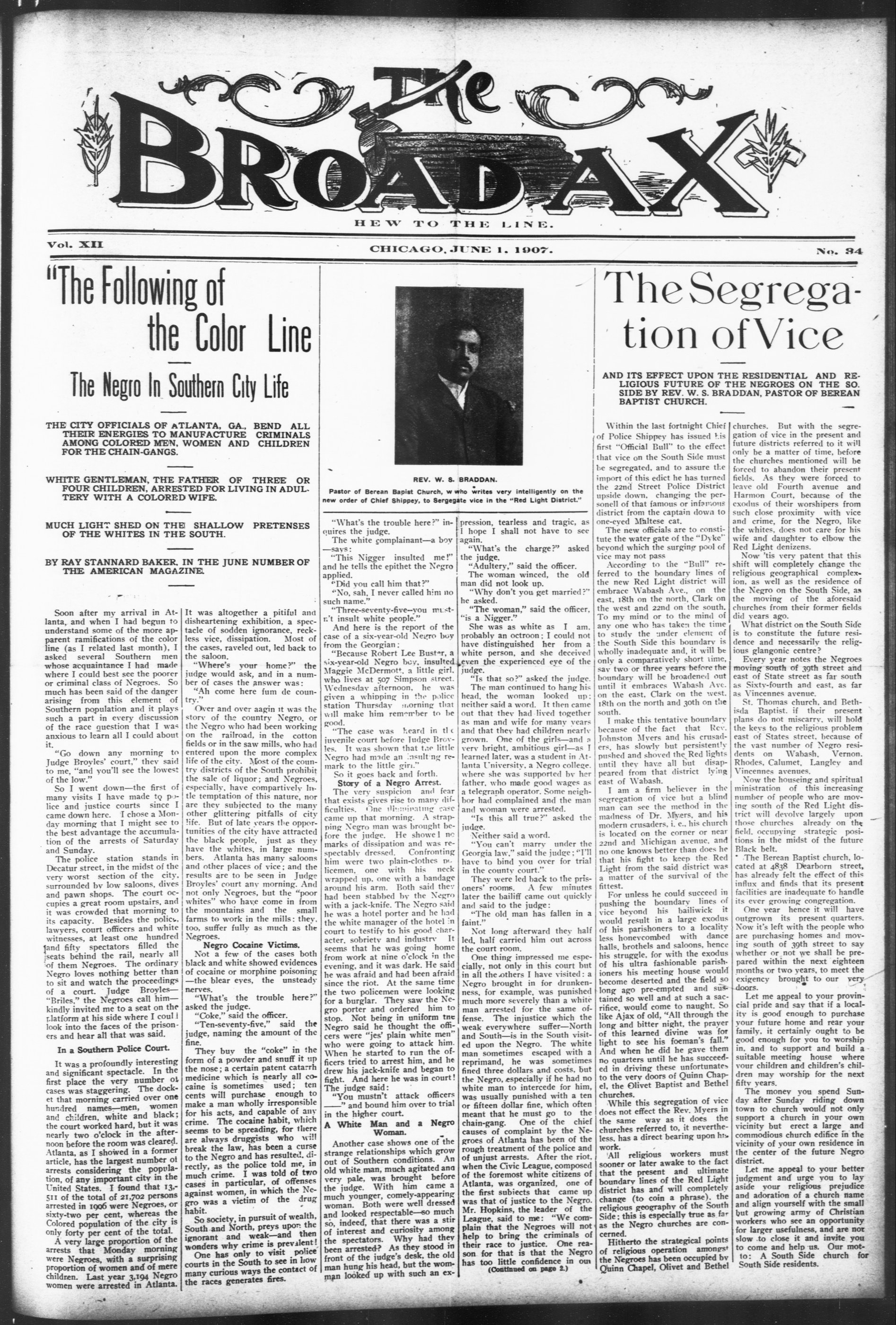
REV. W. S. BRADDAN.
Pastor of Berean Bapist Church, w who writes very intelligently on the new order of Chief Shippey, to Sergegate vice in the "Red Light District."
Pastor of Berean Baptist Church, w who writes very intelligently on the new order of Chief Shippey, to Sergeate vice in the "Red Light District."
"What's the trouble here?" inquires the judge.
The white complainant—a boy—says:
"This Nigger insulted me!" and he tells the epithet the Negro applied.
pression, tearless and tragic, as I hope I shall not have to se again.
"What's the charge?" ask the judge.
"Adultery," said the officer.
The woman winced, the ol
"Did you call him that?"
"No, sah, I never called him no such name."
"Three-seventy-five--you mustn't insult white people."
And here is the report of the case of a six-year-old Negro boy from the Georgian:
"Because Robert Lee Buster, a six-year-old Negro boy, insulted Maggie McDermott, a little girl, who lives at 507 Simpson street. Wednesday afternoon, he was given a whipping in the police station Thursday morning that will make him remember to be good.
"The case was heard in the juvenile court before Judge Broyles. It was shown that the little Negro had made an insulting remark to the little girl."
So it goes back and forth.
The very suspicion and fear that exists gives rise to many difficulties. One illuminating case came up that morning. A strapping Negro man was brought before the judge. He showel no marks of dissipation and was respectably dressed. Confronting him were two plain-clothes policemen, one with his neck wrapped up, one with a bandage around his arm. Both said they had been stabbed by the Negro with a jack-knife. The Negro said he was a hotel porter and he had the white manager of the hotel in court to testify to his good character, sobriety and industry. It seems that he was going home from work at nine o'clock in the evening, and it was dark. He said he was afraid and had been afraid since the riot. At the same time the two policemen were looking for a burglar. They saw the Negro porter and ordered him to stop. Not being in uniform the Negro said he thought the officers were "jes' plain white men" who were going to attack him. When he started to run the officers tried to arrest him, and he drew his jack-knife and began to fight. And here he was in court! The judge said:
"You mustn't attack officers ____" and bound him over to trial in the higher court.
A White Man and a Negro Woman.
Another case shows one of the strange relationships which grow out of Southern conditions. An old white man, much agitated and very pale, was brought before the judge. With him came a much younger, comely-appearing woman. Both were well dressed and looked respectable—so much so, indeed, that there was a stir of interest and curiosity among the spectators. Why had they been arrested? As they stood in front of the judge's desk, the old man hung his head, but the woman looked up with such an ex-
pression, tearless and tragic, as I hope I shall not have to see again.
"What's the charge?" asked the judge.
"Adultery," said the officer.
The woman winced, the old man did not look up.
"Why don't you get married?" he asked.
"The woman," said the officer, "is a Nigger."
She was as white as I am, probably an octroon; I could not have distinguished her from a white person, and she deceived even the experienced eye of the judge.
"Is that so?" asked the judge. The man continued to hang his head, the woman looked up; neither said a word. It then came out that they had lived together as man and wife for many years and that they had children nearly grown. One of the girls—and a very bright, ambitious girl—as I learned later, was a student in Atlanta University, a Negro college, where she was supported by her father, who made good wages as a telegraph operator. Some neighbor had complained and the man and woman were arrested.
"Is this all true?" asked the judge. Neither said a word. "You can't marry under the Georgia law," said the judge; "I'll have to bind you over for trial in the county court."
They were led back to the prisoners' rooms. A few minutes later the bailiff came out quickly and said to the judge:
"The old man has fallen in a faint."
Not long afterward they half led, half carried him out across the court room.
One thing impressed me especially, not only in this court but in all the others I have visited: a Negro brought in for drunkenness, for example, was punished much more severely than a white man arrested for the same offense. The injustice which the weak everywhere suffer—North and South—is in the South visited upon the Negro. The white man sometimes escaped with a reprimand, he was sometimes fined three dollars and costs, but the Negro, especially if he had no white man to intercede for him, was usually punished with a ten or fifteen dollar fine, which often meant that he must go to the chain-gang. One of the chief causes of complaint by the Negroes of Atlanta has been of the rough treatment of the police and of unjust arrests. After the riot, when the Civic League, composed of the foremost white citizens of Atlanta, was organized, one of the first subjects that came up was that of justice to the Negro. Mr. Hopkins, the leader of the League, said to me: "We complain that the Negroes will not help to bring the criminals of their race to justice. One reason for that is that the Negro has too little confidence in our (continued on page 2.)
The Segregation of Vice
AND ITS EFFECT UPON THE RESIDENTIAL AND RELIGIOUS FUTURE OF THE NEGROES ON THE SO. SIDE BY REV. W. S. BRADDAN, PASTOR OF BEREAN BAPTIST CHURCH.
Within the last fortnight Chief of Police Shippey has issued his first "Official Bull" to the effect that vice on the South Side must be segregated, and to assure the import of this edict he has turned the 22nd Street Police District upside down, changing the personell of that famous or infamous district from the captain down to one-eyed Maltese cat. The new officials are to constitute the water gate of the "Dyke" beyond which the surging pool of vice may not pass
According to the "Bull" referred to the boundary lines of the new Red Light district will embrace Wabash Ave., on the east, 18th on the north, Clark on the west and 22nd on the south. To my mind or to the mind of any one who has taken the time to study the under element of the South Side this boundary is wholly inadequate and, it will be only a comparatively short time, say two or three years before the boundary will be broadened out until it embraces Wabash Ave. on the east, Clark on the west, 18th on the north and 30th on the south.
I make this tentative boundary because of the fact that Rev. Johnston Myers and his crusaders, has slowly but persistently pushed and shoved the Red lights until they have all but disappeared from that district lying east of Wabash.
I am a firm believer in the segregation of vice but a blind man can see the method in the madness of Dr. Myers, and his modern crusaders, i. e., his church is located on the corner or near 22nd and Michigan avenue, and no one knows better than does he that his fight to keep the Red Light from the said district was a matter of the survival of the fittest
For unless he could succeed in pushing the boundary lines of vice beyond his bailiwick it would result in a large exodus of his parishoners to a locality less honevcombed with dance halls, brothels and saloons, hence his struggle, for with the exodus of his ultra fashionable parishioners his meeting house would become deserted and the field so long ago pre-empted and sustained so well and at such a sacrifice, would come to naught. So like Ajax of old, "All through the long and bitter night, the prayer of this learned divine was for light to see his foeman's fall." And when he did he gave them no quarters until he has succeeded in driving these unfortunate to the very doors of Quinn Chapel, the Olivet Baptist and Bethel churches.
While this segregation of vice does not effect the Rev. Myers in the same way as it does the churches referred to, it nevertheless, has a direct bearing upon his work.
All religious workers must sooner or later awake to the fact that the present and ultimate boundary lines of the Red Light district has and will completely change (to coin a phrase), the religious geography of the South Side; this is especially true as far as the Negro churches are concerned. Hitherto the strategical points of religious operation amongst the Negroes has been occupied by Quinn Chapel, Olivet and Bethel
No. 34
egrega-
ofVice
THE RESIDENTIAL AND RE-
THE NEGROES ON THE SO.
ADDAN, PASTOR OF BEREAN
churches. But with the segregation of vice in the present and future districts referred to it will only be a matter of time, before the churches mentioned will be forced to abandon their present fields. As they were forced to leave old Fourth avenue and Harmon Court, because of the exodus of their worshipers from such close proximity with vice and crime, for the Negro, like the whites, does not care for his wife and daughter to elbow the Red Light denizens. Now 'tis very patent that this shift will completely change the religious geographical complexion, as well as the residence of the Negro on the South Side, as the moving of the aforesaid churches from their former fields did years ago. What district on the South Side is to constitute the future residence and necessarily the religious glangonic centre?
Every year notes the Negroes moving south of 39th street and east of State street as far south as Sixty-fourth and east, as far as Vincennes avenue.
St. Thomas church, and Bethisda Baptist, if their present plans do not miscarry, will hold the keys to the religious problem east of States street, because of the vast number of Negro residents on Wabash, Vernon. Rhodes, Calumet, Langley and Vincennes avenues.
Now the houseing and spiritual ministration of this increasing number of people who are moving south of the Red Light district will devolve largely upon those churches already on the field, occupying strategic positions in the midst of the future Black belt.
* The Berean Baptist church, located at 4838 Dearborn street, has already felt the effect of this infux and finds that its present facilities are inadequate to handle its ever growing congregation.
One year hence it will have outgrown its present quarters. Now it's left with the people who are purchasing homes and moving south of 39th street to say whether or not we shall be prepared within the next eighteen months or two years, to meet the exigency brought to our very doors.
Let me appeal to your provincial pride and say that if a locality is good enough to purchase your future home and rear your family, it certainly ought to be good enough for you to worship in, and to support and build a suitable meeting house where your children and children's children may worship for the next fifty years.
The money you spend Sunday after Sunday riding down town to church would not only support a church in your own vicinity but erect a large and commodious church edifice in the vicinity of your own residence in the center of the future Negro district.
Let me appeal to your better judgment and urge you to lay aside your religious prejudice and adoration of a church name and align yourself with the small but growing army of Christian workers who see an opportunity for larger usefulness, and are not slow to close it and invite you to come and help us. Our motto: A South Side church for South Side residents.
THE BROAD AX.
"Will promulgate and at all times uphold the true principles of Democracy, but Catholic, Protestant, Polish, Indelbe, Farmare, Single Taxes, Republic, and so on, any one can have responsibility is fixed. The Broad, is a newspaper whose platform is broad enough for all, ever claiming the editorial right to speak its own mind. Local communications will receive attention. Write only on one side of the paper."
Entered vt the Post Office at Chicago
IB. as Second-class Matter.
Mayor Busse Cleaned Out the Members of the Board of Education
Several weeks ago Mavon Busse, decided to remove all the members of the Board of Education, who refused to dance to his music, and who were not in favor of permitting the Chicago Tribune to pay little or almost no rent for the school ground its building stands upon the corner of Dearborn and Madison streets
And last Monday evening Mayor Busse cleaned out all the members of the Board of Education who refused to fall down and worship him like a god, and in order to pay his debt to the Tribune for the support it rendered him in his contest with Edward F. Dunne, and to further build up his strong political machine he selected the following members and retained the old members of that body who are in favor of dragging politics into the public schools of Chicago.
New Members of Board.
Chester M. Dawes, to succeed George Duddleston, resigned, Theodore W. Robinson, to succeed Dr. James F. Chvatal, resigned; Daniel R. Cameron, to succeed Charles O. Sethness, resigned; Otto C. Schneider, to succeed Dr. C. A. Weil, resigned; John R. Morron, to succeed Emil W. Ritter, resigned; Severt T. Gunderson, to succeed Dr. W. A. Kuflewski, resigned; Dr. Alexander Blackwood, to succeed Dr. Cornelia De Bey, removed; Geo. Limbert, to succeed Raymond Robins, removed; Frank C. Waller, to succeed Wiley W. Mills, removed; George F. Trumbull, to succeed Louis F. Post, removed; Dr. Alfred D. Kohn, to succeed J. J. Sonsteby, removed.
Holdover Members of Board.
Dr. Rufus A. White, Mrs. Emmons Blaine, Miss Jane Addams,
Dr. John Guerin, P. Shelly O'Ryan, Modie J. Spiegel, Mrs.
W. C. H. Keough.
Vacancies Not Filled
John J. Hayes, removed; John C. Harding, removed; Philip Angsten, removed.
Otto C. Schneider, has been chosen president of the Board and Rev. Rufus A. White vice-president.
The ousted members of the Board will continue their fight in the courts for the purpose of contesting the right of Mayor Butse to remove them before their terms expired and without a just cause!
Democrats Appoint Pueblo Negro
to an Important Position.
Dr. S. A. Huff, a prominent physician and surgeon of Pueblo, and a member of the executive committee of the Colorado Negro Business League, has been appointed police surgeon by a Democratic administration.
It is reported that the eighteen hundred Colored voters of Pueblo under the fearless and able leadership of Lawyer W. B. Townsend demanded of the Republican managers better recognition for the Colored vote, which has for many years been cast unanimously for the Republican ticket and upon being notified that they could not receive the recognition demanded they immediately started a revolt and formed a combination with the Democratic nominees, who were successful in the recent election and as a result the Pueblo Colored citizens are rejoicing over the splendid recognition of this very able gentleman.—Ex.
White man Remembers His Negro Children.
Leaves Bulk of His Estate to Them—Jury Sustains Will.
Special to The Citizen:
Little Rock, Ark., Thursday.
A jury in the Pulaski Circuit Court today sustained the will of Peter J. King, a wealthy
white citizen of Little Rock. The sisters and brothers of King, who live in Pennsylvania, sought break the will because practically all of the property is left to the Negro relatives, and Charles B. King, a Negro, is named as one of the executors.
Charles B. King, a Negro son, was left property in Little Rock and Argenta. Sam B. King, another Negro son, was also left property in this city, while their mother was given a home and $6,00 in money. Out of the $20,000 life insurance which he carried, King left $2,000 each to his seven white relatives.—The Citizen, Memphis, Tenn.
IMPRISONMENT FOR DEBT
U. S. Supreme Court Upholds Pennsylvania Law Passed in 1842.
The Supreme Court of the United States has denied to George H. Crawford, of Cameron county, Pa., the privilege of filing a writ of habeas corpus. He is imprisoned in Lycoming county on the charge of attempting to defraud a creditor. Crawford, being indebted to Marie P. Johnson in the sum of $27,000, is alleged to have left the county to avoid payment, and was arrested under the act of 1842, authorizing imprisonment under such conditions. The effect of the decision is to leave in effect the decision of the Pennsylvania courts.—Ex. Look out Col. "Pony" Moore for the crowing of the cock!
Negro Bank to Be Organized.
First Concern of Its Kind North of Mason and Dixon Line Will Be at Toledo. O.
Toledo, O., May 26.—A national bank for Negroes will be organized here with Toledo, New York, Cleveland, and Washington capital. It will be the first Negro bank north of the Mason and Dixon line.
There is more than enough idle money in the banks in Chicago belonging to Afro-Americans which if they would become united, they could put their money together and start a sound little National bank in this city, not for Colored people alone, but for anybody who had any banking business to transact.
Now is the time for the leading Colored business men in Chicago to wake up and get a move on themselves.
FOLLOWING THE COLOR LINE.
Concluded from page 1.)
courts. We must give him that, above all things."
In accordance with this plan, the Civic League, heartily supported by Judge Broyles, has already employed and is paying a young lawyer, Mr. Underwood, to appear regularly in court and look after the interests of Negroes. Other plans, including the possible employment of Negro policemen, to arrest Negroes only, are under consideration.
Convicts Making a Profit for Georgia.
One reason for the very large number of arrests—in Georgia particularly—lies in the fact that the state and the counties make a profit out of their prison system. No attempt is ever made to reform a criminal, either white or Colored: convicts are hired out to private contractors or worked on the public roads. Last year the net profit to Georgia from its chain-gangs, to which the prison commission refers with pride, reached the great sum of p45,853.55.
Of course a very large proportion of the prisoners are Negroes. The demand for convicts by rich saw-mill operators, owners of brick-yards, large farmers and others is far in advance of the supply. The natural tendency is to convict as many men as possible—it furnishes steady, cheap labor to the contractors and a profit to the state. Undoubtedly this explains in some degree the very large number of criminals, especially Negroes, in Georgia. One of the leading political forces in Atlanta is a very prominent banker who is a dominant member of the city police board. He is also the owner of extensive brick-yards near Atlanta, where many convicts are employed. Some of the large fortunes in Atlanta have come chiefly from the labor of chain-gangs of convicts leased from the state. I have looked into other phases of the chain-gang system, of which I shall have more to say.
(To be Continued.)
THE LATE JOHN FITZGERALD.
The sudden death of former Justice John Fitzgerald, who was stricken down with apoplexy Tuesday forenoon on Wabash avenue near Van Buren street, was a great blow to his many friends, for as he was always the very picture of health, they least expected that his earthly existence would be ended in such a manner, without giving him one moment's time to prepare to meet death.
Very few men were better known in the Town of Lake than John Fitzgerald for many years he presided over the police court in the stock yards district, and as a general rule, if it was possible, he would show mercy to the poor and the unfortunates who were brought before him, and at all times we honestly believe he endeavored to give his fellowmen a square deal and by his sudden death he will be greatly missed by those who knew him well in the Town of Lake.
Institutional Church and Social Settlement. 3845 Dearborn St.
The pastor will preach at both the morning and evening services. Juvenile choir will sing at the morning services and the orchestra and voluntary choir at the evening services. The following program will be rendered Organ, Vol., Mrs. Bessie Warren-Weisiger; Doxology, Chanting Lord's Prayer. Hymn by choir and congregation—"Come thou Almighty King." Scripture lesson. Anthem, "Give Ear Unto My Prayer." Sermon, H. E. Stewart, Pastor. Invitation. Hymn No. 302, "Almost perfect." Offertory. Vocal Solo—"Babylon," Mrs. Alexander. Anthem—"Have Mercy on Me." Benediction.
Contest, bazar. and musical treat, June 25, 26, 27. Splendid program each night. Great organ contest. The proceeds of this Bazar for the decorating of the church. Season ticket, 35c.—"S."
WEST SIDE NEWS BY PROF. A. L.
SIMPSON.
Mrs. Wilson has just opened a southern eating house and store at Lake and Leavitt streets. If you want a good home cooked meal call around. Special Sunday dinner.
Mr. Samuel Whorton, a popular West side young man, for a number of years kept company with Mrs. Boone a rich widow very sorry to say Mr. Whorton has lost a hard fought battle the widow has engaged herself to another young man and the wedding isn't far off—and Sam laughed.
Dr. Charles Pickett has taken up the practice of medicine in the city again.
The west side Sunday Club is having better order at present, they have just appointed a sergeant-at-arms.
The drama rendered at Providence Baptist church, last Monday evening was a grand success.
If you want The Broad Ax mailed to your house please notify A. L. Simpson, 753 Fulton st.
Mrs. M. Burroughs 920 W. Lake st., is on the sick list again. We wish her a speedy recovery.
Mrs. Anna Peirce 920 West Lake st., is on her feet again after a short illness.
Have your feet conditioned for the summer by Prof. A. L. Simpson, 753 Fulton st.
Mr. James Edwards a few days ago was arrested for keeping a 16 year old girl away from home one week.
Mr. Edwards will be free in a few days as he consents to marry the girl.
The West Side Sunday Club was well entertained by the North Side People's Club last Sunday at 4 p. m. Prof. A. L. Simpson was the hit of the day with a few of his original jokes and paper.
The Charity Ball at Douglas Hall, Tuesday evening, under the direction of Prof. and Mrs. Wm. Emanuel was a great social and financial success. A large sum was realized for the social settlement for which it was given. Mr. and Mrs. Emanuel was assisted in caring for their many guests, by Dr. Robert Harden and Mr. Julius N. Avendorph.
Miss Brockway, graduate nurse of Provident Hospital has moved to 3722 Dearborn st.
Mr. Joe Williams, 394 33rd st., died with consumption, last Friday and was buried Sunday.
Mr. M T. Bailey, 3638 State st., graduated from the Illinois College of Law, Tuesday evening.
Mr. Robert Allen of Columbus, O., spent last week in the city, stopped at the Keystone Hotel.
Mr. and Mrs. Chas. Williams entertained their "Dixie Jubilee Co." at the Pekin Theatre, Monday evening.
Rev. T. A. Clark 3600 Forest ave., is becoming himself again, after passing through a severe sickness.
Hon. Lawrence A. Young has removed his law offices from the Ashland Block, to the Rookery building.
It is reported that Mr. Bennie Summers a popular young man about town will soon wed one of the belles of St. Louis.
"Sargent Rufus" is the name of the next play by Alfred Anderson that will be produced at the New Pekin Theater.
Mr. Will Jackson of Nashville, Penn., is spending the summer in the city the guest of his uncle Mr. Jacobs, 318 32nd st.
Mr. John Slaughter of Milwaukee, Wis., who had his thumb amputated left the city for his home Wednesday.
Mr. John L. Fry, proprietor of the Keystone Hotel was appointed Quarter-master Sargent of the 8th Regiment and was seen in the parade Sunday.
Alderman, P. J. O'Connell, and family have removed from 522 West 63rd street, into a fine new home, 5958 Normal ave., which the honest Alderman of the 31st ward recently bought.
Mr. and Mrs. John T. Montgomery, 4743 Shields ave., are for the present residing at 5530 Armour ave., and on or about Sept. 1. They will move into a home of their own which they lately purchased at 5436 Dearborn st.
The Russell Packing Company which is so successfully managed by former Alderman John T. Russell, have removed their store from 5101 South Halsted street, to 6151 Halsted street, where they have one of the finest places of its kind on the Southwest side.
The Special Edition of The Bystander, Des Moines, Iowa, Saturday, May 25th, reflects much credit on Editor Thompson and his able assistants; it was illustrated with cuts and interesting sketches of many of the most prominent Afro-American men and women residing in that enterprising city, and on the whole it reached the top notch in Negro Journalism.
The one hundred and five salesmen employed by McNell and Higgins Co. wholesale groceries 27 South market street, were tendered a banquet, by the Erlich Mfg. Company, at the Sherman House, last Saturday evening, Robert J. Roulston one of the best hustlers connected with that well-known firm gracefully served as toastmaster.
Carter H. Harrison, at one time Mayor of Chicago, who has been spending the past winter in Cal., returned to the city the latter part of last week, and he is stopping at the Virginia Hotel, and some of his warm friends and former supporters in his political battles, are getting his boom in shape, to secure the nomination for President of the United States in 1908.
On Sunday., May. 26th. Frank A. Mead, age 47 years, 5120 Indiana ave. suddenly departed this life in Milwaukee, Wis. Mr. Mead is the oldest son of Mr. and Mrs. G. W. Mead who are well known among Chicagos oldest citizens. A wife two sisters, three brothers and his father survive him. Funeral services were held over the remains at St. Thomas Episcopal Church, Friday at 3 p. m. Father Massiah officiating. The body accompanied by his wife and sister, Mrs. Harris was taken to Louisville, Ky., for burial.
Mrs. William McKinley died early Sunday morning at her home in Canton, O., surrounded by many of her friends of childhood days. Mrs. McKinley had for many years been an invalid, and it was something remarkable that she withstood the terrible shock of the sudden death of her husband and survived his death almost six years. She was laid to rest by the side of her husband in West Lawn Cemetery at Canton. Her plain and simple funeral was attended by Pres. Roosevelt, Vice pres., Fairbanks and many other distinguished men.
A white man has just been arrested in Lynchburg for throwing a shoe at a Negro woman and it developed at the trial that the Negro woman is his wife, they having been married in Pennsylvania. The trouble with both of these people is the fact that they had not sense enough to disgrace themselves like thousands of white men and Negro women do in the South. If they had only said that woman was the cook, the laundress, the house keeper, anything but the wife, there would have been no further questions asked and no possible trouble experienced.—The Star Newport, News, Va.
THE PENN-JONES, CO'S SCALP AND SKIN FOOD IS THE BEST ON THE MARKET.
For one thousand years you have wanted it, and now you have it, for it has been tested and it is the best on the market, we refer to the Penn-Jones skin and scalp food, which you should use.
Prof. Penn's new discovery gives new life to the hair by cultivating the roots, you can throw away the irons—use this remedy and have good hair, for by using it there is no need of having bad hair.
If you do as the farmer does cultivate the roots by using Prof. Penn's skin and scalp food and by rubbing it in it will do the work, or your money refunded.
This new and wonderful skin and scalp food is for sale by the Penn-Jones Co., 3842 State street, and by the leading druggists.
American Cleanliness.
It has always been our boast that the English are the apostles of cleanliness. Perhaps it would now be advisable to reconsider that contention. The American has replaced our dingy, dirty looking tram cars with clean, alty and roomy vehicles. He has transformed our dismal and filthy underground railways into reasonably bright and well ventilated systems, and he has substituted for our dreary private hotels the speckless palaces we have seen arise almost as if by magic. All those improvements we could have effected ourselves if we had really been so devoted to cleanliness as we imagine we are. How surpassingly charming we Englishmen would be were we not so perfect—in our own estimation—London Truth.
Enormous Flow of Words.
A committee clerk at the house end of the capitol estimates that as a result of the deliberations of the recent short session of congress the literature of the year has been enriched by the addition of 9,000,000 words. This stupendous verbal output was printed in the Congressional Record and consisted of speeches, reports of various kinds and the presidential messages, of which, for one reason and another, there were an unusual number and variety. The session consumed only seventy-one legislative days, the average duration of which was a little less than five hours each. Thus the verbal output per hour of the nation's statesmen the past winter was 24,000, a record, it is believed, unsurpassed in the modern history of parliaments.
Working Out His Poll Tax
This is the story of the difficulty of compelling a Tonkawa Indian to work out his poll tax: "Kapitan worked about fifteen minutes and then struck for a four hour day. This was granted. In another fifteen minutes he struck again for lemonade to drink instead of water. This was allowed. Then the street commissioner got a gun and told Kap the striking season was over. So Kap worked until noon. Just as the school bell rung for 12 o'clock Kap ran a twenty penny nail through his foot. The boss wanted to pull it out, but Kap said: 'No, you don't; not in the noon hour. Wait until 1 o'clock.' Kap had a sunstroke in the afternoon, but otherwise he got through the day very pleasantly."—Nardin (Okla.) Star.
"Motor Heart" In Dogs
"Motor heart" in dogs is a new disease, says one of the king's veterinary surgeons. "The motor car possesses a curious fascination for dogs. They enjoy the swift motion, the exciting, scorching rush through the air as much as their masters. But the veterinary surgeon in many cases is obliged to curb this canine fondness for the car, because of the injurious effect the sport has on a dog's heart."
The symptoms of "motor heart" in dogs are enlargement, flabbiness and general weakness of that organ. The dog looks restless and excited. The heartbeats are rapid and weak. Breathing is difficult and distressed. The only cure is total abstinence from car rides—London Mall.
Magnetite Lamps
Among the more recent forms of are lamps are those in which a stick of magnetite is substituted for carbon in the negative terminal. The magnetite lamp is the result of efforts to find a substance capable of withstanding exposure in an open arc and giving a white light instead of the orange color of the brilliant flame carbon lamps. To increase its efficiency a small percentage of other metallic oxides is added to the magnetite. It is found that the flame in these lamps is fed only by the negative electrode, the magnetite stick, which alone needs to be replaced from time to time, the positive terminal, composed of copper, not being consumed.—Youth's Companion.
THE HALL OF FAME
George J. Gould is disposing of his stable of polo ponies and is withdrawing from the game temporarily.
Michael Leavitt of Milliford, N. H., who claims he is 110 years old, walked three and a half miles recently just for exercise, he said.
Ex-Mayor Burke of Burlington, Vt., who lately retired from office, is a capable blacksmith. A few days ago he shod fifty-two horses "all round."
Representative and Mrs. Nicholas Longworth expect to spend a month in Alaska the coming summer. They will leave their home in Cincinnati about July 1.
Alma, the one-year-old daughter of Mr. and Mrs. Harry Reiter of Red Hill, Pa., enjoys the distinction of having four living great-grandmothers and two grandmothers.
Eleven years ago Elmer Chase of Milo, Me., got a large splinter in his hand, which has caused him so much annoyance that the other day he had a physician extract it.
Gabriele d'Annunzio has refused an offer of $16,000 to deliver eight lectures in, South America. In refusing he wrote, "I have no wish to brave the ocean for a box of cigars."
Dinizulu, the Zulu chief once widely known and feared in war, has a graphophone with which he entertains his guests. He has also an organ, built in England, on which he plays himself.
To have served forty-six years without having a single criticism passed upon his work is the record of Assistant Chief Edwin Williams of the Hartford (Conn.), fire department, who now resigns.
Lionel Walter Rothschild, who is spending $100,000 on a history of extinct birds, is a member of the famous family of bankers. He is a son of the first English Baron Rothschild and possesses an immense fortune.
Charles A. Elch of Cohasset, Mass., now that Thomas Wigglesworth is dead, is Harvard's oldest living graduate. He was eighteen years old when he was graduated in the class of '33. He is ninety-two years old and has practiced law nearly seventy years in Boston.
When John Burns entered the British cabinet, there were rumors that he would refuse to don the cocked hat and epaulets of official uniform. The king asked him about it. "Not true," replied Mr. Burns, "and, besides, I have already worn your majesty's uniform." The king naturally asked when that was. "When I was in Pentonville," answered Mr. Burns, alluding to his three months' sentence after the Trafalgar square riots.
FACTS FROM FRANCE
The French government is taking steps to stop the promiscuous wearing of foreign uniforms in France. The reason is that they are often used to promote and cloak fraud. France, with her population of less than 40,000,000, has a national indebtedness of more than $6,000,000,000, or about $156 per capita. The debt charges alone entail a burden of more than $6 a year on every man, woman and child. M. Bovet, director of the postoffice at Lausanne, France, has notified the postal employees in the town that in future toothache will not be an excuse for absence from work. They must either get the tooth out or get out themselves.
A Parisian couple, M. Lebon and his wife, who are being divorced and are dividing their effects, have spent $15,000 on law in a wrangle over the possession of a collection of postage stamps. An expert is to be engaged to divide the collection equitably.
LEARNING THEIR PARTS
William Gillette memorizes new parts on long country walks.
Ethel Barrymore, seated before the fire, has her maid or secretary read her new parts aloud till she has mastered them.
Mme. Bernhardt rarely attempts to memorize a part save in the presence and with the help of the playwright.—New York Press.
Richard Mansfield learns new parts in the morning, walking up and down his library. One morning often suffices for the longest role.
Nat Goodwin learns a new part by saying it into a phonograph, which then repeats it over and over to him until he knows it perfectly.
Henry E. Dixey finds that his mind is at its best for mastering new parts late at night, and accordingly he will often remain at his desk till sunrise, a manuscript before him, his lips moving rapidly.
ENGLISH ETCHINGS
A firm in business on Oxford street, London, has just insured for $1,000,000 against earthquakes. Some of the saloons in Liverpool display the sign, "Ladies Cannot Be Served Without Their Hats On." In London's new criminal court, on the Old Ballay site, prisoners will climb up white marble stairs to reach the dock. In a recent municipal election at Chard, England, two male candidates withdrew in order that two women might have an uncontested election. London firemen get one day's leave in fifteen and a short annual holiday. They begin on 25 shillings a week and do not rise to the full wage of 35 shillings until after ten years' service.
PASSPORTS
The Strict Regulations, That Are Enforced in Russia.
There are very few countries where travelers now require passports in order to promote their convenience and security. In Brazil and Venezuela a passport must be shown to the officials before one is allowed to leave the country for a foreign port—a vexation measure, enforced apparently for the sake of enabling a few officials to collect small fees.
In Russia, as is well known, passport regulations are enforced with the greatest stringency. No traveler, indeed, is permitted to enter the empire until he has obtained a passport and convinced the Russian consular officers at the port from which he sails that he is neither a Roman Catholic priest nor a Hebrew. The question ordinarily asked is, "What is your religion?" but it is designed to provide against the entry of either of these two classes.
When the traveler arrives at a Russian port with a passport that has been properly vised and countersigned at a consular office, it is critically examined by a police officer and duly registered. At the entrance of the hotel another police officer takes possession of the document and in the course of twenty-four hours returns it with a permit for a limited residence in the country.
It has been said with but little exaggeration that it is as difficult for one to leave Russia as it is to enter it. When the traveler departs for another city in the empire, he must have the passport countersigned by the police. This process continues until he reaches the frontier, which he cannot cross unless the passport has been vised and stamped by the police. Not infrequently tourists are stopped at the frontier and subjected to serious inconvenience because they have neglected to comply with the police regulations respecting passports. All this red tape causes annoyances and irritation among tourists, who are apt to overlook the fact that Russians as well as foreigners are compelled to observe these police regulations. It is the business of the police to know where everybody lodges.
The same system prevails in Turkey, where it is not practicable for a foreigner to travel without a passport. Elsewhere in Europe passports are not required. They are relics of a bygone period when communication between countries was slow and infrequent—San Francisco Chronicle.
Skin Like Armor Plate
When she is in a freakish mood, nature seems to revel in making human beings who are a constant mystery to their fellow creatures. Such a man is Herr Schwartz, the "armor plated man," who is such a puzzle to the doctors of Europe. Herr Schwartz has for some years been undergoing an ossification of the whole of his body and is rapidly developing into the hardness and immobility of a statue. His back now become rigid, the muscles standing out hard and immovable. In fact, he seems to be enveloped in a kind of armor plating, consisting of surface bone as hard as stone. He is no longer able to move his jaws and is compelled to take food in a liquid form through a tube, some of his teeth having been removed for the purpose. And yet this osseous man enjoys excellent health and not long ago was married to a charming young Berlin woman—Boston Post.
Boston's First Building Law.
Two hundred and twenty-six years ago a house was burned in Boston, which led to the promulgation of the first building law. The fact developed at a legislative hearing recently, and when told by Assistant Solicitor Child aroused great interest. The order passed on March 16, 1881, as follows:
"About noon the chimney of Mr. Thomas Sharp's house in Boston took fire. The wind drove the fire to Mr. Colburn's house and burned that down also. For the prevention whereof in our new town indented this somer to be bulled we have ordered that noe man there shall build his chimney with wood nor cover his house with thach, which was readily asented unto."—Boston Herald.
Bagging the Smoke
At nearly all of the large dinners this year a flashlight photograph has been taken of the feast, photographs being developed and ready for the dinner by the time the dinner has been over. Such a thing has not been allowed before by the places where the big dinners are held. That such photographs have been taken this year has been due to an ingenious contrivance which the flashlight man now has for collecting his smoke. This is a large inverted baglite arrangement into which the smoke ascends and is caught so successfully that not a vestige can be detected afterward. Now the flashlight man, instead of being tabooed, seems to be one of the adjuncts of the large public dinners. New York State
Comic Neutrality
International law can sometimes develop a situation that is not devoid of humor. Something of the kind has just happened in Luxembourg. A man who had been arrested in German Lorraine and to be conveyed to Saverne through Luxembourg. On reaching Battembourg, the first station in Luxembourg, he managed to get the carriage open and, leaping to the platform, refused to re-enter the carriage on the ground, that, as the country was neutral, he could neither be compelled nor arrested. He was detained, but the Luxembourg government, by telephone entered his release, while the jailer returned to Lorraine crestfallen—London
FACTS IN FEW LINES
Switzerland has a hotel keepers' school, where hotel keeping is taught in all its branches.
Australia has arranged for the repatriation of a thousand discouraged Australians now in South Africa.
A Baltimore scientist now claims to have discovered that natural gas was used on the altars of many primitive temples.
A Tokyo newspaper remarks "that one day's pay for an American workman in San Francisco represents a fair monthly stipend for a Japanese."
Of the 95,000,000 yards which still remain to be excavated before the Panama canal is finished 43,500,000 are concentrated in the famous Culebra cutting.
Mrs. J. B. Hines of Washington swept her dining room and threw the dust into the kitchen stove. The dust exploded with a loud report and blew the stove to fragments.
What is regarded as the world's shearing record has been established by nine men on Hawkes bay station, Australia. They succeeded in shearing 2,384 sheep in nine hours.
The two new Cunarders are the first vessels to exceed the Great Eastern in beam. They are eighty-eight feet wide as against the eighty-three feet of the levlathan of fifty years ago.
Mrs. James E. Mansfield of Newark, N. J., while on her deathbed wrote this, which has been admitted to probate: "This is my last will. Property, both personal and real, to my husband."
In the thirty-five years that William J. Wheeler of South Paris, Me., has been an insurance agent he has made settlements for damage done by lightning in eleven out of the twelve months of the year.
The fact that $117 a square foot has recently been paid for land in New York city recalls the other alleged fact that the entire Manhattan island was originally bought from the Indians for $24 worth of gewgaws.
A small table that had been many years in an almshouse at Bristol, England, was sent recently with other discarded furniture to an auction room, where it was recognized as a Chippendale and sold for $387.50.
A pack of English foxhounds were recently in full cry after a fox and the field was having a fine run when all at once two sheep dogs jumped out, killed reynard and ended the day's sport there and then to the general disgust. Richard J. O'Mulrenin, M. A. $_{n}$ of Dublin by his will left the violin which was played on Vinegar hill the night before the battle in 1798 to the museum in Kildare street, Dublin. His library was bequeathed to the Gaellic league. Edward B. Condon, who went to Tanana, Alaska, without a dollar three years ago, now owns mining properties worth a million. At a recent dinner given in his honor he burst into tears when presented with a gold watch, for he declared it was the only gift he had ever received.
Sewer system, new water system, fire alarm boxes, electric railways, telephones, new and increased electric light plant, bridges, most extensive harbor improvements and no port duea—all this going on at the one time in Manila means that the city is becoming the American Hongkong, Shanghai or Yokohama.
Fifth avenue, New York, is sometimes spoken 'of in art circles as "Picture lane"' because of the numerous dealers' galleries there or in the side streets just off the avenue. Art, however, is not limited to any one of the city's thoroughfares. Fourth avenue has its share of galleries, and they are also to be found west of Fifth avenue and untown.
Eben Appleton of New York city has in his possession the "star spangled banner" which flew over Fort McHenry and which inspired Francis Scott Key to the composition of his national ode. It is his intention at his death to leave the flag to either one of the national museums at Washington or the Massachusetts Historical museum at Boston.
The men who mechanically handle large sums of money seem to lose the sense of relative value. A customer asked the paying teller of a New York downtown branch bank, "How much money do you usually have on hand when the bank opens?" "Not very much," was the answer; "not over $300,000 or $400,000. We keep the most of it in the main bank uptown."
There is now a canal connection between Milan and Pavla, about twenty-five miles long, through an ancient channel, which has been in use for more than 600 years. Thousands of canal boats from the Po go to Milan every year, pass through the city's canal system, which is founded on the old defensive moats of the middle ages, and proceed northward to the Italian lakes, or vice versa.
Probably the oddest scrapbook in New England is that of William F. Fernald of Old Orchard, Me. It is a big book, devoted exclusively to the preservation of news lore pertaining to appendicitis. Every person, great or small, who has had an attack of appendicitis and a newspaper notice within range of Mr. Fernald acquires a space of record in his book. All phases of the case are noted.
A wonderful family of barbers is that of Benjamin M. Youells, who lives at Easton, Pa., and who, although eighty-seven years old, still wields a razor. Of his nine children, all of whom are living, the three sons are barbers, and two of his six daughters can handle a razor as skillfully as a man. The other four daughters are married to barbers. Nine of his seven grandchildren are barbers, and his seven great-grandchildren say they will become knights of the razor.
CHOICE MISCELLANY
A Tragic Story.
The Glorale nate Di Sicilia, in speaking of the memoirs of the brigand, Gluseppe Salomone, says: "In the introduction the brigand speaks of the tragedy of his life as the result of the hatred for him of the mayor of his native town. Salomone was arrested for aiding in the robbery of a fisherman and, although absolutely innocent, was sentenced through the influence of the mayor to ten years' imprisonment. 'I am not learned and am no writer,' he says, 'and must force myself to write. The reader must overlook my errors of literature when he remembers the hatred which insures me.' He tells of his years of torture in the prisons of Fonombrom, Ancona and Senigallia and of his hope that some day his innocence would be made known. But the full term of ten years had elapsed when he was released, and he hastened to embrace his mother, who believed in his innocence. When he reached his home he found the candles burning near the body of his mother, who had died the night before. 'Then,' he says, 'I vowed vengeance, and at the first opportunity I killed the mayor.' Since then the police have been trailing him, and he knows that finally he will be captured. His closing words are to the jury which will be called upon to decide his fate, to whom he says: 'Remember what drove me to crime—3,650 nights and as many days of agony! Ten times the trices blossomed, ten times the harvest time came, and I, an honest man, in fetters.'"
A Marine Monster of 1800.
"When I saw our latest leviathan warship, the Indomitable, launched at Glasgow the other day," writes a correspondent, "I could not help wondering what our forefathers of a century ago would have thought of her. In 1800 a leading naval authority wrote: 'The size of our ships seems now to have reached its ultimatum. The French indeed have latterly built a ship of most extraordinary size, 172 feet keel, 55 feet 9 inches by the beam, tonnage about 2,850 tons. But she is pronounced to be entirely unit for service.' And yet this marine monster of 1800, whose size made her so unwieldy that 'she hath never been out of harbor,' was but a third as long as our latest cruiser, little more than two-thirds the width and a sixth of the tonnage. In fact, she was relatively so small that she might easily, one would think, have been carried on the Indomitable's deck. Although a fifty acre forest had provided her timbers and it had taken 200 shipwrights a year to build her, her total cost was less than one-tenth that of her successor of today."—Westminster Gazette.
Flowers That Fight:
Many plants and flowers are provided with devices that protect them from undesirable insects and other enemies. The cactus and other prickly plants find their spikes an admirable protection, while several plants exude a sticky liquid which entangles insects endeavoring to climb up the stem. As insects are useful to many flowers in conveying the pollen from the male to the female plants, provision is made to attract those insects which are capable of performing the service and to exclude those which would be of no use to the flower. Several pale flowers, for instance, which attract moths exhale a fragrant odor only in the evening when the moths will be abroad and be attracted thereby. In the day the flowers close and thereby avoid the notice of undesirable insects abroad at that time. Certain plants of the dandelion class actually have bodyguards of ants which repel the attacks of destructive beetles, the ants being rewarded with a sweet nectar deposited by the plant—New York American.
Queer Locomotives In Bolivia.
The Siamese twin effect is the result of a definite purpose and not, as might well be imagined, a freak locomotive made to pull itself apart. This type of engine, built in England for the Bollivian railways, is so constructed on account of the terrific grades, which frequently are as steep as one foot in thirty-five. Under such conditions if a single boiler of necessary length was used all the water would frequently be at one end or the other of the boilers with disastrous results; hence the Fairlie type, as it is known, was designed, using two boilers, each fired independently of the other. The machine is really two small complete locomotives backed together and connected permanently. The water tanks are on each side below the cab floor. The coal storage is in the side tanks above—New York Globe.
The Chinese Jews.
American interest in China since the Boxer rebellion has extended to the Chinese Jews, who settled at Kaifungfu during the Han dynasty, that ruled China from 200 B. C. to 200 A. D. The Kaifungfu colony is mentioned occasionally by European travelers, among them Marco Polo in the fourteenth century, while in 1600 and 1704 they were visited by Jesuit missionaries. Today, according to Alfred K. Glover, writing in the Overland Monthly, the Chinese Jews are almost extinct, but their records and historical tablets are carefully preserved.
North Role as an Auto Station
No less than six automobiles, patterned after the euphoniously named Long Island scooter, are said to be building for various arctic explorers, who will use them in attempts to reach the pole during the summer of 1008. Two of them are under construction for Dr. Frederick A. Cook of Brooklyn, who once accompanied Peary, and a third is for Anthony Fiala of Ziegler expedition fame, while the remainder are for other expeditions.
HUMOR OF THE HOUR
HUMOR OF THE HOUR
Tit For Tat.
Young Stevens was on his way north to spend the week end with his parents and felt in a particularly jovial mood.
The train in which he was traveling had stopped at a small village. As a farmer who was sauntering up and down the platform came opposite Stevens' compartment he was asked by the youth if he knew that the Duke of Devonshire was in the train.
Immediately the man showed great interest and said:
"No. Is he?"
"I think he is not," answered Stevens.
"I only asked if you knew that he was."
The farmer said nothing, but continued his walk on the platform. As he came opposite the window again he remarked that their town had been experiencing some excitement.
"What's the matter?" asked Stevens,
"The authorities wouldn't let some
folks bury a woman," replied the
farmer.
"What was the reason for refusing?"
"She wasn't dead," was the laconic
reply.
And then he strolled away, leaving
young Stevens biting his lip—Judge's
Library.
The Sleepyhead's Choice.
"I see that an eminent physician declares that two hours of sleep before midnight are worth more than six after that hour."
"Nonsense! Two hours of sleep after you're called in the morning are worth more than anything else."—Des Moines Register.
Anything to Oblige
"All the big strawberries," said Miss Housekeep, "are on the top of this box. I can see that."
"Well, m'am," replied the huckster, "if yer'd rather have de little ones on top I'll just turn de box upside down." --Philadelphia Press.
A Has Been Maybe:
Intending Horse Purchaser—You say he's quiet and will pass anything. Owner—Yes. Bystander—I reckon I know something he won't pass. Indignant Owner—What's that? Bystander—The veterinary surgeon.—London Opinion.
Only Fair Play.
A
Wifey—Be to my faults a little blind. Hubby—I'll be a little blind if you'll keep your mouth a little shutter.
Wifey—Be to my faults a little blind. Hubby—I'll be a little blind if you'll keep your mouth a little shutter.
No Chance
"Do you think his interest in art will ever amount to anything?"
"No," answered Miss Cayenne. "He is too well off to become an artist himself and not rich enough to become a connoisseur."—Washington Star.
Not In Her Estimation
"I suppose you regard marriage as a failure."
"No," replied the lady who had secured three divorces. "I've succeeded in getting a fair bunch of allmany each time."—Chicago Record-Herald.
Implacable.
"Jimson's widow threatens to break his will."
"I thought she approved of it?" "Yes, but she can't forgive him for dying during housecleaning time."—Cleveland Plain Dealer.
Delays Are Dangerous.
Miss Gotrox — George, dear, I'm afraid our wedding will have to be postponed.
Mr. Owings — Impossible, darling.
My creditors won't stand for it—St. Louis Post-Dispatch.
"Don't you know the reason some men can't get along in this world?" "No. You tell it." "Well, they're afraid of thunder, and they can't dodge lightning."—Atiana Constitution.
Both Happy.
Boundebout—By the way, old man,
how are you getting along with your
wife now?
Gayboy — Splendidly! We were divorced last week.—New York Life.
The Absentminded Magnate.
Gunbusta—Will you pass the butter,
please?
Railroad Magnate (absentmindedly)
—No, sir; you'll get no pass— Oh,
excuse me! Certainly!—Judge.
His Only Chance
Dreamer—I wish I had an airship.
Dreamer—What for?
Dreamer—I'd like to visit some of my castles in the air—Detroit Tribune.
Went a Whizn
George held her hand and she hold him.
Soon they agreed to want to kisn!
He had him.
Madden'n hope and simply sizzin-
? * ! * ! 0 * ; ? ?
Gege, but George went whit!
- Princeton Tiger.
FACTS IN FEW LINES
American tourists spent $1,110,000 in the Swiss city of Lucerne last year. Twenty-seven thousand vessels enter the port of London in the course of a year. The smoking of dried colt's foot leaves antedated the introduction of tobacco in England. Probably the oldest dog in the state of Maine is Jack, owned by C. E. Freeman of Norway. Mr. Freeman claims that the dog is thirty-two years old. There were 35,918 emigrants from Ireland to England last year, an increase of 4,764 over the previous year, this being the first time in five years that an increase has been recorded. Cocoa importations into the United States are now averaging more than $1,000,000 a month against $250,000 per month a decade ago. Meantime importations of both tea and coffee show a decline.
In his "Queens of Spain" Major Hume says that Isabella I. authorized the burning of 700 persons in Seville alone and condemned 5,000 more to life imprisonment and the confiscation of their property.
Mayor Fitzgerald observed Arbor day by planting an elm tree on Boston Common. The tree is an offspring of the Washington elm at Cambridge, which was presented to the city by Jackson Dawson of the Arnold arboretum.
William Blount of Bayonne, N. J., is only fourteen years old, but has run away from home 100 times. He has been publicly spanked in court and threatened with hanging, but these methods of correction have no effect.
Dr. Paul Prager, an army surgeon of Vienna, suggests that molds of the mouths of prisoners would be much better than finger prints for identification purposes, as the palate remains absolutely unchanged throughout life.
A complete set of the signatures of the signers of the Declaration of Independence recently sold in New York for $2,850. A Portsmouth (N. H.) man has a nearly complete set and which includes that of Button Gwinnett, which is very rare.
Northeast Australia develops very slowly. Farmers grow maize in the old fashioned way. The maize crop in Queensland this year is a record one. Canning pineapples is becoming an important industry in Queensland. Opal mining is growing steadily.
The lack of railroad transportation has been the main cause of keeping the state of Sinaloa from taking her position as one of the leading and largest states of Mexico, it having 35,000 square miles of splendid farming land and thousands of rich undeveloped mines.
A little bit of land, not too far from the city, if intelligently cultivated, declares Bolton Hall, author of "Three Acres and Liberty," will support a family and give them a life far more wholesome than they could ever have in the crowded city. Intensive cultivation is the password now. Charles Doolittle Walcott, the new head of the Smithsonian institution For Scientific Research, was state geologist of New York and in 1888 attended the international geological congress in London, where he won much praise for his addresses. Since 1902 he had been secretary of the Carnegie institute. He lives in Washington.
The home of the poet Keats in the Plaza di Spagni, Rome, which is to be preserved as a memorial to Keats and Shelley, will be overhauled, and the floor on which Keats lived will be made into a memorial museum. A fund for the purchase of furniture has been started by Nelson Gay of Boston, secretary of the local committee. Baron d'Estournelles de Constant, one of the prominent figures at the peace congress in New York, is a member of the French senate, an officer of the Legion of Honor, author, lecturer and champion of international arbitration. He came to this country as head of the French section at the congress, and his motto is, "My country's good through the peace of the world."
A New York woman who has employed several Japanese male servants declares that she will have no more of them. "I do not care," she says, "to have a butler or waiter who, however humble he may appear, carries with him the air of knowing more about everything than I do. A Japanese servant will do as he is told, but his manner of doing it suggests that he knows a better way."
According to a Shelbyville correspondent, Combs P. Parrish of that city claims the stump removing championship of Indiana. Parrish has been in the business of stump blowing for twenty-eight years. A few months ago on the Adams farm, near Shelbyville, he removed 2,900 stumps. His record for fast work was in March, when in five days, with the assistance of several men, he blew 2,875 stumps from the ground.
Not only does Henry Vanness of Rockville, Conn., enjoy the distinction of being the only negro railroad conductor in the world, but he has also the honor of being one of the men who have been longest in continuous railroad service in the country, having been employed as a conductor for forty-three years without a break. He has been employed on the New York, New Haven and Hartford railroad since it was opened to traffic in 1863.
Mrs. Anna F. Coston has on Staten Island the oddest laboratory and factory known. It is where the distress signals, her own invention, used in the army and navy, the revenue service and the life saving and lighthouse bureaus, are manufactured. The signal burns with a strong red, white red flame for two minutes and is visible twenty miles away. The formula for the signal light is kept a secret, but a copy is deposited in a vault, and there is no danger of its being lost.
NEW SHORT STORIES
Joke Was on the Jokerz.
During the American civil war several northern soldiers were talking together one day just before the advance upon Corinth. A tall, ungainly raw recruit stepped up to them with a bundle of soiled clothes in his hand. "Do you know where I can get this washing done?" he asked.
Two of the group were practical jokers. A bright thought flashed into their heads and, as the sequel shows, unfortunately found expression. "Oh, yes, we know. Just go up there with
R.
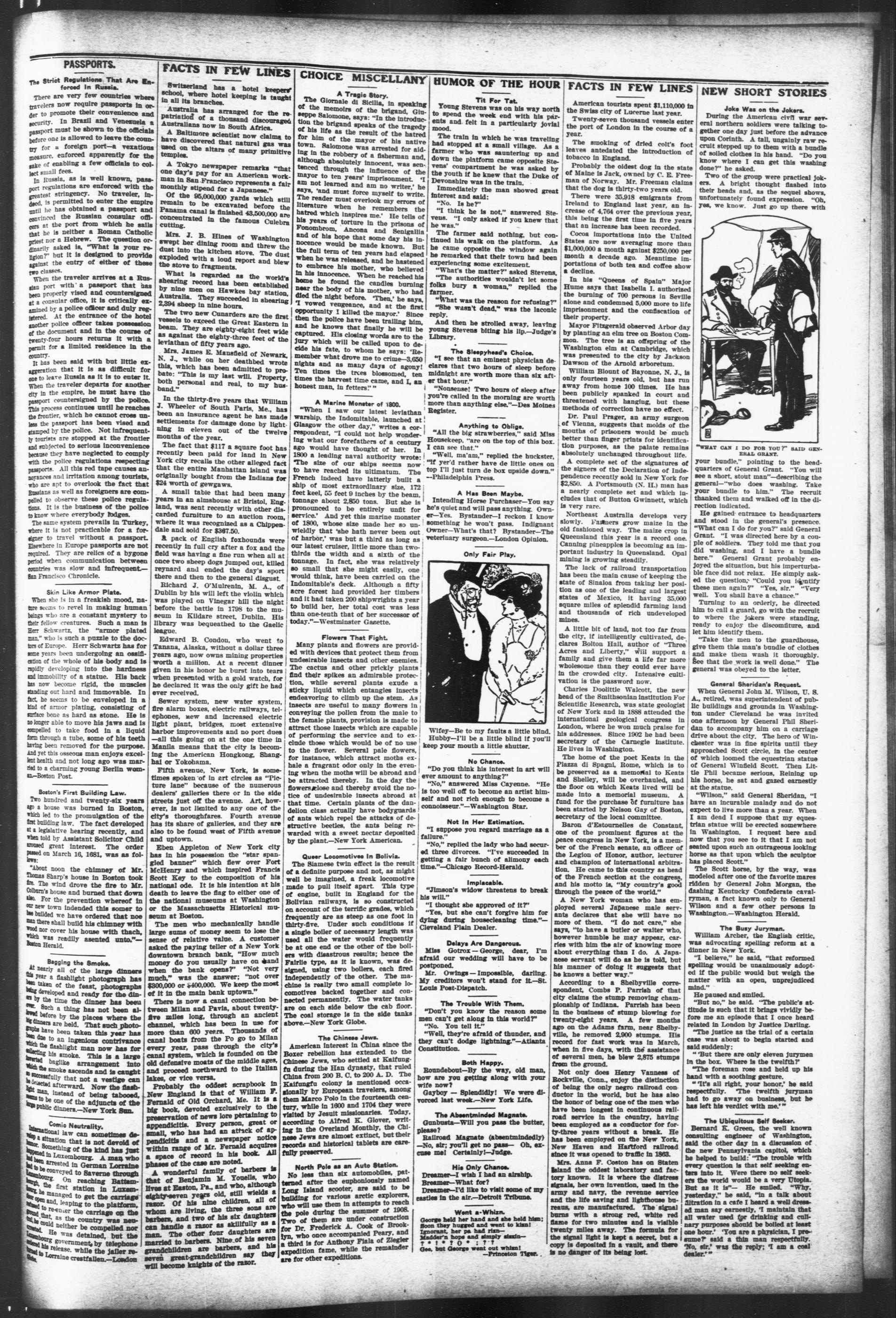
"WHAT CAN I DO FOR YOU?" SAID GENERAL GRANT.
"WHAT CAN I DO FOR YOU?" SAID GENERAL GRANT.
your bundle." pointing to the headquarters of General Grant. "You will see a short, stout man." describing the general—"who does washing. Take your bundle to him." The recruit thanked them and walked off in the direction indicated.
He gained entrance to headquarters and stood in the general's presence. "What can I do for you?" said General Grant. "I was directed here by a couple of soldiers. They told me that you did washing, and I have a bundle here." General Grant probably enjoyed the situation, but his imperturbable face did not relax. He simply asked the question, "Could you identify these men again?" "Yes, sir." "Very well. You shall have a chance."
Turning to an orderly, he directed him to call a guard, go with the recruit to where the jokers were standing, ready to enjoy the discomfiture, and let him identify them.
"Take the men to the guardhouse, give them this man's bundle of clothes and make them wash it thoroughly. See that the work is well done." The general was obeyed to the letter.
General Sheridan's Request
When General John M. Wilson, U. S. A., retired, was superintendent of public buildings and grounds in Washington under Cleveland he was invited one afternoon by General Phil Sheridan to accompany him on a carriage drive about the city. The hero of Winchester was in fine spirits until they approached Scott circle, in the center of which loomed the equestrian statue of General Winfield Scott. Then Little Phil became serious, Reinling up his horse, he sat and gazed earnestly at the statue.
"Wilson," said General Sheridan, "I have an incurable malady and do not expect to live more than a year. When I am dead I suppose that my equestrian statue will be erected somewhere in Washington. I request here and now that you see to it that I am not seated upon such an outrageous looking horse as that upon which the sculptor has placed Scott."
The Scott horse, by the way, was modeled after one of the favorite mares ridden by General John Morgan, the dashing Kentucky Confederate cavalryman, a fact known only to General Wilson and a few other persons in Washington—Washington Herald.
The Buay Juryman.
William Archer, the English critic, was advocating spelling reform at a dinner in New York.
"I believe," he said, "that reformed spelling would be unanimously adopted if the public would but weigh the matter with an open, unprejudiced mind."
He paused and smiled.
"But no," he said. "The public's attitude is such that it brings vividly before me an episode that I once heard related in London by Justice Darling.
"The justice as the trial of a certain case was about to begin started and said suddenly:
"But there are only eleven jurymen in the box. Where is the twelfth?
"The foreman rose and held up his hand with a soothing gesture.
"It's all right, your honor," he said respectfully. The twelfth juryman had to go away on business, but he has left his verdict with me."
The Ubiquitous Self Seeker.
Bernard K. Green, the well known consulting engineer of Washington, said the other day in a discussion of the new Pennsylvania capitol, which he helped to build: "The trouble with every question is that self seeking enters into it. Were there no self seekers the world would be a very Utopia. But as it is"— He smiled. "Why, yesterday," he said, "in a talk about filtration in a cafe I heard a well dressed man say earnestly, 'I maintain that all water used for drinking and culinary purposes should be boiled at least one hour.' 'You are a physician, I presume?' said a thin man respectfully. 'No, sir,' was the reply: 'I am a coal dealer.'"
Fifty-First St. and Armour Ave.
RAIL YARDS: 1st St. & L. S. & N. S. Ry.
2nd St. and Armour Ave.
CHJCAGO
50,000
BOOKS FREE By Mail
treating on all the
50,000
BOOKS FREE By Mall
treating on all the
DISEASES PECULIAR TO MAN.
THIS BOOK contains many illustrations and is a storehouse of knowledge for both old and young
who are suffering from excesses, lost vitality,
nervous disorder, blood poison, stomach
kidney and bladder diseases. It explains how you
can successfully cure yourself at home.
DR. JOS. LISTER & CO.
40 Dearborn St., A-10. Chicago, IL.
Tile and State Hauling a Specialty.
COAL
J. H. COLEMAN & CO.
Express & Van Moving
TRUNKS EVERYWHERE.
2540 State Street
Phone 699 Calumet CHICAGO
Phone Oakland 1828
F. A. Rawlins
The Modern Embalmer
UNDERTAKER AND
FUNERAL DIRECTOR
When his work is finished
you have no displeasure.
4834 State St., CHICAGO
Phone Douglas 1550
ICE CREAM CIGARS, TOBACCO
SHIRT WAISTS KIMONAS
MRS. A. E. BAKER
NOTIONS
419-36TH STREET
Underwear a
Specialty CHICAGO
J. GARNER Tel. Douglas 325
THE ELITE BUFFET
FINE WINES, LIQ'SORS
AND CIGARS
3030 State Street CHICAGO
MCAIL MOTHER
10
15
MCAIL MOTHER
50
YEAR
REINING AFTER BURN
There are two Moaïl Patterson so called to the world. One is Moaïl Patterson, the other is an account of their life, memory and simplicity. Moaïl Patterson's Magnitude (The Queen of Problems) have some unreliability but any other Lady Magneta, a magnificent lady, is a magnificent lady. It is amazing. Every subject gets a Moaïl Patterson Book. Subscribe today.
Lady Agents Wanted. Hardware premises
Serving the public. Warehouse of the
city and Province Catalogues Displaying are promising
and free. Addressee THE McCALL CO. New York.
Waiters and Cooks
Prefer Our Make
JACKETS - AND LINEN
because they have found them
satisfactory.
Write for complete Catalogue
FREE.
giving full instructions how
to order.
Marcus Ruben (Inc.)
390 State St., CHICAGO.
READY FOR THE PRESS
CHICAGO CAVE DWELLERS
Not for Preachers
320 Pages, Cloth, $1.00
POST PAID
A Story of the Underworld
and the Overworld
By Parker H. Sercombe,
Editor To-Morrow
Magazine, Chicago.
Only a limited edition of
this remarkable book will be
printed. Each copy will be
signed by Sercombe Him-
self and automatically num-
bered from 1 up. First
orders in will get the low
numbers in rotation except
No. 1, which goes to Mrs.
Sercombe.
Address
TO-MORROW MAGAZINE,
For the Signature and Supervision and The New Cincinnati,
2220 Oatmeal Ave.
Chicago, Illinois.
10 CENTS THE COPY. $1 A YEAR.
---
WASHINGTON LETTER
[Special Correspondence.]
[special Correspondence]
It is not such a prosocial world when a hard headed congress will spend $100,000 for a sea altar to sentiment. That is what the rebuilding of the old frigate Constitution means. She has been rebuilt to the exact model of her first self. Again a full rigged ship, she may spread the stately pyramid of snowy canvas which carried her safely from one pursuing fleet and maneuvered her so craftily into position for raking the Guerriere.
The Guerriere's Bell.
They have dug up the Guerriere's bell, too, which will again strike the hours on the frigate's deck as it did from the date of that famous fight to about 1848. This bell has a history of its own, for it was cast by one Peter Ziest of Amsterdam in the year 1260, stolen from Holland by soldiers of the French revolution and was installed on the Guerriere in time for the capture of that ship by the English. When the Guerriere was in turn sunk by the Americans a midshipman sent to save anything removable from her decks brought back the bell.
Wooden Walls and Steel.
When the Constitution was turned out new a second time from Boston, where she was launched in September, 1797, the old ship found a grim looking line of sisters to welcome her return. For years the Constitution has been carried on the navy list as "unserviceable." The fiscal year which sees her return to the active list will see that list decorated with the names of twenty-five modern steel battleships of the first class. This summer sees the American navy with more battleships in commission than any nation except Great Britain.
Six New Battleships.
Of the nineteen battleships on the active list only the Wisconsin and Oregon are in yards under such repairs that take them out of commission temporarily. France, having more battleships built, has but thirteen in commission at this time. Germany has sixteen. Six new American battleships will go into commission during the coming fiscal year if the plans of the bureau of construction for rushing the work succeed, and by the end of the year thirteen armored cruisers, which can take their place in the front line of battle, will also be in commission.
The New and the Old.
The frigate Constitution corresponded to the armored cruiser in her day. A duplicate of her old battery will be reinstalled in her gun ports. She had thirty long twenty-four pounders and twenty-four thirty-two-pounders, or, in other words, her batteries could discharge 1,488 pounds of shot simultaneously, or about 744 in broadside. One twelve inch gun on one of the sister ships the rejuvenated Constitution will meet fires a shell heavier than her whole broadside.
Sex of the National Bird.
Lillian Devereux Blake of New York, who proclaims that the eagle on the national coat of arms is a ladybird, and the curator of the Harvard museum, who says no one can tell what the government's idea was as to sex, are both in error. It is plainly recorded in official documents that the fathers selected an eagle of the male persuasion.
Gallard Hunt, chief of the passport division of the state department, is the greatest living authority on the national coat of arms. The question of the sex of the eagle, it is true, has been called to his attention only in the last few days. To settle it he looked up the description of the coat of arms as given in the annals of the Continental congress, and under date of June 20, 1774, discovered the following:
Settles the Question.
"Arms. Pale ways of thirteen pieces, argent and gules; a chief azure, the escutcheon on the breast of the American eagle displayed proper, holding in his dexter talon an olive branch and in his sinister a bundle of thirteen arrows, all proper, and in his beak a scroll, inscribed with this motto, 'E pluribus unum.' "That settles the question," observed Mr. Hunt, "for that is the law. See that word 'his'. It could not be a ladybird."
Mr. Pinchot's Trip.
Gifford Pinchot, chief forester, dropped in at the White House a few days ago to say goodbye to the president and Secretary Loeb prior to his departure for the west, where he will remain until the fall. He is to accompany the inland waterways commission on its trip on the Mississippi river and will afterward attend the public land meeting at Denver from the 18th to the 20th of June. This gathering is to be held for the general discussion of public land matters and has been inaugurated by Governor Buchtel of Colorado, who has been interesting the governors of the various western states in the meeting. From Denver Mr. Pinchot will go to Idaho and during the remainder of the summer hopes to visit a number of the forest reserves.
An Agricultural Explorer.
Probably nobody in the government service has had so many interesting and unusual experiences as have fallen to the lot within the last year of Professor Frank N. Meyer, explorer for the agricultural department. He has gust completed a remarkable tour of China, Korea and Alaska in search of plants, flowers and cereals. In the prosecution of his work he penetrated remote and mysterious parts of those lands which it is believed were never before visited by a white man. He has brought back to Washington specimens of plants, flowers and cereals that are new to the agricultural department.
CARL SCHOFIELD.
"If you won't talk about your new auto I won't talk about my new baby."
—Cleveland Leader.
Quick Corrections.
He—Let me propose to you—
She—Oh, Indeed, I'll accept—
He—That we get out of the rain—
She—Your suggestion. —Baltimore American.
Quantitative Distinction.
Mrs. Knicker—Does your husband go out between the acts?
Mrs. Bocker—No. He comes in the theater between drinks. —Judge.
Mike's Choice.
Footpad—Your money or your life!
Mike—Take me lof. Ol need the money.—Kansas City Times.
The Sad Part.
"Man wants but little here below," So runs the ancient song.
Alas, that for that little he So often has to long!
He has to long so long, alas. But for that little bit And mostly always shuffles off Without a-getting it!
—Woman's Home Companion.
A Smash.
"The McBangs have had a marital bust-up, haven't they?"
"I should say so. McBangs exploded with rage, his wife burst into tears and was all cut up about it, and now they have broken with each other."—Cleveland Leader.
Opposed to It.
"Really," said Mrs. Subbubs, "we ought to have one of those burglar alarms put in"—
"What!" exclaimed Subbubs. "And have the thing go off at night and wake the baby? Not much!"—Philadelphia Press.
Unavoidable.
"The trouble with that man is that he takes small matters seriously."
"Yes," answered Miss Cayenne, "but you could not expect him to do otherwise - without sacrificing his self esteem."—Washington Star.
Heard in the Restaurant.
"I haven't spoken to my wife for three years," said the henpecked man.
"Why?" asked some one.
"I didn't want to interrupt her," he said—Houston Post.
BRIGHT BOYS AND GIRLS WANT-
Bright boys and girls can make money in every community by selling The Broad Ax. It will cost you nothing to begin, as we will send you a supply of papers for the first week free. If there are any bright boys and girls in any section of the country who want to start in business for themselves, make money and be independent, write to us at once, and we will send you ten papers free of charge. You can sell them for five cents each, this will give you the capital which you can buy more papers at the newsdealers' rate, allowing you a good profit.
Thinking and progressive people read the Broad Ax. Your father, brothers, uncles and friends will buy the paper from you. If you mean business write to Jullus F. Taylor, 5040 Armour avenue, Chicago.
THE BROAD AX.
is for sale at the following news stands:
Mrs. E. L. Holmes, 2508 $ \frac{1}{2} $ State st.
Cigars, tobacco and news stand.
J. W. Hoagan, cigars, tobacco and news Stand 2718 State St.
L. L. Jones, barber shop and news stand, 3842 State st.
Mrs. Nellie Phelps, Cigars, Notions and News Stand, 131 W. 51st street.
T. B. Hall's Cigar Store and Laundry office, 281 29th St.
W. S. Cole, 354 Thirty-first street, cigars, tobacco and news stand.
J. R. Peters Cigars, Tobacco and News Stand, 338 E. 27th street.
Mrs. A. E. Baker, Notions and News Stand, 419, 36th street.
W. P. Johnson, Notion Store and News Stand 3704 State st.
Turner Williams' Shaving Parlor and News Stand, 2903 Armour ave.
B. Davis, cigars, tobacco, and confectionery, 3853 State st.
Jackson Sisters, cigars, confectionery store and news stand, 920 W. Lake Street.
C. C. McLain, cigars, tobacco and news stand, 2006 State street.
Mrs. Katherine R. Hamlet, Cigars, tobacco, and fancy groceries and news stand 5028 Armour ave.
The Informer News Co., 188 Randolph St. Detroit, Mich.
News items and advertisements left at these places will find their way into the columns of The Broad Ax.
HILLMAN'S STATE & WASHINGTON STS.
MARKET AND GROCERY TELEPHONE DOUGLAS 565 81st and State Streets
J. J. Bradley
TELEPHONE CENTRAL 900 CHICAGO
Tel. Douglas 1565 Notary Public
Jesse Binga
Sandy W. Trice & Co.
2918 State Street
W. E. Carlmore & Co. NEW REAL ESTATE Why don't
Why don't you get in the habit of doing your trading in the New Store? Every Tuesday and Friday special sales-day and two of Fish Trading Stamps with each 10c purchase.
We carry a swell line of Ladles' Shirtwaists, Underwear and Corrects. A spendid assortment of Shoes. Hosiery, Gloves, Belts, fine Purses. Laces, Ribbons, Gowns, Bracelets, Millinery and everything you wear.
We make a specialty of Men's Baihriggan Underwear, Hosiery, swell Waistcoats, Pants, Shoes, Fedora and Derby Hats.
See our Novelties in Jewelry, Watch-chains, Fobs, Cuff-buttons, Studs and Safety Pins.
Boys' Suits, Pants, Hats, Shoes and Shirts.
American Br
President and Treasurer, THOMAS S.
Vice-President, JOHN S.
Secretary, WIL
MANUFATURED
Common and Sev
Office and Yards
45th and Rol
Yards running winter and sum
with the latest improved Wolf
output of Winter Yards
output of Summer Yarde
Telephone Yar
ILLINOIS BR
American Brick Co.
Common and Sewer Brick Office and Yards:
45th and Robey Sts.
Output of Winter Yards ..... 14,000 per km²
Output of Summer Yards ..... 30,000 per km²
ILLINOIS BRICK CO.
994 N. Western Av
1994 N. Western Ave., Chicago.
Whem All Else Fails, Try Farmer's Hair Tonic And
Telephone Yard Junk'a Dr
Junk's Brewery
M. JUNK, Proprietor JOS. P. JUNK, Manager 3700-3710 South Halsted Street and 897 to 929 Thirtyseventh Street CHICAGO
---
GRAY & MORAN
GRAY & MORAN
ATTORNEYS AT LAW
Suite 1114 Ashland Block, Clark and
Randolph Sts. Tel. Central 569.
CHICAGO.
Residence 57 Macallister Place
Telephone Ashland 363
Office Telephones
Telephone 5840 Automatic 5940
Suite 318-320 Reaper Block
CLARK AND WASHINGTON STS.
CHICAGO.
Attorney at Law,
84-86 La Salle Street, Chicago
Suite 615 to 619.
Telephone Main 3077.
JOHN E. OWENS
ATTORNEY & COUNSELOR
AT LAW
222 ASHLAND BLOCK
REAL ESTATE, LOANS AND
RENTING
FIRE INSURANCE
Bates Building
3637 STATE STREET CHICAGO
Telephones
Oakland 1489, Gray 3331, Blue 3983
LOANS AND FIRE INSURANCE
Money Loaned on Mortgages
OFFICES
120 W. 51st St. 5253 State St.
4901 Dearborn St.
CHICAGO
The Twentieth Century Barber Shop
Agent for the Black Diamond Development Company. Stock for sale now 50c Per Share.
Fine Stock of Cigars.
3842 STATE STREET CHICAGO
Phone Douglas 4314.
Phone 194 South
A. B. SCHULTZ, M. D.
PHYSICIAN AND SURGEON.
2719 State Street
Hours: 9 to 12 A. M.
3 to 5 and after 6 P. M.
CHICAG
Special Announcement
From on and after this date all announcements of entertainments, etc. for which an admission is charged, will be considered advertising, and will be charged for at the rate of 12 cents a line, seven words to a line. The money must accompany the matter and reach the editor no later than Thursday morning of the week intended for publication. This rule will also apply to all personal items and matter for which no charges will be made. In other words, all news matter must reach us either on Wednesday evening or early Thursday morning in order to find its way into the columns of this paper the same week it is written
Write plainly on one side of the paper only, and address all communications to The Broad Ax, 5040 Armour avenue.
D. M. Stronach, a native of Forres, and until lately employed by G. S. Nicoll, Glasgow, has been entertained to dinner in the Grosvenor Hotel on leaving for Africa, a large number of his fellow-employees attending to do him honor.
Farmer's Hair Cream
On Sale at People's Drug Store, 27th and Dearborn street and 29th street and Armour avenue; 4836 Langley avenue and 4832 Langley avenue; Sandy W. Trice & Co., 2918 State street; Mrs. Helen Avery Brown, 4326 Cottage Grove Avenue.
WHERE EVERY PATRON Saves ON EVERY PURCHASE
Jacob Feinberg
BRADLEY & FIELDS REAL ESTATE, LOANS AND INSURANCE
American Brick Co. 4
Agent and Treasurer, THOMAS CAREY.
Vice-President, JOHN SHELHAMER,
Secretary, WILLIAM SULLIVAN.
MANUFATURERS OF
Lemon and Sewer Brick
Office and Yards:
H and Robey Sts.
Yards running winter and summer, equipped
with the latest improved Wolf Dryer.
Water Yards ..... 14,400 per day
Summer Yarde..... 30,400 per day
Telephone Yards 128.
INOIS BRICK CO.
President and Treasurer, THOMAS CAREY. Vice-President, JOHN SHELHAMER, Secretary, WILLIAM SULLIVAN. MANUFATURERS OF
Yards running winter and summer, equipped with the latest improved Wolf Dryer.
Telephone Yards 128.
WILLIAM G. KUESTER,
SUPERINTENDENT.
N. Western Ave., Chicago
Telephone Lake View 270.
Telephone Yards: 718
J. M. Fields
CHICAGO