The Broad Ax
Saturday, June 15, 1907
Chicago, Illinois
Page text (machine-generated)
BROAD AX
"The Following of the Color Line The Negro In Southern City Life
THE CITY OFFICIALS OF ATLANTA, GA., BEND ALL THEIR ENERGIES TO MANUFACTURE CRIMINALS AMONG COLORED MEN, WOMEN AND CHILDREN FOR THE CHAIN-GANGS
MUCH LIGHT SHED ON THE SHALLOW PRETENSES OF THE WHITES IN THE SOUTH.
BY RAY STANNARD BAKER, IN THE JUNE NUMBER OF THE AMERICAN MAGAZINE.
Vol. XII
"The Following the
The Negro In S
THE CITY OFFICIALS OF A
THEIR ENERGIES TO M
AMONG COLORED MEN
FOR THE CHAIN-GANGS
MUCH LIGHT SHED ON THE
OF THE WHITES IN THE
BY RAY STANNARD BAKER
THE AMERICAN MAGA
CONCERNING THE VAGRANT NE GRO
Before I get away from observations of the low-class Negro, I must speak of the subject of vagrancy. Many white men have told me with impatience of the great number of idle or partly idle Negroes—idle while every industry and most of the farming districts of Georgia are crying for more labor. And from my observation in Atlanta, I should say that there were a good many idle or partly idle Negroes—even since the riot, which served, I understand, to drive many of them away. Five days before the riot of last September, a committee of the city council visited some forty saloons one afternoon, and by actual count found 2,455 Negroes (and 152 white men) drinking at the bars of lounging around the doorways. In some of these saloons—conducted by white men and permitted to exist by the city authorities—pictures of nude white women were displayed as an added attraction. Has this anything to do with Negro crimes against white women? Since the riot these conditions in Atlanta have much improved.
Increased Negro idleness is the result, in large measure, of the marvelous and rapid changes in Southern conditions. The South has been and is to-day dependent on a single labor supply—the Negro. Now Negroes, though recruited by a high birth rate, have not been increasing in any degree as rapidly as the demand for labor incident to the development of every sort of industry, railroads, lumbering, mines, to say nothing of the increased farm area and the added requirements of growing cities. With this enormous increased demand for labor the Negro supply has, relatively, been decreasing. Many have gone North and
and West, many have bought farms of their own, thousands, by education, have become professional men, teachers, preachers, and even merchants and bankers—always draining away the best and most industrious men of the race and reducing by so much the available supply of common labor. In short, those Negroes who were capable have been going the same way as the unskilled Irishman and German in the North—upward through the door of education—but, unlike the North, there have been no other laborers coming in to take their places. What has been the result? Naturally, a fierce contest between agriculture and industry for the limited and dwindling supply of the only labor they had.
Negro Monopoly on Labor.
Negro Monopoly on Labor So they blit one against another—it was as though the Negro had a monopoly on labor—and within the last few years day wages for Negro workers have jumped from fifty or sixty cents to $1.25 and $1.50, often more—a pure matter of competition. A similar advance has affected all sorts of servant labor—cooks, waiters, malds, porters. High wages, scarcity of labor, and the consequent loss of opportunity for
taking advantage of the prevailing prosperity would, in any community, South or North, whether the labor was white or black, produce a spirit of impatience and annoyance on the part of the employing class. I found it evident enough last summer in Kansas where the farmers were unable to get workers to save their crops; and the servant problem is not more provoking, certainly, in the South than in the North and West. Indeed, it is the labor problem more than any other one cause, that has held the South back and is holding it back to day.
But the South has an added cause of annoyance. Higher wages, instead of porducing more and better labor, as they would naturally be expected to do, have actually served to reduce the supply. This may, at first, seem paradoxical; but it is easily explainable and it lies deep down beneath many of the perplexities which surround the race problem.
Most Negroes, as I have said, were (and still are, of course) farm-dwellers and farm-dwellers in the hitherto wasteful Southern way. Their living is easy to get and very simple; it that warm climate they need few clothes; a shack for a home. Their living standards are low; they have not learned to save; there has not been time since slavery for them to attain the sense of responsibility which would encourage them to get ahead. And moreover they have been and are to-day largely under the discipline of white land owners.
What was the effect, then of a rapid advance in wages? The poorer class of Negroes, naturally indolent and happy-go-lucky, found that they could make as much money in two or three days as they had formerly earned in a whole week. It was enough to live on as well as they had ever lived: why then, work more than two days a week? It was the logic of a child, but it was the logic used. Everywhere I went in the South I heard the same story: high wages coupled with the difficulty of getting anything like continuous work from this class of Colored men.
On the other hand the better and more industrious Negroes, who would work continuously—and there are unnumbered thousands of them, as faithful as any workers—occasionally saved their surplus, bought little farms or businesses of their own and began to live on a better scale. One of the first things they did after getting their footing was to take their wives and daughters out of the white man's kitchen, and to send their children from the cotton fields (where the white man needed them) to the school-house where the tendency (exactly as with white children) was to educate them away from farm employment. With the development of ambition and a higher standard of living, the Negro follows the steps of the rising Irishman or Italian: he has a better home, he wants his wife to take care of it, and he insists upon the ducation of his children.
HEW TO THE LINE.
CHICAGO, JUNE 15, 1907.
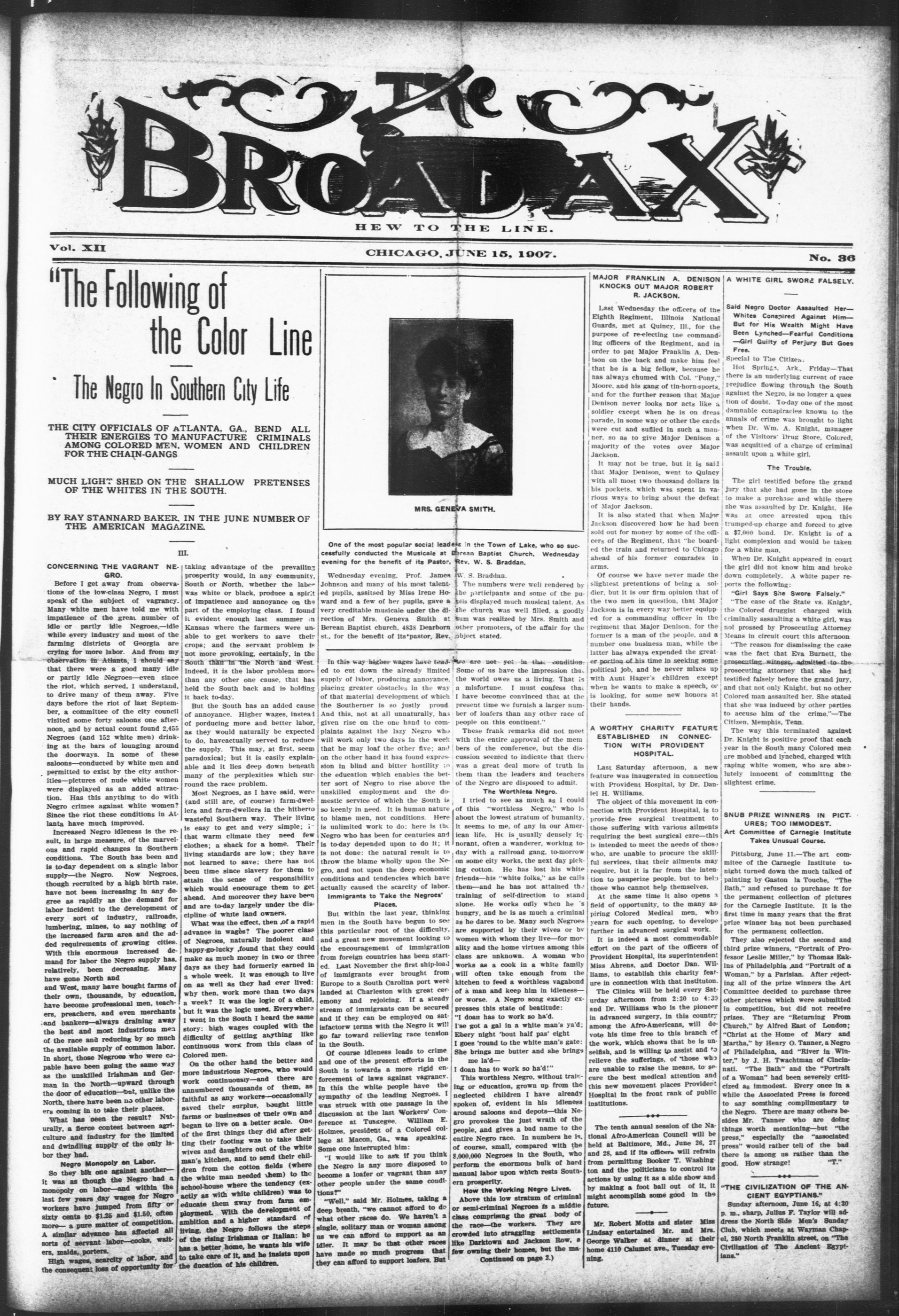
MRS. GENEVA SMITH.
One of the most popular social leaders in the Town of Lake, who so successfully conducted the Musicale at Berean Baptist Church, Wednesday evening for the benefit of its Pastor, Rev. W. S. Braddan.
Wednesday evening, Prof. James W. S. Braddan.
Johnson and many of his most talent. The numbers were well rendered by ed pupils, assisted by Miss Irene Ho. the participants and some of the pward and a few of her pupils, gave a plays displayed much musical talent. A very creditable musicale under the dl. the church was well filled, a good rection of Mrs. Geneva Smith at sum was realized by Mrs. Smith and Berean Baptist church, 4838 Dearborn other promoters, of the affair for the st., for the benefit of its*pastor. Rev. object stated.
In this way higher wages have tended to cut down the already limited supply of labor, producing annoyance, placing greater obstacles in the way of that material development of which the Southerner is so justly proud. And this, not at all unnaturally, has given rise on the one hand to complaints against the lazy Negro who will work only two days in the week that he may loaf the other five; and on the other hand it has found expression in blind and bitter hostility to the education which enables the better sort of Negro to rise above the unskilled employment and the domestic service of which the South is so keenly in need. It is human nature to blame men, not conditions. Here is unlimited work to do: here is the Negro who has been for centuries and is to-day depended upon to do it; it is not done: the natural result is to throw the blame wholly upon the Negro, and not upon the deep economic conditions and tendencies which have actually caused the scarcity of labor.
Immigrants to Take the Negroes' Places.
But within the last year, thinking men in the South have begun to see this particular root of the difficulty, and a great new movement looking to the encouragement of immigration from foreign countries has been started. Last November the first ship-load of immigrants ever brought from Europe to a South Carolina port were landed at Charleston with great ceremony and rejoicing. If a steady stream of immigrants can be secured and if they can be employed on satisfactories with the Negro it will go far toward relieving race tension in the South.
Of course idleness leads to crime, and one of the present efforts in the South is towards a more rigid enforcement of laws against vagrancy. In this the white people have the sympathy of the leading Negroes. I was struck with one passage in the discussion at the last Workers' Conference at Tuskegee. William E. Holmes, president of a Colored college at Macon, Ga., was speaking. Some one interrupted him:
"I would like to ask if you think the Negro is any more disposed to become a loafer or vagrant than any other people under the same conditions?" "Well," said Mr. Holmes, taking a deep breath, "we cannot afford to do what other races do. We haven't a single, solitary man or woman among us we can afford to support as an idler. It may be that other races have made so much progress that they can afford to support loafers. But
The numbers were well rendered by the participants and some of the pupils displayed much musical talent. As the church was well filled, a goodly sum was realized by Mrs. Smith and other promoters, of the affair for the object stated.
we are not yet, in that condition. Some of us have the impression that the world owes us a living. That is a misfortune. I must confess that I have become convinced that at the present time we furnish a larger number of loafers than any other race of people on this continent."
These frank remarks did not meet with the entire approval of the members of the conference, but the discussion seemed to indicate that there was a great deal more of truth in them than the leaders and teachers of the Negro are disposed to admit.
The Worthless Negro.
I tried to see as much as I could of this "worthless Negro," who is about the lowest stratum of humanity, it seems to me, of any in our American life. He is usually densely ignorant, often a wanderer, working today with a railroad gang, to-morrow on some city works, the next day picking cotton. He has lost his white friends—his "white folks," as he calls them—and he has not attained the training of self-direction to stand alone. He works oftly when he's hungry, and he is as much a criminal as he dares to be. Many such Negroes are supported by their wives or by women with whom they live—for morality and the home virtues among this class are unknown. A woman who works as a cook in a white family will often take enough from the kitchen to feed a worthless vagabond of a man and keep him in idleness or worse. A Negro song exactly expresses this state of beatitude: "I do loan has to work so ha'd. Ise got a gal in a white man's ya'd;
I'se got a gal in a white man's ya'd;
Ebery night 'bout half pas' eight
I goes 'round to the white man's gate:
She brings me butter and she brings;
me la'd-
I doan has to work so ha'd!"
This worthless Negro, without training or education, grown up from the neglected children I have already spoken of, evident in his idleness around saloons and depots—this Negro provokes the just wrath of the people, and gives a bad name to the entire Negro race. In numbers he is, of course, small, compared with the 8,000,000 Negroes in the South, who perform the enormous bulk of hard manual labor upon which rests Southern prosperity.
How the Working Negro Lives.
Above this low stratum of criminal or semi-criminal Negroes is a middle class comprising the great body of the race—the workers. They are crowded into straggling settlements like Darktown and Jackson Row, a few owning their homes, but the ma-Continued on page 2.)
MAJOR FRANKLIN A. DENISON
KNOCKS OUT MAJOR ROBERT
R. JACKSON.
Last Wednesday the officers of the Eighth Regiment, Illinois National Guards, met at Quincy, Ill., for the purpose of re-electing the commanding officers of the Regiment, and in order to pat Major Franklin A. Denison on the back and make him feel that he is a big fellow, because he has always chumed with Col. "Pony," Moore, and his gang of tin-horn-sports, and for the further reason that Major Denison never looks nor acts like a soldier except when he is on dress parade, in some way or other the cards were cut and suffled in such a manner, so as to give Major Denison a majority of the votes over Major Jackson.
It may not be true, but it is said that Major Denison, went to Quincy with all most two thousand dollars in his pockets, which was spent in various ways to bring about the defeat of Major Jackson.
It is also stated that when Major Jackson discovered how he had been sold out for money by some of the officers of the Regiment, that "the boarded the train and returned to Chicago ahead of his former comrades in arms.
Of course we have never made the slightest pretensions of being a soldier, but it is our firm opinion that of the two men in question, that Major Jackson is in every way better equipped for a commanding officer in the regiment that Major Denison, for the former is a man of the people, and a number one business man, while the latter has always expended the greater portion of his time in seeking some political job, and he never mixes up with Aunt Hager's children except when he wants to make a speech, or is looking, for some new honors at their hands.
A WORTHY CHARITY FEATURE
ESTABLISHED IN CONNEC
TION WITH PROVIDENT
HOSPITAL.
Last Saturday afternoon, a new feature was inaugurated in connection with Provident Hospital, by Dr. Daniel H. Williams.
The object of this movement in connection with Provident Hospital, is to provide free surgical treatment to those suffering with various ailments requiring the best surgical care—this is intended to meet the needs of those who, are unable to procure the skillful services, that their ailments may require, but it is far from the intention to pauperize people, but to help those who cannot help themselves.
At the same time it also opens a field of opportunity, to the many aspiring Colored Medical men, who yearn for such opening, to develop further in advanced surgical work.
It is indeed a most commendable effort on the part of the officers of Provident Hospital, its superintendent Miss Ahrens, and Doctor Dan. Williams, to establish this charity feature in connection with that institution.
The Clinics will be held every Saturday afternoon from 2:30 to 4:30 and Dr. Williams who is the pioneer in advanced surgery, in this country among the Afro-Americans, will devote his time free to this branch of the work, which shows that he is unselfish, and is willing to assist and to relieve the sufferings, of those who are unable to raise the means, to secure the best medical attention and this new movement places Provident Hospital in the front rank of public institutions.
---
The tenth annual session of the National Afro-American Council will be held at Baltimore, Md., June 26, 27 and 28, and if its officers will refrain from permitting Booker T. Washington and the politicians to control its actions by using it as a side show and by making a foot ball out of it, it might accomplish some good in the future.
Mr. Robert Motts and sister Miss Lindsay entertained Mr. and Mrs. George Walker at dinner at their home 4110 Calumet ave., Tuesday evening.
A WHITE GIRL SWORE FALSELY.
Said Negro Doctor Assaulted Her—
Whites Conspired Against Him—
But for His Wealth Might Have
Been Lynched—Fearful Conditions
—Girl Guilty of Perjury But Goes
Free.
Special to The Citizen
Hot Springs, Ark., Friday—That there is an underlying current of race prejudice flowing through the South against the Negro, is no longer a question of doubt. To-day one of the most damnable conspiracies known to the annals of crime was brought to light when Dr. Wm. A. Knight, manager of the Visitors' Drug Store, Colored, was acquitted of a charge of criminal assault upon a white girl.
The Trouble.
The girl testified before the grand jury that she had gone in the store to make a purchase and while there she was assaulted by Dr. Knight. He was at once arrested upon this trumped-up charge and forced to give a $7,000 bond. Dr. Knight is of a light complexion and would be taken for a white man.
When Dr. Knight appeared in court the girl did not know him and broke down completely. A white paper reports the following:
"Girl Says She Swore Falsely."
"The case of the State vs. Knight, the Colored druggist charged with criminally assaulting a white girl, was not proscribed by Prosecuting Attorney Means in circuit court this afternoon.
"The reason for dismissing the case was the fact that Eva Burnett, the prosecuting witness, admitted to the prosecuting attorney that she had testified falsely before the grand jury, and that not only Knight, but no other Colored man assaulted her. She stated that she was induced by other parties to accuse him of the crime."—The Citizen, Memphis, Tenn.
The way this terminated against Dr. Knight is positive proof that each year in the South many Colored men are mobbed and lynched, charged with raping white women, who are absolutely innocent of committing the slightest crime.
SNUB PRIZE WINNERS IN PICT
URES: TOO IMMODEURS.
Art Committee of Carnegie Institute Takes Unusual Course.
Pittsburg, June 11.-The art committee of the Carnegie Institute tonight turned down the much talked of painting by Gaston la Touche, "The Bath," and refused to purchase it for the permanent collection of pictures for the Carnegie Institute. It is the first time in many years that the first prize winner has not been purchased for the permanent collection.
They also rejected the second and third prize winners, "Portrait of Professor Leslie Miller," by Thomas Eakins of Philadelphia and "Portrait of a Woman," by a Parisian. After rejecting all of the prize winners the Art Committee decided to purchase three other pictures which were submitted in competition, but did not receive prizes. They are "Returning From Church," by Alfred East of London; "Christ at the Home of Mary and Martha," by Henry O. Tanner, a Negro of Philadelphia, and "River in Winter," by J. H. Twachtman of Cincinnati. "The Bath" and the "Portrait of a Woman" had been severely criticized as immodest. Every once in a while the Associated Press is forced to say something complimentary to the Negro. There are many others besides Mr. Tanner who are doing things worth mentioning—but "the press," especially the "associated press" would rather tell of the bad there is among us rather than the good. How strange! "T."
"THE CIVILIZATION OF THE ANCIENT EGYPTIANS."
Sunday afternoon, June 16, at 4:30 p. m., sharp, Julius F. Taylor will address the North Side Men's Sunday Club, which meets at Wayman Chapel, 280 North Franklin street, on "The Civilization of The Ancient Egyptians."
Will promulgate and at all times uphold the true principles of Democracy, but Catholic, Protestant, Roman Catholic, and one other. Knights of Labor, or any one else can have their way, no long as their language is proper and responsibility is fixed.
The Broad is a newspaper whose platform is best enough for all, ever clausing the editorial right to its own publication.
Local communications will receive attention.
Write only on one side of the paper.
Subscriptions must be paid in advance.
One Year.....$2.60
Six Months.....1.00
Advertising rates made known on application.
JULIUS F. TAYLOR, Editor and Publisher.
Entered at the Post Office at Chicago,
IL., as Second-class Matter.
FOLLOWING THE COLOR LINE.
(Concluded from page 1.)
jority renting precariously, earning good wages, narmless for the most part, but often falling into petty crime. Poverty here, however, lacks the tragic note that it strikes in the crowded sections of Northern cities. The temperament of the Negro is irrepressibly cheerful, he overflows from his small home and snags and laughs in his streets; no matter how ragged or forlorn he may be good humor sits upon his countenance, and his squalor is not unpicturesque. A banjo, a mullet supper from time to time, an exciting revival, give him real joys. Most of the families of this middle class, some of whom are deserted wives with children, have their "whit-folks" for whom they do washing, cooking, gardening, or other service. and all have church connections, so that they have a real place in the social fabric and a certain code of self-respect.
I tried to see all I could of this phase of life. I visited many of the poorer Negro homes and I was often received in squall rooms with a dignity of politeness which would have done credit to a society woman. For the Negro, naturally, is a sort of Frenchman. And if I can sum up the many visits I made in a single conclusion, I should say, I think, that I was chiefly impressed by the tragic punishment meted out to ignorance and weakness by our complex society. I would find a home of one or two rooms neatly furnished, but having one corner a glittering cottage organ, or on the mantel shelf a glorified gilt clock; crayon portraits, inexpressibly crude and ugly, but framed gorgeously, are not uncommon—the first uncertain, primitive (not unpitiful) reachings out after some of the graces of a broader life. Many of these things are bought from agents and the prices paid are extortionate. Often a Negro family will pay monthly for a year or so on some showy clock or chromo or music-box or decorated mirror—paying the value of it a dozen times over, only to have it seized when through sickness, or lack of foresight, they fail to meet a single note. Instalment houses prey upon them, pawnbrokers suck their blood, and they are infinitely the victims of patent medicines. It is rare, indeed, that I entered a Negro cabin, even the poorest, without seeing one or more bottles of some abominable cure-all. The amount yearly expended by Negroes for patent medicines, which are glaringly advertised in all Southern newspapers, must be enormous—million of dollars. I had an interesting side-light on conditions one day while walking in one of the most fashionable resident districts of Atlanta. I saw a magnificent gray stone residence standing somewhat back from the street. I said to my companion, who was a resident of the city:
"Yes; stop a minute," he said, "I want to tell you about that. The anti-kink man lives there."
"Anti-kink?" I asked in surprise.
"Yes; the man who occupies that house is one of the wealthiest men here. He made his money by selling to Negroes a preparation to smooth the kinks out of their wool. They're simply crazy on the subject."
"Does it work?"
"You haven't seen any straight-haired Negroes, have you?" he asked. Ignorance carries a big burden and climbs a rocky road!
Old Mammies and Nurses.
The mass of Colored people still maintain, as I have said, a more or less intimate connection with white families—frequently a very beautiful and sympathetic relationship like that of the old mammies or nurses. To one who has heard so much of racial hatred as I have since I have been down here, a little incident that I observed the other day comes with a charm hardly describable. I saw a carriage stop in front of a home. The expected daughter had arrived—a very pretty girl indeed. She stepped out eagerly. Her father was halfway down to the gate; but ahead of him was a very old Negro woman in the cleanest of clean starched dresses.
/
"Honey," she said, eagerly.
"Mammy!" exclaimed the girl, and the two rushed into each other's arms. clasping and kissing—the white girl and the old black woman.
I thought to myself: "There's no Negro problem there: that's just plain human love!"
"Master" Superseded by "Boss." Often I have heard Negroes refer to "my white folks" and similarly the white man still speaks of "my Negroes." The old term of slavery, the use of the word "master," has wholly disappeared, and in its place has arisen, not without significance, the round term "Boss," or sometimes "Cap" or "Cap'n." To this the white man responds with the first name of the Negro "Jim" or "Susle"—or if the Negro is old or especially respected: "Uncle Jim" or "Aunt Susan."
To an unfamiliar Northerner one of the very interesting and somewhat amusing phases of conditions, down here is the panic fear displayed over the use of the word "Mr." or "Mrs." No Negro is ever called Mr. or Mrs. by a white man: that would indicate social equality. A Southern white man told me with humor of his difficulties:
"Now I admire Booker Washington. I regard him as a great man, and yet I couldn't call him 'Mr.' Washington. We were all in a quandary until a doctor's degree was given him. That saved our lives! we call him 'Dr.' Washington now."
Sure enough! I don't think I have heard him called Mr. Washington since I came down here. It is always "Dr." or just "Booker." They are ready to call a Negro "Professor" or "Bishop" or "The Reverend"—but not "Mr."
In the same way a Negro may call Miss Mary Smith by the familiar "Miss Mary," but if he called her Miss Smith she would be deeply incensed. The formal "Miss Smith" would imply social equality.
I digress: But I have wanted to impress these relationships. There are all gradations of Negroes between the wholly dependent old family servant and the new, educated Negro professional or business man, and, correspondingly, every degree of treatment from indulgence to intense hostility.
I must tell, in spite of ack of room, one beautiful story I heard at Atlanta, which so well illustrates the old relationship. There is in the family *Dr. J. S. Todd*, a well known citizen of Atlanta, an old, old servant called, affectionately, Uncle Billy. He has been so long in the family that in reality he is served as much as he serves. During the riot last September he was terrified: he did not dare to go home at night. So Miss Louise, the doctor's daughter, took Uncle Billy home through the dark streets. When she was returning one of her friends met her and was much alarmed that she should vulture out in a time of so much danger.
"What are you doing out here this time of night, he asked?
"Why," she replied, as if it were the most natural answer in the world, "I had to take Uncle Billy safelv home." Over against this story I have an account of a Tennessee farmer who, entering an Illinois Central Pullman car in Kentucky, and discovering therein a Negro Bishop and his wife, compelled enforcement of the "Jine Crow" law. The train was held nine minutes at Hopkinsville while a policeman made them dress and move into the compartment for Colored passengers.
I have now described two of the three great classes of Negroes: First the worthless and idle Negro, often a criminal, comparatively small in numbers, but perniciously evident. Second, the great middle class of Negroes who do the manual work of the South. Above these, a third class, frew in numbers, but most influential in their race, are the progressive, property-owning Negroes, who have wholly severed their old intimate ties with the white people—and who have been getting farther and farther away from them. Of some of these leading Negroes in Atlanta I told last month, and I shall have much more to say of the class in coming articles.
A White Man's Problem.
Do you know, after being down here for some months it keeps coming to me that this is more a white man's problem than it is a Negro problem. The white man as well as the black is being tried by fire. The white man is in full control of the South, politically, socially, industrially: the Negro, as ex-Governor Northen point out, is his helpless ward. What will he do with him? Speaking of the education of the Negro, and in direct reference to the conditions in Atlanta which I have already described, many men have said to me:
"Think of the large sums that the South has spent and is spending on the education of the Negro. The Negro does not begin to pay for his edu-
cation in taxes.*
Neither do the swarming Slaves Italians and Poles in our Northern cities. They pay little in taxes and yet enormous sums are expended in their improvement. For their benefit? Of course, but chiefly for ours. It is better to educate men in school than to let them so educate themselves as to become a menace to society. The present kind of education in the South may possibly be wrong; but for the protection of society it is as necessary to train every Negro as it is every white man.
When I see the crowds of young Negroes being made criminal—through lack of proper training—can't help thinking how pitilessly ignorance finally revenges itself upon that society which neglects or exploits it. (Mr. Baker's next article will follow the Color line into the county districts of the south.)
The End.
BOOKER WASHINGTON ELECTED TRUSTEE OF HOWARD UNIVERSITY.
Leading Industrial Educationist Put
(Boston Post, June 7, 1907.)
(Boston Post, June 7, 1907.)
The Suffrage League of Boston and vicinity held an enthusiastic meeting at the New Twelfth Baptist church at Shawmut avenue and Madison street yesterday. A vote of welcome to the Niagara Movement, which comes to Boston August 27-29, was passed. The main business was action against the recent election of Booker T. Washington as a trustee of Howard University. Secretary Taft was severely condemned. The following resolution was passed unanimously:
"Whereas, Booker T. Washington was recently elected as a trustee of Howard University, his name being proposed by a white trustee, who on March 8, 1904, appeared before a congressional committee on behalf of trebling the appropriation for an industrial department of said university, saying: 'I can see nothing more important than the industrial system for our-Colored race.'
"Therefore, be it resolved, That we the Suffrage League of Boston and vicinity, believing in the America system of education for all Americans, regardless of race or color, unalterably opposed to any color line in education, do protest against Booker T. Washington, or any man who is committed to industrial training as best for Colored people or whose chief interest and work is for that brand, being made a trustee of Howard University. Higher education men for higher education schools."
INSTITUTIONAL CHURCH AND SOCIAL SETTLEMENT.
A grand June Bazaar will be conducted at the above Church, beginning, Tuesday night, June 25. On this night an excellent program is to be furnished by Prof. N. Clark Smith's Boys Cadet Band and Drum Corps, consisting of 30 pieces. This promises to be a grand affair.
The second night, Wednesday 26th, will consist in a fine program rendered by the new organization of Jubilee Singers.
Thursday night, 27th, is to be the banner night. A great Ogan contest between some of the best organisers of the city also Mayor Busse will be present at the church. This has been assured a great success.
The proceeds of this bazaar is to assist in the decoration of the church the cleaning and carpeting etc.
Season ticket 35 cts.
The committee is making extensive preparations for a most excellent time.
Booths have been put in the hands of some of the best workers of the city and they and their friends will assist in this worthy effort.
Hear Rev. C. W. Thompson at the Institutional Church, Sunday. He will fill the pulpit for the pastor, Rev. H. E. Stewart, both at the morning and evening services.
Rev. Thompson is an excellent preacher. "S."
THE BEST SKIN AND SCALP FOOD IN THE WORLD.
The Penn-Jones Company makes the best skin and scalp food in the world. For many thousand years people have been looking for something like it, and this new discovery by Prof. Penn for the hair is just what you want, for it gives new like to the hair by cultivating the roots, and if you try it once you will never be without it, for it is absolute; harmless in every respect.
By using Prof. Penn's skin and scalp food you can throw away your irons, for it softens the hair and makes it pliable, and if it fails to do the work your money will be refunded.
Prof. Penn's new skin and scalp food, which sells for 25c., 50c., and 75c. a jar, can be secured at all the leading drug stores, department
stores and also barber shops. It will also be for sale by first-class lady hair dressers. Main office 188 Madison street, F. A. Wescott & Co.; branch office, 3842 State street, Chicago. All mail orders will receive prompt attention.
SLAVE WINS $100,000
Dallas, Texas, June 13—The Texas Supreme Court has decided the noted Maria Hamilton land case., involving half a league of land in Hardin County, in the heart of the oil and lumber region, valued at more than $100,000, in favor of the descendants of Maria Hamilton, a torner slave.
WEST SIDE ITEMS BY PROF. A. L.
SIMPRON.
Mr. Chas. Wheeler and Mr. I. Harris are racing every day, to see which can keep the people the cleanest over here.
Miss Jessie Lucas is very proud of her new position and says she will be glad when the day comes, that all Colored girls will be in as good, or better places.
Mrs. James Gordon furnished the music for the West Side Sunday Club, Sunday.
The West Side Sunday Club was well attended last Sunday, owing to it being ladies day. Dr. Mercer was kept quite busy with his new auto and the ladies.
Mr. J. H. Zedricks, Mr. S. Sutton, and a party of St. Louis ladies visited the parlors of Prof. A. L. Simpson recently.
Mrs. Wilson the conductor of the new cafe Wilson at Lake and Leavitt streets had to turn people away last Sunday. Still the Jackson Cafe at 920 W. Lake st., had all the people they could handle. BLACK DIAMOND DEVELOPMENT COMPANY.
Notice.
Every stockholder of the Black Diamond Development Company should send his address to the Secretary's office room 210, Securitv Building, 188 Madison st., Chicago, so that he may be properly informed as to just what the Company is doing and assist the Secretary in keeping the Stockholders posted by Bulletins.
There is good news awaiting every Black Diamond Development Company stockholder.
The Secretary must have your correct address.
A. WILBERFORCE WILLIAMS.
President.
CHIPS
J. W. Jackson, Colored, is a successful boot and shoe dealer of Denver, Col.
Dr. Ames, one of the leading Negro physicians of Detroit, Mich., spent a few days in Chicago the first of the week.
Miss Nettie French, of 4838 Evans ave., returned home last Friday after spending the winter in Montgomery, Ala., as a teacher.
Mrs. Julius N. Avendorph and son Julius will leave next week for an all-summer visit in Salt Lake City, Utah, and other western points.
Mr. Geo. Kelley, 3716 Wabash ave. is confined to his home sick. Mr. Kelley is one of the old members of Golden Fleece Lodge of Odd Fellows.
Miss Gertruce James of St. Paul, Minn., is the guest of her sister Mrs. Robert Taylor, 3629 Dearborn st. Miss James will remain in Chicago all the summer.
Mrs. Clara Belle Barley, 4157 Ellis avenue, has returned from her summer home in Cassopolis, Mich., where she went to bury her brother Richard last week.
Mrs. Katherine Barr, of Los Angeles, Cal., passed through the city the first of the week en route to Jacksonville, Ill., to attend the wedding of some friends.
G. W. McKinley has removed his barber shop from 114 West 51st street to 5108 State street, where he would be pleased to meet his old friends and customers.
Mr. and Mrs. Nathan Ennals, 6618 Vernon avenue, are visiting friends and relatives in Detroit, Mich., after which they will spend a while visiting some of the Michigan summer resorts.
Clarence McKoin, of Muskogee, I. T., is visiting his brother and sister, Mr. and Mrs. Jos. B. Crum, at 814 Inglewood avenue. Mr. McKoin is a government officer in the Indian Territory.
Invitations have been issued to the marriage of Miss Helen McKinney to Mr. C. A. Jordan which will take place Thursday, June the 27th at 4 o'clock, at the residence of Mrs. J. Wallace, 3528 Forest ave. The bride and groom will reside at 5125 Grove ave., after July 6th.
Mrs. Clifford Johnson 2712 State st. left Wednesday morning for New York City, from which point she will sail today for Europe where she will spend three months.
Miss Mason, of Milneapolis, Minn. is in the city the guest of her sister, Mrs. Delbert L. Lee, 4822 Evans ave. Miss Mason, comes from the South where she has been engaged teaching.
The great law firm of Tnornton and Chancellor, have removed their law offices from the Masonic Temple to the Heyworth Bldg., and they now have the finest suite of law offices in this city.
Miss Gladys Williams, 6618 Vernon ave., entertained sixteen little girls members of her Sunday School Class Club, Friday afternoon from 2:30 to 6 o'clock. Story telling and music were the pleasure features of the event
Andrew J. Scott, who at one time was worth more than $300,000, and was the wealthiest Afro-American in Chicago, died this week at the County Hospital, and he was buried in a pauper's grave, the ups and down of Andrew J. Scott, almost seem like a dream.
Mr. Adolphus C. Harris, who has been confined to his room at the Provident Hospital, for the last week, will leave the Hospital on Saturday, after which he will be at his residence, 5247 Dearborn st. We are glad to announce that Mr. Harris, is doing nicely, and expects to be out within the next week.
Mrs. Robert Hardin 6347 Rhodes av. has been on the sick list this week. Hon. Harry Barrett, of Orange, N. J., did some tall hustling here for the Metropolitan Mercantile and Realty Co., of New York, which he represented and no doubt there will be many Chicagoua who will become stockholders in the Co., before long.
George I. Hutchinson conducts the Mt. Clemens Hotel and Mineral Bath House at Mt. Clemens, Mich., and it is the only bath house in that place where Afro-Americans can be served, and this first-class enterprise reflects much credit upon Mr. Hutchinson and proves that he is able to keep abreast of the times.
The historians of New York City have discovered that a Colored woman, named Catherine Furguson, was the first to open and teach a Sunday school in that city. The white people of New York have raised many thousands of dollars with which they are preparing to erect a Catherine Furguson Memorial Inter-denominational church with hotel attached for the Colored race.
On last Wednesday evening Mr. and Mrs. Moses Ratcliff, 4850 Dearborn street, served luncheon to their friends, Mr. and Mrs. Lee Averett, who were married June 1st at Wheaton, Ill.; also Mr. and Mrs. Dr. W. H. Marshall, Mr. and Mrs. Davis, Miss Harris, Mrs. S. S. Thompson, Mr. Petit of Oxford, Miss. The afternoon was spent delightfully. All enjoyed themselves as usual, for the hostess thoroughly understands the art of entertaining.
Richard S. Hood, age 43 years, 2455 State st., for many years chief chef at William's restaurant on Madison st., died June 6th after a severe attack of pneumonia. The remains accompanied by his wife and daughter Frances age 5 years, and sisters, Mrs. Clara B. Barley and Mrs. Anna English were caried to Cassopolis, Mich., for burial on the family estate. Besides the above mentioned relatives, the deceased is survived by an aged mother who resides at his birthplace in Cassopolis.
HUMOR OF THE HOUR
Tit For Tat.
Young Stevens was on his way north to spend the week end with his parents and felt in a particularly jovial mood.
The train in which he was traveling had stopped at a small village. As a farmer who was sauntering up and down the platform came opposite Stevens' compartment he was asked by the youth if he knew that the Duke of Devonshire was in the train.
Immediately the man showed great interest and said:
"No. Is he?
"I think he is not," answered Stevens. "I only asked if you knew that he was."
The farmer said nothing, but continued his walk on the platform. As he came opposite the window again he remarked that their town had been experiencing some excitement.
"What's the matter?" asked Stevens,
"The authorities wouldn't let some folks bury a woman," replied the farmer.
"What was the reason for refusing?"
"She wasn't dead," was the laconic reply.
And then he strolled away, leaving young Stevens biting his lip—Judge's Library.
A VICTIM OF TRADE.
Nature's "Craggy Ocean Pyramid"
Leased to a Quarry Firm.
Great indignation has been excited by the story that the Marquis of Allisa has leased for the purpose of quarrying its granite the noble rock known as Allisa crag, says the London News. This stupendous crag, rising abruptly from the sea to a height of 1.114 feet and having a circumference of nearly two miles, stands sentinel at the entrance to the estuary of the Clyde, almost equidistant between the peninsula of Kintyre and the County of Ayr and within sight of the Irish coast; hence its sobriquet, Paddy's milestone
The rock is an object of great natural beauty and inspires feelings of wonder and admiration. The thought of its demolition to make paving stones raises bitter resentment among a people who are at present collecting $10,000 to preserve the "auld brig o' Ayr" against the dilapidations of time, simply because their beloved peasant poet had endeared that structure in their hearts. Alisa crag, storm beaten by the foaming billows, has enlisted the muse of Keats and Wordsworth, and Daniel Defoe is among the many prose writers who have paid it homage.
Apart from its recognition as nature's "craggy ocean pyramid," as Keats called it, the rock is of great strategic importance. It is the Gibraltar of the Clyde. Although unprotected, the rock commands the waterway that leads to Greenock and Glasgow. It has besides great geological and historical value. Scientists say it is of volcanic origin—thrown up from the bed of a crater like Berwick, Low and Edinburgh castle rock. Many basalt columns, four, five and six sided, resembling those seen at the Giant's Causeway and the island of Staffa, are also found there, and there are besides several interesting caves.
Above the lighthouse on the eastern side there stand the ruins of an old castle, and the ruins of an old church and burying ground are known to have existed near by. The castle is said to have been the property of early monks.
Quarrying operations to the extent of the material for 1,000 pairs of curling stones have been permitted at the rock for a number of years, but the wholesale deprivation of the granite, of which it is largely composed, is exciting stern opposition.
Bargains In Horseflesh.
Father Blind, winner of the Great Metropolitan at Epsom, who is said to have cost his owner no more than £40, is the latest addition to the long list of successful race horses which have been picked up for a paltry sum. The historic Eclipse, who won at least £5,000 during his brilliant career, was bought as a yearling for 75 guineas, which was, we believe, the exact sum paid for Peep o' Day, winner of many big races; Deadlock, dam of Islinglass, came into Captain Machell's hands for the aburd price of £20, one twenty-fifth of the sum Major McCalmont purchased her for a little later; Rover, whose son, St. Gatien, was sold for £15,000, changed hands for £50, and £30 secured two capital horses in Althorp and Carlton; Thraste, who beat Ladas so sensationally in the St. Leger, was actually given away by one of her owners, and Stockwell, a famous St. Leger winner and sire of three winners of the Derby, was bought by Lord Exeter for £180.-Westminster Gazette.
Pooled Their Resources.
Liang Tung Yn, the new Chinese minister to the United States, is a pretty good business man, according to the stories of some of his old classmates at Yale. When he was in college he was closely associated with a set of young fellows, ten in all, who had about the same allowance each month, $100. All the checks came at once, and after a day or so every member of the set was "strapped." Liang finally solved the difficulty. The checks were all pooled, and each $100 was to last the coterie three days. For exactly three days one man had to pay all the expenses of the ten. Thereafter every one was able to get through the month without being in danger of starvation.
San Francisco as a Phenix.
On the average a new building has been finished every forty-five minutes in San Francisco since the fire. The building permits issued in San Francisco in 1905 were about $22,000,000. That year was a record breaker up to that time. Labor Commissioner Stafford's report shows that $1,000,000 a week is now paid out for wages, or $2,000,000 per year, and as wages only represent about 50 per cent of actual cost of building it is conservative to say that San Francisco at present is building at the rate of over $100,000,000 per year.
Pittaburg Leads In Pig Iron
Of the total production of 25,307,191 gross tons of pig iron in the United States in 1906 Pennsylvania made 11,247,869 gross tons, and of this output the Pittsburgh district (Allegheny, Beaver and Washington counties) contributed 6,230,863 tons. In other words, says the Iron Age, the Pittsburg district last year made nearly 25 per cent of the total production of pig iron in the United States and 55 per cent of the output in Pennsylvania.
The Irony of Fate
After spending eight years in voluntary confinement, immured in a cell of his own construction, and undergoing great hardships and privations, an Italian, who was legally an escaped convict, has again fallen into the hands of the law, to discover that his self inflicted punishment counts for nothing and that he will have to serve the whole of the ten years' sentence originally passed upon him.—Wide World Magazine.
THE BROAD AX.
Will promulgate and at all times uphold the true principle of Democracy, but Catholic, Protestant, Federal, or Christian, single Taxes, Republican, Knights of Labor, or other authorities have their way, so long as their language is proper and responsibility is fixed.
The Broad AX is a newspaper whose platform is broad enough for all, ever claiming the editorial right to speak its own mind.
Local communications will receive attention. Write only on one side of the paper.
Subscriptions must be paid in advance.
One Year ..... $8.00
Six Months ..... 1.00
Advertising rates made known on application.
Address all communications to
THE BROAD AX
$940 Armour Avenue, Chicago.
JULIUS F. TAYLOR, Editor and Publisher.
Entered at the Post Office at Chicago, IL., as Second-class Matter.
FOLLOWING THE COLOR LINE.
(Concluded from page 1.)
jority renting precariously, earning good wages, narmless for the most part, but often falling into petty crime. Poverty here, however, lacks the tragic note that it strikes in the crowded sections of Northern cities. The temperament of the Negro is impressibly cheerful, he overflows from his small home and slings and laughs in his streets; no matter how ragged or forlorn he may be good humor sits upon his countenance, and his squalor is not unpicturesque. A banjo, a mullet supper from time to time, an exciting revival, give him real joys. Most of the families of this middle class, some of whom are deserted wives with children, have their "whit-folks" for whom they do washing, cooking, gardening, or other service. and all have church connections, so that they have a real place in the social fabric and a certain code of self-respect.
I tried to see all I could of this phase of life. I visited many of the poorer Negro homes and I was often received in squald rooms with a dignity of politeness which would have done credit to a society woman. For the Negro, naturally, is a sort of Frenchman. And if I can sum up the many visits I made in a single conclusion, I should say, I think, that I was chiefly impressed by the tragic punishment meted out to ignorance and weakness by our complex society. I would find a home of one or two rooms neatly furnished, but having it one corner a glittering cottage organ, or on the mantel shelf a glorified gilt clock; crayon portraits, inexpressibly crude and ugly, but framed gorgeously, are not uncommon—the first uncertain, primitive (not upitiful) reachings out after some of the graces of a broader life. Many of these things are bought from agents and the prices paid are extortionate. Often a Negro family will pay monthly for a year or so on some showy clock or chromo or music-box or decorated mirror—paying the value of it a dozen times over, only to have it seized when through sickness or lack of foresight, they fall to meet a single note. Installment houses prey upon them, pawnbrokers suck their blood, and they are infinitely the victims of patent medicines. It is rare, indeed, that I entered a Negro cabin, even the poorest, without seeing one or more bottles of some abominable cure-all. The amount yearly expended by Negroes for patent medicines, which are glaringly advertised in all Southern newspapers, must be enormous—million of dollars. I had an interesting side-light on conditions one day while walking in one of the most fashionable resident districts of Atlanta. I saw a magnificent gray stone residence standing somewhat back from the street. I said to my companion, who was a resident of the city:
"Yes; stop a minute," he said, "I want to tell you about that. The anti-kink man lives there."
"Anti-kink?" I asked in surprise.
"Yes; the man who occupies that house is one of the wealthiest men here. He made his money by selling to Negroes a preparation to smooth the kinks out of their wool. They're simply crazy on the subject."
"Does it work?"
"You haven't seen any straight-haired Negroes, have you?" he asked. Ignorance carries a big burden and climbs a rocky road!
Old Mammies and Nurses.
Old Mammies and Nurses.
The mass of Colored people still maintain, as I have said, a more or less intimate connection with white families—frequently a very beautiful and sympathetic relationship like that of the old mammals or nurses. To one who has heard so much of racial hatred as I have since I have been down here, a little incident that I observed the other day comes with a charm hardly describable. I saw a carriage stop in front of a home. The expected daughter had arrived—a very pretty girl indeed. She stepped out eagerly. Her father was halfway down to the gate; but ahead of him was a very old Negro woman in the cleanest of clean starched dresses.
"Honey," she said, eagerly. "Mammy!" exclaimed the girl, and the two rushed into each other's arms. clasping and kissing—the white girl and the old black woman. I thought to myself: "There's no Negro problem there: that's just plain human love!"
"Master" Superseded by "Boss."
"Master" Superseded by "Boss."
Often I have heard Negroes refer to "my white folks" and similarly the white man still speaks of "my Negroes." The old term of slavery, the use of the word "master," has wholly disappeared, and in its place has arisen, not without significance, the round term "Boss," or sometimes "Cap" or "Cap'n." To this the white man responds with the first name of the Negro "Jim" or "Susie"—or if the Negro is old or especially respected: "Uncle Jim" or "Aunt Susan."
To an unfamiliar Northernner one of the very interesting and somewhat amusing phases of conditions down here is the panic fear displayed over the use of the word "Mr." or "Mrs." No Negro is ever called Mr. or Mrs. by a white man: that would indicate social equality. A Southern white man told me with humor of his difficulties:
"Now I admire Booker Washington. I regard him as a great man, and yet I couldn't call him 'Mr.' Washington. We were all in a quandary until a doctor's degree was given him. Tha. saved our lives! we call him 'Dr.' Washington now."
Sure enough! I don't think I have heard him called Mr. Washington since I came down here. It is always "Dr." or just "Booker." They are ready to call a Negro "Professor" or "Bishop" or "The Reverend"—but not "Mr."
In the same way a Negro may call Miss Mary Smith by the familiar "Miss Mary," but if he called her Miss Smith she would be deeply incensed. The formal "Miss Smith" would imply social equality.
I digress: But I have wanted to impress these relationships. There are all gradations of Negroes between the wholly dependent old family servant and the new, educated Negro professional or business man, and, correspondingly, every degree of treatment from indulgence to intense hostility.
I must tell, in spite of lack of room, one beautiful story I heard at Atlanta, which so well illustrates the old relationship. There is in the family Dr. J. S. Todd, a well known citizen of Atlanta, an old, old servant called, affectionately, Uncle Billy. He has been so long in the family that in reality he is served as much as he serves. During the riot last September he was terrified: he did not dare to go home at night. So Miss Louise, the doctor's daughter, took Uncle Billy home through the dark streets. When she was returning one of her friends met her and was much alarmed that she should veture out in a time of so much danger.
"What are you doing out here this time of night, he asked?
"Why," she replied, as if it were the most natural answer in the world, "I had to take Uncle Billy safelv home." Over against this story I have an account of a Tennessee farmer who, entering an Illinois Central Pullman car in Kentucky, and discovering therein a Negro Bishop and his wife, compelled enforcement of the "Jim Crow" law. The train was held nine minutes at Hopkinsville while a policeman made them dress and move into the compartment for Colored passengers.
I have now described two of the three great classes of Negroes: First, the worthless and idle Negro, often a criminal, comparatively small in numbers, but perniciously evident. Second, the great middle class of Negroes who do the manual work of the South. Above these, a third class, frew in numbers, but most influential in their race, are the progressive, property-owning Negroes, who have wholly severed their old intimate ties with the white people—and who have been getting farther and farther away from them. Of some of these leading Negroes in Atlanta I told last month, and I shall have much more to say of the class in coming articles.
A White Man's Problem.
Do you know, after being down here for some months it keeps coming to me that this is more a white man's problem than it is a Negro problem. The white man as well as the black is being tried by fire. The white man is in full control of the South, politically, socially, industrially: the Negro, as ex-Governor Northen points out, is his helpless ward. What will he do with him? Speaking of the education of the Negro, and in direct reference to the conditions in Atlanta which I have already described, many men have said to me: "Think of the large sums that the South has spent and is spending on the education of the Negro. The Negro does not begin to pay for his edu-
location in taxes.
Neither do the swarming Slavs, Italians and Poles in our Northern cities. They pay little in taxes and yet enormous sums are expended in their improvement. For their benefit? Of course, but chiefly for ours. It is better to educate men in school than to let them so educate themselves as to become a menace to society. The present kind of education in the South may possibly be wrong; but for the protection of society it is as necessary to train every Negro as it is every white man.
When I see the crowds of young Negroes being made criminal—through lack of proper training—can't help thinking how pitilessly ignorance finally revenues itself upon that society which neglects or exploits it. (Mr. Baker's next article will follow the Color line into the county districts of the south.) The End.
BOOKER WASHINGTON ELECTED TRUSTEE OF HOWARD UNIVERSITY.
Leading Industrial Educationist Put on Governing Board of Higher Education School.
(Boston Post, June 7, 1907.)
(Boston Post, June 7, 1907.) The Suffrage League of Boston and vicinity held an enthusiastic meeting at the New Twelfth Baptist church at Shawmut avenue and Madison street yesterday. A vote of welcome to the Niagara Movement, which comes to Boston August 27-29, was passed. The main business was action against the recent election of Booker T. Washington as a trustee of Howard University. Secretary Taft was severely condemned. The following resolution was passed unanimously:
"Whereas, Booker T. Washington was recently elected as a trustee of Howard University, his name being proposed by a white trustee, who on March 8, 1904, appeared before a congressional committee on behalf of trebling the appropriation for an industrial department of said university, saying: 'I can see nothing more important than the industrial system for our-Colored race.'
"Therefore, be it resolved, That we the Suffrage League of Boston and vicinity, believing in the American system of education for all Americans, regardless of race or color, unalterably opposed to any color line in education, do protest against Booker T. Washington or any man who is committed to industrial training as best for Colored people or whose chief interest and work is for that brand, being made a trustee of Howard University. Higher education men for higher education schools."
INSTITUTIONAL CHURCH AND SOCIAL SETTLEMENT.
A grand June Bazaar will be conducted at the above Church, beginning, Tuesday night, June 25. On this night an excellent program is to be furnished by Prof. N. Clark Smiths' Boys Cadet Band and Drum Corps consisting of 30 pieces. This promises to be a grand affair.
The second night, Wednesday 26th, will consist in a fine program rendered by the new organization of Jubilee Singers.
Thursday night, 27th, is to be the banner night. A great Ogan contest between some of the best organisers of the city also Mayor Busse will be present at the church. This has been assured a great success.
The proceeds of this bazaar is to assist in the decoration of the church the cleaning and carpeting etc.
Season ticket 35 cts.
The committee is making extensive preparations for a most excellent time.
Booths have been put in the hands of some of the best workers of the city and they and their friends will assist in this worthy effort.
Hear Rev. C. W. Thompson at the Institutional Church, Sunday. He will fill the pulpit for the pastor, Rev. H. E. Stewart, both at the morning and evening services.
Rev. Thompson is an excellent preacher. "S."
THE BEST SKIN AND SCALP FOOD IN THE WORLD.
The Penn-Jones Company makes the best skin and scalp food in the world. For many thousand years people have been looking for something like it, and this new discovery by Prof. Penn for the hair is just what you want, for it gives new life to the hair by cultivating the roots, and if you try it once you will never be without it, for it is absolute; harmless in every respect.
By using Prof. Penn's skin and scalp food you can throw away your irons, for it softens the hair and makes it pliable, and if it fails to do the work your money will be refunded.
Prof. Penn's new skin and scalp food, which sells for 25c., 50c., and 75c. a jar, can be secured at all the leading drug stores, department
stores and also barber shops. It will also be for sale by first-class lady hair dressers. Main office 188 Madison street, F. A. Wescott & Co.; branch office, 3842 State street, Chicago. All mail orders will receive prompt attention.
SLAVE WINS $100,000,
Dallas, Texas, June 13.—The Texas Supreme Court has decided the noted Maria Hamilton land case., involving half a league of land in Hardin County, in the heart of the oil and lumber region, valued at more than $100,000, in favor of the descendants of Maria Hamilton, a former slave.
WEST SIDE ITEMS BY PROF. A. L.
SIMPSON.
Mr. Chas. Wheeler and Mr. I. Harris are racing every day, to see which can keep the people the cleanest over here.
Miss Jessie Lucas is very proud of her new position and says she will be glad when the day comes, that all Colored girls will be in as good, or better places.
Mrs. James Gordon furnished the music for the West Side Sunday Club, Sunday.
The West Side Sunday Club was well attended last Sunday, owing to it being ladies day. Dr. Mercer was kept quite busy with his new auto and the ladies.
Mr. J. H. Zedricks, Mr. S. Sutton, and a party of St. Louis ladies visited the parlors of Prof. A. L. Simpson recently.
Mrs. Wilson the conductor of the new cafe Wilson at Lake and Leavitt streets had to turn people away last Sunday. Still the Jackson Cafe at 920 W. Lake st., had all the people they could handle.
BLACK DIAMOND DEVELOPMENT COMPANY.
Notice.
Every stockholder of the Black Diamond Development Company should send his address to the Secretary's office room 210, Securl*v Building, 188 Madison st., Chicago, so that he may be properly informed as to just what the Company is doing and assist the Secretary in keeping the Stockholders posted by Bulletins.
There is good news awaiting every Black Diamond Development Company stockholder.
The Secretary must have your correct address.
A. WILBERFORCE WILLIAMS.
President.
CHIPS
J. W. Jackson, Colored, is a successful boot and shoe dealer of Denver, Col.
Dr. Ames, one of the leading Negro physicians of Detroit, Mich., spent a few days in Chicago the first of the week.
Miss Nettie French, of 4838 Evans ave., returned home last Friday after spending the winter in Montgomery, Ala., as a teacher.
Mrs. Julius N. Avendorph and son Julius will leave next week for an all-summer visit in Salt Lake City, Utah., and other western points.
Mr. Geo. Kelley, 3716 Wabash ave., is confined to his home sick. Mr. Kelley is one of the old members of Golden Fleece Lodge of Odd Fellows.
Miss Gertruez James of St. Paul Minn., is the guest of her sister Mrs. Robert Taylor, 3629 Dearborn st. Miss James will remain in Chicago all the summer.
Mrs. Clara Belle Barley, 4157 Ellis avenue, has returned from her summer home in Cassopolis, Mich., where she went to bury her brother Richard last week.
Mrs. Katherine Barr, of Los Angeles, Cal., passed through the city the first of the week en route to Jacksonville, Ill., to attend the wedding of some friends.
G. W. McKinley has removed his barber shop from 114 West 51st street to 5108 State street, where he would be pleased to meet his old friends and customers.
Mr. and Mrs. Nathan Ennals, 6618 Vernon avenue, are visiting friends and relatives in Detroit, Mich., after which they will spend a while visiting some of the Michigan summer resorts.
Clarence McKoin, of Muskogee, I. T., is visiting his brother and sister, Mr. and Mrs. Jos. B. Crum, at 814 Inglewood avenue. Mr. McKoin is a government officer in the Indian Territory.
Invitations have been issued to the marriage of Miss Helen McKinney to Mr. C. A. Jordan which will take place Thursday, June the 27th at 4 o'clock, at the residence of Mrs. J. Wallace, 3528 Forest ave. The bride and groom will reside at 5135 Grove ave., after July 6th.
Mrs. Clifford Johnson 2712 State st. left Wednesday morning for New York City, from which point she will sail today for Europe where she will spend three months.
Miss Mason, of Minneapolis, Minn. is in the city the guest of her sister, Mrs. Delbert L. Lee, 4822 Evans ave., Miss Mason, comes from the South where she has been engaged teaching.
The great law firm of Tnornton and Chancellor, have removed their law offices from the Masonic Temple to the Heyworth Bldg., and they now have the finest suite of law offices in this city.
Miss Gladys Williams, 6618 Vernon ave., entertained sixteen little girls members of her Sunday School Class Club, Friday afternoon from 2:30 to 6 o'clock. Story telling and music were the pleasure features of the event
Andrew J. Scott, who at one time was worth more than $300,000, and was the wealthiest Afro-American in Chicago, died this week at the County Hospital, and he was buried in a pauper's grave, the ups and down of Andrew J. Scott, almost seem like a dream.
Mr. Adolphus C. Harris, who has been confined to his room at the Provident Hospital, for the last week, will leave the Hospital on Saturday, after which he will be at his residence, 5247 Dearborn st. We are glad to announce that Mr. Harris, is doing nicely, and expects to be out within the next week.
Mrs. Robert Hardin 6347 Rhodes av. has been on the sick list this week. Hon. Harry Barrett, of Orange, N. J., did some tall hustling here for the Metropolitan Mercantile and Realty Co., of New York, which he represented and no doubt there will be many Chicagoans who will become stockholders in the Co., before long.
George I. Hutchinson conducts the Mt. Clemens Hotel and Mineral Bath House at Mt. Clemens, Mich., and it is the only bath house in that place where Afro-Americans can be served, and this first-class enterprise reflects much credit upon Mr. Hutchinson and proves that he is able to keep abreast of the times.
The historians of New York City have discovered that a Colored woman, named Catherine Furguson, was the first to open and teach a Sunday school in that city. The white people of New York have raised many thousands of dollars with which they are preparing to erect a Catherine Furguson Memorial Inter-denominational church with hotel attached for the Colored race.
On last Wednesday evening Mr. and Mrs. Moses Ratcliff, 4850 Dearborn street, served luncheon to their friends, Mr. and Mrs. Lee Averett, who were married June 1st at Wheaton, Ill.; also Mr. and Mrs. Dr. W. H. Marshall, Mr. and Mrs. Davis, Miss Harris, Mrs. S. S. Thompson, Mr. Petit of Oxford, Miss. The afternoon was spent delightfully. All enjoyed themselves as usual, for the hostess thoroughly understands the art of entertaining.
Richard S. Hood, age 43 years, 2455 State st., for many years chief chef at William's restaurant on Madison st., died June 6th after a severe attack of pneumonia. The remains accompanied by his wife and daughter Frances age 5 years, and sisters, Mrs. Clara B. Barley and Mrs. Anna English were carried to Cassopolis, Mich., for burial on the family estate. Besides the above mentioned relatives, the deceased is survived by an aged mother who resides at his birthplace in Cassopolis.
HUMOR OF THE HOUR
Tit For Tat
Young Stevens was on his way north to spend the week end with his parents and felt in a particularly jovial mood.
The train in which he was traveling had stopped at a small village. As a farmer who was sauntering up and down the platform came opposite Stevens' compartment he was asked by the youth if he knew that the Duke of Devonshire was in the train.
Immediately the man showed great interest and said:
"No. Is he?"
"I think he is not," answered Stevens.
"I only asked if you knew that he was."
The farmer said nothing, but continued his walk on the platform. As he came opposite the window again he remarked that their town had been experiencing some excitement.
"What's the matter?" asked Stevens,
"The authorities wouldn't let some folks bury a woman," replied the farmer.
"What was the reason for refusing?"
"She wasn't dead," was the laconic reply.
And then he strolled away, leaving young Stevens biting his lip—Judge's Library.
A VICTIM OF TRADE.
Nature's "Craggy Ocean Pyramid"
Leased to a Quarry Firm.
Great indignation has been excited by the story that the Marquis of Allisa has leased for the purpose of quarrying its granite the noble rock known as Allisa crag, says the London News. This stupendous crag, rising abruptly from the sea to a height of 1,114 feet and having a circumference of nearly two miles, stands sentinel at the entrance to the estuary of the Clyde, almost equidistant between the peninsula of Kintyre and the County of Ayr and within sight of the Irish coast; hence its sobriquet, Paddy's milestone.
The rock is an object of great natural beauty and inspires feelings of wonder and admiration. The thought of its demolition to make paving stones raises bitter resentment among a people who are at present collecting $50,000 to preserve the "auld brig o' Ayr" against the dilapidations of time, simply because their beloved peasant poet had endeared that structure in their hearts. Alisa crag, storm beaten by the foaming billows, has enlisted the muse of Keats and Wordsworth, and Daniel Defoe is among the many prose writers who have paid it homage.
Apart from its recognition as nature's "craggy ocean pyramid," as Keats called it, the rock is of great strategic importance. It is the Gibraltar of the Clyde. Although unprotected, the rock commands the waterway that leads to Greenock and Glasgow. It has besides great geological and historical value. Scientists say it is of volcanic origin—thrown up from the bed of a crater like Berwick, Low and Edinburgh castle rock. Many basalt columns, four, five and six sided, resembling those seen at the Giant's Causeway and the island of Staffa, are also found there, and there are besides several interesting caves.
Above the lighthouse on the eastern side there stand the ruins of an old castle, and the ruins of an old church and burying ground are known to have existed near by. The castle is said to have been the property of early monks.
Quarrying operations to the extent of the material for 1,000 pairs of curling stones have been permitted at the rock for a number of years, but the wholesale deprivation of the granite, of which it is largely composed, is exciting stern opposition.
Bargains In Horseflesh.
Father Blind, winner of the Great Metropolitan at Epsom, who is said to have cost his owner no more than £40, is the latest addition to the long list of successful race horses which have been picked up for a paltry sum. The historic Eclipse, who won at least £5,000 during his brilliant career, was bought as a yearling for 75 guineas, which was, we believe, the exact sum paid for Peep o' Day, winner of many big races; Deadlock, dam of Isinglass, came into Captain Machell's hands for the absurd price of £20, one twenty-fifth of the sum Major McCalmont purchased her for a little later; Rover, whose son, St. Gatien, was sold for £15,000, changed hands for £50, and £30 secured two capital horses in Althorp and Carlton; Thraste, who beat Lathrop so sensationally in the St. Leger, was actually given away by one of her owners, and Stockwell, a famous St. Leger winner and sire of three winners of the Derby, was bought by Lord Exeter for £180.—Westminster Gazette.
Pooled Their Resources
Liang Tung Yn, the new Chinese minister to the United States, is a pretty good business man, according to the stories of some of his old classmates at Yale. When he was in college he was closely associated with a set of young fellows, ten in all, who had about the same allowance each month, $100. All the checks came at once, and after a day or so every member of the set was "strapped." Liang finally solved the difficulty. The checks were all pooled, and each $100 was to last the coterie three days. For exactly three days one man had to pay all the expenses of the ten. Thereafter every one was able to get through the month without being in danger of starvation.
San Francisco as a Phenix.
On the average a new building has been finished every forty-five minutes in San Francisco since the fire. The building permits issued in San Francisco in 1905 were about $22,000,000. That year was a record breaker up to that time. Labor Commissioner Stafford's report shows that $1,000,000 a week is now paid out for wages, or $2,000,000 per year, and as wages only represent about 50 per cent of actual cost of building it is conservative to say that San Francisco at present is building at the rate of over $100,000,-000 per year.
Pittsburg Leads In Pis Iron
Pittsburgh Lead in Pig Iron.
Of the total production of 25,307,191 gross tons of plg iron in the United States in 1906 Pennsylvania made 11,247,890 gross tons, and of this output the Pittsburg district (Allegheny, Beaver and Washington counties) contributed 6,230,863 tons. In other words, says the Iron Age, the Pittsburg district last year made nearly 25 per cent of the total production of plg iron in the United States and 55 per cent of the output in Pennsylvania.
The Irony of Fate
After spending eight years in voluntary confinement, immured in a cell of his own construction, and undergoing great hardships and privations, an Italian, who was legally an escaped convict, has again fallen into the hands of the law, to discover that his self inflicted punishment counts for nothing and that he will have to serve the whole of the ten years' sentence originally passed upon him.—Wide World Magazine.
Huse
‘One Million Net Enough For the Work-
man Seeking 2 Good Time.
A man of extreme wealth, tired of
taking care of bis money, went to a se
cluded spot on a river bridge and jump
ed off. He was not aware that life
savers always frequent secluded spots
and that the best place to commit sul
cide is on Broadway at noon. And,
sure enough, @ poor workman leaped
in after him and pulled him out, cold
and shivering.
As he stood there, dripping, it oc
curred to the wealthy man that what
be bad needed was not eternity, but
just a cold bath. And be waxed grate.
fal.
“I am rich beyond telling.” he said.
“1 will grant any wish. I will make
real your wildest hopes.”
‘The poor workman replied instantly,
“Then give me a million dollars.”
“A million dollars!” sneered he whose
life had been saved. “That is the easi-
est thing in the world. But stop a mo
ment—consider. It was money that
made me try to kill myself. You had
better go slow.”
“A million dollars,” repeated the poor
workman stolidly.
“Very well; you shall have it. But
since you have saved my life I will
make this further offer: If at the end
of three years you are not satisfied
with your bargain come to me and I
‘will do whatever else you wish.”
Three years passed, and the former
poor workman came to his benefactor’s
door.
“aha, I thought so!” exclaimed the
man of great wealth. “I knew you
would come back. You know now how
little mere money means. Now, what
can I do for you?”
“Alas, I have found how little bap
piness can be got with a million,” was
the sad reply.
“Aha, I knew it!” exclaimed the man
of extreme wealth. “And since you
have found how little happiness can be
got with a million, what will you have
me do for you next?”
“Give me another millioh,” replied
the former poor workman.—Freeman
‘Tilden in Judge.
How He Gets Relief.
‘The Rev. E. W. Webber, a Main
minister, who was located for awhik
4m a Georgia town as pastor of a Uni
Yersalist church, occasionally relates
this story:
‘He was talking with William Dot
son, ex-president of the Georgia sen
ate.
“I suppose you feel the heat greatly
Gown here in the summer, don’t you?
queried Mr. Webber of the southern
man.
“Well, it does get pretty warm here
sometimes,” admitted Mr. Dodson, “but
‘every time I feel too warm I think of
the visit I once made to Boston, and it
sends the cold shivers all over me.”
A Mean Man.
“George,” chirped the young wife at
breakfast, “I read where some loving
and poetical husband actually wrote a
poem on his wife's biscuits. Now,
dear, if you want to pay me a pretty
compliment, why don’t you write a
poem on the biscuits that I bake?”
“It would be impossible,” laughed the
cruel husband.
“And why, George?”
“Because the biscults you make are
so bard they wouldn't take the ink.”
And then the trouble began. — Bt.
Louis Post-Dispatch.
a i cee
“I wonder if the Bimbles are getting
oor!”
“I should say not! What makes you
think so?”
“Why, I saw Bimble turning the
wringer yesterday morning. They al-
ways used to have a washerwoman.”
“Oh, I understand that.” .
“Then please explain.”
“Well, Bimble told me he expected
to buy an auto, and he’s taking lessons
in eranking.”"—Cleveland Plain Dealer.
He Was Fired.
‘The railroad president was bearing
complaints.
“What is the charge against this
brakeman?” he inquired.
“Please, sir,” responded the spotter,
“I have frequently heard him calling
the names of stations so clearly that
people could understand what he said.”
“This is a direct violation of one of
our chief rules,” observed the president
warmly. “Fire him.”—Bohemian.
Unless He is Cremated.
RS
bP
SS
[
~
——_ a —
“He wants the earth.”
“Well, be'll be right in it when he
dies."—Cleveland Leader.
re
Talkative.”
“She does seem to know everybody
else's business.”
“Yes, she never leaves anything for
‘another single sou! to tell.”"—Baltimore
American.
NEW SHORT STORIES
‘Satisfied With Small Reauits
T. V. Powderly at the informal con-
ference of capital and labor that An-
drew Carnegi¢ held in his Fifth avenue
mansion recently jold a story about
‘contentment.
“Contentment is 2 good thing,” Mr.
Powderly began, “but it should never
be carried too far. It is discontent,
‘we must always remember, that brings
about improvement.
“Let me tell you a story about a too
contented Scranton farmer.
“This old man might have had a
good modern shotgun, but he was ton-
ZI.
- ‘ % if \ |
GQ
cd
Ae
SS
a hs 5
ME LAT UBROCONSCIOUS FOR SOME MINUTIG.
tent with an old musket, a relic of the
civil war. He was very proud of this
antique firearm. When I lived in
Seranton he was always boasting
about his prowess at sparrow shooting
with it.
“One day he took a man out with
him to show what he could do in the
sparrow shooting line. Before he set
‘ut he loaded the gun. He put into It a
half dozen screws, some rusty nails,
'@ handful of buttons and a bit of file
‘that happened to be lying on a rubbish
beap.
“The two men came to a tree, a
great flock of sparrows rose Into the
air, and the farmer put up his gun and
Jet drive. The report was tremendous.
‘One sparrow fell, and the old man fell
too. He lay unconscious for some
minutes.
“When he revived he looked at his
watch. Then he sat up, patted his gun
affectionately and said, with a content
ed amile:
“She used me well this time. It
mostly takes twenty minutes to a good
half hour before I come to myself; but,
by gosh, I always get my sparrow!”
Dili in Oiaieines
‘The late A. J. Cassatt at a dinner al
the Philadelphia Country club was
once asked his opinion of the fashion
of women riding horseback astride.
“I don’t altogether favor this fash-
jon,” said Mr. Cassatt, smiling. “I
think It leads to confusion.
“I was driving one afternoon on the
Lancaster pike when a rider was
thrown violently from a spirited bay
horse. Luckily the accident happened
patieee st ames:
“The pharmacist ran forth with his
‘cleric. “He propped up the head of the
unconscious rider, and, seeing a gold
‘cigarette case lying in the road, he
‘took it up and read the address, ‘P. 8.
Browne, 1817 Walnut street.’
“‘Jack,’ the pharmacist shouted to
his errand boy, ‘telephone to Mrs.
Browne, 1817 Walnut street, that her
busband has’—
“But just then a tiny gold hand mir-
ror with a powder puff attachment fell
from the rider’s trousers pocket, and
the pharmacist called:
“‘[ mean, Jack, to telephone to Mr.
Browne that Mrs. Browne bas fallen’—
“But at this point the clerk, who had
been burning a feather under the rid-
ex's nose, tickled her lips with it, and
she smiled and murmured, ‘Jim.’
“Telephone Mr. and Mrs. Browne
that Miss Browne has fallen off her
horse’
a eer
Dr. Edward Everett Hale at the db
vorce reform congress in Washington
said of certain divorce laws:
“The put forward for these
laws remind me of the apology tat 2
gourmet bishop once made during
Lent.
“The bishop happened to sit at din-
ner beside an irreverent young woman.
He ate his oysters, and then, with
flashing eyes, a heightened color and
every indication of enjoyment, he fell
to upon a plate of rich turtle soup.
“The young woman, watching the
bishop swaflow this costly food, could
not restrain a sneer.
“‘T thought,’ she said, ‘that you fast-
e4 during Lent, bishop?
“The bishop put down his spoon and
allowed his face to become passive.
«ah, I do fast in Lent,’ be said. ‘I
subsist chiefly on fish.’ He swallowed
a lump of meat worth about half a dol
lar. ‘Turtle,’ he added, ‘is a kind of
feb?”
Servants and Ecos.
‘Mrs. Phelps Stokes in an address in
ow Xe said of the servant ques-
“are there not too m@y mistresses
who treat their servants as the lady
id in buying eggs?
“This lady entered a sbop and said:
**Elave you egss?
“Yes, madam,’ said the shopman.
“*Well’ said the lady, ‘I want s
Gosen absolutely fresh eggs for myself
‘and (sbe touched the erm of her maid,
‘who stood beside her) a half dosen not
quite so fresh for my maid here.’”
CHOICE MISCELLANY
‘The President’s Name.
_ Btrange as it may be, since it ts
‘Spoken every day, if not every hour,
by peoples of every nation, tongue and
clime, comparatively few persons give
to the president's name its correct pro-
‘unclation, says the Washington Her-
ald. Even right here in Washington
it Is more commonly called “Roosvelt”
than anything else, while its facetious
twist into “Rosenfelt” is not infre-
quent. Among that class of persons
Who make a stagger at giving it its
Proper pronunciation it becomes “Rose-
Yelt” more often than anything else,
though “Roosvelt” is a close second.
For the several hundredth time within
the period of his occupancy of the
White House the president a few days
ago tried to straighten out a visitor
orthoepically in respect of the presi-
dential patronymic. He spelled it out
thus:
“Ro-zie-velt.
“It is more nearly Ro-za-velt than it
is Ro-zle-velt,” the president explained
Patiently, “but if I should syllable it
that way for you and you should fol-
low my spelling in an effort to convey
to others the historically correct pro-
nunciation of my name somebody
would be sure to give the broad sound
to the ‘a’ and make it ‘Ro-zar-velt,’ so
that it is safer to use the diphthong ‘le’
in order to avoid worse confusion. So
remember that in my name the double
© is just 0, the s is z, and the e follow-
ing the s is short a.”
‘The Camel.
Admiral D. D. Porter, who once went
to north Africa to secure camels for
introduction into America, gives some
interesting potnts about the value of
these ugly but useful animals. He
says:
“In thelr campaigns against Algiers
the French were surprised to see thelt
camels, although reduced to skeletons
making forced marches with thelr
loads. Mules in thelr condition could
not have even carried their saddles. A
camel's fiesh is as good as beef. You
can hardly tell one meat from the oth.
ex. Camel's milk is very good, as I can
testify, because I used it in my coffee.
A camel generally drinks once in three
days, and besides his four stomachs he
carries a sort of reservoir in which he
stores water. I have been told that
even ten days after the death of a
camel this reservoir can be opened and
ten or fifteen pints of clear, drinkable
water taken from it”
TT. M. C's Ten Deller Bill.
‘T. M. C. may be interested to know
‘that the $10 he or she received as 2
Christmas gift in 1905 is now in the
possession of a New Yorker who is try-
ing bard not to spend it The Metro-
politan bank passed it out a few days
ago. It is a United States note, No.
44,566,198, and in the blank space on
the reverse side is this typewritten
greeting:
ToT. MC
Merry Christmas 196
‘and many more of
‘them.
Perhaps it was T. M. C. who added
in precise handwriting on the opposite
‘apace:
‘The best of friends must part.
‘Auf Wiedersehen.
—New York Sun.
a |
Lancheon served in carriages lined
up along the curbstone is the latest
fad introduced to Philadelphia. This
fnnovation was witnessed when a car-
riage containing a man and a woman
fashionably dressed was stopped in
front of a Chestnut street restaurant.
‘The coachman got down from his seat
and hastened into the restaurant, and
in a short time a waiter appeared on
the sidewalk with a trayful of edibles.
‘The food was handed into the carriage,
‘and the occupants fell to eating in full
view of passersby. The idea promises
to become popular among shoppers.
who, as a rule, find the public dining
rooms crowded just about the time
they want their luncheon, says the
Philadelphia Record.
Contenary of a Lottery Town.
In 1807 Daniel Miller laid out 200
building lots on a large tract of land
which he owned along the Susquehan-
na river near the mouth of Wiconisco
creek. He numbered tickets to corre-
spond with the numbers of the lots
and, placing them in a bat, charged
$88'n draw. The drawer became the
owner of the lot indicated by his tick-
et. The town was called Millersburg
im honor of the founder. It is located
1m Dauphin county and will celebrate
its one hundredth anniversary on Sept
1, 4 and 5 next—Philadelphia Record.
a i eee
‘The present Marquis of Donegal.
who is now three and a half years old,
4s by heredity high admiral of Lough
‘Neagh, a naval command dating back
to the time of Queen Elizabeth. The
Uttle admiral derives no pay or emolu-
ments from his office, bat he has sever-
al notable perquisites, among others
the right to wear the uniform of an
admiral of the fleet and to receive an
admiral’s salute. In addition the young
marquis is hereditary governor of Car-
rickfergus castle and is at all times en
titled to free quarters in that ancient
fortress.—Reader Magazine.
Stench Aer end Mow Cex
‘The curious fact has come to light
‘that, while French army officers have
had their pay raised to meet growing
prices, the pay of naval officers re-
‘mains just where it was thirty years
‘agp. The naval officer draws now con-
‘Siorabiy lees at home than his brother
‘of corresponding grade in the army.
and the inequality becomes more giar-
ing outside France, since the army of-
ficer serving abroad has his pay dou-
bled, while that of the naval officer re-
‘mains stationary.
FACTS IN FEW LINES
Ushments in Iceland, Scotland, South
America, Japan and elsewhere.
While Australia has the reputation
of a great sheep growing country,
eae more of these animals in In-
The number of different species of
animals known to naturalists is rougl-
ly 156,000, of which 15,300 are verte-
brates or backboned.
In Greece the usual price of olive oll
fs only about 20 cents a quart at
wholesale. When the yield is excep-
tionally large pure ol is still cheaper.
The thin paper on which the Oxford
Bible ts printed 1s made after a secret
Process by the Oxford University
— The secret is valued at $1,250.
Professor Burt G. Wilder of Cornell
4s out with a declaration that cats
ought to be liceased and that cats that
are not worth licensing ought not to be
permitted to live.
The late Sir Walter Besant ten years
ago estimated that there were fifty
novelists in England who earned up-
ward of $5,000 a year. There are now
probably nearer 150.
Mrs, Harding, testifying in a London
court against her son, said he had been
‘@ brute to her since his boyhood. “In
fact,” she said, “a husband could not
have treated me worse.”
A college of foreign languages has
‘been opened in Canton, China, the part
of the Chinese empire from which the
greatest number of emigrants sail to
distant parts of the globe.
A record in sawing laths has been
made by a crew at Smith's mills, at
Machias, Me. when in one day of a
Uttle over nine hours 61,000 good Iaths
and over 6,000 poor ones were sawed.
At the Norwich (England) rural coun-
ell Counctlor Watts reported a case of
& boatman who willed and bequeathed
bis son Fred to another boatman,.who
paid a half crown to make the transac-
tion, as he imagined, legal.
After handling $2,000,000 In currency
Cashier Jobn F. O'Brien of the city
collector's office in Chicago fell from
his seat in a dead faint. He got the
money in all shapes, and the strain of
counting and sorting proved too great.
‘The Japanese premler, Prince Kung,
tried to compliment General Grant in
English when he was in Japan by as-
suring him that he was born to com-
mand. His words were, however,
“Bire, brave general, you were ma@e to
order!”
‘The adage which advises people who
live in glass houses not to throw stones
‘will have to be revised. The glass that
4s now used in making houses is not
breakable. It looks like white marble
and is used in the same way as that
material.
‘The Grosecloses brothers of Sully
county, 8. D., have a large tract of
land which they are cultivating entire
ly without the ald of horses or other
animals. Plowing, harrowing, seeding,
harvesting and marketing are all done
‘with motor machinery.
A box containing a thousand cigars
arrived at Buckingham palace recent-
ly. It was a present from Baron
Rothschild to King Edward. For over
thirty years his majesty has received a
similar present from Rothschild. The
cigars are worth about $2.65 each.
‘The Merchants’ bank in Salem, Mass.,
is a young men's bank. Henry M.
Batchelder, its president, is the young-
est bank president in the city. J. H.
Gifford, the cashier, only recently
passed his thirtieth year, white F. A.
Brooks, assistant cashier. and A. H.
Barnet, teller, are both under thirty.
‘The steel bridge the Portland and
Seattle railroad is building across the
Columbia at Vancouver will be a mile
and a half long, the longest steel
bridge in the world. It will be finished
next January. Twenty thousand tons
of steel will be used in it, not includ-
ing the weight of the double track.
The drawbridge is 464 feet long.
All mechanics in France are obliged
to serve an apprenticeship of from two
to three years, during half of which
period at least they receive no wages
and must board themselves. In addi-
tion to this each one must give up two
years of his life for military service,
for which he receives a cent a day and
board and clothes. It will be seen that
every mechanic in France must expend
four or five years of his life without
wages.
One of the growing methods of
cheating in New York is by “short
change.” The system bas taken firm
root in many ticket offices and shops
and has notably increased when small
payments are being made through
dumb waiters, in which latter instance
the person delivering goods says too
ttle was sent down or that he re-
rurned more than the recelver can find
and that there must have been a loss
n transit.
‘Just outside the city limits of Nash-
aa, N. HL, there have been all sorts
of dog fights and so called sport of
hat kind for years, but it is now at an
nigh eee ah desig ~ carat gata gg
TALE OF A FISH.
‘He whipped the stream with practiond
‘There came a whirl and swish,
And then from up the waters cool
He drew « modest
1
s
b
He told the tale to all his friends,
‘Described the tempting dish,
And entertained them with the jength
‘Of that peculiar
t
1
.
b
nr a iittle day by day,
acenwer
Until his whole connection knew
‘OF that gigantic
F
I
8
x.
‘The tale would still be going round,
But on one reckless night
He drew it out so very long
It strung clean out of sight.
—McLandburgh Wilson in New York
‘Sun.
Sound Reasoning.
Sa 5
exc. gan) ESQ
Sayre om
OH cs
[LE
3 y \
os
ee
“
Za
> y
x A 7!
Mrs. Dashaway—Why have you nev-
ec married?
Colonel Oldboy—By George, madam,
you surely couldn't expect me to be
such a fool as to marry a woman who
‘would be fool enough to marry me!—
Philadelphia Press.
Earlier we Younger.
In « case tried in an Indiana court
one of the witnesses evinced some dis-
inclination to state her age.
“Is it very necessary?” coyly asked
the witness, a spinster of uncertain
years.
“It is absolutely necessary, madam,”
interposed the judge.
“Well,” sighed the maideo, “if I
must I suppose I must. I don't see
how It could possibly affect the case,
for you see”—
“Madam,” sald the judge, with some
asperity, “I must ask you not to fur-
ther waste the time of this court. Kind-
ly state your age.”
“I am—that is, I was”—
_ “Madam, hurry up, hurry up!” ex-
‘claimed the judge, now thoroughly im-
patient. “Every minute makes tt
‘worse, you know."—New York Times.
At the Minatre! Show.
‘Tambones — Mistah Interlockcanal,
what am de diffrunce ‘tween a gentus
in de wedder brewery who dopes out
de bad wedder an’ a fellah what gits
Insanely angry fo’ a few minnits?
Interlocutor — I don’t know, Tam-
bones. What is the difference between
@ genius in the weather bureau who
dopes out the bad weather and a fel-
low who gets insanely angry for a few
minutes?
‘Tambones—Why, de one has “storm
brains” an’ de odder has “brain
storms.” Ha, ba, ba!
Interlocutor—Mr. Zimmerman will
now sing “They Use to Call It Water
on the Brain.”—Judge.
Proper Footgear.
For a clergyman, cloth.
For a tourist, rubber.
For an explorer, arctics.
For a Caucasian baby, white kid.
For a negro baby, black kid.
For a milkman, pumps.
For a book agent, canvas, =~
For a waiter, tipped.
For collector of the port, custom
made.
For country lovers, overgate-ers.
For a cheeky person, bronze—Bohe-
mian.
‘Simeon Chine.
“Bverybody has more or less trou-
bie”
“Yes,” answered the observant wo-
man. “If a man can't find anything
else to worry him he goes to a ball
game and gets highly indignant at the
‘uumpire.”"—Washington Star.
Not Be a Good Match.
“Why is your daughter going to talk
against the permanence of a republic
in that college debate, Mr. Cynicus?”
“Because she thought the advocacy
of a republic would not go well with
her new empire gown.” — Baltimore
American. '
Galina ae eas .
Far From It.
“Dora, dearest, I love”—
“Oh! Ob!"
| “Do you interrupt me, Dora, because
you don't want to hear it?”
“That wasn't intended as an inter-
ruption, George. Go ahead.” — Des
Moines Register.
Intemperate.
“My son, did you take anything at
the freshman dinner?” asked the stern
parent of his youthful offspring.
“Yes, father, I cannot tell a lie. I
took two spoons and a napkin.” he ear
nestly replied —Harrard Lampoon.
Me. indeed! |
“When your pa was licking you did
you sass and fight beck?”
“What! With the circus comin’ next
week? You must think I'm crasy?—
‘Kansas City Times.
HUMOR OF THE HOUR
Net Her Day.
Eleanor’s beauty was of a change
able type. If her hair were becoming-
ly arranged and the color of her gown
Jost right she was almost beautiful.
Under adverse conditions, however,
she was really homely.
One day while rushing homeward
after a visit to the dentist Eleanor un-
expectedly encountered her younger
brother in the street.
“For heaven's sake,” he pleaded ear-
nestly as the girl approached, “walk
straight ahead and pretend that you
don't know me. There's a whole bunch
of the boys coming this way, and It
isn’t ten minutes since I told them that
you were pretty!"—Lippincott’s,
‘The Bore Retorts.
Midnight came and still the bore re-
mained.
“Do you like music?” asked the
‘beautiful girl, just to break the mo-
Rotony.
“Passionately fond of It,” replied the
bore. “In fact, music will always car
ry me away.”
She rushed over to the piano and
played several popular airs.
“You are still here,” she said, turning
on the stool.
“Yes,” yawned the bore.
“But I thought you sald musie ab
ways carried you away?”
“So I did—music.”"—Chicago News.
Boendine Hic Wealth.
“I can’t last much longer, my dear,”
sald old Mr. Kloseman, who was near-
ing his end; “but, ab! It’s good to
think that even after death I'll be near
You and watch over you.”
“Well—er--really,” replied the soon
to be young widow, “if that’s true,
Silas, I'm afraid my extravagance will
pain you terribly.”—Philadelphia Press.
Where the Difficulty Lay.
A Brooklyn man has a little gir!
named Ethel, who not long since gave
@ birthday party, at which there was
some slight delay in providing seats
‘for her small friends.
Said Ethel, “You see, it isn’t that we
have not chairs enough, but that I
have asked too much company.”—Wo-
man’s Home Companion.
How It Happens.
“I have a great admiration for these
public men who are constantly figur-
ing in anecdotes. They appear to be
bright enough to say something clever
‘whenever they are interviewed.”
“Not at all. They are merely bright
enough always to get themselves in-
terviewed by clever reporters.”—Cleve-
land Leader.
Regular.
| r EX
a, S
ATER %
— Ou oy
a ha
: F \
KG
~
“Borrowell boasts that he is as regu-
lar in his habits as clockwork.”
“Lives on tick, eh?’—Philadelphia
Press.
Didn't Blame Him.
Farmer Hayrix—I hear yore son Ze-
dekiah air makin’ a name fer hisself in
the city.
Farmer Oatcake—Yaas, and I ain't
blamin’ bim fer it neether. I ain't
powerfully stuck on his ole name my-
self, by grass!—Detroit Free Press.
Too Severe a Test.
“He says I am the only girl he ever
loved,” said the sentimental miss.
“Well,” answered Miss Cayenne,
“perhaps he means it. Don’t insist on
kmowing whether you are the only gir!
to whom he has made the same re
‘mark.”—Washington Star.
‘The Always Ailing Kind.
Friend—Why did you pass that man
‘as a good risk? I heard him tell you
he had over ten different kinds of
ee Doct—Tee: bat, you
Imow, those kind of fellows never die.
—Indge.
At the Tea Party.
“Young Mr. Jones is so touchy.”
“In what way?”
“You know he has been refused by
so many girls that now he gets mad If
one hands him a lemon in his tea."—
Baltimore American.
Not Ashamed of Them.
“Ob, yes! He's been in jail half a
Gosen times, and he.doesn't hesitate to
admit it.”
“You don't say? Has the courage of
his convictions, eh ?"—Houston Post.
Even Poor Music.
“My daughter,” said Mrs. Nexdore,
“ts very fond of music.”
“Ob, very!” replied Mrs. Pepprey-
“She even appears to be fond of her
own.”—Des Moines Register.
Net For Fuel.
“What does his auto burn?”
“I guess it must burn up the ground.
He gets arrested every few days for
speeding.”—Cleveland Plain Dealer.
Mee Firat Thouckt.
‘When an sutomobile runs over s man,
Ho rants and swears as loud as he can
‘and fests tor the okie that So posted Sem
And vows that his ribs are out of place,
But © woman don't bunt for bruises or
swear—
Just shrieks, “You chump, you've mussed
my hair
—Chicago News.
HUMOR
HE WANTED MORE
One Million Not Enough For the Workman Seeking a Good Time.
A man of extreme wealth, tired of taking care of his money, went to a secluded pool on a river bridge and jumped off. He was not aware that life savers always frequent secluded spots and that the best place to commit suicide is on Broadway at noon. And, sure enough, a poor workman leaped in after him and pulled him out, cold and shivering.
As he stood there, dripping, it occurred to the wealthy man that what he had needed was not eternity, but just a cold bath. And he waxed grateful.
"I am rich beyond telling," he said.
"I will grant any wish. I will make real your wildest hopes."
The poor workman replied instantly, "Then give me a million dollars."
"A million dollars!" sneered he whose life had been saved. "That is the easiest thing in the world. But stop a moment—consider. It was money that made me try to kill myself. You had better go slow."
"A million dollars," repeated the poor workman stolldly.
"Very well; you shall have it. But since you have saved my life I will make this further offer: If at the end of three years you are not satisfied with your bargain come to me and I will do whatever else you wish."
Three years passed, and the former poor workman came to his benefactor's door.
"Aha, I thought so!" exclaimed the man of great wealth. "I knew you would come back. You know now how little mere money means. Now, what can I do for you."
"Alas, I have found how little happiness can be got with a million," was the sad reply.
"Aha, I knew it!" exclaimed the man of extreme wealth. "And since you have found how little happiness can be got with a million, what will you have me do for you next?" "Give me another million," replied the former poor workman—Freeman Tilden in judge.
How He Gets Relief
The Rev. E. W. Webber, a Mathe minister, who was located for awhile in a Georgia town as pastor of a Universalist church, occasionally relates this story:
He was talking with William Dodson, ex-president of the Georgia senate.
"I suppose you feel the heat greatly down here in the summer, don't you?" queried Mr. Webber of the southern man.
"Well, it does get pretty warm here sometimes," admitted Mr. Dodson, "but every time I feel too warm I think of the visit I once made to Boston, and it sends the cold shivers all over me."
A. Mean Man.
"George," chirped the young wife at breakfast, "I read where some loving and poetical husband actually wrote a poem on his wife's biscuits. Now, dear, if you want to pay me a pretty compliment, why don't you write a poem on the biscuits that I bake?" "It would be impossible," laughed the cruel husband. "And why, George?"
And then the trouble began. — St Louis Post-Dispatch.
Just a Lesson.
"I wonder if the Bimbles are getting poor!"
"I should say not! What makes you think so?"
"Why, I saw Bimble turning the wringer yesterday morning. They always used to have a washerwoman."
"Oh, I understand that."
"Then please explain."
"Well, Bimble told me he expected to buy an auto, and he's taking lessons in cranking."—Cleveland Plain Dealer.
He Was Fired.
The railroad president was hearing complaints.
"What is the charge against this brakeman?" he inquired.
"This is a direct violation of one or our chief rules," observed the president warmly. "Fire him."—Bohemian.
"He wants the earth."
"Well, he'll be right in it when he dies."—Cleveland Leader.
Exhausting the Supply.
"I hate a gossiping woman like Mrs. Talkative."
"She does seem to know everybody else's business." "Yes, she never leaves anything for another single soul to tell."—Baltimore American.
NEW SHORT STORIES
T. V. Powderly at the informal conference of capital and labor that Andrew Carnegie held in his Fifth avenue mansion recently told a story about contentment.
"Contentment is a good thing," Mr. Powderly began, "but it should never be carried too far. It is discontent, we must always remember, that brings about improvement.
"Let me tell you a story about a too contented Scranton farmer.
"This old man might have had a good modern shotgun, but he was con-
B
HE LAY UNCONSCIOUS FOR SOME MINUTES.
tent with an old musket, a relic of the civil war. He was very proud of this antique firearm. When I lived in Scranton he was always boasting about his prowess at sparrow shooting with it.
"One day he took a man out with him to show what he could do in the sparrow shooting line. Before he set out he loaded the gun. He put into it a half dozen screws, some rusty nails, a handful of buttons and a bit of file that happened to be lying on a rubbish heap.
"The two men came to a tree, a great flock of sparrows rose into the air, and the farmer put up his gun and let drive. The report was tremendous. One sparrow fell, and the old man fell too. He lay unconscious for some minutes.
"When he revived he looked at his watch. Then he sat up, patted his gun affectionately and sald, with a content ed smile: "She used me well this time. It mostly takes twenty minutes to a good half hour before I come to myself; but, by gosh, I always get my sparrow!"
Leads to Confusion:
The late A. J. Cassatt at a dinner at the Philadelphia Country club was once asked his opinion of the fashion of women riding horseback astride. "I don't altogether favor this fashion," said Mr. Cassatt, smiling. "I think it leads to confusion.
"I was driving one afternoon on the Lancaster pike when a rider was thrown violently from a spiited bay horse. Luckily the accident happened in front of a pharmacy.
"The pharmacist ran forth with his clerk. He propped up the head of the unconscious rider, and, seeing a gold cigarette case lying in the road, he took it up and read the address, P. S. Browne, 1817 Walnut street."
"Jack,' the pharmacist shouted to his errand boy, 'telephone to Mrs. Browne, 1817 Walnut street, that her husband has'—
"But just then a tiny gold hand mirror with a powder puff attachment fell from the rider's trousers pocket, and the pharmacist called:
"I mean. Jack, to telephone to Mr. Browne that Mrs. Browne has fallen"
"But at this point the clerk, who had been burning a feather under the rider's nose, tickled her lips with it, and she smiled and murmured, 'Jim.'
"Telephone Mr. and Mrs. Browne that Miss Browne has fallen off her horse."
Loose Fasting.
Dr. Edward Everett Hale at the divorce reform congress in Washington said of certain divorce laws:
"The apologies put forward for these laws remind me of the apology that a gourmet bishop once made during Lent.
"The bishop happened to sit at dinner beside an irreverent young woman. He ate his oysters, and then, with flashing eyes, a heightened color and every indication of enjoyment, he fell to upon a plate of rich turtle soup.
"The young woman, watching the bishop swallow this costly food, could not restrain a sneer.
"I thought," she said, "that you fasted during Lent, bishop?"
"The bishop put down his spoon and allowed his face to become passive.
"Ah, I do fast in Lent," he said. "I subselist chiefly on fish." He swallowed a lump of meat worth about half a dollar. "Turtle," he added, "is a kind of fish."
Servants and Eggs.
Mrs. Phelps Stokes in an address in New York said of the servant question:
"Are there not too many mistresses who treat their servants as the lady did in buying eggs?
"This lady entered a shop and said:
"Have you eggs?
"Yes, madam, said the shopman.
"Well,' said the lady, 'I want a dozen absolutely fresh eggs for myself and (she touched the arm of her maid, who stood beside her) a half dozen not quite so fresh for my maid here."
CHOICE MISCELLANY
The President's Name.
Strange as it may be, since it is spoken every day, if not every hour, by peoples of every nation, tongue and clime, comparatively few persons give to the president's name its correct pronunciation, says the Washington Herald. Even right here in Washington it is more commonly called "Roosevelt" than anything else, while its facetious twist into "Rosenfelt" is not infrequent. Among that class of persons who make a stagger at giving it its proper pronunciation it becomes "Rosevelt" more often than anything else, though "Roosevelt" is a close second. For the several hundredth time within the period of his occupancy of the White House the president a few days ago tried to straighten out a visitor orthoepically in respect of the presidential patronymic. He spelled it out thus:
"Ro-zie-velt
"It is more nearly Ro-za-velt than it is Ro-zie-velt," the president explained patiently, "but if I should sylable it that way for you and you should follow my spelling in an effort to convey to others the historically correct pronunciation of my name somebody would be sure to give the broad sound to the 'a' and make it 'Ro-zar-velt,' so that it is safer to use the diphthong 'le' in order to avoid worse confusion. So remember that in my name the double o is just j, the s is z, and the e following the s is short a."
The Camel.
Admiral D. D. Porter, who once went to north Africa to secure camels for introduction into America, gives some interesting points about the value of these ugly but useful animals. He says:
"In their campaigns against Algiers the French were surprised to see their camels, although reduced to skeletons, making forced marches with their loads. Mules in their condition could not have even carried their saddles. A camel's flesh is as good as beef. You can hardly tell one meat from the other. Camel's milk is very good, as I can testify, because I used it in my coffee. A camel generally drinks once in three days, and besides his four stomachs he carries a sort of reservoir in which he stores water. I have been told that even ten days after the death of a camel this reservoir can be opened and ten or fifteen pints of clear, drinkable water taken from it."
T. M. C.'s Ten Dollar Bill.
T. M. C. may be interested to know that the $10 he or she received as a Christmas gift in 1905 is now in the possession of a New Yorker who is trying hard not to spend it. The Metropolitan bank passed it out a few days ago. It is a United States note, No. 44,566,198, and in the blank space on the reverse side is this typewritten greeting:
To T. M. C.
Merry Christmas 1905
and many more of
them.
Perhaps it was T. M. C. who added in precise handwriting on the opposite space:
—New York Sun
Carriage Luncheons
Luncheon served in carriages lined up along the curbstone is the latest fad introduced to Philadelphia. This innovation was witnessed when a carriage containing a man and a woman fashionably dressed was stopped in front of a chestnut street restaurant. The coachman got down from his seat and hastened into the restaurant, and in a short time a waiter appeared on the sidewalk with a trayful of edibles. The food was handed into the carriage, and the occupants fell to eating in full view of passersby. The idea promises to become popular among shoppers, who, as a rule, find the public dining rooms crowded just about the time they want their luncheon, says the Philadelphia Record.
---
Centenary of a Lottery Town
In 1807 Daniel Miller laid out 200 building lots on a large tract of land which he owned along the Susquehanna river near the mouth of Wilsonco creek. He numbered tickets to correspond with the numbers of the lots and, placing them in a hat, charged $38 a draw. The drawer became the owner of the lot indicated by his ticket. The town was called Millersburg in honor of the founder. It is located in Dauphin county and will celebrate its one hundredth anniversary on Sept. 1, 4 and 5 next.-Philadelphia Record.
An Admiral at Three and a Half
The present Marquis of Donegal, who is now three and a half years old, is by heredity high admiral of Lough Neagh, a naval command dating back to the time of Queen Elizabeth. The little admiral derives no pay or emoluments from his office, but he has several notable perquisites, among others the right to wear the uniform of an admiral of the fleet and to receive an admiral's salute. In addition the young marquis is hereditary governor of Carrickfergus castle and is at all times entitled to free quarters in that ancient fortress.—Reader Magazine.
French Army and Navy Pay.
The curious fact has come to light that, while French army officers have had their pay raised to meet growing prices, the pay of naval officers remains just where it was thirty years ago. The naval officer draws now considerably less at home than his brother of corresponding grade in the army, and the inequality becomes more glaring outside France, since the army officer serving abroad has his pay doubled, while that of the naval officer remains stationary.
FACTS IN FEW LINES
Goethe was eighty-two years of age when he completed "Faust."
The Norwegians have whaling establishments in Iceland, Scotland, South America, Japan and elsewhere.
While Australia has the reputation of a great sheep growing country, there are more of these animals in India.
The number of different species of animals known to naturalists is roughly 156,000, of which 15,300 are vertebrates or backboned.
In Greece the usual price of olive oil is only about 20 cents a quart at wholesale. When the yield is exceptionally large pure oil is cheaper.
The thin paper on which the Oxford Bible is printed is made after a secret process by the Oxford University Press. The secret is valued at $1,250,000.
Professor Burt G. Wilder of Cornell is out with a declaration that cats ought to be licensed and that cats that are not worth licensing ought not to be permitted to live.
The late Sir Walter Besant ten years ago estimated that there were fifty novelists in England who earned upward of $5,000 a year. There are now probably nearer 150.
Mrs. Harding, testifying in a London court against her son, said he had been a brute to her since his boyhood. "In fact," she said, "a husband could not have treated me worse."
A college of foreign languages has been opened in Canton, China, the part of the Chinese empire from which the greatest number of emigrants sail to distant parts of the globe.
A record in sawing laths has been made by a crew at Smith's mills, at Machias, Me., when in one day of a little over nine hours 61,000 good laths and over 6,000 poor ones were sawed. At the Norwich (England) rural council Councillor Watts reported a case of a boatman who willed and bequeathed his son Fred to another boatman, who paid a half crown to make the transaction, as he imagined, legal. After handling $2,000,000 in currency Cashler John F. O'Brien of the city collector's office in Chicago fell from his seat in a dead faint. He got the money in all shapes, and the strain of counting and sorting proved too great. The Japanese premier, Prince Kung, tried to compliment General Grant in English when he was in Japan by assuring him that he was born to command. His words were, however, "Sire, brave general, you were made to order!"
The adage which advises people who live in glass houses not to throw stones will have to be revised. The glass that is now used in making houses is not breakable. It looks like white marble and is used in the same way as that material. The Grossecloses brothers of Sully county, S. D., have a large tract of land which they are cultivating entirely without the aid of horses or other animals. Plowing, harrowing, seeding, harvesting and marketing are all done with motor machinery.
A box containing a thousand cigars arrived at Buckingham palace recently. It was a present from Baron Rothschild to King Edward. For over thirty years his majesty has received a similar present from Rothschild. The cigars are worth about $2.65 each.
The Merchants' bank in Salem, Mass. is a young men's bank. Henry M. Batchelder, its president, is the youngest bank president in the city. J. H. Glifford, the cashier, only recently passed his thirtieth year, while F. A. Brooks, assistant cashier, and A. H. Barnet, teller, are both under thirty. The steel bridge the Portland and Seattle railroad is building across the Columbia at Vancouver will be a mile and a half long, the longest steel bridge in the world. It will be finished next January. Twenty thousand tons of steel will be used in it, not including the weight of the double track. The drawbridge is 464 feet long.
All mechanics in France are obliged to serve an apprenticeship of from two to three years, during half of which period at least they receive no wages and must board themselves. In addition to this each one must give up two years of his life for military service, for which he receives a cent a day and board and clothes. It will be seen that every mechanic in France must expend four or five years of his life without wages.
One of the growing methods of cheating in New York is by "short change." The system has taken firm root in many ticket offices and shops and has notably increased when small payments are being made through dumb waiters, in which latter instance the person delivering goods says too little was sent down or that he returned more than the receiver can find and that there must have been a loss in transit.
Just outside the city limits of Nashua, N. H., there have been all sorts of dog fights and so called sport of that kind for years, but it is now at an end. Mrs. Jennie Kimball, a little woman, five feet high, decided that good citizens were right who did not want these things and that they should stop. So she became a deputy sheriff, and she was so diplomatic about it that it was not necessary more than once for her to make an arrest.
Although a millionaire, Edwin U. Curtis has taken the position of United States subtreasurer at Boston. Early in life he took a fancy to politics, and, having plenty of money, he gratified his desire. He was elected mayor of Boston. Twice afterward he was nominated, but each time defeated. He does not care for private business and would prefer to be in public service. His salary of $5,000 a year in his new position would be only a small part of the profits he would find in a mercantile pursuit.
TALE OF A FISH.
He whipped the stream with practiced hand,
There came a whirl and swish,
And the water's cool
He drew a modest.
He told the tale to all his friends,
Described the tempting dish,
And entertained them with the jength
Of that peculiar
It grew a little day by day,
According to his wish.
Until his whole connection knew
Of that stericant.
The tale would still be going round,
But on one reckless night
He drew it out so very long
It strung clean out of sight.
McLandburgh Wilson in New York
Sun
Sound Reasoning.
Mrs. Dashaway—Why have you never married?
Colonel Oldboy-By George, madam,
you surely couldn't expect me to be
such a fool as to marry a woman who
would be fool enough to marry me!
Philadelphia Press.
Earlier the Younger.
In a case tried in an Indiana court one of the witnesses evinced some disinclination to state her age.
"Is it very necessary?" coyly asked the witness, a spinster of uncertain years.
"It is absolutely necessary, madam," interposed the judge.
"Well," sighed the maiden, "if I must I suppose I must. I don't see how it could possibly affect the case, for you see"—
"Madam," said the judge, with some asperity, "I must ask you not to further waste the time of this court. Kindly state your age."
"I am—that is, I was"—
"Madam, hurry up, hurry up!" ex-
claimed the judge, now thoroughly im-
patient. "Every minute makes it
worse, you know."—New York Times.
At the Minstrel Show.
Tambones — Mistah Interlockcanal, what am de diffrance 'tween a genius in de wedder brewery who dopes out de bad wedder an' a fellah what gets insanely angry fo' a few minnits? Interlocutor — I don't know, Tambones. What is the difference between a genius in the weather bureau who dopes out the bad weather and a fellow who gets insanely angry for a few minutes? Tambones—Why, de one has "storm brains" an' de odder has "brain storms." Ha, ha, ha! Interlocutor — Mr. Zimmerman will now sing "They Use to Call It Water on the Brain."—Judge.
Proper Footgear:
For an explorer, arctics.
For a Caucasian baby, white kid.
For a negro baby, black kid.
For a milkman, pumps.
For a book agent, canvas.
For a waiter, tipped.
For collector of the port, custom made.
For country lovers, overgate-ers.
For a cheeky person, bronze.—Bohe man.
Human Unrest
"Everybody has more or less trouble."
"Yes," answered the observant woman. "If a man can't find anything else to worry him he goes to a ball game and gets highly indignant at the umbrella."—Washington Star.
Not Be a Good Match.
"Why is your daughter going to talk against the permanence of a republic in that college debate, Mr. Cynicus?" "Because she thought the advocacy of a republic would not go well with her new empire gown." — Baltimore American.
Far From It.
"Do you interrupt me, Dora, because you don't want to hear it?"
Intemperate.
"My son, did you take anything at the freshman dinner?" asked the stern parent of his youthful offspring. "Yes, father, I cannot tell a lie. I took two spoons and a napkin," he earnestly replied—Harvard Lampoon.
No. Indeed!
"What! With the circus comin' next week? You must think I'm crazy!"- Kansas City Times.
HUMOR OF THE HOUR
Not Her Day
Eleanor's beauty was of a changeable type. If her hair were becomingly arranged and the color of her gown just right she was almost beautiful. Under adverse conditions, however, she was really homely.
One day while rushing homeward after a visit to the dentist Eleanor unexpectedly encountered her younger brother in the street.
"For heaven's sake," he pleaded earnestly as the girl approached, "walk straight ahead and pretend that you don't know me. There's a whole bunch of the boys coming this way, and it isn't ten minutes since I told them that you were pretty!"-Lippincott's.
The Bore Retorts
Midnight came and still the bore remained.
"Do you like music?" asked the beautiful girl, just to break the monotony.
"Passionately fond of it," replied the bore. "In fact, music will always carry me away."
She rushed over to the piano and played several popular airs.
"You are still here," she said, turning on the stool.
"Yes," yawned the bore.
"But I thought you said music all ways carried you away?"
"So Liddy crysle," Chicago Narr.
Spending His Wealth
"I can't last much longer, my dear," said old Mr. Kloseman, who was nearing his end; "but, ah! It's good to think that even after death I'll be near you and watch over you."
"Well—er—really," replied the soon to be young widow, "if that's true, Silas, I'm afraid my extravagance will pain you terribly." -Philadelphia Press.
Where the Difficulty Lay
A Brooklyn man has a little girl named Ethel, who not long since gave a birthday party, at which there was some slight delay in providing seats for her small friends.
Said Ethel, "You see, it isn't that we have not chairs enough, but that I have asked too much company."—Woman's Home Companion.
How It Happens.
"I have a great admiration for these public men who are constantly figuring in anecdotes. They appear to be bright enough to say something clever whenever they are interviewed." "Not at all. They are merely bright enough always to get themselves interviewed by clever reporters."—Cleveland Leader.
Regular.
"Borrowell boasts that he is as regular in his habits as clockwork."
"Lives on tick, eh?"—Philadelphia Press.
Didn't Blame Him.
Farmer Haytrix—I hear yore son Zedekiah air makin' a name fer hiself in the city.
Farmer Oatcake-Yaas, and I ain't blamin' him fer it neither. I ain't powerfully stuck on his ole name myself, by grass!-Detroit Free Press.
Too Severe a Test.
"He says I am the only girl he ever loved," said the sentimental miss.
"Well," answered Miss Cayenne, "perhaps he means it. Don't insist on knowing whether you are the only girl to whom he has made the same remark."—Washington Star.
The Always Ailing Kind.
Friend--Why did you pass that man as a good risk? I heard him tell you he had over ten different kinds of chronic diseases.
nce Doctor--Yes; but, you know, those kind of fellows never die.
-Judge.
At the Tea Party.
"Young Mr. Jones is so touchy."
"In what way?"
"You know he has been refused by so many girls that now he gets mad if one hands him a lemon in his tea."—Baltimore American.
---
"Oh, yes! He's been in jail half a dozen times, and he doesn't hesitate to admit it." "You don't say? Has the courage of his convictions, eh?" - Houston Post.
Even Poor Music
"Oh, very!" replied Mrs. Pepprey. "She even appears to be fond of her own."-Des Moines Register.
Not For Fuel.
What does it mean "I guess it must burn up the ground. He gets arrested every few days for speeding." - Cleveland Plain Dealer.
Her First Thought.
When an automobile runs over a man,
He rants and swears as loud as he can
And feels for the skin that is peeled from
his face
And vows that his ribs are out of place.
But a woman don't hunt for bruises or
swear--
Just shrieks. "You chump, you've mussed
my hair!"
—Chicago News.
Fifty-First St. and Armour Ave.
RAIL YARD: 347 St. & L. B. & M. B. Ry.
52nd St. and Armour Ave.
CHICAGO
50,000
BOOKS FREE By Mall
treating on all the
50,000
BOOKS FREE By
Mall
treating on all the
DISEASES PECULIAR TO MAN.
THIS BOOK contains many illustrations and is a
storehouse of knowledge for both old and young
who are feeling from disease, but reality
nervous disorder, blood poison, stomach,
kidney and bladder diseases. It explains how you
can successfully cure yourself at home.
DR. JOS. LISTER & CO.
40 Dearborn St., A-10. Chicago, ILL.
Tile and Slate Hauling a Specialty.
COAL
J. H. COLEMAN & CO.
Express & Van Moving
TRUNKS EVERYWHERE.
2540 State Street
Phone 699 Calumet CHICAGO
Phone Oakland 1828
F. A. Rawlins
The Modern Embalmer
UNDERTAKER AND
FUNERAL DIRECTOR
When his work is finished
you have no displeasure.
4834 State St., CHICAGO
Phone Douglas 1550
ICE CREAM CIGARS, TOBACCO
SHIRT WAISTS KIMONAS
MRS. A E. BAKER
NOTIONS
419-36TH STREET
Underwear a
Specialty CHICAGO
J. GARNER Tel. Douglas 325
THE ELITE BUFFET
FINE WINES, LIQORS
AND CIGARS
FEDERAL NATIONAL
10
15
NEW YORK
FEDERAL NATIONAL
50
YEAR
AMERICAN AFICEX EDITION
There are open Mic (Call) Postage well to the United
Peninsula that may either make a payment to us or an
advertiser.
McCALL'S Magazine (The Queen of Pubs) per
pursuing the new policy Lady Magistrate, Our
society and its members, have been invited to
participate & engage. Every member gets a free trial
from Proof. Enrol today.
Lady Agnes Wimbley. Headlines of most
interest. The New York Times Catalogue of the
dial and French Catalogue (sharing on premises)
and from. Address THE MCCALL CO., New York.
Waiters and Cooks
Prefer Our Make
JACKETS AND LINEN
because they have found them
satisfactory.
Write for complete Catalogue
FREE:
giving full instructions how
to order.
Marcus Ruben (Inc.)
390 State St., CHICAGO.
READY FOR THE PRESS
CHICAGO CAVE DWELLERS
Not for Preachers
$20 Pages, Cloth, $1.00
PORT PAID
A Story of the Underworld
and the Overworld
By Parker H. Sercombe,
Editor To-Morrow
Magazine, Chicago.
Only a limited edition of
this remarkable book will be
printed. Each copy will be
signed by Sercombe Him-
self and automatically num-
bered from 1 up. First
orders in will get the low
numbers in rotation except
No. 1, which goes to Mrs.
Sercombe.
Address
TO-MROW MAGAZINE,
For the magazine and magazine and The New Cilindrica.
2200 Calumet Ave.
Chicago, Illinois.
10 CENTS THE COPY, $1 A YEAR.
---
SELECTIONS
A BASEBALL SUPPER.
How a College Team's Captain Entertained Eight "Fans."
"Out on the first!" "That's a hot one!" "Willie scores one!" "Home run for Arthur." These were the familiar terms that greeted each joke or attempted joke. The occasion was a novel entertainment recently given in a college town at which the captain of the college team entertained eight of the most enthusiastic "fans" among his friends at a baseball dinner. Counting the host, the party numbered nine. Dinner was announced at 9 o'clock in the evening
With the assistance of his mother and sister the young man carried out the whole arrangement with brilliant success. Before going into the dining room each man was given a place on the "team" and by this means found his proper place at the table. The dining table, which was square, was turned and spread in such a manner as to represent the diamond of a baseball field. Instead of the usual cards there was at each cover a miniature fan bearing the word pitcher, catcher, first base, second base, third base, right shortstop, left shortstop, right field, left field. The menu cards were diamond shaped and had "Official Score" printed on one side, and on the other side was the menu, consisting of nine courses, or "innings," as they were termed on the cards. They read, leaving out the interpolations, as follows:
FIRST INNING.
First strike.....Oyster Cocktails
**In which the Losing Team Lands...Soup**
THIRD INNING.
Caught on the Fly.....
Mountain Trout on Diamond Shaped Toast
FOURTH INNING.
**A Sacrifice**
.....Lamb Chops with Potato Balls
FIFTH INNING.
**A Foul Ball**
.....Turkey Croquettes, Green Peas
SIXTH INNING.
**The Umpire, When We Lose**
.....Lobster Salad, Cheese Wafers
SEVENTH INNING.
**What We Were Handed...Lemon Cream
in Diamond Shaped Slices and Maccaroons.**
EIGHTH INNING.
**Essential for Good Playing**
.....Preserved Ginger, Wafers, Coffee
NINTH INNING.
Distribution of Favors
The favors were tiny horns, with
which, at the suggestion of one of the
boys, they rooted for the clever host
and the unique way in which they had
been entertained.—What to Eat.
The "Drago Doctrine."
What is the "Drago doctrine," which is to be excluded from the deliberations of The Hague conference? It has nothing to do with the late Queen Drago of Servia, but derives its name from Dr. Drago, foreign minister of the Argentine Republic, who, limiting the example of President Monroe, enunciated the convenient theory that debts owed to the citizens of one government by those of another may not be "collected" by force. This was when the combined fleets of England, Germany and Italy in 1902 appeared off Venezuela and caused Mr. Kipling to write his "Rowers." This "Drago doctrine" was naturally hailed with enthusiasm by all the money borrowing republics of South America, but they were told from Washington that it could not be regarded as a subclause of the Monroe doctrine.-Chicago News.
The Postoffice and Crime Detection
The Postoffice and Crime Detection. Discussing "Frauds In the Mall" in the North American Review, George B. Cortelyou, secretary of the treasury, says: It will be readily understood that the guarding of the mails for the purpose of keeping at the minimum the manifold abuses to which they are inherently subject is a task of great magnitude. But it is being better and more efficiently done every year, affording much justification for the remark which was made not long ago that "the postoffice department of the United States is the most effective agency in the world for the detection and prevention of crime and the apprehension of the criminal."
The Phonograph as a Witness
In Brussels lives a lawyer who recently made good use of a phonograph in a lawsuit. He had been continually amused by the noises of hammering at an iron foundry in his near neighborhood. Finding that complaints were unavailing, he brought the matter into court. But before doing so he placed a phonograph in his library for one whole day. When the case came before the court he produced the phonograph and set going the specially prepared cylinder. An uproar and din as from the forge of Vulcan was the result, and the ingenious lawyer won his case.
The Shock on the Dreadnought.
In the simultaneous discharge of eight of the ten twelve-inch guns of the Dreadnought a shock was given that vessel of 400,000 tons, more than double that of any broadside ever before fired. The vessel of 18,500 tons skidled sideways several yards, listing many degrees. The guns are fifty-three feet long, and each shell of 850 pounds is discharged by 265 pounds of cordite, with a muzzle velocity of 2000 miles an hour.
France's Lost Provinces
The Germans are by no means content with the state of affairs in Alsace-Lorraine, for in spite of the six and thirty years which have passed since the annexation the sentiments of the majority of the population are as anti-German as ever—London Globe.
BRIGHT BOYS AND GIRLS WANT-
ED TO SELL THE BROAD AX.
Bright boys and girls can make money in every community by selling The Broad Ax. It will cost you nothing to begin, as we will send you a supply of papers for the first week free. If there are any bright boys and girls in any section of the counry who want to start in business for themselves, make money and be independent, write to us at once, and we will send you ten papers free of charge. You can sell them for five cents each, this will give you the capital which you can buy more papers at the newsdealers' rate, allowing you a good profit.
Thinking and progressive people read the Broad Ax. Your father, brothers, uncles and friends will buy the paper from you. If you mean business write to Julius F. Taylor, 5040 Armour avenue, Chicago.
THE BROAD AX.
Is for sale at the following news
stands:
Mrs. E. L. Holmes, 2508½ State st.
Cigars, tobacco and news stand.
J. W. Hoagan, cigars, tobacco and
News Stand 2718 State St.
L. L. Jones, barber shop and news
stand, 3842 State st.
A. F. Tervalon, 134 W. 51st street
Cigar Store and News Stand.
Mrs. Nellie Phelps, Cigars, Notions
and News Stand, 131 W. 51st street.
T. B. Hall's Cigar Store and
Laundry office, 281 29th St.
W. S. Cole, 354 Thirty-first street.
Cigars, tobacco and news stand.
J. R. Peters Cigars, Tobacco and
News Stand, 338 E. 27th street.
Mrs. A. E. Baker, Notions and News
Stand, 419, 36th street.
W. P. Johnson, Notion Store and
News Stand 3704 State st.
Turner William's Shaving Parlor and News Stand, 2903 Armour ave.
Jackson Sisters, cigars, confectionery store and news stand, 920 W. Lake Street.
C. C. McLain, cigars, tobacco and news stand, 2006 State street.
Mrs. J. H. Hadley 116 W. 51st st. cigars, tobacco and news stand.
Mrs. Katherine R. Hamlet, Cigars, tobacco, and fancy groceries and news stand 5028 Armour ave.
The Informer News Co., 188 Randolph St., Detroit, Mich.
The Standard News Co 131 W. 53rd st., New York, City, N. Y.
News items and advertisements left at these places will find their way into the columns of The Brand Ax.
Pairing Off.
"Let's make a bargain."
"Well?"
"If you won't talk about your new auto I won't talk about my new baby."
—Cleveland Leader.
Quick Corrections.
He—Let me propose to you—
She—Oh, indeed, I'll accept—
He—That we get out of the rain—
She—Your suggestion.—Baltimore American.
Quantitative Distinction.
Mrs. Knlcker—Does your husband go out between the acts?
Mrs. Bocker—No. He comes in the theater between drinks.—Judge.
Mike's Choice.
Footpad—Your money or your life!
Mike—Take me loff. Ol need the money.—Kansas City Times.
The Sad Part.
"Man wants but little here below," So runs the ancient song.
Ana hates that little he So often has to long!
He has to long so long, alas, But for that little bit Ana also wishes off Without a-getting it!
—Woman's Home Companion.
A 8mash.
"The McBangs have had a marital bust-up, haven't they?" "I should say so. McBangs exploded with rage, his wife burst into tears and was all cut up about it, and now they have broken with each other."—Cleveland Leader.
Opposed to It.
"Really," said Mrs. Subbubs, "we ought to have one of those burglar alarms put in"—
"What!" exclaimed Subbubs. "And have the thing go off at night and wake the baby? Not much!"—Philadelphia Press.
Unavoidable.
"The trouble with that man is that he takes small matters seriously." "Yes," answered Miss Cayenne, "but you could not expect him to do otherwise without sacrificing his self esteem." -Washington Star.
"I didn't want to interrupt her," he said.—Houston Post.
HILLMAN'S STATE & WASHINGTON STS. WHERE EVERY PATRON Saves ON EVERY PURCHASE
81st and State Streets
J. J. Bradley
BRADLEY & CO.
REAL ESTATE,
AND INSURA
1709 S. Halsted Street
Sandy W. Tripp
2918 State St
New Department
Why don't you get in the habit of doing you
more? Every Tuesday and Friday special sales
Stamps with each 10c purchase.
We carry a swell line of Ladies' Shirtw
s. A spendid assortment of Shoes. Hosiery
Jees, Ribbons, Gowns, Bracelets, Millinery and
We make a specialty of Men's Baibrigan
histcoats, Pants, Shoes, Fedora and Derby H
A beautiful line of soft Percale Negligee Sh
A fancy line of Neckwear and Handkerchil
See our Novelties in Jewelry, Watch-chain
and Safety Pins.
TELEPHONE CENTNAL 998 CHICAGO
Tel. Douglas 1565 Notary Public
Sandy W. Trice & Co. 2918 State Street
Why don't you get in the habit of doing your trading in the New Store? Every Tuesday and Friday special sales-day and two of Fish Trading Stamps with each 10c purchase.
We carry a swell line of Ladies' Shirtwaists, Underwear and Corrects. A spiendid assortment of Shoes. Hosiery, Gloves, Belts, fine Purses. Laces, Ribbons, Gowns, Bracelets, Millinery and everything you wear.
We make a specialty of Men's Baibriggan Underwear, Hosiery, swell Waistcoats, Pants, Shoes, Fedora and Derby Hats.
See our Novelties in Jewelry, Watch-chains, Fobs, Cuff-buttons, Studs and Safety Pins. Boys' Suits, Pants, Hats, Shoes and Shirts.
American Br
President and Treasurer, THOMAS S.
Vice-President, JOHN S.
Secretary, WILLIAM
MANUFATURED
Common and Sev
Office and Yards:
45th and Rol
Yards running winter and sum
with the latest improved Wolf
output of Winter Yards
output of Summer Yards
Telephone Yard
ILLINOIS BR
- American Brick Co.
A. B. SCHULTZ, M. D.
PHYSICIAN AND SURGEON.
2719 State Street
Hours: 9 to 12 A.M.
3 to 5 and after 6 P.M. CHICAO
Common and Sewer Brick Office and Yards:
Output of Winter Yards 144,900 per day
Output of Summer Yards 384,000 per day
ILLINOIS BRICK CO.
994 N. Western Av
1994 N. Western Ave., Chicago.
Whem All Else Fails, Try Farmer's Hair Tonic And
Telephone Yard unk's Br
Junk's Brewery
M. JUNK, Proprietor JOS. P. JUNK, Manager 3700-3710 South Halsted Street and 897 to 929 Thirtyseventh Street CHICAGO
---
GRAY & MORAN
GRAY & MORAN
ATTORNEYS AT LAW
Suite 1114 Ashland Block, Clark and
Randolph Sts. Tel. Central 569.
CHICAGO.
Residence 57 Macallister Place
Telephone Ashland 363
Office Telephones
Central 1289 Automatic 5940
MILES J. DEVINE
ATTORNEY AT LAW
Suite 315-330 Resper Block
CLARK AND WASHINGTON STS.
CHICAGO.
A. D. GASH
Attorney at Law,
84-86 La Salle Street, Chicago
Suite 615 to 619.
Telephone Main 3077.
JOHN E. OWENS
ATTORNEY & COUNSELOR
AT LAW
329 ASHLAND .BLOCK
Jesse Binga
REAL ESTATE, LOANS AND
RENTING
FIRE INSURANCE
Bates Building
3637 STATE STREET CHICAGO
Telephones
Oakland 1489, Gray 3331, Blue 3983
W. E. Carlmore & Co.
LOANS AND FIRE INSURANCE
Money Loaned on Mortgages
OFFICES
120 W. 51st St. 5252 State St.
4901 Dearborn St.
CHICAGO
W.R.COWAN&CO. REAL ESTATE, LOANS AND INSURANCE
260 S. Clark Street CHICAGO
Phone 194 South
Special Announcement
From on and after this date all announcements of entertainments, etc., for which an admission is charged, will be considered advertising, and will be charged for at the rate of 12 cents a line, seven words to a line. The money must accompany the matter and reach the editor no later than Thursday morning of the week intended for publication. This rule will also apply to all personal items and matter for which no charges will be made. In other words, all news matter must reach us either on Wednesday evening or early Thursday morning in order to find its way into the columns of this paper the same week it is written.
Write plainly on one side of the paper only, and address all communications to The Broad Ax, 5040 Armour avenue.
D. M. Stronach, a native of Forres, and until lately employed by G. S. Nicoll, Glasgow, has been entertained to dinner in the Grosvenor Hotel on leaving for Africa, a large number of his fellow-employees attending to do him honor.
Farmer's Hair Cream
On Sale at People's Drug Store, 27th and Dearborn street and 29th street and Armour avenue; 4836 Langley avenue and 4832 Langley avenue; Sandy W. Trice & Co., 2918 State street; Mrs. Helen Avery Brown, 4326 Cottage Grove Avenue.
Jacob Feinberg
MARKET AND GROCERY TELEPHONE DOUGLAS 565
Telephone Yards 693
BADLEY & FIELDS
REAL ESTATE, LOANS
AND INSURANCE
Estated Street CHICAGO
Dy W. Trice & Co.
2918 State Street
Department Store
Let you get in the habit of doing your trading in the New
York Tuesday and Friday special sales-day and two of Fish Trad.
with each 10c purchase.
For a swell line of Ladies' Shirtwaists, Underwear and Cor-
ridid assortment of Shoes. Hosiery, Gloves, Belts, fine Purses.
Hats, Gowns, Bracelets, Millinery and everything you wear.
A specialty of Men's Baibriggan Underwear, Hosiery, swell
ants, Shoes, Fedora and Derby Hats.
A line of soft Percale Negligee Shirts and Suspenders.
Line of Neckwear and Hardkerchiefs.
Novelties in Jewelry, Watch-chains, Fobs, Cuff-buttons, Studs
ins.
BRADLEY & FIELDS REAL ESTATE, LOANS AND INSURANCE
American Brick Co..
Client and Treasurer, THOMAS CAREY.
Vice-President, JOHN SHELHAMER,
Secretary, WILLIAM SULLIVAN.
MANUFATURERS OF
Lemon and Sewer Brick
Office and Yards:
H and Robey Sts.
Yards running winter and summer, equipped
with the latest improved Wolf Dryer.
Water Yards ..... 14,400 per day
Summer Yards..... 30,400 per day
Telephone Yards 128.
NOIS BRICK CO.
President and Treasurer, THOMAS CAREY.
Vice-President, JOHN SHELHAMER,
Secretary, WILLIAM SULLIVAN.
MANUFATURERS OF
Yards running winter and summer, equipped with the latest improved Wolf Dryer.
Telephone Yards 128.
WILLIAM G. KUESTER. SUPERINTENDENT. N. Western Avo., Chicago. Telephone Lake View 270.
Telephone Yards: 718 k's Brewery
Telephone Yards: 718
J. M. Fields
CHICAGO