The Broad Ax
Saturday, January 18, 1908
Chicago, Illinois
Page text (machine-generated)
THE BROAD AX
HEW TO THE LINE.
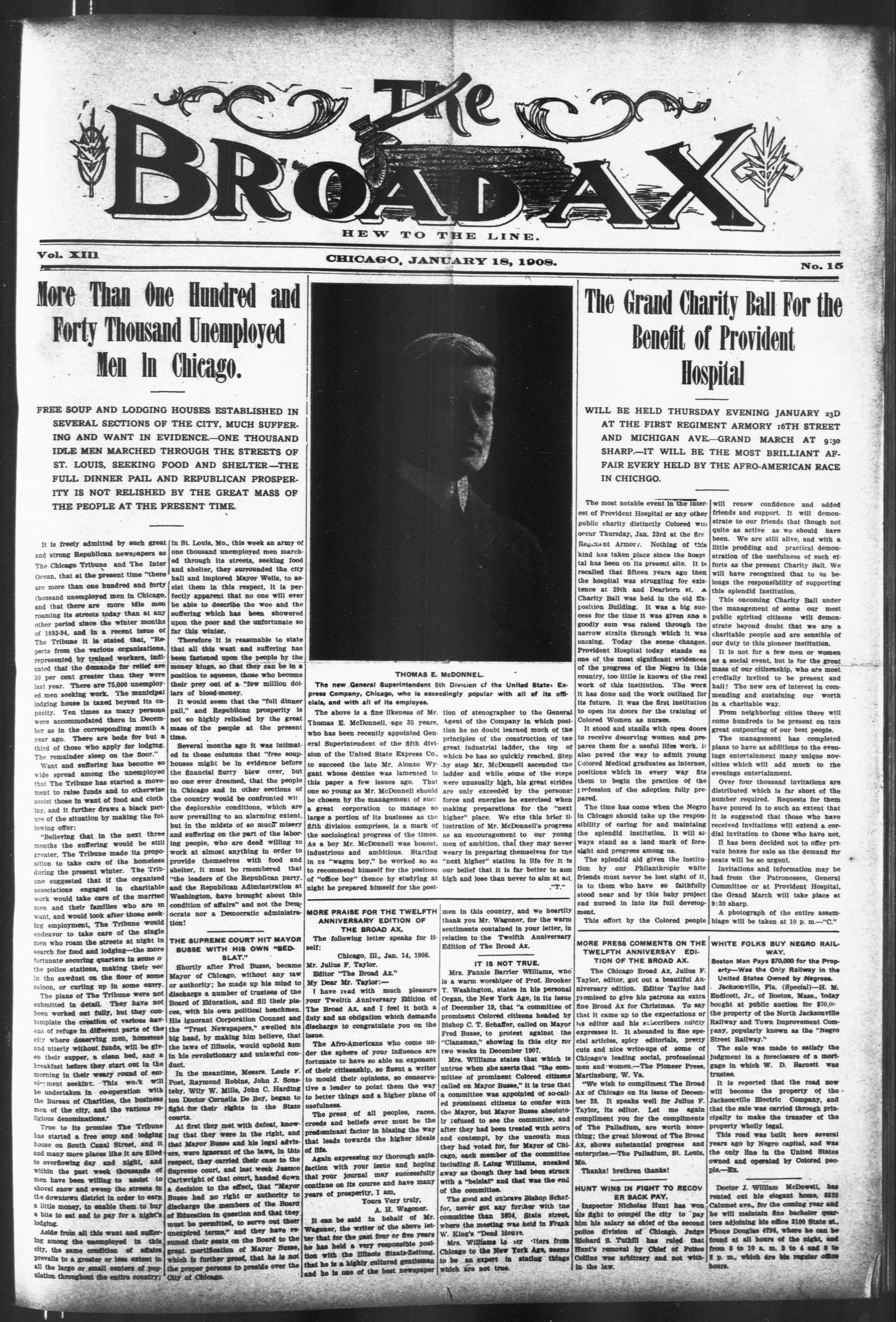
More Than One Hundred and Forty Thousand Unemployed Men In Chicago.
FREE SOUP AND LODGING HOUSES ESTABLISHED IN SEVERAL SECTIONS OF THE CITY, MUCH SUFFERING AND WANT IN EVIDENCE. ONE THOUSAND IDLE MEN MARCHED THROUGH THE STREETS OF ST. LOUIS, SEEKING FOOD AND SHELTER. THE FULL DINNER PAIL AND REPUBLICAN PROSPERITY IS NOT RELISHED BY THE GREAT MASS OF THE PEOPLE AT THE PRESENT TIME.
Vol. XII
More Than One
Forty Thousand
Men In
FREE SOUP AND LODGING
SEVERAL SECTIONS OF
ING AND WANT IN EY
IDLE MEN MARCHED T
ST. LOUIS, SEEKING H
FULL DINNER PAIL A
ITY IS NOT RELISHED
THE PEOPLE AT THE P
It is freely admitted by such great and strong Republican newspapers as The Chicago Tribune and The Inter Ocean, that at the present time "there are more than one hundred and forty thousand unemployed men in Chicago, and that there are more idle men roaming its streets today than at any other period since the winter months of 1893-94, and in a recent issue of The Tribune it is stated that, "Reports from the various organizations, represented by trained workers, indicated that the demands for relief are 50 per cent greater than they were last year. There are 75,000 unemployed men seeking work. The municipal lodging house is taxed beyond its capacity. Ten times as many persons were accommodated there in December as in the corresponding month a year ago. There are beds for but a third of those who apply for lodging. The remainder sleep on the floor."
Want and suffering has become so wide spread among the unemployed that The Tribune has started a movement to raise funds and to otherwise assist those in want of food and clothing, and it further draws a black picture of the situation by making the following offer:
"Believing that in the next three months the suffering would be still greater, The Tribune made its proposition to take care of the homeless during the present winter. The Tribune suggested that if the organized associations engaged in charitable work would take care of the married men and their families who are in want, and would look after those seeking employment, The Tribune would endeavor to take care of the single men who roam the streets at night in search for food and lodging—the more fortunate securing quarters in some of the police stations, making their nec in the sawdust on the floor of some saloon, or curling up in some entry.
The plans of The Tribune were not submitted in detail. They have not been worked out fully, but they contemplate the creation of various havens of refuge in different parts of the city where deserving men, homeless and utterly without funds, will be given their supper, a clean bed, and a breakfast before they start out in the morning in their weary round of employment seeking. This work will be undertaken in co-operation with the Bureau of Charities, the business men of the city, and the various religious denominations.'
True to its promise The Tribune has started a free soup and lodging house on South Canal Street, and it and many more places like it are filled to overflowing day and night, and within the past week thousands of men have been willing to assist to shovel snow and sweep the streets in the downtown district in order to earn a little money, to enable them to buy a bite to eat and to pay for a night's lodging.
Aside from all this want and suffering among the unemployed in this city, the same condition of affairs prevails to a greater or less extent in all the large or small centers of population throughout the entire country;
In St. Louis, Mo., this week an army of one thousand unemployed men marched through its streets, seeking food and shelter, they surrounded the city hall and implored Mayor Wells, to assist them in this respect, it is perfectly apparent that no one will ever be able to describe the woe and the suffering which has been showered upon the poor and the unfortunate so far this winter.
Therefore it is reasonable to state that all this want and suffering has been fastened upon the people by the money kings, so that they can be in a position to squeeze, those who become their prey out of a "few million dollars of blood-money.
It would seem that the "full dinner pail," and Republican prosperity is not so highly relished by the great mass of the people at the present time.
Several months ago it was intimated in these columns that "free soups houses might be in evidence before the financial flurry blew over, but no one ever dreamed, that the people in Chicago and in other sections of the country would be confronted with the deplorable conditions, which are now prevailing to an alarming extent, but in the midsts of so much misery and suffering on the part of the laboring people, who are dead willing to work at almost anything in order to provide themselves with food and shelter, it must be remembered that "the leaders of the Republican parry, and the Republican Adimistration at Washington, have brought about this condition of affairs" and not the Democrats nor a Democratic administration!
THE SUPREME COURT HIT MAYOR BUSSE WITH HIS OWN "BED-SLAT."
Shortly after Fred Busse, became Mayor of Chicago, without any law or authority; he made up his mind to discharge a number of trustees of the Board of Education, and fill their places, with his own political henchmen. His ignorant Corporation Counsel and the "Trust Newspapers," swelled his big head, by making him believe, that the laws of Illinois, would uphold him in his revolutionary and unlawful conduct.
In the meantime, Messrs. Louis F. Post, Raymond Robins, John J. Sonsteby, Wily W. Mills, John C. Hardington Doctor Cornelia De Bey, began to fight for their rights in the State courts.
At first they met with defeat, knowing that they were in the right, and that Mayor Busse and his legal advisers, were ignorant of the laws, in this respect, they carried their case to the Supreme court, and last week Justice Cartwright of that court, handed down a decision to the effect, that "Mayor Busse had no right or authority to discharge the members of the Board of Education in question and that they must be permitted, to serve out their unexpired terms," and they have resumed their seats on the Board to the great mortification of Mayor Busse, which is further proof, that he is not the proper persons to preside over the City of Chicago.
[Name]
The new General Superintendent 5th Division of the United State Express Company, Chicago, who is exceedingly popular with all of its officials, and with all of its employees.
The above is a fine likeness of Mr. tion of stenographer to the General Thomas E. McDonnell, age 35 years, Agent of the Company in which position who has been recently appointed General Superintendent of the fifth division of the United State Express Co., which he has so quickly reached. Step to succeed the late Mr. Alonzo Wy by step Mr. McDonnell ascended the giant whose demise was lamented in this paper a few issues ago. That step one so young as Mr. McDonnell should are only exceeded by the personal force and energies he exercised when a great corporation to manage so large a portion of its business as the higher" place. We cite this brief for fifth division comprises, is a mark of illustration of Mr. McDonnell's progress the sociological progress of the times. As a boy Mr. McDonnell was honest, men of ambition, that they may never industrious and ambitious. Starting in as "wagon boy," he worked so as to recommend himself for the position our belief that it is far better to amu "office boy" thence by studying at high and lose than never to aim at an night he prepared himself for the post.
"T."
The following letter speaks for its self:
Chicago, Ill., Jan. 14, 1908.
Mr. Julius F. Taylor.
Editor "The Broad Ax."
My Dear Mr. Taylor:—
I have read with much pleasure your Twelfth Anniversary Edition of The Broad Ax, and I feel it both a duty and an obligation which demands discharge to congratulate you on the issue.
The Afro-Americans who come under the sphere of your influence are fortunate to have so able an exponent of their citizenship, so fluent a writer to mould their opinions, so conservative a leader to point them the way to better things and a higher plane of usefulness.
The press, of all peoples, races, creeds and beliefs ever must be the predominant factor in blazing the way that leads towards the higher ideals of life.
Again expressing my thorough satisfaction with your issue and hoping that your journal may successfully continue on its course and have many years of prosperity, I am.
Yours Very truly,
It can be said in behalf of Mr. Wagoner, the writer of the above letter that for the past four or five years he has held a very responsible position with the Illinois Staats-Zeitung, that he is a highly cultured gentleman and he is one of the best newspaper
tion of stenographer to the General Agent of the Company in which position he no doubt learned much of the principles of the construction of the great industrial ladder, the top of which he has so quickly reached. Step by step Mr. McDonnell ascended the ladder and while some of the steps were unusually high, his great strides are only exceeded by the personax force and energies he exercised when making preparations for the "next higher" place. We cite this brier illustration of Mr. McDonnell's progress as an encouragement to our young men of ambition, that they may never weary in preparing themselves for the "next higher" station in life for it is our belief that it is far better to am high and lose than never to aim at all. "T."
men in this country, and we heartily thank you Mr. Wagoner, for the warm sentiments contained in your letter, in relation to the Twelfth Anniversary Edition of The Broad Ax.
IT IS NOT TRUE.
Mrs. Fannie Barrier Williams, who is a warm worshiper of Prof. Brooker T. Washington, states in his personal Organ, the New York Age, in its issue of December 19, that "a committee of prominent Colored citizens headed by Bishop C. T. Schaffer, called on Mayor Fred Busse, to protest against the "Clansman," showing in this city for two weeks in December 1907.
Mrs. Williams states that which is untrue when she asserts that "the committee of prominent Colored citizens called on Mayor Busse," it is true that a committee was appointed of so-called prominent citizens to confer with the Mayor, but Mayor Busse absolutely refused to see the committee, and after they had been treated with scorn and contempt, by the uncouth man they had voted for, for Mayor of Chicago, each member of the committee including S. Laing Williams, sneaked away as though they had been struck with a "belslat" and that was the end of the committee.
The good and unbrave Bishop Schaffer, never got any further with the committee than 3604, State street, where the meeting was held in Frank W. King's "Dend House."
Mrs. Williams in her letters from Chicago to the New York Age, seems to be an expert in stating things which are not true.
The Grand Charity Ball For the Benefit of Provident Hospital
WILL BE HELD THURSDAY EVENING JANUARY 23D AT THE FIRST REGIMENT ARMORY 16TH STREET AND MICHIGAN AVE.—GRAND MARCH AT 9:30 SHARP.—IT WILL BE THE MOST BRILLIANT AF FAIR EVERY HELD BY THE AFRO-AMERICAN RACE IN CHICHGO.
The most notable event in the interest of Provident Hospital or any other public charity distinctly Colored will occur Thursday, Jan. 23rd at the first Regiment Armory. Nothing of this kind has taken place since the hospital has been on its present site. It is recalled that fifteen years ago then the hospital was struggling for existence at 29th and Dearborn st. A Charity Ball was held in the old Exposition Building. It was a big success for the time it was given and a goodly sum was raised through the narrow straits through which it was passing. Today the scene changes. Provident Hospital today stands as one of the most significant evidences of the progress of the Negro in this country, too little is known of the real work of this institution. The work it has done and the work outlined for its future. It was the first institution to open its doors for the training of Colored Women as nurses.
It stood and stands with open doors to receive deserving women and prepares them for a useful lifes work. It also paved the way to admit young Colored Medical graduates as internes, positions which in every way fits them to begin the practice of the profession of the adoption fully prepared.
The time has come when the Negro in Chicago should take up the responsibility of caring for and maintaining the splendid institution. It will always stand as a land mark of fore-sight and progress among us.
The splendid aid given the institution by our Philanthropic white friends must never be lost sight of it, is to them who have so faithfully stood near and by this baby project and nursed in into its full development.
This effort by the Colored people
MORE PRESS COMMENTS ON THE TWELFTH ANNIVERSARY EDITION OF THE BROAD AX.
The Chicago Broad Ax, Julius F. Taylor, editor, got out a beautiful Anniversary edition. Editor Taylor had promised to give his patrons an extra fine Broad Ax for Christmas. To say that it came up to the expectations of its editor and his subscribers mildly expresses it. It abounded in fine special articles, spicy editorials, pretty cuts and nice write-ups of some of Chicago's leading social, professional men and women.—The Pioneer Press, Martinsburg, W. Va.
"We wish to compliment The Broad Ax of Chicago on its issue of December 28. It speaks well for Julius F. Taylor, its editor. Let me again compliment you for the compliments of The Palladium, are worth something; the great blowout of The Broad Ax, shows substantial progress and enterprise.—The Palladium, St. Louis, Mo.
Thanks! brethren thanks!
HUNT WINS IN FIGHT TO RECOVER BACK PAY.
Inspector Nicholas Hunt has won his fight to compel the city to pay him his salary as chief of the second police division of Chicago. Judge Richard S. Tuthill has ruled that Hunt's removal by Chief of Police Collins was arbitrary and not within the law.
Security Ball For the
of Provident
Hospital
DAY EVENING JANUARY 23D
ENT ARMORY 16TH STREET
—GRAND MARCH AT 9:30
THE MOST BRILLIANT AF-
THE AFRO-AMERICAN RACE
will renew confidence and added friends and support. It will demonstrate to our friends that though not quite as active as we should have been. We are still alive, and with a little prodding and practical demonstration of the usefulness of such efforts as the present Charity Ball. We will have recognized that to us belongs the responsibility of supporting this splendid Institution.
This oncoming Charity Ball under the management of some our most public spirited citizens will demonstrate beyond doubt that we are a charitable people and are sensible of our duty to this pioneer institution.
It is not for a few men or women as a social event, but is for the great mass of our citizenship, who are most cordially invited to be present and hall! The new era of interest in commending and sustaining our worth in a charitable way.
From neighboring cities there will come hundreds to be present on this great outpouring of our best people.
The management has completed plans to have as additions to the evenings entertainment many unique novelties which will add much to the evenings entertainment.
Over four thousand invitations are distributed which is far short of the number required. Requests for them have poured in to such an extent that it is suggested that those who have received invitations will extend a cordial invitation to those who have not. It has been decided not to offer private boxes for sale as the demand for seats will be so urgent. Invitations and information may be had from the Patronesses, General Committee or at Provident Hospital, the Grand March will take place at 9:30 sharp. A photograph of the entire assembly will be taken at 10 p. m.—"C."
WHITE FOLKS BUY NEGRO RAILWAY.
Boston Man Pays $70,000 for the Property—Was the Only Railway in the United States Owned by Negroes.
Jacksonville, Fla. (Special)—H. M. Endicott, Jr., of Boston, Mass., today bought at public auction for $70,000 the property of the North Jacksonville Railway and Town Improvement Company, popularly known as the "Negro Street Railway."
The sale was made to satisfy the judgment in a foreclosure of a mortgage in which W. D. Barnett was trustee.
It is reported that the road now will become the property of the Jacksonville Electric Company, and that the sale was carried through principally to make the transfer of the property wholly legal.
This road was built here several years ago by Negro capital, and was the only line in the United States owned and operated by Colored people.—Ex.
Doctor J. William McDowell, has rented out his elegant home, 3518 Calumet ave., for the coming year and he will maintain fine bachelor quarters adjoining his office 3100 State st., Phone Douglas 4796, where he can be found at all hours of the night, and from 8 to 10 a. m. 2 to 4 and 6 to 8 p. m., which are his regular office hours.
THE BROAD AX.
Will promulgate and at all times uphold the principles of Democracy, but Catholics, Protestants, Protestants, Indels, Farmers, Single Taxers, Republicans, Knights of Labor, or any one else can have their say, so long as their language is proper and
The Broadcast is a newspaper whose platform is trusted enough for all, ever claiming the editorial right to speak. The Broadcast local communications will receive attention. The outside side of the paper.
WILLIUS Y. TAYLOR, Editor and Publisher.
Entered at the Post Office at Chicago
% as Second-clam Matter.
HOW TO KEEP WELL
CONSUMPTION.
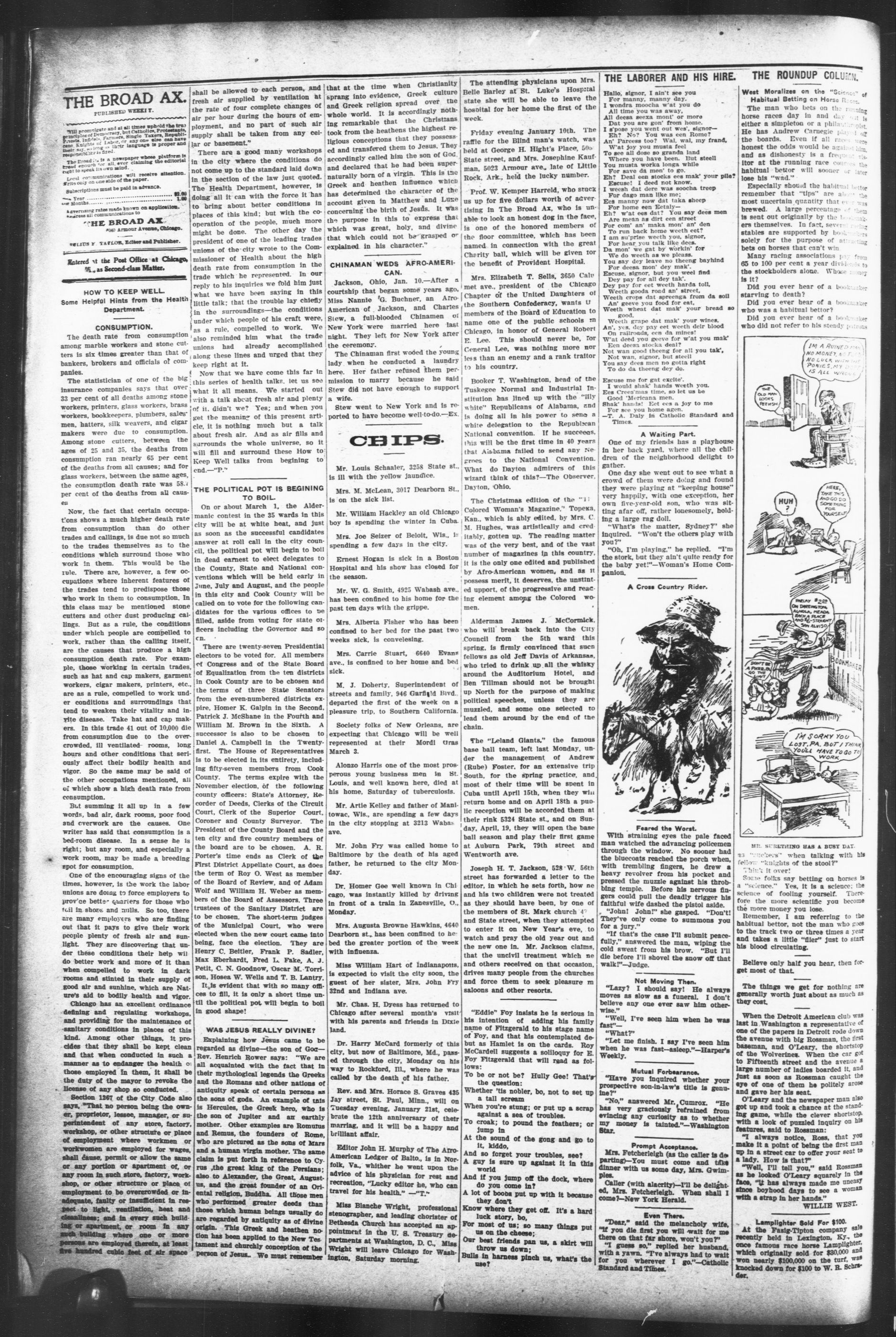
The death rate from consumption among marble workers and stone cutters is six times greater than that of bankers, brokers and officials of companies.
The statistician of one of the big insurance companies says that over 33 per cent of all deaths among stone workers, printers, glass workers, brass workers, bookkeepers, plumbers, salesmen, hatters, silk weavers, and cigar makers were due to consumption. Among stone cutters, between the ages of 25 and 35, the deaths from consumption ran nearly 65 per cent of the deaths from all causes; and for glass workers, between the same ages, the consumption death rate was 58.8 per cent of the deaths from all causes.
Now, the fact that certain occupations shows a much higher death rate from consumption than do other trades and callings, is due not so much to the trades themselves as to the conditions which surround those who work in them. This would be the rule. There are, however, a few occupations where inherent features of the trades tend to predispose those who work in them to consumption. In this class may be mentioned stone cutters and other dust producing callings. But as a rule, the conditions under which people are compelled to work, rather than the calling itself, are the causes that produce a high consumption death rate. For example, those working in certain trades such as hat and cap makers, garment workers, cigar makers, printers, etc. are as a rule, compelled to work under conditions and surroundings that tend to weaken their vitality and inite disease. Take hat and cap makers. In this trade 41 out of 10,000 die from consumption due to the over crowded, ill ventilated-rooms, long hours and other conditions that seriously affect their bodily health and vigor. So the same may be said of the other occupations mentioned, all of which show a high death rate from consumption.
But summing it all up in a few words, bad air, dark rooms, poor food and overwork are the causes. One writer has said that consumption is a bedroom disease. In a sense he is right; but any room, and especially a work room, may be made a breeding spot for consumption.
One of the encouraging signs of the times, however, is the work the labor unions are doing to force employers to provide better quarters for those who toll in shops and mills. So too, there are many employers who are finding out that it pays to give their work people plenty of fresh air and sunlight. They are discovering that under these conditions their help will do better work and more of it than when compelled to work in dark rooms and stinted in their supply of good air and sunshine, which are Nature's aid to bodily health and vigor
Chicago has an excellent ordinance defining and regulating workshops, and providing for the maintenance of sanitary conditions in places of this kind. Among other things, it provides that they shall be kept clean and that when conducted in such a manner as to endanger the health of those employed in them, it shall be the duty of the mayor to revoke the license of any shop so conducted.
Section 126% of the City Code also says, "That no person being the owner, proprietor, lessee, manager, or superintendent of any store, factory, workshop, or other structure or place of employment where workmen or workwomen are employed for wages, shall cause, permit or allow the same or any portion or apartment of, or any room in such store, factory, workshop, or other structure or place of employment to be overcrowded or inadequate, faulty or insufficient in respect to light, ventilation, heat and cleanliness; and in every such building or apartment, or room in any such building where one or more persons are employed therein, at least five hundred cubic feet of air space
shall be allowed to each person, and fresh air supplied by ventilation at the rate of four complete changes of air per hour during the hours of employment, and no part of such air supply shall be taken from any celar or basement."
There are a good many workshops in the city where the conditions do not come up to the standard laid down in the section of the law just quoted. The Health Department, however, is doing all it can with the force it has to bring about better conditions in places of this kind; but with the cooperation of the people, much more might be done. The other day the president of one of the leading trades unions of the city wrote to the Commissioner of Health about the high death rate from consumption in the trade which he represented. In our reply to his inquiries we fold him just what we have been saying in this little talk; that the trouble lay chiefly in the surroundings—the conditions under which people of his craft were, as a rule, compelled to work. We also reminded him what the trade unions had already accomplished along these lines and urged that they keep right at it.
Now that we have come this far in this series of health talks, let us see what it all means. We started out with a talk about fresh air and plenty of it, didn't we? Yes; and when you get the meaning of this present article, it is nothing much but a talk about fresh air. And as air fills and surrounds the whole universe, so it will fill and surround these How to Keep Well talks from beginning to end—"P."
THE POLITICAL POT IS BEGINNING TO BOIL.
On or about March 1, the Aldermanic contest in the 35 wards in this city will be at white heat, and just as soon as the successful candidates answer at roll call in the city council, the political pot will begin to boil in dead earnest to elect delegates to the County, State and National conventions which will be held early in June, July and August, and the people in this city and Cook County will be called on to vote for the following candidates for the various offices to be filled, aside from voting for state officers including the Governor and so on.
There are twenty-seven Presidential electors to be voted for. All members of Congress and of the State Board of Equalization from the ten districts in Cook County are to be chosen and the terms of three State Senators from the even-numbered districts expire, Homer K. Galpin in the Second, Patrick J. McShane in the Fourth and William M. Brown in the Sixth. A successor is also to be chosen to Daniel A. Campbell in the Twenty-first. The House of Representatives is to be elected in its entirety, including fifty-seven members from Cook County. The terms expire with the November election, of the following county officers: State's Attorney, Recorder of Deeds, Clerks of the Circuit Court, Clerk of the Superior Court, Coroner and County Surveyor. The President of the County Board and the ten city and five country members of the board are to be chosen. A. R. Porter's time ends as Clerk of the First District Appellate Court, as does the term of Roy O. West as member of the Board of Review, and of Adam Wolf and William H. Weber as members of the Board of Assessors. Three trustees of the Sanitary District are to be chosen. The short-term judges of the Municipal Court, who were elected when the new court came into being, face the election. They are Henry C. Beltler, Frank P. Sadler, Max Eberhardt, Fred L. Fake, A. J. Petit, C. N. Goodnow, Oscar M. Torrison, Hosea W. Wells and T. B. Lantry. It is evident that with so many offices to fill, it is only a short time until the political pot will begin to boll in good shape!
WAS JESUS REALLY DIVINE?
Explaining how Jesus came to be regarded as divine—the son of God—Rev. Henrich Rower says: "We are all acquainted with the fact that in their mythological legends the Greeks and the Romans and other nations of antiquity speak of certain persons the sons of gods. An example of this is Hercules, the Greek hero, who is the son of Jupiter and an earthly mother. Other examples are Romunus and Remus, the founders of Rome, who are pictured as the sons of Mars and a human virgin mother. The same claim is put forth in reference to Cyrus, the great king of the Persians; also to Alexander, the Great, Augustus, and the great founder of an Oriental religion, Buddha. All those men who performed greater deeds than those which human beings usually do are regarded by antiquity as of divine origin. This Greek and heathen notion has been applied to the New Testament and churchly conception of the person of Jesus. We must remember
that at the time when Christianity sprang into evidence, Greek culture and Greek religion spread over the whole world. It is accordingly nothing remarkable that the Christians took from the heathens the highest religious conceptions that they possessed and transferred them to Jesus. They accordingly called him the son of God, and declared that he had been supernaturally born of a virgin. This is the Greek and heathen influence which has determined the character of the account given in Matthew and Luke concerning the birth of Jesus. It was the purpose in this to express that which was great, holy, and divine that which could not be grasped or explained in his character."
CHINAMAN WEDS AFRO-AMERI CAN
Jackson, Ohio, Jan. 10.—After a courtship that began some years ago, Miss Nannie 'G. Buchner, an Arro-American of Jackson, and Charles Stew, a full-blooded Chinamen of New York were married here last night. They left for New York after the ceremony.
The Chinaman first wooded the young lady when he conducted a laundry here. Her father refused them permission to marry because he said Stew did not have enough to support a wife.
Stew went to New York and is reported to have become well-to-do.—Ex.
Mr. Louis Schaaler, 3258 State st., is ill with the yellow jaundice.
Mrs. M. McLean, 3017 Dearborn St., is on the sick list.
Mr. William Hackley an old Chicago boy is spending the winter in Cuba.
Mrs. Joe Seizer of Beloit, Wis., is spending a few days in the city.
Ernest Hogan is sick in a Boston Hospital and his show has closed for the season.
Mr. W. G. Smith, 4925 Wabash ave., has been confined to his home for the past ten days with the grippe.
Mrs. Alberta Fisher who has been confined to her bed for the past two weeks sick, is connecled.
Mrs. Carrie Stuart, 6640 Evans ave., is confined to her home and bed sick.
M. J. Doherty, Superintendent of streets and family, 946 Garfield Bvd., departed the first of the week on a pleasure trip, to Southern California.
Society folks of New Orleans, are expecting that Chicago will be well represented at their Mordl Gras March 3.
Alonzo Harris one of the most prosperous young business men in St. Louis, and well known here, died at his home, Saturday of tuberculosis.
Mr. Artie Kelley and father of Manitowac, Wis., are spending a few days in the city stopping at 3213 Wabas ave.
Mr. John Fry was called home to Baltimore by the death of his aged father, he returned to the city Monday.
Dr. Homer Gee well known in Chicago, was instantly killed by driving in front of a train in Zanesville, O., Monday.
Mrs. Augusta Browne Hawkins, 4640 Dearborn st., has been confined to bed the greater portion of the week with influenza.
Miss William Hart of Indianapolis, is expected to visit the city soon, the guest of her sister, Mrs. John Fry 32nd and Indiana ave.
Mr. Chas. H. Dyess has returned to Chicago after several month's visit with his parents and friends in Dixie land.
Dr. Harry McCard formerly of this city, but now of Baltimore, Md., passed through the city, Monday on his way to Rockford, Ill., where he was called by the death of his father.
Rev. and Mrs. Horace S. Graves 435 Jay street, St. Paul, Minn., will on Tuesday evening, January 21st, celebrate the 12th anniversary of their marriag, and it will be a happy and brilliant affair.
Editor John H. Murphy of The Arro-
American Ledger of Balto, is in Norfolk, Va., whither he went upon the advice of his physician for rest and recreation, "Lucky editor he, who can travel for his health." — "T."
Miss Blanche Wright, professional stenographer, and leading chorister of Pethesda Church has accepted an appointment in the U. S. Treasury departments at Washington, D. C., Miss Wright will leave Chicago for Washington, Saturday morning
The attending physicians upon Mrs. Belle Barley at St. Luke's Hospital state she will be able to leave the hospital for her home the first of the week.
Friday evening January 10th. The raffle for the Blind man's watch, was held at George H. Hight's Place, 500 State street, and Mrs. Josephine Kaufman, 5023 Armour ave, late of Little Rock, Ark., held the lucky number.
Prof. W. Kemper Harreld, who suck us up for five dollars worth of advertising in The Broad Ax, who is unable to look an honest dog in the face, is one of the honored members of the floor committee, which has been named in connection with the great Charity ball, which will be given for the benefit of Provident Hospital.
Mrs. Elizabeth T. Sells, 3650 Calumet ave., president of the Chicago Chapter of the United Daughters of the Southern Confederacy, wants U members of the Board of Education to name one of the public schools in Chicago, in honor of General Robert E. Lee. This should never be, for General Lee, was nothing more nor less than an enemy and a rank traitor to his country.
Booker T. Washington, head of the Tuskegee Normal and Industrial Institution has lined up with the "illy white" Republicans of Alabama, and is doing all in his power to send a white delegation to the Republican National convention. If he succeeds, this will be the first time in 40 years that Alabama failed to send any Negroes to the National Convention. What do Dayton admirers of this wizard think of this?—The Observer, Dayton, Ohio.
The Christmas edition of the "11 Colored Woman's Magazine," Topeka, Kan., which is ably edited, by Mrs. C. M. Hughes, was artistically and creditably, gotten up. The reading matter was of the very best, and of the vast number of magazines in this country, it is the only one edited and published by Afro-American women, and as it possess merit, it deserves, the unstinted support, of the progressive and reading element among the Colored women.
Alderman James J. McCormick, who will break back into the City Council from the 5th ward this spring, is firmly convinced that such fellows as old Jeff Davis of Arkansas, who tried to drink up all the whisky around the Auditorium Hotel, and Ben Tillman should not be brought up North for the purpose of making political speeches, unless they are muzzled, and some one selected to lead them around by the end of the chain.
The "Leland Giants," the famous base ball team, left last Monday, under the management of Andrew (Rube) Foster, for an extensive trip South, for the spring practice, and most of their time will be spent in Cuba until April 15th, when they will return home and on April 18th a public reception will be accorded them at their rink 5324 State st., and on Sunday, April, 19, they will open the base ball season and play their first game at Auburn Park, 79th street and Wentworth ave.
Joseph H. T. Jackson, 528' W. 56th street has forwarded a letter to the editor, in which he sets forth, how he and his two children were not treated as they should have been, by one of the members of St. Mark church 47 and State street, when they attempted to enter it on New Year's eve, to watch and pray the old year out and the new one in. Mr. Jackson claims, that the uncivil treatment which he and others received on that occasion, drives many people from the churches and force them to seek pleasure in saloons and other resorts.
"Eddie" Foy insists he is serious in his intention of adding his family name of Fitzgerald to his stage name of Foy, and that his contemplated debut as Hamlet is on the cards. Roy McCardell suggests a soliloquy for E. Foy Fitzgerald that will read as follows:
Escuse me for gat excite'.
Shak' hands! Ect ees a joy to me
For see you home agen.
-T. A. Daly in Catholic Standard and
Times.
A Waiting Part.
One of my friends has a playhouse in her back yard, where all the children of the neighborhood delight to gather.
One day she went out to see what a crowd of them were doing and found they were playing at "keeping house" very happily, with one exception, her own five-year-old son, who was sitting afar off, rather lonesomely, holding a large rag doll.
"What's the matter, Sydney?" she inquired. "Won't the others play with you?"
"Oh, I'm playing," he replied. "I'm the stork, but they ain't quite ready for the baby yet."—Woman's Home Companion
A Cross Country Rider.
Feared the Worst
With straining eyes the pale faced man watched the advancing policemen through the window. No sooner had the bluecoats reached the porch when, with trembling fingers, he drew a heavy revolver from his pocket and pressed the muzzle against his throbbing temple. Before his nervous fingers could pull the deadly trigger his faithful wife dashed the pistol aside. "Johnl John!" she gasped. "Don't! They've only come to summons you for a jury." "If that's the case I'll submit peacefully," answered the man, wiping the cold sweat from his brow. "But I'll die before I'll shovel the snow off that walk!" -Judge.
Not Moving Then
"Lazy? I should say! He always moves as slow as a funeral. I don't believe any one ever saw him otherwise."
"Well, I've seen him when he was fast"—
"What?"
"Let me finish. I say I've seen him when he was fast—asleep."—Harper's Weekly.
Mutual Forbearance.
"Have you inquired whether your prospective son-in-law's title is genuine?"
"No," answered Mr. Cumrox. "He has very graciously refrained from evincing any curiosity as to whether my money is tainted."—Washington Star.
Prompt Acceptance
Mrs. Fetcherleigh (as the caller is departing)—You must come and take dinner with us some day, Mrs. Gwimples.
Caller (with alacrity)—I'll be delighted, Mrs. Fetcherleigh. When shall I come?—New York Herald.
Even There.
"Dear," said the melancholy wife, "If you die first you will wait for me there on that far shore, won't you?" "I guess so," replied her husband, with a yawn. "I've always had to wait for you wherever I go."—Catholic Standard and Times.
West Moralizes on the "Science" of Habitual Betting on Horse Racing
Habitual Betting on Horse Rescue.
The man who bets on the running horse races day in and day out is either a simplepon or a philanthropist. He has Andrew Carnegie played off the boards. Even if all races were honest the odds would be against him, and as dishonesty is a frequent visitor at the running race courses the habitual bettor will sooner or later lose his "wad."
Especially should the habitual better remember that "tips" are about the most uncertain quantity that ever was brewed. A large percentage of them is sent out originally by the bookmakers themselves. In fact, several racing stables are supported by bookmakers solely for the purpose of attracting bets on horses that can't win.
Many racing associations pay from 65 to 100 per cent a year dividends to the stockholders alone. Whose money is it?
Did you ever hear of a bookmaker starving to death?
Did you ever hear of a bookmaker who was a habitual better?
Did you ever hear of a bookmaker who did not refer to his steady patron
I'M A RUINED PIN
NO MONEY, NO FUND
NO LOCK WITH THE
PONIES, MY DIRT
IS ALL WHORL
THE OLD MAN
LOOKS PREVIEW
HERE,
THAT'S
AND GO TO
SOMETHING
FOR
YOURSELF
PIRLAY #22
ON DRAWINGTON
MAGNOLIA, PERSON
BROW A PLACE
AND 26-STRAIGHT
SUN ALVISO
DON'T BE
A POWER,
GO THE HUNT
BOOKMAKER
I'M SORRY YOU
LOST, PA. BUT I THINK
YOU'LL HAVE TO GO TO
WORK
MIR. SURRETHING HAS A BUSY DAY.
an "nuckles" when talking with his
fellow "knights of the stool?"
Think it over!
Some folks say betting on horses is
a "science." Yes, it is a science; the
science of fooling yourself. Therefore
the more scientific you become
the more money you lose.
Remember, I am referring to the
habitual better, not the man who goes
to the track two or three times a year
and takes a little "fler" just to start
his blood circulating.
Belleve only half you hear, then forget most of that.
The things we get for nothing are
generally worth just about as much as they cost.
When the Detroit American club was last in Washington a representative of one of the papers in Detroit rode down the avenue with big Rossman, the first baseman, and O'Leary, the shortstop of the Wolverines. When the car got to Fifthth street and the avenue a large number of ladies boarded it, and just as soon as Rossman caught the eye of one of them he politely arose and gave her his seat.
O'Leary and the newspaper man also got up and took a chance at the standing game, while the clever shortstop, with a look of puzzled inquiry on his features, said to Rossman:
"I always notice, Ross, that you make it a point of being the first man up in a street car to offer your seat to a lady. How is that?"
"Well, I'll tell you," said Rossman as he looked O'Leary squarely in the face, "it has always made me uneasy since boyhood days to see a woman with a strap in her hands."
WILLIE WEST.
Lamplighter Sold For $100.
Lampighter Sold For $100
At the Fasig-Tipton company sale recently held in Lexington, KY, the once famous race horse Lampighter, which originally sold for $30,000 and won nearly $100,000 on the turf, was knocked down for $100 to W. R. Schrader.
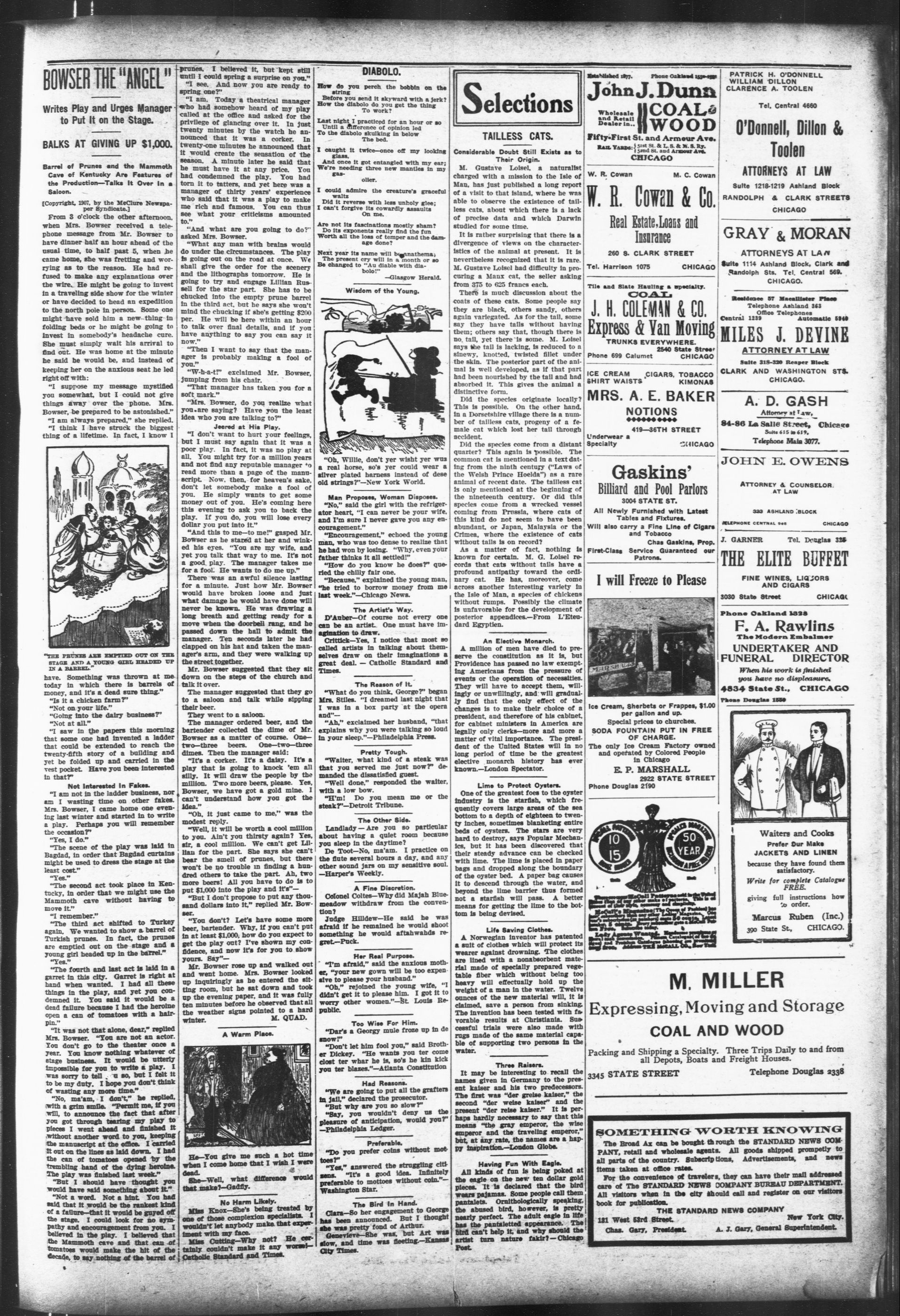
BOWSER THE "ANGEL"
Writes Play and Urges Manager to Put It on the Stage.
Barral of Prunes and the Mammoth Cave of Kentucky Are Features of the Production—Talks It Over In a Saloon.
[Copyright, 1907, by the McClure Newspaper Syndicate.]
From 3 o'clock the other afternoon, when Mrs. Bowser received a telephone message from Mr. Bowser to have dinner half an hour ahead of the usual time, to half past 5, when he came home, she was fretting and worrying as to the reason. He had refused to make any explanations over the wire. He might be going to invest in a travelling side show for the winter or have decided to head an expedition to the north pole in person. Some one might have sold him a new thing-in folding beds or he might be going to invest in somebody's headache cure. She must simply wait his arrival to find out. He was home at the minute he said he would be, and instead of keeping her on the anxious seat he led right off with:
"I suppose my message mystified you somewhat, but I could not give things away over the phone. Mrs. Bowser, be prepared to be astonished." "I am always prepared," she replied. "I think I have struck the biggest thing of a lifetime. In fact, I know I
A
"THE PRUNES ARE EMPTYTED OUT ON THE STAGE AND A YOUNG GIRL HEADED UP IN A BARREL."
have. Something was thrown at me today in which there is barrels of money, and it's a dead sure thing.
"Is it a chicken farm?"
"Not on your life."
"Going into the dairy business?"
"Not at all."
"I saw in the papers this morning that some one had invented a ladder that could be extended to reach the twenty-fifth story of a building and yet be folded up and carried in the vest pocket. Have you been interested in that?"
Not Interested In Fakes.
"I am not in the ladder business, nor am I wasting time on other fakes. Mrs. Bowser, I came home one evening last winter and started in to write a play. Perhaps you will remember the occasion?"
"Yes I do"
"The scene of the play was laid in Bagdad, in order that Bagdad curtains might be used to dress the stage at the least cost."
"Yes."
"The second act took place in Kentucky, in order that we might use the Mammoth cave without having to move it."
"I remember."
"The third act shifted to Turkey again. We wanted to show a barrel of Turkish prunes. In fact, the prunes are emptied out on the stage and a young girl headed up in the barrel."
"Yes."
"The fourth and last act is laid in a garret in this city. Garret is right at hand when wanted. I had all these things in the play, and yet you condemned it. You said it would be a dead failure because I had the heroine open a can of tomatoes with a hairpin."
"It was not that alone, dear," replied Mrs. Bowser. "You are not an actor. You don't go to the theater once a year. You know nothing whatever of stage business. It would be utterly impossible for you to write a play. I was sorry to tell . . . you, but I felt it to be my duty. I hope you don't think of wasting any more time." "No, ma'ma, I don't," he replied, with a grim smile. "Permit me, if you will, to announce the fact that after you got through tearing my play to pieces I went ahead and finished it without another word to you, keeping the manuscript at the office. I carried it out on the lines as laid down. I had the can of tomatoes opened by the trembling hand of the dying heroine. The play was finished last week." "But I should have thought you would have said something about it."
"Not a word. Not a hint. You had said that it would be the rankest kind of a failure—that it would be guyed off the stage. I could look for no sympathy and encouragement from you. I believed in the play. I believed that the Mammoth cave and that can of tomatoes would make the hit of the decade, to say nothing of the barrel of
prunes, I believed it, but kept still until I could spring a surprise on you." "I see. And now you are ready to spring one!" "I am. Today a theatrical manager who had somehow heard of my play called at the office and asked for the privilege of glancing over it. In just twenty minutes by the watch he announced that it was a corker. In twenty-one minutes he announced that it would create the sensation of the season. A minute later he said that he must have it at any price. You had condemned the play. You had torn it to tatters, and yet here was a manager of thirty years' experience who said that it was a play to make me rich and famous. You can thus see what your criticisms amounted to." "And what are you going to do?" asked Mrs. Bowser.
"What any man with brains would do under the circumstances. The play is going out on the road at once. We shall give the order for the scenery and the lithographs tomorrow. He is going to try and engage Lillian Russell for the star part. She has to be chucked into the empty prune barrel in the third act, but he says she won't mind the chucking if she's getting $200 per. He will be here within an hour to talk over final details, and if you have anything to say you can say it now."
"Then I want to say that the manager is probably making a fool of you."
"W-h-a-t!" exclaimed Mr. Bowser, jumping from his chair.
"That manager has taken you for a soft mark."
"Mrs. Bowser, do you realize what you are saying? Have you the least idea who you are talking to?"
Jeered at His Play.
"I don't want to hurt your feelings, but I must say again that it was a poor play. In fact, it was no play at all. You might try for a million years and not find any reputable manager 'to read more than a page of the manuscript. Now, then, for heaven's sake, don't let somebody make a fool of you. He simply wants to get some money out of you. He's coming here this evening to ask you to back the play. If you do, you will lose every dollar you put into it."
"And this to me—to me!" gasped Mr. Bowers as he stared at her and winked his eyes. "You are my wife, and yet you talk that way to me. It's not a good play. The manager takes me for a fool. He wants to do me up."
There was an awful silence lasting for a minute. Just how Mr. Bowser would have broken loose and just what damage he would have done will never be known. He was drawing a long breath and getting ready for a move when the doorbell rang, and he passed down the hall to admit the manager. Ten seconds later he had clapped on his hat and taken the manager's arm, and they were walking up the street together.
Mr. Bowser suggested that they sit down on the steps of the church and talk it over.
The manager suggested that they go to a saloon and talk while sipping their beer.
They went to a saloon.
The manager ordered beer, and the bartender collected the dime of Mr. Bowser as a matter of course. One-two-three beers. One-two-three dimes. Then the manager said: "It's a corker. It's a daisy. It's a play that is going to knock 'em all silly. It will draw the people by the million. Two more beers, please. Yes, Bowser, we have got a gold mine. I can't understand how you got the idea." "Oh, it just came to me," was the modest reply. "Well, it will be worth a cool million to you. Ain't you thirsty again? Yes, sir, a cool million. We can't get Lillian for the part. She says she can't bear the smell of prunes, but there won't be no trouble in finding a hundred others to take the part. Ah, two more beers! All you have to do is to put $1,000 into the play and it"—
"But I don't propose to put any thousand dollars into it," replied Mr. Bowser.
"You don't? Let's have some more beer, bartender. Why, if you can't put in at least $1,000, how do you expect to get the play out? I've shown my confidence, and now it's for you to show yours. Say"—Mr. Bowser rose up and walked out and went home. Mrs. Bowser looked up in inquiringly as he entered the sitting room, but he sat down and took up the evening paper, and it was fully ten minutes before he observed that all the weather signs pointed to a hard winter. M. QUAD.
A Warm Place.
A
She—Well, what difference would that make?—Gadfly.
No Harm Likely.
Miss Knox-She's being treated by one of those complexion specialists. I wouldn't let anybody make that experiment with my face.
Miss Cutting-Why not? He certainly couldn't make it any worse! Catholic Standard and Times.
DIABOLO
How do you perch the bobbin on the string
Before you send it skyward with a jerk?
How the diabolo do you get the thing
To work?
Last night I practiced for an hour or so
Until a difference of opinion led
To the diabolo skulking in below
The bed.
I caught it twice—once off my looking glass.
And once it got entangled with my ear;
We're needing three new mantles in my
gas-
oiler.
I could admire the creature's graceful
waltz
Did it reverse with less unholy glee;
I can't forgive its cowardly assaults
On me.
Are not its fascinations mostly sham?
Do its exponents really find the fun
Worth all the loss of temper and the dam-
age done?
Next year its name will be anathema;
The present cry will in a month or so
Be changed to "An disable with dia-
bolo!"—Glasgow Herald.
"Oh, Willie, don't yer wisht yer wuz a real horse, so's yer could wear a silver plated harness instead of dese old strings?"—New York World.
Man Proposes. Woman Disposes.
"No," said the girl with the refrigerator heart, "I can never be your wife, and I'm sure I never gave you any encouragement."
"Encouragement," echoed the young man, who was too dense to realize that he had won by losing. "Why, even your father thinks it all settled!"
"How do you know he does?" queried the chilly fair one.
"Because," explained the young man, "he tried to borrow money from me last week."—Chicago News.
The Artist's Way
D'Auber-Of course not every one can be an artist. One must have imagination to draw.
Crittick-Yes, I notice that most so called artists in talking about themselves draw on their imaginations a great deal. — Catholic Standard and Times
The Reason of It:
"What do you think, George?" began Mrs. Stiles. "I dreamed last night that I was in a box party at the opera and"— "Ah," exclaimed her husband, "that explains why you were talking so loud in your sleep."—Philadelphia Press.
Pretty Tough.
"Walter, what kind of a steak was that you served me just now?" demanded the dissatisfied guest. "Well done," responded the waiter, with a low bow. "H'm! Do you mean me or the steak?"—Dedroit Tribune.
The Other Side.
Landlady — Are you so particular about having a quiet room because you sleep in the daytime? De Toot—No, ma'am. I practice on the flute several hours a day, and any other sound jars on my sensitive soul. —Harper's Weekly.
A. Fine Discretion
Colonel Coltes—Why did Majah Blue meadow withdraw from the convention?
Judge Hilldew—He said he was afraid if he remained he would shoot something he would aftahwahds regret—Puck.
Her Real Purpose:
"I'm afraid," said the anxious mother, "your new gown will be too expensive to please your husband." "Oh," rejoined the young wife, "I didn't get it to please him. I got it to worry other women."—St. Louis Republic.
Too Wise For Him
"Dar's a Georgy mule froze up in de snow!"
"Don't let him fool you," said Brother Dickey. "He wants you ter come closest ter what he is, so's he kin kick you ter blazes."-Atlanta Constitution
Had Reasons.
"We are going to put all the grafters in jail," declared the prosecutor.
"But why are you so slow?"
"Say, you wouldn't deny us the pleasure of anticipation, would you?"
Philadelphia Ledger.
Preferable.
"Do you prefer coins without mottoes?"
"Yes," answered the struggling citizens. "It's a good idea. Infinitely preferable to mottoes without coin."—Washington Star.
The Bird In Hand.
Clara—So her engagement to George has been announced. But I thought she was pretty fond of Arthur. Genevieve—She was, but Art was slow, and time was fleeting—Kansas City Times.
Selections
TAILLESS CATS.
Considerable Doubt Still Exists as to Their Origin.
M. Gustave Lolsel, a naturalist charged with a mission to the Isle of Man, has just published a long report of a visit to that island, where he was able to observe the existence of tailless cats, about which there is a lack of precise data and which Darwin studied for some time.
It is rather surprising that there is a divergence of views on the characteristics of the animal at present. It is nevertheless recognized that it is rare.
M. Gustave Lolsel had difficulty in procuring a Manx cat, the seller asking from 375 to 625 francs each.
There is much discussion about the coats of these cats. Some people say they are black, others sandy, others again variegated. As for the tall, some say they have tails without having them; others say that, though there is no tail, yet there is some. M. Loisel says the tail is lacking, is reduced to a slewy, knotted, twisted fillet under the skin. The posterior part of the animal is well developed, as if that part had been nourished by the tail and had absorbed it. This gives the animal a distinctive form.
Did the species originate locally?
This is possible. On the other hand, in a Dorsetshire village there is a number of tallless cats, progeny of a female cat which lost her tail through accident.
Did the species come from a distant quarter? This again is possible. The common cat is mentioned in a text dating from the ninth century ("Laws of the Welsh Prince Hoelaa") as a rare animal of recent date. The tallless cat is only mentioned at the beginning of the nineteenth century. Or did this species come from a wrecked vessel coming from Prussia, where cats of this kind do not seem to have been abundant, or Japan, Malaysia or the Crimea, where the existence of cats without tails is on record?
As a matter of fact, nothing is known for certain. M. G. Loisel records that cats without tails have a profound antipathy toward the ordinary cat. He has, moreover, come across another interesting variety in the Isle of Man, a species of chickens without rumps. Possibly the climate is unfavorable for the development of posterior appendices.—From L'Eteudan Egypt.
An Elective Monarch.
A million of men have died to preserve the constitution as it is, but Providence has passed no law exempting Americans from the pressure of events or the operation of necessities. They will have to accept them, willingly or unwillingly, and will gradually find that the only effect of the changes is to make their choice of a president, and therefore of his cabinet, for cabinet ministers in America are legally only clerks—more and more a matter of vital importance. The president of the United States will in no long period of time be the greatest elective monarch history has ever known—London Spectator.
Lime to Protect Oysters
One of the greatest foes to the oyster industry is the starfish, which frequently covers large areas of the sea bottom to a depth of eighteen to twenty inches, sometimes blanketing entire beds of oysters. The stars are very hard to destroy, says Popular Mechanics, but it has been discovered that their steady advance can be checked with lime. The lime is placed in paper bags and dropped along the boundary of the oyster bed. A paper bag causes it to descend through the water, and beyond the lime barrier thus formed not a starfish will pass. A better means for getting the lime to the bottom is being devised.
Life Saving Clothes.
A Norwegian inventor has patented a suit of clothes which will protect its wearer against drowning. The clothes are lined with a nonabsorbent material made of specially prepared vegetable fiber which without being too heavy will effectually hold up the weight of a man in the water. Twelve ounces of the new material will, it is claimed, save a person from sinking. The invention has been tested with favorable results at Christiania. Successful trials were also made with rugs made of the same material capable of supporting two persons in the water.
Three Raisers.
It may be interesting to recall the names given in Germany to the present kaiser and his two predecessors. The first was "der greise kaiser," the second "der weise kaiser" and the present "der reise kaiser." It is perhaps hardly necessary to say that this means "the gray emperor, the wise emperor and the traveling emperor," but at any rate, the names are a happy insipiration—London Globe.
Having Fun With Eagle
All kinds of fun is being poked at the eagle on the new ten dollar gold pieces. It is declared that the bird wears pajamas. Some people call them pantalets. Ornithologically speaking, the abused bird, however, is pretty nearly perfect. The adult eagle in life has the pantaletted appearance. The bird can't help it, and why should the artist turn nature fakir?—Chicago Post.
Fifty-First St. and Armour Ave.
RAIL YARDS: 1st St. & L. S. & N. S. RY.
1st St. and Armour Ave.
CHICAGO
W. R. Cowan M. C. Cowan
W. R. Cowan & Co.
Real Estate, Loans and
Insurance
260 S. CLARK STREET
Tel. Harrison 1075 CHICAGO
Tile and State Hauling a specialty.
COAL
J. H. COLEMAN & CO.
Express & Van Moving
TRUNKS EVERYWHERE.
2540 State Street
Phone 699 Calumet
CHICAGO
ICE CREAM
CIGARS, TOBACCO
SHIRT WAISTS
KIMONAS
MRS. A. E. BAKER
ATTORNEY at LAW,
84-86 La Salle Street, Chicago
Suite 615 to 619.
Telephone Main 3077.
NOTIONS
419-36TH STREET
Underwear a
Specialty CHICAGO
Gaskins'
Billiard and Pool Parlors
323 ASHLAND BLOCK
TELEPHONE CENTRAL 948 CHICAGO
J. GARNER Tel. Douglas 325
THE ELITE BUFFET
3004 STATE ST.
All Newly Furnished with Latest
Tables and Fixtures.
Will also carry a Fine Line of Cigars
and Tobacco
Chas Gaskins, Prop.
First-Class Service Guaranteed our
Patrons.
I will Freeze to Please
MARSHAL
Ice Cream, Sherbets or Frappes, $1.00
per gallon and up.
Special prices to churches.
SODA FOUNTAIN PUT IN FREE
OF CHARGE.
The only Ice Cream Factory owned
and operated by Colored People
in Chicago
E. P. MARSHALL
2922 STATE STREET
Phone Douglas 2190
SPECIAL ANNIVERSARY
10
15
50
YEAR
REMAINING AFTER 1920
Photographs upon the Cell Programmes sold in the United Kingdom for all types of patterns. This is all bound of their size, quantity and simplicity.
No Cell's Migration (The Queen's Wardrobe) for sale in the United Kingdom. Only information on past sizes and colours. Only 15 copies are available. Please contact the Agency for details.
Hugh Agnes Wanted. Hugh Agnes programmes for sale and distribution. Please Catalogue of the Stock. Admiral Admiral McCullough, New York.
M. MILLER
Expressing, Moving
COAL AND
Packing and Shipping a Specialty
all Depots, Boats a
3345 STATE STREET
Moving and Storage
DAL AND WOOD
g a Specialty. Three Trips Daily to and from
boats, Boats and Freight Houses.
ET Telephone Douglas 2338
Packing and Shipping a Specialty. Three Trips Daily to and from all Depots, Boats and Freight Houses. 3345 STATE STREET Telephone Douglas 2338
SOMETHING WORTH KNOWING
The Broad Ax can be bought through the STANDARD NEWS COMPANY, retail and wholesale agents. All goods shipped promptly to all parts of the country. Subscriptions, Advertisements, and news items taken at office rates.
For the convenience of travelers, they can have their mail addressed care of The STANDARD NEWS COMPANY BUREAU DEPARTMENT. All visitors when in the city should call and register on our visitors book for publication.
THE STANDARD NEWS COMPANY
181 West 53rd Street. New York City.
Chas. Gary, President. A. J. Gary, General Superintendent.
PATRICK H. O'DONNELL
WILLIAM D'ILLON
CLARENCE A. TOOLEN
Tel. Central 4660
O'Donnell, Dillon &
Toolen
ATTORNEYS AT LAW
Suite 1218-1219 Ashland Block
RANDOLPH & CLARK STREETS
CHICAGO
GRAY & MORAN
ATTORNEYS AT LAW
Suite 1114 Ashland Block, Clark and Randolph Sts. Tel. Central 569.
CHICAGO.
Residence 57 Macallister Place
Telephone Ashland 363
Office Telephones
Central 1239 Automatic 5940
MILES J. DEVINE
ATTORNEY AT LAW
Suite 318-320 Reaper Block
CLARK AND WASHINGTON STS.
CHICAGO.
A. D. GASH
JOHN E. OWENS
ATTORNEY & COUNSELOR
AT LAW
FINE WINES, LIQUORS
AND CIGARS
1030 State Street CHICAGO
Phone Oakland 1828
F. A. Rawlins
The Modern Embalmer
UNDERTAKER AND
FUNERAL DIRECTOR
When his work is finished
you have no displeasure.
4834 State St., CHICAGO
Phones Douglas 1550
COOKS
Waiters and Cooks
Prefer Our Make
JACKETS AND LINEN
because they have found them
satisfactory.
Write for complete Catalogue
FREE.
giving full instructions how
to order.
Marcus Ruben (Inc.)
390 State St., CHICAGO.
DANGEROUS FREIGHT.
Cargoes That Are a Source of Danger to Vessels.
Exhaustive experiments by the New South Wales government have now proved—what has all along been suspected—that wool will under certain conditions ignite spontaneously and that consequently it is a dangerous cargo to carry.
Probably, therefore, it will be added to the list of commodities which the board of trade decrees must be stowed with extra care, commodities which include such diverse articles as matches, acids, gunpowder, coal, wheat and timber.
This, however, will be but poor consolation to the harassed sea captain, since all these things have to be carried anyhow, somehow. Besides, the danger frequently lies not so much in cargoes known to be dangerous as in those supposed to be safe.
Thus a cargo of glass bottles came within an ace of wrecking the sailing ship Camel off the Isle of Wight a short time ago, and a patent paint drying preparation sufficed to send to the bottom of the strait of Magellan the Dotelel and the 143 souls aboard her.
Potatoes that decayed into a putrid pulp engendered a pestilence that a couple of years ago killed eleven out of twenty-seven of the crew of one of the finest vessels in the American mercantile marine and nearly caused her total loss off Tenerife. This year in one of the Liverpool docks the emanations from a cargo of soap blew a ship well nigh to bits and killed a number of men who were working in her hold. The other day a bark put out from Cadiz with a huge block of granite poised near her after hatch. This through some mismanagement fell into the hold, broke through her bottom and sank her there and then. Three huge vans filled with furniture caused the Marie Rose to capsize and founder in Marseilles harbor.
Finally there is the extraordinary case of the Southern Belle, lost last spring between Tahiti and the New Hebrides, the cause of the wreck being officially described as due to "monkeys gnawing cordage." — Bermuda Royal Gazette.
Excitement on the Sun.
There is now visible upon the sun's disk a remarkable array of spots in which rapid changes are taking place. The activity to which they are due is no doubt connected with the great sun flame, shooting up to an elevation of 325,000 miles, which was recently observed at the Radcliffe observatory, Oxford. The entire length of the disturbed area, which lies practically parallel with the sun's equator, is not less than 350,000 miles. Recent spectroscopic studies of great sun spots have stimulated interest in these wonderful phenomena by showing that in the nature of the light given forth from them they bear a resemblance to certain red stars which appear to be in a more or less advanced stage of decadence. Thus they serve as indications of the existence of a tendency in our sun toward a change of state which will probably end in its ultimate extinction.—Garrett P. Servill in New York American
Pacific Coast Halibut
That a large part of the eastern fresh halibut comes from the Pacific coast will probably surprise many of the lovers of that huge fish. The business of western halibut is growing constantly, and the supply going to Boston comprises about all of the 25,000,000 pounds a year taken by the fishermen in Seattle and Alaska. The fish is carefully boxed and iceed down and then rushed to Boston by express freight and sold back again to New York, Chicago and other large centers for distribution. Comparatively little halibut is taken to Boston in vessels. San Francisco Argonaut.
New Drowning Theory.
An Illinois physician has revived the idea of resuscitating drowned people by first immersing them in a hot bath for twenty minutes or longer and then resorting to the old and ordinary methods of restoration. He says the lungs of a drowned person do not contain water, a spasm of the larynx occurring which prevents the entrance of water for a period of nine days. Drowning, so called, is merely suspended animation and not death. By this process life may be saved if the body has not been submerged more than six hours.
A Year's Crops.
According to the eleventh annual report of the secretary of agriculture made public recently, the main crops of the country are valued as follows
Corn, $860,000,000; hay, $675,000,000;
cotton, $675,000,000; wheat, $500,000;
oats, $800,000,000; potatoes, $180,
000,000; barley, $115,000,000; tobacco
$67,000,000; rice, $19,500,000; poultry
and eggs, $600,000,000; dairy products
$800,000,000.
The Blue and the Grav
The blue and the Gray.
Missouri boasts a new society, the United Veterans of the Civil War, made up of Union and Confederate soldiers. Missouri was on the borderland between north and south, and "brother against brother" was more than a figure of speech. The Missouri society may lead to a united grand army of blue and gray—Youth's Companion.
English Not Wanted.
It is an exceedingly significant and a by no means infrequent experience to need advertisements in Canadian papers that end up, "No English need supply" — Sidney Brooks in Harper's World.
Dr.J. William McDowell
Physician & Surgeon
OFFICE: 3102 STATE STREET.
Hours, 8-10 a. m., 2-4 & 6-8.30 p. m.
Sundays by appointment.
Phones Residence, 4792 Douglas.
" Office, 4796 Douglas.
Dr. W. E. MACKEY
3111 STATE STREET
Phone Doug. 4101
HOURS: 9 to 11 A. M., 2 to 4 and ? to
9 P. M.
RESIDENCE: 6843 ARMOUR AVENUE
Phone Blue 6571
HOURS: 7 to 9 A. M. and Nights
CHICAGO.
City Office, 500 Burton Bldg.
39 State Street
Hours 4-7 P. M. Phone Central 3207
W.D. Langford, M.D.
PHYSICIAN AND SURGEON
Home Office, 2353 State Street
HOURS—9-12 m. 1:30 p. m. After
7:30 p. m. Phone Calumet 264
Telephone Calumet 185
E. A. STACK
DRUGGIST AND CHEMIST
2843 South State Street
Cor. Twenty-Ninth
CHICAGO
GRAND
ROLLER
SKATING
EVERY AFTERNOON and EVENING
At—
CHATEAU de la PLAISANCE
5324—26 State Street
BEST RESTAURANT IN THE CITY
IN CONNECTION
MUSIC BY ARMANT
ADMISSION 15 CENTS
Leland Giants B. B. & A. Asen.
6258 Haisted Street
THE BROAD AX.
!s for sale at the following news stands:
A. F. Tervalon, 134 W. 51st street
Cigar Store and News Stand.
C. H. Green, cigars, tobacco and
news stand, 2718 State st.
Mrs. Nellie Pheips, Cigars, Notions
and News Stand, 121 W. 51st street.
T. B. Hall's Cigar Store and
Laundry office, 221 30th St.
Mrs. Alma A. Simpson, news agent.
Telephone
DOUGLAS...1865
JESSE BINGA
INSURANCE
REAL ESTATE LOANS
3637 STATE STREET
CHICAGO.
LEASES NEGOTIATED, EXCHANGES MADE, PROPERTY MANAGED.
Imported and Domestic Wines Liquors & Cigars
POOL AND CIGARS AND
BILLIARDS TOBACCO8
WILLIAM LEWIS
THE FRONTANAC
CLUB
239 E. 22ND STREET
Phone Callnet 2940 CHICAGO
Leland Giants Base-Ball and Amusement Assn.
Now Organizing-Capital Stock
$100,000
The Stock-Holders of the Leland Giants Base-Ball Association, has concluded to dissolve that Association in order to give roorr for the former, with it's increased Capital for the purpose of buying a Permanent Home For The Leland Giants Base-Ball Club and Establishing For All The People, The Only First Class, Up-To-Date Amusement Park, With Its Theater (Light Opera), Figure Eight, Shoot The Chutes, Minature Ry, Electric Theater, Dance Pavilion, Roller Skating, Hurley Burley, Double Swing, Boating, Auto Riding, and all the latest fun making devices and laugh producing concessions, together with a First Class Summer Hotel, large enough to accommodate 1000 guests, at it's present location, 79th and Wentworth Ave., twenty (20) minutes ride on the Electric Cars to the Loop District in Chicago.
The Public is Base-Ball mad, and amusement Crazy. Stocks have doubled in value in a single season. Millions can be made by those Who Take Stock In This New Enterprise.
Are You In Favor Of The Race Owning And Operating This Immense And Well Paying Plant. Where More Than 1,000 Persons Will Be Employed, between May and October of each year, where you can come without fear and Enjoy The Life and Freedom of a Citizen unmolested or annoyed? The Answer can only be effectively given by subscribing for Stock in this Corporation. it has been made purposely low so that all Loyal Members of the Roar can have a Share and Interest in this Twentieth Century Enterprise. Think of it, Shares Only Ten (10,00) Dollars Each. You Squander More than this amount Any Holiday around Amusement Parks and Public Places, where you are not wanted and never welcome. Come! buy and build one of your own by filling out the attached Coupon and mail with Ten Dollars to the Leland Giants Base-Ball and Amusement Association. Do it to-day so that we may commence to build
FOR SALE.
JESSE BINGA, 3637 STATE ST. Phone Douglas 1565.
Frank H. Lewis, Prop.
Lou Seldon, Mgr.
HILLMAN'S
STATE & WASHINGTON STS.
WHERE EVERY PATRON
Saves
ON EVERY PURCHASE
MARKET AND GROCERY TELEPHONE DOUGLAS 565 81st and State Streets
J. J. Bradley
L. Bradley J. M. Fields
Telephone Yards 693
BRADLEY & FIELDS
REAL ESTATE, LOANS
AND INSURANCE
O S. Halsted Street CHICAGO
We Sell
And Write
That's All
Neighbors, Merriweather & Co. 5910 State St. Phone 4965 Douglas
Why don't you get in the habit of doing your trading in the New Store? Every Tuesday and Friday special sales-day and two of Fish Trading Stamps with each 10c purchase.
We carry a swell line of Ladies' Shirtwaists, Underwear and Concepts. A spiendid assortment of Shoes, Hosiery, Gloves, Belts, fine Purses, Laces, Ribbons, Gowns, Bracelets, Millinery, and everything you wear.
President and Treasurer, THOMAS CAREY.
Vice-President, JOHN SHELHAMER,
Secretary, WILLIAM SULLIVAN.