The Broad Ax
Saturday, December 12, 1908
Chicago, Illinois
Page text (machine-generated)
THE BROAD AX
HEW TO THE LINE.
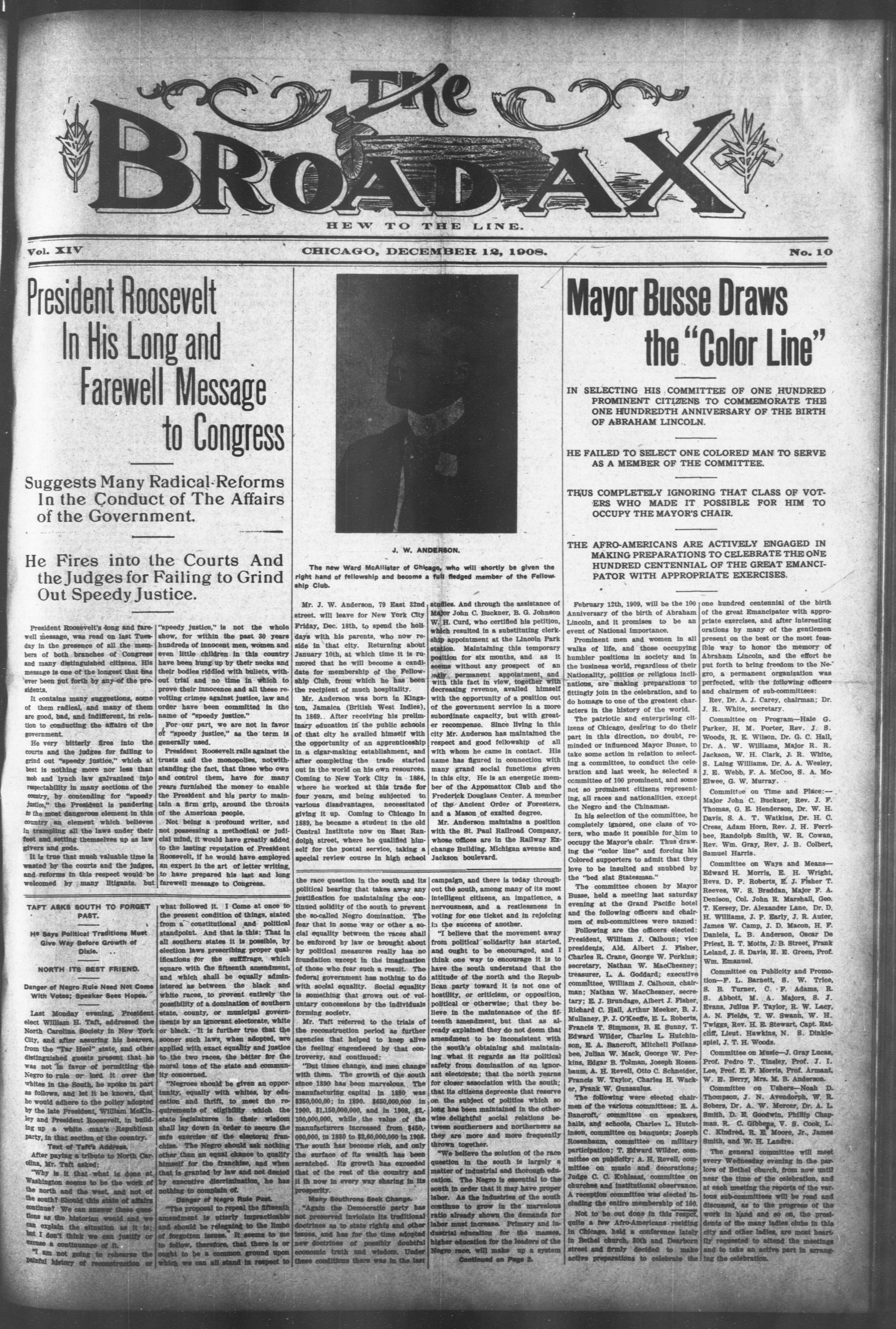
President Roosevelt In His Long and Farewell Message to Congress
Suggests Many Radical Reforms In the Conduct of The Affairs of the Government.
He Fires into the Courts And the Judges for Failing to Grind Out Speedy Justice.
Vol. XIV
President Roof
In His Lon
Farewell
Suggests Many H
In the Conduc
of the Governn
He Fires into t
the Judges for
Out Speedy Ju
President Roosevelt's long and farewell message, was read on last Tuesday in the presence of all the members of both branches of Congress and many distinguished citizens. His message is one of the longest that has ever been put forth by any of the presidents.
It contains many suggestions, some of them radical, and many of them are good, bad, and indifferent, in relation to conducting the affairs of the government.
He very bitterly fires into the courts and the judges for failing to grind out "speedy justice," which at best is nothing more nor less than mob and lynch law galvanized into respectability in many sections of the country, by contending for "speedy justice," the President is pandering to the most dangerous element in this country an element which believes in trampling all the laws under their feet and setting themselves up as law givers and gods.
It is true that much valuable time is wasted by the courts and the judges, and reforms in this respect would be welcomed by many litigants, but
TAFT ASKS SOUTH TO FORGET PAST.
He Says Political Traditions Must Give Way Before Growth of Dixie.
NORTH ITS BEST FRIEND.
Danger of Negro Rule Need Not Come With Votes; Speaker Sees Hopes.
Last Monday evening, President elect William H. Taft, addressed the North Carolina Society in New York City, and after assuring his hearers, from the "Tar Heel" state, and other distinguished guests present that he was not in favor of permitting the Negro to rule or lord it over the whites in the South, he spoke in part as follows, and let it be known, that he would adhere to the policy adopted by the late President, William McKinley and President Roosevelt, in building up a white man's Republican party, in that section of the country.
Text of Taft's Address.
After paying a tribute to North Carolina, Mr. Taft asked:
"Why is it that what is done at Washington seems to be the work of the north and the west, and not of the south? Should this state of affairs continue? We can answer these questions as the historian would and we can explain the situation as it is; but I don't think we can justify or excuse a continuance of it.
"I am not going to rehearse the painful history of reconstruction or
"speedy justice," is not the whole show, for within the past 30 years hundreds of innocent men, women and even little children in this country have been hung up by their necks and their bodies riddled with bullets, without trial and no time in which to prove their innocence and all these revolting crimes against law, and order have been committed in the name of "speedy justice."
For our part, we are not in favor of "speedy justice," as the term is generally used.
President Roosevelt rails against the trusts and the monopolies, notwithstanding the fact, that those who own and control them, have for many years furnished the money to enable the President and his party to maintain a firm grip, around the throats of the American people.
Not being a profound writer, and not possessing a methodical or judicial mind, it would have greatly added to the lasting reputation of President Roosevelt, if he would have employed an expert in the art of letter writing, to have prepared his last and long farewell message to Congress.
what followed it. I Come at once to the present condition of things, stated from a constitutional and political standpoint. And that is this: That in all southern states it is possible, by election laws prescribing proper qualifications for the suffrage, which square with the fifteenth amendment, and which shall be equally administered as between the black and white races, to prevent entirely the possibility of a domination of southern state, county, or municipal governments by an ignorant electorate, white or black. It is further true that the sooner such laws, when adopted, are applied with exact equality and justice to the two races, the better for the moral tone of the state and community concerned.
"Negroes should be given an opportunity, equally with whites, by education and thrift, to meet the requirements of eligibility which the state legislatures in their wisdom shall lay down in order to secure the safe exercise of the electoral franchise. The Negro should ask nothing other than an equal chance to qualify himself for the franchise, and when that is granted by law and not denied by executive discrimination, he has nothing to complain of.
Danger of Negro Rule Past.
"The proposal to repeal the fifteenth amendment is utterly impracticable and should be relegated to the limbo of forgotten issues. It seems to me to follow, therefore, that there is or ought to be a common ground upon which we can all stand in respect to
[Image of a man in a suit with a tie and a badge on his left shoulder].
J. W. ANDERSON.
The new Ward McAllister of Chicago, who will shortly be given the right hand of fellowship and become a full fledged member of the Fellowship Club.
Mr. J. W. Anderson, 79 East 32nd street, will leave for New York City Friday, Dec. 18th, to spend the holidays with his parents, who now reside in that city. Returning about January 10th, at which time it is rumored that he will become a candidate for membership of the Fellowship Club, from which he has been the recipient of much hospitality.
studies. And through the assistance of Major John C. Buckner, B. G. Johnso W. H. Curd, who certified his petition which resulted in a substituting client appointment at the Lincoln Park station. Maintaining this temporary position for six months, and as seems without any prospect of a early permanent appointment, and with this fact in view, together will decreasing revenue, availed himself
Mr. Anderson was born in Kingston, Jamalaica (British West Indies), in 1869. After receiving his preliminary education in the public schools of that city he availed himself with the opportunity of an apprenticeship in a cigar-making establishment, and after completing the trade started out in the world on his own resources. Coming to New York City in 1884, where he worked at this trade for four years, and being subjected to various disadvantages, necessitated giving it up. Coming to Chicago in 1889, he became a student in the old Central Institute now on East Randolph street, where he qualified himself for the postal service, taking a special review course in high school
the race question in the south and its political bearing that takes away any justification for maintaining the continued solidity of the south to prevent the so-called Negro domination. The fear that in some way or other a social equality between the races shall be enforced by law or brought about by political measures really has no foundation except in the imagination of those who fear such a result. The federal government has nothing to do with social equality. Social equality is something that grows out of voluntary concessions by the individuals forming society. Mr. Taft referred to the trials of the reconstruction period as further agencies that helped to keep alive the feeling engendered by that controversy, and continued:
"But times change, and men change with them. The growth of the south since 1890 has been marvelous. The manufacturing capital in 1880 was $250,000,00; in 1890. $650,000,000 in 1900. $1,150,000,000, and in 1908. $2,100,000,000, while the value of the manufacturers increased from $450,000,000, in 1890 to $2,600,000,000 in 1908. The south has become rich, and only the surface of its wealth has been scratched. Its growth has exceeded that of the rest of the country and it in now in every way sharing in its prosperity.
Many Southrons Seek Change.
"Again the Democratic party has not preserved inviolate its traditional doctrines as to state rights and other issues, and has for the time adopted new doctrines of possibly doubtful economic truth and wisdom. Under these conditions there was in the last
studies. And through the assistance of Major John C. Buckner, B. G. Johnson W. H. Curd, who certified his petition, which resulted in a substituting clerkship appointment at the Lincoln Park station. Maintaining this temporary position for six months, and as it seems without any prospect of an early permanent appointment, and with this fact in view, together with decreasing revenue, availed himself with the opportunity of a position out of the government service in a more subordinate capacity, but with greater recompense. Since living in this city Mr. Anderson has maintained the respect and good fellowship of all with whom he came in contact. His name has figured in connection with many grand social functions given in this city. He is an energetic member of the Appomattox Club and the Frederick Douglass Center. A member of the Ancient Order of Foresters, and a Mason of exalted degree. Mr. Anderson maintains a position with the St. Paul Railroad Company, whose offices are in the Railway Exchange Building, Michigan avenue and Jackson boulevard.
campaign, and there is today throughout the south, among many of its most intelligent citizens, an impatience, a nervousness, and a restlessness in voting for one ticket and in rejoicing in the success of another.
"I believe that the movement away from political solidarity has started, and ought to be encouraged, and I think one way to encourage it is to have the south understand that the attitude of the north and the Republican party toward it is not one of hostility, or criticism, or opposition, political or otherwise; that they believe in the maintenance of the fifteenth amendment, but that as already explained they do not deem that amendment to be inconsistent with the south's obtaining and maintaining what it regards as its political safety from domination of an ignorant electorate; that the north years for closer association with the south; that its citizens deprecate that reserve on the subject of politics which so long has been maintained in the otherwise delightful social relations between southerners and northerners as they are more and more frequently thrown together.
"We believe the solution of the race question in the south is largely a matter of industrial and thorough education. The Negro is essential to the south in order that it may have proper labor. As the industries of the south continue to grow in the marvelous ratio already shown the demands for labor must increase. Primary and industrial education for the masses, higher education for the leaders of the Negro race, will make up a system Continued on Page 2.
Mayor Busse Draws the "Color Line"
IN SELECTING HIS COMMITTEE OF ONE HUNDRED PROMINENT CITIZENS TO COMMEMORATE THE ONE HUNDREDTH ANNIVERSARY OF THE BIRTH OF ABRAHAM LINCOLN.
HE FAILED TO SELECT ONE COLORED MAN TO SERVE
AS A MEMBER OF THE COMMITTEE.
THUS COMPLETELY IGNORING THAT CLASS OF VOTERS WHO MADE IT POSSIBLE FOR HIM TO OCCUPY THE MAYOR'S CHAIR.
THE AFRO-AMERICANS ARE ACTIVELY ENGAGED IN MAKING PREPARATIONS TO CELEBRATE THE ONE HUNDRED CENTENNIAL OF THE GREAT EMANCIPATOR WITH APPROPRIATE EXERCISES.
February 12th, 1909, will be the 100 Anniversary of the birth of Abraham Lincoln, and it promises to be an event of National importance.
Prominent men and women in all walks of life, and those occupying humbler positions in society and in the business world, regardless of their Nationality, politics or religious inclinations, are making preparations to fittingly join in the celebration, and to do homage to one of the greatest characters in the history of the world.
The patriotic and enterprising citizens of Chicago, desiring to do their part in this direction, no doubt, reminded or influenced Mayor Busse, to take some action in relation to selecting a committee, to conduct the celebration and last week, he selected a committee of 100 prominent, and some not so prominent citizens representing, all races and nationalities, except the Negro and the Chinaman.
In his selection of the committee, he completely ignored, one class of voters, who made it possible for him to occupy the Mayor's chair. Thus drawing the "color line" and forcing his Colored supporters to admit that they love to be insulted and snubbed by the "bed slat Statesman."
The committee chosen by Mayor Busse, held a meeting last Saturday evening at the Grand Pacific hotel and the following officers and chairmen of sub-committees were named: Following are the officers elected: President, William J. Calhoun; vice presidents, Ald. Albert J. Fisher, Charles R. Crane, George W. Perkins; secretary, Nathan W. MacChesney; treasurer, L. A. Goddard; executive committee, William J. Calhoun, chairman; Nathan W. MacChesney, secretary; E. J. Brundage, Albert J. Fisher, Richard C. Hall, Arthur Meeker, B. J. Mullaney, P. J. O'Keeffe, E. L. Roberts, Francis T. Simmons, B. E. Sunny, T. Edward Wilder, Charles L. Hutchinson, E. A. Bancroft, Mitchell Follansbee, Julian W. Mack, George W. Perkins, Edgar B. Tolman, Joseph Rosenbaum, A. H. Revell, Otto C. Schneider, Francis W. Taylor, Charles H. Wacker, Frank W. Gunsalus.
The following were elected chairmen of the various committees: E. A. Bancroft, committee on speakers, halls, and schools, Charles L. Hutchinson, committee on banquets; Joseph Rosenbaum, committee on military participation; T. Edward Wilder, committee on publicity; A. H. Rovell, committee on music and decorations; Judge C. C. Kohlsaat, committee on churches and institutional observance. A reception committee was elected including the entire membership of 100. Not to be out done in this respect, quite a few Afro-Americans residing in Chicago, held a conference lately in Bethel church, 80th and Dearborn street and firmly decided to make active preparations to celebrate the
No.10
THE DRAWS
"COLOR LINE"
ATTTEE OF ONE HUNDRED
TO COMMEMORATE THE
ANNIVERSARY OF THE BIRTH
N.
COLORED MAN TO SERVE
COMMITTEE.
ING THAT CLASS OF VOT-
POSSIBLE FOR HIM TO
CHAIR.
ACTIVELY ENGAGED IN
US TO CELEBRATE THE ONE
L OF THE GREAT EMANCI-
RIATE EXERCISES.
one hundred centennial of the birth of the great Emancipator with appropriate exercises, and after interesting orations by many of the gentlemen present on the best or the most feasible way to honor the memory of Abraham Lincoln, and the effort he put forth to bring freedom to the Negro, a permanent organization was perfected, with the following officers and chairmen of sub-committees:
Rev. Dr. A. J. Carey, chairman; Dr. J. R. White, secretary.
Committee on Program—Hale G. Parker, H. M. Porter, Rev. J. S. Woods, R. E. Wilson, Dr. G. C. Hall, Dr. A. W. Williams, Major R. R. Jackson, W. H. Clark, J. R. White, S. Laing Williams, Dr. A. A. Wesley, J. E. Webb, F. A. McCoo, S. A. McElwee, G. W. Murray.
Committee on Time and Place:—Major John C. Buckner, Rev. J. F. Thomas, G. E. Henderson, Dr. W. H. Davis, S. A. T. Watkins, Dr. H. C. Cress, Adam Horn, Rev. J. H. Ferrilbee, Randolph Smith, W. R. Cowan, Rev. Wm. Gray, Rev. J. B. Colbert, Samuel Harris.
Committee on Ways and Means—Edward H. Morris, E. H. Wright, Revs. D. P. Roberts, E. J. Fisher T. Reeves, W. S. Braddan, Major F. A. Denison, Col. John R. Marshall, Geo. T. Kersey, Dr. Alexander Lane, Dr. D. H. Williams, J. P. Early, J. R. Auter, James W. Camp, J. D. Macon, H. F. Daniels, L. B. Anderson, Oscar De Priest, R. T. Motts, J. B. Street, Frank Leland, J. S. Davis, E. E. Green, Prof. Wm. Emanuel.
Committee on Publicity and Promotion—F. L. Barnett, S. W. Trice, S. B. Turner, C. F. Adams, R. S. Abbott, M. A. Majors, S. J. Evans, Julius F. Taylor, R. W. Lacy, A. N. Fields, T. W. Swann, W. H. Twiggs, Rev. H. E. Stewart, Capt. Ratcliff, Lieut. Hawkins, N. S. Dinklespiel, J. T. H. Woods.
Committee on Music—J. Gray Lucas, Prof. Pedro T. Tinsley, Prof. J. I. Lee, Prof. E. F. Morris, Prof. Armant, W. E. Berry, Mrs. M. B. Anderson.
Committee on Ushers—Noah D. Thompson, J. N. Avendorph, W. R. Sobers, Dr. A. W. Mercer, Dr. A. L. Smith, D. E. Goodwin, Phillip Chapman, R. C. Glbebps, V. S. Cook, L. C. Kindred, R. E. Moore, Jr., James Smith, and W. H. Landre.
The general committee will meet every Wednesday evening in the parliors of Bethel church, from now until near the time of the celebration, and at each meeting the reports of the various sub-committees will be read and discussed, as to the progress of the work in hand and so on, the presidents of the many ladies clubs in this city and other ladies, are most heartily requested to attend the meetings and to take an active part in arranging the celebration.
: a nee eee Soe
M4 the tro raat es e
bet Catholics. (Prot ‘iS ie
ise oan “have ‘their “say, 84
Sear es thar ts et rere =e
‘The Az is 3 bows whose
Sanseers=
tts ows
the paper.
‘Subscriptions must be paid in ad-
vance,
SE aden ER
Advertising rates made known on
‘Address all communications to
THE BROAD AX
$038 Armour Avenue, Chicago.
ZRAUS '¥. TATLOR, ier end Feb
Entered as Second-Ciass Matter,
‘Aug. 19, 1902 at the Post Office at
Chicago, Ilinols, under Act of March
3, 1679, d
NEGROES JOIN IN WHITE PLAGUE
FIGHT.
‘Will Hold Congress on Tuberculosis.
‘One of the most progressive, as weil
8s one of the most interesting steps
im the campaign against tubereuiosis.
‘which fs being at present waged with
especial vigor throughout the South,
1s the Negro Congress on Tuberculosis
‘which will be held at Tuskegee, Ale-
Dama, from December 14th to 19th.
‘The meeting which is being held un-
er the joint auspices of the Tuske
ge Institute, of which Booker T. Wash-
‘ington is the bead, and the National
Association for the Study and Pre
vention of Tuberculosis, will be at-
tended by representative Colored men
‘and women from all over the United
States. The object of the Congress
is to discuss means for checking the
enormous mortality from consumption
‘among the Negroes.
In connection with the Congress, an
exhibition showing the ravages of tu-
berculosis, and the methods for treat-
ing and. preventing it, will be held.
Among the striking features which’
‘Will be demonstrated by the exhibit
will be the fact that the: mortality
from tuberculosis is 150 percent high-
€r in the Colored population of the
country than in the white.
‘The week of December 13th has
been set apart in almost all of the
Colored communities in the South,
‘snd in many in the North, as “Health
Week.” All Colored religious, educa-
tional, civic and social bodies will
unite at that time to spread the gospel
of health, particularly as relating to
tuberculosis, among the Negroes.
Coineident with this meeting in Tus-
kkegee is a determined effort on the
part of the white population of the
South to stamp out tubercitlosis. Pre.
perations are being made in Florida
for a “Ninety-day Campaign,” to com-
mence immediately after Christmas,
which ts expected to reacli every man,
woman. and child fn the state with
the message that consumption can be!
cured and thet {t should be prevented.
Immediately after the campaign in
Florida, « systemized attack will be
commenced on the disease in Georgia.
In Tennessee, the warfare against
tuberculosis has become in many
counties, a political issue, and plans
for drastic jepislation affecting this
@isease, are being prepared. The
three departments of Health, Agrical-
ture and Education have united for
the fight on the white plague. “Health
Days” and weeks are being observed
throughout the South for the purpose
of instructing the school children
‘The National Association, under:
is ‘being carrie out, predicts. that
wi be saved by the efforts)
now be'ng made. eee de
FALSE ELECTION PROMISES.
‘Out in New Jersey they are shoot
tng workingmen now for demanding
fulfillment of the Taft proeiection
Promises. As in thousands of factory
towns all over the country, the own-
rs of a factory st Keasbey, N. J.
Satire sion tat the
fore election thst their reduced
‘wages would be restored to $150 2
Gay if Taft were slocted. They didn't
prsmise this in worfis, but they said
epee eer mn tm set
Senin are ym
2 el works ittrrspecs stot Be
ide erate 2 Tes
Miaees”” there eye §
wills ‘ctacl dik okt malas 2 tos oem,
i ieols Gok. ab pad ahaa
noble game we fear—this that the
plutocrets Of our country are playing,
with ‘Wworkinmen for pawns and rich
government privileges for stakes. —
The Public, Chicago, Dec. 5, "08.
DE a i pet -
_ Hon, E H. Wright, W. R. Cowan,
Arthur Wells, James Morton, H. C.
Callins, Ralph Farmer, Mr. A. Palmer
lawyer Beauregard F. Moseley dined
‘at the Chateau Cafe Saturday last and
each declared the Cuisine the best in
the city, ©
see
‘Mr, Henry High “and Mr. G. Davis
‘and « party of Indy friends were
guests of the manager during the
week, They all reported & good time,
‘and are invited to call again.
ee
| Saturday Matinees are fast becom-
‘ing the most popular of the week ss
‘on this day there are no schools and
the school Misses and Masters liter
ally take charge of the Rink. It is
one of the features of the manage
ment to look after school chiliren so
that no child will be mistreated or.
suffer to do things improper and as
skating is the most healthful exercise
possible parents should encourage the
boys and girls to attend these func
tons.
eee
Roller Skating is a winter sport and
there is no better place in the City
to spend a winter evening than at the
Chateau. The Blectric piano furnish-
es music for dancers in the parlors
off the Cafe, the vioscope furnishes
amusement for those who sit in the
gallery by presenting the best moving
pictures in the City and the Rink af-
fords’ place for skaters so that ‘all
who attend are guaranteed a good
time.
see
Sunday dinners served at the Cha-
teau Restaurant from 2 to 8 P. M.
Those who had taken dinner at the
Chateau last Sunday, who pronounced
them to be the best meals in the City,
for Soc were Beauregani F. Moseley
und family, Miss Laura Tyler, Miss
Sis Cunningham, Mr. W. O. Tyler, J.
H. Bolden and wife, Mrs. Bell Patton, |
Mr. James Booker and Mr> Andrew
Payne.
sae
The following is the Sunday Menu
ut the Chatean for the 18th of Dec. |,
Chicken—A La Printanire
Broiled Cat Fish—Steak—Piquant |.
Sauce—Potatoes Hollondise '
Queen Olives—Salted Alimonds—Dill |.
Pickles. =
Croquette of Veal—OxPetite Pols |,
French String Beans
Boston Cream Puffs.
Chocolate—De Glase. .
Choice Cut of Beef—Au Jus
Roast Young Turkey—Stuffed—Cran-
berry Jelly.
Lettuce Salad—French Dressing
New York Ice Cream & Cake.
reme De Menthe. Cafe Noir. |!
—u
INSTITUTIONAL CHURCH, 3825
DEARBORN STREET.
Special Mission Each Sunday up to
‘the First of the Year.
| Sunday, December 13. Bishop C. T.
Shaffer, M. D. DD, will consecrate
the Deaconess of the Church. Special
service will take place at 7:45 P. M.
10:50 A. M. The Pastor, Rev. H. EB
Stewart D. D., will preach from the
subject, WOMANS WORK IN THE
RDEMPTION OF THE WORLD.
The following question will _be an-
swered why the church cannot be a
social culture club? Women in club
‘and social lifes compared to Church
and Christain work. t
Sunday, December the 20th. At
10:60 A. M. the Pastor will discuss the
following subject, THE REALITY OF
LIFE, OR THE MEANING OF THE
NEW BIRTH, MODERNIZED. This
question will be answered. Why
SOME PEOPLE LOOSE FAITH IN
CHRISTIANITY? eto, etc.
Subject for the evening service, 7:45
P. M. A STATEMENT OF DOCTRINE
This will be discussed under the fol-
lowing heads, Baptism, Regeneration,
Sanctification. The extent of each in
buman lite.
‘Sunday, December the 27th. Sub-
fect 10:50 A.M. AN AFTER CHRIST-
Ceaser aah auaee :
IN JE
[T AS. ON ALL L4FH TO DAY. Sud-
fet at 1:46 P.M. Review of the past
fear. t: VINE
On TN HUMAN -ANPAINS - A
Ave A Srnamencad cage
LACaS AND DUDWIDUALA iy NOT
Pa i ik cae:
ceased and doffre to sak © ques.
_ will have it answered if they sub- |
pestion to panes a
gare Aare holed
question is auked, the answer will
be given the following Sunday. The
name of the writer must be given but
the name will not be mentioned, ‘un-
less by the writers consent or wish.
—s"
JUDGES REAPPOINT MASTERS.’
Official Aids in Circuit Court Retain
Places Two Years,
All masters in chancery of the Cir
‘cult Court were reapointed by Judges
of that court at a meeting held last
‘Monday afternoon in the rooms of
‘Chief Justice Thomas G. Windes. Fol.
Jowing is the list:
Albert W. Birckwood—By Judge
Carpenter.
Granville W.° Browning—By ll
Judges.
‘William Fennimore Cooper — By
Judge Adams.
John W. Ellis—By all the judges.
Edward B. Esher—By Judge Fred
A. Smith
|, Henry Guerin—By Judge Cittord
: Stillman B. Jamieson—By Judge
Gibbons.
Roswell B. Mason—By all the
Judges.
_ Michaél J. Moran—By Judge Kers-
ten.
| John E. Owens—By Judge B 0.
Brown.
George Mills Rogers—By Judge Ba-
ker.
Thomas Taylor, Jr—By Judge
Windes.
Horatio L. Wait—B~ Judge Tuthill.
Sigmund Zeisler—By Judge Walker.
JUDGES OF THE CIRCUIT COURT
‘TO BE ELECTED IN JUNE, 1909,
‘The 13th of April, 1909, the Judicial
primaries will be held, at which time
fourteen candidates will be chosen by
the Democrats and by the Repubit-
cans to make the race for Judges of
the Circuit. Court; at the same time
‘one Judge of the Superior Court will
also be elected, it is expected that
well onto one hundred candidates
good, bed and indifferent will seek
these Judicial positions and with one
or two exceptions it would be well if
the present Judges would be permitt-
ed to retain their seats on the bench
for another term.
The following are the Judges whose
terms expire in June, 1909:
Democrats, Thomas G. Windes,
Francis Adams, Frank Baker, Edward
O. Brown, Richard W. Clifford, Lock-
wood Honore, Julian W. Mack, Charles
M: Walker, George Kersten. Repub-
Ucans:—George A. Carpenter, John
Gibbons, Merritt W. Pinckney, Fred-
erick A. Smith, Richard 8. Tuthill, and
Judge Theodore Brentano of the Su-
perior Court, also a Republican.
NEGRO STEALS $50,000.
From the Government—Will Get Sen.
tence—Money Not Recovered.
| ea
| Kansas City, Mo., Friday. Dec. 4—
Charles Stevens, the Negro who stole
$50,000 from a registered mail pouch
here several months ago, was found
guilty in the Federal Court today on
six counts. The maximum penalty is
thirtyfive years. He will be ser-
tenced later.
‘The stolen pouch contained money
being shipped to New York City by a
Los Angeles tank. The pouch was
recovered, but none of the money was
ever found by the officers. Stevens ts
believed to have buried the treasure
fe eee ene ee he
served out his term in prison.
WHITE MAN ELOPES WITH NEGRO
WOMAN,
Arrested, Found Guilty of Bigamy—
Gets Two Years in Pen,
Kokomo, Ind. Dec. §—Thomas Can.
nall, a furniture dealer of Troy, 0.
‘was arrested here today for wife de-
wertion and bigamy. He was “rail
ronded” Into ® two-year term.
He was living here with Mrs. Rossa
Morris, © Colored woman of Tyoy,
Ohio, whose husband caused the ar
rest Cannall was working in a stone
‘quarry when arrested, his money be
ing gone.
DRIVEN FROM NORRIS CITY.
e¢ Fated
_ Carmi, Tl.—Devid B Parker, «
warned by the citizens of Norris City
to dispense with his Negro workmen
there, The Negroes were chased to
the depot and forced to take a freight
train fr Pe ee
ph oe ies ee &
is atways short on rats and
aa Se iat Sn oe
fred fi ies re William |
ake
President Elect, William H. Taft, and
“His Appeal to the South.
Ceccleded trem Pace 4.
under which their improvement,
which statistics show to have been
noteworthy in the last forty years,
will continue at the same rate.
Hopes to Lead Way Out.
“The recent election has made tt
probable I shall become more or less
responsible for the policy of the next
presidential administration, and, I im
prove this opportunity to say that
nothing would give me greater pride
if I could so direct that policy in re-
spect to the southern states as to
convince its intelligent citizens of the
desire of the administration to aid
them in working out satisfactorily the
serious problems before them and of
bringing them and their northern
fellow citizens closer and closer in
sympathy and point of view.
"I have watched with delight and
thanksgiving the bond of union be-
tween the two sections grow firmer.
I pray that it may be given to me to
strengthen this movement to obliver-
ate all sectional lines and leave noth-
ing of differences between the north
and the south save a friendly emula-
tion for the benefit of our common
country.”
SEND IN YOUR DONATIONS FOR
THE OLD FOLK’S HOME.
‘The Workers for the King of the
Kings Daughters Circle the first Col-
ored circle which was organized some
twenty years in this city, are prepar-
ing to send their basket donation as
usual to the Old Folk’s Home for
Christmas. All persons wishing to
donate anything to this basket will
kindly send it to the residence of
Mrs. J.B. Johnston, $388 Wabash Ave.,
not later than Dec. 28rd, 1908.
Mrs. Ada McKinley, 6220 Morgan St.
Pres.
Miss Connie M. Hancock, 3424 Dear-
born St. Sec’y.
CHrIPs
Marriage and births among Negroes
tm Jersey City are falling off.
Mr. Wm. Clark has returned from
Louisville, Ky., where he spent a por
tion of Thanksgiving week doing
swell socia] stunts.
‘Mr. Samuel W. Thompson is mak
ing preparations to spend the Xmas
holidays with his wife and children
im Los Angeles, California.
Mr. and Mrs, William H. Hayman,
3236 Wabash avenue, will celebrate
their 12th wedding anniversary Wed-
nesday evening, December 23rd, from
5 to 11 o'clock.
Attorney Walter M. Farmer will ad-
dress the West Side Sunday Club,
which meets in St. Stephen's Church,
Sunday, December 13, on “The Citi-
zenship of the Negro.”
In Greenville, Miss, the leading
city of the Delta Country, the only
book store and stationery business is
owned and conducted by Granvilie
Carter, a Colored man.
Mrs. J. B. Bish, 5821 Wabash ave-
mue, @ great worker in secret socie-
ties and charity work, has fully re-
covered from her recent indisposition,
and her many friends will welcome
her to her post of duty.
‘Mr. and Mrs. J. C. Stewart, 5434
Normal avenue, who are high'y es-
teemed by their hosts of friends. will
celebrate their 25th wedding anniver-
sary Friday evening, December 13th,
from 8 to 12 o'clock.
Wm. Lewis, 2444 Wabash avenue,
who has s strong political following
in the Second Ward, is sporting a
new salt and pepper suit and a dandy
pew brown hat, and he looks like
a fourtime winner.
B. F. Moseley, James N. Simms,
Edward H Wright, J. Gray Lucas
Hale G. Parker, T. Webster Brown,
8. A. McElwee and Albert Batey
George are receptive candidates to
succeed F. 1. Barnett as Assistant
State's Attorney.
‘Samuel Richardson, 142 La Salle
street, Phone Main 2133, has for rent
Se ee
the South, North and ‘Sides.
Mr. Richardson rents and handles his
awn property, and good Colored ten-
ts re always appreciated by Bis.
Some people who pray the a
ae always ready to. set
ko th the qutrency Of hesven that)
eae ree ane Seams these gesatel
re oo gee eR eee
tee tlie tis Haat
areca ee ae
z 5 ae ee eh
died in New York City last Friday. At
‘the time of his death he was confined
‘{m one of its hospitals, and ft is
claimed that he did not have much
vf this world’s goods,
‘Mrs. Joseph Crum, who was operat.
ed on for appendicitis at Provident
Hospital Wednesday by Dr. Daniel H.
Williams, is reported “out of danger
and doing nicely.” Mrs. Geo, W. Me
Koin of St. Louis, Mo. mother of
Mrs. Crum, ts in the city and will re
main until her daughter is able to re
sume her household duties.
‘The Negro Voice of Tallulab, La.
and the Negro World of Cary, Miss.
are among the other newspapers
‘Whose editors have thought it was
wise. on thelr part to reproduce our
article in full on “The Leading Afro
American Preachers in Chicago, be-
ing ready and willing to transform
their churches into political halls for
the sake of making a tittle easy
money, and it is safe to say that so
far the article in question has been
read by more than one hundred
thousand people.
Abend of tha Qama
Byker—I attended a successful sleight
of hand performance last night.
Pyker—So?
Byker—Yes. I lent the conjurer a
counterfeit dollar and he gave me
back 2 good one.—Chicago News.
AN Meade Uc.
Florist—What is that sheet of paper
you have?
Assistant—I can’t quite make out ex-
cept that it is a blanket order.
Florist—Then I suppose it is for bed-
ding plants.—Pittsburg Post.
‘ienine Shin Gites.
Mrs. Gaswell (reading)—John, bow
id the sphinx get its reputation for
being so wise?
Gaswell—By keeping its mouth sbut
for 8,000 years, my dear.—Detrolt Trib-
une.
The Reason.
“The writer of this anonymous letter
says it is not prompted by malice, but
is written for your own good.”
“Sure. That's why he was ashamed
to sign it."—Kansas City Times,
Between the Acts.
Robbie (at the opera)—Mamma, what
does papa keep gcing out between the
acts for?
Mother—Sh! He goes out for opera
giasses.—Judge.
“ever Kitew eer Husband's Name.
/_ In declaring that she never Enew her
husband's first name Mrs. Esther Nie
man of Monroe street created laughter
‘at the central police court.
“I have always called him ‘Pop
from the first day I married him, and
as he did not object I never worried
myself about his frst name,” said Mrs.
Nieman, who hed her husband arrest-
ed on the charge of failing to support
ber.
‘The accused husband by direction of
the magistrate was induced to tell his
wife his full name.
“Certainly. I'm giad to do It,” re
marked the defendant, “but I think
my wife bas known right along that
Iam Jacob Nieman.”
After telling bis name Nieman was
held in $300 bail for trial.—Philadel-
phia Inquirer.
ep tastat San
Inducements to Drink.
In Catania an enterprising wine
dealer has initiated a novel scheme of
drinking by the hour ad libitum. « For
15 cents one may drink for sixty min-
utes, and the current price of wine is
5 cents a liter. ‘The chances are, how-
ever, in favor of the merchant, for it
requires a strong stomach to drink
three liters of Etna wine in one hour.
At a neighboring town the charge is
10 cents for the frst hour and 15
cents for two. The fashion seems to
have “caught on,” and at Bologna,
where the wines are better, the charge
is 41 cents for the frst hour, 31 cents
for the second and 20 cents for the
third. The result of these induce-
ments to drink is sald not to be en-
chanting. a
a eae ee
College Education.
Knicker—What are the three rs?
Bocker—Bab, rah, rahi-New York
Sun.
‘Profite tn Cocsinn
Tt ie stated that cocaine is sold at
$2.65 an ounce and that it is sold at
Tetail to fends at 20 cents for about
wix-grains. There being 490 grains to
an ounce, the venders at this rate
‘would realize $16 on an ounce of the
‘Grog, & clear profit of $18.35. In view
of the enormous profit in this trade it
can be readily realized that the temp-
‘tation to violate the city and state
ordinances is very great one and
that many of the unscrupulous dealers
YL Resort. to almost any trick tn or-
to evade the inw. — Charleston
News and Coutler.
—
ag ce
ES teins of tops tt tn bet
ty toe i wos ine hart
everlasting peace. asked
Bernard Shaw to be one of the party,
which invitation most men would have
thought a but Mr. Shaw
it you. mg
te my house : T should
oT ses ms then any mort
x :
= ko 3
aA} %
7 ij Ee
a = al a
=
eran 7
ery F: og a4
ter feed
oe ae
MRS. JENNIE ELDRIDGE watts,
Mrs. Jennie Eldridge Wat's, and
Mrs. Viola Stewart, have opened up
the Yew York and Paris Millinery
Parlors, at 2616 Calumet ave. Both
ladles are expert artists in this tine
of work. They will also remodel ola
hats and make them look like new,
and carry in stock the very latest
syles in hats and headgear.
Mail orders will receive prompt at.
tention. ‘
HUMOR OF THE HOUR
Obeying Instructions.
A milkman who lives in a town of
New England and collects milk from
the neighboring farmers bad in his ex
ploy a boy whom he sent about with
&@ wagon every mornzg picking up bis
supply. There is a rather dangerous
wailroad crossing on the road, and
‘when the boy began work for him the
milkman said, “When there's a train
coming just stop and sit still in your
‘wagon till it gets’by.”
‘The boy went about his task, but to-
stead of collecting the “milk ix about
am hour and a half, as should have
been done, he took at least two hours
and sometimes more.
‘The milkman grumbled a little, but
the boy said nothing, and as he seen-
ed honest nothing was done.
One evening the milkman went over
his route to see some of his customers.
“What ails that boy of yours?" asked
one of the farmers.
“Why, nothing, only that he's rather
slow,” was the reply.
“Slow! Well, I guess you'd think he
was slow if you saw him resting for
half an hour in his wagon down there
by the railroad track every morning.”
“Is tt true that you stop half an hour
every morning down at the railroad
track?” the boy was asked.
“Yes, sir; I have to,” said the boy.
“Have to! What do you mean?”
“Well, sir, you told me to stop when
there was a train coming and to walt
till tt got by. There's a crook in the
track there, so ‘t I never can see
whether there’s a train coming dowa
the track or not. So I just stop an’
wait till there’s one goes by anyway,
an’ then I just skip over lively!"—Har.
Ser's Weekly.
How Johnny Managed it.
“You and that little Wattles boy
seem to play very nicely together.”
said Johnny's mother. “I am glad
thére is one boy in the neighborhood
that you can get along with.”
“Yes,” replied Johnny. “I lick bim
every morning, and then he’s nice ®
me all day.”—Chicago Record-Hersld.
Admirable.
oo 8
a 1
i — fi
‘ ‘
r | Vi
ee lis
) t
Ni S
a p<
SN a
“T certainly admire that pianist whe
‘"oyor his compositions forbs
or pe
formances?”
Figg oo yoy neal
charging $2 a seat"—New
‘Herald. sn
Boeed.
Le
you’
“It Gepends on what you meaz,” 20
ewered Mr, bugging, “Over the
Sade 1 goes at i same pace 26 most
of am, ees
Wastington Stal
paren
went Wem.
“The style of wearing tailor meds
gowns * bars may esiness” com
"a: ‘ale wetho bit
Pa oS
Dealer. aie
ee HS ETF ate tie
‘Prisser — Whee &
pear ics noes pesos come ot
‘man vant in and asteid if be could
ee nee ‘of your chasse?
Fiction
ON THE REBOUND
By GARFIELD MACNEAL
Lillian Treadwell awoke on the morning of her thirtieth birthday to the sickening consciousness that she was an old maid. She parted the cretonne curtains of her bed, curtains covered with red roses, suggestive of summer sunshine, and turned her eyes toward the window. Rain beating against the panes and dull gray sky proclaimed a cheerless November day. She sighed. Then, stretching out a shapely arm, she took a silver hand mirror from the nearby dressing table and carefully studied her features. In the language of Shakespeare, she saw "no deeper wrinkles yet," face long and oval, patrician in outline and expression, skin rather olive, eyes brown, deep and luminous, a mouth generously molded and a wealth of brown hair. On the whole, it was a notable face and one of character.
Dropping the mirror on the bed, she called "Lois!" A French maid, neat, trim and smiling, appeared with the breakfast tray.
"Ah, ma'm'selle! A thousand congratulations on your birthday."
"My thirtieth, Lois. But thank you just the same."
"Me'm'selle is still young, and already fame has come to you. And when your novel is published the world will be at your feet," said Lois, with a comprehensive sweep indicating the world.
"Oh, yes, the novel!" murmured her mistress, sitting up and starting in on her coffee and rolls, while the maid laid a bundle of letters and manuscripts on the bed.
Miss Treadwell opened the one bulky package and looked at the accompanying letter. It was from a great publishing house formally expressing regret that they were unable to accept her novel.
She gulped down something in her throat. Her novel declined—her first really original work, to which she had given the leisure hours of six years! Truly, this was a most delightful birthday gift.
"Lois," she said, and her voice trembled—"Lois, my novel has been declined."
"Ah, ma'm'selle, I am too sorry"—with quick sympathy—"but some other publisher will accept it."
Her mistress shook her head. "I shall not send it out again. I shall stick to hack work. I can at least make a living at that." Then she added reflectively, "My life has been a failure."
Lois protested. She worshiped her mistress. "Ma'm'selle has been successful. You have a pretty apartment and everything you want."
"Other women, too, have pretty apartments and everything they want."
"Ah, yes, but they did not work for them," said Lois, with a worldly shrug, as she went in response to the electric bell, which at this moment buzzed loudly in the hall.
She reappeared with a huge white box. "Flowers, ma'me' selle, and a note," she said gayly.
Miss Treadwell cut the ribbon that held the box and disclosed a mass of violets. They seemed to look up at her tenderly, yet shrinkingly, as she bent over them. With a sigh of pleasure she took the note and studied the bold handwriting of the superscription. Her heart jumped. Surely it was Jack'a! Dear old Jack had remembered her!
She silt across the end of the envelope while her fingers trembled and eagerly unfolded the paper.
"Dear Lillian," she read, "may I hope that this remembrance of your birthday will prove that I have not forgotten you? I have been in town two days. I secured your address from C's Magazine and send these flowers to warn you that I am coming to invade your sanctum sanctorum and talk over old times. Always your friend, Jack Alnsworth."
She started up, scattering letters and manuscripts on the floor. "Lola," she said decidedly, "i want you to lay out my new morning gown, the sea green one with the train."
Sitting down at her dressing table, she began a careful toilet. Her thoughts were busy with the past. Jack had been her girlhood friend in the little inland town where they were both born and bred. Again she was twenty-four and he was twenty-six. Why had he never spoken? She knew he loved her, and perhaps she had loved him, too, then. But when her mother's death left her alone in the world she was seized with the desire to come to New York to try her fortune. Jack had advised against it, but a strange perversity made her deaf to his warnings.
At first they had kept up a correspondence. Boon even that link was broken as she was drawn more and more into the absorbing whirl of newspaper and magazine work. For five years no letters had passed between them. To be sure, she had heard of him indirectly—how he gradually forged shed from clerk in the railroad office to manager of the whole system, and she had been glad for his sake.
And now, after all this time, they were to meet. She wondered what he would be like. Doubtless he had lost the fresh boyish beauty she so well remembered. He was past thirty now, she reflected with a sigh. Doubtless, too, his career as a man of affairs had
made him bruise and cold. She had rides of bearded check and chin and perhaps glasses. Horrors! Had it really come to that? Well, she would live in the old days and pay no attention to externals.
When at last Lols announced that Mr. Ainsworth was in the drawing room she swept to her mirror and surveyed the graceful figure reheated there. Her gown of sea green fell in shimmering folds. Her hair was done beautifully, and some of the violets were clasped in the silver girdle at her waist. She could not fall to be satisfied.
This consciousness helped her to enter the drawing room with the perfect self possession of a woman of the world. With outstretched hand she greeted him as if they had parted but yesterday.
"Jack! How good of you to some to see me on my birthday and to send me these lovely flowers!" turning to a center table where the violets were displayed.
Jack Ainsworth gasped. Could this elegant woman, with her perfect hair and silvery voice, be his old friend?
"Lillian," he said, still grasping her hand, "is it really you?"
She smiled, and it was her old smile.
"Yes, Jack, it is I. You see, I am going the way of the world."
"Nonsense! You are perfect!" he cried vehemently.
She was no less charmed. There was no evidence of beard or glasses, though the boy had grown into the man—tail, athletic, clean shaven, with strong jaw and deep voice. His honest gray eyes feasted on her beauty. She flushed.
all these years, Jack," she said finally.
"Oh, working hard and following your career?"
"Yes," she said, "you have done well for yourself, and I am proud of you. As for my career, it has not amounted to much."
"Lillian," Alinsworth said, leaping forward eagerly, "do you know that you have not written a line I have not read! You ceased to write to me, but I did not forget, dear."
Miss Treadwell had forgotten the rain and the unfeeling publisher.
"Tell me, Jack, what brings you to New York?" she asked.
"I have been elected vice president of the road and must live here," he replied.
"Then I suppose you will marry and keep up an establishment?" with a pretense of lightness.
"I don't know," he said dubiously. "There never was but one girl for me, and she—she has achieved fame. She would not think of giving up glory to become the wife of a railroad man." A feeling long dead woke in the woman. "But she might be willing, Jack, if you asked her," she said almost wistfully. "She might gladly give up all her false glory to find real happiness."
"If I thought that," said Ainsworth breathlessly, "I'd ask her in a minute." She thought of the novel, of the hack work, of the loneliness of her life which this friend of the past brought sharply before her.
"Jack," she said, "I've decided"—she paused, then went on rapidly, fingering the violets in her belt—"to give up literature for good."
Ainsworth started forward. "Do you really mean it. Lillian?"
"Yes, I do," she replied bravely.
"But why?" he inquired, doubting, puzzled.
She looked up at him, and he read it in her shining eyes.
He leaped forward and folded her in his arms, crushing the violets in his eagerness. "My darling!" was all he could say in trembling tones.
As for Miss Treadwell, with that embrace came the realization that woman was not made to live on mind alone.
"Lois," she called after a little, "bring me the manuscript of my novel!" She took it from the wondering maid and turned to Jack, with a radiant smile. "Come," she cried gaily—"come to my study fire and help me make dust and ashes of my literary pretensions."
Courtesy In Business
The man who solicits your advertisement, the salesman who has samples to exhibit, the life insurance agent whose hair trigger tongue pleads eloquently for your family, even the seductive canvasser who tries to invigle you into buying a history of the world in twenty-five volumes, can be listened to for a courteous minute or two and politely dismissed without seriously clogging the wheels of business. Perhaps they may really have something worth while to offer. Above all, the tellers and the cashiers of every bank need a course in the art of gracious expression. Why should the depositor of money be regarded with frowning suspicion and why should his mistake in indorsing checks wrong side up or his failure to have his books balanced regularly call forth shouts of correction instead of a few words of kindly instruction? After all, he is only ignorant or only forgetful. No dark scheme for defrauding the bank larks behind his failure to follow the bank's rules. Courtesy is its own reward. It pays in personal satisfaction, in minimizing friction, in making friends and in raising you in the eyes of your business associates—Scientific American.
Looks Like it.
Howell—Three hundred men attended a dog fight last Sunday, and there were less than fifty at our church. Powell—It's no wonder they say that the country is going to the dogs—New York Press.
A thousand times listen to the counsel of your friend, but seek it only once. - Hards
WM. D. NEIGHBORS & CO REAL ESTATE AT LOWEST PRICES
Easiest Terms to be had in Chicago
Loans on first and second Mortgages
Fire Insurance placed in any company
Main Office:
Suite 64, 95 Washington St., CHICAGO, ILL.
Branch Office:
3220 State Street
'PHONE 4386 CENTRAL
CHOICE MISCELLANY
Smart Boys of Long Age. It is often asserted nowadays that our young men and women attain intellectual maturity much later than did their parents and grandparents, and in support of this theory the precocity of distinguished personages who flourished a generation or two ago is cited. Now, somebody who has probably been bored like the rest of us with this yarn about the phenomenal brightness of the old fashioned boys has looked up the records of eleven leading colleges to see what changes have taken place in the age of graduates. From 1850 to 1880 the average age at graduation was 23 years 1.3 months. From 1890 to 1900 it was 23 years 1.9 months. In 180 years at Dartmouth the average age at graduation has fallen three months. This average age, it appears, has changed as little as the average weather. Thus one or two precocious youths of the long ago are sufficient to endure all their contemporaries with the same qualities. But the fact is the twentieth century boy is smarter than any of his predecessors, and (unfortunately) in nine cases out of ten he knows it—Pittsburgh Gazette Times.
A Fatal Paraphrase.
General Sheridan, says the Philadelphia Ledger, used to take delight in belling the following:
"A young man seated at dinner one time said to his wife:
"Ellen, if you are good at guessing here is a conundrum for you. If the devil should lose his tall where would he go to get another one?"
"After some time spent in guessing she gave it up.
"Well,' said he, 'where they retail spirits'.
"Eager to get it off, she hastened to a lady friend with:
"Oh, Marian! I have such a nice conundrum. Joe just told me of it. I know you can't guess it. If the devil should lose his tail where would he go to get another one?
"Her friend Marian having given it up, she said:
"Where they sell liquor by the glass."
"Marian couldn't see the point of the joke."
Once Chinaman Always Chinaman. China is yet a land and a people ruled by ancestors. A Chinaman belongs, soul and body, to his home land because his ancestors belonged there. The wandering Mogul who dies in a strange land has paid tribute all his toiling years to a brotherhood whose sacred duty is to coffin his bones and send him back to his native land for burial. Not even after death will his country relinquish her claims to him. Why should the Chinese government be interested in keeping American born Chinese familiar with the reading and writing of the old language when it is presumed that they and their children will remain in America henceforth? The answer is that such is never the presumption. The government's theory is that a Chinaman is here only by the accident of birth or to get money, and when it becomes possible he will take his money and go to live and enjoy it in the Flowery Kingdom—Washington Post.
Chicago's Maiden Aunfe
Chicago is boasting of its "five maiden aunts" and deciding that they have done more toward securing better industrial conditions in that city and in the country at large than any other like number of citizens, men or women, in the world. The "five maiden aunts" are Jane Addams of Hall House, Julia Lathrop, a charity expert; Mary McDowell of the University settlement; Margaret Haley, who organized the Teachers' federation, and Dr. Cornelia De Bey, a practicing physician, who secured the settlement of the great stockyard strike by arbitration. Dr. De Bey has also been prominent in investigating factory violations of the child labor law and is a member of the Chicago board of education.
Reversible Turbines.
One of the objections urged against turbine engines has been their inability to run backward as well as forward. John Ogg of Aberdeen has invented a form of turbine which avoids this difficulty. The steam enters the machine through a hollow axle and thence acts upon the wings of the rotating disks mounted upon the axle. When it is desired to reverse the motion a new set of disks, having their wings set at a reverse angle, are brought into play, and by means of grooved valves the steam is projected against them, then producing a backward motion. The reversal of motion can be produced simultaneously.
THE IRISH BIRD CHARMER.
Wild more or less o tuneful grace,
As fits a Celtic singer,
I've praised the "great" bird of our
race."
The stork, the blessin' bringer.
When he sees the poor bird he came
How sweetly he sees the song!
I called him every dacent name
That I could lay my tongue to.
But, glory be, that praise from me
So pleased the simple crayture
His visits have come to be
An sort o second, nature!
I want to see now an' then,
But, glory be to heaven!
If here he isn't back again,
An' this is number seven!
Och, though this gift o' song may be
In manny ways a blessin',
It has been
But now when all these mouths to feed
Ate up our little savin's
The birds whose visits most we need
Ate up our little savin's
Begor', if they were round these days
An' I could make them hear me
I'd sing them such a song o' praise
Twould keep them always near me!
I— Daly in Catholic Standard. and
True
Careless Fellow.
"Do be careful, Ernest. There won't be any wine left for luncheon."—Pele Mele.
Uncle Hiram's Deducti
"Who are them people livin' next door?" asked Mrs. Gadby's uncle Hiram.
"I don't know," she replied.
"I really don't know. I have never heard anything about them."
"Hm! Gosh, you people must be mighty well off!"
"What has our financial condition to do with the people who live next door?"
"Why, you don't seem to ever have to borrow anything."—Chicago Record-Herald.
Must Have Meant Him.
"I wish I knew," said Cholly Saphead, "if I have any show of winning Miss Roxle Swellman." "Well," replied Miss Pepprey, "from a remark of hers I think you're her choice." "Aw! Really? What did she say?" "She said nobody was good enough to be her husband."—Catholic Standard and Times.
His Explanation
A boy was asked to explain the difference between animal instinct and human intelligence. "If we had instinct," he said, "we should know everything we needed to know without learning it, but we've got reason, and so we have to study ourselves most blind or be a fool."
What He Wanted.
"Well, what do you want?" queried the stereoscopic lecturer as a stranger appeared before him.
"Oh, I merely came to get your views," replied the stranger—who proved to be a constable—as he proceeded to levy on the outfit—Chicago News.
Reverberating.
"Ha, Mrs. Taukaway, I'm not the only one who snores. I just heard you sawing wood." "You're mistaken again, Mr. Taukaway. That was the echo of your own snoring that didn't die away for some seconds after you woke up." Kansas City Times
He started back with indignation.
"I am a gentleman, sir," he hotly said, "and I never could demean myself by washing windows. But if you'll hold the job open for a half hour I'll see if I can't get my wife to do it."—Cleveland Plain Dealer.
Saving the Pieces.
"Why did you steal the horse?"
"I was drunk."
"Confess the circumstance, and ask the mercy of the court."
"Never! The only thing I have left now is my reputation for sobriety."—Cleveland Leader.
PATRICK H. O'DONNELL
WILLIAM DILLON
CLARENCE A. TOOLEN
Tel. Central 4860
O'Donnell, Dillon &
Toolen
ATTORNEYS AT LAW
Suite 1218-1219 Ashland Block
RANDOLPH & CLARK STREETS
CHICAGO
JAMES J. GRAY
ATTORNEY AT LAW
Suite 1518 Ashland Block
RANDOLPH AND CLARK STREETS
CHICAGO
Tel. Central 4728
Residence 67 Macallister Place
Telephone Ashland 368
Office Telephones
Central 1239 Automatic 5840
MILES J. DEVINE
ATTORNEY AT LAW
Suite 318-330 Reper Block
CLARK AND WASHINGTON STS.
CHICAGO.
Phone Main 4153 NOTARY PUBLIC
Phone residence, Gray 5670
Walter M. Farmer
ATTORNEY AT LAW
Suite 708, 171 Washington St.
Res., 4356 Langley Av. CHICAGO
JOHN E. OWENS
ATTORNEY & COUNSELOR
AT LAW
AGHLAND.BLOCK
A. D. GASH
Attorney at Law,
84-85 La Salle Street, Chicago
Suite 615 to 619.
Telephone Male 3077.
Motuitically Expressed.
Westend—What did your wife say
when you got home from the stag the
other night?
Broadway—Nothing at all. She just
sat down at the piano and played
"Tell Me the Old, Old Story."—Puck.
Pertinent Query:
"Man's work is from sun to sun, but woman's work is never done," quoted her husband's wife. "Well, why doesn't she stay home occasionally and do it?" queried his wife's husband—St. Louis Republic.
Something In Luck
"Do you believe there is anything in luck?" asked the young man.
"Yes," answered the home grown philosopher. "There is a lot of intelligence and perseverance in it."—Detroit Tribune.
A Philippine Snack House.
A fine little shack can be built in the Philippines for about $50, one that will last for seven or eight years and even longer with proper care. Bananas and rice grow while you wait. The law requires a native to wear a certain amount of clothing and no more. It never gets cold, so there is no need to save up and provide for long, hard winters, and the sun shines on the just and the unjust alike over there—Travel Magazine.
Relative Values In Testimony.
If Split Finney and Dr. Lyman Abbott differed diametrically in their relation of an incident observed on a race track the issue might well be decided in favor of the testimony of Finney upon the presumption that he would be the more accurate observer of an occurrence within his special sphere of knowledge.-Law Notes.
Among the smart models shown for a service coat is one of thin tweed in a two toned stripe of gendarme blue. It is not fastened all the way down, but has extra wide fronts and is fastened slightly double breasted from the brooch to within four inches of the waist. Large buttons are used with braid buttonholes for ornament. There are many pockets, two of which are in the sleeves just below the elbow.
A Pleasant Winter Evening.
ARE YOU IN SEARCH OF ONE?
Then Visit the "Chateau," 524 State Street, Tonight.
There is a fine Picture Show, Roller Skating, Dancing and superb music, refreshments and a jolly good time for good people. No prescription. Special prize program every Saturday and Sunday.
Admission, 10 cents--one dime
Established 1877. Phone Oakland age 50.
John J. Dunn
Wholesale
and Retail
Dealer In...
COAL &
WOOD
Fifty-First St. and Armour Ave.
RALM VARDEN: 51st St. & L. B. & N. B.
52nd St. and Armour Ave.
CHICAGO
Dr. W. E. MACKEY
4042 Armour Avenue.
Phone, Blue 6571.
CHICAGO.
Hours: 9 to 12 a. m.; 1 to 4 p. m.;
and Nights.
C. E. Kreyssler
Chemist and Druggist
5059 STATE STREET
N. E. Cor. 51st St. CHICAGO
Telephones:
Oakland 246 and Oakland 245
Arthur Johnson
Merchant Tailor
Strictly First Class and Up-to-Date
Work at Reasonable Prices
Special Attention Given to Orders for
Cleaning, Pressing, Dyeing and Repairing
Goods'Called for. Orders Delivered.
134 W. 51st Street, Chicago
J. GARNER Tel. Douglas 329
THE ELITE BUFFET
FINE WINES, LIQUORS
AND CIGARS
3030 State Street CHICAGO
Phone Oakland 1838
F. A. Rawlins
The Modern Embalmer
UNDERTAKER AND
FUNERAL DIRECTOR
When his work is finished
you have no displeasure.
4817 State Street CHICAGO
Phone Douglas 1838
THE BROAD AX.
is for sale at the following news stands:
A. F. Tervalon, 134 W. 51st street,
Cigar Store and News Stand.
Geo. L Martin, maker of fine cigars,
and news stand, 342 East 51st St.
C. H. Green, cigars, tobacco and
news stand, 2718 State st.
Mrs. Nellie Phelps, Cigars, Notions
and News Stand, 131 W. 51st street.
T. R. Hall's Cigar Store and
Laundry office, 281 29th St.
Mrs. Alma A. Simpson, news agent,
1255 State street.
W. S. Cole, 354 Thirty-first street,
cigars, tobacco and news stand.
J. R. Peters Cigars, tobacco and News Stand, 338 E. 27th street.
Mrs. A. B. Baker, Notions and News Stand, 419, 36th street.
W. P. Johnson, Notion Store and News Stand 5704 State st.
Turner William' Shaving Porter and News Stand, 2963 Ardmore ave.
M. Davis, cigars, tobacco, and confectionery, 3833 State st.
C. C. McLain, cigars, tobacco and news stand, 2908 State street.
Mrs. J. W. Hadley 116 W. 51st st. cigars, tobacco and news stand.
Standard News Company, 49 W. 169th street, New York City, N. E.
M. A. Johnson, news stand, cigars and tobacco, 3512 State Street.
The Informer News Co., 128 Mandalph St., Detroit, Mich.
The Standard News Co. 121 W. 51st st., New York, City, N. Y.
tobacco, and fatty groceries and news stand 5928 Ardour ave.
1st
Lyman Jennings.
By the terms of a contract entered into thirty-one years ago between Lyman Jennings, fifty-nine years old, and the town of Athol, in Massachusetts, he gave the town $9,000 outright on its agreement to pay him interest on it at 6 per cent as long as he lived-$540 a year—and then to continue after his death to pay to his widow $180 a year and to each of his three children $120 a year, an amount equal to that which Jennings would receive yearly during his lifetime, as long as each of these four heirs might live. The results of the contract are being widely commented upon as a ruinously reckless deal by that thrifty New England town. The selectmen decided to take up with Jennings' offer after applying the figures of a life insurance mortuary table to the five proposed beneficiaries. Jennings lived thirty years instead of the fourteen and a half years that they had credited him with. The town meantime had paid out to him $16,200. His wife and one daughter now survive him, and the town is paying them together $300 a year and must continue to pay one $180 a year and the other $120 so long as each lives. In other words, it is now getting the use of $9,000 for only about 3 1/3 per cent interest. If it invested the principal properly there ought to be a good profit in this. But, supposing Jennings had put that $9,000 in a good savings bank back in 1877, he would have drawn $540 a year on it for at least fifteen years or so and after that only 5 per cent or 4 per cent or perhaps as low as 3½ per cent at times, but on an average interest of 4½ per cent for the full period he would have drawn $12,500 in all, and his widow and daughter would now be drawing 4 per cent on it, or $360 a year instead of $300, and, besides this, they not the town, would own the $9,000. Lyman Jennings wasn't nearly as good a "iggerer" as the town of Athol was, after all—New York Commercial.
A Lucky Investment.
John Roberts of Watkins, Schuyler county, a well driller, recently purchased of Angelo Dupree, a junk dealer, an old pump for 10 cents. It was apparently of no value, but he thought there might be some parts that he could use in his business. When Mr. Roberts and his assistant took the pump to one of the wells they were drilling and started breaking it up, they were greatly surprised to see gold coins drop out of the holes they made. They at once finished the job and found $4,000, nearly all in twenty dollar gold pieces. Whom the pump belonged to at the time the money was hidden or how long it had been there is a mystery. The latest date of any of the coins was 1888. Mr. Roberts at once deposited his find in the Farmers and Merchants' bank at Watkins—Utica (N. Y.) Press.
Before leaving for France, after his recent visit to England, King Alfonso made a call on a well known firm of jewelers in Regent street, London. After a cursory glance around the showrooms he looked at his watch and exclaimed: "I wish to buy a few things, but am in a great hurry."
He purchased a number of sets of game bird menu holders in silver and enamel, a gold elephant charm, some handsome diamond ornaments and other pieces of jewelry, then, remarking that he had only ten minutes in which to catch his train, suddenly swept up all the articles from the counter and, without waiting for them to be put in paper, thrust them into his pockets and was gone, the visit occupying just three minutes.
Ceylon's Camphor Trees
It is estimated, that the planting of between 15,000 and 20,000 acres to camphor trees in Ceylon would develop a production of 8,000,000 pounds, which, according to most authorities, is the quantity of camphor demanded annually at present. The camphor tree naturally grows to a height of forty feet, but in Ceylon it is being kept at the more convenient height of four to five feet.
Japan's Enormous Debt.
The public debt of Japan amounted on March 31, 1908, to about $1,408,861.875. Her population, exclusive of her island colonies, Formosa, the Pescadores and Sakhalin, is about 48,000,000. The national debt, therefore, amounts to about $24 per capita, the greater part of which is owed abroad, and the cost of her civil and military establishments is enormous.
Eggenell Gas Minder.
Eggshell as gas mantles is an idea from Germany. The contents are drawn or blown out, the ends are neatly cut off, and the body of the shell is fixed in position like the regular article. The light thus obtained is very good, while the new form of mantle is durable.
The New Game.
They say that there is a new game in the academic department. It is called the James game. You read a chapter of Henry James and count one for Mr. James when you can't understand a line and one for yourself when you can. Yale Alumni Weekly.
European's "Slick Man."
europe-slick man
It has been the custom to refer to the sultan of Turkey as "the sick man of Europe." It has been moved and seconded that the word "slick" be inserted in place of the word "sick" are you ready for the question!—Buffalo Times.
WOMAN AND FASHION
A Hat That Makes a Picture. The huge hat that settles bandaneless about the bead is relieved from any suggestion of heaviness by the upturning side roll which shows the hair. Over the brim of this big hat of satin in the deep electric or Edison blue falls a superb black willow
OF EDINBURGH BLUE SAIL
feather. About the low crown is folded a wide scarf of silver tissue, on which are embroidered motifs in the rich blue color. A hat for ceremonious wear could scarcely be more simple, yet the very simplicity of this lovely model forms its chief distinction.
Feathers and Velvet.
The feathers of last year's chapeau can be freshened up by holding them in the steam from boiling water. This loosens up all the fluffy particles, and if on colored feathers salt is sprinkled it cleans them. They should then be dried with hot air and for this purpose can either be held in front of a register or over a hot stove. When the latter method is used be careful not to singe the ends.
After this each strand should be placed over the back of a silver knife and drawn between it and the thumb of the right hand. Put through this process, they will have a slight curl.
The Popular Moleskin
The extraordinary popularity of moleskin nowadays sets people wondering how they ever got along without it. In the past it was called iron or elephant gray, and there was a great rage some dozen years ago for suits of mole color in covert coating, a material which, except for covert coats, is seldom thought of in these times. Mole seems to have taken an established place among the colors.
Young Girl's Dancing Freck.
Young Girls Dancing Prock.
A dainty accordion plaited dancing dress for a little girl is fashioned of fine china silk. The skirt is afforded a decorative finish by three graduated tucks and is set on to a tiny decollete yoke of the silk, that is enhanced by a trailing floral embroidery, flanked by delicate feathersitching. For the guimpe and elbow length pouf sleeves—an entirely separate affair—a fine spot net is used.
Black and Green.
The dead black coat suit has returned to its own. It will not be left alone, however, as the triple revers and cuffs on it will be of the brightest apple green. Some tailors go so far as to add a three inch band shape of green on the skirt. It is prettier without it.
1st Ornaments Popular.
Every type of ornament imaginable is reproduced in brilliant and dull jet. For the colure are coronets, Mercury wings, butterflies, serpents, combs, pins and barettes, some developed wholly of the fascinating composition and others mingled or set with rhinestones, seed and fresh water pearls or opals. Frequently the center of an
M.
ornament is of jet and its border of gems, or the colored stones are set at regular intervals among the black cuttings. When the smooth jet is used pearls and diamonds are sunken into it precisely as in the case of gold or silver settings. Bracelets, dog collars, chains, necklets and plastron decorations of jet repeat all the different types of settings used for hair decoration.
The next day all the women in town bought one of the rival.-Chicago Post.
Jesse Binga BANKER
S. E. Cor. State and 36th Place, Chicago Telephone Douglas 1565
3 per cent allowed on Savings Accounts Safety Deposit Vaults, $3.00 per Year
As ageut buy and sell Real Estate on commission, manages estates for non-residents, including payment of taxes and looking after assessments. Money to loan on Chicago Real Estate.
Especially Invites the patronage of Chicago business men.
Office Phone, Douglas 727 Res. Phone, Douglas 5998
E. JACKSON
FUNERAL DIRECTOR
2959-61 STATE ST., CHICAGO
Branch: 1310 Bingham St., Pittsburg, Pa.
Fine Carriages for Hire to Parties and Weddings.
ROBERT K. SLOAN
FUNERAL DIRECTOR
2821-23 Archer Ave. - Chicago
Telephone Yards 721
FIRST CLASS LIVERY
Old Sol
is at his merriest,
jolliest best right
now in
California
Why not take a trip out
there this Winter? For
booklets on California
write
Union Pacific
SouthernPacific
E. L. LOMAX, Gen. Pass. Agent
Omaha, Neb.
THE MIDDLE EAST MUSEUM
3 per cent allowed
Safety Deposit Vau
REAL ESTATE
As agent buy and sell Real Estate on condents, including payment of taxes and locks on Chicago Real Estate.
Especially Invites the patron
Office Phone, Douglas 727
E. JAC
FUNERAL
2959-61 STATE
Branch: 1310 Bingha
Fine Garriages for Hire
ROBERT
FUNERAL
2821-28 Archer Ave
Telephone
FIRST CLA
A MEMORY OF THE-PAST.
The Unalloyed Joy That Came With the Little Red Scarf.
"I was wondering the other day what one thing had given me the most pleasure in the world," said the village deacon. "I had to go back a long ways—clear back into the blessed Santa Claus days—but I recalled it. It was a scarf I found in my stocking one bright Christmas morning. I got a red one, and my brother got a blue one. I was a mighty proud boy that morning as I trudged downtown with that red scarf around my neck. I wore it every day until the birds began to sing in the springtime and the kids were hunting up their marbles. I don't now remember who gave it to me nor what became of it, but I do know that the memory of it still clings like a beadediction.
"Since the days of that little red scarf I have had things of far more intrinsic value. I have worn lodge amblems of high degrees; I have had a gold watch and chain; I once had a pair of shoes that cost 35 and a necktie that cost twice as much as the little red scarf. Nay, more, I once tackled a plug hat. But among these things do I recall none that gave me such genuine and unalloyed pleasure, such a swelled up feeling, as did that little red scarf way back in the days when the wolf sat out in the road and howled. "Tis the little red scarf days that stir the memory with 'It might have been!"—Osborn (Kan.) Farmer.
WHERE EVERY PATRON Saves ON EVERY PURCHASE
Jacob Feinberg
Wholesale and Retail
MARKET AND GROCERY
TELEPHONE DOUGLAS 565
81st and State Streets
JOHN J. BRADLEY
Real Estate
Loans
Fire and Plate Glass Insurance
4709 S. HALSTED ST
CHICAGO
Good Colored Tenants Always Appreciated
Stove Heated Flats
I am no Agent. I Rent only my own Property
You will save many a weary step when you want a Flat
if you first call on me.
MONEY TO LOAN ON REAL ESTATE OR PERSONAL PROPERTY;
Samuel Richardson, 142 La Salle Street
Telephone Main 2183 CHICAGO Room 1, OTIS BLOCK
(Please cut this out)
THE RAILROAD INN
Imported and Domestic Wines
Liquors & Cigars
Cafe in Connection
N. E. Corner Fifty-first and Armour Avenue, Chicago, IL.
American Brick Co.
President and Treasurer, THOMAS CAREY. Vice-President, JOHN SHELHAMER, Secretary, WILLIAM SULLIVAN. MANUFATURERS OF Common and Sewer Brick Office and Yards:
THE
CONTINENTAL
NATIONAL
BANK
OF
CHICAGO
FULL Weight
That's merely honesty
City Weighmasters Certificate PROVES IT
QUALITY CONTROL
In the Secret of REAL Saving-Get it
We furnish the BEST at the cost of the
other kind
WHOLESAID
CHARLES R. PRICE CO.
MINES AREA
AIL YARDS
CHARLES R. PRICE CO.
General Offices: 632 W. 43rd St. Thurs 8:57-8:57
OUR GUARANTEE—City Weighmasters Certificate
With Each Land, 2000 Fountains To Each Ton.
Lou Seldon, Vgr.