The Broad Ax
Saturday, August 28, 1909
Chicago, Illinois
Page text (machine-generated)
BROADAX
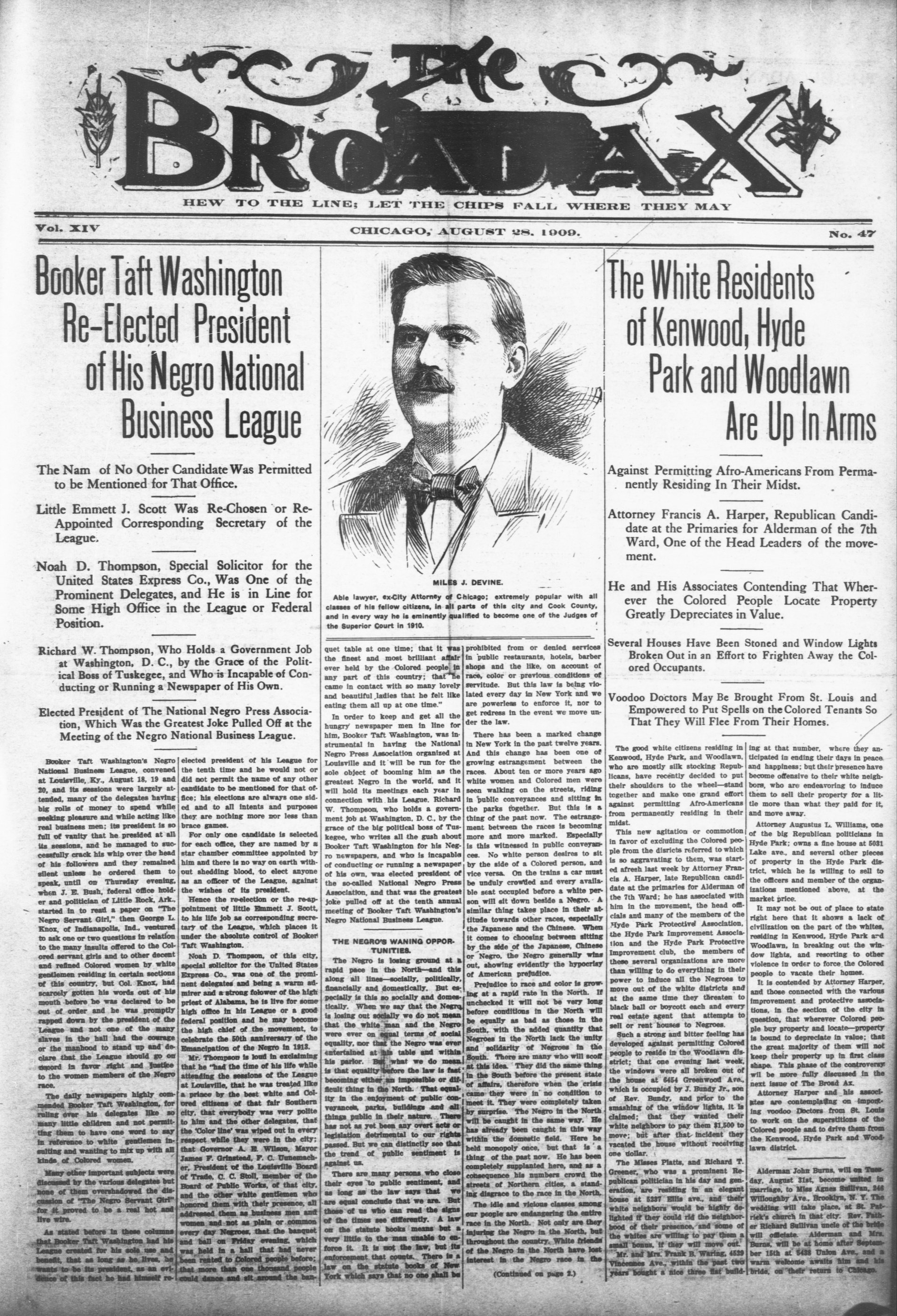
Booker Taft Washington Re-Elected President of His Negro National Business League
The Nam of No Other Candidate Was Permitted to be Mentioned for That Office.
Little Emmett J. Scott Was Re-Chosen or Re-Appointed Corresponding Secretary of the League.
Noah D. Thompson, Special Solicitor for the United States Express Co., Was One of the Prominent Delegates, and He is in Line for Some High Office in the League or Federal Position.
Richard W. Thompson, Who Holds a Government Job at Washington, D. C., by the Grace of the Political Boss of Tuskegee, and Who is Incapable of Conducting or Running a Newspaper of His Own.
Elected President of The National Negro Press Association, Which Was the Greatest Joke Pulled Off at the Meeting of the Negro National Business League.
Vol. XIV
HEW TO THE LINE; LET THE CHIPS FALL WHERE THEY MAY
elected president of his League for the tenth time and he would not or did not permit the name of any other candidate to be mentioned for that office; his elections are always one sided and to all intents and purposes they are nothing more nor less than brace games.
For only one candidate is selected for each office, they are named by a star chamber committee appointed by him and there is no way on earth without shedding blood, to elect anyone as an officer of the League, against the wishes of its president.
Hence the re-election or the re-appointment of little Emmett J. Scott, to his life job as corresponding secretary of the League, which places it under the absolute control of Booker Taft Washington.
Noah D. Thompson, of this city, special solicitor for the United States Express Co., was one of the prominent delegates and being a warm admirer and a strong folower of the high priest of Alabama, he is live for some high office in his League or a good federal position and he may become the high chief of the movement, to celebrate the 50th anniversary of the Emancipation of the Negro in 1913.
CHICAGO; AUGUST 28, 1909.
MILES J. DEVINE
MILES J. DEVINE.
Able lawyer, ex-City Attorney of Chicago; extremely popular with all classes of his fellow citizens, in all parts of this city and Cook County, and in every way he is eminently qualified to become one of the Judges of the Superior Court in 1910.
quet table at one time; that it was the finest and most brilliant affair ever held by the Colored people in any part of this country; that he came in contact with so many lovely and beautiful ladies that he felt like eating them all up at one time."
prohibited from or denied services in public restaurants, hotels, barber shops and the like, on account of race, color or previous conditions of servitude. But this law is being violated every day in New York and we are powerless to enforce it, nor to
In order to keep and get all the hungry newspaper men in line for him, Booker Taft Washington, was instrumental in having the National Negro Press Association organized at Louisville and it will be run for the sole object of booming him as the greatest Negro in the world, and it will hold its meetings each year in connection with his League. Richard W. Thompson, who holds a government job at Washington, D. C., by the grace of the big political boss of Tuskegee, who writes all the gush about Booker Taft Washington for his Negro newspapers, and who is incapable of conducting or running a newspaper of his own, was elected president of the so-called National Negro Press Association, and that was the greatest joke pulled off at the tenth annual meeting of Booker Taft Washington's Negro National Business League.
THE NEGRO'S WANING OPPOR-TUNITIES.
The Negro is losing ground at a rapid pace in the North—and this along all lines—socially, politically, financially and domestically. But especially is this so socially and domestically. When we say that the Negro is losing out socially we do not mean that the white man and the Negro were ever on equal terms of social equality, mor that the Negro was ever entertained at his table and within his parlor. But what we do mean is that equality before the law is fast becoming either an impossible or difficult thing in the North. That equality in the enjoyment of public conveyances, parks, buildings and all things public in their nature. There has not as yet been any overt acts or legislation detrimental to our rights passed. But we can distinctly see that the trend of public sentiment is against us.
There are many persons who close their eyes to public sentiment, and as long as the law says that we are equal conclude that we are. But those of us who can read the signs of the times see differently. A law on the statute books means but a very little to the man unable to enforce it. It is not the law, but its enforcement that counts. There is a law on the statute books of New York which says that no one shall be
prohibited from or denied services in public restaurants, hotels, barber shops and the like, on account of race, color or previous conditions of servitude. But this law is being violated every day in New York and we are powerless to enforce it, nor to get redress in the event we move under the law.
There has been a marked change in New York in the past twelve years. And this change has been one of growing estrangement between the races. About ten or more years ago white women and Colored men were seen walking on the streets, riding in public conveyances and sitting in the parks together. But this is a thing of the past now. The estrangement between the races is becoming more and more marked. Especially is this witnessed in public conveyances. No white person desires to sit by the side of a Colored person, and vice versa. On the trains a car must be unduly crowded and every available seat occupied before a white person will sit down beside a Negro. A similar thing takes place in their attitude towards other races, especially the Japanese and the Chinese. When it comes to choosing between sitting by the side of the Japanese, Chinese or Negro, the Negro generally wha out, showing evidently the hypocrisy of American prejudice.
Prejudice to race and color is growing at a rapid rate in the North. If unchecked it will not be very long before conditions in the North will be equally as bad as those in the South, with the added quantity that Negroes in the North lack the unity and solidarity of Negroes in the South. There are many who will scoff at this idea. They did the same thing in the South before the present state of affairs, therefore when the crisis came they were in no condition to meet it. They were completely taken by surprise. The Negro in the North will be caught in the same way. He has already been caught in this way within the domestic field. Here he held monopoly once, but that is a thing of the past now. He has been completely supplanted here, and as a consequence his numbers crowd the streets of Northern cities, a standing disgrace to the race in the North.
The White Residents of Kenwood, Hyde Park and Woodlawn Are Up In Arms
Against Permitting Afro-Americans From Permanently Residing In Their Midst.
Attorney Francis A. Harper, Republican Candidate at the Primaries for Alderman of the 7th Ward, One of the Head Leaders of the movement.
He and His Associates Contending That Wherever the Colored People Locate Property Greatly Depreciates in Value.
Several Houses Have Been Stoned and Window Lights Broken Out in an Effort to Frighten Away the Colored Occupants.
Voodoo Doctors May Be Brought From St. Louis and Empowered to Put Spells on the Colored Tenants So That They Will Flee From Their Homes.
The good white citizens residing in Kenwood, Hyde Park, and Woodlawn, who are mostly silk stocking Republicans, have recently decided to put their shoulders to the wheel—stand together and make one grand effort against permitting Afro-Americans from permanently residing in their midst.
This new agitation or commotion in favor of excluding the Colored people from the districts referred to which is so aggravating to them, was started afresh last week by Attorney Francis A. Harper, late Republican candidate at the primaries for Alderman of the 7th Ward; he has associated with him in the movement, the head officials and many of the members of the Hyde Park Protective Association, the Hyde Park Improvement Association and the Hyde Park Protective Improvement club, the members of these several organizations are more than willing to do everything in their power to induce all the Negroes to move out of the white districts and at the same time they threaten to black ball or boycott each and every real estate agent that attempts to sell or rent houses to Negroes.
Such a strong and bitter feeling has developed against permitting Colored people to reside in the Woodlawn district; that one evening last week, the windows were all broken out of the house at 6454 Greenwood Ave., which is occupied by J. Bundy Jr., son of Rev. Bundy, and prior to the smashing of the window lights, it is claimed; that they wanted their white neighbors to pay them $1,500 to move; but after that incident they vacated the house without receiving one dollar.
The Misses Platts, and Richard T. Greener, who was a prominent Republican politician in his day and generation, are residing in an elegant house at 5237 Ellis ave., and their white neighbors would be highly delighted if they could rid the neighborhood of their presence, and some of the whites are willing to pay them a small bonus, if they will move out.
Mr. and Mrs. Frank B. Waring, 4529 Vincennes Ave., within the past two years bought a nice three flat build
No. 47
Residents
Hyde
Woodlawn
We Up In Arms
Americans From Perma-
eir Midst.
Super, Republican Candi-
or Alderman of the 7th
and Leaders of the move-
Contending That Wher-
eople Locate Property
Value.
Stoned and Window Lights
to Frighten Away the Col-
Bought From St. Louis and
on the Colored Tenants So-
om Their Homes.
ing at that number, where they anticipated in ending their days in peace and happiness; but their presence have become offensive to their white neighbors, who are endeavoring to induce them to sell their property for a little more than what they paid for it, and move away.
Attorney Augustus L. Williams, one of the big Republican politicians in Hyde Park; owns a fine house at 5081 Lake ave., and several other pieces of property in the Hyde Park district, which he is willing to sell to the officers and member of the organizations mentioned above, at the market price.
It may not be out of place to state right here that it shows a lack of civilization on the part of the whites, residing in Kenwood, Hyde Park and Woodlawn, in breaking out the window lights, and resorting to other violence in order to force the Colored people to vacate their homes.
It is contended by Attorney Harper, and those connected with the various improvement and protective associations, in the section of the city in question, that wherever Colored people buy property and locate—property is bound to depreciate in value; that the great majority of them will not keep their property up in first class shape. This phase of the controversy will be more fully discussed in the next issue of The Broad Ax.
Attorney Harper and his associates are contemplating on importing voodoo Doctors from St. Louis to work on the superstitions of the Colored people and to drive them from the Kenwood, Hyde Park and Woodlawn district.
Alderman John Burns, will on Tuesday, August 31st, become united in marriage, to Miss Agnes Sullivan, 246 Willoughby Ave., Brooklyn, N. Y. The wedding will take place, at St. Pat
Will promulgate and at all times uphold the true principles of Democracy, Public Law, Public Health, Single Taxer, Republican, or anyone else can have their say, as long as their language is proper and responsibility is fixed.
The Broad AX is a newspaper whose platform is broad enough for all, ever claiming the editorial right to speak its own mind.
Local communications will receive attention. Write only on one side of the paper.
Subscriptions must be paid in advance.
One Year.....$3.00
Six Months.....1.00
Advertising rates made known on application.
Address all communications to
THE BROAD AX
$883 Armour Avenue, Chicago.
JULIUS P. TATLOR, Editor and Publisher.
Entered as Second-Class Matter, Aug. 10, 1902 at the Post Office at Chicago, Illinois, under Act of March 3, 1979.
THE NEGRO IN BUSINESS AND PROFESSIONS.
What is called the Negro problem in the United States has many phases and aspects, and some of them are still acute, but upon one thing all observers and thinkers, white or black, can agree. That is, that every step which the Colored race takes toward efficiency, thrift, usefulness, service is a step which counts toward the satisfactory solution of the highly complex "problem."
Hostility and prejudice based on race or faith are most effectually combated by indirect, subtle means. Contention and controversy cannot be avoided, but an ounce of positive achievement for good is worth volumes of theoretical arguments, in this workaday world. A Negro farmer, a Negro banker, a Negro merchant, a Negro druggist, a Negro foreman, a Negro builder, a Negro architect, a Negro educator, a Negro musician, a Negro lawyer—these are the "arguments" which must finally prevail.
The wise teaching and practice of men like Booker T. Washington, exemplified most strikingly perhaps in the National Negro Business League, cannot fall to command support and admiration everywhere. Whatever else the Negro in America may need in order to secure full recognition of his rights under the Constitution and laws, he certainly needs property, education, industry, development of his best faculties. And, for the benefit of whites and blacks alike, proper emphasis should always be placed on the material, intellectual and moral progress which the freed men of color have made in the few decades of opportunity, liberty and human dignity they have enjoyed in a limited degree. To some this course may seem "humiliating," but as a matter of fact there is no humiliation in looking reality in the face and dealing with human nature as it is, and Booker T. Washington has deserved well of the whole country for preaching the gospel of work, of manliness, of discipline, of honorable ambition, to his race.—The Chicago, Record-Herald, Tuesday, August 24, 1900.
The above editorial is reproduced in these columns, without comment, at the special request of one of the staunch followers of the wizard of Tuskegee.—Editor.
WHITE MAN TRIES TO GOBBLE UP COLORED PARAMOUR'S FORTUNE,
New Orleans, August 21.—Frank Walker, a white man who had been named as legatee of a $25,000 estate by Virginia R. Davis, a mulatto woman, was today dispossessed by a decision of the civil district court, which upheld a contest of the will made by George Campbell, a Nashville Negro, who is a natural son of the woman.
The court handing down the decision condemned Walker in terms exceedingly severe, and emphasised the fact that his association with the Negro woman was in violation of the state law, adding: "And the public policy of the Southern civilization, the integrity of the white race in the South, demands the enforcement of the law." Judge Allen, formerly of the supreme court of Tennessee, and who recently prosecuted the night rider case, came down to prosecute the contest on behalf of Campbell.
TWO NICE FURNISHED ROOMS TO
COLORED LAWYER IS REBUKED BY VETERANS.
F. L. McGhee, Negro attorney, who threatened to split in the face of L. G. Prendergast, custodian at the old capitol, during a dispute some time ago, has been formally rebuked by Worth Bagley Camp No. 2, Spanish War Veterans. Following a report on the matter by a committee appointed for that purpose, the camp Monday night adopted the following resolution:
"Wheeras, we have learned of the actions of one F. L. McGhee, a citizen of St. Paul, and his unbecoming conduct toward one of our comrades of the Grand Army of the Republic, and,
"Whereas, upon investigation of the case, we find that such conduct was uncalled for, as it is apparent that Comrade L. G. Prendergast was simply performing the duties of custodian, as they were prescribed. Therefore, be it
"Resolved, that Worth Bagley Camp No. 2, United Spanish War Veterans, indorse the action taken by Hancock post, Union Veterans' Union, in censuring the actions of Mr. McGhee, as unbecoming a citizen of our great city and state."
During the convention of a "Negro fraternal society in St. Paul in July McGhee had some trouble over securing a room in the capitol and, it is said, threatened to spit in the custodian's face.—From the Daily News, St. Paul, Minn., August 24, 1909.
The white lawyers of St. Paul, also met in that city a short time ago and passed resolutions severely condemning F. L. McGhee, for his ungentlemanly conduct, during the meeting of the United Brothers of Friendship, and for threatening to spit in the face of an old gray haired soldier, and we also pass resolutions condemning Fred McGhee for his rash act and for failing to pay the three dollars he owes us as subscription to The Broad Ax.
The Negro's Waning Opportunities
South, because of the shiftless attitude of Northern Negroes. This class of Negroes seems to be hopeless. As a general rule the young compose this class and their number comprise those who have had some advantages at schooling. They seem to be living for one thing only, the amount of injury they can do the race. That they are accomplishing this end in an alarming manner, no one who knows the conditions obtaining here will deny.
This slack attitude of our people affords excuse and cause for the growing spirit of opposition to them waged by the whites. The Negro is the only race in the North which is contented and satisfied with his present condition, and which is making no effort to better their condition. All other races are striving to forge their way to the front, but the Negro. He is satisfied to see every other race get ahead of him. He tries to excel in but one thing—a good time. That is his highest ambition, and his women are no better. Dress is their highest ambition. They think this will supply everything, including character in many instances. So that extravagance and spend-thriftiness are added to indolence and slothfulness. The result is a motley combination affording excellent opportunity for the white man to continue to further oppress them. This is a subject that should claim the earnest solicitation of the leaders of our people, for their own safety, as well as that of the race—The Metropolitan News, New York, City, N. Y., August 21, 1809.
SPECIAL MENTION.
CHATEAU RINK NOTES.
Hundreds packed the Chateau Garden last Sunday Eve., and enjoyed the cool breeze and wildly cheered Jerrry Mills and his Vaudeville Company. Why not join the crowd tonight early and have a good time.
Mr. J. G. Pegg of Omaha, Neb.
Mr. J. Leonard of Lockport, New York and Mr. James Gordon of Dayton, Ohio were among the many strangers who inspected the Chateau Garden last week. All reported a good time and wish the management much success.
As the season is fast drawing to a close an entire change of Programme each night at the Chateau Garden. Better take advantage of the open air while the weather is fine. Visit it tonight and you will come again.
The Chateau Garden is a splendid high class place to bring your friends and family and enjoy the music and amusements at a trifling cost. Visit it tonight and see for yourself.
"Would you Miss Me" and "When I look into your eyes," illustrated songs. Song by Howard Jeffrey of Williams and Walker Company.
APPOMATTOX: CLUB NOTES.
President B. F. Moseley of the Appomattox Club has returned from his summer vacation and on Wednesday last, through the Eentertainment Committee gave a Reception to the Members and their visiting friends at the Club Parlors, which was well attended and thoroughly enjoyed by a large number of guests.
Commencing Sunday, Sept. 20th the usual Sunday afternoon Cabinet meeting will be resumed.
The Pekin Theater, 2700 State St., still keeps up the high standard as the first class play house. It is the leading Negro theater in the world and its owner and manager, Robert T. Motta, is running a tip top show of varied interesting and life provoking laughs. If any one is effected with the blues they want to hike to the Pekin, where they can laugh one hundred times in one hundred minutes, and at the present time there is a continuous vaudeville show from 7:30 to 11:30 P. M.
James J. Gray, prominent North Side Democratic politician; popular and well known throughout this city and Cook County, has been dangerously ill at his home, 639 Cleveland Ave., for the past three weeks. Abscess of the brain has been the cause of his serious illness. His physicians now declare that he has now passed the critical point and that he has more than a fighting chance to recover his health, which is very gratifying indeed to his hosts of warm friends.
CHIPS
Miss Ruth Lee of Springfield, H. is in the city visiting her aunt, Mrs. Albert Morgan, 3427 Armour Ave.
Mrs. Dora Powell, 5008 Dearborn St., is entertaining Miss Hattie Emonds of Columbus, Ohio.
Miss Elizabeth B. Slaughter, lee Monday for Louisville, Ky., to visit her mother, Mrs. Carter Slaughter.
Mrs. B. F. Moseley, and her daughter, 6248 Sangamon street; are visiting Mrs. Barbers and other friends in Portland, Oregon.
Mrs. Geo. C. Hall, left Friday, for Boston, Mass., to attend the Doctor Convention, and she will return home with her husband Dr. Geo. C. Hall.
Mrs. C. Westover Miller and her sister Mrs. Cora Williamson, 7114 Chplain Ave., are spending their vacation in Atlantic City, New Jersey.
Emanuel Jackson, 2961 State street will depart Sunday morning for Pittburg, Pa., his old home where he will spend two weeks.
Mrs. Jennie E. Watts, has removed from 2816 Dearborn street to 2418 Wabash ave., where she will be pleased to meet her many friends.
Mr. and Mrs. Frank K. King have returned from Louisville, Ky., when they attended the convention of the National Negro Business League last week.
Dunn and Hight, 5050 State street will on September 1, engage a first class chinaman to act as cook and serve Chop Suey, in connection with their English Chop House.
Dr. Wm. Purnell and son Lee left Friday for their home in Oakland Calif., Mrs. Theo. Lee Purnell will join her husband and son about two weeks hence.
Mr. and Mrs. Mack Weaver, 3800 Wabash Ave., entertained Rev. Taylor Rector in charge of St. Thomas Episcopal Church, during the absence of Father Masslah.
Mr. and Mrs. Phil Green, 243 W 47th St., entertained several friends Thursday evening in honor of Mrs. Rose Lively, and Mr. Greene Raby of Gulfport, Miss.
Mr. Alex. T. Easton, 3205 Rhodes Ave., gave a smoker, Tuesday evening in honor of Dr. M. F. Leland, Messrs Jno. R. Leland and Louis D. Easton of Cincinnati, Ohio.
Mr. Wm. J. Allen, 6006 Center Ave., entertained several friends at dinner Friday evening in honor of some of his New Orleans friends who are visiting the city.
Mr. and Mrs. Charles A. Blarford of Louisville, Ky., are visiting her cousin, Mrs. Louis Smead of 3550 Dearborn St., en route to New York City.
Mrs. M. Toles Mitchell of 3540 Dearborn St., entertained State Officers of the Federation of Colored Women's Clubs, Monday, Aug. 23, Luncheon being served at 2:30 P. M.
Attorney R. A. J. Shaw, now occupies the suite of law offices so long used by the late Robert M. Mitchell, at 79 So. Clark street, room 9, and he has lately had the rooms decorated and put in first class shape.
Mrs. Thressa Johnson, 5012 Armour Ave., has for the past two weeks been at Provident Hospital through serious illness; and it is very pleasing to her hosts of friends to note, that she is recovering her health.
William Robinson, 3511 Armour Ave., who has charge of the 22d Street Police Station, and who is a property holder and tax payer, has become one of the highest K. P.'s among the Afro-Americans in Chicago.
J. Fenton Johnson, 3026 Vernon Ave., has just finished writing a new play which he has presented to the Phyllis Wheatley Woman's Club, and its members are making arrangements for its presentation in the near future.
Mr. and Mrs. Samuel Carter, entertained a party of sixteen friends, Tuesday evening at theatre and dinner in honor of Mrs. Rosa Lively, who will leave the city shortly to reside in Gulfport, Miss: with Mr. Green Raby her afflianced husband.
A large number of our Southern relatives have come among us to stay. Let us see to it that they either find employment or "move on" to the next station. For it is the idle in our midst who make it harder for us to get along anywhere.
Rev] T. A. Clark, 3600 Forest Ave. has regained his health again and he is in the real estate business with his
son, and the firm of Clark, Hayes and Co., 3705 State Street, phone Aldine, 2686, and they are doing nicely and meeting with much success.
Mrs. J. T. Robinson, 451, 35th street is still having a good time with relatives and friends at Hannibal, Mo. Several parties and receptions the past week have been given in her honor and she has spent much time in taking pleasant drives around the country.
Messrs. S. Laing Williams, Virgil Pumphrey, Atty. Sims, C. Webb, Noah D. Thompson C. R. Harris and Jesse Binga the banker have returned from Louisville, Ky., where they attended the recent convention of the National Negro Business League, as delegates. The gentlemen report a great and inspiring time at the convention which was a success in every particular.
Thought She Had Arrived.
"I have moved into a perfect gem of an apartment on the sixth floor of one of those new houses," said the woman who paints china, "and am reveling in its liberal supply of fresh air and sunlight."
"But don't you find the stairs an overbalancing disadvantage?" asked an acquaintance.
"It seemed ages that I waited in the hall after the ringing of the lower bell, and upon hearing the labored breathing of my ascending visitor I ran back for the smelling salts.
"When I had administered all the means of resuscitation at hand she managed to articulate between gasps:
"I thought St. Peter always opened the door!"—New York Times.
Sunset In "the Red City" of Beverla.
Sunset In "the Red City" of Seattle. The numerous entrances to the old town of Rothenburg are guarded by beautiful watchtowers, which are inhabited by impoverished old women, who rent their airy lodgings for a nominal sum. The red twinkle of their lamps high over the dusky streets of Rothenburg at night—for it is as mediaeval in its lighting as in many other ways—is very charming in effect. The walls of Rothenburg are a constant delight to visitors, who, by dint of much squeezing through narrow passageways and groping in darkness, are able to make a circuit of the city, getting glimpses on the way through loopholes of the green country outside. Wondrous views of the town are also to be had from many of the distant hills. At sunset the sight of its graceful towers and clutter of red roof tops is like a fair vision of romance. The city blazes for a moment in a fiery mist, then suddenly melts, mirage-like, in the gathering dusk, leaving a sense of something born of dream, the illusion of an enchanter's wand.—Rothenburg Letter to Vogue.
LILY WHITES BEING ROUTED.
Messrs. Plesants and Hopkins Leading Political Fight in Virginia.
I am glad to see that the Lily Whites are being routed in old Virginia, and especially am I glad to see that the good work had its beginning in Goochland county, where, as a boy, I remember that there were but two regular political parties—the Republican and Democratic. Each then worked along its own party lines. The third party within a party, the Lily Whites, was at that time unknown. It did not exist in the days of William Mahone and William P. Moseley.
To our good friends, J. F. Plesants and D. Hopkins, whom we have known for many years, we say: "Bravo! Go on! You are on the right track. Let the Negro manhood of old Virginia rise up as one man and fight the enemy of its civil and political rights to a finish.
We know you to be capable men who have never yet bent the knee to the Baal of freedom and liberty."—Thomas P. Moseley, Brooklyn, N. Y.
Census, Figures, Misleading.
Census Figures misleading.
The census of 1900 gave the Negro population in the United States by periodical comparison as follows: In 1800 the Negro formed 18.88 per cent of the population; in 1810, 19.08 per cent; in 1850, 15.08 per cent; in 1860, 14.02 per cent; in 1880, 13.11 per cent; in 1890, 11.93 per cent; in 1900, 11.59 per cent.
While the above figures show a decided falling off in the Negro population when compared with the total population of the United States, they are not to be construed to mean that there are fewer Negroes now than in 1800. Take the population of the United States in 1800 and then add to it the number of immigrants to the United States from 1800 to 1900 and it will be clearly seen how misleading these figures are.
Her Proposal.
"You've been courting me now for a number of years, George," remarked a girl to a young man, "and I want to make a little leap year proposal."
"I—I am not in a position to m-marry just yet," stammered the youth, "but—"
"Who said anything about marriage?" interrupted the girl. "I was going to propose that you stop coming here and give somebody else a chance." Philadelphus Impaler.
The Coughing Bean.
To the ordinary housemaid the falling of a house plant into a violent paroxysm of coughing is naturally disconcerting. Yet there are plants which will do this when the broom or the duster begins to make dust fly. This singular plant is the "coughing bean," known to the botanist as the Eutada tusslens. It is a native of warm and moist tropical countries and cannot and will not stand dust. When dust settles upon the breathing pores in the leaves of this plant and chokes them a gas accumulates inside the leaves and when it gains sufficient strength forcibly "blows off," clearing the pores of dust and making a sound exactly like coughing. At the same time the leaves tremble and the plant actually "gets red in the face" through the sinking of the green chlorophyll grains and the appearance of red particles on the leaves. This plant is sometimes used as a house plant, and sweeping the room sets it coughing, to the intense astonishment of persons not familiar with its peculiarities. London Chronicle.
Paid For the Kiss.
Lord Northcote was once made curious use of while governor general of Australia, says London M. A. P. Strolling one night through an avenue of somber trees to a friend's house to dinner, he was suddenly pounced upon by a maidservant, who kissed him effusively and pressed a little parcel into his hand. "Here's a sausage for you. I can't come out tonight, as master has company," she whispered and as mysteriously disappeared. When he got to the house he found one of his servants lottering by the gate. "What are you doing there?" asked Lord Northcote. "I'm waiting for my sweetheart," the man stammered. "Where is she?" "In service here." "Ah, then, I am right. Here is a sausage from your sweetheart, and she wishes me to tell you that she cannot come out tonight, as her master has company." Seeing that the man looked nervous, he added kindly: "She also gave me a kiss for you, but perhaps you would rather wait until you see her. Here is 5 shillings instead."
Round About Dorking
The neighborhood of Dorking, where George Meredith lived, has many literary associations independent of its connection with that famous novelist. It was at Burford Bridge, near Dorking, that Keats completed "Endymion" in November, 1817; close by, at the Rookery, was born Father Malthus, the popular economist, and at West Humble Frances Burney, after her marriage with General d'Arbay, built Camilla cottage with profits of her novel of that name and settled down. Sheridan resided at Polesden and John Stuart Mill at Mickleham, while other illustrious residents in the locality in earlier times were John Evelyn and Daniel Defoe. To most people, however, the chief literary association of Dorking is with Dickens, for it was not at the Marquis of Granby's, variously identified with the White Hart and the Old King's Head, that Mr. Weller, Sr., made the fatal blunder of proposing to a "vidder"?—Westminster Gazette.
English Difficult to Pronounce
English Difficult to Pronounce.
The difficulty of English for strangers does not lie in its orthography, but in its pronunciation. Abroad people will constantly say that they can read and write English readily, while unable to utter a word or to understand a word of the spoken language, as, of course, vice versa, a great many English and Americans can read and write French long before they can understand or make themselves understood. The other languages are just as difficult for them to pronounce as English is for others. The only difference is that English stands alone with its system or lack of system of pronunciation. When a Frenchman knows how to write German he is at the same time able to speak the language, if not beautifully, at least so as to be understood. The same holds for a German speaking French.—Professor Albert Schina in North American Review.
The Battle of the Nations
The conflict called the "Battle of the Nations" was the battle of Lelpsic. It was fought on Oct. 16-18, 1513, between the soldiers of Russia, Prussia, Austria, Sweden, Denmark and Holland, under Schwarzenberg, on the one side, and Napoleon's army of allies, on the other. It was one of the greatest battles of modern times. A half million of men were engaged, and the casualties on both sides were 94,000. It resulted in overwhelming defeat for Napoleon and the liberation of Germany. Troops from every nation of Europe participated in it, hence the "Battle of Nations."
Over the Limit.
Husband (reading from his paper)—Here, they say, is a comet coming toward the earth, traveling at the rate of a million miles a minute. Wife (awaking from a doze)—Why don't they enforce the speed laws better?—Baltimore American.
It Makes a Difference.
In Lever's "Charles O'Malley" the hero's boast while on his way to a duel, "I can break the stem of a wineglass at fifteen paces," was met by his friend and mentor with the comment, "Yes, but the wineglass hasn't a pistol in its hand."
"Now they refer to me as a man with a past. Wish I could have a present once."-Cleveland Leader.
What is called the Negro problem in the United States has many phases and aspects, and some of them are still acute, but upon one thing all observers and thinkers, white or black, can agree. That is, that every step which the Colored race takes toward efficiency, thrift, usefulness, service is a step which counts toward the satisfactory solution of the highly complex "problem."
Hostility and prejudice based on race or faith are most effectually combated by indirect, subtle means. Contention and controversy cannot be avoided, but an ounce of positive achievement for good is worth volumes of theoretical arguments, in this workaday world. A Negro farmer, a Negro banker, a Negro merchant, a Negro druggist, a Negro foreman, a Negro, builder, a Negro architect, a Negro educator, a Negro musician, a Negro lawyer—these are the "arguments," which must finally prevail.
The wise teaching and practice of men like Booker T. Washington, exemplified most strikingly perhaps in the National Negro Business League, cannot fail to command support and admiration everywhere. Whatever else the Negro in America may need in order to secure full recognition of his rights under the Constitution and laws, he certainly needs property, education, industry, development of his best faculties. And, for the benefit of whites and blacks alike, proper emphasis should always be placed on the material, intellectual and moral progress which the freed men of color have made in the few decades of opportunity, liberty and human dignity they have enjoyed in a limited degree. To some this course may seem "humiliating," but as a matter of fact there is no humiliation in looking reality in the face and dealing with human nature as it is, and Booker T. Washington has deserved well of the whole country for preaching the gospel of work, of manliness, of discipline, of honorable ambition, to his race. The Chicago, Record-Herald, Tuesday, August 24, 1900.
The above editorial is reproduced in these columns, without comment, at the special request of one of the staunch followers of the wizard of Tuskegee.—Editor.
WHITE MAN TRIES TO GOBBLE UP
COLORED HARMOURS
New Orleans, August 21.—Frank Walker, a white man who had been named as legatee of a $25,000 estate by Virginia R. Davis, a mulatto woman, was today dispossessed by a decision of the civil district court, which upheld a contest of the will made by George Campbell, a Nashville Negro, who is a natural son of the woman.
The court handing down the decision condemned Walker in terms exceedingly severe, and emphasised the fact that his association with the Negro woman was in violation of the state law, adding: "And the public policy of the Southern civilization, the integrity of the white race in the South, demands the enforcement of the law."
Judge Allen, formerly of the supreme court of Tennessee, and who recently prosecuted the night rider cases, came down to prosecute the contest on behalf of Campbell.
TWO NICE FURNISHED ROOMS TO RENT.
Parties desiring furnished rooms, can find two nice ones to rent at $135. Dearborn street.
F. L. McGhee, Negro attorney, who threatened to split in the face of L. G. Premerdgast, custodian at the old capitol, during a dispute some time ago, has been formally rebuked by Worth Bagley Camp No. 2, Spanish War Veterans. Following a report on the matter by a committee appointed for that purpose, the camp Monday night adopted the following resolution: "Wheeras, we have learned of the actions of one F. L. McGhee, a citizen of St. Paul, and his unbecoming conduct toward one of our comrades of the Grand Army of the Republic, and,
"Whereas, upon investigation of the case, we find that such conduct was uncalled for, as it is apparent that Comrade L. G. Prendergast was simply performing the duties of custodian, as they were prescribed. Therefore, be it
"Resolved, that Worth Bagley Camp No. 2, United Spanish War Veterans, indorse the action taken by Hancock post, Union Veterans' Union, in censuring the actions of Mr. McGhee, as unbecoming a citizen of our great city and sta'e."
During the convention of a "Negro fraternal society in St. Paul in July McGhee had some trouble over securing a room in the capitol and, it is said, threatened to spit in the custodian's face."—From the Daily News, St. Paul, Minn., August 24, 1909.
The white lawyers of St. Paul, also met in that city a short time ago and passed resolutions severely condemning F. L. McGhee, for his ungentlemanly conduct, during the meeting of the United Brothers of Friendship, and for threatening to spit in the face of an old gray haired soldier, and we also pass resolutions condemning Fred McGhee for his rash act and for failing to pay the three dollars he owes us as subscription to The Broad Ax.
The Negro's Waning Opportunities
South, because of the shiftless attitude of Northern Negroes. This class of Negroes seems to be hopeless. As a general rule the young compose this class and their number comprise those who have had some advantages at schooling. They seem to be living for one thing only, the amount of injury they can do the race. That they are accomplishing this end in an alarming manner, no one who knows the conditions obtaining here will deny.
This slack attitude of our people affords excuse and cause for the growing spirit of opposition to them waged by the whites. The Negro is the only race in the North which is contented and satisfied with his present condition, and which is making no effort to better their condition. All other races are striving to forge their way to the front, but the Negro. He is satisfied to see every other race get ahead of him. He tries to excel in but one thing—a good time. That is his highest ambition, and his women are no better. Dress is their highest ambition. They think this will supply everything, including character in many instances. So that extravagance and spend-thriftiness are added to indolence and slothfulness. The result is a motley combination affording excellent opportunity for the white man to continue to further oppress them. This is a subject that should claim the earnest solicitation of the leaders of our people, for their own safety, as well as that of the race—The Metropolitan News, New York, City, N. Y., August 21, 1909.
SPECIAL MENTION.
Beginning with the next issue of The Broad Ax, there will appear a series of articles, entitled "The Rise and Reign of the Bourbon Oligarchy," by Joseph C. Manning, editor, the Southern American, Alexander City, Alabama.
One chapter will run through these columns each week, until the end and those who desire to become familiar with the true political situation in Alabama, at the present time should not fail to follow this story as set forth by editor Manning.
INSTITUTIONAL CHURCH NOTES.
The final illustrated services for this conference year will be given at the Institutional Church, Sunday night, Aug. 29 and Sunday night, Sept. 5. Subject Sunday night will be: The Curse of the Century, Sept. 5 Will be: Paradise Lost and Regained.
The Pastor will preach Sunday morning on "Idolatry in Chicago." Don't fall to attend these services. All welcome.
"B."
CHATEAU RINK NOTES.
Hundreds packed the Chateau Garden last Sunday Eve., and enjoyed the cool breeze and wildly bearded Jerry Mills and his Vaudeville Company. Why not join the crowd tonight early and have a good time.
Mr. J. G. Pegg of Omaha, Neb.
Mr. J. Leonard of Lockport, New York and Mr. James Gordon of Dayton, Ohio were among the many strangers who inspected the Chateau Garden last week. All reported to good time and wish the management much success.
As the season is fast drawing to a close an entire change of Programme each night at the Chateau Garden. Better take advantage of the open air while the weather is fine. Visit it tonight and you will come again.
The Chateau Garden is a splendid high class place to bring your friends and family and enjoy the music and amusements at a trifling cost. Visit it tonight and see for yourself.
"Would you Miss Me" and "When I look into your eyes," illustrated songs. Song by Howard Jeffrey of Williams and Walker Company.
APPOMATTOX CLUB NOTES
President B. F. Moseley of the Appomattox Club has returned from his summer vacation and on Wednesday last, through the Eentertainment Committee gave a Reception to the Members and their visiting friends at the Club Parlors, which was well attended and thoroughly enjoyed by a large number of guests.
Commencing Sunday, Sept. 20th the usual Sunday afternoon Cabinet meeting will be resumed.
The Pekin Theater, 2700 State St. still keeps up the high standard as the first class play house. It is the leading Negro theater in the world and its owner and manager, Robert T. Motta, is running a tip top show of varied interesting and life provoking laughs. If any one is effected with the blues they want to hike to the Pekin, where they can laugh one hundred times in one hundred minutes, and at the present time there is a continuous vandeville show from 7:30 to 11:30 P. M.
James J. Gray, prominent North Side Democratic politician; popular and well known throughout this city and Cook County, has been dangerously ill at his home, 630 Cleveland Ave., for the past three weeks. Abscess of the brain has been the cause of his serious illness. His physicians now declare that he has now passed the critical point and that he has more than a fighting chance to recover his health, which is very grafting indeed to his hosts of warm friends.
---
CHIPS
Miss Ruth Lee of Springfield, IL is in the city visiting her aunt, Mrs Albert Morgan, 3427 Armour Ave.
Mrs. Dora Powell, 5008 Dearborn St., is entertaining Miss Hattle E. monds of Columbus, Ohio.
Miss Elizabeth B. Slaughter, lee Monday for Louisville, Ky., to visit her mother, Mrs. Carter Slaughter.
Mrs. B. F. Moseley, and her daughter, Mrs. Barbers and other friends of Portland, Oregon.
Mrs. Geo. C. Hall, left Friday, for Boston, Mass., to attend the Doctor Convention, and she will return home with her husband Dr. Geo. C. Hail.
Mrs. C. Westover Miller and her sister Mrs. Cora Williamson, 7114 Champlain Ave., are spending their vacation in Atlantic City, New Jersey.
Emanuel Jackson, 2961 State street will depart Sunday morning for Pittburg, Pa., his old home where he will spend two weeks.
Mrs. Jennie E. Watts, has removed from 2816 Dearborn street to 2475 Wabash ave., where she will be pleased to meet her many friends.
Mr. and Mrs. Frank K. King have returned from Louisville, Ky., when they attended the convention of the National Negro Business League last week.
Dunn and Hight, 5050 State street will on September 1, engage a first class chinman to act as cook and serve Chop Suey, in connection with their English Chop House.
Dr. Wm. Purnell and son Lee left Friday for their home in Oakland Calif., Mrs. Theo. Lee Purnell will join her husband and son about two weeks hence.
Mr. and Mrs. Mack Weaver, 3800 Wabash Ave., entertained Rev. Taylor Rector in charge of St. Thomas Episcopal Church, during the absence of Father Massiah.
Mr. and Mrs. Phil Green, 243 W 47th St., entertained several friends Thursday Lively, in honor of Mrs. Rose Lively, and Mr. Greene Raby of Gulfport, Miss.
Mr. Alex. T. Easton, 3205 Rhodes Ave., gave a smoker, Tuesday evening, in honor of Dr. M. F. Leland, Messrs Jno. R. Leland and Louis D. Easton of Cincinnati, Ohio.
Mr. Wm. J. Allen, 6006 Center Ave., entertained several friends at dinner Friday evening in honor of some of his New Orleans friends who are visiting the city.
Mr. and Mrs. Charles A. Blarford of Louisville, Ky., are visiting her cousin, Mrs. Louis Smead of 3550 Dearborn St., en route to New York City.
Mrs. M. Toles Mitchell of 3540 Dearborn St., entertained State Officers of the Federation of Colored Women's Clubs, Monday, Aug. 23, Luncheon being served at 2:30 P. M.
Attorney R. A. J. Shaw, now occupies the suite of law offices so long used by the late Robert M. Mitchell, at 79 So. Clark street, room 9, and he has lately had the rooms decorated and put in first class shape.
Mrs. Theresa Johnson, 5012 Armour Ave., has for the past two weeks been at Provident Hospital through serious illness; and it is very pleasing to her hosts of friends to note, that she is recovering her health.
William Robinson, 3511 Armour Ave. who has charge of the 22d Street Police Station, and who is a property holder and tax payer, has become one of the highest K. P.'s among the Afro-Americans in Chicago.
J. Fenton Johnson, 3026 Vernon Ave., has just finished writing a new play which he has presented to the Phyllis Wheatley Woman's Club, and its members are making arrangements for its presentation in the near future.
Mr. and Mrs. Samuel Carter, entertained a party of sixteen friends, Tuesday evening at theatre and dinner in honor of Mrs. Rosa Lively, who will leave the city shortly to reside in Gulfport, Miss: with Mr. Green Raby her afflianced husband.
son, and the firm of Clark, Hayes and Co., 3705 State Street, phone Aldine, 2696, and they are doing nicely and meeting with much success.
Mrs. J. T. Robinson, 451, 35th street is still having a good time with relatives and friends at Hannibal, Mo. Several parties and receptions the past week have been given in her honor and she has spent much time in taking pleasant drives around the country.
Messrs. S. Laing Williams, Virgil Pumphrey, Atty. Sims, C. Webb, Noah D. Thompson C. R. Harris and Jesse Binga the banker have returned from Louisville, Ky., where they attended the recent convention of the National Negro Business League, as delegates. The gentlemen report a great and inspiring time at the convention which was a success in every particular.
Thought She Had Arrived.
Thought She Had Arrived.
"I have moved into a perfect gem of an apartment on the sixth floor of one of those new houses," said the woman who paints china, "and am reveling in its liberal supply of fresh air and sunlight."
"But don't you find the stairs an overbalancing disadvantage?" asked an acquaintance.
"The thought of the cozy quarters at such moderate cost colors my climb with the roseate hue of optimism," laughed the artist, "but one of my customers, middle aged and filled with good food and the joy of living, evidently found it a harrowing experience.
"It seemed ages that I waited in the hall after the ringing of the lower bell, and upon hearing the labored breathing of my ascending visitor I ran back for the smelling salts.
"When I had administered all the means of resuscitation at hand she managed to articulate between gasps: "I thought St. Peter always opened the door.""—New York Times.
Sunset In "the Red City" of Bavaria.
The numerous entrances to the old town of Rothenburg are guarded by beautiful watchtowers, which are inhabited by impoverished old women, who rent their airy lodgings for a nominal sum. The red twinkle of their lamps high over the dusky streets of Rothenburg at night—for it is as mediaeval in its lighting as in many other ways—is very charming in effect. The walls of Rothenburg are a constant delight to visitors, who, by dint of much squeezing through narrow passageways and groping in darkness, are able to make a circuit of the city, getting glimpses on the way through loopholes of the green country outside. Wondrous views of the town are also to be had from many of the distant hills. At sunset the sight of its graceful towers and clutter of red roof tops is like a fair vision of romance. The city blazes for a moment in a fiery mist, then suddenly melts, mirage-like, in the gathering dusk, leaving a sense of something born of dream, the illusion of an enchanter's wand.—Rothenburg Letter to Vogue.
LILY WHITES BEING ROUTED.
Messra. Plesanta and Hopkins Leading Political Fight in Virginia.
I am glad to see that the Lily Whites are being routed in old Virginia, and especially am I glad to see that the good work had its beginning in Goochland county, where, as a boy, I remember that there were but two regular political parties—the Republican and Democratic. Each then worked along its own party lines. The third party within a party, the Lily Whites, was at that time unknown. It did not exist in the days of William Mahone and William P. Moseley.
To our good friends, J. F. Plesanta and D. Hopkins, whom we have known for many years, we say: "Bravo! Go on! You are on the right track. Let the Negro manhood of old Virginia rise up as one man and fight the enemy of its civil and political rights to a finish. We know you to be capable men who have never yet bent the knee to the Baal of freedom and liberty."—Thomas P. Moseley, Brooklyn, N. Y.
Census. Figures Misleading.
The census of 1900 gave the Negro population in the United States by periodical comparison as follows: In 1800 the Negro formed 18.88 per cent of the population; in 1810, 19.08 per cent; in 1850, 15.08 per cent; in 1880, 14.02 per cent; in 1890, 18.11 per cent; in 1890, 11.93 per cent; in 1900, 11.59 per cent.
While the above figures show a decided falling off in the Negro population when compared with the total population of the United States, they are not to be construed to mean that there are fewer Negroes now than in 1800. Take the population of the United States in 1800 and then add to it the number of immigrants to the United States from 1800 to 1900 and it will be clearly seen how misleading these figures are.
"You've been courting me now for a number of years, George," remarked a girl to a young man, "and I want to make a little leap year proposal."
"Who said anything about marriage?" interrupted the girl. "I was going to propose that you stop coming here and give somebody else a chance." Philodelphia Innoter
To the ordinary housemaid the falling of a house plant into a violent paroxysm of coughing is naturally disconcerting. Yet there are plants which will do this when the broom or the duster begins to make dust fly. This singular plant is the "coughing bean," known to the botanist as the Eutada tussilis. It is a native of warm and moist tropical countries and cannot and will not stand dust. When dust settles upon the breathing pores in the leaves of this plant and chokes them a gas accumulates inside the leaves and when it gains sufficient strength forcibly "blows off," clearing the pores of dust and making a sound exactly like coughing. At the same time the leaves tremble and the plant actually "gets red in the face" through the sinking of the green chlorophyll grains and the appearance of red particles on the leaves. This plant is sometimes used as a house plant, and sweeping the room sets it coughing, to the intense astonishment of persons not familiar with its peculiarities. London Chronicle.
Paid For the Kiss.
Lord Northcote was once made curious use of while governor general of Australia, says London M. A.P. Strolling one night through an avenue of somber trees to a friend's house to dinner, he was suddenly pounced upon by a maidservant, who kissed him effusively and pressed a little parcel into his hand. "Here's a sausage for you. I can't come out tonight, as master has company," she whispered and as mysteriously disappeared. When he got to the house he found one of his servants loitering by the gate. "What are you doing there?" asked Lord Northcote. "I'm waiting for my sweetheart," the man stammered. "Where is she?" "In service here." "Ah, then, I am right. Here is a sausage from your sweetheart, and she wishes me to tell you that she cannot come out tonight, as her master has company." Seeing that the man looked nervous, he added kindly: "She also gave me a kiss for you, but perhaps you would rather wait until you see her. Here is 5 shillings instead."
Round About Dorking
The neighborhood of Dorking, where George Meredith lived, has many literary associations independent of its connection with that famous novelist. It was at Burford Bridge, near Dorking, that Keats completed "Endymon" in November, 1817; close by, at the Rookery, was born Father Malthus, the popular economist, and at West Humble Frances Burney, after her marriage with General d'Arbay, built Camilla cottage with profits of her novel of that name and settled down. Sheridan resided at Polesden and John Stuart Mill at Mickleham, while other illustrious residents in the locality in earlier times were John Evelyn and Daniel Defoe. To most people, however, the chief literary association of Dorking is with Dickens, for was it not at the Marquis of Granby's, variously identified with the White Hart and the Old King's Head, that Mr. Weller, Sr., made the fatal blunder of proposing to a "vilder"?—Westminster Gazette.
English Difficult to Pronounce
The difficulty of English for strangers does not lie in its orthography, but in its pronunciation. Abroad people will constantly say that they can read and write English readily, while unable to utter a word or to understand a word of the spoken language, as, of course, vice versa, a great many English and Americans can read and write French long before they can understand or make themselves understood. The other languages are just as difficult for them to pronounce as English is for others. The only difference is that English stands alone with its system or lack of system of pronunciation. When a Frenchman knows how to write German he is at the same time able to speak the language, if not beautifully, at least so as to be understood. The same holds for a German speaking French.—Professor Albert Schins in North American Review.
The Battle of the Nations
The conflict called the "Battle of the Nations" was the battle of Lelpsic. It was fought on Oct. 16-18, 1813, between the soldiers of Russia, Prussia, Austria, Sweden, Denmark and Holland, under Schwarzenberg, on the one side, and Napoleon's army of allies, on the other. It was one of the greatest battles of modern times. A half million of men were engaged, and the casualties on both sides were 94,000. It resulted in overwhelming defeat for Napoleon and the liberation of Germany. Troops from every nation of Europe participated in it, hence the "Battle of Nations."
Over the Limit.
Husband (reading from his paper)—Here, they say, is a comet coming toward the earth, traveling at the rate of a million miles a minute. Wife (awaking from a dose)—Why don't they enforce the speed laws better?—Baltimore American.
It Makes a Difference
In Lever's "Charles O'Malley" the hero's boast while on his way to a duel, "I can break the stem of a wineglass at fifteen paces," was met by his friend and mentor with the comment, "Yes, but the wineglass hasn't a pistol in its hand."
Published in the Plains District by
John J. Dunn
Woodsands and Logging
District No.
COAL
WOOD
Pittsburgh St. and Dumont Drive,
Baltimore, Maryland
Dorsey's
WHITE ROSE
Petrolatum
For Chapped Hands, Face and Lips.
KINGSTON PHARMACY
J. S. DORSEY, R. Ph., proprietor
116 1-2 W. 51st Street, Near Dearborn, Chicago
TELEPHONE 814-303
Our Motto is Purity and Accuracy
DR. A. WILBERFORCE WILLIAMS
announces the Removal
of his office to
3255 State Street, N. E. cor. 33d Street
Suite A
Hours 10 to 12 m., 2 to 6,7:30 to 8:30
YOURSELF AND FRIENDS WILL BE CORDIALLY RECEIVED
Phone Aldine 2208
WORKING THEIR WAY OUT.
Afro-Americans Breaking Away From Crowded City Life.
Without the beating of any tomtoms or the sounding of any loud alarms there is being built up within a few miles of Philadelphia, at Sharon Hill, an Afro-American town which promises to prove an attraction to our people from the crowded city streets.
The pastors of the churches and others of the race are interesting themselves in building up the town, and, besides several tracts of land that already had been purchased, some of our enterprising business men have recently purchased the old Nonsall farm and will parcel it off into building lots.
The members of the First African Baptist church in Sharon Hill, of which the Rev. C. T. Wilcher is pastor, recently purchased two lots on Clifton avenue, which is to be about the center of the village, and upon it is to be built a new church edifice. In the neighborhood of the proposed church there are springing up many business enterprises, such as grocery stores, restaurants, barber shops, real estate offices, and near by are several large truck farms. In order to afford employment to the members of the race a brick manufacturing company has been incorporated and has opened up a yard at Sharon Hill.
New Bank Opened at Dallas.
The opening of the Penny Savings bank at Dallas, Tex., the other day was an interesting event. The board of directors had previous to the opening day issued invitations to the people of Dallas and vicinity to be present, and they came in large numbers. Each visitor was requested to register his name and address in a book which was provided for that purpose. "Without some money and some property there is but little appreciation for our people. This is the day of accumulation." said the directors to the people. The three ranking officers of the bank are Dr. G. I. Jackson, president; B. R. Bluett, cashier, and M. C. Cooper, vice president.
Successful Religious Bodies.
Much gratification is expressed over the success which attended the annual meetings of the New England Baptist Sunday school convention and the woman's auxiliary to the New England Baptist missionary convention, which were held in Boston recently. The annual financial reports of each showed that a splendid work had been done for home and foreign missions, education and large gains in membership.
When Frederick built his famous palace of Bans Souci there happened to be a mill that greatly hampered him in the execution of his plans, and he asked the miller for how much he would sell it. The miller replied that for a long series of years his family had owned the mill, which had passed from father to son, and that he would not sell it for any price. The king used every solicitation, offered to build him a mill in a better place and pay him, besides, any sum he might demand, but the obtrate miller still persisted in his determination to preserve the inheritance of his ancestors.
Irritated at last by his conduct, the king sent for him and said in an angry tone:
"Why do you refuse to sell your mill notwithstanding all the advantages I have offered you?"
The miller repeated his reasons. "Do you know," continued the king, "that I could take it without giving you a penny?" "Yes," returned the miller calmly, "If it were not for the chamber of justice at Berlin." The king was so flattered by this answer, which showed that he was incapable of an act of injustice, that he dismissed the miller without further entreaty and changed the plan of his garden.
Giving the Bride a Tip.
"Here's a little pointer for you," said the bride of last year to the bride of this year. "I'll tell you my own experience, and you can judge for yourself what to do. When we returned from our wedding trip and I began to rum-make through George's belongings I found six or seven pairs of gloves and at least six pairs of silk hose, things that he had never had on. They had been tucked away in all sorts of places. Most of them I at once recognized as presents I had given to him from time to time. Besides them, I found a lot of handkerchiefs still unused, handkerchiefs that I had embroidered his initial on with my own hands.
"What do you suppose I did? Foolishly I gathered them all together and spread them out on the bed where he would see them when he came home and feel ashamed of himself for never using my presents. Just think what a lack of forethought I showed! Consider what a saving of pin money it would have been if I had put the things away and then doled them out to him for Christmas presents or birthday presents one by one. It would have served him exactly right too."—Cleveland Plain Dealer.
Are You a Beggar?
All the beggars are not holding out a hand to passsby in the street. You probably know the man who is ever whining for help. If a farmer, he thinks his neighbors should help him get in his grain or do his plowing. If in business, he is always trying to borrow or wanting some one to boost him or drum up customers. He never seems to think of relying on his own efforts. There is a well known fable about the larks in a grainfield. As long as the farmer depended on his neighbors and relations to come and cut his grain the larks felt perfectly safe. When the man determined to cut the grain himself the larks knew it was time to seek safety elsewhere. There are times when every one needs help, but help should be asked only when one has made every possible effort for himself.
Too much help given a man weakens his character.—Milwaukee Journal.
A. Quiet Rebuke.
An "object admonition" like the one described by Warren Lee Goss in his article, "Campaigning to No Purpose," published in Johnson's "Battles and Leaders of the Civil War," is often more efficacious than storms of reproach.
One day the colonel of the regiment noticed a soldier on parade wearing a badly soiled pair of gloves.
"Corporal," said the officer, "why do you set the men such a bad example as appearing before them in dirty gloves? Why is it?"
"I've had no pay, sir, since I entered the service," returned the corporal. "I can't afford to have them done up."
The colonel drew from his pocket a pair of gloves, spotlessly white. Handing them to the corporal, he said quietly: "Put these on. I washed them myself."
It was an unforgotten lesson to the whole regiment.
Von Holstein's Dress Coat.
Prince Bulow once invited Herr von Holstein to dinner, telling him that it was to meet the emperor. "But," replied Holstein, "I don't believe that I have a dress coat at present. I will try, however, to get one made in time, and if I can't perhaps the emperor will take me as I am." This, the Times says, was reported to his majesty, who said that Herr von Holstein was to appear in any garb he pleased.
When the meeting took place Holstein was in his usual frock coat, and the emperor laughingly tapped him on the shoulder and said: "I see that dress coat wasn't ready. It doesn't matter."—London Standard.
Cheering Him Up.
"Bill," said the invalid's friend. "I've come to cheer yer up a bit like. I've brought yer a few dahrs, Bill. I thought if I was too late they'd come in 'andy for a wreaf, yer know. No, don't get down'earted, yer Bill. Lummy, don't yer look gashly! But, there, keep up yer spirits, ole-sport; I've come to see yer an' cheer yer up a bit. Nice little room yer 'ave 'ere; but, as I says to meself when I was a'comin' up, put a orkard staircase to get a coffin dahn!"—London Globe.
An Epitaph.
In the churchyard of Leigh, near Bolton, will be found a tombstone bearing the following amazing sentence: "A virtuous woman is 5a. to her husband." The explanation seems to be that space prevented "a crown" being cut in full, and the stonemason argued that a crown equals 5 shillings. —London Notes and Queries.
"It depends on the kind you want."
replied the smart clerk. "We sell piano music by the pound and organ music by the choir."
A Blowing Up.
An odd battle between a California vulture and a rattlesnake was witnessed in the Cocopah mountains of Lower California. It was in the early morning. The big bird had seized the snake behind the head and was struggling upward with its writhing, deadly burden. The snake's captor appeared aware that its victim was dangerous. The burden was heavy, as the reptile was nearly five feet long. The grip of the bird on the snake's body was not of the best. The snake seemed to be squirring from its captor's talons, at least sufficiently to enable it to strike. Its triangular head was seen to recoll and dart at the mass of feathers.
It did this once or twice, and then with a shriek the vulture dropped its prey. The bird was probably 500 feet or so above the observers. The astonished men were then treated to a spectacle seldom seen. Few birds but a vulture could accomplish such a feat. The instant the snake escaped from the bird's clutches it dropped earthward like a shot, and like a shot the bird dropped after it, catching it in midair with a grip that caused death. At any rate, the snake coated to wriggle, and the vulture soared away to a mountain peak to devour its hard earned meal.
The Distinguished Guest.
The Distinguished Guest.
Captain Raabe was a man whose name had weight in the French cavalry. He was a tall man, belonging to the middle aged trooper type. With military qualities of the highest kind, he had a singular bearing, a savage sort of misanthropy and a cynical tongue, which stood in the way of promotion. When he was in the Sixth lancers, on garrison duty at Commerce, one of his comrades brought his father to dine with him at the officers' mess, a man of humble position and unpretentiously dressed. Captain Raabe, considering that this guest had not been fity received, gave expression to his opinion, saying that if the executioner of Commerce had come in evening dress he would have had a better reception. The officers demurring, he made no rejoinder, but shortly afterward came to mess with a guest whose dress was irreproachable. Every one lavished attention on the unknown. When dinner was on Captain Raabe, raising his glass, proposed the health of "the executioner of Commerce."
A Clever Acrobat.
A diverting anecdote is told in "Annals of the Liverpool Stage" of an unrehearsed episode that occurred at the Hop, a cheap but popular place of entertainment. A troupe of acrobats were engaged, and one of their number gave a "single turn" in which he displayed his skill as a champion weight lifter. Somebody, however, on mischief bent, changed one of the fifty-six pound weights for one made of cardboard. The strong man's vision was impaired by the loss of one eye, but in this instance not unfortunately so. He took the first and second weights, and after having manipulated them he took the third, the one made of cardboard. Realizing in an instant what had been done, he as quickly decided to turn it to his own advantage by throwing three "flip-flaps" while holding the dummy weight. He was greeted with a perfect round of applause, and the audience declared it to be the greatest feat they had ever witnessed.
Not Built That Way.
For the first time the old lady was about to make a railway journey, and when she arrived at the station she did not know what to do.
"Young man," she said to a porter, who looked about as old as Methuse-lah. "can you tell me where I can get my ticket?"
"Why, mum," he replied, "you get it at the booking office through the pigeonhole."
Being very stout, she looked at the hole in amazement, and then she burst out in a rage:
"Go away with you, you old idiot! How can I get through there? I ain't no blessed pigeon!"—London Answers.
"Yes," answered Mr. Crosslots.
"There are only two a day at present-one to take us to town in the morning and one to bring us back at night."
"Well, one of them is a press agent. His language is very attractive. But the other is a traveling salesman, and he treats her as if she were a big buyer."—Kansas City Journal.
Badly Expressed.
Mabel—I don't believe you really meant it when you said you were anxious to hear me sing. Sam—Oh, I assure you I did! You see. I had never heard you sing before—London Pick-Me-Up.
A Good Example.
Father (in a lecturing mood)—You never heard of a man getting into trouble by following a good example.
Son (incorrigible)—Yeah, sir, I have—the counterfeiter.—Boston Transcript.
Easiest Terms to be had in Chicago Loans on first and second Mortgages Fire Insurance placed in any company
Main Office:
Branch Office
Sulfe 64, 95 Washington St., CHICAGO, ILL.
3517 State Stroe,
AGENTS WANTED
Can Make From $5.00 to $25.00 a day It is the Best Seller That Has Ever Been Upon the Market A NEW BOOK HAS MADE ITS APPEARANCE
"The Industrial History of the Negro Race of the United States"
By Giles B. Jackson and D. Webster Davis of Richmond, Va. This book is a novelty. It contains matter concerning the race never before published. It takes up the industrial, social, religious, ethological, domestic, inventive and business advancements of the Negro. One of its most important features is the origin of the Negro, why he is black and why his hair curls.
Although it contains over 400 pages, with about 100 illustrations the price has been placed within the reach of all at $1.00 for board back; $1.50, cloth bound and $2.50, half morocco. Liberal arrangements will be made with agents. 10,000 are wanted throughout the country. For terms write to Giles B. Jackson, 602 N. 2nd St., Richmond, Va. Parties desiring to secure this book from the home office can send the price $1.00, $1.50 or $2.50 to R. T. Hill, Treasurer, 602 N. 2nd St., Richmond, Va. Postage 13c extra.
LOGAN SQUARES—May 9th, June 12th, Aug. 7th and 15th.
WEST ENDS—June 6th, 19th, Aug. 1st and 14th.
GUNTHERS—June 5th, 13th, July 31st, Sept. 12th.
ANSON COLTS—June 20th, July 18th, Aug. 29th, Sept. 19th.
MILWAUKEE—June 26th, Aug. 8th, 28th and Sept. 26th.
After the Game Visit the Open Air Musical Emporium.
5324 State Street. Phone Went. 215.
ALL KINDS OF NEW AND SECOND HAND PIANOS ON EASY PAYMENTS THIS MONTH . Call Before You Buy . Local Branch Agent for Bissell, Cowen Co. EASY TERMS AND EASY PAYMENTS
3249 State Street, Chicago, Ill. Fine Funeral Furnishing Goods and Livery in Connection. Open Day and Night.
Man's Superiority.
"Woman," exclaimed the suffragette,
"is the equal of man in every respect."
"Oh, I don't know," replied a man
in the audience; "It takes a man to
put an angleworm on a fishhook."—
Detroit Free Press.
"Folly, Genius and Common Sense once went walking and came to a stream. Genius, having his head in the clouds, naturally started to wade across, paying no attention to the depth. The waters soon went over his head, and he was drowned. Common Sense hunted for a safe way to get across, and finally he found a foot log. As he got out about the center of the stream the log swayed, and he fell into the water and sank to rise no more. Folly stopped at the bank of the stream to amuse himself by throwing pebbles into the water and watching the waves. He sat upon the moist, cold bank until he caught a cold which developed in pneumonia, of which he soon died. Moral.—It doesn't make much difference, after all, whether you are a genius, a sage or a fool. You'll get it sooner or later anyway."—Erchause.
PATRICK H. O'DONNELL
WILLIAM DILLON
CLARENCE A. TOOLEN
Tel. Central 4669
O'Donnell, Dillon &
Toolen
ATTORNEYS AT LAW
Suite 1218-1219 Ashland Block
RANDOLPH & CLARK STREETS
CHICAGO
JAMES J. GRAY
ATTORNEY AT LAW
Suite 1518 Ashland Block
RANDOLPH AND CLARK STREETS
CHICAGO
Tel. Central 4723
Residence NW MacMillan Place
Telephone Auband 366
Office Telephones
Central 2800 Automatic 5040
MILES J. DEVINE
ATTORNEY AT LAW
Suite 362-369 Reagan Block
CLARK AND WASHINGTON ST.
CHICAGO.
Phone Main 4153 NOTARY PUBLIC
Phone residence, Gray 5670
ATTORNEY AT LAW
Suite 708, 171 Washington St.
Res., 4880 Langley Av. CHICAGO
JOHN E. OWENS
ATTORNEY & COUNSELOR
AT LAW
820. ASHLAND BLOCK
A. D. GACH
Attorney at Law
84-00 La Salle Street, Chicago
Suite 615 to 619,
Telephone Main 3077.
Phone Oakland 1838
F. A. Rawlins
The Modern Embalmer
UNDERTAKER AND
FUNERAL DIRECTOR
When his work is finished
you have no displeasure.
4617 State Street CHICAGO
Phone Douglas 1830
A Pleasant Summer Evening
ARE YOU IN SEARCH OF ONE?
Then Visit the "Chateau," 5324 State Street, Tenight.
There is a fine Picture Show, Roller Skating, Dancing and superb music, refreshments and a jolly good time for good people. No proscription. Special prize program every Saturday and Sunday.
Admission, 10 cents--one dime
LELAND GIANTS' BASE BALL AND AMUSEMENT ASS'N.
THE BROAD AX CAN BE FOUND ON SALE AT THE FOLLOWING NEWS STANDS.
From on and after this date, The Broad Ax can be found on sale at the following news stands:
J. S. Dorsey, 116½ W. 51st St.
A. F. Tervalon, a cigar store and news stand, 5004 State street.
R. A. Jones new stand and barber shop, 5264 State Street.
George I. Martin, maker of fine cigars, and news stand, 242 81st street, near State.
Mrs. Nellie Phelps, cigars, notions and news stand, 131 W. 51st street, near Dearborn.
W. S. Cole, cigars, tobacco and news stand, 354 51st street.
J. R. Peters, cigars, tobacco, laundry office and news stand, 338 51st street.
T. B. Hall, laundry office, cigars, tobacco and news stand, 281 29th street.
Mrs. Jas. H. Lewis, nations, cigars and news stand, 419 36th Street.
B. Davis, cigars, tobacco and news
Established ship. Plans obtained upon
John J. Dunn
Wholesale
and
Distributor
COAL
WOOD
Fifty-First St. and Amherst Ave.
Rent Venue
Dorsey's
WHITE ROSE
Petrolatum
For Chapped Hands, Face and Lips.
KINGSTON PHARMACY
J. S. DORSEY, R. Ph., proprietor
116 1-2 W. 51st. Street, near Dearborn, Chicago
TELFONE OAKLAND 302
Our. Motto is Purity and Accuracy
3255 State Street, N. E. cor. 33d Street
Suite A
CHICAGO, ILL.
Hours 10 to 12 m., 2 to 5,7:30 to 8:30
YOURSELF AND FRIENDS WILL BE CORONAVIRUS RECEIVED
Phone Alineo 2208
WORKING THEIR WAY OUT.
Afro-Americans Breaking Away From Crowded City Life. Without the beating of any tomtoms or the sounding of any loud alarms there is being built up within a few miles of Philadelphia, at Sharon Hill, an Afro-American town which promises to prove an attraction to our people from the crowded city streets. The pastors of the churches and others of the race are interesting themselves in building up the town, and, besides several tracts of land that already had been purchased, some of our enterprising business men have recently purchased the old Nonsall farm and will parcel it off into building lots.
The members of the First African Baptist church in Sharon Hill, of which the Rev. C. T. Wilcher is pastor, recently purchased two lots on Clifton avenue, which is to be about the center of the village, and upon it is to be built a new church edifice.
In the neighborhood of the proposed church there are springing up many business enterprises, such as grocery stores, restaurants, barber shops, real estate offices, and near by are several large truck farms.
In order to afford employment to the members of the race a brick manufacturing company has been incorporated and has opened up a yard at Sharon Hill.
New Bank Opened at Dallas
The opening of the Penny Savings bank at Dallas, Tex., the other day was an interesting event. The board of directors had previous to the opening day issued invitations to the people of Dallas and vicinity to be present, and they came in large numbers. Each visitor was requested to register his name and address in a book which was provided for that purpose. "Without some money and some property there is but little appreciation for our people. This is the day of accumulation." said the directors to the people. The three ranking officers of the bank are Dr. G. I. Jackson, president; B. R. Bluet, cashier, and M. C. Cooper, vice president.
Successful Religious Bodies.
Much gratification is expressed over the success which attended the annual meetings of the New England Baptist Sunday school convention and the woman's auxiliary to the New England Baptist missionary convention, which were held in Boston recently. The annual financial reports of each showed that a splendid work had been done for home and foreign missions, education and large gains in membership.
An Independent Miller
When Frederick built his famous palace of Sans Souci there happened to be a mill that greatly hampered him in the execution of his plans, and he asked the miller for how much he would sell it. The miller replied that for a long series of years his family had owned the mill, which had passed from father to son, and that he would not sell it for any price. The king used every solicitation, offered to build him a mill in a better place and pay him, besides, any sum he might demand, but the obstate miller still persisted in his determination to preserve the inheritance of his ancestors.
Irritated at last by his conduct, the king sent for him and said in an angry tone:
"Why do you refuse to sell your mill notwithstanding all the advantages I have offered you?"
The minister repeated his reason.
"Do you know," continued the king,
"that I could take it without giving
you a penny?"
"Yes," returned the miller calmly, "if it were not for the chamber of justice at Berlin."
The king was so flattered by this answer, which showed that he was incapable of an act of injustice, that he dismissed the miller without further entreaty and changed the plan of his garden.
Fooled Him.
Country Drummer (with cigars)—Pardon me; have you a match? Village Lofer (tentatively)—Yasu, but I don't no sugar. Country Drummer—Good! In that case you won't need the match!—Chicago News.
Take care of your health. You have no right to become a burden to yourself and perhaps to others—Hall.
Giving the Bride a Tip.
"Here's a little pointer for you," said the bride of last year to the bride of this year. "I'll tell you my own experience, and you can judge for yourself what to do. When we returned from our wedding trip and I began to rumake through George's belongings I found six or seven pairs of gloves and at least nine pairs of silk hose, things that he had never had on. They had been tucked away in all sorts of places. Most of them I at once recognized as presents I had given to him from time to time. Besides them, I found a lot of handkerchiefs still unused, handkerchiefs that I had embroidered his initial on with my own hands.
"What do you suppose I did? Foolishly I gathered them all together and spread them out on the bed where he would see them when he came home and feel ashamed of himself for never using my presents. Just think what a lack of forethought I showed! Consider what a saving of pnn money it would have been if I had put the things away and then doled them out to him for Christmas presents or birthday presents one by one. It would have served him exactly right too."—Cleveland Plain Dealer.
Are You a Beggar?
All the beggars are not holding out a hand to passersby in the street. You probably know the man who is ever whining for help. If a farmer, he thinks his neighbors should help him get in his grain or do his plowing. If in business, he is always trying to borrow or wanting some one to boost him or drum up customers. He never seems to think of relying on his own efforts. There is a well known fable about the larks in a grainfield. As long as the farmer depended on his neighbors and relations to come and cut his grain the larks felt perfectly safe. When the man determined to cut the grain himself the larks knew it was time to seek safety elsewhere. There are times when every one needs help, but help should be asked only when one has made every possible effort for himself.
Too much help given a man weakens his character. -Milwaukee Journal.
A. Quiet Rebuke.
An "object admonition" like the one described by Warren Lee Goss in his article, "Campaigning to No Purpose," published in Johnson's "Battles and Leaders of the Civil War," is often more efficacious than storms of reproach.
One day the colonel of the regiment noticed a soldier on parade wearing a badly solled pair of gloves.
"Corporal," said the officer, "why do you set the men such a bad example as appearing before them in dirty gloves? Why is it?"
"I've had no pay, sir, since I entered the service," returned the corporal. "I can't afford to have them done up."
The colonel drew from his pocket a pair of gloves, spotlessly white. Handing them to the corporal, he said quietly: "Put these on. I washed them myself."
It was an unforgotten lesson to the whole regiment.
Ven. Holstein's Dress Cost:
Prince Bulow once invited Herr von Holstein to dinner, telling him that it was to meet the emperor. "But," replied Holstein, "I don't believe that I have a dress coat at present. I will try, however, to get one made in time, and if I can't perhaps the emperor will take me as I am." This, the Times says, was reported to his majesty, who said that Herr von Holstein was to appear in any garb he pleased.
When the meeting took place Holstein was in his usual frock coat, and the emperor laughingly tapped him on the shoulder and said: "I see that dress coat wasn't ready. It doesn't matter."—London Standard.
Cheering Him Up.
"Bill," said the invalid's friend. "I've come to cheer yer up a bit like. I've brought yer a fewfahrs, Bill. I thought if I was too late they'd come in 'andy for a wreaf, yer know. No, don't get down'earted, Bill. Lummy, don't yer look gashly! But, there, keep up yer spirits, ole-sport; I've come to see yer an' cheer yer up a bit. Nice little room yer 'ave 'ere; but, as I says to mescif when I was a'comin' up, wet or aorkard staircase to get a coffin dahn!"—London Globe.
An Epitaph
In the churchyard of Leigh, near Bolton, will be found a tombstone bearing the following amazing sentence: "A virtuous woman is 5s. to her husband." The explanation seems to be that space prevented "a crown" being cut in full, and the stonemason argued that a crown equals 5 shillings.—London Notes and Queries.
"It depends on the kind you want"
replied the smart clerk. "We sell piano music by the pound and organ music by the choir."
A Blowing Up.
"New, Willie," said the teacher to a small pupil, "can you tell me what dynamite is used for?"
"Kee, ma'am," answered Willie. "It's used to blaspheme things with."—Chicago News.
An odd battle between a California vulture and a rattlesnake was witnessed in the Cocopah mountains of Lower California. It was in the early morning. The big bird had seized the snake behind the head and was struggling upward with its writhing, deadly burden. The snake's captor appeared aware that its victim was dangerous. The burden was heavy, as the reptile was nearly five feet long.
The grip of the bird on the snake's body was not of the best. The snake seemed to squirm from its captor's talons, at least sufficiently to enable it to strike. Its triangular head was seen to recoll and dart at the mass of feathers.
It did this once or twice, and then with a shriek the vulture dropped its prey. The bird was probably 500 feet or so above the observers. The astonished men were then treated to a spectacle seldom seen. Few birds but a vulture could accomplish such a feat. The instant the snake escaped from the bird's clutches it dropped earthward like a shot, and like a shot the bird dropped after it, catching it in midair with a grip that caused death. At any rate, the snake ceased to wriggle, and the vulture soared away to a mountain peak to devour its hard earned meal.
The Distinguished Guest.
Captain Raabe was a man whose name had weight in the French cavalry. He was a tall man, belonging to the middle aged trooper type. With military qualities of the highest kind, he had a singular bearing, a savage sort of misanthropy and a cynical tongue, which stood in the way of promotion. When he was in the Sixth lancers, on garrison duty at Commerce, one of his comrades brought his father to dine with him at the officers' mess, a man of humble position and unpretentiously dressed. Captain Raabe, considering that this guest had not been fifty received, gave expression to his opinion, saying that if the executioner of Commerce had come in evening dress he would have had a better reception. The officers demurring, he made no rejoinder, but shortly afterward came to mess with a guest whose dress was irreproachable. Every one lavished attention on the unknown. When dinner was over Captain Raabe, raising his glass, proposed the health of "the executioner of Commerce."
A Clever Acrobat
A diverting anecdote is told in "Annals of the Liverpool Stage" of an unrehearsed episode that occurred at the Hop, a cheap but popular place of entertainment. A troupe of acrobats were engaged, and one of their number gave a "single turn" in which he displayed his skill as a champion weight lifter. Somebody, however, on mischief bent, changed one of the fifty-six pound weights for one made of cardboard. The strong man's vision was impaired by the loss of one eye, but in this instance not unfortunately so. He took the first and second weights, and after having manipulated them he took the third, the one made of cardboard. Realizing in an instant what had been done, he as quickly decided to turn it to his own advantage by throwing three "flip-flaps" while holding the dummy weight. He was greeted with a perfect round of applause, and the audience declared it to be the greatest feat they had ever witnessed.
Not Built That Way.
For the first time the old lady was about to make a railway journey, and when she arrived at the station she did not know what to do.
"Young man," she said to a porter, who looked about as old as Methuse-jab. "can you tell me where I can get my ticket?"
"Why, mum," he replied, "you get it at the boking office through the plgeonhole."
Being very stout, she looked at the hole in amazement, and then she burst out in a rage:
"Go away with you, you old idiot! How can I get through there? I ain't no blessed pigeon!"—London Answers.
An Arrangement Approved.
"So they have reduced the number of trains that stop at your station?"
"Yes," answered Mr. Crosslots.
"There are only two a day at present—one to take us to town in the morning and one to bring us back at night."
"It must be a great disappointment."
"Not at all. When we get a servant now she's obliged to stay at least one day."—Exchange.
"Well, one of them is a press agent. His language is very attractive. But the other is a traveling salesman, and he treats her as if she were a big buyer."—Kansas City Journal.
Bradly Expressed.
Bady Expressed.
Mabel—I don't believe you really meant it when you said you were anxious to hear me sing. Sam—Oh, I assure you I did! You see, I had never heard you sing before.—London Pick-Me-Up.
A Good Example.
Father (in a lecturing mood)—You never heard of a man getting into trouble by following a good example. Son (incorrigible)—Yeah, sir, I have—the counterfeiter.—Boston Transcript.
"They don't. But they keep a lot of bill collectors walking the streets."—Washington Star
Easiest Terms to be had in Chicago Loans on first and second Mortgages Fire Insurance placed in any company
AGENTS WANTED
AGENTS WANTED
Can Make From $5.00 to $25.00 a day It is the Best Seller That Has Ever Been Upon the Market A NEW BOOK HAS MADE ITS APPEARANCE
"The Industrial History of the Negro Race of the United States"
By Giles B. Jackson and D. Webster Davis of Richmond, Va. This book is a novelty. It contains matter concerning the race never before published. It takes up the industrial, social, religious, ethological, domestic, inventive and business advancements of the Negro. One of its most important features is the origin of the Negro, why he is black and why his hair curls.
Although it contains over 400 pages, with about 100 illustrations the price has been placed within the reach of all at $1.00 for board back; $1.50, cloth bound and $2.50, half morocco. Liberal arrangements will be made with agents. 10,000 are wanted throughout the country. For terms write to Giles B. Jackson, 602 N. 2nd St., Richmond, Va. Parties desiring to secure this book from the home office can send the price $1.00, $1.50 or $2.50 to R. T. Hill, Treasurer, 602 N. 2nd St., Richmond, Va. Postage 13c extra.
LOGAN SQUARES—May 9th, June 12th, Aug. 7th and 15th.
WEST ENDS—June 6th, 19th, Aug. 1st and 14th.
GUNTHERS—June 5th, 13th, July 31st, Sept. 12th.
ANSON COLTS—June 20th, July 18th, Aug. 29th, Sept. 19th.
MILWAUKEE—June 26th, Aug. 8th, 28th and Sept. 26th.
After the Game Visit the Open Air Musical Emporium.
5324 State Street. Phone Went. 215.
PIANOS
ALL KINDS OF NEW AND SECOND HAND
PIANOS ON EASY PAYMENTS THIS MONTH
... Call Before You Buy ...
Local Branch Agent for Bissell, Cowen Co.
EASY TERMS AND EASY PAYMENTS
FRANK L. GALE
3140 STATE STREET
3249 State Street, Chicago, Ill. Fine Funeral Furnishing Goods and Livery in Connection. Open Day and Night.
Office Phone, 2445 Aldine
Charles S.
Undertaker a
3249 State Street
Fine Funeral Furnishing
Connection. Open
Spontaneous combustion can only occur when oxidation causes the temperature to rise to the ignition point of the material. Spontaneous combustion of the human body is impossible on account of the heat regulating effect of the 75 or 80 per cent of water contained. The enormous heat necessary to dry the tissues sufficiently would destroy life long before ignition could take place. An old idea was that the alcohol in a confirmed drunkard might promote combustion, but Liebig showed that even if the body could give off inflammable vapor and this could become ignited the body itself would not be set on fire.
Man's Superiority.
"Woman," excused the suffrugette.
"is the equal of man in every respect."
"Oh, I don't know," replied a man
in the audience; "it takes a man to
put an angelworm on a fishhook."—
Dekroft Free Press.
Branch Office
3517 State Stree
WANTED
200 to $25.00 a day
Ever Been Upon the Market
DE ITS APPEARANCE
"Gro Race of the United States"
Webster Davis of Richmond, Va.
maint concerning the race
up the industrial, social, religi-
tive and business advancements
important features is the origin
and why his hair curls.
pages, with about 100 illustra-
within the reach of all at $1.00
bound and $2.50, half morocco.
made with agents. 10,000 are
For terms write to Giles B.
mond, Va. Parties desiring to
home office can send the price
Hill, Treasurer, 602 N. 2nd St.,
a.
ILL 1909
nth and Wentworth Avenue
Giants
12th, Aug. 7th and 15th.
1st and 14th.
31st, Sept. 12th.
18th, Aug. 29th, Sept. 19th.
28th and Sept. 26th.
Air Musical Emporium.
Phone Went. 215.
NOS
AND SECOND HAND
MENTS THIS MONTH
You Buy . . .
For Bissell, Cowen Co.
EASY PAYMENTS
L. GALE
STREET
Residence Phone 5988 Douglas
C. Jackson
and Embalmer
et, Chicago, Ill.
Goods and Livery in
Day and Night.
A Philosopher's Fable.
Arthur Aull is responsible for this
one:
"Folly, Genius and Common Sense once went walking and came to a stream. Genius, having his head in the clouds, naturally started to wade across, paying no attention to the depth. The waters soon went over his head, and he was drowned. Common Sense hunted for a safe way to get across, and finally he found a foot log. As he got out about the center of the stream the log swayed, and he fell into the water and sank to rise no more. Folly stopped at the bank of the stream to amuse himself by throwing pebbles into the water and watching the waves. He sat upon the moist, cold bank until he caught a cold which developed into pneumonia, of which he soon died. Moral—It doesn't make much difference, after all, whether you are a genius, a sage or a fool. You'll get it sooner or later anyway."—Erchause
PATRICK H. O'DONNELL
WILLIAM DILLON
CLARENCE A. TOOLEN
Tel. Central 4600
O'Donnell, Dillon &
Toolen
ATTORNEYS AT LAW
Suite 1218-1219 Aahland Block
RANDOLPH & CLARK STREETS
CHICAGO
JAMES J. GRAY
ATTORNEY AT LAW
Suite 1518 Ashland Block
RANDOLPH AND CLARK STREETS
CHICAGO
Tel. Central 4728
Residence W. Moonhunter Pine
Telephone Ashland 326
Office Telephones
Central 1800 Automatic 5040
MILES J. DEVINE
ATTORNEY AT LAW
Suite 810-820 Heaper Block
CHARK AND WASHINGTON ST.
OHIOAG.
Phone Main 4158 NOTARY PUBLIC
Phone residence. Gray 5670
Walter M. Farmer
ATTORNEY AT LAW
Suite 708, 171 Washington St.
Res., 4856 Langley Av. CHICAGO
JOHN E. OWENS
ATTORNEY & COUNSELOR
AT LAW
820. ASHLAND BLOCK
GPHONE CENTRAL 900 CHICAGO
A. D. GACH
Attorney at Law
84-00 In 5400 Street, Chicago
Suite 415 to 619.
Telephone Main 3077.
Phone Oakland 1838
F. A. Rawlins
The Modern Embalmer
UNDERTAKER AND
FUNERAL DIRECTOR
When his work is finished
you have no displeasure.
4617 State Street CHICAGO
Phone Dennis 1850
A Pleasant Summer Evening
ARE YOU IN SEARCH OF ONE?
Then Visit the "Chateau," 5324 State Street, Tenight.
There is a fine Picture Show, Roller Skating, Dancing and superb music, refreshments and a jolly good time for good people. No proscription. Special prize program every Saturday and Sunday.
Admission, 10 cents--one dime
LELAND GIANTS' BASE BALL AND AMUSEMENT ASS'N.
THE BROAD AX CAN BE FOUND ON SALE AT THE FOLLOWING NEWS STANDS.
From on and after this date, The Broad Ax can be found on sale at the following news stands:
J. S. Dorsey, 116½ W. 51st St.
A. F. Tervalon, a cigar store and news stand, 5004 State street.
R. A. Jones new stand and barber shop, 5264 State Street.
George I. Martin, maker of fine cigars, and news stand, 342 51st street, near State.
Mrs. Nellie Phelps, cigars, notions and news stand, 131 W. 51st street, near Dearborn.
W. S. Cole, cigars, tobacco and news stand, 354 51st street.
J. R. Peters, cigars, tobacco, laundry office and news stand, 338 57st street.
T. B. Hall, laundry office, cigars, tobacco and news stand, 381 29th street.
Mrs. Jas. H. Lewis, nations, cigars and news stand, 419 36th Street.
B. Davis, cigars, tobacco and news
Wasted All Three Wishes.
An Irish legend has it that a good fairy once visited an old couple and promised them that any three wishes they would make would be granted. After racking their brains for some time in an endeavor to discover what they desired most the couple decided to visit the county fair to see if something there would suggest what they wanted. They did so, and, after rambling around all day and not seeing anything that exactly suited them, toward evening they found themselves before a display of kitchen utensils. Among them was a soup ladle, cheap, but likely to appeal to a woman, so the old woman in an absent moment said, "Oh, I wish I had one of those," and immediately she had it. The old man was so enraged because his wife had thoughtlessly thrown away one valuable wish that he retorted, "I wish that was stuck down your throat," and immediately this was done. Thereupon he was at once sorry at what he wished, and the only thing left to do was to wish the ladle out again. So all three wishes went for naught.
How Snakes Get Over Ground.
Although the snake appears to have no legs or feet, it may be said to be practically supplied with upward of a hundred pairs of them. In fact, each joint of the backbone bears a pair of ribs, which are mobile and have their points attached to the inner surface of one of the large transverse, platelike scales which clothe the undersurface of the body. Thus by the movements of the ribs attached to it each plate can be drawn forward and its margin applied to the ground. By the successive application of these multitudinous plates the body can be drawn forward in a straight line without its being thrown into, undulations from side to side. But rapid movements are also effected by such undulations, and serpents can by pressure and appropriate muscular action climb trees and sometimes spring forward. They also swim easily by lateral flexures, but no serpents advance by vertical bendings of the body, though they are so often drawn in such an attitude.
Bolivia's Electrical Sterma.
Owing to the peculiar topographical formation of Bolivia, electric and other phenomena are of constant occurrence, the principal zone where such disturbances take place being the Altiplanic, or grand plateau. As the atmosphere is heavily charged with electricity both in summer and winter, dry or electric storms are of frequent occurrence both on the plateau and in the valleys. Before the rainy season sets in electrical accumulation becomes considerable on the plateau region, its most violent manifestations taking place toward the eastern section of the tablelands. An electrical storm in these regions is always a most imposing spectacle, as the tremendous force of the wind, almost equal to a hurricane, and the heavy electrical accumulation in the clouds produce terrible atmospheric explosions and violent detonations, while the surface of the ground sparkles and crackles.
Vacation by Think
Make a compact with your soul to take a vacation and the way is simple. There are portions of your time over which you have control. Probably your evenings and your Sundays are your own. Set apart a month or so. Eliminate the self assigned tasks for those hours out of business and give yourself up to the pursuit of pleasure. Get others to join you. Call a vacation club. Adopt a real vacation spirit and go in for a good time. Resolve never to speak of work out of business hours, but to fill to the full that time which is your own with recreations which most appeal to you. Did you ever sing? Sing now. Did you ever paint? Paint now. Remember nature's gifts to you and find occasion to praise nature within as well as without—Exchange.
He Got It Wrong.
A lady while going downstairs to dinner had the misfortune to step slightly on the dress of a lady in front of her. The man on whose arm the former was leaning said aloud, rudely, so that the couple in front might hear: "Always getting in the way, like Baalam's ass."
"Pardon me! It was the angel who stood in the way and the ass which spoke"—Tit-Bits.
Why Women Are Like Nugheata.
Bigga-Why are the fugs on the Wisconsin river like the co-eds who walk up and down State street? Muggs-And the answer is? Bigga-Some toe out ar1 some toe in.-Wisconsin Sphinx.
WISE REAL ESTATE DEAL
Afro-Americans to Have Industrial Cooperation
School In Shelby County, Ky.
The educational progress of the race aside from the older and higher institutions of learning in Kentucky is very encouraging. It has been the desire of many of the leaders of our people in educational matters to have a thoroughly equipped industrial training school for young men and women away from the city, where they might combine the trades with the higher literary subjects to better advantage than heretofore. This desire in a great measure has at last been realized. The adjustment fund of $400,000 for the building of Lincoln institute, the proposed industrial and normal training school for Negroes to be run in connection with Berea college, has been completed, according to a statement made recently by W. G. Frost, president of Berea.
Three hundred and fifty thousand dollars of the amount was subscribed by Andrew Carnegie. Mrs. Russell Sage and other philanthropists of the east and north on condition that $50,000 be raised by the officials of the proposed institution. This amount has all been subscribed, and the work of collecting it will begin at once.
It is expected that work on the new buildings will begin shortly. A site of 600 acres has been purchased in Shelby county ten miles from Shelbyville, Ky., where the institution will be located. The ground was purchased by Louisville read estate agents, and it was not until after all deals had been completed that it became known for what purpose the land was intended. It was then that the white people of Shelby county set up a complaint against putting the school in that region. Similar complaints were made in other parts of central Kentucky when efforts were made to purchase a site by representatives of Berea college.
EQUAL PAY FOR BOTH RACES.
Georgia Arbitration Board Against Seniority of White Firemen.
The award of the Georgia railroad strike arbitration board, which was announced a few days ago, is against the seniority of white firemen over Negroes and provides that the Georgia railroad when using Negroes as firemen, hostlers or hostlers' helpers shall pay them the same wages as white men in similar positions. Arbitrator Hardwick dissented from this.
Firemen in the line of promotion to the position of engineer must have three years' experience before being promoted to the position of engineer and are to be promoted in the order of their seniority. If they refuse or fail to pass the first examination they will be reduced to freight service without losing their seniority. Failing on the second examination, they will be reduced to the bottom of the extra list or disposed of as the company desires. Firemen now in the service who are physically incapacitated for service will not be subject to this rule. Mr. Hardwick in a dissenting opinion from the proposition fixing Negroes' wages the same as those of whites said: "In so far as the above finding permits the continued employment of Negro firemen I dissent because I believe from the evidence that such employment is a menace to the safety of the traveling public."
the arbitrators, chosen as a result of the recent strike of the white firemen, were ex-Secretary of the Navy Hilary Herbert for the road, Congressman Hardwick for the white firemen and Chancellor Barrow for the Negro firemen.
Bishops' Case Dismissed
Five bishops of the African Methodist Episcopal church, who complained to the interstate commerce commission some time ago that they were discriminated against by southern railroads and by the Pullman company in transportation, dining car and sleeping car facilities, have been informed by the commission that their complaint was not warranted. The bishops are Wesley J. Gaines, H. M. Turner, Evans Tyre, C. S. Smith and F. W. Lampton. Most of the complainants and their witnesses testified that they actually did ride on sleeping cars.
It is held by the commission in its decision that undue discrimination or prejudice was not shown, and the complaint, therefore, was dismissed.
There is a growing spirit of independence among the younger element of Negroes, which is a hopeful sign of the future for the Negro politically. The tendency of our fathers to pose as martyrs to the cause of the G. O. P. while white demagogues in that party had working agreements with their political opponents which enabled them to swap votes for certain offices, using the Negro as a pawn in their desperate game, will not be so pronounced in the future state and national campaigns. The young Negro is going "to play ball" when the political season opens again, and he will certainly make some political leaders sit up and take notice. Negroes are slow but apt scholars.
Race Question Sidestepped.
The prevailing opinion that President Taft has sidestepped the Negro question seems to be not wholly without foundation. Well, the race that can stand 250 years of the most damnable bondage that ever cursed a world and four years of civil war will survive the perplexity of a political party. The Negro is one of the permanent races. He will not disappear, reports of his enemies to the contrary notwithstanding—Dallas Express.
GENERAL BANKING
nt allowed on Savings
Deposit Vaults, $3.00
REAL ESTATE DEPARTMENT
Res Estate on commission, manages
ment of taxes and looking after assessm
ate.!
Invites the patronage of Chicago bus
Douglas 727 Res. Phone,
JACKSON
GENERAL DIRECT
-61 STATE ST., CHIC
ch: 1310 Bingham St., Pittsburg
ages for Hire to Parties and
F. LYN
ing, Gas Fitt
Sewerage
STATE STREET, CHI
3 per cent allowed on Savings Accounts Safety Deposit Vaults, $3.00 per Year
As ageist bay and sell Real Estate on commission, manages estates for non-residents, including payment of taxes and looking after assessments. Money to loan on Chicago Real Estate. Especially Invites the patronage of Chicago business men.
Office Phone, Douglas 727 Res. Phone, Douglas 1856
E. JACKSON
FUNERAL DIRECTOR
2959-61 STATE ST., CHICAGO
Branch: 1310 Bingham St., Pittsburg, Pa.
Fine Carriages for Hire to Parties and Weddings
Plumbing, Gas Fitting and Sewerage 4740 STATE STREET, CHICAGO
TELEPHONE DREXEL 3633
lett L. I
ARTLETT &
real Estate
g, Loans and In
street
J. S. BARTLETT & SON Real Estate
Renting, Loans and Insurance
Telephone Oakland 1061
but discovered in the in employ a man he believed at of the Central Baltimore News. It time after he took real's traffic office the commodore to improve. Whenase the president and asked: is the New York
Net in "I have called," "to see if I can in work"— "Young man," who answered that am interested in dusting, cleaning hanger, making hardwood floors, i shirts, getting two daring nine pals
BROOKLYN MUSEUM
3 per cent all
Safety Deposits
REAL
As agent buy and sell Real Estate
dents, including payment of tax
on Chicago Real Estate."
Especially Invites
Office Phone, Douglass
E. J
FUNERA
2959-61
Branch: 131
Fine Carriages
M. F
Plumbing
S
4740 STAT
Estimates Given
TEL
J. S. Bartlett
J. S. BAF Real Renting, 5126 State Street
Tele-
Commodore Vanderbilt dis-
James H. Rutter, then in
of the Erie railroad, a man
the freight department of t
needed, says the Baltimore
is related that some time af-
charge of the Central's t
Rutter called on the com-
submit a plan for improvement
S. E. Cor. State and 36th Place, Chicago Telephone Douglas 1565
GENERAL BANKING
owed on Savings Accounts
Vaults, $3.00 per Year
ESTATE DEPARTMENT
state on commission, manages estates for non-resi-
ses and looking after assessments. Money to loan
the patronage of Chicago business men.
727 Res. Phone, Douglas 1856
JACKSON
MAL DIRECTOR
ESTATE ST., CHICAGO
Bingham St., Pittsburg, Pa.
For Hire to Parties and Weddings
LYNCH
, Gas Fitting and
Beverage
STREET, CHICAGO
Prompt Attention to Jobbing
L. E. Bartlett
BARTLETT & SON
Real Estate
Loans and Insurance
Chicago
NOTARY PUBLIC
OVERED In the employ believed in Central News. It the took the office odore to it. When president used, New York Not interested. "I have called," said the book agent, "to see if I can interest you in a little work"— "Young man," snapped the woman who answered the door, "just now I am interested in washing my dishes, dusting, cleaning up after the paper-hanger, making six beds, polishing the hardwood floors, ironing my husband's shirts, getting two more meals today, daring nine pairs of stockings and
L. E. Bartlett
Chicago
HILLMAN'S
STATE & WASHINGTON STS.
WHERE EVERY PATRON
Saves
ON EVERY PURCHASE
Jacob Feinberg
Wholesale and Retail
MARKET AND GROCERY
TELEPHONE DOUGLAS 565
81st and State Streets
JOHN J. BRADLEY
Real Estate
Loans
Fire and Plate Glass Insurance
4709 S. HALSTED ST
CHICAGO
Good Colored Tenants Always Appreciate
Good Colored Tenants Always Appreciated
Stove Heated Flats
I am no Agent. I Rent only my own Property You will save many a weary step when you want a Flat if you first call on me. MONEY TO LOAN ON REAL ESTATE OR PERSONAL PROPERTY
Phone Oakland 1787.
THE RAILROAD INN
Imported and Domestic Wines
Liquors & Cigars
Cafe in Connection
N. E. Corner Fifty-first and Armour Avenue, Chicago, NL.
American Brick Co.
President and Treasurer, THOMAS CAREY. Vice-President, JOHN SHELHAMER, Secretary, WILLIAM SULLIVAN. MANUFATURERS OF Common and Sewer Brick Office and Yards:
Yards running winter and summer, equipped with the latest improved Wolf Dryer.
FULL Weight
That's merely honesty
City Weightmaster Certificates PROVES IT
QUALITY COURTS
Is the MEMBERAL Saving Get it
We furnish the BEST at the coat of the
other kind
WHOLEMARK
CHARLES R. PRICE CO.
MINDS
RAIL YARDS
CHARLES R. PRICE CO.
Sound Office: 633 W. 43rd St.
Tulip: 817-817
WUB GUARANTEE: City Weightmaster Certificates
With Each Load, 3000 POUNDS To Each Tow.
Good Colon
Stove
I am no Agent
You will sa
MONEY TO LOAN
Samuel Rich
Telephone Main
Frank H. Lewis, Prep. THE Importe
Telephone Yards 693
AND TREATED ACCORDINGLY
preciated
Flats
own Property
a Flat
L PROPERTY
Salle Street
TIS BLOCK
Lou Golden, Mgr.