The Broad Ax
Saturday, March 8, 1913
Chicago, Illinois
Page text (machine-generated)
THE BROAD AX
HEW TO THE LINE; LET THE CHIPS FALL WHERE THEY MAY
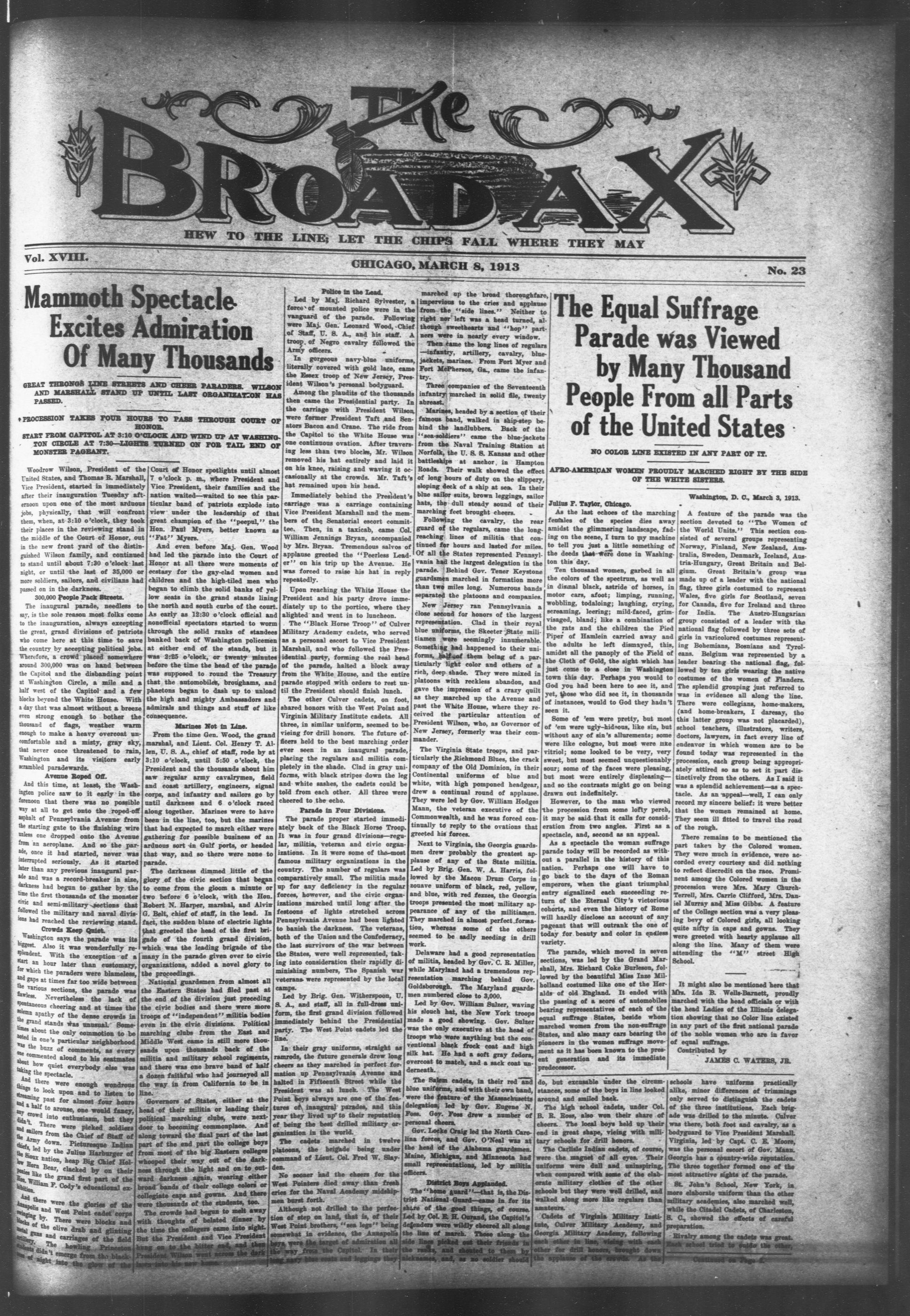
Mammoth Spectacle Excites Admiration Of Many Thousands
GREAT THRONGS LINE STREETS AND CHEER PARADERS. WILSON AND MARSHALL STAND UP UNTIL LAST ORGANIZATION HAS PASSED.
PROCESSION TAKES POUR HOURS TO PASS THROUGH COURT OF HONOR.
START FROM CAPITOL AT 3:10 O'CLOCK AND WIND UP AT WASHINGTON CIRCLE AT 7:30—LIGHTS TURNED ON FOR TAIL END OF MONSTER PAGEANT.
Vol. XVIII.
Mammoth S
Excites A
Of Many
GREAT THRONG'S LINE STREETS
AND MARSHALL STAND UP
PASSED.
PROCESSION TAKES FOUR HOURS
START FROM CAPITOL AT 3:10 O'C
TON CIRCLE AT 7:30—LIGHT
MONSTER PAGEANT.
Woodrow Wilson, President of the United States, and Thomas R. Marshall, Vice President, started in immediately after their inauguration Tuesday afternoon upon one of the most arduous jobs, physically, that will confront them, when, at 3:10 o'clock, they took their places in the reviewing stand in the middle of the Court of Honor, out in the new front yard of the distinguished Wilson family, and continued to stand until about 7:30 o'clock last night, or until the last of 35,000 or more soldiers, sailors, and civilians had passed on in the darkness.
300,000 People Pack Streets.
The inaugural parade, needless to say, is the sole reason most folks come to the inauguration, always excepting the great, grand divisions of patriots who come here at this time to save the country by accepting political jobs. Wherefore, a crowd placed somewhere around 300,000 was on hand between the Capitol and the disbanding point at Washington Circle, a mile and a half west of the Capitol and a few blocks beyond the White House. With a day that was almost without a breeze even strong enough to bother the thousand of flags, weather warm enough to make a heavy overcoat uncomfortable and a misty, gray sky, that never once threatened to rain, Washington and its visitors early scrambled paradewards.
Avenue Roped Off.
And this time, at least, the Washington police saw to it early in the forenoon that there was no possible way at all to get onto the roped-off asphalt of Pennsylvania Avenue from the starting gate to the finishing wire unless one dropped onto the Avenue from an aerospace. And so the parade, once it had started, never was interrupted seriously. As it started later than any previous inaugural parade and was a record-breaker in size, darkness had begun to gather by the time the first thousands of the monster civic and semi-military sections that followed the military and naval divisions had reached the reviewing stand.
Crowds Keep Quiet.
Washington says the parade was its biggest. Also it was wonderfully rependent. With the exception of a start an hour later than customary, for which the paraders were blameless, and gaps at times far too wide between the various sections, the parade was fawless. Nevertheless the lack of spontaneous cheering and at times the solemn apathy of the dense crowds in the grand stands was unusual. Sometimes about the only commotion to be noted in one's particular neighborhood was the buzz of comments, as every one commented aloud to his sextmates about how quiet everybody else was taking the spectacle.
And there were enough wondrous things to look upon and to listen to streaming past for almost four hours and a half to arouse, one would fancy, any crowd into enthusiasm, but they didn't. There were picked soldiers and sailors from the Chief of Staff of the Army down. Picturesque Indian chiefs, led by the Julius Harburger of the Sioux nation, heap Big Chief Hollow Horn Bear, clacked on by their ponies like the grand first part of the Horn. William F. Cody's educational exhibition.
And there were the glories of the Annapolis and West Point cadet corps carrying by. There were blocks and blocks of the olive drab and glinting metal guns and carriages of the field artillery. The howling Princeton students didn't emerge from the blackness of night into the closes of the
---
Court of Honor spotlights until almost 7 o'clock p. m., where President and Vice President, their families and the nation waited - waited to see this particular band of patriots explode into view under the leadership of that great champion of the "peepul," the Hon. Paul Myers, better known as "Fat" Myers.
And even before Maj. Gen. Wood had led the parade into the Court of Honor at all there were moments of ecstasy for the gay-clad women and children and the high-tiled men who began to climb the solid banks of yellow seats in the grand stands lining the north and south curbs of the court.
As early as 12:30 o'clock official and nonofficial spectators started to worm through the solid ranks of standees banked back of Washington policemen at either end of the stands, but it was 2:25 o'clock, or twenty minutes before the time the head of the parade was supposed to round the Treasury that the automobiles, broughtams, and phaetons began to dash up to unload the high and mighty Ambassadors and admirals and things and stuff of like consequence.
Marines Not in Line.
From the time Gen. Wood, the grand marshal, and Lieut. Col. Henry T. Allen, U. S. A., chief of staff, rode by at 3:10 o'clock, until 5:50 o'clock, the President and the thousands about him saw regular army cavalrymen, field and coast artillery, engineers, signal corps, and infantry and sailors go by until darkness and 6 o'clock raced along together. Marines were to have been in the line, too, but the marines that had expected to march either were gathering for possible business of an arduous sort in Gulf ports, or headed that way, and so there were none to parade.
The darkness dimmed little of the glory of the civic section that began to come from the gloom a minute or two before 6 o'clock, with the Hon. Robert N. Harper, marshal, and Alvin G. Belt, chief of staff, in the lead. In fact, the sudden blaze of electric lights that greeted the head of the first brigade of the fourth grand division, which was the leading brigade of the many in the parade given over to civic organizations, added a novel glory to the proceedings.
National guardmen from almost all the Eastern States had filed past at the end of the division just preceding the civic bodies and there were more troops of "independent" militia bodies even in the civic divisions. Political marching clubs from the East and Middle West came in still more thousands upon thousands back of the militia and military school regiments, and there was one brave band of half a dozen faithful who had journeyed all the way in from California to be in line.
Governors of States, either at the head of their militia or leading their political marching clubs, were next door to becoming commonplace. And along toward the final part of the last part of the end part the college boys from most of the big Eastern colleges whooped their way out of the darkness through the light and on to outward darkness again, wearing either broad bands of their college colors or collegiate caps and gowns. And there were thousands of the students, too.
The crowds had begun to melt away with thoughts of belated dinner by the time the collegers came into sight. But the President and Vice President hung on to the bitter end, and then President Wilson went across the dark
Led by Maj. Richard Sylvester, a force of mounted police were in the vanguard of the parade. Following were Maj. Gen. Leonard Wood, Chief of Staff, U. S. A., and his staff. A troop of Negro cavalry followed the Army officers.
In gorgeous navy-blue uniforms, literally covered with gold lace, came the Essex troop of New Jersey, President Wilson's personal bodyguard.
Among the plaudits of the thousands then came the Presidential party. In the carriage with President Wilson were former President Taft and Senators Bacon and Crane. The ride from the Capitol to the White House was one continuous ovation. After traversing less than two blocks, Mr. Wilson removed his hat entirely and laid it on his knee, raising and waving it occasionally at the crowds. Mr. Taft's hat remained upon his head.
Immediately behind the President's carriage was a carriage containing Vice President Marshall and the members of the Senatorial escort committee. Then, in a taxicab, came Col. William Jennings Bryan, accompanied by Mrs. Bryan. Tremendous salvos of applause greeted the "Peerless Leader" on his trip up the Avenue. He was forced to raise his hat in reply repeatedly.
Upon reaching the White House the President and his party drove immediately up to the porch, where they alighted and went in to luncheon.
The "Black Horse Troop" of Culver Military Academy cadets, who served as a personal escort to Vice President Marshall, and who followed the Presidential party, forming the real head of the parade, halted a block away from the White House, and the entire parade stopped with orders to rest until the President should finish lunch.
The other Culver cadets, on foot, shared honors with the West Point and Virginia Military Institute cadets. All three, in similar uniform, seemed to be vieing for drill honors. The future officers held to the best marching order ever seen in an inaugural parade, placing the regulars and militia completely in the shade. Clad in gray uniforms, with black stripes down the leg and white sashes, the cadets could be told from each other. All three were cheered to the echo.
Parade in Four Divisions.
The parade proper started immediately back of the Black Horse Troop It was in four grand divisions—regular, militia, veteran and civic organizations. In it were some of the most famous military organizations in the country. The number of regulars was comparatively small. The militia made up for any deficiency in the regular forces, however, and the civic organizations marched until long after the festoons of lights stretched across Pennsylvania Avenue had been lighted to banish the darkness. The veterans, both of the Union and the Confederacy, the last survivors of the war between the States, were well represented, taking into consideration their rapidly diminishing numbers, The Spanish war veterans were represented by the local camps.
Led by Brig. Gen. Witherspoon, U. S. A., and staff, all in full-dress uniform, the first grand division followed immediately behind the Presidential party. The West Point cadets led the line.
In their gray uniforms, straight as ramrods, the future generals drew long cheers as they marched in perfect formation up Pennsylvania Avenue and halted in Fifteenth Street while the President was at lunch. The West Point boys always are one of the features of inaugural parades, and this year they lived up to their reputation of being the best drilled military organization in the world.
The cadets marched in twelve platoons, the brigade being under command of Lieut. Col. Fred W. Slayden.
No sooner had the cheers for the West Pointers died away than fresh cries for the Naval Academy midshipmen burst forth.
Although not drilled to the perfection of step on land, that is, of their West Point brothers, "see legs" being somewhat in evidence, the Annapolis boys were the target of admiration all the way from the Capitol. In their lone blue coats and learnings they
marched up the broad thoroughfare, impervious to the cries and applause from the "side lines." Neither to right nor left was a head turned, although sweethearts and "hop" partners were in nearly every window. Then came the long lines of regulars—infantry, artillery, cavalry, blue-jackets, marines. From Fort Myer and Fort McPherson, Ga., came the infantry. Three companies of the Seventeenth infantry marched in solid file, twenty abreast. Marines, headed by a section of their famous band, walked in ship-step behind the landlubbers. Back of the "sea-soldiers" came the blue-jackets from the Naval Training Station at Norfolk, the U. S. S. Kansas and other battleships at anchor, in Hampton Roads. Their walk showed the effect of long hours of duty on the slippery, sloping deck of a ship at sea. In their blue sailor suits, brown leggings, sailor hats, the dull steady sound of their marching feet brought cheers.
Following the cavalry, the rear guard of the regulars, came the long-reaching lines of militia that continued for hours and lasted for miles. Of all the States represented Pennsylvania had the largest delegation in the parade. Behind Gov. Tener Keystone guardsmen marched in formation more than two miles long. Numerous bands separated the platoons and companies. New Jersey ran Pennsylvania a close second for honors of the largest representation. Clad in their royal blue uniforms, the Skeeter State militiamen were seemingly innumerable. Something had happened to their uniforms, half of them being of a particularly light color and others of a rich, deep shade. They were mixed in platoons with reckless abandon, and gave the impression of a crazy quilt as they marched up the Avenue and past the White House, where they received the particular attention of President Wilson, who, as Governor of New Jersey, formerly was their commander.
The Virginia State troops, and particularly the Richmond Blues, the crack company of the Old Dominion, in their Continental uniforms of blue and white, with high pomponed headgear, drew a continual round of applause. They were led by Gov. William Hodges Mann, the veteran executive of the Commonwealth, and he was forced continually to reply to the ovations that greeted his forces.
Next to Virginia, the Georgia guardsmen drew probably the greatest applause of any of the State militia. Led by Brig. Gen. W. A. Harris, followed by the Macon Drum Corps in zouave uniform of black, red, yellow, and blue, with red fezzes, the Georgia troops presented the most military appearance of any of the militiamen. They marched in almost perfect formation, whereas some of the others seemed to be sadly needing in drill work.
Delaware had a good representation of militia, headed by Gov. C. R. Miller, while Maryland had a tremendous representation marching behind Gov. Goldsborough. The Maryland guardsmen numbered close to 3,000.
Led by Gov. William Sulzer, waving his slouch hat, the New York troops made a good showing. Gov. Sulzer was the only executive at the head of troops who were anything but the conventional black frock coat and high silk hat. He had a soft gray fedora, overcoat to match, and a sack coat underneath.
The Salem cadets, in their red and blue uniforms, and with their own band, were the feature of the Massachusetts delegation, led by Gov. Eugene N. Foss. Gov. Foss drew a number of personal cheers.
Gov. Locke Craig led the North Carolina forces, and Gov. O'Neal was at the head of the Alabama guardmen. Maine, Michigan, and Minnesota had small representations, led by militia officers.
District Boys Applauded.
The "home guard"—that is, the District National Guard—came in for its share of the good things, of course. Led by Col. E. H. Ourand, the Capitol's defenders were wildly cheered all along the lines of march. Those along the side lines picked out their friends in the ranks, and shouted to them by nicknames, and, as no soldier should
The Equal Suffrage Parade was Viewed by Many Thousand People From all Parts of the United States
NO COLORE LINE EXISTED IN ANY PART OF IT.
AFRO-AMERICAN WOMEN PROUDLY MARCHED RIGHT BY THE SIDE OF THE WHITE SISTERS.
Julius F. Taylor, Chicago.
As the last echoes of the marching females of the species dies away amidst the glimmering landscape, fading on the scene, I turn to my machine to tell you just a little something of the deeds that were done in Washington this day.
Ten thousand women, garbed in all the colors of the spectrum, as well as in dismal black, astride of horses, in motor cars, afoot; limping, running, wobbling, todaloing; laughing, crying, screaming, leering; mild-faced, grim-visaged, bland; like a combination of the rats and the children the Pied Piper of Hamlein carried away and the adults he left dismayed, this, amidst all the panoply of the Field of the Cloth of Gold, the sight which has just come to a close in Washington town this day. Perhaps you would to God you had been here to see it, and yet, those who did see it, in thousands of instances, would to God they hadn't seen it.
Some of 'em were pretty, but most of 'em were ugly-hideous, like sin, but without any of sin's allurements; some were like cologne, but most were like vitriol; some looked to be very, very sweet, but most seemed unquestionably sour; some of the faces were pleasing, but most were entirely displeasing—and so the contrasts might go on being drawn out indefinitely.
However, to the man who viewed the procession from some lofty perch, it may be said that it calls for consideration from two angles. First as a spectacle, and, second as an appeal.
As a spectacle the woman suffrage parade today will be recorded as without a parallel in the history of this nation. Perhaps one will have to go back to the days of the Roman emperors, when the giant triumphal entry signalized each succeeding return of the Eternal City's victorious cohorts, and even the history of Rome will hardly disclose an account of any pageant that will outrank the one of today for beauty and color in endless variety.
The parade, which moved in seven sections, was led by the Grand Marshall, Mrs. Richard Coke Burleson, followed by the beautiful Miss Inze Millholland costumed like one of the Heralds of old England. It ended with the passing of a score of automobiles bearing representatives of each of the equal suffrage States, beside whom marched women from the non-suffrage States, and also many cars bearing the pioneers in the women suffrage movement as it has been known to the present generation and its immediate predecessor.
do, but excusable under the circumstances, some of the boys in line looked around and smiled back.
The high school cadets, under Col B. R. Rose, also won their share of cheers. The local boys held up their end in great shape, vicing with military schools for drill honors. The Carlisle Indian cadets, of course, were the magnet of all eyes. Their uniforms were dull and uninspiring, when compared with some of the elaborate military clothes of the other schools but they were well drilled, and walked along more like regulars than amateurs. Cadets of Virginia Military Institute, Culver Military Academy, and Georgia Military Academy, following each other in line, visting with each other for drill honors, brought down the applause of the crowds. As the
No.23
Washington, D. C., March 3, 1913.
A feature of the parade was the section devoted to "The Women on the World Units." This section consisted of several groups representing Norway, Finland, New Zealand, Australia, Sweden, Denmark, Iceland, Austria-Hungary, Great Britain and Belgium. Great Britain's group was made up of a leader with the national flag, three girls costumed to represent Wales, five girls for Scotland, seven for Canada, five for Ireland and three for India. The Austro-Hungarian group consisted of a leader with the national flag followed by three sets of girls in varicolored costumes representing Bohemians, Bosnians and Tyroleans. Belgium was represented by a leader bearing the national flag, followed by ten girls wearing the native costumes of the women of Flanders. The splendid grouping just referred to was in evidence all along the line. There were collegians, home-makers, (and home-breakers, I daresay, the this latter group was not placarded), school teachers, illustrators, writers, doctors, lawyers, in fact every line of endeavor in which women are to be found today was represented in the procession, each group being appropriately attired so as to set it part distinctively from the others. As I said it was a splendid achievement—as a spectacle. As an appeal—well, I can only record my sincere belief: it were better that the women remained at home. They seem ill fitted to travel the road of the rough.
There remains to be mentioned the part taken by the Colored women. They were much in evidence, were accorded every courtesy and did nothing to reflect discredit on the race. Prominent among the Colored women in the procession were Mrs. Mary Church-Terrell, Mrs. Carrie Clifford, Mrs. Daniel Murray and Miss Gibbs. A feature of the College section was a very pleasing bevy of Colored girls, all looking quite nifty in caps and gowns. They were greeted with hearty applause all along the line. Many of them were attending the "M" street High School.
It might also be mentioned here that Mrs. Ida B. Wells-Barnett, proudly marched with the head officials or with the head Ladies of the Illinois delegation showing that no Color line existed in any part of the first national parade of the noble women who are in favor of equal suffrage.
Contributed by
schools have uniforms practically alike, minor differences of trimming only served to distinguish the cadets of the three institutions. Each brigade was drilled to the minute. Culver was there, both foot and cavalry, as a bodyguard to Vice President Marshall. Virginia, led by Capt. C. E. Moore, was the personal escort of Gov. Mann. Georgia has a country-wide reputation. The three together formed one of the most attractive sights of the parade. St. John's School, New York, in more elaborate uniform than the other military academies, also marched well, while the Citadel Cadets, of Charleston, S. C., showed the effects of careful preparation.
THE BROADAX
PUBLISHED WEEKLY.
Will promulgate and at all times uphold the laws of the United States, Catholic, Protestant, Freist, Indochs, Single Taxes, Republicans, or anyone else can have their say, as long as their language is proper and responsibility is fixed.
The Broad Ax is a newspaper whose pages are written in all languages, claiming the editorial right to speak its own mind.
Local communications will receive attention. Write only on one side of the paper.
Subscriptions must be paid in advance. One Year ..... $3.00
Six Months ..... 1.00
Advertising rates made known on application.
Address all communications to
THE BROAD AX
5057 ARMOUR AVENUE, CHICAGO, ILL.
PHONE DREXEL 4500.
JULIUS F. TAYLOR, Editor and Publisher
Entered as Second-Class Matter Aug. 19,
1902, at the Post Office at Chicago, Illinois,
under Act of March 3, 1879.
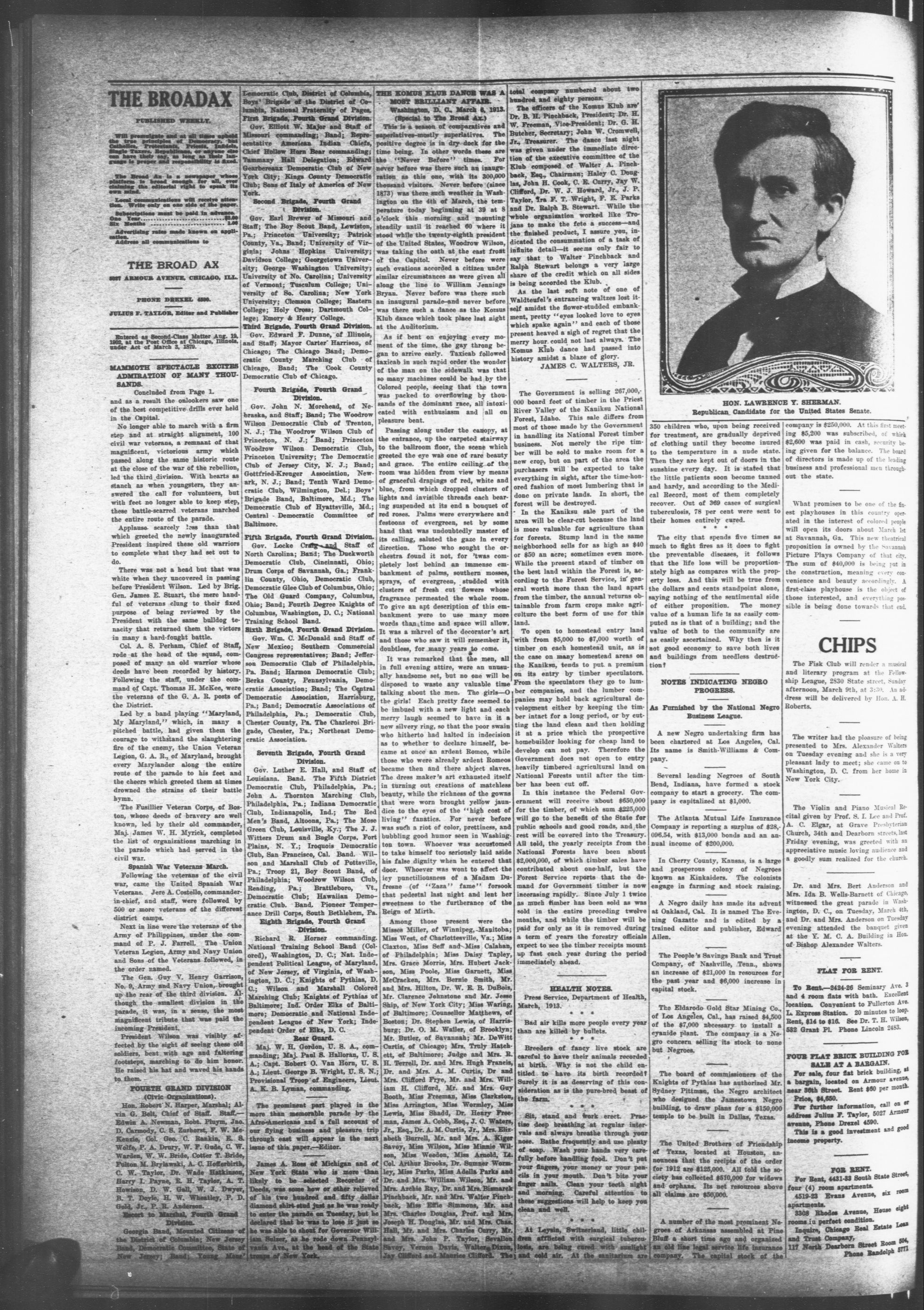
MAMMOTH SPECTACLE EXCITES
ADMIRATION OF MANY THOUSANDS.
Concluded from Page 1.
and as a result the onlookers saw one
of the best competitive drills ever held
in the Capital.
No longer able to march with a firm step and at straight alignment, 100 civil war veterans, a remnant of that magnificent, victorious army which passed along the same historic route at the close of the war of the rebellion, led the third division. With hearts as stanch as when youngsters, they answered the call for volunteers, but with feet no longer able to keep step, these battle-searred veterans marched the entire route of the parade.
Applause scarcely less than that which greeted the newly inaugurated President inspired these old warriors to complete what they had set out to do.
There was not a head but that was white when they uncovered in passing before President Wilson. Led by Brig. Gen. James E. Stuart, the mere handful of veterans clung to their fixed purpose of being reviewed by the President with the same bulldog tenacity that returned them the victors in many a hard-fought battle.
Col. A. S. Perham, Chief of Staff, rode at the head of the squad, composed of many an old warrior whose deeds have been recorded by history. Following the staff, under the command of Capt. Thomas H. McKee, were the veterans of the G. A. R. posts of the District.
Led by a band playing "Maryland, My Maryland," which, in many a pitched battle, had given them the courage to withstand the slaughtering fire of the enemy, the Union Veteran Legion, G. A. R., of Maryland, brought every Marylander along the entire route of the parade to his feet and the cheers which greeted them at times drowned the strains of their battle hymn.
The Fusillier Veteran Corps, of Boston, whose deeds of bravery are well known, led by their old commander, Maj. James W. H. Myrick, completed the list of organizations marching in the parade which had served in the civil war.
Spanish War Veterans March. Following the veterans of the civil war, came the United Spanish War Veterans. Jere A. Costello, commander-in-chief, and staff, were followed by 500 or more veterans of the different district camps. Next in line were the veterans of the Army of Philippines, under the command of P. J. Farrell. The Union Veteran Legion, Army and Navy Union and Sons of the Veterans followed, in the order named. The Gen. Guy V. Henry Garrison, No. 9, Army and Navy Union, brought up the rear of the third division. Although the smallest division in the parade, it was, in a sense, the most magnificent tribute that was paid the incoming President.
President Wilson was visibly affected by the sight of seeing these old soldiers, bent with age and faltering footsteps, marching to do him honor. He raised his hat and waved his hands to them.
FOURTH GRAND DIVISION
(Civic Organizations).
Hon. Robert N. Harper, Marshal; Alvin G. Belt, Chief of Staff. Staff—Edwin A. Newman, Robt. Pluym, Jno. D. Carmody, C. S. Zurhorst, F. W. McKenzie, Col. Geo. C. Rankin, E. S. Welfe, P. A. Drury, W. F. Gude, C. W. Warden, W. W. Bride, Cotter T. Bride, Fulton M. Brylawski, A. C. Hoferbirth, C. W. Taylor, Dr. Wade Hatkinson, Harry I. Payne, E. H. Taylor, A. T. Howison, D. W. Gall, W. J. Dwyer, B. T. Doyle, H. W. Wheatley, P. D. Gold, Jr., P. R. Anderson.
Escort to Marshal, Fourth Grand Division.
Georgia Band, Mounted Citizens of the District of Columbia; New Jersey Band, Democratic Committee, State of New Jersey; Band: Young Mose
8
Democratic Club, District of Columbia, Boys' Brigade of the District of Columbia, National Fraternity of Pages, First Brigade, Fourth Grand Division. Gov. Elliott W. Major and Staff of Missouri commanding; Band; Representative American Indian Chiefs; Hollow Horn Hear commanding; Tammany Hall Delegation; Edward Gearbeveaux Democratic Club of New York City; Kings County Democratic Club; Sons of Italy of America of New York.
Division.
Gov. Earl Brewer of Missouri and Staff; The Boy Scout Band, Lewiston, Pa.; Princeton University; Patrick County, Va., Band; University of Virginia; Johns Hopkins University; Davidson College; Georgetown University; George Washington University; University of No. Carolina; University of Vermont; Tusculum College; University of So. Carolina; New York University; Clemson College; Eastern College; Holy Cross; Dartmouth College; Emory & Henry College.
Third Brigade, Fourth Grand Division,
Gov. Edward F. Dunne, of Illinois,
and Staff; Mayor Carter Harrison,
of Chicago; The Chicago Band; Democratic County Marching Club of Chicago, Band; The Cook County Democratic Club of Chicago.
Fourth Brigade, Fourth Grand Division.
Gov. John N. Morehead, of Nebraska, and Staff; Band; The Woodrow Wilson Democratic Club of Trenton, N. J.; The Woodrow Wilson Club of Princeton, N. J.; Band; Princeton Woodrow Wilson Democratic Club, Princeton University; The Democratic Club of Jersey City, N. J.; Band; Gottfried-Krenger Association, Newark, N. J.; Band; Tenth Ward Democratic Club, Wilmington, Del.; Boys' Brigade Band, Baltimore, Md.; The Democratic Club of Hyattsville, Md.; Central Democratic Committee of Baltimore.
Fifth Brigade, Fourth Grand Division.
Gov. Locke Craig and Staff of North Carolina; Band; The Duckworth Democratic Club, Cincinnati, Ohio; Drum Corps of Savannah, Ga.; Franklin County, Ohio, Democratic Club Democratic Glee Club of Columbus, Ohio; The Old Guard Company, Columbus, Ohio; Band; Fourth Degree Knights of Columbus, Washington, D. C.; National Training School Band.
Sixth Brigade, Fourth Grand Division.
Gov. Wm. C. McDonald and Staff of New Mexico; Southern Commercial Congress representatives; Band; Jefferson Democratic Club of Philadelphia, Pa. Band; Harmon Democratic Club; Berks County, Pennsylvania, Democratic Association; Band; The Central Democratic Association, Harrisburg, Pa.; Band; Democratic Associations of Philadelphia, Pa.; Democratic Club Chester County, Pa. The Charleroi Brigade, Chester, Pa.; Northeast Democratic Association.
Seventh Brigade, Fourth Grand Division
Gov. Luther E. Hall, and Staff of Louisiana. Band. The Fifth District Democratic Club, Philadelphia, Pa.; John A. Thornton Marching Club, Philadelphia, Pa.; Indiana Democratic Club, Indianapolis, Ind.; The Red Men's Band, Altoona, Pa.; The Mose Green Club, Louisville, Ky.; The J. J. Witters Drum and Bugle Corps, Fort Plains, N. Y.; Iroquois Democratic Club, San Francisco, Cal. Band. Wilson and Marshall Club of Pottsville, Pa.; Troop 21, Boy Scout Band, of Philadelphia; Woodrow Wilson Club, Reading, Pa.; Brattleboro, Vt. Democratic Club; Hawaiian Democratic Club. Band. Pioneer Temperature Drill Corps, South Bethlehem, Pa.
Eighth Brigade, Fourth Grand
Richard R. Horner commanding. National Training School Band (Colored), Washington, D. C.; Nat. Independent Political League, of Maryland, of New Jersey, of Virginia, of Washington, D. C.; Knights of Pythias, D. C.; Wilson and Marshall Colored Marching Club; Knights of Pythias of Baltimore; Ind. Order Elks of Baltimore; Democratic and National Independent League of New York; Independent Order of Elks, D. C.
Rear Guard.
Maj. W. H. Gordon, U. S. A., commanding; Maj. Paul S. Halloran, U. S. A.; Capt. Robert O. Van Horn, U. S. A.; Lieut. George B. Wright, U. S. N.; Provisional Troop of Engineers, Lieut. A. K. B. Lyman, commanding.
The prominent part played in the more than memorable parade by the Afro-Americans and a full account of our flying business and pleasure trip through east will appear in the next issue of this paper.—Editor.
James A. Ross of Michigan and of New York State who is more than likely to be selected Recorder of Deceds, was some how or other relieved of his two hundred and fifty dollar diamond shirt stud just as he was ready to enter the parade on Tuesday, but he declared that he was to lose it just so he was able to shout for Governor William Sulzer, as he rode down Pennsylvania Ave. at the head of the State troops of New York.
(Special to The Bread Ax.)
This is a season of comparatives and superlatives—mostly superlatives. The positive degree is in dry dock for the time being. In other words these are the "Never Before" times. For never before was there such an inauguration as this one, with its 300,000 thousand visitors. Never before (since 1873) was there such weather in Washington on the 4th of March, the temperature today beginning at 39 at 8 o'clock this morning and mounting steadily until it reached 60 where it stood until the twenty-eighth president of the United States, Woodrow Wilson, was taking the oath at the east front of the Capitol. Never before were such ovations accorded a citizen under similar circumstances as were given all along the line to William Jennings Bryan. Never before was there such an inaugural parade—and never before was there such a dance as the Komus Klub dance which took place last night at the Auditorium.
As if bent on enjoying every moment of the time, the gay throng began to arrive early. Taxicab followed taxicab in such rapid order the wonder of the man on the sidewalk was that so many machines could be had by the Colored people, seeing that the town was packed to overflowing by thousands of the dominant race, all intoxicated with enthusiasm and all on pleasure bent.
Passing along under the canopy, at the entrance, up the carpeted stairway to the ballroom floor, the scene which greeted the eye was one of rare beauty and grace. The entire ceiling of the room was hidden from view by means of graceful drapings of red, white and blue, from which dropped clusters of lights and invisible threads each bearing suspended at its end a bouquet of red roses. Palms were everywhere and festoons of evergreen, set by some hand that was undoubtedly master of its calling, saluted the gaze in every direction. Those who sought the orchestra found it not, for 'twas completely lost behind an immense embankment of palms, southern mosses, sprays, of evergreen, studded with clusters of fresh cut flowers whose fragrance permeated the whole room. To give an apt description of this embankment were to use many more words than time and space will allow. It was a marvel of the decorator's art and those who saw it will remember it, doubtless, for many years to come.
It was remarked that the men, all in full evening attire, were an unusually handsome set, but no one will be disposed to waste any valuable time talking about the men. The girls—O the girls! Each pretty face seemed to be imbued with a new light and each merry laugh seemed to have in it a new silvery ring, so that the poor swain who hitherto had halted in indecision as to whether to declare himself, became at once an ardent Romeo, while those who were already ardent Romeos became then and there abject slaves. The dress maker's art exhausted itself in turning out creations of matchless beauty, while the richness of the gowns that were worn brought yellow jaundice to the eyes of the "high cost of living" fanatics. For never before was such a riot of color, prettiness, and bubbling good humor seen in Washington town. Whoever was accustomed to take himself too seriously laid aside his false dignity when he entered that door. Whoever was wont to affect the jey punctilliousness of a Madam Du fresne (of "Zaza" fame" forsook that pedestal last night and lent her sweetness to the furtherance of the Reign of Mirth.
Among those present were the Misses Miller, of Winnipeg, Mauitoba; Miss West, of Charlottesville, Va.; Miss Claxton, Miss Seff and Miss Calahan, of Philadelphia; Miss Daisy Tapley, Mrs. Grace Morris, Mrs. Hubert Jackson, Miss Poole, Miss Garnett, Miss McCracken, Mrs. Bernie Smith, and Mrs. Hilton, Dr. W. E. B. DuBois, Mr. Clarence Johnstone and Mr. Jesse Ship, of New York City; Miss Waring, of Baltimore; Counselor Matthews, of Boston; Dr. Stephen Lewis, of Harrisburg; Dr. O. M. Waller, of Brooklyn; Mr. Butler, of Savannah; Mr. DeWitt Curtis, of Chicago; Mrs. Truly Hatchett, of Baltimore; Judge and Mrs. B. H. Terrell, Dr. and Mrs. Hugh Franese, Dr. and Mrs. A. M. Curtis, Dr. and Mrs. Clifford Frye, Mr. and Mrs. William H. Clifford, Mr. and Mrs. Guy Booth, Miss Freeman, Miss Clarkston, Miss Arrington, Miss Wormley, Miss Lewis, Miss Shadd, Dr. Heury Freeman, James A. Cobb, Dr. J. Waters, Jr., Esq, Dr. A. M. Curtis, Jr., Mrs. Elizabeth Burrell, Mr. and Mrs. A. Kiger Savoy, Miss Wilson, Miss Minnie Wilson, Miss Weedon, Miss Arnold, I. Col Arthur Brooks, Miss Summor Wormley, Miss Parks, Miss Adella Parks and Dr. and Mrs. William Wilson, Mr. and Mrs. Archie Ray, Dr. and Mrs. Bismarck Pinchback, Mr. and Mrs. Walter Pinchback, Miss Effie Simmons, Mr. and Mrs. Charles Douglas, Prof. and Mrs. Joseph H. Douglas, Mr. and Mrs. Chass Hall, Mr. and Mrs. Charles Curry, Mr. and Mrs. John P. Taylor, Sevallon Savoy, Vernon Days, Walter Dixon, Jay Clifford and Maurice Clifford. The
total company numbered about two hundred and eighty persons.
hundred and eight persons.
The officers of the Komus Klub are Dr. B. H. Pinchback, President; Dr. H. W. Freeman, Vice-President; Dr. G. H. Butcher, Secretary; John W. Cromwell, Jr., Treasurer. The dance last night was given under the immediate direction of the executive committee of the Klub composed of Walter A. Pinchback, Eaq, Chairman; Haley C. Douglas, John H. Cook, C. E. Curry, Jay W. Clifford, Dr. W. J. Howard, Jr., J. P. Taylor, Ira F. T. Wright, F. E. Parks and Dr. Ralph B. Stewart. While the whole organization worked like Trojans to make the fete a success—and the finished product, I assure you, indicated the consummation of a task of infinite detail—it seems only fair to say that to Walter Pinchback and Ralph Stewart belongs a very large share of the credit which on all sides is being accorded the Klub.
As the last soft note of one of Waldenfelten's entrancing waltzes lost itself amidst the flower-studded embankment, pretty "eyes looked love to eyes which spake again" and each of those present heaved a sigh of regret that the merry hour could not last always. The Komus Klub dance had passed into history amidst a blaze of glory.
JAMES C. WALTERS, JR.
The Government is selling 267,000,000 board feet of timber in the Priest River Valley of the Kaniksu National Forest, Idaho. This sale differs from most of those made by the Government in handling its National Forest timber business. Not merely the ripe timber will be sold to make room for a new crop, but on part of the area the purchasers will be expected to take everything in sight, after the time-honored fashion of most lumbering that is done on private lands. In short, the forest will be destroyed.
In the Kaniksu sale part of the area will be clear-cut because the land is more valuable for agriculture than for forests. Stump land in the same neighborhood sells for as high as $40 or $50 an acre; sometimes even more. While the present stand of timber on the best land within the Forest is, according to the Forest Service, in general worth more than the land apart from the timber, the annual returns obtainable from farm crops make agriculture the best form of use for this land.
To open to homestead entry land with from $5,000 to $7,000 worth of timber on each homestead unit, as is the case on many homestead areas on the Kaniksu, tends to put a premium on its entry by timber speculators. From the speculators they go to lumber companies, and the lumber companies may hold back agricultural development either by keeping the timber intact for a long period, or by cutting the land clean and then holding it at a price which the prospective homebuilder looking for cheap land to develop can not pay. Therefore the Government does not open to entry heavily timbered agricultural land on National Forests until after the timber has been cut off.
In this instance the Federal Government will receive about $650,000 for the timber, of which sum $225,000 will go to the benefit of the State for public schools and good roads, and the rest will be covered into the Treasury. All told, the yearly receipts from the National Forests have been about $2,900,000, of which timber sales have contributed about one-half, but the Forest Service reports that the demand for Government timber is now increasing rapidly. Since July 1 twice as much timber has been sold as was sold in the entire preceding twelve months, and while the timber will be paid for only as it is removed during a term of years the forestry officials expect to see the timber receipts mount up fast each year during the period immediately ahead.
HEALTH NOTES
Press Service, Department of Health March, 1913.
Bad air kills more people every year than are killed by bullets.
Breeders of fancy live stock are careful to have their animals recorded at birth. Why is not the child entitled to have its birth recorded? Surely it is as deserving of this consideration as is the pure-bred beast of the farm.
Sit, stand and work erect. Practise deep breathing at regular intervals and always breathe through your nose. Bathe frequently and use plenty of soap. Wash your hands very carefully before handling food. Don't put your fingers, your money or your pencils in your mouth. Don't bite your finger nails. Clean your teeth night and morning. Careful attention to these suggestions will help to keep you clean and well.
At Leysin, Switzerland, little children afflicted with surgical tuberculosis, are being cured with sunlight and cold air. At the sanitarium are
THE
FATHER
OF
THE
FAMILY
350 children who, upon being received for treatment, are gradually deprived of clothing until they become inured to the temperature in a nude state. Then they are kept out of doors in the sunshine every day. It is stated that the little patients soon become tanned and hardy, and according to the Medical Record, most of them completely recover. Out of 369 cases of surgical tuberculosis, 78 per cent were sent to their homes entirely cured.
The city that spends five times as much to fight fires as it does to fight the preventable diseases, it follows that the life loss will be proportionately high as compares with the property loss. And this will be true from the dollars and cents standpoint alone, saying nothing of the sentimental side of either proposition. The money value of a human life is as easily computed as is that of a building; and the value of both to the community are as easily ascertained. Why then is it not good economy to save both lives and buildings from needless destruction?
NOTES INDICATING NEGRO
PROGRESS.
As Furnished by the National Negro Business League.
A new Negro undertaking firm has been chartered at Los Angeles, Cal. Its name is Smith-Williams & Company.
Several leading Negroes of South Bend, Indiana, have formed a stock company to start a grocery. The company is capitalized at $1,000.
The Atlanta Mutual Life Insurance Company is reporting a surplus of $28,096.54, with $13,000 bonds and an annual income of $200,000.
In Cherry County, Kansas, is a large and prosperous colony of Negroes known as Kinkaiders. The colonists engage in farming and stock raising.
A Negro daily has made its advent at Oakland, Cal. It is named The Evening Gazette and is edited by a trained editor and publisher, Edward Allen.
The People's Savings Bank and Trust Company, of Nashville, Teen., shows an increase of $21,000 in resources for the past year and $6,000 increase in capital stock.
The Eldarodo Gold Star Mining Co., of Los Angeles, Cal., has raised $4,500 of the $7,000 necessary to install a cyanide plant. The company is a Negro concern selling its stock to none but Negroes.
The board of commissioners of the Knights of Pythias has authorized Mr. Sydney Pittman, the Negro architect who designed the Jamestown Negro building, to draw plans for a $150,000 temple to be built in Dallas, Texas.
The United Brothers of Friendship of Texas, located at Houston, announces that the receipts of the order for 1912 are $125,000. All told the society has collected $510,000 for widows and orphans. Its net resources above all claims are $50,000.
A number of the most prominent Negroes of Arkansas assembled at Pine Bluff a short time ago and organized an old line legal service life insurance company. The capital stock of the
company is $25,000. At this first meeting, $5,200 was subscribed, of which $2,600 was paid in cash, security being given for the balance. The board of directors is made up of the leading business and professional men throughout the state.
---
What promises to be one of the finest playhouses in this country operated in the interest of colored people will open its doors about March 1st at Savannah, Ga. This new theatrical proposition is owned by the Savannah Picture Plays Company of that city. The sum of $40,000 is being put in the construction, meaning every convenience and beauty accordingly. A first-class playhouse is the object of those interested, and everything possible is being done towards that end.
CHIPS
The Fisk Club will render a musical and literary program at the Fellowship League, 2830 State street, Sunday afternoon, March 9th, at 3:30. An address will be delivered by Hon. A. H. Roberts.
The writer had the pleasure of being presented to Mrs. Alexander Walters on Tuesday evening and she is a very pleasant lady to meet; she came on to Washington, D. C. from her home in New York City.
The Violin and Piano Musical Recital given by Prof. S. I. Lee and Prof. A. C. Elgar, at Grave Presbyterian Church, 34th and Dearborn streets, last Friday evening, was greeted with an appreciative music loving audience and a goodly sum realized for the church.
Dr. and Mrs. Bert Anderson and Mrs. Ida B. Wells-Barnett of Chicago, witnessed the great parade in Washington, D. C., on Tuesday, March 4th and Dr. and Mrs. Anderson on Tuesday evening attended the banquet given at the Y. M. C. A. Building in Hon. of Bishon Alexander Walters.
FLAT FOR RENT.
To Rent. -2424-26 Seminary Ave. 3
and 4 room flats with bath. Excellent
location. Convenient to Fullerton Ave.
L Express Station. 20 minutes to loop.
Rent. $14 to $16. See Dr. T. H. Wilson.
532 Grant Pl. Phone Lincoln 2483.
FOUR FLAT BRICK BUILDING FOR SALE AT A BARGAIN.
For sale, four flat brick building, at a bargain, located on Armour avenue, near 86th Street. Rent $60 per month.
Price, $4,650.
For further information, call on or address Julius F. Taylor, 5027 Armour avenue, Phone Drexel 4590.
This is a good investment and good income property.
FOR RENT.
For Bent, 4431-33 South State Street,
four (4) room apartments.
4519-23 Evans Avenue, six room
apartments.
3308 Rhodes Avenue, House eight
rooms in perfect condition.
Inquire, Chicago Real Estate Loan
and Trust Company,
117 North Dearborn Street Room 504,
Phone Bandolph 5771
HOSTS SEE NEW CHIEFS INSTALLED
PARADE IS BEST YET
Many New Wrinkles In Inaugural Pageant.
JUST HOW IT ALL HAPPENED
New President Sworn In Before Cheering Throngs by Chief Justice White and Delivers Simple Address—Wild and Jubilant Crowds Line Pennsylvania Avenue, Jam Stands, Dot Windows and Lean Over Roofs as Elaborate Procession Passes.
Washington, March 4.—In the presence of the biggest crowd that ever packed and jammed itself into the great plaza at the east end of the capitol, surrounded by high civil and military dignitaries, diplomats and statesmen of his own and foreign countries, Woodrow Wilson, erstwhile governor of New Jersey and president-elect, today took the oath of office that made him the twenty-eighth president of the United States.
Less than an hour before, with solemn ceremonial, Thomas R. Marshall, the vice president-elect, had been inducted into his office in the senate chamber before the members of both houses. Somewhat earlier still President Taft, the president and vice president-elect, with their respective guards of honor, the Essex troop of Newark, N. J., and the Culver Black Horse troop of Indiana, had swept down Pennsylvania avenue on their way to the capitol between row on row of cheering, shouting thousands.
Before that and harking back to the dim and distant day before, when "the man of the hour" left his Princeton home for his four year sojourn in this city, escorted by two special trainloads of his "boys," members of the student body of Princeton university, events followed each other in rapid sequence. Among these was the president-elect's reception by a committee, headed by Dr. Thomas Nelson Page, the famous author, at the Union station the pre-
Chief Justice WHITE
vious night and the reception and amoker given in his honor by his old classmates and others of the Princeton Alumni association at the New Willard.
Yet all the receptions and formal speechmaking that went before, just as the White House luncheon and great military pageant that followed, were but the setting of the principal scene, the background of the event which will make the history of this country for four years to come.
Crowds Gather Early.
Soon after daybreak in the morning the crowds began to gather along Pennsylvania avenue and in front of the great platform that had been erected for the inaugural exercises at the eastern end of the capitol. Long before noon every available inch of space was taken.
Points of vantage, which in ordinary times would be deemed precarious even for a sparrow, were pre-empted by youngsters willing to risk the loss of a limb or worse for the chance of seeing a president of the United States inaugurated. Nor was their enthusiasm dampened by delay.
As the august procession, which preceded the inaugural ceremony filed out of the capitol and wound its way across the platform a hush fell over the crowd. Mechanically many uncovered their heads.
The servile stance of the senate
Inaugurated President of the United States of America.
T. H.
and house, followed by the marshal of the supreme court and the marshal of the District of Columbia, made up the vanguard of the procession of high dignitaries. Behind these last came Chief Justice Edward D. White of the supreme court, whose duty it was to administer the oath of office to the president-elect and the associate justices, followed by the committee on arrangements.
Then came the president and the president-elect, and at their rear a distinguished following of ambasadors, governors and other dignitaries, including the newly sworn vice president.
Chief Justice Administers Oath.
When the procession paused every ear strained attention to catch the words that would usher into the chair of Washington, Jefferson and Lincoln the first Democrat to gain that high place in a score of years.
Solemly and distinctly, though most of the waiting thousands hanging on the event of his words could not even see the motions of his lips, the chief justice administered the oath of office to the president-elect.
An instant the waiting host stood silent. Then it became a shrieking, leaping mob, roaring a pandemoniac welcome to the nation's new executive and all but smothering the saluting cannon which first gave notice that a new president had been inaugurated and a new administration had begun.
From the crowd in the square and on the platform the other massed multitudes that lined the broad sides of Pennsylvania avenue took their cue, and it was many minutes before President Wilson could begin his brief inaugural address. Even then so great was the clamor that only those nearest to him could distinguish what he said.
Returns to Executive Mansion.
Immediately after the address was finished President Wilson, accompanied by the ex-president, hastened to the Pennsylvania avenue side of the capitol, where carriages awaited to take the party to the luncheon in the executive mansion. During the drive Mr. Taft sat on the left of his successor. In this he followed established precedent, a precedent that was broken four years ago by Colonel Roosevelt, who went directly from the capitol after the inaugural exercises were over to the Union station to take a train for Oyster Bay.
All along the route up Pennsylvania avenue the old and the new presidents were greeted tumultuously. Indeed, to an observer not familiar with the situation it might have been difficult to determine which was the incoming and which the outgoing chief executive, so well did the genial Taft smile match the beaming features of President Wilson.
At the executive mansion the two were met by Mrs. Taft, who hitherto had taken no part in the day's ceremonies, and a subcommittee of the official reception committee. President Wilson also saw for the first time since early in the day Mrs. Wilson and their three daughters, who had been under the escort of special military aids during the ceremonies at the capitol.
There was a brief exchange of compliments between Mrs. Wilson and Mrs. Taft, in which the latter gracefully turned over the suzerainty that had been hers for the past four years to the new mistress of the White House. Soon afterward the ex-president and Mrs. Taft quietly left through a rear entrance to take the 2:05 train from the Union station for Augusta, Ga. Here they will spend several weeks before going to New Haven, where Mr. Taft will take up his work as professor of law in Yale university.
Wilson's Official Day Begins. President Wilson's official day began at 10:30 in the morning. At that hour a delegation of the congressional committee waited upon him at the Shoreham, where he stopped during the night, to escort him to the White House.
House.
A similar delegation swifted upon
Vice President-Elect Marshall at the
rune hotel, where the new vice pres
ident will make his home during the coming months.
At the executive mansion the incoming president and vice president were greeted by Mr. Taft, and a few minutes later the fateful ride to the capitol was begun. The president and president-elect occupied the first carriage with two members of the congressional committee.
In the carriage following were Vice President-Elect Marshall and three members of the committee, there being no retiring vice president. After them strung along the carriages of a host of cabinet officers and other high dignitaries of military and civil rank.
On the way to the capitol President Taft occupied the seat on the right side of the carriage, this position being reversed after the inaugural ceremony, the new president having the seat of honor on their return to the executive mansion.
Arrived at the senate wing of the capitol, the president and president-elect went at once to the president's room. Vice President-Elect Marshall repaired to the vice president's chamber.
Short Delay Occurs.
Here there was a short delay owing to some hitch in the proceedings, but it was soon over. The committee on arrangements waited on the president and president-elect and escorted them to the senate chamber, where they were given seats reserved for them in front of the vice president's desk.
The same committee also escorted the vice president-elect to the senate chamber, where the members of the house and of the supreme court were already seated.
Then on the eve of the senate's adjournment the president pro tempore administered the oath that made Governor Thomas R. Marshall of Indiana vice president of the United States. Immediately thereafter the senate adjourned after a prayer by the chapain.
Following the adjournment Vice President Marshall delivered his inaugural address, after which he administered the oath of office to the senators-elect.
At the conclusion of the impressive ceremonies within the senate chamber all those assembled there formed a procession, marching through the rotunda of the capitol to the platform at the east end of the building, where the big event of the day, the actual swearing in of the president-elect, took place.
The Great Parade.
Next to this great event, so essential!
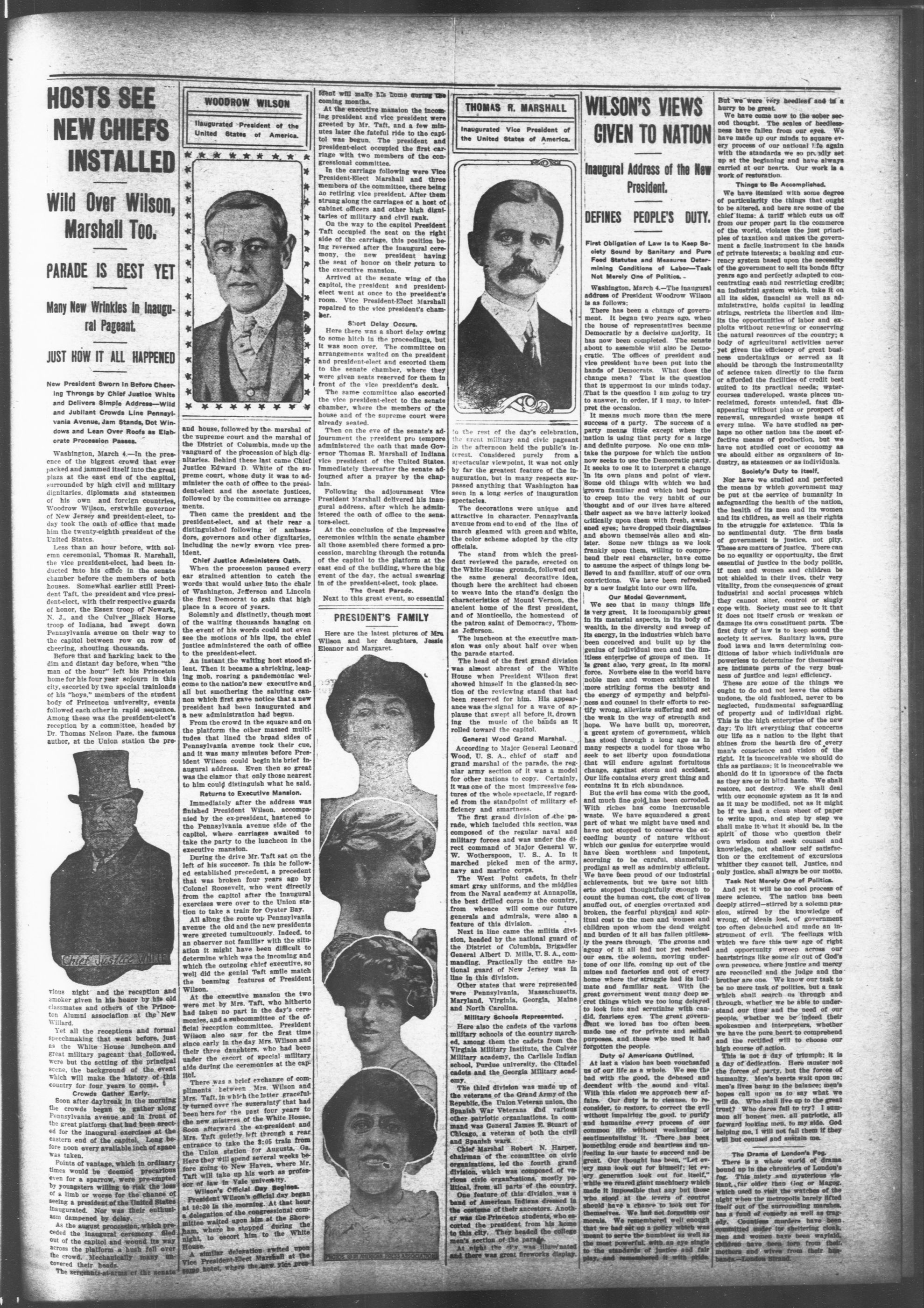
PRESIDENT'S FAMILY
Here are the latest pictures of Mra Wilson and her daughters, Jessie Eleanor and Margaret.
PHOTOS © BY AMERICAN PRESS ASSOCIATION
Inaugurated Vice President of the United States of America.
190
to the rest of the day's celebration, the great military and civic pageant in the afternoon held the public's interest. Considered purely from a spectacular viewpoint, it was not only by far the greatest feature of the inauguration, but in many respects surpassed anything that Washington has seen in a long series of inauguration spectacles. The decorations were unique and attractive in character. Pennsylvania avenue from end to end of the line of march gleamed with green and white, the color scheme adopted by the city officials.
The stand from which the president reviewed the parade, erected on the White House grounds, followed out the same general decorative idea, though here the architect had chosen to weave into the stand's design the characteristics of Mount Vernon, the ancient home of the first president, and of Monticello, the homestead of the patron saint of Democracy, Thomas Jefferson.
The luncheon at the executive mansion was only about half over when the parade started.
The head of the first grand division was almost abreast of the White House when President Wilson first showed himself in the glassed-in section of the reviewing stand that had been reserved for him. His appearance was the signal for a wave of applause that swept all before it, drowning the music of the bands as it rolled toward the capitol.
General Wood Grand Marshal.
According to Major General Leonard Wood, U. S. A., chief of staff and grand marshal of the parade, the regular army section of it was a model for other nations to copy. Certainly, it was one of the most impressive features of the whole spectacle, if regarded from the standpoint of military efficiency and smartness. The first grand division of the parade, which included this section, was composed of the regular naval and military forces and was under the direct command of Major General W. W. Wotherspoon, U. S. A. In it marched picked men of the army, navy and marine corps. The West Point cadets, in their smart gray uniforms, and the middles from the Naval academy at Annapolis, the best drilled corps in the country, from whence will come our future generals and admirals, were also a feature of this division.
Next in line came the militia division, headed by the national guard of the District of Columbia, Brigadier General Albert D. Mills, U.S.A., commanding. Practically the entire national guard of New Jersey was in line in this division. Other states that were represented were Pennsylvania, Massachusetts, Maryland, Virginia, Georgia, Maine and North Carolina.
Military Schools Represented.
Here also the cadets of the various military schools of the country marched, among them the cadets from the Virginia Military Institute, the Culver Military academy, the Carlisle Indian school, Purdue university, the Citadel cadets and the Georgia Military academy.
The third division was made up of the veterans of the Grand Army of the Republic, the Union Veteran union, the Spanish War Veterans and various other patriotic organizations. In command was General James E. Stuart of Chicago, a veteran of both the civil and Spanish wars.
Chief Marshal Robert N. Harper, chairman of the committee on civic organizations, led the fourth grand division, which was composed of various civic organizations, mostly political, from all parts of the country.
One feature of this division was a hand of American Indians dressed in the costume of their ancestors. Another was the Princeton students, who escorted the president from his home to this city. They headed the college men's section of the parade.
At night the city was illuminated and there was great fireworks display.
WILSON'S VIEWS GIVEN TO NATION
Inaugural Address of the New President.
DEFINES PEOPLE'S DUTY.
First Obligation of Law Is to Keep Society Sound by Sanitary and Pure Food Statutes and Measures Determining Conditions of Labor—Task Not Merely One of Politics.
Washington, March 4.—The inaugural address of President Woodrow Wilson is as follows:
There has been a change of government. It began two years ago, when the house of representatives became Democratic by a decisive majority. It has now been completed. The senate about to assemble will also be Democratic. The offices of president and vice president have been put into the hands of Democrats. What does the change mean? That is the question that is uppermost in our minds today. That is the question I am going to try to answer, in order, if I may, to interpret the occasion.
It means much more than the mere success of a party. The success of a party means little except when the nation is using that party for a large and definite purpose. No one can mistake the purpose for which the nation now seeks to use the Democratic party. It seeks to use it to interpret a change in its own plans and point of view. Some old things with which we had grown familiar and which had begun to creep into the very habit of our thought and of our lives have altered their aspect as we have latterly looked critically upon them with fresh, awakened eyes; have dropped their disguises and shown themselves alien and sinister. Some new things as we look frankly upon them, willing to comprehend their real character, have come to assume the aspect of things long believed in and familiar, stuff of our own convictions. We have been refreshed by a new insight into our own life.
Our Model Government.
Our Model Government.
We see that in many things life is very great. It is incomparably great in its material aspects, in its body of wealth, in the diversity and sweep of its energy, in the industries which have been conceived and built up by the genius of individual men and the limitless enterprise of groups of men. It is great also, very great, in its moral force. Nowhere else in the world have noble men and women exhibited in more striking forms the beauty and the energy of sympathy and helpfulness and counsel in their efforts to rectify wrong, alleviate suffering and set the weak in the way of strength and hope. We have built up, moreover, a great system of government, which has stood through a long age as in many respects a model for those who seek to set liberty upon foundations that will endure against fortuitous change, against storm and accident. Our life contains every great thing and contains it in rich abundance.
But the evil has come with the good, and much fine gold has been corroded. With riches has come inexcusable waste. We have squandered a great part of what we might have used and have not stopped to conserve the exceeding bounty of nature without which our genius for enterprise would have been worthless and impotent, scorning to be careful, shamefully prodigal as well as admirably efficient. We have been proud of our industrial achievements, but we have not hither stopped thoughtfully enough to count the human cost, the cost of lives snuffed out, of energies overtaxed and broken, the fearful physical and spiritual cost to the men and women and children upon whom the dead weight and burden of it all has fallen pitilessly the years through. The grouses and agony of it all had not yet reached our ears, the solemn, moving undertone of our life, coming up out of the mines and factories and out of every home where the struggle had its intimate and familiar seat. With the great government went many deep secret things which we too long delayed to look into and scrutinize with candid, fearless eyes. The great government we loved has too often been made use of for private and selfish purposes, and those who used it had forgotten the people.
Duty of Americans Outlined.
At last a vision has been vouchsated us of our life as a whole. We see the bad with the good, the debased and decadent with the sound and vital. With this vision we approach new affairs. Our duty is to cleanse, to reconsider, to restore, to correct the evil without impairing the good, to purify and humanize every process of our common life without weakening or sentimentalizing it. There has been something crude and heartless and unfeeling in our haste to succeed and be great. Our thought has been, "Let every man look out for himself; let every generation look out for itself," while we reared giant machinery which made it impossible that any but those who stood at the levers of control should have a chance to look out for themselves. We had not forgotten our morals. We remembered well enough that we had set up a policy which was meant to serve the humbleest as well as the most powerful, with an eye single to the standards of justice and fair play, and remembered it with pride.
But we were very heedless and in a hurry to be great.
We have come now to the sober second thought. The scales of heedlessness have fallen from our eyes. We have made up our minds to square every process of our national life again with the standards we so proudly set up at the beginning and have always carried at our hearts. Our work is a work of restoration.
Things to Be Accomplished.
We have itemized with some degree of particularity the things that ought to be altered, and here are some of the chief items: A tariff which cuts us off from our proper part in the commerce of the world, violates the just principles of taxation and makes the government a facile instrument in the hands of private interests; a banking and currency system based upon the necessity of the government to sell its bonds fifty years ago and perfectly adapted to concentrating cash and restricting credits; an industrial system which, take it on all its sides, financial as well as administrative, holds capital in leading strings, restricts the liberties and limits the opportunities of labor and exploits without renewing or conserving the natural resources of the country; a body of agricultural activities never yet given the efficiency of great business undertakings or served as it should be through the instrumentality of science taken directly to the farm or afforded the facilities of credit best suited to its practical needs; watercourses undeveloped, waste places unreclaimed, forests untended, fast disappearing without plan or prospect of renewal, unregarded waste heaps at every mine. We have studied as perhaps no other nation has the most effective means of production, but we have not studied cost or economy as we should either as organizers of industry, as statesmen or as individuals.
Society's Duty to Itself.
Nor have we studied and perfected the means by which government may be put at the service of humanity in safeguarding the health of the nation, the health of its men and its women and its children, as well as their rights in the struggle for existence. This is no sentimental duty. The firm basis of government is justice, not pity. These are matters of justice. There can be no equality or opportunity, the first essential of justice in the body politic, if men and women and children be not shielded in their lives, their very vitality, from the consequences of great industrial and social processes which they cannot alter, control or singly cope with. Society must see to it that it does not itself crush or weaken or damage its own constituent parts. The first duty of law is to keep sound the society it serves. Sanitary laws, pure food laws and laws determining conditions of labor which individuals are powerless to determine for themselves are intimate parts of the very business of justice and legal efficiency.
These are some of the things we ought to do and not leave the others undone, the old fashioned, never to be neglected, fundamental safeguarding of property and of individual right. This is the high enterprise of the new day: To lift everything that concerns our life as a nation to the light that shines from the hearth fire of every man's conscience and vision of the right. It is inconceivable we should do this as partisans; it is inconceivable we should do it in ignorance of the facts as they are or in blind haste. We shall restore, not destroy. We shall deal with our economic system as it is and as it may be modified, not as it might be if we had a clean sheet of paper to write upon, and step by step we shall make it what it should be. in the spirit of those who question their own wisdom and seek counsel and knowledge, not shallow self satisfaction or the excitement of excursions whether they cannot tell. Justice, and only justice, shall always be our motto.
Task Not Morely One of Politics.
Task Not Merely One of Politics.
And yet it will be no cool process of mere science. The nation has been deeply stirred—stirred by a solemn passion, stirred by the knowledge of wrong, of ideals lost, of government too often debauched and made an instrument of evil. The feelings with which we face this new age of right and opportunity sweep across our heartstrings like some air out of God's own presence, where justice and mercy are reconciled and the judge and the brother are one. We know our task to be no mere task of politics, but a task which shall search us through and through, whether we be able to understand our time and the need of our people, whether we be indeed their spokesmen and interpreters, whether we have the pure heart to comprehend and the rectified will to choose our high course of action.
This is not a day of triumph; it is a day of dedication. Here muster not the forces of party, but the forces of humanity. Men's hearts wait upon us; men's lives hang in the balance; men's hopes call upon us to say what we will do. Who shall live up to the great trust? Who dares fall to try? I summon all honest men, all patriotic, all forward looking men, to my side. God helping me, I will not fall them if they will but counsel and sustain me.
The Drama of London's Fog.
There is a whole world of drama bound up in the chronicles of London's fog. This misty and mysterious visitant, far older than Gog or Magog, which used to visit the watches of the night when the metropolis barely lifted itself out of the surrounding marshes, has a fund of comedy as well as tragedy. Countless murders have been committed under its shetering cloak, men and women have been waylaid, children have been born from their mothers and wives from their husbands—London Strand.
$15
Victor-Victrola IV
You never thought of getting a genuine Victor-Victrola for $15—yet here it is.
And it is of the same high quality and perfection which characterizes all the products of the Victor Company.
Come in and hear it—any time.
Other styles $25 to $200.* Victors $10 to $100.
Telephone Dongles 6558 Telephone Automatic 71-709
FRANK L. GALE PIANO CO.
3159 S. State Street : Chicago
THE BROAD AX CAN BE FOUND
ON SALE AT THE POLLOWING
NEWS STANDS:
From on and after this date The
Broad Ax, can be found on sale at the
following news stands:
A. F. Tervalon, cigar store and news
stand, 5004 State street.
George I. Martin, maker of fine cig-
ars and news stand, 18 W. 31st St,
near State.
R. M. Harvey's barber shop and
news stand, 3924 State street.
Mrs. Nellie Phelps, cigars, notions
and news stand, 15 W. 51st St., near
Dearborn.
W. S. Cole, cigars, tobacco and news
stand, 34 W. 31st St., near Dearborn.
T. B. Hall, laundry office and news
stand, 11 W. 29th St., near State.
B. Davis, cigars, tobacco and news
stand, 3532 State St.
W. M. Maxwell, notions, cigars, tobacco, confections and news stand, 5244 State St.
Edward Felix, notions, cigars and news stand, 52 W. 30th St.
F. Bishop, cigars, tobacco and news stand, 8 W. 27th St., near State.
Sylvester McGloffin, news stand and laundry office, 4122 State St.
William Gaughan, laundry office, cigars, tobacco and news stand, 2636 State St.
Mrs. L. B. Taylor, notions, cigars and news stand, 15 W. 36th Street, near State.
A. D. Hayes, cigars, tobacco, notions, stationery and news stand, 3640 S. State St.
J. H. Roberts, barber shop and news stand, 33081/4 S. State St.
Abram Aplin, cigars, tobacco, gents furnishings and news stand, 4730 S. State St.
A. H. Harris, cigars, tobacco and news stand, 2825 S. State St.
White & Bell, toilet articles, cigars, tobacco and news stand, 2942 S. State St.
Fred M. Waterfield, cigars, tobacco and news stand. 1343 W. 61st street, near Ada.
THE AMERICAN LIFE INSURANCE COMPANY OF ILLINOIS.
Under State Government Supervisory,
$100,000 deposited with the State. $20,000 of all kinds, ranging from five cents to ten thousand dollars. Our industrial contracts give to the color-
lorist the industrial contracts in any other company for the same weekly premium.
Colored Agents to Write and Collect Your Business
Information of rates and values at your age will be furnished free, upon giving your age, name and address to
The American Life Insurance Co., of Illinois,
Tel. Randolph 5.
72 West Adame Street
Telephones, CALUMET 4401--4428
AUTOMATIC 75-655
2701 Dearborn St. CHICAGO
Use Dorsey's fine Pomade for the hair. It
will make it soft and glossy. Prescriptions
carefully compounded. Phone your ORDERS
Phone Douglas 5820 Rooms by Day or Week
Room 25-05-00
The Douglas Hotel
For Non Only
Baths, Steam Heat, Electric Light
2000 2. State Street. CHICAGO
TELEPHONES
Oakland 1609 Res. Oakland 17601 Auto. 79156
HENRY C. BOMAR & SON
FINE FURNITURE AND PIANO
MOVERS, PACKERS AND SHIPPERS
3.Trips Daily to All Depots
4706 Indiana Ave. [CHICAGO]
Suite 318-320 Ranger Blvd
Cork and Washington Streets CHICAGO
Phones, Central 124th Auto. 41-013
Phones; Office, Main 4153
Ren. Drensel, 7990
Auto. 33-736
WALTER M. FARMER
ATTORNEY AT LAW
Suite 708, 184 Washington St.
Notary Public CHICAGO, ILL.
Office Phones: Central 6624.
Ren. Phones, Downg. 4397.
No. 508 East 36th Street
J. GRAY LUCAS
Attorney at Law
Suite 405, 145 Clark St.
Cor. Randolph St.
Tol. Central $145
Franklin A. Denison
Attorney at Law
30 W. RANDOLPH STREET
Suite 708
Delaware Building CHICAGO
A. D. GASH
ATTORNEY AT LAW
118 North La Salle St. Chicago
[Suite 615 to 616
Telephone Main 3077
Notary Public
Office Phone Automatic 44-185
Res. Phone Automatic 79-137
W. G. ANDERSON
ATTORNEY-AT-LAW
Suite 5, Methodist Church Block
S. E. Cor. Clark & Washington Sts., CHICAGO
Residence: 3642 Prairie Ave.
Phone Douglas 3688
First Class Accommodation for
Single or Married People
THE FINEST AND LARGEST
COLORED HOTEL IN AMERICA
Steam Heat and Bath
Everything New and Up-to-date
Rooms by the Day or Night 50c 75c and $1.00
Including Free Bath. Rates by Week $2.25 up
(EUROPEAN PLAN)
3639-41-43 So. State St. CHICAGO
J. A. JONES, Proprietor
OFFICE HOURS Phone Oakland 4662
From 9 a.m. to 5 p.m.
From 7 p.m. to 9 p.m.
Sunday by Appointment
4709 S. State St CHICAGO
CHARITY
FOR
Old Folk Home
Easter-Monday Night 8:30 P.M.
MINSTREL SHOW AND DANCE
BY
THE MIDDLE EAST MUSEUM
GENERAL BANKING
3 per cent allowed
Safety Deposit Va
REAL ESTATE
As agent buy and sell Real Estate on
dents, including payment of taxes and
on Chicago Real Estate.
Especially Invites the pat
The Cranfor
Building.
The finest building ever op
Steam heat, electric light, tile b
per cent allowed on Savings Account
ity Deposit Vaults, $3.00 per
REAL ESTATE DEPARTMENT
and sell Real Estate on commission, manages estates
ing payment of taxes and looking after assessments.
Real Estate.
especially Invites the patronage of Chicago business m
e- Cranford Apartment
Building. 3600 Wabash Ave
best building ever opened to Colored tenants
electric light, tile baths, marble entrance.
3 per cent allowed on Savings Accounts Safety Deposit Vaults, $3.00 per Year
As agent buy and sell Real Estate on commission, manages estates for non-residents, including payment of taxes and looking after assessments. Money to loan on Chicago Real Estate.
Especially Invites the patronage of Chicago business men.
The Cranford Apartment Building. 3600 Wabash Ave.
10
The finest building ever opened to Colored tenants in Chicago. Steam heat, electric light, tile baths, marble entrance.
J. W. Casey, Agent,
'Phone Randolph 803
74 W. WASHINGTON STREET.
"Few Women Know How To Boil Water"
Few Won How To Be
Few Women Know How To Boil Water
This statement was made by a noted teacher of the science of cooking.
She said that it was difficult to convince her pupils that there were many ways of "boiling so-called boiled foods."
When water becomes hot enough to force small bubbles to leave the bottom of the kettle its temperature is 180 degress. At this heat water is just right to cook "boiled meats and soups."
When the bubbles leave the bottom and sides of the kettle the thermometer will register 190 degrees. The water is then just right to cook "boiled eggs" and "boiled cabbage."
And when the heat finally starts the whole mass of water into violent motion—the temperature is then 212 degrees (the technical boiling point). This is the proper temperature for cooking "boiled macaroni" or "boiled rice."
Special ovens for boiling are featured in some of our latest
Composite Ranges
These "boiling ovens" send the tables up to the flue pipe. Besides many other features which have new wrinkles in cooking possible meat, vegetables, rolls and dessert which effects a great saving of "Composite" ranges include 50 st them—at any of our branches or
"boiling ovens" send the odor of boiled cabbage and other to the flue pipe. Besides these ovens "Composite" range other features which have made all sorts of new economy in cooking possible. With a "Composite" you can vegetables, rolls and dessert all at once with one fire—a effecta's a great saving of time and gas. Our complete site" ranges include 50 styles and shapes—you should not any of our branches or the big downtown salesroom
These "boiling ovens" send the odor of boiled cabbage and other vegetables up the flue pipe. Besides these ovens "Composite" ranges have many other features which have made all sorts of new economies and new wrinkles in cooking possible. With a "Composite" you can cook meat, vegetables, rolls and dessert all at once with one fire—a system which effects a great saving of time and gas. Our complete line of "Composite" ranges include 50 styles and shapes—you should inspect them—at any of our branches or the big downtown salesroom.
The Peoples Gas Light & Coke Company
JOHN BLOCKI, Pres. F. W. BL
JOHN BLOCKI &
PERFUMERS
GO TO
C. E. Kreyssler, Dr
5057 S. STATE STRE
NOT ON THE CORN
For high grade Drugs, Chemicals, and Medicinal
BLOCKI, Pres. F. W. BLOCK
HN BLOCKI & S
PERFUMERS
GO TO
E. Kreyssler, Drug
5057 S. STATE STREET
NOT ON THE CORNER
JOHN BLOCKI, Pres. F. W. BLOCKI, Treas.
JOHN, BLOCKI & SON
PERFUMERS
GO TO
C. E. Kreyssler, Druggist
5057 S. STATE STREET
NOT ON THE CORNER
For high grade Drugs, Chemicals, and Medicinal Preparations
All Prescriptions Carefully Compounded
ALSO CARRY A FULL LINE OF
Blocki's Ideal & Blocki's Flower
In Bottle Perfumes
JESSE BINGA BANKER
S. E. Cor. State and 36th Place, Chicago Telephone Douglas 1565
owed on Savings Accounts
at Vaults, $3.00 per Year
ESTATE DEPARTMENT
state on commission, manages estates for non-resi-
ces and looking after assessments. Money to loan
the patronage of Chicago business men.
Anford Apartment
g. 3600 Wabash Ave.
ver opened to Colored tenants in Chicago.
tile baths, marble entrance.
J. W. Casey, Agent,
74 W. WASHINGTON STREET.
Women Know Boil Water"
made by a chance of
cult to it there
ing so
hot bubbles to kettle its mass. At right to groups."
When the bubbles leave the bottom and sides of the kettle the thermometer will register 190 degrees. The water is then just right to cook "boiled eggs" and "boiled cabbage."
And when the heat finally starts the whole mass of water into violent motion—the temperature is then 212 degrees (the technical boiling point). This is the proper temperature for cooking "boiled macaroni" or "boiled rice."
and the odor of boiled cabbage and other vegeta-
ces these owens "Composita" ranges have
have made all sorts of new economies and
possible. With a "Composita" you can cook
dessert all at once with one fire—a system
ing of time and gas. Our complete line of
50 styles and shapes—you should inspect
maches or the big downtown salesroom.
F. W. BLOCKI, Treas.
BLOCKI & SON
PERFUMERS
GO TO
eyssler, Druggist
STATE STREET
IN THE CORNER
"A STORE FOR EVERYBODY"
HILLMAN'S
STATE & WASHINGTON STS.
Everything to eat, to wear and for the home. Ready to
wear attire for man, woman and child at lowest prices,
quality and workmanship considered. Make it a point to
visit this store every day and take advantage of the special
bargain offerings that we give in all departments.
JOHN J. BRADLEY
Real Estate
Loans
Fire and Plate Glass Insurance
4709 S. HALSTED ST
CHICAGO
Telephone Oakland 1787
BELLE MEADE C
Buffet and Cafe
FRANK H. LEWIS, Proprietor
1959 Armour A
Cor. 51st Street, Chicago
Douglas 4482
Auto 73-974
Auto 74-478
HARRY
LA VERDO BUFFET
TED AND DOMESTIC CIGARS AND CIGA
te Street
JOHN J. BRADLEY
Real Estate Loans
Fire and Plate Glass Insurance
4709 S. HALSTED ST
CHICAGO
The BELLE MEADE CLUB
FRANK H. LEWIS, Proprietor
5059 Armour Ave.
Cor. 51st Street, Chicago
Phones Douglas 4482 HARRY J. KELLY
Auto 73-974 Prop.
Auto 74-478
LA
IMPORTED AND
3100 State Street
Hotel
BUFFE
3004 State Street
LA VERDO BUFFET IMPORTED AND DOMESTIC CIGARS AND CIGARETTES 3100 State Street CHICAGO.
Hotel Brunswick
Geo. W. Holt, Prop.
BUFFET, POOL AND BILLIARDS
State Street
Elite Buffet and Caf
Hotel Brunswick Geo. W. Holt, Prop. BUFFET, POOL AND BILLIARDS.
Elite
Phone Douglas 8550
WILLIAM LEW
[Phone
MINERA
BUFF
3517
HIGH CLASS
Elite Buffet and Cafe
AM LEWIS, Prop. HENRY C. SNEEK
[Phone Douglas 3309 Automatic]75-173
GENERAL SPRING CITY
FFET AND CAL
3517 S. State Street, CHICAGO
CLASS INTERTAINERS EVERY E
DUNN ESTABLISHED TEL.
HEY 1877 154
ES
JOHN J. DUNN
WILLIAM LEWIS, Prop. HENRY C. SNEED, M'g'r
[Phone Douglas 3309 Automatic]75-173
B U F F E T A N D C A F E
WHOLESALE COAL RETAIL
FIFTY-FIRM
RAIL
FRANK DUNN
Douglas 5574
FIFTY-FIRST STREET and ARMOUR AVENUE
RAILYARDS 51et St. and L. S. & M. S.
51et St. and ARMOUR AVE.
UNN C
4 At
FIFTY-FIRST STREET and ARMOUR AVENUE
RAILYARDS 51st St. and L. S. & M. S.
51st St. and ARMOUR AVE.
BEAUTIFUL MOUNT GLENWOOD CEMETERY.
The Most
A new concrete two
a cozy reception room a
A deep well for the
be drilled.
Further, plans are b
the summer.
The Wise Ones will
increase the prices.
The Most Perfect Burial Ground in the Northwest concrete two-story building is now being erected which motion room and a perfectly appointed lunch room. well for the purpose of supplying the purest and cool plans are being made for their new vault to be construse Ones will buy lots now before the improvements new prices. 2.00 cash and $2.00 per month, with a free Sick and A to protect your payments. Telephone for an agent to come and tell you about it To all Colored churches, Sunday-schools, lodges and Grove for picnics or outings. Train stone at the ca
a cozy reception room and a perfectly appointed lunch room.
A deep well for the purpose of supplying the purest and coolest water will be drilled.
Further, plans are being made for their new vault to be constructed during the summer.
The Wise Ones will buy lots now before the improvements now being made increase the prices.
Terms: $2.00 cash and $2.00 per month, with a free Sick and Accident Insurance Policy to protect your payments.
A. F. Codense
FRANK DUNN
J. B. McCAHEY
TRUSTEES
FFET
AND CIGARETTES
CHICAGO.
swick
LIARDS.
Chicago
Cafe
Chea. Harris, Manager
C. SNEED, M'g'r
c75-173
G CLUB
CA FE
CAGO
EVERY EVENING
NN
the Northwest.
directed which will contain
each room.
rest and coolest water will
not to be constructed during
movements now being made
Telephone Yards 693
Phone Aldine 3653
8030 State Street
HARRY J. KELLY Prop.
Henry Jones
TEL. OAKLAND 1550,1551,1552
CHICAGO
Automatic 71-866