The Broad Ax
Saturday, April 24, 1915
Chicago, Illinois
Page text (machine-generated)
THE BROAD AX HEW TO THE LINE; LET THE CHIPS FALL WHERE THEY MAY
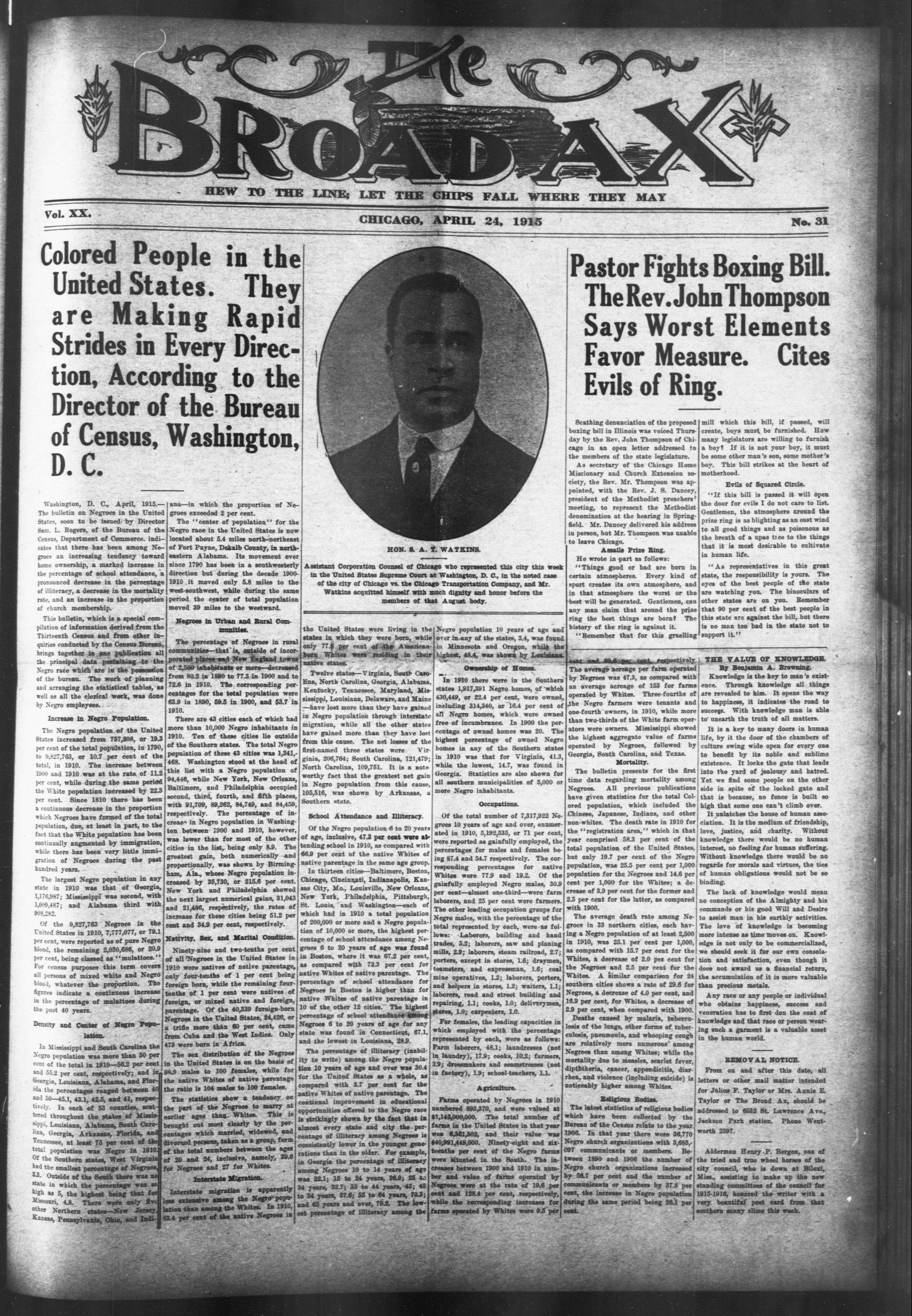
Colored People in the United States. They are Making Rapid Strides in Every Direction, According to the Director of the Bureau of Census, Washington, D. C.
Vol. XX.
Colored Peo United Sta are Maki Strides in tion, Accor Director of of Census, D. C.
Washington, D. C., April, 1915. The bulletin on Negroes in the United States, soon to be issued by Director Sam. L. Rogers, of the Bureau of the Census, Department of Commerce. indicates that there has been among Negroes an increasing tendency toward home ownership, a marked increase in the percentage of school attendance, a pronounced decrease in the percentage of illiteracy, a decrease in the mortality rate, and an increase in the proportion of church membership.
This bulletin, which is a special compilation of information derived from the Thirteenth Census and from other inquiries conducted by the Census Bureau, brings together in one publication all the principal data pertaining to the Negro race which are in the possession of the bureau. The work of planning and arranging the statistical tables, as well as all the clerical work, was done by Negro employees.
Increase in Negro Population.
The Negro population of the United States increased from 757,208, or 19.3 per cent of the total population, in 1790, to 9,827,763, or 10.7 per cent of the total, in 1910. The increase between 1900 and 1910 was at the rate of 11.2 per cent, while during the same period the White population increased by 22.3 per cent. Since 1810 there has been a continuous decrease in the proportion which Negroes have formed of the total population, due, at least in part, to the fact that the White population has been continually augmented by immigration, while there has been very little immigration of Negroes during the past hundred years.
The largest Negro population in any state in 1910 was that of Georgia, 1,176,987; Mississippi was second, with 1,009,487; and Alabama third with 908,282.
Of the 9,827,763 Negroes in the United States in 1910, 7,777,077, or 79.1 per cent, were reported as of pure Negro blood, the remaining 2,050,686, or 20.9 per cent, being classed as "mulattoes." For census purposes this term covers all persons of mixed white and Negro blood, whatever the proportion. The figures indicate a continuous increase in the percentage of mulattoes during the past 40 years.
Density and Center of Negro Popu- lation
In Mississippi and South Carolina the Negro population was more than 50 per cent of the total in 1910—56.2 per cent and 55.2 per cent, respectively; and in Georgia, Louisiana, Alabama, and Florida the percentages ranged between 40 and 50—45.1, 43.1, 42.5, and 41, respectively. In each of 53 counties, scattered throughout the states of Mississippi, Louisiana, Alabama, South Carolina, Georgia, Arkansas, Florida, and Tennessee, at least 75 per cent of the total population was Negro in 1910. Of the Southern states, West Virginia had the smallest percentage of Negroes, 5.3. Outside of the South there was no state in which the percentage was as high as 5, the highest being that for Missouri, 4.8. There were only five other Northern states—New Jersey, Kansas, Pennsylvania, Ohio, and Indi-
ans—in which the proportion of Negroes exceeded 2 per cent. The "center of population" for the Negro race in the United States is now located about 5.4 miles north-northeast of Fort Payne, Dekalb County, in northeastern Alabama. Its movement ever since 1790 has been in a southwesterly direction but during the decade 1900-1910 it moved only 5.8 miles to the west-southwest, while during the same period, the center of total population moved 39 miles to the westward.
Negroes in Urban and Rural Communities.
The percentage of Negroes in rural communities—that is, outside of incorporated places and New England towns of 2,500 inhabitants or more—decreased from 80.2 in 1890 to 77.3 in 1900 and to 72.6 in 1910. The corresponding percentages for the total population were 63.9 in 1890, 59.5 in 1900, and 53.7 in 1910.
There are 43 cities each of which had more than 10,000 Negro inhabitants in 1910. Ten of these cities lie outside of the Southern states. The total Negro population of these 43 cities was 1,341, 468. Washington stood at the head of this list with a Negro population of 94,446, while New York, New Orleans, Baltimore, and Philadelphia occupied second, third, fourth, and fifth places, with 91,709, 89,262, 84,749, and 84,459, respectively. The percentage of increase in Negro population in Washington between 1900 and 1910, however, was lower than for most of the other cities in the list, being only 8.9. The greatest gain, both numerically- and proportionally, was shown by Birmingham, Ala., whose Negro population increased by 35,730, or 215.6 per cent. New York and Philadelphia showed the next largest numerical gains, 31,043 and 21,486, respectively, the rates of increase for these cities being 51.2 per cent and 34.9 per cent, respectively.
Nativity, Sex, and Marital Condition.
Ninety-nine and two-tenths per cent of all Negroes in the United States in 1910 were natives of native parentage, only four-tenths of 1 per cent being foreign born, while the remaining four-tenths of 1 per cent were natives of foreign, or mixed native and foreign, parentage. Of the 40,339 foreign-born Negroes in the United States, 24,426, or a trifle more than 60 per cent, came from Cuba and the West Indies. Only 473 were born in Africa.
The sex distribution of the Negroes in the United States is on the basis of 98.0 males to 100 females, while for the native Whites of native parentage the ratio is 104 males to 100 females.
The statistics show a tendency on the part of the Negroes to marry at earlier ages than Whites. This is brought out most clearly by the percentages which married, widowed, and divorced persons, taken as a group, form of the total numbers between the ages of 20 and 24, inclusive, namely, 39.6 for Negroes and 27 for Whites.
Interstate Migration.
Interstate migration is apparently less extensive among the Negro population than among the Whites. In 1910, 38.4 per cent of the native Negroes in
[Picture of a man in a suit and tie].
HON. S. A. T. WATKINS.
Assistant Corporation Counsel of Chicago who represented this city this week in the United States Supreme Court at Washington, D. C., in the noted case of the city of Chicago vs. the Chicago Transportation Company, and Mr. Watkins acquitted himself with much dignity and honor before the members of that August body.
the United States were living in the states in which they were born, while only 77.5 per cent of the American-born Whites were residing in their native states.
Twelve states—Virginia, South Carolina, North Carolina, Georgia, Alabama, Kentucky, Tennessee, Maryland, Mississippi, Louisiana, Delaware, and Maine—have lost more than they have gained in Negro population through interstate migration, while all the other states have gained more than they have lost from this cause. The net losses of the first-named three states were: Virginia, 206,764; South Carolina, 121,479; North Carolina, 109,751. It is a noteworthy fact that the greatest net gain in Negro population from this cause, 105,516, was shown by Arkansas, a Southern state.
School Attendance and Illiteracy.
Of the Negro population 6 to 20 years of age, inclusive, 47.3 per cent were attending school in 1910, as compared with 66.9 per cent of the native Whites of native parentage in the same age group. In thirteen cities—Baltimore, Boston Chicago, Cincinnati, Indianapolis, Kansas City, Mo., Louisville, New Orleans, New York, Philadelphia, Pittsburgh St. Louis, and Washington—each of which had in 1910 a total population of 200,000 or more and a Negro population of 10,000 or more, the highest percentage of school attendance among Negroes 6 to 20 years of age was found in Boston, where it was 67.2 per cent, as compared with 73.3 per cent for native Whites of native parentage. The percentage of school attendance for Negroes in Boston is higher than for native Whites of native parentage in 10 of the other 12 cities. The highest percentage of school attendance among Negroes 6 to 20 years of age for any state was found in Connecticut, 67.1, and the lowest in Louisiana, 28.9.
The percentage of illiteracy (inability to write) among the Negro population 10 years of age and over was 30.4 for the United States as a whole, as compared with 3.7 per cent for the native Whites of native parentage. The continual improvement in educational opportunities offered to the Negro race is strikingly shown by the fact that in almost every state and city the percentage of illiteracy among Negroes is consistently lower in the younger generations than in the older. For example, in Georgia the percentage of illiteracy among Negroes 10 to 14 years of age was 22.1; 15 to 24 years, 26.9; 25 to 34 years, 32.7; 35 to 44 years, 43; 45 to 54 years, 57.6; 55 to 64 years, 70.2; and 65 years and over, 79.2. The lowest percentage of illiteracy among the
Negro population 10 years of age and over in any of the states, 3,4, was found in Minnesota and Oregon, while the highest, 48,4, was shown by Louisiana.
Ownership of Homes.
In 1910 there were in the Southern states 1,917,391 Negro homes, of which 430,449, or 22.4 per cent, were owned, including 314,340, or 16.4 per cent of all Negro homes, which were owned free of incumbrance. In 1900 the percentage of owned homes was 20. The highest percentage of owned Negro homes in any of the Southern states in 1910 was that for Virginia, 41.3, while the lowest, 14.7, was found in Georgia. Statistics are also shown for all southern municipalities of 5,000 or more Negro inhabitants.
Occupations.
Of the total number of 7,317,922 Negroes 10 years of age and over, enumerated in 1910, 5,192,535, or 71 per cent, were reported as gainfully employed, the percentages for males and females being 87.4 and 54.7 respectively. The corresponding percentages for native Whites were 77.9 and 19.2. Of the gainfully employed Negro males, 30.9 per cent—almost one-third—were farm laborers, and 25 per cent were farmers. The other leading occupation groups for Negro males, with the percentage of the total represented by each, were as follows: Laborers, building and hand trades, 5.2; laborers, saw and planing mills, 2.9; laborers, steam railroad, 2.7; porters, except in stores, 1.6; draymen, teamsters, and expressman, 1.6; coal mine operatives, 1.2; laborers, porters, and helpers in stores, 1.2; waiters, 1.1; laborers, road and street building and repairing, 1.1; cooks, 1.0; deliverymen, stores, 1.0; carpenters, 1.0.
For females, the leading capacities in which employed with the percentage represented by each, were as follows: Farm laborers, 48.1; laundresses (not in laundry), 17.9; cooks, 10.2; farmers, 3.9; dressmakers and seamstresses (not in factory), 1.9; school-teachers, 1.1.
Farms operated by Negroes in 1910 numbered 893,370, and were valued at $1,142,000,000. The total number of farms in the United States in that year was 6,361,502, and their value was $40,991,449,000. Ninety-eight and sixteenths per cent of the Negro farms were situated in the South. The increases between 1900 and 1910 in number and value of farms operated by Negroes were at the rate of 19.6 per cent and 128.4 per cent, respectively, while the corresponding increases for farms operated by Whites were 9.5 per
Agriculture.
Pastor Fights Boxing Bill. The Rev.John Thompson Says Worst Elements Favor Measure. Cites Evils of Ring.
Scathing denunciation of the proposed boxing bill in Illinois was voiced Thursday by the Rev. John Thompson of Chicago in an open letter addressed to the members of the state legislature.
As secretary of the Chicago Home Missionary and Church Extension society, the Rev. Mr. Thompson was appointed, with the Rev. J. S. Dancey, president of the Methodist preachers' meeting, to represent the Methodist denomination at the hearing in Springfield. Mr. Dancey delivered his address in person, but Mr. Thompson was unable to leave Chicago.
"Things good or bad are born in certain atmospheres. Every kind of sport creates its own atmosphere, and in that atmosphere the worst or the best will be generated. Gentlemen, can any man claim that around the prize ring the best things are born? The history of the ring is against it.
"Remember that for this gruelling
cant and 90.6 per cent, respectively. The average acreage per farm operated by Negroes was 47.3, as compared with an average acreage of 153 for farms operated by Whites. Three-fourths of the Negro farmers were tenants and one-fourth owners, in 1910, while more than two-thirds of the White farm operators were owners. Mississippi showed the highest aggregate value of farms operated by Negroes, followed by Georgia, South Carolina, and Texas.
Mortality.
The bulletin presents for the first time data regarding mortality among Negroes. All previous publications have given statistics for the total Colored population, which included the Chinese, Japanese, Indians, and other non-whites. The death rate in 1910 for the "registration area," which in that year comprised 58.3 per cent of the total population of the United States, but only 19.7 per cent of the Negro population, was 25.5 per cent per 1,000 population for the Negroes and 14.6 per cent per 1,000 for the Whites; a decrease of 3.9 per cent for the former and 2.5 per cent for the latter, as compared with 1900.
The average death rate among Negroes in 33 northern cities, each having a Negro population of at least 2,500 in 1910, was 25.1 per cent per 1,000, as compared with 15.7 per cent for the Whites, a decrease of 2.0 per cent for the Negroes and 2.5 per cent for the Whites. A similar comparison for 24 southern cities shows a rate of 29.6 for Negroes, a decrease of 4.0 per cent, and 16.9 per cent, for Whites, a decrease of 2.9 per cent, when compared with 1900.
Deaths caused by malaria, tuberculosis of the lungs, other forms of tuberculosis, pneumonia, and whooping cough are relatively more numerous among Negroes than among Whites; while the mortality due to measles, scarlet fever, dipthitheria, cancer, appendicitis, diarrhea, and violence (including suicide) is noticeably higher among Whites.
Religious Bodies.
The latest statistics of religious bodies which have been collected by the Bureau of the Census relate to the year 1906. In that year there were 36,770 Negro church organizations with 3,685,097 communicants or members. Between 1890 and 1906 the number of Negro church organizations increased by 56.7 per cent and the number of communicants or members by 37.8 per cent, the increase in Negro population during the same period being 26.1 per cent.
No.31
mill which this bill, if passed, will create, boys must be furnished. How many legislators are willing to furnish a boy? If it is not your boy, it must be some other man's son, some mother's boy. This bill strikes at the heart of motherhood.
Evils of Squared Circle.
"If this bill is passed it will open the door for evils I do not care to list. Gentlemen, the atmosphere around the prize ring is as blighting as an east wind to all good things and as poisonous as the breath of a upas tree to the things that it is most desirable to cultivate in human life.
"As representatives in this great state, the responsibility is yours. The eyes of the best people of the state are watching you. The binoculars of other states are on you. Remember that 90 per cent of the best people in this state are against the bill, but there is no man too bad in the state not to support it."
THE VALUE OF KNOWLEDGE.
Knowledge is the key to man's existence. Through knowledge all things are revealed to him. It opens the way to happiness, it indicates the road to success. With knowledge man is able to unearth the truth of all matters.
It is a key to many doors in human life, by it the door of the chambers of culture swing wide open for every one to benefit by its noble and sublime existence. It locks the gate that leads into the yard of jealousy and hatred. Yet we find some people on the other side in spite of the locked gate and that is because, no fence is built so high that some one can't climb over.
It unlatches the house of human association. It is the medium of friendship, love, justice, and charity. Without knowledge there would be no human interest, no feeling for human suffering. Without knowledge there would be no regards for morals and virtues, the ties of human obligations would not be so binding.
The lack of knowledge would mean no conception of the Almighty and his commands or his good Will and Desire to assist man in his earthly activities. The love of knowledge is becoming more intense as time moves on. Knowledge is not only to be commercialized, we should seek it for our own consolation and satisfaction, even though it does not award us a financial return, the accumulation of it is more valuable than precious metals.
Any race or any people or individual who obtains happiness, success and veneration has to first don the coat of knowledge and that race or person wearing such a garment is a valuable asset in the human world.
REMOVAL NOTICE.
From on and after this date, all letters or other mail matter intended for Julius F. Taylor or Mrs. Annie E. Taylor or The Broad Ax, should be addressed to 6532 St. Lawrence Ave., Jackson Park station. Phone Wentworth 2597.
Alderman Henry-P. Bergen, one of the tried and true wheel horses of the city council, who is down at Biloxi, Miss., assisting to make up the new standing committees of the council for 1915-1916, honored the writer with a very beautiful post card from that southern sunny clime this week.
PAGE TWO
Haiti's Old Citadel.
On the summit of a Haitian mountain over 4,000 feet high stand the wonderful ruins of the great citadel La Ferrière, built by the black king Christophe. Some of the walls are eighty feet high and sixteen feet thick, and heavy batteries of old fifty-six and thirty-two pound guns are still in position. They were laid to guard every approach of what was intended to be the last asylum of Haitian independence. Springs of water still exist in the interior, and there were secret subterranean passages and secret chambers for holding his hoarded wealth, much of which is supposed to be still buried there. Although partly destroyed by the earthquake in 1842, which demolished nearly all of the important buildings in the country, the colossal ruins of the citadel still attest the gigantic work of Christophe, and the world still wonders how the work was done and how the material for the construction and armament was ever got to the top of the mountain. Little authentic information has ever been obtained on the subject, and the whole enterprise is clouded in romance and anecdote—Argonaut.
Dust Clouds Armies Make
An army on the march along dry roads naturally throws up very heavy dust clouds. To those who haven't been trained one dust cloud looks very much like another, but to a soldier these dust clouds tell a very clear story.
The dust clouds thrown up by infantry, for example, hang in a low, thick cloud. The longer the cloud the more men underneath it, and a scout can by this means make a fairly accurate guess of the number of men on the march.
Cavailry on the march sends up a dust cloud that is much higher and thinner than that of infantry. The most distinctive of these dust clouds, however, is that made by wagons and heavy guns. The dust rises in little groups of clouds, quite different from the long clouds of cavailry and infantry. So even when unable to see the actual cause of the dust, a scout can tell many miles away what kind of force is passing along a road.—Exchange.
Indifferent Librarians
The Bodleian library has not always been fortunate in its custodians. When George III, presented a copy of the newly published "Voyages of Captain Cook" to the library the then librarian—we mercifully omit his name—promptly sent it to a friend, with a note asking him to keep it for a twelvemonth or so, as otherwise if the university men knew the book was available he would be pestered to death by applications for it.
The problem of storage for the Bodleian library is no new one and no doubt it will recur from age to age. But Oxford is probably a long way yet from any likelihood of adopting Lord Chancellor Westbury's suggestion as to the proper way of "removing the Bodleian." His proposal was that the books should be wheeled to the parks and burnt there—London Standard.
Strength of a Shark.
Given special advantages, such as that of holding the end of a stout rope at the other extremity of which is a hook fixed in a shark's mouth, man may, with the assistance of a number of his fellows, have the best of the shark. But alone and in the water the advantage is wholly and absolutely the other way, and the strongest swimmer and the bravest heart fall when the tyrant of the sea seeks to make his acquaintance. The shark is gifted with great strength, a savage temper, dogged perseverance and exceptional power of jaw. The lion and tiger may mangle, the crocodile may lacerate, the bulldog may hold fast—the shark alone of living creatures possesses the power of nipping off a human limb at a bite.
Its Own Beward.
Dr. Jones leaped into the air, dropping the evening paper he was reading as the telephone bell split the peaceful atmosphere.
"Who is it? What is it? Where is it?" he shouted as he took the receiver down.
"Everybody, ceptin" me. I was maughng, so mother wouldn't let me have any of the lovely mushrooms father picked yesterday."—Exchange.
Throwing Rise
Throwing rice at a wedding symbolizes not the expression of good luck, but it is a metaphorical flight of arrows shot at the bridegroom. In uncivilized ages most nations were accustomed to the forcible capture of a bride by her lover, and the attempts on the part of her male relatives to prevent her husband from carrying her away is typified by a volley of rice instead of more fatal missiles.
A Different Love
An odd typographical error once appeared in a criticism of Ellen Terry. The reviewer wrote, "Her love of Portia made acting easy," but the sentence appeared in the paper as "Her love of porter made acting easy." — Detroit Free Press.
He Didn't Do the Running.
Leading Lady—Did he run off the stage when the eggs hit him? Leading Man — No, but he showed a yellow streak. — Exchange.
Every person is responsible for all the good within the scope of his abilities. — Gall Hamilton.
Mummies of Peru.
Before taking leave of Cuzco, Peru, we went to see the very interesting collection of Inca relics in the private museum of a Peruvian doctor who has devoted many years of his life to Inca research. Ranged round the walls were mummies which had been taken from rock tomba. All had been buried in a sitting posture, and, judging by the horrible expressions of agony on the parchment skin, I should imagine that some of them, prisoners of war, I was told, had been entombed alive. The horror of those mummied faces and the awful contortions of the skeletons haunted me for a long time, nor shall I ever forget the sight.
One or two of the skulls bore evidence of skillful surgery, star shaped pieces of bone having been cleverly fitted in to repair damage done by the star shaped stone weapons of the period. I did not measure those I saw in the museum, but one of the aforesaid stone weapons which we brought back to England from Cuzco measured four inches from point to point across the top—a truly formidable club.-Wide World Magazine.
They Feared the Dutch.
In 1678, in the old days of England's wars with the Dutch, the inhabitants of Sheringham, in terror of invasion by the Dutch forces, petitioned the lord lieutenant and deputy lieutenants of Norfolk. "Our Town," they said, "Joynes upon ye Maine sea, and we are afraid every night ye enemy should come ashore and fire Our Towne when we be in our Bedds; for ye Houses stand very close together, and all ye Houses thatched with straw, that in one hours time ye Towne may be burnt, for we have nothing to Resist them But one Gunn, with a broken carriage and four Musquets, which we bought at our Owne cost and charges; which is a very small defence against an enemy; and likewise wee have no powder, nor shot for ye said Gunn, nor Musquets, when we stand in need." They therefore asked for a few more muskets, with powder and bullets. In granting this the authorities stipulated that Sheringham should not "imbocll ye said arms and ammunition."
Oliver Goldsmith and Bowden
April 4, 1774, died Oliver Goldsmith, in his forty-seventh year, at the height of his fame, as also of his embarrassments. Goldsmith's death was hastened, as some thought, by his taking against his apothecary's wish the famous specific. Dr. James' fever powders. One should be just to the powders. Goldsmith himself thought he had been given spurious and not the genuine powders, while Mr. Hawkes, his apothecary, declared the sick man had taken the right remedy in a wrong fashion and after Goldsmith's death published, in collaboration with the poet's other two physicians, "An Account of the Late Dr. Goldsmith's Illness So Far as Relates to the Exhibition of Dr. James' Powders." Death pays all debts. In no other way possibly could Goldsmith have cleared himself—London Spectator.
A Costly Quarrel
Rowley, the English violinist, was hard to beat in his perseverance against one who had incurred his ill will. Rowley had a quarrel with a horse dealer named Brant. It was a trivial matter, but Rowley took the next house to Brant, set up a plano, bought a cornet and proceeded to make insomnia for Brant. After one or two assault cases in court Brant moved. Rowley bought out the next door neighbor and followed with plano and cornet. Brant went to law, but found he could do nothing. Falling, he took a detached house. Then Rowley hired brass bands and organs and assailed him. This was actionable, and Rowley paid $5,000 for his revenge—London Tatler.
The Gospel Oak.
In the village of Polestead, Suffolk, England, stands a famous oak which the rector has proved to be 2,000 years old. The tree has a girth of thirty-six feet and has been known always as the gospel oak, since under it the first Christian missionaries preached to the heathen Saxons thirteen centuries ago. This event is commemorated each year by a special service held under the tree.
Early Soporifics.
Hostho, a Chinese physician who lived in the third century, gave his patients a preparation of hemp, whereby they were rendered insensible during surgical operations. The soporific effects of mandrake are mentioned by Shakespeare.
"Who was that tough looking chap I saw you with today. Hicks?"
"Be careful, Parker. That was my twin brother."
"By jove, old chap, forgive me! I really ought to have known."—Kansas City Times.
Wrong Either Way.
Isabel—I'll never have another photograph taken. Dorothy—Why not, dear? Isabel—Oh, if it looks like me I don't like it, and if it flatters me my friends don't like it!—Exchange.
"Your doom is sealed!" cried the villain
"Hn," laughed the heroine defiantly,
"I guess I can steam it open!"—Chicago Herald.
"Your cook is just like one of the family, isn't she? She never would eat warmed up dishes." — Baltimore American
THE BROAD AX, CHICAGO, APRIL 24, 1915
The Englishman Spoke.
In a second class railway carriage, going from Lausanne to Paris, I once passed a night of conflict. On my side were a Swiss who spoke English and an Englishman who didn't speak. Our opponents were two members of a Latin race. They wanted the windows shut. We wanted at least one window open. Our common cause drew the three of us together. At first the Englishman's expression had seemed to wonder whether the Swiss and the American were quite worthy to prefer fresh air. As the night wore on this expression waned, and I thought I detected a trace of sympathy in the glances he sparingly aimed at us.
Merchant Ship's:
The British mercantile familiarly as the red dye speaking, no inland right to fly the red ensign only flag permissible by union jack, which the often files upside down sign has its official sticks of two queens, 1707 and Queen Victoria.
The merchantmen of generally use the red dye by permission of the ship add the badge of the city." Some nations have cannile marine flags, but United States flag, for it
In answer to my question the Swiss explained his mastery of the English language by saying he had learned without a teacher, just by sitting near an open window in a tub of cold water. At this the Englishman almost spoke. Morning came. He filled his pipe and began to hunt through his pockets for matches. The Swiss offered him a box. "Thank you," he said gravely; "I prefer my own." and went on hunting.-New Republic.
Colors of the Opal
In judging an opal color is of the greatest importance. Red fire or red in combination with yellow, blue and green is the best. Blue by itself is quite valueless, and the green opal is not of great value unless the color is very vivid and the pattern very good. The color must be true—that is to say, it must not run in streaks or patches, alternating with a colorless or inferior quality. Pattern is an important factor, the several varieties being known as "pin fire" when the grain is very small, "harlequin" when the color is in small squares, the more regular the better, and the "flash fire," or "flash opal," when the color shows as a single flash or in very large pattern. Harlequin is the most common and is also popularly considered the most beautiful. When the squares of color are regular and show as distinct minute checks of red, yellow, blue and green it is considered magnificent. Some stones show better on edge than on top.—Exchange.
Barrele
A barrel is not always a barrel, for according to a Massachusetts judge, the matter of state lines has considerable to do with it. Some time since a Boston man purchased 200 barrels of sweet potatoes in the state of Maryland. When the sweet potatoes arrived in Boston the purchaser sold one barrel just as it had come from Maryland, but it appears that the barrel weighed only 129 pounds instead of 150 pounds, the legal weight in Massachusetts. In that state when a person buys a barrel of potatoes the weight must be not less than 150 pounds. The Massachusetts courts ruled that the purchaser of the Maryland sweet potatoes violated the law when he sold the barrel that was underweight, although the barrel was a legal one in Maryland. Therefore a barrel is not a barrel in Massachusetts when it weighs less than 150 pounds.-Utica Press.
Penetration of Light.
Experiments show that light can be seen through a clean cut opening of not more than one forty-thousandth of an inch. This fact was determined by taking two thoroughly clean straight edges and placing a piece of paper between the surfaces at one end, the opposite end being allowed to come together. The straight edges being placed between the eye and a strong light in a dark room, a wedge of light was perceived from the ends between which the paper was placed and the opposite, which were brought together. The thickness of the paper being known, the distance apart of the two edges of the small end of the wedge of light was easily calculated.
Irving's Intensity.
The piercing eyes and intense expression of Henry Irving once had the effect of making a fellow actor altogether forget that he was on the stage at all. It occurred in Manchester during a performance of "Macbeth," and in the scene where Macbeth says to one of the murderers, "There's blood upon thy face!" Irving put so much earnestness into his words that the murderer forgot his proper answer ("Tis Banquo's, then") and replied in a startled voice: "Is there? Great Scott!" He fancied, as he afterward said, that he'd broken a blood vessel.
Synthetic Dyes.
The raw materials from which almost all the synthetic dyes are made are only nine or ten direct products of coal tar. These are transformed chemically into from 250 to 300 intermediate products, which in their turn yield about 1,200 chemically distinct dyestuffs. Among the processes employed are high temperatures, great pressures and low refrigeration.
His Query.
"You've been sentenced to twenty years' hard labor. With good time you can cut that down, of course," said the lawyer.
"Good time!" exclaimed the prisoner.
"How's a guy going to have any good time in prison?"—Detroit Free Press.
"Does your father object because I'm paying attention to you?"
"No. Paw says he's glad to see you paying something, if it's only attention."—Buffalo Express.
True thrift, according to Robert Louis Stevenson, is to earn a little and spend a little less.
Merchant Shipe' Flaga.
The British mercantile flag is known familiarly as the red ensign. Strictly speaking, no inland person has any right to fly the red ensign ashore, the only flag permissible being the plain union jack, which the ordinary citizen often files upside down. The red ensign has its official status from the edicts of two queens, Queen Anne in 1707 and Queen Victoria in 1804.
The merchantmen of the colonies generally use the red ensign also, but by permission of the admiralty may add the badge of the colony "in the fly." Some nations have special mercantile marine flags, but not all. The United States flag, for instance, is the stars and stripes for all occasions.
The German mercantile flag of black, white and red dates only from 1867 and symbolizes the union between the Hohenzollern black and white and the red and white of the Hanseatic league. The Russian mercantile flag, introduced by Peter the Great, was originally the Dutch flag, familiar to him from his studies in Holland, reversed. Later the arrangement of the three colors was varied—London Globe.
Our Mineral Wealth
The United States is not only the world's greatest producer of mineral wealth, but it possesses by far the greatest known reserve of any nation in most of the important minerals. This is one of the things that has made us great and which is destined to make us far greater as measured by world standards. In some instances, such as coal and oil and phosphate rock and radium ore, the United States possesses more than all the other known deposits of the world, and the only essential minerals of the first rank of which the United States has no known supply at all commensurate with its needs are nitrates, potash, salts, tin, nickel and platinum. But as it stands today no other nation in the world so nearly approaches absolute independence in respect to mineral resources notwithstanding the vast magnitude of our home consumption.—Review of Reviews.
Why Some Women Look Dowdy
In the Woman's Home Companion Grace Margaret Gould, fashion editor of that publication, explains how fashions have to be applied differently to different individuals. A woman may be fashionably dressed and still look like a frump. Following is an extract from what she has to say:
"The new fashions, generally speaking, each season attempt to give grace and beauty to women as a whole, but for each individual me there must be discrimination.
"Fashion favors a style for everybody and everybody in style, but yet one woman's style is another woman's dowdiness, just as one man's meat is another man's poison. There is danger therefore in following blindly the dictates of fashion, for what is attractive for one woman may be ridiculous for another."
Geography.
There are many little errors of geography that are more or less prevalent. A glance at the globe, for instance, corrects the notion that France is just about east of England. Nearly half of France lies, in fact, west of Dover. Lisbon is not only west of London, but is west of the entire island of England and even west of Dublin. Even Madrid is west of London. It was not until the Spanish war and the Oregon's wonderful swing round the circle to join Admiral Sampson that this country came to see by the map that the whole continent of South America is east of New York. And not until Colonel Goethals got to work did we understand that the Pacific end of the Panama canal is east of the Atlantic end. -Topeka Capital.
Beauty of Zambesi Falle
To realize fully the wondrous beauty of the Zambezi falls, Rhodesia, one must have time to linger and watch the ever changing scene. The depths of the chasm below are velled from sight by the rising columns of opalescent mist and above the yawning abyss the sun glints and sparkles, weaving the drops into a magnificent rainbow. Three hundred feet below roars and bolls the swirling flood as it emerges from the Bolling Pot, rushing down on the zigzag gorge between towering cliffs of rock, narrow, fierce and of unfathomable depth. - African World.
Harnese Work
Bill—What's your friend's business? Jill—He's a harness maker. "Well, here's something he may be able to succeed at. This paper says more than 400 patents have been issued by the United States for devices intended to harness the power of sea waves."—Yonkers Statesman.
"I always envy the man who can take life easy and let his money work for him."
"So do I, but unfortunately in a majority of cases a man has to work for his money before his money will work for him."—Boston Transcript.
"My brother had a part of his speech cut out the other day."
"What surgeon was the operator?"
"No surgeon; just plain telephone girl."—Exchange.
When a man with a yellow streak gets blue he turns green with envy of some one he thinks more fortunate.—Chicago Post.
He is not always at ease who laughs.—St. Evelynond.
Unexplored Lands.
Europe is the only continent which has been completely explored. A large area in North America has never been visited by civilized people. It is in the northwestern part of Alaska, within a short distance of the coast. There are, besides, similar areas in the extreme northern section of the North American continent, in the vicinity of Hudson bay, and again in Labrador. The interior of Brazil has several large unexplored areas, and there are similar areas to the southward. Africa, as might be expected, contains more unexplored territory than any other continent. The largest lies in the Sahara, while the central part of the dark continent to the southward offers many opportunities for exploration.
Despite the antiquity of civilization in Asia, much remains to be done by the geographer. There are several unexplored areas in Arabia, as well as in China, and especially in northern Siberia. Australia contains several dark spaces in the northern section. Throughout the south seas lie many islands, some of considerable area, which have not yet been placed upon the map.
The Habit of Hustle and Rush
Hustle and rush constitute a typically American habit, and one in which we take considerable pride. It gives a man the notion that he is accomplishing a great deal, because he works so hard and is so exhausted at night. A bit of adverse criticism and a word of advice are here offered. The physician may pass them on to some of his patients with advantage and take a small portion himself if he thinks it is needed.
Hustle and rush! No one ever saw a German or an Englishman or even a Frenchman work in such mad haste. We say they are slow. Maybe they are in some lines, but they get results. In science, philosophy and art we acknowledge their superiority by going to Europe to study from them. And many of their banking systems, business methods and their co-operative societies are better than ours.-Medical Progress.
How He Learned a Lesson.
In a murder case in Mississippi the principal witness for the state was an old negro man, an ex-slave. The attorney for the defense attempted by a severe and sarcastic cross examination to break down his testimony or at least make him angry, but failed utterly to do so. After the old fellow left the witness stand the district attorney said to him:
"Uncle Bill, I want to compliment you in that you did not get angry today, but answered the attorney so pleasantly."
"Marse Jimmie," said the old fellow, "I was a-teamin' in dem woods over yonder 'fore you wuz born, an' I learnt den 'dat it's lots o' times jes es easy an' always more comfle ter drive round er stump dan it is ter drive over blt, an' I jess 'membered dat fact on de witness stan'."—Los Angeles Times.
The Cross on Sinai
A simple cross marks the spot which investigators of Sinai have decided is the place where Moses read out to the children of Israel the laws of God. The mountain itself must stand for the monument. Rus Sufsafeh, the elevation on which the cross stands, is wild, barren and rocky. About 300 yards from the base of the mountain there runs across the plain a low, semicircular mound which forms a kind of natural theater, while farther distant, on either side of the plain, the slopes of the inclosing mountains would afford seats to an almost unlimited number of spectators. Not far off there is an extensive recess which was probably used as a camping ground. No spot on the whole peninsula is so well supplied with water and pasturage. — London Strand Magazine.
Antiquity of Wheat
There is evidence that the Chinese cultivated wheat nearly 5,000 years ago, regarding it as a direct gift from heaven. The Egyptians attributed it to their god Isis and the Greeks to Ceres. Concerning the latter it was believed that when she had taught her favorite, Triptolemus, how to till the soil and make bread she gave him her charlot, and in that he traversed the world, distributing corn to all nations. Wheat growing in Egypt can by the evidence of a grain found imbedded in the brick of a pyramid be traced back to 3359 B. C. Varieties of wheat are legion. A French firm in its trial seed grounds had over 600 varieties growing, and since then "crossing" has increased the number.
Soiled Furniture
Covered furniture that is soiled can be made to look much fresher if rubbed over with a soft cloth dipped in gasoline. This will not harm the most delicate fabric, and the odor will pass away when exposed to the air. Do not run any risks, however, by using gasoline near fire—Home Craft.
Consistent.
Brown—Why is your daughter going to talk against the permanence of a republic in that college debate? Smith—Because she thought the advocacy of a republic would not go well with her new empire gown—Brooklyn Citizen.
* At the Cottage
He—I didn't know it was so late.
Are you sure that clock is going?
Feminine voice from above—it's going
a whole lot faster than you are, young
man.—Penn State Froth.
High birth is a poor dish on the table.—Irish Proverb.
Not only uniforms, but even cannon have been made of paper in the past. This experiment was once tried by Krupp's, field pieces of small caliber being composed of a metal core surrounded by a compressed paper pail. The idea at the back of this was that guns made of paper would, of course, be far lighter and easier to carry about than guns made of metal.
All kinds of substances have been tried for the manufacture of cannon. Weapons of wood and stone were quite common. The Swedes in former time used leather cannon, while in India a cannon of almost pure gold have been discovered. When Cortes left Mexico the Mexicans attempted to copy his guns in china. Perhaps the most extraordinary guns ever manufactured were the six employed for the firing of salutes at a winter fete in Petrograd in the year 1740. These had an effective range of about sixty yards, successfully withstood the test of firing without bursting and were made of—ice!—London Answers.
How to Take a Sun Roll
To get the maximum benefit from sun baths a regular formal routine should be followed.
The first exposure to the sun's rays should not be longer than 10 minutes. The head should be shaded, while as much of the rest of the body as possible should be bared to the healing rays. The best time is about two hours after a meal. On the next day and on sun speeding days longer exposures are allowed, increasing as tanning takes place. With little care all acute burning or blistering of the skin is avoided. After the skin has been fully tanned two or more baths a day may be taken. While sufferers from chronic tuberculosis and anaemia make up the bulk of the patients at the numerous established sun cure sanatoria on the continent, the treatment will be found to have a noticeably bracing and vigorating effect on those generally run down and debilitated.-London Mail.
Corn as Food.
Corn is really a food for the gods. In nutritive value it is but little behind whole wheat flour, containing within 6 per cent as much carbohydrates and within 3 per cent as much protein. Much of the food value of wheat is sacrificed in preparation of flour, to the end that our dainty appetites may be plied by the snowy whiteness of the bread. Thus bulk for bulk good corn bread is quite as nutritive as is the wheaten loaf. Many ways of cooking corn are known, but the simplest are the better. A sturdy race of pioneers throve on mush and milk and corn pone and hoe cake. Civilization and luxury have led the children of these pioneers to look with disdain on corn and to prefer to secure its great health giving properties through other mediums. We have been taking our corn by way of pork and beef.-Omaha Bee
Hatful of Pearls
The wit of Jenny Lind was as charming in its way as her voice.
On the occasion of her second rehearsal at the Paris Opera House La balche, the famous singer, was entranced with her voice. Hurrying up to her, he said enthusiastically:
"Give me your hand, mademoiselle Every note in your voice is a pearl!"
"Give me your hat," replied Jenny Lind, with a playful smile.
Labche handed the hat to her. Putting it to her mouth, she gave one of her matchless trills and birdlike snatches of song.
"Here," she said, smiling at the delighted Labche as she returned his property. "is a hatful of pearls for you, monsieur."
The Robert Legal
The judge did not seem to appreciate the remarks of the lawyer for the defense. Several years before they had had a fight over the question of religion. At last the judge interrupted the lawyer and said, "Do you not know that everything you are saying is going in one ear and out the other?" The lawyer turned to him and replied, "Your honor, what is to present?" Aaronaut.
Tit For Tat
Porter—Miss, yo' train is—Precis
Passenger—My man, why do you say
"your train" when you know it be
longs to the railway company? Porter
—Dunno, miss. Why do you say "my
man" when you know I belong to my
old woman?—Exchange.
The Ressimist Says:
The Pessimist Say
I don't see why folks should have any difficulty in believing in love as first sight. To me that sort of love seems more natural and better fortified than the variety that is supposed to follow extended acquaintance. Rich mon Times-Dispatch.
Feminine Courage.
"Don't you think women are naturally more courageous than men?" challenged the champion of her sex.
"Of course," said the horrid cynic
"No man would ever dare to get off a
car the way the average woman does."
—Kansas City Star.
Keeps Putting 'Em Up.
"I won't bet with you." said the
baker. "You haven't the dough."
"Oh, I guess I can put up the
stakes!" replied the butcher—Boston
Transcript.
A Mean Hint.
Miss Oldgirl—I have been studying
with Professor Plump, and he gave
me a few wrinkles. Miss Pert—Do
you think you need any more, dear—
Exchange.
BRIGHT BRIEFS.
You'll not get anywhere unless you start.
When you are in doubt what to say don't say it.
Downward the course of shipping takes its way.
Where much can be said on both sides it is usually said.
Nobody should ever look anxious, except those who have no anxiety.
Mexico is spared the necessity of worrying about a treasury surplus.
Morbid imagination explores the future in search of cause for wormment.
Might as well be a thousand years away as to be on the eve of doing something.
The gypsies of Europe are peaceful. Their motto is, "In time of war take to the woods."
A smile may hide a man's thoughts just as paint occasionally conceals a woman's complexion.
If time were money the average man would have his watch geared to run forty-eight hours a day.
To add to the general confusion the Russian government announces that Przemysl's name fell with it.
Life's best joys are found in living on last month's salary instead of the one for the month just ahead.
The fearful wastage of horses, said to be a million in the war zone up to date, indicates the penalty of being man's best friend.
A big sun spot has appeared, but even the most ardent advocates of the sun spot doctrine must admit that the troubles of the world began months before the sun spot appeared.
Animal Oddities.
The distance from which vultures and eagles can spy their prey is almost incredible.
The graffite is one of the only two absolutely dumb animals in the world; the kangaroo is the other.
No carnivorous bird or quadruped in England will eat the flesh of a cat. The rule applies even to the carrion crow, which will devour dead dogs greedily.
The fiercest shark will get out of the sea way in a very great hurry if the swimmer, noticing its approach, sets up a noisy splashing. A shark is in deadly fear of any sort of living thing that solashes in the water.
Current Comment.
Cotton may be a lazy man's crop in the making, but nowadays it takes a hustler to sell it.—Chicago News. If you feel that you must fight something swat the fly. Nobody is neutral when it comes to that.—Philadelphia Press. The Massachusetts Forestry association's arbor day slogan of "talk less and plant more" is worthy of wider application.—Boston Herald. The Mexican decree against circulating counterfeit Mexican money suggests that a decree against counterfeit disinterested Mexican patriots if enforceable would be still more advantageous.—Chicago Herald.
Dress Hints.
The tall woman may lessen her height with tucks; the short woman may lengthen hers with plaits.
Before wearing your rubbers rub them well with vaseline. Let them remain a few days before wearing them.
Holes in kid gloves can be mended by first buttonholing around the hole and then filling in with buttonhole stitch. This should be done with thread matching the glove.
Velvet wrinkles very readily, so that a gown of this material should be hung up carefully when not in use. Never hang any garment so that it touches another suit or the walls of the closet.
The Royal Box.
The kaiser's eyes are steely gray in color.
King George of England will be fifty in June.
Emperor Francis Joseph of Austria is a considerable real estate owner in France, with which country he is at war.
Grand Duchess Victoria, who has been awarded the St. George's medal for bravery in personally directing the removal of the wounded to a hospital at Sochaczew during the bombardment of Osowiec and other services, is a cousin of the czar by marriage. She is the wife of the Grand Duke Cyril.
Fashion Frills.
In defense of the feminine fashions the injurious charge is made that they are designed by men—Chicago News.
Women's skirts promise to be almost as wide as the grins of the satisfied cloth manufacturers—Pittsburgh Gazette-Times.
This year's styles in women's millinery—why should it be necessary to distinguish?—are awfully becoming—Chicago News.
When Dame Fashion has the new dress a little danger like pneumonia doesn't halt her for an instant. All the courage is not in the trenches—Philadelphia Ledger.
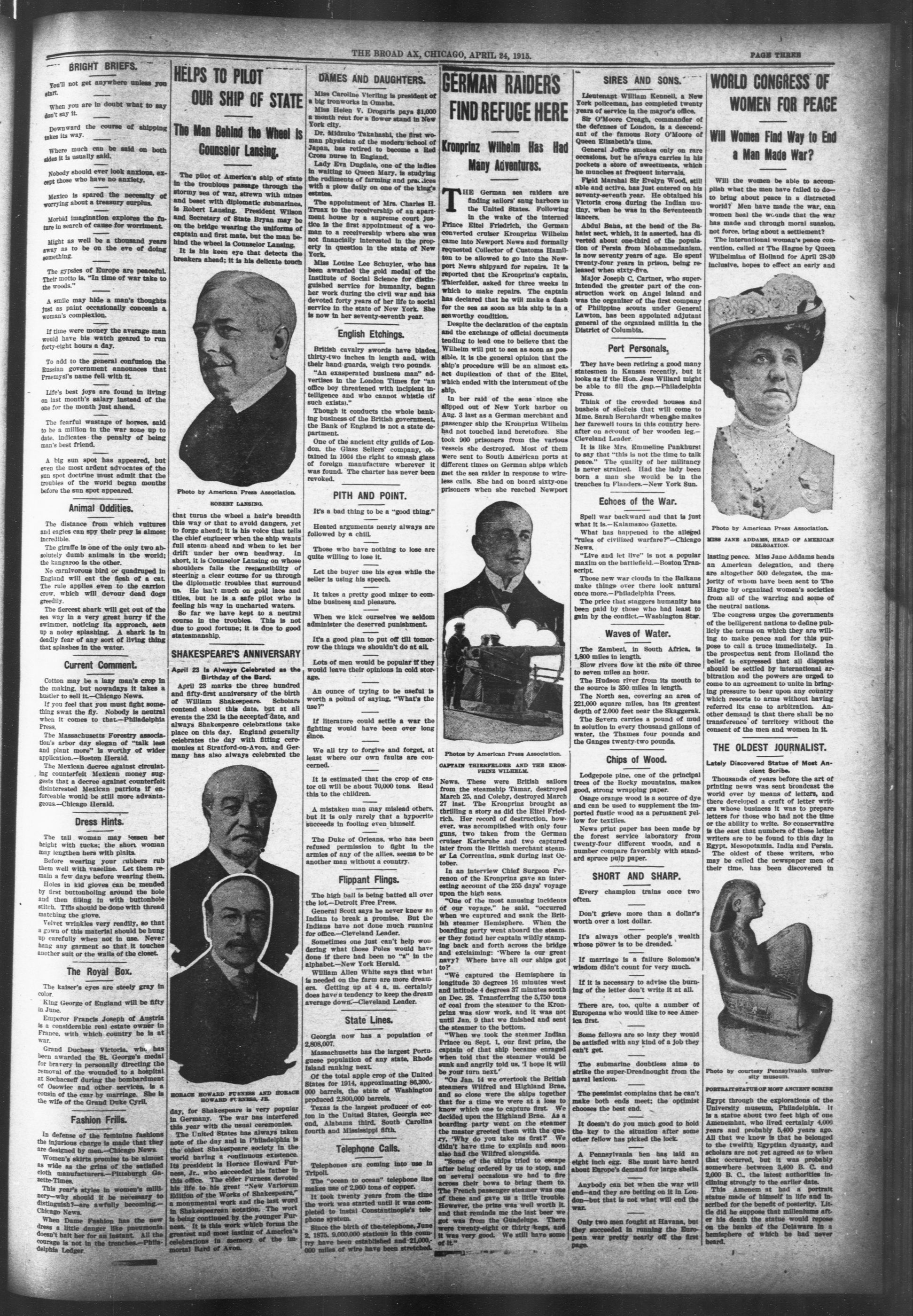
HELPS TO PILOT OUR SHIP OF STATE
The pilot of America's ship of state in the troublous passage through the stormy sea of war, strewn with mines and beset with diplomatic submarines, is Robert Lansing. President Wilson and Secretary of State Bryan may be on the bridge wearing the uniforms of captain and first mate, but the man behind the wheel is Counselor Lansing. It is his keen eye that detects the breakers ahead; it is his delicate touch
P.
Photo by American Press Association.
ROBERT LANSING.
that turns the wheel a hair's breadth this way or that to avoid dangers, yet to forge ahead; it is his voice that tells the chief engineer when the ship wants full steam ahead and when to let her drift under her own headway. In short, it is Counselor Lansing on whose shoulders falls the responsibility of steering a clear course for us through the diplomatic troubles that surround us. He isn't much on gold lace and titles, but he is a safe pilot who is feeling his way in uncharted waters.
So far we have kept to a neutral course in the troubles. This is not due to good fortune; it is due to good statesmanship.
SHAKESPEARE'S ANNIVERSARY
April 23 is Always Celebrated as the Birthday of the Bard.
April 23 marks the three hundred and fifty-first anniversary of the birth of William Shakespeare. Scholars contend about this date, but at all events the 23d is the accepted date, and always Shakespeare celebrations take place on this day. England generally celebrates the day with fitting ceremonies at Stratford-on-Avon, and Germany has also always celebrated the
M. B. B.
HORAGE HOWARD FUNNESS AND HORAGE
HOWARD FUNNESS, JE.
HORACE HOWARD FUNNESS AND HORACE HOWARD FUNNESS, JR.
day, for Shakespeare is very popular in Germany. The war has interfered this year with the usual ceremonies. The United States has always taken note of the day and in Philadelphia is the oldest Shakespeare society in the world having a continuous existence. Its president is Horace Howard Funness, Jr., who succeeded his father in this office. The elder Funness devoted his life to his great "New Varlorum Edition of the Works of Shakespeare," a monumental work and the last word in Shakespearean notation. The word is being continued by the younger Funness. It is this work which forms the greatest and most lasting of America's celebrations in memory of the imperial Bard of Avon.
THE BROAD AX, CHICAGO, APRIL 24. 1915
DAMES AND DAUGHTERS.
Miss Caroline Vierling is president of a big ironworks in Omaha.
Miss Helen V. Drogaris pays $1,000 a month rent for a flower stand in New York city.
Dr. Midkuzko Takahashi, the first woman physician of the modern school of Japan, has retired to become a Red Cross nurse in England.
Lady Eva Dugdale, one of the ladies in waiting to Queen Mary, is studying the rudiments of farming and practices with a plow daily on one of the king's estates.
The appointment of Mrs. Charles H. Truax to the receivership of an apartment house by a supreme court justice is the first appointment of a woman to a receivership where she was not financially interested in the property in question in the state of New York.
Miss Louise Lee Schuyler, who has been awarded the gold medal of the Institute of Social Science for distinguished service for humanity, began her work during the civil war and has devoted forty years of her life to social service in the state of New York. She is now in her seventy-seventh year.
English Etchings
British cavalry swords have blades thirty-two inches in length and, with their hand guards, weigh two pounds.
"An exasperated business man" advertises in the London Times for "an office boy threatened with incipient intelligence and who cannot whistle (if such exists)."
Though it conducts the whole banking business of the British government, the Bank of England is not a state department.
One of the ancient city gullets of London, the Glass Sellers' company, obtained in 1604 the right to smash glass of foreign manufacture wherever it was found. The charter has never been revoked.
PITH AND POINT.
It's a bad thing to be a "good thing."
Heated arguments nearly always are followed by a chill.
Those who have nothing to lose are quite willing to lose it.
Let the buyer use his eyes while the seller is using his speech.
It takes a pretty good mixer to combine business and pleasure.
When we kick ourselves we seldom administer the deserved punishment.
It's a good plan to put off till tomorrow the things we shouldn't do at all.
Lots of men would be popular if they would leave their opinions in cold storage.
An ounce of trying to be useful is worth a pound of saying, "What's the use?" ^
If literature could settle a war the fighting would have been over long since. ^
We all try to forgive and forget, at least where our own faults are concerned. ^
It is estimated that the crop of castor oil will be about 70,000 tons. Read this to the children. ^
A mistaken man may mislead others, but it is only rarely that a hypocrite succeeds in fooling even himself. ^
The Duke of Orleans, who has been refused permission to fight in the armies of any of the allies, seems to be another man without a country. ^
Flippant Flings
The high ball is being batted all over the lot.—Detroit Free Press.
General Scott says he never knew an Indian to break a promise. But the Indians have not done much running for office.—Cleveland Leader.
Sometimes one just help wondering what those Poles would have done if there had been no "n" in the alphabet.—New York Herald.
William Allen White says that what is needed on the farm are more dreamers. Getting up at 4 a. m. certainly does have a tendency to keep the dream average down.—Cleveland Leader.
State Lines.
Georgia now has a population of 2,808,007.
Massachusetts has the largest Portuguese population of any state, Rhode Island ranking next.
Of the total apple crop of the United States for 1914, approximating 86,300,000 barrels, the state of Washington produced 2,800,000 barrels.
Texas is the largest producer of cotton in the United States, Georgia second, Alabama third, South Carolina fourth and Mississippi fifth.
Telephone Calls.
Telephones are coming into use in Tripoli.
The "ocean to ocean" telephone line makes use of 2,900 tons of copper. It took twenty years from the time the work was started until it was completed to install Constantinople's telephone system.
Since the birth of the telephone, June 2. 1875. 9,000,000 stations in this country have been established and 21,000,000 miles of wire have been stretched.
THE German sea raiders are finding sailors' snug harbors in the United States. Following in the wake of the interned Prince Eitel Friedrich, the German converted cruiser Kronprinz Wilhelm came into Newport News and formally requested Collector of Customs Hamilton to be allowed to go into the Newport News shipyard for repairs. It is reported that the Kronprinz's captain, Thierfelder, asked for three weeks in which to make repairs. The captain has declared that he will make a dash for the sea as soon as his ship is in a seaworthy condition.
Despite the declaration of the captain and the exchange of official documents tending to lead one to believe that the Wilhelm will put to sea as soon as possible, it is the general opinion that the ship's procedure will be an almost exact duplication of that of the Eitzel, which ended with the internment of the ship.
In her raid of the seas since she slipped out of New York harbor on Aug. 3 last as a German merchant and passenger ship the Kronprinz Wilhelm had not touched land heretofore. She took 900 prisoners from the various vessels she destroyed. Most of them were sent to South American ports at different times on German ships which met the sea raider in response to wireless calls. She had on board sixty-one prisoners when she reached Newport
A. H.
Photos by American Press Association.
CAPTAIN THIERFELDER AND THE KRON-PRINZ WILHELM.
News. These were British sailors from the steamship Tamar, destroyed March 25, and Coleby, destroyed March 27 last. The Kronprinz brought as thrilling a story as did the Eitel Friedrich. Her record of destruction, however, was accomplished with only four guns, two taken from the German cruiser Karlsruhe and two captured later from the British merchant steamer La Correntina, sunk during last October.
In an interview Chief Surgeon Perrenon of the Kronprinz gave an interesting account of the 255 days' voyage upon the high seas.
"One of the most amusing incidents of our voyage," he said, "occurred when we captured and sank the British steamer Hemisphere. When the boarding party went aboard the steamer they found her captain wildly stamping back and forth across the bridge and exclaiming: 'Where is our great navy? Where have all our ships got to?'
"We captured the Hemisphere in longitude 30 degrees 16 minutes west and latitude 4 degrees 37 minutes south on Dec. 28. Transferring the 5,750 tons of coal from the steamer to the Kronprinz was slow work, and it was not until Jan. 9 that we finished and sent the steamer to the bottom.
"When we took the steamer Indian Prince on Sept. 1, our first prize, the captain of that ship became enraged when told that the steamer would be sunk and angrily told us, 'I hope it will be your turn next.'"
"On Jan. 14 we overtook the British steamers Wilfred and Highland Brae, and so close were the ships together that for a time we were at a loss to know which one to capture first. We decided upon the Highland Brae. As a boarding party went on the steamer the master greeted them with the query, 'Why do you take us first?' We didn't have time to explain and soon also had the Wilfred alongside.
"Some of the ships tried to escape after being ordered by us to stop, and on several occasions we had to fire across their bows to bring them to. The French passenger steamer was one of these and gave us a little trouble. However, the prize was well worth it, and that reminds me the last beer we got was from the Guadelupe. There were twenty-eight or thirty kgs, and it was very good. We still have some of it."
SIRES AND SONS.
Leutenant William Kennell, a New York policeman, has completed twenty years of service in the mayor's office. Sir O'Moore Creagh, commander of the defenses of London, is a descendant of the famous Rory O'Moore of Queen Elizabeth's time.
General Joffre smokes only on rare occasions, but he always carries in his pockets a store of sweetmeats, which he munches at frequent intervals.
Field Marshal Sir Evelyn Wood, still able and active, has just entered on his seventy-seventh year. He obtained his Victoria cross during the Indian mutiny, when he was in the Seventeenth lancers.
Abdul Baha, at the head of the Bahaist sect, which, it is asserted, has diverted to one-third of the population of Persia from Mohammadanism, is now seventy years of age. He spent twenty-four years in prison, being released when sixty-five.
Major Joseph C. Cartner, who superintended the greater part of the construction work on Angel island and was the organizer of the first company of Philippine scouts under General Lawton, has been appointed adjutant general of the organized militia in the District of Columbia.
Pert Personals.
They have been retiring a good many statesmen in Kansas recently, but it looks as if the Hon. Jess Willard might be able to fill the gap.-Philadelphia Press.
Think of the crowded houses and bushels of shekels that will come to Mine. Sarah Bernhardt when she makes her farewell tours in this country hereafter on account of her wooden leg.-Cleveland Leader.
It is like Mrs. Emmeline Pankhurst to say that "this is not the time to talk peace." The quality of her militancy is never strained. Had the lady been born a man she would be in the trenches in Flanders.-New York Sun.
Echoes of the War.
Spell war backward and that is just what it is.—Kalamazoo Gazette.
What has happened to the alleged "rules of civilized warfare?"—Chicago News.
"Live and let live" is not a popular maxim on the battlefield.—Boston Transcript.
Those new war clouds in the Balkans make things over there look natural once more.—Philadelphia Press.
The price that staggers humanity has been paid by those who had least to gain by the conflict.—Washington Star.
Waves of Water.
The Zambezi, in South Africa, is 1,800 miles in length.
Slow rivers flow at the rate of three to seven miles an hour.
The Hudson river from its mouth to the source is 350 miles in length.
The North sea, covering an area of 221,000 square miles, has its greatest depth of 2,000 feet near the Skaggerak.
The Severn carries a pound of mud in solution in every thousand gallons of water, the Thames four pounds and the Ganges twenty-two pounds.
Chips of Wood.
Lodgepole pine, one of the principal trees of the Rocky mountains, makes good, strong wrapping paper. Osage orange wood is a source of dye and can be used to supplement the imported fustic wood as a permanent yellow for textiles. News print paper has been made by the forest service laboratory from twenty-four different woods, and a number compare favorably with standard spruce pulp paper.
SHORT AND SHARP.
Every champion trains once two often.
Don't grieve more than a dollar's worth over a lost dollar.
It's always other people's wealth whose power is to be dreaded.
If marriage is a failure Solomon's wisdom didn't count for very much.
If it is necessary to advise the burning of the letter don't write it at all.
There are, too, quite a number of Europeans who would like to see America first.
Some fellows are so lazy they would be satisfied with any kind of a job they can't get.
The submarine doubtless aims to strike the super-Dreadnought from the naval lexicon.
The pessimist complains that he can't make both ends meet; the optimist chooses the best end.
It doesn't do you much good to hold the key to the situation after some other fellow has picked the lock.
A Pennsylvania ben has laid an eight inch egg. She must have heard about Europe's demand for large shells.
Anybody can bet when the war will end—and they are betting on it in London—but that is not what will end the war.
Only two men fought at Havana, but they succeeded in running the European war pretty nearly off the first page.
PAGE THREE
WORLD CONGRESS OF WOMEN FOR PEACE
Will the women be able to accomplish what the men have failed to do—to bring about peace in a distracted world? Men have made the war, can women heal the wounds that the war has made and through moral sasion, not force, bring about a settlement? The international woman's peace convention, called at The Hague by Queen Wilhelmina of Holland for April 28-30 inclusive, hopes to effect an early and
Mary C.
Photo by American Press Association.
MISS JANE ADDAMS, HEAD OF AMERICAN
DELEGATION.
lasting peace. Miss Jane Addams heads
an American delegation, and there
are altogether 500 delegates, the
majority of whom have been sent to The
Hague by organized women's societies
from all of the warring and some of
the neutral nations.
The congress urges the governments of the belligerent nations to define publicly the terms on which they are willing to make peace and for this purpose to call a truce immediately. In the prospectus sent from Holland the belief is expressed that all disputes should be settled by international arbitration and the powers are urged to come to an agreement to unite in bringing pressure to bear upon any country which resorts to arms without having referred its case to arbitration. Another demand is that there shall be no transference of territory without the consent of the men and women in it.
THE OLDEST JOURNALIST.
Lately Discovered Statue of Most Ancient Scribe.
Thousands of years before the art of printing news was sent broadcast the world over by means of letters, and there developed a craft of letter writers whose business it was to prepare letters for those who had not the time or the ability to write. So conservative is the east that numbers of these letter writers are to be found to this day in Egypt. Mesopotamia. India and Persia. The oldest of these writers, who may be called the newspaper men of their time, has been discovered in
A
Photo by courtesy Pennsylvania university museum.
Egypt through the explorations of the University museum, Philadelphia. It is a statue about two feet high of one Amenemhat, who lived certainly 4,000 years and probably 5,400 years ago. All that we know is that he belonged to the twelfth Egyptian dynasty, and scholars are not yet agreed as to when that occurred, but it was probably somewhere between 3,400 B. C. and 2,000 B. C., the latest authorities including strongly to the earlier date. This Amenemat at had a portrait statue made of himself in life and inscribed for the benefit of posterity. Little did he suppose that millenniums after his death the statue would repose on the banks of the Delaware in a hemisphere of which he had never heard.
PAGE FOUR
THE BROAD AX
PUBLISHED WEEKLY.
Will promulgate and at all times uphold the true principles of Democorny, but Catholien, Protestants, Priests, Inaddie, Single Taxes, Republicans, or anyone else can have their say, as long as their language is proper and responsibility is fixed.
The Broad Ax is a newspaper whose platform is broad enough for all, ever claiming the editorial right to speak its own mind.
Local communications will receive attention. Write only on one side of the paper.
Subscriptions must be paid in advance. One Year.....$9.00
Six Months.....1.00
Advertising rates made known on application.
Address all communications to
THE BROAD AX
2007 FEDERAL STREET, CHICAGO, ILL.
PHONE DREXEL 4590
JULIUS F. TAYLOR, Editor and Publisher
Entered as Second-Class Matter Aug. 19,
1903, at the Post Office at Chicago, Illinois,
under Act of March 3, 1879.
HEALTH NOTES.
People often wonder how the flies manage to live through the winter and why it is that with the coming of the first warm days in spring a few of the little pests will be seen buzzing about the house.
Well, the answer is not at all difficult. For example, the Sanitary Bureau of the City of New York on January 7th of this year found flies actually breeding in a pile of manure that was covered with tar paper and other rubbish. The covering of tar paper had practically made the manure impervious to snow and frost and thus a degree of warmth sufficient to hatch the eggs had been maintained all winter long.
Of course, it is almost certain that most of the flies thus hatched out in a winter temperature were soon killed with the cold. But it is also equally certain that a few managed to get into someone's house or kitchen, where unless killed by the swatting process, they could get along quite comfortably until the warm weather, when they could sally forth and begin the work of propagating their kind.
It is not uncommon to see a few flies in the restaurants of Chicago in midwinter. And there is no doubt but that enough flies are always able to get through the winter to furnish an unlimited supply for summer consumption.
Then there are the flies that survive until the late autumn or the beginning of winter. These deposit their eggs in places where they are protected and yet lie dormant until with the coming of warm weather they hatch out and thus we get our new crop of flies.
It has long been understood that ninety per cent of all so called house flies are born and breed in stable manure. If this be true and there is no doubt that it is, then if we could only get rid of the manure pile, we would be able to get rid of ninety per cent of our flies. The remaining ten per cent would be comparatively easy to handle.
Chicago now has an ordinance regulating the care, storage and handling of manure, which if strictly enforced, would go far towards making Chicago a flyless city. The stable owners of this city can do much to rid the city of flies by giving the Department of Health their hearty co-operation in putting this ordinance into effect. On the other hand, they can retard the city's sanitary progress by refusing or failing to comply with the provisions of the ordinance. And by taking this latter course they can also be assured they will be contributing their full share in adding to the dangers that threaten the health of the people of Chicago and that help materially to swell its death rate from the diseases that are due to filth and flies.
The clean up season is close at hand. It is time now that everyone should be thinking about cleaning up their premises and getting rid of the winter's accumulation of filth and rubbish of every kind. It is not necessary to wait until the Mayor issues a clean up proclamation. The good citizen should act on his own initiative. Why is it necessary that a day be set and an official proclamation be issued before people start to clean up? As a matter of fact every day should be a clean up day. Keeping clean isn't a matter of time or season. It is a matter of daily duty, so let's start the clean up campaign now and keep it up all summer.
Miss Marie Ford of Pasadena, California, is in Chicago attending the Chicago Musical College. She is residing at the home of Miss Myrtle Smith, 6316
Champlain Ave.
NOTES ON RACIAL PROGRESS.
Furnished by the National Negro Business League.
C. W. Brown, a Colored lawyer of Elizabeth City, North Carolina, recently passed the State Supreme Court Examination.
Bartow F. Powel, a farmer of Baker County, Georgia, recently sold 500 bales of cotton at 8 cents a pound. The amount of the sale was more than $20,000.
The local Negro Business League of Muskogee, Oklahoma, is co-operating with the White citizens of that city to make the forthcoming meeting of The Southern Commerical Congress a success.
Camp Nelson is the name of a Colored town in the State of Kentucky. They recently installed an electric power plant and organized several other business enterprises.
Charles Watkins, the salesman of the Story and Clark Piano Company of St. Louis who won the bonus from this company for being among the best salesmen during the year 1914, has gone into business for himself; opening a branch of the Wurlitzer Piano Company at 2005 Laclede Avenue, St. Louis.
A Thought for the Weak.
We had four pairs of shoes to be repaired the other day and we took them to a Colored shoe shop. The shoemaker had caught up with his work and had nothing to do. We told him that we wanted a quick job done, so he inspected the shoes and declared that they were not worth fixing; that he could not fix them; and we thought what he said was true. But we happened to pass a White man's shop and so we asked him if the shoes were worth mending; he replied "yes" and in less than two and a half hours he had the four pairs of shoes mended and the amount of two dollars in his pocket. When we passed back by the Negro shop, he had locked up and was standing out in the sun with his hands in his pockets waiting for a job, as he called it, and declaring that the times were dull and that he could get no work to do. The White man had plenty of work to do, was making money hand over fist, only two hundred yards away from the Negro, because he had "an eye to business."—Editorial, Charleston (S. C.) Messenger.
HYDE PARK NEWS.
Mrs. Ben Williams moved from 1365
E. 55th Street to 5524 Engleside Ave.
Mr. James Hunter, and his brother
Captain Charles Hunter, foreman of
the Illinois Storage Dept. of Hyde
Park, were called to the bedside of a
very sick sister in Hampton, Ohio.
Mr. and Mrs. Clarence Kennett, entertained a few of their friends at
their residence, 5626 Lake Park Ave.,
with a special prepared Sunday feast.
The Rev. W. H. Griffin, Pastor of the Hyde Park A. H. E. Church, preached a very able sermon Sunday night upon the subject, "For what purpose are we born." Taking his theme from the 37th verse of the 18th Chapter of St. John. "To this end was I born, and for this cause came I into the world." Many bewildered minds were given a new hope from hearing his analises of the sermon.
He will preach the Quarterly Sermon at Quinn's Chapel Church, 24th and Wabash Ave., next Sunday afternoon. This is a splendid tribute to his ministerial ability.
Quite a number of our Colored citizens in Hyde Park are looking for appointment by his Honor the Mayor elect. We shall be pleased to note and publish said successful individuals.
The base ball season will open Sunday at the American Giants Park, 39th Street and Wentworth-Ave. Everybody is waiting the home coming of the Rube Foster's diamond artists. The line up may be: Wickware and Petway, battery, Barber, 1st base, Francis, 2nd, Jenkins, short step, and Duncan, 3rd, Ball, L. F. Hill, center, Jackson R. F. The new players added to the team are: McNair, Hutchinson, Whitworth and Bauchman. The favorite supporters are: Ball, Gatewood, San Top, Francis, Petway, Barber, Hill, Dunean, Wickware and Jenkins. We await their successful entry in the fan arena. Chicago, Ill. April, 21st, 1915.
The American Giants under the leadership of Rube Foster, returns to city, and will play their opening game Sunday, the 25th versus the Milwaukee. A banquet will be tendered the players at Elite No. 2, Monday night, May 3rd. All friends and admirers are invited to attend. Beauregard F. Mossley will have present to cheer the boys, several base ball magnates. The owner of the park, John M. Scherling, Judge Willis W. Melville and President of the City
THE BROAD AX, CHICAGO, APRIL 24, 1915 League, Teenan Jones, Geo. W. Holt Frank L. Hamilton and other local celebrities. ST. MARK M. B. The Lexington Conference forty-sixth annual session
From Ohio Chicago Examiner 4-23-15.
SOUTHERN SCHOOL DRAWS
COLOR LINE POE BELAYS.
Columbia, B. C., April 21.—Because he would be forced to compete with negroes, Oscar Plaxicon, of the University of South Carolina, today was informed that he would be expelled should he carry out his intention of going to Philadelphia to compete in the University of Pennsylvania relay carnival beginning to-morrow. This decision was reached by the faculty at a special meeting.
A gala day for Mr. A. B. Hullett, at Ebenezer Baptist Church, 35th and Dearborn Streets Sunday being special guest to address the Mother's Union, at 3 P. M. and The Star Literary at 4 P. M. an unusual honor given to a public speaker. Mr. Hullett was the Chief of the Colored voter's department of Mr. Wm. Hale Thompson's campaign which makes his message the more interesting to the Colored people.
Mr. Hullett when introduced to the Mother's Union meeting said, "I don't know what that means but if it has anything to do with mothers then I want to say to you that the only way to test a gentleman is by the way the demons strates his love for his mother. I am here doing my Christian duty, I bring you a message from Bill Thompson. Believing as I do that you are going to have a typical Christian gentleman for mayor, I know that it is the one thing certain that he feels the needs of Chicago, and deep down in his heart he feels the needs of the Colored people. I know that he feels grateful to the Colored people for the hearty support you gave him and I am certain that you will not be forgotten. I believe that you will in the near future rejoice by having a member upon the school board and one upon the civil service board, there may be something required upon your part to make this city a prosperous one and be called upon to help the mayor to make his administration a success. We ought to have a home guard to act voluntary as we use to do in our fire department without pay, for God and Humanity. When there was a little more love for one another than there is today. The trouble about our boys and our girls are, is that they haven't got any mothers and any fathers they are too busy engaged with the day's business struggling to make a living we must organize to bring prosperity to our city our state, and our country. The people must be given employment. Mr. Hullett touch the same things in the Star Literary Club at 4 P. M.
GREETERS NIGHT AT THE APO-
MATTOX CLUB.
Last Saturday evening was greeters night at the Appomattox Club, 3441 S. Wabash Ave., and many of the older members of the club were on hand to greet and extend the right hand of fellowship to the more than forty new members who joined it recently at the present time its membership is almost two hundred and fifty, all over two hundred are simply auxiliary members for they are on the waiting list ready and willing to take the places of the old time members whenever they feel like dropping out.
Col. B. F. Moseley, Hon. Edward H. Wright and Major Robert R. Jackson furnished the oratory for the occasion and J. Barni Barber and Misses Gertrude Delaney and Hatti Hairston were the entertainers.
WOMAN SAVES LIFE OF CHILD.
Mrs. Minnie McFall proves herself heroic when she rushes out in front of a speeding auto to rescue a playmate of her boy. The accident was not fatal, a bruised forehead being the only injury, the child was given immediate care while many congratulated Mrs. McFall on the desperate chance she took.
NEGRO FELLOWSHIP LEAGUE.
NEMO FELLOWSHIP LEAGUE.
Address by Pullman Conductor Bell.
The Negro Fellowship League next Sunday April 25, at the Reading Room, 3005 State Street, will be addressed by Mr. B. W. Bell the Pullman conductor who lost his job for trying to organize the Colored porters into a union that would help them to secure better wages.
Chairman Walsh of the Federal Industrial Commission is also expected to be present. The public is urged to be present as following this an opportunity will be given to discuss whether it would be better for the porters to content himself with the small wages which the company pays him and depend on tips from the public, or to be paid higher wages. Come early and bring a friend.
Last Sunday the League was most highly entertained by an address by Mr. Lewis Johnson on "Loyalty and the Boy." Mr. Johnson thrilled his audience with his earnest plea, and has offered aid in the future to help the boys of the League.
Ida B. Wells Bennett President
ST. MARK M. E. CHURCH.
The Lexington Conference closed its forty-sixth annual session at Fulton St. Methodist Episcopal Church, Sunday night April 18, having held a splendid convention, a large number of eminent divines filled Chicago Pulpits last Sunday. The Rev. Dr. J. L. Franklin, Mt. Zion M. E. Church, Cincinnati, preached a great sermon to a large congregation at St. Mark last Sunday morning, Mrs. Dollie Lewis the evangelist preached at the evening service.
St. Mark M. E. Church, fiftieth St. and Wabash Ave., is rejoicing over the return of their beloved pastor the Rev. Dr. John Wallace Robinson, under whose leadership such glowing accounts are recorded in our methodism. We welcome him and his devoted wife and children, it is our wish that his stay be indefinite.
The Rev. Julius C. Peters who was formerly a member of the Lexington Conference has been transferred to The Lincoln Conference of The Methodist Episcopal Church will preach next Sunday evening at St. Mark M. E. Church, Rev. Peters will depart soon to take up the work of his appointment at Denver, Colorado. Rev. E. L. Gillium of Columbus, Ohio, addressed St. Mark Lyceum last Sunday afternoon.
The following ministers of the Lexington Conference enjoyed the program: Rev. B. J. Colman, Augusta, Ky., Rev. C. H. Piles, Ancharidege, Ky., Rev. R. L. Dickerson, Paris, Ky. Miss Luceille Beatrice Robinson, Piano Solo was very pleasing.
TEST FILM LAW, PLAN OF
OWNERS OF FIGHT
SCENES
Give notification an Attack Will Be Made Before the Supreme Court. Washington, D. C., April-Owners of the moving picture films of the Willard-Johnson championship fight in Havana have notified the department of justice that they propose to attack before the Supreme court of the United States the constitutionality of the federal statute prohibiting the exhibition of the films in this country. Former United States Senator Charles A. Towne of Minnesota, now practicing law in New York, has been retained to make the legal contest. Mr. Towne has conferred with Solicitor General Davis and obtained the consent of that official to expedite the hearing if the court so agrees.
The law, which was passed by the sixty-second congress on July 31, 1912, following the hubbub over the exhibition of the defeat of Jim Jeffries by Jack Johnson, not only places an inhibition upon the interstate shipment of such films in the United States but also bans their importation into this country.
ALPHA SUPPRAGE CLUB
The Alpha Suffrage Club enjoyed a fine parliamentary drill last Wednesday night. The president, Mrs. Barnett announced that every Wednesday evening she was going to call on a different member to preside and expect them to drill the members in parliamentary practices. Mrs. Sadie Adams the corresponding secretary was the presiding officer last week. This week Mrs. Mary E. Jackson, vice president was in the chair. The club is making preparation for a public entertainment for the benefit of the Alpha Suffrage Club and the Negro Fellowship League jointly. It also voted to attend in a body the complimentary dinner to alderman elect Mr. Oscar De Priest.
CHIPS
The Laurell Dancing School, will on and after April 23, hold their regular dancing class at Johnson's Dreamland Hall, 3522 South State Street.
Miss Lacolia Monroe a student of the Normal College is going to Peru, Indiana to spend a week, as the guest of Miss Rhoygnette Webb, the celebrated nurse.
George R. Garner Jr. who has been on a long successful singing tour through the western states will return home the last of this coming week.
W. A. Driver, Jr. son of Dr. and Mrs.
W. A. Driver, 3536 Prairie Ave.,
returned to this city Monday morning
with his charming bride Miss Deborah
Barber of Evans, Iowa; the new bride
and groom will reside at the above
mentioned number.
The Choral Study Club made its second appearance of the season Monday April 19, at the Olivet Baptist Church. The soloists were: Mrs. H. Sayre, soprano, Mrs. L. Jordan, contralto, Mr. Theos Allen, tenor and Jacob Daly, baritone. Gaul's "Ten Virgins." was the feature of the evening. Mr. Geo. E. Duncan conducted the chorus.
Mr. A. H. Roberts, honored the race by his presence last Friday evening at a special gathering of the Literary German friends of the Hon. Judge
Phone Douglas 3617
COUGHS, COLDS AND CONSUMP TION
Every person above the tender years of early life knows the condition commonly called a cold. Aside from the disagreeable annoyance experienced in the early stages of a cold, most of us consider it not worthy of serious consideration. When we consider that pneumonia and consumption are the diseases responsible for more physical death than probably all other causes combined and that both are the result of a cold grown to maturity, we realize to a considerable extent how dangerous an enemy we entertain when visited by a cold. The fact that a cold merges into consumption and pneumonia by gradual growth and no one can safely state where the dividing line is, should aid us in giving proper attention to the subject at all times. A cold demands vigorous attention of the best character, because it is the largest gateway to that state of bodily dissolution, called death. It will be questioned by none familiar with the deadly work of colds when we say that every cold should have the early care of a physician. Remember the old adage: "A stitch in time saves nine." It appears that almost every case of pneumonia and consumption is given the haphazard hit or miss treatment called "home remedies" before scientific aid by way of doctor is sought. It seems that such a plan is due to the practice of economy. Often the stage at which cure could have been accomplished by the physician has passed. Every one would probably have a physician in the early stage of a cold but for the element of money. Since most people die, physically, as the result of diseases due to a cold and since those conditions are easily cured in the early stages by the physician, the people who practice "economy" in such a manner are practicing false economy. They are penny wise and pound foolish.
Coughs are more often due to a cold than to any other reason. A cough is a warning; it is nature's method of telling us to seek relief. It is nature's method of making us know that we need attention of a high order. Long before the diseases called pulmonary or lung diseases are fully developed, the patient gets a warning by way of the cough. Some have ears to hear the cough but they hear not; friends who have ears and who use them intelligently, will urge the patient to seek the aid of a person trained in the art of healing, the physician. The cough may be due to stomach derangement or it may
John Stelk, municipal court Judge of Cook County. He was honored by this invitation, because of his oratorical ability, and we are proud of the fact that he made good. Honesty, energy and ability will win in the long run if we but stick to our oars.
The Citizens Entertainment and Ball given by the citizens committee Auxiliary to the Physicians, Dentists and Pharmacists Club of Chicago at the 8th Regiment Armory, 35th Street and Forest Ave., under the splendid management of Col. John R. Marshall and Mrs. Lloyd G. Wheeler was noted for its personal and its splendid decorum and feminine attractiveness, it was not so large in numbers but big in proportion and enjoyment.
Relic of the Romans in England. A farmer brought about the discovery of a mysterious house in Sonerset England. In plowing he turned up several pieces of pottery and some coins. Men were set to digging on the spot and uncovered the charred rulns of an immense house. It was about 180 feet long, 35 feet wide and contained nineteen rooms. The outer walls, still standing, are of heavy masonry, and the floors are of concrete. Some of them were formerly covered with tiles. Quantities of charcoal over the rulns showed that the building was destroyed by fire. The house has been examined by scholars, who say that it was built in the days when the Romans were in possession of England, about 2,000 years ago. The occupants have left many relics scattered about the ruins—pottery dishes and utenails, a grindstone, a small whetstone and other objects. Buried in a corner were several pieces of window glass and the neck of a small glass vase.
[Name]
be due to a functional heart disease or an organic disorder of the heart. Any of the above named diseases need the services of the doctor for they all may lead to dissolution of the body. So beware of all coughing; submit yourself to the doctor if you have a cough for he alone can tell the exact cause of it unerringly. He, alone can give the proper treatment.
It is not strange to those who know the nervous anatomy of the body that a person often appears to have a disease of the stomach, when in reality, that person has incipient tuberculosis. Such a case will deceive many until the time of a possible cure has passed. The patient will have what the untutored will call dyspepsia by the trained diagnostician will easily understand the symptom complex. He will also cure the patient by removing the cause or causes by the various agents in the ar-mamentarium of the profession; he will restore such conditions as will permit nature to do the real healing. And here lies the enigma that causes many persons to fall into error and set at naught the work of the doctor. They have not the power of understanding the need of the physician if nature does the healing. Such septicism born of ignorance will accept the fatalism that says whatever will be must be. But those who are foremost in the world's work know that we must make an effort to get results.
The doctor is constantly thinking of means to cure these cases. He will not only give drugs that prepare the way for the next drug needed but step by step he will actually cure consumption. Every doctor knows that consumption can be cured and is cured when given early scientific treatment. But that must be done before the patient has ruined his system by the use of inferior methods, such as the patient medicines and hit or miss so called home remedies mentioned above. The doctor will find out the errors of living which must be corrected to get a cure. The reason that most cases of the cases of consumption fail of cure is because the patients keep up the mode of life that brings the disease. Solomon said to be the wisest man advises us that there is safety in much counsel. The doctor should be counseled with in the most simple diseased condition because he can give such advice and counsel as will prevent those disorders frucifying into the harvest of misery, disease and physical decay before the three score and ten years allotted in this state of being.
A Record In Hard Work.
Lord George Bentnick's record of political work, as set out by his biographer, seems even more stalking than that accomplished by Wellington in 1834. "It is very difficult." writes DIsraeli, "to convey a complete picture of the laborious life of Lord George Bentnick during the sitting of parliament. At 9:30 began his elaborate and methodical correspondence, all of which he carried on himself in a handwriting clear as print, and never employing a secretary; at 12 or 1 he was at a committee, and he only quitted the committee room to take his seat in the house, which he never left until it adjourned, always long past midnight and often at 2 a. m. His principle was that a member should never be absent from his seat. * * * Although he breakfasted only on dry toast he took no sustenance all this time, dining at White's at 2:30 in the morning."—London Chronicle.
Why the Prince laughed:
Why the Prince Laughed
When King George of England was in the navy, as a young man, an American, of some consequence obtained permission to visit the ship on which he was serving. The ship was coaling at Hallfax, and when the American clambered aboard a young officer, with a very coal grimy face, was told off to show him around. After making his tour of inspection the American rowed back to shore in company with the captain of the vessel, "Well," he said, "I have only one complaint and that is that I did not see the prince." "But you have been talking to him for the best part of an hour," answered the surprised captain. "What?" said the American. "Was that grimy fellow the prince? Sakes alive, no wonder he laughed so heartily when I asked him if they kept his royal highness in cotton wool while the coal dust was flying about!"
CAUSES OF FIRES AND HOW TO AVOID THEM
A very dangerous practice, common in most garages is the cleaning of automobile parts with gasoline from an open can. Employes find it easy to clean the grease and oil from a motor of an automobile and from different parts with a brush saturated with gasoline. The fact that the gasoline is open to the air is a danger in itself, says a writer in a recent issue of Safety Engineering, it being readily ignited by a spark such as caused by striking two pieces of metal together, a spark from the ignition system by turning the starting crank, or by a spark from the cigar or pipe of some passer-by.
1
Smoking in garages is also very careless, but it is almost impossible to eliminate it. For instance, a man comes into a garage with his machine after having used it all day and has a cigar in his mouth. He never thinks of the danger of that cigar and might willingly throw it away if some one would only draw his attention to it. Few men see the danger of smoking in garages and often they become quite indignant when their attention is called to the fire rules. But signs prohibiting smoking often do good.
Allowing automobiles to enter garages with their lights lit is also a bad plan. It is simply another instance where the flame from any one of the lamps might ignite the gasoline vapor which constantly fills a garage. One instance which was brought to the writer's attention was where an automobile was being taken into a garage at 9 p. m. The lights had been put out with the exception of the rear lamp, and as soon as the car was well in the garage, it became enveloped in flame.
Electric motors, forges and stoves are the causes of many fires in garages. Electric motors frequently throw sparks and forges are a danger by virtue of their flames; both should be safeguarded. A good plan is to have a shield of metal placed about them, extending from the floor to a height of 5 or 6 feet; then the gasoline vapor would not come in contact with the original point of danger, as it does not rise that high. Stoves should never be allowed. The heating apparatus should be in a separate building or in a basement that has no connection with the garage. The entrance to the basement should be outside.
Spontaneous combustion is another cause of carelessness. Oily waste, if not placed in a safe receptacle, will decay of itself and smolder and in time will burst into flame. Cans of zinc or tin with covers are handy to put this waste in and thereby save the garage from possible destruction. Occasionally sawdust or shavings are strewn under a car to absorb the waste oil drippings. This is a foolish idea and spontaneous combustion is apt to result in this case also. Sand is a very good substitute for sawdust and can be better renewed.
Some garages contain small openings in the floors, into which men go to repair the under parts of machines. Such openings are called pits. Gasoline vapor is found very thick in all low places and these pits are therefore dangerous. In one instance, a man was in one of these pits repairing a machine which was partly over him. A nut became obstinate and he hit it with a wrench causing a spark. The instant the spark was struck, the thick vapor in the pit became ignited and flame filled the pit and enveloped the car at the same time. The result was that the man was burned very severely and the car was of no use when the fire was extinguished. Turntables are considered bad in garages if there are openings in the floor where they revolve, these openings being as dangerous as pits. Public garages should always be built of fireproof material and a one-story building is preferred. When a two, three or four-story building is erected there should be no connection from one floor to an other, but an outside stairway should be used. Some times tenants desire to install an elevator. The best place for an elevator is on the outside of the building with fire doors on each landing.
When the automobile business was new, wooden floors were common in garages, but now people have become more sensible and have replaced them with cement. They realized that the wooden floors became saturated with oil and only added to the hazard.
Occasionally you read in the papers of a number of covers to sewer openings having been blown up in the streets. Investigation generally proves that it is caused by the gasoline from the garage districts. After gasoline has been used for various purposes in garages, it is poured into the drainage system. In some places, gasoline vapor is very strong and when men enter the sewers to clean some clogged spot, the vapor ignites from the small lamps the men take with them.
In every garage, chemical fire extinguishers in numbers to compare with the size of the garage and fire pails containing sand should be installed.
Singing While In Danger.
Though there is no definite rule laid down in the British naval regulations, yet it has become an unwritten one for the officers to instruct their men to sing when they are in great danger, as, for instance, when their ship has been mined or torpedoed and is sinking.
A popular song, as a rule, is ordered to be sung because most of the sailors know it, and collective singing puts more heart in them and helps them to hang on as long as possible till help comes.
Some years ago some sailors from the Vernon were blown up in Portsmouth harbor. It was in the middle of January and an ice blizzard made things worse than usual. The lieutenant in command, who was swimming in the water, yelled out to his men, who were also battling for their lives, "Sing 'Bill Bailey,'" and probably that once popular song was never sung under stranger conditions. It is said that the lieutenant swam round and punched the heads of those who were not singing—Pearson's.
Water on a Hot Stove
It is impossible to throw a few drops of water on a redhot stove. The water can never touch the stove at all. What is seen is a few drops rolling rapidly over the surface, gradually getting smaller until they disappear. If the drops are on a perfectly level place one can see under them to the other side of the room, thus proving that they are not in contact with the stove itself.
What actually happens is that the bottom of the drop changes at once to steam or vapor on coming close to the hot surface, and this vapor is supplied by the drop as it gradually goes away. So the drop rests on a cushion of vapor until it is entirely dissipated. This state of water is known as the spheroidal state and is of interest simply on account of its peculiarity and seemingly paradoxical behavior.
Work of a Submarine
The submarine inventor, Simon Lake, says in the Century Magazine that this formidable weapon of naval warfare can be means of charts work its way on the bottom through the cables of mines or under nets or booms until it reaches the vicinity of the enemy's anchorage. Moreover: "If the enemy has its torpedo nets out, the submarine can creep up near the vessel, send a diver out and attach a bottom mine under, to be electrically exploded after the submarine has moved a safe distance away. If desired, a mine can be attached to the bottom of the surface vessel and exploded hours later by clockwork mechanism. In this manner mines can be placed under several ships, and all can be blown up simultaneously at a given hour, when the submarine may be miles away."
The Paucity of Eustiness
This story is vouchered for—just as all the others are. It concerns a small maid who had a way of saying starting things at the table.
Not long ago the family expected a visit from a relative—a distant cousin from the roomy west.
"Now," said the mother, "don't you dare say a word if you see Cousin Jim eating with his knife."
All through the dinner the little maid gave the visitor her closest attention. She noticed that his manners were faultless; that he ate as politely and correctly as if kings and queens had been his tablemates. And then she turned to her mother.
"Well, ma," she gravely said, "I guess somebody stung you, all right. He didn't use his knife once."—Cleveland Plain Dealer.
Cleaning Day.
A practical joke which was played in a small town created lots of fun and some indignation. A joker notified many of the housewives that on a certain morning the telephone company was going to blow the dust out of the phones and from the wires. They were told to clothe over the phone to prevent the dust ruining wall paper, furniture and pictures. Some of the phones were kept closely tied for an hour or two, and others were under the rags for half a day, or at least until they found by making inquiries of central that the joke was on them. My informant said the joker had to leave town for a day or two to escape the righteous indignation of women who were fooled.—Cincinnati Commercial Tribune.
Sardonic
"The greeting 'How are you?' doesn't seem to me to represent any sincere and sensible inquiry," remarked the man who thinks hard about trifles.
"That is true," replied Miss Cayenne.
"When I meet several people I know I am always tempted to say 'why' instead of 'how.'"—Washington Star.
But the World Lies
My son. I would have you speak the truth, the whole truth and nothing but the truth, and also I would have you keep in mind that the business of this world is mainly carried on by lying.-Michael Monahan in "At the Sign of the Van."
Most Populous Countries.
The ten countries with the largest populations are, in the order named, Chins, India, Russia, the United States, Germany, Japan, the United Klagdom, France, Italy and Austria.
"She a sound of cheer.
"I'm glad to hear it. I'll leave me
with her next time our club meats."
-Detroit Free Press.
THE BROAD AX. CHICAGO. APRIL 24. 1915
San Francisco and Its Harbor.
San Francisco proper is on the narrow neck of land lying to the south of the Golden Gate opening. A similar neck, though less narrow, rises abruptly at the north. Behind these two strips, running generally parallel to the ocean, is the bay of San Francisco, the northern extremities of which bear the names San Pablo bay and Sulsun bay. This combined body of water has a total area of 420 square miles and a shore line of 350 miles. The area exceeding thirty feet of depth at low water is approximately 190 square miles. The entrance to the bay is a mile wide, and six miles outside this entrance in a half circle is a narrow bar over which at low tide there is a uniform depth of thirty feet and two crossings of over thirty feet. Around this bay is grouped the population of the metropolitan San Francisco, embracing Oakland, Alameda, Berkeley, Richmond and smaller centers—Engineering Magazine.
Polite Rebuke
On the boat from Kiel to Copenhagen the son of Bjorn Bjornson, the famous Norwegian man of letters, wandered up to the top deck of the steamer, from whence ran a small companion ladder to the captain's bridge. On the stairway was a conspicuous placard with the legend "Eingang Verboten." But, conscious of special privilege as his great father's son, Mr. Bjornson ascended and was strutting on the bridge when an officer appeared and politely but peremptorily ordered him down.
Bjornson's indignation was unbounded. "Why, my man, what do you mean? Don't you know who I am? Why, sir, I am the son of the greatest Norwegian poet of all times!"
The officer was visibly impressed. He bowed, all humility and admiration. "I beg your pardon, Herr Ibsen," he apolized.—Everybody's.
Walking For Joy.
I walk out into a nature such as the old prophets and—Manu, Moses, Homer, Chaucer—walked in. You may name it America, but it isn't America. Neither Americus Vespucius nor Columbus nor the rest were the discoverers of it. There is a truer account of it in mythology than any history of America, so called, that I have seen. At present in this vicinity the best part of the land is not private property. The landscape is not owned, and the walker enjoys comparative freedom. But possibly the day will come when it will be partitioned off into so called pleasure grounds, in which a few will take a narrow and exclusive pleasure only. To enjoy a thing exclusively is commonly to exclude yourself from the true enjoyment of it. Let us improve our opportunities, then, before the evil days come—Thorean.
Webster and Turkey
Senator Daniel Webster at his farms in New Hampshire and at Marshfield, Mass., seems to have been one of the earliest advocates of improving the turkey. He did a great deal in that way himself and sent many fine gobblers and hens from Marshfield to friends at home and in Europe who were engaged in improving breeds of poultry. A downtown hotel in this city made for years a special feature of serving prime turkeys from Webster's Marshfield farm. The "godlike Daniel" used to stay at that hotel, and at times when in good humor he would take the head of a table and carve one of his own raised turkeys, a saddle of mutton from his New Hampshire place or a haunch of a deer shot by himself in Plymouth woods.—New York Sun.
Private Care of Bahia
In the town of Bahia, on the east coast of Brazil, the private car question has been settled to the satisfaction of every white resident by providing a private street car for each of them. The cars are pushed by a native black and are small. They are fitted with a wide seat which will hold two persons. The tracks of this private road lead through the main streets of the town, with switches to the stores and clubs. Each owner of a car has a switch to his yard and boards his car in the same manner as an automobilist. The road is financed by each car owner, who pays a certain sum each year for upkeep. The road is used for no other purpose than to carry the owners on their outing or calling expeditions.-Wall Street Journal.
The Refrigerator Ltd.
Refrigerator and icebox lids have a way of banging down upon the head of the person who is seeking victuals or ice in the top compartment. This may easily be prevented by fastening to the wall a curved piece of springy brass, projecting in such a way that it will catch the refrigerator lid when this is pushed up, but will not hold it so tightly that the lid cannot be closed again without effort.
+ Glanced Off.
Mrs. Wickleigh looked over the room which the maid had pronounced finished.
"Mary Ann." she said, "if you will take a sweeping glance around this room I think you will find that you have given it a very glancing sweep." -Ladies' Home Journal.
Careworn man has in all ages sown vanity to reap despair. Goethe.
In Defense of the Mule.
In what is described by Justice Henry Lamm of the supreme court of Missouri as a "celebrated case" the court handed down a decision exonerating the Missouri mule. Some years ago one Lyman sued one Dale for damages done to the plaintiff's buggy by "the aforesaid wild and unruly mule." After being considered by justices of the peace, one circuit judge, three judges of the court of appeals and four supreme court justices the mule is exonerated by Judge Lamm as follows:
"There are sporadic instances of mules behaving badly. That one that Absalom rode and 'went from under' him at a crisis in his fate, for instance. 'The mule don't kick according to no rule,' saith the American negro. His voice has been a matter of derision, and there are those who put their tongue in their cheek when speaking of it.
"However, the faithfulness, surefootedness and good sense of the mule, all matters of common knowledge, may be allowed to stand over against his faults and create a preponderance in the scale in his favor." - New York Sun.
Grief of a Rhinoceros
A rhinoceros is capable of grief, according to a Paris writer who wrote this anecdote years ago: "The animal had been in the collection at the Jardin des Plantes for twenty-two years, but was of an unusable and irascible temper, and not even his keepers ventured to take any liberties with him. One day, however, the little lap dog of the wife of the director got into his house by squeezing in between the bars. Instead of killing the intruder, as expected, the rhinoceros allowed the little creature to play with him, stamping over his back, biting his neck and playing off all manner of sportive tricks. The two became great friends, the 'we doggie' passing several hours each day with his undemonstrative acquaintance, who put up patiently with all its teasings. One day the rhinoceros inadvertently set his foot on his little pet, killing it instantly. The poor brute's grief at the catastrophe was pittable. For two days he did not eat a particle of food."
Verbaeren's Love of Finery.
Vernhaeren's Love of Priny.
A love of gorgeous raiment, such as characterized Emile Verhaeren, the noted Belgian author, in his youth, has been common to many famous writers. Disraeli as a young man startled the town by an evening dress comprising green velvet trousers, a canary colored waistcoat and a coat with lace cuffs. Dickens, likewise, was fond of a certain bright green waistcoat, which he wore in accompaniment with a vivid scarlet tie, and he turned up at Frith's studio one day in a sky blue overcoat with red cuffs. Even more fearful and wonderful was Dumas' appearance at an ambassador's reception in "a shirt on which were depicted a number of little red demons disporting themselves amid flames of yellow fire." "My costume was a great success," he wrote. "Every one thronged round and made much of me." -London Graphic.
He'd Change His Wooing.
"If you had it to do over again, would you marry?"
"Yes, I think I would."
"The same girl?"
"Yes, the same girl."
"Then you have no regrets what ever?"
"I wouldn't say that exactly. If I had it to do over again, I shouldn't be so reckless during my courtship days with promises of the things I would buy for her after marriage. I'd have more common sense and fewer electric motorcars and fur coats and servants and unlimited charge accounts in my wooing."-Detroit Free Press.
Cynical.
Two actors were discussing their ideas of marriage. At the seventh wedding breakfast of the first actor the other, who had himself been married six times, said: "Well, old man, I thought you had learned by this time that a marriage is nothing but a sentence of hard labor for life." "Yes," said the other actor, "but it's a sentence that you can get commuted by bad behavior."—Exchange.
We Remember
Bacon—It is said that tin is used to weight silk to such an extent that many a woman's dress would assay as highly as what often is considered good tin ore. Egbert—Yes, and then the women get a lot of "tin" out of our clothes, too, you must remember. Yonkers Statesman.
Same Power.
"I have tribute to my powers as an actor. I can draw tears from men and women alike any time by working on their feelings."
"I have never heard Biffers complain about it."
"He'd better not. She supports him by lecturing."—Cleveland Plain Dealer.
Wanted Her to Have the Best.
Nell—Rather conceived, isn't he? Belle—I should say. He said the best was none too good for me, and then he proposed.—Philadelphia Record.
Innocence is better than repentance, an unsuilled life better than pardon.—Binney.
SIRES AND SONS.
Patrick Grant, seventy, has just retired after forty-nine years of service as a policeman in New York.
Ernest Roume, former governor general of the French province in East Africa, has been appointed governor general of Indo-China by the cabinet.
Marshall Morgan, recently appointed secretary of the American and British claims arbitration commission, has been for the last three years managing editor of the Nashville Tennessee.
The Right Hon. Thomas Burt, who rose from pit boy to privy councilor and who is known as "the father of the house of commons," is to retire on account of his age. He is seventy-seven years old.
In recognition of over twenty-five years' service with the Hamburg-American line Julius P. Meyer of New York has been given the decoration of the Red Eagle of the fourth class by the German emperor, through Ambassador Count Bernstorff.
John M. Carnahan, the telegraph operator who fashed the news of the Cluster massacre to the world in 1876, retired on New Year's day, after active service of more than fifty years. He has entered upon the enjoyment of the pension which the company granted for long service.
Flippant Flings
One thing that bothers us is what a fitney passenger does with his strap arm.—Toledo Blade.
Women have started a movement to conceal their ages when registering. Very few of them look as old as that—Chicago News.
Adulteration of merchandise has gone so far that rubber is now found in cotton bales and copper in barrels of sugar.—Philadelphia Record.
One of the latter day prophets says the destruction of men by war will ultimately result in a revival of polygamy. Not while the price of bonnets remains at current quotations.—Houston Post.
Town Topics.
Killing bank robbers has become a habit in Cincinnati—Pittsburgh Post. Cleveland police are forbidden to wear wrist watches. But are they permitted spats?—Detroit Free Press. The perfect man is being sought by Chicago tailors. The only joke in this news consists in the fact that they are looking for him in Chicago—Cleveland Plain Dealer. There is some complaint in Boston that baseball is interfering with art. Still baseball has given Boston considerable prominence that would have been impossible to art—Philadelphia Press.
Wireless Whispers.
Test messages of wireless telegraphs sent in Peru with five kilowatt power passed the Andes mountains from 14,000 to 20,000 feet high. Japanese electricians were among the first experimenters with wireless telegraphy and have perfected one of the most efficient systems known. Two German wireless experts have succeeded in sending messages through the earth from miles 1,600 feet deep and one and one-half miles apart.
Culinary Capers.
In making cake always beat the yolks and whites of the eggs separately.
Instead of boiling beetroots roast them in the oven. The flavor will be much improved.
To successfully bake a pie crust without its filling line it with paraffin paper and fill with uncooked rice.
BRIGHT BRIEFS.
The easiest way to get a living is to earn it.
The more you know the less sure you are.
A stitch in time is worth two needles in a haystack.
A short answer is often followed by a long silence.
Mexico seems to have found the secret of perpetual motion.
Better not try it on the dog—unless you are sure of your dog.
Every time a man picks up a few cents' worth of experience he drops a dollar.
Indeed do we live in a rapid age. A history of the present war is on the market.
It's easier for a young man to make love to a girl than for him to make a living for her.
The income tax doesn't bother the man whose principal holdings consist of castles in the air.
The only way to tell for sure that you don't owe more than you can pay is to go ahead and pay it.
It is all right to speak well of your enemies, but it is better to give your friends the first compliments.
If there is anything you haven't seen now is the time to take a good look. Manufacturers announce a jump in the price of eyeglasses.
PAGE FIVE
Improving the Family Tree
"Look at this, my deaz," said Mr. Newrich to his wife, displaying a fine case of jewels.
"Oh, you have bought them for me, haven't you?" she exclaimed. "How sweet of you!"
"No, my love; I have bought them for my grandmother."
"But she is a bedridden nonguazian. She can't appreciate them."
"True, dear. And she need never know anything about them."
"What in the world do you mean?"
"Simply this, dear: It is always advisable to have some heirlooms in a family that makes any social pretensions. These jewels now belong to my grandmother. When our daughter Ethel comes out in a year or two she shall have them, and when it is understood that they were once the gems of her great-grandmother just see the antiquity which our family will develop and all on account of my having a great head."
And Mr. Newrich threw mental bouquets at himself with supreme lavishness.
The Profession of Mayer
In Germany, where efficiency has become a national passion, the profession of mayor of cities has been established. The people of the German cities reason in this fashion:
"We have here a big corporation. It is a big business corporation and more. It is a big social organization as well. On its efficient management much of our comfort, our health, our success depends. Therefore we will get the best manager we can find. If he does not happen to be in the city we will go outside to get him."
The cities pay well and employ the mayor-manager for a long term of year. After a preliminary trial he is retained indefinitely. In the larger Prussian cities his ability is so esteemed that he is usually made a member of the Prussian upper house. If he shows unusual qualifications he may be chosen a minister of state. The mayoralty in Germany really offers a career-Kansas City Star.
Left Over Roast Lamb
To use left over roast lamb take it and cut away all the bone and gristle and grind through a food chopper or chop fine in hash bowl; then mix with six sprigs of parsley and two stalks of celery. Add crumbled soda crackers, one tablespoonful of softened butter, a little salt and pepper, one spoonful of minced onion and then beat in one egg and form into a steak. Put in a buttered pan, place in a moderate oven and roast for twenty-five minutes, beating with melted butter or good drippings. Just before the last five minutes is up spread a generous layer of fine breadcrumbs mixed with egg yolk over the top and sides to brown, serve on a hot platter and garnish with sliced lemon or parsley. Cleveland Plain Dealer.
Table Manners.
The good people of the church gave the poor children of the parish a bountiful New Year's dinner, and the delight of the youngsters was much more manifest than their table manners. One little fellow was discovered clutching a doughnut in one fist and a lump of steak in the other. He was reproved for his breach of etiquette and took the reproach very meekly. But a moment later he turned to the dinner next him and remarked regretfully, "The trouble about these here table manners is that they was invented by somebody who wasn't never really hungry!" —Argonaut.
Just Let Her Talk
"How did you happen to marry that man, Imra? Did he please you so well?" "Oh, on the contrary! But when I told him the reasons why I wouldn't marry him he listened to me without interrupting me for two hours, so at last I accepted him."
An Exe to Business
Drummer—And so our friend, your husband, is gone! He dealt with me for twenty years. Weeping Widow—Yes, and if you had come a fortnight earlier you would have found him still among the living. Drummer—Do you think he left any order for me?—Flegende Blatter.
Great Bridges.
The largest suspension bridge in the world is the Manhattan, between New York city and Brooklyn. The longest railroad bridge over navigable water is the one on the Norfolk and Southern line at Edinton, N. C., connecting Edinton with Mackaya—New York American.
True to His Profession
Physician—I'm sorry, sir, but we can't quite be sure as to what is wrong with your arterial system unless we put you under the X ray machine. Publisher-That's all right. I never made any secret of my circulation—Judge.
The Remedy.
Doctor-You must go away for a long rest. Overworked Merchant-But doctor, I'm too busy to go away. Doctor-Well, then, you must stop advertising-St. Louis Times.
"What's that loud talking going on
on your flat. Willie?"
Ignorance is the dominion of absurdity—Proude.
PAGE SIX
A. B.
MRS. HENRY F. DIMOCK.
A building is to be erected at Washington which is to be a veritable people's forum. There is an association called the George Washington Memorial association, of which Mrs. Dimock is president, which has been authorized by congress to raise $2,500,000 for the construction and maintenance of this building. A site has been set apart by the Sixty-second congress next to the new National museum and near Pennsylvania avenue, which is valued at $500,000.
The memorial is to contain rooms for various state exhibits, offices for patriotic, educational, scientific and public welfare organizations of national scope; many small and average size halls, a banquet room, reception room, etc., and a large hall to seat not less than 6,000 persons.
This auditorium, with the small halls adjoining, will afford ample accommodations for great world congresses such as have heretofore met in the capital cities of Europe. Diplomatic functions and the inaugural reception may be held there also.
This unique and serviceable memorial, when completed, will be under the care and administration of the board of regents of the Smithsonian institution.
EMBROIDERED PINCUSHION.
Attractive Accessory For the Dressing
Table of Yellow Satin.
The attractive pincushion shown in
the illustration is made of yellow satin
and is matched by a tray for pins with
FOR MILADY'S BOUDOIR.
a glass to fit over the embroidery. Daisies of white are done in outline stitch and have yellow centers of French knots.
Make Your Days Joyous.
Here is a general warning to elderly women: Never permit yourself to live in the past. This trick, more than anything else, will age you. So often we hear women say: "Life holds nothing for me now save memories. I live with my loved ones in the past."
That speech and crows' feet are boon companions. Naturally the woman of fifty or more finds herself dropping into reminiscences, but do not indulge in this habit even if it gives you a melancholy sort of pleasure. Find pleasure in those around you. Force yourself to be interested in their interests. Think of the future. Never permit yourself to think that your usefulness is ended or your capacity for enjoyment dulled. If you cannot play tennis you certainly can take brisk walks in the fresh morning air—and play bridge later in the day, if your conscience permits. And there is no law against your playing golf.
Do not dress in what is known as a kittenish fashion, but do not think that because years are overtaking you you must wear dun colored rament. Do not brush your hair back severely from your face and don an uncompromising toque. Fluff your hair on either side if you part it, and under no circumstances wear a severe pompadour unless you have classic features and a stately carriage.
Do not curl your hair with the iron, as this has a tendency to break hairs which you cannot afford to lose. Better far to use soft rags or patent curlers overnight, and right here let us speak of the nightcap, which is enjoying a decided revival. Make this of very thin china silk, interlined with fine sheer waddling in which you strew sachet powder. This gives a charming perfume to the hair and wards off dangers from drafts if you sleep near an open window.
Good form
Announcing an Engagement.
If you are to make the announcement at a luncheon of your friends, which is a very popular method of announcing one's engagement, you can very satisfactorily herald the announcement by some message written on the place cards. Choose place cards having some bridal or wedding design such as a tiny bride and groom, wedding bells or hearts. The bridal couple is perhaps the most effective design.
Write across the back some such sentence as "Wedding bells are soon to ring." When the girls come into the dining room and see all these bride and groom cards they will naturally take them up and read what is written on the back. Then you may take your place standing at the head of the table and, holding up your hand, call attention to your engagement ring.
Or, if you prefer to make the announcement at an evening party, choose any game in which your guests have to select partners. Have provided as many cardboard hearts (such as attractive valentine cards) as there are couples. Have each heart cut into two sections on a zigzag line, each heart being differently cut. One half of each card must be given to one of the girls and the other half to the young man who is to be her partner. When it comes time to select partners and match up the sections of the cut hearts, let all of your guests, your flance excepted, find their partners first. Then, taking the arm of your flance, both you and he having a section of a heart of larger size than the others, step where you can stand in front of all your guests and holding up the two sections of the heart match them together, at the same time showing your engagement ring.
Or you might have two hearts wreathed together in some way with a satin ribbon and hold these up before your guests. They will at once understand the significance of the united hearts.
Things to Do and Not to Do.
A woman who is untidy or carelessly dressed is quite as rude as a man without a collar. He would never dream of going out without something around his throat, yet she will appear in public with a divorce in the region of the waist, a few buttons and books missing, her hair bundled up anyhow and her shoes down at the heel. Not only is she exceedingly unattractive, but she is being actually discourteous to the folk who are obliged to look at her.
It is usually either nervousness or thoughtlessness that prompts a woman to display her worst side to the world. She will take a seat that is offered to her in a crowded car without a word of thanks or else will make the chivalrous person feel still more embarrassed by a quick and emphatic refusal to profit by his generosity.
Or perhaps she will rush through swing doors without bothering to notice if any one is likely to be caught in the rebound, elbow people who are in her way, walk on the wrong side of the street or fall to remember that she must always bow first to her male acquaintances before they raise their hats.
Consideration for others and a desire to be inconspicuous always mark the well bred person in public. It is still more important that in the home this consideration should not be pushed aside like an irksome duty. It is a mistake to encourage indifferent manners toward those who are lived with day after day. It is just as much trouble to be rude as to be polite, and intimacy in the home should not be made the peg on which to hang countless petty bickerings and little errors in good manners.
Ignore Social Errors.
Do you know how to meet the social break—how to pass it lightly or ignore it if it is made intentionally, or how to cover it or even to take it upon yourself if it is made blindly?
There is one sort of social break that takes a great deal of courage to meet in the tactful womanly manner, and that is the break when some one tells you something disagreeable she has heard about you. Besides the pain that such information always causes, there is always an element of curiosity that makes you yearn to hear all. But put down this curiosity; show the greatest indifference about any sort of slander that may be brought to your ears.
"Oh, please don't tell me. I like to be liked, you know," laughed a young woman when her neighbor volunteered some malicious gossip she had gleaned about her.
"Well, I'm sorry; that is my misfortune." you might say the next time your attention is called to the animosity of another toward you. Remember that the woman of social importance—the woman who has a place of consequence to fill anywhere—will always have fault found with her, and there are always plenty of persons who will bring you news of this fault on the slightest encouragement. Repeating this sort of gossip is one of the worst of social errors, and, no matter how high the social standing or how great the education of the person who repeats it, the part of the woman of refinement and tact is always to meet it by disregarding it.
THE BROAD AX, CHICAGO, APRIL 24, 1915.
FOR EVENING WEAR.
This Gown of White and Silver
Brocade Shows Grecian Tendency.
HANDSOME PARISIAN GOWN.
This is a year when milady pretty much pleases herself in the style of her evening gown. For a certain type—the tall, stately, classic type—nothing is more becoming than the loose flowing draperies reminiscent of the Greek costumes. Such an evening creation is shown in the picture. It is developed in white and silver brocaded satin and is girdled with a pearl embroidered girdle. A gracefully draped scarf of silver net bound with silver cloth falls from the shoulders.
How to Launder Neckwear.
The majority of women who indulge in the ubiquitous neck decorations of the moment find it necessary to launder the dalyty finery themselves in order to have it done as it should be.
It should in any case, however, be done separately from the regular wash. White crepe de chine sets should be washed in cold water and a good white soap, rinsed in cold water and ironed while wet between the folds of a Turkish towel.
Some women clear starch white neckwear, but others find a substitute in powdered borax, allowing two teaspoonfuls to a quart of water, which is said to leave the material more sheer than does starch.
Heavy lace, which will pull out of shape if regularly washed, can be cleaned by scrubbing it with a new but not too stiff nailbrush wet with soap and water, laying the lace on something flat like a plate or stone of the washbowl during the process. When finished iron it over folds of Turkish toweling or fannel to bring out the patterns of the lace.
Smoky Windows Cleaned.
To clean smoky windows and also use up old stockings take an old cotton stocking that is clean and soft, put a few drops of kerosene oil on the stocking and wipe window so every part will receive some of the oil. Then take a soft piece of clean tissue paper and polish. If properly done the windows will shine and look better than when washed with soap and water.
THE "SCORCH" UNDER BAN
Many housekeepers ask how to clean a scorched pan or how to keep food from having a burned taste once the pan is scorched. Scorching food is absolute and downright carelessness. That too many women are careless is shown by the amount of washing soda used.
Washing soda is a strong alkali, which "eats" the grease and scorch, but which also eats the metals of which the pots are made. When a woman carelessly throws a "handful of soda" into a pot and "lets it soak" she is soaking the scorch and the metal too. That is the reason so many pans chip or "wear out" so easily. Washing soda should be used only to clean the sink and waste pipes. How thinking women will use this strong caustic in their pots, especially enamel ones, and then expect their pots to wear is a mystery.
There should be no scorched pots. The newer fuels and methods are changing things for the better. The steam cooker and fireless cooker and aluminium are putting the "scorch" out of the home.
CHIC STREET FROCK.
Early Summer Model of White Ga-
hardine Shows Pleasing Details.
BRAIDED STREET COSTUME.
White is to be much worn this season, and many of the advance models are shown in the shops. The one shown here is of white gabardine richly braided. The blouse has long tight sleeves, and the box plaited skirt has side pockets, which are braided and tasseled.
One of the new white suits seen at a southern resort had an unusual belt. It was of dull white leather about two inches wide, perhaps narrower. It was fastened in front by means of a leather covered buckle, and on the left side, a few inches from the buckle, was a little pocket. Just about the width of the belt. It chased shut with a snap fastener.
White belts on blue serge suits are a feature of the spring modes. This striking contrast of the white against the somber background produces just the note of chic needed in the plain little tailor made suits.
Needlework Notes
To make a good oven cloth fold a worn Turkish towel double and stitch round the edges from corner to corner. Make a loop of tape or, quicker still for the busy woman, fasten a safety pin in one corner to hang the cloth by, and you have a most useful "oven" cloth with which to handle hot dishes from the oven or kettles on the top of the stove, hot plates, etc. Have it hung close by the stove so that it is always at hand. Use old lace curtains for window cloths. They give the window an extra polish and are quickly dried. Old underwear if cut into shape and hemmed double make most acceptable wash cloths.
New York Ice Cream
Fill a sherbet glass nearly full of vanilla ice cream; add three tablespoonfuls of ice cold grapejuice, crown with whipped cream and two maraschino cherries.
DON'T OVERPAMPER CHILD
Don't start out with the idea that because an only child is so very precious he is naturally delicate also. He is probably quite as strong as other little ones, but you will make him fragile if you take too much care of him.
Don't keep him all to yourself, but encourage him to mix with other children as much as possible. As he has no brothers and sisters, he needs a whole host of little friends to keep him in good spirits.
Don't wait on him hand and foot or call him "poor lamb" or spoil and indulge him "because he is the only one." If these things are permitted they will make him quite unfit to hold his own among other boys, and when he goes to school he will have a very miserable time indeed.
Don't interfere too much with his games and amusements. Children, even if they have brothers and sisters, often like to play alone. It is a mistake to think that an only child needs entertaining all the time. If you let him get into the habit of expecting this he will very soon become a nuisance to himself and every one else in the house.
Cookery Points
Eat Seasonable Foods.
No matter how carefully we may have lived throughout the winter, every one feels more or less the lassitude of the early spring days, and, although the inclination may be toward sulphur and molasses or some patent medicine, there is no doubt that the common sense thing to do is to change our customary food habits and introduce more seasonable foods.
Unfortunately in many sections there is a between times month, when the winter vegetables and fruits are jaded and the spring products are forced and consequently prohibitive in price. But grapefruit can be obtained almost anywhere at small cost, oranges are always inexpensive at this time, cranberries, with their wonderful acid, are still in season, and lemons, which are invaluable, can be used ad libitum. Apples, too, can be obtained, and fortunate the housewife who has been so provident as to buy her spring apples in the midwinter.
There is an old proverb which runs like this, "Eat onions in May, no doctor to pay." This applies not only to onions, but to lettuce, spinach and, in fact, all the green foods that begin to appear about March 1. If choice is to be made between a porterhouse steak for dinner and no green salad and beef stew with salad choose the latter every time. It will be argued that the nutriment is the same, and as far as the meat is concerned it is. But the porterhouse steak does not have the minerals that the salad contains, and after it is eaten the whole body will not feel as light, buoyant and as generally satisfied as when the salad accompanies the meat.
As to the salad dressing, let it be very simple, preferably of olive oil cut by lemon juice, or if olive oil is too expensive, with corn or peanut oil, which can be obtained at one-third the price. As to the desserts, it is very easy to use fruit foundation and so work in the necessary acids in a disguised manner, for the family will balk at medicinal foods if forced to eat them.
Some Odor Culprits
Some kitchen odors are savory and appetizing. Others are not. The chief culprits are cabbages, onions, fish and "bolling over." Cabbages will not smell if a crust of bread is laid on the top when they are bolling. Better still, for this improves the cabbages, is a piece of charcoal.
Onions, barred in so many homes on account of the odor—a great pity, for onions are blood purifiers, complexion beautifiers and disease preventers—must be met with a counter odor. Buy some powdered cedar wood and sprinkle a pinch on the range. That's all. And, by the way, if onions are peeled under water or held under a running tip they will not smell, nor will your eyes smart.
Fish are often blamed for the odor which really arises from the stale batter or bad butter. If those causes are absent, then sprinkle the top of the range within "spluttering" distance with a layer of salt. When frying is done, sweep the salt into the fire. The salt absorbs all "splutterings" of grease and there is no smell. If you have had to clean fish, your hands naturally smell unpleasant. Rub them with a little dry mustard. "Bolling over" might be stopped by not filling saucepans and dishes quite so full.
Dandelion~Salad.
Fresh dandelion leaves make a delicious salad. Place the greens in a large pan of cold water as soon as they come from the market and wash them thoroughly. Then shake off all the moisture and set in a very cold place until ready to serve. To make the salad, place the leaves in a chilled salad bowl, cover with chopped hard boiled egg, a few shavings of young white onion, and molten with a good French dressing.
Watercress may be used as a salad and, unlike many other greens, it will serve as an attractive garnish for many dishes. It is delicious and appetizing for a sandwich filling in place of the usual lettuce leaves. To dress a watercress salad, mix together a teaspoonful of celery salt, a saltspoonful of white pepper, a pinch of cayenne, half a teaspoonful of salt and one tablespoonful of lime juice. Then stir in gradually three tablespoonfuls of olive oil and two more tablespoonfuls of lime juice. Blend thoroughly and season with a teaspoonful of chopped chives and an equal amount of fresh tarragon leaves.
Lettuce, Endive and Romaine.
Lettuce, Endive and Romaine.
Lettuce, endive and romaine are all good salad greens. The two latter may also be cooked in several attractive forms, and the lettuce may form the basis of a cream of lettuce soup or may be boiled and chopped like spinach and enriched with a highly seasoned sauce.
Every housekeeper should realize the tonic properties of these spring salads and some variety of salad should appear at least once daily in every well planned menu in spring. This salad should be simple and composed mainly of the greens themselves, although a combination of two or three vegetable is permissible. Avoid all rich mayonnaise or boiled dressings and substitute a well made French dressing that is both refreshing and healthful.
For the Children
Group of Youngsters
Watching a Ball Game.
Photo by American Press Association.
After long months of weary waiting the baseball season has at last arrived, and all the boys, great and small, are supremely happy. There are other sports that young America likes very well, but nothing so thoroughly dis the youthful heart as a game of baseball.
As soon as the spring sun dries the mud in the playgrounds, balls, bats and mitts are taken from their winter hiding places and the fun begins. And it is well that the boy finds joy in baseball. There is no other game that will develop the best there is in life.
It teaches quick thinking and acting and furnishes abundant exercise to build up and strengthen the body. Baseball is truly called the national game, for there is hardly a man or boy in the country who hasn't, at one time or another, been either a fan, player or both. The illustration shows a group of boys watching a game in one of New York city's parks. Their faces show the eagerness and interest with which they regard the various plays.
A New Box Party.
A young people's society gave the following unique affair that resulted in a most enjoyable evening for all the participants: The invitations were delivered in tiny pill boxes and asked the guests to bring a lunch prepared for two in a box to consist of sandwiches, hard boiled eggs, cake and wafers. The entertainment committee provided potato salad, coffee and olives. The first test was for girls only, and each was given an empty box, a piece of paper and some string. Scissors were also placed accessible to all, and five minutes was allowed for seeing who could do up the nearest parcel. A prize was awarded, consisting of a box of homemade candy. The next test was for the boys, and the same boxes were used and a number of articles produced to be packed, and the man who displayed the nearest box at the end of five minutes received a box of salted peanuts. The luncheon boxes were hidden, and the company was divided into pairs by matching animal crackers and hunted the boxes. Then after the feast a boxing glove was produced, and each one in turn had to put it on and write his or her name and the date.
A Flower Love Story.
Marigold lives in the woods with her father and was very happy until one day she heard that her friend daisy was to be married to johnny jumpup and then she wanted to marry too.
One day the young Prince William came riding by, who was called sweet william. He fell in love with marigold and aster to marry him. She said, "I will have to ask poppy." So the next afternoon he came again at o'clock and found her sitting on a snowball blowing a trumpet, watching how the sweetpea bees When she saw sweet william she rose, and be kissed her tulls. He said, "If you don't marry me I will wear a bachelor's button, and you will see my bleeding heart." But she said she would marry him, and so he took her home gave her a golden rod and a buttercup to drink from. The next day they were married by jack in the pulpit, and then marigold said, "I hope I won't be a mourning bride, but will live forever with sweet william and he will forget men."
The Seven Wonders.
The seven wonders of the world were
1. Egyptian pyramids. 2. Mausoleum of Artemisia. 3. Temple of Diana at Ephesus. 4. Hanging gardens of Babylon. 5. Colossus of Rhodes. 6. The statue of Jupiter Olympus. 7. The Pharos, or watchtower of Alexandria. The seven American wonders have been decreed to be as follows:
1. Niagara falls. 2. Yellowstone park.
3. Mammoth cave. 4. Canyons and Garden of the Gods. 5. The giant trees of California. 6. The natural bridge. 7. The Yosemite valley.-Philadelphia Ledger.
Boys.
We all love manly fellows,
Boys that are brave and true;
Boys that are helpful and earnest.
And know just what to do
The boy with a heart as gentle
As a girl's when the case demands
And the boy who is always ready
To do that which falls to his hands
Such boys may heaven bless them
One is most everywhere;
One may they grow in numbers
In every person's prayer.
LINCOLN STATE BANK OF CHICAGO
UNDER STATE SUPERVISION
13105-07 SOUTH STATE STREET
CHICAGO, IL.
Douglas 200
CAPITAL, $200,000.00
SURPLUS, $20,000.00
Commercial Banking!
Savings and Checking Accounts
Foreign Exchange
Safety Deposit Vaults
Mortgages and Bonds
3 Per Cent
Interest on Savings
Deposits
Your Patronage Solicited
This Registering Home Bank
FREE to our Savings Depositors; will start you saving and keep you at it. A Savings Account is the first step to wealth. OPEN one with US.
Depository and Correspondent,
Continental & Commercial
National Bank of Chicago,
Illinois.
The Christian Era.
The Christian era which we now use was fixed by Dionysius (surnamed The Little), a Roman abbot and one of the most learned men of the sixth century. Its epoch, or commencement, is the first day of January, on the fourth year of the one hundred and ninety-fourth olympiad, the seven hundred and fifty-third from the foundation of Rome and four thousand seven hundred and fourteenth of the Julian period. It is usually supposed to begin with the birth of Christ, but there are various opinions with regard to the year in which that event took place. The system accepted by the Christian world is that of Usher, which makes the date of the birth of Christ four years before the Christian era. The time for the Christian era was introduced in Italy in the sixth century and began to be used in Gaul in the eighth century, though it was not generally followed in that country until a century later. From extant charters it is known to have been in use in England before the close of the eighth century. Before its adoption the usual course in Latin countries was to distinguish the years by their number in the cycle of indiction, or tax levying era.-Philadelphia Press.
A Pleasant Time
It was Thursday afternoon, and the housemaids were in great evidence on one of the trolley cars. Presently one of them came in and took her seat and at once discovered an acquaintance sitting opposite her. Leaning across the alce, she said:
"Hello, Annie! Where you livin' now?"
"Oh, I'm workin' away out in the sun's now."
"Ain't it terrible lonesome out there?"
"No, not a bit. You see, the house is on a corner, and there is a church on the next corner and a fire engine house on the opposite corner and a police station on the other corner. Yesterday there was a funeral in the church, and the fire engine was called out three times, and two men was run into the station, all in one day. Then the couple I lives with don't git along very well. So, take it altogether, there's plenty doin' all the time, an' I never git a bit lonesome."—New York Tribune
Force of Habit
"Funny things happen, even on street cars," stated old Dad Bing. "Tuther day I got on one that was entirely empty, and at the next corner it stopped and let another gent on. He was a middle aged person with a faraway look in his eye, and instead of taking his choice of seats he grabbed a strap and hung there, swaying and flapping like a fresh caught fish.
"I don't aim to be inquisitive, podner, says I, 'but if it's a fair question why don't you set down?'
"Why—why", says he, I could do that, couldn't I? But, no, also! It is too late to change the habits of a lifetime. I never saw an empty seat before!
"So saying, he clung and swung clear downtown, and I went along just to look at him."—Kansas City Star.
Hazel Twigs.
Hazel twigs long have been used as instruments with which to discover water under ground. The twig has at various times been credited with many marvelous powers. Not only could it discover water, but concealed lodes of metal, especially silver, were betrayed by the hazel, which according to tradition, was guided by the pixies who guarded the treasures of the earth. In France the divining rod of hazel was used in the pursuit of criminals, while in many of the methods of investigating the future the burning of hazel nuts played a part.
A Magnetic Island
The island of Bornholm, in the Baltic sea, may be regarded as a huge magnet. Although the power of attraction is not so great as to draw nails and bolts out of approaching ships, the magnetism works a good deal of damage in that it deflects the needle of the compass so that it cannot be depended upon. The effect is perceptible at a distance of nine and a half miles.
Sleep and Poetry.
An exchange recommends the reading of a fine, soul felt poem before retiring for the night's rest. It tends to compose the soul and put it in harmony with the truth and goodness of things. A novel will not do that, nor a newspaper, nor anything that sets the mind in a futter. Reading a poem—one of the good old kind that gets into the heart and has a nice time there—is like floating down a quiet stream, past the fragrance of flowers and the songs of the birds. Never had that experience, eh? How very shiftless, indeed.
Did you ever try reading "Snow-bound" on an evening when the snow was piling up the "silence deep and white?" Well, try it. Whittier will give one something for any evening. Tennyson's "Idyls" are a little more urgent, but they are as tranquilizing as a gentle arm around you. Wordsworth is great, but takes too much thought; Browning, too, and Lowell, but Longfellow not so much. But as easy as smiling is the humorous kind, like Riley. But there are hundreds of poems floating about as sweet as a bush of roses. Take them in and read them before going to bed. A good one will last a week. Like a song, they improve with age.—Columbus Journal
Just Pleasantness.
Perhaps just pleasantness has not a very heroic sound, but the human heart that, knowing its own bitterness, can yet carry itself cheerfully is not without herosism. Indeed, if that human heart does no more than hold its tongue about its own aches and pains it has a certain moral value that the world cannot afford to lose. "Pleasantness" does not sound as well as self sacrifice or wisdom or spirituality, but it may include all these great words. And certainly just to start one's husband out to his work cheerly, to make the hobbledecho of a son feel a gentler and sweet sentiment toward women because of his own mother's sound, sweet gayety and strength, to help one's servants to put good humor and friendliness into their services—these things make for right cousness in the world.—Margaret Deland.
The Panama Canal.
The Panama canal was suggested for the isthmus of Panama as early as 1520 by Angel Saavedra, but for a long time all such suggestions met with determined opposition from Spain, which made it a capital offense to seek or make known any improvement on the existing route from Porto Bello to Panama. More recently Louis Napoleon, when a prisoner at Ham, spent much time considering the practicability of such a scheme. It was not, however, until the California gold rush of 1849 that any accurate knowledge of the topographical conditions was obtained, and even then thirty more years elapsed before the actual site was chosen by an international body and the work begun.
Origin of the Organ.
The date of the invention of the organ is unknown. It is said to have been during the third century previous to the Christian era, and from that period to A. D. 670 the invention has been ascribed to various parties. At the latter date organs were said to have been introduced into some of the churches of western Europe. This statement, however, is not considered trustworthy, and it is not certain they were used in church service until 755, when one was sent as a present by Copronymus, the Greek emperor, to King Pepin of France, who placed it in the Church of St. Cornelile at Complegne. Keys were invented about the close of the eleventh century and pedals in the fourteenth.
A young woman who went to Columbia to take her degree of doctor of philosophy married her professor in the middle of her second year. When she announced her engagement one of her friends said:
"But, Edith, I thought you came up
in ours Ph. D."
THE BROAD AX, CHICAGO, APRIL 24, 1915
"John Bull," a popular epithet for an Englishman, as a personalization of what is supposed to be the English type, is derived from a prose political satire by Dr. John Arbuthnot, who used the name in his "History of John Bull" (1712, reprinted complete in "Pope's Miscellanies" in 1728). The subject of that history is the "Spanish succession during the reigns of Queen Anne and Louis XIV." Queen Anne is "Mrs. Bull."
"John Bull's mother" is the church of England, and "John Bull's sister Peg" is the Scotch nation, represented as in love with Jack (Calvin). The description of Bull is so close to the familiar figure in the pages of Punch that a sentence or two may be quoted: "Bull in the main was an honest and plain dealing fellow, choleric, bold and of a very inconsistent temper. He dreaded not old Lewis (Louis XIV), either at back sword, single falcon, or cudgel play, but then he was very apt to quarrel with his best friends, especially if they pretended to govern him. If you flattered him you might lead him as a child."
Literary Controversies
Famous controversies over the authorship of poems include the following:
"Laugh and the World Laughs With You," claimed by four or five different authors, is now credited to Ellis Wheeler Wilcox. Her chief opponent was John A. Joyce.
"Rock Me to Sleep" was claimed by two different authors.
John J. Ingalls, the great Kansas statesman and writer, had his authorship of "Opportunity" disputed many times.
Walt Whitman and Mary Mapes Dodge had a stirring dispute about a little poem, "The Two Mysteries."
The authorship of Shakespeare's plays has been ascribed to Francis Bacon (Lord Verulam), Christopher Marlowe, Sir Walter Raleigh and other contemporaries. St. Louis Republic.
Popular Poverty.
Katie, aged seven, was the only child of Mr. and Mrs. Jones. One day, when the new minister called, Katie, upon her own invitation, went into the parlor to entertain him until her mother came down stairs. As she approached the parlor door, Mrs. Jones heard the minister ask Katie how many children her mother had, and was very much surprised to hear her little daughter reply "six."
Her mother wisely made no comment upon the startling reply of the child, but sent her out to play, and when the minister's visit was over she asked Katie why she had told him that her mother had six children, and was more dumfounded than ever when Katie said, "Because, I did not want the strange gentleman to know that you were so poor that you didn't have but one child."-National Monthly.
An Efficiency Recipe.
Be earnest, but be calm, no matter what happens. A man may learn to treble his day's work by systematically shutting out all feeling during office hours. What fatigues and annoys us is not our work, but the mental friction, nervous strain, muscular tension, emotional wear and tear which we allow to accompany our work. A real man is always a machine while on the job, never a machine at any other time. Recipe for efficiency: Be a plodder by day and a poet by night. Do your planning, your dreaming, your resolving, when silence and solitude open the mind for great thoughts and purposes; then appear to the world just as an ordinary business man, with nothing unique about you to rouse the neighbors' suspicions.—New York Independent.
The Dramatic In Life
The undying interest which is taken in the theater is explained by the very profound line with which Shakespeare began a very silly speech, "All the world's a stage." People, as a rule, take no interest in anything that is not dramatically or, as in the case of politics, melodramatically formulated. Any creed to be popular must be dramatically stated. Therefore the gospels are preferred to the epistles. Aesop's fables are remembered because they are the truth about things stated dramatically and morally—George Bernard Shaw.
Sense of Humor.
A sense of humor preserves all who have it from extremes. It warns away from the confines of the petty and ridiculous and produces very often the same tolerant effects as magnanimity, revealing through laughter that reasonable line of thought which was obscured by logic.
The Test
"Do you really believe college education helps a young man in business life?"
"I know it does. At college my boy was the champion sprinter of his class and now he has a job as a bank runner."—Baltimore American.
A Hero.
Muggins—That little shrimp doesn't look like a hero, does he? Muggins—Great Scott, no! What has he ever done? Muggins—He's been married six times—Philadelphia Record.
Court of the Earth
Crust of the Earth.
The volume of the rocky crust of the earth, estimated as ten miles thick, including the mean elevation of the land above the sea, is 1,633,000,000 cubic miles.
The Turks have a proverb which says that the devil tempts all other men, but that idle men tempt the devil—Charles Colton.
"Lonely" and "Lonesome."
Here's the distinction between the words lonely and lonesome, although often they are used in the same sense. "Lonely" means to be deprived of human society and companionship, while "lonesome" is the dejection and sadness due from lack of society. The one is a state of being, the other a state of mind.
To be lonely is entirely physical, while lonesome is exclusively mental and may be the result of actual loneliness or may merely be an imaginary lonesomeness caused by mental depression.
The difference between the words is better illustrated in the following: A man is sitting in the library of his home, both lonely and lonesome. The telephone rings. Friends invite him to join a merry party then in progress a few miles away. In order to reach this party he must mount his horse and traverse a lonely and dangerous road. In this journey he is lonely, for the road is lonely, but he is not the least bit lonesome, for his thoughts are pleasant in anticipation of the enjoyable evening he is about to spend with gay comrade—St. Louis Post-Dispatch.
Lincoln and the Preachers.
Lincoln and the Preachers.
I talked once with an old man who heard the Lincoln and Douglas debate at Bloomington, Ill., who said, "I remember Lincoln quoted Scripture like a preacher." Browne, one of his biographers, wrote: "He made frequent use of Bible language and of illustrations drawn from Holy Writ. It is said that when he was preparing his Springfield speech of 1858 he spent hours trying to find language to express the central idea. Finally a Bible flashened through his mind, and he exclaimed, 'A house divided against itself cannot stand!" (Mark iii, 25.) In his second inaugural he quoted twice from Matthew and once from the Psalms. It would seem that in every crisis of his life he sought Bible inspiration and divine guidance. While he was running for congress he declared his religious attitude when, pulling a small Bible from his pocket, he said to a minister friend, "If I read this book aight every preacher ought to be with me in this contest."-Christian Herald.
Squeaky Shoes.
The "squeak" in shoes is caused by the inside and outside soles rubbing together in walking. To overcome this disagreeable trouble make an opening at the edge of the inside of the shank of the shoe and work a screwdriver between the soles to the tips, thereby loosening the inner and outer soles. Then work in a little French chalk, soapstone or talc powder through the opening. By bending the soles back and forth or slightly tapping the edges the powder will work itself between them. The opening can then be closed with one or two tacks, and the squeaking will be permanently stopped. Such an emergency repair is very much better than the soaking and oiling frequently resorted to and yet does no harm to the shoes provided the job is done by a competent shoe repairer.—Technical World.
Where Leaders Stand.
There is one Asiatic idea as to the right place of the commander in warfare which is altogether different from the frigid scientific Japanese principle. Sir Francis Younghusband has told us that when the British expedition to Lhasa first met the armed host of the Tibetans and a fight was provoked, with consequences disastrous to the primitive warriors, the lamas protested against the wickedness of the British attack. The Tibetans, they insisted, had never meant resistance, and for proof they pointed to the presence of the leaders with the troops. If, they said, any fighting had been intended all those in authority would of course have moved a day's march to the rear! -Manchester Guardian.
Why He Was Cut Off.
"I thought you were a friend of his?"
"I used to be."
"And now?"
"I had to give him up in self defense."
"Why?"
"To every life insurance and book agent that asked him if he had any friends who might be interested in their propositions he insisted on giving my name."—Detroit Free Press.
Easily Arranged.
"How did you come to get married?" asked a man of a very homely friend. "Well, you see," he replied, "after I'd vainly tried to win several girls that I wanted I finally turned my attention to one that wanted me, and then it didn't take long to arrange matters."—London Strand Magazine.
Thought He Was Smart.
"Oh, dear," groaned the young wife. "I don't know what to use to raise my bread; I've tried everything."
"A derrick and a couple of jack-screws ought to do it" thought her husband, but he didn't say it aloud.—Boston Transcript.
No Fool.
"He's hot headed, but he's no fool."
"What do you mean?"
"He knows enough not to lose his temper in the presence of a man he can't kick."—Detroit Free Press.
All Eye Trouble
SEE
Dr. LOUIE USSELMANN
The Practical Optician
THE MOST COMPLETE OPTICAL ROOMS IN THE CITY
BEST GOODS AT THE LOWEST PRICES
Consultation or examination
FREE. We have 28 different
ways of testing the eyes and
guarantee to give satisfaction.
3150 S. STATE ST.
Phone Douglas 5308
CHICAGO
Boys!
Do you want this dandy BICYCLE?
No Money Needed
This is not a Prize Contest. Every boy who fills out and mails the corner coupon can earn this high-grade Bicycle for very little effort during spare time. ASK "The Bicycle Man." Mail this coupon TO-DAY.
"The Bicycle Man"
% The McCall Co.
236 W. 37th Street
New York City
Dear "Bicycle Man":
Please tell me how to get one of your high-grade Bicycles, without money, and for very little effort.
Name
Address
A. D. GASH
ATTORNEY AT LAW
118 North La Salle St. Chicago
Suite 619 to 616
Telephone Main 3077
NOTARY PUBLIC Office Phone
Automatic 44-185
W. G. ANDERSON
ATTORNEY-AT-LAW
Room 40, 143 North Dearborn Street
Cor. Randolph St. CHICAGO McCormick Blds
Evening Office, 3458 State Street
Phone Automatic 77-574
NOTARY PUBLIC
Faustin S. Delany
Attorney and Counselor at Law
312 S. Clark St., Suits 422
CHICAGO
COLLECTIONS A SPECIALTY
Res. 4510 St. Lawrence Ave.
Tel. Drexel 5260
Louis B. Anderson
LAWYER
Room 508 Firmenich Building
184 W. Washington St. :: CHICAGO
Cer. 5th Ave.
PHONES: OFFICE, MAIN 4183
AUTOMATIC 33-736
RESIDENCE, DREKEL 7990
Walter M. Farmer
ATTORNEY AT LAW
SUITE 708, 184 WASHINGTON ST.
NOTARY PUBLIC CHICAGO
THE MOST COMPLETE OPTION
BEST GOODS AT THE
Consultation or examination FREE. We have 28 different ways of testing the eyes and guarantee to give satisfaction.
No Money Needed
This is not a Prize Contest. Every who fills out and mails the cornerpon can earn this high-grade Bicycle for very little effort during spare time. ASK "The Bicycle Man." Mail this coupon TO-DAY.
The beginning of many family jars comes with the wife trying to jar a little money loose from the husband.
Sermons by phonograph are the latest. They ought to be a boom to the lazy Christian who doesn't like to go to church.
Health inspectors have found that the New York subway is full of germs. They must be very tough germs to live in that atmosphere.
Statisticians some time ago presented figures which went to show that travel on the seas was safer than travel by land. But that was before the war.
e in The
PAGE SEVEN
RESIDENCE 1282 MACALISTE - PLACE
TELEPHONE, MONROE 2714
MILES J. DEVINE
ATTORNEY AT LAW
SUITES 318-320 REAPER BLOCK
CLARK AND WASHINGTON STS.
PHOENIX
CENTRAL 220
AUTOMATIC 41-816
CHICAGO
Franklin A. Denison
ATTORNEY AT LAW
38 W. Randolph Street, CHICAGO
Suites 708 Delaware Blvd.
Tel. General 3142
Office Phone: Res. 5133 S. Wabash Ave.
Oakland 4682. Auto. 73-058 Phone Drunel 18815
Dr. Theo. R. Mozee
DENTIST
4709 S. STATE STREET
CHICAGO
Hours 9 A. M. to 5 P. M., 7 P. M. to 9 P. M.
Sundays by Appointment
Phone Res. 508 E. 36th St.
FRANKLIN 2727 Phone Douglas 4397
AUTO. 41-543
J. GRAY LUCAS
ATTORNEY-AT-LAW
'25 N. Dearborn St.
Union Bank Building
Suite 311 CHICAGO
Phone Main 2017 Automatic 32-395
A. L. WILLIAMS
ATTORNEY AND COUNSELOR AT LAW
Suite 706 Firmenich Bldg.
184 W. Washington St.
Residence 5548 Jefferson Av.
Phone Midway 5515 Chicago
All Eye Trouble
SEE
DR. LOUIE USSELMANN
The Practical Optician
TICAL ROOMS IN THE CITY
THE LOWEST PRICES
150 S. STATE ST.
Phone Douglas 5308
CHICAGO
Do you want
this dandy
BICYCLE?
FILL OUT AND MAIL THIS COUPON TO DAY
"The Bicycle Man"
% The McCall Co.
236 W. 37th Street
New York City
Dear "Bicycle Man":
Please tell me how to
get one of your high-grade
Bicycles, without money, and
for very little effort.
Name
Address
Silent Tragedies
It is only the life of violence, the life of bygone days that is perceived by nearly all our tragic writers, and truly one may say that anachronism dominates the stage, and that dramatic art dates back as many years as the art of sculpture. To the tragic author it is only the violence of the anecdote that appeals. And he imagines, forsooth, that we shall delight in witnessing the very same acts that brought joy to the hearts of barbarians, with whom murder, outrage and treachery were matters of daily occurrence, where as it is far away from bloodshed, but treachy and sword thrust that the lives of most of us flow on, and men's tears are silent today, and invisible and all most spiritual.—Masterlink.
Broad Ax
PAGE EIGHT
S. E. Cor. State and 36th Place, Chicago Telephone Douglas 1565 GENERAL BANKING
3 per cent allowed
Safety Deposit Vault
REAL ESTATE
As agent buy and sell Real Estate on co
dents, including payment of taxes and lo
on Chicago Real Estate.
Especially Invites the patro
owed on Savings Accounts
at Vaults, $3.00 per Year
ESTATE DEPARTMENT
State on commission, manages estates for non-resi-
ces and looking after assessments. Money to loan
the patronage of Chicago business men.
3 per cent allowed on Savings Accounts Safety Deposit Vaults, $3.00 per Year
REAL ESTATE DEPARTMENT As agent buy and sell Real Estate on commission, manages estates for non-residents, including payment of taxes and looking after assessments. Money to loan on Chicago Real Estate. Especially Invites the patronage of Chicago business men.
A. F. CODOZOE
E ELITE
E and BUFFET
table d'Hote in the City
p. m., te 1 a. m.
HENRY JONES THE CAFE and Finest Table d 4 p. m.,
JOHN BLOCKI, Pres.
JOHN BLOCK
PERF
C. E. Kreys
5057 S. STA
NOT ON T
For high grade Drugs, Chemicals
All Prescriptions C
ALSO CARRY A
Blockl's Ideal &
In Bottle
F. W. BLOCKI, Treas.
BLOCKI & SON
PERFUMERS
GO TO
Keyssler, Druggist
ESTATE STREET
IN THE CORNER
Chemicals, and Medicinal Preparations
Options Carefully Compounded
BARRY A FULL LINE OF
Special & Blocki's Flower
Bottle Perfumes
Blocki's Ideal & Blocki's Flower In Bottle Perfumes
Town Topics.
Having its river terminal system complete, New Orleans is getting all the advertising, to say nothing of the business—St. Louis Republic.
Talk of making St. Paul and Minneapolis one city is liable to precipitate internecine strife as to which shall stand in front of the hyphen—Washington Post.
It has taken a Detroit man seventeen years to get a divorce. Detroit is not so big as Cleveland, but in some of these little details she has it all over us—Cleveland Plain Dealer.
There is some complaint in Boston that baseball is interfering with art. Still baseball has given Boston considerable prominence that would have been impossible to art—Philadelphia Press.
PITH AND POINT.
The only way to be a neutral is to talk about something else.
An explosive mine has no sense of discrimination or of safety first.
Cotton is vainly waiting for fashionable philanthropy to boom the callco dress.
He who relies on posterity to do him justice will not feel the pain of disappointment.
When a fellow puts on the gloves with old habit he is in for an interesting out.
All the nations want peace with "honor." The trouble will arise over defining the latter word.
We shall not surely know whose ocean it's going to be probably until it is settled who wins the war.
Mines and submarines, it would seem to a landlubber, are about enough to blow the romance of the sailor's life.
Iceland has had an earthquake. The country that has not had something in the way of trouble is, indeed, a lonely one on the map.
He who lives much out of doors is sedent out of sorts, and the only weatherwise are those who do not mind the weather.
With so much wealth being shot away every day, the dollar's purchasing power shows only a middling to poor recuperative power.
Evidently the man who takes a cold bath every morning isn't repaid by the resulting benefit; he has to talk about it to get his money's worth.
---
Phone: Douglas 3256
3030 State Street
Flippant Flings.
It will be funny to see dignified office seekers tiptoeing around for fear of waking the baby—Atlanta Constitution.
George W. Perkins advises consumers to buy in bulk and save on the cost of living. How would you buy liver by the bulk?—Detroit Free Press.
A Kansas man wants a divorce because his wife snores. Goodbye marriage if he gets it and a precedent is established—Atlanta Constitution.
Since the White House is the traditional goal of every American boy, what is now left for President Wilson's grandson to plug for?—New York Sun.
BRIGHT BRIEFS
A grievance is never improved by secret nursing.
Industry is the mother of success. Luck is merely a distant relation.
Mexican generals are spectacular in everything except getting killed off.
When a man writes his autobiography many interesting facts are omitted.
Some men are so lucky that they even fall down when nobody is around to see.
Swelled head is the only disease in which the suffering is done by other people.
The greatest mistake is to become discouraged because you have made a mistake.
Kilping insists that the English are the only humorous nation. If they can fathom that joke they are.
Scientists are agreed that the old earth is cooling off. But the process doesn't extend to the firing line.
It is sad to see family relics sold at auction, but the most painful thing under the hammer is generally your thumbnail.
With its armed neutrality, its mounting deficits and its dearth of tourists, Switzerland finds its scenery less satisfactory than usual.
Hussein Kemal, the new khedive of Egypt, has a larger mustache than the former khedive. Otherwise the government is not greatly changed.
A census of the men who have been president of Mexico in the last four years is in order. A census of those who have tried to be president is hopefully impossible.
Automatic 72-379
Chicago, Ill
THE BROAD AX CAN BE FOUND ON SALE AT THE FOLLOWING NEWS STANDS:
From on and after this date The Broad Ax, can be found on sale at the following news stands:
N. B. Jones, magazines, cigars, tobacco and news stand, 248 E. 35th St.
N. O. Chalmers, cigars, tobacco, notion store and news stand, 5012 S. State street.
L. E. Chilton, news stand, S. E. corner 51st and State streets.
S. Berenbaum, Cigars, Notions and News Stand; 31 W. 51 Street, near Dearborn.
E. H. Faulkner, news agency; 3109 S. State street.
CONSTANTIN
MAY BE CZA
If Russians Rule The WHI Be Changed
NAPOLEON THE CITY said, "Constantin the empire of Western Europe above all, accepted the
George I Martin, maker of fine cigars and news stand, 18 W. 31st St., near State.
R. M. Harvey's barber shop and news stand, 3924 State street.
W. M. Maxwell, notions, cigars, to bacco, confections and news stand, 5244 State St.
Edward Felix, notions, cigars and news stand, 52 W. 30th St.
F. Bishop, cigars, tobacco and news stand, 8 W. 27th St., near State.
Sylvester McGloffin, news stand and laundry office, 4123 State St.
William Gaughan, laundry office cigars, tobacco and news stand, 2636 State St.
E. M. Oliver, notions, cigars and news stand, 15 W. 36th Street, near State.
A. D. Hayes, cigars, tobacco, notions,
stationery and news stand, 3640 S.
State St.
George McFaro, shoe shining parlors
and news stand. 3800½ State street.
T. B. Hall, Laundry office, cigars, tobacco and news stand. 3618 South State street.
Fred M. Waterfield, cigars, tobacco, notions and news stand, 5202 South State street.
Coleman & Glanton, cigars, tobacco and news stand, 3342 S. State street.
Miss E. M. McClain, hair dressing parlor and news stand. 30 W. 39th street.
F. M. Diffay, cigars, tobacco, notions and news stand. 3605 State street.
Tiny German States.
While it is well known that some of the German states are of illiptious size, few persons are aware that it is quite possible to visit seven of them, including two kingdoms, two duchies and three principalities in an easy walk of four and a half hours. A good walker, starting from Steinbach, in Bavaria, will arrive in half an hour at Lichtentanne, which is situated in Saxe-Melingen. Thence the road proceeds in one and a half hours to Rauschengesees (Reuss, elder branch), after which it, a few minutes Gleim, in Schwarburg-Rudolstadt, is reached. Half an hour's walk brings the pedestrian to Altengeesees (Reuss, younger branch). An hour farther on lies Drognitz, on Prussian soil, and the last stage is another hour's stroll, finishing up at Saalthal, Saxe-Altenburg—Washington Star.
Over Their Heads.
Lady Southwark, in her "Social and Political Reminiscences," relates this experience of her father, the late Sir Thomas Chambers, during an election meeting in 1880, when Gladstone was speaking for him in St. Pancras: "When my father arrived the crowd outside the building was so dense that it seemed physically impossible for him to get in. An inspector, realizing this, suggested that he should go over and not through the crowd. This extraordinary idea was carried out. My father was lifted up with a gentle shove and propelled along on the heads of the people on all fours. This, he said, was not so difficult, as most wore bowler hats. Willing hands assisted, and when he reached the inside of the door he was gently lowered to the g. d."
One Exception.
Mrs. Blanc said to her daughter one day:
"I am certainly easy on shoes. Look at this pair of elastic sides. I've worn them three years, and they're as good as new. I'm easy on clothes too. There's my tweed—just as fresh as the day I bought it seven years ago. And hats, gloves, stockings—in fact, I'm easy on everything."
"Except father, chi?" said the daughter.—Detroit Free Press.
Bombs In Warfare
It is claimed that during the siege of Paris in 1500 the Parisians invented the first bombs ever used. Being short of ammunition with which to reply to the artillery of the Bearnails, they set to fabricating it as best they could. Old nails and bits of wire, copper and other metals were rolled up in leaden envelopes, and the cannons were loaded with these improvised projectiles.
Right and Left
A writer says that probably in every language, as in English, "right" originally signified merely "straight," "straightforward" and thus "normal." "Left" at first was no opposes to "right," but meant "weak," inefficient."
More Worry.
"Don't worry. Worry affects the duckless glands of the body, thereby causing actual physical ailments." "Gosh, I'm sorry you told me that. It will make me worry."—Louisville Courier-Journal
CONSTANTINOPLE MAY BE CZARGRAD
NAPOLEON THE GREAT once said, "Constantinople means the empire of the world." Western Europe, England above all, accepted the dictum for a century and acted upon it. The theory of the supreme importance of Constantinople was the controlling feature of the British foreign policy for generations. Yet ever since the present war broke out British public opinion has been educating itself to an abandonment of Constantinople to Russia, and it seems within the bounds of possibility that the caer will reign in ancient Byzantium and change its name to Czargrad, "fortress of the caer."
To appreciate conditions in Constantinople it is necessary to understand the place. To come upon it by boat up the sea of Marmora and to catch a first glimpse of St. Sophia over the hill and then, after rounding the Golden Horn, to come upon Stamboul and Pera, white in the sunlight, is to see one of the truly artistic vistas of the world. The black and white shadows of the oriental mosques and the minarets hung upon the cypress covered slopes of the Bosporus pattern a rare picture for the eye of any man.
The Turk always has loved that which is beautiful, and wherever he has builted he has selected the most attractive site for his city. Sloping hillside, blue sky and sun kissed stretch of semi-tropic see, a silhouette of dark trees against the sky line, the mystic hush which is found only in this land, and you have what should be the true spirit of the place. Under all this there are avarice, passion, stealthy crime, intrigue and cringing servitude. In a place which to the eye is beautiful and in which we expect to find things worth while there are mas-
A
MUTINIERS IN CONSTANTINOPLE STREET
acre, disease and flth, due mainly to
misgovernment and the corruption of
the Ottoman officials of high and low
degree.
In Pera, the city on the hill; in Galata,
which is reached by the most wonderful
bridge in the world, and in
Stamboul, the old city, under normal
conditions there are more people of
different races than in any other place
on the globe. Greeks, Germans, Englah,
French, immigrants from the Balkan
lands, Jews, wealthy Armenians,
orientals from Asia, each with his own
religion, each with his own motive,
each with his own deep rooted fear,
dislike and distrust of the other man,
live in fear of their very lives.
Picture to yourself a city with streets so narrow that the bay windows of the overhanging houses fairly touch each other and shut out the sky above the narrow roadway below. Picture this street rising sheer from the sea, sagged with stones centuries old and ending abruptly at its upper extremity in a veritable desert, and you have a fair idea of the thoroughfires of the congested section which rise from the water, front in old Stamboul. Picture these streets teeming with people so close one upon another that they touch as they pass and you have some idea of the compactness of the place.
The movement of people in Constantinople is as ceaseless as the fluttering wavelets of the Bosporus. The flow of humanity back and forth across the Galata bridge has no counterpart on the globe. Across this ancient and historic bridge, touching elbows, are the rich and the bitterly poor, the great and the small of almost every nation of the earth. Beside a Turkish officer in uniform laden with gold lace mumbles the ragged, crouching beggar. Trotting behind a Parisian equipage of the latest pattern is a turbaned Arab, bustling and bustling along the countless throng of water venders, fresh meat venders, runners, children, veiled women, Europeans, sailors of every nation, a weird composition of men who mingle and who yet will not mix.
Picture to yourself a city, if one may call such a quant group of "Arabian Nights" buildings peopled with such a rainbow people a city, wherein anything is possible, from the tenderest of romance to the most fendish set of brutality, and you have Constantinople.
"A STORE FOR EVERYBODY"
HILLMAN'S
STATE & WASHINGTON STS.
Everything to eat, to wear and for the home. Ready to
wear attire for man, woman and child at lowest prices,
quality and workmanship considered. Make it a point to
visit this store every day and take advantage of the special
bargain offerings that we give in all departments
The-Cranford Apartment Building. 3600. Wabash Ave.
THE NEW YORK MUSEUM
The finest building ever opened to Colored tenants in Chicago Steam heat, electric light, tile baths, marble entrance.
A woman is eating at a table.
When Betty
She can sit in most of the table and an science of cooking the famous
Compos
For with the aid of POSITE" Range, most can today rival a chef.
"COMPOSITE" Range Their features include of over fifty thousand laboratories.
The new "COMPOSITE" are now on display at a sell them on liberal mo no charge for deliveries.
A street car will take store in a few minutes.
The Peoples Gas
Peoples Gas Building
Betty Cooks
The Diner
visit in mother's place and tell how the cooking has been sim
Composite Ranges
the aid of a cook-book and range, most any 12-year old a chef.
SITE" Ranges are built to include those we have thousand tests made in
"COMPOSITES"—some display at all of our sales; liberal monthly payments; deliveries and connection; we will take you to our nearby minutes.
Apples Gas Light & Co. building Telephone Ranges
ESTABLISHED
1977
HN J. DUNN
ALE COAL RETAIL
St STREET and ARMOUR AVENUE
WARDS Blot St. and L. S. & M.
Blot St. and ARMOUR AVE.
She can sit in mother's place at the head of the table and and tell how much the science of cooking has been simplified by the famous
Composite Range
For with the aid of a cook-book and a "COMPOSITE" Range, most any 12-year old school girl can today rival a chef.
"COMPOSITE" Ranges are built to our order. Their features include those we have sifted out of over fifty thousand tests made in our own laboratories.
The new "COMPOSITES"—some fifty styles—are now on display at all of our salesrooms. We sell them on liberal monthly payment terms, with no charge for deliveries and connections.
A street car will take you to our nearest service store in a few minutes.
The Peoples Gas Light & Coke Co.
Peoples Gas Building Telephone Randolph 4567
JOHN J
WHOLESALE CO
FIFTY-FIRST STREET
RAILYARDS Slot
Slot St. and A
FRANK DUNN
An Exception.
Bix—No man ever succeeded in busi-
ness who kept watching the clock.
Bix—Oh, I don't know. There's the
train dispatcher—Brooklyn Eagle.
Not one man in a thousand who rolls down to the bottom of the hill can make the world believe he did it for exercise.—Atlanta Constitution.
```markdown
```
Phone Randolph 803
FRANK DUNN
J. B. MoCAHEY
TRUSTEES!
J. W. Casey, Agent,
74 W. WASHINGTON STREET
My Cooks
In The Dinner—
other's place at the head
and tell how much the
has been simplified by
Site Range
a cook-book and a "COM-
any 12-year old school girl
anges are built to our order.
those we have sifted out
and tests made in our own
SITES"—some fifty styles—
all of our salesrooms. We
monthly payment terms, with
s and connections.
e you to our nearest service
Us Light & Coke Co.
Telephone Randolph 4567
UBLISHED
1977
TEL. OAKLAN B
1893, 1591, 1652
J. DUNN
OAL RETAIL
and ARMOUR AVENUE
St. and L. S. & M. S.
ARMOUR AVE.
@H16A00
Domestic Harmony:
Louise—Does Howard get along happily with his wife? Julia—Yes. Some of his opinions coincide with hers and the others he keeps silent about—Life.
All Around Him.
"I'm looking for spats."
"You ought to have my job for awhile." commented the weary four-walker—Louisville Courier-Journal.
@HIGACO