The Broad Ax
Saturday, July 24, 1915
Chicago, Illinois
Page text (machine-generated)
THE BROAD AX
HEW TO THE LINE; LET THE CHIPS FALL WHERE THEY MAY
The Hon. Oscar DePriest Endeavored to Induce Julius F. Taylor to Fall Down and Worship at the Big Feet of the Hon. Thomas Wallace Swann and the Rev. Hon. Archibald James Carey, Ph. D., D.D.; That If He Would Do so, the Case then Pending in the Municipal Court Against the Writer Would be Dismissed
THE HON. EDWARD D. GREEN URGED US TO BE PRESENT AT THE INSTITUTIONAL CHUECH THE EVENING THAT ALDERMAN DEPRIEST WAS PRESENTED WITH HIS DIAMOND STAR AND SPEAK FROM THE PULPIT "ON THE PRESS" SO THAT THE REV. HON. ARCHIBALD JAMES CAREY, PH. D. D. D., WOULD HAVE A SPLENDID CHANCE TO FIRE INTO US AND INSULT US TO HIS HEART'S CONTENT.
THOMAS W. ALLEN INFORMED US RECENTLY THAT "ON THE NIGHT OF THE PRESIDENTIAL ELECTION IN 1908 THAT HIS FRIEND THOMAS WALLACE SWANN PULLED HIS BIG MAGAZINE REVOLVER ON JAMES T. BREWINGTON IN FRONT OF THE PEKIN THEATER; THAT HE TOOK THE REVOLVER AWAY FROM MR. SWANN AND TURNED IT OVER TO THE BARTENDER SO IN CASE MR. BREWINGTON HAD MR. SWANN ARRESTED THE POLICE OFFICERS WOULD NOT FIND THE REVOLVER ON HIM.
JAMES T. BREWINGTON INFORMED US THAT MANY HOT GUSS WORDS PASSED BETWEEN HIM AND THOMAS WALLACE SWANN ON JULY 1, 1918, RIGHT UNDER THE SHADOW OF THE STATE CAPITOL AT SPEINGFIELD AND WITHIN A STONE'S THROW OF THE TOME OF THE IMMORTAL ABRAHAM LINCOLN.
THAT THOMAS WALLACE SWANN MADE A MOVE AS THOUGH HE INTENDED TO DRAW HIS REVOLVER; THAT RIGHT THERE AND THEN HE THREATENED TO KNOCK HIS BLOCK OFF; THAT THE REV. HON. ARCHIBALD JAMES CAREY, PH. D. D. D., RUSHED IN BETWEEN THEM AND SEPARATED THEM AND WITH MANY VILE AND UNPRINTABLE OATES ON HIS LIPS THE REV. HON. ARCHIBALD JAMES CAREY, PH. D. D. D., ACCOMPANIED HIM INTO THE OFFICE OF THE HON. EDWARD F. DUNNE WHERE HE WAS CHOSEN SECRETARY OF THE ILLINOIS STATE COMMISSION.
THE HON. WILLIAM L. MARTIN, ONE YEAR AGO, STATED FOR THE BENEFIT OF THE WRITER IN THE PRESENCE OF ATTORNEY WALTER M. FARMER, "THAT THOMAS WALLACE SWANN WAS A BAD AND VERY DANGEROUS MAN; THAT HE HAD SHOT TWO OR THREE MEN DOWN EAST; THAT HE DELIGHTS TO BOAST OF THE FACT; THAT HE TOTES THREE OR FOUR BULLETS FROM REVOLVERS WHICH WERE PUMPED INTO HIS BODY DURING SOME OF HIS SHOOTING SCRAPS."
Vol. XX.
The Hon. Taylor Hon. Archi Do so Again
THE HON. EDWARD D. GREEN U.S. INSTITUTIONAL CHURCH THE PRIEST WAS PRESENTED WITH FROM THE PULPIT "ON THE ARCHIBALD JAMES CAREY, PH. DID CHANCE TO FIRE INTO U.S. CONTENT.
THOMAS W. ALLEN INFORMED USE OF THE PRESIDENTIAL ELECTION ON JAMES T. BREWINGTON THAT HE TOOK THE REVOLVED TURNED IT OVER TO THE BARBELLTON HAD MR. SWANN ARREST. NOT FIND THE REVOLVER ON.
JAMES T. BREWINGTON INFORMED PASSED BETWEEN HIM AND T. 1, 1913, RIGHT UNDER THE SHIP SPRINGFIELD AND WITHIN A THE IMMOETAL ABRAHAM LIN.
THAT THOMAS WALLACE SWANN INTENDED TO DRAW HIS REVEN THEN HE THREATENED TO REVEN. HON. ARCHIBALD JAMES TWEEN THEM AND SEPARATE AND UNPRINTABLE OATHS OF BALD JAMES CAREY, PH. D. D OFFICE OF THE HON. EDWARD SEN SECRETARY OF THE ILLINOIS.
THE HON. WILLIAM L. MARTIN, BENEFIT OF THE WRITER IN TERM M. PARMER, "THAT THOMAS AND VERY DANGEROUS MAN THREE MEN DOWN EAST; THAT FACT; THAT HE TOTES THREE ERS WHICH WERE PUMPED IN HIS SHOOTING SCREPS."
On Monday May 3, 1915, the writer in company with attorney Walter M. Farmer, ran into the Hon. Oscar De Priest, the Hon. Thomas Wallace Swann, Col. R. S. Abbott, Editor of the Chicago Defender, the "World's greatest newspaper" and the Hon. Edward D. Green on La Salle St. opposite the City Hall and after shaking hands all around and exchanging the greetings of the day, Alderman De Priest, stated that what he wanted to do was to get his friend Thomas Wallace Swann and itself together that he wanted us to set a date at which time he would want us both to be his guest at a dinner, we very politely informed him in the presence of the gentlemen mentioned above that we would not make him any definite promise then but that we would let him know later on, then he said will you let me know by the 15th of May! and we responded yes, on May 15, we called at the office of the Hon. Oscar De Priest at 3439 South State and was informed that he was out of the city for a few days.
On Tuesday morning May 18, we again called on him for the purpose of transacting some private business with him and he informed us that he had just returned home from Springfield, Illinois, where he spent four or five days in company with his friend Thomas Wallace Swann, that he had assisted him to settle his law suit with Lee F. Osborne of that city that they had settled it out of court—that statement was true on the part of the Hon. Oscar De Priest for later on we visited Springfield and A. Morris Williams, attorney for Mr. Osborns informed us that Messrs. De Priest and Swann had paid over to Mr. Osborne fifty-five dollars which was the tail end of the two hundred and twenty dollars more or less, which Mr. Swann had flammed him out of or had obtained
from him under false pretenses; that Major George W. Ford, had also assisted Mr. Swann to work Mr. Osborne out of two hundred dollars making more than four hundred dollars all told, that Major Ford who is one of the unknown members of the Illinois state commission was refunding or returning his part of the dead easy money or loot back to Mr. Osborne in monthly or easy payments as Mr. Osborne had secured a judgment in the Circuit Court of Sangamon County against Messrs. Swann and Ford for more than four hundred dollars.
As stated before on Tuesday morning May 18, the Hon. Oscar De Priest strongly intimated that his friend Swann would be forced to pay him back all the money he had advanced to him and we were led to believe that he would collect something each month from his salary as secretary of the Illinois State Commission.
On Tuesday morning May 18, after returning home from Springfield the Hon. Oecar De Priest, after writing us out a check for some money due us he stated at any time he would be willing to do anything he could for us, but he was unable to look us right square in the eyes when he made that statement and was very careful not to say one word in relation to the dinner which he had spoke about in connection with his friend Swann and ourselves, as they had spent four or five days together at Springfield, Ill. eating and drinking together and possibly sleeping together it is no more than fair to assume that they discussed future plans. Just how they would attempt to handle or control us in reference to writing about the Hon. Thomas Wallace Swann and the Rev. Hon. Archibald Carey, Ph. D. D. D. whom the Hon. Oecar De Priest only a short time ago would out at the rate of ten thousand
GHICAGO, JULY 24, 1915
miles a minute, and on Wednesday evening May 19, one day after we had visited the office of Hon. Oscar De Priest, at about eight, the first unsuccessful attempt was made to force us to fall down and worship at the big feet of the Hon. Thomas Wallace Swann and the Rev. Hon. Archibald James Carev, Ph. D. D. D.
On Tuesday morning May 25, while the writer was in conversation with O. M. Henderson and L. W. Washington in the council committee rooms in the City Hall, Alderman De Priest and the Hon. Edward D. Green hoved in sight and Alderman De Priest approached us extending his hand at the same time stating "I want to see you on some important business will you call at my office Wednesday morning at nine o'clock?" and as he brushed by the Hon. Edward D. Green stepped up in front of us and urged us to see "Oscar" as he would be able to fix some things for us and so on, so the next morning that is Wednesday morning May 26, we called at the office of Alderman De Priest just to see what he really wanted and when he got around to us he let the cat right out of the bag by stating right off the reel that he wanted to see if he could not arrange to have us to meet his friends the Thomas Wallace Swann and the Rev. Hon. Archibald James Carey, Ph. D. D. D. in conference with him, that he wanted us all three to get together, we reminded him that the suit of Mr. Swann was then pending against us in the Municipal Court—that it was set for trial Tuesday morning June 1, he promptly responded that that was nothing "that if it was possible for brothers Swann, Carey and ourselves to get together that the case or the suit then pending in the Municipal Court could or would be dismissed; that it was useless to waste any money with the lawyers in fighting in the courts, when the whole affair could be settled 'out of court' or words to the same effect.
On withdrawing from him we promised him that we would think about it and let him know what we would do but we never did for we had fully made up our mind to fight the case and all those who were or are behind it to the bitter end.
Near that same time the Hon. Edward D. Green urged us to be present at the Institutional Church on the evening that Alderman De Priest was presented with his diamond star and speak from the pulpit "On the Press" so that the Rev. Hon. Archibald James Carey, Ph. D. D. D. would have a splendid chance to hit back at us, to fire into us and grossly insult us to his heart's content but we failed to fall into their coon trap.
Thomas W. Allen, informed us not so long ago that "on the evening of the presidential election in 1908, that his friend Thomas Wallace Swann pulled his big magazine revolver on James T. Brewington in front of the Pekin Theater, that he took the revolver away from Mr. Swann and turned it over to the bartender so in case Mr. Brewington had Mr. Swann arrested the police officers would not find it on him.
James T. Brewington stated to us in 1913, that many hot or cuse words passed between him and Thomas Wallace Swann on July 1, 1913, right under the shadow of the state capital at Springfield and within a stone's throw of the tomb of the immortal Abraham
M.
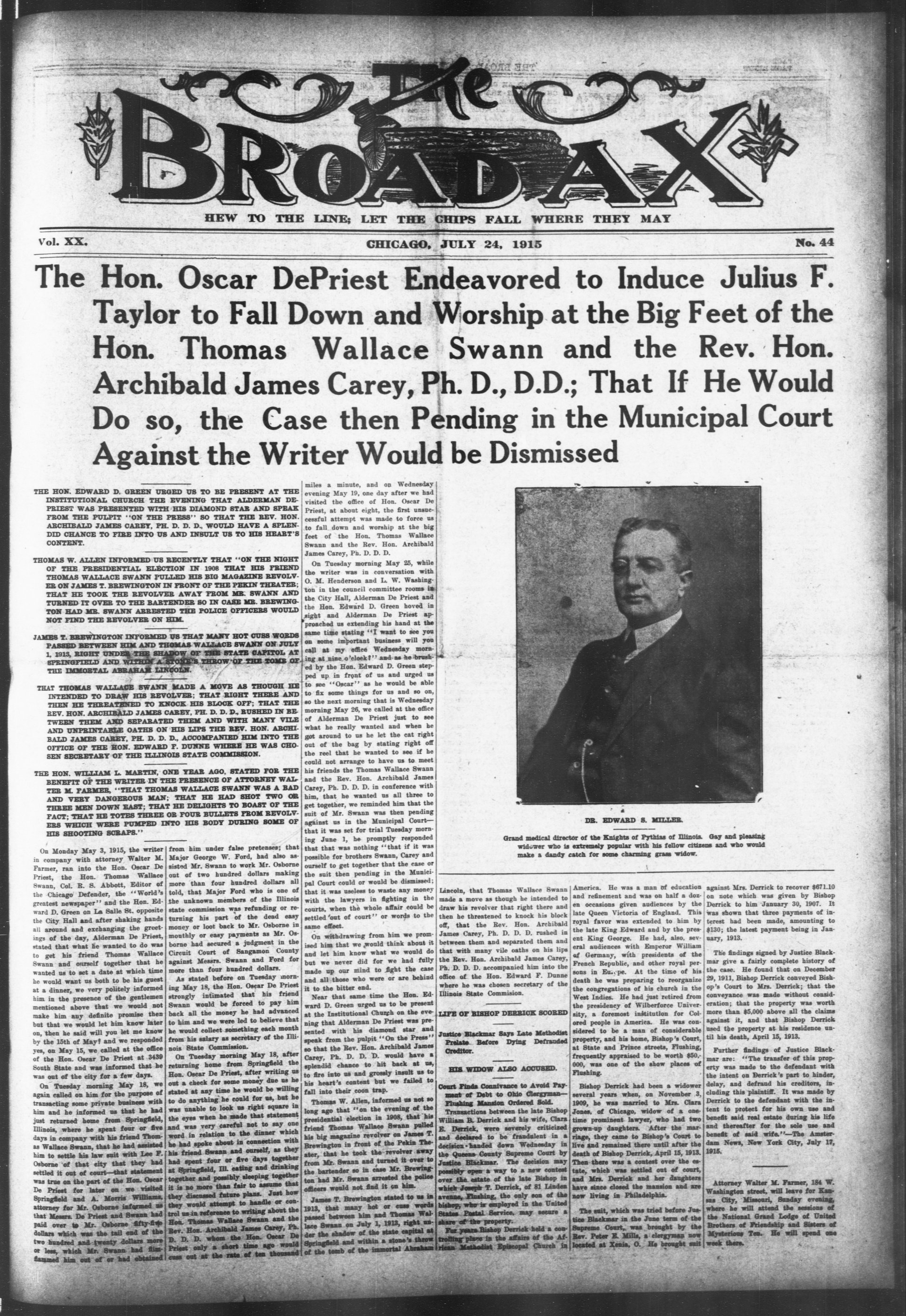
Grand medical director of the Knights of Pythias of Illinois. Gay and pleasing widower who is extremely popular with his fellow citizens and who would make a dandy catch for some charming grass widow.
Grand medical director of the Knights of Pythias of Illinois. Gay and pleasing widower who is extremely popular with his fellow citizens and who would make a dandy catch for some charming grass widow.
Lincoln, that Thomas Wallace Swann made a move as though he intended to draw his revolver that right there and then he threatened to knock his block off, that the Rev. Hon. Archibald James Carey, Ph. D. D. D. rushed in between them and separated them and that with many vile oaths on his lips the Rev. Hon. Archibald James Carey, Ph. D. D. D. accompanied him into the office of the Hon. Edward F. Dunne where he was chosen secretary of the Illinois State Commission.
LIFE OF BISHOP DEERICK SCORED
Justice Blackmar Says Late Methodist Prelate Before Dying Defrauded Creditor.
Court Finda Connivance to Avoid Payment of Debt to Ohio Clergyman—Flushing Mansion Ordered Sold.
Transactions between the late Bishop William B. Derrick and his wife, Clara E. Derrick, were severely criticized and declared to be fraudulent in a decision handed down Wednesday in the Queens County Supreme Court by Justice Blackmar. The decision may possibly open a way to a new contest over the estate of the late Bishop in which Joseph T. Derrick, of 81 Linden avenue, Flushing, the only son of the bishop, who is employed in the United States Postal Service, may secure a share of the property.
For years Bishop Derrick held a controlling place in the affairs of the African Methodist Episcopal Church in
America. He was a man of education and refinement and was on half a dozen occasions given audiences by the late Queen Victoria of England. This royal favor was extended to him by the late King Edward and by the present King George. He had, also, several audiences with Emperor William of Germany, with presidents of the French Republic, and other royal persons in Europe. At the time of his death he was preparing to reorganize the congregations of his church in the West Indies. He had just retired from the presidency of Wilberforce University, a foremost institution for Colored people in America. He was considered to be a man of considerable property, and his home, Bishop's Court, at State and Prince streets, Flushing, frequently appraised to be worth $50,000, was one of the show places of Flushing.
Bishop Derrick had been a widower several years when, on November 3, 1909, he was married to Mrs. Clara Jones, of Chicago, widow of a one-time prominent lawyer, who had two grown-up daughters. After the marriage, they came to Bishop's Court to live and remained there until after the death of Bishop Derrick, April 15, 1913. Then there was a contest over the estate, which was settled out of court, and Mrs. Derrick and her daughters have since closed the mansion and are now living in Philadelphia.
The suit, which was tried before Justice Blackmar in the June term of the Supreme Court, was brought by the Rev. Peter E. Mills, a clergyman now located at Xenia, O. He brought suit
No.44
Julius F. Feet of the Rev. Hon. He Wouldipal Court
Gay and pleasing men and who would
against Mrs. Derrick to recover $671.10 on note which was given by Bishop Derrick to him January 30, 1907. It was shown that three payments of interest had been made, amounting to $130; the latest payment being in January, 1913.
The findings signed by Justice Blackmar give a fairly complete history of the case. He found that on December 29, 1911, Bishop Derrick conveyed Bishop's Court to Mrs. Derrick; that the conveyance was made without consideration; that the property was worth more than $5,000 above all the claims against it, and that Bishop Derrick used the property at his residence until his death, April 15, 1913.
Further findings of Justice Blackmar are: "The transfer of this property was made to the defendant with the intent on Derrick's part to hinder, delay, and defraud his creditors, including this plaintiff. It was made by Derrick to the defendant with the intent to protect for his own use and benefit said real estate during his life and thereafter for the sole use and benefit of said wife."-The Amsterdam News, New York City, July 17, 1915.
Attorney Walter M. Farmer, 184 W. Washington street, will leave for Kansas City, Missouri, Sunday evening, where he will attend the sessions of the National Grand Lodge of United Brothers of Friendship and Sisters of Mysterious Ten. He will spend one week there.
A.
THE COUNTESS OF WARWICK.
The Countess of Warwick, famous though she is for her beauty, has achieved quite as much distinction on account of her various and well directed charities, upon which subject she is as reticent as she is liberal. Two of the objects upon which her philanthropic energies are expended have assumed such proportions as to be beyond the power of concealment. These are the Easton School of Needlework and the Essex Needlework guild, both excellent organizations to aid the poor of England. The countess recently caused much talk by her criticisms of the social "butterflies" who make a pretense of nursing wounded soldiers—in reality posing and hindering the war work.
The countess is an optimist, as witness what she said in an interview not so very long ago.
"The best time of life is always after the age of thirty. Better than that is after forty. The very best time of life is fifty-three, which is my age. I just now am aming the best time I ever had. At eighteen I was a pessimist. Now I know better. And because of what I've learned—by putting my experiences, my knowledge, to the best uses—I, like all women of my age, know better how to enjoy the days that are given to me."
This is what she thinks about the ballot for women: "The ballot in itself means nothing. What prompts the fight for the ballot in England and America is a fight for sex independence, a fight women are making—and which eventually they will win—because woman, given economic independence plus the ballot, will then be started on the road toward her right to exact a recognition of the fact that she is entitled to exercise her God given impulses quite as much as a man is." The responsibility of the United States in the present war in Europe she voices thus:
"It seems to me that the greatest republic of the world has a serious duty, a grave responsibility. It has thriven on a gigantic scale without patronage or privileged classes, without titles, without such honors as are merely honors in name. Freed by the Atlantic from the domination of Europe, it has grown in power and given its citizens a life removed from the worst anxieties that beset the continent. It knows what kingship and unlimited power have cost Europe, and it embraces within its wide domain the children of every European nation, who dwell side by side in peace and amity. The freedom enjoyed by the republic would not be bartered for the wealth of the world, for that freedom is the secret of its eternal youth, its boundless energy, its unframured progress."
It is especially necessary to have looseness in a slip cover. There must be plenty of "give" to it. Otherwise when one sits on it it is apt to burst open, which would be most disconcerting, particularly if it happened to be some one else's chair.
The strip which runs from the extreme top of the chair back down to the seat, across the seat and on down to the required length, should be cut lengthwise of the goods without plecing.
Before cutting it should be tucked well into the crease between the seat and the back. The narrow fronts of the arms are cut separately.
The arm's inner side is cut lengthwise and extends over the roll, under which another seam occurs. The outside of the arm is cut in one with the side of the seat.
The rear side of the chair back is cut in two lengthwise pieces, with the opening up the middle. The back's "thickness" will also need a small piece, extending to the arm. The fasteners are balls and sockets, or buttons and buttonholes, or, in some instances, little bows. The balls and sockets are used for the back openings or for little tabs when seam openings are used.
Hints for Housewives
French toast sandwiches are among the favorite tea room novelties that housewives find it easy to duplicate at home. These sauté slices of bread, put together in pairs, with any preferred filling have the advantage of being adaptable to any of the three meals of the day, while their particular mission is to afford something a little out of the ordinary for the Sunday night tea table or the after theater supper. The occasion must decide what filling is appropriate and whether the French toast sandwich shall be served crisp and dry from the griddle or accompanied by a suitable sauce.
The novelty consists in the fact that after the sandwich is made it is pressed closely together and then dipped in a thin batter made in the proportion of one beaten egg to a half cupful of milk. If the filling of the sandwich is a savory mixture of egg, cheese, fish or fowl, a pinch each of pepper and salt should be added to the batter. If, however, the sandwich has a sweet filling, the batter should be slightly sweetened and flavored with a teaspoonful of sherry. Cook the molested sandwich on a hot, well greased griddle, browning first on one side and then on the other. A shallow iron frying pan will answer the same purpose and olive oil will be found an excellent substitute for butter.
For those who like something more than the ordinary breakfast of fruit, cereal and eggs several variations of the French toast sandwich will be found appropriate to accompany the morning coffee. Flaked salt codfish, made a little less moist than in the popular dish known as creamed codfish, is an excellent filling for a breakfast appetizer of this kind. Half fish and half finely chopped hard boiled egg makes an equally good mixture, or a little finely chopped cold boiled potato may be used. Season well and dip in batter. When thoroughly browned on the griddle serve hot, either with or without a little white sauce.
A particularly appetizing combination, suited to serve at breakfast, luncheon or Sunday night supper, calls for equal parts of finely chopped cold boiled ham and tongue. This should be seasoned with either French or English mustard and moistened with a little cream or rich milk. Lovers of cheese will enjoy a hot cheese sandwich with filling of softened cheese moistened with cream and highly seasoned with Worcestershire sauce and paprika. The batter should also be seasoned, and the finished sandwich when toasted and served piping hot should have much the flavor of a Welsh rabbit. As a simple sweet course at luncheon or family dinner French toast sandwiches with fresh fruit or jam filling will be found delicious.
The story goes that we are indebted to a thrifty housewife for this particular brand of toasted sandwiches. In her endeavor to utilize an oversupply of dainty sandwiches prepared for an afternoon tea the idea occurred to her to brown a few of them on the griddle for her luncheon the next day.
A French Dainty.
Tenderloin and mushrooms is the plain name in this country, but this way of doing the cookery is purely French. Peel six mushrooms and take out the stems. Then drop them for five minutes in cold salted water. Take them out, dry on a fresh cloth and put them in the plait with a teaspoonful of butter. Cover the plait with a saucer or breakfast plate, set it over the blaze and saute the mushrooms for fifteen minutes without uncovering. Then dump them in a hot little vessel, cover that and keep warm until the steak is cooked.
Scrape the tenderloin steak with a knife, rub it over with the cut side of a lemon and put on a faint dust of salt and pepper. Then place the plat with all the mushroom taste and a little of the sauce over the fire and when piping hot put in the steak. It should brown a little on either side, but still be pink inside. When cooked pour the mushrooms back into the pan, add a pinch more of butter if the sauce has dried out, cover the plat, set it in the oven for three minutes and serve at once. As mushrooms draw their own juices, only enough butter to start them cooking must be used when they are first prepared.
Chocolate Cake.
One-half cake of chocolate, one-half cupful of sugar, one-half cupful of milk, one egg yolk and a pinch of salt. Cook in double boiler until smooth. One cupful of sugar, one-half cupful of butter, creamed together well; add two eggs beaten light, one cupful of milk and one level teaspoonful of soda dissolved in milk, two level cupful of flour and one tablespoonful of vanilla. Mix this with the other, beat well and bake one-half hour.
Tomato Eggs.
Beat one-half dozen fresh eggs lightly. Rub one-half cupful of tomato through a colander and mix with the eggs. Stir in one tablespoonful lemon juice, one small onion finely minced, one tablespoonful minced parsley, one teaspoonful each salt and celery salt and a generous dash of sweet paprika. Pour into a double boiler, place over boiling water and stir constantly until thick enough to serve on toasted bread.
THE BROAD AX, CHICAGO, JULY 24, 1915.
CHILD'S DAINTY FROCK.
Printed Blue and White Linen
Trimmed With Plain Blue.
CHIC SUMMER DRESS.
For summer wear is this charming frock of printed blue and white linen, with trimming of plain blue linen. The guimpe and sleeves are of striped batiste. An attractive sunbonnet of plain and printed linen is becomingly worn.
NEW HANDKERCHIEFS
Volle is Now Being Used For These Very Necessary Articles.
The newest thing in handkerchiefs—and there are new things in these accessories as well as in any other—are those of volle. Of course the finest of volle is used for the purpose, so that it will not be disagreeable to use.
One style of handkerchief is of solid pale pink volle and is bound with a narrow white hem. Blue, lavender and green volles are used in the same way.
A number of the handkerchiefs have a very wide border of white around a solid portion of color.
A very unusual decoration of one volle handkerchief is a figure of a woman dressed in street costume and leading a dog. The latter is embroidered in black, while the figure of the woman is embroidered in a combination of gay colors.
Some of the voile handkerchiefs are ornamented solely with a fancy hemstitched border. Such treatment of handkerchiefs adds great value to them, so that the price of one handkerchief is $1 or more. Blocked designs are very prominent in the new voile handkerchiefs. These are separate sections of the material hemsstitched into the corner of a handkerchief. Not only are women's handkerchiefs made of voile. It is used also for men's handkerchiefs, and the colored borders on them are just as gay and attractive as those of the smaller kerchiefs. Of course handkerchiefs of crepe de chine and china silk are still enjoying great popularity.
PIE PLATE AND SHADOW HATS
Odd, Chic and Exceedingly Becoming Are These Midsummer Creations. As the days grow warmer new fashions are launched, but those which do appear are no less attractive and sometimes show greater thought and originality than the features displayed in the fashion festivals at the beginning of the seasons.
Odd, chic and exceedingly becoming are the new ple plate and shadow hats. The ple plate hat has a reasonably large brim, about the edge of which is an upturned frill of plaited malines, giving the appearance of a crinkly ple. The shadow hat is even more fascinating, for it vells at times the eyes. At least it does so when the head is bent. This shadow hat is nothing more than a straight brimmed sailor, the brims of various widths, according to choice, about which is placed a flat fold of malines, black or white. The fold is about two inches in width, and, being placed with its center along the edge of the hat brim, an inch extension of the fold is then upon either side of the brim edge. This makes a sort of little transparent wall about the hat above the edge of the brim and a smooth curtain like band below the edge. The very smartest people are wearing these hats.
Colored tulle is being used for neckwear, the favorite manner of arrangement being a crushed fold of it about the stock collar, ending with a large chon at the back—a reminder of the old Gibson styles. Plaid silk collars and cuffs upon blouses of plain crepe de chine are new and effective, particularly for morning street wear. These plaids are medium in size and appear in many bright colors. They are sometimes made in one with the blouse, but effender, for practical lumbering reasons, are detachable.
AN AFTERNOON GOWN.
Dotted Cream Net Makes a Charming Frock For Summer Femininity.
HANDSOME CREATION.
Dotted cream net combined with hello pussy willow taffeta is the material used in this charming afternoon frock. A deep tunic accordion, plaited and of irregular length, falls over a plaited foundation of cream colored daphne silk. The tunic is finished with two wide bands of the taffeta. The bodice is simple, crossing in surplus effect with a girdle of taffeta, which ascends in a point very high on the right side. Two points of taffeta also trim the back.
ATTRACTIVE SPORT GARMENT.
Yellow and Blue Striped Silk Sweater With Sash of Self Material.
Nothing is more convenient than the lovely silk sweaters which come in the most brilliant shades imaginable. The one shown in the illustration is of bright yellow and sapphire blue, to be
THE FASHION WEEKLY
FOR THE SUMMER PLAYTIME.
worn by a brunette, whose dark hair and eyes will be doubly beautiful with such a setting.
A plain strip of blue trims the front around the sleeves as cuffs and across the pockets. The sash is finished by blue tassels.
Good on Summer Menus.
A green salad served with cheese, nuts or eggs, and a French dressing with whole wheat sandwiches, can be made the main course for luncheon. A cheese souffle served with spinach makes meat unnecessary. Beets stuffed with creamed mushrooms and nuts are delightful, and a ring of mashed potatoes filled with creamed carrots and peas will please the most fastidious appetite. A canape, bisque or purée made of fresh vegetables, or a cocktail made of mixed fruits, is a good beginning to either luncheon or dinner. Desserts should be fresh fruits, fruit ices or gelatin dishes.
Pockets are the proper thing these days, though not always used. The round and square patch pockets are giving place to slot pockets, sometimes back hip pockets in sure enough masculine fashion, while a new patch pocket is cut diagonally in half and stitched along its slanting edge. Sashes, when they appear, are frequently weighted in various ways. That is why rosettes of the sash ribbon are found on the sash accompanying a French creation recently exhibited.
Care of the Baby In Summer
[Prepared by the children's bureau, United States department of labor.]
Most mothers have leared to regard diarrhea as one of the most dangerous ills of babyhood. Thousands of babies die of this disease every year, largely in the hot weather months—a fact which has gained for this illness the common name of "summer complaint." The deaths from this disease begin to increase in May, and the number grows rapidly in June and July and reaches its highest point in August, then decreases rapidly as cool weather approaches. It is prudent, therefore, for mothers to be on guard at the beginning of summer and to do all in their power to prevent the onset of this illness by exercising great care in feeding the baby and by keeping him as cool and quiet as possible. In all illnesses prevention is far better than cure, but this is particularly true with infant diarrhea, because the second attack comes on much more readily than the first. Also the baby's growth is seriously interfered with at a time when it is proceeding most rapidly.
To prevent summer diarrhea in babies first feed the baby on the right food in suitable amounts at proper intervals and in no other way; give him plenty of pure, cool water to drink between meals; keep him out of doors as much as possible in cool, fresh air, dress him lightly and bathe him frequently.
Another important part of keeping the baby well is to protect him from flies and mosquitoes, which frequently carry disease about. It is believed that one form of infant diarrhea is distributed by these household pests.
The healthy baby usually has one or two bowel movements a day. If this number is increased to four or more it is time to take measures against sickness.
It is well to remember, however, that the bowel movements of a baby fed entirely at the breast are normally more frequent than those of a bottle fed baby and that a slight increase in the number of movements is not so serious a matter to a baby at the breast as to one artificially fed. A baby fed at the breast does not usually have diarrhea, and when such a baby shows signs of digestive disturbance it is usually because he is overfed, either he is nursed too often or at irregular intervals, or is allowed to nurse too long at one time. When he does have diarrhea the time between nursings should be increased to four hours, and the times at the breast reduced to five or ten minutes. If the bowels continue loose the breast should be withdrawn entirely for several feedings if necessary, giving the baby instead cool drinking water at frequent intervals. In this case the mother should pump her breasts at the regular nursing times, both to keep them from drying up and to prevent their caking.
Bottle fed babies are the most frequent sufferers from summer diarrhea, and this fact furnishes another strong argument in favor of breast feeding. Diarrhea in a bottle fed baby is also best treated by reducing the amount of food. The bottle should be omitted for eight, twelve or twenty-four hours, according to the severity of the attack, and in place of the milk there should be given as much boiled and cooled water as the baby will take. Food should not be withheld for more than twenty-four hours, without the advice of a doctor. When the bottle is resumed the food should be much weaker than before, water should be substituted for at least half the milk previously given. The milk should be skimmed and the sugar omitted. The return to the former feeding should be made gradually by adding a little more milk each day and beginning to add sugar. The more severe the attack has been the more slowly should changes be made.
If the baby is on "mixed" feeding—that is, partly breast and partly bottle fed—the bottle feedings should be omitted if diarrhea appears and the breast given once in four or five hours, with nothing but drinking water between meals. The children's bureau publishes a pamphlet called "Infant Care," which is sent free to any one sending a request to the chief of the children's bureau, United States department of labor, Washington. This pamphlet contains some simple directions for the care of the babies in summer, which may help the mother to prevent summer diarrhea and other ailments of infancy.
It should be understood that whenever possible the baby should be put at once under the care of a doctor. If the mother in the city has no physician she should take her baby to the nearest infant welfare station, where she will be well advised as to his care.
Since the country mother does not usually have access to an infant welfare station and is frequently far away from a doctor, she should use every effort to keep the baby well, but if serious diarrhea occurs a doctor must be procured without delay.
To Clean Sinks.
Coal oil will clean badly discolored enameled sinks or bathnubs and also will remove fresh paint stains.
For Young Folks
Esther Morris, Handsomest Baby
In Staten Island, New York.
Photo by American Association
Recently in the borough of Richmond, a part of the city of New York, which comprises all of Staten Island, situated in New York bay, there was held a great baby show. Hundreds of little ones from all over the borough were entered for the various prizes. There were many prizes offered for the fattest baby, the most beautiful, the healthiest, the largest for its age, for the tallest and for the shortest, and all the classes were well filled. The charming little miss who captured the prize for beauty is shown in the accompanying picture holding the cup that was awarded her. Among so many handsome children it must have been a difficult question for the judges to decide. But they one and all agreed that Miss Esther Morris was worthy of the high honor. As you can see by the picture, Miss Esther is a young lady of exceeding beauty, but she is altogether to young to care about that, but was highly pleased with the handsome prize.
Paper and Pencil Games.
When your friends come give them each a paper and pencil and see how many can write the correct answers to these questions:
Name a battle found in every farmyard?
Name an uninhabited battle?
Name in tumbledubbatte battle?
Name a battle unpleasant to bare-
foot boys?
Name two battles that are found in a
forest?
Name a good luck battle?
Name a suspended battle?
Answers: Cowpens, Wilderness.
Stony Point. Fair Oaks and Seven
Pines. Horseshoe. Brandywine. Look
out Mountain. Fort Pillow. Princeton.
Rich Mountain. White Plains.
Suspended Rock.
"Fool Monkey."
In this as in so many games it lends ease if the players sit in a circle and select a leader. The leader then starts the game by naming an animal whose name begins with "A," as "antelope." The player on his left at once takes this up and adds to it another animal, the name beginning with "B," saying, "Antelope, bison," and passing the turn to his left hand neighbor, who repeats the list, adding, say, "Camel" for "C." And so it goes on, soon becoming a serious tax on the memory and alertness of the players.
Whoever bungles the catalogue or fails to find an animal with the letter for which he or she is responsible is hailed in mockery as "sool monkey," and this name must be mentioned by succeeding players instead of the animal which the delinquent ought to have uttered but muddled.
Experience shows that the ranks of the "fool monkey" will soon be well filled.
Interesting Bird Items:
Birds seen eating army worms were Robins, catbirds, meadow larks, chewinks, thrushes and wrens. In Germany the owners of vineyards are encouraged by their government to distribute nesting material and erect birdhouses in their vineyards to attract feathered foes of insect pests. The swiftest bird is said to be the frigate bird. This bird is able to fly, under favorable conditions, 200 miles on hour.
Earliest Watches.
Some of the earliest watches were made in Nuremberg. Their shape was almost round, and they were called "Nuremberg eggs."
Why the Owl Is Wise.
"As wise as an owl," my father said
One day while talking to Uncle Ted.
Now I've thought and thought about that speech.
And every time I hear one screech
I say to myself, "As wise as an owl."
And wish that I at night might prowl
So I could learn to be as wise
And see as much with my wee eyes.
And that is why the grownup says,
"As wise as an owl"—tis as plain as day,
—Philadelphia Record.
One effect of the ravages of war has been a call from Europe for American artificial limbs. One of the leading American manufacturers of artificial limbs recently returned from a trip to England and France, having been invited there to confer with leading surgeons, and his report agrees with those of the United States department of commerce, which indicate there is now a tremendous opening in the European markets for legs and arms made here. England, France and Russia have not enough makers of artificial limbs in their dominions to supply 10 per cent of the number required. It is generally admitted—in fact, there is no question about it—that the
A man climbs a ladder.
Photo by American Press Association.
AUSTRIAN SOLDIER GETTING ACCUSTOMED TO NEW LIMBS; HE HAS LOST BOTH HANDS AND FEET.
American made artificial limbs are the best in the world. The demand in this country has been on the increase in the last century, and the American who loses a leg refuses to go on crutches for a long time.
French surgeons realize that the French maimed can be better equipped and more fully restored to their ability to resume their former functions by American artificial limbs than by any other kind. French soldiers who are thus supplied will be able to return quickly to their homes, while those who choose to remain in the service can perform clerical work, taking the places of ablebodied men, who will thus be released for the front.
It has been suggested that each hospital in France appoint as many surgeons, nurses or wardens as possible to measure the soldiers for artificial limbs and send the measurements to the United States and when the limbs are sent over to have the same measurers adjust them. Neither measuring nor fitting is difficult, as full instructions are issued.
HINDENBURG'S CARPET.
Turkish Admires Give Him One In
Map of East Prussia Woven In.
A translation issued by the German information service concerns the presentation of a remarkable carpet to Field Marshal von Hindenburg. It reads: "The city of Konia, in Asia Minor, recently presented Field Marshal von
MILITARIA
Photo by American Press Association.
Hindenburg with a magnificent carpet. On it is woven an exact map of East Prussia, the seat of the field marshal's great victory. In the left corner of the carpet, surrounded by a laurel wreath, is a portrait of Hindenburg, and below is an inscription in German and Turkish containing the words. To his excellency General Field Marshal Paul von Benckendorf and von Hindenburg, to express thanks for the great victorious battles at the Masurian lakes, presented by the inhabitants of Konia, in Asia Minor."
John Mund of Kansas City claims Andrew Carnegie has owed him $1 for fifty-one years.
Sir Charles Frederick Fraser, who was made a Knight of the Bath on the birthday of King George of England, has been for many years a foremost figure in Canada in the work of educating the blind.
Max Bruch, the German composer, who on his seventieth birthday in 1908 declared, "I shall write no more, for the source of my inspiration has dried up," has just completed, in his seventeenth year, a new work, a concerto for two pianos and orchestra.
Colonel L. Mervin Maus, who has been automatically retired owing to age, was a member of the medical corps, with a longer term of service to his credit than any other man in the active army. He entered with the class of 1874, and out of that class and the succeeding one there are no other survivors.
Frank W. Crilly, chief gunner's mate, who recently set a world's record as a diver by locating the submarine F-4 in 288 feet of water at Honolulu, has a fine naval record of fifteen years, beginning as a naval apprentice and serving on the United States steamship Georgia and other ships. He is twenty-seven years of age and was born in Trenton, N. J.
Echoes of the War.
It isn't the initial cost of war; it's the upkeen—New York Tribune.
In the European war, instead of there being glory enough to go 'round, there is not much glory for anybody.—Washington Star.
Spain now is said to have the war fever. There seems to be no effectual quarantine against that disease.—Detroit Free Press.
And still there are little nations that consider sitting on a barbed wire fence much safer than dashing headlong into barbed wire entanglements.—Atlanta Constitution.
Jane Addams found that the rulers of Europe were adamant for war, but that the people were longing for peace. There is no reason to doubt it, and much for believing it.—Pittsburgh Dispatch.
Fashion Frills.
After wearing a straw hat a week or two one wonders why he wasted so much time selecting it.—Nashville Banner.
The wearing of furs in the summer may be followed with discarding shoes and stockings in winter.—Milwaukee Sentinel.
In these days of freak gowns you can't tell just by looking at her back how old a young thing of sixty-five is.—Philadelphia Inquirer.
A whole lot of girls would like to know if there is ever coming a time when silk stockings will be sold under a mileage guarantee like automobile tires.—Louisville Courier Journal.
Recent Inventions.
A new chair for invalids is equipped with a system of mirrors by which the occupant may see what is going on all around without the necessity of moving the head. An S shaped hook that can be folded for carrying in the pocket has been invented to enable a person to hang up his hat and coat in almost any place he may so desire. Two New York inventors have pattened machinery to cut coal in a mine, pulverize it and mix it with water and pump it to any desired destination, where it would be dried, the idea being to save costs of handling and transportation.
BRIGHT BRIEFS.
Fighting in the Alps has not put war on a higher level.
Hard work is the stuff that makes day dreams come true.
It is possible for a man to be a failure without having failed.
The "has-been" can never make a return trip while nursing a grouch.
Mistakes are stepping stones upon which some people step upward and some downward.
What is called overwork is largely failure to make proper use of the time available for rest.
At the rate it is going on the looting of Mexico City must soon come to an end automatically.
This country is on the last lap now of the four year interim between national conventions.
One of the hardest things in the world for a failure to understand is the success of others.
It would be better for some persons if they had to have credit in order to be able to borrow trouble.
Probably the most wily of all naval tactics would be to cut the Dreadnoughts down to submarines.
An oculist says cigarette smoking spoils women's eyes. It also spoils the odor of mignonette and lily of the valley.
The reason a woman considers that her age is nobody's business is because she knows somebody who would like to find out how old she is.
THE BROAD AX, CHICAGO, JULY 24, 1915
THE TRAGEDY OF BLIGHTED POLAND
Crushed Between the Forces of Austro-Germany and Russia.
BELGIUM was invaded; Poland is almost obliterated. Belgians were chased from their homes by war's alarms and fled to friendly refuge; Poles have been driven from their homes of centuries and fled into the muzzles of another foe coming from the opposite direction. Like hunted rabbits, not knowing whither to turn, they have lain down to die. Poland is less than a name. It is hardly an idea. It is the one great scar on Europe, the reminder of the most awful tragedy that the modern world has seen.
The blackness of despair has settled like a pall over that corner of Europe where contending armies have surged this way, then that. Caught between the upper and the nether millstones Poland has been the one to suffer. Whichever way the battle has gone always Poland has been the loser. The fortunes of war may vary for the battling armies, never for Poland. There is no Poland practically. Four thousand square miles have been swept as bare as they were the morn after the creation. There are eleven provinces wedged in that corner between Russia and Prussia and Austria, provinces with strange sounding names, and only one, Siedlce, has escaped destruction. Two hundred cities and towns and 9,000 villages have been destroyed, and 5,000 villages have been razed to the ground, absolutely razed, with not one brick left on another.
And the dead! Who has kept toll of the thousands on thousands who have gone staggering to their deaths in these
1
past mouthes in Poland? The shallow graves of those fortunate enough to have graves are not enough to shield them from the air. The warmth of summer is contaminated with the unbearable stench. They pollute the wells. Diseases stalk through the bare lend.
Starvation hovers over the land. Western Poland has produced half a billion dollars' worth a year of farm products. This year nothing. Three million people who have earned their bread in industrial centers are starving, and starving in Poland is no figure of speech; it means starving, being actually devoid of food, living on roots of trees, bark, carcasses of horses killed in battle, whatever they can find that they can put their teeth in. Eastern Poland, the part Russia claims, has sustained a material loss of $700,000,000, which takes no account of the loss by death, merely the houses and farms and factories that have been razed "for strategic reasons."
And Galicia, the part of Poland Austria claims, has suffered still more. There the battle has waxed hottest. Its 32,000 square miles and 8,000,000 population have been swept this way and that. Its hundreds of cities and towns and 6,000 villages have suffered cruelly, while 2,500 villages have absolutely disappeared from sight "for strategic reasons." Its $200,000,000 farm produce and $100,000,000 industrial products have disappeared. Its 800,000 horses and 1,500,000 cattle are gone.
But what do figures tell? You cannot estimate the destruction of a nation in figures. Human suffering cannot be told in dollars and cents. A mother wailing for her young cannot figure the loss in rubles and kopecks.
The contrast of Poland today with the Poland of the past is one of the greatest tragedies in history. Less than 250 years ago, when Russia was but a loosely organized country of semibarbarous peoples, half Tartar; when Prussia, which today holds the hegemony over all the Germanic states that constitute the present German empire, was but a tiny and semibarbarous principality and a vassal to the kings of Poland and Austria a petty archduchy—the East Mark of the Hapsburgs—on the banks of the Danube, there stretched in east central Europe over an area of more than 300,000 square miles the country of Poland, numbering about 25,000,000 inhabitants.
There was no nation at that time in Europe that possessed such a large area of territory, and there is none at present except Russia. Poland at that time occupied the foremost rank among the nations of Europe and for centuries was the bulwark of Christendom against the barbarous Turks.
Zenobia Leaster of Baltimore at eighty boasts of rope skipping ability. Mrs. Helen Gould Shepard has an income said to be well over a million a year. Miss Mabel Guppy, an English girl who has been teaching English in a Japanese school, has resigned her position to become a Buddhist nun. Mrs. Elizabeth C. Pattillo of Atlanta, Ga., is the first blind pupil in the history of the Peabody Conservatory of Music to receive the Peabody diploma. Miss Louisa Lee Schuyler, who for nearly sixty years has been helping the needy in New York city, has recently had the degree of doctor of laws conferred upon her by Columbia university.
Miss Mary Garden, the opera singer, is of Scottish extraction and has a pretty wit. When asked if a woman of the world could dress on £250 a year she promptly retorted, "It may be possible, but what's the use?"
Town Topics.
St. Louis astronomers report seeing new sun spots. Since when have they had a chance to get a good look at the sun?—Detroit Free Press.
Professional pride in New York is evoked by a rogues' gallery that is called the finest in the world. It could hardly be made so without material.—New York World.
"Chicago tells the truth about herself," declared the ad. men in convention assembled. How does Chicago manage to do that and get it through the mails?—Cleveland Plain Dealer.
Reading insists that unescorted young women must not be on the streets after 10 o'clock at night. This should be no trouble in a town where all the girls are so pretty that they can have as many escorts as they like.—Philadelphia Press.
PITH AND POINT.
Remember the longer you live the older you get.
The polite term "casualties" covers a multitude of horrors.
Tomorrow is the date of things that are never accomplished.
In Mexico bullets are regarded as a necessity and bread as a luxury.
A new affliction has been discovered—the automobile eye. Keep it peeled.
About the only person who likes the candid truth is the person who tells it.
Taking a flier continues to be more dangerous in Wall street than elsewhere.
It is all right to follow your inclinations if they are going in the right direction.
Many a man who has a steady aim in life forgets to pull the trigger at the right time.
The war has rid England of her tramps. Which may be considered one of the very least of her deprivations.
Among the few compensations of war, scarce enough at best, is the report that it has endangered Monte Carlo's bank.
Nearly every day some fact leaks past the war censors, which indicates that future historians will have plenty of interesting material.
The human has the strange trait of being willing to play a game of rules or go by rules in business. Yet he will violate rules that control his very existence.
Tales of Cities.
Buffalo will stage an industrial show in September and October. In all buildings in Cologne except separate residences of not more than two stories concrete or iron stairways are required by law. The full title of Los Angeles was in Spanish times Pueblo de Neustra Senora la Retina de los Angeles, or City of Our Lady the Queen of the Angels. The average rent paid for New York city tenements and apartment houses built within five years amounts to $146 annually for each person living in them.
The Royal Box.
Emperor William possesses 324 decorations.
King Constantine of Greece is known as Tino in his family.
Queen Mary of England, writing in a confession album, records that the quality she most admires in a man is that of modesty.
King Victor Emmanuel of Italy as a youth was a weakling, but he has grown to be a fairly strong man, although he is the smallest living monarch, his height being five feet three inches in his boots.
Train and Track
The railroads of the United States carry more than 1,000,000,000 passengers a year.
An all steel caboose, the first of its kind ever built, has been put into use by the Pennsylvania railroad.
China has almost 6,000 miles of railroads open to traffic and more than 2,000 miles under construction.
The projected government railway for Alaska is to run from Seward to Furbanks, a distance of 412 miles.
Retires From Presidency of State College of Washington.
Dr. E. A. Bryan, for twenty-two years president of the State College of Washington at Pullman, is about to retire from that office to accept the presidency of the American Association of Agricultural Colleges and Experimental Stations. The latter is a comparatively new and powerful organization of educators and scientists, whose influence in agricultural matters is felt throughout the country. The resignation of Dr. Bryan calls attention to the remarkable work he has performed during the twenty-two years that he has filled the office of
THE BANK OF THE UNITED STATES
DR. E. A. BRYAN AND THE MECHANIC ARTS BUILDING.
president of the State College of Washington. There is not a building now on the campus that was standing when Dr. Bryan arrived in 1893, and any real agricultural experiment station had scarcely begun. The college now has several fine buildings, notable among which is the hall of mechanic arts, and there are two other large buildings now in the course of erection.
But a greater monument than the college buildings to the achievements of Dr. Bryan is the notable work that has been accomplished for the advancement of agriculture. The introduction of corn, red clover, alfalfa and the college "wheat hybrids" into Washington state farming is an achievement whose value is hard to calculate in dollars and cents.
MASCOT OF A WARSHIP.
Animals Show a Ready Adaptability to Their Surroundings. The adaptability of animals to their surroundings is quite remarkable. It is reported that birds in the war districts of Europe have accustomed themselves to the roar of artillery and are no longer disturbed by it. The illustration shows a cat, the mascot of a
1
warship, which has made a resting place in the breech of one of the big guns of a British Dreadnought in the Dardanelles. The cat seems entirely oblivious to war or to the consequences its resting place might entail. Doubtless a friendly sailor will give the cat due warning should the gun be brought into action. A cat may have nine lives, but it could hardly survive a flight in the company of screening shells.
PAGE THREE
A great many men avoid doing wrong by being so lazy.
War is another thing that ought to be taken out of politics.
The rule is that a good deal is taught and mighty little learned.
It is better not to be too indifferent. If you don't care no one else will.
Of course blowing up the capitol would be an obvious way of ending the war.
So far the submarines haven't put the floating national debts out of business.
The successful man is one who is on the job when the main chance comes along.
Comets will have to develop more than two tails to attract the notice of a world on fire.
Some men climb up in the world, and a lot more remain at the bottom because the elevator isn't running.
Holt's trunkful of dynamite suggests an inquiry into the possibilities of buying the deadly article without suspicion or restraint.
People who are staying at home this summer for the first time begin to realise how vast are the dimensions of the United States.
The statement that a man is at his best at twenty-nine will be accepted without question by all who have just arrived at that age.
The state department is said to have evidence that American passports are being manufactured by the wholesale in Holland. There's a home industry that ought to be protected.
Short Stories.
The use of footlights in theaters originated in Italy.
North and South America have together an area of about 15,000,000 square miles.
United States and Canada life insurance companies last year paid death and other claims aggregating $686,700,000.
Tungsten, which only in recent years has come into general use, was discussed exhaustively in a Spanish treatise written in 1781.
Point Hope, Alaska, which is in darkness during the long arctic winter, will soon have an electric plant. Storms along the coast will be harnessed by windmills to produce the electricity.
Flippant Flings.
They don't have any Who Is Who in Mexico, for nobody knows who it is.—New York Sun.
A janitor of Newark, N. J., claims to be the grandson of George IV. of England. One has long suspected that janitors were of royal descent.—Cleveland Plain Dealer.
The 100 odd years' old relic in Independence hall is not the only Liberty bell to take western trips. There is the divorcee—our twentieth century liberty bell.—Philadelphia Ledger.
A Minnesota professor says that marrying the second time is like buying another book by the same author. Not exactly. In books the happy ending is almost a certainty.—Detroit Free Press.
Current Comment.
"Sulicide is confession." In Holt's case it was also conviction and execution.—Philadelphia Ledger.
Recognizing a Mexican government is a good deal like identifying a tooth on a buzz saw.—Boston Transcript.
You can now send a letter to the Dutch West Indies for two cents. You may not want to send a letter there, but it is pleasant to know that Uncle Sam has made all the necessary arrangements.—New York World.
A Chinese typewriter has been invented, patterned after one of the machines of western civilization. At last, then, there is something—that China doesn't claim to have seen first thousands of years ago.—Albany Journal.
Pert Personals.
Old Vic Huerta can't seem to break himself of the habit of loving trouble.—Detroit Free Press.
Mrs. Pankhurst wants to help make ammunition. Lloyd-George might let her try her hand on a few biscuits.—St. Louis Globe-Democrat.
It is Genevieve Clark's unique distinction that she is probably the only woman who ever had 5,000 invited guests actually see her wedding.—Pittsburgh Dispatch.
Maurice Renaud fights as well as he sings. He has now gained another promotion, to the rank of sublieutenant, for conspicuous gallantry in action.—Philadelphia Ledger.
Flower and Tree
Slam produces a seedless grapefruit.
A spreading oak tree sixty feet high has about 6,000,000 leaves.
Slam has three kinds of trees each of which produces arboreal cotton.
It is believed that Brazilian coconut palms will live from 600 to 700 years.
Roses seem to be the most popular flowers in every country. They are grown in gardens all over the world to a greater extent than any other flower.
FOUNDATION WORKS:
Will promote and use all of these articles
these publications in Dissertations, but
Calibration, Preparation, Prentice, Intelligent,
Sigma Sigma, Baggage, or anyone else
can have their say, but let us our language
to people and responsibility is fixed.
The Brand Ax is a newspaper whose
platform is broad enough for all, ever
elimining the editorial right to speak its
own mind.
Local communications will receive attention.
Write only on one side of the paper.
Subscriptions must be paid in advance.
One Year.....$3.00
Six Months.....1.00
Advertising rates made known on application.
Address all communications to
6532 ST. LAWRENCE AVE., CHICAGO, ILL
PHONE WENTWORTH 2597.
JULIUS F. TAYLOR, Editor and Publisher
Entered as Second-Class Matter Aug. 18,
1903, at the Post Office at Chicago, Illinois
under Act of March 8, 1879.
REMOVAL NOTICE
From on and after this date, all letters or other mail matter intended for Julius F. Taylor or Mrs. Annie E. Taylor or The Broad Ax, should be addressed to 6532 St. Lawrence Ave., Jackson Park station. Phone Wentworth 2597.
HEALTH NOTES
The household cat is a menace to health. It is now well known that contagion and infection of various kinds are carried and spread by feline pets. Cats are, it is believed, more of a menace in this way than dogs on account of their nocturnal habits. Everybody knows that the house cat, unless most carefully watched, will disappear for days at a time; but it always returns. Hence the saying, "the cat came back."
' The important thing, however, is to know where the family pet has been, and just what particular brand of disease germs it has brought home. Children love pets and as cats are domestic, it is always within the probabilities that during Tom's disappearing periods he may be domiciled in a home where there is a case of scarlet fever or diphtheria, or maybe nothing worse than measles, mumps or whooping cough. But even those so-called minor ailments are often quite serious in their effects and are not to be desired under any circumstances. The idea so many parents have, that it is better for their children to have the diseases so common to child life as soon as possible and as they say, "be over with them," is a mistaken one. It is a serious error to assume that children must have a long list of diseases before they are grown up. The facts are they should not have them at all, for the reason that most of them, if not all, are preventable. So it is pretty certain that our feline friends, innocently enough so far as they are concerned are oftentimes real and dangerous enemies to the health and safety of our children.
Dogs, too, are dangerous, though perhaps to a less extent than are cats, as cases of both scarlet fever and diphtheria have been traced directly to dogs that were on friendly and visiting terms with several families in the same neighborhoods.
Modern city life does not afford either safe or favorable conditions for the keeping of animal pets. It is neither fair to the pets nor to the people who harbor them. The modern living apartments are not adapted for the common housing of dogs, cats, canaries and human beings under the same roof; and besides being a menace to health, they are nearly always a source of annoyance to those apartment dwellers who are averse to pets of this kind, and who are compelled to complain to the authorities to have them removed.
It is a good plan, therefore, to try and worry without dogs and cats as a part of the household.
SOMERODY
Somebody helped in saving me,
Somebody helped save you;
We can help in saving some baby.
What will somebody do!
Not all babies that are sick are underfed. Very often it is the overfed baby that needs the doctor's care. Overfeeding is as dangerous as underfeeding. Babies should not be "stuffed." They should be fed at regular intervals and when signs of stomach disturbance appear, it is wise to cause feeding anything but barley water until the stomach becomes normal. If improvement does not follow within twenty-four hours it is wise to call your family physician.
NOTES ON RACIAL PROBLEMS
Reported by the National Negro Bus
Unions League.
This Danville (Virginia) Laws and
Investment Company is capitalized at
$65,000. The corporation owns pro-
perty valued at $40,000 and have made
loans to the amount of $13,000. E. H.
Adams is president and J. H. Wilson,
secretary and treasurer.
Messrs. E. T. Prichett and W. H.
Wilson of Danville, Virginia, are
successful merchants and real estate
dealers said to be worth about $30,000.
W. Howlett Jones, 207 Main Street, Danville, Virginia, has had twenty-five years experience as a baker and manufacturing confectioner, and has successfully held his own against all competitors in the city. He easily does a business of $25,000 annually.
The Norfolk Aid and Investment Company, 516 Queen Street, Norfolk, Virginia, recently held a meeting and decided to combine with the Local Negro Business League and become a branch of the National organization. The merging of the two organizations has very greatly increased the strength and widened the influence of the Local League. Rev. J. A. Handy in the president.
The Brown Savings Bank of Norfolk is in a very healthy condition. E. C. Brown is president and William M. Rich, cashier. Starting six years ago, its total assets in 1909 of $10,434 has increased to $67,827.09 in 1914, which is being added to from twenty to thirty thousand each year. The Christmas Saving Club feature is very popular. In 1914 the bank paid to the depositors in this club the sum of $23,000. At the rate the members of the club are now making weekly deposits, the outlook is favorable for the return of $100,000 the forthcoming Christmas week to the fortunate depositors.
. . .
The newspaper and job printing establishment of the "Journal and Guide" "The Newport News Star" and "The Planet" of Richmond, Virginia, are about the most complete businesses of its kind owned by the race in the United States. The pay-roll of the "Journal and Guide" is about $700 per week. Messrs. A. B. and H. C. Young, president and secretary respectively, as well as editor and associate, are experts and know what to do to succeed in the difficult field of journalism. Col. Matt Lewis, the owner and editor of the "Star" at Newport News, also has his paper on a substantial basis and a balance on the ledger in its favor at the end of the week.
John Mitchell, Jr., editor of "The Planet" has recently installed in his plant a new No. 14 Linotype, the latest creation of the Mergenthaler Linotype Company, of New York, and the first machine of the type to be introduced in this district, comprising Delaware, Maryland, Virginia, West Virginia and North Carolina. It has a range of adjustibility hitherto unattained in a machine with such new complicated parts. It makes and sets the type for both straight matter and job work.
Nowhere else in the country towns of Virginia are there to be found Colored merchants handling a larger percentage of the business in town and surrounding country than in Kembridge. The Mercantile Co-operative Stock Company is doing a live and extensive business. The company owns a commodious brick building 30x70 in a good location on Broad Street and it contains a well selected stock of merchandise; every shelf is crowded. Messrs. C. C. Carrington, president; C. W. Cralle, secretary; J. A. B. Cralle, treasurer, are men of broad experience and real business capacity. It would be hard to find three men more competent and better qualified to handle big business than these men. The possibilities of this company are very great.
The Cralle brothers also conduct a successful dry goods business, carrying the best and finest fabrics, including ladies and gents furnishing goods. The Colored people of Virginia pay taxes on real and personal property to the amount of $34,743,656. They pay taxes on personal property and real estate in the city of Richmond to the amount of $3,180,662. At the close of the Civil War they were practically penniless.
ST. THOMAS' ANNUAL BOAT EXCURSION will go out on Wednesday, August 4th, 1915, on the commodious steamer, "City of Benton Harbor." The management has arranged for the boat to be at the Graham and Morton Dock at 8:15 to avoid the rush of last year. Boat leaves at 9 o'clock promptly. Tickets for trip, 50 cents.
NOTICE
Barber shop for sale, splendid location, well equipped. In first class condition. If you want a good bargain call and see me. 5618 Lake Park Ava.
THE BROAD AX CHICAGO, JULY 24, 1915
ETHIOPIANS IN ANCIENT TIMES
GREEK AND ISHREW SCHOLARS
SUNG THEIR VIRTUES
Book by the Late Edward Willnot Blydon Gives Many interesting Facts
About the Achievements of the Ancestors of the Colored Race in the
The Hon. A. L. William Harper, Ave. has taken up dance in the second ward, political sensation of the san Big Fellows, are getting awful. The fellows who have had their own way are asking the question "What does Well I can answer that quen Brethren of the 2nd
United States.
In his book entitled "Islam Christianity and the Negro Race" the late Dr. Edward Wilmil Blyden delved deeply into both sacred and profane history, showing that Africans were not unknown to the writers of the Bible. Their peculiarities of complexion and hair were as well known to the ancient Greeks and Hebrews as they are to the American people today. And when they spoke of the Ethiopians they meant the ancestors of the people of black skin who for 250 years have been known as laborers on the plantations of the south.
It is to these people and to their country that the psalmist refers, when he says, "Ethiopia shall soon stretch out her hand unto God." Of the hospitality and kindness of Africans he writes: "And this peculiarity of Africans is not a thing known only in modern times. The ancients recognized these qualities and loved to descent upon them. They seemed to regard the fear and love of God as the peculiar gifts of the darker races. In the version of the Chaldean Genesis as given by George Smith the following passage occurs: 'The word of the Lord will never fail in the mouth of the dark races whom he has made.'"
Homer and Herodotus have written immortal eulogies of the race. Homer speaks of them as "the blameless Ethiopians" and tells us that it was the Ethiopians alone among mortals whom the gods selected as people fit to be lifted to the social level of the Olympian divinities. "Every year," the poet says, "the whole celestial circle left the summits of Olympus and betook themselves for their holidays to Ethiopia, where in the enjoyment of Ethiopian hospitality they sojourned twelve days. Lucian represents a skeptic, a free-thinker, of his day, as saying in his irreverence toward the gods that on certain occasions they do not hear the prayers of mortals in Europe because they are away across the ocean, perhaps among the Ethiopians, with whom they dine frequently, on their own invitation." It shows the estimate in which the ancients held the Africans, that they selected them as the only fit associates for their gods.
The country itself has been called the cradle of civilization, and so it is. The germs of all the sciences and of the two great religions now professed by the most enlightened races were fostered in Africa. Science in its latest wonders, has nothing to show equal to some of the wonderful things even now to be seen in Africa.
On African soil stands that marvelous architectural pile, the great pyramid, which has been the admiration and despair of the world for a hundred generations. Scientific men of the present day, mathematicians, astronomers and divines, regard it as a sort of key to the universe—a symbol of the profoundest truths of science, of religion and of all the past and future history of man.
HYDE PARK NEWS.
By L. W. Washington
Notification of the Pastor of Hyde Park A. M. E. Church, that this would be his last quarterly conference, will no doubt bring out every member for services Sunday. Dr. Cook the presiding elder is expected to preach morning and evening, and some of our prominent ministers in the afternoon. All members of the Chair. Officials and friends are specially invited to attend all of these services.
The Hyde Park Lodge's Day Club's concert increased their Rally Fund from $33.50 to $53.50. Mrs. Clarence Kennett was in charge of the concert, which was so successful. The men have not reported yet.
---
Last Sunday afternoon I visited Jackson Park. Covered it pretty thoroughly and found about 10,000 White persons out there enjoying and taking into their lungs the fresh air with all of its purity, and only 36 Colored was to be found. Let the Women's clubs urge upon our women the benefit of giving their children the advantages of our Beautiful Park system during these days of vacation times. Let these natural gardens be your summer resorts, save the children and the babies.
The Christian Endeavor was lead by Mr. Watkins of South Chicago. A splendid service was held. Rev. White and the writer addressed the meeting. Next Sunday Mrs. D. D. Lacey will lead the services.
The Hon. A. L. Williams of 5548 Harper Ave. has taken up his rest dance in the second ward. He is the political sensation of the same, and the Big fellows are getting awfully busy. The fellows who have had things all their own way are asking themselves the question "What does it mean Well I can answer that question for you Brotheren of the 2nd ward. It means, that you fellows, who have had things all your way have the biggest job before you, to beat him, that you ever saw. If you don't believe it, then wait and see. The political complexion of the 2nd ward map, will be changed just as sure as you are a foot high. Williams will do that thing. He will.
Prof. James Davis of Kansas City, Kansas is here under the care of Dr. G. C. Hall. He is now convalescing nicely. We had quite a social chat in the park. The Broad Ax wish for him a complete recovery.
Mrs. Leach wishes to thank Lady Elliots court, for the beautiful flowers they sent her during her bereavement.
ST. MARK M. E. CHURCH.
Memorable in the history of the Churches of Chicago, Sunday, July 18th, will ever be; Memorable in the records of the achievements of a congregation organized just 20 years ago with seven members. Memorable for the contribution to the moral and religious life which the opening of and dedication of the largest church in the city among our people. St. Mark entered into their new church last Sunday with one of the grandest programs ever offered in Chicago. The pastor the Rev. John W. Robinson preached the first sermon at 6 A. M. and administered the Sacrament to a large number of worshippers. The sermon by Bish. W. F. McDowell, was a master piece. The dedication service proper took place at 3 P. M. Promptly at 2:45 led by the choir St. Mark marched into their New Church singing "Onward Christian Soldiers" The Rev. Dr. G. A. Bryant walked with the Pastor as did Revs. H. M. Carroll and Peters. Bishop Isiah B. Scott of Monrovia Liberia Africa, preached the master discourse of the day. He used as his text "Blessed is the Nation whose God is the Lord."
The Solo by Mrs. F. L. Washington, was superbly rendered. The Silver Star Quartette and St. Luke Choir rendered excellent service. The address by Rev. W. S. Bradley and H. M. Carroll were very inspiring.
The Rev. Chas B. Mitchell, St. James M. E. Church, preached at the Evening Service he used as his text "We Cannot but Speak."
Total raised in dedication rally amounts to more than $5,000.
Next Sunday morning Mr. W. B. Williams popular basso will sing at the Morning Service.
Come and worship with us.
THE KNIGHTS OF PYTHIAS OF ILLINOIS HELD HARMONIOUS SESSIONS AT LOVEJOY, ILLINOIS.
The Grand Lodge of Knights of Pythias of Illinois, held its 24th annual session, last week, at Lovejoy, Illinois and the following officers were elected for the ensuing year.
Grand Chancellor, Dr. Allen A. Wesley, Chicago, Grand Vice-Chancellor, Otis B. Duncan, of Springfield, Ill., Grand Keeper of records and seals, Frank B. Waring, Chicago. Grand Prelate, W. O. King. Grand Master of Exchequer, Major Robert R. Jackson, Chicago, Ill. Grand Medical Director, Dr. Edward S. Miller, Chicago. Grand Attorney, R. A. J. Shaw, Chicago. Grand Lecturer Joseph Moxley, East St. Louis, Ill. Grand Outer Guard, H. L. Thomas. Grand Inner Guard, J. C. Haynes. Grand Supreme Representatives; Dr. Allen A. Wesley and Hon. Edward D. Green. In-1916 the 25th Grand Lodge K. of P's, Jurisdiction of Illinois, will be held at Cairo. All those who attended the last session at Lovejoy; are loud in declaring; that the people of that city treated them fine and were all very hospitable.
CHIPS
CHIPS
The St. Louis Cub is visiting our city under the management of James Fuqua.
Mrs. Millie McFarland of Dayton, Ohio, is visiting her daughter, Mrs. Lucile Moore, at 3637 Forest Ave.
Miss Anna Lott, teacher in public schools of Chatter, N. C., is visiting Mrs. Molette, 3342 Vernon Ave.
Nat Jones of 242 East 35th St., was here for a short stay, and immediately returned to Benton Harbor.
Mrs. S. Nelson of 6140 Ada St., is on the sick list, but at this writing is feeling better.
Phone Douglas 3617
SAVE THE BABY.
The welfare of the baby depends upon feeding probably more than it does upon any other one factor. The high death rate among young children is caused chiefly by improper feeding. The death rate is higher during the hot weather than at any other period of the year. It is the season when vegetation flourishes and grows best. Germs are classified as of vegetable identity; they belong to the vegetable kingdom. They seem to thrive best in hot weather; they act like vegetables. They are parasitic in that they live at the expense of other forms of life. We may all be guilty of that charge but they are pathogenic; they produce disease.
Mother's milk is nature's food for the baby; it is usually uncontaminated by pathogenic microorganisms, germs, when baby takes it. Being nature's food, it is for that sufficient reason, the best food for the offspring of the mother, the baby. Nothing comes in contact with the mother's milk between the producer and the consumer, to make it unfit for baby's use. It does not reach the air nor does even the light get a chance to molest it. It comes to the baby as pure nature's laboratory, namely it's mother, has made it. It is then obviously the food par excellence for the baby.
If for any reason the baby cannot receive the blessing of mother's milk, it should receive the next best food, which is without a doubt properly modified cow's milk. The delicate stomach of a baby cannot take, digest and assimilate untreated cow's milk for the very simple reason that the cow's milk was intended for the calf which has four stomachs and not for the baby who has only one stomach. It would be the height of folly to expect a baby to do the work with one stomach that 3—BROAD AX July 23 HENRY it takes a calf's four stomachs to accomplish. When the mother's milk reaches the baby's stomach, it is easily rendered assimilable by the stomach's processes. When improper food, such as cow's milk in it's natural state, reaches the baby's stomach, it forms tough, hard, big lumps that cause digestive disturbances, manifested by vomiting of curds and by the curds found in the stools. If erroneous feeding is kept up, various other symptoms will follow. Baby will loose in weight, become fretful, look puny and finally die of starvation called inanition.
On the other hand if cow's milk is properly modified and made almost as easy of digestion and assimilation as mother's milk, the baby will look healthy and be healthy. The import-
Miss Katie Fowler, 5363 Dearborn street, has been on the indisposed list for the past two weeks.
Mr. M. A. Johnson of 137—138th Sts. Blue Island, was in the city shaking hands with his old friends. He looks well.
Capt. William Robinson, 3511 Federal street, has been confined to his home for more than a week, nursing a painful abscess in his left ear.
Mrs. A. J. Landrum, principal of one of the Virginia Ave. Schools, Atlanta, Ga., is the guest of Mrs. C. O. Seams, 3249 Forest Ave.
The Evangelist Rev. Adams, who was fought so hard by our preachers, has returned to the city, and is holding services at 35th and Forest Ave.
Sir Knight C. C. Smallwood, 1912
S. Dearborn street, has a suit in the
Municipal Court, and his case will
come to a final issue on Monday, Aug
ust 2nd.
Mrs. Mary Turner, 58 years old, who
resided at 3211 Indiana avenue, was
run over by an Indiana avenue street
car about 4 o'clock Tuesday afternoon
and she was instantly killed.
Mrs. Ella Hamilton Lee, wife of Jan. W. Lee tailor has returned from an extended visit in Kansas City, her many friends here are glad of her pleasant greetings.
A. L. H.
ance of the milk modifier cannot be over-estimated; it must do the work of the difference between the digestive apparatus of the baby and the calf. It must render cow's milk so that it will act like mother's milk in the infant's stomach. Remember that cow's milk is liable to contamination from contact with the hands of the milker, the vessels and the air. Germs that are non-pathogenic, not disease producing at the time of milking may become so in the time before baby takes it. Therefore a milk modifier that requires a modicum of cooking of the milk will destroy pathogenic germs and spores in the process. After the disease causing germs and their spores are killed by the mother in preparing the modified cow's milk, that milk is safe for twenty four hours for infant use. That renders the mothers safe from dirty handlers of milk and is the way to help the stomach of the child and be safe from the germs which cause most of the diseases of babyhood, especially in the summer months. Be careful and consult your doctor when in doubt about baby's food. The best modifier will at times require changes to suit in individual cases.
Cleanliness is the watchword if we will save the babies. Filth is conveyed by flies, dirt and dust contaminating the feeding bottle, nipple and vessels for preparing babies' milk. Such articles should be sterilized by boiling before each feeding. Boil nipple only two minutes in a water containing two teaspoonsful of borax, boric acid or soda to the quart. Boil the bottle and other feedings necessities five or ten minutes in the same solution. Rinse and keep those articles in a covered vessel with water containing a teaspoonful of boric acid to a quart of water. Clean bottle with brush.
Dont feed baby too often. Don't feed during mother's sleeping hours. Give water plentifully especially at night. Feed at regular intervals. Each baby is a law into itself as to it's own quantity and interval.
Watch the bowel. Green stools are a sure sign of danger; curds also. Get from one to three stools a day.
The writer has access to an unlimited supply of baby books for mothers; the books are enlarged and printed with a beautiful cover in four colors, lithograph offset process. This book will be mailed free to all who have babies, if request is made for the book. The book contains valuable general information that will save millions of babies. No mother should be without the book.
Rev. Father Edward A. Kelly, pastor of St. Anne's Roman Catholic Church, Wentworth avenue and Garfield boulevard, is still confined to his home with serious illness.
Miss Lillian Robinson and Mrs. Molle Ellis, of Washington, D. C., were for the past two weeks the guests of Mrs. Geneva Smith, 5363 Dearborn street.
Prof. W. E. Day, stepped into our office at 3315 State St. and gave us a passing call. He has just arrived from the Grand Lodge at Lovejoy, Ill. He will visit Ind., Ky. and Ohio, attending the Supreme Lodge of K. of P's. Prof. Dav is from Sulpulpa, Okla.
Mrs. Nettie Mathias of Pine Bluff, Ark., spent two days last week with her aunt Mrs. Amillei while passing through our city en route to Boston, Mass., to join her husband Rev. J. M. Mathias, 19 Holyoke St. her stay here was very pleasant.
Mrs. Martha B. Anderson, 6450 Champlain avenue, is still enjoying her short pleasure and singing tour through the South. The first of this week she was the guest of Prof. and Mrs. Booker T. Washington, at Tuskegee Institute, Ala., and sang in musical recital before the students of that famous institute. She will return home the first of this coming week.
David McGowan, head chief of the Keystone Hotel, 5023 8. State street, is always on hand to greet his many friends and he will have his hostelery in first class shape so he will be able to assist to entertain the 500,000 strangers who will visit Chicago during the Exposition and Abraham Lincoln Jubilee.
Mr. and Mrs. C. O. Seams entertained a few friends at a whist party, Tuesday eve, at their residence, 3249 Forest Ave. The eve was pleasantly ended by dancing. All enjoyed a most agreeable evening. Nice refreshments were served. Those present were Miss Anna Lott, Chattanooga, Tenn.; Mrs. A. J. Landrum, Atlanta, Ga.; Miss L. Wheaton, Natchez, Miss.; Miss Bell, Mr. and Mrs. Davis, Mrs. India Deming Wilson, Mrs. Deming, Miss Nellie Calloway, Mr. Savage Frazier.
Mrs. Pheebee Jones Whitman has returned from Yankton S. D., where she went to make a wardrobe of clothing for these the wealthy and most aristocratic persons of that city. She left Chicago four months ago, being called by the wife of the Mayor of that City. These people kept her busy daily for the time of her stay. Mrs. W. Heston, Bankers wife, Mrs. J. Roane, leading doctor's wife, Mrs. W. E. Walker, banker's wife, Mrs. E. Washabaugh, banker's wife. This young woman is an honor to any people. She has made good.
Water Hemlock
If you are fond of parsnips you should before eating them make sure that they are parsnips and not the poisonous roots of the water hemlock. The water hemlock grows in marshy places in various parts of the United States. Its roots, which look almost exactly like those of parsnips, are full of a deadly poison known to science as spasmotoxin. Animals frequently die from eating the hemlock and occasional cases of serious illness and death among human beings have resulted from eating parsnips with which the poisonous hemlock roots had been mixed by mistake. In India the water hemlock is a favorite method of suicide. Even a very small dose of the poison in this root is sufficient to cause death from asphyxiation, paralysis and exhaustion and no antidote for it has yet been discovered.—New York American.
Ancient Couriers
It was the custom of the couriers of the middle ages to carry silver beads in their mouths to lessen thirst. In certain districts of India which are not traversed by railways the ancient couriers still survive and carry mails from village to village. In the jungle districts they carry bells about their necks to frighten away tigers. The American Indians had their swift runners, who carried messages in times of war between allied tribes or from the warriors in hostile territory to their native villages, and extraordinary tales are told of their swiftness and endurance. The running messenger in Europe was succeeded by the mounted messenger, and as civilization progressed systems of couriers were established, which slowly evolved into the modern system of posts.
The Thermometer
A thermometer the bulb of which contains mercury will not register under 28 degrees F. below zero—that is to say, mercury will freeze at that point. Of course in the temperate zones little practical use is found for thermometers showing more than 28 degrees below zero, but in the arctic and antarctic they are essential. Such instruments, however, contain spirits in the bulbs instead of mercury, but even this fluid becomes sluggish when 40 or 50 degrees below zero is recorded, and it will seldom show .60 degrees below.
Norway's Fourth of July
Norway's Fourth of July.
The Norwegian Fourth of July is the 17th of May, the declaration of independence previous to that country's last union with Sweden having been proclaimed on that date in 1814. Even the Norwegians in this country keep green the memory of that day.
Made Bill Ill.
First Boy—Why are you sad, Bill?
Second Boy—Oh, I'm troubled with dyspepsia. First Boy—How can that be? Second Boy—I got licked at school 'cause I couldn't spell it—Exchange.
Gastronomic Mistake.
"This condiment is so hot I can't eat it."
"Why, my wife said it was chilly sauce."—Baltimore American.
Luxury Too Easy.
"And that boy was raised in the lap of luxury."
"It's a pity he wasn't spanked across it."—Boston Transcript.
Be true to your word and your work and your friend.—O'Bellly.
---
New Gasoline Engine Work
In the practical operation of a gasoline engine there are several parts each characterized by a particular event. The cylinder is charged by an outstroke of the piston, creating a vacuum behind it and drawing in the mixture of air and gasoline gas formed in the carburetor. The charge is then compressed by the return stroke of the piston, which act secures complete carburization of the contained air and reduces the mixture to the proper condition to be kindled by the igniting spark or other source of firing. This causes it to explode, or to expand suddenly and with great effect, and drive the piston outward again. The fourth stroke, which is the one immediately following the explosion, is known as the exhaust stroke from the fact that the piston, moving back again in the cylinder, expels the products of combustion through the exhaust valve. This process completed. the parts are in position for a repetition of the process, the valves for admitting gasoline gas to the cylinder being opened again.
—Philadelphia Press.
Ideal Helpmates
The farmer's wife knows more about her husband's business than any other man's wife knows about his. She has a fairer, clearer and more helpful understanding of it than the average lawyer's, doctor's or merchant's wife can possibly have about her husband's business, for she lives and works with her husband on their "plant." The farmer's wife is the farmer's partner in more senses than one. In the majority of cases she actually operates certain departments of the business. Most wives have genuine interest in and some information about their husbands' business, but the farmer's wife living with her partner on their plant, occupies a unique position among all wives. With this greater opportunity for helpfulness than her city sisters her responsibilities have increased proportionately. All honor and respect to her who carries this heavier burden.—Farm and Fireside.
Terms Not Accepted
While out fishing one day, dressed in oilskins and a slouch hat, Mr. Cleveland was accosted by an amateur fisherman dressed in the height of fashion in outing togs.
"Hello, there, boatman!" called out the stranger, who saw that Mr. Cleveland had made a good catch. "What will you take for your fish?"
"I'm not selling them," replied Mr. Cleveland.
"Well, what do you want to take me out fishing tomorrow?"
Mr. Cleveland laughed, enjoying the joke.
"I can't make any engagement except by the season. Will you give me as much as I made last year?"
"You're a sharp fellow, but you're a mighty fine fisherman, and I'll accept your terms. How much did you earn?"
"Oh, about $1,000 a week. I was president of the United States."
Hunting Ground For the Author.
Hunting Ground For the Author.
The hunting ground for the author in search of a title is the Bible. Hall Caine has drawn therefrom "The Woman Thou Gavest Me," "The Prodigal Son," "The Scapegoat." Miss Marie Corelli went to the same source for "Wormwood" and "Barabbas," Miss Braddon for "One Thing Needful" and "Thou Art the Man," Marlon Crawford for "Whoseover Shall Offend," Whyte Melville for "Black, but Comely," Thomas Hardy for "The Laodicean," Kipling for "Many Inventions," W. J. Locke for "Where Love Is," William Black for "A Daughter of Heth," William Le Queux for "As We Forgive Them," Walter Besant for "Children of Gideon" and "The Fourth Generation," and so on. The list might be greatly prolonged—Pittsburgh Press.
De Quincey's Monotonous Diet
De Quincey's style was variegated enough, but his diet was monotonous to a degree, his dinner for the last thirty years of his life invariably comprising some loin of mutton, boiled rice and coffee. Every day he interviewed the cook and told her to prepare these dishes, adding: "If you do not remember to cut the mutton in a diagonal rather than a longitudinal form, consequences incalculably distressing to my system will arise and will prevent me from attending in matters of overwhelming importance." No wonder the bewildered Scotswoman when thus drenched with polysyllables for the first time was heard to remark, "The body has an awt' sicht of words"—London Chronicle.
Making a Hit
An advertisement of a recent sale ran thus: "The choice collection of bric-a-brac offered for sale is so unusual that it may safely be said each piece in it is calculated to create a sensation among people of artistic sense. Immediately on entering the room the visitor's eye will be struck by a carved walking stick of great weight and beauty."—Christian Register.
"I think these campfire girls are learning some useful lessons."
"For instance?"
"After bending over a smoky campfire a girl won't be half apt to shy from the kitchen range."—Kansas City Journal.
His Relationship.
Kind Party—and is that poor man sitting in the stairway your brother?
Frazzled Freddy—No, sir; he's me stephrudder—Chicago News.
The Parting Guest.
"Welcome the coming, speed the parting guest," is a misquotation. Pope, the author, wrote "the going great."
THE BROAD AX, CHICAGO, JULY, 24, 1915.
Sword of Damplons.
According to a classic legend, Damplons, who lived about 400 years before Christ, was a counter and flatterer of a dynamical ruler immed. Damplons, whom he declared the happiest man on earth. To convince him of his mistake and prove that even the office of king had its drawbacks Dionysius invited Damplons to take his place and do his job for awhile. So Damplons donned royal robes and was seated at a banquet enjoying himself when he suddenly perceived hanging over his head a sword suspended by a single horse hair, which was liable to break at any moment. This so terrified him that he immediately resigned his temporary kingship. Whether the story is true or not, it has served for a long time to point a moral. Thackeray says in "Vanity Fair." "Let us who have not our names in the red book console ourselves by thinking comfortably how miserable our betters may be and that Damplons, who sits on satin cushions and is served on gold plates, has an awful sword hanging over his head, in the shape of a balliff or hereditary disease or family secret."
A Novel Prescription
The celebrated Dr. Abernethy, who lived more than 100 years ago, not only loathed circumlocution in others, but avoided it himself. The Rev. Dr. Tuckerman of New England went to London for his health, where he consulted Dr. Abernethy and, oblivious of scowls and jerks of the body, expatiated on the importance of health to him, as the pastor of "a little parish in Chelsea, Mass," until the physician lost his patience completely and cut him short with:
"No matter about your little parish; go home and build a barn!"
And now comes the proof of the crusty doctor's cleverness as a diagnostician. Although inclined at first to resent the abrupt and unsympathetic dictum, Dr. Tuckerman followed the advice and found it perfectly adapted to his case.
He got plenty of outdoor exercise and a mechanical employment that occupied his mind. When the barn was finished his health was restored. Youth's Companion.
High Explosive Shells
High explosive shells are strong steel cases with a fuse, usually placed in the base. The charge employed may be either lyddite, which is a preparation of picric acid—or tri-nitrotoluol. The metal in the shell is fairly thick. The explosion is very violent, and has a thoroughly destructive effect upon anything near the point where the shell explodes—concrete, walls, entanglements; steel shields for the trenches or for guns.
Shrapnel are quite different projectiles and are serviceable against infantry in the open or lightly intrenched. They are thin steel cases containing a very small charge of low or moderate power explosive, which opens the cases and liberates a large number of bullets in them. These cover an oval area as they scatter and kill unprotected men. Shrapnel are useless against fortified positions, strongly built houses or deep and well planned intrenchments—Pearson's.
Looking Through a Periscope
Looking through a periscope
It is an experience to glance through a periscope of a submarine when submerged. It is also something that needs getting accustomed to before any distinct image can be made out. The first thing that strikes the novice is the extraordinarily wide range of vision. The whole outline of a vessel can be clearly made out, though the ship may be comparatively close at hand, while farther away, the ocean can be swept to a very considerable extent. Those who have been accustomed to submarines since their early days state that vast improvements have been made in periscope lately over the former patterns, when the view was very restricted. Submerged watchers were then often puzzled to know whether it was the hull of a ship or a portion of the coast they could see.—London Standard.
Living Chess.
The game of "living chess" has been given frequently in out of door fetes. The ground is marked in squares, like a huge chessboard, and the pieces are represented by women and men in costumes that indicate their positions—queens, bishops, knights, pawns, etc. The game is played by the directions of two persons seated on thrones at the edge of the board, the pieces making the moves indicated by them.
Very Hard Water
"Is the water where you live now hard or soft?" asked the aunt.
"It must be pretty hard," replied her niece. "The girl spattered some of it on the lamp chimney the other night and it broke all to pieces."—Ladies' Home Journal.
Worship Gun Rooms
The gun room of a man-of-war is a cabin where midshipmen, naval cadets and other junior officers pass their time when they are off duty. It came to be called the gun room from being under the care of the gunner in days gone by.
Her Way.
Jones—I don't see your husband at the club of late. Mrs. Brown! Mrs. Brown—No, he stays at home now and enjoys life in his own way, as I want him to—Exchange.
Where Are Yesterday's Dreams?
Do you remember where you were ten years ago today? And how many of the ambitions that you had then have been fulfilled?—Boston Globe.
Faith sees the best that glimmers through the worst. Tennyson.
The Plapiter's Speed.
Astabishing statistics have been gathered with reference to the amount of work accomplished by the brain and nerves in brain plasmin.
A pianist in view of the present state of pianoforte playing has to cultivate the eye to see about 1,500 signs in one minute, the fingers to make about 2,000 movements and the brain to receive and understand separately the 1,500 signs while it issues 2,000 orders. In playing Weber's "Moto Perpetuo" a pianist has to read 4,541 notes in a little under four minutes. This is about nineteen per second, but the eye can receive only about ten consecutive impressions per second, so that it is evident that in very rapid music a player does not see each note singly, but rather sees them in groups, probably a bar or more at one vision. In Chopin's "Etude" in E minor, in the second set, the speed of reading is still greater, since it is necessary to read 3,950 signs in two minutes and a half, which is equivalent to about twenty-six notes per second.—Independent.
Two Doctors.
The famous Dr. John Abernethy, accusing a rich and famous quack, said: "Sir, you are no surgeon. You swindle the public. You deceive your patients. You are totally ignorant and utterly unscrupulous, and yet you live in a palace, ride in a charlot and actually smell of wealth. I, John Abernethy, surgeon of London, an operator, a student, an author, I, who strive to be an 'honest and conscientious man,' must live in a humble abode, must walk my rounds and only by the hardest work do I make a bare living. Why are these things?"
The quack said:
"Mr. Abernethy, yonder is London bridge. How many people, think you, cross it in a day?"
The surgeon answered:
"I do not know; perhaps a hundred thousand."
The quack responded:
"And how many of them are fools! You, Mr. Abernethy, attend the wise men; I attend the fools."
A Premier Who Won't Write
Okumu, though he is the author of books and pamphlets and innumerable magazine and newspaper articles, dictates all his work to a secretary and so far as is known has never even written his own signature. The truth of the matter is that he forms the beautiful Chinese characters like a schoolboy, and, since the autographs of the great are highly prized in Japan, many expedients have been successfully tried to get a scrap of his writing. A friend once made an attempt which came near being successful. He pretended to have forgotten how to form a certain Chinese character and asked how it should be written. Count Okumu took up the brush and paper, which had been conveniently placed at his elbow, but the plot failed at the last moment, for he put down the writing material with a smile and traced the character with his finger on the ashes of the hearth—Carl Crow in World's Work.
Presence of Mind
Young Arthur, the pride of the family, had been attending school all of six weeks, and his devoted parent thought it was high time he should find out how things were running. So he asked one afternoon:
"And what did my little son learn about this morning?"
"Oh. a mouse. Miss Wilcox told us all about mouses."
"That's the boy. Now, how do you spell mouse?"
"It was then that Arthur gave promise of being an artful dodger. He paused meditatively for a moment, then said:
"Father, I guess I was wrong. It wasn't a mouse teacher was telling us about; it was a rat."—Harper's Magazine.
Couldn't Blame Them.
Papa had a grouch, and an atmosphere of deep gloom settled over the family dinner table. Even little Bobby felt that something was wrong, but he had to talk or burst, and he preferred to talk.
"Daddy," he asked, "why did they throw the tea overboard in Boston harbor?"
Daddy twirled the spoon in his cup while he thought up this mean thing to say: "If it was anything like this stuff they certainly had a mighty good excuse for throwing it overboard."
Having got this remark off his chest, the old man felt so good that he actually smiled, and before he knew it his grouch was gone.—St. Louis Post-Dispatch.
A Keen Observer.
"Pe," said George, "is it true that George Washington never told a lie?" "I guess so, my son. Why?" "I was just thinkin'," said George, who was a keen observer, "that if that was true Martha must have always gone along whenever he went out anywhere."—Exchange.
Wedding Vows.
Hice—Oh, yes, he did.
"But I thought he was still a bachelor."
"He is, but he vowed he'd never get married."—Yonkers Statesman.
Saunterers.
A "saunterer" in the old days was one who had made a pilgrimage to the Sainte Terre, the Holy Land. The connection between the word and place is clear.
Knowledge, in truth, is the great sun in the firmament. Life and power are scattered with its beams—Webster.
Use of a Turkish Woman.
The Turkish woman are to be counted among the most industrious women of the earth. They certainly do a vast amount of work. They make carpets, screens for doors, workbags, horse clothing and blankets. A Turkish girl makes all the kibbits, or tent domestic carpets, and other household requisites before she is married. If she gets married without completing this task it is expected that she will by her own labor refund the money which her parents have given as her dowry. This dowry usually consists of 100 sheep and a certain amount of money, which a bridegroom either pays down in a lump sum to the parents of the bride to collect his friends for a succession of horse races and other sports. An important part is to decorate a camel with the handsomest trappings, which are sent to the bride's tent. On this she goes forth to receive congratulations of her relatives and friends. It is on this she is carried away by the female relatives of the bridegroom. She and her attendants feign to resist the act by throwing raw oats at the other women.—Indianapolis News.
Jonathan Wild
Nothing in the way of thieving is likely to disturb the record of Jonathan Wild, thief taker and receiver of stolen goods, who did such a flourishing business with his lost property office in the Old Bailey two centuries ago. He organized his thieves into gangs, allotting them to the different main roads to London, to churches, theaters and public functions, while a special brigade was trained for domestic service. Wild's practice when receiving stolen goods was, if possible, to inform the person who had been robbed that they had been detained by a dealer and would be restored on payment of commission. Other stolen property was warehoused, and a staff of mechanics was kept for altering watches and jewelry, which were conveyed to the continent by his own vessel. A trifling matter of the restoration of some stolen lace proved his downfall, and he was hanged at Tyburn on May 24, 1725. -London Tatler.
Lazy Tropical Laborera.
The most considerate employers of tropical labor agree with the most inconsiderate in saying that in general it is useless to attempt to spur the natives by any motive beyond the actual demands of food and shelter. Kindness and consideration on the part of the employer undoubtedly promote faithfulness, but they seem rarely to arouse ambition or energy.
It is literally true in Guatemala, for instance, that the more a native is paid the less he will work. If one day's pay will buy two days' food he will work half the time; if the pay is increased so that one day's pay will buy food for three days he will work one-third of the time. The experiment has been tried again and again, and there is practically universal agreement as to its result—Professor Ellsworth Huntington in Journal of Race Development.
Evidently Some Mistake
Some time ago a party named Brown had a dream, and the thing so impressed him that he gave a detailed account of it to several of his friends.
"By the way, Jim," he remarked to an acquaintance one afternoon, "did I tell you about the dream I had the other night?"
"No, I don't think you did," responded the other. "What was it about?"
"I dreamed that I was in heaven," answered Brown, with a reflective expression. "On one side there was a piano playing. On the other there was a cornet. Not far away there was a phonograph, while just beyond against there was a vio"—
"You must have been mistaken, old man," impressively broke in the other. "That wasn't heaven."—Philadelphia Telegraph.
Presence of Mind
Watching her house burn down, the woman suddenly bethought her that she had written out a check and left it lying on her desk. Fortunately she could remember the number of it—281. With rare presence of mind she at once called up the bank. "Please stop payment on check numbered 281!" she directed, with the crisp brevity characteristic of those balanced souls who know exactly what they want—Boston Journal.
Locked Up.
"Ever been locked up?" demanded the counsel for the defendant.
"I have been," admitted the witness.
"Aha! And what had you been doing to get yourself locked up?
"I had been doing jury duty."—London Telegraph.
A Curious Lake
Selawik is a curious lake near the seacow of Alaska. Tides rise and fall in the lake by reason of an underground connection with the sea. At the bottom the water is quite salt, but at the top there is a layer of perfectly fresh water.
"See here, aren't you the same man I gave some biscuits to last week?" "No, lady. Do doctor says I'll never be de same man!"—Browning's Magazine.
No Accomplishment
Knicken—College teaches a boy how to yell and kick. Bocker—A mule can do that and still have two legs left over—Judge.
Weighty Transaction.
A politician does not simply order a ham sandwich; he "confers" with the waiter about it. — Louisville Courier Journal
PAGE FIVE
SHOW ME ALL
Strongest Bird Wooing.
The manner in which the peacock
pushes itself and displays its feathers
when searching for a mate has often
been commented upon. The strangest
bird courtship, however, is that of the
lesser birds of paradise, who hold danc-
ing parties at which the male birds
work themselves up to a state borde-
ing on frenzy and attract the females
by uttering loud, penetrating cries, hop-
ping backward and forward wildly
among the trees and displaying their
feathers to the best advantage.
The crane is another bird which dances for his love and makes het many graceful bows, while manikins—birds largely found in South America—dance in pairs and sing at the same time. The male birds stand upon a twig about one and one-half feet from each other and literally jump in the air about two feet and land in the same spot on the twig with the regularity of clockwork, repeating a short melody as they do this, which presumably fascinates and captures the heart of the other sex.—London Tit-Bits.
Sugar- and Salt
Granulated sugar tastes sweet. Powder it in a mortar and it will taste less sweet. Owing to this fact it is hard to convince some people that powdered sugar is not adulterated, although this practice, easily detected, is practically unknown at present, writes George W. Rolfe in the Science Conspectus. A quarter of a grain of quinine mixed into a pound of granulated sugar is said to make it taste sweeter. Common salt in small quantities will improve the sweetness of cake and other sweet foods, as all cooks know. Raw sugars, even when they contain negligible quantities of the sweeter mother sirups, taste distinctly sweeter than granulated sugar, although their actual sugar content is less. This is due to the salts and extractive matter in the raw product, and it is why many cooks sigh for the old fashioned open kettle sugar and even prefer the refiners' imitation goods to granulated in making their apple pies.
Republic of Qualla.
American natives still maintain a republic of their own in western North Carolina, the independence of which is recognized at Washington. It is governed by Cherokee Indians and consists of a rich valley about eighty square miles in area with 1,000 population.
This republic is known as Qualla, and its president is chosen by ballot every four years, receiving a salary of $500 annually. Only Cherokees over thirty-five years old can be president. Three secretaries form his cabinet, and there is a council of congress consisting of two delegates from each 100 members of the tribe. Although the chief possesses veto power, he cannot act on any matter of public policy without consent of the council. No one can hold office who denies the existence of God, heaven or hell. The school system is excellent. English and Cherokee languages are taught—Brooklyn Eagle.
Deadly Plants
Blue rockets show fear, and the deadly nightshade is full of hatred. Both of these are plants, but that does not prevent them from declaring merciless war on all animal life. The blue rocket perfume carries one of the deadliest of poles. One-sixteenth of a grain shot from its poison pistil has proved fatal to a man.
"Give this plant the semimuscular system possessed by the carnivorous plants and it would be more dangerous than the cholera," said Professor Henry G. Walters, head of the plant research bureau at Langhorne.
The professor, who maintains that plants have memories and are capable of love, believes also that there are plants which exercise all the emotions of enmity.—New York Sun.
The Old Saltcellar
During the latter part of the middle ages the saltcellar was the most conspicuous object on the table. It was always placed in the center of the long table at which the household gathered, my lord and lady, family and guests being at one end and the servants and retainers at the other, and in this way one's social position was at once apparent, the "gentle folk" sitting "above the salt" and the yeomanry below it. Among the wealthy the saltcellar was of gold or silver. Benvenuto Cellini chased some for Francis I. that were of the most exquisite workmanship, and at the Louvre may be seen several rich specimens of saltcellars in faince and the famous set made at Orlon for Henry I.
Persia's Great Post
Omar Khayyam was a Persian poet, astronomer and mathematician. He was born at Nishapur, in Khorasan. His scientific works, which were of high value in their day, have been eclipsed by the fame of "Rubalyat" a collection of about 500 epigrams in praise of wine, love and pleasure and at the same time depressingly pessimistic. He died in Nishapur in 1123.
Sure Cure Always
"Oh, dear," sighed the engaged girl. "I'm so afraid Harold won't make a good husband! He's awfully reckless with his money."
"Never mind, dear," said the mother soothingly. "He'll get over that after he's married."—St. Louis Post-Dispatch.
Different.
She—A clock is different from a man. He—In what respect? She—When it strikes it keeps on working.—Philadelphia Record.
Vulgarity in manners defiles fine garments more than mud.—Plautus.
The Muscat Button.
Parrots known commercially as musical is a species of cactus grown in northern Mexico. The musical button, about one and a half inches in diameter, is to the uninitiated disagreeable in both odor and taste. Although a tea is made from it, it is more generally eaten in its dry state, and has hence been called "dry whisky." The effect upon the user is different from that of any other drug. There is trembling and nausea, a sense of dual existence, in some cases a delirium somewhat similar to delirium tremens, and an overestimation of time—minutes becoming hours and hours long periods of time. The most extraordinary effect, however, is the visual hallucinations and the effect upon the hearing. The habitat enjoys "a regular kaleidoscopic play of most wonderful colors, an incessant flow of visions of infinite beauty, grandeur and variety, while each note produced on the piano becomes a center of a medley of other notes which appear to be surrounded by a halo of color, pulsating to the music."—Leslie's.
The Difference
Herman Frasch, chief chemist of the Standard Oil company, who died worth $5,000,000, made many millions for his employers by his utilization of waste.
In an interview in New York, discussing the discovery that turned coal tar from a waste to a highly valuable byproduct, Mr. Frasch once said to a reporter:
"That one little change, that little chemical change, did it all. There is never more than a tiny difference, you know, between a waste and a byproduct, between wealth and poverty, between success and failure.
"Look, for example, into some great business office. Here is a haggard man in his shirt sleeves on a high stool working for dear life—he checks the cash. Then, in a little glass office all by himself, look at that other frock coated man leaning back in a tufted green leather armchair, smoking a cigar and reading the paper—he cashes the checks."—Boston Record.
Eating Asparagus.
Mr. G. K. Chesterton does not like the modern way of eating asparagus "Excluding cannibalism," he writes, "and the habit of eating sand (about which I can offer no opinion), there is really nothing one can eat which is less fit to be eaten with the fingers than asparagus. It is long; it is greasy; it is loose and liable to every sort of soft yet sudden catastrophe; it is always eaten with some sort of oily sauce, and its nice conduct would involve the powers of a professional juggler, combined with some practice in climbing the greasy pole. Most things could easily be eaten with one's fingers. Only this one tiresome, toppling vegetable I eat between my finger and thumb. I should be better off as a giraffe eating the top of a palm tree. It doesn't want any holding up."—London Chronicle.
Lots of Vowels.
In the Hawaiian language every word ends in a vowel. A Hawaiian finds it almost impossible to pronounce two consonants together, and in English he has the greatest difficulty in pronouncing any word ending with a consonant, Mr. Hale in his Polynesian grammar says: "In all the Polynesian dialects every syllable must terminate in a vowel, and two consonants are never heard without a vowel between them. It is chiefly to this peculiarity that the softness of these languages is to be attributed. The longest syllables have only three letters, and many syllables consist of a single vowel" Again, no syllable, as a general rule, in the Bantu family of African speech can end in a consonant, but only in vowels.
Protected.
Grubbs—I hear that old Skinem has given the committee his views on the proposed new charter.
Stubbs—That must be a mistake. Skinem never gave anybody anything. If the committee had his views he has the committee's note providing for the return of the views with something more than legal interest.—Richmond Times-Dispatch.
An Element of Difficulty.
"What is the hardest part of your work as a lecturer?" asked the man designated as toastmaster.
"As a rule," replied Mr. Speekins.
"the hardest part of my work is waking the audience up after the man who introduces me has concluded his remarks."—Washington Star.
"Loan me $5 until Thursday, old man. If I live till then I'll surely pay you."
"All right. But if you succumb don't send anybody around to touch me for the funeral expenses."—Seattle Post-Intelligencer.
Medus Vivandl.
The term modus vlendi is a mutual arrangement whereby persons not at the time being on friendly terms can be induced to live together in harmony. The term may be applied to individuals, to societies or to people. It signifies a mode of living.
Wood Alcohol.
The greatest danger in inhaling the fumes of wood alcohol is their effect on the optic nerve, which often results in total and incurable blindness.
Strange.
"Strange things happen in life."
"Indeed! I even know a man who actually thinks his landlord is a fine fellow."—Exchange.
Flags of France France had numerous national flags before it adopted the tricolor. Although its present banner is not particularly artistic, its predecessors ranked among the most beautiful flags in the world. The first French flag was extremely quaint. It consisted of a blue hood hung on a cross bar and represented the cloak of St. Martin, a saint greatly reverenced by the French, and years ago his helmet was carried in their wars to inspire the soldiers. The second French flag was a beautiful banner of red, with its loose end cut into three tongues resembling flames, between each of which was a green tassel. Some picturesque banners were at one time carried by the French warriors before the tricolor waved over the French battlefields. There was the sky blue cavalry standard with the golden sum of Louis XIV., the white and gold banner of Joan of Arc, magnificently embroidered with the Madonna, angels and lilies, and the famous old banner of the city of Paris, with its white ship on a blood red field.
Watch Your Disholoth
Improperly care for, what a happy hunting ground for germs and microbes the dishcloth may be, exclaims Elva J. de Marsh in Farm and Home. Just put one in a pan with a lot of dirty, greasy dishes, rinse it in lukewarm water or not at all, hang it in a warm, dark, shut in corner and leave it overnight. You will know it is there! Drink some milk, eat some butter, pudding or jelly that has stood where it absorbed all the dishcloth had to give, and if you suffer no ill effects you are germ proof.
The materials of your cloth may be anything, so long as it is absolutely clean and free from dyestuffs. Let your dishes be scraped clean before they go into the pan, use your cloth to wash them only and always rinse it well when you are through. If you can, frequently hang it in the sun, wash and boil often, and never leave a cloth so it will remain wet a long time and get sour.
How's your dish rag?
The Man-of-war Bird.
The frigate pelican, or man-of-war bird, is usually met with by travelers in the tropics. Although when stripped of its feathers it is hardly larger than a pigeon, yet no man can touch at the same time the tips of its extended wings. The long wing bones are exceedingly light, and the whole apparatus of air cells is extremely developed, so that its real weight is very trifling. It flies at a great height above the water and from that elevation pounces down on fish, especially preferring the poor, persecuted flying fish for its prey. According to some authors, the name of man-of-war bird was given to it because its appearance was said to foretell the coming of a ship, probably because the frigate pelican and real frigates are equally adverse to storms, and both like to come into harbor if the weather threatens.
Our First Silk Factory
Ohio was the first state in the Union to engage in the manufacture of silk, according to Dr. William C. Mills of Ohio State university.
"The first silk factory was erected at Point Pleasant in 1841 by John W. Gill and Thomas White," said Dr. Mills. "These men planted twenty-five acres in mulberry trees and began the raising of silkworms the following year. Dress silks, ribbons, silk velves and figured silks were manufactured. The buckeye burr in light buff was the first pattern woven. A vast pattern from this piece was presented to Henry Clay, who also wore a suit of broccloth made in a Steubenville factory. Since 1877 not a yard of cloth of any kind has been made in Steubenville, although at one time there were twelve woolen, cotton and silk mills located there."-Baltimore American.
The Sublime Porte
The phrase "the sublime porte" arises from an aspect of the sultan's capital. The French words "sublime porte" are derived from "porta sublima," meaning "the lofty gate." Constantinople city used to have twelve gates, and near one was a building with an imposing gateway called Babi-Humajun. In this building resided the grand vizier, and there also were the offices of the chief ministers, whence all the edicts of state were issued. The French phrase was adopted because at the time French was the language of European diplomacy.
Restricted Freedom
One of the funniest things in the world is the self conscious look of embarrassment on the face of a distinguished visitor when he receives the freedom of a city and its key, which he knows won't even admit him to a five cent moving picture show.-Philadelphia Inquirer.
A Facilitator
Impatient Guest—Walter, I must catch a train, and I'm in a hurry. What are the chances of my getting served at once? Walter—About one to one, sir. Impatient Guest—I get you—$1 to one waiter. Here you are! Now slidel—Exchange.
The Other Side
The Other Side.
She—Why do you refuse Ethel's hand to Mr. Nocoyne? Don't you want your daughter married off? He—Yes; what I am trying to avoid is having a son-in-law married on—Boston Transcript
Useful and Ornaments:
"You certainly wear swell clothes, old man. How can you afford them?" By wearing swell clothes I am able to make enough to be able to afford them—Brownine's Magazine.
THE BROAD AX: CHICAGO, JULY 24, 1915.
Arizona's Mines.
The northwestern continuation in Arizona of the great mining region of Mexico, celebrated for centuries for its fabulously rich ores of silver and other metals, is the oldest mining district in the United States. The district has an area of 1,400 square miles, situated on the border of Mexico, in the middle of that portion of Arizona known as the Gadsden Purchase. Authentic records show that silver mining was carried on here by the Papago Indians before the Spanish conquest of Mexico in the sixteenth century. Later the lodes were worked from time to time and their ores smelted under the direction of the Jesuit fathers and the Spanish government, and remnants of their old mine workings, to which the charm of romance clings, point the way to possible wealth not yet exhausted. From 1883, the date of the Gadsden Purchase, to the present time mining has been carried on by Americans—not, however, without interruptions, especially during the earlier part of this period, in which raids by the bloodthirsty Apaches or Mexican outlaws figured prominently.—Exchange.
They're All Good.
Burne-Jones, the famous artist, made many sketches for the children of his friend, J. Comyns Carr. He once laughedly proposed to instruct the eldest boy in the principles of anatomy, and there and then made for him two beautiful drawings representing the anatomy of the good man and the good woman, in both of which the heart, magnificently large, winged and backed by spreading flames, is the central detail.
By special request he made another drawing, illustrating the anatomy of the bad man. On being met with the reproach that the third drawing showed nothing of the details of internal structure he replied:
"There are none. The bad man is quite hollow."
On being challenged to illustrate the anatomy of the bad woman he gravely replied:
"My dear boy, she doesn't exist."
Sailors as First Lords.
A good many sailors have been first lords, including Keppel, Spencer, St. Vincent and Barham, but these appointments were all made long ago, and some of the first lords, though not always the worst, have been strikingly unsailorlike in their appearance and ways. Among these was Lord Goschen. He used to tell a story of how, when he was appointed, there was a popular song which bound the singer to strange happenings should he prove unfaithful, and a verse which had an immense success ran:
If ever I cease to love
May Mr. Goschen have a notion
Of the motion of the ocean,
If ever I cease to love.
Mr. W. H. Smith is supposed to have inspired part at least, of "Pinafore."—London Standard.
The Mushroom.
It is commonly believed that the mushroom literally grows in a night, so that it has come to be emblematic of sudden development, but the truth is quite otherwise. It is very likely to require several weeks for its formation, and up to the time of its appearance in the light of day it remains beneath the surface, very much compressed and held in small compass. Then comes a moist night, and the cells of which the fungus is composed are greatly expanded, so that it thrusts itself out above ground. But it is no heavier, though so much bigger, than days before perhaps, when it lay hidden in small compass under the top layer of soil, a perfect mushroom—Exchange.
The heart of every hallstone is a tiny speck of dust. Such a speck, with a little moisture condensed about it, is the germ from which may be formed a hallstone capable of felling a man or smashing a window. But first it must be caught up by a current of air and carried to the level of the lofty cirrus clouds five or six or even ten miles high. Then, continually growing by fresh accessions of moisture, it begins its long plunge to the earth, spinning through the cloud and flashing in the sun like a diamond bolt shot from a rainbow.
Maternal Pride
Judge (in children's court, sternly)—
This youngster was brought up before
me three years ago when he was hardy-
ly more than knee high. I let him off
then with a warning.
Mother of Culprit (proudly)—He have
grown wonderfully, your honor,
haven't he?—New York Post.
First Public Pianist.
Of all the myriads who play the
piano how many know that "Tom
Bowling" Dibdin was the first man
who played the instrument in public?
That was in 1767, and the feat was
performed at the first night of "The
Beggar's Opera."—London Mall.
The True Philosopher.
The true philosopher makes a considerable to do over his love of and his search for knowledge. But if he is a truly wise philosopher and if he values his reputation he will stop safely short of ever acquiring exact information. Exact information is fatal to the philosophical temperament. A philosopher is a man who can make solemn and profound remarks about any matter whatsoever without knowing anything about it. As soon as he learns something about a matter he is to that extent excluded from philosophizing about it. He is no longer a pure philosopher; he is now part scientist. This explains why there are so few prominent and prosperous philosophers these days. With the vast development of our means of communication, the multiplication of books and newspapers and the obtrusiveness of reformers, it is almost impossible to get through the world without picking up a great deal of correct information, and consequently it is well nigh impossible to be a philosopher.—Life.
That "Dead Man's Chest."
The rendering of the first line of Stevenson's immortal song as "Fifteen men on a dead man's chest" spoils the significance of the phrase, writes a correspondent. License is permitted to poets, but no fifteen men could ever find room on the chest of any man, dead or alive, unless they were Lilliputians on the top of a Gulliver. The actual phrase is "the Dead Man's Chest," which is the name of one of the Virgin islands, lying to the east of Porto Rico. It is said that when Columbus discovered the group he named them after St. Ursula and some of her mythical virgins, but the English buccaneers rechristened them in homelier terms, such as "Dutchman's Cap," "Broken Jerusalem," "Rum island" and "The Dead Man's Chest." Kingsley refers to the matter in the first volume of "At Last." and Stevenson acknowledged, in his account of "Treasure Island," that he had lifted the phrase from the older novelist's pages. - Manchester Guardian.
How to Sharpen Your Knife
In the Woman's Home Companion a contributor gives boys the following advice as to how to keep their knives sharpened:
"Few boys who undertake to sharpen a knife have any great difficulty in getting a sufficiently keen edge. It is in keeping this edge that the trouble arises. This is due to holding the knife blade too flat when sharpening.
"By holding the knife blade very flat a sharp edge can be readily produced, but is so very thin that it is easily broken and the blade is marred by jagged nicks.
"The men who are employed in factories to sharpen the best grade of knives hold the blade at an angle of about 45 degrees and really sharpen only the cutting edge itself. This method leaves the blade behind the immediate point of contact sufficiently thick and strong to stand any ordinary usage."
Temperament
"What the dickens do they mean by artistic temperament?" asked young Arbuthnot of his talented pa.
"Why," explained pa. "if you go to a tailor and ask him to make you a suit the tailor is satisfied to go ahead and make you any kind of suit you want any way you want it made. If you go to an architect he's tickled to build you any kind of house you want any way you want it built. But if you go to a man and ask him to write you a certain kind of book or poem in any particular way, or if you want him to paint you a picture or sculp you a statue of any particular kind the man with the artistic temperament, instead of being tickled to get the job, will say:
"Now just look what this durno fool wants now!" — Judge.
Perspiring School
"Seymour Hicks is an English actor who has never visited America," said a Chicago manager. "Hicks is a comedian of the violent school. He's all over the stage at once. In his efforts to please he perspires in a way that is painful to witness.
"At a dinner I once gave Arthur Pinero made fun of Hicks for his strenuous methods, his lack of repose.
"Hicks, my boy,' Pinero said, 'I see you've got upon your bills "Doors open at 8." Why don't you change it. Hicks, to "Pores open at 8?"""Detroit Free Press.
"Don't be too hopeful," said mother wearily. "She is merely preparing to read a paper on domestic science at her club."-Kansas City Journal.
Swelled.
Playwright-I want a hat-size 8.
Hatter-Mr. Pemen, you always wear
a 6%. Playwright-Sir, I know what
I want. My comedy was a success
last night-Chicago Mail.
"Yes. I have announced my unwillingness to be a candidate."—Washington Star.
Don't Dodge.
Do not dodge. Whatever the difficulties to be met, they are not made easier by trying to dodge them. In trying to dodge a missile from one direction you may come in line with one from a different direction. When we dodge trouble we are more than likely to get into other trouble no less easy to endure. Look with courage on what must be met. Faced with courage difficulties are half conquered. Better meet and conquer difficulties than to dodge them. Do not dodge duties that devolve on you. Duties performed add strength and dignity to character. It matters little what these duties are; though they be of the simplest and humblest, well and truly done, they acquire dignity. Stand up bravely and squarely to meet the difficulties of life. With courage you will conquer. You will come through life with fewer scars than by trying to dodge duty or difficulty. Trying to evade begets in a man a cringing spirit. He gets a habit of truckling, and upright, self respecting manhood is gone. Don't dodge if you would hold yourself above meanness.-Milwaukee Journal.
Creek Names of Iowa
That Iowa is a farming state is reflected in the names of many of the streams that flow through it. First there is Farm creek, so that Farmers creek is not out of place; then there is a Chicken creek, a Duck creek, a Goose creek, a number of Turkey creeks, as well as Pigeon creek. There are Fox, Hawk and Rat creeks to devour the domestic animals, and some Crow creeks, while there is also a Fly creek and Mosquito creek. Water creeks are present, likewise a Hog run and a Mud creek, so that Bacon creek is not strange. It is fitting that with a Bee creek and a Bee branch there should also be a Honey creek. There are a couple of Cherry creeks, a Crabapple creek and plenty of Plum creeks, and for the wild animals we have Bear, Beaver, Buck, Crane, Deer, Doe, Elk, Otter, Panther, Raccoon, Skunk and Wolf creeks. With a Keg creek there is a Whisky creek and a Whisky run. Finally there is a Purgatory creek.—Argonaut.
Beauty of Victoria Falls
The Victoria falls, the native name for which is Mosi-oa-Tounya, or the Thunder Sounding Smoke, have rightly been called the most beautiful gem in the whole of the earth's scenery. No penn picture or photograph can give the faintest idea of the marvous grandeur and beauty of the scene. The majesty and mystery of the gigantic gorges, the foaming torrents, the wonderful atmospheric effects—all come upon one with a force and power as though nothing had ever before been read or heard in connection with them. The falls by moonlight are a truly fascinating spectacle. The roaring clouds of spray, the somber rain forest, the stream of the Zambesi shimmering far above the trembling earth, the lunar rainbow, combine to make an inimitable picture.
Portugal.
Five hundred years ago, the span of a few generations, Portugal was the greatest maritime power, preceding Great Britain in that eminence. The Portuguese first explored the two coasts of Africa. The Cape of Good Hope was doubled by Bartholomeo Diaz in 1436. Vasco da Gama reached India, via Cape of Good Hope, eleven years later. In 1500 King Emanuel ascended the throne of Portugal and assumed the title of "lord of the conquest, navigation and commerce of India, Ethiopia, Arabia and Persia." In that year the Portuguese made settlements in Brazil. History is a catalogue of dreams. The dream of empire is nearly the oldest one. Its star is very fickle.
The Poet's Peacock
Dante Gabriel Rossetti had an irresistible tendency to purchase rare and beautiful birds and beasts that appealed to his poetic or artistic fancy. Ellen Terry tells in "The Story of My Life" of his once buying an exquisite white peacock, which very soon after its arrival at his home disappeared under the sofa. In vain did Rossetti "shoo" it out. It refused to budge. This went on for days.
"The lovely creature won't respond to me" said Rossetti to a friend. The friend dragged the bird.
the friend dragged out the bird.
"No wonder" said he; "it's dead"
Sounded Ominous
"Gosh, I'm timorous about the new styles!"
"Why so?"
"Heard my wife say this morning that she was planning a gown. A little later I heard her say that her mind was a perfect blank."-Louisville Courier-Journal.
For the Hirsutely Ornamented.
Mrs. Vermonte Brown-Why on earth don't you get your husband to cut off his whiskers? Mrs. Smiffan Jones-I wouldn't have him do it for the world. I want him to let them grow and get them all out of his system-Ohio State Journal.
The diameter of the earth from pole to pole is 7,899 miles, the equatorial diameter being 7,925 miles. The slight difference of diameter is owing to the flattening out of the poles.
"I wonder if surgeons don't feel somewhat cheap when they have to be operated on themselves?"
"I dare say they do feel rather cut up about it."-Baltimore American.
To make laws complete they should reward as well as punish.-Goldsmith.
Literally the Japanese work all the time. It is not at all uncommon to find Japanese men and women at work in their shops at 2, 3 and 4 o'clock in the morning. They must work like this or starve. They live directly in the rear of their places of business. Their entire household equipment comprises a few mats, a few cushions and a little tableware. They go at their job—whether it consists of making clogs or inlaid cuff buttons, and work and work and work until they are exhausted. Then they sleep a little and go back to work. It does not take a Japanese ten minutes to eat his meal of rice and fish. He has his festivals, of course, and a good many of them, but he works the rest of the time, and in many households it must be a special and personal festival, connected with some individual or family gods, to lure him from his occupation. He needs the money.—Samuel G. Blythe in Saturday Evening Post.
Mars and the Hand
There is a mount in the hands of persons who are said to be impressed more in music by marches of warlike character than anything else. It is a soft, cushion-like mount within the center of the hand proper, but is generally developed toward the outer edge of the palm.
These persons are said to be under the influence of Mars and to have inherited warlike tendencies, but it more than usually shows an ordinary amount of courage that is possessed by most persons. These are the ones who would be thrilled by the "Marselliae," the Russian national hymn, "The Watch on the Rhine" or the "Star Spangled Banner." Subjects of Mars seldom become proficient musicians or successful singers unless the other indications in their hands show other musical fancies.—Buffalo News.
Poor Knights of the Garter
The splendor that surrounds the Order of the Garter makes it almost impossible to believe there ever have been "poor" knights of the order or that these still exist today. Such, however, is the case. These now number eighteen in all, and their official title is the Military Knights of Windsor. They are divided into two "foundations," twelve being in the "upper foundation" and the remainder in the "lower." When Edward III. founded the premier order of chivalry of the world he appointed one poor gentleman to act as a sort of attendant or squire to each knight, and twenty-six was the original number. These were known as the "alms" or "poor" knights of the garter until the title was changed to the present one by William IV.-London Standard.
Death to the Mosquito
The Panama canal was built by paraffin! The fearful mosquito plague, which once made life for the workers unbearable, and which was one of the factors which made the French relinquish their attempts to build the canal, was ended by the simple expedient of covering all stagnant water with a film of paraffin. Midges lay their eggs in stagnant waters, but the larvae which develop have to come to the surface frequently to get fresh air. The paraffin entirely cuts off the supply of air, the larvae are suffocated, and consequently there are no midges. Other parts of the world, formerly regarded as the graves of white men, have now become mosquito free by the same means—Pearson's Weekly.
Positive and Comparative
In the lobby of a Cincinnati hotel, during an educational convention, one school man approached another and, by way of introducing himself, said: "I'm Beck."
"That's good," replied the man addressed, taking the proffered hand. "I'm more so."
"You're what?" asked the first speaker.
"I say I'm more so," repeated the second.
"Well, my name is Becker."-Youth's Companion.
Like Son Was Father.
All through the long sermon little Johnny had been restless, and his mother had to keep pinching him in order to keep him in anything like order. Still his fidging continued. "Can't you do something with that boy?" whispered the wife to her husband. "Yes," said the husband. "I second his motion to adjourn."—St. Louis Post-Dispatch.
A Subtle Mexican Drug
The Mexican Indians derived from their ancestors, the Aztecs, the method of making the poison of Talavatch. It is a subtle drug, the constituents of which are not known. The peculiar effect of the poison is to destroy the mind while only slightly affecting the body.
Because.
Drawing Teacher—Rastus, your drawing of the mule is very good, but why didn't you finish it? Rastus—Cause Miss Emily, you to'l us to leave out de tail—Judge.
Too Young.
The Boss—You are late again, Newlywed. Have you a reasonable excuse? Newlywed—No. He's not old enough to reason yet—just yells all night—Puck.
It is in general more profitable to reckon up our defects than to boast of our attailments—Carlyle
This RegisteringHome Bank FREE to our Savings Depositors will start you saving and keep you at it. A Savings Account is the first step to wealth. OPEN one with US.
Farragut's Way.
While preparations were being made for the attack on New Orleans, the navy department came into possession of a complete set of plans of the defenses of that city. Not only were the positions of the forts laid down, but, also, the submarine mines, as well as the system of torpedoes, and the reserve of war vessels which were to cooperate with the land batteries. No time was lost in sending it to Admiral Farragut, but no acknowledgment ever reached the navy department. Meanwhile the passage of the forts was effected. New Orleans captured, Admiral Farragut in due time went north. Proceeding to Washington, he at once called at the navy department, where he received hearty congratulations upon his brilliant successes. While he was in the department a prominent official referred to the plans of the defenses of New Orleans and asked the admiral if he had ever received them. "Yes," he replied, "I received the plans, but on examination I found out that, according to them, New Orleans could never be taken. So I tore them up and threw them into the waste basket."—Argonaut.
The Camel's Stomach
The stomach of a camel is divided into four compartments, and the walls of these are lined with large cells, every one of which can be opened and closed at will by the means of powerful muscles. When a camel drinks it drinks for such a long time you really think it never meant to leave off. The fact is that it is not satisfying its thirst, but is filling up its cistern as well. One after another the cells of its stomach are filled with water, and as soon as each is quite full it is tightly closed. Then, when a few hours later the animal becomes thirsty, all it has to do is to open one of the cells and allow the water to flow out. Next day it opens one or two more cells, and so it goes on day after day until the whole supply is exhausted. In this curious way a camel can live five or even six days without drinking at all, and so is able to travel quite easily through the desert, where the wells are often hundreds of miles apart—Exchange.
The "Fire" of a Submarine
The "Fins" of a submarine are the few persons outside of the navy who have ever seen a submarine's "fins" in action. The modern submersible craft built for the United States navy are all provided with these lateral rudders, but when the vessels are at the surface or moving in a level plane under water the fins are folded back into recesses in the sides of the hull. The purpose of these plans is to aid the submarine to rise or sink on an even keel. "Porpoising," or rising and diving at an angle, is avoided in submarine practice as much as possible. The lateral fins are attached to the hull by ball and socket joints, so that they may be rotated to give a planing effect either upward or downward at any angle and folded away when not in use—Popular Mechanics.
Live Stock Was Cheap in 1194. The high cost of living lends an interest to a volume issued by the London Pipe Roll society. From the introduction one gathers an idea of prices in 1194. Certain land was to be stocked and a price for each class of stock was fixed. Oxen figure at four shillings, cows a shilling less. Farm horses were also four shillings a head, pigs were a shilling and sheep stood at sixpence. Incidentally, the book proves the antiquity of the familiar fine in London of 40 shillings, for it records its imposition as long ago as 1185 on one who had overthrown a pillory.
Good Reply.
mental arithmetic.
"Now, boys," he said, "here is an easy one. A man desiring to go into business borrows $1,000,000 at 15 per cent for four years. What's the result? Quick!"
Fifteen hands shot up and fifteen voices shouted in chorus:
"The man goes broke"—St. Louis Post-Dispatch
SURPLUS, $20,000.00
Commercial Banking
Savings and Checking Accounts
Foreign Exchange
Safety Deposit Vaults
Mortgages and Bonds
3 Per Cent Interest on Savings Deposits Your Patronage Solicited
Depository and Correspondent, Continental & Commercial National Bank of Chicago, Illinois.
Food Value of Cheese.
Cheese is wholesome and a very valuable food. It is rich in protein and can be used as a substitute for meat. One pound of cheese is equal in protein to two pounds of beef. Cheese is indigestible if eaten raw. This may be somewhat overcome by cooking it and adding a small amount of bicarbonate of sodium. An admirable way of eating cheese is by combining it with macaroni. It is enjoyable served in the form of Welsh rabbit. To prepare Welsh rabbit use the following ingredients: One tablespoonful of butter, one teaspoonful of cornstarch, half a cupful of thin cream, half a pound of sharp or mild cheese (as may be preferred) cut in small pieces, one-fourth teaspoonful of salt, one-fourth teaspoonful of mustard, a few grains of cayenne and toast. Melt the butter, add the cornstarch, stir until well mixed, then add the cream gradually, cook slowly for ten minutes, season and serve poured over toasted bread.
Ancient Diamonds.
The discoverer of diamonds is unknown. From references in Exodus it is apparent that the diamond was a precious stone in Egypt in those early times, and even before that it was known in India, where probably it was first obtained. The name is derived from the Greek word "adamas," meaning "unsubduable."
From Pliny, a writer of the first century, we learn that the diamond was regarded as the most valuable of all things and only a few kings ever could afford to buy them. But as no means of artificial polishing had been discovered the stone depreciated in value, so that the ruby and the emerald became more precious. The discovery by Ludwig van Berquen in 1476 of a mode of polishing and cutting it at once returned this gem to the first place among precious stones—Chicago Herald.
A Curious Baetle.
The little bombardier beetle because preyed upon by larger beetles of its own family has been armed by nature with what is practically a miniature cannon. When attacked the bombardier beetle turns and makes off, but if overtaken by the larger insect—bangl—and an acid fluid is shot from glands situated in the tip of its tail onto the enemy beetle. The acid when ejected vaporizes upon reaching the air and thus gives the effect of a puff of smoke from a gun, while at the same time a small but distinct report, like a tiny cannon, is heard. The bombardier beetle is a rapid fireer, too, for the discharge can be repeated in quick succession, and thus the little insect keeps off his larger foes until he can scurry into a convenient hole in the soil or find sheltier under a stone—Atlanta Journal.
This Happened In New York.
The Happiest Man
"No spik English." gesticulated Hafza with rising excitement, looking rather wildly about for an interpreter, down at the Seamen's Church institute on South street. Arab translators are not frequent about the institute, and the man behind the desk down in the savings department was distinctly mystified, says the Lookout.
"He won't take this money; it's interest on the gold he deposited with us a year ago," he explained at last to a glittering eyed man from Bagdad who finally came to the rescue.
"On, no, he can't: Mohammedans—they can't—any of them. It is against their religion to take interest. Hafiz, he very good, very devout," protested the interpreter. And Hafiz went away, virtuously content.
Antimony.
The use of antimony is to harden the softer metals, such as tin and lead, in the manufacture of shrapnel shells, bebbitt for machinery bearings, type metal and castings of all kinds. In its pure state it cannot be employed for any useful purpose, owing to its extreme brittleness. Its value in alloying, however, is great, not only because it hardens metal, but because of its low melting point.
A Costly Client.
Miss Bayley told me that Mr. Phipps, the oculist, told a gentleman, who told me, the following anecdote of the late Duchess of Devonshire: Mr. Phipps was sent for to Chatsworth to operate upon the duchess' eye. He stayed there some time and at parting received from the duke a fee of £1,000. Just before he stepped into his carriage a message from the duchess brought him to her chamber. She hoped the duke had done what was handsome by Mr. Phipps. The gentleman protested:
Mrs. Grant's Retort.
The Grant administration but brilliant throng of military of the capital, and the young p the president's family—he daughter and several sons—m White House gay. Mrs. Gr plain in appearance, unpreten manner, but genuinely hospit quicker witted than she was g given credit for being.
Addressed in French by a young at one of her receptions sponded in English.
"Ah!" said the bumptious f
"Yes, and more than handsome."
"It is an awful thing," continued her grace, "to ask, but really I am at this moment in immediate want of such a sum, and if you could, Mr. Phipps"—What could the oculist do? He produced his £1,000, took his leave and never heard of his money from that day to this.—From "Recollections of a Long Life," by Lord Broughton.
A Joke on the Lynx.
Frequently during the winter nature plays a joke on the lynx. Mr. Lynx does his hunting at night and lies outstretched on some horizontal limb during the day. Some day, while the lynx is dreaming, the sun comes out bright and warm and softens the surface of the snow to such extent that when the animal climbs down and starts in search of his supper the soft snow collects in great clumsy balls on the long foot hairs. The lynx sits down and with his sharp teeth gnaws away the accumulated snow, gets up and starts on, only to find that the balls have collected again. Again he sits down, a little less patiently this time, and gnaws the snow away. In a short time it has accumulated once more. The infuriated animal tears at the persistent wound with his sharp teeth and wounds his feet until they bleed. You can often track the animal by the bloodstains on the snow. Youth's Companion.
Oldest Bridge In England.
Oldest Bridge in England.
Harold's bridge, said to be the oldest bridge in England, is near Waltham Abbey, which the Saxon King Harold founded. It consists of a single arch of sandstone surmounting stone foundations and spans a little stream, the river Lea. Across this bridge King Harold is said to have been borne to his grave in the abbey churchyard after having been slain by an arrow at the battle of Hastings in 1006. The sides of the arch have crumbled away, but the central portion is intact and seemingly as secure as it was when constructed. more than 850 years ago.
The bridge is not in use today, but stands in a pasture adjoining the grounds of the ancient abbey, of which the chapel, now used as the parish church, and portions of the brick wall surrounding the grounds alone remain.
Springfield Republican.
A Gramophone Trick
The neatest thing in gramophone tricks is to offer a bet to any member of the company that you can play a record without the machine. It is a perfectly straightforward matter, says the Strand Magazine. Take a lead pencil and a piece of note paper and explain that this is all you are going to use. Then fix the lead pencil into the hole of the disk so that it can be set spinning on the point like a child's teetotum. Fold a piece of paper, which should be thin and crisp, and hold the sharp point of the paper in the groove of the record very lightly, so as not to disturb the equilibrium of the spinning disk. The record will be distinctly played, only very faintly, of course, as you are substituting a somewhat primitive "producer" instead of the patent sound box.
Frehman's Generosity.
Mr. Heyman said to Charles Frobman one day: "Do you know you are not doing right in sending money to all the people who write and tell you they are in hard luck? They may be imposing on you." "There may be some that are imposing." Frobman answered, "but I know that there are others in want, so I can't afford to make a mistake."—New York World.
Patriotic James
In some school not located—locate it to please yourself—the teacher was hearing the history lesson. Turning to one of the scholars, she asked:
"James, what was Washington's farewell address?"
The new boy rose with a promptitude that promised well for his answer.
"Heaven, ma'am," he said.—Current Opinion.
Old English Customs
The ladies of Edward IV's time dined at 11 in the morning and were in bed shortly after 8 at night. Perhaps none of the old English customs has undergone such a change as the number of meals taken a day and the times of retiring to rest.
Poisonous Fish.
Poisonous fish are rare here, but common in the tropics. A Japanese fish, fugu, has deadly poisonous roe. Boe of pike and meat of sturgeons are poisonous when spawning. The bile and liver of many fish are poisonous. But most fish poison is due to decay.
Madame—I don't know where our son gets all his faults from. I'm sure he doesn't get them from me. Monsieur—No, you're right there; you haven't lost any of yours.
Mrs. Grant's Retort.
The Grant administration brought a brilliant throng of military officers to the capital, and the young people of the president's family—he had a daughter and several sons—made the White House gay. Mrs. Grant was plain in appearance, unpretentious in manner, but genuinely hospitable and quicker witted than she was generally given credit for being.
Addressed in French by a young diplomat at one of her receptions, she responded in English.
"Ah!" said the bumptious foreigner, attempting to be facetious. "Madame does not speak French? How surprising! In Europe all the ladies of the upper class speak French and generally two or three other languages besides."
"I know," said Mrs. Grant dryly, "and can understand why this must be on a continent divided into so many small kingdoms, some of them smaller than our smallest states, each speaking a different language, but in our great, united country, one language only is spoken from end to end of it. We need no other." The abashed foreigner retired.—Exchange.
The "Dominion" of Canada
We are accustomed to take the expression of the "Dominion" of Canada for granted, but the original of that somewhat unusual word is known to very few. When at length the great scheme of Sir John Macdonald was realized, and the nine provinces grouped themselves together into one great confederation, a serious difficulty was presented by the choice of a suitable name. For a time almost a deadlock ensued.
At length one old member of parliament rose from his seat and told his colleagues that he had read in his Bible that very morning the words, "His dominion shall be from the one sea to the other." Accordingly he suggested that Canada should be known as the Dominion, or God's Land. The suggestion seized upon the hearts and imaginations of those present, and it was promptly acted upon—Pall Mall Gazette.
In the Stocks.
In England the punishment of the stocks has been inflicted within the memory of men now living. In the Manchester Guardian of June 14, 1872, there is an account of a man enduring this form of punishment at Newbury. He was a rag and bone dealer of temperate habits and was fixed in the stocks for drunkenness and disorderly conduct. "Twenty-six years had elapsed since the stocks were last used." states this account, "and their reappearance created no little sensation and amusement, several hundreds of persons being attracted to the spot where they were fixed." The "amusement" does not appear to have been shared by the prisoner, who was released after four hours and "seemed anything but pleased with the laughter and derision of the crowd."
Truth Persists.
The prejudices of one age are condemned even by the prejudiced of the succeeding ages. The truth haters of every future generation will call the truth haters of another generation by their true names—for even these the stream of time carries onward. In fine, truth, considered in itself and in the effects natural to it, may be considered as a gentle spring or water course, warm from the genial earth and breathing up into the snowdrift that is piled up and around its outlet. It turns the obstacle into its own form and character and as it makes its way increases its stream. And should it be arrested in its course by a chilling season it suffers delay, not loss, and waits only for a change in the wind to awaken again and roll onward—Taylor Coleridge.
Painting and Music.
Whereas, while polish, refinement, culture and breeding are in no way arguments for artistic result, it is also no reproach to the most finished scholar or greatest gentleman in the land that he be absolutely without eye for painting or ear for music—that in his heart he prefer the popular print to the scratch of Rembrandt's needle, or the songs of the hall to Beethoven's O minor symphony. — James MacNell Whistler.
Bedly Shrunk
The loser of an election bet in Baltimore one time had to wheel the winner several miles in a wheelbarrow, with the provision that every time the man stopped to rest five inches were to be cut off the legs of his trousers. He stopped four times.
Yonkers.
Patroon Van der Donck, in the years after 1642, lived such a serene and robust life on his Hudson river estate that the Dutch villagers called his manor farm "De jongheer's land"—the gentleman's land, later compressed by the frugal English into Yonkers.
A Mighty Splash.
When a 12-inch shell strikes the water it throws up a "splash" higher than a battleship's mast. This "splash" weighs about 2,000 tons, enough to drown a small ship.
W. G. ANDERSON
ATTORNEY-AT-LAW
Room 40, 143 North Dearborn Street
Corr. Randolph St. CHICAGO McCormick Bldg
Evening Office, 3458 State Street
Phone Automatic 77-574
NOTARY PUBLIC
Faustin S. Delany
Attorney and Counselor at Law
312 S. Clark St., Suite 422
CHICAGO
COLLECTIONS A SPECIALTY
Res. 4510 St. Lawrence Ave.
Tel. Drexel 5260
Louis B. Anderson
LAWYER
Room 508 Firmenich Building
184 W. Washington St. :: CHICAGO
Cor. 5th Ave.
PHONES: OFFICE, MAIN 4153
AUTOMATIC 33-736
RESIDENCE, DREXEL 7990
Walter M. Farmer
ATTORNEY AT LAW
SUITE 708, 184 WASHINGTON ST.
NOTARY PUBLIC CHICAGO
TELEPHONE DOUGLAS 518
WILLIAM ADAMS
TAILOR
E STREET
3101S. STATE STREET
All Eye Trouble
SEE
DR. LOUIE USSELMAN
The Practical Optician
THE MOST COMPLETE OPTICAL ROOMS IN THE CITY
BEST GOODS AT THE LOWEST PRICES
Consultation or examination
FREE. We have 28 different
ways of testing the eyes and
guarantee to give satisfaction.
3150 S. STATE ST
Phone Douglas 5308
CHICAGO
No Money Needed
This is not a Prize Contest. Every who fills out and mails the corner coupon can earn this high-grade Bicycle for very little effort during spare time. ASK "The Bicycle Man." Mail this coupon TO-DAY.
Boys!
Do you want this dandy BICYCLE?
Prize Contest. Every boy and mails the corner cont this high-grade Bicycle effort during spare The Bicycle Man."
upon TO-DAY.
Boys!
Do you want this dandy BICYCLE?
No Money Needed
This is not a Prize Contest. Every boy who fills out and mails the corner coupon can earn this high-grade Bicycle for very little effort during spare time. ASK "The Bicycle Man." Mail this coupon TO-DAY.
"The Bicycle Man"
% The McCall Co.
236 W. 37th Street
New York City
Dear "Bicycle Man":
Please tell me how to get one of your high-grade Bicycles, without money, and for very little effort.
Name:
Address:
Why Is the Sky Blue?
When a piece of iron is slowly heated in a flame it at first radiates heat, and as the frequency of the wave motions becomes greater it radiates light—first red rays, then yellow and finally, if the heat is verv intense, a white light is emitted. The red rays are longer and of less frequency than the blue. When white light is passed through a prism the waves are acted upon and are separated. The red rays are diverted less from their previous direction than the violet. This is exemplified by light from a clear sky. Refracted by suspended particles in the air, the blue rays are diverted more than the others and give a bine appearance to the otherwise colorless clear sky—Samuel S. Sadlier, S. E., in "Chemistry of Familiar Things."
e in The B
The Broad
Phone FRANKLIN 2717
ATTORNEY AT LAW
36 W. Randolph Street, CNICAGO
Office Phones: Res. 5133 Ss. Wahsh Ave.
Oakland 4082, Auto. 73-058 Phone Dresel 18815
Dr. Theo. R. Mozee
DENTIST
4709 S. STATE STREET
CHICAGO
Hours 9 A. M. to 5 P. M., 7 P. M. to 9 P.M.
Sundays by Appointment
Phone Res. 508 E. 36th St.
FRANKLIN 2727 Phone Douglas 4397
AUTO. 41-543
J. GRAY LUCAS
ATTORNEY-AT-LAW
'25 N. Dearborn St.
Union Bank Building
Suite 311 CHICAGO
Phone Main 2017 Automatic 32-395
A. L. WILLIAMS
ATTORNEY AND COUNSELOR AT LAW
Suite 706 Firmenich Bldg.
184 W. Washington St.
Residence 5548 Jefferson Av.
Phone Midway 5515 Chiengo
---
All Eye Trouble
SEE
DR. LOUIE USSELMANN
The Practical Optician
TICAL ROOMS IN THE CITY
THE LOWEST PRICES
150 S. STATE ST.
Phone Douglas 5308
CHICAGO
boys!
Do you want this dandy BICYCLE?
"The Bicycle Man"
% The McCall Co.
236 W. 37th Street
New York City
Dear "Bicycle Man";
Please tell me how to get one of your high-grade Bicycles, without money, and for very little effort.
Name
Address
On the last day of school prizes were distributed at Peter's school. When the little boy returned home the mother was entertaining callers.
"Well, Peter," asked one of the callers, "did you get a prize?"
"No," replied Peter, "but I got horrible mention."—New York Times.
Bluff.
"Bah!" sneered the bistery man.
"Bluff is the thing. A man can bluff his way through life."
"But," said the conservative, "if you couldn't swim and fell in you couldn't bluff the river for a second."—Livingston Lance.
CHICAGO
Peter's Version.
BROOKLYN MUSEUM
S. E. Cor. State and 36th Place, Chicago Telephone Douglas 1565 GENERAL BANKING
3 per cent allowed on Sav
Safety Deposit Vaults, $3
REAL ESTATE DEPA
As agent buy and sell Real Estate on commission,
dents, including payment of taxes and looking after
on Chicago Real Estate.
Especially Invites the patronage of Chi
THE ELITE
cent allowed on Savings Acc
y Deposit Vaults, $3.00 per
REAL ESTATE DEPARTMENT
and sell Real Estate on commission, manages estat
payment of taxes and looking after assessments
real Estate.
Specially Invites the patronage of Chicago business
owed on Savings Accounts
at Vaults, $3.00 per Year
ESTATE DEPARTMENT
estate on commission, manages estates for non-resi-
ces and looking after assessments. -Money to loan
the patronage of Chicago business men.
LITE NO. 2
3 per cent allowed on Savings Accounts Safety Deposit Vaults, $3.00 per Year
As agent buy and sell Real Estate on commission, manages estates for non-residents, including payment of taxes and looking after assessments. -Money to loan on Chicago Real Estate.
Especially Invites the patronage of Chicago business men.
THE ELITE NO.2
3445 SOUTH STATE STREET Telephone Douglas 4591
The finest and most
BUFFET and CAFE
Side. First-Class Entere
HENRY "TEENAN" JON
JOHN BLOCKI, Pres.
JOHN BLOCKI
PERFUMERS
GO TO
C. E. Kreyssler,
5057 S. STATE S.
NOT ON THE C
For high grade Drugs, Chemicals, and M
All Prescriptions Carefully Co
ALSO CARRY A FULL L
Blocki's Ideal & Block
In Bottle Perf
HOTEL LIN
(American or European Plan)
finest and most UP-TO
ET and CAFE on the
First-Class Entertainers
Y "TEENAN" JONES, Prop
BLOCKI, Pres. F. W. BLOCKI
IN BLOCKI & S
PERFUMERS
GO TO
S. Kreyssler, Drugs
057 S. STATE STREET
NOT ON THE CORNER
Grade Drugs, Chemicals, and Medicinal Prep
All Prescriptions Carefully Compounded
ALSO CARRY A FULL LINE OF
Blocki's Ideal & Blocki's First
In Bottle Perfumes
TEL LINCO
(loan or European Plan)
and most UP-TO-DATE
CAFE on the South
class Entertainers.
NAN" JONES, Proprietor.
F. W. BLOCKI, Treas.
BLOCKI & SON
PERFUMERS
GO TO
Keyssler, Druggist
STATE STREET
IN THE CORNER
Chemicals, and Medicinal Preparations
tions Carefully Compounded
ERRY A FULL LINE OF
al & Blocki's Flower
tle Perfumes
LINCOLN
(Sean Plan)
The finest and most UP-TO-DATE BUFFET and CAFE on the South Side. First-Class Entertainers. HENRY "TEENAN" JONES, Proprietor.
For high grade Drugs, Chemicals, and Medicinal Preparations All Prescriptions Carefully Compounded ALSO CARRY A FULL LINE OF Blocki's Ideal & Blocki's Flower In Bottle Perfumes
HOTEL LINCOLN
HISTORICAL MUSEUM
Arverne, L. I. Phone 1417 Hammel
$1.00 Per Week
City Credit
27 W. Washington St.,
ne, L. I. Phone 1417 C. A. BRE
Hammel Prop
Week $1.00
ty Credit C
I. Phone 1417 C. A. BRECKENRIDGE Hammel Proprietor $1.00 Per Week Credit Co.
Suits and Overcoats Made to Order FIT AND WORKMANSHIP GUARANTEED All The Very Latest Patterns in Woolens to Select From
Combines the restful quiet of the country and seashore with the galeties of a great city. Only a few minutes' ride by train separates New York City from this delightful spot. Hotel Lincoln is within three minutes' walk of the Beach, where there is boating, bathing and fishing; 26 magnificently appointed rooms, single or en suite. Every convenience to suit the most exacting.
THE BROAD AX CAN BE FOUND ON SALE AT THE FOLLOWING NEWS STANDS:
From on and after this date The Broad Ax, can be found on sale at the following news stands:
N. B. Jones, magazines, cigars, tobacco and news stand, 248 E. 35th St.
N. C. Chalmers, cigars, tobacco, notion store and news stand, 5012 S. State street.
L. E. Chilton, news stand, S. E. corner 51st and State streets.
S. Befenbaum, Cigars, Notions and News Stand; 31 W. 51 Street, near Dearborn.
E. H. Faulkner, news agency; 3109 S. State street.
SIRES AND SONS
Mr. John Redmond was "on the very first day he sat ment.
As president of the French M. Poincare receives a salary, 000 per annum.
Baron Burian, minister of a fairs for Austro-Hungary, long and honorable career as man and a diplomat.
John Fowler, who has been consular service of this country for the past quarter of a will henceforth be stationed ski. Quebec. He is a native Hampshire and entered the ment service in 1879.
Brigadier General William
George I Martin, maker of fine cigars and news stand, 18 W. 31st St. near State.
R. M. Harvey's barber shop and news stand, 3924 State street.
W. M. Maxwell, notions, cigars, to bacoe, confections and news stand, 5244 State St.
Edward Felix, notions, cigars and news stand, 52 W. 30th St.
F. Bishop, cigars, tobacco and news stand, 3 W. 27th St., near State.
Sylvester McGlofin, news stand and laundry office, 4122 State St.
William Gaughan, laundry office cigars, tobacco and news stand, 2636 State St.
E. M. Oliver, notions, cigars and news stand, 15 W. 36th Street, near State.
A. D. Hayes, cigars, tobacco, notions stationery and news stand, 3640 S. State St.
George McFaro, shoe shining parlors and news stand. 3800 $ \frac{1}{2} $ State street.
T. B. Hall, Laundry office, cigars, tobacco and news stand. 3618 South State street.
Fred M. Waterfield, cigars, tobacco, notions and news stand, 5202 South State street.
Coleman & Glanton, cigars, tobacco and news stand, 3342 S. State street.
Miss E. M. McClain, hair dressing parlor and news stand. 30 W. 39th street.
F. M. Diffay, cigars, tobacco, notions and news stand. 3605 State street.
DAMES AND DAUGHTERS.
Miss Rose A. Gray of Newark, N. J., has been employed in one position with the same firm for the last fifty years. In recognition of the devotion of Lady Ralph Paget the municipality of Uskuh, Servia, has decided to rename the finest street in that city after her. Much of the credit of the home relief work done in Philadelphia during the last winter is due to the hard work of Mrs. J. Willis Martin, wife of Judge Martin. Miss U. L. Poinkalszky has charge of the unique school maintained on Ellis island by the United States government to teach immigrant children quartered there.
Miss Helen Losonitch, who has come to this country to co-operate with the Servian agricultural relief committee, is the daughter of the former secretary of agriculture and commerce of Servia. She was decorated by her country for heroism and valor as a war nurse. She reads and speaks English well.
Inhabitants of the America have a perfectly good hemisphere with plenty of room on it, and they should stick to it.
Hatred in plants kills men, says a scientist. A toadstool, then, must be a mushroom in a highly peeved state of mind.
Europe lingered on the verge of war for many years; more by far, it is hoped, than will be necessary to bring about a preparedness for peace.
Train and Track
The International and Great North
ern railway, Texas, is about to spend
$1,000,000 for improvements.
In a new type of interurban car the
engine runs at a constant rate, the
speed of the car being governed by
friction drive, which is applied to each
of the eight wheels independently.
Without stopping his train an
engineer can move a lever in his cab and
open a newly devised switch to enable
him to enter a siding, the switch auto-
matically closing when the last car
has passed over it.
The Royal Box
The Prince of Wales, it is said, after the war will give his attention to agriculture.
The kaiser is entitled to wear the uniform of every regiment in the German army.
Every year the king of Siam sends a contingent of Siamese scholars to England to be educated at his expense.
King Victor Emmanuel of Italy is a great numismatist and possesses a collection of over 20,000 coins, which is said to be the finest in Europe.
English Etohings.
There were only 7,000,000 people in Great Britain in 1780.
The original Greenwich observatory cost £200 to build, and the money was rated by the sale of some spelled greenwonder.
Mr. John Redmond was "suspended" on the very first day he sat in parliament.
As president of the French republic M. Poincaré receives a salary of $120,000 per annum.
Baron Burian, minister of foreign affairs for Austro-Hungary, has had a long and honorable career as a statesman and a diplomat.
John Fowler, who has been in the consular service of this country in China for the past quarter of a century, will henceforth be stationed at Rimouski, Quebec. He is a native of New Hampshire and entered the government service in 1879.
Brigadier General William Luther Sibert, whom the war department has named as commanding officer of the Pacific coast defense district, with headquarters at Fort Miley, San Francisco, was a conspicuous figure in the construction of the Panama canal.
Dugald Christie, missionary doctor, who has labored in bleak Manchuria for thirty-three years, is the only man in civil life who has ever been decorated by four rulers—those of China, Japan, Russia and Great Britain. He is a native of Scotland, a veteran of the United Free church of his home land and has lived to devote himself to the work at hand.
Town Topics.
Now that Detroit is to have a speedway here's hoping the joy riders can be confined to it.-Detroit Free Press. There's a movement on foot to make Chicago a city of gardens. Beer, vegetable, summer or Mary?-Washington Post. The man who enunciated that axiom, "What goes up must come down," never studied the career of the New York tax rate.-New York Press. Philadelphia justifies its title of the City of Brotherly Love by ignoring the war long enough to seek the Olympic games for 1916.-Chicago News.
Train and Track
There are 39,000 miles of railway in Germany.
Traveling at sixty miles an hour continuously a train would cover the circumference of the earth in seventeen days.
There is an electric railway ten miles long in the south Tyrol which is operated entirely by adhesion, though the maximum gradient is 6.2 per 100.
By authority of the Brazilian government the railways of that country and Paraguay will be connected, providing another transcontinental line for South America.
Tales of Cities.
New York has become the world's greatest seaport.
Beattle now has a club of former residents of Buffalo.
Beavons chief exports are leather manufactures, meats, printing paper and wheat.
Toledo this year has planned new buildings calling for expenditures aggregating over $1,000,000.
St. Louis estimates that 27,000 tons of soot yearly fall in its streets and on its roofs from the 9,000,000 tons of soft coal annually burned in city limits.
Industrial Items.
There are 180 shoe factories in Canada, employing 16,150 persons. In Chicago there is an electric pie making machine with which six girls can turn out 23,000 pies a day. In numerous cases women are taking the places of their husbands as officers in the labor unions in Germany. It takes a woman twenty years to reach a maximum wage of $15 a week in many New York department stores.
SHORT AND SHARP.
The vacant lot league has also opened its season.
Too many of the things we wait for are not worth the delay.
Little things console us because most of our afflictions are little ones.
It costs $25 to tip anybody in Wisconsin now—if you are found out.
A cruiser in a snug harbor is worth two on the bottom of the cruel sea.
Why do some men look so startled when their wives call them "dear" in public?
Satan seldom collects pay in advance, but he never neglects the accounts at the windup.
Best let sleeping dogs lie, is an old aphorism whose value has been proved many times.
China finds that being a republic does not free it from the kind of troubles to which it has been accustomed.
"A STORE FOR EVERYBODY"
HILLMAN'S
STATE & WASHINGTON STS.
Everything to eat, to wear and for the home. Ready to
wear attire for man, woman and child at lowest prices,
quality and workmanship considered. Make it a point to
visit this store every day and take advantage of the special
bargain offerings that we give in all departments.
The Cranford Apartment Building. 3600-Wabash Ave.
THE FORTY-FOURTH STREET
The finest building ever opened to Colored tenants in Chicago Steam heat, electric light, tile baths, marble entrance. J. W. Casey, Agent, Phone Randolph 803 74 W. WAS INSTON STREET.
'Phone Randolph 803
Master—
Beds of This Range—
Acorn No. 450
d a Quarter Down
dlar a Month
25 in all
A Prosperity Booster—
Three Car Loads of
Composite Acorn
One Dollar and a C
One Dollar a
$21.25 i
The Car Loads of This Rail
Composite Acorn No. 450
Dollar and a Quarter I
One Dollar a Month
$21.25 in all
Three Car Loads of This Range—
Composite Acorn No. 450
THE SAME range we show on page 42 of our new 1915 Catalog, and sell at $26.00. We never carried a more popular style. While it is exceptionally small and compact, it is a complete composite in every respect with all the essential features of the higher priced styles.
On display at all our branch stores and our big salesroom down town.
The Peoples Gas Light
Peoples Gas Building Telephone
NK DUNN ESTABLISHED
S. MoCAHEY 1977
BUSTERS
The Peoples Gas Light & Coke Co.
Gas Building Telephone Randolp
ESTABLISHED TEL
EY
1877
JOHN J. DUNN
HOLESALE COAL RETAIL
TY-FIRST STREET and ARMOUR AVENUE
RAILYARDS 61st St. and L. S. & M. S.
61st St. and ARMOUR AVE.
as Light & Coke Co.
Telephone Randolph 4567
The Peoples Gas Light & Coke Co.
Peoples Gas Building Telephone Randolph 4567
J. DUNN
OAL RETAIL
and ARMOUR AVENUE
St. and L. S. & M. S.
ARMOUR AVE.
CHICAGO
only admitted to be one
must what is the inter-
tee?"
A paragraph suggesting
as the dove of peace find
introducing its claims.
One advantage in talki-
self is that you can ful-
everything that is said.
A paragraph suggesting the bluebird as the dove of peace finds the redbird introducing its claims.
One advantage in talking with yourself is that you can fully agree with everything that is said.
OWING to the fact that we have ordered three car loads of this particular range, we are able to make this unprecedented low price, divided into minimum monthly payments, so that everybody may enjoy the advantages of a modern, up-to-date gas range. The three car loads are for this sale only, and this offer holds good while they last.
Some men are so far ahead of the times that the times will never catch up with them.
TEL. OAKLAND
1580, 1581, 15