The Broad Ax
Saturday, June 3, 1916
Chicago, Illinois
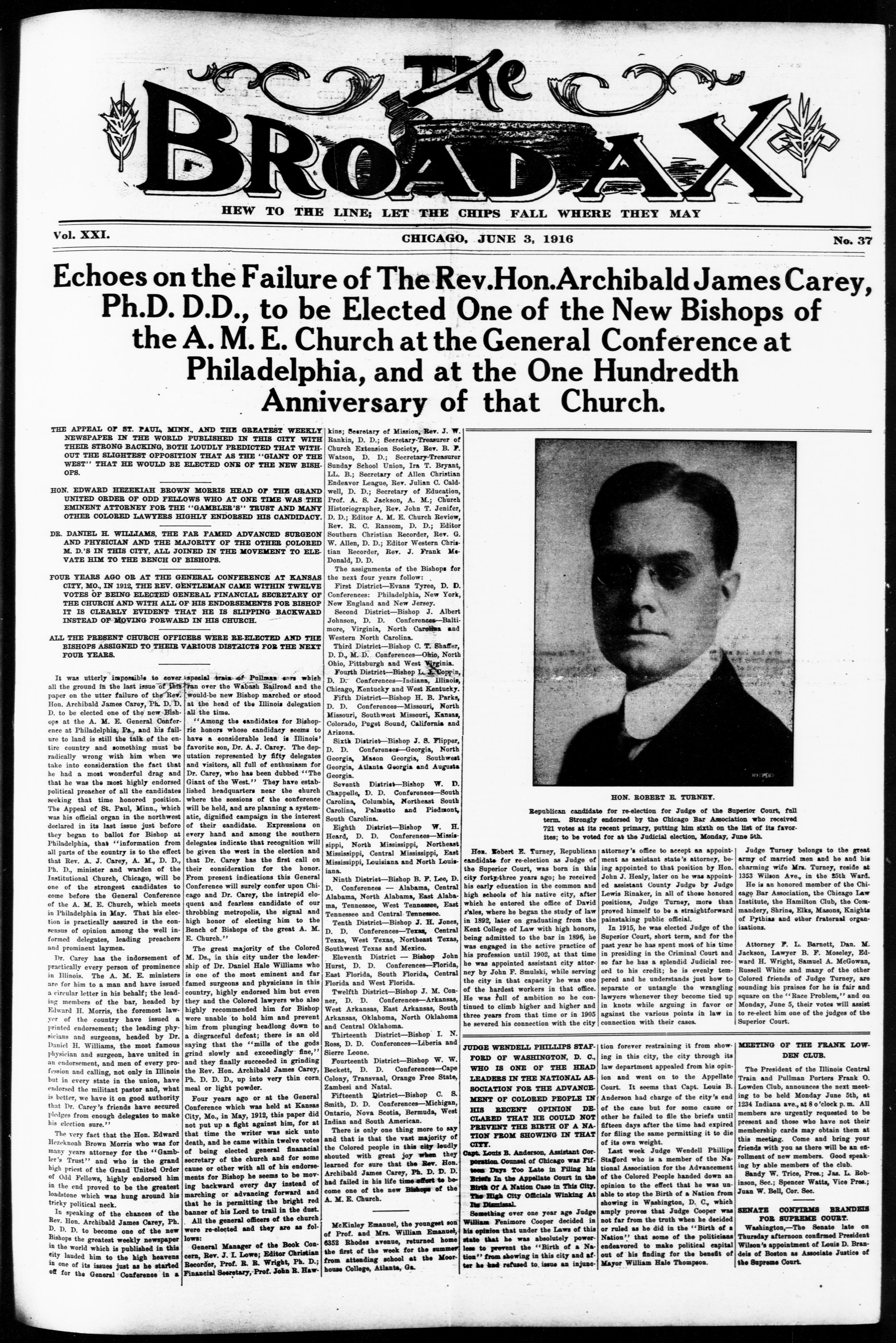
Page text (machine-generated)
THE BROAD AX
Echoes on the Failure of The Rev.Hon.Archibald James Carey, Ph.D. D.D., to be Elected One of the New Bishops of the A.M.E. Church at the General Conference at Philadelphia, and at the One Hundredth Anniversary of that Church.
THE APPEAL OF ST. PAUL, MINN., AND THE GREATEST WEEKLY NEWSPAPER IN THE WORLD PUBLISHED IN THIS CITY WITH THEIR STRONG BACKING, BOTH LOUDLY PREDICTED THAT WITHOUT THE SLIGHEST OPPOSITION THAT AS THE "GIANT OF THE WEST" THAT HE WOULD BE ELECTED ONE OF THE NEW BISHOPS.
HON. EDWARD HEZEKIAH BROWN MORRIS READ OF THE GRAND UNITED ORDER OF ODD FELLOWS WHO AT ONE TIME WAS THE EMINENT ATTORNEY FOR THE "GAMBLER'S" TRUST AND MANY OTHER COLORED LAWYERS HIGHLY ENDORSED HIS CANDIDACY.
DR. DANIEL H. WILLIAMS, THE FAR FAMED ADVANCED SURGEON AND PHYSICIAN AND THE MAJORITY OF THE OTHER COLORED M. D.'S IN THIS CITY, ALL JOINED IN THE MOVEMENT TO ELEVATE HIM TO THE BENCH OF BISHOPS.
FOUR YEARS AGO OR AT THE GENERAL CONFERENCE AT KANSAS CITY, MO., IN 1912, THE REV. GENTLEMAN CAME WITHIN TWELVE VOTES OF BEING ELECTED GENERAL FINANCIAL SECRETARY OF THE CHURCH AND WITH ALL OF HIS ENDORSEMENTS FOR BISHOP IT IS CLEARLY EVIDENT THAT HE IS SLIPPING BACKWARD INSTEAD OF MOVING FORWARD IN HIS CHURCH.
ALL THE PRESENT CHURCH OFFICERS WERE RE-ELECTED AND THE BISHOPS ASSIGNED TO THEIR VARIOUS DISTRICTS FOR THE NEXT FOUR YEARS.
Vol. XXI.
Echoes on
Ph.D.
the
THE APPEAL OF ST. PAUL, MIN.
NEWSPAPER IN THE WORLD
THEIE STRONG BACKING, BOTH
OUT THE SLIGHTEST OPPOSIT
WEST" THAT HE WOULD BE
OPS.
HON. EDWARD HEZEKIAH BROWN
UNITED ORDER OF ODD FELLO
EMINENT ATTORNEY FOR THE
OTHER COLORED LAWYERS H
DR. DANIEL H. WILLIAMS, THE
AND PHYSICIAN AND THE M.
M. D.'S IN THIS CITY, ALL JO
VATE HIM TO THE BENCH OF
FOUR YEARS AGO OR AT THE G
CITY, MO., IN 1912, THE REV. G
VOTES OF BEING ELECTED GEO
THE CHURCH AND WITH ALL OF
IT IS CLEARLY EVIDENT TH
INSTEAD OF MOVING FORWAR
ALL THE PRESENT CHURCH OFFI
BISHOPS ASSIGNED TO THE IIB
FOUR YEARS.
It was utterly impossible to cover all the ground in the last issue of this paper on the utter failure of the Rev. Hon. Archibald James Carey, Ph.D.D. D. to be elected one of the new Bishops at the A. M. E. General Conference at Philadelphia, Pa., and his failure to land is still the talk of the entire country and something must be radically wrong with him when we take into consideration the fact that he had a most wonderful drag and that he was the most highly endorsed political preacher of all the candidates seeking that time honored position. The Appeal of St. Paul, Minn., which was his official organ in the northwest declared in its last issue just before they began to ballot for Bishop at Philadelphia, that "information from all parts of the country is to the effect that Rev. A. J. Carey, A. M., D.D., Ph.D., minister and warden of the Institutional Church, Chicago, will be one of the strongest candidates to come before the General Conference of the A. M. E. Church, which meets in Philadelphia in May. That his election is practically assured is the consensus of opinion among the well informed delegates, leading preachers and prominent laymen.
Dr. Carey has the indorsement of practically every person of prominence in Illinois. The A. M. E. ministers are for him to a man and have issued a circular letter in his behalf; the leading members of the bar, headed by Edward H. Morris, the foremost lawyer of the country have issued a printed endorsement; the leading physicians and surgeons, headed by Dr. Daniel H. Williams, the most famous physician and surgeon, have united in an endorsement, and men of every profession and calling, not only in Illinois but in every state in the union, have endorsed the militant pastor and, what is better, we have it on good authority that Dr. Carey's friends have secured pledges from enough delegates to make his election sure."
The very fact that the Hon. Edward Hezeknoah Brown Morris who was for many years attorney for the "Gambler's Trust" and who is the grand high priest of the Grand United Order of Odd Fellows, highly endorsed him in the end proved to be the greatest loadstone which was hung around his tricky political neck.
In speaking of the chances of the Rev. Hon. Archibald James Carey, Ph. D. D. D. to become one of the new Bishops the greatest weekly newspaper in the world which is published in this city lauded him to the high heavens in one of its issues just as he started off for the General Conference in a
HEW TO THE LINE: LET THE CHIPS FALL WHERE THEY MAX
special train of Pullman cars which ran over the Wabash Railroad and the would-be new Bishop marched or stood at the head of the Illinois delegation all the time.
"Among the candidates for Bishopric honors whose candidacy seems to have a considerable lead is Illinois' favorite son, Dr. A. J. Carey. The deputation represented by fifty delegates and visitors, all full of enthusiasm for Dr. Carey, who has been dubbed "The Giant of the West." They have established headquarters near the church where the sessions of the conference will be held, and are planning a systematic, dignified campaign in the interest of their candidate. Expressions on every hand and among the southern delegates indicate that recognition will be given the west in the election and that Dr. Carey has the first call on their consideration for the honor. From present indications this General Conference will surely confer upon Chicago and Dr. Carey, the intrepid eloquent and fearless candidate of our throbbing metropolis, the signal and high honor of electing him to the Bench of Bishops of the great A. M. E. Church."
The great majority of the Colored M. Ds., in this city under the leadership of Dr. Daniel Hale Williams who is one of the most eminent and far famed surgeons and physicians in this country, highly endorsed him but even they and the Colored lawyers who also highly recommended him for Bishop were unable to hold him and prevent him from plunging headlong down to a disgraceful defeat; there is an old saying that the "mills of the gods grind slowly and exceedingly fine," and they finally succeeded in grinding the Rev. Hon. Archibald James Carey, Ph. D. D. D., up into very thin corn meal or light powder.
Four years ago or at the General Conference which was held at Kansas City, Mo., in May, 1913, this paper did not put up a fight against him, for at that time the writer was sick unto death, and he came within twelve votes of being elected general financial secretary of the church and for some cause or other with all of his endorsements for Bishop he seems to be moving backward every day instead of marching or advancing forward and that he is permitting the bright red banner of his Lord to trail in the dust.
All the general officers of the church were re-elected and they are as follows:
General Manager of the Book Concern, Rev. J. I. Lowe; Editor Christian Recorder, Prof. B. R. Wright, Ph. D.; Financial Secretary, Prof. John R. Haw.
CHICAGO, JUNE 3. 1916
e of The Re Elected hurch at th nia, and at iversary o
kins; Secretary of Mission, Rev. J. W. Rankin, D. D.; Secretary-Treasurer of Church Extension Society, Rev. B. P. Watson, D. D.; Secretary-Treasurer Sunday School Union, Ira T. Bryant, LL. B.; Secretary of Allen Christian Endeavor League, Rev. Julian C. Caldwell, D. D.; Secretary of Education, Prof. A. S. Jackson, A. M.; Church Historiographer, Rev. John T. Jenifer, D. D.; Editor A. M. E. Church Review, Rev. R. C. Ransom, D. D.; Editor Southern Christian Recorder, Rev. G. W. Allen, D. D.; Editor Western Christian Recorder, Rev. Frank McDonald, D. D.
The assignments of the Bishops for the next four years follow:
First District—Evans Tyree, D. D. Conferences: Philadelphia, New York, New England and New Jersey.
Second District—Bishop J. Albert Johnson, D. D. Conferences—Baltimore, Virginia, North Carolina and Western North Carolina.
Third District—Bishop C. T. Shaffer, D. D., M. D. Conferences—Ohio, North Ohio, Pittsburgh and West Virginia.
Fourth District—Bishop L. L. Coppin, D. D. Conferences—Indiana, Illinois, Chicago, Kentucky and West Kentucky.
Fifth District—Bishop H. B. Parks, D. D. Conferences—Missouri, North Missouri, Southwest Missouri, Kansas, Colorado, Puget Sound, California and Arizona.
Sixth District—Bishop J. S. Flipper, D. D. Conferences—Georgia, North Georgia, Mason Georgia, Southwest Georgia, Atlanta Georgia and Augusta Georgia.
Seventh District—Bishop W. D. Chappelle, D. D. Conferences—South Carolina, Columbia, Northeast South Carolina, Palmatto and Piedmont, South Carolina.
Eighth District—Bishop W. H. Heard, D. D. Conferences—Mississippi, North Mississippi, Northeast Mississippi, Central Mississippi, East Mississippi, Louisiana and North Louisiana.
Ninth District—Bishop B. F. Lee, D. D. Conferences—Alabama, Central Alabama, North Alabama, East Alabama, Tennessee, West Tennessee, East Tennessee and Central Tennessee.
Tenth District—Bishop J. H. Jones, D. D. Conferences—Texas, Central Texas, West Texas, Northeast Texas, Southwest Texas and Mexico.
Eleventh District — Bishop John Hurst, D. D. Conferences—Florida, East Florida, South Florida, Central Florida and West Florida.
Twelfth District—Bishop J. M. Conner, D. D. Conferences—Arkansas, West Arkansas, East Arkansas, South Arkansas, Oklahoma, North Oklahoma and Central Oklahoma.
Thirteenth District—Bishop I. N. Ross, D. D. Conferences—Liberia and Sierre Leone.
Fourteenth District—Bishop W. W. Beckett, D. D. Conferences—Cape Colony, Transvaal, Orange Free State, Zambesi and Natal.
Fifteenth District—Bishop C. S. Smith, D. D. Conferences—Michigan, Ontario, Nova Scotia, Bermuda, West Indian and South American.
There is only one thing more to say and that is that the vast majority of the Colored people in this city loudly shouted with great joy when they learned for sure that the Rev. Hon. Archibald James Carey, Ph. D. D. D. had failed in his life time effort to become one of the new Bishops of the A. M. E. Church.
McKinley Emanuel, the youngest son of Prof. and Mrs. William Emanuel, 6352 Rhodes avenue, returned home the first of the week for the summer from attending school at the Moorhouse College, Atlanta, Ga.
Rev.Hon.Are
One of the
General
the One
of that Ch
Republican candidate
term. Strongly
721 votes at its
ites; to be vote
323 PEU
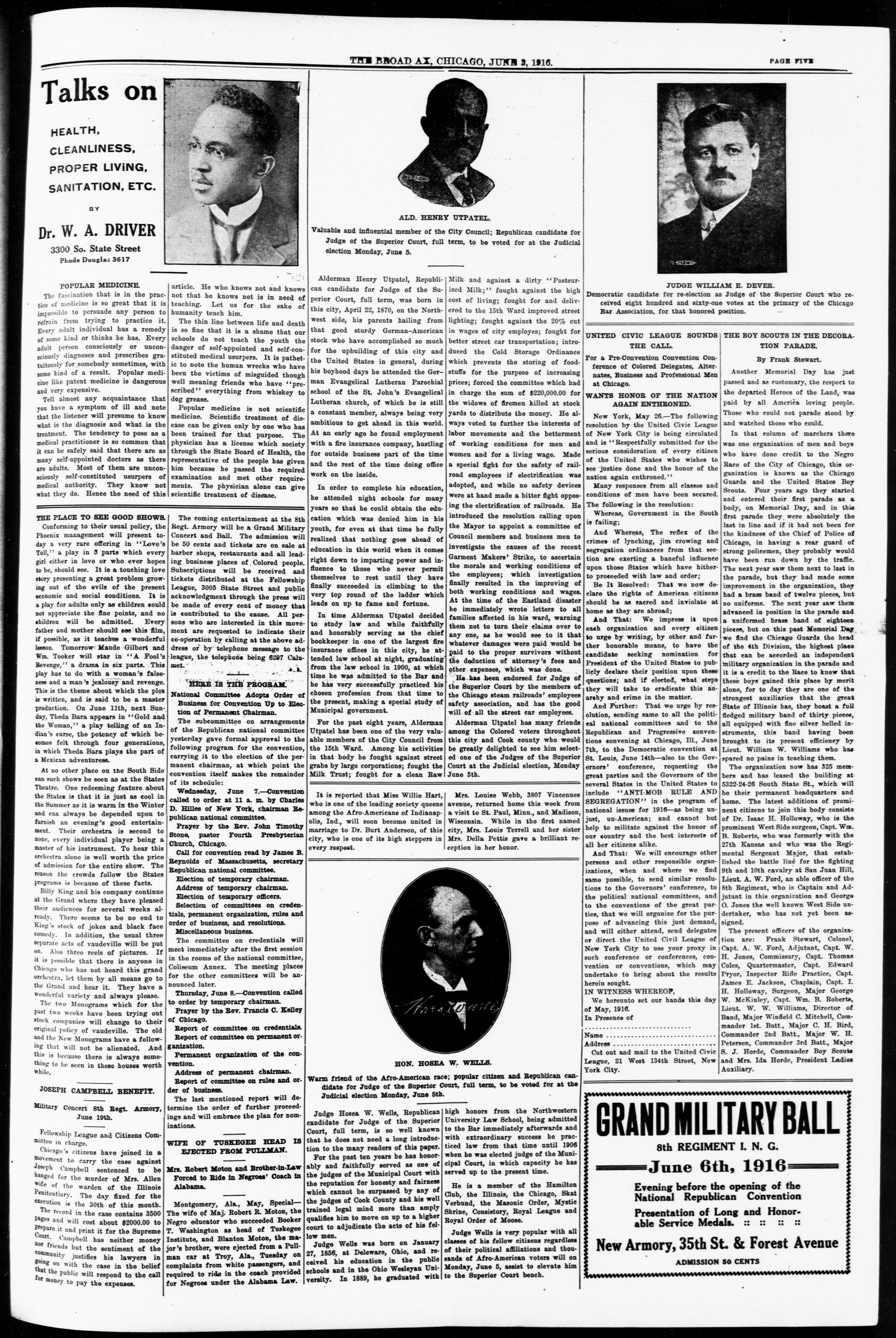
Republican candidate for re-election for Judge of the Superior Court, full term. Strongly endorsed by the Chicago Bar Association who received 721 votes at its recent primary, putting him sixth on the list of its favorites; to be voted for at the Judicial election, Monday, June 5th.
Hon. Robert E. Turney, Republican candidate for re-election as Judge of the Superior Court, was born in this city forty-three years ago; he received his early education in the common and high schools of his native city, after which he entered the office of David Rales, where he began the study of law in 1892, later on graduating from the Kent College of Law with high honors, being admitted to the bar in 1896, he was engaged in the active practice of his profession until 1902, at that time he was appointed assistant city attorney by John F. Smulski, while serving the city in that capacity he was one of the hardest workers in that office. He was full of ambition so he continued to climb higher and higher and three years from that time or in 1905 he severed his connection with the city attorney's office to accept an appointment as assistant state's attorney, being appointed to that position by Hon. John J. Healy, later on he was appointed assistant County Judge by Judge Lewis Rinaker, in all of those honored positions, Judge Turney, more than proved himself to be a straightforward painstaking public official.
In 1915, he was elected Judge of the Superior Court, short term, and for the past year he has spent most of his time in presiding in the Criminal Court and so far he has a splendid Judicial record to his credit; he is evenly tempered and he understands just how to separate or untangle the wrangling lawyers whenever they become tied up in knots while arguing in favor or against the various points in law in connection with their cases.
Judge Turney, army of charming wife M. 1353 Wilson Ave. He is an honorable cage Bar Association Institute, the Hart manery, Shrine, of Pythias and eminations.
Attorney F. H Jackson, Lawyer ward H. Wright, Russell White and Colored friends of sounding his praisal square on the "R Monday, June 5, to re-elect him on Superior Court.
JUDGE WENDELL PHILLIPS STAFFORD OF WASHINGTON, D. C., WHO IS ONE OF THE HEAD LEADERS IN THE NATIONAL ASSOCIATION FOR THE ADVANCEMENT OF COLORED PEOPLE IN HIS RECENT OPINION DECLARED THAT HE COULD NOT PREVENT THE BIRTH OF A NATION FROM SHOWING IN THAT CITY.
Capt. Louis B. Anderson, Assistant Corporation Counsel of Chicago was Fifteen Days Too Late in Filing his Briefs In the Appellate Court in the Birth Of A Nation Case in This City. The High City Officials Winking At Its Dismissal.
Something over one year age Judge William Fenimore Cooper decided in his opinion that under the Laws of this state that he was absolutely powerless to prevent the "Birth of a Nation" from showing in this city and after he had refused to issue an injunction.
---
HON. ROBEET E. TURNEY.
attorney's office to accept an appointment as assistant state's attorney, being appointed to that position by Hon. John J. Healy, later on he was appointed assistant County Judge by Judge Lewis Rinaker, in all of those honored positions, Judge Turney, more than proved himself to be a straightforward painstaking public official. In 1915, he was elected Judge of the Superior Court, short term, and for the past year he has spent most of his time in presiding in the Criminal Court and so far he has a splendid Judicial record to his credit; he is evenly tempered and he understands just how to separate or untangle the wrangling lawyers whenever they become tied up in knots while arguing in favor or against the various points in law in connection with their cases.
tion forever restraining it from showing in this city, the city through its law department appealed from his opinion and went on to the Appellate Court. It seems that Capt. Louis B. Anderson had charge of the city's end of the case but for some cause or other he failed to file the briefs until fifteen days after the time had expired for filing the same permitting it to die of its own weight.
Last week Judge Wendell Phillips Stafford who is a member of the National Association for the Advancement of the Colored People handed down an opinion to the effect that he was unable to stop the Birth of a Nation from showing in Washington, D. C., which amply proves that Judge Cooper was not far from the truth when he decided or ruled as he did in the "Birth of a Nation" that some of the politicians endeavored to make political capital out of his finding for the benefit of Mayor William Hale Thompson.
No.37
Judge Turney belongs to the great army of married men and he and his charming wife Mrs. Turney, reside at 1353 Wilson Ave., in the 25th Ward. He is an honored member of the Chicago Bar Association, the Chicago Law Institute, the Hamilton Club, the Commandery, Shrine, Elks, Masons, Knights of Pythias and other fraternal organizations.
Attorney F. L. Barnett, Dan. M. Jackson, Lawyer B. F. Moseley, Edward H. Wright, Samuel A. McGowan, Russell White and many of the other Colored friends of Judge Turney, are sounding his praises for he is fair and square on the "Race Problem," and on Monday, June 5, their votes will assist to re-elect him one of the judges of the Superior Court.
MEETING OF THE FRANK LOW
DEN CLUB.
The President of the Illinois Central Train and Pullman Porters Frank O. Lowden Club, announces the next meeting to be held Monday June 5th, at 1234 Indiana ave., at 8 o'clock p.m. All members are urgently requested to be present and those who have not their membership cards may obtain them at this meeting. Come and bring your friends with you as there will be an enrollment of new members. Good speaking by able members of the club. Sandy W. Trice, Pres.; Jas. L. Robinson, Sec.; Spencer Watts, Vice Pres.; Juan W. Bell, Cor. Sec.
SENATE CONFIRMS BRANDELS
FOR SUPREME COURT.
Washington,—The Senate late on Thursday afternoon confirmed President Wilson's appointment of Louis D. Brandeis of Boston as Associate Justice of the Supreme Court.
PAGE TWO
THE BROAD AX
THE BROAD AX
Published Weekly
In this city since July 15th, 1899, without missing one single issue, Republicans, Democrats, Catholics, Protestants, single Taxers, Priests, infidels or anyone else can have their say as long as their language is proper and responsibility is fixed.
The Broad Ax is a newspaper whose platform is broad enough for all, ever claiming the editorial right to speak its own mind.
Local communications will receive attention. Write only on one side of the paper.
Subscriptions must be paid in advance.
One Year.....$2.00
Six Months.....1.00
Advertising rates made known on application.
Address all communications to
THE BROAD AX
6532 St. Lawrence Ave, Chicago, Ill.
PHONE WENTWORTH 2507.
JULIUS P. TAYLOR, Editor and Publisher.
Entered as Second-Class Matter Aug. 19, 1902, at the Post Office at Chicago, Illinois, under Act of March 3, 1879.
AUTHORIZED AGENTS AND CORRESPONDENTS FOR THE BROAD AX.
L. W. Washington, 5465 Kimbark avenue.
B. W. Pitts, 3315 S. State street. Phone Douglas 4049.
The Broad Ax can be found on sale at the last named place and news items and advertisements left there will find their way into these columns.
Artificial Ears.
Artificial ears are so skillfully made that they may with difficulty be distinguished from natural ones, so it is claimed.
When the person who has lost an ear applies to the manufacturer for a substitute there is made a mold of the remaining ear. If there be left any part of the other a mold of that part also must be taken to assist in the fitting of the artificial. Manufacturers assert that no two ears are alike and that it takes a skillful workman to prepare an ear from the mold or molds.
When finished the new ear is pasted on the stump or simply set in the position of the lost ear. It is really only the first artificial ear that is expensive, the chief cost pertaining to the making of the mold. Vulcanized rubber, which can be bent and twisted, has been found to constitute the best material for the making of artificial ears—Detroit Free Press.
A Question of Size.
If old Garge Jones was the most inquisitive man in the village, Tom Morton was certainly the surliest.
One afternoon, as Garge perambulated slowly along the one narrow street, he paused at Tom's garden fence and gazed inquiringly over at Tom, who was busily nailing a very large box together.
"Afternoon, Tom!" said the old chap genially. "Whatever be 'ye eputtin' that great box together for?" Tom paused in his hammering long enough to retort curly:
"To hold all your questions, if so be as it's big enough"
Garge eyed him in pained silence for a few moments. Then he took an empty matchbox from his pocket and threw it over to Sandy.
"Then that'll do for yer civil answers if so be as it's small enough!" he retorted quietly.—London Express.
Lotteries In England.
Lotteries for the purpose of raising money for the state have never caught on in England. But for definite ends of a semistate character, such as building canals or founding a British museum, sanction has been readily granted. Our first recorded lottery is that of 1599, when the prizes were pieces of plate, the chances 40,000 for 10 shillings each and the desirable object the maintenance of harbors. But, once familiar grown, lotteries corrupted the ancient virtues of John Bull, and by the time of Queen Anne the state stepped in and suppressed every private lottery as a public nuisance. By an act passed in 1823 sanction was given to a particular lottery, and that was the last. At the same time all sale of tickets for home or foreign lotteries was forbidden—London Times.
Fair Enough.
"Yes," we admitted, "it's a fine car, and we'd be glad to own it, but we can't afford to buy it, and there's no use wasting your breath trying to persuade us."
"Listen," pleaded the agent. "This car isn't going to cost you a cent. All you've got to do is to take out an accident policy in our favor and the car is yours. We'll even pay the premium on the policy. Can anything be fairer than that?"—St. Louis Post-Dispatch.
The English language presents a large number of words that have been completely changed in their significance since they first came into use. In some cases their meaning has been exactly reversed. A compulsive example of this is the word "let," which Shakespeare uses several times with the meaning "he hinder." Hamlet exclaimed, "I'll make a ghost of him that lets me," of course "him that stops me."
The word is used in the same sense in the Bible, as in II Thessalonians ii. 7—"He who now letteth will let until he be taken out of the way."
"Ravel" and "unravel" mean exactly the same thing, although at one time to unravel probably meant to reduce confusion to order. Compare the words "valuable" and "invaluable" and "loose" and "mloose."
As used frequently in the Bible "prevent" instead of meaning to "hinder" means to "precede" or "go before," which is, of course, its etymological meaning.—Los Angeles Times.
Holy Lands of All Religions
Christians call Palestine the Holy Land because it was the birthplace of the Christian religion on earth as well as that of the Saviour, whose birth, ministry and death are inseparably associated with the history of Jerusalem and vicinity. To the Mohammedans Mecca, in Arabia, is the holy land, it being the birthplace of Mohammed, the saviour of the followers of that faith. India is the holy land of the Chinese and other oriental Buddhists, it being the native land of Sakya Muni, the supreme Buddha. Elis, one of the several divisions of the ancient Peloponnesus, was the Mecca and the Jerusalem of the ancient Greeks. The temple of Olympus Zeus was situated at Elis, and the sacred festivals were held there each year. The believers in the Shinto religion make annual pilgrimage to Sitsa Kara, the immense stone pillar where their supreme ruler last stood while talking to men.
Pigeons In Constantinople.
In no big city in the world are there so many tame pigeons as in Constantinople. In many squares in London there are small flocks of pigeons, but in the Turkish capital they are to be seen by the thousand. These pigeons are sacred, and, indeed, many a wealthy Turk leaves money to be devoted to buying food for them. The story of why they are sacred is rather interesting. When Mohammed, the Turkish prophet, was flying from his enemies he hid in a cavern. At the mouth of the cavern two pigeons built their nest, so tradition runs, while across the entrance a spider spun its web. The soldiers who came along some days later felt certain that no one had entered the cave, seeing the birds nesting and the spider's web, and so never troubled to enter it and search. Ever since then the Turks have held pigeons and spiders to be sacred.
Gifts of the Grass.
The grass is missed only by its absence. When we pass a lawn by a house which is minus a green lawn or grassy plot in front we exclaim, "What a blot on the landscape!" In a vague way we realize that the grass gives tone and color to outdoor life as nothing else can; that no picture is complete without it. All the beauties of the seashore—the bold rocks, the crested surf, the dashing waves, the lights and shadows which play at sunrise and sunset beside old ocean—cannot compensate for the lack of the grass beneath our feet. Friends wintering at southern beaches have told us that they grew homesick for the grassy fields and meadows of home—Margaret Woodward in Countryside Magazine.
Naming the Baby.
Give your baby a name that will suit him or her throughout life. Let it be a euphonious, well balanced name, indicative of intelligence, character and success and one so easily written or spoken that no nicknames will ever be found necessary. If there is available a family name with these good qualities, all the better. Do not indulge in levity, do not give way to sentiment, do not surrender to affectation or romance in this matter of selecting a suitable name, and avoid novel combinations and plays upon words without loading the child down with cheap commonplace.—Dallas News.
Starting the Tears.
Her Husband—Do you know, dear,
that I found my first gray hair this
morning? His Wife—Oh, give it to me,
John, and I'll keep it as a souvenir
to remember you by. Her Husband—
What's the matter with me keeping it
to remember you by?—Indianapolis
Star.
When France Washed In Holland.
In the sixteenth century clothes were sent from all parts of France to be washed in Holland, where the water of the canals was supposed to have special cleansing properties. The cost of transport was about ten times greater in these days than at present.
Out of Sight.
Country Cousin—Of course pertaters
grows underneath the ground. City
Cousin—H'm! Ye-es, but what gits
me is how you tell when they're ripe
or not—Farming Business.
When She See's It Quickly.
"Can your wife see a joke?"
"If it's in the shape of a bonnet or
a dress that some other woman is wear-
ing she can."—Detroit Free Press.
Worry, whatever its source, weakens,
takes away courage and shortens life.
THE BROAD AX, CHICAGO, JUNE 3, 1916.
STEPHENS BILL PROTECTS PUBLIC
TO AID HONEST BUSINESS.
Measure Will Prevent Injury to Smaller Cities and Towns From Cutthroat Monopolistic Methods of Mail Order Houses and Big City Stores—Will Insure Uniform Prices and High Quality
Bv W. BOB HOLLAND.
"A bill to protect the public against dishonest advertising and false pretenses in advertising."
This is the comprehensive title of a measure introduced in the present congress by Representative Dan V. Stephens of Nebraska. A similar bill has been introduced in the senate by Senator Ashurst of Arizona. No one can find fault with legislation that will achieve the objects stated in the titles of the Stephens-Ashurst bill. The public certainly needs protection "against dishonest advertising and false pretenses in merchandising."
The bill now under consideration is the successor of the Stevens bill, a measure introduced in the last congress by Representative Stevens of New Hampshire. It was widely discussed and died in committee after several public hearings, at which its merits and demerits were considered. The Stephens bill embodies the changes that seemed advisable after these hearings and discussions, and it is believed that in its present form it safeguards the producer, the merchant and the consumer.
For many years the right of a producer to contract with merchants for the resale of his products at standard, uniform prices was generally recognized and its legality was not questioned. Then the supreme court of the United States held that such a contract was "in restraint of trade" and "against public policy." The court divided on the question, 5 to 4, and the majority found no specific law forbidding the practice that had long been common, but held that congress had intended the Sherman law to prohibit such business methods.
Agency System Is Legal.
This court made law upset long established custom, but it does not prevent the end sought from being reached by other means. Producers who wish to have no discrimination shown to favored individuals can insure uniform prices for their goods by establishing branch establishments or by appointing agents. This is the method followed by manufacturers of automobiles. Bakers who sell their products within a restricted area can also regulate their prices by making grocers their agents and thereby retaining title to their bread and rolls until they reach the consumer. Producers of other articles, goods sold in small quantities and which must depend on established merchants for their distribution, are denied the right that men in other lines have. The Stephens-Ashurst bill is designed to restore to these producers a protection they had before it was taken away from them by the supreme court.
Cut rate department stores, so called "chain" drug and grocery stores in the large cities, and mall order houses use cut prices on standard, well known articles to draw trade away from small stores and small towns. The loss they may suffer on these standard articles is more than made up by the high profits on anonymous goods or goods put up under their own brands. In this way the producer is injured because the reputation of his product is ruined; the retail merchant is damaged because he cannot afford to advertise widely a special bargain "haif" to attract customers to whom other goods may be sold at a profit; the consumer is damaged because producers are not encouraged to maintain quality and because inferior articles are substituted.
Ample Protection Afforded.
The Stephens-Ashurst bill is not compulsory. To take advantage of its provisions the producer must register his trademark or special brand with the bureau of corporations in Washington and must pay a fee of $10. He must not have a monopoly of articles belonging to the same general class of merchandise, and he must not agree with any competitor to control prices. The producer must also file a schedule giving the prices at which his listed article is sold to wholesalers, to retailers and to the consumer. This schedule of prices becomes a public document. The prices scheduled must be uniform to buyers under similar circumstances. This permits reduction in prices for quantity purchases and allowances to equalize freight rates. A merchant who decides to quit business, who wishes to discontinue any line of listed goods or who becomes bankrupt must first offer such listed articles to the manufacturers for redemption at the full price paid. Should the manufacturers neglect or refuse to redeem the goods then the dealer can sell them at any price he desires or can get. Damaged goods must also be offered for exchange or redemption, and if later offered for sale at reduced prices the reason for the reduction must be made known to purchasers. There is also a clause permitting seasonable sales.
Vouth Man Only Three Remaining of Original Seven In Locket—Hopes to Find a Tune Loom.
Kansas City, Mo.—A well dressed young man walked into a loan office here. He brought forth his pocketbook and paid the interest on money he had borrowed on a locket.
Then he asked Frank Nevins, appraiser, to be allowed to see the trinket. Nevin produced it. The young man examined it and grew confidential. "That locket," he said, "represents four love affairs gone astray. You will notice four of the seven diamonds with which it was originally set are missing. It was four years ago that I became engaged the first time. The girl suggested I take a diamond from the locket for our engagement ring. I have been engaged three times since, and every time I have used one of the diamonds. The girls have broken their engagements and then kept the ring.
"You see these three remaining stones? I hope to be able to find a girl that will keep her promise before they are all gone."
Mr. Nevins said the diamonds in the locket were worth about $75 each.
WAR EMANCIPATES THE TURKISH WOMEN
Veils Being Discarded or Modified, and Theaters Will Soon See Native Actresses Is Belief.
Constantinople.—Since the allies abandoned the Dardanelles attack Constantinople has become normal and is now as far removed from the theater of war as any big city in neutral countries. The cafes and motion picture houses are well attended, and the theaters are crowded. Recently there was a big first night in the Petit Champs, the occasion being the performance of a French comedy. The actors were Turks, but the actresses were all Armenians, as Turkish women are not yet permitted to appear on the stage, but the general opinion is expressed by all thinking Turks that before long their women will make their first appearance as actresses.
The emancipation of women in Turkey has made remarkable progress since the beginning of the war. In the best society in Constantinople the women no longer wear their veils when receiving their guests. Though veils continue to be worn by the Turkish women in the street, still the fashion has made them so flimsy and transparent that they might just as well be dispensed with.
Consequently all the fascination and mystery that heretofore has surrounded the harem has suddenly disappeared. There is no longer any such thing, and in its place there is simply the usual family life. The Turkish woman is as much a housewife as her European sister, and in this war her resources have been taxed to the utmost. Despite the fact that the rich agricultural country of Anatolia is not far distant, the prices of all necessaryes of life have increased enormously.
Turkey has awakened from its long lethargy, and the war has brought a new life in the empire. Progress is now the keynote, and the indications are that within a few years Constantinople will be one of the most advanced cities in the world.
WOMEN NOT REAL ANGLERS.
New York Commissioner Pratt, Therefore, Would Let 'Em Fish Free. Albany, N. Y.—"Women," says Conservation Commissioner Pratt, "do not constitute a factor of importance in the fishing situation."
Therefore Mr. Pratt recommends that the fair sex, as are children under sixteen years of age, be exempt from the provisions of his bill to compel fishermen to take out an annual license costing $1.10.
"It is not desired," he adds, "to put any burden upon these young fishermen."
Under the bill a license is not required to catch suckers, bullheads, carp or other plebeian fish, but to catch fish propagated by the state the $1.10 fee must be paid.
WEDS LOSER OF PHOTO
Planter Traveled Throughout Middle West Six Months Seeking Ideal.
Hudsonville, Mich.—George N. Howard, a planner of Birmingham, Ala., found a handbag on the Panama-Pacific exposition grounds at San Francisco last September. The bag contained the photograph of a young woman. On the picture was written the name "Wisconsin."
Howard fell in love and for six months traveled throughout the middle west seeking his ideal. He found her here.
The bride was Miss Nettie Telsma of Oshkosh, Wis.
Flying Hen Drops Egg.
Blusfield, W. Va.—What is believed to be the first time on record of a hen laying an egg in midair was the unusual accomplishment of a brown leghorn in the express office at Graham. The hen was in a coop of chickens. After the coop had been placed on a truck the brown leghorn escaped, and while flying dropped a snow white egg into space. John Jones, a colored rousabout, who was pursuing the hen, caught the egg as it dropped.
Driene Tells Those to Think Curiously
and Powerfully About Their
Wedding Day.
Cleveland — Twelve Gettin Rules
For Young Lovers" was the subject of
the magazine delivered by Rev. Thomas
Hughes, pastor of the Rocky River
Methodist church. The twelve rules
"Choose carefully your company of both sexes.
"Open your eyes and ears, but keep your heart closed to the gush and nonsense from the so called lovers.
"Be careful about your dress. Have it becoming and tasteful.
"Be more careful about what is in your head than what is in your heart.
"Don't be self conceited.
"Don't keep company with a sinful young man.
"Think carefully and prayerfully about your wedding day.
"Be considerate about the time and money of your gentlemen friends.
"Be true to the best ideals of womanhood."
DRIVEN INSANE BY 100
CIGARETTES A DAY
Sent to an Asylum Upon Saloon- keeper's Complaint and Doctor's Testimony.
Detroit, Mich.—Frank Winters, the man who smoked a hundred cigarettes a day, was committed to the Pontiac asylum by Judge Hulbert recently in the probate court.
The incessant use of the cigarettes was declared by Dr. S. L. Layton, who examined Winters, to have affected his mind. Frequenting a saloon at the corner of Chamberlain and Lawndale avenues, Winters smoked until his supply gave out and his money too. After that he begged smokes from the customers of the saloon, according to Joseph Berman, the proprietor of the place.
Berman petitioned the court to have Winters taken to an asylum. A German by birth, Winters was getting along well in this country until the cigarette habit got the upper hand. Given jobs by Berman, Winters even lost his power of application to simple work.
"No more work for me," he would say as he would sit down on the job, Berman told investigators.
The nicotine undoubtedly had a deteriorating effect on his mentality, Dr. Layton declared.
FEWER KANSAS FARMERS
There Are Not So Many Now as Ten Years Ago.
Abilene, Kan.-Fewer people are engaged in agricultural pursuits in Kansas now than ten years ago, according to J. C. Mohler, secretary of the state board of agriculture.
"In 1805 of those engaged in all occupations 55 per cent were in agriculture," he declared, "and in 1905 50 per cent and in 1915 46 per cent. It is a very discouraging sign in a state like Kansas, where agriculture is the overshadowing industry, that fewer instead of more people are engaging in it."
Some of the serious problems that must be solved in Kansas are those of the home secker, the ownership of lands, employment of capital, better farming and the improvement of conditions of rural life, Mr. Mohler asserted.
WOULDN'T SPOIL HIS FINGERS
Artistic Hands, Out of a Job, Refuses to Shovel Coal.
Montclair, N. J.-If a man has "plano fingers" and is offered a job on a coal wagon should he accept the job to support his wife and six children, or should a philanthropic society place him in some position where his digital refinement would not be affected by manual labor?
This is one of the questions propounded in the annual report of Mrs. Nettle E. Patterson, superintendent of the Altruist society. Mrs. Patterson mentions the case in referring to the difficulties that confront the society.
She said that a man when offered a place on the coal wagon refused, saying he had been told he had "plano fingers" and did not wish to spoil them.
UNABLE TO FIND A WIFE.
Farmer Has Been Searching Sixteen Years, but So Far Has Failed.
Bridgeport, Conn.—Joseph Cronan, a farmer of Derby, announced that he had searched forty-two states and two countries of Europe and that, while in a receptive mood, he had not found a girl suitable to be his spouse.
"I am strictly temperate, a healthy and strong farmer, and I have been searching sixteen years for the right kind of a wife," he declared. "I have yet to find the woman, and I wish the newspapers would help me."
Pig Ate Sixty Others' Tails
Findlay, O.—Anson James, a Delaware county farmer, went into his hog yard and found sixty of his sixty-one pigs minus tails. He watched the drove for awhile and saw the sixty-first pig trying to eat his own tail.
When We Faired the Indians.
At a recent gathering of life insurance men one of the old timers exhibited a copy of a permit which had been attached to a policy issued in 1868. This permit read:
"The within assured has permission to reside in any settled part of the states of California, Nevada, Oregon or Washington territory and while so residing to make trips (as a passenger only) on first class steamers plying between the ports of Washington territory, the states of California and Oregon and the Sandwich Islands and to proceed to and return from in like manner or by public conveyance overland;
"Provided that written notice be given by the assured whenever any trip to the Sandwich Islands or to the Atlantic states is undertaken to the general agent of the company at San Francisco, Cal., and provided, also, that on the overland route the said assured to take his own risk by death from hostile Indians."—Wall Street Journal.
A Natural Born Spender
When a long forgotten cousin died and left Miss Mitfield a round hundred thousand the entire village, after having recovered from the shock, fell to wondering whether the faded little spinster, after having for sixty-three years pinched and scraped and plain sewed just to keep soul and body together, would, after all, get much comfort from her eleventh hour opulence.
The state of little Miss Mitfield's mind was revealed when her next door neighbor inquired what she should do with her money—did she mean to save it?
"Save it!" Her eyes flashed with new found scorn. "Listen to me, Betsy; all my life long I've wanted a pair of side combs with yellow glass beads onto 'em, and now I'm gain' to hev 'em; yes, ma'am, even if I should hev to go as high as 50 cents!"—Youth's Companion.
Coffee With Milk
For many years after coffee was first drunk in Europe, says the Manchester Guardian, no one thought of mixing it with milk any more than the Turks and Arabs do now. The use of coffee au lait seems to date from 1687. Mme. de Sevigne, writing to her daughter in that year, said that a doctor much in vogue "has taught us to mix sugar and milk with our coffee. They make a most delightful compound, which will help to support me through the rigors of Lent."
In a letter written seven years earlier she had mentioned as an eccentric proceeding on the part of Mme. de la Sabliere that "she drinks milk to her tea." Readers of "Unbeaten Tracks in Japan" may remember that one of the Alnus thought it disgusting that Mrs. Bishop should drink milk and pollute her tea with a fluid having so strong a smell and taste.
Bin Van Winkle—Himself.
Joseph Jefferson used to tell a story of his visit to a village in the Catskill mountains. He was taking a cup of tea in the hotel when he heard a negro waiter giving a detailed account of legends.
"Yes, sah." he continued, "Rip went up into de mountains, slep' for twenty years, and when he come back hyar in dis berry town his own folks didn't know him."
"Why," said the listener, "you don't believe the story's true."
"True? Ob course it is. Why," pointing to Jefferson, "dat's de man."
Boss Prevaricators
"There goes a man who boasts that he has never bought a gold brick." "Reminds me of the fellow who says he has never told a lie." "Yes. He reminds me of the chap who says the upkeep of his automobile is next to nothing." "And he's in the same category with the man who says he never was sick a day in his life." — Birmingham Age-Herald.
Fuel In Ancient Rome.
The fuel of the ancient Romans was almost exclusively charcoal. This was burned in open pans without grate or flue and gave economical heat for living rooms and baths. The inconvenience of chimneys was avoided, and the heat could be easily regulated.
Frenzied Finance.
Short- I wish I were a rumor. Long- What's the answer? Short- Why, a rumor soon gains currency.-St. Louis Post-Dispatch.
```markdown
```
0 PRACTICAL HEALTH HINT.
Treating a Sprain
A sprain is a straining or tearing of the ligaments and capsule which surround a joint by a sudden twist or wrench. There are pain, heat and swelling at the seat of the injury, followed later on by discoloration of the skin. The treatment is to put the parts affected at complete rest. If the sprain is in a joint of the upper extremity apply a padded splint to the inside of the limb, then place the forearm in a large arm sling. If in a joint of the lower extremity place the patient in bed, apply a padded back splint to the limb and keep it slightly elevated. After the limb has been put at rest apply bandages dipped in a saturated solution of epsom salts. Keep the bandages constantly wet with the solution. If the pain is severe and cold cannot be tolerated use hot applications of the epsom salt solution.
Long Distance Courtship Rounds Up With a Mishap.
WRONG FELLOW IS HUGGED.
Victim Utters Incoherent Words of Inquiry When Prospective Hueband Comes Along, and After Apologies He Hurries Her Off to Minister.
Parsons, Kan.—Marcella Howland kissed the wrong man. And inasmuch as Marcella at the time of her osculatory performance was engaged to be married and the man she kissed was not her prospective husband, she found herself in an embarrassing situation when the real groom hove to and made anxious inquiry as to her affection for another man. If it had been in the good old days of raplers and swords perhaps there would have been a duel, with much blood, but there was none of that, and only a few people at the Katy station were aware of the near tragedy.
The story of the kissing and Marcella and the man she kissed and the man she should have kissed adds another chapter to the volumes that have been written about long distance love making. This episode might have been labeled "Courtship by Mail, or Wooing by Correspondence." The story is this, duly attested and sworn to by at least one of the parties concerned:
Marcella lives near Joplin and is a helper in a grocery store. A year ago she found the name of James Vandyke in a case of eggs, the said James not being a barber, as his name might indicate, but a raiser of chickens and corn near Anadarko, Okla. Marcella wrote to James, and James replied. Then followed a correspondence with each succeeding letter ripened into love. A month ago it was decided to meet in Parsons and have a minister here perform the ceremony, an elopement being considered the proper thing to do.
James arrived and spent a restless afternoon waiting for his bride, who was to come from Joplin on the evening train.
Came 7:45 o'clock, and with it the train from Joplin and Marcella. James was a bit confused in time and was not at the station. Marcella, wearing a pink carnation by prearrangement, went to the waiting room and sat down to await the arrival of her husband to be.
Now enter the other side of the triangle, whose name for the present is unknown, as he absolutely refused to divulge his identity. His name will be John Doe for this occasion. John entered the station and gazed over the crowds. Marcella saw him, and after giving him time to discover her tripped across the room and stood enraptured before the astonished man.
"Well, here I am, James," she said demurely, waiting for her fiance to take in her arms, etc., etc.
John gasped, but made no move toward her.
"Why, you bashful thing," the girl exclaimed, and with that bounded over to the man, threw her arms about him and planted a kiss upon his lips. John extricated himself as best he could—or would, and was mumbling some incoherent words of inquiry when in came a breathless Vandyke, who had come up just in time to be hold the performance, and, convinced that some one was making away with his bride to be, rushed up to thwart him.
As he approached misgiving spread over Marcella's face. She had a faint suspicion that she had kissed the wrong man, and this suspicion grew with each step of the excited Vandyke. He stood before her. She looked at Doe and then at Vandyke. Yes, the last man was certainly the one she had come to meet. How could she have mistaken the other fellow for him, although their resemblance was quite marked?
Then apologies, explanations, assurances by Doe to Vandyke that he was an innocent party and had no intention to "op" Marcella, and then Marcella kissed the right man, right there in the station, with a score of people watching her.
The couple decided to take the 8:22 train back to Joplin and be married there. They hurried to a telephone, made an appointment with a minister there and left.
GETS BACK HIS SIGHT.
Blinded by a Fall, a Man is Recovering After Eight Years.
Philadelphia.—Unable to see for eight years. Edward Claycomb, a painter, of Altoona, Pa., is recovering his sight by degrees.
In 1908 he fell from a house he was painting, and in addition to his other injuries he detached the retinas of both eyes. He became blind. Specialists of a dozen cities were consulted, and they all told him his case was hopeless.
For the last several weeks his sight has been returning, and now he can see and read large letters and distinguish between colors. Physicians are puzzled. Claycomb is hopeful that his sight will become normal.
Sells Hidden Money With Potatoes.
Manton, Cal. W. A. Cleland placed
$220 in $20 gold pieces in a potato bin
for safe keeping. Forgetting about the
money, he sold some potatoes. Later
a search for the cola proved unsuccessful.
Cleland now thinks banks are a
safer proposition than potato bins.
Uncle Joe Cannon Tells of Some Changes in Forty-four Years.
SHOWS AGE IS NO HANDICAP
Says Uncle Sam Is Two and One-half Times Bigger Than When He Broke Into Congress—Has Retained Subtleness Despite His Eighty Years.
Washington.—Reclining on the sofa in his office just off the chamber of the house of representatives, his well known cigar at the proper angle in his mouth, Uncle Joe Cannon, who recently celebrated his eighteenth birthday, told a correspondent on that occasion of some of the changes which have occurred in the United States during the forty-four years he has been in public life, forty of which have been spent in congress.
Taking his cigar out of his mouth, Uncle Joe squinted at the end of it a moment, and then, replacing it most carefully at its accustomed angle, he said:
"I suppose you want to know something about the changes which have taken place since I first entered congress back in 1873. Why, my boy, the
The
Photo by American Press Association.
UNOLE JOE CANNON.
changes have been like those of an infant growing into a stalwart man or a sapling into a tree.
"Uncle Sam is two and a half times as big as he was when I broke into congress. I mean by that in physical stature as measured by population. In other ways the country has multiplied four, five and even ten times.
"We had thirty-seven states and less than 40,000,000 population when I came to congress. We now have forty-eight states and 100,000,000 population at home, with ten or fifteen millions more in Hawaii, Porto Rico and the Philippines. Our total wealth then was given at $24,000,000,000, gold basis, or $30,000,000,000 currency, but now it is $187,000,000,000, without any distinction as to the unit of measure.
"This enormous wealth is not in Wall street or within a thousand miles of it. It is not gathered into banks or trust companies, but is scattered over the broad land—the prairies, the plains and the mountains as well as in the factories and commercial centers. In fact, there is more of this wealth west of the Mississippi river than in New York and New England combined. So you can see that Uncle Sam has grown, and it has been something of a job for congress to keep up with the development of the country."
"What do you think has been congress' most farreaching act during this period?"
"I would hardly call it an act. I would call it a discovery," replied Uncle Joe. "It was the discovery of the general welfare clause of the constitution. We used to have long constitutional arguments against any kind of internal improvements by the federal government, but now we just read the general welfare clause of that old document and appropriate money for any scheme that may be proposed.
"This change of sentiment is pretty general, but it is marked in the delegations from the south."
The correspondent met with this answer when he mentioned legislation: "I am not going to discuss politics."
Getting up from the couch, he stretched his arms, and then, just to show he is eighty years young, Uncle Joe kicked as high as his chin.
"Can you do that, young man?" he asked. And then in reply he said:
"No, and there aren't ten other men in the house who can."
The correspondent expressed the belief that when a person reached the fourscore milestone it was time to take it easy, and Uncle Joe replied:
"Well, I do take it easy. I'm entitled to it, am I not? I have things just about as fine as any man could wish. I have lots of friends, no enemies that I know of, and lots of hope and ambition."
Although he has been mixed up in every great political fight since the election of Lincoln in 1860, Uncle Joe declined to discuss politics in the concrete.
"It would be hardly fitting," he said.
"People insist I am a partisan. I am a Republican, but this isn't a time for me to talk party politics. My friends are in all of the parties."
THE BROAD AX. CHICAGO. JUNE 3. 1916
CAMED THE DAYLIGHT IN
INDIANA THIRTY YEARS AGO
Cement Mills Started at 6 A. M. and Men Got In Ten Hours a Day Even in Winter.
New Albany, Ind.—Germany, Austria and other war rent countries of Europe, which have begun to conserve daylight, are thirty years behind Indiana. A cable dispatch from Berlin recently spoke of the daylight conservation idea as having been adopted there. The tenor of the dispatch created the impression that it was something new, when, in fact, the idea was adopted thirty years ago at the Speeds Cement mills, north of this city.
It was about 1886 when David Cook, manager, who still has charge of the plant, which produces Portland cement, realized it was a sin to waste the fine daylight which permits work at 6 a.m., even on most winter days. He studied the matter, and soon the whistle for going to work sounded at 6 in the morning. It took some time for the men to get used to the change, but now they would not swap back to the old system. They begin an hour earlier and quit an hour earlier, and even during the winter the ten hour day can be made.
CONSTRUCT HOUSE IN
OHIO IN TWELVE HOURS
CONSTRUCT HOUSE IN
OHIO IN TWELVE HOURS
Two Hundred Workmen Complete Structure, Gift to a Bride, While Thousands Look On.
Toledo, O. — Seventy-two carpenters began to build a house from the ground up at 4:30 a. m. At 4 p. m. the same day it was completed in every detail and Mrs. Emma Plessner-McCann was serving tea in it to Mayor Milroy and others.
The house and lot were a wedding present from the Toledo Real Estate board and contractors. Mrs. McCann was Miss Emma Plessner until a few hours before the house was finished, when she became the bride of John J. McCann. She was assistant secretary of the real estate board for several years.
After the carpenter work had progressed a short time plumbers, gas fitters, painters, paper hangers, electricians and other workmen got busy and did their share of the building work within a given time. More than 200 workmen helped build the house. It is a five room house, with a bathroom, costing $4,000. Ordinarily it takes two or three months to finish such a house.
Thousands watched the construction work. Three hundred gallons of buttermilk and a cartload of sandwiches were served.
In addition to the lot and house, built in less than twelve hours, considerable furniture was presented by friends.
FAITH IN DIVINING ROD.
Treasure Hunter Says "Tip" Is Right and Keeps on Digging.
Shreveport, La.—Having discovered evidence of what he believes is buried treasure or a gold mine on a piece of ground on Fairfield avenue and owned by Dr. J. M. Comegys in the most exclusive residence district of the city, a Shreveport contractor named Farmer spent all day and part of a night digging in the plot for hidden wealth. Farmer claims he was led to the spot by a divining rod, and he further maintains that his divining rod hasn't played him false because it leads him to the exact spot every time he moves.
Farmer, with the assistance of three negro helpers, labored far into the night in search of the treasure or mine or whatever it is, and spaddeal after spaddeal of dirt had been removed without results. Late bulletins from the scene indicated that no treasure had been disclosed as yet, though the hole measured four feet deep and as many feet in width when the search was concluded temporarily.
Shreveport is too far inland to have been the haunt of Captain Kidd or any other of our well known pirates, and the next best guess is that it is a gold mine. Farmer won't quit until he is either convinced to his own satisfaction that his divining rod has pulled a "bone" or that there is really a treasure at the spot.
BIG ROOSTER CRIPPLES MAN.
Resents Intrusion of Angler, Who Was Crossing Barnyard.
Pendleton, Ore—L. A. McClintock, local implement dealer, is among the wounded and helpless as a result of an encounter with an angry rooster.
While he was crossing through a barnyard near the Furish dam, enroute to the river with an angling outfit, a big Buff Cochin rooster, resenting the intrusion, flew at him. Unable to pierce his rubber boots with its beak, the rooster jumped into the air and drove his spurs home just above McClintock's knee, one on each side.
The spurs struck a tendon and crippled him. He was helped to an auto and brought home.
Rushes Junk Cart Miles
Holton, Kan. — Sherman Crawford, an industrious junk gatherer of this city, loses none of his profits to the railroads. He loads his cart with 800 pounds of material and when weather and roads are good pushes the cart to Topeka. By leaving Holton at 8 o'clock in the morning Crawford can make the thirty-two miles to the capital city by sundown.
HEN 29 YEARS OLD LAYS EGG.
Spanish Annie Breaks All Records, Dazzling Her Owner.
Hartford.—Spanish Annie, the grand old she of twenty-nine years (duly authenticated), owned by Colonel James Blanchard of Dayville, is quite content to die because recently she performed what is probably her last labor in this world, something beyond "all the king's horses and all the king's men," for she laid a nice brown egg.
Spanish Annie, called because she is of the black Spanish variety, hasn't laid an egg in years. However, within a year she got her name in the newspapers and her picture in many of them when she hatched out a fine brood of chickens and was hailed as the world's champion Biddy.
Colonel Blanchard, who is proud of his famous hen, has discovered from his poultry records that Spanish Annie was hatched July 4, 1887, and for years contributed generously to the Blanchard daily egg supply. Some years ago her shiny jet black feathers began turning white and her eggs were fewer. Then she lost her quick, dashing gait, and at present her feathers are a mottled gray. Spanish Annie made no particular commotion after laying her egg, but her happy owner arranged a special feed for her.
PEARL 5.000.000 YEARS OLD.
Found on the Seacoast and Sent to Stanford University.
Stanford University, California.—A pearl estimated to have been formed 5,000,000 years ago and to be the oldest specimen of its kind in the world was found by Stanley C. Herold, a Stanford student, six months ago. The pearl will be presented to the, Stanford museum.
The pearl and the cockleshell in which it was imbedded came to Stanford in a consignment of geologic material from the coast of the state of Washington.
According to university authorities, the pearl is of little value as a gem, but the oyster in which it was found originated, they said, probably in the paleozoic period.
"We have no record," said Herold, "of pearls having been formed before the time this one was created. It retains considerable luster and when thoroughly polished will regain more, but its 5,000,000 years of existence has taken out about 50 per cent of its luster.
"At the time this pearl was made the dinosaur, mastodon and sabre toothed tiger were in existence."
ROBINS ACCEPT HUMAN AID.
Man Replaces Fallen Nest and Birds Occupy It.
Seattle, Wash.—"I had always understood," said Crawford E. White, the attorney, who lives at 4203 Mead street, "that birds would invariably abandon a nest which had been disturbed by human hands.
"Something that happened in my yard the other day is a distinct exception to this rule. Two robins had a nest in the branches of a cedar tree. The cross limb which held up the nest fell away and let it down on the ground.
"I thought that would be the end of that nest. But the two birds stayed near it all the next day, and finally I got the idea of rebuilding it. I took a foot ladder and fastened the nest back securely in place with some ordinary hay baling wire.
"The robins apparently liked the rough job I made of it, for they came back and have been working together rebuilding the old nest."
GIRLS TOO BASHEFUL.
Make Inquiries Over Phone Regarding Man Wishing to Wed.
St. Paul. — "Ambitious, but bashful," is the characterization Joseph Mounts, secretary to Chief of Police John J. O'Connor, made of a St. Paul young woman after a day of telephone calls regarding Elmer Johnson, rancher, of Sidney, Mon., who wrote to the chief making an offer of matrimony to a suitable St. Paul girl.
"Many girls," said Mr. Mounts, "called me asking about Johnson, but none would give me her name. I think the girls are passing up a good thing, because I think the man is on the level."
Johnson has 320 acres of fertile Montana land, two miles from a railroad, and says he is "well fixed."
"Some of the girls talked real fine, too," added Mr. Mounts, "and if Johnson had heard them maybe he would have liked to look them over. It's too bad they are so bashful."
FINDS DIAMOND IN TOBACCO.
Railroad Engineer Discovers Gem In Tin of the Weed.
St. Mary's, Pa.—Patrick Fehley, an engineer on the Pennsylvania railroad, stationed here, considers himself a very lucky individual.
A few days ago he bought a ten cent tin of tobacco. While replenishing his pipe he was surprised to see a ring imbedded in the weed, and examination proved it to contain a setting which looked suspiciously like a diamond. He took his find to a jeweler, who appraised the stone to be worth at least $50.
With Choir. No Gift.
Topeka. Kan.—Property held for the Church of Christ in this city will revert to the original owners should there come into existence within the body any choir or other organization, according to the terms of the deed by which it was conveyed for church purposes, and which has just been filed for record.
Travels Over Deep Snowdrifts to Become Bride of a Young Los Angeles Business Man.
Los Angele, Cal.-Skiing fifteen miles over deep snowdrifts to be a bride, Miss Helen Skinner, eighteen-year-old daughter of F. C. Skinner of Pine Knot Lodge, Big Bear valley, arrived recently in Los Angeles and was married to Wesley P. Turner, a young business man.
Miss Skinner, who passed last summer at Big Bear valley, had intended to leave there for Los Angeles earlier in the season, but was detained until all roads down the mountain had been washed out by the rains and lost under many feet of snow. When she learned that none of the roads would be opened until nearly summer she declared her intention of walking down to Los Angeles, no matter how far the snow extended.
It was then learned that a stage could make its way to Dobble, a dead mining camp on the crest of Big Bear, hanging 6,800 feet above the Mohave desert. So the dauntless little bride elect, accompanied by her mother and father, donned skis and walked from Pine Knot Lodge to Dobble, fifteen miles, over snow that lay an average depth of three feet. At Dobble the party was met by a stage from Victorville.
BIT OF GALLANTRY
WINS HIM $200,000
Frank H. Canning, Who Protected a Woman In Fight, Remembered In Her Will.
Philadelphia.—As a result of a bit of gallantry to a woman more than three years ago Frank H. Canning, formerly of this city and later of Clarksboro, N. J., is to receive $200,000.
Mrs. J. T. Elkins of Detroit, widow of a wealthy ranch owner, died several weeks ago, leaving an estate of $400,000. Half of the money goes to Mr. Canning, the remainder to a charitable institution in Detroit. Mrs. Elkins was formerly Miss Irene Chadley of this city.
Miss Chadley was returning to her home on a trolley car late one night. She was the only woman on the car, the other passengers being half a dozen intoxicated men and Mr. Canning. Suddenly a fight started, and one of the men brushed against Miss Chadley and threatened her. Mr. Canning placed himself in front of the woman and, with the aid of the conductor, managed to overcome the rowdies.
Miss Chadley was so upset that Mr Canning called a cab and rode with her to her home in West Philadelphia.
LIGHTNING STRUCK HOUSE.
Russell, His Wife and Baby Have a Narrow Escape.
Brady, Tex.-Bob Russell, his wife and baby, who live six miles west of Brady, had a narrow escape recently when lightning struck their home, giving them a severe shock and setting the wall paper and bedclothing afire.
The electric bolt passed across the roof and came down the wall inside the room where the family were asleep and passed to the ground by way of a telephone wire and two shotguns standing near a bed.
Russell was rendered unconscious, and when he recovered he found the bed clothing and wall paper afire. He was able to extinguish the blaze with but little difficulty. The barrels of both guns were melted, as was also the telephone ground wire.
SEEKS REMEDY FROM SEA.
Physician Dips Thirty Fathoms For Pure Salt Water.
San Francisco.—To save the life of a patient in St. Winifred's hospital Dr. Winslow Anderson, accompanied by fourteen doctors and nurses, went out to sea in a Crowley launch for thirty-six gallons of the purest of pure sea water.
The alliment from which the patient is suffering will give way only to a treatment in which pure salt water from the sea forms the chief element.
The party carried twelve three-gallon jugs with heavy lead sinkers, by means of which the water was lifted from a depth of thirty fathoms. The launch went nearly to the Farallone islands, and the party did not return until late at night.
ROBBER THANKS VICTIM.
Sends Back Keepsake and Keeps $500
He Stole From St. Louis Resident.
St. Louis.—The thief who robbed
the home of L. L. Whittmore of jewelry valued at $500 mailed a letter to the family. Inclosed was a miniature pair of opera glasses, used as a watch charm. His letter reads:
To Whom It May Concern.—Very sorry to take this little keepsake. Thank you for the other articles. With best wishes.
AN OUTCAST.
Fish Makes Long Swim.
London.—A salmon which had been marked and returned to the water at Kintradwel, north of Brora, Sutherlandshire, was caught fifteen days afterward on the Aberdeenshire coast. The minimum distance covered by the fish was 140 miles, and it had lost one and one-half pounds in weight between the date of marking and its recapture.
PAGE THREE
COURAGE WINSHER
Stand Made by Suffragists Impresses Pearl White. ONCE SCORNED THEIR FIGHT. Her Views Changed When She Saw How Bravely the Women Marched In a Parade In New York Despite a Cold, Miserable Day.
New York.—"You see, it was like this," said Miss Pearl White, curling her slender figure up on a corner of her couch. "I was one of those who found suffrages funny. They handed me a laugh many a time just because I thought they were pulling a speech off to get themselves heard. But I tell you I didn't think that after their October parade. It was on an awfully cold, mean day, if you recall it, and the way those women came up the avenue beating against the wind, with their white dresses on, fairly gave one a thrill.
THE FILM MAKER
UPPER PHOTO SHOWS MISS PEARL WRITE IN A CHARACTERISTIC POSE, LOWER IN ONE OF HER STEEPLEJACK STUNTS.
There they stood, hour after hour, waiting to get into line, and there weren't six of them that 'beat it for home,' I'll make my guess.
"I like to see women who dare to do things. There are hundreds of women working for their living, and most of them don't dare say what they think. But those suffragettes, they've got their courage right with them, all the time," went on the plucky, daredevil "movie" star.
She it was who took up the dare when some one said no girl could be a steeplejack, and on April 15, dressed in the part of a sign painter in overalls and cap on which "Votes For Women" gleamed across the visor, Miss White let herself down an electric sign twenty-two stories above Broadway.
Miss White is as litle as a panther. She can twist her pliant figure into more curves than most women. Half Italian and half Irish, she comes from Missouri, and so she udds keenness to her Celt and Latin traits. "I pay taxes," said she thoughtfully. "Why shouldn't I say something about what is to be done with my tax money? I pay income tax, too, just as if I were a man. I earn money too. In my profession a woman star earns more than a man, yet I have nothing to say about the income tax law nor about any other law. Why shouldn't I vote? Women are doing every kind of work men, and over in Europe they are suffering as much as men suffer. If war should come to America they would suffer here. I want to vote for president of this country, for I know who I think ought to govern us. But I shan't have anything to say about the president. I'll have to abide by the decision of men, who may not care half as much as I care."
WIND IMPRISONS WOMAN.
Locked In Closet and Near Collapse When Rescued.
Bridgeville, Del.—Imprisoned in a closet by the wind slamming a door fast, Mrs. Mollie Cordery, who lives near Bridgeville, had a narrow escape from death and when discovered was nearly overcome by the shock.
Mrs. Cordery was cleaning the attic, and while she was looking in an old closet a gust of wind slammed the door and locked it from the outside. There was no one but herself in the house, and it was nearly an hour before Mrs. Cordery's screams happened to be heard by a gang of men who were repairing the road. With all the doors locked downstairs, Harley Rickards climbed to the second floor and got through by a window. When Mrs. Cordery was found she was in a pittible state. She is still seriously ill from the shock.
Sentences Himself to Jail.
Visalia, Cal.-Ernest Stevenson, a Visalia laborer, sentenced himself to a year in the county jail in Judge Knox's court after pleading guilty to a charge of drunkenness. The verdict was set aside by the judge as excessive. In passing sentence on himself after the judge had asked him to do so Stevenson said treatment in hospital did no good and perhaps he could "sober up right" in a year.
THE OVER
M. B.
HON. ANDREW J. REDMOND
One of the ablest, most painstaking and popular law
Republican candidate for Judge of the Superior Co
endorsed by the Chicago Bar Association, receiving
primary as against 470 for his Democratic opponent
the Judicial election Monday, June 5.
One of the ablest, most painstaking and popular lawyers in Cook County; Republican candidate for Judge of the Superior Court, short term, highly endorsed by the Chicago Bar Association, receiving 860 votes at its recent primary as against 470 for his Democratic opponent, to be voted for at the Judicial election Monday, June 5.
Hon. Andrew J. Redmond, Republican candidate for Judge of the Superior Court, short term, to be voted for at the Judicial election Monday, June 5, was born in Philadelphia, August 1, 1864. When he was still very young he came with his parents to De Kalb, Illinois, where he was brought up on a farm. He attended public school, and later a school for teachers at Oregon, Illinois. After completing his course there, he studied at the Northwestern Illinois Normal School.
He began his career as a teacher, but being ambitious to practice law, he came to Chicago in 1889 and entered the Northwestern University Law School, from which he graduated with the degree of LL. B. Since that time he has continued actively in the practice of his profession for a long time occupying an extensive suite of law offices on the 16th floor of the Otis Building; in 1895 Mr. Redmond was happily united in marriage to Miss Emma Robertson, daughter of Mr. John Robertson, the successful banker of Barrington, Illinois and from 1896 to the present time Mr. and Mrs. Redmound have resided in a lovely home in Oak Park, where they are held in the highest esteem by a large circle of friends.
He has honorably served in the past as attorney for the Town of Cicero, and again attorney for Barrington, For-
PAYS HIGH TRIBUTE.
A Contribution from a Chicago Friend
Who Knows the Judge.
Judge William Fenimore Cooper. One of the best known men in the state of Illinois is Judge William Fenimore Cooper of the superior court of Cook county. Judge Cooper is a man of sterling qualities, unexcelled in judicial ability, and possesses the most vigorous personality of any man before the American public today.
In speaking of this man it must be borne in mind that he is possessed of a peculiar rugged honesty and sincerity of purpose that characterizes his legal opinions and is easily discernable in all of his court decisions. Judge Cooper has lived in Illinois more than twenty-five years, during which period he has devoted much of his time, energy and money in defense of the political and civil rights of the common people. He has stood like a stone wall between them and unwarranted assaults upon their individual interest by persons and corporations of powerful influences. He has proven, in more instances than one, that he is an uncompromising friend and a staunch protector of the weaker and less fortunate of men, regardless of nationality or religious inclinations.
There are many instances in the judicial career of all good men in which the layman fails to understand the full meaning of some of their decisions. They fail to recognize the fact that judicial decisions are based upon facts controlled by certain well defined and fixed legal principles which no judge can well afford to ignore.
It is particularly gratifying to know that Judge Cooper is too honorable and too fair to permit his decisions to be influenced by anything other than the law and the facts, a most admirable qualification for any good judge to possess.
During the past six years that Judge Cooper has occupied the bench he has made an enviable record for himself, which, without any other considerations, make him by far the strongest candidate for re-election on the Demo-
---
PAGE FOUR
est Park, Wauconda, Lake Zurich and River Grove. His home town or the village of Oak Park has recently passed the following resolution in favor of his candidacy for Judge of the Superior Court. Whereas, the services of Andrew J. Redmond as attorney for this district were of the character worthy of the highest commendation, and Whereas, Mr. Redmond has at all times enjoyed the esteem and confidence of the citizens of Oak Park, and Whereas, he is now a candidate for Judge of the Superior Court of Cook County.
Therefore, recognizing his fitness and ability, we, the members of the Village Board of Oak Park, do hereby endorse his candidacy and ask all good citizens to assist in furthering his cause, which we believe to be in the best interest of Cook County.
Mr. Redmond is an eminent lawyer, a first class gentleman at all times and in every way well fitted to become one of the Judges of the Superior Court.
He is well and favorably known to the Colored people in this city for on several occasions he has addressed them in their churches and it goes without saying that the Colored people throughout this city and Cook County will roll up a solid vote for him on Monday, June 5, and assist to put him over the plate.
eratic ticket June 5th. He is preeminently fitted and peculiarly qualified for the position he now holds and his thorough knowledge of the needs and conditions surrounding this great costopolitan city entitles him to the continued confidence and support of all the good people of this community, and is a sufficient guarantee that he will continue to prove his unmeasurable value to Cook County.—From the World, Indianapolis, Indiana, May 27th, 1916.
HON. GEORGE A. DUPUY, REPUBLICAN CANDIDATE FOR JUDGE OF THE SUPERIOR COURT, FULL TERM, TO BE VOTED FOR AT THE JUDICIAL ELECTION, MONDAY, JUNE 5TH.
Former Judge George A. Dupuy, who received seven hundred and eighty-nine votes at the late primary of the Chicago Bar Association for Judge of the Superior Court, was born March 4, 1858, on a farm in St. Clair County; Ill.; educated in the public schools and in the Illinois Wesleyan University at Bloomington; graduated in 1882 from the Union College of Law, Chicago. Except during his period on the bench, has practiced law in Chicago ever since his graduation. He was assistant corporation counsel of the city of Chicago under John S. Miller, William G. Beale and Adolph Kraus; was afterwards member of firm of Rubens, Dupuy & Fischer. he was elected judge of Superior Court in November, 1904; served in that capacity until December, 1910, and during the last year of his service, was chief justice of that court.
He is a member of the Union League and Chicago Congregational Clubs and other social and civic organizations. He is a member of the Chicago and the Illinois Bar Associations and is a member of the bar of the Supreme Court of the United States.
His great grandfather located with his family in Illinois in the year 1816 and the family has resided here continuously ever since. His great grandfather was a colonial soldier in the American Revolution.
THE BROAD AX. CHICAGO. JUNE 3. 1916.
The Inauguration of Major Robert R. Moton as the New Principal of Tuskegee Institute, Alabama.
BY JOHN W. FELTON.
Tuskegee, like the Niagara Falls, the Grand Canyons of Colorado, the Desert of Sahara and many other wonders of the world cannot be told you must see for yourself. The people of Tuskegee had been preparing for the Chicago Party that visited the institute last week for more than a month and they received a very hearty welcome.
The Chicago Party left their home town Monday, May 22nd, about noon and numbered about forty. They went to Tuskegee in a chartered Pullman car and ate meals in the diner both going and coming. Breakfast was served Tuesday morning between Birmingham, Alabama and Montgomery.
When the party arrived at Tuskegee, Tuesday afternoon, they were greeted with yells and were escorted to their dormitories by the band. The men retired at the famous Rockefeller hall. The Southern hospitality was so great and the favors given to the party so numerous that we could not but feel somewhat embarrassed. We had the extreme pleasure of meeting Major Moton, Mr. Logan Warren and Mr. Isaac Fisher and many others who were all invited and attended a reception given in honor of the Chicago Party Wednesday afternoon, by Mrs. J. J. Jones of the '06 class. At the reception Major Moton delivered an address which was very timely and to the point.
Tuesday afternoon the students had a drill contest which was won by Company B under the command of Capt. Thomas.
Wednesday morning we visited all of the buildings of the institute as follows: The Post-office which is a second class office and has a postmaster and two clerks. They are all Colored and the postmaster is appointed by the president and receives a salary of $1,960 per annum. The post-office downtown is a third class office.
We visited the Carnegie Library which cost $20,000, the millinery shop, laundry, broom factory, tin shop, blacksmith shop, harness shop, electric shop, paint shop, tailor shop, shoe shop, printing office, carpenter shop, plumbing shop, automobile shop, dairy, hospital which cost $55,000, agricultural building, veterinary hospital and the power house all of which were built by the students.
In the automobile shop we met mohamed Jama an African who guided Rousevelt through the jungles of Africa on his lion hunt, who is now working his way through school aided by the Colonel.
The dining room known as Thompkins' Hall seats more than 2,000 people at one time.
Thursday was commencement day and inauguration day. Part one began at 9:30 a. m. and Mr. C. A. Barnett, of '06 class, spoke in behalf of the class who presented the school with a gift of nearly $300.00.
Part two began at 2:00 p. m. with Mr. Wilcox of New York acting as chairman. Many of the trustees were present including the great millionaire and philanthropist, Julius Rosenwald, who donated $100,000.00 to the Booker T. Washington memorial fund. The inauguration was the grandest that we have ever witnessed.
Friday we visited the farms and the magnitude of them is beyond the imaginative power of man.
After all that is said and done the voters throughout Cook County will be highly honoring themselves by placing him back on the bench of the Superior Court.
DEATH OF REV. A. T. HALL OF
BATAVIA, ILLINOIS.
The latter part of last week, Rev. A. T. Hall quietly passed away at his home, Batavia, Illinois. He was well on to one hundred years old. He was one of the oldest A. M. E. preachers in this section of the country and many years ago he was the pastor of Quinn Chapel. He was laid to rest Tuesday, Decoration Day.
THE BETHEL LITERARY SOCIETY
—PREPAREDNESS—
The Hon. J. M. Vance of New Or-
Major Moton is unquestionably the man for the place, he was unanimously elected by the trustees and is loved by the faculty, students and citizens of Tuskegee. He received many beautiful gifts and large sums of money which he did not keep for his personal use but turned them over to the school. Tuskegee is indeed a wonderful place. All who have not had the opportunity to see it should take the advantage. Dr. G. C. Hall, ex officio chairman, Messrs. C. A. Barnett, Chairman, A. Washington, J. Greene, A. H. Palmer and W. E. Mitchell of the committee deserve great credit for making the tour a complete success.
Of the eight thousand persons who attended the exercises, seven thousand were white people leaving one thousand Colored people, the following were some of the most prominent personages in Alabama, in the south as well as the north who were present on that history making occasion.
Prominent People Present
Glancing over the veritable sea of faces during the exercises, one recognized men of such prominence as: Hon. Charles Henderson, Governor of Alabama; William G. Wileo, trustee, New York; Charles E. Mason, trustee, Boston, Mass.; Julius Rosenwald, trustee, Chicago; William M. Scott, trustee, Philadelphia; W. W. Campbell, vice chairman, Board of trustees Tuskegee; R. O. Simpson, trustee, Furman, Ala.; Belton Glireath, trustee, Birmingham; V. H. Tulane, trustee, Montgomery; Miss Mary E. Popham, Secretary Hampton Association, New York; Dr. Hollis Burke Frissell, principal, Hampton Industrial and Agricultural Institute, Hampton, Va.; Miss Mary E. Wooley, president, Mount Holyoke College, South Hadley, Mass.; Charles Ellis Mason, of Harvard University; Dr. Allison A. Pringle, representing University of Pittsburg, Pa. and Cox College, College Park, Ga.; Ludwig T. Laren, Talladega, Ala., College; Dr. T. W. Palmer, Alabama Girls' Technical Institute, Montevallo; Prof N. B. Young, President, Florida A. and M. College, Tallahassee; James L Sibley, Reuben F. Kolb, Walter F Walker, Secretary to President of Republic of Liberia, Monrovia, Liberia;
Chicago Party There.
There were at least a hundred prominent persons composing the Chicago party and about the same number representing Hampton Institute. The former was composed of the following:
Chicago party—Dr. and Mrs. George Cleveland Hall, Dr. Carrie Golden and daughter, Mr. and Mrs. B. F. Shepard, Mrs. G. W. Bradshaw, Mrs. B. F. Cranshaw, Mr. A. B. Washington, Mr. Thomas Wright, Dr. A. Wilberforce Williams, Prof. James A. Munday, Mrs. L. Q. Dean, Mr. J. Addison, Mrs. J. S Tandy, Mrs. Hugh Hancock, Mrs. Frances Moss Menn, Mrs. Mabel Jones, Mrs. D. C Bell, Mrs. E. Euper, Mrs. Maud D. Newsome, Mrs. J. H. Cotton, Mrs. Mary F. Waring, Mrs. Mary Talbert, Mr. James A. Green, Mr. John W. Felton, Mr. Ernest H. Williamson, Mr William Nelson, Mr. Jesse Johnson, Jr., Mr. W. I. Thomas, Mr. and Mrs. William E. Mitchell, Mrs. F. I. Edwards, Mrs. E. G. Wilson, Mr. Claude A. Barnett, Mr. A. H. Palmer, Dr. William Garnett, Mr. William R. Sobers, Miss Eliza Sengtackle, Mrs. Carrie Brewer, Mr. Cary B. Lewis, Mr. B. F. Shepard, Jr.
leans, La., will also make a short ad-
dress.
Geo. T. Kersey, Chrm. Program
Comte.
Sandy W. Trice, President.
Rev. D. W. Cook, Pastor.
30th Street and Dearborn.
Mrs. John L. Fry, and her little
daughter, Miss Francis Fry, are in Indi-
dianapolis, Ind., where they will make
a long visit with her mother and other
relatives.
Mrs. Geneva Smith, 5363 Dearborn
street; Prof. and Mrs. A. J. Bowling
spent Tuesday, Decoration Day, in visit-
ing at the new home of Mr. and Mrs.
Jenkins, their sister, 111th street Morgan
Park.
Mrs. William Emanuel, 6352 Rhodes avenue, spent Sunday at the Idelwild Summer resort in Northern Michigan and inspected her lots along with the other lot owners, who joined in the excursion.
[Name not visible]
JASPER M. HIGGINBOTHAN.
The leading Afro-American contractor in this city who recently graduated with high honors with the degree of Bachelor of Theology from the Chicago Religious Training Seminary.
The leading Afro-American contractor in this city who recently graduated with high honors with the degree of Bachelor of Theology from the Chicago Religious Training Seminary.
Rev. J. N. Higginbothan, 4519 Evans a member of the Board of Managers of ave., who on Monday evening, May 29th, was graduated with high honors from the Chicago Religious Training Seminary with the degree of Bachelor of Theology. He is the treasurer, and also an officer's position in that Church.
OUTDOORS FOR THE CHILDREN.
A child living its early years in dark, sunless rooms, poorly ventilated and poorly supplied with other sanitary decencies, can hardly grow up to be a normal, healthy man or woman, even if its food is sufficient and proper. The chances are strong that it will not grow up at all. It is bound to be like a plant grown in the dark—pale, thin and sickly.
Such a child, if it lives, is apt to have a low vitality, low resistance against disease. It will be handicapped in school, and when at work its earning power will very likely be of a low order. Both the parents and the community are to blame. The engine was good to start with, but it was soon in ill repair, wheezy, rattly and rusty. Its gasoline was low as well as its oil. What chance had the poor thing when mud and ruts were deep, rocks many, hills steep and bridges out of order! There are many little children in Chicago in just this plight.
Fortunately, June, July, August, September and October are in league with the children. These months love childhood in this latitude. They beckon to youth to come out of doors. They allure with green grass, warm breezes and blue skies. The trees toss up their arms in welcome and the bushes and shrubs in the parks say to all the "kids," "Come play hide and seek; bring your lunch baskets, bean bags and your.dolls. Or, if you have none of these, just bring yourselves and lay in a store of health for the next school year." "Oh, Skinnay! C'mon, we're goin' to the park."
This is now the "good old summer-time," the delightful outdoors season of the year. Let us all make the most of it and get out into the open all we can.
For the benefit of vacationists, citizens of Chicago, who will be sojourning at summer resorts, or in camp, or as tourists in other places, where there may be good reasons for suspecting the safety of the water supply, the Health Department Laboratory has prepared in convenient form calcium hypochlorite tablets, containing 20 to 30 milligrams of available chlorine per tablet. These tablets are preserved in glass vials and, if kept tightly stoppered in a cool, dark place, will retain their potency for about four weeks.
Directions—Dissolve one tablet by crushing between the fingers in one quart of water in an ordinary mason jar, which should be sealed with an air tight cap. The jar is then shaken, contents allowed to settle, and should be stored in a cool, dark place. This is the stock solution and under average conditions will last about one week, after which it should be renewed.
To prepare water for drinking, take one teaspoonful of the clear stock solution, avoiding the sediment, to one eight ounce glass of drinking water; allow it to stand for 15 minutes, when it is ready for drinking and will be safe. If it is suspected that the water is heavily polluted, two teaspoonfuls of the stock solution should be used to each eight ounce glass of water. If it is desired to make up a daily supply, ready for use, it can be done by adding four teaspoons to each quart of water.
Vials containing these tablets may be obtained on application to Room 707, Department of Health.
in this city who recently graduated with
bachelor of Theology from the Chicago
a member of the Board of Managers of
the Wabash ave. department of the
Young Men's Christian Association,
and is one of the leading members of
the Olivet Baptist Church and holds
an officer's position in that Church.
If we love the babies, we should not let them die for lack of proper care and feeding. Give the little citizen every chance to make good.
Arthur F. Codozoe, to the delight of his many friends is rapidly regaining his health again and the first of this week, he was removed from Provident Hospital, to his home at 5329 S. Wabash avenue.
Mr. and Mrs. E. H. Johnson, 3026 Vernon avenue, are home again after spending about five weeks at Hot Springs, Ark., for the benefit of the health of Mr. Johnson.
Attorney James A. Scott, at one time assistant State's Attorney of Cook County, states "that he is not a candidate for the legislature, from the first Senatorial district, nor any other district in Illinois; that he is employed by one corporation which pays him $4,000 a year for his legal advice; that he is publishing a law book which will not him $12,000; that lately he bought a private residence for himself and family, at 312 E. 30th street, paying $4,500 cash for the same."
FOR INFORMATION.
Send names of delegates and alternates to Mrs. Sarah L. Willis corresponding secretary, 420 West 19th street, Cheyenne, Wyo.
Send program as suggested, to Mrs. J. Snowden-Porter, 3302 Rhodes Ave., Chicago, Illinois.
Observe-Admission fee, $1.00. Per capita tax, five cents per year. Permanent fund, one cent per year per capita.
One delegate for every ten members or fraction thereof over five members.
Delegates send thir name and address to Miss Stella Turner, 518 N. Water St., Wichita, Kans., chairman of placing committee and she will send assignment. Entertainment free.
Blue Ribbon art and needle work display will be a feature of the meeting Urge members to send their best. Please contribute something to the Ways and Means Com. Advertise the meeting from now to meeting time in the clubs, in the newspapers, in the magazines and in the church. When the meeting is over each one will be glad to have had a part in it.
COLORED PEOPLE'S PROGRESS
A new race history, soon to be placed on the market at $1.50; an inspiring volume, showing the wonderful advancement of the Colored American, reads like magic, so rapid has been their progress in every department—Industry, Science, Art, Religion, Literature. Imparts practical suggestions for self-improvement and teaches the way to success. The publishers, Austin & Jenkins Co., Washington, D. C., are now placing agents. Anybody can sell. SECURE THE AGENCY AT ONCE by getting a fine prospectus FREE for 10 cents in postage. AGENTS make $10.00 per day. It sells on sight.
---
Talks on
HEALTH,
CLEANLINESS,
PROPER LIVING,
SANITATION, ETC.
Dr. W. A. DRIVER
3300 So. State Street
Phode Douglas: 3617
POPULAR MEDICINE.
The fascination that is in the practice of medicine is so great that it is impossible to persuade any person to refrain from trying to practice it. Every adult individual has a remedy of some kind or thinks he has. Every adult person consciously or unconsciously diagnoses and prescribes gratuitously for somebody sometimes, with some kind of a result. Popular medicine like patent medicine is dangerous and very expensive.
Tell almost any acquaintance that you have a symptom of ill and note that the listener will presume to know what is the diagnosis and what is the treatment. The tendency to pose as a medical practitioner is so common that it can be safely said that there are as many self-appointed doctors as there are adults. Most of them are unconsciously self-constituted usurpers of medical authority. They know not what they do. Henee the need of this
THE PLACE TO SEE GOOD SHOWS.
Conforming to their usual policy, the Phoenix management will present today a very rare offering in "Love's Toll," a play in 5 parts which every girl either in love or who ever hopes to be, should see. It is a touching love story presenting a great problem growing out of the evils of the present economic and social conditions. It is a play for adults only as children could not appreciate the fine points, and no children will be admitted. Every father and mother should see this film, if possible, as it teaches a wonderful lesson. Tomorrow Maude Gilbert and Wm. Tooker will star in "A Fool's Revenge," a drama in six parts. This play has to do with a woman's falseness and a man's jealousy and revenge. This is the theme about which the plot is written, and is said to be a master production. On June 11th, next Sunday, Theda Bara appears in "Gold and the Woman," a play telling of an Indian's curse, the potency of which becomes felt through four generations, in which Theda Bara plays the part of a Mexican adventures.
At no other place on the South Side can such shows be seen as at the States Theatre. One redeeming feature about the States is that it is just as cool in the Summer as it is warm in the Winter and can always be depended upon to furnish an evening's good entertainment. Their orchestra is second to none, every individual player being a master of his instrument. To hear this orchestra alone is well worth the price of admission for the entire show. The reason the crowds follow the States programs is because of these facts.
Billy King and his company continue at the Grand where they have pleased their audiences for several weeks already. There seems to be no end to King's stock of jokes and black face comedy. In addition, the usual three separate acts of vaudeville will be put on. Also three reels of pictures. If it is possible that there is anyone in Chicago who has not heard this grand orchestra, let them by all means go to the Grand and hear it. They have a wonderful variety and always please. The two Monograms which for the past two weeks have been trying out stock companies will change to their original policy of vaudeville. The old and the New Monograms have a following that will not be alienated. And this is because there is always something to be seen in these houses worth while.
JOSEPH CAMPBELL BENEFIT
Military Concert 8th Regt. Armory
June 19th.
Fellowship League and Citizens Committee in charge.
Chicago's citizens have joined in a movement to carry the case against Joseph Campbell sentenced to be hanged for the murder of Mrs. Allen wife of the warden of the Illinois Penitentiary. The day fixed for the execution is the 30th of this month.
The record in the case contains 3500 pages and will cost about $2000.00 to prepare it and print it for the Supreme Court. Campbell has neither money nor friends but the sentiment of the community justifies his lawyers in going on with the case in the belief that the public will respond to the call for money to pay the expenses.
[Picture of a man in a suit and tie].
article. He who knows not and knows not that he knows not is in need of teaching. Let us for the sake of humanity teach him. The thin line between life and death is so fine that it is a shame that our schools do not teach the youth the danger of self-appointed and self-constituted medical usurpers. It is pathetic to note the human wrecks who have been the victims of misguided though well meaning friends who have "prescribed" everything from whiskey to dog grease.
Popular medicine is not scientific medicine. Scientific treatment of disease can be given only by one who has been trained for that purpose. The physician has a license which society through the State Board of Health, the representative of the people has given him because he passed the required examination and met other requirements. The physician alone can give scientific treatment of disease.
The coming entertainment at the 8th Regt. Armory will be a Grand Military Concert and Ball. The admission will be 50 cents and tickets are on sale at barber shops, restaurants and all leading business places of Colored people. Subscriptions will be received and tickets distributed at the Fellowship League, 3005 State Street and public acknowledgment through the press will be made of every cent of money that is contributed to the cause. All persons who are interested in this movement are requested to indicate their co-operation by calling at the above address or by telephone message to the league, the telephone being 6297 Calumet.
National Committee Adopts Order of Business for Convention Up to Election of Permanent Chairman.
The subcommittee on arrangements of the Republican national committee yesterday gave formal approval to the following program for the convention, carrying it to the election of the permanent chairman, at which point the convention itself makes the remainder of its schedule:
Wednesday, June 7.—Convention called to order at 11 a. m. by Charles D. Hills of New York, chairman Republican national committee.
Prayer by the Rev. John Timothy Stone, pastor Fourth Presbyterian Church, Chicago.
Call for convention read by James B. Reynolds of Massachusetts, secretary Republican national committee.
Election of temporary chairman.
Selection of committees on credentials, permanent organization, rules and order of business, and resolutions.
Miscellaneous business.
The committee on credentials will meet immediately after the first session in the rooms of the national committee, Coliseum Annex. The meeting places for the other committees will be announced later.
Thursday, June 8.—Convention called to order by temporary chairman.
Prayer by the Rev. Francis C. Kelley of Chicago.
Report of committee on credentials.
Report of committee on permanent organization.
Permanent organization of the convention.
Address of permanent chairman.
Report of committee on rules and order of business.
The last mentioned report will determine the order of further proceedings and will embrace the plan for nominations.
WIFE OF TUSKEGEE HEAD IS EJECTED FROM PULLMAN.
Mrs. Robert Moton and Brother-in-Law Forced to Ride in Negroes' Coach in Alabama.
Montgomery, Ala., May, Special—The wife of Maj. Robert R. Moton, the Negro educator who succeeded Booker T. Washington as head of Tuskegee Institute, and Blanton Moton, the major's brother, were ejected from a Pullman car at Troy, Ala., Tuesday on complaints from white passengers, and required to ride in the coach provided for Negroes under the Alabama Law.
THE BROAD AX, CHICAGO, JUNE 3, 1916.
ALD. HENRY UTPATEL.
Valuable and influential member of the City Council; Republican candidate for Judge of the Superior Court, full term, to be voted for at the Judicial election Monday, June 5.
Alderman Henry Utpatel, Republican candidate for Judge of the Superior Court, full term, was born in this city, April 22, 1870, on the Northwest side, his parents hailing from that good sturdy German-American stock who have accomplished so much for the upbuilding of this city and the United States in general, during his boyhood days he attended the German Evangelical Lutheran Parochial school of the St. John's Evangelical Lutheran church, of which he is still a constant member, always being very ambitious to get ahead in this world. At an early age he found employment with a fire insurance company, hustling for outside business part of the time and the rest of the time doing office work on the inside.
In order to complete his education, he attended night schools for many years so that he could obtain the education which was denied him in his youth, for even at that time he fully realized that nothing goes ahead of education in this world when it comes right down to imparting power and influence to those who never permit themselves to rest until they have finally succeeded in climbing to the very top round of the ladder which leads on up to fame and fortune.
In time Alderman Utpatel decided to study law and while faithfully and honorably serving as the chief bookkeeper in one of the largest fire insurance offices in this city, he attended law school at night, graduating from the law school in 1900, at which time he was admitted to the Bar and he has very successfully practiced his chosen profession from that time to the present, making a special study of Municipal government.
For the past eight years, Alderman Utpatel has been one of the very valuable members of the City Council from the 15th Ward. Among his activities in that body he fought against street grabs by large corporations; fought the Milk Trust; fought for a clean Raw
It is reported that Miss Willie Hart, who is one of the leading society queens among the Afro-Americans of Indianapolis, Ind., will soon become united in marriage to Dr. Burt Anderson, of this city, who is one of its high steppers in every respect.
Aurel Wine
HON. HOSEA W. WELLS.
Warm friend of the Afro-American race; popular citizen and Republican candidate for Judge of the Superior Court, full term, to be voted for at the Judicial election Monday, June 5th.
Judge Hosea W. Wells, Republican candidate for Judge of the Superior Court, full term, is so well known that he does not need a long introduction to the many readers of this paper. For the past ten years he has honorably and faithfully served as one of the judges of the Municipal Court with the reputation for honesty and fairness which cannot be surpassed by any of the judges of Cook County and his well trained legal mind more than amply qualifies him to move on up to a higher court to adjudicate the acts of his fellow men.
high honors from the Northwestern University Law School, being admitted to the Bar immediately afterwards and with extraordinary success he practiced law from that time until 1906 when he was elected judge of the Municipal Court, in which capacity he has served up to the present time.
He is a member of the Hamilton Club, the Illinois, the Chicago, Skat Verbund, the Masonic Order, Mystic Shrine, Consistory, Royal League and Royal Order of Moose.
Judge Wells is very popular with all
Judge Wells was born on January 27, 1856, at Deleware, Ohio, and received his education in the public schools and in the Ohio Wesleyan University. In 1889, he graduated with
Milk and against a dirty "Pasteurized Milk;" fought against the high cost of living; fought for and delivered to the 15th Ward improved street lighting; fought against the 20% cut in wages of city employees; fought for better street car transportation; introduced the Cold Storage Ordinance which prevents the storing of food-stuffs for the purpose of increasing prices; forced the committee which had in charge the sum of $220,000.00 for the widows of firemen at stock yards to distribute the money. He always voted to further the interests of labor movements and the betterment of working conditions for men and women and for a living wage. Made a special fight for the safety of railroad employees if electrification was adopted, and while no safety devices were at hand made a bitter fight opposing the electrification of railroads. He introduced the resolution calling upon the Mayor to appoint a committee of Council members and business men to investigate the causes of the recent Garment Makers' Strike, to ascertain the morals and working conditions of the employees; which investigation finally resulted in the improving of both working conditions and wages. At the time of the Eastland disaster he immediately wrote letters to all families affected in his ward, warning them not to turn their claims over to any one, as he would see to it that whatever damages were paid would be paid to the proper survivors without the deduction of attorney's fees and other expenses, which was done.
He has been endorsed for Judge of the Superior Court by the members of the Chicago steam railroads' employees safety association, and has the good will of all the street car employees. Alderman Utpatel has many friends among the Colored voters throughout this city and Cook county who would be greatly delighted to see him selected one of the Judges of the Superior Court at the Judicial election, Monday June 5th.
Mrs. Louise Webb, 3807 Vineennes avenue, returned home this week from a visit to St. Paul, Minn., and Madison, Wisconsin. While in the first named city, Mrs. Louis Terrell and her sister Mrs. Della Pettis gave a brilliant reception in her honor.
high honors from the Northwestern University Law School, being admitted to the Bar immediately afterwards and with extraordinary success he practiced law from that time until 1906 when he was elected judge of the Municipal Court, in which capacity he has served up to the present time.
He is a member of the Hamilton Club, the Illinois, the Chicago, Skat Verbund, the Masonic Order, Mystic Shrine, Consistory, Royal League and Royal Order of Moose.
Judge Wells is very popular with all classes of his fellow citizens regardless of their political affiliations and thousands of Afro-American voters will on Monday, June 5, assist to elevate him to the Superior Court bench.
70
JUDGE WILLIAM E. DEVER.
Democratic candidate for re-election as Judge of the Superior Court who received eight hundred and sixty-one votes at the primary of the Chicago Bar Association, for that honored position.
Democratic candidate for re-election as Judge of the Superior Court who received eight hundred and sixty-one votes at the primary of the Chicago Bar Association, for that honored position.
UNITED CIVIC LEAGUE SOUNDS THE CALL.
For a Pre-Convention Convention Conference of Colored Delegates, Alternates, Business and Professional Men at Chicago.
WANTS HONOR OF THE NATION
AGAIN ENTHRONED.
New York, May 26.—The following resolution by the United Civic League of New York City is being circulated and is "Respectfully submitted for the serious consideration of every citizen of the United States who wishes to see justice done and the honor of the nation again enthroned." Many responses from all classes and conditions of men have been secured. The following is the resolution:
Whereas, Government in the South is failing;
And Whereas, The reflex of the crimes of lynching, jim crowing and segregation ordinances from that section are exerting a baneful influence upon those States which have hitherto proceeded with law and order:
Be It Resolved: That we now declare the rights of American citizens should be as sacred and inviolate at home as they are abroad;
And That: We impress it upon each organization and every citizen to urge by writing, by other and further honorable means, to have the candidate seeking nomination for President of the United States to publicly declare their position upon these questions; and if elected, what steps they will take to eradicate this anarchy and crime in the matter.
And Further: That we urge by resolution, sending same to all the political national committees and to the Republican and Progressive conventions convening at Chicago, Ill., June 7th, to the Democratic convention at St. Louis, June 14th—also to the Governors' conference, requesting the great parties and the Governors of the several States in the United States to include "ANTI-MOB RULE AND SEGREGATION" in the program of national issues for 1916—as being unjust, un-American; and cannot but help to militate against the honor of our country and the best interests of all her citizens alike.
And That: We will encourage other persons and other responsible organizations, when and where we find same possible, to send similar resolutions to the Governors' conference, to the political national committees, and to the conventions of the great parties, that we will organize for the purpose of advancing this just demand, and will either attend, send delegates or direct the United Civil League of New York City to use your proxy in such conference or conferences, convention or conventions, which may undertake to bring about the results herein sought.
IN WITNESS WHEREOF,
We hereunto set our hands this day of May, 1916.
Name .....
Address .....
Cut out and mail to the United Civic League, 21 West 134th Street, New York City.
GRAND MILITARY BALL
8th REGIMENT I. N. G.
June 6th, 1916
Evening before the opening of the
National Republican Convention
Presentation of Long and Honor-
able Service Medals. :: :: :: ::
New Armory, 35th St. & Forest Avenue
ADMISSION 50 CENTS
THE BOY SCOUTS IN THE DECORATION PARADE
By Frank Stewart.
Another Memorial Day has just passed and as customary, the respect to the departed Heroes of the Land, was paid by all America loving people. Those who could not parade stood by and watched those who could.
In that column of marchers there was one organization of men and boys who have done credit to the Negro Race of the City of Chicago, this organization is known as the Chicago Guards and the United States Boy Scouts. Four years ago they started and entered their first parade as a body, on Memorial Day, and in this first parade they were absolutely the last in line and if it had not been for the kindness of the Chief of Police of Chicago, in having a rear guard of strong policemen, they probably would have been run down by the traffic. The next year saw them next to last in the parade, but they had made some improvement in the organization, they had a brass band of twelve pieces, but no uniforms. The next year saw them advanced in position in the parade and a uniformed brass band of eighteen pieces, but on this past Memorial Day we find the Chicago Guards the head of the 4th Division, the highest place that can be accorded an independent military organization in the parade and it is a credit to the Race to know that these boys gained this place by merit alone, for to day they are one of the strongest auxiliaries that the great State of Illinois has, they boast a full fledged military band of thirty pieces, all equipped with fine silver belled instruments, this band having been brought to its present efficiency by Lieut. William W. Williams who has spared no pains in teaching them.
The organization now has 325 members and has leased the building at 5322-24-26 South State St., which will be their permanent headquarters and home. The latest additions of prominent citizens to join this body consists of Dr. Isaac H. Holloway, who is the prominent West Side surgeon, Capt. Wm. B. Roberts, who was formerly with the 27th Kansas and who was the Regimental Sergeant Major, that established the battle line for the fighting 9th and 10th cavalry at San Juan Hill, Lieut. A. W. Ford, an able officer of the 8th Regiment, who is Captain and Adjutant in this organization and George O. Jones the well known West Side undertaker, who has not yet been assigned.
The present officers of the organization are: Frank Stewart, Colonel, Capt. A. W. Ford, Adjutant, Capt. W. H. Jones, Commissary, Capt. Thomas Coles, Quartermaster, Capt. Edward Pryor, Inspector Rifle Practice, Capt. James E. Jackson, Chaplain, Capt. I. H. Holloway, Surgeon, Major George W. McKinley, Capt. W. B. Roberts, Lieut. W. W. Williams, Director of Band, Major Winfield C. Mitchell, Commander 1st Batt., Major C. H. Bird, Commander 2nd Batt., Major W. H. Petersen, Commander 3rd Batt., Major S. J. Horde, Commander Boy Scouts and Mrs. Ida Horde, President Ladies Auxiliary.
PAGE FIVE
PAGE SIX
American Author Whose Book Has Been Suppressed.
One of the Four Women War Correspondents Sent Out by the Biggest Magazine Gives Her Definition of War—Describes Her Impressions Eloquently.
When the editor sent four women correspondents to the great war because he believed that "the big story of a war is never at the front, but in the hospitals and in the homes, that war is largely a woman's affair, and woman, I think, best understand the little things that go to make up the big story," Mary Roberts Rinehart, trained
MARY ROBERTS RINEHART.
nurse, wife of a Pittsburgh physician, author of several successful plays and many delectable stories, was one of the women picked by the magazine.
She interviewed both Queen Mary of England and the king and queen of the Belgians. Her description of refurbishing up her toilet before presenting herself at La Panne, her quest of shoe buttons in ravaged Belgium and her final transfer of those she had from the top of her boots to that section most prominent below her gown when she sat is one of the liveliest parts of her story. Her latest book has recently been suppressed by the British censor on the ground that it contained information of value to the enemy. When asked what effect the nearness of battle had on her own literary powers Mrs. Rinehart replied:
"I do not know how other writers are affected, but I could do nothing at the front. I wrote the interview with the king of the Belgians there and ruined a really fine opportunity. Of course I have had no newspaper training. But that was not the only trouble. For me writing has two phases, each distinct from the other. One is receiving and absorbing impressions; the other is giving them out. And between the two there must be a lapse of time to give me perspective, to let me see the 'high light,' as it were—to know what should be emphasized. It is a matter of proportion, as all writing is. That is why I think that the real literature of the war will come after the world is once more at peace.
"Once under a great strain I did write something that reflected my attitude of mind. I had just been through a bombardment by aeroplanes, and I wrote that night with cold hands and a hot head my definition of war. It is this:
"War is not two great armies meeting in a clash and frenzy of battle. It is much more than that. War is a boy carried on a stretcher, looking up at God's blue sky with bewildered eyes that are soon to close; war is a woman carrying a child that has been wounded by a shell; war is spirited horses tied in burning buildings and waiting for death; war is the flower of a race torn, battered, hungry, bleeding, up to its knees in ice water; war is an old woman burning a candle before the Mater Dolorosa for the son she has given for king and country!"
Stuffed Sweetbreads.
Materials.-Six sweetbreads, a plint plain stuffing, one-half cupful mushrooms, sliced; toast, beaten egg, flavor, four tablespoonfuls butter, three-fourths cupful cream, a tablespoonful flour, two tablespoonfuls orange juice, cracker crumbs, salt and pepper
Way of Preparing.—Parbull the sweetbreads until render. Plunge them into cold water. Drain, wipe dry and trim into shape. Make a plain stuffing, as for poultry. Cut a pocket in the sweetbreads and stuff. Then sew up the pocket. Melt the butter in the chafing dish, flour the sweetbreads lightly, then dip them in the beaten egg, roll in crumbs and fry in the butter in the chafing dish. Remove to a hot platter. Now add the flour to the butter in the chafing dish. When it bubbles add the orange juice, cream, mushrooms and salt and pepper to taste. Cook five minutes. Arrange six pieces of toast on a platter, place the sweetbreads on the toast, pour the sauce over and around, garnish with sliced oranges and watercress and serve. These stuffed sweetbreads will be found delicious for a Sunday supper or an informal dinner.
CHILDREN'S CLOTHES.
What Small Felks Are Wearing Closely Resemble Their Mothers'.
Suits for little girls are after the models shown for women. The skirts have considerable fullness, and the coats are inclined to ripple below the waist line. Some very attractive suits for children are made with skirts of broken checks and coats of serge in solid color. They have suspenders attached to the skirt or are finished with a belt. The coats, as a rule, are loose and belted and of hip length. Belts which encircle the waist or belted back styles with pockets on either the skirt or coat, and buttons fastening the front of the skirt, are especially good looking.
Children's skirts are usually cut circular and have considerable flare at the foot, fitting fairly close over the hips. The coats are finished with a coat collar and lapels, and some are made in Norfolk styles. There are many variations in trimmings. Buttons are used profusely and in novel ways. A number of suits in solid color have collar and cuffs of blue and white polka dotted silk or of green satin piped with white.
Coats of shepherd checks are sometimes trimmed with black satin in bands at the foot, and the collars and cuffs are also of satin. Little coats of light blue silk poplin are smocked on either side of the front and in the center of the back. The blue collar and cuffs are embroidered in white. Coats have girdles of ribbon tied loosely around the waist, ending in a loose knot on the side. A little coat of two toned corduroy in brown and white is made with a flared skirt, piped at the waist line and on the collar and cuffs. Black and white and blue and white corduroy coats are also seen.
The little middy dresses, the Russian blouse, the one piece dress joined with a belt, the coat and Norfolk styles and the little suspender dresses worn with guimps, as well as the short waisted effects, are all seen in attractive assortments. Some dresses hang in loose lines from the shoulders and are trimmed with smocking.
The majority of sleeves are made in the set in effect, but there are also sleeves with a low shoulder, the bishop sleeve and also those with a flare effect.
Ginghamms, percales, linens, reps and lawns are the prominent wash materials. Plain and fancy materials are frequently combined in the making. Colored dresses are often trimmed with collars and cuffs of white. Sashes and belts of leather, self material or silk are used. White dresses, with sashes of color, with the waist line low, normal or slightly raised, are in many attractive styles. The little skirts are very full.
THE PERKY BOW.
A Model For Sweet Sixteen and All Her Kin.
Boxed like a compass, with twin roses clustered on the brim, this hat of navy lisere straw takes a band of
GOOD STYLE.
king's blue velvet ribbon with extension bow. Around the band is a row of green leaves set primly to give a flat effect. The result is quite charming.
Don't Rush Through Life.
How many women are there who rush through their day's and their evening engagements without a moment's relaxation? A bath before dressing for the evening is substituted for the rest which the body needs. If pallor of the face offends the ever handy cosmetic is drawn upon and the "bloom of youth" applied. But no artificial coloring ever hid successfully for any length of baggy bags, sunken cheeks and other marks which worn out nerves register upon the face.
The surest way for a woman to maintain her attractive appearance—to be "easy to look at," as one of our famous humorists said—is to keep the body up to its highest standard of efficiency. If this be done rosy cheeks, a clear complexion, sparkling eyes, a sweet breath, grace of carriage, will follow as surely as sunrise follows the night.
Covering the Neck.
Soon we shall be thinking about pretty ways of decorating the uncovered neck and shall no doubt revive the old time lace hemmed net ruche fastened by a rose or a ribbon bow, which in the portraits of young French beauties of the eighteenth century looks so fascinating. Devices of this and other kinds the collarless blouses which are arriving will make possible and desirable. There is a decided leaning toward the decollete blouses, with a choice of chokers.
THE BROAD AX, CHICAGO, JUNE 3, 1916.
FOR THE CHILDREN
FOR THE CHILDREN
A Sleepy Time Story About a Very Remarkable Bird.
WAR EAGLE OF THE SIXTIES.
About a Baby Camel Which Was Born
In a Circus and Nursed on a Bottle.
Many Interesting and Amusing
Things For Little Folk.
As Memorial day will soon be here,
Uncle Ben told the children this story
about
AN AMERICAN EAGLE.
The eagle has always been the emblem of power and courage. It is pictured in many ways, the most popular way being spread out. This is called the spread eagle.
The United States in 1785 adopted the bald eagle, its wings displayed, as the national emblem. You know that sailors and soldiers always make a pet of something and take it with them on their trips. Well, in the civil war the Wisconsin soldiers took with them as their mascot a young eagle.
It is very hard to get an eagle from its nest, for the nests are usually very high up and in lonely places. An Indian once managed to steal a very young eagle from its nest, and he sold it to a soldier. The soldier named it "Abe" for he intended to present the bird to Abraham Lincoln when the war closed. The soldiers all made a great fuss over this bird. At mustering in they decorated him with red, white and blue ribbons, tying the colors around its neck and putting an immense rosette on its breast. The color bearer, the tallest man in the regiment, carried "Abe" on a staff, which was placed a little above the colors.
When any orders were given the colors and the eagle were always first in place. It would sit very still and look from side to side to see if everything was all right. When battles were being fought it would scream and flap its wings as if to cheer the soldiers. It seemed to understand all the orders given to the men.
Once when the men were ordered to lie on the ground it flew down and stretched flat beside the soldiers. When they got up it flew to the top of its perch again, so the story goes.
It went through twenty-two battles and thirty skirmishes and was wounded three times.
When the war was ever it traveled all over the country and received as much homage as a great man. A veteran was detailed to take care of it and was well paid for doing so.
The bird died in 1881, and its skin was stuffed and put in the state capitol. But it was later burned in a great fire.
The Common Hen.
When you come right down to natural history facts there is no beast or bird about which a boy or girl knows more than about the common barnyard hen, which is a very industrious individual. But there may be some boys and girls who do not know that the hen and her male companion, the rooster, came originally from Asia. In the jungles of India they used to roam wild and were great fighters. When a couple of them engaged in battle the one that was victorious would shout it out with loud crowing. There is also a negro variety that has not only black feathers, but a black skin. You no doubt have seen the Cochins that came originally from China, and you may have heard or read that the Greeks and Romans and the Egyptians thought a great deal of the hen.
A. Valuable Tree:
Whittier, in Los Angeles county, can perhaps claim the most valuable fruit tree in California. It is an avocado (alligator pear) and is insured against wind and fire by Lloyd's of London to the amount of $30,000. This tree in 1914 produced 3,000 pears, which averaged the grower 50 cents each; it also produced $1,500 worth of bud wood, making a total production of $3,000 for the year.
A Menagerie Infant
Not long ago the menagerie of a great big circus received an addition that was hailed with delight by the circus folks. It was a baby camel.
Photo by American Press Association.
a cute and awkward little fellow, covered with soft brown hair. Sad to say, the baby's mother was unable to nurse him, so the kind hearted keeper fitted a rubber nipple on the neck of a bottle, and little Mr. Camel soon learned how to take his meals.
A Smart Model Put Up In Blue Serge For Wear.
Durable, popular, ubiquitous navy serge gives this good looking outfit, cut with a box plaited, jacket and skirt.
c
ULTRA LINES.
An unusual finish is gained by a white organdie piping around the coat to match the collar. The slashed belt is also interesting.
FOR SUMMER SHOWERS
Gay Umbrellas Are Appearing Like Broken Off Bits of Rainbows.
It is not a bit too soon to get ready for summer showers. Indeed, one need not regret the gentle downpour if she is provided with one of the new umbrellas made of silk taffeta in green, blue, burgundy, prelate, orchid, dull yellow or African brown. The color choice is broad, so that the costume or the salient tone thereof may be matched.
These silks are waterproof, and the color looks no worse after its summer bath. The handles are quite short and are said to be copied from the stick of the British or French officer. There is no handle in the usual sense of the word, but instead there is a heavy cord loop run through a perforation in the handle, and this is swung over the wrist.
One advantage of the new umbrella is that it may be used for sun protection quite as well as for the rain defense. One feels less foolish starting out in the morning under a cloud, as it were, umbrella in hand or raised above the head, and finding herself equally prepared when the sun unexpectedly pierces the clouds later in the day. Moreover, the gay color seems to anticipate the appearance of the rainbow.
Kitchen Helps.
In order to keep lettuce fresh for an indefinite time put the head in a glass containing water and place it in the icebox or some other cool, dark place. The roots will absorb the water, which should be changed daily, and keep the lettuce fresh and crisp. If you would save your hands from unsightly vegetable stains always peel or scrape potatoes, turnips, etc., under warm running water. When your grocer sends you hard lemons and you want them for immediate use let them stand for a few hours in water, and they will soon become soft and juicy.
A home "cold storage" for eggs may be made by placing two inches of wood ashes in the bottom of a tir pail. In this stand on the small end as many fresh eggs as will fit easily without letting them touch. Over these sift a couple of inches of ashes and adjust another layer of eggs. When the pail is full cover it tightly and place in a cool place, and the eggs will keep perfectly for an indefinite time.
On Ironing Day.
One will find it a great help on ironing day to have a goodly supply of clothes hangers at hand. As soon as a garment is ironed slip it over a hanger. Each hanger will hold a number of the same kind of garments, and in putting the clothes away all that is necessary is to place the hangers in the closet. In this way many pieces do not have to be handled twice and wrinkled clothes are avoided.
Strawberry Shortcake For Two
A large cupful of prepared flour, a teaspoonful of lard. Mix with cold milk, mold into two large biscuits and bake in quick oven. Split through center and butter and pour over same one box of strawberries which have been mashed with one and one-half cupfuls sugar. Serve with whipped cream or ice cream.
FRESH CURTAINS.
How to Make Home Laundering Really Effectual.
After Twenty Years' Experience With Window Hangings, a Professional Tells Us Just How to Manage Unruly Frames and Sopping Wet Curtains.
"Many women," says an expert, "think that the proper way to mount a curtain on a stretcher is to first fasten down each of the four corners and then to stretch the edges into shape by pulling from the corners.
"This is entirely a mistake, and curtains mounted in this way are almost sure to have the mesh broken or torn in several places, even if the pattern and the scalloped edges dry to look straight and even.
"In mounting a lace curtain over a stretcher, one should always begin at the middle point of the long border edge. Slip this over the pin at the center on the top edge of the frame; then, working from the center, first to the right and then to the left, slip the successive scallops over pins until the entire long border edge is attached to the pins on the upper bar of the frame.
"The curtain is now hanging with its unpatterned edge falling loosely downward. The next step is to attach the bottom end of the curtain to the frame pins. This usually has the same border as the long, patterned edge. In fastening it to the stretcher work downward from one of the top corners until you have all the patterned edge attached to the pins.
"Now notice how many inches on the top bar of the frame are covered by the long border edge and how many inches at the side and then adjust the remaining two sides of the frame to correspond exactly in the number of inches. Fasten the other short edge of the curtain, which will be the top edge when hung, and lastly fasten the other long edge to the frame pins.
"The last edge may have to be puckered a little to make it fit over the pins, but the puckering will not show when the curtains are dry, and, what is more to the point, the edge will not pull down after it is dry.
"One other thing that should be emphasized is that the long border or patterned edge of lace curtains should always be dried at the top of the frame. Removing the curtains from the stretcher after they are dry requires some care. One should not try to take the edges from the pins until the frame has been sufficiently loosened, so that there will be no strain on the delicate mesh; otherwise threads are almost sure to be strained and broken.
"A curtain stretcher to be entirely satisfactory should have movable pins and should be made of well seasoned wood. Stretchers having stationary pins may or may not have the pins placed at intervals which will match the scallops in the particular curtains one wishes to clean, and unless they happen to match exactly the size of the scallops it is not possible to dry the scallops in good shape. Stretchers which have movable pins can be perfectly adjusted to either large or small scallops."
A SMALL SIZE.
Little Honey Needs a Party Gown Like Big Sister's.
When the small person speaks a piece, goes to dancing class or a birthday party, she needs a smart frock.
J
CORRECT FLARES.
The cut shows one of organdy trimmed with val lace and insertion set around inverted scallops. The tunic falls over a sash of pale pink ribbon, worn low, as do French children.
American Chop Suey.
Two pounds of veal from the shoulder or leg will be required for the chop sue. Cut into cubes and fry lightly in a little butter. Add a tiny bit of onion, two bananas cut in cubes and a small can of button mushrooms sliced. Season highly with salt and pepper and add half a teaspoonful of curry powder. When the bananas and mushrooms are brown cover with cold water and simmer for twenty minutes; thicken slightly and serve. The bananas may be omitted and celery substituted if desired.
Toddler
A charming little is made of soft pin sleeve bands and a little apron buttons yoke and is cut w that it spreads wild is a cross stitched peep and a couple The same apron co and white, with Goose character or in the cross stitch.
Here's a Model You Can
Easily Copy at Home.
This dainty lingerie gown is featured
in white embroidered net and lace. A
fail of net on the skirt falls over a drop
A
of net ribbon trimmed. A simple bodice is chiefly of the embroidery with V neck, elbow sleeves and deep satin girdle. The parasol is black and white taffeta.
LET THE CHILDREN DIG.
Nothing Pleases Small Ones Better Than a Garden Patch.
If you live out of town or spend your summers there, let your children study nature first hand in their own gardens. Nothing will teach them more quickly of trees, flowers, birds and vegetables than the planning and developing of a small garden.
Of course each child can personally manage only a very small garden. This can be in the form of a bed or in the form of certain possessions at various places in the big family garden. For instance, you might give into one child's keeping a climbing rose over a summer house, a dwarf evergreen in the far corner of the shrubbery border, a row of beans (a short one) in the vegetable garden and a little patch of flowers in the flower border. In this way the child has a chance unconsciously to study trees, flowers and vegetables.
If possible, make the child interested in all the details of garden growth. If the child can sketch let him sketch leaves and flowers and roots, seeds and seed pods and all the other parts of the plants he works with. Let him keep a little notebook for his sketches. Without doubt they will prove so interesting as he collects them that they will form the nucleus of an interesting lot of sketches, which he will refer to even when winter has made gardening impossible.
Buy a bird house or two for the child's garden. By watching the chance inhabitants who occupy it from year to year he will become familiar with birds, for his interest in one pair will lead to an interest in all birds.
Perhaps an interesting book or two will stimulate the child's desire to garden. There are children's bird books and gardening books and simple guides of all sorts. Then there are botany books, fascinating when mastered in the open, but rather dry work to most children indoors.
Let the child have possession of the fruits of his garden—vegetables, flowers or fruits, whatever they are. It is a mistake to give a child anything, even a raspberry bush, unless the gift is free and complete.
Collars Make Blouses
Do you know how to "trim up" the plain blouse and make it become your individual style? Get a collar in white chiffon or sheerest organdle which in turning back covers the nape and the sides of the neck, runs flatly across the shoulders and straight down over the bust, forming a slender "V" opening below the throat. This collar is bordered with pin tucked self material, straight on its outer edge and widely scalloped along the fine, embroidery outlined inner edge. Another blouse dominating collar has a tapering, narrow turnover coming high against all save the front of the neck and widened by an extremely broad frilling of the plaited material a-jour hemmed. In crepe de chine this second collar is extremely practical as well as dainty.
A charming little work or play apron is made of soft pink linen with a yoke, sleeve bands and hem of white. The little apron buttons at the back of the yoke and is cut with flaring lines, so that it spreads wide at the hem. There is a cross stitched design of Little Bopeep and a couple of her wee lambs. The same apron could be made in blue and white, with any other Mother Goose character or animal or flower in the cross stitch.
FOR AFTERNOONS
Toddler's Apron.
QUINADE
GROWS HAIR
REMOVES DANDRUFF
SEND FOR SAMPLE
QUINASOAP
THE IDEAL SHAMPOO SOAP
THOROUGHLY CLEANSSES THE SCALP
QUINACOMB
HAIR STRAIGHTENER
SHAMPOO DRYER
QUINADE 25¢ QUINACOMB 50¢ QUINACAP 25¢
AT ALL DRUGGISTS
SEEBY DRUG COMPANY, NEW YORK CITY, N. Y.
THE SANITARY and SHIP CANAL
Length - - - - - 32 Miles
Depth - - - - - 22 Feet
Width - - - 162 to 290 Feet
THE CANAL OFFERS:
Industrial Locations, Dock Facilities, Water Transportation, Railroad Connections, Electric Power, Concrete Building Material.
Direct Connection with St. Louis via the Illinois River and Direct Connection with the Gulf via the Illinois and Mississippi Rivers.
Electric Energy Created from Water Power for the Modern Factory Means Efficiency and Economy.
THOMAS A. SMYTH, - President
JOHN McGILLEN, - Chief Clerk
F. D. CONNERY, - Comptroller
Karpen Building
900 So. Michigan Ave., CHICAGO
An Artist's Ead.
A Parisian artist in lieu of a picture gallery has a collection of great painters' palettes, some 500 in number, among them being Corot's, Isabey's and Theodore Rousseau's. On many of the palettes are sketches by the painters who used them.
Wycliffe's Bible
John Wycliffe, completed the translation of the whole Bible for the first time into the language of the English people. He was born near Richmond, in Yorkshire, about 1324.
A. Case of Fifty: Fifty.
"Half the world doesn't know how the other half lives."
"That's the half that minds its own business probably."—Philadelphia Ledger.
The smallest thing well done becomes artistic—William Matthews.
Flower of the Air
There is a plant in Chile and a similar one in Japan called the "flower of the air." It is so called because it appears to have no root and is never fixed to the earth. It twines around a dry tree or sterile rock. Each shoot produces two or three flowers like a lily-white, transparent and odoriferous. It is capable of being transported 600 to 700 miles and vegetates as it travels suspended on a twig.
Perfect Mashiner
"Their household seems a perfect piece of machinery."
"Yes; the wife's the governor, the children safety valves and the husband a crank."-Philadelphia Bulletin.
His Views.
"Dear me, I forgot to send her an invitation to our wedding!"
"I imagine it won't make much difference. We won't miss one pickle fork"—Kansas City Journal.
Astronomy.
Astronomy is one of the most exact of the sciences. The powerful telescopes, the spectroscope and other almost perfect instruments come pretty near telling the truth.
Stevenson's Brownies.
Stevenson maintained that much of his work was only partially original. His collaborators were the brownies who ran riot through his brain during the hours of sleep. He instances the case of "Dr. Jekyll and Mr. Hyde." "I had long been trying to write a story on this subject," he writes, "to find a body, a vehicle for that strong sense of man's double being which must at times come in upon and overwhelm the mind of every thinking creature. For two days I went about racking my brains for a plot of any sort, and on the second night I dreamed the scene at the window and a scene afterward split in two, in which Hyde, pursued for some crime, took the powder and underwent the change in the presence of his pursuers. All the rest was made awake and consciously, although I think I can trace in much of it the manner of my brownies."
Lordly, Disraeli.
Disraeli once told a woman that two possessions which were indispensable to other people he had always done without. "I made," she said, "every kind of conjecture, but without success, and on my asking him to enlighten me he solemnly answered that they were a watch and an umbrella. 'But how do you manage,' I asked, if there happens to be no clock in the room and you want to know the time?' 'I ring for a servant,' was the magniloquent reply. 'Well,' I continued, 'and what about the umbrella? What do you do, for instance, if you are in the park and are caught in a sudden shower?' 'I take refuge,' he replied, with a smile of excessive gallantry, 'under the umbrella of the first pretty woman I meet.'
A Warning.
"Watch out how you holler fer der worl' ter look up at you when you gits ter de mountain top," said Brother Williams. "Of all time dat's de one time ter lay low, fer de worl' will find you when it gits good an' ready. An' dis other thing is what you got to consider: De minute you hollers old man. Trouble locates you an' sets his traps ter trip you an' send you rollin' down ter de bottom, whar you come from."-Atlanta Constitution.
THE BROAD AX, CHICAGO, JUNE 3. 1916.
Astonishing the Chinese
"When I was in China," a fireworks man said, "I was astonished to find how little the people knew about pyrotechny beyond their own Chinese crackers. They can make these crackers much more cheaply than they could be produced in America. But of set pieces, rockets and such like, the Chinese know practically nothing, and their attempts to make them are crude in the extreme.
"A Chinese cracker maker living near Hongkong challenged me once to compete with him in a fireworks display, and a friendly mandarin was called in to act as judge. My Chinese opponent set off a lot of gigantic crackers and made a terrifying noise, but the mandarin had been used to that from infancy and wasn't at all impressed. My show, however, astounded him, although it was really a mean exhibit, for I wasn't going to waste my best pieces on a private competition. I got the award easily enough.—Washington Star.
French Army Helmet
There are sixty-four distinct operations necessary in turning out one of the plain steel helmets worn by French soldiers. The first step is stamping out disks from large sheets of steel. A special machine is used for this purpose, exerting a pressure of 150 tons and capable of cutting out 5,000 steel disks a day. Each disk is placed under a shaping machine, which presses the disk into the form of a helmet with a broad rim. Polishing and cutting machines remove all irregularities in the helmet, after which it has holes punched in the crown, some for ventilation purposes, others for fastening on the regimental crest. Each helmet is cleaned and dipped in a special mixture which makes it a dull, inconspicuous bluish-gray. A lining and leather chin straps are then fastened on, and the helmet is complete.—Pearson's.
The Wesley Oak:
The Wesley oak, according to the Atlanta (Ga.) Journal, stands on St. Simon's island, less than a mile from Fort Frederica. It is 200 feet high, and its cool shade rests like a benediction over an area of several acres. According to local tradition, this tree marks the exact spot on which the Wesley preached. Charles Wesley engaged himself to Oglethorpe as private secretary before leaving England. But he afterward took orders and devoted much of his time to preaching near Frederica. From time to time John Wesley came down from Savannah to join him. This famous oak stands at the gateway to the churchyard of Christ church, and several generations sleep within the enclosure that it guards. Mosses hang down from its limbs, and it is solemn and beautiful.
United States.
If you should hear some stranger mention the United States are you positive that you would know what he meant? In the eastern part of South America the term "United States" is regarded as an unqualified designation of the republic of Brazil, while a little way to the north the term is taken to refer to Venezuela. In almost all parts of the southern continent the mention of a country in the northern hemisphere called "United States" is likely to suggest Mexico, whose official title is Estados Unidos Mexicanos. There are still those who speak of the republic of Colombia as "the United States," because during the period when its federal constitution was in force, from 1861 to 1886, it was called Estados Unidos de Colombia."—St. Louis Globe-Democrat.
Self Reliance.
The spirit of self help is the root of all genuine growth in the individual, and, exhibited in the lives of many, it constitutes the true source of national vigor and strength. Help from without is often enfeebling in its effects, but help from within invariably invigorates. Whatever is done for men or classes to a certain extent takes away the stimulus and necessity of doing for themselves, and where men are subjected to overguidance and overgovernment the inevitable tendency is to render them comparatively helpless.—Samuel Smiles.
A. Close Connection
"I'm tryin' to get some information about a friend of mine named Fox, who came out here," said the stranger from the east. "They tell me he died of some throat trouble."
"I guess that's about right," said the cowboy.
"What was it? Bronchitis?"
"Bronchitis? That's a new one on me, but I reckon I see the connection. He stole a broncho." — Philadelphia Press.
A Vagrant Thought.
"I was just thinking about that longevity record established by Methuselah."
"What about it?"
"If he hadn't set such a high mark maybe more men would go after it." — Louisville Courier-Journal.
Decided Change.
Mrs. A.—How marriage changes a man! Mrs. B.—Doesn't it? Take my husband. He used to offer me a penny for my thoughts, and now he offers me $50 to shut up.—Boston Transcript.
Find the Grouch.
"Say, dad, what's bonds of matrimony?" "They ought to be bonds to keep the peace, but they're not."—Richmond Times-Dispatch.
Life, that ever needs forgiveness, has, for its first duty, to forgive.—Bulwer-Lytton.
His Backbone is a Spring.
The mapping bug has a spring in his back, like a knife. When not in use as a spring it serves him as a backbone, so you see he is a believer in scientific efficiency and makes one part of his machinery do the work of two. His spring backbone, or backbone spring if you prefer, gives him power to jump, which in turn gives him his name. Nature probably gave him the spring to help him get on his feet when he's on his back. You've noticed how helpless some insects are when you lay them on their backs. Not this one, however. He slips his backbone out of its groove and then slips it back again suddenly. The spring pops him up in the air, he turns a somersault and drops right side up. Spring backbones are common in several other beetles. The beetle of the pestiferous wire worm, which destroys the farmer's crops, has a spring in his back. Other members of the family make their homes in trees or decayed wood. —Philadelphia North American.
Resourceful Burglar
A constable going the rounds of his beat in London a few nights ago noticed a light in a house from which the family and servants had gone out of town. After the officer had pulled the bell several times a man put his head out of the bedroom window to say that he would be down in a few minutes. He came down in a dressing gown and carrying a candle in his hand.
The constable explained his suspicion, whereupon the man stated that he had just run up to town to see that all was right. After chatting for a little he invited the constable to have a glass of wine. He lit the dining room gas and produced a bottle of port. After they had drunk each other's health he let the constable out and bolted the door after him.
The man lost no time in getting the "swag" together and left the house by another exit.
Giving a Horse Its Name:
The shire horse owes its name to Arthur Young's remarks, in the description of his agricultural tours during the closing years of the eighteenth century, concerning the large old English black horse, "the produce principally of the shire counties in the heart of England." But long previous to this the word "shire" in connection with horses was used in statutes of Henry VIII. Under the various names of the war horse, the great horse, the old English black horse and the shire horse the breed has for centuries been cultivated in the rich fen lands of Lincolnshire and Cambridgeshire and in many counties of the west. Curiously enough, the Shire Horse society, which has done so much to promote the breed, was known for the first six years of its existence, which began in 1878, as the English Cart Horse society—London Chronicle.
The First War.
The first writing known to scholars was the account of a war waged between hostile nations in Mesopotamia, perhaps 3500 B. C. The first battle was that between Cain and Abel. Apparently men have always been quick to settle their differences by fighting. The first warlike king is said to have been Osymandys of Egypt, who passed into Asia and conquered Bactria in 2100 B. C. Palamedes Bacgos is mythically reported to have been the first who ranged an army in a regular line of battle, placed sentinels round a camp and excited the soldier's vigilance by giving him a password. This occurred during the siege of Troy, the date of which is variously estimated at about 2,500 years before the Christian era.—Pittsburgh Press.
Reverting the Compliment.
A cashier of somewhat portly build was frowning over a statement of accounts just placed before him by his pretty typist.
"As a young lady," he said, "I admire your type, but I can't honestly say I admire your typing."
"How funny!" she replied smartly.
"We are so different, for, though you are of course splendid at figures, no one could say you have a splendid figure"—London Express.
Quick Way to Drive Posts
To drive posts quickly take a section of log about fifteen inches in diameter and two feet long, to which are attached two handles at an angle. Two men, one on each side, can use this hand power pile driver while a third man holds the post to be driven and keeps it in alignment—Farm and home.
Made Him Cross
"I made my husband cross this afternoon," said Mrs. Caller.
"How was that?" queried Mrs. Hemer.
"He was on the opposite side of the street, and I beckoned him to come ever," explained the other.
Cause For Thanks.
Guest—Look here! This mirror is so fearfully dirty that I can't see my face in it. Hotel Servant—It strikes me you ought to be thankful for that instead of making trouble about it.—Exchange.
Rope and an Oath.
In Assam an euth is taken standing within a rope circle, to imply a wish to perish as the rope does if the witness does not tell the truth.
Unhistoric Youngster.
"Mud," replied the bright youngster. —Chicago News.
They have a right to censure that have a heart to help. The rest is cruelty, not justice.—William Penn.
LINCOLN STATE BANK OF CHICAGO
CAPITAL, $200,000.00
This Registering Home Bank FREE to our Savings Depositors; will start you saving and keep you at it. A Savings Account is the first step to wealth. OPEN one with US.
PHONES: OFFICE, MAIN 4183
AUTOMATIC 33-736
RESIDENCE, DREXEL 7980
Walter M. Farmer
ATTORNEY AT LAW.
SUITE 708, 184 WASHINGTON ST.
NOTARYPUBLIC CHICAGO
Office Phones: Res. 5133 So. Wabash Ave.
Oakland 4662. Auto. 73-058 Phone Dresel 18815
4709 S. STATE STREET
CHICAGO
Hours 9 A. M. to 5 P. M., 7 P. M. to 9 P. M.
Sundays by Appointment
Phone Main 2017 Automatic 32-395
Phone Main 2017 Automatic 32-395
A. L. WILLIAMS
ATTORNEY AND COUNSELOR AT LAW
Residence 5548 Jefferson Av.
Phone Midway 5515 Chicago
Household Helps.
To cut butter in small even squares for the table use a coarse wet thread, as this leaves no ragged edges.
It is a waste of gas to allow the flames to blaze up the sides of a kettle or saucepan. This does not cause the contents to boll any more quickly.
Wooden ware which has any odor of the food which has been in it—and wood absorbs odors quickly—should be soaked in hot water in which soda is dissolved in the proportion of one tablespoonful of soda to four quarts of water.
THE BROAD AX CAN BE FOUND
ON SALE AT THE FOLLOWING
NEWS STANDS:
From on and after this date The
Broad Ax, can be found on sale at the
following news stands:
N. C. Chalmers, cigars, tobacco, notion store and news stand, 5012 S. State street.
L. E. Chilton, news stand, S. E. corner 51st and State streets.
S. Berenbaum, Cigars, Notions and News Stand; 31 W. 51 Street, near Dearborn.
E. H. Faulkner, news agency; 3109 S. State street.
George I Martin, maker of fine cigars and news stand, 18 W. 31st St., near State.
E. M. Harvey's barber shop and news stand, 3924 State street.
Edward Felix, notions, cigars and news stand, 52 W. 30th St.
F. Bishop, cigars, tobacco and news stand, 3 W. 27th St., near State.
Sylvester McGlofin, news stand and laundry office, 4122 State St.
William Gaughan, laundry office cigars, tobacco and news stand, 2636 State St.
E. M. Oliver, notions, cigars and news stand, 15 W. 36th Street, near State.
A. D. Hayes, cigars, tobacco, notions, stationery and news stand, 3640 S. State St.
George McFaro, shoe shining parlors and news stand. 3800½ State street.
BANK OF CHICAGO
STATE SUPERVISION
TH STATE STREET,
CHICAGO, ILL.
Jugles 200
SURPLUS, $20,000.00
Commercial Banking
Savings and Checking Accounts
Foreign Exchange
Safety Deposit Vaults
Mortgages and Bonds
3 Per Cent Interest on Savings Deposits Your Patronage Solicited
Depository and Correspondent,
Continental & Commercial
National Bank of Chicago,
Illinois.
A. D. GASH
ATTORNEY AT LAW
118 North La Salle St., Chicago
Suite 615 to 616
PHONE MAIN 2214
Residence 1262 Macaliater Place
Telephone Monroe 2714
MILES J. DEVINE
ATTORNEY AT LAW
Suite 313-329 Reaper Block
Clark & Washington Sts.
Phones Central 239
Auto. 41-916 CHICAGO
Franklin A. Denison
ATTORNEY AT LAW
36 West Randolph St., Chicago
Suite 708 Delaware Building
Tel. Central 3142
Res. 508 E. 36th St.
Phone Douglas 4397
Phone Res. 508 E. 36th St.
FRANKLIN 2727 Phone Douglas 4397
AUTO. 41-543
J. GRAY LUCAS
ATTORNEY-AT-LAW
25 N. Dearborn St.
Union Bank Building
Suite 311 CHICAGO
FRANK DUNN
J. B. CAHEY
Trustees
Established 1877
TEL. OAKLAND 1550, 1551, 1552
JOHN J. DUNN
WHOLESALE COAL RETAIL
Fifty-First and Armour Avenue
RAILYARDS
81st St. and L. S. & M. S.
81st St. and Armour Ave.
OHIO AGO
T. B. Hall, Laundry office, cigars, tobacco and news stand. 3618 South State street.
Fred. M. Waterfield, cigars, tobacco, notions and news stand. 5202 South State street.
Coleman & Glanton, cigars, tobacco and news stand. 3342 S. State street.
Miss E. M. McClain, hair dressing parlor and news stand. 30 W. 39th street.
F. M. Diffay, cigars, tobacco, notions and news stand. 3605 State street.
Why Not Be Friendly?
Less than a third of the people in the average American neighborhood are natives. In thousands of cases practically all the population was born elsewhere. So why stand off when some one moves in from another section? Why be niggardly with neighborhood? Of course one may make an occasional mistake, but for every undesirable acquaintance we find several good people worth knowing. You, your neighbor and the newcomer are problems of your community, and as each of you may be the other two the problem ought to be simple.
If you are an older resident greet the newcomer. There is a double blessing in a welcome. In giving you get.
If you are the newcomer—well, your duty was never better stated than in these words of Ruskin:
"It is a good and safe rule to sojourn in any place as if you meant to spend your life there, never omitting an opportunity of doing a kindness or speaking a true word or making a friend."
The way to fill the lonesome hours is to be friendly.—Country Gentleman.
PAGE EIGHT TEENAN JON
TEENAN JONES' PLACE
3445 SOUTH STATE STREET Telephone Douglas 4591
The finest and most BUFFET and CAL Side. First-Class B HENRY "TEENAN"
A. F. CODOZOE,
J. H. WHISTON, Proprietors
CHAS. HARRIS, Manager
The Elite AND BU
3030 STATE STREET
JOHN BLOCKI, President
JOHN BLOCKI PERFUME
GO TO
C. E. KREYSSEN
5057 South St
NOT ON THE
FOR HIGH GRADE DRUG
MEDICINAL PRE
All Prescriptions Caref
ALSO CARRY A F
BLOCKI'S IDEAL & B IN BOTTLE P
The finest and most UP-TO-DATE BUFFET and CAFE on the South Side. First-Class Entertainers. HENRY "TEENAN" JONES. Proprietor.
A. F. CODOZOE,
J. H. WHISTON, Proprietors
CHAS. HARRIS, Manager
DOUGLAS 5971
Phones DOUGLAS 3256
AUTO. 72-379
The Elite Cafe
AND BUFFET
3030 STATE STREET
CHICAGO
FOR HIGH GRADE DRUGS, CHEMICALS AND MEDICINAL PREPARATIONS
BLOCKI'S IDEAL & BLOCKI'S FLOWER IN BOTTLE PERFUMES
All Eye Trouble
SEE
DR. LOUIE USSELMAN
The Practical O ticia
THE MOST COMPLETE OPTICAL ROOMS IN THE CITY
BEST GOODS AT THE LOWEST PRICES
Consultation or examination
FREE. We have 28 different
ways of testing the eyes and
guarantee to give satisfaction.
3150 S. STATE ST
Phone Douglas 5308
CHICAGO
A Test of Philosophy.
Slowbetter is a calm man, not easily upset. On one occasion, as his motorcar had come to a sudden stop, he crawled underneath it to see what was the matter.
Somehow or other some petrol ignited. A fierce burst of flame and smoke came forth, enveloping Slowbetter. In the midst of the excitement he walked to one side with his usual slow and regular step. His face was black, his eyebrows and eyelashes were sunged, and what was left of his hair and beard was a sight to behold.
Some one brought a mirror, and he had a look at himself. As usual, however, he took matters philosophically. "Well," he said slowly and deliberately, "I was needing a shave and my hair cut anyway."—Exchange.
Our First Free School
The first free school established in the United States was in the province of Massachusetts Bay in the year 1641 by order of the general colonial court. In 1647 the same authority declared that free schools should be established within every town having fifty householders under penalty of a fine of $25. This fine was doubled by a declaration made in 1671 and again doubled in 1683.
"So you are playing with your soldiers, Willie?" said the caller.
"Yes, ma'm."
"They seem very heavy soldiers."
"Yes, ma'm. They're on their way home from the war and they've got a lot of lead in 'em."—Yonkers Statesman.
Warranted Not to Fail.
Doctor—Your wife needs outdoor exercise more than anything else. Husband—But she won't go out. What am I to do? Doctor—Give her plenty of money to shop with.
Poverty is hard, but debt is horrible. A man might as well have a smoky house and a scolding wife, which are said to be the two worst evils of our life—Spurgeon.
Madge—Did you have anything to talk about at the club meeting? Marjorie—Lots! On account of the storm there were only three of us present—Judge.
Lead Soldiers.
Getting In Debt.
Fine Field.
most UP-TO-DATE
CAFE on the South
Entertainers.
"JONES, Proprietor.
DOUGLAS 5971
Phones DOUGLAS 3256
AUTO. 72-379
ite Cafe
BUFFET
T CHICAGO
F. W. BLOCKI, Treasurer
BLOCKI & SON
DRUMERS
TO TO
SLER, Druggist
State Street
THE CORNER
DRUGS, CHEMICALS AND
PREPARATIONS
Carefully Compounded
A FULL LINE OF
BLOCKI'S FLOWER
PERFUMES
All Eye Trouble
SEE
Dr. LOUIE USGELMANN
The Practical O'tician
TICAL ROOMS IN THE CITY
THE LOWEST PRICES
150 S. STATE ST.
Phone Douglas 5308
CHICAGO
Two Wonderful Clocks.
One of the most wonderful clocks in the world is owned by a Frenchman, Louis Descutter. It is mounted on a Louis Selze stand and has four faces. Besides marking the hours, it shows the tides at six different parts of the world, the mean time and the solar time, the age of the moon, the movements of the planets and all eclipses. It is also a perpetual calendar. It was made by Janvier of Paris in 1789 and took eleven years to manufacture.
San Diego, Cal., has a wonderful clock with twenty dials, which tell the time simultaneously in all parts of the world, also the days of the week and the date and month. It stands twenty-one feet high, and four of its dials are each four feet in diameter. It is inclosed in plate glass, so that every action can be seen, and the whole is illuminated every night. It is jeweled with tourmaline, topaz, agate and jade and required fifteen months to build. The motive power is a 200 pound weight. The cost of the clock was $3,000.-People's Home Journal.
Styles In Indian Names.
Although among the Indians there are not so many Deerslayers as there were in the days of James Fenimore Cooper, yet many of the names still possess strong individuality. This is shown by examining the names that were prominent in a recent sale of Indian lands in the Standing Rock reservation, in the Dakota.
Here, for instance, was found Barney Two Bears, an amable neighbor to Miss Katie Good Crow. Melda Crowghost and Mary Yellow Fat have adjoining tracts, and there are also Mrs. Crazy Walking and Jack Elk Ghost in the same section.
It is not to be wondered at that Mary Lean Dog looks enviously from her door when Agatha Big Shield goes by with her aristocratic name, nor could any one blame Jennie Dog Man and Mary Shave Head if they fell all over themselves to assume on short notice the heroic name borne by Morris Thundershield, heir apparent to Long Step Thundershield.—New York Times.
Not Too Thick.
"Well, not too thick, sir," answered the native. "We have to use this lake partly for navigation."—Louisville Courier-Journal.
THE BROAD AX. CHICAGO: JUNE 3. 1916.
26-Passenger Auto Funeral Coaches
Carries Complete Funeral to Any Local Cemetery and Return
Greater Elegance, Half the Cost
My Funeral Compartment Auto-Sars Are Revolutionizing Funeral Services in Chicago. They Are Vastly
Proved to Stable Carriages and Artists, as They Insure For Greater Elegance and Beauty, and Beside
Save More than Half the High Cost of Carriages and Automobiles
Tel. Kenwood 455 Calls Promptly Answered Day or Night Auto. 73-867
ERNEST H. WILLIAMSON
PRIVATE CHAPEL UNDERTAKER NOTARY PUBLIC
5028-5030 S. State St. Automobiles for All Occasions Chicago, Ill.
Why They Walk In Circles.
Why They Walk In Circles.
"If you were lost in a desert or in a forest and tried to find your way out," says a well known scientist, "you would be almost sure to walk in a circle." This well known fact is due to a slight inequality in the length of the legs. Careful measurements of a series of skeletons have shown that only 10 per cent had the lower limbs equal in length, 35 per cent had the right limb longer than the left, while in 55 per cent the left limb was the longer.
The result of one limb being longer than the other will naturally be that a person will unconsciously take a longer step with the longer limb, and consequently will trend to the right or left, according as the left or right leg is the longer. The left leg being more frequently the longer, the inclination should take place more frequently to the right than to the left, and this conclusion is quite borne out by observations made on a number of persons when walking blindfolded. The inequality in the length of limb is not confined to any sex or race, but seems to be universal in all respects.
Courtesy In Business Paya.
In the American Magazine is a story by Fred C. Kelly to prove that courtesy in business pays. It has to do with George C. Boldt, manager of the Waldorf-Astoria in New York city and former manager of a Philadelphia hostelry.
"One night when all the hotels in Philadelphia were crowded and it was almost impossible to obtain a room a man and his wife drove up to Boldt's hotel and asked in a tone of despair if he could not give them a place to sleep.
"Yes. Boldt told them; 'you can take my room. That's all I have.'"
"The next morning the guest told Boldt that a manager with his sense of courtesy would be an assured success in a much larger hotel.
"And, added the guest, 'I'm willing to provide you with the hotel.'"
"Since then that same guest has invested many millions of dollars in hotels under Boldt's direction. The guest was William Waldorf Astor."
The Silver Fox.
The silver fox is really a black fox, instead, as some persons suppose, of being almost white or a silver gray. The name is given on account of the presence of glistening white and grayish hairs which appear among the black. In the better grades the long, silky brush has a tip of pure white. About a quarter of a century ago the little animal, which welcomes when full grown only about twelve pounds, became almost extinct. Because of the beauty of its fur the species was trapped until almost the last of them had disappeared. For a long time the standard price offered by the Hudson Bay company for silver fox pelts was around $1,000, and the efforts of the French Canadians, half breeds and Indian trappers to obtain this sum, to them a fortune, can be better imagined than described.—St. Louis Post-Dispatch
Curious Recruiting Custom.
The Russian army in the early part of the nineteenth century had a curious way of raising troops. A levy of two to four men out of every 500 were selected and then medically examined at the army's headquarters, either at Moscow or St. Petersburg (now Petrograd). If the recruit successfully passed he was then turned over to an officer, who saw to it that he was correctly measured and, if the proper height, was sent into another apartment, where the front part of his head was shaved. If rejected as being medically unfit or short of the necessary height the back part of his head was then shorn of its locks to prevent him from appearing again among new levies.
Heavy Hole.
Do You Want
Lower Gas Bills?
YOUR GAS RATES WILL BE REDUCED
at once by the city's acceptance of the gas
company's proposal, which is now before the
city council. Here, in brief, is our proposition:
Gas Company's Pro-
posal to the City
1. Give us permission to make and sell
"heat unit" gas instead of obsolete
and expensive "candle power" gas.
2. We in turn will put into effect immedi-
ately a schedule of rates materi-
ally lower than present rates.
3. The lower rate schedule will be sub-
ject to further revision when our
property is valued, and can always
be revised at any time by the pro-
perly constituted authorities.
4. Present gas rates must be increased
unless we are permitted to make and
sell "heat unit" gas. We can prove
this to anybody's satisfaction.
The city's acceptance of this proposal will give you lower
gas rates at once. Talk to your alderman about this.
If any part of the subject puzzles you, write us about it.
Just address your letter or post card to Depart-
ment B, Peoples Gas Light & Coke Company,
and watch for the answer in the adver-
tements now running in the big daily papers.
The Peoples Gas Light & Coke Company
Peoples Gas Building
Telephone Wabash 6000
Lines on the Palms or Hands.
It cannot be said that the lines on the palms of our hands are of any great service to us. Indeed, it is doubtful if they are of any value in themselves, outside of the possible aid they may be in helping us to determine the character of the surface of things which we grasp or touch. It is possible that they aid in some slight degree in this way. There is little doubt, however, that they are a result of the work the hands are constantly called upon to do rather than contrived for any particular service. The habitual tendency of the fingers in grasping and holding things throws the skin of the palms into creases which through frequent repetition make the lines of the palms permanent in several instances.
The peculiarity of these lines or creases in various individuals as to details and length and variations is the chief basis of the so called science of palmistry.—Exchange.
Yourself.
If you want to be miserable think about yourself—about what you want, what you like, what respect people ought to pay to you and what people think of you.—Charles Kingsley.
Hit the Same Way.
"Professor Jones has no right to teach. He doesn't understand his subject, and he can't explain"— "Yeah; I know. He gave me a low mark too."—Exchange.
Answer It.
Little Willie (who is of a painfully inquiring turn of mind)-Mamma, tell me, do mosquitoes bite us because they like us or because they don't like us?
THE MUSEUM OF THE ARTS
GENERAL BANKING
3 per cent all
Safety Deposit
REAL
As agent buy and sell Real E
dents, including payment of u
on Chicago Real Estate.
Especially Invite
The Cra
Building
The finest building e
team heat, electric light
Recent allowed on Savings Acct. Deposit Vaults, $3.00 per REAL ESTATE DEPARTMENT and sell Real Estate on commission, manages estate payment of taxes and locking after assessments Estate. Specially Invites the patronage of Chicago business.
Cranford Apartment Building. 3600. Wabash A
building ever opened to Colored tenant electric light, tile baths, marble entrance.
3 per cent allowed on Savings Accounts Safety Deposit Vaults, $3.00 per Year
As agent buy and sell Real Estate on commission, manages estates for non-residents, including payment of taxes and locking after assessments. Money to loan on Chicago Real Estate. Especially Invites the patronage of Chicago business men.
THE NEW YORK MUSEUM
The finest building ever opened to Colored tenants in Chicago. Steam heat, electric light, tile baths, marble entrance.
J. W. Casey, Agent,
*Phone Randolph 803
74 W. WASHINGTON STREET.
---
S. E. Cor. State and 36th Place, Chicago Telephone Douglas 1565
owed on Savings Accounts
at Vaults, $3.00 per Year
ESTATE DEPARTMENT
state on commission, manages estates for non-resi-
ties and locking after assessments. Money to loan
the patronage of Chicago business men.
Ford Apartment
. 3600. Wabash Ave.
er opened to Colored tenants in Chicago.
tile baths, marble entrance.
J. W. Casey, Agent,
74 W. WASHINGTON STREET.