The Broad Ax
Saturday, October 14, 1916
Chicago, Illinois
Page text (machine-generated)
THE BROAD AX
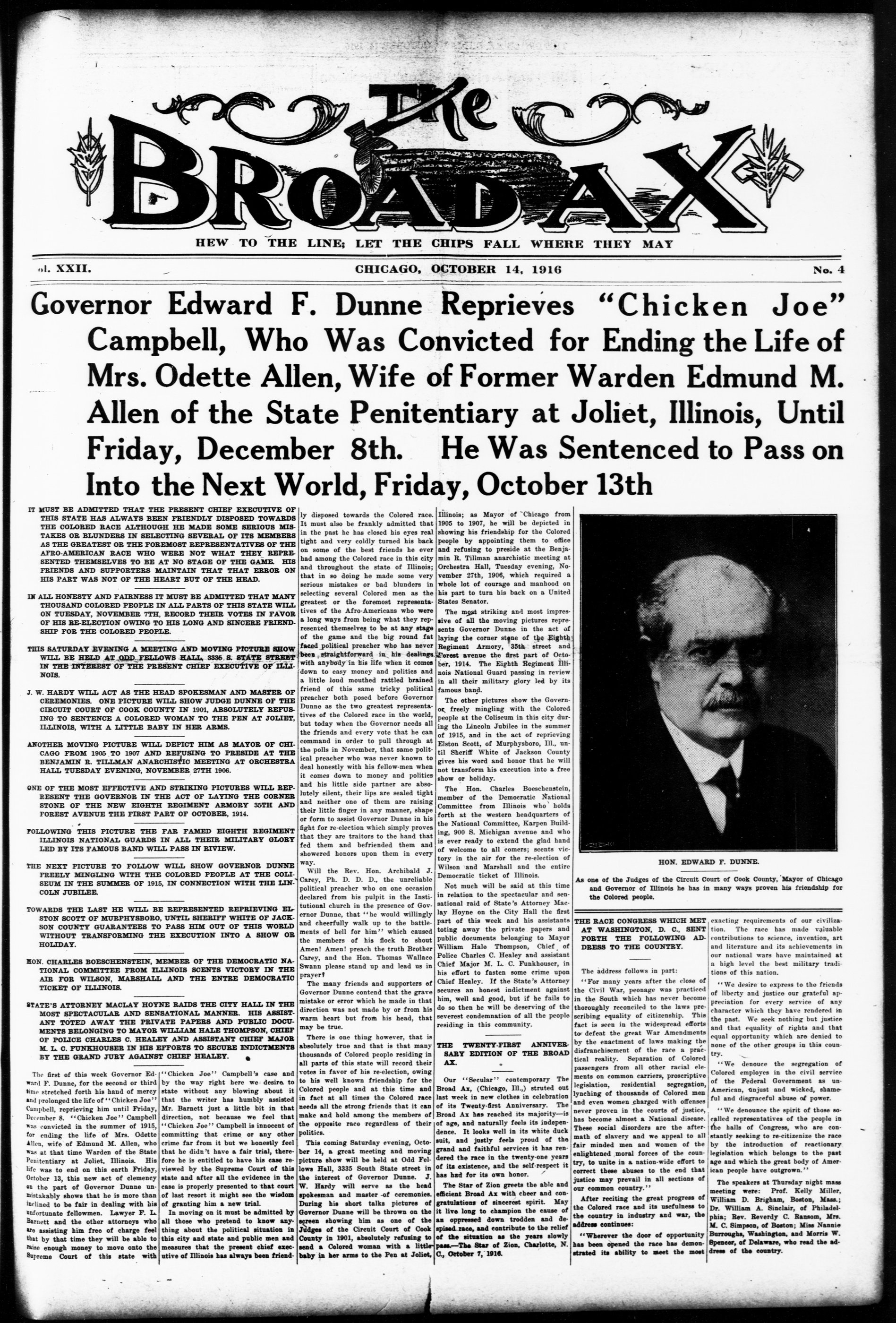
Governor Edward F. Dunne Reprieves "Chicken Joe" Campbell, Who Was Convicted for Ending the Life of Mrs. Odette Allen, Wife of Former Warden Edmund M. Allen of the State Penitentiary at Joliet, Illinois, Until Friday, December 8th. He Was Sentenced to Pass on Into the Next World, Friday, October 13th
IT MUST BE ADMITTED THAT THE PRESENT CHIEF EXECUTIVE OF THIS STATE HAS ALWAYS BEEN FRIENDLY DISPOSED TOWARDS THE COLORED RACE ALTHOUGH HE MADE SOME SERIOUS MISTAKES OR BLUNDERS IN SELECTING SEVERAL OF ITS MEMBERS AS THE GREATEST OR THE FOREMOST REPRESENTATIVES OF THE AFRO-AMERICAN RACE WHO WERE NOT WHAT THEY REPRESENTED THEMSELVES TO BE AT NO STAGE OF THE GAME. HIS FRIENDS AND SUPPORTERS MAINTAIN THAT THAT ERROR ON HIS PART WAS NOT OF THE HEART BUT OF THE HEAD.
IN ALL HONESTY AND FAIRNESS IT MUST BE ADMITTED THAT MANY THOUSAND COLORED PEOPLE IN ALL PARTS OF THIS STATE WILL ON TUESDAY, NOVEMBER 7TH, RECORD THEIE VOTES IN FAVOR OF HIS RE-ELECTION OWING TO HIS LONG AND SINCERE FRIENDSHIP FOR THE COLORED PEOPLE.
THIS SATURDAY EVENING A MEETING AND MOVING PICTURE SHOW WILL BE HELD AT ODD PELLOWS HALL, 3335 S. STATE STREET IN THE INTEREST OF THE PRESENT CHIEF EXECUTIVE OF ILLINOIS.
J. W. HARDY WILL ACT AS THE HEAD SPOKESMAN AND MASTER OF CEREMONIES. ONE PICTURE WILL SHOW JUDGE DUNNE OF THE CIRCUT COURT OF COOK COUNTY IN 1901, ABSOLUTELY REFUSING TO SENTENCE A COLORED WOMAN TO THE PEN AT JOLIET, ILLINOIS, WITH A LITTLE BABY IN HER ARMS.
ANOTHER MOVING PICTURE WILL DEPICT HIM AS MAYOR OF CHICAGO FROM 1905 TO 1907 AND REFUSING TO PRESIDE AT THE BENJAMIN R. TILLMAN ANARCHISTIC MEETING AT ORCHESTRA HALL TUESDAY EVENING, NOVEMBER 27TH 1906.
ONE OF THE MOST EFFECTIVE AND STRIKING PICTURES WILL REPRESENT THE GOVERNOR IN THE ACT OF LAYING THE CORNER STONE OF THE NEW EIGHTH REGIMENT ARMORY 35TH AND FOREST AVENUE THE FIRST PART OF OCTOBER, 1914.
FOLLOWING THIS PICTURE THE PAR FAMED EIGHTH REGIMENT ILLINOIS NATIONAL GUARDS IN ALL THEIR MILITARY GLORY LED BY ITS FAMOUS BAND WILL PASS IN RIVIEW.
THE NEXT PICTURE TO FOLLOW WILL SHOW GOVERNOR DUNNE PREELY MINGLING WITH THE COLORED PEOPLE AT THE COLISEUM IN THE SUMMER OF 1915, IN CONNECTION WITH THE LINCOLN JUBILEE.
TOWARDS THE LAST HE WILL BE REPRESENTED REPRIEVING ELSTON SCOTT OF MURPHYSBORO, UNTIL SHERIFF WHITE OF JACKSON COUNTY GUARANTEES TO PASS HIM OUT OF THIS WORLD WITHOUT TRANSFORMING THE EXECUTION INTO A SHOW OR HOLIDAY.
MON. CHARLES BOESCHENSTEIN, MEMBER OF THE DEMOCRATIC NATIONAL COMMITTEE FROM ILLINOIS SCENTS VICTORY IN THE AIR FOR WILSON, MARSHALL AND THE ENTRE DEMOCRATIC TICKET OF ILLINOIS.
STATE'S ATTORNEY MACLAY HOYNE RAIDS THE CITY HALL IN THE MOST SPECTACULAR AND SENSATIONAL MANNER. HIS ASSISTANT TOTED AWAY THE PRIVATE PAPERS AND PUBLIC DOCUMENTS BELONGING TO MAYOR WILLIAM HALE THOMPSON, CHIEF OF POLICE CHARLES C. HEALEY AND ASSISTANT CHIEF MAJOR M. L. C. FUNKHOUSER IN HIS EFFORTS TO SECURE INDICTMENTS BY THE GRAND JUBY AGAINST CHIEF HEALEY.
ol. XXII.
Governor of Campus Mrs. O'Allen Friday Into the
IT MUST BE ADMITTED THAT THE THIS STATE HAS ALWAYS BEEN THE COLORED BACE ALTHOU TAKES OR BLUNDERS IN SELI AS THE GREATEST OR THE FOR AFRO-AMERICAN RACE WHO SENTED THEMSELVES TO BE FRIENDS AND SUPPORTERS IN HIS PART WAS NOT OF THE BEST
IN ALL HONESTY AND FAIRNESS TO THOUSAND COLORED PEOPLE ON TUESDAY, NOVEMBER 7TH OF HIS RE-ELECTION OWING THE SHIP FOR THE COLORED PEOPLE
THIS SATURDAY EVENING A MEET WILL BE HELD AT ODD FELL IN THE INTEREST OF THE PRINOIS.
J. W. HARDY WILL ACT AS THE HER CEREMONIES. ONE PICTURE W CIRCUIT COURT OF COOK COUING TO SENTENCE A COLORED ILLINOIS, WITH A LITTLE BACK
ANOTHER MOVING PICTURE W CAGO FROM 1905 TO 1907 AND BENJAMIN R. TILLMAN ANARHALL TUESDAY EVENING, NOVEMBER
ONE OF THE MOST EFFECTIVE AND RESENT THE GOVERNOR IN THE STONE OF THE NEW EIGHTH FOREST AVENUE THE FIRST HOUR
FOLLOWING THIS PICTURE THE ILLINOIS NATIONAL GUARDS LED BY ITS FAMOUS BAND WIRE
THE NEXT PICTURE TO FOLLOW FREELY MINGLING WITH THE SEUM IN THE SUMMER OF 1911 COLN JUBILEE.
TOWARDS THE LAST HE WILL BE STON SCOTT OF MURPHYSEORON COUNTY GUARANTEES THE WITHOUT TRANSFORMING THE HOLIDAY.
MON. CHARLES BOESCHENSTEIN, NATIONAL COMMITTEE FROM IN AIR FOR WILSON, MARSHALL TICKET OF ILLINOIS.
STATE'S ATTORNEY MACLAY HOWE MOST SPECTACULAR AND SENIENT TOTED AWAY THE PRIVILEMENTS BELONGING TO MAYOR OF POLICE CHARLES C. HEAL M. L. C. FUNKHOUSER IN HIS BY THE GRAND JUBY AGAINS
The first of this week Governor Edward F. Dunne, for the second or third time stretched forth his hand of mercy and prolonged the life of "Chicken Joe" Campbell, reprieving him until Friday, December 8. "Chicken Joe" Campbell was convicted in the summer of 1915, for ending the life of Mrs. Odette Allen, wife of Edmund M. Allen, who was at that time Warden of the State Penitentiary at Joliet, Illinois. His life was to end on this earth Friday, October 13, this new act of clemency on the part of Governor Dunne unmistakably shows that he is more than inclined to be fair in dealing with his unfortunate fellowmen. Lawyer F. L. Barnett and the other attorneys who are assisting him free of charge feel that by that time they will be able to raise enough money to move onto the Supreme Court of this state with
"Chicken Joe" Campbell's case and by the way right here we desire to state without any blowing about it that the writer has humbly assisted Mr. Barnett just a little bit in that direction, not because we feel that "Chicken Joe" Campbell is innocent of committing that crime or any other crime far from it but we honestly feel that he didn't have a fair trial, therefore he is entitled to have his case reviewed by the Supreme Court of this state and after all the evidence in the case is properly presented to that court of last resort it might see the wisdom of granting him a new trial.
In moving on it must be admitted by all those who pretend to know anything about the political situation in this city and state and public men and measures that the present chief executive of Illinois has always been friend-
CHICAGO, OCTOBER 14, 1916
ly disposed towards the Colored race. It must also be frankly admitted that in the past he has closed his eyes real tight and very coldly turned his back on some of the best friends he ever had among the Colored race in this city and throughout the state of Illinois; that in so doing he made some very serious mistakes or bad blunders in selecting several Colored men as the greatest or the foremost representatives of the Afro-Americans who were a long ways from being what they represented themselves to be at any stage of the game and the big round fat faced political preacher who has never been straightforward in his dealings with anybody in his life when it comes down to easy money and politics and a little loud mouthed rattled brained friend of this same tricky political preacher both posed before Governor Dunne as the two greatest representatives of the Colored race in the world, but today when the Governor needs all the friends and every vote that he can command in order to pull through at the polls in November, that same political preacher who was never known to deal honestly with his fellow-men when it comes down to money and politics and his little side partner are absolutely silent, their lips are sealed tight and neither one of them are raising their little finger in any manner, shape or form to assist Governor Dunne in his fight for re-election which simply proves that they are traitors to the hand that fed them and befriended them and showered honors upon them in every way.
Will the Rev. Hon. Archibald J. Carey, Ph. D. D. D., the unreliable political preacher who on one occasion declared from his pulpit in the Institutional church in the presence of Governor Dunne, that "he would willingly and cheerfully walk up to the battlements of hell for him" which caused the members of his flock to shout Amen! Amen! preach the truth Brother Carey, and the Hon. Thomas Wallace Swann please stand up and lead us in prayer?
The many friends and supporters of Governor Dunne contend that the grave mistake or error which he made in that direction was not made by or from his warm heart but from his head, that may be true.
There is one thing however, that is absolutely true and that is that many thousands of Colored people residing in all parts of this state will record their votes in favor of his re-election, owing to his well known friendship for the Colored people and at this time and in fact at all times the Colored race needs all the strong friends that it can make and hold among the members of the opposite race regardless of their politics.
This coming Saturday evening, October 14, a great meeting and moving picture show will be held at Odd Fellows Hall, 3335 South State street in the interest of Governor Dunne. J. W. Hardy will serve as the head spokesman and master-of ceremonies. During his short talks pictures of Governor Dunne will be thrown on the screen showing him as one of the Judges of the Circuit Court of Cook County in 1901, absolutely refusing to send a Colored woman with a little baby in her arms to the Pen at Joliet,
Illinois; as Mayor of Chicago from 1905 to 1907, he will be depicted in showing his friendship for the Colored people by appointing them to office and refusing to preside at the Benjamin R. Tillman anarchistic meeting at Orchestra Hall, Tuesday evening, November 27th, 1906, which required a whole lot of courage and manhood on his part to turn his back on a United States Senator.
The most striking and most impressive of all the moving pictures represents Governor Dunne in the act of laying the corner stone of the Eighth Regiment Armory, 35th street and Forest avenue the first part of October, 1914. The Eighth Regiment Illinois National Guard passing in review in all their military glory led by its famous band.
The other pictures show the Governor freely mingling with the Colored people at the Coliseum in this city during the Lincoln Jubilee in the summer of 1915, and in the act of reprieving Elston Scott, of Murphysboro, Ill., until Sheriff White of Jackson County gives his word and honor that he will not transform his execution into a free show or holiday.
The Hon. Charles Boeschenstein, member of the Democratic National Committee from Illinois who holds forth at the western headquarters of the National Committee, Karpen Building, 900 S. Michigan avenue and who is ever ready to extend the glad hand of welcome to all comers; scents victory in the air for the re-election of Wilson and Marshall and the entire Democratic ticket of Illinois.
Not much will be said at this time in relation to the spectacular and sensational raid of State's Attorney Maclay Hoyne on the City Hall the first part of this week and his assistants toting away the private papers and public documents belonging to Mayor William Hale Thompson, Chief of Police Charles C. Healey and assistant Chief Major M. L. C. Funkhouser, in his effort to fasten some crime upon Chief Healey. If the State's Attorney secures an honest indictment against him, well and good, but if he fails to do so then he will be deserving of the severest condemnation of all the people residing in this community.
THE TWENTY-FIRST ANNIVERSARY EDITION OF THE BROAD AX.
Our "Secular" contemporary The Broad Ax, (Chicago, Ill.) struted out last week in new clothes in celebration of its Twenty-first Anniversary. The Broad Ax has reached its majority—is of age, and naturally feels its independence. It looks well in its white duck suit, and justly feels proud of the grand and faithful service it has rendered the race in the twenty-one years of its existence, and the self-respect it has had for its own honor.
The Star of Zion greets the able and efficient Broad Ax with cheer and congratulations of sincerest spirit. May it live long to champion the cause of an oppressed down trodden and despised race, and contribute to the relief of the situation as the years slowly pass.—The Star of Zion, Charlotte, N.C., October 7, 1916.
4
HON. EDWARD F. DUNNE
As one of the Judges of the Circuit C and Governor of Illinois he has i the Colored people.
As one of the Judges of the Circuit Court of Cook County, Mayor of Chicago and Governor of Illinois he has in many ways proven his friendship for the Colored people.
THE RACE CONGRESS WHICH MET AT WASHINGTON, D. C., SENT FORTH THE FOLLOWING ADDRESS TO THE COUNTRY.
The address follows in part:
"For many years after the close of the Civil War, peonage was practiced in the South which has never become thoroughly reconciled to the laws prescribing equality of citizenship. This fact is seen in the widespread efforts to defeat the great War Amendments by the enactment of laws making the disfranchisement of the race a practical reality. Separation of Colored passengers from all other racial elements on common carriers, proscriptive legislation, residential segregation, lynching of thousands of Colored men and even women charged with offenses never proven in the courts of justice, has become almost a National disease. These social disorders are the aftermath of slavery and we appeal to all fair minded men and women of the enlightened moral forces of the country, to unite in a nation-wide effort to correct these abuses to the end that justice may prevail in all sections of our common country."
After reciting the great progress of the Colored race and its usefulness to the country in industry and war, the address continues:
"Wherever the door of opportunity has been opened the race has demonstrated its ability to meet the most
---
exacting requirements of our civilization. The race has made valuable contributions to science, invention, art and literature and its achievements in our national wars have maintained at a high level the best military traditions of this nation.
"We desire to express to the friends of liberty and justice our grateful appreciation for every service of any character which they have rendered in the past. We seek nothing but justice and that equality of rights and that equal opportunity which are denied to none of the other groups in this country.
"We denounce the segregation of Colored employees in the civil service of the Federal Government as un-American, unjust and wicked, shameful and disgraceful abuse of power.
"We denounce the spirit of those so-called representatives of the people in the halls of Congress, who are constantly seeking to re-citizenize the race by the introduction of reactionary legislation which belongs to the past age and which the great body of American people have outgrown."
The speakers at Thursday night mass meeting were: Prof. Kelly Miller, William D. Brigham, Boston, Mass.; Dr. William A. Sinclair, of Philadelphia; Rev. Reverdy C. Ransom, Mrs. M. C. Simpson, of Boston; Miss Nannie Burroughs, Washington, and Morris W. Spencer, of Delaware, who read the address of the country.
No. 4
PAGE TWO
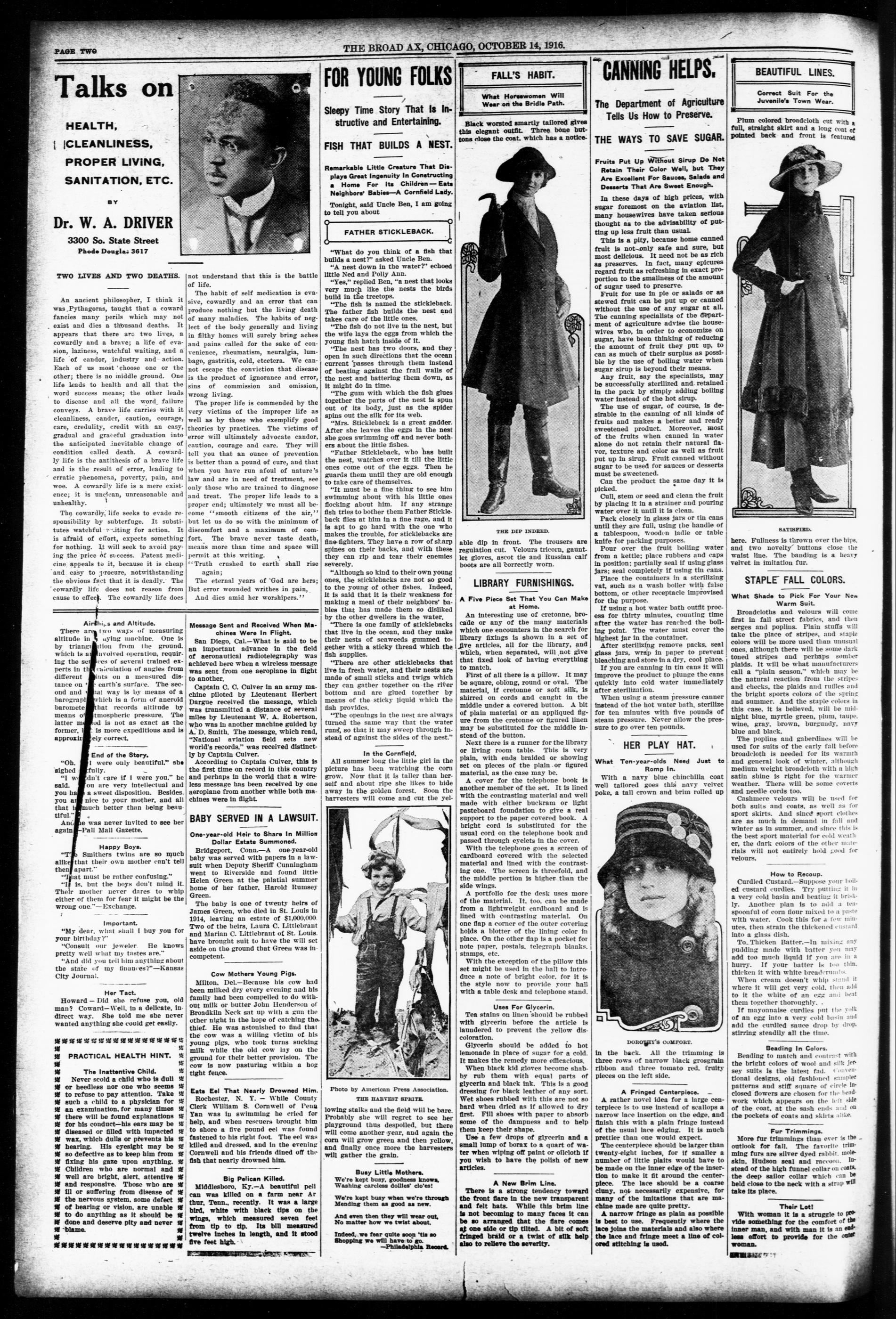
Talks on
HEALTH,
CLEANLINESS,
PROPER LIVING,
SANITATION, ETC.
BY
Dr. W. A. DRIVER
BY
3300 So. State Street
Phode Douglass 3617
TWO LIVES AND TWO DEATHS.
An ancient philosopher, I think it was Pythagoras, taught that a coward fancies many perils which may not exist and dies a thousand deaths. It appears that there are two lives, a cowardly and a brave; a life of evasion, laziness, watchful waiting, and a life of candor, industry and action. Each of us most choose one or the other; there is no middle ground. One life leads to health and all that the word success means; the other leads to disease and all the word failure conveys. A brave life carries with it cleanliness, candor, caution, courage, care, credulity, credit with an easy, gradual and graceful graduation into the anticipated inevitable change of condition called death. A cowardly life is the antithesis of a brave life and is the result of error, leading to erratic phenomena, poverty, pain, and woe. A cowardly life is a mere existence; it is unclean, unreasonable and unhealthy.
The cowardly life seeks to evade responsibility by subterfuge. It substitutes watchful writing for action. It is afraid of effort, expects something for nothing. It will seek to avoid paying the price of success. Patent medicine appeals to it, because it is cheap and easy to procure, notwithstanding the obvious fact that it is deadly. The cowardly life does not reason from cause to effect. The cowardly life does
Airthias and Altitude
There are two ways of measuring altitude in a laying machine. One is by triangulation from the ground, which is an involved operation, requiring the services of several trained experts in the calculation of angles from different points on a measured distance on the earth's surface. The second and usual way is by means of a barograph, which is a form of aneroid barometer that records altitude by means of atmospheric pressure. The latter method is not as exact as the former, but is more expeditious and is approximately correct.
End of the Story:
"Oh, I were only beautiful," she sighed affection.
"I wore don't care if I were you," he said. "You are very intellectual and you have a sweet disposition. Besides, you are nice to your mother, and all that is much better than being beautiful."
And he was never invited to see her again-Pall Mall Gazette.
Happy Boys.
"The Smithers twins are so much alike that their own mother can't tell them apart."
"That must be rather confusing."
"It is, but the boys don't mind it. Their mother never dares to whip either of them for fear it might be the wrong one."—Exchange.
Important
"My dear, what shall I buy you for your birthday?"
"Consult our jeweler. He knows pretty well what my tastes are."
"And did you tell him anything about the state of my finances?"—Kansas City Journal.
Her Tact.
Howard - Did she refuse you, old man? Coward-Well, in a delicate, indirect way. She told me she never wanted anything she could get easily.
```markdown
```
PRACTICAL HEALTH HINT.
The Inattentive Child.
Never scold a child who is dull or heedless nor one who seems to refuse to pay attention. Take such a child to a physician for an examination, for many times there will be found explanations for his conduct—his ears may be diseased or filled with impacted wax, which dulls or prevents his hearing. His eyesight may be so defective as to keep him from fixing his gaze upon anything. Children who are normal and well are bright, alert, attentive and responsive. Those who are ill or suffering from disease of the nervous system, some defect of hearing or vision, are unable to do anything as it should be done and deserve pity and never blame.
---
[Name]
not understand that this is the battle of life.
The habit of self medication is evasive, cowardly and an error that can produce nothing but the living death of many maladies. The habits of neglect of the body generally and living in filth homes will surely bring aches and pains called for the sake of convenience, rheumatism, neuralgia, lumbago, gastritis, cold, eteetera. We cannot escape the conviction that disease is the product of ignorance and error, sins of commission and omission, wrong living.
The proper life is commended by the very victims of the improper life as well as by those who exemplify good theories by practices. The victims of error will ultimately advocate candor, caution, courage and care. They will tell you that an ounce of prevention is better than a pound of cure, and that when you have run afoul of nature's law and are in need of treatment, see only those who are trained to diagnose and treat. The proper life leads to a proper end; ultimately we must all become "smooth citizens of the air," but let us do so with the minimum of discomfort and a maximum of comfort. The brave never taste death, means more than time and space will permit at this writing.
"Truth crushed to earth shall rise again;
The eternal years of 'God are hers;
But error wounded writhes in pain,
And dies amid her worshipers."
Message Sent and Received When Machines Were In Flight.
San Diego, Cal.-What is said to be an important advance in the field of aeronautical radiotelegraphy was achieved here when a wireless message was sent from one aeroplane in flight to another.
Captain C. C. Culver in an army machine piloted by Lieutenant Herbert Dargue received the message, which was transmitted a distance of several miles by Lieutenant W. A. Robertson, who was in another machine guided by A. D. Smith. The message, which read, "National aviation field sets new world's records," was received distinctly by Captain Culver.
According to Captain Culver, this is the first time on record in this country and perhaps in the world that a wireless message has been received by one aeroplane from another while both machines were in flight.
BABY SERVED IN A LAWSUIT.
One-year-old Heir to Share In Million Dollar Estate Summoned.
Bridgeport, Conn.—A one-year-old baby was served with papers in a lawsuit when Deputy Sheriff Cunningham went to Riverside and found little Helen Green at the palatial summer home of her father, Harold Rumsey Green.
The baby is one of twenty heirs of James Green, who died in St. Louis in 1914, leaving an estate of $1,000,000. Two of the heirs, Laura C. Littlebrant and Marian C. Littlebrant of St. Louis, have brought suit to have the will set aside on the ground that Green was incompetent.
Cow Mothers Young Pigs.
Milton, Del.-Because his cow had been milked dry every evening and his family had been compelled to do without milk or butter John Henderson of Broadkil Neck sat up with a gun the other night in the hope of catching the thief. He was astonished to find that the cow was a willing victim of his young pigs, who took turns sucking milk while the old cow lay on the ground for their better provision. The cow is now pasturing within a hog tight fence.
Eats Eel That Nearly Drowned Him. Rochester, N. Y. - While County Clerk William S. Cornwell of Penn Yan was in swimming he cried for help, and when rescuers brought him to shore a five pound eel was found fastened to his right foot. The eel was killed and dressed, and in the evening Cornwell and his friends dined off the fish that nearly drowned him.
Big Pelican Killed.
Middlesboro, Ky.-A beautiful pell can was killed on a farm near Arthur, Tenn., recently. It was a large bird, white with black tips on the wings, which measured seven feet from tip to tip. Its bill measured twelve inches in length, and it stood five feet high.
THE BROAD AX, CHICAGO, OCTOBER 14, 1916.
FOR YOUNG FOLKS
Sleepy Time Story That Is Instructive and Entertaining.
Remarkable Little Creature That Displays Great Ingenuity In Constructing a Home For Its Children—Eats Neighbors' Babies—A Cornfield Lady.
Tonight, sald Uncle Ben, I am going to tell you about
FATHER STICKLEBACK.
"What do you think of a fish that builds a nest?" asked Uncle Ben.
"A nest down in the water?" echoed little Ned and Polly Ann.
"Yes," replied Ben, "a nest that looks very much like the nests the birds build in the treetops.
"The fish is named the stickleback. The father fish builds the nest and takes care of the little ones.
"The fish do not live in the nest, but the wife lays the eggs from which the young fish hatch inside of it.
"The nest has two doors, and they open in such directions that the ocean current passes through them instead of beating against the frail walls of the nest and battering them down, as it might do in time.
"The gum with which the fish glues together the parts of the nest is spun out of its body, just as the spider spins out the silk for its web.
"Mrs. Stickleback is a great gadder. After she leaves the eggs in the nest she goes swimming off and never bothers about the little fishes.
"Father Stickleback, who has built the nest, watches over it till the little ones come out of the eggs. Then he guards them until they are old enough to take care of themselves.
"It must be a fine thing to see him swimming about with his little ones flocking about him. If any strange fish tries to bother them Father Stickleback flies at him in a fine rage, and it is apt to go hard with the one who makes the trouble, for sticklebacks are fine-fighters. They have a row of sharp spines on their backs, and with these they can rip and tear their enemies severely.
"Although so kind to their own young ones, the sticklebacks are not so good to the young of other fishes. Indeed, it is said that it is their weakness for making a meal of their neighbors' babies that has made them so disliked by the other dwellers in the water.
"There is one family of sticklebacks that live in the ocean, and they make their nests of seaweeds gummed together with a sticky thread which the fish supplies.
"There are other sticklebacks that live in fresh water, and their nests are made of small sticks and twigs which they can gather together on the river bottom and are glued together by means of the sticky liquid which the fish provides.
"The openings in the nest are always turned the same way that the water runs, so that it may sweep through instead of against the sides of the nest."
In the Cornfield
All summer long the little girl in the picture has been watching the corn grow. Now that it is taller than herself and about ripe she likes to hide away in the golden forest. Soon the harvesters will come and cut the reel
A boy in a cornfield.
Photo by American Press Association.
THE HARVEST SPRITE.
lowing stalks and the field will be bare. Probably she will regret to see her playground thus despoiled, but there will come another year, and again the corn will grow green and then yellow, and finally once more the harvesters will gather the grain.
Busy Little Mothers.
We're kept busy, goodness knows.
Washing carless dolles' cloes!
We're kept busy when we're through Mending them as good as new.
And even then they will wear out.
No matter how we twist about.
Indeed, we fear quite soon 'tis so Shopping we will have to go.
—Philadelphia Record.
FALL'S HABIT.
What Horsewomen Will Wear on the Bridle Path.
Black worsted smartly tailored gives this elegant outfit. Three bone buttons close the coat, which has a notice-
THE LADY OF THE RING
THE DIP INDEED.
able dip in front. The trousers are regulation cut. Velours tricorn, gauntlet gloves, ascot tie and Russian calf boots are all correctly worn.
LIBRARY FURNISHINGS.
A Five Piece Set That You Can Make at Home.
An interesting use of cretonne, brocade or any of the many materials which one encounters in the search for library fixings is shown in a set of five articles, all for the library, and which, when separated, will not give that fixed look of having everything to match.
First of all there is a pillow. It may be square, oblong, round or oval. The material, if cretonne or soft silk, is shirred on cords and caught in the middle under a covered button. A bit of plain material or an appliqued figure from the cretonne or figured linen may be substituted for the middle instead of the button.
Next there is a runner for the library or living room table. This is very plain, with ends braided or showing set on pieces of the plain or figured material, as the case may be.
A cover for the telephone book is another member of the set. It is lined with the contrasting material and well made with either buckram or light pasteboard foundation to give a real support to the paper covered book. A bright cord is substituted for the usual cord on the telephone book and passed through eyelets in the cover. With the telephone goes a screen of cardboard covered with the selected material and lined with the contrasting one. The screen is threefold, and the middle portion is higher than the side wings. A portfolio for the desk uses more of the material. It, too, can be made from a lightweight cardboard and is lined with contrasting material. On one flap a corner of the outer covering holds a blotter of the lining color in place. On the other flap is a pocket for note paper, postals, telegraph blanks, stamps, etc.
With the exception of the pillow this set might be used in the hall to introduce a note of bright color, for it is the style now to provide your hall with a table desk and telephone stand.
Uses For Glycerin
Tea stains on linen should be rubbed with glycerin before the article is laundered to prevent the yellow discoloration. Glycerin should be added to hot lemonade in place of sugar for a cold. It makes the remedy more efficacious.
Use a few drops of glycerin and a small lump of borax to a quart of water when wiping off paint or oilcloth if you wish to have the polish of new articles.
A New Brim Line.
There is a strong tendency toward the front flare in the new transparent and felt hats. While this brim line is not becoming to many faces it can be so arranged that the flare comes at one side or tip tilted. A bit of soft fringed braid or a twist of silk help also to relieve the severity.
CANNING HELPS.
The Department of Agriculture Tells Us How to Preserve.
THE WAYS TO SAVE SUGAR.
Fruits Put Up Without Sirup Do Not Retain Their Color Well, but They Are Excellent For Sauces, Salads and Desserts That Are Sweet Enough. In these days of high prices, with sugar foremost on the aviation list, many housewives have taken serious thought as to the advisability of putting up less fruit than usual. This is a pity, because home canned fruit is not-only safe and sure, but most delicious. It need not be as rich as preserves. In fact, many epicures regard fruit as refreshing in exact proportion to the smallness of the amount of sugar used to preserve.
Fruit for use in pie or salads or as stewed fruit can be put up or canned without the use of any sugar at all. The canning specialists of the department of agriculture advise the housewives who, in order to economize on sugar, have been thinking of reducing the amount of fruit they put up, to can as much of their surplus as possible by the use of boiling water when sugar sirup is beyond their means. Any fruit, say the specialists, may be successfully sterilized and retained in the pack by simply adding boiling water instead of the hot sirup. The use of sugar, of course, is desirable in the canning of all kinds of fruits and makes a better and ready sweetened product. Moreover, most of the fruits when canned in water alone do not retain their natural flavor, texture and color as well as fruit put up in sirup. Fruit canned without sugar to be used for sauces or desserts must be sweetened.
Can the product the same day it is picked.
Cull, stem or seed and clean the fruit by placing it in a strainer and pouring water over it until it is clean.
Pack closely in glass jars or tin cans until they are full, using the handle of a tablespoon, wooden ladle or table knife for packing purposes.
Pour over the fruit boiling water from a kettle; place rubbers and caps in position; partially seal if using glass jars; seal completely if using tin cans.
Place the containers in a sterilizing vat, such as a wash boiler with false bottom, or other receptacle improvised for the purpose.
If using a hot water bath outfit process for thirty minutes, counting time after the water has reached the boiling point. The water must cover the highest jar in the container.
After sterilizing remove packs, seal glass jars, wrap in paper to prevent bleaching and store in a dry, cool place.
If you are canning in tin cans it will improve the product to plunge the cans quickly into cold water immediately after sterilization. When using a steam pressure canner instead of the hot water bath, sterilize for ten minutes with five pounds of steam pressure. Never allow the pressure to go over ten pounds.
HER PLAY HAT.
What Ten-year-olds Need Just to
Romp In.
With a navy blue chinchilla coat
well tallored goes this navy velvet
poke, a tall crown and brim rolled up
A.
DOROTHY'S COMFORT.
in the back. All the trimming is
three rows of narrow black grosgrain
ribbon and three tomato red. fruity
pieces on the left side.
A Fringed Centernied
A rather novel idea for a large centerpiece is to use instead of scallops a narrow lace insertion on the edge, and finish this with a plain fringe instead of the usual lace edging. It is much prettier than one would expect.
The centerpiece should be larger than twenty-eight inches, for if smaller a number of little plaits would have to be made on the inner edge of the insertion to make it fit around the centerpiece. The lace should be a coarse cluny, not necessarily expensive, for many of the imitations that are machine made are quite pretty.
A narrow fringe as plain as possible is best to use. Frequently where the lace joins the materials and also where the lace and fringe meet a line of colored stitching is used.
Correct Suit For the Juvenile's Town Wear. Plum colored broadcloth cut with a full, straight skirt and a long coat of pointed back and front is featured
I
here. Fullness is thrown over the hips, and two novelty buttons close the waist line. The banding is a heavy velvet in imitation fur.
STAPLE FALL COLORS.
What Shade to Pick For Your New Warm Suit.
Broadcloths and velours will come first in fall street fabrics, and then serges and poplins. Plain stuffs will take the place of stripes, and staple colors will be more used than unusual ones, although there will be some dark toned stripes and perhaps somber plaids. It will be what manufacturers call a "plain season," which may be the natural reaction from the stripes and checks, the plaids and ruffles and the bright sports colors of the spring and summer. And the staple colors in this case, it is believed, will be midnight blue, myrtle green, plum, taupe, wine, gray, brown, burgundy, navy blue and black.
The poplins and gambardines will be used for suits of the early fall before broadcloth is needed for its warmth and general look of winter, although medium weight broadcloth with a high satin shine is right for the warmer weather. There will be some coverts and needle cords too. Cashmere velours will be used for both suits and coats, as well as for sport skirts. And since sport clothes are as much in demand in fall and winter as in summer, and since this is the best sport material for cold weather, the dark colors of the other materials will not entirely hold good for velours.
How to Recoup.
Curdled Custard.—Suppose your boiled custard curdles. Try putting it in a very cold basin and beating it briskly. Another plan is to add a teaspoonful of corn flour mixed to a paste with water. Cook this for a few minutes, then strain the thickened custard into a glass dish.
To Thicken Batter.—In mixing any pudding made with batter you may add too much liquid if you are in a hurry. If your batter is too thin, thicken it with white breadcrumbs.
When cream doesn't whip stand it where it will get very cold, then add to it the white of an egg and beat them together thoroughly.
If mayonnaise curdles put the yolk of an egg into a very cold basin and add the curdled sauce drop by drop, stirring steadily all the time.
Beading In Colors
Reading to match and contrast with the bright colors of wool and silk jersey suits is the latest fad. Conventional designs, old fashioned simpler patterns and stiff square of circle enclosed flowers are chosen for the headwork which appears on the left side of the coat, at the sash ends and on the pockets of coats and skirts alike.
Fur Trimmings
More fur trimmings than ever is the outlook for fall. The favorite trimming furs are silver dyed rabbit, mole-skin, Hudson seal and raccoon. Instead of the high funnel collar on coats, the deep sailor collar which can be held close to the neck with a strap will take its place.
Their Lot!
With woman it is a struggle to provide something for the comfort of the inner man, and with man it is an endless effort to provide for the outer woman.
BALDHEADED ALASKAN BEARS
Volcanic Ash Brings Hardship to Bruin on Kadiak Island.
Seward, Alaska.-It will take more than two or three years of enforced diet of straight meat and fish and a loss of hair to seriously set back the bear population of Kadiak island, according to D. Winn of the United States bureau of fisheries.
Kadiak island, says Mr. Winn, in 1912 was covered with volcanic ash at no point at a depth less than eleven inches. The ash killed all vegetation, and as all bears are fond of a mixed diet of meat, fish and vegetables, they found 1913 and 1914 unpleasant from a dietary standpoint.
Another effect of the fall of ash, according to Mr. Winn, was the havoc it created with the furry coats of the animals. Bald headed bears are now as common on Kadiai island as bald headed men in the front row of a musical comedy. The ash sifted down on to the skins of the animals as it fell, and the first rain turned to lye, which had the effect of almost tanning the skins of the bears while yet a part of their personal effects.
WHITTLES VIOLIN FINGERS.
Player Hopes to Increase His Proficiency by Surgery.
Wichita, Kan.—In order to become a more proficient violin artist Mark Sandfort, a member of an orchestra here, had a piece of flesh taken from each of his six fingers. The incisions were drawn together and sewn with horsehair. The operation was performed by Dr. H. S. Hickok, and Sandfort will be able to remove the bandages soon.
Sandfort has won a reputation as a violinist. However, his execution of musical selections was not as good as he desired it to be. He hit upon a plan. He would have his fingers whitted down. He waited until the season closed and bad the operation performed.
According to physicians, this is the first time that an operation of this kind has been performed.
BOY FALLS: SERVICE STOPS
Pastor and Congregation See Lad Hit by Electric Current.
Little Rock, Ark.—Kenneth McEwen, eleven years of age, was electrocuted thirty feet in the air on a lighting tower in view of the congregation of a church that was holding services on the church lawn because of the heat.
The boy was knocking the wire that supplied current to the lights on the tower against the steel frame to produce sparks. Suddenly a flash of blue flames enveloped him, and he plunged downward, fracturing his skull on the pavement below. He died in a hospital a few minutes later.
The pastor of the church, the Rey, E. P. Aldredge, was preaching a special sermon to boys. He rushed over, alced in placing the dying lad in an ambulance and then resumed his sermon, using the accident as a warning to the boys.
GIRL'S PROFIT IN HOGS.
Raising Swine Not a Finishing School For Debutantes.
Holtville, Cal.—Raising hogs for pleasure and profit is the occupation of Miss Josie Fuller, seventeen, the youngest and best all around feminine pork producer in the Imperial valley.
It is her ambition to become the best expert on hogs in her district. Her herd numbers fifty strong and is increasing. "Pig culture isn't aesthetic work, of course," said Miss Fuller. "It can't be considered a finishing school for debutantes, but there's money in it." She has established a record of developing her porkers for the market at a cost of $3½ cents a pound.
"Women may not admire hogs, but if they don't it's because they know so little about them. Once interested they become just as capable as men in handling swine."
TWO DEATHS IN ONE HOME.
Sees Mother-in-law Stricken With Heart Failure, Then Dies.
Philadelphia - Stricken with heart failure just after she had called her son to dinner at noon, Mrs. Rebecca Thomas, seventy-three years old, a sister of Jesse Pratt, former mayor of Camden, fell dead in the dining room of her Camden home.
Mrs. Madeline Thomas, her daughter-in-law, who was in an adjoining room, ran to her assistance and was leaning over her, trying to lift her form to a couch, when she, too, collapsed and fell lifeless.
ANOTHER QUITS SING SING.
Officials Think Prisoner Swam to Liberty.
Ossining, N. Y.—"I'm going into the garden to get some tomatoes for breakfast," said Elmer Schultz, a prisoner at Sing Sing, as he walked out of the power house, where he was doing duty as a fireman. Some hours later the big whistle tooted the message that another prisoner had escaped.
Prison officials had then found two iron pickets had been pulled apart and concluded that Schultz went through the opening, dived into the Hudson and swam to liberty.
Lost Dog Returned Home
New York. - After a year's absence a beagle belonging to Louis W. Well of Flushing, N. Y., returned home. Mr. Well went on a hunting trip a year ago and took the beagle along. He lost the dog. The dog seemed to enjoy its homecoming, and the Well family showed its delight in a way that tickled the dog's palate.
Stagetruck Women
William A. Page, the Chicago crick and publicity writer, says in the Woman's Home Companion in an article about stagnest cricket women:
"And what becomes of them? Caught in the eddies of frivolity, many of them temporarily abandon their stage ambitions in the kaledoscopic life of Broadway. Others live in hall bedrooms, boll eggs over a gas jet and waste their young lives in the fruitless pursuit of a rainbow which they never find, only sooner or later to return home sadly and settle down to forget their stage ambitions. Others study, economize, sincerely strive for engagements, possibly get small roles with some obscure company and start in on a career which will be filled with many, many disappointments. And of the thousands who came so bravely to the front last year how many still remain in the lists? Not counting those who may have gone into musical comedy, perhaps a score still cherish the shrine of Marlowe and of Adams. For the rest, oblivion."
Shaw Didn't Like Himself
"Many years ago in a house in Ashley Gardens," writes G. Bernard Shaw in the New Witness, "I was walking along a corridor with other guests at a musical evening when I saw coming toward me a man who produced an extraordinarily disagreeable impression on me, a tall young man in evening dress, with a blond beard and, as it seemed to me, a hateful expression.
"He was coming straight at me. I moved aside to avoid him, and he moved, too, apparently to get into my way again. An impulse of rage at this insult was checked just in time by the discovery that instead of walking along a corridor I was crossing a square landing and that the detestable apparition who had chilled my very soul with his abominable aspect was a reflection of myself in the wall of mirror which the tenant of the Ashley Gardens flat had put up to give his cramped dwelling an appearance of spacious magnificence."
Power In Plant Cells.
Along with the formation of the sugar, and caused in part by its accumulation, there develop within the minute cells of the blueberry plants enormous osmotic pressures, which enable the plant to push its buds open, F. V. Coville writes in the National Geographic Magazine.
These pressures are frequently as high as seven atmospheres or more than 100 pounds to the square inch—a pressure that would start a leak in a low pressure steam engine. The pressure may become as high as thirty atmospheres or 450 pounds to the square inch—a force sufficient to blow the cylinder head off of a thousand horsepower Corliss engine. The reason the plant does not explode is because it is broken up into many extremely small and strongly built cells instead of having one big interior cavity. These minute chambers are often as thick walled proportionately as an artillery shell.
A Famous War Horse.
Bucephalus, the charger that carried Alexander the Great through all his campaigns, received his name from the fact that, although white, he had a black mark resembling an ox's head on his forehead.
A Thessalonian had offered the horse for sale to Philip of Macedon, but as none of the monarch's attendants could manage him the king ordered his owner to take him away. Alexander, who was present, expressed his regret at losing so fine an animal, and Philp replied that he would buy the horse if his son could ride him. The offer was accepted by Alexander, who succeeded in the attempt. Bucephalus would never suffer any other person to mount him.
Airing a Room.
In airing a room there are two things to be remembered—first, that the impure air must be allowed to escape and, secondly, that fresh air must be admitted. Impure air in a room is always warm and will therefore rise toward the ceiling, when it will escape if the window is opened at the top, while cold fresh air will enter through the lower part of the window when opened.
A Grand Canyon Sunrise
A sunrise in the Grand canyon lasts as long as you please. Each hour is a sunrise for some cavern deeper than the last, and, in fact, there are many where it has yet to rise for the first time since the canyon was made by those ages of running water.
His Ashes.
"So you prefer to be cremated when you die?"
"I certainly do."
"Why?"
"So that my remains may be mingled with the ashes of the grate."—London Telegraph.
Parental Care.
"Did your bride's father, give her away?"
"No, he didn't. He left me to find out a few things about her for myself."—Baltimore American.
Causes.
Bix—A physician says that yawning is caused by a lack of oxygen in the blood. Dix—Or a lack of pep in the conversation.—Boston Transcript.
The Comeback
Skintlint—I have no money, but I will give you a little advice. Beggar—Well, if yer ain't got no money yer advice can't be very valuable.
Sooner or later the world comes around to see the truth and do the right—Hilliard.
THE BROAD AX, CHICAGO, OCTOBER 14, 1916
Coney Island's Start.
Coney Island starts.
The first man to realize the great possibilities of Coney Island as a summer resort was Austin Corbin, a banker and railway official. From the beginning of the last century the beach at Coney Island was frequented by many New Yorkers, but it remained for Corbin to initiate the movement which has made "Coney" a synonym for a certain kind of amusement. Corbin started his financial career at Davenport, Ia., but in 1865 he opened a banking house in New York, and in 1873 he purchased the eastern part of Coney Island. There he created the great resort known as Manhattan Beach. He also became president of the Long Island railroad and played a big part in the development of all the summer resorts on Long Island. In the last forty years Coney Island has become the greatest popular summer resort in the world, and in addition to the millions of transient visitors from the city who go there for the day many thousands are regular summer residents of the hotels and cottages which line its shores. — New York World.
Money Mark Twain Refused.
Money Mark Twain Refused.
By the time that Mark Twain had finally succeeded in paying off the burden of debt that had fallen upon him with the failure of his publishing venture he found himself one of the best paid authors in the world. He refused many offers of money that did not agree with his literary conscience. He declined $10,000 for a tobacco indorsement, though he liked the tobacco well enough. He declined $10,000 a year for five years to lend his name as editor to a humorous periodical. He declined another $10,000 for ten lectures and another for fifty lectures at the same rate—that is, $1,000 a night. And he was offered $1 a word for his writing, which he also declined, making a final arrangement with his regular publishers that they should print whatever he wrote, the payment being 20 (later 30) cents a word.—"Boys' Life of Mark Twain" in St. Nicholas'.
Persian Words In English
Regarding the Persian language, we all have a few words from that source in our vocabularies, although we may not be aware of our indebtedness. There are about a dozen words in the English dictionary which trace to Persia, the most common being perhaps "orange" although this was thought by some to be derived from the Latin "aurum" (gold), "Sash," meaning a ribbon or band (the "sash" of a window is the Latin "capsa"), "shawl" and "taffeta" are other Persian words which have become thoroughly acclimatized, as have "chess," "caravan," "lilac," "dervish" and "lac," while "emerald" and "indigo," "azure," "bazaar," "jackal," "musk," "paradise" and "scimitar" have also been traced to the same source.-London Opinion.
Sympathy With Nature.
"Tis an evidence of how directly we are related to nature that we more or less sympathize with the weather and take on the color of the day. Goethe said he worked easiest on a high barometer. One is like a chimney that draws well some days and won't draw at all on others, and the secret is mainly in the condition of the atmosphere. Anything positive and decided with the weather is a good omen. A pouring rain may be more auspicious than a sleeping sunshine. When the stove draws well the fogs and fumes will leave your mind. - John Burroughs.
Teeth as Sentinels
"When thou sittest to eat with a ruler consider diligently him that is before thee," says the Hebrew proverb, warning a king's guest to regulate his appetite by his host's temper. Boswell, Dr. Johnson's biographer, gives in his potebook a modern paraphrase of the old Jewish proverb: "I said of a rich man who entertained us luxuriously that, although he was exceedingly ridiculous, we restrained ourselves from talking of him as we might do lest we should lose his feasts. 'He makes our teeth sentinels on our tongues,' said I."
Fire and Matrimony
In Persia the wedding service is read in front of a fire. In Nicaragua the priest, taking the couple each by the little fingers, leads them to an apartment where a fire is lighted and there instructs the bride in her duties, extinguishing the fire by way of conclusion. In Japan the woman kindles a torch and the bridegroom lights one from it. The playthings of the wife being then burned.
A Record In Governors
Mrs. Richard Manning of South Carolina had the distinction of being the only woman on record who was the wife of a governor, the sister of a governor, the niece of a governor, the mother of a governor and the aunt and foster mother of a governor.
Accounted For:
Aunt--My goodness, Eddie! Why did you take the biggest apple in the dish? Eddie--I was afraid some one else would get it--Chicago Herald.
Cotton Seed.
It is estimated that one seed of cotton, given the application of all possible care and skill, would produce 40. 000,000,000 seeds in six years.
Almost as Bad.
Kathryn I hear that you said I was double good. Kitye—I never did. I merely said you were double chinned—Exchange.
Conscience is harder than our enemies, knows more, accuses with more nicety—George Elliot.
Famous Arteo Runners:
Communication (among the Aztecs) was maintained with the remotest parts of the country by means of couriers. Posthouses were established on the great roads, about two leagues distant from each other. The courier, bearing his dispatches in the form of a hieroglyphical painting, ran with them to the first station, where they were taken by another messenger and carried forward to the next, and so on till they reached the capital. These couriers, trained from childhood, traveled with incredible swiftness; not four or five leagues an hour, as an old chronicler would make us believe, but with such speed that dispatches were carried from 100 to 200 miles a day. Fresh fish was frequently served at Montezuma's table in twenty-four hours from the time it had been taken in the gulf of Mexico, 200 miles from the capital. In this way intelligence of the movements of the royal armies was rapidly brought to court, and the dress of the courier denoting by its color that of his tidings, spreading joy or consternation in the towns through which he passed.—From Prescott's "History of the Conquest of Mexico."
Picardy Names.
Whence come the names of the Picardy villages, strange even in France? Among the names of places are Bray, which is of Celtic origin and signifies a swamp or morsass. Fay is from the Latin "agus," meaning a beech tree. Hem is a home or habitation. Estree is from the Latin "strata," meaning route. Fins is from "finis," signifying the limits. Combles means vales or valleys. The termination "oy" is applied to a plantation—Quesnoy, Tilloy, Autnoy, Rosoy. The name of "Bois des Trones" is simply "the wood of the thrones." The name of the city of Albert was formerly the same as the name of the stream, Ancre. It was changed when the lordship passed to the house of Albert de Lyne of the family Alberti, originally of Florence. Peronne, noted because of the captivity of King Louis XI. at that place, was for a long time called La Puceille, "the malden."-Indianapolis News.
Hard to Kill
An alligator's tenacity of life is remarkable. "I remember one time," says an English traveler in India, "I was with a shooting party on the Ganges when the natives brought in a six foot alligator. They hoped some one would want to buy it, but no one did, so it was determined to kill the creature. It was hauled out of the tank and tied to a tree. Bullets from a small rifle or an ordinary twelve bore gun seemed only to irritate the saurian, and he did not seem to care very much when a native thrust a spear down his throat. Finally they were obliged to get axes and chop off its head. Even then the tall thrashed around, and the body was almost cut to pieces before all movement ceased."
A Brassy Cheek.
"You," exclaimed the indignant old gentleman-"you want to marry my daughter! Why, sir, it is only a few years ago that you were caddying for me." "Yes, sir," said the young man, "but I don't intend to let that stand in the way. I hope I am philosopher enough to realize that a very bad golfer may make a fairly good father-in-law."-Boston Transcript.
White Specks In Butter.
White specks in butter are sometimes simply fine particles of milk curd, resulting from lack of care in skimming. Sometimes they are small specks of dried cream, having been scraped from the sides of the pan and being too dry to thoroughly soften and mix with the rest.
Lost and Found—a Heart:
Nothing seems so hopelessly lost, when it is lost, as a heart, yet nothing, when it is lost, is by the experience of the centuries so absolutely certain of recovery.—Puck.
As It Will Be.
The New Woman—I'm going to the club, Algernon. Algernon—Very well, but I've done all I could to make the home attractive—Philadelphia Ledger.
```markdown
```
PRACTICAL HEALTH HINT.
Proper Eating.
Eating is important to every one. It is a matter that calls for thought, for eating anything and everything without thought is certain to breed disease. Good health is necessary to our happiness, and health depends largely on the food we eat, its quality and quantity and the regularity of our meals. Quality includes the cooking. There are some who, as the Scotch say, "dig their graves with their teeth." Louis Corano some hundreds of years ago wrote discourses on how to acquire and keep good health. The chief thing, according to Corano, was to eat simple foods in moderation and lead a temperate life. His theories are quite as good today as in his time. Cicero said, "Eat to live, not live to eat." William Penn gave advice. "Always rise from the table with an appetite and you will never sit down without one." Overeating, eating without regard to digestion, is the cause of a large proportion of our sickness. Gluttony kills more men than the sword. "Who minds not his stomach will soon mind little else."
---
QUINADE
GROWS HAIR
REMOVES DANDRUFF
SEND FOR SAMPLE
QUINASOAP
THE IDEAL SHAMPOO SOAP
THOROUGHLY CLEANSSES THE SCALP
QUINACOMB
HAIR STRAIGHTENER
SHAMPOO DRYER
QUINADE 25¢ QUINACOMB 50¢ QUINASOAP 25¢
AT ALL DRUGGISTS
SEEBY DRUG COMPANY, NEW YORK CITY, N.Y.
Giant Grotto.
The immense cavern known as the Giant grotto is situated near Trieste, Austria, and is said to be the largest known to exist. It consists of one vast chamber, 787 feet long, 433 feet broad and 452 feet high. There are three entrances, two in the roof and one at the edge of the roof, which has been provided with ladders with steps, so that visitors can safely descend into the grotto. Once on the bottom, progress is easy. The cavern contains remarkable groups of stalactites, some of them of gigantic size and others of bizarre shapes. The tallest stalactite has a length of little more than thirty-nine feet. No side or underlying caverns have yet been discovered. The bottom of the grotto is 525 feet below the surface of the ground forming the top of the roof, which in turn is about 1,580 feet above sea level—Pearson's Weekly.
Old Engraved Rings
Among the legends of Greece it is told that the father of Pythagorus, the famous Greek philosopher, was a celebrated engraver of gems, and, according to classical history, both Helen of Troy and Ulysses of Greece wore engraved rings.
Engraving on stones that were partly precious was an art at a very remote age. The British museum proudly boasts the possession of a small square of yellow jasper bearing the figure of a horse and the name and titles of Amenophis II., believed to date back to about the year 1450 B. C. The very finest specimen of engraved gem now in existence is a head of Nero carved on a first water diamond by the brothers Castanzi in the year 1730 A. D.-St. James' Gazette.
Gained Her Object.
There's method in some people's seeming miserliness, although the reason for so much privation does not strike ordinary folk as sufficient. A Swiss village owes its fine peal of bells to this sort of self sacrifice.
About ten years ago a widow who had lived in great misery for no less than fifty years went to the commune and presented it with over $4,000 for a peal of bells for the old church. She had saved the amount penny by penny, dressing like a beggar and starring herself. She said she had gained the object of her life.
Breaking a Looking Glass
The breaking of a looking glass superstition is a very old one. Hundreds of years ago it used to be a common belief that those who wished to harm others could do so by getting pictures or making images of their enemies and destroying them. The destruction of the picture would be followed by the death of its original. Even the victim's reflection in a mirror was enough for the purpose, provided the mirror was promptly broken.
All In.
Friend—I was just in the art gallery admiring your "Napoleon After Waterloo." The fidelity of expression on Bonaparte's face is positively wonderful. Where did you get it? Mr. Dobber—From life. I got my wife to pose for me the morning after she gave her first reception.—Puck.
An Old Smallpox Cure.
The following primitive "cure" for smallpox was discovered by the Leytonshire (England) guardians in one of their registers for the year 1700: "Take thirty to forty live toads and burn them to clinders in a new pot, then crush into a fine black powder. Dose for smallpox, three ounces."
A Matter of Distance.
Aesop was asked how far it was to a certain place. "Let me see you walk," replied Aesop. The man protested that he wished a civil answer. "You foolish person," said Aesop. "How can I tell how far it is to that town until I see at what pace you travel?"
Three Classes on the Cara.
An Italian drummer explains in the Milan Domencia del Corriere that "in the first class the passengers abuse the trainmen, in the third class the trainmen are rude to the passengers. in the second class the passengers insult each other."
Muffled.
"They tell me Jimson is over his ears
in debt."
"Yes; so much so that he can't hear
the doorbell when his creditors call."—
Exchange.
It is not every man that can afford
to wear a shabby coat.—Colton.
PAGE THREE
INADE
HAIR
DANDRUFF
SAMPLE
ASOAP
CHAMP00 SOAP
ANSES THE SCALP
ALCOMB
HAIGHTENER
SOO DRYER
B5.50€ QUINASGAP 25€
RUGGISTS
NEW YORK CITY, N.Y.
Old English Furniture
That fine old furniture is yet found in Great Britain in many unexpected places is said to be largely due to the stirring up of the country that was given by the great exhibition at London of 1851. This was soon after the development of the railway system in England, and there flocked to London a large number of squires and their wives. A new world had opened to the country dames. The new things had a wonderful fascination for them. On returning home they got rid of much of their old furniture and bought new. Much of the old furniture found its way to secondhand shops and was sold to poor folk who could not afford to buy new. This accounts for the finding today of much good old furniture in small houses in provincial towns and among country people.-Indianapolis News.
Napoleon Obeyed the Mob.
In "The Corsican-A Diary of Napoleon's Life in His Own Words," Bonaparte tells how as an obscure soldier he witnessed some of the opening scenes of the revolution: "I lodged at Rue du Mall, Place des Victories. At the sound of the tocosin and the news that the Tuilleries were attacked I started for the Carousel. Before I had got there in the Rue des Petits Champs I was passed by a mob of horrible looking fellows parading a head stuck on a pike. Thinking I looked too much of a gentleman, they wanted me to shout "Vive la nation!" which I did promptly, as may easily be imagined."
Just Used Him.
They met again at Atlantic City. The young man asked the girl:
"Now that you have become engaged to George why have you flirted with me so long and let me take you motoring, golfing and theater going? Why did you encourage me so long when you intended to accept George?"
The girl blushed a little and sighed. "I wanted," she said softly, "to test my love for George."—Pittsburgh Chronicle-Telegraph.
He Won the Trick
"Oh, George, dear," she whispered when he slipped the engagement ring on her tapering finger, "how sweet of you to remember just the sort of stone I preferred! None of the others was ever so thoughtful."
George was staggered but for a moment. Then he came back with: "Not at all, dear. You overrate me. This is the one I've always used."
She was inconsistent enough to cry about it.
Retort Caustic
Artist's Friend (patronizingly) — I think those thistles in your foreground are superbly realistic, old chap! 'Pen my word, they actually seem to be nodding in the breeze, don't you know! Ungrateful Artist—Yes. I have had one or two people tell me they would almost deceive an ass!
A Perfect Being:
Once upon a time there was a human being who never made a mistakes And his neat little tombstone records the fact that he was one day old when he died.—Springfield Union.
Perfect Fit.
Clara—Is she satisfied with her divorce suit? Bella—Yes; she wouldn't have it altered for the world.—Chicago Herald.
```markdown
```
Bran as a Medicine.
Bread or muffins made from bran make a nutritious breakfast food. Because of its coarseness and bulk bran is highly laxative. Persons of sedentary habit and those who eat much meat invariably suffer from constipation. Uncooked bran makes a more active laxative for such cases. It should be eaten once a day—two or three tablespoonfuls of sterilized bran mixed in with the breakfast cereal or stewed fruit or taken with a pinch of salt and milk or cream over it. A warm preparation of uncooked bran can be had by stirring it into soup.
The aged enjoy the bran bread
for breakfast, dinner and sup
per. It does away with the need
for a cereal at breakfast for
them. Digestive disturbances are
apt to result from a too steady
diet of cereals, and bran prepara-
tions prevent and correct dis-
orders of digestion.
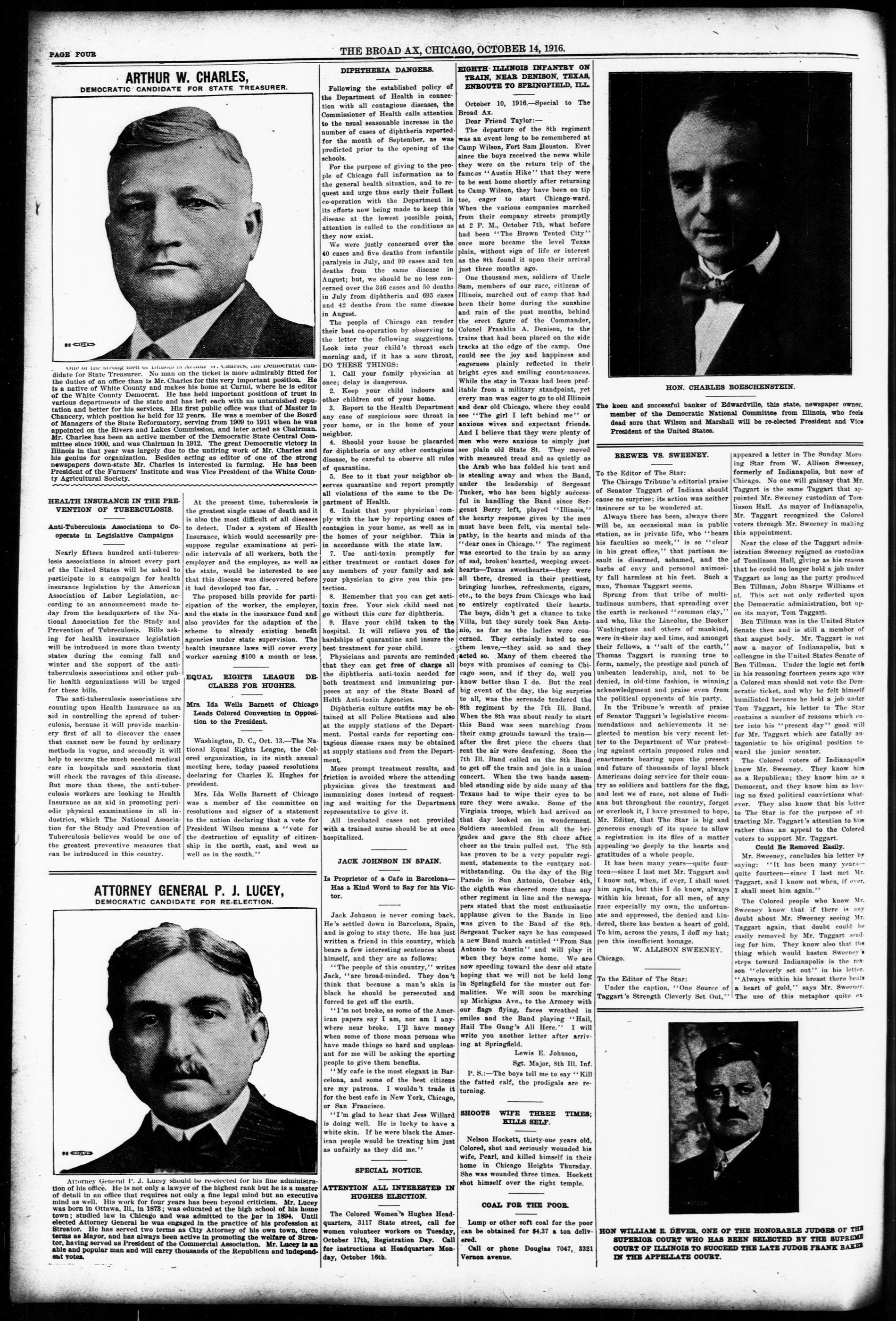
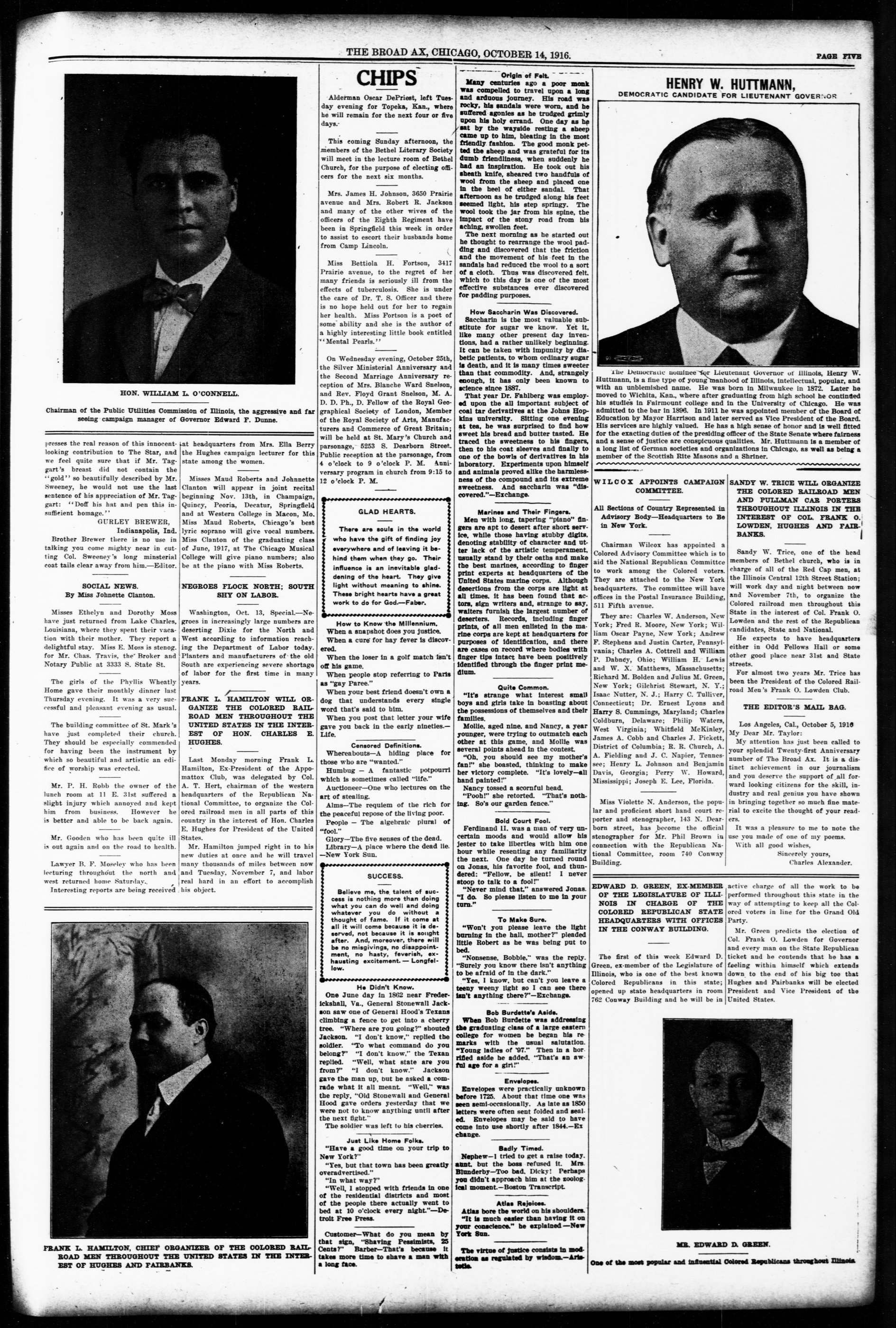
DEMOCRATIC CANDIDATE FOR STATE TREASURER.
One of the strong men of Illinois is Arthur W. Charles, the Democratic candidate for State Treasurer. No man on the ticket is more admirably fitted for the duties of an office than is Mr. Charles for this very important position. He is a native of White County and makes his home at Carmi, where he is editor of the White County Democrat. He has held important positions of trust in various departments of the state and has left each with an unattornished reputation and better for his services. His first public office was that of Master in Chancery, which position he held for 12 years. He was a member of the Board of Managers of the State Reformatory, serving from 1909 to 1911 when he was appointed on the Rivers and Lakes Commission, and later acted as Chairman. Mr. Charles has been an active member of the Democratic State Central Committee since 1900, and was Chairman in 1912. The great Democratic victory in Illinois in that year was largely due to the untiring work of Mr. Charles and his genius for organization. Besides acting as editor of one of the strong newspapers down-state Mr. Charles is interested in farming. He has been President of the Farmers' Institute and was Vice President of the White County Agricultural Society.
---
ATTORNEY GENERAL P. J. LUCEY,
DEMOCRATIC CANDIDATE FOR RE-ELECTION.
88
Attorney General P. J. Lucey should be re-elected for his fine administration of his office. He is not only a lawyer of the highest rank but he is a master of detail in an office that requires not only a fine legal mind but an executive mind as well. His work for four years has been beyond criticism. Mr. Lucey was born in Ottawa, Ill., in 1873; was educated at the high school of his home town; studied law in Chicago and was admitted to the par in 1894. Until elected Attorney General he was engaged in the practice of his profession at Streator. He has served two terms as City Attorney of his own town, three terms as Mayor, and has always been active in promoting the welfare of Streator, having served as President of the Commercial Association. Mr. Lucey is an able and popular man and will carry thousands of the Republican and independent votes.
Attorney General P. J. Lucey should be re-elected for his fine administration of his office. He is not only a lawyer of the highest rank but he is a master of detail in an office that requires not only a fine legal mind but an executive mind as well. His work for four years has been beyond criticism. Mr. Lucey was born in Ottawa, Ill., in 1873; was educated at the high school of his home town; studied law in Chicago and was admitted to the par in 1894. Until elected Attorney General he was engaged in the practice of his profession at Streator. He has served two terms as City Attorney of his own town, three terms as Mayor, and has always been active in promoting the welfare of Streator, having served as President of the Commercial Association. Mr. Lucey is an able and popular man and will carry thousands of the Republican and independent votes.
PAGE FOUR
ARTHUR W.
DEMOCRATIC CANDIDATE
One of the strong men of Illinois is
didate for State Treasurer. No man of
the duties of an office than is Mr. Cha-
lis a native of White County and make-
of the White County Democrat. He he
various departments of the state and
dation and better for his services. His
Chancery, which position he held for 12
of Managers of the State Reformatory,
appointed on the Rivers and Lakes Co-
Mr. Charles has been an active mem-
mittee since 1900, and was Chairman in
Illinois in that year was largely due to
his genius for organization. Besides
newspapers down-state Mr. Charles is
President of the Farmers' Institute and
city Agricultural Society.
HEALTH INSURANCE IN THE PRE
VENTION OF TUBERCULOSIS.
Anti-Tuberculosis Associations to Co-operate in Legislative Campaigns
Nearly fifteen hundred anti-tuberculosis associations in almost every part of the United States will be asked to participate in a campaign for health insurance legislation by the American Association of Labor Legislation, according to an announcement made today from the headquarters of the National Association for the Study and Prevention of Tuberculosis. Bills asking for health insurance legislation will be introduced in more than twenty states during the coming fall and winter and the support of the antituberculosis associations and other public health organizations will be urged for these bills.
The anti-tuberculosis associations are counting upon Health Insurance as an aid in controlling the spread of tuberculosis, because it will provide machinery first of all to discover the cases that cannot now be found by ordinary methods in vogue, and secondly it will help to secure the much needed medical care in hospitals and sanatoria that will check the ravages of this disease. But more than these, the anti-tuberculosis workers are looking to Health Insurance as an aid in promoting periodic physical examinations in all industries, which The National Association for the Study and Prevention of Tuberculosis believes would be one of the greatest preventive measures that can be introduced in this country.
ATTORNEY GEN
DEMOCRATIC CANDID
At the present time, tuberculosis is the greatest single cause of death and it is also the most difficult of all diseases to detect. Under a system of Health Insurance, which would necessarily presuppose regular examinations at periodic intervals of all workers, both the employer and the employee, as well as the state, would be interested to see that this disease was discovered before it had developed too far. The proposed bills provide for participation of the worker, the employer, and the state in the insurance fund and also provides for the adaption of the scheme to already existing benefit agencies under state supervision. The health insurance laws will cover every worker earning $100 a month or less.
EQUAL RIGHTS LEAGUE
CLARES FOR HUGHES.
Mrs. Ida Wells Barnett of Chicago Leads Colored Convention in Opposition to the President.
Washington, D. C., Oct. 13.—The National Equal Rights League, the Colored organization, in its ninth annual meeting here, today passed resolutions declaring for Charles E. Hughes for president.
Mrs. Ida Wells Barnett of Chicago was a member of the committee on resolutions and signer of a statement to the nation declaring that a vote for President Wilson means a "vote for the destruction of equality of citizenship in the north, east, and west as well as in the south."
THE BROAD AX, CHICAGO, OCTOBER 14, 1916.
DIPHTHERIA DANGERS
Following the established policy of the Department of Health in connection with all contagious diseases, the Commissioner of Health calls attention to the usual seasonable increase in the number of cases of diphtheria reported for the month of September, as was predicted prior to the opening of the schools.
For the purpose of giving to the people of Chicago full information as to the general health situation, and to request and urge thus early their fullest co-operation with the Department in its efforts now being made to keep this disease at the lowest possible point, attention is called to the conditions as they now exist.
We were justly concerned over the 40 cases and five deaths from infantile paralysis in July, and 99 cases and ten deaths from the same disease in August; but, we should be no less concerned over the 346 cases and 50 deaths in July from diphtheria and 695 cases and 42 deaths from the same disease in August.
The people of Chicago can render their best co-operation by observing to the letter the following suggestions. Look into your child's throat each morning and, if it has a sore throat, DO THESE THINGS:
1. Call your family physician at once; delay is dangerous.
2. Keep your child indoors and other children out of your home.
3. Report to the Health Department any case of suspicious sore throat in your home, or in the home of your neighbor.
4. Should your house be placarded for diphtheria or any other contagious disease, be careful to observe all rules of quarantine.
5. See to it that your neighbor observes quarantine and report promptly all violations of the same to the Department of Health.
6. Insist that your physician comply with the law by reporting cases of contagion in your home, as well as in the homes of your neighbor. This is in accordance with the state law.
7. Use anti-toxin promptly for either treatment or contact doses for any members of your family and ask your physician to give you this protection.
8. Remember that you can get antiotoxin free. Your sick child need not go without this cure for diphtheria. 9. Have your child taken to the hospital. It will relieve you of the hardships of quarantine and insure the best treatment for your child. Physicians and parents are reminded that they can get free of charge all the diphtheria anti-toxin needed for both treatment and immunizing purposes at any of the State Board of Helth Anti-toxin Agencies. Diphtheria culture outfits may be obtained at all Police Stations and also at the supply stations of the Department. Postal cards for reporting contagious disease cases may be obtained at supply stations and from the Department.
More prompt treatment results, and friction is avoided where the attending physician gives the treatment and immunizing doses instead of requesting and waiting for the Department representative to give it.
All incubated cases not provided with a trained nurse should be at once hospitalized.
JACK JOHNSON IN SPAIN.
Is Proprietor of a Cafe in Barcelona—Has a Kind Word to Say for his Victor.
Jack Johnson is never coming back. He's settled down in Barcelona, Spain, and is going to stay there. He has just written a friend in this country, which bears a few interesting sentences about himself, and they are as follows:
"The people of this country," writes Jack, "are broad-minded. They don't think that because a man's skin is black he should be persecuted and forced to get off the earth.
"I'm not broke, as some of the American papers say I am, nor am I anywhere near broke. I'll have money when some of those mean persons who have made things so hard and unpleasant for me will be asking the sporting people to give them benefits.
"My cafe is the most elegant in Barcelona, and some of the best citizens are my patrons. I wouldn't trade it for the best cafe in New York, Chicago, or San Francisco.
"I'm glad to hear that Jess Willard is doing well. He is lucky to have a white skin. If he were black the American people would be treating him just as unfairly as they did me."
SPECIAL NOTICE.
ATTENTION ALL INTERESTED IN
HUGHES ELECTION.
The Colored Women's Hughes Headquarters, 3117 State street, call for women volunteer workers on Tuesday, October 17th, Registration Day. Call for instructions at Headquarters Monday, October 16th.
EIGHTH ILLINOIS INFANTRY ON
TRAIN, NEAR DENISON, TEXAS,
ENROUTE TO SPRINGFIELD, ILL.
October 10, 1916.—Special to The
Broad Ax.
Dear Friend Taylor:— The departure of the 8th regiment was an event long to be remembered at Camp Wilson, Fort Sam Houston. Ever since the boys received the news while they were on the return trip of the famcus "Austin Hike" that they were to be sent home shortly after returning to Camp Wilson, they have been on tip toe, eager to start Chicago-ward. When the various companies marched from their company streets promptly at 2 P. M., October 7th, what before had been "The Brown Tented City" once more became the level Texas plain, without sign of life or interest as the 8th found it upon their arrival just three months ago.
One thousand men, soldiers of Uncle Sam, members of our race, citizens of Illinois, marched out of camp that had been their home during the sunshine and rain of the past months, behind the erect figure of the Commander, Colonel Franklin A. Denison, to the trains that had been placed on the side tracks at the edge of the camp. One could see the joy and happiness and eagerness plainly reflected in their bright eyes and smiling countenances. While the stay in Texas had been profitable from a military standpoint, yet every man was eager to go to old Illinois and dear old Chicago, where they could see "The girl I left behind me" or anxious wives and expectant friends. And I believe that they were plenty of men who were anxious to simply just see plain old State St. They moved with measured tread and as quietly as the Arab who has folded his tent and is stealing away and when the Band, under the leadership of Sergeant Tucker, who has been highly successful in handling the Band since Sergeant Berry left, played "Illinois," the hearty response given by the men must have been felt, via mental telepathy, in the hearts and minds of the "dear ones in Chicago." The regiment was escorted to the train by an army of sad, broken hearted, weeping sweet-hearts—Texas sweethearts—they were all there, dressed in their prettiest, bringing lunches, refreshments, cigars, etc., to the boys from Chicago who had entirely captivated their hearts. The boys, didn't get a chance to take Villa, but they surely took San Antonio, as far as the ladies were concerned. They certainly hated to see them leave,—they said so and they acted so. Many of them cheered the boys with promises of coming to Chicago soon, and if they do, well you know better than I do. But the real big event of the day, the big surprise to all, was the serenade tendered the 8th regiment by the 7th Ill. Band. When the 8th was about ready to start this Band was seen marching from their camp grounds toward the train—after the first piece the cheers that rent the air were deafening. Soon the 7th Ill. Band called on the 8th Band to get off the train and join in a union concert. When the two bands assembled standing side by side many of the Texans had to wipe their eyes to be sure they were awake. Some of the Virginia troops, which had arrived on that day looked on in wonderment. Soldiers assembled from all the brigades and gave the 8th cheer after cheer as the train pulled out. The 8th has proven to be a very popular regiment, statements to the contrary notwithstanding. On the day of the Big Parade in San Antonio, October 4th, the eighth was cheered more than any other regiment in line and the newspapers stated that the most enthusiastic applause given to the Bands in line was given to the Band of the 8th Sergeant Tucker says he has composed a new Band march entitled "From San Antonio to Austin" and will play it when they boys come home. We are now speeding toward the dear old state hoping that we will not be held long in Springfield for the muster out formalities. We will soon be marching up Michigan Ave., to the Armory with our flags flying, faces wreathed in smiles and the Band playing "Hail, Hail The Gang's All Here." I will write you another letter after arriving at Springfield.
Lewis E. Johnson,
Sgt. Major, 8th Ill. Inf.
P. S.:—The boys tell me to say "Kill the fatted calf, the prodigals are returning.
SHOOTS WIFE THREE TIMES;
KILLS SELF.
Nelson Hockett, thirty-one years old, Colored, shot and seriously wounded his wife, Pearl, and killed himself in their home in Chicago Heights Thursday. She was wounded three times. Hockett shot himself over the right temple.
COAL FOR THE POOR
Lump or other soft coal for the poor can be obtained for $4.37 a ton delivered.
Call or phone Douglas 7047, 3321 Vernon avenue.
M.
HON. CHARLES BOESCHENSTEIN.
The keen and successful banker of Edwardville, this state, newspaper owner, member of the Democratic National Committee from Illinois, who feels dead sure that Wilson and Marshall will be re-elected President and Vice President of the United States.
The keen and successful banker of Edwardville, this state, newspaper owner, member of the Democratic National Committee from Illinois, who feels dead sure that Wilson and Marshall will be re-elected President and Vice President of the United States.
BREWER VS. SWEENEY.
The Chicago Tribune's editorial praise of Senator Taggart of Indiana should cause no surprise; its action was neither insincere or to be wondered at.
Always there has been, always there will be, an occasional man in public station, as in private life, who "bears his faculties so meek," is so "clear in his great office," that partisan assault is disarmed, asashed, and the barbs of envy and personal animosity fall harmless at his feet. Such a man, Thomas Taggart seems.
Sprung from that tribe of multitudinous numbers, that spreading over the earth is reckoned "common clay," and who, like the Lincoln, the Booker Washingtontons and others of mankind, were in-their day and time, and amongst their fellows, a "salt of the earth," Thomas Taggart is running true to form, namely, the prestige and punch of unbeaten leadership, and, not to be denied, in old-time fashion, is winning acknowledgment and praise even from the political opponents of his party.
In the Tribune's wreath of praise of Senator Taggart's legislative recommendations and achievements it neglected to mention his very recent letter to the Department of War protesting against certain proposed rules and enactments bearing upon the present and future of thousands of loyal black Americans doing service for their country as soldiers and battlers for the flag, and lest we of race, not alone of Indiana but throughout the country, forget or overlook it, I have presumed to hope Mr. Editor, that The Star is big and generous enough of its space to allow a registration in its files of a matter appealing so deeply to the hearts and gratitudes of a whole people.
It has been many years—quite fourteen—since I last met Mr. Taggart and I know not, when, if ever, I shall meet him again, but this I do know, always within his breast, for all men, of any race especially my own, the unfortunate and oppressed, the denied and hindered, there has beaten a heart of gold. To him, across the years, I doff my hat; pen this insufficient homage.
W. ALLISON SWEENEY.
Chicago.
Under the caption, "One Source of
Taggart's Strength Cleverly Set Out."
C. D.
HON WILLIAM E. DEVER, ONE OF THE HONORABLE JUDGES OF THE SUPERIOR COURT WHO HAS BEEN SELECTED BY THE SUPREME COURT OF ILLINOIS TO SUCCEED THE LATE JUDGE FRANK BAKER IN THE APPELLATE COURT.
To the Editor of The Star:
To the Editor of The Star:
appeared a letter in The Sunday Morning Star from W. Allison Sweeney, formerly of Indianapolis, but now of Chicago. No one will gainsay that Mr. Taggart is the same Taggart that appointed Mr. Sweeney custodian of Tomlinson Hall. As mayor of Indianapolis, Mr. Taggart recognized the Colored voters through Mr. Sweeney in making this appointment.
Near the close of the Taggart administration Sweeney resigned as custodian of Tomlinson Hall, giving as his reason that he could no longer hold a job under Taggart as long as the party produced Ben Tillman, John Sharpe Williams et al. This act not only reflected upon the Democratic administration, but upon its mayor, Tom Taggart.
Ben Tillman was in the United States Senate then and is still a member of that august body. Mr. Taggart is not now a mayor of Indianapolis, but a colleague in the United States Senate of Ben Tillman. Under the logic set forth in his reasoning fourteen years ago why a Colored man should not vote the Democratic ticket, and why he felt himself humiliated because he held a job under Tom Taggart, his letter to The Star contains a number of reasons which enter into his "present day" good will for Mr. Taggart which are fatally antagonistic to his original position toward the junior senator.
The Colored voters of Indianapolis know Mr. Sweeney. They know him as a Republican; they know him as a Democrat, and they know him as having no fixed political convictions whatever. They also know that his letter to The Star is for the purpose of attracting Mr. Taggart's attention to him rather than an appeal to the Colored voters to support Mr. Taggart.
Could Be Removed Easily.
Mr. Sweeney, concludes his letter by saying: "It has been many years—quite fourteen—since I last met Mr. Taggart, and I know not when, if ever, I shall meet him again."
The Colored people who know Mr. Sweeney know that if there is any doubt about Mr. Sweeney seeing Mr. Taggart again, that doubt could be easily removed by Mr. Taggart sounding for him. They know also that the thing which would hasten Sweeney's steps toward Indianapolis is the reason "cleverly set out" in his letter. "Always within his breast thereto beats a heart of gold," says Mr. Sweeney. The use of this metaphor quite ex-
[Name]
HON. WILLIAM L. O'CONNELL
Chairman of the Public Utilities Comm seeing campaign manager of
Chairman of the Public Utilities Commission of Illinois, the aggressive and farseeing campaign manager of Governor Edward F. Dunne.
Chairman of the Public Utilities Commission of Illinois, the aggressive and farseeing campaign manager of Governor Edward F. Dunne.
presses the real reason of this innocent-looking contribution to The Star, and we feel quite sure that if Mr. Taggart's breast did not contain the "gold" so beautifully described by Mr. Sweeney, he would not use the last sentence of his appreciation of Mr. Taggart: "Doff his hat and pen this insufficient homage."
GURLEY BREWER.
Brother Brewer there is no use in talking you come mighty near in cutting Col. Sweeney's long minsterial coat tails clear away from him.-Editor.
SOCIAL NEWS.
By Miss Johnette Clanton
Misses Ethelyn and Dorothy Moss have just returned from Lake Charles, Louisiana, where they spent their vacation with their mother. They report a delightful stay. Miss E. Moss is stenog. for Mr. Chas. Travis, the Broker and Notary Public at 3333 S. State St.
The girls of the Phyllis Wheatly Home gave their monthly dinner last Thursday evening. It was a very successful and pleasant evening as usual.
The building committee of St. Mark's have just completed their church. They should be especially commended for having been the instrument by which so beautiful and artistic an edifice of worship was erected.
Mr. P. H. Robb the owner of the lunch room at 11 E. 31st suffered a slight injury which annoyed and kept him from business. However he is better and able to be back again.
Mr. Gooden who has been quite ill is out again and on the road to health.
Lawyer B. F. Moseley who has been lecturing throughout the north and west returned home Saturday.
Interesting reports are being received
FRANK L. HAMILTON, CHIEF ORGANIZER OF THE COLORED RAIL ROAD MEN THROUGHOUT THE UNITED STATES IN THE INTEREST OF HUGHES AND FAIRBANKS.
mission of Illinois, the aggressive and far Governor Edward F. Dunne.
at headquarters from Mrs. Ella Berry the Hughes campaign lecturer for this state among the women.
Misses Maud Roberts and Johnnette Clanton will appear in joint recital beginning Nov. 13th, in Champaign, Quincy, Peoria, Decatur, Springfield and at Western College in Macon, Mo. Miss Maud Roberts, Chicago's best lyric soprano will give vocal numbers. Miss Clanton of the graduating class of June, 1917, at The Chicago Musical College will give piano numbers; also be at the piano with Miss Roberts.
NEGROES FLOCK NORTH; SOUTH
SHY ON LABOR.
Washington, Oct. 13, Special—Negroes in increasingly large numbers are deserting Dixie for the North and West according to information reaching the Department of Labor today. Planters and manufacturers of the old South are experiencing severe shortage of labor for the first time in many years.
FRANK L. HAMILTON WILL ORGANIZE THE COLORED RAIL-ROAD MEN THROUGHOUT THE UNITED STATES IN THE INTEREST OF HON. CHARLES E. HUGHES.
Last Monday morning Frank L. Hamilton, Ex-President of the Appomattox Club, was delegated by Col. A. T. Hert, chairman of the western headquarters of the Republican National Committee, to organize the Colored railroad men in all parts of this country in the interest of Hon. Charles E. Hughes for President of the United States.
Mr. Hamilton jumped right in to his new duties at once and he will travel many thousands of miles between now and Tuesday, November 7, and labor real hard in an effort to accomplish his object.
---
THE BROAD AX, CHICAGO, OCTOBER 14, 1916
CHIPS
CHIPS
Alderman Oscar DePriest, left Tuesday evening for Topeka, Kan., where he will remain for the next four or five days.
This coming Sunday afternoon, the members of the Bethel Literary Society will meet in the lecture room of Bethel Church, for the purpose of electing officers for the next six months.
Mrs. James H. Johnson, 3650 Prairie avenue and Mrs. Robert R. Jackson and many of the other wives of the officers of the Eighth Regiment have been in Springfield this week in order to assist to escort their husbands home from Camp Lincoln.
Miss Bettiola H. Fortson, 3417 Prairie avenue, to the regret of her many friends is seriously ill from the effects of tuberculosis. She is under the care of Dr. T. S. Officer and there is no hope held out for her to regain her health. Miss Fortson is a poet of some ability and she is the author of a highly interesting little book entitled "Mental Pearls."
On Wednesday evening, October 25th the Silver Ministerial Anniversary and the Second Marriage Anniversary reception of Mrs. Blanche Ward Snelson, and Rev. Floyd Grant Snelson, M. A. D. D. Ph., D. Fellow of the Royal Geographical Society of London, Member of the Royal Society of Arts, Manufacturers and Commerce of Great Britain; will be held at St. Mary's Church and parsonage, 5253 S. Dearborn Street. Public reception at the parsonage, from 4 o'clock to 9 o'clock P. M. Anniversary program in church from 9:15 to 12 o'clock P. M.
GLAD HEARTS.
There are souls in the world who have the gift of finding joy everywhere and of leaving it behind them when they go. Their influence is an inevitable gladdening of the heart. They give light without meaning to shine. These bright hearts have a great work to do for God.—Faber.
How to Know the Millennium.
When a snapshot does you justice.
When a cure for hay fever is discovered.
When the loser in a golf match isn't off his game.
When your best friend doesn't own a dog that understands every single word that's said to him.
When you post that letter your wife gave you back in the early nineties.—Life.
Censored Definitions.
Whereabouts—A hiding place for those who are "wanted."
Humbug — A fantastic potpourri which is sometimes called "life."
Auctioneer—One who lectures on the art of stealing.
Glory—The five senses of the dead.
Library—A place where the dead lie.
-New York Sun.
Believe me, the talent of success is nothing more than doing what you can do well and doing whatever you do without a thought of fame. If it come at all it will come because it is deserved, not because it is so sought after. And, moreover, there will be no misgivings, no disappointment, no hasty, feverish, exhausting excitement. — Longfellow.
He Didn't Know.
One June day in 1862 near Frederickshall, Va., General Stonewall Jackson saw one of General Hood's Texans climbing a fence to get into a cherry tree. "Where are you going?" shouted Jackson. "I don't know," replied the soldier. "To what command do you belong?" "I don't know," the Texan replied. "Well, what state are you from?" "I don't know." Jackson gave the man up, but he asked a comrade what it all meant. "Well," was the reply. "Old Stonewall and General Hood gave orders yesterday that we were not to know anything until after the next fight."
The soldier was left to his cherries.
Just Like Home Folks.
"Have a good time on your trip to New York?"
"Yes, but that town has been greatly overadvertised."
"Well, I stopped with friends in one of the residential districts and most of the people there actually went to bed at 10 o'clock every night."—Detroit Free Press.
Customer—What do you mean by that sign, "Shaving Pessimists, 25 Cents?" Barber—That's because it takes more time to shave a man with a long face.
Origin of Felt.
Many centuries ago a poor monk was compelled to travel upon a long and arduous journey. His road was rocky, his sandals were worn, and he suffered agonies as he trudged grimly upon his holy errand. One day as he sat by the wayside resting a sheep came up to him, bleating in the most friendly fashion. The good monk petted the sheep and was grateful for its dumb friendliness, when suddenly he had an inspiration. He took out his sheath knife, sheared two handfuls of wool from the sheep and placed one in the heel of either sandal. That afternoon as he trudged along his feet seemed light, his step springy. The wool took the jar from his spine, the impact of the stony road from his aching, swollen feet.
The next morning as he started out he thought to rearrange the wool padding and discovered that the friction and the movement of his feet in the sandals had reduced the wool to a sort of a cloth. Thus was discovered felt, which to this day is one of the most effective substances ever discovered for padding purposes.
How Saccharin Was Discovered:
Saccharin is the most valuable substitute for sugar we know. Yet it, like many other present day inventions, had a rather unlikely beginning. It can be taken with impunity by diabetic patients, to whom ordinary sugar is death, and it is many times sweeter than that commodity. And, strangely enough, it has only been known to science since 1887.
That year Dr. Fahlberg was employed upon the all important subject of coal tar derivatives at the Johns Hopkins university. Stitting one evening at tea, he was surprised to find how sweet his bread and butter tasted. He traced the sweetness to his fingers, then to his coat sleeves and finally to one of the bowls of derivatives in his laboratory. Experiments upon himself and animals proved alike the harmlessness of the compound and its extreme sweetness. And saccharin was "discovered."—Exchange.
Marines and Their Fingers.
Men with long, tapering "plano" fingers are apt to desert after short service, while those having stubby digits, denoting stability of character and utter lack of the artistic temperament, usually stand by their oaths and make the best marines, according to finger print experts at headquarters of the United States marine corps. Although desertions from the corps are light at all times, it has been found that actors, sign writers and, strange to say, waiters furnish the largest number of deserters. Records, including finger prints, of all men enlisted in the marine corps are kept at headquarters for purposes of identification, and there are cases on record where bodies with finger tips intact have been positively identified through the finger print medium.
Quite Common.
"It's strange what interest small boys and girls take in boasting about the possessions of themselves and their families.
Mollie, aged nine, and Nancy, a year younger, were trying to outmatch each other at this game, and Mollie was several points ahead in the contest.
"Oh, you should see my mother's fan!" she boasted, thinking to make her victory complete. "It's lovely—all hand painted."
Nancy tossed a scornful head.
"Pooch!" she retorted. "That's nothing. So's our garden fence."
Bold Court Fool.
Ferdinand II. was a man of very uncertain moods and would allow his jester to take liberties with him one hour while resenting any familiarity the next. One day he turned round on Jonas, his favorite fool, and thundered: "Fellow, be silent! I never stoop to talk to a fool!" "Never mind that," answered Jonas. "I do. So please listen to me in your turn."
To Make Sure.
"Won't you please leave the light burning in the hall, mother?" pleaded little Robert as he was being put to bed.
"Nonsense, Bobble," was the reply.
"Surely you know there isn't anything to be afraid of in the dark."
"Yes, I know, but can't you leave a teeny weeny light so I can see there isn't anything there?"—Exchange.
Bob Burdette's Aside.
When Bob Burdette was addressing the graduating class of a large eastern college for women he began his remarks with the usual salutation. "Young ladies of '97." Then in a horrified aside he added, "That's an awful are for a girl."
Envelopes.
Envelopes were practically unknown before 1725. About that time one was seen semi-occasionally. As late as 1850 letters were often sent folded and sealed. Envelopes may be said to have come into use shortly after 1844.-Ex change.
Radly Timed.
Nephew—I tried to get a raise today.
aunt, but the boss refused it. Mrs.
Blunderby—Too bad. Dicky! Perhaps
you didn't approach him at the zoological
moment—Boston Transcript.
Atlas Reinoes
Atlas bore the world on his shoulders. "It is much easier than having it on your conscience." he explained—New York Sun.
The virtue of justice consists in moderation as regulated by wisdom.—Aristotle.
HENRY W. HUTTMANN.
The Democratic nominee for Lie-
Huttmann, is a fine type of young man
with an unblemished name. He was
moved to Wichita, Kan., where after g
his studies in Fairmount college and
admitted to the bar in 1896. In 1911 h
Education by Mayor Harrison and late
His services are highly valued. He ha
for the exacting duties of the presiding
and a sense of justice are conspicuous
a long list of German societies and org
member of the Scottish Rite Masons an
99
The Democratic nominee for Lieutenant Governor of Illinois, Henry W. Huttmann, is a fine type of young manhood of Illinois, intellectual, popular, and with an unblemished name. He was born in Milwaukee in 1872. Later he moved to Wichita, Kan., where after graduating from high school he continued his studies in Fairmount college and in the University of Chicago. He was admitted to the bar in 1896. In 1911 he was appointed member of the Board of Education by Mayor Harrison and later served as Vice President of the Board. His services are highly valued. He has a high sense of honor and is well fitted for the exacting duties of the presiding officer of the State Senate where fairness and a sense of justice are conspicuous qualities. Mr. Huttmann is a member of a long list of German societies and organizations in Chicago, as well as being a member of the Scottish Rite Masons and a Shriner.
WILCOX APPOINTS CAMPAIGN
COMMITTEE.
All Sections of Country Represented in Advisory Body—Headquarters to Be in New York.
Chairman Wileox has appointed a Colored Advisory Committee which is to aid the National Republican Committee to work among the Colored voters. They are attached to the New York headquarters. The committee will have offices in the Postal Insurance Building, 511 Fifth avenue.
They are: Charles W. Anderson, New York; Fred R. Moore, New York; William Oscar Payne, New York; Andrew F. Stephens and Justin Carter, Pennsylvania; Charles A. Cottrell and William P. Dabney, Ohio; William H. Lewis and W. X. Matthews, Massachusetts; Richard M. Bolden and Julius M. Green, New York; Gilechrist Stewart, N. Y.; Isaac Nutter, N. J.; Harry C. Tulliver, Connecticut; Dr. Ernest Lyons and Harry S. Cummings, Maryland; Charles Coldburn, Delaware; Philip Waters, West Virginia; Whitfield McKinley, James A. Cobb and Charles J. Pickett, District of Columbia; R. R. Church, A. A. Fielding and J. C. Napier, Tennessee; Henry L. Johnson and Benjamin Davis, Georgia; Perry W. Howard, Mississippi; Joseph E. Lee, Florida.
Miss Violette N. Anderson, the popular and proficient short hand court reporter and stenographer, 143 N. Dearborn street, has become the official stenographer for Mr. Phil Brown in connection with the Republican National Committee, room 740 Conway Building.
EDWARD D. GREEN, EX-MEMBER OF THE LEGISLATURE OF ILLINOIS IN CHARGE OF THE COLORED REPUBLICAN STATE HEADQUARTERS WITH OFFICES IN THE CONWAY BUILDING.
The first of this week Edward D. Green, ex-member of the Legislature of Illinois, who is one of the best known Colored Republicans in this state; opened up state headquarters in room 762 Conway Building and he will be in
[Name]
MR. EDWARD D. GREEN.
One of the most popular and influential Colored Repub
Suttenant Governor of Illinois, Henry W. Wood of Illinois, intellectual, popular, and born in Milwaukee in 1872. Later he graduating from high school he contined in the University of Chicago. He was was appointed member of the Board of or served as Vice President of the Board. is a high sense of honor and is well fitted officer of the State Senate where fairness qualities. Mr. Huttmann is a member of organizations in Chicago, as well as being a and a Shriner.
SANDY W. TRICE WILL ORGANIZE THE COLORED RAILROAD MEN AND PULLMAN CAR PORTERS THROUGHOUT ILLINOIS IN THE INTEREST OF COL. FRANK O. LOWDEN, HUGHES AND FAIR-BANKS.
Sandy W. Trice, one of the head members of Bethel church, who is in charge of all of the Red Cap men, at the Illinois Central 12th Street Station; will work day and night between now and November 7th, to organize the Colored railroad men throughout this State in the interest of Col. Frank O. Lowden and the rest of the Republican candidates, State and National.
He expects to have headquarters either in Odd Fellows Hall or some other good place near 31st and State streets.
For almost two years Mr. Trice has been the President of the Colored Railroad Men's Frank O. Lowden Club.
THE EDITOR'S MAIL BAG
Los Angeles, Cal., October 5, 1910
My Dear Mr. Taylor:
My attention has just been called to your splendid Twenty-first Anniversary number of The Broad Ax. It is a distinct achievement in our journalism and you deserve the support of all forward looking citizens for the skill, industry and real genius you have shown in bringing together so much fine material to excite the thought of your readers.
It was a pleasure to me to note the use you made of one of my poems.
With all good wishes,
active charge of all the work to be performed throughout this state in the way of attempting to keep all the Colored voters in line for the Grand Old Party.
Mr. Green predicts the election of Col. Frank O. Lowden for Governor and every man on the State Republican ticket and he contends that he has a feeling within himself which extends down to the end of his big too that Hughes and Fairbanks will be elected President and Vice President of the United States.
Colored Republicans throughout Illinois
PAGE FIVE
---
Sincerely yours,
Charles Alexander
PAGE SIX
TAMPICO SCUTTLE A CRAVEN AFFAIR SAYS ROOSEVELT
Constituted So Grave an Offense Against the Nation's Honor and Duty That the Man Responsible Should Be Removed From Office.
WILSON CANNOT SHIELD HIMSELF BEHIND DANIELS
Authentic Proof That Americans In Peril Were Deserted by Their Own Government Against the Protest o the Senior Naval Officer Present Most Pusillanimous Episode In the Naval Annals of Our Country.
Theodore Roosevelt in a letter to Henry Reuterdahl, the naval critic, criticises President Wilson and Secretary Daniels in connection with the Tampico affair, when the American warships were withdrawn by order of the Administration. The colonel says: "You have presented authentic proof of how the Americans in peril at Tampico were deserted by their own government against the protest of the senior American naval officer present. You have shown that the government at Washington had full knowledge of the danger of the situation through telegrams from Admiral Mayo sent by wireless to the navy department on April 11, 12 and 13. You also give the telegram of Mr. Daniels of April 20 directing the admiral to proceed to Vera Cruz.
Mave Feared Loss of Life.
"You have shown that Admiral Mayo made an emphatic protest to the navy department, stating that he feared the result of the squadron's leaving would be the loss of American lives and property. You also quote the telegrams sent by Admiral Mayo the following day, containing the protest of the American consul, Mr. Miller, and requesting authority to remain at Tampico. You have shown that, nevertheless, the navy department on the 21st confirmed its previous orders and directed the ships to leave at once.
"You have shown that the admiral put out into the ocean eight miles distant, but received a protest from Consul Miller reiterating his demand for protection. You then quote the telegrams and signals of Admiral Mayo, who, in spite of his orders, nobly refused to run from the post of duty while the lives of American men, women and children were in danger."
Can't Hide Behind Daniels.
Of the President and Secretary Daniels the colonel writes:
"President Wilson cannot shield himself behind Mr. Daniels, for Mr. Daniels could do nothing that the president does not order or sanction. When Mr. Daniel's actions have been brought to the attention of Mr. Wilson, and are not repudiated by him, they become Mr. Wilson's; and Mr. Wilson is fully and completely responsible for Mr. Daniels, for all that he has done and left undone.
"The proof is absolute that when Admiral Mayo was at Tampico he had received full knowledge of the looting and of the imminent danger to American lives; but that, nevertheless, he steamed away into the ocean, and that the Americans were rescued by German and British ships. This action constituted so grave an offense from the standpoint of national duty and self-respect, that any man responsible for it should be at once taken out of office.
Facts Made Public In U. S.
"Shortly thereafter the facts were made public in the United States. If Admiral Mayo had been responsible and had not acted under orders, then the only proper course for Secretary Daniels would have been to order his instant court-martial, and in such case the failure to do so would have shifted the blame at once from the shoulders of Admiral Mayo to the shoulders of superiors, President Wilson and Secretary Daniels.
"Therefore, even if these telegrams did not exist, even if there had been no such orders, or those actually issued by the secretary of the navy to Admiral Mayo, nevertheless his superiors, Secretary Daniels and President Wilson, would both have become fully responsible for the guilty transaction by their acquiescence therein. They cannot, as they have sought to do, shift the blame to the shoulders of the admiral."
The Soldier Vote
A significant feature following the Maine election was the nature of the soldier vote.
It is reported that one Maine battalion hiked sixty miles in two days for the purpose of exercising the franchise.
And we know how they voted!
Latin politeness is proverbial, but aren't these Mexican commissioners exceeding the limit when they persist in likening Woodrow Wilson to Venustiano Carranza?
Josephus Daniels might have made a passable secretary of the Salvation Navy, but it was pretty rough to impose him on Uncle Sam's fighting navy.
IF ELECTION WERE OVER?
While Democrats Are Admittedly the Champion Question Fiends, it is Believed This Quiz is as Unanswerable as Their Most Childlike Effort.
If election day were passed would President Wilson make so little of the principle of arbitration in industrial disputes? Would he be so sure that it is more important to preserve peace, when a great strike is threatened, than it is to make judicial methods rather than force the means of settling differences between capital and labor?
If election day had come and gone would Mr. Wilson keep the national guardsmen of the country in camp on the ground that they may be needed to protect the United States against Mexico? Would there be months of inaction and indecision in which no use is made of a large body of citizen soldiers? Would they not be allowed to go home or else be set in motion to make Mexico as safe a neighbor as the Administration seems to think that it is already?
If election day were past would the President drive through Congress a bill like the shipping bill which is intended to embark the federal government upon a new venture in a hazardous field and use $50,000,000 of the people's money to buy tonnage held above its normal value or else so owned that it cannot be used without peril of international complications? Is sound public policy behind such a measure or only campaign politics?
If election day were not to be considered would Woodrow Wilson use so many high and mighty words in international notes and do so little to make them mean anything practical? Would his deeds lag so far behind his phrases? -Cleveland Leader.
"HE DIDN'T DO RIGHT."
Independent Voters Turning This Conviction Over and Over In Their Minds and It Will Cost Mr.
A Democrat who never voted for a Republican candidate for President except in 1872, when he was forced by the lack of a Democratic nominee to cast his ballot for Horace Greeley, says: "I expect to vote for Woodrow Wilson, but I don't like his course in the railroad dispute. He didn't do right."
The railroad controversy has introduced a moral issue into the campaign. Mr. Wilson sacrificed principle to expediency, or what he judges to be expediency, when he tames surrendered to the demands of the train-service brotherhoods.
He put his own personal and party need before the public good. He angled for votes. He aimed a body blow at the tried and tested arbitration method of settling differences.
"God help you; I cannot," he is said to have exclaimed to the railroad managers, who do not to poll as many votes as their employees. But he could have helped them if he had stood impartially between them and the utterly reckless train-service representatives who were bent on their rule-or-ruln programme.
"He didn't do right." The consciousness of that fact is sinking deep into the American mind.
"He didn't do right." That widespread conviction will cost him thousands of votes on election day.
"He didn't do right." He preferred the weak, the timid attitude of the born compromiser.
The American people like courage. They like convictions. They like a man who has the courage of his convictions. They like a man who is willing to risk consequences for the sake of a just cause.
It was an unjust cause in which Woodrow Wilson enlisted when he accepted the brotherhood view that the chief item in their demands could not be arbitrated.—Providence Journal.
FIVE THOUSAND A DAY
Enrollmen's in the Hughes National College League.
The Hughes National College League, 511 Fifth avenue, New York, is receiving enrollments at the rate of five thousand a day. They are coming from all parts of the country, and the work of organizing branches in all states and most of the important cities has been started. A large percentage of the enrollments are from men who give their usual political affiliations as Progressive, Democratic or Independent.
The league has received the endorsement of Governor Hughes, who wired: "If there was ever a time when the educated men of the country who have its welfare at heart should work for right principles and strong government it is now." Chairman Willecox of the Republican National Committee, ex-President Taft, and John Hays Hammond have also praised the work enthusiastically, as much on the score of the benefit to the men themselves as of the real work it will do to help elect Governor Hughes.
The British censorship is delaying the United States malls almost as annoyingly as Burleson's inefficiency.
'BEATEN GOOD AND PLENTY'
Champ Clark Sees no Rainbows
In Maine Result.
"We got whipped, and I guess
that is all I will say about the
Maine election," said Speaker
Champ Clark. "We got beaten
good and plenty."
THE BROAD AX, CHICAGO, OCTOBER 14, 1916
DECLINED TO PERMIT A SQUADRON TO DEFEND AMERICANS.
THE WIND FROM MA
A wind that's from the rocks and scented by the pine
Sweeps through the sycamores t where sequoias line
The ranks of giant sentinels th
At Tampico there was a general movement of attack by the Mexicans on Americans and other foreigners. We had a squadron of American warships in the neighborhood. The Wilson Administration delined to permit this squadron to be used to defend the lives of American men and the honor of American women, and the commanders of the German and English ships at Tampico had to step in and perform the task our representative had so basely abandoned. At the very time that the Mexican mob had surrounded the building in which the Americans had taken refuge and was howling for their blood, the American fleet, in spite of the protests of the American naval commander, and in accordance with wireless orders from Washington, was forced to steam out of the harbor and leave the Americans to be massacred by the Mexicans or rescued by the Germans and English—From the Speech of Col. Theodore Roosevelt, Delivered at Lewiston, Maine, in Behalf of Charles E. Hughes.
```markdown
```
POLITICAL JOTTINGS
******************************
If plans "to get Villa" are abandoned Villa should reciprocate and refrain from organizing expeditions "to get" American citizens.
The fact that Mr. Wilson could endorse this Pork Congress shows that he isn't seasick, anyway.
Mr. Pinchot also seems of the opinion that God Hates a Quitter.
The man who quotes the Baltimore platform is regarded as a political archeologist.
"He kept the country out of war," but he robbed it of its peace.
Up in Maine they are now rhyming Hughes with Moose. And there is reason as well as rhyme connecting the two words.
"Victory," Mr. Fairbanks told Oklahoma Republicans, "surely will perch on our banner." But Champ Clark tied it up in a neater and more compact bundle when he said: "They licked hell out of us."
Members of President Wilson's cabinet are ready to do anything to re-elect their chief, except resign.
Writes a former Princeton man: "At first we called him 'W. W.'; then we made it 'I. W. W.'"
That one term plank in the Democratic platform of 1912—it is more than likely to hold, after all.
When President Wilson called upon the Mexican commissioners at New London he revived old precedents, but did he wave the Stars and Stripes?
A man in Washington has made a bust of the President, thus anticipating Mr. Hughes by several weeks.
Discussing the endorsement by the Democratic convention of Texas of Mr. Wilson's Mexican policy, the Houston Post (Dem.) flatly declares: "It is not believed anything like a majority of the people of Texas indorse our Mexican policy, and those in a position to know seriously doubt that the platform adopted expressed the real sentiments of the convention itself."
The Omaha Bee couples woeful waste with watchful waiting as a Democratic falling.
Bolled down, the best that has been said of President Wilson's Mexican policy was that he had good intentions. We've often heard of a road paved with this kind of material.
The President is deceived if he believes that the history he has written is not more praiseworthy than that which he has made.
President Wilson signed the Philippine bill as moving picture cameras clicked. There is one man who is not afraid to have his mistakes recorded!
```markdown
```
WILSON CONSISTENT ONLY IN HIS VACILLATION.
As it is with "war," so it is with "intervention." President Wilson has again and again said he would not "intervene" in Mexico. As a matter of fact he has intervened continuously but as he never followed any policy of either intervention or non-intervention with any resolution—always yielding at the critical moment to some bandit chief of whom he became fearful—both his spasms of intervention and his spasms of non-intervention have allike been entirely futile.—From the Speech of Col. Theodore Roosevelt, Delivered at Lewiston, Maine, in Behalf of Charles E. Hughes.
THE WIND FROM MAINE.
A wind that's from the rocks and sea and scented by the pine
sweeps through the pecanores today and
where sequoias line
The ranks of giant sentinels that guard the western slopes.
The balsam of this briny breeze brings heavy hearts new hopes.
The mountains and the rivers cry the message that is Maine's
To men whose pride was shattered, and their desperate wanes.
Again the hearts are raised to look the future in the face.
For Maine has been the clarion that's heartening a race.
'Twas shame that sunk the souls of us to depths we never knew
In days our flag was honored in the harbors where it flew.
When nations paid us homage, for they knew our hands were white.
Ere blood of our own countrymen had stained them like a blight.
And now again our songs we sing of deeds that we must do
To make the dream that passed away come marvelously true;
For the sturdy souls that breathe the pine have brought to life again.
The faith that all nations a nation heart that feels the wind from Maine.
EDWARD S. VAN ZILE
-New York Sun, Sept 13.
EDITORIAL COMMENTS.
******************************
If you had two dollars to invest would you trust it to the business sagacity of Josephus Daniels? Then, why let him handle the millions that are to be spent on the new navy?
Judging by the signs of War Department activity the Administration is cunningly arranging to bring the militiamen home just in time to enable them to vote for Mr. Hughes.
A train of thought on a one-track mind has to be composed of shuttle cars.
Three years ago Woodrow Wilson was explaining that hard times were psychological, but he isn't trying to squirm out of responsibility for the present prosperity.
The disaster to the Memphis caused very little excitement, Americans being used nowadays to seeing the navy on the rocks.
This Democratic Congress has passed into history—profane history.
President Wilson's speech of acceptance could have been phrased even more succinctly in the graphic words of Boss Tweed, "What are you going to do about it?"
We see by the interviews with the Mexican commissioners that the campaign slogan this year in the Sonora bandit belt is "Thank God for Woodrow Wilson."
Mr. Wilson's eulogy of Lincoln at Hodgenville was more literary but less sincere than the one he pronounced upon himself at Shadow Lawn.
The new half dollars will have an olive branch on one side and on the other an eagle, in full flight. Wilson money.
A Democrat's idea of an ideal watchdog of the Treasury is a Pommeranian.
Mr. Wilson is now busily engaged working the other side of the suffrage street.
The campaign agents who two years ago were busily engaged thanking God for Woodrow Wilson seem to be taking their vacations just now.
A record wasn't the only thing the late Congress broke—there's the Federal Treasury.
Congress didn't want a Tariff Commission composed of $12,000 men, those $7,500 salaries being designed for $1,200 men.
President Wilson's scheme for commissions for everything has been adroitly planned to make three jobs for deserving Democrats grow where only one would grow before.
Vice-President Marshall says Mr. Hughes is an echo of the past. Quite true. Of statesmanship, of patriotic performance and safe legislation.
First fruits of the Adamson bill: The New York street car strike.
SINFUL MUTILATION
We notice that the editor of the Democratic campaign book, made up of samples of "Woodrow Wilson's Wit and Wisdom," has tampered with one specimen speech by omitting the phrase "too proud to fight."
This smacks of lese majeste, to say the least.
The only possible excuse for this sin of omission that we can think of is that there may also be times when a haughty handbook complier is too proud to print.
```markdown
```
HOME OF THE BRAVE.
"This is the land of the free and the home of the brave, and if it ceases to be the home of the brave it will soon cease to be the land of the free."—Charles E. Hughes in a Speech Delivered at Plattsburgh, N. Y.
FINNEGAN'S PHILOSOPHY.
"Faith an' now Wilson's for protection. Four year agone he was agin it, for it was agin the constychooshun. Now that he is for it, that immortal instrument has also changed its mind. He makes me head shwim.
"But I've good company. Bryan an Garrison, the civil service Dimycrats, and the rale Dimycrats, the Passfysts an' the vulgar sowls that's none 'Too Proud to Fight'—they've all been on the Merry-go-round. Some iv thim turned sick.
"God bless ye—ye're a good man, but ye make me dizzy," says Bryan, leppin' from the Hobby-Horse and runin' for the woods. "I've a ginyw raygrit at losin' ye," says Wudthrow throwin' him a Cocked-Hat iv the vintage of 1909.
"Here's the Army bill," says Garrison. "How does it suit?" he axes.
"Fine,' says Wudthrow, 'barrin' a few changes. 'Ye'll redraw it,' he says, 'to provide,' says he, 'voluntary universal service in a Federal Millish,' says he, 'controlled be the states,' says he; 'an recruited be spiritual com-pulsion,' says he. 'It shud be nayther too large nor too small' says he; 'or maybe both,' he says; 'an the ammynition,' says he 'must be nayther too much, nor too little,' says he. 'I've to see Hay, before I decide the daytales, for 'tis me j'ooty to kape an open mind,' says Wudthrow.
"Stop the music and lave me off,' says Garrison. 'Are ye crazy or am I? Garrison moans, layin' on his back an gazin' wildly at th' sky. 'God bless ye,' says Wudthrow. 'I've a near-real raygrit at losn' you,' he says. And Garrison beats it to Jarsey the Merry-Go-Round plays a side step.
"F'what iv the Navy,' says Kitchin.
'It shud be thur'y adaquate ivry-
where,' says the Great Idaylist, 'except in Montany, where we need no Navy,' says he, 'and in St. Louey, where it shud be the biggest in the world. We'll be none extravagant like thim Raypublicans,' says he, 'so here's the Dimycrat bill ye'll pass,' says he.
"But this same is the Raypublican's bill,' says Kitchin starin. 'Ye'll go an pass it,' says Wudwthrop, pounding the desk. 'Hooray,' says the black Raypublicans votin' for the bill. 'Do I dream,' says Kitchin. 'If I liver drank, I'd t'tink I was boozed,' says Kitchin in a thremlin' vice. And he falls off.
"How about the Army bill,' axes Hay.
"Through an 'i' instant preparation for defense must be the wurd,' says Wudthrow, wild heroic rls'lution in his eye.
"I have here a bill,' says Hay, 'providin' for an increase iv five hundther men a year for twinty year,' he says; 'an amylsunb for six hours' acksum,' he says; 'twill make us safe from maddygasker, measles, muckrakin' milt-rism and marital infidility,' he says, 'an' we'll catch Villy before he dies av he doant die before we catch him,' says Hay.
"Embrace me,' says Wilson. 'Oh Hay—after all preparedness is a matter iv the heart an' not of guns or forts. Did Cleveland ivir give ye a job? he axes, stopin' short like.
"Dilv a wan,' says Hay. 'Thin' says Wudthrow shakin' the both iv Hay's hands cordial like, 'for yer patriotic service in so bravely sipportin' me policies,' he says, 'in all their phrases,' he says, 'I make a judge iv ye'he,' he says, he as, as well as yer frind that ye put in the Joker,' says the Prisdint. 'Howly Saints,' says the preparation S'nitors.
"Ph-what does this mean at all at all? they axes, 'I've the wan thrack mind,' says the Presidint, 'an' ye go all through me train iv thought before ye come to the pork car,' says he. 'Are ye on?' axes the Apostle iv Common Counsels.
"We're on,' says the Sintitors, falling off. An' the Merry-go-round plays a Wilson Waltz (which ye know, Jawn, is wan step forward, two steps back, hesitate and sldestep). An' Tumulty goes out to spread the glad tin't that the preparation p'rade will be led be the Presidint in person.
"How does he save his face? asked Malumphy.
"Wild his mouth,' responded Finnegan dryly.
OH YOU JOSEPHUSI
This is a free advertisement for "Life," issue of September 14:
If you want to find a reflection of your own inward opinion of the present amiable, inconsequential and befuddling Secretary of the Navy, here 'tis; for "Life" dedicates an entire issue to our own officious, omniscient, ontological, oleaginous, obligarchical Sir Joe-sea-fuss!
Incompeten-Sea.
Inefficien-Sea.
Idiosyncra-Sea.
Inadequa-Sea.
Delinquen-Sea.
Impermanen-Sea.
hypocri-Sea.
Also, with a mind to the juice that has made our State and Navy Departments famous, "Life" proposes this toast:
"Grape Nuts! Bryan and Daniels!"
Hc Jacet!
Of the 36 electors who cast Pennsylvania's vote for Roosevelt in 1912, 35 are living and 27 of them have pledged, unitedly, their support to Mr. Hughes.
The President must be credited with having put a slick one over if he can get the votes and make the people pay the freight.
WHAT HUGHESWOULD HAVE LEFT UNDONE
That Is Campaign's True Angle and Not the Trite Question With Which Hecklers Are Nagging the Republican Standard Bearer. ACHIEVEMENTS ASSURANCE BLUNDERING IS NO HABIT
Wincing Democrats Trying to Run Away From the Record of the Administration and to Inveigle the Voters Down Rhetorical Bypaths, All In the Thinly-Disguised Effort to Change the Subject.
When Mr. Hughes criticises the record of the Administration the spokesman of Mr. Wilson cry: "What would you have done?" They forget that it is Mr. Wilson and not Mr. Hughes who is on trial. They forget that four years ago Mr. Wilson criticised Mr. Taft and Mr. Roosevelt throughout the campaign and that Mr. Taft and Mr. Roosevelt defended their respective records, instead of crying, "What would you have done?" They forget these things or they refuse to confess them. They are trying to run away from the record of the Administration and induce the people to follow them down some bypath of rhetorical hypothesis, all in the effort to change the subject.
"By their fruits ye shall know them." When Mr. Hughes was Governor of New York he did not pay political debts by filling the public offices with unfit men. He did not champion certain principles during his campaign and repudiate them after he entered office. As Governor, he did not resort to brave and beautiful words as a substitute for firm and consistent deeds. He was careful in his use of words, but he backed his words with deeds. He did not promise what he could not perform. He did not plaster the people with compliments they did not deserve. He was not a rhetorician, he was not a flatterer, he was not "too proud to fight" for labor or for capital, for the strong or the weak, when the right was on their side.
Mr. Wilson's spokesmen seek to divert attention from the attacks Mr. Hughes is making upon the record of the Administration by asking him, "What would you do?" They are unconsciously helping Mr. Hughes. They are recalling to the memory of the people the record he made throughout his two terms as Governor of New York. It was then that he first said "public office shall not be a private snap under my administration," and made performance square with promise. There is this about Mr. Hughes that makes him so different from Mr. Wilson: "Hughes means what he says." So it is that the campaign is really a contest of character between two men, with sincerity as the differentiating and deciding factor.
FIERY WORDS
"Direct violations of a nation's sovereignty cannot await vindication in suits for damage. The nation which violates those essential rights must be checked and called to account by direct challenge and resistance." — From Woodrow Wilson's Speech Accepting the Democratic Nomination For Presidency.
BUT—
The American flag is still unsaluted at Vera Cruz.
Villa is still uncaptured and unpunished.
Carranza still slaps the United States.
There still has been no accounting for American lives and property destroyed in Mexico.
The whole question of reparation for invasion of American rights by various warring nations is still sleeping in a pigeonhole.
All the "direct challenge and resistance" noticeable to the average American is included in a series of notes said to possess high literary quality, if nothing else in particular.
Wabbling Woodrow
Opportunism has claims that every statesman must respect. But never has there been an opportunist in the White House of greater willingness to change than the present incumbent. The country feared it had placed power in the hands of a doctrinaire schoolmaster incapable of bending. It finds that it has a man of remarkable plasticity of judgment, who one moment stands for states' rights and the next for nationalism, who one day is a pacifist, and the next is out-shouting Col. Roosevelt for arms and ships, who one week is for a barren neutrality and the next for war in behalf of general righteousness, who one night is for collective wage bargaining and arbitration of industrial disputes and the next is waving the flag of decreeing wages up or down as the votes of the larger number can be controlled.—New York Globe and Commercial Advertiser.
Gen. Pershing's army continues in fine fettle, "it for a fight or a frolic." To its credit let it be said it went as far as politics permitted.
Constitutional Requirement Proposed to be Amended Reduces Instead of Increases Revenue from Intangibles.
ONLY $1 OUT OF $20 TAXED
The Amendment Will Change the Constitution So That the Legislature Can Impose Suitable Rates and Conditions of Taxation, on All Taxable Intangible Values in Illinois.
The constitution, Article IX, says that "the general assembly shall provide such revenue as may be needful by levying a tax, by valuation, such that every person and corporation shall pay a tax in proportion to the value of his, her or its property." The tax thus provided for by the constitution was intended to be equal on all forms of property. And, the supreme court had already said that all forms of tangible value were taxable property within the meaning of the constitution. The attempt to tax intangible property uniformly with farm lands, railroads, skyscrapers and that sort of thing, has been a failure, and the revenue which was presumed to be derived from intangible value taxes has not been forthcoming. The deficit occasioned by its loss has had to be made up by increasing the tax on tangible things. This statement is not fantastical nor exaggerated. It is estimated that there are from three to five billion dollars of intangible values in Illinois which under the supreme court decision should be paying the same rate of taxes as that levied on farms and other tangible property.
Billions of Dollars Untaxed.
In Chicago for 1916 there was filed for record more than a billion dollars of mortgages—every dollar of which is taxable at the full tax rate. In the state of Illinois, according to federal government reports, there is more than three hundred and fifty million dollars of farm mortgages. Probably the total of all kinds of mortgages in Illinois which, under the law, should be paying taxes amounts to about two billions of dollars. In addition to this there are taxable credits—nobody knows how much. Bank deposits amount to more than a billion dollars while stocks and bonds and stocks of corporations not organized in Illinois probably exceed a billion dollars of value. These figures, to a large extent, are conjectural, because there are no statistics upon this point.
Assuming that there are from three to five billions of dollars of intangible taxable values in Illinois it is worth while to compare this amount with the figures actually returned to the local assessors as shown by the report of the state board of equalization. The full-value figures for the intangible values taxed for 1915 are: Money's other than banker chiefly cash in hand .$100,681,035 individual bank deposits.
corporations not organized in Illinois ..... Mortgages — Investments secured by real estate ..... Annuities and royalties .....
3,627,900
218,233
Total intangibles assessed ..... $265,079,494
From these figures it will be seen that the provision of the constitution, saying that the revenues for public use shall be derived from a uniform tax upon all forms of property, is a failure. Apparently no more than about one-wentieth of the taxable intangible values are returned for taxation. The Tax Amendment to be voted on November 7 will make it possible to derive considerable revenue from intangible values that now do not contribute to the support of state and municipal government service at all.
ORGANIZATIONS SUPPORTING
THE PENDING AMENDMENT
The following civic organizations have commended and pledged support of the Tax Amendment:
Illinois Farmers' institute, Illinois Manufacturers' association, Chicago Real Estate board, Cook County Real Estate board, Illinois Commercial Federation, Springfield Chamber of Commerce, Peoria Chamber of Commerce, Rockford Real Estate board, Chicago Association of Commerce, Building Construction Employers' association, Chicago Board of Trade, Illinois Bankers' association, Commercial club of Chicago, Industrial club of Chicago, Citizens' association, Hamilton club, Iroquois club, Illinois Live Stock Breeders' association, Farmers' Grain Dealers' association of Illinois. Jackson, Grange. Will county, Civic Club of Kewanee, -Retail Merchants' association, Real Estate association of Illinois, Supervisors, County Commissioners, County and Probate Clerks' Association; Executive committee, Chicago Retail Druggists' association, and legislative committee, Illinois Pharmaceutical association.
New kinds of service and better service of the old kinds, are demanded by the people. This means heavier taxation—unless intangible values are made to bear a share. Vote for the Tax Amendment.
Illinois Press Comments.
Taylorville Courier: If the amendment passes, the legislature will be authorized to enact laws altering the present tax measure as it sees fit.
Mansfield Express: For every dollar of personal property now assessed for taxation in Illinois, another dollar escapes taxation. If the untaxed were made to pay a fair share of taxes the burdens on the property now paying all the taxes-would be reduced in proportion.
Rockford Star: Keep the Tax Amendment in mind. Post yourself and be wise. It will be a great boon to Rockford. The Tax Amendment will permit a reasonable tax on mortgages, keep the money at home, increase the volume of taxable property and reduce the rate.
Rushville Herald: "The Illinois tax system is a school for perjury with the state for teacher and every citizen a pupil. How can we expect honesty in public affairs when our very law breeds dishonesty," said George C. Gale of Galesburg, in addressing the picnic of the Warrensburg Corn Growers' and Development association at Fairview Park, Decatur.
Chicago Examiner: It took a good many years under our inelastic constitution to get an opportunity to amend the state's organic law so that the collection of taxes could be made equitable for all the people. That opportunity will be here in the November balloting, and its vital importance to the state must not be overlooked in the hubbub of a presidential campaign.
Jerseyville Banner: Practically there is no opposition to the amendment. Certainly none that is likely to be actively effective, but, in this there is danger, for the reason that the amendment may be beaten even though it has more votes cast for it than are cast against. This is because the Constitution provides that the amendment must receive a majority of the votes of all the electors voting at the election at which the amendment is submitted.
Quincy Herald: There is no good reason why any person—even although he is not generally a student of such matters—should not fully understand the pending Tax Amendment to the Illinois Constitution . . . The legislature cannot now classify the different kinds of personal property according to kind and put a different rate on each class. The pending amendment simply removes this restriction, but only as to personal property. It does not affect real estate.
Moline Dispatch: The pending Tax Amendment to the Illinois constitution, to be voted upon November 7, is not the result of a sudden caprice on the part of the legislature. For a decade at least Illinois publicists, tax officials and newspapers, have been aware that solution of the tax problems of Illinois was obstructed by the state constitution. The interfering feature of the constitution is that provision which requires that all taxable property shall be assessed and taxed uniformly, on a single basis. Other states, having similar constitutions, have amended them—or are moving to do so—so that their legislatures can legislate with intelligence and greater freedom in tax matters.
OXCART OR EXPRESS UP TO THE VOTERS
Tax Amendment Needed to Enable Legislature to Modernize Illinois Unworkable Tax System.
Endorsements of the tax amendment multiply, says the Chicago Tribune. The four candidates for governor on the various tickets have pronounced in favor of it. Gov. Dunne, who has twice recommended tax reform to the legislature, says the amendment "is distinctly worth while in itself, and it will make possible forms of taxation for which there is the greatest need and a justifiable demand." Mr. Lowden advises Illinois "to lose no time in getting in line with the foremost thought on the subject of revenue reform." The Socialist and Prohibition candidates heartily favor it and will urge its endorsement at the polls by their followers.
It is up to the voters of Illinois now to indicate whether they are content to march with the awkward squad or with the vanguard of enlightened progress. As Mr. George C. Gale recently said, the oxcart is just as adaptable to the modern demands for rapid transportation as our ancient and wormout tax system is to the many modern forms of wealth which it is supposed to reach and tax. Shall we continue to ride in the oxcart of 1818 or in the Twentieth Century express?
The real taxable valuation of Illinois is not represented by the returns made under the present system. Real estate, which cannot be hidden, bears an unjust burden, while many other forms of wealth which are intangible escape the assessors. The old system permits evasion and induces perjury. Honesty cannot be expected when our very laws breed the opposite. No one who suffers under the unfair burden or who loves justice should fail to vote for the amendment. To neglect this duty is to vote against it, for a majority of the entire vote cast is necessary for carrying the measure.
THE BROAD AX, CHICAGO, OCTOBER 14, 1916
Its Origin—Its Wording—What It Will Do.
The Illinois Special Tax Commission drafted the pending amendment. This commission, appointed under legislative act of 1909, in April, 1910, was made up of the following persons:
John P. Wilson, lawyer, Chicago, chairman; Edmund J. James, president University of Illinois, Urbana, secretary; Ben. F. Caldwell, farmer, Springfield; A. M. Craig, lawyer and ex-justice Illinois Supreme court, Galesburg; A. P. Groun, farmer, Winchester; Harrison B. Riley, president Chicago Title and Trust Co., Chicago; B. L. Winchell, then president C. & E. I. Railroad, Chicago. [Justice Craig and Mr. Grout have since passed away.]
The full text of the amendment proposed by this Commission in January, 1911, to the Illinois General Assembly, and submitted by the Forty-ninth General Assembly in 1915, without any change whatever, is given below.
The joint resolution submitting the amendment was adopted by the Senate, by two-thirds vote, May 18, 1915. Concurred in by the House, by two-thirds vote, May 20, 1915. To be voted upon by the people, November 7, 1916.
To be added to Article IX—"Revenue"—of the Constitution of Illinois, and to be numbered "Section 14 of Article IX."
Article IX, Sec. 14. From and after the date when this section shall be in force the powers of the General Assembly over the subject matter of the taxation of personal property shall be as complete and unrestricted as they would be if sections one (1), three (3), nine (9), and ten (10) of this article of the Constitution did not exist; provided, however, that any tax levied upon personal property must be uniform as to persons and property of the same class within the jurisdiction of the body imposing the same, and all exemptions from taxation shall be by general law, and shall be revocable by the General Assembly at any time.
This amendment, if adopted, will of itself make no change in the tax laws of Illinois. It will, however, give to the General Assembly the authority to revise the personal property tax laws of Illinois, following the example of those States which have made sane and constructive progress in the fair and just taxation of those classes of property which in Illinois almost universally escape taxation.
**************************************************************
*
* HEAVIEST TAX BURDENS ON FARMS.
The attempt to tax all kinds of property by the same rules has in all times, and in all countries, imposed heavier burdens upon rural districts than cities, and in a large degree has measured the tax to be paid by each citizen by the amount of his consumption, rather than by the opportunity he enjoys to acquire wealth under protection of the State.
Prof. Edwin R. Seligman, Columbia University of the City of New York.
I am in favor of anything which will free us from the continuance of the general property tax as it is levied in Illinois, as well as in many other states. As I have repeatedly stated, the general property tax is an anachronism. It is a survival of an earlier economic stage. It is impossible of success under modern conditions, and it has been abandoned by every great industrial country except the United States. An amendment to the Constitution which will permit of the classification of personal property will be a decided step in advance, in the direction of greater justice in taxation.
PRESS IS FOR CHANGE IN REVENUE SYSTEM
The Press, the Public Officials and Publicists Favor the Tax Amendment.
In considering the Tax Amendment voters of Illinois should keep in mind, that practically the entire press of the state is outspoken in support of it. The most potential newspapers are printing much in advocacy of reform in our revenue laws and point to the amendment as the beginning necessary to be made. In addition to the press all of the candidates for governor—the men who hope to be called upon to administer state affairs—are outspoken in its favor.
The voter should also keep in mind that the amendment is the product of many years of investigation of the Illinois tax situation. The movement in favor of classification of personal property for taxation took pronounced form in 1910 when the Illinois special tax commission drafted the amendment exactly as it is now offered. This commission was appointed by Governor Deneen by authority of the general assembly of 1909. The commission was made up of men widely known in public affairs.
Still further, the voter should observe that, in announcing that the amendment will be voted upon, the secretary of state, in his official instruction to county clerks, says that under the constitution as it now stands, "The only basis upon which taxes may be levied is that of the valuation of property. If the proposed amendment should be adopted, said Section 1 of Article 9 would be changed by the amendment so as to permit the legislature to enact laws which would substitute different and suitable rates and methods for the just and sure taxation of each of the various classes of personal property, instead of the present so-called 'uniform' method, which results in the escape of millions from taxation."
Practically there is no opposition to the amendment anywhere in the state. The only difficulty in bringing about its adoption is to induce the voters who realize that it ought to be adopted to overcome their inertia and vote for it.
POLITICAL PLATFORMS FOR THE AMENDMENT
All of the Candidates for Governor Are Advocating Revenue Change.
Both the Republican and Democratic platforms fully and unequivocally endorse the Tax Amendment as constituting a part of their party policies. The candidates for governors on other tickets are advocating its adoption. It appears from this that all of the political organizations of Illinois express themselves in favor of tax reform. This being the fact, members of each and all of these political organizations—unless they disagree with their party representatives—are in favor of the amendment and will support it on election day. The Democrat who shouts for his party and for his party's policies, must endorse the amendment. And, it is the same with the Republican, the Socialist, the Prohibitionist.
It is reasonable to suppose that all of the partisans of these great parties in Illinois, when election day comes, will go to the polls and vote for the amendment. They are fully committed to doing so by the pledges which their conventions and representatives have made to the people. And, not only are they in reason expected to vote for the amendment but, they should also, use their endeavors to induce others to do so. It is not to be feared that the rank and file of any of the parties, to any great extent, will deliberately vote "No" against a distinct pledge of their party. But there is danger "lest we forget." The amendment requires a majority of all the votes cast at the election to secure its adoption. A ballot that is not marked "Yes" is a vote against it.
It is especially the duty of each candidate on all of the party tickets to call the attention of voters to the plank in their party platforms advocating the adoption of the amendment. By doing this candidates not only demonstrate their loyalty to the declarations of their party, but show that they keep in mind the great issues which affect the people, while they exert themselves to secure their own personal success in the election.
TAX AMENDMENT INTERESTS WOMEN
TAX AMENDMENT INTERESTS WOMEN
Cannot Vote on Amendment, but Should Exert Themselves for Its Adoption.
It is an unfortunate thing that the courts have decided that women cannot vote on the tax amendment to be submitted to the electors of Illinois in November, for the injustice of the present system bears quite as heavily on women as on men, and more of the former than the latter are without means of earning a livelihood, says the Chicago Herald. We hope the women of Illinois who have taken such a keen interest in everything concerning civic betterment will, nevertheless, remind their more privileged relatives and friends not to neglect to vote upon this measure while in the booths, for everyone should understand that an unrecorded vote on this proposition is the same as a vote against it, as a majority of all votes cast is necessary to carry it.
In 1818, when the present unfair system was adopted, scarcely any of the intangible property which now escapes the assessor existed. This property, consisting of mortgages, stocks and bonds, is hardest to find and assess. In the aggregate it amounts to millions. When the assessor does find it the tax as now levied, often is nearly confiscatory. As a consequence its owners are driven to evasions of one sort or another, even to changing their legal residence. Upon the honest owners of small savings and investments the burden is particularly hard.
If adopted, the amendment will permit the classification of such holdings, guarding them as to income and their ability to pay. It is not unlikely that there will be exemptions of small property holdings. It will allow assessors to reach property which has heretofore escaped taxation and at the same time it will equalize taxes over the whole body of taxable valuations. It is bound to increase the state's revenue without adding to the average burden. But the amendment must be voted on. This should be hammered into the intelligence of every voter.
IMMORAL, UNJUST, INEF-
FECTIVE
A. W. Harris, President North western University, Chicago.
I am in favor of the Proposed Amendment relating to personal property tax. The present situation is immoral, unjust and ineffective. It is immoral because by its excessive demands it leads to a very general attempt to escape the requirements of the law. It is extortionate, for it calls for a tax in some cases equivalent to an income tax of 25 per cent or more, and it is uneven in its distribution, throwing undue weight upon those whose income is derived from personal property. It is ineffective because it yields much less than a more moderate and more scientific system would produce.
Greater Legislative Freedom Is Required.
Allen Ripley Foote, Founder and First President of the National Tax Association.
I wish to commend the Taxation Constitutional Amendment submitted to the people for adoption. A well-defined movement has been developed in many states to secure amendments to their respective constitutions, enabling legislatures to exercise broader powers in dealing with taxation problems. All of these proposals, like your own, are designed to secure liberty of action through permitting freedom in the classification of the subjects of taxation in conformity with their economic characteristics. Several states have always enjoyed this freedom of action, and several others have acquired it through amending their constitutions. While the whole trend of development throughout the country is toward greater freedom, in no state has a demand arise to restrict the freedom allowed. In my judgment, the adoption of the proposed amendment is absolutely necessary to enable the legislature of your state to enact laws revising the taxation system now in force in a way that will remedy its defects and place your state in a position to finance its public affairs, state and local, in a way that will be both helpful and satisfactory to its citizens.
OUGHT, EVEN, TO GO FURTHER.
Harry Pratt Judson, President of the University of Chicago.
The suggested Amendment is in the direction of reform of a very bad situation, and I should hope that it might be adopted. I regret that it did not go very much farther, but suppose that this is all that could be done at the time.
PAGE SEVEN
BUSINESS MENACE IN OUR TAX LAW
Would Take One-Half of Income on Savings Deposits and Fully One-Fifth of the Ordinary Security Returns.
LIFE INSURANCE IS TAXABLE
Life Insurance Policies' Surrender Values Now Subject to a Tax That Would in Some Cases Equal Annual Premium—Tax Amendment Will Make Just Law Possible.
The reason that the present revenue laws of Illinois have not been enforced is not because the assessing bodies have deliberately discriminated by omitting intangible values. The fact is that such values cannot be discovered by the assessor without resorting to methods which never have been applied, and probably never will be resorted to, by any modern government. In the first place, intangible taxable values cannot be discovered by the ordinary processes which assessors are permitted to employ—that is to say, by seeing them and determining their value. In the second place, it is fully recognized that if the taxation of intangible values, as now provided for by law—the law being made necessary by the constitution—a business panic would be invited. All savings deposits—and there are about half a billion dollars of them—would have to be taxed at a rate that would be equivalent to one-half of their income. Nowhere—and hardly under the war taxes of Europe—is the half of an income taken by the tax-gatherer. Commercial deposits—checking accounts which pay no income at all—will have to pay in taxes from one to two per cent a year. The effect of such taxes would be to induce both classes of depositors to withdraw their money from the banks. Suppose that, say tomorrow, it became absolutely certain that these taxes on deposits were to be collected, there would be an immediate withdrawal of cash from the banks, runs, panics and possibly liquidation of good banks.
Debtors' Accommodations Taxed.
The revenue law—as the constitution compels it to be—calls for the collection of the full-rate tax upon all credits which all merchants, great or small, extend as a matter of accommodation to their customers. If the law were compiled with as to taxing these credits the merchant would be more reluctant to extend credit because when the assessor would come around he would proceed to assess all of the credits which might be owing to the merchant; and, the tax collector would demand from one to two per cent on all of the credits on the merchant's books. And, where the merchant extended credit to a customer he would have to charge into his price for the goods the tax rate which he would have to pay on the credit extended. Taxation on credits is double taxation because the goods sold have already been taxed in the hands of the owner, and, when they are sold on credit, the credit account also is taxed. Apparently a rigid enforcement of taxation of credits would bring a cessation of credit, which would, in many cases, create more or less hardship, and encourage creditors in a more rigid enforcement of their collection demands against their debtors.
Suppose that the law were enforced—fully and completely—as to taxation on securities of all kinds. The average rate of return on securities is about five per cent. Even if these securities were made to pay only one per cent on their par value it would be equivalent to taking one-fifth of the entire income produced by them. Wherever income tax laws are in operation the income tax rate is very much less than one-fifth of the income.
Life Insurance is Taxable.
It is worth while also to consider that a rigid enforcement of the present law would require the taxation of all life insurance policies that have a "surrender value." The tax rate would be equivalent to a charge upon the insured of from one to two per cent on the value of his policy and in many cases would exceed the present premium which he has to pay. The effect of such an enforcement would induce many persons who are now wisely and well insured to surrender their policies. This of itself would create considerable financial disturbance and would operate as a deterrent of thrift.
In general the enforcement of the revenue law as it stands would produce financial and economic disturbances of great magnitude. The Tax Amendment, to be voted on November 7, will enable the legislature to enact laws providing for reasonable rates for the taxation of all forms of intangible values and for the exemption of values which in wisdom should not be taxed at all.
More and more interest is developing in the campaign for the adoption of the Tax Amendment. Present indications are that it will receive a conclusive vote. This is due to the fact that all of the parties, public speakers, civic organizations and publicists in the state—excepting, perhaps, only a few single-taxes—are earnestly supporting it. The Tax Amendment Campaign Committee, Room 804. The Temple, Chicago, will send literature to all who apply for it.
TEENAN JO
TEENAN JONES' PLACE
3445 SOUTH STATE STREET
Telephone Douglas 4591
The finest and most UP-TO BUFFET and CAFE on the Side. First-Class Entertainer
HENRY "TEENAN" JONES, Pro
Phone Randolph 4758
The finest and most UP-TO-DATE BUFFET and CAFE on the South Side. First-Class Entertainers. HENRY "TEENAN" JONES, Proprietor.
Residence, 2802 S. Tripp Ave.
Phone Lawndale 7055
C. J. Waring
Attorney and Counselor at Law
Suite 18,
143 North Dearborn Street
CHICAGO
Franklin A. Denison
ATTORNEY AT LAW
36 West Randolph St., Chicago
Suite 708 Delaware Building
Tel. Central 3142
FRANK DUNN
J. B. McCAHEY
Trustees
Established 1877
TEL. OAKLAND 1860, 1851, 1852
JOHN J. DUNN
WHOLESALE COAL RETAIL
Fifty-First and Armour Avenue
RAILYARDS
St1st St. and L. S. & M. S.
St1st St. and Armour Ave.
CHICAGO
THE BROAD AX
Published Weekly
In this city since July 15th, 1899, without missing one single issue, Republians, Democrats, Catholics, Protestants, single Taxers, Priests, infidels or anyone else can have their say as long as their language is proper and responsibility is fixed.
The Broad Ax is a newspaper whose platform is broad enough for all, ever claiming the editorial right to speak its own mind.
Local communications will receive attention. Write only on one side of the paper.
Subscriptions must be paid in advance.
Advertising rates made known on application.
Address all communications to
THE BROAD AX
6418 Champlain Ave., Chicago, Ill.
PHONE WENTWORTH 2597.
JULIUS F. TAYLOR, Editor and Publisher.
Entered as Second-Class Matter Aug. 19, 1902, at the Post Office at Chicago, Illinois, under Act of March 3, 1879.
A. F. CODOZOE,
J. H. WHISTON, Proprietors
CHAS. HARRIS, Manager
The Eli
AND B
3030 STATE STREET
A. F. CODOZOE,
J. H. WHISTON, Proprietors
CHAS. HARRIS, Manager
DOUGLAS 5971
Phones DOUGLAS 3256
AUTO. 72-379
The Elite Cafe
AND BUFFET
3030 STATE STREET
CHICAGO
From New York harbor and immediate approaches alone 268 beacon lights to navigation are required, in cluding forty-six shore lights, two light vessels and thirty-eight lighted buoys there are 192 buoys of all classes and thirty-seven for signals, including sounding buoys.
The Unsafe Safe.
Willis (ready for school)—Mamma, they are hoisting a safe down the street. Mother—Well, be careful not to walk on the safe side.—Boston Transcript.
Then and Now.
"Yes, we pay spot cash for every thing."
"Ah! I often speak to my husband about the time when we had to."—Puck.
PAGE EIGHT
most UP-TO-DATE LIFE on the South Entertainers. JONES, Proprietor.
EDWARD FELIX
CIGARS
TOBACCO
CANDIES
NOTIONS
LIGHT GROCERIES
3002 Dearborn Street
Office Hours Office Phones
2 to 4 P. M. Douglas 3522
7 to 8:30 P. M. Auto. 71-777
Sundays 2 to 4 P. M.
EDWARD S. MILLER, M. D.
Physician and Surgeon
3101 South State Street
Residence
3247 Wabash Avenue
Phone Douglas 2903 Auto 71-867 Chicago
PHONES: OFFICE. MAIN 4183
AUTOMATIC 33-736
RESIDENCE, DREXEL 7990
Walter M. Farmer
ATTORNEY AT LAW
SUITE 708, 184 WASHINGTON ST.
NOTARYPUBLIC CHICAGO
Office Phones: Res. 5133 So. Wabash Ave.
Oakland 4662, Ante. 73-658 Phone Dresel 18815
Dr. Theo. R. Mozee
DENTIST
4709 S. STATE STREET
CHICAGO
Hours 9 A.M. to 5 P.M., 7 P.M. to 9 P.M.
Sundays by Appointment
Phone Main 2017 Automatic 32-395
A. L. WILLIAMS
ATTORNEY AND COUNSELOR AT LAW
Suite 706 Firmenich Bldg.
184 W. Washington St.
Residence 5548 Jefferson Av.
Phone Midway 5515 Chicago
A. D. GASH
ATTORNEY AT LAW
118 North La Salle St., Chicago
Suite 615 to 616
PHONE MAIN 2214
Residence 1262 Macalister Place
Telephone Monroe 2714
MILES J. DEVINE
ATTORNEY AT LAW
Suite 313-329 Reper Block
Clark & Washington Sts.
Phones Central 239
Auto 41-818
CHICAGO
DOUGLAS 5971
Phones DOUGLAS 3256
AUTO. 72-379
te Cafe
BUFFET
CHICAGO
How They Love Each Other!
Agnes (yawning)—Oh, dear! I feel today as if I were thirty years old.
Marie—Why, what have you been doing to rejuvenate yourself?—Boston Transcript.
Her Definition.
"Can you tell me what a smile is?"
asked a gentleman of a little girl.
"Yes, sir. It's the whisper of a laugh."—London Answers.
Oh, Did It?
Patience — What did you think of Bob's mustache? Patrice—Oh, it tickled me immensely.—Yonkers Statesman.
Neither hew down the whole forest nor come home without wood.—Servian Proverb.
---
THE BROAD AX, CHICAGO, OCTOBER 14, 1916.
Consult me, I can save
Shipping to all parts of
Funerals a Specialty.
Chapel. Call promptly a
Ernest H.
KENWOOD
455
Unc
5028 and 5030 S.
Consult me, I can save you Worry, Time and Money. Shipping to all parts of the Country and Automobile Funerals a Specialty. Central Display Rooms and Chapel. Call promptly answered day or night.
Ernest H. Williamson,
KENWOOD
455
Undertaker
AUTOMATIC
73-867
THE MUSEUM OF THE ARTS
GENERAL BANKING
3 per cent a Safety Depo
Recent allowed on Savings Acct. Deposit Vaults, $3.00 per
REAL ESTATE DEPARTMENT
and sell Real Estate on commission, manages estates payment of taxes and looking after assessment of Estate.
Specially Invites the patronage of Chicago business.
Most Important "Labor Saves"
Now Made for City Homes in the Little Gas Water Heater
R "labor-savers" are mostly built to light connected with a single task.
At the Little Gas Water Heater plays a part in connection with most ever sewage's program.
Go without steaming hot water which alone can render is a woeful mistake.
Standard size for average requirements of gallons in thirty minutes at a cost of the — and
3 per cent allowed on Savings Accounts Safety Deposit Vaults, $3.00 per Year
As agent buy and sell Real Estate on commission, manages estates for non-residents, including payment of taxes and locking after assessments. Money to loan on Chicago Real Estate.
The Most Important "Labor Saver Now Made for City Homes is The Little Gas Water Heater
OTHER "labor-savers" are mostly built to lighten the work connected with a single task.
But the Little Gas Water Heater plays a prominent labor-saving part in connection with most every task in the housewife's program.
To go without steaming hot water which a gas heater alone can render is a woeful mistake.
A standard size for average requirements will heat twenty gallons in thirty minutes at a cost of two cents for gas — and
A First Payment of
A Dollar and a Quarter
Will Bring One of These
Little Gas Water Heaters
To Your Home Today
hold 4,000 of this type last year—have it and have just received two more carlo manufacturer. Key of our customers are also installing as an auxiliary to the coal-fired water heating hot water when the regular
We sold 4,000 of this type last year—have sold 5,300 in 1916, and have just received two more carloads from the manufacturer.
Many of our customers are also installing this style heater as an auxiliary to the coal-fired water heater, to supply steaming hot water when the regular supply is not hot enough.
See one of these efficient Gas Water Heaters demonstrated at our Water Heater Department in the Peoples Gas Building, or at any of our Branch Stores. If you cannot call, write a postal or telephone Wabash 6000 and we will send you complete information.
The Peoples Gas Light & Coke Co.
Peoples Gas Building Telephone Wabash 6000
JOHN BLOCKI, President F. W. BLOCKI, Treasurer
JOHN BLOCKI & SON
PERFUMERS
GO TO
C. E. KREYSSLER, Druggist
5057 South State Street
NOT ON THE CORNER
FOR HIGH GRADE DRUGS, CHEMICALS AND
MEDICINAL PREPARATIONS
All Prescriptions Carefully Compounded
ALSO CARRY A FULL LINE OF
BLOCKI'S IDEAL & BLOCKI'S FLOWER
IN BOTTLE PERFUMES
A. E. H.
As Near As Your Telephone DISTANCE IMMATERIAL
IN a Metropolitan City of this size, death knocks every thirty minutes at some door. Too often that death not only brings sorrow, but misfortune as well. Let the price you pay for a funeral be a business proposition and you will benefit by it in service, quality and cost to you in dollars and cents. The result of my campaign has built for me one of the largest and most magnificent establishments in the world.
State St., Chicago, Ill.
JESSE BINGA
BANKER
S. E. Cor. State and 36th Place, Chicago
owed on Savings Accounts
at Vaults, $3.00 per Year
ESTATE DEPARTMENT
state on commission, manages estates for non-resi-
lates and locking after assessments. Money to loan
the patronage of Chicago business men.
Important "Labor Saver"
ide for City Homes is
Gas Water Heater
vers" are mostly built to lighten the
d with a single task.
Gas Water Heater plays a prominent
connection with most every task in
gram.
steaming hot water which a gas
under is a woeful mistake.
for average requirements will heat
thirty minutes at a cost of two cents
of this type last year—have sold 5,300
must received two more carloads from
customers are also installing this style
ary to the coal-fired water heater, to
not water when the regular supply is
the efficient Gas Water Heaters demon-
er Heater Department in the Peoples
LAUREL
Chicago, Ill
BINGA
KER
THE SANITARY and SHIP CANAL
Length - - - - - 32 Miles
Depth - - - - - 22 Feet
Width - - - 162 to 290 Feet
THE CANAL OFFERS:
Industrial Locations, Dock Facilities, Water Transportation, Railroad Connections, Electric Power, Concrete Building Material. Direct Connection with St. Louis via the Illinois River and Direct Connection with the Gulf via the Illinois and Mississippi Rivers. Electric Energy Created from Water Power for the Modern Factory Means Efficiency and Economy.
THOMAS A. SMYTH, - President
JOHN McGILLEN, - - Chief Clerk
F. D. CONNERY, - - Comptroller
Karpen Building
900 So. Michigan Ave., CHICAGO
All Eye Troubl
SEE
DR. LOUIE USSELMAN
The Practical O ticia
THI MOST COMPLETE OPTICAL ROOMS IN THE CITY
BEST GOODS AT THE LOWEST PRICES
The Cranford Apartment Building. 3600 Wabash Ave.
THE HOTEL
The finest building ever opened to Colored tenants in Chicago Steam heat, electric light, tile baths, marble entrance. J. W. Casey, Agent, Phone Randolph 803 74 W. WAS INSTON STREET.