The Broad Ax
Saturday, October 28, 1916
Chicago, Illinois
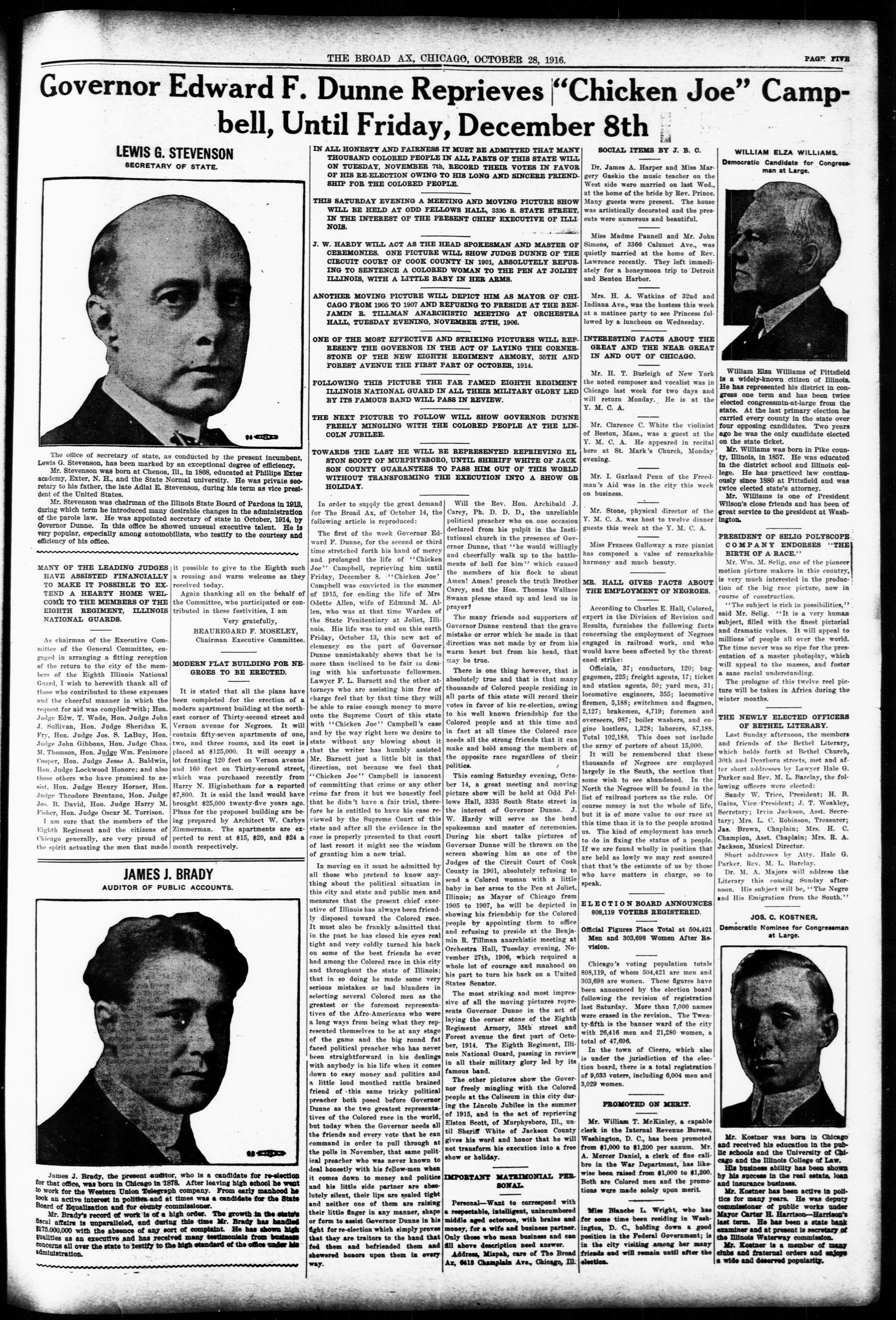
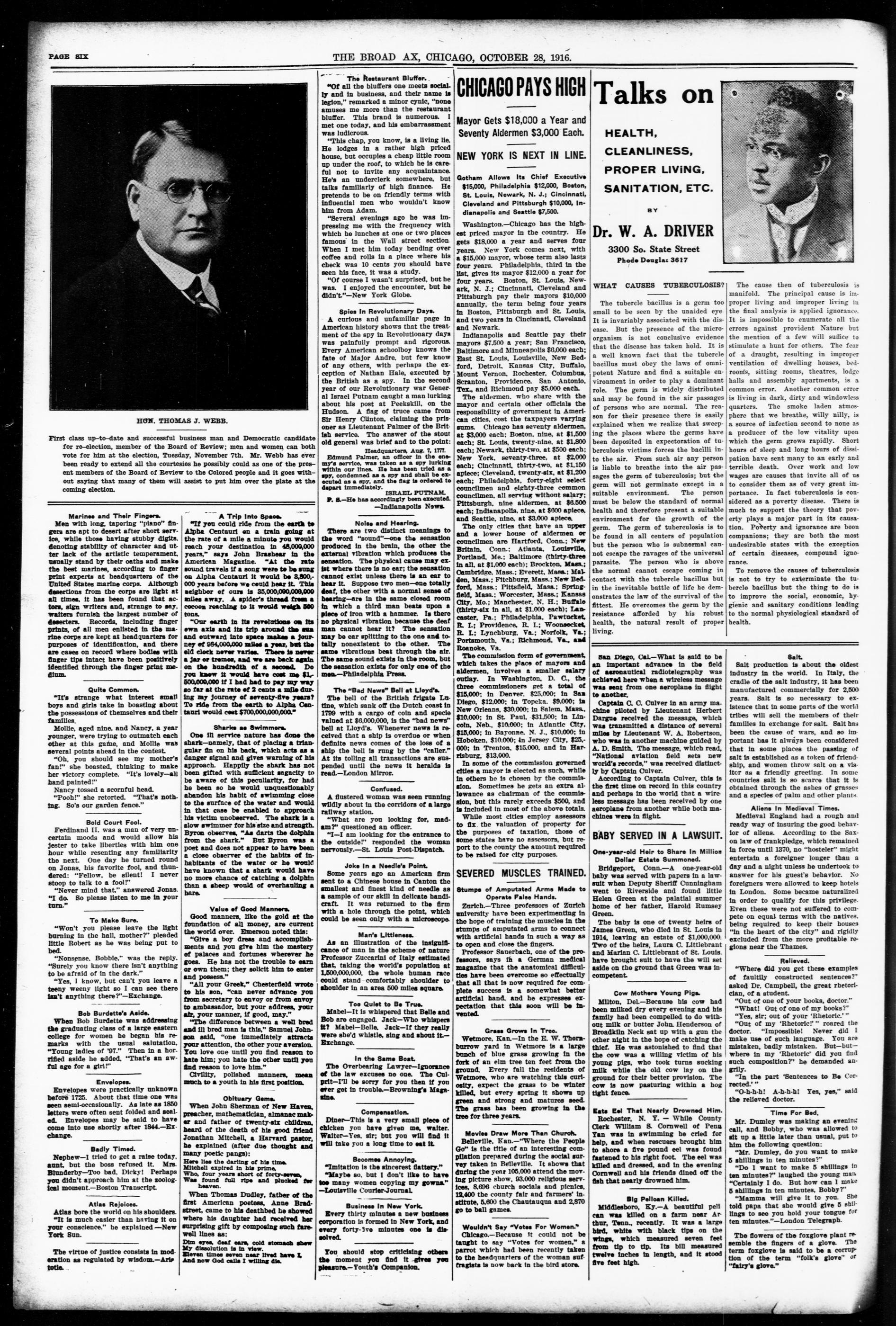
Page text (machine-generated)
THE BROAD AX
HEW TO THE LINE; LET THE CHIPS FALL WHERE THEY MAY
The Eighth Regiment Illinois National Guard, Col. Franklin A. Denison Commanding, Arrives Home After Spending More than Four Months on the Mexican Border
CONGRESSMAN MARTIN B. MADDEN, HON. SAMUEL A. ETTELSON, MAYOR WILLIAM HALE THOMPSON, CHIEF OF POLICE CHARLES C. HEALEY AND MANY OTHER PROMINENT WHITE CITIZENS JOINED IN ASSISTING TO MAKE THEIR HOME COMING LONG TO BE REMEMBERED.
THE BITTER AND FAR REACHING FEUD BETWEEN HON. MACLAY HOYNE, STATE'S ATTORNEY AND CHIEF OF POLICE HEALEY, CONTINUES TO GROW IN INTENSITY EACH DAY.
THE OCTOBER GRAND JURY THE FIRST OF THE WEEK RETURNED INDICTMENT AGAINST THE CHIEF, HIS SECRETARY AND ANOTHER CITY HALL POLITICIAN.
THE NUMEROUS FRIENDS OF THE CHIEF ARE RAISING A DEFENSE FUND WHICH WILL AMOUNT WELL ON TO $60,000 AND THEY AS WELL AS MAYOR THOMPSON ARE DEMANDING AN IMMEDIATE TRIAL FOR HIM.
THE TWENTY-FIVE OR THIRTY DETECTIVES OR POLICEMEN WHO HAVE BEEN ON DUTY IN THE STATE'S ATTORNEY'S OFFICE LIVING ON THE FAT OF THE LAND AT THE EXPENSE OF THE SMALL TAXPAYERS IN THIS CITY HAVE BEEN WITHDRAWN AND SENT TO THE WOODS BY CHIEF HEALEY AS A PUNISHMENT FOR ASSISTING TO RAID THE CITY HALL A Few WEEKS AGO IN A RAW HANDED AND MOST NOTORIOUS MANNER.
PETER J. GAYNOR, THE WILY AND FOXY SALOONKEEPER, WHO WAS ONE OF THE STAR WITNESSES IN CHIEF JUSTICE HARRY OLSON'S COURT IN AN EFFORT TO BLACKEN THE CHARACTER OF CHIEF HEALEY, IS STILL RESTING UP IN THE COOK COUNTY JAIL, WHERE HE WAS SENT BY JUDGE OLSON, ON THE CHARGE OF PERJURY.
MAYOR WILLIAM HALE THOMPSON TAKES ANOTHER TURN AT THE BAT AND HE COMMENDS CHIEF HEALEY FOR PULLING BACK OR OUT HIS OFFICERS FROM THE STATE'S ATTORNEY'S OFFICE AND HE BRANDS THE HON. MACLAY HOYNE AS THE "NEW CZAR OF RUSSIA."
THE PRESIDENTIAL STRAW VOTE AT MANY POINTS THROUGHOUT THE COUNTRY STRONGLY INDICATE THE REELECTION OF PRESIDENT WOODROW WILSON AT OTHER POINTS THEY INDICATE THE ELECTION OF HON. CHARLES E. HUGHES AS PRESIDENT OF THE UNITED STATES. THE BETTING ON THEM BY THE SPORTING ELEMENT IS ALMOST EVEN, SO AT THIS WRITING IT IS VERY HARD TO TELL JUST HOW THE PRESIDENTIAL POLITICAL CAT WILL JUMP.
COL. THEODORE ROOSEVELT, THE FORMER ROUGH RIDING PRESIDENT, TOOK CHICAGO BY STORM THURSDAY AFTERNOON AND EVENING. MORE THAN TWO HUNDRED THOUSAND PEOPLE PAID HOMAGE TO HIM WHILE IN CHICAGO.
ol. XXII.
The Eighty Denis More
CONGRESSMAN MARTIN B. MALE
MAYOR WILLIAM HALE THOM
C. HEALEY AND MANY OTH
JOINED IN ASSISTING TO MA
BE REMEMBERED.
THE BITTER AND FAR REACHING
HOYNE, STATE'S ATTORNEY
CONTINUES TO GROW IN INTU
THE OCTOBER GRAND JURY THE
DICTMENT AGAINST THE CHIC
CITY HALL POLITICIAN.
THE NUMEROUS FRIENDS OF THE
FUND WHICH WILL AMOUNT
WELL AS MAYOR THOMPSON
TRIAL FOR HIM.
THE TWENTY-FIVE OR THIRTY-
HAVE BEEN ON DUTY IN THE
ING ON THE FAT OF THE LAN
TAXPAYERS IN THIS CITY H
TO THE WOODS BY CHIEF H
SISTING TO RAID THE CITY H
HANDED AND MOST NOTORIOUS.
PETER J. GAYNOR, THE WILY AND
ONE OF THE STAR WITNESSES
COURT IN AN EFFORT TO BE
HEALEY, IS STILL RESTING
WHERE HE WAS SENT BY J
PERJURY.
MAYOR WILLIAM HALE THOMPSON
BAT AND HE COMMENDS CHI
OUT HIS OFFICERS FROM THE
HE BRANDS THE HON. MACL
RUSSIA."
THE PRESIDENTIAL STRAW VOTED
THE COUNTRY STRONGLY IND
DENT WOODROW WILSON AT
ELECTION OF HON. CHARLES
UNITED STATES. THE BETTING
MENT IS ALMOST EVEN, SO A
TO TELL JUST HOW THE PR
JUMP.
COL. THEODORE ROOSEVELT, THE
DENT, TOOK CHICAGO BY ST
EVENING. MORE THAN TWO
HOMAGE TO HIM WHILE IN C
The Chicago members of the Eighth Regiment, Illinois Guards, Col. Franklin A. Denison, Commanding, their colors flying to the breezes and the famous band playing, arrived home this morning from Camp Lincoln, Illinois where it has been waiting for more than two weeks waiting to be mustered out of the federal service, for sometime past the citizens committee composed of many prominent White and Colored citizens, such as the Hon. Martin B. Madden, Hon. Samuel A. Ettelson, Hon. William Hale Thompson, Chief of Police Charles C. Healey, Col. John R. Marshall, Attorney William L. Martin, Lawyer S. A. T. Watkins, Lawyer B. F. Moseley, E. Wright, R. S. Abbott, Hon. Oscar DePriest, and many others had been planning to extend to each and every member of the Regiment a most hearty or a royal welcome which would long be remembered by all those participating in it.
Shortly after 8 o'clock this morning the long trains bearing them home arrived at the 12th St. station of the Illinois Central Railroad detraining later on at the Randolph street station, thousands of people were on hand to greet them, including the wives, sweet-hearts, friends and other relatives of the returning soldiers.
On landing from the long trains a procession was formed which wended its way through many of the downtown streets and all along the line of march it was loudly cheered and welcomed home by all Chicago, the procession was headed by motor and mounted police who were followed by Mayor Thompson and other distinguished citizens in more than fifty autos which included Col. F. A. Denison and his staff, many members of the 'Appomattox Club. Col.
John R. Marshall, President, met at the 12th street station and acted as an escort to the returning soldiers; this afternoon at three o'clock a banquet and reception will be held at the armory in honor of their home coming.
The first of the present week the October Grand Jury returned indictments against Chief Healey, his secretary and another city hall politician the chief is charged with failing to do his sworn duty at all times and with winking at crime and vice, hundreds of his loyal friends are rushing to his aid in his hours of trouble and they are already engaged in raising a defense fund for him which will amount to near sixty thousand dollars and they and as well as the chief himself, also Mayor Thompson are all demanding an immediate trial for him and all the people of Chicago should do the same thing for if he is guilty of doing the things which he is charged with doing which are absolutely wrongful in the eyes of the law the people residing in this city are entitled to know it at once and if he is innocent they (the people) also desire to know that without delay and the State's Attorney should not be permitted to hold a heavy club over his head.
To show his utter contempt for State's Attorney Hoyne, a few days ago Chief Healey recalled the twenty-five or thirty detectives or policemen who had been on dead easy duty in the State's Attorney's office for the past four or five years, feasting on the fat of the land at the great expense of the small taxpayers of this city whereas the expense for maintaining them on the North side should have come out of the pockets of the people residing in Cook
CHICAGO, OCTOBER 28. 1916
county outside of Chicago; they have been sent to the woods by Chief Healey, as part punishment for assisting to raid the city hall a few weeks ago in rough western cowboy style.
In pulling or removing his 25 or 30 picked men from the State's office Chief Healey issued the following statement:
"For many years past it has been the custom of the general superintendent of police to furnish the state's attorney with whatever assistance he required in the way of police officers to help him in obtaining evidence of crimes committed, to lend aid in circumventing crimes contemplated where information of such could be had, and to cooperate with generally and obey the orders of the public prosecutor in the performance of his lawful duties.
"Under former state's attorneys the following is the record of police details to their offices for the purpose above mentioned:
"Charles S. Deneen, from 1896 to 1904, had four men.
"John J. Healy, from 1904 to 1908, had four men."
"John E. W. Wayman, from 1008 to 1912, had four men, except for a brief period of time when he was engaged in closing the 'red light' district, when he had twenty men, otherwise the four were sufficient for his regular work.
All Bounds Exceeded.
"Under the present state's attorney, Maclay Hoyne, all bounds have been exceeded and the police officers detailed to him have been assigned to duties which the law never intended they should perform. The following is his present assignment.
Two sergeants of police in uniform.
Five detective sergeants.
Seventeen patrolmen in plain clothes.
One policewoman.
"This detail works under his exclusive orders and costs the taxpayers of Chicago $33,800 in annual salaries, toward which Cook county does not contribute one cent.
Some "Inside Scandal"
Raids the Final Straw.
"The culminating misdeeds of the police officers under the state's attorney's direction were the lawless, riotous raids committed upon their own department, that of the police, and the office of the mayor, two weeks ago. In these raids constitutions and laws were set aside and every legal right which public officials and other people have was violated and outraged in the fullest degree. Day before yesterday one of the state's attorney's police officers was caught red handed taking an innocent citizen into custody without warrant of law. He was promptly deprived of his authority and suspended pending trial
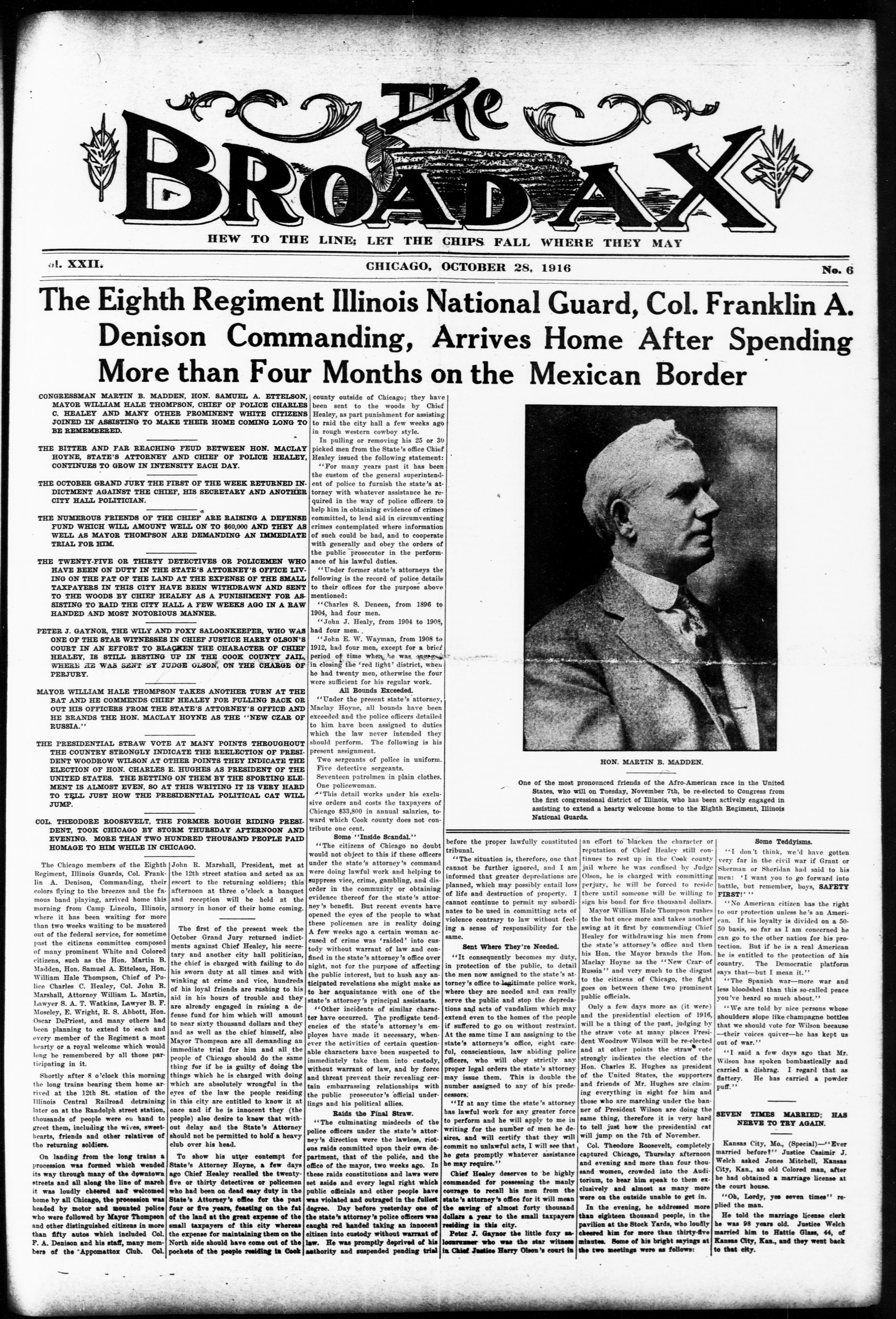
One of the most pronounced friends of the Afro-American race in the United States, who will on Tuesday, November 7th, be re-elected to Congress from the first congressional district of Illinois, who has been actively engaged in assisting to extend a hearty welcome home to the Eighth Regiment, Illinois National Guards.
before the proper lawfully constituted tribunal.
"The situation is, therefore, one that cannot be further ignored, and I am informed that greater depredations are planned, which may possibly entail loss of life and destruction of property. I cannot continue to permit my subordinates to be used in committing acts of violence contrary to law without feeling a sense of responsibility for the same.
Sent Where They're Needed.
“It consequently becomes my duty in protection of the public, to detail the men now assigned to the state’s at torney’s office to legitimate police work where they are needed and can really serve the public and stop the depredations and acts of vandalism which may extend even to the homes of the people if suffered to go on without restraint. At the same time I am assigning to the state’s attorneys’ office, eight careful, conscientious, law abiding police officers, who will obey strietly any proper legal orders the state’s attorney may issue them. This is double the number assigned to any of his predecessors.”
“If at any time the state’s attorney has lawful work for any greater force to perform and he will apply to me in writing for the number of men he desires, and will certify that they will commit no unlawful acts, I will see that he gets promptly whatever assistance he may require.”
Chief Healey deserves to be highly commended for possessing the manly courage to recall his men from the state’s attorney’s office for it will mean the saving of almost forty thousand dollars a year to the small taxpayers residing in this city.
Peter J. Gaynor the little foxy saloonrunner who was the star witness in Chief Justice Harry Olson's court in
HON. MARTIN B. MADDEN.
pronounced friends of the Afro-American will on Tuesday, November 7th, be re-electedressional district of Illinois, who has been extend a hearty welcome home to the Eigrdrs.
an effort to blacken the character or reputation of Chief Healey still continues to rest up in the Cook county jail where he was confined by Judge Olson, he is charged with committing perjury, he will be forced to reside there until someone will be willing to sign his bond for five thousand dollars.
Mayor William Hale Thompson rushes to the bat once more and takes another swing at it first by commending Chief Healey for withdrawing his men from the state's attorney's office and then his Hon. the Mayor brands the Hon. Maclay Hoyne as the "New Czar of Russia" and very much to the disgust to the citizens of Chicago, the fight goes on between these two prominent public officials.
Only a few days more as (it were) and the presidential election of 1916 will be a thing of the past, judging by the straw vote at many places President Woodrow Wilson will be re-elected and at other points the straw vote strongly indicates the election of the Hon. Charles E. Hughes as president of the United States, the supporters and friends of Mr. Hughes are claiming everything in sight for him and those who are marching under the banner of President Wilson are doing the same thing, therefore it is very hard to tell just how the presidential cat will jump on the 7th of November.
Col. Theodore Roosevelt, completely captured Chicago, Thursday afternoon and evening and more than four thousand women, crowded into the Auditorium, to hear him speak to them exclusively and almost as many more were on the outside unable to get in.
In the evening, he addressed more than eighteen thousand people, in the pavilion at the Stock Yards, who loudly cheered him for more than thirty-five minutes. Some of his bright sayings at the two meetings were as follows:
---
No. 6
Some Teddvisims.
"I don't think, we'd have gotten very far in the civil war if Grant or Sherman or Sheridan had said to his men: 'I want you to go forward into battle, but remember, boys, SAFETY FIRST!'"
"No American citizen has the right to our protection unless he's an American. If his loyalty is divided on a 50-50 basis, so far as I am concerned he can go to the other nation for his protection. But if he is a real American he is entitled to the protection of his country. The Democratic platform says that—but I mean it."
"The Spanish war—more war and less bloodshed than this so-called peace you've heard so much about."
"We are told by nice persons whose shoulders slope like champagne bottles that we should vote for Wilson because—their voices quiver—he has kept us out of war."
"I said a few days ago that Mr. Wilson has spoken bombastically and carried a dishrag. I regard that as flattery. He has carried a powder puff."
SEVEN TIMES MARRIED; HAS
NERVE TO TRY AGAIN.
Kansas City, Mo., (Special)—"Ever married before?" Justice Casimir J. Welch asked Jones Mitchell, Kansas City, Kan., an old Colored man, after he had obtained a marriage license at the court house.
"Oh, Lordy, yes seven times" replied the man.
He told the marriage license clerk he was 98 years old. Justice Welch married him to Hattie Glass, 44, of Kansas City, Kan., and they went back to that city.
94
94
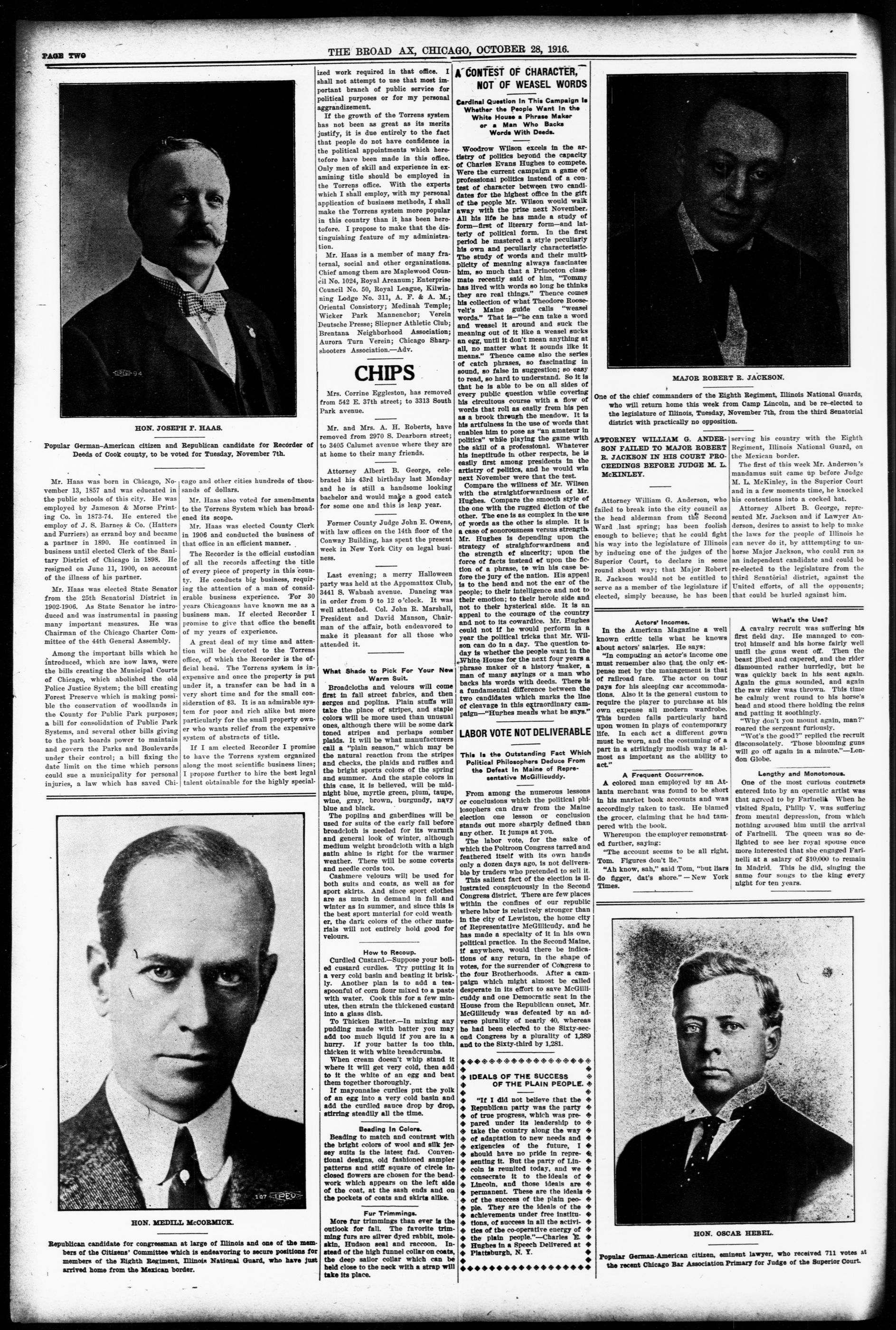
HON. JOSEPH F. HAAS.
Popular German-American citizen and Republican
Deeds of Cook county, to be voted for Tuesc
an citizen and Republican can
county, to be voted for Tuesday,
Popular German-American citizen and Republican candidate for Recorder of Deeds of Cook county, to be voted for Tuesday, November 7th.
Mr. Haas was born in Chicago, November 13, 1857 and was educated in the public schools of this city. He was employed by Jameson & Morse Printing Co. in 1873-74. He entered the employ of J. S. Barnes & Co. (Hatters and Furriers) as errand boy and became a partner in 1890. He continued in business until elected Clerk of the Sanitary District of Chicago in 1898. He resigned on June 11, 1900, on account of the illness of his partner.
Mr. Haas was elected State Senator from the 25th Senatorial District in 1902-1906. As State Senator he introduced and was instrumental in passing many important measures. He was Chairman of the Chicago Charter Committee of the 44th General Assembly.
Among the important bills which he introduced, which are now laws, were the bills creating the Municipal Courts of Chicago, which abolished the old Police Justice System; the bill creating Forest Preserve which is making possible the conservation of woodlands in the County for Public Park purposes; a bill for consolidation of Public Park Systems, and several other bills giving to the park boards power to maintain and govern the Parks and Boulevards under their control; a bill fixing the date limit on the time which persons could sue a municipality for personal injuries, a law which has saved Chi-
```markdown
```
1920
107 IPEO
HON. MEDILL McCORMICK
Republican candidate for congressman
bers of the Citizens' Committee wh
members of the Eighth Regiment
arrived home from the Mexican bo
or congressman at large of Illinois Committee which is endeavoring ninth Regiment, Illinois Nation the Mexican border.
Republican candidate for congressman at large of Illinois and one of the members of the Citizens' Committee which is endeavoring to secure positions for members of the Eighth Regiment, Illinois National Guard, who have just arrived home from the Mexican border.
PAGE TWO
Republican candidate for Recorder of
ced for Tuesday, November 7th.
cago and other cities hundreds of thousands of dollars.
Mr. Haas also voted for amendments to the Torrens System which has broadened its scope.
Mr. Haas was elected County Clerk in 1906 and conducted the business of that office in an efficient manner.
The Recorder is the official custodian of all the records affecting the title of every piece of property in this county. He conducts big business, requiring the attention of a man of considerable business experience. For 30 years Chicagoans have known me as a business man. If elected Recorder I promise to give that office the benefit of my years of experience.
A great deal of my time and attention will be devoted to the Torrens office, of which the Recorder is the official head. The Torrens system is inexpensive and once the property is put under it, a transfer can be had in a very short time and for the small consideration of $3. It is an admirable system for poor and rich alike but more particularly for the small property owner who wants relief from the expensive system of abstracts of title.
If I am elected Recorder I promise to have the Torrens system organized along the most scientific business lines; I propose further to hire the best legal talent obtainable for the highly special-
107 LPEU
at large of Illinois and one of the mem- which is endeavoring to secure positions for Illinois National Guard, who have just order.
ized work required in that office. I shall not attempt to use that most important branch of public service for political purposes or for my personal aggrandizement.
A CONTEST OF CHARACTER NOT OF WEASEL WO
Cardinal Question In This Campa
Whether the People Want In
If the growth of the Torrens system has not been as great as its merits justify, it is due entirely to the fact that people do not have confidence in the political appointments which heretofore have been made in this office. Only men of skill and experience in examining title should be employed in the Torrens office. With the experts which I shall employ, with my personal application of business methods, I shall make the Torrens system more popular in this country than it has been heretofore. I propose to make that the distinguishing feature of my administration.
Mr. Haas is a member of many fraternal, social and other organizations. Chief among them are Maplewood Council No. 1024, Royal Arcanum; Enterprise Council No. 50, Royal League, Kilwinning Lodge No. 311, A. F. & A. M.; Oriental Consistory; Medinah Temple; Wicker Park Mannenchor; Verein Deutsche Presse; Sliepner Athletic Club; Brentana Neighborhood Association; Aurora Turn Verein; Chicago Sharp shooters Association—Adv.
CHIPS
Mrs. Corrine Eggleston, has removed from 542 E. 37th street; to 3313 South Park avenue.
Mr. and Mrs. A. H. Roberts, have removed from 2970 S. Dearborn street; to 3405 Calumet avenue where they are at home to their many friends.
Attorney Albert B. George, celebrated his 43rd birthday last Monday and he is still a handsome looking bachelor and would make a good catch for some one and this is leap year.
Former County Judge John E. Owens, with law offices on the 14th floor of the Conway Building, has spent the present week in New York City on legal business.
Last evening; a merry Halloween party was held at the Appomattox Club, 3441 S. Wabash avenue. Dancing was in order from 9 to 12 o'clock. It was well attended. Col. John R. Marshall, President and David Manson, Chairman of the affair, both endeavored to make it pleasant for all those who attended it.
What Shade to Pick For Your New Warm Suit.
Broadcloths and velours will come first in fall street fabrics, and then serges and poplins. Plain stuffs will take the place of stripes, and staple colors will be more used than unusual ones, although there will be some dark toned stripes and perhaps somber plaids. It will be what manufacturers call a "plain season," which may be the natural reaction from the stripes and checks, the plaids and ruffles and the bright sports colors of the spring and summer. And the staple colors in this case, it is believed, will be midnight blue, myrtle green, plum, taupe, wine, gray, brown, burgundy, navy blue and black.
The poplins and gaberdines will be used for suits of the early fall before broadcloth is needed for its warmth and general look of winter, although medium weight broadcloth with a high satin shine is right for the warmer weather. There will be some coverts and needle cords too.
Cashmere velours will be used for both suits and coats, as well as for sport skirts. And since sport clothes are as much in demand in fall and winter as in summer, and since this is the best sport material for cold weather, the dark colors of the other materials will not entirely hold good for velours.
How to Recoup.
Curdied Custard.—Suppose you boulded custard curdles. Try putting it in a very cold basin and beating it briskly. Another plan is to add a teaspoonful of corn flour mixed to a paste with water. Cook this for a few minutes, then strain the thickened custard into a glass dish.
To Thicken Batter.—In mixing any pudding made with batter you may add too much liquid if you are in a hurry. If your batter is too thin, thicken it with white breadcrumbs.
When cream doesn't whip stand it where it will get very cold, then add to it the white of an egg and beat them together thoroughly.
If mayonnaise curdles put the yolk of an egg into a very cold basin and add the curdled sauce drop by drop, stirring steadily all the time.
Beading In Colors.
Beading to match and contrast with the bright colors of wool and silk jersey suits is the latest fad. Conventional designs, old fashioned sampler patterns and stiff square of circle incled flowers are chosen for the beadwork which appears on the left side of the coat, at the sash ends and on the pockets of coats and skirts alike.
Eur Trimmings.
More fur trimmings than ever is the outlook for fall. The favorite trimming furs are silver dyed rabbit, moleskin, Hudson seal and raccoon. Instead of the high funnel collar on coats, the deep sailor collar which can be held close to the neck with a strap will take its place.
A CONTEST OF CHARACTER, NOT OF WEASEL WORDS
Cardinal Question In This Campaign Is Whether the People Want In the White House a Phrase Maker or a Man Who Backs Words With Deeds.
Woodrow Wilson excels in the artistry of politics beyond the capacity of Charles Evans Hughes to compete. Were the current campaign a game of professional politics instead of a contest of character between two candidates for the highest office in the gift of the people Mr. Wilson would walk away with the prize next November. All his life he has made a study of form—first of literary form—and latterly of political form. In the first period he mastered a style peculiarly his own and peculiarly characteristic. The study of words and their multiplicity of meaning always fascinates him, so much that a Princeton classmate recently sald of him, "Tommy has lived with words so long he thinks they are real things." Thence comes his collection of what Theodore Roosevelt's Maine guide calls "weasel words." That is—"he can take a word and weasel it around and suck the meaning out of it like a weasel sucks an egg, until it don't mean anything at all, no matter what it sounds like it means." Thence came also the series of catch phrases, so faschinating in sound, so false in suggestion; so easy to read, so hard to understand. So it is that he is able to be on all sides of every public question while covering his circultous course with a flow of words that roll as easily from his pen as a brook through the meadow. It is his artfulness in the use of words that enables him to pose as "an amateur in politics" while playing the game with the skill of a professional. Whatever his inaptitude in other respects, in the artistry of politics, and he would win next November were that the test.
Compare the willness of Mr. Wilson with the straightforwardness of Mr. Hughes. Compare the smooth style of the one with the rugged diction of the other. The one is as complex in the use of words as the other is simple. It is a case of sonorousness versus strength. Mr. Hughes is depending upon the strategy of straightforwardness and the strength of sincerity; upon the force of facts instead of upon the fiction of a phrase, to win his case before the jury of the nation. His appeal is to the head and not the ear of the people; to their intelligence and not to their emotion; to their heroic side and not to their hysterical side. It is an appeal to the courage of the country and not to its cowardice. Mr. Hughes could not if he would perform in a year the political tricks that Mr. Wilson can do in a day. The question today is whether the people want in the White House for the next four years a phrase maker or a history maker, a man of many sayings or a man who backs his words with deeds. There is a fundamental difference between the two candidates which marks the line of cleavage in this extraordinary campaign—"Hughes means what he says."
LABOR VOTE NOT DELIVERABLE
This Is the Outstanding Fact Which Political Philosophers Deduce From the Defeat In Maine of Representative McGillicuddy.
From among the numerous lessons or conclusions which the political philosophers can draw from the Maine election one lesson or conclusion stands out more sharply defined than any other. It jumps at you.
The labor vote, for the sake of which the Poltroton Congress tarred and feathered itself with its own hands only a dozen days ago, is not deliverable by traders who pretended to sell it.
This salient fact of the election is illustrated conspicuously in the Second Congress district. There are few places within the confines of our republic where labor is relatively stronger than in the city of Lewiston, the home city of Representative McGillcudy, and he has made a specialty of it in his own political practice. In the Second Maine, if anywhere, would there be indications of any return, in the shape of votes, for the surrender of Congress to the four Brotherhoods. After a campaign which might almost be called desperate in its effort to save McGillcudy and one Democratic seat in the House from the Republican onset, Mr. McGillcudy was defeated by an adverse plurality of nearly 40, whereas he had been elected to the Sixty-second Congress by a plurality of 1,389 and to the Sixty-third by 1,281.
```markdown
```
IDEALS OF THE SUCCESS OF THE PLAIN PEOPLE
"If I did not believe that the Republican party was the party of true progress, which was prepared under its leadership to take the country along the way of adaptation to new needs and exigencies of the future, I should have no pride in representing it. But the party of Lincoln is reunited today, and we consecrate it to the ideals of Lincoln, and those ideals are permanent. These are the ideals of the success of the plain people. They are the ideals of the achievements under free institutions, of success in all the activities of the co-operative energy of the plain people."—Charles E. Hughes in a Speech Delivered at Plattsburgh, N. Y.
M.
MAJOR ROBERT R. JACKSON.
One of the chief commanders of the Eighth Regiment, I who will return home this week from Camp Lincoln the legislature of Illinois, Tuesday, November 7th, f district with practically no opposition.
One of the chief commanders of the Eighth Regiment, Illinois National Guards, who will return home this week from Camp Lincoln, and be re-elected to the legislature of Illinois, Tuesday, November 7th, from the third Senatorial district with practically no opposition.
ATTORNEY WILLIAM G. ANDERSON FAILED TO MAJOR ROBERT R. JACKSON IN HIS COURT PROCEDINGS BEFORE JUDGE M. L. McKINLEY.
serving his country with the Eighth Regiment, Illinois National Guard, on the Mexican border.
The first of this week Mr. Anderson's mandamus suit came up before Judge
Attorney William G. Anderson, who failed to break into the city council as the head alderman from the Second Ward last spring; has been foolish enough to believe; that he could fight his way into the legislature of Illinois by inducing one of the judges of the Superior Court, to declare in some round about way; that Major Robert R. Jackson would not be entitled to serve as a member of the legislature if elected, simply because, he has been
In the American Magazine a well known critic tells what he knows about actors' salaries. He says: "In computing an actor's income one must remember also that the only expense met by the management is that of railroad fare. The actor on tour pays for his sleeping car accommodations. Also it is the general custom to require the player to purchase at his own expense all modern wardrobe. This burden falls particularly hard upon women in plays of contemporary life. In each act a different gown must be worn, and the costing of a part in a strikingly modish way is almost as important as the ability to act."
A. Frequent Occurrence.
A colored man employed by an Atlanta merchant was found to be short in his market book accounts and was accordingly taken to task. He blamed the grocer, claiming that he had tampered with the book.
Whereupon the employer remonstrated further, saying:
"The account seems to be all right. Tom. Figures don't lie."
"Ah know, sah," said Tom, "but liars do figger, dat's shore." — New York Times.
J. B.
HON. OSCAR HEBEL.
Popular German-American citizen, eminent lawyer, who received 711 votes at the recent Chicago Bar Association Primary for Judge of the Superior Court.
Actors' Incomes.
nth Regiment, Illinois National Guards, from Camp Lincoln, and be re-elected to November 7th, from the third Senatorial on.
serving his country with the Eighth Regiment, Illinois National Guard, on the Mexican border.
The first of this week Mr. Anderson's mandamus suit came up before Judge M. L. McKinley, in the Superior Court and in a few moments time, he knocked his contentions into a cocked hat.
Attorney Albert B. George, represented Mr. Jackson and if Lawyer Anderson, desires to assist to help to make the laws for the people of Illinois he can never do it, by attempting to unhorse Major Jackson, who could run as an independent candidate and could be re-elected to the legislature from the third Senatorial district, against the United efforts, of all the opponents; that could be hurled against him.
A cavalry recruit was suffering his first field day. He managed to control himself and his horse fairly well until the guns went off. Then the beast jibed and capered, and the rider dismounted rather hurriedly, but he was quickly back in his seat again. Again the guns sounded, and again the raw rider was thrown. This time he calmly went round to his horse's head and stood there holding the reins and patting it soothingly.
"Why don't you mount again, man?" roared the sergeant furiously.
"Wot's the good?" replied the recruit disconsolately. "Those blooming guns will go off again in a minute."—London Globe.
Lengthy and Monotonous.
One of the most curious contracts entered into by an operatic artist was that agreed to by Farknell. When he visited Spain, Philip V. was suffering from mental depression, from which nothing aroused him until the arrival of Farknell. The queen was so delighted to see her royal spouse once more interested that she engaged Farknelli at a salary of $10,000 to remain in Madrid. This he did, singing the same four songs to the king every night for ten years.
[Image of a man in a suit with a tie].
inent lawyer, who received 711 votes as Primary for Judge of the Superior Court.
What's the Use?
BALDHEADED ALASKAN BEARS
Volcanic Ash Brings Hardship to Bruin on Kadia island.
Seward, Alaska.-It will take more than two or three years of enforced diet of straight meat and fish and a loss of hair to seriously set back the bear population of Kadlak island, according to D. Winn of the United States bureau of fisheries.
Kadlak island, says Mr. Winn, in 1912 was covered with volcanic ash at no point at a depth less than eleven inches. The ash killed all vegetation, and as all bears are fond of a mixed diet of meat, fish and vegetables, they found 1913 and 1914 unpleasant from a dietary standpoint.
Another effect of the fall of ash, according to Mr. Winn, was the havoc it created with the furry coats of the animals. Bald headed bears are now as common on Kadinka island as bald headed men in the front row of a musical comedy. The ash sifted down on to the skins of the animals as it fell, and the first rain turned it to lye, which had the effect of almost tanning the skins of the bears while yet a part of their personal effects.
WHITTLES VIOLIN FINGERS.
Player Hopes to Increase His Proficiency by Surgery.
Wichita, Kan.—In order to become a more proficient violin artist Mark Sandfort, a member of an orchestra here, had a piece of flesh taken from each of his six fingers. The incisions were drawn together and sewn with horsehair. The operation was performed by Dr. H. S. Hickok, and Sandfort will be able to remove the bandages soon.
Sandfort has won a reputation as a violinist. However, his execution of musical selections was not as good as he desired it to be. He hit upon a plan. He would have his fingers whittled down. He waited until the season closed and had the operation performed.
According to physicians, this is the first time that an operation of this kind has been performed.
BOY FALLS: SERVICE STOPS
Pastor and Congregation See Lad Hit by Electric Current.
Little Rock, Ark—Kenneth McEwen, eleven years of age, was electrocuted thirty feet in the air on a lighting tower in view of the congregation of a church that was holding services on the church lawn because of the heat. The boy was knocking the wire that supplied current to the lights on the tower against the steel frame to produce sparks. Suddenly a flash of blue flames enveloped him, and he plunged downward, fracturing his skull on the pavement below. He died in a hospital a few minutes later. The pastor of the church, the Rev. E P. Aldredge, was preaching a special sermon to boys. He rushed over, aided in placing the dying lad in an ambulance and then resumed his sermon, using the accident as a warning to the boys.
GIRL'S PROFIT IN HOGS.
Raising Swine Not a Finishing School
For Debutantes
Holtville, Cal. — Raising hogs for pleasure and profit is the occupation of Miss Josie Fuller, seventeen, the youngest and best all around feminine pork producer in the Imperial valley.
It is her ambition to become the best expert on hogs in her district. Her herd numbers fifty strong and is increasing. "Pig culture isn't aesthetic work, of course," said Miss Fuller. "It can't be considered a finishing school for debutantes, but there's money in it."
She has established a record of developing her porkers for the market at a cost of $3½ cents a pound.
"Women may not admire hogs, but if they don't it's because they know so little about them. Once interested they become just as capable as men in handling swine."
TWO DEATHS IN ONE HOME
Soes Mother-in-law Stricken With Heart Failure, Then Dies.
Philadelphia — Stricken with heart failure just after she had called her son to dinner at noon, Mrs. Rebecca Thomas, seventy-three years old, a sister of Jesse Pratt, former mayor of Camden, fell dead in the dining room of her Camden home.
Mrs. Madeline Thomas, her daughter-in-law, who was in an adjoining room, ran to her assistance and was leaning over her, trying to lift her form to a couch, when she, too, collapsed and fell lifeless.
ANOTHER QUITS SING SING.
Officials Think Prisoner Swam to Liberty.
Ossining, N. Y.—"I'm going into the garden to get some tomatoes for breakfast," said Elmer Schultz, a prisoner at Sing Sing, as he walked out of the power house, where he was doing duty as a fireman. Some hours later the big whistle tooted the message that another prisoner had escaped.
Prison officials had then found two iron pickets had been pulled apart and concluded that Schultz went through the opening, dived into the Hudson and swam to liberty.
Lost Dog Returned Home
New York. After a year's absence a beagle belonging to Louis W. Well of Flushing, N. Y., returned home. Mr. Well went on a hunting trip a year ago and took the beagle along. He lost the dog. The dog seemed to enjoy its homecoming, and the Well family showed its delight in a way that tickled the dog's palate.
Stagestruck Women.
William A. Page, the Chicago crick and publicity writer, says in the Woman's Home Companion in an article about stagnest cricket women:
"And what becomes of them? Caught in the eddies of frivolity, many of them temporarily abandon their stage ambitions in the kaleidoscopic life of Broadway. Others live in hall bedrooms, boil eggs over a gas jet and waste their young lives in the fruitless pursuit of a rainbow which they never find, only sooner or later to return home sadly and settle down to forget their stage ambitions. Others study, economize, sincerely strive for engagements, possibly get small roles with some obscure company and start in on a career which will be filled with many, many disappointments. And of the thousands who came so bravely to the front last year how many still remain in the lists? Not counting those who may have gone into musical comedy, perhaps a score still cherish the shrine of Marlowe and of Adams. For the rest, oblivion."
Shaw Didn't Like Himself
"Many years ago in a house in Ashley Gardens," writes G. Bernard Shaw in the New Witness, "I was walking along a corridor with other guests at a musical evening when I saw coming toward me a man who produced an extraordinarily disagreeable impression on me, a tall young man in evening dress, with a blond beard and, as it seemed to me, a hateful expression.
"He was coming straight at me. I moved aside to avoid him, and he moved, too, apparently to get into my way again. An impulse of rage at this insult was checked just in time by the discovery that instead of walking along a corridor I was crossing a square landing and that the detestable apparition who had chilled my very soul with his abominable aspect was a reflection of myself in the wall of mirror which the tenant of the Ashley Gardens flat had put up to give his cramped dwelling an appearance of spacious magnificence."
Power In Plant Cells.
Along with the formation of the sugar, and caused in part by its accumulation, there develop within the minute cells of the blueberry plants enormous osmotic pressures, which enable the plant to push its buds open, F. V. Coville writes in the National Geographic Magazine.
These pressures are frequently as high as seven atmospheres or more than 100 pounds to the square inch—a pressure that would start a leak in a low pressure steam engine. The pressure may become as high as thirty atmospheres or 45.0 pounds to the square inch—a force sufficient to blow the cylinder head off of a thousand horse power Corliss engine. The reason the plant does not explode is because it is broken up into many extremely small and strongly built cells instead of having one big interior cavity. These minute chambers are often as thick walled proportionately as an artillery shell.
A Famous War Horse.
Bucephalus, the charger that carried Alexander the Great through all his campaigns, received his name from the fact that, although white, he had a black mark resembling an ox's head on his forehead.
A Thessalonian had offered the horse for sale to Phillip of Macedon, but as none of the monarch's attendants could manage him the king ordered his owner to take him away. Alexander, who was present, expressed his regret at losing so fine an animal, and Philip replied that he would buy the horse if his son could ride him. The offer was accepted by Alexander, who succeeded in the attempt. Bucephalus would never suffer any other person to mount him.
Alring Room.
In airing a room there are two things to be remembered—first, that the impure air must be allowed to escape and, secondly, that fresh air must be admitted. Impure air in a room is always warm and will therefore rise toward the ceiling, when it will escape if the window is opened at the top, while cold fresh air will enter through the lower part of the window when opened.
A Grand Canyon Sunrise.
A sunrise in the Grand canyon lasts as long as you please. Each hour is a sunrise for some cavern deeper than the last, and, in fact, there are many where it has yet to rise for the first time since the canyon was made by those ages of running water.
Hia Ashes.
"So you prefer to be cremated when you die?"
"I certainly do."
"Why?"
"So that my remains may be mingled with the ashes of the grate."—London Telegraph.
Parental Care.
"Did your bride's father give her away?"
"No, he didn't. He left me to find out a few things about her for myself."—Baltimore American.
Causes.
Bix—A physician says that yawning is caused by a lack of oxygen in the blood. Dix—Or a lack of pep in the conversation.—Boston Transcript.
The Comeback:
Skinfint—I have no money, but I will give you a little advice. Beggar—Well, if yer ain't got no money yer advice can't be very valuable.
Sooner or later the world comes around to see the truth and do the right—Hillard.
THE BROAD AX, CHICAGO, OCTOBER 28, 1916.
Coney Island's Start.
The first man to realize the great possibilities of Coney Island as a summer resort was Austin Corbin, a banker and railway official. From the beginning of the last century the beach at Coney Island was frequented by many New Yorkers, but it remained for Corbin to initiate the movement which has made "Coney" a synonym for a certain kind of amusement. Corbin started his financial career at Davenport, Ia., but in 1865 he opened a banking house in New York, and in 1873 he purchased the eastern part of Coney Island. There he created the great resort known as Manhattan Beach. He also became president of the Long Island railroad and played a big part in the development of all the summer resorts on Long Island. In the last forty years Coney Island has become the greatest popular summer resort in the world, and in addition to the millions of translent visitors from the city who go there for the day many thousands are regular summer residents of the hotels and cottages which line its shores. — New York World.
Money Mark Twain Refused.
Money Mark Twain Refused.
By the time that Mark Twain had finally succeeded in paying off the burden of debt that had fallen upon him with the failure of his publishing venture he found himself one of the best paid authors in the world. He refused many offers of money that did not agree with his literary conscience. He declined $10,000 for a tobacco indorsement, though he liked the tobacco well enough. He declined $10,000 a year for five years to lend his name as editor to a humorous periodical. He declined another $10,000 for ten lectures and another for fifty lectures at the same rate—that is, $1,000 a night. And he was offered $1 a word for his writing, which he also declined, making a final arrangement with his regular publishers that they should print whatever he wrote, the payment being 20 (later 30) cents a word. "Boys' Life of Mark Twain" in St. Nicholas'.
Peralan Words In English.
Regarding the Persian language, we all have a few words from that source in our vocabularies, although we may not be aware of our indebtedness. There are about a dozen words in the English dictionary which trace to Persia, the most common being perhaps "orange." a. although this was thought by some to be derived from the Latin "aurum" (gold). "Sash," meaning a ribbon or band (the "sash" of a window is the Latin "capsa"), "shawl" and "taffeta" are other Persian words which have become thoroughly acclimatized, as have "chess." "caravan," "filac." "derivish" and "liac," while "emerald" and "indigo." "azure," "bazaar." "jackal." "musk." "paradise" and "scimitar" have also been traced to the same source.-London Opinion.
Sympathy With Nature.
Tis an evidence of how directly we are related to nature that we more or less sympathize with the weather and take on the color of the day. Goethe said he worked easiest on a high barometer. One is like a chimney that draws well some days and won't draw at all on others, and the secret is mainly in the condition of the atmosphere. Anything positive and decided with the weather is a good omen. A pouring rain may be more auspicious than a sleeping sunshine. When the stove draws well the fogs and fumes will leave your mind. — John Burroughs.
Teeth as Sentinels.
"When thou sittest to eat with a ruler consider diligently him that is before thee," says the Hebrew proverb, warning a king's guest to regulate his appetite by his host's temper. Boswell, Dr. Johnson's biographer, gives in his notebook a modern paraphrase of the old Jewish proverb: "I said of a rich man who entertained us luxuriously that, although he was exceedingly ridiculous, we restrained ourselves from talking of him as we might do lest we should lose his feasts. 'He makes our teeth sentinels on our tongues,' said I."
Fire and Matrimony
In Persia the wedding service is read in front of a fire. In Nicaragua the priest, taking the couple each by the little fingers, leads them to an apartment where a fire is lighted and there instructs the bride in her duties, extinguishing the fire by way of conclusion. In Japan the woman kindles a torch and the bridegroom lights one from it. The playthings of the wife being then burned.
A Record In Governors
Mrs. Richard Manning of South Carolina had the distinction of being the only woman on record who was the wife of a governor, the sister of a governor, the niece of a governor, the mother of a governor and the aunt and foster mother of a governor.
Accounted For:
Aunt--My goodness, Eddite! Why did you take the biggest apple in the dish? Eddie--I was afraid some one else would ret it--Chicago Herald.
Cotton Seed.
It is estimated that one seed of cotton, given the application of all possible care and skill, would produce 40.000,000 seeds in six years.
Almost as Bad.
Kathryn—I hear that you said I was double faced. Kitye—I never did. I merely said you were double chinned—Exchange.
Conscience is harder than our enemies, knows more, accuses with more nicety—George Elliot.
Communication (among the Aztecs) was maintained with the remotest parts of the country by means of couriers. Posthouses were established on the great roads, about two leagues distant from each other. The courier, bearing his dispatches in the form of a hieroglyphical painting, ran with them to the first station, where they were taken by another messenger and carried forward to the next, and so on till they reached the capital. These couriers, trained from childhood, traveled with incredible swiftness; not four or five leagues an hour, as an old chronicler would make us believe, but with such speed that dispatches were carried from 100 to 200 miles a day. Fresh fish was frequently served at Montezuma's table in twenty-four hours from the time it had been taken in the gulf of Mexico, 200 miles from the capital. In this way intelligence of the movements of the royal armies was rapidly brought to court, and the dress of the courier denoting by its color that of his tidings, spreading joy or consternation in the towns through which he passed.—From Prescott's "History of the Conquest of Mexico."
Picardy Names.
Whence come the names of the Picardy villages, strange even in France? Among the names of places are Bray, which is of Celtic origin and signifies a swamp or morass. Fay is from the Latin "agus," meaning a beech tree. Hem is a home or habitation. Estree is from the Latin "strata," meaning route. Fins is from "finis," signifying the limits. Combles means vales or valleys. The termination "oy" is applied to a plantation—Quesnoy, Tilloy, Autnoy, Rosoy. The name of "Bois des Trones" is simply "the wood of the thrones." The name of the city of Albert was formerly the same as the name of the stream, Ancre. It was changed when the lordship passed to the house of Albert de Lyne of the family Alberti, originally of Florence. Peronne, noted because of the captivity of King Louis XI. at that place, was for a long time called La Pucele, "the maiden."-Indianapolis News.
Hard to Kill
An alligator's tenacity of life is remarkable. "I remember one time," says an English traveler in India, "I was with a shooting party on the Ganges when the natives brought in a six foot alligator. They hoped some one would want to buy it, but no one did, so it was determined to kill the creature. It was hauled out of the tank and tied to a tree. Bullets from a small rifle or an ordinary twelve bore gun seemed only to irritate the saurian, and he did not seem to care very much when a native thrust a spear down his throat. Finally they were obliged to get axes and chop off its head. Even then the tall thrashed around, and the body was almost cut to pieces before all movement ceased."
A Brassy Check
"You," exclaimed the indignant old gentleman—"you want to marry my daughter! Why, sir, it is only a few years ago that you were caddying for me."
"Yes, sir," said the young man, "but I don't intend to let that stand in the way. I hope I am philosopher enough to realize that a very bad golfer may make a fairly good father-in-law."—Boston Transcript.
White Specks In Butter
White specks in butter are sometimes simply fine particles of milk curd, resulting from lack of care in skimming. Sometimes they are small specks of dried cream, having been scraped from the sides of the pan and being too dry to thoroughly soften and mix with the rest.
Lost and Found—a Heart:
Nothing seems so hopelessly lost, when it is lost, as a heart, yet nothing, when it is lost, is by the experience of the centuries so absolutely certain of recovery.—Puck.
As It Will Be.
The New Woman—I'm going to the club, Algernon. Algernon—Very well, but I have done all I could to make the home attractive. Philadelphia Ledger.
```markdown
```
PRACTICAL HEALTH HINT.
Proper Eating.
Eating is important to every one. It is a matter that calls for thought, for eating anything and everything without thought is certain to breed disease. Good health is necessary to our happiness, and health depends largely on the food we eat, its quality and quantity and the regularity of our meals. Quality includes the cooking. There are some who, as the Scotch say, "dig their graves with their teeth." Louis Corano some hundreds of years ago wrote discourses on how to acquire and keep good health. The chief thing, according to Corano, was to eat simple foods in moderation and lead a temperate life. His theories are quite as good today as in his time. Cicero said, "Eat to live, not live to eat." William Penn gave advice, "Always rise from the table with an appetite and you will never sit down without one." Overeating, eating without regard to digestion, is the cause of a large proportion of our sickness. Gluttony kills more men than the sword. "Who minds not his stomach will soon mind little else."
```markdown
```
QUINADE
GROWS HAIR
REMOVES DANDRUFF
SEMDFOR SAMPLE
QUINASOAP
THE IDEAL SHAMPOO SOAP
THOROUGHLY CLEANSSES THE SCALP
QUINACOMB
HAIR STRAIGHTENER
SHAMPOO DRYER
QUINADE 25¢ QUINACOMB 50¢ QUINASOAP 25¢
AT ALL DRUGGISTS
SEEBY DRUG COMPANY, NEW YORK CITY, N.Y.
Giant Grotto.
The immense cavern known as the Giant grotto is situated near Trieste, Austria, and is said to be the largest known to exist. It consists of one vast chamber, 787 feet long, 433 feet broad and 452 feet high. There are three entrances, two in the roof and one at the edge of the roof, which has been provided with ladders with steps, so that visitors can safely descend into the grotto. Once on the bottom, progress is easy. The cavern contains remarkable groups of stalactites, some of them of gigantic size and others of bizarre shapes. The tallest stalactite has a length of little more than thirty-nine feet. No side or underlying caverns have yet been discovered. The bottom of the grotto is 525 feet below the surface of the ground forming the top of the roof, which in turn is about 1,580 feet above sea level—Pearson's Weekly.
Old Engraved Rings.
Among the legends of Greece it is told that the father of Pythagorus, the famous Greek philosopher, was a celebrated engraver of gems, and, according to classical history, both Helen of Troy and Ulysses of Greece wore engraved rings.
Engraving on stones that were partly precious was an art at a very remote age. The British museum proudly boasts the possession of a small square of yellow jasper bearing the figure of a horse and the name and titles of Amenophis II., believed to date back to about the year 1450 B. C. The very finest specimen of engraved gem now in existence is a head of Nero carved on a first water diamond by the brothers Castanzil in the year 1700 A. D.-St. James' Gazette.
Gained Her Oblest
There's method in some people's seeming miseriliness, although the reason for so much privation does not strike ordinary folk as sufficient. A Swiss village owes its fine peal of bells to this sort of self sacrifice.
About ten years ago a widow who had lived in great misery for no less than fifty years went to the commune and presented it with over $4,000 for a peal of bells for the old church. She had saved the amount penny by penny, dressing like a beggar and starving herself. She said she had gained the object of her life.
Breaking a Looking Glass
The breaking of a looking glass superstition is a very old one. Hundreds of years ago it used to be a common belief that those who wished to harm others could do so by getting pictures or making images of their enemies and destroying them. The destruction of the picture would be followed by the death of its original. Even the victim's reflection in a mirror was enough for the purpose, provided the mirror was promptly broken.
All In.
Friend-I was just in the art gallery admiring your "Napoleon After Waterloo." The fidelity of expression on Bonaparte's face is positively wonderful. Where did you get it? Mr. Dobber—From life. I got my wife to pose for me the morning after she gave her first reception.-Puck.
An Old Smallpox Cure
The following primitive "cure" for smallpox was discovered by the Leytonshire (England) guardians in one of their registers for the year 1700: "Take thirty to forty live toads and burn them to cinders in a new pot, then crush into a fine black powder. Dose for smallpox, three ounces."
A Matter of Distance.
Aesop was asked how far it was to a certain place. "Let me see you walk," replied Aesop. The man protested that he wished a civil answer. "You foolish person?" said Aesop. "How can I tell how far it is to that town until I see at what pace you travel?"
Three Classes on the Care.
An Italian drummer explains in the Milan Domencia del Corriere that "in the first class the passengers abuse the trainmen, in the third class the trainmen are rude to the passengers. in the second class the passengers insult each other."
Muffled.
"They tell me Jimson is over his ears in debt."
"Yes; so much so that he can't hear the doorbell when his creditors call"—Exchange.
It is not every man that can afford to wear a shabby coat—Colton.
PAGE THREE
MADE
HAIR
DANDRUFF
SAMPLE
ASOAP
HAMP00 SOAP
ANSES THE SCALP
COMB
AIGHTENER
O DRYER
50¢ QUINAGAF 25¢
BUGGISTS
NEW YORK CITY, N.Y.
Old English Furniture
That fine old furniture is yet found in Great Britain in many unexpected places is said to be largely due to the stirring up of the country that was given by the great exhibition at London of 1851. This was soon after the development of the railway system in England, and there flocked to London a large number of squires and their wives. A new world had opened to the country dunes. The new things had a wonderful fascination for them. On returning home they got rid of much of their old furniture and bought new. Much of the old furniture found its way to secondhand shops and was sold to poor folk who could not afford to buy new. This accounts for the finding today of much good old furniture in small houses in provincial towns and among country people.—Indianapolis News.
Napoleon Obeyed the Moh
In "The Corsican—A Diary of Napoleon's Life in His Own Words," Bonaparte tells how as an obscure soldier he witnessed some of the opening scenes of the revolution: "I lodged at Rue du Mail, Place des Victories. At the sound of the tocosin and the news that the Tulleries were attacked I started for the Carousel. Before I had got there in the Rue des Petits Champs I was passed by a mob of horrible looking fellows parading a head stuck on a pike. Thinking I looked too much of a gentleman, they wanted me to shout "Vire la nation" which I did promptly, as may easily be imagined."
Just Used Him
They met again at Atlantic City. The young man asked the girl: "Now that you have become engaged to George why have you flirted with me so long and let me take you motoring, goling and theater going? Why did you encourage me so long when you intended to accept George?" The girl blushed a little and sighed. "I wanted," she said softly, "to test my love for George."—Pittsburgh Chronicle-Telegraph.
He Won the Trick
"Oh, George, dear," she whispered when he slipped the engagement ring on her tapering finger, "how sweet of you to remember just the sort of stone I preferred! None of the others was ever so thoughtful."
George was staggered but for a moment. Then he came back with: "Not at all, dear. You overrate me. This is the one I've always used."
She was inconsistent enough to cry about it.
Retort Caustic.
Artist's Friend (patronizingly) - I think those thistles in your foreground are superbly realistic, old chap! 'Pon my word, they actually seem to be nodding in the breeze, don't you know! Ungrateful Artist-Yes. I have had one or two people tell me they would almost deceive an ass!
A Perfect Being.
Once upon a time there was a human being who never made a mistake. And his neat little tombstone records the fact that he was one day old when he died.—Springfield Union.
Perfect Fit
Clara—Is she satisfied with her divorce suit? Bella—Yes; she wouldn't have it altered for the world.—Chicago Herald
```markdown
```
0 PRACTICAL HEALTH HINT.
Bran as a Medicine.
Bread or muffins made from bran make a nutritious breakfast food. Because of its coarseness and bulk bran is highly laxative. Persons of sedentary habit and those who eat much meat invariably suffer from constipation. Uncooked bran makes a more active laxative for such cases. It should be eaten once a day—two or three tablespoonfuls of sterilized bran mixed in with the breakfast cereal or stewed fruit or taken with a pinch of salt and milk or cream over it. A warm preparation of uncooked bran can be had by stirring it into soup.
The aged enjoy the bran bread
for breakfast, dinner and supper. It does away with the need
for a cereal at breakfast for them. Digestive disturbances are apt to result from a too steady diet of cereals, and bran preparations prevent and correct disorders of digestion.
1
|
eee a
| : 6 ae .
ae ad i
) oo.
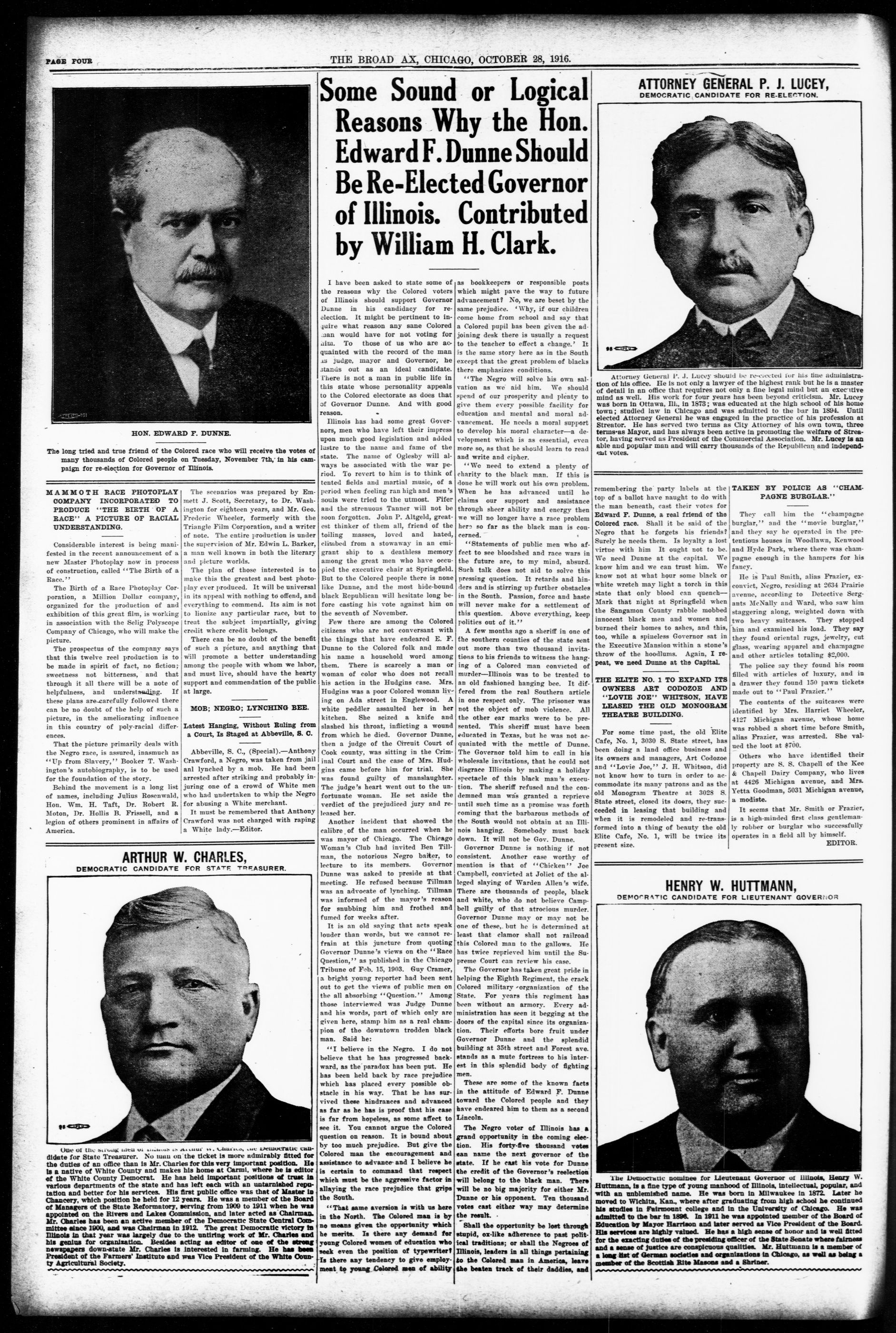
HON. EDWARD F. DUNNE.
‘The long tried and true friend of the Colored race who will receive the votes of
many thousands of Colored people on Tuesday, November 7th, in his cam-
paign for re-election for Governor of Tilinois.
MAMMOTH RACE PHOTOPLAY) The scenarios was prepared by Em-
COMPANY INCORPORATED TO/|mett J. Scott, Secretary, to Dr. Wash-
PRODUCE “‘THE BIRTH OF Alington for eighteen years, and Mr. Geo.
RACE” A PICTURE OF RACIAL|Frederie Wheeler, formerly with the
UNDERSTANDING. Triangle Film Corporation, and a writer
Considerable interest is being mani-
fested in the recent announcement of a
new Master Photoplay now in proces:
of construetion, called ‘The Birth of a
Race.’”
‘The Birth of a Race Photoplay Cor.
poration, a Million Dollar company,
organized for the production of and
exhibition of this great film, is working
in association with the Selig Polyseope
Company of Chicago, who will make the
picture.
The prospectus of the company says
that this twelve reel production is to
be made in spirit of fact, no fiction;
sweetness not bitterness, and that
through it all there will be a note of
helpfulness, and understanding. If
these plans are-carefully followed there
ean be no doubt of the help of such a
picture, in the ameliorating influence
in this country of poly-racial differ
ences.
That the picture primarily deals with
the Negro race, is assured, inasmuch as
“Up from Slavery,’? Booker T. Wash-
ington’s autobiography, is to be used
for the foundation of the story.
Behind the movement is a long list
of names, including Julius Rosenwald,
Hon. Wm. H. Taft, Dr. Robert R.
Moton, Dr. Hollis B. Frissell, and a
legion of others prominent in affairs of
America.
ARTHUR W. CHARLES,
DEMOCRATIC CANDIDATE FOR STATE TREASURER.
SS
a
ee
Lee
—— Sf
coe oe
| rg
Ode OF Une suk Wed Yi needa uo Aa cuUe wy, CAMEL, wwe DCLUCTMUC Calle
didate for State Treasurer. No wun on the ticket is more admirably fitted for
the duties of an office than Is Mr. Charles for this very important position. He
Is a native of White County and makes his home at Carmi, where he is editor
‘ef the White County Democrat. He has held important positions af trust in
various departments of the state and has left each with an untarnished repo-
tation and better for his services. His first public office was that of Master ip
Chancery, which position he held for 12 years. He was a member of the Board
of Managers of the State Reformatory, serving from 1909 to 1911 when he was
‘appointed on the Rivers and Lakes Commission, and later acted as Chairman.
‘Mr. Charles has been an active member of the Democratic State Central Com-
mittee alnce 1900, and was Chairmen in 1912. The great Democratic victory tm
Tilinols in that year was largely due to the untiring work of Mr. Charles and
bis genius for organization. Besides acting as editor of one of the strong
newspapers downstate Mr. Charles is interested in farming. He has been
President of the Farmers’ Institute and was Vice President of the White Coun-
ty Agricultural Society. ad
Latest Hanging, Without Buling from
"a Court, Is Staged at Abbeville, 8. C.
| Abbeville, S. C., (Special).—Anthony
Crawford, a Negro, was taken from jail
anl lynched by a mob. He had been
arrested after striking and probably in-
juring one of a crowd of White men
who had undertaken to whip the Negro
for abusing a White merchant.
It must be remembered that Anthony
Crawford was not charged with raping
‘a White lady.—Editor.
Some Sound or Logical
Reasons Why the Hon.
Edward F. Dunne Should
Be Re-Elected Governor
of Illinois. Contributed
by William H. Clark.
the reasons why the Colored voters
of Illinois should support Governor
Dunne in his candidacy for re-
election. It might be pertinent to in-
quire what reason any sane Colored
aan would have for not voting for
aim. To those of us who are ac
quainted with the record of the man
48 judge, mayor and Governor, he
stands out as an ideal candidate.
There is not a man in public life in
this state whose personality appeals
to the Colored electorate as does that
of Governor Dunne. And with good
reason. -
Illinois has had some great Gover-
nors, men who have left their impress
upon much good legislation and added
lustre to the name and fame of the
state. The name of Oglesby will al-
ways be associated with the war pe-
riod. To revert to him is to think of
tented fields and martial music, of a
period when feeling ran high and men’s
souls were tried to the utmost. Fifer
and the strenuous Tanner will not be
soon forgotten. John P. Altgeld, great-
est thinker of them all, friend of the
toiling masses, loved and hated,
climbed from a stowaway in an emi-
grant ship to a deathless memory
among the great men who have oceu-
pied the executive chair at Springfield.
But to the Colored people there is none
like Dunne, and the most hide-bound
black Republican will hesitate long be-
fore casting his vote against him on
the seventh of November.
Few there are among the Colored
eitizens who are not conversant with
the things that have endeared E. F.
Dunne to the Colored folk and made
his name a household word among
them. There is scarcely a man or
woman of color who does not recall
his action in the Hudgins case. Mrs.
Hudgins was a poor Colored woman liv-
ing on Ada street in Englewood. A
white peddler assaulted her in her
kitehen, She seized a knife and
slashed his throat, inflieting a wound
from which he died. Governor Dunne,
then a judge of the Cireuit Court of
Cook county, was sitting in the Crim-
inal Court and the ease of Mrs. Hud-
gins eame before him for trial. She
was found guilty of manslaughter.
‘The judge's heart went out to the un-
fortunate woman. He set aside the
verdict of the prejudiced jury and re-
Teased her.
Another incident that showed the
calibre of the man occurred when he
was mayor of Chicago. The Chicago
Woman’s Club had invited Ben Till-
man, the notorious Negro baiter, to
lecture to its members. Governor
Dunne was asked to preside at that
meeting. He refused because Tillman
was an advocate of lynching. Tillman
was informed of the mayor’s reason
for snubbing him and frothed and
fumed for weeks after.
It is an old saying that acts speak
louder than words, but we cannot re-
frain at this juncture from quoting
Governor Dunne’s views on the ‘Race
Question,’? as published in the Chicago
Tribune of Feb, 15, 1903. Guy Cramer,
a bright young reporter had been sent.
‘out to get the views of publie men on
the all absorbing ‘‘Question.’? Among
those interviewed was Judge Dunne
and his words, part of which only re
given here, stamp him as a real cham-
pion of the downtown trodden black
man. Said he:
“T believe in the Negro. I do not
believe that he has progressed back-
ward, as the paradox has been put. He
has been held back by race prejudice
which has placed every possible ob-
stacle in his way. That he has sur-
vived these hindrances and advanced
as far as he has is proof that his case
is far from hopeless, as some affect to
see it. You cannot argue the Colored
question on reason. It is bound about
by too much prejudice. But give the
Colored man the encouragement and
assistance to advance-and I believe he
is certain to command that respect
which must be the aggressive factor in
allaying the race prejudice that grips
the South.
“That same aversion is with us bere
in the North. The Colored man is by
no means given the opportunity which
he merits. Is there any demand for
young Colored women of education who
fseek even the position of typewriter?
there any tendency to give employ-
ment to young Colored men of ability
which might pave the way to future
advancement? No, we are beset by the
same prejudice. ‘Why, if our children
come home from school and say that
a Colored pupil bas been given the ad.
joining desk there is usually a request
to the teacher to effect a change.’ It
is the same story here as in the South
except that the great problem of blacks
there emphasizes conditions.
“*The Negro will solve his own sal-
vation as we aid him. We should
spend of our prosperity and plenty to
give them every possible facility for
education and mental and moral ad- |
vaneement. He needs a moral support
to develop his moral eharacter—a de-
velopment which is as essential, even
more so, as that he should learn to read
and write and cipher.
“Wo need to extend a plenty of
charity to the black man, If this is
done he will work out his own problem.
When he has advanced until he
claims our support and assistance
through sheer ability and energy then
we will no longer have a race problem
hers so far as the black man is con-
cerned. :
“Statements of publie men who af-
fect to see bloodshed and race wars in
the future are, to my mind, absurd.
Such talk does not aid to solve this
pressing question. It retards and hin-
ders and is stirring up further obstacles
in the South. Passion, force and haste
will never make for a settlement of
this question. Above everything, keep
polities out of it.’?
A few months ago a sheriff in one of
fhe southern counties of the state sent
out more than two thousand invita-
tions to his friends to witness the hang-
ing of a Colored man convicted of
murder—Illinois was to be treated to
an old fashioned hanging bee. It dif-
|fered from the real Southern article
in one respect only. The prisoner was
not the object of mob violence. All
the other ear marks were to be pre-
sented. This sheriff must have been
edueated in Texas, but he was not ac-
quainted with the mettle of Dunne.
‘The Governor told him to call in his
wholesale invitations, that he could not
disgrace Minois by making a holiday
spectacle of this black man’s execu-
tion. The sheriff refused and the eon-
demned man was granted a reprieve
until such time as a promise was forth
coming that the barbarous methods of
the South would not obtain at an Illi-
nois hanging. Somebody must back
down. It will not be Gov. Dunne.
Governor Dunne is nothing if not
consistent. Another ease worthy of
mention is that of ‘Chicken’? Joe
Campbell, convicted at Joliet of the al-
leged slaying of Warden Allen’s wife.
There are thousands of people, black
and white, who do not believe Camp-
bell guilty of that atrocious murder.
Governor Dunne may or may not be
‘one of these, but he is determined st
least that clamor shall not railroad
this Colored man to the gallows. He
has twice reprieved him until the Su-
preme Court ean review his case. |
‘The Governor has taken great pride in
helping the Eighth Regiment, the oat
Colored military -organization of the
State. For years this regiment has
been without an armory. Every ad-
ministration has seen it begging at the
doors of the capital since its organiza-
tion. Their efforts bore fruit under
Governor Dunne and the splendid
building at 35th street and Forest ave.
stands as a mute fortress to his inter-
est in this splendid body of fighting
men. |
These are some of the known facts
in the attitude of Edward F. Dunne
toward the Colored people and they
have endeared him to them as a second
Lincoln.
The Negro voter of Illinois has a
|grand opportunity in the coming elee-
tion. His forty-five thousand votes
ean name the next governor of the
state. If he cast his vote for Dunne
the credit of the Governor’s reelection
‘will belong to the black man. There!
‘will be no big majority for either Mr.
‘Dunne or his opponent. Ten thousand
votes cast either way may determine
the result. -
“Shall the opportunity be lost through
Jstupid, ox-like adherence to past polit-
ical traditions; or shall the Negroes of
|Minois, leaders in all things pertaining
jto the Colored man in America, leave
|the beaten track of their daddies, and
ATTORNEY GENERAL P. J. LUCEY,
DEMOCRATIC CANDIDATE FOR RE-ELECTION.
~~ SS
| r =. YY
soo per ‘
Attorney Geuerul P. J. Lucey should be re-ciected tor his She administra-
tion of his office. He is not only a lawyer of the highest rank but he is a master
of detail in an office that requires not oniy a fine legal mind but an execitive
mind as well. His work for four years has been beyond criticism. Mr. Lucey
was born in Ottawa, Ill., in 1878; was educated at the high school of his home
town; studied Iaw in Chicago and was admitted to the bar in 1804. Until
elected Attorney General he was engaged in the practice of his profession at
Streator. He has served two terms as City Attorney of his own town, three
terms-as Mayor, and has always been active in promoting the welfare of Strea-
tor, having served us President of the Comercial Association. Mr. Lucey 1s an
able aud popular man and will earry thousands of the Republtean and independ-
eut votes.
HENRY W. HUTTMANN,
DEMOCRATIC CANDIDATE FOR LIEUTENANT GOVERNOR
~ 3 ai ia.
ee
if -
Bi ee q
Ps eae
eh ar
eS Be a
fs Be
‘the Democratic nominee for Lieutenant Governor of lilipois, Henry W-
-Huttmann, ts a fine type of young manhood of Illinois, intellectual, popular, and
‘with an unblemished name. He was born in Milwaukee in 1872 Later he
“moved to Wichita, Kan., where after graduating from high school he continued
bis studies in Fairmount college and in the University of Chicago. He was
admitted to the bar in 1896. In 1911 he was appointed member of the Board of
‘Education by Mayor Harrison and later served as Vice President of the Board.
His services are highly valued. He hes a high sense of honor and is well fitted
for the exacting duties of the presiding officer of the State Senate where fairness
‘and a sense of justice are conspicuous qualities. Mr. Huttmana is a member of
a long Uist of German societies and organizations in Chicago, as well as being ©
“member of the Scottish Rite Masons and a Shriner.
remembering the’ party labels at the
top of a ballot have naught to do with
the man beneath, cast their votes for
Edward F. Dunne, a real friend of the
Colored race. Shall it be said of the
Negro that he forgets his friends?
Surely he needs them. Is loyalty a lost
virtue with him It ought not to be.
We need Dunne at the capital. We
know him and we ean trust him. We
know not at what hour some black or
white wretch may light a torch in this
state that only blood ean quench—
Mark that night at Springfield when
the Sangamon County rabble mobbed
innocent black men and women and
burned their homes to ashes, and this,
too, while a spineless Governor sat in
the Executive Mansion within a stone’s
throw of the hoodlums. Again, I re-
Peat, we need Dunne at the Capital.
eis ELITE NO. 1 TO EXPAND ITS
OWNERS ART CODOZOE AND
“LOVIE JOE’? WHITSON, HAVE
LEASED THE OLD MONOGRAM
THEATRE BUILDING.
For some time past, the old Elite
Cafe, No. 1, 3030 8. State street, has
been doing a land office business and
its owners and managers, Art Codozoe
and ‘Lovie Joe,’’ J. H. Whitson, did
not know how to turn in order to ae-
commodate its many patrons and as the
old Monogram Theatre at 3028 S.
State street, closed its doers, they suc-
ceeded in leasing that building and
when it is remodeled and re-trans-
formed into a thing of beauty the old
Elite Cafe, No. 1, will be twice its
present size.
TAKEN BY POLICE AS ‘‘CHAM
PAGNE BURGLAR.”’
They call him the ‘‘ebampagne
burglar,’? and the ‘movie burglar,’?
and they say he operated in the pre-
tentious houses in Woodlawn, Kenwood
‘and Hyde Park, where there was cham-
Pagne enough in the hampers for his
fancy.
| He is Paul Smith, alins Prazier, ex-
convict, Negro, residing at 2634 Prairie
avenue, according to Detective Serg-
Ces MeNally and Ward, who saw him
staggering along, weighted down with
two heavy suiteases. They stopped
him and examined his load. They say
they found oriental rugs, jewelry, eut
sas, wearing apparel and champagne
and other articles totaling $2,000.
| The police say they found his room
filled with articles of luxury, and in
‘a drawer they found 150 pawn tickets
‘made out to ‘‘Paul Frazier.’”
"The contents of the suiteases were
identified by Mrs. Harriet Wheeler,
ae Michigan axyenue, whose home
was robbed a short time before Smith,
atias Frazier, was arrested. She val-
‘ued the loot at $700.
Others who have identified their
property are S. 8. Chapell of the Kee
& Chapell Dairy Company, who lives
at 4426 Michigan avenue, and Mrs.
Yetta Goodman, 5031 Michigan avenue,
a modiste.
It seems that Mr. Smith or Frazier,
is a high-minded first class gentleman-
ly robber or burglar who successfully
operates in a field all by himself.
EDITOR.
Governor Edward F. Dunne Reprieves "Chicken Joe" Campbell, Until Friday, December 8th
1913
The office of secretary of state, as conducted by the present incumbent, Lewis G. Stevenson, has been marked by an exceptional degree of efficiency.
Mr. Stevenson was born at Chenoa, Ill., in 1808, educated at Phillips Exter academy, Exter, N. H., and the State Normal university. He was private secretary to his father, the late Adlai E. Stevenson, during his term as vice president of the United States.
Mr. Stevenson was chairman of the Illinois State Board of Pardons in 1918, during which term he introduced many desirable changes in the administration of the parole law. He was appointed secretary of state in October, 1914, by Governor Dunne. In this office he showed unusual executive talent. He is very popular, especially among automobilists, who testify to the courtesy and efficiency of his office.
C. H.
James J. Brady, the present auditor, who is a candidate for re-election for that office, was born in Chicago in 1878. After leaving high school he went to work for the Western Union Telegraph company. From early manhood he took an active interest in politics and at times was a candidate for the State Board of Equalization and for equity commissioner.
Mr. Brady's record of work is of a high order. The growth in the state's fiscal affairs is unparalleled, and during this time Mr. Brady has handled R75,000,000 with the absence of any sort of complaint. He has shown high qualities as an executive and has received many testimonials from business concerns all over the state to testify to the high standard of the office under his administration.
MANY OF THE LEADING JUDGES
HAVE ASSISTED FINANCIALLY
TO MAKE IT POSSIBLE TO EXTEND A HEARTY HOME WELCOME TO THE MEMBERS OF THE EIGHTH REGIMENT, ILLINOIS NATIONAL GUARDS.
As chairman of the Executive Committee of the General Committee, engaged in arranging a fitting reception of the return to the city of the members of the Eighth Illinois National Guard, I wish to herewith thank all of those who contributed to these expenses and the cheerful manner in which the request for aid was complied with; Hon. Judge Edw. T. Wade, Hon. Judge John J. Sullivan, Hon. Judge Sheridan E. Fry, Hon. Judge Jos S. LaBuy, Hon. Judge John Gibbons, Hon. Judge Chas M. Thomson, Hon. Judge Wm. Fenimore Cooper, Hon. Judge Jesse A. Baldwin, Hon. Judge Lockwood Honore; and also those others who have promised to assist. Hon. Judge Henry Horner, Hon. Judge Theodore Brentano, Hon. Judge Jos B. David, Hon. Judge Harry M. Fisher, Hon. Judge Oscar M. Torrison.
I am sure that the members of the Eighth Regiment and the citizens of Chicago generally, are very proud of the spirit actuating the men that made
it possible to give to the Eighth such a rousing and warm welcome as they received today.
Again thanking all on the behalf of the Committee, who participated or contributed in these festivities, I am
Very gratefully,
BEAUREGARD F. MOSELEY,
Chairman Executive Committee.
MODERN FLAT BUILDING FOR NE GROES TO BE ERECTED.
It is stated that all the plans have been completed for the erection of a modern apartment building at the northeast corner of Thirty-second street and Vernon avenue for Negroes. It will contain fifty-seven apartments of one, two, and three rooms, and its cost is placed at $125,000. It will occupy a lot fronting 120 feet on Vernon avenue and 160 feet on Thirty-second street, which was purchased recently from Harry N. Higinbotham for a reported $7,800. It is said the land would have brought $25,000 twenty-five years ago. Plans for the proposed building are being prepared by Architect W. Carbys Zimmerman. The apartments are expected to rent at $15, $20, and $24 a month respectively.
THE BROAD AX, CHICAGO, OCTOBER 28, 1916
IN ALL HONESTY AND FAIRNESS IT MUST BE ADMITTED THAT MANY THOUSAND COLORED PEOPLE IN ALL PARTS OF THIS STATE WILL ON TUESDAY, NOVEMBER 7th, RECORD THEIR VOTES IN FAVOR OF HIS RE-ELECTION OWING TO HIS LONG AND SINCERE FRIENDSHIP FOR THE COLORED PEOPLE.
THIS SATURDAY EVENING A MEETING AND MOVING PICTURE SHOW WILL BE HELD AT ODD FELLOWS HALL, 3335 S. STATE STREET, IN THE INTEREST OF THE PRESENT CHIEF EXECUTIVE OF ILLINOIS.
J. W. HARDY WILL ACT AS THE HEAD SPOKESMAN AND MASTER OF CEREMONIES. ONE PICTURE WILL SHOW JUDGE DUNNE OF THE CIRCUIT COURT OF COOK COUNTY IN 1901, ABSOLUTELY REFUSING TO SENTENCE A COLORED WOMAN TO THE PEN AT JOLIET ILLINOIS, WITH A LITTLE BABY IN HER ARMS.
ANOTHER MOVING PICTURE WILL DEPICT HIM AS MAYOR OF CHICAGO FROM 1905 TO 1907 AND REFUSING TO PRESIDE AT THE BENJAMIN R. TILLMAN ANARCHISTIC MEETING AT ORCHESTRA HALL, TUESDAY EVENING, NOVEMBER 27TH, 1906.
ONE OF THE MOST EFFECTIVE AND STRIKING PICTURES WILL REPRESENT THE GOVERNOR IN THE ACT OF LAYING THE CORNER-STONE OF THE NEW EIGHTH REGIMENT ARMORY, 35TH AND FOREST AVENUE THE FIRST PART OF OCTOBER, 1914.
FOLLOWING THIS PICTURE THE FAR FAMED EIGHTH REGIMENT ILLINOIS NATIONAL GUARD IN ALL THEIR MILITARY GLORY LED BY ITS FAMOUS BAND WILL PASS IN REVIEW.
THE NEXT PICTURE TO FOLLOW WILL SHOW GOVERNOR DUNNE PREELY MINGLING WITH THE COLORED PEOPLE AT THE LINCOLN JUBILEE.
TOWARDS THE LAST HE WILL BE REPRESENTED REPRIEVING ELSTON SCOTT OF MURPHYSBORO, UNTIL SHERIFF WHITE OF JACKSON COUNTY GUARANTEES TO PASS HIM OUT OF THIS WORLD WITHOUT TRANSFORMING THE EXECUTION INTO A SHOW OR HOLIDAY.
In order to supply the great demand for The Broad Ax, of October 14, the following article is reproduced:
The first of the week Governor Edward F. Dunne, for the second or third time stretched forth his hand of mercy and prolonged the life of "Chicken Joe" Campbell, reprieving him until Friday, December 8. "Chicken Joe" Campbell was convicted in the summer of 1915, for ending the life of Mrs. Odette Allen, wife of Edmund M. Allen, who was at that time Warden of the State Penitentiary at Joliet, Illinois. His life was to end on this earth Friday, October 13, this new act of clemency on the part of Governor Dunne unmistakably shows that he is more than inclined to be fair in dealing with his unfortunate fellowman. Lawyer F. L. Barnett and the other attorneys who are assisting him free of charge feel that by that time they will be able to raise enough money to move onto the Supreme Court of this state with "Chicken Joe" Campbell's case and by the way right here we desire to state without any blowing about it that the writer has humbly assisted Mr. Barnett just a little bit in that direction, not because we feel that "Chicken Joe" Campbell is innocent of committing that crime or any other crime far from it but we honestly feel that he didn't have a fair trial, therefore he is entitled to have his case reviewed by the Supreme Court of this state and after all the evidence in the case is properly presented to that court of last resort it might see the wisdom of granting him a new trial.
In moving on it must be admitted by all those who pretend to know anything about the political situation in this city and state and public men and measures that the present chief executive of Illinois has always been friendly disposed toward the Colored race. It must also be frankly admitted that in the past he has closed his eyes real tight and very coldly turned his back on some of the best friends he ever had among the Colored race in this city and throughout the state of Illinois; that in so doing he made some very serious mistakes or bad blunders in selecting several Colored men as the greatest or the foremost representatives of the Afro-Americans who were a long ways from being what they represented themselves to be at any stage of the game and the big round fat faced political preacher who has never been straightforward in his dealings with anybody in his life when it comes down to easy money and politics and a little loud mouthed rattle brained friend of this same tricky political preacher both posed before Governor Dunne as the two greatest representatives of the Colored race in the world, but today when the Governor needs all the friends and every vote that he can command in order to pull through at the polls in November, that same political preacher who was never known to deal honestly with his fellow-men when it comes down to money and politics and his little side partner are absolutely silent, their lips are sealed tight and neither one of them are raising their little finger in any manner, shape or form to assist Governor Dunne in his fight for re-election which simply proves that they are traitors to the hand that fed them and befriended them and showered honors upon them in every way.
Will the Rev. Hon. Archibald J. Carey, Ph. D. D. D., the unreliable political preacher who on one occasion declared from his pulpit in the Institutional church in the presence of Governor Dunne, that "he would willingly and cheerfully walk up to the battlements of hell for him" which caused the members of his flock to shout Amen! Amen! preach the truth Brother Carey, and the Hon. Thomas Wallace Swann please stand up and lead us in prayer?
The many friends and supporters of Governor Dunne contend that the grave mistake or error which he made in that direction was not made by or from his warm heart but from his head, that may be true.
There is one thing however, that is absolutely true and that is that many thousands of Colored people residing in all parts of this state will record their votes in favor of his re-election, owing to his well known friendship for the Colored people and at this time and in fact at all times the Colored race needs all the strong friends that it can make and hold among the members of the opposite race regardless of their politics.
This coming Saturday evening, October 14, a great meeting and moving picture show will be held at Odd Fellows Hall, 3335 South State street in the interest of Governor Dunne. J.W. Hardy will serve as the head spokesman and master of ceremonies. During his short talks pictures of Governor Dunne will be thrown on the screen showing him as one of the Judges of the Circuit Court of Cook County in 1901, absolutely refusing to send a Colored woman with a little baby in her arms to the Pen at Jaliet, Illinois; as Mayor of Chicago from 1905 to 1907, he will be depicted in showing his friendship for the Colored people by appointing them to office and refusing to preside at the Benjamin R. Tillman anarchistic meeting at Orchestra Hall, Tuesday evening, November 27th, 1906, which required a whole lot of courage and manhood on his part to turn his back on a United States Senator.
The most striking and most impressive of all the moving pictures represents Governor Dunne in the act of laying the corner stone of the Eighth Regiment Armory, 35th street and Forest avenue the first part of October, 1914. The Eighth Regiment, Illinois National Guard, passing in review in all their military glory led by its famous band.
The other pictures show the Governor freely mingling with the Colored people at the Coliseum in this city during the Lincoln Jubilee in the summer of 1915, and in the act of reprieving Elston Scott, of Murphysboro, Ill., until Sheriff White of Jackson County gives his word and honor that he will not transform his execution into a free show or holiday.
IMPORTANT MATRIMONIAL PERSONAL.
Personal—Want to correspond with a respectable, intelligent, unincumbered middle aged actoroon, with brains and money, for a wife and business partner. Only those who mean business and can fill above description need answer. Address, Mizpah, care of The Broad Ax, 6418 Champlain Ave., Chicago, Ill.
SOCIAL ITEMS BY J. B. C.
Dr. James A. Harper and Miss Margery Gaskio the music teacher on the West side were married on last Wed., at the home of the bride by Rev. Prince. Many guests were present. The house was artistically decorated and the presents were numerous and beautiful.
Miss Madme Pannell and Mr. John Simons, of 3366 Calumet Ave., was quietly married at the home of Rev. Lawrence recently. They left immediately for a honeymoon trip to Detroit and Benton Harbor.
Mrs. H. A. Watkins of 32nd and Indiana Ave., was the hostess this week at a matinee party to see Princess followed by a luncheon on Wednesday.
INTERESTING FACTS ABOUT THE GREAT AND THE NEAR GREAT IN AND OUT OF CHICAGO.
Mr. H. T. Burleigh of New York the noted composer and vocalist was in Chicago last week for two days and will return Monday. He is at the Y. M. C. A.
Mr. Clarence C. White the violinist of Boston, Mass., was a guest at the Y. M. C. A. He appeared in recital here at St. Mark's Church, Monday evening.
Mr. I. Garland Penn of the Freedman's Aid was in the city this week on business.
Mr. Stone, physical director of the Y. M. C. A. was host to twelve dinner guests this week at the Y. M. C. A.
Miss Frances Galloway a rare pianist has composed a valde of remarkable harmony and much beauty.
MR. HALL GIVES FACTS ABOUT THE EMPLOYMENT OF NEGROES.
According to Charles E. Hall, Colored, expert in the Division of Revision and Results, furnishes the following facts concerning the employment of Negroes engaged in railroad work, and who would have been affected by the threatened strike:
Officials, 37; conductors, 120; bag gagemen, 225; freight agents, 17; ticket and station agents, 50; yard men, 31; locomotive engineers, 355; locomotive firemen, 5,188; switchmen and flagmen, 2,127; brakemen, 4,719; foremen and overseers, 987; engine washers, and engine hostlers, 1,328; laborers, 87,188.
Total 102,188. This does not include the army of porters of about 15,000.
It will be remembered that these thousands of Negroes are employed largely in the South, the section that some wish to see abandoned. In the North the Negroes will be found in the list of railroad porters as the rule. Of course money is not the whole of life, but it is of more value to our race at this time than it is to the people around us. The kind of employment has much to do in fixing the status of a people. If we are found wholly in position that are held as lowly we may rest assured that that's the estimate of us by those who have matters in charge, so to speak.
ELECTION BOARD ANNOUNCES
808.119 VOTERS REGISTERED.
Official Figures Place Total at 504,421 Men and 303,698 Women After Revision.
Chicago's voting population totals 808,119, of whom 504,421 are men and 303,698 are women. These figures have been announced by the election board following the revision of registration last Saturday. More than 7,000 names were erased in the revision. The Twenty-fifth is the banner ward of the city with 26,416 men and 21,280 women, a total of 47,696.
In the town of Cicero, which also is under the jurisdiction of the election board, there is a total registration of 9,033 voters, including 6,004 men and 3,029 women.
PROMOTED ON MERIT.
Mr. William T. McKinley, a capable clerk in the Internal Revenue Bureau, Washington, D. C., has been promoted from $1,000 to $1,200 per annum. Mr. A. Mercer Daniel, a clerk of fine calibre in the War Department, has likewise been raised from $1,000 to $1,200. Both are Colored men and the promotions were made solely upon merit.
Miss Blanche L. Wright, who has for some time been residing in Washington, D. C., holding down a good position in the Federal Government; is in the city visiting among her many friends and will remain until after the election.
---
PAGE FIVE
WILLIAM ELZA WILLIAMS.
Democratic Candidate for Congress
man at Large.
M. W.
William Elza Williams of Pittsfield is a widely-known citizen of Illinois. He has represented his district in congress one term and has been twice elected congressmn-at-large from the state. At the last primary election he carried every county in the state over four opposing candidates. Two years ago he was the only candidate elected on the state ticket.
Mr. Williams was born in Pike county, Illinois, in 1857. He was educated in the district school and Illinois college. He has practiced law continuously since 1880 at Pittsfield and was twice elected state's attorney.
Mr. Williams is one of President Wilson's close friends and has been of great service to the president at Washington.
PRESIDENT OF SELIG POLYSCOPE COMPANY ENDORSES "THE BIRTH OF A RACE."
Mr. Wm. M. Selig, one of the pioneer motion picture makers in this country, is very much interested in the production of the big race picture, now in course of construction.
"The subject is rich in possibilities," said Mr. Selig. "It is a very human subject, filled with the finest pictorial and dramatic values. It will appeal to millions of people all over the world. The time never was so ripe for the presentation of a master photoplay, which will appeal to the masses, and foster a sane racial understanding.
The prologue of this twelve reel picture will be taken in Africa during the winter months.
THE NEWLY ELECTED OFFICERS OF BETHLEHEM LITERARY
Last Sunday afternoon, the members and friends of the Bethel Literary, which holds forth at Bethel Church, 30th and Dearborn streets, met and after short addresses by Lawyer Hale G. Parker and Rev. M. L. Barelay, the following officers were elected:
Sandy W. Trice, President; H. B. Gains, Vice President; J. T. Weakley, Secretary; Irvin Jackson, Asst. Secretary; Mrs. L. C. Robinson, Treasurer; Jas. Brown, Chaplain; Mrs. H. C. Champion, Asst. Chaplain; Mrs. R. A. Jackson, Musical Director.
Short addresses by Atty. Hale G. Parker, Rev. M. L. Barelay.
Dr. M. A. Majors will address the Literary this coming Sunday afternoon. His subject will be, "The Negro and His Emigration from the South."
JOS. C. KOSTNER.
Democratic Nominee for Congressman at Large.
PETER H.
Mr. Kostner was born in Chicago and received his education in the public schools and the University of Chicago and the Illinois College of Law. His business ability has been shown by his success in the real estate, loan and insurance business. Mr. Kostner has been active in politics for many years. He was deputy commissioner of public works under Mayor Carter H. Harrison—Harrison's last term. He has been a state bank examiner and at present is secretary of the Illinois Waterway commission. Mr. Kostner is a member of many clubs and fraternal orders and enjoys a wide and deserved popularity.
THE FEDERAL NATIONAL HISTORY SOCIETY
[Name]
HGN. THOMAS J. WEBB.
First class up-to-date and successful for re-election, member of the Board vote for him at the election, Tuesday been ready to extend all the court ent members of the Board of Review out saying that many of them will coming election.
First class up-to-date and successful business man and Democratic candidate for re-election, member of the Board of Review; men and women can both vote for him at the election, Tuesday, November 7th. Mr. Webb has ever been ready to extend all the courtesies he possibly could as one of the present members of the Board of Review to the Colored people and it goes without saying that many of them will assist to put him over the plate at the coming election.
Marines and Their Fingers
Men with long, tapering "plano" fingers are apt to desert after short service, while those having stubby digits, denoting stability of character and utter lack of the artistic temperament, usually stand by their oaths and make the best marines, according to finger print experts at headquarters of the United States marine corps. Although desertions from the corps are light at all times, it has been found that actors, sign writers and, strange to say, waiters furnish the largest number of deserters. Records, including finger prints, of all men enlisted in the marine corps are kept at headquarters for purposes of identification, and there are cases on record where bodies with finger tips intact have been positively identified through the finger print medium.
"It's strange what interest small boys and girls take in boasting about the possessions of themselves and their families.
Mollie, aged nine, and Nancy, a year younger, were trying to outmatch each other at this game, and Mollie was several points ahead in the contest.
"Oh, you should see my mother's fan!" she boasted, thinking to make her victory complete. "It's lovely—all hand painted!"
Nancy tossed a scornful head.
"Pooh!" she retorted. "That's nothing. So's our garden fence."
Ferdinand II. was a man of very uncertain moods and would allow his jester to take liberties with him one hour while resenting any familiarity the next. One day he turned round on Jonas, his favorite fool, and thundered: "Fellow, be silent! I never stoop to talk to a fool!" "Never mind that," answered Jonas. "I do. So please listen to me in your turn."
"Won't you please leave the light burning in the hall, mother?" pleaded little Robert as he was being put to bed.
"Nonsense, Bobble," was the reply.
"Surely you know there isn't anything to be afraid of in the dark."
"Yes, I know, but can't you leave a teeny weeny light so I can see there isn't anything there?"—Exchange.
When Bob Burdette was addressing the graduating class of a large eastern college for women he began his remarks with the usual salutation, "Young ladies of '97." Then in a horrified aside he added, "That's an awful are for a girl!"
Envelopes were practically unknown before 1725. About that time one was seen semi-occasionally. As late as 1850 letters were often sent folded and sealed. Envelopes may be said to have come into use shortly after 1844.—Ex change.
Badly Timed.
Nephew—I tried to get a raise today, aunt, but the boss refused it. Mrs. Blunderby—Too bad, Dicky! Perhaps you didn't approach him at the zoological moment.—Boston Transcript.
Atlas bore the world on his shoulders. "It is much easier than having it on your conscience." he explained—New York Sun.
The virtue of justice consists in moderation as regulated by wisdom.—Aristotle.
PAGE SIX
Quite Common.
Bold Court Fool.
To Make Sure.
Bob Burdette's Aside.
Envelopes.
Badly Timed.
Atlas Rejoices.
business man and Democratic candidate
rd of Review; men and women can both
day, November 7th. Mr. Webb has ever
sies he possibly could as one of the pres-
w to the Colored people and it goes with-
assist to put him over the plate at the
A Trip Into Space
"If you could ride from the earth to Alpha Centauri on a train going at the rate of a mile a minute you would reach your destination in 45,000,000 years," says John Brashear in the American Magazine. "At the rate sound travels if a song were to be sung on Alpha Centauri it would be 3,800,000 years before we could hear it. This neighbor of ours is 35,000,000,000 miles away. A spider's thread from a cocoon reaching to it would weigh 560 tons.
"Our earth in its revelations on its own axis and its trip around the sun and outward into space makes a journey of 854,000,000 miles a year, but the old clock never varies. There is never a jar or tremens, and we are back again on the hundredth of a second. Do you know it would have cost me $1,500,000,000 if I had had to pay my way so far at the rate of 2 cents a mile during my journey of seventy-five years? To ride from the earth to Alpha Centauri would cost $700,000,000,000."
One ill service nature has done the shark—namely, that of placing a triangular fin on his back, which acts as a danger signal and gives warning of his approach. Happily the shark has not been gifted with sufficient sagacity to be aware of this peculiarity, for had he been so he would unquestionably abandon his habit of swimming close to the surface of the water and would in that case be enabled to approach his victim unobserved. The shark is a slow swimmer for his size and strength. Byron observes, "As darts the dolphin from the shark." But Byron was a poet and does not appear to have been a close observer of the habits of inhabitants of the water or he would have known that a shark would have no more chance of catching a dolphin than a sheep would of overhauling a hare.
Value of Good Manners
Good manners, like the gold at the foundation of all money, are current the world over. Emerson noted this: "Give a boy dress and accomplishments and you give him the mastery of palaces and fortunes wherever he goes. He has not the trouble to earn or own them; they solicit him to enter and possess."
"All your Greek," Chesterfield wrote to his son, "can never advance you from secretary to envoy or from envoy to ambassador, but your address, your air, your manner, if good, may."
"The difference between a well bred and ill bred man is this," Samuel Johnson said, "one immediately attracts your attention, the other your aversion. You love one until you find reason to hate him; you hate the other until you find reason to love him."
Civility, polished manners, mean much to a youth in his first position.
When John Sherman of New Haven preacher, mathematician, almanac maker and father of twenty-six children, heard of the death of his good friend Jonathan Mitchell, a Harvard pastor, he explained (after due thought and many poetic pangs):
Here lies the darling of his time. Mitchell expired in his prime. Who, four years short of forty-seven, Was found full ripe and plucked few heaven.
When Thomas Dudley, father of the first American poetess, Anne Bradstreet, came to his deathbed he showed where his daughter had received her surprising gift by composing such farewell lines as:
Dim eyes, deaf ears, cold stomach show My dissolution is in view. Eleven times seven near lived have I And now God calls I willing die.
---
Sharka as Swimmers
Obituary Gema
THE BROAD AX, CHICAGO, OCTOBER 28, 1916.
The Restaurant Bluffer.
"Of all the bluffers one meets socially and in business, and their name is legion," remarked a minor cyclic, "none amuses me more than the restaurant bluffer. This brand is numerous. I met one today, and his embarrassment was ludicrous.
"This chap, you know, is a living lie. He lodges in a rather high priced house, but occupies a cheap little room up under the roof, to which he is careful not to invite any acquaintance. He's an underclerk somewhere, but talks familiarly of high finance. He pretends to be on friendly terms with influential men who wouldn't know him from Adam.
"Several evenings ago he was impressing me with the frequency with which he lunches at one or two places famous in the Wall street section. When I met him today bending over coffee and rolls in a place where his check was 10 cents you should have seen his face, it was a study. "Of course I wasn't surprised, but he was. I enjoyed the encounter, but he didn't"-New York Globe.
Spies In Revolutionary Days.
A curious and unfamiliar page in American history shows that the treatment of the spy in Revolutionary days was painfully prompt and rigorous. Every American schoolboy knows the fate of Major Andre, but few know of any others, with perhaps the exception of Nathan Hale, executed by the British as a spy. In the second year of our Revolutionary war General Israel Putnam caught a man lurking about his post at Peekskill, on the Hudson. A flag of truce came from Sir Henry Clinton, claiming the prisoner as Lieutenant Palmer of the British service. The answer of the stout old general was brief and to the point:
Headquartera, Aug. 7, 1777
Edmund Palmer, an officer in the enemy's service, was taken as a spy lurking within our lines. He has been tried as a spy, condemned as a spy and shall be sent to prison with the flag is ordered to deport immediately.
ISRAEL PUTNAM.
P. 8.—He has accordingly been executed
—Indianapolis News.
Noise and Hearing.
There are two distinct meanings to the word "sound"—one the sensation produced in the brain, the other the external vibration which produces the sensation. The physical cause may exist where there is no ear; the sensation cannot exist unless there is an ear to hear it. Suppose two men—one totally deaf, the other with a normal sense of hearing—are in the same closed room in which a third man beats upon a piece of iron with a hammer. Is there no physical vibration because the deaf man cannot hear it? The sensation may be ear splitting to the one and totally nonexistent to the other. The same vibrations beat through the air. The same sound exists in the room, but the sensation exists for only one of the men—Philadelphia Press.
The "Bad News" Bell at Lloyd's
The bell of the British frigate Lutine, which sank off the Dutch coast in 1709 with a cargo of coin and specie valued at $6,000,000, is the "bad news" bell at Lloyd's. Whenever news is received that a ship is overdue or when definite news comes of the loss of a ship the bell is rung by the "caller." At its tolling all transactions are suspended until the news it heralds is read.-London Mirror.
Confused.
A flustered woman was seen running wildly about in the corridors of a large railway station.
"What are you looking for, madam?" questioned an officer.
"I—I am looking for the entrance to the outside!" responded the woman nervously—St. Post-Dispatch.
Joke In a Needle's Point.
Some years ago an American firm sent to a Chinese house in Canton the smallest and finest kind of needle as a sample of our skill in delicate handicraft. It was returned to the firm with a hole through the point, which could be seen only with a microscope.
Man's Littleness.
As an illustration of the insignificance of man in the scheme of nature Professor Zuccarini of Italy estimated that, taking the world's population at 1,500,000,000, the whole human race could stand comfortably shoulder to shoulder in an area 500 miles square.
Too Quiet to Be True
Mabel—it is whispered that Belle and Bob are engaged. Jack—Who whispers it? Mabel—Belle. Jack—If they really were she'd whistle, sing and about it—Exchange.
In the Same Boat
The Overbearing Lawyer—Ignorance of the law excuses no one. The Culprit—I'll be sorry for you then if you ever get in trouble.—Browning's Magazine.
Compensation
Diner—This is a very small piece of chicken you have given me, waiter. Waiter—Yes, sir; but you will find it will take you a long time to eat it.
Becomes Annoying.
"Imitation is the sincerest fattery." "Maybe so, but I don't like to have too many women copying my gowns." —Louisville Courier-Journal.
Business In New York
Every thirty minutes a new business corporation is formed in New York, and every forty-five minutes one is dissolved.
You should stop criticising others the moment you find it gives you pleasure.—Youth's Companion.
CHICAGO PAYS HIGH
Mayor Gets $18,000 a Year and Seventy Aldermen $3,000 Each.
NEW YORK IS NEXT IN LINE
Gotham Allows Its Chief Executive $15,000, Philadelphia $12,000, Boston, St. Louis, Newark, N. J.; Cincinnati, Cleveland and Pittsburgh $10,000, Indianapolis and Seattle $7,500.
Washington.—Chicago has the highest priced mayor in the country. He gets $18,000 a year and serves four years. New York comes next, with a $15,000 mayor, whose term also lasts four years. Philadelphia, third in the list, gives its mayor $12,000 a year for four years. Boston, St. Louis, Newark, N. J.; Cincinnati, Cleveland and Pittsburgh pay their mayors $10,000 annually, the term being four years in Boston, Pittsburgh and St. Louis, and two years in Cincinnati, Cleveland and Newark.
Indianapolis and Seattle pay their mayors $7,500 a year; San Francisco, Baltimore and Minnesota $0,000 each; East St. Louis, Louisville, New Bedford, Detroit, Kansas City, Buffalo, Mount Vernon, Rochester, Columbus, Scranton, Providence, San Antonio, Tex., and Richmond pay $5,000 each.
The aldermen, who share with the mayor and certain other officials the responsibility of government in American cities, cost the taxpayers varying sums. Chicago has seventy aldermen, at $3,000 each; Boston, nine, at $1,500 each; St. Louis, twenty-nine, at $1,800 each; Newark, thirty-two, at $500 each; New York, seventy-three, at $2,000 each; Cincinnati, thirty-two, at $1,150 apiece; Cleveland, twenty-six, at $1,200 each; Philadelphia, forty-eight select councilmen and eighty-three common councilmen, all serving without salary; Pittsburgh, nine aldermen, at $6,500 each; Indianapolis, nine, at $600 apiece, and Seattle, nine, at $3,000 apiece.
The only cities that have an upper and a lower house of aldermen or councilmen are Hartford, Conn.; New Britain, Conn.; Atlanta, Louisville, Portland, Me.; Baltimore (thirty-three in all, at $1,000 each); Brockton, Mass., Cambridge, Mass.; Everett, Mass.; Malden, Mass.; Fitchburg, Mass.; New Bedford, Mass.; Pittsfield, Mass.; Springfield, Mass.; Worcester, Mass.; Kansas City, Mo.; Manchester, N. H.; Buffalo (thirty-six in all, at $1,000 each); Lancaster, Pa.; Philadelphia, Pawtucket, R. I.; Providence, R. I.; Woonsocket, R. I.; Lynchburg, Va.; Norfolk, Va. Portsmouth, Va.; Richmond, Va., and Roanoke, Va.
The commission form of government which takes the place of mayors and aldermen, involves a smaller salary outlay. In Washington, D. C., the three commissioners get a total of $15,000; in Denver, $25,000; in San Diego, $12,000; in Topeka, $9,000; in New Orleans, $30,000; in Salem, Mass., $10,000; in St. Paul, $31,000; in Lincoln, Neb., $10,000; in Atlantic City, $15,000; in Bayonne, N. J., $10,000; in Hoboken, $10,000; in Jersey City, $25,000; in Trenton, $15,000, and in Harrisburg, $13,000.
In some of the commission governed cities a mayor is elected as such, while in others he is chosen by the commission. Sometimes he gets an extra allowance as chairman of the commission, but this rarely exceeds $500, and is included in most of the above totals.
While most cities employ assessors to fix the valuation of property for the purposes of taxation, those of some states have no assessors, but report to the county the amount required to be raised for city purposes.
SEVERED MUSCLES TRAINED
Stumpe of Amputated Arms Made to Operate False Hands.
Zurich.—Three professors of Zurich university have been experimenting in the hope of training the muscles in the stumps of amputated arms to connect with artificial hands in such a way as to open and close the fingers.
Professor Sauerbach, one of the professors, says in a German medical magazine that the anatomical difficulties have been overcome so effectually that all that is now required for complete success is a somewhat better artificial hand, and he expresses expectation that this soon will be invented.
Grass Groves In Trees
Wetmore, Kan.—In the E. W. Thornburrow yard in Wetmore is a large bunch of blue grass growing in the fork of an elm tree ten feet from the ground. Every fail the residents of Wetmore, who are watching this curiosity, expect the grass to be winter killed, but every spring it shows up green and strong and matures seed. The grass has been growing in the tree for three years.
Movies Draw More Than Church
Belleville, Kan.—"Where the People Go" is the title of an interesting compilation prepared during the social survey taken in Belleville. It shows that during the year 105,000 attend the moving picture show, 93,000 religious services, 8,696 church socials and picnics, 12,400 the county fair and farmers' institute, 5,600 the Chautauqua and 2,870 go to ball games.
Wouldn't Say "Votes For Women." Chicago.—Because it could not be taught to say "Votes for women," a parrot which had been recently taken to the headquarters of the woman suffragists is now back in the bird store.
Talks on
HEALTH,
CLEANLINESS,
PROPER LIVING,
SANITATION, ETC.
Dr. W. A. DRIVER
3300 So. State Street
Phode Douglass 3617
WHAT CAUSES TUBERCULOSIS?
The tubercle bacillus is a germ too small to be seen by the unaided eye. It is invariably associated with the disease. But the presence of the microorganism is not conclusive evidence that the disease has taken hold. It is a well known fact that the tubercle bacillus must obey the laws of omnipotent Nature and find a suitable environment in order to play a dominant role. The germ is widely distributed and may be found in the air passages of persons who are normal. The reason for their presence there is easily explained when we realize that sweeping the places where the germs have been deposited in expectation of tuberculosis victims forces the bacilli into the air. From such air any person is liable to breathe into the air passages the germ of tuberculosis; but the germ will not germinate except in a suitable environment. The person must be below the standard of normal health and therefore present a suitable environment for the growth of the germ. The germ of tuberculosis is to be found in all centers of population but the person who is subnormal cannot escape the ravages of the universal parasite. The person who is above the normal cannot escape coming in contact with the tubercle bacillus but in the inevitable battle of life he demonstrates the law of the survival of the fittest. He overcomes the germ by the resistance afforded by his robust health, the natural result of proper living.
San Diego, Cal.-What is said to be an important advance in the field of aeronautical radiotelegraphy was achieved here when a wireless message was sent from one aeroplane in flight to another.
Captain C. C. Culver in an army machine piloted by Lieutenant Herbert Dargue received the message, which was transmitted a distance of several miles by Lieutenant W. A. Robertson, who was in another machine guided by A. D. Smith. The message, which read, "National aviation field sets new world's records," was received distinctly by Captain Culver.
According to Captain Culver, this is the first time on record in this country and perhaps in the world that a wireless message has been received by one aeroplane from another while both machines were in flight.
BABY SERVED IN A LAWSUIT.
One-year-old Heir to Share In Million Dollar Estate Summoned.
Bridgeport, Conn.—A one-year-old baby was served with papers in a lawsuit when Deputy Sheriff Cunningham went to Riverside and found little Helen Green at the palatial summer home of her father, Harold Rumsey Green.
The baby is one of twenty heirs of James Green, who died in St. Louis in 1914, leaving an estate of $1,000,000. Two of the heirs, Laura C. Littlebrant and Marlan C. Littlebrant of St. Louis, have brought suit to have the will set aside on the ground that Green was incompetent.
Cow Mothers Young Pigs
Milton, Del.-Because his cow had been milked dry every evening and his family had been compelled to do without milk or butter John. Henderson of Broadknil Neck sat up with a gun the other night in the hope of catching the thief. He was astonished to find that the cow was a willing victim of his young pigs, who took turns sucking milk while the old cow lay on the ground for their better provision. The cow is now pasturing within a hog tight fence.
Eats Eel That Nearly Drowned Him. Rochester, N. Y. - While County Clerk William S. Cornwell of Penn Yan was in swimming he cried for help, and when rescuers brought him to shore a five pound eel was found fastened to his right foot. The eel was killed and dressed, and in the evening Cornwell and his friends dined off the fish that nearly drowned him.
Big Pellican Killed.
Middlesboro, Ky.-A beautiful pell can was killed on a farm near Arthur, Tenn., recently. It was a large bird, white with black tips on the wings, which measured seven feet from tip to tip. Its bill measured twelve inches in length, and it stood five feet high.
A. E.
The cause then of tuberculosis is manifold. The principal cause is improper living and improper living in the final analysis is applied ignorance. It is impossible to enumerate all the errors against provident Nature but the mention of a few will suffice to stimulate a hunt for others. The fear of a draught, resulting in improper ventilation of dwelling houses, bedrooms, sitting rooms, theatres, lodge halls and assembly apartments, is a common error. Another common error is living in dark, dirty and windowless quarters. The smoke laden atmosphere that we breathe, willy nilly, is a source of infection second to none as a producer of the low vitality upon which the germ grows rapidly. Short hours of sleep and long hours of dissipation have sent many to an early and terrible death. Over work and low wages are causes that invite all of us to consider them as of very great importance. In fact tuberculosis is considered as a poverty disease. There is much to support the theory that poverty plays a major part in its causation. Poerty and ignorance are boon companions; they are both the most undesirable states with the exception of certain diseases, compound ignorance.
To remove the causes of tuberculosis is not to try to exterminate the tubercle bacillus but the thing to do is to improve the social, economic, hygienic and sanitary conditions leading to the normal physiological standard of health.
Salt
Salt production is about the oldest industry in the world. In Italy, the cradle of the salt industry, it has been manufactured commercially for 2,500 years. Salt is so necessary to existence that in some parts of the world tribes will sell the members of their families in exchange for salt. Salt has been the cause of wars, and so important has it always been considered that in some places the passing of salt is established as a token of friendship, and women throw salt on a visitor as a friendly greeting. In some countries salt is so scarce that it is obtained through the ashes of grasses and a species of palm and other plants.
Aliens In Medieval Times.
Medieval England had a rough and ready way of insuring the good behavior of allens. According to the Saxon law of frankpledge, which remained in force until 1370, no "hosteler" might entertain a foreigner longer than a day and a night unless he undertook to answer for his guest's behavior. No foreigners were allowed to keep hotels in London. Some became naturalized in order to qualify for this privilege. Even these were not suffered to compete on equal terms with the natives, being required to keep their houses "in the heart of the city" and rigidly excluded from the more profitable regions near the Thames.
Reliaved.
"Where did you get these examples of faulty constructed sentences?" asked Dr. Campbell, the great rhetorician, of a student.
"Out of one of your books, doctor."
"What! Out of one of my books?"
"Yes, sr; out of your 'Rhetoric.'"
"Out of my 'Rhetoric!' roarred the doctor.
"Impossible! Never did I make use of such language. You are mistaken, badly mistaken. But—but—where in my 'Rhetoric' did you find such composition?" he demanded angrily.
"In the part 'Sentences to Be Corrected.'"
"O-h-h-h! A-h-h-h! Yes, yes," said the relieved doctor.
Time For Bed.
Mr. Dumley was making an evening call, and Bobby, who was allowed to sit up a little later than usual, put to him the following question:
"Mr. Dumley, do you want to make 5 shillings in ten minutes?"
"Do I want to make 5 shillings in ten minutes?" laughed the young man "Certainly I do. But how can I make 5 shillings in ten minutes, Bobby?"
"Mamma will give it to you. She told papa that she would give 5 shillings to see you hold your tongue for ten minutes."-London Telegraph.
The flowers of the foxglove plant resemble the fingers of a glove. The term foxglove is said to be a corruption of the term "folk's glove" or "fairy's glove."
Tax Burdens, Which Intangible Property Ought to Share in Carrying, Are Shifted to Farms, Cottages and Work Shops.
THE IDLE RICH ARE NOT TAXED
Vote "Yes" on the Tax Amendment and Make it Possible to Revise the Personal Property Tax Laws-Te Not Vote Is to Vote "No!"
The present tax law protects the rich. It enables those who live off of the interest of their money to escape taxation altogether. The wealth of the rich is largely made up of securities which produce dividends or bear interest. Very little of this sort of property is taxed in Illinois.
When a man acquires enough wealth to live off of the interest of it he can invest it in securities of some sort and live without labor or effort and without contributing any monetary aid to the community in which he resides. Such owners of accumulated wealth have all of the benefits of the places where they live—schools, police, fire and health service, roads and bridges. They have all of the rights and protection of citizenship. It is estimated that there is almost as much of taxable intangible values in Illinois as there is of real estate.
Because of the failure of our tax system real property pays practically all of the taxes to maintain public service of various kinds, which the owners of intangible wealth get the benefit of but do not aid in supporting. It is argued by some that the owner of intangible wealth who rents a house and pays the rent out of the earnings of his stocks and bonds really pays the taxes. But, while he may be paying the taxes upon the property he lives in, he is not paying the taxes upon the intangible property which he possesses and which the laws of the state protect him in holding and which goes on increasing in value. His failure to pay taxes increases the taxes on the home which the wage worker and poor man owns and perhaps owes for.
The spectacle of wholly untaxed wealth is demoralizing to the popular mind. It makes it appear that there is a tax law for the poor man and a different tax law for the rich man. The forbidding aspect of this is increased by the fact that the rich man now escapes taxation upon his intangible values by failing to comply with the law.
The law now requires that all intangible values shall be assessed and taxed at the same rate as real property. It has been found to be impossible accurately to locate intangible values the same as farms, skyscrapers, railroads. The tax rate on intangibles being the same as on real estate and other tangibles is excessive compared with other states. If fully collected it would take about one-third of the income on stocks and bonds. This is a higher rate of "income tax" than is collected under any income tax law. The result is that it is not collected at all, because the security holder hides his wealth; or, if he does not succeed in hiding it, he moves it out of the state to other states where intangible tax rates are proportioned somewhat to income.
The Tax Amendment to be voted on in Illinois November 7 will make it possible for the legislature to overhaul our entire revenue system, so far as personal property is concerned and make laws that will fit the case of each class of property, probably exempting small lots of household goods, shops and tools. A failure to vote is a vote "no."
Some of the tax dodgers—desiring to have the present system continue—claim that the pending Tax Amendment might possibly, by some sort of judicial mischance, be misconstrued to make single tax possible under it. Against this is the fact that no organized and outright opposition to the Amendment exists, except that of the single taxers. Thus it appears that the two elements that are opposing the Amendment are the tax dodgers, who pretend to think that it might make single tax possible, and the single taxers, who are vehement in their denunciations of it because it appears to them to make single tax hot eless.
Quincy Journal: Equal and reasonable taxation of modern forms of wealth which escape today, will be made impossible if the tax amendment to the constitution is adopted November 7.
Chicago Tribune: In 1818, when the present unfair system was adopted, scarcely any of the intangible property which now escapes the assessor existed. This property, consisting of mortgages, stocks and bonds, is hardest to find and assess. In the aggregate it amounts to millions. If adopted, the amendment will permit the classifications of such holdings, rating them as to income and their ability to pay.
ILLINOIS PRESS COMMENT
Moline Despatch: Tax reform is necessary.
Lewistown News: There can be no greater injustice in our revenue laws than a tax upon debts.
Effingham Review: Tax conditions in Illinois are becoming intolerable. * * * No improvement can be made unless the amendment is adopted.
Galva News: There are many and devious ways of hiding taxable property from the assessor, but they are all closed to the poor man, principally because he hasn't anything to hide.
Kewanee Star Courier: The farmer who has experienced the evils of double taxation * * * will vote for the pending tax amendment next fall and urge his neighbors to do likewise.
Rockford Star: An amendment to the constitution which will permit the classification of personal property will be a decided step in advance, in the direction of greater justice in taxation.
Chicago News: The Illinois tax amendment to be voted on November 7 is expected to receive stimulus at the Tenth Annual Convention of the National Tax association, to be held at Indianapolis.
Chicago Examiner: We are to vote next November on the tax reform amendment to the constitution—and attempt to bring Illinois into the ranks of progressive states that has modern tax laws.
Morris Herald: If the voters of Illinois vote to amend and revise the revenue article of the constitution next November, they will not be changing the present law; but they will make it possible for a change in the method of making assessments.
Freeport Standard: Other states, similar in character to Illinois, by modern and scientific methods, have made tax dodging a rare offense instead of a common habit, and have devised means for taxing effectively and justly those classes of property which largely escape in Illinois.
Peoria Journal: If the amendment passes it will be possible for the general assembly to provide for special taxes on intangible property such as now are successfully used in Pennsylvania and Maryland; or to establish a special recording tax on mortgages such as now is in force in New York and Minnesota.
Moline Dispatch: The old general property tax is impossible of administration. A classified system opens the door for real reform in tax matters in this state, and the proposed constitutional change which provides for this should receive the overwhelming support of the electorate on November 7.
Edwardsville Republican: Under the general property tax law, the assessors in theory are required to levy taxes uniformly on all classes of property. In practice this has been found utterly impracticable, nor would it be just and equitable even were it practicable, for all classes of property cannot stand the same rate of taxation. The result is that we have developed a most unjust and inequitable system of taxation, under which real property, and especially real estate, is required to carry more than its share of expense of government, while intangible personal property, in the shape of stocks, bonds, mortgage, money credits and all kinds of income-producing property, which can be concealed, escapes taxation almost entirely.
TAX AMENDMENT, WHY?
Tax System Now Makes Perjurers,
Penalizes Thrift and Burdens
the Home.
What's the need of a tax amendment?
asks the Chicago Herald.
Because Illinois is tied to the general property tax, under which personal and real property are taxed uniformly.
Doesn't that work unfairly?
It doesn't work well as far as the property is concerned. And if it did work, it would be practically confiscatory in character.
For instance?
Well, a savings bank account paying 3 per cent is liable to taxation. To impose the general property rate on it would mean taking nearly two-thirds of the income. The holder of a 4 per cent bond would have to pay nearly half his income in taxes. A widow with a few thousand dollars from her husband's insurance policy invested at 6 per cent would have to pay about a third of it. What's the net result of the general property tax as at present administered?
It penalizes thrift, it makes constructive perjurers out of good citizens willing to pay fair taxes, it makes evasion almost a case of self-defense. Is that all?
By no means. Instead of resulting in uniformity it results in crass inequality as regards personality assessments between individuals, between different counties and sections of the state, between the owners of personality that can be seen and assessed and intangible personality.
Anything else?
By failing to reach and collect a larger revenue from personality, it throws an inequitable part of the tax burden on real estate—on the owners of the small homes, the farms as well as other real estate owners. And that doesn't end the indictment.
Will the classification of personal property for taxation suited to the various classes help to remedy this situation?
The experience of other states leaves no doubt on that point.
THE BROAD AX, CHICAGO, OCTOBER 28, 1916
Tax Amendment Vote Will Show If People Give Attention to Referendum Matters.
Here is a case of "referendum," for those who believe in referendum. It is also a case of "initiative" by the people, for those who believe in initiative. The constitution of the state of Illinois makes it possible for the general assembly—representing the people—to respond to the demands of the people and initiate a change in the system of government by proposing amendments to the constitution. Of course, there have been demands for an enlargement of this method of initiative and referendum—and they have been looked upon with great favor by many. The people now have a chance to show what they will do with propositions that are referred to them for action by the legislature.
In order to adopt the tax amendment it is necessary that it have a majority of all the ballots cast at the election November 7. There is no doubt about its having a majority of all who vote on the Amendment proposition. The only danger that confronts it is that some, or many, will not take the trouble to mark their ballots for it, even though they favor it. Those who believe in referendum and initiative, especially should be alert to see to it that this important referendum proposition does not result in a demonstration that referendum of great questions—such as that involved in the Tax Amendment—do not fall because of the inattention of the voter.
BILLIONS UNTAXED UNDER PRESENT LAW
Ex-Mayor Kern of Belleville and Former State Senator Magill of Springfield Speak for Tax Amendment.
Belleville, Oct. 6.—Former State Senator Hugh S. Magill, now superintendent of the Springfield, Ill., half million dollar high school, told a small audience in the Circuit Court room last evening that Illinois' crying need was the constitutional amendment, to be voted on in the November election, by which the present constitutional limitations surrounding the restricted valuation of all classes of property could be removed.
That Billions of dollars of wealth created under conditions which did not exist when the constitution of 1870 was adopted now escape taxation, and that as a result of this inequitable system every humble home owner in the state, every honest merchant whose stock of goods is in sight and every honest man who made an honest return on his possessions must bear the dishonest man's proportion of the public taxes, was the conclusion reached by Mr. Magill.
Mr. Magill was followed by former Mayor Fred J. Kern of this city, who made a vigorous argument in favor of the proposed tax amendment and said that he was satisfied to vote "yes" on the proposed amendment because the Illinois Bar Association and a two-thirds membership of the Illinois senate and the lower house, regardless of partisan affiliation, had agreed to have this question submitted to the voters of the state. The amendment in question proposes to enable the Illinois Legislature to establish a classification on property of all sorts so that there may be equitable assessment and a more certain law of reaching many classes of property that are now concealed and escape proper taxation. The meeting was held under the auspices of the Commercial Club.
WOULD REQUIRE "TAX PAID"
STAMP ON SECURITIES.
That something will be done—and something drastic—if the Tax Amendment is not adopted now and then is indicated by the trend of discussion concerning taxation. One of the suggestions, worth while to reflect upon, is that advanced by ex-Senator Hugh S. Magill of Springfield, in his speech at Belleville. Mr. Magill pointed out that even under the present constitutional provision a tax might be ordered, and enforced, by compelling all security owners to return their securities to the tax officers and have them stamp "tax paid" thereon. This requirement would be enforced, according to Mr. Magill's plan, by some system of outlawing securities that were not so stamped.
Under the present system with the current confiscatory rates such a tax would operate to drive investments out of the state and make conditions worse than now. If the Amendment is adopted on November 7, however, reasonable rates of taxation will be possible for securities, and stamp taxes or other automatic methods would then produce revenue and make for uniformity of operation.
Chicago Herald: The Republican state platform declares for the adoption of the tax amendment and for legislation to bring about "real tax reform" in case the amendment is adopted.
Discussing the pending Tax Amendment to be voted on November 7, Paul Steinbrecher, president of the Chicago Real Estate Board, in an address to the Jollet Real Estate Board a few days ago said, "the Amendment, when adopted, will put an end to tax dodging as to personal property. Relieved of heavy and heavier taxation rents will be more reasonable; and, this, in turn, will tend to reduce the high cost of living generally." Mr. Steinbrecher said further that only ignorance on the part of the voters may defeat the Amendment, and, he pointed out that it has the endorsement of all parties and of all of the leading economists and tax experts. Mr. Steinbrecher also showed that the system of dealing with personal property—especially intangible property—which the proposed Amendment will make possible in Illinois—is now in successful operation in twenty states. Intangible wealth, as returned by the assessors, now represents only about 5 per cent of the total taxable wealth of the state. Estimates show that the taxable intangible values in Illinois are probably about one-third to one-half of the total taxable value in the state.
The misproportion of tax burden borne by real estate everywhere throughout the state tends to create increased overhead expense for the landlord, and the manufacturer, the merchant, and the tenant. A fair apportionment of the tax burden between tangible and intangible property would operate to reduce the tax rates on real property.
Many who would have to pay taxes on intangible values under a remodeled system are now escaping taxation altogether. Some of these imagine that the present system of tax dodging in Illinois can be carried into the future indefinitely. There are others who by their position and knowledge know that a change has got to be made that will bring about the taxing of intangible values at a reasonable rate. Those who think they can escape on their holdings of mortgage notes, bonds and stocks and other forms of intangibles, are opposed to any amendment or any revision of the tax laws which will compel them to pay even a small tax—such as that which intangible value owners pay in Pennsylvania, New York, Maryland and other states. The opposition which comes from tax dodgers of this sort is not outright and direct, but is covert and insinuating. They pretend to believe that the phraseology of the Amendment is such that it will do harm and deadly things to real estate owners. It is worth while to take into account that all of the leading real estate organizations in Illinois favor the Amendment on the ground that it will relieve real estate of some of its tax burdens.
"Voting for the Tax Amendment to the state constitution," says the Chicago Dally News, "will not be spectacular, but it will be highly important." This states the situation exactly. It is unfortunate that popular government has to deal with phases of public affairs which not only are difficult to understand but which are unattractive. The subject of taxation is extremely complicated, and presents great difficulty to arrive at just conclusions. In considering the Tax Amendment, the people should understand that two general assemblies have dealt with the question—one of them providing for a special tax commission, which was appointed by Governor Deneen. Another general assembly, acting upon the recommendations of the tax commission, submitted the Tax Amendment that is to be voted upon on November 7. Those who have not time to study out all the details and bearings of the Amendment may take it for granted that the proposition is the product of mature deliberation by the leaders of all parties—men who best understand taxation matters—and that it meets the requirements of the Illinois taxation situation.
In its condemnation of the general property tax, the Illinois Special Tax Commission quotes from the report of the Rhode Island Special Tax Commission: "The General Property Tax, which for many years has been general throughout the United States, and . . . is a constitutional provision in many states, has proved ineffectual in producing revenue; unjust because it places the burden upon the weak, while it allows the shrewd and powerful to escape; inadvisable because it brings the law into disrepute and debases the morals of the community."
Of the few who oppose the pending Tax Amendment some say, "Let the present law be enforced." This would mean that every savings bank depositor would have to pay about one-half of his three per cent interest to the tax collector.
"As a result of the present situation, there is a notorious evasion of the terms of the revenue law, which are unjust in principle and unenforceable in practice."—Illinois Special Tax Commission.
ILLINOIS PRESS COMMENT
Mt. Sterling Democrat Messengert Old tax methods must go.
Chicago Post: The absurdity of levying the same proportional tax on land, banks, savings, bonds, household furniture and mortgages needs no argument.
Quincy Herald: Modern laws regard mortgages and kindred values as differing in character from other property and tax them according to ability to bear the tax.
Tiskilwa Chief: Taxation affects every citizen directly or indirectly. Our present system penalizes thrift and industry and taxes the necessities of life, increasing their cost.
Rushville Herald: The ratification of the amendment is making the start. So impress on your mind now to vote "Yes" on it when you are marking your ballot November 7.
Mansfield Express: The State Farmers' Institute and many of the farmer county institutes throughout the state have gone on record as favoring reforms in taxation, and the question is one that can no longer be evaded.
Champaign Gazette: All elements in the voting population of the state—home owners, manufacturers, wage workers and business men—ought to join in securing the adoption of the much needed tax amendment to the constitution.
Jacksonville Journal: If endorsements from party leaders and candidates for office give influence, the pending tax amendment to the state constitution should receive favorable consideration at the general election, November 7.
St. Louis Globe Democrat: The only thing that can defeat the proposed amendment to the Illinois constitution will be the indifference of the voters. The real danger is that too many voters may fail to express themselves on the question.
Springfield News-Record: The tax system established in the days of the ox cart is not suited to the age of the steam engine and electric car. The amendment will need active support, for it requires a majority of all votes cast at the election to be adopted.
Freeport Standard: It need not be feared that the legislature will abandon any source of revenue open to it by making unjust and sweeping exemptions of personal property from taxation, for the very substantial reason that the state needs and will always need the money.
Edwardsville Intelligencer: Voters of Illinois will be asked at the November election to pass judgment on an important proposed tax amendment to the state constitution. If the amendment passes it will be possible for the general assembly to provide for special taxes on intangible property such as are now successfully used in Pennsylvania and Maryland. The amendment will affect only personal, not real property.
Decatur Herald: Farmers are just as much victims as are other classes of property owners to the vicious system of double taxation which the present law promotes. They, too, take notes for payment in property transactions and pay taxes upon the note, although the original property may have been taxed. Indeed, so many farms are being bought on the part payment plan nowadays that double taxation is especially felt by farmers.
PENALIZING PART-PAYMENT
PLAN HOME PURCHASERS
A conspicuous injustice which the Constitutional Amendment, to be voted on November 7, will make it possible to remedy, is double taxation. Discussing this fact the Quincy Journal points out that the taxation of mortgaged property and of mortgages as well as some other forms of intangible value occasions frequent complaint of "double taxation."
Most farms and most homes in Illinois today are bought on the part-payment plan—a little cash and a note, secured by mortgage, being given by the purchaser. A mortgage on land is taxable, which in effect is double taxation. Two taxable values are thus created where only one existed before. Suppose that a man sell a horse, for say $200, and takes a note for it, the note becomes taxable. Suppose, further, that the buyer sell a horse to another man for another note, this second note becomes taxable. This same horse may be sold indefinitely on credit, creating a taxable value each time that it is sold.
Illinois — Chicago — is becoming a great money and the intangible wealth of the state will be greater than the tangible. It should bear taxes sure to be collected—and at rates that will not drive it into other states where taxes on intangibles are reasonable. Our tax laws should help, not mar, the economic growth of the state.
"The most deplorable consequence of our present tax law is the demoralizing influence of the hiatus between the written words of the law and its actual administration, which is well known and recognized both by public officials and our most highly respected citizens. This situation inevitably leads to disrespect of the law in other fields, and calls for far-reaching changes in the present system of taxation."—Illinois Special Tax Commission.
If the present law is enforced as to the tax on mortgages, it will mean a higher rate of interest when you renew your mortgage.
PAGE SEVEN
PILED UP RICHES SHOULD BE TAXED
Unworkable Tax Laws of Illinois Enable Holders of Accumulated Wealth to Escape Taxes Which Others Must Pay.
TAX AMENDMENT IS NEEDED
Other Great States Have Changed From the Old Systems To Plans Which the Pending Amendment Will Make Possible In Illinois.
It is generally felt that the proposed Tax Amendment law that the people of Illinois will vote on at the November election will be passed with the unanimous expression of the voters of the state, says the Waukegan Sun. It is a known fact that the tax laws of Illinois have long been obsolete. This state has stood back while other states have forged to the front in the matter of revising their arrangements on taxing property, personal and real estate. To date the real estate of Illinois has gone to the front of taxation. Personal property has escaped in a manner which is shameful and which has forced the burden of taxation on the common people. Under the proposed tax amendment the laws will be so changed that the taxing bodies will be placed in a position to go after the personal property of wealthy residents of the state and they will be made to share the burden of taxation. As it now is, fortune upon fortune has escaped any taxation whatever, while the visible property, the real estate, is forced to carry the heavy expenses of the state. The injustice of such a taxation should have appealed to the people of Illinois long ago, and therefore voters seize the opportunity by which they will be able to equalize the burden of taxation. Several neighboring states long ago have adopted a change in taxation by which burden has been equalized and as a result nobody has suffered. Under the proposed change in Illinois, only the rich will be hit and in a way the burden which has been carried on by real estate holdings will be alleviated to a great extent.
This paper is most heartily in favor of the proposed tax amendment law and from what we have been able to learn, it will in no way be a burden on the ordinary people, but will be a step toward making the rich come to and pay their just share of running Illinois.
OUR REVENUE SYSTEM OUTGROWN AND BAD B. A. Eckhart Points Out that it is like the Gradle, Sickle and Flail in Farming.
"The restriction of the constitution of 1818 are entirely unsuited to the present financial, industrial and economic conditions of the state of Illinois," said Mr. B. A. Eckhart, chairman, speaking at the Tax Amendment Campaign Committee meeting at the Press Club, Chicago, October 5. "The farmers of the agricultural portion of our state," Mr. Eckhart continued, "have adopted modern methods of producing agricultural products; they have long ago abandoned the harvesting of their grain with sickles or cradles and thrashing with the flail. In place of these antiquated implements they are using the very latest self-propelling harvesting machines and the steam-propelled thrashing machine. Our old-fashioned revenue law is no more adaptable to our modern conditions than the sickles, cradles and flail would be to our agricultural condition of today."
Chairman Eckhart declared, with great emphasis, that the pending Amendment is one of the most important matters ever placed on the small ballot in this state. He said "no state or nation can exist without an adequate and effective system of taxation that will not only produce sufficient revenue with which to administer the affairs of the state or nation, but it must do so in a manner so just as to satisfy the majority of the taxpayers. Nearly every state in the union has been confronted with the difficult question of proper taxation. Many state have enacted laws enabling classification of personal property where all of the people are fully alive to the importance of securing the adoption of the amendment.
Mr. Frank L. Shepard spoke at length, detailing the legal aspects and bearings of the proposed Amendment and pointing out that the present constitutional provision for uniform taxation was devised when uniformity was not only just but practicable. He said that it was necessary. In order to establish justice and to produce proper revenue that the Amendment be adopted. Mr. Clarence S. Darrow explained that under any and all circumstances the collection of a just and equitable tax is exceedingly difficult, adding that under the uniform tax requirement provision of the Illinois constitution it is not only difficult but practically impossible.
TEENAN JO
TEENAN JONES' PLACE
3445 SOUTH STATE STREET
Telephone Douglas 4591
The finest and most UP-TO BUFFET and CAFE on the Side. First-Class Entertainer
HENRY "TEENAN" JONES, Prop
Phone Randolph 4758
The finest and most UP-TO-DATE BUFFET and CAFE on the South Side. First-Class Entertainers. HENRY "TEENAN" JONES, Proprietor.
Residence, 2802 S. Tripp Ave.
Phone Lawndale 7055
C. J. Waring
Attorney and Counselor at Law
Suite 18,
143 North Dearborn Street
CHICAGO
Franklin A. Denison
ATTORNEY AT LAW
36 West Randolph St., Chicago
Suite 708 Delaware Building
Tel. Central 3142
FRANK DUNN Trustees Established 1877
J. B. McCAHEY
TEL. OAKLAND 1850, 1551, 1552
JOHN J. DUNN
WOLESALE COAL RETAIL
Fifty-First and Armour Avenue
RAILYARDS
51st St. and L. S. A M. S.
51st St. and Armour Ave.
OHIO
THE BROAD AX
Published Weekly
In this city since July 15th, 1899, without missing one single issue, Republicans, Democrats, Catholics, Protestants, single Taxers, Priests, infidels or anyone else can have their say as long as their language is proper and responsibility is fixed.
The Broad Ax is a newspaper whose platform is broad enough for all, ever claiming the editorial right to speak its own mind.
Local communications will receive attention. Write only on one side of the paper.
Subscriptions must be paid in advance.
Advertising rates made known on application.
Address all communications to
THE BROAD AX
6418 Champlain Ave., Chicago, Ill.
PHONE WENTWORTH 2597.
JULIUS P. TAYLOR, Editor and Publisher.
Entered as Second-Class Matter Aug
19, 1902, at the Post Office at Chicago
Illinois, under Act of March 3, 1879.
A. F. CODOZOE,
J. H. WHISTON, Proprietors
CHAS. HARRIS, Manager
The Elite
AND B
3030 STATE STREET
A. F. CODOZOE, DOUGLAS 5971
J. H. WHISTON, Proprietors Phones DOUGLAS 3256
CHAS. HARRIS, Manager AUTO. 72-379
The Elite Cafe
AND BUFFET
3030 STATE STREET CHICAGO
From New York harbor and immediate approaches alone 268 beacon lights to navigation are required, in cluding forty-six shore lights, two light vessels and thirty-eight lighted buoys there are 192 buoys of all classes and thirty-seven for signals, including sounding buoys.
The Unsafe Safe.
Willis (ready for school)—Mamma, they are hoisting a safe down the street. Mother—Well, be careful not to walk on the safe side.—Boston Transcript.
Then and Now.
"Yes, we pay spot cash for everything."
"Ahl I often speak to my husband about the time when we had to."—Puck.
PAGE EIGHT
most UP-TO-DATE LIFE on the South Entertainers. JONES, Proprietor.
EDWARD FELIX
CIGARS
TOBACCO
CANDIES
NOTIONS
LIGHT GROCERIES
3002 Dearborn Street
Office Hours Office Phones
2 to 4 P. M. Douglas 3522
7 to 8:30 P. M. Auto. 71-777
Sundays 2 to 4 P. M.
EDWARD S. MILLER, M. D.
Physician and Surgeon
3101 South State Street
Residence
3247 Wabash Avenue
Phone Douglas 2903 Auto 71-867 Chicago
PHONES: OFFICE. MAIN 4183
AUTOMATIC 33-736
RESIDENCE, DREXEL 7990
Walter M. Farmer
ATTORNEY AT LAW
SUITE 708, 184 WASHINGTON ST.
NOTARY PUBLIC CHICAGO
Office Phone: Res. 5133 Ss. Walash Ave.
Oakland 6662, Auto. 73-058 Phone Drezel 18815
Dr. Theo. R. Mozee
DENTIST
4709 S. STATE STREET
CHICAGO
Houre 9 A. M. to 5 P. M., 7 P. M. to 9 P. M.
Sundays by Appointment
Phone Main 2017 Automatic 32-395
A. L. WILLIAMS
ATTORNEY AND COUNSELOR AT LAW
Suite 706 Firmenich Bldg.
184 W. Washington St.
Residence 5548 Jefferson Av.
Phone Midway 5515 Chicago
A. D. GASH
ATTORNEY AT LAW
118 North La Salle St., Chicago
Suite 615 to 616
PHONE MAIN 2214
Residence 1262 Macalister Place
Telephone Monroe 2714
MILES J. DEVINE
ATTORNEY AT LAW
Suite 313-329 Reaper Block
Clark & Washington Sts.
Phones Central 239
Auto. 41-916
CHICAGO
DOUGLAS 5971
Phones DOUGLAS 3256
AUTO. 72-379
te Cafe
BUFFET
CHICAGO
How They Love Each Other!
Agnes (yawning)-Oh, dear! I feel today as if I were thirty years old.
Marle-Why, what have you been doing to rejuvenate yourself? - Boston Transcript.
Her Definition.
"Can you tell me what a smile is?"
asked a gentleman of a little girl.
"Yes, sir. It's the whisper of a laugh."-London Answers.
Oh, Did It?
Patience - What did you think of Bob's mustache? Patrice-Oh, it tickled me immensely.-Yonkers Statusman.
Neither how down the whole forest nor come home without wood.-Servian Proverh.
---
THE BROAD AX, CHICAGO, OCTOBER 28, 1916.
As Near As Your Telephone DISTANCE IMMATERIAL
IN a Metropolitan City of this size, death knocks every thirty minutes at some door. Too often that death not only brings sorrow, but misfortune as well. Let the price you pay for a funeral be a business proposition and you will benefit by it in service, quality and cost to you in dollars and cents. The result of my campaign has built for me one of the largest and most magnificent establishments in the world.
Consult me, I can save you Worry,
Shipping to all parts of the Country
Funerals a Specialty. Central Dis
Chapel. Call promptly answered day
Ernest H. William
KENWOOD
455
Undertake
5028 and 5030 S. State St.,
Consult me, I can save you Worry, Time and Money. Shipping to all parts of the Country and Automobile Funerals a Specialty. Central Display Rooms and Chapel. Call promptly answered day or night.
MIDDLEWARD HOSPITAL
GENERAL BANKING
3 per cent allowed
Safety Deposit Vault
REAL ESTATE
As agent buy and sell Real Estate on co-
dents, including payment of taxes and le-
n on Chicago Real Estate.
Especially Invites the patro
ACTUAL
BETV
Recent allowed on Savings Acct
Deposit Vaults, $3.00 per
REAL ESTATE DEPARTMENT
and sell Real Estate on commission, manages estat
payment of taxes and locking after assessment
Estate.
Specially Invites the patronage of Chicago business
CTUAL RELATION
BETWEEN
3 per cent allowed on Savings Accounts Safety Deposit Vaults, $3.00 per Year
REAL ESTATE DEPARTMENT As agent buy and sell Real Estate on commission, manages estates for non-residents, including payment of taxes and locking after assessments. Money to loan on Chicago Real Estate.
Light from a modern
Amber Glow Gas Light
If You Had Your Chance
and you took the sin
of the ten-carat whi
be looking for you.
And the same squirrels will
same reason—if you p
ers instead of mantle g
The sketches at the top sh
the volume of light from
The Amber Glow M
The Flat Flame (No.
Don't take chances with th
your out-of-date fl
Lights—and get five t
The Peoples Gas Li
BRANCH
You Had Your Choice of Two Dials
and you took the single-carat yellow stone
of the ten-carat white stone—the squirrels
are looking for you.
The same squirrels will camp on your trail—
same reason—if you persist in using flat flam-
ers instead of mantle gas units to light your p
kettches at the top show the relative propo-
sition of light from the two units—
The Amber Glow Mantle Light (No. 1)
The Flat Flame (No. 2)
Take chances with the squirrels—ask us to
our out-of-date flat flames with Amber
lights—and get five times the light for less m
The Peoples Gas Light & Coke Comp
BRANCH OFFICES:
NORTH SIDE SOUTH
Madison Street 3069-71 Lincoln Avenue 731 West
12th Street 3643 Irving Park Blvd. 3478 Arche
Waukee Avenue 408 West North Avenue 3448 Indian
en Avenue 9051 Comm
Madison Street 11025 Michi
If YouHad YourChoice of TwoDiamonds
and you took the single-carat yellow stone instead of the ten-carat white stone—the squirrels would be looking for you.
And the same squirrels will camp on your trail—for the same reason—if you persist in using flat flame burners instead of mantle gas units to light your premises.
Don't take chances with the squirrels—ask us to replace your out-of-date flat flames with Amber Glow Lights—and get five times the light for less money.
WEST SIDE
2142 W. Madison Street
1709 West 12th Street
1671 Maliwake Avenue
3023 Oiden Avenue
4023 W. Madison Street
Main Exhibition Room
PEOPLES GAS BUILDING
Telephone Wabash 6000
JOHN BLOOKI, President
JOHN BLO
PERF
C. E. KREYS
KI, President F. W. BLOCK
OHN BLOCKI & SO
PERFUMERS
JOHN BLOCKI, President F. W. BLOCKI, Treasurer
JOHN BLOCKI & SON
PERFUMERS
GO TO
C. E. KREYSSLER, Druggist
5057 South State Street
NOT ON THE CORNER
FOR HIGH GRADE DRUGS, CHEMICALS AND
MEDICINAL PREPARATIONS
All Prescriptions Carefully Compounded
ALSO CARRY A FULL LINE OF
BLOCKI'S IDEAL & BLOCKI'S FLOWER
IN BOTTLE PERFUMES
PETER H.
ESSE BINGA
BANKER
E. Cor. State and 36th Place, Chicago
Telephone Douglas 1565
ed on Savings Accounts
Vaults, $3.00 per Year
STATE DEPARTMENT
on commission, manages estates for non-resi-
dial locking after assessments. Money to loan
atronage of Chicago business men.
RELATION
TWEEN
Light from an out-of-date
Flat Films, Get Light
Choice of TwoDiamonds
a single-carat yellow stone instead
white stone—the squirrels would
we will camp on your trail—for the
you persist in using flat flame burn-
tle gas units to light your premises.
we show the relative proportion of
from the two units—
Mantle Light (No. 1)
No. 2)
in the squirrels—ask us to replace
flat flames with Amber Glow
times the light for less money.
Light & Coke Company
NCH OFFICES:
F. W. BLOOKI, Treasurer
BLOCKI & SON
FRFUMERS
GO TO
SSLER. Druggist
LAUREL
SOUTH SIDE
731 West 63rd Street
3488 Archer Avenue
3488 Indiana Avenue
9105 Commercial Ave.
10125 Michigan Ave.
THE SANITARY and SHIP CANAL
Length - - - - - 32 Miles
Depth - - - - - 22 Feet
Width - - - 162 to 290 Feet
THE CANAL OFFERS:
Industrial Locations, Dock Facilities, Water Transportation, Railroad Connections, Electric Power, Concrete Building Material. Direct Connection with St. Louis via the Illinois River and Direct Connection with the Gulf via the Illinois and Mississippi Rivers. Electric Energy Created from Water Power for the Modern Factory Means Efficiency and Economy.
THOMAS A. SMYTH, - President
JOHN McGILLEN, - - Chief Clerk
F. D. CONNERY, - - Comptroller
THE MOST COMPLETE OPTICAL ROOMS IN THE CITY
BEST GOODS AT THE LOWEST PRICES
The Cranford Apartment Building. 3600 Wabash Ave.
THE NEW YORK MUSEUM
The finest building ever opened to Colored tenants in Chicago. Steam heat, electric light, tile baths, marble entrance.
Phones { Calumet 6247 Auto 74-292
The Brunswick
Hotel & Buffet
3004 S. STATE STREET
GEO. W. HOLT, Prop
THE SAN
and SHIP
Length - - - -
Depth - - - -
Width - - - -
THE CANAL
Industrial Location
ities, Water Transp
road Connections,
Concrete Building
Direct Connection
via the Illinois Ri
Connection with the
Illinois and Mississippi
Electric Energy
Water Power for
Factory Means L
Economy.
THOMAS A. SMYTH,
JOHN McGILLEN,
F. D. CONNERY,
Karpen
900 So. Michigan Av
Eye
Consultation or examination
FREE. We have 28 different
ways of testing the eyes and
guarantee to give satisfaction.
The Cranford
Building. 3606
Phones { Douglas 8629
Auto 71-382
The Mission
Buffet and Billiards
3504 S. STATE STREET
CHICAGO, ILL.
MINITARY CANAL
- 32 Miles
- 22 Feet
- 22 to 290 Feet
OFFERS:
Dock Facil-
portation, Rail-
electric Power,
Material.
with St. Louis
er and Direct
e Gulf via the
api Rivers.
Created from
the Modern
efficiency and
- President
- Chief Clerk
- Comptroller
Building
.. CHICAGO
All Eye Trouble
SEE
DR. LOUIE USSELMANN
The Practical Otician
L ROOMS IN THE CITY
NWEST PRICES
O S. STATE ST.
Ione Douglas 5308
CHICAGO