The Broad Ax
Saturday, December 2, 1916
Chicago, Illinois
Page text (machine-generated)
THE BROAD AX
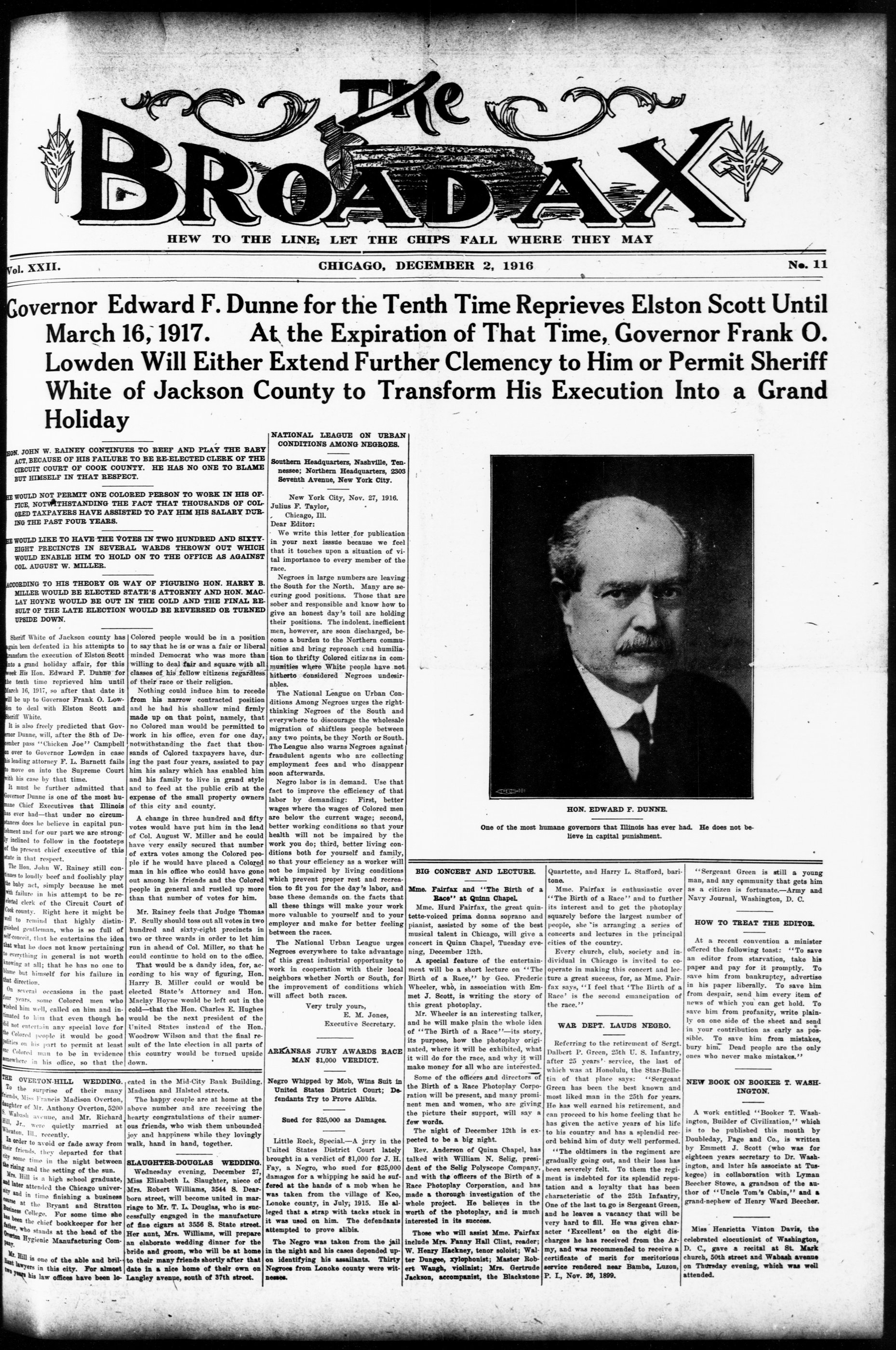
Governor Edward F. Dunne for the Tenth Time Reprieves Elston Scott Until March 16,1917. At the Expiration of That Time, Governor Frank O. Lowden Will Either Extend Further Clemency to Him or Permit Sheriff White of Jackson County to Transform His Execution Into a Grand Holiday
HON. JOHN W. RAINEY CONTINUES TO BEEF AND PLAY THE BABY ACT, BECAUSE OF HIS FAILURE TO BE RE-ELECTED CLERK OF THE CIRCUIT COURT OF COOK COUNTY. HE HAS ONE TO BLAME BUT HIMSELF IN THAT RESPECT.
HE WOULD NOT PERMIT ONE COLORED PERSON TO WORK IN HIS OFFICE, NOT WITHSTANDING THE FACT THAT THOUSANDS OF COLORED TAXPAYERS HAVE ASSISTED TO PAY HIM HIS SALARY DURING THE PAST FOUR YEARS.
HE WOULD LIKE TO HAVE THE VOTES IN TWO HUNDRED AND SIXTY-EIGHT PRECINCTS IN SEVERAL WARDS THROWN OUT WHICH WOULD ENABLE HIM TO HOLD ON TO THE OFFICE AS AGAINST COL. AUGUST W. MILLER.
ACCORDING TO HIS THEORY OR WAY OF FIGURING HON. HARRY B. MILLER WOULD BE ELECTED STATE'S ATTORNEY AND HON. MACLAY HOYNE WOULD BE OUT IN THE COLD AND THE FINAL RESULT OF THE LATE ELECTION WOULD BE REVERSED OR TURNED UPSIDE DOWN.
Vol. XXII.
Governor E
March I
Lowden
White o
Holiday
HON. JOHN W. RAINEY CONTINUED
ACT, BECAUSE OF HIS FAILURE
CIRCUT COURT OF COOK COU
BUT HIMSELF IN THAT RESPE
HE WOULD NOT PERMIT ONE COL
FICE, NOT WITHSTANDING THE
ORED TAXPAYERS HAVE ASSIS
ING THE PAST FOUR YEARS.
HE WOULD LIKE TO HAVE THE VO
EIGHT PRECINCTS IN SEVER
WOULD ENABLE HIM TO HOL
COL. AUGUST W. MILLER.
ACCORDING TO HIS THEOBY OR W
MILLER WOULD BE ELECTED S
LAY HOYNE WOULD BE OUT
SULT OF THE LATE ELECTION
UPSIDE DOWN.
Sheriff White of Jackson county has again been defeated in his attempts to transform the execution of Elston Scott into a grand holiday affair, for this sweep His Hon. Edward F. Duhne for the tenth time reprieved him until March 16, 1917, so after that date it will be up to Governor Frank O. Lowden to deal with Elston Scott and Sheriff White.
It is also freely predicted that Governor Dunne, will, after the 8th of December pass "Chicken Joe" Campbell over to Governor Lowden in case his leading attorney F. L. Barnett fails to move on into the Supreme Court with his case by that time.
It must be further admitted that Governor Dunne is one of the most humane Chief Executives that Illinois has ever had—that under no circumstances does he believe in capital punishment and for our part we are strongly inlined to follow in the footsteps of the present chief executive of this state in that respect.
The Hon. John W. Rainey still continues to loudly beef and foolishly play the baby act, simply because he met with failure in his attempt to be reelected clerk of the Circuit Court of Cook county. Right here it might be well to remind that highly distinguished gentleman, who is so full of self-conceit, that he entertains the idea that what he does not know pertaining to everything in general is not worth knowing at all; that he has no one to blame but himself for his failure in that direction.
On several occasions in the past four years, some Colored men who wished him well, called on him and intimated to him that even though he did not entertain any special love for the Colored people it would be good politics on his part to permit at least one Colored man to be in evidence somewhere in his office, so that the
THE OVERTON-HILL WEDDING.
To the surprise of their many friends, Miss Frames Madison Overton, daughter of Mr. Anthony Overton, 5200 S. Wabush avenue, and Mr. Richard Hill, Jr., were quietly married at Wheaton, Ill., recently.
In order to avoid or fade away from their friends, they departed for that city some time in the night between the rising and the setting of the sun. Mrs. Hill is a high school graduate, and later attended the Chicago university and in time finishing a business course at the Bryant and Stratton Business College. For some time she has been the chief bookkeeper for her father, who stands at the head of the Overton Hygienic Manufacturing Company. Mr. Hill is one of the able and brilliant lawyers in this city. For almost two years his law offices have been lo-
Colored people would be in a position to say that he is or was a fair or liberal minded Democrat who was more than willing to deal fair and square with all classes of his fellow citizens regardless of their race or their religion.
Nothing could induce him to recede from his narrow contracted position and he had his shallow mind firmly made up on that point, namely, that no Colored man would be permitted to work in his office, even for one day, notwithstanding the fact that thousands of Colored taxpayers have, during the past four years, assisted to pay him his salary which has enabled him and his family to live in grand style and to feed at the public crib at the expense of the small property owners of this city and county.
A change in three hundred and fifty votes would have put him in the lead of Col. August W. Miller and he could have very easily secured that number of extra votes among the Colored people if he would have placed a Colored man in his office who could have gone out among his friends and the Colored people in general and rustled up more than that number of votes for him.
Mr. Rainey feels that Judge Thomas F. Scully should toss out all votes in two hundred and sixty-eight precincts in two or three wards in order to let him run in ahead of Col. Miller, so that he could continue to hold on to the office. That would be a dandy idea, for, according to his way of figuring, Hon. Harry B. Miller could or would be elected State's Attorney and Hon. Maclay Hoyne would be left out in the cold—that the Hon. Charles E. Hughes would be the next president of the United States instead of the Hon. Woodrow Wilson and that the final result of the late election in all parts of this country would be turned upside down.
cated in the Mid-City Bank Building, Madison and Halsted streets.
The happy couple are at home at the above number and are receiving the hearty congratulations of their numerous friends, who wish them unbounded joy and happiness while they lovingly walk, hand in hand, together.
SLAUGHTER-DOUGLAS WEDDING
SLAUGHTER-DOUGLAS WEDDING.
Wednesday evening, December 27,
Miss Elizabeth L. Slaughter, niece of
Mrs. Robert Williams, 3544 S. Dearborn
street, will become united in marriage
to Mr. T. L. Douglas, who is
successfully engaged in the manufacture
of fine cigars at 3556 S. State street.
Her aunt, Mrs. Williams, will prepare
an elaborate wedding dinner for the
bride and groom, who will be at home
to their many friends shortly after that
date in a nice home of their own on
Langley avenue, south of 37th street.
CHICAGO, DECEMBER 2, 1916
NATIONAL LEAGUE ON URBAN CONDITIONS AMONG NEGROES.
Southern Headquarters, Nashville, Tennessee; Northern Headquarters, 2303 Seventh Avenue, New York City.
New York City, Nov. 27, 1916.
Julius F. Taylor,
Chicago, Ill.
Dear Editor:
We write this letter for publication in your next issue because we feel that it touches upon a situation of vital importance to every member of the race.
Negroes in large numbers are leaving the South for the North. Many are securing good positions. Those that are sober and responsible and know how to give an honest day's toil are holding their positions. The indolent, inefficient men, however, are soon discharged, become a burden to the Northern communities and bring reproach and humiliation to thrifty Colored citizens in communities where White people have not hitherto considered Negroes undesirables.
The National League on Urban Conditions Among Negroes urges the righte-thinking Negroes of the South and everywhere to discourage the wholesale migration of shiftless people between any two points, be they North or South. The League also warns Negroes against fraudulent agents who are collecting employment fees and who disappear soon afterwards. Negro labor is in demand. Use that fact to improve the efficiency of that labor by demanding: First, better wages where the wages of Colored men are below the current wage; second, better working conditions so that your health will not be impaired by the work you do; third, better living conditions both for yourself and family, so that your efficiency as a worker will not be impaired by living conditions which prevent proper rest and recreation to fit you for the day's labor, and base these demands on the facts that all these things will make your work more valuable to yourself and to your employer and make for better feeling between the races.
The National Urban League urges Negroes everywhere to take advantage of this great industrial opportunity to work in cooperation with their local neighbors whether North or South, for the improvement of conditions which will affect both races.
ARKANSAS JURY AWARDS RACE
MAN $1,000 VERDICT.
Negro Whipped by Mob, Wins Suit in
United States District Court; Defendants Try to Prove Albis.
Sued for $25,000 as Damages
Little Rock, Special.—A jury in the United States District Court lately brought in a verdict for $1,000 for J. H. Fay, a Negro, who sued for $25,000 damages for a whipping he said he suffered at the hands of a mob when he was taken from the village of Keo, Lonoke county, in July, 1915. He alleged that a strap with tacks stuck in it was used on him. The defendants attempted to prove alibis.
The Negro was taken from the jail in the night and his cases depended upon identifying his assailants. Thirty Negroes from Lonoke county were witnesses.
101
One of the most humane governors that Illinois has ever had. He does not believe in capital punishment.
BIG CONCERT AND LECTURE.
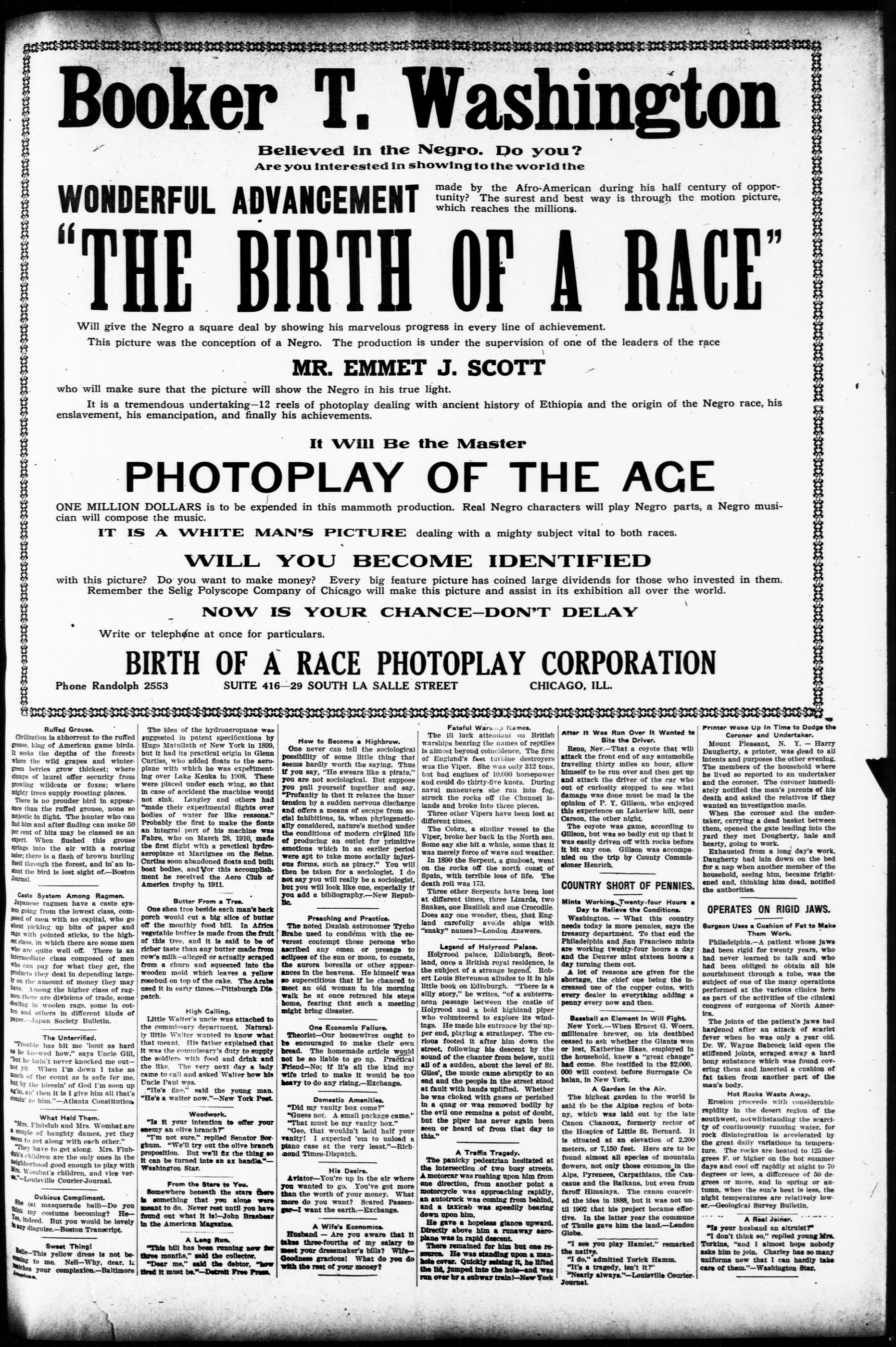
Mme. Fairfax and "The Birth of a Race" at Quinn Chapel.
Mme. Hurd Fairfax, the great quintette-voiced prima donna soprano and pianist, assisted by some of the best musical talent in Chicago, will give a concert in Quinn Chapel, Tuesday evening, December 12th.
A special feature of the entertainment will be a short lecture on "The Birth of a Race," by Geo. Frederic Wheeler, who, in association with Emmet J. Scott, is writing the story of this great photoplay.
Mr. Wheeler is an interesting talker, and he will make plain the whole idea of "The Birth of a Race"—its story, its purpose, how the photoplay originated, where it will be exhibited, what it will do for the race, and why it will make money for all who are interested.
Some of the officers and directors of the Birth of a Race Photoplay Corporation will be present, and many prominent men and women, who are giving the picture their support, will say a few words.
The night of December 12th is expected to be a big night.
Rev. Anderson of Quinn Chapel, has talked with William N. Selig, president of the Selig Polyscope Company, and with the officers of the Birth of a Race Photoplay Corporation, and has made a thorough investigation of the whole project. He believes in the worth of the photoplay, and is much interested in its success.
Those who will assist Mme. Fairfax include Mrs. Fanny Hall Clint, reader; W. Henry Hackney, tenor soloist; Walter Dungee, xylophonist; Master Robert Wang, violinist; Mrs. Gertrude Jackson, accompanist, the Blackstone
humane governors that Illinois has ever hieve in capital punishment.
Quartette, and Harry L. Stafford, baritone.
Mme. Fairfax is enthusiastic over "The Birth of a Race" and to further its interest and to get the photoplay squarely before the largest number of people, she "is arranging a series of concerts and lectures in the principal cities of the country.
Every church, club, society and individual in Chicago is invited to cooperate in making this concert and lecture a great success, for, as Mme. Fairfax says, "I feel that 'The Birth of a Race' is the second emancipation of the race."
WAR DEPT. LAUDS NEGRO
Referring to the retirement of Sergt-Dalbert P. Green, 25th U. S. Infantry, after 25 years' service, the last of which was at Honolulu, the Star-Bulletin of that place says: "Sergeant Green has been the best known and most liked man in the 25th for years. He has well earned his retirement, and can proceed to his home feeling that he has given the active years of his life to his country and has a splendid record behind him of duty well performed.
"The oldtimers in the regiment are gradually going out, and their loss has been severely felt. To them the regiment is indebted for its splendid reputation and a loyalty that has been characteristic of the 25th Infantry, One of the last to go is Sergeant Green, and he leaves a vacancy that will be very hard to fill. He was given character 'Excellent' on the eight discharges he has received from the Army, and was recommended to receive a certificate of merit for meritorious service rendered near Bamba, Luzon, P. I., Nov. 26, 1899.
---
No.11
"Sergeant Green is still a young man, and any community that gets him as a citizen is fortunate.—Army and Navy Journal, Washington, D. C.
HOW TO TREAT THE EDITOR
At a recent convention a minister offered the following toast: "To save an editor from starvation, take his paper and pay for it promptly. To save him from bankruptcy, advertise in his paper liberally. To save him from despair, send him every item of news of which you can get hold. To save him from profanity, write plainly on one side of the sheet and send in your contribution as early as possible. To save him from mistakes, bury him. Dead people are the only ones who never make mistakes."
NEW BOOK ON BOOKER T. WASH
INGTON.
A work entitled "Booker T. Washington, Builder of Civilization," which is to be published this month by Doubleday, Page and Co., is written by Emmett J. Scott (who was for eighteen years secretary to Dr. Washington, and later his associate at Tuskegee) in collaboration with Lyman Beecher Stowe, a grandson of the author of "Uncle Tom's Cabin," and a grand-nephew of Henry Ward Beecher.
Miss Henrietta Vinton Davis, the celebrated elocutionist of Washington, D. C., gave a recital at St. Mark church, 50th street and Wabash avenue on Thursday evening, which was well attended.
Dan M. Jackson
Geo. T. Kersey
David A. McGpwan
Ahmed A. Rayner
The Emanuel Jackson Undertaking Co., Inc. 2959-61 South State St.
Reliable Service Courteous Treatment Reasonable Prices
FREE CHAPEL IN CONNECTION
Complete line of Funeral Goods. Automobiles for hire
---
Wonders of a book.
There is perhaps no greater wonder than a book. By the help of little figures upon spins or paper men have been able to transmit their thoughts through thousands of years. The names and shapes of things, the deeds and sorrows that have occurred as far back as Adam, have been made known to us. Even those invisible and abstract thoughts which have no shape or substance, but which inspired the writer and have since inspired others, are all put down in the little letters and made eternal. The songs of David, the speculations of Plato, the visions of Homer, have by these means been handed down faithfully for many centuries and distributed among mankind. If there were no books our knowledge would almost be confined to the limit of sight and hearing. All that we could not see or hear would be to us like the inhabitants of the planet Saturn—a mere matter of idle conjecture—Barry Cornwall.
Felt For Him.
Bobbie Smith, aged nine, was the shining light of the family, and his father was very proud of him.
"I shall call round and see your teacher," said his fond parent, "and thank him for the kind interest he is taking in you."
"If you do, father, I want to tell you that all the boys in our class are not known by name, but by number only. My number is 25."
In due course the father called at the school and knocked at the door, which was after a few moments opened by the head master.
"Good morning, sir," said Mr. Smith.
"I am the father of 25."
"Indeed," replied the schoolmaster, with surprise. "Come inside, my friend. I can feel for you, for I am the father of twelve myself."—London Globe.
Southern California of Argentina. Mendoza is the southern California of Argentina. Irrigation has long been successfully applied to its vineyards, which produce more wine than the combined vineyards of the entire United States of North America. The whole of the province lies at an altitude of more than 2,000 feet. Itallans are for the most part employed in the cultivation of the grapes, the whole family accompanying husband and father to the field and assisting in tending the vines. The babies are put to sleep in improvised tents while their elders work.—National Geographic Magazine.
Eggs In the Nest.
All birds have a systematic arrangement in depositing their eggs in the nest, and there are very few species, if any, in which some peculiarity is not to be seen if careful observation is made. Many birds so plainly and invariably show a tendency to a set arrangement that their habit is generally known.
He Got the Raise
"You want more money? Why, my boy, I worked three years for $11 a month right in this establishment, and now I'm owner of it." "Well, you see what happened to your boss. No man who treats his help that way can hang on to his business."
Tea Production
No accurate figures of the world's total production of tea can be given, but the quantity in exchange between nations amounts to about a billion pounds, worth to the producers about $150,000,000 and costing the consumers over twice as much.
Unprofitably Occupied
Teacher—Well, Henry, are you learning anything? Henry—Please, no, sir;
I am listening to you!
PRACTICAL HEALTH HINT.
Neglect of the Nose.
An organ whose unhealthy condition is much neglected by the public is the nose. The interior of the nose is really very complicated. It is divided down the center by a septum, and each half of the nose contains various small chambers formed by delicate shell-like bones covered with mucous membrane and richly supplied with nerves and blood vessels.
Any part of this complicated organ may suffer from various forms of catarrh, congestion and inflammation, the least expression of which is a more or less constant and very tiresome cold, but which may develop into more serious difficulties.
---
PAGE TWO
Phones Calumet 6164
Automatic 71-629
OPEN DAY
AND NIGHT
Automobles for hire
Freeest Animals.
Writers of a century ago were firm in the conviction that the greyhound was the fastest living animal; some maintained that he could run a mile in a minute. Modern observers, however, have found that the best hound is by no means able to keep pace with a trained race horse. Indeed, the late J. A. Graham, a careful student of such writers, used to say that no living animal could outfoot a modern race horse.
A first rate horse running his best and not handicapped by carrying a rider can run a mile in less than 100 seconds. A fleet hound, such as those used in coursing, can run a mile in about a minute and fifty seconds. A jack rabbit is nearly as fast, and an antelope is considerably faster. Mr. Graham thought an antelope might run a mile across the level prairie in a minute and forty-five seconds.
On the other hand, Mr. Cottar, an old African hunter, thinks that Thomson's gazelle would have no trouble whatever in running away from the fastest horse and that Grant's gazelle and the gerenuk are almost equally fleet—Youth's Companion.
Money No Object.
As an instance of the reckless character of the old time British tar an English writer quotes the following authenticated reminiscence:
"One morning, as an officer was standing in Fore street, Devonport, his attention was drawn to three post-chaises, with four horses to each, drawn up at the door of the King's Arms hotel. These were presently driven off. On inquiring what great person had arrived, the officer was informed that all this display was the freak of a common sailor, who had just received £500 in prize money, and, having been granted but a week's leave, his ingenuity had devised the most ostentatious mode of getting rid of this windfall. He had hired one chase and four for himself, another for his hat and a third for his cudgel. It was his intention to make the trip to London and back, which would, he hoped, nearly consume the whole sum."
Really Little Known of Poland
Poland's history, with its fight for freedom, justice and equality, its struggle in defense of Christianity and European civilization and its unselfishness in aiding the weak, made it famous among the world's nations, both in success and adversity. The achievements of the Polish nation in art, music, literature, science and religion are known, as are the life deeds of its great men. But the industries, mines, trade and natural wealth of that unhappy country have since its partition been to a great extent a sealed book to most of the people outside of the nations attempting to assimilate the Poles. This was principally due to the inability of people from the outside to break through the network of foreign governmental systems in which Poland is enmeshed.-Buffalo News.
How Some Insects Multiply.
The fecundity of certain insect forms is astounding. The progeny of one little insect, the "hop aphis," sees thirteen generations born to it in a single year and would, if unchecked to the end of the twelfth generation, multiply to the inconceivable number of ten sextillions of individuals. If this brood were marshaled in line, ten to the inch, it would extend to a point so sunk in the profundity of space that light from the head of the procession, traveling at the rate of 184,000 miles a second, would take 2,500 years to reach the earth. In eight years the progeny of a pair of gypsy moths could destroy all the foliage in the United States if unchecked.—Popular Science Monthly.
What Worried Him
"Papa, dear," said the anxious daughter, "you must not worry because Harold is going to marry me and take me far away from you and mamma."
"Oh, a little thing like that isn't going to worry me," replied the fond parent, "but if he ever does anything that will cause you to come back to us again I'll certainly do him bodily injury."—St. Louis Post-Dispatch.
Time to Quit Then
"Do you expect to spend your whole life in the wicked pursuit of riches?" asked the ascetic person. "No," replied the brisk individual. "If I'm not rich by the time I reach fifty years of age I shall consider myself an ignoble failure."—Birmingham Age-Herald.
Puzzled.
"Women are so awfully hard to understand."
"What's the matter now?"
THE BROAD AX. CHICAGO. DECEMBER 2, 1916.
How They Are Saluted.
Salute to the national flag, the president and ex-president of the United States and the presidents or sovereigns of foreign states, twenty-one guns; vice president of the United States and foreign ambassadors, nineteen guns; the president of the senate, speaker of the house of representatives, cabinet officers, chief justice, governors within their respective states or territories, governors general of foreign states, civil governors of the Philippine Islands, general of the army, admiral of the navy and same ranks in foreign armies and navies, seventeen guns; United States and foreign ministers plenipotentiary, vice governor of the Philippine Islands, assistant secretaries of war or navy, ileutenant general or major general commanding the army and corresponding ranks in the navies, fifteen guns; ministers resident, major generals, rear admirals and corresponding ranks in foreign armies and navies, thirteen guns; charge d'affaires, brigadier generals and corresponding ranks in foreign armies and navies, eleven guns; consuls general, nine guns.
Dawn and the Darkest Hour.
"The darkest hour is just before dawn," is an old English proverb which expresses more poetically the homelier adages, "When things are at their worst they soonest mend," "When gale is highest boat is highest," "The longest day will have an end," "After a storm comes a calm," and finds an equivalent in other languages, as in French, "By dint of going wrong all will come right;" in Italian, "I is the eve of well;" in Persian, "It is at the narrowest part of the defile that the valley begins to open," and in Hebrew, "When the tale of bricks is doubled Moses comes."
That the nights, as a rule, are darkest just before dawn is doubtless true, for the moon has then reached far on to the western horizon, while the sun is still below the eastern horizon.
Sound Waves.
Science says that the loudness of sounds varies inversely as the square of the distance. This is merely another way of saying that if you walk three times as far away from the source of the sound as you were before its loudness will not be a third what it was, but a ninth of what it was, for nine is the square of three.
On the other hand, the density of the medium which conveys sound is very important. On a frosty night the air is dense. One consequence of this is that an automobile runs better because the engine gets larger supplies of oxygen. Another result is that sounds are heard more loudly. However, the report of a gun high up in the mountains is like the sound of an exploded firecracker.
Father of English Poetry.
The first English bard to attain lasting fame was Geoffrey Chaucer, who was born in London about 1340. "The father of English poetry" was the son of a vintner named John Chaucer and in his youth served the king as a soldier and was taken prisoner by the French. The English king paid $80 for his ransom, which was quite a high price for a poet. Chaucer's most celebrated work, "The Canterbury Tales," was written between 1373 and 1400. It consists of a series of tales supposed to have been told by a company of pilgrims to the shrine of St. Thomas a Becket at Canterbury, and in its pages we get such pictures of English life and ways of thought as are found nowhere else.
Brevity.
Robert Louis Stevenson was a close student of style and has left more than one interesting discussion of the technique of writing. In a letter to R. A. M. Stevenson, dated October, 1883, he says:
"There is but one art—to omit! Oh, if I knew how to omit I would ask no other knowledge! A man who knew how to omit would make an 'Illad' of a daily paper."
When Pressing Silk
Always press silk under a piece of muslin to prevent the silk from becoming hard and crackly. First dampen the muslin and use a moderately hot iron till the muslin is outte dry.
Forgetful.
Headaches
In these modern times a headache is just as necessary and useful as a fire alarm. It is a warning that something is wrong and that somebody had better get on the job instanter and alter conditions.
What is the commonest cause of headache? There are a hundred or more different causes. Overfatigue, not enough sleep, sleeping in a stuffy room, overeating or eating something that disagrees with the stomach, some alight eye defect, an infection or congestion of the nasal passage caused by cold—any of these and many, more things bring on headaches. Chronic inflammation within the nose itself and also within the bony cavities of the skull which open into the nose will cause intense headaches at times. Persistent headaches are danger signals that warn you to consult a physician.
Haiti's Grotesque Army. When the late President Laconte of Haiti set about to reduce the size of his army a few years ago many of the generals whom he mustered out of the service were put to breaking rock on the street. At one time there were more officers than men in the Haitian army, according to apparently authentic statements. In former times the pay of a Haitian soldier was small at best, nothing at worst and at all times insufficient to keep the warrior fed decently. The days for loading coffee on departing ships were great days in Haiti. They were days when the army got a square meal, thanks to the steward wages which the men were able to earn, says the National Geographic Magazine. The army officers of Haiti were as fond of gold lace as a mountain girl of bright colors. Small wonder, then, that the regalia of a field marshal was everywhere in evidence. Feeding the Haitian armies in the days before the American "big brother" movement was not a difficult job. Garrison rations consisted of a sugar cane stalk two or three feet long and whatever else the soldier could beg, borrow or steal.
Rocking Chairs.
Rocking chairs are an American institution, although they are to be found today pretty much all over the civilized world. In England they are invariably referred to as "American rockers," and indeed this application is not confined to that country. Here and there on the continent you will hear of them in the same category. Authorities are widely at variance as to the time and place of the very first rocker. But that the first one was turned out more than 200 years ago there is little room for doubt. It is fair to assume that it was the invention of a New Englander who loved his ease. He probably invented it to offset the discomforts of the severely straight backed chairs of our early colonial days.—Exchange.
Boumanian Peasant Diversions
Roumanian Peasant Diversions.
"Many hands make light work" is a proverb of the Roumanian peasant often put into practice. Almost every night there is a neighborhood gathering like the old fashioned apple cutting or apple butter boiling in early American rural history. The houses have their turns at these parties, and there is always a kettle of cornmeal mush and baked pumpkin and potatoes and popcorn ready for the occasion. All hands join in the evening program of combing, carding and spinning the household supply of wool or flax, while the neighborhood gossip passes current among the elders and occasional words of love or childish jest among the more youthful members of the party.—National Geographic Magazine.
Donkeys Are Haiti's Food Trains. Nearly all the produce for the feeding of the population of Port au Prince, Haiti, a city of some 60,000 people, is brought in on the backs of donkeys. The public squares are converted into open air market places, and here the buying and selling goes on from early morning until 4 or 5 o'clock in the afternoon, when the caravans begin their toilome journey homeward. Situated in a region famous for its fine fish, among them the delectable and plentiful "red snapper," the Haitians eat quantities of salt cod imported from Massachusetts waters. And the quality of this imported staple is such as would not find favor in American markets. - National Geographic Magazine.
First "Outsiders."
Until the nomination of Franklin Pierce for the presidency of the United States the word "outsider" was unknown. The committee on credentials came in to make its report and could not get into the hall because of the crowd of people who were not members of the convention. The chairman of the convention asked if the chairman of the committee was ready to report, and the chairman answered, "Yes, Mr. Chairman, but the committee is unable to get inside on account of the crowd and the pressure of the outsiders." The newspaper reporters took up the word and used it.
Pilloried
"You druggists have to stand for a good many jokes."
"Yes."
"A drug store is sometimes facetiously alluded to as a pillory."
"About right, too," said the druggist.
"Keeps you penned up most of the time."—Louisville Courler-Journal.
Reassuring.
Irate Gentleman (to his gardener)—What do you mean, sir, by telling people in the village that I'm a stingy master? Gardener—No fear o' me a-doin' the likes o' that, guv'nor. I allus keeps my thoughts to myself.—London Punch.
"Do you think you can turn the baser metals into gold?"
"Undoubtedly—if you can guess which way the steel market is going."
—Washington Star.
Turn About.
Stella—When you are engaged you tell him that he must economize. Bella—And after you are married he tells you that you must—Puck.
Finished.
"Jack got through college in three years."
"What of it? I got through in one."
—Harvard Lampoon.
It is better to find excuses for others than for ourselves.
[Black and white portrait of a man in a suit and tie].
THE RELIEF OF THE WOMEN.
The painless childbirth and the education of the women concerning the rational hygienic living has eliminated the suffering that women previously endured. The light of learning has given to the women freedom from pain, heretofore held to be her lot as a penalty for transgression of mother Eve. The only penalty that they really pay is due to ignorance of the law of proper living, or failure to seek advice and treatment from properly trained advisers.
If the expectant mother would call on the family doctor and follow instructions, she would prevent many of the mistakes that often lead to many ills. She would first eliminate fear which is a sinister influence and would at the same time eliminate much of the ignorance that the promiseuous questioning of unqualified observers brings. Be sure you get technical information on such an important subject as your health and the health of your prospective heir. She should know what the doctor alone is qualified to tell her in this matter and she should find out at the first signs of the approach of the meritorious and marvelous motherhood, the grandest of them all.
Not only should all women be delivered without pain, but all should
GIFTS FOR HOLY LAND
GO IN CHRISTMAS SHIP
American Collier Will Carry Relief For War Sufferers.
New York.—America's 1916 Christmas ship for the relief of unfortunate victims of the war will leave New York Dec. 1. The American Red Cross is co-operating with the American committee for Armenian and Syrian relief in collecting foodstuffs and clothing to be sent to Syria on a government collier placed at the disposal of the latter committee by Secretary Daniels.
The collection of the Christmas ship cargo is in the hands of Albert W. Staub of the American Red Cross receiving and distributing station at Bush terminal, Brooklyn. Mr. Staub has already received countless bundles of old clothing, unavailable for the cargo, as military regulations preclude the shipment of second hand clothing in this cargo. He said, "It must be emphasized that the only clothing America can send to the unfortunate ones in Turkey must be new and must be sent prepaid to the American Red Cross, Bush terminal, Brooklyn." Mr. Staub sent the following letter from the war relief information and shipping office: "It is more than significant that the first letter to go out from the newly organized Red Cross war relief information office has to do with a Christmas ship. It is doubly significant that it is to take relief to a people living so near the Holy Land."
MIKE HICKEY TELLS OF HIS REFORMATION
Ex-Pickpocket, With Twenty Years' Prison Record, Talks to 400 Men.
Mike Hickey, once a notorious pick-pocket, with a record of nineteen and a half years behind prison bars, told 400 men at the Harlem branch Y. M. C. A., New York, how he straightened out and how other inhabitants of the underworld could be helped to do the same.
Mike's career as a thief lasted until about four years ago, when he wandered, fresh from Sing Sing, into the Cremorne mission, on Thirty-second street. It ended there. Now he is night man at the Bowery Y. M. C. A. and passes his spare time helping his old pals from Dannemora and Sing Sing to get their feet on the "straight and narrow."
The trouble with the newly emerged convict, he said, was the old story—out into the world with a $10 bill and a wish to keep straight; a job until a cop told the boss of his record, then ne more job; broke; one more trick to get money to eat; caught, and back to prison.
What the convict needs is a bit of belief and encouragement when he starts to reform, said Hickey, adding that more and more the employees are beginning to give this, so that many men with long records as criminals are now taking their places in honest life.
HEALTH,
CLEANLINESS,
PROPER LIVING,
SANITATION, ETC.
Dr. W. A. Driver
3300 So. State Street
Phone Douglas 3617
learn how to equalize the circulation
and avoid painful menstruation, which
is also called dysmenorrhea. Proper
advice on the function of menstruation
will be in accord with scientific
medical advice only if obtained from proper
sources. Much of the suffering of
women is due to a failure to get proper
advice at the start of the phenomena
of menstruation. Warmth is essential
to proper circulation and cold feet and
painful menstruation are the antithesis
of both warmth and proper circulation.
Constipation is also the antithesis of
proper circulation. Warm baths are
not the antithesis of proper circulation.
Frequent examinations are essential to the protection of life. This is especially true of those who have reached the critical turn of the life of woman. The mind of such a woman should be commensurate with the grand matronly achievement, that is, she should be treated with serpulon courtesy and kindness by all who are blessed with her acquaintance. The grand woman should be treated gently, for the simple reason that she has lived to reach the grand age in femininity. The women who have acquired the great grand age should be proportionately honored, respected and loved and must be to consummate the altruism parexcellence, the relief of women.
Capitals We Have Had.
It is asserted sometimes that the United States has had five capitals but the statement is not correct. The United States has had but three capitals—New York, Philadelphia and Washington. In the period preceding the adoption of the constitution as place was legally constituted a capital. In a loose and unofficial sense it is possible to describe as a capital any city which was the seat of government. Taking the sessions of the Continental congress as establishing a seat of government in the Revolution and the confederation, the following cities may loosely rank as capitals: Philadelphia, Baltimore, Lancaster, York Princeton, Annapolis, Trenton and New York. The articles of confederation were passed by congress in Philadelphia, and the federal convention charged to prepare a constitution convened at the same place.
Not Her Fault
The express was approaching a railway bridge that spanned a deep river, and a stout old lady in one of the compartments showed signs of nervousness. As the train went roaring across the structure she did not speak a word, but seemed to be holding her breath.
“There,” said a gentleman in a neighbor boring seat, “we are over it safely.” The old lady heaved an explosive sigh.
“Well,” she said, “if we had gone to the bottom I should have died with a clear conscience, for it wouldn’t have been my weight that did it. I bore up so that I really made the train lighter than it would have been without me”—London Mall.
Melabar's Lemon Grass
The hillsides of the Malabar coast of India are the scene of great commercial activity once a year, when the lemon grass harvest is under war. Oil extracted from the grass is employed in the manufacture of artificial pet fumes. The hillsides are burned over to destroy the old and useless grass. Six months later the fresh crop is ready to be cut, and at once the countryside is dotted with furnaces and stills.
Life's Three Questions
The three great questions of life are "Is it right or wrong? Is it true or false? Is it beautiful or ugly? These our education should help us to answer, and insomuch as it fails it will lack, in reaching a proper physical or moral standard.
Natural Result
She—What! He, a flirt, married a firt? How can that be? He—Why, it's simple enough. They set out to see which could beat the other flirting and it resulted in a tie—Exchange.
Queer.
"It's a queer language."
"What's the matter now?"
"When you pay the cash down you call it settling up."—Detroit Press.
Did the Best He Could. She (during the spat) You should have married some stupid, creature girl. He—Well, my dear, I fill the best I could—Boston Transcript.
The birth of J. M. Barrie's play, "Peter Pan," was full of romantic interest. Barrie had agreed to write a play for Frohman and met him at dinner one night at the Garrick club in London. Barrie seemed nervous and ill at ease.
"What's the matter?" said Charles. "Simply this," said Barrie. "You know I have an agreement to deliver you the manuscript of a play?" "Yes," said Frohman.
"Well, I have it all right," said Barrie, "but I am sure it will not be a commercial success. It is a dream child of mine, and I am so anxious to see it on the stage that I have written another play which I will be glad to give you and which will compensate you for any loss on the one I am so eager to produce."
to see Peter.
"Don't bother about that," said Frohman. "I will produce both plays."
Now, the extraordinary thing about this episode is that the play about whose success Barrie was so doubtful was "Peter Pan," which made several fortunes. The manuscript he offered Frohman to indemnify him from loss was "Alice-Sit-by-the-Fire," which lasted only a season." "Charles Frohman, Manager and Man."
Married Money.
"Glad to see you looking so well, old man," said the friend of a newly made benedict. "This is the first opportunity I have had of offering my congratulations on your recent marriage. From the look of things I guess you've married money. Well, it was the right thing to do. That shop walking berth of yours must have been awfully boring. Is she in? I should like to be introduced." "Oh, she's at work," said the husband, with a placid smile. "At work? What do you mean?" asked the friend. "Well, you see, it was this way," replied the benedict. "She had a much better position than mine—head of her department, £8 a week. Wouldn't give it up. So there was nothing for it but for me to retire from business and keep house, and here I am, you see. You have to let women have their way in some things." -London Tit-Bits.
The Business of Life.
Life is a business we are all apt to mismanage, either living recklessly from day to day or suffering ourselves to be guided out of our moments by the maniates of custom. We should depise a man who gave as little activity and forethought to the conduct of any other business. But in this, which is the one thing of all others, since it contains them all, we cannot see the forest for the trees. One brief impression obliterates another. There is something superfying in the recurrence of unimportant things, and it is only on rare provocations that we can rise to take an outlook beyond daily concerns and comprehend the narrow limits and great possibilities of our existence.—Robert Louis Stevenson.
He Was the Whole of It.
Over the wire to the parsonage came this request:
"The bishop would like to meet at the church this evening the pastor, the class leader, the Sunday school superintendent, the president of the cradle roll and of the young people's societies, the president of the missionary society, the chorister and the sexton?"
"All right! I'll be there," was the answer.-Christian Herald.
At Regular Rates
Amateur Poetess—Ten dollars for correcting the poet of this little versel Professional Poet—Oh, yes; for this sort of work I charge regular plumbers' rates—Life.
Shook.
Molly—You say you shook all over
when you proposed to her? Cholly—
Yes. I did. Molly—And how about the
girl? Cholly—Oh, she only shook her
beard.
PRACTICAL HEALTH HINT.
Wrong Eating.
"After all," says a bulletin from a state board of health, "good health is largely a matter of what goes into the stomach. If a person eats heavily of rich, greasy, concentrated foods, such as fried meats, rich pastries, soggy or underdone breads, he will soon find himself seeking a relief from headache, sluggishness, constipation and billiousness, and the patent medicine route will be the way he will likely choose. Pills and purgatives will find a hearty welcome and become a warm friend to persons who so poison themselves. The trouble arising from eating food of this kind is that it ferments in the stomach, throws off poisons and creates a condition which calls for a stronger poison in the form of medicine to throw off the food poison. The medicine habit is acquired, and the digestive organs of the stomach are wrecked and no longer perform their natural functions.
"On the other hand, whoever eats freely of fruits, vegetables, milk, butter, salads, cereals and nuts-foods prepared by nature for man-not only avoids digestive troubles, but he is spared the evil effects of food poisons, such as rheumatism, headaches, sluggishness and billiousness. He also escapes the patent medicine habit. He eats according to nature's demand and needs, and no medicine is required as an after dose."
---
Soldiers Love Their Job, and If Not Paid They Loot.
Peking.—China's toughest problem now is how to disband the army raised during the revolution. The government, hard pressed for money, will have to raise at least $30,000,000 to pay off the 800,000 men under arms, and unpaid soldiers are always a menace in China. Coolies regard military service as a very desirable occupation. Once enlisted it is difficult to persuade them to retire. They riot and become extremely troublesome if an attempt be made to disband them without liberal payment. The commanding officers are frequently as mercenary as the soldiers. When the government fails to give its soldiers what they regard as adequate pay the troops frequently become bandits and loot.
Each province has its own military governor and a distinct military organization, presumably under control of the Peking authorities, but actually independent in most cases. Consequently the Peking government is forced to deal very diplomatically with the military organizations in the provinces, particularly in the remote provinces.
HARVARD MAN FOILS SUN WITH INVENTION
Presses a Button In Bed and the Window Shade Goes Down as if by Magic.
Cambridge, Mass. — Every morning at 7 o'clock Henry R. Guild of Boston, a Harvard senior, rolls over in bed. Seven o'clock is too early for a senior to get up, so Mr. Guild presses a button and the shade at the distant end of his chamber rolls down as if by magic.
No rising sun is going to make him leave his bed unseasonably. Some morning he may miss a four alarm fire by pressing the button, but he's willing to take the chance, he asserts.
Getting up at 7 a. m. is a high crime at Harvard, the same as admitting Yale has a good football team this year.
Henry Guild framed up a motor, attached to the curtain string and laid wires to his bedside. When the sun throws its rays into his bedroom every morning, weather permitting, he presses a button and the curtain flops faster than in a vaudeville theater.
Mr. Guild's next invention probably will be a trap door to throw tiresome professors into the cellar by means of a button that any student can press. Life's attendant inconveniences aren't going to bother him while electricity can do the work.
FIREMAN SAVES BABY.
Climbed on Pilot of Locomotive, Lifted Infant From Track.
La Crosse, Wis.—Coon valley residents are talking of applying for a Carnegie medal for Fireman Peter Hensgen of the La Crosse and Southeastern. He was in a freight engine cab when he saw a child in the distance on the track.
It was down grade and the brakes were slow to grip. Hensgen climbed out along the footboard to the pilot, grasped a rod and leaned down.
He grabbed the sleeping child with his free hand and lifted her from the track. The child was the little daughter of Mr. and Mrs. Elmer Jacobson. She had wandered away in the afternoon and lay down tired between the rails and went to sleep.
NEW DIMES IN CIRCULATION.
$180,000 Worth of Coins Distributed by the Philadelphia Mint.
Philadelphia. — The new ten cent pieces which have been coined in large quantities at the Philadelphia mint were recently put into circulation for the first time, about $180,000 worth being distributed to banks and trust companies. They were introduced simultaneously in the western states from the Denver mint.
The obverse side of the new dime shows a head of Liberty in profile, while the reverse side shows a bundle of rods in the center and the protruding battleax, symbols of unity. Surrounding the central design is an olive wreath, denoting peace.
The new coins are expected to be in general circulation within a few days.
Child Escapes Coyote.
Bend, Ore.—Attracted to the dooryard by an unusual noise being made by her flock of turkeys, Mrs. Thomas Merchant, living east of Bend, found a coyote running toward her little girl, who was playing in the yard. The animal was frothing at the mouth and is believed to have been rabid. Mrs. Merchant had just time to snatch her daughter up and return to the house before the coyote reached the spot where the little girl was at play.
Ante Kill Bees.
Oakland, Cal.-Dr. J. H. Callen, who had two hives of bees, much alive, on his Fruitvale avenue property, is now occupied in cleaning out two hives of dead bees, victims of an unsuccessful Vardun defense against a horde of marmuding ants. The evidence shows that the ants attacked in solid mass formation, carrying the bees' first, second and third line of trenches and then attacking the entrances to the hives.
THE BROAD AX. CHICAGO, DECEMBER 2, 1916
Camera Men and War Pictures. The camera man in search of lively war pictures often enjoys the protection of a special guard, which is especially detailed to protect him. Since the camera does not shoot as far as a gun, the photographer often works at an immense disadvantage. The camera makes a conspicuous target and often draws the enemy's fire. The special camera guard, which originated in one of the early Villa campaigns in Mexico, consists of two picked men, perhaps more, who accompany the photographer or skirmish ahead of him to render his position as safe as possible when the camera is set up. Many thousands of feet of war film have been made while sharpshooters on both sides kept up a steady and effective fire. A guard of two American Indians, both crack shots, were employed for many weeks to protect L. M. Burrud, an American camera man, who accompanied Villa in one of his campaigns. The Indians' stealth and daring in reconnoitering the ground in advance often proved indispensable—"The Camera Man," by Francis Arnold Collins.
Stage Names and Real:
The extent to which favorite actresses are somebody else off the stage is not well understood. Actors generally play under their own names, but the woman who has achieved a reputation before marriage prefers to retain the name under which she became known rather than assume that of her husband. Some women, too, play while unmarried under another name than the real one.
For instance, Maude Adams is really Miss Kiskadden, and Marie Dressler is Lella Koerer. Jack and Ethel Barymore are properly called Blythe, and Truly Shattuck is Clarice Ertlura de Bucharde, a name rather too long for the stage. Theater goers seem to like short names easily remembered. Trixie Friganza is really Della Edna O'Callahan, and Mary Manninger is Florence Friend; Elsie Janls was formerly Elsie Blerbower, and Margaret Anglin is Mary Warren. And so it goes through the list—Boston Herald.
Orkney Islands In Pawn
The Orkney islands, says Pearson's Magazine, do not really belong to Great Britain in the sense that they were ever ceded by treaty or acquired by conquest. They were simply transferred by Denmark to Scotland in 1468, in pledge for the payment of the dowry of the Princess of Denmark, who was married to James III., king of Scotland. In the deed of transfer, which is still in existence, it is specially mentioned that Denmark shall have the right to redeem them at any future time by paying the original amount of the dowry with interest to date. There is no likelihood, however, that Denmark will ever attempt to exercise her right of redemption, because 60,000 florins, the original amount of the dowry, plus compound interest for 448 years, would amount to perhaps £1,000,000,000,000, and that is a bit more than the islands are worth.
"Thanks For the Ducks."
An official in one of the largest manufacuring concerns in Philadelphia recently showed me the huge plant. I marveled at the labor saving machinery.
"One of our workmen," he said, "has made a great many of the improvements you see in this room. He likes to go duck shooting, and while off on a trip for a week or more he thinks out some new way to save labor."
After a moment's pause he added:
"Why, he turned up one day with a plan whereby we save $50,000 a year."
"And what," I inquired, "does that workman get out of it?"
"Oh," the happy official replied, "he gets the ducks."—Girard in Philadelphia Ledger.
Simple Arithmetic
A little boy who had not learned how to count one day received three apples from a friend.
He was very pleased and told his mother afterward.
"How many apples did you get?" she asked.
"I don't know just how many mother," he replied, "but I got one in the middle and two outside."—New York Times.
Not Guilty.
Little Charley had been spanked by his mother for stealing cookies. His cousin, who was present, wishing to comfort him, said: "Poor Charley! You have my sympathy." Looking up through his tears, he protested: "I have not! I didn't touch it!"—Boston Transcript.
The Ancient Mayas
It is urged by an archaeologist that the Mayas, who once inhabited America, had a civilization as far advanced as that of any early people except the Greeks. The dwellers in the jungles of Yucatan, Guatemala and Honduras are believed to be their descendants.
Clam Shells
Clam shells are susceptible of a fine polish and are used for many ornamental purposes. Chinese carve them into snuffboxes, tops of walking sticks, bracelets and similar articles.
Merely a Delusion
Insurance Doctor--Any insanity in your family? Cholly-Only-aw—the pater-thinks he's the head of the house. ye know.-Boston Globe.
Strong on Bills.
Winkle—My wife would make a good
member of congress. Hinkle—Why?
Winkle—She's always introducing bills
into the house.
Where love and skill work together
expect a masterpiece—Reade.
Lobster and Butterfly.
Lobster and Butterfly.
According to a scientific observer, the lobster is akin to the butterfly. The kinship is not merely that of two members of the animal kingdom. The lobster and the butterfly are actually in one and the same great group of the kingdom, like the clam and the snail or the whale and the giraffe, whose spheres of activity are so widely separated. It is simply, as Darwin pointed out in the case of other creatures many years ago, that the lobster and its friends, the crab, the prawn and the shrimp, chose one method of life, while the butterfly and its set chose another. So the first group developed characteristics suited to the conditions in which it lived, including as one of the most important, as its members do not move rapidly, a coat of armor to protect them from their innumerable enemies, while the butterflies and the great host of winged insects shed every bit of superfluous weight, trusting to swiftness to carry them out of danger and to protective coloring to conceal them when flight is unavailing.
A Useful Coffin.
A writer in an English church magazine once found in a collier's cottage in Staffordshire a coffin used as a bread and cheese cupboard. Notwithstanding his wife's remonstrance, he told the story of the coffin as follows: "Eighteen years ago I ordered that coffin. The wife and me used to have a good many words. One day she said, 'I'll never be content till I see thee in thy coffin.' 'Well, lass,' I said. 'If that'll content thee it'll soon be done.'
"Next day I gave directions to have the thing made. In a few days it came home, to the wife's horror. I got into and sald, 'Now, lass, are the content?' She began to cry and wanted the 'horrid thing' taken away. But that I wouldn't allow. In the end she got accustomed to seeing it, and as we wanted to turn it to some use we had some shelves put in and made it into a bread and cheese cupboard. We have never quarreled since it came."
Where Johnson Made a Blunder
The present Blackfriars bridge is a comparatively modern structure, which replaced the bridge of Robert Myline after the latter had endured, with much alteration and repair, it is true, for nearly a hundred years. Myline's design, it will be recalled by those familiar with their Boswell, was attacked by Johnson with that arrogance and, let me sadly add, ignorance which he was too wont to display in subjects of which he knew very little. Johnson, with a weight of words which might have tested any bridge, declared that no structure with elliptical arches could bear heavy weights. Myline's bridge has gone, but the elliptical form of arch remains, and very beautiful it is and adequate for a weight of traffic of which Johnson never dreamed.—Westminster Gazette.
Lakes of Blood.
The name Lake of Blood or its equivalent has been given to places as far apart as England and South America. "Sanguelac"—l. e., the Lake of Blood—was the name given by the victorious Normans to the battlefield at Hastings, where the Saxons were overthrown and slain with terrible carnage. For a similar reason Lake Trasimene has borne the name "Sanginetto" because its waters were reddened during the second Punic war by the blood of some 15,000 Romans who fell before the troops of Hannibal. Yet another Lake of Blood, called also "Yaguar Cocha," is situated in the state of Ecuador. It is one of a series of lakes formed by the extinct craters of volcanoes on the towering heights of the Andes range of mountains.
Game.
Daughter of Western Farmer—Oh,
George, the harvest hands threaten to
quit, and papa is away!
Young Foreman—Yes, I know. I
wired him this morning for instructions.
Daughter of Western Farmer—What
did he answer?
Young Foreman—He said, “Hold
hands till I come.”
Daughter of Western Farmer—Well,
it means an awful lot of spooning, but
I guess we can do it, can't we?—Life.
Feminine Sympathy.
"I could tell her how sorry all the girls felt for Mamie yesterday."
"Why so?"
"Because she sat there without a word when the others were telling indignantly how those contemptible street mashers tried to flirt with them."—Baltimore American.
Deserved to Get It.
"I want to ask you for a bit of advice," said the insinuating man.
"What is it?"
"I want you to put yourself in my place and me in yours and tell me how you would go about it if you wanted to borrow $10 from me."—Exchange.
The Irritated Tourist
"Is this the bureau of information?" asked the confused traveler. "No," replied the man. "This is the ticket office." "Great guns! Is it getting so they sell tickets now for information?"—Washington Star.
Troublesome Trait
"Brown claims that he always tells
the truth."
"Yes; he seems to have a mania for
stirring up trouble." — New York
Times.
This is the best day the world has
ever seen. Tomorrow will be better.—
R. A. Campbell.
The Horse Upstairs.
Not long since we were riding on an elevated train in Chicago. We looked out of the car, and there, right at our elbow, was a horse's head, thrust through the upper floor window of a brick building. It was a startling thing. We felt like saying, "Now, what on earth are you doing up here, old man?" But the horse appeared to be very much at home. No doubt he lived there, twenty feet or so from the ground. It was like a jail. He had no barn lot or pasture. When his day's work was over he was taken direct from the wagon to his upstairs stall. Rents were too high for his owner to furnish a stall on the ground. He never had a chance to "roll over" or to nibble at a bit of fresh plowed earth. Yet that horse's life in the city was no more artificial and abnormal than the life of the average city man. The man goes of his own accord, however, and the horse has no choice in the matter. Probably the horses wonder why men want to hive together like bees—Farm Life.
Artecs and Human Sacrifices
Human victims were sacrificed by the Aztecs in various ways and relatively in large numbers. Hubert Howe Bancroft, in his "History of Mexico," says: "The victims were for the most part captives taken in war, and war was often made solely with a view to obtaining them. A large proportion, however, consisted of condemned criminals or slaves, and even of children, bought or presented for the purpose. Moreover, persons sometimes offered themselves voluntarily for the good of the people or for the honor of a god. The greater part of the victims died under the knife, but some were burned alive, and children were often buried alive or drowned, while we hear of criminals being crushed to death between stones. But the most cruel sacrifice of all, and yet the most common, was performed by tearing out the heart of a living human creature at the sacrificial stone."
Haiti's Sans Souci.
The palace of Sans Souci, erected by Christophe, the black leader of Haiti, is situated in the hills above the level vale of Milot, with a background of forest and a foreground sprinkled with the palms and huts of simple cultivators. Dilapidated ruins and a tangle of tropical trees are the rueful remnants of the glory that was once the palace without care and the garden of delight of the king of slaves. It was off the coast of Haiti, near the site of this palace, that the flagship of Columbus was wrecked, and here he left most of his men when he returned to Spain for aid. Upon his return to the settlement, which he called "La Navidad," he found the whole party dead, including an Englishman named Allard and an Irishman, who was entered on the Santa Maria's books as William of Galway.—National Geographic Magazine.
The Vampire
This is the vampire: Always inert, sitting still, spending five to seven hours a day looking out the window on the street. Nothing to give, and always giving it. Seeking amusement, entertainment, but never affording any. Taking, but never giving. Sitting quietly and listening to others converse and confer, even when her presence is unwelcome, but saying nothing but an occasional yes or no. Primitive minded and narrow, with nothing to give, she drains others of ideas without retaining them—like a sieve. Thought passes through and beyond her without stopping. She acquires nothing, gives nothing, takes everything. One person alone with her becomes exhausted while she is revivified—New Yok Globa.
Firm aa a Rock.
"There," he said, pulling his shirt sleeves over his brawny arms and surveying the clothes prop which had taken him the best part of the afternoon to fix in the garden, "that's as firm as a rock. Even the combined forces of the elements cannot bring it down."
Later in the day he found the pole on the ground.
"Did you do this?" he roared to his eight-year-old son.
"No, father," was the answer; "a sparrow perched on it. I seed it myself."—London Globe.
A River In Brazil.
The state of Sao Paulo, in the republic of Brazil, has a river that carries one of the longest names of any stream in the world. The name is of Indian origin and is "Tandamauaeety" and is also called without saving anything in length "river of the Great Tamanoir."
Air Movements:
The movement of air is variously designated, according to its velocity, as a zephyr, breeze, wind, gale or hurricane. A dense or thick fog, according to the weather bureau, obscures objects at a distance of 1,000 feet.
Prodiay.
"That youngster of yours is pretty bright, eh?"
"Reads Henry James at sight," answered the Boston man.—Kansas City Journal.
Cruel.
Lottie—He wore my photograph over his heart, and it stopped the bullet. Tottie I'm not surprised, darling; it would stop a clock—London Sketch.
One Drawback
Confession may be good for the soul, but it's often rough on the reputation. —Charleston News and Courier.
Nothing boosts the value of blessings like their removal—Chicago News.
PAGE THREE
He Used His Head.
In the American Magazine Charles M. Schwab says:
"Andrew Carnegie first attracted attention by using his head to think with. It was when he was a telegraph operator on the Pennsylvania railroad under Colonel Thomas A. Scott. One morning a series of wrecks tangled up the line. Colonel Scott was absent and young Carnegie could not locate him. Things looked bad.
"Right then Carnegie disregarded one of the road's strictest rules and sent out a dozen telegrams signed with Colonel Scott's name, giving orders that would clear the blockade.
"Young man,' said the superintendent a few hours later, 'do you realize that you have broken this company's rules?
"Well, Mr. Scott, aren't your tracks clear and your trains running? asked the young telegrapher.
"Colonel Scott's punishment was to make Carnegie his private secretary. A few years later, when the colonel retired from office, he was succeeded by the former telegraph operator, then only twenty-eight years old."
The Thespian's Fiasco.
Among Italians, a correspondent in Rome tells me, the origin of the term "fasco" for failure is believed to have originated in the remark of an old Italian actor. He had in the course of a play to deliver a somewhat lengthy monologue, in which he invariably scored a great success. It was his habit to always hold some object or other in his hand, changing the article every time he appeared and never using the same thing twice. One evening, seeing a wine battle (called in Italian fasco), he seized it and proceeded on the stage to pronounce his sollouqy. Whether it was that on that occasion the audience was extraordinarily difficult to please or whether it was that the actor was not up to his usual form, the fact remains that for once he did not obtain his customary applause, from which time the phrase "fare fasco" has become general in the Italian language.—London Chronicle.
Largest Village In the World.
Open, unprotected, utterly indefensible. The Hague has basked, smiling, just behind the storm swept edge of the ocean for centuries. Bleak, shifting downs roll up to the very gardens of its suburban villas; ancient historical forests proffer mild memories of their vastness in woody parks and winding shady ways. It is essentially a place to be at peace.
Although so mingled with the doings of the house of Orange that every square has a historical association, every old palace and park its story, though the parliaments of the Dutch states have met there since 1466 and suave ambassadors have brought it weighty questions and strange faces since the sixteenth century, there is a pretty irresponsibility about this "largest village of the world" that has endeared it to the pleasure lover of all ages.—New York Telegram.
Making Mistakes
Big men make big mistakes. Little men could not make big mistakes if they tried; they haven't the capacity. The fellow of strong personality, the man who grabs at an opportunity with all his might and goes straight toward its accomplishment hurriedly is more likely to make big mistakes than the weazened of the world who are timid and afraid. But the mistakes do not amount to so much with him—that is the point. The little fellow who makes a mistake is lost. But the big fellow is only encouraged by making a mistake and often is able to drag success over his errors as a giant might drag a bull through the underbrush. The little fellow is not to be blamed, but the big fellow is to be admired.—Columbus (O.) Dispatch.
That Midnight Oil
"I suppose," ventured the interested friend of the family, "that John is still burning the midnight oil at college?" "Yes, indeed," replied the fond but puzzled mother, "but the college must furnish a very inferior quality of oil. John writes me that some midnights the light is so very poor that he can hardly read his hand." — Pittsburgh Chronicle-Telegraph.
College Faculty
From the letter of a father to his son at college:
Dear Harold—Your brief letter came today. I am inclosing the check for the amount you requested. I have heard a great deal of the college faculty. I take it to be the faculty for spending money. Affectionately,
FATHER.
-New York Post.
Flying Predictions
In 1273 Friar Bacon predicted that flying would "shortly" become a general practice, and Bishop Wilkins in 1652 said, "It will yet be as usual to hear a man call for his wings when he is going on a journey as it is now to hear him call for his boots."
Some People Think So.
"Lucia di Lammermoor" is a great favorite of mine," said Mrs. Van Spender to Mrs. Climber, whom she was entertaining at the opera.
"I've never met her," said Mrs. Climber. "Is she attractive?"—New York World.
Proving It
"Boggs says that he finds that two can live as cheaply as one."
"Yes. They live with his wife's folks."—Browning's Magazine.
I am responsible before God for the work I might have done and did not do—B. A. Torrey.
```markdown
```
M.
MR. NOBLE B. JUDAH. JR
First class lawyer, who stands well with Illinois, who could be easily elected in 1917.
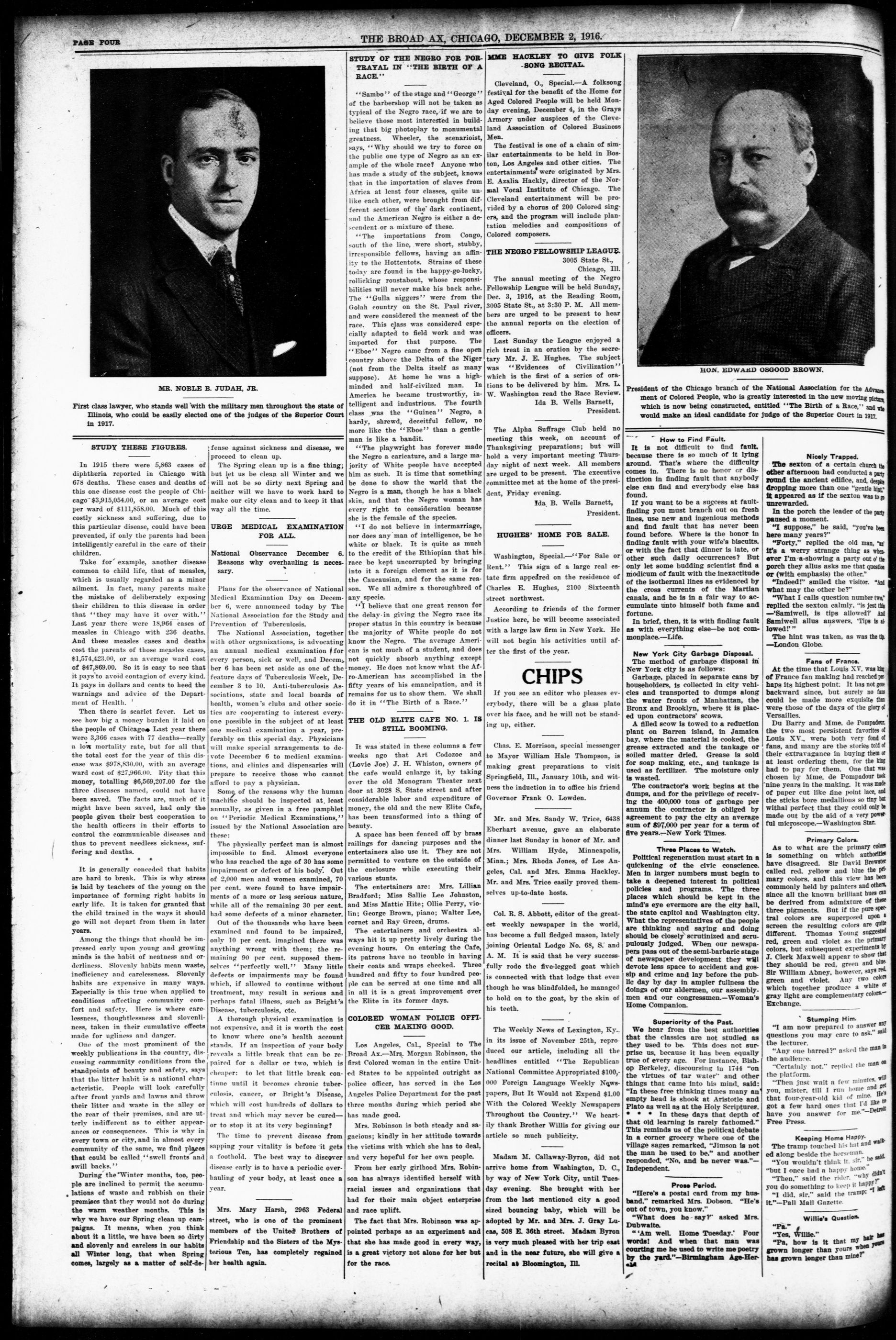
First class lawyer, who stands well with the military men throughout the state of Illinois, who could be easily elected one of the judges of the Superior Court in 1917.
First class lawyer, who stands well with the military men throughout the state of Illinois, who could be easily elected one of the judges of the Superior Court in 1917.
STUDY THESE FIGURES.
In 1915 there were 5,863 cases of diphtheria reported in Chicago with 678 deaths. These cases and deaths of this one disease cost the people of Chicago $3,915,054.00, or an average cost per ward of $111,858.00. Much of this costly sickness and suffering, due to this particular disease, could have been prevented, if only the parents had been intelligently careful in the care of their children.
Take for example, another disease common to child life, that of measles, which is usually regarded as a minor ailment. In fact, many parents make the mistake of deliberately exposing their children to this disease in order that "they may have it over with." Last year there were 18,964 cases of measles in Chicago with 236 deaths. And these measles cases and deaths cost the parents of those measles cases, $1,574,423.00, or an average ward cost of $47,869.00. So it is easy to see that it pays to avoid contagion of every kind. It pays in dollars and cents to heed the warnings and advice of the Department of Health.
Then there is scarlet fever. Let us see how big a money burden it laid on the people of Chicago. Last year there were 3,366 cases with 77 deaths—really a low mortality rate, but for all that the total cost for the year of this disease was $978,830.00, with an average ward cost of $27,966.00. City that this money, totalling $6,569,207.00 for the three diseases named, could not have been saved. The facts are, much of it might have been saved, had only the people given their best cooperation to the health officers in their efforts to control the communicable diseases and thus to prevent needless sickness, suffering and deaths.
It is generally conceded that habits are hard to break. This is why stress is laid by teachers of the young on the importance of forming right habits in early life. It is taken for granted that the child trained in the ways it should go will not depart from them in later years.
Among the things that should be impressed early upon young and growing minds is the habit of neatness and orderliness. Slovenly habits mean waste, inefficiency and carelessness. Slovenly habits are expensive in many ways. Especially is this true when applied to conditions affecting community comfort and safety. Here is where carelessness, thoughtlessness and slovenliness, taken in their cumulative effects made for ugliness and danger.
One of the most prominent of the weekly publications in the country, discussing community conditions from the standpoints of beauty and safety, says that the litter habit is a national characteristic. People will look carefully after front yards and lawns and throw their litter and waste in the alley or the rear of their premises, and are utterly indifferent as to either appearances or consequences. This is why in every town or city, and in almost every community of the same, we find places that could be called "swell fronts and swill backs."
During the Winter months, too, people are inclined to permit the accumulations of waste and rubbish on their premises that they would not do during the warm weather months. This is why we have our Spring clean up campaigns. It means, when you think about it a little, we have been so dirty and slovenly and careless in our habits all Winter long, that when Spring comes, largely as a matter of self-de-
PAGE FOUR
***
fense against sickness and disease, we proceed to clean up.
The Spring clean up is a fine thing; but let us be clean all Winter and we will not be so dirty next Spring and neither will we have to work hard to make our city clean and to keep it that way all the time.
URGE MEDICAL EXAMINATION FOR ALL.
National Observance December 6. Reasons why overhauling is necessary. Plans for the observance of National Medical Examination Day on December 6, were announced today by The National Association for the Study and Prevention of Tuberculosis.
The National Association, together with other organizations, is advocating an annual medical examination # for every person, sick or well, and December 6 has been set aside as one of the feature days of Tuberculosis Week, December 3 to 10. Anti-tuberculosis Associations, state and local boards of health, women's clubs and other societies are cooperating to interest everyone possible in the subject of at least one medical examination a year, preferably on this special day. Physicians will make special arrangements to devote December 6 to medical examinations, and clinics and dispensaries will prepare to receive those who cannot afford to pay a physician.
Some of the reasons why the human machine should be inspected at, least annually, as given in a free pamphlet on "Periodic Medical Examinations," issued by the National Association are these:
The physically perfect man is almost impossible to find. Almost everyone who has reached the age of 30 has some impairment or defect of his body. Out of 2,000 men and women examined, 70 per cent. were found to have impairments of a more or less serious nature, while all of the remaining 30 per cent. had some defects of a minor character.
Out of the thousands who have been examined and found to be impaired, only 10 per cent. imagined there was anything wrong with them; the remaining 90 per cent. supposed themselves "perfectly well." Many little defects or impairments may be found which, if allowed to continue without treatment, may result in serious and perhaps fatal illness, such as Bright's Disease, tuberculosis, etc.
A thorough physical examination is not expensive, and it is worth the cost to know where one's health account stands. If an inspection of your body reveals a little break that can be repaired for a dollar or two, which is cheaper: to let that little break continue until it becomes chronic tuberculosis, cancer, or Bright's Disease, which will cost hundreds of dollars to treat and which may never be cured—or to stop it at its very beginning?
The time to prevent disease from sapping your vitality is before it gets a foothold. The best way to discover disease early is to have a periodic overhauling of your body, at least once a year.
Mrs. Mary Harsh, 2963 Federal street, who is one of the prominent members of the United Brothers of Friendship and the Sisters of the Mysterious Ten, has completely regained her health again.
THE BROAD AX, CHICAGO, DECEMBER 2, 1916.
STUDY OF THE NEGRO FOR POR-
TRAYAL IN "THE BIRTH OF A
RACE." MME HACKLEY TO GIVE B
-SONG RECITAL.
"Sambo" of the stage and "George" of the barbershop will not be taken as typical of the Negro race, if we are to believe those most interested in building that big photoplay to monumental greatness. Wheeler, the scenarioist, says, "Why should we try to force on the public one type of Negro as an example of the whole race? Anyone who has made a study of the subject, knows that in the importation of slaves from Africa at least four classes, quite unlike each other, were brought from different sections of the dark continent, and the American Negro is either a dependent or a mixture of these.
"The importations from Congo, south of the line, were short, stubby, irresponsible fellows, having an affinity to the Hottentots. Strains of these today are found in the happy-go-lucky, rollicking roustabout, whose responsibilities will never make his back ache. The "Gulla niggers" were from the Golah country on the St. Paul river, and were considered the meanest of the race. This class was considered especially adapted to field work and was imported for that purpose. The "Eboe" Negro came from a fine open country above the Delta of the Niger (not from the Delta itself as many suppose). At home he was a high-minded and half-civilized man. In America he became trustworthy, intelligent and industrious. The fourth class was the "Guinea" Negro, a hardy, shrewd, deceitful fellow, no more like the "Eboe" than a gentleman is like a bandit.
"The playwright has forever made the Negro a caricature, and a large majority of White people have accepted him as such. It is time that something be done to show the world that the Negro is a man, though he has a black skin, and that the Negro woman has every right to consideration because she is the female of the species.
"I do not believe in intermarriage, nor does any man of intelligence, be he white or black. It is quite as much to the credit of the Ethiopian that his race be kept uncorrupted by bringing into it a foreign element as it is for the Caucausian, and for the same reason. We all admire a thoroughbred of any specie.
"I believe that one great reason for the delay in giving the Negro race its proper status in this country is because the majority of White people do not know the Negro. The average American is not much of a student, and does not quickly absorb anything except money. He does not know what the Afro-American has accomplished in the fifty years of his emancipation, and it remains for us to show them. We shall do it in "The Birth of a Race."
THE OLD ELITE CAFE NO. 1. IS STILL BOOMING.
It was stated in these columns a few weeks ago that Art Codooze and (Lovie Joe) J. H. Whiston, owners of the cafe would enlarge it, by taking over the old Monogram Theater next door at 3028 S. State street and after considerable labor and expenditure of money, the old and the new Elite Cafe, has been transformed into a thing of beauty.
A space has been fenced off by brass railings for dancing purposes and the entertainers also use it. They are not permitted to venture on the outside of the enclosure while executing their various stunts.
The entertainers are: Mrs. Lillian Bradford; Miss Sallie Lee Johnston, and Miss Mattie Hite; Ollie Perry, violin; George Brown, piano; Walter Lee, cornet and Ray Green, drums.
The entertainers and orchestra always hit it up pretty lively during the evening hours. On entering the Cafe, its patrons have no trouble in having their coats and wraps checked. Three hundred and fifty to four hundred people can be served at one time and all in all it is a great improvement over the Elite in its former days.
COLORED WOMAN POLICE OFFI
CER MAKING GOOD.
Los Angeles, Cal., Special to The Broad Ax.-Mrs. Morgan Robinson, the first Colored woman in the entire United States to be appointed outright as police officer, has served in the Los Angeles Police Department for the past three months during which period she has made good.
Mrs. Robinson is both steady and sagacious; kindly in her attitude towards the victims with which she has to deal, and very hopeful for her own people.
From her early girlhood Mrs. Robinson has always identified herself with racial issues and organizations that had for their main object enterprise and race uplift.
The fact that Mrs. Robinson was appointed perhaps as an experiment and that she has made good in every way, is a great victory not alone for her but for the race.
MME HACKLEY TO GIVE FOLE
.SONG RECITAL.
Cleveland, O., Special.—A folksong festival for the benefit of the Home for Aged Colored People will be held Monday evening, December 4, in the Grays Armory under auspices of the Cleveland Association of Colored Business Men. The festival is one of a chain of similar entertainments to be held in Boston, Los Angeles and other cities. The entertainments were originated by Mrs. E. Azalia Hackly, director of the Normal Vocal Institute of Chicago. The Cleveland entertainment will be provided by a chorus of 200 Colored singers, and the program will include plantation melodies and compositions of Colored composers.
THE NEGRO FELLOWSHIP LEAGUE.
3005 State St.,
Chicago, Ill.
The annual meeting of the Negro Fellowship League will be held Sunday, Dec. 3, 1916, at the Reading Room, 3005 State St., at 3:30 P. M. All members are urged to be present to hear the annual reports on the election of officers.
Last Sunday the League enjoyed a rich treat in an oration by the secretary Mr. J. E. Hughes. The subject was "Evidences of Civilization" which is the first of a series of orations to be delivered by him. Mrs. L. W. Washington read the Race Review.
Ida B. Wells Barnett,
President.
The Alpha Suffrage Club held no meeting this week, on account of Thanksgiving preparations; but will hold a very important meeting Thursday night of next week. All members are urged to be present. The executive committee met at the home of the president, Friday evening.
Ida, B. Wells Barnett,
President.
HUGHES' HOME FOR SALE
Washington, Special.—"For Sale or Rent." This sign of a large real estate firm appended on the residence of Charles E. Hughes, 2100 Sixteenth street northwest. According to friends of the former Justice here, he will become associated with a large law firm in New York. He will not begin his activities until after the first of the year.
CHIPS
If you see an editor who pleases everybody, there will be a glass plate over his face, and he will not be standing up, either.
Chas. E. Morrison, special messenger to Mayor William Hale Thompson, is making great preparations to visit Springfield, Ill., January 10th, and witness the induction in to office his friend Governor Frank O. Lowden.
Mr. and Mrs. Sandy W. Trice, 6438 Eberhart avenue, gave an elaborate dinner last Sunday in honor of Mr. and Mrs. William Hyde, Minneapolis, Minn.; Mrs. Rhoda Jones, of Los Angeles, Cal. and Mrs. Emma Hackley, Mr. and Mrs. Trice easily proved themselves up-to-date hosts.
Col. R. S. Abbott, editor of the greatest weekly newspaper in the world, has become a full fledged mason, lately joining Oriental Lodge No. 68, S. and A. M. It is said that he very successfully rode the five-legged goat which is connected with that lodge that even though he was blindfolded, he managed to hold on to the goat, by the skin of his teeth.
The Weekly News of Lexington, Ky. in its issue of November 25th, reproduced our article, including all the headlines entitled "The Republican National Committee Appropriated $100,000 Foreign Language Weekly Newspapers, But It Would not Expend $1.00 With the Colored Weekly Newspapers Throughout the Country." We heartily thank Brother Willis for giving our article so much publicity.
Madam M. Callaway-Byron, did not arrive home from Washington, D. C., by way of New York City, until Tuesday evening. She brought with her from the last mentioned city a good sized bouncing baby, which will be adopted by Mr. and Mrs. J. Gray Lucas, 508 E. 36th street. Madam Byron is very much pleased with her trip east and in the near future, she will give a recital at Bloomington, Ill.
M.
HON. EDWARD OSGOOD BROWN.
President of the Chicago branch of the National Association for the Advancement of Colored People, who is greatly interested in the new moving picture which is now being constructed, entitled "The Birth of a Race," and who would make an ideal candidate for judge of the Superior Court in 1917
It is not difficult to find fault, because there is so much of it lying around. That's where the difficulty comes in. There is no honor or distinction in finding fault that anybody else can find and everybody else has found.
If you want to be a success at fault-finding you must branch out on fresh lines, use new and ingenious methods and find fault that has never been found before. Where is the honor in finding fault with your wife's biscuits, or with the fact that dinner is late, or other such daily occurrences? But only let some budding scientist find a modicum of fault with the inexactitude of the isothermal lines as evidenced by the cross currents of the Martian canals, and he is in a fair way to accumulate unto himself both fame and fortune.
In brief, then, it is with finding fault as with everything else—be not commonplace.—Life.
New York City Garbage Disposal.
The method of garbage disposal in New York city is as follows:
Garbage, placed in separate cans by householders, is collected in city vehicles and transported to dumps along the water fronts of Manhattan, the Bronx and Brooklyn, where it is placed upon contractors' scows.
A filled scow is towed to a reduction plant on Barren island, in Jamaica bay, where the material is cooked, the grease extracted and the tankage or soiled matter dried. Grease is sold for soap making, etc., and tankage is used as fertilizer. The moisture only is wasted.
The contractor's work begins at the dumps, and for the privilege of receiving the 400,000 tons of garbage per annum the contractor is obliged by agreement to pay the city an average sum of $97,000 per year for a term of five years.--New York Times.
Political regeneration must start in a quickening of the civic conscience. Men in larger numbers must begin to take a deepened interest in political policies and programs. The three places which should be kept in the mind's eye evermore are the city hall, the state capitol and Washington city. What the representatives of the people are thinking and saying and doing should be closely scrutinized and scrupulously judged. When our newspapers pass out of the semi-barbaric stage of newspaper development they will devote less space to accident and gossip and crime and lay before the public day by day in ampler fullness the doings of our aldermen, our assemblymen and our congressmen.—Woman's Home Companion.
We hear from the best authorities that the classics are not studied as they used to be. This does not surprise us, because it has been equally true of every age. For instance, Bishop Berkeley, discoursing in 1744 "on the virtues of tar water" and other things that came into his mind, said: "In these free thinking times many an empty head is shook at Aristotle and Plato as well as at the Holy Scriptures. * * * In these days that depth of that old learning is rarely fathomed." This reminds us of the political debate in a corner grocery where one of the village sages remarked, "Jimson is not the man he used to be," and another responded, "No, and he never was."—Independent.
"Here's a postal card from my husband," remarked Mrs. Dobson. "He's out of town, you know."
"What does he say?" asked Mrs. Dubwaite.
"Am well. Home Tuesday.' Four words! And when that man was courting me he used to write me poetry by the yard."—Birmingham Age-Herald
Three Places to Watch.
Superiority of the Past.
Prose Period.
Nicely Trapped.
The sexton of a certain church the other afternoon had conducted a party round the ancient edifice, and, despite dropping more than one "gentle hint," it appeared as if the sexton was to go unrewarded.
In the porch the leader of the party paused a moment.
"I suppose," he said, "you've been here many years?"
"Forty," replied the old man, "an it's a wry strange thing as whenever I'm a-showing a party out of the porch they allus asks me that question or (with emphasis) the other."
"Indeed!" smiled the visitor. "And what may the other be?"
"What I calls question number two," replied the sexton calmly. "is jest that—'Samiwell, is tips allowed? And Samiwell allus answers. Tips is allowed!"
The hint was taken, as was the tip—London Globe.
Fans of France
At the time that Louis XV, was king of France fan making had reached perhaps its highest point. It has not gone backward since, but surely no fan could be made more exquisite than were those of the days of the glory of Versailles.
Du Barry and Mme. de Pompadour, the two most persistent favorites of Louis XV., were both very fond of fans, and many are the stories told of their extravagance in buying them on at least ordering them, for the kings had to pay for them. One that was chosen by Mme. de Pompadour took nine years in the making. It was made of paper cut like fine point lace, and the sticks bore medallions so tiny but withal perfect that they could only be made out by the aid of a very powerful microscope.—Washington Star.
Primary Colors.
As to what are the primary colors is something on which authorities have disagreed. Sir David Brewater called red, yellow and blue the primary colors, and this view has been commonly held by painters and others since all the known brilliant hues can be derived from admixture of these three pigments. But if the pure spectral colors are superposed upon a screen the resulting colors are quite different. Thomas Young suggested red, green and violet as the primary colors, but subsequent experiments by J. Clerk Maxwell appear to show that they should be red, green and blue Sir William Abney, however, says red green and violet. Any two colors which together produce a white or gray light are complementary colors—Exchange.
Stumping Him:
"I am now prepared to answer my questions you may care to ask," said the lecturer.
"Any one barred?" asked the man in the audience. "Certainly not." replied the man on the platform.
"Then just wait a few minutes, will you, mister, till I run home and get that four-year-old kid of mine. He's got a few hard ones that I'd like to have you answer for me."—Detroit Free Press.
"Then," said the rider, "why did you do something to keep it happy?" "I did, sir," said the trump; "I left it"—Fall, Sir. Gazette
Willie's Question
"Pa." "Yes. Willie."
"Yes, Willie."
"Pa, how is it that my hair has grown longer than yours when yours has grown longer than mine?"
---
Booker T. Washington
WONDERFUL ADVANCEMENT made by the Afro-American during his half century of opportunity? The surest and best way is through the motion picture, which reaches the millions.
"THE BIRTH OF A RACE"
Will give the Negro a square deal by showing his marvelous progress in every line of achievement. This picture was the conception of a Negro. The production is under the supervision of one of the leaders of the race
It is a tremendous undertaking-12 reels of photoplay dealing with ancient history of Ethiopia and the origin of the Negro race, his enslavement, his emancipation, and finally his achievements.
PHOTOPLAY OF THE AGE
ONE MILLION DOLLARS is to be expended in this mammoth production. Real Negro characters will play Negro parts, a Negro musician will compose the music. IT IS A WHITE MAN'S PICTURE dealing with a mighty subject vital to both races.
with this picture? Do you want to make money? Every big feature picture has coined large dividends for those who invested in them Remember the Selig Polyscope Company of Chicago will make this picture and assist in its exhibition all over the world.
BIRTH OF A RACE PHOTOPLAY CORPORATION
---
who will make sure that the picture will show the Negro in his true light.
Write or telephone at once for particulars.
Phone Randolph 2553
```markdown
```
Ruffed Grouse.
Civilization is abhorrent to the ruffed grouse, king of American game birds. It seeks the depths of the forests where the wild grapes and winter-green berries grow thickest; where clumps of laurel offer security from prowling wildcats or foxes; where mighty trees supply roosting places. There is no prouder bird in appearance than the ruffed grouse, none so majestic in flight. The hunter who can find him and after finding can make 50 per cent of hits may be classed as an expert. When flushed this grouse springs into the air with a roaring noise; there is a flash of brown hurling itself through the forest, and in an instant the bird is lost sight of.—Boston Journal.
Caste System Among Ragmen
Caste System Among Hagmen.
Japanese ragmen have a caste system going from the lowest class, composed of men with no capital, who go about picking up bits of paper and rags with pointed sticks, to the highest class, in which there are some men who are quite well off. There is an intermediate class composed of men who can pay for what they get, the products they deal in depending largely on the amount of money they may have. Among the higher class of ragmen there are divisions of trade, some dealing in woolen rags, some in cotton and others in different kinds of paper—Japan Society Bulletin.
The Unterrified.
"Trouble has hit me 'bout as hard as he knowed how," says Uncle Gill, "but he haint 'never knocked me out—not ity. When I'm down I take as much of the count as is safe fer me, but by the blessin' of God I'm soon up ag'm, an' then it is I give him all that's comin' to him."—Atlanta Constitution
What Held Them
"Mrs. Flubdub and Mrs. Wombat are a couple of haughty dames, yet they seem to get along with each other." "They have to get along. Mrs. Flubdub's children are the only ones in the neighborhood good enough to play with Mrs. Wombat's children, and vice versa."-Louisville Courier-Journal.
Dubious Compliment
She (at masquerade ball)—Do you think my costume becoming? He—Yes, indeed. But you would be lovely in any disguise—Boston Trailer plot.
Sweet Thing!
Belle--This yellow dress is not being to me. Nell--Why, dear. It matches your complexion.-Baltimore Amusement.
WILL YOU BECOME IDENTIFIED
NOW IS YOUR CHANCE-DON'T DELAY
SUITE 416-29 SOUTH LA SALLE STREET
The idea of the hydroaeroplanet was suggested in patent specifications by Hugo Matullath of New York in 1899, but it had its practical origin in Glenn Curtiss, who added floats to the aeroplane with which he was experimenting over Lake Keuka in 1908. These were placed under each wing, so that in case of accident the machine would not sink. Langley and others had "made their experimental flights over bodies of water for like reasons". Probably the first to make the floats an integral part of his machine was Fabre, who on March 28, 1910, made the first flight with a practical hydroaeroplanet at Martignes on the Seine. Curtiss soon abandoned floats and built boat bodies, and for this accomplishment he received the Aero Club of America trophy in 1911.
Butter From a Tree.
One shea tree beside each man's back porch would cut a big slice of butter off the monthly food bill. In Africa vegetable butter is made from the fruit of this tree, and it is said to be of richer taste than any butter made from cow's milk—alleged or actually scraped from a churn and squeezed into the wooden mold which leaves a yellow rosebud on top of the cake. The Arabs used it in early times—Pittsburgh Dispatch.
High Calling.
Little Walter's uncle was attached to the commissary department. Naturally little Walter wanted to know what that meant. His father explained that it was the commissary's duty to supply the soldiers with food and drink and the like. The very next day a lady came to call and asked Walter how his Uncle Paul was.
"He's fine," said the young man. "He's a waiter now."—New York Post.
Woodwork
"Is it your intention to offer your enemy an olive branch?" "I'm not sure," replied Senator Sorghum. "We'll try out the olive branch proposition. But we'll fix the thing so it can be turned into an ax handle."—Washington Star.
From the Stara to You.
Somewhere beneath the stars there is something that you alone were meant to do. Never rest until you have found out what it is! -John Brashear in the American Magazine
A Long Run.
"This bill has been running now for three months," said the collector.
"Dear me," said the debtor, "how tired it must be"—Detroit Free Press
Believed in the Negro. Do you? Are you interested in showing to the world the
MR. EMMET J. SCOTT
How to Become a Highbrow.
One never can tell the sociological possibility of some little thing that seems hardly worth the saying. Thus if you say, "He swears like a pirate," you are not sociological. But suppose you pull yourself together and say, "Profanity in that it relaxes the inner tension by a sudden nervous discharge and offers a means of escape from social inhibitions, is, when phylogenetically considered, nature's method under the conditions of modern civilized life of producing an outlet for primitive emotions which in an earlier period were apt to take more socially injurious forms, such as piracy." You will then be taken for a sociologist. I do not say you will really be a sociologist, but you will look like one, especially if you add a bibliography.—New Republic.
Preaching and Practice.
The noted Danish astronomer Tycho Brahe used to condemn with the severest contempt those persons who ascribed any omen or presage to eclipses of the sun or moon, to comets, the aurora borealis or other appearances in the heavens. He himself was so superstitious that if he chanced to meet an old woman in his morning walk he at once retraced his steps home, fearing that such a meeting might bring disaster.
One Economic Failure.
Theorist—Our housewives ought to be encouraged to make their own bread. The homemade article would not be so liable to go up. Practical Friend—No; if it's all the kind my wife tried to make it would be too heavy to do any rising.—Exchange.
Domestic Amenities
"Guess not. A small package came."
"That must be my vanity box."
"Gee, that wouldn't hold half your vanity! I expected 'em to unload a piano case at the very least.'-Richmond Times-Dispatch.
Hia Desire.
Aviator—You're up in the air where you wanted to go. You've got more than the worth of your money. What more do you want? Scared Passenger—I want the earth—Exchange.
A Wife's Economics
Husband — Are you aware that it takes three-fourths of my salary to meet your dressmaker's bills? Wife— Goodness gracious! What do you do with the rest of your money?
Paternal Warship Names.
The ill luck attendant on British warships bearing the names of reptiles is almost beyond coincidence. The first of England's fast turbine destroyers was the Viper. She was only 312 tons, but had engines of 10,000 horsepower and could do thirty-five knots. During naval maneuvers she ran into fog, struck the rocks off the Channel islands and broke into three pieces.
Three other Vipers have been lost at different times.
The Cobra, a similar vessel to the Viper, broke her back in the North sea. Some say she hit a whale, some that it was merely force of wave and weather.
In 1890 the Serpent, a gunboat, went on the rocks off the north coast of Spain, with terrible loss of life. The death roll was 173.
Three other Serpents have been lost at different times, three Lizards, two Snakes, one Basilisk and one Crocodile Does any one wonder, then, that England carefully avoids ships with "snaky" names?—London Answers.
Holyrood palace, Edinburgh, Scotland, once a British royal residence, is the subject of a strange legend. Robert Louis Stevenson alludes to it in his little book on Edinburgh. "There is a silly story," he writes, "of a subterranean passage between the castle of Holyrood and a bold highland piper who volunteered to explore its windings. He made his entrance by the upper end, playing a strathspey. The curious footed it after him down the street, following his descent by the sound of the chanter from below, until all of a sudden, about the level of St. Giles', the music came abruptly to an end and the people in the street stood at fault with hands uplifted. Whether he was choked with gases or perished in a quag or was removed bodily by the evil one remains a point of doubt, but the piper has never again been seen or heard of from that day to this."
The panicky pedestrian hesitated at the intersection of two busy streets. A motorcar was rushing upon him from one direction, from another point a motorcycle was approaching rapidly, an autotruck was coming from behind, and a taxicab was speedily bearing down upon him.
He gave a hopeless glance upward. Directly above him a runaway aeroplane was in rapid descent.
There remained for him but one resource. He was standing upon a manhole cover. Quickly seizing it, he lifted the lid, jumped into the hole—and was run over by a subway train—New York
Fateful Wars and Names.
Legend of Holyrood Palace.
A Traffic Tragedy:
CHICAGO, ILL.
After It Was Run Over It Wanted to Bite the Driver.
Reno, Nev.—That a coyote that will attack the front end of any automobile traveling thirty miles an hour, allow himself to be run over and then get up and attack the driver of the car who out of curiosity stopped to see what damage was done must be mad is the opinion of P. Y. Gillson, who enjoyed this experience on Lakeview hill, near Carson, the other night.
The coyote was game, according to Gillson, but was so badly cut up that it was easily driven off with rocks before it bit any one. Gillson was accompanied on the trip by County Commissioner Henrich.
COUNTRY SHORT OF PENNIES
Mints Working Twenty-four Hours a Day to Relieve the Conditions.
Washington. - What this country needs today is more penniles, says the treasury department. To that end the Philadelphia and San Francisco mints are working twenty-four hours a day and the Denver mint sixteen hours a day turning them out.
A lot of reasons are given for the shortage, the chief one being the increased use of the copper coins, with every dealer in everything adding a penny every now and then.
Baseball an Element In Will Eight
New York.—When Ernest G. Woerz millionaire brewer, on his deathbed ceased to ask whether the Giants won or lost, Katherine Haas, employed in the household, knew a "great change" had come. She testified in the $2,000,000 will contest before Surrogate Cobalan, in New York.
A Garden In the Air.
The highest garden in the world is said to be the Alpine region of botany, which was laud out by the late Canon Chanoux, formerly rector of the Hospice of Little St. Bernard. It is situated at an elevation of 2,200 meters, or 7,150 feet. Here are to be found almost all species of mountain flowers, not only those common in the Alps, Pyrenees, Carpathians, the Caucasus and the Balkans, but even from faroff Himalaya. The canon conceived the idea in 1888, but it was not until 1902 that his project became effective. In the latter year the commune of Thulie gave him the land.—London Globe.
"I see you play Hamlet." remarked the native.
"I do," admitted Yorick Hamm.
"Nearly always."—Louisville Courler.
Journal.
```markdown
```
Printer Woke Up In Time to Dodge the Coroner and Undertaker.
Mount Pleasant, N. Y. — Harry Daugherty, a printer, was dead to all intents and purposes the other evening. The members of the household where he lived so reported to an undertaker and the coroner. The coroner immediately notified the man's parents of his death and asked the relatives if they wanted an investigation made.
When the coroner and the undertaker, carrying a dead basket between them, opened the gate leading into the yard they met Dougherty, hale and hearty, going to work.
Exhausted from a long day's work, Daugherty had lain down on the bed for a nap when another member of the household, seeing him, became frightened and, thinking him dead, notified the authorities.
OPERATES ON RIGID JAWS.
Surgeon Uses a Cushion of Fat to Make Them Work.
Philadelphia.—A patient whose jaws had been rigid for twenty years, who had never learned to talk and who had been obliged to obtain all his nourishment through a tube, was the subject of one of the many operations performed at the various clinics here as part of the activities of the clinical congress of surgeons of North America.
The joints of the patient's jaws had hardened after an attack of scarlet fever when he was only a year old. Dr. W. Wayne Babcock laid open the stiffened joints, scraped away a hard bony substance which was found covering them and inserted a cushion of fat taken from another part of the man's body.
Hot Rocks Waste Away.
Erosion proceeds with considerable rapidity in the desert region of the southwest, notwithstanding the scarcity of continuously running water, for rock disintegration is accelerated by the great daily variations in temperature. The rocks are heated to 125 degrees F. or higher on the hot summer days and cool off rapidly at night to 70 degrees or less, a difference of 50 degrees or more, and in spring or autumn, when the sun's heat is less, the night temperatures are relatively lower.-Geological Survey Bulletin.
A Real Joiner.
"Is your husband an altruist?"
"I don't think so," replied young Mrs. Torkins, "and I almost hope nobody asks him to join. Charley has so many uniforms now that I can hardly take care of them."-Washington Star.
PAGE SIX
Wife of Dr. Rice With Party on Trip to Amazon.
WIDOW OF TITANIC VICTIM.
Dr. Rice Has Mapped About 100,000 Square Miles In Vicinity of Mightiest Stream In World—Yacht Protected With Rust Proof Screens to Ward Off Flying Pests.
New York.—The people of the great forest are again to see Dr. A. Hamilton Rice. With Mrs. Rice he left here on the yacht Alberta for the river of the Amazons to complete his explorations in the northwestern part of the basin of the mightiest stream in all the world.
Mrs. Rice, who was formerly Mrs. George D. Widener of Philadelphia, is herself interested in science and will help in the work of the expedition. She has been directing until recently the building and equipping of the great library at Harvard university which is a memorial to Mr. Widener, who was lost on the steamship Titanic. The yacht will stop first at Barbados and then go up the Amazon to Manaos, Brazil, 950 miles from the coast, and then into the Rio Negro to Santa Isa-
DR. ALEXANDER H. RICE
bel, the base of the explorations. The region to which Dr. Rice and the scientists accompanying him are to give their attention is bounded on the north by the Guaviare river, on the west by the Andes, on the south by the Caqueta river and on the east by the Rio Negro. The territory included in the plan comprises parts of Brazil, Venezuela and Colombia.
Dr. Rice has mapped about 100,000 square miles of this region. He proposes to make a survey of the tributaries of the Rio Negro and to complete as nearly as he can the maps of enormous tracts yet practically unexplored.
So well equipped is this expedition that it is expected that it will accomplish more work in the six months it will be away than could be done in twice that period under ordinary conditions. The yacht Alberta is in herself a veritable floating citadel armed against trouble. One of the plagues of tropical South America comes from the insects. There are many flies and mosquitoes that inflict painful bites and cause disease. To ward off the flying pests Dr. Rice has had the Alberta equipped with rustproof screens of fine copper mesh, so that every deck and every port hole will be protected.
There are other insects to be guarded against, among them various kinds of ants. One of the worst of them is the leaf cutting ant, the saubra, which will eat up the ordinary taranite mosquito net as though it were so much cobweb. In the account of one of his previous expeditions Dr. Rice tells how the ants devoured not only a mosquito net, but a pair of trousers and the pockets of his coat. The tabano or blood sucking fly is a menace to life in this part of the Amazon basin. The chilgs burrow into the skin and cause intense suffer-
into the skin and cause intense sufering. With the copper mesh screens and with other appliances for warding off the insects, the party expects to reduce the discomfort from this source to the minimum.
SIX HOUR DAY IN SING SING.
Warden Cuts Down Labor of the Convicts.
Ossining, N. Y.-The six hour day has arrived in Sing Sing. By order of Warden Derrick the prisoners quit work in the various shops at 3 o'clock instead of 4, as was the custom before this time. The men start work at 8 in the morning and in the middle of the day have an hour off for dinner.
With the shortening of the day Warden Derrick announced the men must work steadily.
An Egg Every Day.
Baltimore, Md.-Mitchell Lingo of Trinity, near Federalsburg, says he has the champion egg layer in a two-year-old hen. The hen has laid in the same spot in the barn all year, and Lingo, backed by officials of that town, states that she laid 365 eggs last year.
DIG UP BIG TOOTH OF PREHISTORIC MASTODON
Well Preserved, Though Found Far Be low [surface of the Ground].
Cottonwood Falls, Kan.—A big tooth which is supposed to have come from the jaw of some mastodon of prehistoric ages, has been unearthed by T. E. Nichols of this city by men employed in making a deep cut on Diamond creek, a mile and a half northeast of Elmdale. The trench had been sunk to a depth of fifty-three feet and had passed through an eight foot gravel strata when the big tooth was found. A soapstone formation was encountered just beneath it.
The tooth is well preserved. It weighs over three pounds, measures a foot and three inches in circumference around its base and is three inches in height from its base to the points of the tooth. It is oblong in shape, its width being three and a half inches. There are six flanges or points to the tooth, which extend upward in regular pairs. The tooth has two large roots, there being about three or four inches of the root intact, but the lower parts are broken off. It is believed the tooth belonged to a carnivorous, or flesh eating, animal because of the flanges or sharp points. After finding the tooth another bone only a few feet away was uncovered by another workman. It is a large flat, round shaped bone, which resembles a kneecap.
FAITHFUL DOG'S BARKING CALLS FATHER TO CHILD
Wheatland, Wyo.—G. F. Harold's little son, Alvin, two and a half years old, was kicked in the head by a horse the other day, his skull was fractured and other severe wounds, seemingly sufficient to cause death, were sustained.
The father's attention was called to the child by the frantic barking of the farm dog, and upon investigating he found that the dog was guarding the insensible form of the little boy from a bunch of horses in the pasture where the little fellow had wandered in his play.
The child's forehead was crushed, the nose broken and the eye laid open by the flesh being all torn from it. As he was still alive he was rushed to a hospital with all possible speed. The surgeon performed a very delicate operation, lifting the broken bones into position and sewing the torn skin around the eye back into place, and at present writing the little fellow is getting along nicely and gives promise of complete recovery.
That he was not instantly killed is probably due to the fact that the horse's hoof struck a glanding blow, and that he lives at all is because there was a skillful surgeon available.
SISTERS EARN $2,400.
Set New Agricultural Record Raising Cabbages.
Greensburg, Pa. — Four Westmoreland county young women, daughters of Mr. and Mrs. C. H. Smith, near Ruffsdale, have established a new agricultural record in the yield and profits to be derived from a two acre plot of cabbage.
The Misses Smith, the eldest of whom is eighteen, now have a bank account of $900, with accounts due from Pittsburgh commission men amounting to $500, and a quarter of their cabbage yet remains to be cut and marketed. Buyers estimate the value of the entire field at about $2,400.
Early last spring Smith turned the two acre plot over to his daughters, telling them to make any use of it they desired. The girls, after closely scanning the market reports for weeks, decided to grow cabbages. They set about 18,000 plants.
KILL WHITE FACED IBIS
Kansas Hunters Were Puzzled, but Professor Solved the Problem.
Topeka, Kan.—A party of hunters were near Stafford when a long legged bird, which looked like a crane and fled like a duck, suddenly rose and started toward Oklahoma.
Six guns spoke at the same time. The bird gave up the southern trip. The men did not know what they had killed. They guessed everything from a mud hen to a wild turkey.
George Stansfield made a secret trip to Lawrence and conferred with some of the professors. They labeled the kill a white faced glossy ibis, a species of waterfowl very rare in Kansas. The coloring is very delicate and changes continually. It is one of the snipe family, but is unit for food.
Long Trip of Bible
Mays Landing, N. J.-It will take fifty years of traveling, during which time 100,000 miles will be covered, for a "traveling Bible." now in the lodge quarters of P. O. S. of A. camp, No. 106, to fulfill its mission. The Bible is to be taken from one camp to another in each county until every county in the state has been covered, then it will go to every camp in each county, remaining three weeks with each.
THE BROAD AX, CHICAGO, DECEMBER 2, 1916.
Transatlantic Aeroplane Line Is Possible, Says Woodhouse.
Great Britain Is Spending $250,000,000 In Military Aeronautics This Year—In Half a Dozen Countries Number of Aviators Ranges Between 2,000 and 10,000.
New York.—"A transatlantic aeroplane line is now quite possible owing to improved motors," Henry Woodhouse, member of the board of governors of the Aero club, told 250 members of the Rotary club here.
"The aspect of things in aeronautics," he said, "has been changed. Nowadays the motor can outlast the aviator. Aeroplanes equipped with from two to six motors and carrying up to thirty people can be built for commercial purposes. The largest aeroplane at present has a carrying capacity of fifteen tons, but plans are ready for an aeroplane capable of lifting thirty tons. American aeroplanes and motors are so efficient that a flight of over a thousand miles a day is possible.
"There are 25,000 aeroplanes in use in the world, and the reason why there are not more is that they cannot be supplied fast enough to replace those that are put out of action or worn out.
"Great Britain is spending $250,000,000 in military aeronautics this year. Five hundred thousand people are producing and operating air craft and aeronautic supplies. The American aeronautic industry has orders and pending contracts amounting to $50,000,000.
"In half a dozen countries the number of aviators ranges between 2,000 and 10,000. The United States army and navy have together about a hundred. The European countries have thousands of observation balloons and hundreds of dirigibles. The United States army and navy together have only four observation balloons ordered and one small dirigible."
MAN FIGHTS JELLYFISH.
Swimmer Sent to a Hospital After a Life and Death Struggle.
Santa Barbara, Cal.—G. H. Wilson was sent to the Cottage hospital here in a critical condition recently. He had a life and death struggle with a huge jellyfish. Four hundred feet from shore, off Serena, Wilson was suddenly attacked.
He saw before him what he later said looked like a huge sheet of butter and eggs. Suddenly the strips of yellow and white began to separate from the mass and extend toward him. He turned to swim out of reach when the creature threw its tentacles about him, and the mad fight was on. In the struggle Wilson broke the mass into fragments, but reached the shore exhausted and his face and shoulders stinging as though scalds.
At the hospital it was said that the patient would recover. His pain at times was so intense that morphine had to be administered. His shoulders and face resemble one mass of poison oak burns.
HE'S A GIANT SUPERMAN.
Never Used Meat, Pepper, Alcohol, Tea, Tobacco—Still Single.
Clinton, Mo.—Dusty and travel worn, but with his long strides retaining the vigor of all his eleighteen years of backwoods life, Clarence Barton trudged into town after covering 130 miles from Turner, Mo. He came in the heat and dust over the miles of hills afoot to attend the Missouri conferences of the Seventh Day Adventists.
And this youth has lived a strange life in the very modern and up to date state of Missouri.
In all his eighteen years he never tasted a mouthful of meat. Never has a drink of tea or coffee passed his lips. His meager fare of dally food has never been seasoned with pepper. He never has tasted a drop of alcohol in any form and does not know the tang of tobacco smoke. And he is a perfect specimen—a young backwoods giant. Barton excelled in all the sports of the camp.
SHAD SIGN OF MILD WINTER.
Caught in Lower Hudson For First Time In Thirty Years.
Dobbs Ferry, N. Y.—Shad were caught in the Hudson river for the first time in thirty years at this season of the year. The fishing experts say that it is an infallible sign of an open winter.
John H. Lange, professional fisherman, caught the shad in the gill nets he had set in the running tideway for striped bass. Lavinas D. Hill, a recognized authority on fishing, said that shad usually went south to warmer waters in the fall, and when caught in the lower Hudson thirty years ago the weather was so mild that the river was open for navigation all through the winter.
Busy Man Offers $1,000 For Wife.
New York.-Too busy to play the role of suitor himself, Albert F. Shore, a business man, has commissioned a friend to find him a wife. If the friend succeeds before Christmas in discovering a girl about twenty-four years old, either blond or brunette, but studious and not a social butterfly, he will receive $1,000. And if he has not succeeded at that time then any person may earn the $1,000 by producing a suitable bride. Shore is thirty-four years old. He is of medium height, dark complexion and dark curly hair.
Girl Gave Up Stenography to Take In Clothes.
Norristown, Pa.-Quitting her position as stenographer to go to the washtub. Miss Georgianna Cuthbert is making $68 a week, and she handles only five washes to do it, according to her testimony in the equity action in which she is defendant and Marie Lusson, her neighbor, plaintiff.
Miss Cuthbert informed Judge Swartz that one family alone paid her $20, another $12, two $9 and a fifth $8 a week. She gets the business, she says, because she does not use bleach or acids in cleansing them.
"None of the clothing I handle is soiled, only mussed," she said.
Mrs. Marie Lusson seeks to prevent Miss. Cuthbert erecting a laundry in the rear of her lot in Ardmore, Pa. Mrs. Lusson says that a laundry there would be undesirable, unhealthy and in violation of building restrictions.
In the testimony experts said a laundry would be unobjectionable; that there would be no dirt, no noise, no smell and, in fact, no reason why this woman should not be permitted to proceed with the laundry.
PAY FARES AFTER 20 YEARS.
Charity Finally Took $1 That Railway Official Refused to Accept
Findlay, O. — Philosophers for centuries have attempted to analyze the conscience of the human race and what prompts it, but have been unsuccessful. That such a thing does really exist, Charles F. Smith, general manager of the Toledo, Bowling Green and Southern railway, can now testify.
Recently he was sitting in his office when two men walked in and each threw a fifty cent piece on his desk, explaining that twenty years ago they had ridden from the north side to the Tangent depot without paying fare. That was because they were compelled to stand most of the way. During all this time their consciences, they said, had troubled them and they got no rest until they had returned the money with interest.
Mr. Smith refused to take the money, but Dr. J. P. Baker, head of the Associated charities, who happened in Smith's office at the time, confiscated the money for that purpose.
DEER ATTACKS POSTMAN
Herd Within Three Miles of Pennsylvania Town.
Huntington, Pa.—Clark Smith, the oldest rural route agent attached to the Huntington postoffice, met with a spirited attack from a big buck deer while on his return trip a few evenings ago within three miles of this place.
A herd of six does, led by a large buck, had been feeding in a mountain meadow and were about to emerge into the open highway just as Smith was driving leisurely past.
His horse, a calico colored bronco, seemed to have aroused the fire of the buck, which leaped a fence and attacked the bronco by rearing up and endeavoring to strike it with its forefeet. Mr. Smith used his whip vigorously on the deer. The bronco took fright and finally drew itself and driver to a place of safety.
A herd of ten deer, including one elk, has been seen by a farmer at the further end of Smith's route.
DREAMED ABOUT SNAKES
Then He Woke Up to Find a Three Foot Rattler In His Room.
Altoona, Pa. — George Meritts of Franklinville, Huntingdon county, tossed in the throes of a frightful nightmare and dreamed of rattlesnakes. In bed with Meritts was Samuel Alley of the same place.
When Meritts came to himself he still believed himself dreaming, for a hideous rattle sounded in his ears. Alley also heard it.
The frightful whirr maintained a steady cadence, and both men were then aware that a rattlesnake was in their room. Having no light handy, the men were imprisoned in their bed for some time.
Finally a match and lantern were procured. The snake, more than three feet long, with seven rattles and a button, was coiled in the center of the floor. It was killed.
WANTS TO GET OUT OF JAIL
Amandus Kessler's Plea to Join Marine Corps Likely to Go Unheeded.
New York.-Because he is a good porch climber, rifle shooter and has other marked accomplishments, Amandus Kessler wants to get out of jail at Easton, Pa., and become a fighter for Uncle Sam in the ranks of the United States marine corps, according to an appealing letter addressed to the marine recruiting station in this city.
Amandus wrote several pages in his patriotic outburst and promised to use his influence to awaken his fellow prisoners to the call of the flag if the marines would only come and get him out.
Although the young man claims to be a good, "healthy feller," unfortunately his morals are not in the same flourishing condition, so Amandus and his pals must languish in prison while the marine corps remains heartless but uncontaminated.
Scholars Read Original Poems
Westmont. N. J.-Eighteen grade pupils in the public schools read original poems during the afternoon session, creating considerable amusement and uncovering some latent literary talent. Recently each pupil in this grade was required to make a five minute address without manuscript.
Buys Auto From Savings as Elevator Operator.
GRIT AND DETERMINATION.
"I Just Didn't Get Some Things That Other Girls Do and That Only Please For a Little While," She Declares. First Began to Save Her Money For Rainy Day.
Seattle, Wash.—Girl elevator operators may not be unusual in war stricken Europe, but they certainly are an oddity in Seattle, the first one in this city being Miss Beryl Smithson, elevator conductor in the Eitel building at Second and Pike, Seattle's busiest corner.
Not only is Miss Smithson's employment unusual for a girl, but all in all she is remarkable in other ways for a girl still in her teens. Few people know that the automobile she drives to and from her work is her own and was saved out of her very own sav-
THE FASHION WEEKLY
MISS SMITHSON IN HER AUTO AND RUN-
NING ELEVATOR.
ings, every penny of it. It's unusual
for even male elevator operators to
run their own automobiles.
"I have always wanted to run an
automobile, and after I learned to
manage one it was my ambition to own
one. I simply decided I could own
one if I set to work to do it. Now I
own one, and it wasn't very hard work
to save for it either. But I don't see
why you or anybody else should be so
concerned about it or wonder at it.
Anyhow, it doesn't interest anybody."
This was the snappy though not unkindly reply which the busy little elevator girl made to the reporter's in-
quiry.
"Don't you think it is rather a remarkable achievement for a young woman who is earning her way?" asked the reporter, who never could understand how anybody ever managed to save any money, no matter how much or how little he made.
"No; I don't think it is so remarkable," said Miss Smithson. "I think any young girl with a little grit and determination can do that. It isn't so hard to save a part of what you make if you simply try."
"Well, how did you do it, Miss Smithson?"
"I just made up my mind to save as much money as I could as soon as I began to earn wages. I didn't begin to save money just for this automobile. I first began to save for emergency—for a rainy day, as they say. If I should say it wasn't hard work that wouldn't be true. It was hard at first. I had to sacrifice some things that I liked and wanted, but were not absolutely necessary. I just didn't buy some things that other girls do and that only please for a little while. Then I watched prices on things, and, while I decided to buy the best of everything I had to buy, I thought twice before I bought."
Secret Annual Gift For Life Savers.
Washington...The mysterious annual
$1,000 gift to the life saving service
from two New York women whose
names always have been surrounded
with secrecy arrived here. The two
sisters, who for twenty years have
been paying an unknown debt of gratitude to the service, now have given
$20,000. Since the last contribution
was made one of the sisters has died,
but the survivor sent $500 for her.
Says Shingle Spanking Killed Boy. Chicago.—That the death of her nine-year-old son, William Paul Cameron, was due to an old fashioned spanking with a shingle was the allegation made at an inquest by Mrs. F. H. Brown, member of the Dowle cult at Zion City. Ill. It was reported by Mrs. Brown that Ester Oterlaucher and Edzie McDougal, aged about sixteen years, administered the spanking four weeks ago when her son threw stones at them.
Urge Novel Method of Taking Haunt From American Legation.
Washington.—A legend has gone around Peking that the American legation is haunted; that the shade of an officer who lost his life during the Boxer massacres of white men in 1900 is in the habit of occasionally visiting his old quarters in the legation, greatly to the discomfort of the occupants.
This aroused considerable interest among the Chinese in Peking. Their own spooks, being daily or rather nightly companions, do not excite much attention. But a foreign ghost is quite a new thing. A Chinese gentleman named Hsu Nai Hsu has taken the matter seriously to heart and has felt moved to write to the American minister expressing his sympathy for the affliction which the legation is undergoing in the matter of a haunted room.
He says that experience has shown in China that the way to rid a house of ghosts is to remove the roof of the building, leaving the interior of the room exposed to the sun and air for some tens of days, after which the roof may be restored and the ghost will no longer frequent the place. Mr. Hsi said that he humbly offered this suggestion, "as foreigners may not be familiar with the proper method of handling ghosts in China."
If congress, says the Tokyo Advertiser, is asked to appropriate a sum for the recoording of the legation at Peking the American people will now understand what it is all about.
Carpenter Work on Old Place Reveals Apartments None Knew About.
Chicago.—At 3624 Ellis Park is an old three story frame building that was a home when Ellis park was a woodland. For the last eight or nine years, in a remodeled form, it has been an apartment building.
A few days ago a carpenter, tearing away old planking to build a porch broke through a wall and made discoveries which made 3624 Ellis Park a house of mystery.
Between the second and third floors he found a hidden apartment, of which not even John Chamales, new owner of the building, knew. Carefully Frank Wilder, the carpenter, entered through the hole he had made in the wall.
He found a complete set of rooms running from the front to the rear of the building. The walls and ceilings were unfinished. There were no wires dows and no visible means of exit. There was a small table in one corner with a few dishes on it and an old copper lamp. Rust covered, but with a frying pan of ancient days still on it, there was a stove. Some straw in a corner seemed to indicate where the mysterious occupant of the mystery chamber had slept.
A piece of wire between two walls served as a hanger for an old coat. Over everything was a thick layer of dust.
In hunting for an exit Wilder came upon a panel in the wall fastened with a hinge, two big iron hooks and a bar that fitted into iron clasps. It opened upon the staircase and so matched the paneling that it was invisible from the outside.
SAYS HE BURIED GOLD.
Old Man on Way to English Workhouse Tells of it.
Corning, Cal.-Mrs. T. L. Barkle of Newlyn, England, in a letter to her son, the Rev. T. J. Barkle of this city, states an old man named Kempe, who came from California less than a dozen years ago, was found on the verge of starvation and taken to the workhouse. Among the old man's effects was found nearly $5,000. This was all made in California, and on the way to the workhouse Kempe said he had buried about $2,000 in California in a hole five feet deep, but never could find it.
Little is known of Kempe except that he was a miner in California and returned to England eleven or twelve years ago.
Somewhere in the mining district of California a bag containing $2,000 is buried.
PRIZE DOG SAVES MASTER.
Barks an Alarm When Auto Pins Dr Hair Against Garage Wall. Bridgeport, Conn.-Dr. James E Hair, widely known in this country and Canada as a dog expert, probably was saved from death by one of his prize pets when the automobile he was cranking shot forward and pinned him against the wall of the garage. The barking of the dog brought neighbors, who found Dr. Hair unconscious. He was severely bruised in the abdomen, but is expected to recover. Appareutly he had thought the engine neutral and had started it without setting the brake.
Shot at Movie Picture.
Hammond, Ind.-Patrons of the Lyric theater were thrown into a parade here when John Sebastian, a foreigner, whipped out a revolver and killed the villain, who was choking the beautiful heroine in the movie. The shot punctured the arch friend's breast. "He was choking the lady," said John, as a policeman led him away.
FST IN CONG
The only American Woman to
sit In the House Officially.
woweN STOOD BY HER.
gui Young and Attractive With Her
Reddish Hair, Able to Make Her Own
Clothes and Cook, Miss Rankin Now
Becomes Congresswoman Elect,
iss Jeannette Rankin of Montana,
fhe woman congressman elect, is a
Moree of pride to the National Suf-
frge association, inasmuch as she
‘as for a number of years one of its
dost valved organizers and the stand-
Be bearer who carried her state for
suffrage.
Miss Rankin led the fight that won
the batlot for her sex in Montana in
‘gis, and it was expected that for this
=z
~— Oe
GO, =
y /7 a
Oe a
: ee
F bs3
| cag
; Gta
ag * oe]
ass JEANNETTE RANKIN
reason, if for no other, she would get
the vote of every member of the sex
in that state regardless of party affilia-
tions.
As soon as it was learned that Miss
‘Rankin had won, telegrams from all
parts of the country showered upon
ber at ber home in Missoula. Promi-
Dent suffrace leaders sent messages
saying that her election was signifi-
caut of a great victory for the women
of the couutry
Jeannette Kankin is a member of a
‘Well todo banker's family of Missoula.
fee is small, slizht, with reddish
‘brown bair, and is about thirty-five
years of aze. She is a graduate of the
University of Moutana and makes her
own clotues—stunning ones, too—and
ber hats. She is also an excellent cook.
SNAPPY STUFFINGS.
Various Delectable Ways to Dress Up
the Bird.
Here are some very tasty stuffings:
Raisin Stulling—Soak and squeeze
‘&y ove quart of breadcrumbs, add
fo well beaten ezzs, one teaspoonful
taalt, two tablespoonfuls of parsley.
e capful of chopped raisins and one-
halt cupful of chopped celery. This 18
tellent for wild game birds.
Suusaze Stuiling.—Mix together four
pfuls of bread soaked in water and
Fessed dry. one egg, one-half cupfal
{chopped celery, one-half pound of
Msaze. one teaspoonful of salt and
Sefourth teaspoonful of pepper. ‘This
Bakes an excellent filling for a goose.
Chestnut Stutfing.—Shell one quart of
ure, round chestunts. Place them in
tot water and boil until the skins are
feftened: then drain off the water and
Move the skins, Replace in water
%2 boll until soft. ‘Take out a few
M4 tine and rab through a sieve.
Toes nash more easily when hot.
Setson the washed chestnuts with one
Ublesiooiful of butter, one teaspoon-
fal of suit. one-quarter teaspoonful of
Pret. ene teaspoonful of grated lem-
ind sud one teaspoonful of chop-
Ped rarsies Add one tablespoonful of
Patel lm. two tablespoontuls of
Riel rvs) rumbs and two well beat-
fs Koware of having this stuf-
108 ton wt *
Celery Siuiting Sante one table-
Peeutht of chopped onfons in two ta-
Mesiwonfuis of tmtter: add one capt
Sterne cw'ers, one eupfal of chopped
ries. Cook “for five minutes, then
S44 one expat of tyreaderambs, salt,
Mier and seated nutmeg to taste
Mid enonsh stuck to molsten.
Pa Siutting.—Crumble a small
of stale craham bread, then sea-
2 bichir with salt and paprika; add
Ma's teaspoontat of powdered
Nets. bait a pint of shelled, roasted
— stound: four drops of onion
;_me teaspoonful of chopped
aed "nd sufficient cream to mols-
“ichtls. Tend well and stuff the
SREP 5 hours before cooking If poe.
EW that the favor of the dressing
By ohe a chiance tol permeate the
Dae: G65 tee
Se ee ee
mami! Woodwork that bas been
‘y match scrathhes can be
mart! to its original by
mt ‘ith lemon and washing
“Clean rag dipped tiiwater.
THAT TILT.
A Discourse on the Simple
Art ef Posing Your’ Hat.
‘When it comes to placing a hat cor-
rectly, or, better still, smartly and at
tractively on the head, the wisest mil-
liner and the best mirror have their
‘Umitations as first aid.
‘The milliners say what the doctors
Say to their patients who have nervous
troubles—that the salvation les in
one’s self, not in any outside ald. Prac-
tice does not make perfect, nor even
skillful in every case. There are wo-
men who pick up the art when they
are mere infants as though they had
brought the knowledge with them from
another sphere. There are others,
‘equally intelligent, who do not learn it
until they die, and possibly not after
that.
The woman who boasts that she
rops into her clothes at the ring of a
Dell and is off to her duties always
bears strong evidence of her rapid per-
formance. She may be proud of her
facility, but she has no reason for
Pride in the result.
‘Well, at least there Is this to be said
in regard to the fashionable pose: It is
the simplest thing that the milliners
have demanded in several seasons.
That rakish tilt or the succession of
tilts that has governed millinery dur-
ing the last few years was difficult
beyond measure to achieve. The genus
which we call flapper for want of a
real name could do this tilt to perfec-
tion, no matter how often it changed,
as she could do the latest and most
complicated dance step.
‘When France sent us word that hats
would be pliable and without regular
form the news was not received with
especial delight, for it was thought that
the effect would be negligible, too diffi-
cult of graceful adjustment over the
irregular features of the average
American face. |
‘We did not look far enough forward
or backward in taking this view, for
the hats which France was copying
were from the era of picturesque fash-
jons for men. Women’s hats were not
of any importance then; in truth, there
were head coverings that reached from
the primitive band that the early fash-
jonables invented to keep the hair out
of the eyes, and later the towering
headdress that was built up of every-
ehing the wardrobe contained, to judge
from the pictures of them that remain.
FOR THE WEE TOT’S PLAY.
This Delectable Doll For the Children’s
Christmas.
Rag dolls are ever dearer to small
hearts than are elegant ones. This
fine one is embroidered on twill, her
) Sey
ae |
ey |
x
iT fe ae
. Bose Ans
As Tal
kos Tai reas te
ee ae
ee oh og Sd
2 3
Meta et wy
oe ee
GOING GARDENING.
flower basket being done in original
colors. Small buttons, waist fashion,
are stitched on as expressive eyes.
Please observe that the cuffs match
the cap.
Collars of Felt.
A new feature in blouses is felt trim-
ming. Some of the georgette crape
models have collars and cuffs of felt
attached to the blouse by bits of em-
broldery in the cross stitch or by
French knots. Such blouses are cut
low, V neck in front, with the felt col-
lar turning down across the back.
Blouses are as often seen with high
collars as with low V cut, and there is
a way of combining the two in a novel
manner. A long, straight piece of chif-
fon of the same material of which the
blouse is made {s attached at the neck
in the back and is brought around the
throat and tied in a bow over the V cut
or ig crossed in front, with the two em-
broidered ends hanging over the shoul-
ders in scarf fashion,
Many such novel ideas are to be
noted in the blouses and especially the
peplum embroidered blouses.
Siieenien Be tet Sie
Pleasure has a way of coming indl-
rectly—where least you look for her
and when least you expect her., She
Jurks in the happiness of work well
done. She lingers in the consciousness
of honest bookkeeping with life, and
she always is to be found in the joy
of growth and progress. In all these
ways honest pleasure is to be found.
‘This isn't meant to be a dull preach-
ment against anything but work. But
it does mean to say that happiness
Ties m doing and the consciousness of
‘well doing.
A Fresher Way.
‘A yolk of egg will keep fresh for
eeveral days if a little cold water is
poured over it,
THE BROAD AX, CHICAGO, DECEMBER 2, 1916.
FOR YOUNG FOLKS) {swan sur
, eee eames
—e Simplicity of Line and
Sleepy Time Story About a Fish- Some itee
erman of Olden Times. Brown velours de laine is the fab
—_—__ =~ suit, cut so severely and wi
STRANGE TALE OF THE SEA.| “* %¥ ‘rimming is self buttons
What Happened When a Kind Hearted
Man Nibbled a Piece of a Wonderful Ci Pm
Sea Plant—Bathing In a Magic Foun- ey
tain—A Little Prlobees - Ce
Tonight, said Uncle Ben to Little 3 oe
Ned and Polly Ann, I am going to tell
you the
STORY OF GLAUCUS.
Glaucus was a fisherman. He lived
long ago—so long ago that there isn't
any way for me to prove that my stor)
fs really true, so you can believe it of
not, as you like.
His home was on the seashore, and
he was very poor. He caught fish and
sold them to buy food and clothing.
Some people thought Glaucus but an
idle fellow because he loved to sit in
his boat and look at the waves and sky
instead of casting his net into the
ocean and filling it with fish. He would
sometimes seem as pleased with a
pretty shell found on the shore as with
the finest fish that he caught for the
market.
Glaucus loved the sea and all the
beautiful things that grew in it and
the graceful forms that swam through
its waters. When he caught more fisb
than he needed for his day's living he
would throw them back into the water
and watch them wistfully as they
swam away, for Glaucus wondered
about the great world under the wa-
ters and longed to see it for himself.
with its mermaids and mermen and
strange water nymphs and water gods
about whom the country people talked
on chilly evenings beside their fires.
One day Glaucus drew his net out of
«he water near an island. The net was
‘0 full of fish that he thought he would
and and empty them out on the shore.
\ strange plant which he had never
een before grew close to the shore,
ind when the young fisherman threw
Jown his fish those who touched this
Nant flapped their fins and before he
could prevent ft jumped back into the
water and went swimming away.
Glaucus looked at the little plant
He nibbled a bit of it. Then he was
overcome by a creat longing to go into
the water. Without the slightest fear
he leaped in and went swimming after
the fish.
Soon he reached the palace of the
sea king Oceanus, who sat high on a
throne of coral and pearls. The king
received Glaucus very kindly. When
the king heard how pleased the fisher-
man was with the ocean world and
how much he wished to live there in-
stead of upon the earth Oceanus sent
him to a magic fountain, and when
Glaucus bathed in this he was wonder-
fully changed. Fe became a sea green
god, with green hair and a fish's
tail to swim with instead of legs to
walk on.
A Sweet Little Princess.
The pretty little girl herewith ple-
tured is Princess Juliana, heir to the
throne of the Netherlands or Holland
gs it is commonly called. Juliana is
now seven years old and is said to be
Ue
UES GRU
2) teal
A, Che =
LG 7 .
Rye i
Di ccitoong AN
inal IN
eace- en Al -
JULIANA OF THE NETHERLANDS.
a charming little girl. Her mother is
Queen Wilhelmina of the-Netherlands,
and Juliana is her only child. Her fa-
ther is a German prince, but is not
King, being called the royal consort.
Recently Juliana was reported ill, and
the Dutch people were seriously alarm-
ed, because she is greatly loved and
the heiress to the Dutch throne.
The Seesaw.
Seesaw, seesaw —
‘Up and down we got
‘Seesaw, seesnw—
Oh, "tis fun, you know!
Just a board, and that te all,
Balanced on the old stone wall!
Seesaw, seconw—
In the finest style!
Seesaw, seconw—
Laughing all the while!
‘Two good friends together so
Always ean have fun, you know!
. —=Philedelphia Recor.
SMART SUIT.
_=—=——————__—_———|
Simplicity of Line and
Good Tailoring Here.
Brown velours de laine is the fabric
of this suit, cut so severely and well.
‘Its only trimming is self buttons at-
3 “i
es
4
r F
k
F
se
Be %
— 4
E §
ce a
-« ee
Se — —
nae gy
YOUTHFUL LINES.
tractively set and skunk collar and
cuffs. The hat is also a brown velours
trimmed with pink dahlias.
CHRISTMAS CAKES.
the Holiday Spirit.
Wash and dry one pound of almond
meats and put through a meat chopper
with the brown skins. Stir one pound
of sifted sugar and one cup of finely
eut peel of candied lemon and add the
beaten whites of six ees, flavor with
cinnamon and set a part of this mix.
ture aside. Roll the remainder out to
a wafer-like thickness, first adding the
almonds. Cut into stars and brush
with some of the mixture you have put
aside and bake in a slow oven. These
cakes improve in flavor with keeping.
Lebkuchen.
Over 600 years old, these little honey
‘cakes have lost none of their popular-
ity. Put two ounces each of orange
peel and citron through the food chop-
per, half a pound of almonds shredded
fine; mix these together with two cup-
fuls of honey, two tablespoonfuls of
cinnamon, one tablespoonful of cloves,
one teaspoonful of nutmeg, one tea-
spoonful of baking soda, wineglass of
brandy, grated peel of one lemon, two
ounces of brown sugar and enough
flour to make a stiff dough; knead well,
let stand overnight. In the motning
roll out, cut in desired shapes, bake on
well greased and floured pans in a
moderate oven twenty minutes, ice
with sirup and water cooked to a fine
thread. These cakes will keep all win-
ter and improve with age.
Pfeffernusss.
‘These cakes are truly delicious. To
a half pound of sifted flour add half a
pound of powdered sugar, two eggs,
two ounces of citron, grated rind of
one lemon, half a teaspoonful each of
nutmeg and cloves, one tablespoonful
of cinnamon, one teaspoonful of bak-
ing powder. Beat the eggs in a bowl,
adding the spices, flour, baking powder
‘and sugar; knead well, form in small
round cakes the size of a half dollar,
bake on well greased tins in a slow
oven, brush with a sirup made of sugar
‘and water cooked to a thread; then
roll in pulverized sugar.
English Crisps.
One cupful of sugar, one-half cupful
of butter, one and one-half cupfuls of
molasses, three cupfuls of flour. Melt
the butter and the other ingredients,
mix well together and drop by small
spoonfuls far apart on a greased flat
baking tin. Rake in a rather slow
oven, remove from the tin with a
broad biaded knife and place over the
edge of a bow! to curl and cool.
Artistic Color Schemes.
Brown tulle or chiffon fs often used
in artistic color schemes. velling other
colors smokily, as in the case of an
odd and beautiful deep greenish blue
over which brown chiffon was thrown.
with a little fur and metal embroidery
for trimming: but these effects call for
an artist's color sense. and the one tone
frocks of the “putty” and “beige” and
“taupe” class are a safer proposition.
In satin of considerable luster they
have more life than in materials of
Gall surface and are often becoming
where other material in the same color
geheme would be trying.
‘What “Marinate” Means.
Marinate merely means to cover
with @ dressing and stand thus two or
Se eee
HERE’S YOUR LIST
Some sugpestions to Re-enforce
Your Fagged Mind.
CHRISTMAS "GIFTS GALORE.
Just Hints to Help You Remember Al)
Your Family and a Few of Your
Chums—How to Please Your Men
Friends.
‘The “duty” gift blesses neither the
giver nor the receiver. So let our
gifts speak the love and good wishes
of this happy season. Let them be
spontaneous, a delight to the giver, or
the recipient will not feel that thrill of
Joy that comes on receiving a gift of
Teal love.
Give sister a year's subscription at a
good brary and she will bless you at
least once a week.
Or give her a length of silk to make
her an evening blouse, and be sure to
‘add two yards of crape or chiffon to
the gift.
Or give her a bit of silver for her
dressing table or some knickknack for
her writing desk.
Dainty scarfs, marabou boas, a silk
petticoat, fans and lace tunics all make
charming gifts. For the girl who likes
pretty things for her wardrobe the list
4s practically unlimited.
If brother plays cards, there are
bridge boxes, sets of duplicate whists,
poker outfits, etc. The bridge sets
come in leather book shaped boxes and
are quite inexpensive, some for $1.
Fitted traveling bags are expensive,
but very handsome, but the average
man would prefer a bag of pigskin or
walrus mounted on an aluminum
frame to a bag filled with glass and
silver.
A good camera is a safe present to
most men, even {f one would not dare
give them guns or fishing rods. Sports-
men have their cranks and whims
about these.
TRUE HOSPITALITY.
How to Be Gracious Even if Your Cup-
board Fails You.
A well known writer on household
subjects tells an anecdote illustrating
what she called perfect hospitality.
She had gone to call on two old friends.
an old lady and her middle aged daugh-
ter, who were in reduced circum-
stances, and quite unconsciously the
caller had overstayed the luncheon
hour. The old Indy asked her in the
most charming way to partake of their
lunch, saying quite simply, “Do stay
and share our crackers and cheese,”
and the caller found that the lunch in
reality consisted of very little more.
‘They had tea to drink and a Welsh
rabbit on toast, but ft was served on
exquisite napery, and the toast was
cut in the daintiest slices, and the china
was delicacy itself. And the simple
meal was served without apology and
a dignified but generous hospitality
which made it far more acceptable
than many a more elegant repast.
We all have had similar experiences
with callers arriving at lunch time, but
not all of us have arisen to the occa-
sion so beautifully.
Nowadays, however, there is no ex-
cuse except poverty for unprepared-
ness in the food line. With the help of
canned fish, spaghetti, meats, beans,
vegetables and soups to eke out food
already on hand, a wife should be able
to greet her friends with a fair show
of cordial hospitality, untinged by a
fear lest there may not be enough to
go around.
ANOTHER TURBAN.
Drapes Are Still the Thing by Way of
Millinery.
Constructed of gray panne velvet
bound around the top, East Indian
fashion, and leaving a plain effect
eee,
fos i ee
zz SS
| ils: ea
er
Eh
nas
2 A ; a
) <q 3 (V2)
Bie sy)
= A aes i
ine a y i
WW
>. SL |
Se
around the face, this turban takes a
trimming of white aigrets, set brush
fashion. There seems to be no end of
turban variations.
Your Clethese Wrincer.
tg rubber rollers of a wringing ma-
ehine become sticky, as is often the
case after wringing flannels, rub them
with a rag moistened with paraffin, wipe
zy, and they will be equal to new.
“THE FRENCHY WAY.
Paris Puts Up Rest
Robes Like This One.
Fashioned of flesh colored chiffon is
this fetching robe, also combined with
dotted. net. Ribbon catches up the
ie ¥
SLE
. 7S
Sy ee
Nea.
Ge a
yy a @
2 ao
qa il
a dea
PGT ee
sides in a drape fashioned with two
rosettes. Loose, soft and chic—three
ehief ingredients of a dishabille.
GIFTS FOR MEN.
A List From Which to Pick Their
Christmas Presents.
A, capital idea to recommend those
who are looking about for some worthy
gift for a father, on the price of which
the family funds will be combined, is
‘one of the convenient clothes presses.
Tt is-in reality a special cabinet de-
signed to hold suits and hats most com-
pactly and yet neatly. The lower draw-
ers contain linen and underwear, in
the central compartment every ar-
rangement is made for holding hats of
all shapes and on one hand the cabinet
is to be filled with trousers on stretch-
ers, in the other side for coats to be
swung. At either end of the cabinet
hooks appear for mackintoshes, dress-
ing gowns, etc. and in the smallest
space every requirement for snugly
storing a complete masculine wardrobe
is found.
‘Most men like a good reading chair.
‘Those of dull oak or mahoguny are
excellent. Polished wood chairs, cush-
foned in leather, are also pretty for
working rooms. A revolving chair for
the desk is well worth the money ex-
pended.
Bath robes made of soft blankets are
from $5 to $30. House coats in plain
colors with cuffs and collar of checked
stuff are $5.
‘Umbrellas are at every price, trom $2
to $25. A very good one can be had
for $5. Men like umbrella handles with
crook or a ring. Women think them
awkward and clumsy, but a man when
buying an umbrella for himself always
picks out a “steering gear” handle.
In Jewelry there are tie clips, scarf-
pins, cuff links, pearl shirt studs, crest
Tings, monogram watch fobs and gold
cigar cutters and silver matchboxes.
A carved cabinet of Dutch oak for
his personal belongings; an artistic bit
of pewter in one of the old Dutch de-
signs; a crystal clock, with face clear
and plain; a set of letter scales of any-
thing from steel to sterling silver, 80
that they are correct; a lamp that will
give a clear, bright light; a reflector
for his lamp of a combination of mir-
rors; a wallet of the new hand carved
leather; a wallet or satchel of the
horned alligator skin; balf a dozen
French bath towels for his own per-
sonal use; a Turkish lantern, if he is
fond of a deep, religious light.
A Touch of Fur.
Everywhere one finds the touch of
fur—or the lavish use of fur—and
great cleverness has been shown in the
handling of these fur trimmings, the
ordinary bordering bands being less in
evidence than odd little girdle arrange-
ments of fur, fur collars, ete. Of
course, the bordering bands are popu-
lar, too, and very wide bands appear
on the bottoms of skirts or tunics in
afternoon and street models, but these
trimmings, though effective and hand-
some, are not new, and some of the
less ‘striking but more original fur
motifs are more interesting.
Cutting Fresh Bread.
A warmed knife should be used to
cut thin bread from a fresh loaf.
Place a jug of boiling water and a
cloth by your side, and before cutting
dip the knife into the water. wipe on
the cloth and, while it is still hot, cut
the bread. When the knife is cool dip
again into the hot water. In this way
fresh bread can be cut as thinly and
as easily as stale bread.
‘When brown shoes darken more than
‘fe Mked « liquid polish will often rem-
dy matters. Add a little turpentine
to it and rub the mixture weil into the
leather. Polish with a duster and
then a clean pad of brown velvet.
80 PIQUANT.
Ten Shas
TEENAN JO
TEENAN JONES' PLACE
3445 SOUTH STATE STREET
Telephone Douglas 4591
The finest and most UP-TO BUFFET and CAFE on the Side. First-Class Entertainer
HENRY "TEENAN" JONES, Prop
Phone Randolph 4758
The finest and most UP-TO-DATE BUFFET and CAFE on the South Side. First-Class Entertainers. HENRY "TEENAN" JONES, Proprietor.
Residence, 2802 S. Tripp Ave.
Phone Lawndale 7055
C. J. Waring
Attorney and Counselor at Law
Suite 18,
143 North Dearborn Street
CHICAGO
Franklin A. Denison
ATTORNEY AT LAW
36 West Randolph St., Chicago
Suite 708 Delaware Building
Tel. Central 3142
FRANK DUNN
J. B. CAHEYI
Trustees
Established 1857
TEL. OAKLAND 1850, 1851, 1852
JOHN J. DUNN
WOOLSALE COAL BETAF
Fifty-First and Armour Avenue
RAILYARDS
1st St. and L. S. & M. S.
2nd St. and Armour Ave.
ONIOAO
THE BROAD AX
In this city since July 15th, 1899, without missing one single issue, Republicans, Democrats, Catholics, Protestants, single Taxers, Priests, infidels or anyone else can have their say as long as their language is proper and responsibility is fixed.
The Broad Ax is a newspaper whose platform is broad enough for all, ever claiming the editorial right to speak its own mind.
Local communications will receive attention. Write only on one side of the paper.
Subscriptions must be paid in advance.
Advertising rates made known on application.
Address all communications to
THE BROAD AX
6418 Champlain Ave., Chicago, Ill.
PHONE WENTWORTH 2567.
JULIUS F. TAYLOR, Editor and Publisher.
Entered as Second-Class Matter Aug
19, 1902, at the Post Office at Chicago
Illinois, under Act of March 3, 1879.
A. F. CODOZOE,
J. H. WHISTON, Proprietors
CHAS. HARRIS, Manager
The Elite
AND B
3030 STATE STREET
A. F. CODOZOE, DOUGLAS 5971
J. H. WHISTON, Proprietors Phones DOUGLAS 3256
CHAS. HARRIS, Manager AUTO. 72-379
The Elite Cafe
AND BUFFET
3030 STATE STREET CHICAGO
From New York harbor and immediate approaches alone 268 beacon lights to navigation are required, in including forty-six shore lights, two light vessels and thirty-eight lighted buoys there are 192 buoys of all classes and thirty-seven for signals, including sounding buoys.
Willis (ready for school)—Mamma, they are hoisting a safe down the street. Mother—Well, be careful not to walk on the safe side.—Boston Transcript.
Then and Now.
"Yes, we pay spot cash for everything."
"Ah! I often speak to my husband about the time when we had ta"—Park.
PAGE EIGHT
The Unsafe Safe.
Then and Now.
EDWARD FELIX
CIGARS'
TOBACCO
CANDIES
NOTIONS
LIGHT GROCERIES
3002 Dearborn Street
Office Phones
Douglas 3522
Auto. 71-777
Office Hours
2 to 4 P. M.
7 to 8:30 P. M.
Sundays 2 to 4 P. M.
3101 South State Street
Residence
3247 Wabash Avenue
Phone Douglas 2903 Auto 71-867 Chicago
PHONES: OFFICE. MAIN 4183
AUTOMATIC 33-736
RESIDENCE, DREXEL 7990
Walter M. Farmer
ATTORNEY AT LAW
SUITE 708, 184 WASHINGTON ST.
NOTARY PUBLIC CHICAGO
Office Phones: Res. 5133 So. Wakeab Ave.
Oakland 4602. Auto. 73-058 Phone Dreszel 18815
Dr. Theo. R. Mozee
DENTIST
4709 S. STATE STREET
CHICAGO
Hours 9 A.M. to 5 P.M., 7 P.M. to 9 P.M.
Sundays by Appointment
A. L. WILLIAMS
ATTORNEY AND COUNSELOR AT LAW
Suite 706 Firmenich Bldg.
184 W. Washington St.
Residence 5548 Jefferson Av.
Phone Midway 5515 Chicago
118 North La Salle St., Chicago
Suite 615 to 616
PHONE MAIN 2214
Residence 1262 Macalister Place
Telenbone Monroa 2714
How They Love Each Other!
Agnes (yawning)—Oh, dear! I feel today as if I were thirty years old.
Marle—Why, what have you been doing to rejuvenate yourself?—Boston Transcript.
Her Definition.
"Can you tell me what a smile is?"
asked a gentleman of a little girl.
"Yes, sir. It's the whisper of a laugh."—London Answers.
Oh, Did It?
Patience — What did you think of Bob's mustache? Patrice—Oh, it tickled me immensely.—Yonkers Statesman.
Neither hew down the whole forest nor come home without wood.—Servian Proverb.
THE BROAD AX, CHICAGO, DECEMBER 2, 1916.
Consult me, I can save you
Shipping to all parts of the
Funerals a Specialty. C
Chapel. Call promptly an
Ernest H. V
KENWOOD
455
Unde
5028 and 5030 S. S
Consult me, I can save you Worry, Time and Money. Shipping to all parts of the Country and Automobile Funerals a Specialty. Central Display Rooms and Chapel. Call promptly answered day or night.
THE MUSEUM OF THE ARTS
THE MUSEUM OF THE ARTS
GENERAL BANKING
3 per cent all Safety Deposit
REAL
As agent buy and sell Real B
dents, including payment of the
on Chicago Real Estate.
Especially Invite
"Don't
The
It's guilty
victed of the
money. The
The temptation
But you must
For this reason
"Wabash 66
criminals" you
remove them
A Modern
Mantle Light
than flat flame
"regular money
cake flour and
good look—a
burners and p
W
Mantle
We have all
requirements
NOW.
The People
cent allowed on Savings Acco y Deposit Vaults, $3.00 per
3 per cent allowed on Savings Accounts Safety Deposit Vaults, $3.00 per Year
REAL ESTATE DEPARTMENT
and sell Real Estate on commission, manages estate
ing payment of taxes and looking after assessments,
real Estate.
specially Invites the patronage of Chicago business
"Don't Shoot It"
As agent buy and sell Real Estate on commission, manages estates for non-residents, including payment of taxes and looking after assessments. Money to loan on Chicago Real Estate.
"Don't Shoot It"
There's a Better Way
it's guilty, all right, and it stands
ted of the crime of wasting your
money. The death penalty is mild.
The temptation to shoot it at sundown is
you must have another light to put in it.
This reason the "better way" is
Wabash 6000"—tell us how many "flam-
nals" you want executed, and order
move them all and replace each one with
Modern Mantle Gas Lights
Mantle Lights give ever so much mo-
n flat flame burners and use less gas. The
regular money"—money you can use for
the flour and movie tickets. So take a
look—a farewell look—at your flam-
ners and phone now—
Wabash 6000
Ask for the
Mantle Light Department
We have all kinds of mantle lights to mo-
n requirements and suit all pocketbooks. GO ON.
The Peoples Gas Light & Coke
Peoples Gas Building
DKI, President
F. W. BLOCK
JOHN BLOCKI & SON
PERFUMERS
GO TO
KREYSSLER, Dru
It's guilty, all right, and it stands convicted of the crime of wasting your good money. The death penalty is mild. The temptation to shoot it at sundown is great. But you must have another light to put in its place. For this reason the "better way" is to call "Wabash 6000"—tell us how many "flat flame criminals" you want executed, and order us to remove them all and replace each one with—
A Modern Mantle Gas Light
Mantle Lights give ever so much more light than flat flame burners and use less gas. They save "regular money"—money you can use for pancake flour and movie tickets. So take another good look—a farewell look—at your flat flame burners and phone now-
We have all kinds of mantle lights to meet all requirements and suit all pocketbooks. Get one NOW.
The Peoples Gas Light & Coke Co.
Peoples Gas Building
JOHN BLOCKI, President
JOHN
C. E. KRE
JOHN BLOCKI & SON PERFUMERS
5057 South State Street NOT ON THE CORNER
FOR HIGH GRA
MEDIC
All Prescrip
ALSO
BLOCKI'S IDE
IN BOX
HIGH GRADE DRUGS, CHEMICALS MEDICINAL PREPARATIONS All Prescriptions Carefully Compounded ALSO CARRY A FULL LINE OF KI'S IDEAL & BLOCKI'S FLU IN BOTTLE PERFUMES
FOR HIGH GRADE DRUGS, CHEMICALS AND MEDICINAL PREPARATIONS
BLOCKI'S IDEAL & BLOCKI'S FLOWER IN BOTTLE PERFUMES
JOHN B. HARRIS
As Near As Your Telephone DISTANCE IMMATERIAL
IN a Metropolitan City of this size, death knocks every thirty minutes at some door. Too often that death not only brings sorrow, but misfortune as well. Let the price you pay for a funeral be a business proposition and you will benefit by it in service, quality and cost to you in dollars and cents. The result of my campaign has built for me one of the largest and most magnificent establishments in the world.
State St., Chicago, Ill.
JESSE BINGA BANKER
S. E. Cor. State and 36th Place, Chicago Telephone Douglas 1565
owed on Savings Accounts at Vaults, $3.00 per Year
state on commission, manages estates for non-resi-
kes and looking after assessments. Money to loan
the patronage of Chicago business men.
it Shoot It"
all right, and it stands con-
crime of wasting your good
death penalty is mild.
On to shoot it at sundown is great.
Give another light to put in its place.
On the "better way" is to call
"000"—tell us how many "flat flame
want executed, and order us to
call and replace each one with—
On Mantle Gas Light
It gives ever so much more light
burners and use less gas. They save
"money you can use for pan-
movie tickets. So take another
carewell look—at your flat flame
one now—
Vabash 6000
Ask for the
Light Department
Kinds of mantle lights to meet all
and suit all pocketbooks. Get one
Gas Light & Coke Co.
People's Gas Building
F. W. BLOCKI, Treasurer
BLOCKI & SON
PERFUMERS
GO TO
YSSLER, Druggist
DE DRUGS, CHEMICALS AND
NAL PREPARATIONS
ions Carefully Compounded
CARRY A FULL LINE OF
AL & BLOCKI'S FLOWER
TTLE PERFUMES
Chicago, Ill.
QUINADE
GROWS HAIR
REMOVES DANDRUFF
SEND FOR SAMPLE
QUINASOAP
THE IDEAL SHAMPOO 50AP
THOROUGHLY CLEANSES THE SCALP
QUINACOMB
HAIR STRAIGHTENER
SHAMPOO DRYER
QUINADE 25¢ QUINACOMB, 50¢ QUINASGAP 25¢
AT ALL DRUGGISTS
SEEBY DRUG COMPANY. NEW YORK CITY. N.Y.
THE SANITARY and SHIP CANAL
Length - - - - - 32 Miles
Depth - - - - - 22 Feet
Width - - - 162 to 290 Feet
THE CANAL OFFERS:
Industrial Locations, Dock Facilities, Water Transportation, Railroad Connections, Electric Power, Concrete Building Material. Direct Connection with St. Louis via the Illinois River and Direct Connection with the Gulf via the Illinois and Mississippi Rivers. Electric Energy Created from Water Power for the Modern Factory Means Efficiency and Economy.
THOMAS A. SMYTH, - President
JOHN McGILLEN, - - Chief Clerk
F. D. CONNERY, - - Comptroller
Karpen Building 900 So. Michigan Ave., CHICAGO
THIS MOST COMPLETE OPTICAL ROOMS IN THE CITY BEST GOODS AT THE LOWEST PRICES
The Cranford Apartment Building. 3600-Wabash Ave.
THE NEW YORK MUSEUM
The finest building ever opened to Colored tenants in Chicago Steam heat, electric light, tile baths, marble entrance. J. W. Casey, Agent, Phone Randolph 803 74 W. WAS-INGTON STREET.
Eye
Consultation or examination FREE. We have 28 different ways of testing the eyes and guarantee to give satisfaction.
DR. LOUIE USSELMANN
The Practical O tician
3150 S. STATE ST.
Phone Douglas 5308
CHICAGO