The Broad Ax
Saturday, March 10, 1917
Chicago, Illinois
Page text (machine-generated)
THE BROAD AX
The Hon. State's Attorney of Cook County Spent Almost $150,000 of the Small Taxpayers Money, in a Vain or Childish Effort to Land Attorneys Patrick H. O'Donnell and Charles E. Erbstein Behind the Prison Bars at Joliet. Illinois
ONE DETECTIVE AGENCY IT IS SAID RECEIVED $40,000 FOR THE PART IT PLAYED IN HUNTING UP EVIDENCE AGAINST THEM AND ANOTHER DETECTIVE AGENCY RECEIVED $52,000 FOR ATTEMPTING TO DO THE SAME THING.
BOARD, MEALS, ROOM RENT, CLOTHES AND PERFUME FOR THE WITNESSES AMOUNTED TO MORE THAN $29,000.
THE EXPENSES IN CONNECTION WITH THE FIVE HUNDRED JURORS SWORN IN AND EXAMINED AMOUNTED TO $5,000, THE WHOLE EXPENSES IN ROUND NUMBERS INCIDENT TO THE CASE, WILL COST THE TAXPAYERS $150,000.
JUDGE CHARLES M. WALKER, SEVERELY SCORED AND REPRIMANDED BY, THE HON. STATE'S ATTORNEY BECAUSE HE REFUSED TO TERMINATE THE CASE TO SUIT HIM.
MESSRS. O'DONNELL AND ERESTEIN, HAVE PERFORMED A GREAT SERVICE FOR THE SMALL TAXPAYERS OF COOK COUNTY IN COMPLETELY SHOWING UP THE BOTTEN AND RECKLESS METHOD AND THE ENORMOUS EXPENDITURE OF PUBLIC FUNDS ON THE PART OF THE HON. STATE'S ATTORNEY IN A WEAK ATTEMPT TO HOOK OR HANG SOME IMAGINARY CRIME UPON SOME OF THE LAW ARIDING CITIZENS OF THIS COMMUNITY.
Vol. XXII.
The Hon. $150, Child and Joliet
ONE DETECTIVE AGENCY IT IS SAY IT PLAYED IN HUNTING UP EITHER DETECTIVE AGENCY BEFORE TO DO THE SAME THING.
BOARD, MEALS, ROOM RENT, CITY WITNESSES AMOUNTER
THE EXPENSES IN CONNECTION WITH SWORN IN AND EXAMINED A EXPENSES IN BOUND NUMBER COST THE TAXPAYERS $150,000
JUDGE CHARLES M. WALKER, MANDED BY, THE HON. ST. REFUSED TO TERMINATE THE MESSRS. O'DONNELL AND ERBST SERVICE FOR THE SMALL COMPLETELY SHOWING UP THE AND THE ENORMOUS EXPENSE PART OF THE HON. STATE'S TO HOOK OR HANG SOME IMAGE LAW ABIDING CITIZENS OF THE
The celebrated and far famed conspiracy to suborn perjury cases against Attorneys Patrick H. O'Donnell and Charles E. Erbstein which had been hanging fire in the Criminal Court of this county for almost two months came to a very sudden and sad ending on the part of the Hon State's Attorney, last Saturday afternoon, before Judge Charles M. Walker, and it must be admitted by all those who honestly believe in fair play that from its beginning to its end it reflected not the least bit of credit or honor on the Hon. State's Attorney and those who were attempting to stab or figuratively speaking to assassinate Messrs. O'Donnell and Erbstein in the very temple of justice.
Bight here we must pause to state, although we may be running the risk of landing in jail, that it is a very dangerous thing whenever any Hon. State's Attorney is invested with the power to expend almost one hundred and fifty thousand dollars of the small taxpayers money, to deliberately entertain well known crooks, perjurers, burglars, gunmen and other desperate characters at the leading hotels in this city for more than eighteen months, in a very rash attempt to land some one, after much blowing through the columns of the daily newspapers on the part of the Hon. State's Attorney, behind the prison bars at Joliet, Illinois. This winter many of the small taxpayers both White and Colored have been compelled to feast on snowballs, owing to the high cost of food and no doubt some of them come near freezing to death from the lack of coal, while thousands and thousands of dollars of their money was being squandered right and left for highly entertaining thieves and other highway men so that they would be able to assist to blacken the characters of persons whose shoes they were utterly unworthy to unlatch.
It is contended or estimated that one of the leading detective agencies in this city pulled in forty thousand dollars in fees for the part it played in the case in the way of hunting up and guarding witnesses whose testimony its head officials figured would land Messis. O'Donnell and Erbstein in jail for at least ten or fifteen years, that another detective agency raked in fifty-two thousand dollars of the small taxpayers money for attempting to do the same thing; that board, meals, room at some of the leading hotels, clothes, powder and perfumes for the lady witnesses will run up to more than twenty-nine thousand dollars; that the expense in swearing
HEW TO THE LINE; LET THE CHIPS FALL WHERE THEY MAY
in or examining five hundred jurors cost the small taxpayers five thousand dollars and that other vast sums of money expended in connection with the case all to no avail will cost the small struggling taxpayers more than one hundred and fifty thousand dollars.
Then after the Hon. State's Attorney had expended all that enormous sums of money and after he had unsuccessfully raked heaven and hell for witnesses to appear against Messrs. O'Donnell and Erbstein, he learned or found out that he had no case against them and then the Hon. Frank Johnston, Jr., who blew into this town some years ago from Miss., where the majority of White gentlemen are supposed to know all about the "Niggers" and not so much about the criminal laws of Illinois and the Hon. Henry A. Berger who has never been accused of knowing too much law, wanted Judge Charles M. Walker to nolle prosse the case after the jury had been sworn in and had listened to all the testimony on the part of the witnesses on the part of the state and after Judge Walker had coldly and firmly refused to comply to their unheard of and dishonorable request Messrs. Johnston and Berger withdrew from his court room like unto two big mad tom boys, then the greatest scene was enacted that has been witnessed in any court room for many years for the jurors stood right up in the jury box and refused to listen to any evidence on the part of Messrs. O'Donnell and Erbstein, they as one man shouted in a loud voice "not guilty" and then they proudly walked out of the court room like two heroes and who had bitterly fought a successful and very brilliant legal battle and the Hon. State's Attorney through, the columns of the Sunday morning newspapers severely scored and repremanded Judge Walker, who are members of the same wing of the Democratic party, for utterly failing to show his teeth and bow down real low unto the Hon. State's Attorney of Cook County.
It must be said to the great credit of Messrs. O'Donnell and Erbstein that with much expense to themselves that they have performed a great and we hope a lasting service for the small taxpayers residing in this city and county by completely showing up the rotten and reckless method adhered to by the Hon. State's Attorney and the enormous expenditure of the public funds on his part in a very weak attempt to hook or fasten some kind of an imaginary crime upon the shoulders of some of the citizens residing in this part of the middle west.
CHICAGO, MARCH 10, 1917
NATIONAL NEWS NOTES.
Brief Bits of News and Comment On Men and Women.
Des Moines, Iowa.—The leading daily newspaper of this place, in a well-considered editorial expression with reference to the scant attention the Negro receives in times of peace and the solicitude vouchsafed him in time of war, says: A demand is now before Congress for a great national school for Negroes, made, strange as it may appear, by a Congressman from Tennessee. It is to be a school for military training. The Southern leaders who during fifty years of peace have permitted the Negro to secure his own training for civil life, have suddenly become thoroughly aroused to the need of government instruction in the art of war. Of course, if we are to prepare soldiers much may be said for the proposed school. The Negro has stood up beside the best soldiers in the world, and he is more willing to fight for the flag than many to whom the flag has meant more in privilege. But is it not worth thinking about that we should be so suddenly solicitous for the training of the Negro in times of war and so little solicitous in times of peace? Suppose the Congressman from Tennessee had proposed a great national training school for the Negro fifty years ago to fit him better for the common duties of American life?
Washington, D. C.—John Temple Graves, Southerner of Southerners, "lets the cat out of the bag," exposing the hypocrisy and cant which characterizes the so-called moral movement in the South for radical prohibition legislation. In writing to the Hearst group of newspapers, he says: "Many here (Washington) predict with confidence that the Reed amendment will force the repeal of State prohibition laws in several states, and particularly in the South, where the race problem was a moving factor in prohibition, and where thousands of residents counted on the reserved right to consume intoxicants in their homes and clubs." In other words the thought was to put fetters on the Negroes but leave the rest of the South's citizenship free to indulge in liquor drinking to its heart's content!
Continuing, Mr. Graves writes: Does the "bone dry" act, enacted Wednesday in Congress, mark the high tide of radical prohibition legislation? Will a reaction now set in toward moderation—the permanent abolition of whiskey and the saloon, and the gradual establishment of a Continental basis of light wines and beer? These are the questions which are in the minds and on the lips of two-thirds of the people—prohibition and liberal—in the United States today. Certainly no statute more sweeping and conclusive than the Reed amendment has found a place upon the records of sumptuary legislation. It rejoices thereat and satisfies the hope of every fiery and consecrated evangel of the White Ribbon between the two oceans."
BOY SHOOTS AT SPARROW BUT
KILLS NEGRO GIBL.
A rifle bullet fired at a sparrow by Fred Singer, 12 years old, 3922 South La Salle street, went wide of its mark and cost the life of Myra Crawford, colored, 13 years old, 3754 Lafayette avenue, Thursday.
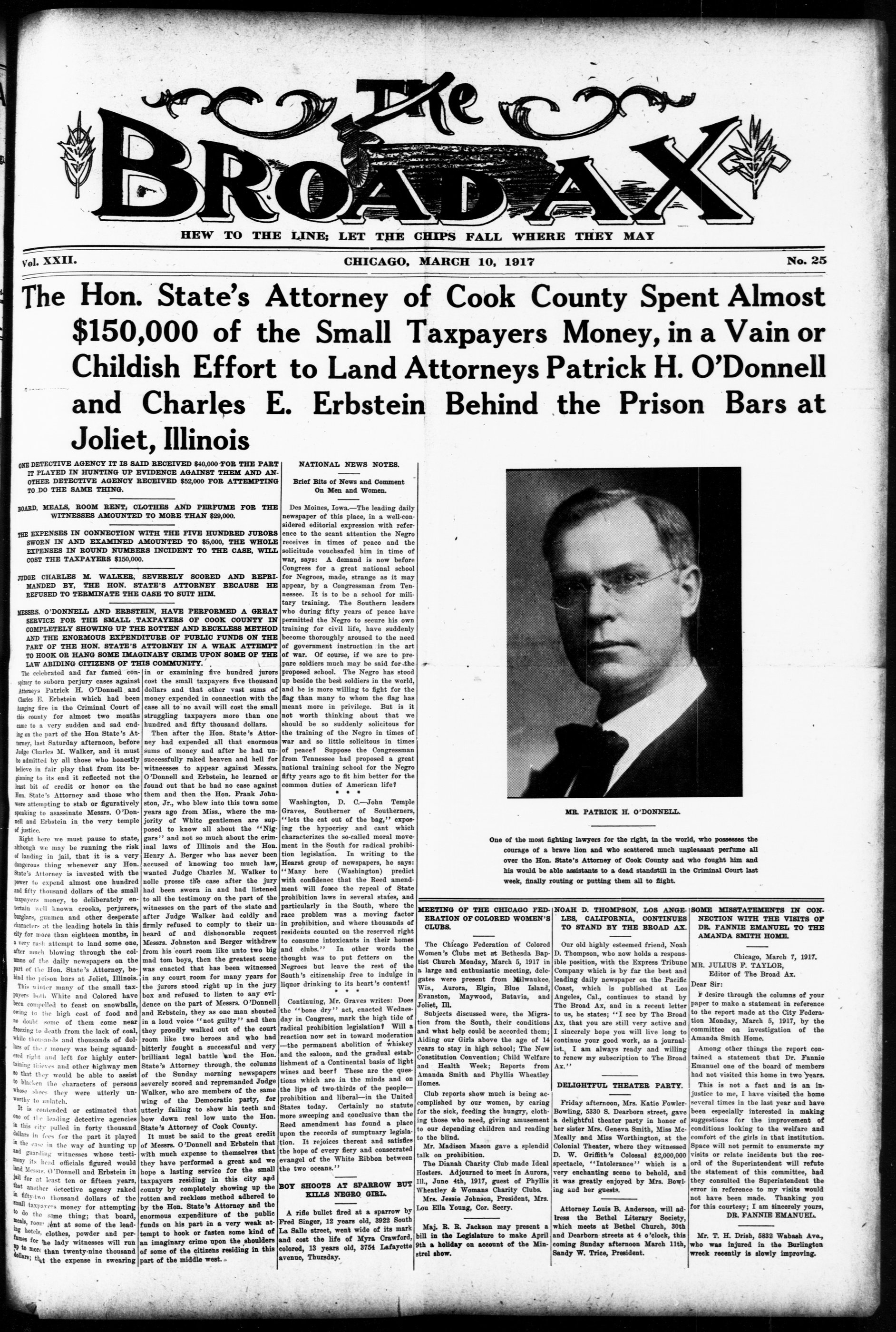
[Image of a man in a suit and bow tie].
One of the most fighting lawyers for the right, in the world, who possesses the courage of a brave lion and who scattered much unpleasant perfume all over the Hon. State's Attorney of Cook County and who fought him and his would be able assistants to a dead standstill in the Criminal Court last week, finally routing or putting them all to flight.
MEETING OF THE CHICAGO FEDERATION OF COLORED WOMEN'S CLURS.
The Chicago Federation of Colored Women's Clubs met at Bethesda Baptist Church Monday, March 5, 1917 in a large and enthusiastic meeting, delegates were present from Milwaukee Wis., Aurora, Elgin, Blue Island, Evanston, Maywood, Batavia, and Joliet, III.
Subjects discussed were, the Migration from the South, their conditions and what help could be accorded them; Aiding our Girls above the age of 14 years to stay in high school; The New Constitution Convention; Child Welfare and Health Week; Reports from Amanda Smith and Phyllis Wheatley Homes.
Club reports show much is being accomplished by our women, by caring for the sick, feeding the hungry, clothing those who need, giving amusement to our depending children and reading to the blind.
Mr. Madison Mason gave a splendid talk on prohibition.
The Dianah Charity Club made Ideal Hosters. Adjourned to meet in Aurora, Ill., June 4th, 1917, guest of Phyllis Wheatley & Womans Charity Clubs.
Mrs. Jessie Johnson, President, Mrs. Lou Ella Young, Cor. Secery.
Maj. R. R. Jackson may present a bill in the Legislature to make April 9th a holiday on account of the Minstrel show.
MR. PATRICK H. O'DONNELL.
ighting lawyers for the right, in the work brave lion and who scattered much un State's Attorney of Cook County and able assistants to a dead standstill in the routing or putting them all to flight.
NOAH D. THOMPSON, LOS ANGELES, CALIFORNIA, CONTINUES TO STAND BY THE BROAD AX.
Our old highly esteemed friend, Noah D. Thompson, who now holds a responsible position, with the Express Tribune Company which is by far the best and leading daily newspaper on the Pacific Coast, which is published at Los Angeles, Cal., continues to stand by The Broad Ax, and in a recent letter to us, he states; "I see by The Broad Ax, that you are still very active and I sincerely hope you will live long to continue your good work, as a journalist. I am always ready and willing to renew my subscription to The Broad Ax."
DELIGHTFUL THEATER PARTY.
Friday afternoon, Mrs. Katie Fowler-Bowling, 5330 S. Dearborn street, gave a delightful theater party in honor of her sister Mrs. Geneva Smith, Miss McMeally and Miss Worthington, at the Colonial Theater, where they witnessed D. W. Griffith's Colossal $2,000,000 spectacle, "Intolerance" which is a very enchanting scene to behold, and it was greatly enjoyed by Mrs. Bowling and her guests.
Attorney Louis B. Anderson, will address the Bethel Literary Society, which meets at Bethel Church, 30th and Dearborn streets at 4 o'clock, this coming Sunday afternoon March 11th, Sandy W. Trice, President.
No.25
SOME MISSTATEMENTS IN CONNECTION WITH THE VISITS OF DR. FANNIE EMANUEL TO THE AMANDA SMITH HOME.
Chicago, March 7, 1917.
MR. JULLIUS F. TAYLOR,
Britton of the Browns.
I desire through the columns of your paper to make a statement in reference to the report made at the City Federation Monday, March 5, 1917, by the committee on investigation of the Amanda Smith Home.
Among other things the report contained a statement that Dr. Fannie Emanuel one of the board of members had not visited this home in two years.
This is not a fact and is an injustice to me. I have visited the home several times in the last year and have been especially interested in making suggestions for the improvement of conditions looking to the welfare and comfort of the girls in that institution. Space will not permit to enumerate my visits or relate incidents but the record of the Superintendent will refute the statement of this committee, had they consulted the Superintendent the error in reference to my visits would not have been made. Thanking you for this courtesy; I am sincerely yours,
DR. FANNIE EMANUEL
Mr. T. H. Drish, 5832 Wabash Ave., who was injured in the Burlington wreck recently is slowly improving.
Dan M. Jackson
Geo. T. Kersey
David A. McGowan
Ahmed A. Rayner
The Eman
Undertakin
2959-61 South State St.
Reliable Service
Reasona
FREE CHAPEL
Complete line of Funeral Goods
Telephone Douglas 6568
THE SOLACE B
"THE MODERN SCHOOL"
TERREVOUS L
CIGARS—WHOLE
BOX TRADES
3556 South State Street
Reliable Service Courteous Treatment Reasonable Prices
Telephone Douglas 6568 Automatic 73-657
THE SOLACE BILLIARD ACADEMY
"THE MODERN SCHOOL" - CLEAN AND RELIABLE
TERREVOUS L. DOUGLAS, Prop.
CIGARS—WHOLESALE AND RETAIL
BOX TRADE A SPECIALTY
3556 South State Street Chicago
T. W. Chal
Real Estate
RENTING :: LO
5107 South
Ch
A Wonderful Aboriginal City.
Near Laguna, N. M., may be seen Acoma, the "sky city," claimed to be the most wonderful aboriginal city in the world. It stands on an isolated rock eminence 400 feet in height. The city embraces three rows of houses over a thousand feet in length, rising up in terraces four and five stories. One is amazed when he stops to consider that the material for these buildings were transported long distances and up the cliffs upon the heads and backs of these human burden bearers. Their graveyard consumed forty years in building by reason of the necessity of bringing earth from the plain below, and their church must have cost the labor of many generations, for its walls are sixty feet high and ten feet thick, and it has timbers forty feet long and fourteen inches square.—Exchange
In Longfellow's journal, in which he chronicled daily things that came under his observation, he notes that upon a certain occasion he attended a church where the minister took as his subject "Progress." He was very flattered when the latter quoted about half of the "Psalm of Life." After repeating the verses the minister said, "I could never read that poem without feeling the inspiration with which it was written." To this incident Longfellow adds: "But I had the conceit taken out of me on the evening of that day, when I happened to meet a lady at Prescott's and in our conversation she referred to the sermon in the morning and added, 'He quoted some beautiful verses, but nobody knew whence came the quotations.'"
Estimating the world's population as 1,600,000,000, the whole human race at present living could stand comfortably shoulder to shoulder in an area of 500 square miles. Taking the number of generations in the past 6,000 years as 200, the room taken up by them all on the above plan would be less than the area of the state of Colorado. To bury all the people on earth would need a graveyard little larger than that area.
A correspondent inquires whether it is proper to speak of a Hawaiian as a "Kanaka." The term is masculine. A "Kanaka" is a male Hawaiian. A "wahine" is an unmarried Hawaiian woman. A "wahinemare" is a married Hawaiian woman. These definitions are from the Hawaiian dictionary—Bellingham American Review.
Professor—Yes, sir, your daughter is pretty well grounded in French, but it will, of course, take some time and trouble for her to acquire fluency. Father—Well, you know, that's rather strange to me. I had an idea that the fluency would have come sort of natural to her—Exchange.
Papa—I'm surprised that you are at the foot of your class, Tommy. Why aren't you at the head sometimes, like little Willie Bigbee? Tommy—You see, papa, Willie's got an awful smart father, and I guess he takes after him.—London Telegraph.
"Why do you fire me? I work like sixty."
"If you were sixty that might be excusable. But you're only twenty-five."
—Louisville Courier-Journal.
Happy the man who learns the very wide chasm that lies between his wishes and his powers.—Goethe.
PAGE TWO
PH ONE DREXEL 3244
A Story of Longfellow
We, the People
What Is a Hawaiian?
Inherited, as It Were.
Explained the Matter
Made a Difference
Phones Calumet 6164 Automatic 71-629
uel Jackson ng Co., Inc.
Courteous Treatment
Available Prices
IN CONNECTION
Bands. Automobiles for hire
Automatic 73-657
WILLIARD ACADEMY
CLEAN AND RELIABLE
L, DOUGLAS, Prop.
SALE AND RETAIL
BE A SPECIALTY
bet Chicago
Champion & Co.
State Brokers
DANS :: INSURANCE
North State Street
Chicago
How many beautiful homes on which money has been spent lavishly to make them complete are marred by some defect in the landscape work! A few hours' motor trip through the suburbs of almost any city in the country will reveal many such cases. The most frequent jar the trained eye receives is from the poorly laid out walks and driveways in which badly arranged curves are used or walks made to curve around an oval grass plot placed in the center for no other reason than to make pedestrians take time to circle about that particular grass plot. Postmen, messenger boys and others take a short cut, and soon a path in the proper direction is worn across the sod. When a curve is used in a walk or driveway there should be a reason for it. If there is no other reason plant one; place a tree or two or shrubs in a position so the curve will seem necessary. People then will keep on the walk, and the plan will seem reasonable--New York Sun.
The simplest way of magnetizing a bar of steel is that known as "single touch." The bar to be magnetized is laid on the table, and the pole of a powerful magnet is rubbed from ten to twenty times along its length, always in the same direction. If the north pole of the magnet is employed the end of the bar first tucked will also become a north pole, while the opposite end, at which the magnet is lifted before returning, will be a south pole.
There are other and more complicated methods, known as "divided touch" and "double touch," in which two and even four magnets are employed.
A steel bar can also be magnetized by placing it within a coll of insulated wire, through which a galvanic current is circulating. The magnetism induced in this way, however, is weak compared with that which can be procured if the same strength of current is employed through the intervention of an electromagnet.
Many William Shakespeare
There have been many William Shakespearees in the past. Among the burials in the registers of St. Clement Danes, in the Strand, there is the entry, "Jane Shackpeer, daughter of Willm, 8 Aug., 1609." Warwickshire records show, among other things, that a William Shakespeare "paid 8s. to the Lay Subsidy, Walton super Olde;" another W. S. priced the goods of "Robert Shakespeare of Wroxall" on March 19, 1563; another, a shoemaker of Coventry, made his will March 18, 1605; still another William Shakespeare, "gentleman," had "his daughter Susanna" (singularly enough) baptized on March 14, 1506, and yet again another W. S., a shoemaker of Warwick, fell into the Avon and was drowned. These are a mere fraction of the full list.—London Chronicle.
Falling Up Out of a Balloon.
If a man falls out of a rising aeroplane or balloon he will not go toward the earth, but will continue rising into the air for an appreciable time. If the air machine were stopped in its ascent at the time it could catch the man as he came down. If the airship were ascending at the rate of thirty-two feet a second the man would rise sixteen feet before beginning to fall toward the earth. Thus, by reducing the speed of its ascent, the vessel might keep by the side of the man and rescue him. The reason why the man rises is the same as the reason for a bullet's rising when shot from a gun into the air—both the man and the bullet are given a velocity upward, and it takes some time for gravity to negative that velocity.
---
OPEN DAY AND NIGHT
RES. PHONE DREXEL 2082
Making a Magnet.
THE BROAD AX, CHICAGO, MARCH -10, 1917.
What Are You Worth?
Have you any idea? Did you ever capitalize your wages and figure it out? This is the way to ascertain how much your labor is really worth. For instance, a man who has saved $20,000 and invested it at 5 per cent receives an annual income of $1,000 a year, or about $20 a week. The clerk in the office or the workman in the factory who gets $20 a week therefore receives the income at 5 per cent on an investment of $20,000. He is a $20,000 man—that is, he is getting as much week by week as the man with $20,000 who depends solely upon the income from his investments and who does not work for a living. The man who earns $40 a week has about the same income as the investor with $40,000 put out at interest at 5 per cent.
So labor is capital. It has a market value. It can be called a commodity because it can be sold by its owner the same as any other possession he may have. John A. Sleicher in Leslie's.
Shotguns In War.
That shotguns should be largely utilized in modern warfare is the contention of a number of military experts. It is pointed out that such guns would be particularly useful to sentries at night time, as an intruder might more easily be crippled and captured by a spreading charge of heavy shot than by a single bullet. Moreover, a person moving quickly might often be missed by a shot from a rifle, whereas a snapshot from a shotgun in semidarkness could hardly fall to find its object.
In the trenches shotguns could be used with success. A shotgun loaded with about forty-eight grains of powder and one and a half ounces of big shot, with about twenty-five pellets, would be of much more value than the rifle, as during a night attack, either for attack or defense in semidarkness, a single charge would hardly fall to inflict serious wounds on one or more of the enemy.—Exchange.
The Swiss Admiral
"As much business as a Swiss admiral" is a term sometimes used satirically. But the little inland nation actually had an admiral once. He was an Englishman, too, a Colonel Williams, who joined the Swiss colors in 1790. This Colonel Williams got together a small fleet on Lake Zurich and was ordered to oppose the French army, which was preparing to attack the Austrians and Russians massed near by. The French attacked their allied foes and routed them. Admiral Williams calmly watched the battle that was in progress on land. Then, enraged at his own inaction, he discharged his crews, scuttled his vessels and went back to England. Switzerland now has one armored boat on Lake Lucerne, but its commander is only a captain.—Kansas City Star.
A Father Vaughan Story.
Father Bernard Vaughan, the famous English Jesuit preacher, says what he means and means what he says and is never afraid of directing his criticisms even against the most powerful sections of society, especially the idle rich.
An amusing reference was once made to the fiery methods of denunciation he employs when in the pulpit. He had been preaching in Rome and had, as usual, dealt out plain truths about everybody with his accustomed force. One of the cardinals remarked that he preached like an Italian. "Yes," said another dignitary, "but he is an Italian. He was born on Vesuvius, and we only sent him to England to cool."—London Globe.
Salt and Toothbrushes
Our dentist tells us a very interesting thing. Ordinary salt is one of the best methods for sterilizing toothbrushes that are known. But not only because it sterilizes it is so excellent, but because it has the effect of softening the bristles and making them expand in a way. One of the troubles so frequently met with is that the bristles come out and are swallowed, causing appendicitis. The salt causes the bristles to swell and so remain in the brush. This may be but another of the several million theories. It is important, however, that bristles do cause appendicitis—New York Globe.
Substitute For Tobacco
Throughout the tropical orient the natives employ a substitute for tobacco consisting of a slice of areca palm nut, wrapped in betel leaf, flavored with a fine lime made of native seashells and colored with carmine. The habit is universal, especially with the women, and sellers of "betel nut" may be seen on many of the street corners in Saigon and other cities of Indo-China.
Handsome Serenity
"George Washington was never guilty of deception."
"Maybe not. I don't believe, in fact, that he ever looked like his pictures on our postage stamps. But, of course, he wasn't responsible for them."—Washington Star.
Logical Conclusion
"Electric wires must be quick tempered."
"Why?"
"Because it seems so dangerous to cross them."-Baltimore American.
No Hangings.
Him—How did you like the stage hangings in that Shakespeare show? He—There weren't no hangings, y'boob! He killed 'em with a sword—Cornell Widow.
Men who are low and are falling do not revolt. It is men who, although they may be low, are rising who revolt—W. G. Sumner.
YOU HAVE READ MUCH! THOUGHT SOME BUT NOW IS YOUR TIME TO ACT
Your opportunity to be a part owner----to share in profits of "THE BIRTH OF A RACE"
is passing. The shares of Capital Stock have been turned over to a strong firm of brokers. The sales are big----in Chicago----all over the country. The shares are going very fast. Soon they will be entirely gone, and your chance to make a lot of money gone also----unless you get busy. Not Next Month But TO-DAY or Next Week
This Master Photoplay is of interest to you. It will help you and your race, and make money for you at the same time.
President, EDWIN L. BARKER, a man who has produced real motion pictures. Secretary, JOHN C. WILLIAMS, for 6 years Attorney for Sanitary Dist. of Chicago. Treasurer, JOHN GULLIKSEN, Assistant Cashier of the Union Bank of Chicago. DEPOSITORY FOR FUNDS, Union Bank of Chicago.
CLIP, fill out and mail this coupon to-day, and circular telling all about "THE BIRTH OF A RACE," will be sent you at once. There is a Monthly Payment Plan which makes it very easy to own a few shares of stock.
We are continually reading in the newspapers that various battleships have been completed, launched and for how long they have been commissioned. There are probably few people, however, who know how long a battleship lasts. The average life of a modern battleship is about fifteen years. In the old days a battleship was on active service nearly the whole time of its commission, which was about a hundred years. The Victory was forty years old when she fought at Trafalgar, and the Royal William, which was built in 1670, was not "scrapped" until 1813.—London Mail.
A squab grows enormously the first twelve hours and still more rapidly after the third day. Squabs are at first sparsely covered with long filaments of down, the root of each filament indicating the point from which each future feather is to start. The down for awhile still hangs on the tips of some of the feathers during their growth and is thought by some to be finally absorbed into the shaft of the growing feather
"Oh, come! Gee borrowing trouble."
"Borrowing! Gee whiz, man, trouble isn't like money! When I borrow money I can forget about it right away."—Boston Transcript.
A clean tooth never decays.
The best way to clean the teeth is to place the bristles of the brush firmly against the teeth and with a rotary or scrubbing motion go up and down the surface of the upper and lower teeth both inside and out and up on the gums. Go also behind the teeth. After seeing that every bit of the surface of the teeth has been cleaned in this way rinse the mouth thoroughly, forcing the water between the teeth several times to loosen any food particles. Do this more than once and always spit it out.
To keep the teeth as clean as they should be kept in order to preserve them and prevent decay it is necessary to wash them after each meal so as to remove all food particles. They should also be washed the first thing in the morning and the last thing at night. It is well to have more than one brush on hand at a time, so that it will never be necessary to use a wet, limp brush.
```markdown
```
1
Using the Scrub Palmetto.
Once a prolific and troublesome waste product throughout Florida, the scrub palmetto is now being developed into an asset of great possibilities. Not only has it been discovered that paper of good quality can be made from it, but the manufacture of carpets, mattings, twines, rope and burlap from the plant is already an industry of high standing in the state. Only the green leaf, or fan, is used. Claim is made that the palmetto leaves when shredded and spun are very much tougher than the grass now used for mattings. The green leaves are fed just as they are cut into the shredding and spinning machines, and in three minutes they come out in twine. This avoids the discolorations and losses occasioned in drying, storing and handling grasses commonly used for matting. Palmetto can be cut every day in the year and immediately made into twine. The skins of twine when hung up dry rapidly and uniformly. The twine is used as soon afterward as necessary.—Argonaut.
Creed of the Busy Man
I believe in the stuff I am handing out, in the firm I am working for and in my ability to get results. I believe that honest stuff can be passed out to honest men by honest methods. I believe in working, not weeping; in boosting, not knocking, and in the pleasure of my job. I believe a man gets what he goes after, that one deed done today is worth two deeds tomorrow, and that no man is down and out until he has lost faith in himself. I believe in today and the work I am doing, in tomorrow and the work I hope to do and in the sure reward which the future holds.
I believe in courtesy, in kindness, in generosity, in good cheer, in friendship and in honest competition. I believe there is something doing, somewhere, for every man ready to do it. I believe I'm ready—right now!-Elbert Hubbard.
The Sadness of a Wedding
There is something sad about a wedding. The young groom is leaving a home in which he always has had his way and is going into one in which he never will have his way. Although his parents do not go through the formality of giving him away at the altar, they know well enough that in a few minutes he will be a son-in-law to another woman, while to them he is nothing but a son. There he comes, with another man holding to his arm. It looks as if he might have made an attempt to escape and that the strong best man captured him and brought him back. He is as happy as he is nervous and so trustful that he has no fear for the future—Claude Callan in Fort Worth Star-Telegram.
Why Not?
Clerk—Now, see here, little girl, I can't spend the whole day showing you penny toys. Do you want the earth with a little red fence around it for 1 cent?
Little Girl—Let me see it—Life
Life of a Battleship.
Squaba.
The Wrong Word
His Grouchy Opinion
PRACTICAL HEALTH HINT.
Cleaning the Teeth.
FREE
STYLE BOOK
--- HAIR---
To Colored Women
We are the largest
manufacturers of
Colored Woman
Hair. Our latest
book showing new
styles in hair
fashioning. Every colored woman
should have one. We sell thou-
sand and six-colored
toilet articles. Sifaction
guaranteed or money back.
We sell thou-
sand and six-colored
solid Brass STRAIGHT-
ENING combs, with extra heavy back, fully
guaranteed. With each comb we give lamp
money FREE. Send money order or stamps. MONEY
BACK IF NOT SATISFACTORY. See postpaid.
POSTPAID 89c:
Hair nets, brushes, combs and toilet articles' prices. Send two
Agents' Wanted. Add as follows:
HUMANIA HAIR COMPANY.
181-187 Park Row, New York City.
Address Dept. 84
Grapes will grow almost anywhere and are sure to bear. Grapes can be trained on trellises close to fences or to outbuildings. Spring is the best time to plant, using either one or two year old vines. Frequently cultivation during summer will improve the fruit. Wood ashes make a good fertilizer for grapes, and half a bushel to the vine will not be too much. No pruning will be required the first season, but the second season cut back the strongest canes to three or four buds and remove all others.
Proper Physical Education:
Proper Physical Education
The purpose of physical education is of course, not merely to build up the bodies of boys today, but to put into the lives of boys that thing, whatever it is, that will make the boy stay strong and ablebodied when he reaches manhood. Such men—lovers of fresh air of hiking in the wild, of sleeping out under the sky—men who can both enjoy and endure, are the men who will make up a strong nation and not a nation of weaklings—Scouting.
Cape Horn's Lighthouse
Probably the most desolate and dreary spot in the world inhabited by white men is the lighthouse that is maintained by the Argentine government at Cape Horn. This is claimed to be the southernmost lighthouse in the world.
One at a Time.
"Does your husband worry about the grocery bill?"
"No; he says there's no sense in both himself and the grocer worrying over the same bills."—Exchange.
Queer.
"Your wife gave us a splendid lecture on cooking last evening. Why weren't you there?"
"I was home with a terrible attack of dyspepsia."
Health lies in labor, and there is no earthly royal road to it, but through toll.— Vendell Phillips.
COUPLE WED SEVENTY
YEARS WITHOUT STRIFE
Married Pair Celebrate Their Anniversary of Life In Happiness.
Glasgow, Mo.-J. P. Bentley, ninety years old, and his wife, Mrs. Susan Fristoe Bentley, eighty-eight years of age, were married seventy years ago and never had a fuss. They recently celebrated their anniversary. They live near Forest Green.
Mr. Bentley, who has lived all his life on his farm and still runs the 600 acre tract himself, is rated one of the wealthiest men in Charlton county, having amassed a fortune of between $55,000 and $100,000.
Both he and his wife were born on adjoining farms. When they were wed they agreed that if either became an army the other should take cognizance of it and preserve an unruffled demeanor. This, they say, is the secret of smooth relations.
of nine children, five of whom are living, were born to the union. The five are T. M. Bentley, Sallsbury, Mo.; S. J. Bentley, Forest Green; William Bentley and Mrs. William La Motte, Roanoke, Mo., and Mrs. Lloyd Herring, Forest Green. The Bentley farm descended to its present owner from his father, who obtained it from the government by grant in 1815.
OUTDOOR SHOWMEN GO
ON RECORD FOR UPLIFT
Will Endeavor to Check Unjust Attacks on Their Business. Sunday Sends Message.
New York.-In these days of uplift movements the statement of the newly organized Association of the Outdoor Showman of the World that its chief purpose in life is to uplift and purify the outdoor show business has attracted attention. The association is a unique aggregation of outdoor show interests, embracing every variety of outdoor amusement enterprises, from the big exposition and circus to the fair, carnival and concession men, and its officers are carrying on a wide campaign to secure membership in all parts of the world.
One of the outdoor showmen's announcements, made at the organization meeting and banquet at the Hotel Astor, was that of President Frank P. Spellman, who in explaining the scope of the organization said that Billy Sunday had been invited to become a member and to attend the banquet, as it was recognized that "he is the greatest showman of us all." Billy Sunday in acknowledging the letter of introduction said in characteristic fashion, "You fellows could go some for God if you would."
"We have more practical objects, of course, than the ethical uplift of the outdoor show business," said President Spellman. "We propose to exert our influence to make certain that we get a square deal in the various state legislatures. We will have legal representatives in every city, and we will correct other abuses that we believe artist. We will endeavor to check unjust attacks made on the outdoor show business and to secure fair and equitable treatment. We believe the public will be with us in this campaign."
LACE GROWS ON TREES
Panama Product May Take Place of Mosquito Netting.
New Orleans, La.-Lace grows on trees on the isthmus of Panama, and the trees grow wild in the swamps. Captain L. W. Richards of the steamship Norwalk brought a fine sample, not merely as a curiosity, but to induce tests as to the probable utility of the plant or the tree in this section.
When the bark of the limbs is stripped there are rolls of filmy substance of a texture very much like mosquito netting. The size of these layers increases with the size of the tree, the largest being about a foot in diameter. The fabric is strong and can be sewn without tearing.
The natives use the stuff in making garments. Captain Richards believes that by cultivation the trees may become very valuable, and if the lace layers cannot be enlarged some process may be perfected by which they can be joined into a fabric which will make the finest mosquito bar and may even serve for summer raiment.
POTATO PROFIT 108 PER CENT
That's What South Jersey Farmers Earned On Their Stock.
Woodstown, N. J.—Farmers are prosperous, at least down in southern New Jersey, where a large percentage of New York city's potatoes are grown. The South Jersey Farmers' exchange declined a 100 per cent stock dividend and an $ 5 per cent cash dividend. The exchange is a co-operative selling organization, with 750 farmers as members. At its sixteen stations last year 907 carloads of white potatoes were handled at an average price of 90 cents a bushel. It did a total business in 1916 of $ 1,097,347.70, with a net profit of $ 84,277.70. This was the biggest year since its organization in 1900
Triplets Follow Twins
Hervé Haute, Ind.—Mrs. Joseph Marcki, wife of a miner east of the city, gave birth to triplets, and all are doing well. The mother is thirty-six years old and the bitand forty-seven. A year ago the father gave birth to twins, who still live. The triplets make ten living children.
St. Louis as "Pain Court"
Not many people of today would recognize the metropolis of Missouri by the name "Pain Court," yet that name was quite generally applied to St. Louis in its early days. Laclede, who founded it in 1764, loyalty called it after his French sovereign, Louis XV. But the people of the other villages up and down the Mississippi and along the Ohio and the Wabash derisively nicknamed it Pain Court. It appears that the French settlers of St. Louis neglected agriculture and devoted nearly all their time to hunting and trapping and trading with the Indians. On this account and because a considerable garrison was maintained at the fort provisions were scarcer and higher priced than they were in the other villages. The people of the latter, who frequently went there to trade, took note of this, especially the high price and scarcity of bread, and dubbed the place Pain Court, which in French signifies short or scant bread. — Exchange.
Drier Than the Camel.
The "wild cow" of Arabia, in reality an antelope, the Beatrix oryx, is said never to drink, which is probably correct, for unless these animals can descend the wells they can find no drinking water for ten months in the year. There is no surface water, and rain falls but precariously during the winter. Only once during my journey did I find a pool of rain water, caught in a hollow rock, and even this I should have passed by without knowing of its existence had not my camels sniffed it from a distance and obstinately refused to be turned from going in that direction. These antelopes, however, are provided by nature with a curious food supply, especially designed as a thirst quencher. This is a parasite which grows on the roots of the desert bushes and forms a long spandix full of water and juice. The antelope dig deep holes in the sand in order to get at these.—Wide World Magazine.
John Bull.
For many generations England has been nicknamed "John Bull." "John Bull" means beefy, brawny and obstinate. It is a popular personification of the English people. He is represented as a bluff, corpulent, irascible old fellow, clad in leather breeches and top boots and carrying a stout oaken cudgel. The nickname is derived from Dr. Arbuthnot's satire entitled "The History of John Bull," a political skit on the subject of the Spanish succession, first published in 1712 and afterward reprinted complete in Pope's "Miscellany" in 1728. Arbuthnot thus describes John Bull: "In the main he was an honest, plain dealing fellow, choleric, bold and of very inconstant temper. Very apt to quarrel with his best friends, especially if they pretended to govern him. If you flattered him you might lead him as a child."—Kansas City Star.
Chimneys.
The chimney is something that is relatively new in architecture. Many of the old castles and other buildings of Europe which were constructed before the fifteenth century have no chimneys. In some of them a fire leads from the back and above the fireplace through the wall to the outer air. It was somewhere about the thirteenth century that in certain buildings the masons began to run the fire to the top of the building, but the chimneys of that period had openings in the side, the top being roofed over. It was about the fifteenth century that masons began to build chimneys that extended above the roof of the house and to leave the top of the chimney uncovered.
Granulated Butter
The Chinese preserve their eggs indefinitely by drying them, the yolks and whites being first separated and then each reduced to powder by evaporation. In India butter is treated in much the same way, so that it never becomes stale and may be kept fresh for a hundred years. The butter is boiled till all the water and curds are got rid of and nothing remains but clear oil. When the oil cools into a solid it is granulated and in this form will remain fresh indefinitely. This is what they call ghee, and ghee is nothing more or less than dried butter.
Couldn't Fool Him Twice.
The manager of Kidem's great managerle had induced all the crowd to become patrons except one individual, who stood gazing up at him with mouth agape.
"Right in this way, sir, if you wish to see some deer stalking" shouted the animal king.
"No fear, lad," came the reply. "I was in yesterday, and none of 'em sald a bloomin' word."—London Mall.
Just Had to Grow.
"Why are American men taller than most races?"
"We had to grow to reach those street car straps."—Loulsville Courier-Journal.
Nothing Particular:
Mrs. Benham—What sort of looking woman is she? Benham—Oh, I don't know. She has one of those standard faces, with mouth, nose, eyes, etc.—Chicago Herald.
Real Love.
The Girl—Do you really love me, or do you only think so? The Boy—Oh, I really love you! I haven't thought a deuced thing about it!—Exchange.
Deliberate with caution, but act with decision; yield with graciousness or oppose with firmness.
THE BROAD AX, CHICAGO, MARCH -10, 1917
The difference is apparent early: A boy has as much fun in stoning a cat as a girl has in hunting for violets. A boy's curiosity is directed to the ice-box; a girl would like to see what is in the top bureau drawer. A girl can give the impression when away from home that her parents are wealthy; a boy cannot. Every boy is old enough to be welcome to sit in the neighbor girl's parlor many years before his sister thinks he is old enough-to sit in the parlor at home. A girl is never so young that she will reveal to guests at a party that the spoons are borrowed; a boy child never grows so old that he fails to. Give the boy a dollar and he will eat it; give his sister one and she will wear it. A brother and sister may have hair of the same shade, but the boy's is called red and the girl's auburn.
When brothers fight it is over the larger share of pie; when sisters quarrel one has worn something belonging to the other without asking permission.—Youth's Companion.
The Famous Moslem Kasba:
It is a curious fact that the kaaba, which is one of the great attractions to the pilgrims who go to Mecca and Medina, antedates Mohammed as an institution and consequently is of pagan origin. It is a small building, in one wall of which is set the famous black stone, probably a meteorite, which the pilgrims all seek to kiss. The structure has actually been rebuilt more than once since Mohammed, but its old pagan form has been preserved. It was originally a heathen temple, of such standing among the Arabs that Mohammed felt compelled to adopt it into his new religion and even to permit the continuance of ancient customs concerning it. He did destroy the idols it contained, but he made a great concession to the old prejudices of his converts by making the observance of an old pagan feast of Mecca one of the five great precepts of the new faith.
Lofty Himalaya.
Himalaya, in south central Asia, is the most elevated and stupendous mountain system on the globe. It is not, as sometimes represented, a single chain, but a system, consisting of several parallel and converging ranges, with a vast number of rugged, snowy peaks, separated by great elevated valleys and plateaus. On the north the system descends to the elevated plateau of Tibet, on the south to the depression drained by the Ganges and the Indus. The system starts with the Karakoram, in the Pamirs, whence it trends southeast and east, sweeping in a broad curve, convex, southward. The mass of the Himalaya proper extends from the great bend of the Indus in the west to the great bend of the Brahmaputra in the east, a distance of nearly 1,500 miles.
First Horse Omnibus.
The first horse omnibus was seen in the neighborhood of Nantes in 1826 and ran to facilitate access to a bathing establishment which a M. Baudry had set up in the outskirts of that town.
"The name of these vehicles," M. Baudry said, "shall be omnibus—that is to say, 'open to all.'" The venture was so successful that a limited company was formed to inaugurate a similar enterprise in Paris. The Parisian experiment was at first a failure, but after its originator had manifested his disappointment by drowning himself in the Canal St. Martin others reaped a rich harvest from his ideas.
No Immediate Benefits.
Things looked black for the dramatist. For the fourth time in one season a play had been withdrawn after a week's run.
"Cheer up, old man," said a consoling friend. "Perhaps posterity will recognize the genius displayed in your plays."
"Maybe," said the dramatist bitterly, "but the difficulty is that so far as I am concerned posterity is on the free list."—New York Times.
Tallevrand.
Talleyrand's conservatism was summed up by a witty compatriot, Paul de Courrier, who on one occasion declared that if Talleyrand had been present at the creation he would have exclaimed: "Good gracious! Chaos will be destroyed!"
When It's True.
"There's no sentiment in business," he said coldly.
"Not when you want to give somebody a little the worst of it," the other fellow replied.—Detroit Free Press.
PRACTICAL HEALTH HINT.
Use of Mineral Oil
Dr. Le Tanneur contributes to the Paris Medical some practical points in the use of mineral oil in constipation. The oil, he says, is in no way digested or even modified by the juices of the stomach and intestines. It acts as a lubricant and nothing else, though it tends to heal abrasions of the intestinal wall caused by rough particles of food.
The New York Medical Journal says mineral oil should be taken either before breakfast or after dinner, two tablespoonfuls being a dose. Its use should be continued every day for at least a fortnight, when the bowels will continue to work naturally without it, for the mineral oil is in no sense a cathartic, but it will cure constipation.
Arkansas the Mighty.
Art of Politeness
All truly artistic effort is a labor of love, and love never counts the cost. Art has no price and makes none.
A perfect art of politeness ever involves in one respect or another acts of self abnegation.
There is the famous example of Lord Stair and Louis XIV. when his lordship, being bidden by the king to precede him into one of the royal carriages, immediately complied.
The politeness was equal on both sides. The French sovereign gave proof of so magnanimous a monarch by abandoning his prerogative of precedence in his own dominions to the Scotch viscount.
The English ambassador returned the compliment by yielding immediate obedience to the behest of a king who was not his master. Neither sacrifice was outdone by the other.
Early Railroading.
Some seventy-five years ago when two trains of the Western Atlantic railway met on the road's single track line violent discussions ensued between the conductors as to which train should back up and take the sidetrack, and the engineers frequently joined in the dispute. Rule 14, issued March 1, 1852, says: "As a general rule when trains meet between stations the train nearest the turnout will run back. Any dispute as to which train is to retire is to be determined at once by the conductors without interference on the part of the engineman. This rule is required to be varied in favor of the heaviest loaded engine or worst grades if they meet near the center." Conductors were admonished never to leave either terminal point without the mail or at least first sending to the postoffice for it.
Frightful Friends
The friend who welcomes you by creeping up behind and knocking off your hat.
The friend who invites you to the theater and buys only one ticket.
The friend who introduces you to Miss Wallflower and then disappears.
The friend you ask to dinner on Saturday and who stays over the week end.
The friend who drops in to talk over old times and incidentally borrows all your spare cash.
The friend who insists that you visit him and continually quarrels with his wife.
The friend who telephones you in the middle of the night that he's been arrested.-Life.
Seen on an Ostrich Farm.
It is no uncommon thing to see a male ostrich strutting about followed by three or four distinct broods, all of different sizes. When the incubating process is completed the cock bird leads his young ones off and, if he meets another proud papa, engages in a terrific combat with him. The vanquished bird retires without a single chick, while the other, surrounded by the two broods, walks away triumphantly.
Just a Precaution:
"So you are attending cooking school?" said the friend. "Are you going to do your own work after you are married?" "No; I want to be able to teach my husband how to prepare the meals in an emergency."
Too Much.
Doctor—Have you tried counting up to 100? Insomnia Patient—Yes, but at forty I remember that's the amount of your bill, and at eighty my wife's new gown gets my goat!-Exchange
More Than Serious
Eulalia (elderly helress) - Do you think the baron regards me seriously?
Rosa—Seriously? Why, my dear, every time I mention you he looks positively sad—Flegende Blatter.
Tightwad.
Miss B.—What a frightful night for a dance! But, of course, you've a taxi? Frugal Suior—Well, not exactly, but I've brought you rubbers.—Life.
Natural Preference
"Do you believe much in wives to order?"
"I'd rather have one ready maid."—Baltimore American.
Good Night.
He—Let me stay an hour more, dear;
just an hour by the clock. She—But.
Billie, the clock doesn't need company.
—Penn Froth.
The truest wisdom is a resolute determination.—Napoleon 1.
GET TOGETHER FOR PERMANENT PROSPERITY.
Every man and woman engaged in American factories, mills and mines, whether they know English or speak it, are naturalized or intend to become citizens, have a direct interest in maintaining industrial prosperity. When times are good, all workers should not only be thrifty in habit and lay up a little something for possible rainy days, but they should do all they can to keep the good times with us. Simply because your language is different from that of the foreman, overseer, superintendent, manager or owner of the plant in which you earn a living, is no excuse for misunderstanding your own interest in prosperity by hating your partner in your own industry or listening to and following the gospel of dissension and violence which selfish agitators so often preach.
Do not blindly follow the man who tells you how hard your lot is. Often he is doing so untruthfully and for the purpose of getting you to contribute membership money for his own support in idleness. Agitators get rich by preying on the men in American industry, whom they urge into unlawful or harmful acts by misrepresenting conditions or holding out foolish and false promises of better things if they follow their orders. You know conditions yourself, and you know or ought to know that the man or men whom the agitator who pictures your employer as on inhuman driving machine is actually a partner with you, interested in having the plant or industry successful.
The more successful your plant or industry becomes, the more room for you to grow with it there will be. It should be your feeling, then, that you will not do as little as you may find it convenient to do, but to do just as much as you possibly can do, and then reasonably expect to share in the rewards that always come to the efficient worker.
Do not be a clock watcher in the factory. Those who wait for hours to strike or whistles to blow and "soldier" at the bench, machine or in the office, never get ahead in the ranks of industry. They never get any more pay because they are not worth any more, and often are worth less than they get. Remember the old adage that a man who never does any more or as much as he gets paid for, never gets paid for any more than he does.—Industrial Conservation, N. Y.
PUTTING BUSINESS RIGHT WITH THE PUBLIC
A few years ago some big industrial organizations and certain railroads employed business tactics which, according to the popular idea, would make the financial adventures of Pizarro, Morgan or Captain Kidd look as amateurish as the verbal exploits of Bobby Make-Belleve. All are more or less acquainted with the details. We will concede that there were some glaring abuses, but the public when it came to apply a remedy ignored the fact that these were peculiar to comparatively few institutions and instead of tackling the trouble where it lay furiously assailed everything classifiable as business—the trust magnate, the independent manufacturer ready and anxious to obey the law, the small retailer, a law abiding and useful citizen—the innocent and the guilty suffering alike. Seemingly the law was invoked not to regulate, but to persecute.
There could be but one result. Business was demoralized, and the whole country has felt the evil effects. Now the public is beginning to realize its error and in a rather grudging way is making some concessions.
Business is being permitted to speak for itself, and a movement has been instituted by the leading business men of the country under the title of the National Industrial Conservation Movement for the purpose of repairing the damage that has been done. Nothing revolutionary is contemplated. The plan is simply to educate the public by taking it into the business man's confidence. Meetings will be held in various trade and industrial centers. All classes of citizens will be invited. The purpose of these meetings is to give the public a new and correct viewpoint as to the effects of drastic legislation and restriction of business on the prosperity of the country. Every effort will be made to give the public a clear view of the problems and difficulties which beset business.
Special favors are not sought through these meetings, only fair play. It is believed that once the citizen grasps the situation his whole attitude toward business will change and that he will readily co-operate toward bringing about better conditions. Commercial and other civic organizations and the local press are already showing great interest in this movement, and it is reasonable to believe that much good will come from it. Industrial Conservation, N. Y.
Common Capitalists.
Every man or woman who possesses a dollar or owns a set of tools is a capitalist. People generally make the mistake of thinking that the only form of capital in existence is the national currency—the dollar, franc, ruble, mark, lire or pound sterling. Yet everybody knows that many a successful business man's only original capital was brains, knowledge, ability, determination or ingenuity. It would be well for more people to recognize this trulism before abetting, either by action or attitude, ceaseless efforts on the part of some political or other self seekers, to hobble business men and industrial development. Such is the spirit of industrial patriotism which is needed in America.—Industrial Conservation, New York.
PAGE THREE
In Northern France.
It is strange and terrible to visit Paris—and no one can be happy—but to one who has loved France it is far worse to visit the lovely northern country. There is here a sense of emptiness, as if terror still hushed the normal cheerful noises of mankind. The people of these regions have lost everything. Their houses are burned; their animals, even the rabbits, are gone; their farm implements are shapeless pieces of grotesquely melted iron. They live in temporary, patched shelters and in the houses built by the Society of Friends or mass themselves in some nearby village that escaped destruction. After a time in this silent country one gets the sense that destruction is normal, and tears start to one's eyes at the sight of an undestroyed French village smiling in the sun. So changed are all values that I could feel nothing strange in the words of the woman who told me: "Fortunately my husband is a hunchback. He can't go to the war."—Mary Heaton Vorse in Century.
Abused Superlatives.
It is hard to make people understand that the adjective almost invariably weakens the noun and that the word "very," for instance, does not strengthen a statement, but qualifies it. But the use of the superlative is even more abused. We talk of the "unimpeachable" honesty of somebody or other, knowing perfectly well that anybody's honesty may be impeached. What seems to be required is a readjustment of our habits of thought and better teaching of the value of words and even of the usefulness of grammar. A superlative necessarily involves an axiom. It commits you, like saying that the sum of the angles of any triangle is equal to two right angles. Your dilemma arises when you try to prove it. "Impregnability" and "invulnerability" and all other superlatives in general use are posing as axioms when they are mostly fallacies.—Wall Street Journal.
Taking Him Down
A lawyer with a liking for billiards had occasion recently to visit a small town in the west of Scotland. While there, seeking to pass the time, he found a new and excellent billiard table. Upon inquiring if there was anybody about who could play the landlord referred him to one of the natives. They played several games, but the result was against the lawyer. Try as he might, the countryman won every game.
"Mr. —," the lawyer remarked, "I've quite a reputation at home. They consider me a good billiard player, but I'm not in your class. May I inquire how long you have played?"
"Oh, for awhile back," replied the native. "But, I say, I dinnan want to hurt yer feelin's, but you're the first fellow I ever beat!"—London Tit-Bits.
Victor Hugo.
Victor Hugo was born at Besancon, France, Feb. 26, 1802; died May 22, 1885. He began his literary work at fourteen, and by 1827 his reputation was continental. In 1852, on account of his democratic sympathies, he was an exile in the island of Jersey, but after 1870 he returned to France. Forced into politics, he soon became disgusted with its insincerities and resigned his seat in the assembly to which he had been elected. In 1876 he was made a senator, but never accomplished much on account of his uncompromising hostility to every form of official trickery.
British Isles.
Great Britain is an island in which are located the countries of England, Scotland and Wales. Ireland is an island by itself. These two large islands together, with the numerous small islands adjacent, constitute the British isles.
Lobsters' Shells.
When a lobster is about to shed its shell the latter splits down the back and drops off in two equal parts. Then the tail slips out of the shell like a finger out of a glove.
```markdown
```
PRACTICAL HEALTH HINT.
Winning Long Life.
A recent investigation made to find out what class of men live the longest revealed the fact that clergymen live longer than other men. Monell Sayre, who made the investigation, attributes the longevity of clergymen to their simple life and says that the extra years which the clergy accumulate are the results of clean personal lives—lives of sacrifice and abstinence. Moderation is now considered the salvation of this life. A splendid rule for attaining longevity is summed up by the United States public health service in the following curt statements:
"Other things being equal, it is the man who leads the well balanced life who lasts the longest, whose work to the end is uniformly the best; he who neither overworks nor overplays, neither overeats, overdrinks nor oversleeps; he who maintains a standard of simple, healthy diet in moderation; who offsets mental work with physical recreation; who is as honest with his own body as he is with his own business. When success comes to such a one his physical and mental condition is such that he can enjoy in peace of mind and contentment of body the fruits of his labors."
PAGE FOUR
THINK THIS OVER
Mr. Citizen:—Just a word with you today, if you are not too busy? Did you know that the Health Department physicians during 1916 made 191,225 physical examinations of school children. Of these, 101,237 were found with defects of various kinds; and of this number, 88,014 were advised to seek medical treatment. This means that a note was sent to the parents appraising them of their children's condition and urging that they consult their family physicians.
Also did you know, Mr. Citizen, that among the defects found there were 11,793 children with defective eyesight and that 2,191 were found with other diseases of the eye, making a total of 13,984 children whose eyes needed expert care and attention.
Eyesight is a most precious thing, Mr. Citizen. It means everything to man, woman or child who is able to see perfectly. Then, it may interest you, Mr. Citizen, to know that 21,690 children were found with diseased glands; 31,643 were found with diseased tonsils; 14,263 with adenoids and 663 with defective hearing, caused by diseased ears.
Now, Mr. Citizen, the pathetic thing about this little story we want to tell you today is that while the Health Department has done its work, we'll say, intelligently and conscientiously, yet the parents of these children that were found suffering from these ailments noted, did not respond to the advice and warning given to have them corrected; in fact the percentage of corrections secured was so small as to amount almost to nothing. All this is very discouraging, Mr. Citizen. What do you think about it? Is there not some way that you might help to get better results? There certainly must be. And here is the suggestion that is offered for your best consideration.
Sometime ago the Commissioner of Health, acting with Dr. A. A. O'Neill President of the Chicago Medical Society, appointed a committee of medical experts to study this whole question of the physical health of school children, and to devise ways and means by which better co-operation could be secured with the parents of the children in a work that means so much for the children's physical health and well being. It would seem, Mr. Citizen, that you should get behind a movement of this kind; that you should be deeply interested in it and willing to help the Commissioner of Health and the medical profession of Chicago to conserve in every way known to modern medical science the health of the school children of Chicago.
What will you do about it?
* * *
Mr. and Mrs. Housefly, the industrious and enterprising advance agents for the spread of sickness and disease, will soon be here. As usual they will carry a full line of germs, including, of course, their well known brands of typhoid, consumption and dysentery, together with many others, not so well known perhaps, but guaranteed to be as dangerous to public health as those that might be obtained from any other source.
Mr. and Mrs. Housefly will be pleased to visit all unscreened homes and food stores, where they will feel assured of a hearty welcome and where they will be properly housed and fed. Of course, barns, stables, outhouses, manure piles, uncovered and overflowing garbage cans will be given special attention and will be much appreciated as agencies for increasing and multiplying the tribe to which Mr. and Mrs. Housefly belong. Mr. and Mrs. Housefly may be expected any time between now and April 1st. Don't forget this notice and be ready to give them the right kind of a welcome.
FETZER GAINS 17 VOTES IN 20
PRECINCTS.
William R. Fetzer, who was proclaimed victor over Ald. Merriam by five votes last Monday as Republican aldermanic nominee of the Seventh ward, gained an additional seventeen votes in the first twenty precincts in the recount which was started yesterday in the offices of the board of election commissioners. Twelve ballots were contested by Attorney W. W. Wheelock for Ald. Merriam. They will be submitted to County Judge Thomas F. Scully for ruling.
Most of Ald. Merriam's losses resulted from ballots which, though counted to his credit originally, were without the election judge's indorsement. He lost several others when it was discovered that the voter had placed crosses both in front and in back of his name.
The many friends of Alderman Merriam are urging him to become an independent candidate in case he is counted out, for they feel that he will be able to win out in the face of all opposition.
A sure sign that Spring is here—The Amateur Minstrel Club is rehearsing.
MAN WHO MADE UNEEDA BIS
CUTT FAMOUS DIES.
New York, March 9.—Adolph Williamson Green, president of the National Biscuit Company since 1905, and through whose efforts the concern was formed in 1898, died here tonight after a long illness. He was 74 years old. Mr. Green was born in Boston. He came to Chicago in 1873 where he achieved unusual success as a lawyer. He married Esther Walsh, daughter of the late Charles Walsh of Chicago, in 1881. In 1886 he became attorney for the South Park Board and for a number of years acted in the same capacity for the board of trade. As a result of his activity in the organizing of the National Biscuit Company he became chairman of the board of directors and later president.
One of the first innovations was the putting up of goods in small airtight packages. The system which has worked out with great success necessitated practically the reorganization of the business, revolutionizing methods of manufacture as well as of sale and the production of Uneeda biscuit and other In-seal package goods was the result.
THE PIONEER PRESS OF MARTINS-BURG, WEST VIRGINIA CELEBRATES ITS THIRTY-FIFTH BIRTHDAY.
Brother J. R. Clifford, Editor and founder of the Pioneer Press, Martinsburg, West Virginia, celebrated its 35th birthday, the past week—and he speaks of that event in the following manner. "This paper is thirty-five years old to-day, March 2, 1917. It has been put to many crucial tests; fought and won many victories. Politicians have tried to kill it three times; an old Presiding elder stamped it under his feet in pulpits over this state and called it 'a dirty dimocrat sheet;' it has elected and defeated congressmen. Its editor thirty days in jail, innocent as was Paul, kept it going; and now, in his hoary age having fought in the war that freed 4,000,000 slaves, with increasing aches and pains, deserves a rest."
Brother Clifford you have fought nobly and bravely for so many years, single handed and alone and by and by you are bound to enter into your just reward which you so richly deserve. Editor.
Mr. Chas. Settles will return from Hawaii Island, Easter Monday in time to appear at The Minstrel Show.
THE BROAD AX, CHICAGO, MARCH -10, 1917.
A. B.
MISS MAUDE J. ROBERTS.
The acknowledged silver or golden th
the country, pupil of Prof. Herman
M. B. pianist, (Fisk and Oberlin
Wednesday evening, March 14th,
Center, northeast corner Oakwood
The acknowledged silver or golden throated soprano singer in this section of the country, pupil of Prof. Herman Devries, assisted by Roy Wilfred Tibbs, M. B. pianist, (Fisk and Oberlin Conservatories) will appear in recital Wednesday evening, March 14th, at 8:30 P. M. at the Abraham Lincoln Center, northeast corner Oakwood Boulevard and Langley avenue.
The music loving people of Chicago, have been looking forward with extreme pleasure to the recital which will be given this coming Wednesday evening at the Abraham Lincoln Center, by Miss Maude J. Roberts, who is the most popular soprano song bird in this part of the middle west.
Since her last recital in the same hall two years ago, Miss Roberts has filled many important engagements having appeared recently in Washington, D. C., Nashville, Tenn., and Rockford, Ill. The Rockford Republic of Jan. 16, 1917 says:
"Miss Roberts was heard in groups of songs including several opera areas,
MANY THOUSANDS OF COLORED PEOPLE CONTINUE TO FLOCE TO CHICAGO FROM ALL PARTS OF THE SOUTH.
It must be admitted on all sides, that thousands of Colored people from all parts of the South are invading Chicago every day and many of them are from the rural or country districts
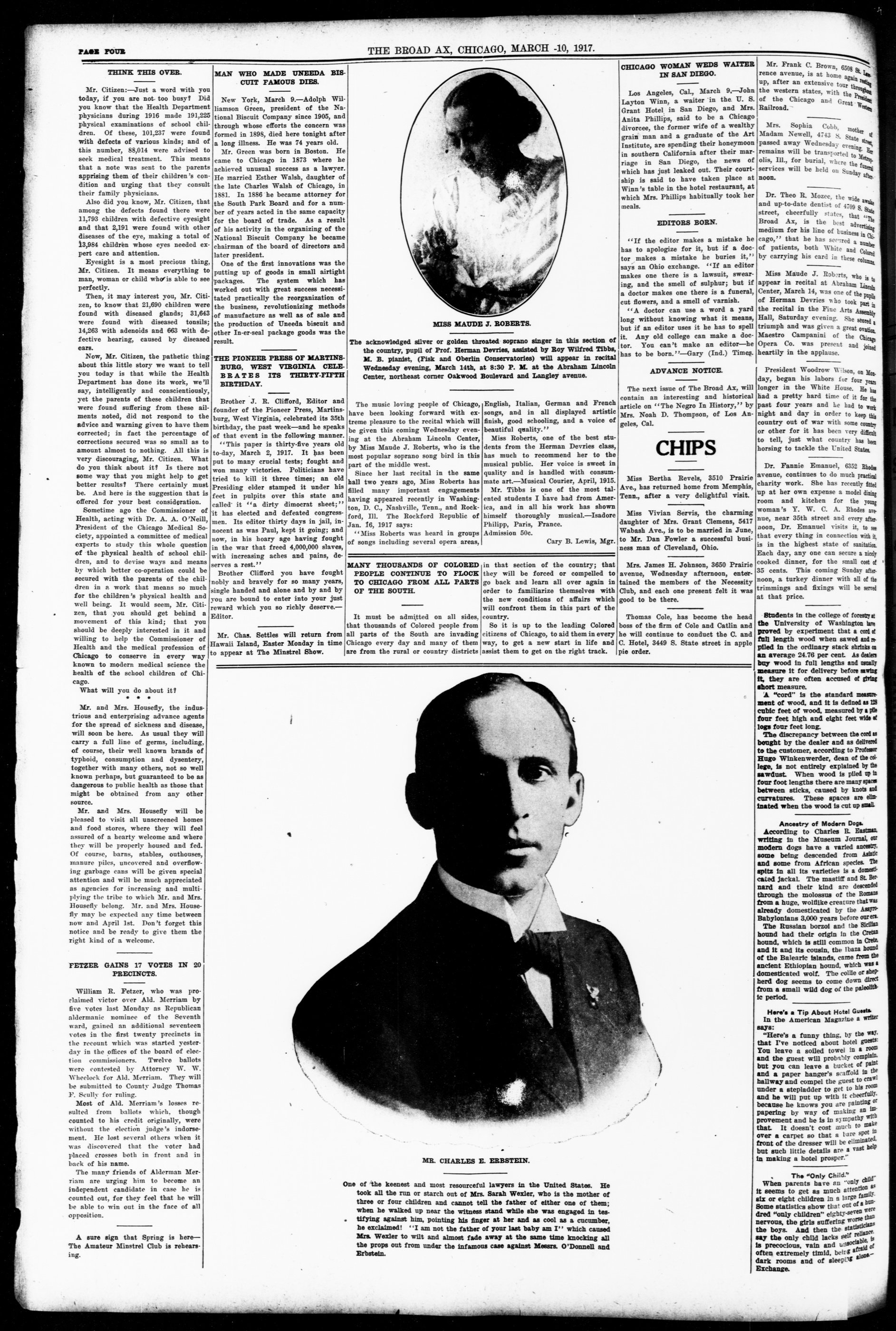
One of the keenest and most resourceful lawyers in the United States. He took all the run or starch out of Mrs. Sarah Wexler, who is the mother of three or four children and cannot tell the father of either one of them; when he walked up near the witness stand while she was engaged in testifying against him, pointing his finger at her and as cool as a cucumber, he exclaimed! 'I am not the father of your last baby am I' which caused Mrs. Wexler to wilt and almost fade away at the same time knocking all the props out from under the infamous case against Messrs. O'Donnell and Erbstein.
coated soprano singer in this section of Devries, assisted by Roy Wilfred Tibbs, (Conservatories) will appear in recital at 8:30 P. M. at the Abraham Lincoln Boulevard and Langley avenue.
English, Italian, German and French songs, and in all displayed artistic finish, good schooling, and a voice of beautiful quality.'
Miss Roberts, one of the best students from the Herman Devries class, has much to recommend her to the musical public. Her voice is sweet in quality and is handled with consum- mate art.—Musical Courier, April, 1915.
Mr. Tibbs is one of the most talented students I have had from America, and in all his work has shown himself thoroughly musical.—Isadore Philipp, Paris, France.
in that section of the country; that they will be forced or compelled to go back and learn all over again in order to familiarize themselves with the new conditions of affairs which will confront them in this part of the country.
So it is up to the leading Colored citizens of Chicago, to aid them in every way, to get a new start in life and assist them to get on the right track.
Cary B. Lewis, Mgr
CHICAGO WOMAN WEDS WAITER
IN SAN DIEGO.
Los Angeles, Cal., March 9. John Layton Winn, a waiter in the U. S. Grant Hotel in San Diego, and Mrs. Anita Phillips, said to be a Chicago divorcee, the former wife of a wealthy grain man and a graduate of the Art Institute, are spending their honeymoon in southern California after their marriage in San Diego, the news of which has just leaked out. Their courtship is said to have taken place at Winn's table in the hotel restaurant, at which Mrs. Phillips habitually took her meals.
EDITORS BORN.
"If the editor makes a mistake he has to apologize for it, but if a doctor makes a mistake he buries it," says an Ohio exchange. "If an editor makes one there is a lawsuit, swearing, and the smell of sulphur; but if a doctor makes one there is a funeral, cut flowers, and a smell of varnish.
"A doctor can use a word a yard long without knowing what it means, but if an editor uses it he has to spell it. Any old college can make a doctor. You can't make an editor—he has to be born."—Gary (Ind.) Times.
ADVANCE NOTICE
The next issue of The Broad Ax, will contain an interesting and historical article on "The Negro In History," by Mrs. Noah D. Thompson, of Los Angeles, Cal.
CHIPS
Miss Bertha Revels, 3510 Prairie Ave., has returned home from Memphis, Tenn., after a very delightful visit.
Miss Vivian Servis, the charming daughter of Mrs. Grant Clemens, 5417 Wabash Ave., is to be married in June to Mr. Dan Fowler a successful business man of Cleveland, Ohio.
Mrs. James H. Johnson, 3650 Prairie avenue, Wednesday afternoon, entertained the members of the Necessity Club, and each one present felt it was good to be there.
Thomas Cole, has become the head boss of the firm of Cole and Catlin and he will continue to conduct the C. and C. Hotel, 3449 S. State street in apple pie order.
---
Mr. Frank C. Brown, 6508 St. Lawrence avenue, is at home again resting up, after an extensive tour throughout the western states, with the President of the Chicago and Great Western Railroad.
Mrs. Sophia Cobb, mother of Madam Newell, 4743 S. State street, passed away Wednesday evening. He remains will be transported to Metropolis, Ill., for burial, where the funeral services will be held on Sunday afternoon.
Dr. Theo R. Mozee, the wide awake and up-to-date dentist of 4709 S. State street, cheerfully states, that "The Broad Ax, is the best advertising medium for his line of business in Chicago," that he has secured a number of patients, both White and Colored by carrying his card in these columns
Miss Maude J. Roberts, who is to appear in recital at Abraham Lincoln Center, March 14, was one of the pupils of Herman Devries who took part in the recital in the Fine Arts Assembly Hall, Saturday evening. She scored a triumph and was given a great ovation. Maestro Campanini of the Chicago Opera Co. was present and joined heartily in the applause.
President Woodrow Wilson, on Monday, began his labors for four years longer in the White House. He has had a pretty hard time of it for the past four years and he had to work night and day in order to keep this country out of war with some country or other for it has been very difficult to tell, just what country has been horsing to tackle the United States
Dr. Fannie Emanuel, 6352 Rhodes avenue, continues to do much practical charity work. She has recently fitted up at her own expense a model dining room and kitchen for the young woman's Y. W. C. A. Rhodes avenue, near 35th street and every afternoon. Dr. Emanuel visits it, to see that every thing in connection with it is in the highest state of sanitation. Each day, any one can secure a nicely cooked dinner, for the small cost of 35 cents. This coming Sunday afternoon, a turkey dinner with all of the trimmings and fixings will be served at that price.
Students in the college of forestry at the University of Washington have proved by experiment that a cord of full length wood when sawed and replied in the ordinary stack shrinks on an average 24.76 per cent. As dealers buy wood in full lengths and usually measure it for delivery before sawing it, they are often accused of giving short measure. A "cord" is the standard measurement of wood, and it is defined as 128 cubic feet of wood, measured by a pile four feet high and eight feet wide of logs four feet long.
The discrepancy between the cord as bought by the dealer and as delivered to the customer, according to Professor Hugo Winkenwerder, dean of the college, is not entirely explained by the sawdust. When wood is piled up in four foot lengths there are many spaces between sticks, caused by knots and curvatures. These spaces are eliminated when the wood is cut up small.
Ancestry of Modern Dogs.
According to Charles R. Eastman, writing in the Museum Journal, our modern dogs have a varied ancestry, some being descended from Asiatic and some from African species. The spitz in all its varieties is a domesticated jackal. The mastiff and St. Bernard and their kind are descended through the molossus of the Romans from a huge, wolflike creature that was already domesticated by the Assyro-Babylonians 3,000 years before our era. The Russian borzol and the Sicilian hound had their origin in the Cretan hound, which is still common in Crete and it and its cousin, the Ibaza haound of the Balearic islands, came from the ancient Ethiopian hound, which was a domesticated Wolf. The collie or sheep herd dog seems to come down direct from a small wild dog of the paleolithic period.
Here's a Tip About Hotel Guests.
In the American Magazine a writer says:
"Here's a funny thing, by the way, that I've noticed about hotel guests. You leave a soiled towel in a room and the guest will probably complain, but you can leave a bucket of paint and a paper hanger's scaffold in the hallway and compel the guest to craw under a stepladder to get to his room and he will put up with it cheerfully, because he knows you are painting or papering by way of making an improvement and he is in sympathy with that. It doesn't cost much to make over a carpet so that a bare spot in front of the dresser will be eliminated, but such little details are a vast help in making a hotel prosper."
The "Only Child."
When parents have an "only child it seems to get as much attention as six or eight children in a large family. Some statistics show that out of a hundred "only children" eighty-seven were nervous, the girls suffering worse than the boys. And then the statisticians say the only child lacks self reliance, is precocious, vain and unusable, is often extremely timid, being afraid of dark rooms and of sleeping alone—Exchange.
ROLAND W. HAYES
OF BOSTON, MASS.
The far famed Tenor Soloist in Musical Recital
in connection with the
Chicago Umbrain Glee Club
AT THE
Y. M. C. A.
3763 So. Wabash Ave.
Thursday Even
Thursday Evening, March 15th
ADMISSION 35 and 50 Cents.
BIG REAL ESTATE BAR
Sacrifice—Two Flat
—Only $3,850—
Amateur Minstrel Club will give their annual Show and Dance
EASTER
Monday Night, April 9th
8th Reg. Armory
BENEFIT
OLD FOLKS HOME
Military Marshals.
Like many other French words relating to war and hunting, "marechal," its older form "mareschal," is of purely Teutonic derivation in both its parts, and the word has had a curious history. Some words rise in the world with the passage of the centuries and others fall. This is one that from the very humblest of beginnings has come a great estate.
The marshals do not owe their name to him, though they are his votaries in the olden times they were about the humbleest men in an army—horse servants or grooms. Then they advanced to the dignity of being horseshoes and those highly respected artisans we still "marechals" in France, though "marants" has to be added to make their calling clear. And, while "mareal de France" is a magnificent title, they are also "marechals des logis," who are in cavalry regiments only that "seercants" are in infantry regiments—Exchange.
The viceroy of India, as representative of the king-emperor, is entitled to salute of thirty-one guns. This number had its origin in a mistake. Formerly he was entitled to twenty-one guns. When the time came, years ago, he allotting the salutes to the various more rulers of India the three principal of these vassal sovereigns—namely those of Hyderabad, Mysore and Andhra—were each accorded twenty-one guns. It was discovered a little in the day that the superior rank of the viceroy had been overlooked in the matter, and the necessity was outed of his supremacy over the usual rulers being emphasized in the eyes of the natives. So instead of reading the number of twenty-one guns had been accorded to the three rulers in question the viceroy was given ten more guns and is today the only person in the world who is entitled to altogether exceptional number of guns—London Spectator.
New Buffalo Bill Get His Name.
Many years ago, when the Union Pa-
railroad was completed, the que-
sion arose as to how all the laboring
men were to be fed on meat, as meat
thought necessary to make muscle.
General W. E. Webb had the con-
trol to feed the men, and in talking
the matter over one day with some of
the subordinates one of them suggest-
that he call in William Cody, then a
namous government scout on the
plans, to help solve the problem. Cody
suggested that he be allowed to hire
men and kill buffaloes for the railroad
means.
This plan was adopted, and Cody be-
came later world famous as Buffalo
In those days the buffaloes were
beautiful that it /is on record that
more than one engineer had to stop his
until a herd had crossed.—A. G.
German in New York Sun.
```markdown
```
Gun Salutes In India.
How Buffalo Bill Got Me
ing, March 15th
BIG REAL ESTATE BARGAINS
Biggest bargain in the City. Fine interior, new baths, good light, convenient to 35th St., Indiana surface and Elevated cars—only $500 Cash down. Phone or write H. E. Evans, 517 E. 42nd St. Phone Oakland 2726.
FOR SALE FOR COLORED PEOPLE
Beautiful 2 flat buildings, brick and stone, hot water and furnace heat, 5, 6 and 7 room flats. Located on the North side, in one of the best districts. Only two blocks to the Wilson Ave. and Evanston “L,” and the Broadway cars.
One block to beautiful Sheridan Road, 2 blocks to the new Clarendon Bathing Beach. Convenient to the剧院, stores and churches. This neighborhood offers great opportunity for employment, many positions being open for janitors, porters, laundry work, etc. Prices range from $4,600.00 to $6,000.00. Small cash payments, balance like rent.
For further information address—Julius F. Taylor, 6418 Champlain Ave. Phone Wentworth 2597.
Masters of Tool Making.
Are Anglo-Saxons conceived about their pre-eminence in matters of machinery? A book, "English and American Tool Builders," by Professor J. W. Roe of Yale, answers the question thus: "Practically all the creative work in tool building has been done in England and America. * * * The French have shown an aptitude for refinements and ingenious novelties. * * * The Swiss are clever artisans, but have excelled in personal skill. * * * Germany has developed splendid mechanics, but the principal machine tools had taken shape before 1870, when the empire began. The history of English and American tool building therefore covers substantially the entire history of the art."
The smallest boat to cross the Atlantic under her own sail was sailed by Captain Andrews. This craft was but fourteen feet long, but in it Captain Andrews crossed the ocean in 1891, landing at Palos, Spain. He traveled about Europe exhibiting his boat until the World's fair in Chicago, when he returned to this country and placed it on view there. He had previously made two unsuccessful attempts to cross the ocean.
A Good Motto.
"We've got a good motto for our paper," said Kidder.
"What is it?" asked his acquaintance.
"What we have we hold."
"Oh, I see! Referring to your circulation. By the way, I didn't know you were a publisher."
"We're not; we manufacture fly paper."—Chicago News.
Inhuman.
"Gentlemen of the jury," said the lawyer for the plaintiff, "the defendant claims that when he ran over my client his car was going but three miles an hour. Think of the agony endured by my client when being run over as slowly as that!"—New York American.
Miss Askit-Did your husband smoke those cigars you gave him for his birthday? Mrs. Nuwed-He smoked one and said he would keep the rest to remind him of my kindness.
Contrariness of the Sex
"How was it your wife came to give up housekeeping?"
"Just her contrary ways. First she broke down, and then she broke up."-Baltimore American.
National Forest Lands
On about 2,000,000 acres of national forest lands grazing by domestic stock is either entirely prohibited or is greatly restricted to provide range for elk.
There is no gate into heaven except at the end of the path of duty.—Van Dyke.
HEAR
Sacrifice—Two Flat!
—Only $3,850—
A Daring Voyage
A Good Motto.
Iphuman.
Very Thoughtful.
THE BROAD AX, CHICAGO, MARCH -10, 1917.
Charles E. Stump, the Kansas Newspaper Correspondent After Being Lost in the Wilderness for Several Months Has Come to Life Again and Continues His Travels Through the South Land
Aberdeen, Miss.-You find me the week in the land of James K. Vardaman, but I am not a Vardaman, and I am going to keep as far away from him as possible. But why take time to talk about him, when he is busy trying to get President Wilson and the United States into war, and while I am not going, I am sure that I will be represented there, and many of our people will be killed if we go to war with Germany or any other country. But man is born to die and not to be killed.
It has been a few weeks since I sent a letter, but it has been because I have been doing some going and I am still going, yet I must pause long enough this week to go back and tell you that I have been to other places, and say a few things about them.
I have been to Chicago, and have touched a few of the big people there and they seemed to enjoy meeting me. I called on B. W. Fitts, the printer, but he has moved his office, hence; I did not get to see him, and will find him when I make the next trip to Chicago. When I come to Chicago, it goes without saying that I made a trip to Kansas to look after this farming business. I am thinking about giving up farming, and going to war, yet I think it would be better for me to get right down to the war business and make something for the fighting people to eat. This would be a good thing for me to do, for really I am too old to fight, and then I will try to get some kind of aches to keep from passing the examination. Not that I am not in for what would follow. I love this country, and the American flag, but I am really too old to die for the flag, and must remain at home. Let the young men die and the old men live.
They were fighting the devil and sin out in Kansas City, Kans., and some people had joined the church who had never been there before, and declared that they were there to stay and would never turn back. Rev. L. K. Williams, that fine pastor of Olivet Baptist Church was doing some real preaching in Kansas City, Kans.
Speaking of Dr. Williams, who is one of the men in Chicago that is being heard from all the time, and who is doing things. He left a big work in Texas to go to Chicago and the people there are real proud of him. He has a fine set of men around him and his church is crowded all the time. It was to me a source of pleasure to talk with him.
From Kansas City, I made a trip to Saint Louis, and there spent a day in Poro College. This college is unique, and I am delighted to see the number of people who are in school there preparing to do things. This is not a school for good time, a practical school of methods. It is to teach you how to care for the head and to grow hair. I did not know that it was such a science to make hair grow, but that is being demonstrated by the Poro College. This is the work of Mrs. A. M. Malone, the wife of Prof. A. E. Malone. This girl has started from an humble home in Illinois, and has through her ability to make hair grow achieved a fortune, and then she is contributing to so many others. She is furnishing employment to between 7,000 and 8,000 agents who are doing business, and making money. Some of them are independent.
Mrs. Malone is one of the best women I have ever met since I have been in the world. She is polite, courteous, and full of information. She is well trained, and just a few minutes talk with her will convince you that she is a trained woman. Her husband is one of the best trained men of our race, and was for a long time connected with the public schools system of Quincy, Ill., and was a principal of a school. I did not spend but one day in St. Louis in Poro College, and pulled out from there on a train known as the
Sunshine. Of course I remembered that soon I would have to move, so I just went to the apartment set aside for our people, and remained in it until I reached Texarkana.
This is one of the finest trains in the country, and it gets over some country. It don't make many stops, but just goes right on and on until it stops, and then you have covered some territory. The Lord is with us, and is still with us and will continue to the end.
I spent a few hours in Texarkana, the guest of Mr. and Mrs. J. Matthews, who are some busy people. I met some of the leading people in that city, and talked with them. Mrs. Duckie Kennedy, is engaged in fixing heads, hands and feet. She is considered one of the best in the country, and she is some busy woman. Then I made a trip to Fort Worth, Texas, touched many lives there. I also made a trip to Dallas, Texas, and had the pleasure of meeting some of them big people there. For instance, I spent a little time with Prof. M. M. Rodgers, and talked with his people. Miss Daisy E. Jackson, was busy writing letters. That man gets a young post office full of mail every day, and he is getting ready now to make a trip. He is getting ready for the Grand Lodge of the State. But I must not take up too much time in this matter, but must turn on back to Texarkana, then to Arkadelphia, Ark., Little Rock, Ark., and from there over to Helena, Ark.
I wish that you could have been over to Helena, Ark., with me, because I had the pleasure of meeting some people over there who were worth while. This is the home of Dr. E. C. Morris, president of the National Baptist Convention, and a man who is doing things up in great shape.
Dr. Morris said that he was glad to see me, and shook hands with me. He spoke of the work being planned by the Baptists of the country. He did not discuss the law suit in which the Baptists are now engaged, but he said that he could see nothing ahead but victory. He said that all attention is now being turned to the meeting in June in Atlanta, which will be the National Baptist Sunday School and B. Y. P. U. Congress. In this all the Baptist family is interested, and will come up in large numbers.
I used to hear about Mrs. Hettie Greene, the wealthiest white woman in the world during her life, and I have not only had the pleasure of meeting her counter-part, but I have been in her home, Mrs. A. H. Miller, of Helena, a woman who don't know her own wealth, yet to see her, you would not think that she had a single cent, but was born to poverty. She is plain, but believe me if you talk with her you will at once find that you are in touch with a master mind. She is just busy collecting her rents, and turning her attention to the business of looking after her money. Mrs. Miller has put on the map the moving picture business. She had a place which has grown too small, and instead of trying to rent from some White people, has just put up one of her own. They are building on it now and will soon be ready. Her son is assisting in the work. Her husband left her with three boys and two girls. She is a rich widow, but declares that she is not on the market and will not consider an offer for marriage.
I met Dr. D. S. Shadd, Elias Morris, Mrs. Morris, and then Madam Douglass and I will have to talk about her in another letter. I got through there in a hurry, going over to Clarksdale, Miss., and meeting some people there. The Rev. Dr. P. H. Polk, of the A. M. E. Church, had just finished a building which cost $15,000, and Sunday being the day they went into it, they closed the day by raising $900 which is a good showing.
You have heard of Prof. George Oliver? Well I stopped over to his
Talks on
Talks on
HEALTH, CLEANLINESS, PROPER LIVING, SANITATION, ETC.
Dr. W. A. Driver
3300 So. State Street
Phone Douglas 3617
DIET IN HEALTH.
The importance of proper diet in health is a bigger matter than appears upon the surface. Most of the disease that flesh is heir to is probably of gastro-intestinal involvement. The veriest tyro knows that the alimentary canal should be kept free from deleterious matter. It is an old and a true saying that many persons dig their graves with their teeth. Proper diet would prevent such grave digging and would increase the life span of our contemporaries.
Almost all people are slow to give careful and critical study to the matter of diet in health. It seems to be the general opinion that in health almost any diet is good enough. As a result of that erroneous opinion disease takes a deep hold upon the people and the diet as a cause of disease is generally disregarded. The proper diet for a baby is mother's milk. If that can not be furnished, the baby should be given cow's milk properly modified to suit the particular case. In case mother's milk is obtainable it should be remembered that at certain lapse of time and under certain conditions it should not be given. The practice of keeping baby
home and met Mrs. Alice Carter-Oliver, one of the best trained young women in the race, and who has just finished a text book for primary work. She is some writer and teacher. I was indeed proud to meet her. She was born in Frankfort, Ky., and spent her early life, there graduating from the State Normal College, and then taking up other work.
I had the pleasure of meeting many people, and heard about Mound Bayou, the little Negro town down on the Valley. They have been having a monkey and parrot time down there, and some of them toted the trouble over to the governor, and he just appointed new officers, making Eugene P. Booze mayor, but they declare that he will not even smell the office. The old mayor is still in and declares that the governor appointed a man or men to office before he had heard both sides, and they are now in court. Well this is just like all men in this kind of business who are contending for the mastery. I have no unkind words to say about any of these men, but I shall have something to tell you later about the work and about the town.
I made it over to Memphis, then to Holly Springs, visiting the Mississippi Industrial college, then to Aberdeen, Miss. I am here with Grand Master T. B. Sykes, of the Mosaic Templars of America. He is one of the men of the race who is bringing things to pass. He is a man among men and a scholar. His wife is one of the busy women of the race, and her sister, Miss Mabel Roy Clopton, is a graduate from one of them schools up there in Chicago and is considered one of the best teachers in Mississippi, saying nothing about race or color.
I shall tell you about them and Mrs. Louise Willis, of this city in another letter. She is treasurer of the order, and is in for good. She is a busy woman. I must now bring this letter to a stop, but will write again.
TIED DUCK WITH CRAVAT.
Left Diamond Stud on it, and That May Account For Turkey Find.
Cuero, Tex.—What Thomas Lovett of this county believes to be the previous history of the recent story from Chicago telling of a diamond stud valued at $150 found in the craw of a Thanksgiving turkey had its inception in a duck hunt here.
According to Lovett's story, while hunting two years ago he slightly wounded a duck and decided to carry the bird home. He used his necktie to bind the bird's feet, neglecting to remove a diamond stud fastened therein. Placing the supposedly helpless bird in the rear of his conveyance, he started home, when a flutter a few minutes later attracted his attention. He turned in time to see the duck flying off with his necktie dangling from its feet.
Cuero is in the center of a large turkey raising portion of Texas, and many of the birds, which roam over a large range, find their way to the Chicago market. Mr. Lovett so far has entered no claim to the stud.
PAGE FIVE
[Name]
on the breast too long is injurious to the health of both mother and child. Many mothers ignorantly nurse the baby beyond the reasonable period and for improper motive. They and the baby suffer a gradual health impairment from the evil practice. The ideal adult foods are vegetables, fish and fruit. A careful reflection will prove that they are healthy beyond a shadow of doubt. This matter should be given more study than it has been receiving. Few diseases can affect those who are properly fed.
Psychological well being depends upon proper diet more than it does upon any other factor. The matter of thought is the most powerful force in the life of any individual. The above observations are of easy demonstration. Watch the animals and note the effects of diet upon the mentality of them.
It is a common saying that fish is brain food. There is much in that saying; it is indeed worthy of acceptance.
Diet in health to avoid the evils of disease. The proper diet in health is safe and sane and those who fail to search the matter out must suffer the miseries that must come to the negligent. Eat right to be happy, healthy and humane.
Signing Diplomatic Notes
No one can say exactly why our secretaries of state sign diplomatic communications with their surnames only, except that it has always been so. We copied the custom from European chancelleries, and it probably has its origin in the habit of royalty, which is to sign with one name only. Thus King George of England signs himself "George, R. I." (Rex, Imperator—King, Emperor); Sir Edward Grey signed always as "Grey;" the democratic Mr. Bryan when secretary of state affixed his signature to diplomatic notes as "Bryan." At first sight there seems to be a profound flattery implied in the custom. It assumes that the signer cannot be mistaken; that there is only one "George," and "Grey," one "Bryan." And generally there is only one in the diplomatic world where these exchanges take place—New York Sun.
Effects of Arsenic
"Arsenic, as science has long told us, an accumulative poison," said a druggist. "When one takes it either by prescription for the upbuilding of an appetite or for the bleaching of the skin he does not feel any ill effects for several years. The effect of the drug is bracing and makes a person feel like eating. It also aids the digestion. The average user of the poison takes it in such small quantities that he does not realize how much of it will accumulate in his system in the course of four or five years.
"Being an accumulative poison, it often takes that length of time to see the results of the drug. Then the user may complain of not being able to control his fingers or toes. Subsequently he loses control of his hands and arms. Paralysis, superinduced by arsenical poisoning, is the fearful result."
Got There All Right.
Many years ago, at the beginning of November, a missive bearing the St. Albans postmark reached St. Martin's. The envelope was addressed "lud mar lunding." Neither tall nor head could be made out of this by the staff, so the envelope was opened for a clew. The letter read, "kenyoblauosfoyosho bilgs."
The practiced St. Martin's decipherer of puzzles promptly made out the signature as "Bill Higga." With the key this afforded the rest was deliciously easy. The message was, "Can you buy a horse for your show?" and "lud mar" meant "lord mayor." So the letter, with an official translation considerably appended, was delivered to the lord mayor elect—London Mall.
Many Uses For Sawdust.
Sawdust is valuable. It can be used for almost anything except food. Used as an absorbent for nitroglycerin it produces dynamite. Used with clay and burned it produces a terra cotta brick full of small cavities that, owing to its lightness and its properties as a nonconductor, makes excellent fireproof material for walls or floors. Treating it with fused caustic alkali produces oxalic acid. Treating it with sulphuric acid and fermenting it with the sugar so formed produces alcohol. Mixed with a suitable binder and compressed it can be used for making moldings and imitation carvings. If mixed with portland cement it produces a flooring material—Philadelphia Record.
THE BROAD AX
In this city sines July 15th, 1899
without missing one single issue, Be
publieans, Demoerats, Cathelies, Pro
testants, single Taxers, Priests, inf.
dels or anyone else ean have their say
as long 2s their language is proper and
responsibility is fixed.
The Broad Ax is a newspaper whose
platform is broad enough for all ever
claiming the editorial night te speak its
own mind,
Local communications will reecive
attention. Write only om one aide of
the paper.
Subscriptions must be paid im ad-
vance.
One Year........eccceeeeeeeees 2.00
Bix Months..........-eeeeeeeee+ 100
Advertising rates made known on ap-
plication.
Address all communications to
THE BROAD aX
6418 Champlain Ave, Chicago, I
PHONE WENTWORTH 2597.
JULIUS F. TAYLOR, Editor and Pub-
Usher.
Entered as Second-Class Matter Aug.
19, 1902, at the Post Office at Chicago,
Illinois, under Act of March 3, 1879.
LARGEST WIRELESS
PLANT AT SAN DIEGO
New $300,000 Station Is Made
Ready For Work After Sat-
isfactory Tests.
Ban Diego, Cal—The new $300,000
wireless telegraph station was recent
1y completed and officially put in com
mission after suitable tests. It is the
largest and most powerful radio sta
tion in the western hemisphere and i
capable of carrying for 12,000 miles
Messages from the British fleet cruis
ing in the North sea, from the high
powered German plant at Berlin and
from American ships and from Aus
tralia have been intercepted.
‘Three units in the globe encircling
radio service of the United States navy
are now completed. These are the sta-
tions at San Diego, Arlington and
Darien (Panama canal zone). A fourth
is under construction at Manila.
‘The three 600 foot aerial towers form
@ triangle. They contain 1,000,000
pounds of fabricated steel and are the
largest radio towers in the world.
‘They are 150 feet in width at the base
and eight feet at the apex. They are
Placed 1,100 feet apart. Huge porce-
Jain insulators embedded in concrete
form the base of each leg of the tow-
ers.
‘The receiving room is absolutely
sound proof, the walls and floors being
Padded with asbestos. There are four
distinct and complete controlling sets
installed in the receiving room, en-
abling any one of the four operators or
all four simultaneously to send and re-
ceive messages. :
The aerials or antennae weigh six-
teen tons and have a sag between tow-
ers of 100 feet. They are twice as large
as those strung from the Eiffel tower
in Paris. ‘The helix is fourteen feet in
diameter and eleven feet in height, or
nine feet higher than the helix used jn
ordinary naval and commercial st§-
tions. ,
.
WOMAN IS A MAIL CARRIER
She Braves Winter and Bad Roads In
Maryland.
Baltimore. — Braving snow, sleet,
rifts, biting winds in the winter f..1
Diistering and scorching heat in #the
summer, Miss Julia M. Shafer of Khos-
ville, Md., for twelve years has seyred
the United States as rural mail frar-
rier.
She is now covering the same ute
her father traveled fourteen yeargago,
when the route first was establyhed,
Miss Shafer in those days was § xub-
stitute for her father; now the [ther
is substituting for her.
In the twelve years that Miss fhafer
bas carried mail it is estimat@’ that
she bas traveled 93,690 mileff She
makes twenty-five miles six fiys of
the week. With the exceptio#of the
regular fifteen day annual mation,
Miss Shafer has been off af; only
thirty days in twelve years,
LINER SAVES TWO A® SEA.
Barge Crew Drifting In tof covers
Craft—Get $40 Pu:
New York.—The Ward ler Sara-
toga, from Havana, brourgt in two
seamen, Jose Faria and MPoual Bap-
tista, crew of the coal barge Edward
F. Clark, which, with her oster barge.
the Theodora Palmer, brok@away from
the ocean tug Minnie in ¢ northwest
erly blast. The Saratoza fell in_with
the Clark, covered with Ice and the
seas breaking over her, about 240 miles
south of Sandy Hook.
‘The two men launched a dory and
Fowed to the Saratoza and boarded her
by a sea Indder. Captain Miller of the
Saratoga also noted another barge fiy-
ing distress signals with a tank stand-
ing by and preparing to take off the
seamen. Passengers of the Saratoga
made up a purse of $40 for the two
Beamen.
MINE FIELDS LAID.
Entrances ao taeaat Harbdrs
Are Quickly Protected.
COAST ARTILLERY IS READY.
Every Square Foot of Water Near Por
of New York Made Unsafe Even For
| Rowboat—Rear Admiral Knight Set
About Safeguarding Narragansett
Bay Naval District.
Washington.—When the break with
Germany came two of the most elabo-
Tate and intricate mine fields that a
nation ever devised for the safeguard-
ing of a city’s water gates were plan-
med by the coast artillery and the
corps of engineers to protect the en-
trances to the waters immediately
about New York. It was a task which
was completed in all save the last de-
tail, the actual laying of the mines, and
these were stored by hundreds at Fort
Totten and Sandy Hook, ready for the
message from the war department
which would send the mine layers out
with their gingerly handled burdens.
‘The aggressiveness and determina-
tion with which an attack can be deliv-
ered are a lesson of the European war
which has not been lost upon the mili-
tary and naval officials of this country.
Ce % e
es —
4
i
. FF
> ym L
( Se
\ De
sc Ky PF
jw .,
sede “anuarean ewere
‘It bas certainly proved of vast value
to the coast artillery, which as a sec
ond and third line of defense will be
intrusted with the defense of New
York. The first, line is the navy, the
fourth is the mobile army.
Newport, R. L, the seat of a torpedo
factory, a mine base, fuel station, mu:
nition magazines, the naval war col
lege and other departments of high
aval importance, was formally trans-
ferred from the control of Collector of
Customs Fitzsimmons to Rear Admiral
Austin M. Knight. The latter immedi-
ately set about protecting the harbor
and the entire Narragansett bay naval
district against any emergency.
Mines were collected at Forts Greble
and Adams ready for distribution in
the waters of the harbor approaches
Every strategic center was placed un-
er double guard, the public was re-
fused admission ‘and troops refused
leave of absence except in special in-
stances. Officers received what is
known as the “mobilization slate,” in-
dicating the posts which they will be
called upon to fill in the event of an
actual mobilization order.
‘The naval torpedo factory was espe-
cially busy. Extra time by workers
and operation in shifts have been or-
dered, while efforts were made to re-
cruit 400 additional machinists. Three
torpedo boat destroyers, with a full
quota of torpedoes, are protecting the
factory and ready at the same time to
perform such other duties as the com-
mandant may order.
“IT’S REAL SPORT.”
This Fighting of Duels In Air, Aviator
on ntieas De
See ee ee
Cleveland, O.—“It’s real sport,” said
Robert Rockwell, a member of the
French aviation service, who is home
on a furlough.
“The Americans in the service,” said
Rockwell, “look upon it as sport. They
forget it is war. When we come back
and, laughing, tell how some enemy
birdman escaped, our officers remind
us we are ‘at war.”
Rockwell went to France two years
ago as a member of the hospital serv.
fce. He Joined’ the air squad last
March. He will rejoin the service on
the Somme front. His cousin, Kiffin
Rockwell, was killed in an air duel.
U. S. LAYS SUBMARINE NET.
It Blocks Entrance to Hampton Roads
and Is Two Miles Long.
Norfolk, Va.—As a protection against
hostile submarines a powerful steel net
has been placed in Hampton Roads be
tween Fort Wool and the government
pier at Fort Monroe. The net blocks
entrance to the entire channel of the
roads and affords absolute protection
to Fort Monroe and Old Point Com
fort.
‘The net was laid with so much se
recy that {ts presence was not known
until masters of vessels were forbidden
to pass over it without authority from
the commanding officer of the navy pa-
trol boats now on duty in the roads.
‘The net is about two miles long. Its
efficiency was proved by the capture
of the steamship Madison.
THE BROAD AX, CHICAGO, MARCH -10, 1917.
werent sauy ron u. s|FUNSTON'S ESCA
i Sania aces sia Narrowly tissed ‘Boing She
Dayton, O.—Orville Wright, inventor
of the aeroplane, announced that in
case of war with Germany he would
abandon his private affairs and offer
his services to the government to help
organize an aerial army.
“While I could not duplicate Henry
Ford's offer to manufacture war ma
chines because I have disposed of my
interests in the manufacturing end of
the business,” Wright asserted, “I cer:
tainly will do everything I can for the
country.
“We have a pitifully small number of
military and licensed civilian pilots to
meet an emergency, but that need not
trouble us a grest deal if we meet the
situation promptly.
“It takes but about two weeks to de.
velop and train a good military aerial
observer. It takes two weeks more to
make him a competent fighting man.
“As for the type of aerial defense, |
would favor the small, high climbing
plane, light and unarmored except for
a single gun. It can jump in and de
a lot of damaze and get away while
heavier planes are getting started.
“I would be absolutely against the
manufacture of Zeppelins or dirigibles
except for observation purposes. As an
offensive weapon in war the Zeppelin
has been a fiat failure.”
UNCLE SAM SWAMPED
WITH SPY APPLICANTS
Several Linguists Say They Could
Make Themselves Agreeable
to Foreign Diplomats.
Washington.—Uncle Sam will never
run short of spies. He bas been fairly
swamped with applications for appoint
ments in the secret service since the
diplomatic break with Germany,
Judging by the number of applica.
tions coming in, every family must
have at least one husky young movie
fan who yearns for the exciting life of
@ daring, dashing, omnipresent, well
dressed, swagger und handsome secret
service agent, spending the winter in
Florida watching foreign diplomats
‘and spies, with nothing much to do ex-
cept keep bis fannel trousers well
creased all the time so that he may be
ready on a moment's notice to rush out
from ambuscade, bop in an automobile
to follow some fair foreign enchant-
ress to a secret rendezvous, there to
make the grim, stern, heartbreaking
choice between enchantress and cold,
gloomy duty, nobly rising to the occa-
sion, grabbing her traveling bag and
returning with the plans and specifica.
tions of an explosive doughnut to the
waiting chief of the secret service in
Washington.
Of course all the present war fever
applicants for jobs in the secret service
have special qualifications. Several of
them know foreign languages. Many
of them are expert dancers and could
make themselves agreeable to foreign
diplomats and their families, particu-
larly the diplomatic daughters, who
are bound to “leak” a lot of state se-
crets to a first class fox trotter maybe.
RIDS TOWN OF TRAMPS.
“Knights of Road” Confronted With
Sign of Skull and Bones.
Nesquehoning, Pa.—While almost ev.
ery other community throughout the
state and probably throughout the en
tire country is being bothered with the
tramp nuisance, these “knights of the
road” are giving Nesquehoning a wide
‘berth.
One day a “Weary Willie” had the
audacity to come into the town and at-
tempt to eke out an existence without
working. It was decided to rid the
town of him and thereby discourage
others from leading a free and easy
life. Various ways were discussed, and
it was finally decided to place him in a
barrel and roll him down a hill. Before
being put into the barre} he said:
‘To Nesquehoning I bid adieu,
And Tl never come back again to see you.
He reached the bottom of the bill
more dead than alive and after extri-
cating bimself made a dash for the
wilds of Broad mountain. ‘That was
the last ever seen of him. His treat-
ment reached the ears of many other
tramps, who to this day fear even to
pass through the town.
“SHORT SKIRTS MAKE’EM EAT”
Lecturer Would Cut Living Cost by
Chanaina Fashions.
Philadelphia.—Short skirts and silk
stockings made a girl eat so much she
becomes bad tempered,
An inch from the skirt means a
Pound of beefsteak Inside.
Highly colored dresses are very dan
gerous and make a girl irritable.
A calico dress is better than imita
tion silk,
A woman's first duty is to make her
self as beautiful as she can.
‘These are a few excerpts from the
law of clothes laid soya by Miss Jane
Newcomb, a State college extension
lecturer, in a talk to a group of women
at the Friends’ Central school.
Miss Newcomb first gave warning
that the less a girl wears the more she
must eat to keep warm. In the day of
short skirts and high living costs Miss
Newcomb has in her investigation into
the folly of fashions come to the con-
clusion that to lengthen the skirt is to
shorten the grocer’s bill.
FUNSTON'S ESCAPE
Narrowly Missed Being Shot by
General Fitzhugh Lee.
LEE DIDN’T RECOGNIZE HIM.
Captor of Aguinalde Had Long Hair,
Unkempt Seard and Gaunt Appear-
ance and Approached Lee Cautiously.
Got Aboard Steamer Next Day With-
out Arousing Suspicion.
Washingtou.—There are many stories
told bere of Major General Fred Fun
ston, whose death occurred recently
One of the stories has to do with Gen:
eral Fitzhugh Lee, now dead, who of.
ten told how near he came to shooting
‘the intrepid captor of Aguinaldo, the
Filipino chief.
Just before the Maine was blown
up General Lee received many threats
that he would be killed and was in
daily fear of his life. Soon after be-
ing warned of a plot to slay him the
American consul general at Havana
got one of the worst scares in his life.
He was alone in his office when the
door opened and one of the worst look-
ing faces he had ever seen looked in
at him. The man had long hair, un
Kempt beard and a gaunt appearance
His hat was full of holes, bis shoes
abeut all one, and he had no clothing
apparently but a linen duster. He ap-
proached General Lee cautiously, and
the latter instinctively grasped his re
volver. “If that fellow had once put
his hand uuder his duster I am positive
1 would bave shot him without wait-
ing for a word,” said General Lee.
“I was satisfied be had been hired to
come and kill me. When he approach-
ed to a speaking distance he astonish
ed me by asking in good English if 1
was General Lee. I told him I was
‘and asked him who he was. He said
he belonged to the Cuban army, was
General Gomez's chief of artillery and
wanted to go back to the United
States.
“He said he was from Kansas and
had enough of the Cubans. | told him
he was taking his life in his hands by
coming into the Spanish lines and if
he was caught they would make quick
work of him as a spy.
“He said he didn't care. 1 was sat
isfied he was telling the truth and sent
him out for a bath and hair cut. When
he came back in a new suit of clothes
you wouldn't bave recognized him as
the same man. 1 got him aboard a
steamer the next day without arousing
any suspicion. He landed safely in the
United States. That man was General
Funston, who captured Aguinaldo.”
INTERSTATE BRIDGE OPENED.
$1,750,000 Structure Between Washing-
ton and Oregon in Use.
Vancouver, \ash.—In a din of steam:
boat whistles. clanzing bells and
cheers from thousands of spectators
the new $1,750.00 interstate bridge be-
tween Oregou and Washington was
opened. :
‘The structure is one of the longest in
the world, four miles, including ap
proaches. It spans the Columbia river
between Vancouver and Multnomah
counties a few miles from Portland.
When the great central draw was
lowered into place a street car crowd
ed with officials and noted visitors
crossed slowly. That was the sigual
for an outburst of noise such as the
old Columbia river never heard before
A procession of flag bedecked automo-
biles followed the car, and another
long line of machines started at the
same time from the Washington side
‘They passed in the middle.
SHE BRAVES U BOATS.
Undaunted by Submarine Menace, Miss
Floretty Sails to Meet Lover.
Philadelphia. — Believing that wo
man's place {s in the home, after all.
Miss Nellie Floretty of Liverpool has
given up her job in an English muni-
tions factory to marry a Clifton Heights
shoemaker.
Hereafter Miss Floretty’s pretty
hands will make bread instead of bul.
lets. She became the bride of Samuel
Kooyoomjian, an Armenian shoemaker.
employed in a shop at Clifton Heights.
thus ending—or perhaps beginning—a
romance that had its origin five years
ago when Kooyoomjian deserted the
‘Turkish army and made his way to
Liverpool.
Undaunted by the kaiser’s submarine
warfare, Miss Floretty, twenty-three
years old, pretty and blond, left Liver-
Pool, landing in New York on the
steamer Kroonland,
Bible Saves Man's Life.
Philadelphia.—An old Bible tucked in
his vest pocket saved the life of George
Tustin, forty-four, when, according to
the police, his companion and room.
mate, Frank Hatfield, stabbed him just
below the heart. The knife penetrated
his breast after passing through the
Bible, inficting & serious wound. Hat
field has been arrested.
SME SAE HE SAE MAE ee Se nae ne ee te tae tae ae ne ve
* THIS MAN LEARNS TO
. READ WITH TONGUE
¢ ae
€ Chicago.—The loss of his sight
€ and both arms in a mine explo-
€ sion in 1906 failed to cause de
® spair to William McPherson of
€ Highland Park, Ill. He has since
€ learned to read with his tongue
€ by means of raised letters on
# porcelain slabs. Now he has
€ been fitted with artificial arms
€ and can feed himself, for the
€ first time in eleven years.
e
OFFERS A CONVICT REGIMENT.
ee See
1,200 From City Prisons.
New York.—New York gangsters may
yet rival the exploits of the apaches of
Paris on the fring line, and the Amer.
jean gun man and the French blue devi
‘may yet be fighting side by side. Bur
dette G. Lewis, commissioner of correc
‘tion, announced that be had been in
consultation with Major General Leon.
‘ard Wood regarding the advisability
of recruiting a regiment of workhouse
‘and peniteutiary inmates in the event
of war between the United States and
Germany. Commissioner Lewis also
consulted with Major General O'Ryan,
commanding the national guard.
‘Commissioner Lewis spoke of the ex-
ploits of the apaches of Paris, the out-
laws of the boulevards, who are com-
parable to the gun men and gangsters
of New York. In the fall of 1914, when
the German army was almost at the
gates of Paris, a force of apaches so
distinguished itself for desperate fight-
ing that it won the sobriquet of the
blue devils, The commissioner of cor-
rection believes that the same reckless
individuality and excess of physical ex-
nberance which enter into the person-
ality of gang leaders and gang men
would tend to make New York's work-
house and penitentiary population a
valuable fighting force if officered by
strict disciplinarians.
POSTOFFICE AIDS AIR RACE.
Designates Transcontinental Course as
an Official Mail Route.
Washington. — Delivery of United
States mail by aeroplane will be a
feature of the cross continental race
planned for next June, as the route of
the contest will be designated as an
aerial mail route by the postoffice de-
partment.
In accepting the Aero club's offer of
co-operation the second assistant post-
master general, Otto Praeger, says in a
letter read at the aeronautics exposi-
tion in the Grand Central palace, New
York, by Alan R, Hawley, president
of the club:
“The field superintendents of the rail-
way mail service have presented to the
department thirty-seven practicable
aeroplane mail routes. The postofiice
department will appreciate it if you
willdesignate a committee to co-operate
with this bureau in making an investi-
gation as to the designation of such
cities in various states as aerial mail
stations, where sitisfactory landing
places can be provided.”
SLATES MAY COME BACK.
High Price of Paper Forces Them Into
Use In New Jersey.
Pennsgrove, N. J.—Slates may come
into vogue again in south Jersey
Schools, in spite of objections to them
on sanitary grounds, as a result of the
shortage and increased cost of paper.
County Superintendent of Schools
Dixon has ulready issued an order to
Pupils of the Salem county schools to
Use both sides of the paper in prepar-
ing written lessons.
A number of organizations and
chureh societies throughout this end of
the state are collecting and selling old
Paper as an effective method of raising
funds for their various schemes. The
most systematic paper saving cam-
paign in this part of the state is being
conducted at the new Du Pont vil-
lages, where a salvage department has
been established.
Old paper is regularly collected in
wagons, and presses have been set up
for baling it into 100 pound bundles
for shipment.
BEAR IN RUSSIAN ARMY.
Huge Animal Fights With a Regiment
‘on Pranch Groat.
Petrograd.—Fighting with the Rus-
sian army in France is a huge bear
from the Caucasian mountains, who
seems to enjoy his sojourn on the
French front fully as much as his mas-
ters enjoy theirs.
He is the mascot of one of the Rus
sian regiments that were transported
halfway round the world from the Rus
sian to the French front to show the
solidarity of the allies.
When the time comes for the bear's
regiment to go to the front line
trenches for its six days of duty the
bear goes along. He keeps the all night
vigils with the sentinels, and as there
is nothing else to eat but the regular
rations brought up from the rear he
Permits the soldiers to divide their
share with him.
COUGARS EATING DOGS.
Among Mountain Beasts.
Los Angeles.—Jobn B. Miller, prest-
dent of the Southern California Edison
company. bas encountered a problem
which he did not consider when be
built his country home in Liveoak can-
yon, north of Pomona, last summer
‘The problem is bow to get rid of the
mountain lions.
It not only {s worrying Mr. Miller.
but threatens to spread to the county
authorities for determination of the
question whether or not live dogs mas
be used for bait.
Reports from the Miller home were
that the tracks of the lion were as
large as a man's band and that the dis
tance it covered when it leaped on the
animal killed was fifteen fect.
Hannibal Gets Mark Twain's Chair.
Hannibal. Mo.—A willow chair.
which was Mark Twain's favorite seat.
has been presented to the boyhood
home of the humorist in Hannibal by
Albert Bigelow Paine. Accompanying
It was a photograph taken by Twain
Seated in the chair in 1909, upon which
the humorist wrote: “This is my best
Mark Twain.”
OUR GIRL seqq
‘Sana
RECRUIT To FULL STRENEn,
Mrs. Low Works Energetic
Organizations to Take Up 7° ‘
Instituted For Women we
League—English Girls Render ag
ance In War,
New York.—Hundreds of fe
young women have joined they’,
Girl Scouts since the cutbreat
Germany, and Mrs. Juliette =
national president, announeey trons
headquarters, 527 Fifty vente, ty
city, that to meet any @ _
organization will be rerutd py
strength of the Boy Scouts of an
Mrs, Low telegraphed to Eto me
worth, vice chairman of the am
Red Cross at Washington, ering iy
services of the girl scouts. thy *
to cooperate with the neatae st
Cross branch.
Ie ts Mrs. Low's ambition to my
the girl ecouts, already 100000 sgt
the greatest girl’s organization aa
Wat cng SOON
ee aN
Be tite: s
Rea SY ae
oe et OB) i
BS on 9 Rx
RAG srk
ba acy) aa
nope: :
ete 4 :
a Te Gs
e ED ;
a a a
> Janene
a ae
ie * —
aor, Dae
Ns © fuck a
ee mae a
Sag a
GIRL SCOUTS IN Woops,
world. Mrs. Low is prominent socity
in England and Scotland as well a
this country.
The Girl Scouts of America is
same as the Girl Guides of Ensia
and the continent and is adapted toi
the same need in girl life that the by
scout movement fills for lads. Mn
Low became interested in this wut
for girls through her observatis ¢
the boy scout movement in Encini
‘by Sir Robert Baden-Powell ani t
almost simultaneously similar more
ment for girls started by bis se
Miss Agnes Baden-Powell. Sit Robet
and his sister visited Mrs. Low ups
her estates in Scotland and ssid
her in starting the work among th
Scottish lassies. They have revatt
come into the advisory board cf t
American organization.
Mrs. Low is now working eesti
cally to get the organizationsinthes
tious cities to take up the trainise
stituted for women by the Navy leg
She has arranged for classes of
scouts to take these courses and bs
offered prizes in that connection.
‘Mrs. Low saw the necessity for ts
work after watching the assists
rendered their country by the eis «
England during the progress of
European war. She says there a
numerable things that girls ean #98
wartime to help their country if tt
are properly trained.
Mrs. Low will hold meetings in
cities she visits under the auspice
the women's clubs. All women "8
are interested in the movement ookst
to the uplift of American eiribood
invited to attend these meetines. &
from educational institutions are
cially invited, as are also college 5
ritles and associations of colleze *
men. Mrs. Low, a brilliant Come
in demand both in the west and
east to explain the work. J
Mrs. Low has great hopes tit ©
visit to America at this time wil ®
the means of arousing considerable ©
terest in the movement amons th ")
men of the land. It is the purpest)
Mrs, Low to explain the sreat feats
be accomplished among the sirls 1,
land through an organization of
Kind and to tell something ea
things that have alreads been So
plished in England and other
countries,
WAIST LINES TIGHTER
Men to Wear Longer Costs #4 ne
Padded. ——
Columbus, 0. — Coats Will © cin
longer, shoulders will be wide,
no padding, and coats will be MO
the walst Tine in men's sults Oo
ing season, according to srs Sts
by the fashions cowvmittee of ~
national Custom Cutters’ sso
"The cutters say trousers "il % ig
er, waistcoats will be cut ton sh
be tight at the waist ne et
proper
Gothee They alo ines —
Norfolk jacket will agelz D®
EX-ENVOY'S LADY
American Born Wife of Former German Ambassador.
EXPATRIATED BY DIPLOMACY.
The Break In the Relations Between Germany and the United States Has Necessitated the Countess von Bernstorff Leaving the Land of Her Birth and Many Washington Friends.
As far as is known, Countess von Bernstorff is the only American woman married to a German diplomat, and the fact is a strong reminder at this time of the desire of Kaiser Wilhelm in sending Count von Bernstorff to Washington in 1908 to strengthen the bonds of friendship between the United States and Germany.
Before her marriage to the count on Nov. 14, 1857, Countess von Bernstorff was a Miss Jeanne Luckemeyer of
Mary Ann
Photo by American Press Association
COUNTESS VON BERNSTERFF.
New York. She is a woman of gradual personality and before the war was one of the most popular hostesses in the diplomatic set in Washington. When the war broke out she was visiting in Berlin, and it was not until last fall that she was able to rejoin her husband in Washington. The countess leaves many warm friends in her social circle at the capital who will sincerely regret her absence.
MEDICINAL GARDENS
What the Commonest Vegetables Do For Your Liver.
Every vegetable garden is a medicine chest recognized by physicians as of considerable value in the treatment of diseases. Onions, for example, contain sulphur oil and are recommended for insomnia and as an aid to gastric digestion. They also help to allay rheumatic pains.
Turnips and parsnips have peculiar principles which are of value as a aperient and diuretic. They are also claimed to be good for coughs and heartiness. Carrots are useful for correcting derangements of the liver. They are excellent as a dressing for painful wounds and swellings.
The tomato exercises medicinal effects not completely explained by the presence of alkaline salts. There is a principle present which, in a concentrated state, produces salivation and a the stimulation of the liver.
Satin Hats
The type of satin hat that dominates in the smart shops is made of black satin, with so small a headband that it is merely a ribbon and so large a brim that it eclipses the crown. This brim convolutes around the head in a series of curves and irregular lines. If it were not made by an expert it would be utterly impossible for any woman to wear. Every line of it must be nicely calculated to the fraction of an inch, so that the face beneath will appear at the best.
Barely is there a touch of trimming on turbans, but the introduction of two flaming, bright wings in front of a black satin turban gives us a new line—wings are evidently coming back to fashion, and one goes up and one goes down.
Avalanche of Pockets
Pockets started to be the fashion a couple of seasons ago. No one looked, however, for the avalanche of pockets which seem to have tumbled on to dresses for all times of day. On sport coats and dresses they are so large that they are really draped on to the sides of the garment. They are mostly such pockets, the tops adorned with a narrow fur band. In one or two modals the whole pocket is of fur like the collar and cuffs.
New Millinery
Among the new features for the south are suede finished felts combined with lisere, tagal straws embalmed or braided with soutache, cotton and silks printed or embalmed in Paley, East Indian and Dominian designs and colors. These luxury straws and fabrics are used in conjunction with the plain straws, indian coconut effects, lisere and indian hemp.
NECK FIXINGS.
Gay Colors and Collarless Effects the Thing.
Just when it seemed that the white collar had become an obsolete feature of dresses it shows evidence of reviving, and it may be said that the broad collar of satin or of lingerie fabrics will be one of the principal attractions of incoming fashions.
As things are at the present moment many women look as if they had dressed in a hurry and omitted the important item of neckwear. The French designer who brought out the collarless frock had in mind the eternally young and pliquant type of girl. As this type is limited, despite all efforts to the contrary, it follows that only the favored few look well dressed in the gown sans collar.
There is something rather commendable in the dress that exploits a neck finish of a gay color. It is in keeping with the trend of fashion that emphasizes everything connected with sport wear, whether the garment in question has anything to do with athletic life or otherwise.
Some of the color combinations are decidedly startling. One finds green associated with purple, and yellow with old rose, and turquoise with pink. Usually the collar is of satin, and this in itself supplies a decorative note when the dress is of wool jersey, serge or similar fabric.
Frequently it happens that the color of the collar is repeated in the facing of the sash. A recent model shows a collar whose front lines are extended to give a four-in-hand effect. The front of the bodice shows two slashes, and through these the ends of the cravat are passed.
FOR TEN-YEAR-OLDS.
Serviceable Frock That Is Also Smart Style.
Flesh colored linen cut kilt skirt, wide belt, bolero and patch pockets, always a childish delight, give this
1920
AFTERNOON FINERY.
good model for school gowns. It is not so simple as it looks, for hours were consumed doing the small scallops that finish all edges.
The Slender Throat.
Too much flesh on the neck is a fatal bar to beauty. It is far simpler to put flesh on a woman's throat than to take it off, for if the tissues are fed with a good skin food, such as cocoa butter, the neck will soon begin to round out. On the other hand, only exercise of the most vigorous sort will reduce the size of the throat. For a tendency to a double chin and to tighten the muscles which have become loosened, try this simple exercise: Throw the head back as far as it will go, drawing the muscles tight. Now turn the head slowly as far to the right as you can and then to the left. Repeat ten times, increasing as you become accustomed to the strain. Massaging the neck with a piece of ice is excellent for keeping the flesh firm.
Colored Veils Worn.
Colored veils are being worn to a considerable extent. Beige, gray and navy are the most popular colors. The embroidered vell continues to dominate, yet one sees a combination of colors; for example, beige colored embroidery on a navy vell is smart, again gray on navy. Black and white combinations are making their appearance in increasing number. We note white chenille embroidery on a fine black hexagon mesh. There seems to be a wane in metallic embroidered vells.
Cheasecloth Bags.
Refrigerator bags are a comfort. They are plain and made of white cheesecloth, with white drawstrings at the top. The name of the contents of each bag is written in a running sitch across the side in a fast shade of blue. The celery bag is made long and slender, lettuce bag wide and short and parsley small and square. A set of these bags is a welcome gift to a friend just starting housekeeping.
THE BROAD AX, CHICAGO, MARCH -10. 1917
FOR YOUNG FOLKS
FOR YOUNG FOLKS
Sleepy Time Story About Kind and Unkind Trees.
THE REWARD OF EVERGREENS
Experience of a Lame Robin Which Could Not Fly Away With Its Companions—How the Oak and the Beech Were Punished For Their Lack of Hospitality. I am going to tell you tonight, said Uncle Ben to little Ned and Polly Ann, about
THE TALKING TREES
Once upon a time as the little birds were making their long journey to the pleasant warm countries where birds spend the winter a little robin was left behind. He had a lame wing, and lame winged birds never can fly far.
Little robin looked about in the strange woods where, tired out, he had to stop. He crept up to a gnarled old oak tree whose branches soared a hundred feet into the air.
"Please let me stay with you all winter," the little bird pleaded. "Your leaves will shelter me from the winter winds."
But the oak was proud. "Go away," he said. "I do not want tramp birds like you about my branches."
The little bird sped to the beech tree, but the beech tree made believe not to hear the robin.
"The maple is so lovely. Perhaps she is also kind," the little bird said. And he went to the maple tree to ask her for shelter. But the maple tree was not kind.
He flew to the little stream along which the white birch trees gleamed, but the birches said that they were not strong enough to take lodgers. As, tired and sorrowful, the little bird started away on his lame wing a dark, haggy tree standing on the hill slope called to him. "Here you are welcome to shelter, little wanderer." It was the tall pine tree with thick needles which could turn off the roughest winter wind. "I, too, have a home for you," called the tall, dark spruce. And the stately cedar whispered that if the little bird cared to live near the dwellings of man not to overlook its sheltering branches in the garden.
"As for me," called the little juniper, "though I may not be able to offer shelter, my berries will provide you with food, to which you are welcome as long as you need them."
And so the little bird stayed with these kind ones, and every morning and every evening he sang them a little song of gratitude.
Old King Winter heard it one day and learned the bird's story. He said to one of his wildest winds:
"Go out into the woods and strip those unkind trees of the leaves of which they are so proud, but the trees that have been kind and willing to share what they had with the unfortunate shall always wear their green leaves all winter."
Happy Days of Ice and Snow.
10
Photos by American Press Association.
BESTING AFTER A SPIN.
Old Mrs. Northwind and sprightly Jack Frost are friends of little folks. If it were not for the activities of these two worthies there would be little joy in the land for the devotees of coasting and skating. Many people complain and rail against the ice and snow, but boys and girls are loud in their praises. The little lady in the picture was snapped while resting after a strenuous hour on her gleaming skates. Like her playmates, she revels in such sports.
The Milkman.
Our milkman, he comes every day,
No matter if it rains and pours.
He never seems to mind a bit
What it is doing out of doors.
And in the middle of the night
I hear him coming up the stairs.
He tiptoes to our door and leaves
Our milk and leaves our neighbors theirs.
EVENING SCARF.
What the Debutante Craves When She Discards Furs.
THE LADY OF THE TROPHUS
BELLE OF THE BALL.
Soon as warm nights arrive this fetching substitute for velvets and furs will delight dancing maldens. A long chiffon scarf with deep borders of metal cloth is the idea, and in this case the color is old gold hemstitched on to a malze chiffon. Any becoming colors may be had.
EMBROIDERY CRETONNES
How to Make Attractive Spreads by the Art of Applique.
Simple work for busy hands seems to be in demand just at present. Appliqued patch embroidery is simple and is made quickly.
To make centerpieces, cushion tops, scarfs, tidies or chair backs, clothes bags, etc., plain linen or silk is needed, preferably linen.
Circles of applique are cut from cretonne. The design should be a large single flower or small spray in order to cut three inch circles. The circles are basted to the cloth and stitched on by machine close to the edge. Chain stitch around each circle with coarse thread, then run through with a white thread in what is called the blanket stitch, or whip it straight along the last row of stitches, catching it over and over. The white rolls in with the black and is very pretty. A scroll is drawn in by cutting out a figure which looks well and then tracing it off on the cloth.
In a centerpiece six medallions are used, three in a pillow, three in each end of a scarf and three in a chair back. To finish the edge outline it as the medallions were outlined. Dots, which are often placed in the center of the scrollwork, are made of black in the satin stitch.
Fashion's Creed
It appears that the prevailing creed in fashion is that a woman must not think of going in her shirt sleeves any more than a man would think of doing it. She wears a wash blouse beneath the jacket for purposes of cleanliness, but not publicity. So farreaching is this creed that the medieval tunic which extends only to the hip line and is fastened to the shoulder or slips over the head is worn over a blouse with a cloth skirt even in the house. Probably the best thing to remember in buying clothes now is that the figure must be straightened out, in the medieval manner, from bust to hips. You can choose your own way of doing it, whether by a deep girdle, by the straight lines of the fabric or by a belt of suede or leather that conceals any inward curve beneath the arms toward the waist.
For Stout Women.
Becoming to the stout woman are tunics of plaited Georgette crape weighted at the edge with a band of velvet and drawn in loosely at the waist line with a knotted or buckled sash. The plaited Georgette hangs in graceful lines, and such a tunic is flattering to the figure, disguising embonpoint more successfully than a fitted tailored frock of cloth material. The skirt may be of velvet, cloth or silk, and the band at the tunic edge should be of similar material, the cuffs also to give continuity of the costume.
Sash an Important Thing.
All the French gowns are showing that the girdle or the sash will be an important feature of the spring fashions. There is no attempt to define the waist line by any kind of belt, but it is swathed in oriental fashion with soft and stiff belts, with Chinese embroidery, with Russian handwork, including threads of old silver and colored crystals and with broad pieces of satin which are cross stitched with silver and gold thread, and on these Jersey blouses there are sashes in broad peppermint candy striping.
A Dragon Blouse.
A novelty in a dressy blouse shows the Chinese influence in two wild eyed dragons which are embroidered at each side of the front. In back there is a pointed collar, a kind of variation of the capuchin hood.
ABOUT FOOD VALUE
How to Buy Nourishment Is Told by an Expert.
COMPARISON OF NUTRIENTS.
The High Cost of Living May Be Reduced by Simple Arithmetic and a Knowledge of What the Different Foods Contain Both of Nourishment and of Waste.
"How much is it a pound?" inquires the housekeeper, whether she purchases meat, flour, cheese or coffee. On the pound value she bases the cost of her housekeeping and the cost of the meals and living of her family. One would think to hear her that, if meat costs 28 cents a pound or cheese 22 cents or coffee 35 cents, just in so many cents does she get an equivalent in nourishment. But this is totally wrong. The price per pound in nowise represents the price of nourishment to the body.
The housekeeper who is really trying to solve the high cost of everything will first study nutritive values. She can do this by the aid of government bulletins and several small volumes which she can buy. She must know how much nutrition she gets out of her meat, her sugar, her cheese, her coffee, before she knows the actual cost of feeding her family. In other words, she must learn to buy not by the pound, but by the food value.
Let us compare porterhouse, the rump and the flank. From actual figures we see that the food values of these pieces are not the same; neither do they contain the same amount of waste:
Refuse. Water. Protein. Fat.
Pct. Pct. Pct. Pct.
Porterhouse .....12.7 52.4 19.1 17.9
Rump .....20.7 45.0 13.0 20.0
Flank .....10.2 54.0 17.0 19.0
The main nutrient which we buy food for, protein, is greatest in the porterhouse. But it is nearly equaled by the flank, and when we compare the refuse of the two we see that there is less refuse in the flank and more fat. But comparing the rump, which is a much cheaper piece, we see it has quite as much refuse and a third less protein value. Now, many a housekeeper with a sense of economy would purchase the rump because it sells for 6 cents or 8 cents a pound less than the porterhouse; or, again, she might purchase the porterhouse, which sells for sometimes 10 cents more than the flank. But the really true economy would be to purchase that meat which sells not for the lower price, but which has the most nutrient "on the dollar," we might say, and this would certainly be the flank. In other words, given a dollar or any number of dollars, on what can it be spent to get best value?
Every food has a certain per cent of waste, and this per cent of waste must be known in order to do really economical buying. It frequently happens that the higher priced foods without waste are less expensive than the cheap food where there are bones, gristle, skin, parings, peel, etc., paid for. Marketing along this new line is being carried on in some of our high schools, where girls are given a definite sum for weekly expenditures and are asked to figure how best to nourish some imaginary family for that amount. How many older housekeepers are following this new and scientific marketing? Perhaps the new arithmetic will have such examples as these: If one pound of cheese costs 22 cents and yields a 25 per cent protein value and one pound of rib roast costs 30 cents and yields only 13 per cent of protein, how many pounds of the most protein value can you buy for a dollar? Arithmetic based on actual practical problems might do more to interest girls and to bring up a new race of scientific housekeepers.
BETWEEN SEASONS.
Just the Kind of Hat You Need For Spring Wear.
Beige straw in a fascinating new rough weave with a draped silk crown is here mounted by an odd white wing
A.
NATTY DESIGN.
that gives a military dash to the contour of the hat. Turbans were never so trig as this season.
PAGE SEVEN
The Newest Kind of Suit Is This Silk Model.
THE FASHION OF THE TWENTIETH CENTURY
THE CHIC ONE.
Figured tussure will be all the rage this spring. The body of this pictured is deep cream color with odd figures in terra cotta contrasted with a Chinese blue. Terra cotta velvet gives the smart rumpled collar, strapped cuffs and stringy belt. Please note the round yoke on the coat.
BEAUTIFUL TEETH.
A Hygiene Note For Mothers of Small Babes.
Good milk will make good teeth, for it makes teeth for calves. Good meat will, for it makes them for young lions and wolves. Good vegetables, nuts and fruits will, for it makes them for monkeys. Good corn, oats, barley, wheat, rye, and indeed everything that grows, will make good teeth if taken in their natural state, no elements being taken out, for every one of them makes good teeth for horses and cows.
But starches and sugars and lard and adulterated foods will not make good teeth; therefore a wise mother will keep from very young children pastry, white bread, cakes and tea and will give them instead good milk, whole wheat bread, cereals, meat, eggs, ripe fruit, vegetables and nuts and will do well to see that these helps are given them early enough.
Every mother should remember that the duty of giving her child useful and strong teeth devolves upon her.
Some Wedding Wava.
Goodby to the plain gold band, at least for awhile. The really smart bride now wears a band of platinum set close with diamonds or merely a plain band of chased or filigree platinum. Hoops of platinum set with one kind of gems—rubies, emeralds, sapphires, as the case may be—are surely unusual as the symbol of "the tie that binds." Green gold, the latest metal fad in jewelry, is fashioned in plain chased bands for the same dignified purpose.
It is something of a change to have the bridesmaids garbed with short vells instead of hats or bonnets. The custom is a pretty one when properly carried out. The veil may be a square of hematised chiffon, bound pointwise on the head with a circlet of pearl beads or a band of metal ribbon.
Hot Water Bags
A few precautions taken with a new hot water bag and continued throughout its life will greatly prolong its days of usefulness. To begin with, buy the bag from a reliable dealer. Most bags are guaranteed and are replaced with new ones if there is any defect. These guarantees, of course, are not good if you treat the bag harshly. But as soon as you get a new bag home fill it with hot water, screw in the top and look it over carefully to see that there is no leak and no other visible imperfection. If there is none and if the bag is of good quality it is your own fault if you cannot tear up the guarantee as not needed.
Grape Sponge.
Soften one tablespoonful of granulated gelatin in one-fourth cupful of gold water, then dissolve over boiling water. Bring one cupful of grape juice to the boiling point, add three-fourths cupful of sugar, the dissolved gelatin, the juice of one lemon and strain. Stir occasionally until beginning to thicken, then add gradually the stiffly beaten whites of three eggs and beat until stiff enough to hold its shape. Turn into a wet mold, place on ice until firm and serve with whipped cream or soft boiled custard.
TEENAN JONES' PLACE
finest and most UP-TO-DATE ET and CAFE on the South First-Class Entertainers. Y "TEENAN" JONES, Proprietor..
The finest and most UP-TO-DATE BUFFET and CAFE on the South Side. First-Class Entertainers. HENRY "TEENAN" JONES, Proprietor..
Office Phones: Res. 5133 So. Wabash Ave.
Oakland 4602, Auto. 73-058 Phone Dresel 18815
Dr. Theo. R. Mozee
DENTIST
4709 S. STATE STREET
CHICAGO
Hours 9 A. M. to 5 P. M., 7 P. M. to 6 P. M.
Sundays by Appointment
Phone Main 2017 Automatic 32-395
A. L. WILLIAMS
ATTORNEY AND COUNSELOR AT LAW
Residence 5548 Jefferson Av.
Phone Midway 5515 Chicago
A. D. GASH
ATTORNEY AT LAW
118 North La Salle St., Chicago
Suite 615 to 616
PHONE MAIN 2214
Alike, let Very Different.
On Seventh avenue the other evening I saw a small red headed fool of a boy throwing cane. "An excitement cravling, empty headed kid." I said to myself, driving by. On the next block I saw a girl with red curls, dressed in furs, rather dashing, who gave me a little provocative smile as I passed. Did I say to myself that she was an excitement cravling, empty headed kid? She was, but I didn't. On the contrary, for the moment at least, I felt quite drawn toward her. Yet she and that boy might easily have been brother and sister and twin rowdies at heart. Why did one of the two so attract me and the other repel?
The strange lure of sex. It was ready to blind me to the mental defects of that girl. It was ready to fix my thoughts on her or her hair if I'd sat with her. Now, isn't that odd? I should never have given a snap for her kid brother's hair or cheeks naturally. I'd have looked him well over and seen at a glance he hadn't much character and maybe less brains, but could I have seen what she lacked once I'd felt her attraction? Clarence Dry, Jr., in Metropolitan Magazine.
A small and simple experiment can be made by any reader which will go far to convince him or her what a good thing it is we have sunlight, which enables our eyes to take advantage of the beautiful hues of nature. Make a room quite dark and then burn some carbonate of soda in the flame of a bunn gas burner. It will burn with an orange yellow light sufficiently strong to illuminate everything in the room, but you will realize with a sudden shock that, bright though the light is, all distinctions of color have vanished. Only light and shade remain. A crimson carnation, a blue violet, a red tablecloth, a yellow blind-all look gray or black or white. The faces of those present look positively repulsive, for all natural color has disappeared. No other experiment will so well convince those who have witnessed it how great a loss would be that of our sense for color.
IKY
HAIR
Atlanta, Ga.
Evelento Med. Co.
Guesthouse
My picture shows you
what's fine
DELENTO
QUININE
POMADE
has done for my hair.
Before I used it my hair
was shorn and coarse.
KINKY
HAIR
Atlanta, Ga.
Exelento Red. Co.
Gentlemen.
My picture shows you
what you find.
EXELENTO
QUININE
POMADE
has done for my hair.
Before I need it, my hair
was short and coarse,
and now it is 44 inches
long, and so soft and
silky that I can do it
my way I want it.
CELLA GREEN.
Don't let some fake Kink Remover fool
you. You really can't straighten your hair
until it's nice and long. That's what
EXELENTO
QUININE
POMADE
does, removes Dandruff, feeds the Roots of
the hair, and makes it grow long, soft and
silky. After using a few times you can tell
the difference, and after it will be so pretty and long that you can fix
it up to suit you. If Exelento don't do as
we claim, we will give your money back.
25¢ by mail on receipt of stamps or coin.
AGENTS WANTED EVERYWHERE.
Write For Particulars.
EXELENTO MEDICINE CO., Atlanta, Ga.
PAGE EIGHT
Residence 1262 Macalister Place
Telephone Monroe 2714
MILES J. DEVINE
ATTORNEY AT LAW
Suite 313-329 Reaper Block
Clark & Washington Sta.
Phones Central 239
Auto. 41-910 CHICAGO
PHONES: OFFICE. MAIN 4188
AUTOMATIC 33-736
RESIDENCE, DREXEL 7990
Walter M. Farmer
ATTORNEY AT LAW
SUITE 708, 184 WASHINGTON ST.
NOTARYPUBLIC CHICAGO
Franklin A. Denison
ATTORNEY AT LAW
36 West Randolph St., Chicago
Suite 708 Delaware Building
Tel. Central 3142
FRANK DUNN
J. B. McCAHEY
Trustees Established 1877
TEL. OAKLAND 1850, 1851, 1852
JOHN J. DUNN
WOOLBALLS COAL RETAR
Fifty-First and Armour Avenue
RAILYARDS
51st St. and L. S. & M. S.
51st St. and Armour Ave.
---
A Little Gas Heater Given Away
```markdown
```
To every purchaser of one length—8 ft. of our metal tubing hose with screw connection,$1.95, we will present one
No. 1 Eclipse Heater (Like Cut)
Just the thing to equalize the temperature in Winter and Spring weather.
Shows results in a minute and can be turned off in a second. Saves health, temper, time and money.
Larger heaters for bigger requirements.
A
Call up House Heating Section
The Peoples Gas Light & Coke Company
Or visit our nearest Branch Store
Harmony There.
Papa (sternly)—Come here, sir! Your mother and I agree that you deserve a sound whipping. Small Boy (bitterly)—Oh, yes; that's about the only thing that you and mamma ever do agree about—Christian Advocate.
"How do you keep moths out of clothing?" asked the girl with a needle and thread.
"Why," replied the girl with a story book, "I didn't know they wore any."—Washington Star.
Wonders of Color.
THE BROAD AX. CHICAGO, MARCH -10, 1917.
The Starvation Point.
To the question, "If there were a siege, how long do you think the soldiers and civilians could live after the food supplies gave out?" an English paper answers: Science tells us that if he can get drinking water an ordinary man can exist for thirty days without food. At the end of that time the machinery of the body will not be spoiled and can be brought back to its former strength by careful feeding.
About a quarter of our body weight is fat, and it is mostly this fat that is absorbed as food during the period of starvation. We can absorb and burn up our muscles until 60 per cent of their weight is gone. We can do the same with from 80 to 40 per cent of our livers and digestive organs and 20 per cent of our lungs. Our hearts can lose 10 per cent and our brains and nervous systems can lose 5 per cent.
It will be seen that the more vital organs—brain and heart—yield least of their valuable substance for the life of the body, while the less essential substances—fat, muscle fiber, etc.—are consumed first.
Don't Be Afraid of Work.
Don't Be Afraid of Well Charles M. Schwab, the well known master of Bethelhem steel works, has no more patience with the man who works by the time clock than has Adam Bede with his fellow workmen who dropped their tools at the sound of the whistle. In his book "Succeeding With What You Have" he writes: "I have yet to hear of one instance where misfortune hit a man because he worked overtime. Not long ago a man was promoted in our works. 'How did you happen to advance this fellow?' I asked his boss. 'Well,' he explained, 'I noticed that when the day shift went off duty this man stayed on the job until he had talked over the day's problems with his successor. That's why.' The man who falls to give fair service during the hours for which he is paid is dishonest. The man who is not willing to give more than this is foolish."
His First Golf Play.
H. Chandler Egan's first golf was played on a three hole course in a pasture back of his father's house, at Highland Park, Ill. The former champion and his brother laid out the links, then invited their cousin, Walter, to teach them the game. The latter teeing up a ball on the first, hit it straight down to the broomstick which served as a flag pole. The ball bounced along the uneven green and disappeared in the hole. Turning to his astonished gallery, he remarked: "There, you see, it is very simple. That is the way you do it." Chandler Egan tried, but didn't succeed, and although he won the amateur title twice, he claims he was never able to equal the wonderful drive his cousin made that day.—Golfers' Magazine
Eyes of Rubber.
Artificial eyes of rubber are taking the place of the old style glass optic in Europe. The rubber eyes have the advantage of being unbreakable, and as they are of pneumatic construction they maintain an elastic contact between the eyelids and the back of the orbitary cavity. To make the new rubber product a cast formed of liquid plaster is made of the orbitary cavity, and from this is constructed an eyeball, the face being of vulcanite. The front and back parts are made of soft rubber, there being a space between the two parts which is occupied by air, making the eyes pneumatic.—Popular Science Monthly.
A Motorcar Race In 1895.
In 1895 a few enthusiastic "horseless carriage" manufacturers decided that the time was ripe for a race. As we look back at it now the contest was a mechanical jest. The vehicles started bravely and then stopped lamely while their drivers made repairs. One inventor followed his mechanical wonder with a team of horses. The winner of the race had averaged the mad speed of seven and one-half miles an hour. His engine, carefully tested after the feverish contest was over, was found to develop an amazing four horsepower. —Waldemar Kaempffert in Harper's Magazine.
Football and Matrimony:
"Well, I wish him luck," said Mr. Jones after reading in the paper an account of the wedding of a popular member of a college football team. "But," he added in a ruminating tone, "marriage is very much like football." "Don't talk so ridiculous!" snapped Mrs. Jones. "How can you compare football to marriage?" "Why," replied Jones, "it looks so easy to those who haven't tried it."
Should Dissemble.
"You claim to have loved and lost."
"Yes."
"Yet you go around with a perpetual grin on your face. When you have loved and lost, deference to the lady makes it proper not to appear to be too cheerful a loser."—Louisville Courier-Journal.
Ellis Island.
In the prehistoric days of the American continent the Indians called what is now Ellis island, the immigrant station in New York harbor, Kloskos, which in English meant Gull island. The tribes thereabout had some strange traditions about it.
Around the Circle
"In my time," declared grandma,
"girls were more modest."
"I know," said the flippant girl. "It
was a fad once. We may get back to
it."—Life.
Nothing can be lasting when reason
does not rule.—Quintus Curtius Rufus.
Length of Our Wars.
The first American war, that of the Revolution, dated from April 19, 1775, to April 11, 1783, a period of eight years; the northwestern Indian wars, from Sept. 19, 1790, to Aug. 3, 1795; the war with France, from July 9, 1798, to Sept. 30, 1800; the war with Tripoli, from June 10, 1801, to June 4, 1805; the Creek Indian war, from July 27, 1813, to Aug. 9, 1814; the war of 1812 with Great Britain, from June 18, 1812, to Feb. 17, 1815; the Seminole Indian war, from Nov. 20, 1817, to Oct. 21, 1818; the Black Hawk Indian war, from April 21, 1831, to Sept. 30, 1832; the Cherokee disturbance or removal, from 1836 to 1837; Creek Indian war or disturbance, from May 5, 1836, to Sept. 30, 1837; the Florida Indian war, from Dec. 23, 1835, to Aug. 14, 1843; Aroostock disturbance, 1836 to 1839; the war with Mexico, April 24, 1846, to July 4, 1848; the Apache, Navajo and Utah war, from 1849 to 1855; the Seminole war, from 1856 to 1858; the war between the states, from 1861 to 1865; the Spanish-American war, April 21, 1898, to Aug. 12, 1898, and the Philippine insurrection, from 1899 to 1900.
The British Manicure Lady.
The British Manicure Lady.
"In English barber shops you do not have to pay for mirrors, elaborately tiled floors and a manicure girl," writes Homer Croy in Everybody's. "Over there a manicurist is considered the last vocable in the way of smartness. The manicure girl hasn't the run of the shop there as she has here. She has a little cage down in one corner, where she is bottled up as if she were a rare liquid. When a man wants to have any light housework done on his hands he thrusts one of them through the bars, while the proprietor hurries up with a newspaper for him to read. In America, we would be insulted if the owner of the shop put something into our hands to read while the manicure girl was working on us. In England the art of jollying the manicurist is unknown."
Room For Thrift
The American Society For Thrift is sounding a warning that should not go unheeded. The statistics it has gathered indicate how reckless we are with our money and how little we lay up for a rainy day. We are pre-eminently a nation of spenders who believe in living while we live.
Statistics show that ninety-five of every hundred Americans who reach the age of sixty are dependent upon their daily earnings or on others for support. The total, of course, includes wives, mothers and daughters who had not tried nor expected to accumulate a competency. But after they are eliminated the percentage of workers who have a nest egg at sixty is very small, even if that is generally considered too young for retirement.
Woman and Electricity
Woman and Electricity.
When a woman is sulky and will not speak—exciter.
If she gets too excited—controller.
If she talks too long—interrupter.
If her way of thinking is not yours—converter.
If she is willing to meet you halfway—meter.
If she will meet you all the way—receiver.
If she wants to go farther—conductor.
If she would go still farther—dispatcher.
If she wants chocolate—feeder.—Exchange.
Stamp Taxes.
Taxation through the use of stamps is nearly 300 years old. The states general of the Netherlands offered a reward for the invention of a new tax, and some person in 1624 suggested that stamps be required on legal documents. England first used stamp taxes in 1694, the United States in 1797.—New York Sun.
Getting It Right.
Mrs. Quilzzer—I see your friend, Mr. Singleton, is here. He was the best man at your wedding, was he not? Mr. Whizzer—No; he was merely the luckiest—New York Globe.
Convincing Proof:
Harker—Why do you think he is a great practical joker? Parker—Because when I played a little joke on him the other day it made him furious. Indianapolis Star.
His Wish.
Willis—Would you be satisfied if you had all the money you wanted? Gillis—I'd be satisfied if I had all the money my creditors wanted.—Exchange.
PRACTICAL HEALTH HINT.
Bronchitis.
Symptoms of an ordinary cold accompany the onset of bronchitis. A chill is rare, but there is invariably a sense of oppression, with heaviness and languor and pains in the bones and back. In mild cases there is scarcely any fever.
The bronchial symptoms set in with a feeling of tightness and rawness beneath the breastbone and a sensation of oppression in the chest. The cough is rough at first and often of a ringing character. It comes on in paroxysms, which rack and distress the patient extremely.
If you get acute bronchitis and want to play safe go to bed and stay there until you are no longer feverish. You will get well a great deal quicker if you stay in bed for a day or two at the beginning of the attack.
```markdown
```
Consult me, I can save you Worry, Time and Money. Shipping to all parts of the Country and Automobile Funerals a Specially. Central Display Rooms and Chapel. Call promptly answered day or night.
Ernest H. Williamson,
KENWOOD
455
Undertaker
AUTOMATIC
73-867
5028 and 5030 S. State St.,
The-Cranford Apartment Building. 3600-Wabash Ave.
THE BROADWAY
The finest building ever opened to Colored tenants in Chicago Steam heat, electric lights, tile baths, marble entrance.
J. W. Casey, Agen
Phone Main 263 133 W. Washington S
All Eye Trouble
SEE
DR. LOUIE USSELMANN
The Practical O tician
THI MOST COMPLETE OPTICAL ROOMS IN THE CITY
BEST GOODS AT THE LOWEST PRICES
Consultation or examination
FREE. We have 28 different
ways of testing the eyes and
guarantee to give satisfaction.
3150 S. STATE ST.
Phone Douglas 5308
CHICAGO
C. E. KREYSSLER, Druggist
5057 South State Street
NOT ON THE CORNER
FOR HIGH GRADE DRUGS, CHEMICALS AND
MEDICINAL PREPARATIONS
All Prescriptions Carefully Compounded
ALSO CARRY A FULL LINE OF
BLOCKI'S IDEAL & BLOCKI'S FLOWER
IN BOTTLE PERFUMES
PETER H. HARRIS
As Near As Your Telephone
DISTANCE IMMATERIAL
IN a Metropolitan City of this size, death knocks every thirty minutes at some door. Too often that does not only brings sorrow, but misfortune as well. Let the price you pay for a funeral be a business proposition as you will benefit by it in service, quality and cost to you in dollars and cents. The result of my campaign is built for me one of the largest and most magnificent establishments in the world.
A visit will convince you.
Chicago