The Broad Ax
Saturday, September 7, 1918
Chicago, Illinois
Page text (machine-generated)
BROAD AX
M.
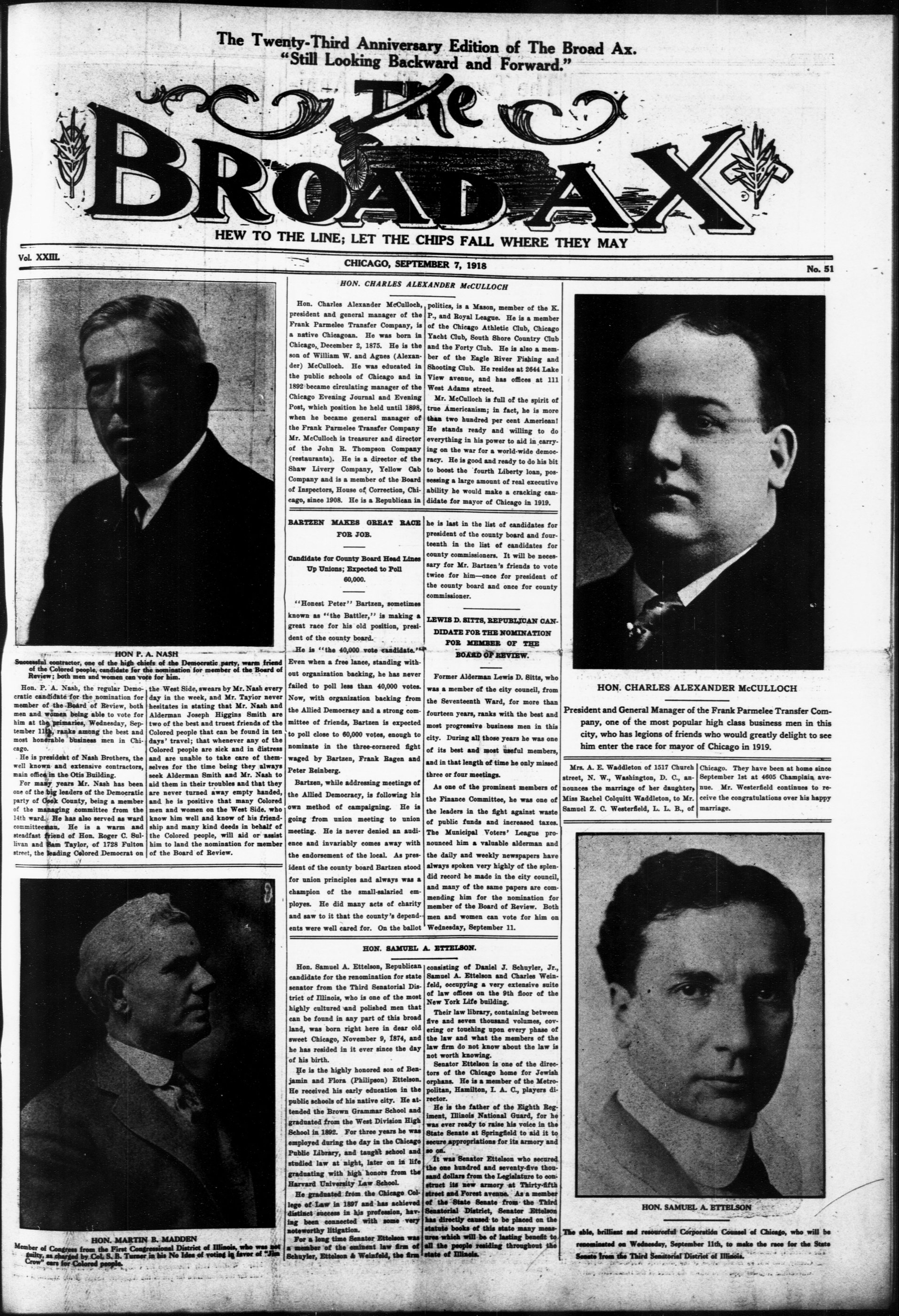
successful contractor, one of the high chiefs of the Democratic party, warm friend of the Colored people, candidate for the nomination for member of the Board of Review; both men and women can vote for him.
successful contractor, one of the high chiefs of the Democratic party, warm friend of the Colored people, candidate for the nomination for member of the Board of Review; both men and women can vote for him.
8
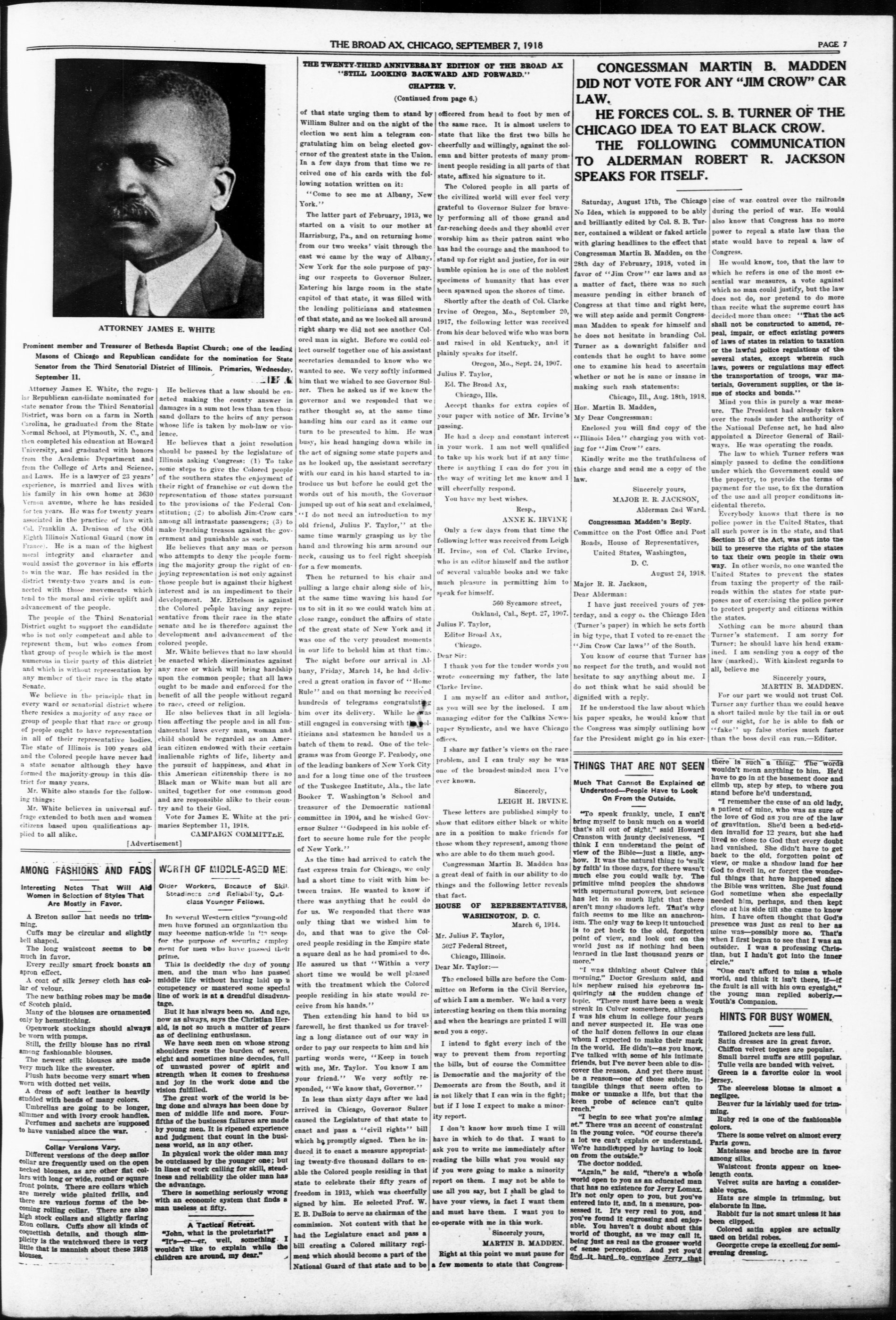
Member of Congress from the First Congressional District of Illinois, who was not guilty, as charged by Col. S.B. Turner in his No Idea of voting in favor of "Jim Crow" care for Colored people.
Vol. XXIII
HON P.
Successful contractor, one of the high chie
of the Colored people, candidate for
Review; both men and women can v
Hon. P. A. Nash, the regular Democratic candidate for the nomination for member of the Board of Review, both men and women being able to vote for him at the primaries, Wednesday, September 11th, ranks among the best and most honorable business men in Chicago.
He is president of Nash Brothers, the well known and extensive contractors, main office in the Otis Building.
For many years Mr. Nash has been one of the big leaders of the Democratic party of Cook County, being a member of the managing committee from the 14th ward. He has also served as ward committeeman. He is a warm and steadfast friend of Hon. Roger C. Sullivan and Sam Taylor, of 1728 Fulton street, the leading Colored Democrat on
The Twenty-Third Anniversary Edition of The Broad Ax. "Still Looking Backward and Forward."
the West Side, swears by Mr. Nash every day in the week, and Mr. Tayior never hesitates in stating that Mr. Nash and Alderman Joseph Higgins Smith are two of the best and truest friends of the Colored people that can be found in ten days' travel; that whenever any of the Colored people are sick and in distress and are unable to take care of themselves for the time being they always seek Alderman Smith and Mr. Nash to aid them in their troubles and that they are never turned away empty handed, and he is positive that many Colored men and women on the West Side. who know him well and know of his friendship and many kind deeds in behalf of the Colored people, will aid or assist him to land the nomination for member of the Board of Review.
CHICAGO, SEPTEMBER 7, 1918
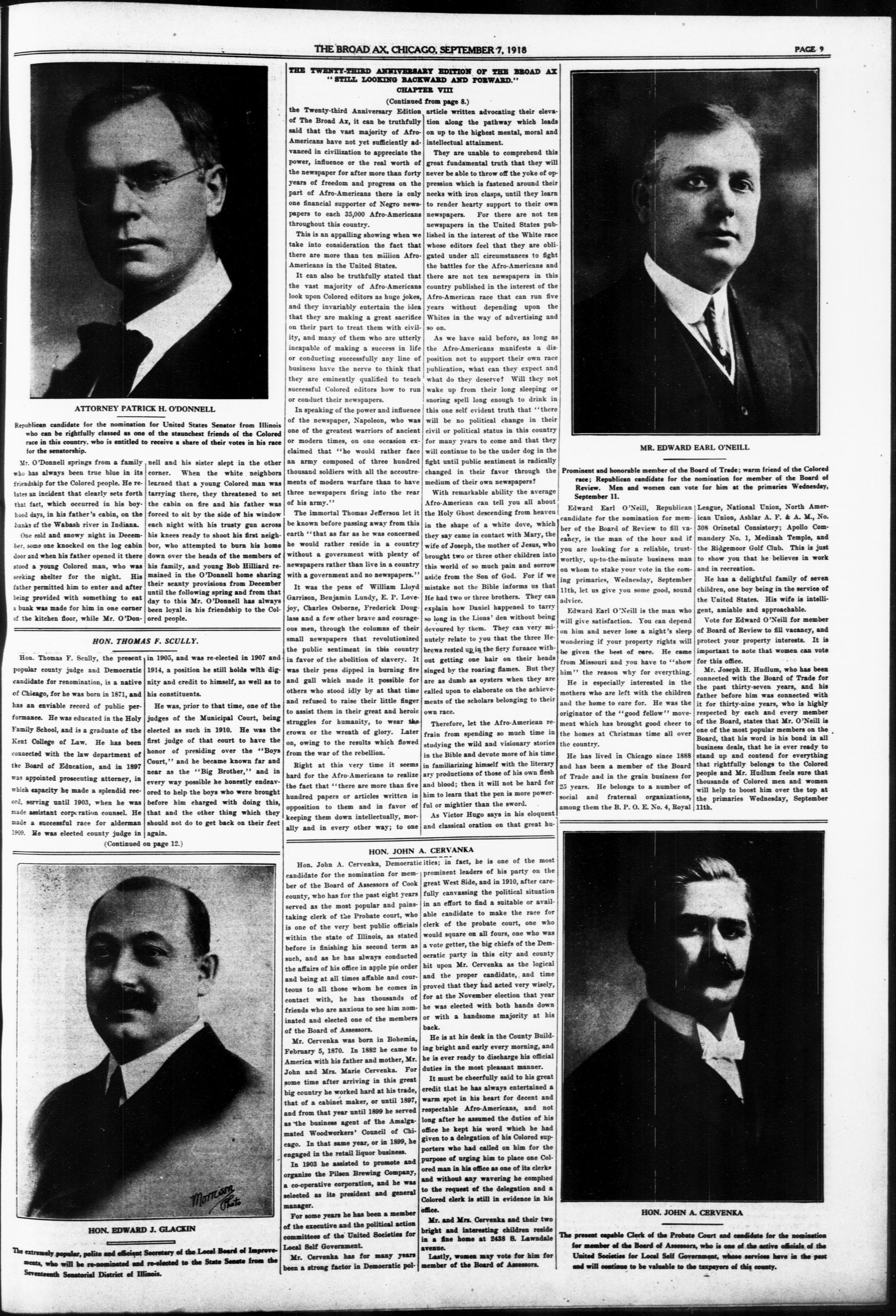
HON. CHARLES ALEXANDER McCULLOCH
Hon. Charles Alexander McCulloch, president and general manager of the Frank Parmelee Transfer Company, is a native Chicagoan. He was born in Chicago, December 2, 1875. He is the son of William W. and Agnes (Alexander) McCulloch. He was educated in the public schools of Chicago and in 1892 became circulating manager of the Chicago Evening Journal and Evening Post, which position he held until 1898, when he became general manager of the Frank Parmelee Transfer Company Mr. McCulloch is treasurer and director of the John R. Thompson Company (restaurants). He is a director of the Shaw Livery Company, Yellow Cab Company and is a member of the Board of Inspectors, House of Correction, Chicago, since 1908. He is a Republican in
"Honest Peter" Bartzen, sometimes known as "the Battler," is making a great race for his old position, president of the county board. He is "the 40,000 vote candidate." Even when a free lance, standing without organization backing, he has never failed to poll less than 40,000 votes. Now, with organization backing from the Allied Democracy and a strong committee of friends, Bartzen is expected to poll close to 60,000 votes, enough to nominate in the three-cornered fight waged by Bartzen, Frank Bagen and Peter Reinberg.
Bartzen, while addressing meetings of the Allied Democracy, is following his own method of campaigning. He is going from union meeting to union meeting. He is never denied an audience and invariably comes away with the endorsement of the local. As president of the county board Bartzen stood for union principles and always was a champion of the small-salaried employees. He did many acts of charity and saw to it that the county's dependents were well cared for. On the ballot
HON. SAMUEL A. ETTELSON.
Hon. Samuel A. Ettelson, Republican candidate for the renomination for state senator from the Third Senatorial District of Illinois, who is one of the most highly cultured and polished men that can be found in any part of this broad land, was born right here in dear old sweet Chicago, November 9, 1874, and he has resided in it ever since the day of his birth.
He is the highly honored son of Benjamin and Flora (Phillipson) Ettelson. He received his early education in the public schools of his native city. He attended the Brown Grammar School and graduated from the West Division High School in 1892. For three years he was employed during the day in the Chicago Public Library, and taught school and studied law at night, later on in life graduating with high honors from the Harvard University Law School.
He graduated from the Chicago College of Law in 1897 and has achieved distinct success in his profession, having been connected with some very noteworthy litigation.
For a long time Senator Ettelson was a member of the eminent law firm of Schuyler, Ettelson and Weinfeld, the firm
politics, is a Mason, member of the K. P., and Royal League. He is a member of the Chicago Athletic Club, Chicago Yacht Club, South Shore Country Club and the Forty Club. He is also a member of the Eagle River Fishing and Shooting Club. He resides at 2644 Lake View avenue, and has offices at 111 West Adams street.
Mr. McCulloch is full of the spirit of true Americanism; in fact, he is more than two hundred per cent American! He stands ready and willing to do everything in his power to aid in carrying on the war for a world-wide democracy. He is good and ready to do his bit to boost the fourth Liberty loan, possessing a large amount of real executive ability he would make a cracking candidate for mayor of Chicago in 1919.
he is last in the list of candidates for president of the county board and fourteenth in the list of candidates for county commissioners. It will be necessary for Mr. Bartzen's friends to vote twice for him—once for president of the county board and once for county commissioner.
LEWIS D. SITTS, REPUBLICAN CAN
DIDATE FOR THE NOMINATION
FOR MEMBER OF THE
Former Alderman Lewis D. Sitts, who was a member of the city council, from the Seventeenth Ward, for more than fourteen years, ranks with the best and most progressive business men in this city. During all those years he was one of its best and most useful members, and in that length of time he only missed three or four meetings.
As one of the prominent members of the Finance Committee, he was one of the leaders in the fight against waste of public funds and increased taxes. The Municipal Voters' League pronounced him a valuable alderman and the daily and weekly newspapers have always spoken very highly of the splendid record he made in the city council, and many of the same papers are commending him for the nomination for member of the Board of Review. Both men and women can vote for him on Wednesday, September 11.
consisting of Daniel J. Schuyler, Jr., Samuel A. Ettelson and Charles Weinfeld, occupying a very extensive suite of law offices on the 9th floor of the New York Life building.
Their law library, containing between five and seven thousand volumes, covering or touching upon every phase of the law and what the members of the law firm do not know about the law is not worth knowing.
Senator Ettelson is one of the directors of the Chicago home for Jewish orphans. He is a member of the Metropolitan, Hamilton, I. A. C., players director.
He is the father of the Eighth Regiment, Illinois National Guard, for he was ever ready to raise his voice in the State Senate at Springfield to aid it to secure appropriations for its armory and so on.
It was Senator Ettelson who secured the one hundred and seventy-five thousand dollars from the Legislature to construct its new armory at Thirty-fifth street and Forest avenue. As a member of the State Senate from the Third Senatorial District, Senator Ettelson has directly caused to be placed on the statute books of this state many measures which will be of lasting benefit to all the people residing throughout the state of Illinois.
M. B.
HON. CHARLES ALEXANDER McCULLOCH
President and General Manager of the Frank Parmelee Transfer Company, one of the most popular high class business men in this city, who has legions of friends who would greatly delight to see him enter the race for mayor of Chicago in 1919.
Mrs. A. E. Waddleton of 1517 Church street, N. W., Washington, D. C., announces the marriage of her daughter, Miss Rachel Colquitt Waddleton, to Mr. Samuel Z. C. Westerfield, L. L. B., of
Chicago. They have been at home since September 1st at 4605 Champlain avenue. Mr. Westerfield continues to receive the congratulations over his happy marriage.
1910
1
M.
HON. SAMUEL A. ETTELSON
The able, brilliant and resourceful Corps resinated on Wednesday, September Senate from the Third Senatorial Dis
resourceful Corporation Counsel on
dnesday, September 11th, to make
ward Senatorial District of Illinois.
The able, brilliant and resourceful Corporation Counsel of Chicago, who will be renominated on Wednesday, September 11th, to make the race for the State Senate from the Third Senatorial District of Illinois.
Chicago. They have been at home since September 1st at 4605 Champlain avenue. Mr. Westerfield continues to receive the congratulations over his happy marriage.
PETER H.
oration Counsel of Chicago, who will be over 11th, to make the race for the State District of Illinois.
PAGE 10 MEDIATION IN WAR
Roman Popes, From Earliest Time Deemed It Privilege.
First Instance Dates From 409, When Effort Was Made to Arrange Peace With Goth Leader.
From the earliest time of papacy, popes, as the religious heads of the Catholic church, have considered it their task to intercede as mediators in temporal disputes, observes a historian. Following are a few instances:
As early as 409, when Alaric I declared he would withdraw from Rome only on condition that the Romans should arrange a peace favorable to him, S. Innocent I went with an embassy of the Romans to Emperor Honerius, at Ravenna, to try, if possible, to make peace with him and the Goths, but failed in his endeavors to bring about peace. More successful was Gregory I, who played the same part on the occasion of the invasion of Italy by the Lombards. Owing to his friendship with the Lombardian queen Theudulinda, he actually mediated a favorable peace. When northern Italy was devastated by Attila the venerable bishop of Rome, Leo I—the first of the great popes—by a personal encounter with the king of the Huns, prevented him from marching upon Rome. He went in 452 to upper Italy, and met Attila at Mincio, in the vicinity of Mantua, obtaining from him the promise that he would withdraw from Italy and negotiate peace with the emperor. This pope also succeeded in obtaining another favor for the inhabitants of Rome. When in 455 the city was captured by the Vandals under Geneseric, the "scourge of God," Leo's intercession obtained a promise that the city should not be injured and the lives of the inhabitants should be spared.
Another pope, Benedict the Twelfth, who from 1334 to 1342 occupied the holy see, was as unsuccessful as a mediator as the present supreme pontiff. At that time Charles IV of France had died without leaving an heir, and when his cousin, Philip VI, put the crown on his head, his right to do so was contested by Edward III of England. Benedict XII, who wanted to mediate, was not listened to, and there ensued hostilities lasting, with some interruptions, for a hundred years. The popes mediated successfully between Christian opponents in cases where it was important to unite them in the common cause of Christianity against Turkey.
Pope Gregory (1271-1276), for the sake of a crusade against the Turks, worked indefatigably upon a reconciliation of the princes in Italy and Germany, and Paul III (1534-1549), nearly three centuries later, tried to prevent a war between Spain and France. Clement IX aided Venice against the Turks by mediating the peace between Louis XIV and Spain, etc.
What You've Been Waiting For
Masculine readers are not usually interested in pictures showing feminine fashions, notes the Outlook, but certain halftones in a Brooklyn furrier's catalogue are calculated to awaken a somnolent intellectual activity in the man who has been leisurely conning the rise in coal and milk bills. On the first page is shown an evening wrap made of chinchilla; its price is $10,000. The next page illustrates a wrap which is made up in various furs to suit different sized purses. The humber seeker for borrowed warmth may get this moleskin for the trifle of $550; more fastidious tastes may call for one of ermine at $2,000; those who prefer Hudson Bay sable may secure their choice for $15,000; while the lady who desires "the real thing" may have her wrap made of Russian sable at a cost of $75,000. An inferior garment of Russian sable, it may be added, will be furnished at $25,000 for anyone of economical tastes.
Overalls and Petticoats
The bloomer idea is going out among the French women employed in factories, especially munition works, according to a letter from one of the industrial centers over there, and return has been made to the skirt that ever has been the badge of femininity. Only where working close to certain machinery would make skirts dangerous have they been discarded for bloomers, or, in most instances, overalls. What was taken up as a fad, says a correspondent, has given way to the older and stronger dictates of modesty. And after work, in spite of the fact that it has been work amid grease and dirt of the exceptional sort—or perhaps because of it—there is recourse to the powder puff and the other appurtenances of frill that in some form or other are synonymous with woman the world over.
Paper Money's Nicknames
Now that paper money is a permanent part of our pocket currency, we await the inevitable nickname for the notes, which is sure to come, says the London Chronicle.
If we follow the precedent set across the Atlantic in 1862, when "greenbacks" first made their appearance, we might be satisfied with "Westminster," with reference to the very admirable lithograph of the palace which adorns the reverse of the new notes. Something better than that is sure to come along.
In the army the notes are known as "CS's," in jocular allusion to the remarkably narrow chest which the artist has given St. George, who is in conflict with a very robust dragon.
HALF-SOLED HER SAVING BANK
Shoemaker Finds Eight Hundred Dollars and Gems in Woman's Shoe —Gets Small Reward.
Business was good with Engle the shoemaker. Many persons had brought many shoes to his shop to be repaired, and his cash drawer was full of strange silver, says the Arizona Republican. Came a boy early one morning bearing a pair of woman's shoes to be half-soled. The boy departed. Shortly afterward Engle picked up the woman's shoes. From the toe of one shoe fell a purse, fat and tightly closed. Before the shoemaker had recovered from his astonishment another purse fell from the toe of the other shoe. Two purses, both fat. Engle opened the first fat purse. There was $300 in bills. Then Engle turned to the second purse. From that one came fashing diamonds, necklaces, rings and eardrops. More than $500 worth.
The shoemaker gathered up the bills and the diamonds and put them safely away and turned to his work. Counting the bills or admiring the diamonds wouldn't make money for Engle. Then a frantic woman burst into the shoemaker's shop. No need for Engle to inquire what she wanted or why she was frantic. The shoemaker knew. The shoes belonged to her and so did the bills and diamonds and other gems. She had taken her safety deposit vault to the shoe shop. Almost in hysteries the woman recovered her money and jewelry, more than $800 in all. She clasped the two purses to her and immediately a great relief spread over her. Placing 50 cents in the hands of Engle the shoemaker the woman left the shop. Engle turned to his shoe repairing.
STORMS AND FOREST TREES
Timber Most Firmly Rooted Will Endure Strain Better Than That of Strongest Wood.
It is always interesting to watch the effect of storms anywhere, but in the woods these effects are most varied and remarkable, says a writer. It frequently happens that a tornado or hurricane will follow a certain course and level only the trees in this line, often leaping from place to place. In such cases all trees in its swath suffer or are blown down; but where there is a general very high wind and all trees are hit with about the same force it may be noted that the best rooted ones and not those of the strongest wood survive.
Wind resistance of the whole tree has also something to do with the bending character of the trunk and branches, for where these give before the force of the storm they permit the wind to slide off. The hickory, above all, will not yield, and consequently receives the hardest strain against its entire top, whether full leaved or bare. It may be commonly noticed that in a mixed woodland, where a hard wind has driven, there are more hickorles down than any other trees.
His Apparent Yearn
"I expect to remain at least two weeks if your accommodations prove satisfactory," said the horse-faced gent. "I wish a room with southern and western exposure. I observe that the railroad runs within half a block of the hotel—you will kindly request the company to refrain from blowing their engine whistles in this vicinity. Persons in adjoining rooms should be cautioned about making unnecessary noises. I wish prompt service at meals, and am especially desirous of having strictly fresh peanut butter, Eata-Bitta health food, distilled water, and—"
"Uh-huh!" nonchalantly returned the landlord of the Petunia Tavern. "What you want, podner, 'pears to be Ouija board, not plain village board. Well, the—yaw-w-w-wn!— house 'is full, and I can't accommodate you."—Kansas City Star.
No Crocuses in November.
It should be a consolation to women who have passed thirty to remember that the most beautiful work of human hands—the Venus de Milo—is the statue of a mature woman, comments a writer. All the Venues, in fact, are represented as mothers. There is not a young girl in the lot. Among the Greek statues only Psyche could qualify as a Broadway beauty, and even Psyche might appear a little plump and mature to the admirers of the human reedbird.
Of course, every woman should fight ugliness to her last hour. She need not lose her beauty at any age. But one does not expect to pick snowdrops or crocuses from the fallen leaves of November, and it is just as futile to hope to look sixteen when you are forty.
The Beauty of Truth.
Only that which has character is beautiful.
Character is the essential truth of any natural object, whether ugly or beautiful; it is even what one might call a double truth, for it is the inner truth translated by the outer truth; it is the soul, the feelings, the idea, expressed by the features of a face, by the gestures, and actions of a human being, by the tones of a sky, by the line of a horizon.
Now, to the great artist, everything in nature has character; for the unswerving directions of his observation searches out the hidden meaning of all things.
There is nothing ugly in art except that which offers no outer or inner truth—Bodin.
THE BROAD AX, CHICAGO, SEPTEMBER 7, 1918 THE TWENTY-THIRD ANNIVERSARY EDITION OF THE BROAD AX "STILL LOOKING BACKWARD AND FORWARD."
(Continued from page 9.)
manitarian "Voltaire," that Voltaire uttered a loud shriek of horror which penetrated down to the bottom of his warm liberty-loving heart, when he beheld the priesthood and the church cutting the tongues out of the mouths of the people, pouring melted lead in their ears, tearing them to pieces over the racks, blinding them by putting out their eyes, simply because they would not yield obedience to the church and the priesthood in all things.
Voltaire, alone, with his pen, in the presence of those united forces, the court, the nobility, the church, capital, that unconscious power, the blind multitude, that terrible majesty so severe to subjects, so docile to the master, crushing and flattering, kneeling upon the people before the king; that clergy vile, melange of hypocrisy and fanaticism, Voltaire alone, we repeat it, declared war against that collation of all the social iniquities against that enormous and terrible world, and he accepted battle with it. And what, dear readers, was his weapon? That which has the lightness of the wind and the power of the thunderbolt—a pen. With that weapon he fought, with that weapon he conquered.
Our main contention is that if Voltaire could stand up single-handed alone and work up and create a sentiment which
HAND TUCKING ON BLOUSES
More Elaborate Models, Imported From Paris, Show Marked Tendency Toward Collarless Style.
The subject of blouses is one which arouses perennial interest in the minds of the feminine portion of humanity, and the recent importations of French blouses are enough to arouse the enthusiasm of even the merest man, declares a New York fashion letter. The great majority of them, even the more elaborate models, are developed in fine volle, handkerchief linen and batiste. There are, of course, a number of designs in Georgette, crepe de chine and chiffon.
On the whole, less lace and button trimming is being used on the blouses this season than last; hand embroidery is largely supplanting these. Hand tucking is being extensively featured this fall with very good effect, especially on fine white linen blouses designed for wear under a suit.
The more elaborate models show a marked tendency toward the new collarless style. In some instances the absence of the collar is covered by the introduction of a hemstitched yoke, in others there is a small collar hung from the shoulder seams.
Some of the more extreme styles show sleeves of the full bishop variety, which are gathered in to a very tight cuff at the wrist. Sports blouses have rather tight sleeves, with deep cuffs reaching almost to the elbow in some cases. Speaking of sports blouses, a great many novelty materials are being pressed into service in their making. Wash satin in all the popular pastel shades perhaps leads the list, the dark taffetas in brilliant stripes are a close second.
COLOR LIKED IN NECKWEAR
Surplice, Shawl and Tuxedo Shapes are Favorites Although Sailor Type Has Not Been Discarded.
A bit of color is liked in the neckwear as well as in the new handkerchiefs. Indeed, it may be said that several of the mouchoirs can easily be matched up in color, if not in fabric, with the new collars and cuffs.
The neckwear sometimes comes in net, fine lawn, batiste or organdie and the edging is done in colored net finely plaited. Frequently there is no other ornamentation. The surplice, shawl and Tuxedo shapes are prime favorites, although they have not made the sailor type passe by any means. The latter is liked for young girls and for children and frequently it is used to impart a note of youth to frocks of silk or satin.
Because it has been found more and more difficult to get fine embroideries the prospects are very promising for a vogue of lace of the better sort. For many years lace has been less fashionable than embroidery, particularly in neckwear development. Therefore, there is more good lace to be had and some of it will now be used up for the adornment of smart dresses and blouses. This lace use has reference to varieties other than fillet and venice, which have been popular for some time.
Cream together one cupful of butter and three-quarters of a cupful of sugar, add one well-beaten egg, one tablespoonful of cream and, very gradually, four cupfuls of flour. Knead the flour in thoroughly, then turn onto a floured pastry board, knead until smooth and roll out in a large round. Cut out in eight triangular pieces, mark all over with a fork and lay on a well-buttered baking tin. Bake in a moderate oven 15 minutes.
Sweet Scones.
compelled the rulers or the authorities of the church and of France itself to accord to them their religious and political liberty, what could several hundred able Negro writers accomplish in the way of creating public sentiment in favor of the Afro-American being permitted to freely enjoy all of his natural rights, if their publications were properly supported? For it hath been said by that eminent authority who was one of the greatest champions of the manhood rights of the Afro-American—Wendell Phillips—that "Armies are nothing, courts are nothing, laws are nothing, unless they are backed up by public sentiment." And mark our words, the Negro never will have public sentiment on his side in this country until he is willing to heartily and cheerfully support newspapers published exclusively for the advancement of his race.
For printer's ink and education tinged with irony and song saps away the strong foundation of all monumental wrongs.
In conclusion, from the very bottom of our warm and sympathetic heart, we most gratefully desire to express our lasting gratitude to each and every one who have in the past and at the present time assisted in any way to make it possible for us to present them with a copy of the twenty-third anniversary edition of The Broad Ax!
When Ironing Kerchiefs.
When ironing handkerchiefs the middle should be ironed first. To iron the edges first causes the middle to swell out like a balloon and makes it difficult to iron satisfactorily.
Airplanes Take Movies of Foe Along Battle Fronts
American pre-eminency in the movies has made itself felt at the front, where United States airplanes equipped with motion picture cameras clicking constantly as the machine whirrs over German positions are rapidly coming into use, writes a correspondent. When the war started both allied and German airmen speedily saw the advantage of photographs of the enemy's defenses, and pocket kodaks came into use. Next the machine carrying a larger camera and defended by a battle plane was brought forth. The camera grew larger and larger and the Italians finally produced a machine which had a large aperture in the bottom, through which a camera took pictures in rapid succession. It remained for the Americans, however, to place a complete motion picture machine in this aperture and to take thousands of feet of film of long lines of Prussian fortifications, trenches and troop movements.
Vestments of the Russian
Clergy Are Most Costly
The robes of the Russian clergy are the richest and most costly in the world. They are unattainable under £200. Of course, notes a writer, a priest not pay this cash down, so the holy synod advances him the money, and then deducts it from his stipend.
In the House of the Holy Synod, situated inside the Kremlin, may be seen vestments of fabulous value. One is embellished with the Nicene creed, embroidered in pearls, estimated to be worth anything between £200,000 and £500,000. There are no fewer than seven miters studded with diamonds, rubies and emeralds; also golden croisers of rare workmanship. The exact value of these treasures has never been divulged, but it is said that if a person offered £45,000,000 for the House of the Holy Synod and secured its contents he would make a great bargain.
Dyes Blue Eyes Brown
Dyeing her eyes was the way a woman in Berlin evaded capture by the police. She had become known as "the murderess with the colored eyes." To escape detection she applied to her eyes a poison which changed their color. They were originally blue, but were more or less successfully dyed brown. While in jail the dye effects wore off and the prisoner's eyes turned blue again. Her identity is now definitely established. The murderess also made a futile attempt to deceive the police by dyeing her hair black.
Ceylon has 16 varieties of palm from which sugar can be extracted. The island of Reunion has changed its name four times in less than a century. In its deepest part the depth of the English channel between Dover and Calais does not exceed 180 feet. The Japanese are producing annually 20,000,000 tons of coal from the mines of Japan and south Manchuria.
Popular Science.
QUESSING THE WOMEN'S AGES
New Game Among Cape Steamship Passengers Stirred Up Wrath of Entire Party.
To relieve the monotony of a recent homeward voyage, the smoking-saloon habitues of a Cape steamship invented a new sweepstake. The bright idea originated during a debate as to the age of one of the women passengers. "Let's take all the women in the passenger list," suggested the sportsman who thought of the sweepstake, "and each of us guess their individual age, add up the total, and hand his estimate to the purser. The purser has exact information in the age declaration of every passenger. He can add up the true aggregate, and the man who comes nearest to it takes the pool."
The sweepstake was carried out, but, so far from beguiling the tedium of a voyage it made it worse, relates a correspondent, for it ended in a certain number of embittered men, a wrathful purser, and a ship's company of suspicious and quarreling women. First of all, the women saloon passengers could not understand, and much resented, men passengers walking round their chairs, making calculations with pencils, studying their hairs and complexions with perturbing curiosity.
Then, when the sweep was drawn, the mean man was embittered who had secretly gone round to most of the women passengers and tried to elicit their ages. The mean man's aggregate estimate was 450 years under the winner's guess. The innocent man was also embittered who had gone round to women asking them to give him their judgment as to other women's ages. The innocent man's estimate was 600 years above the winner's guess.
And the purser was most embittered of all, for not one woman passenger would speak to him the rest of the voyage.
WIRELESS FOR ALL TO HEAR
Instrument No Larger Than Fountain Pen Enables One to Pick Up Messages Nearby.
The "fountain pen" wireless receiver is an established fact, for through the use of the audion bulb Dr. Lee De Forest has perfected a little instrument, no larger than some of the extra-size fountain pens in use by men with heavy hands, through which it is possible for a man to pick up wireless messages at distances up to eight or ten miles, says the Illustrated World. The instrument depends entirely upon the audion bulb for its efficiency. The audion bulb, as most of those interested in wireless knows, made feasible the recent long-distance messages sent out from Washington, and its use for communication by wire also made feasible the now common transcontinental telephoning between New York and San Francisco.
The entire principle of the audon bulb is to amplify sound waves, and by making a bulb small enough to be placed in the end of the fountain pen tube Doctor De Forest has literally made it possible for any "man in the street" to pick up whatever wireless communication may be going on in his neighborhood.
The Beer of Borneo
Beer as made by the natives of Sarawak, in the northwestern region of Borneo varies in its ingredients according to the different tribes who make it, the most intoxicating being that made by the Bisalyahs of Limbang. These people make their beer by boiling rice, adding yeast, crushed wild chill and a large lump of wood ash. This is all put into a jar till the jar is two-thirds full, and covered over with bamboo supports; water is poured on till the jar is full, and the beer is then ready for drinking. The drinking is performed by pushing bamboo tubes down to the bottom of the jar and then sucking up the liquid. So that no one shall have more than his fair proportion at a time, a system of floats is arranged whereby the amount of drink consumed by each man is registered.
One Tropical Spot
Only at one place in the United States is there real tropical vegetation, says the Popular Science Monthly. Florida and California have what is called "sub-tropical" vegetation. In the midst of a desert in the extreme southern part of California is a true oasis. The oasis, Palm Springs, lies 250 feet below the sea level. So hot it is there that there is a riot of vegetation all the year round. Enormous fig trees and mammoth grape fruit and oranges are always to be had. The lemons that grow there weigh two and a half pounds apiece. The responsibility for all this may be laid to a beautiful little stream which is fed by the Colorado river and which flows through the oasis only to disappear into the ground at its end.
Did Not Fool the Bear
Bruin is self-educated, but exceptionally wise in the way of mankind. A prospector proved that. Haying suffered the loss of much food, he prepared a particularly tasty morsel for the bear and left it in the cabin, with a notice on it to warn any prospectors or hunters that might enter that it was intended for bruin, and bruin alone. The bear arrived in due course—and ate everything edible and some things that were not, but passed up the meat that had been prepared for him. And it was bacon, too. This prospector declares that the bear must be able to read.
Popular and Beautiful Melodies Are
Urged in the Home and at Pub-
lic Gatherings.
Sing the old Irish songs at the divi-
sion meeting, at the public meet-
ing and in the home. There is beauty in
them, and as the melody pours forth
from the depths of the emotions there
is a touch of the spirit with the noble
souls whose lips are silent forcest
The inherent gift of song is a foremost trait of Irish character, reminding the National Hibernian. Historians and travelers of other races noted this gift many centuries ago. Philosophers have advanced the theory that the music of a nation exhibits its inner feelings as surely as the needle points the way to the pole. Governments have bored to destroy the melodies of a conquered people and striven to educate subject races to sing the songs of the conqueror. So true is the oft-quoted line of the poet, "Let me write the songs of a nation and I care not who makes its laws," that statesmen have molded their policies upon the wise saying.
Let us sing the old Irish songs! Let us recognize that no nation has such songs to sing. The Irish nation has few immortal composers, but its popular melodies have all the genius of immortal compositions.
An Ancient Seaport.
Kavala, the Grecian seaport, which has been frequently mentioned during the present war, was once known as Neapolis, and it was here that St. Paul landed on his way from Samothrace to Philippi, where there was a thriving colony of Christians to whom the Epistle of the Philippians was addressed. Prior to the beginning of the Christian era Neapolis was the seaport of Philippi, whose ruins are to be found some ten miles from shore, on the highway from Kavala to Thessaly. Here the fleet of Brutus and Cassius was at anchor during the famous conflict on the fields of Philippi in 42 B.C., when the assassinators of Julius Caesar met defeat at the hands of the legions commanded by Antony and Octavius. Practically all that remains to connect ancient Neapolis with modern Kavela is a Roman aqueduct whose two-tier arches still convey water from Mount Pangeus to the town and citadel.
FLASHLIGHTS
The road to victory is lined with disagreeable duties.
The lesson every young man ought to learn is that he isn't in this world to have his own way but to make the best of the other fellow's way.
Every slacker at home makes the battle so much harder for the boys at the front.
Some fellows are perfectly willing to do their duty if they can select their duty first.
Five Foodless Years.
Just as the ranchman's horse had learned to get along without eating, he unfortunately "up and died." All animal organisms would doubtless ultimately meet a similar fate, but certain small beetles in the larval stage have recently lived without food for something over five years. The experimenter, Prof. J. E. Wodsedalek of the University of Idaho, tells in Science (New York) how a number of specimens were placed in sterilized vials to find out how long they could exist without food. Newly hatched larvae lived over four months without ever having eaten. The others resisted death for periods varying with their size and age, the last one only succumbing after five years, one month and twenty-nine days of starvation. The larvae dwindle in bulk, but are ready to eat at the end of their fast, and then grow again to normal size.
Fewer Lobster Fishermen.
An Augusta (Me.) correspondent says that seven hundred fewer fishermen renewed their licenses to catch lobsters this year than last year, this falling off being due to various causes. Thus far this year Oscar H. Dunbar, the commissioner of sea and shore fisheries, has received the applications from 3,193 men who wish to fish the seas. The high cost of the lumber, lath and twine that go into the traps, together with the increased price of gasoline, has caused many of the fishermen to go out of the business.
Prevent Silver From Tarnishing.
To prevent silverware from tarishing, first warm the pieces to be treated, then paint them over with a thin solution of collodion in alcohol, using a wide, soft brush. This will not harm silverware in the least, and will save lots of hard labor trying to keep it clean.
THE RECORD OF THE HON. SAMUEL A. ETTELSON IN THE STATE SENATE OF ILLINOIS WAS NOT FULL OF EMPTY PROMISES, BUT IT IS REPLETE WITH GOOD DEEDS AND LEGISLATIVE MEASURES ENACTED FOR THE BENEFIT OF ALL OF THE PEOPLE OF ILLINOIS
The brilliant record of Hon. Samuel A. Ettelson: In the Forty-sixth, Forty-seventh, Forty-eighth, Forty-ninth and Fiftieth General Assemblies he was appointed to the most important committees. Prominent among these was the Republican Steering Committee, as a member of which, early in his career, he helped to overthrow the notorious "Senate Combine" and to reorganize the Senate so that all bills could get a fair hearing, chairman of committees being no longer able to smother measures designed by the Senate majority. Since then Mr. Ettelson's vote has always been on the side of open and honorable legislative procedure and of progressive legislation.
SOME THINGS SENATOR ETTELSON
HAS DONE.
New Illinois Code: Helped frame this law, the most important piece of Illinois legislation in 30 years. An uphill fight through several sessions resulting in 1917, in a complete new administrative code, setting up a scientific system for the executive department and revolutionizing the administrative machinery through centralizing more than 125 conflicting agencies into nine correlated departments, under cabinet heads named by the Governor. Was active in work in 1913 and 1915 Assemblies that made this law possible.
Legislative Efficiency: A member of the Senate committee that framed the 1917 law for a legislative budget and an efficient business system for the General Assembly. Helped secure, in 1915, a reduction in Senate committees from fifty-one to twenty-six, promoting efficiency. Active for law (vetoed by Gov. Dunne) to check incompetence, extravagance and corruption in state offices by requiring itemized reports to the Assembly. One of original advocates of the Legislative Reference Bureau which was organized in 1915, and in 1917 made possible a record in efficiency and number of laws enacted.
Public Economy: Active in helping Gov. Lowden oppose extravagance. Against bills to increase taxation and make unjustifiable appropriations. Opposed measure to pay salary and expenses of members whose seats were under contest. Voted against paying legislators' traveling expenses from state funds and refused to accept his share of appropriation. Law afterwards declared unconstitutional.
Chicago's Official Representative: As Corporation Counsel had charge of the city's legislative program. Originated the big bills for better government in Chicago and fought them through the Senate against all opposition, only to see them lost in the House. Success would have given back to the voters of Chicago complete power to regulate all public utilities, and would have made possible for the city a modern traction system, with subways under control of the people, and unified operation of "L" and surface lines, with universal transfer. Mr. Ettelson forced similar measures through the 1915 Senate, but these failed to get a House majority.
Consolidation of Chicago Taxing Bodies: Worked in committee and on the floor of the Senate to secure 1915 reform law providing for consolidation of Chicago's numerous conflicting taxing bodies, thereby making for efficiency and economy. Long a worker for this reform.
Highest Interest on Public Funds: Helped enact 1915 law requiring Cook County Treasurer to secure, by open bid the highest possible rate of interest on public funds. Author of 1907 law compelling state treasurer to turn over to the people interest on all state funds. These and other similar measures for which he has voted have saved the people millions of dollars.
Tax Payers' Injunctions: Voted for 1917 law providing tax payers with a weapon, against extravagance, incompetence and dishonesty in the disbursal of public funds.
Private Bank Regulation: Instrumental in giving the voters, at the November election, an opportunity to end
forever the private bank scandals that have cost the life savings of thousands of Chicago working men and widows and left their children paupers. Was the first man to introduce a bill for private bank regulation in the 1913 Assembly and followed it with another at the 1915 session. Anti-Loan Shark Law: Ardent advocate of this 1917 law and active in securing the 1913 enactment. The salary, wage and chattel mortgage sharks can no longer persecute the working man and the widow in their hour of necessity. Has helped to secure complete regulation.
Blue Sky Law: Voted and worked for this 1917 law to protect the savings of the people from swindlers in fake stocks and bonds.
Workmen's Compensation: One of the leaders in creating the original State Industrial Board and in enacting the 1911, 1913, 1915 and 1917 compensation laws, the latter forcing employers in extra hazardous lines to accept compensation, and absolutely preventing corporations setting up the "fellow servant" or other defense. Mr. Ettelson also helped secure 1917 law requiring delinquent employers to pay all burial expenses.
Investigations to Create Better Working Conditions: Helped enact 1917 laws authorizing the Illinois Industrial Survey, an expert investigation into conditions surrounding women in employment, and the labor commission to study sickness and accident not covered by the compensation laws. Both commissions will suggest remedial legislation. Unemployment: Responsible in large part for the 1915 law which gives the working man and woman the present Illinois free employment bureau service, with local and state commissions to aid the unemployed.
Child Labor: One of original advocates of this measure. Helped frame 1915 and 1917 amendments that threw greater protection about minors in industry, providing for medical examination, etc.
Coal Mining: Very active in support of the 1917 law creating the Illinois Mining Investigation Commission, which is to revise the state's mining laws, and of the measures providing better ventilation, fire protection and other safeguards.
Road Building for Convicts: Cooperated actively in securing 1917 law which by employing convicts in preparation of state aid road materials, at one and the same time protects free labor from unfair competition and insures for the prisoners wholesale outdoor activity. Good Roads: Helped give the people the privilege, at the November election, of voting to pull Illinois out of the mud by establishing a state-wide system of hard roads. This great improvement, to be paid for largely by higher automobile licenses, will cut the cost of living in Chicago by reducing the cost of marketing foods.
Mothers' Pensions: Active in securing the original law which has saved hundreds of mothers from the poor house and thousands of children from crime and ruin; and in securing 1915 and 1917 amendments, broadening the law and making it more liberal.
School and Civil Service Pensions: Voted for 1917 laws creating a state teachers' pension fund, a fund for instructors in public institutions, and a commission to study civil service pensions and create a scientific system; and for the many pension bills that made the 49th and 50th General Assembly notable. Public Health Measures: Outspoken and active in support of 1915 law creating tuberculosis sanitariums wherever needed, and the 1917 law doubling their income; the 1915 law providing schools throughout the state with the highest standard of ventilating and fire fighting apparatus; the 1917 law protecting the public against quacks pretending to be qualified for manipulative surgery; the 1915 law for the health, safety and comfort of factory workers; and the 1915 and 1917 laws greatly increasing the difficulty of distributing habit-forming drugs.
State Farm and Municipal Gardens: Always an advocate of constructive penal legislation. Voted for 1917 laws creating a state farm where prisoners from the House of Correction can learn fruit culture and stock raising, and the municipal lodging houses and gardens needed to care for and reconstruct the unfortunate.
Better Housing for Workin Advocated 1913, 1915 and 1917 for better housing. A housing sion bill passed Senate with his 1915. Hopes to help overcomposition of interests in 1919.
People's Measures: Hopes strengthen present child labor a men's compensation laws. Will
Public Parks and Recreation: Added to a long and consistent record in behalf of recreation for the people by working for the 1917 law which empowered Chicago to conduct the present free dances and other exhibitions on the municipal pier and at other places. Author of the original outer harbor bill in 1910 that gave the people this splendid recreation pier. Introduced first bill in 1907 for the present widening of Michigan avenue, the completing link in the great boulevard system. Active in creating legislation for present bathing beaches, giving the lake front back to the people. Helped make possible the great Field Museum now building in Grant Park. Voted for 1915 law giving the West Park Commission funds for expansion, but insisted on a referendum.
High Cost of Living: Voted for 1915 co-operative societies law that gave workingmen the opportunity to organize co-operative associations for the cheaper purchase of groceries, coal, etc.; for the 1917 law putting all cold storage plants under control of the state food commission, with the prevention of extortion, food hoarding and the sale of deteriorated products; the 1917 law empowering Chicago to force down ice prices by opening a municipal ice plant, and the 1915 bill, which passed the Senate only, for a Chicago municipal cold storage of food.
Vital Statistics: Ardent supporter of 1915 law that provided for the official registration of all births and deaths. Of greatest importance in court proceedings, real estate and probate controversies and elsewhere. All men now under the army draft law will appreciate its value. A check on murder.
Fair Deal for All Races, All Creeds: Always foremost in opposing prejudice and discrimination as between religions, races and social orders. Prevented enactments in the 1913 and 1915 Assemblies that would have precluded marriage between certain races, and which enactments were otherwise prejudicial. Secured the passage of the 1913 law and the 1917 laws that prevented discrimination, because of race, color or religious belief, in the price of cemetery lots and accommodation in hotels and theaters, and the exhibition of pictures or plays inciting to race hatred.
War and Preparedness: A leader in all patriotic and preparedness legislation. Helped put Illinois into active cooperation with the government by creating the Illinois State Council of Defense. Worked for 1915 resolution urging upon Congress a strong naval policy—the wisdom of which has since been fully demonstrated. Father of 1915 and 1917 laws for construction of National Guard armories, among these being the Eighth Infantry armory, where the men now in France were trained. Voted at 1917 session to establish the Illinois Reserve Militia to take the place of the active guard in case of any outbreak of lawlessness in the state.
Early Record: In General Assemblies of 1909, 1911 and 1915, voted and worked for such measures as direct primary, direct election of senators, initiative and referendum, adult probation, occupational disease prevention, cheap text books, employers' liability, pure food law, food sanitation, anti-pass restriction, and municipal court law and amendments thereto.
REFORMS THE ENACTMENT OF WHICH IS STILL TO BE SECURED
Home Rule: Will fight to the uttermost to return Chicago's public utilities to the complete control of her voters. Succeeded in Senate in 1917; hopes to succeed in both Senate and House in 1919.
Subways and Unified Operation: Pledged to work for a union of Chicago "L" and surface lines, with universal transfer, and a subway, with provision of all safeguards for control by the public.
Women's Eight-Hour Law: Will use every effort toward success in 1919. Worked hard for 1915 and 1917 enactment, but opposition of interests was too strong. One of pioneers in securing women's ten-hour law in 1909 and nine-hour law in 1911, and other legislation for the protection of women.
Better Housing for Working Men: Advocated 1913, 1915 and 1917 measures for better housing. A housing commission bill passed Senate with his help in 1915. Hopes to help overcome opposition of interests in 1919.
People's Measures: Hopes to help strengthen present child labor and workmen's compensation laws. Will continue his work for a state board on vocational training, for better cheap text book legislation, for a state boxing and athletic commission (passed Senate in 1915), and for a "pure ad" law to protect the buyer from misrepresentation. Voted for the 1915 bill, which passed Senate, but failed in House.
Deep Waterway: Will work in 1919 for a real deep waterway. Opposed former enactment as wasting public funds on what would prove to be a failure.
Women's Suffrage: Will work to extend suffrage to all offices.
Better Government: Will work for a short ballot law, a corrupt practices act, a non-partisan judiciary, and a new code for regulation of corporations. Father of several bills proposing these reforms. Helped get 1917 corporation act through Senate.
Economy in State House and Legislature: Will strive for continuation of efficiency reform begun in 1917. We must have strict business methods in administration and law making.
Central Registration: Will work for measure to cut cost of elections in Chicago through simplification of registration machinery. Would have become a law in 1917 but for error in House engrossing committee.
Municipal Cold Storage: A law for a municipal storage plant to check food profiteering was close to enactment in 1917. Hopes to secure a law in 1919.
After the War: We must prepare for conditions that will confront us when war ends. There will be maimed soldiers to be cared for and taught new vocations. Families will have been destitute. Employment must be found for the returning soldiers. Above all, provision must be made for a campaign of education to bring about complete Americanization of our many racial elements. With the above splendid and brilliant record behind him, Senator Ettelson will have no trouble in going over the top at the primaries Wednesday, September 11.
Ever Upward
It is not enough to win rights from a king, and write them down in a book.
New men, new lights, and the code of the fathers the sons may never brook.
What is liberty now were license then; their freedom our yoke would be.
And each new decade must have new men to determine its liberty. Mankind is a marching army with broadening front the while, Shall it crowd its bulk on the worn paths or clear to the outward file?
Its pioneers are those dreamers who heed neither tongue nor pen.
Of the human spiders whose silk is wove from the lives of toiling men.
—John Boyle O'Reilly on Wendell Phillips.
Unionists Defined.
Wage workers, members in good standing of the union of the trade or calling at which they are employed, who realize as a fundamental principle the necessity of unity of all their fellows employed at the same trade or calling; who recognize the vital, logical extension, growth and development of all unions of all trades and callings and who strive for the unity, federation, co-operation, fraternity and solidarity of all organized wage earners; who can and do subordinate self for the common good and always strive for the common uplift; who decline to limit the sphere of their activity by any dogma, doctrine or ism—finally, those organized wage workers who fearlessly and insistently maintain and contend that the trade unions, the trade union movement, are paramount to any other, form of organization or movement of labor in the world, are the ideal unionists.
Men Who Make a Nation.
The attitude of government toward labor lies at the heart of almost everything that concerns us as a nation. A nation may be said to consist of those who do its daily labor, and America has always boasted that she was the home of free labor, that all were welcome to come to her shores and partake of her unbounded opportunities.
Economy.
Economy, beyond a doubt,
Securely will be speeded.
If we will merely go without
Some things we never needed.
Of Course Not.
Harry—Do you think that money is necessary to happiness?
Helen—Not if one has unlimited credit.
CHARLES E. STUMP, THE KANSAS FARMER NEWSPAPER WRITER, IS STILL ENJOYING HIMSELF IN THE SOUTHERN STATES. HE WILL ATTEND THE NATIONAL BAPTIST CONVENTION AT ST. LOUIS. MISSOURI.
Pine Bluff, Ark.—Did you ever skin the cat? That is just what the French, the English and the Americans are doing with the Germans and all their followers just now, and they are going to do even more before this thing is over. Them Huns had just as well get wings and go to flying, and if they do our fleet will overtake them. It will be a question in a very short time, where can I go to be saved?
My country is just getting its blood hot, and you may know just to what extent when I tell you that some of our men as black as the blackest ink are turning red in the face at the mere mention of the Kaiser, and are just anxious to get a chance at him. His days are numbered, and it will not be long before the whole world will be called upon to attend his funeral and the rest of the Huns are going to take wings and run like a turkey.
Of course we are going to win this war, and we are going to win it with ease. We have already the trained men, and we are calling for men to get behind them in case they need a little help.
Of course you know Colonel Frank Denison, and the world will know him when the war is over. He will have passed from the rank of a mere colonel and will be some other big warrior, and it will not be handed him from a Christmas tree, but will be won by real brave heroic service rendered in the trenches and on the battlefields of France. Of course the war calls for sufferings, but the American people are willing to do that suffering in order to win freedom for the world. We are willing to do anything that is even hinted by our President or those associated with him. We believe in America.
Getting around is an interesting thing and I have been doing just a little of it since I wrote to you last, and I am willing to do just a little more before I am through with this thing. I was in Ennis when I wrote to you, and from there I went to Temple to be present at a Sunday school convention and a B. Y. P. U. convention. I certainly did enjoy meeting these workers for the Lord.
The State Sunday school convention was presided over by Rev. A. Barbour, D. D., of Galveston, Tex., who is indeed a remarkable character and a man of worth. I found pleasure in seeing him preside over Sunday school workers. He is one of the great men of Texas and pastor of a very large church in Galveston, where he has been for many years and where he can stay for many more if it is his desire.
Rev. Joseph Wilson, D. D., was pastor of the church where the convention was held, and he is a good pastor and a fine young man. To have met him was a source of great pleasure and comfort. He is a leader of men. I have known him a long time and know whereof I speak.
The convention was called to order and Rev. J. E. Knox conducted the opening, using as his theme, "The Power of Prayer." I never heard so much about prayer since I have been in the world. I am going to pray a little more myself, and get a little closer to God. I think we all should do this when we think about all them Germans and what they are doing and what they are going to do for this thing you call democracy. I am thinking about it. Then a few of us men who have been on the farm for a long time will have to quit to go to work and do another honorable thing, and that is to serve our country, and if necessary die for it. This dying business is sweet when it means the saving of a country and a people. I am going to do my part or report to God the reason why. I may yet have to sell my farm and dress up in khaki, and if I do all Germans must go out of my way.
But I started out to tell you that the opening sermon was preached by Young Barbour, and he is the son of his father, and truly a representative one. I was so glad to see him and to come in touch with him and his work. At night the son of the Rev. D. A. Scott preached, and he is the son of his father, therefore
PAGE 11
was interesting. The young men had their day and they made good use of it. Of course the old preachers were there, but they listened to the boys and thought of the days when they were young. These young men will make good preachers if they will just remain until they are fully ripe.
I remained at the convention for several days, and then in company with Revs. J. R. Burdett and F. L. Lights I left for Houston, being the guest of Dr. Burdett. We went over the Santa Fe, and that old fellow seemingly lost his head, and it looked like he was going to chase his own brains out between Houston and Temple. We remained still and we went right in on time. When we got to town I went to the Western Star office to call on Editor McCoy, who was one more busy man. He was putting brains on paper. I often wish that I could write like that one man.
Getting through I went up to the beauty parlors of Madam Franklin to have my beauty added to. Mme. Franklin had been called away by the death of her sister, and Mrs. Virginia Shaw, who is a beauty expert, worked on me. She made my finger nails shine like gold or diamonds, and then she put in trim my head by giving it a good washing, but said that my hair did not need to be half-soled or ironed. Miss Shaw is polite, courteous and well trained, and it is fortunate that Madam Franklin has such a worthy young woman.
There is no doubt about it. Madam Franklin had faith in her people and they are responding to her because she knows her business and keeps those who are prepared to do the work. I got around on Sunday and spent the day in church. Sunday morning I was at Bethel Baptist church, Rev. Burdett, pastor, and heard a sermon by Charles Stewart. In the afternoon I went to a lecture at Antioch Baptist church, although there was a meeting at Wesley Chapel, A. M. E. church. This meeting was addressed by the M. H. Broyles, one of the biggest lawyers in the world as he sees himself, and one of the best posted men in all creation. He was booked to represent the National Association for Protection of or Advancement of Colored People. He had plenty to talk about and should have taken advantage of the opportunity to press his cause instead of abusing the speaking of another meeting. He spoke of another meeting being addressed by "A little Darkie from Chicago." Well I am not going to comment on what that big lawyer said. I may grow down as large as he is if I should do this, and that would cause me to have the big head and bust open.
I had the pleasure of meeting some of the leaders in town, shook hands with Dr. E. J. Howard, pastor of Wesley, Mrs. Florence Sledge and her husband. Mrs. Sledge invited me to go to market with her, and I did and enjoyed it so much. She is a fine young woman from Illinois with a good husband. I enjoyed looking at them.
Off to Bedumont from Houston, stopped with Dr. C. B. Charlton, one of the busiest tooth dentists in the world. He can make you second handed teeth if you desire to have them and you may get happy over it. He is just one more busy man.
Rev. E. H. Borden, formerly of Chicago and the first real graduate from the University of Chicago, is pastor of a large church down here and is doing some real qgod work for his people. I met him. Visited the church known as East Mount Olive and the Rev. Dr. Bendy is pastor. I talked to Dr. Charlton about war and war activities, and he believes we are going to move the Kaiser out by next summer. He is a thinker and I am proud of him. I shall have to stop it here for I made it from, Beaumont to Texarkana, then to Little Rock, and then on to Pine Bluff. People are here now from all parts of the world to attend the funeral of Ferd Havis, who was one of the greatest men in the race. He was here to serve his people, and did serve them, and now he has gone to his eternal rest. I shall have more to say about my trip here in the next letter.
[Name]
PAGE 12
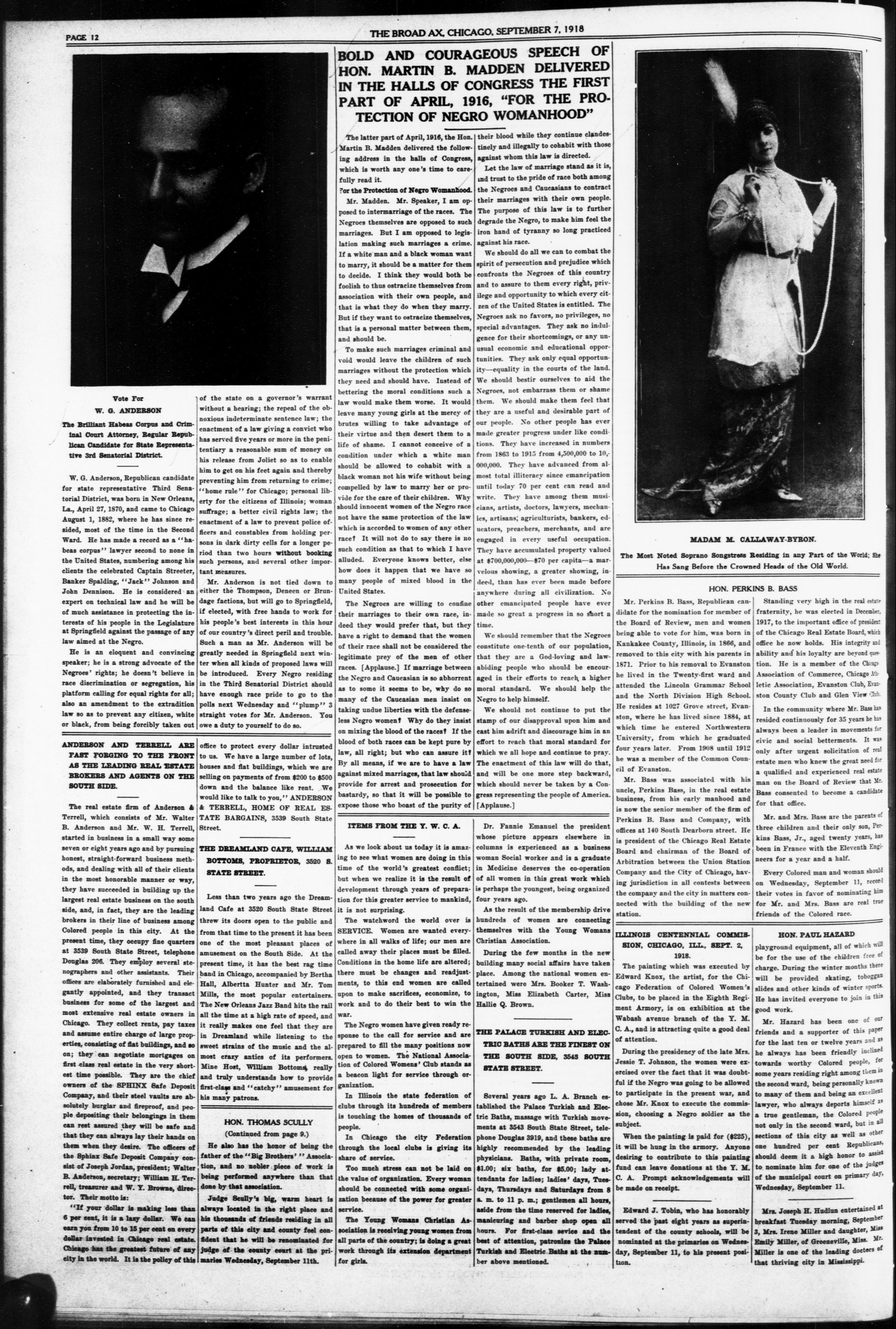
The Brilliant Habeas Corpus and Criminal Court Attorney, Regular Republican Candidate for State Representative 3rd Senatorial District.
W. G. Anderson, Republican candidate for state representative Third Senatorial District, was born in New Orleans, La., April 27, 1870, and came to Chicago August 1, 1882, where he has since resided, most of the time in the Second Ward. He has made a record as a "habeas corpus" lawyer second to none in the United States, numbering among his clients the celebrated Captain Streeter, Banker Spalding, "Jack" Johnson and John Dennison. He is considered an expert on technical law and he will be of much assistance in protecting the interests of his people in the Legislature at Springfield against the passage of any law aimed at the Negro.
He is an eloquent and convincing speaker; he is a strong advocate of the Negroes' rights; he doesn't believe in race discrimination or segregation, his platform calling for equal rights for all; also an amendment to the extradition law so as to prevent any citizen, white or black, from being forcibly taken out
ANDERSON AND TERRELL ARE FAST FORGING TO THE FRONT AS THE LEADING REAL ESTATE BROKERS AND AGENTS ON THE SOUTH SIDE.
The real estate firm of Anderson & Terrell, which consists of Mr. Walter B. Anderson and Mr. W. H. Terrell, started in business in a small way some seven or eight years ago and by pursuing honest, straight-forward business methods, and dealing with all of their clients in the most honorable manner or way, they have succeeded in building up the largest real estate business on the south side, and, in fact, they are the leading brokers in their line of business among Colored people in this city. At the present time, they occupy fine quarters at 3539 South State Street, telephone Douglas 206. They employ several stenographers and other assistants. Their offices are elaborately furnished and elegantly appointed, and they transact business for some of the largest and most extensive real estate owners in Chicago. They collect rents, pay taxes and assume entire charge of large properties, consisting of flat buildings, and so on; they can negotiate mortgages on first class real estate in the very shortest time possible. They are the chief owners of the SPHINX Safe Deposit Company, and their steel vaults are absolutely burglar and fireproof, and people depositing their belongings in them can rest assured they will be safe and that they can always lay their hands on them when they desire. The officers of the Sphinx Safe Deposit Company consist of Joseph Jordan, president; Walter B. Anderson, secretary; William H. Terrell, treasurer and W. Y. Browne, director. Their motto is:
"If your dollar is making less than 6 per cent, it is a lazy dollar. We can earn you from 10 to 15 per cent on every dollar invested in Chicago real estate. Chicago has the greatest future of any city in the world. It is the policy of this
9
of the state on a governor's warrant without a hearing; the repeal of the obnoxious indeterminate sentence law; the enactment of a law giving a convict who has served five years or more in the penitentiary a reasonable sum of money on his release from Joliet so as to enable him to get on his feet again and thereby preventing him from returning to crime; "home rule" for Chicago; personal liberty for the citizens of Illinois; woman suffrage; a better civil rights law; the enactment of a law to prevent police officers and constables from holding persons in dark dirty cells for a longer period than two hours without booking such persons, and several other important measures.
Mr. Anderson is not tied down to either the Thompson, Deneen or Brundage factions, but will go to Springfield, if elected, with free hands to work for his people's best interests in this hour of our country's direct peril and trouble. Such a man as Mr. Anderson will be greatly needed in Springfield next winter when all kinds of proposed laws will be introduced. Every Negro residing in the Third Senatorial District should have enough race pride to go to the polls next Wednesday and "plump" 3 straight votes for Mr. Anderson. You owe a duty to yourself to do so.
office to protect every dollar intrusted to us. We have a large number of lots, houses and flat buildings, which we are selling on payments of from $200 to $500 down and the balance like rent. We would like to talk to you," ANDERSON & TERRELL, HOME OF REAL ESTATE BARGAINS, 3539 South State Street.
THE DREAMLAND CAFE, WILLIAM BOTTOMS, PROPRIETOR, 3520 S. STATE STREET.
Less than two years ago the Dreamland Cafe at 3520 South State Street threw its doors open to the public and from that time to the present it has been one of the most pleasant places of amusement on the South Side. At the present time, it has the best rag time band in Chicago, accompanied by Bertha Hall, Alberta Hunter and Mr. Tom Mills, the most popular entertainers. The New Orleans Jazz Band hits the rail all the time at a high rate of speed, and it really makes one feel that they are in Dreamland while listening to the sweet strains of the music and the almost crazy antics of its performers. Mine Host, William Bottoms, really and truly understands how to provide first-class and "catchy" amusement for his many patrons.
HON. THOMAS SCULLY (Continued from page 9.)
He also has the honor of being the father of the "Big Brothers'" Association, and no nobler piece of work is being performed anywhere than that done by that association.
Judge Scully's big, warm heart is always located in the right place and his thousands of friends residing in all parts of this city and county feel confident that he will be renominated for judge of the county court at the primaries Wednesday, September 11th.
THE BROAD AX, CHICAGO, SEPTEMBER 7, 1918
BOLD AND COURAGEOUS SPEECH OF HON. MARTIN B. MADDEN DELIVERED IN THE HALLS OF CONGRESS THE FIRST PART OF APRIL, 1916, "FOR THE PROTECTION OF NEGRO WOMANHOOD"
The latter part of April, 1916, the Hon. Martin B. Madden delivered the following address in the halls of Congress, which is worth any one's time to carefully read it.
For the Protection of Negro Womanhood.
Mr. Madden. Mr. Speaker, I am opposed to intermarriage of the races. The Negroes themselves are opposed to such marriages. But I am opposed to legislation making such marriages a crime. If a white man and a black woman want to marry, it should be a matter for them to decide. I think they would both be foolish to thus ostracize themselves from association with their own people, and that is what they do when they marry. But if they want to ostracize themselves, that is a personal matter between them, and should be.
To make such marriages criminal and void would leave the children of such marriages without the protection which they need and should have. Instead of bettering the moral conditions such a law would make them worse. It would leave many young girls at the mercy of brutes willing to take advantage of their virtue and then desert them to a life of shame. I cannot conceive of a condition under which a white man should be allowed to cohabit with a black woman not his wife without being compelled by law to marry her or provide for the care of their children. Why should innocent women of the Negro race not have the same protection of the law which is accorded to women of any other race? It will not do to say there is no such condition as that to which I have alluded. Everyone knows better, else how does it happen that we have so many people of mixed blood in the United States.
The Negroes are willing to confine their marriages to their own race, indeed they would prefer that, but they have a right to demand that the women of their race shall not be considered the legitimate prey of the men of other races. [Applause.] If marriage between the Negro and Caucasian is so abhorrent as to some it seems to be, why do so many of the Caucasian men insist on taking undue liberties with the defenseless Negro women? Why do they insist on mixing the blood of the races? If the blood of both races can be kept pure by law, all right; but who can assure it? By all means, if we are to have a law against mixed marriages, that law should provide for arrest and prosecution for bastardy, so that it will be possible to expose those who boast of the purity of
ITEMS FROM THE Y. W. C. A.
As we look about us today it is amazing to see what women are doing in this time of the world's greatest conflict; but when we realize it is the result of development through years of preparation for this greater service to mankind, it is not surprising.
The watchword the world over is SERVICE. Women are wanted everywhere in all walks of life; our men are called away their places must be filled. Conditions in the home life are altered; there must be changes and readjustments, to this end women are called upon to make sacrifices, economize, to work and to do their best to win the war.
The Negro women have given ready response to the call for service and are prepared to fill the many positions now open to women. The National Association of Colored Womens' Club stands as a beacon light for service through organization.
In Illinois the state federation of clubs through its hundreds of members is touching the homes of thousands of people.
In Chicago the city Federation through the local clubs is giving its share of service.
Too much stress can not be laid on the value of organization. Every woman should be connected with some organization because of the power for greater service.
The Young Womans Christian Association is receiving young women from all parts of the country; is doing a great work through its extension department for girls.
their blood while they continue clandestinely and illegally to cohabit with those against whom this law is directed.
Let the law of marriage stand as it is, and trust to the pride of race both among the Negroes and Caucasians to contract their marriages with their own people. The purpose of this law is to further degrade the Negro, to make him feel the iron hand of tyranny so long practiced against his race.
We should do all we can to combat the spirit of persecution and prejudice which confronts the Negroes of this country and to assure to them every right, privilege and opportunity to which every citizen of the United States is entitled. The Negroes ask no favors, no privileges, no special advantages. They ask no indulgence for their shortcomings, or any unusual economic and educational opportunities. They ask only equal opportunity—equality in the courts of the land. We should bestir ourselves to aid the Negroes, not embarrass them or shame them. We should make them feel that they are a useful and desirable part of our people. No other people has ever made greater progress under like conditions. They have increased in numbers from 1863 to 1915 from 4,500,000 to 10,000,000. They have advanced from almost total illiteracy since emancipation until today 70 per cent can read and write. They have among them musicians, artists, doctors, lawyers, mechanics, artisans; agriculturists, bankers, educators, preachers, merchants, and are engaged in every useful occupation. They have accumulated property valued at $700,000,000—$70 per capita—a marvelous showing, a greater showing, indeed, than has ever been made before anywhere during all civilization. No other emancipated people have ever made so great a progress in so short a time.
We should remember that the Negroes constitute one-tenth of our population, that they are a God-loving and law-abiding people who should be encouraged in their efforts to reach a higher moral standard. We should help the Negro to help himself.
We should not continue to put the stamp of our disapproval upon him and cast him adrift and discourage him in an effort to reach that moral standard for which we all hope and continue to pray. The enactment of this law will do that, and will be one more step backward, which should never be taken by a Congress representing the people of America. [Applause.]
Dr. Fannie Emanuel the president whose picture appears elsewhere in columns is experienced as a business woman Social worker and is a graduate in Medicine deserves the co-operation of all women in this great work which is perhaps the youngest, being organized four years ago.
As the result of the membership drive hundreds of women are connecting themselves with the Young Womans Christian Association. During the few months in the new building many social affairs have taken place. Among the national women entertained were Mrs. Booker T. Washington, Miss Elizabeth Carter, Miss Hallie Q. Brown.
THE PALACE TURKISH AND ELECTRIC BATHS ARE THE FINEST ON THE SOUTH SIDE, 3543 SOUTH STATE STREET.
Several years ago L. A. Branch established the Palace Turkish and Electric Baths, massage with Turkish movements at 3543 South State Street, telephone Douglas 3919, and these baths are highly recommended by the leading physicians. Baths, with private room, $1.00; six baths, for $5.00; lady attendants for ladies; ladies' days, Tuesdays, Thursdays and Saturdays from 8 a.m. to 11 p. m.; gentlemen all hours, aside from the time reserved for ladies, manicuring and barber shop open all hours. For first-class service and the best of attention, patronize the Palace Turkish and Electric Baths at the number above mentioned.
THE BROADWAY THEATRE
MADAM M. CALLAWAY-BYRON.
The Most Noted Soprano Songstress Residing in any Part of the World; She Has Sang Before the Crowned Heads of the Old World.
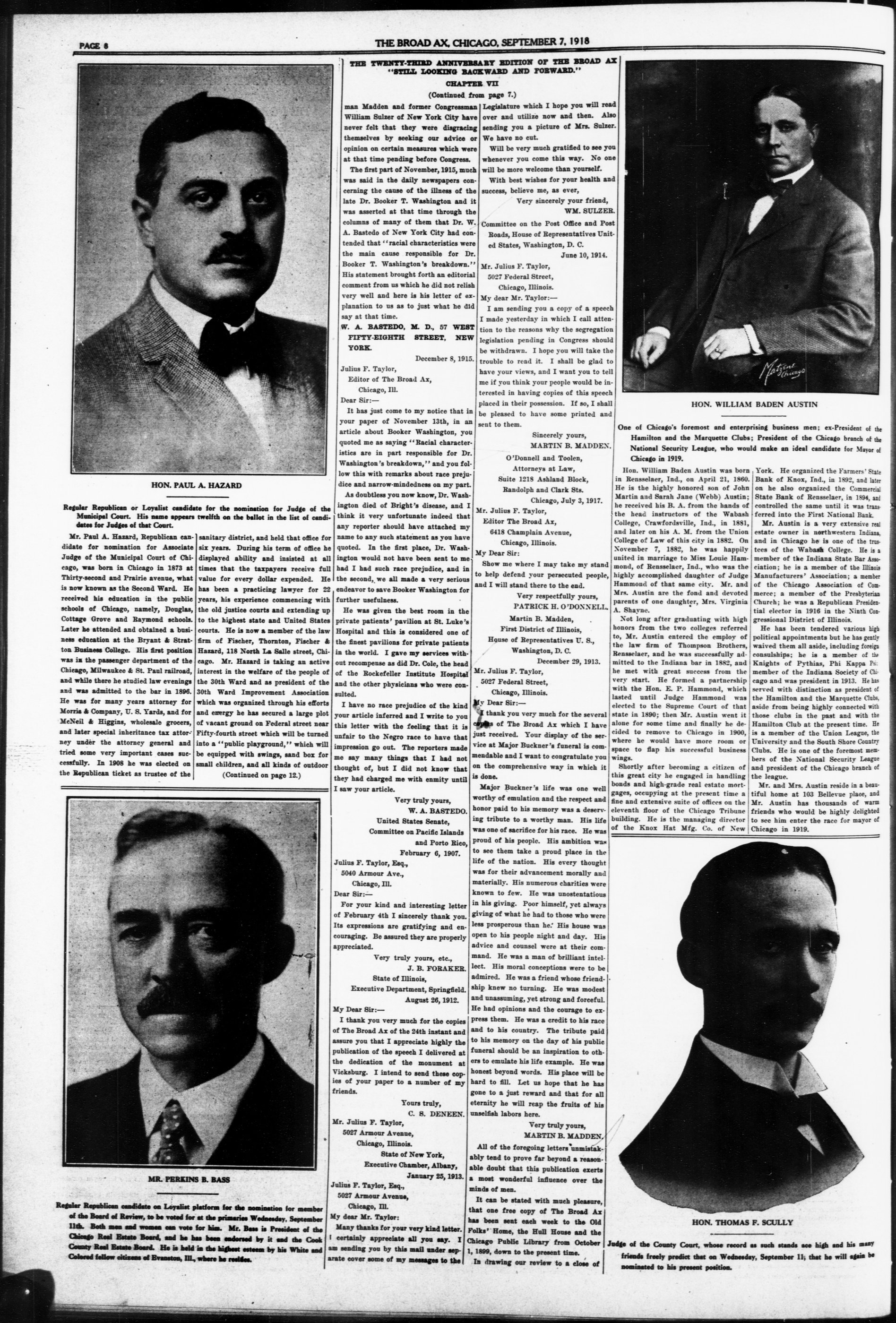
HON. PERKINS B. BASS
Mr. Perkins B. Bass, Republican candidate for the nomination for member of the Board of Review, men and women being able to vote for him, was born in Kankakee County, Illinois, in 1866, and removed to this city with his parents in 1871. Prior to his removal to Evanston he lived in the Twenty-first ward and attended the Lincoln Grammar School and the North Division High School. He resides at 1027 Grove street, Evanston, where he has lived since 1884, at which time he entered Northwestern University, from which he graduated four years later. From 1908 until 1912 he was a member of the Common Council of Evanston.
Mr. Bass was associated with his uncle, Perkins Bass, in the real estate business, from his early manhood and is now the senior member of the firm of Perkins B. Bass and Company, with offices at 140 South Dearborn street. He is president of the Chicago Real Estate Board and chairman of the Board of Arbitration between the Union Station Company and the City of Chicago, having jurisdiction in all contests between the company and the city in matters connected with the building of the new station.
ILLINOIS CENTENNIAL COMMISSION, CHICAGO, ILL., SEPT. 2.
The painting which was executed by Edward Knox, the artist, for the Chicago Federation of Colored Women's Clubs, to be placed in the Eighth Regiment Armory, is on exhibition at the Wabash avenue branch of the Y. M. C. A., and is attracting quite a good deal of attention.
During the presidency of the late Mrs. Jessie T. Johnson, the women were exercised over the fact that it was doubtful if the Negro was going to be allowed to participate in the present war, and chose Mr. Knox to execute the commission, choosing a Negro soldier as the subject.
When the painting is paid for ($225), it will be hung in the armory. Anyone desiring to contribute to this painting fund can leave donations at the Y. M. C. A. Prompt acknowledgements will be made on receipt.
Edward J. Tobin, who has honorably served the past eight years as superintendent of the county schools, will be nominated at the primaries on Wednesday, September 11, to his present position.
Standing very high in the real estate fraternity, he was elected in December, 1917, to the important office of president of the Chicago Real Estate Board, which office he now holds. His integrity and ability and his loyalty are beyond question. He is a member of the Chicago Association of Commeree, Chicago Athletic Association, Evanston Club, Evanston County Club and Glen View Club.
In the community where Mr. Bass has resided continuously for 35 years he has always been a leader in movements for civic and social betterments. It was only after urgent solicitation of real estate men who knew the great need for a qualified and experienced real estate man on the Board of Review that Mr. Bass consented to become a candidate for that office.
Mr. and Mrs. Bass are the parents of three children and their only son, Perkins Bass, Jr., aged twenty years, has been in France with the Eleventh Engineers for a year and a half.
Every Colored man and woman should on Wednesday, September 11, record their votes in favor of nominating him for Mr. and Mrs. Bass are real true friends of the Colored race.
HON. PAUL HAZARD
playground equipment, all of which will be for the use of the children free of charge. During the winter months there will be provided skating, toboggan slides and other kinds of winter sports. He has invited everyone to join in this good work.
Mr. Hazard has been one of our friends and a supporter of this paper for the last ten or twelve years and as he always has been friendly inclined towards worthy Colored people, for some years residing right among them in the second ward, being personally known to many of them and being an excellent lawyer, who always deports himself as a true gentleman, the Colored people not only in the second ward, but in all sections of this city as well as other one hundred per cent Republicans, should deem it a high honor to assist to nominate him for one of the judges of the municipal court on primary days. Wednesday, September 11.
Mrs. Joseph H. Hudlun entertained at breakfast Tuesday morning, September 3, Mrs. Irene Miller and daughter, Miss Emily Miller, of Greeneville, Miss. Mrs. Miller is one of the leading doctors of that thriving city in Mississippi.
Cities of the North.
DR. M. A. MAJORS
The popular and honored President of the Texas Fellowship Club of Chicago special contributor to this paper
There are many perplexing problems arising out of the new conditions made favorable to our people consequent of the war, and the necessary change of his habitation to industrial fields and busy marts of trade where our race is employed on a colossal scale, and at hitherto unknown kinds of employment and at undreamed of wages. Chicago is at this writing such a place, and in so far as meeting the needs of the hour he is filling the void resultant of the millions moved from the trade and sent to Europe.
sential a duty to his new environment. He had flowers in the yard of his little home in the South. He should not lose sight of this very noble attribute.
For many years the tenement and the home problems has engaged the investigative minds of industry in the manufacturing centers of the North. It is gradually growing into a problem in the Negro life in the cities. Real estate agents like the grocer, butcher and baker have, it seems, by magic and presto, grown into landed barons. Prosperity is enticing, and easy living con-
Hundreds of thousands have left their homes in the South to better conditions which we fear are only temporary, but for the scarcity of such as relied upon the usual steady conditions when there was no war emigration upon such a colossal scale as our people are making might be termed a calamity. But fortunately the war conditions, and war needs abundantly supply those who are coming north fabulous wages, which they should not undervalue. Let us insinuate, or at least drop the hint that they will not always last. Rigid economy and steady work will solve many problems in the North that have puzzled statesmen and philosophers.
As a result of such an emigration we are already witnessing a certain form of haughty resistance on the part of thousands of the lower strata of the White race. The White boss over a gang of Negro laborers granted plenary power works himself up into a pseudoplatutor, and is as peevish over his situation as a hawk among a gang of sparrows. Unfortunately a former environment emphasized to determine for the Negro squallor, and proscription plays its damnable roll in the drama, and the sudden change from poverty labor to prosperous existence works havec among the unthinking element recently raised to better living conditions.
The White grocer, butcher and baker fill their cash registers daily from the extravagance and wreckless expenditures made by the Negro, and these little enterprises flourish at the expense of our lack of sober judgment and carelessness, while the keepers grow harsh and I might say contemptible.
True there are dozens of groceries and delicatessens springing up along the busy streets, projected by people of our own blood, such stores are also doing a thriving business. They should multiply, and we should carry trade to them in such fashion that eventually the business idea shall get a chance to determine for us a spirit of thrift and economic understanding.
We must go into business. We must sell as well as buy, that is the only way we will ever become employers of young men and women who must have work. We must do now what we hope to successfully be able to de in the future.
The home life of the recently emigrated Negro to the North is the most remarkable change of all. He has always worked wherever he was, he had to make early time. He has not always lived. He is living in houses far superior to those occupied by his wealthy employers in the South. He is buying better furniture and draperies than he ever saw in the wealthiest homes. In fact his at the present time is an orgy. He is enjoying this change, meanwhile the Pandora box is yet a puzzle, and he regards the wonderful new and startling changes in his living with an ever curious concern.
His home must not be neglected. He cuts the grass in the front lawn for his employer. He should not forget as so
sential a duty to his new environment. He had flowers in the yard of his little home in the South. He should not lose sight of this very noble attribute.
For many years the tenement and the home problems has engaged the investigative minds of industry in the manufacturing centers of the North. It is gradually growing into a problem in the Negro life in the cities. Real estate agents like the grocer, butcher and baker have, it seems, by magic and presto, grown into landed barons. Prosperity is enticing, and easy living conduces to happier living, so the Negro real estate agent has been answering the alluring bribe of the goddess of wealth and the consequence shows upon the market more than a dozen Negroes in Chicago who handle hundreds of thousands of dollars annually in trades, commissions and rentals.
These are glorious achievements. Politics, religion and education are essential and must not lag behind, but we must think of the White race. He builds stores larger than his churches and his schools. Beneath the surface all is not calm, in spite of the fact that our center tinsel and veneer make things appear in a gorgeous hue. Ours is to live and be, and have, and know. Ours is to do, and to do for the period that will require a sensible awakening to the noblest principles of a well ordered life. Ignorance has frightened with its appalling imagery the crude children of a backward race, and forced upon them a marauding terror-like a hurricane of fire from which they must flee, and forced them to shield themselves behind a religion they cannot understand in a cowardly self-defense, or preservation as if nothing was to be done but to die and go somewhere, scattered and running, before the tyranny of Satan, and to heaven, too, in spite of a hypocracy reeking with the scum of filthy habits, lascivious to a degree of a devil superlative, any of whom could teach Milton the first principles of a hell that exists only in the ignorant mind, and nowhere else.
Happily the modern spirit is taking firm hold on many of us who love to see God and His holy angels in a beatific vision with minds and hearts so attuned to good and righteousness that the devil himself must suffer a fiery condemnation for lack of any serious consideration.
Much church and, alas, too much church where ignorance is allowed to squeal. Too much where the leather lunged, hoarse throated presher adds bedlam to the late hours intended for refreshing sleep and rest to tired bodies exhausted from the toil of hay making day. By far too much of useless noise intended to alarm the seeming unalarmed. Too grotesque and silly to arrest the serious attention of thinking people, and only to astonish and bewilder them with pity for so much ignorance.
Fifty-two years have worked a charm and we see stupendous changes here and there; all is not dark and chaotic. Refreshing, gentle sunshine warms into life a phantasmagoria of splendor which will in time dissipate this awful seething multitude of ugly, uncanny ranting about God and His angels. Civilization is the bomb which the intellectual of every sect must uncessingly hurl at this hoiocaust of superstition and fretfulness. The Negro must be saved. Yes, he must save himself by the changes that will conduce to a nobler comprehension of a lovable spirit abiding among us. He must be taught to see holiness in a clean, healthy mind and body. He must
be made to see the glory of God in every worthy act he performs. He must be instructed along lines of serenity and quietude and allow his spirit intoxicated by the mystery of his worshipping to glory in a good wife and a happy home. Suppose a fraction of this unwarranted religious zeal was carried into the channels of commerce where it could not possibly be wasted, we would build up Rockefellers and Carnegies in ebony hue in a day.
SPECIAL ATTRACTION
You are invited to attend meeting and reception in honour in the interest of Augustus L. regular Republican candidate Senator from the Third District, 3440 S. State street, Moning, September 9, at 8. The meeting and reception is under
But we will languish. If this thing many of our very emotional people possess in a marked degree called religion, as the ignorant mind interprets it, was not the greatest, spiritual sham, we would undoubtedly be called the greatest race of saints on earth.
Our progress must like all other races be determined by our ability to acquire wealth and education. Our independence must grow out of these. Without this indefatigable element to give us sober conscienciousness, we are but little removed from slavery, a bondage both of head and heart. Wealth and education then must determine our status. They fix up the well ordered prerequisite forces necessary to all progressive peoples. They are the forerunners of the fitness of things calculated to demonstrate the highest development and culture. Our present day determinations along the spiritual and religious planes of life will be governed by our progress and intellectual development. As we become more able to grasp situations, analyze difficult problems of theology and the Bible, the religious joys of consecrated humanity will unfold themselves.
The glorious and righteous will find a nobler heritage than mere forms, ugly and grotesque mutterings, and bedlams. Today our star is rising in the heavens of grandeur, and of beauty, and of thought, the satellite of genius has become a shooting meteor. The evening stars of our intelligence will light up the dark and chaotic night and dispel this contemptible ignorance like mists before a rising sun. The full blaze of knowledge will be showered upon Ethiopia, and there shall be no more dark nights. Nights of this fearful, insensible ignorance, this monstrous sacrilege, this Saturnalia of accursed oblivion from which affrighted nature in her noblest forms takes alarm.
CHARLES A. GRIPFIN, REPUBLI
CAN CANDIDATE FOR COUNTY
COMMISSIONER
Charles A. Griffin, Republican candidate for county commissioner, to be voted for at the primaries Wednesday, September 11, was born at Bellaire, Ohio, January 24, 1884, and is the son of James A. Griffin, a Methodist minister. Educated in the public, high and manual training schools of Dayton and Cincinnati, Ohio, he came to Chicago in 1892. He first worked as a clerk in the Chicago post office and then established the Wilson & Griffin Regalia House of which he is president. He is secretary of the board of trustees of Bethel Methodist church, the largest Methodist congregation in Chicago, and is active in fraternal organizations.
ADVICE FOR MODERN WOMAN
Schedule for Milady Requires That She Should Not Fall to Borrow a Few Hours Each Day.
The modern woman, by adhering rigidly to the rules laid down by the up-to-date authorities for the benefit of her sex, observes a fashion writer in Philadelphia Inquirer, can make the following useful disposition of her time each day:
Physical culture exercises, half hour.
Morning tub, half hour.
Massage and applications of cold cream, one hour.
Brushing and treatment of hair, one hour.
Manicuring of nails, half hour.
Luncheon, with thorough mastication, one hour.
Afternoon nap, one hour.
Dressing for afternoon calls, one hour.
Making calls, two hours.
Massage and application of cold cream, one hour.
Brushing hair, one hour.
Modeling finger nails, half hour.
Shaping eyebrows, half hour.
Pedicuring, half hour.
Sponge bath, half hour.
Dressing for dinner, one hour.
Dining (in simple King Edward court), one hour.
Bed Crossing, three hours.
Hot bath, half hour.
Brushing hair, half hour.
Massage and cold cream, one hour.
Physical culture exercises, half hour.
Shower bath, quarter hour.
Sleep, eight hours.
Total, 28¼ hours.
SPECIAL ATTRACTION.
You are invited to attend a special meeting and reception in honor of and in the interest of Augustus L. Williams, regular Republican candidate for State Senator from the Third District of Illinois, at the beautiful Washington Theater, 3440 S. State street, Monday evening, September 9, at 8. This unique meeting and reception is under the auspices of the stockholders Public Life Insurance Co. residing in this district. Pear and address the meeting. All of the candidates running on the Loyalist The entire board of directors will applatform ticket will appear.
Among the more prominent speakers in addition to the candidates will be the Hon. Edw. J. Brundage, attorney-general of Illinois; Hon. Homer Galpin, chairman of the Cook county Republican committee; Hon. Albert Clover, chairman of board of directors of the Public Life Insurance Co., and the entire board, including Augustus L. Williams, one of the directors and candidate for State Senator, and many others.
A beautiful patriotic song entitled "The Ocean Must Be Free" will be sung by an able artist, and 1,000 copies of this music will be given away free to each lady in attendance.
Refreshments will be served by the second ward women's permanent Republican Club.
Good music will be rendered by the Masonic band.
Come early in order to secure a seat.
AS THEY SHOP IN GUATEMALA
Visiting Is Principal Feature of Buying Expeditions, Business a Later Consideration.
"Our own way is always the best way," said a philosopher who understood human nature, and why everybody else does not go our way is a cause of constant surprise. For instance, in shopping.
How would you like to shop in Guatemala? They are a very polite people, and on coming into the store, will pass some remark about the weather, and ask how business is. Then comes a string of questions about the health of the proprietor and all his relations and friends; and when all the questions are asked, the proprietor turns around and asks the same questions of you. Then the proprietor gets down to business, and takes down all his stock, which is all examined and priced, and then you say you will go home and think about it.
The next day, you return with the whole family—men, women, children and visitors—all the salutations are repeated, and all the stock displayed again. After two or three hours of this sort of thing, you buy perhaps a yard of muslin, and have it charged on 30 or 60 days' time. This so delights the proprietor, that he follows you to the door, and asks all the questions of your health all over again. It is needless to say that Guatemalan merchants were never known to get rich.
WHAT THUMBS ARE WORTH
Digit Is Estimated to Represent Fully One-Third of the Total Value of the Hand.
One has only to grasp a pen or a tool of some sort to realize that the different fingers are far from having the same value in regard to their usefulness in performing work. The most important, states a writer, is the thumb, for without it seizing or holding would be very imperfect. The hand is no longer pincers, but merely a claw, when deprived of the thumb. It may be estimated that the thumb represents fully a third of the total value of the hand. The total loss of the thumb is estimated by competent authorities as 15 to 35 per cent for the right and 10 to 15 per cent for the left hand, except for workers in art, when 40 to 50 for the right and 25 to 40 per cent for the left hand comes nearer the value.
The total loss of the index finger causes an incapacity estimated at from 10 to 25 per cent for the right hand and 10 to 15 per cent for the left. The middle finger is less important than the index. The ring finger is least important, and the little finger may be compared to its neighbor, except in the professions in which it serves as a point of support for the hand.
Milk for the Poor
In order to meet the emergency that exists because of the high price of milk, Market Commissioner Moskowitz, says the New York World, has recommended to Mayor Mitchell that the board of estimate appropriate $20,000 to relieve conditions in the poor sections of the city. The appropriation he wishes to use for the sale—of milk, at prices they can afford to pay, to those families who are certified by the health commissioner or by his authorized agencies as having children under six years old and as not having sufficient income to provide milk in sufficient quantities for such children."
LAWYER AUGUSTUS L. WILLIAMS
One of the wheel-horses of the Brundage forces in the second ward and Republican candidate for the nomination for State Senator from the Third Senatorial District of Illinois.
A. L. WILLIAMS HITTING FAST PACE IN DRIVE FOR STATE SENATE.
WISE POLITICAL OBSERVERS PREDICT HE WILL WIN OVER ETTELSON.
was followed by an endless chain of new acquisitions to himself and his people; but himself least of all as he has interested himself more in the welfare of others. Mr. Williams has been instrumental, through his influence and personal contact with high city, county
HAS UNPARALLELED RECORD OF
SERVICE.
Augustus L. Williams, prominent lawyer, high in fraternal societies and for many years a well known figure in political, business and professional circles, is a candidate for state senator from the Third Senatorial District of Illinois. In the race are also Samuel A. Ettelson, candidate of the decaying Second Ward Republican organization, and Jas E. White, the "find" of Oscar De Priest. Many irritable wounds have these two corrupt agencies inflicted upon the people of the Second Ward and the Third Senatorial District, but "Father Time" is the irresistible healer of all wounds, and through the splendid medium of time's revolution represented in Augustus L. Williams, the people's choice, a new realm of life is revealed in the imperative demands that he is making upon the voters for more and greater representation in the legislative bodies of both state and nation. A true "child" of democracy, he sets its principles afloat with streaming banners solemnly and earnestly calling upon his people to witness, with a clearer understanding, the message of progress and possibility emanating from its source.
Has Record Without Blemish.
Mr. Williams submits to the perusal of the public a record of continuous service wholly relieved from any form of corruption or purpose derogatory to the moral and intellectual advancement of his race and is waging his campaign solely upon the merit voiced in his published platform. It seems that our duty in this very pressing exigency is obviously clear. A democratic government derives its just powers from the consent of the governed, and all races should have, at least in proportion to their numbers, representation in all branches of such government. If we are numerically strong enough to elect a member of our race to the state senate (and statistics show that we are) and then fail to grasp the opportunity it amounts to nothing less than a pitiful travesty of our much boasted accomplishments. The time for action is now; the future will take care of itself. And in addition to time's present offering comes in the candidacy of Augustus L. Williams' quality, ability, experience and a fine sense of appreciation of what constitutes wholesome, unselfish service in public capacity. As early as 1895 he brought honor and distinction to the race by being the first to be elected from the district as alternate delegate to the Republican National Convention at Philadelphia. This excellent lead
was followed by an endless chain of new acquisitions to himself and his people; but himself least of all as he has interested himself more in the welfare of others. Mr. Williams has been instrumental, through his influence and personal contact with high city, county and state officials in placing a large number of our men and women in responsible position under succeeding administrations, some branches of which were hitherto without representation from amongst us. In the light of this long line of commendable deeds and the urgent need of a faithful "watch dog" to stand guard over our interests while passing through the turbulent channels of legislation and the probability of a constitutional revision, can you conscientiously cast your ballot on September the eleventh for any other candidate for state senator from the third district than Augustus L. Williams, against whom no word of justifyable reproach has been uttered by neither party nor faction? With the same indomitable will to do and to die for justice and right typical of our boys who are forging the links in the chain of world democracy on the gory fields of France, should we exercise in arousing our latent powers to the full possession of every rightful claim before the bar of equal justice and opportunity.
Vote for Step Higher.
A vote for Mr. Williams is a staggering blow from the mail fist of race loyalty and unity against the perpetual exploiters of a misled but blindly credulous multitude of new arrivals in our community. It is rather to our advantage to promote harmony and concord among and between the people of both races, than to fan the flame of racial antipathy into a veritable furnace of loathing. Mr. Williams has won the respect and admiration of hosts of friends among the White people as well as our own, which makes for a stronger bond of brotherhood with he as a representative in the state senate.
Join the "Williams for Senator" booster club and help pile up an overwhelming majority. In no state in the Union have the people of our race a seat in a state senate, and it devolves vitally upon the great state of Illinois to take the lead in this particular. Do not put off until tomorrow what you can do today. Procrastination is the thief of time. Now is the time and September 11th is the day.—Adv.
TWO SISTI $ OF ATTORNEY A. L. WILLIAMS ARE IN THE CITY.
Mrs. Emma Saunders, of Ninety-six, S. C., and Carrie Sutton, of Bagby, Ln., both sisters of A. L. Williams, candidate for state senator, made a surprise call on him this week. When interviewed by The Broad Ax they both readily said that they came to help Mr. Williams in his campaign.
PAGE 13
A
YE EDU 74
HON. FREDERICK W. BLOCKI
President and member of the Board of B of Public Works, Ex-City Treasurer Democratic candidate for the nomin at the primaries Wednesday, September
President and member of the Board of Review of Cook County, Ex-Commissioner of Public Works, Ex-City Treasurer of Chicago, high class business man and Democratic candidate for the nomination for County Treasurer, to be voted for at the primaries Wednesday, September 11.
Hon. Frederick William Blocki, Democratic candidate for the nomination for treasurer of Cook county, was born in this city November 2, 1862, receiving his early and his advanced education in its schools; he is therefore a Chicagoan through and through to the backbone.
In time he took a special course in engineering at the Lewis Institute, which stood him in good hand and became one of his very valuable assets later on in life.
His father before him being a noted chemist, John Blocki, the subject of this sketch, followed in his footsteps and became thoroughly familiar with all the details as a manufacturer of fine perfumes, and the firm of John Blocki and Son is known not only to all the wholesale and retail druggists through
Shortly after arriving at manhood, he became happily united in marriage to Miss Louise Woltersdorf, daughter of Louis Woltersdorf, one of the German-American pioneer retail druggists of this
HON. A. H.
HON. A. H. ROBERTS
Between twenty-five and thirty years Mr. Adelbert H. Roberts, regular Republican candidate for the nomination for representative from the third senatorial district of Illinois, has been a highly respected and honored citizen of Chicago. During many of those years he has held various responsible positions in the county recorder's office and in other departments of the county service, and he made good in all of those positions and commanded the respect of his associates and others connected with the office.
For ten or twelve years past Mr. Roberts has been one of the most efficient and painstaking deputy clerks of the Municipal Court and he has become so thoroughly familiar with the duties and the workings of that office that all the Municipal Court judges, both Democrats and Republicans, are always pleased to have Mr. Roberts assigned to them, for they always know that he will politely and most efficiently discharge all the duties in the most faithful manner pertaining to that office and
[Name]
HON. ADELBERT
Regular Republican candidate for the nom
from the Third Senatorial District of
the Legislative Voters' League. Pre
PAGE FOURTEEN
1
city, and their very beautiful home at $82 Buena avenue is blessed with one son and one daughter, Miss Ruth and Frederick A. L. Blocki.
His father before him being a noted chemist, John Blocki, the subject of this sketch, followed in his footsteps and became thoroughly familiar with all the details as a manufacturer of fine perfumes, and the firm of John Blocki and Son is known not only to all the wholesale and retail druggists throughout the country, but also favorably known to millions of people who have for many years used their exquisite perfumes and other toilet articles, and for a long time Mr. Blocki has been the guiding spirit or hand in actively man
Chief Justice Harry Olson regards Mr. Roberts as one of his most valuable aides. Mr. and Mrs. Roberts and other members of their family reside in a lovely home of their own at 3405 Calumet avenue. For many years they have been active workers in Quinn Chapel, and as president of the Men's Sunday Club of that church he had the distinguished honor of introducing the late President William McKinley, President William Howard Taft and the late Booker T. Washington to its members and friends.
Towards the middle of February each year Mr. Roberts has established a custom of celebrating the birthday anniversaries of Frederick Douglas and Abraham Lincoln at considerable expense to himself. He always manages to secure the best and the most brilliant speakers to deliver occasions on those two great American characters. Being every inch a man; able, worthy and courageous, a slave to principle, he calls 'no man his master.' He is therefore well qualified in every way to represent all the people residing in the third senatorial district in the legislature of Illinois.
aging the affaire of John Blocki and Son. He is also at the head of the Brennan Construction Company, general contractors, No. 17 N. La Salle street; he is also vice-president of the Miami Coal Company, with offices on the 18th floor of the McCormick building, showing that he is engaged in various lines of profitable business and that he is not dependent upon politics for a living.
NEGRO PIONEERS DO FAST IN COMBAT TRAINING
Camp Grant, Rockford, Ill.—C second contribution to Uncle Sam ored fighting machine in Camp G topped the national army rise, v ports made by company officers Eight Hundred and Third pion fantasy regiment showed that t
Aside from his business interests, Mr. Blocki has always taken a lively interest in politics. In April, 1899, he was appointed by Mayor Carter H. Harrison superintendent of the map department of the city of Chicago, creditably serving the city in that capacity until the latter part of the same year. He was then advanced and promoted to deputy commissioner of public works, and a little less than two years from that time still greater honors were in store for him and he was selected by Mayor Harrison as commissioner of public works, being reappointed in 1903 to the same responsible position for two years longer.
During his administration of this office he supervised some of Chicago's great public improvements, such as building some of the first bascule bridges, which did away with center piers, among them being the North Western avenue and Clybourn place bridges. These bridges were designed in the department of public works, thus saving to the city the heavy royalty of about $20,000 usually paid for plans and supervision.
The great intercepting sewer along Lake Michigan from 39th street to 71st street was also built under his supervision, and was successfully completed. This was the first great improvement undertaken by the city by direct or day labor, and at its completion had not only saved the city thousands of dollars under the lowest bidder, but there were no law suits or claims for extras.
In April, 1905, before the expiration of his second term as commissioner of public works, he was elected city treasurer of Chicago by a large majority, running on the same ticket with former Mayor Edward F. Dunne, and the honest and splendid record he made in that office as city treasurer will stand to his everlasting credit as long as Chicago stands.
When he became city treasurer the city was receiving only $1\frac{1}{2}$ per cent interest, but before the expiration of his term he had advanced the rate to 3 per cent, which was a greater rate of interest than the city had ever received. During the period that he was city treasurer the police, fire and other departments were always paid promptly, and on one occasion it was necessary for him to personally borrow about $800,000 from the banks to pay the police and firemen before Christmas, as there was no money in the city treasury available for that purpose.
At the end of his term he turned over to the city of Chicago $234,110.39 net, as interest after all office expenses and his own compensation had been deducted, thus earning for the citizens of Chicago over $100,000 more than had ever been earned during the term of a former city treasurer. Mr. Blocki has also for some years served as treasurer of the Cook County Democratic Committee, and he has thousands of warm friends residing in all parts of this city and in Cook County. In 1912 he was elected as one of the members of the Board of Review, and for some time past he has honorably served as its very wise and far-reaching president.
Mr. Blocki is a prominent member of the Chicago Athletic, Illinois Athletic, Germania Maennerchor, Iroquois and the Illinois clubs. He delights to devote his spare time to motoring and fishing. As an evidence of his true friendship for worthy Colored people, he employs a first class Colored chauffeur all the time.
So far Mr. Blocki has never lost a political battle and he and his many friends feel that he will come out on top at the primaries Wednesday, September 11.
State Senator Edward J. Hughes, of the twenty-first senatorial district, has made a fine legislative record at Springfield and on Wednesday, September 11th he will be renominated and reelected in November. Mr. Hughes is a high class business man, being connected with Nash Brothers, extensive contractors, on the ninth floor of the Otis Building and at all times Senator Hughes conducts himself like a high class gentleman.
NEGRO PIONEERS DO FAST WORK IN COMBAT TRAINING.
Camp Grant, Rockford, Ill—Chicago's second contribution to Uncle Sam's Colored fighting machine in Camp Grant has topped the national army rise, when reports made by company officers of the Eight Hundred and Third pioneer infantry regiment showed that the regiment in the last six days has made the greatest progress in actual combat training of any unit on cantonment records in the same period of time.
Negro soldiers, drawn from city districts and rural communities in Illinois and Wisconsin, who have successfully passed the rigid physical tests laid down by Col. Milton McGrew's line organization, were introduced for the first time this week to the higher arts of warfare and brought in a series of shattered training records to hang up on barracks walls.
Without preliminary rifle training of any kind men of the Second battalion were given Enfield rifles on Monday and thrown into position on the rifle range, where they rushed at once into firing with ball cartridges. Shooting through two series and over all courses on the range, the battalion held up an average of marksmanship equaled by few regiments after two months of practice.
Winslow Ford, a Chicago selective in F company, marked 47 in a possible 50 on the 200 yard course. Private Leslie Creer shot 45 on all of the ranges, making a record for his regiment, and Jackson Hulbert, whose field experiences have been confined to work in kitchens of Chicago hotels, invaded the 300 yard range in apron and cap and hung up 39 bullseyes in 50 shots. Sergt. C. T. Cole was given official mention by shooting 46 on both the 100 and 300 yard ranges in the first series of army musketry he ever entered. The regiment is practically ready for overseas service.
Sergt. Glen Wilbur Wright, of Wheaton received signal honors when his commission as first lieutenant in the adjutant general's department arrived in camp. He is the second enlisted man in training here advanced from the ranks to that grade.
NATIONAL MOVEMENT FOR RACE REPRESENTATION IN SETTLEMENT OF THE WAR.
The National Equal Rights League, Rev. Byron Gunner, Hillburn, N. Y., President, Wm. Monroe Trotter, Boston, Mass., Secretary; Thomas Walker, Eak., 506 Fifth avenue, Washington, Treasurer; Mrs. Ida B. Wells Barnett, 3005 State street, Chicago, chairman of Committee of Arrangements, earnestly requests and invites the Colored people of every community where this paper circulates to send delegates to its 11th annual meeting in Chicago, September 17-19, 1918, to consider and plan the speedy organizing of the race all over the country for protection of rights with the special end in view of securing race men and women delegated by a national race body as representatives for the race to negotiate for the abolition of caste, segregation, disfranchisement and lynching with the nations warring against Germany in the final settlement of world conditions.
Every person attending is requested to secure a credential from some Colored civic organization or lodge, or church, and the league especially urges that citizens from Equal Rights Democracy Leagues or citizens' committees which shall hold meetings and send citizen delegates. Every Colored citizen has full authority to act on this invitation. Let us meet in Chicago to organize for world democracy. Colored America on to Chicago. Show your strength.
National Equal Rights League.
New York.—Three Colored candidate filed their petitions here and were qualified to enter the fall campaign for nomination. Dr. E. C. Ransom will run for United States Congress from the Twenty-first Congressional district, and E. F. Johnson and John C. Hawkins for General Assembly at Albany.
[Portrait of a man in formal attire, facing slightly to the right].
THOR J. BENSON Democratic candidate for the nomination for Congress, from the First Congressional District of Illinois, whose name is fourth on the primary ballot. Mr. Benson is fair and liberal in all things and deserves the support of the members of his party.
Democratic candidate for the nomination for Congress, from the First Congressional District of Illinois, whose name is fourth on the primary ballot. Mr. Benson is fair and liberal in all things and deserves the support of the members of his pasty.
Thor J. Benson, whose name will appear on the Democratic primary ballot in the fourth and final place as an aspirant for the congressional nomination in the First Congressional District on September 11 next, has lived in this city for more than forty years and more than thirty-five years in the district. He came here while yet a minor, from Houston County, Minnesota, in the village of Houston, where he had been appointed assistant postmaster at the age of 18 years.
that the laws enacted thereunder should be enforced in letter and spirit, by the local authorities primarily, but if such authorities fail in their duty then by direct state and federal action. To discriminate against any person on the ground of political, racial or purely religious grounds has ever been abhorrent to him and he will make no compromise with any one drawing the Color line in any manner whatsoever.
He is absolutely in accord with the present national administration in the
His first occupation in the city was that of a telegrapher and he followed the trade of a Morse operator in the main office of the Western Union, at the same time spending much time in the study and discussion of public questions. He is a graduate from the law department of the Lake Forest University, and served for some time as an assistant city prosecuting attorney, as an appointee of Mayor Carter H. Harrison. He also matriculated and studied in the Chicago Theological Seminary of the Lutheran Church under the direction of the late professor Franklin Revere Weidner for a year. He has for the last twenty years, in nearly every campaign, local and national, been called upon by the prepar committee of the Democratic party to aid in the campaign work as a speaker in the discussion of public questions. He believes that the federal constitution should be at all times supported and
THE BUREAU OF SOCIAL SERVICE ENTERTAINS A LARGE NUMBER OF COLORED CHILDREN AT CAMP REINBERG.
Edition Julina P. Warner Invited by Mint
Kate Mead to Send Thirty Children to Summer Camp.
Last Saturday morning at 10:30 the Northwestern depot at Madison and Canal streets were crowded with friends and relatives who were in attendance at the homecoming of one hundred and fifty Colored girls and boys. These children presented to onlookers a picture of happiness and glee seldom seen outside of the movies.
The Bureau of Social Service had given these brown kiddies ten days of real sport at Camp Reinberg, a beautiful summer camp situated near Palatine, Illinois, about thirty miles out from the city. Here the kiddies romped,
In the last Legislature Mr. Lyon further actively supported all measures tending toward Home Rule for the City of Chicago and announces that he will take the same position if returned to the General Assembly.
Mr. Lyon made a splendid record, the Legislative Voters League saying that he was a "Very Active Member." He is an able lawyer and an excellent orator.
Representative Lyon supported by vote and speech the bill to prevent the representation in motion pictures, and in newspapers, of lynchings and other prejudicial matters.
Major Bob Jackson, former member of the Legislature and now Alderman of the 2nd Ward, who introduced this bill says: "My people owe a great debt of gratitude to Mr. Lyon for his support of measures in our interest and his opposition to
that the laws enacted thereunder should be enforced in letter and spirit, by the local authorities primarily, but if such authorities fail in their duty then by direct state and federal action. To discriminate against any person on the ground of political, racial or purely religious grounds has ever been abhorrent to him and he will make no compromise with any one drawing the Color line in any manner whatsoever.
He is absolutely in accord with the present national administration in the matter of conducting the war and in the raising of revenue in this emergency but is rather in favor of a triple tax only, in time of peace, to raise the necessary revenues for local state and federal needs, the inheritance, income and realty taxes, the exemption from income tax to be lowered to $1,000 that. In addition to such taxes, license fees might be imposed, but only for the purpose of covering the expenses of regulating professions or businesses.
He also believes the federal laws regulating the appointment and retention of federal civil service employees should be amended so as to make the entrance requirements less rigid, and the tenure more secure, and the recognition of the rights of employees in the classified service to discuss public questions and accept election to local or federal offices without being separated from their appointive positions, but instead be granted a furlough for such service.
played, fished, and danced, under the direction of very highly trained chaperons. Many of the mothers of these children were in attendance.
The children were recruited by the various social settlement houses and the Juvenile Court. Mr. Julius F. Taylor, Editor of The Broad Ax, was given the privilege of sending thirty children. Mr. Taylor secured the co-operation of Mrs. H. B. Gaines, and Mrs. Olivia Bush Banks of the Chicago Urban League, and the following is a partial list of children sent: Jerry Reid, 10 years; Haywood Reid, 8 years; Julia Stanton, 15 months; Arthur Stanton, 7 years; Lillie May Dudley, 15 years; Mary Frances McIntosh, 5 years; Sylvester McIntosh, 7 years; Fred Myricks, 14 years; Ernest Tippier, 10 years; Henry Brown, 12 years; Albert Thomas, 12 years; Harry Tippier, 12 years; James Lewis, 12 years; Earl Baker, 13 years.
C. N.
[Image of a man with dark hair and glasses, wearing a suit and tie. The background is a solid black oval.]
1930
HON. WILLIAM E. MASON
Abraham Lincoln Republican, author of the Pure Food Law, father of the Rural Free Delivery, candidate for renomination for Congressman-at-Large. One of the fair and honest friends of the Colored race in this country.
Former United States Senator Hon. William E. Mason, who is so extensively well known to the people in all parts of this country, was first elected to the legislature of Illinois in 1878; since that time he has been State Senator, member of Congress from the old third Illinois district, United States Senator and is now congressman-at-large from this state, being elected in 1916.
instead of sticking to the fingers of the profiteers.
Congressman Mason, in his running tilt in Congress with Congressman Thomas J. Heflin, of Alabama, in April and May, attracted wide attention and Congressman Mason branded him as a "gun-toter," for it will be recalled that in 1908 that Congressman Helflin, in order to show his superiority over the Colored people, shot a law abiding Col-
He is a candidate for renomination for congressman-at-large, to be voted for at the state-wide primaries Wednesday, September 11th. He is running or standing on the following platform:
The first business of the nation is to win the war.
We are in this war to defeat Germany; not to make millionaires.
"The American flag should be used as a heart-stimulant and not as a mouthwash."
I am opposed to any man or party that seeks to make money or political capital out of this war.
The men who abuse me are the fellows who feel sure that they will not have to go where my son is now—in the Flanders trenches.
Beware of the man or the party that infers that he or it has a corner on patriotism.
I propose to do all I can to see that the taxpayers' money goes to the support of your boy and my boy in France.
MR. THOMAS KASPERSKI
One of the honest, popular and faithful members of the Board of Commissioners of Cook County
Hon. Thomas Kasperski, Democratic candidate for re-nomination for county commissioner was born in Wittow, Poland. He was the son of Andrew and Agnes (Mojtyys) Kasperski. His parents brought him to the United States in 1882, while he was nothing but a mere boy (as it were). He received his education in the parochial schools. On November 7, 1891, he was very delightfully united in marriage to Miss Anna Dulski, also a native of Poland, and they are the happy parents of two children, Miss Rose and Stanley Kasperski, and their only son has just joined the United States army and he is willing to lay down his life while fighting for a world wide democracy.
For fourteen years Mr. Kasperski was one of the honest and faithful collectors for Weekod & Co. and for one year he served as bailiff of the Criminal Court of Cook County. He has been
instead of sticking to the fingers of the profiteers.
Congressman Mason, in his running tilt in Congress with Congressman Thomas J. Heflin, of Alabama, in April and May, attracted wide attention and Congressman Mason branded him as a "gun-toter," for it will be recalled that in 1908 that Congressman Helflin, in order to show his superiority over the Colored people, shot a law abiding Colored man, who was riding in a street car in Washington, D. C., just because he failed to surrender his seat and duck for his life when the rattle brained southern congressman entered the car, who also shot a white man while he was endeavoring to murder the Negro.
Congressman Hedin was indicted for his bulldozing conduct and the charges or cases against him were continued from time to time or for eight years and then they were dropped after the Democratic party was ushered into power at Washington, D. C.
As Congressman Mason had the courage to stand up in the halls of Congress and tell Congressman Heflin to his face just what he thought of him and let him know that he could not be considered a first-class gentleman and a great statesman and as Congressman Mason is one of the most loyal friends of the Colored race, therefore every Colored man throughout Illinois should on Wednesday, September 11th, vote for his renomination for congressman-at-large from this state.
very successfully engaged in the real estate business since 1906; in 1914 he was elected one of the commissioners of Cook County and he constantly devotes almost every hour in the day in looking after his official duties. He is also one of the Forest Preserve commissioners. He is one of the members of the managing committee of the Democratic Party of Cook County; he is an honored member of the Foresters, the Woodmen and the Knights of Columbus
Commissioner and Mra. Kasperaki are steadfast members of the Roman Catholic Church, and springing from a liberty-loving race he knows no man by the color of his skin, or nationality. In all business transactions his word in his bond and he is justly entitled to receive the votes of all fair or liberal-minded men in this city in his race for nomination for county commissioner.
THE BROAD AX, CHICAGO, SEPTEMBER 7, 1918
1920
HON. CARL R. CHINDBLOM
Republican candidate for nomination for Representative in Congress from the Tenth Congressional District of Illinois—Primary election Wednesday, September 11th
Carl R. Chindblom was born in Chicago on the 21st day of December, 1870. He obtained his general education in the public schools of Chicago and at Augustana College, Rock Island, Illinois, being graduated from the latter institution in 1890. After spending a few years at teaching, he took up the study of law and was graduated from Kent College of Law at Chicago in 1898. Since that time he has been engaged in the general practice of his profession in Chicago, and is now a member of the law firm of Brecher and Chindblom, with offices at 69 West Washington Street.
He has resided in the 10th Congressional District and in the Twenty-sixth Ward of Chicago for nearly twenty years, his home being at 1744 Foster Avenue. His family consists of wife and two children.
He has been an active Republican for twenty-five years and during this period has been in large demand as a public speaker, not only for political, but also for patriotic and benevolent activities. In 1896 and 1900 he campaigned as a speaker for the Republican
HON. HARRY M. FISHER
Democratic candidate for renomination for Judge of the Municipal Court, who has made a splendid reputation while humanely presiding over the boys' court, the court of domestic relations and the morals court, and his services as a Municipal Judge should be retained.
Hon. Harry M. Fisher, Democratic candidate for renomination for Judge of the Municipal Court was born in Russia, Jan. 1, 1882; he was the dutiful son of Moses and Anna Fanny (Kaufam) Fisher and Judge Fisher was brought to the United States in 1893. He was educated in the public schools of this city, later on receiving his LL.B. from the Chicago-Kent College of Law (Lake Forest University) in 1904. In 1905 he was happily united in marriage to Miss Esher R. Schoroff, of Chicago, June 25, and Judge and Mrs. Fisher are the proud and devoted parents of two children, Miss Beatrice and David Deuerra Fisher.
Judge Fisher was admitted to the Illinois bar in 1904, and right from the very jump he met with great success in the practice of his chosen profession. For some time past he has been one of the directors of I. Lurya Lumber Co. In 1912 he was elected one of the judges of the Municipal Court and he has made good as such.
Judge Fisher is a highly honored member of the Illinois State and Chicago Bar Associations, and the Lawyers' Association of Illinois. He is a valuable and useful member of the B'nai B'rith; he is a prominent Mason, Odd Fellow, Knight of Pythias, and Elk; he is a member of the Iroquois and the Lawndale clubs. Judge and Mth. Fisher and the rest of their family reside in a beautiful home at 3247 Douglas Boulevard and his thousands of warm friends confidently feel that he will be renominated and re-elected Judge of the Municipal Court for the second term or time.
National Committee in Illinois and other states.
In 1906 he served as attorney for the Illinois State Board of Health; in 1907-1910 he was a member of the Board of County Commissioners of Cook County, and in 1912-1914 he was County Attorney of Cook County. At present he is a Master in Chancery of the Circuit Court.
He has taken a leading part in all lines of work for the prosecution of the war, holding such positions as president of the Patriotic League of the 26th Ward and chairman of the Legal Advisory Board for Local Board No. 60, City of Chicago.
His name leads the list of six candidates on the primary ballot for the Republican nomination for Representative in Congress in the 10th District. He is endorsed by the regular Republican organizations in the district and solicits the support of all Republicans for his nomination. Mr. Chindblom's platform is summarized briefly: Win the war and prepare for peace.—Advertisement.
A BIT OF HISTORY OF THE COL- ORED TROOPS RECALLED.
Telling of the Origin of the Ninth and Tenth Cavalry and 24th and 25th Regiments.
In 1866 Congress passed a law that Colored regiments should be a part of the regular army. The 9th and 10th cavalry ad the 38th, 39th, 40th and 41st regiments of infantry were organized March 3, 1869, a consolidation act was passed and the 38th and 41st were reorganized as the 24th regiments of infantry; the 39th and 40th were reorganized as the 25th regiment of infantry. The 9th and 10th cavalry won the reputation of being among the best Indian fighters on the frontier. At the outbreak of the Spanish war, in 1898, the four Colored regiments were among the first troops ordered to the front, and they won distinction. At the first battle in Cuba, the 10th cavalry played an important part, coming to the support of Col. Roosevelt and the Rough Riders. The 25th infantry took a prominent part in the battle of El Caney. The 9th and 10th cavalry and the 24th infantry rendered heroic service in the battle of San Juan Hill.
WILLIAM E. TAGG
For more than thirty-one years Mr. William E. Tagg has served as precinct captain in the old fourth, now the second ward. He was precinct captain in the days when they were elected and he always managed to receive enough votes to pull through at the polls.
Mr. Tagg was one of the clerks in the City Attorney's office when Hon. Roy O. West was City Attorney and it was largely through the influence of Mr. West that Mr. Tagg was induced to assume the duties as chairman of the committee on halls and speakers of the Denean organization, with headquarters on the fifth floor of the Morrison Hotel. As the Republican candidate for State Central Committeeman, First Congressional District, every true blue Republican residing in that district should vote for him at the primaries Wednesday, September 11th. Polls open from 6 a.m. to 5 p.m.
PRIMARY ELECTION, WEDNESDAY, SEPTEMBER 11, 1918 VOTE FOR
REGULAR REPUBLICAN CANDIDATE
FOR REPRESENTATIVE
First Seat
Comprising
PRIMARIES WEDNES
Polls Open
JAMES
Regular Republican
ASSOCIATE JUD
OF
Endorsed at the Republic
Coliseum
First Senatorial District
Comprising 1st and 2nd Wards
TUES WEDNESDAY, SEPTEMBER
Polls Open from 6 A. M. to 5 P. M.
JAMES W. BREE
Republican Candidate for Nomine
STATE JUDGE MUNICIPAL
OF CHICAGO
At the Republican County Convention H
Coliseum, Chicago, July 1st.
PRIMARIES WEDNESDAY, SEPTEMBER 11, 1918
Polls Open from 6 A. M. to 5 P. M.
JAMES W. BREEN
Regular Republican Candidate for Nomination for
ASSOCIATE JUDGE MUNICIPAL COURT
OF CHICAGO
Endorsed at the Republican County Convention Held in the
Coliseum, Chicago, July 1st.
P. A. NASH
DEMOCRATIC CANDIDATE
For Member of
MEN AND WOMEN
PRIMARIES WEDNES
WILLIAM
Republic
For State Clerk
First Congress
PRIMARIES WEDNES
THOR
DEMOCRATIC CANDIDATE
For Member
From the First Clerk
PRIMARIES WEDNES
VOT
Judge HARR
MUNICIPAL
Candidate TO
DEMOCRATIC PRIMARIES
Polls open
PUBLIC CANDIDATE FOR THE NOMINEE
Member of the Board of Rev
WOMEN AND WOMEN CAN VOTE FOR HIM
ES WEDNESDAY, SEPTEMBER 1
WILLIAM E. TACO
Republican Candidate
State Central Committee
First Congressional District of Illinois
ES WEDNESDAY, SEPTEMBER 1
AUTHOR J. BENSON
PUBLIC CANDIDATE FOR THE NOMINEE
For Member of Congress
in the First Congressional District of Illinois
ES WEDNESDAY, SEPTEMBER 1
VOTE FOR
DE HARRY M. FISK
of the
MUNICIPAL COURT
Candidate TO SUCCEED HIMSE
AT THE
PUBLIC PRIMARIES SEPTEMBER 1
Polls open from 6 A. M. to 5 P. M.
DEMOCRATIC CANDIDATE FOR THE NOMINATION
For Member of the Board of Review
MEN AND WOMEN CAN VOTE FOR HIM
PRIMARIES WEDNESDAY, SEPTEMBER 11th, 1918
For State Central Committeeman First Congressional District of Illinois PRIMARIES WEDNESDAY, SEPTEMBER 11th, 1918
THOR J. BENSON
DEMOCRATIC CANDIDATE FOR THE NOMINATION
From the First Congressional District of Illinois PRIMARIES WEDNESDAY, SEPTEMBER 11th, 1918
Candidate TO SUCCEED HIMSELF AT THE DEMOCRATIC PRIMARIES SEPTEMBER 11th, 1918 Polls open from 6 A.M. to 5 P.M.
```markdown
```
---
FOR RENT
2,4,5 and Lakeview Blo Steam heat, light, wall modern in
2,4,5 and 6 Room Flats
view Bldg., 3100 Ellis A
team heat, hot water, electric
ight, wall beds, and strictly
modern in every respect
atorial District
Bing 1st and 2nd Wards
SATDAY, SEPTEMBER 11, 1918
from 6 A. M. to 5 P. M.
W. BREEN
Candidate for Nomination for
AGE MUNICIPAL COURT
CHICAGO
Man County Convention Held in the
Chicago, July 1st.
DATE FOR THE NOMINATION
to the Board of Review
WEN CAN VOTE FOR HIM
SATDAY, SEPTEMBER 11th, 1918
M E. TAGG
American Candidate
Central Committeeman
National District of Illinois
SATDAY, SEPTEMBER 11th, 1918
J. BENSON
DATE FOR THE NOMINATION
Chief of Congress
Regional District of Illinois
SATDAY, SEPTEMBER 11th, 1918
TE FOR
RY M. FISHER
of the
PAL COURT
SUCCEED HIMSELF
AT THE
RIES SEPTEMBER 11th, 1918
from 6 A. M. to 5 P. M.
Legislative Voters League report says:—
Very Active Member
RE-ELECT
SIDNEY LYON
REPUBLICAN CANDIDATE FOR
STATE REPRESENTATIVE
8TH SENATORIAL DISTRICT
PRIMARYES, WEDNESDAY, SEPT. 11TH, 1918
FIFTH DISTRICT BOUNDARIES
From the Lake west on 63rd to State; south on State
to 71st; east on 71st to Cottage Grove Avenue;
north on Cottage Grove Avenue to 63rd, and thence
east to the Lake. (OVER)
46 Room Flats
g., 3100 Ellis Ave.
hot water, electric
eds, and strictly
every respect
PAGE FIFTEEN
OCTER 11, 1918
EEN
t
11, 1918
EN
ation for
COURT
Held in the
INATION
view
11th, 1918
GG
heeman
bis
11th, 1918
ON
INATION
bis
11th, 1918
HER
SELF
11th, 1918
BAYON
FOR
CREATIVE
ARTIST
APT. 11TH, 1918
BRIES
Ave.
THE NEW YORK MUSEUM
The finest building ever opened to Colored tenants in Chicago. Steam heat, electric lights, tile baths, marble entrance.
PAGE 16
WALTER M. FARMER
ATTORNEY AND
COUNSELOR AT LAW
NOTARY PUBLIC
Suite 76
184 W. Washington St.
Phones, Office, Main 4131 Auto., 28726
CHICAGO
S. A. BEADLE
Lawyer
3502 SOUTH STATE STREET
CHICAGO
PHONES: MAIN 907
AUTOMATIC 12-36
A. L. WILLIAMS
Attorney and Counsel at Law
Suite 706 FIRMENICH BUILDING
324 West Washington Street CHICAGO
RESIDENCE 3419 South Park Avenues
PHONE DOUGLAS 908
VV M. J. LATHAM
ATTORNEY AT LAW
OFFICE PHONE: CALBERT 903
2 East 31st Street
Suite 7
CHICAGO
Frank Dunn, J. B. McCahay, Trustees
Telephones: Oakland 1562, 1561, 1560
JOHN J. DUNN
ESTABLISHED 1917
Wholesale and Retail
COAL
Fifty-First and Federal Streets
CHICAGO
PHONE MAIN 2214
A. D. GASH
Attorney at Law
118 North La Salle Street
Suite 015 to 018
CHICAGO
KINKY HAIR
Albany, Ga.
Brantley Hall, Co.
Guilford County.
My picture shows you what your face
EXELENTO QUINNE PORSADE
have a hair. Before I said it, my hair was too long and now it is it looks long, and that makes me want it to do it so my way I do it.
JANE RADA
Don't let some fake Kink Rampage fool you. You really can't straighten your hair until it's nice and long. That's what EXELENTO PORSADE does, removes Dandruff, feeds the Roots of the hair, and makes it grow long, soft and silky. After using a few times you can tell that the hair will be so pretty and long that you can fit it up to suit you. If Exelento don't do so we chin, we will give your money back.
By mail on receipt of stamp or e-mail.
AGENTO WANTED EVERYWHERE
EXELENTO MEDICAL CO., Albany, Ga.
---
1
J. W. CASEY, Agent 133 W. Washington Street
RESIDENCE: 508 E. 36th STREET
PHONE: DOUGLAS 4897
Suite 815 Hartford Building
8 S. DEARBORN STREET, CHICAGO
PHONE: CENTRAL 6583
Residence, 1262 Macalister Place
Telephone Monroe 2714
MILES J. DEVINE
Attorney at Law
Suite 313-329 Reaper Block
Clark and Washington Sts.
Phones, Central 229; Auto. 61-818
TEL. CENTRAL 3142
S. A. T. WATKINS
LAWYER
36 WEST RANDOLPH STREET
CHICAGO
In social circles of the celestial empire the family of the bridegroom makes presents to the family of the bride of various articles a few days before the day fixed for the marriage. The presents generally consist of food, the leg and foot of a pig, the leg of a goat, eight small cakes of bread, eight torches, three pairs of large red candles, a quantity of vermicell, and several bunches of firecrackers.
Great. Wrong. Done. Willie.
There ought to be a severe penalty for an alarm clock striking a blue note. One of these things got Willie out of bed an hour too early under the suggestion that he was an hour late, and landed him at the office like a runaway horse, before the janitors had finished their morning's work—Seattle Post-Intelligencer.
Insane Pretend Insanity.
A rather paradoxical message comes from the Paris Medical. In general, it seems, the doctor is not lightly to dismiss insanity which is obviously simulated. A pathological basis should be sought. There are cases where the patient is insane to pretend to be insane.
Needed Qualifications.
Earnest Youth—"Father, what qualifications do you need to be a member of the Supreme court?" Father—"You have to be thoroughly respectable, honorable beyond reproach, and be able to write English in such a way that no other lawyer will be quite sure what you mean."—Life.
Speed Machine Most Needed.
To save labor and space in large post offices, a New Jersey man has invented a letter-sorting cabinet in which the letters are dropped into narrow slots and fall down chutes into larger compartments.
Maintaining One's Rights.
If it be a duty to respect other men's claims, so also is it a duty to maintain our own. That which is sacred in their persons is sacred in ours also.—Herbert Spencer.
Spasmodic Sermon.
No matter how anxious a girl may be to get married quietly she'll find that it can't be done without ceremony.—Indianapolis Star.
The Only Way.
The only way to regenerate the world is to do the duty that lies nearest us—Kingsley.
THE BROAD AX, CHICAGO, SEPTEMBER 7, 1918
In this city since July 15th, 1899, without missing one single issue, Republicans, Democrats, Catholics, Protestants, Single Taxers, Priests, infidels or anyone else can have their say as long as their language is proper and responsibility is fixed.
The Broad Ax is a newspaper whose platform is broad enough for all, ever claiming the editorial right to speak its own mind.
Local communications will receive attention. Write only on one side of the paper.
Subscription must be paid in advance.
One Year .....$2.00
Six Months .....1.00
Advertising rates made known on application.
Address all communications to
THE BROAD AX
6206 S. Elizabeth Street, Chicago, Ill.
PHONE WENTWORTH 2597.
JULIUS F. TAYLOB, Editor and
Publisher.
Entered as Second-Class Matter Aug.
19, 1902, at the Post Office at Chicago,
Illinois, under Act of March 3, 1879.
Alexander Smith, rain-bound in a Skye bothy, found on a shelf two volumes of the Monthly Review. The advertisements were to him more amusing reading than the critical articles. "Depend upon it," wrote Smith over 50 years ago, "to the reader of the next century the advertising sheet (of a magazine) will be more interesting than the poetry, or the essays, or the stories." Mr. Kipling, it is said, when he was unhappy in the United States would buy magazines, tear out the pages of advertisements and throw the rest away—Bostn. Herald.
The inventor of the Bell telephone, Alexander Graham Bell, has another invention to his credit that very few know of. Yet it is in constant use in France. It is called the "telephone probe," and absolutely locates the exact position of a bullet in the human body.
When asked how much stuff she had canned a Jacksonville woman replied that she had canned a powerful lot, sold a heap, and had a right smart mess left.-Florida Times-Union.
It's a darned sight better to be able to laugh at life than to have it laughin' at you.—Baltimore Sun.
H. A. WA
REAL ESTATE A
RENTING A
PHONE DOUGLAS 1714
VOTE
Candidate for BOARD OF REVIEW To Fill Vacancy REPUBLICAN PRIMARIES Women Can Vote for This Office PRIMARY ELECTION, WEDNESDAY, SEPT. 11th, 1918 Polls open from 6 a.m. to 5 p.m.
VOTE FOR
William W. Maxwell
CANDIDATE FOR REPUBLICAN NOMINATION FOR
Judge of the Municipal Court
PRIMARY ELECTION, WEDNESDAY, SEPT. 11th, 1918
Polls open from 6 A.M. to 5 P.M.
The Emanuel Jackson Undertaking Co., Inc.
2959-61 South State Street
Reliable Service Courteous Treatment
Reasonable Prices
FREE CHAFEL IN CONNECTION
Complete Line of Funeral Goods Automobiles for Hire
Kipling's Choice.
"Telephone Probe."
A Woman's Answer.
Lots Better.
I DECORATE
Popular Symbol in China. One of the most frequent groups of symbols seen in Chinese designs is the Buddhist group. The Buddhist knot is the sign of longevity, and also stands for the eight Buddhist commandments. Two fish denote domestic felicity. These fish, or perch, go in pairs and are always faithful to each other. The umbrella of 10,000 people is presented to a mandarin on his leaving a district as a token of the purity of his administration. The canopy, like the umbrella, is a sign relating to official life, which is the ambition of every Chinese.
It is a difficult matter to locate a broken wire in an ignition cable, unless one knows how. Here is how: Draw each individual wire out somewhere along the cable. Hold a compass within a half-inch of the wire. If the current is flowing through the wire, the compass will be deflected from its normal position in one way or the other. A broken wire will have no effect on the instrument, which thereby acts as a detective.
Got Ring Lost Thirty Years Ago. A boy was playing along the rocky coast of North Wales, a short time ago, and trying to lift many of the loose rocks, saw a sparkling object lying underneath one of them. On being fished up this proved to be a valuable gold ring. When inquiries were made, it was found that it belonged to an old resident of the district, who had lost it in the sea over thirty years ago, when bathing.
Most of the snakes used by showmen are procured from a large "snake farm" at San Antonio, Tex., where all kinds of reptiles are bred. This farm consists of eight acres for snakes alone, besides the land required for raising rabbits, chickens, frogs and other "snake feed."
Experts in the employ of Uruguay are experimenting with bituminous schist, which exists in great quantities in that country, in the belief that it may replace fuel oil in government electric plants.
When a survey was made of the wilds of Bolivia all longitude was figured by the aid of time signals sent by wireless from a station 120 miles from the base of operations.
Intuition is the faculty by virtue of which a woman can understand her husband without listening to what he says.
The One to Be Feared.
"Don't bother 'bout de man dat brags about his fightin' qualities," said Uncle Eben; "but keep goh eye on de man dat jez' hones his rasor."
Finding Broken Wire
Snakes Bred for Profit
Seek Fuel Oil Substitute.
Womanly Intuition.
As Near As Your Telephone DISTANCE IMMATERIAL IN a Metropolitan City of this size, death knocks every thirty minutes at some door. Too often that death not only brings sorrow, but misfortune as well. Let the price you pay for a funeral be a business proposition and you will benefit by it in service, quality and cost to you in dollars and cents. The result of my campaign has built for me one of the largest and most magnificent establishments in the world.
Consult me; I can save you Wor
Shipping to all parts of the Cou
Funerals a Specialty. Central
Chapel. Call promptly answered
Ernest H. Wil
KENWOOD
455
Underta
5028 and 5030 S. State S
Consult me; I can save you Worry, Time and Money. Shipping to all parts of the Country and Automobile Funerals a Specialty. Central Display Rooms and Chapel. Call promptly answered day or night.
The E
AND
3030 STATE STREET
Polls open from 6 A. M. to 5 P. M.—Women vote for this office. PRIMARY ELECTION, WEDNESDAY, SEPT. 11th, 1918
PRIMARIES WEDNESDAY, SEPTEMBER 11th, 1918
THOMAS KASPERSKI Candidate for the Democratic Nomination For County Commissioner
MEN AND WOMEN MAY VOTE FOR THIS OFFICE
PERKINS B. BASS
Regular Republican Candidate on Loyalist Platform
PRIMARY DAY, WEDNESDAY, SEPTEMBER 11, 1918
PRIMARIES, WEDNESDAY, SEPTEMBER 11th, 1918 VOTE FOR
ALBERT NOWAK
CANDIDATE FOR THE DEMOCRATIC NOMINATION For County Commissioner
JOHN A. CERVENKA
DEMOCRATIC CANDIDATE
For the nomination for
MEMBER OF THE BOARD OF ASSESORS
Both men and women can vote for him at the
PRIMARIES, WEDNESDAY, SEPTEMBER 11th, 1918.
Samuel A. Ettelson
For the Nomination
FOR STATE SENATOR
Third Senatorial District of Illinois.
PRIMARIES, WEDNESDAY, SEPTEMBER 11th, 1918.
BENJAMIN H. LUCAS
PETER H.
A. F. CORDOZO
J. H. WHISTON, Pro proprietors
CHAS. HARRIS, Manager
VOTE FOR
AS KAS
for the Democratic
County Comm
EN MAY VOTE FOR
INS B.
Political Candidate on Lon
Board of Re
VEDNESDAY, SEPT
DONESDAY, SEPT
VOTE FOR
RT NOV
THE DEMOCRAT
County Comm
A. CERT
DEMOCRATIC CAND
for the nomination for
THE BOARD
women can vote for
DONESDAY, SEPT
VOTE FOR
I A. I
For the Nomination
STATE SEN
Award
DUGLAS M
Phone: DUGLAS M
AUTO. B-10
fe
CHICAGO
THE NEW YORK TIMES
M.
HON. ALBERT NOWAK
Popular and patriotic Polish-American c eratic candidate for renomination for the primaries Wednesday September
Popular and patriotic Polish-American citizen, successful business man and Democratic candidate for renomination for County Commissioner, to be voted for at the primaries Wednesday September 11.
Hon. Albert Nowak, who is winding up his second term as one of the honest commissioners of Cook county, was born in Poland in 1860, and came to Chicago in 1874, where he has met with great success in life and in business. He started his career as a hard working man at that time, being a member of the Knights of Labor. He later engaged in business for himself, and has been very successful. He is a man of family, residing at 2128 North Leavitt street, and Mr. and Mrs. Nowak are strict members of the Roman Catholic Church.
He is an honored member of the Catholic Order of Foresters, the Polish National Alliance and several other societies. He is a member of the National Union. He was treasurer of the Polish Building and Loan Association for nineteen years, which he resigned on account of illness. He was subsequently elected treasurer and is now the treasurer of that institution for an indefinite term. For the past twenty years he has been treasurer of one of the most prosperous building and loan associations in his ward. He is a man of good hard busi-
Mr. Harris B. Gaines, of 5827 Wentworth avenue, arrived in the city last Sunday morning to visit his wife and take part in the political activities of his ward. Mrs. Gaines is all smiles.
1930
HON. HENRY HORNER
The extremely honorable and straightforward Judge of County, who will be re-nominated at the primaries without the slightest opposition within the ranks of
The extremely honorable and straightforward Judge of the Probate Court of Cook County, who will be re-nominated at the primaries Wednesday, September 11, without the elightest opposition within the ranks of the Democratic party.
PAGE TWO
.
citizen, successful business man and Demo- County Commissioner, to be voted for at 11.
ness sense, of the strictest integrity. For more than twenty years he has been handling other people's money in amounts which at the present time average more than three hundred thousand dollars year, and has properly accounted for every penny of it. This shows that among his friends and business associates he is considered trustworthy, reliable, and a man in whom all confidence can be placed with the assurance that that trust will never be betrayed. Mr. Nowak ably represents that class of Polish-American citizens who have done so much to give Chicago the high standing which it now holds among the municipalities of the world.
Since becoming one of the county commissioners Mr. Nowak has amply proven himself to be the right man in the right place; at all times he has been ever ready to, as a county official, to aid those of all races who were in distress, and it goes without saying that the voters residing in this city made no mistake when they selected honest Albert Nowak as one of their public officials, and that the voters will renominate and re-elect him to his present position this coming fall.
The Theosophical Society held the first meeting of the season last Sunday at Douglass Center and mapped out a very interesting course of study for the ensuing year.
```markdown
```
ward Judge of the Probate Court of Cook
the primaries Wednesday, September 11,
in the ranks of the Democratic party.
THE BROAD AX, CHICAGO, SEPTEMBER 7, 1918
The Twenty-Third Anniversary Edition of The Broad Ax. "Still Looking Backward and Forward."
IT HAS THE GREAT HONOR AND DISTINCTION OF BEING THE ONLY NEWSPAPER CONDUCTED BY AN AFRO-AMERICAN IN THIS GREAT CITY WHICH HAS RUN FOR NINETEEN LONG YEARS UNDER THE SAME OWNERSHIP OR MANAGEMENT, WITHOUT MISSING ONE SINGLE ISSUE.
IT HAS GALLANTLY FOUGHT A LONG AND PERSISTENT BATTLE OR FIGHT IN BEHALF OF JUSTICE AND EQUALITY FOR ALL MEN BEFORE THE LAW.
IT HAS NEVER HESITATED IN DENOUNCING THOSE WHO HAVE ATTEMPTED TO APPROPRIATE UNTO THEMSELVES ALL THE FUNCTIONS OF GOVERNMENT AND TO RIDE ROUGHSHOD OVER THE RIGHTS AND THE LIBERTIES OF THE TOILING MILLIONS. IT HAS MADE NOT THE SLGHTEST DIFFERENCE TO IT, WHETHER THEY HAVE BEEN DEMOCRATS, REPUBLICANS OR WHAT-NOTS.
ITS TERRIFIC AND MEMORABLE ONSLAUGHT ON UNITED STATES SENATOR FRANK J. CANNON OF UTAH, IN 1897, 1898 AND IN 1899, CAUSING HIS DEFEAT IN HIS ATTEMPT TO SUCCEED HIMSELF IN THE UNITED STATES SENATE, AND ITS NATION OR WORLD-WIDE FIGHT ON SENATOR BENJAMIN R. TILLMAN IN 1906, WHICH FINALLY TERMINATED BY DRIVING HIM FROM THE LECTURE PLATFORM, RECALLED.
IT HAS ASSISTED TO SHAPE THE LEGISLATION OF THIS MIGHTY NATION—THIS CAN BE VERIFIED BY READING SENATE DOCUMENT NO. 182, 54TH CONGRESS, SECOND SESSION, PAGE 77, WHICH CONTAINS AN EDITORIAL FROM THE BROAD AX, FEB. 19TH, 1897, IN PAVOR OF THE PASSAGE OF THE PRESENT NATIONAL BANK-RUPTOY LAW.
FINE MINERAL COLLECTIONS FROM 68 OF THE LEADING MINES OF UTAH, NEVADA, IDAHO AND MONTANA VALUED AT FIVE HUNDRED DOLLARS, PRESENTED TO THE FISK UNIVERSITY, NASHVILLE, TENNESSEE, BY MR. AND MRS. JULIUS F. TAYLOR IN 1897.
ONE COPY OF THE THIRTEENTH ANNIVERSARY EDITION OF THE BROAD AX, INCLUDING SEVERAL COPIES OF OTHER ISSUES AND OUR BUSINESS CARD, ARE DEPOSITED IN THE COPPER LINED BOX WHICH RESTS IN THE CORNERSTONE OF THE NEW CITY HALL WHICH WAS LAID JULY 20, 1909. NO OTHER AFBO-AMERICAN PUBLICATION WAS HOMORED WITH SPACE WITHIN IT, WHICH WILL BE HANDED DOWN TO GENERATIONS YET UNBORN.
MANY SHORTSIGHTED AND THOUGHTLESS PEOPLE CONTEND THAT THIS PAPER IS SO SMALL AND INSIGNIFICANT THAT IT EXBETS NOT THE SLIGHTEST INFLUENCE OVER THE MINDS OF MEN. SUCH STATEMENTS ARE AS FAR FROM THE TRUTH AS THE BRIGHT SHINING SUN IS FROM THE EARTH.
MANY LETTERS FROM PROMINENT MEN IN VARIOUS PARTS OF THIS COUNTRY, INCLUDING HON. WILLIAM SULZER, HON. MARTIN B. MADDEN, THE LATE UNITED STATES SENATOR JOSEPH BENSON FORAKER, HON. CHAS. S. DENBEN, DR. W. A. BASTEDO AND J. L. TORREY, FATHER OF THE PRESENT NATIONAL BANKRUPTCY LAW, ARE PUBLISHED IN THESE COLUMNS AS AN EVIDENCE OF THE POWER AND INFLUENCE OF THIS PAPER.
THE EDITOR OF THIS PAPER NEVER BEING ON THE POLITICAL PAYROLL IN THIS CITY OR COUNTY TO THE EXTENT OF TEN CENTS, ENABLES THE BROAD AX TO BE STRICTLY INDEPENDENT IN POLITICS, WHICH GREATLY ADDS TO ITS POWER, STRENGTH AND INFLUENCE.
THE VAST MAJORITY OF APRO-AMERICANS ARE NOT YET SUFFICIENTLY ADVANCED IN CIVILIZATION TO APPRECIATE THE WORTH AND INFLUENCE OF NEWSPAPERS.
THEY ARE UNABLE TO COMPREHEND THE UNDISPUTED FACT THAT THE PEN IS MIGHTIER OR MORE POWERFUL THAN THE SWORD.
CHAPTER I
August 31, 1895, or a fraction more than twenty-three years ago, The Broad Ax made its first appearance in Salt Lake City, Utah, and its publication was continued in that far away Western city once each week until June 1, 1899, then it was discontinued there and removed back to this great city where we had resided for seven years prior to 1895, and began its publication in this city July 15, 1899, and from that time to the present which is nineteen long years it has made its appearance once each week without missing one single issue, which is a feat which has not been accomplished so far by any other Colored newspaper publisher within the history of Chicago.
It also has the further honor and distinction of being the only newspaper conducted by an Afro-American in this hustling city that has run continuously for nineteen long years without missing one single issue, under the same ownership or management and we very naturally feel proud of its record and grand achievement in that respect. No one was requested to render any support to it when it was first started in this city until after it had been running for one month and for the first six months after launching it on the more than the uncertain and very dangerous sea of journalism, at this port, for be it remembered that this city has been the graveyard for Colored newspapers, for more than twenty-five of them have been brought to the light
of day within the past nineteen years and the vast majority of them only breathed the free air of real journalism (as it were) for a few years, months or weeks. Then they gradually gave up the ghost or ceased to exist, but during all those years or from July 15, 1899, down to the present time The Broad Ax has, like a well-oiled and well-regulated clock, in season and out of season, through hot or cold, rain or bright sunshine, bravely surmounting the adverse waves and the many obstacles which have from time to time been unsuccessfully cast before it, like the ever-flowing river, has continued to run on and on.
What we started out to say was simply this, that for the first six months after starting the paper in this city, in order to keep down our then small printing bills and other expenses so as to enable us to promptly meet all of our obligations, each Friday evening, after the papers came from the press, they would be tied up in a large bundle and we would lug them to the street car, on to our humble little home, at 5040 Armour Avenue. In the meantime, our good wife, Mrs. Taylor, would address the few wrappers for its regular readers during the week and after arriving home with the papers she would make some paste out of flour and water, then, after eating a little dinner, we would pitch in and fold the papers for our dear life, while Mrs. Taylor would do the wrapping and by half past 10 or 11
[Name not visible]
MR. EDWARD D. GREEN
Father of the Anti-Mob bill of Illinois; Se
strong supporter of Mayor William
and Republican candidate for the not
Senatorial district of Illinois.
Father of the Anti-Mob bill of Illinois; Secretary of the Pythian Temple Commission; strong supporter of Mayor William Hale Thompson for United States Senator and Republican candidate for the nomination for the Legislature from the First Senatorial district of Illinois.
The primary contest is rapidly drawing to a close and the legislative candidates in the various legislative districts and the many other candidates seeking the nominations for easy jobs at the primaries will be forced to come to a show down.
Mr. Green, as one of the contestants for the nomination for the legislature in the first senatorial district of Illinois, who has in the past honorably served two terms as one of its members, is good and ready for the fray.
It will be recalled that Mr. Green is the father and the author of the Anti-Mob Bill or Law; that as one of the members of the legislature he succeeded in having the Civil Rights Law amended, that in every other way he was a useful member of the legislature of this state; that his past record for race loyalty and so on entitles him to be nominated and elected to the legislature of this state for the third time.
HON. JAMES W. BREEN
Hon. James W. Breen, Republican candidate for Judge of the Municipal Court, was born in this city August 31, 1873, receiving his early education in its public schools from which he in time graduated from them with all the honors due him. At the end of that period he attended the Bryant and Stratton Business College and the old Chicago Athenaeum, where he completed his commercial education.
Later on in life he graduated with the highest honors from the law department of the Lake Forest University.
Mr. Breen was admitted to the Chicago Bar and the Illinois Bar in 1897 and later on he received his commission to practice in the United States Supreme Court at Washington, D. C. It must be said to the great credit of Mr. Breen that he has been one of the many successful practitioners and most popular members of the Chicago
```markdown
```
[Name]
HON. JAMES W. BREEN
Able and brilliant Assistant Corporation Counsel of
Mayor William Hale Thompson for United States
date for the nomination for one of the Associate Jud
Able and brilliant Assistant Corporation Council of Chicago, loyal supporter of Mayor William Hale Thompson for United States Senator and popular candidate for the nomination for one of the Associate Judges of the Municipal Court.
Secretary of the Pythian Temple Commission
Hale Thompson for United States Senator
nation for the Legislature from the First
two terms as one of its members, is good
and ready for the fray.
It will be recalled that Mr. Green is
the father and the author of the Anti
Mob Bill or Law; that as one of the
members of the legislature he succeeded
in having the Civil Rights Law amended, that in every other way he was a useful member of the legislature of this state; that his past record for race loyalty and so on entitles him to be nominated and elected to the legislature of this state for the third time.
Bar Association. He served with honor to himself and to the citizens of Chicago as Assistant Prosecuting Attorney of Chicago under the late mayor, Fredd A. Busse, from 1907 to 1911.
For almost four years Mr. Breen has honorably served as Assistant Corporation Counsel of Chicago, and he is one of the best and most brainy aids that Hon. Samuel A. Ettelson has connected with his office, and at all times Mr. Breen conducts himself like a high-class gentleman.
For more than 25 years Mr. Breen who is still single, handsome, pleasant and very manly in his bearing, has resided with his highly honored parents in their own lovely home at 5241 South Morgan street.
In conclusion it is freely admitted by the vast majority of the lawyers in this city that with his splendid legal training that he will make an ideal Judge of the Municipal Court.
SIGNS OF THE INTERPOLATION
Counsel of Chicago, loyal supporter of United States Separate and popular candi- Associate Judges of the Municipal Court.
P
MRS. IRENE MeCOY GAINES
Graduate of Fisk University, Nashville, expert stebographer, who owns a fi Fifty-third street and South Webash
Graduate of Pisk University, Nashville, Tenn. Active social settlement worker; expert stenographer, who owns a fine piece of property in her own name at Fifty-third street and South Wabash avenue—Special contributor to this paper. THE USE OF THE BEAUTIFUL. | Raphael's "Madonna." Murillo's
By Irene M. Gaines.
It is human to be attracted by the beautiful! God himself manifested his pleasure in the beautiful by making the home of man spherical instead of flat; by giving us the curvy lines instead of stiff, straight lines. Great seas have been disturbed over the earth's surface; wild waves lash its shores; millions of streams and rivulets gush forth from lofty mountains whose peaks touch the blue skies. We are also attracted by the harmonizing colors in nature. Perhaps the grass could have been made red and the skies all gray instead of the more restful colors, green and blue. "He hath made everything beautiful in its time."
Judging from nature we find that God's plan was that beauty be of some use. The heavenly bodies were not created simply to be beautiful but to give light; and so it is in all nature. The lonely little "Rhodora" blooming on the bank of a muddy stream in a forest caught the eye of a great writer. The beauty of this simple flower "spreading its leafiness blooms to please the desert and the sluggish brook," inspired Emerson to write a poem in which he says:
"Rhodora, if the sages ask the why
This charm is wasted on the earth and sky,
Tell them, dear, that if eyes were made for seeing,
Then beauty is its own excuse for being."
But to my mind there was a greater excuse for its being, in that it had inspired the heart of the poet.
Sculpture, music, all things that charm the ear and eye, are indeed pleasing; but pleasure is not the only end in beauty. Inspiration and soul power are gained from the beautiful. When one is weary or bereaved there is nothing more consoling than the soft strains of some musical instrument.
The wonderful works of art such as
1
[Image of a man in a suit with a bow tie].
HON. HENRY STUCKART
The honest and straightforward Treasurer of Cook County Managing Committee of the Roger C. Sullivan win is working hard to secure the nomination of every still being boomed by his thousands of friends for
The honest and straightforward Treasurer of Cook County, Acting Chairman of the Managing Committee of the Roger C. Sullivan wing of the Democratic party, is working hard to secure the nomination of every man on the ticket, who is still being boomed by his thousands of friends for Mayor of Chicago in 1919.
Tenn. Active social settlement worker; one piece of property in her own name at avenue—Special contributor to this paper. Raphael's "Madonna,' Murillo's "Magdalene,' "The Fates" by Angelo are inspiring in that they are suggestive of the Creator, who is the true and absolute Ideal of Beauty.
Once a very talented young woman became so engrossed with her special line of Christian work that she did not give any attention to her personal appearance. She wore colors that were not becoming to her, hues that did not harmonize and garments that did not fit. She had an older sister who was very neat and who had often tried in vain to change her ideas of dress. One day a friend pointed out to her the ivy. In the ivy was unity, order and proportion; there were several shades in its color but they harmonized so beautifully! There was such richness in the least details! This young woman took the lesson given by the ivy and thought that if God had taken pains to clothe the ivy with such beauty, she too could rightly give thought to her personal appearance. From that time she was more attractive and others became more interested in her work. Before, people had shunned her; now they sought her, and with her earnestness and ability she wielded a great soul power over all with whom she came in contact.
There is something in the beautiful that appeals to the most unloving, Nero and Caligula, despotic and cruel though they were, admired fine art and spent vast sums of money to be surrounded with the finest works of the masters. Workers among the degraded take advantage of this known appeal of beauty. A prisoner handed a beautiful flower will perhaps recognize in it the favorite flower of his mother; his heart is moved, softened and made ready to receive the message sent by the Creator. Thus may the beautiful that seems to exist only for its beauty be useful in giving to us pleasure, inspiration and soul power. These three, but the greatest of all is soul power; for this power aids others and ourselves in reaching him who alone is the true and absolute Ideal of Beauty.
[Image of a man in a suit with a tie].
of Cook County, Acting Chairman of the Sullivan wing of the Democratic party. Action of every man on the ticket, who is of friends for Mayor of Chicago in 1919.
THE BROAD AX, CHICAGO, SEPTEMBER 7, 1918
THE TWENTY-THIRD ANNIVERSARY EDITION OF THE BROAD AX
"STILL LOOKING BACKWARD AND FORWARD."
CHAPTER II
(Continued from page 2.)
o'clock we would have the papers ready for the mail, and either late that same evening. or real early the next morning, long before breakfast time, we would wend our way with the papers on our back to the State Street cars and climb on the front part of the old cable car, headed for the main postoffice, which was then located on the lake front.
Frequently we would return to our humble little home on foot in order to save carfare, but today, after firmly waiving all pleasure aside for twenty-three years whenever any business has been in sight, The Broad Ax has hundreds and hundreds of friends and stanch supporters in all parts of this broad land and at the present time it has a regular mailing list more than sixty feet long and it is now transported to the main postoffice by wagon, and its driver drives at breakneck speed, from which it is transported through the mails to all parts of the United States.
Many times copies containing its bright and sparkling editorials and other articles on the leading topics of the day have been eagerly read by many of the most eminent statesmen and other distinguished personages in this country and far beyond the broad, deep, blue sea.
With the aid of the daily press, whose editors have frequently commented on its neat appearance from its inception to the present and with the further aid of the associated press, its name has been hurled or flashed clear around or throughout the civilized world.
It may not be out of place to state right here that for twenty-three years it has gallantly fought a long and persistent battle in behalf of justice and the equality of all men before the law. It has never knowingly attempted to transform grand rascals and soundrels into purified white-winged angels. It has never hesitated in denouncing those who have attempted to appropriate unto themselves all of the functions of this government and to ride rough shod over the rights and the liberties of the toiling millions. It has made not the slightest difference to it whether they have been Democrats, Republicans or what-nots. It has always bitterly fought on the side of the toiling millions and against the rich or heaven born, the gigantic trusts and the blood-sucking menopoies.
It has accomplished many far-reaching and brilliant achievements in the past. Its two greatest have been its terrific and memorable onslaughts on United States Senator Frank J. Cannon of Utah, in 1897, 1898 and in 1899, causing his ignominious defeat in his attempt to succeed himself in the United States Senate and that long to be remembered fight on Senator Cannon has become a part of the history of Utah.
Those who are familiar with the past history of the famous 24th regiment are still cognizant of the fact that in the latter part of July, 1896, that the late Daniel Lamont, secretary of war, under the second administration of President Grover Cleveland, issued an order removing that regiment from Silver City, New Mexico, to Fort Douglas, which is located near Salt Lake City, Utah, and immediately after the order had been promulgated by Secretary Lamont the Salt Lake Tribune, which has been for many years the leading Republican daily newspaper published between Omaha, Nebr., and San Francisco, Calif., began to bitterly oppose locating the 24th regiment at that fort. Every day on its editorial page it would paint revolting pictures of half drunken Negro soldiers staggering up and down the streets of Salt Lake City, insulting White ladies and beautiful young girls.
It repeatedly declared that "when the Negro troops displaced the White soldiers at that fort that they should not be permitted to ride on the street cars as the Whites did not want to come in such close social contact with a lot of half drunken "Niggers" soldiers.
As the Tribute favored the re-election of the Hon. Frank J. Cannon to the United States senate at the expiration of his first term, March 4th, 1899, early in September, 1896, it induced or forced him to call on Secretary Lamont and present him with a petition which was signed by the chairman of the Republican state committee of Utah and by many other leading Republicans and Democrats residing in Salt Lake City protesting against permitting the 24th regiment to locate at Fort Douglas. In the meantime we began to fire red-hot shots into Senator Cannon and the Tribune and as he was very popular with the great mass of the people residing in the western country for he was one of the western senators who had walked out of the Republican National convention at St. Louis, Mo., in 1896, because it did not favor the free coinage of silver at the ratio of 16 to 1, and all the daily and weekly newspapers throughout Utah joined in the long-to-be remembered political fight, the majority of them lining up on the side of The Broad Ax and against Senator Cannon and the Tribune. In the midst of that memora-
ble fight which has become a part of the history of Utah, at two o'clock one morning we rushed up to the home of one of the highest officials of the Mormon church, who had just returned to the city and induced him to send a telegram to United States Senator Joseph L. Rawlins, who was a dyed-in-the-wool Democrat, requesting him to call on Secretary Lamont and urge and plead with him not to change nor revoke his order and several days after the visit of Senator Rawlins Senator Cannon again called on Secretary Lamont and the Democratic Secretary of war, very coldly and firmly informed Senator Cannon that "the order had gone forth transferring the 24th regiment to Fort Douglas; that he could not recall nor revoke it," and in spite of all the efforts put forth by the Tribune and Senator Cannon, on October 21, 1896, the 24th regiment proudly marched through the streets of Salt Lake City on its way to Fort Douglas.
One year after this incident the Salt Lake Tribune, in a long editorial, admitted that it had made a mistake in fighting and opposing the 24th regiment from locating at Fort Douglas; that not one White lady had been insulted on the streets nor on the street cars; that each and everyone of its members had conducted themselves like true gentlemen and orderly and well disciplined soldiers; that they were a great improvement over the White soldiers, who were always fighting and shooting at each other on the street cars, scaring the wits out of the fair White ladies; that they had always seemed to take much delight in drinking whisky and cursing or swearing while they were walking up and down the streets, and it wound up by saying that the members of the 24th regiment did not resort to such habits and so on.
The daily newspapers of Salt Lake flashed Senator Cannon's weak admissions to all parts of Utah and the weekly newspapers assisted to fan the flame into white heat. Many of the leading citizens in the various countries instructed their representatives to withdraw their support from Senator Cannon, for after they had read of so many bad things about him in all the newspapers they were not in favor of returning him to the United States Senate, and from February the 9th his followers and supporters began to break away from him and his vote continued to dwindle down and down; on the one hundred and tenth ballot he ran up to 29 votes and our heart almost sprang out of our mouth and we came near falling down on the floor in a dead faint and for a moment we felt that we had gone down to defeat in the great fight which we had waged against him for be it remembered he only needed at that time two more votes, as 31 votes would have given him a majority over all the other senatorial candidates and he would have been elected to the United States Senate.
M.
HON. JOHN E. OWENS
Popular with all classes of his fellow citi didate for the nomination for Judge
Popular with all classes of his fellow citizens, eminent lawyer and Democratic candidate for the nomination for Judge of the County Court, whose army of friends feel sure of his calling and election.
feel sure of his calling and election. Hon. John Edward Owens, Democratic candidate for the nomination for Judge of the County Court, who has within a comparatively short period of time forced himself to the front as one of the most eminent lawyers in this great city.
Judge Owens was born in this city on the Northwest Side June 22, 1875, where he spent his boyhood days. Since becoming of age he has resided on the West Side in the Thirteenth ward. He resides at 3335 Warren avenue with his dearly beloved mother, Mrs. Owens, and two sisters and two brothers. He received his early education at St. Stephens Parochial School and at St. Patricks Academy, Christian Brothers. He pursued law studies at night, graduating from Lake Forest University, and was admitted to the Illinois bar May 1, 1896. He was elected city attorney of Chicago and served from 1901 to 1903. While in this office he destroyed the "ring" which through personal injury damage suits had muted the city of hundreds of thousands of dollars. He was ap-
HON. WILLIAM W. MAXWELL
Former Judge William W. Maxwell,
Republican candidate for the nomination
for Judge of the Municipal Court,
in well and favorably known to the great
majority of the people residing in Chicago,
for he has been practicing law in
this city since 1896. He was born at
Wood Grove, Ohio, on September 3, 1865.
In time he graduated from the Mukingum College, New Concord, Ohio, in
the class of 1886. For some time he studied law in the office of Joslyn and
Casey, at Woodstock, Illinois, and was
successfully admitted to the bar in 1899,
and he practiced in that city until 1896,
at which time he moved to Chicago.
He was elected judge of the Municipal
1920
O
HON. WILLIAM W. MAXWELL
Republican candidate for the nomination for Ju pal Court.
Republican candidate for the nomination for Judge of the Municipal Court.
THE LORD OF THE RING
izens, eminent lawyer and Democratic can of the County Court, whose army of friends
pointed master in chancery in the Circuit Court of Cook County, December 1, 1904, by Judge Edward Osgood Brown. He was elected judge of the County Court November, 1910, for a four-year term, which expired shortly after December 1, 1914. He is a member of the following organizations: Chicago Bar Association, Illinois Bar Association, Knights of Columbus, Foresters, Loyal Order of Moose, Ancient Order of Hibernians, Irish Fellowship Club, Chicago Yacht Club, Gaelic League, United Irish Societies, and he has served with distinction as the first vice-president of the County and Probate Judges' Association of the State of Illinois.
Judge Owens has the distinguished honor of being one of the most handsome bachelors in this city. He occupies an extensive suite of law offices on the fourteenth floor of the Conway building and his clients are numbered among the best citizens of Chicago, and his many clients and friends are working very hard to bring about his nomination for Judge of the County Court.
Court of Chicago at the time of its institution in 1906 and served until 1912. Is now engaged in general practice of the law with offices at 301-305 Ashland Block.
He is a member of the Illinois State Bar Association, Chicago Bar Association, Lawyers' Association of Illinois, Ohio Society of Chicago, Landmark Lodge No. 422 A. F. and A. M., and Vincennes Council, Royal Arcanum.
He was married to Mrs. Elizabeth Beckwith, of South Haven, Mich., in 1907. He resides at 640 Woodland Park. His many friends freely predict his nomination and re-election as one of the judges of the Municipal Court.
THE MAYOR OF BURGUNDY
ination for Judge of the Munici-
PAGE THREE
Deputy Coroner of Cook County, who b
Town of Lake, who are willing to
member of the Legislature from the
77 EIPEU
MICHAEL G. WALSH
Deputy Coroner of Cook County, who has thousands of friends in all parts of the Town of Lake, who are willing to aid him in his race for the nomination for member of the Legislature from the Fourth Senatorial District of Illinois.
Deputy Coroner of Cook County, who has thousands of friends in all parts of the Town of Lake, who are willing to aid him in his race for the nomination for member of the Legislature from the Fourth Senatorial District of Illinois.
Michael G. Walsh, Republican candidate for nomination for member of the legislature from the Fourth Senatorial District was born in 1873 and resides with his family at 5258 Emerald avenue. Mr. Walsh has been at all times a stanch supporter of the Republican party and its candidates. In 1900 he was the Republican nominee for alderman from the 30th ward, and although the ward was then about four to one Democratic he made a fast and vigorous campaign, and lost by only fifty-seven votes. In 1901 he was again honored by the Republican voters of the ward and made their nominee for alderman, and again after a hot campaign was defeated by less than 100 votes. In 1904 he was elected by the Republicans of the Fourth Congressional District (of which the Thirtieth Ward is a part) as their delegate to the Republican National Convention, and had the honor to vote for Theodore Roosevelt for the nomination for President. In 1908 he was again
On last Sunday afternoon Mrs. Tinsley, 3235 Vernon avenue, received for Miss Roan, a health officer of Jacksonville, Florida.
William H. Clark is making a great fight for the nomination for State Senator in the First Senatorial District of Illinois, and many of his friends feel that he will be successful at the polls on primary day, Wednesday, September 11.
Mr. and Mrs. Jordan of 3706 Prairie avenue entertained the University Society at their home last Monday night.
Mr. Meyers of LaFollette, Tennessee, is in the city visiting his brother, Mr. James F. Meyers, a well known post office clerk, residing at 6140 Wabash avenue.
"Hens are funny sorts of creatures," observes a poultry fancier. "They have their likes and dislikes—especially dislikes. If you move a hen she turns crusty, and won't lay egg. She likes her old home, and takes an abomable time to get used to the new. "If you wave a cloth within sight of the occupants of your fowl run, you will hear a shocking row. This particular noise is known as the 'danger signal', and sometimes will be indulged in without a single break for as long as 20 minutes. "If you take it into your head to rearrange the nest boxes, depend upon it. Biddy will pay you out. She will miss that day with her usual erz.
"Provided they are good, it's wiser to stick to old things in poultry-keeping, and not to shift them unless you are compelled to do so. At least, here's one thing you can change, and that's the fodder. Hens won't object is that at all; in fact, they like it."
James was starting out with his mother and the new baby. The baby was put into the cab which had formally been used for James. Feeling that it belonged to him, he protested that he should ride, but was told that he must let the baby have the cab. He stopped short and said, "Well, I'll call a taxi."
PAGE FOUR
Dislikes of Hens
Haughty Youngster
.
honored by the Republican voters of the Fourth Congressional District as their candidate for Congress, and although the district was strongly Democratic and the race seemed hopeless, he cast a very large vote and ran several thousand ahead of his ticket. He was elected by the Republicans of the Thirtieth Ward as a delegate to every state convention from 1896 to 1914, and represented the voters of the ward in this capacity in a faithful and efficient manner. He has served the party without compensation of any kind, spending his own time and money in promoting clean Republican politics. In 1906 Mr. Walsh was appointed by the Hon. Peter M. Hoffman as deputy coroner of Cook County, and has held that position up to the present time. Everyone who has had occasion to meet Mr. Walsh in his official capacity can but say that he always assisted the poor and unfortunate, extending a helping hand in their time of sorrow and need.
SIMPLICITY IN NEW MODES
Smart Freck of Today Need Not Be as Costly as That of a Season When Elaborate Trimming Was Used.
There's no denying that the narrow underskirt with long tunic of some kind is more generally becoming than the full faring skirt ever was; and it is largely owing to this fact that women are, on the whole, looking rather better dressed than usual. The modishness of dark and quiet colors contributes to this happy result and the absence of fussy trimming is still another factor.
The clothes of this season are, even at their costliest, likely to be in accordance with the unwritten laws of good taste and many a woman who hasn't sufficient good taste of her own to like elegant simplicity, will submit to it if it is the mode, says a fashion writer in the New York Sun.
Of course, one can put a great deal of money into the quality of materials, but, despite the high prices of materials the smart frock today need not be so costly as the frock of a season when elaborate trimming that called for the time and effort of skilled labor was the keynote of fashion. Given attractive material and the ability to cut and drape it according to the prevailing mode—one should be able to achieve a successful frock for a very reasonable sum.
Women who work in crape factories have a curious contract with their employers. They must promise not to engage in any housekeeping after working hours so that their hands will not become too coarse for the delicate work.
Gold Embroidered Scarf.
A lovely evening scarf is made of black silk net with gold embroidery. The gold threads form an irregular border at each end, consisting of wavy lines of different depths extending all across the width of the scarf.
Roman striped ribbon is much in vogue. Often they form sashes for sheer white dresses or somber frocks. These gayly-tinted ribbons are also made into the most attractive bags, which are carried with dark-hued caps.
Crape Workera.
THE BROAD AX, CHICAGO, SEPTEMBER 7, 1918
But to make a long story short, at 12 p. m. o'clock on the 9th of March, 1899, after taking one hundred and sixty-seven ballots and after one of the longest and bitterest, most momentous senatorial contests in the history of the west or in any other part of the country, in the midst of the most disgraceful scenes, in the midst of curses and blows, the legislature of Utah adjourned without electing anyone to succeed Frank J. Cannon in the United States Senate.
Therefore, we have freely been given the credit by all the leading newspapers of Utah for starting the long and bitter fight which was made on Senator Cannon, which finally terminated in hurling him headlong into his political grave.
It is still fresh in the minds of the people in this city and throughout the United States and throughout all parts of the world, for that matter, how The Broad Ax in November, 1906 began its terrific, memorable, or nation or world wide fight or onslaught on United States Senator Benjamin R. Tillman and for two weeks before he attempted to speak at Orchestra Hall, Tuesday evening, November 27, 1906, the whole country was in an uproar over it for the associated press had flashed it to the fartherest ends of the earth and before it ended all the great daily newspapers, the weekly newspapers and even the monthly publications took a hand in it. So great and so bitter was the feeling against permitting him to come to this city to pour out his vile spleen against the Colored people and this sentiment against him had been fanned into fever heat by the writer through the columns of The Broad Ax and by no one else for many of the so-called prominent Colored leaders of the race at that time severely condemned us for firing into him; they claiming that he promised them and one of their White lady friends that he would not touch on the "Negro Question" while delivering his so-called lecture on the "Annexation of Cuba" for the benefit of the Union Hospital.
On the day of his arrival in this city he was met at the Northwestern station by more than twenty policemen who escorted him to the great Northern Hotel where they stood guard over him until he appeared at Orchestra Hall, where more than two hundred policemen had been stationed to protect him and as he had been lashed into a fury by our writings for we had dipped our pen in wormwood and bitter gall, while stripping the bloody mask from his anarchistic face.
Still smarting under our merciless lashing which had been kept up in these columns for two weeks that he had not been speaking more than a few moments before he exclaimed to "H—l with the law" when it comes down to dealing with the Colored people, and like a cowardly midnight assassin he was glad to cower behind six or seven Colored policemen while he was engaged in branding all Colored men as "apes, baboons and ravishers of White women."
The morning after his last lecture in this city its whole press turned against him and on that same morning the Wisconsin Chautauqua Association cancelled a forty-eight thousand dollar contract with him for the lecture season of 1907, and our memorable fight on him, almost single handed and alone, finally drove him from the lecture platform.
It has assisted to shape the legislation of this mighty nation—this can be verified by reading senate document No. 182, 54th Congress second session, page 77, which contains an editorial from The Broad Ax, Feb. 19th, 1897, in favor of the present National Bankruptcy Law. Later on in this review; letters and a telegram will be produced to support our contention in this respect.
It has been stated many times in the past by thousands of short-sighted, thoughtless people—those who are unfamiliar with the history of this publication and its owner—that the paper is so small or insignificant that it absolutely fails to exert the slightest influence over the minds of men—such statements are as far from the truth as the bright shining sun is from the earth. The following letters and telegram shed much light on the important part played by this paper in connection with the passage of the present National Bankruptcy Law.
The Shoreham Hotel, Washington, D. C., January 18th, 1897. Julius F. Taylor, Editor of The Broad Ax.
Salt Lake City, Utah.
Dear Sir:—
There will be sent to you by this mail a copy of a Senate document containing much valuable information upon the subject of bankruptey legislation.
The Senate has made the bankruptey bill a special order and no doubt will pass a bill before adjournment.
Will you kindly consider editorially the subject of bankruptey legislation and kindly send me a marked copy of your paper?
Please observe from the printed matter on this letter head that the Torrey bill has been considered and very generally endorsed throughout the country, and has been twice passed by the House of Representatives.
The bill of Mr. Bailey of Texas, as modified, has been recommended as a substitute for ours by a majority of the Senate Committee; it has never so far as I know, been favorably recommended for enactment by any commercial, industrial or professional body in the country, but it, in effect, has been condemned by a number of them. Our bill has been reported favorably by a minority of the Committee.
Heretofore, the controversy has been as to whether or not Congress should enact a bankruptcy law as provided by the Constitution but the question now is whether or not there shall be enacted a complete equitable voluntary and involuntary law (the Torrey bill) or the temporary bill recommended as above which many good people believe would be determined to the best interests of the debtors and creditors of the whole country.
Earnestly hoping that you will give to the proper solution of this question the benefit of your influence, I beg to remain,
Very sincerely and truly yours,
JAY L. TORREY.
Received at Salt Lake, Utah.
Feby. 25, 1897.
Dated Washington, D. C., 25.
To Julius F. Taylor, Publisher and
Editor The Broad Ax.
Please have urgent telegrams sent
Senator Brown favoring Bankruptcy
Legislation.
J. L. TORREY.
Shoreham Hotel,
Washington, D. C., February 25, 1897.
Mr. Julius F. Taylor,
Publisher and Editor The Broad Ax,
Salt Lake City, Utah.
The copy of The Broad Ax arrived this morning containing the marked article headed: "The Torrey Bankruptcy Law." Please accept the thanks of the other friends of the cause for this strong contribution to our literature. Senator Brown has twice entered objections at critical periods to the consideration of the bill, and if it should fail to pass for want of consideration it will, I think, be largely due to his obstructive tactics. Hence I have telegraphed you and beg to confirm my message as follows: "Please have urgent telegrams sent Senator Brown favoring bankruptcy legislation."
There is danger that the bill will not be considered at this session in view of the short time yet remaining. If so, it will fail and will be introduced in the next Congress as a new measure. We shall, however, continue the struggle until the gavel falls on the fourth of March and most earnestly hope that we shall succeed in securing the passage of the bill.
You are without assignment or insolvency laws in Utah, as I am told. Last year there was a larger percentage of those engaged in business in Utah failed than in any other state in the Union, your average being 4.95 per cent, while the average per cent for the whole country was only something like 1.50 per cent. It is reasonable to conclude that if our bill was passed to protect debtors and creditors that there would be a smaller percentage of failures; the honest debtors would get a discharge; the assets of insolvents would be rateably devided between creditors of equal rights. Are not these results earnestly desired by your citizens?
Bespeaking a continuation of your influence, I am,
HON. WILLIAM SULZER
Member of Congress for twenty years from the Tenth Congressional District of New York; ex-Governor of that State, who is one of the oldest and warmest friends of the editor of this paper in the United States.
JAPAN AFTER OUR FAN TRADE
New Creations Open In Regular Shape. With Pictures Depicting Western Manners and Customs.
Japan has been swift to profit by the fact that Europe is not producing and selling to America all the things for which she has for centuries been famed. One of the commodities that she has been especially quick in sending us is a supply of fans of various sorts, notes a fashion critic. Real Japanese fans and Chinese fans, too, are charming, and really much more attractive than some of the later ones that she has so cleverly sent us. These new ones open in regular fan shape, and are printed or painted with scenes supposedly depleting Western manners and customs. No more wistaria and chrysanthemums, no more almond-eyed maldens in soft kimonos. No; these new fans show supposedly American women. One fan shows two women sitting by a table in chairs. One of them is actually clad in a skirt and shirtwaist quite in the most Western fashion possible, and if one may judge by appearances, she is trying to run the Western world according to her own plans, for she is most domineering in appearance.
But of course there are the lovely Japanese fans still to be found, unspoiled by any ideas of Westernism, but just the pretty, transplanted things they always have been.
MANY ATTRACTIVE FALL HATS
Silk Embroidered Flowers, Combined With Velvet or Satin, Among the Latest Creations.
Many attractive models are included in the early fall lines of the millinery wholesalers. For dress wear, net hats with striking silk embroidered flowers, combined with velvet or satin, are seen in collections. Gainsborough effects, with a decided turn at the side, and models with slashed sides also are shown, as is a shape with wide sides, a short back and an envelope front. All of these shapes are very large. Various effects in "tame" are also included in the new showings, in black, navy and brown. They are trimmed with ostrich tassels, bands and tips, as well as with paradise.
For tailored wear, turbans and medium sized shapes are shown in velvet and satin, combined with long nap beaver. The brims and crowns are made of satin or velvet, with the flanges, facings and side crowns of beaver, sometimes in contrasting colors. Among the trimmings of these hats are wings and ribbon cockades, as well as accordion-plaited ribbon in fan-shaped arrangements.
Lace dresses have never been quite so much worn as this year—not the real princess and Brussels patterns of other years, but the net and lace and embroidered nets one sees at country clubs, roof gardens and other like places of gayet. It is to be noted that many of these fine dresses come semimade, and as it is the fashion nowadays to have nothing tight-fitting and to give as much as possible the uncorrupted look the veriest amateur home dressmaker can evolve this sort of summer frock easily.
Reporter—She's hot around the collar because we said she was engaged.
City Editor—My boy, some women would like it if we just said they were divorced.—Judge.
The Perfect Food.
"There are five classes of food—proteins, carbohydrates, fats, minerals and water."
"You get 'em all in hash."
Dresses of Lace
Hard to Sult.
from the Tenth Congressional District of New who is one of the oldest and warmest friends United States.
TRACES KIN IN ARMY
Red Cross Will Keep Relatives Informed.
Bureau Will Get Information Regarding Men Wounded, Killed or Missing.
Washington.—The American Red Cross, through its bureau of communication, issued a request to the relatives of soldiers who are in the American expeditionary force, in which it asks these relatives to make inquiries regarding their kin who are in the army through the Red Cross bureau of communication in Washington instead of, as is the case in numerous instances, of communicating with agencies or individuals in Europe. The request was issued in the name of Harvey D. Gibson, the American Red Cross commissioner in France.
Mr. Gibson points out the fact that in a majority of cases inquiries are merely turned over by the individual or agency to the Red Cross, which has charge of such communication with soldiers' relatives, and which has developed special facilities for obtaining information about those reported killed, wounded, or missing, and those from whom letters have not been received. Congestion of cables and a loss of time and energy are also occasioned by making the request other than through the Red Cross. It has been known that as many as four separate requests have been received about the same men by different institutions.
Edward M. Day, acting director of the bureau of communication, said:
"The function of this bureau is to give relatives all possible information which will lessen anxiety. Every inquiry is handled with full realization that a prompt and full reply is of serious moment to the happiness, peace of mind, and not infrequently to the health of the relatives. By writing to the bureau, relatives frequently will get immediately information at hand and may be sure that search is started abroad as quickly as the case warrants."
MADE $35,000, CAN'T PAY TAX
Soldier Told to Save Pay for Income Assessments, Says "I Blow it All."
Washington—Difficulties of soldiers who formerly were successful business men, in paying last year's income tax on this year's pay, are illustrated by a story brought to Washington by an officer serving at one of the southern cantonments.
Last February, the officer said, he explained to the men of his command that all married men would have to pay a tax on all their last year's earnings over $2,000, while all unmarried men would have to pay on all income over $1,000.
Coming to him later one of the men a private, said:
"I guess I won't be able to pay that income tax. I haven't any money."
"Oh, that's all right," replied the officer, "you have until June to pay it and you can save it out of your pay by that time."
"I'm afraid I couldn't," responded the private, "I made $85,000 last year and I blew it all in when I was called into the army."
"Few of us get a chance to conduct a courtship in a conservatory, as they do in novels."
"It may be just as well. I guess a love that blooms on the front porch is better calculated to bear the cold winds of real life."
A
DR. FANNIE EMANUEL
President of the Young Woman's Christian has for many years expended much of those who have been less fortunate t
ung Woman's Christian Association, 3542 years expended much of her valuable time in been less fortunate than herself.
President of the Young Woman's Christian Association, 3541 Indiana Avenue, who has for many years expended much of her valuable time in an effort to help uplift those who have been less fortunate than herself.
Dr. Fannie Emanuel is so well and favorably known to all the people throughout this section of the country that she needs no long introduction to the many readers of this paper. For many years she has been actively interested in charity or uplift work among the poor and the needy.
Home and the Emanuel Settlement Home and from each ball more than one hundred dollars was turned over to the heads of each one of the institutions mentioned.
Dr. Emanuel is one of the charter members of the Y. W. C. A. and the first of the present year she was elected as
For several years, prior to 1909-1910, she conducted a charity home for little children at 2737 Armour avenue, and the first of January, 1909-1910, she conducted two New Year's charity balls at the Seventh Regiment Armory for the benefit of Provident Hospital, the Old Folks' Home, the Amanda Smith
DEATH OF B. F. BYEON.
Benjamin Farrar Byron, son of Richard and Sarah Byron, born July 10, 1884, in St. Louis, Mo., died August 31, 1918. He is survived by five brothers, Frank, Sumner, Fred, Herbert and Clarence. He followed the profession of music for past 25 years, playing harp, piana, saxaphone, trombone, steel guitar and ukelele. He was a member of a vaudeville act known as the Musical Byrons. He was also a member of
```markdown
```
J.
He was one of the truest friends of the Colored race in the of Scotch-Irish mixture. He was born in Ohio, residing number of years, where he advocated the liberation of Colonel in the Union Army; at the end of the war he left. He was a special contributor to this paper from 1895 to September 20, 1907. He was one of the boldest and most the United States.
truest friends of the Colored race in the mixture. He was born in Ohio, residing, where he advocated the liberation of Union Army; at the end of the war he led contributor to this paper from 1895 to 1907. He was one of the boldest and most.
He was one of the truest friends of the Colored race in this country. He was of Scotch-Irish mixture. He was born in Ohio, residing in Louisiana for a number of years, where he advocated the liberation of the slaves; was a Colonel in the Union Army; at the end of the war he located at Oregon, Mo. He was a special contributor to this paper from 1895 to the day of his death, September 28, 1907. He was one of the boldest and most fearless writers in the United States.
an Association, 3541 Indiana Avenue, who her valuable time in an effort to help uplift than herself.
Home and the Emanuel Settlement Home and from each ball more than one hundred dollars was turned over to the heads of each one of the institutions mentioned.
Dr. Emanuel is one of the charter members of the Y. W. C. A. and the first of the present year she was elected as its president. She is planning to give some highly interesting entertainments in the near future to assist to raise the $9,000 in order to complete the payments on the new building recently purchased at the above number.
All in all, Dr. Emanuel is a great credit to womankind.
Pythias Lodge No. 2, Knights of Pythias and Local 208 American Federation of Musicians.
Col. James H. Johnson, the Deneen candidate for the nomination for county commissioner, has a splendid and brilliant military record behind him, and being prominently connected with the Masons and so on, his many friends should rally to his support on primary day and vote for his nomination for county commissioner.
Ireland
Colored race in this country. He was born in Ohio, residing in Louisiana for aided the liberation of the slaves; was a and of the war he located at Oregon, Mo. paper from 1895 to the day of his death, the boldest and most fearless writers in
THE BROAD AX, CHICAGO, SEPTEMBER 7, 1918
THE TWENTY-THIRD ANNIVERSARY EDITION OF THE BROAD AX
"STILL LOOKING BACKWARD AND FORWARD."
(Continued from page 4.)
Washington, D. C., April 1, 1897. Mr. Julius F. Taylor, Editor.
Your very considerate letter of the 7th ultimo has not been answered sooner because of my enforced attention to matters here.
I should not have asked you to send a telegram if I had known of your strained relations with the senator referred to.
Much obliged for the pointer you give me as to the Hon. W. H. King. I will secure an introduction to him at no distant date. [The Hon. W. H. King referred to was at that time a member of the lower house of congress. At the present time he is one of the United States senators from Utah.]
I have on my table now the proof of an important Senate document, in which will appear your last able editorial upon the subject of bankruptcy legislation. I have taken the liberty of adding a sentence to it, which I know will meet with your approval. In the ordinary course. I will have a copy of it sent to you.
You may have noted by the press that even at this early date in the extra session, our bill has been reported without amendment from the Judiciary Committee, and that it has now become the "unfinished business" of the Senate. A few amendments have been made of a friendly character, but they do not go to the extent of striking out or inserting a section of the bill. I will send you a copy of it by this mail.
Hoping that at no distant day to have the pleasure of a personal acquaintance with you, I am
Very sincerely and truly yours
JAY L. TORREY.
The Shoreham Hotel.
Washington, D.C., May 18, 1897 Julius F. Taylor,
There will be sent to you by this mail a copy of Senate Doc. No. 182 of the last Congress. Commencing at page 76 you will find an able editorial from your pen. I hope you will be pleased at the company in which you find it.
Thanking you on behalf of the men and bodies named on this letterhead for your kindness therein, and bespeaking a continuation of your influence in behalf of the cause, I am,
Very sincerely and truly yours,
JAY L. TORREY.
It might not be out of place to state right here that only one other newspaper published in Utah at that time was honored with its editorial in the senate document referred to and no other Afro-American editor in this country contributed anything in favor of the present National Bankruptcy Law which found its way into that document.
The latter part of 1896 Governor Heber M. Wells of Utah, who was a strong Republican and actually hated any Colored man who dared to think for himself along political lines, appointed the following Colored men as commissioners to the Tennessee Exposition, which was held at Nashville in that state in 1897, namely, W. W. Taylor, R. B. Johnson, P. H. Robinson, P. C. Howell, Rev. M. Jones and P. W. Jackson.
It was the duty of the Colored commissioners to make an effort to collect needle or art work or anything else of value among the Colored people of Utah and send it to Nashville, where it would be exhibited in the Negro building.
After those commissioners had utterly failed to raise their little fingers towards discharging the honor and trusts imposed upon them by Governor Wells the writer collected a fine mineral collection consisting of 178 pieces from 68 of the leading mines of Utah, Nevada, Idaho and Montana, and it was shipped to Richard Hill, who had charge of the Negro building, and at the close of the exposition the collection, which was valued at five hundred dollars and a typewritten catalogue fully describing each specimen, was presented to the Fisk University, Nashville, Tenn., by Mr. and Mrs. Julius F. Taylor.
In that connection the following letters speak for themselves.
---
Editor of The Broad Ax,
Salt Lake City, Utah
My Dear Sir:—
CHAPTER IV.
Nashville, Tenn., July 23, 1897.
Mr. Julius F. Taylor,
Salt Lake City, Utah.
Dear Sir:—The three boxes of minerals sent to Richard Hill, chief of Negro department, Tennessee Centennial for exhibit during the Exposition came to hand day before yesterday and is being set up and arranged today.
I have been asked to write you for Mr. Hill and also in behalf of Fisk University to which institution the minerals are to go—saying that they have come and to express our appreciation of the exhibit. I met Mr. Pyper the other day and he had good words to say for you to us who are strangers.
The exhibit is set up as a part of the Fisk exhibit but labeled stating the facts as to collector, donor, etc., etc. Very truly yours.
931 Salem St., Nashville, Tenn.
Mrs. Julius F. Taylor,
Salt Lake City, Utah.
Dear Madam:—Your beautiful pictures were received all right.
We like them very much.
As yet we have received no minerals.
Nashville, Tenn., July 30, 1897.
Mr. Julius F. Taylor,
Salt Lake City, Utah.
Dear Sir:—Your favor of 25th received contents noted. In reply allow me to say that the mineral exhibit has arrived and has been placed in a nice case by the Fisk University people, near one of the main entrances. It is the best mineral collection in the Negro Building.
Yours truly,
Richard Hill,
Chief.
Your papers are received weekly and read with care.—R. Hill.
Salt Lake City, Utah, June 30, 1897.
Julius F. Taylor.
Editor The Broad Ax, Salt Lake City.
Permit me to thank you and your good wife, Mrs. Taylor, for the interest you have taken in the Tennessee Centennial Exposition at Nashville. The exhibition of the beautiful paintings, the work of Mrs. Taylor, and the mineral exhibits collected and prepared by you, will not only add greatly to the interest of the already attractive Negro building; but are of great credit both to our state, to Mrs. Taylor and yourself. The course pursued by you, as a man and journalist, has done you and your race credit, and has tended and is tending to dissipate what may remain of prejudice heretofore existing between the White and Black people, and this without in the least trespassing upon social rights. Your course is commendable and I hope and believe that you will not only continue, but persist therein.
Most respectfully yours,
J. W. Judd,
Chairman Utah Commission
Tennessee Centennial Exp.
Salt Lake City, June 29, 1897.
Mr. Julius F. Taylor.
Dear Sir;I am informed that you have been instrumental in collecting and shipping a very creditable exhibit of minerals from this state to the Tennessee Centennial Exposition at Nashville and that Mrs. Taylor has also loaned some valuable original paintings for said exhibition—these to be exhibited in the "Negro building." For this service to the public the Colored citizens of Utah ought to be especially grateful as they will be accredited with the exhibit by the thousands of spectators who will view the same at Nashville.
Permit me to tender the thanks of the public as well as my personal thanks in recognition of the energy and public spirit displayed by yourself and wife.
Since August 31, 1895, four of the notable contributors to The Broad Ax who were among the best editorial writers in this country have gently drawn the thin vell aside which separates life from the ever present death and passed on into the next world.
[Name]
HON. BENJAMIN H. LUCAS
Republican candidate for the nomination for member of the Legislature from the First Senatorial District of Illinois. Endorsed by the Legislative Voters' League. Primaries Wednesday, September 11.
Hon. Benjamin H. Lucas, Republican candidate for renomination for member of the legislature from the First Senatorial District of Illinois, was born in Lovejoy, St. Clair County, Illinois; was left fatherless at the age of ten years. His support and education were dependent upon his mother and an elder brother. Being of an industrious and independent nature, their efforts were supplemented by the young boy in selling newspapers and shining boots.
He was educated in the public schools of his home town, and St. Louis, Mo.; took a normal course, but did not like the profession of teaching, so came to Chicago in July, 1900, to take up the study of law.
The first position secured was that of boot-black, but progressed from one thing to the other, janitor, porter, shipping clerk, postal clerk, and in the year of 1906 was appointed State Weigher, which position he held for five and one-half years; was appointed as clerk in the Foreign Corporation Department, under Secretary of State James R. Rose, and then transferred to the Fire Marshal, as Deputy State Fire Marshal, which position he held until January, 1913. He then engaged in the insurance business and has continued up to the present time.
Since coming to Chicago he has been quite active in religious, fraternal and political circles. He is a member of Bethel A. M. E. Church and Sunday School; has been a teacher in the Sunday School for fifteen years; District Superintendent for five years; State Grand Secretary of the United Brothers of Friendship; member of the following social, civic and fraternal organizations: Y. M. C. A.; National Association for the Advancement of Colored People; Urban League; Emanuel Lodge No. 31; United Brothers of Friendship; Queen Ester Royal House No. 1, S. M. T.; Garden City Lodge No. 59, F. & A. M.; Eureka Chapter No. 3, Royal Mason; St. George Commandery, Knight Templars; Court General Robert Elliott No. 7895, Ancient Order of Foresters; Enterprise Council No. 118, A. U. K. & D. of A.; President of the National Bundy Defense Fund.
Mr. Lucas has always stood politically for the things that would best conserve the interest of his race. In 1902 he was elected secretary of the old stalwart Republican Club of the 2nd Ward, which had as its slogan, "More and better representations for the West Side." Be it remembered that at that time very few of our people lived east of Wabash avenue.
He continued his activities and in 1904 organized and was elected the president of the first Chaa. S. Deneen Club on the South Side, which was the beginning of the end of the old 2nd
```markdown
```
a for member of the Legislature from the s. Endorsed by the Legislative Voters' member 11.
Ward organization. While a firm believer in organization, he has always felt that the organization should exist for the benefit of the whole people, and not be used at any time or under any circumstance for the promotion of the interest of the few.
While a member of a particular race, he has always advocated and fought for the equality of man. Discrimination, segregation, and circumscription have met with vigorous opposition and condemnation at all times.
As a member of the 50th General Assembly, he opposed successfully, "The Zoning Bill"; "Rule of 3" in the Civil Service Bill; had enacted into law the "Absent Voters Bill"; fought for an "Anti-High School Fraternity Bill"; "The Loan Shark Bill," which had fattened for years upon the very life-blood of the poor and unfortunate; had passed by the House, "The semi-monthly Resolution" for all state employees; introduced a bill against discrimination against his people by insurance companies; a bill to make it unlawful for corporations to conduct insurance under their corporate charters, contending that all of the activities of a corporation should be clearly defined. It has been his pleasure to place 92 men and women in positions ranging in salary or wages from $30.00 to $104.00 per month.
He was lately made district superintendent of the Clover Leaf Casualty Co. and he now has a staff of nine agents under his direct supervision and he is doing a rushing life business. He is an active member of the Chicago Board of Fire Underwriters. He has been indorsed by the United Societies for Local Self Government and also by the Legislative Voters' League, and being a clean cut, honest business man and a great credit to the Colored race he richly deserves to be renominated and re-elected to the legislature of this state from the First Senatorial District of Illinois.
INTERESTING BOOKS TO READ FOR THE WINTER.
A. D. Hayes, 3640 South State street, phone Douglas 7586, is making a specialty of the late Paul Laurance Dunbar's works, which he is selling at low prices. He also is selling small and large family Bibles at reasonable prices and many other good books too numerous to mention.
Mr. Hayes also carries a full stock of other race literature, including all the race newspapers published throughout the United States.—Adv.
Mr. and Mrs. John H. Owens were entertained at dinner Friday by Mr. and Mrs. Samuel Westerfield.
---
PAGE FIVE
THE BUSINESS AND THE POLITICAL CAREER OF HON. MARTIN B. MADDEN, WHO WILL BE RE-ELECTED TO CONGRESS FROM THE FIRST CONGRESSIONAL DISTRICT OF ILLINOIS.
PAGE 6
Hon. Martin Barnaby Madden, Republican candidate for renomination for Congress from the First Congressional District of Illinois, was born at Darlington, England, March 20, 1855. He was the son of John and Eliza (O'Neil) Madden. He received his education in the public school, night school and business college. As a small or young boy he faithfully served as water boy for the Western Stone Co. At that time he was only ten years old, his parents prior to that time coming to this city from their home in England to reside.
On May 16, 1878, Mr. Madden was united in marriage to Miss Josephine Smart, daughter of Mr. and Mrs. E. Smart, of Downer's Grove, Ill., and they are the proud and honored parents of one highly accomplished daughter, Mabel B. (Mrs. Paul Henderson), whose husband is doing his bit to win the war for a world-wide democracy.
Being full of courage and ambition and possessing a large amount of executive ability to an eminent degree, Mr. Madden worked his way up from the water boy of the Western Stone Co. to its president and for many years it has been one of the greatest and most extensive concerns of its kind in the United States.
Mr. Madden honorably served as the president of the Quarry Owners' Association of the United States from 1885 to 1898; president of the Illinois Manufacturers' Association, 1901-02; vice-president Builders' and Traders' Exchange of Chicago, 1886-87; delegate to the National Builders' conventions five times.
With distinction he served as chairman of the Republican City Committee of Chicago from 1890 to 1896; he has been a prominent member of the Republican County Committee since 1890 and at the present time he is its first vicepresident; he was the temporary chairman of the Republican State Convention of 1896; he has served as a delegate to all Republican National conventions since 1896 (served on sub-Committee on Resolutions since 1900), and wrote the Isthmian plank in 1900; he was one of the most prominent, valuable and most business-like members of the Chicago City Council from 1889 to 1897, and was president of that body from 1891 to 1893, and was chairman of the Finance Committee seven years out of eight.
Mr. Madden was elected to Congress from the First Congressional District of Illinois in 1904 and just as he was sworn in on the 4th of March, 1905, he was selected as one of the members of the committee on appropriations, and it was the first time in the history of the lower house of Congress that a brand-new member has ever been selected to serve on that most important committee of that
Field Crops of Canada.
The census and statistics office has issued its preliminary estimate of the total value of the field crops of Canada for the past year, as compared with the finally revised estimates of 1916 and 1915. The estimated values for 1917 represent the prices received by farmers and are calculated from current market quotations. According to this preliminary estimate, the total value of all field crops for 1917 is placed at $1,089,037,000, as compared with $886,494,900 in 1916 and $825,370,600 in 1915. The items making up this total are as follows: Wheat, $451,874,000; oats, $236,142,000; hay, clover, and alfalfa, $145,561,600; potatoes, $81,355,000; other grain crops, $134,006,700, and root and fodder crops, $40,974,700.
In the year 1016 the crops were as follows: Wheat, $344,096,400; oats, $210,957,500; hay, clover and alfalfa, $171,613,900; potatoes, $50,982,300; other grain crops, $84,679,800, and other root and fodder crops, $84,165,000.
Kerensky Real Diplomat
Here is a Kerensky story told by a man lately returned from Petrograd. Kerensky was summoned from his hotel after midnight to the headquarters of the provisional government. A fellow guest at the hotel met Kerensky as he was going out and, learning of the summons Kerensky had received, exclaimed:
"Not another revolution, I hope!"
"I don't know," replied Kerensky, and hurried away.
The next day his fellow guest asked Kerensky what had been the trouble which had brought him out so late the previous evening.
Kerensky smiled.
"I had forgotten to sign a letter," he replied.
body; the long and varied business experience of Mr. Madden pre-eminently fitted him for that position, for some time prior to being elected to Congress in 1904 he was one of the directors of the Metropolitan Trust and Savings Bank and his banking or financial training in that direction assisted him to easily grasp and master all of the vast propositions which confronted him in the United States Congress.
Long since Congressman Madden has proven himself to be one of the best and foremost, ready running and most effective debaters in either branch of Congress. His numerous fiery tilts with the fire-eating Negro-hating Congressmen of the South in relation to the civil and political status of the Colored people in this country has attracted the attention of the civilized world.
His speeches delivered in Congress February 27, 1909, June 8, 1914, January 7, 1915, January 11, 1915, April 4, 1916, and April 24, 1916, on "The Black Battalion-Loyalty of the Colored Soldier Versus the Proposed Segregation of Colored People," "Injustice of the African Exclusion Amendment to the Immigration Bill," "Protection of Negro Womanhood," "Answering Criticisms by Congressman Clark of Florida" and "Defense of the Constitutional Rights of the Negro" are the most logical and formidable orations in defense of the manhood rights of the Negro that have been delivered in either branch of Congress since the days of the immortal and illustrious Charles Sumner.
Mr. Madden is one of the hardest working members of Congress, being known far and near he receives hundreds of letters daily from people all over the country; many of them are from Colored people wanting him to do this, that and the other thing for them, and he never rests until the very last letter is answered, and if those who are only known to him by reputation in all parts of this country could vote for him at the primaries Wednesday, September 11, he would be renominated by more than two hundred thousand majority.
Congressman Madden after laboring long and very hard recently secured the passage of his pet bill in both houses of Congress to increase the pay of all the employes in the postal service throughout the United States and as a direct result of his labors in that direction thousands and thousands of Colored men and women working for Uncle Sam in the postoffice department will receive more pay for their services and they as well as the White employees in that branch of the government residing in this city and throughout the country would be less than human if they did not want to see him re-elected to Congress from the First Congressional District of Illinois.
CARE OF THE HUNTING DOGS
Little Washing and Much Brushing Is Regarded Best for the Health of Any Canine.
In the matter of grooming, says Outing, a cardinal principal is expressed in the bench show handler's apothem "little washing and much brushing." Soap and water are bad for any dog's coat. They wash away the natural oils, making the hair dry and brittle, and consequently the less washing the better the coat will be. The dog, however, must be kept clean. A good stiff brush vigorously and regularly applied will keep a pointer clean as a whistle, and the bristles act as a fine tonic, stimulating the growth of the hair and keeping the skin underneath clean and healthy.
For the setter's long coat the old English recipe is eggs rubbed in, allowed to dry and then brushed out again. The best combination is to use the whites for cleaning and to feed the yellows raw mixed up with bread or biscuits. This is the most effective use, for the whites contain no oil and make the cleaning easier, while the yolks are most valuable food. If the price of eggs, however, is prohibitive, cornmeal (white, cornmeal very finely ground is the better) will answer the same purpose.
Lonely Eminence.
"Did you ever try to uplift the drama?"
"Yes," replied Mr. Stormington Barnes. "I uplifted the drama to my entire satisfaction. But the public was so well satisfied with my attainments that people didn't feel it necessary to come around and supervise my demonstrations."
THE BROAD AX, CHICAGO, SEPTEMBER 7, 1918 THE TWENTY-THIRD ANNIVERSARY EDITION OF THE BROAD AX "STILL LOOKING BACKWARD AND FORWARD."
(Continued from page 5.)
to what you have so intelligently outlined. Your letter is a model one, and I shall send it to Col. Bryan, and tell him that I concur in all you say, and I hope that he will see to it that nothing is done to alienate the vote of any man in the country.
I am leaving for Denver on the 27th, and expect to stop off at Lincoln for a day or so to confer with Mr. Bryan. You can rely on me to do everything in my power to carry out your wishes.
With best wishes for your health and success, believe me, as ever,
All we desire to say in connection with the above letter is that it speaks for itself. During the past nineteen years we have received well onto one hundred letters from Mr. Sulzer in which he expressed his friendship for us.
Feeling deep down in the bottom of our heart that Mr. Sulzer was willing to take a bold and fearless stand in favor of justice for all men in this country, not White nor Black, but all men regardless of their race or station in life and especially for the Colored soldiers and the first part of 1909 we penned him several letters setting forth our views on that all-important subject and we will again step aside for a few moments and permit him to give expression to his sentiments in that direction. This letter, like the first one, has never been published in these columns before.
Committee on Military Affairs, House of Representatives, U. S.
Washington, D. C., Feb. 2, 1909.
Julius F. Taylor, Esq.
Editor, The Broad Ax,
5040 Armour Ave., Chicago, Ill.
My dear Mr. Taylor:
I have read and re-read your letters several times, and I appreciate fully all that you say and will take advantage of the first opportunity to make a speech along the lines you indicate.
If there is anything that I can do for you at any time do not hesitate to let me know. I appreciate the good work you are doing as an editor, and read your paper with much interest.
On Feb. 27th, 1909, the bill was up in the lower house of Congress for discussion in favor of doing justice to the Colored soldiers, and among the notable men in Congress at that time who lined up on either side of that proposition William Sulzer led them all in favor of doing justice to the Colored soldiers, his eloquent oration on that occasion which has enshrined him in the hearts of the Colored people throughout this Republic for all time to come.
In 1912, Mr. Sulzer was nominated and elected governor of New York receiving more than two hundred thousand majority. At that time his campaign committee issued a little book consisting of more than two million copies, containing his record or the story of his life; it also contained an editorial from the columns of this paper, May 14, 1910, in connection with his oration in favor of "Raising the Battleship Maine." We will reproduce the closing part of our editorial which was written more than two years before his nomination for governor.
"It will be recalled that without expecting to receive any reward here on this earth or glory in the next world, Congressman Sulzer, like a golden knight of olden times, heroically stood by the Negro soldiers of the 25th Regiment, who were dishonorably discharged by President Roosevelt and forever debarred from holding any civil office whatever, under the Federal Government, and his eloquent oration in the halls of Congress in favor of restoring the members of that regiment to their rightful position in the army, raised him very high in the estimation of the Afro-Americans throughout the United States, and they would be delighted to see him become governor of the great state of New York, for they feel that as such he would give each and every one of its citizens a square deal.
Prior to his election hundreds and hundreds of copies of The Broad Ax were, at our expense, as our contribution to his campaign fund, sent to the Colored people residing in many parts
Namely, Hadley D. Johnson of Salt Lake City, Utah, who was for a long time editor of the Salt Lake Herald, his son-in-law, Colonel Clarke Irvine of Oregon, Mo., Charles Gano Baylor of Providence, Rhode Island, and Capt. John T. Campbell of the Old Soldiers Home, La Fayette, Ind. No truer friends or sons of humanity ever lived than the four above mentioned men, for at all times their noble and warm hearts were on the side of the weak and the lowly in their struggle for existence. It was Col. Irvine who wrote the two beautiful and interesting stories which ran through these columns in 1906, "The Slave of Murillo" and "Benjamin Banneker." May their sweet honest and courageous spirits repose in peace throughout eternity.
As stated before in these columns one copy of the Thirteenth Anniversary Edition of The Broad Ax, including several copies of other issues and our business card, are deposited in the copper lined box which rests in the cornerstone of the new city hall, which was laid July 20, 1909, and no other Afro-American publication was honored with space within it which will be handed down to generations yet unborn.
The latter part of November, 1899, while attending a political conference of national importance at the old Sherman House in this city, just as it was drawing to a close, a very tall, cleancut featured personage approached us who was as straight as an Indian with bright steel blue eyes and as he drew near to us he laid one of his hands on our shoulder, at the same time looking us through and through and in a sharp and rather commanding voice he wanted to know our name. Without uttering one word and with our eyes riveted upon his we presented him with one of our business cards. Then he enquired if we were an editor and we simply said "That is what the card indicates." Then he presented us with a very plain small card which simply said "William Sulzer, 115 Broadway, New York City." The card failed to state that at that time he was a member of Congress from the Tenth Congressional District of New York City and that he was one of the most eminent lawyers in this country.
Before withdrawing from our presence he requested us to send The Broad Ax to him—that after he had received four copies of the paper of separate dates that he would send us his check for his subscription to it for one year.
From that time to the present or for nineteen long years, William Sulzer has been a constant and steadfast supporter of this publication and aside from our wife, Mrs. Taylor, we love him better than any other human being on the face of the broad earth.
Not having a great many Colored people residing in his congressional district, Congressman Sulzer did not mix up much with them. Neither was he interested in their affairs until after he became a regular reader of this paper. As the years rolled by we began to understand him better and better all the time. Finally we wrote him a letter about the middle of June, 1908, in which it was stated that the northern leaders of the Democratic party could not reasonably expect Colored Americans to assist to elect Col. William J. Bryan president of the United States, if Benjamin R. Tillman, James K. Vardaman, John Sharp Williams and other characters like them would be permitted to attend the Denver convention and vent their bitter racial spleen against the Colored race. We will step aside for a few moments and for the first time permit the thousands of readers of this paper to become familiar with the contents of the letter written by Mr. Sulzer in response to our letter.
115 Broadway,
New York, June 18th, 1908
New York, June 18th, 1908.
Julius F. Taylor, Esq.,
Ed. "The Broad Ax,"
Chicago, Ill.
My dear Mr. Taylor:
Your letter just received and contents carefully noted, and I was very glad to hear from you.
Your suggestions are very wise and timely, and they meet with my hearty approval. It would be the height of political folly for the Democratic party in its platform to do anything contrary
Very sincerely your friend,
WM. SULZER
Editor, The Broad Ax,
With best wishes, believe me, as ever.
USED STRING TO STIR ANGER
Twine Swung in Air, London Busman Explained Indicated Other Cabby's Brother Was Hanged.
The conversation turned on the wonderful pungency and power of invective of the old-time London cabby as narrated by Charles Dickens in "Pickwick Papers" and by other authors of that and a subsequent time.
"A few years ago," said Dr. John H. Oliver, in the Indianapolis News, "I paid my second visit to London. The cabby and his horse had passed away. The horse-drawn omnibus was no more, the pet-driven bus having taken its place. I told a Briton whom I met over there that I liked to sit on the outside next the driver, that I found him a most interesting character.
"So do I,' said my British acquaintance, 'but he is not at all as interesting as his predecessor of the old fashion. I was seated beside one of these oldtime drivers going through a street crowded with vehicles when a bus coming from the opposite direction was in collision with our bus. The wheels of the two locked and then the highly ornate invective between the two drivers began. It was the perfect flower, yes, the full fruiture I thought of profanity and abuse.
"But I was mistaken. There was more and worse to come. When the wheels had become unlocked and we were slowly moving away, my friend, the driver, drew from his pocket a bit of string and holding it above his head swung it slowly to and fro.
"The other driver at once jumped down from his bus and, whip in hand, struck at the string-shaker. The wealth of epithet he then used showed that all that had preceded it was as mild and kindly as the softest baby chatter. Our driver answered not a word, but as he drove slowly on continued the string shaking.
"I wondered what there could be in this simple bit of dumb-show to make the other busman so frantically angry. Then my driver gave the explanation:
"E didn't like it, did 'e? It was honly a bit of joke, don't 'y' see. 'Is brother was 'angled last Friday.'"
Church Gives Every Man
Church gives Every man.
There is a little French church in the heart of Philadelphia which has given and given to the great world strife, ever since the war began, life blood and widows' mites, and in the face of poverty is still giving, giving, according to a Philadelphia correspondent.
Not one man between seventeen and fifty years old remains in the membership of the little church of St. Sauveur. All are at the front, some are with the French army, some are with the United States forces, but all have gone. All are fighting for the same great world ideal.
They have left mothers, wives and little ones who do not complain, but give to the last penny, not only for those they love, but for the relief of all suffering.
Nearly all of them are working people, but, in addition to the struggle for bread and butter, they have found the way to adopt and support four orphans in France. In addition to the incessant knitting and sewing for the little war orphans here these brave women have also found time to make and send countless woolen comforts and relief supplies to the war victims in France and Belgium, the orphans and the wounded. They also subscribed to the starving Armenians.
War Curbs Suicide.
Sir Bernard Mullet, registrar general of the British empire, announced recently that suicide had fallen off strikingly in England since the beginning of the war. The explanation is that the national unity of feeling, the subordination of self and the sharing of sympathy on all sides makes the individual's personal injuries less important and induces him to forget his own desperation. Personal indulgences and excesses of immorality, causes of insanity and metanacholia, are curbed and minimized naturally by the economies enforced upon the populace. Discipline in eating, dressing, working has also a beneficial effect in keeping the mind sane and free from morbid broodings.
Would Take Glass Eye Back.
Paul Gary of Anderson, Ind., is all American, with the exception of a glass eye. The substitute optic is allen.
Gary tried to enlist in the United States marine corps at their recruiting station in Louisville, Ky., but was rejected when his infirmity was discovered by Sergt. G. C. Wright.
"Didn't you know that the loss of an eye would prevent your enlisting?" asked the sergeant.
"I thought it might," explained Gary, "but this glass blinker is the only part of me that was made in Germany, and I want to take it back."
He was advised to moll it.
Crop and Drug Plants
One of the projects outlined by the committee on botany of the national research council is the search for wild plants which may be used as wartime substitutes for the more costly crop plants. During the Civil war Dr. John Porcher, a Southerner, published a book giving a list of plants of the South which could be substituted for much-needed food and drug plants. It is suggested that information might be obtained from hunters, trappers, woodsmen, farmers, Indians and the foreigners, who pick up considerable food from the countryside. Similar information is desired concerning plants that can be used in medicine.
"Sea Jitneys" Suggested for Attack on German Bases.
Canadian Naval Airplane Fighter
Home to Recover From Shrapnel
Wounds Expresses an Opinion.
Theorizing about war conditions has grown quite as tiresome, no doubt, to the people who read newspapers as it has to most of the people who write for them. Yet, now and then, you meet a man who theorizes from the facts of experience and knowledge and who points something out that gives food for thought. Such a case, it seemed to several of us, when a quiet little chap, son of a Canadian millionaire, told us his view of the war in its present state, a New York correspondent of the Cincinnati Times-Star writes. His brother was killed at the Marne and he himself is home to recover from shrapnel wounds received when he was flying a naval airplane some thousands of feet above a town on the Belgian coast.
"The outstanding fact, just now," he said, "is that the German U-boats are doing pretty nearly as much as they were expected to do and that we have no effective defense against them. The Germans are almost justified in believing that they are on the way toward starving England into submislion. If we don't find a new and successful way to combat the U-boats the situation in England will soon be very critical. Of course, I fancy a way will be found. But it must be something entirely new in warfare. For my part, I am convinced that success can be obtained only by the apparently desperate undertaking of assaults by sea upon the U-boat bases. I say 'apparently desperate.' By any known or tried method such assaults would be simply useless and suicidal.
"The German harbors are mined, netted from end to end and fortified with tremendous shore batteries of heavy and aircraft guns. How can the bases be attacked? Well, of course, that will be settled by some one else than I, but I have heard a theoretical plan of attack proposed by one of our naval men which made a great impression on me. He said we must build thousands of small submarines—something like the 'sea jitneys' which manufacturers have talked about—and go into the German harbors with swarms of them, at the risk of losing ninety-nine out of every hundred boats and crews. Barrage fire and bombing have been the new and successful things in land fighting.
"This officer's proposal is for something like an undersea duplication of this plan of attack. Most of the little boats would be lost, no doubt, but most of them would succeed in doing material damage with one or two torpedoes. Nets would be blown away, mines exploded, guard ships sunk and such other disorganization of the harbor defenses accomplished as to give the big ships a chance to complete the work. Yes, it's true that a man would hardly need to worry about his return trip if he went in on one of these little boats. It would be work for volunteers. But the volunteers would be plentiful enough. That I am sure of. "If such attacks promised to win the fight against the U-boats, men would be willing to go. It would be enough for them to know that they were striking the sea murderers at their home, and that some of them might possibly get back."
German Schooling.
German schooling has proved antagonistic to co-operation, although demanding unity of action through mass obedience. It has failed to foster real co-operation, for co-operation is a method by which persons of their own volition and by no compulsion may work together harmoniously, writes Winthrop Talbot in the Century Magazine. Only when training and schooling are the common privilege of all is that state of civic development possible which permits society to become cooperative in its action. In other words, a socialized society becomes more and more possible only as all individual members acquire each the widest vision, and thus the power to co-operate harmoniously.
The Crow.
I have seen no bird walk the ground with just the same air the crow does. It is not exactly pride; there is no strut or swagger in it, though perhaps just a little condescension; it is the contented and self-possessed gait of a lord over his domains. All these acres are mine, he says, and all these crops; men plow and sow for me, and I stay here or go there, and find life sweet and good wherever I am. The hawk looks awkward and out of place on the ground; the game birds hurry and skulk, but the crow is at home and treads the earth as if there were none to molest or make him afraid.—John Burroughs.
The Mystery of Love
Love is the great mystery of life. It may be the growth of years, months or an instant, says the Christian Herald. Man sees a million beautiful faces; he hears a million sweet voices; he meets a million women with flowers at their breasts and light in their eyes—and they do not touch him. Then he sees the one, and she holds him for life and death. She is no nobler, better or more beautiful than were those he passed by, and yet his world is empty without her. Assuredly there is far more than fashion in this universal force we call love.
4.1
ATTORNEY JAMES E. WHITE Prominent member and Treasurer of Bethesda Baptist Church; one of the leading Masons of Chicago and Republican candidate for the nomination for State Senator from the Third Senatorial District of Illinois. Primaries, Wednesday, September 11.
Attorney James E. White, the regular Republican candidate nominated for state senator from the Third Senatorial District, was born on a farm in North Carolina, he graduated from the State Normal School, at Plymouth, N. C., and then completed his education at Howard University, and graduated with honors from the Academic Department and from the College of Arts and Science, and Laws. He is a lawyer of 23 years' experience, is married and lives with his family in his own home at 3630 Vernon avenue, where he has resided for ten years. He was for twenty years associated in the practice of law with Col. Franklin A. Denison of the Old Eighth Illinois National Guard (now in France). He is a man of the highest moral integrity and character and would assist the governor in his efforts to win the war. He has resided in the district twenty-two years and is connected with those movements which tend to the moral and civic uplift and advancement of the people.
The people of the Third Senatorial District ought to support the candidate who is not only competent and able to represent them, but who comes from that group of people which is the most numerous in their party of this district and which is without representation by any member of their race in the state Senate.
We believe in the principle that in every ward or senatorial district where resides a majority of any race or group of people that that race or group of people ought to have representation in all of their representative bodies. The state of Illinois is 100 years old and the Colored people have never had a state senator although they have formed the majority-group in this district for many years.
Mr. White also stands for the following things:
Mr. White believes in universal suffrage extended to both men and women citizens based upon qualifications applied to all alike.
AMONG FASHIONS AND FADS
Interesting Notes That Will Aid Women in Selection of Styles That Are Mostly in Favor.
A Breton sailor hat needs no trimming.
Cuffs may be circular and slightly bell shaped.
The long waistcoat seems to be much in favor.
Every really smart frock boasts an apron effect.
A coat of silk jersey cloth has collar of velour.
The new bathing robes may be made of Scotch plaid.
Many of the blouses are ornamented only by hemstitching.
Openwork stockings should always be worn with pumps.
Still, the frilly blouse has no rival among fashionable blouses. The newest silk blouses are made very much like the sweater.
Plush hats become very smart when worn with dotted net veils. A dress of soft leather is heavily studded with beads of many colors. Umbrellas are going to be longer, slimmer and with ivory crook handles. Perfumes and sachets are supposed to have vanished since the war.
Different versions of the deep sailor collar are frequently used on the open necked blouses, as are other flat collars with long or wide, round or square front points. There are collars which are merely wide plaited frills, and there are various forms of the becoming rolling collar. There are also high stock collars and slightly flaring Eton collars. Cuffs show all kinds of coquettish details, and though simplicity is the watchword there is very little that is mannish about these 1918 blouses.
Collar Versions Vary.
He believes that a law should be enacted making the county answer in damages in a sum not less than ten thousand dollars to the heirs of any person whose life is taken by mob-law or violence.
He believes that a joint resolution should be passed by the legislature of Illinois asking Congress: (1) To take some steps to give the Colored people of the southern states the enjoyment of their right of franchise or cut down the representation of those states pursuant to the provisions of the Federal Constitution; (2) to abolish Jim-Crow cars among all intrastate passengers; (3) to make lynching treason against the government and punishable as such.
He believes that any man or person who attempts to deny the people forming the majority group the right of enjoying representation is not only against those people but is against their highest interest and is an impediment to their development. Mr. Ettelson is against the Colored people having any representative from their race in the state senate and he is therefore against the development and advancement of the colored people. Mr. White believes that no law should be enacted which discriminates against any race or which will bring hardship upon the common people; that all laws ought to be made and enforced for the benefit of all the people without regard to race, creed or religion.
He also believes that in all legislation affecting the people and in all fundamental laws every man, woman and child should be regarded as an American citizen endowed with their certain inalienable rights of life, liberty and the pursuit of happiness, and that in this American citizenship there is no Black man or White man but all are united together for one common good and are responsible alike to their country and to their God.
Vote for James E. White at the primaries September 11, 1918.
CAMPAIGN COMMITTEE.
[Advertisement]
WORTH OF MIDDLE-AGED ME
Older Workers, Because of Skill, Steadiness and Reliability, Out-class Younger Fellows.
In several Western cities "young-old men have formed an organization that may become nation-wide in its scope for the purpose of securing employment for men who have passed their prime.
This is decidedly the day of young men, and the man who has passed middle life without having laid up a competency or mastered some special line of work is at a dreadful disadvantage.
But it has always been so. And age, now as always, says the Christian Herald, is not so much a matter of years as of declining enthusiasm.
We have seen men on whose strong shoulders rests the burden of seven, eight and sometimes nine decades, full of unwashed power of spirit and strength when it comes to freshness and joy in the work done and the vision fulfilled.
The great work of the world is being done and always has been done by men of middle life and more. Four-fifths of the business failures are made by young men. It is ripened experience and judgment that count in the business world, as in any other.
In physical work the older man may be outclassed by the younger one; but in lines of work calling for skill, steadiness and reliability the older man has the advantage.
There is something seriously wrong with an economic system that finds a man useless at fifty.
A Tactical Retreat.
John, what is the problem?
"It's-er-er, well, something. I wouldn't like to explain while the children are around, my dear."
THE BROAD AX, CHICAGO, SEPTEMBER 7, 1918 THE TWENTY-THIRD ANNIVERSARY EDITION OF THE BROAD AX "STILL LOOKING BACKWARD AND FORWARD."
(Continued from page 6.)
of that state urging them to stand by William Sulzer and on the night of the election we sent him a telegram congratulating him on being elected governor of the greatest state in the Union. In a few days from that time we received one of his cards with the following notation written on it: "Come to see me at Albany, New York."
The latter part of February, 1913, we started on a visit to our mother at Harrisburg, Pa., and on returning home from our two weeks' visit through the east we came by the way of Albany, New York for the sole purpose of paying our respects to Governor Sulzer. Entering his large room in the state capitol of that state, it was filled with the leading politicians and statesmen of that state, and as we looked all around right sharp we did not see another Colored man in sight. Before we could collect ourselves together one of his assistant secretaries demanded to know who we wanted to see. We very softly informed him that we wished to see Governor Sulzer. Then he asked us if we knew the governor and we responded that we rather thought so, at the same time handing him our card as it came our turn to be presented to him. He was busy, his head hanging down while in the act of signing some state papers and as he looked up, the assistant secretary with our card in his hand started to introduce us but before he could get the words out of his mouth, the Governor jumped up out of his seat and exclaimed, 'I do not need an introduction to my old friend, Julius F. Taylor,' at the same time warmly grasping us by the hand and throwing his arm around our neck, causing us to feel right sheepish for a few moments.
Then he returned to his chair and pulling a large chair along side of his, at the same time waving his hand for us to sit in it so we could watch him at close range, conduct the affairs of state of the great state of New York and it was one of the very proudest moments in our life to behold him at that time. The night before our arrival in Albany, Friday, March 14, he had delivered a great oration in favor of "Home Rule" and on that morning he received hundreds of telegrams congratulating him over its delivery. While he was still engaged in conversing with the politicians and statesmen he handed us a batch of them to read. One of the telegrams was from George F. Peabody, one of the leading bankers of New York City and for a long time one of the trustees of the Tuskegee Institute, Ala., the late Booker T. Washington's School and treasurer of the Democratic national committee in 1904, and he wished Governor Sulzer "Godspeed in his noble effort to secure home rule for the people of New York."
As the time had arrived to catch the fast express train for Chicago, we only had a short time to visit with him between trains. He wanted to know if there was anything that he could do for us. We responded that there was only thing that we wished him to do, and that was to give the Colored people residing in the Empire state a square deal as he had promised to do. He assured us that "Within a very short time we would be well pleased with the treatment which the Colored people residing in his state would receive from his hands."
Then extending his hand to bid us farewell, he first thanked us for traveling a long distance out of our way in order to pay our respects to him and his parting words were, "Keep in touch with me, Mr. Taylor. You know I am your friend." We very softly responded, "We know that, Governor."
In less than sixty days after we had arrived in Chicago, Governor Sulzer caused the Legislature of that state to enact and pass a "civil rights" bill which he promptly signed. Then he induced it to enact a measure appropriating twenty-five thousand dollars to enable the Colored people residing in that state to celebrate their fifty years of freedom in 1913, which was cheerfully signed by him. He selected Prof. W. E. B. DuBois to serve as chairman of the commission. Not content with that he had the Legislature enact and pass a bill creating a Colored military regiment which should become a part of the National Guard of that state and to be
officered from head to foot by men of the same race. It is almost useless to state that like the first two bills he cheerfully and willingly, against the solemn and bitter protests of many prominent people residing in all parts of that state, affixed his signature to it.
The Colored people in all parts of the civilized world will ever feel very grateful to Governor Sulzer for bravely performing all of those grand and far-reaching deeds and they should ever worship him as their patron saint who has had the courage and the manhood to stand up for right and justice, for in our humble opinion he is one of the noblest specimens of humanity that has ever been spawned upon the shores of time.
Shortly after the death of Col. Clarke Irvine of Oregon, Mo., September 20, 1917, the following letter was received from his dear beloved wife who was born and raised in old Kentucky, and it plainly speaks for itself.
Oregon, Mo., Sept. 24, 1907.
Julius F. Taylor,
Ed. The Broad Ax,
Chicago, Ills.
Accept thanks for extra copies of your paper with notice of Mr. Irvine's passing.
He had a deep and constant interest in your work. I am not well qualified to take up his work but if at any time there is anything I can do for you in the way of writing let me know and I will cheerfully respond. You have my best wishes.
Only a few days from that time the following letter was received from Leigh H. Irvine, son of Col. Clarke Irvine, who is an editor himself and the author of several valuable books and we take much pleasure in permitting him to speak for himself.
560 Syeamore street,
Oakland, Cal., Sept. 27, 1907.
Julius F. Taylor,
Editors Board, An
Editor Broad Ax,
Chicago.
Dear Sir:
I thank you for the tender words you
wrote concerning my father, the late
Clarke Irvine.
I am myself an editor and author,
as you will see by the inclosed. I am
managing editor for the Calkins Newspaper Syndicate, and we have Chicago offices.
I share my father's views on the race
problem, and I can truly say he was
one of the broadest-minded men I've
ever known.
Sincerely.
LEIGH H. IRVINE
These letters are published simply to show that editors either black or white are in a position to make friends for those whom they represent, among those who are able to do them much good.
Congressman Martin B. Madden has a great deal of faith in our ability to do things and the following letter reveals that fact.
HOUSE OF REPRESENTATIVES,
WASHINGTON, D. C.
March 6, 1914.
Mr. Julius F. Taylor,
5027 Federal Street,
Chicago, Illinois.
Dear Mr. Taylor:—
The enclosed bills are before the Committee on Reform in the Civil Service, of which I am a member. We had a very interesting hearing on them this morning and when the hearings are printed I will send you a copy.
I intend to fight every inch of the way to prevent them from reporting the bills, but of course the Committee is Democratie and the majority of the Democrats are from the South, and it is not likely that I can win in the fight; but if I lose I expect to make a minority report.
I don't know how much time I will have in which to do that. I want to ask you to write me immediately after reading the bills what you would say if you were going to make a minority report on them. I may not be able to use all you say, but I shall be glad to have your views, in fact I want them and must have them. I want you to co-operate with me in this work.
Sincerely yours,
MARTIN B. MADDEN.
Right at this point we must pause for a few moments to state that Congress-
CONGESSMAN MARTIN B. MADDEN DID NOT VOTE FOR ANY "JIM CROW" CAR LAW.
HE FORCES COL. S. B. TURNER OF THE CHICAGO IDEA TO EAT BLACK CROW. THE FOLLOWING COMMUNICATION TO ALDERMAN ROBERT R. JACKSON SPEAKS FOR ITSELF.
Saturday, August 17th, The Chicago No Idea, which is supposed to be ably and brilliantly edited by Col. S. B. Turner, contained a wildcat or faked article with glaring headlines to the effect that Congressman Martin B. Madden, on the 28th day of February, 1918, voted in favor of "Jim Crow" car laws and as a matter of fact, there was no such measure pending in either branch of Congress at that time and right here, we will step aside and permit Congressman Madden to speak for himself and he does not hesitate in branding Col. Turner as a downright falsifier and contends that he ought to have some one to examine his head to ascertain whether or not he is sane or insane in making such rash statements:
Chicago, Ill., Aug. 18th, 1918
Hon. Martin B. Madden,
My Dear Congressman:
Enclosed you will find copy of the
"Illinois Idea" charging you with voting for "Jim Crow" cars.
Kindly write me the truthfulness of this charge and send me a copy of the law.
Sineerely yours,
MAJOR R. R. JACKSON,
Alderman 2nd Ward.
Congressman Madden's Reply.
Committee on the Post Office and Post Roads, House of Representatives,
August 24, 1918.
Major R. R. Jackson,
Dear Alderman:
I have just received yours of yesterday, and a copy o. the Chieago Idea (Turner's paper) in which he sets forth in big type, that I voted to re-enact the "Jim Crow Car laws" of the South.
You know of course that Turner has no respect for the truth, and would not hesitate to say anything about me. I do not think what he said should be dignified with a reply.
If he understood the law about which his paper speaks, he would know that the Congress was simply outlining how far the President might go in his exer-
THINGS THAT ARE NOT SEEN
Much That Cannot Be Explained or Understood—People Have to Look On From the Outside.
"To speak frankly, uncle, I can't bring myself to bank much on a world that's all out of sight," said Howard Cranston with jaunty decisiveness. "I think I can understand the point of view of the Bible—just a little, anyhow. It was the natural thing to 'walk by faith' in those days, for there wasn't much else you could walk by. The primitive mind peoples the shadows with supernatural powers, but science has let in so much light that there aren't many shadows left. That's why faith seems to me like an anachronism. The only way to keep it untouched is to get back to the old, forgotten point of view, and look out on the world just as if nothing had been learned in the last thousand years or more."
"I was thinking about Culver this morning," Doctor Gresham said, and his nephew raised his eyebrows inquiringly at the sudden change of topic. "There must have been a weak streak in Culver somewhere, although I was his chum in college four years and never suspected it. He was one of the half dozen fellows in our class whom I expected to make their mark in the world. He didn't—as you know, I've talked with some of his intimate friends, but I've never been able to discover the reason. And yet there must be a reason—one of those subtle, intangible things that seem often to make or unmake a life, but that the keen probe of science can't quite reach."
"I begin to see what you're aiming at." There was an accent of constraint in the young voice. "Of course there's a lot we can't explain or understand. We're handcuffed by having to look on from the outside." The doctor nodded. "Again," he said, "there's a whole world open to you as an educated man that has no existence for Jerry Lomax. It's not only open to you, but you've entered into it, and, in a measure, possessed it. It's very real to you, and you've found it engrossing and enjoyable. You haven't a doubt about this world of thought, as we may call it, being just as real as the grosser world of sense perception. And yet you'd find it hard to convince Jerry that
PAGE
cise of war control over the railroads during the period of war. He would also know that Congress has no more power to repeal a state law than the state would have to repeal a law of Congress.
He would know, too, that the law to which he refers is one of the most essential war measures, a vote against which no man could justify, but the law does not do, nor pretend to do more than recite what the supreme court has decided more than once: "That the act shall not be constructed to amend, repeal, impair, or effect existing powers of laws of states in relation to taxation or the lawful police regulations of the several states, except wherein such laws, powers or regulations may effect the transportation of troops, war materials, Government supplies, or the issue of stocks and bonds."
Mind you this is purely a war measure. The President had already taken over the roads under the authority of the National Defense act, he had also appointed a Director General of Railways. He was operating the roads. The law to which Turner refers was simply passed to define the conditions under which the Government could use the property, to provide the terms of payment for the use, to fix the duration of the use and all proper conditions incidental thereto.
Everybody knows that there is no police power in the United States, that all such power is in the state, and that Section 15 of the Act, was put into the bill to preserve the rights of the states to tax their own people in their own way. In other words, no one wanted the United States to prevent the states from taxing the property of the railroads within the states for state purposes nor of exercising the police power to protect property and citizens within the states.
Nothing can be more absurd than Turner's statement. I am sorry for Turner; he should have his head examined. I am sending you a copy of the law (marked). With kindest regards to all, believe me
Sincerely yours.
MARTIN B. MADDEN.
For our part we would not trust Col.
Turner any further than we could heave
a short tailed mule by the tail in or out
of our sight, for he is able to fish or
“fake” up false stories much faster
than the boss evil can run—Editor.
there is such a thing. The words wouldn't mean anything to him. He'd have to go in at the basement door and climb up, step by step, to where you stand before he'd understand.
"I remember the case of an old lady, a patient of mine, who was as sure of the love of God as you are of the law of gravitation. She'd been a bed-ridden invalid for 12 years, but she had lived so close to God that every doubt had vanished. She didn't have to get back to the old, forgotten point of view, or make a shadow land for her God to dwell in, or forget the wonderful things that have happened since the Bible was written. She just found God sometime when she especially needed him, perhaps, and then kept close at his side till she came to know him. I have often thought that God's presence was just as real to her as mine was—possibly more so. That's when I first began to see that I was an outsider. I was a professing Christian, but I hadn't got into the inner circle."
"One can't afford to miss a whole world, and think it isn't there, if—if the fault is all with his own eyesight," the young man replied soberly. Youth's Companion.
HINTS FOR BUSY WOMEN.
Tallored jackets are less full.
Satin dresses are in great favor.
Chiffon velvet toques are popular.
Small barrel muffs are still popular.
Tulle veils are banded with velvet.
Green is a favorite color in wool
jersey.
The sleeveless blouse is almost a
negligee.
Beaver fur is lavishly used for trimming.
Ruby red is one of the fashionable
colors.
There is some velvet on almost every
Paris gown.
Matelasse and broche are in favor
among silks.
Walstcoat fronts appear on knee-
length coats.
Velvet suits are having a consider-
able vogue.
Hats are simple in trimming, but
elaborate in line.
Rabbit fur is not smart unless it has
been clipped.
Colored satin apples are actually
used on bridal robes.
Georgette crepe is excellent for semi-
evening dressing.
HON. PAUL A. HAZARD
Regular Republican or Loyalist candidi Municipal Court. His name appear dates for Judges of that Court.
royalist candidate for the no- its name appears twelfth on the st Court.
Regular Republican or Loyalist candidate for the nomination for Judge of the Municipal Court. His name appears twelfth on the ballot in the list of candidates for Judges of that Court.
Mr. Paul A. Hazard, Republican candidate for nomination for Associate Judge of the Municipal Court of Chicago, was born in Chicago in 1873 at Thirty-second and Prairie avenue, what is now known as the Second Ward. He received his education in the public schools of Chicago, namely, Douglas, Cottage Grove and Raymond schools. Later he attended and obtained a business education at the Bryant & Stratton Business College. His first position was in the passenger department of the Chicago, Milwaukee & St. Paul railroad, and while there he studied law evenings and was admitted to the bar in 1896. He was for many years attorney for Morris & Company, U. S. Yards, and for McNeil & Higgins, wholesale grocers, and later special inheritance tax attorney under the attorney general and tried some very important cases successfully. In 1908 he was elected on the Republican ticket as trustee of the
M.
1930
M.
Regular Republican candidate on Loyalist platform for of the Board of Review, to be voted for at the print 11th. Both men and women can vote for him. In Chicago Real Estate Board, and he has been en County Real Estate Board. He is held in the high Colored fellow citizens of Evanston, Ill., where he n
he on Loyalist platform for the to be voted for at the primari women can vote for him. Mr. board, and he has been endor. He is held in the highest of Evanston, Ill., where he resit
Regular Republican candidate on Loyalist platform for the nomination for member of the Board of Review, to be voted for at the primaries Wednesday, September 11th. Both men and women can vote for him. Mr. Bass is President of the Chicago Real Estate Board, and he has been endorsed by it and the Cook County Real Estate Board. He is held in the highest esteem by his White and Colored fellow citizens of Evanston, Ill., where he resides.
PAGE 8
.
sanitary district, and held that office for six years. During his term of office he displayed ability and insisted at all times that the taxpayers receive full value for every dollar expended. He has been a practicing lawyer for 22 years, his experience commencing with the old justice courts and extending up to the highest state and United States courts. He is now a member of the law firm of Fischer, Thornton, Fischer & Hazard, 118 North La Salle street, Chicago. Mr. Hazard is taking an active interest in the welfare of the people of the 30th Ward and as president of the 30th Ward Improvement Association which was organized through his efforts and energy he has secured a large plot of vacant ground on Federal street near Fifty-fourth street which will be turned into a "public playground," which will be equipped with swings, sand box for small children, and all kinds of outdoor
(Continued on page 12.)
THE BROAD AX, CHICAGO, SEPTEMBER 7, 1918 THE TWENTY-THIRD ANNIVERSARY EDITION OF THE BROAD AX 'STILL LOOKING BACKWARD AND FORWARD.'
(Continued from page 7.)
I am sending you a copy of a speech I made yesterday in which I call attention to the reasons why the segregation legislation pending in Congress should be withdrawn. I hope you will take the trouble to read it. I shall be glad to have your views, and I want you to tell me if you think your people would be interested in having copies of this speech placed in their possession. If so, I shall be pleased to have some printed and sent to them.
Sincerely yours,
MARTIN B. MADDEN.
O'Donnell and Toolen,
Attorneys at Law,
Suite 1218 Ashland Block,
Randolph and Clark Sts.
Chicago, July 3, 1917.
Mr. Julius F. Taylor,
Editor The Broad Ax,
6418 Champlain Avenue,
Chicago, Illinois.
My Dear Sir:
Show me where I may take my stand
to help defend your persecuted people,
and I will stand there to the end.
Very respectfully yours,
PATRICK H. O'DONNELL.
Martin B. Madden,
First District of Illinois,
House of Representatives U. S.,
Washington, D. C.
December 29, 1913.
Mr. Julius F. Taylor,
I thank you very much for the several copies of The Broad Ax which I have just received. Your display of the service at Major Buckner's funeral is commendable and I want to congratulate you on the comprehensive way in which it is done.
Major Buckner's life was one well worthy of emulation and the respect and honor paid to his memory was a deserving tribute to a worthy man. His life was one of sacrifice for his race. He was proud of his people. His ambition was to see them take a proud place in the life of the nation. His every thought was for their advancement morally and materially. His numerous charities were known to few. He was unostentatious in his giving. Poor himself, yet always giving of what he had to those who were less prosperous than he. His house was open to his people night and day. His advice and counsel were at their command. He was a man of brilliant intellect. His moral conceptions were to be admired. He was a friend whose friendship knew no turning. He was modest and unassuming, yet strong and forceful. He had opinions and the courage to express them. He was a credit to his race and to his country. The tribute paid to his memory on the day of his public funeral should be an inspiration to others to emulate his life example. He was honest beyond words. His place will be hard to fill. Let us hope that he has gone to a just reward and that for all eternity he will reap the fruits of his unselfish labors here.
Julius F. Taylor, Esq.,
5040 Armour Ave.,
Chicago, Ill.
Dear Sir:— life of the n
was for their
materially. H
known to few
Yours truly,
C. S. DENEEN.
Mr. Julius F. Taylor,
5027 Armour Avenue,
Chicago, Illinois.
State of New York,
Executive Chamber, Albany,
January 25, 1913.
Julius F. Taylor, Esq.,
5027 Armour Avenue,
Chicago, Ill.
My dear Mr. Taylor:
All of the foregoing letters unmistakably tend to prove far beyond a reasonable doubt that this publication exerts a most wonderful influence over the minds of men.
It can be stated with much pleasure, that one free copy of The Broad Ax has been sent each week to the Old Folks' Home, the Hull House and the Chicago Public Library from October 1, 1899, down to the present time.
In drawing our review to a close of
---
I will wait for your review so I can close it.
man Madden and former Congressman William Sulzer of New York City have never felt that they were disgracing themselves by seeking our advice or opinion on certain measures which were at that time pending before Congress. The first part of November, 1915, much was said in the daily newspapers concerning the cause of the illness of the late Dr. Booker T. Washington and it was asserted at that time through the columns of many of them that Dr. W. A. Bastedo of New York City had contended that "racial characteristics were the main cause responsible for Dr. Booker T. Washington's breakdown." His statement brought forth an editorial comment from us which he did not relish very well and here is his letter of explanation to us as to just what he did say at that time.
W. A. BASTEDO, M. D., 57 WEST
FIFTY-EIGHTH STREET, NEW
YORK.
December 8, 1915.
Julius F. Taylor,
Editor of The Broad Ax,
Chicago, Ill.
Dear Sir:—
It has just come to my notice that in
your paper of November 13th, in an
article about Booker Washington, you
quoted me as saying "Racial characteristics
are in part responsible for Dr.
Washington's breakdown," and you follow
this with remarks about race prejudice
and narrow-mindedness on my part.
As doubtless you now know, Dr. Washington died of Bright's disease, and I think it very unfortunate indeed that any reporter should have attached my name to any such statement as you have quoted. In the first place, Dr. Washington would not have been sent to me had I had such race prejudice, and in the second, we all made a very serious endeavor to save Booker Washington for further usefulness.
He was given the best room in the private patients' pavilion at St. Luke's Hospital and this is considered one of the finest pavilions for private patients in the world. I gave my services without recompense as did Dr. Cole, the head of the Rockefeller Institute Hospital and the other physicians who were consulted.
I have no race prejudice of the kind your article inferred and I write to you this letter with the feeling that it is unfair to the Negro race to have that impression go out. The reporters made me say many things that I had not thought of, but I did not know that they had charged me with enmity until I saw your article.
Very truly yours,
W. A. BASTEDO.
United States Senate,
Committee on Pacific Islands
and Porto Rico,
February 6. 1907.
For your kind and interesting letter of February 4th I sincerely thank you. Its expressions are gratifying and encouraging. Be assured they are properly appreciated.
Executive Department, Springfield.
August 26, 1912.
My Dear Sir:—
I thank you very much for the copies
of The Broad Ax of the 24th instant and
assure you that I appreciate highly the
publication of the speech I delivered at
the dedication of the monument at
Vicksburg. I intend to send these copies
of your paper to a number of my
friends.
Many thanks for your very kind letter. I certainly appreciate all you say. I am sending you by this mail under separate cover some of my messages to the
Legislature which I hope you will read over and utilize now and then. Also sending you a picture of Mrs. Sulzer. We have no cut.
Will be very much gratified to see you whenever you come this way. No one will be more welcome than yourself.
With best wishes for your health and success, believe me, as ever,
Committee on the Post Office and Post Roads, House of Representatives United States, Washington, D. C.
June 10, 1914.
Mr. Julius F. Taylor,
5027 Federal Street,
Chicago, Illinois.
My dear Mr. Taylor:—
Matteo Chicago
HON. WILLIAM BADEN AUSTIN
One of Chicago's foremost and enterpr Hamilton and the Marquette Club National Security League, who wou Chicago in 1919.
One of Chicago's foremost and enterprising business men; ex-President of the Hamilton and the Marquette Clubs; President of the Chicago branch of the National Security League, who would make an ideal candidate for Mayor of Chicago in 1919.
Hon. William Baden Austin was born in Rensselaer, Ind., on April 21, 1860. He is the highly honored son of John Martin and Sarah Jane (Webb) Austin; he received his B. A. from the hands of the head instructors of the Wabash College, Crawfordsville, Ind., in 1881, and later on his A. M. from the Union College of Law of this city in 1882. On November 7, 1882, he was happily united in marriage to Miss Louie Hammond, of Rensselaer, Ind., who was the highly accomplished daughter of Judge Hammond of that same city. Mr. and Mrs. Austin are the fond and devoted parents of one daughter, Mrs. Virginia A. Shayne.
Not long after graduating with high honors from the two colleges referred to, Mr. Austin entered the employ of the law firm of Thompson Brothers, Rensselaer, and he was successfully admitted to the Indiana bar in 1882, and he met with great success from the very start. He formed a partnership with the Hon. E. P. Hammond, which lasted until Judge Hammond was elected to the Supreme Court of that state in 1890; then Mr. Austin went it alone for some time and finally he decided to remove to Chicago in 1900, where he would have more room or space to flap his successful business wings.
Shortly after becoming a citizen of this great city he engaged in handling bonds and high-grade real estate mortgages, occupying at the present time a fine and extensive suite of offices on the eleventh floor of the Chicago Tribune building. He is the managing director of the Knox Hat Mfg. Co. of New
```markdown
```
```markdown
```
HON. THOMAS F. SCULLY
Judge of the County Court, whose record as such stand friends freely predict that on Wednesday, September nominated to his present position.
Judge of the County Court, whose record as such stands see high and his many friends freely predict that on Wednesday, September 11; that he will again be nominated to his present position.
Judge of the County Court, whose record as such stands see high and his many friends freely predict that on Wednesday, September 11; that he will again be nominated to his present position.
rising business men; ex-President of the
; President of the Chicago branch of the
old make an ideal candidate for Mayor of
York. He organized the Farmers' State
Bank of Knox, Ind., in 1892, and later
on he also organized the Commercial
State Bank of Rensselaer, in 1894, and
controlled the same until it was trans-
ferred into the First National Bank.
Mr. Austin is a very extensive real estate owner in northwestern Indiana and in Chicago he is one of the trustees of the Wabash College. He is a member of the Indiana State Bar Association; he is a member of the Illinois Manufacturers' Association; a member of the Chicago Association of Commerce; a member of the Presbyterian Church; he was a Republican Presidential elector in 1916 in the Ninth Congressional District of Illinois.
He has been tendered various high political appointments but he has gently waived them all aside, including foreign consulships; he is a member of the Knights of Pythias, Phi Kappa Psi member of the Indiana Society of Chicago and was president in 1913. He has served with distinction as president of the Hamilton and the Marquette Clubs, aside from being highly connected with those clubs in the past and with the Hamilton Club at the present time. He is a member of the Union League, the University and the South Shore Country Clubs. He is one of the foremost members of the National Security League and president of the Chicago branch of the league.
Mr. and Mrs. Austin reside in a beautiful home at 103 Bellevue place, and Mr. Austin has thousands of warm friends who would be highly delighted to see him enter the race for mayor of Chicago in 1919.
1910
as such stands ace high and his many day, September 11; that he will again be
e clita a
/ '
ATTORNEY PATRICK H. O'DONNELL
Republican candidate for the nomination for United States Se
who can be rightfully classed as one of the staunchest frie
race in this country. who is entitled to receive « share of the
for the senstorship.
Republican candidate for the nomination for United States Senator from Illinois
who can be rightfully classed as one of the staunchest friends of the Colored
race in this country. who is entitled to receive a share of their votes in his race
for the senatorship.
Mr. O'Donnell springs from a family nell and his sister slept in the other
who has always been true blue in its|corner. When the white neighbors
friendship for the Colored people. He re-| learned that a young Colored man was
Istes an incident that clearly sets forth | tarrying there, they threatened to set
that fact, which occurred in his boy-|the cabin on fire and his father was
ood days, in his father’s eabin, on the | forced to sit by the side of his window
banks of the Wabash river in Indiana. /each night with his trusty gun across
One cold and snowy night in Decem-| his knees ready to shoot his first neigh-
ber, some one knocked on the log cabin | bor, who attempted to burn his home
door and when his father opened it there | down over the heads of the members of
stood a young Colored man, who was| his family, and young Bob Hilliard re-
seeking shelter for the night. His|™ained in the O’Donnell home sharing
father permitted him to enter and after = eee eae
being provided with something to eat/ aa. to this Mr. O'Donnell has always
+ bunk was made for him in one corner | been loyal in his friendship to the Col-
cf the kitehen floor, while Mr. O’Don- | ored people.
HON. THOMAS F. SCULLY.
Hon. Thomas F. Scully, the present
Popular county judge and Demoeratie
candidate for renomination, is a native
of Chieago, for he was born in 1871, and
has an enviable record of public per-
formance. He was educated in the Holy
Family School, and is a graduate of the
Kent College of Law. He has been
connected with the law department of
the Board of Education, and in 1897
Was appointed prosecuting attorney, in
which eapacity he made a splendid ree-
ord, serving until 1903, when he was
made assistant corpcratinn counsel. He
made a successful race for alderman
1908. Me was elected county judge in
(Continued
(Continued on page 1°.)
o ASS BI eset pee
x “a = eee 3
: eae
ee i
|
. at ;
: -
-
a = Fewer?
} E
; ; gm
oe
= =e
E 0: eee
Br ae
Bey tena. os, ae
’ ihe so = ee
Beanies Seer tens OE
Bo + SS ee ee tS
Bo en 5 aR
Ars fae WE 7
HON. EDWARD J. GLACKIN
—=—
‘The extremely popular, polite and efficient Secretary of the 1
‘meats, who will be re-nomieted and re-elected to the
Seventeenth Senatorial District of Illinois.
The extremely popular, polite and efficient Secretary of the Local Board of Improve-
‘eats, who will be re-nominsted and re-elected to the State Senste from the
Seventeenth Senatorial District of Iilinois.
im 1905, and was re-elected in 1907 and
1914, a position he still holds with dig.
nity and credit to himself, as well as to
his constituents.
He was, prior to that time, one of the
judges of the Municipal Court, being
elected as such in 1910. He was the
first judge of that court to have the
honor of presiding over the ‘Boys
Court,’? and he became known far and
near as the ‘‘Big Brother,”’ and in
every way possible he honestly endeav-
ored to help the boys who were brought
before him charged with doing this,
that and the other thing which they
should not do to get back on their feet
again.
Sa ois
THE BROAD AX, CHICAGO, SEPTEMBER 7, 1918
a
THE TWENTY-THIRD ANWIVERSARY EDITION OF THE BROAD AX
“STILL LOOKING BACKWARD AND FORWARD.”
CHAPTER VIII
(Continued from page 8.)
(ae
the Twenty-third Anniversary Edition
of The Broad Ax, it ean be truthfully
said that the vast majority of Afro-
Americans have not yet sufficiently ad-
vanced in civilization to appreciate the
Power, influence or the real worth of
the newspaper for after more than forty
years of freedom and progress on the
part of Afro-Americans there is only
one financial supporter of Negro news-
Papers to cach 35,000 Afro-Americans
throughout this country.
‘This is an appalling showing when we
one imto consideration the fact that
there are more than ten million Afro-
Americans in the United States.
It ean also be truthfully stated that
the vast majority of Afro-Americans
look upon Colored editors as huge jokes,
and they invariably entertain the idea
that they are making a great sacrifice
on their part to treat them with eivil-
ity, and many of them who are utterly
ineapable of making a success in life
or condueting suecessfully any line of
business have the nerve to think that
they are eminently qualified to teach
successful Colored editors how to rum
or conduct their newspapers.
In speaking of the power and influence
of the newspaper, Napoleon, who was
one of the greatest warriors of ancient
or modern times, on one occasion ex-|
claimed that ‘“‘he would rather face
an army composed of three hundred
thousand soldiers with all the accoutre-
ments of modern warfare than to have
three newspapers firing into the rear
of his army.”?
The immortal Thomas Jefferson let it
be known before passing away from this
earth ‘‘that as far as he was concerned
he would rather reside in a country
without a government with plenty of
newspapers rather than live in a country
with @ government and no newspapers.”
It was the pens of William Lloyd
Garrison, Benjamin Lundy, E. P. Love-
joy, Charles Osborne, Frederick Doug-
lass and a few other brave and courage-
ous men, through the columns of their
small newspapers that revolutionized
the public sentiment in this country
in favor of the abolition of slavery. It
was their pens dipped in burning fire
and gall which made it possible for
others who stood idly by at that time
and refused to raise their little finger
to assist them in their great and heroic
struggles for humanity, to wear the|
crown or the wreath of glory. Later
on, owing to the results which flowed
from the war of the rebellion.”
Right at this very time it seems
hard for the Afro-Americans to realize
the fact that ‘there are more than five
hundred papers or articles written in
opposition to them and in favor of
keeping them down intellectually, mor-
ally and in every other way; to one
HON. JOHN A. CERVANKA
| Hon. John A. Cervenka, Democrat
candidate for the nomination for mem.
ber of the Board of Assessors of Cook
county, who has for the past eight years
served as the most popular and pains
taking clerk of the Probate court, whe
is one of the very best publie officials
within the state of Llinois, as stated
before is finishing his second term as
such, and as he has always conducted
the affairs of his office in apple pie order
and being at all times affable and cour
teous to all those whom he comes in
contact with, he has thousands of
friends who are anxious to see him nom-
inated and elected one of the members
of the Board of Assessors.
Mr. Cervenka was born in Bohemia,
February 5, 1870. In 1882 he came to
America with his father and mother, Mr.
John and Mrs. Marie Cervenka. For
some time after arriving in this great
big country he worked hard at his trade,
that of a cabinet maker, or until 1897,
and from that year until 1899 he served
as “the business agent of the Amalga-
mated Woodworkers’ Council of Chi-
cago. In that same year, or in 1899, he
engaged in the retail liquor business.
In 1903 he assisted to promote and
organise the Pilsen Brewing Company,
a co-operative corporation, and he was
sclected as its president and general
manager.
For some years he has been s member
af the executive and the political action
committees of the United Societies for
Local Self Government.
‘Mr. Cervenka has for many years
been 2 strong factor in Democratic pol-
article written advocating their cleva-
tion along the pathway which leads
on up to the highest mental, moral and
intellectual attainment.
‘They are unable to comprehend this
great fundamental truth that they will
never be able to throw off the yoke of op-
pression which is fastened around their
necks with iron clasps, until they learn
to render hearty support to their own
newspapers. For there are not ten
newspapers in the United States pub-
lished in the interest of the White race
whose editors feel that they are obli-
gated under all circumstances to fight
the battles for the Afro-Americans and
there are not ten newspapers in this
country published in the interest of the
Afro-American race that cam run five
years without depending upon the
Whites in the way of advertising and
s0 on.
As we have said before, as long as
the Afro-Americans manifests a dis-
position not to support their own race
| publication, what can they expect and
‘what do they deserve? Will they not
/wake up from their long sleeping or
| snoring spell long enough to drink in
‘this one self evident truth that ‘‘there
‘will be no political change in their
civil or political status in this country
for many years to come and that they
will continue to be the under dog in the
fight until public sentiment is radically
changed in their favor through the
medium of their own newspapers? |
With remarkable ability the average
Afro-American ean tell you all about |
the Holy Ghost descending from heaven |
im the shape of 2 white dove, which
they say came in contact with Mary, the
wife of Joseph, the mother of Jesus, who
brought two or three other children into
this world of so much pain and sorrow
aside from the Son of God. For if we
mistake not the Bible informs us that
He had two or three brothers. They can
explain how Daniel happened to tarry
so long in the Lions’ den without being
devoured by them. They can very mi-
nutely relate to you that the three He
brews rested up in the fiery furnace with-
out getting one hair on their heads
singed by the roaring flames. But they
are as dumb as oysters when they are
called upon to elaborate on the achieve-
ments of the scholars belonging to their!
own race.
Therefore, let the Afro-American re-
frain from spending so much time in
studying the wild and visionary stories
in the Bible and devote more of his time!
in familiarizing himself with the literary
ary productions of those of his own flesh
and blood; then it will not be hard for
him to learn that the pen is more power-
ful or mightier than the sword.
‘As Vietor Hugo says in his eloquent.
and classical oration on that great se]
pities; in fact, he is one of the most
prominent leaders of his party on the
coeak West Side, and in 1910, after care-
|fully canvassing the political situation
|in an effort to find a suitable or avail-
|able candidate to make the race for
jelerk of the probate court, one who
would square on all fours, one who was
a vote getter, the big chiefs of the Dem-
oeratic party in this city and county
hit upon Mr. Cervenka as the logical
and the proper candidate, and time
proved that they had acted very wisely,
for at the November election that year
he was cleeted with both hands down
or with a handsome majority at his
back.
He is at his desk in the County Build-
ing bright and early every morning, and
he is ever ready to discharge his official
duties in the most pleasant manner.
It must be cheerfully said to his great
credit that he has always entertained a
warm spot in his heart for decent and
respectable Afro-Americans, and not
long after he assumed the duties of his
office he kept his word which he had
given to a delegation of his Colored sup-
porters who had called on him for the
purpose of urging him to place one Col-
ored man in his office as one of its clerk»
and without any wavering he complied
to the request of the delegation and a
Colored clerk is still in evidence in his
office.
Mr. and Mrs. Corvenka and their two
bright and interesting children reside
im 2 fine home at 2438 8. Lawndale
avenue.
Lastly, women may vote for him for
member of the Board of Assessors.
= ent
fe
S a
=
“
s(t
MR. EDWARD EARL O'NEILL
Prominent and honorable member of the Board of Trade; warm friend of the Colored
race; Republican candidate for the nomination for member of the Board of
Review. Men and women can vote for him at the primaries Wednesday,
September 11.
| Edward Earl O'Neill, Republican
candidate for the nomination for mem-
ber of the Board of Review to fill va-
eahcy, is the man of the hour and if
you are looking for a reliable, trust:
worthy, up-to-the-minute business man
on whom to stake your vote in the com-
ing primaries, Wednesday, September
Lith, let us give you some good, sound
advice.
Edward Earl O'Neill is the man who
will give satisfaction. You can depend
on him and never lose a night’s sleep
wondering if your property rights will
‘be given the best of cere. He came
from Missouri and you have to “‘show
him’? the reason why for everything.
He is especially interested in the
mothers who are left with the children
and the home to care for. He was the
originator of the “‘good fellow’? move-
ment which has brought good cheer to
the homes at Christmas time all over
the country.
He has lived in Chicago since 1888
and has been a member of the Board
of Trade and in the grain business for
25 years. He belongs to a number of
social and fraternal organizations,
among them the B. P. 0. E. No. 4, Royal
aa |
HON. JOHN A. CERVENKA
The present capable Clerk of the Probate Court end cand
for member of the Board of Assessors, who is one of
United Societies for Local Self Government, whose +
and will continue to be valuable to the taxpayers of th
The present capable Clerk of the Probate Court end candidate for the nomination
for member of the Board of Assessors, who is one of the active officials of the
United Societies for Local Self Government, whose services have in the past
and will continue to be valuable to the taxpayers of this county.
League, National Union, North Amer-
ican Union, Ashlar A. F. & A. M., No.
308 Orinetal Consistory; Apollo Com-
mandery No. 1, Medinah Temple, and
the Ridgemoor Golf Club. This is just
‘to show you that he believes in work
= im recreation.
“He has a delightful family of seven
‘children, one boy being in the service of
the United States. His wife is intelli-
gent, amiable and approachable.
"Vote for Edward O'Neill for member
of Board of Review to fill vacancy, and
protect your property interests. It is
important to note that women can vote
for this office.
Mr. Joseph H. Hudlum, who has been
connected with the Board of Trade for
the past thirty-seven years, and his
father before him was connected with
it for thirty-nine years, who is highly
respected by each and every member
of the Board, states that Mr. O'Neill is
one of the most popular members on the
Board, that his word is his bond in all
business deals, that he is ever ready to
stand up and contend for everything
that rightfully belongs to the Colored
people and Mr. Hudlum feels sure that
thousands of Colored men and women
will help to boost him over the top at
the primaries Wednesday, September
11th.
PACE 9