The Broad Ax
Saturday, May 10, 1919
Chicago, Illinois
Page text (machine-generated)
For the Next Thirty Days or Until Further Notice to the Contrary, The Broad Ax Will Be Sent to Any Address in the United States for One Year for $1.50
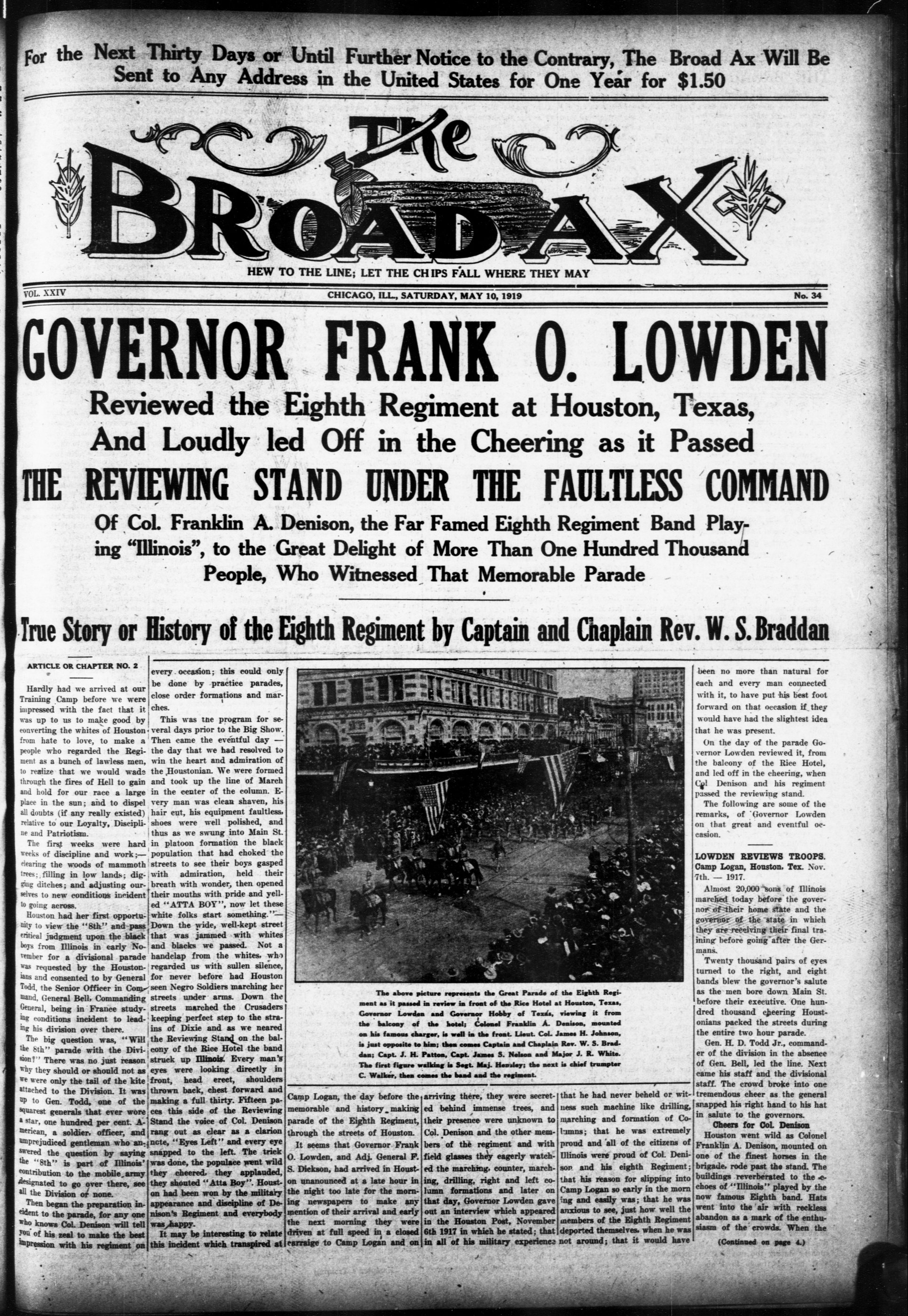
THE BROAD AX
HEW TO THE LINE; LET THE CHIPS FALL WHERE THEY MAY
GOVERNOR FRANK O. LOWDEN
Reviewed the Eighth Regiment at Houston, Texas, And Loudly led Off in the Cheering as it Passed THE REVIEWING STAND UNDER THE FAULTLESS COMMAND
Of Col. Franklin A. Denison, the Far Famed Eighth Regiment Band Playing "Illinois", to the Great Delight of More Than One Hundred Thousand People, Who Witnessed That Memorable Parade
True Story or History of the Eighth Regiment by Captain and Chaplain Rev. W. S. Braddan
ARTICLE OR CHAPTER NO. 2
Hardly had we arrived at our Training Camp before we were impressed with the fact that it was up to us to make good by converting the whites of Houston from hate to love, to make a people who regarded the Regiment as a bunch of lawless men, to realize that we would wade through the fires of Hell to gain and hold for our race a large place in the sun; and to dispel all doubts (if any really existed) relative to our Loyalty, Discipline and Patriotism.
The first weeks were hard weeks of discipline and work;—clearing the woods of mammoth trees; filling in low lands; digging ditches; and adjusting ourselves to new conditions incident to going across
Houston had her first opportunity to view the "8th" and pass critical judgment upon the black boys from Illinois in early November for a divisional parade was requested by the Houstonians and consented to by General Todd, the Senior Officer in Command, General Bell, Commanding General, being in France studying conditions incident to leading his division over there.
The big question was, "Will the 8th" parade with the Division? There was no just reason why they should or should not as we were only the tail of the kite attached to the Division. It was up to Gen. Todd, one of the squarest generals that ever wore a star, one hundred per cent. American, a soldier, officer, and unprejudiced gentleman who answered the question by saying the "8th" is part of Illinois' contribution to the mobile army designated to go over there, see all the Division or none. Then began the preparation incident to the parade, for any one who knows Col. Denison will tell you of his zeal to make the best impression with his regiment on
every occasion; this could only be done by practice parades, close order formations and marches.
This was the program for several days prior to the Big Show. Then came the eventful day — the day that we had resolved to win the heart and admiration of the Houstonian. We were formed and took up the line of March in the center of the column. Every man was clean shaven, his hair cut, his equipment faultless, shoes were well polished, and thus as we swung into Main St. in platoon formation the black population that had choked the streets to see their boys gasped with admiration, held their breath with wonder, then opened their mouths with pride and yelled "ATTA BOY", now let these white folks start something." Down the wide, well-kept street that was jammed with whites and blacks we passed. Not a handclap from the whites, who regarded us with sullen silence, for never before had Houston seen Negro Soldiers marching her streets under arms. Down the streets marched the Crusaders keeping perfect step to the strains of Dixie and as we neared the Reviewing Stand on the balcony of the Rice Hotel the band struck up Illinois. Every man's eyes were looking directly in front, head erect, shoulders thrown back, chest forward and making a full thirty. Fifteen paces this side of the Reviewing Stand the voice of Col. Denison rang out as clear as a clarion note, "Eyes Left" and every eye snapped to the left. The trick was done, the populace went wild they cheered. they applauded, they shouted "Atta Boy". Houston had been won by the military appearance and discipline of Denison's Regiment and everybody was happy. It may be interesting to relate this incident which transpired at
CHICAGO, ILL., SATURDAY, MAY 10, 1919
THE MARSHAL'S PARADE
The above picture represents the Great Parade of the Eighth Regiment as it passed in review in front of the Rice Hotel at Houston, Texas, Governor Lowden and Governor Hobby of Texas, viewing it from the balcony of the hotel; Colonel Franklin A. Denison, mounted on his famous charger, is well in the front. Lieut. Col. James H. Johnson, is just opposite to him; then comes Captain and Chaplain Rev. W. S. Braddan; Capt. J. H. Patton, Capt. James S. Nelson and Major J. R. White. The first figure walking is Segt. Maj. Hensley; the next is chief trumpeter C. Walker, then comes the band and the regiment.
Camp Logan, the day before the memorable and history making parade of the Eighth Regiment, through the streets of Houston. It seems that Governor Frank O. Lowden, and Adj. General F. S. Dickson, had arrived in Houston unannounced at a late hour in the night too late for the morning newspapers to make any mention of their arrival and early the next morning they were driven at full speed in a closed carriage to Camp Logan and on
arriving there, they were secreted behind immense trees, and their presence were unknown to Col. Denison and the other members of the regiment and with field glasses they eagerly watched the marching, counter, marching, drilling, right and left column formations and later on that day, Governor Lowden gave out an interview which appeared in the Houston Post, November 6th 1917 in which he stated; that in all of his military experience
that he had never beheld or witness such machine like drilling, marching and formation of Columns; that he was extremely proud and all of the citizens of Illinois were proud of Col. Denison and his eighth Regiment; that his reason for slipping into Camp Logan so early in the morning and easily was; that he was anxious to see, just how well the members of the Eighth Regiment deported themselves. when he was not around; that it would have
been no more than natural for each and every man connected with it, to have put his best foot forward on that occasion if they would have had the slightest idea that he was present.
On the day of the parade Governor Lowden reviewed it, from the balcony of the Rice Hotel, and led off in the cheering, when Col Denison and his regiment passed the reviewing stand.
The following are some of the remarks, of Governor Lowden on that great and eventful occasion.
LOWDEN REVIEWS TROOPS.
Camp Logan, Houston, Tex. Nov. 7th. — 1917.
Almost 20,000 sons of Illinois marched today before the governor of their home state and the governor of the state in which they are receiving their final training before going after the Germans.
Twenty thousand pairs of eyes turned to the right, and eight bands blew the governor's salute as the men bore down Main St. before their executive. One hundred thousand cheering Houstonians packed the streets during the entire two hour parade.
Gen. H. D. Todd Jr., commander of the division in the absence of Gen. Bell, led the line. Next came his staff and the divisional staff. The crowd broke into one tremendous cheer as the general snapped his right hand to his hat in salute to the governors.
Cheers for Col. Denison
Houston went wild as Colonel Franklin A. Denison, mounted on one of the finest horses in the brigade, rode past the stand. The buildings reverberated to the echoes of "Illinois" played by the now famous Eighth band. Hats went into the air with reckless abandon as a mark of the enthusiasm of the crowds. When the
PAGE TWO
Published Every Saturday
In this city since July 15th, 1899, without missing one single issue. Republicans, Democrats, Catholics, Protestants, Single Taxers, Priests, infidels or anyone else can have their say as long as their language is proper and responsibility is fixed.
The Broad Ax is a newspaper whose platform is broad enough for all, ever claiming the editorial right to speak its own mind.
Local communications will receive attention. Write only on one side of the paper.
Subscriptions must be paid in advance.
One Year.....$2.00
Six Months.....1.00
Advertising rates made known on application.
Address all communications to
THE BROAD AX
£206 So. Elizabeth St., Chicago, Ill.
Phone Wentworth 2597.
JULIUS F. TAYLOR
Editor and Publisher
DR. M. A. MAJORS
Associate Editor
4700 South State Street
Phone Drexel 1416
Vol. XXIV. May 10, 1919 No. 34
1902, at the Post Office at Chicago,
Ill. under Act of March 3, 1879
RECONSTRUCTION AND THE NEGRO
By Julius Rosenwald President Sears. Roebuck and Co. and Trustee of Tuskegee
Institute
Although American sacrifices in the European War have been great, we find compesation for them in many directions. Not the least of these is the vastly increased number of opportunities fer to many of our citizens. to many of our citizens.
Today the United States is the leading nation of the world in virtually every line of activity. We have been thrust into a new world leadreship by the war. It behooves us to make the most of our new opportunities. To equip ourselves creditably we must utilize the best there is in the manhood and womanhood of our nation, drawing upon the intellect and ability of every person who has either to give.
Approximately ten percent of our present population is colored. Every man, woman and child of this ten percent should be given the opportunity to utilize whatever ability he has in the struggle for the maintenance of world leadership which we now face.
Just insofar as we refuse to give this part of our population an opportunity to lend its strength to helping us set a pace for the rest of the world, as best it can, so do we weaken the total strength of our nation. In other words, we can either give our colored population the right and the opportunity to do the best work of which it is capable and increase our efficiency, or we can deny them their rights and opportunities, as we have done in many instances, and decrease our efficiency proportionately.
Of course, the question naturally arises as to how efficient the colored man and the colored woman are when given the opportunity to demonstrate their ability. No better answer can be found than that given by the splendid work of the majority of our colored people during the war. On the firing line, in the camps behind the line, and in civil life our colored population has done well indeed. Four hundred thousand Negroes offered their lives for their country. Many more made noble sacrifices in civilian life.
It was my privilege not only to observe the work done in civil life by colored persons in this country during the war, but to visit colored troops in France
There is no question that the Negro has given a splendid account of himself both as an exceptionally fearless fighting man and as a member of non-combatant troops. I made diligent effort to ascertain the manner in which the Negro troops conducted them selves behind the lines. It is much easier for a man to become lax in his conduct there than in actual fighting. Without exception every officer I questionel stated he could not ask for more obedient, willing, hard working or more patriotic troops than the Negro regiments had proven themselves to be. Every account I have read regarding the engagement of colored men in fighting units and every case in which I had the opportunity to inquire personally regarding the bravery of colored troops has led me to believe our colored men were as good soldiers as could be found in either our own army or the armies of our allies, regardless of color.
One needs only to scan the records of the War Department and the official reports of General Pershing to find positive proof of the valor, endurance and patriotism of the colored troops who battled for liberty and democracy for all the world. The entire nation notes with pride the splendid service of the 365th to the 372nd Infantry units inclusive. Every man of the 369th 371st and 372nd units has been awarded the Croix-de-Guerre, in recognition of the rare quality of his work. Similiar honors have been conferred on certain members of the other units. Not only did the colored troops as definite organizations win these coveted laurels, but many individuals, such as Needham Roberts, Harry Johnson and William Butler, and others equally meritorious, were awarded the Croix-de-Guerre and the distinguished Service Cross. When historians tell the story of the sanguinary conflicts at Chateau Thierry, in the Forest of Argonne, in the Champagne sector, Belleau Wood and at Metz, the record will give reason to believe that the victories achieved on those memorable fields might have shown a different result had it not been for the remarkable staying and fighting abilities of the colored troops. French, English and American commanding officers unite in singing the praises of these gallant warriors and agree that in the entire Allied Army no element contributed more signally than did they to the final downfall of the German Military Machine, in proportion to their numbers.
Not only the combatant units of the colored troops win laurels across the sea, but the 301st Stevedore Regiment was cited for exceptionally efficient work having broken all records by unloading and coaling the giant steamer "Leviathan" in fifty six hours, competing successfully with the best stevedore detachments on the western front of France. Everywhere, behind the lines as well as when facing shot, shell and gas, the colored soldiers have given a most creditable account of themselves and are entitled to the product of their patriotism and loyalty.
Those who remained at home during the war realize fully that the patriotic service rendered by colored persons in civil life, both in doing war work and in the purchase of Liberty Bonds and War Savings Stamps, is to be commended.
Surely after the many demonstrations of patriotism both on the battlefield and at home the white people of this country will be willing to accord the colored people a square deal by at least giving them a fair opportunity to earn a livelihood in accordance with their ability.
We have been assking the impossible of the colored man and the colored woman. We have demanded that they be honest, selfrespecting citizens, and at the
same time we have forced them into surroundings which almost makes this result impossible. In many places they are deprived of a fair opportunity to obtain education or amusement in a decent environment. Only the most menial positions are offered them. An educated girl particularly has practically no opportunity to earn a livelihood in the manner for which her education fits her. in a most generous disposal of the G uightout its perio the list of corp nities and indivi aided in bringing american arms by Liberty Bonds and Stamps and by other war relief deed a long one. Opportunities people to make
We whites of America must begin to realize that Booker T. Washington was right when he said it was impossible to hold a man in the gutter without staying there with him, because "if you get up, will get up". We do not want to remain in the gutter. We therefore, must help the Negro to rise.
If we are to obtain the most results from colored labor, unions should admit it to their membership. It is not the universal practice to admit color persons to unions. The result, of course, is that even if a colored man has the opportunity to learn a trade, knowing he will not be permitted to enjoy the benefits of a union, he does not have the highest incentive for learning it. The north is especially neglectful in not providing openings for the colored men in trades. In the south it is not unusual to see a colored brick-mason working alongside a white brick-mason. But in the north the best a colored man can hope for on a building job now is a position as a hod-carrier or mortar mixer.
When the alien arrives in this country, he is given opportunity for virtually every kind of employment. But the colored man who is born in the United States and, therefore, should share in its opportunities, is not given as fair a chance as the alien worker. Naturally, we cannot hope that these conditions will be remedied in a day or a month nor can the colored man expect that the millennium will come to him through the action of white people alone. He can improve his chances of securing greater rights and opportunities in the United States, if he will make the most of the limited opportunities now afforded him. He who does the best he can with the tools he has at hand is bound in time to demand by his good work better tools for the performance of more important and profitable duties. The conviction is general that He that is faithful in that which is least is faithful also in much. The late Colonel Theodore Roosevelt, who was a good friend of the black men as well as the white, struck the right note in his introduction to the biography of Booker T. Washington when he said:
"If there is any lesson, more essential than any other, for this country to learn, it is the lesson that the enjoyment of rights should be made conditional upon the performance of duty." There exist certain rights which every colored man and woman may enjoy regardless of laws and prejudice. For instance, nothing can prevent a colored person from practicing industry honesty saving and decency, if he or she desires to practice them.
The helpfulness of the colored race to the Government need not be confined to fighting in the army nor to service in the manifold domestic callings. It is the duty of the colored citizens, as it is their right, to have a part in the substantial development of the nation and to assist in financing its operations for war or peace. The colored people, as a rule, are industrious and thrifty and have come to appreciate their importance as a factor in the economic and financial world as indicated by their prosperous business enterprises, their large holding in real estate, their management of banks, and their scrupulous handling of the millions of deposits entrusted to their care. This capital, saved through sacrifice, has been placed
in a most generous manner at the disposal of the Government throughout its period of need, and the list of corporations, fraternities and individuals who have aided in bringing success to American arms by the purchase of Liberty Bonds and War Savings Stamps and by contributions to other war relief agencies, is indeed a long one. Opportunities of the colored people to make safe investment of their savings never were so great as they are today.
The financial program the Government has entered upon and is continuing to carry out to meet the expense of the war gives a chance to save in sums as small as twenty-five cents and make an investment upon which return of both principal and interest is absolutely guaranteed. Too often colored people have entrusted their savings to wholly irresponsible persons, lost them through the dishonesty of these persons, and in discouragement abandoned all attempts at saving. Today, however, there is no excuse for any man not saving a certain amount of his earnings no matter how small it may be. It is a poor person, indeed, who cannot invest twenty-five cents at stated intervals in a Thrift Stamp. Many are able also to buy small Liberty Bonds. It is a duty and a privilege for colored persons to help the Government finance the war, which was for both whites and blacks.
It is the particular duty of white persons, in cooperation with the most influential members of their own race, to explain these Government financial plans to the colored men and women that they may make safe investments, acquire a competence, and thus become better citizens.
It is my belief that the Negro soldiers returning from France will be a better citizens than when he left. He will be benefitted mentally and physically by his military training, and experience. He will have a broader vision. He will appreciate American citizenship. He will know, I believe, that freedom, for which he risked his life and all, is not license. He will find his brothers at home who did not go overseas better for their war sacrifices. Both the soldier and the civilian have proved their devoted loyalty. Justice demands that they now be rewarded*with an equal chance with the white man to and professional world as their climb as high in the industrial individual capacity warrants.
HAMPTON CELEBRATES ITS SEMI-CENTENNIAL
Kampton, Va. May Hon. William Howard Taft, president of the Hampton Institute Board of Trustees, speaking in Ogden Hall at the Fifty-first Anniversary execises of Hampton Institute, which included the celebration of the School's Semi-centennial, paid tribute to the work of Armstrong, Frissell, and Gregg.
"Hampton is a great National instrument of progress, invented by General Armstrong and perfected by Dr. Frissell. It is given to few schools to be a pioneer in education, as Hampton has been. Hampton is the mother of a new system of education. Gen. Armstrong, with the problem of fitting thousands of a backward race for life and progress, conceived the possibility of uniting mental training with that of the hand in useful trade. It was especially adapted to the need he sought to satisfy. But his conception, worked out to a successful, practical result, has been given application around the world. Not only for backward races but also for a considerable part of races advanced in civilization is the union of manual and intellectual training regarded as the best preparation for life."
Hampton's Training
Rev. Dr. M. Ashby Jones of Atlanta, speaking for the white South outlined "Hampton's Contribution to National Education." Dr. Jones said: "The glory of Hampton is that she is the first to give the Negro an opportunity to speak for himself. The deadly sin of slavery against the Negro was that it predetermined his life for him: marked the limits of his achievements; and determined the quality of his contribution to the world. It said "The Negro is this kind of a man and can be no other." Even as the years have gone by, much of the world has continued to say, "The Negro is capable thus far and no farther." Hampton said, "We do not know what the Negro is capable of, for he has never had an opportunity to speak for himself."
"I glory in the fact that Hamp ton does not strive to teach you what to think, but how to think for yourselves; not what to say, but how to speak for yourselves. Hampton has taught you loyalty to your racial instincts and your racial inheritance.
"Pour into the word "Negro" all the definition of honor, of high and holy aspiration, of splen did achievement, and hand it down to your children, not as a curse but as a blessing to those who are to come."
Dr. Moton Speaks
Dr. Robert R. Moton, principal of Tuskegee Institute, declared that General Armstrong hoped that "through Hampton's work there would come a better understanding between the North and South and a more sympathetic and helpful relation between the two races" — and the hope has been realized. Dr. Moton said:
"While we do not overlook the need and value of other systems of education, it is evident that the Hampton type of education has more than proven its worth and justified its place in the scheme of National progress. We have found that the trained man is a contributing factor in developing the vast resources of the country. The South is therefore no longer willing to tolerate ignorance, awkwardness, or fawning stupidity in either black or white, which retards human progress and hampers National prosperity. The world today cares no less about what you know but is insists on what you can do and how well you can do it.
"I have never seen a more earnest desire and effort on the part, not only of the leading white people but also the average white person in the South, that the Negro should be treated fairly and justly, educationally as well as in other ways, and no people in our country are more chagrined and humiliated when injustice is done than this very large element of Southern white people.
Gratitude to Hampton
"I am grateful to Hampton Institute because it has encouraged the buying and more intelligent cultivating of land among my people.
It has also deepend our love and appreciation of country life. I am thankful to Hampton because it has encouraged and developed a higher type of artisan among the members of my race. It has also stimulated a greater and more persistent and a more intelligent industrial life among us. Through Hampton, we have more captains of industry, with many more contractors and builders. Our people have also been taught to exercise greater economy and thrift and there has been created a stronger desire for better homes and schools with larger educational aspirations and opportunities.
I am also thankful for the large contribution that Hampton directly and indirectly, through its large army of graduates and former students, has made to the educational ideals of the nation. "In other words Hampton has more than any other single institution, first, taught the dignity, beauty, grandeur, and the absolute necessity for work of the
hands; second, it has emphasized race pride and race integrity; third, it has given us a safe platform along with an educational and economic program on which North and South and the Negro may work in hearty and unselfish co-operation, without embarrassment or humiliation to either, for absolute justice and fairness for all — for the good of men and to the glory of God. These, then, are some of the concrete results of Hampton's fifty years of service to the Negro and Indian races, to our country and to civilization.
PLEA FOR A MAN'S CHANCE
"Hampton has never asked. No groes do not now ask, I am not asking for my race, any pity or even sympathy, as much, no special privileges or opportunities not granted to other Americans. I do earnestly ask, however, that my race shall have every privilege along every line of every other American citizen under our laws — just a chance, with other Americans, to work and to be trained to live amid decent surroundings; to have first-class treatment in public conveyances when required to pay first-class fare; and a chance to be of the highest service to our race and to our country. No decent, self-respecting American can or should ask more."
Interesting Addresses
Dr. Lueien E. Warner brought greetings from the American Missionary Association "the mother of Hampton Institute" which in 1867 at the request of Samuel C. Armstrong bought the tract of 157 acres on which the Hampton School has been built. "Hampton Institute, he said, "through the introduction of the industrial idea in education has taught educators of this and other countries how best to train the masses."
Addresses were made by three members of the Class of 1919. Wendell L. Johnson, Lexington, Ky., spoke on "The Negro as a Patriotic American". Helen E. Cornish, Patersburg, Va., gave a demonstration on "The Preparation of an Invalid's Tray"; and Columbus K. Simango, Molsetter So., Rhodesia, So. Africa, spoke on "The Life of a South African." —
Homer L. Ferguson, president and general manager of the Newport News Shipbuilding and Dry Dock Company, was elected to membership on the Hampton Institute Board of Trustees. The Board has authorized the institution of an advanced, two-year, teacher—training course on the recommendation of Dr. James E. Gregg.
Dr. Gregg announced the folloowing: from the family of Robert C. Ogden, appropriate plaform furniture for the completion of "Ogden Hall"; from the family of Capt. Charles B. Wilder, $20,000; from the General Education Board, $25,000 for the maintenance of "Ogden Hall" and from the Hampton Alumni Association, $3500 for schoolar Galley
The musical program included the chorus singing of patriotic airs and old—time plantation melodies, including "Oh, Freedom" and Mrs. Natalie Curtis Burlin's "Hymn of Freedom" based upon "Ride on, Jesus" and Gretehinof's "Cherubin Song in F" sung by the Hampton Institute Choir.
Alumni Meeting
Alumni Meeting
Wm. M. Reid of Norfolk, Class of "77", president of the Hampton Alumni Association, presented to Mr. Taft $3500 which the Association had raised for schoolships. Well over 200 Hampton alumni returned for Hampton's semi-centennial. Moorfield Storey of Boston spoke to the alumni on the value of co—operation between white and colored people "I have been astonished and inspired," said Mr. Storey by what I have seen. The lesson which Hampton is teaching this country is the lesson which every citizen ought to learn."
Critain "Perspective."
Retain Perspective
We say of a painting that the "perspective" is good—meaning that we can see far ahead, beyond the apparent background to imagined beauties still further in the distance. Many people have not this perspective; they see only the pebbles and shallow water in the foreground and, stopping to dabble their feet in the first pleasant invitation to ease and coolness, they lose the call and lure of the deep pools and forests farther on, content to stay at the half-way house, even forgetting that they once held a faint rison of castles of accomplishment.
Ant Development
Ants have developed nothing remotely resembling industrial organization. Many unnecessary conclusions have been drawn from comparing neurer (undeveloped female) ant workers with the unmarried women of modern industry. A comparison with child labor would be truer. For ant workers are always "hunger" forms—stunted creatures who have no economic opportunity to grow up—who are forced by family necessity to venture out for food before they reach full growth.
Nankins
Table napkins were in use long before some of the other accessories which we consider indispensable today. Before forks came to be known, men had to use their fingers in preparing their food; hence the ancient common habit of frequently passing the basin of water and its accompanying napkin for wiping the hands. It now seems incredible that forks were not customary until the seventeenth century.
Physicians' Oath.
A part of the Hippocratic oath is as follows: "Whatever, in connection with my professional practice, or not in connection with it, I may see or hear in the lives of men which ought not to be spoken abroad, I will not divulge, as reckoning that all such should be kept secret." This oath is respected by every court in the world, and rarely indeed has it ever been broken by a reputable physician.
Good Manners
Good manners, which give color to life, are of greater importance than laws, which are but one of their manifestations. The law touches us here and there, but manners are about us, everywhere, pervading society like the air we breathe. Good manners, as we call them, are neither more nor less than good behavior, consisting of courtesy and kindness.—Samuel Smiles.
Moroccan Charm
Moroccan wives have a recipe for winning back affection. The suspicious wife draws a line of honey from forehead to chin and collects the drippings. Then she rubs the tip of her tongue with a fig leaf till it bleeds and soaks seven grains of salt in the blood. This she mixes with the honey and puts the dose in the erring husband's food.
Home of Nympha
Near the cape of Shima, in Japan, there is a village the name of which in Japanese means "The settlement of Nymphs." Woman in this village is the predominant partner. The chief industry is pearl fishing and the women are the fishers. The men stay at home and do the work.
Have Record for Laziness
The Todas of India are said to be the laziest people in the world. The men of the household club together to take one wife to support, and then they let her do the work. The Todas have reduced the simple life to the formula: Do only what you must, and very little of that.
Invented First Chronometer.
The first chronometer of any value was the invention of John Harrison, about 1750, for which he received from the British board of longitude $50,000 as a part of $100,000 which "they offered for many years as a reward for a thoroughly trustworthy timekeeper."
Ball Over Bill You're Sporing
Man, say the scientists, is the only living thing that ever sleeps on its back. Perhaps it is from a feeling of pride that some of us make so much noise when indulging in this accomplishment.
Ingrediente for Happiness.
Without strong affection and humanity of heart, and gratitude to that Being whose code is mercy and whose great attribute is benevolence to all things that breathe, true happiness can never be attained—Dickens.
Oldest Roof.
The roof of Hotel Rhinebeck in New York city is supposed to be the oldest slate roof in America. It was slated in the year 1700 with slate brought from Wales for this purpose.
Altar va. Halter.
Sald the facetious feller: "Nobody expects a wedding ceremony to go through without a hitch."
Daily Thought. Valor consists in the power of self-recovery.—Emerson.
The Astrolayer
An astrologer, who was famed for his great learning and his knowledge of the stars, went out for a walk. As he walked, all the time looking up at the sky, he said to himself: "Oh, how much wiser am I than most men. All the secrets of the stars are known to me. I read them as other men read books. . . ." Thus speaking, he came to a well, but, being far too busy praising his own cleverness to notice it, he tripped and fell in headlong, and there he had to stay until his servant, hearing his cries, came and pulled him out.—Aesop's Fables.
Anglo-Saxons
The Angles, or Engles, were a people once located in a part of the world now known as Schleswig-Holstein and who accompanied or immediately followed the Saxons into England. The Angles are believed to have been the more powerful race, for they occupied the larger portion of Britain, and they gave their name to the land, for out of Engle grew the word England and the Saxons made the word Anglo-Saxon.
Needed Prompting.
Mr. Jobling was asked by his wife to call at a shop on his way home and get her three articles of feminine wear. When she reached the shop he had forgotten what they were, so he said apologetically to the attendant behind the counter: "Excuse me, my wife told me to come here and get her some things to wear, and I've forgotten what they are! Would you mind naming a few things?"
Status of the Shoes
Kathleen and her mamma had just returned from a shopping trip bringing home a pair of shoes for Kathleen, but only on approval. Upon arriving home Doris, Kathleen's older sister, out of curiosity immediately started to open the package. Kathleen indignantly said, "Doris, you just leave those shoes alone; mamma only brought them home on a furlough."
Mastering Worry.
The person who knows no worry is a fortunate individual (if such a human being possibly exists), but worry as well as its first cousins, nerves, can be mastered if we sensibly take each day as it comes, smiling at its problems, and forgetting all about that "doubtful future" which some folks declare is full of woes.
Benefactor of Men.
The New York Sun's appreciation of the late Dr. Mary Walker contains this tribute: "One debt of gratitude men owe Doctor Walker which they ought not to forget. She was the inventor of the inside neckband on shirts which protects the flesh from being rubbed by the collar button."—Outlook.
Care of Umbrellas
Carelessness in the treatment of umbrellas is a great factor in their rapid deterioration. An umbrella merely damp should be opened and left until dry, while a very wet one should be put to drain first, handle downward, and opened for the final drying.
Unique Nation.
Costa Rica is unique among modern nations, inasmuch as it has more teachers than soldiers. The standing army is only 500 strong, while the teachers in active service number about 2,000. For nearly 45 years the country has enjoyed internal peace.
New Water Power.
A new use of ocean water power has been perfected by an Englishman. He catches water when the tide rises and makes it operate turbine engines when the tide falls. Thus he obtains a perpetual water power, as the tide always ebbs and flows.
Experimental.
"Dad." inquired a small boy, "what is a test case?" "A test case, my son," replied his parent, "is a case brought into court to decide whether there's enough in it to justify lawyers in working up more cases of a similar kind!"
There is something servile in the habit of seeking after a law which we may obey. We may study the law of matter at and for our convenience, but a successful life knows no law.—Thoreau.
Brudder Shinbone's Idea
"Ah ain't. passionally quainted wiv dis yar cootie," remarked Shibnone, "but Ah reckon he ain't nuffin' mo'丹 a sartin omentionable insec' wiv er military trainln."—Boston Transcript.
Howise Business Men.
There be those who are ready to rush into great ventures on suspicion, as it were, not having made a careful and exhaustive survey of the situation, nor having counted the cost.
Rain by X-Ray.
An Australian inventor has patented a method for producing rain by raising large X-ray bulbs by balloons into higher strata of air that are filled with moisture.
Daily Thought.
Write to the mind and heart and let the car glean after what it can.— Bailey.
THE BROAD AX, CHICAGO, MAY 10, 1919
Lake of Sulphate
A lake near Biggar, Saskatchewan, and about three hundred miles northwest of Regina, has been found to be saturated with sodium sulphate, and the deposit under the lake and alongside the edge to be nearly 97 per cent pure sulphate. The mineral is used extensively in the manufacture of sulphuric acid, in photography and other industrial purposes. The lake occupies an area of about two hundred acres. The edge is muddy, but on boring down a solid bed of mirabilite crystals is found.
French Port Regaina Trade
While Havre was still young the seafaring men of Honfleur conquered Newfoundland, founded Quebec and established numerous trading posts in India. Much of the town's commerce was gradually absorbed by Havre. At the outbreak of the great war, however, Honfleur had a prosperous export trade with England in dairy products, fruits and vegetables, and a considerable quantity of lumber was imported direct from the Scandinavian countries.
Waa Last Polish King.
In 1798, on the 11th of April, Stanislaus Poniatowski, the last king of Poland, died. Poniatowski ascended the Polish throne in 1764. The condition of Poland required a strong man on the throne to keep the country from ruin, and Stanislaus lacked the necessary strength and statesmanship. Russia, Prussia and Austria divided this kingdom among them and the deposed king retired to Petrograd on a pension, where he died in 1798.
Equal to the Occasion
"Speaking of accommodating hotel managers," said a traveler, "the best I ever met was in a provincial town. I reached the hotel late in the evening. Just before I retired I heard a scampering under the bed, and saw a couple of large rats just escaping. I at once complained at the office. The manager was as serene as a summer breeze. T'll fix that all right, sir," he said. "Boots! Take a cat to room 15 at once!"
Stranger to Western: World.
The Asiatic zoological expedition, sent into the South Chinese mountain province of Yunan to investigate its range of animal life, succeeded in securing several fine specimens of the serow, which is a stranger to the western world. The serow is a mountain dweller, somewhat like the chamois. It is wary and fleet and takes a dizzy and seemingly impossible course among its native crags.
Country's Dark Days
The saying, "not worth a continental," came from the fact that the continental currency, issued by the continental congress, was worthless, or nearly so, during the revolution and after. As the continental congress had no power to levy taxes it was unable to redeem its promises to pay. Besides, the country was flooded with counterfeits which could not be detected.
Astonished Daddy
June is having some difficulty in settling upon the proper title for her father. The other day she was playing with one of his collars when she tore it. Just then she heard him coming upstairs, and rushing to the top step called in distressful tones: "Oh, daddy, I has tore my hubble's collar!"
Mind That Is Truly Free.
I call that mind free which is jealous of its own freedom, which guards itself from being merged in others, which guards its empire over itself as nobler than the empire of the world—William Ellery Channing.
Baby's Locomotion.
Merrill's father had just been learning to drive his car. The baby was just learning to walk, and she walked sideways. One day Merrill ran into the house and said: "Oh, mamma, come and see the baby skidding!"
Not Guilty Here.
"Of all the left-handed compliments designed to keep mere man in a happy frame of mind," remarked the facetious philosopher, "the one about a man being handy about the house is the worst."—Indianapolis News.
Munings of Martha
If th' wedding' ceremony included,
besides "love, honor and obey," "cook
his meals, wash his clothes, darn his
socks, an' sew on his buttons," there'd
be fewer hasty marriages.
From the Heart.
Our favorite books are few; since only what rises from the heart reaches it, being caught and carried on the tongues of men wheresoever love and letters journey.—Alcott.
Something to Worry About.
Considering how little is accomplished, one sometimes wonders if it is really worth a hungry elephant's time to eat so small a thing as a peanut.
Daily Thought.
Good company and good discourse are the very sinnes of virtue.—Isaak Walton.
DAY HONORED BY WELSHMEN
March the First Known the World
Oven as Anniversary of the
Country's Patron Saint
The first day of March has long been observed as a special day by the people of Wales and is called St. David's day in honor of the good St. David, patron saint of the Welsh, who lived in the sixth century.
St. David was said to have been the son of a prince of Cardiganshire, Wales, and is accredited with the working of many miracles, especially among the poor of the country. It was said that when the saint first went into the fields to preach to his followers the ground on which he was standing began to rise until it assumed a goodly height, and henceforth was his pulbit.
For hundreds of years the Welsh wore sprigs of leek—a plant with broad bluish-green leaves and yellow flower clusters—in their hats as a symbol of recognition of the day. This custom was brought about, some say, from the fact that in a battle of the Welsh against their old enemies, the Saxons, St. David had ordered all Welshmen to go into battle wearing their native leek, not only to distinguish them from their enemies, but to bring them good luck.
Other writers argue that the badge was worn more as a fraternal sign and because leek was grown in every Welsh garden and was the favorite vegetable of a true Welshman.
Writers of the last century depict a typical Welsh garden as a garden of onlons, garlic and leek. Homely, incidents are told of Welshmen assisting each other in farming and eating their leeks together, a ceremony symbolle of hospitality and good fellowship.
NOT ALWAYS PROPERLY SANE
Scientists Assert Few People Have at All Times Full Command of Their Mental Faculties.
Many people think that the expression "temporary insanity" is merely used by a jury wishing to save relatives pain, but numbers of doctors who have made a study of mental disorders emphatically declare it is no idle term.
One doctor has stated that temporary insanity is a condition of double consciousness, not dissimilar to epilepsy. A person normally quite sane may have attacks of temporary aberration lasting little more than a few minutes, especially after long bouts of hard, continuous mental work, being particularly liable if insomnia supervenes.
Crimes have been committed in the early morning when the perpetrator has not really been properly awake, and has been horrified to find what he has done. This is a true case of temporary insanity, but it is comparatively rare, and a man in normal health would not suffer in this way. A specialist in mental diseases has stated that he knew a case in which a person was insane during a certain time of each day, and that others have been known when the patient was quite normal at ordinary times, but suffered from a temporary fit of mania regularly once a month.
Forming Artificial Pearls
Pearls were valuable as gems in China as early as twenty-two centuries before our era, and the Chinese had worked out a plan for the artificial formation of pearls about 700 years ago, which they have carried on extensively. Large numbers of oysters are collected and the shell gently opened to allow the introduction of various foreign substances which are inserted by means of a forked bamboo stick. These pellets are generally made of prepared mud, but may be bone, brass or wood. The oysters are then placed in shallow ponds connected with canals and are nourished by tubs of night soil thrown in from time to time.
Some time later, from several months to two years, depending upon the size of the gem desired, these oysters are taken out of the shell, the pearls removed and the body of the animal eaten as food. Millions of such pearls are sold annually in China. The most valuable are either round or pear shaped.
Few Old People in New Guinea.
The average duration of life is shorter in New Guinea than in any other country, owing to the peculiar diet of the natives, who devour with gusto the larvae of beetles, dug out of decayed tree trunks, and habitually drink seawater when near the coast. "The people die off at about forty," A. E. Pratt says in his "Two Years Among the Cannibals of New Guinea." "We saw one very old man, who may have been about sixty years of age—the only example of longevity that we came across. He was bent almost double, and had a long, white beard. His fellow tribesmen regarded him as a great curiosity, and brought him to see us. Despite the decrepitude of his body, however, there was no trace of senility; his senses were unimpaired and the poor old creature showed great gratitude for a gift of tobacco."
Hence the Congestion
"You have plenty of room in Ameri ca," said the foreign visitor. "Oh, yes." "Then why do you build so many sky-scrapers?" "I guess that's because the average American thinks he can't transact business unless he's within walking distance of the post office."—Birmingham Ame. Herald.
Undoubted Proof.
An eminent pianist was about to give a recital in a large hall. As the audience was filling in a man staggered up to the door and presented a ticket. "You cannot go in," said the official in charge; "you are not in a fit condition." "Didn't I pay for my ticket?" asked the man. "Isn't it in order?" "It's all right," was the reply, "but you—you are all wrong—you are intoxicated!" "Intoxicated? Of course I'm intoxicated! If I wasn't do you think I would come to a piano recital?"
Doomed to Wretchedness
Let a man choose what condition he will, and let him accumulate around him all the goods and gratifications seemingly calculated to make him happy in it; if that man is left at any time without occupation or amusement, and reflects on what he is, the meager, languid felicity of his present lot will not bear him up. He will turn necessarily to gloomy anticipation of the future; and unless his occupation calls him out of himself, he is inevitably wretched.—Pascal.
A Great Man.
A great man is he who chooses the right in invincible resolution, who resists the sorest temptations from within and without, who bears the heaviest burdens cheerfully, who is calmest in storms and most fearless under frowns, whose reliance on truth, on virtue, on God, is most unfaltering. I believe this greatness to be most common among the multitude, whose names are never heard.—W. E. Channing.
Keen Sweet
Losing the temper takes all the sweet, pure feeling out of life. One may get up in the morning with a clean heart, full of song, and start out as happy as a bird, and the moment he is crossed and gives way to temper the clean feeling vanishes; and a load as heavy as lead is rolled upon the heart. Be the master of your temper and you hold the key to joy and contentment.
Whence "Dutch."
The name * Dutch is derived from Dutch, meaning the vernacular, as distinguished from Latin. It is the same word as the German Deutsch. Dutch belongs to the Frankish division of the Low German, and is closely related to the Flemish, with which it is now practically identified in its written form. The Dutch language is one of the Germanic group of dialects, and is practically the same in its structure.
Evidently No Lover of Cards.
It is very wonderful to see persons of the best sense passing hours together in shuffling and dividing a pack of cards with no conversation but in different figures. Would not a man what is made up of a few game phrases, and no other ideas but those of black or red spots ranged together laugh to hear any one of his species complaining that life is short?—Addison.
Endurance.
Endurance, not fleetness, wins the race. Never give up. Keep pegging away even though everything looks hopeless. Many a man has failed to achieve both fortune and fame because he lost courage just as he was within reach of them. What you desire may be only one step ahead. Keep going.
Curiosities of the Calendar
It will be found that January always begins on the same day of the week as October, and the same is true of April and July, September and December. Again February, March and November also begin on the same day of the week. This, however, is only true in years of 365 days.
Testing for All Wool.
Anybody can tell whether it is all wool or not by boiling out a little piece in a test-tube with a solution of caustic soda over an alcohol lamp. Whatever does not dissolve is not wool. This piece of chemical wisdom is propounded by the Little Journal.
The Old Story.
We asked at our house for a menu that would make for plain living and clear thinking, and they gave us an alligator pear salad with pomegranate seeds and Thousand island dressing. Grand Rapids Press.
The Other Side.
If you want to make yourself solid with other folks don't stop to tell them what wonderful things you have done, but just say, "You fellow have the world beaten for big things!"
Found Road to Happiness
I have been a great deal happier since I have given up thinking about what is easy and pleasant, and being discontented because I could not have my own will.-George Ellot.
We wonder if one could raise forage for a nightmare in a garden of dreams. Columbian Misfortune
Daily Thought
The fearful unbelief is unbelief in
yourself.—Carlyle.
PAGE THREE
ORIENTAL LOVE OF BEAUTY
Flowers and Nature Have Always Figured Prominently in Their Paintings and Writings.
The Orient was always fond of flowers. In primitive times the Arabs studied the big herbalis of Byzantine doctors and scientists and copied flower after flower in their own manner; they loved them, but they were unconscious of their beauty. When they wanted to adorn they only used the conventionalized form of the lotus and the arabesque flower consecrated by hundreds of years of tradition. Later on Chinese masters taught them the living beauty of flowers. In the Mongol miniatures they study the blossoming almond tree and the iris, but in the sixteenth century only they begin to love the flower for itself—to study each leaf, each petal, each line and each hue of color. They show the same intimate love for detail which inspired the landscapes of Bezhad. Their landscapes are always like the poems of Hafiz—sunny, cheerful and gay. Nothing more charming than these meetings of kings and princesses in the greens under richly embroidered tents with musicians and dancers. And no difference if the artist paints one of the cruel bloody scenes of the antique "Shahnameh"; must it not be a wonderful feeling to be executed by the order of the king in his illustrious presence, with retainers and maldens around, the sun shining, a soft wind covering your head and shoulders with the pink petals of the almond tree in flower? The birds sing sweeter than ever in the trees. The touch of the cold steel is after all only of passing moment and eternal is the beauty of sun, spring and flowers.—R. M. Riefstahl, in Asia Magazine.
SHOW SPIRIT OF FAIRNESS
American Gives English Writers Credit for One Attribute That Is Worthy of Praise.
I have frequently said the writers in England are superior to ours, particularly as to fairness and conservatism. The other day I ran across a review article criticising the general ignorance of the people about old and classical things. After proving his point cleverly and effectually the writer proceeded to examine himself. He turned to the encyclopedia at random and took the first subject at the top of the page. He confessed he knew nothing about it. He did the same thing with many other subjects of classical antiquity. And this fellow is one of the best-educated men in England.
An American writer would not have done that; he would have pretended to be thoroughly familiar with everything in the encyclopedia, and witheringly abused the people for lacking his great knowledge.
The truth about old classical subjects is that most of them are buried in books and that few people know anything about them, for the reason that they are not of the slightest importance.
An Englishman is mean, but he has a lot of sense; and he will be reasonably fair, even if disagreeable with it.
—E. W. Howe's Magazine.
Tints and Autumn Colors.
Everyone has seen and admired the beautiful colors of autumn leaves, but vary few know anything about the why and wherefore.
It has been noticed that in two trees of maples, oak or other trees, coloring in autumn, of the same species, one will often take on much brighter color than the other.
It should be remembered that, though there must be certain chemical combinations before any color can be produced, the act of producing is a vital one, and can only operate under vital conditions. If we cut a branch of any tree in summer time and throw it aside, the leaves turn black or brown, and without any brilliant color; but if the branch be only half broken off or in some way injured the leaves will color, as if the autumn time had arrived.
This shows that coloring is connected with a check to vital power, short of its total destruction. Hence, in the autumn, the tree with the greater vital power will color less than the other.
The Whippoorwill.
It is almost impossible to see a whippoorwill in the daytime because of the manner in which it sits upon a limb of a tree. It doesn't sit cross-wise, like other birds, but lengthwise of the limb. Its toes are short, but broad-spreading, and it can sit lengthwise on a limb better than it could sit crosswise, where it would have to clasp the limb with its toes like other birds. You may pass right under a tree where a whippoorwill is sitting on a limb and never notice it—and it knows it will never be noticed, so it doesn't become alarmed and fly out of the tree.
Why Diamonds Burst
That diamonds burst is an old idea, which has been variously explained. It has been thought that the stones have fractured by violent eruptions in the inclosing rocks, by sudden removal of pressure around them, or in the smoky specimens by spontaneous breaking up. Dr. J. R. Sutton concludes that the breaking usually results from the minerals inclosed. These may be garnet zircon, limeite or iron pyrites, and such crystals, under ordinary heating at least, have so much greater expansion than the diamond that they would exert great pressure.
107
1897
HON. FRANK O. LOWDEN
War governor of Illinois, who Illinois at Houston, Texas, in November their soldierly bearing he bade farew manding the regiment.
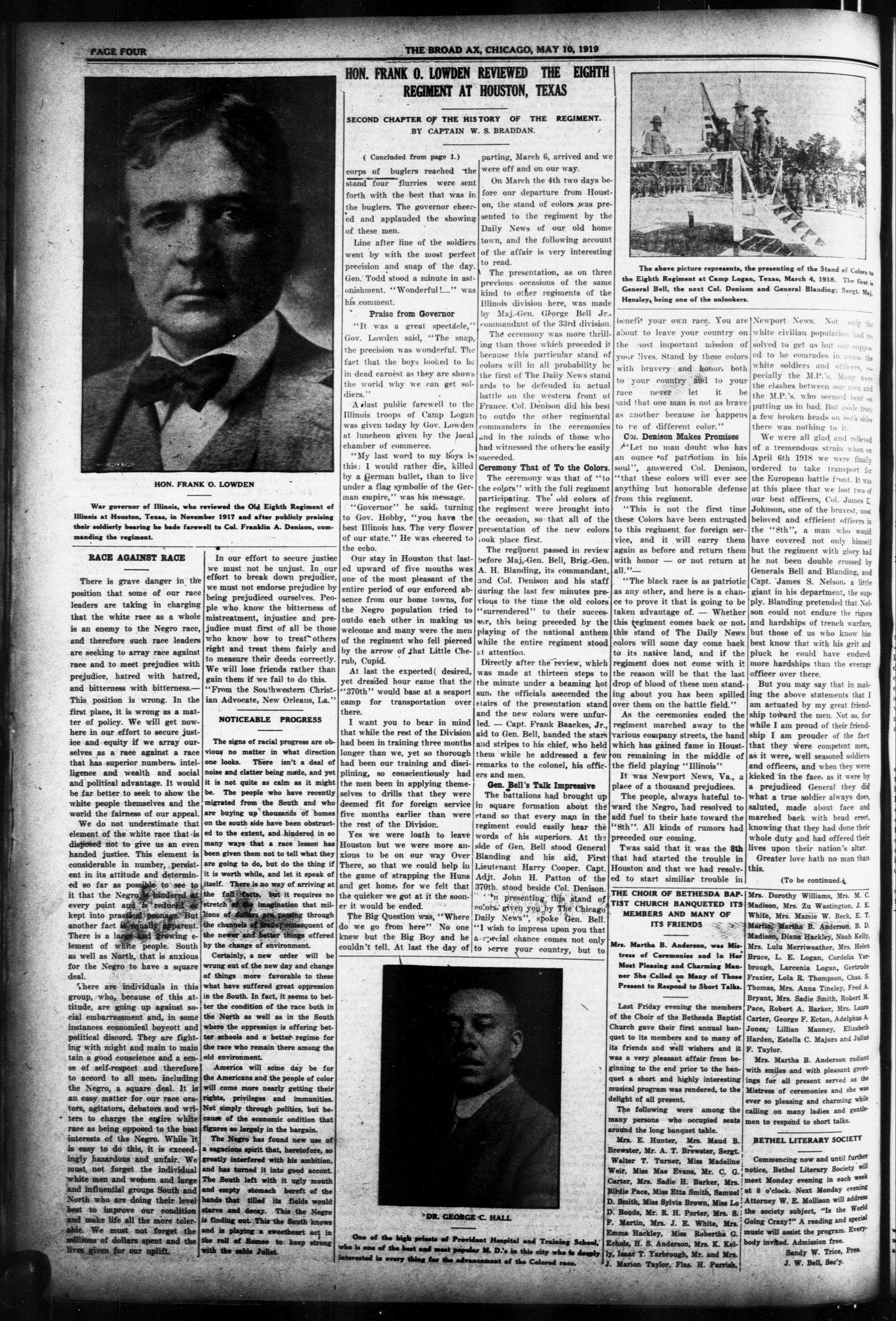
War governor of Illinois, who reviewed the Old Eighth Regiment of Illinois at Houston, Texas, in November 1917 and after publicly praising their soldierly bearing he bade farewell to Col. Franklin A. Denison, commanding the regiment.
RACE AGAINST RACE
There is grave danger in the position that some of our race leaders are taking in charging that the white race as a whole is an enemy to the Negro race, and therefore such race leaders are seeking to array race against race and to meet prejudice with prejudice, hatred with hatred, and bitterness with bitterness.—This position is wrong. In the first place, it is wrong as a matter of policy. We will get nowhere in our effort to secure justice and equity if we array ourselves as a race against a race that has superior numbers, intelligence and wealth and social and political advantage. It would be far better to seek to show the white people themselves and the world the fairness of our appeal.
We do not underestimate that element of the white race that is disposed not to give us an even handed justice. This element is considerable in number, persistent in its attitude and determined so far as possible to see to it that the Negro is hindered at every point and is reduced or kept into practical peonage. But another fact is equally apparent. There is a large and growing element of white people. South as well as North, that is anxious for the Negro to have a square deal.
There are individuals in this group, who, because of this attitude, are going up against social embarrassment and, in some instances economical boycott and political discord. They are fighting with might and main to main tain a good conscience and a sense of self-respect and therefore to accord to all men, including the Negro, a square deal. It is an easy matter for our race orators, agitators, debaters and writers to charge the entire white race as being opposed to the best interests of the Negro. While it is easy to do this, it is exceedingly hazardous and unfair. We must, not forget the individual white men and women and large and influential groups South and North who are doing their level best to improve our condition and make life all the more tolerable. We must not forget the millions of dollars spent and the lives given for our uplift.
---
PAGE FOUR
In our effort to secure justice we must not be unjust. In our effort to break down prejudice, we must not endorse prejudice by being prejudiced ourselves. People who know the bitterness of mistreatment, injustice and prejudice must first of all be those who know how to treat others right and treat them fairly and to measure their deeds correctly. We will lose friends rather than gain them if we fail to do this. "From the Southwestern Christian Advocate, New Orleans, La."
NOTICEABLE PROGRESS
The signs of racial progress are obvious no matter in what direction one looks. There isn't a deal of noise and clatter being made, and yet it is not quite as calm as it might be. The people who have recently migrated from the South and who are buying up thousands of homes on the south side have been obstructed to the extent, and hindered in so many ways that a race lesson has been given them not to tell what they are going to do, but do the thing if it is worth while, and let it speak of itself. There is no way of arriving at the full facts, but it requires no stretch of the imagination that millions of dollars are passing through the channels of trades consequent of the newer and better things offered by the change of environment.
Certainly, a new order will be wrung out of the new day and change of things more favorable to these what have suffered great oppression in the South. In fact, it seems to better the condition of the race both in the North as well as in the South where the oppression is offering better schools and a better regime for the race who remain there among the old environment. America will some day be for the Americans and the people of color will come more nearly getting their rights, privileges and immunities. Not simply through politics, but because of the economic oding that figures so largely in the bargain.
The Negro has found new use of a sagacious spirit that, heretofore, so greatly interfered with his ambition, and has turned it into good account. The South left with it ugly mouth and empty stomach bereft of the hands that tilled its fields would starve and decay. This the Negro is finding out. This the South knows and is playing a sweetheart act in the roll of Romeo to keep strong with the sable Juliet.
THE BROAD AX, CHICAGO, MAY 10, 1919
HON. FRANK O. LOWDEN REVIEWED THE EIGHTH REGIMENT AT HOUSTON, TEXAS
SECOND CHAPTER OF THE HISTORY OF THE REGIMENT. BY CAPTAIN W. S. BRADDAN.
corps of buglers reached the stand four flurries were sent forth with the best that was in the buglers. The governor cheered and applauded the showing of these men.
Line after line of the soldiers went by with the most perfect precision and snap of the day. Gen. Todd stood a minute in astonishment. "Wonderful!..." was his comment.
Praise from Governor
"It was a great spectacle," Gov. Lowden said, "The snap, the precision was wonderful. The fact that the boys looked to be in dead earnest as they are shows the world why we can get soldiers."
A last public farewell to the Illinois troops of Camp Logan was given today by Gov. Lowden at luncheon given by the local chamber of commerce.
"My last word to my boys is this: I would rather die, killed by a German bullet, than to live under a flag symbolic of the German empire," was his message.
"Governor" he said, turning to Gov. Hobby, "you have the best Illinois has. The very flower of our state." He was cheered to the echo.
Our stay in Houston that lasted upward of five months was one of the most pleasant of the entire period of our enforced absence from our home towns, for the Negro population tried to outdo each other in making us welcome and many were the men of the regiment who fell pierced by the arrow of that Little Cherub, Cupid.
At last the expected( desired, yet dreaded hour came that the "370th" would base at a seaport camp for transportation over there.
I want you to bear in mind that while the rest of the Division had been in training three months longer than we, yet so thorough had been our training and disciplining, so conscientiously had the men been in applying themselves to drills that they were deemed fit for foreign service five months earlier than were the rest of the Division.
Yes we were loath to leave Houston but we were more anxious to be on our way Over There, so that we could help in the game of strapping the Huns and get home, for we felt that the quicker we got at it the sooner it would be ended.
The Big Question was, "Where do we go from here". No one knew but the Big Boy and he couldn't tell. At last the day of
1910
P. A.
DR. GEORGE C. HALL
One of the high priests of Provident Hospit who is one of the best and most popular M. D.'s interested in every thing for the advancement of
One of the high priests of Provident Hospital and Training School, who is one of the best and most popular M. D.'s in this city who is deeply interested in every thing for the advancement of the Colored race
parting, March 6, arrived and we were off and on our way.
On March the 4th two days before our departure from Houston, the stand of colors was presented to the regiment by the Daily News of our old home town, and the following account of the affair is very interesting to read.
The presentation, as on three previous occasions of the same kind to other regiments of the Illinois division here, was made by Maj.-Gen. Géorge Bell Jr. commandant of the 33rd division
The ceremony was more thrilling than those which proceeded it because this particular stand of colors will in all probability be the first of The Daily News stand ards to be defended in actual battle on the western front of France. Col. Denison did his best to outdo the other regimental commanders in the ceremonies and in the minds of those who had witnessed the others he easily succeeded.
Ceremony That of To the Colors.
The ceremony was that of "to the colors" with the full regiment participating. The old colors of the regiment were brought into the occasion, so that all of the presentation of the new colors took place first.
The regiment passed in review before Maj.-Gen. Bell, Brig.-Gen. A. H. Blanding, its commandant, and Col. Denison and his staff during the last few minutes previous to the time the old colors "surrendered" to their successor, this being preceded by the playing of the national anthem while the entire regiment stood at attention.
Directly after the review, which was made at thirteen steps to the minute under a beaming hot sun, the officials ascended the stairs of the presentation stand and the new colors were unfurled. — Capt. Frank Baackes, Jr., aid to Gen. Bell, handed the stars and stripes to his chief, who held them while he addressed a few remarks to the colonel, his officers and men.
Gen. Bell's Talk Impressive
Gen. Ben's Talk Impressive
The battalions had brought up in square formation about the stand so that every man in the regiment could easily hear the words of his superiors. At the side of Gen. Bell stood General Blanding and his aid, First Lieutenant Harry Cooper. Capt. Adjt. John H. Patton of the 370th. stood beside Col. Denison. in presenting this stand of colors, given you by The Chicago Daily News", spoke Gen. Bell. "I wish to impress upon you that a special chance comes not only to serve your country, but to
The quick brown fox jumps over the lazy dog.
The above picture represents, the presenting of the Stand of Colors to the Eighth Regiment at Camp Logan, Texas, March 4, 1918. The first is General Bell, the next Col. Denison and General Blanding; Sergt. Maj. Hensley, being one of the onlookers.
benefit your own race. You are about to leave your country on the most important mission of your lives. Stand by these colors with bravery and honor, both to your country and to your race never let it be said that one man is not as brave as another because he happens to be of different color."
Newport News. Not only the white civilian population had resolved to get us but our supposed to be comrades in arms the white soldiers and officers, especially the M.P.'s. Many were the elashes between our men and the M.P.'s. who seemed bent on putting us in bad. But aside from a few broken heads on both sides there was nothing to it
Col. Denison Makes Promises
"Let no man doubt who has an ounce of patriotism in his soul", answered Col. Denison,
"that these colors will ever see anything but honorable defense from this regiment.
"This is not the first time these Colors have been entrusted to this regiment for foreign service, and it will carry them again as before and return them with honor — or not return at all."
"The black race is as patriotic as any other, and here is a chance to prove it that is going to be taken advantage of. — Whether this regiment comes back or not, this stand of The Daily News colors will some day come back to its native land, and if the regiment does not come with it the reason will be that the last drop of blood of these men standing about you has been spilled over them on the battle field."
As the ceremonies ended the regiment marched away to the various company streets, the band which has gained fame in Houston remaining in the middle of the field playing "Illinois"
It was Newport News, Va., a place of a thousand prejudices.
The people, always hateful toward the Negro, had resolved to add fuel to their hate toward the "8th". All kinds of rumors had preceded our coming.
Twas said that it was the 8th that had started the trouble in Houston and that we had resolved to start similar trouble in
Mrs. Martha B. Anderson, was Mistress of Ceremonies and In Her Most Pleasing and Charming Manner She Called on Many of Those Present to Respond to Short Talks.
Last Friday evening the members of the Choir of the Bethesda Baptist Church gave their first annual banquet to its members and to many of its friends and well wishers and it was a very pleasant affair from beginning to the end prior to the banquet a short and highly interesting musical program was rendered, to the delight of all present.
The following were among the many persons who occupied seats around the long banquet table.
Mrs. E. Hunter, Mrs. Maud B. Brewster, Mr. A. T. Brewster, Sergt. Walter T. Turner, Miss Madeline Weir, Miss Mae Evans, Mr. C. G. Carter, Mrs. Sadie H. Barker, Mrs. Birdie Pace, Miss Etta Smith, Samuel D. Smith, Miss Sylvia Brown, Miss Lo D. Bonds, Mr. R. H. Porter, Mrs. S. F. Martin, Mrs. J. E. White, Mrs. Emma Hackley, Miss Robertha G. Echols, H. S. Anderson, Mrs. K. Kelly, Isaac T. Yarbrough, Mr. and Mrs. J. Marion Taylor, Flas. H. Parrish.
Newport News. Not only the white civilian population had resolved to get us but our supposed to be comrades in arms the white soldiers and officers, especially the M.P.'s. Many were the elashes between our men and the M.P.'s, who seemed bent on putting us in bad. But aside from a few broken heads on both sides there was nothing to it.
We were all glad and relieved of a tremendous strain when on April 6th 1918 we were finally ordered to take transport for the European battle front. It was at this place that we lost two of our best officers, Col. James E. Johnson, one of the bravest, most beloved and efficient officers in the "8th", a man who would have covered not only himself but the regiment with glory had he not been double crossed by Generals Bell and Blanding, and Capt. James S. Nelson, a little giant in his department, the supply. Blanding pretended that Nelson could not endure the rigors and hardships of trench warfare, but those of us who know him best know that with his grit and pluck he could have endured more hardships than the everage officer over there.
But you may say that in making the above statements that I am actuated by my great friendship toward the men. Not so, for while I am proud of their friendship I am prouder of the fact that they were competent men, as it were, well seasoned soldiers and officers, and when they were kicked in the face, as it were by a prejudiced General they did what a true soldier always does, saluted, made about face and marched back with head ecret, knowing that they had done their whole duty and had offered their lives upon their nation's altar. Greater love hath no man than this.
(To be continued.
Mrs. Dorothy Williams, Mrs. M. C. Madison, Mrs. Zu Wastington, J. E. White, Mrs. Mamie W. Beck, E. T. Martin, Martha B. Anderson, B. D. Madison, Diana Hackley, Noah Kelly, Mrs. Lulu Merriweather, Mrs. Helen Bruce, L. E. Logan, Cordelia Yarbrough, Larcenia Logan, Gertrude Frazier, Lola R. Thompson, Chas. S. Thomas, Mrs. Anna Tineley, Fred A. Bryant, Mrs. Sadie Smith, Robert M. Pace, Robert A. Barker, Mrs. Laura Carter, George F. Ecton, Adelphus A. Jones, Lillian Manney, Elizabeth Harden, Estella C. Majors and Julius F. Taylor.
Mrs. Martha B. Anderson radiant with smiles and with pleasant greetings for all present served as the Mistress of ceremonies and she was ever so pleasing and charming while calling on many ladies and gentlemen to respond to short talks.
BETHEL LITERARY SOCIETY
Commencing now and until further notice, Bethel Literary Society will meet Monday evening in each week at 8 o'clock. Next Monday evening Attorney W. E. Mollison will address the society subject, "Is the World Going Crazy?" A reading and special music will assist the program. Everybody invited. Admission free.
PEV 101
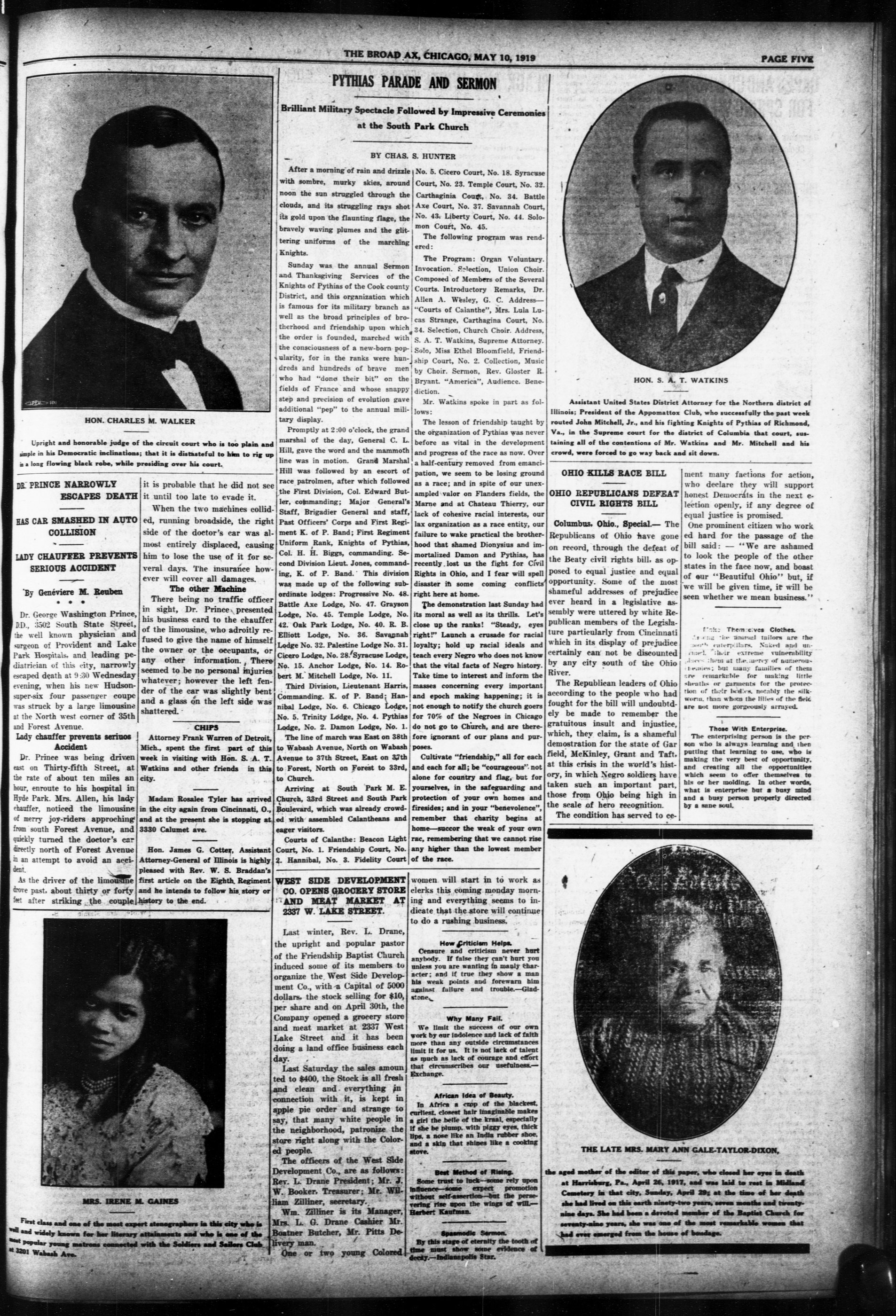
HON. CHARLES M. WALKER
Upright and honorable judge of simple in his Democratic inclinations in a long flowing black robe, while
DR. PRINCE NARROWLY
ESCAPES DEATH
Upright and honorable judge of the circuit court who is too plain and simple in his Democratic inclinations; that it is distasteful to him to rig up in a long flowing black robe, while presiding over his court.
HAS CAR SMASHED IN AUTO COLLISION
LADY CHAUFFER PREVENTS SERIOUS ACCIDENT
Dr. George Washington Prince, DD., 3502 South State Street, the well known physician and surgeon of Provident and Lake Park Hospitals, and leading pediatrician of this city, narrowly escaped death at 9:30 Wednesday evening, when his new Hudson-super-six four passenger coupe was struck by a large limousine at the North west corner of 35th and Forest Avenue.
Lady chauffer prevents serinos
Accident
Dr. Prince was being driven east on Thirty-fifth Street, at the rate of about ten miles an hour, enroute to his hospital in Hyde Park. Mrs. Allen, his lady ehauffer, noticed the limousine of merry joy-riders approaching from south Forest Avenue, and quickly turned the doctor's car directly north of Forest Avenue in an attempt to avoid an accident. As the driver of the limousine drove past, about thirty or forty feet after striking the couple
2.
2
MRS. IRENE M. GAINES
First class and one of the most expert stenographers well and widely known for her literary attainments. Most popular young matrons connected with the St. 3201 Wabash Ave.
First class and one of the most expert atenographers in this city who is well and widely known for her literary attainments and who is one of the most popular young matrons connected with the Soldiers and Sailors Club. at 3201 Wabash Ave.
if the circuit court who is too plain and; that it is distasteful to him to rig up presiding over his court.
it is probable that he did not see it until too late to evade it.
When the two machines collided, running broadside, the right side of the doctor's car was almost entirely displaced, causing him to lose the use of it for several days. The insurance however will cover all damages.
The other Machine
There being no traffic officer in sight, Dr. Prince presented his business card to the chauffer of the limousine, who adroitly refused to give the name of himself the owner or the occupants, or any other information. There seemed to be no personal injuries whatever; however the left fender of the car was slightly bent and a glass on the left side was shattered.
Attorney Frank Warren of Detroit, Mich., spent the first part of this week in visiting with Hon. S. A. T. Watkins and other friends in this city.
Madam Rosalee Tyler has arrived in the city again from Cincinnati, O., and at the present she is stopping at 3330 Calumet ave.
Hon. James G. Cotter, Assistant Attorney-General of Illinois is highly pleased with Rev. W. S. Braddan's first article on the Eighth Regiment and he intends to follow his story or history to the end.
The image provided is too blurry to accurately recognize any text or details. It appears to be a close-up of a person's face, but no identifiable features or text can be discerned.
ert atenographers in this city who is attainments and who is one of the with the Soldiers and Sailors Club
CHIPS
THE BROAD AX, CHICAGO, MAY 10, 1919
PYTHIAS PARADE AND SERMON
BY CHAS. S. HUNTER
After a morning of rain and drizzle with sombre, murky skies, around noon the sun struggled through the clouds, and its struggling rays shot its gold upon the flaunting flage, the bravely waving plumes and the glittering uniforms of the marching Knights.
Sunday was the annual Sermon and Thanksgiving Services of the Knights of Pythias of the Cook county District, and this organization which is famous for its military branch as well as the broad principles of brotherhood and friendship upon which the order is founded, marched with the consciousness of a new-born popularity, for in the ranks were hundreds and hundreds of brave men who had "done their bit" on the fields of France and whose snappy step and precision of evolution gave additional "pep" to the annual military display.
Promptly at 2:00 o'clock, the grand marshal of the day, General C. L. Hill, gave the word and the mammoth line was in motion. Grand Marshal Hill was followed by an escort of race patrolmen, after which followed the First Division, Col. Edward Butler, commanding; Major General's Staff, Brigadier General and staff, Past Officers' Corps and First Regiment K. of P. Band; First Regiment Uniform Rank, Knights of Pythias, Col. H. H. Biggs, commanding. Second Division Lieut. Jones, commanding, K. of P. Band. This division was made up of the following subordinate lodges: Progressive No. 48. Battle Axe Lodge, No. 47. Grayson Lodge, No. 45. Temple Lodge, No. 42. Oak Park Lodge, No. 40. R. B. Elliott Lodge, No. 36. Savannah Lodge No. 32. Palestine Lodge No. 31. Cicero Lodge, No. 28. Syracuse Lodge, No. 15. Anchor Lodge, No. 14. Robert M. Mitchell Lodge, No. 11.
Third Division, Lieutenant Harris, Commanding. K. of P. Band: Hannibal Lodge, No. 6. Chicago Lodge, No. 5. Trinity Lodge, No. 4. Pythias Lodge, No. 2. Damon Lodge, No. 1. The line of march was East on 38th to Wabash Avenue, North on Wabash Avenue to 37th Street, East on 37th to Forest, North on Forest to 33rd, to Church. Arriving at South Park M. E. Church, 33rd Street and South Park Boulevard, which was already crowded with assembled Calantheans and eager visitors. Courts of Calanthe: Beacon Light Court, No. 1. Friendship Court, No. 2. Hannibal, No. 3. Fidelity Court
WEST SIDE DEVELOPMENT CO. OPENS GROCERY STORE AND MEAT MARKET AT 2337 W. LAKE STREET.
Last winter, Rev. L. Drane, the upright and popular pastor of the Friendship Baptist Church induced some of its members to organize the West Side Development Co., with a Capital of 5000 dollars, the stock selling for $10, per share and on April 30th, the Company opened a grocery store and meat market at 2337 West Lake Street and it has been doing a land office business each day.
Last Saturday the sales amounted to $400, the Stock is all fresh and clean and everything in connection with it, is kept in apple pie order and strange to say, that many white people in the neighborhood, patronize the store right along with the Colored people.
No. 5. Cicero Court, No. 18. Syracuse Court, No. 23. Temple Court, No. 32. Carthaginia Court, No. 34. Battle Axe Court, No. 37. Savannah Court, No. 43. Liberty Court, No. 44. Solomon Court, No. 45.
The following program was rendered:
The Program: Organ Voluntary. Invocation. Selection, Union Choir. Composed of Members of the Several Courts. Introductory Remarks, Dr. Allen A. Wesley, G. C. Address—"Courts of Calanthe", Mrs. Lula Lucas Strange, Carthagina Court, No. 34. Selection, Church Choir. Address, S. A. T. Watkins, Supreme Attorney. Solo, Miss Ethel Bloomfield, Friendship Court, No. 2. Collection, Music by Choir. Sermon, Rev. Gloster R. Bryant. "America", Audience. Benediction.
Mr. Watkins spoke in part as follows:
The lesson of friendship taught by the organization of Pythias was never before as vital in the development and progress of the race as now. Over a half-century removed from emancipation, we seem to be losing ground as a race; and in spite of our unexamplied valor on Flanders fields, the Marne and at Chateau Thierry, our lack of cohesive racial interests, our lax organization as a race entity, our failure to wake practical the brotherhood that shamed Dionysius and immortalized Damon and Pythias, has recently lost us the fight for Civil Rights in Ohio, and I fear will spell disaster in some coming conflicts right here at home.
The demonstration last Sunday had its moral as well as its thrills. Let's close up the ranks! "Steady, eyes right!" Launch a crusade for racial loyalty; hold up racial ideals and teach every Negro who does not know that the vital facts of Negro history. Take time to interest and inform the masses concerning every important and epoch making happening; it is not enough to notify the church goers for $70\%$ of the Negroes in Chicago do not go to Church, and are therefore ignorant of our plans and purposes.
Cultivate "friendship," all for each and each for all; be "courageous" not alone for country and flag, but for yourselves, in the safeguarding and protection of your own homes and firesides; and in your "benevolence", remember that charity begins at home--succor the weak of your own rac, remembering that we cannot rise any higher than the lowest member of the race.
women will start in to work as clerks this coming monday morning and everything seems to indicate that the store will continue to do a rushing business.
How Criticism Helps
Censure and criticism never hurt anybody. If false they can't hurt you unless you are wanting in mauly character; and if true they show a man his weak points and forewarn him against failure and trouble—Gladstone.
Why Many Fair.
We limit the success of our own work by our indulence and lack of faith more than any outside circumstances limit it for us. It is not lack of talent as much as lack of courage and effort that circumscribes our usefulness.—Exchange.
African Idea of Beauty.
In Africa a crop of the blackest, curliest, closest hair imaginable makes a girl the belle of the krsal, especially if she be plump, with piggy eyes, thick lips, a nose like an India rubber shoe, and a skin that shines like a cooking stove.
Best Method of Rising.
Best Method of Rising.
Some trust to luck—some rely upon influence—some expect promotion without self-assertion—but the persevering rise upon the wings of will.—Herbert Kaufman.
Spartanic sermon.
By this stage of eternity the tooth of
time must show some evidence of
decey.—Indianspolis $star.
A. B.
Assistant United States District Attorney for the Northern district of Illinois; President of the Appomattox Club, who successfully the past week routed John Mitchell, Jr., and his fighting Knights of Pythias of Richmond, Va., in the Supreme court for the district of Columbia that court, sustaining all of the contentions of Mr. Watkins and Mr. Mitchell and his crowd, were forced to go way back and sit down.
THE LATE MRS. MARY ANN GALE-TAYLOR-DIXON,
the aged mother of the editor of this paper, who closed her eyes in death at Harrisburg, Pa., April 26, 1917, and was laid to rest in Midland Cemetery in that city, Sunday, April 29; at the time of her death she had lived on this earth ninety-two years, seven months and twenty-nine days. She had been a devoted member of the Baptist Church for seventy-nine years, she was one of the most remarkable women that had ever emerged from the house of boudage.
THE LATE MRS. MARY ANN GALE-TAYLOR-DIXON.
OHIO KILLS RACE BILL
OHIO REPUBLICANS DEFEAT CIVIL RIGHTS BILL
Columbus, Ohio., Special.—The Republicans of Ohio have gone on record, through the defeat of the Beaty civil rights bill, as opposed to equal justice and equal opportunity. Some of the most shameful addresses of prejudice ever heard in a legislative assembly were uttered by white Republican members of the Legislature particularly from Cincinnati which in its display of prejudice certainly can not be discounted by any city south of the Ohio River.
The Republican leaders of Ohio according to the people who had fought for the bill will undoubtedly be made to remember the gratuitous insult and injustice, which, they claim, is a shameful demostration for the state of Gar field, McKinley, Grant and Taft, at this crisis in the world's history, in which Negro soldiers have taken such an important part, those from Ohio being high in the scale of hero recognition. The condition has served to ce-
PAGE FIVE
T. WATKINS
Attorney for the Northern district of Club, who successfully the past week sitting Knights of Pythias of Richmond, district of Columbia that court, sus-Watkins and Mr. Mitchell and his d sit down.
ment many factions for action, who declare they will support honest Democrats in the next election openly, if any degree of equal justice is promised.
One prominent citizen who worked hard for the passage of the bill said: — "We are ashamed to look the people of the other states in the face now, and boast of our "Beautiful Ohio" but, if we will be given time, it will be seen whether we mean business."
Clothes Themselves
Among the animal tailors are the smooth caterpillars. Naked and unruled, their extreme vulnerability places them at the mercy of numerous enemies; but many families of them are remarkable for making little sheaths or garments for the protection of their bodies, notably the silkworm, than whom the lilies of the field are not more gorgeously arrayed.
Those With Enterprise.
The enterprising person is the person who is always learning and then putting that learning to use, who is making the very best of opportunity, and creating all the opportunities which seem to offer themselves to his or her molding. In other words, what is enterprise but a busy mind and a busy person properly directed by a sane soul.
---
PAGE SIX
CAPES AND GOWNS FOR SPRING WEAR
Garments in Vast Array Make Choice Wholly Up to the Individual.
UNIFORMS AMONG PAST EVILS
Mannish Dressing Does Not Admit of Women Looking Their Best; Pretty Clothes Bring Out True Disposition.
Clothes reflect current events and the spirit of the times in which we live to a greater extent than appears to the casual observer. Fashions are now as topsy-turvy as the rest of the world, observes a prominent fashion correspondent. Many things are shown, but few are chosen, so the best thing we can do is to select the clothes that best express beauty and harmony and that above all are lovely and feminine.
Let uniforms and mannish dressing for women be among past evils. It may be that uniforms are inspiring to feminine wearers—some people think so—but why be inspired to be an efficient machine? Who wouldn't prefer the inspiration that comes from frills and furbelows? If a woman is beautifully and becomingly dressed she has that soul gratifying assurance that comes with the knowledge that she is looking her best, and she is possessed of something akin to the faith that removes mountains. There is no doubt about it—pretty clothes make us cheerful and happy and charming.
There are ever so many new French ideas that we can use in making our spring frocks smart and becoming—for instance, the little undersleeves of white mull that peep from beneath short, tight sleeves of either silk or serge dresses are beautiful. Many of these have picot finished frills of the mull set on flatly, and sometimes these frills are edged with real lace.
Worth showed directore gowns of silk with tiny undersleeves, and often a matching treatment was carried out in the rounding neckline. Here a little glet of mull was edged with one of these perky fluted frills that barely showed itself from beneath the cloth. Short-waisted dresses of taffeta are cored both at the waistline and rounded neck, and sometimes at the bottom of the sleeves as well. Several of the dresses have small di-
W
Navy blue tricotine gown and cape to match affords one of the favorite combinations.
Navy blue tricotine gown and cape to match affords one of the favorite combinations.
rectoire capes to complete them. Such capes are cut short in the front and longer in the back.
Winged Moths Luring the Flames.
A slender, straight-line dress with a cape that makes its wearer look like a little winged moth is picturesque enough for any woman who does not wear strictly tailor-made things and practical enough to adapt itself to any hour of the day. Wide box pliats of the cloth that hang loose except where they are caught at the neckline and underneath the hem at the bottom of the skirt are a new feature. The round neckline appears in this model and it is softened by a rolling collar of white silk. Venetian red buckles are used to fasten the belt, which is somewhat wider than is usually worn on gowns of this type. The cape is made like those just described, which curve shorter in front, and it is slit for armbones at either side. White satin is used for its lining. Many of these capes shown at the French openings were lined with cotton fabrics. Old-fashioned white cross-barred muslin frequently was used to line both cape and coat.
Topcoats have not been neglected this season. They, too, have come in for their share of trimmings at a time when everybody seems to be quite mad on the subject of ornamentation. Leather and tweed are favorite combinations for country wear. Coarse grained black leather without even a suspicion of gloss forms a voluminous shawl collar, cuff and even ample patch pockets on a coat of dark gray homepun, and with a narrow strip of leather it is belted high under the arms; then it flares toward the bottom after the manner of swagger topcoats. Smooth red leather trims a motor coat of dust-colored Irish tweed. The large buttons that fasten it are leather-covered, and this time the leather collar and revers swing the
THE LADY IN A COAT AND HAT
Oiseau bleu is the name of this frock of chiffon velvet with flowing Chantilly lace sleeves.
Olesau bleu is the name of this frock of chiffon velvet with flowing Chantilly lace sleeves.
pendulum of fashion in the opposite direction by being very scanty. The cuffs are unusually narrow; in fact, they are little more than facings. To make this overcoat warmer as well as smarter it is given a red cloth lining.
Linen of oarse weave is used to make surplice waistcoats for still other topcoats. Marine blue is the color most often chosen, and a leather collar and cuff in the same hue is added. One new motor coat that I saw was of black and white plaid worsted. It was a loose, baggy affair with raglan sleeves, and tan leather faced the collar and cuffs. Another good-looking one was of champagne-colored camel's hair cloth—the real camel's hair cloth which is so difficult to procure now. The coat was swung from a deep yoke, and the collar, which in this instance was of the cloth, rumped up around the ears in becoming folds. Champagne-colored silk with a broad purple stripe made a striking tining.
Humble Straw Makes Its Debut.
There is a French coat that has gone so far as to have a straw collar. Collars and cuffs of other coats are adorned with bandings of tightly interlaced straw. This idea of trimming clothes with straw is rampant. The other day I saw some tailored sport shirts of white linen, and under the tucks in the front was set a finely fluted trimming of brown linen woven so as to appear like straw. A prim Eton collar and turned-back cuffs were bordered to match.
Why fallie silk should be selected as a material from which to evolve sport clothes is a bit difficult to say, especially when there are so many beautiful silks of rough weave that are made for nothing but this type of dress. However, the fact remains that fallie and Angora have formed an alliance to make some sport clothes so good looking that we scarcely dare question their practicability. One suit that I saw was of buff-colored fallie and had bands of brushed Angora down either side of the skirt, from waistband to hem. The Angora, which was light brown in color, encircled the bottom of the short box coat and formed a scarf collar just like the scarfs we have worn on our sweaters. These loose, scarf-like collars are much used.
Dove-gray silk made another suit that had smoke-colored Angora as its trimming. Brick red silk was chosen for a cape. A straight strip of the fallle was taken and gathered to a band of gray Angora. Any one who can use a needle could easily make such a wrap—and it was so pretty and effective! The more serviceable red velours might be substituted for silk, or turquoise blue cloth with white Angora would be effective.
Martial et Armand of Paris have made a cape for country wear of turquoise blue duvetyn. It is rather a scanty cape that sweeps gracefully around its slender wearer. Deep rose satin lines it, and the openings that serve as armholes are cut in a way to reveal the rosy lining and make a pleasing color contrast. These armholes are banded with ever so many tiers of narrow blue braid.
THE BROAD AX, CHICAGO, MAY 10, 1919
BLACK AND WHITE
BLACK AND WHITE
Vogue Launched by French Makers Still in Favor.
Afternoon Dress of White Crepe de Chine Heavily Embroidered in Front With Black Wool.
The imported gowns from that dear Paris are not pretty as to line and design—not even the most enthusiastic admirer of French creations can enthuse over the very short skirts and sleeves and the rather bunchy look most of them seem to have—but they are decidedly interesting and, more than that, even they are different from anything we see hereabouts.
Now, for instance, says a fashion writer, comes a white silk jersey evening gown, and from Doucet. It is a charming thing with long lines so very graceful that it is distinctly novel.
While it is true most of the imported models seem to be rather bunchy, it is also to be noted that they all more of less are of the one-piece or chemise type of dress. This particular evening gown is an excellent example, as it has nothing to break the long lines except a wide sash going twice around the waist and looping just at the hip on one side. The ends are finished with a heavy silken fringe and about halfway up the skirt are looped strands of white beads punctuated with large flat jet sequins. The yoke of the bodice is ornamented with the same sort of beads and jet so placed that they fall over the shoulders and thus form the sleeves, as there are no others. It is difficult to describe a frock of this sort for the reason that it is far lovelier to see than it is to read about.
All last year the French makers were busy launching a vogue of black and white, and the combination is still highly favored, as I find it exploited pleasingly in a Lanvin afternoon dress of white crepe de chine heavily embroidered in the front with black wool. This dress has the queer skirt distinguishing a number of French gowns by being so much longer in front than in the black and also by having most of the fullness gathered in the front. A black sash goes around the waist and falls quite to the hem in the back
Indeed, the sash is an important thing on every gown, as it appears in many unusual and interesting arrangements, sometimes placed high up under the arms and crossed in the front and again in the back, where it loops between the shoulderblades and then falls the length of the entire frock. In this instance the sash is not more than four inches wide and appears on a Lige satin frock made with the simplicity of a little girl's school dress, falling long and straight from the shoulders, with only the little crossed sashes at the bust and in the back to hold in the fullness. The sleeves are very short, just the length we would call awkward, as they stop far short of the elbow.
ROSE SILK AND LACE VEST
MILTON COE
This is a most charming vest of rose silk and lace. Many are the accessories for milady's spring wardrobe and the vest is decidedly popular among the number.
GINGHAM AND MUSLIN LINING
Materials for Inner Finish of Coats and Capes Afford New and Approved Idea.
We hear of satin capes shown at the Paris openings that were lined with a soft pile fabric like duvetyn. These must add materially to the warmth of the garment, notes a fashion writer.
And have you heard of gingham linings? This is a new idea, but after all, why would not gingham make as good a lining for a summer cape or coat as satin or peau de cygne or chiffon?
Who would ever have dared to use unbleached muslin for the lining of coats and capes? No one in the world but one of the smartest of Paris dressmakers. Apparently this is merely a bit of daring, and not done in an effort toward economy, for the unbleached fabric is used to line the most gorgeous and luxurious of garments.
Organdie and English Prints. Some of the newest French blouses are of organdie trimmed in English prints, a cotton fabric printed in calico designs.
GOWN IS OF BLUE GEORGETTE
MARIE
MARIE
MARIE
Of blue georgette crepe, elaborately embroidered in oriental designs in tones of blue. This draped model is held in place at the waistline by a gold cord.
ASSUME GARB OF GROWNUPS
Little Girls Naturally Wish to Copy
Elders and Designers Have Provided for Them.
Did you ever see a little girl who didn't want to dress like grownups and who was not always surreptitiously borrowing things from her mother's dressing room to play at dressup? Even the powder box from the dressing table is included in the game.
Those who design clothes for little people, states a fashion writer, have not forgotten their own childhood. They remember that little girls, even as you and I, have better dispositions when they are wearing clothes that they like.
A very young lady, say of about five years of age, could not possibly have that insignificant feeling which is so trying when wearing a dolman cape just like mother's. One is of buff colored velours—a nice soft, cuddly, double-faced velours is used for it—and the bonnet that accompanies it is of bright red chiffon cloth with lots of tucks. If you ask any little sub-deb what the trouble with most party dresses is she will tell you that they make one feel entirely too dressed up, and this, of course, is fatal to a good time. For who wants to sit around and talk and sing and never remo or anything?
OVERBLOUSE OF THE FRENCH
Garments Have Apron Fronts and Coquettish Little Saashes of the Material.
French women are wearing the overblouse in each of its many versions. There are some that end at the waistline in the back and are finished to go over the skirt with an inch-wide ribbon of unusual weave and usually in contrasting color. After finishing the back of the blouse these colorful ribbons slip through loops made by buttonhole stitching to tie over the apron front. The fronts of many of these short-back blouses take their inspiration from the waistcoat of the past winter.
Organdle overblouses are very smart. They have apron fronts and coquettish little sashes of the material edged with real lace. These new organdle blouses could be combined with separate skirts of organdle to make an attractive summer frock. The late imports of blouse almost invariably feature the short sleeve, usually cut on kimono lines or set into a very loose armhole. The fastening of the blouse appears to be a movable thing. It may close on one shoulder or on both, in the back, in the front, or it may not fasten at all, merely slipped on over the head.
TAILORED SUIT IS FAVORITE
Coat Outfit Depicts Supreme Art Which Has Been Mastered by American Manufacturers.
For so long a time now women have come to accept the tailored coat suit as the very foundation of their wardrobes that it is the first consideration as the seasons change. Especially is this true of the average woman whose wishes are controlled by expediency and determined by absolute need. There is no doubt about the fact that American manufacturers have developed the supreme art in the making of the coat suit. It is now possible to buy such suits, so well built, so perfectly designed, that few tailors can excel, for as great care is given to detail as the master makers themselves can show.
Some foreign critic has said that there is such a monotony about the clothes of American women that it is as if everyone were trying to be as much like her neighbor as possible, and originality is an unknown sartorial art in this country. This critic must have referred to the blue serge suits, for it is undeniably the custom to clothe ourselves in dark blue, resting secure in the choice of color and its suitability for all occasions.
SUIT OR A DRESS?
SUIT OR A DRESS?
Question Is a Puzzling One for Majority of Women.
Tight-Fitting, Severely Tailored Outfit Not So Much Shown as More Youthful Looking Models.
Whether to buy a tailored suit, or a dress and separate coat, that is the problem which confronts the woman who goes forth at this time to spend her dress allowance, and this spring the question is a puzzling one. Some years are what the garment makers call "suit years," when the problem is settled, before we even begin to shop, by the manufacturers; other years the shops show nothing, comparatively speaking, but one-piece dresses and coats. But this year both suits and dresses are shown in amazing variety, and wise indeed is the woman who has looked over her wardrobe and reached a decision as to what she needs, before she goes to the stores.
The new suits are distinctive in several ways. Coats are just finger-tip length, as a rule, and many of them have the loose outside pocket effect, achieved by turning up the bottom of the coat at the sides and in front. The skirts are narrow, as rumor predicted that they would be. The more extreme models have made allowance for the wearer's need, either by slitting the skirt at the back seam for a few inches up the hem, or, as in one case, by making the skirt with the front and back widths absolutely separate as far up as the hips; these two sections were then caught together at intervals down the sides by short threads, heavily buttonholed, which field the two sections together except when the wearer was walking. When such skirts as these are worn, there is worn also a heavy satin slip, matching the skirt in color.
The tight-fitting, severely tallored suit is not so much shown as are the looser-coated, more youthful-looking models. Narrow belts are on nearly all of these jackets, fastening at the side; the skirts of the coats are rather full, and are quite apt to be inconspicuously trimmed. Embroidered silk arrow heads make one such coat interesting; another is bound with narrow.
COTTON
Woolen
Taffeta
Suit of Gray English Tissue.
flat, black silk braid; still another harks back to the woven ribbon work in which our grandmothers delighted, the skirt of the coat being made of black ribbon, woven in a squared pattern with the blue tricotine of which the suit was made. Tucks, running crosswise, relieve these short jackets of plainness, and sometimes, on suits meant for formal wear, an embroidered band around the bottom edge of the coat gives it distinction. One delightfully simple suit of dark blue serge had rather wide, rolled seams, which made a decidedly interesting finish. The wide, scarf collar, one end of which is thrown over the wearer's shoulder, is nearly always becoming, but is, of course, impractical on a suit which must be worn on all occasions and in all weathers, since its effect is more becoming than trim.
FADS AND FANCIES
CREATION OF BLACK MALINES
44
Very plain but attractive is this model of black malines and Spanish fold-over edge of brim veiling the eye Diamond-shaped medallions and blue ostrich are arranged on brim and crown.
GRACEFUL FOLDS OF CAPES
Clingy Lightness of Serge, Satin, Wool Jersey or Tricotine Supplies Winter Materials.
The spring maid is all wrapped up in capes as voluminously as her predecessor, Madame Winter. No matter how she tries she can't seem to get out from under the graceful folds. The only difference between the winter and spring models is that those folds have dwindled from the heavy richness of fur, colours and duvety to the spring-like clingy lightness of serge, satin, wool jersey or tricotine.
If we follow old Omar's admonition and fling our winter garment of repentance in the fires of spring it will only be to don another exactly similar in cut and style.
Of course the spring capes have some new and novel touches to bring them up to date, such as embroidery ornamentation, scarf collars ending in swishing tassels, patch pockets and button excrescences jutting out in nobby designs.
A perfect jewel of a model is of pearl-gray jersey with a deep soft cape collar edged in a wide band of black silk braid. The wide braid also finishes the slashes for the arms and a vivid lining of orange and black checkerboard satin shows free and unchecked when the wind blows.
A smart draped cape of black taffeta has one of the deep soft collars also, which is edged with a wide fringe of long narrow taffeta ribbon loops, as is also the bottom of the cape. The lining of this distinctive model is a vivid apple-green silk crepe, fruitfully sprinkled with cherry polka dots and plum-hued dashes.
Almost all of the cape lining strikes such a gay, joyous and riotous color note that they seem to indicate the real inner nature of their fair warriers.
BLOUSE WITH PEPLUM FRONT
Model Christened "Bibette" and if Occasionally Is Known as the "Apron" Blouse.
Among the very interesting blouses developed this spring the models with peplum fronts are increasingly popular. This type of blouse came in style last fall, when it was christened the "Bibette." It is known either as the "Bibette" blouse or the "Apron" blouse.
Most of the models developed on this line fasten either in the back or at one side, as a straight-front fastening would mar the effect sought; but great individuality is possible in designing such a blouse, as it may be rather tailored and severe or very dressy and feminine, according to choice.
When worn with a dark suit a blouse in light or bright color, with long front section, appears to much better advantage when the suit coat is on than when it is removed, as the normal waistline at back and sides and long panel or apron front give the figure a rather inartistic line. But American women are being converted to the French idea in wearing suits, and rarely is a woman seen with her suit-coat removed, except at luncheon or tea. At such times the blouse may be merely part of a once-piece frock, as far as the actual observer is able to tell.
KITCHEN SHOULD BE CHEERY
Workshop of the Home in Which Man
Jority of Housewives Spend
Most of Their Time.
The average woman does not think
of her home as a mirror, but that is
exactly the relation to herself in which
it stands.
Of course, it is but natural that
milady spends a goodly portion of her
energy upon her living and dining
rooms.
Yet the kitchen, as the workshop of
the house, is the room in which many
housekeepers spend most of their wa-
king hours, and therefore it should be
the lightest, airiest and most cheerful
one in the home. But how often it is
not!
Harmony of color plays an important role in making interiors attractive, and one pretty combination for the kitchen is to have the walls-tinted a light green and the floor finished in a darker shade of the same color.
Stop Thief!
THE "Jumbo" gas burner shown here at the right, (actual size) is a robber on any gas lighting fixture in Chicago. If you have one, get rid of it! It makes high gas bills and causes a great many of the complaints that come to us.
Claims that a "Jumbo" will give more light without using more gas are false.
Use mantle burners to get more light with less gas. Burning five hours a day for a month, the "Jumbo" consumes $2.30 worth of gas; a "Junior" mantle burner, in the same time, consumes only 39 cents worth, or $1.91 less, and gives much more light.
This Is the
"JUNOR MANTLE"
Telephone Calu
Telephone Calumet 602-3572
MORRIS, Pres. KIRBY W
MORRIS-WA
COAL CO.
HUGH NORRIS, Pres. KIRBY W
NORRIS-WA
COAL CO.
Incorporated
2545 SOUTH PARK AVENUE
Chicago
THE CR
Apartment
3600 WABA
The finest building ever open
cago. Steam heat, electric light
THE CRANFORD
Department Building
3600 WABASH AVENUE
It building ever opened to Colored ten-
am heat, electric lights, tile baths, man-
tain 263
J. W. CA
133 W. Washi
tise in the BROA
THE BROADWAY
Advertise in
Advertise in the BROAD AX
John Tyler's Career.
On March 29, 1790, John Tyler,
tenth president of the United States,
was born in Charles City county,
Virginia. Tyler was inaugurated vice
president in 1841 and in the April
following he was inaugurated as presi-
dent to fill the place of William Henry
Harrison, who had died. He served as
president until 1845. After the organiza-
tion of the Confederacy Tyler was
elected a member of the Confederate
congress. He died at Richmond, Jan-
uary 18, 1862.
Bactericides.
Most fruit juices, through their acids, were found in Japanese experiments to destroy the bacillus of typhoid and other bacteria; but sugars and starches, even in the strongest solutions, had no antiseptic effect. The strongest bactericide of the vegetable acids proved to be tannic acid, which was followed in order by citric, tartaric and malic. Imitation "lemonade" prepared with various acids, especially with hydrochloric acid, had considerable bactericidal action.
---
Phone Main 263
We sell "Junior Mantle" lights complete for only fifteen cents, (which is less than "Jumbos" usually cost) or give one free, in exchange for a "Jumbo," at our main office or any of these stores:
West Side 3643 Irving Park Blvd.
2142 West Madison St. 408 West North Ave.
1709 West 12th St. South Side
1641 Milwaukee Ave. 731 West 63rd St.
3221 Ogden Ave. 3478 Archer Ave.
4033 West Madison St. 103-5 East 35th St.
North Side 9051 Commercial St.
3071 Lincoln Ave. 11025 Michigan Ave.
The Peoples Gas Light & Coke Co.
Michigan Avenue at Adams Street
Telephone Wabash 6000
Calumet 602-3572 KIRBY WARD, See IS-WARD AL CO.
CRANFORD
ment Building
VABASH AVENUE
or opened to Colored tenants in Chi-
ric lights, tile baths, marble entrance
J. W. CASEY, Agent
133 W. Washington Street
in the BROAD AX
A lake near Bigzar, Saskatchewan, has been found to be saturated with sodium sulphate, and the deposits under the lake and alongside the edge to be nearly 97 per cent pure sulphate. The mineral is used extensively in the manufacture of sulphuric acid, in photography and other industrial purposes.
Cleaning Wallpaper.
To clean and polish wallpaper, add two tablespoonfuls of ammonia to half a palpful of water, and wash the walls down with a fannel dipped in this. Take half a palpful of water and add two tablespoonfuls of turpentine. Wash the walls a second time with this and wipe as dry as possible.
Good Rule for Life.
We are ruined, not by what we really want, but by what we think we do; therefore, never go abroad in search of your wants; for if they be real wants they will come in search of you. He that buys what he does not want, will soon want what he cannot buy—Colton.
This Is the "Jumbo" Gas Burner
THE BROAD AX, CHICAGO, MAY 10, 1919
PATRONIZE OUR ADVERTISERS
As Near As Your Telephone DISTANCE IMMATERIAL
IN a Metropolitan City of this size, death knocks every thirty minutes at some door. Too often that death not only brings sorrow, but misfortune as well. Let the price you pay for a funeral be a business proposition and you will benefit by it in service, quality and cost to you in dollars and cents. The result of my campaign has built for me one of the largest and most magnificent establishments in the world.
Consult me, I can save you Worry. The Shipping to all parts of the Country and Funerals a Specialty. Central Display Chapel. Call promptly answered day of Ernest H. William KENWOOD 455 Undertaker 5028 and 5030 S. State St., OWNERS AND DAN M. JACKSON GEO. T. KERSEY DAVID A McGOWAN AHMED A. RAYNER OPEN DAY The Emanu Undertaking 2959-61 South Reliable Service Reasona FREE CHAPEL Complete Line of Funeral Go
Consult me, I can save you Worry, Time and Money. Shipping to all parts of the Country and Automobile Funerals a Specialty. Central Display Rooms and Chapel. Call promptly answered day or night.
OWNERS AND DIRECTORS
DAN M. JACKSON
GEO. T. KERSEY
Phones Calumet 6164
DAVID A McGOWAN
Automatic 71-629
AHMED A. RAYNER
OPEN DAY AND NIGHT
The Emanuel Jackson Undertaking Co., Inc.
2959-61 South State Street Reliable Service Courteous Treatment Reasonable Prices FREE CHAPEL IN CONNECTION
Residence: 508 East 36th Street
Phone Douglas 4397
J. GRAY LUCAS
Attorney At Law
Suite 815 Hartford Building
8 S. Dearborn St., Chicago.
Phone Central 6583
Tel. Central 3142
S. A. T. WATKINS
LAWYER
36 WEST RANDOLPH STREET CHICAGO
Residence, 4533 Prairie Avenue
Phone Kenwood 8520
WALTER M. FARMER
ATTORNEY AND
COUNSELOR AT LAW
NOTARY PUBLIC
Suite 708
184 W. Washington St.
Tel., Office, Main 4153 Auto 33736
CHICAGO
Residence, 1262 Macalister Place
Tel. Monroe 2714
Attorney At Law
Suite 318-320 REAPER BLOCK
Clark and Washington Streets
Phone Central 1239
CHICAGO
PHONE MAIN 2214
A. D. GASH
Attorney At Law
118 North La Salle Street
CHICAGO
JOHN H. HARRIS
DIRECTORS
Phones Calumet 6164
Automatic 71-629
END NIGHT
Michael Jackson
Bug Co., Inc.
State Street
Courteous Treatment
Prices
CONNECTION
Automobiles for Hire
Residence 3419 South Park Ave.
PHONE DOUGLAS 9354
WM. J. LATHAM
Attorney At Law
OFFICE PHONE: CALUMET 875
2 EAST 31ST STREET
Suite 7
CHICAGO
JOHN J. DUNN
ESTABLISHED 1877
Wholesale and Retail
Fifty-First and Federal Sts. CHICAGO
KINKY HAIR
Atlanta, Ga.
Russell Holt, On.
Gottlieben.
It makes hair so
you what your sine
EXELENTO QUININE
POMADE
has done for my
hair. Before I used
it for the short and course,
and now it is so
little brittle and soft
and silky that
it is easy to way
way I want to.
JANE RAND.
Don't let some fake Kink Remover fool
you the hair, and make it grow long, soft and
silky, after it has dried the difference, and after a little while it
will be so pretty and long that you can fix
it up to suit you. If ExelentO don't do as
we claim, we will give you 250s by mail on receipt of stampe or coin.
AGENTS WANTED EVERYWHERE.
Write For Particulars.
EXELENTO MEDICINE CO., Atlanta, Ga.
NOW IS THE TIME TO SUBSCRIBE FOR THE BROAD AX
---
LAUREL WREATH
A. F. CODOZOE
J. H. WHISTON, Proprietors
CHAS. HARRIS, Manager
The E
and
the Elite Caf and Buffet
3030 STATE STREET
National
4300 So.
Space for Offices, Lodge and Assembly
Spacious Dance Halls in Chicago
J. L. Slaugh
4300 So. STATE STR
Chicago Title and
STATE
OUR BUSINESS
been that of show
real estate titles.
The millions up
to build and rebu-
furnished relying
ABSTRACTS are
No man has lost
This is our pass
Wise men judge
behavior
CHICAGO TITLE
69 W. W.
Assets excels
No deposits
National Hall H
00 So. State
Offices, Professional a
l Assembly Halls. ... L
Dance Hall. ... Best W
Chicago for Rent. :::
National Hall Bldg 4300 So. State St.
Space for Offices, Professional and Others Lodge and Assembly Halls. .. Large and Spacious Dance Hall. .. Best Ventilated Halls in Chicago for Rent. :: :: ::
Laughter Real
STEET STREET TEL. 1
Title and Trust
STATED BRIEFLY:
BUSINESS SINCE 1851
of showing the con-
titute titles.
millions upon millions of
and rebuild Chicago h
and relying on the accurac-
ACTS and TITLE PO-
n has lost a dollar by s
our past.
men judge future action
TITLE AND TRUST
99 W. Washington St
assets exceed $12,000,000
deposits or demand liab
J. L. Slaughter Real Estate 4300 So. STATE STREET TEL. DREXEL 7812
Chicago Title and Trust Company
OUR BUSINESS SINCE 1847 has been that of showing the condition of real estate titles.
The millions upon millions required to build and rebuild Chicago have been furnished relying on the accuracy of our ABSTRACTS and TITLE POLICIES.
No man has lost a dollar by so relying.
This is our past.
Wise men judge future action by past behavior
CHICAGO TITLE AND TRUST COMPANY
TELEPHONE DOUGLAS 1
GEORGE F.
E F. HARDEY Real Estate
GEORGE F. HARDING, JR.
Up-to-Date or Modern Houses Apartments and Stores to Rent
3101 Cottage Grove Avenue Corner 31st Street, Chicago
JOHNSON EXPRESS, STORAGE AND VAN CO.
EXPERT PIANO MOVERS-AUTO SERVICE
Packers, Shippers and Storage
TRUNKS TO AND FROM ALL DEPOTS
Main Office: 1431 East 67th Street
AUTO. 72-379
Phones: DOUGLAS 3256
DOUGLAS 5071
Cafe
t
APPLY
PAGE SEVEN
CHICAGO
THE BR
THE BROAD AX
PUBLISHED EVERY SATURDAY
In this city since July 15th, I
Republicans, Democrats, Catholics
infidels or anyone else can have
proper and responsibility is fixed.
The Broad Ax is a newspaper
all, ever claiming the editorial
Local communications will run
on one side of the paper.
Subscriptions must be paid
One Year.
Six Months.
Advertising rates made known
VOL. XXIV. MA
Address all co
THE B
6206 South Elizabeth
Phone Wen
JULIUS F. TAYLOR
DR. M. A. MAJORS
In this city since July 15th, 1899, without missing one single issue. Republicans, Democrats, Catholics, Protestants, Single Taxers, Priests, infidels or anyone else can have their say as long as their language is proper and responsibility is fixed.
The Broad Ax is a newspaper whose platform is broad enough for all, ever claiming the editorial right to speak its own mind. Local communications will receive attention. Write plainly, only on one side of the paper.
4700 South State Street,
Phone Drexel 1416
IMPORTANT
For resolutions, obituary n
special announcements of events a
sion is made, and the opening of
cents per line; 6 words or fraction
Personal or social items such
everything of a general interest,
Entered as Second-Class Matter, August
Under Act of
IMPORTANT NOTICE
For resolutions, obituary notices, cards of thanks, write-ups, special announcements of events to happen, when a charge of admission is made, and the opening of new business enterprises, etc., 15 cents per line; 6 words or fraction makes one line.
Personal or social items such as marriages, births, deaths and everything of a general interest, published free of charge.
Entered as Second-Class Matter, August 19, 1902, at the Post Office at Chicago, Ill., Under Act of March 3, 1879.
Ancient Gambling Games.
It is known that from the earliest Roman times the games of tall and tessera were played with dice, but their invention has been attributed by the Grecian poets and sophists to Palmedes, who in 1244, B. C., joined the Greeks in their expedition against Trdy, where, by some writers, Palmedes is said to have been slain by an arrow from the bow of Paris. In addition to the invention of dice, Palmedes is said to have invented lighthouses, measures, scales, the discus, the alphabet and the art of regulating sentinels.
The birds known to sailors as Mother Carey's chickens, whose appearance is supposed to foretell a storm, are otherwise known by the term stormy petrel (Thalassidroma pelagica). The bird seems to run in a remarkable manner along the surface of the sea, where it picks up its food. The petrel is a small bird of disky plumage, nocturnal in habit, most abundant in the southern hemisphere. The name Mother Carey is supposed to be a corruption of the "Mother Cara"—dear mother—of Levantine sailors.
Perfume Their Dead.
Natives of Torres Strait islands, to the north of Queensland, have some peculiar burial customs. One is the anointing the bodies with cheap perfume, the remainder being corked in the bottle and left on the grave. In some cases a cheap stone is set on the grave and this ceremony is usually marked by a three-days' gorge on the part of the relatives of the departed, pig, yams and turtle being shaken down to make room for more by vigorous dancing and singing.
What Is a Mofussil?
"Mofussil" is a Hindoo word meaning "the provincial or rural districts" as opposed to the towns. The Gangetic delta is the land deposited by the river Garges in India at its mouth, forming an extensive tract of very rich soil. The whole phrase refers to those rich, fertile districts near the mouth of the Ganges, where great quantities of rice are grown.
"The Sick Man of Europe"
"The Sick Man of Europe."
A collector of old prints proved that the expression, "the sick man of Europe," persistently applied for years to Turkey, dates back to the seventeenth century, when John Soblesk drove back the Turks from the gates of Vienna. A print of the period shows the Turk on his sick bed and doctors, representing the nations of Europe, gathered about him.
Comets are erratic members of the solar system moving in orbits. Stars may be classified as fixed stars and planets, the planets revolving about the sun, while the position of the fixed stars relative to other heavenly bodies seems unvarying.
Best of All Fertilizers
Best of All Fertilizers.
I believe that the best fertilizer for any soil is a spirit of industry, enterprise and intelligence. Without this, lime and gypsum, bones and green manure, marl and guano will be of little use.—Henry Ward Beecher.
And Then They Worked Hard.
It takes four men to give an elephant castor oil, the dose being 128 ounces. We have known it to take three women and two men to give a small boy castor oil, dose only one dram.
Optimistic Thought.
Against stupidity the very godd
fight in vain.
PAGE FIGHT
The Stormy Petrel
Comets and Stars
1899, without missing one single issue.
Uses, Protestants, Single Taxers, Priests,
their say as long as their language is.
or whose platform is broad enough for
right to speak its own mind.
receive attention. Write plainly, only
in advance.
.....$2.00
1.00
own on application.
MAY 10, 1919 No. 34
communications to
BROAD AX
North Street, Chicago, Ill.
entworth 2597.
Editor and Publisher
Associate Editor
notices, cards of thanks, write-ups,
to happen, when a charge of admis-
few business enterprises, etc., 15
n makes one line.
such as marriages, births, deaths and
published free of charge.
19, 1992, at the Post Office at Chicago, Ill.
March 8, 1879.
Fruits of the Spirit.
The fruits of the spirit are love, joy, peace, kindness, benevolence. The less here is not only for the great powers, hitherto concerned at peace settlements only with division of spells; but it is also for labor and capital, for the upper ten and the lower five, for all the varied and sometimes embattled elements in our complicated social framework. The mind that is ruled by hate is sowing seeds for his own reaping in loss and shame. The Sermon on the Mount still stands.—Exchange.
White Chocolate
A Swiss product which is said to have greater food value than the brown sweet chocolate of America is white chocolate. It is made of cocoa butter, and either sugar or dried cream. It is smooth, glossy, and rather attractive in appearance.
His Ultimate End.
The children were discussing a famous soldier, when four-year-old Benny asked: "Who is he, anyway?" "Well," replied wise first-grade Harold, "he's a wonderful brave man now, after hewhile he'll be a statue."
You May Not Believe It, but
If statistics could be compiled showing the number of men who have a sudden and sneaking impulse to set the house on fire when the cleaning season approaches, the world would stand aghast.-Indianapolis Star.
Optimistic Thought
Heaven does not speak; how, then
can it bestow sovereignty on man?
Korean Women Independent
Korean women are no longer slaves of their husbands, but are ready to assert their rights. Many of them no longer depend on their husbands for support as of old, but try to obtain their own lying in various branches of industry.
Great Value of Courage
It is not clearly understood how valuable is the adjunct of courage in the man or woman, nor that, if accompanied by good judgment it is the most valuable of business assets.—John Brisbane Walker.
Real Moral Courage
When you are so devoted to doing what is right that you press straight on to that and disregard what men are saying about you, there is the triumph of moral courage:--Phillips Brooks.
Optimistic Thought
A man, said Talmage, never looks more dignified than when he takes a spectacle case from his pocket, opens it, unfolds a lens, sets it astride his nose and looks you in the eye.
- Imagination and Reality.
"How did Morgan come to break with Miss Blossom? He used to say that she was as good as gold!" "Yes, but you see he got acquainted with a girl who has gold!"
Start on Trade at 8.
In India wood, metal and ivory carvers begin to learn their trade at the age of three years and become skilled workers by the time they are twelve.
Keeping Twine
Instead of making a ball of twine, roll it on one of the little wooden handles such as come on packages and hang this on a hook.
THE BROAD AX. CHICAGO, MAY 10, 1919
EDITORIAL PAGE
Happiness Easily Attained.
Those of us who ever stop to reason or think along profitable lines know that there are "sermons in stones, books in running brooks, and good to everything" as the poet sings. We do not have to be either rich or famous to procure happiness. If we try to keep cheerful, forget our woes and "look pleasant," our narrow sphere will take on a broad and pleasing aspect. Furthermore, this view will make us see lots of good in the folks around us and many fine attractions in our home and old "home town."
Sheep Bone Toy of Small Orientals.
Sheep Bone Toy of Small Orientals.
Without the bone of a sheep, that eternal, ubiquitous playtoy of all the East, the children of Asia would be absolutely without an amusement device. Go wherever children play—Osmanlis or Kurds, Armenians or Arabs, Druses or Greeks—and you will see the sheep bone represents everything from a doll to a sword, from a passha's horsetail ornamented standard to a British gunboat, from a mosque to a church.—Red Cross Magazine.
Cosmetic Art
From the looks of some of the women when it turns cold, it would be a good proposition to sell different shades of powder for hot, warm, cool and cold weather. They say that they sell different shades for day and night—white for the daytime and blue for use under artificial light, so, why not for different degrees of temperature as well? However, probably some bright genius has already thought this up and patented his compound and it may not be well advertised as yet.—Grit
Eveless Oysters.
The oyster has a good-sized stomach, which is connected with the mouth by a short gullet; two pairs of gills for breathing, an intesthe, a dark green liver, a two-chambered heart and an elementary nervous system, but is minus ears, nose and eyes. It also lacks the footlike appendage that many mollusks possess for the reason that it has no need of an organ of locomotion.
Mixing Tobacco
The mixing of light and dark tobacco is a thing of comparatively recent date. A man from London found his pipe tobacco was nearly exhausted, so he cut up a cake of chewing tobacco and made a mixture. He continued to smoke the blend, and, meeting a friend who was in the trade, he gave him a sample, with the result that the first smoking mixture was soon before the public.
Various Alphabets
There is quite a difference in the number of letters in the alphabets of the languages of the world. The English language contains 26 letters; the French, 23; the Italian, 20; the Spanish, 27; the German, 26; the Slavonic, 27; the Russian, 41; the Latin, 22; the Greek, 24; the Hebrew, 22; the Arabic, 28; the Persian, 32, and the Turkish, 33.
Conquer Fear.
It is an everlasting duty, the duty of being brave. Valor is still value. The first duty of a man is still that of subduing fear. We must get rid of fear; we cannot act till then. A man shall and must be valiant, he must march forward. Now and always the completeness of his victory over fear will determine how much of a man be is.
To clean an umbrella place a table-spoonful of sugar in a basin, pour over it half a pint of water and stir till dissolved Then open the umbrella and, starting from the ferrule, sponge each gore down to the point. Leave the umbrella open till dry.
Vegetable Wax
A Japanese industry which has made remarkable progress in recent years is that concerned with the extraction of vegetable wax, which is coming into greater demand on foreign markets.
On Life's Journey
I do not say we ought to be happier as we grow older, but we ought to be calmer, knowing better what life is, and looking forward to another, which we\believe to be a reality though we cannot tell what it means.—Exchange.
Common Gain.
The cause of freedom is identified with the destinies of humanity, and in whatever part of the world it gains ground by and by, it will be a common gain to all those who desire it.—Kossuth.
Learn From Mistakes
If you make a mistake don't look back at it long. Take the regson of the thing into your own mind, and then look forward. Mistakes are lessons of wisdom.—Hugh White.
She Almost Started a Fad.
A girl who selected two earrings from different sets yesterday morning when dressing hurriedly, was suspected of introducing a new fad. She was unconscious of the attention she attracted and did not realize that heads of her neighbors in church were turned and twisted to get a "close-up" of her jewels until she reached home. A glance in her mirror told her that she was the object of interest in her pew, for a huge pearl blossomed in one ear and a brilliant blue pendant hung from the lobe of the other.—Worcester Evening Post.
Opium.
Opulm is the dried juice of the white poppy, a flower that grows in many parts of Asia. A few days after the flowers have fallen off the plants men go through the fields in the afternoon and make little cuts in the poppy head. Out of these cuts a milky juice oozes, which dries into a brown, sticky paste. Every morning the men go through the fields again and scrape off this paste, which they put into jars. Later on it is made into half-pound balls and then packed for shipment.
Mid-Air Proposal.
The "most remarkable proposal" we know of was made at St. Louis by Charles Kruger, a trapeze performer, one of whose most sensational performances was to catch with his hands a lady who dived through the air from a great height in a desperate "leap for life." One night as he caught her in her downward flight and had her swinging in the air, he proposed to her; and before the cheers had died away he had secured her consent to be his wife.
Eggs on Bushes.
Herring that flock along the coast of southern Alaska in vast "schools" lay their eggs in bunches in very shallow water near shore, attaching them to floating seaweeds or rocks. It is a habit of which the native Indians take advantage by throwing quantities of brush into the water at the spawning season. Later, they collect the brush and scrape off the fish eggs, drying the latter in the sun for food.
Learn to Swim.
Swim every day and you will not develop large, ugly muscles, but beautiful, smooth-working ones under a clean skin, a body that moves with grace, bright eyes and a smile that will carry you anywhere. One of the greatest medical experts in the country has classed swimming as the greatest of exercises, because it uses the whole muscular system, with moderate demand on nerve control.
World's Supply of Coal.
A good authority gives the coal area of the world in square miles as follows: United States, 192,000; British America, 18,000; Great Britain, 12,000; Spain, 4,000; France, 2,000; Germany, 1,800; Belgium, 518; rest of Europe, 100,000; China, 2,000; Japan, 5,000. Coal is found in commercial quantities in 28 of the states and territories of the United States.
Stones for Rosaries
The rosaries sold at Kandahar are extensively manufactured from soft, crystallized silicate of magnesia. This is quarried from a bill about thirty miles northwest of the city, where soapstone and antimony are also obtained in considerable abundance. The stone varies in color from a light yellow to a bluish white, and is generally opaque.
Apache Custom
In order to ascertain the time of day, the Apache Indians used a gourd on which the stars of heaven were marked. As the constellation rose the Indian could tell the hour by referring to the gourd, and by turning the gourd round he could tell the order in which the constellations might be expected to appear.
Potash-Producing Weed
It is believed that the ash of bracken contains 40 to 50 per cent of soluble potash. In parts of Australia, where the weed grows abundantly, it has been found that a yield of 400 pounds of potash can be obtained per acre. The potassium occurs chiefly as sulphate and chloride.
Trade Secret
A West Dallas widow says that the latest proposal she has received was from a lunch counter, magnate, who said if she would agree to marry him he would show her how to make a chicken ple without monkeying with a chicken—Dallas News.
Were on the Way.
Virginia was greatly interested in the setting of duck eggs. She was visiting her aunt shortly afterward and her aunt asked her if she had any little ducks yet. "No, Anat Mollie," seriously, "but we have got lots of them planted."
Umbrella Improvement
It is the little things which make for perfection, we are told. An inventor has perfected a device which certainly shows a taste for perfection. No one is unfamiliar with the strip of tape with a catch which is used smugly to wind up closed umbrellas. When the umbrella is open this piece of tape dangles and pendulates in a way that undoubtedly is offensive to the dignity of some. The inventor in question has made an invention which provides means of stowing away the pendant into the interior of the opened umbrella by means of a snapping device.
Dominoes for the Blind
Dominoes for the blind are rather lagenious. Recognizing the need of something that would not easily be displaced as the fingers of the blind passed back and forth reading the numbers on the face of the dominoes, the inventor has given us a set of interlocking pieces. The mortise joint makes them hold together no matter how much they are brushed around. The number on each piece is indicated by the raised heads of brass tacks, easily read by the touch.
Old Name for February.
The old Britons gave the nickname "Fildyke" to February, not because it is a particularly wet month, the average rainfall being the least of any month in the year, but because the melting snow on the hills causes the rivers and dykes to overflow. When there is a superabundance of snow and rain in February there is too much of what would be a good thing in moderation, and floods where they are least welcome.
Canada's Water Power
An important feature of the water powers of Canada is their fortunate situation with respect to existing commercial centers. Within economic transmission range of practically every important city from the Atlantic to the Pacific, except those in the central western prairies, there are clustered water-power sites which will meet the probable demands for hydropower for generations.
Enjoyment Spoiled
A little girl's mother had just bought her a bright red coat which she had never worn. There being a death in the family her mother dressed her and decided it not best to wear such a bright coat, so put on an old black one. As the child noticed this she began to cry and said, "If I can't wear my new red coat I sure won't have a good time at the funeral."
Steel and Iron.
Steel is a kind of iron which can easily be hammered out thin without cracking and can be made extremely hard by being heated and then cooled quickly. It is different from ordinary iron because of the amount of carbon in it. Wrought iron contains less carbon than steel and so, it cannot be made so hard; cast iron contains more and so is brittle.
Founding of Siberia.
In 1582 Yermak, a Cossack chleftain, with chosen warriors set out to subdue a powerful Tartar tribe east of the Urals. Tsar Ivan IV sent orders for the expedition to return. But it was too late; Yermak and his men captured the city of Sibir, the stronghold of the Tartar chief, and this city become the nucleus of Siberia.
Natural Curiosity.
Nature has placed one of her curlosities on the location of a former sugar mill on the island of Trinidad. The plant has since been reduced to ruins and is overgrown with vegetation. The old solid chimney is intact and up through its center one of the quick growing trees of the tropics has sprung, spreading its branches out of the top of the huge chimney and is now in full bloom.
Would Do Better Next Time.
While in the act of playing coalman Robert dumped some building blocks out of his sister's doll buggy. His sister being asleep at the time, I told him to make less noise, as he might wake her up. His answer was: "Till get soft coal next time, daddy, and she won't wake up."
The Baby Seal.
When seals are born they are snow-white, which makes them invisible on the ice on which they lie. Their eyes and noses are black, and when the little ones are suddenly alarmed they close their eyes, bury their noses and lie quite still.
News to Many.
The jaw of the shark furnishes the best watchmaker's oil. In each shark is found about half a pint.
Daily Thought
Look, then, into thine heart and
write.—Longfellow.
It is easy to make mistakes in the hanging of pictures. Observing the following as a guide, you will make fewer mistakes in this respect. First, a plain paper for the room is almost imperative. This will give you an opportunity to use all the pictures, no matter what they are. Soft grays and terra cotta tones are best for background. Avoid figured and highly-colored papers as these prevent the picture from standing out. Be careful not to tilt the pictures too much. Hang them almost flat.
Light and Dark of More
Popularly, the moon is called new when, after passing the sun, she first becomes visible as a thin crescent. Some persons say the light of the moon is from this time until the moon is full. Others say that the light of the moon is during the few days when the moon appears to be full. The dark of the moon is also thought by some to extend from the full moon until no moon is visible. Popularly, however, the moon is dark during the few days of invisibility when near conjunction with the sun.
The Brute
Popperton—"The wife has gone shopping and left me in charge of the baby, and I'm blest if I know how to keep the beggar quiet." Grimshaw (after critically regarding the howling juvenile)—"I should think you could easily keep him quiet, both in a vocal and physical way, by gagging him carefully, tying his hands behind his back, binding his feet together, nailing his clothes' to the floor, and then administering chloroform to him."
Biblical "Seven Ages"
First age, from the creation to the deluge, 2349 B. C.; second age, to the coming of Abraham into Canaan, 2282 B. C.; third age, to the Exodus from Egypt, 1491 B. C.; fourth age, to the founding of Solomon's temple, 1041 B. C.; fifth age, to the capture of Jerusalem, 588 B. C.; sixth age, to the birth of Christ; seventh age, to the present time.
Our Foolish Filosofy
Cheer up. Why worry? Most anything you do will make somebody glad. If you get sick somebody who don't like you will be pleased about it. If you get well somebody who likes you will feel mighty happy about it. If you die the undertaker is entitled to congratula—er—that is to say, we all have our little moments.—Indianapolis Star.
FROM THIS DATE ONWARD THE BROAD AX CAN ALWAYS BE FOUND ON SALE AT THE FOLLOWING NEWS STANDS:
Mrs. L. Graves, The Provident
Candy Shop, Notion Store and News
Stand, 15 W. 36th Street, near State.
George I. Martin, Cigar, Notion
Store and News Stand, 18 W. 31st
St., near State.
Edward Felix, Notions, Cigars and
News Stand, 3002 S. Dearborn St.
F. Bishop, Cigars, Tobacco and
News Stand, 8 W. 27th Street, near
State.
A. D. Hayes, Cigars, Tobacco, Notion,
Stationery and News Stand,
3640 S. State Street.
Dodson's Shoe Shining Parlors and News Stand, So. West Corner 35th and State Streets.
Lawrence M. Heard, Travelling News Agent, with news stands at 3129 S. State St. and So. East Cor. 35th and State Streets.
Charles F. Mallory's Barber Shop and News Stand, 313 E. 35th Street.
W. D. Scott's Lunch Room and Restaurant, 248 E. 35th Street.
Louis Wimbley's Shoe Shining Parlors and News Stand, 2946 South State Street.
Mrs. S. F. Peyton, News Stand,
Confectionary Store, 5012 S. State
Street.
News item left with any of the
above news agents prior to Wednesday mornings of each week, will find
their way into the columns of The Broad Ax.