The Broad Ax
Saturday, February 19, 1921
Chicago, Illinois
Page text (machine-generated)
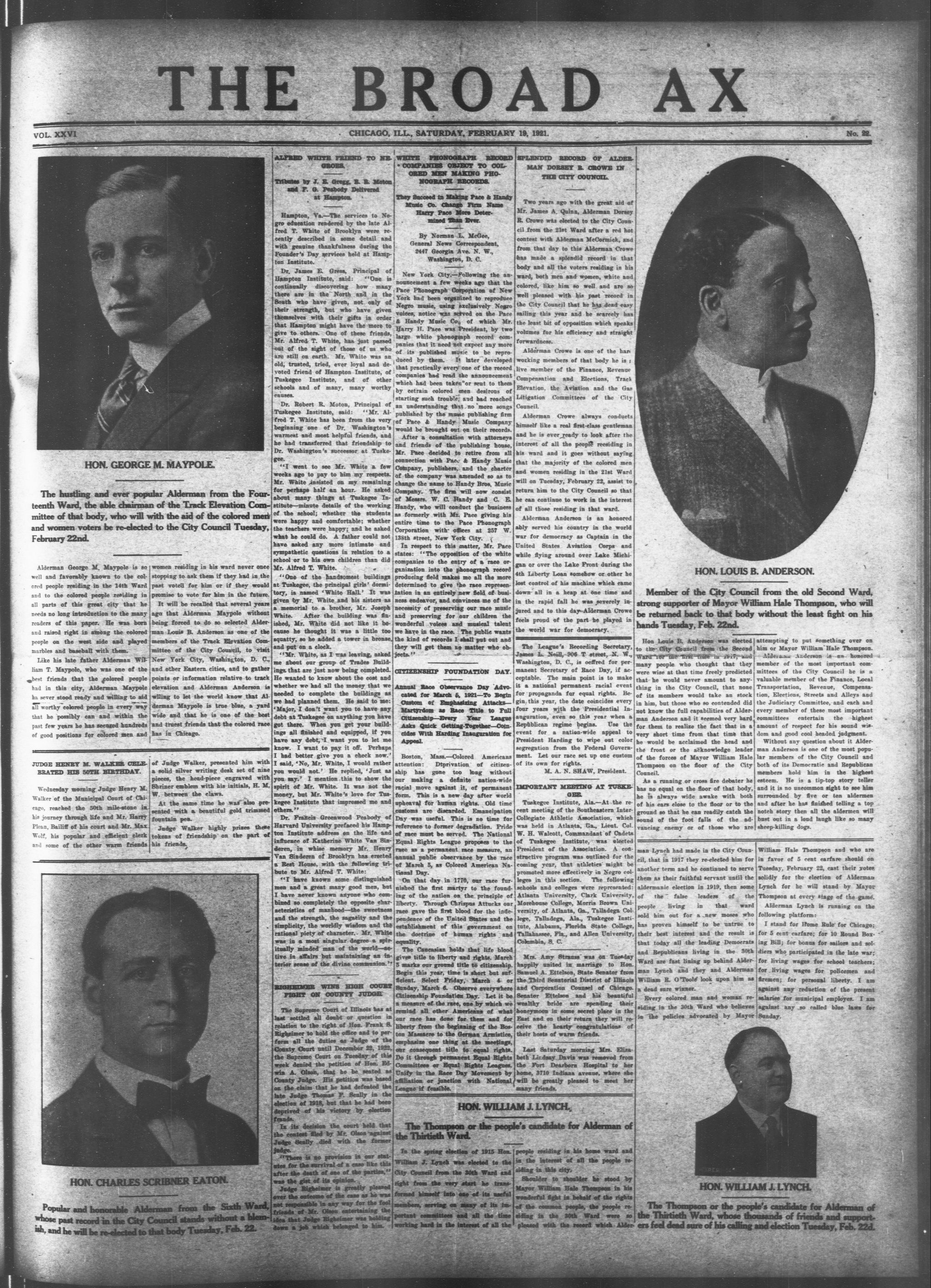
The hustling and ever popular Alderman from the Fourteenth Ward, the able chairman of the Track Elevation Committee of that body, who will with the aid of the colored men and women voters be re-elected to the City Council Tuesday, February 22nd.
HON. CHARLES SCRIBNER EATON.
Alderman George M. Maypole is so well and favorably known to the colored people residing in the 14th Ward and to the colored people residing in all parts of this great city that he needs no long introduction to the many readers of this paper. He was born and raised right in among the colored people on the west side and played marbles and baseball with them.
Like his late father Alderman William T. Maypole, who was one of the best friends that the colored people had in this city, Alderman Maypole ha sever stood ready and willing to aid all worthy colored people in every way that he possibly can and within the past few years he has seized hundreds of good positions for colored men and
JUDGE HENRY M. WALKER CELE BRATED HIS 50TH BIRTHDAY.
Wednesday morning Judge Henry M. Walker of the Municipal Court of Chicago, reached the 50th mile-stone in his journey through life and Mr. Harry Plean, Balliff of his court and Mr. Max Wolf, his popular and efficient clerk and some of the other warm friends
THE BROAD AX
women residing in his ward never once stopping to ask them if they had in the past voted for him or if they would promise to vote for him in the future. It will be recalled that several years ago that Alderman Maypole without being forced to do so selected Alderman Louis B. Anderson as one of the members of the Track Elevation Committee of the City Council, to visit New York City, Washington, D. C., and other Eastern cities, and to gather points or information relative to track elevation and Alderman Anderson is willing to let the world know that Alderman Maypole is true blue, a yard wide and that he is one of the best and truest friends that the colored race has in Chicago.
of Judge Walker, presented him with a solid silver writing desk set of nine pieces, the head-piece engraved with Shriner emblem with his initials, H. M. W. between the claws. At the same time he was also presented with a beautiful gold trimmed fountain pen. Judge Walker highly prices these tokens of friendship on the part of his friends.
Hampton, Va.—The services to Negro education rendered by the late Alfred T. White of Brooklyn were recently described in some detail and with genuine thankfulness during the Founder's Day services held at Hampton Institute.
Dr. James E. Gress, Principal of Hampton Institute, said: "One is continually discovering how many there are in the North and in the South who have given, not only of their strength, but who have given themselves with their gifts in order that Hampton might have the more to give to others. One of these friends, Mr. Alfred T. White, has just passed out of the sight of those of us who are still on earth. Mr. White was an old, trusted, tried, ever loyal and devoted friend of Hampton Institute, of Tuskegee Institute, and of other schools and of many, many worthy causes.
Dr. Robert R. Moton, Principal of Tuskegee Institute, said: "Mr. Alfred T. White has been from the very beginning one of Dr. Washington's warmest and most helpful friends, and he had transferred that friendship to Dr. Washington's successor at Tuskegee.
"I went to see Mr. White a few weeks ago to pay to him my respects. Mr. White assisted on my remaining for perhaps half an hour. He asked about many things at Tukkegee Institute—minute details of the working of the school; whether the students were happy and comfortable; whether the teachers were happy; and he asked what he could do. A father could not have asked any more intimate and sympathetic questions in relation to a school or to his own children than did Mr. Alfred T. White.
"One of the handsomest buildings at Tukkegee, the principal girls' dormitory, is named 'White Hall.' It was given by Mr. White and his sisters as a memorial to a brother, Mr. Joseph White. After the building was finished, Mr. White did not like it because he thought it was a little too squatty, so he added a tower in bronze and put on a clock.
"Mr. White, as I was leaving, asked me about our group of Trades Buildings that are just now being completed. He wanted to know about the cost and whether we had all the money that we needed to complete the buildings as we had planned them. He said to me: 'Major, I don't want you to have any debt at Tuskegee on anything you have got there. When you get your buildings all finished and equipped, if you have any debt, I want you to let me know. I want to pay it off. Perhaps I had better give you a check now.' I said, 'No, Mr. White, I would rather you would not.' He replied, 'Just as you say.' I mention this to show the spirit of Mr. White. It was not the money, but Mr. White's love for Tuskegee Institute that impressed me and others." Dr. Franheis Greenwood Peabody of Harvard University prefaced his Hampton Institute address on the life and influence of Katherine White Van Sinderen, in white memory Mr. Henry Van Sinderen of Brooklyn has erected a Best House, with the following tribute to Mr. Alfred T. White:
"I have known some distinguished men and a great many good men, but I have never known anyone who combined so completely the opposite characteristics of manhood—the sweetness and the strength, the sagacity and the simplicity, the worldly wisdom and the rational piety of character. Mr. White was in a most singular degree a spirit itually minded man of the world—active in affairs but maintaining an interior sense of the divine communion."
HIGHEIMER WINS HIGH COURT FIGHT ON COUNTY JUDGE
The Supreme Court of Illinois has at last settled all doubt or question in relation to the right of Hon. Frank S. Higheimer to hold the office and to perform all the duties as Judge of the County Court until December 22, 1922, the Supreme Court on Tuesday of this week denied the petition of Hon. Edwin A. Olson, that he be seated as County Judge. His petition was based on the claim that he had defended the late Judge Thomas P. Scully in the election of 1918, but that he had been deprived of his victory by election frauds.
In its decision the court held that the content filed by Mr. Olson against Judge Scully died with the former judge.
"There is no provision in our statutes for the survival of a case like this after the death of one of the parties," was the gist of its opinion.
Judge Higheimer is greatly pleased over the outcome of the case as he was not responsible in any way for the fool friends of Mr. Olson entertaining the idea that Judge Higheimer was holding down a job which belonged to him.
WHITE PHONOGRAPH RECORDS
* COMPANIES OBJECT TO COL-
ORED MEN MAKING PHON-
OGRAPH RECORDS.
New York City.—Following the announcement a few weeks ago that the Pace Phonograph Corporation of New York had been organized to reproduce Negro music, using exclusively Negro voices, notice was served on the Pace & Handy Music Co., of which Mr. Harry H. Pace was President, by two large white phonograph record companies that it need not expect any more of its published music to be reproduced by them. It later developed that practically every one of the record companies had read the announcement which had been taken"or sent to them by cetrain colored men desirous of starting such trouble; and had reached an understanding that no more songs published by the music publishing firm of Pace & Handy Music Company would be brought out on their records.
After a consultation with attorneys and friends of the publishing house, Mr. Pace decided to retire from all connection with Pace & Handy Music Company, publishers, and the charter of the company was amended so as to change the name to Handy Bros. Music Company. The firm will now consist of Messrs. W. C. Handy and C. E. Handy, who will conduct the business as formerly with Mr. Pace giving his entire time to the Pace Phonograph Corporation with offices at 257 W. 138th street, New York City.
In respect to this matter, Mr. Pace states: "The opposition of the white companies to the entry of a race organization into the phonograph record producing field makes me all the more determined to give the race representation in an entirely new field of business endeavor, and convinces me of the necessity of preserving our race music and preserving for our children the wonderful voices and musical talent we have in the race. The public wants the kind of records I shall put out and they will get them no matter who objects."
CITIZENSHIP FOUNDATION DAY
Annual Race Observance Day Advocated for March 6, 1921—To Begin Custom of Emphasizing Attacks—Martyrdom as Race Title to Full Citizenship—Every Year League Anks Quick Getting-Together—Ocinclides With Harding Inauguration for Appeal.
Boston, Mass.—Colored Americans attention: Dtprivation of citizenship has gone too long without our making a definite nation-wide racial move against it, of permanent form. This is a new day after world upheaval for human rights. Old time customs are discarded. Emancipation Day was useful. This is no time for reference to former degradation. Pride of race must be served. The National Equal Rights League proposes to the race as a permanent race measure, an annual public observance by the race of March 5, as Colored American National Day.
On that day in 1770, our race furnished the first martyr to the founding of the nation on the principle of liberty. Through Crispus Attucks our race gave the first blood for the independence of the United States and the establishment of this government on the doctrine of human rights and equality.
The Caucasian holds that life blood gives title to liberty and rights, March 5 marks our ground title to citizenship. Begin this year, time is short but sufficient. Select Friday, March 4 or Sunday, March 6. Observe everywhere Citizenship Foundation Day. Let it be a measure of the race, one by which we remind all other Americans of what our race has done for them and for liberty from the beginning of the Boston Massacre to the German Armistice, emphasize one thing at the meetings, our consequent title to equal rights. Do it through permanent Equal Rights Committees or Equal Rights Leagues. Unify in the Race Day Movement by affiliation or junction with National League if feasible.
In the spring election of 1915 Hon. William J. Lynch was elected to the City Council from the 30th Ward and right from the very start he transformed himself into one of its useful members, serving on many of its important committees and all the time working hard in the interest of all the
Two years ago with the great aid of Mr. James A. Quinn, Alderman Dorsey R. Crowe was elected to the City Council from the 21st Ward after a red hot contest with Alderman McCormick, and from that day to this Alderman Crowe has made a splendid record in that body and all the voters residing in his ward, both men and women, white and colored, like him so well and are so well pleased with his past record in the City Council that he has dead easy sailing this year and he scarcely has the least bit of opposition which speaks volumes for his efficiency and straight forwardness.
Alderman Crowe is one of the hard working members of that body he is: live member of the Finance, Revenue Compensation and Elections, Track Elevation, the Aviation and the Gas Litigation Committees of the City Council.
Alderman Crowe always conducts himself like a real first-class gentleman and he is ever ready to look after the interest of all the people reesiding in his ward and it goes without saying that the majority of the colored men and women residing in the 21st Ward will on Tuesday, February 22, assist to return him to the City Council so that he can continue to work in the interest of all those residing in that ward.
Alderman Anderson is an honored ably served his country in the world war for democracy as Captain in the United States Aviation Corps and while flying around over Lake Michigan or over the Lake Front during the 4th Liberty Loan somehow or other he lost control of his machine which came down all in a heap at one time and in the rapid fall he was severely injured and to this day Alderman Crowe feels proud of the part he played in the world war for democracy.
The League's Recording Secretary, James L. Neill, 906 T street, N. W., Washington, D. C., is offered for permanent Secretary of Race Day, if acceptable. The main point is to make it a national permanent racial event for propaganda for equal rights. Begin this year, the date coincides every four years with the Presidential Inauguration, even so this year when a Republican regime begins. Use the event for a nation-wide appeal to President Harding to wipe out color segregation from the Federal Government. Let our race set up one custom of its own for rights.
M. A. N. SHAW, President.
IMPORTANT MBETING AT TUSKEG
Tuskegee Institute, Ala.-At the recent meeting of the Southeastern Inter-Collegiate Athletic Association, which was held in Atlanta, Ga., Lieut. Col. W. H. Walcott, Commandant of Cadets of Tuskegee Institute, was elected President of the Association. A constructive program was outlined for the coming year, that athletics might be promoted more effectively in Negro colleges in this section. The following schools and colleges were represented: Atlanta University, Clark University, Morehouse College, Morris Brown University, of Atlanta, Ga., Talladega College, Talladega, Ga., Tuskegee Institute, Alabama, Florida State College, Tallahassee, Fla., and Allen University, Columbia, S. C.
Mr. Amy Stranss was on Tuesday happily united in marriage to Hon. Samuel A. Ettelson, State Senator from the Third Senatorial District of Illinois and Corporation Counsel of Chicago Senator Etelson and his beautiful wealthy bride are spending their honeycomon in some secret place in the East and on their return they will receive the hearty congratulations of their hosts of warm friends.
Last Saturday morning Mrs. Elizabeth Lirdray Davis was removed from the Fort Dearborn Hospital to her home, 3710 Indians avenue, where she will be greatly pleased to meet her many friends.
people residing in his home ward and in the interest of all the people residing in this city. Shoulder to shoulder he stood by Mayor William Hale Thompson in his wonderful sight in behalf of the rights of the common people, the people residing in the 30th Ward were so pleased with the record which Alder
[Name not visible]
Member of the City Council from the old Second Ward, strong supporter of Mayor William Hale Thompson, who will be returned back to that body without the least fight on his hands Tuesday, Feb. 22nd.
Hon Louis B. Anderson was elected to the City Council from the Second Ward for the first time in 1817, and many people who thought that they were wise at that time freely predicted that he would never amount to anything in the City Council, that none of its members would take an stock in him, but those who so contended did not know the full capabilities of Alderman Anderson and it seemed very hard for them to realize the fact that in a very short time from that time that he would be acclaimed the head and the front or the acknowledge leader of the forces of Mayor William Hale Thompson on the floor of the City Council.
As a running or cross fire debater he has no equal on the floor of that body, he is always wide awake with both of his ears close to the floor or to the ground so that he can readily catch the sound of the foot falls of the advancing enemy or of those who are attempting to put something over on him or Mayor William Hale Thompson. Alderman Anderson is an honored member of the most important committees of the City Council he is a valuable member of the Finance, Local Transportation, Revenue, Compensation, Elections, Streets and Alleys and the Judiciary Committee, and each and every member of these most important committees entertain the highest amount of respect for his sound wisdom and good cool headed judgment.
Without any question about it Alderman Anderson is one of the most popular members of the City Council and both of its Democratic and Republican members hold him in the highest esteem. He is a tip-top story teller and it is no uncommon sight to see him surrounded by five or ten aldermen and after he has finished telling a top notch story then all the aldermen will bust out in a loud laugh like so many sheep-killing dogs.
man Lynch had made in the City Council, that in 1917 they re-elected him for another term and he continued to serve them as their faithful servant until the aldermanic election in 1919, then some of the false leaders of the people living in that ward sold him out for a new moses who has proven himself to be untrue to their best interest and the result is that today all the leading Democrats and Republicans living in the 30th Ward are fast lining up behind Alderman Lynch and they and Alderman William R. O'Toole look upon him as a dead sure winner.
Every colored man and woman residing in the 30th Ward who believes in the policies advocated by Mayor
HON. WILLIAM J. LYNCH.
The Thompson or the people's candidate for Alderman of the Thirtieth Ward, whose thousands of friends and supporters feel dead sure of his calling and election Tuesday, Feb. 22d.
attempting to put something over on him or Mayor William Hale Thompson. Alderman Anderson is an honored member of the most important committees of the City Council he is a valuable member of the Finance, Local Transportation, Revenue, Compensation, Elections, Streets and Alleys and the Judiciary Committee, and each and every member of these most important committees entertain the highest amount of respect for his sound wisdom and good cool headed judgment. Without any question about it Alderman Anderson is one of the most popular members of the City Council and both of its Democratic and Republican members hold him in the highest esteem. He is a tip-top story teller and it is no uncommon sight to see him surrounded by five or ten aldermen and after he has finished telling a top notch story then all the aldermen will bust out in a loud laugh like so many sheep-killing dogs.
William Hale Thompson and who are in favor of 5 cent carfare should on Tuesday, February 22, cast their votes solidly for the election of Alderman Lynch for he will stand by Mayor Thompson at every stage of the game. Alderman Lynch is running on the following platform:
I stand for Home Rule for Chicago;
for 5 cent carfare; for 10 Round Boxing Bill; for bonus for sailors and soldiers who participated in the late war;
for living wages for school teachers;
for living wages for policemen and firemen; for personal liberty. I am against any reduction of the present salaries for municipal employees. I am against any so called blue laws for Sunday.
In this city since July 15th, 1899 without missing one single issue. Republicans, Democrats, Catholics, Protestants, Single Taxers, Priests, inidels or anyone else can have their say as long as their language is proper and responsibility is fixed.
The Broad Ax is a newspaper whose platform is broad enough for all, ever claiming the editorial right to speak its own mind.
Local communications will receive attention. Write only on one side of the paper.
Subscriptions must be paid in advance.
One Year $2.00
Six Months $1.00
Advertising rates made known on application.
Address all communication to
THE BROAD AX
6206 So. Elizabeth St., Chicago, Ill
Phone Wenworth 2597
JULIUS F. TAYLOR
Editor and Publisher
Associate Editor
DR. M. A. MAJORS
4700 South State Street
Phone Drexel 1416
FEBRUARY 19, 1921,
Vol. XXVI
No. 22
Entered as Second-Class Matter, Aug.
19, 1902, at the Post Office at Chicago,
Ill. Under Act of March 8, 1879.
FIRST NEGRO DOCTOR
Born a Slave in Philadelphia in 1767.
The first Negro physician in this country was James Derham, a slave, born in Philadelphia in 1767. He was taught by his master to read and write, and was employed in compounding medicines. He became so skilled in the profession of medicine that the new master to whom he was sold employed him as his assistant.
Eventually Derham purchased his freedom and went to New Orleans where he built up a lucrative practice.
An account of him was published by the celebrated physician, Dr. Benjamin Rush who spoke of him in the highest terms; of his character and skill as a physician.
The present census according to that of 1910 will show no less than 6,000 physicians, 1,000 dentists and 5,000 trained nurses of the Negro race. In 1910 there were 3,777 physicians, 478 dentists, and 2,433 trained nurses.
SOUTHERN WHITE DIALECT.
"She' Nuf?"
From the Enquirer.
Washington, D. C—There's hard times down in "Gaugy."
Following is a reply received by a Washington firm in answer to a request to a Georgia customer that "he remit."
"Dear Sir: I receive your letter about what I owes you.
"Now be pashent. I ain't forgot you, and as soon as folks pay me, I'll pay you, but if this was judgment day and you were no more prepared to meet your Creator than I am to meet your account then you she' is gon' to hell.
"Goodby."
The above is a specimen of white dialect from the type of the average Southerner, who is eternally talking of the inferiority of "Niggers" and the purity of the noble white man, "By Gawd sah"
NEGRO WOMEN ASK VOTE QUIZ.
Urge Congress to Look Into Disenfranchisement in South.
Washington, D. C.—Colored women from twenty states, meeting here at the call of the National Association for the Advancement of Colored People, have presented to the national woman's party a request that it urge Congress to investigate the alleged disenfranchisement of colored women in the South at the latest general election.
"Violations of the intent and purposes of the Susan B. Anthony amendment," a statement prepared by the women declared, "occurred in the elections of 1920 in the Southern states and it has not been made secret that wherever white women were now allowed the bullet it was counted worth while to relinquish it in order that it might be denied colored women."
INSTALLATION BIG SUCCESS
The public installation and banquet given by St. Angusta Household of Ruth, 6765, January 26, at People's Movement Club, 2140 Indiana avenue, was a big success. Many of the out-of town officers were present and made interesting remarks. This household was worked up by Mrs. Ida M. Nelson and was organized with 134 members.
72
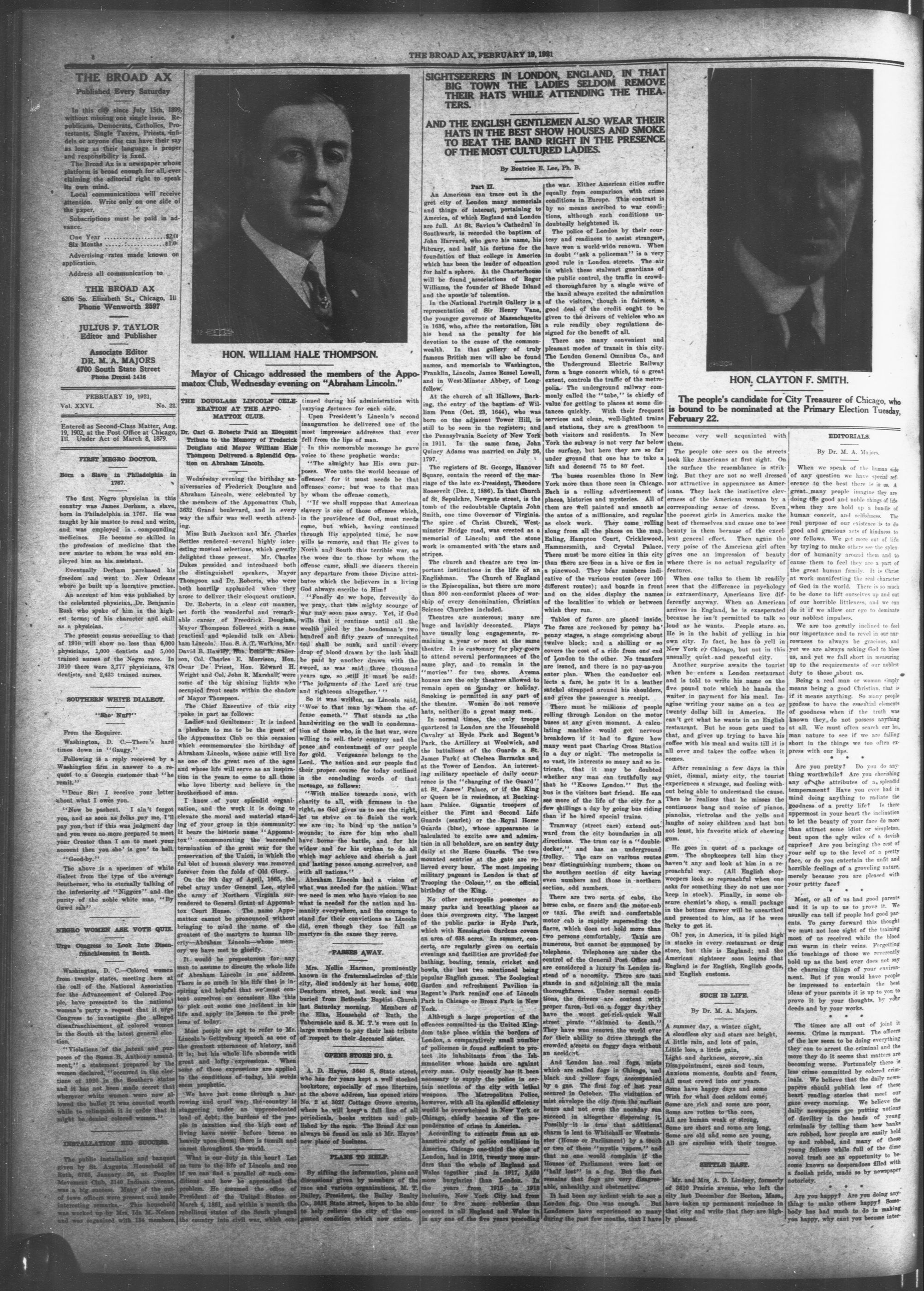
HON. WILLIAM HALE THOMPSON.
Mayor of Chicago addressed the members of the Appomattox Club, Wednesday evening on "Abraham Lincoln."
THE DOUGLASS LINCOLN CELEBRATION AT THE APPOMATTOX CLUB.
Dr. Carl G. Roberts Paid an Elequent Tribute to the Memory of Frederick Douglass and Mayor William Hale Thompson Delivered a Splendid Oration on Abraham Lincoln.
Wednesday evening the birthday anniversary of Frederick Douglass and Abraham Lincoln, were celebrated by the members of the Appomattox Club, 3632 Grand boulevard, and in every way the affair was well worth attending.
tinued during his administration with varying fortunes for each side.
Upon President's Lincoln's second inauguration he delivered one of the most impressive addresses that ever fell from the lips of man.
In this memorable message he gave voice to these prophetic words:
"The almighty has His own purposes. Woe unto the world because of offences! for it must need be that offences come; but woe to that man by whom the offense cometh.
"If we shall suppose that American slavery is one of those offences which, in the providence of God, must need come, but which having continued
Miss Ruth Jackson and Mr. Charles Settles rendered several highly interesting musical selections, which greatly delighted those present. Mr. Charles Dukes presided and introduced both the distinguished speakers, Mayor Thompson and Dr. Roberts, who were both heartily applauded when they arose to deliver their eloquent orations. Dr. Roberts, in a clear cut manner, set forth the wonderful and remarkable career of Freedrick Douglass, Mayor Thompson followed with a sane practical and splendid talk on Abraham Linecoln. Hon. S.A. T. Watkins, Mr. David B. Hawley, Hon. Louis B. Anderson, Col. Charles E. Morrison, Hon. Oscar De Priest, Hon. Edward H. Wright and Col. John R. Marshall; were some of the big shining lights who occupied front seats within the shadow of Mayor Thompson
The Chief Executive of this city
poke in part as follows:
poke in part as follows:
Ladies and Gentlemen: It is indeed a pleasure to me to be the guest of the Appattox Club on this occasion which commemorates the birthday of Abraham Lincoln, whose name will live as one of the great men of the ages and whose life will serve as an inspiration in the years to come to all those who love liberty and believe in the brotherhood of man.
I know of your splendid organization, and the work it is doing to elevate the moral and material standing of your group in this community. It bears the historic name "Appomattox" commemorating the successful termination of the great war for the preservation of the Union, in which the fulb of human slavery was removed forever from the folds of Old Glory. On the 9th day of April, 1665, the rebel army under General Lee, styled the army of Northern Virginia surrendered to General Grant at Appomattox Court House. The name Appomattox cannot be pronounced without bringing to mind the name of the greatest of the martyrs to human liberty—Abraham Lincoln—whose memory we have met to glorify.
It would be preposterous for any man to assume to discuss the whole life of Abraham Lincoln in one address. There is so much in his life that is inspiring and helpful that we must content ourselves on occasions like this to pick out some one incident in his life and apply its lesson to the problems of today.
Most people are apt to refer to Mr. Lincoln's Gettysburg speech as one of the greatest utterances of history, and it is; but his whole life abounds with great and lofty expressions. When some of those expressions are applied to the conditions of today, his words seem prophetic.
We have just come through a harrowing and cruel war; the country is staggering undoran an unprecedented load of debt; the burdens of the people in taxation and the high cost of living have never before borne so heavily upon them; there is tumult and unrest throughout the world.
What is our duty in this hour? Let us turn to the life of Lincoln and see if we can find a parallel of such conditions and how he approached the problem. He assumed the office of President of the United States on March 4, 1861, and within a month the rebellious states of the South plunged the country into civil war, which con-
tinued during his administration with varying fortunes for each side.
Upon President's Linecoln's second inauguration he delivered one of the most impressive addresses that ever fell from the lips of man.
In this memorable message he gave voice to these prophetic words:
"The almighty has His own purposes. Woe unto the world because of offenses! for it must needs be that offenses come; but woe to that man by whom the offense cometh.
"If we shall suppose that American slavery is one of those offenses which, in the providence of God, must needs come, but which, having continued through His appointed time, he now wills to remove, and that He gives to North and South this terrible war, as the woes due to those by whom the offense came, shall we discern there any departure from those Divine attributes which the believers in a living God always ascribe to Him?
"Fondly do we hope, fervently do we pray, that this mighty scourge of war may soon pass away. Yet, if God wills that it continue until all the wealth piled by the bondsman's two hundred and fifty years of unrequited toil shall be sunk, and until every drop of blood drawn by the lash shall be paid by another drawn with the sword, as was said three thousand years ago, so still it must be said: 'The judgments of the Lord are true and righteous altogether.'"
So it was written, as Lincoln said,
"Woe to that man by whom the offense cometh." That stands as the handwriting on the wall in condemnation of those who, in the last war, were willing to sell their country and the peace and contentment of our people for gold. Vengeance belongs to the Lord. The nation and our people find their proper course for today outlined in the concluding words of that message, as follows:
"With malice towards none, with charity to all, with firmness in the right, as God gives us to see the right, let us strive on to finish the work we are in; to bind up the nation's wounds; to care for him who shall have borne the battle, and for his widow and for his orphan to do all which may achieve and cherish a just and lasting peace among ourselves, and with all nations."
Abraham Lincoln had a vision of what was needed for the nation. What we need is men who have vision to see what is needed for the nation and humanity everywhere, and the courage to stand for their convictions as Lincoln did, even though they too fall as martyrs in the cause they serve.
Mrs. Nellie Harmon, prominently known in the fraternal circles of this city, died suddenly at her home, 4004 Dearborn street, last week and was buried from Bethesda Baptist Church last Saturday morning. Members of the Elks, Household of Ruth, the Tabernacle and S. M. T.'s were out in large numbers to pay their last tribute of respect to their deceased sister.
A. D. Hayes, 3640 S. State street, who has for years kept a well stocked bookstore, especially of race literature, at the above address, has opened store No. 2 at 3627 Cottage Grove avenue, where he will keep a full line of all periodicals, books written and published by the race. The Broad Ax can always be found on sale at Mr. Hayes' new place of business.
Byifting the information, plans and discussions given by members of the race and various organizations, M. T. Bailey, President, the Bailey Realty Co., 8083 State street, hopes to be able to help relieve the city of the congested condition which now exists.
SIGHTSEERERS IN LONDON, ENGLAND, IN THAT BIG TOWN THE LADIES SELDOM REMOVE THEIR HATS WHILE ATTENDING THE THEATERS.
AND THE ENGLISH GENTLEMEN ALSO WEAR THEIR HATS IN THE BEST SHOW HOUSES AND SMOKE TO BEAT THE BAND RIGHT IN THE PRESENCE OF THE MOST CULTURED LADIES.
By Beatrice E. Lee, Ph.
An American can trace out in the greet city of London many memorials and things of interest, pertaining to America, of which England and London are full. At St. Saviour's Cathedral in Southwark, is recorded the baptism of John Harvard, who gave his name, his library, and half his fortune for the foundation of that college in America which has been the leader of education for half a sphere. At the Charterhouse will be found associations of Roger Williams, the founder of Rhode Island and the apostle of toleration.
In the National Portrait Gallery is a representation of Sir Henry Vane, the younger governor of Massachusetts in 1636, who, after the restoration, lost his head as the penalty for his devotion to the cause of the commonwealth. In that gallery of truly famous British men will also be found names, and memorials to Washington, Franklin, Lincoln, James Russel Lowell, and in West-Minster Abbey, of Long fellow.
At the church of all Hallows, Barking, the entry of the baptism of William Penn (Oct. 23, 1644), who was born on the adjacent Tower Hill, is still to be seen in the registers; and the Pennsylvania Society of New York in 1911. In the same fane, John Quiney Adams was married on July 26, 1797.
The registers of St. George, Hanover Square, contain the record of the marriage of the late ex-President, Theodore Roosevelt (Dec. 2, 1886). In that Church of St. Sepulchre, Newgate street, is the tomb of the redoubtable Captain John Smith, one time Governor of Virginia. The spire of Christ Church, Westminster Bridge road, was erected as a memorial of Lincoln; and the stone work is ornamented with the stars and stripes.
The church and theatre are two important institutions in the life of an Englishman. The Church of England is the Episcopalian, but there are more than 800 non-conformist places of worship of every denomination, Christian Science Churches included.
Theatres are numerous; many are huge and lavishly decorated. Plays have usually long engagements, remaining a year or more at the same theatre. It is customary for play-goers to attend several performances of the same play, and to remain in the "movies" for two shows. Avena houses are the only theatres allowed to remain open on Sunday or holiday. Smoking is permitted in any part of the theatre. Women do not remove hats neither do a great many men.
In normal times, the only troops quartered in London are the Household Cavalry at Hyde Park and Regent's Park, the Artillery at Woolwick, and the battalions of the Guards a St James Park ( at Chelsea Barracks and at the Tower of London. An interesting military spectacle of daily occurrence is the 'changing of the Guard' at St James' Palace, or if the King or Queen be in resiednce, at Buckingham Palace. Gigantic troopers of either the First and Second Life Guards (searlet) or the Royal Horse Guards (blue), whose appearance is calculated to excite awe and admiration in all beholders, are on sentry duty daily at the Horse Guards. The two mounted sentries at the gate are relieved every hour. The most imposing military pageant in London is that of Trooping the Colour', on the official birthday of the King.
No other metropolis possesses so many parks and breathing places as does this overgrown city. The largest of the public parks is Hyde Park, which with Kensington Gardens covers an area of 638 acres. In summer, concerts, are regularly given on certain evenings and facilities are provided for bathing, boating, tennis, cricket and bowls, the last two mentioned being popular English games. The Zoological Garden and refreshment Pavilion in Regent's Park remind one of Lincoln Park in Chicago or Bronx Park in New York.
Although a large proportion of the offences committed in the United Kingdom take place within the borders of London, a comparatively small number of policemen is found sufficient to protect its inhabitants from the Inhumaclites whose hands are against every man. Only recently has it been necessary to supply the police in certain sections of the city with lethal weapons. The Metropolitan Police, however, with all its splendid efficiency would be overwhelmed in New York or Chicago, chiefly because of the preponderance of crime in America.
Part II.
the war. Either American cities suffer equally from comparison with crime conditions in Europe. This contrast is by no means ascribed to war conditions, although such conditions undoubtedly heightened it.
The police of London by their courtesy and readiness to assist strangers, have won a world-wide renown. When in doubt "ask a policeman" is a very good rule in London streets. The air in which these stalwart guardians of the public control, the traffic in crowded thoroughfares by a single wave of the hand always excited the admiration of the visitors, though in fairness, a good deal of the credit ought to be given to the drivers of vehicles who as a rule readily obey regulations designed for the benefit of all.
There are many convenient and pleasant modes of transit in this city. The Loudon General Omnibus Co., and the Underground Electric Railway form a huge concern which, to a great extent, controls the traffic of the metropolis. The underground railway commonly called the "tube," is chiefly of value for getting to places at some distances quickly. With their frequent services and clean, well-lighted trains and stations, they are a great boon to both visitors and residents. In New York the subway is not very far below the surface, but here they are so far under ground that one has to take a lift and descend 75 to 80 feet.
The buses resembles those in New York more than those seen in Chicago. Each is a rolling advertisement of placea, histories and mysteries. All of them are well painted and smooth as the autos of a millionaire, and regular as clock work. They come rolling along from all the places on the map. Ealing, Hampton Court, Cricklewood, Hammersmith, and Crystal Palace. There must be more cities in this city than there are bees in a hive or firs in a pinewood. They bear numbers indicative of the various routes (over 100 different routes); and boards in front and on the sides display the names of the localities to which or between which they run.
Tables of fares are placed inside
The fares are reckoned by penny hat
penny stages, a stage comprising about
twelve block; and a shilling or so
covers the cost of a ride from one end
of London to the other. No transfers
are issued, and there is no pay-as-you
enter plan. When the conductor collects a fare, he puts it in a leather
satchel strapped around his shoulders,
and gives the passenger a receipt.
There must be millions of people rolling through London on the motor buses at any given moment. A calculating machine would get nervous breakdown if it had to figure how many went past Charing Cross Station in a day or night. The metropolis is so vast, its interests so many and so intricate, that it may be doubted whether any man can truthfully say that he "Knows London." But the bus is the visitors best friend. He can see more of the life of the city for a few shillings a day by going bus riding than if he hired special trains.
Tramway (street cars) extend outward from the city boundaries in all directions. The tram car is a "double-decker," and has an underground trolley. The cars on various routes bear distinguishing numbers; those on the southern section of city having even numbers and those in northern section, odd numbers.
There are two sorts of cabs, the horse cab, or finere and the motor-cab or taxi. The swift and comfortable motor cab is rapidly superseding the fiore, which does not hold more than two persons comfortably. Taxis are numerous, but cannot be summoned by telephone. Telephones are under the control of the General Post Office and are considered a luxury in London instead of a necessity. There are taxi stands in and adjoining all the main thoroughfares. Under normal conditions, the drivers are content with proper fares, but on a foggy day they have the worst get-rich-quick Wall street pirate "skinned to death." They have won renown the world over for their ability to drive through the crowded streets on foggy days without an accident.
And London has real fogs, mists which are called fogs in Chicago, and black and yellow fogs, accompanied by a gas. The first fog of last year occurred in October. The visitation of mist envelope the city from the earliest hours and not even the noonday sun succeed in altogether dispersing it. Possibly it is true that additional charm is lent to Whitehall or Westminster (House or Parliament) by a touch or two of these "mystic vapors" and that no one would complain if the Houses of Parliament were lost or "half lost" in a fog. But the fact remains that fogs are very disagreeable, unhealthy and obstructive.
It had been my ardent wish to see a London fog. One was enough. But Londoners have experienced so many the last few months that I have
C. A.
HON. CLAYTON F. SMITH.
The people's candidate for City Treasurer of Chicago, who is bound to be nominated at the Primary Election Tuesday, February 22.
become very well acquainted with them.
EDITORIALS.
The people one sees on the streets look like Americans at first sight. On the surface the resemblance is striking. But they are not so well dressed nor attractive in appearance as Americans. They lack the instinctive cleverness of the American woman by a corresponding sense of dress. Even the poorest girls in America make the best of themselves and cause one to see beauty in them because of the excellent general effect. Then again the very poise of the American girl often gives one an impression of beauty where there is no actual regularity of features.
When one talks to them he readily sees that the difference in psychology is extraordinary, Amerieans live differently anyway. When an American arrives in England, he is exasperated because he isn't permitted to talk so loud as he wants. People stare so. He is in the habit of yelling in his own city. In fact, he has to yell in New York or Chicago, but not in this unusually quiet and peaceful city.
Another surprise awaits the tourist when he enters a London restaurant and is told to write his name on the five pound note which he hands the waiter in payment for his meal. Imagine writing your name on a ten or twenty dollar bill in America. He can't get what he wants in an English restaurant. But he soon gets used to that, and gives up trying to have his coffee with his meal and waits till it is all over and takes the coffee when it comes.
After remaining a few days in this quiet, dismal, misty city, the tourist experiences a strange, sad feeling without being able to understand the cause. Then he realizes that he misses the continuous bang and noise of pianos, pianolas, victrolas and the yells and laughs of noisy children and last but not least, his favorite stick of chewing gum.
He goes in quest of a package of gum. The shopkeepers tell him they haven't any and look at him in a reproachful way. (All English shopweepers look so reproachful when one asks for something they do not use nor keep in stock). Finally, in some obscure chemist's shop, a small package in the bottom drawer will be unearthed and presented to him, as if he were lucky to get it. Oh! yes, in America, it is piled high in stacks in every restaurant or drug store, but this is England; and the American sightseer soon learns that England is for English, English goods, and English customs.
A summer day, a winter night,
A cloudless sky and stars are bright,
A little rain, and lots of pain,
Little loss, a little gain,
Light and darkness, sorrow, sin
Disappointment, cares and tears,
Anxious moments, doubts and fears,
All must crowd into our years.
Some have happy days and some
Wish for what does seldom come;
Some are rich and some are poor,
Some are rotten to the core,
All are human weak or strong,
Some are short and some are long,
Some are old and some are young,
All are careless with their tongue.
Mr. and Mrs. A. D. Lindsey, formerly of 3610 Prairie avenue, who left the city last December for Boston, Mass, have taken up permanent residence in that city and write that they are highly pleased.
SUCH IS LIFE.
SETTLE EAST
When we speak of the human side of any question we have special reference to the best there is in us. A great many people imagine they are doing the good and noble things of life when they are hold up a bundle of human conceit, and selfishness. The real purpose of our existence is to do good and gracious acts of kindness to our fellows. We get more out of life by trying to make others see the splendor of humanity around them and to cause them to feel they are a part of the great human family. It is Christ at work manifesting the real character of God in the world. There is so much to be done to lift ourselves up and out of our horrible littleness, and we can do it if we allow our ego to dominate our noblest impulses.
We are too greatly inclined to feel our importance and to revel in our narrowness to always be gracious, and yet we are always asking God to bless us, and yet we fall short in measuring up to the requirements of our noblest duty to those about us.
Being a real man or woman simply means being a good Christian, that is if it means anything. So many people profess to have the essential elements of goodness when if the truth was known they do not possess anything at all. We must often search our man nature to see if we are falling short in the things we too often express with our lips.
Are you pretty? Do you do anything worthwhile? Are you cherishing any of the attributes of a, splendid temperament? Have you ever had in mind doing anything to radiate the goodness of a pretty life? Is there uppermost in your heart the inclination to let the beauty of your face do more than attract some idiot or simpleton, bent upon the ugly wiles of a devilon caprice? Are you bringing the rest of your self up to the level of a pretty face, or do you entertain the unfit and horrible feelings of a groveling nature, merely because you are pleased with your pritty face?
Most, or all of us had good parents and it is up to us to prove it. We usually can tell if people had good parents. To carry forward this thought we must not lose sight of the training most of us received while the blood ran warm in their veins. Forgetting the teachings of those we reverently hold up as the best ever does not say the charming things of your environment. But if you would have people be impressed to entertain the best ideas of your parents it is up to you to prove it by your thoughts, by your deeds and by your works.
The times are all out of joint it seems. Crime is rampant. The officers of the law seem to be doing everything they can to arrest the criminal and the more they do it seems that matters are becoming worse. Fortunately there is less crime committed by colored criminals. We believe that the daily newspapers should publish less of these heart rending stories that meet our gaze every morning. We believe the daily newspapers are putting notions of devilry in the heads of young criminals by telling them how banks are robbed, how people are easily held up and robbed, and many of these young fellows while full of the dime novel trash see an opportunity to become known as desperadoes filled with a foolish pride, made so by newspaper notoriety.
Are you happy? Are you doing anything to make others happy? Somebody has had much to do in making you happy, why can't you become inter-
rested in some one so that they may be happy too? Of course if you are just existing so that you may eat and sleep and wear elegant clothes, grin at some one when some one grins at you, your life doesn't count for much, and besides you could never be happy and may never know just what it takes to be happy, or make people happy.
We are a great admirer of the late Hon. Frederick Douglass. We had a speaking acquaintance with him, and was given opportunity to study him while he walked on earth among us. We had never seen any before like him, and we never expect to see his like again. There will never be another Frederick Douglass. Now nature does not lavish on the earth extravagance in so formidable spirits. She knows better than to use up her best material all at once. Just as here and there along the wide stretch of desert one reaches a fortile oasis, green with foliage and flower and perfume, so has great nature strung all through the centuries men like Lineoln, Douglass, Booker T. Washington and women like Harriet Beecher Stowe, Susan B. Anthony, Hallie Q. Brown, Mary Tolbert and Mollie Church Terrell. These are our rich heritage, and it is a bit refreshing to realize these were human like us only a little more so.
Some people are indeed very funny. Most of our worries come from people being funny. Usually it is at some ones expense. Hilarity expresses much of the joy a great many people have and it is seldom worth while. We can appreciate a joke as acutely as the rest of mankind, but when, come to think of it, did any one ever hear of our Savior laughing? Lincoln and Douglass laughed and could enjoy making others laugh, but has any one ever heard of Christ telling a joke or making others laugh? This distinction is a bit grotesque, but we have made it to show that we are not as high up as the God of Righteousness.
Our people are rapidly coming into their own, and it is the answer to the prophecy of hundreds of our leading spirits who thought for us in the dark days of our helplessness. They worked and prayed for the deliverance which we enjoy today. There is a sort of reckless prodigality among us no doubt because the impulses of some fine temperaments are swayed with vanity, but the sober nature of the race can be relied on to press out the wrinkles when they appear. In fact in all the sober graces of the race there is a thickened crust of gold to sustain the journ spirit, and to tell a real worthy truth, we are just about like the rest of mankind, only we enjoy a lot more coloring, and Ohl what a variety of it!
NEWS ITEMS FROM BUTTE MONT
By Mrs. L. C. Foreman.
The regular monthly meeting of the Pearl Federated Woman's Club met on Tuesday evening, February 8, at the apartments of Mrs. Horace Mayfield.
Much business of importance was attended to.
The plans for Mr. Trotter's lecture were perfected. It will be given at the A. M. E. Church, February 23.
Mrs. I. C. Foreman made a very interesting and instructive talk on the State of Iowa.
Mrs. J. W. Duncan read an article from the "Crisis" concerning the way the American branch of the Y. W. C. A., in Paris, France, discriminated against Mrs. M. B. Talbert the colored woman delegate to the Woman's International Council which was held in Christiana, Norway.
Meeting adjourned to meet March 8 with Mrs. John Palmer, 220 W. Mercury street.
The Clover Leaf Art Club met Friday evening at the home of Mrs. Jane Cunningham, 216 S. Idaho street. Mrs. Rose Glenn, instructor of hand painting, is very much pleased with the progress the ladies are making. Delicious refreshments were served by the hostess. Mrs. Jessie Edwards entertains the club next week at her home, 530 W. Silver street.
H. D. Smith, 55th and Grove avenue, a member of Illinois Lodge U. B. F. who has been ill for quite a while, is improving rapidly and able to be out.
CHARLES E. STUMP, TRAVELING CORRESPONDENT FOR THE BROAD AX, VISITS BATON ROUGUE, LA. WHERE HE HAD A PLEASANT INTERVIEW WITH GOVERNOR JOHN M. PARKER.
Southern University, Baton Rouge, La. I have been telling you about Governor Bickett, Governor Morrow, Governor Robinson, and their stand for law and order, and I have had words of praise for them, and now I find that there is another real man, who believes in law and order, and who is Governor not alone of the white people, but of all the people and believes that law should be applied to all alike. Now you know it takes a real man to take this stand, and this is the position of Governor John M. Parker, of Louisiana, and I am willing to take off by head to him and bow him a vote of real thanks from my heart.
I have had the pleasure of meeting him, I have heard him, and I have looked right in his mouth and saw the words as they left his heart and came right to the hundreds of people who were present at the Farmers' Conference held in this place last week. He did not bite his tongue in speaking nor did he flatter the people, but told them right to their faces what where expected of them, and that this world was not a one sided affair. I admire him all the more for it. I like to know just where a man stands and what he is thinking about, and I like to have him speak right out to me and let me speak right out to him, and in that case we will understand each other.
In the first place, Governor Parker, is not a ward politician, and was not elected for his abuse of the Negro, but he was a high class rich man, not depending on his position, and he is not seeking to spend the rest of his life making terms with some politicians compromising his manhood in order to get a political job. It was a sacrifice for him to come to the city of Baton Rouge and serve the state as Governor. He is honoring the state as well as the state is honoring him, and for that reason he is going to give first-class service, and will close his eyes to friend and foo when it comes to the violators of the law.
Already they have tried his soul and by this time they all know just where he stands on the question of the inhuman taking of human life by lawless men, by mobs, by lynching, by mobs, but anything else. There is not to be any burning of men alive under his influence, by that I mean his administration. Then there are going to be better schools, better teachers, better officers of the law, better jailers, better citizens, and Gov. John M. Parker is going to be father of them all. Louisiana is going to be a better state, and it will be a safe place in which to live, and law and order will prevail.
I am here attending the Farmers' Conference, and this is the State Institution. This is where our young people are being trained, and this is where they are getting just the things they need for higher manhood and womanhood under the leadership of that noted educator, Dr. J. S. Clark, who is a graduate from this state and got his finishing touch at Harvard University, way up yonder in Massachusetts. He got the finishing touch there, and then he has been serving his people ever since. He was placed at the head of the colored school, when it was decided to move it out of the city of New Orleans and put it in charge of our men. You—see they had had a white man president before this time. Now believe me when I tell you that this is an entire new school, and is doing wonderful work.
The farmers of the state are being benefitted, and the other people too, even the teachers get some new inspiration and they are being helped, and then the teachers for the future in Louisiana are being trained here, and all because that a man life Dr. Clark lived. These farmer conferences are taking larger scope, and new features are being added. This was the first time that they had been addressed by the Governor, and he had a right to speak to them because of his personal interest. Upon his recommendation the legislature appropriated $267,000 to the school at the last session and some new buildings are going up. This is practically a new school out here, but I am here to tell you that already it has a rank with the other state schools and it does not yet appear all it shall be.
Governor Parker, in his address commended the people on the wonderful progress they had made in this country in fifty-five years, and that they had outstripped any other people in the same length of time, but he was frank enough to tell them they had not made any progress over home yet. But that is not the point. He condemned the lawless crowd whether white or black, and asked the leaders of my people to assist in bringing to justice the criminal element. He wanted that they be turned up and that he would see that they were protected. He was willing to help the Negro and asked them to help him. I am telling you the truth when I tell you that I am proud of Governor Parker, and then I got a new insight into State Superintendent Harra, who is a man and who desires to see better schools throughout the state, better pay for the teachers, and to that end he is working.
You would not be surprised when I tell you that they have down here a new lawmaker, and it doth not yet
appear what it shall be under Governor Parker. I have had the pleasure of being in company with that great teacher of science, Dr. W. D. Thomas, who was born down in Georgia, got his education down there as far as it would go, found his way to Harvard, and worked until he had graduated from there, and then he has been busy ever since, completing a course in the doctor business, and at the same time devoting his life to his people. He is in charge of the department of science, and right by his side is his wife, Mrs. Edwinia Kennedy-Thomas, of Kentucky. When Kentucky and Georgia gets together you may know that it is a combination right.
It has been a pleasure for me to be in touch with these people and to see what they are doing for God and the race. Mrs. M. M. Barance, is in charge of the hospital, and I was her special guest while here, and she looked after me, because I had been sick before. I came in touch with Prof. J. A. Mitchell, of Ohio, who is considered the dean, and he got his finishing touch at Boudoin College, up in Maine, and got some more in Germany, and I shall tell you about him in another letter.
Mrs. W. D. Thomas, Mrs. Mabery and Mrs. J. S. Clark, together with Mrs. Barance looked after my eating, and I had some special diets while here, and now that I am away, and I leave there feeling better. I shall write about the school when I return.
CHARLES E. STUMP.
For the second time in the past two years Dr. Stork has visited the home of Mr. and Mrs. E. H. Johnson, 3056 Vernon avenue. The first time he left a baby boy and on his second visit he left a nine-pound baby girl. Dr. James R. White assisted Dr. Stork on the last occasion.
IN LATEST WRAPS
Picturesque Garments for Afternoon and Evening.
Vogue for Dance-Teas and Restaurant Parties Creates Demand for Attractive Apparel.
Picturesque wraps—for afternoon as well as evening—are immensely popular this year. The ever increasing vogue of dance-teas and restaurant parties may be answerable for this. Certain it is that the fashions of the present hour are extremely decorative—and becoming.
Some of the latest designs for evening wraps are so intricate that ordinary women feel a little afraid of them, but much of the elaboration is centered in the design itself—and in the linings chosen, for it is truly the day of linings.
Several different materials may be mingled in these mantles—those intended for afternoon wear as well as evening cloaks. This is a specially practical fashion. Old garments, made of good materials, may be taken to pieces, freshened up and then combined. In this way very rich and beautiful effects may be obtained without a great outlay of money.
Take for example an exquisite evening wrap recently launched at Monte Carlo by Cecil Secl. It, was long, almost ankle-length, and it was made of several different materials—black chantilly lace, silver tissue and rust red satin—the latter used for the lining.
In addition to all this there was a shoulder cape, attached to the mantle all round the border, of seal musquash, and this cape was cut in varnishes. It seemed as though the lower
A
part of the cape depended from a long shoulder yoke, but in reality the cape had been a separate garment. There were two flouses of black chabilly, each flounce bordered with a narrow band of seal mungush, and there was a bigh Medici collar of the same fur.
THE BROAD AX. FEBRUARY 19, 1921
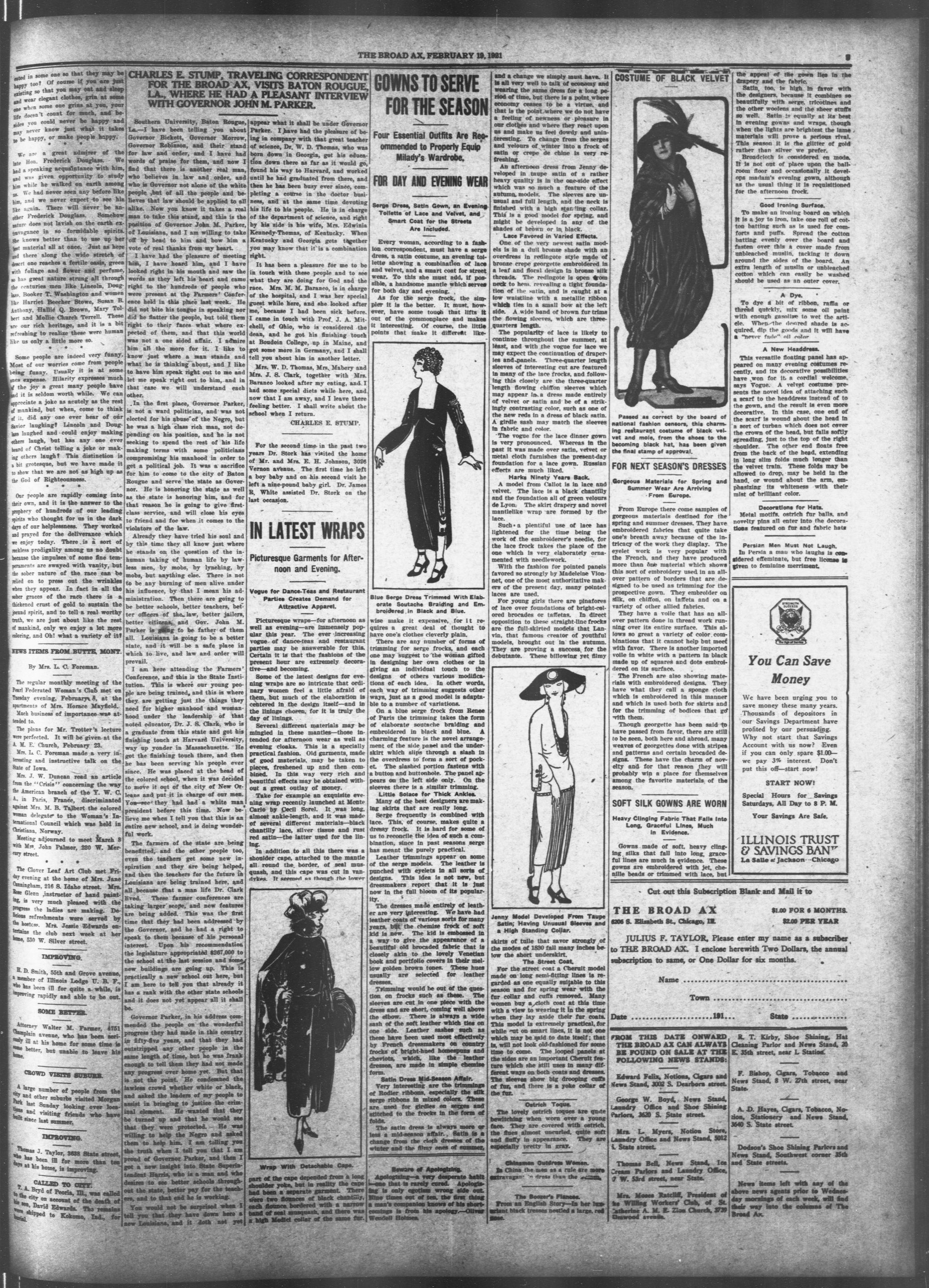
Four Essential Outfits Are Recommended to Properly Equip Milady's Wardrobe.
FOR DAY AND EVENING WEAR
Serge Dress, Satin Gown, an Evening Toilette of Lace and Velvet, and Smart Coat for the Streets Are Included.
Every woman, according to a fashion correspondent, must have a serge dress, a satin costume, an evening toilette showing a combination of lace and velvet, and a smart coat for street wear. To this she must add, if possible, a handsome mantle which serves for both day and evening.
As for the serge frock, the simpler it is the better. It must, however, have some tough that lifts it out of the commonplace and makes it interesting. Of course, the little points that make it different, like
1
Blue Serge Dress Trimmed With Elaborate Soutache Braiding and Embroidered in Black and Blue.
wise make it expensive, for it requires a great deal of thought to have one's clothes cleverly plain.
There are any number of forms of trimming for serge frocks, and each one may suggest to the woman gifted in designing her own clothes or in giving an individual touch to the designs of others various modifications of each idea. In other words, each way of trimming suggests other ways, just as a good model is adaptable to a number of variations.
On a blue serge frock from Renee of Paris the trimming takes the form of elaborate soutache braiding and embroidered in black and blue. A charming feature is the novel arrangement of the side panel and the underskirt which slips through a slash in the overdress to form a sort of pocket. The slashed portion fastens with a button and buttonhole. The panel appears on the left side only. On the sleeves there is a similar trimming. Little Soace for Thick Ankle. Many of the best designers are making skirts that are really long. Serge frequently is combined with face. This, of course, makes quite a dressy frock. It is hard for some of us to reconcile the idea of such a combination, since in past seasons serge has meant the purely practical.
Leather trimmings appear on some of the serge models. The leather is punched with eyelets in all sorts of designs. This idea is not new, but dressmakers report that it is just now in the full bloom of its popularity.
The dresses made entirely of leather are very interesting. We have had leather coats of various sizes for many years, but the chemise frock of soft kid is new. The kid is embossed in a way to give the appearance of a beautiful old brocaded fabric that is closely akin to the lovely Venetian book and portfolio covers in their mellow golden tones. These hues usually are selected for leather dresses.
Trimming would be out of the question on frocks such as these. The sleeves are cut in one piece with the dress and are short, coming well above the elbow. There is always a wide sash of the soft leather which ties on one side. Leather sashes such as these have been used most effectively by French dressmakers on country frocks of bright-hued homespuns and cheviots, which, like the leather dresses, are made in simple chemise form.
Satin Dress Mid-Season Affair.
Very interesting are the trimmings of Rodier ribbons, especially the silk serge ribbons in mixed colors. These are used for girdles on serges and fitted to the frocks in the form of folds.
The satin dress is always more or less a mid-season affair. Satin is a change from the cloth dresses of the winter and the flimy ones of summer.
**Wearable** of Apologizing.
Apologizing—a very desperate habit—one that is rarely cured. Apologizing is only apology wrong side out. Nine times out of ten, the first thing a man's companion knows of his short-comings is from his apology—Olliver Wendell Holmes.
and a change we simply must have. It is all very well to talk of economy and wearing the same dress for a long period of time, but there is a point where economy ceases to be a virtue, and that is the point where we do not have a feeling of newness or pleasure in our clothes and where they react upon us and make us feel dowdy and uninteresting. To change from the serges and velours of winter into a frock of satin or crepe de chine is very refreshing.
An afternoon dress from Jenny developed in taupe satin of a rather heavy quality is in the one-side effect which was so much a feature of the autumn models. The sleeves are unusual and full length, and the neck is finished with a high standing collar. This is a good model for spring, and might be developed in any of the shades of brown or in black.
Lace Favored in Varied Effects.
One of the very newest satin models is in a dull bronze shade with an overdress in redingote style made of bronze crepe georgette embroidered in a leaf and floral design in bronze silk threads. The redingote is open from neck to hem, revealing a tight foundation of the satin, and is caught at a low waistline with a metallic ribbon which ties in a small bow at the left side. A wide band of brown fur trims the flowing sleeves, which are three-quarters length.
The popularity of lace is likely to continue throughout the summer, at least, and with the vogue for lace we may expect the continuation of draperies and panels. Three-quarter length sleeves of interesting cut are featured in many of the lace frocks, and following this closely are the three-quarter length flowing chiffon sleeves which may appear in a dress made entirely of velvet or satin and be of a strikingly contrasting color, such as one of the new reds in a dress of black satin. A girdle sash may match the sleeves in fabric and color.
The vogue for the lace dinner gown is very pronounced. Whereas in the past it was made over satin, velvet or metal cloth furnishes the present-day foundation for a lace gown. Russian effects are much liked.
Harks Ninety Years Back.
A model from Callot is in lace and velvet. The lace is a black chantilly and the foundation all of green velours de Lyon. The skirt drapery and novel mantellike wrap are formed by the lace.
Such a plentiful use of lace has lightened for the time being the work of the embroiderer's needle, for the lace frock takes the place of the one which is very elaborately ornamented with needlework.
With the fashion for pointed panels favored so strongly by Madeleine Vlonet, one of the most authoritative makers of the present day, many pointed laces are used.
For young girls there are pinafores of lace over foundations of bright-colored brocades or taffetas. In direct opposition to these straight-line frocks are the full-skirted models that Lanvin, that famous creator of youthful models, brought out in the autumn. They are proving a success, for the debutante. These billowing yet flimy
1
Jenny Model Developed From Taupe Satin; Having Unusual Sleeves and a High Standing Collar.
skirts of tulle that savor strongly of the modes of 1890 fall many inches below the short underskirt.
For the street coat a Cheruit model made on long semi-lifting lines is regarded as one equally suitable to this season and for spring wear with the fur collar and cuffs removed. Many women buy a cloth coat at this time with a view to wearing it in the spring when they lay aside their fur coats. This model is extremely practical, for while out on smart lines, it is not one which may be said to date itself; that is, will not look old-fashioned for some time to come. The looped panels at the sides are an important Cheruit feature which she still uses in many different ways on both coats and dresses. The sleeves show big drooping cuffs of fur, and there is a yoke collar of the fur.
Curtiss toque.
The lovely ostrich toques are quite bewildering when worn over a young face. They are covered with ostrich, the fuses almost curled, quite soft and finely in appearance. They are especially pretty in gray.
The Boone's Flames.
From an English Story—In her luxurious black tresses nestled a large red dress.
Cut out this Subscription Blank and Mail it to
JULIUS F. TAYLOR, Please enter my name as a subscriber to THE BROAD AX. I enclose herewith Two Dollars, the annual subscription to same, or One Dollar for six months.
C.
Passed as correct by the board of national fashion censors, this charming restaurant costume of black velvet and mole, from the shoes to the becoming black hat, has been given the final stamp of approval.
FOR NEXT SEASON'S DRESSES
Gorgeous Materials for Spring and Summer Wear Are Arriving From Europe.
From Europe there come samples of gorgeous materials destined for the spring and summer dresses. They have embroidered fabrics that quite take one's breath away because of the intricacy of the work they display. The eyelet work is very popular with the French, and they have produced more than one material which shows this sort of embroidery used in an all-over pattern of borders that are designed to be used as trimming for the prospective gown. They embroider on silk, on chiffon, on taffeta and on a variety of other allied fabrics.
They have a volle that has an all-over pattern done in thread work running over its entire surface. This allows so great a variety of color combinations that it cannot help but meet with favor. There is another imported volle in white with a pattern in black made up of squares and dots embroidered on its surface.
The French are also showing materials with embroidered designs. They have what they call a sponge cloth which is embroidered in this manner and which is used both for skirts and for the trimming of bodices that go with them.
Though georgette has been said to have passed from favor, there are still to be seen, both here and abroad, many weaves of georgettes done with stripes and patterns and certain brocaded designs. These have the charm of novelty and for that reason they will probably win a place for themselves among the favorite materials of the season.
SOFT SILK GOWNS ARE WORN
Heavy Clinging Fabric That Falls Into Long, Graceful Lines, Much in Evidence.
Gowns made of soft, heavy clinging silks that fall into long, graceful lines are much in evidence. These gowns are embroidered with jet, chenille beads or trimmed with lace, but
Cut out this Subscriptio
THE BROAD AX
6206 S. Elizabeth St., Chicago, Ill.
JULIUS F. TAYLOR, Please
to THE BROAD AX. I enclose
subscription to same, or One Dol
Name .....
Town .....
Date .....191.
FROM THIS DATE ONWARD
THE BROAD AX CAN ALWAYS
BE FOUND ON SALE AT THE
FOLLOWING NEWS STANDS:
Edward Felix, Notions, Cigars and
News Stand, 3002 S. Dearborn street.
George W. Boyd, News Stand,
Laundry Office and Shoe Shining
Parlors, 3620 S. State street.
Mrs. L. Myers, Notion Store,
Laundry Office and News Stand, 5012
S. State street.
Thomas Bell, News Stand, Ice
Cream Parlors and Laundry Office,
7 W. 33rd street, near State.
Mrs. Mease Ratcliff, President of
the Willing Workers' Club, of St.
St. Anthony A. M. B. Zion Church, 3220
the appeal of the gown lies in the drapery and the fabric.
Satin, too, is high in favor with the designers, because it combines so beautifully with serge, tricotines and the other woolens and the sheer stuffs so well. Satin is equally at its best in evening gowns and wraps, though when the lights are brightest the lame materials will prove a serious rival. This season it is the glitter of gold rather than silver we prefer.
Broadcloth is considered en mode. It is not out of place upon the ballroom floor and occasionally it develops madam's evening gown, although as the usual thing it is requisitioned for the afternoon frock.
Good Ironing Surface
To make an ironing board on which it is a joy to iron, take one roll of cotton batting such as is used for comforts and puffs. Spread the cotton batting evenly over the board and fasten over this a cover made from unbleached muslin, tacking it down around the sides of the board. An extra length of muslin or unbleached cotton which can easily be washed should be used as an outer cover.
A Dye.
To dye a bit of ribbon, raffia or thread quickly, mix some oil paint with enough gasoline to wet the article. When the desired shade is acquired, dip the goods and it will have a "never fade" oil color.
A. New Headdress.
This versatile floating panel has appeared on many evening costumes recently, and its decorative possibilities have won for it a cordial welcome, says Vogue. A velvet costume presents the novel idea of attaching such a scarf to the headaddress instead of to the gown, and the result is even more decorative. In this case, one end of the scarf is wound about the head in a sort of turban which does not cover the crown of the head, but falls softly spreading, just to the top of the right shoulder. The other end floats free from the back of the head, extending in long slim folds longer than the velvet train. These folds may be allowed to drop, may be held in the hand, or wound about the arm, emphasizing its whiteness with their mist of brilliant color.
Decorations for Hats
Metal motifs, ostrich fur balls, and novelty pins all enter into the decorations featured on fur and fabric hats
Persian Men Must Not Laugh.
In Persia a man who laughs is considered effeminate, but free license is given to feminine merriment.
You Can Save Money
We have been urging you to save money these many years. Thousands of depositors in our Savings Department have profited by our persuading. Why not start that Savings Account with us now? Even if you can only spare $1.00—we pay 3% interest. Don't put this off—start now!
Special Hours for Saving
Saturdays, All Day to 8 P. M.
ILLINOIS TRUST
& SAVINGS BAN
La Salle at Jackson...Chicago
on Blank and Mail it to
$1.00 FOR 6 MONTHS.
$2.00 PER YEAR
enter my name as a subscriber
herewith Two Dollars, the annual
dollar for six months.
State
R. T. Kirby, Shoe Shining, Hat
Cleaning Parlor and News Stand, 20
E. 35th street, near L Station.
F. Bishop, Cigars, Tobacco and
News Stand, 8 W. 27th street, near
State.
A. D. Hayes, Cigars, Tobacco, Notion, Stationery and News Stand, 3640 S. State street.
Dodson's Shoe Shining Parlors and News Stand, Southwest corner 35th and State streets.
News items left with any of the above news agents prior to Wednesday mornings of each week, will find their way into the columns of The Broad Ax.
BINGA STATE BANK, 3633 So. State Street C. N. LANGSTON, Cashier
JESSE BINGA
President
CHAR S. JACKSON
Undertaker, Vice-President
R. S. ABOTT,
Editor Chicago Defender
W. A. BOBINSON
Attorney-at-Law.
Arabia Long on Handshaking.
When friendly Arabia meet their
saturation is almost grotesque, for
they shake hands seven or eight times,
and sometimes repeatedly kiss each
other.
HOWARD UNIVERSITY
WASHINGTON
J. STANLEY DURKEE, A. M.
EMMETT J. SCOTT, A. M., L.
Collegiate and Profession
Junior College, covering the Freshman leading to the Senior Colleges.
Senior College, consisting of the School Journalism, and Commerce and Finance degrees. A. B. or B. S.; A. B. or B. nalism; B. S. in Commerce.
School of Applied Science, four year C. E.; B. S. in E. E. B. S. in M. E. in Agriculture, and B. S. in Household.
School of Music, four year course, giving School of Religion, three year course, gloma and Correspondence Course.
School of Law, three year evening course.
School of Medicine, including Medical legs. Four year course for Medical years for Pharmaceutical student M. D., D. D. S., Phar. C.
Students may enter for Collegiate W quarter.
REGISTRATION:
Autumn Quarter.....8
Winter Quarter.....8
Spring Quarter.....8
For Catalog and Information write:
DWIGHT O. W. HO.
Howard University.
WARD UNIVERSITY
WASHINGTON, D. C.
BENLEY DURKEE, A. M., Ph. D.,
J. SCOTT, A. M., LL. D., Secreta.
Megiate and Professional School
covering the Freshman and Sophomore
the Senior College.
consisting of the Schools of Liberal
and Commerce and Finance, granting
B. or B. S.; A. B. or B. S. in Education
S. in Commerce.
ed Science, four year course, giving
in E. E. B. S. in M. E. B. S., in Ar-
te, and B. S. in Household Economic
four year course, giving degree of
three year course, giving degree of
Correspondence Courses.)
four year evening course, giving de-
pine, including Medical, Dental, Phar-
ture course for Medical and Dental
pharmaceutical students. Following
S., Phar. C.
center for Collegiate Work at the b
quarter.
RATION:
June Quarter.....September 27 to
October Quarter.....January
Quarter.....March 19 and
and Information write
WRIGHT O. W. HO-MES, Regist-
city, W
J. STANLEY DURKEE, A. M., Ph. D., President EMMETT J. SCOTT, A. M., LL.D., Secretary-Treasurer
Senior College, consisting of the Schools of Liberal Arts, Education, Journalism, and Commerce and Finance, granting respectively the degrees. A. B. or B. S.; A. B. or B. S. in Education; B. S. in Journalism; B. S. in Commerce.
School of Applied Science, four year course, giving degree, B. S. in C. E.; B. S. in E. E. B. S. in M. E., B. S. in Architecture; B. S. in Agriculture, and B. S. in Household Economics.
School of Medicine, including Medical, Dental, Pharmaceutical Colleges. Four year course for Medical and Dental Students; three years for Pharmaceutical students. Following degrees given: M, D, D, D, S, Phar. C.
REGISTRATION:
Autumn Quarter.....September 27 to 29, 1920
Winter Quarter .....January 2, 1921
Spring Quarter.....March 19 and 21, 1921
For Catalog and Information write
DWIGHT O. W. HO-MES, Registrar
Howard University,
Washington, D. C.
Wm. Jones
Established
DEALER
Groceries and
HOME MADE SAUSAGE
VEGETABLES AND FRUIT
We are as near you as your tele
ceive prompt attention.
Phone Boulevard
3636 South State Street
"Admired Envied By
Established 1899
DEALER IN
PROCERIES and MEASURES
WE MADE SAUSAGE A SPECIFIC
TABLES AND FRUITS IN SIX
for you as your telephone, and
attention.
Phone Boulevard 1812
State Street
Ennired By E
Evied By Ev
Groceries and Meats HOME MADE SAUSAGE A SPECIALTY VEGETABLES AND FRUITS IN SEASON
"Admired By Every Man and Envied By Every Woman"..
1970
OTHER FAMOUS
EXELENTO SKIN
BEAUTIFIER
Good for all skin alliments. Acts
immediately and almost immediately
on dark and valley skin, whitening
and removing all pigment and blisters.
Price $10.
OTHER FAMOUS EXELENTO
ENTO SKIN
STIFIER
skin allurea. Acts
almost universally
new skin, whitening
whimsy and blister.
EXELENTO
SKIN
A solid, healing
skin the soft, rich
health. Wonderful
when used with Ey
Sir. Price 20s.
Long, straight, silky hair can be yours if you want it. We have letters from thousands of satisfied users of EXELENTO QUININE POMADE. You, too, can have beautiful, luxuriant hair that will make you "admired by every man and envied by every woman."
EXELENTO will do for you what it has done for others. It is a truly marvelous preparation that removes dandruff, keeps the scalp clean and sweet, softens the hair, and makes it long, straight and beautiful.
EXELENTO costs but 25c. If you cannot get the genuine EXELENTO from your druggist, send 25c in stamps or coin for full sized package.
Agents Wanted Everywhere—Write for Particulars
EXELENTO MEDICINE CO.,
Atlanta, Georgia
A. D. GASH
ATTORNEY AT LAW
118 N. La Salle Street
CHICAGO
Residence 3342 Calumet Ave. Telephone Douglas 1278
JAMES G. COTTER
ATTORNEY AT LAW
145 NORTH CLARK STREET
SUITE 407
Telephone Central 8384
CHICAGO
Formerly
Assistant Attorney General
State of Illinois
Res. 3846 Grand Bopl.
Doug. 4397.
J. GRAY LUCAS
ATTORNEY-AT-LAW
129 E. 31ST STREET
Suite 16-17
Phone: Douglas 6381
CHICAGO
P. Dunn, J. R. McCahey,
Trustees
Tel: Oakland 1852, 1851, 1850
JOHN J. DUNN
Established 1877
WHOLESALE AND RETAIL
COAL
Fifty-First and Federal Streets
CHICAGO
Residence, 1263 McCallister Place
Yon, stmere, K11
MILES J. DEVINE
ATTORNEY AT LAW
SUITE 818-320 REAPER BLK.
Clark and Washington Streets
Phone Central 1230
CHICAGO
The Trouble.
"Everybody about that bank seems to be catching cold. Is it damp?" "No; but there are so many drafts about it."
An Historic Forest.
The historical associations connected with the forest of Vallombrosa are very interesting. It was founded in the Twelfth century and given its name which, literally translated, means "Shadowed Valley," by Saint Giovanni Galberto, says Nelson Courtlandt Brown in the American Forestry Magazine. It was founded as a monastery and retreat for one of the Benedictine order of monks, and from its early inception the monks took great pride in caring for, cultivating and replanting the forests.
Meaning of Feverish Dream.
To dream you have a fever signifies that you will excite the envy of your friends; also difficulties with your lover.
Man and woman"..... hair can be yours if you is from thousands of satis TO QUININE POMADE. tiful, luxuriant hair that by every man and envied
Comparative Statement of Deposits
November 18, 1912, $836,605.23
November 17, 1914, $912,005.69
November 17, 1916, $1,132,750.72
November 18, 1918, $1,284,084.24
November 17, 1919, $2,359,636.62
November 15, 1920, $3,224,633.09
OFF
JOHN BAIN President
MICHAEL MAISEL, W.
EDW. C. BARRY
W. MERLE
ARTHU
OFFICERS
N. President
AEL MAISEL, Vice President
DW. C. BARRY, Cashier
W. MERLE FISHER, Assistant
ARTHUR C. UTESCH, A
JOHN BAIN President
MICHAEL MAISSEL, Vice President
EDW. C. BARRY, Cashier
W. MERLE FISHER, Assistant Cashier
ARTHUR C. UTESCH, Asst. Cashier.
Squeaking Shoes a Good Omen.
Theatrical people have many superstitions and they cling to the profession closely, one being if an actor's shoes squeak, ever so little, as he makes the first entrance, he is assured of a welcome from the audience.
TELEPHONE DOUGLAS 1
GEORGE F. H.
REAL
Up-to-Date or Modern
and Store
3101 COTTAGEN
Corner 31st S
Office Phone:
KERSEY, McGOWAN
CHICAGO'S REAL
UNDERY
Finest Establishment
GEO. T. KERSEY D. A: Mc
Proprietor
3515 INDIANA AVENUE
AGE F. HARDING
REAL ESTATE
Date or Modern Houses, Apa
and Stores to Rent
COTTAGE GROVE
Corner 31st Street, Chicago
Office Phone: Douglas 8285
KEY, McGOWAN AND MORS
CHICAGO'S REPRESENTATIVE
UNDERTAKERS
Finest Establishment in the U. S.
KEY D. A: McGOWAN WM. J.
Proprietors
NA AVENUE CHIC
Up-to-Date or Modern Houses, Apartments and Stores to Rent
3101 COTTAGE GROVE AVE.
Corner 31st Street, Chicago
GEO. T. KERSEY D. A: McGOWAN WM. J: MORSELL Proprietors
Notary Public
Phones: Office Main 4153; Residence,
4751 Champlain Avenue.
Phone Kenwood 5611
Walter M. Farmer
ATTORNEY AND COUNSELOR AT LAW
Suite 708—184 W. Washington St.
CHICAGO
Auditorium 8855 Prairie Ave.
Phone Dengus 0183
Phones: Main 2017 Auto 82-306
A. L. WILLIAMS
ATTORNEY AND COUNSELOR AT LAW
Suite 706 Firmanish Building
84 W. Washington Street
CHICAGO
Telephone Oakland 346
E. K. CALDWELL
Successor to
C. E. KREYSLER
DBUGGIST
8857 South State Street Near 51st St.
Net On the Corner CHICAGO
Telephone Central 2832
Residence Douglas 2616
Mrs. Warner
346
BILDWELL
mer to
KEYSSLER
OGIST
arct Near 51st St.
CHICAGO
Central 2832
Douglas 2616
FUNERAL DIRECTORS
5121 ERNEST H. WILLIAMSON UNDERTAKER
GARAGE
GASOLINE OIL
OPEN DAY & BLESS
Ernest H. Williamson UNDERTAKER
Day Light Chapel, capacity 200, Outside Ventilation—Organ and Organist Free—
I am as near as your Telephone—I give service at a reasonable price—Distance
immaterial, consult me—I save you worry, time and money.
5121 & 5123 SOUTH STATE STREET
CHICAGO, ILLINOIS
James A. Easton DEALER IN WALL PAPER Decorator House Painter
3504 SOUTH STATE STREET CHICAGO, ILL.
Highest New York Mountain.
According to the United States geological survey the highest mountain in the state of New York is Mount Marcy, a peak in the Adirondacks, which rises 5,344 feet above sea level. The average or main elevation of the state, as estimated by the geological survey, is 900 feet.
Coloring Arc Lamp Globe.
The purple color of arelamp globes is due to the use of manganese in the glass. The manganese is used to counteract the greenish color which comes from ferrous salts in the glass, but the action of light on the manganese only substitutes a purple coloration for a greenish hue.
The Cranford Apartment Bldg.
3600 WABASH AVENUE
The finest building ever opened to Colored tenants in Chicago.
Steam heat, electric lights, tile bricks, marble entrance
Phone Main 263 J. W. Casey, Agt. 133 W. Washington St.
Douglas 8620
Mission
d Hall
OLT, Propr.
Coloring Arc Lamp Globs.
The purple color of arelamp globes is due to the use of manganese in the glass. The manganese is used to counteract the greenish color which comes from ferrous salts in the glass, but the action of light on the manganese only substitutes a purple coloration for a greenish hue.
CHICAGO