The Broad Ax
Saturday, March 5, 1921
Chicago, Illinois
Page text (machine-generated)
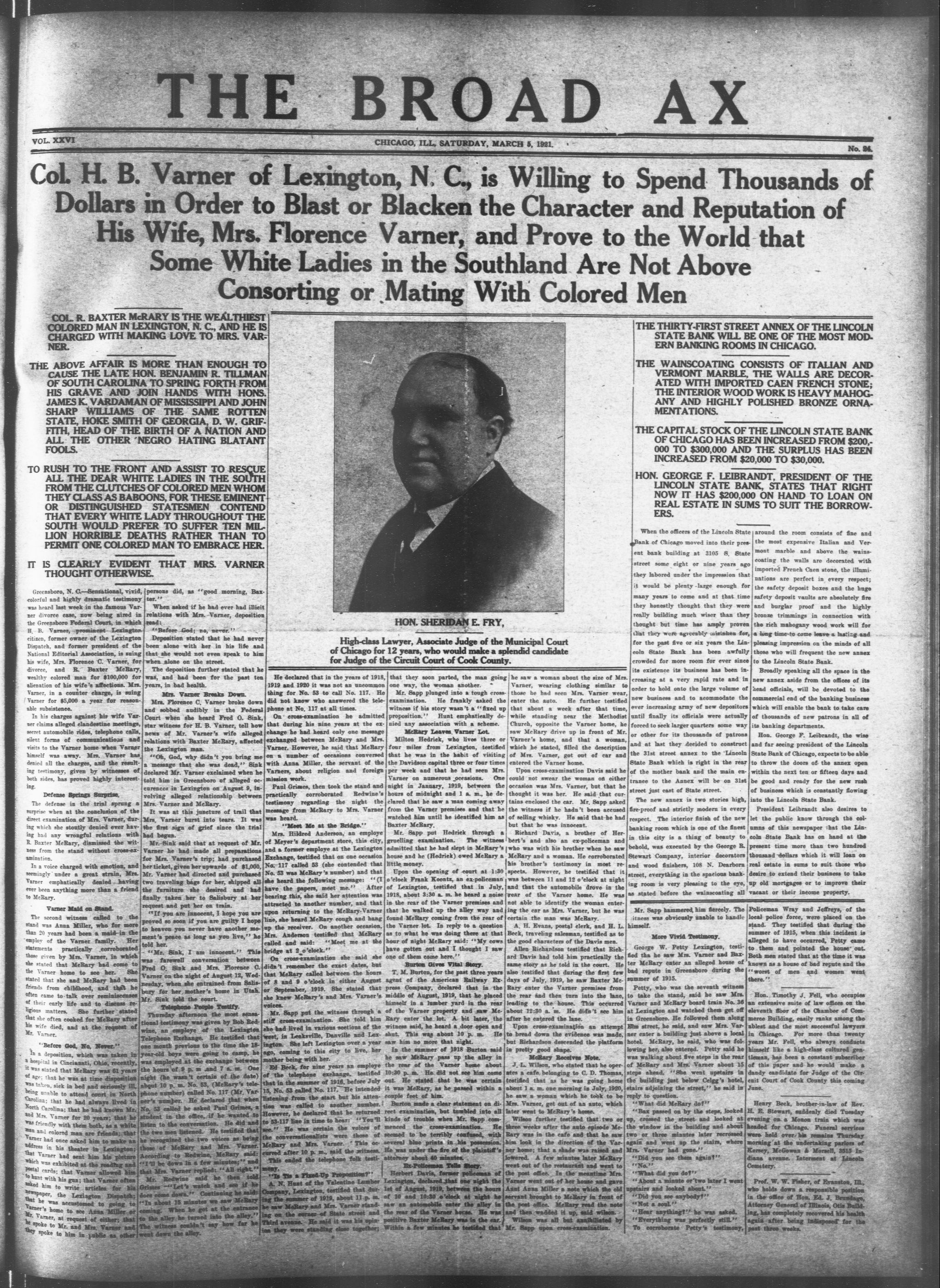
Col. H. B. Varner of Lexington, N. C., is Willing to Spend Thousands of Dollars in Order to Blast or Blacken the Character and Reputation of His Wife, Mrs. Florence Varner, and Prove to the World that Some White Ladies in the Southland Are Not Above Consorting or Mating With Colored Men
COL. R. BAXTER McRARY IS THE WEALTHIEST COLORED MAN IN LEXINGTON, N. C., AND HE IS CHARGED WITH MAKING LOVE TO MRS. VARNER.
THE ABOVE AFFAIR IS MORE THAN ENOUGH TO CAUSE THE LATE HON. BENJAMIN R. TILLMAN OF SOUTH CAROLINA TO SPRING FORTH FROM HIS GRAVE AND JOIN HANDS WITH HONS. JAMES K. VARDAMAN OF MISSISSIPPI AND JOHN SHARP WILLIAMS OF THE SAME ROTTEN STATE, HOKE SMITH OF GEORGIA, D. W. GRIFITH, HEAD OF THE BIRTH OF A NATION AND ALL THE OTHER NEGRO HATING BLATANT FOOLS.
TO RUSH TO THE FRONT AND ASSIST TO RESCUE ALL THE DEAR WHITE LADIES IN THE SOUTH FROM THE CLUTCHES OF COLORED MEN WHOM THEY CLASS AS BABOONS, FOR THESE EMINENT OR DISTINGUISHED STATESMEN CONTEND THAT EVERY WHITE LADY THROUGHOUT THE SOUTH WOULD PREFER TO SUFFER TEN MILLION HORRIBLE DEATHS RATHER THAN TO PERMIT ONE COLORED MAN TO EMBRACE HER.
IT IS CLEARLY EVIDENT THAT MRS. VARNER THOUGHT OTHERWISE.
Greensboro, N. C.—Sensational, vivid colorful and highly dramatic testimony was heard last week in the famous Varner divorce case, now being aired in the Greensboro Federal Court, in which H. B. Varner, prominent Lexington citizen, former owner of the Lexington Dispatch, and former president of the National Editorial Association, is suing his wife, Mrs. Florence C. Varner, for divorce, and R. Baxter McRary, wealthy colored man for $100,000 for alienation of his wife's affections. Mrs. Varner, in a counter charge, is suing Varner for $5,000 a year for reasonable subsistence.
In his charges against his wife Varner claims alleged clandestine meetings, secret automobile rides, telephone calls, silent forms of communications and visits to the Varner home when Varner himself was away. Mrs. Varner has denied all the charges, and the resulting testimony, given by witnesses of both sides, has proved highly interesting.
Defense Springs Surprise.
The defense in the trial sprung a surprise when at the conclusion of the direct examination of Mrs. Varner, during which she stoutly denied ever having had any wrongful relations with R. Baxter McRary, dismissed the witness from the stand without cross-examination.
In a voice charged with emotion, and seemingly under a great strain, Mrs. Varner emphatically denied having ever been anything more than a friend to McRary.
Varner Maid on Stand.
The second witness called to the stand was Anna Miller, who for more than 20 years had been a maid in the employ of the Varner family. Her statements practically corroborated these given by Mrs. Varner, in which she stated that McRary had come to the Varner home to see her. She stated that she and McRary had been friends from childhood, and that he often came to talk over reminiscences of their early life and to discuss religious matters. She further stated that she often cooked for McRary after his wife died, and at the request of Mr. Varner.
Before God, No. Never.
In a deposition, which was taken in a hospital in Cincinnati, Ohio, recently, it was stated that McRary was 61 years of age; that he was at time disposition was taken, sick in bed and seriously ill being unable to attend court in North Carolina; that he had always lived in North Carolina; that he had known Mr. and Mrs. Varner for 20 years; that he was friendly with them both, as a white man and colored man are friends; that Varner had once asked him to make an address in his theater in Lexington; that Varner had sent him his picture which was exhibited at the reading and postal cards; that Varner allowed him to hunt with his gun; that Varner often naked him to write articles for his newspaper, the Lexington Dispatch; that he was accustomed to going to Varner's home to see Anna Miller or Mr. Varner, at request of either; that he spoke to Mr. and Mrs. Varner and they spoke to him in public as other
THE BROAD AX
persons did, as "good morning, Baxter."
Before God; no, never.
Deposition stated that he had never been alone with her in his life and that she would not even speak to him when alone on the street.
The deposition further stated that he was, and had been for the past ten years, in bad health.
Mrs. Varner Breaks Down.
Mrs. Florence C. Varner broke down and sobbed audibly in the Federal Court when she heard Fred O. Sink, star witness for H. B. Varner, tell how news of Mr. Varner's wife alleged relations with Baxter McRary, affected the Lexington man.
"Oh, God, why didn't you bring me a message that she was dead," Sink declared Mr. Varner exclaimed when he told him in Greensboro of alleged occurrences in Lexington on August 9, involving alleged relationship between Mrs. Varner and McRary.
It was at this juncture of trail that Mrs. Varner burst into tears. It was the first sign of grief since the trial had begun.
Mr. Sink said that at request of Mr. Varner he had made all preparations for Mrs. Varner's trip; had purchased her ticket, given her upwards of $1,000, Mrs. Varner had directed and purchased two traveling bags for her, shipped all the furniture she desired and had finally taken her to Salisbury at her request and put her on train.
"If you are innocent, I hope you are proved so soon if you are guilty I hope to heaven you never have another moment's peace as long as you live," he told her.
"Mr. Sink, I am innocent." This was farewell conversation between Fred O. Sink and Mrs. Florence O. Varner on the night of August 12, Wednesday, when she entrained from Salisbury for her mother's home in Utah. Mrs. Sink told the court.
Thursday afternoon the most sensational testimony was given by Bob Redwine, an employee of the Lexington Telephone Exchange. He testified that one month previous to the time the 18-year-old boys were going to camp, he was employed at the exchange between the hours of 9 p. m. and 7 a. m. One night (he wasn't certain of the date) about 10 p. m. No. 53, (McRary's telephone number) called No. 117 (Mr. Varner's number. He declared that when No. 53 called he asked Paul Grimes, a student in the office, if he wanted to listen to the conversation. He did and the two men listened. He testified that he recognized the two voices as being those of McRary and Mrs. Varner. According to Redwine, McRary said: "I'll be down in a few minutes;" and that Mrs. Varner replied: "All right." Mr. Redwine said he then told Grimes: "Let's watch and see if he does come down." Continuing he said: "In about 15 minutes we saw McRary coming. When he get at the entrance to the alley he turned into the alley." The witness couldn't say how far he went down the alley.
[Image of a man in a suit with a tie].
High-class Lawyer, Associate Judge of the Municipal Court of Chicago for 12 years, who would make a splendid candidate for Judge of the Circuit Court of Cook County.
He declared that in the years of 1918, 1919 and 1920 it was not an uncommon thing for No. 53 to call No. 117. He did not know who answered the telephone at No. 117 at all times. On cross-examination he admitted that during his nine years at the exchange he had heard only one message exchanged between McRary and Mrs. Varner. However, he said that McRary on a number of occasions conversed with Anna Miller, the servant of the Varners, about religion and foreign mission work. Paul Grimes, then took the stand and practically corroborated Redwine's testimony regarding the night the message from McRary to Mrs. Varner was heard.
"Meet Me at the Bridge."
Mrs. Hildred Anderson, an employee of Meyer's department store, this city, and a former employee at the Lexington Exchange, testified that on one occasion No. 117 called 53 (she contended that No. 53 was McRary's number) and that she heard the following message: "I have the papers, meet me." After hearing this, she said her attention was attracted to another number, and that upon returning to the McRary-Varner line, she heard McRary cough and hang up the receiver. On another occasion, Mrs. Anderson testified that McRary called and said: "Meet me at the bridge at 2 o'clock."
On cross-examination she said she didn't remember the exact dates, but that McRary called between the hours of 8 and 9 o'clock in either August or September, 1919. She stated that she knew McRary's and Mrs. Varner's voices.
Mr. Sapp put the witness through a stiff cross-examination. She told him she had lived in various sections of the west, in Leaksville, Danville and Lexington. She left Lexington over a year ago, coming to this city to live, her mother being with her.
Ed Beck, for nine years an employee of the telephone exchange, testified that in the summer of 1916, before July 15, No. 53 called No. 117. He intended listening from the start but his attention was called to another number. However, he declared that he returned to 53-117 line in time to hear: "You'll see." He was certain the voices of the conversationists were those of McBary and Mrs. Varner. "This occurred after 10 p. m., said the witness. This ended the telephone folk testimony.
"Is It a Fixed-Up Proposition?"
A. N. Hunt of the Valentine Lumber Company, Lexington, testified that during the summer of 1925, about 11 p. m. he was McBary and Mrs. Varner standing on the curraz of State street and Third avenue. He said it was his opinion they were standing close together;
that they soon parted, the man going one way, the woman another.
one way, the woman another.
Mr. Sapp plunged into a tough cross examination. He frankly asked the witness if his story wasn't a "fixed up proposition." Hunt emphatically denied any association with a scheme.
McRary Leaves Varner Lot.
Milton Hedrick, who lives three or four miles from Lexington, testified that he was in the habit of visiting the Davidson capital three or four times per week and that he had seen Mrs. Varner on numerous occasions.
One night in January, 1919, between the hours of midnight and 1 a.m., he declared that he saw a man coming away from the Varner premises and that he watched him until he identified him as Baxter McRary.
Mr. Sapp put Hedrick through a gruelling examination. The witness admitted that he had slept in McRary's house and he (Hedrick) owed McRary a little money.
Upon the opening of court at 1:30 o'clock Frank Koontz, an ex-policeman of Lexington, testified that in July 1918, about 3:30 a. m. he heard a noise in the rear of the Varner premises and that he walked up the alley way and found McRary coming from the rear of the Varner lot. In reply to a question as to what he was doing there at that hour of night McRary said: "My cows have gotten out and I thought I saw one of them come here."
Burton Gives Vital Story.
T. M. Burton, for the past three years agent of the American Railway Express Company, declared that in the middle of August, 1919, that he placed himself in a lumber yard in the rear of the Varner property and saw McRary enter the lot. A bit later, the witness said, he heard a door open and shut. This was about 10 p. m. He saw him no more that night.
In the summer of 1918 Burton said he saw McRary pass up the alley in the rear of the Varner home about 10:30 p.m. He did not see him come out. He stated that he was certain it was McRary, as he passed within a couple feet of him.
Burton made a clear statement on direct examination, but tumbled into all kinds of trouble when Mr. Sapp commenced the cross-examination. He seemed to be terribly confused, with several blue prints in his possession. He was under the fire of the plaintiff's attorney about 40 minutes.
Dr. Pollockman Tells Law
Ex-Policeman Tells Story.
Herbert Davin, former policeman of Lexington, declared that one night the 1st of August, 1919, between the hours of 10 and 10:20 o'clock at night he saw an automobile enter the alley in the rear of the Varner horse. He was positive Baxter McBery was in the car. Within a few minutes he testified that
he saw a woman about the size of Mrs. Varner, wearing clothing similar to those he had seen Mrs. Varner wear enter the auto. He further testified that about a week after that time, while standing near the Methodist Church, opposite the Varner home, he saw McRary drive up in front of Mr. Varner's home, and that a woman, which he stated, filled the description of Mrs. Varner, got out of car and entered the Varner home.
Upon cross-examination Davis said he could not swear the woman on either occasion was Mrs. Varner, but that he thought it was her. He said that curtains enclosed the ear. Mr. Sapp asked the witness if he hadn't been accused of selling whisky. He said that he had but that he was innocent.
Richard Davis, a brother of Herbert's and also an ex-policeman and who was with his brother when he saw McRary and a woman. He corroborated his brother's testimony in most respects. However, he testified that it was between 11 and 12 o'clock at night and that the automobile drove in the rear of the Varner home. He was not able to identify the woman entering the car as Mrs. Varner, but he was certain the man was McRary.
A. H. Evans, postal clerk, and H. L. Beck, traveling salesman, testified as to the good characters of the Davis men.
Allen Richardson testified that Richard Davis had told him practically the same story as he told in the court. He also testified that during the first few days of July, 1919, he saw Baxter McRary enter the Varner premises from the rear and then turn into the lane, leading to the house. This occurred about 12:30 a. m. He didn't see him after he entered the lane.
Upon cross-examination an attempt to bread down the evidence was made, but Richardson descended the platform in pretty good shape.
McRary Receives Note.
J. L. Wilson, who stated that he operates a cafe, belonging to C. D. Thomas, testified that as he was going home about 1 a. m. one morning in July, 1920, he saw a woman which he took to be Mrs. Varner, get out of an auto, which later went to McRary's home.
Wilson further testified that two or three weeks after the auto episode McBary was in the cafe and that he saw him look in the direction of the Varner home; that a shade was rained and lowered. A few minutes later McBary went out of the restaurant and went to the post office. In the meantime Mrs. Varner went out of her house and gave Aunt Ann Miller a note which the old servant brought to McBary in front of the post office. McBary read the note and then wadded it up, said wilson. Wilson was all but annihilated by Mr. Sapp upon cross-examination.
THE THIRTY-FIRST STREET ANNEX OF THE LINCOLN STATE BANK WILL BE ONE OF THE MOST MODERN BANKING ROOMS IN CHICAGO.
THE WAINSCOATING CONSISTS OF ITALIAN AND VERMONT MARBLE, THE WALLS ARE DECORATED WITH IMPORTED CAEN FRENCH STONE; THE INTERIOR WOOD WORK IS HEAVY MAHOGANY AND HIGHLY POLISHED BRONZE ORNAMENTATIONS.
THE CAPITAL STOCK OF THE LINCOLN STATE BANK OF CHICAGO HAS BEEN INCREASED FROM $200,000 TO $300,000 AND THE SURPLUS HAS BEEN INCREASED FROM $20,000 TO $30,000.
HON. GEORGE F. LEIBRANDT, PRESIDENT OF THE LINCOLN STATE BANK, STATES THAT RIGHT NOW IT HAS $200,000 ON HAND TO LOAN ON REAL ESTATE IN SUMS TO SUIT THE BORROWERS.
When the officers of the Lincoln State Bank of Chicago moved into their present bank building at 3105 S. State street some eight or nine years ago they labored under the impression that it would be plenty large enough for many years to come and at that time they honestly thought that they were really building much wiser than they thought but time has amply proven that they were agreeably mistaken for, for the past five or six years the Lincoln State Bank has been awfully crowded for more room for ever since its existence its business has been increasing at a very rapid rate and in order to hold onto the large volume of new business and to accommodate the ever increasing army of new depositors until finally its officials were actually forced to seek larger quarters some way or other for its thousands of patrons and at last they decided to construct the 31st street annex to the Lincoln State Bank which is right in the rear of the mother bank and the main entrance to the Annex will be on 31st street just east of State street.
The new annex is two stories high fire-proof and strictly modern in every respect. The interior finish of the new banking room which is one of the finest in this city is a thing of beauty to behold, was executed by the George R. Stewart Company, interior decorators and wood finishers, 108 N. Dearborn street, everything in the spacious banking room is very pleasing to the eye, as stated before the wainscoating all
Mr. Sapp hammered him fiercely. The fitness was obvicusly unable to handle himself.
More Vivid Testimony.
George W. Petty Lexington, testified tha he saw Mrs. Varner and Baxter McRary came an alleged house of bad repute in Greensboro during the summer of 1915.
Petty, who was the seventh witness to take the stand, said he saw Mrs. Varner and McRary board train No. 36 at Lexington and watched them get off in Greensboro. He followed them along Elm street, he said, and saw Mrs. Varner enter a building just above a local hotel. McRary, he said, who was following her, also entered. Petty said he was walking about five steps in the rear of McRary and Mrs. Varner about 15 steps ahead. "She went upstairs in the building just below Celgg's hotel, stairs adjoining the street," he said in reply to question.
"What did McRary do?"
"Bax passed on by the steps, looked up, crossed the street and looked at the window in the building and about two or three minutes later recrossed again and went up the stairs, where Mrs. Varner had gone."
"Did you see them again?"
"No."
No. 24
around the room consists of fine and the most expensive Italian and Vermont marble and above the wainscoating the walls are decorated with imported French Caen stone, the illuminations are perfect in every respect; the safety deposit boxes and the huge safety deposit vaults are absolutely fire and burglar proof and the highly bronze trimmings in connection with the rich mahogany wood work will for a long time to come leave a lasting and pleasing impression on the minds of all those who will frequent the new annex to the Lincoln State Bank. Broadly speaking all the space in the new annex aside from the offices of its head officials, will be devoted to the commercial end of the banking business which will enable the bank to take care of thousands of new patrons in all of its banking departments. Hon. George F. Leibrandt, the wise and far seeing president of the Lincoln State Bank of Chicago, expects to be able to throw the doors of the annex open within the next ten or fifteen days and be good and ready for the new rush of business which is constantly flowing into the Lincoln State Bank.
President Leibrandt also desires to let the public know through the columns of this newspaper that the Lincoln State Bank has on hand at the present time more than two hundred thousand dollars which it will loan on real estate in sums to suit those who desire to extend their business to take up old mortgages or to improve their vacant or their income property.
Policeman Wray and Jeffreys, of the local police force, were placed on the stand. They testified that during the summer of 1915, when this incident is alleged to have occurred, Petty came to them and pointed the house out. Both men stated that at the time it was known as a house of bad repute and the "worst of men and women went there."
Hon. Timothy J. Fell, who occupies an extensive suite of law offices on the eleventh floor of the Chamber of Commerce Building, easily ranks among the ablest and the most successful lawyers in Chicago. For more than twenty years Mr. Fell, who always conducts himself like a high-class cultured gentleman, has been a constant subscriber of this paper and he would make a dandy candidate for Judge of the Circuit Court of Cook County this coming June.
Henry Beck, brother-in-law of Rev. H. E. Stewart, suddenly died Tuesday evening on a Monon train which was headed for Chicago. Funeral services were held over his remains Thursday morning at the undertaking parlor of Korsey, McGowan & Morsell, 3515 Indiana avenue. Interment at Lincoln Cemetery.
Prof. W. W. Fisher, of Evanston, Ill., who holds down a responsible position in the office of Hon. Ed. J. Brundage, Attorney General of Illinois, Otis Building, has completely recovered his health again after being indisposed for the past three weeks.
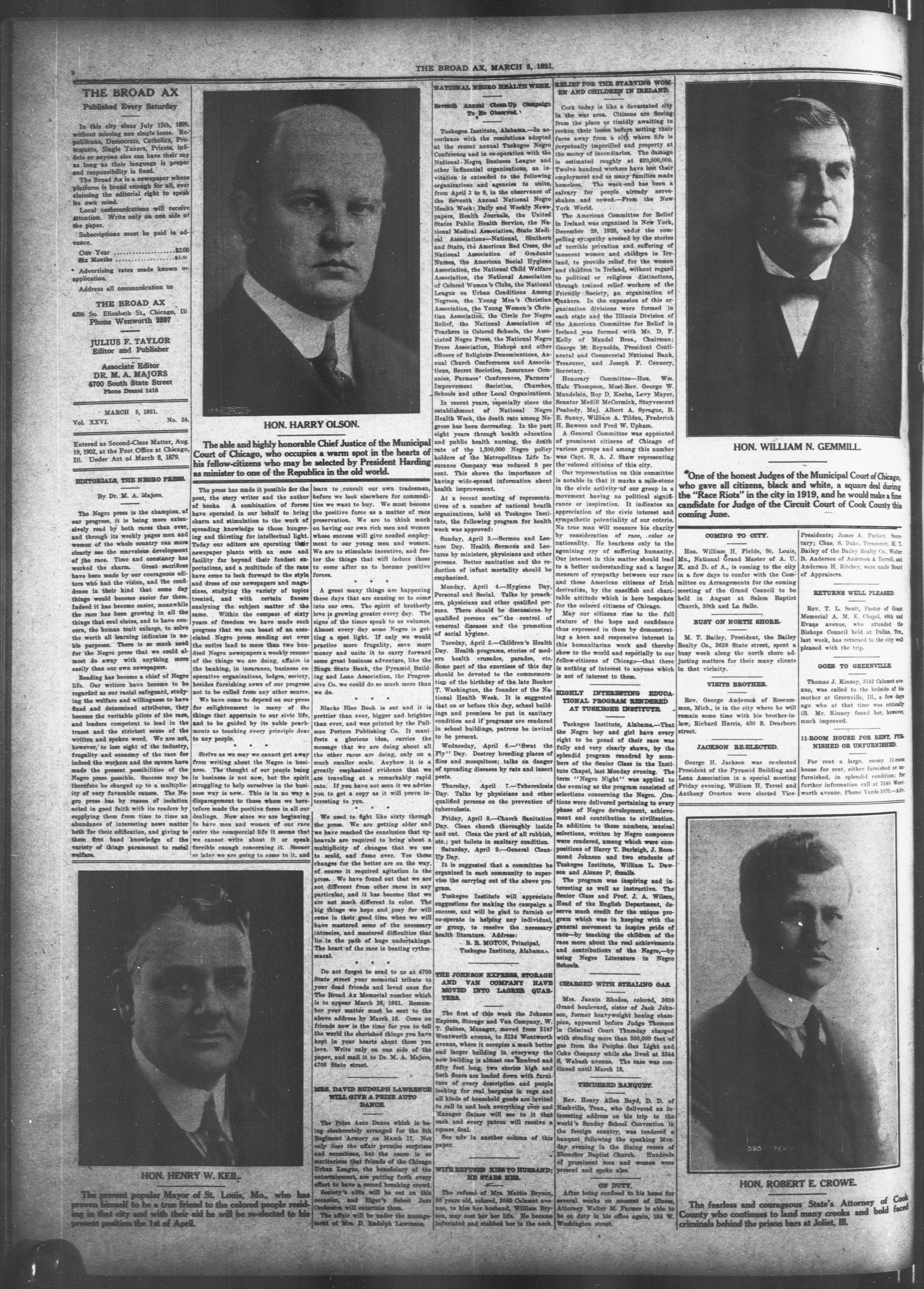
In this city since July 15th, 1899, without missing one single issue. Republicans, Democrats, Catholics, Protestants, Single Taxers, Priests, infidels or anyone else can have their say as long as their language is proper and responsibility is fixed. The Broad Ax is a newspaper whose platform is broad enough for all, ever claiming the editorial right to speak his own mind.
Local communications will receive attention. Write only on one side of the paper.
* Subscriptions must be paid in advance.
One Year .....$2.00
Six Months .....$1.00
* Advertising rates made known on application.
Address all communication to
THE BROAD AX
6206 So. Elizabeth St., Chicago, Ill
Phone Wenworth 2597
JULIUS F. TAYLOR
Editor and Publisher
Associate Editor
DR. M. A. MAJORS
4700 South State Street
Phone Drexel 1416
MARCH. 5, 1921.
Vol. XXVI. No. 24.
Entered as Second-Class Matter, Aug.
19, 1902, at the Post Office at Chicago.
III. Under Act of March 8, 1879.
EDITORIALS. THE NEGRO PRESS.
By Dr. M. A. Majors.
The Negro press is the champion of our progress, it is being more extensively read by both races than ever, and through its weekly pages men and women of the whole country can more clearly see the marvelous development of the race. Time and constancy has worked the charm. Great-sacrifices have been made by our courageous editors who had the vision, and the confidence in their kind that some day things would become easier for them. Indeed it has become easier, meanwhile the race has been growing in all the things that soul elates, and to have concern, the human trait enlarg, to solve the worth all learning indicates in noble purposes. There is so much need for the Negro press that we could almost do away with anything more easily than our own newspapers.
Reading has become a chief of Negro life. Our writers have become to be regarded as our racial safeguard, studying the welfare and willingness to have fixed and determined attributes, they become the veritable pilots of the race, and leaders competent to lead in the truest and the strictest sense of the written and spoken word. We are not, however, to lose sight of the industry, fraugality and economy of the race for indeed the workers and the savers have made the present possibilities of the Negro press possible. Success may be therefore be charged up to a multiplicity of very favorable causes. The Negro press has by reason of isolation acted in good faith with its readers by supplying them from time to time an abundance of interesting news matter both for their edification, and giving to them first hand knowledge of the variety of things paramount to racial welfare.
```markdown
```
M. B.
The present popular Mayor of St. Louis proven himself to be a true friend to the coming in that city and with their aid he will be present position the 1st of April.
The present popular Mayor of St. Louis, Mo., who has proven himself to be a true friend to the colored people residing in that city and with their aid he will be re-elected to his present position the 1st of April.
107 PEI
The able and highly honorable Court of Chicago, who occupi his fellow-citizens who may be as minister to one of the Repub
The able and highly honorable Chief Justice of the Municipal Court of Chicago, who occupies a warm spot in the hearts of his fellow-citizens who may be selected by President Harding as minister to one of the Republics in the old world.
The press has made it possible for the poet, the story writer and the author of books. A combination of forces have operated in our behalf to bring charm and stimulation to the work of spreading knowledge to those hungering and thirsting for intellectual light. Today our editors are operating their newspaper plants with an ease and facility far beyond their fondest expectations, and a multitude of the race have come to look forward to the style and dress of our newspapers and magazines, studying the variety of topics treated, and with certain finesse analyzing the subject matter of the same. Within the compass of sixty years of freedom we have made such progress that we can boast of an associated Negro press sending out over the entire land to more than two hundred Negro newspapers a weekly resume of the things we are doing, affairs in the banking, in insurance, business cooperative organizations, lodges, society besides furnishing news of our progress not to be culled from any other source. We have come to depend on our press for enlightenment in many of the things that appertain to our civic life and to be guided by its noble peachments as touching every principle dear to any people.
Strive as we may we cannot get away from writing about the Negro in business. The thought of our people being in business is not new, but the spirit struggling to help ourselves in the business way is new. This is in no way a displacement to those whom we heretore made the positive force in all our dealings. Now since we are beginning to have men and women of our race enter the commercial life it seems that we cannot write about it or speak forcible enough concerning it. Sooner or later we are going to come to it, and
1930
of St. Louis, Mo., who has end to the colored people resid aid he will be re-elected to his al.
HON. HARRY OLSON.
learn to consult our own tradesmen before we look elsewhere for commodities we want to buy. We must become the positive force as a matter of race preservation. We are to think much on having our own rich men and women whose success will give needed employment to our young men and women We are to stimulate incentive, and foster the things that will induce those to come after us to become positive forces.
A great many things are happening these days that are causing us to come into our own. The spirit of brotherly love is growing greater every day. The signs of the times speak to us volumes. Almost every day some Negro is getting a spot light. If only we would practice more frugality, save more money and unite it to carry forward some great business adventure, like the Binga State Bank, the Pyramid Building and Loan Association, the Progressive Co. we could do so much more than we do.
Blacks Blue Book is out and it is prettier than ever, bigger and brighter than ever, and was printed by the Pullman Porters Publishing Co. It manifests a glorious idea, carries the message that we are doing about all the other races are doing, only on a much smaller scale. Anyhow it is a greatly emphasized evidence that we are traveling at a remarkably rapid rate. If you have not seen it we advise you to get a copy as it will prove interesting to you.
We used to fight like sixty through the press. We are getting older and we have reached the conclusion that upheavals are required to bring about a multiplicity of changes that we use to scold, and fume over. Yes these changes for the better are on the way of course it required agitation in the press. We have found out that we are not different from other races in any particular, and it has become that we are not much different in color. The big things we hope and pray for will come in their good time when we will have mastered some of the necessary intracies, and mastered difficulties that lie in the path of huge undertakings. The heart of the race is beating rythm-macal.
Do not forget to send to us at 4700 State street your memorial tribute to your dead friends and loved ones for The Broad Ax Memorial number which is to appear March 26, 1921. Remember your matter must be sent to the above address by March 18. Come on friends now is the time for you to tell the world the cherished things you have kept in your hearts about those you love. Write only on one side of the paper, and mail it to Dr. M. A. Majors, 4700 State street.
MRS. DAVID RUDOLPH LAWRENCE
WILL GIVE A PRIZE AUTO
DANCE
The Prize Auto Dance which is being elaborately arranged for the 8th Regiment Armory on March 17. Not only does the affair promise surprises and sensations, but the cause is so memorious that friends of the Chicago Urban League, the beneficiary of the entertainment, are putting forth every effort to have a record breaking crowd. Society's elite will be out on this occasion, and Elgar's Select Jazz Orchestra will entertain them. The affair will be under the management of Mrs. D. Radolph Lawrence.
. . .
. . .
THE BROAD AX. MARCH 5, 1921.
Tuskegee Institute, Alabama.—In accordance with the resolutions adopted at the recent annual Tuskegee Negro Conference and in co-operation with the National Negro Business League and other influential organizations, an invitation is extended to the following organizations and agencies to unite, from April 3 to 9, in the observance of the Seventh Annual National Negro Health Week: Daily and Weekly Newspapers, Health Journals, the United States Public Health Service, the National Medical Association, State Medical Associations—National, Southern and State, the American Red Cross, the National Association of Graduate Nurses, the American Social Hygiene Association, the National Child Welfare Association, the National Association of Colored Women's Clubs, the National League on Urban Conditions Among Negroes, the Young Men's Christian Association, the Young Women's Christian Association, the Circle for Negro Relief, the National Association of Teachers in Colored Schools, the Associated Negro Press, the National Negro Press Association, Bishops and other officers of Religious Denominations, Annual Church Conferences and Associations, Secret Societies, Insurance Companies, Farmers' Conferences, Farmers' Improvement Societies, Churches, Schools and other Local Organizations.
In recent years, especially since the establishment of National Negro Health Week, the death rate among Negroes has been decreasing. In the past eight years through health education and public health nursing, the death rate of the 1,500,000 Negro policy holders of the Metropolitan Life Insurance Company was reduced 9 percent. This shows the importance of having wide-spread information about health improvement.
At a recent meeting of representatives of a number of national health organizations, held at Tuskegee Institute, the following program for health week was approved: Sunday, April 3.—Sermon and Lecture Day. Health Sermons and Lectures by ministers, physicians and other persons. Better sanitation and the reduction of infant mortality should be emphasized. Monday, April 4.—Hygiene Day. Personal and Social. Talks by preachers, physicians and other qualified persons. There should be discussions by qualified persons on the control of venereal diseases and the promotion of social hygiene.
Tuesday, April 5.—Children's Health Day. Health programs, stories of modern health crusades, parades, etc. Some part of the exercises of this day should be devoted to the commemoration of the birthday of the late Booker T. Washington, the founder of the National Health Week. It is suggested that on or before this day, school buildings and premises be put in sanitary condition and if programs are rendered in school buildings, patrons be invited to be present.
Wednesday, April 6.—"Swat the Fly" Day. Destroy breeding places of flies and mosquitoes; talks on danger of spreading diseases by rats and insect pests.
Thursday, April 7.—Tuberculosis Day. Talks by physicians and other qualified persons on the prevention of tuberculosis.
Friday, April 8.—Church Sanitation Day. Clean church thoroughly inside and out. Clean the yard of all rubbish, etc.; put toilets in sanitary condition. Saturday, April 9.—General Clean-Up Day.
It is suggested that a committee be organized in each community to supervise the carrying out of the above program.
Tuskegee Institute will appreciate suggestions for making the campaign a success, and will be glad to furnish or co-operate in helping any individual, or group, to receive the necessary health literature. Address:
B. R. MOTON, Principal,
Tuskegee Institute, Alabama.
THE JOHNSON EXPRESS, STORAGE
AND VAN COMPANY HAVE
MOVED INTO LAGREB QUARTERS.
The first of this week the Johnson Express, Storage and Van Company, W. T. Gaines, Manager, moved from 5147 Wentworth avenue, to 5134 Wentworth avenue, where it occupies a much better and larger building in everyway the new building is almost one hundred and fifty feet long, two stories high and both floors are loaded down with furniture of every description and people looking for real bargains in rugs and all kinds of household goods are invited to call in and look everything over and Manager Gaines will see to it that each and every patron will receive a square deal.
The refusal of Mrs. Mattie Bryson, 38 years old, colored 2040 Calmet avenue, to kiss her husband, William Bryson, may cost her her life. He became infuriated and stabbed her in the neck
RELIEF FOR THE STARVING WOMEN AND CHILDREN IN IRELAND.
Cork today is like a devastated city in the war area. Citizens are fleeing from the place or timidly awaiting to reckon their losses before setting their faces away from a city where life is perpetually imperilled and property at the mercy of incendiaries. The damage is estimated roughly at $20,000,000. Twelve hundred workers have lost their employment and as many families made homeless. The week-end has been a calvary for people already nerv-shaken and cowed—From the New York World.
The American Committee for Relief in Ireland was organized in New York, December 29, 1920, under the compelling sympathy aroused by the stories of terrible privation and suffering of innocent women and children in Ireland, to provide relief for the women and children in Ireland, without regard to political or religious distinctions, through trained relief workers of the Friendly Society, an organization of Quakers. In the expansion of this organization divisions were formed in each state and the Illinois Division of the American Committee for Relief in Ireland was formed with Mr. D. F. Kelly of Mandel Bros., Chairman; George M. Reynolds, President Continental and Commercial National Bank, Treasurer, and Joseph F. Connery, Secretary.
Honorary Committee—Hon. Wm.
Hale Thompson, Most-Rev. George W.
Mundelein, Roy D. Keehn, Levy Mayer,
Senator Medill McCormick, Stuyvesant
Peabody, Maj. Albert A. Sprague, B.
E. Sunny, William A. Tilden, Frederick
H. Rawson and Fred W. Upham.
A General Committee was appointed
of prominent citizens of Chicago of
various groups and among this number
was Capt. R. A. J. Shaw representing
the colored citizens of this city.
Our representation on this committee is notable in that it marks a mile-stone in the civic activity of our group in a movement having no political significance or inspiration. It indicates an appreciation of the civic interest and sympathetic potentiality of our coterie. No true man will measure his charity by consideration of race, color or nationality. He heartens only to the agonizing cry of suffering humanity. Our interest in this matter should lead to a better understanding and a larger measure of sympathy between our race and those American citizens of Irish derivation, by the unselfish and charitable attitude which is here bespoken for the colored citizens of Chicago.
May our citizens rise to the full stature of the hope and confidence thus expressed in them by demonstrating a keen and responsive interest in this humanitarian work and thereby show to the world and especially to our fellow-citizens of Chicago—that there is nothing of interest to anyone which is not of interest to them.
EIGHLY INTERESTING EDUCATIONAL PROGRAM RENDERED AT TUSKEGEE INSTITUTE
Tuskegee Institute, Alabama—That the Negro boy and girl have every right to be proud of their race was fully and very clearly shown, by the splendid program reneded by members of the Senior Class in the Institute Chapel, last Monday evening. The term "Negro Night" was applied to the evening as the program consisted of selections concerning the Negro. Orations were delivered pertaining to every phase of Negro development, achievement and contribution to civilization. In addition to these numbers, musical selections, written by Negro composers were rendered, among which were compositions of Harry T. Burleigh, J. Rosamond Johnson and two students of Tuskegee Institute, William L. Dawson and Alonzo P. Smalla.
The program was inspiring and interesting as well as instructive. The Senior Class and Prof. J. A. Wilson, Head of the English Department, deserve much credit for the unique program which was in keeping with the general movement to inspire pride of race—by teaching the children of the race more about the real achievements and contributions of the Negro,—by using Negro Literature in Negro Schools.
CHARGED WITH STEALING GAS.
Mrs. Jannie Rhodes, colored, 2638 Grand boulevard, sister of Jack Johnson, former heavyweight boxing champion, appeared before Judge Thomson in Criminal Court Thursday charged with stealing more than 500,000 feet of gas from the Peoples Gas Light and Coke Company while she lived at 3344 S. Wabash avenue. The case was continued until March 18.
TENDERED BANQUET
Rev. Henry Allen Boyd, D. D. of Nashville, Tenn., who delivered an interesting address on his trip to the world's Sunday School Convention in the foreign country, was tended a banquet following the speaking Monday evening in the dining rooms of Ebenezer Baptist Church. Hundreds of prominent men and women were present and spoke also.
ON DUTY.
After being confined to his home for several weeks on account of illness, Attorney Walter M. Farmer is able to be on duty in his office again, 184 W. Washington street.
I
HON. WILLIAM N. GEMMILL
One of the honest Judges of the Municipal Co who gave all citizens, black and white, a squa the "Race Riots" in the city in 1919, and he wom candidate for Judge of the Circuit Court of Co coming June.
honest Judges of the Municipal Court citizens, black and white, a squats" in the city in 1919, and he wou Judge of the Circuit Court of Co
One of the honest Judges of the Municipal Court of Chicago, who gave all citizens, black and white, a square deal during the "Race Riots" in the city in 1919, and he would make a fine candidate for Judge of the Circuit Court of Cook County this coming June.
COMING TO OTY.
Hon. William H. Fields, St. Louis, Mo., National Grand Master of A. U. K. and D. of A., is coming to the city in a few days to confer with the Committee on Arrangements for the coming meeting of the Grand Council to be held in August at Salem Baptist Church, 30th and La Salle.
BUSY ON NORTH SHORE
M. T. Bailey, President, the Bailey Realty Co., 3638 State street, spent a busy week along the north shore adjusting matters for their many clients in that vicinity.
VISITS BROTHER
Rev. George Anderson of Rosecommon, Mich., is in the city where he will remain some time with his brother-in-law, Richard Harris, 450 S. Dearborn street.
JACKSON RE-ELECTED
George H. Jackson was re-elected President of the Pyramid Building and Loan Association in a special meeting Friday evening, William H. Terrel and Anthony Overton were elected Vice-
393
393
393 PED
HON. ROBERT E. CROWE
The fearless and courageous State's Atta County who continues to land many crooks criminals behind the prison bars at Joliet, Ill.
iss and courageous State's Attorneys continues to land many crooks and find the prison bars at Joliet, Ill.
The fearless and courageous State's Attorney of County who continues to land many crooks and bold criminals behind the prison bars at Joliet, Ill.
The fearless and courageous State's Attorney of County who continues to land many crooks and bold criminals behind the prison bars at Joliet, Ill.
the Municipal Court of Chicago,
and white, a square deal during
1919, and he would make a fine
court Court of Cook County this
Presidents; James A. Parker, Secretary; Chas, S. Duke, Treasurer; M. T.
Bailey of the Bailey Realty Co., Walter
B. Anderson of Anderson & Terrell, and
Anderson H. Ritehey, were made Board
of Appraisers.
RETURNS WELL PLEASED
Rev. T. L. Scott, Pastor of Great Memorial A. M. E. Chapel, 46th and Evans avenue, who attended the Bishops Council held at Dallas, Tex. last week, has returned to the city well pleased with the trip.
GOES TO GREENVILLE
Thomas J. Kinney, 3142 Calumet avenue, was called to the bedside of his mother at Greenville, Ill., a few days ago who at that time was critically ill. Mr. Kinney found her, however, much improved.
11-BOOM HOUSE FOR RENT, FUB
NISHED OR UNFURNISHED.
For rent a large, roomy 11-room house for rent, either furnished or unfurnished, in splendid condition; for further information call 5140 Westworth avenue. Phone Yards 1075-Adv.
THE NEW YORK TIMES
State's Attorney of Coo many crooks and bold face at Joliet, Ill.
THE GIRLS' DRESS
Spotted Finery and Gay Colors Give Appearance of 'Carelessness, Fashion Critic Declares.
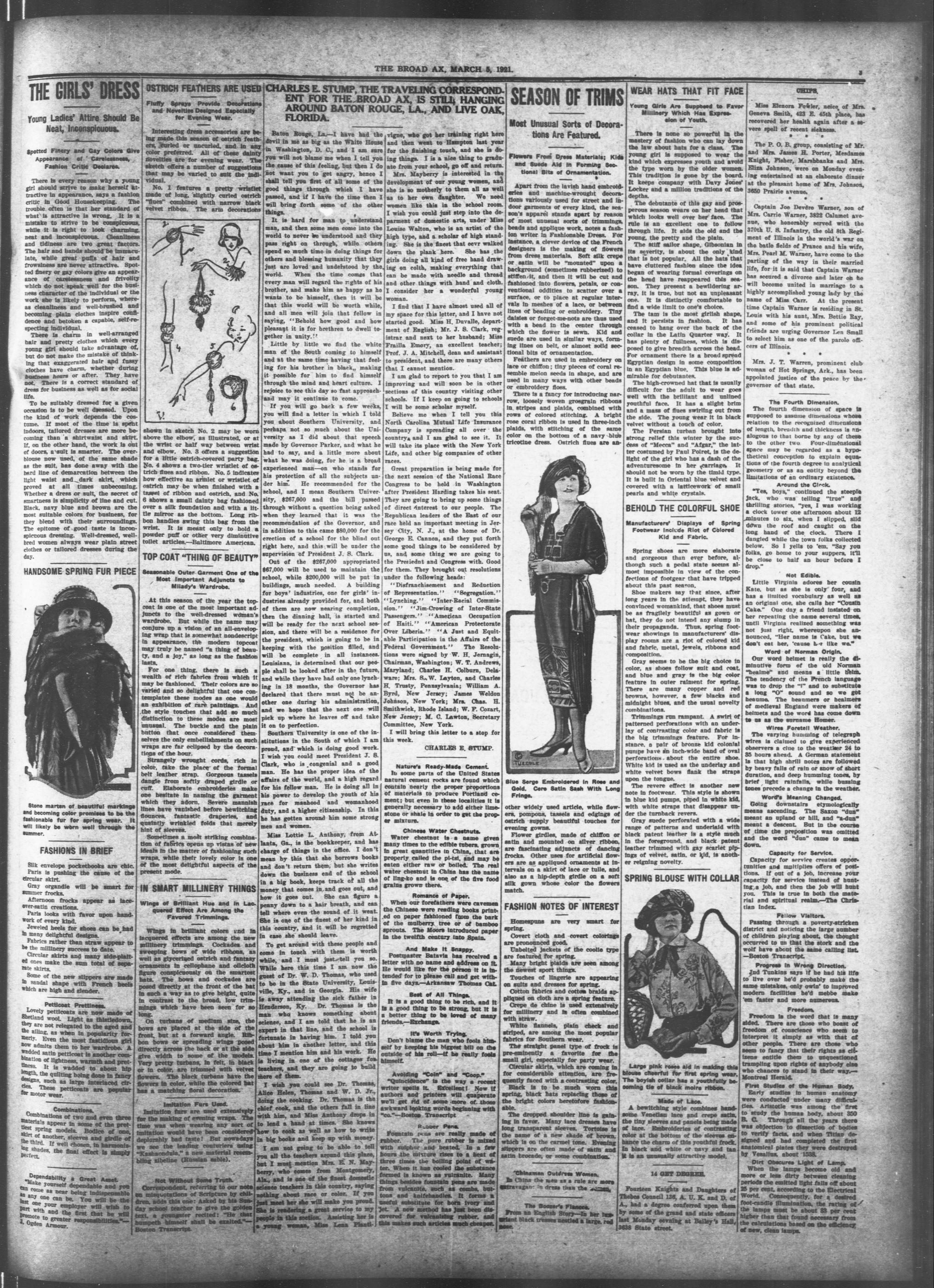
There is every reason why a young girl should strive to make herself attractive in appearance, says a fashion critic in Good Housekeeping. The trouble often is that her standard of what is attractive is wrong. It is a mistake to strive to be conspicuous, while it is right to look charming, neat and inconspicuous. Cleanliness and tidiness are two great factors. The hair and hands should be immaculate, while great puffs of hair and frownsiness are never attractive. Spotted finery or gay colors give an appearance of carelessness and frivolity which do not speak well for the business character of the individual or the work she is likely to perform, whereas cleanliness and well-brushed and becoming plain clothes inspire confidence and betoken a capable, self-respecting individual.
There is charm in well-arranged hair and pretty clothes which every young girl should take advantage of, but do not make the mistake of thinking that exaggerated hair and fussy clothes have charm, whether during business hours or after. They have not. There is a correct standard of dress for business as well as for social life.
To be suitably dressed for a given occasion is to be well dressed. Upon the kind of work depends the costume. If most of the time is spent indoors, tailored dresses are more becoming than a shirtwaist and skirt. If, on the other hand, the work is out of doors, a suit is smarter. The overbouse now used, of the same shade as the suit, has done away with the hard line of demarcation between the light waist and dark skirt, which proved at all times unbecoming. Whether a dress or suit, the secret of smartness is simplicity of the line and cut. Black, navy blue and brown are the most suitable colors for business, for they blend with their surroundings. The epitome of good taste is inconspicuous dressing. Well-dressed, well-bred women always wear plain street clothes or tailored dresses during the day.
HANDSOME SPRING FUR PIECE
M.
Stone marten of beautiful markings and becoming color promises to be the fashionable fur for spring wear. It will likely be worn well through the summer.
FASHIONS IN BRIEF
Silk envelope pocketbooks are chic. Paris is pushing the cause of the circular skirt. Gray organdie will be smart for summer frocks.
Circular skirts and many side-plaited ones make the sum total of separate skirts.
Some of the new slippers are made in sandal shape with French heels which are high and slender.
Petticoat Petticoat
Petticoat Prettiness
Lovely petticoats are now made of Sheetland wool. Light as thistledown, they are not relegated to the aged and the ailing, as when in popularity formerly. Even the most fastidious girl now admits them to her wardrobe. A wadded satin petticoat is another combination of lightness, warmth and pettiness. It is wadded to about hip length, the quilting being done in fancy designs, such as large interlined circles. These petticoats are popular for motor wear.
Combinations
Combinations of two and even three materials appear in some of the prettiest spring models. Bodice of one, shirt of another, sleeves and girdle of the third. If well chosen, in harmonizing shades, the final effect is simply perfect.
Dependability a Great Asset
"Make yourself dependable and you can come as near being indispensable as any one can be. You will be the last one your employer will wish to part with and the first that he will promote to greater responsibilities"—J. Ogden Armour.
Fluffy Sprays Provide Decorations and Novelties Designed Especially for Evening Wear.
Interesting dress accessories are being made this season of ostrich feathers, curled or uncurled, and in any color preferred. All of these dainty novelties are for evening wear. The sketch offers a number of suggestions that may be varied to suit the individual.
No. 1 features a pretty wristlet made of long, slightly curled ostrich "fuses" combined with narrow black velvet ribbon. The arm decorations
2
3
4
5
6
shown in sketch No. 2 may be worn above the elbow, as illustrated, or at the wrist or half way between wrist and elbow. No. 3 offers a suggestion for a little ostrich-covered party bag. No. 4 shows a two-tier wristlet of ostrich fuses and ribbon. No. 5 indicates how effective an armlet or wristlet of ostrich may be when finished with a tassel of ribbon and ostrich, and No. 6 shows a small daly bag fashioned over a silk foundation and with a little mirror as the bottom. Long ribbon handles swing this bag from the wrist. It is meant only to hold a powder puff or other very diminutive toilet articles.-Baltimore American.
TOP COAT "THING OF BEAUTY"
Seasonable Outer-Garment One of the Most Important Adjuncts to Milady's Wardrobe.
At this season of the year the topcoat is one of the most important adjuncts to the well-dressed woman's wardrobe. But while the name may conjure up a vision of an all-enveloping wrap that is somewhat nondescript in appearance, the modern topcoat may truly be named "a thing of beauty, and a joy," as long as the fashion lasts.
For one thing, there is such a wealth of rich fabrics from which it may be fashioned. Their colors are so varied and so delightful that one contemplates these modes as one would an exhibition of rare paintings. And the style touches that add so much distinction to these modes are most unusual. The buckle and the plain button that once considered themselves the only embellishments on such wraps are far eclipsed by the decorations of the hour.
Strangely wrought cords, rich in color, take the place of the formal belt leather strap. Gorgeous tassels dangle from softly draped girdle or cuff. Elaborate embroidery makes one hesitate in naming the garment which they adorn. Severe mannish lines have vanished before bewitching fixtures, fantastic draperies, and quintily wrinkled folds that merely hint of sleeves.
Sometimes a most striking combination of fabrics opens up vistas of new ideals in the matter of fashioning such wraps, while their lovely color is one of the most delightful aspects of the present mode.
IN SMART MILLINERY THINGS
Wings of Brilliant Hue and In Lac-quered Effect Are Among the Favored Trimmings.
Wings in brilliant colors and in acquered effects are among the new millinery trimmings. Cockades and sweeping bows of wide ribbons, as well as glycerol ostrich and fantasy ornaments in cellophane and oilcloth figure conspicuously on the smartest hats. The bows and cockades are posed directly at the front of the hat in such a way as to give height, quite in contrast to the broad, low trimming which have been seen for so long.
On turbans of medium size, the bows are placed at the side of the front, but at a forward angle. Ribbon bows or spreading wings pose directly across the back or at the side give width to some of the models. Very pretty turbans, in felt, in black or in color, are trimmed with velvet flowers. The black turbans have the flowers in color, while the colored hat has a matching floral decoration.
Imitation Furs Used.
Imitation furs are used extensively for the marking of evening wraps. The time was when wearing any sort of imitation would have been considered deplorably bad taste! But nowadays we see the leading contourers using "Kashnondule," a new material resembling sibeline (Russian sable).
Not Without Some Truth.
Correspondent, referring to our note on misquotations of Scripture by children, adds this one: Asked by his Sunday school teacher to give the golden text, a youngster recited: "He that humpeth himself shall be exalted."—Boston Transcript.
CHARLES E. STUMP, THE TRAVELING CORRESPONDENT FOR THE BROAD AX, IS STILL, HANGING AROUND BATON ROUGE, LA., AND LIVE OAK, FLORIDA.
Baton Rouge, La.—I have had the devil in me as big as the White House in Washington, D. C., and I am sure you will not blame me when I tell you the cause of this feeling, but then I do not want you to get angry, hence I shall tell you first of all some of the good things through which I have passed, and if I have the time then I will bring forth some of the other things.
vigne, who got her training right here and then went to Hampton last year for the finishing touch, and she is doing things. I is a nice thing to graduate from your school, go off and return.
Mrs. Mayberry is interested in the development of our young women, and she is so motherly to them all as well as to her own daughter. We need women like this in the school room. I wish you could just stem into the de-
It is hard for man to understand man, and then some men come into the world to never be understood and they pass right on through, while others spend so much time in doing things for others and blessing humanity that they just are loved and understood by the world. When the time comes that every man will regard the rights of his brother, and make him as happy as he wants to be himself, then it will be that this world will be worth while, and all men will join that fellow in saying, "Behold how good and how pleasant it is for brethren to dwell together in unity."
Little by little we find the white man of the South coming to himself and at the same time having that feeling for his brother in black, making it possible for him to find himself through the mind and heart culture. I rejoice to see this day so fast approach and may it continue to come.
If you will go back a few weeks, you will find a letter in which I told you about Southern University, and perhaps not so much about the University as I did about that speech made by Governor Parker, and what he had to say, and a little more about what he was doing, for he is a broad experienced man—who stands for his protection of all the subjects under him. He recommended for the school, and I mean Southern University, $267,000 and the bill passed through without a question being asked when they learned that it was the recommendation of the Governor, and in this case $80,000 for the erection of a school for the blind out right here, and this will be under the supervision of President J. S. Clark. Out of the $267,000 appropriated $67,000 will be used to maintain the school, while $200,000 will be put in buildings, much needed. A building for boys' industries, one for girls' industries already provided for, and both of them are now nearing completion, then the dining hall, is started and will be ready for the next school session, and there will be a residence for the president, which is going to be in keeping with the position filled, and will be complete in all instances. Louisiana, is determined that our people shall be looked after in the future, and while they have had only one lynching in 18 months, the Governor has declared that there must not be another one during his administration, and we hope that the next one will pick up where he leaves off and take it on to perfection.
Southern University is one of the institutions in the South of which I am proud, and which is doing good work. I wish you could meet President J. S. Clark, who is congenial and a good man. He has the proper idea of the affairs of the world, and a high regard for his fellow man. He is doing all in his power to develop the youth of his race for manhood and womanhood duty, and a higher citizenship. In this he has gotten around him some strong men and women.
Miss Lottie L. Anthony, from Atlanta, Ga., is the bookkeeper, and has charge of things in the office. I don't mean by this that she borrows books and don't return them, but she writes down the business end of the school in a big book, keeps track of all the money that comes in and goes out, and how it goes out. She can figure a penny down to a hair breath, and can tell where even the sound of it went. She is one of the finest of her kind in this country, and it will be regretted in case she should leave.
To get around with these people and come in touch with them is worth while, and I must just-tell you so. While here this time I am now the guest of Dr. W. D. Thomas, who used to be in the State University, Louisville, Ky., and in Georgia. His wife is away attending the sick father in Henderson, Ky. Dr. Thomas is the man who knows something about science, and I am told that he is an expert in that line, and the school is fortunate in having him. I told you about him in another letter, and this time I mention him and his work. He is living in one of the cottages for teachers, and they are going to build more of them.
I wish you could see Dr. Thomas, Alice Helen, Thomas and W. D. Jr., doing the cooking. Dr. Thomas is the chief cook, and the others fall in line with him, and Miss Anthony drops in to lead a hand at times. She knows how to cook as well as how to write in big books and keep up with money. I am not going to be able to tell you all the teachers around this place, but I must mention Mrs. E. N. Mayberry, who comes from Montgomery, Ala, and is one of the finest domestic science teachers in this country, saying nothing about race or color. If you just meet her she will make you proud. She is rendering a great service to my people in this section. Assisting her is a young woman, Miss Laan Phanti-
---
THE BROAD AX. MARCH 8. 1921.
vigine, who got her training right here and then went to Hampton last year for the finishing touch, and she is doing things. I is a nice thing to graduate from your school, go off and return. Mrs. Mayberry is interested in the development of our young women, and she is so motherly to them all as well as to her own daughter. We need women like this in the school room. I wish you could just step into the department of domestic arts, under Miss Louise Walton, who is an artist of the high type, and a scholar of high standing. She is the finest that ever walked down the plank here. She has the girls doing all kind of free hand drawing on colth, making everything that can be made with needle and thread and other things with hand and cloth. I consider her a wonderful young woman.
I find that I have almost used all of my space for this letter, and I have not started good. Miss H. Duvalle, department of English; Mr. J. S. Clark, registrar and next to her husband; Miss Praira Emory, an excellent teacher; Prof. J. A. Mitchell, dean and assistant to president, and there are many others that I cannot mention.
I am glad to report to you that I am improving and will soon be in other sections of this country visiting other schools. If I keep on going to schools I will be some scholar myself.
Believe me when I tell you this North Carolina Mutual Life Insurance Company is spreading all over the country and I am glad to see it. It will take its place with the New York Life, and other big companies of other races.
Great preparation is being made for the next session of the National Race Congress to be held in Washington after President Harding takes his seat. They are going to bring up some things of direct interest to our people. The Republican leaders of the East of our race held an important meeting in Jersey City, N. J., at the home of Dr. George E. Cannon, and they put forth some good things to be considered by us, and some thing we are going to the Presidet and Congress with Good for them. They brought out resolutions under the following heads:
"Disfranchisement and Reduction of Representation." "Segregation." "Lynching." "Inter-Bacial Commission." "Jim-Crowing of Inter-State Passengers." "American Occupation of Haiti." "American Protectorate Over Liberia." "A Just and Equitable Participation in the Affairs of the Federal Government." The Resolutions were signed by W. H. Jernagin, Chairman, Washington; W. T. Andrews, Maryland; Charles H. Colburn, Delaware; Mrs. S. W. Layton, and Charles H. Trusty, Pennsylvania; William A. Byrd, New Jersey; James Weldon Johnson, New York; Mrs. Chas. H. Smithwick, Rhode Island; W. F. Cozart, New Jersey; M. C. Lawton, Secretary Committee, New York.
I will bring this letter to a stop for this week.
CHARLES E STUMP
Nature's Ready-Made Cement
In some parts of the United States natural cement rocks are found which contain nearly the proper proportions of materials to produce Portland cement; but even in these localities it is generally necessary to add either limestone or shale in order to get the proper mixture.
Chinese Water Chestnuts.
Water chestnut is a name given many times to the edible tubers, grown in great quantities in China, that are properly called the pfls-li, and may be eaten either raw or boiled. The real water chestnut in China has the name of ling-ko and is one of the five food grains grown there.
Romance of Paper.
When our forefathers were cavemen the Chinese were reading books printed on paper fashioned from the bark of the mulberry tree or of bamboo sprouts. The Moors introduced paper in the twelfth century into Spain.
And Make It Snappy
Postmaster Batavia has received a letter with no name and address on it. He would like for the person it is intended for to please call and get within five days—Arkansw Thomas Cat.
Best of All Things
It is a good thing to be rich, and it is a good thing to be strong, but it is a better thing to be loved of many friends.—Exchange.
It's Worth Trying.
Don't blame the man who fools himself by keeping his biggest bill on the outside of his roll—if he really fools himself.
Avoiding "Coin" and "Coop.",
"Quincidence" is the way a recent writer spells it. Excellent! Now if authors and printers will quaracter we'll get rid of some more of those awkward looking words beginning with "co."—Boston Transcript
Rubber Pane
Fountain pens are really made of rubber. The pure rubber is mixed with sulphur and heated. In a few hours the mixture rises to a heat of three times the boiling point of water. When it has cooled the substance formed is known as vulcanite. Many things besides fountain pens are made from vulcanite, such as combs, buttons and knifehandles. It forms a useful substitute for horn ivory and jet. A new method has just been discovered for vulcanizing rubber, and this makes such articles much cheaper.
SEASON OF TRIMS
Flower From Dress Materials; Kidi and Suede Aid In Forming Sectional Bits of Ornamentation.
Apart from the lavish hand embroideryies and machine-wrought decorations variously used for street and indoor garments of every kind, the season's apparel stands apart by reason of most unusual sorts of trimming, beads and appliqué work, notes a fashion writer in Fashionable Dress. For instance, a clever device of the French designers is the making of flowers from dress materials. Soft silk crepe or satin will be "mounted" upon a background (sometimes rubberized) to stiffen it, and then it will be cut and fashioned into flowers, petals, or conventional oddities to scatter over a surface, or to place at regular intervals in meshes of a lace, or between lines of beading or embroidery. Tiny daisies or forget-me-nots are thus used with a bead in the center through which the flower is sewn. Kid and suede are used in similar ways, forming lines on belt, or almost solid sectional bits of ornamentation.
Feathers are used in embroidery on lace or chiffon; tiny pieces of coral resemble melon seeds in shape, and are used in many ways with other beads or embroidery floss.
There is a fancy for introducing narrow, loosely woven grosgrain ribbons in stripes and plains, combined with rows of colored stitching. A bright rose coral ribbon is used in three-inch plains, with stitching of the same color on the bottom of a navy blue tricotine dress. Ostrich fuses are an
TURZOLE
Blue Serge Embroidered In Rose and Gold, Core Satin Sash With Long Fringe.
other widely used article, while flowers, pompons, tassels and edgings of ostrich supply beautiful touches for evening gowns.
Flower girdles, made of chiffon or satin and mounted on silver ribbon, are fascinating adjuncts of dancing frocks. Other uses for artificial flowers are as appliqued ornaments at intervals on a skirt of lace or tulle, and also as a hip-depth girdle on a soft silk gown whose color the flowers match.
FASHION NOTES OF INTEREST
Homespuns are very smart for spring.
Covert cloth and covert colorings are pronounced good.
White fannels, plain check and striped, are among the most popular fabrics for Southern wear.
The straight panel type of frock is pre-eminently a favorite for the small girl, especially for party wear. Circular skirta, which are coming in for considerable attention, are frequently faced with a contrasting color. Black is to be much worn this spring, black hats replacing those of the bright colors heretofore fashionable.
The dropped shoulder line is gaining in favor. Many face dresses have long transparent sleeves. Tortoise is the name of a new shade of brown, which is on the caramel tone. Evening shippers are often made of satin and satin brocade, or some combination.
"Chinaman Outdress Women. In China the men as a rule are more extravagant in dress than the women."
The Booster's Flanack
From an English Story—In her lux-
plant black tresses nestled a large, red
nose.
WEAR HATS THAT FIT FACE
Young Girls Are Supposed to Favor Millinery Which Has Expression of Youth.
There is none so powerful in the mastery of fashion who can lay down the law about hats for a class. The young girl is supposed to wear the kind which expresses youth and avoid the type worn by the older women. This tradition is gone by the board. It keeps company with Davy Jones' Locker and a million traditions of the depths.
The debutante of this gay and prosperous season wears on her head that which looks well over her face. The rule is an excellent one to follow through life. It aids the old and the young, the pretty and the plain.
The stiff sailor shape, Gibsonian in its severity, is about the only kind that is not popular. All the hats that have cluttered fashion since the idea began of wearing formal coverings on the head have reappeared this season. They present a bewildering array. it is true, but not an unpleasant one. It is distinctly comfortable to find a wide limit to one's choice. The tam is the most girlish shape, and it persists in fashion. It has ceased to hang over the back of the collar in the Latin Quarter way. It has plenty of fullness, which is disposed to give breadth across the head. For ornament there is a broad spread Egyptian design in some composition in an Egyptian blue. This blue is admirable for debauchat.
The high-crowned hat that is usually difficult for the adult to wear goes well with the brilliant and unlined youthful face. It has a slight brim and a mass of flues swirling out from the side. The young wear it in black velvet without a touch of color. The Persian turban brought into strong relief this winter by the success of "Mecca" and "Afag", the latter costumed by Paul Poiret, is the delight of the girl who has a dash of the adventuresome in her carriage. It should not be worn by the timid type. It is built in Oriental blue velvet and covered with a latticework of small pearls and white crystals.
BEHOLD THE COLORFUL SHOE
Manufacturers' Displays of Spring Footwear Include Riot of Colored Kid and Fabric.
Spring shoes are more elaborate and gorgeous than ever before, although such a pedal state seems almost impossible in view of the confections of footwear that have tripped about this past season.
Shoe makers say that since, after long years in the attempt, they have convinced womankind, that shoes must be as fragilely beautiful as gown or hat, they do not intend any slump in their propaganda. Thus, spring footwear showings in manufacturers' display rooms are a riot of colored kid and fabric, metal, jewels, ribbons and composition.
Gray seems to be the big choice in color, as shoes follow suit and coat, and blue and gray is the big color feature in outer ralment for spring. There are many copper and red browns, however, a few blacks and midnight blues, and the usual novelty combinations.
Trimmings run rampant. A swirl of patterned perforations with an underlay of contrasting color and fabric is the big trimmings feature. For instance, a pair of bronze kid colonial pumps have an inch-wide band of oval perforations, about the entire shoe. White kid is used as the underlay and white velvet bows flank the straps upon the tongue.
The revere effect is another new note in footwear. This style is shown in blue kid pumps, piped in white kid, with white straps that disappear under the turnback revers.
Gray suede perforated with a wide range of patterns and underlaid with black patent leather is a style much in the foreground, and black patent leather trimmed with gray scarlet pipings of velvet, satin, or kid, is another reigning novelty.
SPRING BLOUSE WITH COLLAR
L
Large pink roses aid in making this blouse cheerful for first spring wear. The boyish collar has a youthfully be coming tie of black moire ribbon.
Made of Lace.
A bewitching style combines handsome Venetian lace and crepe satin, the tiny sleeves and panels being made of lace. Embroideries of contrasting color at the bottom of the sleeves enhance the charm of this youthful frock. In black and white or navy and tan it is an unusually attractive model.
14 GET DEGREE
Fourteen Knights and Daughters of Thebes Council 136, A. U. K. and D. of A., and a degree conferred upon them by some of the grand and state officers last Monday evening at Balley's Hall, 3638 State street.
Miss Elenora Fowler, niece of Mrs. Geneva Smith, 423 E. 45th place, has recovered her health again after a severe spell of recent sickness.
The P. O. B. group, consisting of Mr. and Mrs. James H. Porter, Mendesa Knight, Fisher, Marshbanks and Mrs. Eliza Johnson, were on Monday evening entertained at an elaborate dinner at the pleasant home of Mrs. Johnson, 3650 Prairie avenue.
Captain Joe Devère Warner, son of Mrs. Carrie Warner, 3822 Calumet avenue, who honorably served with the 370th U. S. Infantry, the old 8th Regiment of Illinois in the world's war on the battle fields of France and his wife, Mrs. Pearl M. Warner, have come to the parting of the way in their married life, for it is said that Captain Warner has secured a divorce and later on he will become united in marriage to a highly accomplished young lady by the name of Miss Carr. At the present time Captain Warner is residing in St. Louis with his aunt, Mrs. Bettie Ray, and some of his prominent political friends are urging Governor Len Small to select him as one of the parole officers of Illinois.
Mrs. J. T. Warren, prominent clubwoman of Hot Springs, Ark, has been appointed justice of the peace by the governor of that state.
The Fourth Dimension
The fourth dimension of space is supposed to assume dimensions whose relation to the recognized dimensions of length, breadth and thickness is analogous to that borne by any of these to the other two. Four-dimensional space may be regarded as a hypothetical conception to explain equations of the fourth degree in analytical geometry or as an entity beyond the limitations of an ordinary existence.
Around the Clock.
"Yes, boys," continued the stepple jack, who was telling "true" and thrilling stories, "yes, I was working a clock tower one afternoon about 12 minutes to six, when I slipped, slid down the roof and caught on the long hand of the clock. There I dangled while the town folks collected below. So I yells to 'em, "Say your folks, go home to your suppers, it'll be close to half an hour before I drop."
Not Edible.
Little Virginia adores her cousin Kate, but as she is only four, and has a limited vocabulary as well as an original one, she calls her "Cousin Cake." One day a friend insisted on her repeating the name several times, until Virginia realized something was not just right, whereupon she announced, "Her name is Cake, but we don't eat her, 'cause b--like we."
Word of Norman Origin.
Our word helmet is really the diminutive form of the old Norman "healme" and means a little helm. The tendency of the French language was to drop the "i" and to substitute a long "O" sound and so we got heaume. The beaumers or healmers of medieval England were makers of helmets and the word has come down to us as the surname Homer.
Wires Forecast Weather
The varying humming of telegraph wires is claimed to give experienced observers a clue to the weather 24 to 85 hours ahead. A German statement is that high shrill notes are followed by heavy falls of rain or snow of short duration, and deep humming tones, by brief light rainfalls, while buzzing tones precede a change in the weather.
Word's Meaning Changed.
Going downstairs etymologically means ascending. The Saxon "dun" meant an upland or hill, and "a-dun" meant a descent. But in the course of time the preposition was omitted and the word "dun" came to mean down.
Capacity for Service
Capacity for Service.
Capacity for service creates opportunities and multiplies offers of positions. If out of a job, increase your capacity for service instead of hunting, a job, and then the job will hunt you. This is true in both the material and spiritual realm.—The Christian Index.
Pellow Visitors.
Passing through a poverty-stricken district and noticing the large number of children playing about, the thought occurred to us that the stork and the wolf have about the same calling list.—Boston Transcript.
Progress in Wrong Direction.
Jud Tunkins says if he had his life to live over he'd probably make the same mistakes, only own'in to improved modern facilities he'd mebbe make 'em faster and more numerous.
Freedom
Freedom is the word that is many sided. There are those who boast of freedom of conscience who seem to interpret it simply as with that of other people. There are those who seem to fancy that their rights as citizens entitle them to unquestioned trampling upon rights of anybody else who chances to stand in their way—Montreal Herald.
First Studies of the Human Body. Early studies in human anatomy were conducted under many difficulties. Aristotle was among the first to study the human body, about 350 B. C. Through all the years there was objection to dissection of bodies to verify facts, and when Titanian designed and had completed the first anatomical plates they were destroyed by Vesalius, about 1538.
Dirt Obcures Light of Lamp.
When the lamps become old and more or less dirty between cleaning periods the emitted light falls off about 25 per cent, according to the Electrical World. Consequently, for a desired foot-candle illumination, the rating of the lamps must be about 83 per cent higher than that found necessary from the calculations based on the efficiency of new, clean lamps.
J. GRAY LUCAS