The Broad Ax
Saturday, December 3, 1921
Chicago, Illinois
Page text (machine-generated)
THE NEWLY ELECTED TRUSTEES AND OFFICERS OF THE FORT DEARBORN HOSPITAL AND TRAINING SCHOOL FOR NURSES. JUDGE GEORGE B. HOLMES OF THE MUNICIPAL COURT OF CHICAGO BECOMES THE NEW PRESIDENT OF THE BOARD OF TRUSTEES. HON. EMMETT WHEALAN, COUN TY COMMISSIONER; VICE PRESIDENT.
MR. ALFRED CLOVER, GENERAL MANAGER OF THE PUBLIC LIFE INSURANCE COMPANY, ATTORNEY AUGUSTUS L. WILLIAMS, ONE OF ITS DIRECTORS, AND JULIUS F. TAYLOR COMPOSE THE EXECUTIVE COMMITTEE, AND IT WILL HAVE CHARGE OF THE ENTIRE MANAGEMENT OF THE HOSPITAL.
5 CENTS per copy
VOL. XXVII.
THE NEWLY ELSE AND OFFICERS DEARBORN TRAINING SCHOOL
JUDGE GEORGE B MUNICIPAL CO BECOMES THE OF THE BOAR HON. EMMETT TY COMMISSION DENT.
MR. ALFRED CL MANAGER OF INSURANCE CO NEY AUGUSTUS OF ITS DIRECTOR TAYLOR COMMUTIVE COMMIT HAVE CHARGE MANAGEMENT PITAL.
Last Tuesday evening many of the friends of the Fort Dearborn Hospital met at 3902 South State street, and, after many of the doctors and others present had ably discussed many important matters pertaining to the future success of the hospital, a new constitution and by-laws were adopted and the following gentlemen were elected trustees and officers for the coming year:
Hon. Thomas Carey, 4427 Grand Blvd.; Mr. Julius F. Taylor, 6206 S. Elizabeth St.; Mr. Alfred Clover, 108 S. La Salle St.; Mr. A. L. Williams, 184 W. Washington St.; Hon. Henry Stuckart, 2511 Archer Ave.; Hon. Emmett Whealan, County Building; Hon. L. B. Anderson, 184 W. Washington St.; Hon. Geo. B. Holmes, 441 S. 102d Pl.; Rev. J. W. Robinson, 213 E. 50th St.; Hon. Jas. W. Breen, City Hall; Mr. Chas. H. Irish, Roosevelt State Bank, 35th St, at Grand Blvd; B. R. Bluitt, M. D., 3102 Indiana Ave.; M. J. Brown, M. D., Roosevelt State Bank Bldg., 35th at Grand Blvd.; C. W. Bibb, M. D., Roosevelt State Bank Bldg., 35th St. at Grand Blvd.
WHAT NEGROES CAN CONTRIBUTE TO AMERICAN DEMOCRACY
Dr. Carter G. Woodson, Editor of "Journal of Negro History," Makes Race-Pride Appeal in Hampton Institute Address.
Hampton, Va.—"There are certain things which Negroes in this country must do, if they hope to, enjoy the blessings of real democracy; they must attain economic independence; they must have educational independence; they must develop a press; they must develop a literature; they must learn to preserve their own records; and they must learn the value of tradition." Dr. Carter G. Woodson of Washington, D. C., well-known editor of the "Journal of Negro History," director of research for the Association for the Study of Negro Life and History, and author of "Negro Education Prior to 1861" and "A Century of Negro Mitigation," made this declaration in a recent address on "The Negro and Modern Democracy," which he delivered in Ogden Hall, Hampton Institute, before a large audience of Hampton workers and students. Doctor Woodson said: "The people who control the coal and iron, the banks, the stock markets, and other valuable resources are the people who will dictate exactly what shall be done for every group in this land. Liberty is to come to the Negro, not as a bequest, but as a conquest; that is, the Negro must contribute something to the good of his race, his country, his God.
"The Negro must find some avenue of business. He must exploit something to the extent that he will develop an industry or a business in which he can give some other Negro employment.
THE BROAD AX
M. R. Bibb, M. D., 3650 Michigan Ave.; D. E. Burrows, M. D., 3701 Indiana Ave.; F. C. Cade, M. D., 3035 Prairie Ave.; I. M. Mason, M. D., 470 E. 35th St.; R. A. Shell, M. D., 459 E. 35th St.; G. W. Hardeman, M. D., 3335 State St.; C. Crook, 3553 Cottage Grove Ave.; N. A. Diggs, M. D., 3036 Indiana Ave.; J. W. Burrell, M. D., 3701 Indiana Ave., Hon. Wm. McDonald, Fort Worth, Texas.
Officers
Judge Geo. B. Holmes, President; Hon. Emmett Whealan, Vice President; Fred C. Cade, M. D., Secretary.
Committees
Executive Committee—Mr. Alferd Clover, Mr. A. L. Williams, Mr. Julius F. Taylor. Advisory Committee—Hon. Thos. Carey, Hon. Henry Stuckart, Hon. Jas. W. Breen, Hon. L. B. Anderson, Mr. Alfred L. Clover. It will be noted that the executive committee will have entire charge of the management of the Fort Dearborn Hospital and with the assistance of the various doctors connected with it, and with the aid of its many friends, they will strive to gradually make it one of the best and most up-to-date hospitals in the Middle West.
Appeal to Race Pride
"Until the Negro learns to do something for himself in the field of education he will never be able to consider himself a real man. If the Negro is not going to become an educational factor among his own people, then education is not the leverage to lift him, in the sense that it has lifted other people. A man is educated when he can do without a teacher and when he can and will develop and grow without the stimulus of instruction. So it must be with a race.
Power of the Press
"Some Negroes never read a Negro newspaper. A few Negro newspapers tell the story of the Negro in a cool, calm way. They tell of the strivings of the Negro in such a way as to be an inspiration to youth. Every Negro ought to read the publications of his race.
"We complain because white newspapers publish our crimes and tell of the evils we do, but do not say anything of our achievements in those lines that tend to stamp us a people of the world. We must learn to tell the story ourselves. It is our duty to develop a press.
Outlook for Negro Race
"Negroes should read something of their own people that they may be inspired thereby. We must realize that there are certain things in the Negro race which are worth developing. Those things may be worth as much to the world as the better things of the white race, when they are properly developed.
"Let us study our history with the understanding that we are not, after all, an inferior people, but simply a people who have been set back, a people whose progress has been impeded. That history will inspire us to greater achievements."
CHICAGO, ILL. SATURDAY, DECEMBER 3, 1921.
[Name]
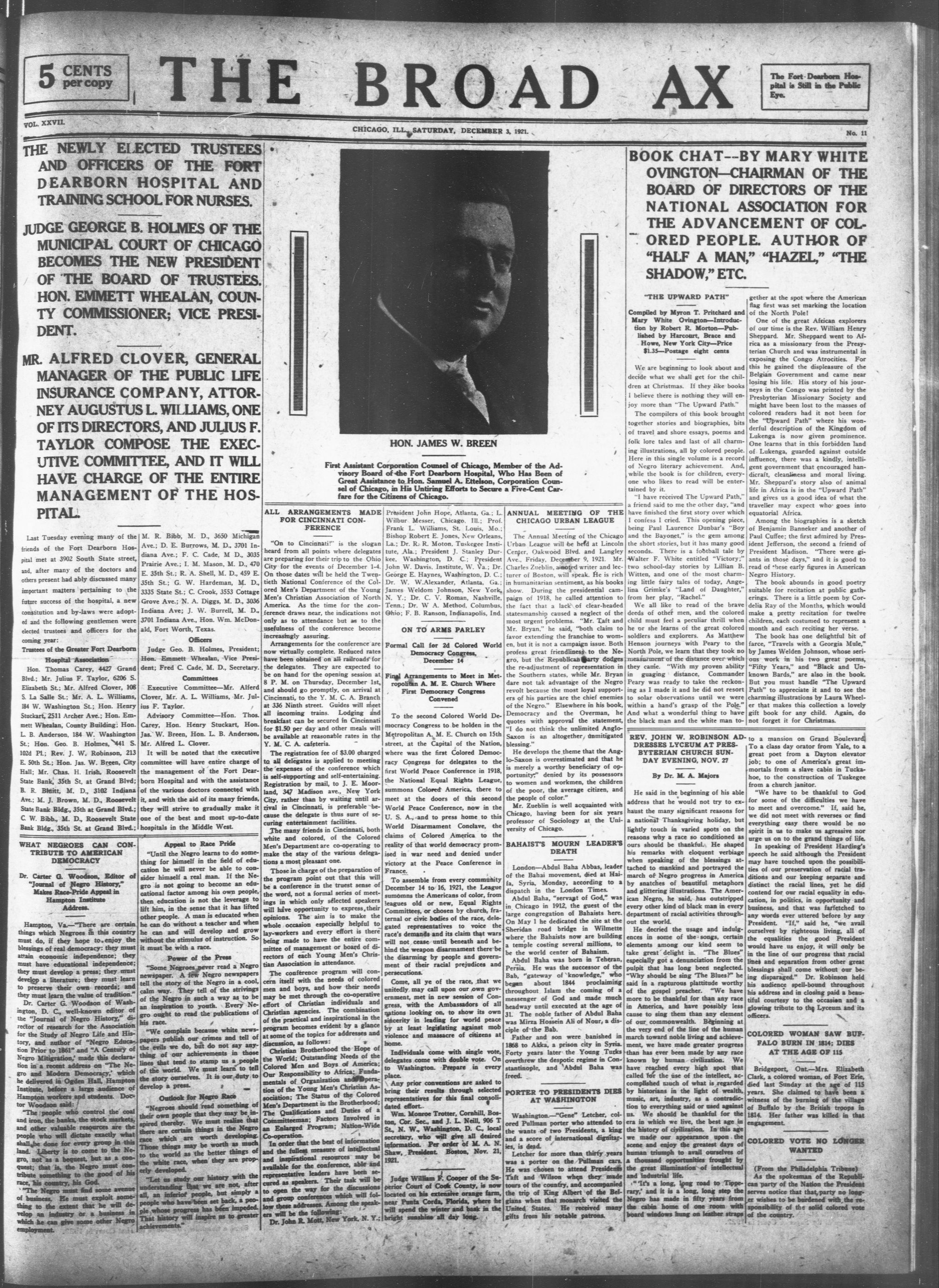
First Assistant Corporation Counsel of Chicago, Member of the Advisory Board of the Fort Dearborn Hospital, Who Has Been of Great Assistance to Hon. Samuel A. Ettelson, Corporation Counsel of Chicago, in His Uniting Efforts to Secure a Five-Cent Carfare for the Citizens of Chicago.
ALL ARRANGEMENTS MADE
FOR CINCINNATI CON-
FERENCE
"On to Cincinnati!" is the slogan heard from all points where delegates are preparing for their trip to the Ohio City for the events of December 1-4. On those dates will be held the Twentieth National Conference of the Colored Men's Department of the Young Men's Christian Association of North America. As the time for the conference draws near, the indications not only as to attendance but as to the usefulness of the conference become increasingly assuring.
Arrangements for the conference are now virtually complete. Reduced rates have been obtained on all railroads for the delegates. They are expected to be on hand for the opening session at 8 P. M. on Thursday, December 1st, and should go promptly, on arrival at Cincinnati, to the Y. M. C. A. Branch at 336 Ninth street. Guides will meet all incoming trains. Lodging and breakfast can be secured in Cincinnati for $1.50 per day and other meals will be available at reasonable rates in the Y. M. C. A. cafeteria.
The registration fee of $3.00 charged to all delegates is applied to meeting the 'expenses of the conference which is self-supporting and self-entertaining. Registration by mail, to J. E. Moorland, 347 Madison ave., New York City, rather than by waiting until arrival in Cincinnati, is preferable because the delegate is thus sure of securing entertainment facilities.
The many friends in Cincinnati, both white and colored, of the Colored Men's Department are co-operating to make the stay of the various delegations a most pleasant one.
Those in charge of the preparation of the program point out that this will be a conference in the truest sense of the word, not a formal series of meetings in which only selected speakers will have opportunity to express, their opinions. The aim is to make the whole occasion especially helpful to lay-workers and every effort is there being made to have the entire committee of management or board of directors of each Young Men's Christian Association in attendance.
The conference program will concern itself with the needs of colored men and boys, and how their needs may be met through the co-operative effort of Christian individuals and Christian agencies. The combination of the practical and inspirational in the program becomes evident by a glance at some of the topics for addresses and discussion, as follows:
Christian Brotherhood the Hope of the World; Outstanding Needs of the Colored Men and Boys of America; Our Responsibility to Africa; Fundamentals of Organization and Operation of the Young Men's Christian Association; The Status of the Colored Men's Department in the Brotherhood; The Qualifications and Duties of a Committeeman; Factors Involved in an Enlarged Program; Nation-Wide Co-operation.
In order that the best of information and the fullest measure of intellectual and inspirational resources may be available for the conference, able and representative leaders have been secured as speakers. Their task will be to open the way for the discussions and group conferences which will follow these addresses. Among the speakers will be the following:
Dr. John R. Mott, New York, N. Y.;
HON. JAMES W. BREEN
Corporation Counsel of Chicago, Md. of the Fort Dearborn Hospital, Vance to Hon. Samuel A. Ettelson, Co., in His Untiring Efforts to Secure Citizens of Chicago.
President John Hope, Atlanta, Ga.; L. Wilbur Messer, Chicago. Ill.; Prof Frank L. Williams, St. Louis, Mo.; Bishop Robert E. Jones, New Orleans, La.; Dr. R. R. Moton, Tuskegee Institute, Ala.; President J. Stanley Durkee, Washington, D. C.; President John W. Davis, Institute, W. Va.; Dr. George E. Haynes, Washington, D. C. Dr. W. W. Alexander, Atlanta, Ga.; James Weldom Johnson, New York, N. Y.; Dr. C. V. Roman, Nashville, Tenn.; Dr. W. A. Method, Columbus, Ohio; F. B. Ranson, Indianapolis, Ind.
ON TO ARMS PARLEY
Formal Call for 2d Colored World Democracy Congress, December 14
Final Arrangements to Meet in Metropolitan A. M. E. Church Where First Democracy Congress Convened
To the second Colored World Democracy Congress to be holden in the Metropolitan A. M. E. Church on 15th street, at the Capital of the Nation, where was the first Colored Democracy Congress for delegates to the first World Peace Conference in 1918, the National Equal Rights League, summons Colored America, there to meet at the doors of this second World Peace Conference, now in the U. S. A., and to press home to this World Disarmament Conclave, the claims of Colored America to the reality of that world democracy promised in war need and denied under victory at the Peace Conference in France.
To assemble from every community December 14 to 16, 1921, the League summons the Americans of color, from leagues old or new, Equal Rights Committees, or chosen by church, fraternal or civic bodies of the race, delegated representatives to voice the race's demands and its claim that wars will not cease until beneath and behind the weapon disarmament there be the disarming by people and government of their racial prejudices and persecutions.
Come, all ye of the race, that we unitedly may call upon our own government, met in new session of Congress, with the Ambassadors of all nations looking on, to show its own sincerity in leading for world peace by at least legislating against mob violence and massacre of citizens at home.
Individuals come with single vote, delegates come with double vote. On to Washington. Prepare in every place.
Any prior conventions are asked to bring their results through selected representatives for this final consolidated effort.
Wm. Monroe Trotter, Cornhill, Boston, Cor. Sec., and J. L. Neill, 906 T St., N. W., Washington, D. C., local secretary, who will give all desired information. Per order of M. A. N. Shaw, President. Boston, Nov. 21, 1921.
Judge William F. Cooper of the Superior Court of Cook County, is now located on his extensive orange farm, near Punta Corda, Florida, where he will spend the winter and bask in the bright sunshine all day long.
ANNUAL MEETING OF THE CHICAGO URBAN LEAGUE
The Annual Meeting of the Chicago Urban League will be held at Lincoln Center, Oakwood Blvd. and Langley Ave. Friday, December 9, 1921. Mr. Charles Zueblin, a noted writer and lecturer of Boston, will speak. He is rich in humanitarian sentiment, as his books show. During the presidential campaign of 1918, he called attention to the fact that a lack of clear-headed statesmanship caused a neglect of the most urgent problems. "Mr. Taft and Mr. Bryan," he said, "both claim to favor extending the franchise to women, but it is not a campaign issue. Both profess great friendliness to the Negro, but the Republican party dodges the re-adjustment of representation in the Southern states, while Mr. Bryan dare not tak advantage of the Negro revolt because the most loyal supporters of his parties are the chief enemies of the Negro." Elsewhere in his book, Democracy and the Overman, he quotes with approval the statement, "I do not think the unlimited Anglo-Saxon is an altogether unmitigated blessing."
He develops the theme that the Anglo-Saxon is overestimated and that he is merely a worthy beneficiary of opportunity, denied by its possessors to women and workmen, the children of the poor, the average citizen, and the people of color."
Mr. Zuebbin is well acquainted with Chicago, having been for six years professor of Sociology at the University of Chicago.
BAHAIST'S MOURN LEADER'S
DEATH
London—Abdul Baha Abbaas, leader of the Bahai movement, died at Haifa, Syria, Monday, according to a dispatch in the London Times.
Abdul Baha, "servant of God," was in Chicago in 1912, the guest of the large congregation of Bahaists here. On May 1 he dedicated the site at the Sheridan road bridge in Wilmette where the Bahais now are building a temple costing several millions, to be the world center of Bahaism.
Abdul Baha was born in Teheran, Persia. He was the successor of the Bab, "gateway of knowledge," who began about 1844 proclaiming throughout Islam the coming of a messenger of God and made much headway until executed at the age of 31. The noble father of Abdul Baha was Mirza Hossein Ali of Nour, a disciple of the Bab.
Father and son were banished in 1868 to Akka, a prison city in Syria. Forty years later the Young Turks overthrew the despotic regime in Constantinople, and Abdul Baha was freed.
PORTER TO PRESIDENTS DIES
AT WASHINGTON
Washington—"Gene" Letcher, colored Pullman porter who attended to the wants of two Presidents, a king and a score of international dignitaries, is dead.
Letcher for more than thirty years was a porter on the Pullman car. He was chosen to attend Presidents Taft and Wilson when they made tours of the country, and accompanied the trip of King Albert of the Belgians when that monarch visited the United States. He received many gifts from his notable patrons.
BOOK CHAT--BY MARY WHITE OVINGTON-CHAIRMAN OF THE BOARD OF DIRECTORS OF THE NATIONAL ASSOCIATION FOR THE ADVANCEMENT OF COLORED PEOPLE. AUTHOR OF "HALF A MAN," "HAZEL," "THE SHADOW,"ETC.
"THE UPWARD PATH"
Compiled by Myron T. Pritchard and Mary White Ovington—Introduction by Robert R. Morton—Published by Harcourt, Brace and Howe, New York City—Price $1.35—Postage eight cents
We are beginning to look about and decide what we shall get for the children at Christmas. If they like books I believe there is nothing they will enjoy more than "The Upward Path."
The compilers of this book brought together stories and biographies, bits of travel and shore essays, poems and folk lore tales and last of all charming illustrations, all by colored people. Here in this single volume is a record of Negro literary achievement. And, while the book is for children, everyone who likes to read will be entertained by it.
"I have received The Upward Path," a friend said to me the other day, "and have finished the first story over which I confess I cried. This opening piece, being Paul Laurence Dunbar's "Boy and the Bayonet," is the gem among the short stories, but it has many good seconds. There is a football tale by Walter F. White entitled "Victory," two school-day stories by Lillian B. Witten, and one of the most charming little fairy tales of today, Angelina Grimke's "Land of Daughter," from her play, "Rachel."
We all like to read of the brave deeds of other men, and the colored child must feel a peculiar thrill when he or she learns of the great colored soldiers and explorers. As Matthew Henson journeys with Peary to the North Pole, we learn that they took no measurement of the distance over which they cane. "With my proven ability in guaging distance, Commander Peary was ready to take the reckoning as I made it and he did not resort to solar observations until we were within a hand's grasp of the Pole." And what a wonderful thing to have the black man and the white man to-
REV. JOHN W. ROBINSON AD
DRESSES LYCEUM AT PRES-
BYTERIAN CHURCH SUN-
DAY EVENING, NOV. 27
By Dr. M. A. Majors
He said in the beginning of his able address that he would not try to exhaust the many significant reasons for a national Thanksgiving holiday, but lightly touch in varied spots on the reasons why a race so conditioned as ours should be thankful. He shaped his remarks with eloquent verbiae when speaking of the blessings attached to mankind and portrayed the march of Negro progress in America by snatches of beautiful metaphors and glittering illustrations. The American Negro, he said, has outstripped every other kind of black man in every department of racial activities throughout the world.
He decried the usage and indulences in some of the songs, certain elements among our kind seem to take great delight in. "The Blues" especially got a denunciation from the pulpit that has long been neglected. "Why should be sing "The Blues?" he said in a rapturous plattitude worthy of the gospel preacher. "We have more to be thankful for than any race in America, and have possibly less cause to sing them than any element of our commonwealth. Beginning at the very end of the line of the human march toward noble living and achievement, we have made greater progress than has ever been made by any race known by human civilization. We have reached every high spot that called for the use of the intellect, accomplished much of what is regarded by historians in the light of wealth, music, art, industry, as a contradiction to everything said or used against us. We should be thankful for the era in which we live, the best age in the history of civilization. In this age we made our appearance upon the scene and enjoy the greatest days of human triumph to avail ourselves of a thousand opportunities fought by the great illumination of intellectual and industrial life.
"It's a long, long road to Tipperary, and it is a long, long step the Negro has made in fifty years from the cabin home of one room with board windows hung on leather straps
The Fort-Dearborn Hospital is Still in the Public Eye.
No. 11
BY MARY WHITE
HAIRMAN OF THE
RECTORS OF THE
ASSOCIATION FOR
ACEMENT OF COLLE.
AUTHOR OF
," "HAZEL," "THE
No.11
gether at the spot where the American flag first was set marking the location of the North Pole!
One of the great African explorers of our time is the Rev. William Henry Sheppard. Mr. Sheppard went to Africa as a missionary from the Presterian Church and was instrumental in exposing the Congo Atrocities. For this he gained the displeasure of the Belgian Government and came near losing his life. His story of his journeys in the Congo was printed by the Presbyterian Missionary Society and might have been lost to the masses of colored readers had it not been for the "Upward Path" where his wonderful description of the Kingdom of Lukenga is now given prominence.
One learns that in this forbidden land of Lukenga, guarded against outside influence, there was a kindly, intelligent government that encouraged handicraft, cleanliness and moral living. Mr. Sheppard's story also of animal life in Africa is in the "Upward Path" and gives us a good idea of what the traveller may expect who goes into equatorial Africa.
Among the biographies is a sketch of Benjamin Banneker and another of Paul Cuffee; the first admired by President Jefferson, the second a friend of President Madison. "There were giants in those days," and it is good to read of these early figures in American Negro History.
The book abounds in good poetry suitable for recitation at public gatherings. There is a little poem by Cordelia Ray of the Months, which would make a pretty recitation for twelve children, each costumed to represent a month and each reciting her verse.
The book has one delightful bit of farce, "Travels with a Georgia Mule," by James Welden Johnson, whose serious work in his two great poems, "Fifty Years," and "Black and Unknown Bards," are also in the book. But you must handle "The Upward Path" to appreciate it and to see the charming illustrations by Laura Wheeler that makes this collection a lovely gift book for any child. Again, do not forget it for Christmas.
to a mansion on Grand Boulevard
To a class day orator from Yale, to a great poet from a Dayton elevator job; to one of America's great immortals from a slave cabin in Tuckahoe, to the construction of Tuskegee from a church janitor.
"We have to be thankful to God for some of the difficulties we have to meet and overcome." If, said he, we did not meet with reverses or find everything easy there would be no spirit in us to make us agressive nor urge us on to the grand things of life. In speaking of President Harding's speech he said although the President may have touched upon the possibilities of our preservation of racial traditions and our keeping separate and distinct the racial lines, yet he did contend for our racial equality in education, in politics, in opportunity and business, and that was farfetched to any words ever uttered before by any President. "If," said he, "we avail ourselves by righteous living, all of the equalities the good President would have us enjoy, it will only be in the line of our progress that racial lines and separation from other great blessings shall come without our being disparaged." Dr. Robinson held his audience spell-bound throughout his address and in closing paid a beautiful courtesy to the occasion and a glowing tribute to the Lyceum and its officers.
COLORED WOMAN SAW BUF-
FALO BURN IN 1814; DIES
AT THE AGE OF 115
Bridgeport, Ont.-Mra. Elizabeth Clark, a colored woman, of Fort Erie, died last Sunday at the age of 115 years. She claimed to have been a witness of the burning of the village of Buffalo by the British troops in 1814. Her father was killed in that engagement.
(From the Philadelphia Tribune)
As the spokesman of the Republican party of the Nation the President serves notice that that party no longer wishes to be burdened with, the responsibility of the solid colored vote of the country.
M.
THE BROAD AX Published Every Saturday
In this city since July 15th, 1899, without missing one single issue. Republicans, Democrats, Catholics, Protestants, Single Taxers, Priests, infidels or anyone else can have their say as long as their language is proper and responsibility is fixed. The Broad Ax is a newspaper whose platform is broad enough for all, ever claiming the editorial right to speak its own mind. Local communications will receive attention. Write only on one side of the paper.
Subscriptions must be paid in advance.
One Year ..... $2.00
6x Months ..... $1.00
Advertising rates made known on
application.
4206 So. Elizabeth St., Chicago, Ill.
Phone Wenworth 2597
JULIUS F. TAYLOR
Editor and Publisher
Associate Editor
DR. M. A. MAJORS
4700 South State Street
Phone Drexel 1416
DECEMBER 3, 1921.
Vol. XXVII. No. 11
Entered as Second-Class Matter, Aug.
19, 1902, at the Post Office at Chicago,
III. Under Act of March 8, 1879.
WILLIAM ROWLAND SOBERS
DIES SUDDENLY
W. R. Sobers, one of Chicago's most popular citizens, died very suddenly Sunday evening, November 19th, at ten o'clock, which was a shock to the entire community. While his death was unexpected, he had been under the care of Dr. Geo. C. Hall for several weeks suffering from the results of an assault made on him by Norman Cumberbatch, one of his employees, which was responsible for his untimely death. "Billy," as he was known to his host of friends, was possessed of all the traits that goes to make a man and a friend. To know him was to love him.
He came to Chicago in 1890 and in 1893 he entered the tailoring business which he made a success. He was in business a very short time in the neighborhood before he became one of the most popular men in the business, and was a general favorite with both white and colored alike. When the Chicago Beach Hotel was opened up, he was asked by his personal friend, Manager W. R. Ross, to put a shop in the hotel, and from the day he opened the shop until his death he maintained the respect of Managers, clerks, guests and employees. He was always dignified, yet pleasant to meet at all times. He was born in Barbados, West Indies.
His death is mourned by his son, Ernest Sobers, a nephew and a host of friends. The funeral services was held at St. Thomas Episcopal church at one o'clock Wednesday, November 23rd. Rev. Simons officiated; interment at Oakwood cemetery. Pall-bearers were: W. J. Anderson, Geo. H. Walker, Dewitt Curtis, T. Douglas, Adam Perry and Julius N. Avendorch.
M. H.
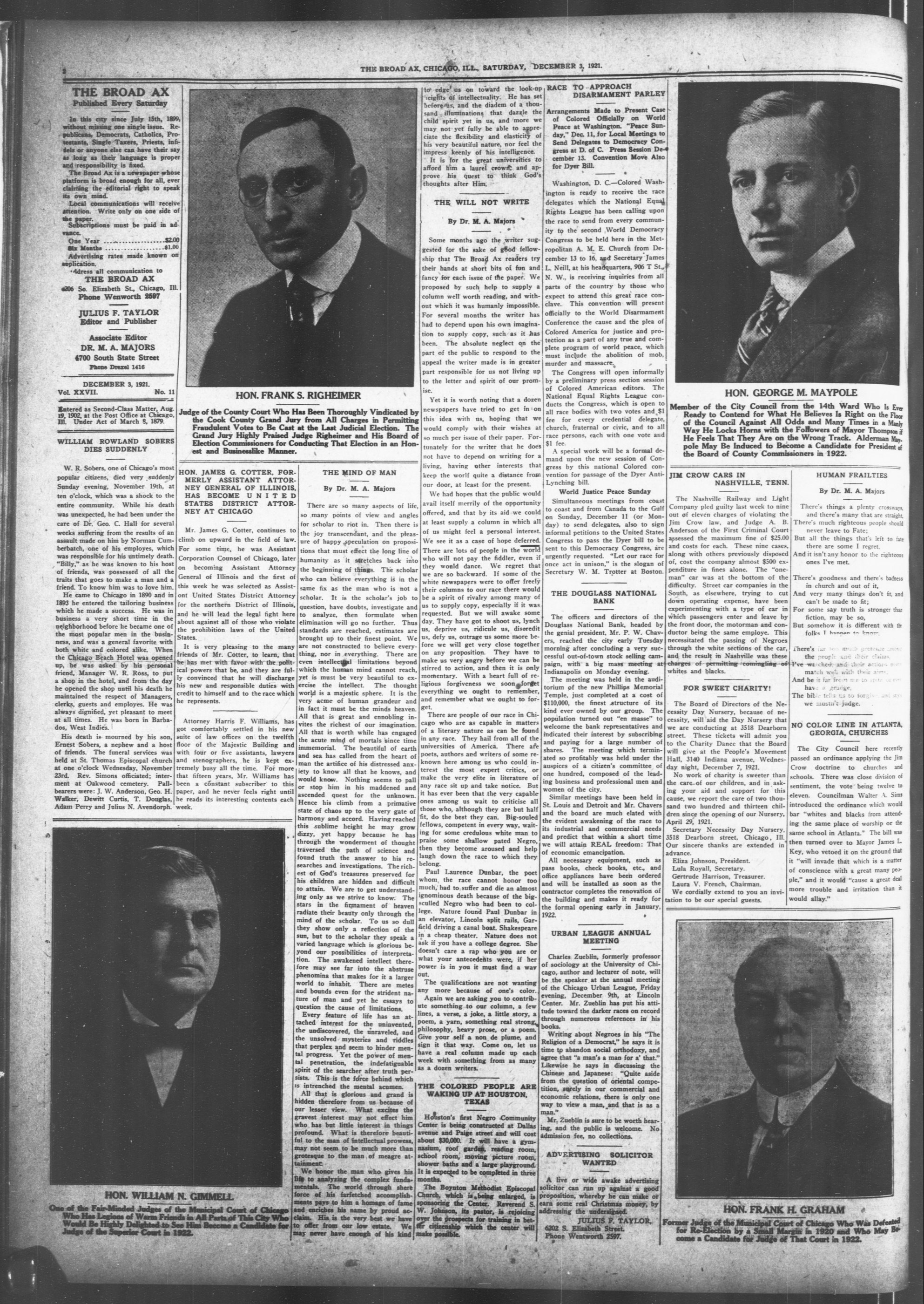
HON. FRANK S. RIGHEIMER
Judge of the County Court Who Has Been Thorough the Cook County Grand Jury from All Charge Fraudulent Votes to Be Cast at the Last Judiciary Grand Jury Highly Praised Judge Righeimer an Election Commissioners for Conducting That Eleast and Businesslike Manner.
Judge of the County Court Who Has Been Thoroughly Vindicated by the Cook County Grand Jury from All Charges in Permitting Fraudulent Votes to Be Cast at the Last Judicial Election. The Grand Jury Highly Praised Judge Righeimer and His Board of Election Commissioners for Conducting That Election in an Honest and Businesslike Manner.
HON. JAMES G. COTTER, FOR-MERLY ASSISTANT ATTOR-NEY GENERAL OF ILLINOIS, HAS BECOME U N I T E D STATES DISTRICT ATTOR-NEY AT CHICAGO
THE MIND OF MAN
By Dr. M. A. Majors
There are so many aspects of life,
Mr. James G. Cotter, continues to climb on upward in the field of law. For some time, he was Assistant Corporation Counsel of Chicago, later on becoming Assistant Attorney General of Illinois and the first of this week he was selected as Assistant United States District Attorney for the northern District of Illinois, and he will lead the legal fight here about against all of those who violate the prohibition laws of the United States.
It is very pleasing to the many friends of Mr. Cotter, to learn, that he has met with favor with the political powers that be, and they are fully convinced that he will discharge his new and responsible duties with credit to himself and to the race which he represents.
Attorney Harris F. Williams, has got comfortably settled in his new suite of law offices on the twelfth floor of the Majestic Building and with four or five assistants, lawyers and stenographers, he is kept extremely busy all the time. For more that fifteen years, Mr. Williams has been a constant subscriber to this paper, and he never feels right until he reads its interesting contents each week.
THE MIND OF MAN
By Dr. M. A. Majors
There are so many aspects of life so many points of view and angles for scholar to riot in. Then there is the joy transcendant, and the pleasure of happy speculation on propositions that must effect the long line of humanity as it stretches back into the beginning of things. The scholar who can believe everything is in the same fix as the man who is not a scholar. It is the scholar's job to question, have doubts, investigate and to analyze, then formulate when elimination will go no further. Thus standards are reached, estimates are brought up to their finest point. We are not constructed to believe everything, nor in everything. There are even intellectual limitations beyond which the human mind cannot reach, yet is must be very beautiful to exercise the intellect. The thought world is a majestic sphere. It is the very acme of human grandeur and in fact it must be the minds heaven. All that is great and ennobling invites the richest of our imagination. All that is worth while has engaged the acute mind of mortals since time immemorial. The beautiful of earth and sea has called from the heart of man the artifice of his distressed anxiety to know all that he knows, and would know. Nothing seems to pall or stop him in his maddened and ascended quest for the unknown. Hence his climb from a primitive state of chaos up to the very gate of harmony and accord. Having reached this sublime height he may grow dizzy, yet happy because he has through the wonderment of thought traversed the path of science and found truth the answer to his researches and investigations. The richest of God's treasures preserved for his children are hidden and difficult to attain. We are to get understanding only as we strive to know. The stars in the firmament of heaven radiate their beauty only through the mind of the scholar. To us so dull they show only a reflection of the sun, but to the scholar they speak a varied language which is glorious beyond our possibilities of interpretation. The awakened intellect therefore may see far into the abstruse phenomina that makes for it a larger world to inhabit. There are metes and bounds even for the strident nature of man and yet he essays to question the cause of limitations.
Every feature of life has an attached interest for the uninvented, the undiscovered, the unraveled, and the unsolved mysteries and riddles that perplex and seem to hinder mental progress. Yet the power of mental penetration, the indefatigable spirit of the searcher after truth persists. This is the force behind which is intrenched the mental acumen. All that is glorious and grand is hidden therefore from us because of our lesser view. What excites the gravest interest may not effect him who has but little interest in things profound. What is therefore beautiful to the man of intellectual prowess, may not seem to be much more than grotesque to the man of meagre attainment.
We honor the man who gives his life to analyzing the complex fundamentals. The world through short force of his farnetched accomplishments pays to him a homage of fame and enriches his name by proud acclaim. His is the very heat we have to offer from our low estate. We may never have enough of his kind
to edge us on toward the look-up heights of intellectuality. He has set before us, and the diadem of a thousand illuminations that dazzle the child spirit yet in us, and more we may not yet fully be able to appreciate the flexibility and elasticity of his very beautiful nature, nor feel the impress keenly of his intelligence.
It is for the great universities to afford him a laurel crown, and approve his quest to think God's thoughts after Him.
RACE TO APPE DISARM
Arrangements Ma of Colored O Peace at Washi day," Dec. 11, for Send Delegates grees at D. of C ember 13. Cor for Dyer Bill.
Washington, D.
THE WILL NOT WRITE
Some months ago the writer suggested for the sake of good fellowship that The Broad Ax readers try their hands at short bits of fun and fancy for each issue of the paper. We proposed by such help to supply a column well worth reading, and without which it was humanly impossible. For several months the writer has had to depend upon his own imagination to supply copy, such as it has been. The absolute neglect on the part of the public to respond to the appeal the writer made is in greater part responsible for us not living up to the letter and spirit of our promise.
Yet it is worth noting that a dozen newspapers have tried to get in on this idea with us, hoping that we would comply with their wishes at so much per issue of their paper. Fortunately for the writer that he does not have to depend on writing for a living, having other interests that keep the world quite a distance from our door, at least for the present.
We had hopes that the public would avail itself merrily of the opportunity offered, and that by its aid we could at least supply a column in which all of us might feel a personal interest. We see it as a case of hope deferred. There are lots of people in the world who will not pay the fiddler, even if they would dance. We regret that we are so backward. If some of the white newspapers were to offer freely their columns to our race there would be a spirit of rivalry among many of us to supply copy, especially if it was requested. But we will awake some day. They have got to shoot us, lynch us, deprive us, ridicule us, disseredit us, defy us, outrage us some more before we will get very close together on any proposition. They have to make us very angry before we can be stirred to action, and then it is only momentary. With a heart full of religious forgiveness we soon forget everything we ought to remember, and remember what we ought to forget.
There are people of our race in Chicago who are as capable in matters of a literary nature as can be found in any race. They hail from all of the universities of America. There are poets, authors and writers of some reknown here among us who could interest the most expert critics, or make the very elite in literature of any race sit up and take notice. But it has ever been that the very capable ones among us wait to criticise all those who, although they are but half fit, do the best they can. Big-souled fellows, competent in every way, waiting for some credulous white man to praise some shallow pated Negro, then they become aroused and help laugh down the race to which they belong.
Paul Laurence Dunbar, the poet whom, the race cannot honor too much, had to suffer and die an almost ignominious death because of the big-sculled Negro who had been to college. Nature found Paul Dunbar in an elevator, Lincoln split rails, Garfield driving a canal boat. Shakespeare in a cheap theater. Nature does not ask if you have a college degree. She doesn't care a rap who you are or what your antecedents were, if her power is in you it must find a way out.
The qualifications are not wanting any more because of one's color. Again we are asking you to contribute something to our column, a few lines, a verse, a joke, a little story, a poem, a yarn, something real strong philosophy, heavy prose, or a poem. Give your self a non de plume, and sign it that way. Come on, let us have a real column made up each week with something from as many as a dozen writers.
THE COLORED PEOPLE ARE WAKING UP AT HOUSTON, TEXAS
Houston's first Negro Community Center is being constructed at Dallas avenue and Paige street and will cost about $30,000. It will have a gymnasium, roof garden, reading room, school room, moving picture room, shower baths and a large playground. It is expected to be completed in three months. The Boynton Methodist Episcopal Church, which is being enlarged, is sponsoring the Center, Reverend S. W. Johnson, its pastor, is rejoicing over the prospects for training in better citizenship which the center will make possible.
RACE TO - APPROACH
DISARMAMENT PARLEY
Arrangements Made to Present Case of Colored Officially on World Peace at Washington. "Peace Sunday," Dec. 11, for Local Meetings to Send Delegates to Democracy Congress at D. of C. Press Session December 13. Convention Move Also for Dyer Bill.
Washington, D. C.—Colored Washington is ready to receive the race delegates which the National Equal Rights League has been calling upon the race to send from every community to the second World Democracy Congress to be held here in the Metropolitan A. M. E. Church from December 13 to 16, and Secretary James L. Neill, at his headquarters, 906 T St., N. W., is receiving inquiries from all parts of the country by those who expect to attend this great race conclave. This convention will present officially to the World Disarmament Conference the cause and the plea of Colored America for justice and protection as a part of any true and complete program of world peace, which must include the abolition of mob, murder and massacre.
The Congress will open informally by a preliminary press section session of Colored American editors. The National Equal Rights League conducts the Congress, which is open to all race bodies with two votes and $1 fee for every credential delegate, church, fraternal or civic, and to all race persons, each with one vote and $1 fee. A special work will be a formal demand upon the new session of Congress by this national Colored convention for passage of the Dyer Anti-Lynch bill.
World Justice Peace Sunday
Simultaneous meetings from coast to coast and from Canada to the Gulf on Sunday, December 11 (or Monday) to send delegates, also to sign informal petitions to the United States Congress to pass the Dyer bill to be sent to this Democracy Congress, are urgently requested. "Let our race for once act in unison," is the slogan of Secretary W. M. Trotter at Boston.
THE DOUGLASS NATIONAL BANK
The officers and directors of the Douglass National Bank, headed by the genial president, Mr. P. W. Chavers, reached the city early Tuesday morning after concluding a very successful out-of-town stock selling campaign, with a big mass meeting at Indianapolis on Monday evening. The meeting was held in the auditorium of the new Phillips Memorial Temple, just completed at a cost of $110,000, the finest structure of its kind ever owned by our group. The population turned out "en masse" to welcome the bank representatives and indicated their interest by subscribing and paying for a large number of shares. The meeting which terminated so profitably was held under the auspices of a citizen's committee of one hundred, composed of the leading business and professional men and women of the city.
Similar meetings have been held in St. Louis and Detroit and Mr. Chavers and the board are much elated with the evident awakening of the race to its industrial and commercial needs and predict that within a short time we will attain REAL freedom: That of economic emancipation. All necessary equipment, such as pass books, check books, etc., and office appliances have been ordered and will be installed as soon as the contractor completes the renovation of the building and makes it ready for the formal opening early in January, 1922.
URBAN LEAGUE ANNUAL MEETING
Charles Zueblin, formerly professor of sociology at the University of Chicago, author and lecturer of note, will be the speaker at the annual meeting of the Chicago Urban League, Friday evening, December 9th, at Lincoln Center. Mr. Zueblin has put his attitude toward the darker races on record through numerous references in his books.
Writing about Negroes in his "The Religion of a Democrat," he says it is time to abandon social orthodoxy, and agree that "a man's a man for a that." Likewise he says in discussing the Chinese and Japanese: "Quite aside from the question of oriental competition, surely in our commercial and economic relations, there is only one way to view a man, and that is as a man."
Mr. Zueblin is sure to be worth hearing, and the public is welcome. No admission fee, no collections.
ADVERTISING SOLICITOR WANTED
A live or wide awake advertising solicitor can run up against a good proposition, whereby he can make or earn some real Christmas money, by addressing the undersigned.
JULIUS P. TAYLOR,
6202 S. Elizabeth Street.
Phone Wentworth 2597.
HON. GEORGE M. MAYPOLE
Member of the City Council from the 14th Ward Ready to Contend for What He Believes Is Right of the Council Against All Odds and Many Tiny Way He Locks Horns with the Followers of May He Feels That They Are on the Wrong Track. A pole May Be Induced to Become a Candidate for the Board of County Commissioners in 1922.
he City Council from the 14th Ward Contend for What He Believes Is Right Council Against All Odds and Many Tircks Horns with the Followers of May that They Are on the Wrong Track. Be Induced to Become a Candidate f of County Commissioners in 1922.
Member of the City Council from the 14th Ward Who Is Ever Ready to Contend for What He Believes Is Right on the Floor of the Council Against All Odds and Many Times in a Manly Way He Locks Horns with the Followers of Mayor Thompson if He Feels That They Are on the Wrong Track. Alderman Maypole May Be Induced to Become a Candidate for President of the Board of County Commissioners in 1922.
JIM CROW CARS IN
NASHVILLE, TENN
The Nashville Railway and Light Company pled guilty last week to nine out of eleven charges of violating the Jim Crow law, and Judge A. B. Anderson of the First Criminal Court assessed the maximum fine of $25.00 and costs for each. These nine cases, along with others previously disposed of, cost the company almost $500 expenditure in fines alone. The "oneman" car was at the bottom of the difficulty. Street car companies in the South, as elsewhere, trying to cut down operating expense, have been experimenting with a type of car in which passengers enter and leave by the front door, the motorman and conductor being the same employee. This necessitated the passing of Negroes through the white sections of the car, and the result in Nashville was these charges of permitting comingling of whites and blacks.
FOR SWEET CHARITY!
The Board of Directors of the Necessity Day Nursery, because of necessity, will aid the Day Nursery that we are conducting at 3518 Dearborn street. These tickets will admit you to the Charity Dance that the Board will give at the People's Movement Hall, 3140 Indiana avenue, Wednesday night, December 7, 1921.
No work of charity is sweeter than the care of our children, and in asking your aid and support for this cause, we report the care of two thousand two hundred and thirteen children since the opening of our Nursery, April 29, 1921.
Secretary Necessity Day Nursery, 3518 Dearborn street, Chicago, Ill. Our sincere thanks are extended in advance.
We cordially extend to you an invitation to be our special guests.
1914
M.
M.
HON. FRANK H. GRAHAM
Former Judge of the Municipal Court of Chicago W
for Re-Election by a Small Margin in 1920 and
come a Candidate for Judge of That Court in 1921
the Municipal Court of Chicago Who was on by a Small Margin in 1920 and W
candidate for Judge of That Court in 1922
Former Judge of the Municipal Court of Chicago Who Was Defeated for Re-Election by a Small Margin in 1920 and Who May Become a Candidate for Judge of That Court in 1922.
from the 14th Ward Who Is Ever He Believes Is Right on the Floor Odds and Many Times in a Manly the Followers of Mayor Thompson if the Wrong Track. Alderman Maycome a Candidate for President ofissioners in 1922.
HUMAN FRAILTIES
There's things a plenty crossways,
and there's many that are straight.
There's much righteous people should
never leave to Fate;
But all the things that's left to take
there are some I regret.
There's goodness and there's badness in church and out of it.
For some say truth is stronger than fiction, may be so.
But somehow it is different with the folks I happen to know.
There's far too much pretence among the people and their claims.
I've watched and their actions match well with their aims.
And be it far from me to spite or not have a grudge.
The bible tells us to forgive and says we mustn't judge.
NO COLOR LINE IN ATLANTA
GEORGIA, CHURCHES
The City Council here recently passed an ordinance applying the Jim Crow doctrine to churches and schools. There was close division of sentiment, the vote being twelve to eleven. Councilman Walter A. Sims introduced the ordinance which would bar "whites and blacks from attending the same place of worship or the same school in Atlanta." The bill was then turned over to Mayor James L. Key, who vetoed it on the ground that it "will invade that which is a matter of conscience with a great many people," and it would "cause a great deal more trouble and irritation than it would allay."
1930
Art of Chicago Who Was Defeated
Margin in 1920 and Who May Be
That Court in 1922.
The Christmas or the Holiday Edition of The Broad Ax Will Appear Saturday, December 17. It Will Contain Some Highly Interesting Articles by Eminent Writers. It Will Also Contain Beautiful Half Tone Cuts of Some of the Prominent Citizens of Chicago.
Now Is the Time to Advertise in It, to Secure Special Write-Ups in It, and to Subscribe for It. : : : : : : : : : :
[Name]
---
CHIPS
Miss Benna Carter, of the Vernon Pharmacy, 434 E. 31st Street, and her mother, Mrs. Bettie Braxton Carter, dined with Dr. and Mrs. James Hunter McClure, on Thanksgiving day, at their lovely residence, 3538 Calumet Avenue.
...
Dr. Lawrence Blanchet, 6501 Rhodes Avenue, is rapidly recovering from the effects of an operation which he underwent a short time ago. At that time his right leg was removed at the thigh. Dr. Speed successfully performed the operation. The many friends of Dr. Blanchet are delighted to learn that he will soon be himself again, after suffering so much pain from being struck by a motorcycle some years ago.
Thursday evening, the Ida Dempsey Club met at the home of Mrs. Rosa Forche, 527 E. 46th Street and a pleasant evening was spent by all present and much business of importance was transacted. Mrs. Sadie J. Carter, Grand Secretary.
Mr. Harry Ramsey, 331 Garfield Avenue is an old time reader and supporter of The Broad Ax, and he swears by the truthfulness of its contents at every stage of the game.
HOPKINSVILLE, KY, IS ON THE POLITICAL MAP
J. T. Whitney, colored, is contesting the election of T. G. Skinner, white, to the office of city prosecutor here at the election in November.
Only Skinner's name appeared on the official ballot, and he received 1,385 votes. Whitney's name was written down on the ballot by 76 persons who preferred to vote for him. Whitney bases his contest upon the ground that the law required filing of petition of candidacy forty-five days before election, whereas Skinner did not file his petition until ten days before the election, and that the street addresses of persons signing the petition did not appear. Therefore, Whitney contends that Skinner's votes were illegal, and since he was the only other person to receive votes for the office, the certificate of election should have been given to him.
12TH ANNUAL ESSAY CONTEST
DECEMBER 18
Chicago is looking forward with pleasure to the coming of the great 12th annual essay contest, to be held Sunday afternoon, December 18, at 2:30 o'clock, in the beautiful auditorium of Pilgrim Baptist church, 33rd street and Indiana avenue. Eight of the leading literary clubs of the city will participate Subject: "The Darker Races and the Impending Crisis." Prizes, two diamond rings, known as first and second prizes, donated by the popular jeweler, Dr. Louis Usselmann, 3150 S. State street. B. W. Fitts, founder and manager; Frank W. Henry, Alonzo J. Bowling and Willis N. Huggins, assistants.
Freddie had come into possession of a dog, something he had always wanted. He and the dog were inseparable. Coured asked him to his birthday party. He besieged, but finally said: "I'd like to go first rate, if I can take my dog along. Where I go he goes. I'm just like we were twina"
THE BROAD AX, CHICAGO, ILL., SATURDAY, DECEMBER 3, 1921
NEWS FROM NASHVILLE,
TENN.
Professor Lovell headed a committee from Walden University, which asked the backing of the Nashville Chamber of Commerce in a campaign for funds to get Walden on its feet. Professor Lovell stated that the general committee of the Northern Methodist Church had agreed to give dollar for dollar for maintenance purposes, according to the amount the local board could raise in Nashville.
COLORED UNIONS TO FORM
BIG CENTRAL LABOR
BODY
Unions representing Pullman porters, butchers' workers, car cleaners, colored musicians and hotel and restaurant workers have perfected plans for a central labor body representing all unions of colored workers. Headquarters have been established at Forty-third and State sts. The body wil have jurisdiction over all unions of colored workers in the city.
Superstition Protects Spider.
There are traditions that hold the spider sacred. The French have a motto pressaging bad luck for him who kills a spider in the morning; and there are old rhymes and warnings that those who wish to live and per per will spare the life of this animal—it is not an insect, as most of us used to believe until entomologists informed us to the contrary.
Christopher Columbus' Big Crop.
The American sugar crop, which now goes all over the world, was planted by Christopher Columbus. On his second trip to this country he planted the sugar cane at Santo Domingo. It was the first crop to be grown in the new world and one which has grown each year.
That Sunday School Class!
Wishing to be acquainted with the methods of her predecessor, a young woman who taught a Sunday school class for the first time asked the group of bright-faced six-year-olds what the lesson had been the previous Sunday: Silence prevailed for a moment. Then a snub-nosed urchin waved has hand frantically and when granted permission to speak, answered: "It was about burning the bugs in the church." Conversation with the former teacher afterwards revealed that the lesson had been "Burning Incense in the Temple."
Nute In Immense Quantities
On the north coast of Guatemala 60,000 tons of cohune nuts are sold to be available for exportation annually, and with an expenditure of $10,000 for highway improvement this quantity could probably be increased to 100,000 tons per annum. On the Pacific or south coast the yield of corozo nuts, it is estimated, could easily be increased to 300,000 tons per annum. There is a supply of cheap labor in this southern region.
Valuable People.
The value of a single man or woman of open mind, independent judgment, and moral courage, who requires to be convinced and refuses to be cajoled, is only concerned to be right and not afraid to be singular, deferring to reason but not to rank, true to their own self, and therefore not false to any man—the value of such a man or woman, I say, is priceless; a nation of such would leaven and regenerate the world.—Professor James Ward.
Forest Fire Spread Darkness
During the occurrence of great forest fires in Idaho, in August, 1920, the smoke was carried over the whole of the northern United States and southern Canada and far over the oceans. It was observed 500 miles from land. These fires caused "dark days" over a greater area than in any other case on record in this country.
Softest Known Wood.
Trees belonging to the genus Jacaranda, growing in tropical America, are remarkable for their soft wood. After part of the bark is cut away a machete can be shoved to the center of the trunk with ease. The wood, when fresh, can be cut into blocks with a knife, as one would cut up parchments or turnips. As the wood dries, it shrinks to a small fraction of its original bulk.
Diplomatic Bob
Bob and I were out sailing when the boat was capized by a sudden shifting breeze, writes a correspondent of the Chicago Journal. While we were in the water, clinging to the boat, Bot proposed. I remember I said "yes" for fear he would let me drown if I refused. As soon as he had his answer he said "The water is shallow here, so let's not bother righting the boat. We can just walk to shore."
Offended Hie Dignity.
Jim Blue, colored, has resigned as a Pullman porter on the Central branch. He resigned in a huff. It came about this way: One night Jim was standing on the platform at Concordia. Suddenly he slipped and, as and as he fell he threw his lantern high into the alr. The engineer thought the lantern was giving the highball sign and pulled out of the station, leaving Jim on the platform. That peeved Jim and he decided to quit.—Atchison Globe.
Evolution of Writing.
The earliest Greek inscriptions were written from right to left. Next came the method called "bosthophedon," in which the written lines run alternately from left to right, or vice versa. Lastly, writing from left to right became universal.
Tit for Tat.
When Lord Randolph Churchill visited the diamond fields of South Africa he is said to have exclaimed after looking at some diamonds: "And all for the vanity of women." A lady who heard the remark added: "And the deprivacy of men."
Ballet costume 1
Black and white braid is effectively used to trim this otherwise severely simple frock.
PROPER CARE FOR YOUR HATS
Velvet Headgear Needs Especial Attention—Each Hat Should Have Box of Its Own.
It is not only the wear that a hat receives that makes it lose its freshness and shape. It is the way the hat is treated when it is not in use that has a good deal to do with this.
Velvet hats are so much in evidence this season that the chances are you have one or will have before many weeks. These need particular care, and will repay you the care you give them. The old-fashioned way was to have a piece of heavy black mourning crepe with which to rub off the dust from velvet, but a velvet brush is easier to handle. A heavy, coarse brush should never be used on velvet. The best time to brush dust from velvet is after you have worn the hat, unless it is damp or spotted with rain. Then you should not use a brush until it has been thoroughly dried.
It is hard in limited quitterts to give your hats the right place to repose when not in use, unless you are content to get along with but one or two hats a season. Ideally, each hat should have a box of its own, and even your ordinary hats should be boxed when not in use. Hats that have trimming of the down-drooping variety should not be laid flat in a box but should rest on a little hat block—anything. In fact, that will raise the brim somewhat from the bottom of the box.
A piece of china silk—an old silk handkerchief is good—is useful in caring for your hats. Quilts should be carefully wiped off with it and estrich feathers may be dusted gently. Any trimming with cire finish or jet ornaments may be carefully dusted with this silk.
8t. Swithin Myth Disproved.
A record was kept from 1840 for twenty years for the purpose of testing the truth of the popular belief that if rain fell on St. Swinith's day it would rain for forty days after. The result of this test shows that the greatest number of rainy days had occurred in these two decades in years when St. Swinith's day was dry.
Ancient Roman Empire.
The Roman empire during the reign of Augustus is supposed to have contained 100,000,000 inhabitants, half of whom were slaves. It included the modern countries of Portugal, Spain, France, Belgium, western Holland, Rhenshilian Prussia, parts of Baden, Wurtemberg and Bavaria, Switzerland, Italy, the Tyrol, the former Austrian empire proper, western Hungary, Croatia, Slavonia, Turkey in Europe, Greece, Asia Minor, Syria, Palestine, Egypt, Tripoli, Tunis, Algeria, and most of Morocco.
Persian Ferris Wheel.
The Ferris wheel of Bagdad is built of long poles attached to a heavy long crocuse; on the ends of the pole trade wooden chairs are placed, in which the lovers of excitement are strapped, while by man power the revolution is made, the rider getting a tabloid thrill of the real Ferris wheel.
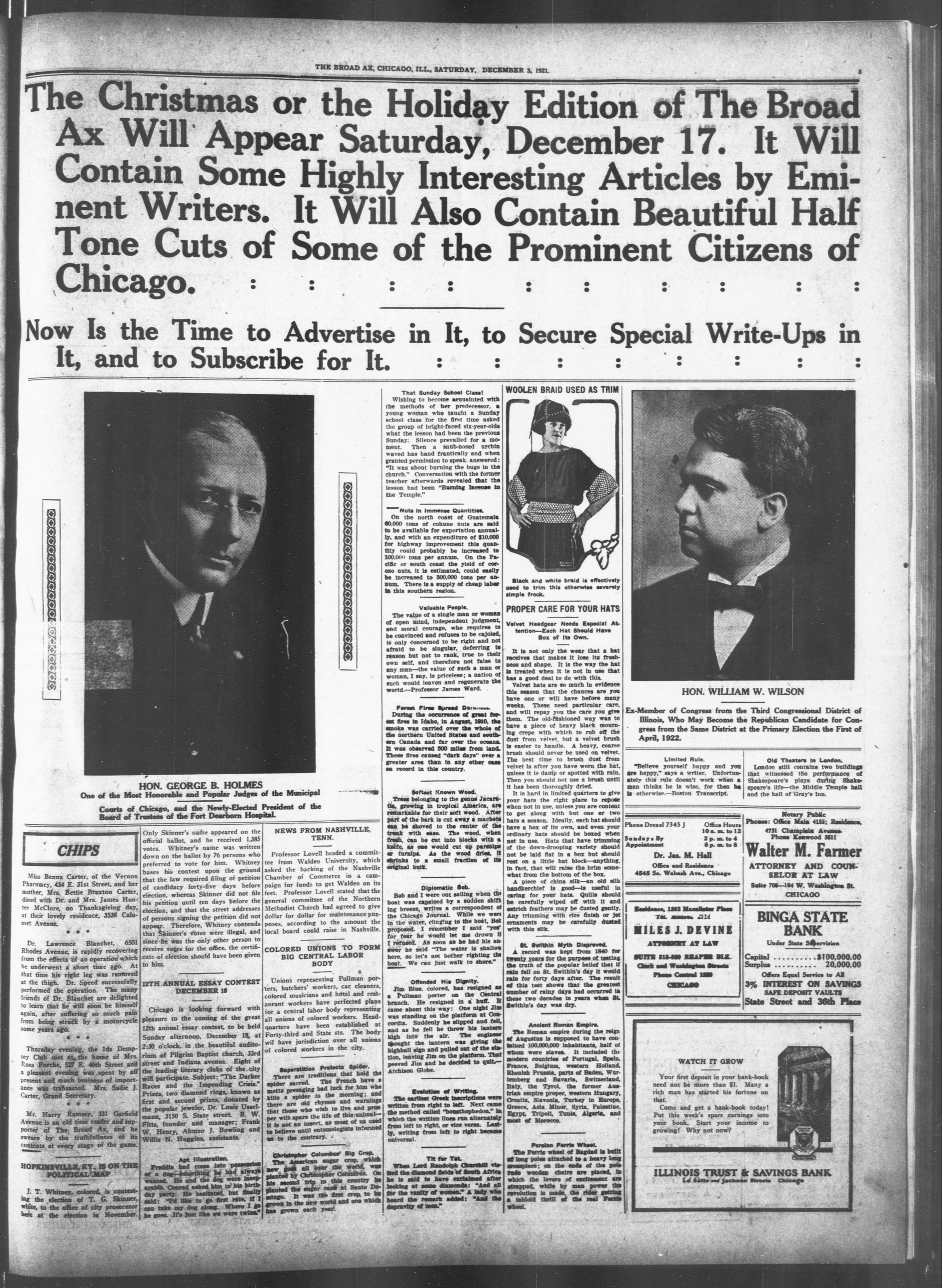
HON. WILLIAM W. WILSON
Ex-Member of Congress from the Third Congress Illinois, Who May Become the Republican Cargress from the Same District at the Primary Elec April, 1922.
The Third Congressional District of the Republican Candidate for Con- t the Primary Election the First of
Ex-Member of Congress from the Third Congressional District of Illinois, Who May Become the Republican Candidate for Congress from the Same District at the Primary Election the First of April, 1922.
Old Theaters in London
London still contains two buildings
that witnessed the performance of
Shakespeare's plays during Shakespeare's life—the Middle Temple hall
and the hall of 'Gray's Inn.
Notary Public
Phones: Office Main 4153; Residence,
4751 Champlain Avenue.
Phone Kenwood 5611
Walter M. Farmer
ATTORNEY AND COUN-
SELOR AT LAW
Suite 706—184 W. Washington St.
CHICAGO
Residence, 1262 MacKester Place
Tel. monte. 2124
MILES J. DEVINE
ATTORNEY AT LAW
SUITE 318-320 REAPER BLK.
Clark and Washington Streets
Phone Central 1899
CHICAGO
BINGA STATE BANK
Under State Supervision
Capital $100,000.00
Surplus 20,000.00
Offers Equal Service to All
3% INTEREST ON SAVINGS
SAFE DEPOSIT VAULTS
State Street and 36th Place
---
Your first deposit in your bank-book need not be more than $1. Many a rich man has started his fortune on that.
Come and get a bank-book today! Put this week's spare earnings into your book. Start your income to growing! Why not now?
ILLINOIS TRUST & SAVINGS
Le Salle and Jackson Streets Chicago
SAVINGS BANK
n Streets Chicago
ILLINOIS TRUST & SAVINGS BANK
La Salle and Jackson Chicago
Limited Rule.
Limited Rule.
"Belleve yourself happy and you are happy," says a writer. Unfortunately this rule doesn't work when a man thinks he is wise, for then he is otherwise—Boston Transcript.
Office Hours
10 a. m. to 12
2 p. m. to 4
6 p. m. to 8
Residence, 1282 MacMaster Place
Tulsa, Oklahoma 7414
SUITE 318-389 REAPER BLK
Clark and Washington Streets
Phone Central 1889
CHICAGO
WATCH IT GROW
MUSEUM OF ARCHITECTURE
NEW YORK
1920
May Gilbert Praises
EXELENTO QUININE
POMADE
Says her hair has grown
28 inches long by using
this wonderful hair grower
YOU can have soft, silky hair that can be easily dressed.
EXELENTO has made happy thousands of women who had
coarse, nappy hair. It will do the same for you. If your
hair is brittle and lifeless or if you have dandruff and itching
scalp, try a box of EXELENTO QUININE POMADE.
For sale at all drug stores. Price by mail. No receipt of stamps or coin.
AGENTS WANTED—Write for Particulars
EXELENTO MEDICINE COMPANY, Atlanta, Georgia
We make EXELENTO SKIN BEAUTIFIER, an eminent for dark, shallow skins,
used in treatment of skin troubles.
Bank Books oftimes bring about the most amazing developments Beautiful homes, gigantic businesses grow out of them It's all up to the owner of the book His willingness to save, his dogged consistency tell the story Presto change! What will your bank account 'turn into'?
Lincoln State Bank of Ch
3105 South State Street—9 and 11 East 1
Under State Government Superv
8 Per Cent on Savings Resources over $2
Lincoln State Bank of Chicago
3105 South State Street—9 and 11 East 31st Street
Under State Government Supervision
3 Per Cent on Savings. Resources over $2,800,000.00
TELEPHONE DOUGLAS 1
Up-to-Date or Modern Houses, Apartments and Stores to Rent
3101 COTTAGE GROVE AVE.
Corner 31st Street, Chicago
THE BROAD AX. CHICAGO, ILL., SATURDAY, DECEMBER 3, 1921.
HANDBAGS MUST BE USEFUL
Compartmentes as important as Style
—Duvetyn Faile, Silk and Canton Crepe, Materials.
Smart compact bags are the keynote of the novelties featured this season. Paris has set the pace for bulkless appearing handbags, and American manufacturers have adopted this idea with variations to suit the needs of American women. Bags are carried more for utility than for decoration by American women, it was pointed out, and therefore compartments are as important an element as the style. To give the flat effect and at the same time make it roomy has taxed the ingenuity of manufacturers, but they have succeeded admirably in combining the two. Bags are being made so small and at the same time spacious enough for toilet articles, that the term "vanity" is liberally applied.
The envelope bag, square and oblong shape, is the most stressed style, but bags on frames and draw strings developed in new materials are also conspicuously featured. Duvetyn fallle, silk and canton crepe are three of the most popular materials used this season and are combined in many cases with steel beads. There is a strong tendency toward fur bags. Some manufacturers are bringing them out in American broadtail and the cheaper makers are approximating this by using fur fabrics or imitations.
FABRIC GLOVE IS APPROVED
Even Those Accustomed to tB Wear Kid Have Declared Preference for Newer Handcovering.
The fabric glove has found favor with the most fastidious; even those accustomed to wear the kid glove exclusively have declared preference for the fabric glove for general wear.
Led by the fancy kid glove, which has had its quota of success, the fabric glove has begun to be decorated in various ways. One of the weaves finding favor comes from France, and, strange to say, it has been developed with all thought for an American clientele. It is an armure of fine cotton which has been passed through an emergy process, leaving it with a velvety finish like a dull suede. It is said to be lighter in quality than the chamois, which is the one liked best in the heavier grades.
Among the shades preferred, gray and belize are now in the first rank with such differences in tones as shades in each color with white and black and, not infrequently, combinations of the two.
INDIAN DESIGNS ARE LATEST
Indications Are That Sport Clothes Will Copy Navajo Tribe and the Scandinavians.
If the sweaters which have been seen are an indication of what the coming season fashions are to be, the feminine world of sport clothes lovers will resemble the Navajo tribe and Scandinavian sportsmen.
Light backgrounds with Norwegian and Swedish designs in all the primary colors and darker backgrounds with Navajo patterns are the latest things in sweaters. As to colors, the fuchsia shades are in the lead, but every color the rainbow has ever displayed or suggested vies in popularity.
Mending the Blouse.
Sometimes, when a favorite suit blouse goes to pieces under the arms, a new piece of material may be hemstitched to the worn place most satisfactorily.
Spread of Bathing in Europe.
Spread of Bathing in Europe.
Bathing came to Europe as one of the good results of the Crusades. The Knights of the Cross found baths in general use among the Saracens, and seeing what good things they were, on returning from those wars took the initiative for their introduction. In this they were highly successful first in England and from that to other countries. So popular did the bath become that it became customary to have one before ceremonies such as marriage or knighthood, and the people have been ever since learning the values of keeping their skins clean.
Longest Shakespeare Play.
"Hamlet" is the longest of Shakespeare's plays, with 3,930 lines, and the "Comedy of Errors" the shortest with 1,777 lines.
The Last Piece of Cake.
It is considered bad luck to take the last piece of cake or other food on the plate. This superstition may be traced as far back as the Bible, where he injunction to "leave some for manners" is found in Ecclesiasticus 31:17.
Olive Oil in Babies' Diet
Dr. E. E. Graham of Philadelphia recommends the addition of olive oil to the diet of babies in their first two years. It is digested well by most infants and supplies them with additional fat.
Arrow Deadly as Bullet.
Arrow Deadly as Bullet.
A mounted Indian or white man with bow and arrows sometimes could kill more buffaloes than a man could kill with a rifle, says the American Forestry Magazine. At close range the arrow was as deadly as the bullet, it made less noise, and arrows could be discharged three or four times as rapidly as bullets from muzzle-loading guns.
---
Indian Name of Quaint Old City. The Indians called a strait "Kebec," and the name was given to the site of the present city of Quebec from the peculiar configuration of the St. Lawrence river at that point, for the river there grows narrow and from its deep waters rises the bold height on which the ancient city stands. The French-Canadian still pronounces the name Kebec.
Old Buggy His Court
A judge of Livingston, N. J., is on record as holding court from the seat of an old buggy. The case was that of a tenant who had disregarded notice to vacate property, so the buggy was drawn up within a short distance of the house in question and the trial proceeded.
English Poetry and Prose
If there is anything in literature as wonderful as English poetry it is English prose. Like the twin pillars of a mighty temple stand those two great books, the Bible of 1611, the Shakespeare of 1623, and no other country can show their equal—George Sampson.
Regiment Proud of Long Service.
The Third infantry, the oldest regiment of our army, which dates from 1784, has developed its arms to show its early service in Mexico. One interesting device used by this regiment is a baton crossed with an oldtime bayonet back of the shield. The baton which figures prominently in the regiment's history was made from the flagstaff of the capitol of the City of Mexico and was taken when the city was captured. It is still one of the most highly prized possessions of the regiment.
Electricity and Chinese Demona. Word has come from Shanghai that employees of the China Electric company recently called in a native priest to drive away the demon in an electric buzz saw which had cut off two of the operator's fingers. After the ceremony the workmen returned to their tasks contentedly. The manager of the plant felt that, despite the superstition displayed, these Chinese workmen were accepting electricity in their own way—North American.
THE NEWEST NOTES IN HATS
Lace Still Much Used and Sometimes Seen in Streamere That Hang to the Waletline.
Lace is a becoming and decorative note which is still much used. It is sometimes seen in long streamers that fall from the brim across the back and hang to the waletline, or, again, it is draped at one side. There are some shadow designs, but the Spanish laces are particularly interesting and quite different from anything used during the summer, because of their definitely heavy pattern and silky weave. Metallic laces in gold and silver are decorative for evening hats.
Soft willow ostrich with long fines, natural or glycerinized ostrich feathers, lacquered quilia, and narrow ribbons are used for trimming. Very often, black feathers are tipped with silver.—Vogue.
Clean Velour Hat
If the velours hat is shabby, put some finally powdered salt in the oven. When it is quite hot, rub it into the hat with soft paper. Discard the rolled paper for new occasionally. Brush with a stiff brush.
FUNERAL DIRECTORS
5121 ERNEST H. WILLIAMSON UNDERTAKER
GARAGE
GASOLINE OIL
OPEN DARK & BIGGY
Ernest H. Williamson UNDERTAKER
Day Light Chapel, capacity 200, Outside Ventilation—Organ and Organist Free—
I am as near as your Telephone—I give service at a reasonable price—Distance
immaterial, consult me—I save you worry, time and money.
5121 & 5123 SOUTH STATE STREET
CHICAGO, ILLINOIS
118 N. La Salle Street CHICAGO
Residence Telephone
3342 Calumet Ave. Douglas 1275
JAMES G. COTTER
ATTORNEY AT LAW
145 NORTH CLARK STREET
SUITE 407
Telephone Central 8354
CHICAGO
Formerly
Assistant Attorney General
State of Illinois
Res. 3046 Grand Boul.
Doug. 4397
J. GRAY LUCAS
ATTORNEY-AT-LAW
Phone: Douglas 6351
CHICAGO
F. Dunn, J. B. McCahey,
Trustees
Tel: Oakland 1552, 1551, 1550
JOHN J. DUNN
Established 1877
WHOLESALE AND RETAIL
COAL
Fifty-First and Federal Streets
CHICAGO
Academice 3885 Prairie Ave.
Phone Douglas 0138
Phones: Main 2017 Auto 32-385
A. L. WILLIAMS
ATTORNEY AND
COUNSELOR AT LAW
Suite 706 Firmenich Building
84 W. Washington Street
CHICAGO
PHONE KENWOOD 455
Comparative Statement of Deposits
November 18, 1912, $836,605.23
November 17, 1914, $912,005.69
November 17, 1916, $1,132,750.72
November 18, 1918, $1,284,084.24
November 17, 1919, $2,359,636.62
November 15, 1920, $3,224,633.09
OFFICE
JOHN BAIN. President
MICHAEL MAISEL, VP
EDW. C. BARRY,
W. MERLE R.
ARTHUR
N. President
AEL MAISEL, Vice President
DW. C. BARKY, Cashier
W. MERLE FISHER, Assistant
ARTHUR C. UTESCH, A
IN BAIN, President
MICHAEL MAISEL, Vice President
EDW. C. BARRY, Cashier
W. MERLE FISHER, Assistant Cashier
ARTHUR C. UTESCH, Asst. Cashier.
Something in This.
If a man has the raw material for being a blamed fool, he cannot blame the fakir for taking advantage of opportunities.—Exchange.
It Always Costs Him a Stroke.
Nothing is more disconcerting to a middle-aged golfer than to be asked by the young lady who is watching him drive off whether he intends to enter the grandfather's tournament.
The Cranford A
3600 WABAS
The finest building ever opened
Steam heat, electric lights, t
Phone Main 263 J. W. Casey
Sanford Apartment
600 WABASH AVENUE
ding ever opened to Colored tenants
electric lights, tile baths, marble
J. W. Casey, Agt. 133 W. W.
THE BROADWAY
The Cranford Apartment Bldg. 3600 WABASH AVENUE
The finest building ever opened to Colored tenants in Chisage. Steam heat, electric lights, tile baths, marble entrance Phone Main 263 J. W. Casey, Agt. 133 W. Washington St.
OUR NEW HOME
FUNERAL DIRECT
DIRECTORS
CERS
Face President
Cashier
FISHER, Assistant Cashier
R C. UTESCH, Asst. Cashier.
OFFICERS
Chair Silencers
In rooms where the floor is not covered with a soft carpet the moving of chairs is often the cause of a good chill of noise. The trouble may be caused in this way: From thick felt cut small rounds to glue on to the floor of the chairs. These can be secured from an old hat or cut from an odd piece of floor covering. The chairs can be moved about quietly even on the hardest floors.