The Broad Ax
Saturday, April 29, 1922
Chicago, Illinois
Page text (machine-generated)
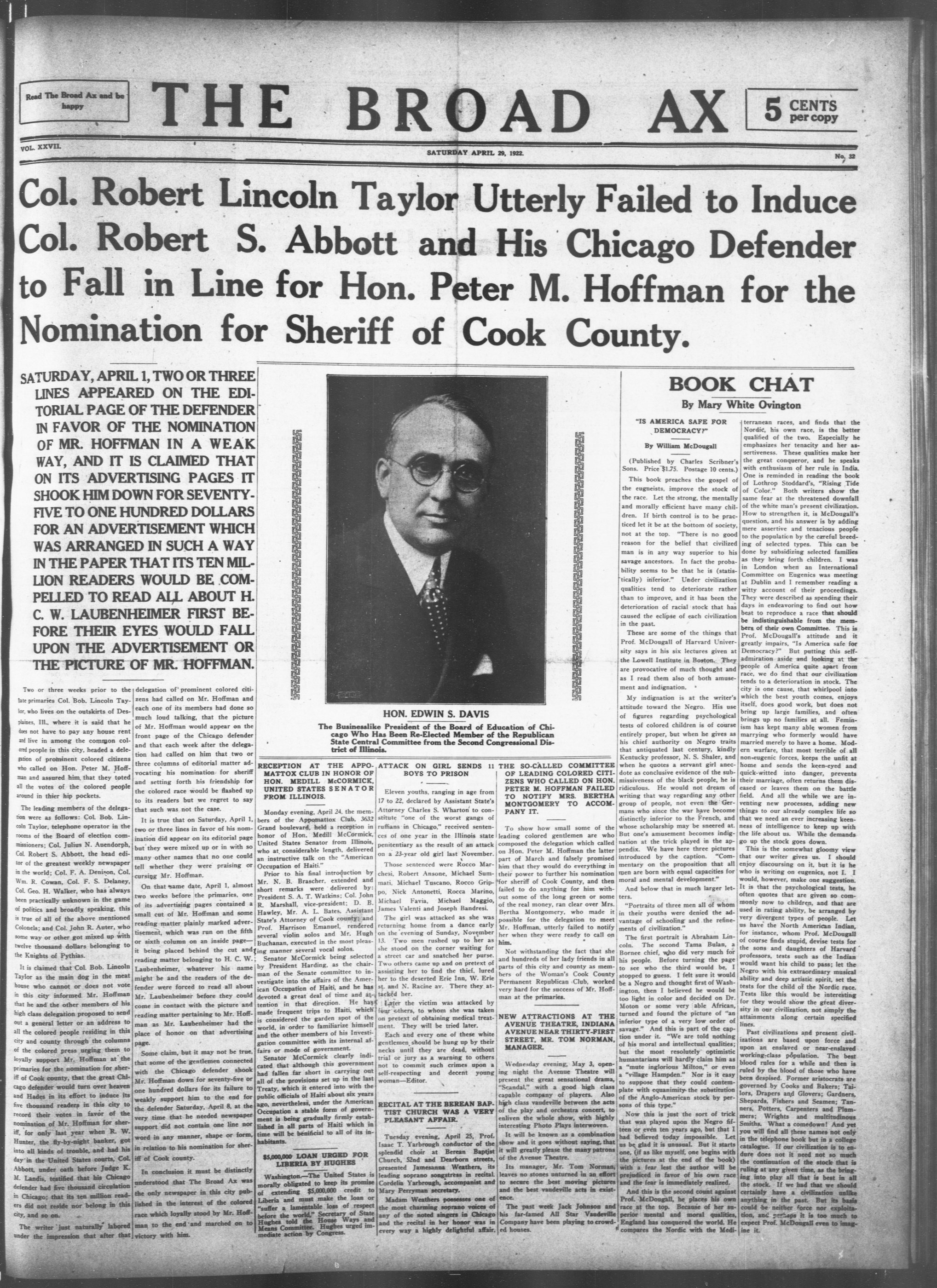
Col. Robert Lincoln Taylor Utterly Failed to Induce Col. Robert S. Abbott and His Chicago Defender to Fall in Line for Hon. Peter M. Hoffman for the Nomination for Sheriff of Cook County.
SATURDAY, APRIL 1, TWO OR THREE LINES APPEARED ON THE EDITORIAL PAGE OF THE DEFENDER IN FAVOR OF THE NOMINATION OF MR. HOFFMAN IN A WEAK WAY, AND IT IS CLAIMED THAT ON ITS ADVERTISING PAGES IT SHOOK HIM DOWN FOR SEVENTY-FIVE TO ONE HUNDRED DOLLARS FOR AN ADVERTISEMENT WHICH WAS ARRANGED IN SUCH A WAY IN THE PAPER THAT ITS TEN MILLION READERS WOULD BE COMPELLED TO READ ALL ABOUT H. C. W. LAUBENHEIMER FIRST BEFORE THEIR EYES WOULD FALL UPON THE ADVERTISEMENT OR THE PICTURE OF MR. HOFFMAN.
Read The Broad Ax and be happy
VOL. XXVII.
Col. Ro
Col. Ro
to Fall
Nomina
SATURDAY, APRIL
LINES APPEAR
TORIAL PAGE
IN FAVOR OF
OF MR. HOFF
WAY, AND IT
ON ITS ADVER
SHOOK HIM DO
FIVE TO ONE H
FOR AN ADVER
WAS ARRANG
IN THE PAPER
LION READERS
PELLED TO RE
C. W. LAUBEN
FORE THEIR E
UPON THE AD
THE PICTURE
Two or three weeks prior to the late primaries Col. Bob. Lincoln Taylor, who lives on the outskirts of Desplaines, Ill., where it is said that he does not have to pay any house rent and live in among the common colored people in this city, headed a delegation of prominent colored citizens who called on Hon. Peter M. Hoffman and assured him, that they toted all the votes of the colored people around in thier hip pockets.
The leading members of the delegation were as follows: Col. Bob. Lincoln Taylor, telephone operator in the rooms of the Board of election commissioners; Col. Julius N. Auendorph, Col. Robert S. Abbott, the head editor of the greatest weekly newspaper in the world; Col. F. A. Denison, Col. Wm. R. Cowan, Col. F. S. Delaney, Col. Geo. H. Walker, who has always been practically unknown in the game of politics and broadly speaking, this is true of all of the above mentioned Colonels; and Col. John R. Auter, who some way or other got mixed up with twelve thousand dollars belonging to the Knights of Pythias.
It is claimed that Col. Bob. Lincoln Taylor as the main dog in the meat house who cannot or does not vote in this city informed Mr. Hoffman that he and the other members of his high class delegation proposed to send out a general letter or an address to all the colored people residing in this city and county through the columns of the colored press urging them to loyally support Mr. Hoffman at the primaries for the nomination for sheriff of Cook county, that the great Chicago defender would turn over heaven and Hades in its effort to induce its five thousand readers in this city to record their votes in favor of the nomination of Mr. Hoffman for sheriff, for only last year when R. W. Hunter, the fly-by-night banker, got into all kinds of trouble, and had his day in the United States courts, Col. Abbott, under oath before Judge K. M. Landis, testified that his Chicago defender had five thousand circulation in Chicago; that its ten million readers did not reside nor belong in this city, and so on.
The writer just naturally labored
under the impression that after that
THE BROAD AX
delegation of' prominent colored citizens had called on Mr. Hoffman and each one of its members had done so much loud talking, that the picture of Mr. Hoffman would appear on the front page of the Chicago defender and that each week after the delegation had called on him that two or three columns of editorial matter advocating his nomination for sheriff and setting forth his friendship for the colored race would be flashed up to its readers but we regret to say that such was not the case.
It is true that on Saturday, April 1, two or three lines in favor of his nomination did appear on its editorial page but they were mixed up or in with so many other names that no one could tell whether they were praising or cursing Mr. Hoffman.
On that same date, April 1, almost two weeks before the primaries, one of its advertising pages contained a small cut of Mr. Hoffman and some reading matter plainly marked advertisement, which was run on the fifth or sixth column on an inside page—it being placed behind the cut and reading matter belonging to H. C. W. Laubenheimer, whatever his name might be and the readers of the defender were forced to read all about Mr. Laubenheimer before they could come in contact with the picture and reading matter pertaining to Mr. Hoffman as Mr. Laubenheimer had the place of honor on that advertising page.
Some claim, but it may not be true, that some of the gentlemen connected with the Chicago defender shook Mr. Hoffman down for seventy-five or one hundred dollars for its failure to weakly support him to the end for the defender Saturday, April 8, at the very time that he needed newspaper support did not contain one line nor word in any manner, shape or form, in relation to his nomination for sheriff of Cook county.
In conclusion it must be distinctly understood that The Broad Ax was the only newspaper in this city published in the interest of the colored race which loyally stood by Mr. Hoffman to the end and marched on to victory with him.
[Picture of a man in a suit with a tie and glasses. He is facing the camera, looking directly at the viewer. The background is a solid black color. The man's hair is neatly styled, and he has a serious expression on his face. The image is in black and white.]
[Picture of a man in a suit with a tie and glasses. He is facing the camera, looking directly at the viewer. The background is a solid black color. The man's hair is neatly styled, and he has a serious expression on his face. The image is in black and white.]
The Businessalike President of the Board of Education of Chicago Who Has Been Re-Elected Member of the Republican State Central Committee from the Second Congressional District of Illinois.
---
RECEPTION AT THE APPOMATTOX CLUB IN HONOR OF HON. MEDILL McCORMICK, UNITED STATES SENATOR FROM ILINOIS.
Monday evening, April 24, the members of the Appomattox Club, 3632 Grand boulevard, held a reception in honor of Hon. Medill McCormick, United States Senator from Illinois, who at considerable length, delivered an instructive talk on the "American Occupation of Haiti."
Prior to his final introduction by Mr. N. B. Brascher, extended and short remarks were delivered by: President S. A. T. Watkins; Col. John R. Marshall, vice-president; D. B. Hawley, Mr. A. L. Bates, Assistant State's Attorney of Cook country; and Prof. Harrison Emanuel, rendered several violin solos and Mr. Hugh Buchanan, executed in the most pleasing manner several vocal solos.
Senator McCormick being selected by President Harding, as the chairman of the Senate committee to investigate into the affairs of the American Occupation of Haiti, and he has devoted a great deal of time and attention in that direction. He has made frequent trips to Haiti, which is considered the garden spot of the world, in order to familiarize himself and the other members of his Investigation committee with its internal affairs or mode of government.
Senator McCormick clearly indicated that although this government had fallen far short in carrying out all of the provisions set up in the last Treaty, which it entered into with the public officials of Haiti about six years ago, nevertheless, under the American Occupation a stable form of government is being gradually firmly established in all parts of Haiti which in time will be beneficial to all of its inhabitants.
$5,000,000 LOAN URGED FOR
LIBRERIA BY HUGHES
Washington.—The United States is morally obligated to keep its promise of extending $5,000,000 credit to Liberia and must make the loan or "suffer a lamentable loss of respect before the world." Secretary of State Hughes told the House Ways and Measures Committee. Hughes urged im-
SATURDAY APRIL 29, 1922.
aylor U
tt and
on. Pete
ff of Co
or Utt
and H
Peter
of Coo
HON. EDWIN S. DAVIS
The President of the Board of Ed
has Been Re-Elected Member of
Committee from the Second Co
osis.
The President of the Board of Education has Been Re-Elected Member of the Rep
l Committee from the Second Congressi on.
ATTACK ON GIRL SENDS 11 THE S
BOYS TO PRISON OF L
Eleven youths, ranging in age from 17 to 22, declared by Assistant State's Attorney Charles S. Wharton to constitute "one of the worst gangs of ruffians in Chicago," received sentences of one year in the Illinois state penitentiary as the result of an attack on a 23-year old girl last November.
Those sentenced were Rocco Marchesi, Robert Anselone, Michael Summati, Michael Tuscano, Rocco Grippo, Nick Antonetti, Rocca Marino, Michael Favia, Michael Maggio, James Valenti and Joseph Bandresi.
The girl was attacked as she was returning home from a dance early on the evening of Sunday, November 13. Two men rushed up to her as she stood on the corner waiting for a street car and snatched her purse. Two others came up and on pretext of assisting her to find the thief, lured her to the deserted Erie Inn, W. Erie st. and N. Racine av. There they attacked her.
Later the victim was attacked by four others, to whom she was taken on pretext of obtaining medical treatment. They will be tried later.
Each and every one of these white gentlemen should be hung up by their necks until they are dead, without trial or jury as a warning to others not to commit such crimes upon a self-respecting and decent young woman-Editor.
RECITAL AT THE BEREAN BAP-
TIST CHURCH WAS A VERY
PLEASANT AFFAIR.
Tuesday evening, April 25, Prof. Isaac T. Yarbrough conductor of the splendid choir at Berean Baptist Church, 52nd and Dearborn streets, presented Jamesanna Weathers, its leading soprano songstress in recital. Cordelia Yarbrough, accompanist and Mary Perryman secretary.
Madam Weathers possesses one of the most charming soprano voices of any of the noted singers in Chicago and the recital in her honor was in every way a highly delightful affair.
---
THE SO-CALLED COMMITTEE OF LEADING COLORED CITIZENS WHO CALLED ON HON. PETER M. HOFFMAN FAILED TO NOTIFY MRS. BERTHA MONTGOMERY TO ACCOMPANY IT.
To show how small some of the leading colored gentlemen are who composed the delegation which called on Hon. Peter M. Hoffman the latter part of March and falsely promised him that they would do everything in their power to further his nomination for sheriff of Cook County, and then failed to do anything for him without some of the long green or some of the real money, ran clear over Mrs. Bertha Montgomery, who made it possible for the delegation to meet Mr. Hoffman, utterly failed to notify her when they were ready to call on him.
Not withstanding the fact that she and hundreds of her lady friends in all parts of this city and county as members of the Woman's Cook County Permanent Republican Club, worked very hard for the success of Mr. Hoffman at the primaries.
NEW ATTRACTIONS AT THE AVENUE THEATRE, INDIANA AVENUE NEAR THIRTY-FIRST STREET, MR. TOM NORMAN, MANAGER.
Wednesday evening, May 3, opening night the Avenue Theatre will present the great sensational drama, "Scandal," with a good high class capable company of players. Also high class vaudeville between the acts of the play and orchestra concert, to enliven the whole show, with highly interesting Photo Plays interwoven.
It will be known as a combination show and it goes without saying, that it will greatly please the many patrons of the Avenue Theatre.
Its manager, Mr. Tom Norman, leaves no stones unturned in an effort to secure the best moving pictures and the best vaudeville acts in existence.
The past week Jack Johnson and his far-famed All Star Vaudeville Company have been playing to crowded houses.
---
"IS AMERICA SAFE FOR DEMOCRACY?"
By William McDougall
(Published by Charles Scribner's Sons. Price $1.75. Postage 10 cents.) This book preaches the gospel of the eugneists, improve the stock of the race. Let the strong, the mentality and morally efficient have many children. If birth control is to be practiced let it be at the bottom of society, not at the top. "There is no good reason for the belief that civilized man is in any way superior to his savage ancestors. In fact the probability seems to be that he is (statistically) inferior." Under civilization qualities tend to deteriorate rather than to improve, and it has been the deterioration of racial stock that has caused the eclipse of each civilization in the past. These are some of the things that Prof. McDougall of Harvard University says in his six lectures given at the Lowell Institute in Boston. They are provocative of much thought and as I read them also of both amusement and indignation.
My indignation is at the writer's attitude toward the Negro. His use of figures regarding psychological tests of colored children is of course entirely proper, but when he gives as his chief authority on Negro traits that antiquated last century, kindly Kentucky professor, N. S. Shaler, and when he quotes a servant girl anecdote as conclusive evidence of the submissiveness of the black people, he is ridiculous. He would not dream of writing that way regarding any other group of people, not even the Germans who since the war have become distinctly inferior to the French, and whose scholarship may be sneered at. But one's amusement becomes indignation at the trick played in the appendix. We have here three pictures introduced by the caption. "Commentary on the proposition that all men are born with equal capacities for moral and mental development."
And below that in much larger letters.
"Portraits of three men all of whom in their youths were denied the advantage of schooling and the refinements of civilization."
The first portrait is Abraham Lincoln. The second Tama Bulan, a Bornee chief, who did very much for his people. Before turning the page to see who the third would be, I stopped to guess. I felt sure it would be a Negro and thought first of Washington, then I believed he would be too light in color and decided on Dr. Moton or some very able African, turned and found the picture of "an inferior type of a very low order of savage." And this is part of the caption under it. "We are told nothing of his moral and intellectual qualities; but the most resolutely optimistic humanarians will hardly claim him as a "mute inglorious Milton" or even a "village Hampden." Nor is it easy to suppose that they could contemplate with equanimity the substitution of the Anglo-American stock by persons of this type."
Now this is just the sort of trick that was played upon the Negro fifteen or even ten years ago, but that I had believed today impossible. Let us be glad it is unusual. But it starts one, (if as like myself, one begins with the pictures at the end of the book) with a fear lest the author will be prejudiced in favor of his own race and the fear is immediately realized.
And this is the second count against Prof. McDougall, he places his own race at the top. Because of her superior mental and moral qualities, England has conquered the world. He compares the Nordic with the Medi-
5 CENTS per copy
No. 32
Induce
efender
for the
CHAT
white Ovington
terranean races, and finds that the Nordic, his own race, is the better qualified of the two. Especially he emphasizes her tenacity and her assertiveness. These qualities make her the great conqueror, and he speaks with enthusiasm of her rule in India. One is reminded in reading the book of Lothrop Stoddard's, "Rising Tide of Color." Both writers show the same fear at the threatened downfall of the white man's present civilization. How to strengthen it, is McDougall's question, and his answer is by adding mere assertive and tenacious people to the population by the careful breeding of selected types. This can be done by subsidizing selected families as they bring forth children. I was in London when an International Committee on Eugenics was meeting at Dublin and I remember reading a witty account of their proceedings. They were described as spending their days in endeavoring to find out how best to reproduce a race that should be indistinguishable a Committee of their Own Committee. This is Prof. McDougall's attitude and it greatly impairs, "Is America safe for Democracy?" But putting this self-admiration aside and looking at the people of America quite apart from race, we find that our civilization tends to a deterioration in stock. The city is one cause, that whirlpool into which the best youth comes, enjoys itself, does good work, but does not bring up large families, and often brings up no families at all. Feminism has kept many able women from marrying who formerly would have married merely to have a home. Modern warfare, that most terrible of all non-eugenic forces, keeps the unfit at home and sends the keen-eyed and quick-witted into danger, prevents their marriage, often returns them diseased or leaves them on the battle field. And all the while we are inventing new processes, adding new things to our already complex life so that we need an ever increasing keenness of intelligence to keep up with the life about us. While the demands go up the stock goes down.
This is the somewhat gloomy view that our writer gives us. I should enjoy discoursing on it, but it is he who is writing on eugenics, not I. I would, however, make one suggestion. It is that the psychological tests, he often quotes that are given so commonly now to children, and that are used in rating ability, be arranged by very divergent types of people. Let us have the North American Indian, for instance, whom Prof. McDougall of course finds stupid, devise tests for the sons and daughters of Harvard professors, tests such as the Indian would want his child to pass; let the Negro with his extraordinary musical ability and deep artistic spirit, set the tests for the child of the Nordic race. Tests like this would be interesting for they would show the great diversity in our civilization, not simply the attainments along certain specified lines.
Past civilizations and present civilizations are based upon force and upon an enslaved or near-enslaved working-class population. The best blood rules for a while and then is ruled by the blood of those who have been despised. Former aristocrats are governed by Cooks and Bakers; Tailors, Drapers and Glovers; Gardners, Shepards, Fishers and Seamen; Tanners, Potters, Carpenters and Plummers; Wrights and multitudinous Smiths. What a comedown! And yet you will find all these names not only in the telephone book but in a college catalogue. If our civilization is to endure does not it need not so much the continuation of the stock that is ruling at any given time, as the bringing into play all that is best in all the stock. If we had that we should certainly have a civilization unlike anything in the past. But its basis could be neither force nor exploitation, and perhaps it is too much to expect Prof. McDougall even to imagine it.
THE BROAD AX
Published Every Saturday
In this city since July 15th, 1899, without missing one single issue. Republicans, Democrats, Catholics, Protestants, Single Taxers, Priests, infidels or anyone else can have their say as long as their language is proper and responsibility is fixed.
The Broad Ax is a newspaper whose platform is broad enough for all, ever claiming the editorial right to speak as own mind.
Local communications will receive attention. Write only on one side of the paper.
Subscriptions must be paid in ad-
One Year .....$2.00
Six Months .....$1.00
Advertising rates made known on
application.
Address all communication to ...
THE BROAD AX
6206 So. Elizabeth St., Chicago, Ill.
Phone Wentworth 2597
JULIUS F. TAYLOR
Editor and Publisher
Associate Editor
DR. M. A. MAJORS
4700 South State Street
Phone Drexel 1416
April 29, 1922
Vol. XXVII. No. 32
Entered as Second-Class Matter, Aug.
19, 1902, at the Post Office at Chicago,
III. Under Act of March 8, 1879.
N. A. A. C. P. SPRING DRIVE
OPENED MONDAY, APRIL 24
Culminates in Anti-Lynching Confer-
ence in Newark, June 18-23—
"Lynch Law Must Go"
Is Slogan
"Lynch Law Must Go" is the slogan of the Spring Drive of the National Association for the Advancement of Colored People, which opened Monday, April 24, and culminated in an anti-lynching conference in Newark, N. J., from June 18 to 23.
The entire weight of the Association's forces throughout the United States is to be applied in an organized pressure toward the enactment by the Senate of the Dyer Anti-Lynching Bill, H. R. 13, already passed by the House of Representatives.
There is no doubt felt in the National Office of the N. A. A. C. P. that President Harding will sign the measure if and when the Senate enacts it. In fact, the President's signature is looked upon as a foregone conclusion. The N. A. A. C. P. campaign on the Dyer Bill has already been begun in two states, Michigan and New Jersey, where local elections are made to hinge on that issue. Colored voters and the press throughout the country are being asked to make it clear that the Republican party will be held responsible for non-performance of its duty and its pledge to pass some such legislation as the Dyer Bill.
Secretary Johnson's Statement
In opening the N. A. A. C. P. Spring Drive, James Weldon Johnson, secretary of the association, said: "The Dyer Bill was passed in the House of Representatives because colored people in the United States worked together for that end. It will be passed in the Senate for the same reason.
"The National Association for the Advancement of Colored People believes that the Dyer Bill is an excellent object lesson in the value of working together. If we can accomplish so much in one direction, we can in others as well. Therefore, we want active, enthusiastic members. If half a million colored Americans join the N. A. A. C. P., each individual will be part of an immense power working through organized machinery, which will make the Negro's just claims felt in the Nation. For the Negro, as for all humanity, 'In Union There Is Strength.' Join the N. A. A. C. P.'
Southern Branches Active
Southern branches are especially active in the N. A. A. C. P. drive this year, among them being the branches in Houston. El Paso, Corpus Christi and Dallas, Texas: Houston has undertaken to reorganize the branches in Texas that became dormant at the time of the assault on John R. Shillady.
New Orleans, La., branch is in the midst of a canvass for 5,000 members and Shreveport has also vigorously entered the drive. Most of the branches in Florida and many Arkansas branches have made their preparations to start at the word "Go."
No timidity is being shown by southern branches in the method of their campaign. Houston placing window cards in the homes of their members, inscribed with the words:
"This Family 100 Per Cent Members N. A. A. C. P."
The branch in the national capital, Washington, D. C., has set itself the largest quota, seeking to obtain 25,000 members, and Chicago and New York follow with quotas of 10,000 each.
#
[Picture of a man in a suit with a bow tie].
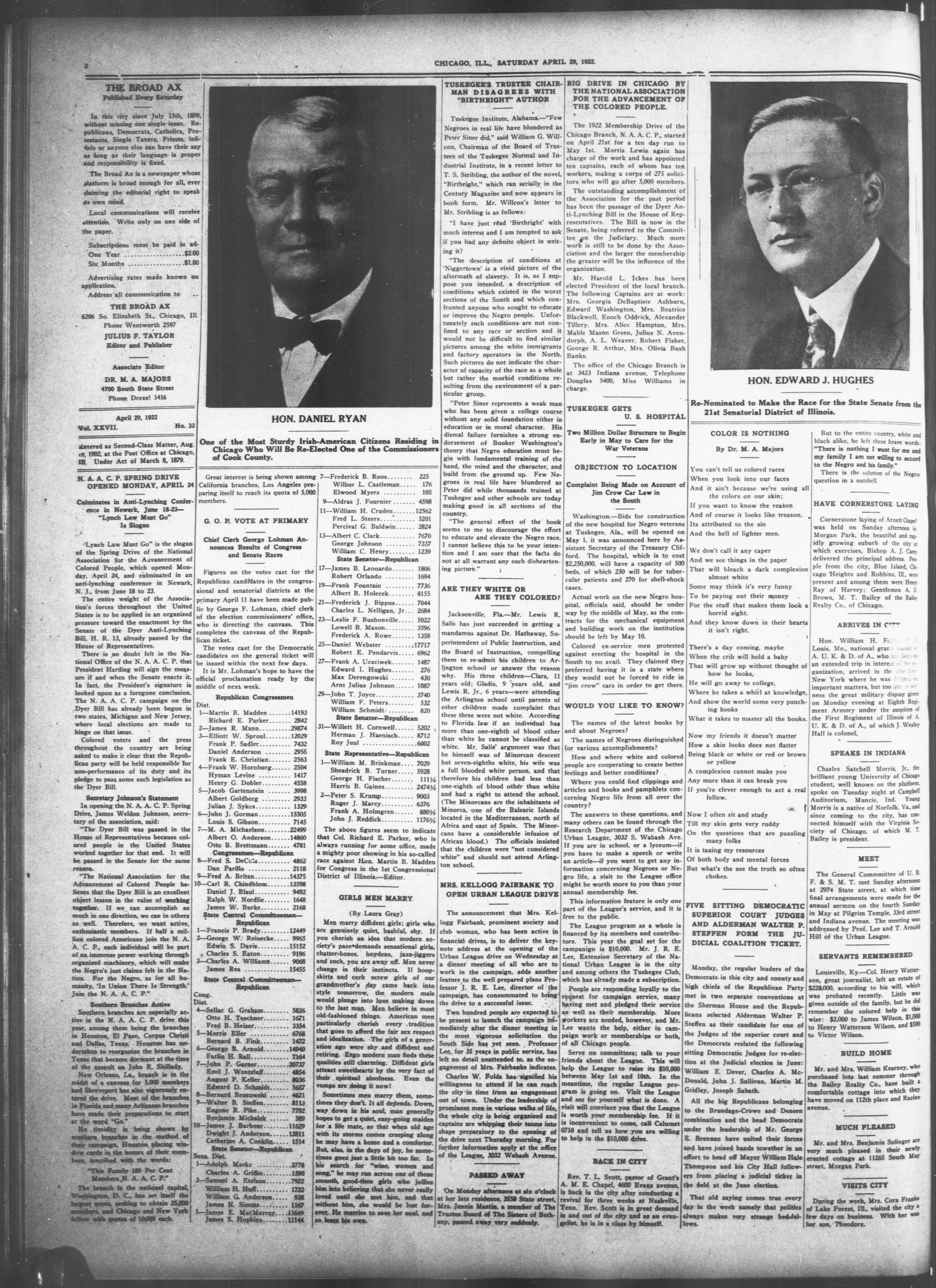
HON. DANIEL RYAN
One of the Most Sturdy Irish Chicago Who Will Be Re-El of Cook County.
One of the Most Sturdy Irish-American Citizens Residing in Chicago Who Will Be Re-Elected One of the Commissioners of Cook County.
Great interest is being shown among 7—Frederick B. Roos..... 225
California branches, Los Angeles preparing itself to reach its quota of 5,000 members.
Wilbur L. Castleman..... 176
Elwood Myers..... 105
9—Aldras J. Fournier..... 4598
G. O. P. VOTE AT PRIMARY
Chief Clerk George Lohman Announces Results of Congress and Senate Races
Figures on the votes cast for the Republican candidates in the congressional and senatorial districts at the primary April 11 have been made public by George F. Lohman, chief clerk of the election commissioners' office, who is directing the canvass. This completes the canvass of the Republican ticket. The votes cast for the Democratic candidates on the general ticket will be issued within the next few days.
It is Mr. Lohman's hope to have the official proclamation ready by the middle of next week.
Republican Congressmen
Dist.
1—Martin B. Madden ... 14193
Richard E. Parker ... 2842
2—James R. Mann ... 29874
3—Elliott W. Sproul ... 12029
Frank P. Sadler ... 7432
Daniel Anderson ... 2956
Frank E. Christian ... 2563
4—Frank W. Hornburg ... 2504
Hyman Levine ... 1417
Henry G. Dobler ... 4558
5—Jacob Gartenstein ... 3998
Albert Goldberg ... 2933
Julian J. Sykes ... 1329
6—John J. Gorman ... 15505
Louis S. Gibson ... 7145
7—M. A. Michaelson ... 22499
Albert O. Anderson ... 14860
Otto B. Brettmann ... 4781
Congressmen—Republican
8—Fred S. DeCola ... 4862
Dan Parillo ... 2118
9—Fred A. Briten ... 14375
10—Carl R. Chindblom ... 13598
Daniel J. Blaul ... 9492
Ralph W. Nordlie ... 1648
James W. Burke ... 2168
State Central Committeeman—Republican
1—Francis P. Brady ... 12449
2—George W. Reinecke ... 9965
Edwin S. Davis ... 15152
Charles S. Eaton ... 9196
3—Charles A. Williams ... 9068
James Rea ... 15455
State Central Committeeman—Republican
---
7—Frederick B. Roos..... 225
Wilbur L. Castleman..... 176
Elwood Myers..... 105
9—Aldras J. Fournier..... 4598
11—William H. Cruden..... 12562
Fred L. Steers..... 5201
Percival G. Baldwin..... 2824
13—Albert C. Clark..... 7670
George Johnson..... 7337
William C. Henry..... 1239
**State Senator—Republican**
17—James B. Leonardo..... 1806
Robert Orlando..... 1694
19—Frank Fountain..... 7736
Albert B. Holecke..... 8155
21—Frederick J. Bippus..... 7044
Charles L. Nelligan, Jr..... 2684
23—Leslie F. Bushville... 5022
Lowell B. Mason..... 3596
Frederick A. Aowe..... 1358
25—Daniel Webster..... 17717
Robert E. Pendarvis..... 6962
27—Frank A. Uczciwek..... 1487
Edward I. Hughes..... 276
Max Derengowski..... 430
Arnt Julius Johnson..... 1087
29—John T. Joyce..... 3740
William F. Peters..... 532
William Schmidt..... 820
**State Senator—Republican**
31—Willett H. Cornwell..... 5202
Herman J. Haenisch..... 8712
Roy Juul..... 6002
**State Representative—Republican**
1—William M. Brinkman..... 7029
Sheadrick B. Turner..... 5928
George H. Fischer..... 111%
Harris B. Gaines..... 2474%
2—Peter S. Krump..... 9003
Roger J. Marcy..... 6376
Frank A. Holmgren..... 880%
John J. Reddick..... 1176%
The above figures seem to indicate that Col. Richard E. Parker, who is always running for some office, made a mighty poor showing in his so-called race against Hon. Martin B. Madden for Congress in the 1st Congressional District of Illinois—Editor.
GIRLS MEN MARRY
(By Laura Gray)
Men marry diffident girls; girls who are genuinely quiet, bashful, shy. If you cherish an idea that modern society's pace-demands sensational girls, chatter-boxes, hoydens, jazz-jiggers and such, you are away off. Men never change in their instincts. If hoopskirts and cork screw girls of our grandmother's day came back into style tomorrow, the modern male would plunge into love making down to the last man. Men believe in most old-fashioned things. American men particularly cherish every tradition that goes to afford the fair sex respect and idealization. The girls of a generation ago were shy and diffident and retiring. Esgo modern man finds these qualities still charming. Diffident girls attract sweethearts by the very fact of their spiritual aloofness. Even the vamps are doing it now!
Sometimes men marry them, sometimes they don't. It all depends. Down, way down in his soul, man generally hopes to get a quiet, easy-going maiden for a life mate, so that when old age with its storms comes creeping along he may have a home and a comforter. But, alas, in the days of joy, he sometimes goes just a little bit too far. In his search for "wine, women and song," he may run across one of those smooth, good-time girls who jolles him into believing that she never really loved until she met him, and that without him, she would be lost forever. He marries to save her soul, and so loses his own.
CHICAGO, ILL. SATURDAY APRIL 29, 1922
TUSKEGEE'S TRUSTEE CHAIR
MAN DISAGREES WITH
"BIRTHRIGHT" AUTHOR
Tuskegee Institute, Alabama—"Few Negroes in real life have blundered as Peter Siner did," said William G. Willcox, Chairman of the Board of Trustees of the Tuskegee Normal and Industrial Institute, in a recent letter to T. S. Stribling, the author of the novel, "Birthright," which ran serially in the Century Magazine and now appears in book form. Mr. Willcox's letter to Mr. Stribling is as follows: "I have just read 'Birthright' with much interest and I am tempted to ask if you had any definite object in writing it?
"The description of conditions at 'Niggertown' is a vivid picture of the aftermath of slavery. It is, as I suppose you intended, a description of conditions which existed in the worst sections of the South and which confronted anyone who sought to educate or improve the Negro people. Unfortunately such conditions are not confined to any race or section and it would not be difficult to find similar pictures among the white immigrants and factory operators in the North. Such pictures do not indicate the character of capacity of the race as a whole but rather the morbid conditions resulting from the environment of a particular group.
"Peter Siner represents a weak man who has been given a college course without any solid foundation either in education or in moral character. His dismal failure furnishes a strong endorsement of Booker Washington's theory that Negro education must begin with fundamental training of the hand, the mind and the character, and build from the ground up. Few Negroes in real life have blundered as Peter did while thousands trained at Tuskegee and other schools are today making good in all sections of the country.
"The general effect of the book seems to me to discourage the effort to educate and elevate the Negro race. I cannot believe this to be your intention and I am sure that the facts do not at all warrant any such disheartening picture."
ARE THEY WHITE OR
ARE THEY COLORED?
Jacksonville, Fla.—Mr. Lewis R. Salis has just succeeded in getting a mandamus against Dr. Hathaway, Superintendent of Public Instruction, and the Board of Instruction, compelling them to re-admit his children to Arlington school or answer the reason why. His three children—Clara, 11 years old; Gladis, 9 years old, and Lewis R. Jr., 6 years—were attending the Arlington school until parents of other children made complaint that these three were not white. According to Florida law if an individual has more than one-eighth of blood other than white he cannot be classified as white. Mr. Salis' argument was that he himself was of Minorcan descent but seven-eighths white, his wife was a full blooded white person, and that therefore his children had less than one-eighth of blood other than white and had a right to attend the school. (The Minorcans are the inhabitants of Minorca, one of the Balearic Islands located in the Mediterranean, north of Africa and east of Spain. The Minorcans have a considerable infusion of African blood.) The officials insisted that the children were "not considered white" and should not attend Arlington school.
MRS. KELLOGG FAIRBANK TO
OPEN URBAN LEAGUE DRIVE
The announcement that Mrs. Kellogg Fairbank, prominent society and club woman, who has been active in financial drives, is to deliver the keynote address at the opening of the Urban League drive on Wednesday at a dinner meeting of all who are to work in the campaign, adds another feature to the well prepared plans Professor J. R. E. Lee, director of the campaign, has commensulated to bring the drive to a successful issue.
Two hundred people are expected to be present to launch the campaign immediately after the dinner meeting in the most vigorous solicitation the South Side has yet seen. Professor Lee, for 35 years in public service, has left no detail unattended to, as the engagement of Mrs. Fairbanks indicates. Charles W. Folds has signified his willingness to attend if he can reach the city in time from an engagement out of town. Under the leadership of prominent men in various walks of life, the whole city is being organized and captains are whipping their teams into shape preparatory to the opening of the drive next Thursday morning. For further information apply at the office of the League, 3032 Wahash Avenue.
PASSED AWAY
On Monday afternoon at six o'clock at her late residence, 3558 State street, Mrs. Jennie Martin, a member of The Trustee Board of The Sisters of Bethany, passed away very suddenly.
BIG DRIVE IN CHICAGO BY
THE NATIONAL ASSOCIATION
FOR THE ADVANCEMENT OF
THE COLORED PEOPLE.
The 1922 Membership Drive of the Chicago Branch, N. A. A. C. P., started on April 21st for a ten day run to May 1st. Morris Lewis again has charge of the work and has appointed ten captains, each of whom has ten workers, making a corps of 275 solicitors who will go after 5,000 members.
The outstanding accomplishment of the Association for the past period has been the passage of the Dyer Anti-Lynching Bill in the House of Representatives. The Bill is now in the Senate, being referred to the Committee on the Judiciary. Much more work is still to be done by the Association and the larger the membership the greater will be the influence of the organization.
Mr. Harold L. Ickes has been elected President of the local branch. The following Captains are at work: Mrs. Georgia DeBaptiste Ashburn, Edward Washington, Mrs. Beatrice Blackwell, Enoch Oddrick, Alexander Tillery, Mrs. Alice Hampton, Mrs. Mable Mason Green, Julius N. Avendorph, A. L. Weaver, Robert Fisher, George R. Arthur, Mrs. Olivia Bush Banks.
The office of the Chicago Branch is at 3423 Indiana avenue, Telephone Douglas 5400, Miss Williams in charge.
Two Million Dollar Structure to Begin Early in May to Care for the War Veterans
OBJECTION TO LOCATION
Complaint Being Made on Account of Jim Crow Car Law in the South
Washington.—Bids for construction of the new hospital for Negro veterans at Tuskegee, Ala., will be opened on May 1, it was announced here by Assistant Secretary of the Treasury Clifford. The hospital, which is to cost $2,250,000, will have a capacity of 500 beds, of which 230 will be for tubercular patients and 270 for shell-shock cases.
Actual work on the new Negro hospital, officials said, should be under way by the middle of May, as the contracts for the mechanical equipment and building work on the institution should be left by May 10.
Colored ex-service men protested against erecting the hospital in the South to no avail. They claimed they preferred having it in a state where they would not be forced to ride in "jim crow" cars in order to get there.
WOULD YOU LIKE TO KNOW?
The names of the latest books by and about Negroes?
The names of Negroes distinguished for various accomplishments?
How and where white and colored people are cooperating to create better feelings and better conditions?
Where you could find clippings and articles and books and pamphlets concerning Negro life from all over the country?
The answers to these questions, and many others can be found through the Research Department of the Chicago Urban League, 3032 S. Wabash Ave. If you are in school, or a lyceum—if you have to make a speech or write an article—if you want to get any information concerning Negroes or Negro life, a visit to the League office might be worth more to you than your annual membership fee.
This information feature is only one part of the League's service, and it is free to the public.
The League program as a whole is financed by its members and contributors. This year the goal set for the campaign is $10,000. Mr. J. R. E. Lee, Extension Secretary of the National Urban League is in the city and among others the Tuskegee Club, which has already made a subscription.
People are responding loyally to the request for campaign service, many having met and pledged their service as well as their membership. More workers are needed, however, and Mr. Lee wants the help, either in campaign work or memberships or both, of all Chicago people.
Serve on committees; talk to your friends about the League. This will help the League to raise its $10,000 between May 1st and 10th. In the meantime, the regular League program is going on. Visit the League and see for yourself what is done. A visit will convince you that the League is worth your membership fee. If it is inconvenient to come, call Calumet 0710 and tell us how you are willing to help in the $10,000 drive.
BACK IN CITY
Rev. T. L. Scott, pastor of Grant's A. M. T. E. Chapel, 4600 Evans avenue, is back in the city after conducting a revival for three weeks at Nashville, Tenn. Rev. Scott is in great demand in and out of the city and as an evangelist, he is in a class by himself.
PETER H. HARRIS
HON. EDWARD J. HUGHES
Re-Nominated to Make the Ra 21st Senatorial District of L
Re-Nominated to Make the Race for the State Senate from the 21st Senatorial District of Illinois.
COLOR IS NOTHING
By Dr. M. A. Majors
You can't tell us colored races
When you look into our faces
And it ain't because we're using all
the colors on our skin;
If you want to know the reason
And of course it looks like treason,
Its attributed to the sin
And the hell of lighter men.
We don't call it any caper
And we see things in the paper
That will bleach a dark complexion almost white
Some may think it's very funny
To be paying out their money
For the stuff that makes them look a horrid sight.
And they may down in their hearts it isn't right.
There's a day coming, maybe
When the crib will hold a baby
That will grow up without thought of how he looks.
He will go away to college,
Where he takes a whirl at knowledge,
And show the world some very punching hooks
What it takes to master all the books.
Now my friends it doesn't matter
How a skin looks does not flatter
Being black or white or red or brown or yellow
A complexion cannot make you
Any more than it can break you
If you're clever enough to act a real fellow.
Now I often sit and study
Till my skin gets very ruddy
On the questions that are puzzling many folks
It is taxing my resources
Of both body and mental forces
But what's the use the truth so often chokes.
FIVE SITTING DEMOCRATIC
SUPERIOR COURT JUDGES
AND ALDERMAN WALTER P
STEFFEN FORM THE JU
DICIAL COALITION TICKET.
Monday, the regular leaders of the Democrats in this city and county and high chiefs of the Republican Party met in two separate conventions at the Sherman House and the Republicans selected Alderman Walter P. Steffen as their candidate for one of the Judges of the superior court and the Democrats resisted the following sitting Democratic Judges for re-election at the Judicial election in June: William E. Dever, Charles A. McDonald, John J. Sullivan, Martin M. Gridley, Joseph Sabath.
All the big Republicans belonging to the Brundage-Crowe and Deneen combination and the head Democrats under the leadership of Mr. George E. Brennan have united their forces and have joined hands towether in an effort to head off Mayor William Hale Thompson and his City Hall followers from placing a judicial ticket in the field at the June election.
That old saying comes true every day in the week namely that politics always makes very strange bed-fellows.
pace for the State Senate from the Illinois.
But to the entire country, white and black alike, he left these brave words: "There is nothing I want for me and my family I am not willing to accord to the Negro and his family."
There is the solution of the Negro question in a nutshell.
HAVE CORNERSTONE LAYING
Cornerstone laying of Arnett Chapel was held on Sunday afternoon in Morgan Park, the beautiful and rapidly growing suburb of the city at which exercises, Bishop A. J. Carey delivered the principal address. People from the city, Blue Island, Chicago Heights and Robbins, Ill., were present and among them were Heard Ray of Harvey; Gentlemen A. D. Brown, M. T. Bailey of the Bailey Realty Co., of Chicago.
ARRIVES IN CITY
Hon. William H. Fri-
Louis, Mo., national gran-
dest of A. U. K. & D. of A., who
has on an extended trip in interest of the organization, arrived in the city of New York where he was delivered on important matters, but too late to witness the great military display given on Monday evening at Eighth Regiment Armory under the auspices of the First Regiment of Illinois of A. U. K. & D. of A., of which J. Wesley Hall is colonel.
SPEAKS IN INDIANA
Charles Satchell Morris, Jr., the brilliant young University of Chicago student, well known on the platform, spoke on Tuesday night at Campbell Auditorium, Muncie, Ind. Young Morris is a native of Norfolk, Va., and since coming to the city, has connected himself with the Virginia Society of Chicago, of which M. T. Bailey is president.
The General Committee of U. B. F. & S. M. T. meet Sunday afternoon at 2974 State street, at which time final arrangements were made for the annual sermon on the fourth Sunday in May at Pilgrim Temple, 33rd street and Indiana avenue. The meeting was addressed by Prof. Lee and T. Arnold Hill of the Urban League.
SERVANTS REMEMBERED
Louisville, Ky.—Col. Henry Watterson, great journalist, left an estate of $228,000, according to his will, which was probated recently. Little was given outside of the family, but he did remember the colored help in this wise: $2,000 to James Wilson, $1,000 to Henry Watterson Wilson, and $500 to Victor Wilson.
BUILD HOME
Mr. and Mrs. William Kearney, who purchased lots last summer through the Bailey Realty Co., have built a comfortable cottage into which they have moved on 112th place and Racine avenue.
MUCH PLEASED
Mr. and Mrs. Benjamin Sulinger are very much pleased in their newly erected cottage at 11265 South May street, Morgan Park.
VISITS CITY
During the week, Mrs. Cora Franke of Lake Forest, Ill., visited the city a few days on business. With her was her son, Theodore.
MEET
W
Dr. WALTER N. THOMAS Prominent Mason, One of the Trustees of the Church and One of the Most Progressive M.
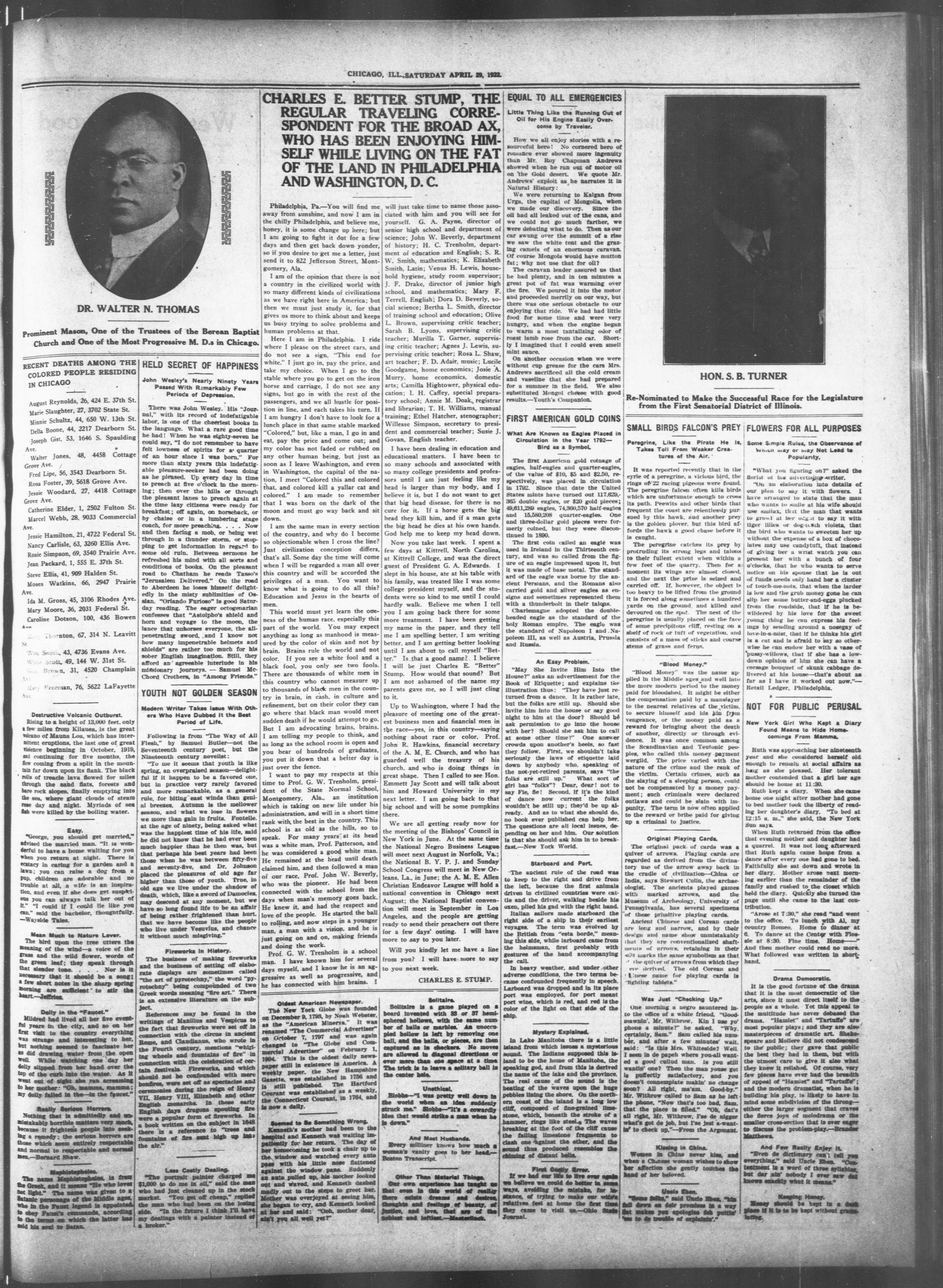
Prominent Mason, One of the Trustees of the Berean Baptist Church and One of the Most Progressive M. D.s in Chicago.
RECENT DEATHS AMONG THE COLORED PEOPLE RESIDING IN CHICAGO
August Reynolds, 26, 424 E. 37th St.
Marie Slaughter, 27, 3702 State St.
Minnie Schultz, 44, 650 W. 13th St.
Della Boone, 44, 2217 Dearborn St.
Joseph Gist, 53, 1646 S. Spaulding Ave.
HELD SECRET OF HAPPINESS
John Wesley's Nearly Ninety Years Passed With Remarkably Few Periods of Depression.
There was John Wesley. His "Journal," with its record of indefatigable labor, is one of the cheeriest books in the language. What a rare good time he had! When he was eighty-seven he could say, "I do not remember to have felt lowness of spirits for a quarter
Walter Jones, 48, 4458 Cottage
Grove Ave.
Fred Lipe, 56, 3543 Dearborn St.
Rosa Foster, 39, 5618 Grove Ave.
Jessie Woodard, 27, 4418 Cottage
Grove Ave.
Catherine Elder, 1, 2502 Fulton St.
Marcel Webb, 28, 9033 Commercial
Ave.
Jessie Hamilton, 21, 4722 Federal St.
Nancy Carlisle, 63, 3260 Ellis Ave.
Rosie Simpson, 69, 3540 Prairie Ave.
Jean Packard, 1, 555 E. 37th St.
Steve Ellis, 41, 909 Halden St.
Moses Watkins, 66, 2947 Prairie
Ave.
Ida M. Gross, 45, 3106 Rhodes Ave.
Mary Moore, 36, 2031 Federal St.
Caroline Dotson, 100, 436 Bowen
Ave.
Mary Thornton, 67, 314 N. Leavitt
St
Wm. Smith, 43, 4736 Evans Ave.
Wade Scott, 49, 144 W. 31st St.
Gon. Brown, 31, 4520 Champlain
Ave.
Mary Freeman, 76, 5622 LaFayette
Ave.
Destructive Volcanic Outburst
Rising to a height of 13,000 feet, only a few miles from Kilauea, is the great volcano of Mauna Loa, which has intermittent eruptions, the last one of great violence beginning in October, 1919, and continuing for five months, the flow coming from a split in the mountain far down upon its flank. The black roils of treacle lava flowed for miles through the sand flats, forests and bare rock slopes, finally emptying into the sea, where giant clouds of steam rose day and night. Myriads of sea fish were killed by the boiling water.
"George, you should get married," advised the married man. "It is wonderful to have a home waiting for you when you return at night. There is ecstacy in caring for a garden and a lawn; you can raise a dog from a pup, children are adorable and no trouble at all, a wife is an inspiration, and even if she does get suspicious you can always talk her out of it." "I could if I could lie like you can," said the bachelor, thoughtfully. -Wayside Tales.
Mean Much to Nature Lover.
The bird upon the tree utters the meaning of the wind—a voice of the grass and the wild flower, words of the green leaf; they speak through that slender tone. Nor is it necessary that it should be a song; a few short notes in the sharp spring morning are sufficient to stir the heart. -Jeffries.
Dolly in the "Faucet."
Mildred had lived all her five eventful years in the city, and so on her first visit to the country everything was strange and interesting to her, but nothing seemed to fascinate her as did drawing water from the open well. While watching one day her dolly slipped from her hand over the top of the curb into the water. As it went out of sight she ran screening to her mother: "Oh, mamma, mamma; my dolly failed in the—in the faucet."
Really Serious Morners.
Nothing that is admittedly and unmistakably horrible matters very much, because it frightens people into seeking a remedy; the serious horrors are those which seem entirely respectable and normal to respectable and normal men—Bernard Shaw.
The name Mephistophanes, is from the Greek, and it means "He who loves not light." The name was given to a Satanic percentage of the Middle ages who in the Faust legend is appointed to obey Faust's commands, according to the terms on which the latter has sold his soul to Satan.
Easy.
HELD SECRET OF HAPPINESS
John Wesley's Nearly Ninety Years Passed With Remarkably Few Periods of Depression.
There was John Wesley. His "Journal," with its record of indefatigable labor, is one of the cheesiest books in the language. What a rare good time he had! When he was eighty-seven he could say, "I do not remember to have felt lowness of spirits for a quarter of an hour since I was born." For more than sixty years this indefatigable pleasure-seeker had been doing as he pleased. Up every day in time to preach at five o'clock in the morning; then over the hills or through the pleasant lanes to preach again at the time lazy citizens were ready for breakfast; off again, on horseback, or by chase or in a lumbering stage coach for more preaching. . . . Now and then facing a mob, or being wet through in a thunder storm, or stopping to get information in regard to some old rule. Between sermons he refreshed his mind with all sorts and conditions of books. He on the pleasant "Jerusalem Delivered." On the road to Aberdeen he loses himself delightedly in the maze sublimities of Ossian. "Orlando Furioso" is good Saturday. The eager octogenarian confesses that "Astolpho's shield and horn and voyage to the moon, the lance that unmorses everyone, the all-penetrating sword, and I know not how many impenetrable helmets and shields" are rather too much for his sober English imagination. Still, they afford an agreeable interlude in his missionary journeys. — Samuel McChord Crothers, in "Among Friends."
YOUTH NOT GOLDEN SEASON
Modern Writer Takes Issue With Others Who Have Dubbed It the Best Period of Life.
Following is from "The Way of All Flesh," by Samuel Butler—not the Seventeenth century poet, but the Nineteenth century novelist:
"To me it seems that youth is like spring, an overprised season—delightful if it happen to be a favored one, but in practice very rarely favored and more remarkable, as a general rule, for biting east winds than genial breezes. Autumn is the mellow season, and what we lose in flowers we more than gain in fruits. Fontelle, at the age of ninety, being asked what was the happiest time of his life, said he did not know that he had ever been much happier than he then was, but that perhaps his best years had been those when he was between fifty-five and seventy-five, and Dr. Johnson placed the pleasures of old age far higher than those of youth. True, in old age we live under the shadow of death, which, like a sword of Damocles, may descend at any moment, but we have so long found life to be an affair of being rather frightened than hurt, that we have become like the people who live under Vesuvius, and chance it without much misgiving."
Fireworks In History.
The business of making fireworks and the business of setting off elaborate displays are sometimes called "the art of protechyney," the word "pyrotechyny" being compounded of two Greek words meaning "fire art." There is an extensive literature on the subject.
References may be found in the writings of Manilus and Vespicus to the fact that fireworks were set off in connection with the circus in ancient Rome, and Claudianus, who wrote in the Fourth century, mentions "whirling wheels and fountains of fire" in connection with the celebration of certain festivals. Fireworks, and which should not be confounded with mere bonfires, were set off as spectacles and ceremonies during the reign of Henry VII, Henry VIII, Elizabeth and other English monarchs. In these early English days dragons spouting fire were a popular form of fireworks. In a book written on the subject in 1645 there is a reference to "trees and fountains of fire sent high up into the sky."
Lease Costly Dealing.
Less costly. Dear,
"The portrait painter charged me
$1,000 to do me in oil," said the man
who had cleaned up in the stock
market." Mr. Dear cheap, replied
man who had been on the losing
side." In the future I think I'll have
my dealings with a painter instead of
a buyer."
CHICAGO, ILL. SATURDAY APRIL 29, 1922.
CHARLES E. BETTER STUMP, THE REGULAR TRAVELING CORRESPONDENT FOR THE BROAD AX, WHO HAS BEEN ENJOYING HIMSELF WHILE LIVING ON THE FAT OF THE LAND IN PHILADELPHIA AND WASHINGTON, D. C.
Philadelphia, Pa.—You will find me away from sunshine, and now I am in the chilly Philadelphia, and believe me, honey, it is some change up here; but I am going to fight it out for a few days and then get back down yonder, so if you desire to get me a letter, just send it to 822 Jefferson Street, Montgomery, Ala.
I am of the opinion that there is not a country in the civilized world with so many different kinds of civilizations as we have right here in America; but then we must just study it, for that gives us more to think about and keeps us busy trying to solve problems and human problems at that.
Here I am in Philadelphia. I ride where I please on the street cars, and do not see a sign, "This end for white." I just go in, pay the price, and take my choice. When I go to the stable where you go to get on the iron horse and carriage, I do not see any signs, but go in with the rest of the passengers, and we all hustle for position in line, and each takes his turn. If I am hungry I don't have to look for a lunch place in that same stable marked "Colored," but, like a man, I go in and eat, pay the price and come out; and my color has not faded or rubbed on any other human being, but just as soon as I leave Washington, and even in Washington, the capital of the nation, I meet "Colored this and colored that, and colored kill a yallar cat and colored." I am made to remember that I was born on the dark of the moon and must go way back and sit down.
I am the same man in every section of the country, and why do I become so objectionable when I cross the line? Just civilization conception differs, that's all. Some day the time will come when I will be regarded a man all over this country and will be accorded the privileges of a man. You want to know what is going to do all this? Education and Jesus in the hearts of men.
This world must yet learn the oteness of the human race, especially this part of the world. You may expect anything as long as manhood is measured by the color of skin and not by brain. Brains rule the world and not color. If you see a white fool and a black fool, you only see two fools. There are thousands of white men in this country who cannot measure up to thousands of black men in the country in brain, in cash, in culture and refinement, but on their color they can go where that black man would meet sudden death if he would attempt to go. But I am advocating brains, brains. I am telling my people to think, and as long as the school room is open and you hear of hundreds of graduates, you put it down that a better day is just over the fence.
I want to pay my respects at this time to Prof. G. W. Trenholm, president of the State Normal School, Montgomery, Ala., an institution which is taking on new life under his administration, and will in a short time rank with the best in the country. This school is as old as the hills, so to speak. For many years at its head was a white man, Prof. Patterson, and he was considered a good white man. He remained at the head until death claimed him, and then followed a man of our race, Prof. John W. Beverly, who was the pioneer. He had been connected with the school from the days when man's memory goes back. He knew it, and had the respect and love of the people. He started the ball to rolling, and now steps in a younger man, a man with a vision, and he is just going on and on, making friends and doing the work.
Prof. G. W. Trenholm is a school man. I have known him for several days myself, and I know he is an aggressive as well as progressive, and he has connected with him brains. I
Oldest American Newspaper
Oldest American Newspaper
The New York Globe was founded on December 9, 1798, by Noah Webster, as the "American Minerva." It was renamed "The Commercial Advertiser" on October 7, 1797 and was again changed to "The Globe and Commercial Advertiser" on February 1, 1804. This is the oldest daily newspaper still in existence in America. A weekly paper, the New Hampshire Gazette, was established in 1756 and is still published. The Hartford Courant was established as a weekly, the Connecticut Courant, in 1764, and is now a daily.
Seemed to Be Something Wrong.
Kenneth's mother had been to the hospital and Kenneth was waiting impatiently for her return. The day of her homecoming he took a chair up to the window and watched every auto pass with his little nose flattened against the window pane. Suddenly an auto pulled up, his mother looked out and waved, and Kenneth dashed madly out to the steps to greet her. Mother was overjoyed at seeing him, she began to cry, and Kenneth looked at her and said: "Ooh, mother dear, ain't you all well yet?"
will just take time to name those associated with him and you will see for yourself. G. A. Payne, director of senior high school and department of science; John W. Beverly, department of history; H. C. Trenholm, department of education and English; S. R. W. Smith, mathematics; K. Elizabeth Smith, Latin; Venus H. Lewis, household hygiene; study room supervisor; J. F. Drake, director of junior high school, and mathematics; Mary F. Terrell, English; Dora D. Beverly, social science; Bertha L. Smith, director of training school and education; Olive L. Brown, supervising critic teacher; Sarah B. Lyons, supervising critic teacher; Murilla T. Garner, supervising critic teacher; Agnes J. Lewis, supervising critic teacher; Rosa L. Shaw, art teacher; F. D. Adair, music; Lucile Goodgame, home economics; Josie A. Murry, home economics, domestic arts; Camilla Hightower, physical education; I. H. Caffey, special preparatory school; Annie M. Doak, registrar and librarian; T. H. Williams, manual training; Ethel Hatcher, stenographer; Willesse Simpson, secretary to president and commercial teacher; Susie J. Goyan, English teacher.
I have been dealing in education and educational matters. I have been to so many schools and associated with so many college presidents and professors until I am just feeling like my head is larger than my body, and I believe it is, but I do not want to get that big head disease, for there is no cure for it. If a horse gets the big head they kill him, and if a man gets the big head he dies at his own hands. God help me to keep my head down.
Now you take last week. I spent a few days at Kittrell, North Carolina, at Kittrell College, and was the direct guest of President G. A. Edwards. I slept in his house, ate at his table with his family, was treated like I was some college president myself, and the students were so kind to me until I could hardly walk. Believe me when I tell you I am going back there for some more treatment. I have been getting my name in the paper, and they tell me I am spelling better. I am writing better, and I am getting better looking until I am about to call myself "Better." Is that a good name? I believe I will be just Charles E. "Better" Stump. How would that sound? But I am not ashamed of the name my parents gave me, so I will just cling to it.
Up to Washington, where I had the pleasure of meeting one of the greatest business men and financial men in the race—yes, in this country—saying nothing about race or color, Prof. John R. Hawkins, financial secretary of the A. M. E. Church, and who has guarded well the treasury of his church, and who is doing things in great shape. Then I called to see Hon. Emmett Jay Scott and will talk about him and Howard University in my next letter. I am going back to that big school and will be some pumpkins there.
We are all getting ready now for the meeting of the Bishops' Council in New York in June. At the same time the National Negro Business League will meet next August in Norfolk, Va.; the National B. Y. P. J. and Sunday School Congress will meet in New Orleans, La., in June; the A. M. E. Allen Christian Endeavor League will hold a national convention in Chicago next August; the National Baptist convention will meet in September in Los Angeles, and the people are getting ready to send their preachers out there for a few days' outing. I will have more to say to you later.
Will you kindly let me have a line from you? I will have more to say to you next week.
CHARLES E. STUMP.
Solitaire
Soltaire is a game played on a board invented with 33 or 37 hemisphered hollows, with the same number of balls or marbles. An unoccupied hollow is left by removing one ball, and the balls, or pieces, are then captured as in checkers. No moves are allowed in diagonal directions or over more than one space at a time. The trick is to leave a solitary ball in the center hole.
Unethical
Blobbe—"I was pretty well down in the world when an idea suddenly struck me." Blobbe—"It's a cowardly idea that would strike a man when he is down."
And Most Husbands.
Every milliner knows how much a woman's vanity goes to her head—Boston Transcript.
Other Than Material Things.
Our own experience has taught us that even in this world of reality there exists dreams and desires, thoughts and feelings of beauty, of justice, and love, that are of the highest and lowest—Mastermind.
EQUAL TO ALL EMERGENCIES
Little Thing Like the Running Out of Oil for His Engine Easily Overcome by Traveler.
How we all enjoy stories with a resourceful hero! No cornered hero of romance ever showed more ingenuity than Mr. Roy Chapman Andrews showed when he ran out of motor oil on the Gobi desert. We quote Mr. Andrews' exploit as he narrates it in Natural History:
We were returning to Kalgan from Urga, the capital of Mongolia, when we made our discovery. Since the oil had all leaked out of the cans, and we could not go much farther, we were debating what to do. Then as our car swung over the summit of a rise we saw the white tent and the grazing camels of an enormous caravan. Of course Mongols would have mutton fat; why not use that for oil?
The caravan leader assured us that he had plenty, and in ten minutes a great pot of fat was warming over the fire. We poured it into the motor and proceeded merrily on our way, but there was one serious obstacle to our enjoying that ride. We had had little food for some time and were very hungry, and when the engine began to warm a most tantalizing odor of roast lamb rose from the car. Shortly I imagined that I could even smell mint sauce.
On another occasion when we were without cup grease for the cars Mrs. Andrews sacrificed all the cold cream and vaseline that she had prepared for a summer in the field. We also substituted Mongol cheese with good results—Youth's Companion.
FIRST AMERICAN GOLD COINS
What Are Known as Eagles Placed in Circulation in the Year 1792—Bird as a Symbol.
The first American gold coinage of eagles, half-eagles and quarter-eagles, of the value of $10, $5 and $2.50, respectively, was placed in circulation in 1792. Since that date the United States mints have outturned 117,620,365 double eagles, or $20 gold pieces; 49,611,289 eagles, 74,360,570 half-eagles and 15,580,208 quarter-eagles. One and three-dollar gold pieces were formerly coloned, but they were discontinued in 1890.
The first coin called an eagle was used in Ireland in the Thirteenth century, and was so called from the figure of an eagle impressed upon it, but it was made of base metal. The standard of the eagle was borne by the ancient Persians, and the Romans also carried gold and silver eagles as insignes and sometimes represented them with a thunderbird in their talons.
Charlemagne adopted the double-headed eagle as the standard of the holy Roman empire. The eagle was the standard of Napoleon I and Napoleon III, as well as Austria, Prussia and Russia.
An Easy Problem
"May She Invite Him Into the House?" asks an advertisement for the Book of Etiquette; and explains the illustration thus: "They have just returned from a dance. It is rather late, but the folks are still up. Should she invite him into the house or say good night to him at the door? Should he ask permission to go into the house with her? Should she ask him to call at some other time?" One answer crowds upon another's heels, so fast they follow. First, we shouldn't take seriously the laws of etiquette laid down by anybody who, speaking of the not-yet-retired parents, says "the folks are still up." What sort of girl has "folks?" Dear, dear! not to say Fie, fie! Second, if it's the kind of dance now current the folks wouldn't be still up; they'd be up already. And as to what she should do, no book ever published can help her. The questions are all local issues, depending on her and him. Our solution is that she should ask him in to breakfast—New York World.
Starboard and Port
The ancient rule of the road was to keep to the right and drive from the left, because the first animals driven in civilized countries were cattle and the driver, walking beside his oxen, piled his gad with the right hand. Italian sailors made starboard the right side of a ship in their earliest voyages. The term was evolved by the British from "esta borde," meaning this side, while larboard came from the helmsman, first probably with gestures of the hand accompanying the call.
In heavy weather, and under other adverse conditions, the two terms became confounded frequently in speech. Larboard was dropped and in its place port was employed, for port meant port wine, which is red, and red is the color of the light on that side of the ship.
Mystery Explained
In Lake Manitoba there is a little island from which issues a mysterious sound. The Indians supposed this island to be the home of Manitoba, the speaking god, and from this is derived the name of the lake and the province. The real cause of the sound is the beating of the waves upon the huge pebbles lining the shore. On the northern coast of the island is a long low cliff, composed of fine-grained limestone, which, beneath the stroke of a hammer, rings like steel. The waves breaking at the foot of the cliff cause the falling limestone fragments to clash one against the other, and the sound thus produced resembles the chining of distant bells.
First Custly Error.
If we had our life to live over again we believe we could do better in some ways, avoiding the mistake, for instance, of trying to make our wife's relatives feel at home the first time they came to visit us—Ohio State Journal.
[Name]
HON. S. B. TURNER
Re-Nominated to Make the Successful Race for the Legislature from the First Senatorial District of Illinois.
SMALL BIRDS FALCON'S PREY
Peregrine, Like the Pirate He Is, Takes Toll From Weaker Creatures of the Air.'
It was reported recently that in the eyre of a peregrine, a vicious bird, the rings of 22 racing pigeons were found. The peregrine falcon often kills birds which are unfortunate enough to cross its path. Pewitws and other birds that frequent the coast are relentlessly pursued by this hawk, and another prey is the golden plover, but this bird affords the hawk a good chase before it is caught.
The peregrine catches its prey by protruding its strong legs and talons to their fullest extent when within a few feet of the quarry. Then for a moment its wings are almost closed, and the next the prize is seized and carried off. If, however, the object is too heavy to be lifted from the ground it is forced along sometimes a hundred yards on the ground, and killed and devoured on the spot. The nest of the peregrine is usually placed on the face of some precipitous cliff, resting on a shelf of rock or tuff of vegetation, and consists of a mass of sticks and course stems of grass and ferns.
"Blood Money" was the name applied in the Middle ages and well into the more modern period to the money paid for bloodshed. It might be either the compensation paid by a manslayer to the nearest relatives of the victim, to secure himself and his kin [prp] vengeance, or the money paid as a reward for bringing about the death of another, directly or through evidence. It was once common among the Scandinavian and Teutonic peoples, who called this money payment werglid. The price varied with the nature of the crime and the rank of the victim. Certain crimes, such as the slaying of a sleeping person, could not be compensated by a money payment; such criminals were declared outlaws and could be slain with impunity. The term is now often applied to the reward or bribe paid for giving up a criminal to justice.
Original Playing Cards
The original pack of cards was a quiver of arrows. Playing cards are regarded as derived from the divinatory use of the arrow away back in the cradle of civilization—China or India, says Stewart Culin, the archaeologist. The ancients played games with marked arrows, and the Museum of Archeology, University of Pennsylvania, has several specimens of these primitive playing cards.
Ancient Chinese and Corean cards are long and narrow, and by their design and name show unmistakably that they are conventionalized shafts of arrows, retaining in their silk marks the same symbolism as that of the quiver of arrows from which they are derived. The old Corean and Corean name for playing cards is "fighting tablets."
Was Just "Checking Up."
One morning a negro sauntered into the office of a white friend. "Good mawmwin', Mr. Withrow, Kin I use my phone a minute' he asked. "Why certainly, Sam." Sam called his number, and after a few minutes' wait, said: "Is this Mrs. Whiteside? Well I seen in de paphe where you all wanted a good culdul man. is you still wantin' one? Then the man youseg got is puffely satisfactory, and you doesn't connipe makin' no change soon? All right, ma'am. Good-by-. Mr. Withrow called to Sam as he left the phone, "Now that's too bad, Sam, that the place is filled." "Oh, dats all right, Mr. Withrow. I see digger what's got de job, but I see jest a-wantin' to check up."—From the Argonaut.
Women in China never kiss, and when a Chinese woman wishes to show her affection she gently touches the hand of her beloved.
"Some folks," said Uncle Ebom, "hit
fall down on deer promises in a way
that makes you apologize dah puttin'
'am to do trouble of apologizing.'
"Blood Money."
Kissing in China
FLOWERS FOR ALL PURPOSES
Some Simple Rules, the Observance of
Which may or may Not Lead to
Popularity.
"What you figuring on?" asked the
florist of his advertising writer.
"On an elaboration into details of our plan to say it with flowers. I have arranged to state that the man who wants to smile at his wife should use simulax, that the man that wants to groat at her ogot to say it with tiger illies or dog-toosh violets, that the bird who wants to sweeten her up without the expense of a box of chocolates may use candytuff, that instead of giving her a wrist watch you can present her with a bunch of four o'clocks, that he who wants to serve notice on his spouse that he is out of funds needs only hand her a cluster of touch-me-nots, that when the larder is low and the grub money gone he can slip her some butter-and-eggs plucked from the roadside, that if he be wildered by his love for the sweet young thing he can express his feelings by sending around a nosegay of love-in-a-mist, that if he thinks his girl is a cat and is afraid to say so otherwise he can endow her with a vase of pussy-willows, that if she has a low-down opinion of him she can have a corsage bouquet of skunk cabbage delivered at his house—that's about as far as I have it worked out now."—Retail Ledger, Philadelphia.
NOT FOR PUBLIC PERUSAL
New York Girl Who Kept a Diary Found Means to Hide Home comings From Mamma
Ruth was approaching her nineteenth year and she considered herself old enough to remain at social affairs as long as she pleased. Her tolerant mother contended that a girl her age should be home at 11:30. Ruth kept a diary. When she came home one night after mother had gone to bed mother took the liberty of reading her daughter's diary. "To bed at 12:15 a. m.," she said, the New York Sun says.
When Ruth returned from the office that evening mother and daughter had a quarrel. It was not long afterward that Ruth again came home from a dance after every one had gone to bed. Faithfully she sat down and wrote in her diary. Mother arose next morning earlier than the remainder of the family and rushed to the closet which held the diary. Quickly she turned the page until she came to the last contribution.
"Arose at 7:30," she read "and went to the office. To lunch with Al, my country Romeo. Home to dinner at 6. To dance at the Center with Flosse at 8:30. Fine time. Home——" And then mother could read no more. What followed was written in short hand.
It is the good fortune of the drama that it is the most democratic of the arts, since it must direct itself to the people as a whole. Yet this appeal to the multitude has never debased the drama. "Hamlet" and "Tartuffe" are most popular plays; and they are also masterpieces of dramatic art. Shakespeare and Moliere did not condescend to the public; they gave that public the best they had in them, with but with the utmost care to give it also what they knew it relied. Of course, very few pieces have ever had the breadth of appeal of "Hamlet" and "Tartuffe"; and the modern dramatist, when he is building his play, is likely to have in mind some subdivision of the throng—either the larger segment that craves the fierce joys of melodrama or the smaller cross-section that is ever eager to discuss the problem-play—Brander Matthewa.
And Faw Really Enjoy it.
"Even de dictionary can't tell you everything" said Uncle Eben. "Contentment is a word of three syllables, but dar ain' nobody I ever saw dat knows exactly what it means."
Keeping Honey.
Money should be kept in a dark place if it is to be kept without granulating.
Drama Democrat
we soft, silky hair that can be
has made happy thousands of
hair. It will do the same if
and lifeless or if you have dain
of EXELENTO QUININ
new poses. Price by mail 256 en receipt.
AGENTS WANTED-Write for Particu
MEDICINE COMPANY, A
EXELENTO SKIN BEAUTIFIER, an ointment for d
used in treatment of skin troubles.
YOU can have soft, silky hair that can be easily dressed.
EXELENTO has made happy thousands of women who had
coarse, nappy hair. It will do the same for you. If your
hair is brittle and lifeless or if you have dandruff and itching
scalp, try a box of EXELENTO QUININE POMADE.
For sale at all drug stores. Price by mail $2c can receipt $4 stamp or coin.
AGENTS WANTED-Write for picturals.
EXELENTO MEDICINE COMPANY, Atlanta, Georgia
New for $2.99 extra. SKIN TREATMENT, animent for dark yellow skin.
TELEPHONE DOUGLAS 1
GE F. HARDIN REAL ESTATE
Up-to Date or M
and S
3101 COTTA
Corner 31
Phot
FURN
Brass and Wood
Refrigerators
Hardw
HENRY
2515-19
JAS. B. McCAHEY, President
FRANK J. DUNN, Vice-President
ESTA
or Modern Houses,
and Stores to Rent
COTTAGE GROW
ner 31st Street, Chicago
Phone Yards 27
FURNITU
Wood Beds, Electric
Generators, Stoves, Paint
Hardware, Linoleum
NRY STUCKA
2515-19 ARCHER AVE.
President PHILIP J.
Office-President H. X. COMER
ESTABLISHED 1877
Up-to-Date or Modern Houses, Apartments and Stores to Rent
3101 COTTAGE GROVE AVE.
Corner 31st Street, Chicago
Brass and Wood Beds, Electric Washers, Refrigerators, Stoves, Paint, Oil, Hardware, Linoleum HENRY STUCKART 2515-19 ARCHER AVE.
JAS. B. McCAHEY, President PHILIP J. DUNN, Secretary
FRANK J. DUNN, Vice-President H. X. COMERFORD, Treasurer
ESTABLISHED 1877
JOHN J. DUNN
COAL CO.
Telephone Oakland 1550
5100 Federal Street CHICAGO
5100 Federal Street
A. L. WILLIAMS
ATTORNEY AND
COUNSELOR AT LAW
Suite 706 Firmenich Building
184 W. Washington St.
CHICAGO
What
BILL is a good substan who, like many up to a short time ago, his money systematically
What Ralph wrote to Bill
BILL is a good substantial citizen who, like many of us, had, up to a short time ago, never saved his money systematically.
He never really thought seriously of investing in bonds until he was married a few years ago. Being in-experienced in financial matters, he wrote several letters to Ralph, an attorney friend of his, who answered all his questions in a very simple and clear manner.
We have just published a booklet called "An Investor's Letters" which contains all of Ralph's and Bill's correspondence. You will find it very interesting and it may clear up some of the questions you have in your own mind about investment matters.
We shall be glad to send "An Investor's Letters" free of charge or obligation to anyone who requests it.
LINCOLN STATE BANK
OF CHICAGO
Under State Government Supervision
31st and South State Streets
Telephone Victory 4500
Phone Main 2017
Residence 3655 Prairie Ave.
Phone Douglas 9133
Sicily Greer Praises
EXELENTO QUININE
POMADE
Says her hair was short, coarse
and nappy before using this
wonderful hair grower.
I silky hair that can be easily dressed.
made happy thousands of women who had
It will do the same for you. If your
less or if you have dandruff and itching
EXELENTO QUININE POMADE.
Price by mail 25c can receipt of stamp or coin.
WANTED—Write for Particulars.
CINE COMPANY, Atlanta, Georgia
IN BEAUTIFER, an enlistment for dark, shallow skin,
in treatment of skin trouble.
F. HARDING, JR.
Modern Houses, Apartments
and Stores to Rent
STAGE GROVE AVE.
31st Street, Chicago
Phone Yards 27
FURNITURE
Bed Beds, Electric Washers,
ors, Stoves, Paint, Oil,
ware, Linoleum
STUCKART
19 ARCHER AVE.
st PHILIP J. DUNN, Secretary
ident H. X. COMERFORD, Treasurer
TABLISHED 1877
CHICAGO
Residence, 1262 Macalister Place
Telephone Monroe 2714
MILES J. DEVINE
ATTORNEY AT LAW
Suite 318-320 Reaper Block
Clark and Washington Sts.
CHICAGO
Telephone Central 1239
BILL is a good substantial citizen
who, like many of us, had,
up to a short time ago, never saved
his money systematically.
CHICAGO
Why Save for a "Rainy Day"?
There'll be no rainy day, only sunshine and smiles, for those who have acquired the habit of saving and laid by a sufficient sum to tide over the adversity that some poor folk term "rainy days." Open a savings account in this strong bank today.
ILLINOIS TRUST
La Salle and Jack
ILLINOIS TRUST & SAVINGS BANK
La Salle and Jackson Streets Chicago
[Name not visible]
Who Is This?
Notary Publci
Phones: Office Main 4153; Residence,
4751 Champlain Avenue
Phone Kenwood 5611
Walter M. Farmer
ATTORNEY AND COUNSELOR
AT LAW
Suite 708—184 W. Washington St.
CHICAGO
ALMOST WORSHIP THE MANGO
Natives of India Have Good Reason
to Think Highly of That Really
Wonderful Tree.
Mango trees line the roads on the hot Indian plains which stretch out level "like the palm of a hand," as far as the eye can see. These trees, about 40 feet in height, clothed in thick, heavy foliage, not only afford a welcome cool shade in the hottest day, but a variety of fruit which is said to have no rival in sweetness, flavor, delicousness and food value. Under these trees the village school is kept in the forenoon, and the village children learn to love them from their childhood.
Nature is very prolific in the tropics, for one mango tree may yield almost half a ton of fruit in one season. The mango is a fruit varying in size from a small pear to a large coconut. The thick skin protects the flavor, and except for the stone, the entire fruit is used in many ways. It is eaten raw, or rather sucked, in slices, made into jam, pickles and mango cakes, and is used as a flavor for both sour and sweet foods.
Mango ice cream is a very delicious food, but, perhaps, of all the tree's products, mango chutney is the most famous. Mango is also used as a medicine, and is a specific for sunstroke, which it curses almost instantly. The poor Indian peasant loves this tree to almost adoration because of its wonderful qualities.
Barley Basis of Weight
During the reign of Henry VIII standards of length and weight were established with actual grains of wheat and barley as a basis. Three barley corn were an inch, and from that was built up our table of inches, feet, ells (yards), perch and acre. One restriction was that the barley corn must be dry and taken from the middle of the car and mid-end to end. Under this same system 30 grains of wheat made a pennyweight, and from that as a basis they worked out the Troy pound in which 12 ounces still make a pound. Originally the size of slices were based upon grains of barley, and it is said that these are the same today as in the early days. There were 13 grains of barley to each size. "Furlong" is an old English word meaning "murrow long" and is based upon the length a furrow would be in a square ten-acre field.
Protein Foods.
When we eat protein we consume in reality 18 or 20 substances, known as amino acids, each one of which may have quite special functions in nutrition. Some proteins are deficient in certain of these acids which are lacking in the proteins of corn and grain, and for that reason peanuts are an excellent supplement to a cereal diet, whether in the form of a meal or press cake fed with corn and cereal feeds to animals or as a supplement to wheat protein when used with wheat flour in bread making.
CHICAGO, ILL., SATURDAY APRIL 29, 1922.
T & SAVINGS BANK
Johson Streets Chicago
Office Phones: Main 1612, 1854
W. G. Anderson
Attorney-At-Law
Notary Public
184 W. Washington St., Cor. Wells
Suite 603, Firmenich Bldg.
Residence: 3354 Vernon Avenue
Phone Douglas 6045
CHICAGO
Jimmy was visiting his aunt, who was a good cook, and he enjoyed every meal. One day after an unusually good dinner he glanced at his three cousins, who were fat and rosy, and said: "I know now why you got such fat kids"
The End.
"Till never ask another girl to marry me as long as I live," groaned the unhappy fellow, "What! Refused again?" asked his sympathetic friend. "No, accepted, you fool!"
Charcoal Eph's Philosophy
Charcoal Eph's Philosophy.
"I ain't got no use fo' a whining man," said Charcoal Eph, in a ruminative mood. "The Lawd made man fo' 'tight an' cuss, an' woman fo' weelin' an' lamentin'. Eat a prume, Mistal Jackson," -Richmond Times-Dispatch
Look Upward.
If we look down, then our shoulders stoop. If our thoughts look down, our character bends. It is only when we hold our heads up that the body becomes erect. It is only when our thoughts go up that our life becomes erect. —Alexander McKenzie.
NEW YORK HINT OF VENICE
Reservoir Is Beautiful Spot, With Stately Homes That Seem to Arise From the Water.
What the Brooklyn bridge is to the resident of Brooklyn the reservoir is to the middle uptown New York—a refreshing and beautiful place for a brisk walk, says the New York Sun.
The reservoir, particularly the upper one, with a path on the brink, is a place of romance. Across the water rise stately houses; they seem almost on the edge of the water, like the houses of Venice. Sometimes the water is a sheet of ice. One day it seemed like a stretch of gray taffeta, with inserts of blue crepe where the wind rippled the patches of water that remained. Close to the shore broken bits of ice tinkled continually against a stretch of solid ice, with the sound of sleigh bells. But in summer there is another aspect to the reservoir. Horseback riders gallop around in fetching costumes, while the water sparkles in the sun.
But there is one point at a certain hour that lifts you out of New York, out of America, out of the world. The point is the western stretch of the southern side. The hour is sunset. The magic is produced by the fountain, a thin, high sweep of spray painted with rainbow shades by the setting sun. Up goes the stream, swirling into a gigantic feather in the gentle hands of the breeze. Suddenly the rainbow appears, to vanish as the wind swings the spray in another direction, to reappear again for a few breath-catching seconds. The spray sweeps here and there, covering you for an instant. The sun leaves, it for a moment and the fountain becomes a bridal veil. Out comes the sun and the fountain flashes into glory.
STATE
UNIVERSITY
WARREN
The End.
FUNERAL DIRECTORS
ERNEST H. WILLIAMSON UNDERTAKER
PRIVATE ANCULANCE
MUTES AT ALL HOURS
ALL MONDAY & SAT
5121 ERNEST H. WILLIAMSON UNDERTAKER
GARAGE
GASOLINE OIL
OPEN DAY & NIGHT
Day Light Chapel, capacity 200, Outside Ventilation—Organ and Organist Free—I am as near as your Telephone—I give service at a reasonable price—Distance immaterial, consult me—I save you worry y, time and money.
PHONE MAIN 2214
A. D. GASH
ATTORNEY AT LAW
118 N. La Salle Street
CHICAGO
Residence
3342 Calumet Ave.
Telephone
Douglas 1278
JAMES G. COTTER
ATTORNEY AT LAW
145 NORTH CLARK STREET
SUITE 407
Telephone Central 8384
CHICAGO
Formerly
Assistant Attorney General
State of Illinois
Res. 3646 Grand Beul.
Doug. 4397
J. GRAY LUCAS
ATTORNEY-AT-LAW
129 E. 31ST STREET
Suite 16-17
Phone: Douglas 6351
CHICAGO
CHICAGO
BINGA STATE BANK
Under State Supervision
Capital $100,000.00
Surplus 20,000.00
Offers Equal Service to All
3% INTEREST ON SAVINGS
SAFE DEPOSIT VAULTS
State Street and 36th Place
Wanted
Advertising Solicitor
A live or wide awake newspaper man or solicitor can earn some easy money by calling on or addressing the undersigned.
Julius F. Taylor, 6206 S. Elizabeth street. Phone Wentworth 2597.
PHONE KENWOOD 455
West Englewood Trust & Savings Bank
Capital, Surplus and Undivided
Profits, $500,000.00
OFFICERS
OFFICERS
John Bain, President Arthur C. Utesch, Ass
Michael Maisel, Vice-Pres. W. Merle Fisher, Ass
Edw. C. Barry, Cashier and Tru
The Cranford A
3600 WABAS
The finest building ever opened
Steam heat, electric lights,
Phone Main 263 J. W. Casey
ranford Apartment II
3600 WABASH AVENUE
building ever opened to Colored tenants in
heat, electric lights, tile baths, marble en-
63 J. W. Casey, Agt. 133 W. Wash
The finest building ever opened to Colored tenants in Chicago. Steam heat, electric lights, tile baths, marble entrance Phone Main 263 J. W. Casey, Agt. 133 W. Washington St.
OUR NEW HOME FUNERAL DIRECT
AL DIRECTORS
CHICAGO
ICERS
Arthur C. Utesch, Asst. Cashier
W. Merle Fisher, Asst. Cashier
and Trust Officer
```markdown
```