The Broad Ax
Saturday, December 30, 1922
Chicago, Illinois
Page text (machine-generated)
The Twilight Party Given at the Vincennes Hotel, Thirty Sixth Street and Vincennes Avenue, Christmas Evening December 25, by Mr. and Mrs. Jesse Binga, Far Surpassed Their Previous Extremely Pleasant Parties; Mr. and Mrs. James H. Cole, of Detroit, Mich., Assisted Mr. and Mrs. Binga to Receive Their Invited Guests.
DAVID PEYTON'S CLEFF CLUB ORCHESTRA, DIRECT FROM THE HAMILTON CLUB, FURNISHED THE MOST SNAPPY AND UP-TODATE MUSIC FOR THE AUSPICIOUS OCCASION.
THE DINING ROOM WAS BRILLIANTLY ILLUMINATED, WHICH IMPARTED A SOFT REDISH GLOW WHICH MADE EVERYTHINGLOOK VERY ENCHANTING.
MISS MARION HARRISON CHARMINGLY SANG "LOVE WILL FIND A WAY," BY MR. BLAKE, OF THE "SHUFFLE ALONG" COMPANY, AND "TWILIGHT."
THE HUGE CHRISTMAS TREE WHICH STOOD IN THE EAST END OF THE ROOM WAS LOADED DOWN WITH NUMEROUS KINDS OF PRESENTS AND FAVORS FOR EACH GUEST.
MISS DORIS CATLETT REPRESENTED "REBECCA AT THE WELL," AND SHE DISPENSED COOLING AND REFRESHING PUNCH THROUGHOUT THE EVENING.
MR. JULIUS N. AVENDORPH SERVED AS MASTER OF CEREMONIES, AND HE EASILY PROVED HIMSELF TO BE PAST MASTER IN THAT ART OR DIRECTION.
A HAPPY NEW YEAR TO ALL
The Twentieth Sixth Street December 20
Previous
Cole, of I
Their Inv
DAVID PEYTON'S
CHESTRA, DIRECTOR
HAMILTON C
THE MOST SNA
DATE MUSIC
CIOUS OCCASION
THE DINING ROOM
LY ILLUMINAT
PARTED A SO
WHICH MADE E
VERY ENCHAN
MISS MARION HA
INGLY SANG "L
WAY," BY MR.
"SHUFFLE ALO
AND "TWILIGHT"
THE HUGE CHRIST
STOOD IN THE
ROOM WAS LOA
NUMEROUS KIN
AND FAVORS I
MISS DORIS CATIL
ED "REBECCA
AND SHE DISP
AND REFRE
THROUGHOUT
MR. JULIUS N. AVEN
AS MASTER OF
HE EASILY PRO
BE PAST MAST
OR DIRECTION
Monday evening, Mr. and Mrs. Jesse Binga, to the great delight of their hosts of friends, gave their delightful annual twilight party, at the Vincennes hotel, 36th street and Vincennes avenue. Well on to three hundred invited guests were present and in every way it was one of the finest and most elaborate social affairs or functions ever held among the best class of the tax-paying and prop-
erty-owning colored people in this city.
Promptly at half past five Monday evening the guests began to arrive, and on the west side of the main entrance to the large dining room, stood Mr. and Mrs. Jesse Binga and Mr. and Mrs. James Cole of Detroit, Mich., on a slightly raised platform, and as the guests entered they were presented to them by Mr. Julius N. Avendorph.
THE BROAD AX, CHICAGO, ILLINOIS, SATURDAY, DECEMBER 30, 1922
Mrs. Binga was beautifully gowned in black chiffon velvet with cut steel trimmings and diamond ornaments. It was one of the most costly and elaborate gowns worn by any of the ladies present. Mrs. Cole wore black beaded georgette, pearl ornaments.
The gentlemen attending the very brilliant affair were all in full evening dress, including white gloves and so on, and it is reasonably safe to state that at no time in the history of Chicago have so many elegantly gowned ladies assembled together as were present at the twilight party and the very sight of them all faultlessly attired was sufficient to cause any one to feel extremely proud of the womanhood of the Afro-American race, for on that very delightful occasion the dear, sweet ladies resembled real fairy queens.
Several new features were introduced into the twilight party. First, the house of music was constructed on the east side of the room close up to the main entrance to it, and a fair sized opening permitted the dreamy and snappy music furnished by Mr. Dave Peyton's high class orchestra flowed out through the room through it and Miss Marion Harrison stood inside of the house of music at a large window where she sweetly and charmingly sang "Love Will Find a Way" and "Twilight." At the conclusion of the singing by Miss Harrison, dancing was in full sway for a while, then another pause and then the greatest attraction of the evening was in evidence as the lights were extinguished and nothing but the flash-tight to guide 12 little misses, under the direction of Mrs. Hazel Thompson Davis, entered the room from the east end and their fancy toe dancing could not be excelled and they all resembled little fairy angels and they were forced to return three or four times before the many guests had enough of their fancy dancing, and it was the most attractive feature of the entire evening.
At the end of their dancing, everybody two-stepped and fox-trotted for a while and then another pause in the dancing and the ladies were requested to form and fall in line on the east side of the room and the gentlemen on the west side of the room and before marching past the large Christmas tree which stood in the south end of the room. Mr. Haitt, dressed up as Santa Claus, ran up and down the room and all around it, wishing everybody a Merry Christmas and a Happy New Year in behalf of Banker and Mrs. Jesse Binga.
Then the orchestra struck up a march and as the two long rows of ladies and gentlemen wended their way past the Christmas tree, Mr. Santa Claus, assisted by Mr. Morris Lewis, Jr., presented each lady with a headband trimmed in silver and raised silver ornament and with a beautiful bracelet trimmed in silver with a bell. Each gentlemen was presented with a large white bow of chrysanthemums and with a black
cane decorated in silver trimmings and a big bow of red ribbon. An elegant luncheon was served throughout the evening in a private side dining room, by Brawley, the best and most up-to-date caterer on the south side, and not one of his well trained waiters attempted to open his mouth to any of the guests unless they were requested to do so.
Dr. and Mrs. A. Wilberforce Williams, Prof. and Dr. William Emmanuel, Hon. and Mrs. John B. French, Mr. and Mrs. Julius F. Taylor, Mr. and Mrs. William H. Riley, Mr. and Mrs. Morris Lewis and Mr. Morris Lewis, Jr. Mr. and Mrs. Albert B. George, Mr. and Mrs. John H. Coleman, Miss Ida M. Taylor, Dr. and Mrs. H. S. Turner, Miss Beatrice Lee and Mr. Stokes, Mr. and Mrs. William A. Robinson, Mr. and Mrs. Joseph B. Crum, Mr. and Mrs. Benjamin H. Martin, Mr. and Mrs. James B. Newsome, Dr. and Mrs. William T. Jefferson, Mrs. Dolly Jennings, Mr. and Mrs. W. H. Eaves, Miss Olive Eaves and their guest, Miss Louise Conway of Peoria, Ill., Col. and Mrs. F. A. Denison, Col. and Mrs. Robert S. Abbott, Mr. and Mrs. Harry Stanton Brown, Mr. and Mrs. F. B. Waring, Mr. and Mrs. R. J. Collins, Hon. and Mrs. A. H. Roberts, Mrs. L. W. Cummings, Mr. and Mrs. Joseph E. Brent, Mr. and Mrs. Alfred Anderson, Mr. and Mrs. William R. Cowan, Col. John R. Marshall, Dr. and Mrs. C. Spencer Dickerson, Dr. H. W. Garnes and his mother, Mrs. Garnes, Mr. and Mrs. James H. Cole of Detroit, Mich, Mr. and Mrs. William Leary, Mr. B. J. Stovall, Mr. and Mrs. Vance Anderson, Dr. and Mrs. Midan Brousfield, Mr. Anderson Brody, Mr. and Mrs. D. Rudolph Lawrence, Mr. and Mrs. J. E. McGooden, Mr. and Mrs. Edward R. Mead, Dr. and Mrs. Robert H. Hardin, Rev. and Mrs. W. S. Braddan, Capt. John Fry, Mrs. Mamie Clinkscale and her daughter, Miss Marvel Clinkscale, Mr. and Mrs. Cary B. Lewis, Mr. and Mrs. David A. McGowan, Mr. and Mrs. Charles S. Washington, Mr. and Mrs. C. N. Langston, Mrs. Ida N. Langston, mother, and Mr. J. M. Langston of St. Louis, Mo., Hon. and Mrs. Oscar De Priest, Mrs. Arabelle Medley, Mr. and Mrs. W. H. Hackley, Mrs. Martha B. Anderson, Miss Estella Bonds, Mr. George R. Arthur, Mr. and Mrs. S. J. Evans, and Mr. and Mrs. W. H. King were among those present at the Binga twilight party.
All in all, no finer or more elaborate social function has ever been given by the best and most progressive colored people in this city. In every respect it was a home party and the great majority of the guests knew each other without going through the formality of an introduction, and as the guests departed for their homes, at eleven o'clock, each and every one of them heartily thanked Mr. and Mrs. Binga for making it possible for them to spend such an enjoyable evening.
ARGENT ARCHER
PHOTO
KENSINGTON
LONDON
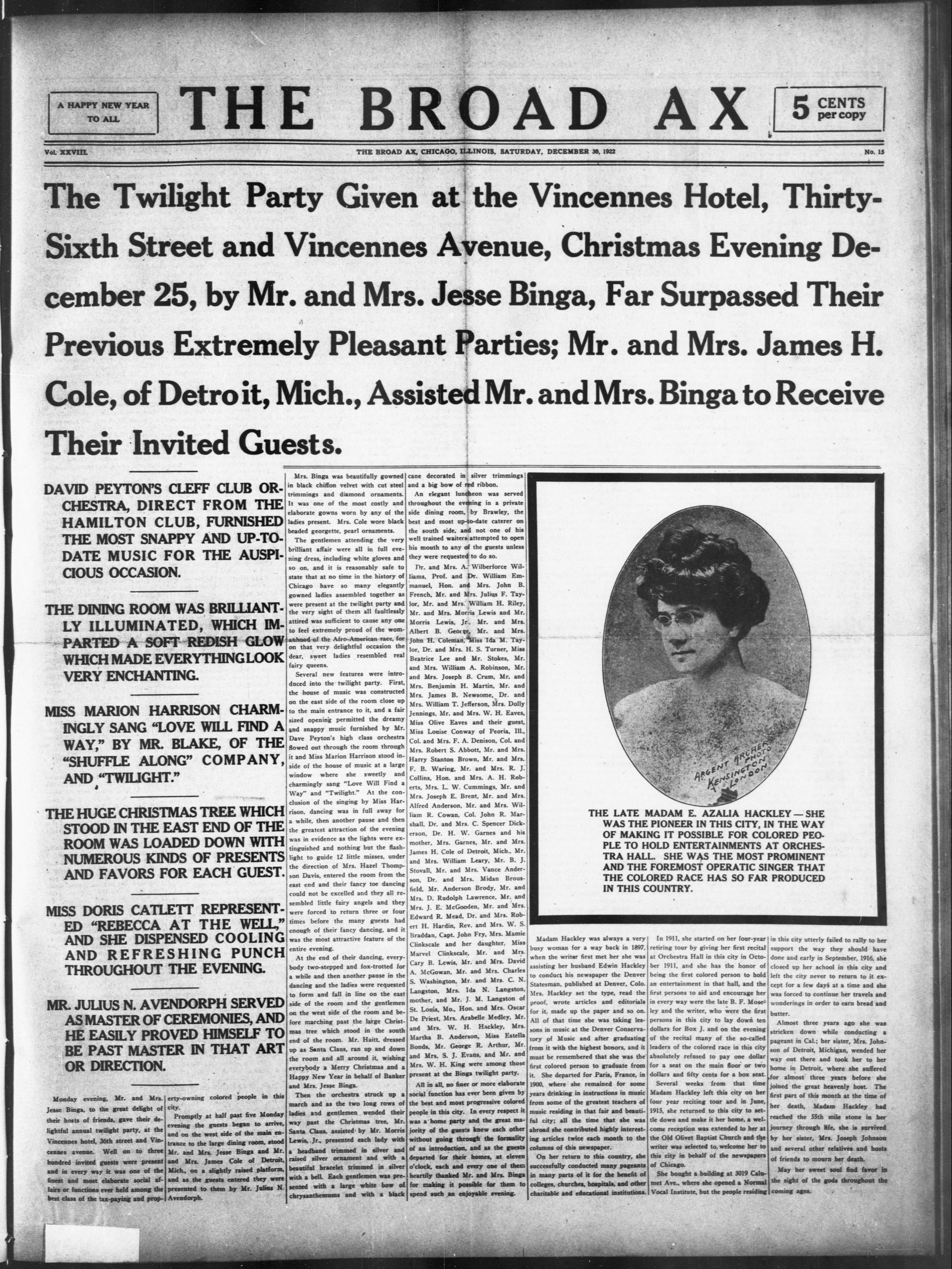
THE LATE MADAM E. AZALIA HACKLEY — SHE WAS THE PIONEER IN THIS CITY, IN THE WAY OF MAKING IT POSSIBLE FOR COLORED PEOPLE TO HOLD ENTERTAINMENTS AT ORCHESTRA HALL. SHE WAS THE MOST PROMINENT AND THE FOREMOST OPERATIC SINGER THAT THE COLORED RACE HAS SO FAR PRODUCED IN THIS COUNTRY.
Madam Hackley was always a very busy woman for a way back in 1897, when the writer first met her she was assisting her husband Edwin Hackley to conduct his newspaper the Denver Statesman, published at Denver, Colo. Mrs. Hackley set the type, read the proof, wrote articles and editorials for it, made up the paper and so on. All of that time she was taking lessons in music at the Denver Conservatory of Music and after graduating from it with the highest honors, and it must be remembered that she was the first colored person to graduate from it. She departed for Paris, France, in 1900, where she remained for some years drinking in instructions in music from some of the greatest teachers of music residing in that fair and beautiful city; all the time that she was abroad she contributed highly interesting articles twice each month to the columns of this newspaper.
On her return to this country, she successfully conducted many pageants in many parts of it for the benefit of colleges, churches, hospitals, and other charitable and educational institutions.
In 1911, she started on her four-year retiring tour by giving her first recital at Orchestra Hall in this city in October 1911, and she has the honor of being the first colored person to hold an entertainment in that hall, and the first persons to aid and encourage her in every way were the late B. F. Mosley and the writer, who were the first persons in this city to lay down ten dollars for Box J. and on the evening of the recital many of the so-called leaders of the colored race in this city absolutely refused to pay one dollar for a seat on the main floor or two dollars and fifty cents for a box seat.
Several weeks from that time Madam Hackley left this city on her four year reciting tour and in June, 1915, she returned to this city to settle down and make it her home, a welcome reception was extended to her at the Old Olivet Baptist Church and the writer was selected to, welcome her to this city in behalf of the newspapers of Chicago.
She bought a building at 3019 Calumet Ave., where she opened a Normal Vocal Institute, but the people residing
5 CENTS per copy
Thirty-
ning De-
ed Their
James H.
Receive
KLEY — SHE
IN THE WAY
EXPLORED PEO-
AT ORCHES-
PROMINENT
SINGER THAT
PRODUCED
in this city utterly failed to rally to her support the way they should have done and early in September, 1916, she closed up her school in this city and left the city never to return to it except for a few days at a time and she was forced to continue her travels and wonderings in order to earn bread and butter.
Almost three years ago she was stricken down while conducting a pageant in Cal.; her sister, Mrs. Johnson of Detroit, Michigan, wended her way out there and took her to her home in Detroit, where she suffered for almost three years before she joined the great heavenly host. The first part of this month at the time of her death, Madam Hackley had reached the 55th mile stone in her journey through life, she is survived by her sister, Mrs. Joseph Johnson and several other relatives and hosts of friends to mourn her death.
May her sweet soul find favor in the sight of the gods throughout the coming ages.
COVING AGAIN
In this city since July 15th, 1899, without missing one single issue. Republicans, Democrats, Catholics, Protestants, Single Taxers, Priests, infidels or anyone else can have their say as long as their language is proper and responsibility is fixed.
The Broad Ax is a newspaper whose platform is broad enough for all, ever claiming the editorial right to speak its own mind.
Local communications will receive attention. Write only on one side of the paper.
Subscriptions must be paid in advance.
One Year .....$2.00
Six Months .....$1.00
Advertising rates made known on application.
Address all communication to ...
THE BROAD AX
6200 So. Elizabeth St., Chicago, Ill.
Phone Wentworth 2597
JULIUS F. TAYLOR
Editor and Publisher
Associate Editor
DR. M. A. MAJORS
December 30, 1922
Vol. XXVIII No. 15
intered as Second-Class Matter, Aug.
19, 1902, at the Post Office at Chicago,
cal. Under Act of March 8, 1879.
HUNDRED THOUSAND STATE
OFFICIALS TO BE RE-
LEASED IN AUSTRIA
One hundred thousand Austrian state officials are to be dismissed in the near future under the plan by which the League of Nations is attempting to rehabilitate Austria's national finances. This fact was recently stated to members of the Friends' Relief Mission in Vienna by Herr Schueller, Section Chief of the Austrian Foreign Office.
The problem of absorbing these men into other lines of activity is a problem with which the Austrian Government itself must deal. The Quaker Relief Mission, however, is helping to meet the problem by rendering assistance to the Land Settlements, co-operative garden settlements which will absorb many of the men and their families. The Friends will also assist individual families of dismissed state officials who are in need of emergency relief, as they are already assisting a large number of destitute members of the salaried and professional classes.
In his interview with the Friends Herr Schuller was optimistic about the general outlook for the future feeling that it is better than during the last several years. The League of Nations plan for financial rehabilitation, however, does not remedy the present distress among the Austrian people themselves. The necessity of enforcing the stringent reforms involved in the plan will tend rather to increase the distress among individuals for the next year or two; and emergency relief is necessary to preserve as much as possible of the energy and faith of the people in order that they may take their parts in working for national reconstruction.
Great efforts are being made among the Viennese themselves to relieve suffering in their country. A relief committee, under the auspices of Chancellor Seipel, is raising funds for wood and coal, the Viennese children's doctors appeal for clothing for needy school children, the various hospital's and Children's Homes for blind people and for the old make collections through the Vienna Press, the War Invalids' organization arranged for house to house collections, and collection days and charity concerts are frequently held for the First Aid Society. All these efforts, however, are insufficient to meet the need The Friends' Relief Mission through its middle-class relief work is aiding many artists, teachers, students, members of the former aristocracy, and others whose incomes were formerly large, but who are now unable to provide themselves with ever the bare necessities of life. The Mission is also importing schools which are sold to various welfare institutions in return for payments of milk, and this milk is in turn used for relief purposes. It is likewise lending assistance to the Land Settlement movement and is helping to support a number of Children's Homes, tuberculosis dispensaries and similar institutions which would be unable to continue but for such aid. Five hundred thousand dollars is needed to carry on the Quaker program of relief during the coming year.
Recently the Friends extended their a fresh-milk distribution to include a number of groups which had not pre- viviously received milk. Eight times
A.
MADAM BERTHA L. HEN
BER OF MANY CHAR
WORKER FOR THE SU
WHEATLEY HOME,
AND THE DOORS OF
3528 VERNON AVENUE
WAYS FOR THE POOR
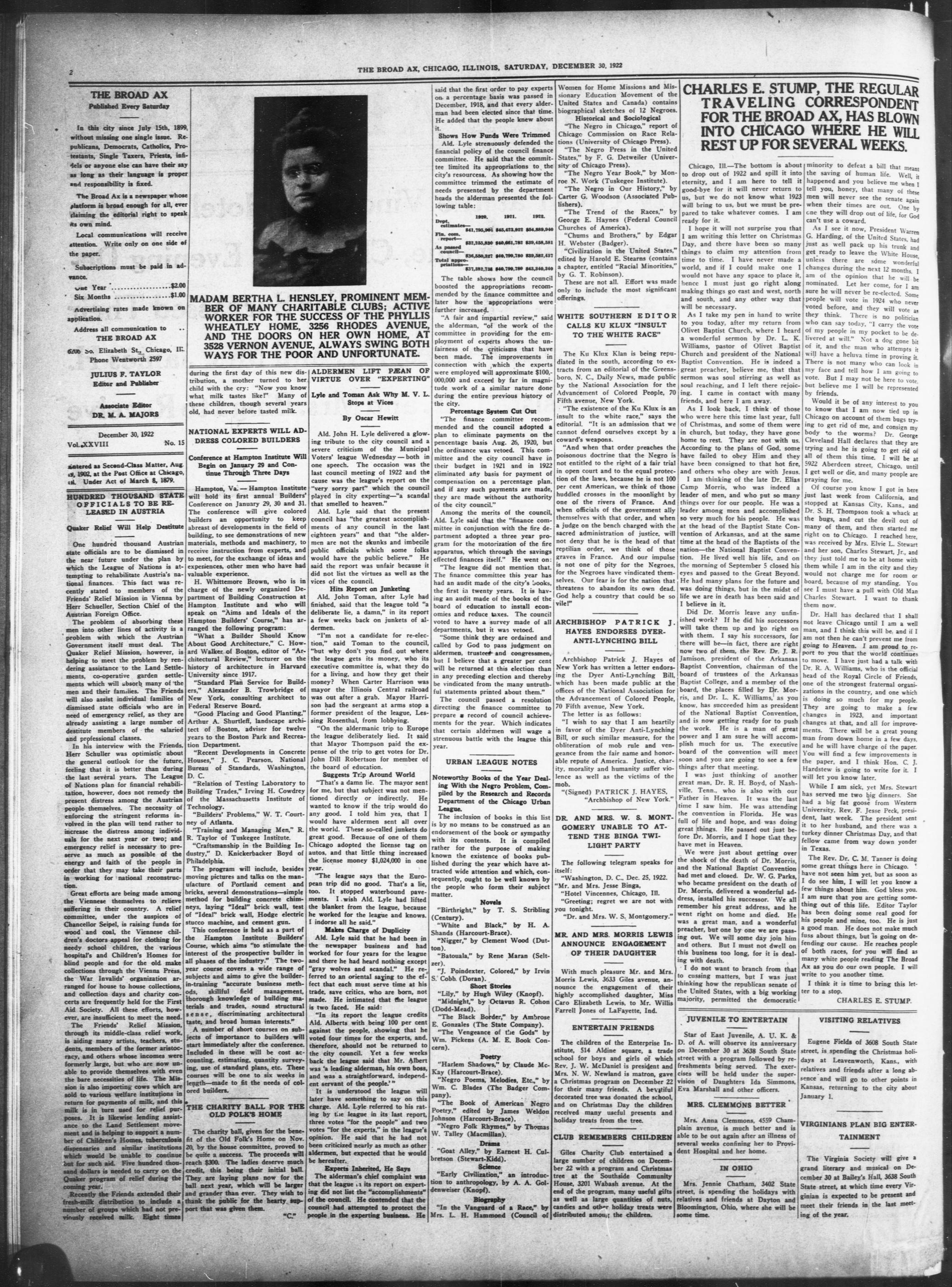
MADAM BERTHA L. HENSLEY, PROMINENT MEMBER OF MANY CHARITABLE CLUBS; ACTIVE WORKER FOR THE SUCCESS OF THE PHYLLIS WHEATLEY HOME, 3256 RHODES AVENUE, AND THE DOORS ON HER OWN HOME, AT 3528 VERNON AVENUE, ALWAYS SWING BOTH WAYS FOR THE POOR AND UNFORTUNATE.
during the first day of this new distribution, a mother turned to her child with the cry: "Now you know what milk tastes like!" Many of these children, though several years old, had never before tasted milk.
NATIONAL EXPERTS WILL ADDRESS COLORED BUILDERS
Conference at Hampton Institute Will Begin on January 29 and Continue Through Three Days
Hampton, Va. — Hampton Institute will hold its first annual Builders' Conference on January 29, 30 and 31. The conference will give colored builders an opportunity to keep abreast of developments in the field of building, to see demonstrations of new materials, methods and machinery, to receive instruction from experts, and to meet, for the exchange of ideas and experiences, other men who have had valuable experience.
H. Whittemore Brown, who is in charge of the newly organized Department of Building Construction at Hampton Institute and who will speak on "Aims and Ideals of the Hampton Builders' Course", has arranged the following program:
"What a Builder Should Know About Good Architecture," C. Howard Walker of Boston, editor of "Architectural Review," lecturer on the history of architecture in Harvard University since 1917.
"Standard Plan Service for Builders," Alexander B. Trowbridge of New York, consulting architect to Federal Reserve Board.
"Good Placing and Good Planting," Arthur A. Shurtleff, landscape architect of Boston, adviser for twelve years to the Boston Park and Recreation Department.
"Recent Developments in Concrete Houses," J. C. Pearson, National Bureau of Standards, Washington, D. C.
"Relation of Testing Laboratory to Building Trades," Irving H. Cowdrey of the Massachusetts Institute of Technology.
"Builders' Problems," W. T. Courtney of Atlanta.
"Training and Managing Men." R. R. Taylor of Tuskegee Institute. "Craftsmanship in the Building Industry." D. Knickerbacker Boyd of Philadelphia. The program will include, besides moving pictures and talks on the manufacture of Portland cement and bricks, several demonstrations—simple method for building concrete chimneys, laying "Ideal" brick wall, test of "Ideal" brick wall, Hodge electric stucco machine, and cement gun.
This conference is held as a part of the Hampton Institute Builders' Course, which aims "to stimulate the interest of the prospective builder in all phases of the industry." The two-year course covers a wide range of subjects and aims to give the builder-in-training "accurate business methods, skillful field management, thorough knowledge of building materials and trades, sound structural sense, discriminating architectural taste, and broad human interests."
A number of short courses on subjects of importance to builders will start immediately after the conference. Included in these will be cost accounting, estimating, quantity surveying, use of standard plans, etc. These courses will be one to six weeks in length—made to fit the needs of colored builders.
THE CHARITY BALL FOR THE
OLD FOLK'S HOME
The charity ball, given for the benefit of the Old Folk's Home on Nov. 20, by the house committee, proved to be quite a success. The proceeds will reach $300. The ladies deserve much credit, this being their initial ball. They are laying plans now for the ball next year, which will be larger and grander than ever. They wish to thank the public for the hearty support that was given them.
"C."
ALDERMEN LIFT PEAAN OF
VIRTUE OVER "EXPERTING"
Lyle and Toman Ask Why M. V. L.
Stops at Vices
By Oscar Hewitt
Ald. John H. Lyle delivered a glowing tribute to the city council and a severe criticism of the Municipal Voters' league Wednesday—both in one speech. The occasion was the last council meeting of 1922 and the cause was the league's report on the "very sorry part" which the council played in city experting—a scandal that smelled to heaven."
Ald. Lyle said that the present council has "the greatest accomplishments of any council in the last eighteen years" and that "the aldermen are not the skunks and imbecile public officials which some folks would have the public believe." He said the report was unfair because it did not list the virtues as well as the vices of the council.
Hits Report on Junketing
Hits Report on Junketing
Ald. John Toman, after Lyle had finished, said that the league told "a deliberate lie, a damn," in its report a few weeks back on junkets of aldermen.
"I'm not a candidate for re-election," said Toman to the council,
"but why don't you find out where the league gets its money, who its executive committee is, what they do for a living, and how they get their money? When Carter Harrison was mayor the Illinois Central railroad was out after a grab. Mayor Harrison had the sergeant at arms stop a former president of the league, Lessing Rosenthal, from lobbying.
"On the aldermanic trip to Europe the league deliberately lied. It said that Mayor Thompson paid the expense of the trip to get votes for Dr. John Dill Robertson for member of the board of education.
Suggests Trip Around World
Suggests Trip Around World
"That's a damn lie. The mayor sent for me, but that subject was not mentioned directly or indirectly. He wanted to know if the trip would do any good. I told him yes, that I would have aldermen sent all over the world. These so-called junkets do great good. Because of one of them Chicago adopted the license tag on autos, and that little thing increased the license money $1,024,000 in one year.
"The league says that the European trip did no good. That's a lie, too. It stopped waterbound pavements. I wish Ald. Lyle had lifted the blanket from the league, because he worked for the league and knows. I indorse all he said."
Ald. Lyle said that he had been in the newspaper business and had worked for four years for the league and there he had heard nothing except "gray wolves and scandal." He referred to an oriental saying to the effect that each must serve time at his trade, save critics, who are born, not made. He intimated that the league is two faced. He said:
"In its report the league credits Ald. Alberts with being 100 per cent against the people, showing that he voted four times for the experts, and, therefore, should not be returned to the city council. Yet a few weeks back the league said that Mr. Albert was 'a leading alderman, his own boss, and was a straightforward, independent servant of the people.'"
It is understood the league will later have something to say on this charge. Ald. Lyle referred to his rating by the league in its last report, three votes "for the people" and two votes "for the experts," in the league's opinion. He said that he had not been criticized nearly as much as other aldermen, but expected that he would be hereafter.
Expertis Inherited, He Says
The alderman's chief complaint was that the league a its report on exporting did not list the "accomplishments" of the council. He contended that the council had attempted to protect the people in the exporting business. He
said that the first order to pay experts on a percentage basis was passed in December, 1918, and that every alderman had been elected since that time. He added that the people knew about it.
Shows How Funds Were Trimmed
Ald. Lyle strenuously defended the financial policy of the council finance committee. He said that the committee limited its appropriations to the city's resource. As showing how the committee trimmed the estimate of needs presented by the department heads the alderman presented the following table:
Women for Home Missionary Education in United States and biographical sketches
Historical and
"The Negro in Chicago Commissionations (University of Chicago)
"The Negro Presidency States," by F. G. D. city of Chicago Presidency
"The Negro Year roe N. Work (Tuskegee)
"The Negro in Carter G. Woodson (lishers).
1920. 1921. 1922.
Dept. estimates— $41,795,901 $45,423,922 $54,889,946
Fin. con. report— $32,255,830 $40,661,782 $39,458,581
As passed council— $36,550,327 $40,790,780 $39,582,437
Total appropriations— $37,382,738 $40,790,780 $43,340,340
The table shows how the council boosted the appropriations recommended by the finance committee and later how the appropriations were further increased.
"A fair and impartial review," said the alderman, "of the work of the committee in providing for the employment of experts shows the unfairness of the criticisms that have been made. The improvements in connection with which the experts were employed will approximate $100,-000,000 and exceed by far in magnitude work of a similar nature done during the entire previous history of the city.
Percentage System Cut Out
"The finance committee recommended and the council adopted a plan to eliminate payments on the percentage basis Aug. 26, 1920, but the ordinance was vetoed. This committee and the city council have in their budget in 1921 and in 1922 eliminated any basis for payment of compensation on a percentage plan, and if any such payments are made, they are made without the authority of the city council."
Among the merits of the council, Ald. Lyle said that the "finance committee in conjunction with the fire department adopted a three year program for the motorization of the fire apparatus, which through the savings effected finances itself." He went on:
"The league did not mention that. The finance committee this year has had an audit made of the city's books, the first in twenty years. It is having an audit made of the books of the board of education to install economies and reduce taxes. The council voted to have a survey made of all departments, but it was vetoed. "Some think they are ordained and called by God to pass judgment on aldermen, trustees and congressmen, but I believe that a greater per cent will be returned at this election than in any preceding election and thereby be vindicated from the many untruthful statements printed about them."
The council passed a resolution directing the finance committee to prepare record of council achievements for the year. Which indicates that certain aldérmen will wage a strenuous battle with the league this year.
URBAN LEAGUE NOTES
Noteworthy Books of the Year Dealing With the Negro Problem, Compiled by the Research and Records Department of the Chicago Urban League.
The inclusion of books in this list is by no means to be construed as an endorsement of the book or sympathy with its contents. It is compiled rather for the purpose of making known the existence of books published during the year which have attracted wide attention and which, consequently, ought to be well known by the people who form their subject matter.
Novels
"Birthright," by T. S. Stribling (Century).
"White and Black," by H. A. Shands (Harcourt-Brace).
"Nigger," by Clement Wood (Dutton).
"Batouala," by Rene Maran (Seltzer).
"J. Poindexter, Colored," by Irvin S. Cobb. (Doran).
**Short Stories**
"Lily," by Hugh Wiley (Knopf).
"Midnight," by Octavus R. Cohon (Dodd-Mead).
"The Black Border," by Ambrose E. Gonzales (The State Company).
"The Vengeance of the Gods" by Wm. Pickens (A. M. E. Book Concern).
Poetry
"Harlem Shadows," by Claude McKay (Harcourt-Brace).
"Negro Poems, Melodies, Etc.," by Wm. C. Blades (The Badger Company).
"The Book of American Negro Poetry," edited by James Weldon Johnson (Harcourt-Brace).
"Negro Folk Rhymes," by Thomas W. Talley (Macmillan).
Drama
"Goat Alley," by Earnest H. Culbretson (Stewart-Kidd).
Science
"Early Civilization," an introduction to anthropology, by A. A. Goldenweiser (Knopf).
Biography
"In the Vanguard of a Race," by Mrs. L. H. Hammond (Council of
---
Women for Home Missions and Missionary Education Movement of the United States and Canada) contains biographical sketches of 12 Negroes. Historical and Sociological "The Negro in Chicago," report of Chicago Commission on Race Relations (University of Chicago Press). "The Negro Press in the United States," by F. G. Detweiler (University of Chicago Press). "The Negro Year Book," by Monroe N. Work (Tuskegee Institute). "The Negro in Our History," by Carter G. Woodson (Associated Publishers). "The Trend of the Races," by George E. Haynes (Federal Council Churches of America). "Chums and Brothers," by Edgar H. Webster (Badger).
"Civilization in the United States," edited by Harold E. Stearns (contains a chapter, entitled "Racial Minorities," by G. T. Robinson). These are not all. Effort was made only to include the most significant offerings.
WHITE SOUTHERN EDITOR
CALLS KU KLUX "INSULT
TO THE WHITE RACE"
The Ku Klux Klan is being repudiated in the south, according to extracts from an editorial of the Greensboro, N. C., Daily News, made public by the National Association for the Advancement of Colored People, 70 Fifth avenue, New York.
"The existence of the Ku Klux is an insult to the white race," says the editorial. "It is an admission that we cannot defend ourselves except by a coward's weapons.
"And when that order preaches the poisonous doctrine that the Negro is not entitled to the right of a fair trial in open court and to the equal protection of the laws, because he is not 100 per cent American, we think of those huddled crosses in the moonlight by one of the rivers of France. And when officials of the government ally themselves with that order, and when a judge on the bench charged with the sacred administration of justice, will not deny that he is the head of that reptilian order, we think of those graves in France. And our impulse is not one of pity for the Negroes, for the Negroes have vindicated themselves. Our fear is for the nation that threatens to abandon its own dead. God help a country that could be so vile!"
ARCHBISHOP PATRICK J
HAYES ENDORSES DYER-
ANTI-LYNCHING BILL
Archbishop Patrick J. Hayes of New York has written a letter endorsing the Dyer Anti-Lynching Bill, which has been made public at the offices of the National Association for the Advancement of Colored People, 70 Fifth avenue, New York. The letter is as follows: "I wish to say that I am heartily in favor of the Dyer Anti-Lynching Bill, or such similar measure, for the obliteration of mob rule and vengeance from the fair name and honorable repute of America. Justice, charity, morality and humanity suffer violence as well as the victims of the mob. " (Signed) PATRICK J. HAYES, "Archbishop of New York."
DR. AND MRS. W. S. MONT.
GOMERY UNABLE TO AT-
TEND THE BINGA TWI-
LIGHT PARTY
The following telegram speaks for itself:
"Washington, D. C., Dec. 25, 1922.
"Mr. and Mrs. Jesse Binga,
"Hotel Vincennes, Chicago, Ill.
"Greeting; regret we are not with you tonight.
"Dr. and Mrs. W. S. Montgomery."
MR. AND MRS. MORRIS LEWIS
ANNOUNCE ENGAGEMENT
OF THEIR DAUGHTER
With much pleasure Mr. and Mrs.
Morris Lewis, 3633 Giles avenue, announce the engagement of their highly accomplished daughter, Miss Caro Elizabeth Lewis, to Mr. Willis Farrell Jones of LaFayette, Ind.
ENTERTAIN FRIENDS
The children of the Enterprise Institute, 514 Aldine square, a trade school for boys and girls of which Rev. J. W. McDaniel is president and Mrs. N. W. Newland is matron, gave a Christmas program on December 22 for their many friends. A bevyfat decorated tree was donated the school, and on Christmas Day the children received many useful presents and holiday treats from the tree.
CLUB REMEMBERS CHILDREN
Giles Charity Club entertained a large number of children on December 22 with a program and Christmas tree at the Southside Community House, 3201 Wabash avenue. At the end of the program, many useful gifts as well as large quantities of nuts, candies and other holiday treats were distributed among the children.
CHARLES E. STUMP, THE REGULAR TRAVELING CORRESPONDENT FOR THE BROAD AX, HAS BLOWN INTO CHICAGO WHERE HE WILL REST UP FOR SEVERAL WEEKS.
Chicago, Ill.—The bottom is about to drop out of 1922 and spill it into eternity, and I am here to tell it good-bye for it will never return to us, but we do not know what 1923 will bring to us, but we must be prepared to take whatever comes. I am ready for it.
I hope it will not surprise you that I am writing this letter on Christmas Day, and there have been so many things to claim my attention from time to time. I have never made a world, and if I could make one I would not have any space to place it, hence I must just go right along making things go east and west, north and south, and any other way that will be necessary.
As I take my pen in hand to write to you today, after my return from Olivet Baptist Church, where I heard a wonderful sermon by Dr. L. K. Williams, pastor of Olivet Baptist Church and president of the National Baptist Convention. He is indeed a great preacher, believe me, that that sermon was soul stirring as well as soul reaching, and I left there rejoicing. I came in contact with many friends, and here I am away.
As I look back, I think of those who were here this time last year, full of Christmas, and some of them were in church, but today, they have gone home to rest. They are not with us. According to the plans of God, some have failed to obey Him and they have been consigned to that hot fire, and others who obey are with Jesus.
I am thinking of the late Dr. Elias Camp Morris, who was indeed a leader of men, and who put so many things over for our people. He was a leader among men and accomplished so very much for his people. He was at the head of the Baptist State Convention of Arkansas, and at the same time at the head of the Baptists of the nation—the National Baptist Convention. He lived well his life, and on the morning of September 5 closed his eyes and passed to the Great Beyond. He had many plans for the future and was doing things, but in the midst of life we are in death has been said and I believe in it.
Did Dr. Morris leave any unfinished work? If he did his successors will take them up and go right on with them. I say his successors, for there will be—in fact, there are right now two of them, the Rev. Dr. J. R. Jamison, president of the Arkansas Baptist Convention, chairman of the board of trustees of the Arkansas Baptist College, and a member of the board, the places filled by Dr. Morris, and Dr. L. K. Williams, as you know, has succeeded him as president of the National Baptist Convention, and is now getting ready for to push the work. He is a man of great power and I am sure he will accomplish much for us. The executive board of the convention will meet soon and you are going to see a few things after that meeting.
I was just thinking of another great man, Dr. R. H. Boyd, of Nashville. Tenn., who is also with our Father in Heaven. It was the last time I saw him. He was attending the convention in Florida. He was full of life and hope, and was doing great things. He passed out just before Dr. Morris, and I hope that they have met in Heaven.
We were just about getting over the shock of the death of Dr. Morris, and the National Baptist Convention had met and closed. Dr. W. G. Parks, who became president on the death of Dr. Morris, delivered a wonderful address, installed his successor. We all remember his great address, and he went right on home and died. He was a great man, and a wonderful preacher, but one by one we are passing out. We will some day join him and others. But I must not dwell on this business too long, for it is dealing with death.
I do not want to branch from that to cussing matters, but I was just thinking how the republican senate of the United States, with a big working majority, permitted the democratic
JUVENILE TO ENTERTAIN
Star of East Juvenile, A. U. K. & D. of A. will observe its anniversary on December 30 at 3638 South State street with a program followed by refreshments being served. The exercises will be held under the supervision of Daughters Ida Simmons, Eva Marshall and other officers.
MRS. CLEMMONS BETTER
Mrs. Anna Clemmons, 4559 Champain avenue, is much better and is able to be out again after an illness of several weeks confining her to Provident Hospital and her home.
IN OHIO
Mrs. Jennie Chatham, 3402 State street, is spending the holidays with relatives and friends at Dayton and Bloomington, Ohio, where she will be some time.
minority to defeat a bill that meant the saving of human life. Well, it happened and you believe me when I tell you, honey, that many of these men will never see the senate again when their times are out. One by one they will drop out of life, for God can't use a coward.
As I see it now, President Warren G. Harding, of the United States, had just as well pack up his trunk and get ready to leave the White House, unless there are some wonderful changes during the next 12 months. I am of the opinion that he will be nominated. Let her come, for I am sure he will never be re-elected. Some people will vote in 1924 who never voted before, and they will vote as they think. There is no politician who can say today, "I carry the vote of my people in my pocket to be delivered at will." Not a dog gone bit of it, and the man who attempts it will have a heluva time in proving it. There is not many who can look in my face and tell how I am going to vote. But I may not be here to vote, but believe me I will be represented by friends.
Would it be of any interest to you to know that I am now tied up in Chicago on account of them bugs trying to get rid of me, and consign my body to the worms? Dr. George Cleveland Hall declares that they are trying and he is going to get rid of all of them this time. I will be at 5922 Aberdeen street, Chicago, until I get well or die, and many people are praying for me.
Of course you know I got in here just last week from California, and stopped at Kansas City, Kans., and Dr. S. H. Thompson took a whack at the bugs, and cut the devil out of many of them, and then started right on to Chicago. I reached here, was received by Mrs. Elvie L. Stewart and her son, Charles Stewart, Jr., and they just told me to be at home with them while I am in the city and they would not charge me for room or board, because of my standing. You see I must have a pull with Old Man Charles Stewart. I want to thank them now.
Dr. Hall has declared that I shall not leave Chicago until I am a well man, and I think this will be, and if I am not then he can't prevent me from going to Heaven. I am proud to report to you that the world continues to move. I have just had a talk with Dr. R. A. Williams, who is the official head of the Royal Circle of Friends, one of the strongest fraternal organizations in the country, and one which is doing so much for my people. They are going to make a few changes in 1923, and important changes at that, and all for improvements. There will be a great young man from down home in a few days, and he will have charge of the paper. You will find a few improvements in the paper, and I think Hon. C. J. Hardstew is going to write for it. I will let you know later.
While I am sick, yet Mrs. Stewart has served me two big dinners. She had a big fat goose from Western University, Rev. F. Jesse Peck, president, last week. The president sent it to her husband, and there was a turkey dinner Christmas Day, and that fellow came from way down yonder in Texas.
The Rev. Dr. C. M. Tanner is doing some great things here in Chicago. "have not seen him yet, but as soon as I do see him, I will let you know a few things about him. God bless you. I am sure that you are getting something out of this life. Editor Taylor has been doing some real good for his people and mine, too. He is just a good man. He does not make much fuss about things, but is on defending our cause. He reaches people of both races, for you will find as many white people reading The Broad Ax as you do our own people. I will write to you another time.
I think it is time to bring this letter to a stop.
CHARLES E. STUMP.
VISITING RELATIVES
Eugene Fields of 3608 South State street, is spending the Christmas holidays at Leavenworth, Kans., with relatives and friends after a long absence and will go to other points in Kansas, returning to the city about January 1.
VIRGINIANS PLAN BIG ENTER
TAINMENT
The Virginia Society will give a grand literary and musical on December 30 at Bailey's Hall, 3638 South State street, at which time every Virginian is expected to be present and meet their friends in the last meeting of the year.
THE OPENING OF THE BINGA STATE BANK
Mr. and Mrs. Jesse Binga
LESS BLINDNESS IN COUNTRY; BRUSHES FOR HOUSEHOLD
Mr. Jesse Binga, President of the Binga State Bank, was born in Detroit Michigan, coming from one of its oldest and most highly respected families, receiving his common and high school education in the city of his birth; in time he received his early real estate training in the real estate business by assisting his mother and father Mr. William and Mrs. Adelphia Binga; in 1901 Mr. Binga decided to permanently locate in Chicago, and cast his lot with his hustling and enterprising citizens, and the first year after becoming a resident of the Windy City, he became a curbstone broker in garden vegetables, in fact he was a huckster and with his horse and wagon he sold garden truck up and down the streets on the south side, to many of the people who are now occupying many of his houses and stores either owned by him or under his control.
In the winter of 1902 he decided to launch out in the real estate business, and he opened a small office at 3333 S. State street. His capital at that time consisted of a half month's rent three old rickety chairs, a small flat top table, an old worn out stove resting on two legs, and a brick, but being a hustler and full of courage and pluck Mr. Binga began to do business and make money right from the start. On May 1, 1905, he leased the Bates Building, 3635 and 3637 S. State St., where he moved his real estate office and he caused the white tenants to vacate and colored tenants followed after them and from that day to the present time the complexion of the neighborhood has changed up and Mr. Binga opened the way for
Figure Reveal a Gratifying Decrease of Terrible Affliction Throughout the United States.
Imagine, if you can, a city of 120,000 inhabitants, where every single soul is totally blind; where doctor, lawyer, merchant, chief, along with the rich man, poor man, beggarman and thief, are all in the same boat—sightless! America has the makings of just such a city. There are more than 120,000 totally blind people in the United States, and many times that number partly blind. The terrible part of it is that more than 57 per cent of blindness is classed as preventable, a large portion being the result of eyestrain.
It is encouraging to note, however, that blindness in America has decreased more than 20 per cent since glasses have become more common. Every other country has a far greater percentage of blindness, and they show a yearly increase. Three of every ten Americans wear glasses. Statistics prove that seven of each ten have enough eyestraint to warrant the wearing of correcting lenses. When we realize the relation of good vision to health and happiness, it is hard to understand why so many people neglect their eyes until they are permanently injured. In the first draft of American soldiers in 1917 bad sight caused nearly three times as many rejections as any other physical defect. At the time of the draft 2,510,706 men were examined and 21.68 per cent were rejected because of grossly defective vision—Illustrated World.
Going One Better.
One of the brightest "star" in "The Island King" at the Adelphi theater is Nancie Lovat. She acts and acts charmingly.
I paid Miss Lovat a visit the other evening, and she asked me if I had "heard this one." I hadn't.
Two kiddies were engaged in a bragging match.
"My mummy's gone to the shop to pay some bills," said Joan, proudly.
"My mummy doesn't have to," sneered Doria. "The men come to the house for ours."
Here is another of Miss Lovat's stories.
"George!" murmured the girl, as she nestled close to him, "digars are nothing but a habit."
"Yes, and you've now broken one of my habit," said the young man, as he sadly withdrew the remains of a Havana from his pocket—London Tit Bits.
"Pardners."
In these days of bonding companies and enormous corporations the old phrase, "File word was as good as his bond," has a homely sound, and little tales of long partnership with never a hard and fast legal instrument naming what is his and what is others, seem like old tales out of the past.
But the other day when Sam Harris and George M. Cohen dissolved their seventen-year-old partnership, they ended a period of agreement in their joint producing business in which no contract ever existed, and yet their business was one where more can-tankerous hitches occur than in most. Smooth are the seas when two men, such of whose word goes, do business together—Christian Science Monitor.
colored people to reside on every street and avenue from State street east to Lake Michigan. In 1908, Mr. Binga removed his real estate office into the present three-story brick building which was erected according to his instructions which is now occupied by the Binga State Bank, State and 36th Place. Shortly after that time Mr. Binga opened his private bank and safety deposit vaults and he 'ably conducted his bank from that year until Jan. 3, 1921, at which time it was transformed into the Binga State Bank. President Binga has long since proven himself to be by far the most successful and conservative Afro-American banker in the United States
President Binga and his good wife Mrs. Binga who is one of our warmest lady friends in this city, at the present time pay taxes on more than seven hundred thousand dollars worth of Chicago real estate, their frontage on State street amounts to almost one thousand feet and there are very few persons in this city who owns such a long frontage on that rapidly improving thoroughfare, and Mr. and Mrs. Binga who are a great credit to the Afro-American race, own large blocks of stock in some of the largest and most substantial business concerns in this city.
The officers and directors of the Binga State Bank are as follows: Mr. Jesse Binga, President; Col. John R. Marshall, Vice-president; Mr. C. N. Langston, Cashier. Directors: Jesse Binga, John R. Marshall, Oscar Depriest, W. A. Robinson, R. S. Abott, U. G. Dailley, C. N. Langston, H. R. Smith and Rev. C. H. Clark.
They May Be Divided Into Three Classes, Which Are Bristle, Hair, and Fiber.
There are two classes of brushes those with backs and those without. These come in bristle, in hair and in fiber. It is fiber and bristles that are of special interest in discussing household needs.
The backless brush has the advantage of being usable in any position and thereby being at least twice as long-lived as the brush whose only working surface is one side. These brushes are marvelously made and the bristles, hair, fiber or fabric (mops) are so fastened in as to make a falling bristle almost an impossibility. These brushes come in every department of house life: toilet, bath, pantry, laundry, clothes, kitchen, halls and walls. The Russian pony gives the best horsehair, and the wild boar gives the most and best bristles. The test for the bristle is that it will not break if bent back and will spring into place again. The hair and bristle when burned give a characteristic hair odor.
The fiber brush, though a cheaper brush, is adapted to things for which the bristle brush is not adapted. The fiber makes a good scrubbing brush, but the bristle would not be stiff enough. Many fibers are made to look like bristle, but the bristle test will save you from a rash purchase. The bristle brush is expensive and so is the brush of camel or badger hair from which painting and shaving brushes are made.
Radium From Bohemia
Government-owned mines at Jachymov, Bohemia, are turning out uranium ore, rich in radium, and the known supply is said to be sufficient for 20 years at the present rate of production; in addition, there are three large mines not yet prospected as to depth. These facts are given out by the Scientific American. Two grams of radium a year are now being produced and net profits to the Chechoslovak republic for the past year were about 8,500,000 crowns. The radium is selling today at 10,000,000 crowns per gram, a crown being now worth about 1.94 cents. While production in the United States is greater in quantity, the Jachymov ores are reputed to be richer in quality.
3633
BANK
Caribou Swarm in Yukon.
Tens of thousands of wild caribou are reported to be swarming over the hills through the suburbs of Dawson, T. T., for a radius of 50 miles. The great herd, which annually treks through the district, is now moving northward. Large herds swimming the Yukon have interfaced with the progress of steamers. The herd is so vast that the hunting by men, women and children, who have provided nearly every home with deer meat for the winter, has made no noticeable effect on it.
America's Pipe Linen.
At one time or another almost every barrel of oil produce in the United States travels through a pipe line. The flow of oil in the fifty thousand miles of pipe line never stops. Different grades of oil are separated from one another by "headers," which are merely partitions of water three feet long.
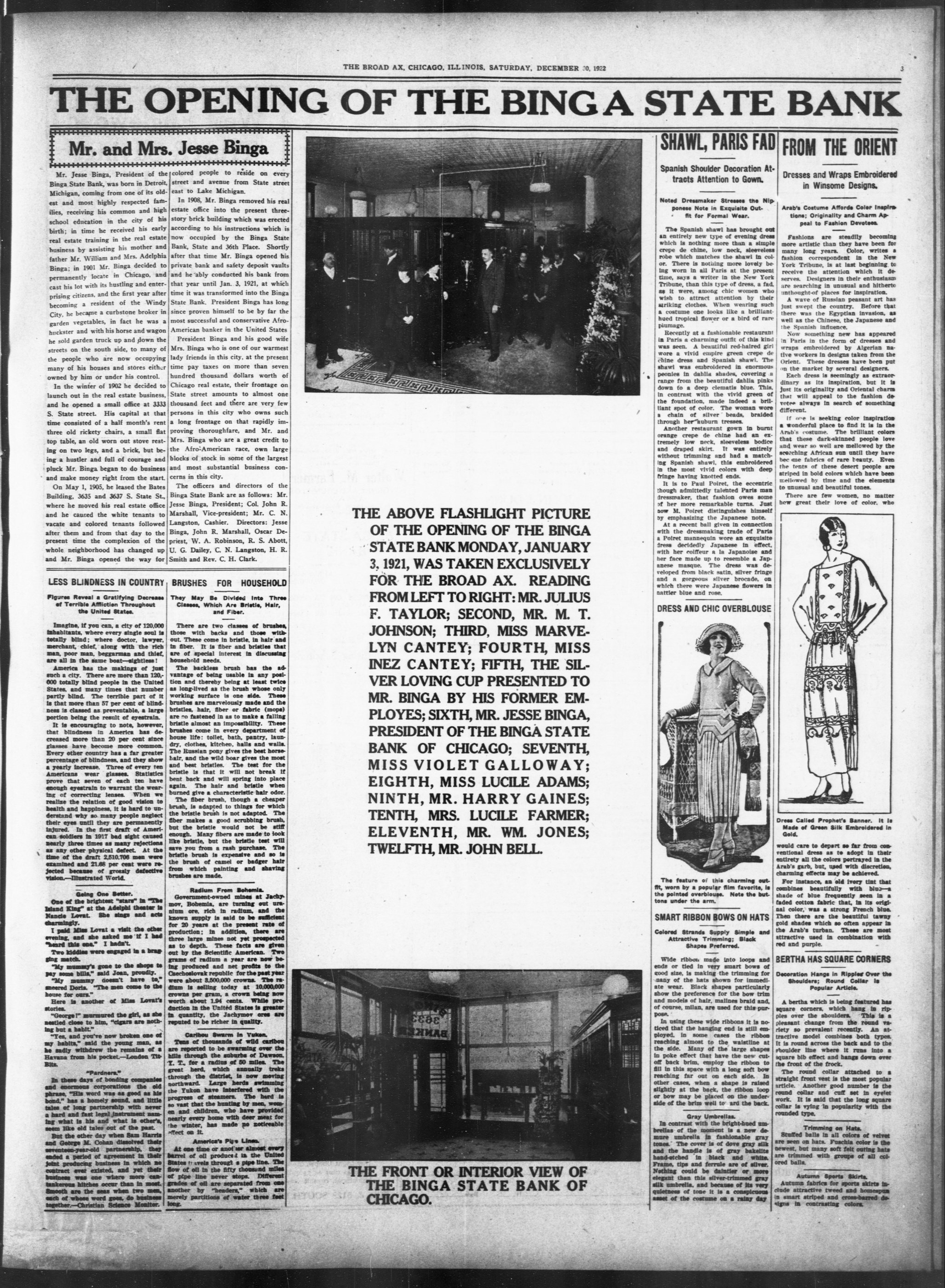
THE FRONT OR INTERIOR VIEW OF THE BINGA STATE BANK OF CHICAGO.
THE BROAD AX, CHICAGO, ILLINOIS, SATURDAY, DECEMBER 30, 1922
SHAWL, PARIS FAD
SHAWL, PARIS FAD
THE TRAINING ROOM
Spanish Shoulder Decoration Attracts Attention to Gown.
Noted Dressmaker Stresses the Nip-
pones Note in Exquite Out-
fit for Formal Wear.
The Spanish shawl has brought out an entirely new type of evening dress which is nothing more than a simple crepe de chine, low neck, sleeveless robe which matches the shawl in color. There is nothing more lovely being worn in all Paris at the present time, says a writer in the New York Tribune, than this type of dress, a fad, as it were, among chic women who wish to attract attention by their sizzling clothes. When wearing such a costume one looks like a brilliant-hued tropical flower or a bird of rare plumage.
Recently at a fashionable restaurant in Paris a charming outfit of this kind was seen. A beautiful red-haired girl wore a vivid empire green crepe de chine dress and Spanish shawl. The shawl was embroidered in enormous peonies in dahlia shades, covering a range from the beautiful dahlia pinks down to a deep clematis blue. This, in contrast with the vivid green of the foundation, made indeed a brilliant spot of color. The woman wore a chain of silver beads, braided through her auburn tresses. Another restaurant gown in burnt orange crepe de chine had an extremely low neck, sleeveless bodice and draped skirt. It was entirely without trimming and had a matching Spanish shawl, this embroidered in the most vivid colors with deep fringe having knotted ends.
It is to Paul Poiret, the eccentric though admittedly talented Paris man dressmaker, that fashion owes some of her more remarkable turns. Just now M. Poiret distinguishes himself by emphasizing the Japanese note.
THE ABOVE FLASHLIGHT PICTURE OF THE OPENING OF THE BINGA STATE BANK MONDAY, JANUARY 3, 1921, WAS TAKEN EXCLUSIVELY FOR THE BROAD AX. READING FROM LEFT TO RIGHT: MR. JULIUS F. TAYLOR; SECOND, MR. M. T. JOHNSON; THIRD, MISS MARVELYN CANTEY; FOURTH, MISS INEZ CANTEY; FIFTH, THE SILVER LOVING CUP PRESENTED TO MR. BINGA BY HIS FORMER EMPLOYES; SIXTH, MR. JESSE BINGA, PRESIDENT OF THE BINGA STATE BANK OF CHICAGO; SEVENTH, MISS VIOLET GALLOWAY; EIGHTH, MISS LUCILE ADAMS; NINTH, MR. HARRY GAINES; TENTH, MRS. LUCILE FARMER; ELEVENTH, MR. WM. JONES; TWELFTH, MR. JOHN BELL.
At a recent ball given in connection with the dressmaking trade of Paris a Poirret mannequin wore an exquisite dress decidedly Japanese in effect, with her coiffeur a la Japonise and her face made up to resemble a Japanese masque. The dress was developed from black satin, silver fringe and a gorgeous silver brocade, on which there were Japanese flowers in nattier blue and rose.
1920s
The feature of this charming outfit, worn by a popular film favorite, is the pointed overblouse. Note the buttons under the arm.
SMART RIBBON BOWS ON HATS
Colored Strands Supply Simple and Attractive Trimming; Black Shapes Preferred.
Wide ribbon made into loops and ends or tied in very smart bows of good size, is making the trimming for many of the hats shown for immediate wear. Black shapes particularly show the preference for the bow trim and models of hair, malines braid and, of course, milan, are used for this purpose.
In using these wide ribbons it is noticed that the hanging end is still employed, in some cases the ribbon reaching almost to the walstine at the side. Many of the large shapes in poke effect that have the new cut-off back brim, employ the ribbon to fill in this space with a long soft bow reaching far out on each side. In other cases, when a shape is raised slightly at the back, the ribbon loop or bow may be placed on the underside of the brim well to ard the back.
Gray Umbrellas.
In contrast with the bright-bued umbrellas of the moment is a new demure umbrella in fashionable gray tones. The cover is of dove gray silk and the handle is of gray baskelite hand-etched in black and white. Frame, tips and ferrule are of silver. Nothing could be daintier or more elegant than this silver-trimmed gray silk umbrella, and because of its very quietness of tone it is a conspicuous asset of the costume on a rainy day
FROM THE ORIENT
FROM THE ORIENT
Dresses and Wraps Embroidered in Winsome Designs.
Arab's Costume Affords Color Inspirations; Originality and Charm Appeal to Fashion Devotees.
Fashions are steadily becoming more artistic than they have been for many long years. Color, writes a fashion correspondent in the New York Tribune, is at last beginning to receive the attention which it deserves. Designers in their enthusiasm are searching in unusual and hitherto unthought-of places for inspiration.
A wave of Russian peasant art has just swept the country. Before that there was the Egyptian invasion, as well as the Chinese, the Japanese and the Spanish influence.
Now something new has appeared in Paris in the form of dresses and wraps embroidered by Algerian native workers in designs taken from the Orient. These dresses have been put on the market by several designers.
Each dress is seemingly as extraordinary as its inspiration, but it is just its originality and Oriental charm that will appeal to the fashion devotee always in search of something different.
If one is seeking color inspiration a wonderful place to find it is in the Arab's costume. The brilliant colors that these dark-skinned people love and wear so well are mellowed by the scorching African sun until they havebec me fabrics of rare beauty. Even the tents of these desert people are striped in bold colors which have beenmellowed by time and the elements to unusual and beautiful tones.
There are few women, no matter how great their love of color, who
1
Dress Called Prophet's Banner. It is Made of Green Silk Embroidered in Gold.
would care to depart so far from conventional dress as to adopt in their entirety all the colors portrayed in the Arab's garb, but, used with discretion, charming effects may be achieved.
For instance, an old ivory tint that combines beautifully with blue—a shade of blue frequently seen in a faded cotton fabric that, in its original color, was a strong French blue. Then there are the beautiful tawny gold shades which so often appear in the Arab's turban. These are most attractive used in combination with red and purple.
BERTHA HAS SQUARE CORNERS
Decoration Hangs in Ripples Over the Shoulders; Round Collar Is Popular Article.
A bertha which is being featured has square corners, which hang in ripples over the shoulders. This is a pleasant change from the round variety so prevalent recently. An attractive model combines both types. It is round across the back and to the shoulder line where it runs into a square bib effect and hangs down over the front of the frock.
The round collar attached to a straight front vest is the most popular article. Another good number is the round collar and cuff set in eyetow work. It is said that the long square collar is vying in popularity with the rounded type.
Trimming on Hats.
Stuffed balls in all colors of velvet are seen on hats. Fuschia color is the newest, but many soft felt cuff hats are trimmed with groups of all colored balls.
Autumn fabrics for sports skirts include attractive tweed and homepurs in smart striped and cross-barred designs in contrasting colors.
Phone Atlantic 2008
Miss Eleanor Gale
Soprano
Available for Concerts, Recitals, Et
net Avenue, Apt. 2
Miss Eleanor Gaines
Soprano
Available for Concerts, Recitals, Etc.
4005 Calumet Avenue, Apt. 2 Chicago, Ill.
Phone Douglas 5322
O. W. Burrell, M.
PHYSICIAN and SURGEON
OFFICE AND RESIDENCE
St., Cor. Indiana Ave.
Hrs: 11-1, 8-5, 7-9 P. M. Sunday, 1-4, 7-8
RE-ELECT
Roman Scott M. B.
(New) 16th Ward
in the square opposite my name
Aldermanic Ballot
ELECTION, TUESDAY, FEB. 27, 1921
Pells Open 6 A. M. to 5 P. M.
OFFICE TELEPHONE DOUGLAS #351
Jno. W. Burrell, M. D.
PHYSICIAN and SURGEON
OFFICE AND RESIDENCE
201 E. 37th St., Cor. Indiana Ave.
CHICAGO
Hours: 11-1, 8-5, 7-9 P. M. Sunday, 1-4, 7-8 P. M.
Alderman Scott M. Hogan
(New) 16th Ward
Make a Cross in the square opposite my name on separate
Aldermanic Ballot
ELECTION, TUESDAY, FEB. 27, 1923
Poll Open 6 A.M. to 5 P.M.
J. GRAY LUCAS
Attorney-at-Law
204 East 35th Street
Chicago
Corner Indiana Ave., Second Floor
Res., 3646 Grand Boul. Tel. Douglas 4307
Phone Yards 27
FURNITURE
Hand Wood Beds, Electric W
refrigerators, Stoves, Paint,
Hardware, Linoleum
HENRY STUCKAR
2515-19 ARCHER AVE.
Brass and Wood Beds, Electric Washers, Refrigerators, Stoves, Paint, Oil, Hardware, Linoleum HENRY STUCKART 2515-19 ARCHER AVE.
TELEPHONE DOUGLAS 1
AGE F. HARDING
REAL ESTATE
ate or Modern Houses, Ap
and Stores to Rent
COTTAGE GROVE
former 31st Street, Chicago
Up-to-Date or Modern Houses, Apartments and Stores to Rent
3101 COTTAGE GROVE AVE.
Corner 31st Street, Chicago
Statement of Condition
At Close of Business on Sept. 15th, 1922
RESOURCES
Loans and Discounts ... $1,850,080.10
(Inspected and approved by our Board of Directors)
Roads and Securities ... 704,894.01
Stocks ... 20,775.00
(Lincoln State Safety Vaults Co.)
Bank Billing and Annu. ... 156,076.25
Furniture and Pictures ... 24,184.39
Other Resources ... 10,188.87
Cash on Hand and Due from Banks ... 564,420.87
Total ... $2,881,890.09
LIABILITIES
Capital Stock ... $800,000.00
Supplies ... 20,000.00
Undivided Profits ... 20,664.43
Reserved for Taxes and Interest ... 3,125.90
Other Liabilities ... 0,975.43
Deposits ... 2,484,635.07
Total ... $2,881,890.09
Increase in Deposits Since June 30, 1922
($270,000.00)
This Bank invites you to avail yourself of its complete facilities.
First Mortgage-Gold Bond—approved with investments—valid 7% interest.
Boxes in our completely equipped Safety Deposit Vaults rent for $4.00 per year and upwards.
Interest at the rate of 2% is allowed on all saving accounts. Savings Department issued from 9 a.m. to 8 p.m. Saturday.
GEORGE F. LEIBRANDT, President.
CHARLES A. WHITE, Vice-President.
GEORGE E. CAMPBELL, Cashier.
L. A. DELAUREN, Asst. Clerk.
ADDRESS E. AVERY, Mgr. Bond Dept.
.
THE BROAD AX, CHICAGO, ILLINOIS, SATURDAY, DECEMBER 30, 1922
PROSPERITY MEANS TEAMWORK
"Prosperity is the result of saving by keeping everlastingly at it." Tomorrow's success is the result of today's action. Open your account today and save by a plan—spend wisely —progress steadily. This is the teamwork which will make your bank account grow.
ILLINOIS TRUST
La Salle and Jack
IS YOUR HAIR
ILLINOIS TRUST & SAVING
La Salle and Jackson Streets
YOUR HAIR SHORT
ILLINQIS TRUST & SAVINGS BANK La Salle and Jackson Streets Chicago
IS YOUR HAIR SHORT OR THIN?
Does it break off or fall out? Is it dry and wry? How your help治病, or more than a normal amount of water?
9
If so, you should set at once, begin using MADAME N. A. FRANKLIN'S Hair GROWER. It matters not success, you should not become discouraged and give up before giving my Hair Grower a trial. It has proven successful, you should do the same for you. I also teach my System by mail or by person. Write for information and terms today.
MY SPECIAL OFFER
To those desiring to try my wonderful Hair Preparation mail, on request, a SIX WEEK TREATMENT MAIL, on request, a SIX WEEK TREATMENT MAIL, with full instructions how to use the same, for only $1.10. One trial treatment will convince you of its value. Make all orders to
MADAME N. A. FRANKLIN
Dept. B, 502 State Street, B, 805 Prairie Ave. CHICAGO, IL.
Order from nearest point Dept. B.
JAS. B. McCAHEY, President
FRANK J. DUNN, Vice-President
ESTABLISHED
JOHN
COA
from nearest point
Dept. B, 3342 So. State St.
CHICAGO
L. McCAHEY, President
PHILIP
K J. DUNN, Vice-President
H. X. COM
JAS. B. McCAHEY, President PHILIP J. DUNN, Secretary
FRANK J. DUNN, Vice-President H. X. COMERFORD, Treasurer
ESTABLISHED 1877
ESTABLISHED 1877
JOHN J. DUNN
COAL CO.
Telsphone Oakland 1550
5100 Federal Street
120 South State St
Opposite
Phone De
MRS. W
Painless C
18 Years
120 South State Street (Seventh R
Opposite Palmer House
---
Phone Dearborn 5871
MRS. WARNE
Painless Chiropodist
18 Years' Experience
Residence Phone Douglas 2616
Center of Human Hair industry. Antwerp, Belgium, is the center of the human hair industry. Raw hair and Chinese hair, which has been bleached, dyed and prepared, is used in the manufacture of women's hair nets.
Kindness and Light.
Give us to awake with smiles, give us to labor smiling. As the sun lightens the world, so let our loving kindness make bright this house of our habitation.—Robert Louis Stevenson.
Concrit Not of Real Value.
Concise may puff a man up for a moment, but never for a long time. It is a mighty poor substitute for that real knowledge of self which values at actual worth. The world has use for only the genuine article.
Essentials for Happiness.
The grand essentials of happiness
are: Something to do, something to
love and something to hope for.
Chas. Krutckoff, Pres.
J. E. Ward, Vice-Pres.
Telephone C
Norris-Ward
YARD
26th St. and South Park, I. C. R. R.
18th and Canal Sts., C. B. 4
Root St., C. R. I. P.
Bustickoff, Pres.
Burd, Vice-Pres.
Telephone Calumet 805
Norris-Ward Coal
YARDS AT
and South Park, I. C. R. R.
Both and Canal Sts., C. B. & Q. R. R.
Root St., C. R. I. P. R. R.
Chas. Krutckoff, Pres.
J. E. Ward, Vice-Pres.
Hugh Norris, Treas.
Kirby Ward, Secy.
Telephone Calumet 805
Norris-Ward Coal Co.
YARDS AT
26th St. and South Park, I. C. R. R.
15th and Canal Sts., C. B. & Q. R. R.
Root St., C. R. I. P. R. R.
Roscoe and Racine Aves., C. M. & St. P. R. R.
2556 COTTAGE GROVE AVE., CHICAGO
CUT OUT THIS SUBSCRIPTION BLANK AND MAIL IT TO
THE BROAD AX
$1.00 FOR 6 MONTHS
6206 S. Elizabeth Street, Chicago, Ill.
$2.00 PER YEAR
JULIUS F. TAYLOR, Please enter my name as a subscriber to THE BROAD AX. I endlose herewith Two Dollars, the annual subscriptions to same, or One Dollar for six months.
Name
Town
Date 19 State
T & SAVINGS BANK
Jason Streets Chicago
SHORT OR THIN?
break off or fall out? Is it dry and wry? Is hair disease, or more than a normal amount off? You should at once, begin using MADAME BANKLIN'S HAIR GROWER. It matters not Hair. Preparation is tried without you should not become diseased by giving my Hair Grower a trial. It has probablenature growth of hair for thousands and by person. Write for information and terms
MY SPECIAL OFFER
de悬ing to my wonderful Hair Preparation mail, on request, a SIX WEEKS' TRIAL ENT, consisting of Shampoo, Hair Grower ing Oil, with full instructions how to use the only A110. One total treatmentSystem will con- of its value. Make all orders to
MADAME N. A. FRANKLIN
3342 So. State St. Dept. B, 805 Prairie Ave.
CHICAGO, ILL.
PHILIP J. DUNN, Secretary
H. X. COMERFORD, Treasurer
J. DUNN
AL CO.
Street (Seventh Floor)
Palmer House
Warborn 5871
WARNER
Chiropodist
Experience
CHICAGO
When Your Hackskaw Breaks.
If the blade in the hackskaw breaks two or three inches from the frame, it can still be utilized. Hold the blade in the flame of a blow torch, or otherwise heat it, and while still warm drill a hole through it; this can be done with a hand nail. The blade can then be replaced in the adjustable saw frame, a. it will be ready for use.
Doc (after exam.)—"Don't worry about your liver trouble, you can live to be so eny years with it. And as to the lea'ning heart valve, you can carry that around easily until you're eighty, but the kidney disease, that's worse. It'll surely bring you to the grave inside of a year."
Hickory in Great Demand.
The weight of a piece of hickory is the best indication of its strength. It is said that 100,000,000 board feet a year are consumed in the making of tool handles, including golf tools.
Hugh Norris, Treas.
Kirby Ward, Secy.
Alumet 805
d Coal Co.
S AT
K. Q. R. R.
R. R.
STRENGTH
WARRIOR
CHICAGO
CHICAGO
Candid\ Information.
FUNERAL DIRECTORS
ERNEST H. WILLIAMSON UNDERTAKER
GARAGE
GASOLINE OIL
OPEN DAY & NIGHT
PHONE MAIN 2214
A. D. GASH
ATTORNEY AT LAW
118 N. La Salle Street
CHICAGO
Phone Main 2017
A. L. WILLIAMS
ATTORNEY AND
COUNSELOR AT LAW
Suite 706 Firmonich Building
184 W. Washington St.
CHICAGO
Residence 3655 Prairie Ave.
Phone Douglas 9133
Residence, 1262 Macalister Place
Telephone Monroe 2714
MILES J. DEVINE
ATTORNEY AT LAW
Suite 318-320 Reaper Block
Clark and Washington Sts.
CHICAGO
Telephone Central 1239
Notary Public
Phones: Office Main 4153; Residence
4751 Champain Avenue
Phone Kenwood 5611
ATTORNEY AND COUNSELOR
AT LAW
Suite 708 - 184 W. Washington St.
CHICAGO
BINGA STATE BANK
Under State Supervision
Capitz ..... $100,000.00
Surplus ..... 20,000.00
Offers Equal Service to All
3% INTEREST ON SAVINGS
SAFE DEPOSIT VAULTS
State Street and 36th Place
Wanted
A live or wide awake newspaper man or solicitor can earn some easy money by calling on or addressing the undersigned.
Julius F. Taylor, 6206 S. Elizabeth street. Phone Wentworth 2597.
PHONE KENWOOD 455
West Englewood Trust & Savings Bank
Critical and Sunny
OFFI
President
Bel, Vice-Pres.
Cashier
Carl O. Seber
Commonwealth
72 W. ADA
PHONE RAI
Electric Shops
all the Federal Wa
Capital and Surplus, $500,000.00
John Bain, President Arthur C. Utsch, Asst. Cashier Michael Maisel, Vice-Pres. W. Merle Fisher, Asst. Cashier Edw. C. Barry, Cashier and Trust Officer Carl O. Seberg, Asst. Cashier
The following Electric Shops carry a full line of Electrical Appliances and sell the Federal Washer on Easy Terms:
Davies Electric Shop, 3408 Fullerton Ave.
De Luxe Electric Shop, 2501 N. Kedzie Ave.
Kalwyn Park Elec. Shop, 4310 Fullerton Ave.
Logan Sq. Lighting Shop, 2455 Milwaukee Ave.
Manor Electric Co., 3651 Lawrence Ave.
Mid-West Electrical Service Co., 3933 Elston Ave.
Patterson Brothers, 1950 Irving Park Blvd.
Szeier Electric Co., 6717 Olmsted Ave.
Adel Electric Shop, 5521 W. North Ave.
WEST SIDE
Balzell & Baza,
Baylor & Baza St.
Bridgeport Electric St.
165th St.
City Electric St.
212th W. 25th St.
645th W. 25th St.
645th W. 25th St.
645th W. Madison St.
645th W. Madison St.
645th W. Madison St.
DeTanbier's Els. Shop,
Fitzpatrick Co.
Fitzpatrick Co.
Madison St.
Rogers B. Garff.
3001 W. Lake St.
Home Appliance Appliance
Company
3899 W. Chicago Ave.
Lake Superior Ave.
719 S. Western Ave.
HOME
OUR NEW HOME
72 W. Adams St.
72 W. Adams St.
448 N. Parkside Ave.
3827 Logan Blvd.
3827 Logan Blvd.
3432 W. Roosevelt St.
NORTH SIDE
Attenborough
2622 N. Clark St.
Broadway Electric Shop,
J. B. Collins & Son.
4531 N. Western Ave.
1538 N. Clark St.
Fullerton Electric Shop,
Karman Harbart Electric
1446 Willows Ave.
Lakeview Electric Co.
O. R. Martin.
3158 N. Clark St.
Marmont Ave.
1504 N. Merrow Ave.
North Shore Electric Co.
Marmont Ave.
1504 N. Merrow Ave.
3306 Southeast Ave.
Sloaneport Ave.
3506 Lincoln Ave.
Sailor's Electric Shop.
Sailor's Electric Shop.
Tip Top Appliance.
297 Lincoln Ave.
Tilt Top Appliance.
833 Irving Park Blvd.
4636 Broadway
NORTHWEST
Art Lena Hensy & GIH
Company,
1890 Milwaukee Ave.
CHICAGO
d Surplus, $500,000
OFFICERS
Arthur C. Uteso
res. W. Merle Fishe
ar
S. Seberg, Asst. Cashier
wealth Edison C
7. ADAMS STREET
LINE RANDOLPH 1280
Shops carry a full line
eral Washer on Easy Ter
```markdown
```
```markdown
```
4370 Lincoln Ave.
4139 Ivory Park Drive
6245 Normal Street
2500 E. 92d SL
E. 2500 SL
Marmark Electric Shop,
Marmark Ave. Avs.
Madele Electric Shop,
3233 W. Madison St.
Madele Ave.
1811 W. 323rd St.
Ogden Electric Shop,
Ogden Ave.
Bernard O. Harn,
3151 W. Madison St.
Ramat Gan Electric
Shop,
3314 W. Chicago Ave.
1132 W. Taylor St.
Richmond Electric Co.
Richmond Ave.
Rioka Electric Shop,
Rioka Electric Shop,
2724 W. Division St.
2324 W. North Ave.
3248 W. North Ave.
8019 Mile Ave.
SOUTH SIDE
St. Berry & Co.
Berry St. 116th St.
St. Co.
Beverly Electric Shop.
St. Co. 1732 W. 98th St.
Brigantine Electric Fix-
ture Co.
Collison St. 3882 Archer Ave.
Collison St. 7334 Electric Shop.
Collison St. 7133 So. Chicago Av.
Cairns Electric Shop.
Collison St. 7133 Michigan Av.
Chatham Electric Fix-
ture Co.
Appliance 721 E. 73rd St.
Collison Electric Co.
5422 S. Halsted St.
Electric Co.
1031 E. 47th St.
ME
6350 S. Naited St.
Burlington, WI 54410
812 S. Naited St.
Odenton Ave.
4007 Odenton Ave.
Grove Ave.
417/419 Grove Ave
Electric Washing
Machine Co.
Gage Park
Arrows Ave.
G. Parkage Park
2612 W. 51st St.
502 W. 51st St.
502-52 W. 118th St.
Goodkeeping
Kingwood Ave.
L. & H. Electric C. Ave.
2, 509 Archer Ave.
Linden Electric Shop.
12335 Brandon Ave.
Linden Electric Shop.
12335 Brandon Ave.
Nalgherbshop H. Ave.
1719. W. 548 St.
61st St.
2418 W. 478 St.
2418 W. 478 St.
2421 W. Mastated St.
2421 W. Mastated St.
Parallal Electric C. Ave.
7923 W. Mastated St.
7923 W. Mastated St.
7923 W. Mastated St.
W. 478 St.
W. 478 St.
Vincentas Electric Shop
7308 Vincentas Ave.
A. Jager,
1222, 518th St.
Sagittarius,
W. Pulliam Electric
West Shop,
611 W. 120th St.
Winchester Store
Elec-
tric, 6760 Stony Island Ave.