The Broad Ax
Saturday, May 8, 1926
Chicago, Illinois
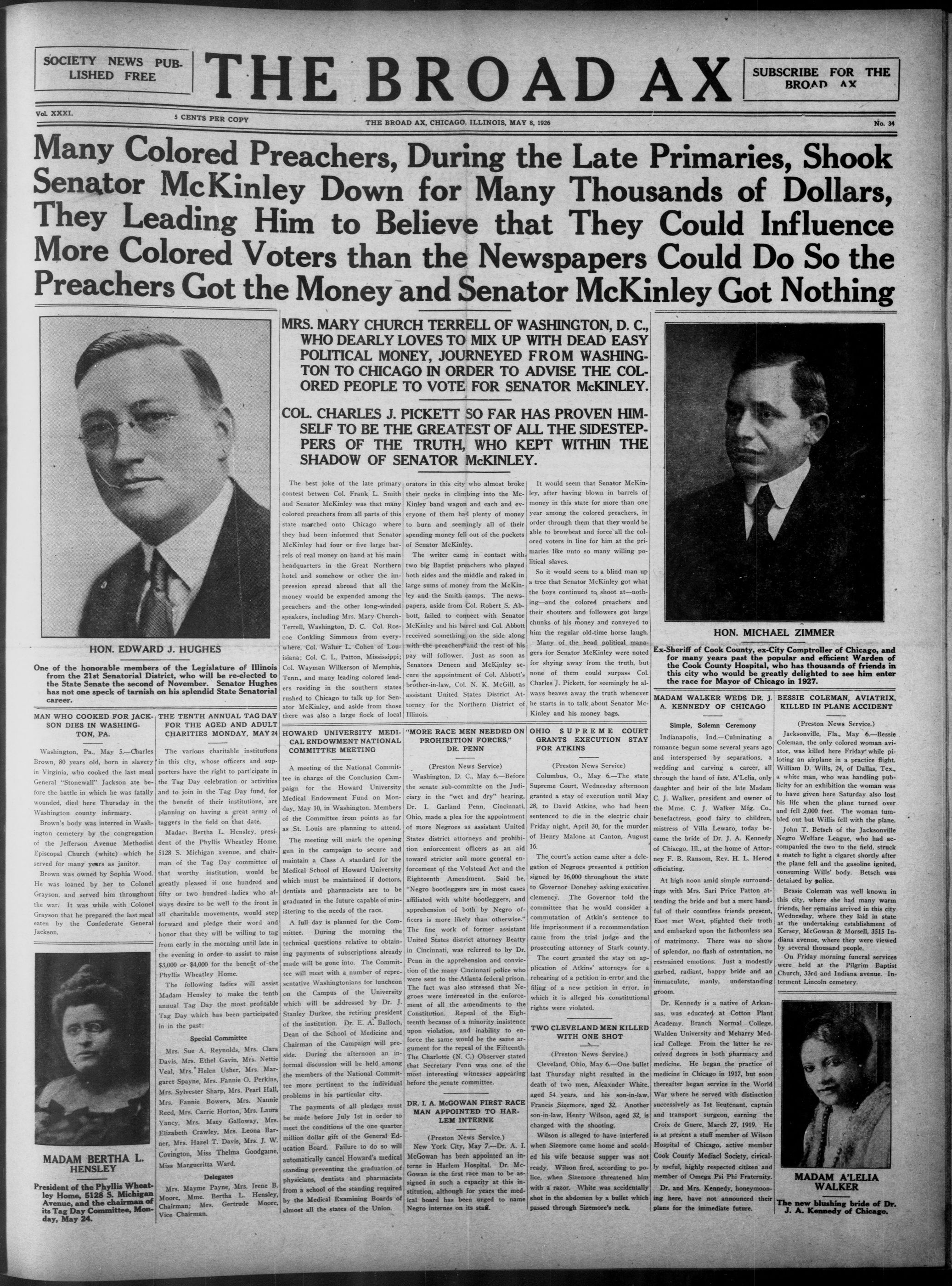
Page text (machine-generated)
Many Colored Preachers, During the Late Primaries, Shook Senator McKinley Down for Many Thousands of Dollars, They Leading Him to Believe that They Could Influence More Colored Voters than the Newspapers Could Do So the Preachers Got the Money and Senator McKinley Got Nothing
SOCIETY NEWS PUBLISHED FREE
Vol. XXXI. 5
Many Colo
Senator M
They Leac
More Colo
Preachers
ny Colored
ator McK
ey Leading
re Colored
achers Go
[Name]
HON. EDWARD J. HUGHES
One of the honorable members of the Legislat from the 21st Senatorial District, who will be the State Senate the second of November. S has not one speck of tarnish on his splendid S career.
Honorable members of the Legislature 11st Senatorial District, who will be senate the second of November. S he speck of tarnish on his splendid S
One of the honorable members of the Legislature of Illinois from the 21st Senatorial District, who will be re-elected to the State Senate the second of November. Senator Hughes has not one speck of tarnish on his splendid State Senatorial career.
MAN WHO COOKED FOR JACK
SON DIES IN WASHINGTON, PA.
Washington, Pa., May 5.—Charles Brown, 80 years old, born in slavery in Virginia, who cooked the last meal General "Stonewall" Jackson ate before the battle in which he was fatally wounded, died here Thursday in the Washington county infirmary. Brown's body was interred in Washington cemetery by the congregation of the Jefferson Avenue Methodist Episcopal Church (white) which he served for many years as janitor. Brown was owned by Sophia Wood. He was loaned by her to Colonel Grayson, and served him throughout the war. It was while with Colonel Grayson that he prepared the last meal eaten by the Confederate General Jackson.
MADAM BERTHA L.
HENSLEY
President of the Phyllis Wheatley Home, 5128 S. Michigan Avenue, and the chairman of its Tag Day Committee, Monday, May 24.
---
---
5 CENTS PER COPY
colored Pr
McKinle
eading H
colored V
rs Got the
s of the Legislature of Illinois strict, who will be re-elected to of November. Senator Hughes on his splendid State Senatorial
THE TENTH ANNUAL TAG DAY FOR THE AGED AND ADULT CHARITIES MONDAY, MAY 24
The various charitable institutions in this city, whose officers and supporters have the right to participate in the Tag Day celebration or activities and to join in the Tag Day fund, for the benefit of their institutions, are planning on having a great army of taggers in the field on that date.
Madar, Bertha L. Hensley, president of the Phyllis Wheatley Home. 5128 S. Michigan avenue, and chairman of the Tag Day committee of that worthy institution, would be greatly pleased if one hundred and fifty or two hundred ladies who always desire to be well to the front in all charitable movements, would step forward and pledge their word and honor that they will be willing to tag from early in the morning until late in the evening in order to assist to raise $3,000 or $4,000 for the benefit of the Phyllis Wheatley Home. The following ladies will assist Madam Hensley to make the tenth annual Tag Day the most profitable Tag Day which has been participated in in the past:
Special Committee
Mrs. Sue A. Reynolds, Mrs. Clara Davis, Mrs. Ethel Gavin, Mrs. Nettie Veal, Mrs. Helen Usher, Mrs. Margaret Spayne, Mrs. Fannie O. Perkins, Mrs. Sylvester Sharp, Mrs. Pearl Hall, Mrs. Fannie Bowers, Mrs. Nannie Reed, Mrs. Carrie Horton, Mrs. Laura Yancy, Mrs. Mary Galloway, Mrs. Elizabeth Crawley, Mrs. Leona Barner, Mrs. Hazel T. Davis, Mrs. J. W. Covington, Miss Thelma Goodgame, Miss Margueritta Ward.
Delegates
Mrs. Mayme Payne, Mrs. Irene B. Moore, Mme. Bertha L. Hensley, Chairman; Mrs. Gertrude Moore, Vice Chairman.
THE BROAD AX
THE BROAD AX, CHICAGO, ILLINOIS, MAY 8, 1926
MRS. MARY CHURCH TERRELL OF WASHINGTON, D. C., WHO DEARLY LOVES TO MIX UP WITH DEAD EASY POLITICAL MONEY, JOURNEYED FROM WASHINGTON TO CHICAGO IN ORDER TO ADVISE THE COLORED PEOPLE TO VOTE FOR SENATOR McKINLEY.
COL. CHARLES J. PICKETT SO FAR HAS PROVEN HIMSELF TO BE THE GREATEST OF ALL THE SIDESTEPPERS OF THE TRUTH, WHO KEPT WITHIN THE SHADOW OF SENATOR McKINLEY.
The best joke of the late primary contest between Col. Frank L. Smith and Senator McKinley was that many colored preachers from all parts of this state marched onto Chicago where they had been informed that Senator McKinley had four or five large barrels of real money on hand at his main headquarters in the Great Northern hotel and somehow or other the impression spread abroad that all the money would be expended among the preachers and the other long-winded speakers, including Mrs. Mary Church-Terrell, Washington, D. C. Col. Roscoe Conkling Simmons from everywhere, Col. Walter L. Cohen of Louisiana; Col. C. L. Patton, Mississippi; Col. Wayman Wilkerson of Memphis, Tenn., and many leading colored leaders residing in the southern states rushed to Chicago to talk up for Senator McKinley, and aside from those there was also a large flock of local
HOWARD UNIVERSITY MEDICAL ENDOWMENT NATIONAL COMMITTEE MEETING
A meeting of the National Committee in charge of the Conclusion Campaign for the Howard University Medical Endowment Fund on Monday, May 10, in Washington. Members of the Committee from points as far as St. Louis are planning to attend. The meeting will mark the opening gun in the campaign to secure and maintain a Class A standard for the Medical School of Howard University which must be maintained if doctors, dentists and pharmacists are to be graduated in the future capable of ministering to the needs of the race.
A full day is planned for the Committee. During the morning the technical questions relative to obtaining payments of subscriptions already made will be gone into. The Committee will meet with a number of representative Washingtonians for luncheon on the Campus of the University which will be addressed by Dr. J. Stanley Durkee, the retiring president of the institution. Dr. E. A. Balloch, Dean of the School of Medicine and Chairman of the Campaign will preside. During the afternoon an informal discussion will be held among the members of the National Committee more pertinent to the individual problems in his particular city.
The payments of all pledges must be made before July 1st in order to meet the conditions of the one quarter million dollar gift of the General Education Board. Failure to do so will automatically cancel Howard's medical standing preventing the graduation of physicians, dentists and pharmacists from a school of the standing required by the Medical Examining Boards of almost all the states of the Union.
orators in this city who almost broke their necks in climbing into the McKinley band wagon and each and everyone of them had plenty of money to burn and seemingly all of their spending money fell out of the pockets of Senator McKinley. The writer came in contact with two big Baptist preachers who played both sides and the middle and raked in large sums of money from the McKinley and the Smith camps. The newspapers, aside from Col. Robert S. Abbott, failed to connect with Senator McKinley and his barrel and Col. Abbott received something on the side along with the preachers and the rest of his pay will follower. Just as soon as Senators Deneen and McKinley secure the appointment of Col. Abbott's brother-in-law, Col. N. K. McGill, as assistant United States District Attorney for the Northern District of Illinois.
"MORE RACE MEN NEEDED ON PROHIBITION FORCES," DR. PENN
Washington, D. C., May 6.—Before the senate sub-committee on the Judiciary in the "wet and dry" hearing, Dr. I. Garland Penn, Cincinnati, Ohio, made a plea for the appointment of more Negroes as assistant United States district attorneys and prohibition enforcement officers as an aid toward stricter and more general enforcement of the Volstead Act and the Eighteenth Amendment. Said he, "Negro bootleggers are in most cases affiliated with white bootleggers, and apprehension of both by Negro officers is more likely than otherwise." The fine work of former assistant United States district attorney Beatty in Cincinnati, was referred to by Dr. Penn in the apprehension and conviction of the many Cincinnati police who were sent to the Atlanta federal prison. The fact was also stressed that Negroes were interested in the enforcement of all the amendments to the Constitution. Repeal of the Eighteenth because of a minority insistence upon violation, and inability to enforce the same would be the same argument for the repeal of the Fifteenth. The Charlotte (N. C.) Observer stated that Secretary Penn was one of the most interesting witnesses appearing before the senate committee.
DR. I. A. McGOWAN FIRST RACE
MAN APPOINTED TO HAR-
LEM INTERNE
(Preston News Service.)
New York City, May 7—Dr. A. I. McGowan has been appointed an interne in Harlem Hospital. Dr. McGowan is the first race man to be assigned in such a capacity at this institution, although for years the medical board has been urged to name Negro interne on its staff.
It would seem that Senator McKinley, after having blown in barrels of money in this state for more than one year among the colored preachers, in order through them that they would be able to browbeat and force all the colored voters in line for him at the primaries like unto so many willing political slaves.
So it would seem to a blind man up a tree that Senator McKinley got what the boys continued to shoot at—nothing—and the colored preachers and their shouters and followers got large chunks of his money and conveyed to him the regular old-time horse laugh.
Many of the head political managers for Senator McKinley were noted for shying away from the truth, but none of them could surpass Col. Charles J. Pickett, for seemingly he always heaves away the truth whenever he starts in to talk about Senator McKinley and his money bags.
OHIO SUPREME COURT GRANTS EXECUTION STAY FOR ATKINS
Columbus, O., May 6.—The state Supreme Court, Wednesday afternoon granted a stay of execution until May 28, to David Atkins, who had been sentenced to die in the electric chair Friday night, April 30, for the murder of Henry Malone at Canton, August 16.
The court's action came after a delegation of Negroes presented a petition signed by 16,000 throughout the state to Governor Donehey asking executive clemency. The Governor told the committee that he would consider a commutation of Atkin's sentence to life imprisonment if a recommendation came from the trial judge and the prosecuting attorney of Stark county.
The court granted the stay on application of Atkins' attorneys for a rehearing of a petition in error and the filing of a new petition in error, in which it is alleged his constitutional rights were violated.
TWO CLEVELAND MEN KILLED
WITH ONE SHOT
(Preston News Service.)
Cleveland, Ohio, May 6.—One bullet last Thursday night resulted in the death of two men, Alexander White, aged 54 years, and his son-in-law, Francis Sizemore, aged 32. Another son-in-law, Henry Wilson, aged 32, is charged with the shooting.
Wilson is alleged to have interfered when Sizemore came home and scolded his wife because supper was not ready. Wilson fired, according to police, when Sizemore threatened him with a razor. White was accidentally shot in the abdomen by a bullet which passed through Sizemore's neck.
M. B.
HON. MICHAEL ZIMMER
Ex-Sheriff of Cook County, ex-City Comptroller of Chicago, and for many years past the popular and efficient Warden of the Cook County Hospital, who has thousands of friends in this city who would be greatly delighted to see him enter the race for Mayor of Chicago in 1927.
MADAM WALKER WEDS DR. J. BESSIE COLEMAN, AVIATRIX,
A. KENNEDY OF CHICAGO KILLED IN PLANE ACCIDENT
Simple, Solemn Ceremony
Indianapolis, Ind.—Culminating a romance begun some several years ago and interspersed by separations, a wedding and carving a career, all through the hand of fate, A'Lelia, only daughter and heir of the late Madam C. J. Walker, president and owner of the Mme. C. J. Walker Mfg. Co., benefactress, good fairy to children, mistress of Villa Lewaro, today became the bride of Dr. J. A. Kennedy of Chiacgo, Ill., at the home of Attorney F. B. Ransom, Rev. H. L. Herod officiating.
At high noon amid simple surroundings with Mrs. Sari Price Patton attending the bride and but a mere handful of their countless friends present, East met West, plighted their troth and embarked upon the fathomless sea of matrimony. There was no show of splendor, no flash of ostentation, no restrained emotions. Just a modestly garbed, radiant, happy bride and an immaculate, manly, understanding groom.
Dr. Kennedy is a native of Arkansas, was educated at Cotton Plant Academy. Branch Normal College, Walden University and Meharry Medical College. From the latter he received degrees in both pharmacy and medicine. He began the practice of medicine in Chicago in 1917, but soon thereafter began service in the World War where he served with distinction successively as 1st lieutenant, captain and transport surgeon, earning the Croix de Guere, March 27, 1919. He is at present a staff member of Wilson Hospital of Chicago, active member Cook County Mediacl Society, civically useful, highly respected citizen and member of Omega Psi Phi Fraternity. Dr. and Mrs. Kennedy, honeymooning here, have not announced their plans for the immediate future.
SUBSCRIBE FOR THE BROAD AX
ies, Shook
of Dollars,
Influence
Do So the
ot Nothing
by, ex-City Comptroller of Chicago, and the popular and efficient Warden of capital, who has thousands of friends in be greatly delighted to see him enter of Chicago in 1927.
DR. J. CAGO
BESSIE COLEMAN, AVIATRIX, KILLED IN PLANE ACCIDENT
(Preston News Service.)
Jacksonville, Fla., May 6.—Bessie Coleman, the only colored woman aviator, was killed here Friday while piloting an airplane in a practice flight. William D. Wills, 24, of Dallas, Tex., a white man, who was handling publicity for an exhibition the woman was to have given here Saturday also lost his life when the plane turned over and fell 2,000 feet. The woman tumbled out but Willis fell with the plane.
John T. Betsch of the Jacksonville Negro Welfare League, who had accompanied the two to the field, struck a match to light a cigarette shortly after the plane fell and the gasoline ignited, consuming Wills' body. Betsch was detained by police.
Bessie Coleman was well known in this city, where she had many warm friends, her remains arrived in this city Wednesday, where they laid in state at the undertaking establishment of Kersey, McGowan & Morsell, 3515 Indiana avenue, where they were viewed by several thousand people. On Friday morning funeral services were held at the Pilgrim Baptist Church, 33rd and Indiana avenue. Interment Lincoln cemetery.
MADAM A'LELIA
WALKER
The new blushing bride of Dr.
J. A. Kennedy of Chicago.
---
THE BROAD AX
Published Every Saturday
In this city since July 15th 1899, without missing one single issue. Republicans, Democrats, Catholics, Protestants, Single Taxers, Priests, infidels or anyone else can have their say as long as their language is proper and responsibility is fixed. The Broad Ax is a newspaper whose platform is broad enough for all, ever claiming the editorial right to speak its own mind. It is neither Democratic nor Republican. It is strictly or absolutely independent in politics Local communications will receive attention. Write only on one side of the paper. Subscriptions must be paid in advance.
Address all communications to
JULIUS F. TAYLOR
Editor and Publisher
vol. XXXI No. 34
Chicago, May 8, 1926
Entered as Second-Class Matter, Aug.
19, 1902, at the Post office at Chicago.
III. Under Act of March 8, 1879.
N.A.A.C.P. ASKS PROTECTION
FOR CARTERET, N. J. NE-
GROES FROM MOB
Investigator on Scene Reports Politic
Helped Cause Church Burning
New York, (recently).—The National Association for the Advancement of Colored People, 69 Fifth avenue, today announced that following riotous attacks on the colored people of Carteret, N. J., and the burning of the local Baptist Church, the Association's Director of Publicity, Herbert J. Seligmann, had proceeded at once to the scene of the trouble, had visited Mayor Mulvihill and demanded full police protection for the colored citizens of the town. In addition, the N.A.A.C.P. twice telegraphed Governor A. Harry Moore of New Jersey, urging military protection if necessary for the colored people.
Mr. Seligmann's report on the Carteret trouble is as follows:
"Early Sunday morning in a street fight between colored and white men John Carroll, a white boxer well known locally, was stabbed to death on the streets of Carteret. That night a mob formed, determined to 'run the Negroes out of town,' attacked the First Baptist Church during services, routing the worshipers and burning the church to the ground. Upwards of 100 colored people were driven out of Carteret and of those who remained many stayed all night in the Armour and Liebig fertilizer plants where they were employed or barricaded themselves in their homes.
"The town was quiet although threats of violence against Negroes were made in connection with the funeral of the prize fighter, Carroll, on the following day, which fortunately, however, passed off without incident. Mayor Mulvihill assured me that the entire police force would be used to protect colored citizens of Carteret.
"The Rev. George H. Reed, pastor of the church which was burned, publicly charged that the riot was due to political animosity, colored votes having helped elect the present Mayor, there being about 600 Negroes in Carteret and the Mayor having won by about 150 votes. Rev. Reed charged that bootlegging and home brew activities went on openly in the town and contributed to the trouble. This charge was corroborated by other people."
The N.A.A.C.P. also announced that Rev. Louis Berry of Newark, had volunteered to lead a delegation of colored people to call upon Governor Moore and ask protection for the colored people of Carteret. Rev. Reed has announced that he will lead the exiled colored people back to their homes and will rebuild the destroyed church.
In the telegrams to Governor Moore the N.A.A.C.P. urged arrest of those responsible for the riotous attack on colored people and the burning of the church. To date no white people have been arrested. Three colored men, alleged to have been implicated in the stabbing of the white prizefighter and his companion, are in custody in the Brunswick county jail.
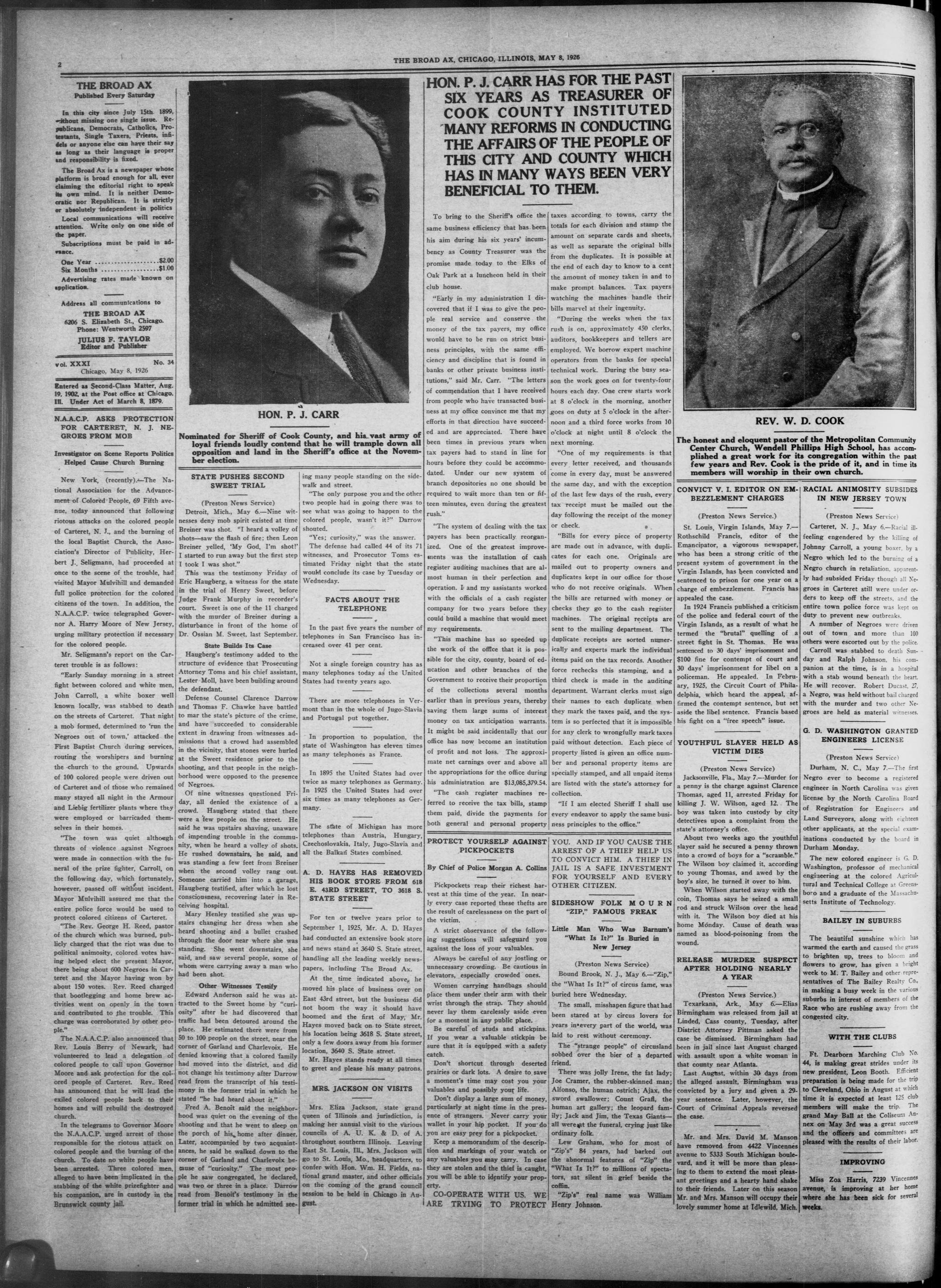
HON. P. J. CARR Nominated for Sheriff of Cook County, and his vast army of loyal friends loudly contend that he will trample down all opposition and land in the Sheriff's office at the November election.
STATE PUSHES SECOND SWEET TRIAL
Detroit, Mich., May 6—Nine witnesses deny mob spirit existed at time Breiner was shot. "I heard a volley of shots—saw the flash of fire; then Leon Breiner yelled, 'My God, I'm shot!' I started to run away but the first step I took I was shot."
This was the testimony Friday of Eric Hauberg, a witness for the state in the trial of Henry Sweet, before Judge Frank Murphy in recorder's court. Sweet is one of the 11 charged with the murder of Breiner during a disturbance in front of the home of Dr. Ossian M. Sweet, last September.
Haugberg's testimony added to the structure of evidence that Prosecuting Attorney Toms and his chief assistant, Lester Moll, have been building around the defendant.
Defense Counsel Clarence Darrow and Thomas F. Chawke have battled to mar the state's picture of the crime, and have succeeded to considerable extent in drawing from witnesses admissions that a crowd had assembled in the vicinity, that stones were hurled at the Sweet residence prior to the shooting, and that people in the neighborhood were opposed to the presence of Negroes.
Of nine witnesses questioned Friday, all denied the existence of a crowd. Haugberg stated that there were a few people on the street. He said he was upstairs shaving, unaware of impending trouble in the community, when he heard a volley of shots. He rushed downstairs, he said, and was standing a few feet from Breiner when the second volley rang out. Someone carried him into a garage. Haugberg testified, after which he lost consciousness, recovering later in Receiving hospital.
Mary Henley testified she was upstairs changing her dress when she heard shooting and a bullet crashed through the door near where she was standing. She went downstairs, she said, and saw several people, some of whom were carrying away a man who had been shot.
Other Witnesses Testify
Edward Anderson said he was attracted to the Sweet home by "curiosity" after he had discovered that traffic had been detoured around the place. He estimated there were from 50 to 100 people on the street, near the corner of Garland and Charlevoix. He denied knowing that a colored family had moved into the district, and did not change his testimony after Darrow read from the transcript of his testimony in the former trial in which he stated "he had heard about it."
Fred A. Benoit said the neighborhood was quiet on the evening of the shooting and that he went to sleep on the porch of his home after dinner. Later, accompanied by two acquaintances, he said he walked down to the corner of Garland and Charlevoix because of "curiosity." The most people he saw congregated, he declared, was two or three in a place. Darrow read from Benoit's testimony in the former trial in which he admitted see-
State Builds Its Case
County, and his vast army of that he will trample down all Sheriff's office at the Novem- ing many people standing on the sidewalk and street. "The only purpose you and the other two people had in going there was to see what was going to happen to the colored people, wasn't it?" Darrow shouted. "Yes; curiosity," was the answer. The defense had called 44 of its 71 witnesses, and Prosecutor Toms estimated Friday night that the state would conclude its case by Tuesday or Wednesday.
In the past five years the number of telephones in San Francisco has increased over 41 per cent.
Not a single foreign country has as many telephones today as the United States had twenty years ago.
There are more telephones in Vermont than in the whole of Jugo-Slavia and Portugal put together.
In proportion to population, the state of Washington has eleven times as many telephones as France.
In 1895 the United States had over twice as many telephones as Germany. In 1925 the United States had over six times as many telephones as Germany.
The state of Michigan has more telephones than Austria, Hungary, Czechoslovakia, Italy, Jugo-Slavia and all the Balkan States combined.
A. D. HAYES HAS REMOVED
HIS BOOK STORE FROM 618
E. 43RD STREET, TO 3618 S.
STATE STREET
For ten or twelve years prior to September 1, 1925, Mr. A. D. Hayes had conducted an extensive book store and news stand at 3640 S. State street, handling all the leading weekly newspapers, including The Broad Ax. At the time indicated above, he moved his place of business over on East 43rd street, but the business did not boom the way it should have boomed and the first of May, Mr. Hayes moved back on to State street, his location being 3618 S. State street, only a few doors away from his former location, 3640 S. State street. Mr. Hayes stands ready at all times to greet and please his many patrons.
MRS. JACKSON ON VISITS
Mrs. Eliza Jackson, state grand queen of Illinois and jurisdiction, is making her annual visit to the various councils of A. U. K. & D. of A. throughout southern Illinois. Leaving East St. Louis, Ill., Mrs. Jackson will go to St. Louis, Mo., headquarters, to confer with Hon. Wm. H. Fields, national grand master, and other officials on the coming of the grand council session to be held in Chicago in August.
THE BROAD AX, CHICAGO, ILLINOIS, MAY 8, 1926
FACTS ABOUT THE TELEPHONE
HON. P. J. CARR HAS FOR THE PAST SIX YEARS AS TREASURER OF COOK COUNTY INSTITUTED MANY REFORMS IN CONDUCTING THE AFFAIRS OF THE PEOPLE OF THIS CITY AND COUNTY WHICH HAS IN MANY WAYS BEEN VERY BENEFICIAL TO THEM.
To bring to the Sheriff's office the same business efficiency that has been his aim during his six years' incumbency as County Treasurer was the promise made today to the Elks of Oak Park at a luncheon held in their club house.
"Early in my administration I discovered that if I was to give the people real service and conserve the money of the tax payers, my office would have to be run on strict business principles, with the same efficiency and discipline that is found in banks or other private business institutions," said Mr. Carr. "The letters of commendation that I have received from people who have transacted business at my office convince me that my efforts in that direction have succeeded and are appreciated. There have been times in previous years when tax payers had to stand in line for hours before they could be accommodated. Under our new system of branch depositories no one should be required to wait more than ten or fifteen minutes, even during the greatest rush."
"The system of dealing with the tax payers has been practically reorganized. One of the greatest improvements was the installation of cash register auditing machines that are almost human in their perfection and operation. I and my assistants worked with the officials of a cash register company for two years before they could build a machine that would meet my requirements.
"This machine has so speeded up the work of the office that it is possible for the city, county, board of education and other branches of the Government to receive their proportion of the collections several months earlier than in previous years, thereby saving them large sums of interest money on tax anticipation warrants. It might be said incidentally that our office has now become an institution of profit and not loss. The approximate net earnings over and above all the appropriations for the office during his administration are $13,085,379.54. "The cash register machines referred to receive the tax bills, stamp them paid, divide the payments for both general and personal property
PROTECT YOURSELF AGAINST
PICKPOCKETS
By Chief of Police Morgan A. Collins
Pickpockets reap their richest harvest at this time of the year. In nearly every case reported these thefts are the result of carelessness on the part of the victim.
A strict observance of the following suggestions will safeguard you against the loss of your valuables.
Women carrying handbags should place them under their arm with their wrist through the strap. They should never lay them carelessly aside even for a moment in any public place.
Be careful of studs and stickpins. If you wear a valuable stickpin be sure that it is equipped with a safety catch.
Don't shortcut through deserted prairies or dark lots. A desire to save a moment's time may cost you your valuables and possibly your life.
Don't display a large sum of money, particularly at night time in the presence of strangers. Never carry your wallet in your hip pocket. If you do you are easy prey for a pickpocket.
Keep a memorandum of the description and markings of your watch or any valuables you may carry. In case they are stolen and the thief is caught, you will be able to identify your property.
CO-OPERATE WITH US. WE ARE TRYING TO PROTECT
taxes according to towns, carry the totals for each division and stamp the amount on separate cards and sheets, as well as separate the original bills from the duplicates. It is possible at the end of each day to know to a cent the amount of money taken in and to make prompt balances. Tax payers watching the machines handle their bills marvel at their ingenuity.
"During the weeks when the tax rush is on, approximately 450 clerks, auditors, bookkeepers and tellers are employed. We borrow expert machine operators from the banks for special technical work. During the busy season the work goes on for twenty-four hours each day. One crew starts work at 8 o'clock in the morning, another goes on duty at 5 o'clock in the afternoon and a third force works from 10 o'clock at night until 8 o'clock the next morning.
"One of my requirements is that every letter received, and thousands come in every day, must be answered the same day, and with the exception of the last few days of the rush, every tax receipt must be mailed out the day following the receipt of the money or check.
"Bills for every piece of property are made out in advance, with duplicates for each one. Originals are mailed out to property owners and duplicates kept in our office for those who do not receive originals. When the bills are returned with money or checks they go to the cash register machines. The original receipts are sent to the mailing department. The duplicate receipts are sorted numerically and experts mark the individual items paid on the tax records. Another force rechecks this stamping, and a third check is made in the auditing department. Warrant clerks must sign their names to each duplicate when they mark the taxes paid, and the system is so perfected that it is impossible for any clerk to wrongfully mark taxes paid without detection. Each piece of property listed is given an office number and personal property items are specially stamped, and all unpaid items are listed with the state's attorney for collection.
"If I am elected Sheriff I shall use every endeavor to apply the same business principles to the office."
YOU. AND IF YOU CAUSE THE ARREST OF A THIEF HELP US TO CONVICT HIM. A THIEF IN JAIL IS A SAFE INVESTMENT FOR YOURSELF AND EVERY OTHER CITIZEN.
SIDESHOW FOLK M O U R N
"ZIP," FAMOUS FREAK
Little Man Who Was Barnum's "What Is It?" Is Buried in New Jersey
(Preston News Service)
Bound Brook, N. J., May 6.—"Zip," the "What Is It?" of circus fame, was buried here Wednesday.
The small, misshapen figure that had been stared at by circus lovers for years in every part of the world, was laid to rest without ceremony.
The "strange people" of circusland sobbed over the bier of a departed friend.
There was jolly Irene, the fat lady; Joe Cramer, the rubber-skinned man; Alfonso, the human ostrich; Ajax, the sword swallower; Count Grafl, the human art jelly, the leopard family; Jack and Jim, the Texas Giants—all were at the funeral, crying just like ordinary folk.
Lew Graham, who for most of "Zip's" 84 years, had barked out the abnormal features of "Zip" the "What Is It?" to millions of spectators, sat silent in grief beside the coffin.
"Zip's" real name was William Henry Johnson.
P.
REV. W. D. COOK
The honest and eloquent pastor
Center Church, Wendell P
plished a great work for it
few years and Rev. Cook is
members will worship in th
CONVICT V. I. EDITOR ON EM-
BEZZLEMENT CHARGES
The honest and eloquent pastor of the Metropolitan Community Center Church, Wendell Phillips High School, has accomplished a great work for its congregation within the past few years and Rev. Cook is the pride of it, and in time its members will worship in their own church.
St. Louis, Virgin Islands, May 7.—Rothschild Francis, editor of the Emancipator, a vigorous newspaper, who has been a strong critic of the present system of government in the Virgin Islands, has been convicted and sentenced to prison for one year on a charge of embezzlement. Francis has appealed the case.
In 1924 Francis published a criticism of the police and federal court of the Virgin Islands, as a result of what he termed the "brutal" quelling of a street fight in St. Thomas. He was sentenced to 30 days' imprisonment and $100 fine for contempt of court and 30 days' imprisonment for libel on a policeman. He appealed. In February, 1925, the Circuit Court of Philadelphia, which heard the appeal, affirmed the contempt sentence, but set aside the libel sentence. Francis based his fight on a "free speech" issue.
YOUTHFUL SLAYER HELD AS
VICTIM DIES
(Preston News Service)
Jacksonville, Fla., May 7.-Murder for a penny is the charge against Clarence Thomas, aged 11, arrested Friday for killing J. W. Wilson, aged 12. The boy was taken into custody by city detectives upon a complaint from the state's attorney's office.
About two weeks ago the youthful slayer said he secured a penny thrown into a crowd of boys for a "scramble." The Wilson boy claimed it, according to young Thomas, and awed by the boy's size, he turned it over to him.
When Wilson started away with the coin, Thomas says he seized a small rod and struck Wilson over the head with it. The Wilson boy died at his home Monday. Cause of death was named as blood-poisoning from the wound.
RELEASE MURDER SUSPECT
AFTER HOLDING NEARLY
A YEAR
Texarkana, Ark., May 6—Elias Birmingham was released from jail at Linded, Cass county, Tuesday, after District Attorney Pittman asked the case be dismissed. Birmingham had been in jail since last August charged with assault upon a white woman in that county near Atlanta. Last August, within 30 days from the alleged assault, Birmingham was convicted by a jury and given a 29-year sentence. Later, however, the Court of Criminal Appeals reversed the case.
Mr. and Mrs. David M. Manson have removed from 4422 Vincennes avenue to 5333 South Michigan boulevard, and it will be more than pleasing to them to extend the most pleasant greetings and a hearty hand shake to their friends. Later on this season Mr. and Mrs. Manson will occupy their lovely summer home at Idlewild, Mich.
of the Metropolitan Community
Willips High School, has accom-
s congregation within the past
the pride of it, and in time its
eir own church.
RACIAL ANIMOSITY SUBSIDES
IN NEW JERSEY TOWN
(Preston News Service)
Carteret, N. J., May 6.—Racial ill-feeling engendered by the killing of Johnny Carroll, a young boxer, by a Negro which led to the burning of a Negro church in retaliation, apparently had subsided Friday though all Negroes in Carteret still were under orders to keep off the streets, and the entire town police force was kept on duty to prevent new outbreaks.
A number of Negroes were driven out of town and more than 100 others were escorted out by the police. Carroll was stabbed to death Sunday and Ralph Johnson, his companion at the time, is in a hospital with a stab wound beneath the heart. He will recover. Robert Ducas, 27, a Negro, was held without bail charged with the murder and two other Negroes are held as material witnesses.
G. D. WASHINGTON GRANTED
ENGINEERS LICENSE
Durham, N. C., May 7.-The first Negro ever to become a registered engineer in North Carolina was given license by the North Carolina Board of Registration for Engineers and Land Surveyors, along with eighteen other applicants, at the special examinations conducted by the board in Durham Monday.
The new colored engineer is G. D. Washington, professor of mechanical engineering at the colored Agricultural and Technical College at Greensboro and a graduate of the Massachusetts Institute of Technology.
BAILEY IN SUBURBS
The beautiful sunshine which has warmed the earth and caused the grass to brighten up, trees to bloom and flowers to grow, has given a bright week to M. T. Bailey and other representatives of The Bailey Realty Co. in making a busy week in the various suburbs in interest of members of the Race who are rushing away from the congested city.
Ft. Dearborn Marching Club No. 44, is making great strides under its new president, Leon Booth. Efficient preparation is being made for the trip to Cleveland, Ohio in August at which time it is expected at least 125 club members will make the trip. The grand May Ball at the Coliseum Annex on May 3rd was a great success and the officers and committees are pleased with the results of their labor.
Miss Zoa Harris, 7239 Vincennes avenue, is improving at her home where she has been sick for several weeks.
WITH THE CLUBS
Cape-Coat Liked for Spring Wear
vious Seasons.
Cape-coats will be numerous this spring, due to the fact that they are becoming to most figures and to the fact that women are wanting something other than straight-lined coats of previous seasons.
There will be many models of pastel-hued woolen materials as well as tafetas, corded silks and moins in dark colors. Also there will be street frocks with cape attachments.
The young girl will find the caped dress or wrap extremely becoming because of its youthfulness. The matron will like its slenderizing effect. Capes that reach between the hip-line and the knee are more becoming to the matron than the more popular hip-lengths.
The cape-coat is one that the seamstress can make quite as well as the tailor since carefully fitted shoulders and armholes are invariably concealed under the cape. Many new models are
1
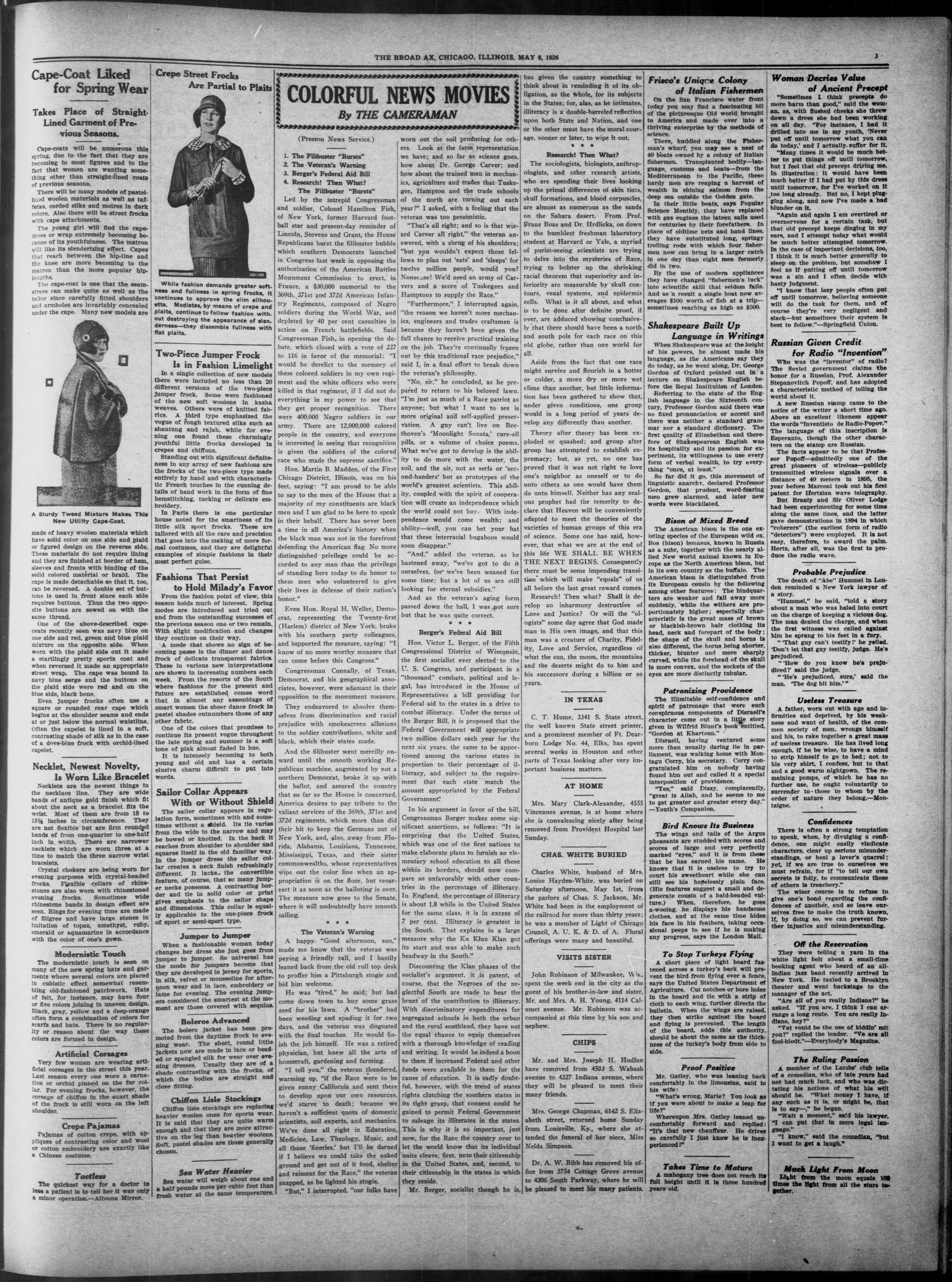
A Sturdy Tweed Mixture Makes This New Utility Cape-Coat.
made of heavy woolen materials which have solid color on one side and plaid or figured design on the reverse side. These materials do not require lining and they are finished at border of hem, sleeves and fronts with binding of the solid colored material or braid. The cape is made detachable so that it, too, can be reversed. A double set of buttons is used in front since each side requires buttons. Thus the two opposite buttons are sewed on with the same thread.
One of the above-described cape-coats recently seen was navy blue on one side and red, green and blue plaid mixture on the opposite side. When worn with the plaid side out it made a startlingly pretty sports coat and when reversed it made an appropriate street wrap. The cape was bound in navy blue serge and the buttons on the plaid side were red and on the blue side, black bone.
Even jumper frocks often use a square or rounded rear cape which begins at the shoulder seams and ends at or just below the normal waistline. Often the capetel is lined in a soft, contrasting shade of silk as in the case of a dove-blue frock with orchid-lined capetel.
Necklet. Newest Novelty.
Is Worn Like Bracelet
Necklets are the newest things in the necklace line. They are wide bands of antique gold finish which fit about the neck as a bracelet fits the wrist. Most of them are from 18 to $13\frac{1}{2}$ inches in circumference. They are not flexible but are firm rounded bands of from one-quarter to one-half inch in width. There are narrow necklets which are worn three at a time to match the three narrow wrist bracelets. Crystal chokers are being worn for evening purposes with crystal-beaded frocks. Flexible collars of rhinestones are also worn with rhinestoned evening frocks. Sometimes wide rhinestone bands in design effect are seen. Rings for evening time are made of filigree and have large stones in imitation of topaz, amethyst, ruby, emerald or aquamarine in accordance with the color of one's gown.
Modernistic Touch
The modernistic touch is seen on many of the new spring hats and garments where several colors are placed in cubistic effect somewhat resembling old-fashioned patchwork. Hats of felt, for instance, may have four or five colors joining in uneven design. Black, gray, yellow and a deep-orange often form a combination of colors for scarfs and hats. There is no regularity or reason about the way these colors are formed in design.
Artificial Corsages
Very few women are wearing artificial corsages in the street this year. Last season every one wore a carnation or orchid pinned on the fur collar. For evening frocks, however, the corsage of chiffon in the exact shade of the frock is still worn on the left shoulder.
Crene Pajamas
Pajamas of cotton crepe, with appliques of contrasting color and wool or cotton embroidery are exactly like a Chinese costume.
Tactless
The quickest way for a doctor to lose a patient is to tell her it was only a minor operation.—Altoona Mirror.
1920
While fashion demands greater softness and fulness in spring frocks, it continues to approve the slim silhouette. Modistes, by means of crepe and plaits, continue to follow fashion without destroying the appearance of slenderness—they dissemble fullness with flat plaits.
Two-Piece Jumper Frock
Is in Fashion Limelight
In a single collection of new models there were included no less than 20 different versions of the two-piece jumper frock. Some were fashioned of the new soft woolens in kasha weaves. Others were of knitted fabrics. A third type emphasized the vogue of fough textured silks such as shantung and rajah, while for evening one found these charmingly youthful little frocks developed in crepes and chiffons.
Standing out with significant defini-
ness in any array of new fashions are the frocks of the two-piece type made entirely by hand and with characteristic French touches in the cunning details of hand work in the form of fine hemmistitching, tucking or delicate embroidery.
In Paris there is one particular house noted for the smartness of its little silk sport frocks. These are tailored with all the care and precision that goes into the making of more formal costumes, and they are delightful examples of simple fashions in their most perfect guise.
Fashions That Persist
to Hold Milady's Favor
From the fashion point of view, this season holds much of interest. Spring modes are introduced and tried out and from the outstanding successes of the previous season one or two remain. With slight modification and changes they continue on their way.
A mode that shows no sign of becoming passe is the dinner and dance frock of delicate transparent fabrics. These in various new interpretations are shown in increasing numbers each week. From the resorts of the South where fashions for the present and future are established comes word that in almost any assemblage of smart women the sheer dance frock in pastel shades outnumbers those of any other fabric.
One of the colors that promises to continue its present vogue throughout the late spring and summer is a soft tone of pink almost faded in hue.
It is intensely becoming to both young and old and has a certain elusive charm difficult to put into words.
Sailor Collar Appears
With or Without Shield
The sailor collar appears in regulation form, sometimes with and sometimes without a shield. Its tie varies from the wide to the narrow and may be bowed or knotted. In the back it reaches from shoulder to shoulder and squares itself in the old familiar way. In the jumper dress the sailor collar creates a neck finish refreshingly different. It lacks, the convertible feature, of course, that so many jumper necks possess. A contrasting border and tie in solid color or print gives emphasis to the sailor shape and dimensions. This collar is equally applicable to the one-piece frock of sport or semi-sport type.
Jumper to Jumper
When a fashionable woman today changes her dress she just goes from jumper to jumper. So universal has the mode for jumpers become that they are developed in jersey for sports, in silk, velvet or moussine for afternoon wear and in lace, embroidery or lame for evening. The evening jumpers considered the smartest at the moment are those covered with sequins.
Boleros Advanced
The bolero jacket has been promoted from the daytime frock to evening wear. The short, round little jackets now are made in lace or beaded or spangled silk for wear over evening dresses. Usually they are of a shade contrasting with the frocks, of which the bodies are straight and close fitting.
Chiffon Lisle Stockings
Chiffon isle stockings are replacing heavier woolen ones for sports wear. It is said that they are quite warm enough and that they are more attractive on the leg than heavier woolens. Soft, pastel shades are those generally chosen.
Sea Water Heavier
Sea water will weigh about one and a half pounds more per cubic foot than fresh water at the same temperature.
THE BROAD AX, CHICAGO, ILLINOIS, MAY 8, 1926
COLORFUL NEWS MOVIES By THE CAMERAMAN
(Preston News Service.)
1. The Filibuster "Bursts"
2. The Veteran's Warning
3. Berger's Federal Aid Bill
4. Research! Then What?
worn out the soil producing for oth ers. Look at the farm representation we have; and so far as science goes, how about Dr. George Carver; and how about the trained men in mechanics, agriculture and trades that Tuske
The Filibuster "Bursts"
Led by the intrepid Congressman and soldier, Colonel Hamilton Fish, of New York, former Harvard football star and present-day reminder of Lincoln, Stevens and Grant, the House Republicans burst the filibuster bubble which southern Democrats launched in Congress last week in opposing the authorization of the American Battles Monument Commission to erect, in France, a $30,000 memorial to the 369th, 371st and 372d American Infantry Regiments, composed of Negro soldiers during the World War, and depleted by 40 per cent casualties in action on French battlefields. Said Congressman Fish, in opening the debate, which closed with a vote of 227 to 116 in favor of the memorial: "I would be derelict to the memory of these colored soldiers in my own regiment and the white officers who were killed in that regiment, if I did not do everything in my power to see that they get proper recognition. There were 400,000 Negro soldiers in our army. There are 12,000,000 colored people in the country, and everyone is interested in seeing that recognition is given the soldiers of the colored race who made the supreme sacrifice."
Hon. Martin B. Madden, of the First Chicago District, Illinois, was on his feet, saying: "I am proud to be able to say to the men of the House that a majority of my constituents are black men and I am glad to be here to speak in their behalf. There has never been a time in all America's history when the black man was not in the forefront defending the American flag. No more distinguished privilege could be accorded to any man than the privilege of standing here today to do honor to these men who volunteered to give their lives in defense of their nation's honor."
Even Hon. Royal H. Weller, Democrat, representing the Twenty-first (Harlem) district of New York, broke with his southern party colleagues, and supported the measure, saying: "I know of no more worthy measure that can come before this Congress."
Congressman Connally, of Texas, Democrat, and his geographical associates, however, were adamant in their opposition to the monument measure.
They endeavored to absolve themselves from discrimination and racial prejudice with smokescreen allusions to the soldier contributions, white and black, which their states made.
And the filibuster went merrily onward until the smooth working Republican machine, augmented by not a northern Democrat, broke it up with the ballot, and assured the country that so far as the House is concerned, America desires to pay tribute to the valiant services of the 369th, 371st and 372d regiments, which more than did their bit to keep the Germans out of New York, and, also, away from Florida, Alabama, Louisiana, Tennessee, Mississippi, Texas, and their sister commonwealths, whose representatives wipe out the color line when an appropriation is on the floor, but resurrect it as soon as the balloting is over. The measure now goes to the Senate, where it will undoubtedly have smooth sailing.
The Veteran's Warning
A happy. "Good afternoon, son," made me know that the veteran was paying a friendly call, and I hastily leaned back from the old roll top desk to proffer him a Pittsburgh stogie and bid him welcome.
He was "tired," he said; but had come down town to buy some grass seed for his lawn. A "brother" had been weeding and spading it for two days, and the veteran was disgusted with the final touches. He would finish the job himself. He was a retired physician, but knew all the arts of homecraft, gardening and farming.
"I tell you," the veteran thundered, warming up, "if the Race were to be given sunny California and sent there to develop upon our own resources, we'd starve to death; because we haven't a sufficient quota of domestic scientists, soil experts, and mechanics. We've done all right in Education, Medicine, Law, Theology, Music, and all those 'fineries,' but I'll be darned if I believe we could take the naked ground and get out of it food, shelter and raiment for the Race," the veteran snapped, as he lighted his stogie. "But." I interrupted, "our folks have
---
worn out the soil producing for others. Look at the farm representation we have; and so far as science goes, how about Dr. George Carver; and how about the trained men in mechanics, agriculture and trades that Tuskegee, Hampton and the trade schools of the north are turning out each year?" I asked, with a feeling that the veteran was too pessimistic.
"That's all right; and so is that wizard Carver all right," the veteran answered, with a shrug of his shoulders, "but you wouldn't expect those fellows to plan out 'eats' and 'sleeps' for twelve million people, would you? Nonsense! We'd need an army of Carvers and a score of Tuskegee and Hamptons to supply the Race."
"Furthermore," I interrupted again "the reason we haven't more mechanics, engineers and trades craftsmen is because they haven't been given the full chance to receive practical training on the job. They're continually frozen out by this traditional race prejudice," said I, in a final effort to break down the veteran's philosophy.
"No, sir," he concluded, as he prepared to return to his beloved lawn. "I'm just as much of a Race patriot as anyone; but what I want to see is more original and self-applied preservation. A guy can't live on Beethoven's 'Moonlight Sonata,' cure-all pills, or a volume of choice poems. What we've got to develop is the ability to do more with the water, the soil, and the air, not as serfs or 'second-handers' but as prototypes of the world's greatest scientists. This ability, coupled with the spirit of cooperation will create an independence which the world could not buy. With independence would come wealth; and ability—well, you can bet your hat that these interracial bugaboos would soon disappear."
"And," added the veteran, as he hastened away, "we've got to do it ourselves, for we've been weaned for some time; but a lot of us are still looking for eternal subsidies."
And as the veteran's aging form passed down the hall, I was not sure but that he was quite correct.
Berger's Federal Aid Bill
Hon. Victor L. Berger, of the Fifth Congressional District of Wisconsin, the first socialist ever elected to the U. S. Congress, and participant in a "thousand" combat, political and legal, has introduced in the House of Representatives a bill providing for Federal aid to the states in a drive to combat illiteracy. Under the terms of the Berger Bill, it is proposed that the Federal Government will appropriate two million dollars each year for the next six years, the same to be apportioned among the various states in proportion to their percentage of illiteracy, and subject to the requirement that each state match the amount appropriated by the Federal Government.
In his argument in favor of the bill, Congressman Berger makes some significant assertions, as follows: "It is surprising that the United States, which was one of the first nations to make elaborate plans to furnish an elementary school education to all those within its borders, should now compare so unfavorably with other countries in the percentage of illiteracy. In England, the percentage of illiteracy is about 1.8 while in the United States for the same class, it is in excess of 7 per cent. Illiteracy is greatest in the South. That explains in a large measure why the Ku Klux Klan got its start and was able to make such headway in the South."
Discounting the Klan phases of the socialist's argument, it is patent, of course, that the Negroes of the neglectful South are made to bear the brunt of the contribution to illiteracy. With discriminatory expenditures for segregated schools in both the urban and the rural southland, they have not the equal chance to equip themselves with a thorough knowledge of reading and writing. It would be indeed a boon to them if increased Federal and other funds were available to them for the cause of education. It is sadly doubtful, however, with the trend of states rights clutching the southern states in its tight grasp, that consent could be gained to permit Federal Government to salvage its illiterates in the states. This is why it is so important, just now, for the Race the country over to let the world know that its individual units cleave, first, unto their citizenship in the United States, and, second, to their citizenship in the states in which they reside.
Mr. Berger, socialist though he is,
has given the country something to think about in reminding it of its obligation, as the whole, for its subjects in the States; for, alas, as he intimates, illiteracy is a double-barreled reflection upon both State and Nation, and one or the other must have the moral courage, sooner or later, to wipe it out.
Research! Then What?
The sociologists, biologists, anthropologists, and other research artists, who are spending their lives looking up the primal differences of skin tins, skull formations, and blood corpuscles, are almost as numerous as the sands on the Sahara desert. From Prof. Franz Boas and Dr. Hrdlicka, on down to the humblest freshman laboratory student at Harvard or Yale, a myriad of purist-seeing scientists are trying to delive into the mysteries of Race, trying to bolster up the shrinking racial theorem that superiority and inferiority are measurable by skull contours, venal systems, and epidermis cells. What is it all about, and what is to be done after definite proof, if ever, are adduced showing conclusively that there should have been a north and south pole for each race on this old globe, rather than one world for all.
Aside from the fact that one race might survive and flourish in a hotter or colder, a more dry or more wet clime than another, but little information has been gathered to show that, under given conditions, one group would in a long period of years develop any differently than another.
Theory after theory has been exploded or quashed; and group after group has attempted to establish supremacy; but, as yet, no one has proved that it was not right to love one's neighbor as oneself or to do unto others as one would have them do unto himself. Neither has any zealous prophet had the temerity to declare that Heaven will be conveniently adapted to meet the theories of the varieties of human groups of this era of science. Some one has said, however, that what we are at the end of this life WE SHALL BE WHEN THE NEXT BEGINS. Consequently there must be some impending transition which will make "equals" of us all before the last great reward comes. Research! Then what? Shall it develop an inharmony destructive of Love and Justice? Or will the "ologists" some day agree that God made man in His own image, and that this man was a creature of Charity, Fidelity, Love and Service, regardless of what the sun, the moon, the mountains and the deserts might do to him and his successors during a billion or so years.
IN TEXAS
C. T. Hume, 3341 S. State street, the well known State street printer, and a prominent member of Ft. Dearborn Lodge No. 44, Elks, has spent several weeks in Houston and other parts of Texas looking after very important business matters.
AT HOME
Mrs. Mary Clark-Alexander, 4555 Vincennes avenue, is at home where she is convalescing nicely after being removed from Provident Hospital last Sunday.
CHAS. WHITE BURIED
Charles White, husband of Mrs. Louise Hayden-White, was buried on Saturday afternoon, May 1st, from the parlors of Chas. S. Jackson, Mr. White had been in the employment of the railroad for more than thirty years; he was a member of Light of Chicago Council, A. U. K. & D. of A. Floral offerings were many and beautiful.
VISITS SISTER
John Robinson of Milwaukee, Wis. spent the week end in the city as the guest of his brother-in-law and sister. Mr. and Mrs. A. H. Young, 4114 Calumet avenue. Mr. Robinson was accompanied at this time by his son and nephew.
CHIPS
Mr. and Mrs. Joseph H. Hudlun have removed from 4503 S. Wabash avenue to 4327 Indiana avenue, where they will be pleased to meet their many friends.
Mrs. George Chapman, 6142 S. Elizabeth street, returned home Sunday from Louisville, Ky., where she attended the funeral of her niece, Miss Nelda Simpson.
Dr. A. W. Bibb has removed his office from 3754 Cottage Grove avenue to 4306 South Parkway, where he will be pleased to meet his many patients.
of Italian Fishermen
On the San Francisco water front today you may find a fascinating bit of the picturesque Old world brought to America and made over into a thriving enterprise by the methods of science.
There, huddled along the Fisherman's wharf, you may see a nest of 40 boats owned by a colony of Italian fishermen. Transplanted bodily-language, customs and boats—from the Mediterranean to the Pacific, these hardy men are reaping a harvest of wealth in shining salmon from the deep sea outside the Golden gate.
In their little boats, says Popular Science Monthly, they have replaced with gas engines the lateen sails used for centuries by their forefathers. In place of oldtime nets and hand lines, they have substituted long, springy trolling rods with which four fishermen now can bring in a larger catch in one day than eight men formerly did in two.
By the use of modern appliances they have changed "fishermen's luck" into scientific skill that seldom falls. And as a result a single boat now averages $100 worth of fish at a trip sometimes reaching as high as $500.
Shakespeare Built Up
Language in Writings
When Shakespeare was at the height of his powers, he almost made his language, as the Americans say they do today, as he went along, Dr. George Gordon of Oxford pointed out in a lecture on Shakespeare English before the Royal Institution of London.
Referring to the state of the English language in the Sixteenth century, Professor Gordon said there was no fixed pronunciation or accent and there was neither a standard grammar nor a standard dictionary. The first quality of Elizabethan and therefore of Shakespearean English was its hospitality and its passion for experiment, its willingness to use every form of verbal wealth, to try everything "once, at least."
So far did it go, this movement of linguistic anarchy, declared Professor Gordon, that prodent, word-fearing men grew alarmed, and later new words were blacklisted.
Bison of Mixed Breed
The American bison is the one existing species of the European wild ox. Bos (bison) bonasus, known in Russia as a zub, together with the nearly allied New world animal known in Europe as the North American bison, but in its own country as the buffalo. The American bison is distinguished from its European cousin by the following among other features: The hindquarters are weaker and fall away more suddenly, while the withers are proportionately higher; especially characteristic is the great mass of brown or blackish-brown hair clothing its head, neck and forepart of the body; the shape of the skull and horns is also different, the horns being shorter, thicker, blunter and more sharply curved, while the forehead of the skull is more convex, and the sockets of the eyes are more distinctly tubular.
Patronizing Providence
The illimitable self-confidence and spirit of patronage that were such conspicuous components of Disraeli's character come out in a little story given in Wilfrid Blunt's book entitled, "Gordon at Khartoun."
Disraeli, having ventured some more than usually daring lie in parlement, was walking home with Montagu Corry, his secretary. Corry congratulated him on nobody having found him out and called it a special interposition of providence.
"Yes," said Dizzy, complacently, "great is Allah, and he seems to me to get greater and greater every day." - Youth's Companion.
Bird Knows Its Business
The wings and tails of the Argus pheasants are studded with scores and scores of large and very perfectly marked "eyes," and it is from these that he has earned his name. He knows that it is useless to try to court his sweetheart while she can still see his hopelessly plain face. (His features suggest a small and degenerate cousin of a bald-headed vulture.) When, therefore, he goes a-wooing, he displays his handsome clothes, and at the same time hides his face in his feathers, taking occasional peeps to see if he is making any progress, says the London Mall.
To Stop Turkeys Flying
A short piece of light board fastened across a turkey's back will prevent the bird from flying over a fence, says the United States Department of Agriculture. Cut notches or bore holes in the board and tie with a strip of cloth to each wing, further directs the bulletin. When the wings are raised, they then strike against the board and flying is prevented. The length of the board, adds this authority, should be about the same as the thickness of the turkey's body from side to side.
Proof Positive
Mr. Gatley, who was leaning back comfortably in the limousine, said to his wife: "What's wrong, Marie? You look as if you were about to make a leap for life?" Whereupon Mrs. Gatley leaned uncomfortably forward and replied: "It's that new chauffeur. He drives so carefully I just know he is inexperienced!"
Takes Time to Mature
A mahogany tree does not reach its full height until it is three hundred rears old.
Woman Decries Value
"Sometimes I think precepts do more harm than good," said the woman, as, with flushed cheeks she throw down a dress she had been working on all day. "For instance, I had it drilled into me in my youth, 'Never put off until tomorrow what you can do today, and I actually suffer for it.' "Many times it would be much better to put things off until tomorrow, but I feel that old precept driving me. In illustration: it would have been much better if I had put by this dress until tomorrow, for I've worked on it too long already. But no, I kept plugging along, and now I've made a bad blunder on it.
"Again and again I am overtired or overnervous for a certain task, but that old precept keeps dinging in my ears, and I attempt today what would be much better attempted tomorrow. In the case of important decisions, too, I think it is much better generally to sleep on the problem, but somehow I feel as if putting off until tomorrow was a sin and I often decide with hasty judgment.
"I know that lazy people often put off until tomorrow, believing someone will do the task for them, and of course they're very negligent and slack—but sometimes their system is best to follow."—Springfield Union.
Russian Given Credit
Who was the "inventor" of radio? The Soviet government claims the honor for a Russian, Prof. Alexander Stepanovitch Popoff, and has adopted a characteristic method of telling the world about it. A new Russian stamp came to the notice of the writer a short time ago. Above an excellent likeness appear the words "Inventisto de Radio-Popov." The language of this inscription is Esperanto, though the other characters on the stamp are Russian. The facts appear to be that Professor Popoff—admittedly one of the great pioneers of wireless—publicly transmitted wireless signals over a distance of 40 meters in 1895, the year before Marconi took out his first patent for Hertzian wave telegraphy.
But Branly and Sir Oliver Lodge had been experimenting for some time along the same lines, and the latter gave demonstrations in 1894 in which "coherers" (the earliest form of radio "detectors") were employed. It is not easy, therefore, to award the palm. Hertz, after all, was the first to produce the radio wave.
Probable Prejudice
The death of "Abe" Hummel in London reminded a New York lawyer of a story.
"Hummel," he said, "told a story about a man who was baled into court on the charge of keeping a vicious dog. The man denied the charge, and when the first witness was called against him he sprang to his feet in a fury.
"That guy can't testify!" he yelled. 'Don't let that guy testify, judge. He's prejudiced.
"How do you know he's prejudiced?" said the judge.
"He's prejudiced, surye," said the man. "The doe bit him!"
Useless Treasure
A father, worn out with age and infirmities and deprived, by his weakness and want of health, of the common society of men, wrongs himself and his, to rake together a great mass of useless treasure. He has lived long enough, if he be wise, to have a mind to strip himself to go to bed; not to his very shirt, I confess, to but that and a good warm nightgown. The remaining pomps, of which he has no further use, he ought voluntarily to surrender to those to whom by the order of nature they belong.—Montagne.
Confidences
There is often a strong temptation to speak, when, by divulging a confidence, one might easily vindicate characters, clear up serious misunderstandings, or heal a lover's quarrel, yet, if we are true to ourselves we must refrain, for if "to tell our own secrets is folly, to communicate those of others is treachery."
The wiser course is to refuse to give one's bond regarding the confidences of another, and so leave ourselves free to make the truth known, if, by doing so, we can prevent further injustice and misunderstanding.
Off the Reservation
They were telling a yarn 'In the white light belt about a small-time booking agent who heard of an all-Indian jazz band recently arrived in New York. He taxied to a Brooklyn theater and went backstage to the manager of the act.
"Are all of you really Indians?" he asked. "If you are, I think I can arrange a long route. You are really Indians, hey?"
"Vat would be the use of kiddin' mit you?" replied the leader. "We are all fool-blott."—Everybody's Magazine.
The Ruling Passion
A member of the Lams' club tells of a comedian, who of late years had not had much luck, and who was dictating his notions of what his will should be. "What money I have, if any such as it is, or might be, that is to say—" he began.
"Wait a moment," said his lawyer, "I can put that in more legal language."
"I know," said the comedian, "but I want to get a laugh."
Much Light From Moon Light from the moon equals 100 times the light from all the stars together.
Ernest H.
WILLIAMSON
UNDERTAKER
ERnest H. WILLIAMSON
UNDERTAKER
512-232-222
E. H. WILLIAMSON
Charles E.
Dawson
DENVER DIRECTORY
An old telephone directory for the city of Denver, dated August 1, 1883, forty-three years ago, shows that at that time there were 689 telephones in the city. One of the subscribers was Eugene Field, the poet. In the last issue of the Denver directory there were approximately 77,000 telephones listed.
RED CAPS' CLUB NEWS
The regular monthly meeting was held on last Sunday, at 4:30 P. M. Attorney Eugene Marshall spoke on the subject "Great Opportunities." Mme. Anita Patti Brown, Dr. R. E. Ashe and Mr. Joseph M. Walker, furnished the musical treats on the program.
MEETS IN FINAL MEETING
The Annual Sermon Committee of U.B.F. & S.M.T., of which J. B. Street is chairman, held its final meeting and made final arrangements for the annual sermon to take place on Sunday afternoon, May 23. The meeting was held at Bailey's Hall, 3638 S. State street.
Conversation's Value
There is a book of knowledge be-
pend the power of learning to bestow,
and this is to be had in conversation.
—Fielding.
Uses of Drudgery
Druggery is as necessary to call out the treasures of the mind as harrowing and planting, those of the earth.—Margaret Fuller.
W.G.Anderson
Attorney At Law
17 North La Salle Street
CHICAGO
Suite 560 Watson Bldg.
Phones: Dearborn 7084-7088
Res. 3354 Vernon Avenue
Phone Douglas 6045
WILL
UND
JOHN D. SCOTT, Manager
Licensed Undertaker
MRS. MARY E. WILLIAMSON
Licensed Undertaker
J. E. BISH
33d Degree PR.W.D.G.M. Bookkeeper
Embalmers Apprentice No.194
Unexcelled for
AUTOMOBILES
KEN
5121-23-25
---
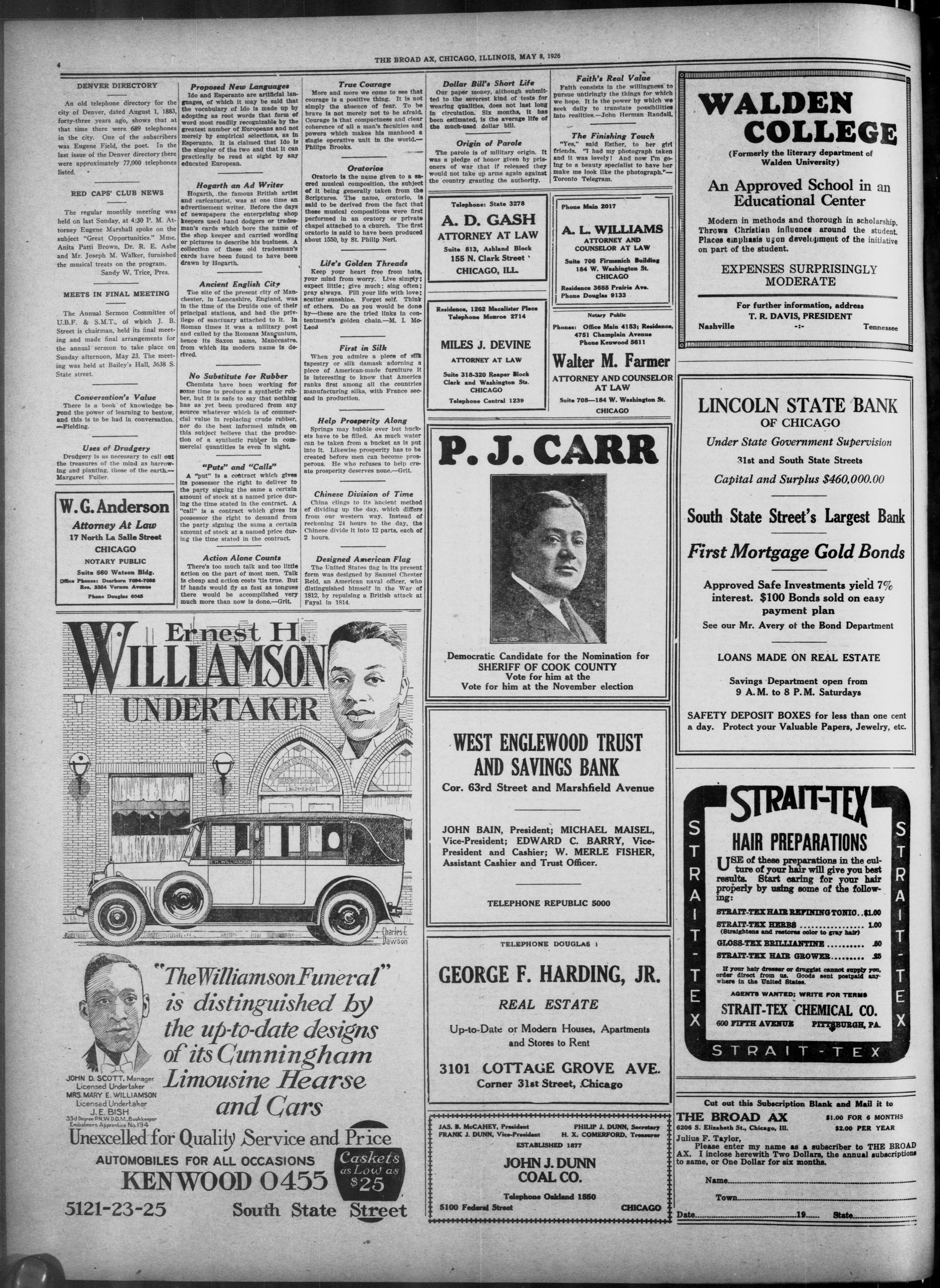
TheWilliamsonFuneral is distinguished by the up-to-date designs of its Cunningham Limousine Hearse and Cars
Proposed New Languages
Proposition 10. Ido and Esperanto are artificial languages, of which it may be said that the vocabulary of Ido is made up by adopting as root words that form word most readily recognizable by the greatest number of Europeans and not merely by empirical selections, as in Esperanto. It is claimed that Ido is the simpler of the two and that it can practically be read at sight by any educated European.
Hogarth an Ad Writer
G hogarth, the famous British artist and caricaturist, was at one time an advertisement writer. Before the days of newspapers the enterprising shop keepers used hand dodgers or tradesman's cards which bore the name of the shop keeper and carried wording or pictures to describe his business. A collection of these old tradesman's cards have been found to have been drawn by G hogarth.
Ancient English Cit
The site of the present city of Manchester, in Lancashire, England, was in the time of the Drulds one of their principal stations, and had the privilege of sanctuary attached to it. In Roman times it was a military post and called by the Romans Mancunium, hence its Saxon name, Manccastro, from which its modern name is derived.
No Substitute for Rubber
Chemists have been working for some time to produce a synthetic rubber, but it is safe to say that nothing has as yet been produced from any source whatever which is of commercial value in replacing crude rubber, nor do the best informed minds on this subject believe that the production of a synthetic rubber in commercial quantities is even in sight.
"Puts" and "Calls"
A "put" is a contract which gives its possessor the right to deliver to the party signing the same a certain amount of stock at a named price during the time stated in the contract. A "call" is a contract which gives its possessor the right to demand from the party signing the same a certain amount of stock at a named price during the time stated in the contract.
Action Alone Counts
There's too much talk and too little action on the part of most men. Talk is cheap and action costs 'tis true. But if hands would fly as fast as tongues there would be accomplished very much more than now is done.-Grit.
THE BROAD AX, CHICAGO, ILLINOIS, MAY 8, 1926
True Courage
More and more we come to see that courage is a positive thing. It is not simply the absence of fear. To be brave is not merely not to be afraid. Courage is that compactness and clear coherence of all a man's faculties and powers which makes his manhood a single operative unit in the world.—Philips Brooks.
Oratorios
Oratorio is the name given to a sacred musical composition, the subject of it being generally taken from the Scriptures. The name, oratorio, is said to be derived from the fact that these musical compositions were first performed in an oratory or private chapel attached to a church. The first oratorio is said to have been produced about 1550, by St. Philip Nerl.
Life's Golden Threads
Keep your heart free from hate,
your mind from worry. Live simply;
expect little; give much; sing often;
pray always. Fill your life with love;
scatter sunshine. Forget self. Think
of others. Do as you would be done
—these are the tried links in contentment's golden chain.—M. I. McLeod
First in Silk
When you admire a piece of silk tapestry or silk damask adorning a piece of American-made furniture it is interesting to know that America ranks first among all the countries manufacturing silks, with France second in production.
Help Prosperity Along
Springs may bubble over but buckets have to be filled. As much water can be taken from a bucket as is put into it. Likewise prosperity has to be created before men can become prosperous. He who refuses to help create prosperity deserves none.—Grit.
Chinese Division of Time
China clings to its ancient method of dividing up the day, which differs from our western way. Instead of reckoning 24 hours to the day, the Chinese divide it into 12 parts, each of 2 hours.
Designed American Flag
The United States flag in its present form was designed by Samuel Chester Reid, an American naval officer, who distinguished himself in the War of 1812, by repulsing a British attack at Fayal in 1814.
Dollar Bill's Short Life
Dollar Bill's Short Life Our paper money, although submitted to the severest kind of tests for wearing qualities, does not last long in circulation. Six months, it has been estimated, is the average life of the much-used dollar bill.
Origin of Parole
The parole is of military origin. It was a pledge of honor given by prisoners of war that if released they would not take up arms again against the country granting the authority.
Telephone: State 3278
A. D. GASH
ATTORNEY AT LAW
Suite 813, Ashland Block
155 N. Clark Street
CHICAGO, ILL.
Residence, 1262 Macalister Place
Telephone Monroe 2714
ATTORNEY AT LAW
Suite 318-320 Reaper Block
Clark and Washington Sts.
CHICAGO
Telephone Central 1239
P. J. C
J.CAF
P.J.CARR
[Picture of a man in a suit].
Democratic Candidate
SHERIFF OF C
Vote for H
Vote for him at the
WEST ENGLEW
AND SAVI
Cor. 63rd Street and
JOHN BAIN, President
Vice-President; EDWA
President and Cashier;
Assistant Cashier and T
ATIC Candidate for the Nominat
HERIFF OF COOK COUNTY
Vote for him at the
for him at the November elec
T ENGLEWOOD TR
ND SAVINGS BAN
d Street and Marshfield
AIN, President; MICHAEL
ident; EDWARD C. BARR
and Cashier; W. MERLE
Cashier and Trust Officer.
Democratic Candidate for the Nomination for SHERIFF OF COOK COUNTY Vote for him at the Vote for him at the November election
WEST ENGLEWOOD TRUST AND SAVINGS BANK
Cor. 63rd Street and Marshfield Avenue
JOHN BAIN, President; MICHAEL MAISEL, Vice-President; EDWARD C. BARRY, Vice-President and Cashier; W. MERLE FISHER, Assistant Cashier and Trust Officer.
TELEPHONE REPUBLIC 5000
TELEPHONE DOUGLAS 1
GEORGE F. H
GEORGE F. HARDING
REAL ESTATE
Up-to-Date or Modern Houses, Ap-
and Stores to Rent
3101 COTTAGE GROVE
Corner 31st Street, Chicago
JAS. B. McCAHEY, President
FRANK J. DUNN, Vice-President
PHILIP J. D.
H. X. COMERF
ESTABLISHED 1877
Date or Modern Houses, Apt
and Stores to Rent
COTTAGE GROVE
Corner 31st Street, Chicago
HEY, President
ANN, Vice-President
PHILIP J. D.
H. X. COMERF
ESTABLISHED 1877
Up-to-Date or Modern Houses, Apartments and Stores to Rent
3101 COTTAGE GROVE AVE.
Corner 31st Street, Chicago
JOHN J. DUNN COAL CO.
Telephone C
5100 Federal Street
Telephone Oakland 1550
al Street
Faith's Real Value
Faith consists in the willingness to pursue untimingly the things for which we hope. It is the power by which we seek daily to translate possibilities into realities. John Herman Randall,
The Finishing Touch
The Finishing Touch
"Yes," said Esther, to her girl
friends. "I had my photograph taken
and it was lovely! And now I'm go-
going to a beauty specialist to have her
make me look like the photograph."—
Toronto Telegram.
Phone Main 2017
A. L. WILLIAMS
ATTORNEY AND
COUNSELOR AT LAW
Suite 706 Firmenich Building
184 W. Washington St.
CHICAGO
Residence 3655 Prairie Ave.
Phone Douglas 9133
Phones: Office Main 4153; Residence
4751 Champlain Avenue
Phone Kenwood 5611
ATTORNEY AND COUNSELOR
AT LAW
Suite 708—184 W. Washington St.
CHICAGO
for the Nomination for
WOOD COUNTY
him at the
November election
WOOD TRUST
INGS BANK
Marshfield Avenue
; MICHAEL MAISEL,
RD C. BARRY, Vice-
W. MERLE FISHER,
Just Officer.
ARDING, JR.
In Houses, Apartments
to Rent
E GROVE AVE.
street, Chicago
PHILIP J. DUNN, Secretary
H. X. COMERFORD, Treasurer
HED 1877
akland 1550
CHICAGO
WALDEN COLLEGE
(Formerly the literary department of Walden University)
An Approved School in
Educational Center
Modern in methods and thorough in school
news Christian influence around the s
ses emphasis upon development of the in
part of the student.
EXPENSES SURPRISINGLY
MODERATE
For further information, address
T. R. DAVIS, PRESIDENT
Nville
NCOLN STATE BANK
OF CHICAGO
Under State Government Supervise
31st and South State Streets
Capital and Surplus $460,000.0
North State Street's Largest
First Mortgage Gold B
Approved Safe Investments yield
interest. $100 Bonds sold on ea
payment plan
We our Mr. Avery of the Bond Depart
LOANS MADE ON REAL ESTATE
School in an
Center
rough in scholarship.
around the student.
ment of the initiative
RISINGLY
STE
on, address
PRESIDENT
Tennessee
TE BANK
GO
nt Supervision
ate Streets
$460,000.00
Largest Bank
Gold Bonds
ents yield 7%
sold on easy
an
Bond Department
REAL ESTATE
An Approved School in an Educational Center
Modern in methods and thorough in scholarship.
Throws Christian influence around the student.
Places emphasis upon development of the initiative on part of the student.
EXPENSES SURPRISINGLY MODERATE
For further information, address
T. R. DAVIS, PRESIDENT
Nashville Tennessee
LINCOLN STATE BANK OF CHICAGO
Under State Government Supervision
31st and South State Streets
Capital and Surplus $460,000.00
South State Street's Largest Bank
First Mortgage Gold Bonds
Approved Safe Investments yield 7% interest. $100 Bonds sold on easy payment plan See our Mr. Avery of the Bond Department
LOANS MADE ON REAL ESTATE
Savings Department open from
9 A.M. to 8 P.M. Saturdays
TY DEPOSIT BOXES for less than one
Protect your Valuable Papers, Jewel
STRAIT-TEX
r less than one cen
Papers, Jewelry, etc
-TEX
SAFETY DEPOSIT BOXES for less than one cent a day. Protect your Valuable Papers, Jewelry, etc.
HAIR PREPARATIONS
USE of these preparations in the culture of your hair will give you better results. Start caring for your hair properly by using some of the following:
STRAIT-TEX HAIR REFINING TONIC.....$1.00
STRAIT-TEX HERBS.....1.00
(Straightens and restores color to gray hair)
GLOSS-TEX BRILLIANTINE......
STRAIT-TEX HAIR GROWER.....
ions in the cul-
give you best
for your hair
of the follow-
INGTONIC...$1.00
1.00
o gray hair)
.50
BE.....25
USE of these preparations in the culture of your hair will give you best results. Start caring for your hair properly by using some of the following:
If your hair dresser or druggist cannot supply you
order direct from us. Goods sent postpaid and
where in the United States.
AGENTS WANTED; WRITE FOR TERMS
STRAIT-TEX CHEMICAL CO.
600 FIFTH AVENUE
PITTSBURGH, P
STRAIT-TEX
t out this Subscription Blank and Mail
TEX
Cut out this Subscription Blank and Mail it to
BROAD AX
$1.00 FOR 6 MONTHS
Elizabeth St., Chicago, Ill.
$2.00 PER YEAR
Taylor,
please enter my name as a subscriber to THE BRO
close herewith Two Dollars, the annual subscript
for One Dollar for six months.
Name.....
Town.....
19.... State....
subscriber to THE BRO
the annual subscription
.
State.....
Please enter my name as a subscriber to THE BROAD AX. I inclose herewith Two Dollars, the annual subscriptions to same, or One Dollar for six months.