The Broad Ax
Saturday, May 29, 1926
Chicago, Illinois
Page text (machine-generated)
SOCIETY NEWS PUBLISHED FREE
HON. GEORGE FRANKL
The well known millionaire real estate of the Republican party on the candidate for Treasurer of Cook and highly talented daughter, M united in marriage to Mr. John W. Ind., the first of the week, and Sen. forgiven his daughter and son-in-dulging in a secret marriage. Mr. be at home to their hosts of friend Evanstop, Ill., on and after July 1
N. GEORGE FRANKLIN HARDY
known millionaire real estate owner, republican party on the South Side, for Treasurer of Cook County, who talented daughter, Miss Mary H. marriage to Mr. John W. Thompson a first of the week, and Senator Harding, his daughter and son-in-law for eleven a secret marriage. Mr. and Mrs. Tie to their hosts of friends at 1505 Ill., on and after July 15.
M. H.
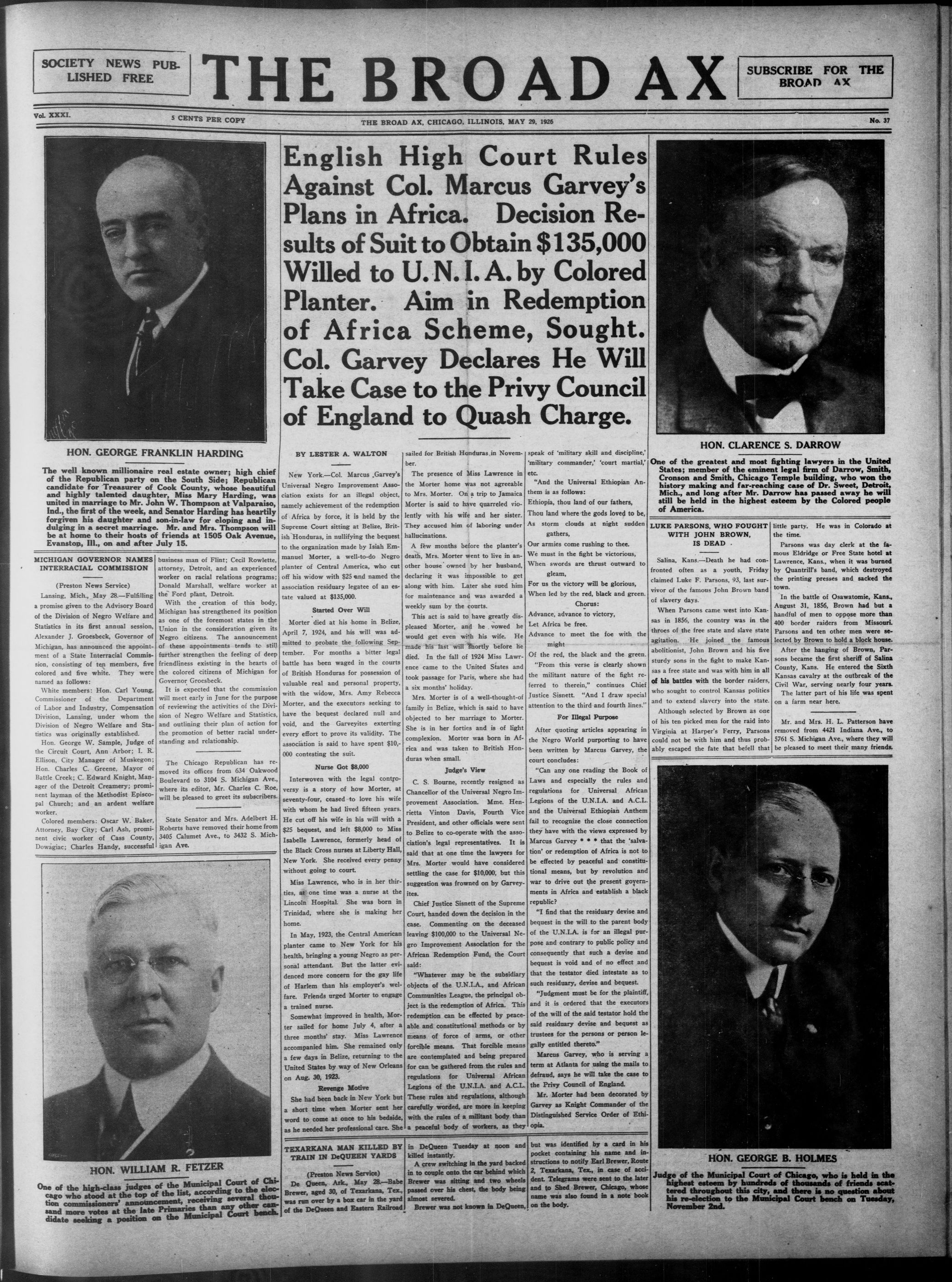
HON. GEORGE FRANKLIN HARDING
The well known millionaire real estate owner; high chief of the Republican party on the South Side; Republican candidate for Treasurer of Cook County, whose beautiful and highly talented daughter, Miss Mary Harding, was united in marriage to Mr. John W. Thompson at Valparaiso, Ind., the first of the week, and Senator Harding has heartily forgiven his daughter and son-in-law for eloping and indulging in a secret marriage. Mr. and Mrs. Thompson will be at home to their hosts of friends at 1505 Oak Avenue, Evanston, Ill., on and after July 15.
MICHIGAN GOVERNOR NAMES business man of Flint; Cecil Rowlette attorney, Detroit, and an experienced
Lansing, Mich., May 28.—Fulfilling a promise given to the Advisory Board of the Division of Negro Welfare and Statistics in its first annual session, Alexander J. Groesbeck, Governor of Michigan, has announced the appointment of a State Interracial Commission, consisting of ten members, five colored and five white. They were named as follows:
White members: Hon. Carl Young, Commissioner of the Department of Labor and Industry, Compensation Division, Lansing, under whom the Division of Negro Welfare and Statistics was originally established.
Hon. George W. Sample, Judge of the Circuit Court, Ann Arbor; I. R. Ellison, City Manager of Muskegon; Hon. Charles C. Greene, Mayor of Battle Creek; C. Edward Knight, Manager of the Detroit Creamery; prominent layman of the Methodist Episcopal Church; and an ardent welfare worker.
Colored members: Oscar W. Baker, Attorney, Bay City; Carl Ash, prominent civic worker of Cass County, Dowagiac; Charles Handy, successful
4/22/1910
[Name]
A. E. S.
HON. WILLIAM R. FETZER
One of the high-class judges of the Municipal cago who stood at the top of the list, accordion commissioners' announcement, receiving sand more votes at the late Primaries than a didate seeking a position on the Municipal
high-class judges of the Municipal stood at the top of the list, accordin missioners' announcement, receiving votes at the late Primaries than sitting a position on the Municipal
One of the high-class judges of the Municipal Court of Chicago who stood at the top of the list, according to the election commissioners' announcement, receiving several thousand more votes at the late Primaries than any other candidate seeking a position on the Municipal Court bench.
Vol. XXXI
5 CENTS PER COPY
real estate owner; high chief in the South Side; Republican Cook County, whose beautiful letter, Miss Mary Harding, was John W. Thompson at Valparaiso, and Senator Harding has heartily son-in-law for eloping and in- Mr. and Mrs. Thompson will of friends at 1505 Oak Avenue, July 15.
business man of Flint; Cecil Rowlette, attorney, Detroit, and an experienced worker on racial relations programs; Donald Marshall, welfare worker at the Ford plant, Detroit.
With the creation of this body, Michigan has strengthened its position as one of the foremost states in the Union in the consideration given its Negro citizens. The announcement of these appointments tends to still further strengthen the feeling of deep friendliness existing in the hearts of the colored citizens of Michigan for Governor Groesbeck.
It is expected that the commission will meet early in June for the purpose of reviewing the activities of the Division of Negro Welfare and Statistics, and outlining their plan of action for the promotion of better racial understanding and relationship.
The Chicago Republican has removed its offices from 634 Oakwood Boulevard to 3104 S. Michigan Ave., where its editor, Mr. Charles C. Roe, will be pleased to greet its subscribers.
State Senator and Mrs. Adelbert H. Roberts have removed their home from 3405 Calumet Ave., to 3432 S. Michigan Ave.
1930
of the Municipal Court of Chi
of the list, according to the eloc-
ement, receiving several thou-
Primaries than any other can
in the Municipal Court bench.
THE BROAD AX
THE BROAD AX, CHICAGO, ILLINOIS, MAY 29, 1926
English High Court Rules Against Col. Marcus Garvey's Plans in Africa. Decision Results of Suit to Obtain $135,000 Willed to U.N.I.A. by Colored Planter. Aim in Redemption of Africa Scheme, Sought. Col. Garvey Declares He Will Take Case to the Privy Council of England to Quash Charge.
BY LESTER A. WALTON
New York.—Col. Marcus Garvey's Universal Negro Improvement Association exists for an illegal object, namely achievement of the redemption of Africa by force, it is held by the Supreme Court sitting at Belize, British Honduras, in nullifying the bequest to the organization made by Isiah Emmanuel Morter, a well-to-do Negro planter of Central America, who cut off his widow with $25 and named the association residuary legatee of an estate valued at $135,000.
Started Over Will
Morter died at his home in Belize, April 7, 1924, and his will was admitted to probate the following September. For months a bitter legal battle has been waged in the courts of British Honduras for possession of valuable real and personal property with the widow, Mrs. Amy Rebecca Morter, and the executors seeking to have the bequest declared null and void, and the Garveyites extinging every effort to prove its validity. The association is said to have spent $10,000 contesting the suit.
Nurse Got $8.000
Interwoven with the legal controversy is a story of how Morter, at seventy-four, ceased to love his wife with whom he had lived fifteen years. He cut off his wife in his will with a $25 bequest, and left $8,000 to Miss Isabelle Lawrence, formerly head of the Black Cross nurses at Liberty Hall, New York. She received every penny without going to court.
Miss Lawrence, who is in her thirties, at one time was a nurse at the Lincoln Hospital. She was born in Trinidad, where she is making her home.
In May, 1923, the Central American planter came to New York for his health, bringing a young Negro as personal attendant. But the latter evidenced more concern for the gay life of Harlem than his employer's welfare. Friends urged Morter to engage a trained nurse.
Somewhat improved in health, Morter sailed for home July 4, after a three months' stay. Miss Lawrence accompanied him. She remained only a few days in Belize, returning to the United States by way of New Orleans on Aug. 30, 1923.
Revenge Motive
She had been back in New York but a short time when Morter sent her word to come at once to his bedside, as he needed her professional care. She
(Preston News Service)
De Queen, Ark., May 28—Babe Brewer, aged 30, of Texarkana, Tex., was run over by a box car in the yard of the DeQueen and Eastern Railroad
sailed for British Honduras in November.
The presence of Miss Lawrence in the Morter home was not agreeable to Mrs. Morter. On a trip to Jamaica Morter is said to have quarreled violently with his wife and her sister. They accused him of laboring under hallucinations.
A few months before the planter's death, Mrs. Morter went to live in another house owned by her husband, declaring it was impossible to get along with him. Later she sued him for maintenance and was awarded a weekly sum by the courts.
This act is said to have greatly displeased Morter, and he vowed he would get even with his wife. He made his last will shortly before he died. In the fall of 1924 Miss Lawrence came to the United States and took passage for Paris, where she had a six months' holiday.
Mrs. Morter is of a well-thought-of family in Belize, which is said to have objected to her marriage to Morter. She is in her forties and is of light complexion. Morter was born in Africa and was taken to British Honduras when small.
Judge's View
C. S. Bourne, recently resigned as Chancellor of the Universal Negro Improvement Association. Mme. Henrietta Vinton Davis, Fourth Vice President, and other officials were sent to Belize to co-operate with the association's legal representatives. It is said that at one time the lawyers for Mrs. Morter would have considered settling the case for $10,000, but this suggestion was frowned on by Garvey-ites.
Chief Justice Sisnett of the Supreme Court, handed down the decision in the case. Commenting on the deceased leaving $100,000 to the Universal Negro Improvement Association for the African Redemption Fund, the Court said:
"Whatever may be the subsidiary objects of the U.N.I.A., and African Communities League, the principal object is the redemption of Africa. This redemption can be effected by peaceable and constitutional methods or by means of force of arms, or other forcible means. That forcible means are contemplated and being prepared for can be gathered from the rules and regulations for Universal African Legions of the U.N.I.A. and A.C.L. These rules and regulations, although carefully worded, are more in keeping with the rules of a militant body than a peaceful body of workers, as they in DeQueen Tuesday at noon and killed instantly. A crew switching in the yard backed in to couple onto the car behind which Brewer was sitting and two wheels passed over his chest, the body being almost severed. Brewer was not known in DeQueen,
speak of 'military skill and discipline,
'military commander,' 'court martial,
etc.
"And the Universal Ethiopian Anthem is as follows:
Ethiopia, thou land of our fathers,
Thou land where the gods loved to be,
As storm clouds at night sudden
Our armies come rushing to thee.
We must in the fight be victorious,
When swords are thrust outward
gleam,
For us the victory will be glorious,
When led by the red, black and green.
Chorus:
Advance, advance to victory,
Let Africa be free.
Advance to meet the foe with the
might
Of the red, the black and the green.
"From this verse is clearly shown
the militant nature of the fight re-
ferred to therein," continues Chief
Justice Sisnett. "And I draw special
attention to the third and fourth lines."
For Illegal Purpose
After quoting articles appearing in the Negro World purporting to have been written by Marcus Garvey, the court concludes:
"Can any one reading the Book of Laws and especially the rules and regulations for Universal African Legions of the U.N.I.A. and A.C.L. and the Universal Ethiopian Anthem fail to recognize the close connection they have with the views expressed by Marcus Garvey * * * that the 'salvation' or redemption of Africa is not to be effected by peaceful and constitutional means, but by revolution and war to drive out the present governments in Africa and establish a black republic?
"I find that the residuary devise and bequest in the will to the parent body of the U.N.I.A. is for an illegal purpose and contrary to public policy and consequently that such a devise and bequest is void and of no effect and that the testator died intestate as to such residuary, devise and bequest."
"Judgment must be for the plaintiff, and it is ordered that the executors of the will of the said testator hold the said residuary devise and bequest as trustees for the persons or person legally entitled thereto."
Marcus Garvey, who is serving a term at Atlanta for using the mails to defraud, says he will take the case to the Privy Council of England.
Mr. Morter had been decorated by Garvey as Knight Commander of the Distinguished Service Order of Ethiopia.
but was identified by a card in his pocket containing his name and instructions to notify Earl Brewer, Route 2, Texarkana, Tex., in case of accident. Telegrams were sent to the later and to Shed Brewer, Chicago, whose name was also found in a note book on the body.
SUBSCRIBE FOR THE BROAD AX
X
No. 37
W. H.
HON. CLARENCE S. DARROW
One of the greatest and most fighting lawyers in States; member of the eminent legal firm of Dr. Cronson and Smith, Chicago Temple building, history making and far-reaching case of Dr. S. Mich., and long after Mr. Darrow has passed still be held in the highest esteem by the Co of America.
LUKE PARSONS, WHO FOUGHT WITH JOHN BROWN, IS DEAD
little party. He was the time. Parsons was day a mous Eldridge or Fr
greatest and most fighting lawyers in number of the eminent legal firm of Da and Smith, Chicago Temple building, taking and far-reaching case of Dr. Swil long after Mr. Darrow has passed a field in the highest esteem by the Coa.
d most fighting lawyers in the United the eminent legal firm of Darrow, Smith, Chicago Temple building, who won the ar-reaching case of Dr. Sweet, Detroit, Mr. Darrow has passed away he will highest esteem by the Colored people
One of the greatest and most fighting lawyers in the United States; member of the eminent legal firm of Darrow, Smith, Cronson and Smith, Chicago Temple building, who won the history making and far-reaching case of Dr. Sweet, Detroit, Mich., and long after Mr. Darrow has passed away he will still be held in the highest esteem by the Colored people of America.
Salina, Kans.-Death he had confronted often as a youth, Friday claimed Luke F. Parsons, 93, last survivor of the famous John Brown band of slavery days.
When Parsons came west into Kansas in 1856, the country was in the throes of the free state and slave state agitation. He joined the famous abolitionist, John Brown and his five sturdy sons in the fight to make Kansas a free state and with him in all of his battles with the border raiders, who sought to control Kansas politics and to extend slavery into the state.
Although selected by Brown as one of his ten picked men for the raid into Virginia at Harper's Ferry, Parsons could not be with him and thus probably escaped the fate that befell that
THE MAYOR OF BROOKLYN
[Image of a man in a suit with a white shirt and a black tie].
M. H.
[Name]
HON. GEORGE B. HOLMES
Judge of the Municipal Court of Chicago, who highest esteem by hundreds of thousands otered throughout this city, and there is no his re-election to the Municipal Court benec November 2nd.
the Municipal Court of Chicago, who is esteem by hundreds of thousands of throughout this city, and there is no objection to the Municipal Court bench over 2nd.
I Court of Chicago, who is held in the hundreds of thousands of friends scat this city, and there is no question about the Municipal Court bench on Tuesday,
Judge of the Municipal Court of Chicago, who is held in the highest esteem by hundreds of thousands of friends scattered throughout this city, and there is no question about his re-election to the Municipal Court bench on Tuesday, November 2nd.
little party. He was in Colorado at the time.
Parsons was day clerk at the famous Eldridge or Free State hotel at Lawrence, Kans., when it was burned by Quantrill's band, which destroyed the printing presses and sacked the town.
In the battle of Osawatomie, Kans., August 31, 1856, Brown had but a handful of men to oppose more than 400 border raiders from Missouri. Parsons and ten other men were selected by Brown to hold a block house.
After the hanging of Brown, Parsons became the first sheriff of Salina County, Kans. He entered the Sixth Kansas cavalry at the outbreak of the Civil War, serving nearly four years.
The latter part of his life was spent on a farm near here.
Mr. and Mrs. H. L. Patterson have removed from 4421 Indiana Ave., to 5761 S. Michigan Ave., where they will be pleased to meet their many friends.
No. 37
THE BROAD AX
Published Every Saturday
In this city since July 15th 1899,
without missing one single issue. Re-
publicans, Democrats, Catholics, Protestants, Single Taxers, Priests, infidels or anyone else can have their say as long as their language is proper and responsibility is fixed.
The Broad Ax is a newspaper whose platform is broad enough for all, ever claiming the editorial right to speak its own mind. It is neither Democratic nor Republican. It is stricty or absolutely independent in politics
Local communications will receive attention. Write only on one side of the paper.
Subscriptions must be paid in advance.
One Year $2.00
Six Months $1.00
Advertising rates made known on application.
THE BROAD AX
6206 S. Elizabeth St., Chicago
Phone: Wentworth 2597
JULIUS F. TAYLOR
Editor and Publisher
Vol. XXXI No. 32
Chicago, May 29, 1926
Entered as Second-Class Matter, Aug
19, 1902, at the Post office at Chicago
III. Under Act of March 8, 1879.
MEMORIAL DAY AND ITS
MEANING TO THE AMERICAN PEOPLE
By Charles Stewart, Jr.
Over half a century ago there was written into the statutes of the United States by the Congress of the nation, a bill fathered by the greatest voluntary soldier of the Civil War, whose monument stands in Grant Park. History tells his story when it says he was the greatest fighting voluntary general in the battle of strife within our own nation. North and South divided, fighting a cause on one side, that human beings might be slaves and on the other that it was the intention of the All Wise Father in His creation of man and womankind that Earth's provisions would give adequate and equal opportunity to each of her citizens.
At the close of this conflict, General John A. Logan, commonly known to the soldiers and the people of the nation as "Black Jack Logan," dug out of the cells of his brain the above law which would awaken the people to the service the men gave who fell on yon battlefield. And since that time the people have awakened to the fullness of the reason and from old Arlington cemetery to the graves in the churchyards as described in Grey's Elegy, they gather tomorrow to pay tributes of reverential respect to the men who sleep in the pained earth of Fort Pillow, Fort Wagner and others of that day.
Strife since that time broadened the graves to the western plains, where General Custer fell and Cyclone Bill Cody fought and killed the great Indian Chief in the channels of revenge. Encounters of a new made army who lost thousands fighting that civilization might reign in Cuba and Porto Rico will decorate the graves of the men who fought under Generals Leonard Wood and the uncompromising warrior who sleeps in tomb in Oyster Bay, Colonel Theodore Roosevelt. Then too, with the immunes the 9th and 10th Cavalry, the 24th and 25th Infantry, who fought on land, while Admiral Dewey became the conquering hero of Manilla Bay, thus the flowers of that country will bedeck the graves of the American soldier in the islands of Manilla.
Peace and quiet reigned for a time until the outbreak in Mexico, when the historic 9th and 10th Cavalry, under their colonel marched into that country and when the commanding officers fell by bullets from the guerrillas, one of our own, Sergeant Peter Bigstaff, picked up the bludgeon and ordered a forward march which was a triumphant success. The Americans in Mexico, tomorrow, will decorate these men who followed the flag.
It looks but yesterday when strife brought the world's war to an issue in the most chaotic form that the world's history has ever recorded, and America in defense of civilization, joined the thirty-six fighting nations and we too, sent these same regiments, 9th and 10th Cavalry, 24th and 25th Infantry, with hundreds of thousands of volunteer and drafted soldiers to follow the flag across the waters where Columbus and Americus Vespucins came to discover this land of ours. Then too, history tells the story of the great Polish General, who came to fight for peace and civilization in America in its early days, that match-
M. B.
HON. GEORGE M. MAYPOLE
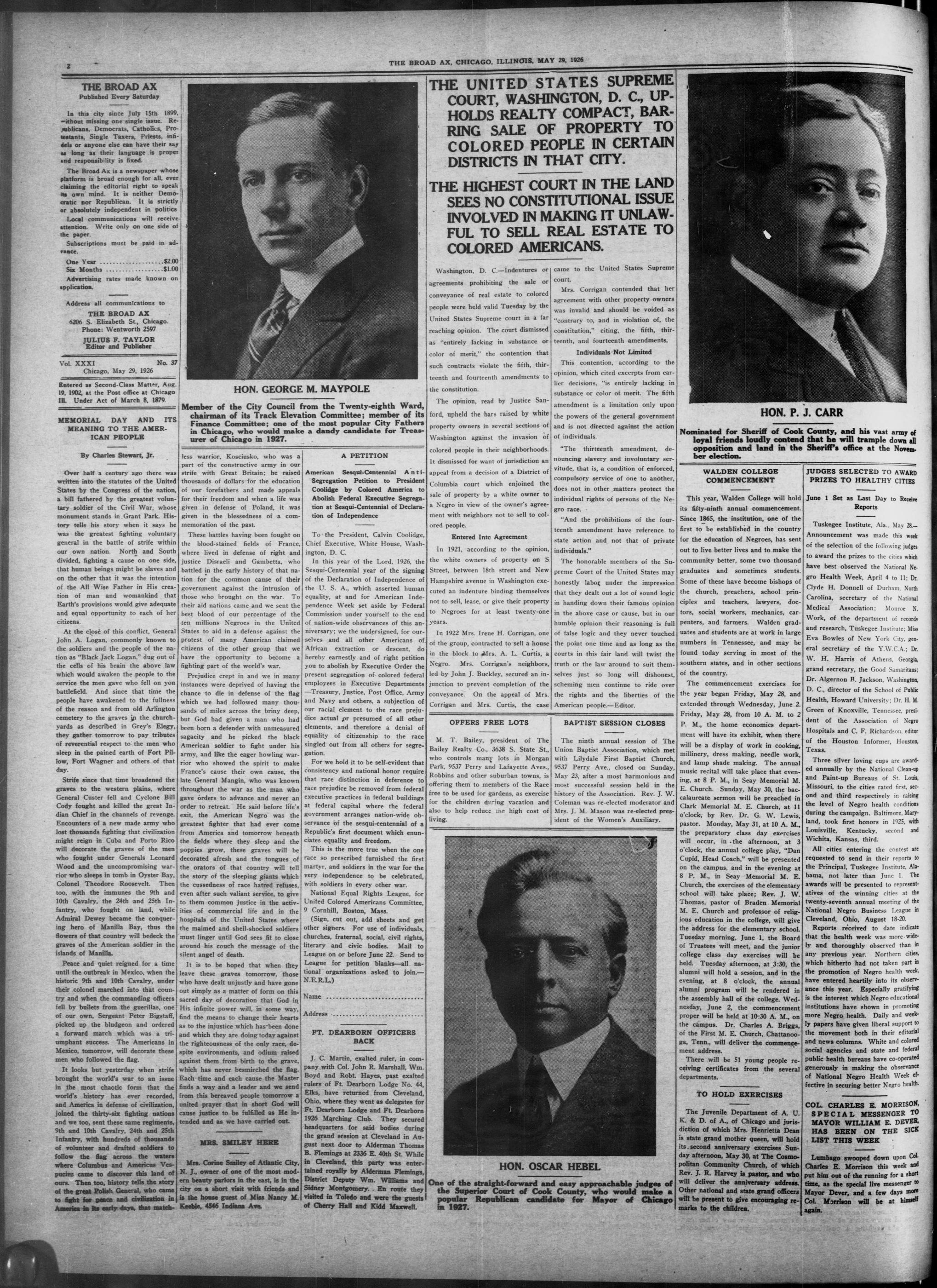
Member of the City Council from the Twenty-eighth Ward, chairman of its Track Elevation Committee; member of its Finance Committee; one of the most popular City Fathers in Chicago, who would make a dandy candidate for Treasurer of Chicago in 1927.
less warrior, Kosciusko, who was a part of the constructive army in our strife with Great Britain; he raised thousands of dollars for the education of our forefathers and made appeals for their freedom and when a life was given in defense of Poland, it was given in the blessedness of a commemoration of the past.
A PETITION
American Sesqui-Centennial Anti-Segregation Petition to President Coolidge by Colored America to Abolish Federal Executive Segregation at Sesqui-Centennial of Declaration of Independence
These battles having been fought on the blood-stained fields of France, where lived in defense of right and justice Disraeli and Gambetta, who battled in the early history of that nation for the common cause of their government against the intrusion of those who brought on the war. To their aid nations came and we sent the best blood of our percentage of the ten millions Negroes in the United States to aid in a defense against the protest of many American claimed citizens of the other group that we have the opportunity to become a fighting part of the world's war.
Prejudice crept in and we in many instances were deprived of having the chance to die in defense of the flag which we had followed many thousands of miles across the briny deep, but God had given a man who had been born a defender with unmeasured sagacity and he picked the black American soldier to fight under his army, and like the eager howling warrior who showed the spirit to make France's cause their own cause, the late General Mangin, who was known throughout the war as the man who gave orders to advance and never an order to retreat. He said before life's exit, the American Negro was the greatest fighter that had ever come from America and tomorrow beneath the fields where they sleep and the poppies grow, these graves will be decorated afresh and the tongues of the orators of that country will tell the story of the sleeping giants which the cussedness of race hatred refuses, even after such valiant service, to give to them common justice in the activities of commercial life and in the hospitals of the United States where the maimed and shell-shocked soldiers must linger until God sees fit to close around his couch the message of the silent angel of death.
It is to be hoped that when they leave these graves tomorrow, those who have dealt unjustly and have gone out simply as a matter of form on this sacred day of decoration that God in His infinite power will, in some way, find the means to change their hearts as to the injustice which has been done and which they are doing today against the righteousness of the only race, despite environments, andodium raised against them from birth to the grave, which has never besmirched the flag. Each time and each cause the Master finds a way and a leader and we send from this bereaved people tomorrow a united prayer that in short God will cause justice to be fulfilled as He intended and as we have carried out.
MRS. SMILEY HERE
Mrs. Corine Smiley of Atlantic City, N. J., owner of one of the most modern beauty parlors in the cast, is in the city on a short visit with friends and is the house guest of Miss Nancy M. Keeleb, 4546 Indiana Ave.
From the Twenty-eighth Ward,
Tion Committee; member of its
the most popular City Fathers
e a dandy candidate for Treas-
A PETITION
American Sesqui-Centennial Anti-
Segregation Petition to President
Coolidge by Colored America to
Abolish Federal Executive Segregation
at Sesqui-Centennial of Declaration of Independence
To the President, Calvin Coolidge,
Chief Executive, White House, Washington, D. C.
In this year of the Lord, 1926, the Sesqui-Centennial year of the signing of the Declaration of Independence of the U. S. A., which asserted human equality, at and for American Independence Week set aside by Federal Commission under yourself to the end of nation-wide observances of this anniversary; we the undersigned, for ourselves and all other Americans of African extraction or descent, do hereby earnestly and of right petition you to abolish by Executive Order the present segregation of colored federal employees in Executive Departments — Treasury, Justice, Post Office, Army and Navy and others, a subjection of our racial element to the race prejudice actual or presumed of all other elements, and therefore a denial of equality of citizenship to the race singled out from all others for segregation.
For we hold it to be self-evident that consistency and national honor require that race distinction in deference to race prejudice be removed from federal executive practices in federal buildings at federal capital where the federal government arranges nation-wide observance of the sesqui-centennial of a Republic's first document which enunciates equality and freedom.
This is the more true when the one race so prescribed furnished the first martyr, and soldiers in the war for the very independence to be celebrated, with soldiers in every other war.
National Equal Rights League, for United Colored Americans Committee, 9 Cornhill, Boston, Mass.
(Sign, cut out, add sheets and get other signers. For use of individuals, churches, fraternal, social, civil rights, literary and civic bodies. Mail to League on or before June 22. Send to League for petition blanks—all national organizations asked to join.—N.E.R.L.)
Name
Address
FT. DEARBORN OFFICERS
BACK
J. C. Martin, exalted ruler, in company with Col. John R. Marshall, Wm. Boyd and Robt. Hayes, past exalted rulers of Ft. Dearborn Lodge No. 44, Elks, have returned from Cleveland, Ohio, where they went as delegates for Ft. Dearborn Lodge and Ft. Dearborn 1926 Marching Club. They secured headquarters for said bodies during the grand session at Cleveland in August next door to Alderman Thomas B. Flemings at 2336 E. 40th St. While in Cleveland, this party was entertained royally by Alderman Flemings, District Deputy Wm. Williams and Sidney Montgomery. En route they visited in Toledo and were the guests of Cherry Hall and Kidd Maxwell.
---
THE UNITED STATES SUPREME COURT, WASHINGTON, D. C., UPHOLDS REALTY COMPACT, BARRING SALE OF PROPERTY TO COLORED PEOPLE IN CERTAIN DISTRICTS IN THAT CITY.
THE HIGHEST COURT IN THE LAND SEES NO CONSTITUTIONAL ISSUE INVOLVED IN MAKING IT UNLAWFUL TO SELL REAL ESTATE TO COLORED AMERICANS.
Washington, D. C.—Indentures or agreements prohibiting the sale or conveyance of real estate to colored people were held valid Tuesday by the United States Supreme court in a far reaching opinion. The court dismissed as "entirely lacking in substance or color of merit," the contention that such contracts violate the fifth, thirteenth and fourteenth amendments to the constitution.
The opinion, read by Justice Sanford, upheld the bars raised by white property owners in several sections of Washington against the invasion of colored people in their neighborhoods. It dismissed for want of jurisdiction an appeal from a decision of a District of Columbia court which enjoined the sale of property by a white owner to a Negro in view of the owner's agreement with neighbors not to sell to colored people.
Entered Into Agreement
In 1921, according to the opinion, the white owners of property on S Street, between 18th street and New Hampshire avenue in Washington executed an indenture binding themselves not to sell, lease, or give their property to Negroes for at least twenty-one years.
In 1922 Mrs. Irene H. Corrigan, one of the group, contracted to sell a house in the block to Mrs. A. L. Curtis, a Negro. Mrs. Corrigan's neighbors, led by John J. Buckley, secured an injunction to prevent completion of the conveyance. On the appeal of Mrs. Corrigan and Mrs. Curtis, the case
OFFERS FREE LOTS
M. T. Bailey, president of The Bailey Realty Co., 3638 S. State St., who controls many lots in Morgan Park, 9537 Perry and Lafayette Aves, Robbins and other suburban towns, is offering them to members of the Race free to be used for gardens, as exercise for the children during vacation and also to help reduce the high cost of living.
JAMES C. HARRIS
5
One of the straight-forward and easy appro
the Superior Court of Cook County, w
popular Republican candidate for M
in 1927.
One of the straight-forward and easy approachable judges of the Superior Court of Cook County, who would make a popular Republican candidate for Mayor of Chicago in 1927.
came to the United States Supreme court.
Mrs. Corrigan contended that her agreement with other property owners was invalid and should be voided as "contrary to, and in violation of, the constitution," citing, the fifth, thirteenth, and fourteenth amendments.
Individuals Not Limited
This contention, according to the opinion, which cited excerpts from earlier decisions, "is entirely lacking in substance or color of merit. The fifth amendment is a limitation only upon the powers of the general government and is not directed against the action of individuals.
"The thirteenth amendment, denouncing slavery and involuntary servitude, that is, a condition of enforced, compulsory service of one to another, does not in other matters protect the individual rights of persons of the Negro race.
"And the prohibitions of the fourteenth amendment have reference to state action and not that of private individuals."
The honorable members of the Supreme Court of the United States may honestly labog under the impression that they dealt out a lot of sound logic in handing down their famous opinion in the above case or cause, but in our humble opinion their reasoning is full of false logic and they never touched the point one time and as long as the courts in this fair land will twist the truth or the law around to suit themselves just so long will dishonest, scheming men continue to ride over the rights and the liberties of the American people.—Editor.
BAPTIST SESSION CLOSES
The ninth annual session of The Union Baptist Association, which met with Lilydale First Baptist Church, 9537 Perry Ave., closed on Sunday, May 23, after a most harmonious and most successful session held in the history of the Association. Rev. J. W. Coleman was re-elected moderator and Mrs. J. M. Mason was re-elected president of the Women's Auxiliary.
D
and easy approachable judges of
County, who would make a
late for Mayor of Chicago
M. B.
HON. P. J. CARR Nominated for Sheriff of Cook County, and his vast army of loyal friends loudly contend that he will trample down all opposition and land in the Sheriff's office at the November election.
This year, Walden College will hold its fifty-ninth annual commencement. Since 1865, the institution, one of the first to be established in the country for the education of Negroes, has sent out to live better lives and to make the community better, some two thousand graduates and sometimes students. Some of these have become bishops of the church, preachers, school principles and teachers, lawyers, doctors, social workers, mechanics, carpenters, and farmers. Walden graduates and students are at work in large numbers in Tennessee, and may be found today serving in most of the southern states, and in other sections of the country.
The commencement exercises for the year began Friday, May 28, and extended through Wednesday, June 2. Friday, May 28, from 10 A. M. to 2 P. M., the home economics department will have its exhibit, when there will be a display of work in cooking, millinery, dress making, needle work, and lamp shade making. The annual music recital will take place that evening, at 8 P. M., in Seay Memorial M. E. Church. Sunday, May 30, the baccalaureate sermon will be preached in Clark Memorial M. E. Church, at 11 o'clock, by Rev. Dr. G. W. Lewis, pastor. Monday, May 31, at 10 A. M., the preparatory class day exercises will occur, in the afternoon, at 3 o'clock, the annual college play, "Dan Cupid, Head Coach," will be presented on the campus, and in the evening at 8 P. M., in Seay Memorial M. E. Church, the exercises of the elementary school will take place; Rev. J. W. Thomas, pastor of Braden Memorial M. E. Church and professor of religious education in the college, will give the address for the elementary school. Tuesday morning, June 1, the Board of Trustees will meet, and the junior college class day exercises will be held. Tuesday afternoon, at 3:30, the alumni will hold a session, and in the evening, at 8 o'clock, the annual alumni program will be rendered in the assembly hall of the college. Wednesday, June 2, the commencement proper will be held at 10:30 A. M., on the campus. Dr. Charles A. Briggs, of the First M. E. Church, Chattanooga, Tenn., will deliver the commencement address.
There will be 51 young people receiving certificates from the several departments.
TO HOLD EXERCISES
The Juvenile Department of A. U. K. & D. of A., of Chicago and jurisdiction of which Mrs. Henrietta Dean is state grand mother queen, will hold its second anniversary exercises Sunday afternoon, May 30, at The Cosmopolitan Community Church, of which Rev. J. R. Harvey is pastor, and who will deliver the anniversary address. Other national and state grand officers will be present to give encouraging remarks to the children.
County, and his vast army of that he will trample down all Sheriff's office at the Novem
JUDGES SELECTED TO AWARD PRIZES TO HEALTHY CITIES
June 1 Set as Last Day to Receive Reports
Tuskegee Institute, Ala., May 28. Announcement was made this week of the selection of the following judges to award the prizes to the cities which have best observed the National Negro Health Week, April 4 to 11; Dr. Clyde H. Donnell of Durham, North Carolina, secretary of the National Medical Association; Monroe N. Work, of the department of records and research, Tuskegee Institute; Miss Eva Bowles of New York City, general secretary of the Y.W.C.A.; Dr. W. H. Harris of Athens, Georgia grand secretary, the Good Samaritans; Dr. Algernon B. Jackson, Washington, D. C., director of the School of Public Health, Howard University; Dr. H. M. Green of Knoxville, Tennessee, president of the Association of Negro Hospitals and C. F. Richardson, editor of the Houston Informer, Houston, Texas.
Three silver loving cups are awarded annually by the National Clean-up and Paint-up Bureaus of St. Louis, Missouri, to the cities rated first, second and third respectively in raising the level of Negro health conditions during the campaign. Baltimore, Maryland, took first honors in 1925, with Louisville, Kentucky, second and Wichita, Kansas, third. All cities entering the contest are requested to send in their reports to the Principal, Tuskegee Institute, Alabama, not later than June 1. The awards will be presented to representatives of the winning cities at the twenty-seventh annual meeting of the National Negro Business League in Cleveland, Ohio, August 18-20.
Reports received to date indicate that the health week was more widely and thoroughly observed than in any previous year. Northern cities, which hitherto had not taken part in the promotion of Negro health week, have entered heartily into its observance this year. Especially gratifying is the interest which Negro educational institutions have shown in promoting more Negro health. Daily and weekly papers have given liberal support to the movement both in their editorial and news columns. White and colored social agencies and state and federal public health bureaus have co-operated generously in making the observance of National Negro Health Week effective in securing better Negro health.
COL. CHARLES E. MORRISON,
SPECIAL MESSENGER TO
MAYOR WILLIAM E. DEVER,
HAS BEEN ON THE SICK
LIST THIS WEEK
Lumbago swooped down upon Col.
Charles E. Morrison this week and
put him out of the running for a short
time, as the special live messenger to
Mayor Dever, and a few days more
Col. Morrison will be at himself
again.
THE WOMEN'S HISTORY MUSEUM
One of the most popular and prominent secret so in Chicago, one of the head teachers at the Most 24th Street and South Wabash Avenue, where she beloved by all of its teachers and pupils. For Mrs. Williamson has greatly assisted her husb undertaking business at 5125 South State Stre
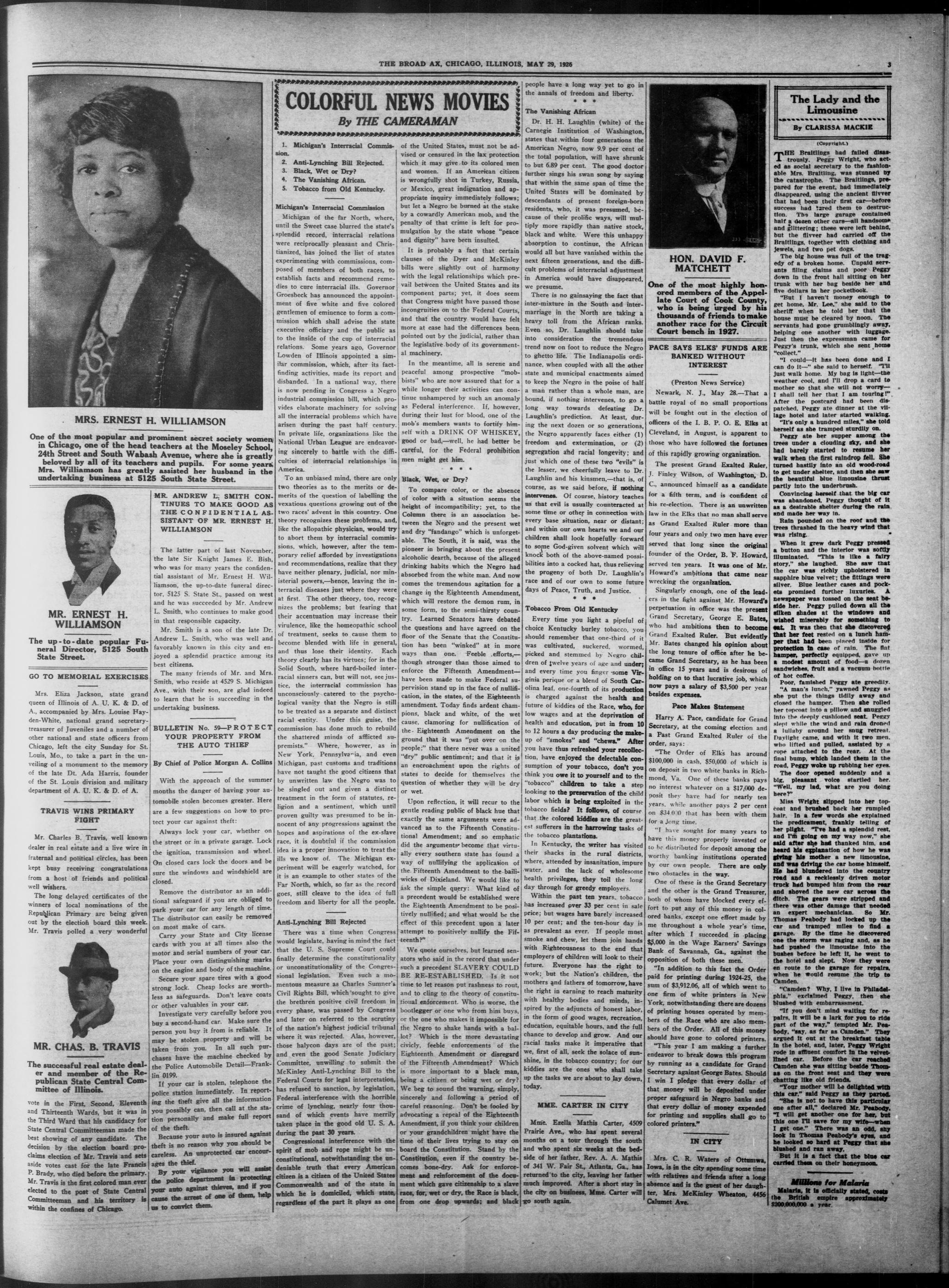
One of the most popular and prominent secret society women in Chicago, one of the head teachers at the Moseley School, 24th Street and South Wabash Avenue, where she is greatly beloved by all of its teachers and pupils. For some years Mrs. Williamson has greatly assisted her husband in the undertaking business at 5125 South State Street.
MR. ANDREW L. SMITH CONTINUES TO MAKE GOOD AS THE CONFIDENTIAL ASSISTANT OF MR. ERNEST H. WILLIAMSON
The latter part of last November, the late Sir Knight James E. Bish, who was for many years the confidential assistant of Mr. Ernest H. Williamson, the up-to-date funeral director, 5125 S. State St., passed on west and he was succeeded by Mr. Andrew
MR. ERNEST H.
WILLIAMSON
The up-to-date popular Funeral Director, 5125 South State Street.
GO TO MEMORIAL EXERCISES
Mrs. Eliza Jackson, state grand queen of Illinois of A. U. K. & D. of A., accompanied by Mrs. Louise Hayden-White, national grand secretary-treasurer of Juveniles and a number of other national and state officers from Chicago, left the city Sunday for St. Louis, Mo., to take a part in the unveiling of a monument to the memory of the late Dt. Ada Harris, founder of the St. Louis division and military department of A. U. K. & D. of A.
TRAVIS WINS PRIMARY
FIGHT
Mr. Charles B. Travis, well known dealer in real estate and a live wire in fraternal and political circles, has been kept busy receiving congratulations from a host of friends and political well wishers.
The long delayed certificates of the winners of local nominations of the Republican Primary are being given out by the election board this week. Mr. Travis polled a very wonderful
MR. CHAS. B. TRAVIS
The successful real estate dealer and member of the Republican State Central Committee of Illinois.
vote in the First, Second, Eleventh and Thirteenth Wards, but it was in the Third Ward that his candidacy for State Central Committeeman made the best showing of any candidate. The decision by the election board proclaims election of Mr. Travis and sets aside votes cast for the late Francis P. Brady, who died before the primary. Mr. Travis is the first colored man ever elected to the post of State Central Committeeman and his territory is within the confines of Chicago.
MR. ANDREW L; SMITH CONTAINES TO MAKE GOOD AS THE CONFIDENTIAL ASSISTANT OF MR. ERNEST H. WILLIAMSON
The latter part of last November, the late Sir Knight James E. Bish, who was for many years the confidential assistant of Mr. Ernest H. Williamson, the up-to-date funeral director, 5125 S. State St., passed on west and he was succeeded by Mr. Andrew L. Smith, who continues to make good in that responsible capacity.
Mr. Smith is a son of the late Dr. Andrew L. Smith, who was well and favorably known in this city and enjoyed a splendid practice among its best citizens.
The many friends of Mr. and Mrs. Smith, who reside at 4529 S. Michigan Ave., with their son, are glad indeed to learn that he is succeeding in the undertaking business.
BULLETIN No. 59—PROTECT YOUR PROPERTY FROM THE AUTO THIEF
By Chief of Police Morgan A. Collins
With the approach of the summer months the danger of having your automobile stolen becomes greater. Here are a few suggestions on how to protect your car against theft:
Always lock your car, whether on the street or in a private garage. Lock the ignition, transmission and wheel. On closed cars lock the doors and be sure the windows and windshield are closed.
Remove the distributor as an additional safeguard if you are obliged to park your car for any length of time. The distributor can easily be removed on most make of cars.
Carry your State and City license cards with you at all times also the motor and serial numbers of your car. Place your own distinguishing marks on the engine and body of the machine. Secure your spare tires with a good strong lock. Cheap locks are worthless as safeguards. Don't leave coats or other valuables in your car. Investigate very carefully before you buy a second-hand car. Make sure the person you buy it from is reliable. It may be stolen property and will be taken from you. In all such purchases have the machine checked by the Police Automobile Detail—Franklin 0199.
If your car is stolen, telephone the police station immediately. In reporting the theft give all the information you possibly can, then call at the station personally and make full report of the theft. Because your auto is insured against theft is no reason why you should be careless. An unprotected car encourages the thief. By your vigilance you will assist the police department in protecting your auto against thieves, and if you cause the arrest of one of them, help us to convict them.
COLORFUL NEWS MOVIES By THE CAMERAMAN
1. Michigan's Interracial Commission.
2. Anti-Lynching Bill Rejected. of the United States, must not be advised or censured in the lax protection which it may give to its colored men
5. Tobacco from Old Kentucky.
Michigan's Interracial Commission
Michigan of the far North, where, until the Sweet case blurred the state's splendid record, interracial relations were reciprocally pleasant and Christianized, has joined the list of states experimenting with commissions, composed of members of both races, to establish facts and recommend remedies to cure interracial ills. Governor Groesbeck has announced the appointment of five white and five colored gentlemen of eminence to form a commission which shall advise the state executive officer and the public as to the inside of the cup of interracial relations. Some years ago, Governor Lowden of Illinois appointed a similar commission, which, after its fact-finding activities, made its report and disbanded. In a national way, there is now pending in Congress a Negro industrial commission bill, which provides elaborate machinery for solving all the interracial problems which have arisen during the past half century. In private life, organizations like the National Urban League are endeavoring sincerely to battle with the difficulties of interracial relationships in America.
To an unbiased mind, there are only two theories as to the merits or demerits of the question of labelling the vexationes questions growing out of the two races' advent in this country. One theory recognizes these problems, and, like the allopathic physician, would try to abort them by interracial commissions, which, however, after the temporary relief afforded by investigations and recommendations, realize that they have neither plenary, judicial, nor ministerial powers,—hence, leaving the interracial diseases just where they were at first. The other theory, too, recognizes the problems; but fearing that their accentuation may increase their virulence, like the homeopathic school of treatment, seeks to cause them to become blended with life in general, and thus lose their identity. Each theory clearly has its virtues; for in the Solid South, where hard-boiled interracial sinners can, but will not, see justice, the interracial commission has unconsciously catered to the psychological that the Negro is still to be treated as a separate and distinct racial entity. Under this guise, the commission has done much to rebuild the shattered minds of afflicted supremists." Where, however, as in New York, Pennsylvania, and even Michigan, past customs and traditions have not taught the good citizens that by unwritten law the Negro was to be singled out and given a distinct treatment in the form of statutes, religion and a sentiment, which until proven guilty was presumed to be innocent of any progressions against the hopes and aspirations of the ex-slave race, it is doubtful if the commission idea is a proper innovation to treat the ills we know of. The Michigan experiment will be eagerly watched, for it is an example to other states of the Far North, which, so far as the record goes, still cleave to the idea of full freedom and liberty for all the people.
Anti-Lynching Bill Rejected
There was a time when Congress would legislate, having in mind the fact that the U. S. Supreme Court could finally determine the constitutionality or unconstitutionality of the Congressional legislation. Even such a momentous measure as Charles Sumner's Civil Rights Bill, which sought to give the brethren positive civil freedom in every phase, was passed by Congress and later on referred to the scrutiny of the nation's highest judicial tribunal where it was rejected. Alas, however, those halycon days are of the past; and even the good Senate Judiciary Committee, unwilling to submit the McKinley Anti-Lynching Bill to the Federal Courts for legal interpretation, has refused to sanction, by legislation, Federal interference with the horrible crime of lynching, nearly four thousand of which events have merrily taken place in the good old U. S. A. during the past 30 years.
Congressional interference with the spirit of mob and rope might be unconstitutional, notwithstanding the undeniable truth that every American citizen is a citizen of the United States Commonwealth and of the state in which he is domiciled, which state, regardless of the part it plays as one
THE BROAD AX. CHICAGO. ILLINOIS. MAY 29. 1925
of the United States, must not be advised or censured in the lax protection which it may give to its colored men and women. If an American citizen is wrongfully shot in Turkey, Russia, or Mexico, great indignation and appropriate inquiry immediately follows; but let a Negro be burned at the stake by a cowardly American mob, and the penalty of that crime is left for promulgation by the state whose "peace and dignity" have been insulted.
It is probably a fact that certain clauses of the Dyer and McKinley bills were slightly out of harmony with the legal relationships which prevail between the United States and its component parts; yet, it does seem that Congress might have passed those incongruities on to the Federal Courts, and that the country would have felt more at ease had the differences been pointed out by the judicial, rather than the legislative body of its governmental machinery.
In the meantime, all is serene and peaceful among prospective "mobbists" who are now assured that for a while longer their activities can continue unhampered by such an anomaly as Federal interference. If, however, during their lust for blood, one of the mob's members wants to fortify himself with a DRINK OF WHISKEY, good or bad,—well, he had better be careful, for the Federal prohibition men might get him.
Black, Wet, or Dry?
To compare color, or the absence of color with a situation seems the height of incompatibility; yet, to the Column there is an association between the Negro and the present wet and dry "fandango" which is unforgetable. The South, it is said, was the pioneer in bringing about the present alcoholic dearth, because of the alleged drinking habits which the Negro had absorbed from the white man. And now comes the tremendous agitation for a change in the Eighteenth Amendment, which will restore the demon rum, in some form, to the semi-thirsty country. Learned Senators have debated the questions and have agreed on the floor of the Senate that the Constitution has been "winked" at in more ways than one. Feeble efforts,—though stronger than those aimed to enforce the Fifteenth Amendment—have been made to make Federal supervision stand up in the face of nullification, in the states, of the Eighteenth amendment. Today finds ardent champions, black and white, of the wet cause, clamoring for nullification of the Eighteenth Amendment on the ground that it was "put over on the people;" that there never was a united "dry" public sentiment; and that it is an encroachment upon the rights of states to decide for themselves the question of whether they will be dry or wet.
Upon reflection, it will recur to the gentle reading public of black hue that exactly the same arguments were advanced as to the Fifteenth Constitutional Amendment; and so emphatic did the arguments become that virtually every southern state has found a way of nullifying the application of the Fifteenth Amendment to the bailiwicks of Dixieland. We would like to ask the simple query: What kind of a precedent would be established were the Eighteenth Amendment to be positively nullified; and what would be the effect of this precedent upon a later attempt to positively nullify the Fifteenth?
We quote ourselves, but learned senators who said in the record that under such a precedent SLAVERY COULD BE RE-ESTABLISHED. Is it not time to let reason put rashness to rout, and to cling to the theory of constitutional enforcement. Who is worse, the bootlegger or one who from him buys, or the one who makes it impossible for the Negro to shake hands with a ballot? Which is the more devastating civily, feeble enforcements of the Eighteenth Amendment or disregard of the Fifteenth Amendment? Which is more important to a black man, being a citizen or being wet or dry? We beg to sound the warning, simply, sincerely and following a period of careful reasoning. Don't be fooled by advocating a repeal of the Eighteenth Amendment, if you think your children or your grandchildren might have the time of their lives trying to stay on board the Constitution. Stand by the Constitution, even if the country becomes bone-dry. Ask for enforcement and reinforcement of the document which gave citizenship to a slave race, for, wet or dry, the Race is black, from one drop upwards; and black
people have a long way yet to go in
the annals of freedom and liberty.
* * *
The Vanishing African
Dr. H. H. Laughlin (white) of the Carnegie Institution of Washington, states that within four generations the American Negro, now 9.9 per cent of the total population, will have shrunk to but 6.89 per cent. The good doctor further sings his swan song by saying that within the same span of time the United States will be dominated by descendants of present foreign-born residents, who, it was presumed, because of their prolific ways, will multiply more rapidly than native stock, black and white. Were this unhappy absorption to continue, the African would all but have vanished within the next fifteen generations, and the difficult problems of interracial adjustment in America would have disappeared, we presume.
There is no gainsaying the fact that inter-mixture in the South and inter-marriage in the North are taking a heavy toll from the African ranks. Even so, Dr. Laughlin should take into consideration the tremendous trend now on foot to reduce the Negro to ghetto life. The Indianapolis ordinance, when coupled with all the other state and municipal enactments aimed to keep the Negro in the poise of half a man rather than a whole man, are bound, if nothing intervenes, to go a long way towards defeating Dr. Laughlin's prediction. At least, during the next dozen or so generations, the Negro apparently faces either (1) freedom and extermination, or (2) segregation and racial longevity; and just which one of these two "evils" is the lesser, we cheerfully leave to Dr. Laughlin and his kinsmen—that is, of course, as we said before, if nothing intervenes. Of course, history teaches us that evil is usually counteracted at some time or other in connection with every base situation, near or distant; and within our own hearts we and our children shall look hopefully forward to some God-given solvent which will knock both of the above-named possibilities into a cocked hat, thus relieving the progeny of both Dr. Laughlin's race and of our own to some future days of Peace, Truth, and Justice.
Tobacco From Old Kentucky
Every time you light a pipeful of choice Kentucky burley tobacco, you should remember that one-third of it was cultivated, suckered, wormed, picked and stemmed by Negro children of twelve years of age and under; and every time you finger some Virginia perique or a blend of South Carolina leaf, one-fourth of its production is charged against the health and future of kiddies of the Race, who, for low wages and at the deprivation of health and education, put in from 10 to 12 hours a day producing the makeup of "smokes" and "chews." After you have thus refreshed your recollection, have enjoyed the delectable consumption of your tobacco, don't you think you owe it to yourself and to the "tobacco" children to take a step looking to the preservation of the child labor which is being exploited in the tobacco fields? It follows, of course, that the colored kiddies are the greatest sufferers in the harrowing tasks of the tobacco plantations.
In Kentucky, the writer has visited their shacks in the rural districts, where, attended by insanitation, impure water, and the lack of wholesome health privileges, they toil the long day through for greedy employers.
Within the past ten years, tobacco has increased over 33 per cent in sale price; but wages have barely increased 10 per cent; and the ten-hour day is as prevalent as ever. If people must smoke and chew, let them join hands with Righteousness to the end that employers of children will look to their future. Everyone has the right to work; but the Nation's children, the mothers and fathers of tomorrow, have the right in earning to reach maturity with healthy bodies and minds, inspired by the adjuncts of honest labor, in the form of good wages, recreation, education, equitable hours, and the full chance to develop and grow. And our racial tasks make it imperative that we, first of all, seek the solace of sunshine, in the tobacco country; for our kiddies are the ones who shall take up the tasks we are about to lay down, today.
MME. CARTER IN CITY
Mme. Ezella Mathis Carter, 4509 Prairie Ave., who has spent several months on a tour through the south and who spent six weeks at the bedside of her father, Rev. A. A. Mathis of 341 W. Fair St., Atlanta, Ga., has returned to the city, leaving her father much improved. After a short stay in the city on business, Mme. Carter will go south again.
233
One of the most highly honored members of the Appellate Court of Cook County, who is being urged by his thousands of friends to make another race for the Circuit Court bench in 1927.
PACE SAYS ELKS' FUNDS ARE BANKED WITHOUT INTEREST
(Preston News Service)
Newark, N. J., May 28—That a battle royal of no small proportions will be fought out in the election of officers of the I. B. P. O. E. Elks at Cleveland, in August, is apparent to those who have followed the fortunes of this rapidly growing organization.
The present Grand Exalted Ruler, J. Finley Wilson, of Washington, D. C., announced himself as a candidate for a fifth term, and is confident of his re-election. There is an unwritten law in the Elks that no man shall serve as Grand Exalted Ruler more than four years and only two men have ever served that long since the original founder of the Order, B. F. Howard, served ten years. It was one of Mr. Howard's ambitions that came near wrecking the organization.
Singularly enough, one of the leaders in the fight against Mr. Howard's perpetuation in office was the present Grand Secretary, George E. Bates, who had ambitions then to become Grand Exalted Ruler. But evidently Mr. Bates changed his opinion about the long tenure of office after he became Grand Secretary, as he has been in office 15 years and is desirous of holding on to that lucrative job, which now pays a salary of $3,500 per year besides expenses.
Pace Makes Statement
Harry A. Pace, candidate for Grand Secretary, at the coming election and a Past Grand Exalted Ruler of the order, says:
"The Order of Elks has around $100,000 in cash, $50,000 of which is on deposit in two white banks in Richmond, Va. One of these banks pays no interest whatever on a $17,000 deposit they have had for nearly ten years, while another pays 2 per cent on $34,000 that has been with them for a long time.
"I have sought for many years to have this money properly invested or to be distributed for deposit among the worthy banking institutions operated by our own people. There are only two obstacles in the way.
One of these is the Grand Secretary and the other is the Grand Treasurer, both of whom have blocked every effort to put any of this money in colored banks, except one effort made by me throughout a whole year's time, after which I succeeded in placing $5,000 in the Wage Earners' Savings Bank of Savannah, Ga., against the opposition of both these men.
"In addition to this fact the Order paid for printing during 1924-25, the sum of $3,912.06, all of which went to one firm of white printers in New York, notwithstanding there are dozens of printing houses operated by members of the Race who are also members of the Order. All of this money should have gone to colored printers.
"This year I am making a further endeavor to break down this program by running as a candidate for Grand Secretary against George Bates. Should I win I pledge that every dollar of that money will be deposited under proper safeguard in Negro banks and that every dollar of money expended for printing and supplies shall go to colored printers."
IN CITY
Mrs. C. R. Waters of Ottumwa, Iowa, is in the city spending some time with relatives and friends after a long absence and is the guest of her daughter, Mrs. McKinley Wheaton, 4456 Calumt Ave.
(Copyright.)
THE Braitlings had failed disastrously. Peggy Wright, who acted as social secretary to the fashionable Mrs. Braitling, was stunned by the catastrophe. The Braitlings, prepared for the event, had immediately disappeared, using the ancient filver that had been their first car—before success had tared them to destruction. The large garage contained half a dozen other cars—all handsome and glittering; these were left behind, but the filver had carried off the Braitlings, together with clothing and jewels, and two pet dogs.
The big house was full of the tragedy of a broken home. Unpaid servants filing claims and poor Peggy down in the front hall sitting on her trunk with her bag beside her and five dollars in her pocketbook.
"But I haven't money enough to get home, Mr. Lee," she said to the sheriff when he told her that the house must be cleared by noon. The servants had gone grumblingly away, helping one another with luggage. Just then the expressman came for Peggy's trunk, which she sent home "collect."
"I could—it has been done and I can do it." she said to herself. "I'll just walk home. My bag is light—the weather cool, and I'll drop a card to mother so that she will not worry—I shall tell her that I am touring!" After the postcard had been dispatched, Peggy ate dinner at the village hotel and later started walking.
"It's only a hundred miles," she told herself as she trumped sturdyily on. Peggy ate her supper among the trees under a clouding sky, and she had barely started to resume her walk when the first raindrop fell. She turned hastily into an old wood-road to get under shelter, and then she saw the beautiful blue limousine thrust partly into the underbrush. Convincing herself that the big car was abandoned, Peggy thought of it as a desirable shelter during the rain and made her way in. Rain pounded on the roof and the trees thrashed in the heavy wind that was rising.
When it grew dark piggy pressed a button and the interior was softly illuminated. "This is like a fairy story," she laughed. She saw that the car was richly upholstered in sapphire blue velvet; the fittings were silver. Blue leather cases and pockets promised further luxuries. A newspaper was tossed on the seat beside her. Peggy pulled down all the shinades at the windows and wished miserably for something to eat. It was then that she discovered that her feet rested on a lunch hamper that had been placed inside for protection in case of rain. The flat hamper, perfectly equipped, gave up a modest amount of food—a dozen sandwiches, fruit and a vacuum bottle of hot coffee.
Poor, famished Peggy ate greedily. "A man's lunch," yawned Peggy as she put the things tidily away and closed the hammer. Then she rolled her topcoat into a pillow and snugged into the deeply cushioned seat. Peggy slept when the wind and rain drowned a lullaby around her snug retreat. Daylight came, and with it two men, who lifted and pulled, assisted by a rope attached to the rear. At the final bump, which landed them in the room, Peggy woke up rubbing her eyes. The door opened suddenly and a big, pleasant voice startled her. "Well, my lad, what are you doing here?"
Miss Wright allipped into her topcoat and brushed back her rumped hair. In a few words she explained the predicament, frankly telling of her plight. "Tve had a splendid rest, and I'm going on my way now," she said after she had thanked him, and heard his explanation of how he was giving his mother a new limousine, and was driving the car home himself. He had blundered into the country road and a recklessly driven motor truck had bumped him from the rear and shoved the new car across the ditch. The gears were stripped and there was other damage that needed an expert mechanician. So Mr. Thomas Peabody had locked up the car and tramped miles to find a garage. By the time he discovered one the storm was raging and, as he had pushed the limousine into the bushes before he left it, he went to the hotel and slept. Now they were en route to the garage for repairs, when he would resume the trip to Camden.
"Camden? Why. I live in Philadelphia," exclaimed Peggy, then she blushed with embarrassment.
"If you don't mind waiting for repairs, it will be a lark for you to ride part of the way." tempted Mr. Peabody, "say, as far as Camden." They argued it out at the breakfast table in the hotel, and, later, Peggy Wright rode in affluent comfort in the velvet-lined car. Before the car reached Camden she was sitting beside Thomas on the front seat and they were chatting like old friends.
"Your mother will be delighted with this car," said Peggy as they parted. "She is not to have this particular one after all," declared Mr. Peabody. "I will get another one for her, but this one I'll save for my wife—when I get one." There was an odd, shy look in Thomas Peabody's eyes, and he looked so hard at Peggy that she blushed and ran away.
But it is a fact that the blue car carried them on their honeymoon.
Millions for Malaria
Malaria, it is officially stated, costs
the British empire approximately
$200,000,000 a year
Ernest H.
WILLIAMSON
UNDERTAKER
ERNEST H. WILLIAMSON
UNDERTAKER
5121-23-25
Charles E.
Dawson
U. B. F. & S. M. T. HOLD EXERCISES
The various lodges and temples of U.B.F. & S.M.T. held their annual Thanksgiving services on Sunday afternoon at Institutional Church. The Uniform Department, Brothers and other departments were escorted to the church by The Ft. Dearborn Band. A fine program was rendered with J. B. Street, president of The Joint Bldg. Assn., and worthy master of North Star Lodge No. 57, as master of ceremonies. Rev. T. L. Scott, pastor of The First A. M. E. Church of Gary, Ind., delivered the anniversary sermon. Rev. Scott is past state grand master of the organization.
WM. GALES IN CITY
William Gales, southern representative of the products of The Overton Hygienic Mfg. Co., arrived in the city during the week after a year's tour throughout the south with his goods.
Name Has Stuck
The buttercup came into its name because the peasants of long ago used to believe that if cows ate of this flower their milk would be rich in butter fat and of a much superior flavor to that of cows who did not dine on these golden blooms. And although it has been proved since that cows never ate this plant the name buttercup has remained.
Glass Jug Lamp Base
A gallon glass elder jug makes a very good lamp base and with its handle is very easy to move about. the jug can be decorated on the inside to make it look unusual by pouring in for example a black paint and stirring it around vigorously. When this has dried, pour in a green paint and stir it around. The effect will be most attractive.
Same Species of Fish
The bureau of fisheries says that there is no difference between the devilfish and the octopus. In some parts of the country where the devilfish is abundant, it ranges from seven to nine feet and weighs from 50 to 60 pounds.
Saving His Shine
"A feller's got to be careful about scrapin' his skin off," said Wille. "cause the paint under it is real fresh."-Boston Transcript.
TheWilliamsonFuneral is distinguished by the up-to-date designs of its Cunningham Limousine Hearse and Cars
May Day Festivities
Kept for Centuries
The origin of the custom of celebrating May day is lost in the mists of antiquity. The first day of May has been observed in some manner since before the time of the Romans. In Rome, May day fell within the period which was sacred to Flora, the goddess of flowers, and flower processes were common on that day. Medieval and early modern England celebrated around the Maypole on the village green. There was a morning procession to the woods to bring home the "May" or hawthorne blossoms to wreathe the Maypole. The "queen," chosen by popular vote, set up her court in a flowery bower, which she left at times to dance with her loyal subjects. Tennyson's "May Queen" gives a picture of these rural festivities. A custom, now almost disappeared, prevailed a generation or so ago in this country in the hanging of "May baskets" on the front doors of the houses of one's friends and neighbors. It was a point of honor to affix the little token of wild flowers to the door knob and slip away undiscovered.—Exchange.
Insistence on Song
Cost Hostess Money
New York makes the most of its eminent people. Invitations to lunch, dine and dance come by the scores to those who have acquired fame by facility at one of the arts, and in many cases they are the drawing cards of the ambitious hostess.
A noted singer recently was invited to join a small group at the home of a casual friend and she accepted. After dinner the hostess cooed. "Now you must sing for us."
"I'm so sorry," said the soprano with genuine regret, "but I begin a concert tour tomorrow, and I must not use my voice till then."
"Ah, but think of the disappointment to our friends here; they came because I assured them you would sing for us. Really, I insist."
"You insist!" asked the singer.
"Assuredly."
The artist sang two songs, and on the next day the hostess received a bill "for professional services—$1,000."
Filling Floor Cracks
To fill cracks in floor best results are obtained by filling in the largest cracks with bits of wood and giving them a coat of paint. This done, secure a good quality of putty and add a gill of japan dryer to ten pounds of putty and work enough dry whiting into it so that it will not stick to the fingers. Fill cracks smooth and even and the floor is ready to paint.
THE BROAD AX, CHICAGO, ILLINOIS, MAY 29, 1926
His Promise
A southwestern banker tells of a man in his state who was continually hard up and had so many notes at the bank that he could not leave town except on Sundays and holidays. There was one note of his falling due every banking day. He dropped into the bank one day and spoke genially to the president. "I came in to fix up that little matter of mine," he said. "I'd like to renew it for a while." The president had the note on his desk. He picked it up and studied it carefully. "Henry," he finally said. "I don't think this note is made out properly." "Why not?" asked the borrower. "It reads: 'I promise to pay,' not 'I promise to renew.'"
Moslems' Holy Stone
The black stone of Mecca is a dark-colored stone about nine inches long, apparently a meteorite, built into the southeast corner of the temple of the Caaba at Mecca. The Mohammedans claim that it was given to Abraham by an angel. Pilgrims to Mecca walk around the temple seven times, then kiss the black stone. The Caaba was the temple of Mecca for ages before the time of Mohammed, and attracted pagan pilgrims in those days just as now it draws thousands of Moslems. It is a legend that the black stone was at one time white, but turned black owing to the sins of men.—Exchange
Necessity for Sleep
We are told that too much sleep may be harmful, deadening the activities of the mind and body. A physician who has been studying the mystery of sleep, has gone so far as to advance the theory that it may be possible to develop a sleepless race. He declares that eventually we may eliminate sleep by scaling it down gradually and getting accustomed to going without it. A way to do this, he suggests, is to reduce our sleep five minutes every two months. At the end of sixteen years, provided we start at eight hours a night, "the stupor of sleep would be banished if it could be."
Named Through Error
The Amazon, largest of the world's rivers, was discovered by Vicente Yanez Pinzon in 1500, and was explored by Orellana, one of Pizarro officers, in 1541. Observing, as he supposed, armed women on the banks as he sailed down the river from Peru to the ocean, he fancied them to be "Amazons," and thus the river obtained its name. These people were simply the native Indians. They parted their long hair in the middle and wore long tunics. To the imagination of the Spanishards they seemed to be the fabled women warriors of antiquity.—Exchange.
Speed of Trains
The modern express passenger locomotive can run 112 miles an hour on a straight, heavy-rail track if the engine is ballasted by a train behind it to prevent its jumping the track. In actual practice 50 miles an hour is not often exceeded.
An Easy Way Out
The hardest thing is to say no, but we find that we can accomplish the same end by taking the matter under advisement—Ohio State Journal.
A. D. GASH
ATTORNEY AT LAW
Suite 813, Ashland Block
155 N. Clark Street
CHICAGO, ILL.
Residence, 1262 Macalister Place
Telephone Monroe 2714
MILES J. DEVINE
ATTORNEY AT LAW
Suite 318-320 Reaper Block
Clark and Washington Sts.
CHICAGO
Telephone Central 1239
P. J. C
J. CAE
SIG.
Democratic Candidate
SHERIFF OF C
Vote for him at the
WEST ENGLEY
AND SAVI
Cor. 63rd Street and
JOHN BAIN, President
Vice-President; EDWA
President and Cashier;
Assistant Cashier and T
TELEPHONE
PUBLIC Candidate for the Nominee
SHERIFF OF COOK COUNTY
for him at the November el
IT ENGLEWOOD TRE
ND SAVINGS BAN
d Street and Marshfield
AIN, President; MICHAEL
ident; EDWARD C. BAR
and Cashier; W. MERLE
Cashier and Trust Officer.
TELEPHONE REPUBLIC 5000
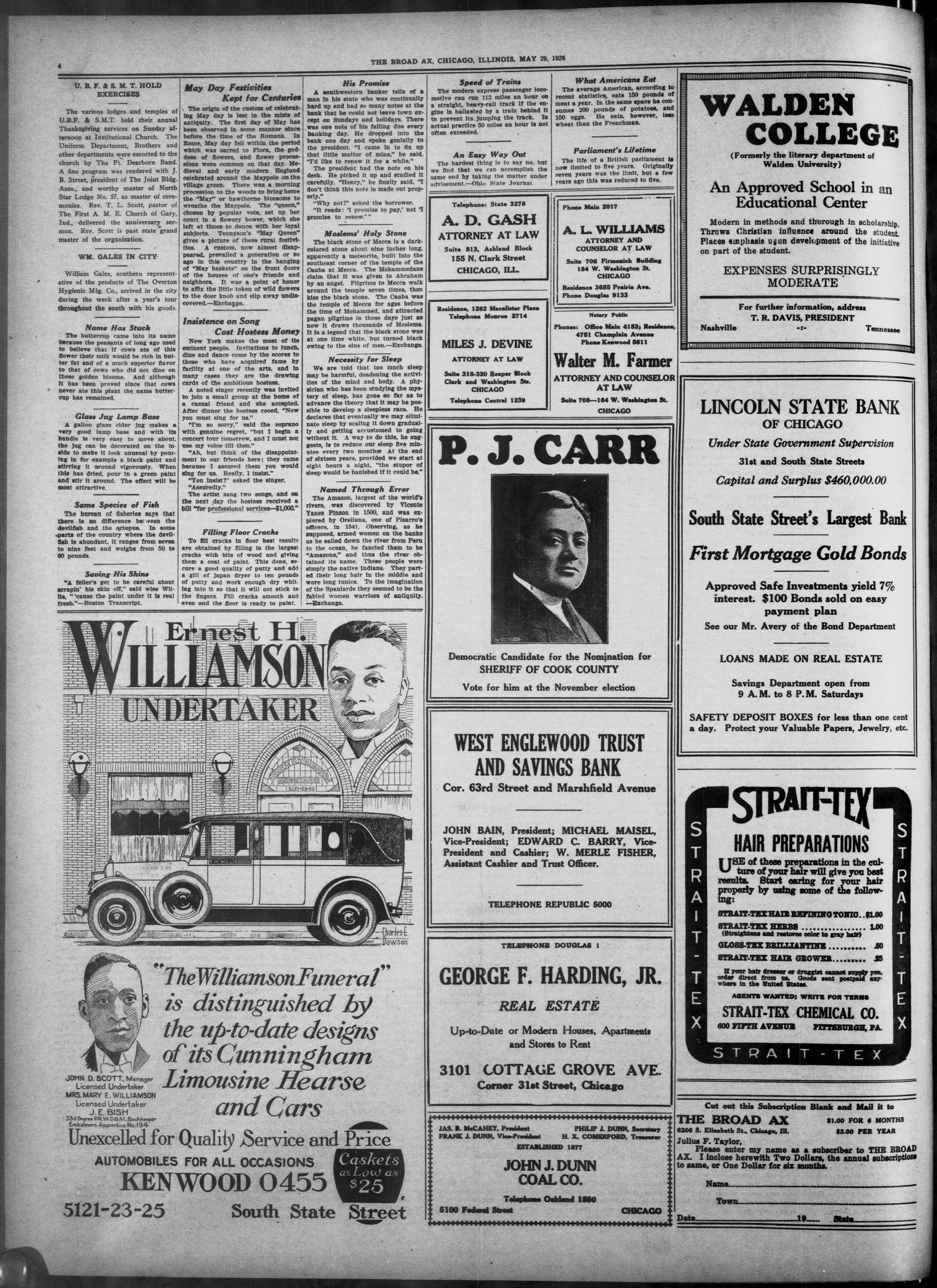
Democratic Candidate for the Nomination for SHERIFF OF COOK COUNTY Vote for him at the November election
WEST ENGLEWOOD TRUST AND SAVINGS BANK
Cor. 63rd Street and Marshfield Avenue
JOHN BAIN, President; MICHAEL MAISEL, Vice-President; EDWARD C. BARRY, VicePresident and Cashier; W. MERLE FISHER, Assistant Cashier and Trust Officer.
TELEPHONE DOUGLAS 1
GEORGE F. H.
REAL
Up-to-Date or Modern
and Store
3101 COTTAGE
Corner 31st S
JAS. B. McCAHEY, President
FRANK J. DUNN, Vice-President
ESTABLISHED
AGE F. HARDING
REAL ESTATE
State or Modern Houses, A
and Stores to Rent
COTTAGE GROVE
Corner 31st Street, Chicago
KEY, President
N, Vice-President
PHILIP J. L.
H. X. COMERP
ESTABLISHED 1877
Up-to-Date or Modern Houses, Apartments and Stores to Rent
3101 COTTAGE GROVE AVE.
Corner 31st Street, Chicago
JOHN J. DUNN COAL CO.
Telephone C
5100 Federal Street
Telephone Oakland 1850
Street
What Americans Eat
The average American, according to recent statistics, eats 150 pounds of meat a year. In the same space he consumes 200 pounds of potatoes, and 150 eggs. He eats, however, less wheat than the Frenchman.
Parliament's Lifetime
The life of a British parliament is now limited to five years. Originally seven years was the limit, but a few years ago this was reduced to five.
Phone Main 2017
A. L. WILLIAMS
ATTORNEY AND
COUNSELOR AT LAW
Suite 706 Firmenich Building
184 W. Washington St.
CHICAGO
Residence 3655 Prairie Ave.
Phone Douglas 9133
Phones: Office Main 4153; Residence,
4751 Champlain Avenue
Phone Kenwood 5611
ATTORNEY AND COUNSELOR AT LAW
Suite 708—184 W. Washington St.
CHICAGO
for the Nomination for
BOOK COUNTY
November election
WOOD TRUST
INGS BANK
Marshfield Avenue
; MICHAEL MAISEL,
RD C. BARRY, Vice-
W. MERLE FISHER,
Just Officer.
REPUBLIC 5000
HARDING, JR.
RESTATE
In Houses, Apartments
to Rent
E GROVE AVE.
Street, Chicago
PHILIP J. DUNN, Secretary
H. X. COMERFORD, Treasurer
ED 1877
CHICAGO
(Formerly the literary department of Walden University)
An Approved School in
Educational Center
cern in methods and thorough in scho
as Christian influence around the s
emphasis upon development of the in
t of the student.
EXPENSES SURPRISINGLY MODERATE
For further information, address
T. R. DAVIS, PRESIDENT
ville -:- Ter
N COLN STATE BANK
OF CHICAGO
Under State Government Superv
31st and South State Streets
capital and Surplus $460,000.0
State Street's Largest
Mortgage Gold B
Proved Safe Investments yield
interest. $100 Bonds sold on ea
payment plan
our Mr. Avery of the Bond Depart
LOANS MADE ON REAL ESTATE
An Approved School in an Educational Center
Modern in methods and thorough in scholarship. Throws Christian influence around the student. Places emphasis upon development of the initiative on part of the student.
EXPENSES SURPRISINGLY MODERATE
For further information, address
T. R. DAVIS, PRESIDENT
Nashville Tennessee
LINCOLN STATE BANK OF CHICAGO
Under State Government Supervision
31st and South State Streets
Capital and Surplus $460,000.00
South State Street's Largest Bank
First Mortgage Gold Bonds
Approved Safe Investments yield 7% interest. $100 Bonds sold on easy payment plan See our Mr. Avery of the Bond Department
LOANS MADE ON REAL ESTATE
Savings Department open from
9 A.M. to 8 P.M. Saturdays
TY DEPOSIT BOXES for less than one
Protect your Valuable Papers, Jewell
SAFETY DEPOSIT BOXES for less than one cent a day. Protect your Valuable Papers, Jewelry, etc.
STRAIT-TEX
HAIR PREPARATIONS
USE of these preparations in the cult-
ture of your hair will give you best
results. Start caring for your hair
properly by using some of the follow-
ing:
STRAIT-TEX HAIR REFINING TONIC... $1.00
STRAIT-TEX HERBS ... 1.00
(Straightens and restores color to gray hair)
GLOSS-TEX BRILLIANTINE ... .50
STRAIT-TEX HAIR GROWER ... .25
If your hair dresser or druggist cannot supply you,
order direct from us. Goods sent postpaid any-
where in the United States.
AGENTS WANTED; WRITE FOR TERMS
STRAIT-TEX CHEMICAL CO.
600 FIFTH AVENUE PITTSBURGH, PA.
STRAIT-TEX
Please enter my name as a subscriber to THE BROAD AX. I inclose herewith Two Dollars, the annual subscriptions to same, or One Dollar for six months.