The Broad Ax
Saturday, June 12, 1926
Chicago, Illinois
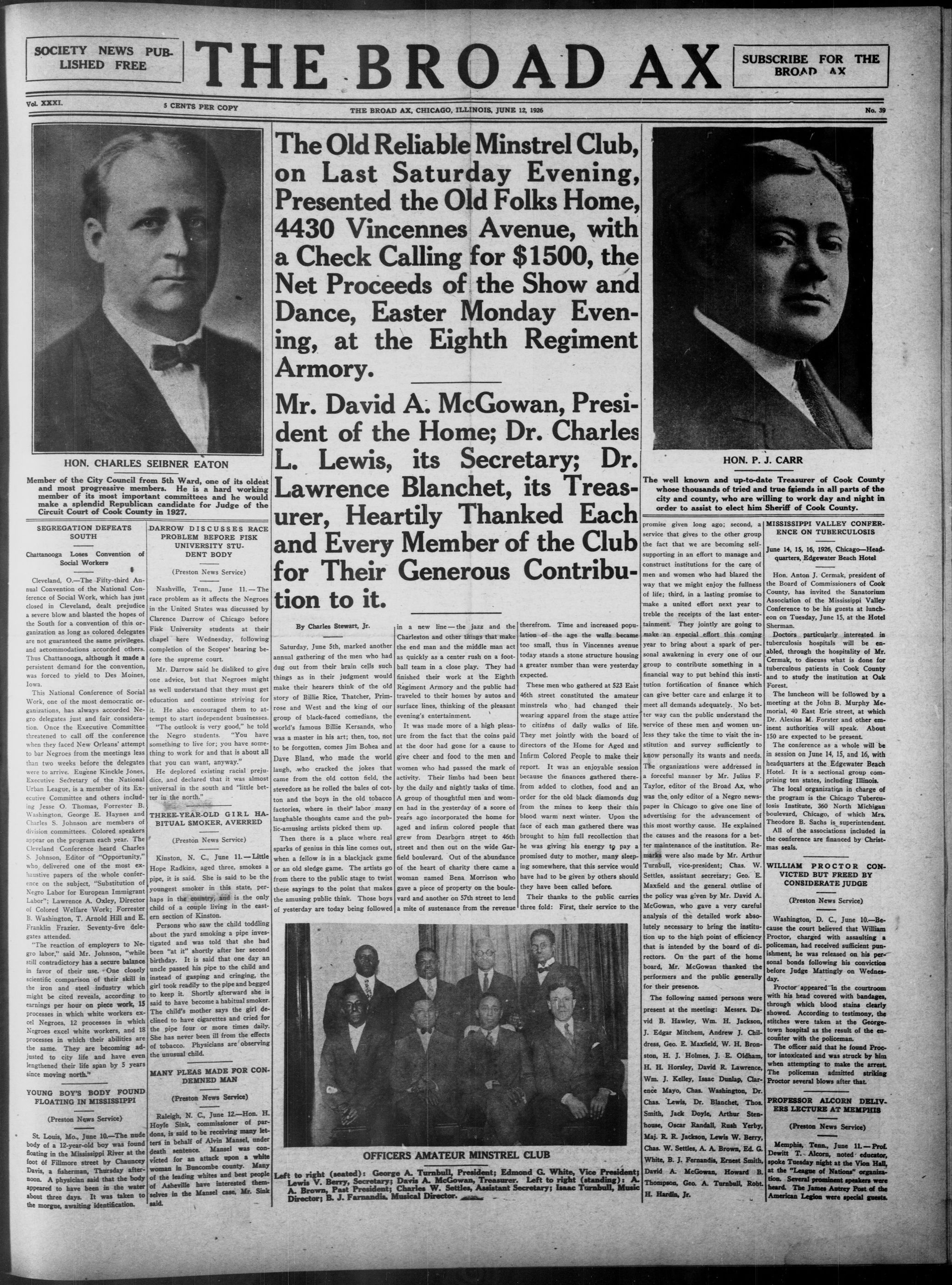
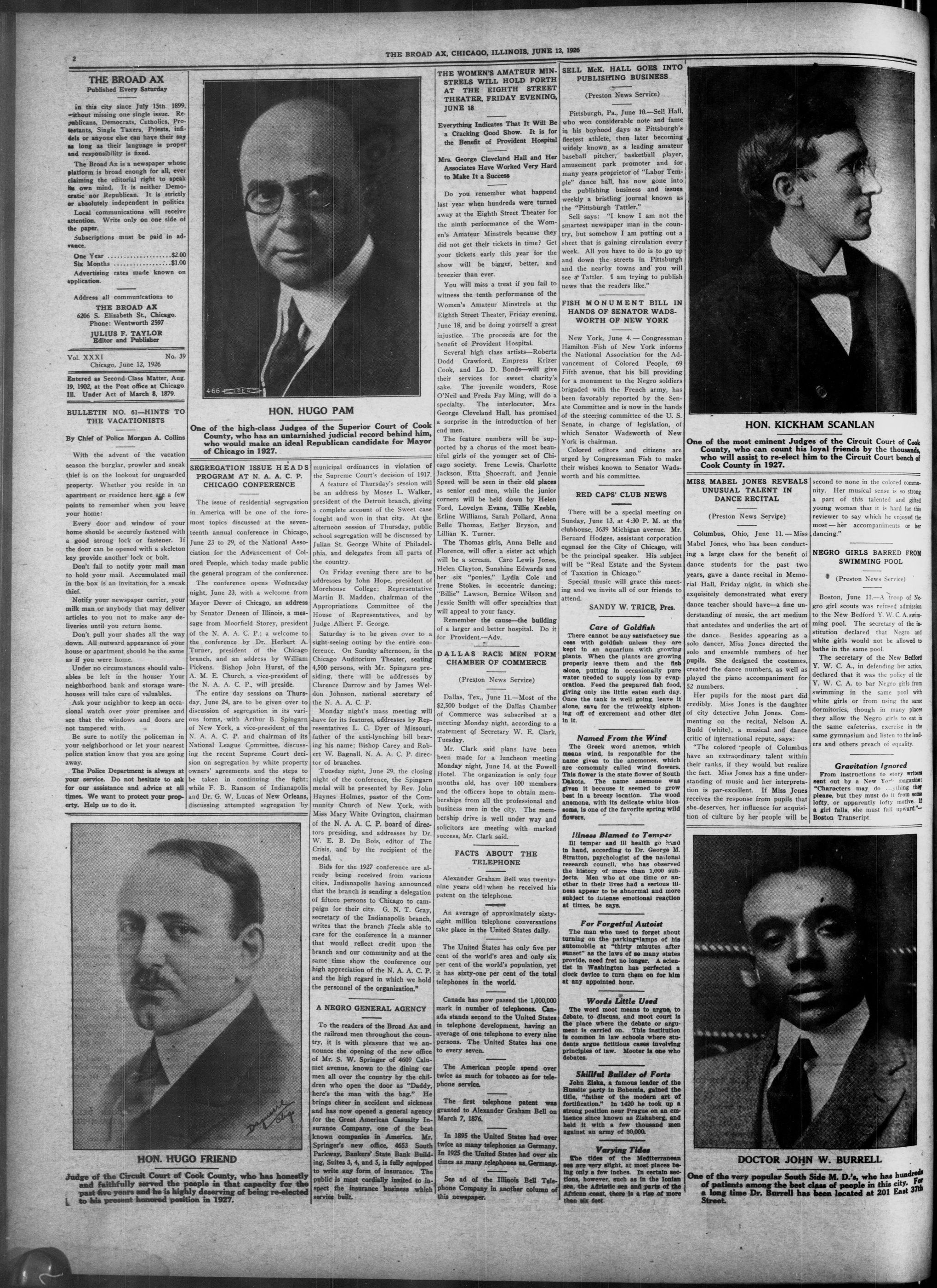
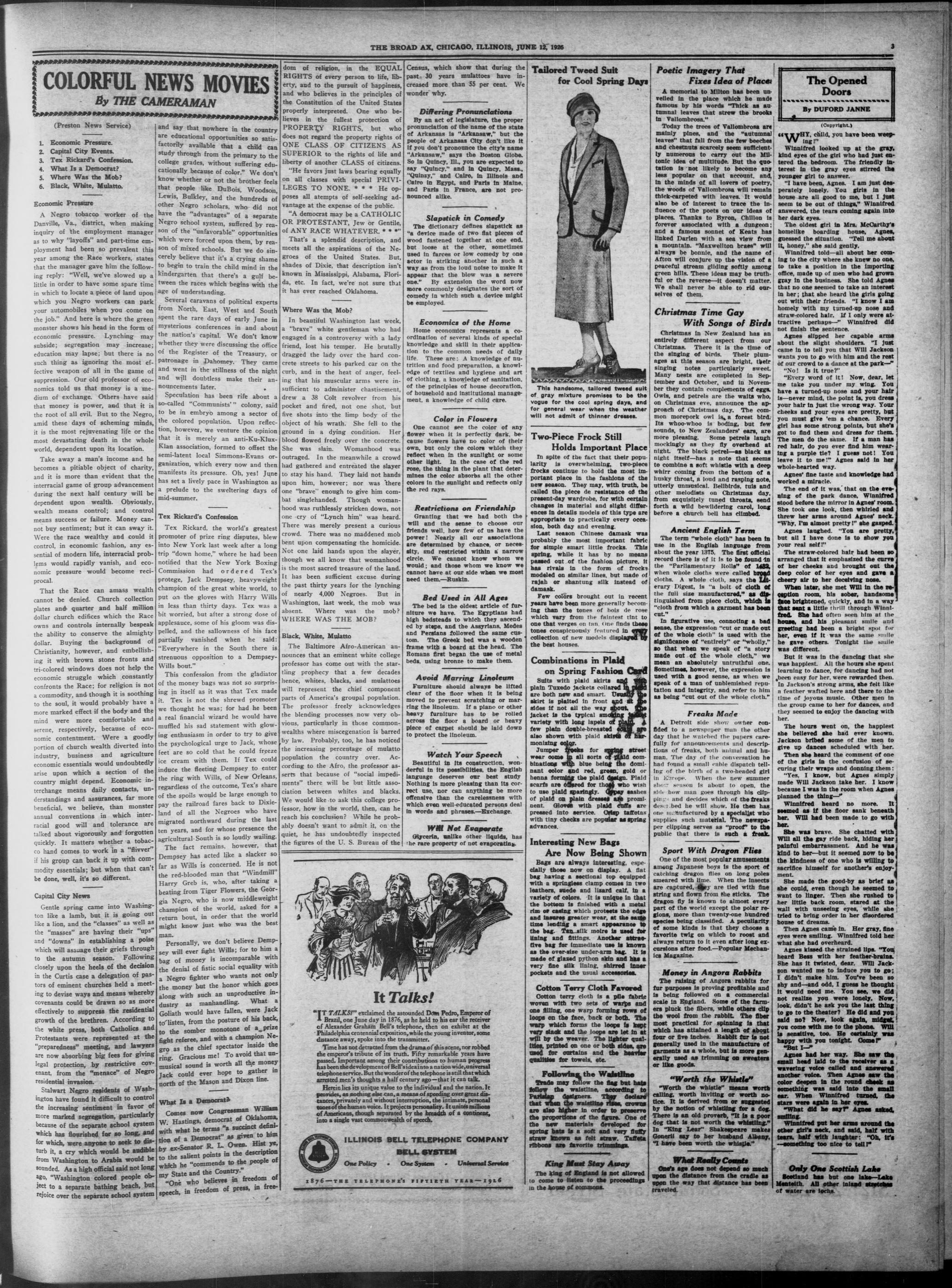
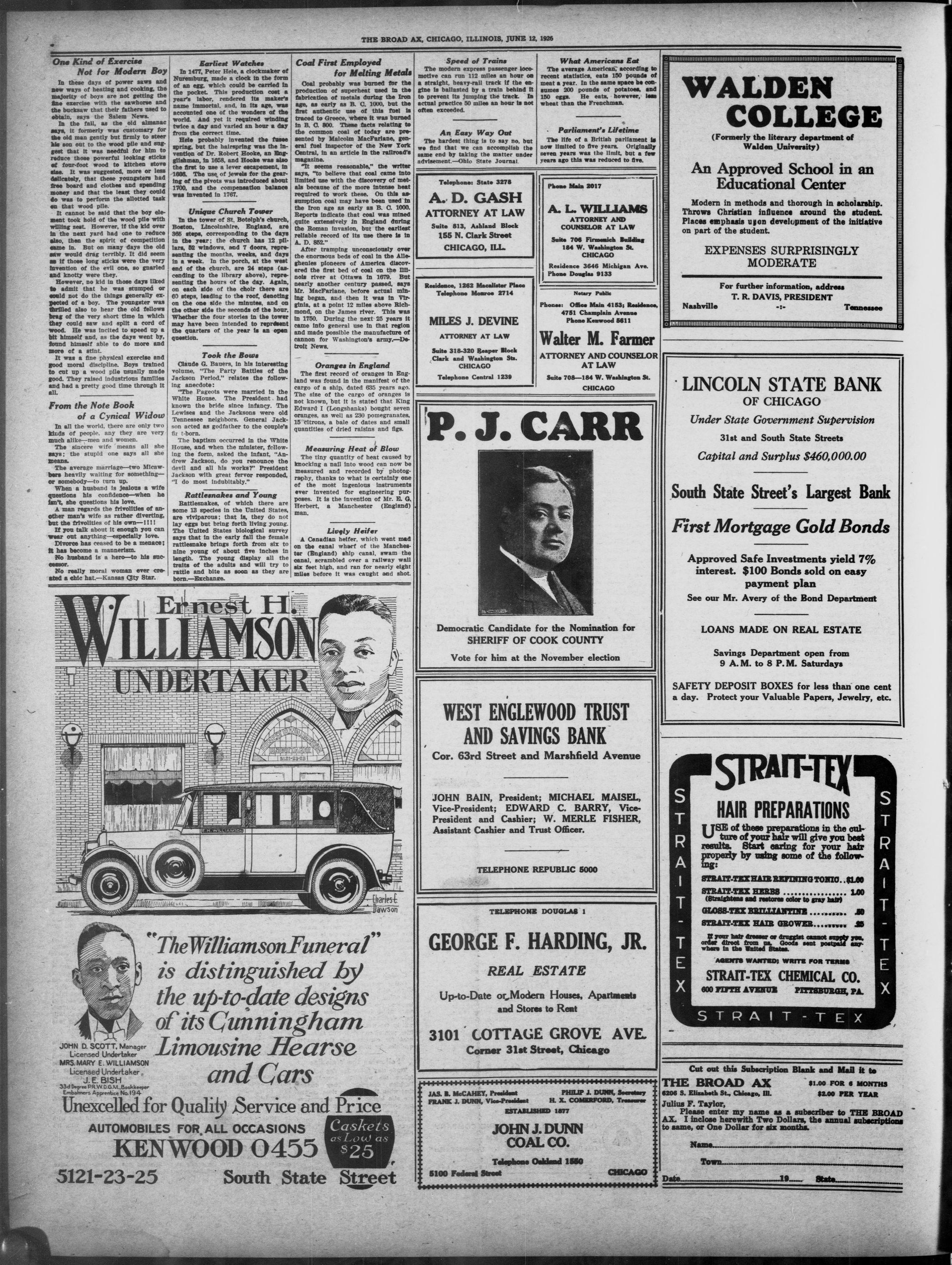
Page text (machine-generated)
SOCIETY NEWS PUBLISHED FREE
Vol. XXXI. 5 C
HON. CHARLES SEIBN
Member of the City Council from 5th and most progressive members. member of its most important co-make a splendid Republican candidate Circuit Court of Cook County in 19
[Picture of a man in a suit with a bow tie].
HON. CHARLES SEIBNER EATON Member of the City Council from 5th Ward, one of its oldest and most progressive members. He is a hard working member of its most important committees and he would make a splendid Republican candidate for Judge of the Circuit Court of Cook County in 1927.
```markdown
```
Vol. XXXI.
SEGREGATION DEFEATS SOUTH
Chattanooga Loses Convention of Social Workers
Cleveland, O.—The Fifty-third Annual Convention of the National Conference of Social Work, which has just closed in Cleveland, dealt prejudice a severe blow and blasted the hopes of the South for a convention of this organization as long as colored delegates are not guaranteed the same privileges. and accomodations accorded others.
Thus Chattanooga, although it made a persistent demand for the convention, was forced to yield to Des Moines, Iowa.
This National Conference of Social Work, one of the most democratic organizations, has always accorded Negro delegates just and fair consideration. Once the Executive Committee threatened to call off the conference when they faced New Orleans' attempt to bar Negroes from the meetings less than two weeks before the delegates were to arrive. Eugene Kinckle Jones, Executive Secretary of the National Urban League, is a member of its Executive Committee and others including Jesse O. Thomas, Forrester B. Washington, George E. Haynes and Charles S. Johnson are members of division committees. Colored speakers appear on the program each year. The Cleveland Conference heard Charles S. Johnson, Editor of "Opportunity," who delivered one of the most exhaustive papers of the whole conference on the subject, "Substitution of Negro Labor for European Immigrant Labor"; Lawrence A. Oxley, Director of Colored Welfare Work; Forrester B. Washington, T. Arnold Hill and E. Franklin Frazier. Seventy-five delegates attended.
"The reaction of employers to Negro labor," said Mr. Johnson, "while still contradictory has a secure balance in favor of their use." One closely scientific comparison of their skill in the iron and steel industry which might be cited reveals, according to earnings per hour on piece work, 15 processes in which white workers excel Negroes, 12 processes in which Negroes excel white workers, and 18 processes in which their abilities are the same. They are becoming adjusted to city life and have even lengthened their life span by 5 years since moving north."
YOUNG BOYS BODY FOUND
FLOATING IN MISSISSIPPI
St. Louis, Mo., June 10.—The nude body of a 12-year-old boy was found floating in the Mississippi River at the foot of Fillmore street by Chauncey Davis, a fisherman, Thursday afternoon. A physician said that the body appeared to have been in the water about three days. It was taken to the morgue awaiting identification.
THE BROAD AX
5 CENTS PER COPY
SEIBNER EATON
from 5th Ward, one of its oldest
members. He is a hard working
plant committees and he would
can candidate for Judge of the
day in 1927.
DARROW DISCUSSES RACE
PROBLEM BEFORE FISK
UNIVERSITY STU-
DENT BODY
(Preston News Service)
Nashville, Tenn., June 11.—The race problem as it affects the Negroes in the United States was discussed by Clarence Darrow of Chicago before Fisk University students at their chapel here Wednesday, following completion of the Scopes' hearing before the supreme court.
Mr. Darrow said he disliked to give one advice, but that Negroes might as well understand that they must get education and continue striving for it. He also encouraged them to attempt to start independent businesses.
"The outlook is very good," he told the Negro students. "You have something to live for; you have something to work for and that is about all that you can want, anyway."
He deplored existing racial prejudice, and declared that it was almost universal in the south and "little better in the north."
THREE-YEAR-OLD GIRL HABITUAL SMOKER, AVERRED
(Preston News Service)
Kinston, N. C., June 11.—Little Hope Radkins, aged three, smokes a pipe, it is said. She is said to be the youngest smoker in this state, perhaps in the country, and is the only child of a couple living in the eastern section of Kinston.
Persons who saw the child toddling about the yard smoking a pipe investigated and was told that she had been "at it" shortly after her second birthday. It is said that one day an uncle passed his pipe to the child and instead of gasping and cringing, the girl took readily to the pipe and begged to keep it. Shortly afterward she is said to have become a habitual smoker. The child's mother says the girl declined to have cigarettes and cried for the pipe four or more times daily. She has never been ill from the effects of tobacco. Physicians are observing the unusual child.
MANY PLEAS MADE FOR CON-DEMNED MAN
(Preston News Service)
Raleigh, N. C., June 12.—Hon. H. Hoyle Sink, commissioner of pardons, is said to be receiving many letters in behalf of Alvin Mansel, under death sentence. Mansel was convicted for an attack upon a white woman in Buncombe county. Many of the leading whites and best people of Asheville have interested themselves in the Mansel case, Mr. Sink said.
THE BROAD AX, CHICAGO, ILLINOIS, JUNE 12, 1926
The Old Reliable Minstrel Club, on Last Saturday Evening, Presented the Old Folks Home, 4430 Vincennes Avenue, with a Check Calling for $1500, the Net Proceeds of the Show and Dance, Easter Monday Evening, at the Eighth Regiment Armory.
Mr. David A. McGowan, President of the Home; Dr. Charles L. Lewis, its Secretary; Dr. Lawrence Blanchet, its Treasurer, Heartily Thanked Each and Every Member of the Club for Their Generous Contribution to it.
OFFICERS AMATEUR MINSTREL CLUB
Left to right (seated): George A. Turnbull, President; Edmond G. White, Vice President; Lewis V. Berry, Secretary; Davis A. McGowan, Treasurer. Left to right (standing): A. A. Brown, Past President; Charles W. Settles, Assistant Secretary; Isaac Turnbull, Music Director; B. J. Farnandis, Musical Director.
Saturday, June 5th, marked another annual gathering of the men who had dug out from their brain cells such things as in their judgment would make their hearers think of the old story of Billie Rice, Thatcher, Primrose and West and the king of our group of black-faced comedians, the world's famous Billie Kersands, who was a master in his art; then, too, not to be forgotten, comes Jim Bohea and Dave Bland, who made the world laugh, who cracked the jokes that came from the old cotton field, the stevedore as he rolled the bales of cotton and the boys in the old tobacco factories, where in their" labor many laughable thoughts came and the public-amusing artists picked them up.
Then there is a place where real sparks of genius in this line comes out, when a fellow is in a blackjack game or an old sledge game. The artists go from there to the public stage to twist these sayings to the point that makes the amusing public think. Those boys of yesterday are today being followed
in a new line—the jazz and the Charleston and other things that make the end man and the middle man act as quickly as a center rush on a football team in a close play. They had finished their work at the Eighth Regiment Armory and the public had traveled to their homes by autos and surface lines, thinking of the pleasant evening's entertainment.
It was made more of a high pleasure from the fact that the coins paid at the door had gone for a cause to give cheer and food to the men and women who had passed the mark of activity. Their limbs had been bent by the daily and nightly tasks of time. A group of thoughtful men and women had in the yesterday of a score of years ago incorporated the home for aged and infirm colored people that grew from Dearborn street to 46th street and then out on the wide Garfield boulevard. Out of the abundance of the heart of charity there came a woman named Bena Morrison who gave a piece of property on the boulevard and another on 57th street to lend a mite of sustenance from the revenue
therefrom. Time and increased population of the age the walls became too small, thus in Vincennes avenue today stands a stone structure housing a greater number than were yesterday expected. These men who gathered at 523 East 46th street constituted the amateur minstrels who had changed their wearing apparel from the stage attire to citizens of daily walks of life. They met jointly with the board of directors of the Home for Aged and Infirm Colored People to make their report. It was an enjoyable session because the finances gathered therefrom added to clothes, food and an order for the old black diamonds dug from the mines to keep their thin blood warm next winter. Upon the face of each man gathered there was brought to him full recollection that he was giving his energy to pay a promised duty to mother, many sleeping somewhere, that this service would have had to be given by others should they have been called before.
Their thanks to the public carries three fold: First, their service to the
M.
HON. P. J. CARR The well known and up-to-date Treasurer of Cook County whose thousands of tried and true friends in all parts of the city and county, who are willing to work day and night in order to assist to elect him Sheriff of Cook County.
promise given long ago; second, a service that gives to the other group the fact that we are becoming self-supporting in an effort to manage and construct institutions for the care of men and women who had blazed the way that we might enjoy the fullness of life; third, in a lasting promise to make a united effort next year to treble the receipts of the last entertainment. They jointly are going to make an especial effort this coming year to bring about a spark of personal awakening in every one of our group to contribute something in a financial way to put behind this institution fortification of finance which can give better care and enlarge it to meet all demands adequately. No better way can the public understand the service of these men and women unless they take the time to visit the institution and survey sufficiently to know personally its wants and needs. The organizations were addressed in a forceful manner by Mr. Julius F. Taylor, editor of the Broad Ax, who was the only editor of a Negro newspaper in Chicago to give one line of advertising for the advancement of this most worthy cause. He explained the causes and the reasons for a better maintenance of the institution. Remarks were also made by Mr. Arthur Turnbull, vice-president; Chas. W. Settles, assistant secretary; Geo. E. Maxfield and the general outline of the policy was given by Mr. David A. McGowan, who gave a very careful analysis of the detailed work absolutely necessary to bring the institution up to the high point of efficiency that is intended by the board of directors. On the part of the home board, Mr. McGowan thanked the performers and the public generally for their presence.
The following named persons were present at the meeting: Messrs. David B. Hawley, Wm. H. Jackson, J. Edgar Mitchem, Andrew J. Childress, Geo. E. Maxfield, W. H. Bronston, H. H. Holmes, J. E. Oldham, H. H. Horsley, David R. Lawrence, Wm. J. Kelley, Isaac Dunlap, Clarence Mayo, Chas. Washington, Dr. Chas. Lewis, Dr. Blanchet, Thos. Smith, Jack Doyle, Arthur Stenhouse, Oscar Randall, Rush Yerby, Maj. R. R. Jackson, Lewis W. Berry, Chas. W. Settles, A. A. Brown, Ed. G. White, B. J. Fernandis, Ernest Smith, David A. McGowan, Howard B. Thompson, Geo. A. Turnbull, Robt H. Hardin, Jr.
SUBSCRIBE FOR THE BROAD AX
No. 39
up-to-date Treasurer of Cook County and true friends in all parts of the are willing to work day and night in him Sheriff of Cook County.
MISSISSIPPI VALLEY CONFERENCE ON TUBERCULOSIS
June 14, 15, 16, 1926, Chicago—Headquarters, Edgewater Beach Hotel
Hon. Anton J. Cermak, president of the Board of Commissioners of Cook County, has invited the Sanatorium Association of the Mississippi Valley Conference to be his guests at lunchon Tuesday, June 15, at the Hotel Sherman.
Doctors particularly interested in tuberculosis hospitals will be enabled, through the hospitality of Mr. Cermak, to discuss what is done for tuberculous patients in Cook County and to study the institution at Oak Forest.
The luncheon will be followed by a meeting at the John B. Murphy Memorial, 40 East Erie street, at which Dr. Alexius M. Forster and other eminent authorities will speak. About 150 are expected to be present.
The conference as a whole will be in session on June 14, 15, and 16, with headquarters at the Edgewater Beach Hotel. It is a sectional group comprising ten states, including Illinois. The local organization in charge of the program is the Chicago Tuberculosis Institute, 360 North Michigan boulevard, Chicago, of which Mrs. Theodore B. Sachs is superintendent. All of the associations included in the conference are financed by Christmas seals.
WILLIAM PROCTOR CONVICTED BUT FREED BY CONSIDERATE JUDGE
Washington, D. C., June 10.—Because the court believed that William Proctor, charged with assaulting a policeman, had received sufficient punishment, he was released on his personal bonds following his conviction before Judge Mattingly on Wednesday.
Proctor appeared in the courtroom with his head covered with bandages, through which blood stains clearly showed. According to testimony, the stitches were taken at the Georgetown hospital as the result of the encounter with the policeman.
The officer said that he found Proctor intoxicated and was struck by him when attempting to make the arrest. The policeman admitted striking Proctor several blows after that.
PROFESSOR ALCORN DELIVI
ERS LECTURE AT MEMPHIS
Memphis, Tenn., June 11.—Prof. Dewitt T. Alcorn, noted educator, spoke Tuesday night at the Vion Hall, at the "League of Nations" organization. Several prominent speakers were heard. The James Autrey Post of the American Legion were special guests.
(Preston News Service)
THE BROAD AX
Published Every Saturday
in this city since July 15th. 1899,
without missing one single issue. Re-
gablicans, Democrats, Catholics, Pro-
testants, Single Taxers, Priests, infi-
dels or anyone eise can have their say
a long as their language is proper
and responsibility is fixed.
‘The Broad Ax is a newspaper whose
platform is broad enough for all, ever
claiming the editorial right to speak
ta own mind. It is neither Demo-
ezatic nor Republican. It is’ strictly
or absolutely independent in politics |
Local communications will receive
attention. Write only on one side of
the paper,
‘Subscriptions must be paid in ad-
vance. '
One Year oes .eeceeceseers + 1$2.00)
Six Months .....0.+2++-+0+!+.$1.00
Advertising rates made known on
application. .
Address all communications to |
THE BROAD AX
6206 S. Elizabeth St., Chicago.
Phone: Wentworth 2597
JULIUS F. TAYLOR
eer
ee
Vol. XXXI No. 39
Chicago, June 12, 1926
ee
Entered as Second-Class Matter, Aug.
19, 1902, at the Post office at Chicazo
Ill. Under Act of March 8, 1879.
a
BULLETIN NO. 6iI—HINTS TO
By Chief of Police Morgan A. Collins
With the advent of the vacation
season the burglar, prowler and sneak
thief is on the lookout for unguarded
property. Whether you reside in an
apartment or residence here age a few
points to remember when you leave
your home:
Every door and window of your
home should be securely fastened with
a good strong lock or fastener. If
the door can be opened with a skeleton
key provide another lock or bolt.
Don’t fail to notify your mail man
to hold your mail. Accumulated mail
in the box is an invitation for a sneak
thief.
Notify your newspaper carrier, your
mille man or anybody that may deliver
articles to you not to make any de-
liveries until you return home.
Don’t pull your shades all the way
down. All outward appearance of your
house or apartment should be the same
as if you were home.
‘Under no circumstances should valu-
ables be left in the houses Your
neighborhood bank and storage ware-
houses will take care of valuables.
"Ask your neighbor to keep an occa-
sional watch over your premises and
see that the windows and doors are
not tampered with —»
Be sure to notify the policeman in
your neighborhood or let your nearest
police station know that you are going
away.
‘The Police Department is always at
your service. Do not hesitate to ask
for our assistance and advice at all
times, We want to protect your prop-
erty. Help us to do it.
oo 3 :
a OO
oe Ee Fe :
‘ x ae Mr o
a Se
area % Pe ~~
ee 4 ern ce ee” oe
Re ae ce
Lak es f ves
ee ae s : rs a OK :
a poo eS
Juiige of the Circuit Court of Cook County, who has honestly
at eciaceaite ts alk vie Se mie one
yenrs ly.
| eis present honored ‘position in 1927,
HON. HUGO FRIEND
eo
One of the high-class Judges of the Superior Court of Cook
‘County, who has an untarnished judicial record behind him,
who would make an ideal Republican candidate for Mayor
of Chicago in 1927.
SEGREGATION ISSUE HEADS| municipal ordinances in violation of
PROGRAM AT N. A. A. C. P. | the Supreme Court's decision of 1917.
CHICAGO CONFERENCE A feature of Thursday's session will
The issue of residential segregation
in America will be one of the fore-
most topics discussed at the seven-
teenth annual conference in Chicago,
June 23 to 29, of the National Asso-
ciation for the Advancement of Col-
ored People, which today made public
the general program of the conference.
The conference opens Wednesday
sich, June 23, with a welcome from
Mayor Dever of Chicago, an address
by canter Donets ob Titi, 5 ane!
sage from Moorfield Storey, president
of the N. A. A.C. P.; a welcome to
the conference by Dr. Herbert A.
Turner, president of the Chicago
branch, and an address by William
Pickens. Bishop John Hurst, of the
A.M. E. Church, a vice-president of
the N. A. A.C. P, will preside.
The entire day sessions on Thurs-
day, June 24, are to be given over to
discussion of segregation in its vari-
ous forms, with Arthur B. Spingarn
of New York, a vice-president of the
N. A. A.C. P. and chairman of its
National League Committee, discuss-
ing the recent Supreme Court deci-
sion on segregation by white property
owners’ agreements and the steps to
be taken in continuing the fight;
while F, B. Ransom of Indianapolis
and Dr. G. W. Lucas of New Orleans,
discussing attempted segregation by
HON. HUGO PAM
municipal ordinances in violation of
the Supreme Court's decision of 1917.
A feature of Thursday's session will
be an address by Moses L. Walker,
president of the Detroit branch, giving
a complete account of the Sweet case
fought and won in that city. At the
afternoon session of Thursday, public
school segregation will be discussed by
Julian St. George White of Philadel-
phia, and delegates from all parts of
the country.
On Friday evening there are to be
addresses by John Hope, president of
Morehouse College; Representative
Martin B. Madden, chairman of the
‘Appropriations Committee of the
House of Representatives, and by
Judge Albert F. George.
Saturday is to be given over to a
sight-seeing outing by the entire con-
ference. On Sunday afternoon, in the
Chicago Auditorium Theater, seating
4,500 persons, with Mr. Spingarn pre-
siding, there will be addresses by
Clarence Darrow and by James Wel-
don Johnson, national secretary of
the N. A. A.C. P.
Monday night's mass meeting will
shave for its features, addresses by Rep-
resentatives L. C. Dyer of Missouri,
father of the anti-lynching bill bear-
ing his name; Bishop Carey and Rob-
ert W. Bagnall, N. A. A. C. P. direc-
tor of branches.
Tuesday night, June 29, the closing
night of the conference, the Spingarn
medal will be presented by Rev. John
Haynes Holmes, pastor of the Com-
munity Church of New York, with
Miss Mary White Ovington, chairman
of the N. A. A. C. P. board of direc-
tors presiding, and addresses by Dr.
W. E. B. Du Bois, editor of The
Crisis, and by the recipient of the
medal.
Bids for the 1927 conference are al-
ready being received from various
cities, Indianapolis having announced
that the branch is sending a delegation
of fifteen persons to Chicago to cam-
paign for their city. G, N. T. Gray,
secretary of the Indianapolis branch,
writes that the branch feels able to
care for the conference in a manner
that would reflect credit upon the
branch and our community and at the
same time show the conference our
high appreciation of the N, A. A. C. P.
and the high regard in which we hold
the personnel of the organization.”
A NEGRO GENERAL AGENCY
To the readers of the Broad Ax and
the railroad men throughout the coun-
try, it is with pleasure that we an-
nounce the opening of the new office
of Mr. S. W. Springer of 4609 Calu-
met avenue, known to the dining car
men all over the country by the chil-
dren who open the door as “Daddy,
here's the man with the bag.” He
brings cheer in accident and sickness
and has now opened a general agency
for the Great American Casualty In-
surance Company, one of the best
known companies in America. Mr,
Springer’s new office, 4653 South
Parkway, Bankers’ State Bank Build-
jing, Suites 3, 4, and 5, is fully equipped
‘to write any form of insurance. The
public is most cordially invited to in-
‘spect, the insurance business which
‘service built,
THE BROAD AX, CHICAGO, ILLINOIS, JUNE 12, 1926
ee
‘THE WOMEN’S AMATEUR MIN-| SELL
STRELS WILL HOLD FORTH Pl
AT THE EIGHTH STREET
THEATER, FRIDAY EVENING,
JUNE 18
— Pitts
Everything Indicates That It Will Be| who w
a Ctacking Good Show. It is for in his
the Benefit of Provident Hospital fleetest
— widely
‘Mrs. George Cleveland Hall and Her | basebal
Associates Have Worked Very Hard | amusen
to Make It a Success many }
Do you remember what happend
last year when hundreds were turned
away at the Eighth Street Theater for
the ninth performance of the Wom-
en's Amateur Minstrels because they
did not get their tickets in time? Get
your tickets early this year for the
show will be bigger, better, and
breezier than ever.
You will miss a treat if you fail to
witness the tenth performance of the
Women’s Amateur Minstrels at the
‘Eighth Street Theater, Friday evening,
‘June 18, and be doing yourself a great
injustice. ‘The proceeds are for the
benefit of Provident Hospital.
| Several high class artists—Roberta
Dodd Crawford, Empress Krizer
Cook, and Lo D. Bonds—will give
‘their’ services for sweet charity's
sake. The juvenile wonders, Rose
‘O'Neil and Freda Fay Ming, will do a
specialty. The interlocutor, Mrs.
George Cleveland Hall, has promised
a surprise in the introduction of her
end men.
The feature numbers will be sup-
ported by a chorus of the most beau-
tiful girls of the younger set of Chi-
cago society. Irene Lewis, Charlotte
Jackson, Etta Shoecraft, and Jennie
Speed will be seen in their old places
as senior end men, while the junior
corners will be held down by Helen
Ford, Lovelyn Evans, Tillie Keeble,
Erline Williams, Sarah Pollard, Anna
Belle Thomas, Esther Bryson, and
Lillian K, Turner.
The Thomas girls, Anna Belle and
Florence, will offer a sister act which
will be a scream, Caro Lewis Jones,
Helen Clayton, Sunshine Edwards and
her six “ponies,” Lydia Cole and
Irene Stokes, in eccentric dancing;
“Billie” Lawson, Bernice Wilson and
Jessie Smith will offer specialties that
will appeal to your fancy.
Remember the cause—the building
of a larger and better hospital. Do it
for Provident—Adv.
DALLAS RACE MEN FORM
CHAMBER OF COMMERCE
(Preston News Service)
Dallas, Tex., June 11.—Most of the
$2,500 budget of the Dallas Chamber
‘of Commerce was subscribed at a
meeting Monday night, according to a
statement gf Secretary W. E. Clark,
Tuesday.
Mr. Clark said plans have been
been made for a luncheon meeting
Monday night, June 14, at the Powell
‘Hotel. The organization is only four
months old, has over 100 members
and the officers hope to obtain mem-
berships from all the professional and
business men in the city. The mem-
bership drive is well under way and
solicitors are meeting with marked
success, Mr. Clark said.
FACTS ABOUT THE
TELEPHONE
Alexander Graham Bell was twenty-
nine years old! when he received his
patent on the telephone.
An average of approximately sixty-
cight, million telephone conversations
take place in the United States daily.
The United States has only five per
cent of the world’s area and only six
per cent of the world’s population, yet
it has sixty-one per cent of the total
telephones in the world.
Canada has now passed the 1,000,000
mark in number of telephones, Can-
ada stands second to the United States
in telephone development, having an
average of one telephone to every nine
persons. The United States has one
to every seven.
The American people spend over
twice as much for tobaceo as for tele-
phone service.
| The first telephone patent was
granted to Alexander Graham Bell on
March 7, 1876,
In 1895 the United States had over
twice as many telephones 2s Germany.
‘In 1925 the United States had over six
times as many telephones as. Germany.
See ad of the Illinois Bell Tele-
phone Company in another column of
this newapaper.
SELL McK. HALL GOES INTO
PUBLISHING BUSINESS
(Preston News Service)
Pittsburgh, Pa., June 10.—Sel! Hall,
who won considerable note and fame
in his boyhood days as Pittsburgh's
fleetest athlete, then later becoming
widely known, as a leading amateur
baseball pitcher, basketball player,
amusement park promoter and for
many years proprietor of “Labor Tem-
ple” dance hall, has now gone into
the publishing business and issues
weekly a bristling journal known as
the “Pittsburgh Tattler.”
Sell says: “I know I am not the
smartest newspaper man in the coun-
try, but somehow I am putting out a
sheet that is gaining circulation every
week. All you have to do is to go up
and down the streets in Pittsburgh
and the nearby towns and’ you will
see # Tattler. {am trying to publish
news that the readers like.”
FISH MONUMENT BILL IN
HANDS OF SENATOR WADS-
WORTH OF NEW YORK
New York, June 4.— Congressman
Hamilton Fish of New York informs
the National Association for the Ad-
vancement of Colored People, 69
Fifth avenue, that his bill providing
for a monument to the Negro soldiers
brigaded with the French army, has
been favorably reported by the Sen-
ate Committee and is now in the hands
of the steering committee of the U. S.
Senate, in charge of legislation, of
which Senator Wadsworth of New
York is chairman.
Colored editors and citizens are
urged by Congressman Fish to make
their wishes known to Senator Wads-
worth and his committee.
RED CAPS’ CLUB NEWS
There will be a special meeting on
Sunday, June 13, at 4:30 P. M. at the
clubhouse, 3639 Michigan avenue. Mr.
Bernard Hodges, assistant corporation
equnsel for the City of Chicago, will
be the principal speaker. His subject
will be “Real Estate and the System
of Taxation in Chicago.”
Special music will grace this mect-
ing and we invite all of our friends to
attend.
SANDY W. TRICE, Pres.
Care of Goldfish
‘There cannot be any satisfactory sue
cess with goldfish unless they are
kept fn an aquarium with growing
plants. When the plants are growing
Properly leave them and the fisb
alone, putting in occasionally pure
water needed to supply loss by evap-
oration. Feed the prepared fish food,
giving only the little eaten each day.
Once the tank is well going, leave It
alone, save for the triweekly siphon-
ing oft of excrement and other dirt
tn it.
Named From the Wind
‘The Greek word anemos, which
means wind, is responsible for the
name given to the anemones, which
are comomnly called wind flowers.
‘This flower is the state flower of South
Dekota. The name anemone was
given it because it seemed to grow
best in a breegy location. The wood
anemone, with its delicate white blos-
soms, is one of the favorite spring wild
flowers, ~ :
Hlness Blamed to Temper
Til temper and fil health go *wa
tn hand, according to Dr. Georse M.
Stratton, psychologist of the navional
research council, who has observed
the history of more than 1,000 sub-
jects, Men who at one time or an-
other in their lives had a serious ill-
mess appear to be abnormal and more
subject to iutense emotional reagtion
at times, he says.
For Forgetful Autoist
‘The man whe used to forget about
turning on the parking*lamps of his
automobile at “thirty minutes after
wanset” as the laws of so many states
provide, need fret no longer. A scien-
tist in Washington has perfected a
clock device to turn them on for him
at any appointed hour.
Worde Little Used
The word moot means to argue, to
Gobate, to discuss, and moot court is
the place where the debate or argu-
ment is carried on. ‘This institution
fs common in law schools where stu-
Gents argue fictitious cases involving
principles of law. Mooter is one who
debates.
Skillfal Builder of Forts
John Ziska, a famous leader of the
‘ussite party in Bohemia, gained the
title, “father of the modern art of
fortification.” In 1420 he took up &
strong position near Prague on an em-
Snence since known as Ziskaberg, and
held it with a few thousand men
‘against an army of 30,000.
Varying Tides
fhe tides of the Mediterranean
see are very slight, at most places De-
tng only a few inches. In certain sec-
tons, however, such as in the Ionian
sea, the Adriatic sen anf perts of the
African coast, there is a rise of more
then six feet.
ae
wee a “3
as | a ar
- « - 4
2 “
| he
| | |
a q I
| :
? . 7
HON. KICKHAM SCANLAN
One of the most eminent Judges of the Circuit (
County, who can count his loyal friends by ti
who will assist to re-elect him to the Circuit C
Cook County in 1927.
One of the most eminent Judges of the Circuit Court of Cook
County, who can count his loyal friends by the thousands,
who will assist to re-elect him to the Circuit Court bench of
Cook County in 1927.
MISS MABEL JONES REVEALS| second to none in the colored comme
UNUSUAL TALENT IN nity. Her musical sense is so strong
DANCE RECITAL a part of this talented and gited
— young woman that it is hard for this
(Preston News Servige) reviewer to say which he enjoyed the
Columbus, Ohio, June 11.— Miss
Mabel Jones, who has been conduct-
ing a large class for the benefit of
dance students for the past two
years, gave a dance recital in Memo-
rial Hall, Friday night, in which she
exquisitely demonstrated what every
dance teacher should have—a fine un-
derstanding of music, the art medium
that antedates and underlies the art of
the dance. Besides appearing as a
solo dancer, Miss Jones directed the
solo and ensemble numbers of her
pupils. She designed the costumes,
created the dance numbers, as well as
played the piano accompaniment for
52 numbers. .
Her pupils for the most part did
credibly. Miss Jones is the daughter
of city detective John Jones. Com-
menting on the recital, Nelson A.
Budd (white), a musical and dance
critic of international repute, says:
“The colored “people of Columbus
have an extraordinary talent within
their ranks, if they would but realize
the fact. Miss Jones has a fine under-
standing of music and her interpreta-
tion is par-excellent. If Miss Jones
receives the response from pupils that
she-deserves, her influence for acquisi-
tion of culture by her people will be
ad pe =
2 : <3 *
ae F ‘ a a
aaa - ee on
RS, 2
hae v=.
a 4) a -
all
rere *, ics
a € ee
Sar ee | ale
5 oe ieee
bo al a es Oa ee
Ee Rye mee f°
ae as atl Cees. FF
eee a) takes ie. 3
Lah As oe ie een.
DOCTOR JOHN W. BURRELL
One of the very popular South Side M. D's, who hi
of patients the best class of people in thi
long time Dr, Burrell has been located at 20
Street.
Se MON a eo a ee
Cnet aver nontae 5 sae RU Dis, bee a Fe
patients class people is city.
@ long time Dr, Burrell has been located at 201 East 37
Boston, June 11.—A troop of Ne
gro girl scouts was refused admission
to the New Bedford Y. W.C. A.swim-
ming pool. The secretary of the ire
stitution declared that Negro and
white girls would not be allowed
bathe in the same pool
‘The secretary of the New Bedford
¥. W. C. A, in defending her action,
declared that it was the policy of the
Y¥. W.C A. to bar Negro girls from
swimming in the same pool with
white girls or from using the same
dormitories, though in many places
they allow the Negro girls to eat ia
the same cafeterias, exercise in the
same gymnasium and listen to the lead-
ers and others preach of equality.
Gravitation Ignored
From instructions to story writes
sent out by a New Yor maganine:
“Characters may do... hing they
please, but they must do it from some
lofty, or apparently lofty motive. I
fa girl falls, she must fell upward"
Boston Transcript
COLORFUL NEWS MOVIES By THE CAMERAMAN
1. Economic Pressure.
2. Capital City Events.
3. Tex Rickard's Confession.
4. What Is a Democrat?
5. Where Was the Mob?
6. Black, White, Mulatto.
Economic Pressure
A Negro tobacco worker of the Danville, Va., district, when making inquiry of the employment manager as to why "layoffs" and part-time employment had been so prevalent this year among the Race workers, states that the manager gave him the following reply: "Well, we've slowed up a little in order to have some spare time in which to locate a piece of land upon which you Negro workers can park your automobiles when you come on the job." And here is where the green monster shows his head in the form of economic pressure. Lynching may subside; segregation may increase; education may lapse; but there is no such thing as ignoring the most effective weapon of all in the game of suppression. Our old professor of economics told us that money is a medium of exchange. Others have said that money is power, and that it is the root of all evil. But to the Negro, amid these days of scheming minds, it is the most rejuvenating life or the most devastating death in the whole world, dependent upon its location.
Take away a man's income and he becomes a pitiable object of charity, and it is more than evident that the interracial game of group advancement during the next half century will be dependent upon wealth. Obviously, wealth means control; and control means success or failure. Money cannot buy sentiment; but it can sway it. Were the race wealthy and could it control, in economic fashion, any essential of modern life, interracial problems would rapidly vanish, and economic pressure would become reciprocal.
That the Race can amass wealth cannot be denied. Church collection plates and quarter and half million dollar church edifices which the Race owns and controls internally bespeak the ability to conserve the almighty dollar. Buying the background of Christianity, however, and embellishing it with brown stone fronts and tri-colored windows does not help the economic struggle which constantly confronts the Race; for religion is not a commodity, and though it is soothing to the soul, it would probably have a more marked effect if the body and the mind were more comfortable and serene, respectively, because of economic contentment. Were a goodly portion of church wealth diverted into industry, business and agriculture economic essentials would undoubtedly arise upon which a section of the country might depend. Economic interchange means daily contacts, understandings and assurances, far more beneficial, we believe, than monster annual conventions in which interracial good will and tolerance are talked about vigorously and forgotten quickly. It matters whether a tobacco hand comes to work in a "flivver" if his group can back it up with commodity essentials; but when that can't be done, well, it's so different.
Capital City News
Gentle spring came into Washington like a lamb, but it is going out like a lion, and the "classes" as well as the "masses" are having their "ups" and "downs" in establishing a poise which will assuage their griefs through to the autumn season. Following closely upon the heels of the decision in the Curtis case a delegation of pastors of eminent churches held a meeting to devise ways and means whereby covenants could be drawn so as more effectively to suppress the residential growth of the brethren. According to the white press, both Catholics and Protestants were represented at the "preparedness" meeting, and lawyers are now absorbing big fees for giving legal protection, by restrictive covenant, from the "menace" of Negro residential invasion.
Stalwart Negro residents of Washington have found it difficult to control the increasing sentiment in favor of more marked segregation, particularly because of the separate school system which has flourished for so long, and for which, were anyone to seek to disturb it, a cry which would be audible from Washington to Arabia would be sounded. As a high official said not long ago, "Washington colored people object to a separate bathing beach, but rejoice over the separate school system
and say that nowhere in the country are educational opportunities so satisfactorily available that a child can study through from the primary to the college grades, without suffering educationally because of color." We don't know whether or not the brother feels that people like DuBois, Woodson, Lewis, Bulkley, and the hundreds of other Negro scholars, who did not have the "advantages" of a separate Negro school system, suffered by reason of the "unfavorable" opportunities which were forced upon them, by reason of mixed schools. But we do sincerely believe that it's a crying shame to begin to train the child mind in the kindergarten that there's a gulf between the races which begins with the age of understanding.
Several caravans of political experts from North, East, West and South spent the rare days of early June in mysterious conferences in and about the nation's capital. We don't know whether they were discussing the office of the Register of the Treasury, or patronage in Dahomey. They came and went in the stillness of the night and will doubtless make their announcements later.
Speculation has been rife about a so-called "Communists' colony, said to be in embryo among a sector of the colored population. Upon reflection, however, we venture the opinion that it is merely an anti-Ku-Klux-Klan association, formed to offset the semi-latent local Simmons-Evans organization, which every now and then manifests its pressure. Oh, yes! June has set a lively pace in Washington as a prelude to the sweltering days of mid-summer.
Tex Rickard's Confession
Tex Rickard, the world's greatest promoter of prize ring disputes, blew into New York last week after a long trip "down home," where he had been notified that the New York Boxing Commission had ordered Tex's protege, Jack Dempsey, heavyweight champion of the great white world, to put on the gloves with Harry Wills in less than thirty days. Tex was a bit worried, but after a strong dose of applesauce, some of his gloom was dispelled, and the sallowness of his face partially vanished when he said: "Everywhere in the South there is strenuous opposition to a Dempsey-Wills bout."
This confession from the gladiator of the money bags was not so surprising in itself as it was that Tex made it. Tex is not the shrewd promoter we thought he was; for had he been a real financial wizard he would have muffled his sad statement with glowing enthusiasm in order to try to give the psychological urge to Jack, whose feet are so cold that he could freeze ice cream with them. If Tex could induce the fleeting Dempsey to enter the ring with Wills, of New Orleans, regardless of the outcome, Tex's share of the spoils would be large enough to pay the railroad fares back to Dixieland of all the Negroes who have migrated northward during the last ten years, and for whose presence the agricultural-South is so loudly wailing. The fact remains, however, that Dempsey has acted like a slacker so far as Wills is concerned. He is not the red-blooded man that "Windmill" Harry Greb is, who, after taking a beating from Tiger Flowers, the Georgia Negro, who is now middleweight champion of the world, asked for a return bout, in order that the world might know just who was the best man.
Personally, we don't believe Dempsey will ever fight Wills; for to him a bag of money is incomparable with the denial of fistic social equality with a Negro fighter who wants not only the money but the honor which goes along with such an unproductive industry as manhandling. What a Goliath would have fallen, were Jack to listen, from the posture of his back, to the somber monotone of a prize fight referee, and with a champion Negro as the chief spectator inside the ring. Gracious me! To avoid that unmusical sound is worth all the money Jack could ever hope to gather in north of the Mason and Dixon line.
What Is a Democrat?
Comes now Congressman William W. Hastings, democrat of Oklahoma, with what he terms "a succinct definition of a Democrat" as given to him by ex-Senator R. L. Owen. Hist ye, to the salient points in the description which he "commends to the people of my State and the Country." "One who believes in freedom of speech, in freedom of press, in free-
THE BROAD AX, CHICAGO, ILLINOIS, JUNE 12, 1926
dom of religion, in the EQUAL RIGHTS of every person to life, liberty, and to the pursuit of happiness, and who believes in the principles of the Constitution of the United States properly interpreted. One who believes in the fullest protection of PROPERTY RIGHTS, but who does not regard the property rights of ONE CLASS OF CITIZENS AS SUPERIOR to the rights of life and liberty of another CLASS of citizens. "He favors just laws bearing equally on all classes with special PRIVILEGES TO NONE. * * * He opposes all attempts of self-seeking advantage at the expense of the public. "A democrat may be a CATHOLIC OR PROTESTANT, Jew or Gentile, of ANY RACE WHATEVER. * * * "That's a splendid description, and meets all the aspirations of the Negroes of the United States. But, shades of Dixie, that description isn't known in Mississippi, Alabama, Florida, etc. In fact, we're not sure that it has ever reached Oklahoma.
In beautiful Washington last week, a "brave" white gentleman who had engaged in a controversy with a lady friend, lost his temper. He brutally dragged the lady over the hard concrete streets to his parked car on the curb, and in the heat of anger, feeling that his muscular arms were insufficient to administer chastisement, drew a 38 Colt revolver from his pocket and fired, not one shot, but five shots into the limp body of the object of his wrath. She fell to the ground in a dying condition. Her blood flowed freely over the concrete. She was slain. Womanhood was outraged. In the meanwhile a crowd had gathered and entreated the slayer to stay his hand. They laid not hands upon him, however; nor was there one "brave" enough to give him combat singlehanded. Though womanhood was ruthlessly stricken down, not one cry of "Lynch him" was heard. There was merely present a curious crowd. There was no maddened mob bent upon compensating the homicide. Not one laid hands upon the slayer, though we all know that womanhood is the most sacred treasure of the land. It has been sufficient excuse during the past thirty years for the lynching of nearly 4,000 Negroes. But in Washington, last week, the mob was absent. Where was the mob? WHERE WAS THE MOB?
The Baltimore Afro-American announces that an eminent white college professor has come out with the starting prophecy that a few decades hence, whites, blacks, and mulattoes will represent the chief component parts of America's groupal population. The professor freely acknowledges the blending processes now very obvious, particularly in those commonwealths where miscegenation is barred by law. Probably, too, he has noticed the increasing percentage of mulatto population the country over. According to the Afro, the professor asserts that because of "social impediments" there will be but little association between whites and blacks. We would like to ask this college professor, how in the world, then, can he reach his conclusion? While he probably doesn't want to admit it, on the quiet, he has undoubtedly inspected the figures of the U. S. Bureau of the
It T
"It TALKS!" exclaimed the army, Brazil, one June day in 1876, of Alexander Graham Bell's telegraph Philadelphia centennial expositio distance away, spoke into the tr
Time has not detracted from the emperor's tribute of its true passed. Important among their is been the development of Bell's telephone service. But the wonder arrested men's thoughts a half o
Herein lies its unique value to provides, as nothing else can, a tances, privately and without in tones of the human voice. It project of Americans, though separated into a single vast commonwealth
A
It Talks!
"I TALKS!" exclaimed the astounded Dom Pedro, Emperor of Brazil, one day in 1876, as he held to his ear the receiver of Alexander Graham Bell's telephone, then on exhibit at the Philadelphia centennial exposition, while the young inventor, some distance away, spoke into the transmitter.
Time has not detracted from the drama of this scene, nor robbed the emperor's tribute of its truth. Fifty remarkable years have passed. Important among their contributions to human progress has been the development of Bell's idea in a nation wide, universal telephone service. But the wonder of the telephone is still that which arrested men's thoughts a half century ago—that it can talk.
Herein lies its unique value to the individual and the nation. It provides, as nothing else can, a means of speeding over great distances, privately and without interruption, the intimate, personal tones of the human voice. It projects personality. It unites millions of Americans, though separated by the breadth of a continent, into a single vast commonwealth of speech.
1876—THE TELEPHONE
1876—THE TELEPHONE'S FIFTIETH YEAR—1926
Where Was the Mob?
Black, White, Mulatto
BEST BUILDING
IN THE WORLD
1930
Census, which show that during the past. 30 years mulattoes have increased more than 55 per cent. We wonder why.
Differing Pronunciations
By an act of legislature, the proper pronunciation of the name of the state of Arkansas is "Arkansasaw," but the people of Arkansas City don't like it if you don't pronounce the city's name "Arkansasaw," says the Boston Globe. So in Quincy, Ill., you are expected to say "Quincy," and in Quincy, Mass., "Quinzy," and Cairo, in Illinois and Cairo in Egypt, and Paris in Maine, and Paris in France, are not pronounced alike.
The dictionary defines slapstick as "a device made of two flat pieces of wood fastened together at one end, but loose at the other, sometimes used in farces or low comedy by one actor in striking another in such a way as from the loud noise to make it appear that the blow was a severe one." By extension the word now more commonly designates the sort of comedy in which such a device might be employed.
Economics of the Home
Home economies represents a coordination of several kinds of special knowledge and skill in their application to the common needs of daily life. These are: A knowledge of nutrition and food preparation, a knowledge of textiles and hygiene and art of clothing, a knowledge of sanitation, of the principles of house decoration, of household and institutional management, a knowledge of child care.
One cannot see the color of any flower when it is perfectly dark, because flowers have no color of their own, but only the colors which they reflect when in the sunlight or some other light. In the case of the red rose, the thing in the plant that determines the color absorbs all the other colors in the sunlight and reflects only the red rays.
Restrictions on Friendship
Granting that we had both the will and the sense to choose our friends well, how few of us have the power! Nearly all our associations are determined by chance, or necessity, and restricted within a narrow circle. We cannot know whom we would; and those whom we know we cannot have at our side when we most need them—Ruskin.
Bed Used in All Ages
The bed is the oldest article of furniture we have. The Egyptians had high bedsteads to which they ascended by steps, and the Assyrians, Medes and Persians followed the same custom. The Greek bed was a wooden frame with a board at the head. The Romans first began the use of metal beds, using bronze to make them.
Avoid Marring Linoleum
Furniture should always be lifted clear of the floor when it is being moved to prevent scratching or marring the linoleum. If a piano or other heavy furniture has to be rolled across the floor a board or heavy piece of carpet should be laid down to protect the linoleum.
Beautiful in its construction, wonderful in its possibilities, the English language deserves our best study Nothing is more pleasing than its correct use, nor can anything be more offensive than the carelessness with which even well-educated persons deal in words and phrases.—Exchange.
Will Not Evaporate
Glycerin, unlike other liquids, has the rare property of not evaporating
Slapstick in Comedy
Color in Flowers
Watch Your Speech
Broadleaves
This handsome, tailored tweed suit of gray mixture promises to be the vogue for the cool spring days, and for general wear when the weather will not admit of thinner dresses.
Two-Piece Frock Still
Holds Important Place
In spite of the fact that their popularity is overwhelming, two-piece frocks continue to hold the most important place in the fashions of the new season. They may, with truth, be called the piece de resistance of the present-day wardrobe, for with certain changes in material and slight differences in details models of this type are appropriate to practically every occasion, both day and evening.
Last season Chinese damask was probably the most important fabric for simple smart little frocks. This spring, while it has by no means passed out of the fashion picture, it has rivals in the form of frocks modeled on similar lines, but made of rajah or shantung silk instead of damask.
Few colors brought out in recent years have been more generally becoming than the tones of boys de rose which vary from the faintest tint to one that verges on tan. One finds these tones conspicuously featured in every collection of new models displayed by the best houses.
Combinations in Plaid
Suits with plaid skirts and with plain Tuxedo jacket collared in plaid are both new and smart. Usually the skirt is plaited in front and at the sides if not all the way about. The jacket is the typical smoothed jacket variety with long lapels of plaid. A few plain double-breasted coats are also shown with plaid skirts of harmonizing color.
Jumper frocks for spring street wear come in all sorts of plaid combinations with blue being the dominant color and red, green, gold or henna forming the plaid design. Plaid scarfs are offered for those who wish to use plaid sparingly. Gapy sashes of plaid on plain dresses are prominent. Gloves with plaid cuffs are pressed into service. Owlap taffetas with tiny checks are popular as spring advances.
Interesting New Bags
Are Now Being Shown
Bags are always interesting, especially those now on display. A flat bag having a sectional top equipped with a springless clamp comes in two leathers, suede and lizard calf, in a variety of colors. It is unique in that the bottom is finished with a metal rim or casing which protects the edge and insures greater wear, at the same time lending a smart appearance to the bag. Tan silk motre is used for lining and fittings. Another attractive bag for immediate use is known as the over-size under-arm bag. It is made of glazed python skin and has a very fine silk lining, shirred inner pockets and the usual accessories.
Cotton Terry Cloth Favored
Cotton Terry Cloth Favored
Cotton terry cloth is a pile fabric
woven with two sets of warp and
one filling. One warp forming rows of
loops on the face, back or both. The
warp which forms the loops is kept
very slack and the loops are let in at
will by the weaver. The lighter qual-
ities, printed on one or both sides,
are used for curtains and the heavier
qualities for towels, etc.
Following the Waistline
Trade may follow the flag but hats follow the waistline, according to Parisian designers. They declare that when the waistline rises, crowns are also higher in order to preserve the proportions of the figure. One of the new materials developed for spring hats is a soft and very soft straw known as felt straw. Taffeta ribbons are favorite trimmings.
King Must Stay Away
The king of England is not allowed to come to listen to the proceedings in the house of commons.
Poetic Imagery That Fixes Idea of Places
A memorial to Milton has been unveiled in the place which he made famous by his words "Thick as autumnal leaves that strew the brooks in Vallombrosa."
Today the trees of Vallombrosa are mainly pines, and the "autumn leaves" that fall from the few beeches and chestnuts scarcely seem sufficiently numerous to carry out the Miltonic idea of multitude. But the quotation is not likely to become any less popular on that account, and, in the minds of all lovers of poetry, the woods of Vallombrosa will remain thick-carpeted with leaves. It would also be of interest to trace the influence of the poets on our ideas of places. Thanks to Byron, Chillon is forever associated with a dungeon; and a famous sonnet of Keats has linked Darlen with a sea view from a mountain. "Maxwellton braes" will always be bonnie, and the name of Afton will conjure up the vision of a peaceful stream gliding softly among green hills. These ideas may be truthful or the reverse—it doesn't matter. We shall never be able to rid ourselves of them.
Christmas Time Gay With Songs of Birds
Christmas in New Zealand has an entirely different aspect from our Christmas. There it is the time of the singing of birds. Their plumages at this season are bright, their singing notes particularly sweet. Many nests are completed in September and October, and in November they contain complements of eggs. Owls, and petrels are the waits who, on Christmas eve, announce the approach of Christmas day. The common morepork owl is a forest bird. Its whoo-whoo is boding, but few sounds, to New Zealanders' ears, are more pleasing. Some petrels laugh mockingly as they fly overhead at night. The black petrel—as black as night itself—has a note that seems to combine a soft whistle with a deep whirr coming from the bottom of a husky throat, a loud and rasping note, utterly unmusical. Bellbirds, tuls and other meidists on Christmas day, from exquisitely tuned threats, send forth a wild bewildering carol, long before a church bell has climbed.
Ancient English Term
The term "whole cloth" has been in use in the English language from about the year 1375. The first official record there is of it is to be found in the "Parliamentary Rolls" of 1482, when whole cloths were called broad cloths. A whole cloth, says the Literary Digest, is "a bolt of cloth of the full size manufactured," as distinguished from piece cloth, which is "cloth from which a garment has been cut."
In figurative use, connoting a bad sense, the expression "cut or made out of the whole cloth" is used with the significance of "entirely" or "wholly," so that when we speak of "a story made out of the whole cloth," we mean an absolutely untruthful one. Sometimes, however, the expression is used with a good sense, as when we speak of a man of unblemished reputation and integrity, and refer to him as being "cut out of the whole cloth."
Freaks Made
A Detroit side show owner conided to a newspaper man the other day that he watched the papers carefully for announcements and descriptions of freaks, both animal and human. The day of the conversation he had found a small cable dispatch telling of the birth of a two-headed girl in Europe. When the new summer show season is about to open, the side how man goes through his clippings and decides which of the freaks described he will show. He then has one manufactured by a specialist who supplies such material. The newspaper clipping serves as "proof" to the public that there is such a freak.
Sport With Dragon Flies
One of the most popular amusements among Japanese boys is the sport of catching dragon flies on long poles smeared with lime. When the insects are captured, they are tied with fine string and flown from the sticks. The dragon fly is known to almost every part of the world except the polar regions, more than twenty-one hundred species being classified. A peculiarity of some kinds is that they choose a favorite twig on which to roost and always return to it even after long excursions after food—Popular Mechanics Magazine.
Money in Angora Rabbits
Money in Angora Rabbits
the raising of Angora rabbits for fur purposes is proving profitable and is being followed on a commercial scale in England. Some of the farmers pluck the fibers, while others clip the wool from the rabbit. The fiber most practical for spinning is that which has attained a length of about four or five inches. Rabbit fur is not generally used in the manufacture of garments as a whole, but is more generally used as trimming on sweaters or like goods.
"Worth the Whistle"
"Worth the whistle" means worth calling, worth inviting or worth notice. It is derived from or suggested by the notion of whistling for a dog. There is an old proverb, "It is a poor dog that is not worth the whistling." In "King Lear" Shakespeare makes Goneril say to her husband Albany, "I have been worth the whistle."
One's age does not depend so much upon the distance from the cradle as upon the way that distance has been traveled.
The Opened Doors
By DUFORD JANNE
(Copyright.)
"WHY, child, you have been weeping!"
Winnifred looked up at the gray, kind eyes of the girl who had just entered the bedroom. The friendly interest in the gray eyes stirred the younger girl to answer.
"I have been, Agnes. I am just desperately lonely. You girls in the house are all good to me, but I just seem to be out of things." Winnifred answered, the tears coming again into her dark eyes.
The oldest girl in Mrs. McCarthy's homelike boarding house, Agnes, guessed the situation. "Tell me about it honey," she said gently.
Winnifred told—all about her coming to the city where she knew no one, to take a position in the importing office, made up of men who had grown gray in the business. She told Agnes that no one seemed to take an interest in her; that she heard the girls going out with their friends. "I know I am homely with my turned-up nose and straw-colored hair. If I only were attractive perhaps" Winnifred did not finish the sentence.
Agnes slipped her capable arms about the slight shoulders. "I just came in to tell you that Will Jackson wants you to go with him and the rest of our crowd to a dance at the park—" "No! Is it true?"
"Every word of it! Now, dear, let me take you under my wing. You have a turned-up nose and your hair is—never mind, the point is, you dress your hair in just the wrong way. Your cheeks and your eyes are pretty, but you must give 'em a chance. Every girl has some strong points, but she's got to find them and dress for them. The men do the same. If a man has red hair, do you ever find him wearing a purple tie? I guess not! You leave it to me!" Agnes said in her whole-hearted way.
Agnes' fine taste and knowledge had worked a miracle.
The end of it was, that on the evening of the park dance, Winnifred stood before the mirror in Agnes' room. She took one look, then whirled and threw her arms around Agnes' neck. "Why, I'm almost pretty!" she gasped. Agnes laughed. "You are pretty, but all I have done is to show you your real self!"
The straw-colored hair had been so arranged that it emphasized the curve of her cheeks and brought out the deep color of her eyes and gave a cheery air to her deceiving nose. When later, she met Will in the reception room, his sober, handsome face brightened, quickly, and in a way that sent a little thrill through Winnifred. She had often seen him at the house, and his pleasant smile and greeting had been a bright spot for her, even if it was the same smile he gave others. Tonight the smile was different.
But it was in the dancing that she was happiest. All the hours she spent learning to dance, for dancing had not been easy for her, were rewarded then. In Jackson's strong arms, she felt like a feather wafhed here and there to the time of joyous music. Other men in the group came to her for dances, and they seemed to enjoy the dancing with her.
The hours went on, the happiest she believed she had ever known. Jackson bribed some of the men to give up dances scheduled with her. Then she heard the comment of one of the girls in the confusion of securing their wraps and donning them: "Yes, I know, but Agnes simply made Will Jackson take her. I know because I was in the room when Agnes planned the thing—" Winnifred heard no more. It seemed as if the floor sank beneath her. Will had been made to go with her.
She was brave. She chatted with Will all the gay ride back, hiding her painful embarrassment. And he was kind to her—but it seemed now to be the kindness of one who is willing to sacrifice himself for another's enjoyment.
She made the good-by as brief as she could, even though he seemed to want to linger. Then she rushed to her little back room, stared at the wall with unseeing eyes, while she tried to bring order in her disordered house of dreams.
Then Agnes came in. Her gray, fine eyes were smiling. Winnifred told her what she had overheard.
Agnes kissed the strained lips. "You heard Bess with her feather-brains. She has it twisted, dear. Will Jack-son wanted me to induce you to go; I didn't make him. You've been so shy—and odd, I guess he thought it would need me. You see, we did not realize you were lonely. Now, look, didn't he ask you the last thing to go to the theater? He did and you said no? Now, look again, midget, you come with me to the phone. Will is sensitive, too. He certainly was happy with you tonight. Come!"
Agnes had her way. She saw the small head laid to the receiver as a wavering voice called and answered another voice. Then Agnes saw the color deepen in the round cheek as something was said into the small ear. When Winnifred turned, the stars were again in her eyes.
"What did he say?" Agnes asked, smiling.
Winnifred put her arms around the other girl's neck, and said, half with tears, half with laughter: "Oh, it's--something too nice to tell."
Only One Scottish Lake
Scotland has but one lake—Lake
Menteith. All other inland stretches
of water are lochs.
Ernest H.
WILLIAMSON
UNDERTAKER
ERnest H. WILLIAMSON
UNDERTAKER
5121-23-25
E. H. WILLIAMSON
Charleston
Dawson
In these days of power saws and new ways of heating and cooking, the majority of boys are not getting the fine exercise with the sawhorse and the buckskaw that their fathers used to obtain, says the Salem News. In the fall, as the old almanac says, it formerly was customary for the old man gently but firmly to steer his son out to the wood pile and suggest that it was needful for him to reduce those powerful looking sticks of four-foot wood to kitchen stove size. It was suggested, more or less delicately, that these youngsters had free board and clothes and spending money and that the least they could do was to perform the allotted task on that wood pile.
It cannot be said that the boy element took hold of the wood pile with willing zeat. However, if the kid over in the next yard had one to reduce also, then the spirit of competition came in. But on many days the old saw would drag terribly. It did seem as if those long sticks were the very invention of the evil one, so gnarled and knotty were they.
However, no kid in those days liked to admit that he was stumped or could not do the things generally expected of a boy. The youngster was thrilled also to hear the old fellows brag of the very short time in which they could saw and split a cord of wood. He was incited to speed up a bit himself and, as the days went by, found himself able to do more and more of a stunt.
It was a fine physical exercise and good moral discipline. Boys trained to cut up a wood pile usually made good. They raised industrious families and had a pretty good time through it all.
From the Note Book
In all the world, there are only two kinds of people, any they are very much alike—men and women.
The sincere wife means all she says; the stupid one says all she means.
The average marriage—two Micawbers heavily waiting for something—or somebody—to turn up.
When a husband is jealous a wife questions his confidence—when he isn't, she questions his love.
A man regards the frivolities of another man's wife as rather diverting, but the frivolities of his own—!!!!
If you talk about it enough you can wear out anything—especially love.
Divorce has ceased to be a menace; it has become a mannerism.
No husband is a hero—to his successor.
No really moral woman ever created a chic hat—Kansas City Star.
The Williamson Funeral is distinguished by the up-to-date designs of its Cunningham Limousine Hearse and Cars
In 1477, Peter Hele, a clockmaker of Nuremburg, made a clock in the form of an egg, which could be carried in the pocket. This production cost a year's labor, rendered its maker's name immortal, and, in its age, was accounted one of the wonders of the world. And yet it required winding twice a day and varied an hour a day from the correct time.
Hele probably invented the fusee spring, but the hairspring was the invention of Dr. Robert Hooke, an Englishman, in 1658, and Hooke was also the first to use a lever escapement, in 1608. The use of jewels for the gearing of the pivots was introduced about 1700, and the compensation balance was invented in 1767.
Unique Church Tower
In the tower of St. Botolph's church, Boston, Lincolnshire, England, are 365 steps, corresponding to the days in the year; the church has 12 pillars, 62 windows, and 7 doors, representing the months, weeks, and days in a week. In the porch, at the west end of the church, are 24 steps (ascending to the library above), representing the hours of the day. Again, on each side of the choir there are 60 steps, leading to the roof, denoting on the one side the minutes, and on the other side the seconds of the hour. Whether the four stories in the tower may have been intended to represent the quarters of the year is an open question.
Took the Rows
Claude G. Bauers, in his interesting volume, "The Party Battles of the Jackson Period." relates the following anecdote:
"The Pageots were married in the White House. The President had known the bride since infancy. The Lewises and the Jacksones were old Tennessee neighbors. General Jackson acted as godfather to the couple's fit t-born.
The baptism occurred in the White House, and when the minister, following the form, asked the infant, "Andrew Jackson, do you renounce the devil and all his works?" President Jackson with great fervor responded, "I do most indubitably."
Rattlesnakes and Young
Rattlesnakes, of which there are some 13 species in the United States, are viviparous; that is, they do not lay eggs but bring forth living young. The United States biological survey says that in the early fall the female rattlesnake brings forth from six to nine young of about five inches in length. The young display all the traits of the adults and will try to rattle and bite as soon as they are born—Exchange.
THE BROAD AX, CHICAGO, ILLINOIS, JUNE 12, 1926
Coal First Employed
Coal probably was burned for the production of superheat used in the fabrication of metals during the Iron age, as early as B. C. 1000, but the first authentic use of this fuel is traced to Greece, where it was burned in B. C. 800. These facts relating to the common coal of today are presented by Malcolm MacParlane, general fuel inspector of the New York Central, in an article in the railroad's magazine.
"It seems reasonable," the writer says, "to believe that coal came into limited use with the discovery of metals because of the more intense heat required to work these. On this assumption coal may have been used in the iron age as early as B. C. 1000. Reports indicate that coal was mined quite extensively in England during the Roman invasion, but the earliest reliable record of its use there is in A. D. 882."
After tramping unconsciously over the enormous beds of coal in the Alleghenies pleneers of America discovered the first bed of coal on the Illinois river at Ottawa in 1679. But nearly another century passed, says Mr. MacFarlane, before actual mining began, and then it was in Virginia, at a point 12 miles above Richmond, on the James river. This was in 1750. During the next 25 years it came into general use in that region and made possible the manufacture of cannon for Washington's army—Detroit News.
Oranges in England
The first record of oranges in England was found in the manifest of the cargo of a ship, dated 635 years ago. The size of the cargo of oranges is not known, but it is stated that King Edward I (Longshanks) bought seven oranges, as well as 230 pomegranates, 15 citrons, a bale of dates and small quantities of dried raisins and figs.
Measuring Heat of Blow
The tiny quantity of heat caused by knocking a nail into wood can now be measured and recorded by photography, thanks to what is certainly one of the most ingenious instruments ever invented for engineering purposes. It is the invention of Mr. E. G. Herbert, a Manchester (England) man.
Lively Heifer
A Canadian heifer, which went mad on the canal wharf of the Manchester (England) ship canal, swam the canal, scrambled over a railway wall six feet high, and ran for nearly eight miles before it was caught and shot.
Speed of Trains
The modern express passenger locomotive can run 112 miles an hour on a straight, heavy-rail track if the engine is ballasted by a train behind it to prevent its jumping the track. In actual practice 50 miles an hour is not often exceeded.
An Easy Way Out
The hardest thing is to say no, but we find that we can accomplish the same end by taking the matter under advisement—Ohio State Journal.
A. D. GASH
ATTORNEY AT LAW
Suite 813, Ashland Block
155 N. Clark Street
CHICAGO, ILL.
Residence, 1262 Macalister Place
Telephone Monroe 2714
ATTORNEY AT LAW
Suite 318-320 Reaper Block
Clark and Washington Sts.
CHICAGO
Telephone Central 1239
J. CAR
B. F. H.
Democratic Candidate
SHERIFF OF C
Vote for him at the
WEST ENGLE
AND SAVI
Cor. 63rd Street and
JOHN BAIN, President
Vice-President; EDWA
President and Cashier;
Assistant Cashier and T
ATIC Candidate for the Nomina
HERIFF OF COOK COUNTY
for him at the November elec
T ENGLEWOOD TR
ND SAVINGS BAN
d Street and Marshfield
AIN, President; MICHAEL
ident; EDWARD C. BARR
and Cashier; W. MERLE
Cashier and Trust Officer.
Democratic Candidate for the Nomination for SHERIFF OF COOK COUNTY Vote for him at the November election
WEST ENGLEWOOD TRUST AND SAVINGS BANK
Cor. 63rd Street and Marshfield Avenue
JOHN BAIN, President; MICHAEL MAISEL, Vice-President; EDWARD C. BARRY, VicePresident and Cashier; W. MERLE FISHER, Assistant Cashier and Trust Officer.
TELEPHONE REPUBLIC 5000
TELEPHONE DOUGLAS 1
GEORGE F. H
REAL
Up-to-Date or Mode
and Stor
3101 COTTAG
AGE F. HARDING REAL ESTATE Date or Modern Houses, Ap and Stores to Rent COTTAGE GROVE
Up-to-Date or Modern Houses, Apartments and Stores to Rent
3101 COTTAGE GROVE AVE.
Corner 31st Street, Chicago
What Americans Eat
The average American, according to recent statistics, eats 150 pounds of meat a year. In the same space he consumes 200 pounds of potatoes, and 150 eggs. He eats, however, less wheat than the Frenchman.
The life of a British parliament is now limited to five years. Originally seven years was the limit, but a few years ago this was reduced to five.
Phone Main 2017
A. L. WILLIAMS
ATTORNEY AND
COUNSELOR AT LAW
Suite 706 Firmenich Building
184 W. Washington St.
CHICAGO
Residence 3646 Michigan Ave.
Phone Douglas 9133
Phones: Office Main 4163; Residen
4751 Champlain Avenue
Phone Kenwood 5611
ATTORNEY AND COUNSELOR
AT LAW
Suite 708—184 W. Washington St.
CHICAGO
for the Nomination for
BOOK COUNTY
November election
WOOD TRUST
INGS BANK
Marshfield Avenue
; MICHAEL MAISEL,
RD C. BARRY, Vice-
W. MERLE FISHER,
Just Officer.
HARDING, JR.
ESTATE
own Houses, Apartments
to Rent
E GROVE AVE.
(Formerly the literary department of Walden University)
An Approved School in the Educational Center
cern in methods and thorough in schools Christian influence around the state emphasis upon development of the interest of the student.
EXPENSES SURPRISINGLY MODERATE
For further information, address
T. R. DAVIS, PRESIDENT
ville -:- Ten
LINCOLN STATE BANK
OF CHICAGO
Under State Government Supervision
31st and South State Streets
Capital and Surplus $460,000.00
State Street's Largest
Mortgage Gold Bond
Proved Safe Investments yield interest. $100 Bonds sold on each payment plan
Our Mr. Avery of the Bond Department
LOANS MADE ON REAL ESTATE
An Approved School in an Educational Center
Modern in methods and thorough in scholarship. Throws Christian influence around the student. Places emphasis upon development of the initiative on part of the student.
EXPENSES SURPRISINGLY MODERATE
LINCOLN STATE BANK OF CHICAGO
Under State Government Supervision
31st and South State Streets
Capital and Surplus $460,000.00
South State Street's Largest Bank
Approved Safe Investments yield 7% interest. $100 Bonds sold on easy payment plan See our Mr. Avery of the Bond Department
LOANS MADE ON REAL ESTATE
Savings Department open from
9 A.M. to 8 P.M. Saturdays
TY DEPOSIT BOXES for less than or
Protect your Valuable Papers, Jewel
SAFETY DEPOSIT BOXES for less than one cent a day. Protect your Valuable Papers, Jewelry, etc.
STRAIT-TEX
HAIR PREPARATIONS
USE of these preparations in the culture of your hair will give you best results. Start caring for your hair properly by using some of the following:
STRAIT-TEX HAIR REFINING TONIC...$1.00
STRAIT-TEX HERBS...1.00
(Straightens and restores color to gray hair)
GLOSS-TEX BRILLIANTINE...50
STRAIT-TEX HAIR GROWER...25
If your hair dresser or druggist cannot supply you, order direct from na. Goods sent postpaid anywhere in the United States.
AGENTS WANTED; WRITE FOR TERMS
STRAIT-TEX CHEMICAL CO.
600 FIFTH AVENUE PITTSBURGH, PA.
STRAIT-TEX