The Broad Ax
Saturday, September 4, 1926
Chicago, Illinois
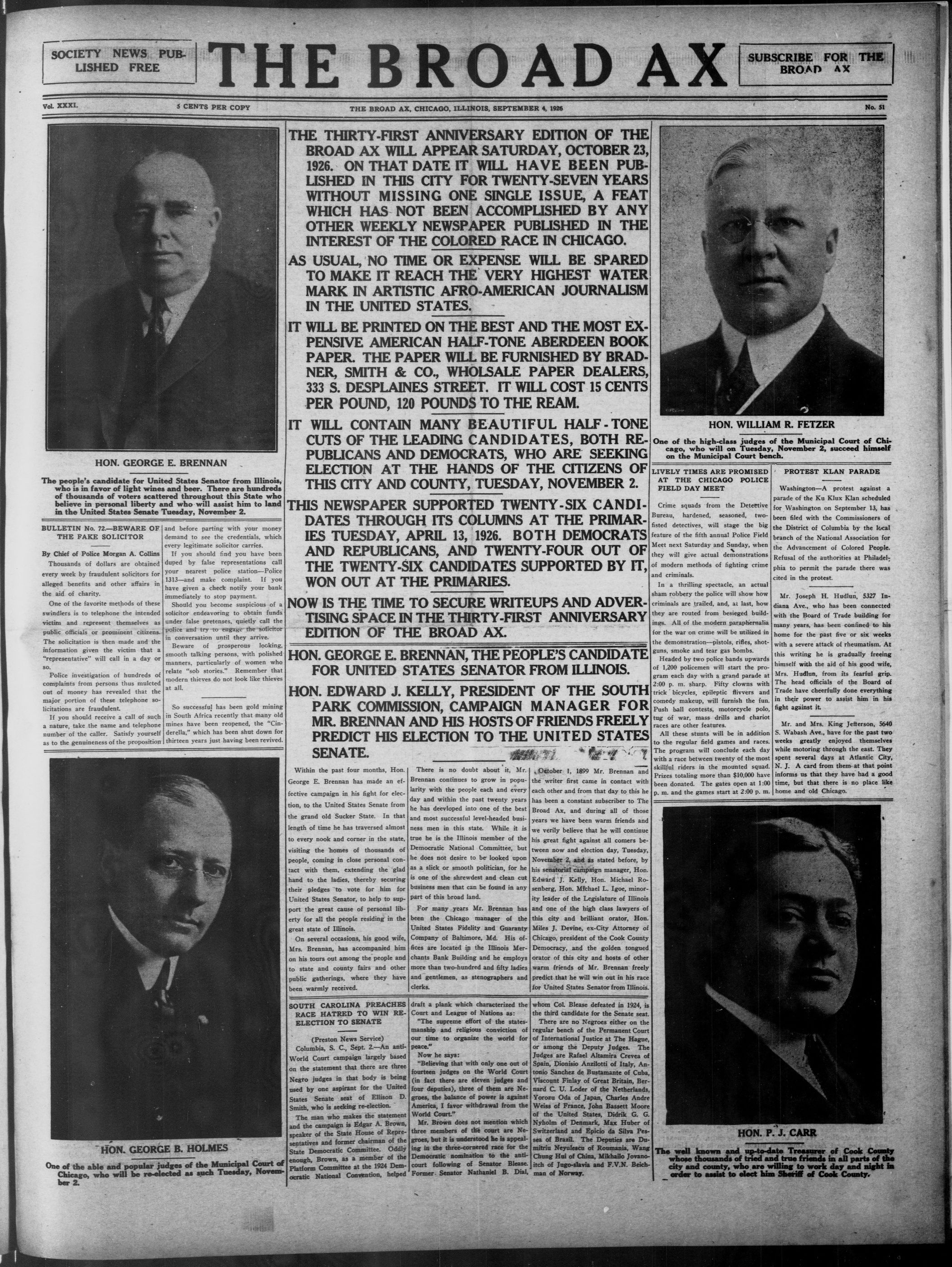
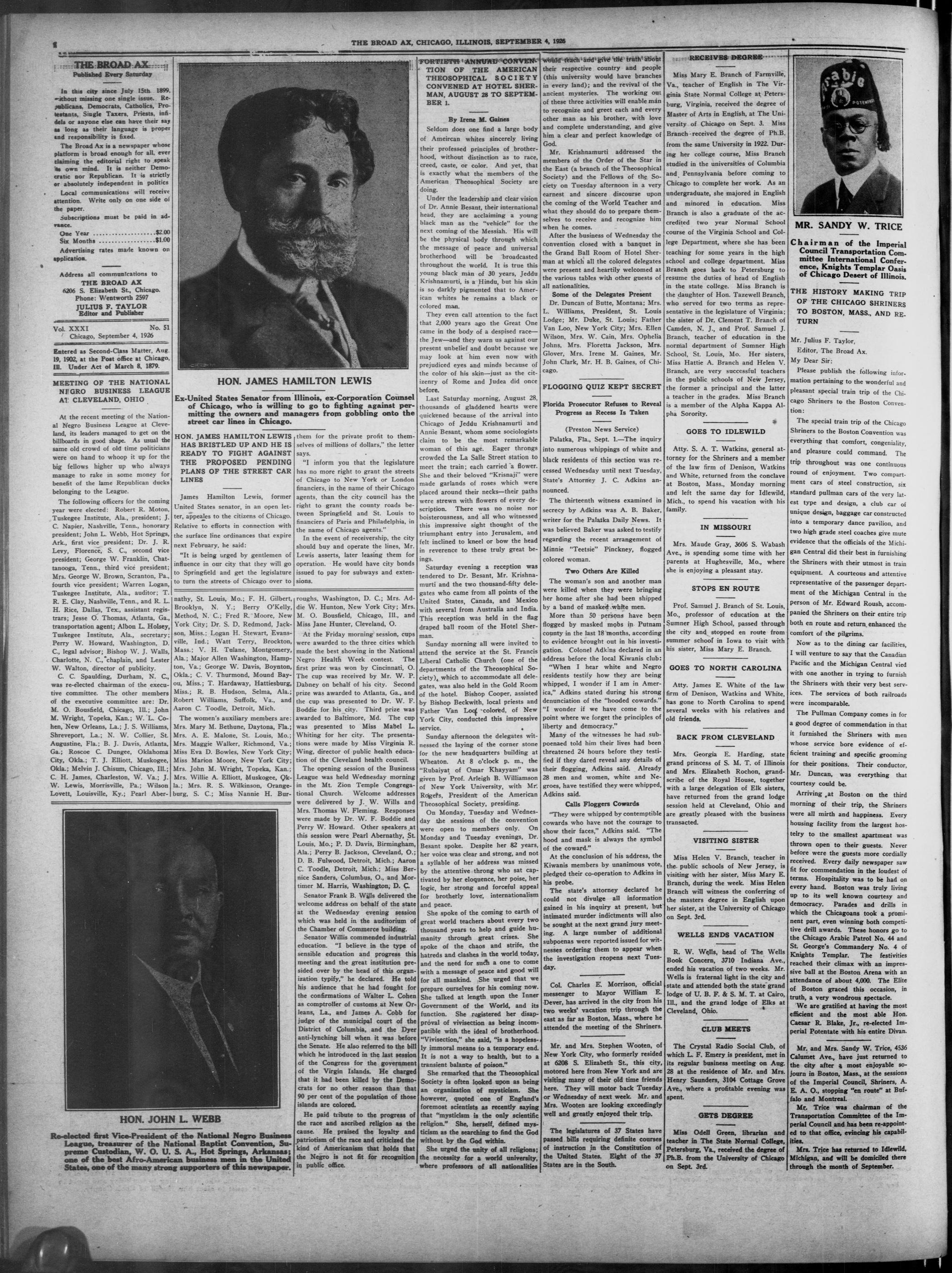
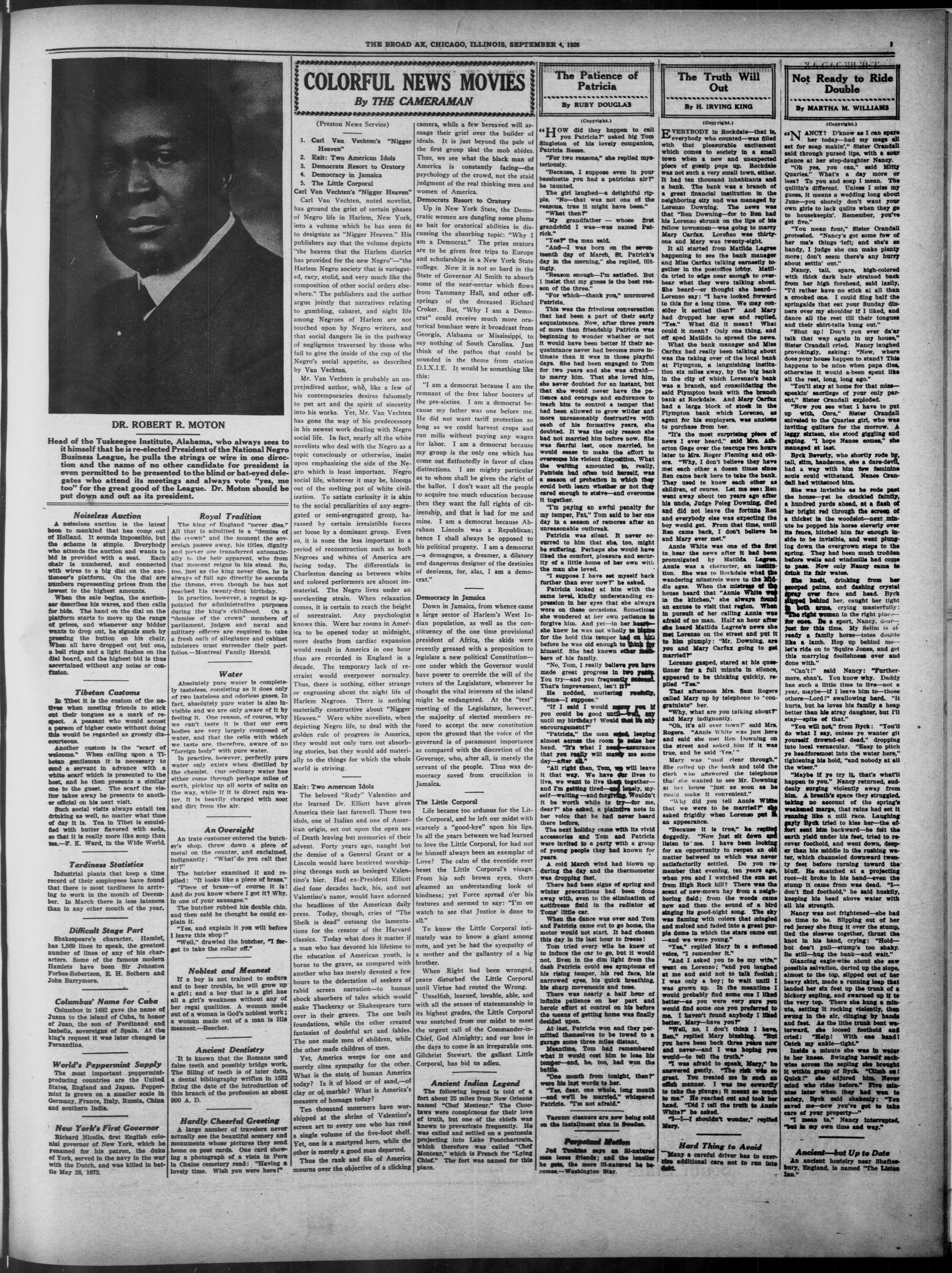
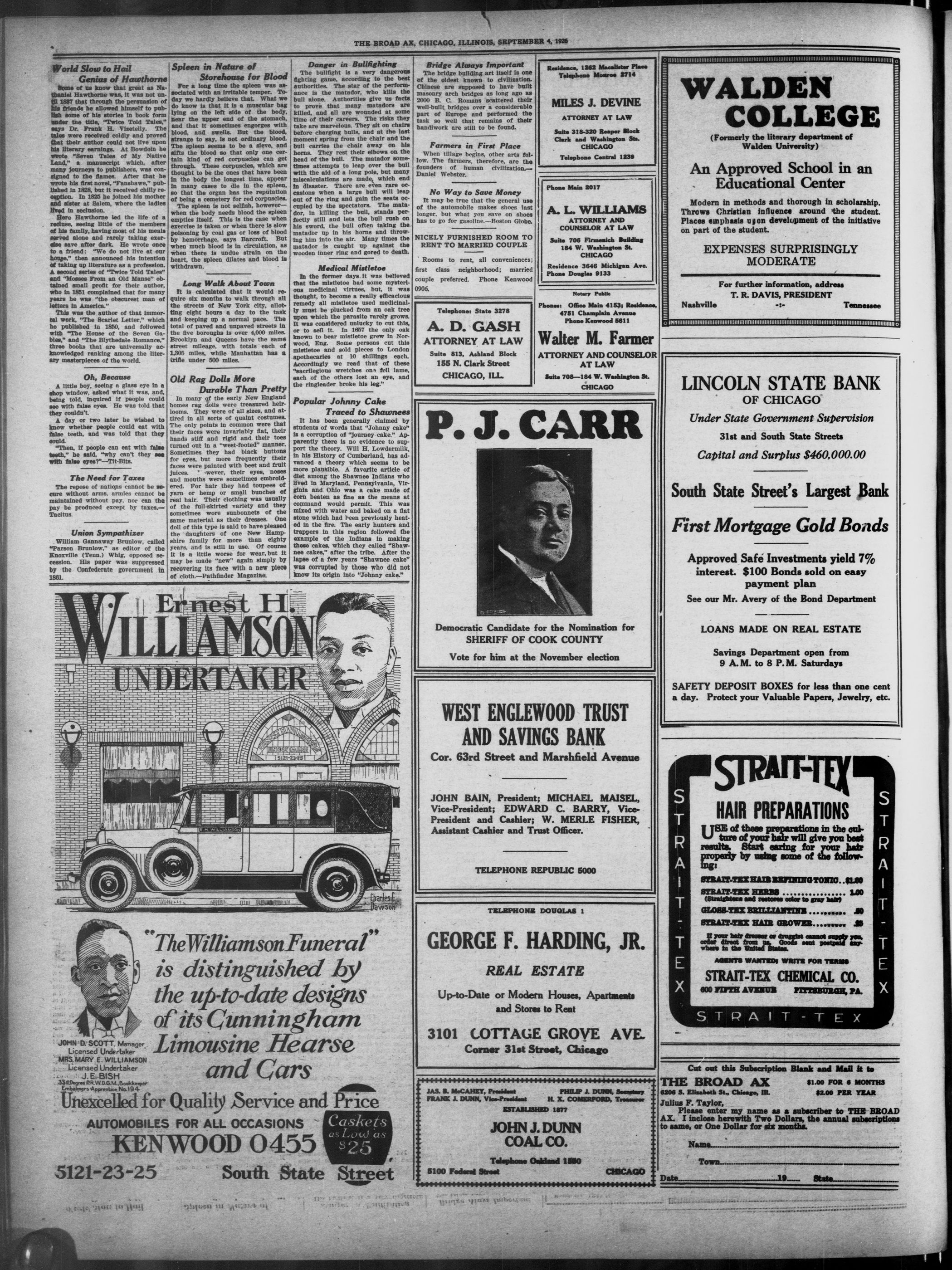
Page text (machine-generated)
SOCIETY NEWS PUBLISHED FREE
Vol. XXXI. $ C
5 CENTS PER
M. B.
The people's candidate for United States Senator who is in favor of light wines and beer. There of thousands of voters scattered throughout to believe in personal liberty and who will assist in the United States Senate Tuesday, November
candidate for United States Senators flavor of light wines and beer. There ends of voters scattered throughout the personal liberty and who will assisted States Senate Tuesday, November
The people's candidate for United States Senator from Illinois, who is in favor of light wines and beer. There are hundreds of thousands of voters scattered throughout this State who believe in personal liberty and who will assist him to land in the United States Senate Tuesday, November 2.
BULLETIN No. 72.—BEWARE OF THE FAKE SOLICITOR
By Chief of Police Morgan A. Collins
Thousands of dollars are obtained every week by fraudulent solicitors for alleged benefits and other affairs in the aid of charity.
One of the favorite methods of these swindlers is to telephone the intended victim and represent themselves as public officials or prominent citizens. The solicitation is then made and the information given the victim that a "representative" will call in a day or so.
Police investigation of hundreds of complaints from persons thus mulleted out of money has revealed that the major portion of these telephone solicitations are fraudulent.
If you should receive a call of such a nature, take the name and telephone number of the caller. Satisfy yourself as to the genuineness of the proposition and before parting with your money demand to see the credentials, which every legitimate solicitor carries.
If you should find you have been duped by false representations call your nearest police station—Police 1313—and make complaint. If you have given a check notify your bank immediately to stop payment.
Should you become suspicious of a solicitor endeavoring to obtain funds under false pretenses, quietly call the police and try to engage the solicitor in conversation until they arrive.
Beware of prosperous looking smooth talking persons, with polished manners, particularly of women who relate "sob stories." Remember that modern thieves do not look like thieves at all.
So successful has been gold mining in South Africa recently that many old mines have been reopened, the "Cinderella," which has been shut down for thirteen years just having been revived
```markdown
```
M. B.
[Name]
HON. GEORGE B. HOLMES
One of the able and popular judges of the Mun Chicago, who will be re-elected as such Tu ber 2.
able and popular judges of the Mun who will be re-elected as such Tu
One of the able and popular judges of the Municipal Court of Chicago, who will be re-elected as such Tuesday, November 2.
United States Senator from Illinois, is and beer. There are hundreds ered throughout this State who and who will assist him to land Tuesday, November 2.
and before parting with your money demand to see the credentials, which every legitimate solicitor carries.
If you should find you have been duped by false representations call your nearest police station—Police 1313—and make complaint. If you have given a check notify your bank immediately to stop payment.
Should you become suspicious of a solicitor endeavoring to obtain funds under false pretenses, quietly call the police and try to engage the solicitor in conversation until they arrive.
Beware of prosperous locking, smooth talking persons, with polished manners, particularly of women who relate "sob stories." Remember that modern thieves do not look like thieves at all.
So successful has been gold mining in South Africa recently that many old mines have been reopened, the "Cinderella," which has been shut down for thirteen years just having been revived.
THE MAYOR OF BROOKLYN
judges of the Municipal Court of
sected as such Tuesday, Novem-
THE BROAD AX
THE BROAD AX, CHICAGO, ILLINOIS, SEPTEMBER 4, 1926
THE THIRTY-FIRST ANNIVERSARY EDITION OF THE BROAD AX WILL APPEAR SATURDAY, OCTOBER 23, 1926. ON THAT DATE IT WILL HAVE BEEN PUBLISHED IN THIS CITY FOR TWENTY-SEVEN YEARS WITHOUT MISSING ONE SINGLE ISSUE, A FEAT WHICH HAS NOT BEEN ACCOMPLISHED BY ANY OTHER WEEKLY NEWSPAPER PUBLISHED IN THE INTEREST OF THE COLORED RACE IN CHICAGO. AS USUAL, NO TIME OR EXPENSE WILL BE SPARED TO MAKE IT REACH THE VERY HIGHEST WATER MARK IN ARTISTIC AFRO-AMERICAN JOURNALISM IN THE UNITED STATES.
IT WILL BE PRINTED ON THE BEST AND THE MOST EXPENSIVE AMERICAN HALF-TONE ABERDEEN BOOK PAPER. THE PAPER WILL BE FURNISHED BY BRADNER, SMITH & CO., WHOLSALE PAPER DEALERS, 333 S. DESPLAINES STREET. IT WILL COST 15 CENTS PER POUND, 120 POUNDS TO THE REAM.
IT WILL CONTAIN MANY BEAUTIFUL HALF-TONE CUTS OF THE LEADING CANDIDATES, BOTH REPUBLICANS AND DEMOCRATS, WHO ARE SEEKING ELECTION AT THE HANDS OF THE CITIZENS OF THIS CITY AND COUNTY, TUESDAY, NOVEMBER 2.
THIS NEWSPAPER SUPPORTED TWENTY-SIX CANDIDATES THROUGH ITS COLUMNS AT THE PRIMARIES TUESDAY, APRIL 13, 1926. BOTH DEMOCRATS AND REPUBLICANS, AND TWENTY-FOUR OUT OF THE TWENTY-SIX CANDIDATES SUPPORTED BY IT, WON OUT AT THE PRIMARIES.
NOW IS THE TIME TO SECURE WRITEUPS AND ADVERTISING SPACE IN THE THIRTY-FIRST ANNIVERSARY EDITION OF THE BROAD AX.
HON. GEORGE E. BRENNAN, THE PEOPLE'S CANDIDATE FOR UNITED STATES SENATOR FROM ILLINOIS.
HON. EDWARD J. KELLY, PRESIDENT OF THE SOUTH PARK COMMISSION, CAMPAIGN MANAGER FOR MR. BRENNAN AND HIS HOSTS OF FRIENDS FREELY PREDICT HIS ELECTION TO THE UNITED STATES
Within the past four months, Hon. George E. Brennan has made an effective campaign in his fight for election, to the United States Senate from the grand old Sucker State. In that length of time he has traversed almost to every nook and corner in the state, visiting the homes of thousands of people, coming in close personal contact with them, extending the glad hand to the ladies, thereby securing their pledges to vote for him for United States Senator, to help to support the great cause of personal liberty for all the people residing in the great state of Illinois.
On several occasions, his good wife, Mrs. Brennan, has accompanied him on his tours out among the people and to state and county fairs and other public gatherings, where they have been warmly received.
SOUTH CAROLINA PREACHES
RACE HATRED TO WIN RE
ELECTION TO SENATE
(Preston News Service)
Columbia, S. C., Sept. 2. An anti-
World Court campaign largely based
on the statement that there are three
Negro judges in that body is being
used by one aspirant for the United
States Senate seat of Ellison D.
Smith, who is seeking re-election.
The man who makes the statement
and the campaign is Edgar A. Brown,
speaker of the State House of Repre-
sentatives and former chairman of the
State Democratic Committee. Oddly
enough, Brown, as a member of the
Platform Committee at the 1924 Democ-
ratic National Convention, helped
There is no doubt about it, Mr. Brennan continues to grow in popularity with the people each and every day and within the past twenty years he has developed into one of the best and most successful level-headed business men in this state. While it is true he is the Illinois member of the Democratic National Committee, but he does not desire to be looked upon as a slick or smooth politician, for he is one of the shrewdest and clean cut business men that can be found in any part of this broad land.
For many years Mr. Brennan has been the Chicago manager of the United States Fidelity and Guaranty Company of Baltimore, Md. His offices are located in the Illinois Merchants Bank Building and he employs more than two-hundred and fifty ladies and gentlemen, as stenographers and clerks.
draft a plank which characterized the Court and League of Nations as:
"The supreme effort of the statesmanship and religious conviction of our time to organize the world for peace."
Now he says:
"Believing that with only one out of fourteen judges on the World Court (in fact there are eleven judges and four deputies), three of them are Negroes, the balance of power is against America, I favor withdrawal from the World Court."
Mr. Brown does not mention which three members of the court are Negroes, but it is understood he is appealing in the three-centered race to the Democratic nomination to the anti-court following of Senator Blease. Former Senator Nathaniel B. Dial,
October 1, 1899 Mr. Brennan and the writer first came in contact with each other and from that day to this he has been a constant subscriber to The Broad Ax, and during all of those years we have been warm friends and we verily believe that he will continue his great fight against all comers between now and election day, Tuesday, November 2, and as stated before, by his senatorial campaign manager, Hon. Edward J. Kelly, Hon. Michael Rosenberg, Hon. Michael L. Igoe, minority leader of the Legislature of Illinois and one of the high class lawyers of this city and brilliant orator, Hon. Miles J. Devine, ex-City Attorney of Chicago, president of the Cook County Democracy, and the golden tongued orator of this city and hosts of other warm friends of Mr. Brennan freely predict that he will win out in his race for United States Senator from Illinois.
whom Col. Blease defeated in 1924, is the third candidate for the Senate seat. There are no Negroes either on the regular bench of the Permanent Court of International Justice at The Hague, or among the Deputy Judges. The Judges are Rafael Altamira Crevea of Spain, Dionisio Anzilotti of Italy, Antonio Sanchez de Bustani of Cuba, Viscount Finlay of Great Britain, Bernard C. U. Loder of the Netherlands, Yorozu Oda of Japan, Charles Andre Weiss of France, John Bassett Moore of the United States, Didrik G. G. Nyholm of Denmark, Max Huber of Switzerland and Epicio da Silva Pessea of Brazil. The Deputies are Dumitriu Neylescu of Roumania, Wang Chung Hui of China, Mikhailo Jovanoitch of Jugo-slavia and F.V.N. Beichman of Norway.
SUBSCRIBE FOR THE BROAD AX
A.
No. 51
C. B. C.
HON. WILLIAM R. FETZER
high-class judges of the Municipal
will on Tuesday, November 2, st
national Court bench.
Judges of the Municipal Court of Chi-Tuesday, November 2, succeed himself court bench.
IMISED POLICE PROTEST KLAN PARADE
LIVELY TIMES ARE PROMISED AT THE CHICAGO POLICE FIELD DAY MEET
Crime squads from the Detective Bureau, hardened, seasoned, two-fisted detectives, will stage the big feature of the fifth annual Police Field Meet next Saturday and Sunday, when they will give actual demonstrations of modern methods of fighting crime and criminals.
In a thrilling spectacle, an actual sham robbery the police will show how criminals are trailed, and, at last, how they are routed from besieged buildings. All of the modern paraphernalia for the war on crime will be utilized in the demonstration—pistols, rifles, shotguns, smoke and tear gas bombs.
PROTEST KLAN PARADE
Washington—A protest against a parade of the Ku Klux Klan scheduled for Washington on September 13, has been filed with the Commissioners of the District of Columbia by the local branch of the National Association for the Advancement of Colored People. Refusal of the authorities at Philadelphia to permit the parade there was cited in the protest.
Mr. Joseph H. Hudlun, 5327 Indiana Ave., who has been connected with the Board of Trade building for many years, has been confined to his home for the past five or six weeks with a severe attack of rheumatism. At
Headed by two police bands upwards of 1,200 policemen will start the program each day with a grand parade at 2:00 p. m. sharp. Fifty clowns with trick bicycles, epileptic flivvers and comedy makeup, will furnish the fun. Push ball contests, motorcycle polo, tug of war, mass drills and chariot races are other features. All these stunts will be in addition to the regular field games and races. The program will conclude each day with a race between twenty of the most skillful riders in the mounted squad. Prizes totaling more than $10,000 have been donated. The gates open at 1:00 p. m. and the games start at 2:00 p. m.
M.
M.
HON. P. J. CARR
own and up-to-date Treasurer of
thousands of tried and true friends in
county, who are willing to work de
assist to elect him Shetiff of Cook
up-to-date Treasurer of Cook County tried and true friends in all parts of the so are willing to work day and night in elect him Sheriff of Cook County.
The well known and up-to-date Treasurer of Cook County whose thousands of tried and true friends in all parts of the city and county, who are willing to work day and night in order to assist to elect him Sheriff of Cook County.
Washington—A protest against a parade of the Ku Klux Klan scheduled for Washington on September 13, has been filed with the Commissioners of the District of Columbia by the local branch of the National Association for the Advancement of Colored People. Refusal of the authorities at Philadelphia, phia to permit the parade there was cited in the protest.
Mr. Joseph H. Hudlun, 5327 Indiana Ave., who has been connected with the Board of Trade building for many years, has been confined to his home for the past five or six weeks with a severe attack of rheumatism. At this writing he is gradually freeing himself with the aid of his good wife, Mrs. Hudlun, from its fearful grip. The head officials of the Board of Trade have cheerfully done everything in their power to assist him in his fight against it.
Mr. and Mrs. King Jefferson, 5640 S. Wabash Ave., have for the past two weeks greatly enjoyed themselves while motoring through the east. They spent several days at Atlantic City, N. J. A card from them-at that point informs us that they have had a good time, but that there is no place like home and old Chicago.
In this city since July 15th, 1899, without missing one single issue. Republicans, Democrats, Catholics, Protestants, Single Taxers, Priests, infidels or anyone else can have their say as long as their language is proper and responsibility is fixed.
The Broad Ax is a newspaper whose platform is broad enough for all, ever claiming the editorial right to speak its own mind. It is neither Democratic nor Republican. It is strictly or absolutely independent in politics. Local communications will receive attention. Write only on one side of the paper.
Subscriptions must be paid in advance.
One Year .....$2.00
Six Months .....$1.00
Advertising rates made known on application.
Address all communications to
THE BROAD AX
6206 S. Elizabeth St., Chicago.
Phone: Wentworth 2597
JULIUS F. TAYLOR
Editor and Publisher
Vol. XXXI No. 51
Chicago, September 4, 1926
Entered as Second-Class Matter, Aug.
19, 1902, at the Post office at Chicago,
Ill. Under Act of March 8, 1879.
MEETING OF THE NATIONAL
NIJGRO BUSINESS LEAGUE
AT CLEVELAND, OHIO
At the recent meeting of the National Negro Business League at Cleveland, its leaders managed to get on the billboards in good shape. As usual the same old crowd of old time politicians were on hand to whoop it up for the big fellows higher up who always manage to rake in some money for benefit of the lame Republican ducks belonging to the League.
The following officers for the coming year were elected: Robert R. Moton, Tuskegee Institute, Ala., president; J. C. Napier, Nashville, Tenn., honorary president; John L. Webb, Hot Springs, Ark; first vice president; Dr. J. R. Levy, Florence, S. C., second vice president; George W. Franklin, Chattanooga, Tenn., third vice president; Mrs. George W. Brown, Scranton, Pa., fourth vice president; Warren Logan, Tuskegee Institute, Ala., auditor; T. R. E. Clay, Nashville, Tenn., and R. L. H. Rice, Dallas, Tex., assistant registrars; Jesse O. Thomas, Atlanta, Ga., transportation agent; Albon L. Holsey, Tuskegee Institute, Ala., secretary; Perry W. Howard, Washington, D.C., legal advisor; Bishop W. J. Walls, Charlotte, N. C., chaplain, and Lester W. Walton, director of publicity.
C. C. Spaulding, Durham, N. C., was re-elected chairman of the executive committee. The other members of the executive committee are: Dr. M. O. Bousfield, Chicago, Ill.; John M. Wright, Topeka, Kan.; W. L. Cohen, New Orleans, La.; J. S. Williams, Shreveport, La.; N. W. Collier, St. Augustine, Fla.; B. J. Davis, Atlanta, Ga.; Roscoe C. Dungee, Oklahoma City, Okla.; T. J. Elliott, Muskogee, Okla.; Melvin J. Chisum, Chicago, Ill.; C. H. James, Charleston, W. Va.; J. W. Lewis, Morrisville, Pa.; Wilson Lovett, Louisville, Ky.; Pearl Aler-
---
M. B.
HON. JOHN L. WEBB
Re-elected first Vice-President of the National League, treasurer of the National Baptist supreme Custodian, W. O. U. S. A., Hot S one of the best Afro-American business States, one of the many strong supporters
Re-elected first Vice-President of the National Negro Business League, treasurer of the National Baptist Convention, Supreme Custodian, W. O. U. S. A., Hot Springs, Arkansas; one of the best Afro-American business men in the United States, one of the many strong supporters of this newspaper.
1917
Ex-United States Senator from Illinois, ex-Corporation Counsel of Chicago, who is willing to go to fighting against permitting the owners and managers from gobbling onto the street car lines in Chicago.
HON. JAMES HAMILTON LEWIS HAS BRISTLED UP AND HE IS READY TO FIGHT AGAINST THE PROPOSED PENDING PLANS OF THE STREET CAR LINES
James Hamilton Lewis, former United States senator, in an open letter, appelles to the citizens of Chicago. Relative to efforts in connection with the surface line ordinances that expire next February, he said:
them for the private profit to themselves of millions of dollars," the letter says.
"I inform you that the legislature has no more right to grant the streets of Chicago to New York or London financiers, in the name of their Chicago agents, than the city council has the right to grant the county roads between Springfield and St. Louis to financiers of Paris and Philadelphia, in the name of Chicago agents."
In the event of receivership, the city should buy and operate the lines. Mr
"It is being urged by gentlemen of influence in our city that they will go to Springfield and get the legislature to turn the streets of Chicago over to nathy, St. Louis, Mo.; F. H. Gilbert, Brooklyn, N. Y.; Berry O'Kelly, Method, N. C.; Fred R. Moore, New York City; Dr. S. D. Redmond, Jackson, Miss.; Logan H. Stewart, Evansville, Ind.; Watt Terry, Brockton, Mass.; V. H. Tulane, Montgomery, Ala.; Major Allen Washington, Hampton, Va.; George W. Davis, Boynton, Okla.; C. V. Thurmond, Mound Bayou, Miss.; T. Hardaway, Hattiesburg, Miss.; R. B. Hudson, Selma, Ala.; Robert Williams, Suffolk, Va., and Aaron C. Toodle, Detroit, Mich.
The women's auxiliary members are:
Mrs. Mary M. Bethune, Daytona, Fla.;
Mrs. A. E. Malone, St. Louis, Mo.
Mrs. Maggie Walker, Richmond, Va.
Miss Eva D. Bowles, New York City
Miss Marion Moore, New York City
Mrs. John M. Wright, Topeka, Kan.
Mrs. Willie A. Elliott, Muskogee, Qkla.; Mrs. R. S. Wilkinson, Orangeburg, S. C.; Mrs. Nannie H. Bur-
```markdown
```
of the National Negro Business National Baptist Convention, Su S. A., Hot Springs, Arkansas; can business men in the United ing supporters of this newspaper.
HON. JAMES HAMILTON LEWIS
THE BROAD AX, CHICAGO, ILLINOIS, SEPTEMBER 4, 1925
them for the private profit to themselves of millions of dollars," the letter says.
"I inform you that the legislature has no more right to grant the streets of Chicago to New York or London financiers, in the name of their Chicago agents, than the city council has the right to grant the county roads between Springfield and St. Louis to financiers of Paris and Philadelphia, in the name of Chicago agents."
In the event of receivership, the city should buy and operate the lines, Mr. Lewis asserts, later leasing them for operation. He would have city bonds issued to pay for subways and extensions.
roughs, Washington, D. C.; Mrs. Addie W. Hunton, New York City; Mrs. M. O. Bousfield, Chicago, Ill., and Miss Jane Hunter, Cleveland, O.
die W. Hunton, New York City; Mrs. M. O. Bousfield, Chicago, Ill., and Miss Jane Hunter, Cleveland, O.
At the Friday morning session, cups were awarded to the three cities which made the best showing in the National Negro Health Week contest. The first prize was won by Cincinnati, O. The cup was received by Mr. W. P. Dabney on behalf of his city. Second prize was awarded to Atlanta, Ga., and the cup was presented to Dr. W. F. Boddie for his city. Third prize was awarded to Baltimore, Md. The cup was presented to Miss Mabel L. Whiting for her city. The presentations were made by Miss Virginia R. Wing, director of public health education of the Cleveland health council.
The opening session of the Business League was held Wednesday morning in the Mt. Zion Temple Congregational Church. Welcome addresses were delivered by J. W. Wills and Mrs. Thomas W. Fleming. Responses were made by Dr. W. F. Boddie and Perry W. Howard. Other speakers at this session were Pearl Abernathy, St. Louis, Mo.; P. D. Davis, Birmingham, Ala.; Perry B. Jackson, Cleveland, O.; D. B. Fulwood, Detroit, Mich.; Aaron C. Toodle, Detroit, Mich.; Miss Bernice Sanders, Columbus, O., and Mortimer M. Harris, Washington, D. C. Senator Frank B. Wills delivered the welcome address on behalf of the state at the Wednesday evening session which was held in the auditorium of the Chamber of Commerce building.
Senator Willis commended industrial education. "I believe in the type of sensible education and progress this meeting and the great institution presided over by the head of this organization typify," he declared. He told his audience that he had fought for the confirmations of Walter L. Cohen as comptroller of customs at New Orleans, La., and James A. Cobb for judge of the municipal court of the District of Columbia, and the Dyer anti-lynching bill when it was before the Senate. He also referred to the bill which he introduced in the last session of the Congress for the government of the Virgin Islands. He charged that it had been killed by the Democrats for no other reason than that 90 per cent of the population of those islands are colored.
He paid tribute to the progress of the race and ascribed religion as the cause. He praised the loyalty and patriotism of the race and criticized the kind of Americanism that holds that the Negro is not fit for recognition in public office.
FORTIETR ANNUAL CONVENTION OF THE AMERICAN THEOSOPHICAL SOCIETY CONVENED AT HOTEL SHERMAN, AUGUST 28 TO SEPTEMBER 1.
By Irene M. Gaines
Seldom does one find a large body of Ameircan whites sincerely living their professed principles of brotherhood, without distinction as to race, creed, caste, or color. And yet, that is exactly what the members of the American Theosophical Society are doing.
Under the leadership and clear vision of Dr. Annie Besant, their international head, they are acclaiming a young black man as the "vehicle" for the next coming of the Messiah. His will be the physical body through which the message of peace and universal brotherhood will be broadcasted throughout the world. It is true this young black man of 30 years, Jeddu Krishnamurti, is a Hindu, but his skin is so darkly pigmented that to American whites he remains a black or colored man.
They even call attention to the fact that 2,000 years ago the Great One came in the body of a despised race—the Jew—and they warn us against our present unbelief and doubt because we may look at him even now with prejudiced eyes and minds because of the color of his skin—just as the citizenry of Rome and Judea did once before.
Last Saturday morning, August 28, thousands of gladdened hearts were quickened because of the arrival into Chicago of Jeddu Krishnamurti and Annie Besant, whom some sociologists claim to be the most remarkable woman of this age. Eager throngs crowded the La Salle Street station to meet the train; each carried a flower. She and their beloved "Krisnaji" were made garlands of roses which were placed around their necks—their paths were strewed with flowers of every description. There was no noise nor boisterousness, and all who witnessed this impressive sight thought of the triumphant entry into Jerusalem, and felt inclined to kneel or bow the head in reverence to these truly great beings.
Saturday evening a reception was tendered to Dr. Besant, Mr. Krishnamurti and the two thousand-fifty delegates who came from all points of the United States, Canada, and Mexico with several from Australia and India. This reception was held in the flag draped ball room of the Hotel Sherman.
Sunday morning all were invited to attend the service at the St. Francis Liberal Catholic Church (one of the departments of the Theosophical Society), which to accommodate all delegates, was also held in the Gold Room of the hotel. Bishop Cooper, assisted by Bishop Beckwith, local priests and Father Van Loc, colored, of New York City, conducted this impressive service.
Sunday afternoon the delegates witnessed the laying of the corner stone for the new headquarters building at Wheaton. At 8 o'clock p. m., the "Rubaiyat of Omar Khayyam" was given by Prof. Arleigh B. Williamson of New York University, with Mr. Rogers, President of the American Theosophical Society, presiding. On Monday, Tuesday and Wednesday the sessions of the convention were open to members only. On Monday and Tuesday evenings, Dr. Besant spoke. Despite her 82 years, her voice was clear and strong, and not a syllable of her address was missed by the attentive throng who sat captivated by her eloquence, her poise, her logic, her strong and forceful appeal for brotherly love, internationalism and peace.
She spoke of the coming to earth of great world teachers about every two thousand years to help and guide humanity through great crises. She spoke of the chaos and strife, the hatreds and clashes in the world today, and the need for such a one to come with a message of peace and good will for all mankind. She urged that we prepare ourselves for his coming now. She talked at length upon the Inner Government of the World, and its function. She registered her disapproval of vivissection as being incompatible with the ideal of brotherhood. "Vivissection," she said, "is a hopelessly immoral means to a temporary end. It is not a way to health, but to a transient balance of poison."
She remarked that the Theosophical Society is often looked upon as being an organization of mysticism. She however, quoted 'one of England's foremost scientists as recently saying that "mysticism is the only scientific religion." She, herself, defined mysticism as the searching to find the God without by the God within.
She urged the unity of all religions; the necessity for a world university, where professors of all nationalities
would teach and give the truth about their respective country and people (this university would have branches in every land); and the revival of the ancient mysteries. The working out of these three activities will enable man to recognize and greet each and every other man as his brother, with love and complete understanding, and give him a clear and perfect knowledge of God.
Mr. Krishnamurti addressed the members of the Order of the Star in the East (a branch of the Theosophical Society) and the Fellows of the Society on Tuesday afternoon in a very earnest and sincere discourse upon the coming of the World Teacher and what they should do to prepare themselves to receive and recognize him when he comes.
After the business of Wednesday the convention closed with a banquet in the Grand Ball Room of Hotel Sherman at which all the colored delegates were present and heartily welcomed at the various tables with other guests of all nationalities.
Some of the Delegates Present
Dr. Duncan of Butte, Montana; Mrs. L. Williams, President, St. Louis Lodge; Mr. Duke, St. Louis; Father Van Loo, New York City; Mrs. Ellen Wilson, Mrs. W. Cain, Mrs. Ophelia Johns, Mrs. Floretta Jackson, Mrs Glover, Mrs. Irene M. Gaines, Mr John Clark, Mr. H. B. Gaines, of Chicago.
FLOGGING QUIZ KEPT SECRET
Florida Prosecutor Refuses to Reveal Progress as Recess Is Taken
(Preston News Service)
Palatka, Fla., Sept. 1.—The inquiry into numerous whippings of white and black residents of this section was recessed Wednesday until next Tuesday, State's Attorney J. C. Adkins announced. The thirteenth witness examined in secrecy by Adkins was A. B. Baker, writer for the Palatka Daily News. It was believed Baker was asked to testify regarding the recent arrangement of Minnie "Teetsie" Pinckney, flogged colored woman.
Two Others Are Killed
The woman's son and another man were killed when they were bringing her home after she had been shipped by a band of masked white men.
More than 50 persons have been flogged by masked mobs in Putnam county in the last 18 months, according to evidence brought out in his investigation. Colonel Adkins declared in an address before the local Kiwanis club: "When I hear white and Negro residents testify how they are being whipped, I wonder if I am in America," Adkins stated during his strong denunciation of the "hooded cowards." "I wonder if we have come to the point where we forget the principles of liberty and democracy."
Many of the witnesses he had subpoenaed told him their lives had been threatened 24 hours before they testified if they dared reveal any details of their flogging, Adkins said. Already 28 men and women, white and Negroes, have testified they were whipped, Adkins said.
Calls Floggers Cowards
"They were whipped by contemptible cowards who have not the courage to show their faces," Adkins said. "The hood and mask is always the symbol of the coward."
At the conclusion of his address, the Kiwanis members by unanimous vote, pledged their co-operation to Adkins in his probe.
The state's attorney declared he could not divulge all information gained in his inquiry at present, but intimated murder indictments will also be sought at the next grand jury meeting. A large number of additional subpoenas were reported issued for witnesses ordering them to appear when the investigation reopens next Tuesday.
Col. Charles E. Morrison, official messenger to Mayor William E. Dever, has arrived in the city from his two weeks' vacation trip through the east as far as Boston, Mass., where he attended the meeting of the Shriners.
Mr. and Mrs. Stephen Wooten, of New York City, who formerly resided at 620 S. Elizabeth St., this city, motored here from New York and are visiting many of their old time friends here. They will motor back Tuesday or Wednesday of next week. Mr. and Mrs. Wooten are looking exceedingly well and greatly enjoyed their trip.
The legislatures of 37 States have passed bills requiring definite courses of instruction in the Constitution of the United States. Eight of the 37 States are in the South.
Miss Mary E. Branch of Farmville, Va., teacher of English in The Virginia State Normal College at Petersburg, Virginia, received the degree of Master of Arts in English, at The University of Chicago on Sept. 3. Miss Branch-received the degree of Ph.B. from the same University in 1922. During her college course, Miss Branch studied in the universities of Columbia and Pennsylvania before coming to Chicago to complete her work. As an undergraduate, she majored in English and minored in education. Miss Branch is also a graduate of the accredited two year Normal School course of the Virginia School and College Department, where she has been teaching for some years in the high school and college department. Miss Branch goes back to Petersburg to resume the duties of head of English in the state college. Miss Branch is the daughter of Hon. Tazewell Branch, who served for two terms as representative in the legislature of Virginia; the sister of Dr. Clement T. Branch of Camden, N. J., and Prof. Samuel J. Branch, teacher of education in the normal department of Sumner High School, St. Louis, Mo. Her sisters, Miss Hattie A. Branch and Helen V. Branch, are very successful teachers in the public schools of New Jersey, the former a principal and the latter a teacher in the grades. Miss Branch is a member of the Alpha Kappa Alpha Sorority.
GOES TO IDLEWILD
Atty. S. A. T. Watkins, general attorney for the Shriners and a member of the law firm of Denison, Watkins and White, returned from the conclave at Boston, Mass., Monday morning and left the same day for Idlewild, Mich., to spend his vacation with his family.
IN MISSOURI
Mrs. Maude Gray, 3606 S. Wabash Ave., is spending some time with her parents at Hughesville, Mo., where she is enjoying a pleasant stay.
STOPS EN ROUTE
Prof. Samuel J. Branch of St. Louis, Mo., professor of education at the Sumner High School, passed through the city and stopped en route from summer school in Iowa to visit with his sister, Miss Mary E. Branch.
GOES TO NORTH CAROLINA
Atty. James E. White of the law firm of Denison, Watkins and White, has gone to North Carolina to spend several weeks with his relatives and old friends.
BACK FROM CLEVELAND
Mrs. Georgia E. Harding, state grand princess of S. M. T. of Illinois and Mrs. Elizabeth Rochon, grand-scribe of the Royal House, together with a large delegation of Elk sisters, have returned from the grand lodge session held at Cleveland, Ohio and are greatly pleased with the business transacted.
VISITING SISTER
Miss Helen V. Branch, teacher in the public schools of New Jersey, is visiting with her sister, Miss Mary E. Branch, during the week. Miss Helen Branch will witness the conferring of the masters degree in English upon her sister, at the University of Chicago on Sept. 3rd.
WELLS ENDS VACATION
R. W. Wells, head of The Wells Book Concern, 3710 Indiana Ave. ended his vacation of two weeks. Mr. Wells is fraternal light in the city and state and attended both the state grand lodge of U. B. F. & S. M. T. at Cairo III, and the grand lodge of Elks at Cleveland, Ohio.
CLUB MEETS
The Crystal Radio Social Club, of which L. F. Emery is president, met in its regular business meeting on Aug. 28 at the residence of Mr. and Mrs. Henry Saunders, 3104 Cottage Grove Ave., where a profitable evening was spent.
GETS DEGREE
Miss Odell Green, librarian and teacher in The State Normal College, Petersburg, Va., received the degree of Ph.B. from the University of Chicago on Sept. 3rd.
Prabie
POTENTIAL
MR. SANDY W. TRICE
Chairman of the Imperial Council Transportation Committee International Conference, Knights Templar Oasis of Chicago Desert of Illinois.
THE HISTORY MAKING TRIP OF THE CHICAGO SHRINERS TO BOSTON, MASS., AND RETURN
Mr. Julius F. Taylor,
Editor, The Broad Ax.
My Dear Sir:
Please publish the following information pertaining to the wonderful and pleasant special train trip of the Chicago Shriners to the Boston Convention:
The special train trip of the Chicago Shriners to the Boston Convention was everything that comfort, congeniality, and pleasure could command. The trip throughout was one continuous round of enjoyment. Two compartment cars of steel construction, six standard pullman cars of the very latest type and design, a club car of unique design, baggage car constructed into a temporary dance pavilion, and two high grade steel coaches give mute evidence that the officials of the Michigan Central did their best in furnishing the Shriners with their utmost in train equipment. A courteous and attentive representative of the passenger department of the Michigan Central in the person of Mr. Edward Roush, accompanied the Shriners on their entire trip both en route and return, enhanced the comfort of the pilgrims.
Now as to the dining car facilities, I will venture to say that the Canadian Pacific and the Michigan Central vied with one another in trying to furnish the Shriners with their very best services. The services of both railroads were incomparable.
The Pullman Company comes in for a good degree of commendation in that it furnished the Shriners with men whose service bore evidence of efficient training and specific grooming for their positions. Their conductor, Mr. Duncan, was everything that courtesy could be.
Arriving at Boston on the third morning of their trip, the Shriners were all mirth and happiness. Every housing facility from the largest hostelry to the smallest apartment was thrown open to their guests. Never before were the guests more cordially received. Every daily newspaper saw fit for commendation in the loudest of terms. Hospitality was to be had on every hand. Boston was truly living up to its well known courtesy and democracy. Parades and drills in which the Chicagoans took a prominent part, even winning both competitive drill awards. These honors go to the Chicago Arabic Patrol No. 44 and St. George's Commandery No. 4 of Knights Templar. The festivities reached their climax with an impressive ball at the Boston Arena with an attendance of about 4,000. The Elite of Boston graced this occasion, in truth, a very wondrous spectacle.
We are gratified at having the most efficient and the most able Hon. Caesar R. Blake, Jr., re-elected Imperial Potentate with his entire Divan.
Mr. and Mrs. Sandy W. Trice, 4536 Calumet Ave., have just returned to the city after a most enjoyable sojourn in Boston, Mass., at the sessions of the Imperial Council, Shriners, A. E. A. O., stopping "en route" at Buffalo and Montreal.
Mr. Trice was chairman of the Transportation Committee of the Imperial Council and has been re-appointed to that office, evincing his capabilities.
Mrs. Trice has returned to Idlewild, Michigan, and will be domiciled there through the month of September.
[Name]
DR. ROBERT R. MOTON
Head of the Tuskegee Institute it himself that he is re-elected Business League, he pulls the tion and the name of no o even permitted to be present gates who attend its meet too" for the great good of t put down and out as its pr
Head of the Tukeegee Institute, Alabama, who always sees to it himself that he is re-elected President of the National Negro Business League, he pulls the strings or wire in one direction and the name of no other candidate for president is even permitted to be presented to the blind or bat-eyed delegates who attend its meetings and always vote "yes, me too" for the great good of the League. Dr. Moton should be put down and out as its president.
Noiseless Auction
A noteless auction is the latest boon to mankind that has come out of Holland. It sounds impossible, but the scheme is simple. Everybody who attends the auction and wants to bid is provided with a seat. Each chair is numbered, and connected with wires to a big dial on the auctioneer's platform. On the dial are numbers representing prices from the lowest to the highest amounts.
When the sale begins, the auctioneer describes his warres, and then calls for bids. The hand on the dial on the platform starts to move up the range of prices, and whenever any biddler wants to drop out, he signals such by pressing the button on his chair.
When all have dropped out but one, a bell rings and a light flashes on the dial board, and the highest bid is thus ascertained without any noise or confusion.
Tibetan Customs
In Tibet it is the custom of the natives when meeting friends to stick out their tongues as a mark of respect. A peasant who would accost a person of higher caste without doing this would be regarded as grossly discountous. Another custom is the "scarf of welcome." When calling upon a Tibetan gentleman it is necessary to send a servant in advance with a white scarf which is presented to the host, and he then presents a similar one to the guest. The scarf the visitor takes away he presents to another official on his next visit. Such social visits always entail tea drinking as well, no matter what time of day it is. Tea in Tibet is emulsified with butter flavored with soda, so that it is really more like soup than tea.—F. K. Ward, in the Wide World.
Tardiness Statistics
Industrial plants that keep a time record of their employees have found that there is most tardiness in arriving to work in the month of December. In March there is less lateness than in any other month of the year.
Difficult Stage Part
Shakespeare's character, Hamlet, has 1,569 lines to speak, the greatest number of lines of any of his characters. Some of the famous modern Hamlets have been Sir Johnston Forbes-Robertson, E. H. Sothern and John Barrmore.
Columbus' Name for Cuba
Columbus in 1492 gave the name of Juana to the island of Cuba, in honor of Juan, the son of Ferdinand and Isabella, sovereigns of Spain. At the king's request it was later changed to Fernandina.
World's Peppermint Supply
The most important peppermint-producing countries are the United States, England and Japan. Peppermint is grown on a smaller scale in Germany, France, Italy, Russia, China and southern India.
Richard Nicolls, first English colonial governor of New York, which he renamed for his patron, the duke of York, served in the navy in the war with the Dutch, and was killed in battle May 28, 1672.
he, Alabama, who always sees to
President of the National Negro
the strings or wire in one direc-
ther candidate for president is
ted to the blind or bat-eyed dele-
lings and always vote "yes, me
the League. Dr. Moton should be
president.
Royal Tradition
The king of England "never dies." All that is admitted is a "demise of the crown" and the moment the sovereign passes away, his titles, dignity and power are transferred automatically to the heir apparent, who from that moment reigns in his stead. So, too, just as the king never dies, he is always of full age directly he ascends the throne, even though he has not reached his twenty-first birthday. In practice, however, a regent is appointed for administrative purposes during the king's childhood. On a "demise of the crown" members of parliament, judges and naval and military officers are required to take a fresh oath of allegiance and cabinet ministers must surrender their portfolios—Montreal Family Herald.
Absolutely pure water is completely tasteless, consisting as it does only of two tasteless and odorless gases. In fact, absolutely pure water is also invisible and we are only aware of it by feeling it. One reason, of course, why we can't taste it is that our own bodies are very largely composed of water, and that the cells with which we taste are, therefore, aware of no "foreign body" with pure water. In practice, however, perfectly pure water only exists when distilled by the chemist. Our ordinary water has either come through perhaps miles of earth, picking up all sorts of salts on the way, while if it is direct rain water, it is heavily charged with soot and dirt from the air.
An irate customer entered the butcher's shop, threw down a piece of metal on the counter, and exclaimed, indignantly: "What do you call that sir?"
The butcher examined it and replied: "It looks like a piece of brass." "Piece of brass—of course it is! And do you know where I got it? Why, in one of your sausages." The butcher rubbed his double chin, and then said he thought he could explain it.
"Yes, and explain it you will before I leave this shop!"
"Well," drawled the butcher, "I forgot to take the collar off."
Noblest and Meanest
If a boy is not trained to endure and to bear trouble, he will grow up a girl; and a boy that is a girl has all a girl's weakness without any of her regal qualities. A woman made out of a woman is God's noblest work; a woman made out of a man is His meanest—Beecher.
Ancient Dentistry
It is known that the Romans used false teeth and possibly bridge work. The filling of teeth is of later date, a dental bibliography written in 1532 fixing the date of the introduction of this branch of the profession as about 900 A. D.
Hardly Cheerful Greeting
A large number of travelers never actually see the beautiful scenery and monuments whose pictures they send home on post cards. One card showing a photograph of a vista in Pere la Chalse cemetery read: "Having a lovely time. Wish you were here!"
Water
An Oversight
THE BROAD AX. CHICAGO. ILLINOIS. SEPTEMBER 4. 1926
COLORFUL NEWS MOVIES By THE CAMERAMAN
(Preston News Service)
1. Carl Van Vechten's "Niggen
Heaven"
2. Exit: Two American Idols
5. The Little Corporal Carl Van Vechten's "Nigger Heaven"
Carl Van Vechten, noted novelist, has ground the grist of certain phases of Negro life in Harlem, New York, into a volume which he has seen fit to designate as "Nigger Heaven." His publishers say that the volume depicts "the heaven that the Harlem district has provided for the new Negro"—"the Harlem Negro society that is variegated, racy, stolid, and very much like the composition of other social orders elsewhere." The publishers and the author argue jointly that narratives relating to gambling, cabaret, and night life among Negroes of Harlem are not touched upon by Negro writers, and that social dangers lie in the pathway of negligence traversed by those who fail to give the inside of the cup of the Negro's social appetite, as described by Van Vechten.
Mr. Van Vechten is probably an unprejudiced author, who, like a few of his contemporaries desires fulsomely to put art and the spirit of sincerity into his works. Yet, Mr. Van Vechten has gone the way of his predecessors in his newest work dealing with Negro social life. In fact, nearly all the white novelists who deal with the Negro as a topic consciously or otherwise, insist upon emphasizing the side of the Negro which is least important. Negro social life, whatever it may be, blooms out of the melting pot of white civilization. To satiate curiosity it is akin to the social peculiarities of any segregated or semi-segregated group, harassed by certain irresistible forces set loose by a dominant group. Even so, it is none the less important in a period of reconstruction such as both Negroes and whites of America are facing today. The differentials in Charleston dancing as between white and colored performers are almost immaterial. The Negro lives under an unrelenting strain. When relaxation comes, it is certain to reach the height of unrestraint. Any psychologist knows this. Were bar rooms in America to be opened today at midnight, more deaths from cardiac expansion would result in America in one hour than are recorded in England in a decade. The temporary lack of restraint would overpower normalcy. Thus, there is nothing, either strange or engrossing about the night life of Harlem Negroes. There is nothing materially constructive about "Nigger Heaven." Were white novelists, when depicting Negro life, to deal with the golden rule of progress in America, they would not only turn out absorbing stories, but they would add materially to the things for which the whole world is striving.
Exit: Two American Idols
The beloved "Rudy" Valentino and the learned Dr. Elliott have given America their last farewell. Those two idols, one of Italian and one of American origin, set out upon the open sea of Death leaving but memories of their advent. Forty years ago, naught but the demise of a General Grant or a Lincoln would have bestirred worshipping throngs such as besieged Valentino's bier. Had ex-President Elliott died four decades back, his, and not Valentino's name, would have adorned the headlines of the American daily press. Today, though, cries of "The Sheik is dead" outsung the lamentations for the creator of the Harvard classics. Today what does it matter if a man who has devoted his lifetime to the education of American youth, is borne to the grave, as compared with another who has merely devoted a few hours to the delectation of seekers of rabid screen narration—to human shock absorbers of tales which would make Thackeray or Shakespeare turn over in their graves. The one built foundations, while the other created fantasies of doubtful art and fables. The one made men of children, while the other made children of men.
Yet, America weeps for one and merely cites sympathy for the other. What is the state of human America today? Is it of blood or of sand,—of clay or of marble? What is America's measure of homage today?
Ten thousand mourners have worshipped at the shrine of Valentino's screen art to every one who has read a single volume of the five-foot shelf. Yet, one is a martyred hero, while the other is merely a good man departed.
Thus the rank and file of America mourns over the objective of a clicking
camera, while a few bereaved will assuage their grief over the builder of ideals. It is just beyond the pate of the first group that the mob abides. Thus, we see what the black man of America is constantly facing—the psychology of the crowd, not the staid judgment of the real thinking men and women of America.
Democrats Resort to Oratory
Up in New York State, the Democratic women are dangling some plums, as bait for oratorical abilities in discussing the absorbing topic: "Why I am a Democrat." The prize orators are to be given free trips to Europe and scholarships in a New York State college. Now it is not so hard in the State of Governor Al Smith to absorb some of the near-nectar which flows from Tammany Hall, and other offsprings of the deceased Richard Croker. But, "Why I am a Democrat" could receive much more oratorical bombast were it broadcast from Georgia, Alabama or Mississippi, to say nothing of South Carolina. Just think of the pathos that could be sounded in the theme from station D.I.X.I.E. It would be something like this:
"I am a democrat because I am the remnant of the free labor booters of the pre-sixies. I am a democrat because my father was one before me. He did not want tariff protection so long as we could harvest crops and run mills without paying any wages for labor. I am a democrat because my group is the only one which has come out fatfooted in favor of class distinctions. I am mighty particular as to whom shall be given the right of the ballot. I don't want all the people to acquire too much education because then they want the full rights of citizenship, and that is bad for me and mine. I am a democrat because Abraham Lincoln was a Republican; hence I shall always be opposed to his political progeny. I am a democrat—a demagogue, a dreamer, a dilatory and dangerous designer of the destinies of denizens, for, alas, I am a democrat."
Democracy in Jamaica
Down in Jamaica, from whence came a large sector of Harlem's West Indian population, as well as the constituency of the one time provisional president of Africa, the skids were recently greased with a proposition to legislate a new political Constitution—one under which the Governor would have power to override the will of the voters of the Legislature, whenever he thought the vital interests of the island might be endangered. At the "test" meeting of the Legislature, however, the majority of elected members refused to accept the new constitution upon the ground that the voice of the governed is of paramount importance as compared with the discretion of the Governor, who, after all, is merely the servant of the people. Thus was democracy saved from crucifixion in Jamaica.
The Little Corporal
Ancient Indian Legend
The following legend is told of a fort about 25 miles from New Orleans named "Chef Menteur." The Choctaws were conspicuous for their love of truth, but one of the chiefs was known to prevaricate frequently. He was exiled and settled on a peninsula projecting into Lake Pontchartrain, which therefore was called "Chef Menteur," which is French for "Lying Chief." The fort was named for this place.
By RUBY DOUGLAS
(Copyright.)
"How did they happen to call you Patricia?" asked big Tom Singleton of his lovely companion, Patricia Reese.
"For two reasons," she replied mysteriously.
"Because, I suppose even in your bassinet you had a patrician air?" he taunted.
The girl laughed—a delightful ripple. "No—that was not one of the reasons, true it might have been."
"What then?"
"My grandfather — whose first grandchild I was—was named Patrick."
"Yes!" the man said.
"And—I was born on the seventeenth day of March, St. Patrick's day in the morning," she replied, liltingly.
"Reason enough—I'm satisfied. But I insist that my guess is the best reason of the three."
"For which—thank you," murmured Patricia.
This was the frivolous conversation that had been a part of their early acquaintance. Now, after three years of more than friendship Patricia was beginning to wonder whether or not it would have been better if their acquaintance never had become more intimate than it was in those playful days. She had been engaged to Tom for two years and she was afraid—to marry him. That she loved him, she never doubted for an instant, but that she would never have the patience and courage and endurance to teach him to control a temper that had been allowed to grow wilder and more unreasonably destructive with each of his formative years, she doubted. It was the only reason she had not married him before now. She was fearful lest, once married, he would cease to make the effort to overcome his violent disposition. What the waiting amounted to, really, Patricia had often told herself, was a season of probation in which they could both learn whether or not they cared enough to stive—and overcome it together.
"I'm paying an awful penalty for my temper, Pat," Tom said to her one day in a season of remorse after an unreasonable outbreak.
Patricia was silent. It never occurred to him that she, too, might be suffering. Perhaps she would have liked the comfort, pleasure and security of a little home of her own with the man she loved.
"I suppose I have set myself back further than ever now!" he asked. Patricia looked at him with the same level, kindly understanding expression in her eyes that she always wore on these occasions. Sometimes she wondered at her own patience to forgive him. And yet—in her heart—she knew he was not wholly to blame for the hold this temper had on him before he was old enough to think for himself. She had known other members of his family.
"No, Tom, I really believe you have made great progress in two years. You try—and you frequently succeed. That's improvement, isn't it?" He nodded, muttering ruefully, "Some—I suppose."
"If I said I would marry you if you could be good until well, say until my birthday? Would that be any encouragement?"
"Patricia," the man exuded, leaping almost across the room to seize her hand. "It's what I need—assurance that you really will marry me some day—after all."
"All right then, Tom, we will leave it that way. We have our lives to live, we want to live them together—and I'm getting tired—and lonely, my—waiting—and forgiving. Wouldn't it be worth while to try—for me, dear?" she asked, a plaintive note in her voice that he had never heard there before.
The next holiday came with its vivid accessories and Tom and Patricia were invited to a party with a group of young people they had known for years.
A cold March wind had blown up during the day and the thermometer was dropping fast.
There had been signs of spring and winter precautions had been done away with, even to the elimination of antifreeze fluid in the radiator of Toms' little car.
When the dance was over and Tom and Patricia came out to go home, the motor would not start. It had chosen this day in its last hour to freeze!
Tom tried every wile he knew of to induce the car to go, but it would not. Even in the dim light from the dash Patricia could see symptoms of his rising temper, his red face, his narrowed eyes, his quick breathing, his sharp movements and tone.
There was nearly a half hour of infinite patience on her part and heroic effort at control on his before the means of getting home was finally decided upon.
At last, Patricia won and they permitted themselves to be towed to a garage some three miles distant.
Meantime, Tom had remembered what it would cost him to lose his temper—and, he, too, had won the battle.
"One month from tonight, then" were his last words to her.
"Tes, dear, one whole, long month—and we'll be married," whispered Patricia. "I'm not afraid."
Vacuum cleaners are now being sold on the installment plan in Sweden.
Parental Notice
Perpetual Motion
Jud Tunkman says an ill-natured man loses friends; and the lonerlier he gets, the more ill-natured he becomes.—Washington Star.
By H. IRVING KING
EVERYBODY in Rockdale—that is, everybody who counted—was filled with that pleasurable excitement which comes to society in a small town when a new and unexpected piece of gossip pops up. Rockdale was not such a very small town, either. It had ten thousand inhabitants and a bank. The bank was a branch of a great financial institution in the neighboring city and was managed by Lorenzo Downing. The news was that "Ren Downing—for to Ben had his Lorenzo shrunk on the lips of his fellow townmen—was going to marry Mary Carnax. Lorenzo was thirty-one and Mary was twenty-eight. It all started from Matilda Lagree happening to see the bank manager and Miss Carax talking earnestly together in the postoffice lobby. Matilda tried to edge near enough to overhear what they were talking about. She heard—or thought she heard—Lorenzo say: "I have looked forward to this for a long time. We may consider it settled then." And Mary had dropped her eyes and replied, "Yes." What did it mean? What could it mean? Only one thing, and off sped Matilda to spread the news.
What the bank manager and Miss Carfax had really been talking about was the taking over of the local bank at Plympton, a languishing institution six miles away, by the big bank in the city of which Lorenzan's bank was a branch, and consolidating the said Plympton bank with the branch bank at Rockdale. And Mary Carfax had a large block of stock in the Plympton bank which Lorenzo, as agent for his employers, was anxious to purchase from her.
"It's the most surprising piece of news I ever heard," said Mrs. Atherton Gage over the teacups two hours later to Mrs. Roger Fleming and others. "Why, I don't believe they have met each other a dozen times since Ren came back here to take the bank. They used to know each other as children, of course. Let me see: Ren went away about ten years ago after his uncle, Judge Pele Downing, died and did not leave the fortune Ren and everybody else was expecting the boy would get. From that time, until Ren came back, I don't believe he and Mary ever met."
Annie White was one of the first to hear the news after it had been promulgated by Matilda Lagree. Annie was a character, an institution. She was to Rockdale what the wandering minstrels were to the Middle ages. When the mistress of the house heard that "Annie White was in the kitchen," she always found an excuse to visit that region. When in pursuit of her calling Annie was afraid of no man. Half an hour after she heard Matilda Lagree's news she met Lorenzo on the street and put it to him plumply: "Mr. Downing, are you and Mary Carfax going to get married?"
Lorenzo gasped, stared at his questioner for a full minute in silence, appeared to be thinking quickly, replied "Yes."
That afternoon Mrs. Sam Rogers called Mary up by telephone to "congratulate" her.
"Why, what are you talking about?" said Mary indignantly.
"Oh, it's all over town?" said Mrs. Rogers.
"Annie White was just here and said she met Ren Downing on the street and asked him if it was true, and he said 'Yes.'"
Mary was "mad clear through." She called up the bank and told the clerk who answered the telephone that she wanted to see Mr. Downing at her house "just as soon as he could make it convenient."
"Why did you tell Annie White that we were to be married?" she asked frigidly when Lorenzo put in an appearance.
"Because it is true," he replied doggedly. "Now just sit down and listen to me. I have been looking for an opportunity to reopen an old matter between us which was never satisfactorily settled. Do you remember that evening, ten years ago, when you and I watched the sun set from High Rock hill? There was the scent of new-mown hay from a neighboring field; from the woods came now and then the sound of a bird singing its good-night song. The sky was flaming with colors that mingled and melted and faded into a great purple dome in which the stars came out—and we were young."
"Yes," replied Mary in a softened voice, "I remember it."
"And I asked you to be my wife," went on Lorenzo; "and you laughed at me and said not to talk foolish; I was only a boy; to wait until I was grown up. In the meantime I would probably find some one I liked better—as you were very sure you would find some one you preferred to me. I haven't found anybody I liked better, Mary—have you?
"Well, no, I don't think I have, Ren," replied Mary blushing. "But you have been back three years now and never—and I was hoping you would—tell the truth."
"I was afraid to speak, Mary," he answered gently. "The risk was so great. You treated me in such an offish manner. I was too cowardly to take the plunge; it meant so much to me." He reached out and took her hand. "Did I tell the truth to Annie White?" he asked.
"I—I—I shouldn't wonder," replied Mary.
Hard Thing to Avoid
Many a careful driver has to exercise additional care not to run into debt.
BY MARTHA WILLIAMS
(Copyright.)
NANOX? D'know as I can spare her today—had my mega all set for soap makin," Sister Orlandall said through pursed lips, with a sour glance at her step-daughter Nancy. "Oh yes, you can," said Mitty Quarles. "What's a day more or less? To you and soap I mean. The quilttin's different. Unless I miss my guess, it means a wedding long about June—you shorely don't want your own girls to lack quilts when they go to housekeepin". Remember, you've got five."
"You mean four," Sister Orlandall protested. "Nancy's got some few of her ma's things' left; and she's so handy, I judge she can make plenty more; don't seem there's any hurry about settin' out."
Nancy, tall, spare, high-colored with thick dark hair strained back from her high forehead, said lazily, "Td rather have no stick at all than a crooked one. I could fling half the springgals that eat your Sunday dinners over my shoulder if I liked, and dance all the rest till their tongues and their shirt-tails hung out."
"Shut up! Don't you ever daer talk that way again in my house," Slister Crandall cried. Nancy laughed provokingly, asking: "Now, where does your house happen to stand? This happens to be mine when papa dies, otherwise it would a-been spent like all the rest, long, long ago."
"You'll stay at home for that miss—speakin' sarcile of your only parent," Slister Crandall exploded.
"Now you see what I have to put up with, Corn," Slister Crandall sn瞅ed to the Quaries girl, who was inviting quilters for the morrow. A legy sixteen, she stood giggling and gaping. "I hope Nance comes," she managed at last.
Byck Beverly, who shortly rode by, tall, slim, handsome, ske a dare-devil, had a way with him few feminine souls could withstand. Nance Crandall had withstood him.
She was invisible as he rode past the house—yet he chuckled faintly, a hundred yards ahead, at a flash of her bright red through the screen of a thicket in the woodslot—next minute he popped his horse cleverly over its fence, hitched him far enough inside to be invisible, and went plunging down the overgrown steps to the spring. They had been much trodden before wells and windmills had come to pass. Now only Nancy came to drink its fair water.
She knelt, drinking from her scooped palms, and dashing crystal spray over face and head. Byck shipped behind her, caught her tight in both arms, crying masterfully: "The right woman in the right place—for once. Be a sport, Nancy, dear—just for this time. My Selim is already a family horse—tots double like a lamb. Hop up behind me—let's ride on to 'Squire Jones, and get this marrying foolishness over and done with."
"Can't!" said Nancy: "Furthermore, shan't. You know why. Daddy has such a little time to live—not a year, maybe—if I leave him to—those others—Lord!" swallowing hard. "If hurts, but he loves his family a heap better than his stray daughter, but I'll stay—spite of that."
"You will not," from Byck: "You'll do what I say, onless wanter wanter yourself drownded dead, dropping into local vernacular. "Easy to pitch ye headforemost into the water here," tightening his hold, "and nobody at all the wiser."
"Maybe if ye try it, that's what'll happen to you." Nancy returned, suddenly surging violently away from him. A breath's space they struggled, taking no account of the spring's weakened marge, that rains had set it running like a mill race. Laughing gayly Byck tried to kiss her—the effort sent him backward—he felt the earth yield under his feet, tried to recover foothold, and went down, deeper than his middle in the rushing water, which channeled downward twenty feet before turning toward the bluff. He matched at a projecting root—it broke in his hand—even the stump it came from was dead. "I don't find foothold," he said huskily, keeping his head above water with all his strength.
Nancy was not frightened—she had no time to be. Slipping out of her red jersey she flung it over the stump, tied the sleeves together, thrust the knot in his hand, crying: "Hold—but don't pull—stump's too shaky. Be still—hug the bank—and wait."
Glancing eagle-wise about she saw possible salvation, darted up the slope, almost to the top, slipped out of her heavy shirt, made a running leap that landed her six feet up the trunk of a hickory sapling, and swarmed up it to the very top. There she hung a minute, setting it rocking violently, swinging in the air, clinging by hands and feet. As the litte trunk bent waterward, she loosed foothold and cried: "Help! With one hand! Cutch my ankle—tight."
Inside a minute she was in water to her knees. Swinging herselfack-wise across the sapling she brought it within grasp of Byck. "Climb on Quick!" she adjured him. Never mind who rides before." Five minutes later when they had won to safety, Byck said shakenly: "You saved me—now you've got to take care of your property—"
"I mean to," Nancy interrupted, "but in my own time and war."
Ancient—but Up to Date
An ancient hostelry near Shaftesbury, England, is named "The Listen Inn."
Ernest H.
WILLIAMSON
UNDERTAKER
ERnest H. WILLIAMSON
UNDERTAKER
5121-23-23
Charlest
Dawson
Unexcelled for Quality Service and Price AUTOMOBILES FOR ALL OCCASIONS KENWOOD 0455 Caskets as Low as $25
Genius of Hawthorne
Some of us know that great as Nathaniel Hawthorne was, it was not until 1837 that through the persuasion of his friends he allowed himself to publish some of his stories in book form under the title, "Twice Told Tales," says Dr. Frank H. Vizetela. The tales were received coldly and proved that their author could not live upon his literary earnings. At Bowdowel he wrote "Seven Tales of My Native Land," a manuscript which, after many journeys to publishers, was consigned to the flames. After that he wrote his first novel, "Fanshawe," published in 1828, but it received chilly reception. In 1825 he joined his mother and sister at Salem, where the ladies lived in seclusion.
Here Hawthorne led the life of a recluse, seeing little of the members of his family, having most of his meals served alone and rarely taking exercise save after dark. He wrote once to a friend: "We do not live at our house," then announced his intention of taking up literature as a profession. A second series of "Twice Told Tales" and "Moses From an Old Manatee" obtained small profit for their author, who in 1851 complained that for many years he was "the obscureest man of letters in America."
This was the author of that immortal work, "The Scarlet Letter," which he published in 1850, and followed with "The House of the Seven Gables," and "The Blythedale Romance," three books that are universally acknowledged ranking among the literary masterpieces of the world.
Oh. Because
A little boy, seeing a glass eye in a shop window, asked what it was, and, being told, inquired if people could see with false eyes. He was told that they couldn't.
A day or two later he wished to know whether people could eat with false teeth, and was told that they could.
"Then, if people can eat with false teeth," he said, "why can't they see with false eyes?"—Tit-Bits.
The Need for Taxes
The repose of nations cannot be secure without arms, armles cannot be maintained without pay, nor can the pay be produced except by taxes.—Tacitus.
Union Sympathizer
William Gannaway Brunlow, called "Parson Brunlow," as editor of the Knoxville (Tenn.) Whig, opposed secession. His paper was suppressed by the Confederate government in 1861.
The Williamson Funeral is distinguished by the up-to-date designs of its Cunningham Limousine Hearse and Cars
South State Street
Spleen in Nature of
Storehouse for Blood
For a long time the spleen was associated with an irritable temper. Today we hardly believe that. What we do know is that it is a muscular bag lying on the left side of the body, near the upper end of the stomach, and that it sometimes engorges with blood, and swells. But the blood, strange to say, is not ordinary blood. The spleen seems to be a sieve, and shifts the blood so that only one certain kind of red corpuscles can get through. These corpuscles, which are thought to be the ones that have been in the body the longest time, appear in many cases to die in the spleen, so that the organ has the reputation of being a cemetery for red corpuscles.
The spleen is not selfish, however—when the body needs blood the spleen empties itself. This is the case when exercise is taken or when there is slow poisoning by coal gas or loss of blood by hemorrhage, says Barcroft. But when much blood is in circulation, as when there is undue strain on the heart, the spleen dilates and blood is withdrawn.
Long Walk About Town
It is calculated that it would require six months to walk through all the streets of New York city, allotting eight hours a day to the task and keeping up a normal pace. The total of paved and unpaved streets in the five boroughs is over 4,000 miles. Brooklyn and Queens have the same street mileage, with totals each of 1,305 miles, while Manhattan has a trifle under 500 miles.
Old Rag Dolls More
Durable Than Pretty
In many of the early New England homes rug dolls were treasured heirlooms. They were of all sizes, and attired in all sorts of quaint costumes. The only points in common were that their faces were invariably flat, their hands stiff and rigid and their toes turned out in a "west-footed" manner. Sometimes they had black buttons for eyes, but more frequently their faces were painted with beet and fruit juices. However, their eyes, noses and mouths were sometimes embroidered. For hair they had toupees of yarn or hemp or small bunches of real hair. Their clothing was usually of the full-skirted variety and they sometimes wore sunnets of the same material as their dresses. One doll of this type is said to have pleased the daughters of one New Hampshire family for more than eighty years, and is still in use. Of course it is a little worse for wear, but it may be made "new" again simply by recovering its face with a new piece of cloth—Pathfinder Magazine.
THE BROAD AX, CHICAGO, ILLINOIS, SEPTEMBER 4, 1926
Danger in Bulllighting
The bullfight is a very dangerous fighting game, according to the best authorities. The star of the performance is the matador, who kills the bull alone. Authorities give us facts to prove that many matadores are killed, and all are wounded at some time of their careers. The risks they take are marvelous. They sit on chairs before charging bulls, and at the last moment spring from the chair and the bull carries the chair away on his horns. They rest their elbows on the head of the bull. The matador sometimes attempts to leap over the bull with the aid of a long pole, but many miscalculations are made, which end in disaster. There are even rare occasions when a large bull will leap out of the ring and gain the seats occupied by the spectators. The matador, in killing the bull, stands perfectly still and lets the bull rush on his sword, the bull often taking the matador up in his horns and throwing him into the air. Many times the matador is caught up against the wooden inner ring and gored to death.
Medical Mistletoe
In the former days it was believed that the mistletoe had some mysterious medicinal virtues, but, it was thought, to become a really efficacious remedy all mistletoe used medicinally must be plucked from an oak tree upon which the parasite rarely grows. It was considered unlucky to cut this, or to sell it. In 1657 the only oak known to bear mistletoe grew in Norwood, Eng. Some persons cut this mistletoe and sold pieces to London apocaries at 10 shillings each. Accordingly we read that of these "sacrificious wretches one fell lame, each of the others lost an eye, and the ringleader broke his leg."
Popular Johnny Cake
Traced to Shawneees
It has been generally claimed by students of words that "Johnny cake" is a corruption of "journey cake". Apparently there is no evidence to support the theory. Will H. Lowdermilk, in his History of Cumberland, has advanced a theory which seems to be more plausible. A favorite article of diet among the Shawnee Indians who lived in Maryland, Pennsylvania, Virginia and Ohio was a cake made of corn beaten as fine as the means at command would permit. This was mixed with water and baked on a flat stone which had been previously heated in the fire. The early hunters and trappers in this region followed the example of the Indians in making these cakes, which they called "Shawnee cakes", after the tribe. After the lapse of a few years "Shawnee cake" was corrupted by those who did not know its origin into "Johnny cake."
Bridge Always Important
The bridge building art itself is one of the oldest known to civilization.
Chinese are supposed to have built masonry arch bridges as long ago as 2000 B. C. Romans scattered their well-built bridges over a considerable part of Europe and performed the task so well that remains of their handlwork are still to be found.
Farmers in First Place
When tillage begins, other arts follow. The farmers, therefore, are the founders of human civilization.—Daniel Webster.
No Way to Save Money
It may be true that the general use of the automobile makes shoes last longer, but what you save on shoes has to go for gasoline.—Boston Globe.
NICELY FURNISHED ROOM TO
RENT TO MARRIED COUPLE
Rooms to rent, all conveniences;
first class neighborhood; married
couple preferred. Phone Kenwood
0906.
Telephone: State 3278
A. D. GASH
ATTORNEY AT LAW
Suite 813, Ashland Block
155 N. Clark Street
CHICAGO, ILL.
J. CAE
J. H. H.
Democratic Candidate
SHERIFF OF C
Vote for him at the
WEST ENGLE
AND SAVI
Cor. 63rd Street and
JOHN BAIN, President
Vice-President; EDWA
President and Cashier;
Assistant Cashier and T
TELEPHONE
ELECT ENGLEWOOD THE
AND SAVINGS BANK
and Street and Marshfield
AIN, President; MICHAEL
Student; EDWARD C. BAR
and Cashier; W. MERLE
Cashier and Trust Officer.
TELEPHONE REPUBLIC 5000
Vote for him at the November election
WEST ENGLEWOOD TRUST AND SAVINGS BANK
Cor. 63rd Street and Marshfield Avenue
JOHN BAIN, President; MICHAEL MAISEL, Vice-President; EDWARD C. BARRY, VicePresident and Cashier; W. MERLE FISHER, Assistant Cashier and Trust Officer.
TELEPHONE DOUGLAS 1
GEORGE F. H.
REAL
Up-to-Date or Modern
and Store
3101 COTTAGE
Corner 31st S
JAS. B. McCAHEY, President
FRANK J. DUNN, Vice-President
ESTABLISHED
AGE F. HARDIN
REAL ESTATE
Date or Modern Houses, A
and Stores to Rent
CLOTAGE GROVE
Corner 31st Street, Chicago
KEY, President
N, Vice-President
PHILIP J. L.
H. X. COMER
ESTABLISHED 1877
GEORGE F. HARDING, JR.
Up-to-Date or Modern Houses, Apartments and Stores to Rent 3101 COTTAGE GROVE AVE. Corner 31st Street, Chicago
JOHN J. DUNN COAL CO.
Telephone
5100 Federal Street
Telephone Oakland 1850
Street
Residence, 1282 Macallister Place
Telephone Monroe 2714
MILES J. DEVINE
ATTORNEY AT LAW
Suite 318-320 Reeper Block
Clark and Washington Sts.
CHICAGO
Telephone Central 1239
Phone Main 2017
A. L. WILLIAMS
ATTORNEY AND
COUNSELOR AT LAW
Suite 706 Firmenich Building
184 W. Washington St.
CHICAGO
Residence 3646 Michigan Ave.
Phone Douglas 9133
Phones: Office Main 4153; Residence 4751 Champlain Avenue Phone Kenwood 5611
ATTORNEY AND COUNSELOR
AT LAW
Suite 708—184 W. Washington St.
CHICAGO
For the Nomination for
BOOK COUNTY
November election
WOOD TRUST
INGS BANK
Marshfield Avenue
; MICHAEL MAISEL,
RD C. BARRY, Vice-
W. MERLE FISHER,
Just Officer.
REPUBLIC 5000
HARDING, JR.
ESTATE
In Houses, Apartments
to Rent
E GROVE AVE.
Street, Chicago
PHILIP J. DUNN, Secretary
H. X. COMERFORD, Treasurer
MED 1877
Oakland 1550
CHICAGO
(Formerly the literary department of Walden University)
An Approved School in the
Educational Center
cern in methods and thorough in scho-
les Christian influence around the s
emphasis upon development of the in-
t of the student.
EXPENSES SURPRISINGLY MODERATE
For further information, address
T. R. DAVIS, PRESIDENT
ville ::- Tent
N COLN STATE BANK
OF CHICAGO
Under State Government Supervise
31st and South State Streets
capital and Surplus $460,000.0
State Street's Largest
Mortgage Gold B
proved Safe Investments yield
interest. $100 Bonds sold on ea-
payment plan
our Mr. Avery of the Bond Depart
LOANS MADE ON REAL ESTATE
An Approved School in an Educational Center
Modern in methods and thorough in scholarship.
Throws Christian influence around the student.
Places emphasis upon development of the initiative on part of the student.
EXPENSES SURPRISINGLY MODERATE
For further information, address
T. R. DAVIS, PRESIDENT
Nashville Tennessee
LINCOLN STATE BANK OF CHICAGO
Under State Government Supervision
31st and South State Streets
Capital and Surplus $460,000.00
Approved Safe Investments yield 7% interest. $100 Bonds sold on easy payment plan See our Mr. Avery of the Bond Department
LOANS MADE ON REAL ESTATE
Savings Department open from
9 A.M. to 8 P.M. Saturdays
TY DEPOSIT BOXES for less than or
Protect your Valuable Papers, Jewel
SAFETY DEPOSIT BOXES for less than one cent a day. Protect your Valuable Papers, Jewelry, etc.
STRAIT-TEX
HAIR PREPARATIONS USE of these preparations in the culture of your hair will give you be results. Start caring for your hair properly by using some of the follow ing: TRAIT-TEX HAIR REFINING TONIC.. $1. TRAIT-TEX HERBS ..... 1
STRAIT - TEX
Please enter my name as a subscriber to THE BROAD AX. I inclose herewith Two Dollars, the annual subscriptions to same, or One Dollar for six months.