The Broad Ax
Saturday, December 4, 1926
Chicago, Illinois
Page text (machine-generated)
SOCIETY NEWS PUBLISHED FREE
Vol. XXXI.
C
WILLIAM H.
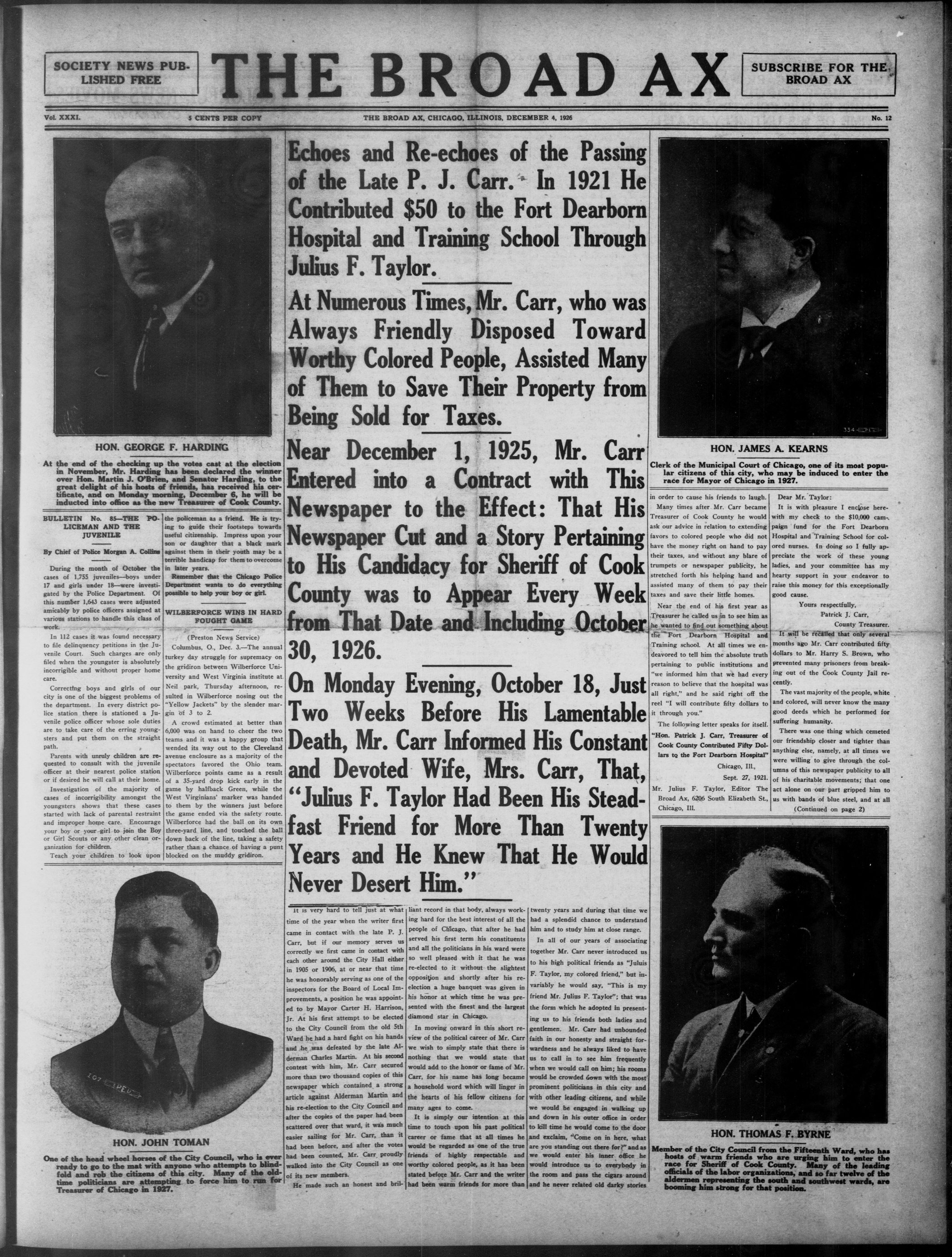
HON. GEORGE F. HARDING
At the end of the checking up the votes cast as in November, Mr. Harding has been declare over Hon. Martin J. O'Brien, and Senator H great delight of his hosts of friends, has re tificate, and on Monday morning, December inducted into office as the new Treasurer of
of the checking up the votes cast at
uber, Mr. Harding has been declared
Martin J. O'Brien, and Senator H
ight of his hosts of friends, has reco
nd on Monday morning, December
into office as the new Treasurer of
At the end of the checking up the votes cast at the election in November, Mr. Harding has been declared the winner over Hon. Martin J. O'Brien, and Senator Harding, to the great delight of his hosts of friends, has received his certificate, and on Monday morning, December 6, he will be inducted into office as the new Treasurer of Cook County.
BULLETIN No. 85—THE POLICEMAN AND THE JUVENILE the policeman as a friend. He is trying to guide their footsteps towards useful citizenship. Impress upon your
By Chief of Police Morgan A. Collins
During the month of October the cases of 1,755 juveniles—boys under 17 and girls under 18—were investigated by the Police Department. Of this number 1,643 cases were adjusted amicably by police officers assigned at various stations to handle this class of work.
In 112 cases it was found necessary to file delinquency petitions in the Juvenile Court. Such charges are only filed when the youngster is absolutely incorrigible and without proper home care.
Correcting boys and girls of our city is one of the biggest problems of the department. In every district police station there is stationed a Juvenile police officer whose sole duties are to take care of the erring youngsters and put them on the straight path.
Parents with unruly children are requested to consult with the juvenile officer at their nearest police station or if desired he will call at their home. Investigation of the majority of cases of incorrigibility amongst the youngsters shows that these cases started with lack of parental restraint and improper home care. Encourage your boy or your girl to join the Boy or Girl Scouts or any other clean organization for children. Teach your children to look upon
107 IPEU
07 IPEU
107 IPEU
One of the head wheel horses of the City Co ready to go to the mat with anyone who fold and rob the citizens of this city. time politicians are attempting to for Treasurer of Chicago in 1927.
road wheel horses of the City Council go to the mat with anyone who attent rob the citizens of this city. Many citizens are attempting to force him of Chicago in 1927.
One of the head wheel horses of the City Council, who is ever ready to go to the mat with anyone who attempts to blindfold and rob the citizens of this city. Many of the old-time politicians are attempting to force him to run for Treasurer of Chicago in 1927.
Vol. XXXI.
5 CENTS PER COPY
The image provided is too blurry to accurately recognize any text or graphics. It appears to be a grayscale photograph of a person's face, but no details can be discerned.
to the votes cast at the election
has been declared the winner
in, and Senator Harding, to the
of friends, has received his cerning,
December 6, he will be
new Treasurer of Cook County.
the policeman as a friend. He is trying
to guide their footsteps towards
useful citizenship. Impress upon your
son or daughter that a black mark
against them in their youth may be a
terrible handicap for them to overcome
in later years.
Remember that the Chicago Police
Department wants to do everything
possible to help your boy or girl.
WILBERFORCE WINS IN HARD
FOUGHT GAME
(Preston News Service)
Columbus, O., Dec. 3.—The annual turkey day struggle for supremacy on the gridiron between Wilberforce University and West Virginia institute at Neil park, Thursday afternoon, resulted in Wilberforce nosing out the "Yellow Jackets" by the slender margin of 3 to 2.
A crowd estimated at better than 6,000 was on hand to cheer the two teams and it was a happy group that wended its way out to the Cleveland avenue enclosure as a majority of the spectators favored the Ohio team. Wilberforce points came as a result of a 35-yard drop kick early in the game by halfback Green, while the West Virginians' marker was handed to them by the winners just before the game ended via the safety route. Wilberforce had the ball on its own three-yard line, and touched the ball down back of the line, taking a safety rather than a chance of having a punt blocked on the muddy gridiron.
1930
of the City Council, who is ever anyone who attempts to blind of this city. Many of the old-pting to force him to run for 27.
THE BROAD AX
THE BROAD AX, CHICAGO, ILLINOIS, DECEMBER 4, 1926
Echoes and Re-echoes of the Passing of the Late P. J. Carr. In 1921 He Contributed $50 to the Fort Dearborn Hospital and Training School Through Julius F. Taylor.
At Numerous Times, Mr. Carr, who was Always Friendly Disposed Toward Worthy Colored People, Assisted Many of Them to Save Their Property from Being Sold for Taxes.
Near December 1, 1925, Mr. Carr Entered into a Contract with This Newspaper to the Effect: That His Newspaper Cut and a Story Pertaining to His Candidacy for Sheriff of Cook County was to Appear Every Week from That Date and Including October 30, 1926.
On Monday Evening, October 18, Just Two Weeks Before His Lamentable Death, Mr. Carr Informed His Constant and Devoted Wife, Mrs. Carr, That, "Julius F. Taylor Had Been His Steadfast Friend for More Than Twenty Years and He Knew That He Would Never Desert Him."
It is very hard to tell just at what time of the year when the writer first came in contact with the late P. J. Carr, but if our memory serves us correctly we first came in contact with each other around the City Hall either in 1905 or 1906, at or near that time he was honorably serving as one of the inspectors for the Board of Local Improvements, a position he was appointed to by Mayor Carter H. Harrison, Jr. At his first attempt to be elected to the City Council from the old 5th Ward he had a hard fight on his hands and he was defeated by the late Alderman Charles Martin. At his second contest with him, Mr. Carr secured more than two thousand copies of this newspaper which contained a strong article against Alderman Martin and his re-election to the City Council and after the copies of the paper had been scattered over that ward, it was much easier sailing for Mr. Carr, than it had been before, and after the votes had been counted, Mr. Carr proudly walked into the City Council as one of its new members.
liant record in that body, always working hard for the best interest of all the people of Chicago, that after he had served his first term his constituents and all the politicians in his ward were so well pleased with it that he was re-elected to it without the slightest opposition and shortly after his re-election a huge banquet was given in his honor at which time he was presented with the finest and the largest diamond star in Chicago.
In moving onward in this short review of the political career of Mr. Carr we wish to simply state that there is nothing that we would state that would add to the honor or fame of Mr. Carr, for his name has long became a household word which will linger in the hearts of his fellow citizens for many ages to come.
It is simply our intention at this time to touch upon his past political career or fame that at all times he would be regarded as one of the true friends of highly respectable and worthy colored people, as it has been stated before Mr. Carr and the writer had been warm friends for more than
twenty years and during that time we had a splendid chance to understand him and to study him at close range.
In all of our years of associating together Mr. Carr never introduced us to his high political friends as "Juluis F. Taylor, my colored friend," but invariably he would say, "This is my friend Mr. Julius F. Taylor"; that was the form which he adopted in presenting us to his friends both ladies and gentlemen. Mr. Carr had unbounded faith in our honesty and straight forwardness and he always liked to have us to call in to see him frequently when we would call on him; his rooms would be crowded down with the most prominent politicians in this city and with other leading citizens, and while we would be engaged in walking up and down in his outer office in order to kill time he would come to the door and exclaim, "Come on in here, what are you standing out there for?" and as we would enter his inner office he would introduce us to everybody in the room and pass the cigars around and he never related old darky stories
No. 12
334
334
HON. JAMES A. KEARNS Clerk of the Municipal Court of Chicago, one of lar citizens of this city, who may be induc race for Mayor of Chicago in 1927.
municipal Court of Chicago, one of its most popuof this city, who may be induced to enter the yor of Chicago in 1927.
in order to cause his friends to laugh.
Many times after Mr. Carr became Treasurer of Cook County he would ask our advice in relation to extending favors to colored people who did not have the money right on hand to pay their taxes, and without any blare of trumpets or newspaper publicity, he stretched forth his helping hand and assisted many of them to pay their taxes and save their little homes.
Near the end of his first year as Treasurer he called us in to see him as he wanted to find out something about the Fort Dearborn Hospital and Training school. At all times we endeavored to tell him the absolute truth pertaining to public institutions and "we informed him that we had every reason to believe that the hospital was all right," and he said right off the reel "I will contribute fifty dollars to it through you."
Dear Mr. Taylor:
It is with pleasure I enclose herewith my check to the $10,000 campaign fund for the Fort Dearborn Hospital and Training School for colored nurses. In doing so I fully appreciate the work of these young ladies, and your committee has my hearty support in your endeavor to raise this money for this exceptionally good cause.
Yours respectfully,
Patrick J. Carr,
County Treasurer
It will be recalled that only several months ago Mr. Carr contributed fifty dollars to Mr. Harry S. Brown, who prevented many prisoners from breaking out of the Cook County jail recently.
The vast majority of the people, white and colored, will never know the many good deeds which he performed for
The following letter speaks for itself "Hon. Patrick J. Carr, Treasurer of Cook County Contributed Fifty Dollars to the Fort Dearborn Hospital"
Mr. Julius F. Taylor, Editor The Broad Ax, 6206 South Elizabeth St. Chicago, Ill.
[Image of a man in a suit with a tie and a serious expression].
M.
HON. THOMAS F. BYRNE
Member of the City Council from hosts of warm friends who race for Sheriff of Cook officials of the labor organi aldermen representing the booming him strong for tha
City Council from the Fifteenth Ward, who has arm friends who are urging him to enter the heriff of Cook County. Many of the leading the labor organizations, and so far twelve of the representing the south and southwest wards, are in strong for that position.
Member of the City Council from the Fifteenth Ward, who has hosts of warm friends who are urging him to enter the race for Sheriff of Cook County. Many of the leading officials of the labor organizations, and so far twelve of the aldermen representing the south and southwest wards, are booming him strong for that position.
SUBSCRIBE FOR THE BROAD AX
Dear Mr. Taylor:
It is with pleasure I enclose herewith my check to the $10,000 campaign fund for the Fort Dearborn Hospital and Training School for colored nurses. In doing so I fully appreciate the work of these young ladies, and your committee has my hearty support in your endeavor to raise this money for this exceptionally good cause.
County Treasurer. It will be recalled that only several months ago Mr. Carr contributed fifty dollars to Mr. Harry S. Brown, who prevented many prisoners from breaking out of the Cook County Jail recently. The vast majority of the people, white and colored, will never know the many good deeds which he performed for suffering humanity. There was one thing which cemeted our friendship closer and tighter than anything else, namely, at all times we were willing to give through the columns of this newspaper publicity to all of his charitable movements; that one act alone on our part gripped him to us with bands of blue steel, and at all
(Continued on page 2)
THE LATE P. J. CARR WAS ONE OF THE MOST POPULAR PERSON- AGES IN THIS COUNTRY AT THE TIME OF HIS UNTIMELY DEATH.
(Continued from page 1) times he would recommend the paper to his friends and urge his friends those seeking office—to place at least some of their advertisements in its columns.
For more than ten years past we had an understanding with Mr. Carr that his cut must always appear on the front page of the Christmas issue of The Broad Ax, and say in the lines beneath his name, "Mr. Carr wishes his legions of friends in this city and county a Merry Christmas and a Happy New Year," or words to the same effect.
Near the first of December, 1925, Mr. Carr requested us to drop in and see him, and on arriving at his office it was crowded down with politicians as usual, and after being introduced around Mr. Carr said, Mr. Taylor, many of my friends are urging me to run for sheriff of Cook County, do you think I could be elected? Instantly we replied, don't be foolish Mr. Carr, you have no idea how well you stand in the estimation of the people in this city and county, and you can easily be elected to any office within their gift; even as mayor of Chicago. At the conclusion of our remarks Mr. Carr smilingly said, don't try to kid me Mr. Taylor, and we retorted, all right wait and see.
S. C. LYNCHERS HIRE ABLE LAWYERS FOR THEIR DEFENSE
Columbia, S. C., Dec. 3.—Attorney Edgar A. Brown, an ally and friend of Cole Blease, the fire-brand senator from South Carolina, has been retained as the leading counsel for defense of the men charged with the ghastly lynching of the three Lomans on October 8, last.
Brown is said to have told newspapermen that he had not been approached by either Hart or Robinson to represent them in the event they were prosecuted for their part in the horrible crime that so signally disgraces the besmeared name of the Palmetto state. Brown comes from Barnwell county which bears almost as nascaus a name as Aiken with reference to lynching orgies.
It is said that excitement, apprehension and fear runs riot throughout Horse Creek valley. Men whose names have never been mentioned in connection with the Loman lynching are said to be making preparations to defend themselves feeling that ere long the Governor's investigation committee will come for them.
This undue expression of fear on the part of residents of the valley in going to Attorney Brown telling him that Hart and Robinson had no part in the lynching gives a careful observer the notion that politics is playing a great part in this affair.
Already Senator Blease, the viking firebrand, worshipped leader of Negro haters, has offered to defend such lynchers as are his friends and supporters and to oppose the constitutional damages sought by Samuel Lowman.
Mr. Brown is supported by Senator Blease in his political ambitions and aspirations. Blease's weekly exists mainly upon its appeal to race hatred by constantly printing items and inflaming articles about "Nigger Rapists." Through this sort of publicity Blease keeps himself in office and maintains his leadership over the hildalgoes of South Carolina.
In the meantime the Governor's investigation is going steadily on. Indications are that Governor McLeod will urge his investigators to proceed with the prosecution when he is convinced that they have built up a sufficiently strong case against the mobbists.
According to friends close to the Governor a mighty strong case will have to be built up to insure conviction of the members of the mob that killed the Lomans. The sentiment, built up by such Negro-haters as the late Ben Tillman and now being so strongly carried on by Blease, makes it an extraordinary difficult task to convict the men who composed the mob. 'It is said that officials in Columbia are confident they know the men who took part in the mob. And have indicated that every effort will be made to wash this horrible stain from the Jinens of South Carolina. The Governor is appealing to the leading law-
Only a few days from that time Mr. Carr decided that he would make the race for Sheriff of Cook County and he then and there entered into a signed contract with us to the effect that his cut and a story of his candidacy for sheriff must appear each week on the front page of The Broad Ax; from that date in December, 1925, up to and including October 30th, 1926.
On Monday, November 1, 1926, while in conversation with him in his private office in the county building, which was the last time we met him face * to face on this earth, he said, "Mr. Taylor you have lived up to the last letter in our contract, and do you still feel that I will be elected sheriff of Cook County?" We simply said after grasping him by the hand and looking him straight in the eye, "Mr. Carr you will be elected sheriff of Cook County tomorrow by 75 to one hundred thousand majority," but his majority ran up to more than one hundred and twenty-five thousand, which was the greatest vote ever accorded to any candidate seeking office in this city or county; but Mr. Carr closed his eyes in death before we were able to congratulate him over his wonderful election.
With pleasure we can state that we have many warm friends in this city, but we had no better or truer friend than the late P. J. Carr.
abiding citizens of the State to throw their influence and support behind a movement to wipe out such demonstrations and acts of violence in South Carolina.
BOY MURDERER GOES TO
DEATH WITHOUT WORD
(Preston News Service)
Columbus, O., Dec. 3.—Emmanuel Ross, 18-year old Cleveland murderer, died at 1:07 Friday in the electric chair at Ohio Penitentiary for killing Isadore Steeck. Cleveland confectioner. Ross entered the death-room at 1:04 a. m., calm and unperturbed. He was placed in the chair at 1:06 a. m. looked around the room and, seeing the warden, said, "Hello, warden."
The mask was placed over his face and he died a minute later. Ross spent Thanksgiving day sitting quietly in his cell. He was not nervous and seemed resigned to his fate. No relatives visited the youth during the day and Warden P. E. Thomas said none had requested to see the young murderer during his last hours of life. His only visitors were a welfare worker and Chaplain Reed. For his last meal Ross had turkey, with dressing, cranberry sauce and all the "trimmers." He ate heartily and did not appear to realize that it was his last meal. Ross' attorneys have waged an unrelenting fight to save the boy from the electric chair. Six dates have been set for his execution. He was received at the penitentiary January 27, to be electrocuted April 28. Since that time he has been granted five stays, two from the governor, two from the state supreme court and one from Cuyahoga County court of appeals. A week ago the state supreme court refused a second time to review the case. That left only two ways by which Ross might have escaped the chair for the sixth time. Governor Donahey could have saved him by another reprieve, or the court of appeals could have acted. Ross' attorneys had sought a reversal of the verdict on the grounds that Ross' case first should have been taken before the juvenile court, inasmuch as he was said to have been only 17 years old when the crime was committed. Ross was convicted of murder in Cuyahoga common pleas court. Declaring Ross had been accorded "every legal right," James W. Huffman, executive secretary to Governor Donahey, Thursday telegraphed a reply to a request for a reprieve made by Alexander H. Martin, attorney for Ross.
"The Emmanuel Ross case has been fully considered by the common pleas court of Cuyahoga County, the appellate court and the supreme court, which is the court of last resort in Ohio. "Ross has been given every legal right. In absence of mitigating circumstances or a recommendation from the trial judge, prosecutor or jury which tried him, the governor has no right to and will not interfere with the decree of a co-ordinate branch of government."
THE BROAD AX, CHICAGO, ILLINOIS, DECEMBER 4, 1926
ROLAND HAYES RECITAL OR
CONCERT AT ORCHESTRA
HALL MONDAY EVENING,
DECEMBER 6, PROMISES TO
BE A GRAND SUCCESS
Monday evening, December 6, at
8:30 o'clock sharp, the celebrated
Roland Hayes, who is well and favorably
known throughout the musical world
as the greatest concert tenor singer
of the age.
The recital this year will be for the benefit of the Indiana avenue branch of the Y.W.C.A. Mr. Hayes sings in French, German, and English and aside from the cause, for which Mr. Hayes, appears the evening will be long to be remembered, for this will be the last chance for Chicagoans to hear this great tenor this season.
The following ladies who stand at the top notch in everything pertaining to the civic advancement of the Afro-American race in this city will have charge of the wonderful affair.
Mrs. Albert B. George, chairman; Mrs. Julius Avendorph, Dr. Mae White, Mrs. Gertrude Balay, Mrs. Sidney Brown, Mrs. Edward H. Carry, Mrs. M. J. Dailey, Mrs. Andrew Foster, Mrs. George C. Hall, Mrs. Ophelia Hudson, Mrs. Jessie E. Jones, Mrs. Morris Lewis, Mrs. Mattie F. Lowe, Mrs. Estelle W. McNeal, Mrs. Willie Miller, Mrs. Iola Price, Mrs. N. Clark Smith, Mrs. Nettie G. Speedy, Mrs. Louise Waller, Mrs. Mabel Washington, Mrs. Harvey A. Watkins, Mrs. Mary Webster, and Mrs. Lulu Lawson.
The last appearance of Mr. Hayes at Orchestra Hall many people failed to note the fact that his concerts or recitals always begin promptly at 8:30 o'clock and the result was that many people failed to find their way into their seats until 9 or 9:30 o'clock, and at that hour the entertainments are more than half out.
The management hopes that Monday evening everybody will be in their seats at 8:30 o'clock as the concert will commence promptly on time. Admission 75c to $2.50.
THE CHICAGO AND NORTH
WESTERN DISTRICT
FEDERATION
The second quarterly meeting of the Chicago and Northern District Federation will be held at Hull House, 800 South Halsted Street, Monday, December 6th at 9:30 a.m.
The Social Service Department and the Community Club will be the hostesses.
The Community Club came into being some time ago as a result of the changing conditions in and around Hull House; a large number of the foreign population moved into other neighborhoods, and their places have been taken by our group; the residents of the famous social settlement are still living up to their ideals of helping the people in the neighborhood to adjust themselves, and our boys and girls are urged to join all of the classes, and with their elders are cordially invited to take part in all of the activities of the place.
The Community Club, Mrs. Adkins, president, is sponsored by the committee of Fifteen, five from each of the following clubs, West Side Women's Club, New Method Industrial Club, and The Clover Leaf Club.
The club meets at Hull House every Monday evening, and most enjoyable inter-racial get-together meetings are held monthly; the contact has been not only harmonious and satisfactory, but very helpful. A splendid program has been prepared by Mrs. Maud Smith, 1st vice president. Dinner will be served in the coffee house. Visitors are welcome. Nannie Reed, president; Elizabeth Lindsay Davis, Editor.
POPULAR CITIZEN HAS DE-
PARTED FROM CHICAGO
Mr. M. F. Haynes, who has served as secretary to the Mr. Sandy W. Trice, president of the Red Caps Club, has severed his connection with that club and has left for Huntington, W. Va., to accept an appointment as Instructor of Music and Biology in the Negro high school there. His departure will be keenly felt as he was an indefatigable worker for the success of and the elevating of his co-workers in the eyes of the general public.
SPECIAL NOTICE
To whom it may concern. This is to certify that Charles Stewart, Jr., 4823 Calumet Ave., is not connected with this newspaper, in any manner, shape or form. Julius F. Taylor, 6206 S. Elizabeth St., Chicago. Nov. 26 1926.
HOWARD DRUBS LINCOLN IN
A 32-0 VICTORY
Washington, D. C., Dec. 3.—Ancient foemen met in a newly dedicated Howard Stadium Turkey Day afternoon in their 22nd annual Thanksgiving day football classic and for the first time since 1920 Howard emerged victorious over Lincoln. It was a sweet revenge for the boys of the Capitol City, who defeated their opponents in a spectacular but one-sided game, 32-0. The Howard Alumm, young and old celebrated their team's victory Thursday. No such enthusiasm has been manifested by the rooters or the Blue and White since Eddie Gray, now a practicing physician in Cincinnati, and his eleven some years ago tamed the lions from Chester County, Pa.
In 1920 Howard defeated Lincoln 42 to 0. In the five following contests the Orange and Blue won three games and two were tied, last year the game ending in Philadelphia without either side scoring.
By defeating Lincoln Thursday, Howard hung up a record for the season of no games lost. Not for many years has it had such a well-rounded eleven. Lincoln, on the other hand, has sustained more defeats than victories. The home players excelled in every department of the game save that of forward passing. In the last quarter, with defeat staring them in the face, Lincoln adopted the style of play to make a touchdown.
Toward the close of the game the most spectacular run was made by Simpson, of Howard, who, after failing to complete two forward passes, caught the ball on the third attempt and ran 40 yards for a touchdown. Howard's superiority over Lincoln was without question. The former made fifteen first downs to the latter's five. In the first half, Howard made twelve first downs to Lincoln's none. It was not until the second half that the visitors chalked up a first down and then on a fifteen yards penalty for clipping. So effectively did Howard's ends smother all attempts of Lincoln them to gain ground by skirting them that Hibbler and Martin were unable to make long runs as in previous games this season. Usually they were stopped in their tracks.
"Tack" Smith and Coles starred for Howard. Aside from Simpson's touchdown near the close of the game they did all the scoring. Largely through the fine work of these two players Howard scored its other three touchdowns. The Blue and White, after a fumble by Lincoln on its 20-yard line, made its first touchdown shortly after the game started, due to Smith skirting Lincoln's right and, and when tackled by his opponents, just managed to put the ball on the goal line. Howard failed to kick goal.
The Blue and White again made a touchdown in the second quarter, due to Cole's fine work, who kicked goal. The third touchdown was registered by him as the result of his productive line plunging in the third quarter, but he failed to kick goal. It was Simpson who projected himself in the line-light and helped to swell Howard's score 7 points last quarter. Fully 20,000 saw the first game in Howard's new stadium. Prior to the game, dedicatory exercises were held. Representative Hon. Martin B. Madden made the principal address. New York was represented at the game. Howard graduates from all over the country attended the game. The line-up:
Howard—Sallie, L. E.; Smith, V. B.
(C.) L. T.; Rainey, L. G.; Martin, C.
Kelly, R. G.; Thomas, R. T.; Sayles,
R. E.; Coles, O. B.; T. Smith, R. H.
Ross, L. H.; Brown, F. B.
WHITE MEN SLAY RACE MAN IN PENNSYLVANIA MINE RIOT
(Preston News Service)
Uniontown, Pa., Dec. 3.—Arthur Faulkner, 35, was shot to death Thursday night at Whitsett, a mining town in northern Fayette County, during a dispute between whites and negroes. Fifty persons were brought to Uniontown for questioning after State police and county officers had quelled the trouble. Ten were held pending further inquity, two of them on charges of murder. The disorder was said to have had its inception in a fist fight between two men. Harry Walker and Theodore Dell were the two held on murder charges.
SOUTHERN SENATORS IN
STOLEN SEATS WILL RE-
CEIVE SHOCK
Washington, D. C.—The fight against seating Senator-elect Vare of Pennsylvania and Senator-elect Frank L. Smith of Illinois, which is being planned by United States Senators of the Progressive and Democratic parties, took on a new angle here last week when the question of the legality of the election of Democratic senators in the South was raised.
The Southern Senators, who are taking such an active part in the plan to deny Vare and Smith seats in the United States Senate, are elected in primaries from which Negro citizens are excluded and elections in which if Negroes vote their vote is not counted. Political leaders, throughout the North and Middlewest are pointing to this practice as illegal and are asking "which Senator is more undesirable, the one who is elected by huge expenditures, or the one by the disfranchisement of a group of citizens on account of race and color?"
These leaders are referring to the fact that alleged expenditures that have "tainted Vare and Smith" were made in the primaries and made public long before the elections, yet the voters elected them by large majorities, but in the South only a portion of the citizens are permitted to exercise their rights of citizenship and that Southern Democratic Senators are elected by this group.
PULLMAN OFFICERS DIS
TURRED AS WORKERS
FLOCK TO BROTHERHOOD
AVERRED
(Preston News Service)
New York City, Dec. 3.—Pullman company officials are said to be disturbed by the number of men, old in the service, who are joining the Brotherhood of Sleeping Car Porters, according to W. H. DesVerney, organizer, who has been working throughout the middle west.
The resignation from service of F. J. Bradley, one of the most popular and influential men in the district, to take charge of the St. Louis, Mo., union office is said to have been a bomb shell to the company officials. Bradley has been in the Pullman service for seventeen years. DesVarney is said to be one of the old-timers himself and became disgusted with the underhand methods of the Pullman Company in dealing with working conditions among the porters and quit the company to devote his time and energies to organize the porters in an effort to force the company to give the workers a better deal. He reports over 70 per cent organization in the St. Louis terminal.
"CHICAGO'S HEALTH"
Weekly Bulletin, Chicago Department of Health, by Herman N. Bundesen, M.D., Commissioner
"Keeping the bedroom windows locked at night to keep the burglar out usually locks a burglar in. The burglar you lock out may only steal your wealth; but the burglar you lock in robs you of your health," says Dr. Herman N. Bundesen, in his latest bulletin.
"Foul air is the thief which not only robs you of your health, but your health reserve as well. To keep right and to get all the benefits of health, an ever-circulating supply of oxygen is necessary. If the air in a room is stale, you are rebreathing not only your own foul air, but that of every person in that room.
Would you use some one else's tooth brush? Of course not. Rebreathing foul air is just as bad," says the Commissioner.
"To keep up good resistance against colds and pneumonia, cold, fresh air is necessary, especially in your bedroom at night. Put on an extra cover, but be sure to get the fresh air circulating in your rooms. Fresh, night air is as good as day air, if not better. Fresh air is free and in abundance and is one of our great health aids," says Dr. Bundesen.
MUCH IMPROVED
Mrs. Cora Franks, 420 E. 48th place, who has been quite ill and confined to her bed, is greatly improved and able to be about her home.
COLORFUL NEWS MOVIES By THE CAMERAMAN
(Preston News Service)
According to estimates of officials of organized labor, there are, in the United States, approximately 165 local unions, representing 6,000 Negro workmen, which are directly affiliated with the American Federation of Labor. These figures do not include musicians, and other organized theatrical workers, who are largely employed in theaters which cater, principally, to Negro patronage. A glimpse of the content of these 165 local unions is enlightening, and their geographical location shows that there is a deal of work to be done in the matter of organizing Negro labor. Transportation hands, of varied descriptions, such as coach and car cleaners, freight handlers, shipyard workers, train porters, mechanics' helpers, station porters, platform men, and mail and baggage handlers, comprise the bulk of the 6,000 organized laborers. Winston-Salem, N. C., boasts of a hair-dressers' union, in good and active standing with the A. F. of L.
The unions are located, principally in Alabama, Arkansas, California Florida, Georgia, Delaware, Kentucky Louisiana, Maryland, Michigan, Missouri, New Jersey, New York, North Carolina, Ohio, Oklahoma, Pennsylvania, South Carolina, Tennessee, Texas, Virginia and West Virginia. In some cases, only seven members comprise the total membership of a local; while the coach cleaners of St. Louis, Mo., and the baggage handlers of Philadelphia, Pa., and Washington, D. C., with a total membership, each of 250, bear off the palms for numerical strength.
In the onward march of organized labor, the time is over-ripe for real live representation in the parent-body. Where are the iron and steel workers, the automobile hands, the building construction men, etc? Is hair-dressing more important, and are the artisans of real labor to play second fiddle to domestic workers and dispensers of "blues" melodies? We think this ought not to be. We advocate organization, regardless of color and regardless of the type of union. Let the A. F. of L., open its doors—and its
HOW'S YOUR HEALTH?
Mark Twain once wrote to a hotel manager complaining about a roller towel he had been obliged to use in the hotel washroom. "You are the fiftieth man who has used that towel," wrote back the manager in reply, "and you are the first one who has kicked about it." One out of fifty to make a complaint!
Probably the forty-nine others belong to the type of person who accepts things as they are because it is too much bother to do otherwise.
That is the way many of us go blithely through life, accepting health as a matter of course until some serious sickness suddenly attacks us seemingly out of a clear sky. We live from day to day in the pleasant belief that we are perfectly well and efficient. We are like the forty-nine who take no responsibility about having a sanitary towel because we personally have not been harmed by the dirty one.
Yet, do we know definitely that we have not been harmed? Do we really know how we stand in the matter of health? Perhaps we have a pain now and then, feel over-tired sometimes and have no appetite. "Oh, well," we say, "that's only natural—we can't baby ourselves and make a fuss over a little pain." Thats' fair logic but not fair enough. A visit to a doctor for a thorough overhauling of our bodies would help us out. That tired feeling may be something, a pain may indicate the earliest stage of an organic trouble. On the other hand they may be warnings of only slight weaknesses and when taken in time can be speedily cured. And anyway what a "grand and glorious feeling" it would be to know there is nothing the matter
Nowadays we do not go to the doctor only when we are really sick. The prevention idea is so important a foundation of modern health teaching that our bodies are regarded like automobiles, locomotives and other mechanical machines that need overhauling periodically to keep them in A-1 running condition. We do not sit back and wait for something to happen. We keep it from happening. We do not wait for a Mark Twain to complain of the roller towel, we
windows—too, and let there be union, first, and petty personalities of prejudice and jealousy last, if at all. Where Negro labor cannot gain ready admission to the local union, let it create another local, clothed with all official authority of any union in the land, and recognizable, both in council and out of council. That's real organization, we think.
When a Negro student of Dunbane High School, Washington, D. C., touched up the keyboard of an Underwood Typewriter at the rate of 109 words per minute, thereby winning the Underwood diamond medal for speed and accuracy, which, incidentally, was the first time that any student—ANY STUDENT—in America has performed such a stunt, it was believed that the youngster's performance would be gladly accepted as news—news of the absorbing progress of American youth. The days of Rose Fritz were recalled, 87-words-per-minute clip. Otis Blaisdell and his speed Remington were recalled, when tons of paper were used by the press to describe Blaisdell's wonder-fingers. Other typewriting kings and queens, whose exploits sent many a typesetter to bed with a headache, were recalled to our fading memory.
But, here though, was a youthful Negro student, named Cortez Peters, still under instruction, who typed 109 words a minute. The news was rushed to the local press by our good friend, J. C. Wright, who, incidentally, is the instructor of Peters, a moulder of public opinion, and a Christian gentleman overflowing with interest in the public welfare. The teacher-newspaperman made a nice story of Peters' amazing performance and sent it to the press far and near, particularly to the four great dailies of Washington, D. C. After a few days' vigil, the story of Peters' triumph, boiled down to a miniature, appeared in a semi-concealed corner of one of the Washington dailies. The other three papers turned it down cold. Alas, to them, such an item was not news. It had no value.
But look in them all and we read: "Dry Raiders Take Forty—Nearly all the prisoners were Negroes." That's news. Color doesn't matter in crime; but in credit—well, that's different. That is NOT news.
each take an individual responsibility in all matters of health. We lock the doors of our stables before our horses are stolen.
The National Tuberculosis Association and its affiliated state and local associations believe the one good way to get the best of tuberculosis and other diseases is to have a thorough overhauling of the body by an expert physician at regular intervals. Caught in time, tuberculosis is nearly always curable and many times preventable. The work of these associations fighting for your health is financed by the annual sale of the penny Christmas seal in December. How's YOUR Health?
OFFICERS COUNCIL ENTERTAINS
Herbert Officers Council No. 1. A U. K. & D. of A, of which Mrs. Elizabeth Rochon is president, and Mrs. Sarah E. Garrison is secretary, entertained on Monday evening, Nov. 29th, if honor of the national and grand officers at 324 E. 51st street. The program was begun at 8:30 with Mrs. Ameretha Jackson, secretary of Leona Council No. 109, acting as mistress of ceremonies. A very interesting program was rendered and among the national and grand officers appearing on the same were Mrs. Eliza Jackson, state grand queen of Illinois; Mrs. Ida Simmons, national grand queen; Mesdames Louise Hayden White, Leona Dixon McKinney, Henrietta Dean, Grace Patillo, Nellie Burbridge-Capt. M. T. Bailey, Col. Wm. Williams and many others. Very excellent music was furnished by the 1st Regiment Band of Illinois and The Ladies Emergency Band. Refreshments were served in abundance to a large assemblage of invited guests, officers, members of Herbert Officers Council No. 1.
COLORED WOMAN PASSES
BAR
Washington, D. C., Nov. 19.-Mrs Isadore Letcher, who just completed Howard University College of Law has passed the rigid law examination of the state of Michigan, and will begin practice in Detroit.
SUNDAY FORUM A SUCCESS
The Sunday afternoon forum, held the second and fourth Sunday in each month, under the auspices of The Ft. Dearborn 1917 Marching Club, is proving to be a huge success. On last Sunday afternoon, a very interesting civic and military program was rendered. Principal addresses were made by Col. Otis B. Duncan of the old 8th Regiment, who was accompanied by several staff officers and members of the national guard, his address was inspiring; J. C. Martin, exalted ruler of Ft. Dearborn Lodge No. 44; Rev. R. R. Thomas, pastor of Grant Memorial Chapel; music by the choir of Grant Chapel. The introduction of Grace Davis, well known soloist, created much enthusiasm, and Miss Davis was at her best in the rendition of her number, accompanied by Miss Geneva Douglas, Grace Davis and Mrs. Douglas are booked to sail for Europe on Dec. 19th and will spend six months abroad in concert work. The meetings of the Sunday afternoon Forum are creating much interest, not among Elks only, but among the public who have been attending these meetings. The public is always welcome on the second and fourth Sundays at 5 p. m.
SYLVESTER MURCHISON VIC
TIM OF COAL MINE
EXPLOSION
(Preston News Service)
Sanford, N. C., Dec. 2.—Two men were killed instantly and a third injured in an explosion of gas caused by a short circuit at the 500-foot level of the Erskine-Ramsey coal mine Tuesday afternoon. Thirty-three other coal miners were at work on lower levels when the explosion occurred, but were unhurt. They were removed a few minutes later.
The dead are: Charles Shirley, (white) aged 50; and Sylvester Murchison, aged 19. Earlier reports of the disaster placed the dead and injured at twelve, and caused widespread excitement throughout the mining section.
1. Song, 2. Prayer, Mr. W, L. Edwards; 3. Remarks by the President, Sandy W. Trice; 4. Music, by Browne's Metropolitan Jubilee Singers; (a) Prelude, (b) Greetings, (c) Spirituals by the Company, 5. Paper on "Service," by Mr. Timothy W. Adams; 6. Introduction of Speaker, by Mr. F. J. Taylor; 7. Address, by Prof. Roy D. Mathews, of Lewis Institute, subject—Some Contributions of the Negro to American Life; 8. Postlude, by Browne's Metropolitan Jubilee Singers. Remarks. Benediction.
Officers: Sandy W. Trice, Pres.; B. F. Shepard, 1st V-Pres.; S. H. Harris, 2nd V. Pres.; Otho Robinson, Treas.; James Walden, Fin. Sec.; C. L. Smith, Cor. Sec.; Frank J. Taylor, Sec.; Mrs. F. D. Hoffman, Musical Director; J. W. Lyons, Librarian; John Ferguson, Sergeant-at-Arms; W. W. Mosley, Custodian of Finances; Wyatt Edgerton, Director; M. G. Haynes, Journalist, and W. L. Edwards, Chaplain.
MAN SHOT TO DEATH IN HILL
STREET FIGHT
Pittsburgh, Pa., Dec. 3.—Said by police to have been the cause of the shooting and killing of Joseph Richardson, aged 35 years, early Wednesday evening in front of a fruit store in Logan street, near Poplar way, Mrs. Mary Green, aged 31 years, was arrested in her home in Wylie avenue a short time after the shooting.
Samuel Smith of Wellsville, Ohio, is said to have been a witness to the shooting, and was arrested at the same time and lodged in jail as a material witness.
The bullets pierced the body of Richardson, who is thought by police to be a deck hand on the river boat Senator Cordill. Police say that the man who did the shooting escaped.
Los Angeles, Cal.—Completed at the cost of nearly $200,000, the beautiful Y.M.C.A. building here was dedicated Sunday with impressive ceremonies. The Spanish motif is carried throughout both the exterior and interior of the structure, the roof being red tile, the facings blue and white stone. There is a roomy convertible "gym" and a beautiful swimming pool in white tile. The building is of four stories with a large number of well furnished rooms and fills a long felt want in the community.
WHITE WIDOW GETS $60,000
ESTATE
Philadelphia—Henry E. Burgess, barbec, 1841 South street, died recently and he left his white wife a $60,000 estate.
This fact known last week when his son, Henri, a letter carrier, entered suit to secure a share in the property claiming that his father married the white woman without the formality of a divorce from his first wife.
FROM PISTOL WOUND
GIRL IS HELD
[Preston News Service]
Little Rock, Ark., Dec. 2—Newton Wendloch, 18 years, who was shot Monday afternoon by Miss Lois Peyton, aged 17 years, died early Wednesday morning in the General Hospital. The charge against the Peyton girl was changed from assault with intent to kill to murder. She is in jail, being held to await the next meeting of the grand jury.
RETURNS TO CITY
Rev. Joshua Christian, 11415 S. Throop street, who visited with relatives and friends in New Orleans, La., a few weeks ago, has returned to the city much pleased with the trip*
PLACES WREATH ON GRAVE
M. T. Bailey placed a wreath on the grave of the late Mrs. Lou Ella Young at Mt. Glenwood Cemetery, on the anniversary of her birth, Nov. 30th.
SHE WAS SOME BABY
Lancaster, Pa.—Lewis Felder's wife compelled him to sleep in a stable, and used a bull-dog to keep him out of the house. He got a divorce.
Memphis, Tenn.—Ed Courtney, a bell-hop, was fined one cent for handling booze.
Agriculture in Alaska
Visitors in Alaska are astonished to see well-kept gardens furnishing the inhabitants with fresh vegetables. The popular conception of Alaska is a region of snow, ice and terrific storms. Such is far from the case in the valley of the Koyukuk river where from May to September, prolific vegetable gardens are cultivated by the white men. The days are long and crops mature quickly.
Dark Ages Bridge
It is a curious light upon the interpretation of our common term "the Dark ages" that those "Dark ages" should have given England nearly all the bridges she had till the time of the Georges, for bridge building persisted with the destruction of the monasteries, and even the principles had to be re-invented by Eighteenth century engineers.
Has Several Broods
There is no native bird which attempts to equal the mourning dove in domestic accomplishments, says the Nature Magazine. Its breeding season extends from early May until late September, and, if fate is lenient with the falr establishment of the bird, three or four broods may be raised to maturity with scarcely a pause between each family.
The Pea Tree
In Scotland the laburnum has the familiar name of pea tree. It is also sometimes called French broom, or Chanay ash. The laburnum is a remarkably domestic tree, rarely growing wild from seeds naturally sown, "perhaps," observes a recent writer, "because hares and rabbits are extraordinarily devoted to the bark and young trees."
Just a Sample
Most of little Beth's neighbors have large families and Beth herself is well supplied with brothers and sisters. After returning from a visit to her aunt who had been married only a short time, Beth was asked how many children her aunt had. "Only one," she answered quickly. "All God's sent her yet is a sample."
Voltage of Lightning
The bureau of standards says that only estimates are available concerning the voltage of lightning strokes. These range from a few hundred thousand to several billion volts, depending upon the ideas of the persons making the estimates. No measurements have been made.
The Vocal Spider
The barking, or "booming," spider was so named because it was found, in the day time, at spots where "booming" had been heard at night. But the booming was eventually traced to qualis! Still the Australian spider has one accomplishment—it can whistle feebly by rubbing its palps against its mandibles.
"I was convinced by my wife she was right, in the convincing way that wives have."—A witness in the Shoreditch (England) County court.
THE BROAD AX, CHICAGO, ILLINOIS, DECEMBER 4, 1926
Evidences of Mound
Smithsonian ethnologists are always on the trail of the ancient civilizations of America. Now they have enlarged the territory known to have been held by the Mound Builders, by discovering on Pecan island, in the southwest corner of Vermilion parish, in Louisiana, 22 of the curious earthworks with which the Ohio and Mississippi valleys are dotted. This extends the field of the Mound Builders far south, says the Philadelphia Bulletin. Preliminary excavations have turned up characteristic copper ornaments, presumably made from copper taken from the outcroppings worked by the Mound Builders in the Lake Superior district, and ornaments carved from light-colored stone of a geological nature not to be found in Louisiana.
Among the early historic occupants of the territory were the Atakapas, dwelling in Texas and western Louisiana, who are known to have been cannibals, while east of them were the lands of the Chitmachas. The expedition sent into the territory by the Smithsonian institution expected to find nothing more than supplementary evidences of the low state of culture of these tribes and their primitive fashion of living. But instead it found that a superior culture antedated the occupation of the Indians. There are stone and wooden ear-plugs and breast ornaments, others of galena and hematite, bone awls and fragments of pottery, unmistakably of Mound Builders origin.
Medieval-Day Boxes
- Became Power Chests
Large wardrobe chests of medieval days, sometimes called portmanteaux, were the runners of the dower chests of later periods. There were no trunks, such as are in use today, and the big boxes were an important part of the impediment carried by the nobles of the Middle ages on their visits to neighboring castles, says Edward Wenham, writing in the International Studio. Usually they were made of oak, but sometimes chestnut was employed. Some of them were covered with leather, upon which the coat of arms and other heraldic signs were emblazoned. In time they become dower chests, usually containing the store of household linen that the bride took to her husband. Passing from mother to daughter, they became heirlooms of great sentimental value. The chest appealed to all countries of Europe and was brought to America by the first settlers, and bridal chests were among the first pieces of early Colonial furniture constructed.
It Never Fails
I was about to start out on my first day of hiking at Glacier park when Bert stopped me. Bert is one of those fancy cowboys who escort "dudes" over the Glacier trails, and he appears to enjoy it. You gotta a map an' compass?" he asked, and I assured him I had.
"Well, hey you gotta deck of playin' keerds?" he persisted.
"Why a deck of playing cards?" I asked.
"Always carry a deck with you, son, and whenever you get lost an' find yourself all alone in the wilderness set down an' start a game of solitaire. There's jest sure to be some darn fool pop up an' look over your shoulder' an' tell you what to do next."—Chicago Tribune.
Lotus Really Water Lily
The sacred lotus has been cultivated in Egypt for at least 5,000 years and for many centuries was used in religious ceremonies and funeral wreaths. There has been confusion among botanists and laymen for centuries as to the identity of the true lotus of the Nile. Many have supposed that the sacred lotus of India and the sacred lotus of the Nile were the same, but they are not. The Indian lotus has a pink flower, while that of the Nile has a blue one. It was only with the identification of the flowers used in the funeral wreaths of Rameses II and Amenhotep I that it was established that the true sacred lotus of Egypt was the blue water lily.—Chicago Daily News.
Safety in Tall Buildings
A geological authority who has given some special attention to earthquakes has given some consolation to the people who are employed in the very tall buildings and who have been fearful of the results in case of an earthquake. He figures it out that those in a 200-foot structure are safer than one 100 feet in height. The former is just the height, to correspond with the period of rocking of the earth and therefore the structure receives the full force of the motion, whereas in the taller buildings this does not coincide with the swing of the earthquake, and hence it is practically immune from danger.
Kentish Hop Crop
Not all the hops grown in the fields of Kent go to the British brewers, for it is said that the dyers take most of the hops grown in all England. The harvesting of the crop is uncertain business, for picking cannot begin until the hops are ripe and they soon spoil. The pods must go to the oats, or drying kilns, as soon as they are picked, and if the pickers are too energetic there is waste.
Origin of "Money"
The term "money" is derived from "moneta," a term applied to Juno, in whose temple at Rome money was coloned, the said term being from "monere" to warm.
(Copyright.)
MARIAN was sorry she had written that letter—but she was not sorry soon enough. Her regret came after she had mailed it. It was a trivial thing they had fallen over, any way—Marian Ormsby and Harold Graves. Marian's letter to Harold was somewhat lengthy. But its meaning was clear—she gave Harold a preemptual divorce on the ground of incompatability of temper, his fatal heresy with regard to bobbed hair and his exeercable taste in necklaces. All was over between them! There were a few side remarks about obstinacy, self-sufficiency and ill nature.
Harold had been rather irritable and didactic, it is true. He had been annoyed by tangled business matters that day, the tangle caused by careless or stupid clerks and the onus thrown on him. Under such circumstances you could not expect a young man to be in an absolutely angelic mood—even if he was in love and his best girl was with him. All things considered, Harold had behaved very well. And Marian, who knew of his troubles, began to realize it when she came to think things over—after she had mailed the letter.
When Harold got the letter he read it over and over again. At first he thought of writing an answer in the argumentative vein. No, that would not do; it would only be continuing the quarrel. Then he considered writing one in a humble and apologetic strain, pleading for forgiveness and begging to be taken again into favor. But he wasn't humble and he told himself that Marian had as much to apologize for as he had. A humble, cringling letter would be insincere—and besides Marian did not like humble and cringling men any too well. He loved Marian with all his heart—but still he wanted to stand on something like an even footing with her.
Then he took a sheet of letter paper and sat down at his typewriter. Marian always used a typewriter and so did Harold; and they were of the same make. Harold wrote only two brief sentences. Then he took his production from the typewriter and laid it on his writing desk; laid Marian's letter beside it; got a piece of tissue paper and traced Marian's signature; which signature he transferred to the bottom of the few lines he had just typed. The forger grinned as he did it.
Then he folded the letter he had thus completed, placed it in an envelope, sealed it and directed it to himself. From a letter he had received that day he soaked off a canceled postage stamp and having dried it affixed it with musculage to the envelope into which he had placed his forgery. All this being accomplished he ordered his car brought up from the public garage where he kept it and drove over to see Marian.
When Harold came bursting into her presence, all smiles and with a cheery greeting, she gave a little glad start and cried: "Oh, Harold!" Then recollecting herself she drew away from him as he tried to catch her in his arms and said haughtily, "Mr. Graves! What does this mean? Keep away from me, sir. Explain yourself. This is an outrage. Did you not get my letter?"
"Sure thing," replied Harold affecting surprise. "That's why I hurried over. Marian, you are the real thing and I always knew you were. Just a little tired last night, eh? And I didn't make allowances. The fault is all mine, my dear. I guess I was a little peevish, too. There is nothing to patch up. We are just two old sillies, that's all. But it was so good of you to write as you did and to take all the blame yourself. Come, give us a kiss." And he took one in spite of her struggles and smothered protests.
"Now," said Marian when she had finally broken away and sunk into a chair—"now, perhaps, you will tell me, you have been talking about. What do you mean by my letter taking all the blame to myself? Are you crazy? or can't you read?"
"Why, I mean what I say," replied Harold. "What are you driving at? Here is your letter." He had torn off one end of the sealed envelope so that the letter had every appearance of having gone through the mail and been opened by its recipient. Without glancing at the address—which might have excited suspicion from its lack of similitude to her own writing—Marian drew out the letter and read it.
"Why, why!" she gasped, "what does this mean? I never wrote this letter."
"Isn't that your signature?" asked Harold sternly.
"Y-e-s, it appears to be," said the puzzled Marian.
"The letter read: "Dear Harold—I guess I was a little irritable last night and didn't mean half I said. Come around tonight and we will patch up our little lovers' quarrel. With love, Marian." "I never wrote it. I can't understand it," said the perplexed girl, "but it goes." A week later, when Harold told her of his forgery they came near having another tiff.
Of Course Not
"Clara's better looking now that she's had her face lifted."
"Yes, she isn't down in the mouth any more."
The high spot in this issue is what causes fires in grocery stores.—Trade Paner.
Orange Flowers Much Used for Perfumery
A sight often to be seen in northern Italy in the distilling season is a carload of orange flowers and leaves, their strong aromatic fragrance leaving a long trail of scented air behind.
One way of obtaining the perfume is by distilling the blossoms with water, and the flowers of the bitter-fruited orange tree are chiefly used for this purpose. These smell more strongly and more deliciously than those of the sweet-fruited "Golden Apple," as the Romans called it in the Middle ages.
Like so many other things this deliciously fragrant oil owes its fame to the whim of fashion. About the year 1680, when great ladies and their squires loved strong perfumes, it came into high favor under the patronage of the Princess Neroll, and was called after her, essence de Neroll.
Owing to its strong scent, the essence of Neroll is of great use, when blended with mixtures, in the complicated perfume industry. These "bouquets" are prepared according to the prevailing fashion and taste.
The composition of these mixtures is a closely guarded secret, and their blending is a singular art, requiring long experience and special aptitude.
Feathered Criminals
One of the greatest enemies of the angler is the cormorant. This ugly bird is a skilled fish catcher and has, moreover, a gourmand's appetite. A pair of these criminals will seriously deplete a trout stock in a very short time, if allowed to go unmolested. Viciousness is associated with the eagles and vultures, but not so often with the swan, although every one knows that it is a bad-tempered bird as a rule. There was recently a case, however, of a swan that attacked a man in a motor car. It broke the windshield, and then broke the driver's nose with a blow from its wing of such force that it rendered the man unconscious.
Jews Protested Stamp Act
Although no list of signers has been found of the New York agreement of merchants to make all past and future orders for British merchandise contingent on the repeal of the stamp act, it is believed that the Jewish merchants of the city of that day joined with their fellow business men. The original agreement entered into by Philadelphia merchants, however, shows that the leading Jews of that city were among the signers. They were Mathias Bush, David Frank, Bernard Gratz, Michael Gratz, Joseph Jacobs, Benjamin Levy, Hyman Levy, Jr., Samson Levy and Moses Mordecai.
Whale Meat Like Beef
The whale is a warm-blooded mammal and its flesh is exactly similar to beef with but slightly coarser texture. The canned product has no oily taste and it is cheap, palatable, and easily digested. The analysis of canned whale meat has shown that its food value may be compared with that of round steak. Some time ago it was estimated that 100,000,000 pounds of whale meat could be supplied the people of the American continent from the British Columbia coast annually at a price of about $12\frac{1}{2} cents a pound.
Lark at Exhibition
A lark's nest, with three eggs, was found behind a stand prior to the opening of the Sussex (England) agricultural exhibition. The bird was not molested, but gained free access to the nest through a wired device, thoughtfully fixed by bird lovers. Although thousands of visitors came in close proximity, the bird sat undisturbed on the nest till the eggs were hatched.
Wrong Way
Little Tommy had a sore toe, so his mother thought this a good opportunity to make him eat his cereal, "Tommy," she said, "if you eat your oatmeal, it will cure your toe." Shortly afterward Tommy came to his mother with a very disgusted air. "I ate my cereal," he said, "but my toe isn't any better. I guess the darn stuff went down the wrong leg"—Fall River Globe.
Airman's Vanity
An amusing instance of vanity unper peculiar circumstances is given in the war diary of a young American flyer in Liberty. During the war, as he tells, one of his comrades, who had lost all of his teeth in a crush, and who had also lost his false teeth one morning, wouldn't fly that day because he was afraid he'd get down with no teeth in his mouth.
Oddly Named Resort
Mount Desert is the name of an island off the coast of Maine, so called by its discoverer, Champlain. A ridge of hills extends across the southern portion of the island, several of the peaks rising somewhat above 1,000 feet. It is one of the most famous and attractive summer resorts on the Atlantic coast.
Birds Had "Stage Fright"
At a recent meeting of the Adelaide Trotting club in England, an attempt to stage a race of ostriches for a crowd of 15,000 persons failed because the birds became too frightened to run. One bird finally completed the course, but without attaining any great speed.
That's All
Efficiency is simply doing the right thing in the right way at the right moment.-Boston Transcript.
This is the season of youth in styles, everything in women's dress being displayed in the light of girlhood, even in the fashions designed for women who are admittedly grown up. This was one of the outstanding features illustrated at the exposition of arts and industries in the recent dramatic pageant of fashion, says a fashion writer in the New York Times. Many picturesque examples dramatically presented the sweep through the century to the present season, all toward the grace, lightness, simplicity and beauty of youth.
The busiest shopper in New York and in every other big town is the mother of daughters who are to be fitted out for boarding school and college. The progress made in the art of dress has been so remarkable in the past four years that the younger women, even girls in their teens, have come in for a large share of attention and the fashions for them at all ages from the nursery to the graduating class are given the endeavors of the best designers. Just anything so it is simple, practical and not too grown-up, is not the answer to the question of a wardrobe for the juniors and misses of this day and age. The department for the younger set is considered one of first importance, and the very best from the designers on both sides of the water is gathered in for the approval of these young persons.
It is a jolly experience for every mother who has appreciation and taste, especially if she has the cooperation of the young person herself. But sophistication and independence in these matters come early nowadays, and most girls are fairly well able to select their own clothes. This is greatly simplified in the styles of this season, which exhibit more common sense, propriety and charm than have been shown in the fashions of several seasons past. The models of frocks, wraps, and even of hats for girls and young women do not vary widely from those designed for women. They reflect all the way through the youthful tendency of dress for women very much to the advantage of both. The latest autumn frocks and suits are conventional without being in the least commonplace, and many delightful and chic styles are shown.
The first recommendation In the new things is the sane character of the materials of which the fall suits and frocks for girls are made. The
THE NEW YORKER
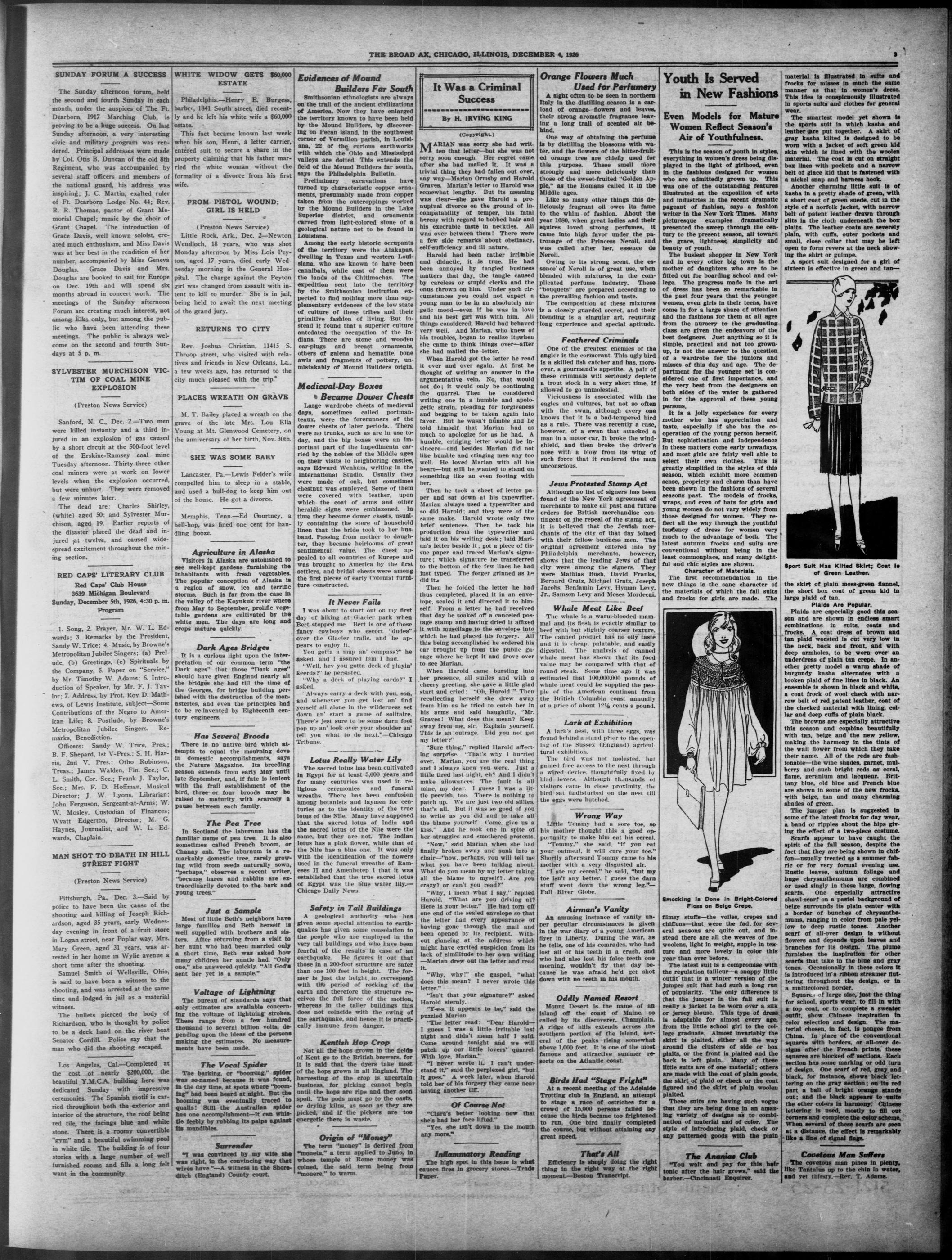
Smocking Is Done in Bright-Colored Floss on Beige Crepe.
filmsy stuffs—the volles, crepes and chiffons—that were the fad, for several seasons are quite out, and instead there are all the weaves of fine woolens, light in weight, supple in texture and more lovely in color this year than ever before.
The latest suit is a compromise with the regulation tailleur—a snappy little outfit that is a winter version of the jumper suit that had such a long run of popularity. The only difference is that the jumper in the fall suit is really a jacket to be worn over a silk or jersey blouse. This type of dress is adaptable for almost every age, from the little school girl to the college graduate. Almost invariably the skirt is plaited, either all the way around the clusters of side or box plaits, or the front is plaited and the back is left plain. Many of these little suits are of one material; others are made with the coat of plain goods, the skirt of plaid or check or the coat figured and the skirt of plain woolen plaited.
These suits are having such vogue that they are being done in an amazing variety of designs as to combination of material and of color. The style of introducing plaid, check or any patterned goods with the plain
The Ananas Club
"You wait and pay for this hair
tonic after the hair grows," said the
barber—Cincinnati Enquirer.
material is illustrated in suits and frocks for misses in much the same manner as that in women's dress. This idea is conspicuously illustrated in sports suits and clothes for general wear.
The smartest model yet shown is the sports suit in which kasha and leather are put together. A skirt of gray kasha kilted is designed to be worn with a jacket of soft green kid skin which is lined with the woolen material. The coat is cut on straight box lines with pockets and a narrow belt of glace kid that is fastened with a nickel snap and harness hook.
Another charming little suit is of kasha in a pretty shade of green, with a short coat of green suede, cut in the style of a norfolk jacket, with narrow belt of patent leather drawn through slits in the cloth underneath the box plats. The leather coats are severely plain, with cuffs, outer pockets and small, close collar that may be left open to form revers at the neck showing the shirt or gulpe. A sport suit designed for a girl of sixteen is effective in green and tan—
A
Sport Suit Has Kilted Skirt; Coat Is of Green Leather.
the skirt of plain moss-green flannel, the short box coat of green kid in large plaid of tan.
Plaids Are Popular.
Plaids are especially good this season and are shown in endless smart combinations in suits, coats and frocks. A coat dress of brown and tan plaid worsted is cut very low in the neck, back and front, and with deep armholes, to be worn over an underdress of plain tan crepe. In another pretty model a warm shade of burgundy kasha alternates with a broken plaid of fine lines in black. An ensemble is shown in black and white, a coat frock of wool check with narrow belt of red patent leather, coat of the checked material with lining, collar and deep cuffs of plain black.
The browns are especially attractive this season and combine beautifully with tan, beige and the new yellow, making the harmony in the tints of the wall flower from which they take their name. All of the reds are fashionable—the wine shades, garnet, mulberry and such bright reds as coral, flame, geranium and lacquer. Brittany blue, old blue and French blue are shown in some of the new frocks, with beige, tan and many charming shades of green.
The jumper plan is suggested in some of the latest frocks for day wear, a band or ripples about the hips giving the effect of a two-piece costume.
Scarfs appear to have caught the spirit of the fall season, despite the fact that they are being shown in chifon—usually treated as a summer fabric or for very formal evening use. Rustic leaves, autumn foliage and huge chrysanthemums are combined or used singly in these large, flowing scarfs. One especially attractive shawl-scarf on a pastel background of beige surrounds its plain center with a border of bunches of chrysanthemums, ranging in color from pale yellow to deep rustic tones. Another scarf of all-over design is without flowers and depends upon leaves and branches for its design. The plume furnishes the inspiration for other scarfs that take in the blue and gray tones. Occasionally in these colors it is introduced in a ribbon streamer fittering throughout the design, or in a multicolored border.
Squares of large size, just the thing for school, sports wear, to fill in with a top coat, or to complete a sweater outfit, show Chinese inspiration in color selection and design. The material chosen, in fact, is pongee from China. In place of the conventional squares with borders, or all-over designs after the French prints, these squares are blocked off sections. Each section has some marking or odd turn of design. One scarf of red, gray and black, for instance, shows black lettering on the gray section; on its red part a ball of bright orange stands out; and the black appears to unite the other colors in harmony. Chinese lettering is used, mostly to fill out corners and complete the color scheme. When several of these scarfs are seen at a distance, the effect is remarkably like a line of signal flags.
Lovetous Man Suffers
The covetous man piles in plenty, like Tantalius up to the chin in water, and yet thirsty—Rev. T. Adams.
Ernest H.
WILLIAMSON
UNDERTAKER
ERNEST H. WILLIAMSON
UNDERTAKER
1-312-25-25
E. H. WILLIAMSON
Charlest E.
Dawson
THE BROAD AX
Published Every Saturday
In this city since July 15th, 1899, without missing one single issue. Republicans, Democrats, Catholics, Protestants, Single Taxers, Priests, infidels or anyone else can have their say as long as their language is proper and responsibility is fixed.
The Broad Ax is a newspaper whose platform is broad enough for all, even claiming the editorial right to speak its own mind. It is neither Democratic nor Republican. It is strictly or absolutely independent in politics. Local communications will receive attention. Write only on one side of the paper.
Subscriptions must be paid in advance.
One Year .....$2.00
Six Months .....$1.00
Advertising rates made known on application.
Address all communications to
THE BROAD AX
oz06 S. Elizabeth St., Chicago.
Phone: Wentworth 2597
JULIUS F. TAYLOR
Editor and Publisher
Vol. XXXI No. 12
Chicago, December 4, 1926
Entered as Second-Class Matter, aug.
19, 1902, at the Post office at Chicago.
III. Under Act of March 8, 1879.
Phon: Office Main 4153; Residence
4751 Champlain Avenue
Phone Kenwood 6011
ATTORNEY AND COUNSELOR
AT LAW
Suite 708—184 W. Washington St.
CHICAGO
Telephone: State 3278
A. D. GASH
ATTORNEY AT LAW
Suite #13, Ashland Block
158 N. Clark Street
CHICAGO, ILL.
WILLI
UND
A. B.
JOHN D. SCOTT, Manager
Licensed Undertaker
MRS. MARY E. WILLIAMSON
Licensed Undertaker
J.E. BISH
33d Degree PR.W.D.G.M. Bookkeeper
Embalmers Apprentice No.194
Unexcelled for
AUTOMOBILES
KEN
5121-23-25
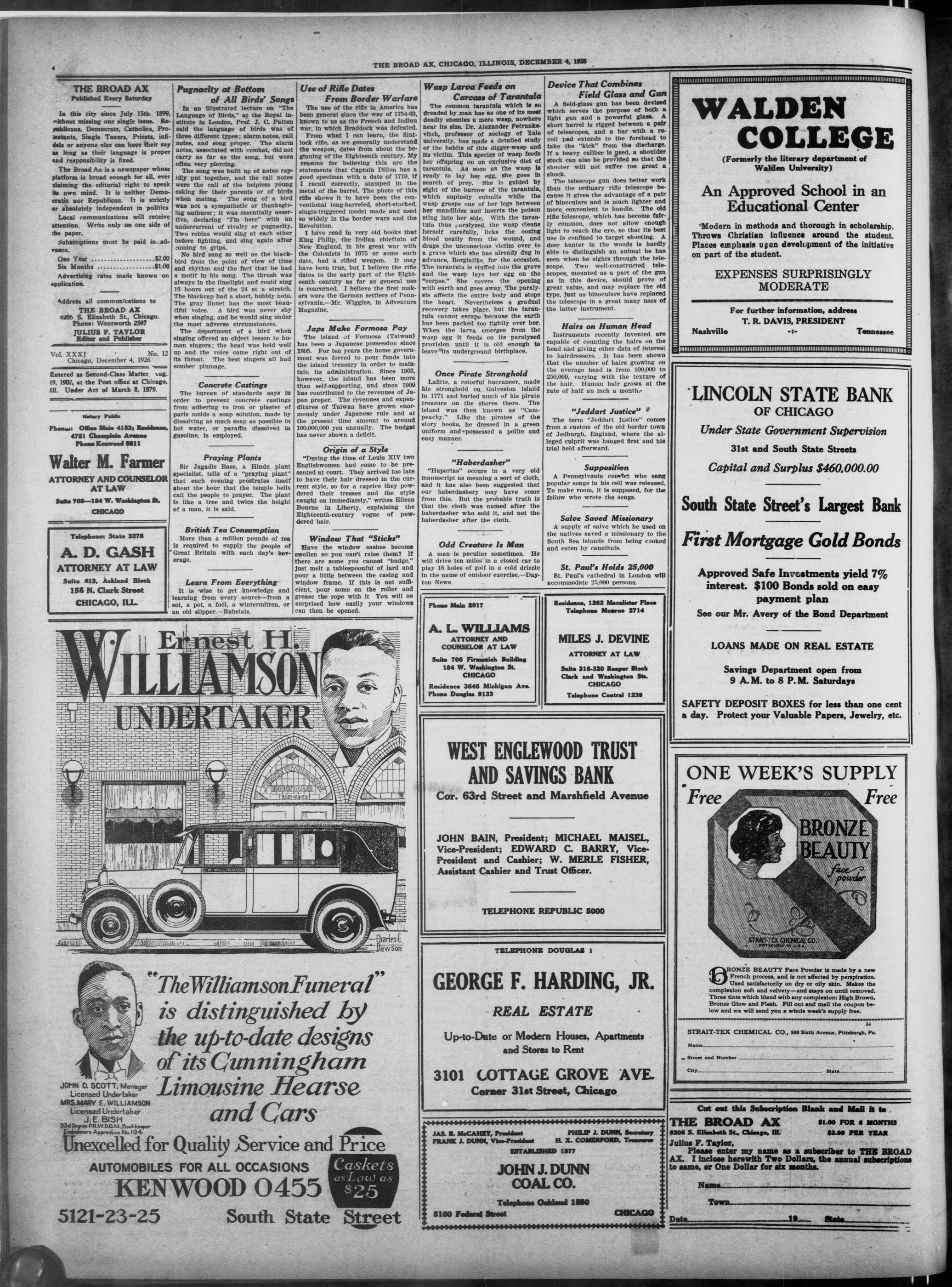
"TheWilliamsonFuneral" is distinguished by the up-to-date designs of its Cunningham Limousine Hearse and Cars
of All Birds' Songs
In an illustrated lecture on "The Language of Birds," at the Royal Institute in London, Prof. J. C. Patten said the language of birds was of three different types; alarm notes, call notes, and song proper. The alarm notes, associated with combat, did not carry as far as the song, but were often very piercing.
The song was built up of notes rapidly put together, and the call notes were the call of the helpless young asking for their parents or of birds when mating. The song of a bird was not a sympathetic or thanksgiving outburst; it was essentially assertive, declaring "Tm here" with an undercurrent of rivalry or pugnacity. Two robins would sing at each other before fighting, and sing again after coming to grips.
No bird sang so well as the blackbird from the point of view of time and rhythm and the fact that he had a motif in his song. The thrush was always in the limelight and could sing 16 hours out of the 24 at a stretch. The blackcap had a short, bubbly note. The gray linnet has the most beautiful voice. A bird was never shy when singing, and he would sing under the most adverse circumstances.
The deportment of a bird when singing offered an object lesson to human singers; the head was held well up and the voice came right out of its throat. The best singers all had somber plumage.
Concrete Castings
The bureau of standards says in order to prevent concrete castings from adhering to iron or plaster of paris molds a soap solution, made by dissolving as much soap as possible in hot water, or paraffin dissolved in gasoline, is employed.
Praying Plants
Sir Jagadis Base, a Hindu plant specialist, tells of a "praying plant" that each evening prostrates itself about the hour that the temple bells call the people to prayer. The plant is like a tree and twice the height of a man, it is said.
British Tea Consumption
More than a million pounds of tea is required to supply the people of Great Britain with each day's beverage.
Learn From Everything
THE BROAD AX, CHICAGO, ILLINOIS, DECEMBER 4, 1926
Use of Rifle Dates
The use of the rifle in America has been general since the war of 1754-63, known to us as the French and Indian war, in which Braddock was defeated. From what I can learn, the flint-lock rifle, as we generally understand the weapon, dates from about the beginning of the Eighteenth century. My reasons for believing this are the statements that Captain Dillon has a good specimen with a date of 1719, if I recall correctly, stamped in the metal of the barrel. The photo of this rifle shows it to have been the conventional long-barreled, short-stocked, single-triggered model made and used so widely in the border wars and the Revolution.
I have read in very old books that King Philip, the Indian chieftain of New England, in his great war with the Colonists in 1675 or some such date, had a rifled weapon. It may have been true, but I believe the rife dates to the early part of the Eighteenth century as far as general use is concerned. I believe the first makers were the German settlers of Pennsylvania.—Mr. Wiggins, in Adventure Magazine.
Jans Make Formosa Pay
The island of Formosa (Taiwan) has been a Japanese possession since 1895. For ten years the home government was forced to pour funds into the island treasury in order to maintain its administration. Since 1905, however, the island has been more than self-supporting, and since 1900 has contributed to the revenues of Japan proper. The revenues and expenditures of Taiwan have grown enormously under Japanese rule and at the present time amount to around 100,000,000 yen annually. The budget has never shown a deficit.
Origin of a Style
"During the time of Louis XIV two Englishwomen had come to be presented at court. They arrived too late to have their hair dressed in the current style, so for a caprice they powdered their tresses and the style caught on immediately," writes Eileen Bourne in Liberty, explaining the Eighteenth-century vogue of powdered hair.
Window That "Sticks"
Have the window sashes become swollen so you can't raise them? If there are some you cannot "budge," just melt a tablespoonful of lard and pour a little between the casing and window frame. If this is not sufficient, pour some on the roller and grease the rope with it. You will be surprised how easily your windows can then be opened.
Wasp Larva Feeds on
The common tarantula which is so dreaded by man has as one of its most deadly enemies a mere wasp, nowhere near its size. Dr. Alexander Petrunkvitch, professor of zoology of Yale university, has made a detailed study of the habits of this digger-wasp and its victim. This species of wasp feeds her offspring on an exclusive diet of tarantula. As soon as the wasp is ready to lay her egg, she goes in search of prey. She is guided by sight of the burrow of the tarantula, which supinely submits while the wasp grasps one of her legs between her mandibles and inserts the poison sting into her side. With the tarantula thus paralyzed, the wasp cleans herself carefully, licks the oozing blood neatly from the wound, and drags the unconscious victim over to a grave which she has already dug in advance, Borgalike, for the occasion. The tarantula is stuffed into the grave and the wasp lays her egg on the "corpse." She covers the opening with earth and goes away. The paralysis affects the entire body and stops the heart. Nevertheless a gradual recovery takes place, but the tarantula cannot escape because the earth has been packed too tightly over her. When the larva emerges from the wasp egg it feeds on its paralyzed provision until it is old enough to leave its underground birthplace.
Once Pirate Stronghold
Lafitte, a colorful buccaneer, made his stronghold on Galveston island in 1771 and buried much of his pirate treasure on the shores there. The island was then known as "Campeachy." Like the pirates of the story books, he dressed in a green uniform and *possessed a polite and easy manner.
"Haberdasher"
"Hapartas" occurs in a very old manuscript as meaning a sort of cloth, and it has also been suggested that our haberdasher may have come from this. But the probable truth is that the cloth was named after the haberdasher who sold it, and not the haberdasher after the cloth.
Odd Creature Is Man
A man is peculiar sometimes. He will drive ten miles in a closed car to play 18 holes of golf in a cold drizzle in the name of outdoor exercise.—Dayton News.
Phone Main 2017
A. L. WILLIAMS
ATTORNEY AND
COUNSELOR AT LAW
Suite 706 Firmenich Building
184 W. Washington St.
CHICAGO
Residence 3646 Michigan Ave.
Phone Douglas 9133
WEST ENGLAND
AND SAVI
Cor. 63rd Street and
JOHN BAIN, President
Vice-President; EDWA
President and Cashier;
Assistant Cashier and T
WEST ENGLEWOOD TRUST AND SAVINGS BANK
Cor. 63rd Street and Marshfield Avenue
JOHN BAIN, President; MICHAEL MAISEL, Vice-President; EDWARD C. BARRY, VicePresident and Cashier; W. MERLE FISHER, Assistant Cashier and Trust Officer.
TELEPHONE REPUBLIC 5000
TELEPHONE DOUGLAS 1
GEORGE F. H
REAL ESTATE
Up-to-Date or Moder
and Store
3101 COTTAG
Corner 31st S
JAS. B. McCAHEY, President
FRANK J. DUNN, Vice-President
ESTABLISHED
Up-to-Date or Modern Houses, Apartments and Stores to Rent
3101 COTTAGE GROVE AVE.
Corner 31st Street, Chicago
JOHN J. DUNN COAL CO.
Telephone
5100 Federal Street
A field-glass gun has been devised which serves the purpose of both a light gun and a powerful glass. A short barrel is rigged between a pair of telescopes, and a bar with a recoil pad extends to the forehead to take the "kick" from the discharge. If a heavy caller is used, a shoulder stock can also be provided so that the shooter will not suffer too great a shock.
The telescope gun does better work than the ordinary rifle telescope because it gives the advantage of a pair of binoculars and is much lighter and more convenient to handle. The old rifle telescope, which has become fairly common, does not allow enough light to reach the eye, so that its best use is confined to target shooting. A deer hunter in the woods is hardly able to distinguish an animal he has seen when he sights through the telescope. Two well-constructed telescopes, mounted as a part of the gun as in this device, should prove of great value, and may replace the old type, just as binoculars have replaced the telescope in a great many uses of the latter instrument.
Hairs on Human Head
Instruments recently invented are capable of counting the hairs on the head and giving other data of interest to hairdressers. It has been shown that the number of hairs growing on the average head is from 100,000 to 250,000, varying with the texture of the hair. Human hair grows at the rate of half an inch a month.
"Jeddart Justice"
The term "Jeddart justice" comes from a custom of the old border town of Jedburgh, England, where the alleged culprit was hanged first and his trial held afterward.
A Pennsylvania convict who sang popular songs in his cell was released. To make room, it is supposed, for the fellow who wrote the songs.
Salve Saved Missionary
A supply of salve which he used on the natives saved a missionary to the South Sea islands from being cooked and eaten by cannibals.
St. Paul's Holds 25,000
St. Paul's cathedral in London will accommodate 25,000 persons.
Residence, 1262 Macalister Place
Telephone Monroe 2714
ATTORNEY AT LAW
Suite 318-320 Reaper Block
Clark and Washington Sts.
CHICAGO
WOOD TRUST
INGS BANK
Marshfield Avenue
; MICHAEL MAISEL,
RD C. BARRY, Vice-
W. MERLE FISHER,
Trust Officer.
HARDING, JR.
Barn Houses, Apartments
to Rent
E GROVE AVE.
Street, Chicago
PHILIP J. DUNN, Secretary
H. X. COMERFORD, Treasurer
HED 1877
CHICAGO
Supposition
WALDEN COLLEGE
(Formerly the literary department of Walden University)
An Approved School in the Educational Center
cern in methods and thorough in school
on Christian influence around the s
emphasis upon development of the in
s of the student.
EXPENSES SURPRISINGLY MODERATE
For further information, address
T. R. DAVIS, PRESIDENT
Title :-
NICOLN STATE BANK
OF CHICAGO
Under State Government Supervise
31st and South State Streets
Capital and Surplus $460,000.00
State Street's Largest
Mortgage Gold B
Proved Safe Investments yield
interest. $100 Bonds sold on ea
payment plan
Our Mr. Avery of the Bond Depart
DANS MADE ON REAL ESTATE
An Approved School in an Educational Center
Modern in methods and thorough in scholarship. Throws Christian influence around the student. Places emphasis upon development of the initiative on part of the student.
EXPENSES SURPRISINGLY MODERATE
For further information, address
T. R. DAVIS, PRESIDENT
Nashville -- Tennessee
LINCOLN STATE BANK OF CHICAGO
Under State Government Supervision
31st and South State Streets
Capital and Surplus $460,000.00
First Mortgage Gold Bonds
Approved Safe Investments yield 7% interest. $100 Bonds sold on easy payment plan See our Mr. Avery of the Bond Department
LOANS MADE ON REAL ESTATE
Savings Department open from
9 A.M. to 8 P.M. Saturdays
TY DEPOSIT BOXES for less than or
Protect your Valuable Papers, Jewels
SAFETY DEPOSIT BOXES for less than one cent a day. Protect your Valuable Papers, Jewelry, etc.
ONE WEEK'S SUPPLY
Free Free
BRONZE
BEAUTY
face powder
STRAIT-TEX CHEMICAL CO.
PITTSBURGH, U.S.A.
BRONZE BEAUTY Face Powder is made by a new French process, and is not affected by perspiration. Used satisfactorily on dry or oily skin. Makes the complexion soft and velvety—and stays on until removed. Three tints which blend with any complexion: High Brown, Bronze Glow and Flesh. Fill out and mail the coupon below and we will send you a whole week's supply free.
STRAIT-TEX CHEMICAL CO., 569 Sixth Avenue, Pittsburgh, Pa.
Please enter my name as a subscriber to THE BROAD AX. I inclose herewith Two Dollars, the annual subscriptions to same, or One Dollar for six months.