Chicago Defender
Saturday, April 20, 1912
Chicago, Illinois
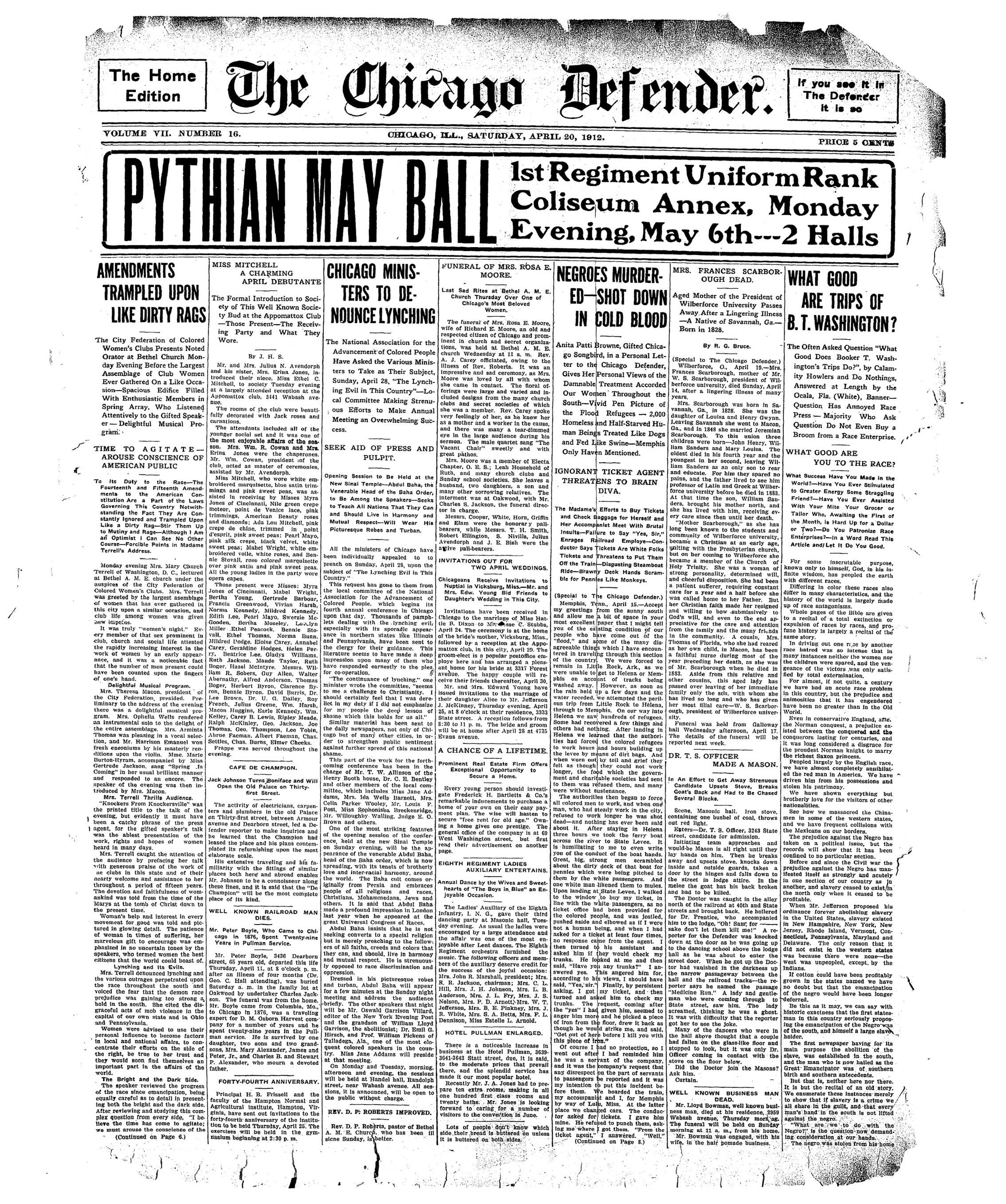
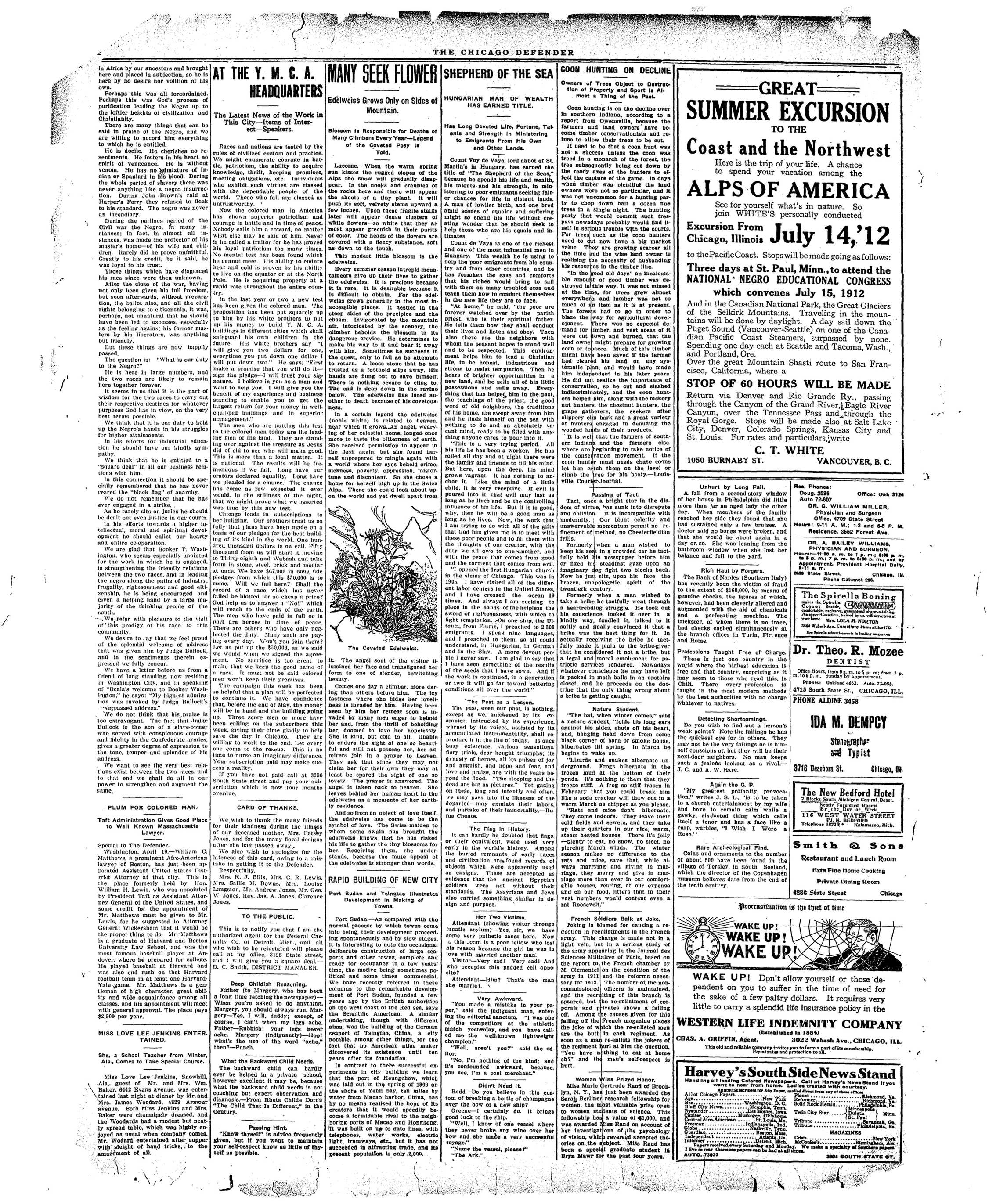
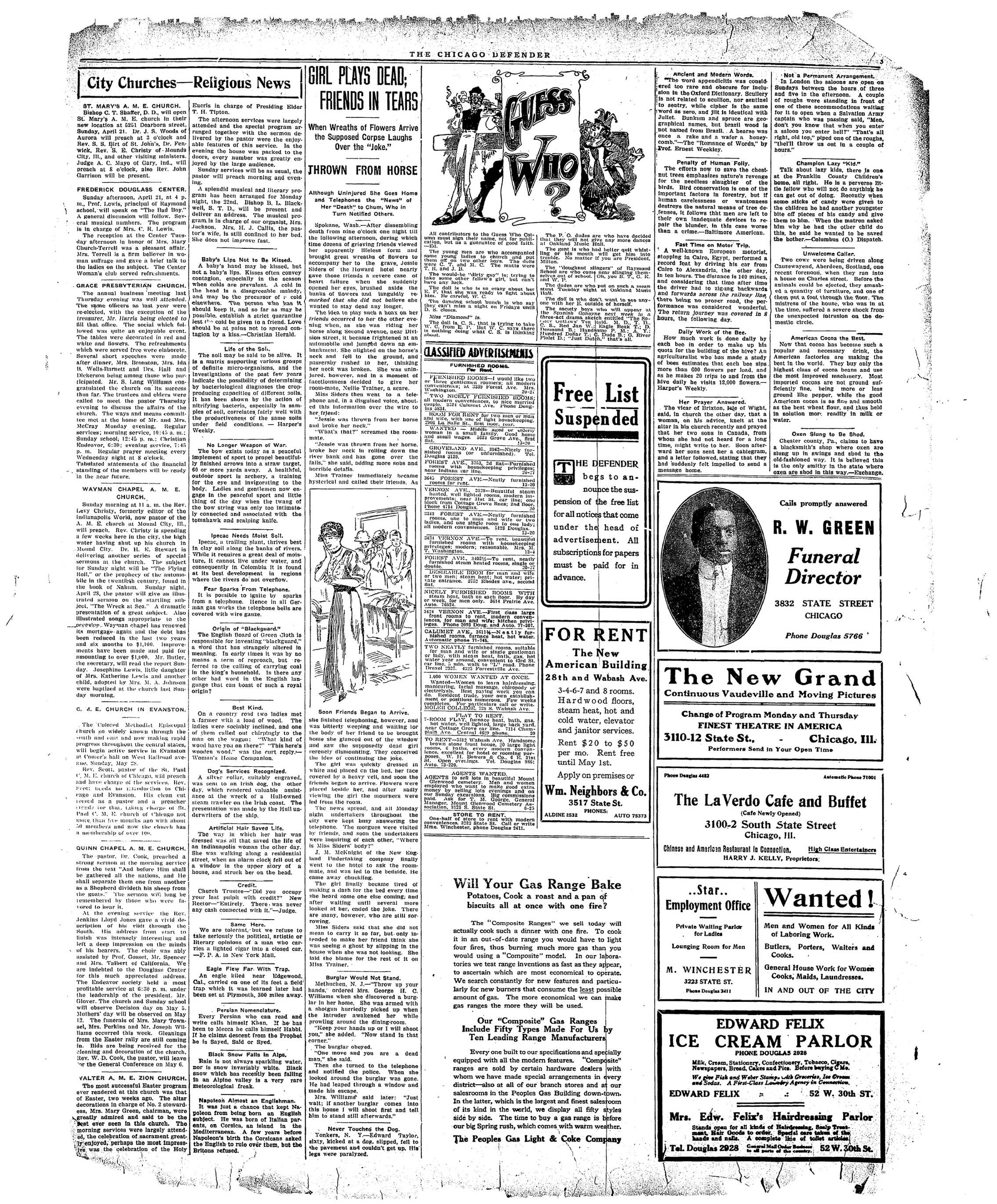
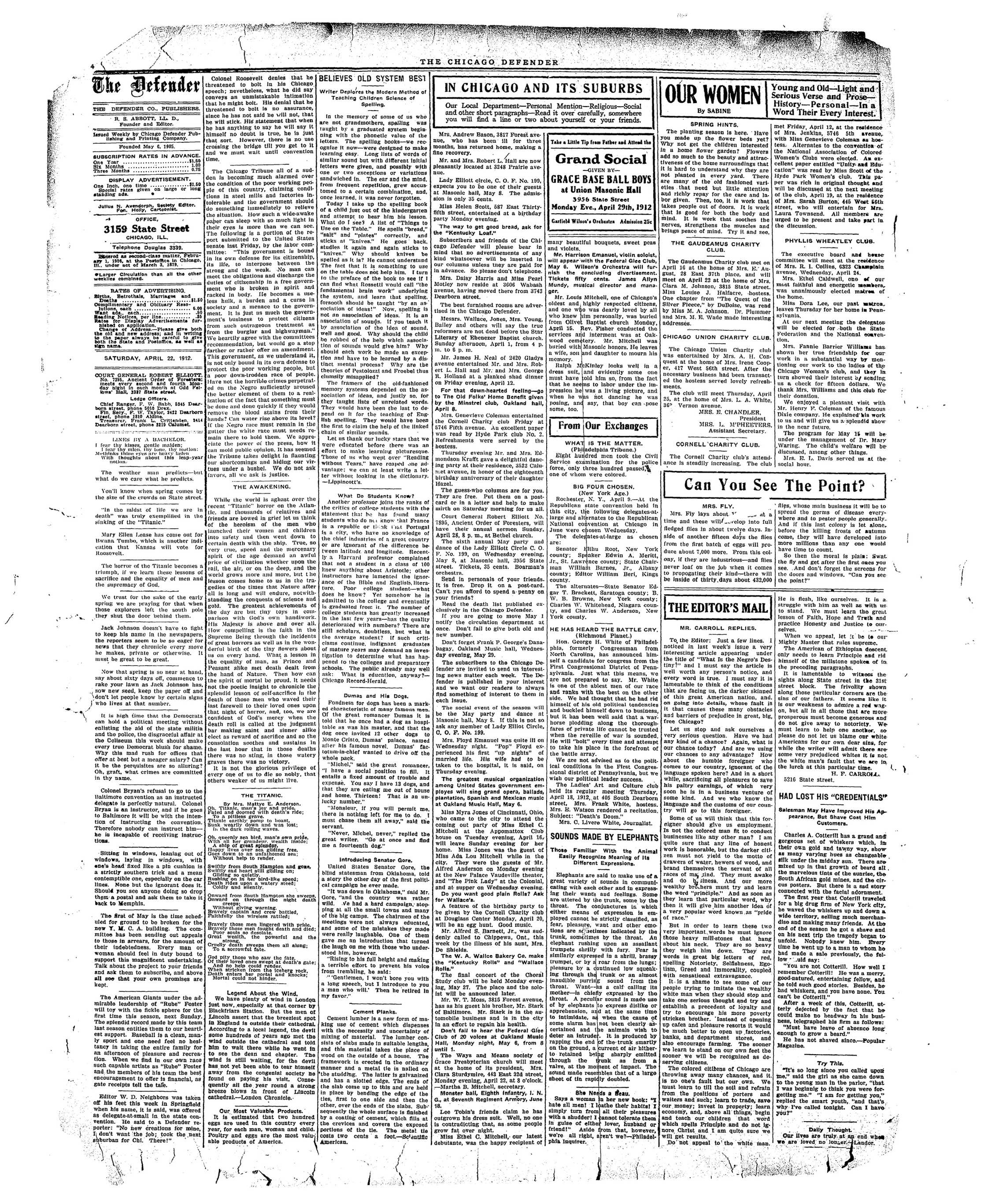
Page text (machine-generated)
PYTHI
HIAN M
Mr. and Mrs. Julius N. Avendorph and his sister, Mrs. Erina Jones, introduced their niece, Miss Ethel C. Mitchell, to society Tuesday evening at a largely attended reception at the Appomattox club. 3441 Wabash avenue.
The rooms of the club were beautifully decorated with Jack roses and carnations.
The attendants included all of the younger social set and it was one of the most enjoyable affairs of the season. Mrs. Wm. R. Cowan and Mrs. Erina Jones were the chaperones. Mr. Wm. Cowan, president of the club, acted as master of ceremonies, assisted by Mr. Avendorph.
Miss Mitchell, who wore white embroidered marquette, skin satin trimmings and pink sweet peas, was assisted in receiving by Misses Myra Jones of Cincinnati, Nile green crepe meteor, point de Venice lace, pink trimmings, American Beauty roses and diamonds; Ada Lou Mitchell, pink crepe de chine, trimmed in point d'esprit, pink sweet peas; Pearl Mayo, pink silk crepe, black velvet, white sweet peas; Mabel Wright, white embroidered volle, white roses, and Bennie Stovall, rose colored marquette over pink satin and pink sweet peas. All the young ladies in the party wore capes.
Those present were Misses: Myra Jones of Cincinnati, Mabel Wright, Bertha Young, Gertrude Barbour, Francis Greenwood, Vivian Harsh, Norma Kennedy, Mildred Kennedy, Edith Lee, Pearl Mayo, Swierie McGooden, Bertha Moseley, Loa-Jyn Miller, Ether Peacock, Bennie Stovall, Ethel Thomas, Norma Bunn, Mildred Dodge, Eloise Carey, Annabel Carey, Geraldine Hodges, Helen Pery, Beatrice Lee, Gladys Williams, Ruth Jackson, Maude Taylor, Ruth Boger, Hazel McIntyre, Messrs. William R. Sobers, Guy Allen, Walter Abernathy, Alfred Anderson, Thomas Boger, Herbert Byron, Clarence Byron, Bennie Byron, David Burris, Dr. Lee Brown, Dr. U. G. Dailley, Roy French, Julius Greene, Wm. Harsh, Macon Huggins, Earle Kennedy, Wm. Kelley, Carey B. Lewis, Ripley Meade, Ralph McKinley, Geo. Jackson, Joe Thomas, Geo. Thompson, Lee Tobin, Ahrue Faeman, Albert Faeman, Chas Settles, Ches. Burns, Elmer Cheeks. Frappe was served throughout the evening.
Jack Johnson Turns Joniface and Will Open the Old Palace on Thirty-first Street.
The activity of electricians, carpenters and plumbers in the old Palace on Thirty-first street, between Armour avenue and Dearborn street, led a Defender reporter to make inquiries and he learned that the Champion had leased the place and his plans contemplated its refurbishing upon the most elaborate scale.
His extensive traveling and his familiarity with the fittings of similar places both here and abroad enables Mr. Johnson to be a connoisseur along these lines, and it is said that the "De Champion" will be the most complete place of its kind.
WELL KNOWN RAILROAD MAN DIES.
Mr. Peter Boyle, Who Came to Chicago in 1876, Spent Twenty-nine Years in Pullman Service.
Mr. Peter Boyle, 3436 Dearborn street, 65 years old, departed this life Thursday, April 11, at 8 o'clock p. m. after an illness of four months (Dr. Goo, C. Hall attending), was buried Saturday a. m. in the family lot at Oakwood by undertaker Charles Jackson. The funeral was from the home. Mr. Boyle came from Columbia, Mo., to Chicago in 1876, was a traveling expert for D. M. Osborn Harvest company for a number of years and he spent twenty-nine years in the Pullman service. He is survived by one daughter, two sons and two grand-sons, Mrs. Mary Alexander, James and Peter, Jr., and Charles B. and Stewart P. Alexander, who mourn a devoted father.
Principal H. B. Frissell and the faculty of the Hampton Normal and Agricultural institute, Hampton, Virginia, have sent out invitations to the forty-fourth anniversary of the institution to be held Thursday, April 25. The exercises will be held in the gymnasium beginning at 2:30 p. m.
---
---
The Home Edition
AMENDMENTS TRAMPLED UPON LIKE DIRTY RAGS
The City Federation of Colored Women's Clubs Presents Noted Orator at Bethel Church Monday Evening Before the Largest Assemblage of Club Women Ever Gathered On a Like Occasion—Spacious Edifice Filled With Enthusiastic Members in Spring Array, Who Listened Attentively to the Gifted Speaker—Delightful Musical Program.
TIME TO AGITATE—AROUSE CONSCIENCE OF AMERICAN PUBLIC
To Its Duty to the Race—The Fourteenth and Fifteenth Amendments to the American Constitution Are a Part of the Laws Governing This Country Notwithstanding the Fact They Are Constantly Ignored and Trampled Upon Like a Dirty Rag—Stir Them Up to Mutiny and Rage—Although I Am an Optimist I Can See No Other Course—Forcible Points in Madame Terrell's Address.
---
Monday evening Mrs. Mary Church Terrell of Washington, D.C., lectured at Bethel A. M. E. church under the auspices of the City Federation of Colored Women's Clubs. Mrs. Terrell was greeted by the largest assemblage of women that has ever gathered in this city upon a similar occasion, and club life among women was given new impetus.
It was truly "women's night." Every member of that sex prominent in club, church and social life attested the rapidly increasing interest in the work of women by an early appearance, and it was a noticeable fact that the number of men present could have been counted upon the fingers of one's hand.
Delightful Musical Program.
Mrs. Theresa Macon, president of the City Federation, presided. Preliminary to the address of the evening there was a delightful musical program. Mrs. Ophella Wells rendered an instrumental solo to the delight of the entire assemblage. Mrs. Arminta Thomas was pleasing in a vocal selection, and Mr. Harrison Emanuel won fresh enconiums by his masterly renditions upon the violin. Mme. Marie Burton-Hyram, accompanied by Miss Gertrude Jackson, sang "Spring Is Coming" in her usual brilliant manner and responded to an encore. The speaker of the evening was then introduced by Mrs. Macon.
"Knockers From Knockersville" was the printed title to the talk of the evening, but evidently it must have been a catchy phrase of the press agent, for the gifted speaker's talk was the ablest presentation of the work, rights and hopes of women heard in many days.
Mrs. Terrell caught the attention of the audience by prefacing her talk with generous praise of the work of ne clubs in this state and of their neatly welcome and assistance to her throughout a period of fifteen years. The devotion and faithfulness of womankind was told from the time of the Marys at the tomb of Christ down to the present time.
Woman's help and interest in every movement for good was told and pictured in glowing detail. The patience of woman in times of suffering, her marvelous gift to encourage was emphasized in no uncertain tones by the speakers, who termed women the best citizens that the world could boast of.
Lynching and its Evils.
Mrs. Terrell denounced lynching and the various outrages perpetrated upon the race throughout the south and voiced the fear that the demon race prejudice was gaining too strong a hold in the south. She cited the disgraceful acts of mob violence in the capital of our own state and in Ohio and Pennsylvania.
Women were advised to use their personal influence to become factors in local and national affairs, to concentrate their efforts on the side of the right, be true to her trust and they would soon find themselves an important part in the affairs of the world.
The Bright and the Dark Side.
The speaker reviewed the progress of the race since emancipation, being equally careful as to detail in presenting both the bright and the dark side.
After reviewing and studying this complex question from every side, "I believe the time has come to agitate; we must arouse the conscience of the (Continued on Page 6.)
The Chicago Defender.
MISS MITCHELL
The Formal Introduction to Society of This Well Known Society Bud at the Appomattox Club—Those Present—The Receiving Party and What They Wore.
By J. H. S.
FORTY-FOURTH ANNIVERSARY.
CHICAGO, ILL., SATURDAY, APRIL 20, 1912.
CHICAGO MINIS TERS TO DE NOUNCELYNCHING
The National Association for the Advancement of Colored People Have Asked the Various Ministers to Take as Their Subject, Sunday, April 28, "The Lynching Evil in This Country"—Local Committee Making Strenuous Efforts to Make Annual Meeting an Overwhelming Success.
SEEK AID OF PRESS AND PULPIT.
Opening Session to Be Held at the New Sinai Temple—Abdul Baha, the Venerable Head of the Baha Order, to Be Among the Speakers—Seeks to Teach All Nations That They Can and Should Live in Harmony and Mutual Respect—Will Wear His Picturesque Robes and Turban.
---
All the ministers of Chicago have been individually appealed to to preach on Sunday, April 28, upon the subject of "The Lynching Evil in This Country."
This request has gone to them from the local committee of the National Association for the Advancement of Colored People, which begins its fourth annual conference in Chicago upon that day. Thousands of pamphlets dealing with the Lynching evil, especially with its sporadic appearance in northern states like Illinois and Pennsylvania, have been sent to the clergy for their guidance. This literature seems to have made a deep impression upon many of them who have responded earnestly to the plea for co-operation.
The continuance of lynching," one minister wrote the committee, "seems to me a challenge to Christianity. I should certainly feel that I was derelict in my duty if I did not emphasize for my people the deep lesson of shame which this holds for us all." Similar material has been sent to the daily newspapers, not only of Chicago but of many other cities, in order to strengthen public sentiment against further spread of this national shame.
This part of the work for the forthcoming conference has been in the charge of Mr. T. W. Allinson of the Henry Booth house, Dr. C. E. Bentley and other members of the local committee, which includes Miss Jane Adams, Mrs. Ida Wells Barnett, Mrs. Cella Parker Wooley, Mr. Louis F. Post, Miss Sophisba Breckenridge, Mr. Willoughby Walling, Judge E. O. Brown and others.
One of the most striking features of the opening session of the conference, held at the new Sinai Temple on Sunday evening, will be the appearance of the venerable Abdul Baha, head of the Baha order, which is now spreading, with its tenets of brotherly love and interracial harmony, around the world. The Baha cult comes originally from Persia and embraces people of all religions and races, Christians, Mohammedans, Jews and others. It is said that Abdul Baha made a profound impression in London last year when he appeared at the great Universal Congress of Races. Abdul Baha insists that he is not seeking converts to a special religion but is merely preaching to the followers of all faiths, creeds and colors that they can, and should, live in harmony and mutual respect. He is strenuously opposed to race discrimination and oppression. Dressed in his picturesque robes and turban, Abdul Baha will appear for a few minutes at the Sunday night meeting and address the audience briefly. The other speakers that night will be Mr. Oswald Garrison Villard, editor of the New York Evening Post and the grandson of William Lloyd Garrison, the abolitionist; Dr. Emil Ghrisch, and Prof. William Pickens of Talladega, Ala., one of the most eloquent colored speakers in the country. Miss Jane Addams will preside at that meeting.
On Monday and Tuesday, morning, afternoon and evening, the sessions will be held at Handel hall, Randolph street, near Wabash avenue. All sessions, it is announced, will be open to the public without charge.
REV. D. P: ROBERTS IMPROVED.
Rev. D. P. Roberts, pastor of Bethel A. M. E. Church, who has been ill since Sunday, is better.
1st Regiment Uniform Rank Coliseum Annex, Monday Evening, May 6th---2 Halls
FUNERAL OF MRS. ROSA E
MOORE
Last Sad Rites at Bethel A. M. E.
Church Thursday Over One of
Chicago's Most Beloved
Women.
The funeral of Mrs. Rosa E. Moore,
wife of Richard E. Moore, an old and
respected citizen of Chicago and prominent in church and secret organizations, was held at Bethel A. M. E.
church Wednesday at 11 a.m. Rev. A. J. Carey officiated, owing to the illness of Rev. Roberts. It was an impressive and sad ceremony, as Mrs. Moore was loved by all with whom she came in contact. The floral offerings were large and varied and included designs from the many church clubs and secret societies of which she was a member. Rev. Carey spoke very feelingly of her, as he knew her as a mother and a worker in the cause, and there was many a tear-dimmed eye in the large audience during his sermon. The male quartet sang "The Vacant Chair" sweetly and with great pathos.
Mrs. Moore was a member of Electa Chapter, O. E. S.; Leah Household of Ruth, and many church clubs and Sunday school societies. She leaves a husband, two daughters, a son and many other sorrowing relatives. The interment was at Oakwood, with Mr. Charles S. Jackson, the funeral director in charge.
Messrs. Cooper, White, Horn, Griffin and Elam were the honorary pall-bearers, while Messrs. T. H. Smith, Robert Ellington, S. Nivills, Julius Avendorph and J. E. Bish were the active pall-bearers.
INVITATIONS OUT FOR
Chicagoans Receive Invitations to Nuptial in Vicksburg, Miss—Mr. and Mrs. Edw. Young Bid Friends to Daughter's Wedding in This City.
Invitations have been received in Chicago to the marriage of Miss Hattie B. Dixon to Mr. Susse C. Stubba, April 24. The ceremony is at the home of the bride's mother, Vicksburg, Miss. followed by a reception at the Appomattox club, in this city, April 29. The groom-elect is a popular postoffice employee here and has arranged a plenus home for his bride at 3317 Forest avenue. The happy couple will receive their friends thereafter, April 30. Mr. and Mrs. Edward Young have issued invitations to the marriage of their daughter Alice to Mr. Jefferson J. McKinney, Thursday evening, April 25, at 8 o'clock at their residence, 3333 State street. A reception follows-from 8:30 to 11 p. m. The bride and groom will be at home after April 28 at 4735 Evans avenue.
A CHANCE OF A LIFETIME
Prominent Real Estate Firm Offers Exceptional Opportunity to Secure a Home.
Every young person should investigate Frederick H. Bartlett & Co.'s remarkable inducements to purchase a home of your own on their easy payment plan. The wise will hasten to secure "free rent for old age." Owning a home gives one prestige. The general office of the company is at 69 West Washington street, but first read their advertisement on another page.
EIGHTH REGIMENT LADIES
AUXILIARY ENTERTAINS
Annual Dance by the Wives and Sweet-hearts of "The Boys in Blue" an Enjoyable Occasion.
The Ladies' Auxiliary of the Eighth Infantry, I. N. G., gave their third dancing party at Masonic hall, Tuesday evening. As usual the ladies were encouraged by a large attendance and the affair was one of the most enjoyable after Lent dances. The Eighth Regiment orchestra furnished the music. The following officers and members of the auxiliary deserve credit for the success of the joyful occasion: Mrs. John R. Marshall, president; Mrs. R. R. Jackson, chairman; Mrs. C. L. Hill, Mrs. J. H. Johnson, Mrs. L. B Anderson, Mrs. J. L. Fry, Mrs. J. S. Nelson, Mrs. P. D. Arnett\*. Mrs. W. T. Jefferson, Mrs. B. E. Pinkney, Mrs. J. R. White, Mrs. S. A. Betts, Mrs. F. L. Dennison, Miss Estelle L. Arnold.
HOTEL PULLMAN ENLARGED.
There is a noticeable increase in business at the Hotel Pullman, 3639-3641-3643 Statt street, due, it is said, to the moderate prices that prevail there, and the splendid service has made it our most popular hotel.
Recently Mr. J. A. Jones had to prepare ten extra rooms, making in all one hundred first class rooms and twenty baths: Mr. Jones is looking forward to caring for a number of visitors to the convention in June.
Lots of people don't know which side their bread is buttered on unless it is buttered on both sides.
NEGROES MURDERED—SHOT DOWN IN COLD BLOOD
Anita Patti Browne, Gifted Chicago Songbird, in a Personal Letter to the Chicago Defender, Gives Her Personal Views of the Damnable Treatment Accorded Our Women Throughout the South—Vivid Pen Picture of the Flood Refugees —2,000 Homeless and Half-Starved Human Beings Treated Like Dogs and Fed Like Swine—Memphis Only Haven Mentioned.
IGNORANT TICKET AGENT
THREATENS TO BRAIN
The Madame's Efforts to Buy Tickets and Check Baggage for Herself and Her Accompanist Meet With Brutal Insults—Failure to Say "Yes, Sin," Enrages Railroad Employee—Conductor Says Tickets Are White Folks Tickets and Threatens to Put Them Off the Train—Disgusting Steamboat Ride—Brawny Deck Hands Scramble for Pennies like Monkeys.
(Special to The Chicago Defender.)
Memphis, Tenn., April 15—Accept my greetings from the sunny south and allow me a bit of space in your most excellent paper that I might tell you of the existing condition of our people who have come out of the "flood," and some of the many disagreeable things which I have encountered in traveling through this section of the country. We were forced to remain in Little Rock, Ark, as we were unable to get to Helena or Memphis on account of tracks being washed away. However, as soon as the rain held up a few days and the water receded, we attempted the perilous trip from Little Rock to Helena, through to Memphis. On our way into Helena we saw hundreds of refugees. Some had recovered a few things and others had nothing. After landing in Helena we learned that the authorities had forced the colored refugees to work hours and hours building up the levee by means of dirt bags. And when worn out by toil and grief they felt as though they could not work longer, the food which the government and charitable societies had sent to them was refused them, and many were without sustenance.
The authorities then began to force all colored men to work, and when one man, who had steadily work in the city, refused to work longer he was shot dead—and nothing has ever been said about it. After staying in Helena three hours we took the ferry boat across the river to State Levee. It is humiliating to me to even write you of the conduct of the boat hands, Great, big, strong men scrambled about the dirty deck of that boat for pennies which were being pitched to them by the white passengers. And one white man likened them to mules. Upon landing at State Levee, I walked to the window to buy my ticket, in line with the white passengers, as no ticket office had been provided for the colored people, and was jostled, pushed aside and elbowed as if I were not a human being, and when I had asked for a ticket at least four times, no response came from the agent. I then turned to his assistant and asked him if they would check my trunks. He looked at me and then said, "Have you any trunks?" I answered yes. This angered him for, according to his views, I should have said, "Yes, sir." Finally, by persistent asking, I got my ticket, and then turned and asked him to check my trunks. The request, coming after the "yes" I had given him, seemed to anger him more and he picked a piece of iron from the floor, drew it back as though he would strike me, and said, "Get out of here before I kill you with this piece of iron."
Of course I had no protection, so I went out after I had reminded him he was a servant of the company, and it was the company's request that any disrespect on the part of servants to passengers be reported and it was my intention to put this incident be fore them. We boarded the train, my accompanist and I, for Memphis by way of Lulu. Miss. At the latter place we changed cars. The conductor asked for tickets. I gave him mine. He refused to punch them, asking me where I got them. "From the ticket agent," I answered. "Well," (Continued on Page 8.)
MRS. FRANCES SCARBOROUGH DEAD.
Aged Mother of the President of Wilberforce University Passes Away After a Lingering Illness —A Native of Savannah, Ga.— Born in 1828.
By R. G. Bruce.
(Special to The Chicago Defender.) Wilberforce, O., April 19.—Mrs. Frances Scarborough, mother of Mr. W. S. Scarborough, president of Wilberforce university, died Sunday, April 14, after a lingering illness of many years.
Mrs. Scarborough was born in Savannah, Ga., in 1828. She was the daughter of Louisa and Henry Gwynn. Leaving Savannah she went to Macon, Ga., and in 1848 she married Jeremiah Scarborough. To this union three children were born—John Henry, William Sanders and Mary Louisa. The oldest died in his fourth year and the youngest in her second, leaving William Sanders as an only son to rear and educate. For him they spared no pains, and the father lived to see him professor of Latin and Greek at Wilberforce university before he died in 1883. At that time the son, William Sanders, brought his mother north, and she has lived with him, receiving every care since then until her death.
"Mother Scarborough," as she has long been known to the students and community of Wilberforce university, became a Christian at an early age, uniting with the Presbyterian church, but on her coming to Wilberforce she became a member of the Church of Holy Trinity. She was a woman of strong personality, determined will, and cheerful disposition. She had been a patient sufferer, requiring constant care for a year and a half before she was called home to her Father. But her Christian faith made her resigned and willing to bow submissively to God's will, and even to the end appreciative for the care and attention from the family and the many friends in the community. A cousin, Mrs. Thomas of Florida, who she had reared as her own child, in Macon, has been a faithful nurse during most of the year preceding her death, as she was of Mr. Scarborough when he died in 1883. Aside from this relative and other cousins, this aged lady has passed over leaving of her immediate family only the son, with whom she has lived so long and who has given her most fillful care—W. S. Scarborough, president of Wilberforce university.
Funeral was held from Galloway hall Wednesday afternoon, April 17 The details of the funeral will be reported next week.
DR. T. S. OFFICER
In An Effort to Get Away Strenuous Candidate Upsets Stove, Breaks Goat's Back and Had to Be Chased Several Blocks.
Scene, Masonic hall. Iron stove, containing one bushel of coal, throws out red light.
Epters—Dr. T. S. Officer, 3243 State street, candidate for admission.
Initiating team approaches and would be Mason is all right until they lay hands on him. Then he breaks away and upsets stove, knocks down inside and outside guards, takes a door by the hinges and falls down to the street in lodge attire. In the mlee the goat has his back broken and had to be killed.
The Doctor was caught in the alley north of the railroad at 40th and State streets and brought back. He hollered for Dr. Prentice, who accompanied him to the lodge, "Oh! Sam, for——sake don't let them kill me!" A reporter for the Defender was knocked down at the door as he was going up to the dancing school above the lodge hall as he was about to enter the street door. When he got up the Doctor had vanished in the darkness up the narrow passageway between the hall and the railroad tracks—the reporter says he named the passage "Medicine Run." A lady and gentleman who were coming through to State street, saw him. The lady screamed, thinking he was a ghost. It was with difficulty that the reporter got her to see the joke.
Many of the dancers who were in the hall above thought that a couple had fallen on the glass-like floor and stopped to look, but it was only Dr. Officer coming in contact with the stove on the floor below. No, the Doctor join the Masons? Ask him. Curtain
WELL KNOWN BUSINESS MAN
DEAD
Mr. Lloyd Bowman, well known busi-
ness man, died at his residence, 2959
Wabash avenue. Thursday mortig-
age The funeral will be held on Sunday
morning at 11 a. m., from his home
Mr. Bowman was engaged, with his
wife, in the hair pomade business.
If you see it in The Defender it is so
mRank
Monday
2 Halls
WHAT GOOD ARE TRIPS OF B.T.WASHINGTON?
The Often Asked Question "What Good Does Booker T. Washington's Trips Do?", by Calamity Howlers and Do Notings, Answered at Length by the Ocala, Fla. (White), Banner—Question Has Annoyed Race Press — Majority Who Ask Question Do Not Even Buy a Broom from a Race Enterprise.
WHAT GOOD ARE
YOU TO THE RACE?
What Success Have You Made in the World?—Have You Ever Stimulated to Greater Energy Some Straggling Friend?—Have You Ever Assisted With Your Mite Your Grocer or Tailor Who, Awaiting the First of the Month, is Hard Up for a Dollar or Two?—Do You Patronize Race Enterprises?—In a Word Read This Article and Let It Do You Good.
For some inscrutable purpose, known only to himself, God, in his infinite wisdom, has peopled the earth with different races.
Differing in color these races also differ in many characteristics, and the history of the world is largely made up of race antagonisms.
Whole pages of the Bible are given to a recital of a total extinction or expulsion of races by races, and profane history is largely a recital of the same story.
In driving out one race by another race hatred was one so intense that in many instances neither the women nor the children were spared, and the vengeance of the victors was only satisfied by total extermination.
For almost, if not quite, a century we have had an acute race problem in this country, but the prejudice and animosities that it has engendered have been no greater than in the Old World.
Even in conservative England, after the Norman conquest, a prejudice existed between the conquered and the conquerors lasting for centuries, and it was long considered a disgrace for the proudest Norman knight to marry the richest Saxon princess. Peopled largely by the English race, we have almost completely annihilated the red man in America. We have driven him from his possessions and stolen his patrimony. We have shown everything but brotherly love for the visitors of other nationalities. See how we massacred the Chinamen in some of the western states, and we have frequent collisions with the Mexicans on our borders. The prejudice against the Negro has taken on a political issue, but the records will show that it has been confined to no particular section. Before and since the Civil war the prejudice against the Negro has manifested itself as strongly and acutely in one section of our country as in another, and slavery ceased to exist in the north only when it ceased to be profitable. When Mr. Jefferson proposed his ordinance forever abolishing slavery in the United States, slavery existed in New Hampshire, New York, New Jersey, Rhode Island, Vermont, Connecticut, Pennsylvania, Maryland and Delaware. The only reason that it did not exist in the western states was because there were none—the west was unpeopled, except, by the Indians.
If cotton could have been profitably grown in the states named we have no doubt but that the emancipation of the negro would have been longer deferred.
Be this as it may, we can say with historic exactness that the first statesman in this country seriously proposing the emancipation of the Negro was of the south, and himself a large slave holder.
The first newspaper having for its main purpose the abolition of the slave, was established in the south, and the man who is now hailed as the Great Emancipator was of southern birth and southern antecedents.
But that is, neither here nor there. It is but the recital of an old story. We enumerate these instances merely to show that if slavery is a crime we all share in the guilt, and that every man's hand in the south is not lifted against the negro.
"What are we to do with the Negro?" is the question now demanding consideration at our hands.
The negro was stolen from his home
In Africa by our ancestors and brought here and placed in subjection, so he is here by no desire nor volition of his own.
---
Perhaps this was all forcoredal. Perhaps this was God's process of purification leading the Negro up to the lotter heights of civilization and Christianity. There are many things that can be said in praise of the Negro, and we are willing to accord him everything to which he is entitled. He is docile. He cherishes no resentments. He fosters in his heart no spirit of vengeance. He is without venom. He has no admixture of Indian or Spanish in his blood. During the whole period of slavery there was never anything like a negro insurrection. During John Brown's raid at Harper's Ferry they refused to flock to his standard. The negro was never an incendiar.
During the perilous period of the Civil war the Negro, in many instances; in fact, in almost all instances, was made the protector of his master's home—of his wife and children. Rarely did he prove unfaithful. Greatly to his credit, be it said, he was loyal to his trust.
Those things which have disgraced his race since were then unknown.
After the close of the war, having not only been given his full freedom, but soon afterwards, without preparation, the ballot also, and all the civil rights belonging to citizenship, it was, perhaps, not unnatural that he should have been led to excesses, especially as the feeling against his former masters by his liberators, was anything but friendly.
Dut these things are now happily passed.
The question is: "What is our duty to the Negro?"
He is here in large numbers, and the two races are likely to remain here together forever.
It seems to us that it is the part of wisdom for the two races to carry out their respective destinies for whatever purposes God has in view, on the very best terms possible.
We think that it is our duty to hold up the Negro's hands in his struggles for higher attainments.
In his efforts for industrial education he should have our kindly sympathy.
We think that he is entitled to a "square deal" in all our business relations with him.
In this connection it should be specially remembered that he has never reared the "black flag" of anarchy.
We do not remember that he has ever engaged in a strike. As he rarely sits on juries he should be dealt out even justice in our courts. In his efforts towards a higher intellectual, moral and spiritual development he should enlist our hearty and entire co-operation.
We are glad that Booker T. Washington, who seems especially anointed for the work in which he is engaged, is strengthening the friendly relations between the two races, and in leading the negro along the paths of industry, frugality, righteousness and good citizenship, he is being encouraged and given a helping hand by a large majority of the thinking people of the south.
We refer with pleasure to the visit of this prodigy of his race to this community.
We desire to say that we feel proud of the splendid welcome of address that was given him by Judge Bullock, and in the sentiments therein expressed we fully concur.
We have a letter before us from a friend of long standing, now residing in Washington City, and in speaking of "Ocala's welcome to Booker Washington," he says: "My highest admiration was invoked by Judge Bullock's "surpassed address." We do not think that his praise is too extravagant. The fact that Judge Bullock is the son of a slave-owner who served with conspicuous courage and fidelity in the Confederate armies, gives a greater degree of expression to the tone, temper and splendor of his address. We want to see the very best relations exist between the two races, and to that end we shall do all in our power to strengthen and augment the same.
PLUM FOR COLORED MAN;
Taft Administration Gives Good Place to Well Known Massachusetts Lawyer.
Special to The Defender:
Washington, April 19.—William C. Matthews, a prominent Aro-American lawyer of Boston, has just been appointed Assistant United States District Attorney at that city. This is the place formerly held by Hon. William H. Lewis, who was appointed by President Taft as Assistant Attorney General of the United States, and some credit for the appointment of Mr. Matthews must be given to Mr. Lewis, for he suggested to Attorney General Wickersham that it would be the proper thing to do. Mr. Matthews is a graduate of Harvard and Boston University Law School, and was the most famous baseball player at Andover, where he prepared for college. He played baseball at Harvard and was also end rush on that Harvard football team in at least one Harvard-Yale game. Mr. Matthews is a gentleman of high character, great ability and wide acquaintance among all classes, and his appointment will meet with general approval. The place pays $2,500 per year.
MISS LOVE LEE JENKINS ENTER
TAINED.
She, a School Teacher from Minter, Ala., Comes to Take Special Course.
Miss Love Lee Jenkins, Snowhill, Ala., guest of Mr. and Mrs. Wm. Baker, 6442 Evans avenue, was entertained last night at dinner by Mr. and Mrs. James Woodard, 4828 Armour avenue. Both Miss Jenkins and Mrs. Baker were charmingly dressed, and the Woodards had a modest but neatly spread table, which was highly enjoyed as usual when company comes. Mr. Wodard entertained after supper with sleight of hand tricks, to the amazement of all.
AT THE Y. M. C. A. HEADQUARTERS
The Latest News of the Work in This City—Items of Interest Speakers.
Races and nations are tested by the rules of civilized custom and practice. We might enumerate courage in battle, patriotism, the ability to acquire knowledge, thrift, keeping promises, meeting obligations, etc. Individuals who exhibit such virtues are classed with the dependable people of the world. Those who fall are classed as untrustworthy. Now the colored man in America has shown superior patriotism and courage in battle and in time of peace. Nobody calls him a coward, no matter what else may be said of him. Never is he called a traitor for he has proved his loyal patriotism too many times. No mental test has been found which he cannot meet. His ability to endure heat and cold is proven by his ability to live on the equator or at the North Pole. He is acquiring property at a rapid rate throughout the entire country.
In the last year or two a new test has been given the colored man. The proposition has been put squarely up to him by his white brothers to put up his money to build Y, M, C. A buildings in different cities which shall safeguard his own children in the future. His white brothers say "I will give you two dollars for one, everytime you put down one dollar I will put down two." He says: "First make a promise that you will do it—sign the pledge—I will trust your signature. I believe in you as a man and want to help you. I will give you the benefit of my experience and business standing to enable you to get the largest return for your money in well-equipped buildings and in superior management."
The men who are putting this test to the colored men today are the leading men of the land. They are standing over against the treasure as Jesus did of old to see who will make good. This is more than a local matter. It is national. The results will be tremendous if we fail. Long have our orators declared equality. Long have we pleaded for a chance. The chance has come as few expected it ever would, in the stillness of the night, that we might prove what we asserted was true by this new test.
Chicago leads in subscriptions to her building. Our brothers trust us so fully that plans have been made on a basis of our pledges for the best building of its kind in the world. One hundred thousand dollars is on call. Fifty thousand from us will start it moving to Thirty-eighth and Wabash and take form in stone, steel, brick and mortar at once. We have $60,000 in hona fide pledges from which this $50,000 is to come. Will we fail here? Shall the record of a race which has never failed be blotted for so cheap a price? God help us to answer a "No!" which will reach to the ends of the earth. The men who have paid in full or in part are heroes in time of peace. There are others who have only neglected the duty. Many such are paying every day. Won't you join them? Let us put up the $50,000, as we said we would when we signed the agreement. No sacrifice is too great to make that we keep the good name of a race. It must not be said colored men won't keep their promises.
The campaign this week has been so helpful that a plan will be perfected to continue it. We have confidence that, before the end of May, the money will be in hand and the building going up. Three score men or more have been calling on the subscribers this week, giving their time gladly to help save the day in Chicago. They are willing to work to the end. Let every one come to the rescue. This is no time to nurse an imaginary difference. Your subscription paid may make success a reality. If you have not paid call at 3330 South State street and pay your subscription which is now four months overdue.
CARD OF THANKS
We wish to thank the many friends for their kindness during the illness of our deceased mother, Mrs. Patsy Jones, and for the many floral designs after she had passed away.
We also wish to apologize for the lateness of this card, owing to a mistake in getting it to the Defender.
Respectfully,
Mrs. K. J. Bills, Mrs. C. R. Lewis,
Mrs. Sallie M. Downs, Mrs. Louise Lungston, Mr. Andrew Jones, Mr. Geo. W. Jones, Rev Jas. A. Jones, Clarence Jones.
TO THE PUBLIC.
This is to notify you that I am the authorized agent for the Federal Casualty Co. of Detroit, Mich., and all who wish to be reinstalled will please call at my office, 3128 State street, and I will give you a square deal—D. C. Smith, DISTRICT MANAGER.
Deen Childish Reasoning
Father (to Margery, who has been a long time fetching the newspaper)—When you're asked to do anything, Margery, you should always run. Margery—Yes, I will, daddy; except, of course. I can't when my legs ache. Father—Rubbish; your legs never ache. Margery (indignantly)—Hoot what's the use of the word "ache," then?—Punch.
What the Backward Child Needs
The backward child can hardly ever be helped in a private school, however excellent it may be, because what the backward child needs is not coaching but expert observation and diagnosis.—From Rhea Childe Dora "The Child That Is Different," in the Century.
Passing Hint
"Know thyself" is advice frequently given, but if you want to maintain your self-respect know as little of thyself as possible.
MANY SEEK FLOWER
Edelweiss Grows Only on Sides of Mountain.
Blossom Is Responsible for Deaths of Many Climbers Every Year—Legend of the Coveted Posy Is
Lucerne—When the warm spring sun kisses the rugged slopes of the Alps the snow will gradually disappear. In the nooks and crannies of the rocks here and there will appear the shoots of a tiny plant. It will push its soft, velvet stems upward a few inches. Upon these fragile stalks later will appear dense clusters of white flowers—so white that they almost appear greenish in their purity of color. The heads of the flowers are covered with a fleecy substance, soft as down to the touch.
This modest little blossom is the edelweiss.
Every summer season intrepid mountaineers give up their lives to gather the edelweil. It is precious because it is rare. It is desirable because it is difficult to obtain. For the edelweil grows generally in the most inaccessible places. It nestles in the steep slides of the precipice and the chasm. Invigorated by the mountain air, intoxicated by the scenery, the olmber beholds the blossom in its dangerous crevice. He determines to make his way to it and bear it away with him. Sometimes he succeeds in the quest, only to fail as he attempts to return. A loose stone that he has trusted as a foothold slips away. His hands are fung out to save himself. There is nothing secure to cling to. The end is deep down in the ravine below. The edelweil has lured another to death because of his covetousness.
In a certain legend the edelweiss (noble white) is related to heaven, near which it grows. An angel, wearying of her celestial home, longed once more to taste the bitterness of earth. She received permission to appear in the flesh again, but she found herself unprepared to mingle again with a world where her eyes beheld crime, sickness, poverty, oppression, misfortune and discontent. So she chose a home for herself high up in the Swiss Alps. There she could look about up on the world and yet dwell apart from
The Coveted Edelweiss.
it. The angel soul of the visitor illumined her face and transfigured her form to one of slender, bewitching beauty.
Comes one day a climber, more daring than others before him. The ice fastness where she blids her loveliness is invaded by him. Having been seen by him her retreat soon is invaded by many men eager to behold her and, from the thrill of beholding her, doomed to love her hopelessly. She is kind, but cold to all. Unable to endure the sight of one so beautiful and still not possess her, her admirers join in a prayer to heaven. They ask that since they may not claim her for their own they may at least be spared the sight of one so lovely. The prayer is answered. The angel is taken back to heaven. She leaves behind her human heart in the edelweiss as a moment of her earthly residence.
And so, from an object of love itself,
the edelweiss has come to be the
symbol of love. The Swiss matten to
whom some swain nas brought the
edelweiss knows that he has risked
his life to gather the tiny blossoms for
her. Recycling them, she understands,
because the mute appeal of
the edelweiss is stronger than words.
RAPID BUILDING OF NEW CITY
Port Sudan and Tsingtao Illustrates Development in Making of Towns.
Port Sudan—As compared with the normal process by which towns come into being, their development proceeding spontaneously and by slow stages, it is interesting to note the occasional deliberate construction of large seaports and other towns, complete and ready for occupancy in a few years' time, the motive being sometimes political and some times commercial. We have recently referred in these columns to the remarkable development of Port Sudan, founded a few years ago by the British authorities on the west coast of the Red sea, says the Scientific American. A similar undertaking, though with different alms, was the building of the German seaport of Tsingtao, China, a city notable, among other things, for the fact that no American atlas maker discovered its existence until ten years after its foundation.
In contrast to these successful experiments in city building we learn that the port of Heungchow, which was laid out in the spring of 1809 on the shore of Yehil bay, ten miles by water from Macao harbor, China, has by no means realized the hope of its creators that it would speedily become a formidable rival to the neighboring ports of Macao and Hongkong. It was built on us to date lines, with telephones, water works, electric light, tramways, etc., but it has not succeeded in attracting trade, and its present population is only 2,000.
THE CHICAGO DEFENDER
SHEPHERD OF THE SEA
HUNGARIAN MAN OF WEALTH
HAS EARNED TITLE.
Has Long Devoted Life, Fortune, Talents and Strength in Ministering to Emigrants From His Own and Other Lands.
Count Vay de Vaya, lord abbot of St. Martin's in Hungary, has earned the title of "The Shepherd of the Sea," because he spends his life and wealth, his talents and his strength, in ministering to poor emigrants seeking fairer chances for life in distant lands. A man of lowlier birth, and one bred amid scenes of squail and suffering might so spend his life without creating wonder that he should seek to help those who are his equals and intimates.
Count de Vaya is one of the richest and one of the most influential men in Hungary. This wealth he is using to help the poor emigrants from his country and from other countries, and he has forsaken the case and comforts that his riches would bring to sail with them on many troubled seas and teach them how to conduct themselves in the new life they are to face.
"At home," he said, "the poor are forever watched over by the parish priest, who is their spiritual father. He tells them how they shall conduct their lives and listen and obey. Then also there are the neighbors with whom the peasant hopes to stand well and to be respected. This environment helps him to lead a Christian life, to be honest, industrious and strong to resist temptation. Then he hears of brighter opportunities in a new land, and he sells all of his little possessions and sails away. Everything that has helped him in the past, the teachings of the priest, the good word of old neighbors, the traditions of his home, are swept away from him and he finds himself on the sea with nothing to do and an absolutely vacant mind, ready to be filled with anything anyone cares to pour into it.
"This is a very trying period. All his life he has been a worker. He has toiled all day and at night there were the family and friends to fill his mind. But here, upon the deep, his mind grows vagrant. It has nothing to anchor it. Like the mind of a little child, it is very receptive. If evil is poured into it, that evil may last as long as he lives and be the controlling influence of his life. But if it is good, why, then he will be a good man as long as he lives. Now, the work that I am trying to do with all of the gifts that God has given me is to meet with these poor people and to fill them with the thoughts of our creator, with the duty we all owe to one another, and with the peace that comes from good and the torment that comes from evil.
"I opened the first Hungarian church in the slums of Chicago. This was in 1905. I have visited all of the different labor centers in the United States, and I have crossed the ocean 19 times. And always I am seeking to place in the hands of the helpless the sword of righteousness, with which to fight temptation. On one ship, the Ustica, from Flume, I preached to 2,300 emigrants. I speak nine languages, and I preached to them, so all could understand, in Hungarian, in German and in the Slav. A more devout people I never saw. I am glad to say that I have seen something of the results of the seeds that I have sown. And if the work is continued, in a generation or two it will go far toward bettering conditions all over the world."
The Past as a Lesson.
The past, even our past, is nothing, except as we, quickened by its examples, instructed by its experience, warned by its voices, assisted by its accumulated instrumentality, shall reproduce it in the life of today. Is once busy existence, various sensations, fiery trials, dear bought triumphs; its dynasty of heroes, all its pulses of joy and anguish, and hope and fear, and love and praise, are with the years beyond the flood. "The sleeping and the dead are but as pictures." Yet, gazing on these, long and intently and often, we may pass into the likeness of the departed—may emulate their labors, and partake of their immortality.—Rufus Chote.
The Flag in History
It can hardly be doubted that flags, or their equivalent, were used very early in the world's history. Among the buried remnants of early races and civilization are found records of objects which were apparently used as ensigns. These are accepted as evidence that the ancient Egyptian soldiers were not without their standards. The Assyrians and Jews also carried something similar in design and purpose.
Her Two Victima
Attendant (showing visitor through lunatic asylum)—Yes, sir, we have some very pathetic cases here. Now it, this ocm is a poor fellow who lost his reason because the girl he was in love with married another man.
Visitor—Very sad! Very sad! And who occupies this padded cell opposite?
Attendant—Him! That's the man she married.
Very Awkward
"You made a mistake in your paper," said the indignant man, entering the editorial sanctum. "I was one of the competitors at the athletic match yesterday, and you have called me the well-known lightweight champion."
"Well, aren't you?" said the editor.
"No, I'm nothing of the kind; and it's confounded awkward, because, you see, I'm a coal merchant."
Didn't Need It.
Redd—Do you believe in this custom of breaking a bottle of champagne over the bow of a new ship?
Greene—I certainly do. It brings good luck to the ship.
"Well, I know of one vessel where they never broke any wine over her bow and she made a very successful voyage."
"Name the vessel, please?"
"The Ark."
Owners of Trees Object to Destruction of Property and Sport is Almost a Thing of the Past.
Coon hunting is on the decline over in southern Indiana, according to a report from Owensville, because the farmers and land owners have become timber conservationists and refuse to allow their trees to be cut.
It used to be that a coon hunt was not a success unless the coon was treed in a monarch of the forest, the tree subsequently being cut down by the ready axes of the hunters to effect the capture of the game. In days when timber was plentiful the land owners were not so particular, and it was not uncommon for a hunting party to chop down half a dozen fine trees in a single night. The hunting party that would commit such tress pass nowadays probably would find itself in serious trouble with the courts. For trees such as the coon hunters used to cut now have a big market value. They are growing scarcer all the time and the wise land owner is realizing the necessity of husbanding his resources in the timber line.
"In the good old days" an incalculable amount of good timber was destroyed in this way. It was not missed at the time, for trees grew almost everywhere, and lumber was not so much of an item as it is at present. The forests had to go in order to blaze the way for agricultural development. There was no especial demand for timber, and vast areas of it were cut down and burned, that the land owner might prepare for growing corn or tobacco. Much of this timber might have been saved if the farmer had cleared his land on any systematic plan, and would have made him independent in his later years. He did not realize the importance of conservation, so he cut and slashed indiscriminately, and the coon hunters helped him, along with the hickory nut hunters, the chestnut hunters, the grape gatherers, the seekers after slippery clim bark and a great variety of hunters engaged in denuding the wooded lands of their products.
It is well that the farmers of southern Indiana and the farmers elsewhere are beginning to take notice of the conservation movement. If the coon hunter must needs chase coons let him catch them on the level or climb the tree for his body—Louisville Courter Journal.
Passing of Tact.
Tact, once a bright star in the diadem of virtue, has sunk into disrepute and oblivion. It is incompatible with modernity. Our blunt celerity and unswervable momentum permit no refinement of method, no Chesterheldian frills. Formerly when a man wished to keep his seat in a crowded car he tactfully held his newspaper before him or fixed his steadfast gaze upon an imaginary dog fight two blocks back. Now he just sits, upon his face the brazen, unapologetic spirit of the twentieth century.
Formerly when a man wished to take a bribe he tactfully went through a heartrending struggle. He took out his conscience, looked it over in a kindly way, fondled it, talked to it softly and finally convinced it that a bribe was the best thing for it. In actually receiving the bribe he tactfully made it plain to the bribe-giver that he considered it not a bribe, but a legal and moral emolument for patriotic services rendered. Nowadays whatever conscience he may have left is packed in moth balls in an upstairs closet, and he proceeds on the doctrine that the only thing wrong about a bribe is getting caught.
Nature Student
"The bat, when winter comes," said a nature student, "holds his long ears against his sides, shuts off his heart, and, hanging head down from some black corner of barn or smoke house, hibernates till spring. In March he begins to wake up." Lizards and snakes hibernate underground. Frogs hibernate in the frozen mud at the bottom of their ponds. It's nothing to them that they freeze stiff. A frog so stiff frozen in February that you could break him like a soda cracker will thaw out in a warm March as chitter as you please.
"Rats and mice don't hibernate. They come indoors. They leave their cold fields and sewers, and they take up their quarters in our nice, warm, steam heated houses. There it's jolly—plenty to eat, no snow, no sieet, no piercing March winds. The winter season makes no difference to the rats and mice, save that, while always marrying and glying in marriage, they marry and give in marriage more than ever in our comfortable houses, rearing, at our expense and on our food, litters that in their vast numbers would content even a rat Roosevelt."
French Soldiers Balk at Joke
French Soldiers Bank at Joke.
Joking is blamed for causing a reduction in reenlistments in the French army. This charge is made not in a light vein, but in a serious study of the army appearing in the Journal des Sciences Militaires of Paris, based on the report to the French chamber by M. Clementel on the condition of the army in 1911 and the reforms necessary for 1912. The number of the noncommissioned officers is maintained, and the recruiting of this branch is assured, but the re-enlistment of corporals and privates shows a falling off. Among the causes given for this falling off the French magazine places the joke of which the re-enlisted men are the butt in each regiment. As soon as a man re-enlists the jokers of the regiment burl at him the question, "You have nothing to eat at home eh?" and the man's self-respect is hurt.
Woman Wins Prized Honor
Miss Marie Gertrude Rud of Brooklyn, N. Y., has just been awarded the Sarah Berliner research fellowship for women, the most valuable prize open to women students of science. This fellowship has a value of $1,000, and was awarded Miss Rand on account of her investigations of the psychology of vision, which revered accepted theories on the subject. Miss Rand has been a special graduate student in Bryn Mawr for the past four years.
GREAT SUMMER EXCURSION TO THE
Coast and the Northwest Here is the trip of your life. A chance to spend your vacation among the
to the Pacific Coast. Stops will be made going as follows: Three days at St. Paul, Minn., to attend the NATIONAL NEGRO EDUCATIONAL CONGRESS
which convenes July 15. 1912
And in the Canadian National Park, the Great Glaciers of the Selkirk Mountains. Traveling in the mountains will be done by daylight. A day sail down the Puget Sound (Vancouver-Seattle) on one of the Canadian Pacific Coast Steamers, surpassed by none. Spending one day each at Seattle and Tacoma, Wash., and Portland, Ore. Over the great Mountain Shasti route to San Francisco, California, where a
STOP OF 60 HOURS WILL BE MADE
Return via Denver and Rio Grande Ry., passing through the Canyon of the Grand River, Eagle River Canyon, over the Tennessee Pass and through the Royal Gorge. Stops will be made also at Salt Lake City, Denver, Colorado Springs, Kansas City and St. Louis. For rates and particulars, write
C. T. WHITE
Unhurt by Long Fall.
A fall from a second-story window of her house in Philadelphia did little more than jar an aged lady the other day. When members of the family reached her side they found that she had sustained only a few bruises. A doctor said no bones were broken, and that she would be about again in a day or so. She was leaning from the bathroom window when she jost her balance and fell to the yard.
The Bank of Naples (Southern Italy) has recently been the victim of fraud to the extent of $160,000, by means of genuine checks, the figures of which, however, had been cleverly altered and augmented with the aid of chemicals and a perforating machine. The trickster, of whom there is no trace, had checks cashed simultaneously at the branch offices in Turin, Florence and Rome.
Professions Taught Free of Charge. There is just one country in the world where the highest education is free and that country, surprising as it may seem to those who read this, is Chili. There every profession is taught in the most modern methods by the best authorities with no charge whatever to natives.
Do you wish to find out a person's weak points? Note the fallings he has the quickest eye for in others. They may not be the very fallings he is himself conscious of, but they will be their next door neighbors. No man keeps such a jealous lookout as a rival—J. C. and A. W. Hare.
"My greatest profanity provocation," writes J. S. L., "is to be taken to a church entertainment by my wife and have to remain calm while a gawky, six-footed thing which calls itself a tenor and has a face like a carp, warbles, "I Wish I Were a Rose."
Bare Archeological Find
Colins and ornaments to the number of about 500 have been found in the village of Tersley, in South Seeland, which the director of the Copenhagen museum believes date from the end of the tenth century.
WAKE UP! WAKE UP! WAKE UP!
WAKE UP! Don't allow yourself or those dependent on you to suffer in the time of need for the sake of a few paltry dollars. It requires very little to carry a splendid life insurance policy in the
Rich Haul by Forgers.
Detecting Shortcomings
Again the G. P.
Res. Phones:
Doug. 2585
Auto 72-607
DR. G. WILLIAM MILLER,
Physician and Surgeon
Office, 4709 State Street
Hours: 9-11 A. m. to 1-3 and 6-8 P. M.
Residence, 3552 Forest Ave.
DR. A. BAILEY WILLIAMS,
PHYSICIAN AND BURGEON.
Hours: 11-18 a. m. to 1 p. m.; 1:30 p. m.
to 5 p. m.; 7 a. m. to 8:30 p. m., and by
Appointment. Provident Hospital Daily,
8:11 p. m.
2:00 State Street,
Chicago, IA.
Phone Calumet 293.
The Spirella Boning
makes the Spirella
Corset beatable,
comfortable, guaranteed
maintaining.
An expert Concierge, trained by us, will serve you at
your home
3804 Wabarb Ave, Corsetville Phone Allie 1621.
No Spirella advertisements in leading newspapers.
Dr. Theo. R. Mozee
Office Hours, from 9 a.m. to 5 p. m; from 7 p.
m to 9 p. m. Sunday by appointment.
Phones: Oakland 4662. Auto. 73-058.
4715 South State St., CHICAGO, ILL.
PHONE ALDINE 3458
IDA M. DEMPCY
3716 Dearborn St. Chicago, IA.
The New Bedford Hotel
2 Blocks South Michigan Central Depot.
Neatly Furnished Rooms
By the Day or Week
116 WEST WATER STREET
F. J. N. BEDFORD
Telephone 1872R * Kalamazoo, Mich.
Restaurant and Lunch Room
Exta Fine Home Cooking
Private Dining Room
4286 State Street Chicago
is the thief of time
VANCOUVER, B. C.
Stenographer
and Typist
City Churches—Religious News
ST. MARY'S A. M. E. CHURCH.
Bishop C. T. Shaffer, D. D., will open St. Mary's A. M. E. church in their new location at 521 Dearborn street, Sunday, April 21. Dr. J. S. Woods of Aurora will preach at 3 o'clock and Rev. S. B. Sirt of St John's, Dr. Fenwick, Rev. S. E. Christy of Mounds City, Ill., and other visiting ministers.
Judge A. C. Mayo of Gary, Ind., will preach at 8 o'clock, also Rev. John Garrison will be present.
FREDERICK DOUGLASS CENTER
Sunday afternoon, April 21, at 4 p.m., Prof. Lewis, principal of Raymond school, will speak on "The Bad Boy." A general discussion will follow. Several musical numbers. The program is in charge of Mrs. C. R. Lewis. The reception at the Center Tuesday afternoon in honor of Mrs. Mary Church-Terrell was a pleasant affair. Mrs. Terrell is a firm believer in woman suffrage and gave a brief talk to the ladies on the subject. The Center Woman's club served refreshments.
GRACE PRESBYTERIAN CHURCH
The annual business meeting last Thursday evening was well attended. The same officers as that year were re-elected, with the exception of the treasurer, Mr. Hurris being elected to fill that office. The social which followed was quite an enjoyable event. The tables were decorated in red and white and flowers. The refreshments which were served free were elaborate. Several short speeches were made after dinner, Mrs. Bronston, Mrs. Ida B. Wells-Barnett and Drs. Hall and Dickerson being among those who participated. Mr. S. Lang Williams congratulated the church on its success thus far. The trustees and elders were called to meet the pastor Thursday evening to discuss the affairs of the church. The ways and means committee met at the home of Mr. and Mrs. McCray Monday evening. Regular services; morning service, 10:45 a.m.; Sunday school, 12:45 p.m.; Christian Endeavor, 6:30; evening service, 7:45 p.m. Regular prayer meeting every Wednesday night at 8 o'clock.
.
Tabulated statements of the financial
standing of the members will be ready
immediately.
WAYMAN CHAPEL A. M. E.
CHURCH.
Sunday morning at 11 a. m. the Rev. Levy Christy, formerly editor of the Indianapolis World, now pastor of the A. M. E. church at Mound City, Ill. will preach. Rev. Christy is spending a few weeks here in the city, the high water having shut up his church in Mound City. Dr. H. E. Stewart is delivering another series of special sermons at the church. The subject for Sunday night will be "The Flying Roll," or the prophecy of the automobile in the twentieth century, found in the book of Nahum. Sunday night, April 28, the pastor will give an illustrated sermon on the startling subject, "The Wreck at Sea." A dramatic presentation of a great subject. Also illustrated songs appropriate to the
Recession. Wayman chapel has renewed its mortgage again and the debt has been reduced in the last two years and six months to $1,100. Improvements have been made and paid for amounting to over $1,000. Mr. Butler, the secretary, will read the report Sunday. Josephine Lewis, little daughter of Mrs. Katherine Lewis and another child, adopted by Mrs. M. A. Johnson were baptized at the church last Sunday morning.
G. A. E. CHURCH IN EVANSTON.
The Colored Methodist Episcopal church go widely known through the south and east and now making rapid progress throughout the central states, will begin active service in Evanston at Comer's hall on West Railroad avenue, Sunday, May 28.
Rev. Scott, pastor of the St. Paul C, M. E, church of Chicago, will preach and have charge of the services. Rev. Scott needs no introduction to Chicago and Evanston. His clean cut record as a pastor and a preacher trends for that, taking charge of St. Paul C, M. E, church of Chicago not more than five months ago with about 50 members and now the church has a membership of over 100.
---
QUINN CHAPEL A. M. E. CHURCH.
QUINN CHAPEL A. M. E. CHURCH.
The pastor, Dr. Cook, preached a strong sermon at the morning service from the text "And before Him shall be gathered all the nations, and He shall separate them one from another as a Shepherd divideth his sheep from the goats." The sermon will long be remembered by those who were favored to hear it.
At the evening service the Rev. Dennis Lloyd Jones gave a vivid description of his visit through the South. His address from start to finish was intensely interesting and left a deep impression on the minds of his hearers. The choir was able assisted by Prof. Gosset, Mr. Spencer and Mrs. Talbert of California. We are indebted to the Douglass Center for this much appreciated address. The Endeavor society held a most profitable service at 6:30 p. m. under the leadership of the president, Mr. Glover. The church and Sunday school will observe Decision day on May 5. Mothers' day will be observed on May 12. The funerals of Mrs. Mary Townsel, Mrs. Perkins and Mr. Joseph Williams occurred this week. Gleanings from the Easter rally are still coming in. Bids are being received for the cleaning and decoration of the church, Rev. W. D. Cook, the pastor, will leave for the General Conference on May 6.
VALTER A. M. E. ZION CHURCH.
The most successful Easter program ever rendered at this church was that of Easter, two weeks ago. The altar decorations in charge of No. 2 stewardess, Mrs. Mary Green, chairman, were greatly admired and said to be the best ever seen in this church. The morning services were largely attended, the celebration of sacrament greatly enjoyed, perhaps the most impressive was the celebration of the Holy
Eueris in charge of Presiding Elder T. H. Tipton.
The afternoon services were largely attended and the special program arranged together with the sermon delivered by the pastor were the enjoyable features of this service. In the evening the house was packed to the doors, every number was greatly enjoyed by the large audience.
Sunday services will be as usual, the pastor will preach morning and evening.
A splendid musical and literary program has been arranged for Monday night, the 22nd. Bishop B. L. Blackwell, S. T. D., will be present and deliver an address. The musical program is in charge of the organist, Mrs. Jackson, Mrs. H. J. Callis, the pastor's wife, is still confined to her bed. She does not improve fast.
Baby's Lips Not to Be Kissed.
A baby's hand may be kissed, but not a baby's lips. Kisses often convey contagion, especially in the season when colds are prevalent. A cold in the head is a disagreeable malady, and may be the precursor of a cold elsewhere. The person who has it should keep it, and so far as may be possible, establish a strict quarantine lest the cold be given to a friend. Love should be at pains not to spread contagion by a kiss—Christian Herald.
Life of the Solu
The soil may be said to be alive. It is a matrix supporting various groups of definite micro-organisms, and the investigations of the past few years indicate the possibility of determining by bacteriological diagnoses the crop-producing capacities of different soils. It has been shown by the action of nitrifying bacteria, especially in samples of soil, correlates fairly well with the productiveness of the same soils under field conditions. — Harper's Weekly.
No Longer Weapon of War.
The bow exists today as a peaceful implement of sport to propel beautifully finished arrows into a straw target, 60 or more yards away. A healthful, outdoor sport is archery, a training for the eye and invigorating to the body. Ladies and gentlemen now engage in the peaceful sport and little thing of the day when the twang of the bow string was only too intimately connected and associated with the tomahawk and scabbing knife.
Insecac Needs Moist Soil
Ipeacac, a trailing plant, thrives best in clay soil along the banks of rivers. While it requires a great deal of moisture, it cannot live under water, and consequently in Colombia it is found at its best development in regions where the rivers do not overflow.
Fear Sparks From Telephone.
It is possible to ignite by sparks from a telephone. Hence in all German gas works the telephone bells are covered with wire gauze.
Origin of "Blackguard."
The English Board of Green Cloth is responsible for inventing "blackguard" a word that has strangely altered in meaning. In early times it was by no means a term of reproach, but referred to the calling of carrying coal in the king's household. Is there any other bad word in the English language that can boast of such a royal origin?
Best Kind.
On a country road two ladies met a farmer with a load of wood. The ladies were sociably inclined, and one of them called out chirpingly to the man on the wagon: "What kind of wood have you on there?" "This here's wooden wood." was the curt reply.—Woman's Home Companion.
Dog's Services Recognized
A silver collar, suitably engraved, was sent to an Irish dog, the other day, which rendered valuable assistance at the wreck of a Hull-owned steam trawler on the Irish coast. The presentation was made by the Hull underwriters of the shin.
Artificial Hair Saved Life
The way in which her hair was dressed was all that saved the life of an indianapolis woman the other day. She was walking along a residential street, when an alarm clock fell out of a window in the upper story of a house, and struck her on the head.
Credit.
Church Trustee "Did you occupy your last pulpit with credit?" New Rector "Entirely. There was never any cash connected with it." -Judge.
Same Here.
We are tolerant, but we refuse to take seriously the political, artistic or literary opinions of a man who carries a lighted cigar into a closed car. F.P.A. in New York Mall.
Eagle Flew Far. With Tran
An eagle killed near Edgewood, Cal., carried on one of its feet a field trap which it was learned later had been set at Plymouth, 300 miles away.
Persian Nomenclature:
Every Persian who can read and write calls himself Khan. If he has been to Mecca he calls himself Habbl. If he claims descent from the Prophet he is Sayed, Sald or Syed.
Black Snow Falls In Alps
Rain is not always sparkling water, nor is snow invariably white. Black snow which has recently been falling in an Alpine valley is a very rare meteorological freak.
Napoteon Almost an Englishman. It was just a chance that kept Napoteon from being born an English subject. He was born of Italian parents, on Corsica, an island in the Mediterranean. A few years before Napoteon's birth the Corsicans asked the English to rule over them, but the Britons refused.
GIRL PLAYS DEAD; FRIENDS IN TEARS
When Wreaths of Flowers Arrive the Supposed Corpse Laughs Over the "Joke."
JHROWN FROM HORSE
Although Uninjured She Goes Home and Telephones the "News" of Her "Death" to Chum, Who in Turn Notified Others.
Spokane, Wash.—After dissembling death from nine o'clock one night till the following afternoon, during which time dozens of grieving friends viewed her apparently lifeless form and brought great wreaths of flowers to accompany her to the grave, Jessie Siders of the Howard hotel nearly gave those friends a severe case of heart failure when she suddenly opened her eyes, brushed aside the bunks of flowers and languidly remarked that she did not believe she wanted to stay dead any longer.
The idea to play such a hoax on her friends occurred to her the other evening when, as she was riding her horse along Second avenue, near Division street, it became frightened at an automobile and jumped down an embankment. She alighted on the horse's neck and fell to the ground, and passersby rushed to her, thinking her neck was broken. She was uninjured, however, and in a moment of facetiousness decided to give her room-mate, Nellie Trainer, a scare.
Miss Siders then went to a telephone and, in a disguised voice, shouted this information over the wire to her friend:
"Jessie was thrown from her horse and broke her neck."
"What's that?" screamed the room-mate.
"Jessie was thrown from her horse, broke her neck in rolling down the river bank and has gone over the falls," she said, adding more sobs and horrible details.
Miss Trainer immediately became hysterical and called their friends. As
A woman in a dress stands in front of a table, talking on a phone. In the background, three women in hats are standing behind the table, looking at the woman.
Soon Friends Began to Arrive.
she finished telephoning, however, and was bitterly weeping and waiting for the body of her friend to be brought home she glanced out of the window and saw the supposedly dead girl serenely dismantling. They conceived the idea of continuing the joke.
The girl was quickly dressed in white and placed on the bed, her face covered by a heavy veil, and soon the friends began to arrive. Flowers were placed beside her, and after sadly viewing the girl the mourners were led from the room.
The news spread, and all Monday night undertakers throughout the city were kept busy answering the telephone. The morgues were visited by friends, and soon the undertakers were inquiring of each other, "Where is Miss Siders' body?"
J. M. McKnight of the New England Undertaking company finally went to the hotel to ask the roommate, and was led to the bedside. He came away chuckling.
The girl finally became tired of making a dash for the bed every time she heard some one else coming; and after waiting until several more looked at her, ended the joke. There are many, however, who are still sorrowing.
Miss Siders said that she did not mean to carry it so far, but only intended to make her friend think she was seeing a ghost by slipping in the house when she was not looking. She laid the blame for the rest of it on Miss Trainer.
Burglar Would Not Stand
Methuchen, N. J. "Throw up your hands," ordered Mrs. George H. C. Williams when she discovered a burglar in her home. She was armed with a shotgun hurriedly picked up when the intruder awakened her while prowling around the dining-room.
"Keep your hands up or I will shoot you," she added. "Now stand in that corner."
The burglar obeyed.
"One move and you are a dead man," she said.
Then she turned to the telephone and notified the police. When she looked around the burglar was gone. He had leaped through a window and made his escape.
Mrs. Williams' said later: "Just wait; if another burglar comes into this house I will shoot first and tell him to stand still afterwards."
Never Touched the Dog
Yonkers, N. Y.-Edward Taylor, slxy, kicked at a dog, slipped, fell to the pavement and couldn't get up. His legs were paralyzed.
GUESS WHO?
Will Your Gas Range Bake Potatoes, Cook a roast and a pan of biscuits all at once with one fire?
The "Composite Ranges" we sell today will actually cook such a dinner with one fire. To cook it in an out-of-date range you would have to light four fires, thus burning much more gas than you would using a "Composite" model. In our laboratories we test range inventions as fast as they appear, to ascertain which are most economical to operate. We search constantly for new features and particularly for new burners that consume the least possible amount of gas. The more economical we can make gas ranges the more they will be used.
Our "Composite" Gas Ranges Include Fifty Types Made For Us by Ten Leading Range Manufacturers
Every one built to our specifications and specially equipped with all the modern features. "Composite" ranges are sold by certain hardware dealers with whom we have made special arrangements in every district—also at all of our branch stores and at our salesrooms in the Peoples Gas Building down-town. In the latter, which is the largest and finest salesroom of its kind in the world, we display all fifty styles side by side. The time to buy a gas range is before our big Spring rush, which comes with warm weather.
The Peoples Gas Light & Coke Company
THE CHICAGO DEFENDER
GUEST WINE
All contributors to the Guess Who Colleague, a name, not for publication, but a gunnery of good faith.
—Ed.
Young men are who accompanied some young ladies to church them off on two other boys. The dolls were T. R. and J. H. M. C. The mutts were T. R. and J. H.
The would be “dirty guy” is; trying to have the fellow girl’s, but can’t have any luck.
The doll is who is so crazy about her
him. He is ready to fight about him.
He careful. W. C.
The dancing school bunch is who say
him a night a light on Fridays until
D. S. closes.
Miss "Diamond" is.
The doll is, C. S., that is trying to take W. from E. P. But W. C, says there W. is doing what C. S. is thinking about.
CLASSIFIED ADVERTISEMENTS
CLASSIFIED ADVERTISEMENTS
FERNISHED ROOMS—I would like two or three gentlemen roomers; all modern conventions; at 3339 Forest Ave. Mrs. Washington. 29-51
TWO NICELY FURNISHED ROOMS: all modern conveniences, to nice married couple, 3224 Cullmet Ave. Phone Douglas 5834.
ROOM FOR RENT for two men or man and wife, with use of light housekeeping. 2966 La Salle St., first floor, rear.
WANTED — Middle aged or elderly woman in a small family. Good home and small wages. 5624 Grove Ave., first flat. 13-20
GROVELAND AVE., 3162—Nicely furnished rooms (or unfurnished). Tel. Douglas 3129.
FOREST AVE., 3753, 2d flat—Furnished rooms with housekeeping privileges; near Indiana car line. 20-27
3645 FOREST AVE.—Nearly furnished rooms for rent. 13-20
VERNON AVE., 3128—Beautiful steam heated, well lighted rooms, modern improvements; near 31st St. car line; one block from Cottage Grove lines; 2nd floor, Phone 414 Douglas. 20
3343 FOREST AVE.—Nearly furnished rooms, one to man and wife or two ladies, and one single room to one lady; all modern conveniences. 5128 Douglas. 13-20
3341 VERNON AVE.—To rent, beautiful furnished rooms with housekeeping privileges; modern; reasonable. Mrs. M. T. Washington. 13-4
FOREST AVE. 34021* To rent, neatly
installed steam heated rooms, singl-
ing.
DESIREABLE for man and wife
two men; steam heat; hot water; private entrance. 2752 Rhodes ave., second flm.
NICELY FURNISHED ROOMS WITH
hot, bath on each floor. By day or week, men only. 6014 Prairie Ave.
Auto. 76524.
3424 VERNON AVE—First class large front rooms to rent, modern conveniences, large bathrooms, large legends. Phone 2083 Doug. and Auto. 77-301. CALUMET AVE, 36111# N a n t a l y furnished rooms, furnace heat, hot water. Automatic phone 71-745.
TWO NEATLY furnished rooms, suitable for a mini walk to "L" road. Phone Drexel 3425 Forrestville Ave.
1,000 WOMEN AT ONCE WATER. You do not learn hairdressing, manicuring, facial hair styling, electrolysis. Best paying work you can resident trade, your own establishment, for particular calls or writes. MOLER COLLEGE, 738 S. Wabash Ave.
FLAT TO RENT. 7301 FLOOR. Furniture heat, bath, gas, hot water, well water, near Cottage Grove car line. 7141 Champlain Ave. Central 4629 phone. 20
TO RENT 3121 Wabash Ave. Handsome front house, 20 large light rooms, 6 baths, excellent for hotel or room purposes. H. Bowers & Co. 6 E. 31st St. Office. Cellings. Tel. Douglas 865-7200. Auto. 73-220.
AGENTS to sell lots in beautiful Mount Glennwood cemetery. Men and women employed who want to make good extra money by selling lots evenings and on our Sunday excursions. Big commissions. Ask for T. M. George, General Manager, Mount Glennwood Cemetery Association, 3125 S. State St.
STORE TO RENT.
One-half of store to rent with modern conveniences, 3123 State St. Call or write Mina, Winchester, phone Douglas 2411.
Will Your Gas Maker
Potatoes, Cook a roast
biscuits all at once
The "Composite Ranges
actually cook such a dinner w
it in an out-of-date range yo
The P. O. dudes are who have decided the P. O. don't give any more dances at Oakland Music Hall. The gent is who had better quit whitling or his mouth will get him into trouble. No matter if you are President, Milton. The "doughnut slimmers" of Raymond School are who come near slinging themselves out of school. [Oh, you E. G. K. T. K. The dudes are who put on such a mean stance Tuesday night at Oakland Music Hall. The doll is who don't want to see anyone with her E. outside of herself.
**MISSION.**
The society boys who were in the Spanish Gohoyne next week in a three-act drama script entitled "The Spoils" (the play) were C. S. Red Jan W.; Eagle Beak T.; D. C. Bumma B. Handmade P. M.; A. Y. Humana B. Handmade P. M.; A. Y. Silver Plotlet D.; "Just Dustin," that all.
Free List Suspended
THE DEFENDER begs to an-
nounce the sus-
pension of the free list
for all notices that come
under the head of
advertisement. All
subscriptions for papers
must be paid for in
advance.
FOR RENT
The New American Building
28th and Wabash Ave.
3-4-6-7 and 8 rooms.
Hardwood floors,
steam heat, hot and
cold water, elevator
and janitor services.
Rent $20 to $50
per mo. Rent free
until May 1st.
Apply on premises or
Wm. Neighbors & Co.
3517 State St.
ALDINE 2532 PHONES: AUTO 75373
Is Range Bake
roast and a pan of
me with one fire?
Continuous Vaudeville and Moving Pictures
Chinese and American Restaurant In Connection. High Class Entertainers
HARRY J. KELLY, Proprietors:
Milk, Cream, Stationery, Confectionery, Tobacco, Cigars,
Newspapers, Bread, Cakes and Pies. Before buying CMe.
We give Fish and Weber Stamp with Grecoris, Ice Cream
and Sodas. A First-Class Laundry Agency in Connection
Ancient and Modern Words.
The word appendicitis was considered too rare and obscure for inclusion in the Oxford Dictionary. Scullery is not related to scullion, nor sentinel to sentry, while cipher is the same word as zero, and jilt is identical with Jullet. Dunkum and spruce are geographical names, but brazil wood is not named from Brazil. A hearse was once a rake and a wafer a honeycomb."—The "Romance of Words," by Prof. Ernest Weekley.
Penalty of Human Folly
The efforts now to save the chestnut trees emphasizes nature's revenge for the needless slaughter of the birds. Bird conservation is one of the important factors in forestry, but if human carelessness or wantonness destroys the natural means of tree defenses, it follows that men are left to their own inadequate devices to repair the blunder. in this case worse than a crime.—Baltimore American.
Fast Time on Motor Trip
A well-known European motorist, stopping in Cairo, Egypt, performed a record feat by driving his car from Calro to Alexandria, the other day, in ten hours. The distance is 140 miles, and considering that time after time the driver had to zigzag backwards and forwards across the railway line, there being no proper road, the performance was considered wonderful. The return journey was covered in 8 hours, the following day.
Daily Work of the Best
How much work is done daily by each bee in order to make up his quota for the building of the hive? An agriculturalist who has made a study of bees estimates that each bee sips more than 600 flowers per load, and as he makes 20 trips to and from the hive daily he visits 12,000 flowers.—Harper's Weekly.
Her. Prayer. Answered.
The vicar of Brixton, Isle of Wight, said, in church the other day, that a woman, on his advice, knelt at the altar in his church recently and prayed that her two sons in Canada, from whom she had not heard for a long time, might write to her. Soon afterward her sons sent her a cablegram, and a letter followed, stating that they had suddenly felt impelled to send a message home.
[Picture of a man in a suit with a white shirt and a black tie].
The New
Continuous Vaudeville
Change of Program M
FINEST THEATRE
3110-12 State St.,
Performers Send #
Phone Douglas 4482
The LaVerdo C
(Cafe New
3100-2 South
Chica
Chinese and American Restaurant in Coo
HARRY J. KE
..Star..
Employment Office
Private Waiting Parlor
for Ladies
Lounging Room for Men
M. WINCHESTER
3223 STATE ST.
Phone Douglas 2411
EDWARD
ICE CREAM
PHONE DO
Milk, Cream, Stationery, Co.
Newspapers, Bread, Cakes a
We give Fish and Weber Stu-
and Sodas. A First-Class L
EDWARD FELIX
Mrs. Edw. Felix's
Stands open for all kinds
Not a Permanent Arrangement.
In London the saloons are open on Sundays between the hours of three and five in the afternoon. A couple of roughs were standing in front of one of these accommodations waiting for it to open when a Salvation Army captain who was passing said, "Men, don't you know that when you enter a saloon you enter hell?" "That's all right, old top," piped one of the roughs, "thell throw us out in a couple of hours."
Champion Lazy "Kid."
Talk about lazy kids, there is one at the Franklin County Children's home, all right. He is a perverse little fellow who will not do anything he can get out of doing. Recently when some sticks of candy were given to the children he had another youngster bite off pieces of his candy and give them to him. When the matron asked him why he had the other child do this, he said he wanted to be saved the bother—Columbus (O. J.) Disnateh.
Unwelcome Caller
Two cows were being driven along Causewayend, Abordeen, Scotland, one recent forenoon, when they ran into a house on Charles street. Before the animals could be ejected, they smashed a quantity of furniture, and one of them put a foot through the floor. The mistress of the house, who was in at the time, suffered a severe shock from the unexpected intrusion on the domestic circle.
American Cocoa the Best.
Now that cocoa has become such a popular and necessary drink, the American factories are making the best in the world. They buy only the highest class of cocoa beans and use the most improved machinery. Most imported cocos are not ground sufficiently fine, being more or less ground like pepper, while the good American cocoa is as fine and smooth as the best wheat flour, and thus held in solution more readily in milk or water.
Oxen Slung to Be Shod
Chester county, Pa., claims to have a blacksmith's shop where oxen are slung up in swings and shod in the old-fashioned way. It is believed this is the only smithy in the state where oxen are shod in this way.—Exchange.
Cails promptly answered
R. W. GREEN
Funeral
Director
3832 STATE STREET
CHICAGO
Phone Douglas 5766
New Grand
ville and Moving Pictures
Monday and Thursday
TRE IN AMERICA
Chicago, Ill.
In Your Open Time
Cafe and Buffet
(Newly Opened)
North State Street
Chicago, Ill.
Connection. High Class Entertainers
KELLY, Proprietors;
Wanted!
Men and Women for All Kinds of Laboring Work.
Butlers, Porters, Walters and Cooks.
General House Work for Women Cooks, Malds, Laundresses.
IN AND OUT OF THE CITY
RD FELIX
AM PARLOR
DOUGLAS 2928
Confectionery, Tobacco, Cigars,
Cakes and Pies. Before buying CMe.
Stamps, with Groceries, Ice Cream
Laundry Agency in Connection.
: 52 W. 30th ST.
Hairdressing Parlor
of Hairdressing, Scalp Treat-
SUBSCRIPTION RATES IN ADVANCE.
One Year . $1.50
Six Months . 1.00
Three Months . 0.75
DISPLAY ADVERTISEMENT.
One Inch, one time . $1.50
Special rates given on large or long standing ad.
Julius N. Avendorgh, Society Editor.
Fon. Holly, Cartoonist.
OFFICE,
3159 State Street
CHICAGO, ILL.
Telephone Douglas 3339.
Battered as second-class matter, February 1, 1905, at the Postoffice in Chicago, Ill., under act of March 3, 1879.
Larger Circulation than all the other weeklies combined.
RATES OF ADVERTISING.
Births, Betrothals, Mariages and Deaths. $1.50
Complimentary and Obligatory Resolutions, each . 6.00
Reading Notices, per line . 35
Rates for Display Advertisements fur-
Change of Address—Please give both the old and new address; and in writing, the State always be careful to give both the State and Postoffice, as well as sign name.
SATURDAY, APRIL 22, 1912.
COURT GENERAL ROBERT ELIOTT.
No. 7385. Ancient Order of Foresters;
masses every second and fourth Monday
night in each month at Odd Fellows'
Hall, 3237 State street.
Lodge Officer.
Chief Range Officer, 5345 Dearborn
street, phone 5010 Drex.
F. Sney, F. W. Taylor, 4422 Dearborn
street, phone 5010 Drex.
Treasurer, Frank A. Ablin, 3414
Dearborn street, phone 3219 Calumet.
LINES BY A BACHELOR.
I fear my kisses, gentle malediction;
for my mild吻, thy tone, thy motion;
Metaphors of love, with thoughts about this leap-year
motion.
The weather man predicts—but
what do we care what he predicts.
You'll know when spring comes by
the size of the crowds on State street.
"In the midst of life we are in death"
was truly exemplified in the
sinking of the "Titanic."
Mary Ellen Lease has come out for Bwana Tunbo, which is another indication that Kansas will vote for Roosevelt.
The horror of the Titanic becomes a triumph, if we learn these lessons of sacrifice and the equality of men and the supremacy of God.
We trust for the sake of the early spring we are praying for that when those explorers left the south pole they shut the door behind them.
Jack Johnson doesn't have to fight to keep his name in the newspapers, the reporters seem to be so eager for news that they chronicle every move he makes, private or otherwise. It must be great to be great.
Now that spring is so near at hand, say about sixty days off, commence to take your lawn as Jack Johnson has, sow new seed, keep the paper off and don't let people know by certain signs who lives at that number.
It is high time that the Democrats can hold a political meeting without enlisting the aid of the state militia and the police, the disgrueful affair at the Colleum this week should make every true Democrat blush for shame. Why this mad rush for offices that offer at best but a mager salary? Can it be the perquisites are so alluring? Oh, graft, what crimes are committed in thy name.
Colonel Bryan's refusal to go to the Baltimore convention as an instructed delegate is perfectly natural. Colonel Bryan is an instructor, and if he goes to Baltimore it will be with the intention of instructing the convention. Therefore nobody can instruct him—he is incapable of receiving instructions.
Sitting in windows, leaning out of windows, laying in windows, with one's head fixed like a pin cushion is a strictly southern trick and a mean contemptible one, especially on the car lines. None but the ignorant does it. Should you see anyone doing so drop them a postal and ask them to take it back to Memphis.
The first of May is the time scheduled for ground to be broken for the now Y. M. C. A. building. The committee has been sending out appeals to those in arrears, for the amount of their indebtedness. Every man or woman should feel in duty bound to support this magnificent undertaking. Talk about the project to your friends and ask them to subscribe, and above all see that your own promises are kept.
The American Giants under the admirable leadership of "Rube" Foster will toy with the fickle sphere for the first time this season, next Sunday. The splendid record made by this team last season entitles them to our heartiest support. Baseball is a clean, manly sport and one need feel no hesitancy in taking the entire family for an afternoon of pleasure and recreation. When we find in our race such capable artists as "Rube" Foster and the members of his team the best encouragement to offer is financial, as gate receipts tell the tale.
Editor W. D. Neighbors was taken off his feet this week in Springfield when his name, it is said, was offered as delegate-at-small in the state convention. He said to a Defender reporter: "No new creations for mine, I don't want the job; took the next suburban for Chl. There!"
---
---
Colonel Roosevelt denies that he threatened to bolt in his Chicago speech; nevertheless, what he did say conveys an unmistakable intimation that he might bolt. His denial that he threatened to bolt is no assurance, since he has not said he will not, that he will stick. His statement that when he has anything to say he will say it himself no doubt is true, he is just that sort. However, there is no use crossing the bridge till you get to it and we must wait until convention time.
The Chicago Tribune all of a sudden is becoming much alarmed over the condition of the poor working people of this country, claiming conditions in steel mills and factories intolerable and the government should do something immediately to relieve the situation. How such a wide-wake paper can sleep with so much light in their eyes is more than we can see. The following is a portion of the report submitted to the United States senate last Friday, by the labor committee: "This government is bound in its own defense for its citizenship, its life, to interpose between the strong and the weak. No man can meet the obligations and discharge the duties of citizenship in a free government that is broken in spirit and racked in body. He becomes a useless hulk, a burden and a curse in society and a menace to the government. It is just as much the government's business to protect citizens from such outrageous treatment as from the burglar and highwayman." We heartily agree with the committee recommendation, but would go a step farther or rather offer an amendment. This government, as we understand it, is not only bound in its own defense to protect the poor working people, but a poor down-trodden race of people. Have not the horrible crimes perpetrated on the Negro sufficiently aroused the better element of them to a realization of the fact that something must be done and done quickly if they would remove the blood stains from their hands? Can water rise above its level? If the Negro race must remain in the gutter the white race must needs remain there to hold them. We appreciate the power of the press, how it can mold public opinion. It has seemed the Tribune takes delight in flaunting our shortcomings and hiding our virtues under a bushel. We do not ask favors, all we ask is justice.
THE AWAKENING.
While the world is againt over the recent "Titanic" horror on the Atlantic, and thousands of relatives and friends are bowed in grief let us think of the heroism of the men who launched their women and children into safety and then went down to certain death with the ship. True, so very true, speed and the mercenary spirit of the age demand an awful price of civilization whether upon the rail, the air, or on the deep, and the world grows more and more, but the lesson comes home to us in the tragedies of the times that Nature after all is long and will endure, notwithstanding the conquests of science and gold. The greatest achievements of the day are but tiny toys, in comparison with the hardwork. His Majesty is above and over all. How compelling is the faith in the Supreme Being through the incidents of great horrors as well as in the wonderful birth of the tiny flowers about us on every hand. What a lesson in the equality of man, as Prince and Peasant alike met death dealt from the hand of Nature. Then how can the spirit of mortal be proud. It needs not the poetic insight to chronicle the splendid lesson of self-sacrifice in the death of those men who waved their last farewell to their loved ones upon that night of horror, and, too, we are confident of God's mercy when the death roll is called at the judgment bar making saint and sinner alike elect as reward of sacrifice and so the consolation soothes and sustains in the last hour that in those deaths there was no sting, in those watery graves there was no victory.
It is not the glorious privilege of every one of us to die so nobly, that others weaker of us might live.
THE TITANIC.
By Mrs. Matty E. Anderson.
Oh, Titanic, man's joy and pride,
Friend and man with death's ride;
To a pitiless坡.
Titanic earthly pomp to boast,
Sunk weary down and was lost;
In the dark rolling waves.
Oh, queenly sea bird, man's own pride,
Wild life with death inside;
A ship or great splendor.
Happy lives over sea gliding free,
Goes down to an unfathomed sea;
Must help to render.
Swifty from South Hampton and gone,
Swifty from South Hampton gliding on;
Gliding so quietly.
Rushing on in her bird-like speed;
Death then upon a watery steed;
Coldly and silently.
Onward from South Hampton she sweeps,
Onward on through the night death
creeps;
Bravely those men lingered with pride, Bravely those men fought death and died; Great wealth, the powerful and the strong, Crusader sweeps them all along; To a sorrowful fate.
God pity those who saw the fate Of their loved ones swept at death's gate; And no help could render. And no iceberg rock, Death enters her porch and knocks; Mortal could not hinder.
Legend About the Wind
We have plenty of wind in London just now, especially at that corner by Blackfriars Station. But the men of Lincoln assert that the breeziest spot in England is outside their cathedral. According to a local legend, the devil some hundreds of years ago met the wind outside the cathedral and told him to wait there while he went in to see the dean and chapter. The wind is still waiting, for the devil has not yet been able to tear himself away from the congenial society he found on paying his visit. Consequently all the year round a strong breeze blows in front of Lincoln cathedral.—London Chronicle.
Our Most Valuable Products.
It is estimated that two hundred eggs are used in this country every year, for each man, woman and child. Poultry and eggs are the most valuable products of America.
BELIEVES OLD SYSTEM BEST
Writer Deplores the Modern Method of Teaching Children Science of Spelling.
In the memory of some of us who are not grandmothers, spelling was taught by a graduated system beginning with the phonetic value of the letters. The spelling books—we recognize it now—were designed to make learning easy. Long lists of words of similar sound but with different initial letters were given, and possibly with one or two exceptions or variations sandwiched in. The ear and the mind, from frequent repetition, grew accustomed to a certain combination, and, once learned, it was never forgotten.
Today I take up the spelling book of a child just out of the kindergarten and attempt to hear him his lesson. What do I see? A list of "Things to Use on the Table." He spells "bread," "salt" and "plates" correctly, and sticks at "knives." He goes back, studies it again and again sticks to "knives." Why should knives be spelled as it is? He cannot understand The fact that it is something to use on the table does not help him. I turn to the preface of the book to see if I can find what Rossetti would call "the fundamental brain work" under the system, and learn that spelling, forsooth should be taught "by an association of ideas!" Now, spelling is not an association of ideas. It is an association of sounds. If you teach it by association of the idea of sound, well and good. Why should the child be robbed of the help which association of sounds would give him? Why should each work be made an exception and have to be learned by a distinct mental process? Why are the theories of Pestolozzi and Froebel thus clumsily misapplied?
The framers of the old-fashioned memory systems depended on the association of ideas, and justly so, for they taught lists of unrelated words. They would have been the last to depend on it for the teaching of English spelling. They would have been the first to claim the help of the linked chain of similar sounds.
Let us thank our lucky stars that we were educated before there was an effort to make learning picturesque. Those of us who wept over "Reading without Tears" have reaped one advantage: we can at least write a letter without looking in the dictionary. —Lippincott's.
What Do Students Know?
What Do Students Know?
Another professor joins the ranks of the critics of college students with the statement that he has found many students who do not know that France is a republic or that Portugal is a city, who have no knowledge of the industries of a great country or are ignorant of the difference between latitude and longitude. Recently a Harvard professor complained that not a student class of 100 knew anything about Aristotle; other instructors have lamented the ignorance of the Bible and English literature. Poor college student—whose he know? Yet somehow he is admitted to the college and eventually is graduated from it. The number of college students has greatly increased in the last few years—has the quality deteriorated with numbers? There are still scholars, doubtless, but what is the average student? If such criticisms continue, indignant graduates of mature years may demand an investigation to determine what has happened to the colleges and preparatory schools. The public already may well ask: What is education, anyway?—Chicago Record-Herald.
Dumas and His Dogs
Fondness for dogs has been a marked characteristic of many famous men. Of the great romancer Dumas it is told that he once had a dog as hospitable as was his master, and that the dog once invited 12 other dogs to Monte Cristo, Dumas' palace, named after his famous novel. Dumas' factum-in-chief wanted to drive off the whole pack.
"Michel," said the great romancer, "I have a social position to fill. It entails a fixed amount of trouble and expense. You say I have 13 dogs, and that they are eating me out of house and home. Thirteen! That is an unlucky number."
"Monsleur, if you will permit me, there is nothing left for me to do. I must chase them all away," said the servant.
"Never, Michel, never," replied the great writer. "Go at once and find me a fourteenth dog."
Introducing Senator Gore
United States Senator Gore, the blind statesman from Oklahoma, told a story the other day of the first political campaign he ever made.
"It was down in Oklahoma," said Mr. Gore, "and the country was rather wild. We had a hard campaign: stopping at all the small towns and many of the big camps. The chairmen of the meetings were not always educated, and some of the mistakes they made were really laughable. One of them gave me an introduction that turned the laugh on me with those who understood him, however.
"Rising to his full height and making a terrible effort to prevent his voice from trembling, he said:
"Gentlemen, I won't bore you with a long speech, but I introduce to you a man who will." Then he retired in my favor."
Cement Planks.
Cement lumber is a new form of making use of cement which dispenses with the necessity and uncertainty of mixing of material. The lumber consists of slabs made in suitable lengths, and this material takes the place of wood on the outside of a house. The framework is erected in the ordinary manner and a metal tie is nailed on the studding. The latter is galvanized and has a slotted edge. The ends of the slab come up to this and are held in place by bending the edge of the ties, first to one side and then the other, over the ends of the slabs. Subsequently the whole surface is finished by cutting of cement, which films at the crevices and covers the exposed portions of the tie. The metal tie costs two cents a foot—Scientific American.
IN CHICAGO AND ITS SUBURBS
Our Local Department—Personal Mention—Religious—Social and other short paragraphs—Read it over carefully, somewhere you will find a line or two about yourself or your friends.
THE CHICAGO DEFENDER
Mrs. Andrew Bason, 3817 Forest avenue, who has been ill for three months, has returned home, making a fine recovery.
Mr. and Mrs. Robert L. Hall are now pleasantly located at 3248 Prairie avenue.
Lady Elliott circle, C. O. F. No. 199, expects you to be one of their guests at Masonic hall, May 8. The admission is only 35 cents.
Miss Helen Scott, 587 East Thirty-fifth street, entertained at a birthday party Monday evening.
The way to get good bread, ask for the "Kentucky Loaf."
Subscribers and friends of the Chicago Defender will please bear in mind that no advertisements of any kind whatsoever will be inserted in our columns unless they are paid for in advance. So please don't telephone.
Mrs. Daisy Harris and Miss Pearl Motley now reside at 3606 Wabash avenue, having moved there from 3743 Dearborn street.
The best furnished rooms are advertised in the Chicago Defender.
Messrs. Wallace, Jones, Mrs. Young, Bailey and others will say the true reformers are not dead before the Star Literary of Ebenezer Baptist church.
Sunday afternoon, April 1, from 4 p. m. to 6 p. m.
Mr. James H. Neal of 2420 Gladys avenue entertained Mr. and Mrs. Robert L. Hall and Mr. and Mrs. George R. Holland at a planked shad dinner on Friday evening, April 12.
For that down-hearted feeling—go to The Old Folke' Home Benefit given by the Minstrel club, Oakland hall, April 8.
Mrs. Genevieve Coleman entertained the Cornell Charity club Friday at 5746 Fifth avenue. An excellent paper was read by Hyde Park club No. 2. Refreshments were served by the hostess.
Thursday evening Mr. and Mrs. Edmondson Kraft gave a delightful dancing party at their residence, 3522 Chatham avenue, in honor of the eighteenth birthday anniversary of their daughter Hazel.
The guess-who columns are for you. They are free. Put them on a postcard or in a letter and help to make mirth on Saturday morning for us all.
Court General Robert Elliott No. 7895, Ancient Order of Foresters, will have their annual sermon Sunday, April 28, 8 p. m., at Bethel church.
The sixth annual May party and dance of the Lady Elliott Circle C. O. F. No. 199, on Wednesday evening, May 8, at Masonic hall, 3956 State street, Tickets, 35 cents. Boarman's orchestra.
Send in personalities of your friends. It is free. Drop it on a post-card. Can't you afford to spend a penny on your friends?
Read the death list published exclusively in the Chicago Defender.
If you are going to move May I notify the circulation department at once. Don't fail to give both old and new number.
Don't forget Frank P. George's Dana bagag, Oakland Music hall, Wednesday evening, May 29.
The subscribers to the Chicago Defender are invited to send us interesting news matter each week. The Defender is published in your interest and we want our readers to always find something of interest to them in each issue.
The social event of the season will be the May party and dance at Masonic hall, May S. If this is not so ask any member of Lady Elliot Circle, C. O. F. No. 199.
Mrs. Floyd Emanuel was quite ill on Wednesday night. "Pop" Floyd experienced his first "up nights" of married life. His wife had to be taken to the hospital, it is said, on Thursday evening.
The greatest musical organization among United States government employees will sing grand opera, ballads, plantation, Spanish and Mexican music at Oakland Music Hall, May 6.
Miss Myra Jones of Cincinnati, Ohio, who came to the city to attend the coming out party of Miss Ethel C. Mitchell at the Appatomack Club house on Tuesday evening, April 16, will leave Sunday evening for her home. Miss Jones was the guest of Miss Ada Lou Mitchell while in the city. They were the guests of Mr. Alfred Anderson on Monday evening at the New Palace Vaudeville theater, and "The Pink Lady" at the Colonial, and at supper on Wednesday evening.
Do you want good plain Rolls? Ask for Wallace's.
A feature of the birthday party to be given by the Cornell Charity club at Douglass Center Monday, April 20, will be an egg hunt. Good music.
Mr. Alfred S. Barnett, Jr., was suddenly called to Chippewa, Ont., this week by the illness of his aunt, Mrs. De Shields.
The W. A. Wallace Bakery Co. make the "Kentucky Rolls" and "Wallace Rolls."
The final concert of the Choral Study club will be held Monday evening, May 27. The place and the soloist will be announced later.
Mr. W. T. Moss, 3815 Forest avenue, has as his guest his brother, Mr. Stark of Baltimore. Mr. Stark is in the automobile business and is in the city in an effort to regain his health.
Don't fail to hear the Federal Glee Club of 20 volces at Oakland Music Hall, Monday night, May 6, from 8 until 1.
The Ways and Means society of Grace Presbyterian church will meet at the home of its president, Mrs. Clara Sturdymire, 443 East 32d street, Monday evening, April 22, at 8 o'clock.
-Martha B. Mitchell, secretary.
Monster ball, Eighth Infantry, I. N. G., at Seventh Regiment Armory, June 18.
Lee Tobin's friends claim he has outgrown his dress suit. Well, no one is contradicting that, as some people have said, he is not a graduate.
Miss Ethel C. Mitchell, our latest debilitate, was the harpy resident of
Take a Little Tip from Father and Attend the
3956 State Street
Monday Eve., April 29th, 1912
Garfield Wilson's Orchestra Admission 25c
many beautiful bouquets, sweet peas
and violets.
Mr. Harrison Emanuel, violin soloist,
will appear with the Federal Glee Club,
6. W Wilson's Orchestra will
furnish the concluding divertissement.
Tickets fifty cents. James Allyn
Monday, musical director and manager.
Mr. Louis Mitchell, one of Chicago's
oldest and highly respected citizens,
and one who was dearly loved by all
who knew him personally, was buried
from Olivet Baptist church Monday,
April 15. Rev. Fisher conducted the
services and interment was at Oakwood
cemetery. Mr. Mitchell was
buried with Masonic honors. He leaves
a wife, son and daughter to mourn his
memory.
Ralph McKinley looks well in a dress suit, and evidently some one must have told him so, from the fact that he seems to labor under the impression he was a living picture, and when he was not dancing he was posing, and say, that boy can -posse, too.
From Our Exchanges
WHAT IS THE MATTER. (Philadelphia Tribune.)
Eight hundred men took the Civil Service examination for the police force, only three hundred passed, one of whom were colored.
BIG FOUR CHOSEN.
Rochester, N. Y., April 9.-At the Republican state convention held in this city, the following delegates-at-large and alternates to the Republican National convention at Chicago in June were chosen Wednesday. The delegates-at-large as chosen are:
Senator Ellihu Root, New York county; Speaker Edwin A. Meritt, Jr., St. Lawrence county; State Chairman William Barnes, Jr., Albany county; Editor William Berl, Kings county.
The alternates—State Senator Edgar T. Brackett, Saratoga county; B. W. B. Browne, New York county; Charles W. Whitehead, Niagara county, and Charles W. Anderson, New York county.
HE HAS HEARD THE BATTLE CRY.
(Richmond Planet)
Hon. George H. White of Philadelphia, formerly Congressman from North Carolina, has announced himself a candidate for congress from the First Congressional District of Pennsylvania. Just what this means, we are not prepared to say. Mr. White is one of the ablest men of our race and ranks with the best on the other side. We had thought that he had rid himself of his old political tendencies and buckled himself down to business, but it has been well said that a warhorse plodding along the thoroughfares of private life cannot be trusted when the revile of war is sounded. He will "bolt" every time and attempt to take his place in the forefront of the battle array.
We are not advised as to the political conditions in the First Congressional district of Pennsylvania, but we wish our political leader success.
The Ladies' Art and Culture club held its regular meeting Thursday, April 18, 1912, at 405 South Dearborn street, Mrs. Frank White, hostess. Mrs. E. Watson rendered a recitation. Subject: "Death's Doom." Mrs. C. Livere White, Journalist.
SOUNDS MADE BY ELEPHANTS
Those Familiar With the Animal Easily Recognize Meaning of Its Different Expressions.
Elephants are said to make use of a great variety of sounds in communicating with each other and in expressing their wants and feelings. Some are uttered by the trunk, some by the throat. The conjunctures in which either means of expression is employed cannot be strictly classified, as fear, pleasure, want and other emotions are sometimes indicated by the trunk, sometimes by the throat. An elephant rushing upon an assailant trumpets shrilly with fury. Fear is similarly expressed in a shrill, brassy trumpet, or by a roar from the lungs; pleasure by a continued low squeaking through the trunk or an almost inaudible purring sound from the throat. Want—as a calf calling its mother—is chiefly expressed by the throat. A peculiar sound is made use of by elephants to express dislike or apprehension, and at the same time to intimidate, as when the cause of some alarm has not been clearlycertained and the animals wish to deter an intruder. It is produced by rapping the end of the trunk smartly on the ground, a current of air hitherto retained being sharply emitted through the trunk as from a valve, at the moment of impact. The sound made resembles that of a large sheet of tin rapidly doubled.
She Needs a Beau
Says a woman in her new book: "I hate all men! I loathe their habits! I simply turn from all their pleasures with a shudder! I cannot tolerate them in guse of either love, husband or friend!" Aside from that, however, we're all right, aren't we?—Philadelphia Inquirer.
Can You See The Point?
Can You See The Point?
OUR WOMEN
By SABINE
SPRING HINTS.
The planting season is here. Have you made up the flower beds yet? Why not get the children interested in a home flower garden? Flowers add so much to the beauty and attractiveness of the home surroundings that it is hard to understand why they are not planted in every yard. There are many of the old fashioned varieties that need but little attention and richly repay for the care and labor given. Then, too, it is work that takes people out of doors. It is work that is good for both the body and mind. It is work that soothes the nerves, strengthens the muscles and brings peace of mind. Try it and see,
THE GAUDEAMUS CHARITY CLUB.
The Gaudeamus Charity club met on April 16 at the home of Mrs. E. August, 28 East 37th place, and will meet on April 22 at the home of Mrs. Clara M. Johnson, 3815 State street, Miss Louise J. Halfacre, hostess, One chapter from "The Quest of the Silver Fleece," by DuBoise, was read by Miss M. A. Johnson. Dr. Plummer and Mrs. M. E. Wade made interesting addresses.
CHICAGO UNION CHARITY CLUB
The Chicago Union Charity club was entertained by Mrs. A. H. Conquest at the home of Mrs. Irene Cooper, 417 West 56th street. After the necessary business had been transacted the hostess served lovely refreshments. The club will meet Thursday, April 25, at the home of Mrs. L. A. White, 36° Vernon avenue.
CORNELL`CHARITY CLUB.
The Cornell Charity club's attendance is steadily increasing. The club
MRS. FLY.
Mrs. Fly lays about 400 at a time and these will develop into full fledged flies in about twelve days. Inside of another fifteen days the flies from the first batch of eggs will produce about 7,000 more. From this colony, if they are industrious—and flies never loaf on the job when it comes to propagating their kind—there will be inside of thirty days about 432,000
THE EDITOR'S MAIL
MR. CARROLL REPLIES.
To the Editor: Just a few lines. I noticed in last week's issue a very interesting article appearing under the title of "What Is the Negro's Destiny?" and I must say the article is well worth any person's notice, and every word is true. I must say it is lamentable to think of the conditions that are facing us, the darker skinned of this great American nation, and, on going into details, whose fault is it that causes these many obstacles and barriers of prejudice in great, big, free Chicago?
Let us stop and ask ourselves a very serious question. Have we had any kind of a chance? Again, what is our chance today? And are we using our chances to any advantage? How about the humble foreigner who comes to our country, ignorant of the language spoken here? And in a short while, sacrificing all pleasures to save his paltry earnings, of which very soon he is. And in a business venture of some kind. And we who know the language and the customs of our country will go to this foreigner.
Some of us will think that this foreigner should give us employment. Is not the colored man fit to conduct businesses like any other man? I am quite sure that any line of honest work is honorable, but the darker citizen must not yield to the mottos of drawers of water, hewers of wood, and brand themselves the servant of all races of mankind. They must awake and do business. And our more wealthy brothers must try and learn the word "principle." And as soon as they learn that particular word, why then it will give him another idea of a very popular word known as "pride of race."
But in order to learn these two very important words be must ignore those heavy mill-stones that hang about his neck. They are so heavy they weigh him down. They are words in great big letters of red, spelling Notorily, Selfishness, Egotism, Greed and Immorality, coupled with sensational evavrage.
It is a shame to see some of our people trying to imitate the wealthy white man when they should stop and take one serious thought and try and establish a precedent of loyalty and try to encourage his more poverty stricken brother. Instead of opening up cafes and pleasure resorts it would be much better to open up factories, banks, and department stores, and also encourage farming. The sooner we learn to stand on our own feet the sooner we will be recognized as deserving citizens.
The colored citizens of Chicago are throwing away many chances, and it is no one's fault but our own. We must learn to till the soil and refrain from the positions of porters and waiters and such; learn to trade, save our money; invest in property; learn economy, and, above all things, begin and teach our children that word which spells Principle and do not ignore Christ and I am quite sure we will get results.
Do not appeal to the white man.
Young and Old—Light and Serious Verse and Prose—History—Personal—In a Word Their Every Interest.
met Friday, April 12, at the residence of Mrs. Jenkins, 5746 5th avenue, with Miss Genevieve Coleman as hostess. Alternates to the convention of the National Association of Colored Women's Clubs were elected. An excellent paper entitled "Unity and Education" was read by Miss Scott of the Hyde Park Women's club. This paper was rich in original thought and will be discussed at the next meeting of the club, April 19, at the residence of Mrs. Sarah Burton, 445 West 56th street, who will entertain for Mrs. Laura Townsend. All members are urged to be present and take part in the discussion.
PHYLLIS WHEATLEY CLUB
the executive board and house committee will meet at the residence of Mrs. R. I. Colling, 6323 Champaign avenue, Wednesday, April 24.
Miss Dora Lee, our past matron, leaves Thursday for her home in Pennsylvania.
At our next meeting the delegates will be elected for both the State Federation and the National convention.
Mrs. Fannie Barrier Williams has shown her true friendship for our work in a substantial way by mentioning our work to the ladies of the Chicago Woman's club, and they in turn showed their interest by sending us a check for fifteen dollars. We thank Mrs. Williams and this club for their donation.
We pleased a pleasant visit with Mr. Henry F. Coleman of the famous Dixie company. He explained his work to us and will give us a splendid show in the near future.
The program for May 15 will be under the management of Dr. Mary Waring. The child's welfare will be discussed, among other things.
Mrs. E. L. Davis served us at the social hour.
files, whose main business it will be to spread the germs of disease everywhere and to pester people generally. And if this last colony is let alone, before the killing frosts of autumn come, they will have developed into more millions than any one would have time to count.
So then the moral is plain: Swat the fly and get after the first ones you see. And don't forget the screens for the doors and windows. "Can you see the point?"
He is flesh, like ourselves. It is a struggle with him as well as with us to stand. We must learn the great lesson of Faith, Hope and Truth and practice Honesty and Justice to ourselves.
When we appeal, let it be to our Mighty Master that rules supreme. The American of Ethiopian descent only needs to learn Principle and rid himself of the millstone spoken of in the preceding paragraphs.
It is lamentable to witness the sights along State street in the 31st street block. The frivolity shown along those particular corners are the sins of our fathers. It seems like it is our weakness to admire a red wagon, but all in all those that are more prosperous must become generous and do not give away to notoriety. We must learn to help one another, so please do not let us blame our white Americans for our own dear sings, for while the writer will admit there are some very prejudiced whites it is not the white man's fault that we are in the lurch at this particular time.
H. F. CARROLL
5216 State street.
HAD LOST HIS "CREDENTIALS"
Salesman May Have Improved His Appearance, But Shave Cost Him Customers.
Charles A. Cotterill has a grand and gorgeous set of whiskers which, in their own gold and tawny way, show as many varying bees as changeable silk under the midday sun. There are mixed up in that growth of beard all the marvelous tints of the sunrise, the South African gold mines, and the circus posters. But there is a sad story connected with the facial adornment.
The first year that Cotterill traveled for a big drug firm of New York city, he waved the whiskers up and down a wide territory, selling much merchandise and making many friends. At the end of the season he got a shave and on his next trip the tragedy began to unfold. Nobody knew him. Every time he went up to a man to whom he had made a sale previously, the fellow said: "You are not Cotterill. How well I remember Cotterill! He was a merry, good-natured, entertaining fellow, and he told such good stories. Besides, he had whiskers, and you have none. You can't be Cotterill."
After a week of this, Cotterill, utterly dejected by the fact that he could make no headway in his business, telegraphed his firm as follows: "Must have leave of absence long enough to grow a beard."
He has not shaved since.—Popular Magazine.
Try This.
"It's so long since you called upon me," said the girl as she came down to the young man in the parlor, "that I was beginning to think you were forgetting me." "I am for getting you," replied the smart youth, "and that's why I've called tonight. Can I have you?"
Daily Thought
Our lives are truly at an end when we are loved no longer. Landor.
MUSICAL AND DRAMATIC "ALL PASSES, ART ALONE ENDURES"
The Past Week at the Chicago Theatres—Notes of the Profession
All Around the World.—By Minnie Adams.
THE GRAND.
The first half of the week beginning Monday, April 15, held many good acts, although the whole bill is very much on the acrobatic turn of things. Van Cello has an act of foot juggling which appealed to the scientific sense of the audience. He was very good. Spencer and Spencer have feet that surely jiggle as was witnessed at each performance. Randall and company have an excellent comedy sketch, "The Dummer," and a very pretty afterpiece of singing, swell costumes and good dancing. The Hickey Trio were fairly special, especially in their acrobatic dancing. Valentine and Bell are a couple of performers who make riding machines of everything detachable in the home—clocks, pictures, tables and bicycles figure in this extraordinary act, which is very clever. Several good photo plays furnish amusement as well as interesting thought for the public.
The MONOGRAM.
Mills and Tansell are improving every time they appear before the footlights and Mr. Mills is much on the order of Shelton Brooks and the little originalities he places in his work gives promise of a fine comedian. Miss Tansell has a very pleasing face and when she realizes the importance of stage costuming her appearance will be much improved. Her costumes at present are decidedly too plain and colorless. She is such a little lady that dainty, fluffy clothes would add so much. Fannie Wise is one of the hits on the bill but needs to pay a little more attention to her placement of tones, which in several instances are not properly attacked, causing a disagreeable sharping or flating of tone.
Kelly and Davis are a dandy talking and dancing team and give much enjoyment to the patrons. Mr. Kelly is an excellent straight man with a good flow of English and clever facial expression. He is well known to the public, having been connected with many comedians of fame as their partner. He was at one time the associate of S. H. Dudley. The present team do some fine hard shoe dancing in which both participants work well. The "Kinky Doo Trio" have their old act of the mummy and her picks. It is a good number, but fails to give the girls the showing they deserve. However they are such clever workers that one enjoys them in everything they do. But we trust at their next appearance we will see them in more favorable work.
POINTS OF INTEREST
all of Cedar Rapids, Iowa, has gone wild about the "Hugo Minstrels," this aggregation will sail about May 8 for Australia to be gone one year. A special from Cedar Rapids, where the company has been in rehearsal for the past two weeks, states that the work of the entire company is good and makes special mention of several features, namely, Morgan Prince as an interlocutor, Ed. Tolliver, the comedian; Charles Marrs, in his robust tenor voice is singing "Answer," and simply "cleaning up." Frank Poole, the basso, is taking the whole town with "Asleep in the Deep." William Spencer is the idol of all because of his sweet lyric tenor voice, and he receives four and five encounters a night singing "Memories." Billy Brown is counted one of the cleverest high-class comedians on the stage today, and "everybody's doing it." Doing what? Why screaming the work of the Era Comedy Four. All of Chicago wishes the entire Hugo Minstrel company a successful tour.
The song recital of George R. Garner, Jr., to be given in Oakland Music hall, Monday evening, April 22, should have the support of every music lover in the city as Mr. Garner is undoubtedly one of the best dramatic tenors among the younger musicians the race has today. The artist will be assisted by talent of much prominence.
"MY FRIEND FROM DIXIE."
J. Leubrie Hill and his aggregation of forty people who are appearing at the Alkambra theater the week of Sunday, April 14, are giving in their musical comedy, "My Friend from Dixie," one of the best shows now on the read. The ensemble work brings back reminiscences of the Williams and Walker and Cole and Johnson choruses. The harmony is splendid and is handled by excellent voices. One of the best features of the work is the precision with which the people dance and make the poses during their singing. Not a moment of hesitancy is displayed; everything is done with clock-like dispatch, and every move is a picture. J. Leubrie Hill is a most laughable character as Mrs. Mandy Lee. He sticks well to his lines but they are given in such a way that nothing stiff appears in his interpretation of the role of Jasper Green's oldest daughter. Miss Erin Robinson day, essays the role of Lucinda Langtree and is splendid in the work. Richard Shelton as Jim Jackson Lee, the husband of Mandy, was very good, and his song, "The St. Vitus Rag," is great. Sam Gaines makes a fine character as old man Jasper Green. Bill Simmons, the role taken by Will Brown, suited him to perfection and his rendition of "Molasses Candy" is one of the big hits of the show. The costing of the entire company is beautiful and every one works with an eye single for the success of the piece, and seem to realize that individual work is what counts in every walk of life. The book and lyrics of the musical comedy are by the leading character, J. Leubrie Hill, and the music is from the pen of the great Will H. Vodery. With two such artists as the builders of the work and Jas. J. Vaughn as musical director, Chicago may build its hopes on a great production and then go to the Alkambra and have them realized. An excellent orchestra accompanies this organization and several city favorites are among them, including Will
liam Bailey, trombonist; John Duff, cornetist, and Joe Jordan, who is playing violin. And after all this, what more can be desired?
A DEFENDER REPORTER STEALS
MARCH ON DANABAGAY.
Frank P. George's Danabagay Oakland music hall, Wednesday evening, May 29, event extraordinary. The great St. Clair White, Alexander O. Taylor, Miss Nellie Revell, first appearance in nine years; Mme. Anna Hackley, W. Joe Shoecraft, and Garfield Wilson's full orchestra, ten pieces. And you know the price is only fifty cents. The above was not intended for publication but was overheard by a Defender reporter and when Mr. George was asked concerning it he said you have got me so go ahead.
FISK CLUB ACTIVE
The meeting last Sunday at Douglas Center of the Fisk club was very enthusiastic. Several persons interested in the work of the club were present and took part in the discussion of the constitution and plans for raising funds for the university. While there is to be no limitation to the amount to be raised the club has decided that $1,200 must be raised by Oct. 1, 1912, and a part of this sum is to be secured as early as May 1. A roster committee and a committee on publication and program were appointed to report at the next meeting, Sunday, April 21, at 6 p. m.
The first Sunday in May will be called "Fish Day" at the Douglas Center. At the meeting at 4 o'clock there will be a musical and literary program and addresses by members of the club and prominent visitors.
THE AMATEUR MINSTREL CLUB
the Amateur Minstrel club wishes to thank the public and the press for the hearty support and grand success given them Easter Monday night. The old folks home and the day nursery will receive benefit thereby. It is the intention of the minstrel with the support of the public and press, to give a show each year for charity and publish a report of each show. The finale meeting was adjourned until next Wednesday in respect and sympathy for three of their members—Messrs. Wm. G. Carroll, David McGowan and D. Goodloe (Doc) Smith, in whose families, we sincerely regret to say, death has occurred since our last show.
Chas. S. Washington, Treas.
Isaac Dunlap, Pres.
H. Harry Hoarsley, Secy.
MODEL IN A DOUBLE SENSE
One Quality in Wax Figure Which Convinced Mr. Jones She Would Make a Good Wife.
Mr. Jones came home at an unseemly hour the other night, and was surprised to see Mrs. Jones sitting up for him below stairs with no other light than that of the gas lamp which faced the door to keep her company.
"M-M-Marie," he said, huskily, "y you shouldn't sit up 'slate when I'm out on business."
As Mrs. Jones did not answer him, he continued, in an alarmed voice: "Shory, m'dear, but it's last time—tell you I'm sorry—won't shpeak to me?"
At this moment Mrs. Jones called from above stairs:
"Mr. Jones, to whom are you talking at this hour of the night?"
"Thash what I'd like to know m-myself," stammered Jones.
Mrs. Jones hastened downstairs, lamp in hand. When she saw the situation, she laughed, in spite of being very angry.
"It's the model," she said. "The model I bought today to fit my dresses on!" "Yes, thash so," said Jones, tipily. "Model woman—didn't talk back. Make some fellow good wife."
Eyes of Night Prowlers
Many creatures are noctambulists. Some have eyes specially adapted to the conditions of the night, among them cats, night birds and night butterflies. In the eyes of night animals the ends of the optic nerve are divided into about 120,000,000 cylindrical fibers and 60,000 conical fibers. According to Von Kries, the conical fibers perceive dark colors. Many animals see clearly in the dark because in their eyes cylindrical and conical fibers are uniformly intermingled. The horse follows the road, however dark the night; the owl sees dark things better than he sees light things; therefore, it is probable that the cylindrical fibers of his optic nerves are either more numerous or more powerful than the conical fibers. —Harper's Weekly.
Difference In Fathers
Mme. de Stach, daughter of M. Necker, being at a ball with 'the daughter of M. de Gutchen, lieutenant general of the marine, for whom she was in mourning, kept tormenting the latter to dance. The woman replied that she could not dance while she was in mourning for her father; but Mme. de Stach still importuned her, until she said:
"Oh!" returned the other with a haughty air, "there is such a difference between fathers and fathers."
"True, madame," replied her companion, "there is a great difference. My father served his king and country for sixty years—yours, in a fortnight, has ruined both."
A swat in time saves nine—and then some. Of course, we are speaking of files.
PARADISE·LAND FOR LAZY
Nigeria a Country Where Everyone is Happy and a Few Weeks of Labor Suffice for Year.
Zingeru, Nigeria—The Ekol of extreme Nigeria on the equator, should be, and probably are, writes P. A. Talbot in the National Geographic Magazine, among the happiest people on earth, for they have no taxes to pay, no wearisome restrictions to undergo, and so fruitful is the land that a few weeks' labor is enough to supply them with food, home and clothes for a whole year.
The Ekol are devoted parents, but it will take years of patient teach-
TWO KINGDOMS
Ekol Natives.
ings before they grasp the importance of fresh air and the simplest sanitary measures for the health of their little ones.
They have curious beliefs as to the advent and death of their babes. One charming superstition forbids all quarrelling in a house where there are little children. The latter, so they say, love sweet words in kind looks and gentle voices, and if these are not to be found in the family into which they have reincarnated, they will close their eyes and forsake the earth till a chance offers to return again amid less quarrellsome surroundings.
At the new year, and on all great festivals, the chief "societies" of men, women and children come up to the station to give a series of dances. To the Ekol舞 is one of the main occupations of life. With them the dance provides an outlet both for the dramatic instinct and for religious fervor.
In the whole country there are no open spaces, save those which have been cleared as sites for villages or farms. The Ekoi spend their whole lives in the twilight of the beautiful, mysterious bush, peopled to their fancy not by wild animals alone, of which they have no fear, but by were-horned or of terrible half-human shapes, and of trees, rocks and rivers. Here more truly even than in old Greece the terror of Pan is everywhere.
One hears from certain sources of the hardships entailed on the natives in the making of the splendid roads, by means of which the British administration is opening up their tropical and luxuriant "bush" district. No one, however, is quicker than the natives themselves to see the advantages to be galanced from such improved means of communication, whether as regards personal safety or trading facilities. On several occasions towns have offered, of their own free will, to do more than had been asked of them. In some cases they have even made a new piece of road on their own initiative as a surprise for my next visit to their part of the country.
LOCKED ANTLERS IN GLACIER
Fatal Fight Between Two Deer Believed to Have Occurred Centuries Ago.
Portland, Ore.—Mute evidence of a mortal combat that may have occurred centuries ago was revealed to J. K. Magnussen, a timber cruiser on the slopes of Mount Baker.
Lying in the lower edge of Roosevelt glacier were the crumbling bones of a buck deer of more than ordinary size. Digging into the ice the cruiser uncovered the remains of a second animal, the body in an excellent state of preservation. The antlers of the animals were tightly interlocked, showing that the deer had died in battle.
From the position of the skeleton and body in the glacier Magnussen is of the opinion that they had been carried a long distance down the mountain side. As the glacier flows only four or five inches a day, the battle of the bucks may have occurred centuries ago.
FIND BALCONIES IN POMPEI
Every House in the Newly Uncovered Street Has an Elaborate One.
Rome.—A feature of great interest in the "Street of Abundance," which was brought to view in Pompell a few days ago, is that every house has a balcony.
Heretofore, in all Pompell only one balcony had been discovered, and it was supposed that the Pompellans did not indulge in this very Italian way of taking the air.
The bitches now found are most elaborate, with columns and much decoration. They bring the old life and old civilization much nearer to our own and render it more understandable.
THE CHICAGO DEFENDER
Are Religious, Devoted to Their Homes and Families.
Husbands Take Pride In Seeing Their Wives Well Dressed—Accident Will Cause Entire Town to Mourn.
Broughty Ferry, Scotland.—Having a relative engaged in one of the pits at Bowhill, a busy mining district, the writer has been privileged to learn by living among them much of the daily life of the Fife miner. Taking the first shift, the miner leaves home in time to reach his work at six o'clock. He does not return till he knocks off at two.
The wife of the miner has a long day to get her household duties attended to. She is not an early riser, and getting the children off to school occupies her morning to the full. They pop into each other's houses at any time and are dependent on each other in cases of sickness. A washerwoman is difficult to obtain. Wages are good and the miner does not care to see his wife going to work. The husbands take great pride in seeing their wives stylishly dressed, and it is a sight to see them out for church on a Sunday. The women will send far to get their millinery up to date. Their taste is good on the whole, though it is largely initiative.
The houses are built in rows, and in the end house perhaps a clerk or overseer has his abode; his wife is usually from the city and has smart tastes. She is closely watched, and whatever she gets new to wear is generally what is worn by the whole row in a few weeks.
Miners' families are adepts at banking up a fire to last all night, so that "father" has only to give it a poke in the morning, and mother gets up to a warm fire and a big kettle of boiling water to make the first cup of tea. They are deeply religious, nearly all churchgoers, at least once a day. Kindhearted and fond of their families, no better class of men exists among working people anywhere. If they demand good wages they surely earn them. Accidents are of frequent occurrence. A miner's wife told me that
Type of Miners' Homes.
her mind was never at rest. "You never know when your man will be carried to the door crushed in some way," she said.
One Sunday I went to church at Auchterderran. There had been an accident shortly before, when two men lost their lives. I was an utter stranger but I shook with sobs at the feeling way the minister prayed for sorrowing families of the victims. An unusual chord was struck as he also prayed for divine blessing on the "kindly hands that had washed the faces of the dead before the relatives looked on them."
CATCHES LION IN HIS COAT
Unarmed Colorado Trapper and Beast
Fall From Tree, but He Holds
Game.
Meeker, Colo.-To, deliberately
climb a tree, unarmed, in pursuit of
a mountain lion, follow the beast out
to the farthermost limb, and, as it
sprang at him, catch it headforemost
in the folds of a coat, is a feat of daring
performed by Richard Tovey, a trapper. When the beast sprang
Tovey barely had time to straighten up and open his coat, fanlike. The lion struck head foremost, a grashing, scratching mass, squarely within its folds. The impact caused the trapper to lose his balance and the two fell to the ground, but Tovey did not loosen his hold. Neither Tovey nor the lion was hurt.
SLY NEEDLE IN HER
Entered Woman's Body Without Her Knowing It - X-Ray Photo Revealed It.
Altoona, Pa. - After being treated for various alliments for eight months, during which time she suffered intense pain, an X-ray photograph of Mrs. Margaret Myers's right forearm was taken, disclosing a sewing needle.
Its presence in her arm she cannot account for, as she has no recollection of ever experiencing any pain until last June, when the arm began to swell, apparently without cause. The needle was cut out.
Clock Rescues Family
Springfield, O.—Because an alarm clock was set at the wrong hour, the family of Harry Barrett was saved from being asphyxated the other night. The little daughter of Mr. Barrett turned the key of the gas stove. At midnight the alarm clock aroused Mr. Barrett, who was partly suffocated, but was able to stagger to the stove and close the valve.
Drowned In Washtub
HlwWed WkHlwHlw
Manage one, falten she who she was washing, fell head foremost into the washtub and was drowned.
THE BINGA BLOCK, 47124752 State street (Inclusive). The longest tenement row in Chicago; desirable flats, low rents, newly decorated. Boulevard, electric lights the entire premises—without cost.
OUT IN ENGLEWOOD.
Weekly Letter from This Thriving Section of the City-All the News.
Willis Matthews, 25 years old, was found murdered in the home of Mrs. Mary Crocket, 6223 Ada street, Monday. He had been shot through the heart. The murder is believed to have been committed in a quarrel over a card game. The police are searching for Charles Britton, a roomer at Mrs. Crocket's home, on suspicion that he may have committed the crime. Mr. Charlie Alexander is still very sick at his home, 6112 Ada street. Mrs. Young of 6221 Morgan street has been confined to her bed for several days. At this writing she is somewhat better. Mrs. A. J. Bowman of 6033 Loomis street, who was on the sick list, is reported better and able to be out. Mrs. Brooks of 6033 Loomis street
Mrs. Brooks of 6033 Loomis street is on the sick list.
Mrs. Thompson, after the first of May, will be glad to see her friends at her new residence, 6243 Morgan street.
Mrs. Cobb of 6037 Loomis street had the misfortune of being held up down town Tuesday and her pocket book containing all she had was taken from her.
Mrs. Gordon entertained the Ideal Woman's club at the residence of Mrs. Grammar, 6545 Carpenter street. The club is busy getting ready for the May bazaar which takes place at Hope Presbyterian church the 16th, Monday, April 22, will be Ardor Day, celebrated by the club at Hope Presbyterian church. Everybody is invited, especially the children at 3 o'clock sharp.
Sunday was installation day. At 3 o'clock the day, Jeffersonn was installed as pastor of the church. The services were very sacred and the day Mrs. McCoen was rendered with so much feeling. The choir sang some of their best anthems. Miss Marle Jefferson presided at the organ.
Shiloh Baptist Church.
Regular services at Shiloh Baptist every Sunday. Rally day, the 28th. Every member and well wisher will come prepared to raise a large amount of money. The choir will render the "Ten Virgins" by Alfred R. Gaul on the second and third of May. If you want to hear something grand come out. The soloists are Mrs. Jackson, soprano; Mrs. Linnie Jordan, contralto; to M. J. Daly, baritone and M. Burnice Mossely and M. A. J. Hall, tenor, and a chorus of thirty-five voices under the leadership of Mr. Geo. Duncan.
Pecullarly Mean Swladler
An elderly man has just been arrested in Berlin, Germany, who had won quite a reputation as a swindler of widows. He was in the habit of visiting the cemeteries and bringing himself under the notice of widows who had come to weep over their husbands' graves. He would engage a bereaved woman in conversation and then pour forth to her his sorrow over the recent loss of his own wife. Acquaintanceships begun in this way invariably grew into friendships, and that resulted in a proposal of marriage from the "widower" to the widow. The man would then borrow a sum of money from his future bride, or pawn some of her late husband's possessions and disappear. Some dozens of widows have been defrauded by him.
For Mamma to Think Over
Young Hopeful—"What did papa mean when he said to that man, You've got a good figure?" "Doting Mamma—He got a good price for some land he sold, my dear." Young Hopeful (innocently)—"Mamma, has the servant girl been selling some land, too?"—Chapparral.
BRANCH 67,
OF THE L. C. B. A.
—Will Give Their—
ANNUAL EASTER DANCE
Monday Eve., April 22nd
—AT—
UNION MASONIC HALL
3956 State Street
Music by Garfield Wilson's Orchestra
MRG. FRANK KING, Chairman
Admission 25c
Children 15c
Point of View.
When the necessity of daily labor is removed and the call of social duty fulfilled, that of moderate and timely amusement claims its place as a want inherent in our own nature. To relieve this want and fill up the mental vacancy games are devised, books are written, music is composed, spectacles and plays are invented and exhibited. And if these plays have a moral and virtuous tendency; if the sentiments expressed are calculated to rouse our love of what is noble, and our contempt of what is base and mean; if they unite hundreds in a sympathetic admiration of virtue, abhorrence of vice or derision of folly—it will remain to be shown how far the spectator is more criminally engaged than if he had passed the evening in the idiosyncrasy of society, in the feverish pursuits of ambition or in the unsated and insatiable struggle after gain.—Walter Scott.
Her Proposal
Miss Ethel Barrymore, apropos of leap year, told a story at the Colony club, in New York. "A girl," she said, "looked calmly as a caller one evening and remarked: "George, as it is leap year—"
"The caller turned rather pale.
"As it is leap year," she continued,
"and you have been calling regularly
now four nights a week for a long,
long time, George I propose."
"I'm not in a position to marry on
my salary," George broke in, hurriedly.
"I know that well, George," the
girl pursued, "and so, as it is leap
year, I thought I'd propose that you
lay off and give some of the more
eligible boys a chance."
Women Who Know Silver
Rich women who are ever on the watch for antique bits of silver or powert, says the New York Tribune, have taken to carrying small silver-mounted microscopes, so that the hallmarks can be examined with ease and the accuracy of the data be determined. Dealers in antiques are very apt to talk gibby of George II, silver or of George III., and even of William and Mary, pieces of those of good Queen Anne, and this prattle is bound to make an impression with those who do not know, and can also fool the near-sighted customer. Hence the microscope and a little folded paper (not mentioned to the dealer), whereby the memory is refreshed.
The Proud Parents-
We have discovered why the parents of the Smart Child are inclined to be unduly proud of its achievements. It is clear enough that they feel that their superior mentality is reflected in the child's accomplishments. And as all children are smart children we have a reason why all parents are proud parents and why they prefer their own miserable progeny to those of other people. These things ought to be excused in a doting mother, but we have known a proud father to break up the social session after the lodge meeting.—Minneapolis Journal.
Lifelong Eccentric Dresser
An old man who recently passed away in Whittinsville, Wash., during all the 88 years of his life had never worn stockings—because he hated the feeling of them; nor had he worn anything but a straw hat, summer and winter alike, to keep, as he expressed it, rain and snow from down his neck.
High Euclidean Needle
High Explosives Used in Mining.
In mining and similar operations in the Transvaal of South Africa great quantities of high explosives are used.
It is estimated that $7,000,000 is invested in such explosives every year.
Finally. Excused.
A juror summoned to serve in the court of Judge Gates asked to be excused because of presting business that he must attend to. The judge refused to excuse him and went on with the examination of other jurors. Every once in a while this juror would interrupt and ask to be excused because of the pressing needs of his business and the judge would command him to sit down. At last Judge Gates, losing patience, demanded:
"And what is your business, sir, that is so pressing?"
"I am a guard at the smallpox hospital and I have left six smallpox patients there this morning who need my attention," he answered.
There was a stamped from the court room and the judge, holding his handkerchief to his nose, nodded for the juror to go.—Exchange.
Wife's Unqualified Praise
The young novelist, had had a hard time of it, and his dear wife had had just as hard a one. She held his talents in poor esteem and often urged him to try something else, for she was sometimes hungry and all the time ill clad. But one day his luck changed. He began to make money. And there ceme a day when he was able to write his check for $100 and pass it to his wife.
Her eyes filled with tears as she read it.
"Willibrand, darling," she said, as she hastened around the table and put her arm about his neck, "I'll take back all the mean things I ever said about your work. This is the best thing you ever wrote?"
Passing of the "Writing Masters."
One sometimes regrets the passing of the "writing master" of the schools of the last century, for even in these days of typewriting the signature must be handwritten. There seems to be a sort of slap-dash, conceived belief among the users of type machines that everybody can recognize his personal signature. This is an unfounded belief, and in a drawer by his side there are letters signed—by unknown persons who have never learned to write their name. Their bankers may possibly recognize the hieroglyphic. But it would ease matters if the user of the type machine would learn to write his own name distinctly. We are not all everybody's bankers.
Insures Promptness
"What alls that man?" said the city salesman. "I made an appointment with him for one o'clock tomorrow, and he asked me if I meant American time. It ought to be obvious that I am not making an appointment in New York for Madrid time." "Don't grumble," said a friend. "That question was a guarantee of good faith on his part. Every fresh arrival from Latin countries asks that when he really wishes to be prompt in his engagements. Left to his own devices he would do as everybody does at home and come straggling along an hour or two late, but to him American time signifies right on the spot, and he'll be there."
Oldest Almanac.
The oldest almanac in existence is the "Almanac National," which has been issued by the French government since 1686. Its name has been changed a good many times during its career of 225 years. Originally the "Almanac Royal," it became "National" in 1753, "Imperial" in 1806, and reverted to its original name nine years later. Since then the title has been altered four times. Like most publications of this sort, the "Almanac National" has grown bulky with advancing years. The first issue contained 48 pages, as compared with 1,580 pages in the current issue.
British Consumption of Fish. It is a question whether John Ball is not more deserving of the name of fish eater than he is of fish eater, for during the past year fish valued at $35,000,000 was landed on his shores for food.
"There is one class of business men who always take the pledge and generally keep it."
"Who are they?"
"Fawnbrokers."
A WEEK WITH "THE WOLVERINES"
Michigan in the Limelight, by Our Special Correspondents—Detroit, Kalamazoo, Dowagiac and Benton Harbor.
THE RACE MAKING GOOD.
The Race Making Progress—Personal and Pertinent Paragraphs About the People—What They Are Doing in Religious, Business and Social Circles.
KALAMAZOO ITEMS
Kalamazoo, Mich., April 19.—Quarterly meeting services were conducted at Grand chapel last Sunday, Rev. Allen (P. E.) from Detroit filled the pulpit both morning and evening. His text was taken from the fourteenth chapter of St. John. Rev. Dungill filled the pulpit at the afternoon services.
Mr. and Mrs. Maxwell Birch entertained Rev. Allen, Rev. Petford and family and Rev. Dungill and family at dinner Sunday.
The new individual communion set at Grand chapel pleased the congregation very much.
Mr. and Mrs. Green are visiting friends in Grand Rapids.
Mr. Rube Smith has been called to his home in Grand Rapids by the illness of his baby.
Mrs. Wallace Stafford entertained a number of friends at her home last week on Stockbridge avenue.
Mr. Oscar Merrod left last Tuesday for Petoskey where he has accepted a position.
Mr. Roland Littlejohn is contemplating taking a fishing trip about May 1.
Mr. Chapple Rogers of Detroit visited his many friends in Kalamazoo last Thursday.
Mr. Samuel Adams has returned to the city, after visiting his wife and many friends in Chicago. He reports a fine time.
Mr. and Mrs. John Butter have erected a very neat little cottage on John street court.
Miss Mayme Simpson of Jackson, Mich., is visiting her sister, Mrs. Orrin White, on West Ransome street. Mr. Bert Thurman is contemplating taking a western trip about July 1. Mrs. Minnie Adams of Chicago will join her husband at Kalamazoo where she has an engagement to sing on April 30. Madame Adams has visited several cities in the country and is well known for her vocal talent. Citizens of Kalamazoo are patiently awaiting her arrival as they expect to entertain her most royally. Mr. Benjamin Golns has removed his barber shop from South Edward street to the Bush building on East Kalamazoo avenue. Revival services are being conducted at the Second Baptist church and are meeting with great success. The pastor, Rev. E. W. Edwards is being assisted by one of the ablest and most powerful gospel ministers of the west—Rev. S. S. Seissen, D. D., of Danville, III. "A mighty voice" is indeed being heard in this part of the land and God's great power is being revealed nightly to many souls. As Dr. Seissen's hour for departure draws near we regret that he cannot stay longer, as his coming to Kalamazoo has been the cause of the saving of souls. Dr. Seissen will be succeeded by Rev. A. W. Williams, D. D., another strong speaker, from Springfield, IL, and we are looking forward to more blessings.
A curious tax was recently introduced in Nagypyr Rata, Hungary, to be levied on bachelors over 24. The amount varies between 40 cents and $20, according to the pecuniary circumstances of each unmarried man. The proceeds are to be entirely devoted to the founding and maintenance of an asylum for poor homeless children.
To Keep On in the Olo Way.
A fond father who had an unexpected windfall and wanted to do something extra for his son and heir went into a hardware store and inquired the price of baths for babies. He was shown several, and finally selected the only one which he thought good enough for his little paragon. "That," the salesman, "will cost you." "Gee Willkinst!" exclaimed the (Well, if that's so) guess we'll have to go on washing the kid in the coal seattle."
Wax Removed.
If candiesticks or the patent holders are unsightly by of wax spots, put them in the oven on a folded newspaper; the heat will melt the wax and most of it will be absorbed by the paper. Wipe them vigorously with a soft cloth or tissue paper as soon as they come from the oven. This treatment removes every vestige of wax.—Exchange.
Trick Didn't Work Out.
A Castleford, Yorkshire England, claimant to an old-age pension produced a prayer book the other day, with his name entered on it as having been born in 1839. The ink used, however, was composed of a dye not invented till 1867, and instead of a pension the claimant got 14 days for attempted fraud.
Must Be So.
"Sadie," said a mother to her small daughter, "why is it that you and your little brother are always quarrelting?" "I don't know," replied Sadie, "unless I take after you and he takes after pap."
Charcoal at Fuel In Japan
Even the dust of charcoal is saved as fuel in Japan. It is carefully preserved and mixed with chaff and chopped straw. It is then moistened into a paste, rolled into balls about the size of an apple and sold in this shape to consumers.
WALLS OF CHINESE CITIES
Immense Structures to Be Demolished to Make Way for Modern Improvements.
Shanghai, China.—The decision to demolish the ancient wall surrounding Shanghai city is an interesting sign of the times as well as the preliminary to an ambitious scheme of development.
Scores of coolies were at work, says the North China Daily News, with pick and shovel on that portion of the city rampart which faces the street leading to the old yamen. The
Copyright, Underwood & Underwood, N. Y.
Fort on the Great Wall.
wall itself is several times wider than the alleyways along which pedestrians and rickshaws make their devious and difficult way in that part of the city. The space acquired by the removal of the wall should therefore, if used to best advantage, be of considerable value.
It appears to have been suddenly discovered that the wall is useless as a means of defense and that it is an ugly impediment to the development and improvement of the native quarters. The work was put in hand immediately the order went forth from the town hall works department that it was to be executed without fall. The owners and inhabitants of shanties on the wall have been ordered to remove these, and any fences, material, etc., which would impede the progress of the work. An outy might have been expected, since the scheme had been strongly opposed, but the order has been quietly accepted. In fact very little interest seems to have been aroused by the work, even though it inaugurates a striking change. Two of the principal gates in the city wall of Hangchow have been removed. At Canton the republican government has ordered an investigation as to the population and the number of houses along the wall inside and outside the city. The officials deputed to the work are to report in a month, submitting a list of the houses and residents, together with a scheme for the demolition of the entire city wall.
RISE AND FALL OF MINE TOWNS
Bubble of Popularity Frequently Is Quickly Punctured in Many Gold Camps.
Vancouver, B. C.—"It don't take long to puncture the bubble of a town's popularity," remarked Paul C. Stephens, formerly of Washington, at the New Ebbitt. Mr. Stephens has been in nearly every mining camp which has sprung up in recent years in the west, Alaska and British Columbia. "The average person in the east," he continued, "does not comprehend what great gold mines there are in the small places of the west about which one hears but little. Take Nevada, for instance. I think the largest gold producing mine in the world is located there, near Goldfield, which yields more than $1,000,000 a month. In Colorado there are scores of mines that are yielding fortunes, but they are rarely heard of. Goldfield, Nev. at the time of the boom, grew into a city of nearly 30,000 population. Today, with the fever gone, it has scarcely 3,000. Rawhide, which was another of the great gold finds, had at one time more than 20,000 people, but there are not more than 300 or 400 residents there today.
"The reality values of Goldfield have depreciated so much that property is worth comparatively little. Lots that were selling during the boom for as high as $50,000 are offered now for $2,000, and there are no buyers. It is almost sad to walk the streets of Goldfield and see the vacant business blocks that were erected by investors who were carried away for the moment by the gold craze.
"In British Columbia, on the Frazier river, is a little place called Barkersville, which is populated by perhaps 75 or 100 persons, mostly Chinamen. There was a time when Barkersville had 30,000 people in it and was a thriving mining camp."
TEETH WORTH $1,500 EACH
Man Who Lost Elight Is Awarded
$12,000 Damages by New
York Jury.
New York.—It is very expensive to knock eight good teeth from a man's head, as the Brooklyn Heights Railroad company learned in Long Island City, when a jury brought in a verdict of $12,000 against the company. The jury decided that each tooth was worth $1,500.
The case was that of Axel Homestead, an insurance man of Brooklyn. He was about to board a trolley car in October, 1910, when he was struck and knocked down by another car.
Thleves Burn Man's Hands
New York—Vincento Giardanosco,
explaining why he needed his burned
hands treated, told Harlem hospital
physicians that two men demanding
money of him tried to set him on fire
when he refused it.
WILBERFORCE
UNIVERSITY
Famous A. M. E. College in the Limelight-Interesting Items Concerning Faculty and Pupils.
By R. G. Bruce.
Wilberforce, O., April 19.—The Saturday evening club of Arnett hall is doing excellent work. Monday, April 8, the girls collected among themselves $2.50 and some fruit to be taken to Mrs. Cousins who is very sick. Monday evening at church service Chaplaim Stewart appointed a committee of five—Pauline Derrit, Madeleine Calander, La Ursa Snelson, Bernice Porter, Ethelyn Walker—to keep up the relief work among the university students. Three dollars and fifteen cents was collected which, with some fruit, they took to Mrs. Cousins also. She seemed very grateful and asked the girls to come again. The club gave a literary program Saturday evening, consisting of papers by Gertrude Simpson, La Ursa Snelson, Helen Young, Ethelyn Walker, Wilda Roberson, Pauline Derrit.
Misses Luella Graham, Hazel Hucks, Clara Cavannah, Wilda Roberson, Cora Embry, Ethel Tibbles, Hazel Bramlett and Rosa Lee Knox have returned, having spent a very pleasant Easter.
Miss Henrietta Carol and Beatrice Foster have returned, reporting their aunt and mother better.
AMENDMENTS TRAMPLED UPON.
(Continued from First Page.)
American public to its duty toward the race. The amendments to the constitution that affect us are not enforced. The fourteenth and fifteenth amendments are considered mere jokes and trampled upon like dirty rags.
"Stir them up, even to mutiny and rage. Although I am always inclined to be optimistic. I see no other course."
Seated upon the rostrum were the following ladies: Lizzie Davis, president State Federation; Emma Kennedy, chairman Ways and Means; Ida D. Lewis, state organizer; Theresa Macon, president City Federation; Sadie Cooper, first vice president City Federation; Clara Johnson, second vice president City Federation; Evan Jenifer, chairman Executive board; Fannie Turner; Olive Lewis, recording secretary; Florence Guy, corresponding secretary, and Cordelia West, honorary president.
Another Brand.
He suddenly put his hand in his waistcock pocket and drew out three broken cigars.
Then he looked at his best girl with a forgiving smile.
"Flor de King Alfonsos," he airily said. "Fifty dollars a hundred. But who cares?"
"Let me see them," said the girl.
She inspected the fragments closely.
"Yes," she quietly announced, "that's the kind papa always buys when he's running for office. I know the odor. Five dollars a thousand. Somebody has fooled you, George."
She was a wise girl and she did not smile.
Power of a Word
A single word was often sufficient for Talleyard to make his keenest retort. When a hypochondriac, who had notoriously led a profligate life, complained to the diplomatist that he was enduring the tortures of hell Talleyard simply answered, "Ah ready?"
To a woman who had lost her husband Talleyard once addressed a letter of condolence in two words: "Oh, madame!"
In less than a year the woman had married again, and then his letter of congratulations was: "Ah, madame!"—Kansas City Star.
Square Foot and Foot Square.
Square Foot and Foot Square. There is no difference in area between one square foot and one foot square, though there may be a difference in the shape and dimensions of the surfaces. For instance, one square foot may be enclosed by a circular line, a hexagon, a triangle, or a sectangle. One foot square is an area of fixed form, the four sides being equal and the four angles all right angles. Seven square feet and seven square feet are not equivalent, either in the dimensions of the sides or the area contained.
War on Rats.
Rats on ships do several million dollars of damage to cargoes every year, to say nothing of the carrying of diseases. Rat-killing virus is used successfully on shipboard, but some of the rats become immune to the disease which the virus causes. This is not so bad, because the rats which are not killed by the virus, but have gotten used to it, carry virus disease to other rats, and these in turn are killed by the disease.
Improve of a Great Man
In the heart of Africa, among the great lakes, I came across black men and women who remembered the only white man they ever saw before—David Livingstone; and as you cross his footsteps in the dark continent, men's faces light up as they speak of the kind doctor who passed there years ago. They could not understand him; but they felt the love that beat in his heart—jienry, Drummond.
Children's Laughter Closed Park.
The Pushkin Park, the only children's playing ground at Vasastopol, which was opened by public subscription, has been closed by administrative order because the children's laughter and shouting interfered with the work of the police officials in their chancellery—Pall Mall Gazette.
No Women in Jap Universities.
There are two imperial universities in Japan, but women are admitted to neither.
U. S. MAY GET TOMB OF ISIS
J. Plerpont Morgan is Negotiating its Purchase—is in Ruins on the Island of Philae.
New York.—Following J. Plerpont Morgan's long sojourn in Egypt this winter, reports have reached this city that he is negotiating for the purchase and removal to America of the famous ruins of the Temple of Philae. The temple is threatened with destruction, owing to the rise of the Upper Nile, as a result of the enlargement of the Assou丹 dam. The ancient edifice already is partly submerged and, the completion of the dam extension probably will obliterate the entire ruin. The cost of the work which Mr. Morgan is said to contemplate would be more than eight million dollars.
The Island of Philae with its temple of Osiris and Isis was sacrificed to the utilitarian spirit of the age. With the erection of the dam across the Nile
Ruins of Temple of Philae.
at Assouan the larger part of the island was submerged with its historic ruins. The Temple of Philae was dedicated to the worship of Osiris and Isis, two of the principal deities of the older Egyptian mythology. However, the temple was built at a much later date, being the work of those Macedonian conquerors who ruled Egypt from 323 B. C. until the Roman conquest under Augustus Caesar. Pha-Lek was the name of the temple according to the Egyptians and later that was softened into Philae by the Greeks.
The legend is that the god Ostris wished to join Isis, his beloved, in the temple, but was kept away by the surging waters until he called up a crocodile which carried him on its back and deposited him safely on the shore. There he remained and his tomb can be seen in the sanctuary in the temple. For centuries Philae was the Mecca of the Egyptians and the worship of Ostris and Isis lingered un-Jackson (Ex-Treasurer Ripley County).
CONVENT OF BISCUIT MAKERS
Delicious Confections That Are Made by Nuns of an Italian
Wilton
Rome.—At Varese Ligure, a mountain village some 25 miles from Sestril Levante, in the north of Italy, there is a most remarkable convent. The ladies who live there spend their time in making biscuits, which they send to private customers all over the world, says the Wide World. All who belong to this quaint religious community have taken a vow never to appear again to the public, and the only person the nuns are allowed to see is the doctor, and then only in case of serious illness. If one cannot see the fair inmates of the convent of Varese Ligure at work with flour and almond paste, one can at least taste their biscuits, which are most delicious. They are made in the form of fish, flowers and fruit, and in some cases are so beautifully colored that it seems a pity to put one's teeth into them. The nuns also devote their attention to drying mushrooms which are brought to them by the peasants of the district, and these fungi sechi are likewise sent all over the world. It is no easy matter for a novice to obtain admission to this convent of lady biscuit makers. Novices desirous of renouncing the community have to bring with them a fairly large capital and a certain amount of education—two conditions which are not always found together.
CAVE DWELLERS OF TUNIS
City Where 3,000 People Built Their Homes in the Bowels of
the Earth.
London.—The capital city of the Matmutas, the cave dwells of Tunis, containing about 3,000 inhabitants, is one of the strangest in the world. It is not erected upon the ground, but is burrowed in the earth, the country being a high, rocky plateau, barren, sunbaked and swept by the simeon. When one of these people wishes to build a dwelling he chooses his spot, traces a circle to show its location, and then digs until he reaches the desired depth, which varies according to the number of stories he desires. The rooms are caves hollowed out in the sides of the circular covered pit, and the bottom of the pit forms the courtyard, which is a usual feature of a Moorish house. Besides the rooms, a passage is also dug communicating with the outside world, and a door is built at the outer end.
The soil is a malleable clay, is easily cut, and lends itself well to excavation, the roof of each room requiring no support as long as it is well arched. The cave dwellers inhabit the territory between the town of Gabes, on the Tunis coast, and the sand hills of the Sahara.
Refuted Adage
"Talk is cheap," commented the ready-made philosopher.
"That remark," replied Senator Sorgum, "proves that you have never undertaken to pay the travelling expenses and hotel bills of a party of campaign orators."
Matrimonial Revival
A Boston pastor wants the basement of his church turned into a "courting parlor." Planning a matrimonial revival, as it were.—New York Herald.
DOUGLAS
DANCING
SCHOOL
EVERY FRIDAY NIGHT
Prof. Garfield Wilson
Manager
GOOD·MUSIC
Beginners Given Individual Atten-
tion
A.
PORO Hair Grower
Me a Box, the extra out of city
Treatment $1.50
3420 Dearborn St. Chicago
Phone Oakland 2489
Madeline R. McFarland
FINE MILLINERY
Feathers Cleaned, Dyed and
Curled
HATS BLOCKED
4746 State St. CHICAGO
"Papa" and "Mamma."
The use of "papa" in this country it
instrates the flow and ebb of fashion
in words, as in costumes, pretty
clearly.
All authorities agree that "papa" and "mamma" arrived here from France in the seventh century, says the London Chronicle. At first they were courtly expressions, and were used by "persons of fashion," adults as well children, in the eighteenth century. But with the nineteenth the middle classes took them up, originally regarding them as genteel; in our own time one of the faults of the hero of "E dunno were e' are," after coming into "a little bit o' splosh," that was that "he ad the cheek and impidence to call 'is mother 'is ma." The usual result followed. Everybody's words adopted as genteel were vulgar, and now "papa" and "mamma" are dying out, even among children.
Recent "Finds" in Egypt
Among the lesser finds recorded are several portrait statuettes, some in limestone and wood, and others in gold alloyed with silver. The last are of great beauty, as are the many necklaces, rings, and toilet sets here figured. A razor of copper was found, still sharp, and with a double edge, one side being made concave, as Mr. Howard Carter suggests, for shaving the head and face, and the other convex, for the armpits and other hollows of the body. There is also a board for playing the game of hounds and jackals, which Mr. Carter has reconstructed in the most ingenious way, and which seems to have been a kind of backgammon, the different moves being determined by throws of dice. These all came from the earlier tombs.
Defiant.
"There is a place awaiting you in the abode of future punishment," said the man who, even though angry, strives to be discreet of speech.
"It don't scare me none," replied the janitor. "T'll be kind o' glad to get some place where the tenants never complain because the radiators are cold."
Wind and Fog in San Francisco.
On some afternoons the velocity of the wind in San Francisco rises with almost clocklike regularity to about 22 miles an hour, and a solid wall of fog, averaging 1,500 feet in height, comes through the Golden Gate, causing a fall in temperature to about that of the sea—namely, 55 degrees Fahrenheit.
Not a Hobeleas Case
There is always a chance that the man who knows he doesn't know may find out.
"House of Quality"
"House of Quality"
We Have the Most Select Trade in Chicago—Most of the best families as our patrons.
A good funeral appeals to the living as a fitting memorial of respect to the dead
I furnish a complete funeral—one of satisfaction, for $65.00, or money refunded. We also have the finest goods and furnishings that are manufactured for the undertaking business, to an eternal bronze casket costing many hundreds.
I am in no way connected with the Casket and Undertaking Trust and I am not interested in the organized vicious attempt to slander and vilify other persons and firms engaged in the burial of our dead. My many years in business to Chicago and the manner and way my business is conducted proves that I am for building up for co-operation between honest business and the public, not advertising that I alone do right, but happy to say that we give the best for the smallest pay of any place in America today. I stand ready to prove this statement at any time.
2959 and 2961 State Street Phone 727 Douglas-Automatic 71-629
FOREMAN'S IDEAL KITCHEN
OPEN DAY AND NIGHT
We Promise and Give a Good Home Cooked Meal
PRICES, 20c., 25c. and 30c.
LUNCH COUNTER IN CONNECTION
We Cater to Dinner Parties and serve all kinds of Salads. Try our Corn,
Wheat Cakes, Hot Biscuits and Home-made Country Sausage.
13 E. 35th STREET,
CHICAGO, ILL.
MURRAY - ANDERSON - TERRELL
WM. H. HACKNEY. Tenor.
a pupil of America's most eminent vocal teachers will take a limited number of pupils in voice beginning October 1. Call or write today. STUDIO 514 E. 33rd St. Telephone Aldine 54.
STUDIO OF MUSIC
MRS. MARTHA BROADUS-ANDERSON
TEACHER OF VOCAL AND PIANO
FALL TERM BIGINS SEPTEMBER 1ST
RESIDENCE, 6450 CHAMPLAIN AVE., CHICAGO, ILL.
PHONE NORMAL 3316
Madam Minnie Adams
SOPRANO
Will accept pupils wishing a thorough knowledge of vocal and dramatic art. Call mornings at studio, 3752 Rhodes-Ave., 3rd Flat. Phone Douglas 1058.
DON'T HESITATE!
The contents of THIS PAPER are filled with advertisements of satisfied customers our clients for years. It pays them; it will pay you. SEND IN A TRIAL "ADV"
A. E.
"House of
Established
We Have the Most
Chicago—Most of the
as our pat-
A good funeral appeal
fitting memorial of re-
I furnish a complete fu-
tion, for $65.00, or
also have the finest goods
are manufactured for the
to an eternal bronze
hundreds.
I am in no way connected with the
am not interested in the organized vicious
persons and firms engaged in the burial of
in Chicago and the manner and way my b
for building up for co-operation between
advertising that I alone do right, but happ
smallest pay of any place in America t
statement at any time.
EMANUEL
DAN'L M. JACKSON
ERNEST H. WILLIAM
Only Place of Business
2959 and 2961
Phone 727 Douglas—
FOREMAN'S IDEA
OPEN DAY A
We Promise and Give a Go
PRICES, 20c.,
LUNCH COUNTER
We Cater to Dinner Parties and serve
Wheat Cakes, Hot Biscuits and
13 E. 35th STREET,
Our Willow Plume
SPECIAL RATES TO MILLI
3115 Prairie Ave.
MURRAY - ANDER
REAL ESTATE
Insurance in All
RENTS
SALARY AND PERSONAL
Geo. V. A. Brown
Specialist in
Electrical, Gas,
Steam Fitting and Plumbing Work
1311 West 61st Street
Phone Aldine 1677 Phone Normal 3083
Of Quality"
fished 1865
Most Select Trade in
of the best families
patrons.
Reals to the living as a
of respect to the dead
The funeral—one of satisfac-
or money refunded. We
foods and furnishings that
the undertaking business,
the casket costing many
In the Casket and Undertaking Trust and I
cious attempt to slander and vilify other
of our dead. My many years in business
my business is conducted proves that I am
between honest business and the public, not
to say that we give the best for
ca today. I stand ready to prove this
JACKSON
DON, Expert Embalmer
WILLIAMSON, Assistant
Business in Chicago
611 State Street
As—Automatic 71-629
IDEAL KITCHEN
Y AND NIGHT
In Good Home Cooked Meal
c., 25c. and 30c.
ER IN CONNECTION
serve all kinds of Salads. Try our Corn,
and Home-made Country Sausage.
CHICAGO, ILL.
G. W. Lambert
Pres.
B. J. Lambert
Sec.
Guarantee Feather Co.
Willow and French
Plumes
and all Styles of Feathers,
Cleaning, Curling, Bleach-
ing and Dyeing.
All Kinds of Feathers
for Sale.
LLINERS AND THE TRADE
Phone Aidine 1926
ERSON - TERRELL
ATE BROKERS
All Its Branches
INTING
NAL PROPERTY LOANS
AT A MANCHU COURT
Empress Dowager of China Described as Unattractive.
She Sees Few People Except on Festival Days, When Princes and Their Wilves Are Entertained at the Palace.
Peking, China.—The correspondent of the Manchester Guardian, in an account of the Manchu court, thus describes the empres dowager, Lung Yu, widow of Emperor Kwang Hsu:
"Here is not, as Tze Hsi's was, an attractive personality. She is a slight woman between forty-three and nineteen years of age, ugly according to Chinese standards, with an unpleasant sallow complexion. She has none of the verve and sprightfulness of Tze Hsi, but is cold, hard and self-contained. The person who has most influence over, her is her chief eunuch, Chang Tse.
"In Tze Hsi's day Chang Te was a sre nobody; today he is exceeding, wealthy and has for the last two ars been one of the most influential men at court. Greatly above the average height, he combines with unusual physical strength a reckless buoyancy that has enabled him successfully to face many difficult crises. His influence over the empress dowager is such that he has been able almost to isolate her. Tze Hsi had about her favorite ladies in waiting. Lung Yu has none."
1. 2. 3. 4. 5. 6. 7. 8. 9. 10. 11. 12. 13. 14. 15. 16. 17. 18. 19. 20. 21. 22. 23. 24. 25. 26. 27. 28. 29. 30. 31. 32. 33. 34. 35. 36. 37. 38. 39. 40. 41. 42. 43. 44. 45. 46. 47. 48. 49. 50. 51. 52. 53. 54. 55. 56. 57. 58. 59. 60. 61. 62. 63. 64. 65. 66. 67. 68. 69. 70. 71. 72. 73. 74. 75. 76. 77. 78. 79. 80. 81. 82. 83. 84. 85. 86. 87. 88. 89. 90. 91. 92. 93. 94. 95. 96. 97. 98. 99. 100.
The dowager empress was then living in the Yen Shen Tien, also called the Winter and the Sea Palace.
"Except on festival days the empress dowager sees saw people. Then princes, ministers and their wives are invited to the palace and entertained with the theatricals. The theater in the Sea Palace stands in the middle of the lake and consists of four summer houses or pavilions connected by bridges. In one is the stage and opposite it is the pavilion reserved for the empress dowager and her lady guests. The pavilions at the sides are occupied by princes and ministers. They are curtained, for men are not allowed to see the empress dowager. This rule is strictly kept and thus there are no state banquets given at the Manchu court, and men and women enfest separately."
Princess Tsai Hsun, wife of the emperor's uncle, Prince Tsai Hsun, is
Pagoda in Forbidden City.
described as the leader of Manchu society's smart set. The correspondent says:
"She is a very stout and rather loud woman, very fond of diamonds. It is only within the last four years that these have come into fashion with Manchu ladies. Until then their value was unknown and they were thought to be only glass ornaments. But ladies like Princess Tsai Hsun and the prince regent's wife go out a good deal. They are very fond of visiting Peking's would-be music hall, the Arcade—Peking's Home of Talent," as it calls itself—and they delight to sit in legation drawing-roms at nighttime and watch foreigners "jumping." Some of them have actually learned to dance."
IS WORSE THAN ST. HELENA
Tristan d'Acunha Said to Be Loneliest Place on Earth—Inhabited by Farmers and Cattle Raisers.
New York.—When Napoleon was sent to St. Helena it was thought that the loneliest place on earth had been assigned to him as a prison, says Harper's Weekly. But St. Helena is 1,400 miles nearer a continent than is Tristan d'Acunha. Many hundreds of miles of ocean lie between this island and its nearest neighbor. Tristan, in short, is a tiny oasis in a boundless wilderness of waters, go from it in which direction you will.
It is a rocky and cliffgirl little lise with a solitary mountain a thousand feet high rearing itself from the midst. Yet on this lonely speck of rock and earth there lives a community seemingly quite happy in its isolation from all the rest of the world. They are farmers, cattle raises and shepherds. In the valleys of the island are fertile fields where potatoes mainly are grown. The food of the people consists, for the most part, of beef, mutton, fowls, potatoes and fish. Tristan used formerly to produce many fruits and vegetables which can no longer be grown there. The reason of this is that the island for a long time was overrun by rats, which escaped from a ship that anchored there, and which the people have been unable, it is said, ever entirely to exterminate.
---
Furniture Stolen While They Slept
Montreal.-Burglar, who have been unusually bold of late, entered the home of J. Seeley on Seaforth avenue, and while the family slept carted away the dining-room furniture and four trunksfull of property.
Passersby, who saw their sleigh in front of the door and men carrying out furniture, believed the family was moving and did not interfere.
LA GRANGE NEWS.
La Grange, Ill., April 19.—The Progressive Sewing circle met at the home of Mrs. Jos. Keoho last Saturday afternoon. Mrs. William Dennis and Mrs. Will Greene were guests. An elaborate lunch was served.
Mr. Willett Evan spent Wednesday evening in Chicago at the theater seeing "My Friend from Dixie."
Mr. and Mrs. Morris Robins of Hindsale were in Chicago Sunday visiting friends.
Mrs. M. J. Drew has returned from a delightful visit to Burlington, Ia.
Mrs. Lewis Currie has moved from Hindsale to La Grange, residing on Sawyer avenue.
The party which was given for the members and friends of his church by Rev. and Mrs. Cobb at their residence, 626 North Catherine avenue, Thursday evening, April 11, was a most enjoyable affair. The party was well attended. Those who were present were Mr. and Mrs. J. H. Thompson, Mr. and Mrs. Charles Saunders, Mr. Wm. Dennis, Mrs. Joseph Kahoe, Mrs. George Greene, Mrs. Add Sisco, Miss Olive Stump, Miss Virginia Everhart, Miss Florence Newton of Medina, N. Y.; Miss Alice Harris of Hinsdale, Miss Alma Grusty of Hinsdale, Messrs. Carl Carter, Harry Hammond, Arthur Hammond, Fred Smith and Carrol Simms; Mrs. William Greene, Mrs. Watson, Mrs. Claybrooks of Hinsdale, Mrs. Cohn of Hinsdale, Mrs. Raymond Brooks of Western Springs, Mr. W. H. Brown of Glencoe, Mr. Evans, Mr. Crump. Mrs. Watson was the proud recipient of the prize cake by restoring the "donkey" his tail. Refreshments were served, after which all departed for their homes. Rev. and Mrs. Cobb appreciated the presence of all who were present.
VALUE OF FORESTS PROVED
In Addition to Conserving Rainfall They Are of Other Aids to Agriculture.
While the rainfall of any region is dependent on dynamic influences in the atmosphere, and can be affected only in a very slight degree, if at all, by the extent of that region covered by forests, it has certainly been shown that woods and forests conserve rainfall. The briefest consideration indicates the likelihood that this must be so, because vegetation and the ground covered with vegetation absorb water and allow it to percolate slowly to the lower levels, whereas on bare ground the rainwater runs quickly away to sea. But trees serve another purpose in aid of agriculture; because, as some recent experiments show, they act as windbreaks and shelters to growing crops. The distance to which the protective influence of trees extends is estimated at twenty times their height, though complete protection, such as might be afforded to growing wheat in a gale, extends only to a distance eight times the height of the trees. Partial protection is about twelve to fourteen times the height. They also check evaporation of rainfall, their influence extending five times their height to windward and eighteen times to leeward, and preserve as much as 70 per cent of moisture ordinarily lost. Finally, their influence heats both air and soil, increasing the diurnal range of temperature by as much as nine degrees Fahrenheit.
FIRST STEP TO WORLD FAME
When "Mark Twain" Strong in the Confidence of Genius, Made His Advent in Literature.
In Harper's, Albert Bigelow Paine, the authorized biographer of Mark Twain, tells of the first entrance of the great humorist into journalism.
"It was the afternoon of a hot, dusty August day in 1862 when a worm, travel stained pilgrim drifted laggingly into the office of the Territorial Enterprise, then in its new building on C street, and, loosening a heavy roll of blankets from his shoulders, dropped wearily into a chair. He wore a rusty shoulch hat, no coat, a faded blue flannel shirt, and a navy revolver. His trousers were hanging on his boot-tops. A tangle of reddish-brown hair fell on his shoulders, and a mass of tawny beard, dingy with alkali dust, dropped half way to his waist.
"Aurora lay 120 miles from Virginia City—hard, hilly miles. He had walked that distance, carrying his heavy load. Editor Goodman was absent at the moment, but the other proprietor, Dennis E. McCarthy, signified that the caller might state his errand. The wanderer regarded him with a faraway look, and said, absently and with leisurely reflection:
"My starboard leg seems to be unshipped. I'd like about a hundred yards of line; I think I'm falling to pieces." Then he added: "I want to see Mr. Barstow or Mr. Goodman. My name is Clemens, and I've come to write for the paper."
"It was the master of the world's widest estate, come to claim his kingdom."
Cost of Living in France
France is making just as much fuss as we are over the cost of living. In five years at Havre, the great port where everything is easily accessible, bread has increased 15 per cent., beef 22, veal 14, mutton 25, butter 14, cheese 25, coal 34, etc. Official statistics declare that for the ordinary articles of household consumption there has been an average increase of 25 per cent.—New York Press.
In the Smart Set
A woman who lives in one of the fashionable districts of New York telephoned the police. "A little baby's been left in the vestibule. We found it just a few minutes ago all wrapped up in a black shawl. We really don't know what to do with it." "Goodness! We didn't know it was getting as bad as all that."—Toledo Blade.
Diseases Spread by the Fly.
There are 500,000 cases of typhoid in this country annually, and some fifty thousand deaths. There are sixty thousand deaths annually from cholera infantum. Nearly all would be prevented if the fly nuisance was conquered.
WASHINGTON GOSSIP
Radium Quest Interesting the Scientists
Seeing Much Gold Makes Employes Ill
Seeing Much Gold Makes Employes Ill
Ancient Mummy for National Museum
Ancient Mummy for National Museum
Something "Dropped"; It Was a Hammer
RADIUM
$100,000
AM PRICE
WASHINGTON.—Austria has not, according to the United States geological survey, a world monopoly in the production of radium, as was stated in a consular report from W. L. Loownie of Carlsbad. This report recorded the purchase of the only two mines under private ownership producing the ores from which radium is made. The purchase price was stated to be $600,000, and to complete the world monopoly in radium by the Austrian government.
The geological survey announces that this monopoly is a myth. It is true that the Austrian mines and the Austrian government heretofore have furnished the bulk of the radium salts existing in the world, but at present radium is being manufactured in three other countries, including the United States.
Sweden is producing radium from kolm, the English are producing it from mines in Wales, and it is extracted also from ores brought from the United States. There is a large deposit of radium producing ore in western Colorado, and it is reported that some is being produced in Australia.
The Colorado deposits produce
The Colorado deposits produce uranium and vanadium, the latter an
FEAR of the spread of the white plague and typhoid fever were relegated to the dusty past the other day, when it became known that a new alliment had seized upon the woman clerks of the treasury. So swift has been the disease in its progress that it has been necessary to establish an emergency room in the basement of the treasury, and an average of five cases a day are treated. Currencitis is the name of the new enemy that has spread terror among the fair clerks. Its symptoms are an acute attack of dizziness, sharp palus in the neck, followed by a severe headache. So far, the medical profession of the District has been unable to determine whether the alliment is conveyed by germs.
Miss Iva Eichelberger, who is in charge of the new emergency room, has made a study of the cases brought under her observation. Miss Eichelberger was surprised to see the great number of young woman clerks who would stumble into her room, gasp for a bottle of smelling salts and then fling themselves upon a couch, complaining of racking'headaches, necks stiff as boards, and a dizzy sensation. After a brief treatment, they would recover and go back to their desks. It was, then that Miss Eichelberger suggested to Chief Clerk Wilmeth the installation of an emergency room, patterned after wards in hospitals.
QUARTERS for the famous African collection of Theodore Roosevelt are to be provided in the National museum at Washington, and work is proceeding at a lively rate. The National museum, together with the Smithsonian institution, will, in a few years, contain the most interesting collection in the world, not excepting that of the famous British museum in London.
Side by side with the regular progress in this field comes the report of an ancient mummy found in a newly opened tomb at Abydos in Egypt; and no sooner had the telegraph news reached Washington than a syndicate was formed to bring it on for exhibition in this country, reminding us of the day when Barnum alone was ready to expend money and effort to secure such curiosities, and discovered "the petrified giant man." Now there is an association of scientists and experts organized to secure these val-
AN ironworker, swinging between earth and sky from a steel beam on the top of the Munsey building, near Fourteenth street and Pennsylvania avenue, dropped a heavy riveting hammer shortly after noon the other day, and then had almost an attack of heart failure when he realized what hammer would do if it hit some one on the street below.
Just as the ironworker dropped the implement, Judge J. A. C. Groner of Norfolk, president of the Bening Sand and Gravel company, was walking in front of the building, talking to his old friend, Judge R. A. Wade of San Francisco. They were stepping briskly along, about a foot and a half apart. Mr. Groner was saying:
"And let me tell you, judge, that when that Chicago convention gets going you're going to hear something drop."
B-i-f-f!
The heavy riveting hammer shot
Best Kind.
On a country road two ladies met a farmer with a load of wood. The ladies were socially inclined, and one of them called out chirpingly to the man on the wagon: "What kind of wood have you on there?" "This here's wooden wood," was the_curt reply.—Woman's Home Companion.
INGTON GOSSIP
Interesting the Scientists
essential in making some of the new high-grade steel alloys. It is mined for the vanadium, but the ore carries two or three per cent. of uranium. Some idea can be had of the microscopic trace of radium in the original ore from the fact that ten tons of the uranium has to be handled to get between 20 or 30 milligrams of radium.
There are no very exact statistics of radium available, but the whole quantity in the world, according to the geological survey, is probably not over two or three ounces. As to the value, it is largely nominal like that of the biggest diamonds. It is worth whatever the holders can get for it. Sir William Ramsey, the head of the English corporation producing radium, said about a year ago that it was worth £30,000,000 sterling a pound. In his last report on the subject he had knocked off £10,000,000 sterling on this estimate. but a little variation like that was not thought to matter when there was no appreciable fraction of a pound of the stuff in existence.
What is more to the 'purpose in fixing the value is the fact that there are now several radium banks in the world where tubes containing a microscopic speck of radium are stored and rented out to physicians at $40 a day. Even then there is little known about the medical value of radium. It is known to be of value in treating lupus, which is a form of tuberculosis attacking the tissues, usually of the face.
with white enameled cots, nurses' costumes for the matrons, and a full equipment of medicines. No sooner had the idea been conceived than it was put into effect. The matron's room was converted from a dismal cheerless place into a bright, wholesome appearing ward that any hospital would be proud to claim as its own. Two white enameled cots were placed along the wall. Waterproof paint turned somber walls into attractive ones, and the matrons shone even more splendidly in spotless garbs, topped off with lace bonnets.
Then the attention of Miss Echelberger was turned toward the disease itself. Test tubes were purchased, with her own funds; a microscope was procured, and the midnight oil consumed. And this is what was revealed—that currencies was caused by the glare of the piles of shimmering gold pieces and dazzling silver present in the treasury. Green eyeshades now are being affected my many, and a falling off in the disease is noticeable. However, the emergency room will be retained.
uable ancient relics for the museum at Washington and those of other large American cities.
The latest mummy is from a tomb of the Twelfth Dynasty, which reaches back to the time of Shishak, who sacked Jerusalem in the time of Rehoboam. The skeleton of a woman is revealed with a necklace of beads about her throat and three scarabs, one of them a superb amethyst, on her left hand. The most remarkable thing is that the head retained its long, black hair, under which were ornaments of every description, including a nose-ring such as is still worn by the princess in British India. In the land of the *Pharaohs* the tombs and funereal pump of mummies give the story of a past civilization such as even the pyramids, the Sphinx and the tablets of countless pylons and statues have failed to preserve.
There is a wizardry and mystery about these "dealings with the dead." This teaching of the living at the hands of the ancient mummies always attracts and rivets the attention of the curious and learned, who love the mysterious lore and infinite variety of the "wisdom of the Egyptians."—News Letter.
downward so suddenly it appeared to be a solid shaft of black, so rapid was its flight. Just as the last word was out of Mr. Groner's mouth the hammer smacked against the sidewalk. It sounded like a rifle shot, and the two men didn't have a chance to dodge an inch.
The hammer, however, bounded high in the air and leaped into the street, where it broke in two.
A few minutes later a scared ironworker appeared at the front door of the Munsey building.
"You didn't see anything of a hammer, did you?" he asked.
The backward child can hardly ever be helped in a private school, however excellent it may be, because what the backward child needs is not coaching but expert observation and diagnosis.—From Rheta Childe Dorr's "The Child That Is Different," in the Century.
TO BID DEFIANCE TO MOTH
French Scientist Comes Forward With News That Will Please All Lovers of Furs.
Every owner of a nice fur coat or a set of furs, knows what is going to happen to the fur if you give the moth just half a chance. The fur will be
Every owner of a nice fur coat or a set of furs, knows what is going to happen to the fur if you give the moth just half a chance. The fur will be ruined. Moth-proof bags, camphor balls, cedar chests, storage houses and other rough-on-moths devices have done much toward protecting valuable furs from year to year, but sooner or later the ever-watchful moth may get the chance she is waiting for and then, one gentle shake and the fur will begin to fly. According to Cosmos, a French scientist has discovered how to make fur coats, muffs and complete fur sets in such a way that no moth will ever touch them. He is going to give us skinless furs, that is, furs from which the natural skin has been removed entirely.
It may surprise a great many readers of this page to learn that moths are not fond of fur after all. As a matter of fact, it is only the skin to which the fur is attached that attracts the uninvited pest. The idea, therefore, has suggested itself to one mind sufficiently bold to make the step, to subsitute some other material not adapted as food for vermin in place of the natural skin.
The following is the method adopted: The fur is stretched upon a wooden frame and is then dipped, hair side down, in a flat dish, the dish being filled with water and placed with the fur in a refrigerating room and allowed to freeze. When the fur is frozen to a solid block the skin is sawed off with a circular saw. It can be further utilized for the manufacture of leather. The surface of the ice block is allowed to melt down. small distance so as to bring out the ends of the hairs, and then a number of layers of rubber solution are applied. After this has set the ice block is melted off, leaving the hair firmly seated in the rubber. The product so obtained perfectly resembles natural fur in appearance, but differs from it in being quite unassailable by vermin.
CAN PRINT WITHOUT INK
Wonderful Possibility of the Future.
If English Inventor Is Not
Over-Sanguine.
It is very possi-
ble that before
long newspapers
will be printed
without the use
of printing ink.
Even the colored
supplements are
to be printed
without ink. A
ble that before long newspapers will be printed without the use of printing ink. Even the colored supplements are to be printed without ink. A German publication, Die Welt der Technik, devoted to scientific matters and inventions, credits the discovery of the inkless printing process to an English inventor.
In the course of some electrical experiments, it says, he accidentally pressed a coin, which had fallen on the table and was rolling off, against a metallic plate covered with a piece of paper, and at the same time against an insulated electric line. To his amazement he saw a sepia print of the coin impressed upon the paper. This happened about twelve years ago. Since then the inventor has followed up this observation, and has now developed a process for printing without printing ink. He uses dry paper impregnated with certain chemicals, whose nature is not disclosed. In the process of printing the paper travels over a metal plate and the type is applied on the opposite side, a current of electricity passing through the paper. According to the particular metal used for the substratum, and according to the mode of impregnation of the paper, a great variety of different colors can be produced, so that multi-color printing becomes an easy matter.
ARTIFICIAL COLOR FOR TEA
Chinamen Meet Demand for Certain Hue by the Nefarious Use of Strong Dyes.
If you have been in the habit of drinking green tea, the following note from one of the Lancet's correspondents in China will be read with interest:
If you have been in the habit of drinking green tea, the following note from one of the Lancet's correspondents in China will be read w i t h interest: "For many years past, owing to the demand of the foreign public for green tea, it has been the practice of some growers in China to color the leaf artificially. After the leaves are roasted, which is done immediately on being gathered, they are rolled, colored and quickly dried. Formerly Prussian blue with gypsum was used, then indigo, and latterly aniline dyes have been employed.
More or Less Valuable Scientific Information, According as to How One Is Interested.
Sparkling gems of good reading and humorous bits of information are gleaned for this page from the most dignified and serious scientific reports. Here
Sparkling gems of good reading and humorous bits of information are gleaned for this page from the most dignified and serious scientific reports. Here is another. The annual report of the Northumberland Sea Fisheries committee for 1911 has just been issued with the customary routine statistics on trawling and seining, sea temperatures and crops. And then the report proceeds to give valuable directions on the best way to mesmerize lobsters.
"The usual way is to hold the lobster head down" says the report, "with the claws arranged so as to form a support with the rostrum, and to stroke it rapidly with the tips of the fingers, i.e. to stroke the base
WILLOW PLUMES ON CREDIT The Sensation of Chicago
ALSO FURS IN ALL STYLES AND GRADES!
TELEPHONE FOR A SALESMAN TODAY.
PARISIAN FEATHER COMPANY, (Inc.)
Telephone Central 3874—Automatic 42744 Masonic Temple. 159 North State Street
All Meals 25c. Table D'Hote 4 to 8 p. m.
A la Carte Lunch, 11:30 to 2 p. m.
Breakfast. 7 a. m. to 10 a. m.
```markdown
```
If it suits you to make a purchase here
HOUSE. NO COLLECTORS IF
OUR PLUMES ARE GUARANTEED
Easy-You Wear
ALSO FURS IN ALL S
TELEPHONE FOR A
PARISIAN FEATHE
Telephone Central 3874-Automatic 47244
Short Order
Rogers' B
Caterers
Select
All Meals 25c.
A la Carte Lunch,
Breakfast. 7 a
21 E. 33rd Street, Near L.
Open from 7 a
WORTH TALKING ABOUT
OLD TIMER REMEMBERS WHEN
IT REALLY WAS COLD.
"Truthful James" Rivals Baron Munchausen in Recalling a Winter That Makes Even Oldest Inhabitant Take Back Seat.
"Did you ever hear," began the stem-winding story toller, as the unwound five yards of wrappings from his neck, "about the winter I lived in the country? It was what a fellow might be excused for calling some winter. That is to say, it was cold.
"We began to notice unusual symptoms along in November. To begin with, the creeks all froze solid—clear to bottom, you understand—and instead of water flowing along in the creek beds there was ice moving at about the same speed. They have something up in the Arctic regions very much like what we saw then—they call them glaciers up there, I believe. But there was this difference—up north the glaciers all move down to the sea and break off and float away, leaving plenty of room for other ice to follow. Our ice streams didn't do that at all.
"The creeks where I was was all emptied into the river and, of course, the river was as full as the creeks. So there was nothing left for the creek lee to do but bump up when it reaches the river and double back on itself. Then when it got back to headquarters it had to double up again and go down to the river. All the creeks kept up this process until they were piled on top of themselves four or five times, or even more than that. We had to tunnel through them to get from one township to another. And we had to keep making new tunnels, too, as the old tunnels moved up above our reach
"But, bad as this condition seemed, the worst was yet to come. The first cold snap lasted until along in January; then we had the usual January thaw—which in the country generally means something. But this particular thaw hadn't got good and started when a big freeze came down on us one night and froze the ground so quick and so hard that it popped the rabbits and woodchucks up out of their holes the way a little boy pops a pea out of its pod.
"Every single one of those poor little animals just stayed up there in the air—frozen stiff some of them six or eight feet above the ground. There were so many of them that a 'fellow couldn't go out without bumping his head. It was much like walking along under a dense forest, only the animals were closer to our heads than the limbs of the trees would have been. The only way we could get a glimpse of the sun was to take an ice ax and climb up the side of one of the creeks. I never expect to see the like again."
"Well," exclaimed the wild eyed victim, "I don't believe you will. And I suppose that when you wanted dinner all you had to do was to go and build a fire anywhere and the dinner would waddl out of the air and fall down into the pot and be cooked. Eh?"
"Not on your life!" asserted the stem winding story teller. "If you knew what you were talking about you wouldn't make any breaks like that. It was so cold that whenever anybody tried to start a fire the air melted and put the fire out. Every time!
"It was well along in March before a square meal could be had anywhere. I would have starved to death a dozen times only for one thing—and a mighty fortunate thing it was. I kept a Jersey cow—just one, but, of course, she was the pick of the herd—in a fireless cooker that I had.
"But since than I never have been able to say that I like ice cream. And I don't suppose I ever will either."—Chicago News.
Mrs. Wunder—What are these strawberries worth?
Marketman—One dollar, lady.
Mrs. Wunder—What? A dollar a pox?
Marketman—No, mum. A dollal piece.
Your Credit is Good
and we will sell you Willow Plumes,
French Plumes, Puridise Birds and
Aigrettes on easy payments. Every-
thing with us is
Strictly Confidential
You telephone for a Sa esman to
call in your house, and he brings
with him the best selection of Plumes in the City.
You are Under No Obligation to Buy
WE will close the sale in YOUR OWN
YOU DON'T WANT THEM.
FEED. Pay a Little Each Week—It's
your While Paying.
ARTYLES AND GRADES!
A SALESMAN TODAY.
ER COMPANY, (Inc.)
Pasionic Temple, 159 North State Street
ers All Day
Resturant
to the Elite
Meats.
Table D'Hote 4 to 8 p. m.
11:30 to 2 p. m.
a. m. to 10 a. m.
Station
CHICAGO
a. m. to 10 p. m.
JAPS BORROW FROM THE WEST
Modern Methods of Fighting Fire Now in Use in Tokyo and Yokohama.
Fires used to be regarded as necessary evils in Japan. Conflagrations which swept through whole quarters, licking up the filmy houses like waste paper, were mere commonplaces of existence there. But the increased value of modern structures has made it imperative to improve the fire fighting systems.
In Yokohama the apparatus is owned and the firemen are paid by the association of fire insurance companies. In Tokyo it is owned by the city. There are 47 watch towers in Yokohama, each fitted with a gong with which fire alarms are given. At night, says Consular and Trade Reports, watchmen are kept on two of these towers, who give the alarm by gongs in case fire is discovered. In Tokyo the tower system is also used for both fire and police alarms. The city is divided into seven disríts, each having a central alarm station. About 250 machines record the alarms upon ticker tane at the different flowers and police and fire stations.
The water pressure in the lower portion and in the Japanese quarter of Yokohama is from 30 to 40 pounds per square inch, but in the upper residence section, where there is much valuable property, the pressure is almost nil. In Tokyo the situation is much more satisfactory. There are nearly 5,000 water plugs in the city and the average pressure is 44 pounds to the square inch.
The coolies who assist in time of fire in Yokohama are paid an average of four cents, American currency, an hour. The regular staff of firemen and watchmen receive an average of $7.47 a month. The coolies in Tokyo receive about $5 cents a day, when called for fire duty, and the regular firemen $6.47 a month. In Tokyo there is also a guild that is subject to being called out for fire duty. In Yokohama there have been 347 fires in the past five years, which destroyed $1,300,147 worth of property. In Tokyo the number of fires in the same period was 2,717, with a loss of $3,504,293.
Straw He Couldn't Catch
She led the bashful one into the conservatory, where the stratos frost the Blue Slames band floated of to them, and the creepers crept coily the rockery, and even the goldfish seemed to bubble with love. She led him to two chairs—those same two chairs which had seated the future of thousands.
"I am afraid," said the bashful one furiously, after she had led him farther still, "that your father would hardly give his consent."
"My father is always willing to listen to reason," she urged.
"But your mother—"
"Absolutely dotes on you, George."
"Myes. But you would never get on with my own people, I'm certain."
"Why, dear, I simply love them!"
"And, of course, my income is small."
"Luxury," she cried, clasping her hands, "has ceased to possess tharms for me! I think it would be heavenly to have a cozy little cottage, where I could do all the cooking myself."
"Well, confound it, then," he exclaimed, "let's get married!"
Great System.
"This winter air is nice and fresh," said the brisk citizen.
"That's where you are wrong," replied the man from Chicago. "It's the same old air; it only seems fresh because it has been in cold storage."
A Self-Accepting Suspicion.
"Why does your son take so much more interest in football than he does in the classies?"
"I don't know; but I'm a little afraid it's because I seem to get so much more enjoyment out of a good game than I do out of a Greek play."
Diplomatic.
"How did you get your wife to foreign her desires for that expensive evening gown?"
"Told her it was just the thin plaid woman needed."—judge.
---
Jubilant Over His Success at the Primaries, April 9, They Besiege Him With Letters and Telegrams—New Orleans and Cincinnati Voice Pleasure by Wire
---
Major R. R. Jackson's signal victory at the primaries April 9 for the nomination as a candidate for representative from the Third Senatorial district has so pleased his many friends that he has been kept busy answering their letters and telegrams of congratulation.
The Chicago Defender prints a few from the large number shown its representative by the Major's secretary.
"Better Late Than Never."
From New Orleans came the following telegram Monday night:
New Orleans, La., April 15, 1912.
R. R. Jackson,
3309 State St. Chicago.
"I makes no difference like the trishman. I makes no difference I have just heard about R." Heartiest congratulations to the Republican nomination for the legislature. May your election be as triumphant as over your components as your nomination.
S. W. GREEN
Hallelujah!
Mr. Joseph L. Jones, president of the Central Regalia Company of Cincinnati, O., voiced the sentiment of the Knights of Pythias in the following telegram:
Cincinnati, O., April 12, 1912.
Dear Major-Telegram received, Glory, glory, hallucination.
JOSHEN R. LONGES
Joseph L. JONES.
Read it in the Defender.
Mr. and Mrs. W. H. Hackley of Brooklyn, N. Y., but formerly of Chicago, wrote as follows:
Brooklyn, N. Y., April 15, 1912.
Major R. R. I. and I just read the Defender and we noticed with much pleasure that you only elected, but ran more than one thousand ahead of your ticket. We congratulate you. You will honor the office. You very truly.
The Right Man.
Lester J. Henderson, one of Major Jackson's stanch Chicago friends, termed him "the right man" in the following letter received this week:
Chicago, Ill., April 10, 1912.
Gen. R. R. Jackson. — Kindly accept my genuine congratulations. Yesterday's resigns, as expressed by the voters of the White Market, emphasize the fact that you were the trustee and trustee they so liberally accorded you is the source of delight and satisfaction to us unassigned.
Sincerely,
Lester J. HENDERSON.
Last and Least.
Under date of April 15 Mr. Adrian C. Jones wrote the Major as follows:
Morgan Park, Ill., April 15, 1912.
Postage list and postage are more sincere. Adrian J. LONES.
Columbus to Entertain Major.
Monday and Tuesday the citizens,
Knights of Pythias and National Guard of Columbus, O., will entertain Major R. R. Jackson in honor of his nomination for the legislature. The program is as follows:
Upon arrival the Major will be conducted in the residence of Brig. Gen. C. C. Caldwell, 1924. The Major will be shown some of the important sights of our city during the morning, and will be shown at 1:30 p. m. He will be entertained by C. I. Lafayette with a citizens' reception on Friday, 10.10. Logan, 1922 Franklin Ave., from 3 to 8 p. m. He be the guest of the officers and members of the Company, Ninth Infantry, O. N. G. City Co., C. N. N. K. of P., in regular session at their varmory, from 9 to 10 p. m. General reception of the field, line and command general committee at the Sixth Ward Social Club, 153 N. Fourth St. Tuesday, 10.10. General reception of the field, line and command general committee of Brig. Gen. C. C. Caldwell, 1924. Champion Ave., from 2 to 5 p. m. He will be entertained by the Brigade General to Memorial Hall by the First Battalion, Second Regiment, and the Third Battalion, band, N. O. G. 5 p. m. An address by Major General R. R. Jackson at 9 p. m.
NEGROES MURDERED
SHOT_DOWN
(Continued from First Page.) said he, "you can't ride on that ticket." I told him the other conductor had accepted my ticket and my trunks were checked on them. "Well, you'll either pay your fare into Memphis, or I'll put you off this train." He went on through the cars and finally came back and said, "The white folks have that kind of a ticket, so its all right. The agent sold the wrong tickets, that's all."
.
Now, if the "white's" tickets had been different from mine, I would have had to suffer for an error which was made by the agents.
Finally we arrived in Memphis, coming over tracks which were buried in tee and found there over 2,000 refuled I am thankful to say that I explored people of Memphis are eerily bestirring themselves to see that they get help.
In all our traveling through this beautiful southland we have these inconveniences to put up with, and I feel the humiliation is too great to encounter again, and I pray God that Jim Crowism may never invade the northland. Pardon the length of this letter.
THE SICK.
The Latest News About Your Friends and Acquaintances Who Are Under the Physicians Care.
Miss Martha Plummer, 3227 Dearborn street, who has been ill several weeks, is still in a very serious condition.
Miss H. Ward, 4953 State street, is able to be up and around the house after a week's illness.
Mrs. H. C. Prentiss, 3457 Dearborn street, was only suffering from a bad cold and not seriously ill as was reported early this week.
Mrs. R. L. Reed and Miss Lizzie Norris, 3640 Wabash avenue, who have been patients at Provident hospital, have improved to the extent that their physician allowed them to go home.
Mrs. M. P. Samuelus, 6501 Rhodes avenue, who was very seriously threatened with typhoid last week, is now convalescent.
Miss Hattle Mae Andrews, 6447 Evans avenue, is somewhat indisposed this week.
Mrs. Maxwell, 5244 State street is 11 at her home.
Mrs. N. Lewis, 3520 Rhodes avenue,
ill with the rheumatism.
Foolish Notion.
ople never seem to get over
that a thing must be dismal
using to be artistic.
DEATHS OF THE WEEK
Dolden, Albert, 7 mo., 5346 Armour Ave.; April 15.
Burns, Delais, 2 years, 6020 Armour Ave.; Blocker, Jolie, 30 years, 279 37th St.; March 17.
Bobbie, Oliver, 62 years, 3436 Dearborn; April 11.
Burns, Eliza, 47 years, 723 Dearborn; Braacy, Harold, 9, 3241 Cottage Grove; April 12.
Bobbie, Nelle, 29 years, 2803 State St.; April 12.
Chibley, Joel W., Jr, 1 year, 5635 Alber April 11.
Cook, W., J. 49 years, 1508 State St.; April 11.
Carroll, Infant, 1 mo., 2917 Dearborn; March 24.
Campbell, David, 19 years, 915 State St.; March 24.
Curtis, John H., 19 years, 9.10 W. 35th St.; March 24.
Demperson, Boyd, 53 years, 1311 So. State; March 28.
Demperson, 45 years, 6101 Stewart Ave.; March 28.
Dunell, Cornelia, 54 years, 2523 State St.; March 28.
Ewilson, Chas, 29 years, 2825 State St.; March 14.
Ewilson, John H., 46 years, 3720 Armour; April 2.
Everage, Albert, 2 mo., 3041 Wahaskar; April 2.
Graham, Horatio, 48 years, 3119 Wentworth; April 11.
Graham, Jessey, 35 years, 5131 Armour; Henderson, Francis, 1 mo., 2912 State St.; April 11.
Henderson, Mindu, 53 years, 4040 Armour; April 6.
Hond, Adelaine, 67 years, 3208 State St.; Knox, Will, 40 years, 1143 Randolph St.; April 13.
McKenan, Eliza, 74 years, 4838 Evans Ave.; April 10.
Meena, Rubin, 48 years, 1410 E. 63d St.; April 10.
Mickinze, Michael, 41 years, 4514 Dearborn; April 6.
Mince, Mindu, 53 years, 4040 Armour; April 6.
Mince, Mary, 35 years, 6512 Evans Ave.; April 13.
Murre, Rufus, 32 years, 6359 Height; March 29.
Murre, Martha J., 35 years, 2413 Wahaskar; April 14.
Powell, Henry J., 28 years, 3474 Dearborn; Purley, Rufus, 32 years, 6359 Height; March 29.
Toronto, Manuel, 6 years, 2902 Wahaskar; April 14.
Toronto, Manuel, 6 years, 2902 Wahaskar; April 14.
Saxon, James, 60 years, 21 E. 28th St.; April 14.
Sixon, Irma V., 14 years, 6211 Loomis; April 8.
Sixon, E., 45 years, 5507 Lake Ave.; April 14.
Townsend, Mollie, 57 years, 28 E. 24th St.; April 14.
Townsend, James, 55, 3500 Armour; April 6.
Toronto,ella B., 2 mo., $25 Larrabee; April 11.
Vance, Hurley, 31 years, 1955 Fulton; Woods, Goo, 50 years, 2049 Walnut St.; March 30.
Wade, Phos., 514, 5140 La Salle; Watson, Aline, 1 mo., 3918 Armour; April 11.
Williams, Monroe, 52 years, 5025 Dearborn; April 5.
Ward, Ariel, 16 years, 1736 Fulton; April 5.
HOTEL NEWS
All Up-to-date Hotel News and News of Boll Hope.
NEW HOTEL WILL HAVE UNDERGROUND STORES.
Five Floors Below Street Level Feature of New York Hostelry; Vanderbilts Behind It.
By S. Adams.
A number of new hotels are being erected in the south land and will be completed at early dates. Galveston and Houston, Texas, are building veritable palaces. The Rice hotel in Houston is said to cost over $2,500,000. This will mean that the city will have one of the finest hotels in the south, where many grand hotels are to be found.
Hotel Downey of Lansing, Mich., destroyed by fire last February, is to be immediately rebuilt, the contract having been let to W. E. Wood of Detroit.
The Wilson of Salt Lake has changed its dining room service from waiters to waitresses.
Plans are being made for a 200-room fire-proof annex to the Euclid of Cleveland.
A man that was very popular in the hotel world has passed out, in the person of Thomas Swan, a well known citizen of Detroit, Mich., who conducted Swan's famous cafe there for years, and also conducted the leading catering company of that city. Mr. Swan, during his business career, employed many of our waiters. Lon Smith was catering head waiter for Mr. Swan for ten years. Peoria, Ill., opened her new hotel, the Jefferson, with a crew of white waiters. As "charity should begin at home," all are in hopes that in the near future the policy of the above house will change and our own men be benefited thereby.
The traveling public will learn with a great deal of pleasure that James P. A. O'Conor, the famous Baltimore hotel caterer of Hotel Rennert, will have the management of the new Hotel Statler in Cleveland.
Mr. Statler's ambition is to make his Cleveland hotel the blackstone of Ohio; to have it first, not alone in construction, equipment, furnishment and service, but to have it rank No. 1 from the epicurean viewpoint; and to gain these several distinctions he could not have made a wiser move than to place Mr. O'Conor as the directing head. Mr. O'Conor is at present supervising the furnishing of the New Willard at Grafton, W. Va., and will take charge of the Statler about April 1.
The latest hotel project in New York city is a twenty-three story structure to be built over the New York Central and New York, New Haven and Hartford lines terminal. The lot is 200 by 215 feet at Forty-third and Forty-fourth streets, and Madison and Vanderbilt avenues. The hotel will have more than a thousand rooms, and the investment will be in the neighborhood of $5,500,000. It has been leased to an operating company, of which Gustave Bauman, formerly of Holland House, is president.
Features of the new hotel will be a banquet hall and ball room on the twenty-third floor, to be utilized for roof garden in summer. There will be eight passenger and five service elevators. There will be five floors below the street level. It is planned to have a Turkish bath with the largest plunge in the United States.
When this house is opened it will be possible for guests to leave the train on. arrival, register, be roomed, take the subway, transact business in Wall Street, Brooklyn, or Jersey City, and return home without setting foot on the street of Manhattan Island.
Advice En Route
(Copyright, 1912, by Associated Literary Press.)
Rattling over the frogs and switches, the "Special" picked its way through the yard, while the engineer's hand grasped the throttle nervously. The president of the road, Philip Newman, sat in the rear car, and he had demanded a record run down to the next division. Once past the tangle of tracks, there was a clear road and a good roadbed all the way to Tuwora. Thomson usually took out the east and west flyer. He was a new engineer on the road and he wanted to show the "Old Man" what he could do.
Back in his private car, Newman was going through the package of mall handed him as he had stepped aboard. It seemed to Newman that since his secretary had quit, the mall had been twice as heavy as formerly. For perhaps half an hour he worked over the mall, then he threw it down on the table in disgust, and went out on the rear platform to smoke a cigar in the crisp winter sunshine. As he stepped through the door, a dark bundle huddled beside the steps caught his eye and he scowled.
He stooped to grasp the man's collar, but before he could do so the man had sprung up and was facing him defiantly.
"Yes, I'm stealing a ride," he admitted before Newman had spoken. "Like you, I am going over the road without a ticket. You can't blame the train hands. They were careful enough, but when they were clear of the yards they had to stay up front or pass through your car, and I knew that they wouldn't do that, so I hopped on board because I want to get away from here."
"Come inside," ordered Newman gruffly as he saw that the man's thin coat and threadbare trousers offered little protection from the nipping air. He was rather amused at the idea of a tramp stealing a ride on his own car.
The stranger followed without the least embarrassment and accepted with easy courtesy the stiff drink that Newman prescribed as an antidote for the cold.
"If I can wash my hands somewhere," the tramp suggested when the warmth had penetrated his half-frozen body, "I'll work my passage. I used to be a pretty good hand at the typewriter in the old days. If you have any routine stuff that an outsider can see, I'll clear that away for you. I know how it is when the mail gets piling up."
He moved toward the closed typewriter desk in a corner of the salon and raised the cover. He nodded as he saw the machine was in good condition, and then followed the porter to the wash room whence he emerged with clean hands and face and well-brushed hair. Newman stared at the transformation.
"I'm not a trump," was the easy explanation. "I am merely out of a job and without a reference to get another berth. I was unwise in falling in love with my boss' daughter. It was a small town, and he could keep me from getting another place there, so I had to leave. Without a recommendation it was hard to catch on in the cities. I have been working fast in the hope of getting to New York eventually. I will say it of your men that they are alert. I've only traveled 60 miles, but it took me two days. I saw the chance of getting on your car and I took it." As he spoke he moved toward the machine again and took up one of the letters in the basket. His fingers fairly flew over the keys and presently he passed a sheet over to Newman. It was terse and comprehensive, and Newman nodded. The president reached for the basket and removed a few of the more important letters, then indicated the rest.
"Do those," he ordered, "and you will be able to make New York in a day coach instead of a box car."
The traveler sat down at the desk again, and for a while the click of the keys made a staccato obligato to the steady roar of the wheels on the rails and from his easy chair Newman watched and nodded approvingly.
The letters were out of the way and signed before the train whistled for Tuwora, and Newman turned to his self-appointed helper.
"Want to go on from the division point or stay on and be my secretary?" he asked.
"I'll stay," was the quiet response.
"The girl lives in Harmon, and that's only 60 miles from your headquarters. I'll marry her yet."
"That's the way to talk," cried Newman. "If you want a girl, fight until you get her. You might answer these other letters."
He indicated the more important ones he had withheld until he had studied his man, and while the latter's nimble fingers resumed their work, he smoked and reflected. Here was a man who would not give up and yet he himself had lost heart in his own love affair. He wanted Alicia Lefgright for his wife, and he had been frightened off by the rivalry of younger men, though he was little past forty. Newman called to his new stenographer.
"What is your name?" he demanded.
"Paul Sidney," was the quiet response. "I have been working for Seth Slater in Harmon."
Newman drew some bills from his pocketbook.
"There is a half hour stop here," he said. "It is a division point and there are some tangles I must straighten out. Slip uptown and get a suit that I make you presentable. No, It isn't an advance on salary" he added, as Paul made a memoranda of the sum. "That is payment for advice" and as the surprised stenographer turned away he added to himself, and you won't be married 'before I am. I guess I can make a fight, too."
THE CHICAGO DEFENDER
37TH ST. FOLKS STILL ON THE
The work of some unknown hand is still on the war path in the form of a circular, which fell into our hands during the week, which gave a pathetic story of how Mr. Keller, a storekeeper at 37th and Dearborn streets, had accumulated a fortune and would not give colored men a job, etc.
A reporter for the Defender was detailed on the job and went through the neighborhood to find out something about the conditions, but the people refused to discuss the matter. Mr. Keller said: "I have always been friendly to these people here. I see no reason why they should try to boycott me. I made a mistake, perhaps, when I let my contract for the work. I should have put it in writing to have colored men on the job, etc., but you can bet I know who is at the bottom of this and I will see my lawyer concerning it."
The day our reporter saw two colored men on the job—one a bricklayer and one a brick "rotor"—and Mr. Keller says if one of the men would have kept away from politics and stuck to his job he, too, would have been working yet.
"Next week," he said, "I will give my stand to the people through The Defender."
A set of resolutions has been sent in to this office and a note stating that a copy of the circular has been sent to all the clergy to urge upon their members not to buy from stores where the colored boys and girls and our men and women are not given a chance.
The Defender will, after a more careful investigation, give in detail a full text of the whole affair. So far it looks as if Mr. Keller meant to do the square thing.
IN THE RAIL ROAD CENTER
By J. R. Winston.
Messrs. J. Bates, L. H. Abel, B. Vanwinkle of New York City were in Chicago April 11, in the service of the Erie Railroad company.
It is reported by Mr. J. A. McDonald, 2361 Grand street, that Mr. Frank Wise of New York city, N. Y., is very much indisposed, and that his family doctor states that he will be unable to go on the road for six or eight months.
Messrs. Bert Gordon and Lewis Taylor are still holding down cafe parlor car 163 between Chicago and Oelwein, in, in the service of the Chicago Great Western Railroad company.
All porters running into Oelwein, in, leave your order at Mrs. E. J. Wood, 219 West Four and One-Half street, for the Chicago Defender, as this is Mr. Winston's headquarters every other day from 7:10 a. m. to 1:40 p. m.
The railroad men supported Mr. Henry Hayes of 4752 Dearborn street for committeeman of the new Twenty-first precinct in the Thirtieth ward, and nominated him against James J. Cross.
Mr. Jesse Pendington, who was running out of Chicago to the city of Los Angeles, Calif., and who was taken back home (Evansville, Ind.), died with the dropy.
Messrs. McNeir, Ernest Stiff, and V. Bailey were in Chicago with a special from Minneapolis April 7, over the Chicago Great Western railroad lines, Mr. Samuel La Force, 3221 Wabash avenue, is in the service of the Chicago, Great Western Railroad company between Minneapolis and Oelwein, Ia., on a cafe parlor car as a waiter and a porter.
Mr. Tug Wilson, Des Moines, Ia., is holding a position as train porter between Des Moines and Oelwein, Ia.
Sacrilegious Cat.
The Chinese world of Philadelphia is searching for a large Massec cat which had the temerity the other day to steal a nice chicken which had been placed before the sacred joss. There was almost a riot when the guardian of the joss discovered the loss, but this turned to dismay later, when the cat was seen crawling over the roof adjoining the joss house with a good portion of the chicken in her mouth. There was a chase, but the cat was too nimble. Now the joss must go hungry.
First Steel Building
The Tower building, at 60 Broadway, New York, when erected in 1888-1889, was then said to mark a new departure in building construction. The skeleton structure was of steel, and engineers hold that this was the first edifice in which the entire weight of the floors and walls was borne and transmitted to the foundation by a framework of metallic posts and beams. In 1899 the Society of Architectural Manufacturers of New York placed on the building a tablet commemorating this.
Family Close to Death
During a recent terrific storm, at Talleywang, N. S. W., a miner, his wife and child had a narrow escape from death in their cabin. The storm caused a gigantic tree to fall across the center of the house, but providentially the man was at one end of the building and his wife and child at the other, when it fell; and although the central portion of the cabin was literally smashed to the ground, either end of the structure remained intact.
Better Not to Take a Chance
A California woman 103 years of age baked a cake in celebration of her birthday. It may he all right, but the eyeslight is not so good at such an age, and the old lady might have used some of her "rheumatic" medicine for the flavoring extracts.
To Be Bardoned Mistakes
Every honest man does what he does because he thinks at the time it is the best thing to do. Therefore, honest men should be forgiven mistakes.—The Macey Monthly.
Coming Back to Maria
"That woman" he leaned across the table and tapped my arm impressively, "was like a pillar of radium with phonograph attachments. She could manage anything—anything; but when all her energies were bent on managing a poor man, why naturally it was too much fierce white light for any weak human being to bear. It shriveled me up. Believe it or not. Mr. McCurdy's eyes took on a far-away reminiscent look and he nodded gloomily, "but I wasn't just Mrs. McCurdy's husband, I was her door mct, her kitchen mop. I was getting so that I ran and asked her if I could walk up the road a piece. Pretty soon she'd have been feeding me with a spoon. So, one day, I just walked out, leavin' her most all the ready money I had; known' all the time that she was smart as lightning at her trade—dressmaking. Well—he shifted his position slightly, "after that, I drifted around quite a little, made and saved some money, and then went back there to settle down on the ranch and look after my properties.
"Well, sir! do you know what? Live! in there on Beehive, and studying over things—life and nature and what not—I got to be quite a philosopher. I found myself—"this with tremendous impressiveness—"I remember the day when it came over me—just like a revelation. I was hooing in the melon patch, and suddenly I straightened myself up and threw down my hoe, and I seemed to sylln up as big as the universe. Why, I almost shouted: 'I ain't afraid of Marla. I ain't afraid of Marla any more, not any more than I am of those dressed industrious ants yonder, which she's like.'
"So not long after that I saddled my horse and rode up the mountain to Marla's cabin; first time I'd clapped eyes on it since the day I left. I felt kind of funny when I walked up that path, you bet. Well, Rosy came to the door and let me in; said her mother was a a missionary meeting but would be home soon. That suited me down to the ground. I thought I'd get things all arranged before Maria showed up. So, I broke it to Rosy with a good deal of paths, if I do say it myself, that I was her long lost father."
He shook his head gloomily. "But it didn't go. Rosy's a beautiful girl, beautiful, but she's got no temperament. All the time I was talking to her, and anybody's admit that I got a persuasive way with me, she looked as if she didn't believe a word I was saying, and when I finished, she sat there with her eyes down and never opened her mouth. Embarrassing, wasn't it?
"I was feeling kind o' foolish and not knowing what next to say when there was the sound of a key rattling in the lock and the next minute Maria walked in.
"Then, would you believe it?—Rosa life, a beautiful girl, beautiful, but no savor fair, says right off, like: 'Mother, this is Mr. McCurdy, he says he's my father.'"
"For a moment that seemed to deprive Maria of her power of speech, so I took my chance.
"Yes, Maria, it's me, I said, 'After all these years,' I spoke kind of touchingly, you know, as if overwhelmed with thoughts too deep for tears. Yes, I've come back."
"What for? says Maria, like that Make anyone jump. Sort of detonating, like a bullet fired off close to your ear.
"Maria," I said firmly—and friend of my better days, I leave it to you, if you ever knew any man that could be firmer than me, not praising myself at all, you know, but just stating facts—"you had your own way for a good many years, and you certainly took it; but you ain't the only one that's had their own way. I've been having it right along down to Beehive Ranch, and.' here I spoke very slowly and impressively, I—found—myself—down—there, and I'm not to be builded, or cowed, or crushed by anyone that walks the earth."
"Now if you talk to nine women out of ten just that way, they'll knuckle down; but I'd have bet my last dime on Maria. I never yet saw any terms of speech that had any effect on her. She wouldn't hesitate to give a piece of her mind to St. George and then turn round and sass the dragon. I never yet saw man, woman, thing or situation that she was afraid of. So you may imagine how the earth seemed to rock when I heard her say, as gentle as a cooing dove:
"I can see, now, Henderson, that you ain't been treated just right. I've always felt that there was only one side to our story, and that was mine. Oh, how she sighed! 'But you've made it plain to me now that you've got a side as well. No, she shook her head slowly back and forth, 'you haven't been treated right; but no one,' and she drew herself up like a queen, 'no one has ever accused Maria McCurdy of not doing the best she could to set right her mistakes. So Henderson.' and here she extended her hand with a sort of royal gesture, 'I'm willing to make it up and let bygones be bygones—start life anew.'"—American Magazine.
Formal Spanish Courtesy.
In Andalusian houses no refreshments are offered to callers except on the saint's day of the hostess, when a large trayful of dulces or cakes is handed around. These dulces are ornamented with little sugar images of saints and angels. If it is a first call that is being made, the hostess offers her house and everything it contains to the callers, who in reply bay, saying that the house is in the best hands in the world and that their only wish is that the present owner may long have health and happiness to enjoy it.
Largest Spring is in Arkansas.
Arkansas has the largest spring in the world, Mammoth spring, a full size river at its source, Spring river.
Homes Selling Fast
On easy payments to better class of people. Great rush to buy these houses.
69 Washington St. :: Phone Randolph 3751
OPEN FOR INSPECTION 8 to 6 P. M. EVERY DAY.
Our newly equipped dining room and quick service is unexcelled by any Cafe in the city. Theatre parties are solicited. Good music by the highest paid artists. Any neglect by any of our help will be immediately took into
Fine Wines, Liquors and Cigars
Our Specialty
KENRY JONES
/ • 3. CODOZOE Prop.
CASS HARR
You Can't Bea
es, Liquors and Cigars Our Specialty Prop. CASS HARRIS, Mgr.
Fine Wines, Liquors and Cigars Our Specialty
KNRY JONES
/ •. CODOZOE Prop.
CASS HARRIS, Mgr.
You Can't Beat It
PETER H.
Hot Home-Made Bread served all day with those delicious home cooked meals that are served at
The Model Cafe
12 WEST 31ST STREET, Near State St.
Columbia Hotel Building
Moderate Prices Quick Service
Phones—Aldine 3368—Automatic 73-174
PHONE AIDINE 396
ERY AND DELICATESSEN
Read and Rolls Every Day
WE CAKES A SPECIALTY
B. BROWN
Post 36th Street, Chicago
Hampson Hardware Co.
IN ALL KINDS OF HARDWARE
Phone Aldine 296
HOME BAKERY AND DELICATE
Fresh Bread and Rolls Every Day
FINE CAKES A SPECIALTY
S. B. BROWN
9 "a" West 36th Street, Chicago
Bonus Thompson Hardware
DEALER IN ALL KINDS OF HARDWARE
We do roofing, guttering and all kinds of tin work. Stoves and furnace repairing especially.
1910 W. Railroad Ave.
DRAWS LINE AT INKY STAMPS
Uncle Sam Ready to Redeem Them,
But They Can Not Be Used to
Carry a Letter.
"How dirty can a postage stamp be
come and still retain its usefulness
in the eyes of the government?" was
a question propounded to muddle the al-
ready overworked brain of a busy
man. Happening to meet a postman
who was collecting mall, the man
handed him a stamped letter.
"That won't go," said the postman.
"Stamp's dirty."
As was his wont on special occa-
stions, he busy man resorted to sarcasm.
"Since when," he demanded, "did
the United States government
become so immaculate that it requires
none but unsullied stamps stuck on
its letters?"
"Well, they've always been pretty particular," returned the unperturbed postman, "but there are some kinds of dirt that count for more than others. That stamp's got ink on it Inky stamps won't go, because an ink spot could be used to disguise a canceled stamp."
"Then I suppose every stamp I happen to drop a speck of ink on is wasted?"
"Oh, no. Turn it in to the office where you bought it, and after a certain period you will get your money back."
"How long will that take?" the man asked.
"About three months."
"I'm afraid I can't wait," said the man, and over the discredited stamp he stuck a spotless one.
Heroes Found In Daily Life
The world has no room for cowards. We must all be ready somehow to toll, to suffer, to die. And yours is not the less noble because no drum beats before you when you go out into your daily battlefields, and no crowds shout about your coming when you return from your daily victory or defeat—R. L. Stevenson.
---
W.L. HARRISON, PROD.
"About three months."
CREDIT
WHEELER'S
CLOTHING
135 S. State Street (Fourth Floor)
Northeast Cor. Adams-over Peacock's
CASH NOT NEEDED
We sell this very hand-
some, $25 cash value,
newest style Ladies'
Suit, in any fabric, on
real credit and easy
little pay- $17.25
ments.....
ALTERATIONS FREE
Cloaks, Dresses, Shirt
Waists, Skirts and the
prettiest Millinery and
Plumes at cash prices
also on credit.
Men's Quality Suits,
serge and other cloths,
$20 each values on credit
and pay a lift-$14.50
tle at a time.
Slip-Ons, $9.75, same terms.
Open Saturdays, Tuesdays and Thursdays
Until 9 P. M.
REAL CREDIT
EASY PAYMENTS
We Give Fishs Stamps
Worked at Typewriter in Air.
An interesting experiment was made
at the Pau, Northern France, aerodrome not long ago, when a typist
taken up together with his machine,
wrote his impressions in the air at a
height of 1,500 feet.
Natural Dividing Line.
Nature herself has drawn a dividing line between what is appropriate for men and what for women. There is no question of superiority or inferiority—Exchange.
Evanston, Ill.