The Gazette
Saturday, September 2, 1911
Cleveland, Ohio
Page text (machine-generated)
TWENTY-NINTH YEAR. NO. 5.
A
IN VINITOR
THERE EST STRONG
TWENTY-NINTH YEAR
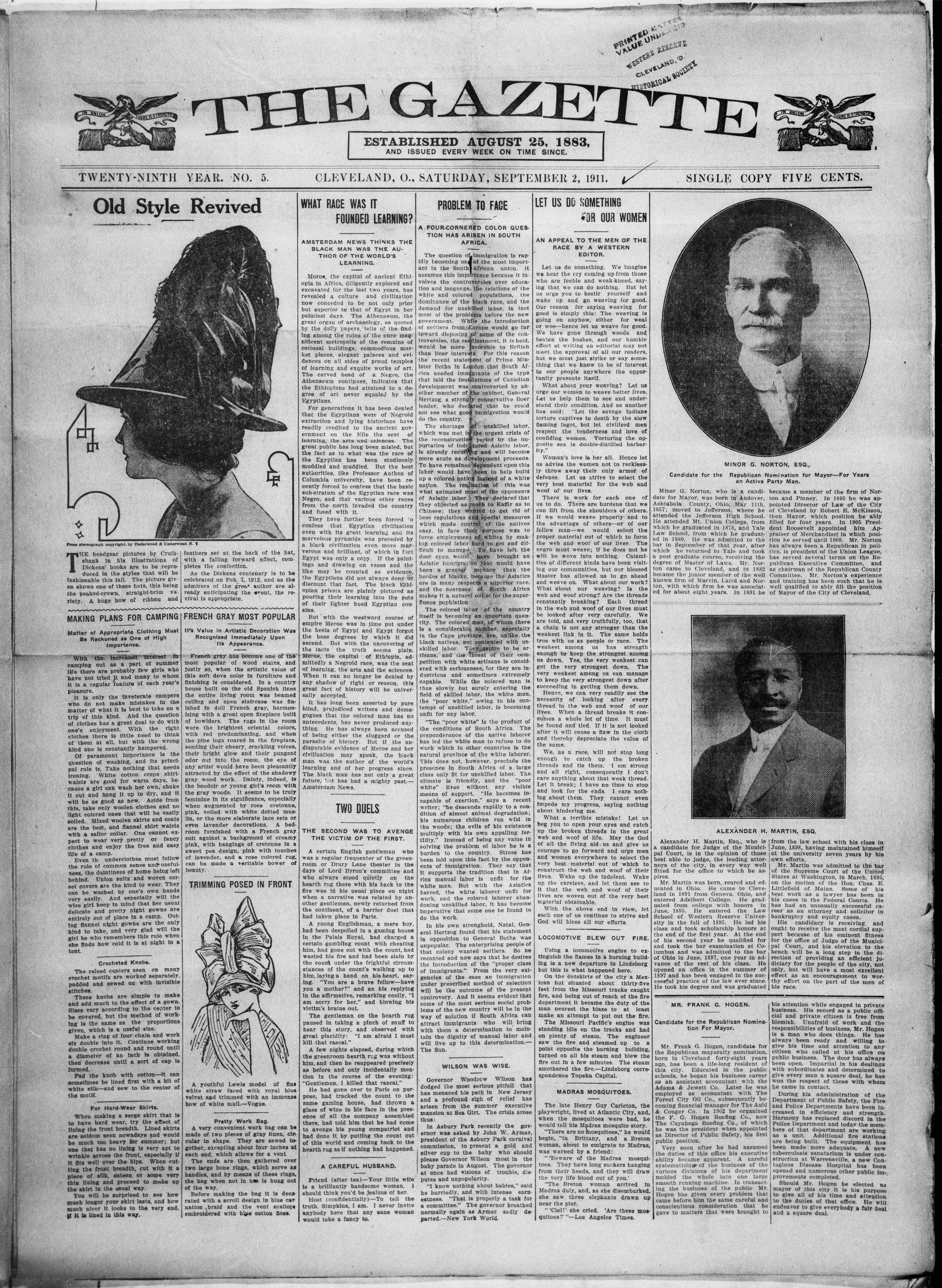
Old Style R
From stereograph copyright, by Underwood & Underwood. N. Y
THE headgear pictures by Cruikshank in his illustrations of Dickens' books are to be reproduced in the styles that will be fashionable this fall. The picture given shows one of these hats, this being the peaked-crown, straight-brim variety. A huge bow of ribbon ready for vival
Matter of Appropriate Clothing Must Be Reckoned as One of High Importance.
With the increased interest in camping out as a part of summer life there are probably few girls who have not tried it and many to whom it is a regular feature of each year's pleasure.
It is only the inveterate campers who do not make mistakes in the matter of what it is best to take on a trip of this kind. And the question of clothes has a great deal to do with one's enjoyment. With the right clothes there is little need to think of them at all, but with the wrong kind one is constantly hampered.
Of paramount importance is the question of washing, and its principal rule is. Take nothing that needs ironing. White cotton crepe shirt waists are good for warm days, because a girl can wash her own, shake it out and hang it up to dry, and it will be as good as new. Aside from this, take only woolen clothes and no light colored ones that will be easily soiled. Mixed woolen skirts and coats are the best, and fannel shirt waists with a sailor collar. One cannot expect to wear very pretty or fancy clothes and enjoy the free and easy life of a camp.
Even the underclothes must follow the rule of common sense and usefulness, the daintiness of home being left behind. Union suits and woven cord covers are the kind to wear. They can be washed by one's own hands very easily. And especially will the wise girl keep in mind that her usual delicate and pretty night gowns are entirely out of place in a camp. Outing flannel night gowns are the only kind to take, and very glad will the girl be who remembers this rule when she finds how cold it is at night in a tent.
Crocheted Knobs.
The raised centers seen on many crochet motifs are worked separately, padded and sewed on with invisible stitches.
These knobs are simple to make and add much to the effect of a gown. Sizes vary according to the center to be covered, but the method of working is the same as the proportions given, which is a useful size.
Make a ring of four chain and work six double into it. Continue working double crochet round and round until a diameter of an inch is obtained, then decrease until a sort of cap is formed.
Pad the knob with cotton—it can sometimes be lined first with a bit of white silk—and sew to the center of the motif.
For Hard-Wear Skirts.
When making a serge skirt that is to have hard wear, try the effect of lining the front breadth. Lined skirts are seldom seen nowadays and would be much too heavy for summer; but one that has no lining is very apt to wrinkle across the front, especially if it fits well over the hips. When cutting the front breadth, cut with it a piece of silk, sateen or some very thin lining and proceed to make up the skirt in the usual way.
You will be surprised to see how much longer your skirt lasts, and how much nicer it looks to the very end, if it is lined in this way.
THE GAZETTE
feathers set at the back of the hat,
with a falling forward effect,
completes the confection.
As the Dickens centenary is to be
celebrated on Feb. 7, 1912, and as the
admirers of the great author are
already anticipating the event, the revival is appropriate.
FRENCH GRAY MOST POPULAR
It's Value in Artistic Decoration Was
Recognized Immediately Upon
Its Appearance.
French gray has become one of the most popular of wood stains, and just so, when the artistic value of this soft dove color in furniture and finishing is considered. In a country house built on the old Spanish lines the entire living room was beamed ceiling and open staircase was finished in dull French gray, harmonizing with a great open fireplace built of bowlers. The rugs in the room were the brightest oriental colors, with red predominating, and when the phe logs roared in the fireplace, sending their cheery, crackling voices, their bright glow and their pungent odor out into the room, the eye of any artist would have been pleasantly attracted by the effect of the shadowy gray wood work. Dainty, indeed, is the boudor or young girl's room with the gray woods. It seems to be truly feminine in its significance, especially when augmented by rose cretonne, pink, veiled with white dotted muslin, or the more elaborate lace sets or even lavender decorations. A bedroom furnished with a French gray suit against a background of creamy pink, with hangings of cretonne in a sweet pea design, pink with touches of lavender, and a rose colored rug, can be made a veritable bower of beauty.
TRIMMING POSED IN FRONT
A youthful Lewis model of fine white straw faced with royal blue velvet and trimmed with an immense bow of white mull.—Vogue.
Pretty Work Bag
A very convenient work bag can be made of two pieces of gray linen, circular in shape. They are sewed together, excepting about four inches at each end, which allows for a vent. The ends are then gathered over two large bone rings, which serve as handles, and by means of these rings, the bag when not in use is hung out of the way. Before making the bag it is decrated with a scroll design in blue carnation, braid and the vent scallop embroidered with blue cotton floss.
CLEVELAND, O., SATURDAY, SEPTEMBER 2, 1911.
WHAT RACE WAS IT
FOUNDED LEARNING?
AMSTERDAM NEWS THINKS THE BLACK MAN WAS THE AUTHOR OF THE WORLD'S LEARNING.
Moroe, the capital of ancient Ethiopia in Africa, diligently explored and excavated for the last two years, has revealed a culture and civilization now conceded to be not only prior but superior to that of Egypt in her palestine days. The Athenaeum, the great organ of archaeology, as quoted by the daily papers, tells of the finding among the ruins of the once magnificent metropolis of the remains of colossal buildings, commodious market places, elegant palaces and evidences on all sides of proud temples of learning and exquite works of art. The carved head of a Negro, the Athenaeum continues, indicates that the Ethiopians had attained to a degree of art never equaled by the Egyptians.
For generations it has been denied that the Egyptians were of Negro extraction and lying historians have readily credited to the ancient government on the Nile the seat of learning, the arts and sciences. The great public has long been misled, but the fact as to what was the race of the Egyptian has been studiously muddled and muddled. But the best authorities, like Professor Anthon of Columbia university, have been recently forced to confess that the basic sub-stratum of the Egyptian race was Negro, and that various other races from the north invaded the country and fused with it.
They have further been forced 'o confess that Egyptian civilization even with its great learning and its marvelous pyramids was preceded by a black civilization even more marvous and brilliant, of which in fact Egypt was only a copy. If the paintings and drawing on vases and the like may be counted as evidence, the Egyptians did not always deny or discount that fact. The black Ethiopian priests are plainly pictured as pouring their learning into the pots of their lighter hued Egyptian cousins.
But with the westward course of empire Meroe was in time put under the heels of Egypt and Egypt forgot the base degrees by which it did ascend. But with the uncovering of the facts the truth seems plain. Meroe, the capital of Ethiopia, admitted a Negroid race, was the seat of learning, the arts and the sciences. When it can no longer be denied by any shadow of right or reason, this great fact of history will be universally accepted.
It has long been asserted by pure blind, prejudiced writers and demagogues that the colored man has no antecedents, has never produced anything. He has always been accused of being either the sluggard or the parasite of history. But if the undisputable evidence of Meroe and her civilization may speak, the black man was the author of the world's learning and of her progress since. The black man has not only a great future, but has had a mighty past.—Amsterdam News.
TWO DUELS
THE SECOND WAS TO AVENGE THE VICTIM OF THE FIRST.
A certain English gentleman who was a regular frequenter of the greenroom or Drury Lane theater in the days of Lord Byron's committee and who always stood quietly on the hearth rug there with his back to the fire was in his usual place on night when a narrative was related by another gentleman, newly returned from the continent, of a barrier duel that had taken place in Paris.
A young Englishman, a mere boy, had been despolied in a gaming house in the Palais Royal, had charged a certain gambling count with cheating him, had gone out with the count, had wasted his fire and had been slain by the count under the frightful circumstances of the count's walking up to him, laying a hand on his heart, saying, "You are a brave fellow—have you a mother?" and an his replying in the affirmative, remarking coily, "I am sorry for her," and blowing his victim's brains out.
The gentleman on the hearth rug paused in taking a pinch of snuff to hear this story, and observed with great placidity: "I am afraid I must kill that rascal."
A few nights elapsed, during which the greenroom hearth rug was without him, and then he reappeared precisely as before and only incidentally mention in the course of the evening: "Gentlemen, I killed that rascal."
He had gone over to Paris on purpose, had tracked the count to the same gaming house, had thrown a glass of wine in his face in the presence of all the company assembled there, had told him that he had come to avenge his young compatriot and had done it by putting the count out of this world and coming back to the hearth rug as if nothing had happened.
A CAREFUL HUSBAND.
Friend (after tea)—Your little wife is a brilliantly handsome woman. I should think you'd be jealous of her. Host (confidently)—To tell the truth, Simpkins, I am. I never invite anybody here that any sane woman would take a fancy to.
PROBLEM TO FACE
A FOUR-CORNERED COLOR QUESTION HAS ARISEN IN SOUTH AFRICA.
The question of immigration is rapidly becoming one of the most important in the South African union. It assumes this importance because it involves the controversies over education and language, the relations of the white and colored populations, the dominance of the black race, and the demand for unskilled labor, in fact most of the problems before the new government. While the introduction of settlers from Europe would go far toward disposing of some of the controversies, the readjustment, it is held, would be more favorable to British than Boer interests. For this reason the recent statement of Prime Minister Botha in London that South Africa needed immigrants of the type that laid the foundations of Canadian development was controverted by another member of the cabinet, General Hertzog, a strongly conservative Boer leader, who declared that he could not see what good immigration would do the country.
The shortage of unskilled labor, which was met in the urgent crisis of the reconstruction period by the importation of indexed Aslatic labor, is already recruiting and will become more acute as development proceeds. To have remained dependent upon this labor would have been to help build up a colored nation instead of a white nation. The realization of this was what animated most of the opponents of Aslatic labor. They declared that they objected as much to Kaffir as to Chinese; they wanted to get rid of boss regulations and special measures which made control of the natives easy, in face their purpose was to force employment of whites by making colored labor hard to get and difficult to manage. To have left the door open would have brought an Aslatic immigration that would have been a greater menace than the hordes of blacks, because the Aslastes are in many respects a superior race, and the nearness of South Africa makes it a natural outlet for the superfluous population.
The colored labor of the country itself is becoming an uncertain quantity. The colored men, of whom there is a considerable number, especially in the Cape province, are, unlike the black natives, not contented with unskilled labor. They aspire to be artisans, and the threat of their competition with white artisans is considered with seriousness, for they are industrious and sometimes extremely capable. While the colored man is thus slowly but surely entering the field of skilled labor, the white man the "poor white" owing to his contempt of unskilled labor, is becoming unfit for any labor.
"The "poor white" is the product of the conditions of South Africa. The preponderance of the native laborer has led the white man to refuse to do work which in other countries is the natural province of the white laborer. This does not, however, preclude the presence in South Africa of a large class only fit for unskilled labor. The climate is friendly, and the "poor white" lives without any visible means of support. "He becomes incapable of exertion," says a recent writer; "the descends rapidly to a condition of almost animal degradation; his numerous children run wild in the woods; the evils of his existence multiply with his own appalling fertility." Instead of being any value in solving the problem of labor he is a burden to the country. Stress has been laid upon this fact by the opponents of immigration. They say that it supports the tradition that in Africa manual labor is unfit for the white man. But with the Asiatics barred, the white laborer unfit for work, and the colored laborer abandoning unskilled labor, it has become imperative that some one be found to do the work.
In his own stronghold, Natal, General Hertzog found that his statement in opposition to General Botha was unpopular. The enterprising people of that colony wanted settlers. So he recanted and now says that he desires the introduction of the "proper class of immigrants." From the very exigencies of the case an immigration under prescribed method of selection will be the outcome of the present controversy. And it seems evident that some of the most serious social problems of the new country will be in the way of solution if South Africa can attract immigrants who will bring with them a determination to maintain the dignity of manual labor and will live up to this determination.—The Sun.
WILSON WAS WISE.
Governor Woodrow Wilson has dodged the most serious pitfall that has menaced his path in New Jersey and a profound sigh of relief has arisen from the summer executive mansion at Sea Girt. The crisis arose thus:
In Asbury Park recently the governor was asked by John W. Aymar, president of the Asbury Park carnival commission, to present a gold and silver cup to the baby who should please Governor Wilson most in the baby parade in August. The governor at once had visions of trouble, disputes and unpopularity.
"I know nothing about babies," said he hurriedly, and with intense earnestness. "That is properly a task for a committee." The governor breathed normally again as Aymar sadly departed—New York World.
LET US DO SOMETHING
FOR OUR WOMEN
AN APPEAL TO THE MEN OF THE RACE BY THE WESTERN EDITOR.
Let us do something. We imagine we hear the cry coming up from those who are feeble and weak-kneed, saying that we can do nothing. But let us urge you to bestir your yourself and wake up and go weaving for good. Our reason for saying weaving for good is simply this: The weaving is going on anyhow, either for weal or woe—hence let us weave for good. We have gone through woods and beaten the bushes, and our humble effort at writing an editorial may not meet the approval of our readers, but we must just strike or say something that we know to be of interest to our people anywhere the opportunity presents itself.
What about your weaving? Let us urge our women to weave better lives. Let us help them to see and understand their condition. And as another has said: "Let the savage Indians torture captives to death by the slow flaming fagot, but let civilized men respect the tenderness and love of confiding women. Forturing the opposite sex is double-distilled barbarity."
Woman's love is her all. Hence let us advise the women not to recklessly throw away their only armor of defense. Let us strive to select the very best material for the web and woof of our lives.
There is work for each one of us to do. There are burdens that we can lift from the shoulders of others. If we would weave properly and to the advantage of others—or of our fellow man—we would select the proper material out of which to form the web and woof of our lives. The negro must weave; if he does not he will be wove into nothing. Calamities of different kinds have been visiting our communities, but our blessed Master has allowed us to go ahead and weave on. What about our work? What about our weaving? Is the web and woof strong? Are the threads constantly breaking? Each thread in the web and woof of our lives must be looked after very carefully. We are told, and very truthfully, too, that a chain is not any stronger than the weakest link in it. The same holds true with us as people or race. The weakest among us has strength enough to keep the strongest among us down. Yes, the very weakest can get the very strongest down. The very weakest among us can manage to keep the very strongest down after succeeding in getting them down. Hence, we can very readily see the necessity of looking after every thread in the web and woof of our lives. When a thread breaks it consumes a whole lot of time. It must be found and tied. If it is not looked after it will cause a flaw in the cloth and thereby depreciate the value of the same.
We, as a race, will not stop long enough to catch up the broken threads and tie them. I am strong and all right, consequently I don't care anything about that weak thread. Let it break; I have no time to stop and look for the ends. I care nothing about them. They cannot even impede my progress, saying nothing about hindering me.
What a terrible mistake! Let us beg you to open your eyes and catch the broken threads in the great web and woof of life. May the God of all the living aid us and give us courage to go forward and urge men and women everywhere to select the very best material out of which to construct the web and woof of their lives. Wake up the indolent. Wake up the careless, and let them see to it that the web and woof of their lives are woven out of the very best material obtainable.
With the above end in view, let each one of us continue to strive and God will bless all our efforts.
LOCOMOTIVE BLEW OUT FIRE
Using a locomotive engine to extinguishe the flames in a burning building is a new departure in Lindsborg but this is what happened here.
On the outskirts of the city a Mexican hut situated about thirty-five feet from the Missouri tracks caught fire, and being out of reach of the fire department it became the duty of the man nearest the blaze to at least make an attempt to put out the fire.
The Missouri Pacific's engine was standing idle on the tracks and had on plenty of steam. The engineer saw the fire and steamed up to a point opposite the burning building, turned on all his steam and blew the fire out in a few minutes. The steam smothered the fire.—Lindsborg correspondence Topeka Capital.
MADRAS MOSQUITOES.
The late Henry Guy Carleton, the playwright, lived at Atlantic City, and, when the mosquitos were bad, he would tell his Madras mosquito story. "There are no mosquitos," he would begin, "in Brittany, and a Breton woman, about to emigrate to Madras, was warned by a friend: "Beware of the Madras mosquitos. They have long suckers hanging from their heads, and they will draw the very life blood out of you." "The Breton woman arrived in Madras duly, and, as she disemarked, she saw three elephants drawn up near the pier." "Ciel!" she cried. 'Are these mosquitos?' "Los Angeles Times.
SINGLE COPY FIVE CENTS.
MINOR G. NORTON, ESO
MINOR G. NORTON, ESQ., Candidate for the Republican Nomination for Mayor—For Years an Active Party Man.
Miner G. Norton, who is a candidate became a member of the firm of date for Mayor, was born in Andover, ton and Pinney. In 1855 he was Ashtabula County, Ohio, May 11th, pointed Director of Law of the 1857; moved to Jefferson, where he of Cleveland by Robert E. McKissatt attended the Jefferson High School, then Mayor, which position he he Attended Mt. Union College, from filled for four years. In 1905 Pt which he graduated in 1878, and Yale dent Roosevelt appointed him Law School of Fayon which adduced praiser of Merchandise in which he attended in 1880. He was admitted to the bar in September of that year, after has always been a Republican in which he returned to Yale and took tics, is president of the Union Lea a post graduate course, receiving has served several terms on the degree of Master of Laws. Mr. Nor-public Executive Committee, ton came to Cleveland, and in 1882 as chairman of the Republican Cou became the junior member of the well Committee. Mr. Norton's experience with the firm of Law was well known, with which firm he was associat- well qualified to ably fill the posted for about eight years. In 1891 he of Mayor of the City of Cleveland.
[Image of a man in a suit with a bow tie].
ALEXANDER H. MARTIN, ESQ.
Alexander H. Martin, Esq., who is a candidate for Judge of the Municipal Court, is in the opinion of those best able to judge, the leading attorneys of the city. In every way well fitted for the office to which he aspires.
from the law school with June, 1898, having maintained at the university seven own efforts.
Mr. Martin was admitted of the Supreme Court of States at Washington in
Mr. Martin was born, reared and educated in Ohio. He came to Cleveland in 1891 from Geneva, Ohio, and entered Adelbert College. He graduated from college with honors in June, 1895. He entered the Law School of Western Reserve University in the fall of 1895. He led his class and took scholarship honors at the end of the first year. At the end of his second year he qualified for and took the bar examination at Columns and was admitted to the bar. He was admitted to the law degree of the rest of his class. He opened an office in the summer of 1897 and has been engaged in the successful practice of the law ever since. He took his degree and was graduated
MR. FRANK G. HOGEN.
Candidate for the Republican Nomination For Mayor.
Mr. Frank G. Hogen, candidate for the Republican mayoral nomination, born in Cleveland forty-eight years ago, has been a life-long resident of this city. Educated in the public schools, he began his business career as an assistant accountant with the Adams & Jewett Co. Later he was employed as accountant with The Forest City Oil Co., subsequently becoming financial manager for The Auld & Conger Co. In 1902 he organized the F. G. Hogen Roofing Co., now The Cuyahoga Roofing Co., of which he was the president when appointed as Director of Public Safety, his first public position.
Very soon after he had assumed the duties of this office his executive ability became apparent. A careful systematizing of the business of the various divisions of his department molded the whole into one large smooth running machine. In transacting the business of the public Mr. Hogen has given every problem that came before him the same careful and conscientious consideration that he gave to matters that were brought to
became a member of the firm of Norton and Pinney. In 1895 he was appointed Director of Law of the City of Cleveland by Robert E. Mckisson, then Mayor, which position he ably filled for four years. In 1905 Presidential candidate Robert Mckisson praiser of Merchandise in which position he served until 1909. Mr. Norton has always been a Republican in politics, is president of the Union League, has served several terms on the Republican Executive Committee, and as chairman of the Republican County committee. Norton's experience as a lawyer has been well qualified to ably fill the position of Mayor of the City of Cleveland.
MARTIN, ESQ.
from the law school with his class in June, 1898, having maintained himself at the university seven years by his own efforts.
Mr. Martin was admitted to the bar of the Supreme Court of the United States at Washington, in March, 1895, on the motion of the Hon. Chas. E. Littlefield of Maine. Some of his best work as a lawyer has been in office. He has had an unusually successful career as an attorney and solicitor in bankruptcy and equity cases.
His candidacy is receiving and ought to receive the most cordial support because of his eminent fitness for the office of Judge of the Municipal Court, and his elevation to the bench will be a long step in the direction of providing an efficient judiciary for the people of the city, not only, but will have a most excellent effort an encouragement to worthy effort on the part of the men of his race.
his attention while engaged in private business. His record as a public official and private citizen is free from blemish. Unafraid of work and the responsibilities of business, Mr. Hogen is a man who does things. He has always been ready and willing to give his time and attention to any job he called. The doctor has always been open. Impartial in his judgments with subordinates and determined to give every man a square deal, he has won the respect of those with whom he came in contact.
During his administration of the Department of Public Safety, the Fire and Police Departments have been increased in efficiency and strength. Harmony has replaced discord in the Police Department and today the members of that department are working as a unit. Additional fire stations are being built. The equipment has been made more adequate. A new tuberculosis sanitarium is under construction at Warrensville, a new Continuous Disease. Hospital has been opened and numerous other public improvements completed.
Should Mr. Hogen be elected as mayor of this city it is his purpose to give all of his time and attention to the duties of that office. He will endeavor to give everybody a fair deal and a square deal.
One Year.....$1.50
Six Months.....1.00
Three Months......50
Subscribers are requested to
mit by postoffice money or
der or registered letter.
Entered at the postoffice in Cleveland,
Ohio, as second-class matter
Address all communications to
HARRY C. SMITH
Editor and proprietor,
THE GAZETTE,
Blackstone Building Cleveland O
Blackstone Building, Cleveland, O.
Member Ohio Legislature: 1894
to 1896; 1896 to 1898; 1900 to 1902
THE GAZETTE is the oldest, and has the largest bona fide circulation, double that of any newspaper in the interest of Afro-Americans, published in the state of Ohio, and comparison with any will immediately establish its rank as one of the NEWSIEST AND BEST in the country.
There is rarely ever a lynching in the north that is not promoted by some southerner, or southern sympathizer who is, of course, a Negro-hater.
The True Reformers have a new staff of national officers, elected recently at the annual meeting held in Richmond, Va., and it is to be hoped, will now have easier and clearer "sailing."
Many items of general interest will be found in our local department (page 3), this week as well as last week, owing to the demand upon our space for portraits and political sketches.
Wonder how much a number of our contemporaries received for their publication of the Tuskegee Tompkins hall portrait and write-up, and also the effusive praise of Dr. Booker T. Washington and his National Negro Business League talk etc.?
The Gazette has received interesting communications, from Rev. M. F. A. Easten when in Rome, Italy, and Alexandra, Egypt, Africa, and from Prof. W. S. Scarborough, who was in Holland at the time of writing, which we hope to be able to publish in our next issue.
Apparently, no reference at all was made to the Washington-Ulrich affair in N. Y. City, some months ago, at the recent annual meeting, at Little rock, Ark., of the National Negro Business League of which Dr. Booker T. Washington is president. There was much talk, feasting and dancing, as usual. The League is a mighty expensive "pleasure." The money spent for transportation alone, by those who attend its meetings, would each year start at least 50 business enterprises of various kinds in different parts of the country.
OKLAHOMA'S DISGRACE
The Purcell, Okla., lynching of last week Thursday was less brutal than the Coatesville, Pa., atrocity, but it was brutal enough to demand vigorous action on the part of the officers of the law. It was brutal enough to cause thoughtful men throughout the country to ask themselves again what measures we must adopt to check a process that means social rebarbarization.
The Negro who was burned at the stake at Purcell had attacked a white woman. His crime was of a nature to excite passionate anger, but he would have been promptly tried and convicted. What the leaders of the mob who talked about "protecting wives and daughters from black hounds" did not think of was the dehumanizing, brutalizing effect of a spectacle of the kind they presented to their boys and girls. The Negro was burned on a brush pile; men and boys had wildly gathered the brush and placed it at the feet of the mob-condemned wretch; three thousand persons, including women and children, "shouted approval" while the preparations and the execution were in progress. Is this civilization? Is this justice? Does this accord with the "radicalism" of the political and social legislation of Oklahoma?
Lynching is rebarbarization. It destroys the moral sense; it makes beasts and flends of men. After burning at the stake of wounded men slow torture might be demanded by the frenzied mob in the next case War must be declared on savagery and lynchings stopped at any cost.—Chicago Record-Herald.
CORNELIUS MALONEY, ESQ.,
Candidate for a Republican Nomination for Municipal Judge—A Strong Candidate.
Attorney Cornellus Maloney, one of the candidates for a Republican nomination for Municipal Judge, four year term, is a man whom we can recommend to our voters. He has taken prominent part in civic issues in Cleveland for ten years, during which time he has proven himself an able and successful lawyer, a broad-minded and unprejudiced man with many strong, personal friends among our people. Be sure to remember Mr. Maloney when you go to the primary, Sept. 5.
Jeannette Outpoints Porky Flynn.
New York City—Jeanette of Hoboken, N. J., outpointed Porky Flynn (white) of Boston in a ten-round bout at the Fairmount A: C. Tuesday night. Jeannette carried the fight to Flynn during every round and was the aggressor from the start to the finish. It was a good bout.
One by one the leaves are falling.
The Portland (Ore.) Advocate says
that it can not follow B. T. Washington
any longer unless he prosecutes
Ulrich. Then it is ended, for Dr.
Washington will not prosecute. He
may not tell why, but he knows...St.
Louis (Mo.) Advance.
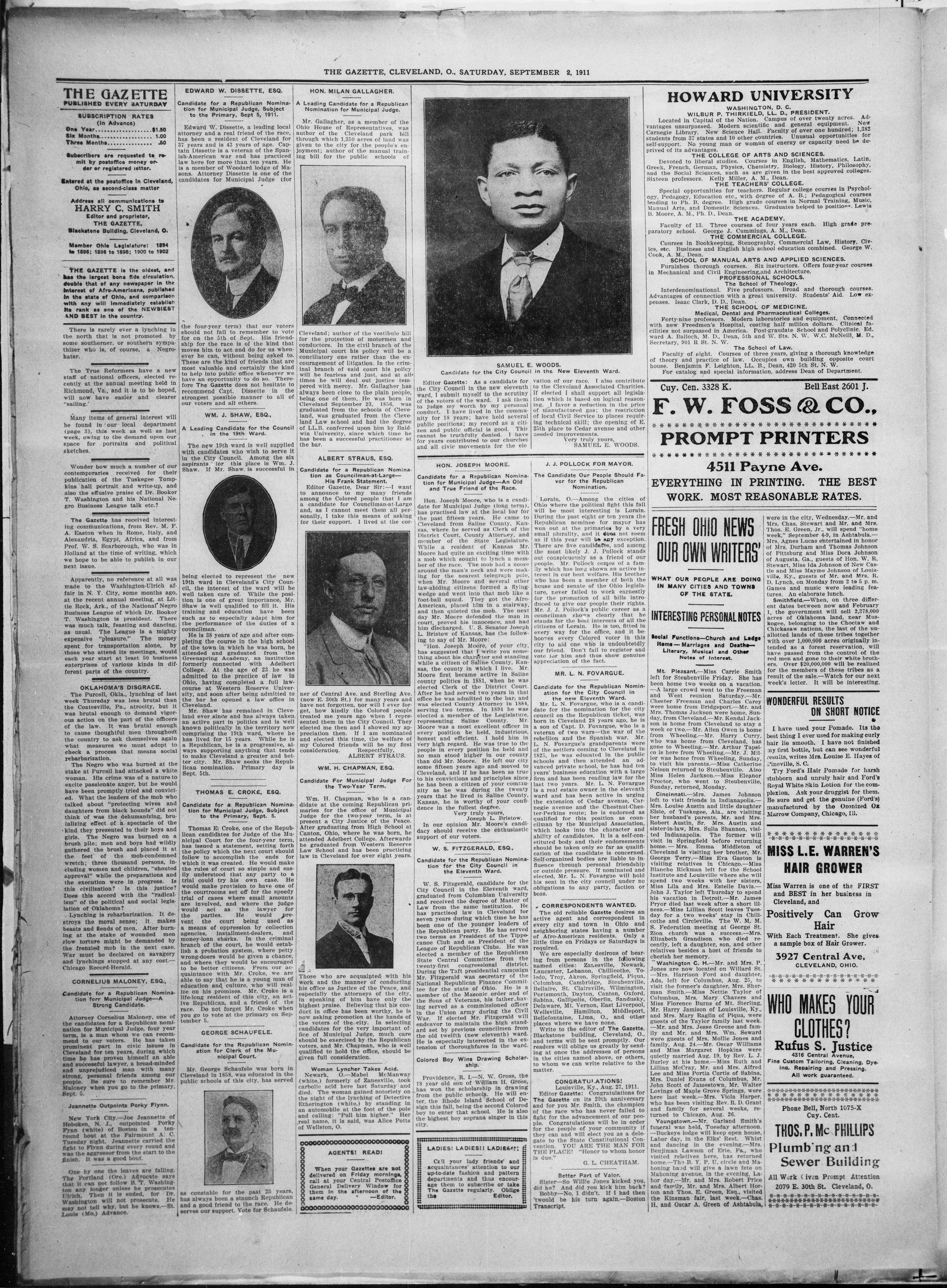
EDWARD W. DISSETTE, ESQ.
Candidate for a Republican Nomination for Municipal Judge, Subject to the Primary, Sept 5, 1911.
Edward W. Dissette, a leading local attorney and a real friend of the race, has been a resident of Cleveland for 37 years and is 43 years of age. Captain Dissette is a veteran of the Spanish-American war and has practiced law in New York. She is a member of Woodard lodge of Masons. Attorney Dissette is one of the candidates for Municipal Judge (for
PETER H.
the four-year term) that our voters should not fall to remember to vote for on the 5th of Sept. His friendship for the race is of the kind that moves him to act and do for us whenever he can, without being asked to. These are the kind of friends that are most valuable and certainly the kind to help into public office whenever we have an opportunity to do so. Therefore The Gazette does not hesitate to recommend Capt. Dissette in the strongest possible manner to all of our voters and all others.
WM. J. SHAW, ESQ.,
A Leading Candidate for the Council
in the 19th Ward.
The new 19th ward is well supplied
with candidates who wish to serve it
in the City Council. Among the six
aspirants for this place is Wm. J.
Shaw. If Mr. Shaw is successful in
being elected to represent the new 19th ward in Cleveland's City Council, the interest of the ward will be well taken care of. While the position is one of great importance, Mr. Shaw is well qualified to fill it. His experience and hard work such as to especially adapt him for the performance of the duties of a councilman.
He is 38 years of age and after completing the course in the high school of the town in which he was born, he attended from Greenspring Academy an institution formerly connected with Adelbert College. At the age of 23 he was admitted to the practice of law in Ohio, having completed a full law course at Western Reserve University, and soon after being admitted to the opened a law office in Cleveland.
Mr. Shaw has remained in Cleveland ever since and has always taken an active part in politics and is well known politically in the territory now. Mr. Shaw has lived for 15 years. While he is a Republican, he is a progressive, always supporting anything that tends to make Cleveland a greater and better city. Mr. Shaw seeks the Republic nomination. Primary day is Sept. 5th.
THOMAS E. CROKE. ESQ.
Candidate for a Republican Nomination for Municipal Judge, Subject to the Primary, Sept. 5.
Thomas E. Croke, one of the Republican candidates for Judge of the Municipal Court for the four-year term, has issued a statement, setting forth the policy which the next court should follow to accomplish the ends for which it was created. He would make the rules of court so simple and easily understood that any party to a trial could try his own case. He would make provision to have one of the courtrooms set off for the special cases where he amounts to act, and where the judge would act as the lawyer for the parties. He would prevent the court being used as a means of oppression by collection agencies, installment-dealers, and money-loan sharks. In the criminal branch of the court, he would establish a probation system, where petty wrong-doers would be given a chance, and where they would be encouraged to be better citizens. From our acquaintance with Mr. Croke, we are able to say that he is a year old educator and one who will realize his promises. Mr. Croke is a life-long resident of this city, an active Republican, and a friend of the race. Do not forget Mr. Croke when you go to vote at the primary on September 5.
GEORGE SCHAUFELE.
Candidate for the Republican Nomination for Clerk of the Municipal Court.
Mr. George Schaufele was born in Cleveland in 1858, was educated in the public schools of this city, has served as constable for the past 25 years, has always been a staunch Republican and a good friend to the race. He deserves our support. Vote for Schaufele.
THE GAZETTE, CLEVELAND, O., SATURDAY, SEPTEMBER 2. 1911
HON. MILAN GALLAGHER.
A Leading Candidate for a Republican Nomination for Municipal Judge.
Mr. Gallagher, as a member of the Ohio House of Representatives, was author of the Cleveland park bill through which 1,350 acres of land was given to the city for the people's enjoyment; author of the manual training bill for the public schools of
M.
Cleveland; author of the vestibule bill for the protection of motormen and conductors. In the civil branch of the Municipal court his policy will be a conciliatory one rather than the encouragement of litigation. In the criminal branch of said court his policy will be fearless and just, and at all times he will be willing to cooperate with mercy. Mr. Gallagher has always been close to the plain people, being one of them. He was born in Cleveland September 23, 1856, was graduated from the schools of Cleveland, was graduated from the Cleveland Law school and had the degree of LLB, conferred upon him by Baidu University, since which time he has been a successful practitioner at the bar.
ALBERT STRAUS, ESQ.
Candidate for a Republican Nomina
tion as Councilman-at-Large—
Federal Member of the Senate
Editor Gazette, Dear Sir;—I want to announce to my many friends among the Colored people that I am a candidate for Councilman-at-Large and, as I cannot meet them all per se, I will be grateful for their support, I lived at the cor
M.
ner of Central Ave. and Sterling Ave. (now E. 30th St.) for many years and have not forgotten, nor will I ever forget, how kindly the Colored people treated me years ago when I represeed me and I showed the Colored elected me then and I showed my apreciation then. If I am nominated and elected this time, the welfare of my Colored friends will be my first consideration. Respectfully,
WM. H. CHAPMAN. ESQ.
Candidate For Municipal Judge For the Two-Year Term.
Wm. H. Chapman, who is a candidate at the coming Republican primary, is the Judge for the two-year term, is at present a City Justice of the Peace. After graduating from High School at Canton, Ohio, where he was born, he attended Adelbert College. Afterwards he graduated from Washington State School and has been practicing law in Cleveland for over eight years.
BROOKLYN
Those who are acquainted with his work and the manner of conducting his office as Justice of the Peace, and especially the attorneys of the city, in speaking of him have only the highest praise. Believing that his conduct in office has been worthy, he is appointed to the position of the hold the voters of the city. In selecting candidates for the very important office of Municipal Judge, much care should be exercised by the Republican voters, and Mr. Chapman, who is well qualified to hold the office, should be given full consideration.
Woman Lyncher Takes Acid.
Newark, O.-Mabel McManway (white). formerly of Zanesville, took carbolic acid here last Saturday and died. The woman gained notoriety on the night of the lynching of Detective Etherington (white). by standing in an anarchic position, calling: "Pull him higher." Her real name, it is said, was Alice Pottas of Wolleston, O.
When your Gazettes are not delivered on Friday mornings, call at your Central Postoffice General Delivery Window for them in the afternoon of the same day. —Editor.
[Name]
SAMUEL E. WOODS.
Candidate for the City Council in the New Eleventh Ward.
Editor Gazette: As a candidate for the City Council in the new eleventh ward, I submit myself to the scrutiny of the voters of the ward. I ask them to judge my worth by what I conduct. I have lived in the community for 18 years; have held several public positions; my record as a citizen and public official is good. This cannot be truthfully denied. I have for years contributed to our churches and all civic movements for the ele
vation of our race. I also co-ordinate to the Cleveland Associated If elected I shall support allation which is based on logic, I favor a reduction in the manufacture of gas; the reof of local Civil Service to place technical skill; the open 25th place to Cedar avenue a needed improvements.
Very truly yours,
SAMUEL E. WOODS
HON. JOSEPH MOORE.
Candidate for a Republican Nomination for Municipal Judge—An Old and True Friend of the Race.
Hon. Joseph Moore, who is a candidate for Municipal Judge (long term), has practised law at the local bar for 25 years. He cei m to Cleveland from Saline County, Kansas, where he served as Clerk of the District Court, County Attorney, and member of the State Legislature. While a resident of Kansas Mr. Moore had quite an exciting time with a mob which sought to lynch a member of the race. The mob had a noose around the man's neck and were make up to throw him. He met when Mr. Moore and several other law-abiding citizens formed a flying wedge and went into that mob like a foot-ball squad. They got the Afro American, placed him in a stairway, and then quieted the mob. The next day Mr. Moore defended the man in court. He was then discharged. I. S. Senator Joseph L. Bristow of Kansas, has the following to say of Mr. Moore:
"Hon. Joseph Moore, of your city, has suggested that I write you some thing about his character and standing while a citizen of Saline County, Kansas, the county in which I live. Mr Moore first became active in Saline county politics in 1881. He was appointed District Court After he had served two years in that office he was admitted to the bar; and was elected County Attorney in 1884 serving two terms. In 1894 he was elected a member of the Legislature, representing Saline County. Mr Moore was most excellenous in the district, industrious, honest and efficient. I hold him in very high regard. He was true to the people in every position he held and no man stood higher in our county than did Mr. Moore. He left our city some fifteen years ago and moved to Cleveland, and if he has been as true to his character, he has been a citizen of your community as he was during the twenty years that he lived in Saline County, Kansas, he is worthy of your confidence in the fullest degree.
In our opinion Mr. Moore's candi dacy should receive the enthusiastic support of our voters.
W. S. FITZGERALD, ESQ.,
Candidate for the Republican Nomina
tion in the Eleventh Ward, in
the Eleventh Ward.
W. S. Fitzgerald, candidate for the City Council in the Eleventh ward, graduated from Columbian University and received the degree of Master of Law from the same institution. He has practised law in Cleveland for seven years during his career but been one of the younger leaders of the Republican party. He has served two terms as President of the Tippeeano Club and as President of the League of Republican Clubs. He was elected a member of the Republican State Central Committee from the twenty-first congressional district. Tara Tippeeano campaign Mr. Fitzgerald was secretary of the National Republican Finance Committee for the state of Ohio. He is a member of the Masonic order and of the Sons of Veterans, his father, having served as a commissioned officer in the Union army during the War. If elected, Fitzgerald will hold the high standard set by previous councilmen from the old twelfth (new eleventh) ward. He is especially interested in the extension of thoroughfares in the ward.
Colored Boy Wins Drawing Scholar ship.
Providence, R. I.-N. W. Gross, the 18 year old son of William H. Gross, has won the scholarship in drawing from the public schools. He will enter, the Rhode Island school of design this fall, being second Class of the center that school. He is also the highest boy soprana singer in this city.
Call your lady friends' and acquaintances' attention to our up-to-date fashion and pattern departments and thus encourage them to subscribe or take The Gazette regularly. Oblige the Editor.
vation of our race. I also contribute to the Cleveland Associated Charities. If elected I shall support all legislation which is based on logical reasoning. I have a strong interest in manufactured gas; the restriction of local Civil Service to places requiring technical skill; the opening of E. 25th place to Cedar avenue and other needed improvements. I serve ours. SAMUEL E. WOODS.
J. J. POLLOCK FOR MAYOR
The Candidate Our People Should
vor for the Republican
Nomination
Lorain, O.—Among the cities of Ohio where the political fight this fall will be most interesting is Lorain. During the past eight or ten years the Republican nominee for mayor has won out at the primaries by a very small plurality, and has done no worse. If he is the best exception, there are five candidates, and among the most likely J. J. Pollock stands out conspicuously as a friend of our people. Mr. Pollock compes of a family which has long shown an active interest in our best welfare. His brother who has been a member of both the house and senate of the city legislature of Ohio works hard for the promotion of all bills introduced to give our people their rights. Mr. J. J. Pollock's public career as a councilman shows clearly that he stands for the best interests of all the citizens of Lorain. He is too, fitted in every way for the office, and it behooves every Colored man who is undoubtedly our friend. Don't fail to register and vote for him and show genuine appreciation of the fact.
MR. L. N. FOVARGUE.
Candidate for the Republican Nomination for the City Council in
the new eleventh district. Mr. L. Fovargue, who is a candidate for the nomination for the city council on the Republican ticket, was born in Cleveland 28 years ago, he is a son of Capt. D. Fovargue, who is a veteran of two wars—the war of the rebellion and the Spanish war. Mr. L. Fovargue's grandfather, Mr. L. Fovargue, the grandfather of Cleveland in 1825, he was educated in the public schools and then attended an advanced private school, he has had ten years' business education with a large firm and has been reading law for the last two years. Mr. L. N. Fovargue is a graduate of the ward and has been active in urging the extension of Cedar avenue, Carnegie avenue and the Chestnut-Chester-Perkins route; he is endorsed as qualified for this position as councilman by the Municipal Association, which looks into the character and activities of the body, fitted body and their endorsements should be taken only so far as qualification of the candidate is concerned. Self-organized bodies are liable to influence through personal friendship or outside pressure. If nominated and elected, Mr. L. N. Fovargue will hold his seat in the city council under no conditions to any party, factor or boss.
CORRESPONDENTS WANTED
The old reliable Gazette desires an active agent and correspondent in every city and town in Ohio and neighboring states having a number of Afro-American residents. Only a little time on Fridays or Saturdays is required.
We are especially desirous of hearing from persons in the following named cities: Zaesville, Newark, Lancaster, Lebanon, Chillicothe, Toledo, Troy, Akron, Columbus, Cambridge, Steubenville, Bellair, St. Clairsville, Wilmington, Portmouth, Dayton, Canton, Oxford, Sabina, Gallipolis, Oberlin, Sandusky, Delaware, M. Vernon, East Liverpool, Wellsville, Hamilton, Middleport, Bellefontaine, Lima, O., and other places where we have none.
Write to the editor of The Gazette, Blackstone building, Cleveland, O., and terms will be sent promptly. Our readers may be pleased by sentiment at once the addresses of persons in the cities named above, or others, to whom we can write relative to the matter.
CONGRATULATIONS!
Louisville, Ky. Aug. 27, 1911.
Editor Gazette: Congratulations for
The Gazette on its 29th anniversary
and for you Mr. Smith, the champion
of the race who has never failed to
fight for the advancement of our people.
Congratulations will be in order
for the people of your country if
they can and will elect you as a de-
legate to the State Constitutional
Convention.
YOU ARE THE MAN FOR
THE PLACE! "Honor to whom honor
is due."
G. L. CHEATHAM.
Better Part of Valor.
Sister—So Willie Jones kicked you,
did he? And did you kick him back?
Bobby—No, I didn't. If I had then
twould be his turn again—Boston
Transcript.
HOWARD UNIVERSITY
WASHINGTON, D. C.
WASHINGTON, D. C.
WILBUR P. THIRKIELD
Located in Capital of the Nation.
vantages unsurpassed. Modern science.
Carnegie Library. New Science Hall.
students from 31 countries and 10 other co-
self-support. 30 young man or woma-
tics as advantages.
WILBUR P. THIRKIELD
Located in Capital of the Nation. Campus of over twenty acres. Advantages unsurpassed. Specialistic and general equipment. New Carnegie Library of Science Hall. Faculty of over one hundred; 1,382 students from 37 states and 10 other countries. Unusual opportunities for self-support. No young man or woman of energy or capacity need be deprived of its advantages.
THE COLLEGE OF ARTS AND SCIENCES.
Devoted to liberal studies. Courses in English, Mathematics, Latin, Greek, French, German, Physics, Chemistry, Biology, History, Philosophy, and the Social Sciences, such as are given in the best approved colleges. Sixteen professors. Kelly Miller, A. M., Dean.
Devoted to liberal studies. Course
Greek, French, German, Physics, Chem
and the Social Sciences, such as are
Sixteen professors. Kelly Miller, A. M.
THE TEACHER
Special opportunities for teachers'
Pedagogy, Education etc., with de-
leading to Ph. B. degree. High grade
Manual Arts, and Domestic Sciences.
B. Moore, A. M., Ph. D., Dean.
THE ACA
Faculty of 13. Three courses of
paratory school. George J. Cumming
THE COMMERCI
Courses in Bookkeeping, Stenograp-
ics, etc. Business and English high sce-
cok, A. M., Dean.
SCHOOL OF MANUAL ARTS
Furnishes thorough courses. Siz
in Mechanical and Civil Engineering.
PROFESSION
Interdenominational. Five profe-
nts of connection with a great
penses. Isaac Clark, D. D., Dean.
THE SCHOOL
Medical, Dental and P
Forty-nine professors. Modern la-
with new Freedmen's Hospital, cost-
ilities not surpassed in America.
Poward A. Balloch, M. D., Dean, 5th and
Secretary, 901 R St. N. W.
The Schoo
Faculty of eight. Courses of thre-
of theory and practice of law. LL. B.
For catalog and special informa-
tion
Cuy. Cen. 3328 K.
F. W. FOS
PROMPT
4511 Pay
EVERYTHING IN PR
WORK. MOST REAL
Special opportunities for teachers. Regular college courses in Psychology, Pedagogy, Education etc, with degree of A. B.; Pedagogical courses leading to Ph. B. degree. High grade courses in Normal Training, Music, Manual Arts, and Domestic Sciences. Graduates helped to position<sup>a</sup> Lewis B. Moore, A. M., Ph. D., Dean.
THE ACADEMY.
Faculty of 13. Three courses of four years each. High grade preparatory school. George J. Cummings, A. M., Dean.
THE COMMERCIAL COLLEGE.
Courses in bookkeeping, Stenography, Commercial Law, History, Civics, etc. Business and English high school education combined. George W. Cook, A. M., Dean.
SCHOOL OF MANUAL ARTS AND APPLIED SCIENCES.
Furnishes thorough courses. Six instructors. Offers four-year courses in Mechanical and Civil Engineering and Architecture.
PROFESSIONAL SCHOOLS.
The School of Theology.
Interdenominational. Five professors. Broad and thorough courses. Advantages of connection with a great university. Students' Aid. Low expenses. Isaac Clark, D. D., Dean.
THE SCHOOL OF MEDICINE.
Medical, Dental and Pharmaceutical Colleges.
Forty-nine professors. Modern laboratories and equipment. Connected with new Freedman's Hospital, costing half million dollars. Clinical facilities for pasture management. America. Post-graduate School and Polyclinic. Edward A. Balloch, M. D., Dean, 5th and W. Sts. N. W. W.C. McNeill, M. D., Secretary, 901 R St. N. W.
Faculty of eight. Courses of three years, giving a thorough knowledge of theory and practice of law. Occupies own building opposite court house. Benjamin F. Leighton, LL B., Dean, 420 5th St. N. W.
4511 Payne Ave.
EVERYTHING IN PRINTING. THE BEST
WORK. MOST REASONABLE RATES.
FRESH OHIO NEWS
OUR OWN WRITERS'
WHAT OUR PEOPLE ARE DOING
IN MANY CITIES AND TOWNS
OF THE STATE.
were in the city, Wednesday—Mr. and
Mrs. Cha, Stewart and Mr. and Mrs.
Thos. E. Green, Jr., will spend "home
week," September 4-8, in Ashtabula.—
Mrs. Agnes Lucas entertained in honor
of Mrs. Durham and Thomas Johnson
of Pittsburg and Miss Dora Johnson
of Augusta, Ga., guests of Hon. W. R.
Stewart, Miss Ida Johnson of New Cas
te and Miss Mayne Johnson of Louis
ville, Ky., guests of Mr. and Mrs. R.
D. Lynch, on Monday from 2 to 5 p. m.
Games and music were leading fea
tures. An elaborate lunch.
INTERESTING PERSONAL NOTES
Social Functions—Church and Lodge
Items—Marriages and Deaths
Literary, Musical and Other
Notes of Interest.
Mt. Pleasant.—Miss Carrie Smith
left for Steubenville Friday. She has
been home two weeks on a vacation.
—A large crowd went to the Freeman
and West reunion Saturday.—Mr. Chester Freeman and Charles Carey
were home from Bridgeport.—Mr. and
Mrs. Jackson were home, Sunday,
from Cleveland.—Mr. Kendal Jack
was home from Wheeling.—Mr. and
week or two.—Mr. Allen Owen is home
from Wheeling.—Mr. Harry Curry,
who was home from Cleveland, has
gone to Wheeling.—Mr. Arthur Tapio
is here from Wheeling.—Mr. J. Miller
was home from Wheeling.—Miss Catherine
Nison returned to Steubenville. Also
Miss Helen returned to Eleanor
Proctor, who went to Steubenville,
Sunday, returned. Monday.
Cincinnati—Mrs. James Johnson left to visit friends in Indianapolis.—Mrs. Louise Austin and little daughter Elsie, of Tuskegee, Ala., are visiting her husband's parents, Mr. and Mrs. Robert Austin. Sr. Mrs. Austin and husband, of Tuskegee, Ala., are visiting Indianapolis. The former will visit in Springfield before returning home.—Mrs. Emma Middleton of Cleveland is visiting her brother, Mr. George Terry.—Miss Eva Gaston is visiting relatives in Chicago.—Miss Blanche Rickman left for the School institute and Louisville where she will visit her brother, Mr. Willard, Miss Lila and Mrs. Estelle Davis.—John J. Taylor left Thursday to spend his vacation in Detroit.—Mr. James Pryor died last week after a short illness.—Miss Lillian Scott leaves Tuesday for a two weeks' stay in Chilcothe and Circleville. The W. M. S. S. Federation meeting at George St. church was a success.—Mrs. Lillian Griffin, cently, left a daughter, son, and other relatives besides a host of friends to cherish her memory.
Washington C. H.-Mr. and Mrs. P. Jones are now located on Willard St.-Mrs. Harrison Ford and daughter, Ada, left for Columbus, Aug. 25, to visit the former's daughter, Mrs. Sherman Smith.-Miss Nettie Taylor of Columbus, Mrs. Mary Chavers and Miss Florence Barmey of Louisville K. and Mrs. Mary Raglin of Pigua were guests of the Taylor family last week.
—Mr. and Mrs. Jessie Greene and family and Mr. and Mrs. Wm. Seward were guests of Mrs. Mollie Jones and family, Aug. 24. —Mr. Oscar Williams and Miss Margaret Hopkins were quietly married Aug. 19, by Rev. L. J. Burley at his home. —Miss Ruth and Lillian McCray, Mr. and Mrs. Alfred Lee and Miss Portia Curtis of Sabina, Mrs. Daniel Evans of Columbus, Mr. John Scott of Jamestown, Mr. Walter Lovings of Maple Grove Springs, were here last week. —Mrs. Viola Harper, who has been visiting Rev. R. D. Grant and family for several weeks, returned to Chicago, Aug. 26.
Youngstown.—Mr. Garland Smith's funeral was held, Tuesday afternoon.—Buckeye lodge will keep open house. Labor day, in the Elks' rest.—Whist and dancing in the evening.—Mrs. Benjiman Lawson of Erie, Pa., who visited relatives here, has returned home.—The B. Y. P. U. circle and Mahoning band will give a lawn gate on Mahoning avenue, in the evening. Labor day.—Mr. and Mrs. Robert Price and family. Mr. and Mrs. Albert Horton and Thos. E. Green, Esq., visited the Kinsman fair, last week.—Chas H. and Oscar A. Green of Ashtabula.
Campus of over twenty acres. Ad-
dic and general equipment. New
Faculty of over one hundred; 1,382
unities. Unusual opportunities for
a of energy or capacity need be de-
in English, Mathematics, Latin, History, Biology, History, Philosophy, given in the best approved colleges. I. Dean.
S. COLLEGE.
Regular college courses in Psychol- degree of A. B.; Pedagogical courses courses in Normal Training, Music, Graduates helped to position. Lewis
DEMY.
Four years each. High grade pre- s. A. M., Dean.
AL COLLEGE.
Physic, Commercial Law, History, Cliv- school education combined. George W.
AND APPLIED SCIENCES.
Instructors. Offers four-year courses and Architecture.
SAL SCHOOLS.
Theology.
Lors. Broad and thorough courses.
university. Students' Aid. Low ex-
OF MEDICINE.
Pharmaceutical Colleges.
Laboratories and equipment. Connected half million dollars. Clinical fast- graduate School and Polyclinic. Ed. W. Sts. N. W. W.C. McNeill, M. D.,
of Law.
Two years, giving a thorough knowledge trips own building opposite court. I. Dean, 420 5th St. N. W.
on, address Dean of Department.
Bell East 2601 J.
SS & CO.,
PRINTERS
Yne Ave.
INTING. THE BEST
ASONABLE RATES.
were in the city, Wednesday—Mr. and Mrs. Chas, Stewart and Mr. and Mrs. Thos. E. Green, Jr. will spend "home week," September 4, 9. In ashtabula—Mrs. Agnes Lucas entertained in honor of Mrs. Durham and Thomas Johnson of Augusta, Ga., guests of Hon. W. R. Stewart, Miss Ida Johnson of New Castle and Miss Mayme Johnson of Louisville, Ky., guests of Mr. and Mrs. R. D. Lynch, on Monday from 2 to 5 p. m. Games and music were leading features. An elaborate lunch. Smithfield—When, on three different days, guests of Mrs. and February 1, the government will sell 2,278,000 acres of Oklahoma land, near Muskogee, belonging to the Choctaw and Chickasaw nations, the last of the unallotted lands of these tribes together with over 1,000,000 acres originally intended as a forest reservation, will have passed from the control of the Choctaw and Chickasaw tribes. Over $20,000,000 will be realized for the members of these tribes as a result of the sale—Watch for our next week's letter. It will be interesting.
WONDERFUL RESULTS
ON SHORT NOTICE
I have used your Pomade. Its the best thing I ever used for making curly hair lie smooth. I have not finished my first bottle, but can see wonderful results, writes Mrs. Louise E. Hayes of Pineville, S. C.
Try Ford's Hair Pomade for harsh stubborn and unruly hair and Ford's Royal White Skin Lotion for the complexion. Ask your druggist for them. Be sure and get the genuine (Ford's) manufactured by the Ozonized Ox Marrow Company, Chicago, Ill.
MISS L.E. WARREN'S
HAIR GROWER
Miss Warren is one of the FIRST and BEST in her business in Cleveland, and
Positively Can Grow
Hair
With Each Treatment. She gives
a sample box of Hair Grower.
3927 Central Ave,
CLEVELAND, OHIO.
WHO MAKES YOUR
CLOTHES?
Rufus S. Justice
4316 Central Avenue,
Fine Custom Tailoring, Cleaning, Dye-
ing, Repairing and Pressing.
All work guaranteed.
Phone Bell, North 1075-X
Cuy. Cent.
THOS. P. Mc PHILLIPS
Plumbing and
Sewer Building
All Work (Given Prompt Attention
2079 E. 30th St. Cleveland, O.
---
Local News
PURCHASE J. S. HALL'S, 3121 Central Ave.
THE L. SCHWARTZ'S, 2921 Central Ave. Open Sunday.
O. C. SCHROEDER'S, Cuyahoga Bldg. Open Sunday.
"GAZETTE" AT ELMER F. BOYD'S, 2604 Central Ave.
F. VALENTINE'S, 2130 Central Ave.
NOTICE TO SUBSCRIBERS:—Subscribers not receiving The Gazette regularly should notify us at once. We desire every copy delivered promptly. We advise our patrons to carefully examine The Gazette's advertisements before making purchases. Business men who advertise in this paper should have the patronage of Afro-Americans. The fact that they advertise is assurance that they want it. Local reading notices (advertisements) ten cents a line (six words in a line.)
NOTARY PUBLIC—For such services call at The Gazette office, No 3 Blackstone Building, No. 1422 W. 3d street, near Superior avenue.
Wanted—A first-class, sober, industrious carriage-smith—one who knows the trade thoroughly; a married man who would be interested in acquiring a time job for a good and capable man. Address, The Gazette, Blackstone Bldg., Cleveland, O.
Mrs. Bradley visited her daughter Mrs. French of Pittsburgh, last week Mrs. J. T. Smith of Blaine avenue spent a pleasant vacation in the east recently. Mr. Jay Noble and family have moved, temporarily, to E. 93d street and Superior avenue.
Mrs. Brewer and sister of E. 46th St., have returned after visiting Cincinnati, for two weeks. Three new houses are nearly completed. About 80
FOR SALE.—Brand new, Imperial Encyclopedia and Dictionary, 40 volumes, finely illustrated, handy to handle. Unexcelled for reference purposes. A library in itself—one that will last a life-time. Contains everything you may wish to know. Call or address, The Gazette, Blackstone Building, 1422 W. 3d St., Cleveland, O., near Superior Av. This is an opportunity of a life-time for those who love good books.
Mrs. J. Dyer is visiting relatives in Detroit.
Mrs. Allen of E. 37th street, has returned.
Mrs. John T. Tuck returned from a visit in Salem, last week.
Mrs. Cook of Dresden, Canada, left for home last week.
Mr. and Mrs. Rufus Justice spent Sunday, in Columbus.
Mrs. E. Lewis of E. 37th street, has just returned from Cadiz.
J. E. Benson of E. 37th street, visited Athens this week.
Mrs. McCoy of Youngstown, is the guest of Mrs. S. Black.
Mrs. Williams and daughter of Pittsburgh, are in the city.
Mrs. Wm. Scott of E. 71st street is to start September 5 for Virginia.
Mr. James Tucker of E. 30th street is in southern Ohio visiting relatives.
Mr. and Mrs. J. W. Pettiford are well-pleased with their new home, Los Angeles, Cal.
Miss Lena Seelig of Columbus, is visiting her brother, Mr. Joseph Seelig of E. 71st street.
Mrs. Lawson and grandson, Horace Evans, are visiting in Louisville and Covington, Ky.
Miss Mattle Dexter is visiting Misses Winifred and Edna Jones of Muskegon, Mich.
Mr. and Mrs. H. W. Cash spent Sunday, guests of Mr. and Mrs. R. L. Morris. Champion Jack Johnson was introduced to Ex-King Manuel of Portugal, in London, Eng., last week.
Miss Vernell Leach and Miss Carrie Guy of Zanesville are visiting their aunt and uncle, Mr. and Mrs. Ernest Smith of E. 4th street.
Miss Pearl Edwards entertained for Mrs. Baxter of Erie, Pa., also two other presidents whose names we failed to secure.
Mr. and Mrs. Anthony Briggs of Paducah, Ky., are spending their vacation in Cleveland. Mrs. Briggs is a sister of Rev. W. G. Webster, pastor of Lane Memorial church.
Miss Katie L. Hurt returned to Jackson, Tenn., last Saturday, after spending three weeks with her sister, Mrs. R. L. Morris. Mrs. Webster of E. 31st street. Miss Hurt is a teacher in Lane College, that city.
Mr. and Mrs. Hansbary of W. 51st St., gave a delightful reception recently in honor of their daughter, Miss Nellie's eighteenth birthday. Refreshments and dancing. Smith's orchestra furnished excellent music. There were several out-of-town guests, and nearly all the ladies of Lane Memorial church will serve dinner Labor day. Go and take dinner with them. They will serve barbecued pig, sweet potatoes, cabbage slaw, bread, coffee, apple pie, and ice cream.
Mr. Lettle Lucas of Central avenue, mother of Master Norman Lucas, died Saturday after a short illness and was buried Monday. The lad and her sister and brother have the sympathy of many friends. The singing of those favorable to the movement to induce Hon. Harry C. Smith to stand as a candidate for constitutional delegate will be held this Saturday evening at Clayton hall, 2828 Central Ave.
Wm. B. Direys of 7918 Quincy avenue does all kinds of mason work and plastering, lays cement sidewalks, drives and cellar bottoms, contracting and jobbing. All work guaranteed. Bell E. 1995-X.
Send your local items to The Gazette on Monday or Tuesday of each week. This paper is published for ALL of our people and "plays no favorites." Everybody is treated the same—fair and right. Take The Gazette and tell your friends to do so also.
Ernest O. Orsburn, a member of the faculty of St. Augustine's school, who has spent the summer with his relatives, Mr. and Mrs. H. W. Cash, left for Raleigh, N. C., Friday, to begin the session's work. He will spend a day in Richmond, Va., en route.
Wm. O. Stuart, candidate for councilman-bearer, be a resident of all of his life; is a strictly union man and will do his best to get the best for all the people of this community all the time, if nominated and elected. Give him a vote.
Do not forget to vote for Mathew Mitchell, candidate for Assessor of the new Eleventh ward. He is best qualified of any of the several candidates for the position, having had two years' experience as assistant assessor under the last assessor. Republican primaries. Sept. 5.
Mrs. Bradley visited her daughter, Mrs. French of Pittsburgh, last week. Mrs. J. T. Smith of Blaine avenue, spent a pleasant vacation in the east, recently. Mr. Jay Noble and family have moved, temporarily, to E. 93d street and Superior avenue. Mrs. Brewer and sister of E. 46th St., have returned after visiting in Cincinnati, for two weeks. Three new houses are nearly complete on the avenue. About 60 of our families live the street, 35 own their own homes. Sam. Langford whipped Tony Ross, Italian heavyweight pugilist, in six rounds at the National Sporting Club, N. Y. City, on Aug. 24th. Gans put more men down for ten seconds than any other battler that ever waltzed into a ring. Fifty-two of 'em in all. A record that may stand for all time. Of course he had plenty of time which to build up the morgue, for he was the fighting eighteen years. And oftener than that old patrolman. Bob Fitzsimmons.
Mrs. Mary E. Garland, mother of C. F. Garland, will return about September 4, from a several weeks' visit with her daughter, Mrs. J. T. Young of Charlerol, Pa. Mr. Garland will spend his two weeks' vacation, up the lakes, the middle of this month. Mrs. Fischer and daughter Miss Ruth, of Loveland, were in the city Monday, en route to Buffalo, Niagara Falls and Toronto, Ont. They were accompanied to Cleveland from Lorain, by Mr. Arthur Fisher, son and brother respectively, and will return to Lorain the last of next week. Mrs. Wm. Morris of E. 31st street, died last week, after a long illness. Services were held at the residence, conducted by Rev. Mr. Paxton. Music composed of Mosss, Harry and Charlerol Williams, Harry E. Thompson and Ernest O. Orsburn. The remains were taken to Buffalo Monday for burial.
One of the neatest and nicest lunch rooms in the city is that of Mr. George Hicks at 3124 Central Ave. See advertisement elsewhere in The Gazette. ice cream, soda, short orders, etc. The "Herald Lunch" gives you neat, quick and clean service, all the time. Give it a try. Mrs J. T. Ferguson of 2024 E. 434 St. gave a party Tuesday evening, Aug. 15, in honor of her youngest daughter, Florence's, 16th birthday. About twenty young people spent a very pleasant evening indeed. Among the out-of-town guests were: Miss Mattie Jackson of Pittsburg, Miss Darlie Johnston of Cannonsburg, Pa., Messrs. Howard, Malvin and Leslie Slaughter of Springfield.
Congo lassies, bereft of garments and adorned only with figures slashed into their bodies with knives, are not nearly so immodest in their dress—or lack of it—as the average American girl, according to Rev. H. D. Campbell, a missionary who has just resigned. It is your res-ience—addressing the Christian Missionary Alliance, in session at Beulah Park on Aug. 22.
Charles S. Sutton, Esq., candidate for Councilman-at-large, is well-known to the people of this community. He is a product of the local public schools and the Western Reserve Law school. Attorney Sutton was admitted to the bar in 1907 and has been actively engaged in the practice of the law ever since. He has always been affiliated with the best interests of the community, and has made a competent and efficient official. His name is the last one (among the Councilman-at-large candidates) on the ballot. As he is a member of the race, we should all vote for him.
Cory M. E. church, in E. 37th street, was packed to the doors on Monday evening, the occasion being the fourth mass meeting of our Citizens' Law and Order League. It was a huge success in several ways. Ten or twelve "politicians" were in attendance "all loaded" and were greatly disappointed as only the immediate work of the committee was accomplished upon. Mr. Walter Brown's talk on "law and Order" and Miss Ollie Wills's paper on "The Morals of Women" were strong and to the point. Likewise the remarks of the chairman of the meeting and president of the league, Mr. Wm. Smith, Miss Ruth Sissle's piano solo was greatly appreciated. Likewise the song by male voices. Hon. Harry C. Smith was mentioned as the one most trustworthy member of the race that is represented by people, a delegate to the State constitutional convention, and after a full and free discussion of the matter, a unanimous vote was taken endorsing him for the same and the following committee appointed to notify him and the daily press of the city, of the action of the league and to tell him, that in view of his splendid public service for the race, in the Ohio Legislature for three terms, six years, and in The Gazette for 25 years, of the work of this civic organization for delegate to the State Constitutional convention. Committee: T. M. Farlice, (chairman of the executive board of the league), I. A. Lawson and H. C. Gilbert, (secretary of the league). This meeting, at Cory church, was even more successful than those at St. John's church, two weeks ago and the one at Shilch church, last week. All in sympathy with this movement are requested to attend the one at St. John's State Convention. It is to be the largest of all. To date, the following ministers have expressed themselves as favorable to the movement: Revs. Bundy, Smith, Sissle, Webster, Forte, Balley and Lowry.
Miss Grace Brock of E. 48th street, is convalescing. Mrs. Emma Middleton is visiting her brother, Mr. Geo. Terry, in Cincinnati.
Mr. Geo. Hicks of 3124 Central Columbus and Chicagoland, last week.
Mrs. C. J. Salyes and Mrs. Turner of E. 28th street, visited in New Haven, Conn., recently. Mrs. A. C. Trimble of Blaine avenue, underwent a successful operation for tibroid tumor, August 28. Dr. Gray of Blaine avenue, will open dental parlors, at an early date. He practiced for some time in the south. Miss Emma Garnes of Washington C. H., is the guest of the Misses Blanch and Ethel Wilson of 2230 Marion avenue. Mrs. Willa Shook has as house guest, Miss Ruth Baxter of Erie, Pa., for whom she entertained Tuesday evening. Mr. and Mrs. Thomas Jackson, Mr. Henry Curry and Mr. Kendal Jackson visited Mt. Pleasant, their former home, recently. Mrs. Pearl Edwards of E. 43d street has returned from a five weeks' sojourn at Atlantic City, N. J. She has as guest, Miss Hall of Baltimore, Md. Mr. Geo. Sampson, Jr., of Xenia, and A. Whitehead of Jacksonville, Fla. are guests of the former's parents. Mr. and Mrs. Geo. Sampson of E. 30th street.
Mrs. Mary Lee Moore, daughters and Miss Ethel Lee of Pittsburgh, for two weeks guests of Mrs. B. Wells and Miss Laura Green, have returned home.
John T. Tuck & Co. have recently painted Mrs. Kloepfer's houses at 2328 and 2330 E. 31st street. See the work it speaks to the race, is a coarse dress, the Patronize it.
Mrs. Mabel Holmes Jackson of Hudson avenue was quite ill. Her sister Miss Viola Holmes, is slowly convalescing. She has been critically ill for weeks. Their mother's broken lower limb is almost well.
Mrs. Alvina Brooks, aged 76 years, died at her residence. Stop 9, Kinsman, at 8:30. Funeral services, August 31, at 1 p.m., at the residence. Interment in E. Cleveland cemetery. E. F. Boyd, funeral director.
Tom Fleming has been a member of the city council nearly two years. What has he done for our people in all that time? He has not even introduced a resolution against discrimination. Members of the race local public places.
The last quarterly meeting for this conference year was held at St. John's church, Monday evening. The return of Dr. J. H. Jones, P. E., and Rev. Chas, Bundy, pastor, was unanimously asked for. St. John's has had a prosperous year. The Caterers' Association's annual clamake and dance will be held at Luna Park on Monday evening, September 25, 1911. The splendid success of this organization's affairs in the past, is assurance of assurance on the 25th equivalent to a banquet and all." Don't fail to arrive on time. Owing to his wife's illness, in London, Eng., Jack Johnson has canceled all his Paris, France engagements. These included three weeks in vaudeville and the establishment of a training camp there. If Mrs. Johnson does not improve her well, she will fight to improve her Wells, billed for October 2, will also be postponed.
The graduating exercises of the teacher-training classes will be held at the Baptist church, Superior avenue and E. 25th street, Sunday afternoon. September 17. About a dozen members of the race will receive diplomas. The exercises are the exercises of the S. S. teacher-training classes conducted at the Old Stone church on Monday evenings from September to May. Some of the Union Depot dining room help have been "fired" within the last ten days by the proprietor for mistreatment of Afro-American patrons, travelers, Mr. Jack Akers was in Columbus when the prejudiced employees were doing their dirty work. We shall have some interesting inside news and this, possibly in our next issue. It is exceptionally interesting, too.
It has been so persistently rumored about town for several weeks that Rev. E. D. Dandridge, a former resident of California as a result of a land deal when he was an agent of a California land company, that a local friend of his wrote the company and received an answer, recently, denouncing as false the rumor, and praising the former pastor of Shiloh and Mr. Churchew, who had read at Mt. Haven's evening services, August 27. Sam, Langford's program before sailing for Australia, where he hopes to get a chance with Jack Johnson, includes fights with Jim Flynn and Joe Jeannette. Sam has licked both; but he is one of the best drawing cards just now. He sails from Vancouver Oct. 6. In Australia, Sam light Bill Leng, Jack Lessee, Calli McVey, Bundman Rice of England, and probably Dave Smith, the Australian light heavyweight.
Mr. and Mrs. M. B. Witten of Oakland, Cal. former residents of this city, are guests of Mr. and Mrs. Ben Wilson of Marion avenue. Before the earthquake and fire Mr. and Mrs. Witten lived in San Francisco. En route to Cleveland they visited in Denver Omaha and Chicago, before returning to Oakland in October, by way of New Orleans and Los Angeles, they will visit relatives in Columbus and Bluefields, W. Va.
Bell, Doan 1398-J, Residence East 791-L, Office
Dr. Walter S. Biggs, Dentist.
(A member of the race.)
4715 Central Ave., Cleveland, O. Hours: 8 to 12 a.m., 1 to 5 p.m. Sundays and Evenings by Appointment
Dunn & Moran
TONSORIAL PARLORS
"Four Barbers"
3014 Central Ave.
CLEVELAND.
---
Opens First Tuesday In September
Located in Greene county, three and one-quarter miles from Xenia, O. Healthful surroundings. Refined community. Faculty of 32 members. Expenses low. Classical and Scientific, Theological, Preparatory, Music, Military, Normal and Business Departments. TEN INDUSTRIES TAUGHT. GREAT OPPORTUNITIES for High School Graduates entering College or Professional Courses. Ohio students desiring to enter Normal, Business or Industrial Department can obtain certificate from State Senator or Representative entitling them to FREE TUITION, ROOM RENT AND INCIDENTALS.
Matriculation Entrance Examinations. September 18 and 19. School Opens Tuesday, September 19, 1911.
Catalogue and special information furnished. Address
W. S. SCARBOROUGH, PRES.
W. A. JOINER, SUPT., C. N. & I. DEPARTMENT.
THE ORIOLE THEATRE
3223 Central Ave
High Class Vaudeville
And DANCING ACAD
To rent for Meeting
Banquets, &c.
O, I
"Don't forget to
Chas. E. So
For Mun
4 YEAR TERM. Repu
LOOK FOR NAME
SCHMICK
Vaudeville and Moving
CING ACADEMY, 32
For Meetings, Private P
Sc.
O, L. HARRIS,
Forget to Remem
VOTE FOR
E. Schmick
Municipal
M. Republican Primar
R NAME
HICK
My P
ILLOT
"A SQUAR
High Class Vaudeville and Moving Pictures
To rent for Meetings, Private Parties, Balls Banquets, &c. O, L. HARRIS, Manager.
"Don't forget to Remember"
VOTE FOR
Subject to Republica Primiles
SEPTEMBER 5th, 1911.
VOTION
X THOMA
Candidate for the CITY C
The Municipal Association Says: "esty and Fair Dealing."
Mr. Deering has always been a practic 1 way on many occasions,
The 42nd Annual F
A. & M. A.
LEXINGTON, KY., SEPTEM
1911, on the beautiful ground
LARGER and BETTER PRE
and first class music. A good Roailrad Rates on all roads i
T. J. Wilson, Pres.
THE "HERALD LUNCH"
George A. C. Hicks, Prop'r.
Ice Cream,
Soda, and Short Orders.
VOTE FOR
THOMAS DEE
State for the CITY COUNCIL in the 90th
Association Says: "He has a good re-
haling."
has always been friendly to our peo-
many occasions, as a many can att
Annual Fair of the
L. & M. Association
RY., SEPTEMBER 12,13
the beautiful groun's of the Trotting
and BETTER PREMIUMS, more fre-
ess music. A good time for eve ybo-
tes on all roads into Lexington.
Pres. A. L. H
D LUNCH"
Bricks, Prop'r.
team,
short Orders.
H. BRYANT
2371 E.
Paper
—A
House
THOMAS DEERING
Candidate for the CITY COUNCIL in the 9th Ward.
The Municipal Association Says: "He has a good reputation for Honesty and Fair Dealing."
Mr. Deering has always been friendly to our people, showing it in a practic 1 way on many occasions, as a many can attest.
The 42nd Annual Fair of the Colored A. & M. Association.
LEXINGTON, KY., SEPTEMBER 12,13,14 15 & 16
1911, on the beautiful groun's of the Trotting Association.
LARGER and BETTER PREMIUMS, more free Attractions
and first class music. A good time for eve ybody. Reduced
Roailrad Rates on all roads into Lexington.
Neat, Clean and Quick Service.
3124 Central Ave., Cleveland, Ohio.
OPEN DAY AND NIGHT.
Boston Dining Hall
W. E WHITE, Prop.
American and European
Service.
Makes a Specialty of Serving
Private Parties and Banquets.
2845 Central Ave.
CLEVELAND, OHIO.
FOR PREVENTING HAIR FROM FALLING OUT, MURDROUF AND FIRED OF
SCALE REWARD OF IMITATIONS, GET THE GENUINE, PUT UP IN
25+ AND 50+ BOTTLES WITH CHARLES FORD'S NAME ON
EVERY PACKAGE
TRY FORD'S ROYAL WHITE
SKIN LOTION. THE MAKER
MAKES THE SKIN WHITER IMMEDIATELY
UPON APPLICATION WILL NOT IRRITATE
THE MOST DELICATE SKIN. UNEXCELLED
FOR ECCEMA, SALT RHEUM, PIMPLES,
ROUGH SKIN AND FRECKLES. . . .
SOLD BY DRUGISTS. IF YOUR DRUGGIST CANNOT
SUPP, VOLUNTE WILL GRANT TO YOU DRUG AT THE
FRECKLES. SAME SIZE, SAME BOTTLE 25-LARGE SIZED BOTTLE
50L. THE OZONIZED OX MARROW CO.
232 LAKE ST. DEPT. 297
AGENTS WANTED.
---
ON BALLOT
TRY THE
A. B. C. D. E. F. G. H. I. J. K. L. M. N. O. P. Q. R. S. T. U. V. W. X. Y. Z.
and Moving Pictures
DEMY, 3221 Central Avenue.
S. Private Parties, Balls
A. HARRIS, Manager.
"Remember"
STE FOR
Hhmick
Municipal Judge
Publican Primaries, Sept. 5th
My Platform
"A SQUARE DEAL"
E FOR
S DEERING
CUNCIL in the 9th Ward.
He has a good reputation for Hon-
friendly to our people, showing it in
as many can attest.
Pair of the Colored
association,
OBER 12,13,14 15 & 16
Members of the Trotting Association.
RIUMS, more free Attractions
time for eve ybody. Reduced
to Lexington.
A. L. Harden, Sec'y
H. BRYANT FREEMAN,
2371 E. 30th, St.
Paper Hanger
—AND—
House Painter.
JOHN T. TUCK & CO.
Dealers in
Wall Paper and
Paints.
Decorators, Paper Hangers and House Painters.
Only
$65.00
No. 24 Southern Buggy
Highest Grade
A Value Unequaled, Sold for $.00
Profit Margin
From
Factory to User
Write your prices
and other styles,
buying online.
C. R. PATTERSON
& SONS
Garden Bike
J largest Negro Carriage camera in the United States
THE OWL DRUG STORE
Cor. East 38th St. Central Ave.
For the best in DRUGS, SUNDRIES
CIGARS and CANDIES
We fill PRESCRIPTIONS from all Physicians. Telephone Booths. Courtecus treatment and prompt Service. Give us a trial.
THE OWL DRUG STORE
Central Ave. & E. 38th St.
Confectionaries, Cigars, Tobacco and School Supplies. 2921 Central Ave.
The Magic will not burn or injure the hair, because the comb is never heated. The steel heating bar which iron the hair, is slane, put into the flame of the alcohol or gasstret. The Alcohol Drier is derived from the heating bar, then, after the bar is heated the gomb goes back into place and is held by a turn of the handle. The Magic Heater is also suitable for curling irons, has a cover and can be carried in a handbar.
Fill with alcohol and lightethroat
Magic Shampoo Drier $1.00. Magic Alcohol Heater $0.50. Liberal terms to agents. Write for literature today.
Magic Shampoo Drier Co. Minneapolis, Minnesota.
Magic Shampoo Drier $1.00. Magic Alcohol Heater $0.50. Liberal terms to agents. Write for literature today.
Magic Shampoo Drier Co.. Minneapolis, Minnesota.
MISS. JEANNE M. BROWN
When we first began our wonderful work of growing all kinds, all qualities, all lengths, and all conditions of hair, even to the growing of hair on bald places of the head, many persons scorned the idea that a thing was possible; but we have grown the hair for hundreds, achieving success, the proof of value of our work that we are being instituted and largely by persons whose own hair we have actually grown and the further fact that they have very frequently mentioned us when trying to sell their goods (saying that "theirs is the same" or "just as good") or referred to "PORO." We advise you to use only "PORO" Hair Grower, (the oldest and best of its kind). See that the name "PORO" is on every box, not genuine with out it. Prepared only by MRS. A. M. POPE.
Beware of Imitations
MRS. A. M. POPE-TURNBO 3100 PINE STREET
ST. LOUIS, MO.
Pure Beer Bottled at the Brewery
Order a Case of
Gold Bond
Bottled Beer
THE CLEVELAND & SANDUSKY
BREWING COMPANY
Delivered at the Home. Both Phones.
The Best in the World!
This Comb, properly heated, and the use of laceful Hair Pomade, will bring the most
crimpy hair straight and silky at every stroke and cause a rapid growth of the hair.
Don't put it off but send $1.00 today and get the comb by return mail.
TAYLOR'S SPECIAL ALCOHOL HEATER is the handiest and most convenient method of heating the Comb, and can be closed up so that you can put it in your hand-bag. Price 25c. For best results use La Creme Hair Pomade. It not only meets every requirements of the Comb Straightener, but promotes a luxurious growth of the hair. Price 25c.
SEND FOR MY FREE CATALOGUE illustrating the Largest and Most Complete Line of Products this country for colored people, such as Bange, Wigs, Puffa, Switches, Pomades, and Ties.
M.
CHURCHES, SOCIETIES, CLUBS, ETC. Private Parlors for Ladies and Escorts.
PERTS.
hair just
folders.
TRADE MARK
Registered
work of growing all kinds, all
at hair, even to the growing of
sons scorned the idea that such
the hair for hundreds, rapidly
of our work is that we are be
our own hair we have actually
e very frequently mentioned us
at "theirs is the same" or "that
you use it use only" "PORO"
And see that the name "PORO"
Prepared only by MRS. A. M
mitations
Call, or Address Mail to
BELL PHONE BOMONT 3109
Beer Bottled at the Br
Order a Case of
Gold Bone
Bottled Beer
CLEVELAND & SANDU
BREWING COMPANY
ered at the Home. Both P
or's New Shampoo
in Hair Straightener!
the Best in the World
properly heated, and the use of Lacrole Hair Pomade, will
air straight and silky at every stroke and cause a rapid growth.
It put it off but send $1.60 today and get the comb by reservation.
Large, Heavy, Strong and B
copper and braze associated
into one solid piece; bigly p
nickle plated; steel bolt rig
the large wood handle and end
end of $1.60 to prevent the
ting looses or coming off. R
in one piece. Nothing to
will last $1.
at the Brewery
case of
Bond
Beer
& SANDUSKY
COMPANY
Both Phones.
Shampoo Dryer
Intener!
the World!
Single Hair Pomade, will bring the most
cause a rapid growth of the hair.
the comb by return mail.
Hairy Strong and Durable. Made of
and brass associated together and cast
solid piece, highly polished and fully
hazed, glass bolt which goes through
wood handle and acrylic into metal
comb to prevent the handle from seize
or coming off. Remember it's all
place. Nothing can set out of order,
will last a lifetime.
SPECIAL ALCOHOL HEATER is the handiest and most convenient method
comb, and can be closed up so that you can put it in your hand-bag. Price $6c
sometimes pay. Purchase it not only meets requirements of
a liturient, but promotes a luxurious growth of the hair. Price $2c.
MY FREE CATALOGUE illustrating the Largest and Most Complete Line
in this country for colored people, such as Bange, Wigs, Puffs, Switches,
Pumins, Combs, Brushes, etc.
T. W. TAYLOR, Howell, Mich.
When writing please mention this paper.
handiest and most convenient method
can put it in your hand-bag. Price 50c
not only meets every requirements of
8th of the hair. Price 25c.
for the Largest and Most Complete Lines
as Bange, Wige, Pulls, Switches, Pun-
LOR, Howell, Mich.
on this paper
We Grew Our Hair
New Let Us Grow
Yours With
THE SAINT OF THE CLOIS
TER AND THE SAINT OF
THE HEARTH.
I pray not that thou shouldest take them out of the world, but that thou shouldest keep them from the evil.—John 17:15.
The Son of Man came eating and drinking, and they say, Behold a man gluttonous and a winebibber, a friend of publicans and sinners.—Matthew 11:19.
"No abstraction from the world, but protection from the evil. Our redemption is to be accomplished, not by changing our locality, but by changing the heart. Religion is not to drive us out of the world into an environment destitute of temptation, but to keep us in the world, that we may attain holiness amid temptation."
We need to emphasize this, because there is a very widespread misunderstanding as to what consistent Christianity really is, and therefore a very general failure to try to live it. Because we have rather vague ideas of what a religious life ought to be, we are apt to picture it as a lofty ideal utterly beyond attainment by plain people like ourselves. And having so very lofty and unworthy a conception of it, we put it out of the realms of practical accomplishment and think no more about it.
isn't a singular thing, for example, that those who reject the medieval theology nevertheless cling to the medieval idea of saltinness? We hardly think of a man as being a saint unless he is a man for whom this present world has no attraction or charm. He must not take even transient satisfaction in any pleasures except those that spring from worship, for him everyday occupations are only hindrances to communion with God. He is very quiet and placid and subdued. If we are to be quite certain about his saltinness, he must be a little thin and pale, not too strong—certainly not hate and hearty and robust. Everybody knows the figure: the saint of the stained glass window, "with wasted form and transparent hands and thin, pale face and eyes heavy with tears or weary with watching."
As a matter of fact, the "good" people we know have come nearest that type are the ones we usually like to avail<sup>4</sup> as much as possible. We feel that.
To live with the saints in heaven
Is bliss and glory.
To live with the saints on earth
Is quite another story.
We are not that kind of a saint
if we would, and we would not be if
we could; and therefore we give up
trying to be any kind of a saint at
all.
We make something of the same
mistake in our conception of what
a minister should be. We are a little
bit shocked if he lacks a certain
serenity of temper and aloofness of
manner, a gentleness of speech, and
perhaps a delicacy of physique. If he
happens to be a man of another sort,
with plenty of muscle and color, with
a cheerful satisfaction in the pleasures
of life, a man who loves to dine
with his friends and eats his full
share of the dinner, who lives a
cheery family life, has hearty human
friendships, has his likes and dislikes,
has his little fallings, too, but is with
alive very likable and very human—we
wonder whether he has not missed
his calling.
Of course, he hasn't. He is good minister of the religion of Jesus Christ. And without becoming stained-glass saints we can all of us in the same way, become good servants of Jesus Christ. There is room for the saint of the counting house as well as for the saint of the cloister. We can be good without ceasing to be natural. Above all, we can be good without being miserable.
We have so happy an example of that in the life of Jesus Christ himself. There is a great deal of truth in Renan's picture of our Lord, in its emphasis on his buoyancy of spirit, his eager delight in life, his franks and alert interest in the common affairs of common people, his love of nature, his animation, his thorough enjoyment of pleasant things. Some one has said that nobody who wanted a wedding to pass off cheerfully and pleasantly would have urged John the Baptist to be the chief guest, but it was the most natural thing in the world that Jesus should always have been welcome. He had a disposition, a manner, a temperament, full of joy and brightness and sunshine. Though life was very serious for him, and the shadows lengthened toward the end, and he was a man of sorrows and acquainted with grief, yet he never lost a healthy, hopeful, sane outlook on life. He always had friends, and one feels that he needed them, not simply that they needed him. He attracted men by his life as well as his teaching. People were never afraid of him. Some objected that he was too much of a "diner out"; they called him a gluttonous man and a winebibber; but nevertheless in him wisdom was justified of her children.
"Not that thou shouldst take them out of the world, but that thou shouldest keep them from evil." It gives us the right idea of Christian holiness. It also leads us to right ideas about the Christian church. For a long time the church preached a religion for the other world, not a religion for this. She tried to prepare men for death and forgot to prepare them for life. She gnawed all her time
AN UNDOUBTED SUCCESS.
"How is the new filing system? Success?" asked the agent of the merchant to whom he had sold a "system" a few days before.
"Great!" said the merchant.
"Good!" said the agent, rubbing his hands. "And how is business?" "Business?" echoed the merchant.
"Oh, we have stopped business to attend to the filing system."—Every body's Magazine.
How can Boston be really hot?
setting men's feet in the road that leads to heaven, and then bid them not to look at anything through which the road passed. But when Christ was on earth it was his wish and purpose to make men happy now as well as hereafter. He made himself, therefore, the enemy of disease and death, of avarice and selfishness, of ignorance and poverty. He "went about doing good." The sight of sickness moved him. He did not like to see people hungry. He was interested in all that entered into the life of men here on this earth. He pointed men toward heaven; but he also gave them a taste of heaven here. He desired to save men—but to save them body, soul and spirit, not spirit only.
That is the new lesson the church is learning—that she must be interested in man's life here as well as his life hereafter, in education and public schools, in political reform and social improvement, in men's clothes and food and wages, in the pleasures they have and the houses they live in. Christianity is interested in all that can make earth more like heaven, but as Jesus Christ was interested in bringing back into harmony with the beautiful Galilean country which he loved all the sad and sick and suffering folk whom he met in the way.
And so the Christianity of today is a life of service. It has led men to build settlement houses and equip playground centers, and support hospitals and sanatoriums, and erect parish houses as well as churches, and hold classes in manual training and physical exercises as well as Bible classes and prayer meetings. If more and more of this charitable and institutional work has been taken up by societies and individuals outside of the church, it is because the world is becoming more Christian, not because the churches have altogether lost their grip.
Yet all this work cannot be done through societies and organizations. individuals must catch the new spirit of Christianity. If you have flowers yourself, you must see that some of them go to a sick neighbor. If you have a carriage or an automobile, you can lend the use of it some afternoon to make another's day cheerier. If you have money, you need not give it all away and fee to the cloister; you can stay in the world and use it—but if you are to be in the world and not of it, you will use a share (and a goodly share) of your wealth in personal, individual service for others. If you are in society, you need not stay away from dinners and social gatherings—rather, you should try to bring God's goodness and God's sunshine to the company. You can be a saint at the theater, the opera or the ball game. Your deliverance from sin to holiness is not to be effected by the removal of the body, but by the reinforcement of the soul.—Charles Fiske.
DECORATIONS.
Senator Beveridge, at a reception in Washington, smiled delightedly as an ambassador passed whose coat front was one blaze of decorations. "They look nice," said Senator Beveridge, "but, after all, they don't mean much."
He laughed.
"An actor," he resumed, "once played in a small German principality for a fortnight. The grand duke, to his disappointment, failed to decorate him. He mentioned this oversight at a court dinner to a chamberlain, and the next day he was sent for.
"My friend,' said the grand duke, handing the actor a box,' 'here is something to remember me by.'
"The overjoyed actor departed, but his cab had hardly gone ten yards when, ordering it to return again, the actor was once more ushed into the grand duke's presence.
"Oh, str,' he said, 'I had to drive back. There are two crosses in the box.'
"Oh, no matter,' said the grand duke. 'Give the other to the cabman.'"
ONE HE OVERLOOKED.
In the early nineties, when the Democratic party was split over Mr. Cleveland's policies, Col. John R. Fellows was one of a party on a coach ride from London to Brighton, in England.
He sat next to an Englishman who had been to nearly all parts of the United States and was boasting of the superiority of English scenery over American. Colonel Fellows went into an argument with the Englishman and had him worsted, until the Englishman cried: "Well, even admitting all that, you have no ruins in the United States."
"Good Lord, sir!" shouted Colonel Fellows, "have you never heard of the Democratic party?"—Philadelphia Saturday Evening Post.
IN THE LIGHT OF REASON
A farmer returning home late at night found a man standing beside the house with a lighted lantern in his hand. "What are you doing here?" he asked savagely, suspecting he had caught a criminal. For answer came a chuckle, and—"It's only mee, zur." The farmer recognized John, his shepherd. "It's you, John, is it? What on earth are you doing here this time o' night?" Another chuckle. "I'm a-coortin Ann, zur." And so you've come courting with a lance. Why, I never took a lantern when I courted your mistress." "No, zur, you didn't zur," John chuckled. "We can all see you didn't zur."—London Answers.
ANOTHER PLAN.
Aged Admirer—Think of all the luxuries a rich husband like me could give you!
Miss De Young—Oh, a rich father would be just as well. Marry my mother."
NO NEED TO LISTEN.
Mr. De Loud—I have—er—called sr, about—er—about your daughter sr. Will you—er—listen to my suit
Old Gentleman—Huh! I could hear that suit a block off!
THE GAZETTE, CLEVELAND, O., SATURDAY, SEPTEMBER 2, 1911
THE TEXAS NEGRO
INTERESTING ARTICLE WHICH APPEARED IN A TEXAS PUBLICATION IS COMMENTED ON BY "OLE HCKORY" IN THE DALLAS EXPRESS.
Under the foregoing caption, the Panola Watchman writes an interesting article. While we do not agree to all of its conclusions, nor accept all of its inferences, we give space to the article on account of its historical worth. Says the Watchman:
"The Texas negro is primarily a farmer and the race has made little progress in commerce, mechanics, science and art. Freedom has carried with it responsibilities which have weighed heavily upon the colored race and after aapse of half a century of freedom they are still the drawers of water and the hewers of stone. The young are dependent upon the white man for their education and the aged and infirm are his wards."
The last sentence is pretty strongly put and a stranger might judge from it that the country is dotted with hospitals and old folks' homes for the special accommodation of negroes and at the white man's expense. However the facts supporting that inference are not in hand. The statement that the young are dependent upon the white man for their education is also likely to misconstrued by any one unacquainted with the facts in the case. The statement seems to imply that this education is a sort of gracious gift on the part of the white man to the negro, and for which the negro renders no service or pay. But what are the facts? The negro being a citizen of the government receives and is entitled to receive this benefit along with other citizens. And while it is true that the white man pays the bulk of the taxes it is equally true that the negro pays taxes in a dozen ways and from which he receives no returns whatever. And is it not an economic fact that the washerwoman, the cook and the day laborer pay the taxes of those for whom they work? And as to the old doctrine that the negroes being a drawer of water and a hewer of stone or wood, it may be pointed out in passing that to be accurate the adage ought to be written thus: "Some negroes are drawers of water and hewers of wood," etc., and so are some of the other folks. The Watchman continues:
"In 1860 there were 158,592 slaves in Texas, rendered for assessment at $106,888,920, giving an average value per slave all ages of $672.71. The assessed value of all land in Texas at that time was $122,294,764. The slaves were almost equal in value to all farm property, constituting 36 percent of the taxable wealth of the state. The state and county revenues derived from taxing slaves annually was approximately $1,000,000." Observe: The negro was producing and for ages had produced revenues amounting to a million dollars annually. Producing it for the other man. Suppose the negro were now contributing absolutely nothing for the support of the government, would there be anything at variance with ethics and equity if he should now be receiving a few million dollars annually for his education?
The Watchman says further:
"Taking into consideration the percent. of true value of property rendered for assessment in 1860, and the rate of interest prevailing at the
WIT AND HUMOR
Wife—What would you like for your birthday, dear?
Husband—Nothing at all. I haven't any money.—Exchange.
"What shall you go to the Shakespeare ball as?"
"Oh, I've got a new idea. I'll go in something streaky as Bacon."—Pink 'Un.
Gladys—The manager at the Frivolity selected twenty chorus girls in twenty minutes.
Totty—My word. Isn't he quick at figures?—Variety Life.
"Sir, as the chairman of the committee, we ask you please not to have wines or liquors at your society's coming banquet. Will you promise this?"
"I promise you the matter shall have my sober thought."—Baltimore American.
---
"The rich Miss Screecher asked the minister of her church what he thought of her singing."
"Gee! What a hole to put a minister in! He couldn't lie, and, of course, could not afford to offend her. What did he tell her?"
"Told her he had never heard anything like it."—Houston Post.
---
"What do you think that fool compositor did to my story of the celebration, and this a prohibition county?"
"What did he do?"
"I wrote 'the busy buzzing crowd,' and he set it up 'the busy boozing crowd.'"
"Well, I guess the compostor knew the crowd." -Baltimore American.
Mrs. De Fashion—What a gump that
Ir Finemind, the great poet is.
Friend—is he?
Mrs. De Fashion—Huh! At the
rand reception I gave him, I had the
most beautiful flowers I could buy
brought in and strewn in his path for
im to walk on, and, would you be
evite it, the clown actually walked
round them, just as if we hadn't
money enough to buy more."
The daily life is the greatest strife.
time, we find the negroes of all ages producing a net revenue of $100 each per annum. Since the war the colored race in Texas has been able to accumulate approximately $75,000,000, which is equivalent to $2 each per annum, white masters of their own destries, against a net production of $100 per annum when under the direct supervision of the white man."
That deadly parallel of what we produced under slavery, $100, as against what each negro produces under freedom, $2, is a stunner—on paper. But at the time we were producing $100 each per annum—for the other man—the following blessings and privileges were absolutely unthinkable: Negro schools, colleges, newspapers, churches, homes, negro banks, insurance companies and benevolent societies. These and scores of others more than make up for that deficit of $88—especially as the $98 went on the wrong side of the ledger. The Watchman next turns the spotlight on the free negro.
"In 1900 the census shows 620,772 negroes in Texas. They owned 65,536 farms, valued at $58,239,210. Their farms average fifty-nine acres each, although fifty-five negroes owned 1,000 acres and over. Over 86 per cent of our negro farms raise cotton and 18.6 per cent of all the farmers in Texas are negroes. There are 184,473 negro children of scholastic age in Texas who receive from our state school fund $6 per annum per scholar. We have 2,471 negro school houses and the education of the negro costs $1,000,000 per annum. The average salary of the teacher in colored schools is $45.88. The school tax paid on property owned by the negro is approximately $60,000 per annum, leaving a net amount of $940,000 per annum given to the negro annually for educational purposes."
We submit that a negro who owns 1,000 acres of land and is hardly a "drawer of water and hewer of wood" in the sense usually read into that popular old Bible extract. And the fellow who owns even 50 acres is in many ways ahead of the bounds and with no fences to climb. That $6 item is always "played up large" by writers on negro education. We know that amount is appropriated, but does the negro get it in every instance, or even in the majority of cases? This reminds one of the story of Eph Sanders' "possum. Uncle Eph succeeded in catching a large fat 'possum one night, and on arriving at home he decided to go into immediate action. After all preliminaries were over he put the "varmint" on to cook and then lay down before the fire and went to sleep. When he woke up he saw to his dismissy that the 'possum had disappeared. On close examination he discovered that his mouth and fingers were covered with gravy and scraps of potatoes, all of which indicated that he himself had eaten the 'possum. "I may have eaten it," he mused, "but I be d—d if dars any evidence of dat fact in my stomach." While Uncle Eph had slept and slumbered the other man had got away with the goods, but had been considerate enough to leave some faint traces around the lips and on the hands of the sleeper.
DISSOLUTION.
Jack—So you broke your engagement with Miss Xexpensive?
John—Neither she nor I broke it.
Jack—Well, why aren't the cards out?
John—Why, she told me what her clothing cost and I told her what my income was. Then our engagement gently dissolved.—Toledo Blade.
Ingenious Horse Dealer—Now, here's a nice horse for you, sir; quite young. The reason his knees are bent like that is because he was born in a stable with too low a roof.—Pele Mele.
"It is a great mistake for a man to pretend to be rich."
"Have you tried it?"
"Yes; I thought my pose would secure my invitations in society. All it brought was a bunch of Black Hand letters."—Washington Star.
"Papa, what is meant by the New England conscience?"
"It is the bug, my son, which causes its possessors to abhor the idea of permitting other people to have what they want."—Chicago Ledger.
"Father," said the beautiful daughter of the American millionaire, "I wish you would explain to me the difference between a baron and a baronet."
"I don't know exactly," he replied, "but if it's going to be more than $500,000 you can just make up your mind that you'll have to take the one that comes cheapest."—Chicago Record-Herald.
HIS SUBSTITUTE
A well-known revivalist, whose work has been principally among the negroes of a certain section of the south, remembers one service conducted by him that was not entirely successful. He had very poor attendance, and spent much time in questioning the darkies as to their reason for not attending.
"Why were you not at our revival?" he asked one old man, whom he encountered on the road.
"Oh, I dunno," said the backward one.
"Don't you ever pray?" demanded the preacher.
The old man shook his head. "No," said he. "I carries a rabbit's foot."—Lippincott's.
UNDER THE STARS AND STRIPES.
American Citizen (adopted)—Bring-a me a pistol.
Citizenness—Here a you-a pistol. It a loaded.
"Vera good-a. Now give-a me-a stilieto."
"Here-a the-a stittoe."
"Vera good-a. Get-a one for your
self, and we go take-a Sunday after-
noon walk-a."
Contrariiness shakes the deepest
sort of love.
ODD TOTEM POLES IN ALACKA
Made by Indians and the Carving is Often Extremely Grotesque and Fantastic.
Sitka, Alaska.—What are known as tootles, or tootem poles, are quite common in Alaska territory. Some of these tootles are shown in an accompanying illustration.
As a usual thing these toot poles are of Alaska cedar, which is very abundant in the territory. This wood, though of a rather soft and yielding grained and well adapted to carving, the tootem poles made by Alaska Indians, the carving is done with rather rude, coarse implement, and consequently is of a crude, unartistic nature. None of the carv-
Totem Polca Near Sitka.
ing makes any approach to either beauty or the artistic. On the contrary, all of the work is rough and rudely performed. However, there is an element of the odd and grotesque in all of these carvings, crude though they are. In point of art the work may be compared to the rude paintings of the plains Indians on their skins composing their rude tents or tepees, buffalo robes, etc. Generally the figures carved on these totems are those representing human beings, particularly the faces, features, etc., all of which are extremely grotesque—and even droll fantastic in shape and crude expression. Of course the forms of various wild animals, fish and marine creatures, etc., are carved on these pieces of wood. In point of size these totem figures vary from mere toy dimensions, up to very large size. Some of the figures are feet and even yards in length. When large these queer appearing figures are carved out of the solid tree or log and form part of it.
The totems are invariably exposed, like those shown in the illustration, in the streets, along roadways, trails, a marsh shore, and in many other places.
AMERICAN WOMAN IN LONDON
Wife of Diplomat and Writer Prominent in Social Life of Metropolis.
London.—Among the American women who were conspicuous in the London social life of the recent coronation period was Halle Ermine Rives, the beautiful wife of Post Wheeler. Mrs. Wheeler was a Kentucky girl and is a cousin of Amelie, Princess Troubetzkoy, a well-known novelist. She is the author of at least half a dozen novels which proved popular and remunerative. Perhaps her best known book is Satan Sanderson.
In 1906 she married Post Wheeler, at that time secretary of the Amer-
A
Hallie Erminie Rives-Wheeler.
foam embassy at Tokyo, but now secretary of the embassy at St. Petersburg. Mr. Wheeler is an author of ability and has written considerable of interest and value on the Tukudhi Indians in the Arctic regions, with whom he spent an extended period of time. For many years Mr. Wheeler was one of the editors of the New York Press and still contributes the well-known paragraphs which appear under the heading "Reflections of a Bachelor."
Doctor Dies of Glanders.
Des Moines, la.-Dr. Henry E. Talbot, 47, a practicing veterinarian, died at his home of glanders. The last case of glanders in a horse which Dr. Talbot attended was a year ago. The disease in man is held to be fatal in most cases by the medical authorities.
Couldn't Hold Out.
St. Louis, Mo.-By lying in a bath of hot water 24 hours and being kneaded, Edward G. Bernard stretched himself two inches to get into the fire department. He shrank again and now he's suspended.
Babe Ate Matches and Died.
Montrose, Colo.-From the effects of eating a dozen matches, Pearl Traverse, aged 22 months, died, after suffering five days from the poison.
The Sunday School Lesson
Sunday School Lesson for September
3, 1911.
REVIEW.
Golded Text—"Depart from evil,
and do good; seek peace, and pursue it."—Ps 34:144.
This review covers but nine lessons.
It is put here instead of the end of the quarter because the lessons that follow have to do with the captivity and return of the Jews. The lessons cover a period of 122 years, from 712 B. C. to 590 B. C. They have to do for the most part with the events leading up to the fall of Jerusalem and deportation of the people. They give us glimpses here and there of the closing days of Judah's history under one good and several bad kings.
A good method of review would be to consider the lessons found in the lives of the kings who are mentioned during the quarter. It would be well to get from the class the central teaching in each lesson of the quarter. Opinions will, of course, differ as to what the central teaching in each lesson may be. Material can be found in the preceding pages from which the teacher may form his own opinion as to the central teaching. It would be well to have each scholar bring in a written statement of what the central teaching of each lesson is. Another good method of review would be to consider the lessons along the line of fulfilled prophecy and to have each scholar bring in a written statement of the fulfilled prophecy of the quarter.
MODES OF THE MOMENT.
Never has dress required to be criti- cized so individually and in such detail as is the case today. Even when it appears as almost monotonous, there are endless differing touches to be observed, and which help, though in a subtle way, to render each model a distinctive success. The observant will remark that in many respects we stand much in the same position today as last year at this time. The empire note, however, is decidedly more emphatic; in fact, its insistence is such as to make one think it is near its demise. The clinging but not actually slim skirt of the winter is carrying all before it. It is necessary to wear under- neath these either milanese kncler- bockers or the very filestim of under- skirts, the softest of satin having recently given way before the superior and more ephemeral attractions of ninon. All these petticoats are mode- led to mold the figure, any detail of flounce or the like being kept proportionately flat.
A foremost fabric of the summer is foulard. The patterns are all small and dainty, and the colorings very beautiful, if at times a trifle vivid. Veiled effects are, if anything, more entrenchingly lovely than ever, and infinitely more daring, although these have a species of rival to fight in the shot and shaded ninons and changant taffetas. Away in the dim distance there are indications of a return to the fashions in vogue during the Stuart period. Little tabbed skirts below the waist, extremely deep, almost cape-like collars of soft embroidered lawn and lace, and, of course, there is the pretty Charlotte Corday frock, which is finding varying expression, modistic license being taken with the apron and fisch, the two distinguishing characteristics of the model.
Shoes and hosiery continue to play an important role in the ensemble of the well dressed woman, shot silk stockings being especially favored; or extremely fine pure black silk with colored clocks are pretty, shoes being cut low to display them.
REASSURING THE PROFESSOR.
A professor of Yale university, who was one of a party which undertook to penetrate the depths of a Nevada mine for scientific purposes, relates a startling incident in connection therewith.
During the professor's ascent in the ordinary manner, by means of a bucket, and with a miner as a fellow passenger, the scientist perceived symptoms of a weak place in the rope.
"Do you often change your ropes, my good man?" he asked, when about half way from the bottom of the abyss.
"We change 'em every three months," was the reassuring reply of the man in the bucket, "and we charge this one tomorrow, if we get up safe today."—Lippincott's.
SLIM CHANCES FOR HER.
A missionary who was making his way through a backwoods region came upon an old woman sitting outside a cabin. He entered upon a religious talk and finally asked her if she didn't know there was a day of judgment coming.
"Why, no," said the old lady. "I hadn't heerd o' that. Won't there be morn'n one day?"
"No, my friend; only one day," was the reply.
"Well, then," she mused, "I don't reckon I can get to go, for we're only got one mule, and John always has to go everywhere first."—National Monthly.
THE MODISTES.
Little Dick—Why do all these dress-
makers have big signs sayin' they is
modist?
Little Dot—I dess they want folks
to know it isn't their fault the dresses
is cut so low.
Jimmie-What yer been doin' latey
Cracker-**buckin'** safes
Practical Fashions
CHILD'S ROMPERS.
4786
The ideal garment for little people is found in rompers. These are especially suitable for warm weather when the children play out of doors. They may be made of any wash material, gingham being among the best, and also of soft outline clothing or challis for the cooler days. The model illustrated has a yoke in front only and opens across the back at the waistline and down the back from neck to belt.
The pattern (4786) is cut in sizes
2 to 8 years. Medium size requires
$2\frac{1}{2}$ yards of 36 inch material.
To procure this pattern send 10 cents
to "Pattern Department," of this paper.
Use the name and address of the
sure store. Add the number of pattern.
A SIX GORE SKIRT.
5108
This skirt is a very drey one. Not only it is sufficiently gored to do away with darts, but it has a deep shaped band at the foot and a circulat flounce above this. There are many ways of making an effective skirt by this model. The combination of three colors or materials is one of these. It would be very handsome to have the shaped flounce of black on a skirt of blue or to have it of a deep gray on a light grey skirt. Other combinations will suggest themselves to any woman once she enters the shops and looks at the various materials.
The pattern (5108) is cut in sizes 22 to 30 inches waist measure. To make the skirt in the medium size will require $3\frac{1}{2}$ yards of material 44 inches wide.
To procure this pattern send 10 cents to "Pattern Department." of this paper. Write a detailed address and notify the company to give size information and be sure
NO. 5108 &IZE.....
NAME.....
TOWN.....
STREET AND NO.....
STATE....
Living from hand to mouth with money paid to him from odd jobs, Henry Paulson of New York, a middle-aged man who never possessed more than five dollars at one time, has suddenly become rich, having inherited more than $100,000 by the death of an aunt in England. At the time of receiving word that fortune had smiled upon him, Paulson was in the act of borrowing 15 cents with which to buy a meal at a lunch counter. He was approached by a boy with a special delivery letter. He received and signed for the massive and then, breaking the seal, was surprised when from the envelope he pulled forth a Bank of England draft for $500. With this was a letter telling him that an aunt, Miss Annie Paulson, had died, willing to him her entire estate of $125,000, and that to secure it he had but to visit London.
In the Good Old Times.
It was Nellie's first visit to the museum and her mother was anxious to explain all things properly. Room after room they passed through, till at length they stood before a knight in shining armor.
"And this, Nellie," said the fond mother, "is a suit of armor which used to be worn by the knights of old. What do you think of it, dear?"
For a few brief seconds Nellie regarded it thoughtfully, then shook her head.
"Praps it was all right," she said thoughtfully. "But don't you think mother, it must have scratched the furniture awfully?"—Answers.
Time Misapplied.
"That young married couple seem just a bit discontented," said the observant woman.
"Yes," replied Miss Cayenne: "I am afraid she is one of those girls who read magazine articles on 'How to Manage a Husband,' when they should be learning to make biscuits."