The Gazette
Saturday, September 16, 1911
Cleveland, Ohio
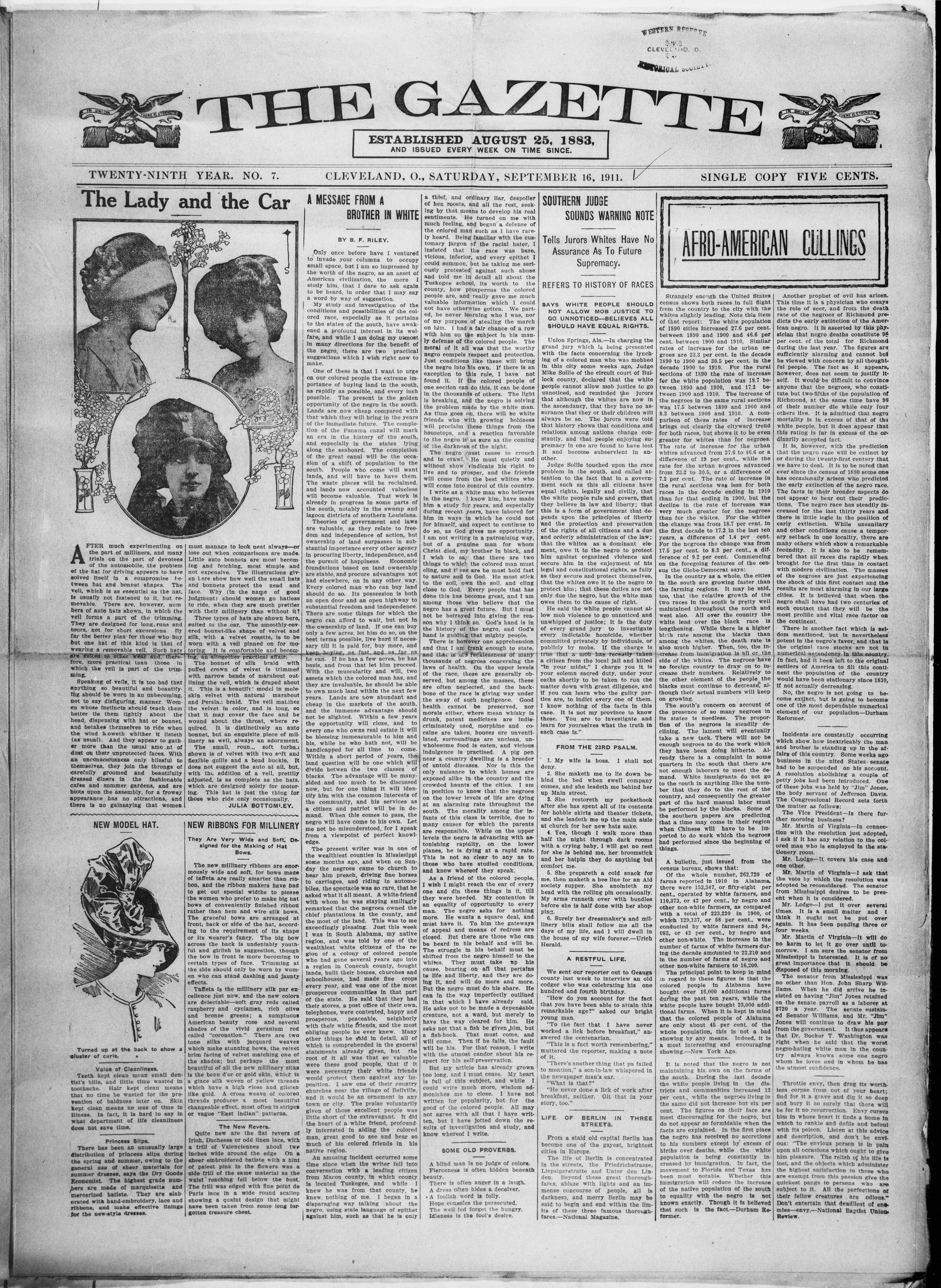
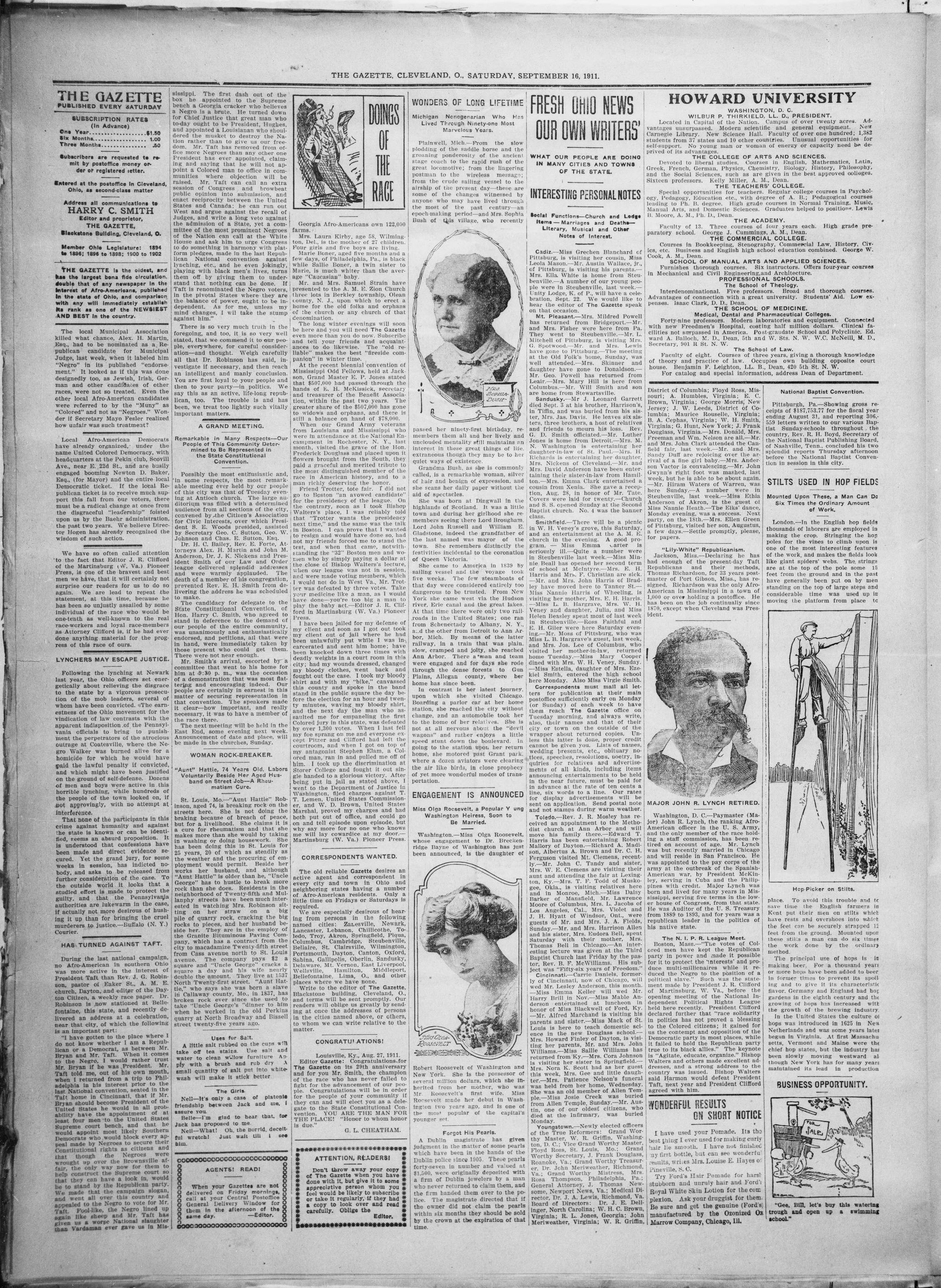
Page text (machine-generated)
TWENTY-NINTH YEAR. NO. 7.
I
---
IN UNION
THERE IS STRUGGLE
TWENTY-NINTH
The Lady
AFTER much experimenting on the part of millimeters, and many trials on the part of devotees of the automobile, the problem of the hat for driving appears to have solved itself in a compromise between hat and bonnet shapes. The vell, which is as essential as the hat, is usually not fastened to it, but removable. There are, however, numbers of auto hats shown, in which the vell forms a part of the trimming. They are designed for long, runs and tours, not for short excursions. By far the better plan for those who buy but one hat of this kind is that of wearing a removable vell. Such hats are suited to other wear and therefore, more practical than those in which the vell is part of the trimming.
Speaking of vells, it is too bad that anything so beautiful and beautifully should be worn in an unbecoming, not to say disfiguring, manner. Women whose fittings should teach them better die them tightly about the head, dispensing with hat or bonnet, and betakes themselves to ride when the wind bowes whither it listeth (as usual). And they appear to gather more than the usual aunt. nt of dust on their unprotected faces. With an unconsciousness only blissful to themselves, they join the throngs of carefully groomed and beautifully dressed diners in the fashionable cates and summer gardens, and are blots upon the assembly, for a frowy appearance has no attractions, and there is no gnaissing that women
NEW MODEL HAT.
Turned up at the back to show a cluster of curls.
Value of Cleanliness.
Teeth kept clean mean small dentist's bills, and little time wasted in toothache. Hair kept clean means that no time be wasted for the prevention of baldness later on. Skin kept clean means no loss of time in illness. In fact, it is hard to say in what department of life cleanliness does not save time.
Princess Silips.
There has been an unusually large distribution of princess slips during the spring and summer, owing to the general use of sheer materials for summer dresses, says the Dry Goods Economist. The highest grade numbers are made of marquisette and mercerized batiste. They are elaborated with hand-embroidery, lace and ribbons, and make effective linings for the new-style dresses.
THE GAZETTE
must manage to look neat always—or lose out when comparisons are made. Little auto bonnets are most becoming and fetching, most simple and not expensive. The illustrations given late show how well the small hats and bonnets protect the head and face. Why (in the name of good judgment) should women go hattles to ride, when they are much prettier with their millinery than without it? Three types of hats are shown here, suited to the car. The smoothly-covered bonnet-like shape of velvet and silk, with a velvet rosette, is to be worn with a veil pinned on for motoring. It is comfortable and becoming, an altogether practical affair. The bonnet of silk braid with puffed crown of velvet is trimmed with narrow bands of marabout outlining the veil, which is draped about it. This is a beautifit: model in molekvin skelvet with natural marabout and Persia. braid. The veil matches the velvet in color, and is long, so that it may cover the face and be wound about the throat, where required. It is distinctively an auto bonnet, but an exquisite piece of millinery as well, always an adornment. The small, round., soft turban shown is of velvet with two soft and flexible quills and a bead buckle. It does not suggest the auto at all, but, with the addition of a veil, pretty adjusted, is as complete as the hats, which are designed solely for motoring. This hat is just the thing for those who ride only occasionally.
They Are Very Wide and Soft, Designed for the Making of Hat Bows.
The new millinery ribbons are enormously wide and soft, for bows made of taffeta are really smarter than ribbon, and the ribbon makers have had to get out special widths to please the women who prefer to make big nat bows of conveniently finished ribbon rather than hem and wire silk bows. The graceful bows are arranged at front, back or side of the hat, according to the requirement of its shape or its wearer's fancy. The big bow across the back is undeniably youthful and girlish in suggestion, though the bow in front is more becoming to certain types of face. Trimming at the side should only be worn by women who can stand dashing and jaunty effects.
Taffeta is the millinery silk par excellence just now, and the new colors are delectable—soft gray reds called raspberry and cyclamen, rich olive and bronze greens; a sumptuous American beauty rose and several shades of the vivid geranium red called "coronation." There are two tone silks with jacquard weaves which make stunning bows, the velvet brim facing of velvet matching one of the shades; but perhaps the most beautiful of all the new millinery silks is the beau d'or or gold skin, which is a glace silk woven of yellow threads which have a high gloss and gilsteen like gold. A cross weave of coloreed threads produces a most beautiful changeable effect, most often in stripes or vague "East Indian" patterns.
The New Revers.
Quite new are the flat reverses of Irish, Duchesse or odd linen lace, with a frill of Valenciennes about two inches wide around the edge. On a sheer embroidered batiste with a hint of palest pink in the flowers was a side frill of the same material as the waist reaching fell below the bust. The frill was edged with fine point de Paris lace in a wide round scallop showing a quaint design that might have been taken from some long forgotten treasure chest.
ESTABLISHED AUGUST 25, 1883 AND ISSUED EVERY WEEK ON TIME SINCE.
A MESSAGE FROM A
BROTHER IN WHITE
BY B. F. RILEY.
Only once before have I ventured to invade your columns to occupy small space, but I am so impressed by the worth of the negro, as an asset of American civilization, the more I study him, that I dare to ask again to be heard, in order that I may say a word by way of suggestion.
My study and investigation of the conditions and possibilities of the colored race, especially as it pertains to the states of the south, have awakened a profound interest in its welfare, and while I am doing my umost in many directions for the benefit of the negro, there are two practical suggestions which I wish right now to make.
One of these is that I want to urge on our colored people the extreme importance of buying land in the south, as rapidly as possible, and every inch possible. The present is the golden opportunity of the negro in the south. Lands are now cheap compared with that which they will bring in the years of the immediate future. The completion of the Panama canal will mark an era in the history of the south, and especially in the states lying along the seaboard. The completion of the great canal will be the occasion of a shift of population to the south. People who come will want lands, and will have to have them. The waste places will be reclaimed, and lands now accounted valueless will become valuable. That work is already in progress in some parts of the south, notably in the swamp and lagoon districts of southern Louisiana.
Theories of government and laws are valuable, as they relate to freedom and independence of action, ownership of land surpasses in substantial importance every other agency in procuring liberty, independence, and the pursuit of happiness. Economic foundations based on land ownership are stable, and procure advantages not had elsewhere, on in any other way. Every colored man who can buy land should do so. Its possession is both an open door and an open highway to substantial freedom and independence. There are some things for which the negro can afford to wait, but not in the ownership of land. If one can buy only a few acres, let him do so, on the best possible, live hard if necessary till it is paid for, buy more, and keep buying, as fast and as far as he can. If he has a few acres, he has basis, and from that let him proceed. With the muscularity and will, two assets which the colored man has, and they are invaluable, he should be able to own much land within the next few years. Lands are now abundant and cheap in the markets of the south, and the immense advantage should not be slighted. Within a few years the opportunity will close, and to every one who owns real estate it will be blessing immeasurable to him and his, while he who hath not, will be handicapped for all time to come. Within a short period of years, the land question will be one which will divide between the two classes of blacks. The advantage will be many-sided and too much to be discussed now, but for one thing it will identify him with the common interests of the community, and his services as a citizen and patriot will be in demand. When this comes to pass, the negro will have come to his own. Let me not be misunderstood, for I speak from a viewpoint of perfect knowledge.
The present writer was in one of the wealthiest counties in Mississippi some months ago, and when on Sunday the negroes came to church to hear him preach, driving fine horses to carriages, and riding in automobiles, the spectacle was so rare, that he asked what it all meant. A white friend with whom he was staying smilingly remarked that the negroes owned the chief plantations in the county, and the most of the land. This was to me exceedingly pleasing. Just this week I was in South Alabama, my native region, and was told by one of the wealthiest white citizens of the region of a colony of colored people who had gone several years ago into a region in Conecuch county, bought lands, built their homes, churches and schoolhouses, had made fine crops every year, and was one of the most prosperous communities in that part of the state. He said that they had their stores, a post office of their own, telephones, were contented, happy and prosperous, peaceable, neighborly with their white friends, and the most obliging people he ever knew. Many other things he said in detail, all of which is comprehended in the general statements already given, but the root of it all was that so valuable were these good people, that if it were necessary their white friends would protect them against any imposition. I saw one of their country churches near the village of Belville, and it would be an ornament in any town or city. The praise voluntarily given of those excellent people was little short of the extravagant. It did the heart of a white friend, profanely interested in aiding the colored man, great good to see and hear so much of his colored friends in his native region.
An amusing incident occurred some time since when the writer fell into conversation with a leading citizen from Macon county, in which county is located Tuskegee, and while I knew he was from that county, he knew nothing of me. I began in a disparaging way talking about the negro, using stale language of epithet against him, such as that he is only
a thief, and ordinary har, despotifier of hen roosts, and all the rest, seeking by that means to develop his real sentiments. He turned on me with much feeling, and began a defense of the colored man such as I have rarely heard. Being familiar with the customary jargon of the racial hater, I insisted that the race was base, vicious, inferior, and every epithet I could summon, but he taking me seriously protested against such abuse and told me in detail all about the Tuskegee school, its worth to the county, how prosperous the colored people are, and really gave me much valuable information which I could not have otherwise gotten. We parted, he never learning who I was, nor of my purpose of stealing the march on him. I had a fair chance of a row with him on the subject in his manly defense of the colored people. The moral of it all was that the worthy negro compels respect and protection. Just conditions like these will bring the negro into his own. If there is an exception to this rule, I have not found it. If the colored people of one section can do this, it can be done in the thousands of others. The light is breaking, and the negro is solving the problem made by the white man. As time goes on, there will be white friends who with growing boldness will proclaim these things from the housetops, and a reaction favorable to the negro is as sure as the coming of the darkness of the night.
The negro must cease to crouch and to crawl. He must quietly and without show vindicate his right to live and to prosper, and the friends will come from the best whites who will come into control of this country. I write as a white man who believes in the negro. I know him, have made him a study for years, and especially during recent years, have labored for him in ways in which he could not for himself, and expect to continue to do so, as God gives me opportunity. I am not writing in a patronizing way, but of a genuine man for whom Christ died, my brother in black, and I wish to say, that there are two things to which the colored man must cling, and these are he must hold fast to nature and to God. He must stick to the soil, own the soil, and cling close to God. Every people that has done this has become great, and I am among those who believe that the negro has a great future. But I must not be betrayed into giving the reason why I think so. God's hand is in the history of the negro, and God's hand is guiding that mighty people.
There is however one apprehension and that I am frank enough to state, and that is its fecklessness of many thousands of negroes concerning the laws of health. On the upper levels of the race, these are generally observed, but among the masses, these are often neglected, and the backbone of the race is giving way under the sway of such negligence. Good health cannot be preserved, nor morals either, where mean whisky is drunk, patent medicines are indiscriminately used, morphine and cocaine are taken, houses are unventilated, surroundings are unclean, unwholesome food is eaten, and vicious indulgence is practised. A pig pen near a country dwelling is a breeder of untold diseases. Nor is this the only nuisance to which homes are exposed alike in the country and the crowded haunts of the cities. I am in position to know that the negroes on the lower levels of life are dying at an alarming rate throughout the south. The morality among the infants of this class is terrible, due to many causes for which the parents are responsible. While on the upper levels the negro is advancing with astonishing rapidity, on the lower planes, he is dying at a rapid rate. This is not so clear to any as to those who have studied conditions, and know whereof they speak.
As a friend of the colored people, I wish I might reach the ear of every one and din these things in it, till they were heeded. My contention is an equality of opportunity to every man. The negro asks for nothing more. He wants a square deal, and must have it. To him the gateways of appeal and means of redress are closed. But there are those who can be heard in his behalf and will be. The struggle in his behalf must be shifted from the negro himself to the whites. They must take up his cause, bearing on all that pertains to life and liberty, and they are doing it, and will do more and more. But the negro must do his share. He can in the way imperfectly outlined in that which I have already said. He asks not to be made a dependable creature, not a ward, but merely to have the way cleared for him. He asks not that a fish be given him, but a fish-hook. That must come, and will come. Then if he fails, the fault will be his. For that reason, I write with the utmost candor about his respect for his self-preservation. But my article has already grown too long, and I must cease. My heart is full of this subject, and while I could write much more, wisdom admonishes me to close. I have not written for popularity, but for the good of the colored people. All may not agree with all that I have written, but I have jotted down the results of investigation and study, and know whereof I write.
SOME OLD PROVERBS.
A blind man is no judge of colors.
Fierceness is often hidden beneath beauty.
There is often anger in a laugh.
A dress often hides a deceler.
· A foolish word is folly.
Hope consoles the persecuted.
The well fed forget the hungry.
Idleness is the fool's desire.
SOUTHERN JUDGE
SOUNDS WARNING NOTE
Tells Jurors Whites Have No Assurance As To Future Supremacy.
REFERS TO HISTORY OF RACES
SAYS WHITE PEOPLE SHOULD NOT ALLOW MOB JUSTICE TO GO UNNOTICED—BELIEVES ALL SHOULD HAVE EQUAL RIGHTS.
Union Springs, Ala.—In charging the grand jury which is being presented with the facts concerning the lynching of a colored man who was mobbed in this city some weeks ago, Judge Mike Solle of the circuit court of Bullock county, declared that the white people cannot allow mob justice to go unnoticed, and reminded the jurors that although the whites are now in the ascendancy, that they have no assurance that they or their children will always be so. The jurors were told that history shows that conditions and relations among nations change constantly, and that people enjoy supremacy in one are found to have lost it and become subservient in another.
Judge Solle touched upon the race problem in the south, and called attention to the fact that in a government such as this all citizens have equal rights, legally and civilly, that the white people rule and govern, that they believe in law and liberty; that this is a form of government that depends upon the principles of liberty and the protection and preservation of the rights of all citizens and a due and orderly administration of the law; that the whites as a dominant element, owe it to the negro to protect him against organized violence and secure him in the enjoyment of his legal and constitutional rights, as fully as they secure and protect themselves, that the whites owe it to the negro to protect him; that these duties are not only due the negro, but the white man owes them to the cause of right.
He said the white people cannot allow mob violence to go unnoticed and unwhipped of justice; it is the duty of every grand jury to investigate every indictable homicide, whether committed privately by individuals, or publicly by mobs. If the charge is true that a mob has recently taken a citizen from the local jail and killed "in your midst," I charge you it is your solemn sacred duty, under your oaths shortly to be taken to run the matter down with great diligence, and if you can learn who the guilty parties are, to indict every one of them. I know nothing of the facts in this case. It is not my province to know these. You are to investigate and learn for yourselves what the truth in each case is."
1. My wife is boss. I shall not deny.
2. She maketh me to lie down behind the bed when swell company comes, and she leadeth me behind her up Main street.
3. She restoreth my pocketbook after she has spent all of its contents for hobble skirts and theater tickets, and she leadeth me up the main aisle at church for her new hats sake.
4. Yea, though I walk more than half the night through dark rooms with a crying baby, I will get no rest for she is behind me, her broomstick and her hatpin they do anything but comfort me.
5. She preheat a cold snack for me, then maketh a bee line for an Ald society supper. She anointeth my head with the rolling pin occasionally. My arms runneth over with bundles before she is half done with her shopping.
6. Surely her dressmaker's and millinery bills shall follow me all the days of my life, and I will dwell in the house of my wife forever—Urich Herald.
We sent our reporter out to Geauga county last week to interview an old codger who was celebrating his one hundred and fourth birthday.
"How do you account for the fact that you have been able to attain this remarkable age?" asked our bright young man.
"To the fact that I have never worked a lick before breakfast," answered the centenarian.
"This is a fact worth remembering," muttered the reporter, making a note of it.
"There's another thing that pa failed to mention," a son-in-law whispered in the newspaper man's ear.
"What is that?"
"He never done a lick of work after breakfast, neither. Git that in your story, too."
LIFE OF BERLIN IN THREE
STREETS.
From a staid old capital Berlin has become one of the gayest, brightest cities in Europe.
The life of Berlin is concentrated in the streets, the Friedrichstrasse, Lipsigersstratte and Unter den Linden. Beyond these great thoroughfares, ablaze with lights and an immense concourse of people, all is darkness, and merry Berlin may be said to begin and end within the limits of these three famous thoroughfares.—National Magazine.
FROM THE 23RD PSALM.
A RESTFUL LIFE.
WESTERN RESERVE
CLEVELAND, O.
HISTORICAL SOCIETY
AFRO
SINGLE CO
AFRO-AMERIC
AFRO-AMERICAN CULLINGS
Strangely enough the United States census shows both races in full flight from the country to the city with the whites slightly leading. Note this item of that report: The white population of 1890 cities increased 27.6 per cent between 1890 and 1900 and 46.6 per cent, between 1900 and 1910. Similar rates of increase for the urban negroes are 23.3 per cent. In the decade 1890 to 1900 and 30.5 per cent. in the decade 1900 to 1910. For the rural sections of 1890 the rate of increase for the white population was 18.7 between 1890 and 1900, and 17.3 between 1900 and 1910. The increase of the negroes in the same rural sections was 17.5 between 1890 and 1900 and 8.3 between 1900 and 1910. A comparison of these rates of increase brings out clearly the cityward trend for both races, but shows it to be even greater for whites than for negroes. The rate of increase for the urban whites advanced from 27.6 to 46.6 or a difference of 19 per cent., while the rate for the urban negroes advanced from 23.2 to 30.5, or a difference of 7.2 per cent. The rate of increase in the rural sections was less for both races in the decade ending in 1910 than for that ending in 1900, but the decline in the rate of increase was very much greater for the negroes than for the whites. For the whites the change was from 18.7 per cent. in the first decade to 17.3 in the last ten years, a difference of 1.4 per cent. For the negroes the change was from 17.5 per cent. to 8.3 per cent., a difference of 9.2 per cent. Commencing on the foregoing features of the census the Globe-Democrat says:
In the country as a whole, the cities in the south are growing faster than the farming regions. It may be said, too, that the relative growth of the two races in the south is pretty well maintained throughout the north and west also. All over the country the white lead over the black race is lengthening. While there is a higher birth rate among the blacks than among the whites, the death rate is also much higher. Then, too, the increase from immigration is all or the side of the whites. The negroes have no foreign country to draw on to increase their numbers. Relatively to the other element of the people the blacks must continue to decrease, although their actual numbers will keep on growing.
The south's concern on account of the presence of so many negroes in its states is needless. The proportion of the negroes is steadily declining. The lament will eventually take a new tack. There will not be enough negroes to do the work which they have been doing hitherto. Already there is a complaint in some quarters in the south that there are not enough laborers to meet the demand. White immigrants do not go to the south in anything like the number that they do to the rest of the country, and consequently the greater part of the hard manual labor must be performed by the blacks. Some of the southern papers are predicting that a time may come in their region when Chinese will have to be imported to do work which the negroes had performed since the beginning of things.
A bulletin, just issued from the census bureau, shows that:
Of the whole number, 262,720 of farms reported in 1910 in Alabama, there were 152,347, or fifty-eight per cent., operated by white farmers, and 110,373, or 42 per cent., by negro and other non-white farmers, as compared with a total of 223,220 in 1900, of which 129,137, or 58 per cent., were conducted by white farmers and 94,083, or 42 per cent., by negro and other non-white. The increase in the number of farms of white farmers during the decade amounted to 22,210 and in the number of farms of negro and other non-white farms to 16,200.
The principal point to keep in mind in regard to these figures is that the colored people in Alabama have bought over 16,000 additional farms during the past ten years, while the white people have bought 23,000 additional farms. When it is kept in mind that the colored people of Alabama are only about 45 per cent of the whole population, this is not a bad showing by any means. Indeed, it is a most interesting and encouraging showing—New York Age.
It is noted that the negro is not maintaining his own on the farms of the south. During the last decade the white people living in the districts and communities increased 13 per cent, while the negroes living in the same did not increase but six per cent. The figures on their face are most discouraging for the negro, but do not appear so formidable when the facts are explained. In the first place the negro has received no accretions to his numbers except by excess of births over deaths, while the white population is being constantly increased by immigration. In fact, the movement to Florida and Texas has been most notable. Whether this immigration will reduce the increase of the native population of the south to equality with the negro is not known exactly. Though it is believed that such is the fact—Durham Reformer.
---
---
SINGLE COPY FIVE CENTS.
Another prophet of evil has arisen. This time it is a physician who essays the role of seer, and from the death rate of the negroes of Richmond predicts the early extinction of the American negro. It is asserted by this physician that negroes constitute 96 per cent of the total for Richmond during the last year. The figures are sufficiently alarming and cannot but be viewed with concern by all thoughtful people. The fact as it appears, however, does not seem to justify itself. It would be difficult to convince anyone that the negroes, who constitute but two-fifths of the population of Richmond, at the same time have 96 of their number die while only four others live. It is admitted that negro mortality is in excess of that of the white people, but it does appear that this rating is far in excess of the ordinarily accepted fact.
It is, however, with the prediction that the negro race will be extinct by or during the twenty-first century that we have to deal. It is to be noted that ever since the census of 1830 some one has occasionally arisen who predicted the early extinction of the negro race. The facts in their broader aspects do not appear to bear out their predictions. The negro race has steadily increased for the last thirty years and there is little logic in the position of early extinction. While unsanitary and other conditions cause a temporary setback in one locality, there are many others which show a remarkable fecundity. It is also to be remembered that all races die rapidly when brought for the first time in contact with modern civilization. The masses of the negroes are just experiencing the shock of this first contact and the results are most alarming in our large cities. It is believed that when the negro shall have had two centuries of such contact that they will be the most prolific and vital race factor on the continent.
There is another fact which is seldom mentioned, but is nevertheless potent in the negro's favor, and that is the original race stocks are not in numerical ascendancy in this country. In fact, had it been left to the original settlers of America to fill this continent the population of the country would have been stationary since 1830, if not actually decreasing.
No, the negro is not going to become extinct, but is going to become one of the most dependable numerical element of our population—Durham Reformer.
Incidents are constantly occurring which show how inextricably the man and brother is standing up in the affairs of this country. Some weeks ago business in the nited States senate had to be suspended on his account. A resolution abolishing a couple of petty jobs had been introduced. One of these jobs was held by "Jim" Jones, the body servant of Jefferson Davis. The Congressional Record sets forth the matter as follows:
The Vice President—Is there further morning business?
Mr. Martin of Virginia—In connection with the resolution just adopted, I ask if it has any relation to the colored man who is employed in the stationery room.
Mr. Lodge—It covers his case and one other.
Mr. Martin of Virginia—I ask that the vote by which the resolution was adopted be reconsidered. The senator from Mississippi desires to be present when it is considered.
Mr. Lodge—I put it over several times. It is a small matter and I think it ought not be put over again. It has been pending three or four weeks.
Mr. Martin of Virginia—It will do no harm to let it go over until tomorrow. I am sure the senator from Mississippi is interested. It is of no great importance that it should be disposed of this morning.
The senator from Mississippi was no other than Hon. John Sharp Williams. When he did arrive he insisted on having "Jim" Jones retained on the senate payroll as a laborer at $720 a year. The senate sustained Senator Williams, and Mr. "Jim" Jones will continue to draw his pay from the government. It thus appears that Dr. Booker T. Washington was right when he said that the worst negro-hating white man in the country always knows some one negro whom he loves and in whom he has the utmost confidence.
Throttle envy, then drag its worthless corpse out of your heart; find for it a grave and dig it so deep and bury it so surely that there will be for it no resurrection. Envy curses him in whose heart it finds a home in which to rankle and defile and beoflw with its poison. Listen at this advice and description, and don't be envious: "The envious person is in pain upon all occasions which ought to give him pleasure. The relish of his life is lost, and the objects which administer the highest satisfaction to those who are exempt from this passion give the quickest pangs to persons who are subject to it. All the perfections of their fellow creatures are odious." Don't entertain that deadliest of enemies—envy.—National Baptist Union Review.
THE GAZETTE
PUBLISHED EVERY SATURDAY
One Year.....$1.50
Six Months.....1.00
Three Months.....5.0
Subscribers are requested to
mit by postoffice money or
order or registered letter.
Entered at the postoffice In Cleveland
Ohio, as second-class matter
Address all communications to
HARRY C. SMITH
Editor and proprietor,
THE GAZETTE,
Blackstone Building, Cleveland, O.
Member Ohio Legislature: 1894
to 1896; 1896 to 1888; 1900 to 1902
THE GAZETTE is the oldest, and has the largest bona fide circulation, double that of any newspaper in the interest of Afro-Americans, published in the state of Ohio, and comparison with any will immediately establish its rank as one of the NEWSIEST AND BEST in the country.
The local Municipal Association killed what chance, Alex H. Martin, Esq., had to be nominated as a Republican candidate for Municipal Judge, last week, when it labeled him "Negro" in its published "endorsement." It looked as if this was done designedly too, as Jewish, Irish, German and other candidates of other races, were not so treated. Even the other local Afro-American candidates were referred to by the "Muny" as "Colored" and not as "Negroes." Wonder if Secretary Mayo Fesler realized how unfair was such treatment?
Local Afro-American Democrats have already organized, under the name United Colored Democracy, with headquarters at the Pekin club, Sovillia Ave, near E. 22d St., and are busily engaged booming Newton D. Baker, Esq. (for Mayor) and the entire local Democratic ticket. If the local Republican ticket is to receive much support this fall from our voters, there must be a radical change at once from the disgraceful "leadership" foisted upon us by the Baehr administration, the past two years. We believe Direcr for Hogen has already recognized the wisdom of such action.
---
We have so often called attention to the fact that Editor J. R. Clifford of the Martininsburg (W. Va.) Pioneer Press, is one of the bravest and best men we have, that it will certainly not surprise our readers for us to do so again. We are lead to repeat the statement, at this time, because he has been so unjustly assailed by some individual of the race who would be one-tenth as well-known to the real race-workers and loyal race-members at Attorney Clifford is, if he had ever done anything material for the progress of this race of ours.
LYNCHERS MAY ESCAPE JUSTICE
Following the lynching at Newark last year, the Ohio officers set energetically about relieving the disgrace to the state by a vigorous prosecution of the mob leaders, several of whom have been convicted. The earnestness of the Ohio movement for the vindication of law contrasts with the apparent indisposition of the Pennsylvania officials to bring to punishment the perpetrators of the atrocious outrage at Coatesville, where the Negro Walker was burned alive for a homicide for which he would have paid the lawful penalty if convicted, and which might have been justified on the ground of self-defense. Dozens of men and boys were active in this horrible lynching, while hundreds of the people of the town looked on, if not approvingly, with no attempt at interference.
That none of the participants in this crime against humanity and against the state is known or can be identified, reems an absurd proposition. It is understood that confessions have been made and direct evidence secured. Yet the grand jury, for some weeks in session, has indicted nobody, and asks to be released from further consideration of the case. To the outside world it looks that a studied effort is made to protect the guilty, and that the Pennsylvania authorities are lukewarm in the case, if actually not more desirous of hushing it up than for bringing the cruel murderers to justice.—Buffalo (N. Y.) Courier.
HAS TURNED AGAINST TAFT
During the last national campaign, no Afro-American in southern Ohio was more active in the interest of President Taft than Rev. J. G. Robinson, pastor of Eaker St., A. M. E. church, Dayton, and editor of the Dayton Citizen, a weekly race paper. Dr. Robinson is now stationed at Bellefontaine, this state, and recently delivered an address at a celebration, near that city, of which the following is an important part:
"I have gotten to the place where I do not know whether I am a Republican or a Democrat, as between Mr. Bryan and Mr. Taft. When it comes to the Negro, I would rather trust Mr. Bryan if he was President. Mr. Taft told me, out of his own mouth, when I returned from a trip to adelphia in his interest to the college in Indiana, seated in the Taft home in Cincinnati, that if Mr. Bryan should become President of the United States he would in all probability have the appointment of at least four men to the United States Supreme court bench, and that would appoint most of the other Democrats who would block every apocalypse of Negroes to secure their constitutional rights as citizens and that though the Negroes were wrought up over the Brownsville affair, the only way now for them to help construct the Supreme court so that they can have a look in, would be to stand by the Republican party. We made that the campaign agenda and went on to appeal to the Negro to vote for Mr. Taft. Foollike, the Negro lined up like sheep and Mr. Taft has given us a worse National slaughter than Vardaman ever gave us in Mis-
sissippi. The first dash out of the box he appointed to the Supreme bench a Georgia cracker who believes a Negro is a brute. He turned down for Chief Justice that great man who to-day ought to be President, Hughes, and appointed a Louisiana man who shouldered the musket to destroy the Nation than to give us our freedom. Mr. Taft opposed a more Negroes than any other one President has ever appointed, claiming and saying that he will not appoint a Colored man to office in communities where objection will be raised. Mr. Taft can call an extra session of Congress and browbeat public opinion into submission, and enact reciprocity between the United States and Canada; he can run out of the Senate and be elected Judges, and write a long veto against the admission of a State, yet a committee of the most prominent Negroes of the Nation can call at the White House and ask him to urge Congress to do something in harmony with platform pledges, made in the last Republican National convention against lynching, etc., and he even jokingly, playing with black men's lives, turns them off by giving them to understand that nothing can be done. If he is accused the New veto in the pivotal States where they are the balance of power, ought to be independent. As for me, unless my mind changes, I will take the stump against him."
There is so very much truth in the foregoing, and too, it is so very well stated, that we commend it to our people, everywhere, for careful consideration—and thought. Weigh carefully all that Dr. Robinson has said, investigate if necessary, and then reach an intelligent and manly conclusion. You are first loyal to your people and then to your party—in politics. We say this as an active, life-long republican, too. The trouble is and has been, we treat too lightly such vitally important matters.
A GRAND MEETING.
Remarkable in Many Respects—Our People of This Community Determined to Be Represented in the State Constitutional Convention.
Possibly the most enthusiastic and, in some respects, the most remarkable meeting ever held by our people of this city was that of Tuesday evening at Antioch church. The large auditorium was filled by a determined Peron in all sections of the city, convened by the Citizen's Association for Civic Interests, over which President S. E. Woods presided, assisted by Secretary Geo. C. Sutton, Geo. W. Johnson and Chas. E. Sutton, Esq. Dr. H. C. Bailley, Rev. E. Forte, Attorneys Alex. H. Martin and John M. Anderson, Dr. J. K. Nickens and President Smith of our Law and Order league delivered splendid addresses and were warmly applauded. The death of Mr. of the Congregation prevented Rev. E. H Smith from delivering the address he was scheduled to make.
The candidacy for delegate to the State Constitutional Convention, of Hon. Harry C. Smith, who agreed to stand in deference to the demand of our people of the entire community, was unanimously and enthusiastically in hand, were immediately taken by those present who could get them. There were not near enough. Mr. Smith's arrival, escorted by a committee that went to his home for him at 9:30 p. m., was the occasion of a demonstration that was most fateful for the people. People are certainly in earnest in this matter of securing representation in that convention. The speakers made it clear—how important, and really necessary, it was to have a member of the race there. The next meeting will be held in the East at the evening next week. Announcement of date and place, will be made in the churches, Sunday.
WOMAN ROCK-BREAKER
"Aunt" Hattie, 74 Years Old, Labors Voluntarily Beside Her Aged Husband on Street Job—A Rheumatic Cure.
St. Louis, Mo.—"Aunt Hattie" Robinson, aged 74, is breaking rock on the streets here. She is not doing the braking because of breach of peace, but for a livelihood. She claims it is a cure for rheumatism and that she makes more than she would by taking in washing or doing housework. She has been doing this in the area for 25 years as steadily as she and the procuring of employment would permit. Beside her works her husband, and although "Aunt Hattie" is older than he, "Uncle George" has to hustle to break more rock than she does. Residents in the neighborhood of Twenty-fifth and Mullanphy streets have been much interested in watching Mrs. Robinson sitting on her straw on a pile of quarry rock, creating the big rocks to pieces, and her husband being in the employ of the Granite Bituminous Paving Company, which has a contract from the city to macadamize Twenty-fifth street from Cass avenue north to St. Louis avenue. The company pays $2 a square and "Uncle George" cracks a square a day and his wife needs double the amount. They work in the Granite Bituminous Paving Company, who says she was born a slave in Callaway county, Mo., in 1887, has broken rock ever since she used to take "Uncle George's" dinner to him when he worked in the old Perkins quarry at North Broadway and Bissell street twenty-five years ago.
Uses for Salt.
A little salt rubbed on the cups will take off tea stains. Use salt and water to clean woll furniture Apply with a brush and rub dry A small quantity of salt put into white wash will make it stick better
The Girls
Nell—It's only a case of platonite friendship between Jack and me, I assure you.
Belle—I am glad to hear that, for Jack has proposed to me.
Nell—What! Oh, the horrid, deceitful wretch! Just wait till I see him.
When your Gazettes are not delivered on Friday mornings, call at your Central Postoffice General Delivery Window for them in the afternoon of the same day. —Editor.
THE GAZETTE, CLEVELAND, O., SATURDAY, SEPTEMBER 16, 1911.
DOINGS
OF
THE
RACE
Georgia Afro-Americans own 122,000 farms.
Mrs. Laura Kirby, age 58, Wilmington, Del., is the mother of 27 children. Four girls and five boys are living. Marie Boner, aged five months and a few days, of Philadelphia, Pa., is black with white hair. A twin sister to Marie is much whiter than the average "Caucasian" baby. Mr. and Mrs. Samuel Strain have presented to the A. M. E. Zion Church three lots in Berkley township, Olean county, N. J., upon which to erect a home for the old folks and orphans of the church or any church of that denomination. The long winter evenings will soon be here and you will need The Gazette even more than you do now. Subscribe and tell your friends and acquaint- ing with the "old reliable" makes the best "fireside companion" in winter time.
At the recent biennial convention of Mississippi Odd Fellows, held at Jackson, Grand Master E. P. Jones stated that $507,000 had passed through the hands of E. H. McKissick, secretary and treasurer of the Benefit Association, within the past two years. The greater share of the $507,000 has gone to widows and orphans, and there is still a balance on hand of $78,000. When our Grand Army veterans from Louisiana and Mississippi who were in attendance at the National Encampment in Rochester, N. Y., last month, visited the grave of Hon. Devon D. DeLance, placed upon flowers brought from the South, they paid a graceful and merited tribute to the most distinguished member of the race in American history, and to a man richly deserving the honor.
Friend Trotter, tote fair. I did not go to Boston "an avowed candidate" for the presidency of the league. On the contrary, soon as I took Bishop Walters's place, I was reliably told the next time, "and the same was the talk in Boston. I can prove that I wanted to resign and would have done so, had not my friends forced me to stand the test, and when that came, notwithstanding the "32" Boston men and women who by simply paying a dollar at the store, when our league was not in session, and were made voting members, which I would not do in West Va. Mr. Trotter was defeated by three votes. Take your medicine like a man, as I would have done--you're too big a man to play the baby act. -Editor J. R. Chiffin in Martinsburg (W. Va.) Pioneer Press
I have been jailed for my defense of my client and soon as I got out took my client out of jail where he had been unlawfully put while I was incarcerated and sent him home; have been knocked down three times when I was in prison in his city; had my wounds dressed, changed my bloody clothes, went back and fought out the case. I took my bloody shirt and with my "bike," canvassed this county and spoke in the band stand in the public square the day before the election for an hour and twenty minutes, waving my bloody shirt, standing in the courtroom, saunted me for empaneling the first Colored jury in this state, was defeated by over 1,300 votes. When I last fell my foe spring on me and everyone except Pitzer and Clifford had left the courtroom, and when I got on top of my antagonist Stephen P. Clifford I pulled me and took up the discrimination at Storer College and fought it out single handed to a glorious victory. After being put in jail as stated above, I went to the Department of Justice in Washington, filed charges against T. T. Lemen, United States Commissioner, and W. D. Brown, United States Marshal, proved my charges but could go and tell episode upon episode, but why say no for no one who knows will my lay cowardice at my door. - Martinsburg (W. Va.) Pioneer Press.
CORRESPONDENTS WANTED.
The old reliable Gazette desires an active agent and correspondent in every city and town in Ohio and neighboring states having a number of Afro-American residents. Only a little time on Fridays or Saturdays is required.
We are especially desirous of hearing from persons in the following named cities: Zanesville, Newark, Lancaster, Lancaster, Chillicotte, Tooway, Troy, Akron, Springfield, Pluqa, Columbus, Cambridge, Steubenville, Bellaire, St. Clairsville, Wilmington, Portmouth, Dayton, Canton, Oxford, Sabina, Gallipolis, Oberlin, Sandusky, Delaware, M. Vernon, East Liverpool, Wellsville, Hamilton, Middleport, Bellefonte, Lima, O, and other places where we have none.
Write to the editor of the Gazette, Bucknake, building, Cleveland, O, and words will be sent promptly. Our readers will oblige us greatly by sending at once the addresses of persons in the cities named above, or others, to whom we can write relative to the matter.
CONGRATULATIONS!
Louisville, Ky. Aug. 27, 1911.
Editor Gazette: Congratulations.for
The Gazette on its 29th anniversary
and for you Mr. Smith, the champion
of the race who has never failed to
fight for the advancement of our people.
Congratulations will be in order
for the people of your community if
they can and will elect you as a de-
legate to the House. You are THE MAN FOR
THE PLACE! "Honor to whom honor
is due."
G. L. CHEATHAM.
ATTENTION, READERSI
Don't throw away your copy of The Gazette when you have done with it, but give it to some appreciative person whom you feel would be likely to subscribe or take it regularly, if they had a copy to look over and read carefully. Oblige the
WONDERS OF LONG LIFETIME
Michigan Nonogenarian Who Has
Lived Through Ninety-one Most
Marvelous Years.
Plainwell, Mich.—From the slow plodding of the saddle horse and the grooming ponderosity of the ancient stage coach to the rapid rush of the great locomotive; from the lingering postman to the wireless message; from the crude sailing vessel to the airship of the present day—these are some of the changes witnessed by anyone who may have lived through the most of the past century—an epoch-making period—and Mrs. Sophia Bush of this village who recently
Mrs. Beverly Desit
passed her ninety-first birthday, remembers them all and her lively and unclouded mentality still maintains an interest in these great things of life extraneous though they may be to her quiet ways of existence.
Grandma Bush, as she is commonly called, is a remarkable woman, silver of hair and benign of expression, and she scans her dally paper without the aid of spectacles.
She was born at Dingwall in the highlands of Scotland. It was a little town and during her girlhood she remembers seeing there Lord Brougham, Lord John Russell and William E. Gladstone, indeed the grandfather of the last named was mayor of the town. She remembers distinctly the festivities incidental to the coronation of Queen Victoria.
She came to America in 1839 by sailing vessel and the voyage took five weeks. The few steamboats of that day were considered entirely too dangerous to be trusted. From New York she came west via the Hudson river, Erie canal and the great lakes. At that time there were only two railroads in the United States; one ran from Schenectady to Albany, N. Y. a.d the other from Detroit to Ann Arbor, Mich. By means of the latter railway, in a train that was plain, slow, cramped and jolly, she reached Ann Arbor. There a man and team were engaged and for days she rode through the dense forests to Gun Plains, Allegan county, where her home has since been.
In contrast is her latest journey upon which she visited Chicago Boarding a parlor car at her home station, she reached the city without change, and an automobile took her to the home of her relatives. She is not at all nervous about the "devil wagons" and rather enjoys a little speed stunt down the boulevard. In going to the station upon her return home, she motored past Grant park where a dozen aviators were clearing the air like birds, in close prophecy of yet more wonderful modes of transportation.
ENGAGEMENT IS ANNOUNCED
Miss Olga Rocevelt, a Popular Y ung
Washington Heiress, Soon to
Be Married.
Washington.—Miss Olga Rocevelt,
whose engagement to Dr. Brecken-
ridge Bayne of Washington has just
been announced. is the daughter of
PASS OLEA
ROSSINELT
Robert Roosevelt of Washington and New York. She is the possessor of several million dollars, which she inherited from her mother, who was Mr. Roosevelt's first wife. Miss Roosevelt made her debut in Washington two years ago, and is one of the most popular of the capital's younger set.
Forgot His Pearls
A Dublin magistrate has given judgment in the matter of some pearls which have been in the hands of the Dublin police since 1905. These pearls forty-seven in number and valued at $1,500, were originally deposited with a firm of Dublin jewelers by a man who never returned to claim them, and the firm handed them over to the police. The magistrate directed that if the owner did not claim the pearls within six months they should be sold by the crown at the expiration of that time.
FRESH OHIO NEWS OUR OWN WRITERS
WHAT OUR PEOPLE ARE DOING IN MANY CITIES AND TOWN$ OF THE STATE.
INTERESTING PERSONAL NOTES
Social Functions—Church and Lodge
Items—Marriages and Deathe-
Literary, Musical and Other
Notes of Interest.
Cadiz—Miss Grechon Blancheard of Pittsburg, is visiting her cousin, Miss Leola Mason. Mr. Austin Wallace, jr., of Pittsburg, is visiting his parents. Mrs. Ella White is home from Steubenville. A number of our young people were in Steubenville, last week. Unity Lodge, K. of P., will have a celebration, Sept. 22. We would like to hear the editor of The Gazette speak on that occasion.
Mr. Pleasant. Mrs. Milred Powell has returned from Bridgeport. Mr. Fisher. Mrs. Fisher were from Pa. They went to Steubenville. Mr. L. Mitchell of Pittsburg, is visiting Mrs. G. Spotwood. Mr. and Mrs. Lewis have gone to Pittsburg. The meeting at the Old Folk's home, Sunday, was well attended. Mrs. Skinner and daughter have gone to Donaldson. Mr. Geo. Powell has returned from Columbus. Mr. Will Smith and son are home from Stewartsville.
Sandusky.—Mr J. Leonard Garrett died Sept. 3 at his brother, Harrison's, in Tiffin, and was buried from his sister, Mrs. Jas, Davis. He leaves six sisters, three brothers, a host of relatives and friends to mourn his loss. Rev. G. D. Smith officiated.—Mr. Luther Jones is home from Detroit.—Mrs. M. N. Washington is entertaining her daughter-in-law of St. Paul.—Mrs. H. Richards is entertaining her daughter, Mrs. Nickens of Cleveland.—Mr. and Mrs. David Anderson have been entertaining their sister-in-law from Hamilton.—Mrs. Emma Clark entertained a cousin from Xenia. She gave a reception, Aug. 28, in honor of Mr. Tate and his family for her 40th birthday and S. S. opened Sunday at the Second Baptist church. No. 4 was the banner class.
Smithfield.—There will be a picnic in W. H. Veney's grove, this Saturday, and an entertainment at the A. M. E. church in the evening. A good program. — Miss Emma Larter is seriously ill—Quite a number were in Steubenville last week. Miss Minnie Beall has opened her second term of school at McIntyre—Mrs. E. H. Harris and Mrs. E. H. Harris, and Mrs. John Harris of Bradley have moved here to Tanner St. Miss Nannie Harris of Wheeling, is visiting her mother, Mrs. E. H. Harris. —Miss L. B. Hargrave, Mrs. W. H. Veney and daughter, Julia, and Miss Helen Beasley spent most of last week in Steubenville. —Ross Faithful and E. H. Giler were here Saturday evening. —Mr. Moss of Pittsburg, who was Miss L. B. Hargrave's guest, last week, and Mrs. Jos. Lee of Columbus, who visited her mother-in-law, lawyer, and teacher, Cooper dined with Mrs. W. H. Veney, Sunday. —Miss Estella, daughter of Mrs. Ezekiel Smith, entered the high school here Monday. Also Miss Virgie Smith.
Correspondents must mall all letters for publication at their main postoffice sufficiently early on Monday (or Sunday) of each week to have them reach The Gazette office on Tuesday morning, and always write, also, their names and that of their city or town on the outside of the wrapper about returned copies of the book. The return credit cannot be given you. Lists of names, wedding presents, etc, obituary notices, speeches, resolutions, noery, inquiries for relatives and advertisements of all kinds, including items announcing entertainments to be held in the near future, must be paid for in advance at the rate of ten cents a line, six words to a line. Our rate is $1.00 per word, and we be sent on application. Send postal note and not stamps during warm weather.
Toledo—Rev J. R. Mosley has received an appointment to the Methodist church at Ann Arbor and will move his family there.—Edward T. Harris has been entertaining Robert Malloy of Dayton, Ohio, and Brown and Dr. C. H. Ferguson visited Mt. Clemens, recently.—Mr. John C. Tandy and sister, Mrs. W. E. Clemens are visiting their aunt and attending the fair at Lexington, Ky.—Mrs. T. F. Todd of Muskegon, Okla., is visiting relatives here and in Monroe, Miss.—Mr. Lawrence Moore of Columbus, Mrs. L. Jacobs of Los Angeles, Cal., Mrs. Violet and J. H. Hyatt of Windsor, Ont., were guests of Mr. and Mrs. J. A. Fields, Sunday.—Mr. and Mrs. Harrison Allen and his sister, Mrs. Eudora Bell, spent Saturday at the Bell in Chicago—An interesting lecture was given at the Third Baptist Church last Friday by the pastor, Rev B. F. McWilliams. His subject was "Fifty-six years of Freedom."
Cincinnati—Carrie Daniels, formerly of Cincinnati, now of Chicago, will wed Mr. Lesley Anderson, this month. —Miss Emma Keller will wed Mr. Harry Brill in Chicago and entertained at luncheon in honor of Miss Blackwell of Ford, Ky. —Mr. Alfred Marchand is visiting his parents and sister. —Miss Mack of St. Louis is here to teach domestic science in the new Douglass school. —Mrs. Howard Finley of Dayton, is visiting her parents, Mr. and Mrs. John Williams. —Miss Sallie Williams has returned from Ky. —Mrs. Cora Johnson is visiting her sister in Springfield. —Mrs. Nora K. Scott had as her guest this week. Mrs. Gee and little daughter. —Mrs. Patience Nelson was held from her home. Wednesday. She was an artist of Allen Temple. Josie Creek was buried from Allen Temple. Sunday. Mr. Austin one of our oldest citizens, who died at the infirmary, was buried Monday.
Youngstown.—Newly elected officers of the True Reformers: Grand Worthy Master, W. R. Griffin, Washington, D. C.; Vice Grand Worthy Master, Floyd Worthy, St. Louis, Mo.; Grand Worthy Secretary, J. Frank Douglas, Roanoke, Va.; Grand Worthy Treasurer, Dr. John Meriweather, Richmond, Va.; Grand Worthy Treasurer, Philadelphia, Pa. General Attorney, J. Thomas Newsome, Newport News, Va.; Medical Director, Dr. J. A. Lewis, Richmond, Va. Board of Directors: Dr. J. E. Dellinger, North Carolina; W. H. C. Brown Virginia; R. L. Jones, Georgia; John Meriweather, Virginia; W. R. Griffin
HOWARD UNIVERSITY
WASHINGTON, D. C.
WILBUR P. THIRKIELD, LL. D., PRESIDENT.
Located in Capital of the Nation. Campus of over twenty acres. Advantages unsurpassed. Modern scientific and general equipment. New Carnegie Library. New Science Hall. Faculty of over one hundred; 1,382 students from 37 states and 10 other countries. Unusual opportunities for self-support. No young man or woman of energy or capacity need be de-
Located in Capital of the Nation,
vantages unsurpassed. Modern scientific
Carnegie Library. New Science Hall.
students from 37 states and 10 other co
self-support. No young man or woman
prived of its advantages.
THE COLLEGE OF AR
Devoted to the studies, Courts
Greek, French, German, Physics, Cheu
and the Social Sciences, such as are
Sixteen professors, Keller M. A.
Devoted to liberal studies. Courses in English, Mathematics, Latin, Greek, French, German, Physics, Chemistry, Biology, Philosophy, and the Social Sciences, such as are given in the best approved colloques. Sixteen professors. Kelly Miller, A. M., Dean.
THE TEACHERS' COLLEGE.
Special opportunities for teachers. Regular college courses in Psychology, Pedagogy, Education etc., with degree of A. B.; Pedagogical courses leading to Ph. B. degree. High grade courses in Normal Training, Music, Biology, Sciences. Graduates helped to position<sup>1</sup>. Lewis B, Moore A, M, Ph. D, Dean
Special opportunities for teachers
ory, Pedagogy, Education etc., with de-
leading to Ph. B. degree, High grade
Manual Arts, and Domestic Sciences.
B. Moore, A. M., Ph. D., Dean.
THE ACA
Faculty of 13. Three courses of
paratory school. George J. Cumming
THE COMMERCI
Courses in Bookkeeping, Stenogra-
ics, etc. Business and English high s
Cook, A. M., Dean.
SCHOOL OF MANUAL ARTS
Furnishes thorough courses. Sib
in Mechanical and Civil Engineering.
PROFESSION
The School of
Interdenominational. Five profess-
antages of connection with a great
penses. Isaac Clark, D. D., Dean.
THE SCHOOL OF
Medical, Dental and P
Forty-nine professors. Modern la-
nge with new Freedmen's Hospital, cost-
cilities not surpassed in America. Pow-
ward A. Balloch, M. D., Dean, 5th and
Secretary, 901 R St. N. W.
The Scho-
Faculty of eight. Courses of
the theory and practice of law. Oc-
house. Benjamin F. Leighton, LL. B.
For catalog and special informa
Faculty of 13. Three courses of four years each. High grade preparatory school. George J. Cummings, A. M., Dean.
THE COMMERCIAL COLLEGE.
Courses in Bookkeeping, Stenography, Commercial Law, History, Civics, etc. Business and English high school education combined. George W. Cook, A. M., Dean.
SCHOOL OF MANUAL ARTS AND APPLIED SCIENCES.
SCHOOL OF MANUAL ARTS AND APPLIED SCIENCES.
Furnishes thorough courses. Six instructors. Offers four-year courses in Mechanical and Civil Engineering and Architecture.
PROFESSIONAL SCHOOLS.
The School of Theology.
Interdenominational. Five professors. Broad and thorough courses.
Advantages of connection with a great university. Students' Aid. Low expenses. Isaac Clark, D. D., Dean.
THE SCHOOL OF MEDICINE.
Medical, Dental and Pharmaceutical Colleges.
Forty-nine professors. Modern laboratories and equipment. Connected with new Freedmen's Hospital, costing half million dollars. Clinical facilities not surpassed in America. Post-graduate School and Polyclinic. Ed. ward A. Balloch, M. D., Dean, 5th and W. Sts. N. W. W.C. McNeill, M. D., Secretary, 901 R St. N. W.
The School of Law.
Faculty of eight. Courses of three years, giving a thorough knowledge of theory and practice of law. Occupies own building opposite court house. Benjamin F. Leighton, LL. B., Dean, 420 5th St. N. W.
For catalog and special information, address Dean of Department.
District of Columbia; Floyd Ross, Missouri; A. Humbles, Virginia; E. C. Brown, Virginia; George Morris, New Jersey; J. W. Leeds, District of Columbia; Maurice Roussele, Virginia; B. A. Cepa, Virginia; W. H. Smith, Virginia; G. Hunt, New York; J. Frank Douglass, Virginia; Mrs. Donald, Mrs. Freeman and Wm. Nelson are all—Mr. and Mrs. John Clark attended the Canfield fair last week. Mr. and Mrs. Duff are rejoicing over the arrival of a fine girl baby—Mrs. Anderson Vector is convalescing. Mr. John Gwynn's right foot was mashed, last week, but he is able to be about again. Mr. Hiram Waters of Warren, was here Sunday. A number were in Steubenville, last week. Miss Ethia Anderson of Akron, is the guest of Miss Nannie Heath. "The Ella's dance, Monday evening, was a success. Next party, on the 18th. Mrs. Ellen Green of Pittsburgh, visited her son, Augustus, a few days. Settle promptly, please, for papers.
National Baptist Convention.
Pittsburgh, Pa.—Showing gross ceilings of $187,753.77 for the fiscal ending August 31, and reporting 30 letters written to our various list. Sunday-schools throughout country, Rev. R. H. Boyd, Secretaria the National Baptist Publishing Be of Nashville, Tenn., concluded his splendid reports Thursday after the National Baptist Convention in session in this city.
STILTS USED IN HOP FIE
Mounted Upon These, a Man Can Six Times the Ordinary Amount of Work.
London.—In the English hop f thousands of laborers are employee making the crop. Stringing the
"Lily-White" Republicanism
Jackson, Miss.—Declaring he has had enough of the present-day Taft Republicans and their methods, Thomas Richardson, for 33 years postmaster of Port Gibson, Miss, has resigned. Richardson was the only Afro-American in Mississippi in a town of 1,000 or over holding a postoffice. He has been on the job continually since except when Cleveland was President.
!
MAJOR JOHN R. LYNCH RETIRED.
Washington, D. C. - Paymaster (Major) John R. Lynch, the ranking Afro-American officer in the U. S. Army, and the only member of the race holding a staff commission, has been reelected by a vote of ace Martin Lynch was but recently married in Chicago and will reside in San Francisco. He was appointed to the pay corps of the army at the outbreak of the Spanish-American war, by President McKinley, serving in Cuba and the Philippines with credit. Major Lynch was born and lived for many years in Mississippi, serving five terms in the low-paying Army. He was Auditor of the U. S. Treasury from 1889 to 1893, and for years was a republican leader in the politics of his native state.
The N. I. P. R. League Meet.
Boston, Mass., "The votes of Colored men have kept the Republican party in power and made it possible for it to protect the 'interests' and produce multi-millionaires while it reduced the Negro to the position of a statement made by President J. R. Clifford of Martinsburg, W. Va., before the opening meeting of the National Independent Political Rights League held here recently. President Clifford declared further that "race should be the basis of not providing blessing to the Colored citizens; it gained for us the contempt and opposition of the Democratic party in most places, while it failed to hold the Republican party true to its black allies." The keynote is "Agitate, educate, organize." Bishop Walters and others made excellent demonstration of the country was issued. Bishop Walters said Harmon would defeat President Taft, next year and President Clifford agreed with him.
WONDERFUL RESULTS
ON SHORT NOTICE
I have used your Pomade. Its the best thing I ever used for making curly hair lie smooth. I have not finished my first bottle, but can see wonderful results, writes Mrs. Louise E. Hayes of Pineville, S.C.
Try Ford's Hair Pomade for harsh stubborn and unruly hair and Ford's Royal White Skin Lotion for the complexion. Ask your druggist for them. Be sure and get the genuine (Ford's manufactured by the Ozonized Ox Marrow Company, Chicago, Ill.
Campus of over twenty acres. Ad-
fice and general equipment. New
Faculty of over one hundred; 1,382
unities. Unusual opportunities for
a of energy or capacity need be de-
TTS AND SCIENCES.
less in English, Mathematics, Latin,
history, Biology, History, Philosophy,
given in the best approved colleges.
L. Dean.
Regular college courses in Psychol-
degree of A. B.; Pedagogical courses
courses in Normal Training, Music,
Graduates helped to position. Lewis
ADEMY.
Four years each. High grade pres.
A, M. Dean.
CAL COLLEGE.
Phy, Commercial Law, History, Civ-
chool education combined. George W.
AND APPLIED SCIENCES.
Instructors. Offers four-year courses
and Architecture.
CAL SCHOOLS.
Of Theology.
Sors. Broad and thorough courses.
university. Students' Aid. Low ex-
OF MEDICINE.
Pharmaceutical Colleges.
Laboratories and equipment. Connected
giving half million dollars. Clinical fast-
graduate School and Polyclinic. Ed.
W. Sts. N. W. W.C. McNeill, M. D.,
of Law.
Free years, giving a thorough knowledge
upon own building opposite court
Dean, 420 5th St. N. W.
ton, address Dean of Department.
National Baptist Convention.
Pittsburgh, Pa.—Showing gross receipts of $187,753 for the fiscal year ending August 31, and reporting 306,559 letters written to our various Baptist Sunday-schools throughout, the country, Rev. R. H. Boyd, Secretary of the National Baptist Publishing Board, and the National Baptist suplendid reports Thursday afternoon before the National Baptist Convention in session in this city.
STILTS USED IN HOP FIELDS
Mounted Upon These, a Man Can Do Six Times the Ordinary Amount of Work.
London.—In the English hop fields thousands of laborers are employed in making the crop. Stringing the hop poles for the vines to climb upon is one of the most interesting features of the work, and makes the fields look like giant spiders' webs. The strings are at the top of the pole some 15 feet from the ground and in the past have generally been put on by men standing on the top of large steps and considerable time was used up in moving the platform from place to
A man on a high ladder, reaching up to the top of a building, is painting the exterior of a tall building. The ladder is very tall, and the man is wearing a long coat and a hat. The background shows a city street with buildings and trees.
Hop-Picker on Stilts. place. To avoid this trouble and to save time the English farmers in Kent put their men on stilts which have rests and overshoes into which the feet can be securely strapped 12 feet from the ground. Mounted upon these stilts a man can do six timer the work done by the ordinary method. The principal use of hops is in making beer. For a thousand years or more hops have been added to beer in former times to prevent its spoiling and to give it its characteristic flavor. Germany and England had hop gardens in the eighth century and the growing of hops has increased with the growth of the brewing industry
In the United States the culture of hops was introduced in 1625 in New Netherlands and was some years later begun in Virginia. At first Massachussetts, Vermont and Malne were the chief hop states, but the industry has been slowly moving westward although New York has for many years maintained its lead in production
FOR SALE
"Gee, Bill, let's buy this watering trough and open up a swimming school."
---
Local News
J. S. HALL'L'S, 3121 Central Ave.
L. SCHWARTZ'S, 2921 Central Ave. Open Sunday.
O. C. SCHROEDER'S, Cuyahoga Bldg. Open Sunday.
ELMER F. BOYD'S, 2604 Central Ave.
F. VALENTINE'S, 2130 Central Ave.
NOTICE TO SUBSCRIBERS:—Subscribers not receiving The Gazette regularly should notify us at once. We desire every copy delivered promptly. We advise our patrons to carefully examine The Gazette's advertisements before making purchases. Business men who advertise in this paper should have the patronage of Afro-Americans. The fact that they advertise is assurance that they want it. Local reading notices (advertisements) ten cents a line (six words in a line.)
NOTARY PUBLIC—For such services call at The Gazette office, No. 3 Blackstone Building, No. 1422 W. 3d street, near Superior avenue.
Real Estate—If you have some money and desire to invest in real estate in or near Cleveland, state in your first letter full particulars as follows: Amount of cash you have, price of property you desire to purchase, the amount of down-payment and monthly payments you can make on the same. I can accommodate you Address, Attorney John M. Anderson, room 520, Superior Bldg., opposite City Hall.
Mr. Talbert of E. 29th St., is quit ill.
Mr. James Wade of E. 29th St., is very sick.
Mrs. H. Hunley, and Lulu M. Coway of Oberlin, were quietly married there Tuesday, and will live in the East End He has purchased a home.
The Probate Court sold the "Mad Son Tilley" property on Hill Ave, las week, for $11,000. James M. Tilley and sister, Mrs. Adela Dumond, are the heirs.
Mrs. Thomas Carroll, Mrs. Joseph Boyd and Mrs. Thomas King return recently from New Haven, Conn
FOR SALE.—Brand new, Imperial Encyclopedia and Dictionary, 40 volumes, finely illustrated, handy to handle. Unexcelled for reference purposes. A library in itself—one that will last a life-time. Contains everything you may wish to know. Call or address, The Gazette, Blackstone Building, 422 W. 3d St., Cleveland, O. northeast of Oberlin. This is an opportunity of a life-time for those who love good books.
Mrs. Thompson of E. 25th St., in very sick.
Mrs. H. W. Calloway visited in Oberlin, recently.
Mrs. L. Hall of E. 36th St., is visiting in Oberlin.
Russell Fleming of Wilberforce, is visiting his parents.
Mrs. Parks of E. 36th St., has returned from Indianapolis.
Miss Ella Thomas of E. 28th St. has returned from Lima and Plaqu. Mr. Meredith Logan of Judd St., died suddenly the first of the week. Miss Noni and Master Cyril Walden of Wellington, were in the city, Monday. Mrs. Maniy and daughter, Miss Pearl, are visiting Mrs. Henson of E. 36th St. Mr. Hudnell of Oberlin, father of Mrs. James Hueston of Pierce Ct., is reported quite ill. Mrs. B. Thurman of E. 36th St., has returned from a visit in Buffalo, Pittsburg and Wellsville. Mrs. B. Herrman of Geo. A. Hicks brooder, has returned from a visit with his mother in southern Ohio. John Simms of the Sandusky Soldiers' Home, was here recently en route home from Rochester, N. Y. A committee business meeting for the benefit of the centennial will be held at Forest City park, Sept. 18-22. Do not tail to read our advertisements and patronize those who ask for trade in the columns of The Gazette
Dr. C. L. Mottley has returned from a several weeks' trip to Atlantic City, N. J., and several other eastern and southern cities.
Lewis Wallace Jr., of Chicago, visited his Aunt, Mrs. A. E. Stevens of Columbia, Missouri. He was a member of the 10th U. S. Cavalry.
An entertainment will be given at Cory church, Wednesday evening, by Misses Daisy Underwood and Hester O. Brown. Mrs. Kate Wallace, captain.
Rev. C. E. Askew, who visited his sister-in-law, Mrs. E. Kane of 4.3rd St., has returned to Washington, N. C. of Rendville, was also her guest.
Mrs. Mary E. Bowman of Chicago, Ill., Mrs. Wm. E. McIntyre's twin sister, passed through the city last week, en route to N. Y. City, to visit. She will stop here on her return.
The remains of Mr. Foster of Arthur Ames, were brought to the west, Monson, associated with J. W. Crawford in the restaurant business on old Sheriff St. some years ago.
James A. Milliner was appointed a sanitary patrolman at the last meeting of the Board of Health and began work Tuesday. He passed the civil service examination for the place, many weeks ago.
Mrs. J. H. Martin and daughter, Marion, of Fremont, were recently guests of Mr. and Mrs. J. Aulick Thomas of 2218 E. 46th St. who entertained a party of twelve, at cards, in honor of Miss Marion.
Mr. John J. Brown of 5402 Superior Ave. is visiting relatives of his wife in Paris, Ky., and will attend the fair at Lexington, Ky., this week and represent The Gazette. He will return to Cleveland early in October.
Send your local items to The Gazette on Monday or Tuesday of each week. This paper is published for ALL of our people and "plays no role in the same—fair and right. Take The Gazette and tell your friends to do so also.
The Caterers' Association's annual clamake and dance will be heed at Luna Park on Monday evening, September 25, 1911. The splendid success of this organization's affairs in the past, is assurance of importance of an enjoyable one on the 25th equivalent to a "banquet and ball." Don't fail to arrange to attend.
The 25 Cleveland organizations trying to select a constitutional convention ticket were to decide last Wednesday at the Hollenden hotel whether or not to continue its attempts. The subcommittee appointed to confer with the two political parties relative to a bipartisan ticket reported "no progress." Prof. A. R. Hatton and Attorney W. Wilfred J. Mahon withdrew from the original ticket last week Tuesday. There are but two candidates, John P. Green and one other, left on the ticket selected, eight having withdrawn. The organization therefore has abandoned the effort.
Mr. Talbert of E. 29th St., is quite ill.
Mr. James Wade of E. 29th St., is very sick.
Wm. H. Hunley, and Lulu M. Cowan of Oberlin, were quietly married there, Tuesday, and will live in the East End. He has purchased a home.
The Probate Court sold the "Madison Tilley" property on Hill Ave, last week, for $11,000. James M. Tilley and sister, Mrs. Adelia Dumond, are the heirs.
Mrs. Thomas Carroll, Mrs. Joseph Boyd and Mrs. Thomas King returned recently from New Haven, Conn., where they went as delegates to the Good Samaritans' National Convention.
J. H. Cisco has returned from a pleasant trip to Pittsburg, Philadelphia and Atlantic City. While at Atlantic City, he was royally entertained at dinner by Capt. W. H. Loving, leader and director of the great Philippine Military Band.
Mr. and Mrs. P. W. Lemon of E. 87th St., entertained about 70 members of St. John's S. S. Board, last Wednesday evening. The home was beautifully maintained with new refreshments. Mrs. Lemon attended a S. S. banquet at St. Paul's church, Columbus Tuesday evening.
On the suggestion of Thos. B. Akridge of this city, Wm. C. Fields, Harvey H. Armstrong and Earl C. Parker, former residents of this city, now located in Los Angeles, Cal., write: "We are stopping at the same home, enjoying the fun, climate immensely and our surroundings more than The Gazette." They are right, too, and subscribed for a year. Do likewise, reader, if you have not already done so.
Our elementary teachers are located this term of school, as follows: Alabama, Mabel Blue; Brownnell, Mary E. Trappe; Central, Wila M. Shook; Pulley, William; Bouldon, Manie Clark; Harmon, Mrs. Sarah Mitchell Bailey; Marion, Cora Bean, Blanche Johnson; Mayflower, Hazel Mountain; Mound, Mabel Early; Murray Hill, Bertha Blue, Georgia Fields; Outhwaite, Bertha Sutton; Sowinskl, Mamie Davis; Warren, Earle Alexander. Helen Chesnutt has taught the teacher of Central High School.
Rev. Joseph L. Courtney, Rev. M. C. Mason and other prominent ministers of the M. E. Church, will speak at Cory church, the last week there. The new pipe-organ in Cory's new, church-edific. scor, Corvill Ave. and E. 36th St., will be played at the dedication by Miss Caroline M. Love of the First M. E. church (white). Special vocal music, also. The local K. of P. are expected to attend the dedicatory service in a body. Rev. E. Killip, Columbus Chapel, the morning, the Broncho, I. B. Scott, Rev. E. A. White, P. E. and others, will speak. Charles H. Griffin for 18 years a mall carrier, died suddenly last week of apoplexy. Up to a few minutes before his death he was laughing and talking. The deceased was born in this city, 43 years ago and educated in our public schools. He leaves a wife, three sisters and one brother, Frank, to mourn his loss. Funeral services were held Monday afternoon, at St. Andrew's church, and were in the Cuyahoga Lodge, Watkins, and the K. of Rev. D. Curtis of St. Andrews church officiating. Interment in Woodland Cemetery.
Property consisting of two two-story frame houses and ground, 2186 and 2188 E. 31st St., is awaiting a claimant, owing to the recent death of Mrs. Mary Simmons, a centenarian, who has distant relatives here and in North Carolina. Mrs. Simmons was free born and lived in Woodbury for almost a hundred days. She came to Cleveland in 1850. Thus far, the only person who lays claim to the property is Mrs. Lena M. Rice, a widow, who cared for "Aunt Polly" during the past five years since the death of her daughter, Mrs. Eliza Bryant, who was 88. Mrs. Simmons was buried later Thursday at Woodbury Cemetery, near his sons and daughter, Mrs. Rice is in possession of the house at 2188 E. 31st St. "I can't tell you anything about the estate," said Mrs. Rice, "save that it is here and that I am in charge awaiting some action of a court or a public administrator. When Aunt Polly's daughter, Mrs. Bryant, died years ago, she would that I would remain with her mother. I have kept that promise. The father of Mrs. Simmons' children, her 'master', in slave-times, sent her and his Colored family north before the war and provided for them with the property left by her and that next door, given a son years ago. They were guarded by a secret order to which the father (white) belonged. Mrs. Simmons' son John carried a rail in the Abraham Lincoln campaign in Cleveland, caught cold and died."
Back Again.
"Didn't I give you a piece of pie last week?" demanded the cooking school graduate "I didn't expect to see you again so soon." "I fooled you, ma'am," replied the tramp. "I didn't eat it."
LADIES! LADIES!! LADIES!!
Call your lady friends' and acquaintances' attention to our up-to-date fashion and pattern departments and thus encourage them to subscribe or take The Gazette regularly. Oblige the Editor.
Mr. and Mrs. Robert F. Coursey of Boston, guests of Mrs. Lena Raymer of E. 38th St., accompanied by her and Mrs. S. C. Green paid The Gazette a pleasant visit, Tuesday afternoon. Thursday evening, Mrs. Green gave a delightful reception in their honor. Miss Jeannette Manley, the last member of a well-known family of this city, died this week. Tuberculosis. Dr. J. M. Glimke F. E. Sports a year of most flattering success in his district. He and his wife, Mrs. Blanche A. Glimke, will leave for the A. M. E. conference at Youngstown, Sept. 20.
Mr. and Mrs. Walter B. Wright, Mr. and Mrs. Lawrence Rogers, Mrs. Jos. Robinson, Chas. E. Gordon and John H. Cisco attended the Hunley-Cowan wedding at Oberlin, Tuesday. Also Mrs. Hunley and daughter, Mrs. Paterson of Springfield.
Wilberforce University
Wilberforce, Ohio.
Opens Third Tuesday in September
Located in Greene县, three and one-quarter miles from Healthful surroundings. Refined community. Faculty of 32 menses low. Classical and Scientific, Theological, Preparatory, Normal and Business Departments. TEN INDUSTRY GREAT OPPORTUNITIES for High School Graduates enter or Professional Courses. Ohio students desiring to enter Necess or Industrial Department can obtain certificate from S or Representative entitlement them to FREE TUITION, ROOM INCIDENTALS.
Matriculation Entrance Examinations, September 18 and 19. Tuesday, September 19, 1911.
The next meeting of the Citizen's Association for Civic Interests, which has charge of the candidacy of the editor for delegate to the State Constitutional Convention, will be held some evening next week in the East End. The exact date and place of the meeting will be announced in our local churches. Sunday. The petitions being filed are the loyal members of race, are being rapidly filled. This is very satisfactory and credible indeed. Geo. C. Sutton, secretary of the Association, No. 2271 E. 101st St., will furnish all desired, blank petitions. Requests for the same can be filed with S. E. Woods, Chas. S. Sutton, Esq. Geo. W. Johnson and other members of the organization.
Higher prices for flour, cereals, meats and all staple foodstuffs, to be effective within the next month, are the first result of the September crop report, issued last week by "Uncle Sam." With prices already at high tide, dealers Monday declared the consumer would look in vain for a lowering of figures. The price of sugar is already advancing.
Miss Longfellow Met Coleridge-Taylors
London, England.—One of the most
picturesque figures at the meeting of
the Welsh National Elsteddfod at Car-
marten was Miss Alice Longfellow,
the daughter of the poet, and it was
quite in the fitness of things that she
should meet Mr. S. Coleridge-Taylor who has been one of the musical adjudicators at the Elsteddiod, and whose musical setting of Longfellow's "Hiwatha" is by common consent destined for immortality.
McCall's Magazine and McCall Patterns
McCall's Magazine and McCall Patterns
For Women
Have More Friends than any other magazine, McCall's is the red and white Fashion Guide monthly in one million one hundred thousand homes. Besides showing all the latest designs of McCall Patterns, each is bimark of sparkling short stories and helpful information for women.
Save Money and Keep in Style by subcribing for McCall's magazine at once. Cost only $10.00. Subscribe any one of the celebrated McCall Patterns free.
McCall Patterns Lead all others in style, fit, simplicity, economy and number sold. More. More. More than any other toy maker combined. None higher than 18 cents. Buy from your dealer, or by mail from
McCALL'S MAGAZINE
233-246 W. 37th St., New York City
Nine-Sample Cp. Creation Patterns and Pattern Catalogs, Inc.
MISS L.E. WARREN'S HAIR GROWER
Miss Warren is one of the FIRST and BEST in her business in Cleveland, and
Positively Can Grow Hair
With Each Treatment. She gives a sample box of Hair Grower.
3927 Central Ave.
CLEVELAND, OHIO.
FORD'S
HAIR POMADE
MAKES HARSH, KINNY OR CUPPIE HAIR
GLOSSY, SOFTER AND MORE PLAIBLE,
EASY TO COME AND PUT UP IN AHY STYLE
HAIR POMADE
MAKES HAIRSHINE OR CRUMP HAIR
GLOSSY, SOFTER AND MORE PLIABLE.
EASY TO COMB AND UP IN ANY PATTERN.
THE LENGTH WILL PERMIT UNEXCEEDED
FOR PREVENTING HAIR FROM FALLING OUT, DANGLING AND ICHING
OF SCALE BEAWARE OF IMITATIONS. GET THE GENIINE, PITUP IN
25S AND 50-BOTTLES WITH CHARLES FORD'S NAME ON
EVERY PACKAGE
TRY FORD'S RIGHT WHITE
SKIN LOTION FOR THE COMPLEXION
MAKES THE SKIN WHITE WHITE
WHITE WHITE WHITE WHITE
NOT IRRITATE
THE MOST DELICATE SKIN. UNEXCELLED
FOR ECZEMA, SALT RHEUM, PIMPLES,
ROUGH SKIN AND FRECKLES. . . .
SOLD BY DRUGISTS. . . . . . . . .
WANTED. YOU MUST SEND IT TO YOU DIRECT AT
THE FOLLOWING Prices. SMALL SIZED BOTTLE 2.5L SIZED BOTTLE 50L. THE OZONIZED OX MARROW CO.
232 LAKE ST. DEPOT, CHICAGO,ILL.
AGENTS WANTED:
North 389-
OPEN DAY AND NIGHT.
TRY THE
Boston Dining Hall
American and European Service.
Makes a Specialty of Serving Private Parties and Banquets.
2845 Central Ave.
CLEVELAND, OHIO.
Wilberforce University
Located in Greene county, three and one-quarter miles from Xenia, O. Healthful surroundings. Refined community, Faculty of 32 members. Expenses low. Classical and Scientific, Theological, Preparatory, Music, Military, Normal and Business Departments. TEN INDUSTRIES TAUGHT. GREAT OPPORTUNITIES for High School Graduates entering College or Professional Courses. Ohio students desiring to enter Normal, Business or Industrial Department can obtain certificate from State Senator or Representative entitling them to FREE TUITION, ROOM RENT AND INCIDENTALS.
Matriculation Entrance Examinations, September 18 and 19. School Opens Tuesday, Septe mber 19, 1911.
Catalogue and special information furnished. Address
W. S. SCARBORG
W. A. JOINER, SUPT., C. N. & I. DEPARTM
THE ORIOLE THEA
W. A. JOINER, SUPT., C. N. & I. DEPARTMENT.
THE ORIOLE THEATRE
THE ORIOLE THEATRE
3223 Central Ave
High Class Vaudeville
And DANCING ACAD
To rent for Meetings:
Banquets, &c.
O, L
The 42nd Annual F
A. & M. A
LEXINGTON, KY., SEPTEM
1911, on the beautiful ground
LARGER and BETTER PRE
an first class music. A good
Roailrad Rates on all roads i
T. J. Wilson, Pres.
Vaudeville and Moving
ING ACADEMY, 32
for Meetings, Private P
Sc.
O, L. HARRIS,
Annual Fair of the
& M. Association
SKY., SEPTEMBER 12, 13
the beautiul ground's of the T otting
and BETTER PREMIUMS, more fre
ess music. A good time for eve yeb
tes on all roads into Lexington.
Pres. A. L.
High Class Vaudeville and Moving Pictures
And DANCING ACADEMY, 3221 Central
Avenue.
To rent for Meetings, Private Parties, Balls
Banquets, &c.
The 42nd Annual Fair of the Colored A. & M. Association.
LEXINGTON, KY., SEPTEMBER 12,13,14 15 & 16
1911, on the beautiful grounds of the Totting Association.
LARGER and BETTER PREMIUMS, more free Attractions
an first class music. A good time for eve ybody. Reduced
Roailrad Rates on all roads into Lexington.
Dunn & Moran
TONSORIAL PARLORS
"Four Barbers"
3014 Central Ave.
WHO MAKES YOUR
CLOTHES?
Rufus S. Justice
4316 Central Avenue,
Fine Custom Tailoring, Cleaning, Dye
inno. Repairing and Pressing.
All work guaranteed.
This Ad Good For
ONE TREATMENT FREE
Of any of the following diseases.
Rheumatism, Indigestion, Constipation, Kidney, Liver, Heart, Asthma, Prostitis, Lung, Locomotor Ataxia, Catarr, Neuralgia, Female Trouble, Bronchitis, Pleurisy, Piles, Insomnia, Obesity, etc.
NO CUTTING OR PAIN. CURE GUARANTEED.
DR.F. D. WEBSTER, M.T.
No. 3903 Central Ave. Cleveland, O.
Factory to User
Write for prices
and special styles.
Send for catalogs.
C. R. PATTERSON
& SONS.
Greenville, Ohio
Largest Negro Carriage concern in the United States.
Phone Bell, North 1075-X
Cuy. Cent.
THOS. P. Mc PHILLIPS
Plumbing and
Sewer Building
All Work ivn Prompt Attention
2079 E. 30th St. Cleveland, O.
The New Center Bath and Pool Room
Gentlemen's Social Club meets every Monday, Thursday and Saturday evenings. Free lunch and drink at every meeting of the club.
Weaver @ Davis.
3038 Central Ave.,
Cleveland, O.
---
CLEVELAND
W. S. SCARBOROUGH, PRES.
N. & I. DEPARTMENT.
E THEATRE
and Moving Pictures
DEMY, 3221 Central
Avenue.
S. Private Parties, Balls
H. HARRIS, Manager.
Pair of the Colored
Association,
NUMBER 12,13,14 15 & 16
's of the Totting Association.
MIUMS, more free Attractions
time for everybody. Reduced
into Lexington.
A. L. Harden, Sec'y
George A. C. Hicks, Prop'r.
Ice Cream.
Soda, and Short Orders.
Neat, Clean and Quick
Service.
OPEN ALL NIGHT!
3124 Central Ave., Cleveland, Ohio.
JO N T. TUCK & CO.
Wall Paper and
Paints.
Decorators, Paper Hang-
ers and House
Painters.
3325 Central Av.
'Phone, North 1153 and Cent. 6661-R.
THE OWL DRUG STORE
Cor. East 38th St. Central Ave.
For the best in DRUGS, SUNDRIES
CIGARS and CANDIES
AT CUT PRICES
We fill PRESCRIPTIONS from all Physicians. Telephone Booths. Courteous treatment and prompt Service. Give us a trial.
Central Ave. & E. 38th St.
Bell, Doan 1398-J, Residence
East 791-L, Office
Dr, Walter S. Biggs,
Dentist.
(A member of the race.)
4715 Central Ave., Cleveland, O.
Hours: 8 to 12 a. m., 1 to 5 p. m.
Sundays and Evenings by
Appointment
LAMB
1
HATS
$1
Best Hat
Least Money.
2122 E. 4th (Sheriff) St.,
South of Prospect St.
CLEVELAND, OHIO
ICE CREAM, BRICK CREAM,
Special Prices to
CHURCHES, SOCIETIES, CLUBS, ETC.
Private Parlors for Ladies and Escorts.
Actionaries, Cigars, Tobac-
and School Supplies.
Central Ave.
THE MAGIC SHAMPOO DRIER
AND HAIR-STRAIGHTENER.
MAILED ANYWHERE IN U.S. $1.00
SEND MONEY BY POST OFFICE MONEY ORDER.
LOOK!
Every lady can have a beautiful and luxurious head o
hair. If she has a MAGIC, after a shampoo, or bath the
Magic dries the hair, removing the dandruff and it with
straighten the curliest head of hair.
And burn or future the hair, because the cooler is after heated. The steel heat-
the half, is alone, put into the frame of the alcohol or gas heater.
Comb is easily detached from the heating bar, then, after the bar is heat-
back into place and is held by a turn of the handle.
Magic
TOP
Drier $1.00. Magic Alcohol Heater $0.50. Liberal terms to agents. Write
by.
Minneapolis, Minnesota.
The Original
Hair Growers
CHURCHES, SOCIETIES, CLUBS, ETC. Private Parlors for Ladies and Escorts. Confectionaries, Cigars, Tobacco and School Supplies. 2921 Central Ave.
The Magic will not burn or injure the hair, because the comb is never heated. The steel heatering tube will not burn or injure the hair. The Aluminum Comb is easily detached from the heating bar, then, after the bar is heated the comb goes back into place and is held by a turn of the handle. The Magic Heater is also suitable for curling irons, has a cover and can be carried in a hand.
Fill with alcohol and light here.
MAGIC
PATENT APPLIED TO
TOP
Magic Shampoo Drier $1.00. Magic Alcohol Heater $0.50. Liberal terms to agents. Write for Literature today.
Magic Shampoo Drier Co., Minneapolis, Minnesota.
F.
POPE. hair was length, and 4 years ago my hair just were bald covered my shoulders. my head.
'PORO'
TRADE MARK Registered
first began our wonderful work of growing all kinds, all lengths, and all conditions of hair, even to the growing of places of the head, many persons seemed the idea that such possible, we have grown the hair for hundreds, rapidly. The proof of the value of our work is that we are be and largely by persons whose own hair we have actually the further fact that they have very frequently mentioned us to sell their goods (saying that "theirs is the same" or "just referred to "PORO." We advise you to use only "PORO" (the oldest and best of its kind). See that the name "PORO" box, not genuine without it. Prepared only by MRS. A. M.
ware of Imitations
Call, or Address Mail to
M. POPE-TURNBO 3100 PINE STREET
ST. LOUIS, MO.
When we first began our wonderful work of growing all kinds, all qualities, all lengths, and all conditions of hair, even to the growing of hair on bald plates of the head, many persons scorned the idea that a thing was possible; but we have grown the hair for hundred rapidly achieving success. The proof of this is that we are beaten and largely by persons whose own hair we have actually grown and the further fact that they have very frequently mentioned us when trying to sell their goods (saying that "theirs is the same" or "just as good") or referred to "PORO." We advise you to use only "PORO Hair Grower, (the oldest and best of its kind). See that the name "PORO" is on every box, not genuine with out it. Prepared only by MRS. A. M. POPE.
Beware of imitations
BELL PHONE BOMONT 3109
Beer Bottled at the Brewery
Order a Case of
Gold Bond
Bottled Beer
CLEVELAND & SANDUSKY
BREWING COMPANY
ered at the Home. Both Phones.
or's New Shampoo Dryer
Hair Straightener!
Best in the World!
properly heated, and the use of LeCroche Hair Pomade, will bring the most straight and silky at every stroke and cause a rapid growth of the hair.
put it off but send $1.00 today and get the Comb by return mail.
Pure Beer Bottled at the Brewery
Order a Case of
Gold Bond
Bottled Beer
THE CLEVELAND & SANDUSKY
BREWING COMPANY
Delivered at the Home. Both Phones.
SPECIAL ALCOHOL HEATER is the handiest and most convenient method of bomb, and can be closed up so that you can put it in your hand-bag. Price 50c results use LaCreole Hair Pomade. It not only meets every requirements of interior, but promotes a luxurious growth of the hair. Price 25c.
MY FREE CATALOQUE illustrating the Largest and Most Complete Line in this country for colored people, such as Bange, Wigs, Puffs, Switches, Pomade, Combs, Brushes, etc.
T. W. TAYLOR, Howell, Mich.
When writing please mention this paper
TAYLOR'S SPECIAL ALCOHOL HEATER is the handiest and most convenient method of heating the Comb, and can be closed up so that you can put it in your hand bag. Price 50c. For best results use LaCrete Hair Pomade. It not only meets every requirements of the Comb Striatterte, but promotes a luxurious growth of the hair. Price 25c. FOR FREE FOR FREE ILLUSTRATING the Largest and Most Complete Line of Hair Grooming for colored people, such as Bangs, Wigs, Puffs, Switches, Pompadours, Hair Pins, Combs, Brushes, etc.
A. B.
Confection
co and
2921 Cen
The Magic is two times larger than
STEEL HEATING BAR
ALUMINUM COMBS
LADIES LOOK!
The Magic will not burn or inju-
ing bar which irons the hair, is alo-
ned the comb goes back into place.
The Magic Heater is also sui-
handbag.
Fill with alcohol
and light here
Magic Shampoo Drier $1.00.
for literature today.
Magic Shampoo Drier
MRS. A. M. POPE.
4 years ago my hair was only a finger-length, and my temples were bald half way up my head.
When we first began qualities, all lengths, and hair on bald places of a thing was possible, but achieving success. The linings limited and largest grown and the further when trying to sell them as good*) or referred to Hair Grower, (the oldest is on every box, not POPE.
Bewar
Cal
MRS. A. M. POPE
Pure Beer
Bell North 1005 L. Cuy. Cen. 8182 W. LEONARD G. SCHWARTZ,
We Grew Our Hair
New Let Us Grow
Yours With
Large, Heavy Strong and Durable. Made of
a heavy metal, it comes into one solid piece; highly polished and fatty
nickle plated; steel bolt which goes through
the metal and is used to secure the metal
end of cob to prevent the handle from
tongues or coming off. Remember it is all,
in one place. It will last a lifetime.
Price of Hair Straightener and Alcohol Heater complete $1.50.
A SERMON
"LORD, TEACH
US TO PRAY"
Luke, xl. 1.
When the scientist discovers a fact widely scattered over the earth on throughout human nature, he very reasonably uses this discovery as a framework upon which to build a theory, and furthermore, when he has procured a sufficient number of these facts repeated over and over again, he offers this theory to the world as a contribution of a verified truth worthy of a statue in the temple of the Eternal Verities; and all earnest seekers after the true light are logically bound to accept it as a part of the revealed will of God. This being true, I can confidently assert, without fear of contradiction, that the best authenticated fact in the scientific world today is the fact of prayer; for no one of the tenets of religion is so universally practiced, no one of the theories of secular science is so fulsomely demonstrated, as the doctrine of prayer. From the dawn of history—among all nations, whether civilized or savage—all classes, whether ignorant or cultivated—men have offered their devotions to diey. And today, as in the past, the righteous and the wicked alike continue universally to practice this custom. The patient continuation of this appeal to heaven would indicate that there was planted in the constitution of the human soul a belief in the possibility of a communion between the Creator and the man, that God can and does hear human petitions and, hearing, answers. It would simply be unthinkable to take the ground that all these millions have been following a mirage, born of some superstition in the childhood of the race and projected into history and modern life. We have no proof of this suspicion which fortune or affliction sometimes creates in revenge for breaking hearts. On the contrary, the fact that the most spiritual-minded people as well as the sinner, whose soul the act of prayer condemns unite in the custom of praying would prove that the uplifting of the eyes to God is founded in the constitution of man.
Yet there are multitudes of persons who testify to having prayed their best, at times in their lives, but have received no answers to their petitions. It would seem, then, that we are concerned, not so much with the fact of prayer as with its method. If some are heard and some are not, it would look as though there were a secret to successful petition which some discover and some do not. This is true. The widespread belief among men that all prayers, from whatever source, from whatever motive in the mind, are of equal value before God is a vain delusion. We have to be taught to pray as we have to be taught to walk or sing or think. To only the one genius, now and then in history, is prayer a natural gift. The rest of us must cultivate the gift. It is quite important, then, for us to settle in our minds the constituent landmarks of successful petition. It was in this spirit that the disciples went to Jesus with the request: "Lord, teach us to pray." He showed them that the first essential was the uplifting of the soul to God—the human mind consulting with the divine mind. It is not true, then, that the mere utterance of the lips in "vain repetitions" is sufficient to attract the soul of the universe. Heart must commune with heart.
Even when this is as it should be, success in prayer depends upon four conditions—(1) Upon the character of the suppliant, (2) upon the results we attempt to effect when we pray, (3) upon the faith of the suppliant, and lastly (4) upon whether the petition is in harmony with the laws of the universe. As to the first, every Bible reader understands that sin limits God power to do for us according to the promptings of the paternal heart—for his power to give good gifts is narrowed to our worthiness to receive. The bad son has a right to pray and find an answer, but his pleadings are limited to the pleading for forgiveness and restoration to his old place in the household of God. The good son may claim the wider promise, "Whatsoever ye shall ask the Father in my name he will give it you."
A PERTINENT QUESTION.
William Dean-Howells, at a tea at Kittery Point, Me, said of a widely read author, says the New York Times:
"Wide reading doesn't necessarily make good writing. Remember Southey.
"Southey, the forgotten laureate, was the hardest working reader the world has ever seen. Every hour of his day had its task, every half-hour its undeviating function.
"Hogg, the incomparable biographer of Shelley, tells us how Southey once outlined his daily life to a Quaker lady.
"I rise at five throughout the year," he said. "From six till eight I read Spanish, then French for an hour, my watch lying on the table; I give two hours to poetry; I write prose for two hours; I translate so long; I make extracts so long, and thus, on and on, till the poor fellow had fairly fagged himself back into his bed again."
"The Quaker lady heard in silence Southey's narrative. Then she said, dryly: "And, pray, friend, when dost thou think?"
Seedy Visitor—Do you have many wrecks about here, boatman?
Boatman—Not very many, sir. You're the first I've seen this season."
—TitBits.
LIONS LIKE LAVENDER.
Lion tamers frequently perfume themselves with lavender. There is, it is said, no record of a lion ever having attacked a trainer who had taken the precaution of using this perfume.
But even these rights of the righteous are bound by the fixed laws of the universe—the laws of truth and justice and love and the wages of sin. No one believes any longer that God can or will break the laws of nature to advance the material interests of his children—or remove the results of their past transgressions. No prayer will bring you forgiveness of your sins if you do not forgive the sins of those who transgress against you. Self-sacrifice and meditation are the only avenues to genuine piety. God himself cannot give the Christ-like spirit to the selfish and the worldly-minded.
But within these laws there is a wide circle of life's events, which, by prayer, God can change and guide and cause to work together for good for those who love him. There is also a compensation for life's mistakes and sorrows which any Christian may have for the asking. If you are enslaved by sinful habits, he will give you strength to break the chains. If you have hopelessly destroyed your health by neglect or the drive in money-getting, he can give the consolation of peace. If you are a watcher by the bedside of your loved ones, the hopes which he holds out of reunion of loving hearts shed a light in the sickroom that will make you sing in the night. But the attainment of these compensations depends upon your own faith in God's willingness to answer. In a certain town in Palestine Jesus could do no mighty works because of their unbelief. It is equally true now. Multitudes of earnest prayers areainted because we ask with little or no faith in their being answered. The prayer is too often the hopeless cry of a bleeding heart. Conviction that God will answer must go along with the cry. "All things are possible to him that believeth."
Just as faith in the divine willingness to give relief up to the full measure of your worthiness is essential to successful pleading, so is it of the highest importance that we watch the results we are attempting to effect when we pray. Very much of our praying is a frantic effort to persuade God to change his plans with regard to our lives, to take away the cup whether it is best for us or not, to take from others in order to give to us some desire we fondly crave. This self-centered habit of supplication—this effort on our part to direct the divine plans laid in wisdom for us, or for the world—is the mere childhood of prayer, to be abandoned when the Christian arrives at the age of manhood. Then, the chief end to be desired in our prayers is, not to change God's plans for our benefit, but that we ourselves may, thereby, be changed so that our wills may harmonize with and become resigned to the will of God concerning us. "Nevertheless," Jesus said, "not my will but thine be done." Resignation to the divine will is, therefore, the summum bonum in all human petitions. This state of mind attained to, the man is made strong to bear adversity; clear-eyed in the hour of perplexity and self-possessed in the day of battle.
But let us not undervalue the difficulties met with by the Christ in teaching us to pray. From the founding of the kingdom men have been slow of heart to learn to apply the power of prayer to life and its needs. Today we are less quick than before. The modern tendency toward the widespread challenging of the dogmas of the faith makes it harder for the suppliant to become as a little child. The overcharge of many minds with the cares and business of life for seven days in the week gives no starlit solitude under whose canopy Christian graces grow. The growing acquaintance with the phenomena of nature tends to destroy faith in an overruling providence and quickens the development of the pride of life. Under such conditions the request of the disciples long ago becomes a crying need in modern Christianity. "Lord, teach us to pray."
And did he do it? Undoubtedly, and in one lesson. That consisted of the model which has become world-famous as the Lord's Prayer. Peruse it again, and in future you will devote your prayers less and less to the asking for things for yourself and more and more to the begging for blessings upon the world. Say it once more, and it will draw you up to the spiritual elevation where your heart's desire will be the hastening of the day when the nations will be bound by chains of love and obedience to the throne of God. Amen.
A PRACTICAL QUESTION.
Mme. Nordica, at a garden party at Deal Beach, said, apropos of her recent European tour:
"Many good people refuse to be impressed by the armless and legless fragments of unique sculpture treasured in the museums of the Old World.
"One day in the British Museum a guide was recounting to a little knot of tourists the glories of the battered centaur, when a Chicago meat salesman broke the reverent hush with the question:
"Excuse me, sir, but what would they feed a bloke like that on—ham and eggs and hay?"—Washington Star.
CAREFUL
"She is very practical minded."
"I is she?"
"Yes. John told her he was desperately in love with her and asked her to marry him."
"What did she say?"
"Said she would have to insure his love at Lloyd's before she could consider his proposal."—Philadelphia Times.
EXPLAINED.
"How is it that you are back at the office? I thought you said you wanted a day off to enjoy yourself?" "So I did, but my wife wants some ribbons matched."—Baltimore American.
HEAT AND COLD.
He—I could love you until the sun grows cold. And you?
She—I could love you until my husband gets hot.—Puck.
The Sunday School Lesson Of Interest to O
Lesson for September 17, 1911.
DANIEL'S COMPANIONS IN THE
FIERY FURNACE.
Golden Text—"The Lord is my
helper, and I will not fear what man
shall do unto me."—Heb. 13:6.
Daniel 3:12-38. Commit vs. 17, 18.
Time—580 B. C. Place—Babylon.
Exposition—1. The loyalty and bravery of three servants of God. 13-18.
Nebuchadnezzar was not moved by zeal for what he considered the true God, he was angry because they did not worship "my gods"—"the image which I have set up." A great deal of religious zeal is of this character. It is always at the bottom of zeal for ourselves and not zeal for God that leads to religious persecutions. Shadrach, Meshach and Abednego now have an opportunity to show the metal they are made of (v. 15), obedience to God means disobedience to Nebuchadnezzar, and disobedience to Nebuchadnezzar means a literal furnace of fire.
They stood the test, they never flinched nor faltered (2 Tim. 3:12; Matt. 16:24). "Who is that God that shall deliver you out of my hands?" cries the furious Nebuchadnezzar. Nebuchadnezzar will surely get the answer to that question—that God is Jehovah, defying him is not safe business (Ex. 5:12; 2 K. 18:35; cf. 2 K. 19:35-37). They had no need to answer (v. 16), because God himself would answer. A true child and servant need to answer the taunts and threats and slanders of his enemies. Just let him quietly wait upon God, will answer in the future. It is a beautiful faith that these Hebrews in God that he will bring everything in (v. 17). Their trust was wholly in their Nebuchadnezzar, but their God was more than a match for him. God is able to deliver and will deliver those who serve and trust him. He may not keep us out of the fiery furnace, but he will be with us in it and bring us triumphant out of it, whether through the same door by which we entered or by the door on the other side that opens up to eternal glory. What these brave men added is very significant, they were not sure they would come out of the furnace alive, but they were sure they were to be delivered somehow from Nebuchadnezzar's rage and power. The due respect which these dauntless men paid to their king, wicked as he was, is worthy of note and imitation; contempt for those in authority is not a mark of true faith (Jude 8:9; Rom. 13:17; 1 K. 2:17). They were not absolutely certain God would save them from suffering, but they were absolutely certain that they would obey his word (v. 18). That was true loyalty. To obey God only when he shields us from the suffering involved in obedience is really not to obey him at all, but that is the way in which many obey.
2. God's deliverance of his faithful servants. 19:28. Nebuchadnezzar, though a great man, was a weak man governed by uncontrollable fury. The man who loses his temper always makes a fool of himself. Fury is a form of insanity, but an insanity for which the victim is himself responsible. All the fire burned for Shadrach, Meshach and Abednego was their bonds. The fires of persecution always set men free and do the man himself no real harm. Nebuchadnezzar may be furious, but if God is for us, Nebuchadnezzar's rage is utterly impotent. The three faithful servants were not merely protected, they were rewarded. They had the companionship of the Son of God. Whether translate Nebuchadnezzar's words with the revisers, "a son of the gods," or with the authorized version, "the Son of God." It was doubtless the Son of God who was there, though it may be doubted whether this wicked king recognized him so clearly. It is often in the furnace of persecution that we enter into the most intimate fellowship with the Son of God (cf. Isa. 43:2). Blessed indeed are the flames when he walks with us in them. Nebuchadnezzar as he beheld the wonder quickly changed his tone, he passes from fury to the most humility (v. 36). Nothing pays like trust in God, it is the sure road to deliverance, victory, peace and blessedness (1 Ch. 5:20; 2 Ch. 20:20; Ps. 22:4, 5; 34:22; 48:11, 12.
AN EASY COURSE
Robert Underwood Johnson, the poet and editor, declared at the University of New York's commencement that New York as a literary center was ridiculous—that nowhere in this country was poetry more appreciated than in Boston, and nowhere less than in New York.
"In fact," said Mr. Johnson afterward, "New York's love of poetry is about equal to the Earlham college boy's love of languages.
"In my sophomore year at Earlham this lad was visited by his mother.
"Well, my dear," she said to him, "what languages have you decided to take up here?
"I have decided to take up Pictish," he replied.
"Pictish?" said his puzzled mother. "Why Pictish?
"Only five words of it remain," said he."
FRIENDS O' MINE.
A dog that wags its tail, a baby that reaches out its arms and says "goo," a woman who can smile for home folks as well as company, a bum who gives me the story of his life for a dime, a flower girl that breaks into bloom as I pass, a bird that sings when the sun is hid, a preacher who delivers me from abstract theology, a politician who makes me no promises, a visitor who praises my wife's cream puffs—these are all friends of mine, a God bless 'em!"—Baltimore Sun.
Of Interest to Our Women
WOMEN AND MONEY.
The household economic department of the University of Wisconsin has issued a bulletin which will create universal astonishment, and nowhere more than in the dry goods stores. This bulletin recites that $10,000,000,000 a year is spent in general shopping, nine-tenths of it by women, and the greater part of these know nothing of the value of money.
The University of Wisconsin has long been famous for its enterprise in meeting the practical needs of the people. It will teach Greek to persons who wish to know Greek, but it will also teach butter making to the far greater number of persons who wish to know how to make gift-edged butter. Hence its department of household economics, which more nearly concerns the community than astronomy, geology and the higher mathematics. If this department will devote itself to teaching dressmaking, millinery and cooking, it will add greatly to the happiness of the state of Wisconsin and the state of matrimony. These are things that most women have to know, but nature does not endow them with skill in these arts, and they must learn them.
But when it comes to shopping and the value of money, the department of household economics in Madison is intruding upon the realm of nature. Women are born shoppers. The vast difference between $3 and $2.98 is a part of their inheritance; they need no benevolent university to teach it to them. Women have been hunting bargains ever since fig-leaves went out of style and costumes had to be bought instead of picked off the trees. Do not the dry goods dealers know that women are by nature gifted as shoppers, and do not their published announcements appeal especially to the instinct of woman for getting the best that there is at the lowest possible price? Can the University of Wisconsin teach bargain hunting? Do the women of Senator La Follette's state need any instruction in the gentle art of shopping? No mere man can get anything like as much for $1.93 as his wife can. If the university would only undertake to teach men how to spend money judiciously it would be something well worth while—Philadelphia Record.
WASHING COLORED DRESSES.
They should never be soaked beforehand unless they are about to undergo their first washing. In this case it is as well to set the colors by soaking them for ten minutes in very strong salted water. Soda, of course, spells ruination to colored prints, cotton, linens, batistes and muslins. For this reason frocks of dainty spriged muslin, as well as one color frocks, always keep their tint better if laundered at home, where they run no danger of being washed by a careless laundered in a lather which is made with soda and has been used for white articles.
Salt should always be dissolved in the rinsing water in which colored cotton dresses are washed.
One of the laundry rules for washing white silk is to avoid both hot water and soda. A mistake is that of leaving the blouse to steep too long
There should be three rinsing waters in washing white silk. The first should be cold and soft. The second, on the contrary, must be hard and cold. With the third rinsing water a little blue bag should be mixed, together with a spoonful of methylated spirits.
JELLIED LOAF.
Put ten cents' worth of stewing veal and the same quantity of beef in a pot and cover well with cold water. Add one onion, four whole cloves, a dash of red pepper and salt, a few mustard seeds and a small end of ginger root. Soak half a box of gelatine in cold water, enough to cover it barely, and when the gelatin is dissolved strain the meat broth—or a quart of it—over the gelatin. Set on a fire and bring to a boll, then remove and set aside to cool. Remove the shells from six hard-bolled eggs, cut into slices and lay these slices in the bottom of a dish, sprinkling lightly with salt. When the gelatin is partly congealed put in a layer of gelatin, then another layer of eggs and proceed in this way until the dish is full, having the last layer of the gelatin. Set on ice overnight and serve on lettuce. It can be sliced very thin by using a knife dipped into hot water.
ANCIENT "REMEDIES."
Some of the sufferers from coughs and colds may feel disposed to try one of the remedies recommended by Pliny. These include Wolf's liver dissolved in hot wine, honey mixed with the gall of a bear and powders made from rabbit skins and bullock's horns burned and powdered together. Should one's ills resist these simple remedies for a cough he might try wrapping any of his fingers in the skin of a freshly killed dog. Three frogs, too, are excellent for all forms of catarrh. Place one in the mouth for a minute, and when he makes his escape the sufferer is cured. No harm is done to the frog. For a cold in the head Pliny prescribes a simple yet infallible remedy—three kisses on the mouth of a mule.
GIRLS' CANNING CLUBS.
The newest and one of the most interesting features of the junior department of the farmers' co-operative demonstrative work is the organization of girls' canning clubs. There are now more than 3,000 girls enrolled in Virginia, North Carolina, South Carolina, Tennessee, Mississippi and Louisiana. Under the tutelage of county agents, who are women, they are receiving instruction in canning with tin and glass and in making preserves, pickles, chow-chow, relishes, etc.
PARISIAN MILLINERS
ANTICIPATING FALL STYLES.
According to their wont here, millers are taking time by the forelock. In their ceaseless quest for novelty, many of them are showing hats that look as if they were made with a view to the fall. I don't supose any woman in New York would care to burden her head in summer time with a huge velet beret, such as French students wear, even though it were mounted on a sort of diadem of straw. This new model is launched by a leading firm in the Rue de la Paix. The beret, just a big Tam o' Shanter, is in black velvet, and the diadem, shelving outwards from its base in fine golden yellow straw; the former bulges far over the latter at the sides and back, while fluted so as to be within its edge in front.
Another notion that would also seem better suited to a later date, is to give a straw hat what the modistes are pleased to call a coat, that is to say, a sheath of velvet to the crown (which must be a domed one) joined to a narrow-shaped piece of the same which rests on the brim.
I have seen this made of black, dark blue or pheasant brown for the chalk-white hats, and in ruby red and kingfisher blue-green for black or dark blue ones. Some of these have the brims bent down over the cars "Niniche" style, while others have wide spreading brims. In either case the trimming is ostrich, arranged so as partly to conceal the crown and rising high above it, and partaking more of the hue of the hat than of the coat. Cyclamen pink on the ruby I thought effective and reseda a nice harmony for the blue-green.—The Millinery Trade Review.
LET WIFE HAVE OWN MONEY.
It is a deplorable fact that many a wife has to beg her husband for money after she has helped to make it. To have to ask for money, even when it is given willingly, is a disagreeable thing. Did you ever hear the story of the committee of women who pledged themselves to contribute $1 each to a worthy cause? The dollar was to be earned by hard word. The night of the collection some funny stories were told about how the money had been earned. "How did you earn your dollar?" the chairman asked a, handsome woman. "I got it from my husband," was the reply. "There was no hard work about that," some one said. The woman smiled and answered, "You don't know my husband."
TOMATO CATSUP.
Wash, mash and boil till tender with two tablespoons of salt, half a bushel of tomatoes. These may be the inferior ones, not choice enough to can. After cooking let them cool, and rub through a sleeve, return to the fire and boil till thick. When nearly done add half an ounce of ground cloves, cinnamon and black pepper, two pounds of sugar and one quart of good vinegar; cook 15 minutes, bottle hot and seal. The ground spices make it dark, but give a better flavor than where whole spices are used. Never put any water into tomatoes when making cupsup or chill sauce, for if they are properly mashed at first they will not need it.
CARROT CONSERVE
Wash and scrape half a dozen firm, highly colored carrots and put them through a food chopper, cutting as small as peas. Boll for half an hour in plenty of clear water, salting lightly. Drain and to each pint add two cups of light brown sugar, and the juice and half the grated rind of a lemon or sugar orange. Cook slowly for one and one-half hours, or until clear, adding a very little water if necessary. For those who like a rich, sweetmeat of foreign flavor, this is an agreeable novelty and few would guess its origin except for the telltale color.
BREAD GRIDDLE CAKES.
To make bread griddle cakes, take one and one-half cups of flour, one cup of stale bread crumbs, three teaspoonfuls of baking powder, one teaspoonful of salt, two teaspoonfuls of sugar, one-half cup of boiling water, three quarters cup of milk, one egg, well beaten, and two tablespoonfuls of melted butter. Add boiling water to the bread crumbs and let stand five minutes. Add the milk, sift together thoroughly the flour, salt, sugar and baking powder and add to the bread mixture; then add the egg and butter. Fry as bread cakes.
ELDERBERRY WINE
Over eight quarts of elderberries your four quarts of boiling water and allow them to stand for 12 hours, stirring occasionally. At the end of that time strain, pressing out all the juice. To this add one-half ounce of cloves (powdered), one ounce of powdered cinnamon and three pounds of sugar. (These proportions are proper for four quarts of juice.) Boil for five minutes and set away to ferment in a stone crock. Cover with a cloth. When fermentation ceases pour off carefully, bottle and seal.
MAKES PASTE MORE ADHESIVE
When desiring to paper white washed walls it is necessary to get a more adhesive paste than the plain mixed flour paste generally made for this purpose.
This can be achieved by mixing the flour paste with skimmed milk instead of water. No cream whatever should be left on the skimmed milk; this can last be done by skimming several times before using, or the whey of milk, when making cottage cheese, can be used for the same purpose.
POETRY
of and by Our People
BURSTING THINGS UP.
There was a fellow got a hunch
That he was very stricely "it";
Just to get even with his boss
He quit.
The boss he bore it wondrous well.
He never waited or moaned or swore!
But said, "As you go out don't slam
The door."
The other boys about the place
Did not go moping much that day.
They hungled and said good-by, and drew
Their pay.
He thought: "They do not realize
That I have left them to their fate.
So much the better; let them laugh;
But walt!"
And then he ambled down the street
And confidently told the town.
"Now, fellows, watch and see the boss
Fall down."
Somehow or other things went on;
The business did not go to smash;
The boss went smiling as he grabbed
The cash.
And every day the fellow met
Some friend who didn't know he'd quit.
And didn't care, and wasn't sore
A bit.
Somehow there isn't any man
For whom the whole creation squirms;
And good men cluster round a job
Like germs.
The world goes plugging, plodding on,
As unconcerned as it can be;
If you are mentioned some one asks,
"Who's he?"—
—St. Paul Dispatch.
COMRADES THREE.
Nay, not alone
When, sunrise signals in the sky
And in the hedge the thrush's cry,
She took the long, long trail.
Three with her walked,
Three comrades down each sunny slope;
And one was Love and one was Hope,
And one was Faith supreme.
And life was joy,
Until one black and bitter day
Love faltered on the upward way,
Faltered and lost the step.
And when at last,
Altered and bears a load,
She took again the onward road.
Two only walked with her.
Then Hope that erst
Had always laughed or rough or smooth
the
And though she called
He said she not, but stayed to weep
And by the side of dead Love keep
A vigil through the dark.
And so but one
Came with her to the journey's end.
Sunset sunset drowns and blend—
But one of all the three.
For Faith abides.
When night's black ensigns fill the sky
It puts the crowding shadows by
And shows the quiet stars.
And yet she knows
That somewhere, somehow she will find
The Love and Hope she left behind
Waiting where ends the road.
-Sara Beaumont Kennedy, in Memphis
Commercial Appeal.
A GARDEN.
Here stands long rows of incense bearing flowers.
Each one a pagan, worshiping the sun;
Some close their petals when his race
Some keep their glory for his dimmer hours.
Here dwells perfection; color, form and scent,
Known to the Great Artificer alone.
Alike live in each bloom and bud unblown.
With lacy foliage in beauty blent.
And He whose thought evolved this love-
liness.
From the crude roughness of a forming
world,
Think you He does not love each flower
unfurled.
And bend above them, to enjoy and bless?
He who in Eden walked, in twilight's
Think you our gardens are unknown to
Him?
-Ninette M. Lowater, in New York Sun.
RACE PRIDE
It's what I thank God for each night—
A little cabin that's mine by right,
The strength of a man for work or fight,
And food and light.
It's what I thank God for each day—
A wife with never much to say;
A wife, a dog, an a child for play,
For those I'd pray.
I thank God for the land I tread,
A pipe to smoke, and an easy bed,
The thatch I made that's over my head,
And daily bread.
I thank God for an honored name,
And a son of mine to bear the same.
My own to love me and none to blame,
No more I'd claim.
-W. M. Letts in the Saturday Review.
YOUTH.
You hear Youth laughing down green,
budding ales,
You glimpse her dancing limbs, her
hair of old.
The care free, sweet defiance of her
smiles.
For you are old.
YOUTH.
But I can see her eyes gray with alarm,
Misty with longings that can find no
tongue.
The booked Future clutching at her arm,
For I am young.
—Theresa Helburn in the Century.
AUGUST.
Who can decry the potency of August
charms.
Earth dreams, and all her dreams are
warped of bliss
And wooed with pleasure, what a fab-
ric thick
Woods green as fade, and harvest golden
farms
Beauty above us, and the earth tran-
scendent grown
Look up, my soul, be young and brave
and strong.
Helping to swell the universal song
That August sings, set high on summer's
throne.
—Lalia Mitchell, in Columbian.
THE NEW YORK STOCKING CO.
Nothing more simple nor more sweet can be made for general wear than a waist in the style illustrated. The neck is round in the prevailing fashion. Below the band which outlines the throat the material is gathered slightly in both back and front. At each shoulder there is a short Gibson tuck in front and back. The sleeve consists of a puff just passing the elbow and below this a cuff of sheer material. This waist will develop in tussah, crepe, messaline and tafetas.
The pattern (5137) is cut in sizes 32 to 42 inches bust measure. Medium size requires 2% of yards of 36 inch material.
To procure this pattern send 10 cents to the Pattern Department, of this paper. Write "Pattern Department" on the paper. Sure to give size and number of pattern.
5233
This waist offers a compromise between the plain shirt waist and the dress waist. It is cut on shirt waist lines, inasmuch as it has the closing in front in shirt style, beneath a band and the neck finished with a band for collar or stock. At each shoulder are two tucks, one near the neck, turning forward and one near the arm turning outward. The effect is that of a very broad box plait put on as a trimming. Just across the bust there is an ornamental strap, which gives a further touch of fancy. The back of the waist is altogether plain and the sleeve is in the regulation shirt style, ending in a cuff. Not only wash materials, but satin, silk, crepe, and many woolens of lighter weight are appropriate for development by this design.
The pattern (5233) is cut in sizes 32 to 42 inches bust measure. Medium size requires $3\frac{1}{4}$ yards of 27 inch material or $1\frac{1}{4}$ yards 44 inch.
To procure this pattern send 10 cents
to "Pattern Department," of this paper.
Write name and address plainly, and be
sure to give size and number of pattern.
NO. 5233. SIZE
NAME.....
TOWN.....
STREET AND NO.....
STATE....
The Bering Strait Tunnel
Russian officials have brought up the question of tunneling Bering strait again. It is claimed that the transcontinental lines of the United States and Canada can be connected by continuous rail to the tip of Cape Prince of Wales. The Siberian railways can be built to the edge of East Cape. The strait between is only thirty-six miles wide, and the greatest depth of water is only about one hundred and eighty feet. Islands in the middle of the strait would divide the tunnel into two parts, each of which would be shorter than the proposed tunnel under the Strait of Dover and only twice as long as the existing tunnel under the Alps at St. Gothard. Some day a man may start at Halifax and go all the way by rail either south to the Strait of Magellan or west to Lisbon.
One or the Other
"That fellow is a positive joke."
"Relative of your wife's or holding a baby."
Real Cold Storage Fish
William Nissen, owner of the Commonwealth Ice company of Richmond Turnpike, West Brighton, Staten Island, had German carp, for breakfast the other day. His foreman, George Galloway, found the fish in a 200-pound cake or ice which he was taking out of the icehouse for a customer. The ice was cut on Nissen's last December. The lake is full of German carp, the foreman got to the right cake of ice and it came out fine. The carp looked as if it had been frozen in for an advertisement for a fish market