The Gazette
Saturday, January 20, 1912
Cleveland, Ohio
Page text (machine-generated)
TWENTY-NINTH YEAR. NO. 25.
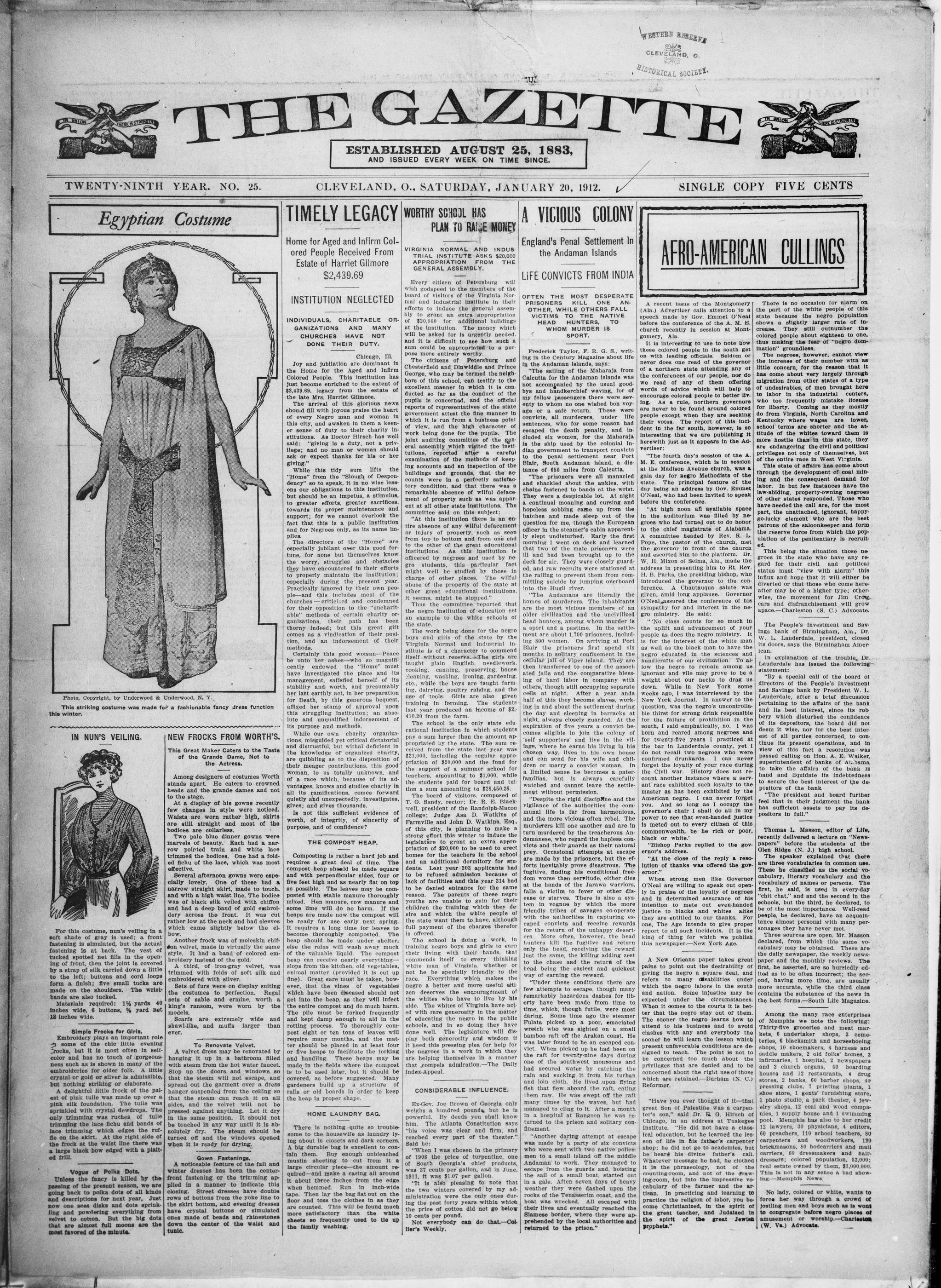
Egyptian Costume
Photo, Copyright, by Underwood & Underwood, N. Y. This striking costume was made for a fashionable fancy dress function this winter.
IN UNION
THERE IS STRONGER
Egyptian
Photo, Copyright, by Underwood &
This striking costume was made for
this winter.
For this costume, nun's velling in a soft shade of gray is used; a front fastening is simulated, but the actual fastening is at back. The vest of tucked spotted net fills in the opening of front, then the joint is covered by a strap of silk carried down a little to the left; buttons and cord loops form a finish; five small tucks are made on the shoulders. The wrist-bands are also tucked.
Materials required: 1½ yards 40
inches wide, 6 buttons, % yard net
18 inches wide.
Simple Frocks for Girls
Embroidery plays an important role some of the chic little evening rocks, but it is most often in self-color and has no touch of gorgeousness such as is shown in many of the embroideries for older folk. A little crystal or gold or silver is admissible, but nothing striking or elaborate. A delightful little frock of the palest of pink tulle was made up over a pink silk foundation. The tulle was sprinkled with crystal dewrops. The only trimming was ruches of tulle trimming the lace fuchi and bands of lace trimming which edges the ruffle on the skirt. At the right side of the frock at the waist line there was a large black bow edged with a plaited frill.
Vogue of Polka Dots
Unless the fancy is killed by the passing of the present season, we are going back to polka dots of all kinds and descriptions for next year. Just one sees disks and dots sprinkling and powdering everything from velvet to cotton. But the big dots that are almost full moons are the most favored of the minute.
THE GAZETTE
NEW FROCKS FROM WORTH'S.
This Great Maker Caters to the Taste of the Grande Dame, Not to the Actress.
Among designers of costumes Worth stands apart. He caters to crowned heads and the grande dames and not to the stage.
At a display of his gowns recently few changes in style were noticed. Waists are worn rather high, skirts are still straight and most of the bodices are collarless.
Two pale blue dinner gowns were marvelous bodices. Each had a narrow pointed train and white lace trimmed the bodices. One had a folded fliu of the lace, which was most effective.
Several afternoon gowns were especially lovely. One of these had a narrow straight skirt, made to touch, and with a high waist line. The bodice was of black silk veiled with cliffon and had a deep band of gold embroidery across the front. It was cut rather low at the neck and had sleeves which came slightly below the elbow.
Another frock was of moleskin chiffon velvet, made in virtually the same style. It had a band of colored embroidery instead of the gold.
A third, of iron-gray velvet, was trimmed with folds of soft silk and embroidered with silver.
Sets of furs were on display suiting the costumes to perfection. Regal sets of sable and ermine, worth a king's ransom, were worn by the models. Scarfs are extremely wide and shawl-like, and muffs larger than ever.
To Renewate Velvet
A velvet dress may be renovated by hanging it up in a bathroom filled with steam from the hot water faucet. Stop up the doors and windows so that the steam will not escape, and spread out the garment over a dress hanger suspended from the ceiling so that the steam can reach it on all sides, and the velvet will not be pressed against anything. Let it dry in the same position. It should not be touched in any way until it is absolutely dry. The steam should be turned off and the windows opened when it is ready for drying.
Gown Fastenings
A noticeable feature of the fall and winter dresses has been the centerfront fastening or the trimming applied in a manner to indicate this closing. Street dresses have double rows of buttons from the yoke line to the skirt bottom, and evening dresses have crystal buttons or simulated ones made of beads and rhinestones down the center of the waist and tunic.
ESTABLISHED AUGUST 25, 1883 AND ISSUED EVERY WEEK ON TIME SINCE.
CLEVELAND, O., SATURDAY, JANUARY 20, 1912.
TIMELY LEGACY
Home for Aged and Infirm Colored People Received From Estate of Harriet Gilmore $2,439.69
INSTITUTION NEGLECTED
INDIVIDUALS, CHARITABLE ORGANIZATIONS AND MANY CHURCHES HAVE NOT DONE THEIR DUTY.
Chicago, Ill.
Joy and jubilation are dominant in the Home for the Aged and Infirm Colored People. This institution has just become enriched to the extent of $2,439.69, legacy from the estate of the late Mrs. Harriet Gilmore.
The arrival of this glorious news should fill with joyous praise the heart of every Negro man and woman in this city, and awaken in them a keen sense of duty to their charity institutions. As Doctor Hirsch has well said: "giving is a duty, not a privilege; and no man or woman should ask or expect thanks for his or her giving."
While this tidy sum lifts the "Home" from the "Slough of Despondency" so to speak, it in no wise lessens our obligations to this institution, but should be an impetus, a stimulus, to greater efforts, greater sacrifices, towards its proper maintenance and support; for we cannot overlook the fact that this is a public institution and for Negroes only, as its name implies.
the directors of the "Home" are especially jubilant over this good fortune, for none but themselves know the worry, struggles and obstacles they have encountered in their efforts to properly maintain the institution; especially during the present year. Practically ignored by their own people—and this includes most of the churches—criticized and condemned for their opposition to the "uncharitable" methods of certain charity organizations, their path has been thorny indeed; but this great gift comes as a vindication of their position, and an indorsement of their methods.
Certainly this good woman—Peace be unto her ashes—who so magnificently endowed the "Home" must have investigated the place and its management, satisfied herself of its stability and worth, and presumably her last earthly act, in her preparation for Death, by this generous bequest, affixed her stamp of approval upon this struggling institution; an absolute and unqualified indorsement of its purpose and methods.
While our own charity organizations, misguided yet critical dictatorial and distrustful, but withal deficient in the knowledge of organized charity, are quibbling as to the disposition of their meager contributions, this good woman, to us totally unknown, and of a race which, because of its advantages, knows and studies charity in all its ramifications, comes forward quietly and unexpectedly, investigates, gives, and gives thousands.
Is not this sufficient evidence of worth, of integrity, of sincerity of purpose, and of confidence?
THE COMPOST HEAP.
Composting is rather a hard job and requires a great deal of time. The compost heap should be made square and with perpendicular sides, four or five feet high and as nearly flat on top as possible. The leaves may be composted with stable manure thoroughly mixed. Hen manure, cow manure and some lime will do no harm. If the heaps are made now the compost will be ready for use early next spring. It requires a long time for leaves to become thoroughly composted. The heap should be made under shelter, else the rails will wash away much of the valuable liquid. The compost heap can receive nearly everything—shops from the kitchen, old vegetables, animal matter (provided it is cut up fine). Great care must be taken, however, that the vines of vegetables which have been diseased should not get into the heap, as they will infect the entire compost and do much harm. The pile must be forked frequently and kept damp enough to aid in the rotting process. To thoroughly compost eight or ten tons of leaves will require many months, and the matter should be placed in at least four or five heaps to facilitate the forking and handling. These heaps may be made in the fields where the compost is to be used later, but it should be covered, as before suggested. Many gardeners build up a structure of rails or old boards in order to keep the heap in proper shape.
HOME LAUNDRY BAG.
There is nothing quite so troublesome to the housewife as laundry lying about in closets and dark corners. A big durable bag is excellent to contain them. Buy enough unbleached muslin sheeting to cut from it a large circular piece—the amount required—and make a casing all around it about three inches from the edge when hemed. Run in inch-wide tape. Then lay the bag flat out on the floor and toss the clothes in as they are counted. This will be found much more satisfactory than the white sheets so frequently used to tie up the family washing.
WORTHY SCHOOL HAS
PLAN TO RAISE MONEY
VIRGINIA NORMAL AND INDUSTRIAL INSTITUTE ASKS $20,000 APPROPRIATION FROM THE GENERAL ASSEMBLY.
Every citizen of Petersburg will wish godsped to the members of the board of visitors of the Virginia Normal and Industrial institute in their efforts to induce the general assembly to grant an extra appropriation of $20,000 for additional buildings at the institution. The money which will be asked for is urgently needed, and it is difficult to see how such a sum could be appropriated to a purpose more entirely worthy.
The citizens of Petersburg and Chesterfield and Dinwiddie and Prince George, who may be termed the neighbors of this school, can testify to the excellent manner in which it is conducted so far as the conduct of the pupils is concerned, and the official reports of representatives of the state government attest the fine manner in which it is run from a business point of view, and the high character of work being done for the pupils. The joint auditing committee of the general assembly which visited the institutions, reported after a careful examination of the methods of keeping accounts and an inspection of the buildings and grounds, that the accounts were in a perfectly satisfactory condition, and that there was a remarkable absence of wilful defacement of property such as was apparent at all other state institutions. The committee said on this subject: "At this institution there is an entire absence of any wilful defacement or injury of property, such as seen from top to bottom and from one end to the other of the great educational institutions. As this institution is officered by negroes and used by negro students, this particular fact might well be studied by those in charge of other places. The wilful abuse of the property of the state at other great educational institutions, it seems, might be stopped." Thus the committee reported that the negro institution of education set an example to the white schools of the state.
The work being done for the negro boys and girls of the state by the Virginia Normal and Industrial institute is of a character to commend itself without reserve. The girls are taught plain English, needlework, cooking, canning, preserving, house cleaning, washing, ironing, gardening, etc., while the boys are taught farming, dalrying, poultry raising, and the use of tools. Girls are also given training in forming. The students last year produced an income of $2,410.20 from the farm.
The school is the only state educational institution in which students pay a sum larger than the amount appropriated by the state. The sum received from the state last year was $21,000, including the regular appropriation of $20,000 and the fund for the support of a summer school for teachers, amounting to $1,000, while the students paid for board and tuition a sum amounting to $28,450.38.
The board of visitors, composed of T. O. Sandy, sactor; Dr. R. E. Blackwell, president of the Randolph-Macon college; Judge Asa D. Watkins of Farmville and John D. Watkins, Esq., of this city, is planning to make a strong effort this winter to induce the legislature to grant an extra appropriation of $20,000 to be used to erect homes for the teachers in the school and an additional dormitory for students. Last year 203 applicants had to be refused admission because of lack of facilities and this year 314 had to be denied entrance for the same reason. The parents of these negro youths are unable to gain for their children the training which they desire and which the white people of the state want them to have, although full payment of the charges therefor is offered.
The school is doing a work, in training negro boys and girls to earn their living with their hands, that commends itself to every thinking white man of Virginia whether or not he be specially friendly to the race. Everything which makes the negro a better and more useful citizen deserves the encouragement of the whites who have to live by his side. The whites of Virginia have acted with rare generosity in the matter of educating the negro in the public schools, and in so doing they have done well. The legislature will display both generosity and wisdom if it heed this pressing plea for help for the negroes in a work in which they are helping themselves in a manner that compels admiration—The Dally Index-Appeal.
CONSIDERABLE INFLUENCE.
Ex-Gov. Joe Brown of Georgia only weighs a hundred pounds, but he is powerful. By deeds you shall know him. The Atlanta Constitution says "his voice was clear and firm, and reached every part of the theater." Said he: "When I was chosen in the primary of 1908 the price of turpentine, one of South Georgia's chief products, was 37 cents per gallon, and in June, 1911, it was $1.07 per gallon. "It is also pleasing to note that the two winters covered by my administration were the only ones during the past forty years within which the price of cotton did not go below 10 cents per pound. Not everybody can do that—Collier's Weekly.
A VICIOUS COLONY
England's Penal Settlement In the Andaman Islands
LIFE CONVICTS FROM INDIA
OFTEN THE MOST DESPERATE PRISONERS KILL ONE ANOTHER, WHILE OTHERS FALL VICTIMS TO THE NATIVE HEAD HUNTERS, TO WHOM MURDER IS SPORT.
Frederick Taylor, F. R. G. S., writing in the Century Magazine about life in the Andaman islands, says:
"The sailing of the Maharaja from Calcutta for the Andaman islands was not accompanied by the usual goodbys and handkerchief waving, for of my fellow passengers there were seventy to whom no one wished bovoyage or a safe return. These were convicts, all murderers, under life sentences, who for some reason had escaped the death penalty, and included six women, for the Maharaja is the ship used by the colonial Indian government to transport convicts to the penal settlement near Port Blair, South Andaman island, a distance of 650 miles from Calcutta.
"The prisoners were all manacled and shackled about the ankles, with chains fastened to bands at the wrist. They were a despicable lot. At night a continual meaning and cursing and hopeless sobbing came up from the hatches and made sleep out of the question for me, though the European officer in the steamer's cabin apparently slept undisturbed. Early the first morning I went on deck and learned that two of the male prisoners were ill and had been brought up to the deck for air. They were closely guarded, and raw recruits were stationed at the railing to prevent them from committing suicide by jumping overboard into the Hughl river.
"The Andamans are literally the homes of murderers. The inhabitants are the most vicious members of an older civilization and the uncivilized head hunters, among whom murder is a sport and a pastime. In the settlement are about 1,700 prisoners, including 800 women. On arriving at Port Blair the prisoners first spend six months in solitary confinement in the cellular jail of Viper island. They are then transferred to one of the associated jails and the comparative blessing of hard labor in company with others, though still occupying separate cells at night. After a year and a half of this they become slaves, working in and about the settlement during the day and sleeping in barracks at night, always closely guarded. At the expiration of five years a convict becomes eligible to join the colony of 'self supporters' and live in the village, he earns his living in his chosen way, lives in his own house and can send for his wife and children or marry a convict woman. In a limited sense he becomes a paterfamilias, but is always carefully watched and cannot leave the settlement without permission.
"Despite the rigid discipline and the vigilance of the authorities the communal life is far from harmonious, and the more vicious often rebel. The murderers kill one another and are in turn murdered by the treacherous Andamanese, who regard the hapless convicts and their guards as their natural prey. Occasional attempts at escape are made by the prisoners, but the efforts inevitably prove disastrous. The fugitive, finding his conditional freedom worse than servitude, either dies at the hands of the Jarawa warriors, falls a victim to fever or other disease or starves. There is also a system in vogue by which the more friendly tribes of savages co-operate with the authorities in capturing escaped convicts and receive rewards for the return of the unhappy deserters. More often, however, the head hunters kill the fugitive and return only the head, receiving the reward just the same, the killing adding zest to the chase and the return of the head being the easiest and quickest way of earning the reward.
"Under these conditions there are few attempts to escape, though many remarkably hazardous dashes for liberty have been made from time to time, which, though futile, were most daring. Some time ago the steamer Fulata picked up a poor, emaciated wretch who was sighted on a small bamboo raft off the Arakan coast. He was later found to be an escaped convict. When picked up he had been on the raft for twenty-nine days during one of the southwest monsoons and had secured water by catching the rain and sucking it from his turban and loin cloth. He lived upon flying fish that flew aboard the raft, eating them raw. He was swept off the raft many times by the waves, but had managed to cling to it. After a month in a hospital at Rangoon he was returned to the prison and solitary confinement.
"Another daring attempt at escape was made by a party of six convicts who were sent with two native policemen to a small island off the middle Andaman to work. They managed to escape from the guards and, hosting the sail of a small boat, started out in a gale. After seven days of heavy weather they were dashed upon the rocks of the Tenasserim coast, and the boat was wrecked. All escaped with their lives and eventually reached the Slamese border, where they were apprehended by the local authorities and returned to the prison."
SINGLE COPY FIVE CENTS
WESTERN RESERVE
CLEVELAND, O.
HISTORICAL SOCIETY.
TE
SINGLE COR
AFRO-AMERICA
A recent issue of the Montgomery (Ala.) Advertiser calls attention to a speech made by Gov. Emmet O'Neal before the conference of the A. M. E. church recently in session at Montgomery, Ala.
It is interesting to use to note how these colored people in the south get on with leading officials. Seldom or never does one read of the governor of a northern state attending any of the conferences of our people, now do we read of any of them offering words of advice which will help to encourage colored people to better living. As a rule, northern governors are never to be found around colored people except when they are seeking their votes. The report of this incident in the far south, however, is so interesting that we are publishing it herewith just as it appears in the Advertiser:
"The fourth day's session of the A. M. E. conference, which is in session at the Madison Avenue church, was a gala day for negro Methodists of the state. The principal feature of the day being an address by Gov. Emmet O'Neal, who had been invited to speak before the conference.
"At high noon all available space in the auditorium was filled by negroes who had turned out to do honor to the chief magistrate of Alabama. A committee headed by Rev. R. L. Pope, the pastor of the church, met the governor in front of the church and escorted him to the platform. Dr. W. H. Mixon of Selma, Ala., made the address in presenting him to Rt. Rev. H. B. Parks, the presiding bishop, who introduced the governor to the conference. A Chautauqua salute was given, amid long applause. Governor O'Neal assured the conference of his sympathy for and interest in the negro ministry. He said:
"No class counts for so much in the uplift and advancement of your people as does the negro ministry. It is for the interest of the white man as well as the black man to have the negro educated in the sciences and handicrafts of our civilization. To allow the negro to remain among us ignorant and vile may prove to be a weight about our necks to drag us down. While in New York some weeks ago, I was interviewed by the New York Journal. In answer to the question, was the negro's uncontrollable thirst for strong drink responsible for the failure of prohibition in the south, I said emphatically, no. I was born and reared among negroes and for twenty-five years I practiced at the bar in Lauderdale county, yet I do not recall two negroes who were confirmed drunkards. I can never forget the loyalty of your race during the Civil war. History does not recount another instance where a servant race exhibited such loyalty to the master as has been exhibited by the American negro. I can never forget you. And so long as I occupy the governor's chair I shall do all in my power to see that even-handed justice is meted out to every citizen of this commonwealth, he be rich or poor, black or white."
"Bishop Parks replied to the governor's address.
"At the close of the reply a resolution of thanks was offered the governor."
When strong men like Governor O'Neal are willing to speak out openly in praise of the loyalty of negroes and in determined assurance of his intention to mete out even-handed justice to blacks and whites alike they are entitled to our thanks. For one, The Age intends to give proper report to all such incidents. It is the kind of thing for which we publish this newspaper.—New York Age.
A New Orleans paper takes great pains to point out the destruability of giving the negro a square deal, and refers to many disabilities under which the negro labors in the south and nation. Some injustice may be expected under the circumstances. When it comes to the courts it is better that the negro stay out of them. The sooner the negro learns how to attend to his business and to avoid clashes with any and everybody the sooner he will learn the lesson which present unfavorable conditions are designed to teach. The point is not to be concerned too much about the privileges that are denied and to be concerned about the right use of those which are retained.—Durham (N. C.) Reformer.
"Have you ever thought of it—that great Son of Palestine was a carpenter's son," said Dr. R. G. Hirsch of Chicago, in an address at Tuskegee Institute. "He did not have a classical education, but he learned the lesson of life in his father's carpenter shop; he did not go to academies, but he heard his divine father's call. Whatever message he had, he clothed it in the phraseology, not of the counting-room, and not of the drawing-room, but into the impressive vocabulary of the farmer and the artisan. In practicing and learning to practice the religion of labor, you become Christianized, in the spirit of the great teacher, and Judaized in the spirit of the great Jewish propheta."
There is no occasion for alarm on the part of the white people of this state because the negro population shows a slightly larger rate of increase. They still outnumber the colored people about eighteen to one, thus making the fear of "negro domination" groundless.
The negroes, however, cannot view the increase of their number with as little concern, for the reason that it has come about very largely through migration from other states of a type of undesirables, of men brought here to labor in the industrial centers, who too frequently mistake license for liberty. Coming as they mostly do from Virginia, North Carolina and Kentucky where wages are lower, school terms are shorter and the attitude of the whites toward them is more hostile than in this state, they are endangering the civil and political privileges not only of themselves, but of the entire race in West Virginia.
This state of affairs has come about through the development of coal mining and the consequent demand for labor. In but few instances have the law-abiding, property-owning negroes of other states responded. Those who have heeded the call are, for the most part, the unattached, ignorant, happy-go-lucky element who are the best patrons of the saloonkeeper and form the reserve force from which the population of the penitentiary is recruited.
This being the situation those no groes in the state who have any regard for their civil and political status must "view with alarm" this infuxi and hope that it will either be diverted or that those who come hereafter may be of a higher type; otherwise, the movement for Jim Crow cars and disfranchisement will grow apace-Charleston (S. C.) Advocate.
The People's Investment and Savings bank of Birmingham, Ala., Dr. W. L. Lauderdale, president, closed its doors, says the Birmingham American.
In explanation of the trouble, Dr. Lauderdale has issued the following statement:
"By a special call of the board of directors of the People's Investment and Savings bank by President W. L. Lauderdale, after a brief discussion pertaining to the affairs of the bank and its best interest, since its robery which disturbed the confidence of its depositors, the board did not deem it wise, nor for the best interest of all parties concerned, to continue its present operations, and in view of this fact a resolution was passed calling on Hon. A. E. Walker, superintendent of banks of Alabama, to take the affairs of the bank in hand and liquidate its indebtedness to secure the best interest of the depositors of the bank
"The president and board further feel that in their judgment the bank has sufficient assets to pay its depositors in full."
Thomas L. Masson, editor of Life, recently delivered a lecture on "Newspapers" before the students of the Glen Ridge (N. J.) high school. The speaker explained that there are three vocabularies in common use. These he classified as the social vocabulary, literary vocabulary and the vocabulary of names or persons. The first, he said, is used in every-day "chit chat," and and the second in the schools, but the third, he declared, to be of the most importance. Well-read people, he declared, have an acquaintance almost personal with many personages they have never met. Three sources are open. Mr. Masson declared, from which this same vocabulary may be obtained. These are the daily newspaper, the weekly newspaper and the monthly reviews. The first, he asserted, are so hurriedly edited as to be often incorrect; the second, having more time, are usually more accurate, while the third class contains the substance of the news in the best forms. -South Life Magazine.
Among the many race enterprises of Memphis we note the following: Thirty-five groceries and meat markets, 6 undertaker shops, 3 cemeteries, 6 blacksmith and horseshoeing shops, 10 shoemakers, 4 harness and saddle makers, 2 old folks' homes, 2 infirmaries, 1 hospital, 2 newspapers and 2 church organs, 50 boarding houses and 12 restaurants, 4 drug stores, 2 banks, 60 barber shops, 40 pressing clubs, 7 printing plants, 1 shoe store, 1 gents' furnishing store, 1 photo studio, a park theater, 4 jewelry shops, 12 coal and wood companies, 1 supply house and 1 swimming pool. Memphis has also to her credit 12 lawyers, 30 physicians, 4 editors, 60 preachers, 110 school teachers, 8 carpenters and woodworkers, 120 brickmasons, 80 hodariers and mail carriers, 60 dressmakers and hairdressers; colored population, $2,000; real estate owned by them, $3,000,000. This is not in any sense a bad showing—Memphis News.
No lady, colored or white, wants to force her way through a crowd of jostling men and boys such as is wont to congregate before negro places of amusement or worship—Charleston (W. Va.) Advocate.
THE GAZETTE
PUBLISHED EVERY SATURDAY
One Year..... $1.80
Six Months..... 1.00
Three Months..... 4.0
Subscribers are requested to remit by postoffice money order or registered letter.
Entered at the postoffice In Cleveland Ohio, as second-class matter
Address all communications to HARRY C. SMITH
Editor and proprietor, THE GAZETTE,
Blackstone Building, Cleveland, O.
Member Ohio Legislature: 1894 to 1898; 1898 to 1898: 1900 to 1902
THE GAZETTE is the oldest, and has the largest benna fide circulation. double that of any newspaper in the interest of Afro-Americans, published in the state of Ohio, and comparison with any will immediately establish its rank as one of the NEWSIEST AND BEST in the country.
His many friends in the north are delighted to learn of the splendid progress of the State College, Orangeburg, S. C., under it's new president, prof. R. S. Wilkinson, a graduate of Oberlin College and a former member of The Gazette staff
The man who suffers personal wrong without protest or opposition, the "peaceful" member of the community, is a demoralizing factor in our social fabric. The class that does not struggle for civic and industrial rights will eventually lapse into slavery. The nation that passively contenances encroachments upon its rights and territory is doomed to dismemberment and national bankruptcy. It is the man who defends his rights, the class that battles for political and industrial advancement, and the nation that holds its own against the entire world; it is the "litigious" person, the revolutionary class, and the vigilant nation, that keep the world from stagnation and force it onward on the path of progress.—Hillquit.
JUSTICE HARLAN'S SUCCESSOR.
A Chicago daily newspaper, in treating this subject recently, said among other things:
"Justice Harlan was a man of the people. It was to him, more than to any justice who has sat in the court in a generation, that the plain people of the country looked for the champion in the court of human rights as against property rights. And those he held accountable and not disregardment of the honesty of purpose or absolute sincerity of other members of the court. Few have questioned the purpose of the nation's greatest tribunal, or the intention of any single one of its members to decide the law on any other basis than the demands of exact justice. Nevertheless, it is not to be denied that it has been the case that the learned justices that the atmosphere and environment in which they moved previous to their appointment to the bench had predisposed them to give more importance to the rights of property than to the rights of man. It may be admitted that they were entirely unconscious of any such predisposition, and, indeed, evidence may be added that in India no such predisposition actually existed, but the fact remains that such a view of the inclination of their minds, just or unjust, did exist, and still exists, in the mind of the public. The public opinion of Justice Harlan was exact in India, and many of his confreres. The plain people always believed that the proneness of his mind was toward them and their interests, not away from them. His whole career on the bench justified that confidence. With never a trace of demagoguery, he was ever a judicial tribune of the people. He had their affections as well as gave spectacle to his belief and gave trust any to his decision, and never have given a single murmur even if he had decided against them."
This is especially true of our portion of "the plain people" of this country. They had every reason to place the fullest confidence in the great Associate Justice, and never a cause to question him or his decisions of special interest to them or all "the plain people" of this land. Justice Harlan was a grand man in the fullest and best meaning of those words, and he was and always will be fully appreciated. It cannot be otherwise.
But what of Judge William C. Hook, the Kansan or Missourian, whom President Taft has indicated an intention to appoint to the U. S. Supreme Court bench, to succeed the great Harlan? He is the man who as Judge of the Eighth Judicial Circuit, rendered a decision (186, Federal Reports) which, in clear terms, denies Afro-Americans, our people, equal rights and privileges in railway travel, thus upholding "jim-crow" cars! This places him on a par with the President's four or five other southern appointees, members of the U. S. Supreme Court, all of whom, with a possible exception, are ex-rebels and democrats—anything but our friends and anything but men of the late, lamented Harlan's class. And William Howard Taft is supposedly a Republican President, a candidate for nomination and re-election at the hands of the Republicans of this country! God forbid!
We would protest against this Hook appointment, as we did against the others, and call upon our people, everywhere, to do so also, if we felt it would do any good to do so. But President Taft has stabbed the race so often in its veryitals, during his few years' incumbency of the Executive Office, and this, too, in spite of it's most vigorous protests from all sections of the country, that we can only continue to suffer insult, indignity and vital injury at his hands, until the time to vote arrives, if the Republican party is so foolish as to permit his renomination which will surely mean for it, political suicide, pure and simple, in November.
AID AND PROTECTION FOR NEGROES.
Oswald Garrison Villard, publisher
of the New York Evening Post, grandson of the great abolitionist Garrison, paid a visit to Chicago and delivered two sincere and powerful addresses on the Negro problem in its various phases. He explained the objects and methods of the National Association for the Advancement of Colored People and the African-American children of an active church in Chicago, then Mr. Villard was to sympathize with him and indorse his position fully. The association stands primarily for truth and knowledge, for simple justice to the Colored population, for defense and protection against lynching and outrage. The association renamed legal aid to poor or threatened Negro people in the institution, to real the public facts in cases of actual or supposed Negro crime; it enforces the law or sees that the authorities enforce it. It also hopes to aid the Negro trade schools and advance the industrial and moral interests of the race. There is not a city of any size in the country which does not need legal aid to protect the branches should have our legal features and should be liberally supported by men and women who really believe in the principles of the American Republic. It cannot be doubted that such activities and education as the association is carrying on will in the course of time change the whole atmosphere in the communities where Negro people obtain elementary justice due to press of law.-Chicago Record-Herald.
What a confession of failure this acknowledgment contains! Are the American people not getting ashamed of this failure? But why is one of the main objects of a state, based on liberty, law and order, "a Republic," thus left to private activity?
LYNCHING, THE CAUSE
Of The Great Exodus From the South-
Land—Some Significant Figures.
Baltimore, Md.—Following are some
census figures as the Manufacturer's
Record sees them. They are of
special interest to the thousands of
readers of The Gazette, and should be
perused carefully and preserved for
future reference:
Our Population in South.
States 1900 1910
Alabama 827,307 908,275
Arkansas 369,556 442,891
Dist. of Columbia 86,702 94,446
Florida 230,730 308,698
Georgia 1,034,813 1,176,987
Kentucky 284,706 261,656
Louisiana 650,804 713,874
Maryland 235,064 232,249
Mississippi 907,630 1,093,487
Missouri 161,234 157,452
North Carolina 624,469 697,843
Oklahoma 55,684 137,612
South Carolina 782,231 835,843
Tennessee 480,243 473,088
Texas 620,722 690,020
Virginia 660,722 671,096
West Virginia 43,499 64,173
Totals ..... 8,553,506 ..... 8,757,651
United States ..... 8,833,994 ..... 8,828,294
Curious with the number of Negroes in other parts of the country than the South, 952,633, is just 15,101 less than the number of foreign-born whites in the South, and the number of Negroes is increasing at a much greater rate in other parts of the country than in the South. Between 1900 and 1910 the increase of our population in the United States was 8,833,394 to 8,923,294, or by 994,300, equal to 11.2 per cent. The increase in the South of 822,155, from 8,053,506 to 8,875,661, was at the rate of 10.2 per cent. while the increase of 172,145 in the rest of the country, from 780,488 to 952,633, was at the rate of 22.1 per cent, or more than twice as rapid as in the South. In that section there were 2,850 in Maryland, 3,782 in Missouri and 7,155 in Tennessee, while the rates of increase were greater than the average for the South in eight states—Arkansas, 20.7 per cent; Florida, 33.8 per cent; Georgia, 13.7 per cent; Mississippi, 11.2 per cent; North Carolina, 11.2 per cent; Oklahoma, 14.7 per cent; Texas, 11.2 per cent, and West Virginia, 47.5 per cent.
The increase in the number of Afro Americans in Massachusetts was 6,068, or more than twice as great as the decrease in their number in Maryland, and the increase in New York was nearly 14,000 greater than the decrease in Kentucky. There are 36,000 Negroes in Pennsylvania than in Missouri, and more than twice as many in New York as in West Virginia, while, in spite of its increase of 147 per cent, the Negro population of Oklahoma is only 28,000 greater than that of Illinois.
Victory Not for the Sluggard.
The privileged boy must wake up, or he will be left behind by the poor boy.
GIANT ROCK LIKE A SPIRE
Curecanti Needle in Black Canyon Rises to a Height of 1,600 Feet Above Surroundings.
Gunnison, Colo.—An enormous splinter of rock, the Curecanti needle, is an isolated mountain spire rising to the height of 1,600 feet above the Black canyon of the Gunnison in Colorado. The Gunnison canyon is
Curecanti Needle. deemed equal in natural beauty to that of the Royal gorge.
The Gunnison river dashes through this wild canyon with such impetus ousness that it is beaten to foam amidst the rugged bowlers. The canyon walls are pleasingly colored and are constantly opening and closing to the view. Chipeta falls dashes down a lofty wall and the tremendous splinter of the Curecanti needle pieces to the clouds. It is a region of wild and rugged beauty.
THE GAZETTE, CLEV LAND, O., SATURDAY, JANUARY 20, 1912.
DENOUNCES LYNCH-MURDER! DATE GROWING IN TEXAS! FREQUEN
A Grand-Son of William Lloyd Garrir
son Declares 9,000,000 Citizens
Are Victims of a Miserable
Race Prejudice.
Chicago, Ill.—"It is an outrage that lynchings should take place in the home state of Lincoln," declared Oswald Garrison Villard, grand-son of William Lloyd Garrison and president of the National Association for the Advancement of Colored People, speaking in Handel Hall one night to "It is our duty to people throughout the length and breadth of the land should be subjected to injustice and oppression of countless kinds. The crime of lynching is trefully accursed because it mocks, scorns and defies the statutes and the divine law and outrages humanity itself. It knows no distinction of race, color or age. In its lust for blood, mob passion cannot find terrible enough tortures for its saturation. It knows no distinction of spared this disgrace. In Illinois, in Ohio, in Pennsylvania, as in every state in the south, the mob rules supreme. In Coatesville, of infamous name, the mob acclaims those whom the juries have acquitted though their guilt is open, proved and confessed. The governor of South Carolina recently declared that the sooner a Negro brute who hale hands on the battered body of a woman, what can we expect when officials who have sworn to uphold the law openly encourage its violation? Something must be done to bring people to their senses and that is why some friends of the Negro have formed what is known as the National Association for the Advancement of Colored People, whose objects are to redress wrongs, to stir the public conscience against lynching and to prosecute the victims of the 900 man canes who have suffered too long from race prejudice."
Miss Jane Addams presided at the meeting and Miss Mary White Owington, executive secretary of the N. A. A. C. P., announced that the organization's next annual conference would be held in Chicago next May.
RETRIBUTION!
African Tribesmen Pull Out Eyes and Burn Captured Portuguese Oceans
Lisbon (via Frontier).—Horrible atrocities have been committed by tribes in Portuguese Africa during a rising of the natives there, according to a dispatch received Jan. 11 from Angola. A number of Portuguese captured officials were burned alive. The rebellion occurred in the province of Muxima and the natives captured all white men who crossed their path. Some of these were immediately burned and their lives seized and their eyes pulled out of their sockets before they were thrown into the flames. Harsh treatment, the cause. The government will dispatch a punitive expedition.
DOINGS OF THE RACE
Our Old Folks' Home in Chicago, has recently received a $2,439.69 legacy from the estate of a Mrs. Harriett Gilmore, deceased.
King Menelik of Abyssinia, Africa, so frequently reported dead, is still alive, but paralyzed, below the hips, according to a letter received by Kenneth F. Rafferty, 5559 Beiber street, Pittsburg, from his brother, Dr. Donald G. Rafferty, one of the four Americans with the Childs-Frick Abyssinian expedition.
Cleveland, Ohio, has nearly twenty Afro-American teachers in her public schools and but a few of them have one or two Afro-American pupils in their rooms. All teach in buildings with a high ceiling, teachers and no two of our teachers are in the same building. This is the result of not having a "Jim Crow" Y. M. C. A., or fire company.
The majority of Negro preachers, as a rule, are not practical enough any way. They delight to preach too often and fully about heaven, the habits of angels and the amusements of the inhabitants up yonder—things out of reach. They know little and for the present at least, concern them and their hearers infinitely less—while they ignore the affairs of earth, the habits of their audience and the inhabitants around who are unreached by church influences.—Rev. Richard Carroll, editor Columbia (S. C.) Ploughman.
It has been persistently rumored for the last ten days or so that our people of Charleston will be barred even from going to church. House because of their misbehavior. Whether the rumor is true or not we are unable to say. But there is one thing we do know and it is this, that the conduct of some of the Colored patrons of the Burlew is a disgrace and will ultimately result in their disharment from that playhouse. Our people have been shut out of a number of Charleston because of their bad conduct. Charleston (W. Va.) Mountain Leader.
Oklahoma furnished the first lynching of the new year. At Sallisaw, recently, Turner, a Colored man, was taken from the home of a farmer, where he had asked to be admitted to keep from freezing to death, by a man who had hanged. Turner worked in the round house at a small station in Arkansas, and was sent with an engine to a logging camp. The engine broke down in the midst of a heavy snow storm. Turner's only crime was being found in a house friendly white man. No arrests have been made. -Portland (Ore.) Advocate.
Don't throw away your copy of The Gazette when you have done with it, but give it to some appreciative person whom you feel would be likely to subscribe or take it regularly, if they had a copy to look over and read carefully. Oblige the
Federal Government Aiding Development of Fruit in Southern Part of Lone Star State.
Fort Brown, Tex.-The federal government is lending valuable assistance to the development of the date growing industry in South Texas. In the government plant testing gardens at Fort Brown are a number of varieties of date palms which are said to be doing as well as in the countries where these fruit bearing trees are native.
There are already many producing date palms in the lower border region of Texas, but it was not until the last few years that steps began to be taken to place the industry on a
Texas Date Tree.
commercial basis. As a result of the success that has been attained at the Fort Brown reservation in growing the palms many people of this section have planted large groves of the trees and some of them have already come into bearing. A co-operative date farm, conducted by the United States department of agriculture, was also established near Laredo, Tex., a few years ago. Four acres of the palms have been planted and a large part of them are in bearing. The yield of some of the trees is enormous, often amounting to as much as 500 pounds of the delicious fruit.
One of the requirements of successful date growing is an abundance of water and plenty of sunshine. There must also be a minimum of cold weather. Rich soil is, of course, necessary. All of these elements are found in the region. Some of the seeding date palms on the ranches and farms of this section have been producing abundant crops of fruit for many years, but it was not until the government took hold of the matter and began to demonstrate the possibilities of the industry from a commercial standpoint that it was taken hold of on a scale commensurate with the profitable returns that it promises to bring the growers.
MAN WHO SUGGESTED PEACE
Was Long Time Finding Out What He Was Good For, But Finally Landed High.
New York—It took Lincoln Steffens a long time to find out what he was good for. He spent his youth in California hunting and having a good time generally. He was graduated from the University of California and then he went to Europe, where he studied in the Universities of Heidelberg, Leipzig, Berlin and the Sorbonne, topped that study off by marrying a fellow student at Sorbonne and going to London, where he spent much time in research work in the British museum. Then he considered himself ready to enter the field of letters. He
L.
Lincoln Steffens.
was made editor of McClure's after several years of newspaper work.
One day Mr. McClure, just back from abroad, entered Steffens' office and said without preamble: "Steffens, you're getting out a rotten magazine. You don't know anything about the country. Don't you realize you are living in the United States? Go out and see something."
Steffens did. He had imagination and enthusiasm and had at last become limbered up menially after his long years of academic study. He had energy and an unlimited supply of questions. The result of that trip was "The Shame of the Cities," a series of exposures of municipal graft that made him famous.
Town's Claim to Prominence
The town of Grasse in France is one of the largest centers for manufacture of perfume
Call your lady, friends' and acquaintances' attention to our up-to-date fashion and pattern departments and thus encourage us to appreciate the Garette regularly. Oblige the Editor.
FRESH OHIO NEWS OUR OWN WRITERS
WHAT OUR PEOPLE ARE DOING IN MANY CITIES AND TOWNS OF THE STATE.
INTERESTING PERSONAL NOTES
Social Functions—Church and Lodge Items—Marriages and Deathe—Literary, Musical and Other Notes of Interest.
Sandusky.—Mr. and Mrs. W. Jones, S. D. Anderson, Mr. W. Alexander's family and others are 'ill—Rev. T. P. Thomas preached a good sermon, Sunday morning, at the S. B. church. The S. S. was well attended although the Supt. was ill—Think twice before speaking and he sume tonight before doing the latter, always, is good general rule for all to follow. Give the local agent your order for the Gazette and tell your friends to do so also.
Cadiz—The B. B.'s met at W. L. Johnson's, last week. H. R. F. Fox preached at Stillwater, last Sunday. Revival services at the A. M. E. church. Quarterly meeting, the 28th, and quarterly conference, the 27th. Geo. Miller is home again—Rev J. W. White represents the Dr. Haux Specialty Co., of St. Louis. Regular prayer service of the M. E. church will be held at private residences—Rev J. R. Adkins of Wheeling, was here recently. Give the agent your order for "the old obliqu" Gazette.
Rendville.—A. T. Reed, one of our leading grocers, returned, Tuesday, from Pittsburgh.—Mrs. Anna Coleman is ill.—Mrs. Katie Stewart of Columbus, was the guest of Mrs. Woodson, this week.—Mrs. Andy Preston is visiting relatives in Pomeroy. Mr. N. Johnson is suffering with frozen feet.—Mr. and Mrs. Howard Woods have been in the hospital. Mr. Earl Golns' has returned from a visit in Columbus. Mr. Hall Whitfield was there, Sunday.—Mrs. John Edwards is ill.—Dr. J. L. Johnson has moved into the Mark Haswell property.—Mrs. Bruce Willis is ill.—Mrs. S. Whitaker has returned from a visit in Charleston, W. Va.—Order The Gazette from the local agent.
Smithfield.-Rev. D. D. Lewis, Mr. G. Davis and Mrs. F. Christian are still ill.-G. D. Binnus, J. Beall and the Misses V. Smith and E. Beall were guests of Miss Faithful and brother, Saturday and Sunday. Miss Alice received from Mrs. Beall, Thomas West and Coy Becks were huckering in Steubenville, Saturday.-McIntyre A. M. E. church was badly burned last Sunday. Miss Beall of that place, is ill. Mr. and Mrs. Jas. Beall visited her Sunday.-Rev. S. W. White preached ably twice, Sunday, and Chas. Randall presided at the church for some time,畏畏 for some time, with rheumatism, is better-Give the local agent your order for The Gazette and keep up to date in the matter of race news.
Canton.-Miss Lillie M. Hill is ill.-Rev. and Mrs. Johnson dined with Mrs. Hanie, Sunday.-Mrs. Walter Gregory beautifully entertained the Embroidery club, Wednesday.-Miss Gracie Neuby dined with Mrs. David Hall. Sunday.-Mrs. Paul's Allen group led by the Paul's people are becoming much interested, Mr. Wyman Jackson being one of the active workers. Services every Sunday at 3 p. m. for young people. Everybody invited. The Ladies' Aid society held a business meeting, Mrs. Johnson gave a fine reception for the pastor, Rev. Johnson, at the hall in the near future. The Presiding Elder will be here, Jan. 24.-Give the local agent your order for The Gazette.
Correspondents must mail all letters for publication at their main postoffice sufficiently early on Monday (or Sunday) of each week to have them reach The Gazette-office on Tuesday morning, and always write, also, their names and that of their city or town on the outside of the building. Unless this latter is done, proper credit cannot be given you. Lists of names, wedding presents, etc., obituary notices, speeches, resolutions, poetry, inquiries for relatives and advertisements of all kinds, including items announcing entertainments to be held in advance at the rate of ten cents a line, six words to a line. Our rates for display advertisements will be sent on application. Send postal note and not stamps during warm weather.
Lorain—Mrs. S. E. Bond who is visiting her daughter, Mrs. Alva Williams, in Van Wert, has pneumonia—Mrs. Mary Stevens is convalescent—Rev. Bond has pneumonia—Rev Ware has ably assisted in the revival at St. Mathews' church. Rev. J. M. Baxter, president of the Lorain Minister's Association, preached Sunday afternoon when special services were held at St. Mathews' men—Mr. Harry Jackson is visiting relatives in Youngstown and Pittsburg—Mrs. Anna Owens has returned to Paulding. She visited relatives here. Mrs. Downs and daughter, Emma, of E. 32d St., entertained Rev. and Mrs. G. L. Hicks and daughter, Helen, at a six o'clock dinner, in honor of Mrs. Owens—Mr. H. Tates, of the American college, at 1335 Broadway, and should have our patronage because he is a member of the race. P. L. McKinney who has been a rheumatic sufferer, has returned to his employment in the chemical department of the U. S. Tube Co. Mr. Frances, engineer of the company, has returned from a visit in Saginaw, Mich—Persons desiring The Gazette will please notify the agent at 401 and 407 W. 21st St. of the American college, have a copy of it in his or her home every week because it fights every inch of the ground for our people. Give your support freely to such an enterprise. The Gazette is indeed—"The Old Reliable."
Dayton. — Present day political corruption was blamed for lynchings in a recent sermon at the Ravenswood Presbyterian church, Chicago, by the Rev. Duncan C. Milner. "Men make creeds to suit their lives." he declared. "They enter upon evil courses, and then seek for plausible reasons to apologize for their course. Base politicians use the ignorant Colored vote for selfish ends, and the Negro was the sufferer. Today the color-nhobla
possesses our land so far that we hear of lynchings North and South that would disgrace a nation of cannibals, and yet no general horror stirs us over these flendish acts, and no vigorous and persistent demand is made for the punishment of lynchers. Apparently there is but little effort from influential sources to arouse public sentiment. We are to learn that if we rob one class of citizens of their rights we are preparing to rob an entire class of their rights. The time has fully come that the press and pulpit and all teachers of the public should speak out plainly against the cruel injustice now in practice and condoned by so large a part of the nation."
Youngstown—Mr. Anderson Vactor, Mrs. Cora Robinson, Mrs. Quinn Mills, Mrs. Chas, Lottier, Thelma Lucas and Beatrice Simpson are still ill, and Mrs. Wm. Honesty, Clifford Davis, Wm. Franklin, Mrs. A. Vactor and Mrs. A. H. Berry are convalescing—Mr. and Mrs. Geo. Lacey's two sons, Mr. and Mrs. Johnson, visit Monday. The other is critically ill at this writing—Rev. Jesse Smith left Wednesday for Cedarville, to attend his brother's funeral, Thursday. Rev. Vincent Smith died, Monday. The former has the sympathy of the community in his bereavement—Mrs. Julia Brown and Mrs. J. H. Stewart are about again after three weeks' ill-health. The reunion on Monday excises will be held Sunday at 3 p.m at Mahoning V. church. All are welcome—Mr. Coleman of St. Louis Av., is visiting his daughter, Mrs. Hawkins of Cleveland, for four weeks—Consuela Stewart Court of Calanthe met Monday evening and transacted considerable routine business. The attendance was good—the greatest illustration of the success is beheaded in the southern states. The constitution of the United States which we claim represents our highest law, declares that "the right of citizens of the United States to vote shall not be denied or abridged by the United States or by any state on account of race, color, or previous condition of servitude." The open and notorious suspension of this law has a natural relation to the Supreme Court, which confined to the south. Does not this suspension of law give warrant to Senator Bristow's amendment to the proposed law for the direct election of United States senators?
FOREIGN SECRETARY UPHELD
Sir Edward Grey's Anglo-German Negotiations Approved and His Resignation Not Tendered.
London.—Those well-informed in British state affairs say that it was the intention of Sir Edward Grey, Great Britain's foreign secretary, to resign his post unless supported in his Anglo-German negotiations. His statement on the subject, which was submitted to parliament recently was approved, and the crises safely passed. Sir Edward has been secretary of state for foreign affairs since 1905. Irish nationalists are playing a
M.
Sir Edward Grey.
waiting game in parliament. Members of the usually turbulent little band which sits below the gangway of the house of commons have kept themselves in hand so far, although they are deeply interested in the insurance bill which is occupying all the time of the house.
William O'Brien and his handful of followers sometimes try to excite their fellow countrymen by engaging in sarcasm at their expense, but without success. The nationalist benches are quietly waiting for 1912, "Ireland's year," as they call it.
While the rankers of the nationalist party are doing missionary work in the lobby, the leader, John Redmond, is busy explaining home rule to the people of England. Mr. Redmond's campaign already has extended from Scotland in the north to the extreme south of England. The colonial secretary, Lewis Harcourt, accompanied him in the midlands, and at other places ministers and liberal leaders have sat with him on the platform.
Press reports of the meetings record very few interruptions of the Irish leader.
Mr. Redmond and other Irish members impress upon their audiences that what Ireland demands is not separation, but "the right of managing its own affairs in a subordinate place, subject to the supremacy of the imperial parliament, a demand that never has been made by any community of white men in the empire and refused except in the case of Ireland".
Three terriers recently killed 250 rats in half an hour when a wheat stack was being threshed at Bishop's Stortford, England.
The foundations of the British empire are laid in the cottages and kitchens of the people of England.—London Daily Mail.
CORRESPONDENTS WANTED.
The old reliable Gazette desires an active agent and correspondent in every city and town in Ohio and neighboring states having a number of Afro-American residents. Only a copy on Fridays or Saturdays is required.
We are especially desirous of hearing from persons in the following named cities: Zanesville, Newark, Lancaster, Lebanon, Chillicothe, Toledo, Troy, Akron, Springfield, Plaquia, Columbus, Cambridge, Steubenville, Bellarne, St. Clairsville, Wilmington, Washburn, Washington, Killenford, Sabina, Gallipolis, Oberlin, Urbana, Delaware, M. Vernon, East Liverpool, Wellsville, Hamilton, Middleport, Bellefontaine, Lima, O., and other places where we have none.
Write to the editor of The Gazette, Blackstone building, Cleveland, O., and terms will be sent promptly. Our readers will oblige us greatly by sending us a copy of the presses of persons in the cities named above, other to whom we can write relative to the matter.
Leaves Over $100,000
Urbana, Ill.—George W. Smith, farmer of the vicinity of Broadlands, who died recently leaves an estate valued at $116,000, of which $110,000 is real estate. His will just admitted to probate, first directs that the personal property be sold and the proceeds used in payments of eighty acres of land recently purchased, the remainder, if any to be divided among the heirs, the widow receiving one third and the seven children the residue. The children are: Mary E. Smith, Gina A. Smith, S. Neal and John M. Smith, all of Broadlands; Fred M. Smith, of Omaha Neb.; Salona E. Sexton, St. Louis, Mo.; Charles A. Smith, of Longwue, All members of the race. All of the children are graduates of the University of Illinois.
Explanation of Sun's Heat
The reason why the sun retains its neat despite the large amount it gives out is explained by the fact that particles toward its center
LEGAL NOTICE
State of Ohio, Cuyahoga County, ss. In the Court of Common Pleas, No. 126,017, June Mason, plaintiff, vs. John Woodford and Lizzie Woodford, defendants. John Woodford, whose residence is unknown, and Lizzie Woodford who resides at No. 2933 Armour Avenue, Chicago, Ill., will take notice that June Mason fled his petition in the Common Pleas Court of Cuyahoga County, Ohio, in Cause No. 126,017, against them on September 9th, 1911, and alleging as a cause of action the claim an interest in the following estate, estate, adverse and hostile to himself as the power of the fee simple title and being in actual possession thereof towik;
Situated in the city of Cleveland, county of Cuyahoga and state of Ohio, and known as being the westier 16 feet 8 inches of sublot Number Thirty-five (35) and the easterly 16 feet 8 inches of sublot Number Thirty-four (34) in Ford and Holden's subdivision of a part of original one hundred acre lot Number 392 as shown by the recorded plat of said subdivision in Volume 5 of Maps, subdivision of Cuyahoga County Records. Being a parcel of 4 acres of age of 33 feet 4 inches on the northerly side of Blaine Avenue N. E. and extending back between parallel lines 122 feet, deem—
That all right and interest theretofore existing in said property in favor of said defendants, the said second party, were terminated thereby and that the record of said contract as the same exists at page 124 of Volume 1273 of the records is a cloud upon his title, and that said defendants have no interest in said property.
He prays that the court adjudge them to have no interest therein, that the record of said contract be cancelled, that plaintiff's title be quieted against all claims of said defendants and for general equitable relief.
Said John Woodford and Lizzie Woodford are required to answer on or before February 3rd, 1912.
ALEXANDER H. MARTIN
Attorney for Plaintiff,
503 American Trust Building, Cleveland, Ohio.
6t
WONDERFUL RESULTS
ON SHORT NOTICE
I have used your Pomade. Its the best thing I ever used for making curly hair lie smooth. I have not finished my first bottle, but can see wonderful results, writes Mrs. Louise E. Hayes of Pineville, S. C.
Try Ford's Hair Pomade for harsh stubborn and unruly hair and Ford's Royal White Skin Lotion for the complexion. Ask your druggist for them.
Be sure and get the genuine (Ford's) manufactured by the Ozonized Ox Marrow Company, Chicago, Ill.
PURELY PERSONAL
PURCHASE THE "GAZETTE" AT
J. S. HALL'S, 3121 Central Ave.
L. SCHWARTZ'S, 2921 Central Ave. Open Sunday.
O. C. SCHROEDER'S, Cuyahoga Bldg. Open Sunday.
ELMER F. BOYD'S, 2604 Central Ave.
F. VALENTINE'S, 2130 Central Ave.
SAM COHEN'S, 2928 Central Ave. Open Sunday.
JOHNSON'S, 3350 Central Ave.
MRS. M. S. BEDFORD'S, 3410 Central Ave.
NOTICE TO SUBSCRIBERS:—Subscribers not receiving The Gazette regularly should notify us at once. We desire every copy delivered promptly. We advise our patrons to carefully examine The Gazette's advertisements before making purchases. Business men who advertise in this paper should have the patronage of Afro-Americans. The fact that they advertise is assurance that they want it. Local reading notices (advertisements) ten cents a line (six words in a line.)
FOR RENT—Houses—If you have places to rent or if you want to rent—notify The Gazette.
FOR RENT—Nicely furnished room, all conveniences, at 2334 E. 87th. St. Bell 'Phone, Doan 2045 R.
NOTARY PUBLIC—For such services call at The Gazette office, No 3 Blackstone Building, No. 1422 W. 3d street, near Superior Avenue.
For select dancing, attend Friday evening's parties at Ideal hall. J. H. Cisco and W. R. Jackson left this week for a ten days' trip to Florida. Mrs. Henson of E. 36th St. and 'Mother' Washington of E. 28th St. are will ill. The extreme cold weather results in a small attendance at Monday evening's Burleigh recital and bal
FOR SALE.—Brand new, imperial Encyclopedia and Dictionary, 40 volumes, finely illustrated, handy to handle. Unexcelled for reference purposes. A library in itself—one that will last a life-time. Contains everything you may wish to know. Call or address, the Gazette, Blackstone Publishing, 1429 W. 3rd St, Cleveland, Onear Superior Av. This is an opportunity of a life-time for those who love good books.
WANTED AGENTS—A good chance to make from $15.00 to $60.00 a week. Good opportunity for men of all ages. We want reliable agents to take orders for our "high quality" guaranteed nursery stock. Liberal commission paid weekly. Permanent year-round position. Complete course in salesmanship with free outfit. Experience unnecessary. All goods sold offer positive brand guarantee to be represented. Write quick. Pennsylvania Nursery Co., Girard, Erie Co., Pa.
Mrs. Trimble of Blaire Av., died this week.
Mrs. Green of Bay City, Mich., is in the city, visiting.
Mrs. T. Bridges and daughter, left this week for Tennessee.
Mr. S. Dixon of E. 40th St., has returned from a visit in Chicago.
Mrs. Ernest Smith of 2266 E. 40th St., has moved to 2255 E. 28th St.
Rev H. D. R. Bradley of Detroit, and Rev H. D. Balloy of Antioch church, ochroned by Mrs. Holmes Jackson last week for Alexandria, Va., to visit a week with Mrs. Margie Wilson Hopkins.
Mrs. J. W. Manley and family of Wellsville, are visiting their mother, Mrs. Henson of 2334 E. 36th St., who is very ill.
Jos. D. Hackley says there is no truth in the rumors that he is to be succeeded in the management of the Mission restaurant.
The Russell Clarke Jewelry Co., 1258 E. 55th St., N. E., issued this year, of the very prettiest illustrated calendars that have come to us.
Rumor has it that the Peoples' Drug store has been purchased by Miss Cora Jackson of N. Y. City, daughter of James H. Jackson, a stockholder of the P. D. Store Co.
Be sure to attend the joint race meeting at St. John's church, MONDAY evening. It is of great importance to you and every other member of the race in the city and state.
Mrs. E. Hall of 3207 Pittsburg Ave. mother of Mrs. Mamie Bush, died last week in hospital, after an operation for cancer, and was buried, Wednesday. She was an old and highly respected resident of this city, and her daughter has the sympathy of a host of friends.
The Caterers' Association Junior Stag hall at Ideal hall, Wednesday evening, proved a most enjoyable social function, largely because of the excellent refreshments, the committee, Messrs. Messrs. Page and Sam. Lamb had prepared, and the Johnson's orchestra.
Mrs. Amy Williams and granddaughter, Amy, of E. 33d St., are soon to locate in Washington, D. C., where the former's son and little Amy's father, Prof. Harry A. Williams, is now located, teaching. He is also connected with Amanda F. Adams, Conservatory of Music there, conducted by Mrs. Ida Gibbs Marshall. Through some misunderstanding, St. John's church was not opened Monday evening, as promised, for the joint meeting advertised. This was terrible treatment for a number of persons who came long distance to attend the meeting on that髓性 day. It was zero weather, too. What was the matter, Dr. Bundy and Trustee Lemon? Mrs. John P. Green, after a brief illness, pneumonia, died early Sunday morning. A husband, Ex-State Senator Green, three sons and a daughter, survive her, and have the sympathy of the community. Mrs. Green, old resident of the good mother life, and highly respected, the family has the sympathy of the community.
For select dancing, attend Friday evening's private parties at ideal hall. A grand mid-winter picnic and carnival, Jan. 22—23 at Forest Street Rink. Everybody is going. Are you? Send your local items to The Gazette on Monday or Tuesday for each week. This paper is published for ALL of our guests and "plays no favorites." Everybody is treated the same - fair and right. Take The Gazette and tell your friends to do so also.
The Chaufeurs club's third ball, its "select leap year dancing party," Thursday evening, in which the ladies extended the invitations to dance, was as enjoyable as it was unique. Trostler's hall never presented a pretier appearance, and the music by Fairfax's orchestra and the rehearsals were excellent. The committee, Messrs. Wm. Gray, Wm. Grant, Tom Clemens, Arthur Goodman, Fred Clark, floor manager, and Jas. Johnson, assistant, again have every reason to feel proud of the affair.
For select dancing, attend Friday evenings, parties at ideal hall.
evenings' parties at ideal hall. J. H. Cisco and W. R. Jackson left this week for a ten days' trip to Florida.
Mrs. Henson of E. 36th St., and "Mother" Washington of E. 28th St., are still ill.
The extreme cold weather resulted in a small attendance at Monday evening's Burleigh recital and ball at Haltinorth' hall.
Wm. H. Gray, 2266 E. 46th St., was taken very ill last week with heart trouble, &c., at his place of employments the Hickox Bldg., and was recently recovered this week to be out.
The editor of The Gazette in debted to the Hon E. A. Crawford, supervisor of public printing for Ohio, for a copy of "The Laws of Public Printing" of this state, which includes the "general rules for legal advertising."
H. L. Taylor, chairman; Dr. H. C. Bailey and S. E. Woods, the Citizens' Rights league committee on a joint meeting, are arranging another date, as a result of Monday evening's failure. The chairman, Mr. Taylor, deserves to be from the ladies' and the Co-Workers as soon as possible this week. He can be addressed at Box 239. Post Office.
Mrs. Blanche Gilmore returned Tuesday evening from Nashville, Tenn., where she was called two weeks ago to attend the funeral of her father, a leading citizen and old resident of that city. Dr. J. M. Gilmore, P. E., left last week to attend an A. M. E. general conference meeting in Kansas City, Mo. Mrs. Gilmore, a host of friends, in her bereavement. When most, if not all, of the other Auto Companies were refusing to accommodate Afro-American passengers, the Acme Auto Co., of 2340 E. 9th St., whose advertisement can be found elsewhere in The Gazette, and which has always been broad and proper in its treatment of all classes of people who desired to rent their machines, was doing the right thing in the case of why we should prefer the Acme Auto Co. now whenever we have need of such service. 'Phones: North, 1231 and Central, 4161.
About all the Baehr Afro-American appointees have been "let out" and none of the local Afro-American Democrats or Independents have been given places as yet by the new administration. The local daily papers have announced that Mayor Baker and his subordinates have filled all the places. This is placing a terrife "damper" on independence in local politics (to say the least), as far as the mayor is concerned. What is the Mayor's Afro-American "referee" committee, Drs. Bundy and Bailey, and J. E. Reed (of the New Market House). doing? Come, gentlemen, "get busy!"
Mrs. Lewis, sister of Mrs. T. O. Queen of E. 43d St. died last week, at the residence of the latter. She leaves two sons, grown, one a resident of this city. Mr. Lewis was for years a Baptist minister in Columbus where he died years ago. He also lived here before entering the ministry. Older residents will remember Mrs. Lewis and Mrs. Queen as "the Milton sisters of Garden St." Mr. and Mrs. Queen have been friends since Lewis was, too, a good wife and mother, and highly respected by all who knew her.
The long expected and looked-for joint-meeting of the Citizen's Rights League, the Co-Workers' Association and the Federation of Women's clubs, anent the Ohio Constitutional Convention, now in session at Columbus, will be held next Monday evening, at St. John's church. All who are with state officials in the state constitution shall not contain the words "white men" in its suffrage and military clauses, are welcome to attend this joint meeting. All members of the organizations named are especially invited to be present at St. John's church, next Monday evening, at 8 p.m. sharp. This will prove the most important meeting fall's campaign when people last cast their ball at the event trying to elect a representative to the Constitutional Convention. Be sure to attend and notify your friends and acquaintances, to do so also.
As fine as was Sunday week's Cleveland Symphony Orchestra program, at Gray's Armory, just as beautiful and pleasing was that of last Sunday, at the same place. Prof. Emil Ring, the efficient conductor, used excellent judgment in selecting popular standard pieces for the orchestra to play. Mr. Felix Hughes, baritone soloist, was at his best and pleased the large audience greatly as usual. Mrs. Hughes, an artist, accompanied him, at the plano. Next Sunday Prof. Johann Beck will again conduct, and Miss Katherine Pike, a pianist, of splendid ability, will be the soloist. Ever since expect another treat. "Pop" concerts are the very best local musical efforts made. Our people of culture, refinement and intelligence who love good music, are taking advantage of them. Among those seen at Sunday's concert were: Mr. and Mrs. Henry W. Cash, Mr. and Mrs. Henry Mjnter, Mr. Fred. Hackley and many others. Popular prices to these concerts prevail.
John H. Hall, chauffeur for Mrs. S. P. Britton of E. 105th St., owner of the St. Louis baseball team, is in jail at Youngstown awaiting trial on the charge of bigamy, according to a dispatch from Youngstown last night. Hall was indicted by the Mahoning county grand jury which adjourned
HE GAZETTE. CLEVELAND. O. SATURDAY, JANUARY 20, 1912.
Wednesday. It is claimed that he was married three times. His first wife, it is said, was Frankle Whithall of Warren, O., to whom he was married Feb. 3, 1890. According to Prosecutor Beard of Mahoning county Hall next week, he was beaten on Aug. 26, 1908. It is alleged that this was a mock wedding and that Hall afterward obtained a marriage license to satisfy his wife. Now it is claimed by the authorities that he is living with his third wife in Cleveland. Hall denies the charge. Bond has been fixed at $800. It is said that he was beaten by a beater the m寡y, asserting that Mrs. Britton will furnish it. Mrs. Britton last night that she will not furnish bail. "I did not know anything of the affair until today," said Mrs. Britton last night. "Then Hall called up one of the other men and told him of his arrest. I am not very familiar with the law. No, I am not going to furnish bond for his release and have not authorized him to say that I will."—Cleveland Plain Dealer.
RAREST BEAST IN CAPTIVITY
Lophilomys, Brought From Africa by Roosevelt-Smithsonian Expedition, Least Known Animal.
Washington.—The lophiomys, the rarest animal in captivity, was brought back from Africa by the Roosevelt-Smithsonian expedition. It is the first of its kind ever captured by white men and the first to be brought to the attention of the scientists. When the Roosevelt party reached Nairobi, in the heart of East Africa, it was entertained at the rancho of W. N. McMillan, an American halling from St. Louis and exemplifying western enterprise in the dark continent. McMillan had a menagerie of the na-
The Lophiomys.
tive animals of the community. It had grown so large that it was eating him out of house and home. It was given to the Smithsonian by Colonel Roosevelt and I sent to America.
The lophiomys was a creature so rare that not one man in a million knew of its existence. It had never acquired a popular name before starting for America, but the seamen came to call it "Loafy" for short, and this name stands a chance of coming into general usage. It is a nocturnal, tree rodent about the size of a cat. It owns its home in the dense forests that flank Mount Konla and to which few white men have ever penetrated. The Winderobe hunters, famous for their prowess and activities in the neighborhood around Lake Victoria, where the Nile makes its head, recently told the British game wardens of the existence of this strange creature. The wardens offered a reward for the capture of one of them alive and a party of natives came to camp the day before the Smithsonian consignment was to start for America and displayed the strange creature.
Some scientists say that it is a member of the rat family. Others place it among the squirrels.
Boy Has Traveling Heart
Los Angeles, Cal. The unusual feat of a human heart traveling from the left side of the body to the right has been experienced by eleven-year-old Erne Lampert. After several months the heart has started back.
BROWN DRUG CO.
"The Mutual Store",
2742 Central Ave., cor. E. 28th St.
Specials from Jan. 15 to 31st.
20 Mule Team Borax, lb. ..... 75%c
Epsom Salts, lb. ..... 10c
Sulphur, lb. ..... 10c
$1 Hot Water Bottles, guaranteed 69c
1.25 Faint Syringe, 2 qt. ..... 69c
Eff. Soda Phosphate, 40c size ..... 29c
All 23c Perfumes ..... 19c
All 43c Perfumes ..... 39c
We cut on everything. Eagle
stamps with all purchases.
Bring your prescriptions to us. We
can save you 20 to 50 per cent. And
in addition you have the satisfaction
of knowing they are filled correctly.
We always give you just what your
Doctor orders. No substitution at this store.
Rufus S. Justice
Rufus S. Justice
4316 Central Ave. Phone E. 2342-R.
Highest Grade of Tailoring for
Men and Young Men. Ladies'
Suits, Coats and Skirts Made to
Order.
CLEANING, DYEING & REPAIRING.
Goods called for and delivered to all
parts of the city.
Travis & Strawder
'Central Transfer Co.'
CAREFUL MOVERS OF FURNI
TURE and PIANOS
Moving Vans
Piano Hoisting a Specialty
Light and Heavy Expressing.
Orders Promptly Attended to.
Prices Reasonable.
Office and Residence:
2903 Central Ave., Cleveland, Ohio.
Cuy. Cen. 8182R.
TELEPHONES:
Bell, Eddy 1100L.
Cuy., Central 1745R.
ACME AUTO CO.
Auto Livery. All People Treated Right.
2340 East Ninth Street. 'Phones North 1231 and Central 4161.
THE ORIOLE THEATRE
High Class Vaudeville and Moving Pictures 3221 Central Avenue. And DANCING ACADEMY, To rent for Meetings, Private Parties, Balls Banquets, &c.
Wall Paper and
Paints.
Decorators, Paper Hang-
ers and House
Painters.
3325 Central Av.
'Phone, North 1153 and Cent. 6661-R.
THE MANHATTAN
The Best Place
on Central Ave.,
to get a Good Lunch
and Quick Service
J. W. CRAWFORD, PRO'R.,
3133 CENTRAL AVE.
Open Evenings for the Accommodation
of the Theater Trade.
Globe Printing Co.,
PRINTERS AND STATIONERS.
1397 East Ninth Street
MISS L.E. WARREN'S HAIR GROWER
Miss Warren is one of the FIRST and BEST in her business in Cleveland, and
Positively Can Grow Hair
With Each Treatment. She gives a sample box of Hair Grower.
3927 Central Ave.
CLEVELAND, OHIO.
IF YOU SUBSCRIBE AT ONCE
YOU CAN STILL GET THE
52 WEEKLY ISSUES OF
THE YOUTH'S
COMPANION
for the coming year for only $1.75.
Thousands of our subscribers whose
subscriptions run over the first of
January into the early weeks of the
new year have written us to ask if we
will not accept subscriptions at the
old rate of $1.75 for a little while
beyond the time announced for the
advance in price to $2.00.
A
A Last Chance
In fairness to these old friends and to new subscribers who were unable to remit before the close of 1911 we have received for taking subscriptions at $1.75 to
March 30
The new rate of $2.00 will be put into effect promptly on April 1. No subscription at $1.75 will be accepted after that date. Subscribe now — to-day — so as not to lose any of the good things in the Volume for 1912.
THE YOUTH'S COMPANION
144 Berkeley Street, Boston, Mass.
New Subscriptions Received at this Office.
O. L. HARRIS, Manager.
Phone Bell, North 1075-X
Cuy. Cent.
THOS. P. Mc PHILLIPS
Plumbing and
Sewer Building
All Work iven Prompt Attention
2079 E. 30th St. Cleveland, O.
THE "HERALD LUNCH"
George A. C. Hicks, Prop'r.
Ice Cream.
Soda, and Short Orders.
Neat, Clean and Quick
Service.
OPEN ALL NIGHT!
3124 Central Ave., Cleveland, Ohio.
G. G. REED'S
Dry Goods and Gents' Furnishings,
A Complete Line.
Cuy, Central 6661 L
3222 Central Ave., Cleveland, O.
**********************************************************
Bell, Doan 1398-J, Residence
East 791-L, Office
Dr. Walter S. Biggs,
Dentist.
(A member of the race.)
4715 Central Ave., Cleveland, O.
Hours: 8 to 12 a.m., 1 to 5 p.m.
Sundays and Evenings by
Appointment
BUSINESS EXCHANGE
AND COLLECTING AGENCY,
2828 Central Ave.
S. E. WOODS, Mgr,
Business, Legal and Private Information Given.
The Poor Man's Insurance—Sick, Accident and Life Insurance Combined. The Best! Small Monthly Payments.
Legal and Business advertisements solicited for The Gazette.
LITTLE GEM
LUNCH ROOM
A FINE QUICK LUNCH FOR LADIES AND GENTLEMEN
2432 Central Ave.
HOME COOKING.
FIRST-CLASS SERVICE.
Charles R. Ellis.
Proprietor.
FORD'S
HAIR POMADE
MAKES HAIRM, KUNKY OR CURLY HAIR
CLASSY, SCOFFER AND MORE PLAID,
LAST MAY CONTAIN THE
THE FASHION MAIL PERMIT UNINTERESTED
FORD'S
HAIR MADE
MAKES HARSH, KINNY OR CURLY HAIR
CLOSSY, COTTER AND MORE PLABLE,
EASY TO GROW AND PUP UP IN ANY STYLE
FOR PREVENTING HAIR FROM FALLING OUT, BROOMFIT AND ITIMING
OF SCALE BEWARE OF INSTITUTIONS, GET THE GENUINE, PUP UP IN
25+ AND 50-BOTTLES WITH CHARLES FORD'S NAME ON
EVERY PACKAGE
TRY FORD'S ROYAL WHITE
SKIN LOTION FOR THE COMPLEXION.
MAKES THE SKIN WHITER IMEDIATELY
UPON APPLICATION. WILL NOT IRRITATE
THE MOST DELICATE SKIN, UNEXCEELED
FOR ECZEMA, SALY RHEUM, PIMPLES,
ROUGH SKIN AND FRECKLES. • •
SOLD BY DRUGGISTS. IF YOUR DRUGGIST CANNOT
SUPPLY YOU, WE WILL SEND IT TO YOU DIRECT AT
THE FOLLOWING POINTS: SHELL STERED BOTTLES 25-LARGE SUD BOTTLE.
501 THE OZONIZED OX MARROW CO.
232 LAKE ST. DEPT. 297
AGENTS WANTED
Again Say Subscribe for THIS PAPER
Confectionaries, Cigars, Tobacco and School Supplies. 2921 Central Ave.
THE MAGIC SHAMPOO DRIER AND HAIR-STRAIGHTENER.
MAILED ANYWHERE IN U.S. $1.00 SEND MONEY BY POST OFFICE HONEY CUP.
LADIES LOOK!
Every lady can have a beautiful and luxurious head of hair if she uses a MAGIC. After a shampoo or bath, the Magic dries the hair, removing the dandruff and it will straighten the curliest head of hair.
The Magic will not burn or injure the hair, but the comb is never heated. The steel heating bar will have the hair in place into the frame of the alcohol or gas heater.
The Aluminum Comb is easily detached from the heating bar, then, after the bar is heated the comb goes back into place and is held by a turn of the handle.
The Magic Heater is also suitable for curling irons, has a cover and can be carried in a handbag.
Fill with alcohol and lighten.
Magic Shampoo Drier $1.00. Magic Alcohol Heater $0.50. Liberal terms to agents. Write for literature today.
Magic Shampoo Drier Co.
Minneapolis, Minnesota.
MRS. A. M. POPE.
4 years ago my hair was only a finger-length, and my temples were bald half way up my head.
MRS. L. L. ROBERTS.
4 years ago my hair just covered my shoulders.
When we first began our wonderful work of growing all kinds, all qualities, all lengths, and all conditions of hair, even to the growing of hair on bald places of the head, many persons scorned the idea that such a thing was possible; but we have grown the hair for hundreds, rapidly achieving success. The proof of the value of our work is that such a thing is instated and largely by persons whose own hair we have actually grown and the further fact that they have very frequently mentioned us when trying to sell their goods (saying that "theirs is the same" or "just as good") or referred to "PORO." We advise you to use only "PORO" Hair Grower, (the oldest and best of its kind.) See that the name "PORO" is on every box, not genuine without it. Prepared only by MRS. A. M. POPE.
MRS. A. M. POPE-TURNBO 3100 PINE STREET
ST. LOUIS, MO.
BELL PHONE BOMONT 3109
Beer Bottled at the Br
Order a Case of
Gold Bone
Bottled Beer
CLEVELAND & SANDU
BREWING COMPANY
opered at the Home. Both P
or's New Shampoo L
Hair Straightener!
Best in the World
operly heated, and the use of LaCreole Hair Pomade will
straight and silky at every stroke and cause a rapid growth
put it off but send $1.08 today and get the comb by return.
Pure Beer Bottled at the Brewery
Order a Case of
Gold Bond
Bottled Beer
THE CLEVELAND & SANDUSKY
BREWING COMPANY
Delivered at the Home. Both Phones.
The Best in the World!
This Comb, properly heated, and the use of La Creme Hair Pomade, will bring the razor, crimpy hair straight and silky at every stroke and cause a rapid growth of the hair.
Don't put it off but send $1.00 today and get the comb by return mail.
SPECIAL ALCOHOL HEATER is the handiest and most cool bumb, and can be closed up so that yo can put it in your hand sanitizer use LaCreole Hair Pomade. It not only meets every listener, but promotes a luxuria at growth of the half. Price is MY FREE CARE. A COUPH illustrating the Largest and Worst this country for colored people, such as Bunge, Wigs, Puffs, Combe, Brushes, etc.
T. W. TAYLOR, Howe
When writing please mention this paper
TAILOR'S SPECIAL ALCOHOL HEATER is the handheld and most convenient method of heating water. It is used in the kitchen for boiling water for the preparation of beverages. For best results, use a La Creme Hot Pomade. It is not only meets any requirements of the kitchen but also provides a great temperature control.
M. R. S.
CHURCHES, SOCIETIES, CLUBS, ETC. Private Parlors for Ladies and Escorts.
MRS. L. L. ROBERTS.
4 years ago my hair just
covered my shoulder.
'PORO'
TRADE MARK
Registered
began our wonderful work of growing all kinds, all
shs, and all conditions of hair, even to the growing of
of the head, many persons scorned the idea that such
sale, but we proof the value of our work is that we are be
largely by persons whose own hair we have actually
other fact that they have very frequently mentioned us
all their goods (saying that "theirs is the same") or just
to "PORO." We advise you to use only "PORO"
oldest and best of its kind. See that the name "PORO"
not genuine with out it. Prepared only by MRS. A. M.
care of Imitations
Call, or Address Mail to
talled at the Brewery
a Case of
Bond
ed Beer
D & SANDUSKY
COMPANY
ome. Both Phones.
Shampoo Dryer
nightener!
in the World!
Of Lactoole Hair Pomade, will bring the moest
stroke and cause a rapid growth of the lair.
ay and get the comb by return mail.
Large, Heavy Strong and Durable. Made of
metal, it is tough and durable. Made of
into one solid piece; highly polished and fully
nickle plated; steel bolt which goes through
it; and a steel ring which goes through
of a cord to prevent the handle from set-
ting looses or coming off. Remember it all
in one piece. It will last in order, order,
will last a lifetime.
Price of Hair Straightener and Alcohol Heater complete $1.50.
ER is the handiest and most convenient method that you can put it in your hand-bag. Price 50c. Needle. It not only meets every requirements of fast growth of the hair. Price 25c. Illustrating the Largest and Most Complete Line, such as the Wigs, Wigs, Wigs, Switches, TAYLOR, Howell, Mich. To mention this paper
We Grow Our Hair
Now Let Us Grow
Yours With
EXTRACTS FROM DR. BOOKER T. WASHINGTON'S FORTHCOMING BOOK, "THE MAN FARTH-EST DOWN."
Cracow, in addition to being one of the three former capitals of Poland, and containing one of the most interesting Ghettos in the world, is also a fortified border city. It guards a frontier which divides not merely two European countries, but two civilizations—I might almost say—two worlds. Cracow is, as a matter of fact, ten miles from the Russian frontier, and although the people of Russian Poland are of the same race or nationality as those who live in the Austrian province of Galicia, speaking the same language and sharing the same traditions, the line which divides them marks the limits of free government in Europe.
Now, there are several things that made this frontier, where eastern and western Europe meet, peculiarly interesting to me. In the first place, I knew that thousands of people, most of them Poles and Jews, who were unwilling or unable to pay the high tax which Russia imposes upon its emigrants, were every year smuggled across that border in order to embark at some German or Austrian port for America. I knew at the same time that Jews, and, to a large extent, perhaps, Poles outside of Russia were making use of this same underground railway to send back, in return for the emigrants who came out, another kind of contraband, namely, books and bombs. In fact, I had heard that a few years ago when Russian Poland was all afame with civil war, it was from Cracow that the Jews, who were the leading spirit in that movement, directed the revolution.
Naturally, all this served to increase my natural curiosity in this border country. So it was that one cool, clear day in September I rented a little drosky for the day and started, in company with my companion, Dr. Park, for the Russian border.
We drove leisurely along a splendid military road between broad fields, in which peasants were gathering, in the cool autumn sunlight, the last fruits of the summer's harvest. A country road in Galicia, as is true in almost any part of Europe, is a good deal more of a highway than a country road in most parts of America. One meets all sorts of travelers. We passed, for example, just beyond the limits of the city, a troop of soldiers, with the raw look of recruits—red faced, country boys they seemed, for the most, bulging out of their military suits and trudging along the dusty road with an awkward effort at the military precision and order of veterans. Now and then we passed a barefoot peasant woman, tramping leisurely to or from the city, with a basket on her head or a milk can thrown over her shoulder.
Once we stopped to watch a group of women and girls threshing. One woman was pitching down skewes of rye from the barn loft, and another was feeding them to the machine, and all were in high glee at the wonderful way, as it seemed to them, in which this new invention separated the grain from the chaff. They were so proud of this little machine that, when we stopped and showed our interest in what they were doing, they insisted on showing us how it worked, and took pains to explain the advantages over the old-fashioned fall. There was a man sitting on a beam outside the barn, smoking a pipe, but the women were doing the work.
On the same journey we stopped at a little straggling village and spent an hour or two visiting the homes of the people. We saw the house of the richest peasant in the village, who owned and farmed something like a hundred acres of land, as I remember, and then we visited the home of the poorest man in the community who lived in a little thatched roof cottage of two rooms, one of these was just large enough to hold a cow, but there was no cow there. The other room, although it was neat and clean, was not much larger than the cow stall, and in this room the poor old man and his daughter lived.
At one point along the road we stopped for a few minutes at a wayside tavern. It was a log structure, with one great long, low, desolate room in one corner of which was a bar at which a four-faced woman presided. Two or three men were lounging about on the benches in different parts of the room, but here again the woman was doing the work.
Every mile or two it seemed to me we met a wagon piled high with great bulging bags, as large as bed ticks. In each case these wagons were driven by a little shrewd-faced Jew. These wagons, as 1 learned, had come that morning from Russia and the loads they carried were goose feathers.
A little farther on we came up with a foot passenger who was making toward the border with great grids. He turned out to be a Jew, a tall, erect figure with the customary round flat hat and long black coat which distinguishes the Polish Jew. Our driver informed us, however, that he was a Russian Jew and pointed out the absence of the side-curls, as indicating that fact. Although this man had the outward appearance, the manner and the dress of the Jews whom I had seen in Cracow there was something in the vigorous and erect carriage that impressed me to such an extent that I suggested that we stop and talk with him. As we were already near the border, and he was evident from Russia, I suggested that Dr. Park show
Many-Sided Scientist
Many-Sided Scientist
Dr. Leland O. Howard, who coined the term, "typhoid fly," and aroused universal interest in the crusade against these dangerous pests, holds the distinction of being the only American on the international agricultural committee. He is an expert on insects in the department of agriculture, and it is largely due to his scientific investigations that the world became acquainted with the de-
him our passports and asked him if they would let us into Russia.
He stopped abruptly, as we spoke to him, and turned his black piercing eyes upon us. Without saying a word he took the passports, glanced them through rapidly, tapped them with the back of his hand and handed them back to us.
"That is no passport," he said, and then he added: "It should have the vise of your consul."
Having said this he turned abruptly, without waiting for further conversation and strode on. We soon came up with and passed him, but he did not look up. A little later we halted at the border. I looked around to see what had become of our wandering Jew, but he had disappeared. Perhaps he had stopped at the inn, and, perhaps, he had his own way of crossing the border.
I was reminded of this strange figure a few months later when I noticed in one of the London papers a telegram from Vienna to the effect that some thirty peopons had been arrested at Cracow who were suspected of being the ring leaders "in what is believed to be a wide-spread revolutionary organization of Russian refugees." The report added that "a whole wagon load of Manneliches rifles, Browning pistols and dynastite grenades, together with a large number of compromising documents and plans of military works, were seized as a result of searches by the police in the houses of the arrested men."
I had frequently seen reports like this in the newspapers before this time, but they had a new significance for me now that I had visited their border country where this commerce with what has been called the "Underground" or "Revolutionary" Russia, was part of the daily experience of the people. It all recalled to my mind the stories I had heard, when I was a boy, from my mother's lips of the American Underground Railway and the adventures of the runaway slaves in their efforts to cross the border between the free and slave states. It reminded me, also, of the wilder and more desperate struggles, of which we used to hear whispers in slavery time when the slaves sought to gain their freedom by means of insurrection. That was a time when, in the southern states, no matter how good the relations between the individual master and his slaves, each race lived in constant fear of the other. It is in this condition, so far as I can learn, that a great part of the people in Russia are living today, for it is fatally true that no community can live without fear in which one portion of the people seeks to govern the other portion through terror.
SPRAYING EXPERIMENTS.
Under conditions existing in New York state spraying with iron sulphate is not an effective method of eradicating dandelions from lawns. This conclusion is reached after two years of spraying, making twelve applications in all, on a strip of lawn at the New York agricultural experiment station, Geneva. The details of the tests are given in bulletin No. 335 of the station. Variety testing as a direct means for the selection of kinds of fruit to recommend for other sections of the state has been practically abandoned by the station at Geneva; but new varieties and seedlings are grown in large numbers in connection with plant breeding work and to ascertain the habits and qualities of the varieties. The results of such work with strawberries during the past two years are reported in bulletin 336 in 1907. Inspection of the dairies supplying milk to the city of Geneva showed that 90 per cent. of the supply came from sources that, from a sanitary standpoint, were considered as dirty or filth. In the first quarter of 1919 similar examination showed no milk coming from such surroundings; but that "all of the milk is now produced by reasonably clean cows kept in reasonably clean stables. is drawn by cleanly milkers into sanitary pails and promptly cooled, while more than one-third of this milk comes from tuberculin tested cows." The simple means by which this remarkable improvement was secured are outlined in bulletin 337. The annual potato-spraying bulletin of the station at Geneva for 1910 is No. 338. As in 1909 dry weather severely tested the practice of spraying, since blight and rot were not common and, where they occurred, not very destructive until late in the season, still, spraying was profitable in sixteen of the nineteen tests reported; while the average gain on farms, not at the station, for 1904 experiments made during the past eight years, is more than forty-five bushels to the acre. All the above bulletins may be obtained without expense by a post card request sent to the New York Agricultural Experiment Station, Geneva, N. Y.
GAITERS AGAIN.
Fashion's wheel revolves eternally. Those of us who several seasons ago thriftly packed away our cloth gaiters or "spats" in moth balls are getting them out now to wear over pumps and slippers. For gaiters are all the style, and the very newest boots, though they have regulation button tops, are made to imitate gaiters—that is, the cloth or velvet top is set on the patent leather or calf vamp just as the cloth gaiter sets over the toe and heel of a shoe. White gaiters are considered very smart, and next in favor come pearl gray and a very pale tan. The shoe under the gaiter must be a dainty affair, with thin soles, or the effect will be elusive.
vastating boll weevil and the gipsy moth. In leading scientific societies of the world he is an honored member, but he can do other things besides investigate bugs. He likes golf, plays a rattling game of billiards, is learned in music, and fairy devours books. In politics he would be termed a "good mixer," having the rare ability to fraternize with al- classes.
THE GAZETTE, CLEVELAND, O. SATURDAY, JANUARY 20, 1912
THE FORMER ATLANTA MINISTER WRITES OF GOOD WORK OF INDUSTRIAL INSTITUTE.
Atlanta, Ga.—R. D. Stinson, principal of the Atlanta Normal and industrial Institute, a training alcohol for negroes, has received a letter of high commendation from Dr. James W. Lee, the well-known Methodist minister, who was located for several years in Atlanta.
Dr. Lee says that he has been delighted to know that Stinson is making a success of the work, and praises the "fair and outspoken" position which he has taken in regard to the race problem.
In view of his sensible views along these lines, says Dr. Lee, he is not surprised that Atlanta citizens have been ready to co-operate in the establishing of the training school.
Just What Negro Needs.
The education which the institute offers is just what the negroes need says Dr. Lee, the importance of industrial education being emphasized. Such education not only teaches the negro to think, but it goes further and shows him how to relate what he learns to practical living.
Dr. Lee's letter continues as follows:
"The disposition to look upon industrial training as not being quite up to the style of our mental faculties is a delusion. If one's mental faculties are not trained to give out through the hand as much learning as he takes in through the head, then his place is in the clouds and not down in the midst of the hard, workkaday affairs of this earth. Ever since the war the poor negro has been deluded and misled and victimized by foolish leaders.
"It is generally understood that the sanest and wisest leader the God of history has ever raised up to show the negroes out of the wilderness of ignorance and superstition and importance is Booker T. Washington. You are fashioning your institution, in some degree, after the type of his. By teaching industrial education, including domestic science and all other forms of activity which call into play the use of the hand, you are preparing the way to give employment to thousands of the negro girls and women in the large southern cities, and in so far as you show them how to employ their hands in useful work, you are giving them the means of building up a pure and honest home life.
"You are showing the negro, too, the importance of cultivating the friendship of the white people at his door with whom he is in daily association, and in so far as the white people are aiding you thus to train the negroes of the state, they are opening the way for their own well being while advancing, at the same time, the well-being of the negroes.
White People Must Share
"The time has come for the rich white people of the south to share largely in the support and oversight of the negroes' institutions that send out teachers, preachers, and workers that are to shape the thought and experience of the negroes who have insight and intelligence among the white people in the south know very well that they cannot get along without the contributions which the negro makes to the commercial well-being of the country, and as the two races are necessarily put into association with one another in the practical affairs of every day life, it becomes of the utmost importance that the white people see to it that the negroes have every advantage that looks to the cultivation of their practical activities along such lines as make of them good citizens.
"I am glad to learn that such men as Mr. Clark Howell, Captain English, Mr. S. M. Inman, Mr. J. A. McCord, Mr. W. Woods White, Mr. W. O. Foote, Mr. S. A. Johnson, Mr. H. S. Jackson, Mr. A. V. Gude and others are actively sustaining you in the great work you are trying to do. Atlanta is the greatest city in the south and desired to grow with the passing years, and there is no center in all Dixie where such a school as you are trying to establish will do so much good. I trust such friends as have money and insight and leadership will be constantly added to the list of those who are willing to help you. Every dollar invested in your institution will come back to the people and back to the general prosperity of the country, multiplied a thousand-fold."
ECLIPSING EDISON
The inventor appeared at his home one day with a number of homing pigeons. "Why this bunch?" queried his wife, "My dear," he replied, "I feel sure that they will make our fortunes. By closely observing their habits and methods I shall make an invention which will bring us millions and provide mankind with something of which it stands in dire need. Yes, my dear, I shall give up for the nonce my effort to find a cure for seasickness and a cheap substitute for ivory billiard balls."
"What do you propose to invent?" inquired his wife. "Something that will cause my name to be blessed in every home in this and," he replied, "a homing umbrella! Think of it—no more permanent borrowing by unscrupulous friends—no more—"
But she had resumed her housework. "Philadelphia Ledger."
Mrs. Ecur—"Although I have been to school and college and am supposed to be educated, I always mix those two countries—Rococco and Morocco."—Meggendorfer Blaster.
AN EXCEPTION.
"They say that lightning never strikes twice in the same place."
"Doesn't it? I know a woman who's been married for her money three times." - Detroit Free Press.
RURAL SCHOOL EDUCATION
Dr. James H. Dillard, president of the Anna T. Jeanes Foundation, and general agent of the John F. Slater fund, recently spoke at Houston, Tex. at the twenty-second annual meeting of the Southern Educational association. He said in part:
In any discussion regarding the negro in the south, whether of education or of economic conditions, or of race relationship, we need first of all to bring home to our minds a fact which we have often heard, but may not perhaps have fully realized. This fact is that the negroes are here in our midst, and that in the main they are sure to remain here, here in the south. We southern white people should think deeply and soberly over the full significance of this fact.
The census may show diminishing increase in the negro race, but this decrease of growth will be so slow, even should it continue, that it will not affect any present consideration of the question. The negroes may spread more and more through the northern states, but this migration will continue, as heretofore, to be confined almost exclusively to the negroes of towns and cities, and will not reach the masses of the rural districts. The various schemes of transportation to Africa or to some one state, are utterly impracticable and have never appealed to, thoughtful people as coming within the range of serious consideration. There is no avoidance of the fact that the negroes will continue here in the south as a large part of the population.
History shows no other situation like ours. Other countries, notably Spain, have faced the problems of unlike races brought together under one government. But no nation, or section of a nation, has faced, as our southern states must face, the juxtaposition, in a legally free condition, of races so unlike. The very peculiarity of the situation calls for the best that is in us.
There is another fact which we have to realize, that as a rule the negroes are anxious for education and for an improvement in their condition, and that very many of them have acquired a good education and considerable property. The amount of money which negroes have contributed during the past twenty-five years toward the establishment and support of their churches and schools is most astounding. Statistics are available, and if they mean anything these statistics speak a wonderful progress. Now the white people of the south, to speak with the frankness which the case demands, can realize and deal with these facts—the presence of the negro, the desire of the negro to improve and the actual improvement of many negroes—we can realize and deal with these facts with ill will and opposition or with good will and with such help and guidance as the conditions demand.
My observation of the past three years leads me to the conviction that the people of the south are now prepared to meet this question of race relationship in the spirit of fairness, and that we are seeking for information and methods that may lead to right conditions.
TROUBLE WITH A NAME
"What is your name, little boy?" asked the teacher.
"I'll have to write it for you, ma'am," said the new boy, hesitating.
"I think not. My hearing is quite good. Your name, please."
"I'd rather not tell you."
"Are you ashamed of your name?" "No, ma'am, but—"
"Then, you will not waste any more time, if you please. I am waiting."
The boy began separately.
"Kuk-kuk-kuk-kuk Clarence! That's my first name. The other is Pup-pup-pup Perkins. I never stutter 'eep when I'm speaking my name, and when I'm nagged like this I'm a whole lot worse, ma'am."—Housekeeper.
WHY HE LIKED VENICE.
A young lady who had returned from a tour through Italy with her father informed a friend that he liked all the Italian cities, but most of all he loved Venice. "Ah, Venice, to be sure!" said the friend. "I can readily understand that your father would like Venice, with the gondolas, and St. Mark's and Michelangelos." "Oh, no." the young lady interrupted, "it wasn't that. He liked it because he could sit in the hotel and fish from the window." — Catholic News.
THE RUSSIAN INVASION.
"in fact, messieurs," the professor, still addressing his class went on to say, "history affords the record of no fewer than two migrations sufficient to have shifted the weight of population from one part of the world to another, namely:
"First, the invasion of the Scythian tribes of the fifth century, whereby the western Roman empire was extinguished, and the modern nations of Europe had their beginning.
"Second, the invasion of the United States of America in the twentieth century by Russian dancers." -Puck.
GAVE HIM SOME CLASS.
"When it was given out that Cohen's cashier ran off with $50,000, Cohen didn't seem to mind it at all." Mose—"Is he so rich as not to miss it?" She—"Well, he was flattered. He never owned $50,000 in his life." Fliegende Blatter.
NOT SO SURE.
Mr. Style—I have tickets for the opera.
Mrs. Style—Oh, good! I'll go and put my hat on right away.
Mr. Style—All right, dear. I guess you'll be ready in time. The tickets are for tomorrow night.—Yonkers Statesman.
No girl should be permitted to receive men callers until she has served an apprenticeship in the kitchen.
Of Interest to Our Women
FASHIONABLE SCARFS.
Scarfs are an important item in the toilet this season. There are designs innumerable, of satin lined with bright-hued silk, of the sheerest chiffon lined with satin, of face, of spangled net, in short, of any article which can be artistically converted into a scarf. Those made of satin and chiffon are gathered into a sort of tassel-like bunch at the ends with some sort of a jeweled ornament as a pendant.
The straight satin scarf, which is from 9 to 12 inches wide and 100 inches long, is not only fashionable and pretty, but serviceable and practical. It may be wound about the throat on a cold day, and it may be arranged to protect the chest.
Some of the newest scarfs are edged with transparent or wooden beads, or a deep band of embroidery. Some have a deep band of fringe and others are finished with a deep hem, above which a fine spray of embroidery spreads out over the scarf, reaching up a foot or more.
Chiffon edged with marabou, velvet lined with satin, and trimmed with fur, and a great many other designs are shown. A bright blue more scarf lined with chinchilla, worn with the black tailored gown, is pretty. Those of heavy, lustrous black satin on one side and white satin on the other, caught together at the ends with a long silk tassel, are the fad for young and old. The white satin scarf edged with swansdown or marabou will be much in evidence as an evening wrap the coming season. The satin scarf, which matches the dress in color, and which is lined with white silk, is also being trimmed on each side with marabou, may be worn over the shoulders in the day time, but for evening it can be thrown over the head like a hood and the long ends drawn closely about the neck.
A gorgeous scarf is made of a cream-colored satin with great designs at each end embroidered in gold, edged with a fringe about six inches long, made of a golden colored ribbon. One made of Persian silk with a row of black lace down the center and a band of black satin on either side, the ends being tied and drawn into a big tassel, is very attractive. A very simple and pretty scarf is made by sewing three strips of marabou upon a broad strip of silver-blue satin messaline. A fringe of marabou finishes the ends of the scarf where the satin is gathered to a point. When making a satin scarf care must be taken to cut straight, or it will not hang well.
PETTICOAT PROBLEMS.
The widening of our skirts is as yet too gradual to have left any trace on our undergarments, and petticoats are, therefore, cut to the figure and guillotess of plants or gathers. This applies equally to every other kind of undergarment. Many women even have learned to dispense with everything that is superfluous, and close fitting combinations, a corset coming very deep over the figure, and woollen combinations for practical and very often even for full dress wear, have superseded with these women all the erustwhile daintiness of feminine attire.
Close woven garments are to be had in many different colors in wool and in silk, and their convenience is undoubted. Their elegance, however, is questioned, and their hygiene is doubtful and so there are still many women who will have none of them. There are others who express their feminine love of fine linen only in the daintiness of their cache corset. Others, again, have done away with all under-petticoats and their accessories, but still cling to the symbolism and the smartness of a silk top skirt.
In case one wishes to wear a petticoat one must beware of succumbing to the attractions of "frillies." Let the petticoat be ever so pretty, ever so sweetly in harmony with frock, of what avail is it if it is so many inches wider, or if the fulling of the flounce will make the dress stick out balloon fashion from the knee downward?
Soft silk or satin, or even crepe de chine, should be chosen for an underskirt, and from the height of the knee it should show long, closely pleated folds, stitched down in the center and at the edge to keep them in position. Any fulness of drapery is permitted only to such soft materials as mousseline de sole or the lightest makes of lace.
Fine batiste is often chosen for evening wear, but fine silk clings to the figure more closely, and so it is to be preferred.
The fact is that though for a long time we have rebelled against the combination garment its success is this season more assured than ever.
FASHION HINTS
Longer skirts—and just a little fuller, if you would heed the Parisian mandate.
Fashionable batte blouses for afternoon wear under thin coat suits are entirely plain, with just a group of hand tucks at the shoulders and an attached frill in front of handsome lace.
Paris is sending over young girls" topcaps made of reversible cloth in two tones of blue, in black and white, which is very smart; in gray and blue, in black and red, and in purple and red.
Three colors used more than any others in millinery are coronation purple, empire green and raspberry red.
Hats with decidedly high crowns fit closely down over the hair and are trimmed with ribbon, velvet feathers or quillings. The shapes of beaver and soft felt are the favorites.
The Parisian blouse frill has a rival—the new lingerie lapel. The effect of each is practically the same, except that the frill is softer and more feminine. These new lapels are of fine handkerchief linen, dainty hand embroidered and finished with a hand scallop.
GOOD ADVICE IN NUGGETS.
Dress for the winter season has settled down into very sumptuous grooves. Constant employment of lace is an important asset toward this impression, for lace in its every guise, from the coarse, boldly patterned macrame qualities to a weave so fine it might have been spun by a spider, is to be observed doing service. The lace counters at the various large establishments which specialize in this accessory are veritable traps of temptation. The piece laces are especially alluring, and, although the price per yard may at first sight prove a little startling, mature consideration brings the comforting reflection that comparatively little is needed to fashion one of the prevailing incidental bodices to the high waist or princess style of skirt.
But quality throughout is the kernel of the whole dress question of the hour. Dame Fashion has spoken, and is still firm in advocating simple outline effected in irreproachable fabrics. This decree holds equally good in the ordinary everyday frock or costume of serge, cloth, tweed or corduroy velvet.
The all in one dress, which is worn beneath fur coats, and is an ideally useful possession to the busy woman, is again to the fore. Sometimes strong touches of contrast are introduced into such a costume with quite admirable effect. A dress of this kind seen recently was in navy blue serge, the corsage of which was thrown open with a single large rever, faced with purple, dull faced satin, over a clear chemisette of ivory net, which was ornamented with one of the new flat jabots of face. At the left side of the front the skirt was slit up to allow the introduction of a sharply pointed panel or rever of the purple satin, and round the waist there was worn a narrow patent leather belt, inlet with little oblongs of the satin. When the sleeves to these dresses are not arranged in one they are cut perfectly straight from the shoulder to just below the elbow, the long sleeve, alas! being still more honored in the breach than the observance.
Although fur as a decorative adjunct cannot possibly be wrong this season, its services being employed on every manner and style of garment, one notes how lightly and artistically it is employed. It is never for a moment allowed to become a predominant feature, but is made subservient to the other component parts.
DEVICE FOR PERFUMING
There are dainty perfumed sachets, filgrelge cases and pads to toss in dresser drawers and sew among miladi's belongings, so that whenever she moves she may be surrounded by an impalpable sweetness. The newest addition to the perfuming paraphernalia is a device for making the air of her boudou also sweet with her own particular sachet powder. Perfume sprayed from an atomizer evaporates almost as soon as it touches the air, but this new method of perfuming a room is much more lasting. In an exquisitely dainty jar of glass and silver is a thick wick, which fills the mouth of the jar. Perfume is poured into the jar and the saturated wick is set alight, the alcohol, which is a part of all perfume making a little blue flame. When this tiny lamp has been burning ten minutes the room and everything in it is sweet with violet, rose, valley lily or whatever odor miladi may fancy.
KITCHENETTES
To peel tomatoes without scalding, rub them backward with the blunt end of a knife.
In selecting beef, the pieces which are well mottled with fat will be found the richest and juicest.
For the roast of cold lamb course, try serving an egg salad, sprinkled with minced mint leaves.
Coal dust is wasted unless the mistress sees that it is burned, and yet it makes beautiful fires. Have a galvanized iron scuttle for the purpose. Add sufficient water to the coal to make it moist. When a fire is burning brightly, bank it up with this wet dust and you will have a clear fire which will last for hours.
When purchasing a roast of veal have the butcher lard it with salt pork. This will make the meat juicy instead of being dry, and it will have a fine flavor that can be had in no other way.
WASHING DOUBLE BLANKETS.
All housewives have trouble with washing double blankets. They are too heavy to handle comfortably and take too much strength from other work more necessary to the home. If you can, take your double blankets and cut them in half and bind raw edges; then when you wish to wash them you will find a great difference. They are easier to handle and very much better to put on the beds, because there are times when the double blanket is too heavy and you cannot separate them to suit yourself. Also they are easier to put away than the double ones. In all ways they are handler for the woman of the house to take care of.
DEVIL'S FOOD CAKE.
Cream a half cupful of butter, work in little by little one cupful of sugar and then the well beaten yolks of two eggs. Beat in gradually and alternately one heaping teaspoonful of baking powder and a half cupful of milk. Then fold in the whites of two eggs beaten stiff, and finally two ounces of melted chocolate and a half teaspoonful of vanilla. Beat well together, put in a deep cake pan, bake 40 minutes, and, if desired, cover with white frosting when cold.
LADY'S WAIST.
LADY'S WAIST.
5606
While very simple in outline and construction this waist has an ornamental feature in the side closing, which can be closed invisibly, the outside having small buttons and brad loops as suggested in the illustration. The plain shirt sleeve can also be shortened to elbow length and a cuff added, Satin, messaline, figured crepe, flannel, and wash materials can be used for this waist.
The Pattern (5606) is cut in sizes 32 to 42 inches bust measure. Medium size requires 3% yards of 27 inch material.
To procure this pattern send 10 cents to "Pattern Department, of this paper, and ensure to give size and number of pattern
GIRL'S DRESS.
5608
Quite a novel effect is obtained in this little frock by the use of the kimono shoulder in combination with a small yoke. The bodice is also tucked in both front and back, while the skirt is plaited all around. Plaid and check materials, plain colors in serge and cashmere, with contrasting silk for the yoke will make a natty little dress in this style.
The pattern (5608) is cut in sizes 6, 8, 10 and 12 years. Medium size requires 2% yards of 50 inch material.
To procure this pattern send 10 cents to "Pattern Department," of this paper. Write name and address plainly, and be sure to give size and number of pattern.
NO. 5608. SIZE.....
NAME.....
TOWN.....
STREET AND NO.....
STATE....
KNEW HE WAS COMING.
When little Dorothy Walworth was introduced to her new baby brother at her home in Yonkers she manifested interest, but was not astonished. She did not even ask questions.
“What do you think of your baby brother Dorothy?” the nurse inquired.
“Oh,” she replied, “I knew he was coming.”
"How did you know it. dear?"
"I was down to Bronx Park and, saw the stork. I recognized him by the black stripes on his wings that papa sald were there. Well, I just went close to the stork, when he was standing on one leg, and whispered that I wanted him to bring me a baby brother. I knew he would do it, too." And the little girl looked wise and very mysterious.
"What made you think he would do as you asked, Dorothy?"
"Cause he looked straight at me and winked his eye." was the emphatic response—New York Herald.
Wonderful Mackerel Catch