The Gazette
Saturday, February 3, 1912
Cleveland, Ohio
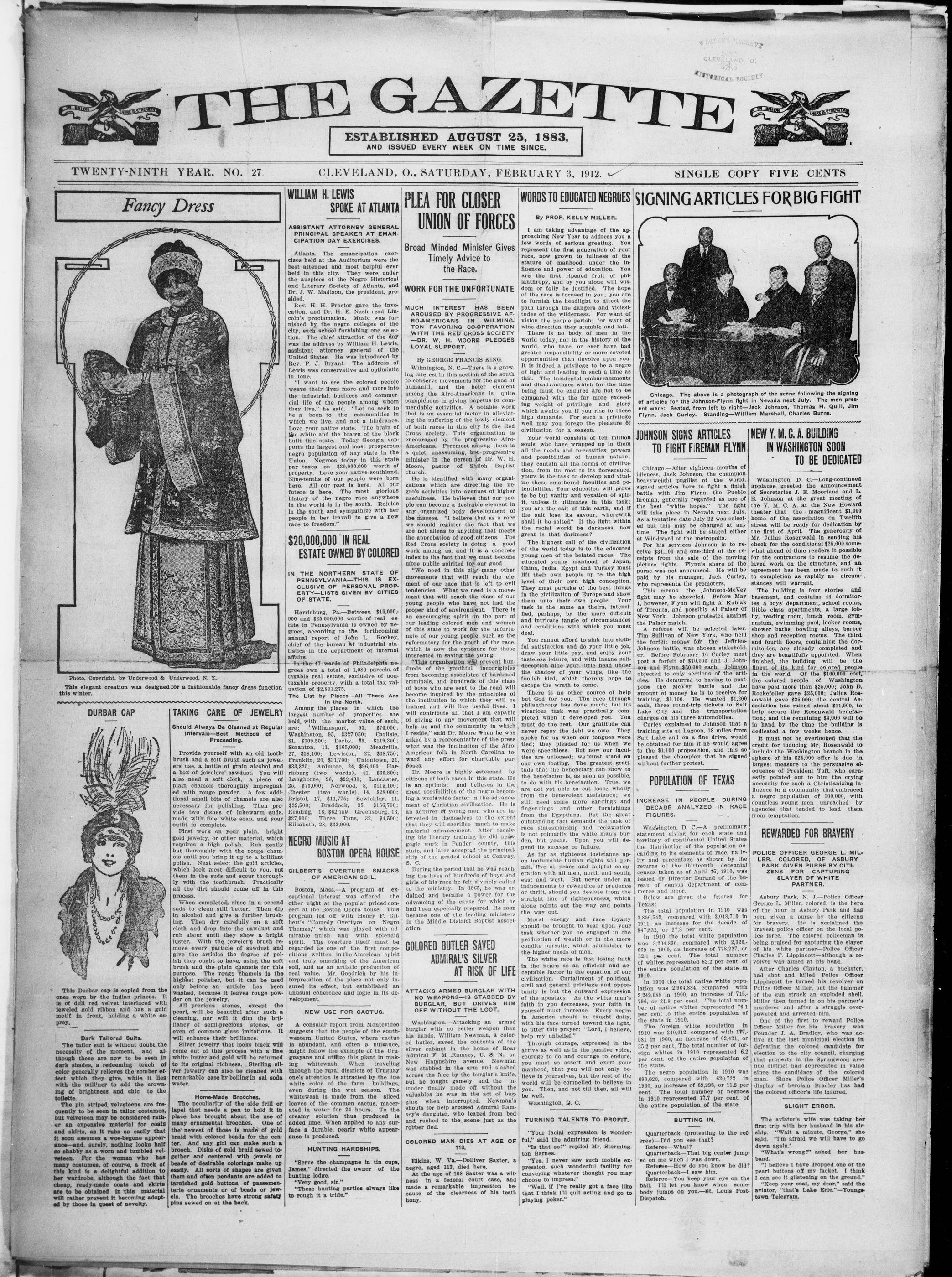
Page text (machine-generated)
IN UMOR
DURING 25 SEMESTRI
TWENTY-NINTH
TWENTY-NINTH YEAR. NO. 27
Fancy Dress
Photo, Copyright, by Underwood &
This elegant creation was designed
this winter.
I
Photo. Copyright, by Underwood & Underwood, N. Y.
This elegant creation was designed for a fashionable fancy dress function this winter.
DURBAR CAP
This Durbar cap is copied from the ones worn by the Indian princess. It is of dull red velvet interlaced with jeweled gold ribbon and has a gold motif in front, holding a white osprey.
Dark Tailored Suits.
The tailor suit is without doubt the necessity of the moment, and although these are now to be seen in dark shades, a redeeming touch of color generally relieves the somber effect which they give, while it lies with the milliner to add the crowning of brightness and chic to the toilette.
The pin striped velvetteens are frequently to be seen in tailor costumes, but velvetteen may be considered rather an expensive material for coats and skirts, as it rubs so easily that it soon assumes a woe-begone appearance—and, surely, nothing looks half so shabby as a worn and tumbled velvetteen. For the woman who has many costumes, of course, a frock of this kind is a delightful addition to her wardrobe, although the fact that cheap, ready-made coats and skirts are to be obtained in this material will rather prevent it becoming adopted by those in quest of novelty.
THE GAZETTE
Underwood, N. Y.
for a fashionable fancy dress function
TAKING CARE OF JEWELRY
Should Always Be Cleaned at Regular Intervals-Best Methods of Proceeding.
Provide yourself with an old toothbrush and a soft brush such as jewelers use, a bottle of grain alcohol and a box of jewelers' sawdust. You will also need a soft cloth, a piece of plain chamels thoroughly impregnated with rouge powder. A few additional small bits of chamels are also necessary for polishing. Then provide two dishes of lukewarm suds, made with fine white soap, and your outfit is complete.
First work on your plain, bright gold jewelry, or other material, which requires a high polish. Rub gently but thoroughly with the rouge chamois until you bring it up to a brilliant polish. Next select the gold articles, which look most difficult to you, put them in the suds and scour thoroughly with the toothbrush. Practically all the dirt should come off in this process.
When completed, rinse in a second suds to clean still better. Then dip in alcohol and give a further brushing. Then dry carefully on a soft cloth and drop into the sawdust and rub about until they show a bright luster. With the jeweler's brush remove every particle of sawdust and give the articles the degree of polish they ought to have, using the soft brush and the plain chamois for this purpose. The rouge chamois is the highest polish, but it can be used only before an article has been washed, because it leaves rouge powder on the jewelry.
All precious stones, except the pearl, will be beautiful after such a cleaning, nor will it dim the brilliancy of semi-precious stones, or even of common glass imitations. It will enhance their brilliance.
Silver jewelry that looks black will come out of this process with a fine white luster and gold will be returned to its original richness. Sterling silver jewelry can also be cleaned with remarkable ease by boiling in sal soda water.
Home-Made Brooches.
The peculiarity of the side frill or lapel that needs a pen to hold it in place has brought about the use of many ornamental brooches. One of the newest of those is made of gold braid with colored beads for the center. And any girl can make such a brooch. Disks of gold braid sewed together and centered with jewels or beads of desirable colorings make up easily. All sorts of shapes are given them and often pendant are added to tarnished gold buttons, of passementerie ornaments or of beads or jewels. The brooches have strong safety pins sewed on at the back.
ESTABLISHED AUGUST 25, 1883 AND ISSUED EVERY WEEK ON TIME SINCE.
WILLIAM H. LEWIS
SPOKE AT ATLANTA
ASSISTANT ATTORNEY GENERAL PRINCIPAL SPEAKER AT EMANCIPATION DAY EXERCISES.
Atlanta.—The emancipation exercises held at the Auditorium were the best attended and most helpful ever held in this city. They were under the auspices of the Negro Historical and Literary Society of Atlanta, and Dr. J. W. Madison, the president, presided.
Rev. H. H. Proctor gave the invocation, and Dr. H. E. Nash read Lincoln's proclamation. Music was furnished by the negro colleges of the city, each school furnishing one selection. The chief attraction of the day was the address by William H. Lewis, assistant attorney general of the United States. He was introduced by Rev. P. J. Bryant. The address of Lewis was conservative and optimistic in tone.
"I want to see the colored people weave their lives more and more into the industrial, business and commercial life of the people among whom they live," he said. "Let us seek to be a boon to the communities in which we live, and not a hindrance. Love your native state. The brain of the white and the brawn of the black built this state. Today Georgia supports the largest and most prosperous negro population of any state in the Union. Negroes today in this state pay taxes on $20,000,000 worth of property. Love your native southland. Nine-tenths of our people were born here. All our past is here. All our future is here. The most glorious history of the negro race anywhere in the world is in the south. Reloje in the south and sympathize with her people in her travail to give a new race to freedom."
$20,000,000 IN REAL
ESTATE OWNED BY COLORED
IN THE NORTHERN STATE OF PENNSYLVANIA—THIS IS EXCLUSIVE OF PERSONAL PROPERTY—LISTS GIVEN BY CITIES OF STATE.
Harrisburg, Pa.—Between $15,000,000 and $25,000,000 worth of real estate in Pennsylvania is owned by negroes, according to the forthcoming annual report of John L. Rockey, chief of the bureau of industrial statistics in the department of internal affairs.
In the 47 wards of Philadelphia negroes own a total of 1,080 parcels of taxable real estate, exclusive of non-taxable property, with a total tax valuation of $2,801,275.
The List by Places—All These Are in the North.
Among the places in which the largest number of properties are held, with the market value of each, are: Williamsport, 93, $70,000; Washington, 55, $327,050; Carlisle, 81, $399,500; Darby, 69, $119,300; Scranton, 11, $165,000; Meadville, 27, $38,100; Lewiston, 22, $38,750; Franklin, 20, $317,000; Unlontown, 21, $33,225; Ardmore, 24, $96,400; Harrisburg (two wards), 41, $66,800; Langhorne, 26, $22,400; Lancaster, 25, $73,000; Norwood, 8, $115,100; Chester (two wards), 14, $28,000; Bristol, 17, $117,575; Wickley, 11, $32,500; Braddock, 35, $156,700; Reading, 18, $62,759; Greensburg, 13, $27,900; Three Tuns, 32, $4,500; Elizabeth, 28, $29,000.
NECRO MUSIC AT
BOSTON OPERA HOUSE
GILBERT'S OVERTURE SMACKS OF AMERICAN SOIL.
Boston, Mass.—A program of exceptional interest was offered the other night at the popular priced concert at the Boston Opera house. This program led off with Henry F. Gilbert's "Comedy Overture on Negro Themes," which was played with admirable finish and with splendid spirit. The overture itself must be regarded as one of the first compositions written in the American spirit and truly smacking of the American soil, and as an artistic production of real value. Mr. Goedrich by his interpretation of the piece not only insured its effect, but established an unusual coherence and logic in its development.
NEW USE FOR CACTUS
A consular report from Montevideo suggests that the people of the southwestern United States, where cactus is abundant, and often a nuisance, might follow the example of the Uruguayans and utilize this plant in making whitewash. When traveling through the rural districts of Uruguay one's attention is attracted by the line white color of the farm buildings, even during the wet season. The whitewash is made from the sliced leaves of the common cactus, macerated in water for 24 hours. To the creamy solution thus produced is added lime. When applied to any surface a durable, pearly white appearance is produced.
HUNTING HARDSHIPS
"Serve the champagne in tin cups, James," directed the owner of the hunting lodge. "Very good, sir." "These hunting parties always like to rough it a trifle."
PLEA FOR CLOSER UNION OF FORCES
PLEA FOR CLOSER UNION OF FORCES
Broad Minded Minister Gives Timely Advice to the Race.
WORK FOR THE UNFORTUNATE
MUCH INTEREST HAS BEEN AROUSED BY PROGRESSIVE AFO-AMERICANS IN WILMINGTON FAVORING CO-OPERATION WITH THE RED CROSS SOCIETY —DR. W. H. MOORE PLEDGES LOYAL SUPPORT.
By GEORGE FRANCIS KING
Wilmington, N. C.—There is a growing interest in this section of the south to conserve movements for the good of humanit, and the better element among the Afro-Americans is quite conspicuous in giving impetus to commendable activities. A notable work that is an essential factor in alleviating the suffering of the lowly element of both races in this city is the Red Cross society. This organization is encouraged by the progressive Afro-Americans. Foremost among them is a quiet, unassuming, but progressive minister in the person of Dr. W. H. Moore, pastor of Shiloh Baptist church.
He is identified with many organizations which are directing the negro's activities into avenues of higher usefulness. He believes that our people can become a desirable element in any organized body development of the masses. "I believe that as a race we should register the fact that we are not aliens to anything that meets the approbation of good citizens. The Red Cross society is doing a good work among us, and it is a concrete index to the fact that we must become more public spirited for our good.
"We need in this city many other movements that will reach the element of our race that is left to evil tendencies. What we need is a movement that will reach the class of young people who have not had the proper kind of environment. There is an encouraging spirit on the part of our leading colored men and women of this state to work for the unfortunate of our young people, such as the reformatory for the youth of the race, which is now the cynosure for those interested in saving the young.
"This organization will prevent hundreds of the youthful incorrigibles from becoming associates of hardened criminals, and hundreds of this class of boys who are sent to the road will become inspired by the principles of the institution in which they will be trained and will live useful lives. I will contribute all that I am capable of giving to any movement that will help us and the community in which I reside," said Dr. Moore when he was asked by a representative of the press what was the inclination of the Afro-American folk in North Carolina toward any effort for charitable purposes.
Dr. Moore is highly esteemed by citizens of both races in this state. He is an optimist and believes in the great possibilities of the negro becoming a worldwide factor in the advancement of Christian civilization. He is an admirer of young men who are interested in themselves to the extent that they will sacrifice much to make material advancement. After receiving his literary training he did pedagogic work in Pender county, this state, and later accepted the principalship of the graded school at Conway, S. C.
During the period that he was reaching the lives of hundreds of boys and girls of his race he felt divinely called to the ministry. In 1865, he was ordained and became a power for the advancing of the cause for which he had been especially prepared. He soon became one of the leading ministers in the Middle District Baptist association.
COLORED BUTLER SAVED
ADMIRAL'S SILVER
AT RISK OF LIFE
ATTACKS ARMED BURGLAR WITH NO WEAPONS—IS STABBED BY BURGLAR, BUT DRIVES HIM OFF WITHOUT THE LOOT.
Washington.—Attacking an armed burglar with no better weapon than his hands, William Newman, a colored butler, saved the contents of the silver cabinet in the home of Rear Admiral F. M. Ramsey, U. S. N., on New Hampshire avenue. Newman was stabbed in the arm and slashed across the face by the burglar's knife, but he fought gamely, and the intruder finally made off without the valuables he was in the act of bagging when interrupted. Newman's shouts for help aroused Admiral Ramsey's daughter, who leaped from bed and rushed to the scene just as the robber fled.
COLORED MAN DIES AT AGE OF 113.
Elkins, W. Va.—Dolliver Saxter, a negro, aged 113, died here.
At the age of 108 Saxter was a witness in a federal court case, and made a remarkable impression because of the clearness of his testil-hony.
WORDS TO EDUCATED NEGROES SIGNING ARTICLES FOR BIG FIGHT
By PROF. KELLY MILLER.
I am taking advantage of the approaching New Year to address you a few words of serious greeting. You represent the first generation of your race, now grown to fullness of the stature of manhood, under the influence and power of education. You are the first ripened fruit of philanthropy, and by you alone will wisdom or folly be justified. The hope of the race is focused in you; you are to furnish the headlight to direct the path through the dangers and viciousities of the wilderness. For want of vision the people perish; for want of wise direction they stumble and fail.
There is no body of men in the world today, nor in the history of the world, who have, or ever have had greater responsibility or more coveted opportunities than devolve upon you. It is indeed a privilege to be a negro of light and leading in such a time as this. The incidental embarrassments and disadvantages which for the time being must be endured are not to be compared with the far more exceeding weight of privilege and glory which awaits you if you rise to these high demands. For such a privilege well may you forego the pleasure or civilization for a season.
Your world consists of ten million souls, who have wrapped up in them all the needs and necessities, powers and possibilities of human nature; they contain all the forms of civilization, from its root to its forecence, yours is the task to develop and vitalize these smothered faculties and potentialities. Your education will prove to be but vanity and vexation of spirit, unless it ultimately in this task; you are the salt of this earth, and if the salt lose its savour, wherewith shall it be salted? If the light within the racial world be darkness, how great is that darkness?
The highest call of the civilization of the world today is to the educated young men of the belated races. The educated young manhood of Japan, China, India, Egypt and Turkey must lift their own people up to the high level of their own high conception. They must partake of the best things in the civilization of Europe and show them unto their own people. Your task is the same as theirs, intensified, perhaps, by the more difficult and intricate tangle of circumstances and conditions with which you must deal.
You cannot afford to sink into slothful satisfaction and do your little job, draw your little pay, and enjoy your tasteless leisure, and with insane self-deception hide your little head under the shadow of your wings, like the foolish bird, which thereby hope to escape the wrath to come.
There is no other source of help but God for you. The race through philanthropy has done much; but its vicarious task was practically completed when it developed you. You must do the rest. Our gratitude can never repay the debt we owe. They spoke for us when our tongues were tied; they pleaded for us when we were speechless. But now our faculties are unloosed; we must stand on our own footing. The greatest gratitude that the beneficiary can show to the benefactor is, as soon as possible, to do with his benefaction. True, we are not yet able to cut loose wholly from the benevolent assistance; we still need some more ear-rings and finger-rings and other furnishings from the Egyptians. But the great outstanding fact demands the task of race statesmanship and reclamation is not primarily the white man's burden, but yours. Upon you will depend its success or failure.
As far as righteous insistence upon inable human rights will permit, five at peace and helpful co-operation with all men, north and south, east and west. But never under an inducements to cowardice or prudence or thrift, should you deviate from the straight line of righteousness, which alone points out the way and points the way out.
Moral energy and race loyalty should be brought to bear upon your task whether you be engaged in the production of wealth or in the more condite pursuits, which administer to the higher needs of man.
The white race is fast losing faith in the negro as an efficient and acceptable factor in the equation of our civilization. Curtailment of political, civil and general privilege and opportunity is but the outward expression of the apostasy. As the white man's faith in you decreases, your faith in yourself must increase. Every negro in America should be taught daily, with his face turned toward the light, to utter this prayer: "Lord, I believe, help my unbelief."
Through courage, expressed in the active as well as in the passive voice, courage to do and courage to endure, you must so assert and exert your manhood, that you will-not only be compelled in yourselves, but the rest of the world will be compelled to believe in you. Then, and not till then, all will be well.
Washington, D. C.
TURNING TALENTS TO PROFIT.
"Your facial expression is wonderful," said the admiring friend.
"Is that so?" replied Mr. Stormington Barnes.
"Yes, I never saw such mobile expression, such wonderful facility for conveying whatever thought you may choose to impress."
"Well, if I've really got a face like that I think I'll quit acting and go to playing poker."
SINGLE COPY FIVE CENTS
Chicago.—The above is a photograph of the scene following the signing of articles for the Johnson-Flynn fight in Nevada next July. The men present were: Seated, from left to right—Jack Johnson, Thomas H. Quill, Jim Flynn, Jack Curley. Standing—William Marshall, Charles Burns.
JOHNSON SIGNS ARTICLES
TO FIGHT FIREMAN FLYNN
Chicaco—After eighteen months of idleness, Jack Johnson, the champion heavyweight pugilist of the world, signed articles here to fight a finish battle with Jim Flynn, the Pueblo fireman, generally regarded as one of the best "white hopes." The fight will take place in Nevada next July. As a tentative date July 22 was selected but this may be changed at any time. The fight will be staged either at Windward or the metropolis. For his services Johnson is to receive $31,100 and one-third of the receipts from the sale of the moving picture rights. Flynn's share of the purse was not announced. He will be paid by his manager, Jack Curley, who represents the promoters. This means the Johnson-MeVey fight may be shovelled. Before May 1, however, Flynn will fight Al Kubik of Toronto, and possibly Al Palser of New York. Johnson protested against the Palser match.
A referee will be selected later, Tim Sullivan of New York, who held the forfeit money for the Jeffries-Johnson battle, was chosen stakeholder. Before February 16 Curley must post a forfeit of $10,000 and J. Johnson and Flynn $50,000 each. Johnson objected to only sections of the articles. He demurred to having to post pone the McVey battle and the amount of money he is to receive for training. $1,100. He wanted $1,200 cash, three round-trip tickets to Salt Lake City and the transportation charges on his three automobiles.
Curley explained to Johnson that a training site at Lagoon, 18 miles from Salt Lake and on a fine drive, would be obtained for him if he would agree to the $1,100 proposition, and this so pleased the champion that he signed without further protest.
POPULATION OF TEXAS
INCREASE IN PEOPLE DURING DECADE ANALYZED IN RACE FIGURES.
Washington, D. C.—A preliminary statement giving for each state and territory of continental United States the distribution of the population according to its elements of race, maturity and percentage as shown by the returns of the thirteenth decennial census taken as of April 16, 1910, was issued by Director Durand of the bureau of census department of commerce and labor.
Below are given the figures for Texas:
The total population in 1910 was 3,896,542, compared with 3,048,710 in 1911, an increase for the decade of 847,832, or 27.8 per cent.
In 1910 the total white population was 3,204,896, compared with 2,325,669 in 1900, an increase of 778,227, or 32.1 per cent. The total number of whites represented 82.2 per cent of the entire population of the state in 1910.
In 1910 the total native white population was 2,964,884, compared with 2,249,088 in 1900, an increase of 715,796, or 31.8 per cent. The total number of native whites represented 76.1 per cent o f the entire population of the state in 1910.
The foreign white population in 1910 was 240,012, compared with 177,581 in 1900, an increase of 62,431, or 35.2 per cent. The total number of foreign whites in 1910 represented 6.2 per cent of the entire population of the state.
The negro population in 1910 was 690,020, compared with 620,722 in 1900, an increase of 69,298, or 11.2 per cent. The total number of negroes in 1910 represented 17.7 per cent. of the entire population of the state.
BUTTING IN.
Quarterback (protesting to the referee)—Did you see that?
Referee—You keep your eye on the ball. I'll let you know when somebody jumps on you.—St. Louis Post-Dispatch.
IN UNION
THERE IS STRENGTH
PY FIVE CENTS
ES FOR BIG FIGHT
graph of the scene following the signing in Nevada next July. The men pres-
Jack Johnson, Thomas H. Quill, Jim
am Marshall, Charles Burns.
NEW Y. M. C. A. BUILDING
IN WASHINGTON SOON
TO BE DEDICATED
Washington, D. C.—Long-continued applause greeted the announcement of Secretaries J. E. Moorland and L. E. Johnson at the great meeting of the Y. M. C. A. at the New Howard theater that the magnificent $1,000 home of the association on Twelfth street will be ready for dedication by the first of April. The generosity of Mr. Julius Rosenwald in sending his check for the conditional $25,000 somewhat ahead of time renders it possible for the contractors to resume the delayed work on the structure, and an agreement has been made to rush it to completion as rapidly as circumstances will warrant.
The building is four stories and basement, and contains 44 dormitories, a boys' department, school rooms, Bible class apartments, a large lobby, reading room, lunch room, gymnasium, swimming pool, locker rooms, shower baths, bowling allies, barber shop and reception rooms. The third and fourth floors, containing the dormitories, are already completed and they are beautifully appointed. When finished, the building will be the finest of its kind for colored people in the world. Of the $100,000 cost, the colored people of Washington have paid more than $25,000; John D. Rockefeller gave $25,000; Julius Rosenwald gave $25,000; the central Association has raised about $11,000, to help secure the Rosenwald benefaction; and the remaining $4,000 will be in hand by the time the building is dedicated a few weeks hence.
It must not be overlooked that the credit for inducing Mr. Rosenwald to include the Washington branch in the sphere of his $25,000 offer is due in largest measure to the persuasive eloquence of President Taft, who earnestly pointed out to him the crying necessity for such a Christianizing influence in a community that embraced a negro population of 100,000, with countless young men unreached by agencies that tended to lead them from temptation.
REWARDED FOR BRAVERY
POLICE OFFICER GEORGE L. MILLER, COLORED, OF ASBURY PARK, GIVEN PURSE BY CITIZENS FOR CAPTURING $LAYER OF WHITE PARTNER.
Asbury Park, N. J.-Police Officer George L. Miller, colored, is the hero of the hour in Asbury Park and has been given a purse by the citizens for bravery. He is acclaimed the bravest police officer on the local police force. The colored policeman is being praised for capturing the slayer of his white partner—Police Officer Charles F. Lippincott—although a revolver was aimed at his head.
After Charles Clayton, a huckster, had shot and killed Police Officer Lippincott he turned his revolver on Police Officer Miller, but the hammer of the gun struck an exploded shell. Miller then turned in on his partner's murderer and after a struggle overpowered and arrested him.
One of the first to reward Police Officer Miller for his bravery was Founder J. A. Bradley, who was active at the last municipal election in defeating the colored candidate for election to the city council, charging that property in the Springwood avenue district had depreciated in value since the candidacy of the colored man. Since Police Officer Miller's display of heroism Bradley has had the colored officer's life insured.
SLIGHT ERROR.
The aviator's wife was taking her first trip with her husband in his airship. "Wait a minute, George," she said. "I'm afraid we will have to go down again."
"What's wrong?" asked her husband.
"I believe I have dropped one of the pearl buttons off my jacket. I think I can see it glistening on the ground."
"Keep your seat, my dear," said the aviator, "that's Lake Erie."—Youngs-town Telegram.
THE GAZETTE
PUBLISHED EVERY SATURDAY
One Year. . $1.50
Six Months. . 1.00
Three Months. . . 5.0
Subscribers are requested to re-
mit by postoffice money or
der or registered letter.
Entered at the postoffice In Cleveland
Ohio, as second-class matter
Address all communications to
HARRY C. SMITH
Editor and proprietor,
THE GAZETTE,
Blackstone Building, Cleveland, O.
Member Ohio Legislature: 1894
to 1896; 1896 to 1989; 1900 to 1902
THE GAZETTE is the oldest, and has the largest bona fide circulation, double that of any newspaper in the interest of Afro-Americans, published in the state of Ohio, and comparison with any will immediately establish its rank as one of the NEWSIEST AND BEST in the country.
We did not believe that there was a Negro or Afro-American in all Ohio who had the temerity to attempt to make an argument, in a public way, in favor of separate schools. But, one Dr. H. M. Porter has made a pitiful effort to do this very thing in a Dayton paper of recent date. How Dr. Booker T. Washington's "doctrine of surrender" is growing? We are beginning to clamor to be made "pariha" of. Whither are we drifting?
Every other class of Americans demands the substance; only the Afro-American is satisfied with the shadow. It is true, we vote in all state elections in Ohio even if there is no foundation in law for our doing so. No other class of citizens, however, save ours, would be so satisfied with such an anomalous condition of suffrage affairs. No other class of people in this country would sit supinely quiet "on the stool of donothing" and leave such vital interests in the hands of others without making the least effort in the world to see that the proper thing was done, especially in view of the fact that what is done by this Ohio Constitutional Convention will in all probability stand, without material change, for another fifty or sixty years.
The man who suffers personal wrong without protest or opposition, the "peaceful" member of the community, is a demoralizing factor in our social fabric. The class that does not struggle for civic and industrial rights will eventually lapse into slavery. The nation that passively counterances encroachments upon its rights and territory is doomed to dismemberment and national bankruptcy. It is the man who defends his rights, the class that battles for political and industrial advancement, and the nation that holds its own against the entire world; it is the "litigious" person, the revolutionary class, and the vigilant nation, that keep the world from stagnation and force it onward on the path of progress. -Hillquit.
WHAT IS THE MATTER?
Mr. Starr, in the Columbus letter published elsewhere in The Gazette, today, asks what is the matter with the Ohio Afro-American? This in connection with our interest in the Ohio Constitutional Convention. Yes, what IS the matter with us? We will wake up some fine morning, along in June or July of this year, and find that the Ohio Constitutional Convention has adjourned without eliminating the word "white" from the State Constitution, and then what a howl (as usual) will be "set up," but it will be too late (as usual). For more than a year The Gazette has tried to awaken our people of this state to a proper realization of their responsibility in the matter, and to arouse them to action, but in vain, thus far. They are as sound asleep, as far as this particular matter is concerned, as our four or five "National" race organizations and others are when it comes to going into the U. S. Supreme Court in an effort to determine the rights of our inter-state railroad passengers in the south where there are "jim-crow" car laws; or going there in an effort to knock out the unconstitutional disfranchisement "laws" of the same section. Yes, what is the matter with the Afro-American, generally, when it comes to making a proper fight for his rights and privileges in the courts of any kind, anywhere in this country?
TAFT IN OHIO.
Four years ago, William Howard Taft came to Cleveland to address a Tippocano Club banquet, just like he did. Monday evening of this week, At that time, as was the case this week, no Afro-American was admitted to the banquet, and there are over four thousand of these voters in this city. Four years ago, all the Afro-American waiters, some fifty or sixty in number, were "chased" from the hall while William Howard Taft spoke (something unheard of at a political banquet in this city, up to that time). At the conclusion of his speech, the doors were again thrown open and the waiters invited and in some cases even importunted to "come in and shake hands with the club's distinguished guest, Mr. Taft". Most of them had the good sense to refuse to do so. Only a few, so far forgot themselves and their race, to shake hands with Taft after such reprehensible and insulting treatment. This week, Monday, in the small crowd of four or five hundred persons that welcomed the President at the Euclid Av. railway station, in this city, not one Afro-American could be seen except the one employed in the station as a train-caller and he was there because his work compelled him. As was the case four years ago, and has been ever since, so it was this week, the President let it be known that his friendship for the South made the Negro or Afro-American person non
grata—he was not wanted at the Tippecanoe C banquet or anywhere else, as far as Taft was concerned, while in Cleveland the first of this week. And this same thing was true of his entire Ohio trip, even if an effort was made to have him shake the hands of the white and black "help" of a Columbus hotel on Tuesday. The fact is that the Ohio Afro-American was unable to meet him except in servant and even in this way, only at the State Capital. This is in thorough harmony with President Taft's "new southern policy" in which he (and not his subordinates) announced that "no Negro (and with a little "n", too) would be appointed to a federal office in the South where the white people of the community objected." He has not only kept this pledge—made the South—but has done infinitely more, worse—he, and his subordinates with his sanction, have replaced with Southern democrats more than three hundred Afro-American federal office-holders in that section alone, to say nothing of those of the race, like the Hon. Jere A. Brown of this city, and others here in the North who have been "demoted" and not replaced by white men, not always Republicans, either, solely because they were Afro-Americans. During his nearly four years' incumbency of the office of Chief Executive of the country, Taft has appointed and reappointed less than a half-dozen Afro-Americans to office, to make for the more than three hundred he has "dried." He has caused the color-line to be increased and multiplied a hundred fold, not only in the federal employ and party politics, but also generally, throughout the country. He has put our people back a quarter of a century in almost every way, vital to the real progress of the race. These facts are notorious among our people everywhere in this country. Therefore, the effort of Taft's "Kitchen Cabinet", Messrs. W. H. Lewis, J. C. Lexington, Ky., at Grandsboro, N. C., Lexington, Ky., at Grandsboro, N. C., and many other places—when he promised the South that he would do the very thing of which we now complain so bitterly, and it is the height of folly for any person, even federal office-holders of color, to come forward now with a printed interview which they claim to have had recently with President Taft, are spreading broadcast, and which they will hope mislead our people into believing that Taft's subordinates are responsible and not the President. They, as usual, tell us "how deeply interested" Mr. Taft is in the race. Well, he has shown it! Action speaks louder than words, and President Taft's shameful misreatment of the race, in the last three years, speaks so loudly that the words of his "Kitchen Cabinet", in this latest alleged interview, is all but drowned out. The President even refused these gentlemen any moderation of his "new Southern policy"; indeed would not discuss it with them, but, according to them, stated privately his disapproval of lynching and "jim-crow" cars—things he has absolutely refused to consider or denounce in any of his messages to Congress and the American people, the proper place for such a thing. Where the rights and lives of so many people, citizens, are denied and threatened and even taken, as the result of disfranchisement, "jim-crow" cars and lynching, it is the sworn duty of the Chief Executive of this country, to see that the Attorney-General of the United States, goes into court, in an effort to uphold the fundamental law of the land whenever it is so transgressed. Does President Taft do his duty in this as well as many other respects, as regards our people? No, indeed! Will he? No, indeed! He, early in his campaign for the nomination, three years ago, pledged himself to the South, if he became President, on all issues and things in which and our race were most interested, and as we have already said in this leader, he has kept his pledge and promise. Now, what can be said of men of color, even to prolong their hold on a small federal office, who will go as far as Messrs. Napier, Johnson, McKinlay, Lewis and Tyler have in their alleged interview, in a vain effort to "bolster up" Taft as a candidate for renomination, among our people? The less The Gazette has to say relative to them at this time, possibly, the better.
NEARLY KILL CHILD PLAYING LYCHING.
WEST UNION, O—Tommie Jones, seven, and Colored, was nearly killed while playing "lynching bee" at the Wilson children's home. Tommie's white playmates tied a rope around his neck and fled when he began to struggle and cry out that it hurt. In attempting to free himself, he drew the noose tighter, and a nurse rescued him barely in time.
DO YOU WANT A BOY?
A good, Christian home is wanted for a baby boy born, Dec. 20, 1911. The mother, a widow whose health is poor, is unable to care for the child. The little fellow is fair, has dark brown hair, blue eyes, and is very attractive. The mother is desirous of having the child well educated as well as being reared in an intelligent Christian home. Address Mrs. Bertha L. Brown, Box 62, Independence, O.
ASK CZAR TO RAP AMERICA.
Leading Brooklyn Men Urge Russian Protest Against Burnings at Stake in This Country.
New York City.—The Cosmopolitan Society of America, a Brooklyn organization composed of leading persons of both races, has sent to the Russian ambassador at Washington a resolution to this effect:
"Whereas, the United States is the only country where human beings are burned at the stake and the president has declined to use his power to press the president of Russia, so far as the Office of the Hague peace conference, should urge upon the president and congress the necessity of stopping such burnings."
THE GAZETTE, CLEVELAND, O. SATURDAY, FEBRUARY 3, 1912
Louis, where I went into a printing
office; but I soon returned to Chelsea
had a fine time, le
ing him, many, r
Found a Friend in Lincoln
HEN coming from the reunion banquet of the One Hundred and Thirty-seventh Ohio volunteer infantry, which took place at
HEN coming from the reunion banquet of the One Hundred and Thirty-seventh Ohio volunteer infantry, which took place at the Grant hotel, Louis P. Bentley of Ludlow, Ky., after hearing eulogies of the war heroes, and especially of Abraham Lincoln, remarked to Alexander Hill, Sr.: "You did not know that for some months I was once a member of Abraham Lincoln's family, did you?" "No, how did that happen?" asked Mr. Hill eagerly. Then in a burst of patriotic pride and confidence, Mr. Bentley told the story which he has always kept to himself and family from an undue sense of modesty, which explains why Miss Ida Tarbell did not find him in writing her book, "He Knew Lincoln."
"It was in 1858," said Mr. Bentley, the other day, repeating his story, "and I was a boy of 18 who had learned the printing business and was staying in Decatur, Ill., then a town of about 3,000 inhabitants, and could not find work. I was boarding at the Ogelsby house, the only hotel in town, and had paid my last $5 for board and was feeling about as blue as any one can feel under those circumstances. Stephen A. Douglas, then the Democratic senator from Illinois, was a candidate for re-election and his opponent, a young lawyer named Lincoln from Springfield, and he were having a series of five addresses, which have since become so famous. Both parties were in the hotel at that time to hold a debate that night, and Douglas, the man of the hour, was upstairs in the hotel parlor with a bottle of whiskey, a box of cigars and surrounded by admiring friends who came to call upon him.
"There was great excitement in the town, and it centered in the hotel, but I was feeling too blue to care about it and sat in the office downstairs, not caring to speak to any one. A tall raw-boned man sat near me as much unnoticed as myself, all hunched up in his chair, whittling a little piece of wood.
"Do you belong here?" he asked.
"No. I replied.
"How long have you been here?
"About a year."
"What are you doing?
"Nothing."
"That is not a good thing for a young man of your age to do. Can you find work?
"No. I replied, feeling very rebellious against fate.
"What do you do when you are working? Have you a trade?
"Yes; I am a printer," I answered, wishing this man would stop his questions.
"Well, young man,' he said kindly. I have an interest in a newspaper in Springfield, and if you come back with me tomorrow I will see if the foreman of the printing room cannot give you a job. Will you come?
"I do not know, I will see,' I answered feeling more kindly toward this curious gentleman.
"Don't you want a job?' he asked quickly.
"Yes, I do,' I answered, but I did not tell him the reason for my not accepting his offer. I had no means to go to Springfield, sixty miles away. It was the first time that I was broke and I hated to own it.
"He said nothing more, and that night after the debate, where there were as many as a half million people present in proportion to the size of the town. I came face to face with him again in the hotel office.
"Well, young man,' he said, 'are you going with me?"
"Then I confessed the reason why I could not.
"I knew then that my friend was Abraham Lincoln, the young Republican candidate for senator, who had debated with Stephen A. Douglas.
"It was near midnight and the steamboat was due to leave in a short time.
"You come with me, anyhow,' said Mr. Lincoln, 'and I will take care of you.'
"I did not require much urging, and went to my room to collect my small belongings and joined his party.
"We arrived in Springfield the next morning and Mr. Lincoln took me to his home, giving me the only vacant room in his house, and I ate breakfast with the family. After that he took me to his law office and had a talk with his partner, Mr. Herndon; then we went to the printing office of the Illinois State Register, the paper in which he had an interest, and we had a talk with the foreman. The latter, after asking me to write something, sald he was sorry, he saw I knew the work, but there was no position that he could give me at present, promising me, however, the first chance of work. At that my spirits, which had risen, dropped down again to a still lower ebb, until my benefactor said: "Now, I am going to be away a great deal on this campaign and Mr. Herndon will be very busy, so how would you like to stay in the office and answer the questions of visitors for $4 a week?" That was before the day of stenographers.
"I did not think there was so much money in the world, so I accepted the offer gladly and remained a resident of the Lincoln household for nine weeks. Mrs. Lincoln's aunt was going to make them a visit and that as I had the only vacant room in the house he would make arrangements for me to stay with a lady across the street, who had two young men boarding with her, if I did not care. I could not object and moved, and I suppose Mr. Lincoln paid my board all the time I was there as well as my salary, for I know I did not pay any. Then one day the foreman sent for me to work on a brief, and when it was finished, to my great delight, paid me full journeyman's wages. Altogether I remained in Springfield four months, going from there to St.
Louis, where I went into a printing office; but I soon returned to Cincinnati and to Ludlow, where I have lived for nearly sixty years."
Mr. Bentley never had an opportunity to renew his acquaintance with Abraham Lincoln, but never forgot the helping hand which he extended to the lonely, despondent boy that night in Decatur, which played such an important part in the history of the great president himself.
BUCKEYE LETTERS
WRITTEN BY "THE OLD RELIABLE" GAZETTE'S CORRESPONDENTS.
What Our People Are Doing Each Week—Church, Personal, Social, Lodge, Literary and Musical — Marriages,
Rendville.-Walter G. Arnold, formerly of Gallipoli, and Dora D. Johnson of Racine, were married in New Lexington, Wednesday morning, and will reside here.-Mr. Covington is much better.-Harry Phillips is agent for a laundry.-Joe Woods is better.-Miss Eva Doleman, who has been in Cleveland two months, has returned.
Canton.-Rev. and Mrs. Johnson dined with Mrs. Z. A. Hunter, Sunday.-Miss L. Hill beautifully entertained the Embroidery Club, Tuesday evening.-Mrs. Roberts is the guest of Mrs. Smallwood.-Mrs. Thomas Jackson dined with Mrs. David Hall, Sunday.-Mr. Wyman Jackson has gone to Huntington, Ind.-Mrs. Rosa Johnson of Cleveland, dined with Mrs. Charlie Spencer, Friday.-There will be a sacred concert at St. Paul's church, Sunday evening.-Mr. Bill Rigely was in Steubenville, last week.-Mr. Rose on many interesting talk on foreign missions at the Allen League. She also assisted Rev. Johnson at services, obtaining four converts. Rev. Kane preached in the morning.
Sandusky.—The new officers of the Second Baptist S. s. are: Supt., Mrs. M. Jones; assistant, Miss S. Johnson; sec., Miss M. Alexander; assistant, Master H. Wallace; treas., Miss R. Garrett; librarians, Master Roy Smith and Master Cecil Shackelford; organist, Master A. Alexander; Miss R. Garrett and Beatrice Pearl, second officer. No. 3 was the banner-class, total collections, $120. The average attendance during the year was good. Four teachers were present; absent. 1. The S. s has started the year with the intention of securing and holding the district banner. Rev. G. D. Smith is proud of his class. S. The student's work involves the pastor preaching special sermons in the morning and evening—Hand your local news to the agent. The Gazette is for all.
Smithfield.—Miss M. Beall spent Saturday and Sunday with her parents.—Ernest Freeman of Bradley, visited his mother, Sunday.—Mr. N. Bigsby visited his wife and family, Sabbath.—R. Faithful of Harrisville, visited G. Binns, Saturday and Sunday.—Quite a number from McIntyre, attended church here, Sunday. Rev. S. W. White preached an excellent sermon in the morning, and Rev. H. H. White preached an evening and Friday evening. He also preached for Rev. Oakey, Sunday morning. Not for many years has the church been aroused as it was, Sunday evening. A number attended the entertainment in McIntyre, Friday evening. It was a success, Rev. Uph Grove is the guest of W. H. Veney. He has been highly entertained by Rev. and Mrs. White, Rev. and Mrs. Lewis, E. J. Smith and family of McIntyre and Mr. Jas. Car
```markdown
```
Dayton. Walter Thomas Payne and Miss Bertha Tanner were married, Tuesday evening, by Rev. DeSoto Bass.—Mrs. John Burgess was the hostess of an afternoon reception for the ladies of Bethel Baptist church, re-entertaining the congregation and the number—Messandrea Brown and Helen Tanner.—Mrs. J. B. Anderson will entertain, Thursday afternoon, for the Aid society. Mr. Walter Reed of Nichollsville, Ky., was in the city last week.—Rev. J. B. Anderson has returned from Cincinnati. He will go there again, Monday, to continue relevant services. The Rev. J. B. Anderson, M.S. Tuesday night.—Mrs. John King entertained, Thursday evening. Cards and music, the features.—A leap year social and supper at Euclid Ave. church, this (Friday) evening.
Correspondents must mail all letters for publication at their main postoffice sufficiently early on Monday (or Sunday) of each week to have them reach The Gazette office on Tuesday morning, and always write, also, their names and that of their correspondent, and the wrapper about returned copies. Unless this latter is done, proper credit cannot be given you. Lists of names, wedding presents, etc., obituary notices, speeches, resolutions, poetry, inquiries for relatives and advertisements of all kinds, memoranda and memorandum contents to be held in the near future, must be paid for in advance at the rate of ten cents a line, six words to a line. Our rates for display advertisements will be sent on application. Send postal note and not stamps during warm weather.
Lorain—Mrs. S. E. Dobinson and Mrs. Wintrey have the grip. Rev. S. E. Bond does not improve.—Miss Bessie Tates was pleasantly surprised, Monday evening, her 23d birthday, by about 30 young people and a most enjoyable time was had. Music, games, etc.—Harry Jackson has returned from Pittsburgh. He visited relatives and friends at a meeting, last Friday evening (his 52d birthday), T. H. Stevens was surprised by about 35 friends who had taken possession of his home. He received many useful presents and all
had a fine time, leaving for home wishing him many more anniversaries.—The musicae at the Second Baptist church, last Friday evening, was quite a success.—Mrs. Williams of Oberlin, visited Mrs. Cooley of E. 27th St., last week.—Among the graduates of the Lorain High School, is a son of Mr. and Mrs. Cooley.—Persons desiring copies of "the old reliable" Gazette can get them from Helen Hicks at the A. M. E. parsonage.
Cadiz.-Rev. J. H. Jones, P. E., gave an interesting lecture Sunday evening to a large and attentive audience at the A. M. E. Church.-Mrs. Susan West is able to go out again.-I. L. Strother sustained painful injuries last week, by a fall.-Two recent marriages: Ralph West and Iona Williams, Mrs. Ralph West and Iona Williams.-Mrs. Susan Brown is home from Columbus., Mrs. Lydia Timbers was called to Wheeling by her sister, Mrs. M. Rainbow's illness.-Special services at the M. E. Church, the 28th. Rev. White was at M. Pleasant recently.-The last conference meeting the 6th, and on the 11th will celebrate Lincoln's birthday with a special program.-Misses Florence Smith and Leola Mason are able to be about.-Mr. Joseph Jones is out of town.
Youngstown. —Covenant lodge, F. & A. M., will give a literary and valentine social, the 14th, at its rooms. —Estelle S. Simpson, stenographer, has moved into the Maloney block. —Mrs. W. J. Jefferson gave an informal yet successful 6 o'clock dinner, the 21st, ult. Pink and white were the predominating colors. A delicious menu, in six courses, as served. The menu includes Harris, Mrs. Ian Taylor, Mr. and Mrs. Robert Docket, Mrs. E. S. Simpson, Mrs. Wright, Emmet Carter and R. Penn. —C. R. Miller, Mose Bell, Mrs. C. Stewart, sr., and Mrs. R. Kerr are ill. —A number of S. high people gave a sleigh-ride to Mrs. Carrie Johnson's, Cornersburg, Saturday evening. Lunch, music and social chat. Those in the party: Mr. and Mrs. W. Smith and family, Mr. and Mrs. O. P. Boggess, jr. Mr. and Mrs. Saunders, Mrs. T. Lonesome, Mrs. W. Honey, Mrs. J. Honey, Misses S. Boggess, I. Holliday, C. Stanup, H. Clark, Mrs. J. Whitney and E. S. Moore. The party arrived home early next morning. —Miss Thelma Lucas, Mrs. L. Stewart, Mrs. H. Johnson, Mrs. W. Honesty, Mrs. R. Mackey and Monroe Thompson are able to be about. —Will Saunders and Mrs. Askins are sick. —F. H. Simpson underwent an operation at the City Hospital, this week. —Logan lodge, Louisa Edwards and Consuela Stewart courts, Mrs. W. Honesty, Mrs. R. Mackey and Monroe Thompson are able to be about. All members are requested to be present at an early hour. —Oak Hill A. church gave Mr. and Mrs. Will Robinson, a shower, Monday evening. —Order The Gazette.
Homestead Land.
Denver, Colo.—There are about six
quarter sections for homesteads in the
Dearfield Settlement which is located
in one of the best farming districts in
Colorado. It is only about sixty miles
from Denver on an air line, and seventy-one miles by rail. All conditions
are favorable to good crops for the
dry farmer this year. There are now
twenty-one families located in the
settlement.
The total cost of filing on a home-
estead is as follows:
R. R. fare to see the ground. $ 4.00
Livery hire to drive to locate 2.00
Lunch . . . 50
Making out papers. 1.50
Filing with land office. 16.00
Total . . . $24.00
If you have some one locate you,
there will be an additional cost of $30
—$25 for locating and $5 for the
location free and with the easily
location of the settlers one can easily
locate and save $30. Persons interested
can see maps and plats at the office of
Attorney A. W. Lewis, 1931 Arapahoe
St. this city.
CONSTITUTIONAL CONVENTION.
Ohio Afro-Americans Apparently Not Interested in This Great Body Although They Right* to Vote is Hanging in the Balance.
Columbus, O., Jan. 24, 1912.
Editor Gaze, Dear Sir:—What is the matter with the Ohio Afro-American? That is the question. I was forced to ask several here after a visit to the state-house, Wednesday, and looking over that August body, the Ohio Constitution, which under 100 members, all white men, and mostly democrats. The "Colored brother is "conspicuous" in it because—of his absence. And yet no resident of the state has more "at stake" in that meeting of men to make a new constitution for Ohio, than our people, who are denied the privilege of voting and participating in this state's military, because the present state constitution says that the state should not do and a decision of the U. S. Supreme Court, some ten or fifteen years ago, expressly stated that the privilege of voting in all STATE elections rests solely with the states and that the famous 14th, and 15th, amendments to the U. S. Constitution do not give us the "right" or rather privilege of voting in STATE elections where the constitution or other legislative act of a state forbids or does not permit us to vote in STATE elections. We should present constitution. We should see it that the word "white" comes out of the present constitution and is not in the new one on which the present. Constitutional Convention, now in session here, is working. Not a single member of the race in all Ohio is showing the least interest, apparently, and The Gazette has been "pounding away" on this important matter for his rights, privileges, and other vital interests, seems to possess him entirely there in the country. And we welcome him in these lines and have been steadily losing ground these last fifteen or twenty years! Can anything awaken him—the Negro?
Sincerely yours,
D. F. Starr.
REV. E. W. KINCHEN OUT WEST.
LOS ANGELES, Cal.-Rev. E. Wesley Kinchen came to Los Angeles about eight months ago as pastor of Wesley Chapel M. E. church. During his patronage there, the Chapel has added one hundred new members to his church roll and the congregations are so large that they often tax the capacity of the building.
BATTLE-HYMN
OF THE
REPUBLIC
He hath loosed the fateful lightning of his terrible helmet with lachrymation on it marching on.
I have seen him in the watch-dresses of a hundred circular campers.
I have read a ferry gospel, writ in bur-
ble. "As you deal with my contemptors, so with
you my grace shall deal;
Let the heirs of the roman, crush the
bearers, with did heeps."
A
He has sounded forth the trumpet that will never call retreat.
He is sifting out the hearts of men before his judgment seat;
Oh, be swift my soul, to answer him! be jubilant my feet!
Our God is marching on.
In the beauty of the lilies Christ was born across the sea.
With a glory in his bosom that transfigures you and me:
As he died to make men holy, let us die to make men free.
While God is marching on.
-Julla Ward Howe.
WONDERFUL RESULTS
ON SHORT NOTICE
I have used your Pomade. Its the best thing I ever used for making curly hair lie smooth. I have not finished my first bottle, but can see wonderful results, writes Mrs. Louise E. Hayes of Pineville, S.C.
Try Ford's Hair Pomade for harsh stubborn and unruly hair and Ford's Royal White Skin Lotion for the complexion. Ask your druggist for them. Be sure and get the genuine (Ford's) manufactured by the Ozonized Ox Marrow Company. Chicago, Ill.
Travis & Strawder
'Central Transfer Co.'
CAREFUL MOVERS OF FURNI
TURE and PIANOS
Moving Vans
Piano Hoisting a Specialty
Light and Heavy Expressing.
Orders Promptly Attended to.
Prices Reasonable.
Office and Residence:
2903 Central Ave., Cleveland, Ohio.
Cuy. Cen. 8182R.
TELEPHONES:
Bell, Eddy 1100L.
Cuy., Central 1745R.
McCall's Magazine
and McCall Patterns
For Women
Have More Friends than any other magazine or patterns. McCall's is the reliable Fashion Guide monthly in one million one hundred thousand designs of McCall Patterns, each issue is brimful of sparkling short stories and helpful information for women.
Save Money and Keep in Style by submitting your magazine at once. Cost only on six issues, and any one of the cateled McCall Patterns free.
McCall Patterns Lead all others in style, fit, simplicity, economy and number sold. More designers all McCall Patterns than any other two make combined. None higher than 150 cents. Buy from your dealer, or by mail from
McCALL'S MAGAZINE
236-246 W. 37th St., New York City
Norm-Sample Copy, Premium Catalogue and Pattern Catalogue free, on request.
DOINGS
OF
THE
RAGE
There are about 100 Afro-American union bricklayers and about 40 union plasterers employed in Greater New York City.
The B. & O. Ry. has established separate waiting rooms at the Camden station in Baltimore, Md., and labeled them with big signs. Do not ride on that road when you are working at the Superior Court, Greenboro, N.C., severely censured an attorney (white), last week, for using the insulting word "darkey" in referring to the plaintiff in the case, and told the discourteous lawyer that races or colors are not recognized in a court of law. Good!
The will of John D. Thompson (white), a wealthy brush manufacturer, contained bequests of $3,000 each to the Home for Aged and Infirm Colored Women and the Colored Children of the North Site, Pittsburgh, Pa.
A white "gentleman" who' visited Boley, Okla., last week to stay over night, asked a young Afro-American where he could "get a Colorized girl to entertain him that night," and was promptly knocked down and the seat of his pants decorated with shoe-tee prints as he hustled for Okeah, a nearby town. Good! Boley is an Afro-American town.
Free musician and composer of Detroit, Mich., is dead. He is credited with having written one of the first pieces of rastime music, if not the first. This was "My Ragtime Baby." This hit was played by John Philip Sousa's band at the Paris Exposition. In the last decade he received royalties on nearly a million copies of his music.
The most notable victory for equal rights which our citizens of New York City have won in recent years has come in the recent decision of the jury of the Special Session of the Criminal Court, holding the Lyric Theater assistant treasurer guilty of a crime in excluding an Afro-American patron from the orchestra of his house.
We cannot understand why any Colored man should leave the Republican party to join the Democratic party. All he has to do is to remain long enough in the Republican party under the Democratic party, or he in the Democratic party, or, rather, he will be paying allegiance to Democratic principles under the name of Republicanism. -Richmond (Va.) Planet.
Prof. Faustin Solouque Delaney of Louisville, Ky., died recently, leaving a wife, young son, a sister and two brothers. The deceased was born in Chatham, Ontario, Canada, and educated at the University of our state. He twice served as principal of the High School for our people at Madison, Ind., and Louisville, Ky.; was a member of the faculty of Wilberforce, and Lincoln Institute, Jeffersonville, Mo., and connected with our public schools in Indianapolis, Ind. At the time of his death, Prof. Delaney was a graduate of the institution for the Blind, Louisville, Ky.
On Monday Lee Williams was discharged from custody in the First Division of the Circuit Court at Little Rock, Ark., at the suggestion of R. L. Rogers, prosecuting attorney. Williams was accused of assaulting a white woman in this city, about thirty days ago. This is the sixth case within a year that has happened in this city, where Negro has been accused of assaulting a white woman. Of attempting to assault a white woman, not mentioned, not in one instance was there any semblance of violence. The white papers were fair in their treatment of the cases and in no way did they attempt to incite race prejudice by publishing the occurrences on the front page with six or seven-column headlines. Each Negro was quietly arrested and carried before his accuser and there identified. Each one was arrested and judged by jurors, and the attorneys for the defendants were allowed the usual time to present their case before the court. In one instance where the defendant was not able to employ legal service, an attorney was appointed by the court. Of these six cases one was hanged, three were sent to the penitentiary for seven, twenty and twenty-six years, the other three had his case in the State Supreme Court and the State Supreme Court by a Southern white jury after his attorney, Scipio A. Jones, Negro, had presented his evidence in the case—Little Rock (Ark.) Mosaic Guide.
Any of our readers who will send The Gazette a copy of its Oct. 28, 1911, issue, will oblige it greatly. We wish it for our flies.
Editor.
CORRESPONDENTS WANTED.
The old reliable Gazette desires an active agent and correspondent in every city and town in Ohio and neighboring states having a number of Afro-American residents. Only a little time on Fridays or Saturdays is required.
We are especially desirous of hearing from persons in the following named cities: Zar.esville, Newark, Lancaster, Lebanon, Chillicothe, Tedo, Troy, Akron, Springfield, Plaqu, Columbus, Cambridge, Steubenville, Bellaire, St. Clairsville, Wilmington, Portsmouth, Washington, C. H., Oxford, Sabina, Gallipolis, Oberlin, Urbana, Columbus, East Liverpool, Wellsville, Hamilton, Midport, Bellefontaine, Lima, O, and other places where we have none.
Write to the editor of The Gazette, Blackstone building, Cleveland, O., and terms will be sent promptly. Our readers will oblige us greatly by sending at once the addresses of persons in the cities named above, or others, to whom we can write relative to the matter.
When your Gazette are not delivered on Friday mornings, call at your Central Postoffice General Delivery Window for them in the afternoon of the same day. —Editor.
PURELY PERSONAL
PURCHASE
THE
"GAZETTE" AT
J. S. HALL'S, 3121 Central Ave.
L. SCHWARTZ'S, 2921 Central Ave. Open Sunday.
O. C. SCHROEDER'S, Cuyahoga Bldg. Open Sunday.
ELMER F. BOYD'S, 2604 Central Ave.
F. VALENTINE'S, 2130 Central Ave.
SAM COHEN'S, 2928 Central Ave. Open Sunday.
JOHNSON'S, 3350 Central Ave.
MRS. M. S. BEDFORD'S, 3410 Central Ave.
NOTICE TO SUBSCRIBERS:—Subscribers not receiving The Gazette regularly should notify us at once. We desire every copy delivered promptly. We advise our patrons to carefully examine The Gazette's advertisements before making purchases. Business men who advertise in this paper should have the patronage of Afro-Americans. The fact that they advertise is assurance that they want it. Local reading notices (advertisements) ten cents a line (six words in a line.)
For Rent: Six room house with bath and gas at 2117 E. 77th. St. Address 2327 E. 90th. St.
FOR RENT:—Houses—If you have places to rent or if you want to rent—notify The Gazette.
NOTARY PUBLIC:—For such services call at The Gazette office, No. 3 Blackstone Building, No. 1422 W. 3d street, near Superior avenue.
W. T. Blue and Mrs. R. Campbell o Cedar Av., are quite ill.
For select dancing, attend Friday evening's private parties at Ideal hall. Mr. and Mrs. Peter Ross of Centra Ave., experienced religion at Shiloh church recently.
Mr. Fred Wickline who fell and so severely injured himself recently, is im proving.
Mrs. G. Evans of Central Av., is con
FOR SALE.—Brand new, imperial Encyclopedia and Dictionary, 40 volumes, finely illustrated, handy to handle. Unexcelled for reference purposes. A library in itself—one that will last a life-time. Contains every book you wish to know. Call address: The Gazette, Blackstone Building, 1422 W. 3d St, Cleveland, O. near Superior Av. This is an opportunity of a life-time for those who love good books.
The Silver Leaf club will give its valentine party, Feb. 14, at ideal hall. Be at St. John's church at 3 p. m., sharp, Sunday. Important to you reader!
Mr. Emma Daniels of New Castle, Pa. is visiting Mrs. J. Clark of 2336 E. 31st St.
Rev. S. W. Courtney, P. E., preached at Cory church, Sunday and held quarterly meeting and conference while in the city. He was the guest of Rev. G. A. Sissle, pastor of the church.
The Law and Order Reform League will hold its regular meeting at headquarters 3027 Central Ave. Thursday afternoon. All officers are expected to be present. Business of great importance. W. H. Smith, president.
Mr. Fred. Sampson sent us a very pretty souvenir post-card, dated Jan. 2, '12 at Key West, Fla., on which he wrote: "Hello, Mr. Smith:—I'm throwing cocoanuts and grape-fruit while you people, up there, are throwing snowballs. ('Ain't it so!') Fine country. This city is full of Cubans. Our people get along finely. Charles W. Wood, librarian, left here this week for Cleveland, Ohio, and vicinity, where he is to do work in the Institute in association with Clarence A. Powell, one of the school's collectors.—Tuskegee (Ala.) Student, Jan. 27, '12.
Send your local items to The Gazeette on Monday or Tuesday of each week. This paper is published for ALL of our people and "plays no favorites." Everybody is treated the same—fair and right. Take The Gazeette and tell your friends to do so and the Misses Claire and Ella Dyson of E. 43d St, left this week Friday for Sandyuk to be guests of Mr. and Mrs. Jas, Davis, who will entertain a housepart in honor of the latter's sister, Miss Rosella Garrett, who graduated this Friday from the Sandyuk High School. Or a souvenir postcard which contains a splendid portrait of the Olympia Cotton Mill, Columbia, S. C. J. H. Cisco of this city, wrote The Gazeette last week. Sandyuk Saves Love for Asheville, at 1 p. m. Will be home, Sunday morning. Weather here just like Spring."
Club No. 1 of St. James' church will give a fine musical. Thursday evening. Feb. 8, at the home of Mr. and Mrs. Andrew Wilkins. 10816 Frank Ave. Coffee, sandwiches and cake. Robert Mahoney, on sale. Captain, Robert Mahoney; president, A. McSpadnion; secretary, Edna Thompson. Mr. and Mrs. H. E. Thompson will sing and Masters Harris and Fields, little Miss Harris and others will participate in the program. The Twentieth century literary center, little Miss Harris, and others will participate in the detrope club and other friends, recently, at Miss Lottie Bailey's. The decorations were in pink and white and the color-scheme was carried out in the refreshments and ladies' costumes. Muscle was furnished by Miss Florence Johnson Washington pianist, Miss Teresa Land and Dr. Washington, vocal soloist.
Eunice, Mr. and Mrs. Alex. Eskridge's infant, died, Jan. 25, at their residence, 2336 E. 30th St. Funeral services, the 27th at Boyd's chapel, 200 p. m. Sunday. Woods Chapel, Woods Chapel shipped to Rockwood, Tenn. for interment. Catherine Depp, age 101 years, died at her residence, 2259 Scovill Ave., Jan. 25. Funeral services, the 29th at Church, 2:30 p. m., conducted by Rev. Geo A. Sissle. Interment in E. Cave, Cemetery. E. P. Boyd, funeral director.
Antonio Maceo, twenty-one years old, with no home, who appeared on a charge of being a common beggar before Judge Cull in the criminal branch of municipal court last week. Wednesday, told the court he was a son of General Antonio Maceo, the Cuban general who was killed in the Spanish-American war. When he was termed as a terrorist of Cuba, he claimed he had fought with his father, his answers were so vague as to make the judge order him held until a Spanish interpreter could be found. Maceo said he was nineteen years old when he took part in the war, which he says, occurred five years ago. Maceo had printed cards on his person when he was arrested, telling his claims. He appeared at the Cory Methodist Episcopal church, it is claimed, and secured $2.80 to help detain his passage back to Cuba. When he appeared in the church, a few days later, and told a different story, Brown became suspicious and secured a warrant for his arrest.
W. T. Blue and Mrs. R. Campbell of Cedar Av. are quite ill.
For select dancing, attend Friday evening's private parties at ideal hall. Mr. and Mrs. Peter Ross of Central Ave., experienced religion at Shiloh church, recently. Mr. Fred Wickline who fell and severely injured himself recently, is improving. Mrs. G. Evans of Central Av., is consolescent. Also little Lila, daughter Mr. and Mrs. L. Roberts of E. 36th St. Early Monday morning, a fire that did about $100 damage to Woodliff block, was discovered and headed off by the Fire Department. Rumor has it that several of our Post-Office clerks are in danger of lost住房, if indeed one has not already recently "lost out." Lewis C. Brown and Miss Alice Williams were married, Tuesday evening, by Rev. Chas. Bundy at his home. They will reside at 3133 Central Av. Clarence C. White, violinist, of Washington, D. C., and Harry A. Williams of this city, now located at the Boston Mass. Tuesday evening.
Mt. Haven church will listen to seminars by its pastor, Sunday, on "The Treasures of the Snow," in the morning, and on "The Inmovable Things of the Church," in the evening, S. S. and B. Y. P. U., at the usual hours.
Miss Ellen Thomas of 2187 E. 28th St., formerly with the Morehouse Co. is now connected with Miss L. E. Waren, in business at 3927 Central Av. Certirement, elsewhere in The Gazette.
Messrs. Fowler, Cheeks, Eugene Robinson, Sidney Waldon, Cortez and Warren Hatcher and Emory Saharber gave an enjoyable dinner at Robert Roy Checks', for Miss Amy Williams who left Saturday to join her father and live in Washington, D. C. Covers were laid for eighteen.
Mr. James Means, for about thirty years a resident of this city, died Monday and was buried Thursday from the family residence in Oregon Av. Rev., Shus, David, and David Anderson and widower, Mrs. Merril Johnson, and relatives in Darton, to mourn his loss. Mr. Means was wellliked by all who knew him and his family has the earnest sympathy of many friends.
Last Sunday's Cleveland Symphony Orchestra concert, Emil Ring conducting, was very good and proved again conclusively, one thing, and that is the fact that he is a leader of a rule, at these fine concerts when more pretty and popular music is played at each concert. The people who attend the "POP" concerts regularly, and others, appreciate all the fine music that is played, but love what is pretty and popular, and more persons who pay their money to the orchestra give it a kind they like best. Here is the solution of the attendance problem and the management should give it earnest consideration. Next Sunday at 3 p. m., at the same place, Johann H. Beck conducting, will be given the fifth "People's" Symphony Concert," with Marinus Salomons, pianist, Anna D. Exter, soprano, pleased the audience greatly. She has a fairly large and sweet voice, and uses it well. Her accompanist was fine. He was attired in a "sack" coat and wore his hair very long. A queer combination, Sunday afternoon. The admission fee to these concerts is so small that everybody can attend who is not a member. Those among our people who pretend to some intelligence, culture, refinement and love for good music, should not miss them.
It is said the following are only some of the members of Antioch church, alone, who held "stock" in the Metropolitan Mercantile & Realty Co. of N. Y. City, the company that is said to be completely bankrupt, "stinging" 5,000 members of the race throughout the north, particular Mr. Brown, the pastor, $200; The Inn, $200; L. Anderson, $200; Eugene Evans, $50; Charley Wilson, $90; Mr. Stevens, $40; J. Grant, $55 and others. There are many others who are members of our other local churches, and many who are not members of any church, who were "stung" by the M. M. & R. Co., of N. Y. City, all of whom would not have lost their hundreds and thousands of hard-earned dollars, had they been regular readers of The Gazette and listened to its warnings and advice, $200; The Inn, just as we did in the case of the Doolgust Automatic Straw Binder Co. and many other similar efforts in recent years that "worked" our of Cleveland and this section of the country, for hundreds and thousands of their hard-earned dollars. Only criticism and abuse was The Gazette's reward from some. There were many, however, that did not read The Gazette and therefore tailed to get its warnings, etc. They have lost thousands of dollars, hard-earned dollars if our of those who would not heed; only abused The Gazette. Theirs was mighty expensive stubbornness. We are sorry for all who have been "stune" because they work hard for what they save, and yet, can only say to them and all of our people—read "the old reliable" Gazette regularly each week and be benefited in every way, along racial lines. Will some one furnish us with a complete list of the local "M. M. & R. Co." stock-holders and the amounts of "stock" they held in it? Also those of the Dougons, who were much like to have them. What an object-less they would enable The Gazette to present to its thousands of readers all over this country.
The grand mass meeting to be held, Sunday afternoon, at St. John's A. M. E. church, E. 40th, St., near Central Av., by the Citizens' Rights league and the Co-Workers, will open promptly at 3 o'clock, the editor of The Gazette presiding. Senator W. T. Clark, for many years a member of the Ohio Legislature, will be the principal speaker, the evening an address on "SUFFRAGE." Attorney Clark is too well known as a public speaker as well as lawyer, among our people, to necessitate further comment. Dr. Chas. Bundy, Dr.
H. C. Bailey and others will also speak and make a determined effort to interest our people of this community in their vital suffrage interests in the Ohio Constitutionian League in session selection, there will be selection, but Mrs. Grace Willis Thompson, St. John's soprano soloist, and H. Edward Thompson, baritone soloist, will sing, accompanied by Mrs. Geneva Minter, the popular organist and pianist, of the church. This promises to be the grandest meeting of the season thus far; so be sure to attend and tell your friends and acquaintances to do so also if they have any interest whatever in the race and the Citizens' Rights league committee in charge of the meeting is: Chairman, H. L. Taylor; S. E. Woods, Dr. J. K. Nickens and Rev. H. C. Bailey.
THANK YOU, PROFESSOR!
Wilbur P. Thirkield Geo. Wm. Cook
President Secretary
Edward L. Parks, Treasurer.
Justice Job Barnard.
President Board of Trustees
Jennie "J2," 12, 1982.
Hon. H. C. Smith, Editor, The Gazette.
Dear Harry: I want to congratulate
you upon the fine showing The Gazette
has made for the last twenty-eight
years. I know that it represents an
ability and energy on your part to
accomplish such a result, since the
obstacles are so great in the way of any
enterprise followed by our people and
especially that in the newspaper line.
Yours very truly,
Geo. Wm. Cook.
Phone East 1421.
THE CENTRAL AVENUE
4505 Central Av. Carries the Best Home-Baked Goods
STOP! READI
THE 20TH CENTURY WONDER.
KINK NO MORE.
THE KING OF
HAIR STRAIGHTENERS
Straightens Kinky Hair with
First Application.
Prevents Hair from Falling Out.
Removes Dandruff.
Will Not Injure the Hair.
NO HOT IRONS.
NO PULING.
NO ELECTRIC METALLIC COMBs.
PURELY VEGETABLE COMPOUND,
Guaranteed under the Food and
Drug Act, June 30, 1906, Serial Number
39,800. Full directions how to use.
Price $1.00 per Box.
SOLE SELLING AGENTS
STRAIGHT HAIR PRESERVER.
A Hair Dresser. Price 50c a Box.
Ask your dressee or Barber, or
consult.
KINK NO MORE SUPPLY CO.
P. O. Box 3006, Fairhill Station,
Philadelphia, Pa.
Sample Outfit $1.00 Postpaid.
AGENTS WANTED.
THE PEOPLE'S DRUG STORE
3315 CENTRAL AVENUE.
New Regeime New Management
Watch Us Grow
Everything Fresh and Improved
CUT RATES
Drugs, Sundries, Toilet Articles,
Candies, Cigars.
THE LEADING COLORED
NEWSPAPERS.
Jaas. H. Jackson, Business Manager.
Dr. Frank Weaver, Mng. Pharmacist.
Prescriptions Carefully Compounded.
Bell North 1153; Cent. 8832.
BROWN DRUG CO.
"The Mutual Store."
Rufus S. Justice
4316 Central Ave. Phone E. 2342-R.
Highest Grade of Tailoring for Men and Young Men. Ladies' Suits, Coats and Skirts Made to Order.
CLEANING, DYEING & REPAIRING.
Goods called for and delivered to all parts of the city.
ACME AUTO CO,
Auto Livery. All People Treated Right.
2340 East Ninth Street. 'Phones North 1231 and Central 4161.
THE ORIOLE THEATRE
High Class Vaudeville and Moving Pictures
To rent for Meetings, Private Parties, Balls Banquets, &c.
Dealers in
THE MANHATTAN
The Best Place on Central Ave.,
to get a Good Lunch and Quick Service
J. W. CRAWFORD, PRO'R.,
3133 CENTRAL AVE.
Open Evenings for the Accommodation of the Theater Trade.
Bell Main 3345. Cuy. Cent. 7597 L.
Globe Printing Co.,
PRINTERS AND STATIONERS.
1397 East Ninth Street
MISS L.E. WARREN'S HAIR GROWER
Miss Warren is one of the FIRST and BEST in her business in Cleveland, and
Positively Can Grow Hair
With Each Treatment. She gives a sample box of Hair Grower.
3927 Central Ave.
CLEVELAND, OHIO.
IF YOU SUBSCRIBE AT ONCE
YOU CAN STILL GET THE
52 WEEKLY ISSUES OF
THE YOUTH'S COMPANION
for the coming year for only $1.75.
Thousands of our subscribers whose subscriptions run over the first of January into the early weeks of the new year have written us to ask if we will not accept subscriptions at the old rate of $1.75 for a little while beyond the time announced for the advance in price to $2.00.
A Last Chance
In fairness to these old friends and to new subscribers who were unable to remit before the close of 1911 we have taken for taking subscriptions at $1.75 to
March 30
The new rate of $2.00 will be put into effect promptly on April 1. No subscription at $1.75* will be accepted after that date. Subscribe now — to-day — so as not to lose any of the good things in the Volume for 1912.
THE YOUTH'S COMPANION
144 Berkeley Street, Boston, Mass.
New Subscriptions Received at this Office.
3221 Central Avenue.
O. L. HARRIS, Manager.
Phone Bell, North 1075-X
Cuy. Cent.
THOS. P. Mc PHILLIPS
Plumbing and
Sewer Building
All W. rk iv.n Prompt Attention
2079 E. 30th St. Cleveland, O.
George A. C. Hicks, Prop'r.
Ice Cream,
Soda, and Short Orders.
Neat, Clean and Quick
Service.
OPEN ALL NIGHT!
3124 Central Ave., Cleveland, Ohio.
Call at
G. G. REED'S
Dry Goods and
Gents' Furnishings,
A Complete Line.
Business, Legal and Private Information Given.
The Poor Man's Insurance—Sick, Accident and Life Insurance Combined. The Best! Small Monthly Payments.
Legal and Business advertisements solicited for The Gazette.
LITTLE GEM
LUNCH ROOM
A FINE QUICK LUNCH FOR LADIES
AND GENTLEMEN
-at—
2432 Central Ave.
HOME COOKING.
FIRST-CLASS SERVICE.
Charles R. Ellis.
Proprietor.
100
TRY FORD'S ROYAL WHITE
SKIN LOTION FOR THE COMPLEXION.
MAKES THE SKIN WHITER IMmediately
UPON APPLICATION. WILL NOT IRRITATE
THE MOST DELICATE SKIN. UNEXCELLED
FOR EUZEMA, SALT RHEUM, PIMPLES,
ROUGH SKIN AND FREESLEES.
SOLD BY DRUGGISTS IF YOUR DRUGGIST CANNOT
SUPPLY YOU. WE WILL SEND IT TO YOU DIRECT AT THE
FOLLOWING PRICES. SMALL SIZED BOTTLE 25 LARGE SIZED BOTTLE
30. THE OZONIZED OX MARROW CO.
232 LAKE ST. DEPT. 297
CHICAGO,ILL
AGENTS WANTED
Again We Say
Subscribe
for THIS
PAPER
Confectionaries, Cigars, Tobacco and School Supplies. 2921 Central Ave.
LADIES LOOK! Every lady has a beautiful and irritating head or hair if she uses a MAGIC. After a shampoo or bath the Magic dries the hair, removing the dandruff; and it will straighten the outfit head of hair.
The Magic will not burn or injure the hair, because the comb is never heated. The steel heaters in the cabinet are easily detached from the heating bar, then, after the bar is heated the comb goes back into place and is held by a turn of the handle. The Magic Heater is also suitable for curing irons, has a cover and can be carried in a hand.
Fill with alcohol and light here.
Magic Shampoo Drier $1.00. Magic Alcohol Heater $0.50. Liberal terms to agents. Write for literature today.
Magic Shampoo Drier Co..
Minneapolis, Minnesota.
MARY
my head.
first began our wonderful work of growing lengths, and all conditions of hair, even to 5 places of the head, many persons scorned the possible; but we have grown the hair for humbess. The proof of the value of our work is and largely by persons whose own hair we further fact that they have very frequently to sell their goods (saying that "theirs is the referred to "PORO." We advise you to use (the oldest and best of its kind). See that the box, not genuine without it. Prepared only
ware of Imitation
Call, or Address Mail to
M. POPE-TURNBO 3100 PINE ST. LOUIS
When we first begin our wonderful work of growing all kinds, all qualities, all lengths, and all conditions of hair, even to the growing of hair on bald places of the head, many persons scorned the idea that such a thing was possible; but we have grown the hair for hundreds, rarely achieving success, in proof of the values of our work; that we are beheaded and largely by persons whose own hair we have actually grown and the further fact that they have very frequently mentioned us when trying to sell their goods (saying that "theirs is the same" or "just as good") or referred to "PORO." We advise you to use only "PORO" Hair Grower, (the oldest and best of its kind). See that the name "PORO" is on every box, not genuine with out it. Prepared only by MRS A. M. POPE.
Beware of the imitation of
BELL PHONE BOMONT 3109
Beer Bottled at the Br
Order a Case of
Gold Bone
Bottled Beer
THE CLEVELAND & SANDU
BREWING COMPANY
Entered at the Home. Both P
lor's New Shampoo B
on Hair Straightener!
The Best in the World
properly heated, and the use of Lakewood Hair Pomade, will hair straight and silky at every stroke and cause a rapid growth. It put it off but send $1.00 today and get the comb by resur
Pure Beer Bottled at the Brewery
Order a Case of
Gold Bond
Bottled Beer
THE CLEVELAND & SANDUSKY
BREWING COMPANY
Delivered at the Home. Both Phones.
The Best in the World!
This Comb, properly heated, and the use of La Creme Hair Pomade, will bring the most crimple hair straight and silky at every stroke and cause a rapid growth of the hair.
Don't put it off and send $1.00 today and give the comb by return mail.
SPECIAL ALCOHOL HEATER is the handiest and most of
comb, and can be closed up so that you can put it in your bea-
res results use LaCrete Hair Pomade. It not only meets ever-
tighter, but promotes a luxurious growth of the hair. Price:
MY FREE CATALOUIH Illustrating the Largest and Nic-
tle of this country for colored people, such as Bunge, Wig, Puff,
Puffs, Combs, Brunsee, etc.
T. W. TAYLOR, Howe
When writing please mention this paper
TAYLOR'S SPECIAL ALCOHOL HEATER is the handiest and most convenient method of heating the Comb, and can be closed up so that you can put it in your handbag. Price 50c. For best results use La Crete Hair Pomade. It not only meets every requirements of the Comb Straightener, but promotes a luxurial at growth of the hair. Price 25c.
SEND FOR MY FREE CATALOGUE ILLUSTRATING the Largest and Most Complete Line of Comb Straighteners, people such as Bange, Wip, Wip, Switches, Pompadours, Hair Flint, Combs, Brunze, etc.
M. B.
CHURCHES, SOCIETIES, CLUBS, ETC. Private Parlors for Ladies and Escorts.
4 years ago my hair just
covered my shoulders.
TRADE MARK
Registered
our wonderful work of growing all kinds, all
and all conditions of hair, even to the growing of
the head, many persons scorned the idea that such
we have grown the hair for hundreds, rapidly
proof of the value of our work is that, rather
by persons whose own hair we have actually
act that they have very frequently mentioned us
goods (saying that "theirs is the same" or "just
"PORO". We advise you to use only "PORO"
and best of its kind). See that the name "PORO"
genuine without it. Prepared only by MRS. A. M.
of Imitations
or Address Mail to
E-TURNBO 3100 PINE STREET
ST. LOUIS, MO.
dled at the Brewery
A Case of
Bond
d Beer
D & SANDUSKY
COMPANY
ome. Both Phones.
Shampoo Dryer
Lightener!
in the World!
If laCreole Hair Pomade, will bring the most
stroke and cause a rapid growth of the hair.
ay and get the comb by return mail.
Large, Heavy Strong and Durable. Made of
one solid piece, highly polished and fully
nickle plated; steel bolt which goes through
it and is easily removed. In cold or
dust of conduit to prevent the handle from
getting loose or coming off. Remember it
in one place. Must be kept in order,
unless it will last a lifetime.
Price of Hair Straightener and Alcohol Heater complete $1.50.
ER is the handiest and most convenient method that you can put it in your band-bag. Price 50c made. It not only meets every requirements of hair growth of the hair. Price 25c. Illustrating the Largest and Most Complete Lime cake, such as Bengs, Wigs, Puffs, Switches, Poms.
TAYLOR, Howell, Mich.
mention this paper
T. W. TAYLOR, Howell, Mich
When writing please mention this paper
We Grew Our Hair Now Let Us Grow Yours With 'PORO'
OUR COLORED AUTHORS
WHO THEY ARE AND THEIR CONTRIBUTION TO THE WORLD'S LITERATURE.
By IRENE Y. McCOY, 2613 WABASH AVE., CHICAGO, ILL.
The evening was very dreary. The rain beat a dismal tattoo on the window panes. Just how long I had been studying my literature lesson I cannot tell, but my eyelids grew very heavy and I could not resist the wooing of Morpheus.
Suddenly I seemed to be standing before a dream palace. A waning sun cast its rays of elfin gold on the wide marble stairs. Lifting my eyes to the inscription over the entrance, I saw the words: The World's Literature Building.
Traversing the brilliantly lighted hallway, I stood on the threshold of a spacious, high vaulted room, opening into similar ones beyond. I was greeted by a group of friendly persons who volunteered to escort me through this wonderful building. The first room that we visited was Historians' hall.
In this interesting apartment there were magnificent paintings of the world's great historians. I was surprised by seeing so many black faces. Who are those distinguished looking black men wearing turbans? I asked. "The first is Mollamann Kotl, an eminent nogriver born in the year 1460, in a little Sudanese village." His life and works date from the third quarter of the fifteenth century to the year 1560. His most celebrated work "Fatassi" is a history of the kingdoms of Ganata, Songhai, and the city of Timbucto, the Queen of the Sudan.
The second painting was that of Ahmen Baba, called "The Unique Pearl of His Time." This great man was born in Arawan, Africa, a city of the Sudan, in the year 1556. He is the author of twenty known books dealing with philosophy, law, ethics, traditions, theology, rhetoric and asronomy. His text books were used in such noted universities as those of Fez, Tunis, Sankore, and Calro. M Du Bois, a celebrated French scholar and African traveler, was so im pressed with the writings and scholar ship of the Sudanese negroes, that he spoke of them in these words of praise:
"The learning and scholarship of the Sudanese blacks were genuine and so thorough that during their sojourns in foreign universities they astounded the most learned men of Islam by their erudition. That these negroes were on the level with the Arabian savants, their teachers, is proved by the fact that they were installed as professors in Morocco and Cafro."
By the sixteenth century these black scholars became so learned that they were regarded as dangerous and it was this that brought upon them the Moorish exile in Morocco. While there our distinguished author, Ahmen Baba, taught rhetoric, law, and theology. His decisions in the courts were regarded as final. After some years he was allowed to return to his beloved country, where he died in 1627. Among his works we find an astronomical treatise written in verse, "Miraz," a work written by Baba while in exile, a wonderful description of the erudition of the Negrale peoples residing in the very heart of Africa. By this work the attention of Morocco and the whole of northern Africa was called to the culture and scholarship of the Sudan negro. On account of "El Ibibladiad," his large biographical dictionary of the Mussulman doctors of the Malekite sect (completed in 1596), it has been possible to reconstruct the intellectual past of Timbucto, showing the culture and civilization of our race in the Sudan, Africa; for this reason the name of Ahmen Baba should be held in plausible memory by every lover of the race. His great-great-grandchildren are now living in Timbucto, near the mosque of Sankore.
Adjoling Historians' hall was another spacious room in which there were thousands of books. Glancing through the catalogue, I came across many other negro historians. There was John Sarbar, author of "Fant Customary Laws," written near the close of the nineteenth century, and said to be the most authoritative work on native laws and customs. The an author, an educated native of the gold coast, West Africa, tells understandingly and truly every phase of the customary laws of his people. This valuable work has done as much, if not more, than any other, to place the African and his institutions before the world in something like their true light and condition.
Perhaps there is no continent and no people held in such little escem through ignorance of their true life, culture and character as Africa and its races, and against whom there is so much unfounded prejudice. That the African race is now producing its own authors to interpret Africa and her people to the nations of the earth, ought to be an inspiration to negroes and mankind everywhere. By his wide acquaintance with native life and conditions, his great command of literary form and style, Hayford may be well mentioned with Sarbar, whose literary prominence recalls the fadeless fame of Koti, Baba, and Sadi, who gave the heart of Africa to the highest forms of literature more than three centuries ago.
There was the great Dr. Edward Wilmot Blyden; this great writer is still living across the seas, an old man in the little British colony of Sierra Leone. His writings began with the last quarter of the nineteenth century. Among his most important
ORNAMENTAL DRESS
The Kind of Clothes Washington,
Hancock and Adams Wore.
The Kind of Clothes Washington,
Hancock and Adams Wore.
John Hancock, thin in person, six
feet in stature, was very fond of ornamental dress. He wore a wig when
abroad and a cap when at home. A man who visited Hancock one day
at noon in June 1782, describes him
as dressed in a red velvet cap lined
with fine white linen, which was
works we find: "Christianity, Islam, and the Negro Race." "The Koran in Africa," "West Africa Before Europe," "Liberia's Offering," and "Monrovia to Palentine." Such scholarly productions were his that they have been translated from English into French, German, Italian and Arabic. Besides these publications, Dr. Bryden has written numerous essays and pamphlets on different subjects touching the welfare of African peoples and the government of them by European colonial powers. For years he has been recognized as the foremost authority on West Africa, and has done more than any other thinker and writer to modify and soften the attitude of white Europe in its government and control of black Africa. Familiar with French, German, Arabic and a number of native tongues, and with a literary style that is fascinating, forceful, and unique, this noted writer will ever be remembered as among the first and foremost scholars on Africa; besides he was for years secretary of state of Liberia, envoy extraordinary and minister pleni-potentiary to the court of St. James, special envoy to the republic of France, and director of Muhamud education in Sierra Leone.
And W. S. Scarborough, president of Wilberforce university, a most scholarly gentleman, had contributed several text books. His Greek Grammars have been used in Harvard and other colleges in the United States and are recognized as being among the best text books written on this subject.
There was William A. Sinclair's "Aftermath of Slavery," a record of the progress of the colored citizens in the United States since the Civil war. This book, written in 1905, has wide reading by the American public and has done much to correct the views of people in this country and abroad, concerning the character and progress of the American negro. The press and literary critics have justly paid tribute to its merits. For some time Mr. Sinclair was secretary and treasurer of Howard university, and has taken a prominent part in the advance movements in behalf of the race. He now resides in Philadelphia.
George W. Williams of Ohio. And here I find two large and splendid volumes written in 1883, on the "History of the Negro Race," and another volume in 1888 on the "History of the Negro Troops in War." The author of these publications had begun another upon the "History of the Negro of the World," when in the midst of his literary task, he suddenly died. He was a member of the Ohio legislature for some years; and his history of the negro is the best history ever written of the colored people in the United States. His style is warm, vivid and glowing, and replete with copies of documents from original sources exhaustive of every phase of his subject. Without a dissenting voice he is the premier historian of the American negro. It would be difficult to find words that would praise too highly the literary and substantial character of his works.
And now turning to the name of Kelly Miller. I was every much interested in the high quality and character of his works. As dean of the college department of Haward university, for some years he has held a unique position in the education of colored people. He is per-eminently a controversial thinker. In the many great questions before the country in which white prejudiced writers sought to defame the character and ability of the negro race, they have found in the pen of this race thinker, a power that has been unable to be subdued. One after another he dashed off in brilliant form and style: "Roosevelt and the Negro," "Appeal to Reason," "Forty Years of Negro Education," "The Ultimate Race Problem," "The Political Capacity of the Negro," "Social Equality," and other pamphlets similar in character; and surpassed himself in a splendid collection of high classed essays dealing with the multiform phases of the race problem; and we had in 1905 his great work, "Race Adjustment," to be followed by his "From Servitude to Service." The Cleveland Plaindealer says of him:
"Prof. Miler shows himself a master of an incisive and a keen logic lan."
Of him the New York Evening Post remarks: "Admirable for calmness and temper, thoroughness and skill." Dr. Booker T. Washington, regarded by Andrew Carnegie as one of the foremost men of this age. He is president of the great industrial Institute of Tuskegee, the greatest institution of its kind in the world. He sprang into prominent in 1890 by what is known as his Atlanta speech, in which he pleads for peace between the races and urged them to unite for the common good in all matters industrial, remaining separate socially. He has been the trusted adviser, on southern matters, of two presidents, wined and dined by princes and crowned heads of Europe and accepted by the authorities as the leader of the American negro. He is an advocate of the gospel of Work, and so careful a publication as the Independent, after his speech Abraham Lincoln, pronounced him the most forceful speaker living. He is more than an orator, organizer, educator; he is a great writer. His first great book in 1901 was "Up From Slavery," in which he told to the world his inspiring story of his struggle from the humblest state of the slave to a coveted place among the foremost men of his day and time. He has been wont to address his students at Tuskegee in Sunday evening talks, and in a splendid volume he gathered together in his book entitled "Character," in
turned up two or three inches over the lower edge of the velvet; a blue damask gown lined with silk, a white silk stock, a white silk embroidered waistcoat, black satin small clothes, white silk stockings and red morocco slippers.
Washington, at his receptions in Philadelphia was dressed in black velvet. His hair was powdered and gathered behind in a large silk bag. His hands were incased in yellow gloves. He held a cocked hat with a cockade on it and its edges adorned
which he emphasizes the growth of habit and the priceless possession of good character. He is the author of other books, "The Life of Frederick Douglass," and "My Experiences," just issued from the press. With a clear and forceful style and an abundance of practical facts he has impressed this country and the world. It is said that his "Up From Slavery" has been translated into more foreign languages than any other work by an American negro. The lustre of his life, fame and works, shed glory upon the whole negro race.
Hearthside," and others of equal merit. It was he who expressed life so poetically and incisively:
A crust of bread and a corner to sleep in.
A minute to laugh and an hour to weep in;
A pint of joy to a peck of trouble.
And never a laugh but the moans come double.
And that is Life.
A crust and a corner that love makes precious.
Passing from this room we entered Fiction hall, a room just as spacious and more beautiful. This room was crowded with great figures and I wondered if they were visitors like myself; but they looked so much at home, though some were very antique. My guides told me that these were the authors themselves. Naturally I looked for the colored faces—and I found them.
There was a very distinguished looking gentleman who came up and said to me in French, "Good Evening, Miss" (Bon soir, Mademoiselle), and then I knew him—we all know him, the greatest of all colored novelists, Alexandre Dumas, born in France in the first half of the 19th century, author of the world renowned, "Count of Monte Cristo," its sequel, "Edmund Dantes," "Three Guardsmen," "Twenty Years After," "The Man in the Iron Mask, "Le Bastille," "La Tulpe Noire," "The Queen's Necklace" and many other notable works that have interested and delighted the world of letters. Some critics place him at the head of the world's novel writers in style, the development and portrayal of characters. His influence for good has been world-wide and he has immortalized the negro in tales of romance and fiction. His name recalls to our minds the great and immortal novelists, Defoe and Dickens of England, Victor Hugo of France, Harriet Beecher Stowe of America, Alexandre Pushkin, the negro writer of Russia, and Cervantes of Spain.
Another distinguished looking gentleman whom I recognized at once was W. E. Burghardt Du Bois, an American negro, who for the last fifteen years has been writing some of the world's best compositions. This author has done much to influence the giving of higher education to the negro boy and girl. His works have caused the world to discuss anew the negro problem. His renowned book, "Souls of the Black Folk," has been read by millions and entitles him to a permanent place among the fiction writers of the globe. With a charm and felicity of style he has disclosed the inner feelings and emotions of the American black people under the peculiar and embarrassing environment of American social and political conditions. He is also the author of a recognized and standard work on the "Negro Slave Trade," and is regarded as one of the most brilliant men ever graduated from Harvard university. From the press there has just been issued his new work, "The Quest of the Silver Fleece," reviewed by William Stanley Braithwaite, another brilliant writer of our race. I fancy that I see in his hands a picture of a young negro boy and girl standing in a cotton field and I recall Bles Ahlyn and Zora in their quest of the silver fleece. This work will bring new lustre and fame to its author and will be read with increasing interest and enthusiasm by thousands, black and white, throughout the world. He is the editor of the Crisis, a national negro publication and moulding sentiment everywhere for equality and justice to negro peoples. We might justly say of him what Shakespeare said of Brutus:
"He was mild and gentle and the elements so mixed in him that all nature might stand up and say, 'This a man.'"
Of the world's great living negroes we think with pride and delight of Du Bois as a scholar and American race champion; of Blyden as a linguist and champion of the African negro; of Kelly Miller as the thinker and race controversalist; and of Washington as the practical organizer and leader of men.
Sliding doors opened into Poet's hall. This was the most beautiful of all. Here I found the little African girl, Phillips, who in 1671 was sold in a Boston slave market to a very cultured and loving woman, Mrs. John Wheatley, who grew to love little Phillips deeply and trained her in the finer arts. There were many beautiful poems written from the depths of her pure, young heart between the years of 1763 and 1784. The poem addressed to Gen. George Washington brought to her a lovely letter of thanks from the father of our country. Her translation of one of Ovid's stories was widely published in Europe. It was she who said:
"Twas mercy brought me from my pagan land
And taught my benighted soul to understand
That there's a God—that there's a Savior, too; Once I reedition neither sought nor knew.
And there was a young man, very young, who had written poetry since his childhood until his pathetic death in 1906, the beloved poet of the American negro, Paul Lawrence Dunbar. He is to us as Robert Burns singing to the Scotch among the hills of his native land. He wrote many poems on the lowly life of his people. He wrote of their sorrows and their joys and the common walks of their daily life and gave them in permanent life every form to the reading world. Most of his poems are in dialect. They are compiled in several volumes, among them, "Lyrics of Lowly Life," "Lyrics of Love and Laughter," "Lyrics of the with a black feather. He wore knee and shoe buckles, and at his left hip appeared a long sword in a polished white leather scabbard with a polished steel hilt.
John Adams on the day of his inauguration was dressed in a full suit of pearl colored broadcloth, and his hair was powdered. Chief Justice Dana of Massachusetts used to wear in winter a white corduroy surtout lined with fur and held his hands in a large muf. The justices of the Supreme court of Massachusetts wore
Hearthside," and others of equal merit. It was he who expressed life so poetically and incisively:
A crust of bread and a corner to sleep in.
A minute to laugh and an hour to weep in;
A pint of joy to a peck of trouble,
And never a laugh but the moans
A crust and a corner that love makes precious,
With the smile to warm and the tears to refresh us,
And joy seems sweeter when care comes after,
And a moan is the finest of folls for laughter;
And that is Life.
It would be difficult to find in the whole range of literature lines more immortally beautiful than these from the soul of this negro poet:
An angel robed in spotless white
Stooped down to kiss the sleeping night;
Night woke to blush; the Sprite was gene,
Man saw the blush and called it dawn.
When I left the World's Literature building my heart was joyful and filled with exceeding gladness.
May our authors ever write, and our poets sing, and in the end may he be heard way out upon the uplifted plains of the future in one grand strain:
"Bring forth the royal diadem and crown him Lord of all."
BOOK REVIEW
MY LARGER EDUCATION, BY BOOKER T. WASHINGTON.
Dr. Booker T. Washington's new book, "My Larger Education," continues the autobiographical narrative of his "Up From Slavery." His education has been quite realistic in, "in learning from men and things." Half of these "chapters from my experiences" relate what he has learned from some exceptional white men, from experience with reporters and newspapers, from ex-President Roosevelt, from black men of many sorts, including "the intellectuals" and their "Boston mob," from his educational campaigns through the south, from meet the high and low in Europe, from observing education in Denmark. His great problem has been how to reconcile and unite the antagonistic forces of public opinion, racial and sectional, so as to inspire, uplift and regenerate the negro masses. Believing in education as the solvent influence, he set to work in "building a school around the problem." How he has succeeded in educating public opinion to agree with him, gaining larger education of himself in the process, forms this story of his experiences. No American of our time has so long and steadily, all amid crosses, pursued an undeviated aim at an ideal of national importance, or has become more widely influential than he. As seen through his testimony, our dreaded race problem is a retreative cloud. Even in Mississippi, supposedly inhospitable to negro interests, there are regions where the races seem to be getting on "as well as, if not better than, in any other portion of the Union." Yet only an inspiring beginning has been made. Wherever Dr. Washington's line has been followed he hostility transformed into cooperation. But he tells us that, "so far as concerns the masses of the negro people, education has never yet been really tried"—tried in his realistic, virile form of teaching how to work out one's own salvation. There are too many sham colleges for negroes whose pretentious futility tends to excuse what remains of southern hostility to negro education. On the other hand, we are warned to regard newspaper reports and political speeches as "a very poor indication of the actual relations of the races." Aside from its report of the advancing solution of a national problem, this remarkable book, replete with teoing facts, possesses a distinct pedagogical value for all professional teachers.
PLANTING APPLE TREES.
Some fruit growers believe that the most appropriate time to plant an apple orchard is in the fall, from about the last of October till the middle of November, when the ground is loose and moist enough to work well, but not wet and sticky. At the same time the growing season is over and the trees will hardly be injured at all by the change from nursery to orchard. The roots that have been cut in digging and preparing for resettling will callous over, and the ground will settle firmly about the roots, and in the spring the trees are ready to awaken into new life without a check to their growth. But in severe winters some trees will be lost. The better plan is to set the trees in a trench with tops sloping close to the ground. Then cover with litter to prevent severe freezing. They will be in fine shape for early spring planting.
OLD CLOCK OUTWORN
The clock in the tower of Trinity church, New York, is one hundred years old. Rust and age have played havoc with it. It is to be replaced by one of modern make, having four dials, each six feet in diameter with numerals inscribed in stone.
until the year 1793 robes of scarlet faced with black velvet in winter and black silk gowns in summer. At the beginning of the last century powder for the hair became unfashionable, tying up the hair was abandoned, colored garments went out of use, buckles disappeared, and knee breeches gave place to trousers.—New York Press.
Most men are satisfied with the wife of their choosing, until another man's choosing puts interference.
Of Interest to Our Women
ARTISTIC PILLOW COVERS
Dainty pillow covers are made with two colors of the same fabric. Thus a background of linen or plate tint and soft loose weave has a center of another color, cut circular or diamond shape. On a 22-inch pillow of pale green linen baste a circular center 19 inches in diameter of a deeper green. Stitch the edge flat by machine and stamp around it a wreath of white daisies with part of the flowers pointing in, the rest toward the pillow edge. Work the petals in white, the centers in pale yellow French knots, and the foliage and stems in gray greens. Use outline stitch for stems, and the leaves may be outlined and seeded the petal's being done in an over-and-over stitch.
Another similar pillow can have a circular of pink linen on a pale gray background surrounded by a wreath of pink wild roses and foliage in natural colors.
A more conventional design can have a diamond-shaped center of violet lines on a strong-colored background, with conventionalized tris extending into each corner. These can be in violet and yellow tones, the shading copied from designs in floral catalogues. The edges of the center not covered by the design should be worked in a shadow buttonhole or over-and-over stitch in white or the tone of the center.
All white pillows are effective and cool, and good-looking cases can be made from dotted Swiss or figured muslin. These may be made plain, with a double hem extending beyond the edge of the pillow several inches, or the outer edge of the squares or oblong can be finished with heavy cotton lace insertions. Stylish designs that look comparatively fine can be found on remnant counters. A monogram worked in center, done in satin stitch padded or in double chain stitch or cross stitch, makes such a pillow more distinctive.
A quickly worked cover made from white dotted muslin with coin dots widely scattered. Rays from each dot are worked in chain stitch in blue, pink or green. The center may be outlined or lightly darned with a deeper tone than the rays. The edge is finished with a cotton cord in white or the color used in the rays.
Gray pillows with conventionalized, scattered figures worked in white, with a black outline, are stylish, and if a quick filling sitch is used need very little work.
Oblong pillows usually have the decoration in the form of bands a few inches in from each end. These may be worked directly on the pillow on both sides, or can be applied on embroidered bands. A quick effect is had by using some of the colored insertions in old blue, pink or green. Another good looking band is of loose canvas weave with a conventional cross-stitch design.
AN ENGLISH INNOVATION.
The introduction of the English vogue for using linoleums as floor coverings in bedrooms has led to an enormous increase in the demand for rugs. Housekeepers appreciate the cleanliness of a floor covering that can be washed without requiring a further polishing with oil or wax. The patterns in the bedroom linoleums are pretty and when ornamented with a few rugs look very attractive. Inexpensive velvet and tapestry squares are often used for this purpose and are to be had in old Persian patterns, in which the dull, rich tones of blue and the beautiful, varying tints of soft rose are seen to wonderful advantage. Among the novelties for curtains and draperies the Murillo fabric, a dull finish silk and satin material obtainable in beautiful colorings, and the Naples satin, which has a bright appearance of silk satin, although it is simply a mixture of cotton and wool, hold first place, combined with their decorative effects. They are importations.
FOR THE MOTORIST.
Eash season sees an increase in the many things the shops offer to add to the luxury of motoring. The lunch baskets now come fully equipped for dinner or tea, and one may find a socalled "combination" basket which meets almost every need. There are bases for the thermos bottles, auto clocks in greatest variety and in flower vases, mirrors mirrorscopes and tumbler carriers one has a wide choice. If one seeks something in the way of a gift for the friend who motors, first study the car she or he uses, and then find a novelty in keeping with its furnishings.
FADS AND FANCIES.
In spite of the fact that lace frills were so widely distributed last season, they are again featured to a surprising extent.
All kinds of laces appear in different parts of new dresses, and there is a vogue known for some time.
Fringe will be seen on nearly all of the new costumes for afternoon and evening wear, on house gowns, negligee, parasols and even on hats.
The early fall tendency in tailored suits is strongly toward suits having trimming on the collars, cuffs and revers and occasionally on the skirts.
The decollegeate in evening and house gowns is frequently trimmed now with a deep scalloped cape, plain fitting and molding the shoulders so that it forms the upper part of the sleeves.
The long coat cut to give the narrow silhouette continues to be popular.
Velvet brocades on silk tissue grounds are one of the accepted ultra novelties.
A BLESSED GIFT.
At a dinner recently the men and girls were discussing what gift they would choose if the "good fairy" should be lading them out. Riches, looks, fascination—the whole gamut was run, until one brilliant young matron's turn. With a half laugh she said:
"If I could have but one gift of the gods, what would I take? A sense of humor?"
That girl *new* the secret of comfortable living. There is no situation so trying, no lot so hard that it cannot be lightened by the power to see the fun in it.
The humor sense is sometimes called dangerous and the sobersides even deem it frivolous. There is no greater safety, however, and the happy possessor should deem himself blessed of the gods.
It is said few women own a real sense of humor. This is as false as most of the theorizings about her sex. A woman may not be able to see fun in the same things as does a man, but too many women are facing distressing conditions and actually getting amusement out of them to deny her this sixth and most blessed sense. Lots of women think they have a sense of humor when they have only a dogged sort of "grim-and-bear it" courage. It is much better to smile than to weep, to take life cheerfully, and keep on fighting than to "chuck the job," but that is not the saving sense. If you really have it, this sense of humor, and you do not have to force a smile, you chuckle because you cannot help it. While doing the most impossible things, your thoughts will be bubbling over with the funny side of it.
Lots of women think they possess this sense because they can see a well-sharpened point to a joke—that is only perception, a quick wit. Others lay claim to the coveted possession when they can enjoy a joke at another's expense and realize how excruciatingly funny are the happenings of their friends.
The real sense of humor enjoys a joke just as much as its owner's expense as at her neighbors.
Clothes horses make excellent screens. First paint the top and lower part of the legs with enamel to match the wall paper. Then cover the remaining part with some pretty art muslin or silk and secure to the horse by dainty ribbons.
To clean a copper kettle, which has been blackened by fire, first wash well with soap and soda water, then make a paste of knife powder and paraffin, and scour well. Or three cleanings may be necessary to restore it to its original brilliance.
Aluminum utensils for the kitchen are becoming daily more popular on account of their light weight and cleanliness. They must never be washed with soda, soap and water being all that is required, with a little powder whitening for polishing.
The muff suspended from the shoulder by a thick silken cord is the latest novelty at the furriers'.
Carried in this fashion the muff suggests one of the enormous amou-
lere bags which were the fad of the moment a season ago. When worn
with an evening wrap, the muff, made en suite with the cloak, is suspended
from the wrist by plaited satin ribbons.
Many new coats are rather plain, the only trimming consisting of large
collars, cuffs and pocket flaps. Belts are frequently added.
Nearly all the new coats have large
collars, and the newest have the long
pointed effect, simulating a hood and
finished off with a tassel.
SOME NOTES ON NEW JEWELRY.
The new note in jewelry is a splendor which has never been equalled in previous seasons. Perhaps the Durbar to be held in India has something to do with the sumptuousness which is displayed in all the new pieces. Sunbursts of diamonds and other precious stones, wrought in the form of diadems and corage ornaments, and the magnificent torch-shaped and splaying jewels that support the turban aligrette have become popular designs. They never lose their charm, these timeworn and beautiful patterns, and their vogue will be permanent this season.
Among the less costly ornaments the influence of the east will be apparent also. The rough, uncut slabs of jade that are being sold now have their appeal for many women, who like their barbaric beauty and pin their faith to them as luck bringsers. A recent bride gave to the bridesmales jewelry and ornaments of jade, a double investment in good fortune, for the elephant is regarded as a luck bringer, and jade, as every one knows, is one of the first magnitude.
Little Nelly told little Anita what she termed a "little fb."
Anita—A fb is the same as a story, and a story is the same as a lie.
Nelly—No, it's not.
Anita—Yes, it is, because my father said so, and my father is a professor at the university.
Nelly—don't care if he is. My father is a real estate man, and he knows more about lying than your father does.—United Presbyterian.
LADY'S SEWING APRON.
Maist 5669
Apron 5670
This design is suitable for a sewing or fancy apron. It has triangle shaped bottom and bib and if used for sewing there is a nice large pocket to hold thimble, thread, etc. If made for a tea apron the bib and pocket are omitted. The apron can be made of lawn, swiss or organdle. It is embellished with lace and has ribbon run through the beading at the waist and ribbon ties. The design is suitable for an embroidery apron.
The pattern (No. 5670) is cut in one size. To make the apron 1 yard of 36 inch material is required, 4 yards of beading, 6 yards of narrow ribbon and 2 yards of wider ribbon for ties.
To procure this pattern send 10 cents to "Pattern Department, of this paper, to give size and number of pattern
LADY'S SIX-GORED SKIRT.
5682'
As a separate skirt or as part of a complete suit, the design here shown will be equally suitable. It has a panel front and back and a side flounce, plaited in the center. Panama or serge will be appropriate. The pattern (No. 5682) is cut in sizes from 22 to 30 inch waist measure. To make the skirt in the medium size will require 4% yards of 36 inch material.
To procure this pattern send 10 cents to "Pattern Department" of this paper. Write name and address plainly, and be sure to give size and number of pattern.
NO. 5682. SIZE.....
NAME.....
TOWN.....
STREET AND NO.....
STATE....
Senator John W. Kern of Indiana recently gave a fairly satisfactory explanation of his whiskers.
"It is a mooted question," said Kern, "what comprises personality, Some say that the eye is the window of the soul. Yet a man who has lost his eyes may have just as much personality as anyone. It is the same if a man loses a leg or an ear. He is still the same man. But with whiskers it is different. A man who has worn whiskers all his life and then suddenly 'ceases to do so is not the same man. He may be just as good a man, but he is a different man—just as much as if he were to change the shape of his nose or the color of his eyes. Therefore no man who has worn whiskers as long as I have should part with them entirely if he would retain his self-respect. He may trim away the edges, but if he goes too far he treads upon sacred ground; he is tampering with the wondrous works of Nature, and he might as well begin to use rouge and perfumery."
Never Spoke Again
Grantley Berkeley, in his recollections, notes one of the shortest parliamentary speeches on record. "Leonard Charlton tried to make a maiden speech, and, rising in his place with a very bald head, known too as he was to everybody as one of the oldest stagers in all the ways of the world, he began with great affectation of inexperience, and with an exceedingly mild voice, 'Mr. Speaker, I am but a young member.' On hearing this assertion from so crafty a man, possessing so venerable a pate, the entire house roared with laughter. Twice he stopped, and three times he commenced with these words, but it was useless. The house would not listen, and he never assayed to speak again." —London Chronicle.