The Gazette
Saturday, February 24, 1912
Cleveland, Ohio
Page text (machine-generated)
TWENTY-NINTH YEAR. NO. 30.
H
IN DUTTON
DREAMS 53 STRENGTHS
TWENTY-NINTH
Designs in
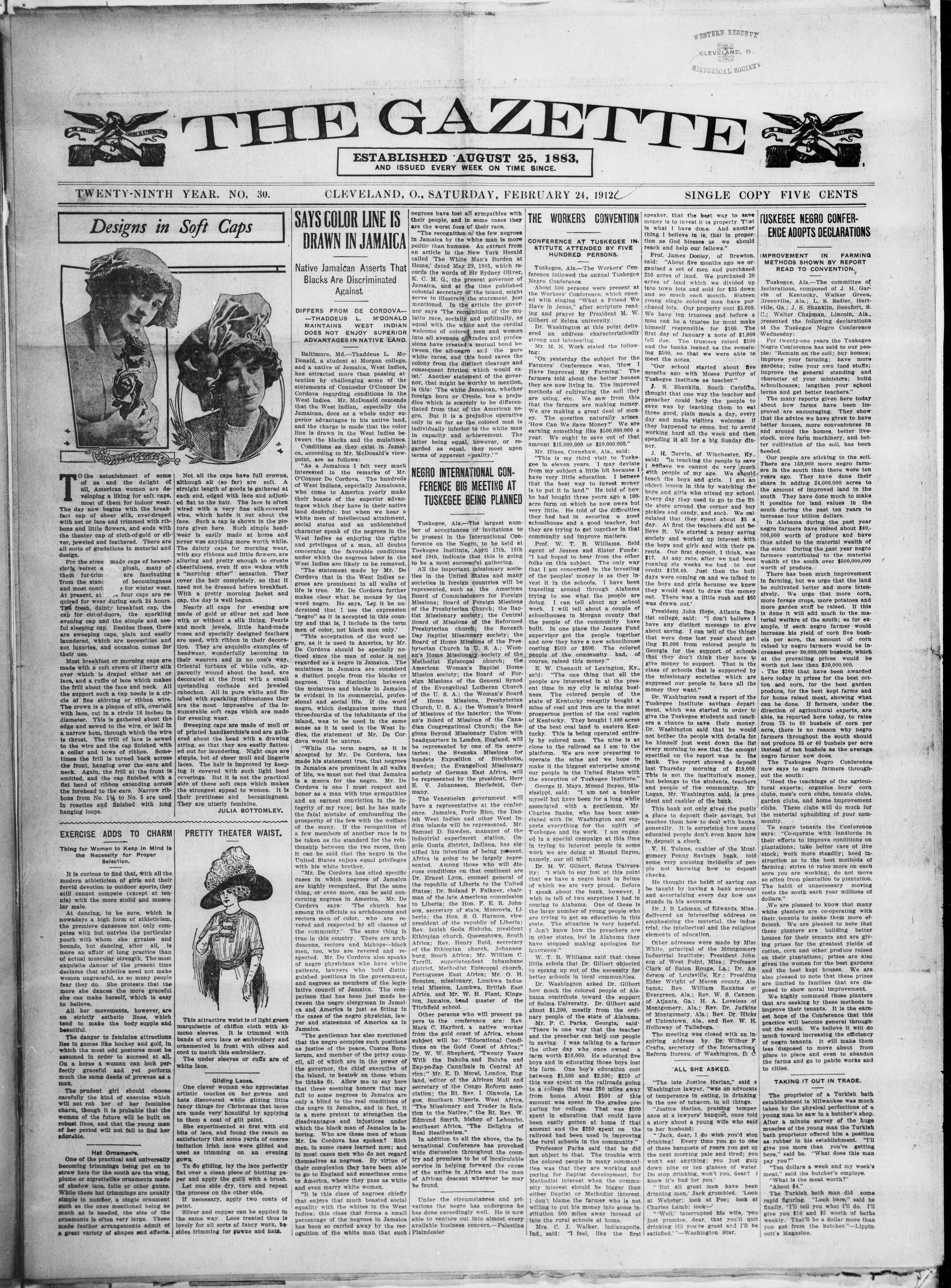
TO the astonishment of some of us and the delight of all, American women are developing a liking for soft caps, most of them for indoor wear. The day now begins with the breakfast cap of sheer silk, over-draped with net or lace and trimmed with ribbons and little flowers, and ends with the theater cap of cloth-of-gold or silver, jeweled and feathered. There are all sorts of gradations in material and design.
For the stree made caps of beaver-cloth, velvet plush, many of them fur-trim are fascinating from the stance of becomingness and most comfort for winter wear. At present, at four caps are required for wear during each 24 hours. The fresh, dainty breakfast cap, the cap for out-of-doors, the sparkling evening cap and the simple and useful sleeping cap. Besides these, there are sweeping caps, plain and easily laundered, which are necessities and not luxuries, and occasion comes for their use.
Most breakfast or morning caps are made with a cott crown of liberty silk over which is draped either net or lace, and a ruffle of lace which makes the frill about the face and neck. All the support such a cap needs is a circle of fine shirring or ribbon wire. The crown is a plaque of silk, overlaced with lace, cut in a circle 18 inches in diameter. This is gathered about the edge and sewed to the wire, or laid in a narrow hem, through which the wire is thrust. The frill of lace is sewed to the wire and the cap finished with a collar and bows of ribbon. Sometimes the frill is turned back across the front, hanging over the ears and neck. Again, the frill at the front is omitted, and the cap finished with a flat band of ribbon extending across the forehead to the ears. Narrow ribbons from No. 1½ to No. 5 are used in rosettes and finished with long hanging loops.
Thing for Women to Keep In Mind Is the Necessity for Proper Selection.
It is curious to find that, with all the modern athleticism of girls and their fervid devotion to outdoor sports, they still cannot compete (except at tennis) with the more stolid and muscular male.
At dancing, to be sure, which is nowadays a high form of athleticism, the premiere danseuse not only competes with but outlines the particular youth with whom she gyrates and bounds, but dancing, after all, is more an affair of long practice than of actual muscular strength. The most exquisite dancer of the present time declares that athletics need not make women ungraceful, as so many people fear they do. She protests that the more she dances the more graceful she can make herself, which is easy to believe.
All her movements, however, are on strictly esthetic lines, which tend to make the body supple and beautiful.
The danger to feminine attractions lies in games like hockey and golf, in which the most odd postures must be assumed in order to succeed at all. On a horse a woman can look perfectly graceful and yet perform much the same deeds of prowess as a man.
The prudent girl should choose carefully the kind of exercise which will not rob her of her feminine charm, though it is probable that the woman of the future will be built on robust lines, and that the young man of her period will not fail to find her adorable.
Hat Ornaments
One of the practical and universally becoming trimmings being put on to straw hats for the south are the wing, plume or igrettelike ornaments made of shadow lace, tulle or other gauze. While these hat trimmings are usually simple in number, a single ornament such as the ones mentioned being as much as is needed, the size of the ornaments is often very large. These made feather arrangements admit of a great variety of shapes and effects.
THE GAZETTE
Not all the caps have full crowns, although all (so far) are soft. A straight length of goods is gathered at each end, edged with lace and adjusted flat to the hair. The lace is often wired with a very fine silk-covered wire, which holds it out about the face. Such a cap is shown in the picture given here. Such simple headwear is easily made at home and never was anything more worth while. The dainty caps for morning wear, with gay ribbons and little flowers, are alluring and pretty enough to create cheerfulness, even if one wakes with a "morning after" sensation. They cover the hair completely, so that it need not be dressed before breakfast. With a pretty morning jacket and cap, the day is well begun.
Nearly all caps for evening are made of gold or silver net and lace with or without a silk lining. Pearls and mock jewels, little hand-made roses and specially designed feathers are used, with ribbon in their decoration. They are exquisite examples of headwear, wonderfully becoming to their wearers and in no one's way. Oriental turbans of white tulle, apparently wound about the head, are decorated at the front with a small upstanding cochade and jeweled capochon. All in pure white and finished with sparkling rhinestones they are the most impressive of the innumerable soft caps which are made for evening wear.
Sweeping caps are made of mull or of printed handkerchiefs and are gathered about the head with a drawing string, so that they are easily flattened out for laundering. Night caps are simple, but of sheer mull and lingerie laces. The hair is improved by keeping it covered with such light head coverings. But it is not the practical side of these soft caps which makes the strongest appeal to women. It is their prettiness and becomingness. They are utterly feminine.
JULIA BOTTOMLEY.
This attractive waist is of light green marquisette of chiffon cloth with klimo sleeves. It is trimmed with bands of ecru lace or embroidery and ornamented in front with olives and cord to match this embroidery.
The under sleeves or cuffs are of white lace.
Gliding Laces.
One clever woman who appreciates artistic touches on her gowns and hats discovered while gliding little fancy things for Christmas that laces are made very beautiful by applying to them a coat of gilt paint.
She experimented at first with old bits of lace and found the result so satisfactory that some yards of coarse imitation Irish lace were gilded and used as trimming on an evening gown.
To do gilding, lay the lace perfectly flat over a clean piece of blotting paper and apply the gullt with a brush.
Let one side dry, turn and repeat the process on the other side.
If necessary, apply two coats of paint.
Silver and copper can be applied in the same way. Lace treated thus is lovely for all sorts of fancy work, besides trimming for gowns and hats.
ESTABLISHED AUGUST 25, 1883 AND ISSUED EVERY WEEK ON TIME SINCE.
CLEVELAND, O., SATURDAY, FEBRUARY 24, 1912
SAYS COLOR LINE IS DRAWN IN JAMAICA
SAYS COLOR LINE IS DRAWN IN JAMAICA
Native Jamaican Asserts That Blacks Are Discriminated Against.
DIFFERS FROM DE CORDOVA—THADDEUS L. M'DONALD MAINTAINS WEST INDIAN DOES NOT ENJOY SUPERIOR ADVANTAGES IN NATIVE LAND.
Baltimore, Md.—Thaddeus L. McDonald, a student at Morgan college, and a native of Jamaica, West Indies, has attracted more than passing attention by challenging some of the statements of Counselor O'Connor De Cordova regarding conditions in the West Indies. Mr. McDonald contends that the West Indian, especially the Jamaican, does as a whole enjoy superior advantages in his native land, and the charge is made that the color line is drawn in the West Indies between the blacks and the mulattoes. Conditions as they exist in Jamaica, according to Mr. McDonald's viewpoint, are as follows:
"As a Jamaican I felt very much interested in the remarks of Mr. O'Connor Dordova. The hundreds of West Indians, especially Jamaicans, who come to America yearly make their boasts of the superior advantages which they have in their native land doubtful; but when we hear a white men of intellectual attainment, social status and an unblemished character speak of the negroes in the West Indies as enjoying the rights and privileges of a man, all doubts concerning the favorable conditions under which the negroes labor in the West Indies are likely to be removed.
"The statement made by Mr. De Cordova that in the West Indies negroes are prominent in all walks of life is true. Mr. De Cordova further makes clear what he means by the word negro. He says, 'Let it be understood that I use the expression "negro" as it is accepted in this country and that is, I include in the term men of color, not black men only.' "This acceptance of the word negro, as it is used in America, by Mr. De Cordova should be specially noticed since the man of color is not regarded as a negro in Jamaica. The mulattoes in Jamaica are consider a distinct people from the blacks or negroes. This distinction between the mulattoes and blacks in Jamaica is evident in its commercial, professional and social life. If the word negro, which designates more than four-fifths of the inhabitants of the island, was to be used in the same sense as it is used in the West Indies, the statement of Mr. De Cordova would be untrue.
"While the term negro, as it is accepted by Mr. De Cordova, has made his statement true, that negroes in Jamaica are prominent in all walks of life, we must not feel that Jamaica is a mecca for the negro. Mr. De Cordova is one I must respect and honor as a man with true sympathies and an earnest conviction in the integrity of my race; but he has made the fatal mistake of confounding the prosperity of the few with the welfare of the many. If the recognition of a few members of another race is to be taken as the standard for the relationship between the two races, then it can be said that the negro in the United States enjoys equal privileges with his white brother.
"Mr. De Cordova has cited specific cases in which negroes of Jamaica are highly recognized. But the same thing, or even more, can be said concerning negroes in America. Mr. De Cordova says: "The church has among its officials as archdeacons and rectors men of color, who are revered and respected by all classes of the community." The same thing is true in this country. There are archdeacons, rectors and bishops—black men, too, who are revered and respected. Mr. De Cordova also speaks of negro physicians who have white patients, lawyers who hold distinguished positions in the government, and negroes as members of the legislative council of Jamaica. The comparison that has been just made between the negro clergyman in Jamaica and America is just as fitting in the cases of the negro physician, lawyer and statesman of America as in Jamaica.
"The gentleman has also mentioned that the negro occupies such positions as justice of the peace, Custos Rotulorum, and member of the privy council, all of which are in the power of the governor, the chief executive of the island, to bestow on those whom he thinks fit. Allow me to say here that these seeming honors that may fall to some negroes in Jamaica are only a blind to the real conditions of the negro in Jamaica, and in fact, it is a mere pretext to strengthen the disadvantages and injustices under which the black man of Jamaica is laboring. Who are these men of whom Mr. De Cordova has spoken? Rich men, in some cases learned men; and in most cases men who do not regard themselves as negroes. By virtue of their complexion they have been able to go to England and sometimes come to America, where they pass as white and even marry white women.
"It is this class of negroes chiefly that enjoys that much boasted social equality with the whites in the West Indies; this class that forms a small percentage of the negroes in Jamaica has been so carried away by the recognition of the white man that such
negroes have lost all sympathetic with their people, and in some cases they are the worst foes of their race.
"The recognition of the few negroes in Jamaica by the white man is more politic than humane. An extract from an article in the New York Herald called The White Man's Burden at Home, dated May 29, 1905, which records the words of Sir Sydney Oliver, K. C. M. G., the present governor of Jamaica, and at the time published colonial secretary of the island, might serve to illustrate the statement just mentioned. In the article the governor says The recognition of the mulatto race, socially and politically, as equal with the white and the cordial welcome of colored men and women into all avenues of trades and professions have created a mutual bond between the all-negro and the pure white races, and this bond saves the colony from the distinct cleavage and consequent friction which would exist. Another statement of the governor, that might be worthy to mention, is this: The white Jamaican, whether foreign born or Creole, has a prejudice which is scarcely to be differentiated from that of the American negro. But it is a prejudice operative only in so far as the colored man is individually inferior to the white man in capacity and achievement. The latter being equal, however, or regarded as equal, they meet upon terms of apparent equality."
NEGRO INTERNATIONAL CONFERENCE BIG MEETING AT TUSKEGEE BEING PLANNED
Tuskegee, Ala.—The largest number of acceptances of invitations to be present in the International Conference on the Negro, to be held at Tuskegee Institute, April 17th, 18th and 19th, indicate that this is going to be a most successful gathering.
All the important missionary societies in the United States and many societies in foreign countries will be represented, such as the American Board of Commissioners for Foreign Missions; Board of Foreign Missions of the Presbyterian Church; the Baptist Missionary society; the Central Board of Missions of the Reformed Presbyterian church; the Seventh Day Baptist Missionary society; the Board of Home Missions of the Presbyterian Church in U. S. A.; Woman's Home Missionary society of the Methodist Episcopal church; the American Woman's Baptist Home Mission society; the Board of Foreign Missions of the General Synod of the Evangelical Lutheran Church of the U. S. A.; the Woman's Board of Home Missions, Presbyterian Church, U. S. A.; the Woman's Board of Missions of the Interior; the Women's Board of Missions of the Canadian Congregational Church; the Regions Beyond Missionary Union with headquarters in London, England, will be represented by one of its secretaries; the Swenska Missions for bundets Exposition of Stockholm, Sweden; the Evangelical Missionary society of German East Africa, will be represented by the president, Herr E. V. Johanssen, Bierlefeld, Germany.
The Venezuelan government will have a representative at the conference, Jamaica, Porto Rico, the Danish West Indies and other West Indian islands will be represented. Mr Samuel D. Bawden, manager of the industrial experiment station, Ongole Gunta district, Indiana, has signified his intention of being present. Africa is going to be largely represented. Among those who will discuss conditions on that continent are Dr. Ernest Lyon, counsel general of the republic of Liberia to the United States; Dr. Roland P. Falkner, chairman of the late American commission to Liberia; the Hon. F. E. R. Johnson, secretary of state, Monrova, Liberia; the Hon. S. G. Harmon, vice president of the republic of Liberia; Rev. Isiah Goda Sishuba, president Ethiopian church, Queenstown, South Africa; Rev. Henry Reynold, secretary of the Ethiopian church, Johannesburg, South Africa; Mr. William C. Terrill, superintendent Inhambane district, Methodist Episcopal church, Portuguese East Africa; Mr. O. H. Scouten, missionary, Lumbwa Industrial Mission, Lumbwa, British East Africa, and Mr. W. H. Plant, Kingston, Jamaica, bead master of the Titchfield school.
Other persons who will present papers to the conference are: Rev. Mark C. Hayford, a native worker from the gold coast of Africa, whose subject will be: "Educational Conditions on the Gold Coast of Africa." Dr. W. W. Shepherd, "Twenty Years With the Bakuba and Baluba and Zapo-Zap Cannibals in Central Africa." Mr. E. D. Morel, London, England, editor of the African Mall and secretary of the Congo Reform association; the Rt. Rev. I. Olnwole, Lagos, Southern Nigeria, West Africa, "The Missionary and Trader in Relation to the Native;" the Rt. Rev. W. Edmund Smyth, bishop of Lebombo, southeast Africa, "The Delights of Real Heathenism."
In addition to all the above, the International Conference has provoked wide discussion throughout the country and promises to be of calculable service in helping forward the cause of the native in Africa and the man of African descent wherever he may be found.
Under the circumstances and privations the negro has undergone he has done exceedingly well. He is now able to venture out into almost every available business concern.—Palestine Palindaler
WORKERS CONVENTION
CONFERENCE AT TUSKEGEE INSTITUTE ATTENDED BY FIVE HUNDRED PERSONS.
Tuskegee, Ala.—The Workers' Conference followed the annual Tuskegee Negro Conference.
About 500 persons were present at the Workers' Conference, which opened with singing "What a Friend We Have in Jesus," after scripture reading and prayer by President M. W. Gilbert of Selma university.
Dr. Washington at this point delivered an address characteristically strong and interesting.
Mr. M. N. Work stated the following:
"On yesterday the subject for the Farmers' Conference was, 'How I Have Improved My Farming.' The farmers told about the better houses they are now living in. The improved methods of cultivating the soil they are using, etc. We saw from this that the farmers are making money. We are making a great deal of money. The question naturally arises, 'How Can We Save Money?' We are earning something like $500,000,000 a year. We ought to save out of that amount $15,000,000 or $20,000,000." Mr. Hines, Crenshaw, Ala., said: "This is my third visit to Tuskegee in eleven years. I may deviate from my subject a little bit because I have very little education. I believe that the best way to invest money is to put it in land." He told of how he had bought three years ago a 100-acre farm on which he now owes but very little. He told of the difficulties they had had in securing a good schoolhouse and a good teacher, but they are trying to get together in that community and improve matters.
Prof. W. T. B. Williams, field agent of Jeanes and Slater Funds: "I had hoped to hear from the other folks on this subject. The only way that I am concerned in the investing of the peoples' money is as they invest it in the schools. I have been traveling around through Alabama trying to see what the people are doing. I can tell about my school work. I will tell about a couple of schoolhouses in Morgan county that the people of the community have built. In one place the Jeanes Fund supervisor got the people together and now they have a new schoolhouse costing $500 or $600. The colored people of the community had, of course, raised this money." E. W. Chenault of Lexington, Ky., said: "The one thing that all the people are interested in at the present time in my city is mining business. The colored people of the state of Kentucky recently bought a mine of coal and iron ore in the most prosperous portion of the coal region of Kentucky. They bought 1,400 acres of the best coal land in eastern Kentucky. This is being operated entirely by colored men. The mine is as close to the railroad as I am to the platform. We are now preparing to operate the mine and we hope to make it the biggest enterprise among our people in the United States with the exception of Tuskegee Institute."
George H. Mays, Mound Bayou, Mississippi, said: "I am not a banker myself but have been for a long while associated with a gentleman, Mr Charles Banks, who has been associated with Dr. Washington and supports everything for the uplift of Tuskegee and its work. I am engaged in a special campaign at this time in trying to interest people in some work we are doing at Mound Bayou, namely, our oil mill." Dr. M. W. Gilbert, Selma University; I wish to say just at this point that we have a negro bank in Selma of which we are very proud. Before I speak about the bank, however, I wish to tell of two surprises I had in coming to Alabama. One of these is the large number of young people who are trying to get an education in this state. The situation is very hopeful. I don't know how the preachers are in other states, but in Alabama they have stopped making apologies for ignorance." W. T. B. Williams said that these little schools that Dr. Gilbert objected to sprang up out of the necessity for better schools in local communities.
Dr. Washington asked Dr. Gilbert how much the colored people of Alabama contribute toward the support of Selma University. Dr. Gilbert said about $1,200, mostly from the ordinary people of the state of Alabama. Mr. P. C. Parks, Georgia, said: "There is one way that the teacher and the preacher can help our people in saving. I was talking to a farmer the other day who once owned a farm worth $10,000. He educated five boys and in educating those boys lost his farm. One boy's education cost between $1,500 and $2,500; $250 of this was spent on the railroads going to a college that was 250 miles away from home. About $500 of this amount was spent in the grades preparing for college. That was $500 spent in education that could have been easily gotten at home if that amount and the $250 spent on the railroad had been used in improving the rural schools in the community." Professor Parks said that he did not object to that. The trouble with the colored people in many communities was that they are working and paying for Baptist development, for Methodist interest when the community interest should be bigger than either Baptist or Methodist interest. I don't blame the farmer who is not willing to put his money into some institution 500 miles away instead of into the rural schools at home. Mrs. C. J. Walker, Indianapolis, Ind. said: "I feel, like the first
SINGLE COPY FIVE CENTS
WESTERN RESERVE
CLEVELAND, O.
HISTORICAL SOCIETY.
speaker, that the best way to save money is to invest it in property. That is what I have done. And another thing I believe in is, that in proportion as God blesses us we should reach and help our fellows."
Prof. James Dooley, of Brewton, said: "About five months ago we organized a set of men, and purchased 250 acres of land. We purchased 30 acres of land which we divided up into town lots and sold for $35 down and so much each month. Sixteen young single colored men have purchased lots. Our property cost $5,000. We have ten trustees and before a man can be a trustee he must make himself responsible for $100. The first day of January a note of $1,000 fell due. The trustees raised $500 and the banks loaned us the remaining $500, so that we were able to meet the notes.
"Our school started about five months ago with Moses Purifoy of Tuskegee Institute as teacher."
J. S. Shanklin, South Carolina, thought that one way the teacher and preacher could help the people to save was by teaching them to eat three good, plain meals a day, every day and make visitors welcome if they happened to come, but to avoid working hard all the week and then spending it all for a big Sunday dinner.
J. H. Garvin, of Winchester, Ky. said: "In teaching the people to save I believe we cannot do very much with people of my age. We should teach the boys and girls. I got an object lesson in this by watching the boys and girls who attend my school. Every day they used to go to the little store around the corner and buy pickles and candy, and such. We calculated that they spent about $5 a day. At first the teachers did not believe it. We started a penny saving society and worked up interest with the boys and girls and with their parents. Our first deposit, I think, was $17. At any rate, after we had been running six weeks we had to our credit $136.40. Just then the holidays were coming on and we talked to the boys and girls because we knew they would want to draw the money out. There was a little rush and $60 was drawn out."
President John Hope, Atlanta Baptist college, said: "I don't believe I have any distinct message to give about saving. I can tell of the things that were done last year about getting $5,000 from colored people in Georgia for the support of schools that they don't think they have to give money to support. That is the class of schools that is supported by the missionary societies which are supposed our people to have all the money they want."
Dr. Washington read a report of the Tuskegee Institute savings department, which was started in order to give the Tuskegee students and teachers a chance to save their money. Dr. Washington said that he would not bother the people with details for he himself just went down the list every morning to see that the amount specified on the report was in the bank. The report showed a deposit last Thursday morning of $19,000. This is not the institution's money, but belongs to the students, teachers and people of the community. Mr Logan, Mr Washington said, is president and cashier of the bank.
This bank not only gives the pupils a place to deposit their savings, but teaches them how to deal with banks generally. It is surprising how many educated people don't even know how to, deposit a check.
V. H. Tulane, cashier of the Montgomery Penny Savings bank, told some very amusing incidents of pee ple not knowing how to deposit checks.
He thought the habit of saving can be taught by having a bank account and ascertainting every day how one stands in his accounts.
Dr. J. B. Lehman, of Edwards, Miss. delivered an interesting address on emphasizing the material, the industrial, the intellectual and the religious elements of education.
Other adresses were made by Miss White, principal of the Montgomery Industrial Institute; President Johnson of West Point, Miss.; Professor Clark of Baton Rouge, La.; Dr. Anderson of Louisville, Ky.; Presiding Elder Wright of Macon county, Alabama; Rev. William Rankins of Evergreen, Ala.; Rev. W. S. Cannon of Atlanta, Ga.; H. A. Loveless of Montgomery, Ala.; Rev. Dr. Judkins of Montgomery, Ala.; Rev. Dr. Hicks of Uniontown, Ala., and Rev. W. H. Holloway of Talladega.
The meeting was closed with an inspiring address by Dr. Wilbur F Crafts, secretary of the International Reform Bureau, of Washington, D. C
'ALL SHE ASKED
"The late Justice Harlan," said a Washington lawyer, "was an advocate of temperance in eating, in drinking in the use of tobacco, in all things." "Justice Harlan, praising temperance at a lawyers' banquet, once told a story about a young wife who said to her husband: "Jack, dear, I do wish you'd stop drinking! Every time you go to one of these banquets of yours you get up the next morning pale and tired; you won't eat anything; you just gulp down nine or ten glasses of water. Do stop drinking, won't you, dear? I know it's bad for you." "But all great men have been drinking men; Jack grumbled. 'Look at Webster; look at Poe; look at Charles Lamb; look—" "Well, interrupted his wife, 'you just promise, dear, that you'll quit drinking till you are great and I'll be satisfied.'"—Washington Star.
THE EAGLE
SINCE 1850
TUSKEGEE NEGRO CONFERENCE ADOPTS DECLARATIONS
IMPROVEMENT IN FARMING METHODS SHOWN BY REPORT READ TO CONVENTION.
Tuskegee, Ala.—The committee of declarations, composed of J. H. Garvin of Kentucky, Walker Green, Greenville, Ala.; L. S. Sadler, Hartville, Ga.; J. S. Shanklin, Beaufort, S. C.; Walter Chapman, Lincoln, Ala., presented the following declarations at the Tuskegee Negro Conference Wednesday:
For twenty-one years the Tuskegee Negro Conference has said to our people: "Remain on the soil; buy homes; improve your farming; have more gardens; raise your own food stuff; improve the general standing and character of your ministers; build schoolhouses; lengthen your school terms and get better teachers."
The many reports given here today about how farms have been improved are encouraging. They show that the advice we have given to have better houses, more conveniences in and around the homes, better livestock, more farm machinery, and better cultivation of the soil, has been heeded.
Our people are sticking to the soil. There are 150,000 more negro farmers in the south than there were ten years ago. They have done their share in adding 24,000,000 acres to the amount of improved land in the south. They have done much to make it possible for land values in the south during the past ten years to increase four billion dollars.
In Alabama during the past year negro farmers have raised about $400,000,000 worth of produce and have thus added to the material wealth of the state. During the past year negro farmers contributed to the material wealth of the south over $500,000,000 worth of produce.
There has been much improvement in farming, but we urge that the land be cultivated better and more intensively. We urge that more corn, more forage crops, more potatoes and more garden stuff be raised. If this is done it will add much to the material welfare of the south; as for example, if each negro farmer would increase his yield of corn five bushels per acre, the amount of corn raised by negro farmers would be increased over 30,000,000 bushels, which at the prevailing prices would be worth not less than $30,000,000.
The $260 that have been awarded here today in prizes for the best cotton and corn, for the best garden produce, for the best kept farms and for home raised meat, showing what can be done. If farmers, under the direction of agricultural experts, are able, as reported here today, to raise from 75 to 80 bushels of corn per acre, there is no reason why negro farmers throughout the south should not produce 35 or 40 bushels per acre instead of ten bushels as the average negro farmer now does.
The Tuskegee Negro Conference now says to negro farmers throughout the south:
"Heed the teachings of the agricultural experts; organize boys' corn clubs, men's corn clubs, tomato clubs, garden clubs, and home improvement clubs. These clubs will do much for the material upbuilding of your community.
To negro tenants the Conference says: "Co-operate with landlords in their efforts to improve conditions on plantations; take better care of live stock; work more steadily; heed instruction as to the best methods of farming; strive to raise more on each acre you are working; do not move so often from plantation to plantation.
The habit of unnecessary moving costs the south each year millions of dollars."
We are pleased to know that many white planters are co-operating with their tenants to make them more efficient. We are pleased to note that these planters are building better houses for their tenants and are giving prizes for the greatest yields of cotton, corn and other produce raised on their plantations; prizes are also given the women for the best gardens and the best kept houses. We are also pleased to note that these prizes are limited to families that are disposed to show moral improvement.
We highly commend those planters that are seeking by these methods to improve their tenants. It is the earnest hope of the Conference that this practice will become general throughout the south. We believe it will do much toward increasing the efficiency of negro tenants. It will make them less disposed to move about from place to place and even to abandon the farms and go to public works and to cities.
TAKING IT OUT IN TRADE
The proprietor of a Turkish bath establishment in Milwaukee was much taken by the physical perfections of a young man he saw in a butcher's shop. After a minute survey of the huge muscles of the young man the Turkish bath proprietor offered him a position as rubber in his establishment. "I'll give you more than you're getting here," said be. "What does this man pay you?" "Ten dollars a week and my week's meat," said the butcher's employee. "What is the meat worth?" "About $4." The Turkish bath man did some rapid figuring. "Look here," said he finally. "Tell you what I do. I'll give you $10 and $5 worth of baths weekly. That'll be a dollar more than you get from the butcher."—Lippincott's Magazine.
THE GAZETTE
PUBLISHED EVERY SATURDAY
SUBSCRIPTION RATES
(In Advance)
One Year.....$1.50
Six Months.....1.00
Three Months......50
Subscribers are requested to
remit by postoffice money or
order or registered letter.
Entered at the postoffice in Cleveland
Ohio, as second-class matter
Address all communications to
HARRY C. SMITH
Editor and proprietor,
THE GAZETTE,
Blackstone Building, Cleveland, O.
Member Ohio Legislature: 1894
to 1895; 1896 to 1898; 1900 to 1902
THE GAZETTE is the oldest, and has the largest bona fide circulation, double that of any newspaper in the Interest of Afro-Americans, published in the state of Ohio, and comparison with any will immediately establish its rank as one of the NEWSIEST AND BEST in the country.
The South is very busy—lynching. Nothing new, you say; but there are more notoriously innocent men, women and children victims of color, these days than ever before, we verily believe.
President Taft has appointed Chancellor Pitney of New Jersey, as Justice Harlan's successor, in the U. S. Supreme Court. Who knows whether Mr. Pitney is any more friendly to our people's rights than Judge Hook is? Both Hook and Taft have shown themselves anything but friends of the race.
Under Nathaniel C. Wright, editor-in-chief, the Daily Leader of this city, is "ringing loud and true", again, as it did in the days of the great Edwin C. Cowles. Help us Editor Wright and continue to treat us right, and we will do our part, not only in this moral uplift movement in the 11th, ward and the entire city, but also by the Cleveland Daily Leader. There are at least 20,000 Afro-Americans in this city, now.
The man who suffers personal wrong without protest or opposition, the "peaceful" member of the community, is a demoralizing factor in our social fabric. The class that does not struggle for civic and industrial rights will eventually lapse into slavery. The nation that passively countenances encroachments upon its rights and territory is doomed to dismemberment and national bankruptcy. It is the man who defends his rights, the class that battles for political and industrial advancement, and the nation that holds its own against the entire world; it is the "litigious" person, the revolutionary class, and the vigilant nation, that keep the world from stagnation and force it onward on the path of progress—Hillquit.
Ohio Afro-Americans continue "to sleep on their rights". See The Gazette's Columbus letter elsewhere in this paper. Absolutely nothing has been done by our people or anyone else to help Delegate Cunningham get his resolution, known as "Proposal N.5", out of the Ohio Constitutional Convention committee to which it was consigned on Jan. 17, 1912—so he informed the editor of The Gazette on Wednesday of this week. SHAME! What is the matter with our people in this state, these days, anyhow? Don't they want the "right" to vote and to enter the state's military after the new state constitution is made and accepted by the voters of Ohio? Don't they want Ohio citizenship? Really they are, apparently, "past understanding."
The American daily newspaper in Havana, Cuba, known as the Telegraph, ignoring the fact that one-third of the population of that island republic are Colored, has in its issue of Feb. 11, 12, a column and a quarter triple-leaded editorial in which it tries to array Afro-Americans against the Cubans in general because some misguided Cuban paper in Havana recently called for our exclusion from that country. An effort is being made to make the Cubans believe that a wholesale emigration of Afro-Americans to their country is soon to take place in an effort to help the Americans "gobble up" their little country. Naturally and easily irritated along this particular line, it is very natural that at least one Cuban paper "would lose its head" and publish such unnecessary "stuff" as the demand for exclusion referred to. Afro-Americans, however, refuse to "bite" at the Telegraph's "bait" and thus be led into making a somewhat similar blunder to that of the Cuban paper, and also become the "tools" of designing Americans of wealth and power in the business world of both this country and Cuba, as said Cuban paper has unconclusively.
The Shiloh Baptist church mass meeting, last Sunday afternoon, was an unqualified success. Good results have been accomplished already, as a result of it. Now let our Ministers' Association and Law & Order Reform league push the effort for a marked improvement in the miserable moral conditions existing in the 11th ward, particularly along Central Av., and in adjacent streets. The Citizens' Rights league is to be thanked by our people of the city for their splendid and most successful effort, of Sunday last, to help in the matter. The committee, appointed by the mass meeting, Sunday afternoon, called upon Mayor Newton D. Baker, Wednesday morning, as instructed, and had a very satisfactory conference with him. What is first and most needed for that section of the city, in this moral reform movement, is better police protection and greater police activity. Without this, little can be accomplished. We believe that the Mayor will see that this is forthcoming and promptly, too. Our people have done two good things,
in addition, as a result of the meeting and its publications in the daily papers immediately preceding it, and they are: To notify all persons in this city that they have been for more than a year, and are trying to better conditions in the 11th. ward.
COLORED CITIZENS ASK JUSTICE.
The following editorial from the Cleveland Daily Leader of Tuesday, is self-explanatory and too good and opportune for The Gazette to fall to republic:
"The committee of Colored citizens chosen to ask Mayor Baker to do something to save them from the shame and dangers and evil inherent in existing conditions in and near the western part of Central avenue has every right to full consideration because the wrongs against which it protests are grave and increasing. Decent families are finding their homes made almost intolerable by the disorder and obscenity permitted in the vicinity of many private residences. Remonstrance means insult and often violence.
"There is no doubt that a disorderly and demoralizing element in the lower Central avenue district has become emboldened by years of comparative immunity from police molestation, and it is now so aggressive and so shameless that it must be subdued and brought under strict control if justice is to be done to a large body of law-abiding and hard-working citizens living in that vicinity. The municipal government has let things drift so long in that quarter that it may find the task of uprooting old evils as arduous as it is disagreeable, but there is no other way out which is not dishonorable to Cleveland."
Splendidly and correctly stated, Edd itor Wright and we sincerely thank you for it.
A SPLENDID VICTORY.
The Gazette desires to compliment the Baltimore (Md.) Afro-American. Ledger on the splendid and successful fight it led, in recent weeks, to have wiped out the jim-crow wait rooms, and under the road, established some weeks flicials of the B. & O. Railgo at its Camden St., station in city. The President of the B. & O. ordered the removal of the insulting and unnecessary discrimination, as soon as his attention was called to it and he had time to view them. More power to you, Editor Murphy, and your kind of fearless, many, loyal and aggressive Afro-American. O, how we need more of them, these days! The pernicious doctrine of surrender (of our rights and privileges, under the law and as American men and women) to the prejudiced, which some of our weak-kneed so-called "leaders" and many of their weaker followers have been so insidiously preaching in recent years, must be stamped out as quickly as possible, or our progress to full, free and untrammeled American citizenship will be practically killed. It has already been seriously impeded by the cowardly and traitorous doctrine. Nothing is so encouraging to those who are trying to fight down all sorts of insulting, degrading and unnecessary discrimination (against the race) that impair our rights and privileges (particularly in public places) as citizens and as American men and women, as such pronounced victories as this Baltimore one. We congratulate our people of that city, and urge them, everywhere, to fight in a proper way every inch of the ground for all that we are entitled to under the law and as American men and women. We must be more aggressive in contending for our rights, privileges and proper treatment.
McVey to Box Barry
Sydney, Australia.—Sam McVey, the California pugilist and heavyweight champion of Australia, has signed articles for a match with James Barry (white) the Chicago heavyweight, to be fought on March 9 and also for a match with Sam Langford, the Nova Scotian pugilist and heavyweight champion of England, to be fought on Easter Monday, April 8.
SLAY 29 IN CRIME SERIES
A Woman, Her Son and Two Daughters Killed With an Ax.
Beaumont, Tex. Feb. 19.—The seventh of a series of crimes in which twenty-nine Negroes have been murdered, occurred near here early this morning. Ethel Love, her son and two daughters were slain as they slept in their cabin. The murders have occurred in southwestern Louisiana and southeastern Texas and in each instance have been committed with an ax and often after each killing the ax has been left near the bodies. Authorities believe the same persons are responsible and several persons have been arrested but evidence to hold that they were five people killed at Rayne, La., at one time; seven at Crowley, La., and eight at Lafayette, La., each of which was visited twice, five at Lake Charles, La., and four at Beaumont.
B. & O. "Jim-Crow" Signs Down.
Baltimore, Md.-Irrate public-spirited Colored citizens of Baltimore, led by the veteran Afro-American Ledger editor, John N. Murphy, have won their fight for the abolition of "jim-crow" accommodations at the Camden station of the Baltimore & Ohio Railroad. Mr. Daniel Willard, president of the company, made a personal inspection of the matter and ordered that the discrimination be abolished.
CORRESPONDENTS WANTED
The old reliable Gazette desires an active agent and correspondent in every city and town in Ohio and neighboring states having a number of Afro-American residents. Only a little time on Fridays or Saturdays is required.
We are especially desirous of hearing from persons in the following states, Newark, Lancaster, Lebanon, Chillicotte, Toledo, Troy, Akron, Springfield, Plaqu, Columbus, Cambridge, Steubenville, Bellaire, St. Clairville, Wilmington, Portmouth, Washington, C. H., Oxford, Sabina, Gallipolis, Oberlin, Urbana, Delaware, M. Vernon, East Liverpool, Wellsville, Hamilton, Middleport, Bellefontaine, Lima, O., and other places where we have none.
Write to the editor of The Gazette, Blackstone building, Cleveland, O., and terms will be sent promptly. Our mail will oblige us greatly by sending at once the addresses of persons in the cities named above, or others, to whom we can write relative to the matter.
THE GAZETTE, CLEVELAND, O. SATURDAY, FEBRUARY 24, 1912
ASK CLEAN-UP OF DIVES.
Mass Meeting Protections at Conditions
Along Central Avenue Being Per-
formed
Eight hundred Negroes, assembled in a mass meeting in Shiloh Baptist Church, E. 30th street, Sunday afternoon, denounced the dives and criminal dens which they said* exist in the city, and co-committee to wait on Mayor Baker and try to get the police to clean out the district. The meeting had been called by the Citizens' Rights League, which is endeavoring to assist the Minister's Association and, the Law and Order Reform League, three influential organizations of Negroes, the members of the Committee to assist the Order of Samuel Cornswet on Central avenue by three negro bandits. Speakers at the meeting told of fruitless forts to get the police to drive criminals from the neighborhood. The "golden rule policy" was criticized Hon. rule C. Smith, the editor of The Gleaner, of dives on Central ave where girls of fourteen were taken on, he said.
"Clean Up" Is Asked.
"We want to learn this section of the city," said Mr. Smith. "We want to go on record as being more dissatisfied with conditions morally than any other race. We've got a mayor, I believe, who is a moral man and I hope he will help us. If he does not, then we can hold him responsible and start questioning motives. We want to go to judge Addams and get where the places around us are where young girls are ruined. There are places nearby where they let girls of fourteen and fifteen and young boys do things that are worse than anything you can see anywhere else in this section." Mr. Smith said that there were many places that were ostensibly doing things without dances, etc. were performed by half drunken girls behind locked doors.
Murder After Murder.
U.S. NORTHWEST HURRIS
"I have been here nine years, and murder after murder has been committed in the neighborhood," said Dr. H. C. Bailey. "We have got to stop the criminals, both black and white, from making the city bad for colored people. We have gone to Chief Kohler. He laughed at us. Now we will go to the mayor. Other members were Rev. E. H. Smith, Rev. W. G. Webster, Samuel D. Barrett, Rev. H. M. Lowry, W. H. Smith and Mrs. Blanche Glimere and others. A committee consisting of W. H. Smith, H. C. Gilbert, Rev. E. H. Smith, Rev. W. G. Webster and S. E. Smith, the mayor this week. Baker said last night would talk the situation over with them.
Resolutions Adopted.
WHEREAS—The recent Wednesday evening Central Av., murder again calls the public's attention to the great need of better police protection and greater police activity in the Eleventh Av., especially along Central Av., and
WHEREAS Our Afro-American Law and Order Reform League and Clergymen of Cleveland, repeatedly petitioned Mayor Herman C Baehr and Police Commissioner year, for this better police protection and greater police activity in this section, but in vain, therefore be it RESOLVED—That AfroAmericans of the Eleventh ward of Cleveland, assembled in mass meeting at Shiloh Park, Pennsylvania, this day, Sunday, Feb. 18, 1812, respectfully, Mayor Newton D. Baker to immediately order a “clean-up” of Central Av., and vicinity, of the indolent, vicious and criminal element that has assembled there in the last few years, enticed by the local “GOLDEN RULE” of large cities within a radius of 200 miles and even from Chicago and New York City; and to order better police protection and greater police activity for the 11th, ward, in order that it may no longer be the “dumping-ground” for black and white criminals of Buffalo, Columbus, Chicago, Cincinnati, Detroit, Chicago and New York City. Further be it
RESOLVED—That a committee of five of our leading citizens be appointed by the Chairman of this meeting, representing the 11th., ward of Cleveland, and particularly our Minister's Association, Law & Order Reform League and citizen Rights League, to investigate, report, week, present these resolutions and confer with him, with a view to securing better police protection and greater police activity in said ward, and thus help to materially rid this section of the city, of the indolent, vicious and criminal element that has disgraced it and the city entirely too frequently in recent years with murders, robberies, other crimes and misdemeanors.
RESOLVED—That a copy of these resolutions be sent not only to the Mayor and the Chief of Police, but also to the daily newspapers and our own weekly paper. The Gazette.
Monday's Cleveland Daily Leader.
HERE IT IS!
Fourth Constitutional Convention. Proposal No. 5.
MR. CANNINGHAM.
Proposal
To submit substitute for Article No. 5 of the Constitution.-Relative to elective franchise.
Resolved by the constitutional convention of the state of Ohio. That a proposal shall be submitted to the electors to amend the constitution by substituting for Article 5 of the constitution the following:
Section 1. Every male citizen of the United States of the age of twenty-one years, who shall have been a resident of the state one year next preceding the election, and of the county, township, precinct or ward in which he resides, such time as may be provided by law, shall have the qualification of an elector and be entitled to vote at all elections. But no idiot or insane person shall be entitled to the privilege of election.
Section 2. All elections shall be by ballot, and canvassed in such manner as may be provided by law.
Section 3. Electors during their attendance at elections, and in going to and returning therefrom shall be privileged from arrest in all cases, except treason, felony, intoxication and breach of the peace. Section 4. The general assembly shall pass no诏令 to exclude the privilege of voting of being able to office, any person convicted of bribery, perjury or other infamous crime. Section 5. No person in the military, navy or marine service of the United States shall be being stationed in any garrison or military or naval station within the state, be considered a resident of this state, and in time of war, no elector in the actual military service of the state or of the United States, in the army or navy by reason of his service from his election district; and the lesbian or gay war to vide the manner in which and the time and place at which such absent electors may vote, and for the return and canvass of their votes in the election districts in which they respectively have a residence.
CONSTITUTIONAL CONVENTION
The August Ohio Body Still In Session—Nothing Done on the New State Constitution as Yet—
The Word White Still in the Old One and Likely to Be in the New One.
Wanted—Live Agents
Men and women wanted to intro
duce high grade household specialties
into every home. Quick sales, big
profits. Send for free samples and
catalog. Address, The Household Sup
56 N. Cemetery Athens, Ohio. 31
BOOKER'S GREAT SECRET
OF THE MIND.
The secret of every human being is the power which they possess to influence and control others. It is important that you should know just what powers for good you possess, and the time that you are ignorant of this power may be considered lost time and opportunity, as "time and tide wait on no man. Learn all you can and the knowledge and wisdom dom is power. Isn't it worth trying for? Be frank, send for the secrets, you will find them just what you need to cultivate a charming and pleasing personality. You have got to have some way of attracting people. Do not let the present doubt and darkness obscure the light that is waiting to shine on you, and will shine on you all the balance of your life if you take my advice. We take the Bible as our guide. Now there are diversities of gifts, but the same ones. And there are differences of administrations, but the same Lord.
For to one is given by the spirit the word of wisdom; to another the word of knowledge by the asme spirit.
To another faith by the same spirit; to another the gifts of healing by the same spirit.
But all these worketh that one and the selfsame spirit, dividing to every man severally as he will.
By studying the secrets which I possess, I have and be brought together; broken-hearted wives are relieved of their jealous forebodings; the separated are united and many bad habits cured.
My secrets teach you how to control others; how to speculate; how to succeed in business; how to gain health, wealth and happiness. Just follow the instructions and success and power is yours to have and to hold.
Positively no attention paid to letters unless one dollar is enclosed.
Address all communications to E. Booker, 806 Wylie avenue, Pittsburgh, Pa.
Don't throw away your copy of The Gazette when you have done with it, but give it to some appreciative person whom you feel would be likely to subscribe or take it regularly. They had a copy to look over and read carefully. Oblige the Editors.
BUCKEYE LETTERS
WRITTEN BY "THE OLD RELIA-
BLE" GAZETTE'S CORRE-
SPONDENTS.
THROUGHOUT ONIO
Stewartsville—The first missionary Baptist church in this place has been established with Rev. C. G. Garner in charge. There were eleven charter members and much interest is being shown in the effort by persons of all classes. The officers of the church are: J. W. Alkens, A. M. Caires, deans; J. W. Hutchinson, K. Hutchinson, trustees; Mr. Hutchinson, clerk; and Elder Garner pastor. His subject Sunday morning will be, "The Growth of God's Word."
---
Rendville.—Mrs. Karl Kiser of Columbus, is here visiting relatives.—Our orchestra, composed of Miss Velver Arnold and Mr. Walter Smithers, is visiting the orchestra, evening, which a large crowd attended.—Miss Millie Barnett of Columbus, is visiting her mother.—Miss Eva Doman and Mrs. J. L. Jones are better.—The benefit entertainment, given in the evening, is a evening.—Dolman was a an evening.—Mr. John Kiser underwent an operation at Columbus, last week, and is improving.
Akron—Miss Kathleen Brown of Holldaysburg, Pa., a graduate of Emerson school, Boston, Mass., gave a reception at the A. M. E. Zion church, Monday evening. A large crowd was present to hear Miss Brown. Mr. Frank Hallstock is planning a "mens day" for Mar. 3. The Ladies' Aid society furnished the supper, Monday evening. Rev. Jones went south to Mount Mirel Mare's funeral. Bohol church held an anniversary celebration in honor of its 150th, year. Feb. 18. Give or send the local agent your order for The Gazette. get it every week regularly and keep up to date with the race news.
Sandusky—Miss Ida Blueford, member of the Smart Set Co, was Mrs. Jas, Davis' guest, Tuesday—Emma and Rosis' Garrett left Thursday for Indianapolis, to visit their sister, Mrs. W. Johnson. The A. M. E. revival is progressing nicely—Mr. Henderson who sustained a stroke of paralysis a year ago. Mr. Alexander's leadership of the B. Y. P. U, of the Second Baptist church, shows excellent results—Mrs. H. Richards' daughter is visiting her parents. Mrs. Jefferson, Mrs. Howard and O. B. Shackelford are a little better. The social at J. S. Davis', was a success, last week—Mr. S. Scott is doing fine. There is a bright future for Messrs. Wilson and J. Shadd.
Smithfield.—Mr. D. Christian and family dined with Mrs. E. Harris, Sunday.—Miss Lizzie and Ileen Washington, the former of Steubenville, visiting her mother, spent Sunday evening, with Mrs. H. Harris.—Mesdames with Mrs. H. Harris, with Mrs. A. Palmer, Sunday.—Miss A. Smith of . . . , visited her parents, Sunday.—S. West, I. Tona and other young folk of McIntyre, attended the Valentine social, Wednesday evening.—Mr. and Mrs. H. Parks of Winters.—Mr. and Mrs. N. Pleasants, Sunday.—Mr. H. Jiles of Mt. Pleasants was here Sunday.—Mr. E. Powell, Mr. M. Washington. Misses Viola Carter and Julia M. Veney are convalescing.—Mrs. N. Mitchell, Mrs. V. Carter, Mr. G. Binns and F. Carter attended Mr. Epps funeral in Cadiz.—The A. M. Epps funeral in Cadiz.—A success. The services, Sunday, were well attended, the pastor preaching two able sermons.
Correspondents must mail all letters for publication at their main postoffice sufficiently early on Monday (or Sunday) of each week to have them reach The Gazette office on Tuesday morning, and always write, also, their names and that of their city or town on the outside of the postoffice. Unless this latter is done, proper credit cannot be given you. Lists of names, wedding presents, etc., obituary notices, speeches, resolutions, poetry, inquiries for relatives and advertisements of all kinds, including items announcing entertainments to be held in advance at the rate of ten cents a line, six words to a line. Our rates for display advertisements will be sent on application. Send postal note and not stamps during warm weather.
Lorain—Little Lucille Tates is very ill. Tiphoid fever. Mrs. S. E. Dobson is much better. Mrs. Riley Thompson has the grip. Mrs. Robinson, Mrs. Cotton and Ralph Young are ill. Mr. G. Cotton and Ralph forefinger, last Thursday evening, at the Tube works. The A. M. E. Brotherdah's Lincoln entertainment, Monday evening, was featured by Mr. Douglas' fine paper on the great enunciator契约 and by Mrs. and Miss E. Bennett and R. Bennett in Elyria, last Tuesday. Mr. Virgil Bennett of Oberlin, was the guest of local Masons, last Wednesday evening. The recital and musicale at the Second Baptist church, last Friday evening, was a grand success. Rev. G. Bennett, the pastor of sermons, Sunday, on "Lethargy," it was fine, practical. The large congregation did not want him to conclude.
—Do not forget to give, or send your order for “the old reliable” race advocate and newspaper, *The Gazette*, to the agent Helen Hicks, 407 W. w21st. St. It fights our cause, “in season and out, every inch of the way”, and is our most aggressive paper in Ohio or this section of the country. *
*Youngstown.* —Thos. Black and C. E. Mosely, of Warren, were here Sunday. —Louisa Edwards Court met last Wednesday evening. On the 28th five
When your Gazette are not delivered on Friday mornings, call at your Central Postoffice General Delivery Window for them in the afternoon of the same day. —Editor.
new members will be initiated, and on Mar. 13, the Court will give a musicale
Mar. 13 the Court will give a musical and leap year party at Foresters' hall. Mr. Lincoln, Mr. Palmer, Jr., H. Simpson, Jas. Holland, Jr., and Thelma Lucas are better.-Mrs. A. Rose and Mrs. C. Lincoln visited in Girard, Sunday. Mrs. B. Roberts entertained six couple of the "Dixie" company, at a "Dutch" lunch, Saturday evening. Music, games, etc. The Dixie Co. drew well at the Opera House, last week. Mrs. B. Palmer, Parker were quietly married at the parsonage by Rev. Jesse H. Smith, last week.-Mr. and Mrs. H. Erwin, Mr. and Mrs. J. Anderson entertained L. J. Hill of the Dixie Co. at dinner, last Friday afternoon.-The Progressive club's Valentine social and dance, Wednesdays at the Opera House, Wright is better.-W. P. Burton was in Pittsburgh, this week.-C. A. Miller is better.
GILCHRIST STEWART.
Albany, N. Y.—The above-named, a son of T. McCants Stewart, former Brooklyn lawyer, and now an Associate Justice of the Liberia, Africa, Supreme Court, was last week given a deputy clerkship here in the State Assembly. He will pay $2,000 a year. Gilchrist Stewart's legal residence is in N. Y. City.
Mr. Smith Honored
Walter L. Brown entertained at 5 o'clock dinner Wednesday in honor of Chas. A. Smith (a contractor) of Struthers, who just returned from a trip to New Castle, Pittsburg, Washington, Baltimore, New York, Philadelphia, Buffalo and Niagara Falls. Those present were: Chas. S. Hackley. Chas. S. Sutton Esq., Prof. Geo. C. Sutton and Mr. Luther Nickles. The
Soup—Cream Tomato
New England Chicken Pot-ple
French green peas Asparagus
Mushroom
After dinner the party was entered tained with music furnished by the two daughters of Mr. Brown, Ruth and Grace. Plano and violin selections rehearsed by the band. The party was then entertained by Chase S. Hackley at the Alpha Theater.
Grand-Master Bailey Dead.
Springfield, O.—George E. Bailley
District Grand-Master of the G. U. of
O. F., dropped dead in Cincinnati,
and is now here today from his home. Mr. Bailley had lived in this city for many years and is well-known throughout Ohio as a result of his long connection with secret orders. For many years he was a host of friends throughout Ohio will mourn his loss.
"Jim-Crow" Cars in Ohio
Greenfield, O, Feb. 17, '12.
Hon. Harry C. Smith, Editor Gazette
Dear Sir: In your protest against
"jim-crow" signs in railway coaches,
don't overlook the N. & W. Railroad
often displays them after leaving
Kingston, W. Va, clear through
Columbus.
On this road I once had a serious
alteration with a southerner who wanted
them enforced in Ohio.
Ever wishing you the success you so much deserve, I am
Respectfully Yours,
G. A. Napper.
Olympian Holdun
Mars had mislaid his helmet and was getting irritable. "Confound it," Confound it, he cried, "what's become of that hat?" "Perhaps Jove took it when he went out for a smoke," suggested Minerva. "Nothing of the sort," snarled Mars. "The old man wears a size 8 halo. That steel box of mine would break his neck. Where is my hat?" At that moment Ganymede in a brand new livery was seen approaching in one hand he carried the missing helmet. The other hand was outstretched with the palm uppermost. Mars stared at Ganymede and then at the helmet. "Jumping thunderbolt!" he roared. "Has the hat-tip-trust reached Olympus?" And rudely flinging a silver skedoollan at the boy he snatched away the helmet and went clattering down the hall—Cleveland Plain Dealer.
Many Soldiers
The military profession over has the greatest percentage suicides.
McCall's Magazine and McCall Patterns
For Women
Have More Friends than any other magazine or patterns. McCall's is the reliable Fashion Guide monthly in one million one hundred thousand homes. Besides showing all the latest designs of McCall Patterns, each is unique of sparkling short stries and helpful information for women.
Save Money and Keep in Style by subscribing to McCall's Patterns at once. Coin only cents a year, including any one of the celebrate. McCall Patterns free.
McCall Patterns Lead all others in style, fit, simplicity, economy and number more. McCall's Patterns makes combined. None higher than 9 cents. Buy from your dealer, or by mail from
McCALL'S MAGAZINE
236-246 W. 37th St, New York City
North-Square, Premium Catalog and Pattern Catalog, Inc.
WHAT'S TROUBLING HIM?
henry Eubanks' Amusing Statements at the Attacks Club's Supper—Qualify for James' Church and is "Roast-ed" at Shiloh.
WONDERFUL RESULTS
ON SHORT NOTICE
I have used your Pomade. Its the best thing I ever used for making curly hair smooth. I have not finished my first bottle, but can see wonderful results, writes Mrs. Louise E. Hayes of Pineville, S. C.
Try Ford's Hair Pomade for harsh stubborn and unruly hair and Ford's Royal White Skin Lotion for the complexion. Ask your druggist for them. Be sure and get the genuine (Ford) manufactured by the Ozonized Ox Marrow Company, Chicago, Ill.
For Rheumatism, Stomach D'seases
Kidney, Liver, &; 50c a bottle.
FEMALE TONIC
CATARRH CURE!
COUGH & LUNG SYRUP!
GREAT ALKALI LINIMENT!
All 0c a bottle.
DR. NICKENS' MEDICINE CO.
4316 Central Ave. Phone E. 2342-R.
Highest Grade of Tailoring for Men and Young Men. Ladies' Suits, Coats and Skirts Made to Order.
CLEANING, DYEING & REPAIRING.
Goods called for and delivered to all parts of the city.
PURELY PERSONAL
PURCHASE
THE
"GAZETTE" AT
J. S. HALL'S, 3121 Central Ave.
L. SCHWARTZ'S, 2921 Central Ave. Open Sunday.
O. C. SCHROEDER'S, Guyahoga Bldg. Open Sunday.
ELMER F. BOYD'S, 2604 Central Ave.
F. VALENTINE'S, 2130 Central Ave.
SAM COHEN'S, 2928 Central Ave. Open Sunday.
JOHNSON'S, 3350 Central Ave.
MRS. M. S. BEDFORD'S, 3410 Central Ave.
NOTICE TO SUBSCRIBERS:—Subscribers not receiving The Gazette regularly should notify us at once. We desire every copy delivered promptly. We advise our patrons to carefully examine The Gazette's advertisements before making purchases. Business men who advertise in this paper should have the patronage of Afro-Americans. The fact that they advertise is assurance that they want it.
Local reading notices (advertisements) ten cents a line (six words in a line.)
PURCHASE
THE
"GAZETTE" AT
FOR RENT —Houses. If you have places to rent or if you want to rent —notify The Gazette.
FOR SALE —Ten room house, both gases, bath, good cellar, furnace, barn. Lot 33 ft. by 135 ft. Apply to The Gazette. This is a bargain.
NOTARY PUBLIC —For such services call at The Gazette office, No 3 Blackstone Building, No. 1422 W. 3d street, near Superior avenue.
For Sale. —Elegant house, nine rooms, bath, full attic and full cellar, furnace. One bedroom between Cedar and Oak. Aves. $1,000 down. C. F. Garland, 507 Columbia Bldg, cor. Prospect Ave. and E. Second St.
FOR SALE.—Brand new, imperial Encyclopedia and Dictionary. 40 volumes, finely illustrated, handy to handle. Unexcelled for reference purposes. A library in itself—one that will last a life-time. Contains everything you may wish to know. Call or address, The Gazette, Blinkenham, Birmingham, 1452 W. 50 St. Cleveland, O, near Superior Av. This is an opportunity of a life-time for those who love good books.
One of our central Post-Office clerks was "let out" recently. It is said his name was Johnson.
Thomas W. Fleming is on a wedding hew. He was married at Tazewell, Va. Thursday at the home of the bride. He left Cleveland Sunday noon.
Mrs. Rosie Brooks and others are organizing a society to assist the Associated Society. This is a good move. We must give a good and always be receiving.
"George A. Bellamy, of Hiram House, gave an address on "Municipal Recreation" for the Cleveland Association of Colored Men at Antioch Baptist church Monday evening. Peter J. Smith of Meedham, Mass., a nursing student, was a week stopping at Mrs. Lair's, E. 46th, St. He is interested in the independent political movement of our people the country over. The few Afro-Americanists holding jobs under county officials are attempting the organization of a racial county political club to which other local Afro-American political organizations are to be made auxiliary. The school was honored with a call, Monday, by Mrs. Waterloo B. Snelson, accompanied by her husband, Dr. Floyd Grant Snelson, M., A. D., D. Ph., D. F. R. G. S, pastor of St. James' A. M. E. church, East End. St. John's W. M. M. S. will celebrate Bishops Allen and Payne's birthdays, Feb. 28th, Rev. G. W. S. and "Seven Years in Africa as a Missionary." A good musical program will also be rendered. Mrs Fla. White, president.
The Glit Edge Needle club's meeting at Mrs. Stella Merritt's was featured by an Abraham Lincoln program. Papers were read by Mrs. F. Wickline, Mrs. H. Shaffer and Mrs. F. Maggett, pianists Mrs. H. Shaffer and Mrs. F. Maggett, pianists. Next meeting at Mrs. Wickline, Mar. 1.
Miss Margaret Perkins entertained 11 playmates on her 10th anniversary, Feb. 10, from 3 to 6 p. m., at Mrs. Wm. Todd's. Those present were: Ida and Eda Fountain, Milton Smith, Susiele Kane, Wilbring Cooper, Wallace and T. Fleming and C. Smith.
Send your local items to The Gazette on Monday or Tuesday of each week. This paper is published for ALL of our people and "plays no favor." Everybody is treated the same—fair and right. Take The Gazette and tell your friends to do so
Rev. and Mrs. F. G. Snelson of Arthur Av., celebrated the 25th., marriage anniversary, last Thursday evening. A large number were in attendance, about 100 making St. James' pastor and his energetic wife many very pretty, useful and very charming. Of very felicitous speeches were made by pastors and others of the city to which Rev. and Mrs. Snelson made fitting responses. At the Jones Home for Friendless Children, last Friday evening, the Letter Carriers' band gave one of their splendid concerts. This organization, which is one of the best led and directed, in the city, deserves a great deal of credit for the splendid, gratuitous work, for the helpless, old and young, of the city it has done in recent months, and it is continuing to work to it.
W. W. C. Fields and wife, Mrs. Alberta Fields, of the "Stockbridge Apartments," Enclid Av., entertained the editor of the "Gazette at a delicious dinner, Tuesday evening. Mr. Fields spent most of last year in southern California, much of this time being put in in Los Angeles, where there are many former Clevelanders of our race, and has a number of pleasant reminiscences that it is a treat to listen to.
Call your lady friends' and acquaintances' attention to our up-to-date fashion and pattern departments and encourage us to subscribe to the Gazette regularly. Oblige the Editor.
Rev. J. W. Hill will preach Sunday morning and evening at Mt. Haven church, Rev. J. L. Burr pastor.
Mrs. Charity Mamrow of Hagerstown, Md., died at her grand-daughter's, Mrs. Susie Weathers in Blair court.
Private W. Van Dusen of Co. D. Ninth Battalion, O. N. G., was pardoned from the Ohio Penitentiary, the past week.
Mr. and Mrs. L. S. Jones and son, of 2180 E. 30th St. visited this week in Columbus, Lancaster and Circleville. Mrs. Jones has a brother living in Circleville, and relatives in the other two cities. They had a very pleasant trip.
Mrs. Edwin Soeig, furnished delicatural instrumental music for the mass meeting at Shilch church, Sunday afternoon, for which the Citizens' Rights league desires to thank her kindly.
There have been many meetings this winter, but none surpassed that at Shiloh church, Sunday afternoon. It was great and its moral effect has been excellent already. Rev. E. H. Smith's sermon, Sunday morning, on "The Moral Conditions of Cleveland from a Religious Point of View", was fine. So was his speech at the latter's meeting. Rev. Smith is now president of our local Ministers' Association.
At a reorganization of the Douglass Club Walter L. Brown was elected secretary and general manager. Dr. P. J. Smith of Boston, the National organizer of Negro Democracy, traveling under the auspices of the National Democratic Congressional Committee, was in the city this week, and perfected an organization of local Colored democrats. Walter L. Brown was elected president. Moakley, Cooper secretary; Clinton Ross, assistant; James M. Tilly, treasurer; Headquarters will be immediately established at 2383 E. 14th St.
With Johann H. Beck as conductor the Cleveland Symphony orchestra gaves its seventh popular concert at the Grays' Armory Sunday afternoon to a house that was "fairly well filled." The big selection of the afternoon was the Beethoven No. 5 symphony which the orchestra gave with more than ordinary ability. Stuken's Festival March, Napravnik's "Mellancolle" Grieg's "Anitra's Dance" for the string orchestra and Gade's "Michael Angelo" overture completed the orchestra part. Rowland A. C. Curry, baritone, was the soloist and won his audience by his pleasing voice and unaffected delivery.
Charles Ellis, a baseball player and prize fighter, is dying (at this writing, Wednesday) at Charity hospital from a blow received in a prize fight at the hall of the Delphi Dell Athletic club, 2400 Central av S. E., late Tuesday night. A blow over the heart, fight by Joe Motto, an Italian fighter, Ellis' opponent, caused him to fall and which the doctors think he will never recover. The club had a permit to hold the fight and it was witnessed by a police lieutenant and several patrolmen as well as an assistant from the city sport department. According to Lieut. Sterling of the third precinct, in which the bout occurred. Motto will not be arrested unless Ellis dies. The police of the third precinct not held Ellis' mother of the accident she drew up after she was carried to the hospital to send the rest of the night at her son's side. The fight of last night was the third fight that had been held under the auspices of the club. The last fight that was held at the club previous to Tuesday night's bout was about two weeks ago and the broke up in a near riot. Ellis lives at 1111 North Avenue and E. Moto lives on Orange Ave S. E., near E. 22d-st. This is more proof of the need of a "clean up," better police protection and greater police activity in the 11th ward. Mr. Mayor, will you comply with our request?
Mrs. Blanche Gilmere, Editor Samuel Barrett, Dr. Bailey and Rev. Webster, particularly the second and third named, made fine speeches at the Shiloh mass meeting. Sunday afternoon, and those who could not get into the church to hear them certainly missed treats. All the seats and chairs were taken and the available space back of the formation was to stand. Mayor N. D. Baker and Chief of Police Fred. Kohler were represented in the meeting by Chief of Detectives Walker. There was no abuse of the Police or any one else. The best of feeling prevailed, but there was an earnestness of which there can be no question. It was a grand meeting, of which the Citizens' Rights league which promoted it, and the Ministers' Association and the Law & Order Reform league may justly feel very proud. The meeting's committee which called it will have their report ready for next week's Gazette. Watch for it as this paper only will have it in full. The committee in charge of the meeting is entitled to a great deal of credit: Herbert L. Taylor, chairman: Dr. J. K. Nickens, Edward Daw, W. H. Smith, S. E. Woods.
The Separate School Issue.
Notwithstanding the fact that quite a goodly number of taxpayers of our city have made it known that they are opposed to the separate school system, the general public ought to know that Superintendent Brumbaugh, aided by a few sly colored men, is determined to make the colored people of our city endure the objectional system. Our citizens should meet and act at once.—Philadelphia (Pa.) Weekly Tribune.
HE GAZETTE. CLEVELAND, O. SATURDAY, FEBRUARY 24, 1912. For select dancing, attend Friday evening's private parties at Ideal hall.
Pittsburg, Pa., Personals.
Edward Brown, the druggist, of Wylie Ave., died Monday at Passavant Hospital, the result of a fall sustained the day before. He leaves a life of faith, a sister, and a host of friends to mourn his loss.—Rev. R. H. Morris of Brown Chapel, after a severe attack of tonsillitis, is able to be out again.—Madame Mallie Smith will entertain her pupils with a leap year social on the 29th.—Rev. Gaxenay of Xenia, O., will preach at Brown Chapel, Sunday afternoon and evening.—Mrs. Collins, mother of Mrs. Morris, has been seriously ill, five weeks. We hope her speedy recovery.—A musical and literary recital will be held at Warren M. E. church Feb. 27th. Miss Sara E. Edward A. Olec O. Collins, Lemuel Brooks and others will appear.—Miss Estella of Greenville, Pa., has entered Madame M. Smith's school of dress-making.—Thela ma, the little daughter of Mr. and Mrs. W. H. Payne, who has been ill, is improving.
QUALITY
NOT
PREMIUMS
The Home of Pure Tea and Coffee.
Cuy, Central 7181 L, Bell Main 1474 J
G. Y. TANGE.
Representing DOBIN TEA CO., Japan
JAPANESE TEA STORE.
23 Taylor Arcade.
Travis & Strawder
'Central Transfer Co.'
CAREFUL MOVERS OF FURNI
TURE and PIANOS
Moving Vans
Piano Hoisting a Specialty
Light and Heavy Expressing.
Orders Promptly Attended to.
Prices Reasonable.
Office and Residence:
2003 Central Ave., Cleveland, Ohio.
Cuy. Cen. 8182R.
TELEPHONES:
Bell, Eddy 1100L.
Cuy., Central 1745R.
THE CENTRAL AVENUE HOME BAKERY.
4505 Central Av.,
Carries the Best Home-Baked Goods.
Phone your orders.
Wagon Delivery.
This is a race enterprise. Patronize us.
Geo. E. West Leroy M. McCurdy.
STOP! READ!
THE 20TH CENTURY WONDER.
KINK NO MORE.
THE KING OF
HAIR STRAIGHTENERS
Straightens Kinky Hair with
First Application.
Prevents Hair from Falling Out.
Restores Hair If
Wilt, Will Unfair, Thin
NO ELECTRIC METALLIC COMBES.
PURELY VEGETABLE COMPOUND.
Guaranteed under the Food and
Drug Act, June 30, 1906, Serial Number 39,800. Full directions how to use.
Price $1.00 per Box.
SOLE SELLING AGENTS
STRAIGHT HAIR PRESERVER.
A Hair Dresser. Price 50c a Box.
Ask your drugstress or Barber, or consult
KNINK NO MORE SUPPLY CO.
P. O. Box 3006, Fairhill Station,
Philadelphia, Pa.
Sample Outfit $1.00 Postpaid.
AGENTS WANTED.
THE PEOPLE'S DRUG STORE
3315 CENTRAL AVENUE.
New Reimee New Management
CUT RATES
Drugs, Sundries, Toilet Articles,
Candies, Cigars.
THE LEADING COLORED
NEWSPAPERS.
Jas. H. Jackson, Business Manager.
Dr. Frank Weaver, Mng. Pharmacist.
Prescriptions Carefully Compounded.
Bell North 1153; Cent. 8832.
Another Great Special Sale at
BROWN DRUG CO..
"The Mutual Store."
"The Mutual Store," 2742 Central, Cor. E. 28th St. 25c and 35c Box Writing Paper, best quality. 18
fresh daily .....20c
Scott's Emulsion, small 39c, large .69c
All Cough and Cold Remedies, Emulsions and Tonics at Cut Prices.
VALUABLE.
This adv. and 15c entitles holder to 25c jar of Brown's Catarrh Jelly. It's great for Catarrh, Cold in the Head, and is fully guaranteed.
We now carry full line of dog remedies, biscuits, food, etc. Call at the store and receive a fine book on the care and treatment of dogs.
Yes, we give Eagle Stamps.
ACME AUTO CO.
AutoLivery. All People Treated Right.
2340 East Ninth Street. 'Pones North 1231 and Central 4161.
THE ORIOLE THEATRE
High Class Vaudeville and Moving Pictures
To rent for Meetings, Private Parties, Balls Banquets, &c. O. L. HAR RIS. Manager.
Wall Paper and Paints.
Decorators, Paper Hangers and House Painters.
3325 Central Av.
Phone, North 1153 and Cent. 6661-R.
THE MANHATTAN
The Best Place on Central Ave.,
to get a Good Lunch
and Quick Service
J. W. CRAWFORD, PRO'R.,
3133 CENTRAL AVE.
Open Evenings for the Accommodation
of the Theater Trade.
Bell Main 3345. Cuy. Cent. 7597 L.
Globe Printing Co.,
PRINTERS AND STATIONERS.
1397 East Ninth Street
MISS L.E. WARREN'S HAIR GROWER
Miss Warren is one of the FIRST and BEST in her business in Cleveland, and
Positively Can Grow Hair
Dealer in First-Class Hair Goods.
3927 Central Ave,
CLEVELAND, OHIO.
'Phone, East 2216X.
IF YOU SUBSCRIBE AT ONCE
YOU CAN STILL GET THE
52 WEEKLY ISSUES OF
THE YOUTH'S
COMPANION
for the coming year for only $1.75.
Thousands of our subscribers whose
subscriptions run over the first of
January into the early weeks of the
new year have written us to ask if we
will not accept subscriptions at the
old rate of $1.75 for a little while
beyond the time announced for the
advance in price to $2.00.
A
A Last Chance
In fairness to these old friends and to new subscribers who were unable to result before the close of 1911 we have before taking subscriptions $1.75 to
March 30
The new rate of $2.00 will be put into effect promptly on April 1. No subscription at $1.75 will be accepted after that date. Subscribe now—to-day—so as not to lose any of the good things in the Volume for 1912.
THE YOUTH'S COMPANION
144 Berkeley Street, Boston, Mass.
New Subscriptions Received at this Office.
Phone Bell, North 1075-X
Cuy. Cent.
THOS. P. Mc PHILLIPS
Plumbing and
Sewer Building
All Work given Prompt Attention
2079 E. 30th St. Cleveland, O.
G. G. REED'S Dry Goods and Gents' Furnishings, A Complete Line.
Cuy. Central 6661 L
3222 Central Ave., Cleveland, O.
Bell, Doan 1398-J, Residence East 791-L, Office
(A member of the race.)
4715 Central Ave., Cleveland, O.
Hours: 8 to 12 a.m., 1 to 5 p.m.
Sundays and Evenings by
Appointment
LITTLE GEM
LUNCH ROOM
A FINE QUICK LUNCH FOR LADIES
AND GENTLEMEN
-at—
2432 Central Ave.
HOME COOKING.
FIRST-CLASS SERVICE.
Charles R. Ellis.
Proprietor.
QUINADE.
(HAIR POMADE AND TONIC)
Quinade will beautify, improve and preserve the hair. Will remove Dandruff. Price, 25 cents. Free sample sent on application.
SEEBY'S "QUINACOMB," a comb made of specially tempered metal so as to retain the proper degree of heat. Used in conjunction with Quinade will remove the curl from and straighten the hair. Price 50 cents.
SEEBY DRUG CO.
NEW YORK.
Quinade and byron are sold in Cleveland by Brown Drug Co., 2743 Central Ave., cor. 28th St. The People's Drug (Sore), cor. Central Ave, and E, 33rd St.; Spenzer's Pharmacy, 2146 2150 Central Ave, S. E.; Zeidler's Drug Store, 2511 E. 9th St., cor. Scovill, and druggists in general.
THE CENTRAL
BUSINESS EXCHANGE
Phone 1230.
2823 Central Av., S. E. Woods, Manager.
Real Estate Transferred, Claims Ad-
justed, Bills Collected, Bonds
Furnished, Houses to Rent,
Legal and Business Ad-
vertising.
Life, Fire, Health and Accident
Insurance.
We gladly furnish advice on busi-
ness matters. Call and get our terms.
S. E. WOODS.
North 1230.
Agent for The Cleveland Gazette.
100
MASSESS MASSESS MASSESS
MASSESS MASSESS MASSESS
MASSESS MASSESS MASSESS
TESALTO CIMBAL FUF PIM PIM
TESALTO CIMBAL FUF PIM PIM
TESALTO CIMBAL FUF PIM PIM
FOR PREVENTIVE HAIR FROM FALLING OUT, DIRRUPTING AND FIRED OF SCALP BEWARE OF IMMATIONS, GET THE GENIURE, PIT UP IN 25+ AND 50+ BOTTLES WITH CHARLES FORD'S NAME ON EVERY MAGAZINE.
TRY FORD'S ROWL WHITE SKIN LOTION FOR THE COMPLEXION. MAKES THE SKIN WHITER IMMEDIATELY UPON APPLICATION. WILL NOT IRRITATE THE MOST DELICATE SKIN. UNEXCEELED SCALE, SAFE, SMOOTH, SIMPLE, ROUGH SKIN AND FREELY CLEANS.
DOLBY SUGGESTS IF YOUR DRUGGIST CANNOT SUPPLY YOU. WE WILL SEND IT TO YOU DIRECT AT THE FOLLOWING PRICES. SMALL SIZED BOTTLE 25% LARGE SIZED BOTTLE 50% THE OWN ST. DEPT. ON MARSHALL CO.
232 LAST ST. DEPT. 297 CHICAGO,ILL AGENTS WANTED.
CHURCHES, SOCIETIES, CLUBS, ETC. Private Parlors for Ladies and Escorts.
Confection co and
2921 Ge
THE MAGIC IS TWO TIMES LARGER
ATTEST MEASURES
ALUMINUM COMBS
LADIES LOOK
The Magic will not burn or inj
ing her watch lose the hair is also
The Aluminum Combis eas
ed the comb goes back into pla
The Magic Heater is also s
handbag.
FILM with alcohol
and lighter.
Magic Shampoo Drier $1.99
for Herature today.
Magic Shampoo Drie
Confectionaries, Cigars, Tobacco and School Supplies. 3921 Central Ave.
The Magic will not burn or injure the hair, because the comb is never heated. The steel heating bar, which heats the hair, is alone, put into the flame of the alcohol to grate hair. The aluminum comb is easily detached from the heating bar, then, after the bar is heated the comb goes back into place and is held by a turn of the handle. The Magic Heater is also suitable for curling irons, has a cover and can be carried in a handbag.
PIN with alcohol and lightness.
Magic Shampoo Drier $1.00. Magic Alcohol Heater $0.50. Liberal terms to agents. Write for literature today.
Magic Shampoo Drier Co. Minneapolis, Minnesota.
MRS. A. M. POPE.
4 years ago my hair was only a finger-length, and my temples were bald half way up my head.
MRS. L. L. ROBERTS.
4 years ago my hair just covered my shoulders.
first began our wonderful work of growing
lengths, and all conditions of hair, even to
places of the head, many persons scorned
the possible, but we have grown the hair for hu-
ccess. The proof of the value of our work is
and largely by persons whose own hair we
further fact that they have very frequently
sell their goods (saying that "theirs is the
referred to "PORO." We advise you to use
(the oldest and best of its kind.) See that the
box, not genuine with out it. Prepared only
ware of Imitation
Call, or Address Mail to
M. POPE-TURNBO 3100 PINE
ST. LOUIS
When we first bega
qualities, all lengths, a
hair on bald places of
a thing was possible; b
achieving success. The
ingilitated and largeg
grown and the further
when trying to sell the
as good") or referred to
Hair Grower. (the olds
is on every box, not
POPE.
Bewar
Cal
MRS. A. M. POP
When we first began our wonderful work of growing all kinds, all qualities, all lengths, and all conditions of hair, even to the growing of hair on bald places of the head, many persons scorned the idea that such a thing was possible; but we have grown the hair for hundreds, achieving success. The proof of value of our work that we are bengrown and largely by persons whose own hair, we have actually grown and the further fact that they have very frequently mentioned us when trying to sell their goods (saying that "theirs is the same" or "just as good") or referred to "PORO." We advise you to use only "PORO Hair Grower, (the oldest and best of its kind). See that the name "PORO" is on every box, not genuine with out it. Prepared only by MRS. A. M. POPE.
Beware of Imitations
MRS. A. M. POPE-TURNBO 3100 PINE STREET ST. LOUIS, MO.
BELL PHONE BOMONT 3109
Pure Beer
Beer Bottled at the Br
Order a Case of
Gold Bone
Bottled Beer
CLEVELAND & SANDU
BREWING COMPANY
served at the Home. Both P
or's New Shampoo B
Hair Straightener!
Best in the World
Pure Beer Bottled at the Brewery
Order a Case of
Gold Bond
Bottled Beer
THE CLEVELAND & SANDUSKY
BREWING COMPANY
Delivered at the Home. Both Phones.
The Best in the World!
This Comb, properly heated, and the use of LaCroche Hair Pomade, will bring the most crimpy hair straight and silky at every stroke and cause a rapid growth of the hair.
Don't put it off but send $1.00 today and get the comb by return mail.
SPECIAL ALCOHOL HEATER is the handiest and most of
omb, and can be closed up so that you can put it in your heat
results use LaCrete Hair Pomade. It not only meets ever
whenever, but promotes a hair at growth of the half. Price
NY FREE CATALOGUE illustrating the Larges and New
this country for colored people, such as Benga, Wigs, Puffs,
nns, Comba Brushes, etc.
T. W. TAYLOR, Howe
When please mention this paper
TAYLOR'S SPECIAL ALCOHOL HEATER is the handlet and most convenient method of heating the Comb, and can be closed up so that yo can put it in your handbag. Price 50c
For best results use LaCreole Hair Pomade. It not only meets every requirements of the Comb Straightener, but promotes a luxuriant growth of the hair. Price 25c.
SEND FOR MY FREE CATALOGUE Illustrating the Largest and Most Complete Line of Hair Goods in this country for colored people, such as Banga, Wigs, Puffs, Switches, Pompadours, Hair Pins, Comba, Brushes, etc.
M. B. B.
44 years ago my hair just
covered my shoulders.
TRADE MARK
Registered
Our wonderful work of growing all kinds, all
at all conditions of hair, even to the growing on
the head, many persons scorned the idea that such
we have grown the hair for hundreds, rapidly
proof of the value of our work, we are be
by persons whose own hair we have actually
that they have very frequently mentioned us
goods (saying that "theirs is the same" or "just
PORO." We advise you to use only "PORO"
and best of its kind). See that the name "PORO"
enquire with out it. Prepared only by MRS. A. M.
Use of Imitations
or Address Mail to
E-TURNBO 3100 PINE STREET
ST. LOUIS, MO.
dled at the Brewery
a Case of
Bond
ed Beer
D & SANDUSKY
COMPANY
ome. Both Phones.
Shampoo Dryer
lightener!
in the World!
Large. Heavy Strong and Durable. Made of copper, stainless steel and mild plastic; highly polished and tuffy nickle plated; sted bolt which goes through the end of cup; hardened end of cup to present the handle from getting loose or coming off. Remember it all in one piece. Will not last a lifetime.
Price of Hair Straightener and Alcohol Heater complete $1.50.
IR is the handiest and most convenient method that you can put it in your hand-bag. Price 50c mask. It is not only meets every requirements of its growth of the hair. Price 50c illustrating the Largest and Most Complete Line, such as Wigs, Puffs, Switches, Pom.
TAYLOR, Howell, Mich.
mention this paper
We Grew Our Hair
New Let Us Grow
Yours With
WITHIN HIS HANDS
AN ORATION DELIVERED AT DAYTONA, FLORIDA, BY M. C. MAX-
WELL, D. D., OF WASHINGTON, D. C.
Again we are gathered together to celebrate the forty-eighth anniversary of our freedom. The day to us gathered here is the same to patriotic negroes gathered elsewhere throughout the states—sacred. On such a day as this it is befitting that the victories and achievements of the race be relied with thankfulness to God, and that we acknowledge our indebtedness to all races, climes and sections which have contributed to our general uplift. We have no reason to boast and neither will we be fittingly celebrate the day if we use these precious hours on abusing the southern whites. The orator who spends his time today inflaming the negroes of the south against the southern whites insults the orderly adjustment of the social order and does his race a positive injury. I am anxious that the southern white man should have justice whenever he is discussed in connection with him in absolute fairness; what we measure to him in absolute measure; we will measure to us again. If we measure to love good will, he will return measure us the same; if we measure him hatred, if we will return the same measure, we will not be able to withstand his anger as well as he can withstand ours. All done and said the southern white man is a great character. More indomitable and invincible than any other white man on the face of the whole earth; and as the negroe's neighbor—the man with whom his lot is cast, the negro will be reckoning without his host if he refuses to reckon with him. A casual perusal of ante and postbellum history verifies my statement that the southern white man is the most indomitable white man on the face of the earth and negro progress will gain nothing if the negro insist in underestimating the man by whose standards he must be measured, in whose fields and around whose doors he must thrive or fall. There is no need longer to chide the southern white man for his slave-holding proclivities nor for his desire to contend for the retention of his vassals, for these proclivities and contentions have been cheered by all predominating classes among all races preceding him since the world began.
I make no defense for slavery as an human institution; to my mind, it does not rise to the dignity of an institution; and without knowing what purpose it served in ancient or modern economics, I am admitting that the slave is not as the human race, hence, it is not an invention of the southern white man.
What has the negro given the country in return for his freedom? We answer what a race gives its country is determined by the types of men and women it produces to follow the pursuits common to that country. The negro gave the first blood in the Revolution for the emancipation of America from British rule and dominion, and besides it must be borne in mind that three thousand negroes besides Crispus Attacks were soldiers in the Revolutionary war and many of them gave their lives that America might be free from British tyranny. The conduct, herism and valor of the negro soldiers during the war of the states and during the Spanish-American war are all accounted for in histories which treat on these wars. The negro has contributed his quota to American soldiery and the history of American military achievements can never be complete with honorable mention of the part played by the negro omitted.
Again, the contribution of the race to its country must be judged by the type of men it has produced. The race has not had much time in men-making, but with what time it has had it has produced some types of men who must stand out for all times to come as monuments of the race's ability to develop and put into action men who can do things; men who can think; who can contribute to the uplift of all the people, and write their names together with their humanitarian deeds in glowing and imperishable letters upon the historic pages of the nations. I shall avoid the mention of names of illustrious negro men here. They are known the world over; we simply ask that you consult your histories, those written by white men as well as those written by colored. When you will have consulted your histories you will find emblazoned upon their pages the lives have been a blessing to their race, nation and country. Then let me remind you there are hundreds of thousands of whom history, for the present, makes no special mention who are working, hard and as untiring for the uplift of the races as those who are heralded forth by historians. A race is also judged by the type and character of the women it produces. There is nothing connected with the race of which we have as much reason to be proud as our women. While the negro woman has been more greatly abused than the women of any other race, while it is true she has greater foes within and without than other women; though she has been more grossly overshadowed by poverty and exposed to galling temptations—though her fathers, husbands and brothers have been often so positioned as to be unable to give her protection of any kind—the honor is ours today to point out with great pride thousands of noble women of
NO WAY OUT OF COURT
There is a lawyer in Chicago, for some years a police magistrate, who was a natural peacemaker and always endeavored to smooth over any slight differences between the persons brought before him.
Once, when the charge involved was technical assault, it came out in the course of evidence that the parties were neighbors and had formerly been on the best of terms. "He had, too bad!" com-
whom no race on earth might feel ashamed. We can point out with pride those who have fully entered into all of the endeavors of the race, added charms to our lives and dignity to our labor, helped us in the accumulation of the substantial things of life, shared our sorrows, sacrificed in the interest of our social and commercial advancement, beautified our home life and ornamented our society. We can point with pride to women who mothered our children and through them perpetuate our name, valor and generation; who make our homes worth having, and, without whom our homes would not rise to the dignity of the wild ass' stall. From the expulsion of the race from the chains of servitude until now the negro woman has been our constant companion. She entered with us fully all our crude wars for endurance, to cheer us on to victory and weep over our defeats and reverses. Every great commoner, every great warrior, every great statesman produced by the race that has endeavored to lift humanity is a gift from the negro woman—a vital contribution. Had it not been for the negro woman the negro man would still be a savage, and the present monuments of his great abilities and industrial acclaim would still be an aching void. Any race that can produce women of the types of Miss Lucy Laney, Mrs. M. McLeod Bethune, Mrs. Fannie Barrier Williams, Ida Wells Barnett, Mary Church Terrell, Mrs. Booker T. Washington, Mrs. Sophia Bryant, Mrs. Flora Batson, Sisleretta Jones, and others too numerous to mention, is a vital race and has contributed vitally to the construction of its country.
The contribution of a race to its country is again judged by its ability to contribute to the sum total of the current intelligence of the country. It is here where the phenomenal and astounding growth of the negro is seen. Emerging from serfery blankly ignorant, he has reduced his illiteracy fifty per cent, and today has twenty thousand school houses, thirty thousand negro school teachers and three million pupils. Any race which can put three millions of pupils in school, thirsting and sacrificing for knowledge and furnish thirty thousand teachers to instruct them from the elementary branches through the learned branches of the professions, invest millions in buildings, academies, seminaries and colleges and maintaining parochial schools is an enemy to ignorance and a contributor of force and dignity to the current intelligence of the nation.
What a race contributes to its country is again determined by its ability to accumulate through the sweat and toll of its industry. I have the honor to inform you that in forty-eight years the negro has acquired two hundred and seventy thousand farms and homes, together with other properties, are worth a billion dollars. This property is not acquired as the result of fabulous salaries paid him for labor. The negro is the worst paid best laborer in the world. When you understand that the average salary of the laboring negro is less than one dollar per day, and in the face of this, his homes, farms and personal property are valued at one billion dollars, I answer that here is a piece of economic freakishness that would baffle the wits and accounting abilities of the most astute economician of the age.
Again the worth of a race's contribution to its country is determined by the respect the government shows him and the part he is allowed to play in it. Let me remind you that the negro has been a United States senator and congressman. I have the honor to inform you that the positions of registrar of the treasury and recorder of deeds have been filled by colored men for a number of years. These positions are now filled by colored men. The collector of the port at Savannah, Ga., has been a colored man for a number of years; the same is true of Brunswick, Ga., and some similar positions in the north; the position of internal revenue collector for Georgia was filled by a colored man for a number of years—a colored man now fills a similar position in Florida. A negro also fills the position of assistant United States attorney of assistant United States attorney of the government at Washington, and there are some services of the government where the show of the negro almost amounts to a monopoly—railway mail clerks and mail carriers, city and rural. I am not arguing whether or not this is sufficient respect shown him nor whether he has had a large enough part in the game of government; I am arguing the fact that the government respect the negro and what he contributes to the sum total of governmental civics and constructural economics. I argue that any race fresh from the fields of slavery, whose ankles still show the gall-marks of serfdom's shackles, which in forty-eight years wears on its head such diadems placed thereon by the country in whose hand fate has placed it and to which its destiny will be wedded for all times to come. I repeat, such a race has been honored and respected beyond expression. The government does not discriminate against the negro; the government cannot discriminate against any other class in favor of the negro. The negro must have patience with the government as the government has
mented the judge. "And between such old friends! Is this not a case that might be settled out of court?" "I'm sorry to say that it can't be done, your honor," remarked the plaintiff, seriously. "I thought of that myself, but the coward won't fight." —Green Bag.
MUFFLED KNOCKS
"Why must you go, Mr. Slocum? I was just beginning to enjoy your call."
THE GAZETTE, CLEVELAND, O. SATURDAY, FEBRUARY 24, 1912.
had great patience with him. The government has put more in the negro than the negro has put in the government. Sections discriminate against the negro—the north, industrially; the south, politically and socially, but it cannot be said with an a lot of truth that the government so discriminates. The north is not the government; the south is not the government; the government is: The whole sovereign people loyal to the fundamental organic law which gives it vital and vigorous rationality. I am not discussing what political parties have done for the negro, but what the government has done for him. No government has been so heroic in the treatment of its negro problem as ours; the negro problem of no nation has been so complexed; and the government is slowly but surely, through a silent campaign of education, rallying all of its citizens around our organic law with a certainly that is sure to result in one America for all Americans. In some sections of the country unjust discriminations on railways and steamboats may obtain; in other sections lynchings and the confiscations of personal rights and liberties in the courts may exist; and these may not be remedied in a short while, but our government is brave; our government is humane; our government is vital; it knows no failure; it will correct these irregularities in time, to the delight of all who are governed under the stars and stripes. (To Be Continued.)
THE ART OF HOME DECORATING
Decorating has become a profession ranking high in artistic demands. The time has passed when any girl who needs to swell her income can call herself a decorator. Because she has a pretty bedroom of her own and all her friends praise her taste. It follows not that she can win a fortune furnishing other people's houses. The modern decorator must be many-sided. More essential than artistic sense—which can be cultivated—is hard business sense, tact, adaptability and common sense. A good education is imperative. House decorating may be classed as one of the luxuries of life. The poor or those of moderate means do their own furnishing, however distrustful of their own taste. And the rich expect value received for their money always. The decorator who fails to give it fails to get customers.
There is no more interesting profession for the right woman, save, perhaps, landscape gardening, which means more of an outdoor life. A girl who is considering a lifework should give decorating serious thought. It will mean hard study, constant effort, much responsibility, inevitable discouragement. On the other side is the fascination of turning out the house beautiful at some one else's expense. The beauty lover, the woman who craves an artistic environment, will find real joy in creating for others what her finances forbid for herself.
The modern decorator, she who is successful in the highest sense, is up in history. She must know the proper hangings, furniture and decorations for any given period; otherwise her decorating will be a hodge-podge, ridiculous to those who recognize incongruities.
She must also know textiles, not only modern ones, but those of former days. She dare not be deceived in dyes and weaves, must understand raw materials as well as the finished products.
The best decorators are almost always antiquarians. They love old furniture and old things generally and cannot be fooled. Often in furnishing a house for a wealthy person it falls to the decorator to produce as well as suggest. She may not say: "We will have this room entirely Sheraton" and then sit by while her patrons fill it with the pseudo Sheraton that is flooding the country.
The good decorator understands color effects, also the connection of color with furnishings, temperament, health, and complexion of the owner. It sounds most effete to consider the hangings of a room with reference to one's skin and eyes, yet that is what is being done every day by the decorator who understands her business. A room, it be ever so beautiful, fails if the owner looks hideous when in it.
The decorator keeps herself in touch with the manufacturers; she must know just where everything can be bought to best advantage. Nor is it wise to have that advantage solely on her own side. The grafting decorator rarely keeps her custom.
A sense of proportion is essential. Nor is this to be entirely literal. It is quite as important to decorate with regard to income and position as not overtrim a small room and underfurnish a salon.
Above all must the successful decorator know people. She must have the knack of making the self-satisfied patron think she is doing all the suggesting; of overriding tacfully the atrocious taste of the bumptious; of listening respectfully to the know-it-all, but never falling to get her own way in essentials.
TOO MUCH FOR ELIZABETH.
Little Elizabeth and her mother were having luncheon together, and the mother, who always tried to impress facts upon her young daughter, said:
"These little sardines, Elizabeth, are sometimes eaten by the larger fish."
Elizabeth gazed at the sardines in wonder and then asked:
"But, mother, how do the large fish get the cans open?"—Lippincott's Magazine.
"How much younger you look, Mr. Whackster, since you've begun to dye your hair!"
"And you're positively handsome tonight, Miss Tootle; I really didn't know you at first."
"How cleverly you can disguise your style at times, Borus! That last story of your quite interested me."
"Mr. Smythe, I like your independence, even if the other boarders do laugh at the way you handle your fork."—Chicago Tribune.
A LESSON THAT
MUST BE LEARNED
A LESSON THAT
MUST BE LEARNED
(From the Houston Post.)
On quite a number of days the report came from Dallas that the new cases and deaths from meningitis were among the Negroes, the inference being that the local authorities thought the danger receding so long as the disease was confined to the Negro districts. The tone of these reports was amazing at the time, but further experience has shown that the authorities in the North Texas city are beginning to understand that even white people can not be indifferent when a deadly contagious malady exists among the Negroes.
It is a lesson all southern cities must learn in all branches of progressive endeavor. No movement for the public good or for the protection of the public health can be successful that omits the Negroes from full consideration. They are in every city in goodly numbers and no peril can threaten them that does not equally threaten the white people. If it be a menace to health, we must take cognizance of the fact that Negroes are employed in our homes and that we must come in contact with them every day; if it be a menace to morals or to good order we are in exactly the same boat.
People who think the whites are separate and apart from the Negroes are deluding themselves. The whites are exposed to exery disease that afflicts the Negroes and we can build no wall of protection about our own households that will prove adequate unless we take note of the dangers to which we are subjected from the Negro quarter.
When a Negro dies of meningitis, or smallpox or other contagious disease, it is time for whites to take notice, for contagion and epidemics are no respectors of persons or races. Our own health authorities in Houston have been just as watchful of conditions in the Negro sections of the city as in the white sections for the plain reasons we have stated, but we do not in all respects recognize the mutuality of interest in our municipal life, and we must do that to bring our forward movement to complete success.
The sanitary needs of Houston can not be met by confining our operations among the whites. All work of that character and all civic effort must include all the city's area and all the city's population. Happily, there are many Negroes of intelligence, character and public spirit in Houston. It is but the part of wisdom and self-interest to enlist these in matters pertaining to the common welfare. The Negroes respond readily to encouragement from the white people, and our civic societies can with good results invite the co-operation of their Negro fellow citizens in all matters of city advancement.
In paving streets, promoting sanitation, the keeping of clean premises and homes, stimulating civic pride and disseminating the evangelists of right living the Negroes must be invited and encouraged to co-operate to the extent of their ability. We must not forget that most of them are poor and many of them are ignorant and that their difficulties are greater than ours, but that we are directly interested in everything that will improve living conditions among them.
The immediate lesson, of course, is the mutual interest of the races in preserving the public health, but the mutuality of interest extends further than that and this fact must be taken into consideration by the men and women who are trying to take Houston a model city.
FALSE.
"That was adding insult to injury," said Representative Mann, the minority leader of the house, apropos of a political squabble. "It reminds me of young Jinks.
"Late one night young Jinks sat in a crowded trolley car, and when a girl he knew got aboard and stood directly in front of him he made no sign. His face hidden by his newspaper, he pretended that he didn't know the girl would like to have his seat.
"After a while she spoke.
"Good evening, Mr. Jinks."
"Why, good evening!"
"I've been to the Primrose Social dance."
"Indeed!"
"Then, after a pause, she added:
"It's a wonder, Mr. Jinks, you wouldn't offer me your seat!"
"Jinks then got up. But he was very angry. He said, as he hooked himself to a strap:
"I thought you wouldn't want it; for, as you said you'd been to a dance, I know you must have been sitting all evening."
THE HORSE'S FEET IN MOTION
When a horse is trotting a 2:20 gait its feet move a little faster than a mile in 1:10. As the body is moving at 2:20 and as each of the feet when in contact with the ground is stationary and then is picked up and moved forward to take the next step, the foot must move that much faster than the body. Now the action is: The foot is at rest upon the ground and is raised one or two feet high, then forced forward nearly the full length of the leg, then lowered to the ground and is at rest for nearly two-thirds of the time that the next step is being taken. The time, nearly two-thirds, is too long, but it is from one-half to two-thirds of the next step.
WHY HIS SPEECH WAS A FAIL
URE.
"When I rose to speak it was so still in the hall you could have heard a pin drop." "Yes?"
"Well, I stood there for a moment, looking out over the audience and framing my first sentence, and I am sure that I should have been able to get along all right, but, just before I had got ready to utter my first word, some fool in the back end of the hall yelled, 'Louder!'" "-Judge Library."
MAKING THE HOME BEAUTIFUL
When you go into a strange house what is the first thing you notice about your surroundings? Whether or not they are artistic. If the keynote of the home is refinement, expressed in good furniture, dainty hangings and pictures, we unconsciously base our opinion of the occupants upon these pleasing facts.
If, on the other hand, those in the home are willing to surround themselves with inartistic things, we judge, and usually correctly, that the beautiful plays a very minor part in their existence.
The home is an outward expression of the inward refinement, or lack of it, of the woman who presides there. And it should be the object of every woman who has a home, no matter how small and unpretentious, to make it as beautiful as possible. This is easily done, and inexpensively, too, if one only knows how.
Let us consider the small flat first. Many women give up in despair at the thought of the cramped conditions which exist in the average apartment and declare that it is 50% together impossible to achieve the artistic in four or five small rooms. This is a great mistake. Of course, there are odds against beauty in an apartment without a matte finish, but if one goes too far in the right way a great deal of beauty may be the result.
Decorating a Small Flat.
In the first place, the woman who lives in a flat must purchase her furniture with an entirely different object in view than the dweller in the suburbs. As the apartments grow smaller the size and amount of the furniture diminishes, and the woman with taste must pick and choose with a fine discrimination if she wishes to enjoy the result.
The room which is most occupied needs the greatest amount of attention. Whether it be a parlor or a living room, it must be furnished to the tastes of every member of the family. This does not mean that it must contain necessarily a heterogeneous collection of all styles and patterns in chairs—not at all! But it does mean that no such extreme styles as Louis Quinze or mission work should be chosen for such a room as this. Good, comfortable lounging chairs should be selected with an eye to comfort first, afterwards to appearance.
If the room be small, the paper should be chosen with the greatest care. Dark reds and greens are used a great deal in the new apartment houses to very bad effect. Red should never be used in a little flat, as it has the peculiar quality of bringing the four walls together; of shutting in the room and decreasing its size 50 per cent. Yellow will be found quite as cheerful, and at the same time it seems to enlarge the room. It is gray and cool in summer, warm and bright in winter. The constant use of a room would make it advisable to provide a large rug, and the customary carpet. Especially in an apartment suitable, as the rug can be rolled back for the sweeping and may be taken up for heating with the greatest ease.
For a room in which the wishes of the entire family are to be satisfied there must be, necessarily, a number of different pieces of furniture. All should be in the same style, however, to retain harmony. Book shelves, or bookcases, are essential to almost every household. For a small room the shelves are preferable, as they may be suspended in such a way as to allow for another piece of furniture beneath. Bookcases take more space, and, while they are more desirable if the room allows, still in a small room the amount of space taken might be used perhaps to greater advantage for something else.
Another requirement of a living room is a desk. If this is of a convenient size it may be placed directly beneath the book shelves. One with plenty of drawers will be found a convenient addition.
For a small room one cannot be too careful in choosing the curtains for the windows. Heavy overporters are foolish and absurd, a menace to health and eyesight. If porters can be abolished so much the better. Simple dimity or lawn curtains, with a border harmonizing with the colors of the room, are in good taste and need no covering. If the outside portier seems necessary, then chintz or cretonne in the pattern is dainty and attractive.
Some women think it necessary to have the door portieres the same as the overcurtains, but this does not always produce a good effect. Harmony of course must prevail, but it will be found a great relief to the eye if the portieres are a contrast to the rest of the room.
For instance, if the wall paper or the room decorations are very plain, a figured effect in portieres will bring variety. But if the walls are patterned somewhat gayly a plain pair of curtains will be found to balance the room beautifully.
It is frequently difficult to fix nails to the walls on which to hang pictures, owing to the powdery condition of the wall plaster, which causes the nails to fall out almost immediately. The best way to overcome this is to have a carpenter plane a small piece of wood and bore six holes in it. Then drive in this wood fine nails, so when
MACARONI WITH TOMATO SAUCE
Having properly cooked and drained three-fourths of a pound of macaroni, put into a saucepan with one cup tomato sauce and the same quantity rich brown gravy. To make the tomato sauce, cut one carrot and one onion in slices and fry in a tablespoonful of butter until brown. All two tablespoons of flour and when blended pour one quart of tomatoes. Season with a little thyme, salt and pepper and simmer gently for three-quarters of an
driven home they will protrude about a quarter of an inch. Knock in the nails and the strip of wood will be quite firm and the hooks screwed into the wall will hold a considerable weight.
RIBBON TRIMMING ON DRESSES.
The season's ribbons are used to make bodies, panels, boleros, casques and all sorts of collars and cuffs, and various blouse garniture. There is a marked and growing preference for girdles or ribbon. Some of the smartest of these girdles are of three or more breadths in pastel colors in meisselle or gauze ribbon, or in breadths of several tones of the same color. The belt is generally draped. In another style the ribbon is braided and in still another it is twisted.
Almost every kind of ribbon is used as trimming for party and evening wear. Floral ribbons are in high flavor, as are also bordered styles and two-tones, and all with some gold or silver. The color preference seems to be for a delicate shaded pattern on a light ground, and the width range from six to ten inches. Double-face satin with a contrasting back, and about four inches wide, is made into very full double box (pliated ruches sewn in the middle with a very pretty color effect. Gauze and gold or silver ribbons about five inches wide are shrilled into conventional patterns over a cord, and fancy styles of every width and style are gathered into flouces, ruffles and frills. Very narrow ribbons are largely used as panels, tabliers and other trimming, or are put on like braid, in a pattern. Rich and exquisite patterns on satin are used as panels, tabliers and other trimming.
Advance spring styles from abroad show organdie and muslin dress designs lavishly trimmed with ribbons. There is an elaborate girdle or sash ribbon in almost every instance, and the ribbon is carried out in the velled corsage in huge rosettes, and for the scarf, hat and parasol.
THICK POTATO CREAM SOUP.
Boll and mash six large or eight small potatoes, and put them over the fire with three pints of boiling water. Stimmer 15 minutes, put through a vegetable press or colander to rub the lumps and return to the pot with a teaspoonful of minced parsley, salt and pepper to taste, and cook for ten minutes, stirring from time to time to prevent scorching. Stir in two tablespoonfuls of butter, a heaping tablespoonful of flour wet up in cold milk, and when the soup has thickened, add a cupful of scalding milk.
Hot water bags should be blown full of air and the stopper screwed in tightly when they are not in use. This prevents the sides sticking together.
Always remove the cake of fat that settles on the top of cold soups. If allowed to remain the soup will turn sour more quickly than it otherwise would.
If when reading or sewing by lamp light a sheet of white paper is placed under the lamp it will be found that a far stronger light is shed all over the room.
Soap shavings, which may be bought by the quantity, are preferred to other kinds of soap by many housekeepers. They dissolve quickly and so expedite the making of suds.
To look well a hardwood floor must be kept in good condition. Oak floors should be polished once a week. First sweep off all dust and wipe thoroughly clean with a duster. Apply a polish made of two ounces of borax and one ounce of hard yellow soap; add enough turpentine to cover. Allow this to stand by the side of the stove until dissolved, stirring now and again. This must be rubbed in well and the floor then polished.
To clean plaster of parls figures, sprinkle them with a thick coating of starch and water. When this is dry the dirt will brush off with the dry powder.
Did you know that by turning a cauliflower head downward it cooks more quickly and improves in flavor?
Potatoes boiled in their skins make nicer salad than those pared raw. Cold baked potatoes likewise make better fried potatoes than when cooked raw or boiled.
Ground glass globes, whether plain or figured, will be brighter and whiter if, after being washed in soap and water, they are rinsed and then allowed to drain instead of being wiped.
When about to boil milk in an enameled saucepan rinse it first with cold water; this prevents the milk from sticking and the saucecap escapes the inevitable scraping so disastrous to the enamel.
hour. Add a teaspoonful of sugar and strain through a coarse sieve. Add a few mushrooms, fresh or canned, and two tablespoonfuls of tongue diced. Season the macaroni with salt and pepper, add a quarter pound grated Parmesan and pour the sauce and gravy over the macaroni. Serve very hot.
Lots of men are heartily sorry they are disappointing to their wives, but few are sorry enough to change their ways.
GIRL'S SAILOR OR MIDDY DRESS.
5674
The popular sailor dress is one of the most charming style ever devised for the small girl. The model illustrated here has the regulation blouse with large sailor collar, effectively trimmed with braid. The usual plaid skirt is employed with the front center box-plait in panel effect and an inverted box-plait at the back. It is attached to an under waist to which the yoke and standing collar are also attached. Serge is a good suggestion for a design of this character, though and of the appropriate wash materials may be utilized to advantage.
The pattern (5674) is cut in sizes from 6 to 12 years. To make the dress in the medium size will require $3\%$ yards of 36 inch material and $4\frac{1}{2}$ yards of braid to trim, as pictured.
To procure this pattern send 10 cents to "Pattern Department," of this paper, Write name and address pamphlet, and be
To procure this pattern send 10 cents
to "Pattern Department" of this paper.
Write name and address plainly, and be
sure to give size and number of pattern.
NO. 5674. SIZE.....
NAME.....
TOWN.....
STREET AND NO.....
STATE.....
MEN'S PAJAMAS.
5679
The palamas here shown are comfortable and good looking. The coat has high neck with standing or rolling collar or it may have low neck with stole band. Around the neck and down the front is a trimming of contrasting material. Braid fasteners make a pretty finish.
The pattern (5679) is cut in sizes from 34 to 42 inch, breast measure. To make the palamas in the medium size will require $5\frac{1}{2}$ yards of 36 inch material. Flannelette is a good suggestion.
To procure this pattern send 10 cents to "Pattern Department," of this paper. To give the address and address of pattern.
NO. 5679. SIZE.
NAME.
TOWN.
STREET AND NO.
STATE.
Resourceful Parson.
An author tells of an old-time preacher whose determination not to have his church turned into a concert hall was expressed somewhat amusingly from his pulpit. Against his sanction a violin had been brought into the choir. On the first Sunday after its introduction, when it came time to announce the hymn, the congregation was amazed to hear:
"We will now sing and fiddle hymn number sixty-five."
A smile passed over the congregation, which had not entirely faded when the reverend gentleman announced the second hymn:
"Let us sing and fiddle, and fiddle and sing, hymn number one hundred and two."
Almost a titter was audible, discreetly covered at once by lusty singing. When the time came to announce the third and closing hymn, the old minister said, clearly and distinctly:
"Please fiddle and sing hymn number thirty-nine."
Moslem Women Awakening
Now it is the Moslem women of Egypt who are taking part in the woman movement, having asked of the Moslem congress the right to attend prayers and sermons in the mosques, a privilege already granted to the women of Constantinople. They also ask that the primary education of young women be made obligatory; that young girls be admitted to schools of medicine; to use means to prevent polygamy and the abuse of divorce and to teach Mohammedan girls sewing, housekeeping and hygiene.