The Gazette
Saturday, May 18, 1912
Cleveland, Ohio
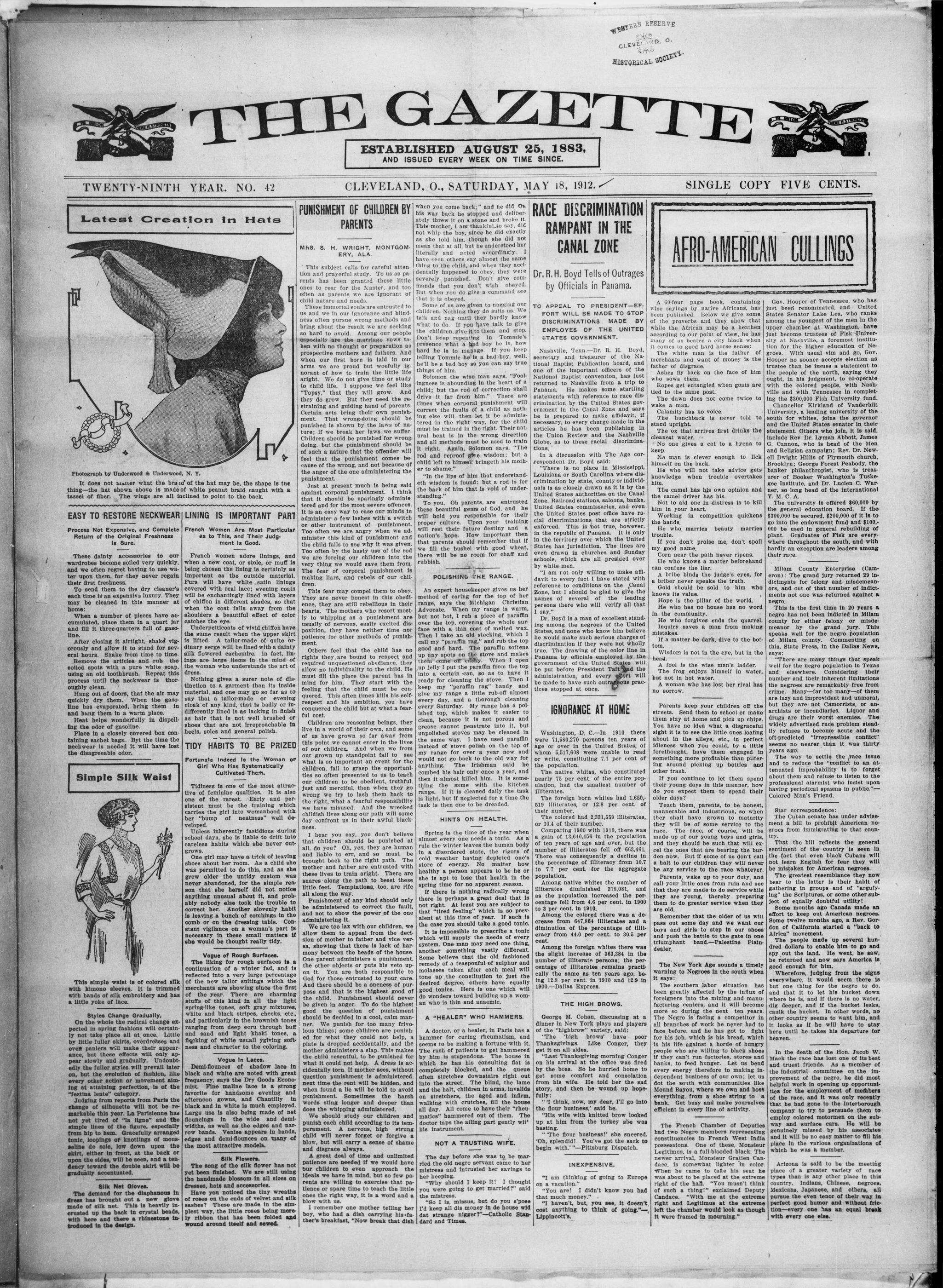
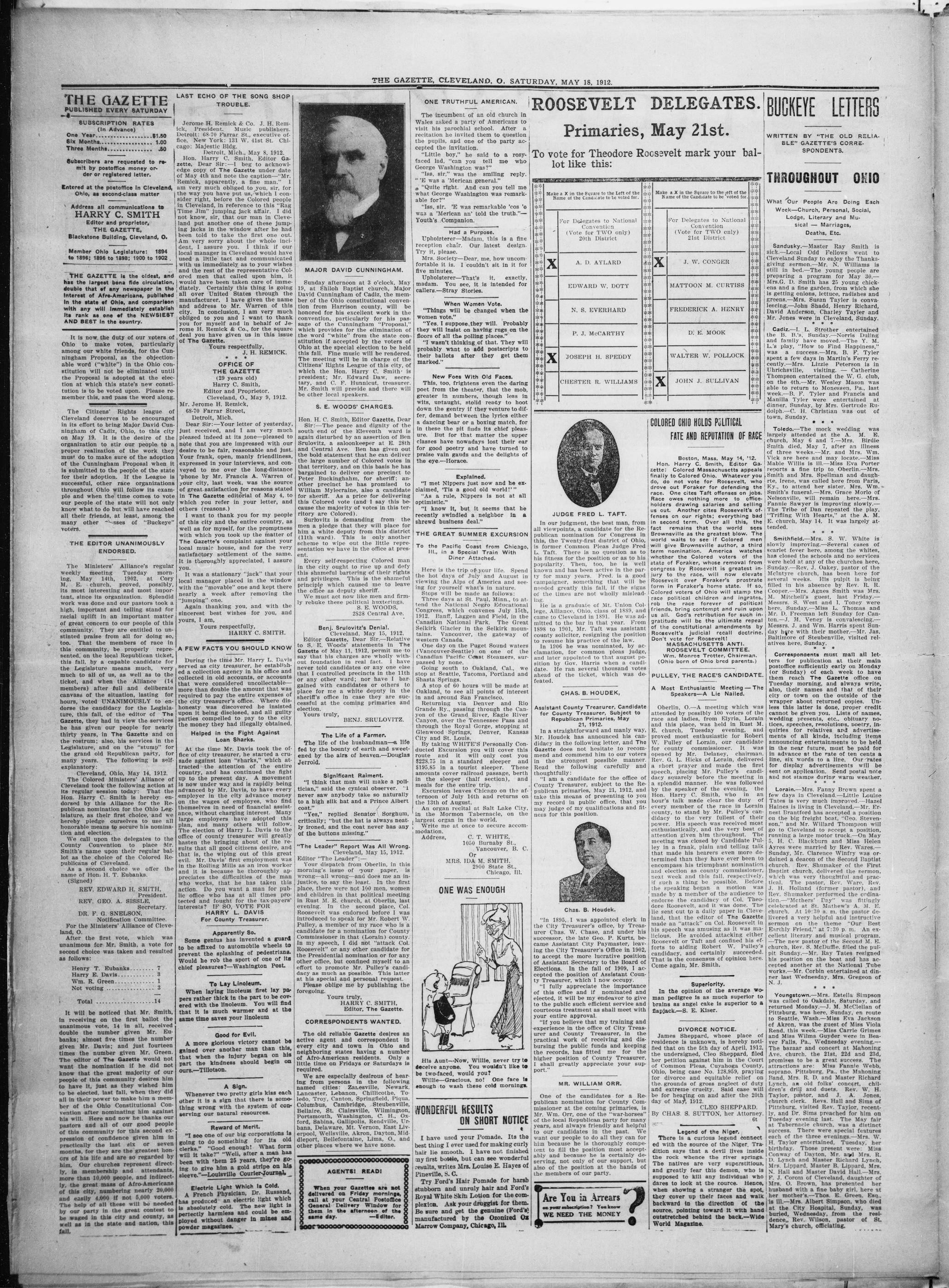
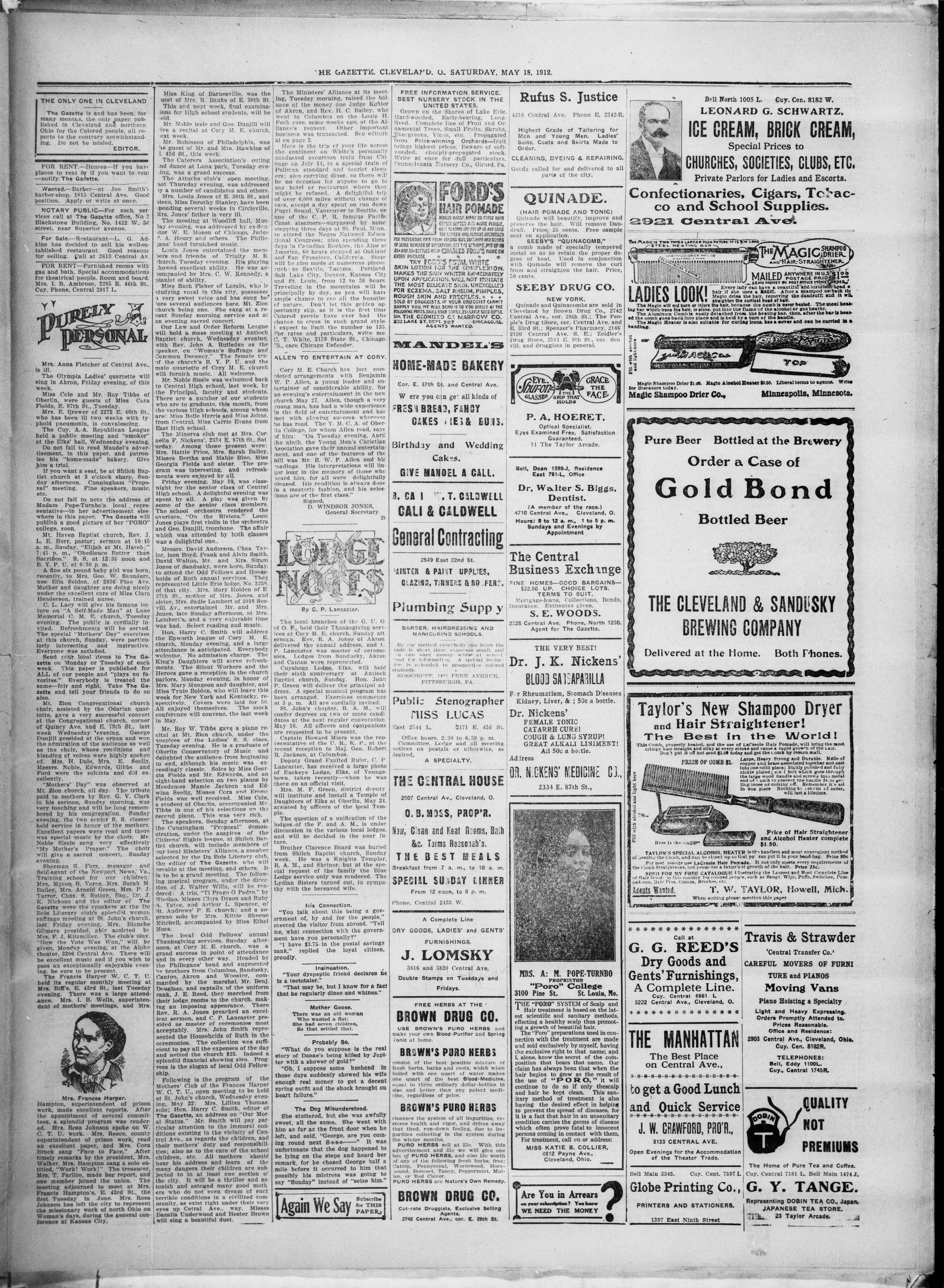
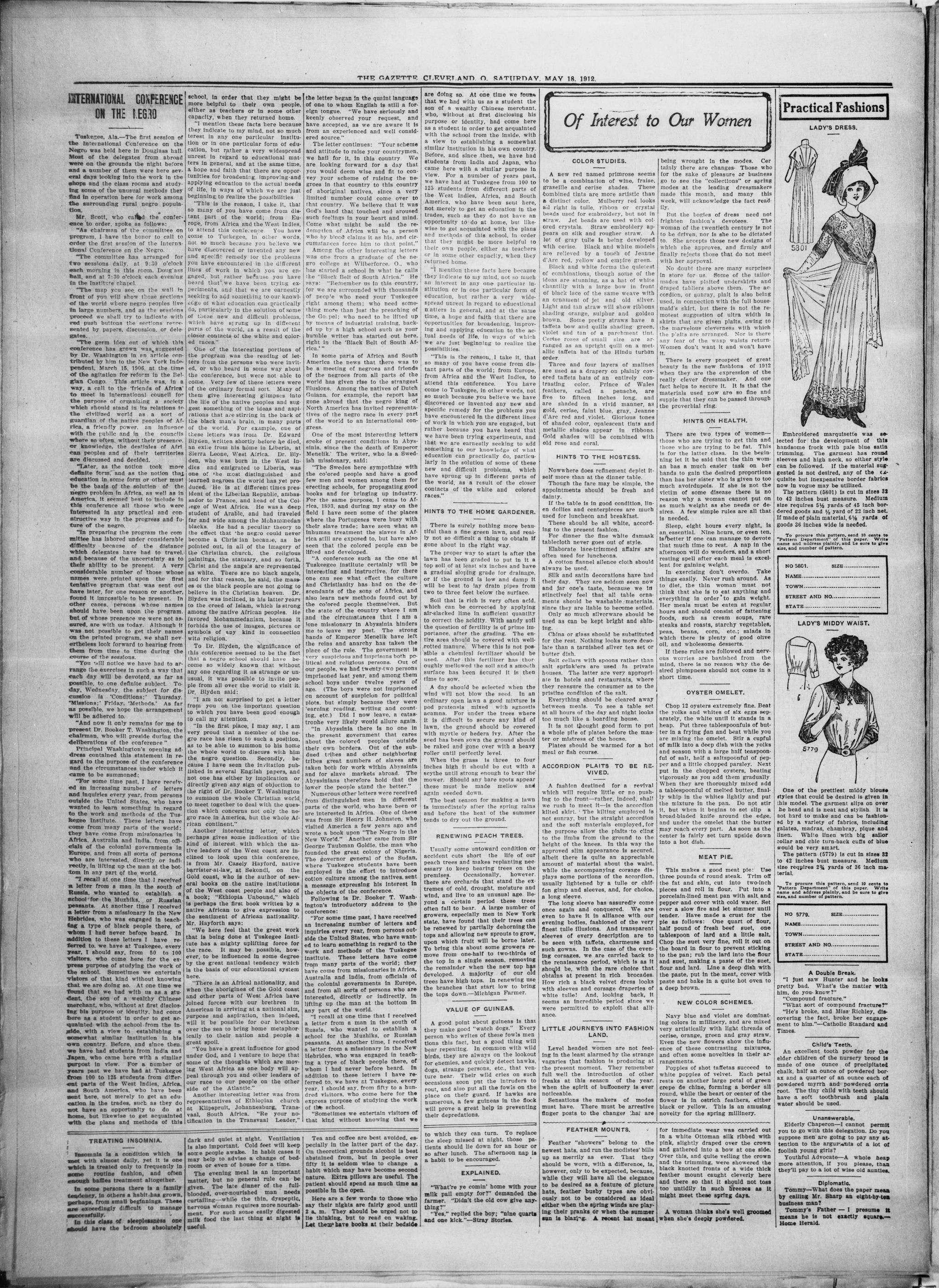
Page text (machine-generated)
TWENTY-NINTH YEAR. NO. 42
Latest Creation in Hats
Photograph by Underwood & Underwood, N. Y.
It does not matter what the brand of the hat may be, the shape is the thing—the hat shown above is made of white peanut braid caught with a tassel of fiber. The wings are all inclined to point to the back.
IN WILTON THERE IS STRONGITY
TWENTY-NINTH YEAR
Latest Creation
Photograph by Underwood & Underwood, N. Y.
It does not matter what the brand of the thing—the hat shown above is made of white tassel of fiber. The wings are all inclined
EASY TO RESTORE NECKWEAR
Process Not Expensive, and Complete Return of the Original Freshness Is Sure.
These dainty accessories to our wardrobes become solled very quickly, and we often regret having to use water upon them, for they never regain their first freshness.
To send them to the dry cleaner's each time is an expensive luxury. They may be cleaned in this manner at home:
When a number of pieces have accumulated, place them in a quart jar and fill it three-quarters full of gasoline.
LINING
French as
Fren when being import Furs they will be of child when catches Under the sae
After closing it airtight, shake vigorously and allow it to stand for several hours. Shake from time to time. Remove the articles and rub the soiled spots with a pure white soap, using an old toothbrush. Repeat this process until the neckwear is thoroughly clean. Hang out of doors, that the air may quickly dry them. When the gasoline has evaporated, bring them in and hang them in a warm place. Heat helps wonderfully in dispelling the odor of gasoline. Place in a closely covered box containing sachet bags. By the time the neckwear is needed it will have lost the disagreeable odor.
Simple Silk Waist
This simple waist is of colored silk with kimono sleeves. It is trimmed with bands of silk embroidery and has a little yoke of lace.
Styles Change Gradually.
On the whole the radical change expected in spring fashions will certainly not take place all at once. Little by little lower skirts, overdresses and even paniers will make their appearance, but these effects will only appear slowly and gradually. Undoubtedly the fuller styles will prevail later on, but the evolution of fashion, like every other action or movement aiming at attaining perfection, is of the "festina lente" category.
Judging from reports from Paris the change of silhouette will not be remarkable this year. La Parisienne has not yet tired of "la ligne" and the simple lines of the figure, especially from hip to hem. Gracefully arranged tunic, loopings or knottings of mousseline de sole, low down upon the skirt, either in front, at the back or upon the sides, will be seen, and a tendency toward the double skirt will be gradually accentuated.
Silk Net Gloves.
The demand for the diaphanous in dress has brought out a new glove made of silk net. This is heavily incrusted up the back in crystal beads, with here and there a rhinestone introduced in the design.
THE GAZETTE
French Women Are Most Particular as to This, and Their Judgment is Good.
French women adore linings, and when a new coat, or stole, or muff is being chosen the lining is certainly as important as the outside material. Furs will have white, satin linings covered with real lace; evening coats will be enchantingly lined with layers of chiffon in different shades, so that when the coat falls away from the shoulders a beautiful effect of color catches the eye.
Underpetticoats of vivid chiffon have the same result when the upper skirt is lifted. A tailor-made of quite ordinary serge will be lined with a dainty silk flowered cachemire. in fact, linings are large items in the mind of the woman who understands the art of dress.
Nothing gives a surer note of distinction to a garment than its inside material, and one may go so far as to say that a tailor-made or evening cloak of any kind, that is badly or indifferently lined is as lacking in finish as hair that is not well brushed or shoes that are not freproachable in heels, soles and general polish.
TIDY HABITS TO BE PRIZED
Fortunate Indeed Is the Woman or Girl Who Has Systematically Cultivated Them.
Tidiness is one of the most attractive of feminine qualities. It is also one of the rarest. Early and persistent must be the training which carries the girl into womanhood with her "bump of neatness" well developed.
Unless inherently fastidious during school days, she is liable to drift into careless habits which she never outgrows.
One girl may have a trick of leaving shoes about her room. As a child she was permitted to do this, and as she grew older the untidy custom was never abandoned, for the simple reason that she herself did not notice anything unusual about it, and probably nobody else took the trouble to correct her. Another slovenly habit is leaving a bunch of combings in the comb or on the dressing table. Constant vigilance on a woman's part is necessary in these small matters if she would be thought really tidy.
Vogue of Rough Surfaces.
The liking for rough surfaces is a continuation of a winter fad, and is reflected into a very large percentage of the new tailor suitings which the merchants are showing since the first of the year. There are charming stuffs of this kind in all the light spring-like tones, soft gray mixtures, white and black stripes, checks, etc., and particularly in the brownish tones ranging from deep ceru through buff and sand and light khaki tones, a flacking of white usall giving softness and character to the coloring.
Vogue In Laces.
Demi-fluoresces of shadow lace in black and white are noted with great frequency, says the Dry Goods Economist. Fine maline lace is a strong favorite for handsome evening and afternoon gowns, and Chantilly in black and in white is much employed. Large use is also being made of net fluorescents in the wide and demi-widths, as well as the edges and narrow bands. Venise appears in bands, edges and demi-fluoresces on many of the most attractive models.
Silk Flowers.
The song of the silk flower has not yet been finished. We are still using the handmade blossom in all sizes on dresses, hats and accessories. Have you noticed the tiny wreaths of roses on the ends of velvet and silk sashes? These are made in the simplest way, the little roses being merely ribbon that has been folded and wound around itself and sewed.
CLEVELAND, O., SATURDAY, MAY 18, 1912.
PUNISHMENT OF CHILDREN BY
MRS. S. H. WRIGHT, MONTGOMERY, ALA.
This subject calls for careful attention and prayerful study. To us as parents has been granted these little ones to rear for the Master, and too often as parents we are ignorant of child nature and needs.
These immortal souls are entrusted to us and we in our ignorance and blindness often pursue wrong methods and bring about the result we are seeking so hard to avoid. Among our people especially are the marriage vows taken with no thought or preparation as prospective mothers and fathers. And when our first born is lain in our arms we are proud but woefully ignorant of how to train the little life aright. We do not give time or study to child life. I suppose we like like "Topsy," that they will grow. And they do grow. But they need the restraining and guiding hand of parents. Certain acts bring their own punishment. That wrong-doing should be punished is shown by the laws of nature; if we break her laws we suffer. Children should be punished for wrong doing, but the punishment should be of such a nature that the offender will feel that the punishment comes because of the wrong, and not because of the anger of the one administering the punishment.
Just at present much is being said against corporal punishment. I think that it should be sparingly administered and for the most severe offences. It is an easy way to ease our minds to administer a few lashes with a switch or other instrument of punishment. Too often we are angry when we administer this kind of punishment and the child falls to see why it was given. Too often by the hasty use of the rod we are forcing our children into the very thing we would save them from. The fear of corporal punishment is making liars, and rebels of our children.
This fear may compel them to obey. They are never honest in this obedience, they are still rebellious in their hearts. The mothers who resort mostly to whipping as a punishment are usually of nervous, easily excited disposition, they have neither time nor patience for other methods of punishment.
Others feel that the child has no rights they are bound to respect and required unquestioned obedience, they allow no individuality to the child. He must fill the place the parent has in mind for him. They start with the feeling that the child must be conquered. This often times kills his self-respect and his ambition, you have conquered the child but at what a fearful cost.
Children are reasoning beings, they live in a world of their own, and some of us have grown so far away from this point we cannot enter in the lives of our children. And when we from our grown up standpoint fail to see what is so important an event for the children, fall to grasp the opportunities so often presented to us to teach our children to be obedient, truthful, just and merciful, then when they go wrong we try to lash them back to the right, what a fearful responsibility we have misused. And the wrecked childish lives along our path will some day confront us in their awful blackness.
I hear you say, you don't believe that children should be punished at all, do you? Oh, yes, they are human and liable to err, and so must be brought back to the right path. The mother and father are entrusted with these lives to train aright. There are snakes along the path to beset these little feet. Temptations, too, are rife all along the way.
Punishment of any kind should only be administered to correct the fault, and not to show the power of the one administering it.
We are too lax with our children, we allow them to appeal from the decision of mother to father and vice versa, showing that there is lack of harmony between the heads of the house. One parent administers a punishment, the other objects or puts his veto upon it. You are both responsible to God for those entrusted to your care. And there should be a oneness of purpose and that is the highest good of the child. Punishment should never be given in anger. To do the highest good the question of punishment should be decided in a cool, calm manner. We punish for too many frivolous things; some children are punished for what they could not help, a plate is dropped accidentally, and the mother administers a slap. This makes the child resentful, to be punished for what it could not help. A dress is accidentally torn. If mother sees, without question punishment is administered, next time the rent will be hidden, and when found a lie will be told to avoid punishment. Sometimes the harsh words sting longer and deeper than does the whipping administered. We should study our children and punish each child according to its temperament. A nervous, high strung child will never forget or forgive a blow, but will carry a sense of shame and disgrace always.
A great deal of time and unlimited patience are needed if we would have our children to even approach the ideals we have in mind, but so few parents are willing to exercise that patience or spare time to teach the little ones the right way, it is a word and a blow with us.
I remember one mother telling her boy, who had a dish carrying his father's breakfast, "Now break that dish
when you come back;" and he did On his way back he stopped and deliberately threw it on a stone and broke it. This mother, I am thankful to say, did not whip the boy, since he did exactly as she told him, though she did not mean that at all, but he understood her literally and acted accordingly. I have seen others say almost the same thing to the child, and when they accidentally happened to obey, they were severely punished. Don't give commands that you don't wish obeyed. But when you do give a command see that it is obeyed. Some of us are given to nagging our children. Nothing they do suits us. We talk and nag until they hardly know what to do. If you have talk to give the children, give it to them and stop. Don't keep repeating in Tommle's presence what a bad boy he is, how hard he is to manage. If you keep telling Tommle he is a bad boy, well, he'll be a bad boy so you can say true things of him.
Solomon the wise man says, "Foolingness is abounding in the heart of a child; but the rod of correction shall drive it far from him." There are times when corporal punishment will correct the faults of a child as nothing else will. Then let it be administered in the right way, for the child must be trained in the right. Their natural bent is in the wrong direction and all methods must be used to train it right. Again, Solomon says, "The rod and reproof give wisdom; but a child left to himself bringeth his mother to shame."
"In the lips of him that understandeth wisdom is found; but a rod is for the back of him that is void of understanding."
To you. Oh parents, are entrusted these beautiful gems of God, and he will hold you responsible for their proper culture. Upon your training will rest their future destiny and a nation's hope. How important then that parents should remember that if we fill the bushel with good wheat, there will be no room for chaff and rubbish.
An expert housekeeper gives us her method of caring for the top of her range, says the Michigan Christian Advocate. When my range is warm, but not hot, I rub a piece of paraffin over the top, covering the whole surface with a thin coat of melted wax. Then I take an old stocking, which I call my "paraffin rag," and rub the top good and hard. The paraffin softens up any spots on the stove and makes them come off easily. When I open up jelly I put the paraffin from the top into a certain can, so as to have it ready for cleaning the stove. Then I keep my "paraffin rag" handy and give my range a little rub-off almost every day, and a thorough cleaning every Saturday. My range has a polished top, which makes it easier to clean, because it is not porous and grease cannot penetrate into it, but unpolished stoves may be cleaned in the same way. I have used paraffin instead of stove polish on the top of my range for over a year now and would not go back to the old way for anything. The Irishman said he combed his hair only once a year, and then it almost killed him. It is something the same with the kitchen range. If it is cleaned daily the task is light, but if neglected for a time the task is then one to be dredged.
HINTS ON HEALTH.
Spring is the time of the year when almost every one needs a tonic. As a rule the winter leaves the human body in a disordered state, the rigors of cold weather having depleted one's store of energy. No matter how healthy a person appears to be he or she is apt to lose that health in the spring time for no apparent reason.
If there is nothing radically wrong there is perhaps a great deal that is not right. At least you are subject to that "tired feeling" which is so prevalent at this time of year. If such is the case you should take a good tonic. It is impossible to prescribe a tonic which will supply the needs of every system. One man may need one thing, another something vastly different. Some believe that the old fashioned remedy of a teaconfell of sulphur and molasses taken after each meal will tone up the constitution to just the desired degree, others have equally good tonics. Here is one which will do wonders toward building up a woman who is thin and anaemic.
A "HEALER" WHO HAMMERS
A doctor, or a healer, in Paris has a hammer for curing rheumatism, and seems to be making a fortune with it. The rush of patients to get hammered by him is stupendous. The house in which he has his consulting flat is completely blocked, and the queue often stretches downstairs right out into the street. The blind, the lame and the halt, children in arms, invalids on stretchers, the aged and infirm, walking with crutches, fill the house all day. All come to have their "rheumatics" hammered out of them. The doctor taps the ailing part gently wit' his instrument.
NOT A TRUSTING WIFE.
The day before she was to be married the old negro servant came to her mistress and intrusted her savings to her keeping.
"Why should I keep it? I thought you were going to get married?" said the mistress.
"So I is, missus, but do you s'pose I'd keep all its money in de house wid dat strange nigger?"—Catholic Standard and Times.
WESTERN RESERVE
CLEVELAND, O.
HISTORICAL SOCIETY.
25, 1883,
E SINCE.
MAY 18, 1912.
RACE DISCRIMINATION RAMPANT IN THE CANAL ZONE
RACE DISCRIMINATION RAMPANT IN THE CANAL ZONE
Dr. R. H. Boyd Tells of Outrages by Officials in Panama.
TO APPEAL TO PRESIDENT-EFORT WILL BE MADE TO STOP DISCRIMINATIONS MADE BY EMPLOYES OF THE UNITED STATES GOVERNMENT.
Nashville, Tenn.—Dr. R. H. Boyd, secretary and treasurer of the National Baptist Publication board, and one of the important officers of the National Baptist convention, has just returned to Nashville from a trip to Panama. He makes some startling statements with reference to race discrimination by the United States government in the Canal Zone and says he is prepared to make affidavit, if necessary, to every charge made in the articles he has been publishing in the Union Review and the Nashville Globe, as to these racial discriminations.
In a discussion with The Age correspondent Dr. Boyd said:
"There is no place in Mississippi, Louisiana or South Carolina where discrimination by state, county or individuals is as closely drawn as it is by the United States authorities on the Canal Zone, Railroad stations, saloons, banks, United States commissaries, and even the United States post office have racial discriminations that are strictly enforced. This is not true, however, in the republic of Panama. It is only in the territory over which the United States has jurisdiction. 'The lines are even drawn in churches and Sunday schools, which are all presided over by white men.' "I am not only willing to make affidavit to every fact I have stated with reference to conditions on the Canal Zone, but I should be glad to give the names of several of the leading persons there who will verify all that I say." Dr. Boyd is a man of excellent standing among the negroes of the United States, and none who know him believe he would make such serious charges of discrimination if they were not wholly true. The drawing of the color line in Panama by officials employed by the government of the United States will be put before President Taft and the administration, and every court will be made to have such outrageous practices stopped at once.
IGNORANCE AT HOME
Washington, D. C.-In 1910 there were 71,580,270 persons ten years of age or over in the United States, of whom 5,517,608 were unable to read or write, constituting 7.7 per cent of the population.
The native whites, who constituted nearly 75 per cent of the entire population, had the smallest number of illiterates.
The foreign born whites had 1,650,519 illiterates, or 12.8 per cent. of their number.
The colored had 2,331,559 illiterates, or 30.4 of their number.
Comparing 1900 with 1910, there was a gain of 13,640,456 in the population of ten years of age and over, but the number of illiterates fell off 663,461. There was consequently a decline in the percentage of illiteracy from 10.7 to 7.7 per cent. for the aggregate population.
Among native whites the number of illiterates diminished 378,081, and as the population increased the percentage fell from 4.6 per cent. in 1900 to 3 per cent. in 1910.
Among the colored there was a decrease from 647,864 illiterates and a diminution of the percentage of illiteracy from 44.0 per cent. to 30.5 per cent.
Among the foreign whites there was the slight increase of 363,384 in the number of illiterate persons; the percentage of illiterates remains practically the same as ten years ago, being 12.8 per cent. in 1910 and 12.9 in 1800—Dallas Express.
George M. Cohan, discussing at a dinner in New York plays and players of the "highbrow" variety, said:
"The high brow' have poor thanksgivings. Like Conger, they get it on all sides.
"Last Thanksgiving morning Conger on his arrival at the office was fired by the boss. So he hurried home to get some comfort and consolation from his wife. He told her the sad story, and then he wound up hopefully:
"I think, now, my dear, I'll go into the flour business," said he.
"His wife with knitted brow looked up at him from the turkey she was basting.
"The flour business!" she sneered.
'Oh, splendid!' You've got the sack to begin with.'-Pittsburgh Dispatch.
"I am thinking of going to Europe on a vacation."
"You are! I didn't know you had that much money."
"I haven't, but, you see, it doesn't cost anything to think of going."—Lippincott's.
THE HIGH BROWS
INEXPENSIVE
TE
SINGLE COPY
AFRO-AMERICA
AFRO-AMERICAN CULLINGS
A 60-four page book, containing wise sayings by native Africans, has been published. Below we give some of the proverbs and they show that while the African may be a heathen according to our point of view, he has many of us beaten a city block when it comes to good hard horse sense:
The white man is the father of merchants and want of money is the father of disgrace.
Ashes fly back on the face of him who sows them.
Gov. Hooper of Tennessee, who has just been renominated, and United States Senator Lake Lea, who ranks among the youngest of the men in the upper chamber at Washington, have just become trustees of Fisk University at Nashville, a foremost institution for the higher education of Negroes. With usual vim and go, Gov Hooper no sooner accepts election a trustee than he issues a statement to the people of the north, saying the ought, in his judgment, to co-operate.
Ropes get entangled when goats are tied to the same post.
The dawn does not come twice to wake a man.
Calamity has no voice.
The hunchback is never told to stand upright.
The ox that arrives first drinks the cleanest water.
No one gives a cat to a hyena to keep.
No man is clever enough to lick himself on the back.
He who will not take advice gets knowledge when trouble overtakes him.
The camel has his own opinion and the camel driver has his.
Not to aid one in distress is to kill him in your heart.
Working in competition quickens the hands.
He who marries beauty marries trouble.
If you don't praise me, don't spoil my good name.
Corn near the path never ripens.
He who knows a matter beforehand can confuse the liar.
A bribe blinds the judge's eyes, for a briber never speaks the truth.
Gold should be sold to him who knows its value.
Hope is the pillar of the world.
He who has no house has no word in the community.
He who forgives ends the quarrel.
Inquiry saves a man from making mistakes.
If a matter be dark, dive to the bottom.
Wisdom is not in the eye, but in the head.
A fool is the wise man's ladder.
The frog enjoys himself in water, but not in hot water.
A woman who has lost her rival has no sorrow.
Parents keep your children off the streets. Send them to school or make them stay at home and pick up chips. You have no idea what a disgraceful sight it is to see the little ones loading about in the alleys, etc., in perfect idleness when you could, by a little forethought, have them engaged in something more profitable than pifter, ing around picking up bottles and other trash.
If you continue to let them spend their young days in this manner, how do you expect them to spend their older days?
Teach them, parents, to be honest, mannerable and industrious, so when they shall have grown to maturity they will be of some service to the race. The race, of course, will be made up of our young boys and girls, and they should be such that will excel the ones that are bearing the burden now. But if some of us don't call a halt to our children they will never be any service to the race whatever.
Parents, wake up to your duty, and call your little ones from ruin and see that they are made to do service while they are young, thereby preparing them to do greater service when they are old.
Remember that the older of us will pass out some day and we want our boys and girls to step in our shoes and push the battle to the gate in one triumphant band—Palestine Plain-dealer.
The New York Age sounds a timely warning to Negroes in the south when it says:
The southern labor situation has been greatly affected by the influx of foreigners into the mining and manufacturing centers, and it will become more so during the next ten years. The Negro is facing a competitor in all branches of work he never had to face before, and he has got to fight for his job, which is his bread, which is his life against a horde of hungry people who are willing to black shoes if they can't run factories, stores and banks, to feed hunger. Let us bend every energy therefore to making independent business of our own; let us dot the south with communities like Mound Bayou, where we own and boss everything, from a shoe string to a bank. Get busy and make yourselves efficient in every line of activity.
The French Chamber of Deputies had two Negro members representing constituenties in French West India possessions. One of these, Monsieur Legitimus, is a full-blooded black. The newer arrival, Monsieur Gratien Candace, is somewhat lighter in color when he came to take his seat he was about to be placed at the extreme right of the hall. "You mustn't think of such a thing!" exclaimed Deputy Candace. "With me at the extreme right and Legitimus at the extreme left the chamber would look as though it were framed in mourning."
---
SINGLE COPY FIVE CENTS.
Gov. Hooper of Tennessee, who has just been renominated, and United States Senator Lake Lea, who ranks among the youngest of the men in the upper chamber at Washington, have just become trustees of Fisk University at Nashville, a foremost institution for the higher education of Negroes. With usual vim and go, Gov. Hooper no sooner accepts election as trustee than he issues a statement to the people of the north, saying they ought, in his judgment, to co-operate with the colored people, with Nashville and with Tennessee in completing the $300,000 Fish University fund. Cancellor Kirkland of Vanderbilt University, a leading university of the south for whites, joins the governor and the United States senator in their statement. Others who join, it is said, include Rev Dr. Lyman Abbott, James G. Cannon, who is head of the Men and Religion campaign; Rev Dr. Newell Dwight Hills of Plymouth church, Brooklyn; George Forest Peabody, the banker philanthropist, who is treasurer of Booker Washington's Tuskegee Institute, and Dr. Lucien C. Warner, so long head of the international Y. M. C. A.
The university is offered $60,000 by the general education board. If the $200,000 be secured, $200,000 of it is to go into the endowment fund and $100,000 be used in general rebuilding of plant. Graduates of Fisk are everywhere throughout the south, and with hardly an exception are leaders among their race.
Milam County Enterprise (Cameron): The grand jury returned 29 indictments for felony and misdemeanors, and out of that number of indictments not one was returned against a negro.
This is the first time in 20 years a negro has not been indicted in Milam county for either felony or misdemeanor by the grand jury. This speaks well for the negro population of Milam county. Commenting on this, State Press, in the Dallas News, says:
"There are many things that speak well for the negro population in Texas and elsewhere. Considering their number and their inherent limitations the negroes are remarkably free from crime. Many—far too many—of them are lazy and improvident and unmoral, but they are not Camorrists, or anarchists or incendiaries. Liquor and drugs are their worst enemies. The widely advertised race problem steadily refuses to become acute and the oft-predicted "freepressible conflict" seems no nearer than it was thirty years ago.
The way to settle the race issue and to reduce the "conflict to an attenuated improbability is to forget about them and refuse to listen to the professional alarmist who insist upon having periodical spasms in public."—Colored Man's Friend.
Star correspondence:
The Cuban senate has under advisement a bill to prohibit American negroes from immigrating to that country.
That the bill reflects the general sentiment of the country is seen in the fact that even black Cubans will not learn English for fear they will be mistaken for American negroes.
The greatest resemblance they now bear to the latter is their habit of gathering in groups and of "arguing" the Scriptures, or some other subject of equally doubtful utility!
Some months ago Canada made an effort to keep out American negroes. Some twelve months ago, a Rev. Gordon of California started a "back to Africa" movement.
The people made up several hundred dollars to enable him to go and spy out the land. He went, he saw, he returned and now says America is good enough for him.
Wherefore, judging from the signs everywhere, it would seem there is but one thing for the negro to do, and that it to let his bucket down where he is, and if there is no water, dig deeper, and if the bucket leaks, caulk the bucket. In other words, no other country seems to want him, and it looks as if he will have to stay here until he takes his departure for heaven.
In the death of the Hon. Jacob W. Mack the race has lost one of its best and truest friends. As a member of the industrial committee on the improvement of the negro, he did most helpful work in opening up opportunities for the employment of members of the race, and it was only recently that he had gone to the Interborough company to try to persuade them to employ colored motormen on the subway and surface cars. He will be genuinely missed by his associates and it will be no easy matter to fill his place in the various organizations of which he was a member.
Arizona is said to be the meeting place of a greater variety of race types than is any other place in this country, Indians, Chinese, negroes, Mexicans, Japanese, and others, all pursue the even tenor of their way in perfect good humor and without friction—every one has an equal break with every one else.
One Year. $1.50
Six Months. 1.00
Three Months. .50
Subscribers are requested to
mit by postoffice money order
or registered letter.
Entered at the postoffice in Cleveland
Ohio, as second-class matter
Address all communications to
HARRY C. SMITH
Editor and proprietor,
THE GAZETTE,
Blackstone Building, Cleveland, O.
Member Ohio Legislature: 1894
to 1896; 1896 to 1898; 1900 to 1902
THE GAZETTE is the oldest, and has the largest bona fide circulation, double that of any newspaper in the Interest of Afe-Americans, published in the state of Ohio, and comparison with any will immediately establish its rank as one of the NEWSIEST AND BEST in the country.
It is now, the duty of our voters of Ohio to make votes, particularly among our white friends, for the Cunningham Proposal, as the objectionable word ("white") in the Ohio constitution will not be eliminated until the Proposal is adopted at the election at which this state's new constitution is to be voted upon. Please remember this, and pass the word along.
The Citizens' Rights league of Cleveland deserves to be encouraged in its effort to bring Major David Cunningham of Cadiz, Ohio, to this city on May 19. It is the desire of the organization to stir our people to a proper realization of the work they must do to make sure of the adoption of the Cunningham Proposal when it is submitted to the people of the state for their adoption. If the League is successful, other race organizations throughout Ohio will follow its example and when the time comes to vote our people of the state will not only know what to do but will have reached all their friends, at least, among the many other "issues of "Buckeye" voters.
THE EDITOR UNANIMOUSLY ENDORSED
The Ministers' Alliance's regular weekly meeting Tuesday morning, May 14th, 1902, at Cory M. E. church, proved, possibly, its most interesting and most important, since its organization. Splendid work was done and our pastors took a high, important and telling stand for racial uplift in an important matter of great concern to our people of this community. They are entitled to unstinted praise from all for doing so, too. That the members of race in this community, be properly represented, on the local Republican ticket, this fall, by a capable candidate for the Legislature means much, very much to all of us, as well as to the ticket, and when the Alliance (14 members) after full and deliberate canvass of the situation, lasting for hours, voted UNANIMOUSLY to endorse the candidacy for the Legislature, this fall, of the editor of The Gazette, they had in view the services he has given our people for nearly thirty years, in The Gazette and on the rostrum; also, his services in the Legislature, and on the "stump" for the grand old Republican party, for many years. The following is self-explanatory:
Cleveland, Ohio, May 14, 1912. The Colored Miners' Alliance of Cleveland took the following action at its regular session today: That the Hon. Harry C. Smith is hereby enclosed as a representative for the public nomination for the Ohio Legislature, as their first choice, and we hereby pledge ourselves to use all honorable means to secure his nomination and election. We call upon the delegates to the Convention to place Mr. Smith's nomination on their regular ballot as the choice of the Colored Republicans of Cleveland.
As a second choice we offer the name of Hon. H. T. Eubanks.
(Signed)
REV. EDWARD H. SMITH,
President.
REV. GEO. A. SISSLE,
Secretary.
DR. F. G. SNELSON,
Notification Committee.
For the Ministers' Alliance of Cleveland, O.
After the first vote, which was unanimous for Mr. Smith, a vote for second choice was taken and resulted as follows:
It will be noticed that Mr. Smith, in receiving on the first ballot the unanimous vote, 14 in all, received double the number given Mr. Eubanks; almost five times the number given Mr. Davis; and just fourteen times the number given Mr. Green. The editor of The Gazette would not want the nomination if he did not know that the great majority of our people of this community desires him to have it, just as they wished him to be elected, last fall, when they did all in their power to make him a member of the Ohio Constitutional Convention after nominating him against his will. Here and now he thanks our pastors and all of our good people of this community for this second expression of confidence given him in practically the last six or seven months, for they are the greatest honors of his life and are so regarded by him. Our churches represent directly, in membership and attendants, more than 10,000 people, and indirectly, the great mass of Afro-Americans of this city, numbering nearly 20,000 and easily 4,000 if not 5,000 voters. Of all the all these will be needed by our party in the great contest to be waged in this city and county, as well as in the state and nation, this fall.
Jerome H. Remick & Co. J. H. Remick, President. Music publishers. Detroit: 68-70 Broadway, st. executive of Maleskirk 131 W. 41st St. Chicago: Maleskirk Bldg.
Detroit, Mich., May 8, 1912.
Hon. Harry C. Smith, Editor Gazette, Dear Sir;—I beg to acknowledge copy of the *Gazette* under date of May 14 and note the caption—"Mr. Remick, apparently, a fine man." I am very much obliged to you, sir, for the way you presented the book to the sider right, before the Colored people in Cleveland, in reference to this "Rag Time Jim" jumping jack affair. I did not know, sir, that our man in Cleveland put another one of these jumping jacks in the window after he had been told to take the first one out. Am very sorry about the whole incident, I assure you. I think if our local manager in Cleveland would have been told to take the first one out, with us immediately as to your wishes and the rest of the representative Colored men that called upon him, it would have been taken care of immediately. Certainly this thing is going all over United States through the manufacturer. I have given the name and address to Mr. Warren of this city. In conclusion, I am very much obliged to you and I want to thank you for your kindness. I am sorry to rome H. Remick & Co., for the square deal you have given us in this issue of the *Gazette*
Cleveland, O, May 9, 1912.
Mr. Jerome H. Remick,
68-70 Farrar Street,
Detroit, Mich.
Dear Sir—Your letter of yesterday
just received, and I am very much
pleased indeed at its tone—pleased to
note that you are impressed with our
desire to be fair, reasonable and just.
Your frank, open, manly friendliness,
expressed in your interviews, and
conveyed to me over the long-distance
'phone by Mr. Francis A. Warren of
your city, last week, was the source of
great satisfaction for reasons stated
In The Gazette editorial of May 4, to
which you refer in your letter, and
others (reasons.)
I want to thank you for my people
of this city and the entire country, as
well as for myself, for the promptness
with which you took up the matter of
The Gazette's complaint against your
local music house, and for the very
satisfactory settlement of the same.
It is thoroughly appreciated. I assure
you.
It was a stationary "jack" that your local manager placed in the window with the "movable" one and kept there nearly a week after removing the "jumping" one.
Again thanking you, and with the sincerest best wishes for you, and yours, I am,
Yours respectfully,
HARRY C. SMITH.
A FEW FACTS YOU SHOULD KNOW
During the time Mr. Harry L. Davis served as city treasurer, he established a collection agency in his office and collected in old accounts, or accounts that were considered uncollectable more than double the amount that was required to pay the entire expenses of the city treasurer's office. Where honesty was discovered, he imitated it being disclosed, and all guilty parties compelled to pay to the city the money they had illegally obtained.
Helped in the Fight Against Loan Sharks.
At the time Mr. Davis took the office of city treasurer, he started a crusade against loan "sharks," which attracted the attention of the entire country, and has continued the fight up to the present day. A movement is now under way and is rapidly being advanced by Mr. Davis, to have every employer in the city advance money on the wages of the employees, who find themselves in the position without charging interest. Many large employers have adopted this plan, and many others will follow. The election of Harry L. Davis to the office of county treasurer will greatly hasten the bringing about of the results that all good citizens desire, and that is, the wiping out of this great evil. Mr. Davis' first employment was in the Rolling Mills as an iron worker and it is because he thoroughly apologized for the abuse that who works, that he has taken this action. Do you want a man for public office who has at all times protected and fought for the tax-payers' interests? IF SO, VOTE FOR
Apparently So.
Some genius has invented a guard to be affixed to automobile wheels to prevent the splashing of pedestrians. Would he rob the sport of one of its chief pleasures?—Washington Post.
To Lay Linoleum.
When laying linoleum first lay papers rather thick in the part to be covered with the linoleum. You will find that it is much warmer and at the same time saves your linoleum
Good for Exit.
A more glorious victory cannot be gained over another man than this, that when the injury began on his part the kindness should begin on ours — Tillotson.
A Sign.
Whenever two pretty girls kiss each other it is a sign that there is something wrong with the system of conserving our natural resources.
Reward of Merit.
"I see one of our big corporations is going to do something for its old clerks." "Good enough. What form will it take?" "Well, after a man has been with them 25 years, they're going to give him a gold stripe on his sleeve."-Louisville Courier-Journal.
Electric Light Which Is Cold.
Electric Light
A French Physician, Dr. Russand,
has produced an electric light which
is absolutely cold. The new light is
harmless and could be employed without danger in mines and
powder magazines.
THE GAZETTE, CLEVELAND, O. SATURDAY, MAY 18, 1912.
MAJOR DAVID CUNNINGHAM.
Sunday afternoon at 3 o'clock, May 19, at Shiloh Baptist church, Major David Cunningham of Cadiz, the member of the Ohio constitutional convention from Harrison county, will be honored for his excellent work in the convention, particularly for his passport "Mr. Smith," which provides for the elimination of the word "white" from the state constitution if accepted by the voters of Ohio at the special election to be held this fall. Fine music will be rendered. The meeting will be in charge of the Citizens' Rights League of this city, of Harry E. Hurry, Smith is president; Mr. Edmund Daw, secretary, and C. F. Hunnicut, treasurer, Mr. Smith will preside and there will be other local speakers.
S. E. WOODS' CHARGES.
Hon. H. C. Smith, Editor Gazette, Dear Sir:—The peace and dignity of the south end of the Eleventh ward is again disturbed by an assertion of Ben Srulovitz, a saloonkeeper at E. 28th and Central Ave. Ben has given out the bold statement that he can deliver the large number of Colored votes in that territory, and on this basis he has bargained to deliver one precinct to Peter Buckinghahn, for sheer aid; to William Prescott, for prescott to William Prescott, also a candidate for sheerit. As a price for delivering this Colored vote (and I say this because the majority of votes in this territory are Colored). Survobitz is demanding from the men a pledge that they will place for him a white deputy from this district (11th ward). This is only another scheme to wipe out the little representation we have in the office at present. Every self-respecting Colored man in the city ought to rise and defy this shameful bartering of their rights and privileges. This is the shameful principle which caused me to leave the office as deputy sheerit.
We must act now like men and firmly rebuke these political huxerings. S. E. WOODS. 2823. Control Ave.
Benj. Srulovitz's Denial.
Cleveland, May 15, 1912.
Editor Gazette, Dear Sir... Relative to S. E. Woods statements in The Gazette of May 11, 1912, permit me to say that his charges are wholly without foundation in real fact. I have never told candidates or any one else that I controlled precincts in the 11th or any other ward; nor have I bars gained with candidates or others to place for me a white deed office in case they are successful at the coming primaries and election.
Yours truly,
BENJ. SRULOVITZ.
The Life of a Farmer
The life of the husbandman—a life fed by the bounty of earth and sweetened by the airs of heaven—Douglas Jerroid.
Significant Baiement.
"I think that man will make a politician," said the cynical observer. "I never saw anybody take so naturally to a high silk hat and a Prince Albert coat." "Yes," replied Senator Sorghum, critically; "but the hat is always neatly ironed, and the coat never has any of the buttons missing." "The Leader" Report Was All Wrong. Cleveland, May 15, 1912. Editor "The Leader"
Your dispatch from Oberlin, in this morning's issue of your paper, is wrong—all wrong—and does me an injustice, to say the least. In the first place, there were not 100 men, women and children in that political meeting in Rust M. E. church, at Oberlin, last evening. In the second place, Col. Roosevelt was endorsed before I was introduced to speak for Mr. Robert W. Pulley, a member of my race who is a candidate for a nomination for County Commissioner in that (Lorain) county. In my speech, I did not "attack Col. Roosevelt" or any other candidate for the Presidential nomination or for any other office, but confined myself to an effort to promote Mr. Pulley's candidacy as much as possible. This latter at his special and personal request.
Please oblige me by publishing the foregoing.
CORRESPONDENTS WANTED.
The old reliable Gazette desires an active agent and correspondent in every city and town in Ohio and neighboring states having a number of Afro-American residents. Only a little time on Fridays or Saturdays is required.
We are especially desirous of hearing from person in the following cities: Zanesville, Newark, Lancaster, Lebanon, Chillicothe, Toledo, Troy, Canton, Springfield, Piqua, Columbus, Cambridge, Steubenville, Bellaire, St. Clairsville, Wilmington, Portsmouth, Washington, C. H., Oxford, Sabina, Gallipolis, Rendille, Urbana, Delaware, Mt. Kinnick, Burlington, Middletown, Bellefontaine, Lima, O., and other places where we have none.
When your Gazettes are not delivered on Friday mornings, call at your Central Postoffice General Delivery Window for them in the afternoon of the same day. — Editor.
ONE TRUTHFUL AMERICAN.
The incumbent of an old church in Wales asked a party of Americans to visit his parochial school. After a recitation he invited them to question the pupils, and one of the party accepted the invitation.
"Little boy," he said to a rosy-faced lad, "can you tell me who George Washington was?" "Iss, sir," was the smiling reply. "'E is a merican general."
Quite right. And can you tell me what George Washington was remarkable for?
"Iss. sir. 'E was remarkable 'cos 'o was a 'Merican an' told the truth."—Youth's. Companion.
Had a Purpose.
Upholsterer—Madam, this is a fine reception chair. Our best design. Try it, please.
Mrs. Society—Dear me, how uncomfortable it is. I couldn't sit in it for five minutes.
Upholsterer—That's it, exactly, madam. You see, it is intended for callers—Stray Stories.
When Women Vote.
"Things will be changed when the women vote."
"Yes. I suppose, they will. Probably they will insist on having rugs on the floors of all the polling places."
"I wasn't thinking of that. They will probably want to add postscripts to their ballots after they get them marked."
New Faces With Old Faces
This, too, frightens even the daring poet from the theater, that the mob, greater in numbers, though less in wits, untaught, stolid ready to boot down the gentry if they venture to differ, demand between the lyrics either a dancing bear or a boxing match, for in these the pit finds its chief pleasure. But for that matter the upper classes have nowadays lost their ear for good poetry and have turned to praise vain gauds and the delights of the eye.-Horace.
Explained.
"I met Nippers just now and he exclaimed, 'Tis a good old world!" "As a rule, Nippers is not at all optimistic." It, but it seems that he recently swindled a neighbor in a shrewd business, deal."
THE GREAT SUMMER EXCURSION
To the Pacific Coast from Chicago, Ill., in a Special Train With Diner Attached.
Here is the trip of your life. Spend the hot days of July and August in viewing the Alps of America and seeing for yourself what's in nature. St. Paul makes as follows: Three days at St. Paul, Minn., to attend the National Negro Educational Congress, which convenes July 15th, 1912. Banff, Laggen and Field, in the Canadian National Park. The Great Selkirk Glacier in the Selkirk mountains. Vancouver, the gateway of western Canada. The Puget Sound waters (Vancouver-Seattle) on one of the Canadian Pacific Coast Steamers, surpassed by none.
Going south to Oakland, Cal., we stop at Seattle, Tacoma, Portland and Shasta Springs. A step of hours will be made at Oakland to see all points of interest in and around San Francisco.
Returning via Denver and Rio Grande Ry., passing through the Canyon of the Grand River, Eagle River Canyon, over the Tennessee Pass and through the Royal Gorge, stopping at Glenwood Springs, Denver, Kansas City and St. Louis.
By taking WHITE'S Personally Conducted Excursion you will cover this route and it will only cost you $228.75 in a standard sleeper and $78.75 in a tourist sleeper. These amounts cover the passage passb in the sleeper (half section), and meals for the entire trip.
Excursion leaves Chicago on the afternoon of July 14th and returns on the 13th of August.
An organ recital at Salt Lake City, in the Mormon Tabernacle, on the largest organ in the world.
Write me at once to secure accommodation.
Address, C. T. WHITE,
1050 Burnaby St.
Vancouver, B. C.
Or.
MRS. IDA M. SMITH,
2960 State St.
Chicago, Ill.
ONE WAS ENOUGH
His Aunt--Now, Willie, never try to deceive anyone. You wouldn't like to be two-faced would you?
Willee—Gracious, no! One face is enough to wash these cold mornings.
WONDERFUL RESULTS
ON SHORT NOTICE
I have used your Pomade. Its the best thing I ever used for making curly hair lie smooth. I have not finished my first bottle, but can see wonderful results, writes Mrs. Louise E. Hayes of Pineville, S.C.
Try Ford's Hair Pomade for harsh stubborn and unruly hair and Ford's Royal White Skin Lotion for the complexion. Ask your druggist for them. Be sure and get the genuine (Ford's) manufactured by the Ozonized Ox Marrow Company, Chicago, Ill.
---
To vote for Theodore Roosevelt mark your ballot like this:
Make a X in the Square to the Left of the Name of the Candidate to be voted for.
For Delegates to National Convention (Vote for TWO only) 20th District
A. D. AYLARD
EDWARD W. DOTY
N. S. EVERHARD
P. J. McCARTHY
JOSEPH H. SPEDDY
CHESTER R. WILLIAMS
For Delegates to National Convention (Vote for TWO only) 21st District
J. W. CONGER
MATTOON M. CURTISS
FREDERICK A. HENRY
D. E. MOOK
WALTER W. POLLOCK
JOHN J. SULLIVAN
JUDGE FRED L. TAFT
In our judgment, the best man, from all viewpoints, a candidate for the Republican nomination for Congress in this, the Twenty-first district of Ohio, is former Common Pleas Judge Fred L. Taft. There is no question as to his fitness for the position or as to his popularity. Then, too, he is well known and has been active in the party for many years. Fred is a good campaigner, something that will be needed greatly this fall, if the signs of the times are not wholly misleadent. He is a graduate of Mt. Union College, Alliance, Ohio, class of 1889, and came to Cleveland in 1891. He was admitted to the bar in that year. From 1898 to 1901, Mr. Taft was assistant county solicitor, resigning the position to resume his practice of the law. In 1906 he was nominated, by acclamation, for common pleas judge, and later appointed to that August position by Gov. Harris when a candidate. He ran several thousand votes ahead of the ticket, which was denied.
CHAS. B. HOUDEK
Assistant County Treasurer, Candidate for County Treasurer, Subject to Republican Primaries, May 21, 1912.
In a forwardward and manly way, Mr. Houdek has announced his candidacy in the following letter, and The Gazette does not hesitate to recommend and commend him to our voters in the strongest possible manner. Read the following carefully and thoughtfully:
"I am a candidate for the office of County Treasurer, subject to the Republican primaries, May 21, 1912, and take this means of presenting to you my record in public office, that you may judge of my qualifications and fitness for this position.
Chas. B. Houdek.
"In 1895, I was appointed clerk in the City Treasurer's office, by Treasurer Chas. W. Chase, and under his successor, the late Geo. P. Kurtz, became Assistant City Paymaster, leaving the City Treasurer's Office in 1902, to accept the more lucrative position of Assistant Secretary to the Board of Elections. In the fall of 1909, I accepted the position of Assistant County Treasurer, which I now occupy.
"I fully appreciate the importance of this office and if nominated and elected, it will be my endeavor to give to the public such efficient service and courteous treatment as shall meet with your entire approval.
"If you believe that my training and experience in the office of City Treasurer and County Treasurer, in the practical work of receiving and disbursing the public funds and keeping the records, has fitted me for the higher position of County Treasurer, I shall greatly appreciate your support."
MR. WILLIAM ORR.
One of the candidates for a Republican nomination for County Commissioner at the coming primaries, is Mr. Wm. Orr, one of the "war-horses" of the local Republican party for many years, and always friendly and helpful to our candidates in the past. We want our people to do all they can for him because he is thoroughly competent to fill the position most acceptably and because he is certainly deserving, not only of our support, but also of the position at the hands of the members of our party.
Are You in Arrears
on your subscription? You know
WE NEED THE MONEY
COLORED OHIO HOLDS POLITICAL
FATE AND REPUTATION OF RACE
Boston, Mass., May 14, '12.
Hon. Harry C. Smith, Editor Gazzette: Colored Massachusetts appeals finally to Colored Ohio. Whatever you do, do not vote for Roosevelt, who drove out Foraker for defending the race. One cites Taft offenses on jobs. Race owes nothing more to officeholders drawing salaries and selling us out. Another cites Roosevelt's offenses on our rights; everything we endure over the past few years fact remains that the world sees Brownsville as the greatest blow. The world waits to see if Colored men will give Brownsville author, a third term nomination. America watches whether the Colored voters of the state of Foraker, whose removal from congress by Roosevelt is greatest injury to the race, will now elevate Roosevelt over Foraker's prostrate form in Foraker's home state. If so, Colored voters of Ohio will stamp the race political children and ingrates, and give up the privilege of political friends, bring contempt and ruin upon us all. God's retribution for such ingratitude will be the ultimate repeal of the constitutional amendments by Roosevelt's judicial recall doctrine. Don't vote for Roosevelt!
MASSACHUSETTS ANTI-
ROOSEVELT COMMITTEE.
Wm. Monroe Trotter, Chairman.
(Ohio born of Ohio bred parents.)
PULLEY, THE RACE'S CANDIDATE
A Most Enthusiastic Meeting — The Speakers—A Lie Nailed.
Oberlin, O.—A meeting which was attended by possibly 100 voters of the race and ladies, from Elyria, Lorain and this place, was held in Rust M. E. church, Tuesday evening, and proved most enthusiastic for Robert W. Pulley of Lorain, our candidate for county commissioner. It was opened by Mr. Delaenay, chairman Rev. G. L. Hair of Lorain, delivered a speech by Dr. Prayer and made the first speech, placing Mr. Pulley's candidacy squarely before the meeting in a splendid manner. He was followed by the speaker of the evening, the Hon. Harry C. Smith, who in an hour's talk made clear the duty of every member of the race in Lorain county, to stand by Mr. Pulley's candidacy to the very fullest of their power. His speech was received most enthusiastically, and the very earnestness of his speech was caught. The meeting was closed by Candidate Pulley in a frank, plain and telling tales that made his hearers even more determined than they have ever been to encompass his triumphant nomination and election as county commissioner, next week and this fall, respectively, if such a thing be possible. Before the speaking began a motion was made by a member of the audience to endorse the candidacy of Col. Theodore Roosevelt, and it was done. The lie sent out the editor of The Gazette in the editor of the Gazeette made an "attack" on Col. Roosevelt in his speech was amusing as it was malicious. He avoided attacking either Roosevelt or Taft and confined his efforts to aiding Robert W. Pulley's candidacy, and certainly succeeded. That is the consensus of opinion here. Come again, Mr. Smith.
Superiority.
In the opinion of the average woman pedigree is as much superior to brains as angel cake is superior to a flapjack. - S. E. Kiser.
DIVORCE NOTICE
James Sheppard, whose place of residence is unknown, is hereby notified that on the 5th day of April, 1912 the undersigned, Cleo Sheppard, filed her petition against him in the Court of Common Pleas, Cuyahoga County, billing for the expenses, 123456, payable for divorce and equitable relief on the grounds of gross neglect of duty and extreme cruelty. Said case will be for hearing on and after the 20th day of May, 1912. CLEO SHEPPARD.
Legend of the Niger
There is a curious legend connected with the source of the Niger, Tradition says that a devil lives inside the rock whence the river springs. The natives are very superstitious, and greatly fear this demon, who is supposed to kill any individual who dares to look at the rource. Hence, when showing a stranger the spot, they cover up their faces and walk backward in the direction of the source, pointing toward it with hand outstretched behind the back.—Wide World Magazine.
WRITTEN BY "THE OLD RELIA-
BLE" GAZETTE'S CORRE-
SPONDENTS.
THROUGHOUT OKIO
What Our People Are Doing Each Week—Church, Personal, Social, Lodge, Literary and Musical — Marriages, Deaths, Etc.
Sandusky,—Master Ray Smith is sick—Local Odd Fellows went to Cleveland Sunday to enjoy the Thanksgiving sermon.—Mr. N. Williams is still in bed.—The young people are preparing a program for May 30.—Mrs.G. D. Smith has 25 young chickens and a fine garden, from which she is getting onions, lettuce, radishes and greens.—Mrs. Susan Tayler is convalescing.—John Shadd, Henry Richard, David Anderson, Charley Tayler and Mr. Jones were in Cleveland, Sunday.
Cadiz.—I. L. Strother entertained the B. B.'s Sunday—Norris Duling and family have moved.—The Y. M.'s play, "How to Find Happiness," was performed a few days in Martin's Ferry recently—Mrs. Lizzie Peterson is in Urchville, visiting. —Catherine Thompson entertained the W. G. club, on the 4th.—Mr. Wesley Mason was able to return to Monessen, Pa., last week. B. F. Tyler and Francis and B. F. Tyler and Mary dinner, Sunday, by Mrs. Gertrude Rudolph.—C. H. Christian was out of town, Sunday.
Toledo.—The mock wedding was largely attended at the A. M. E. church, May 6 and 7.—Mrs. Birdie Smith died, May 7, after an illness of three weeks.—Mr. and Mrs. Wm. Smith died, May 7, after a locate.—Miss Mable Wm. is ill.—Miss Porter reports a fine trip to Oberlin.—Mrs. Smith and Mrs. Spellman and daughte, irene, was called here from Paris, Ky., to attend her sister. Mrs. Wm. Smith's funeral.—Mrs. Grace Morlo of Pelsonville, will remain here.—Mrs. Smith, who was the bride, the Tribe of Dan repeated the play, "Trifling With Hearts," at the A. M. E. church, May 14. It was largely attended.
Smithfield—Mrs. S. W. White is slowly improving. Several cases of scarlet fever here, among the whites, has closed the schools and no services were held at any of the churches here, Sunday. Rev. J. Oakey, pastor of the McIntyre church, has been here for several weeks. His pulpit is being filled in his absence by Rev. R. R. Cooper. Mrs. Agnes Smith was Mrs. Mitchell's guest, last Friday. Mrs. Mitchell, I, last Friday, here, Sunday. Miss L. Thomas and Mr. D. Freeman left Sunday for Canton. J. M. Veney is convalescing. Messrs. J. and Wm. Harris spent Sunday here with their mother. Mr. Jas, Baltimore of Steubenville, visited relatives here, Sunday.
Correspondents must mail all letters for publication at their main postoffice sufficiently early on Monday (or Sunday) of each week to have them reach The Gazette office on Tuesday morning, and always write, also, their names and that of their co-owner. The letter of wraper about returned copies. Unless this latter is done, proper credit cannot be given you. Lists of names, wedding presents, etc., obituary notices, speeches, resolutions, poetry, inquiries for relatives and advertisements of all kinds, including items announcing entertainments to be held in advance at the rate of ten cents a line, six words to a line. Our rates for display advertisements will be sent on application. Send postal note and not stamps during warm weather.
Lorain.—Mrs. Fanny Brown spent a few days in Cleveland. Little Louise Tates is very much improved. Hazel Haines is living in Cleveland. Mr. Ernest Brantford has accepted a position on the big freight boat. "Geo. Stevenson," and Mr. Willard Thompson will run a running a large motor truck. On May 5, H. C. Blackburn and Miss Helen Ayres were married by Rev. Wares.—Sunday, Mr. Clarence Winfy was ordained a deacon of the Second Baptist church. Rev. Shumaker of the First Baptist church, delivered the sermon, which was very thoughtful and practical. The pastor, Rev. Ware, Rev. J. H. Holland (former pastor), and Rev. Shumaker performed the ordination of Mathew M. Mathew, the Lifelong celebrant at St. Mathew's Lifelong Church. At 10:30 a.m. the pastor delivered a very helpful and instructive sermon on the theme "Our Best Earthly Friend," at 7:30 p. m. An excellent literary and musical program.
—The new pastor of the Second M. E. church, Rev. S. McDuffe, filled the pulpit Sunday.—Mr. Ray Tates resigned his position on the boat and has accepted another at the National Tube works.—Mr. Corbin entertained at dinner last Wednesday, Mrs. Gregeon of N. J.
***
Youngstown.—Mrs. Estella Simpson was called to Oakdale, Saturday, and returned Monday.—J. M. McChellan of Pittsburg, was here, Sunday, en route to Seattle, Wash.—Miss Eva Jackson of Akron, was the guest of Miss Viola Rend, the 21st, 22d and 23d, promises to be a great success. The attractions are: Miss Fannie Webb, soprano, Pittsburg, Pa., the Mahoning Band, Mrs. R. D. and Master Richard Lynch, an old folks' concert, chill-out, all night long. Mrs. R. D. Taylor, pastor, and J. A. Jones, church clerk. Revs. Hall and Sims of Pittsburg, visited Rev. Taylor, recently, and Dr. Sims preached for him on Tuesday evening last. The May fair at Tabernacle church was a distinct success. There were special features each of the three evenings.—Mrs. W. T. Taylor, pastor, and Dr. Sims birthday. Those present were: Miss Conway of Dayton, Mr. and Mrs. R. D. Lynch and Master Richard Lynch, Mrs. Lippard, Master B. Lippard, Mrs. N. Hall and Master David Hall.—Mrs. F. J. Corom of Cleveland, daughter of Mrs. O. Brown, has presented her husband with a new baby girl, here at the hospital.—Mrs. Ill.—Mrs. Albert Simpson, who died at the City Hospital, Sunday, was buried, Wednesday, from the residence, Rev. Wilson, pastor of St. Mary's church, officiating.
THE ONLY ONE IN CLEVELAND
The Gazette is and has been, for many months, the only paper published in Cleveland and northern Ohio for the Colored people, all reports to the contrary notwithstanding. Do not be misled.
FOR RENT.—Houses—If you have places to rent or if you want to rent —notify The Gazette.
Wanted.—Barber—at Joe Smith's barber-shop, 1815 Central Ave. Good position. Apply or write at once.
NOTARY PUBLIC—For such services call at The Gazette office, No 3 Blackstone Building, No. 1422 W. 3d street, near Superior avenue.
For Sale.—Restaurant—L. G. Adkins has decided to sell his well-established restaurant. Good reasons for selling. Call at 2613 Central Ave.
FOR RENT—Furnished rooms with gas and bath. Special accommodations for theatrical people. Room and board. Mrs. I. B. Ambrose, 2285 E. 46th St. Cuy. Phone. Central 2917 L.
PURELY PERSONAL
Mrs. Anna Fletcher of Central Ave. is ill.
The Olympia Ladies' quartette will sing in Akron, Friday evening, of this week.
Miss Cole and Mr. Roy Tibbs of Oberlin, were guests of Miss Cora Fields, E. 9th St. Tuesday.
Mrs. E. Brewer of 2272 E. 46th St. who has been ill two weeks with typhoid pneumonia, is convalescing.
The Cuy. A.-A. Republican League held a public meeting and "smoker" at the Els' hall, Wednesday evening. Expel fall to read Mandel's advertisement, in this paper, and patronize his "home-made" bakery. Give him a trial.
If you want a seat, be at Shiloh Baptist church at 3 o'clock sharp, Sunday afternoon. Cunningham "Proposal" meeting. Fine speakers, music器. Do not fall to note the address of Madam Pope-Turnbo's local representative—in her advertisement else where in this paper. The Gazette will publish a good picture of her "PORO" college, soon.
Mt. Haven Baptist church, Rev. J. L. Churr, pastor; sergeon at 10:45 a. m. S. Churr, "Elijah at Mt. Hatr." 7:45 p. m. "Obedience Better than Sacrifice." S. S. at 12:30 noon and B. Y. P. U. at 6:30 p. m.
A fine six pound baby girl was born, recently, to Mrs. Geo. W. Saunders, nee Ella Seldon, of 2836 Pine Ave. Mother and daughter are doing nicely. Miss Clara Henderson, trained nurse.
C. L. Lacy will give his famous lecture on "A Self-Made Man" at Lane Memorial C. M. E. church, Tuesday evening. The public is cordially invited. Refreshments will be served. The special "Mothers' Day" exercises at this church, Sunday, were partici- pated in the morning and instructive. Everyone was satisfied.
Send your local items to The Gazette on Monday or Tuesday of each week. This paper is published for ALL of our people and "plays no favorites." Everybody is treated the same—fair and right. Take The Gazette and tell your friends to do so also.
M. Zion Congregational church choir, assisted by the Odartian quartet, gave a very successful concert at the Congregational church, corner of Quincy Ave. and, E. 79th St., last week Wednesday evening. George Dunjill presided at the organ and won the admiration of the audience as well as the choir, whose renditions and blending of voices were highly spoken by Mrs. H. Dale Irwin, Seelig Messenger, Bob Edwards, Glibb and Ford were the solicists and did ex- excellently.
"Mothers' Day" was observed at Mt. Zion church, all day. The tribute paid to mothers by Rev. G. V. Clark in his sermon, Sunday morning, was a tribute to the mothers bereaved by his congregation. Sunday evening, the two senior S. S. classes held service in honor of the mothers. Excellent papers were read and there was special music by the choir. Mr. Noble's sissle sang very effectively mother's "Prayer." The choir will give a sacred concert. Sunday evening.
Sherman S. Furr, manager and field-agent of the Newport, News, Va. Training school for our children: Mrs. Myron B. Vorce, Mrs. Sarah M. Bailey, Mrs. Arnold Green, Mrs. P. J. Bailley, Mrs. J. Kickner and the editor of the Gazettes were the speakers at the Du Bois Literary club's splendid woman suffrage meeting at St. John's church, last Friday evening, Mrs. Blanche Gilmere presided, aby assisted by Mrs. F. J. Kitzmiller, the club's play, given Monday evening, given Monday evening, at the Alpha theater, 3206 Central Ave. There will be excellent music and if you wish to pass an exceptionally enjoyable evening, be sure to be present. The Francis Harper W. C. T. U. held its regular meet on Friday evening at 3206 St. last Tuesday evening. There was a large attendance. Mrs. I. B. Wells, superintendent of mothers' meetings, and Mrs.
wf
Mrs. Frances Harper.
Hampton, superintendent of prison work with the excellent program. After the appointment of several committees, a splendid program was rendered. Mrs. Rosa Johnson spoke on W.C. T. U. work. Mrs. Reece, county superintendent of prison work, read an excellent paper, and Mrs. Cora Brock sang "Face to Face." After timely remarks by the president, Mrs. Walker, Mrs. Hampton sang a solo entitled, "Work! Work!" The treasurer, Mrs. Farille, made her report, and one member joined the union. The meeting adjourned to meet at Mrs. Francis Hampton's, E. 43rd st., the first Tuesday of the month, left the city to represent the missionary work of north Ohio on Woman's days, during the general conference at Kansas City.
Miss King of Barnesville, was the muest of M. R. Banks of E. 30th St. This and next week, final examinations for High school students, will be held.
Mr. Noble issue and Geo. Dunjill will give a recital at Cory M. E. church ext week.
Mr. Robinson of Philadelphia, was the bau of Mr. and Mrs. Hawkins of 2. 43d St. this week.
The Caterers Association's outing and dance at Luna park, Tuesday evening, was a grand success.
The Attucks club's open meeting, ast Thursday evening, was addressed by a number of candidates and others.
Mrs. Louia Jones of E. 30th St., and piece, Miss Dorothy Stanley, have been spending several weeks in Circleville, Mrs. Jones' father is very ill.
The meeting at Woodliff hall, Monday evening, was addressed by ex-Senior Jason of Chicago, Judice A. Henry and other The Phillips' hand furnished music.
Loula Jones entertained the members and friends of Trinity M. E. Church, Tuesday evening. His playing showed excellent ability. He was accompanied by Mrs. C. W. Kennedy, a pianist of ability.
Miss Ruth Fisher of Lorain, who is studying vocal in this city, possesses a very sweet voice and has sung several audience performances here. Mrs. Kennedy played at a recent Sunday morning service and at an evening sacred concert.
Our Law and Order Reform League will hold a mass meeting at Antioch Baptist church, Wednesday evening, with Rev. John A. Rutledge as the speaker, on "Woman's Suffrage and Common Decency." The female tricute choir, the P.U. and the male quartette of Cory M. E. Church will furnish music. All welcome.
Mr. Noble Sissle was welcomed back to Central High school, last week, by the Principal, faculty and students. There are a number of our students who are to graduate, this month, from the various high schools, among whom are: Miss Belle Harris and Miss John, from Central, Miss Carrie Evans from East High school. The Minerva met at Mrs. Cana F. Nickenbue, 2324 E. 87th St. Saturday, Napping those present were: Mrs. Hattle Price, Mrs. Sarah Bailey, Misses Bertha and Mable Blue, Miss Georgia Fields and sister. The program was interesting, and refreshments were enjoyed by all.
Friday evening, May 10, was classnight for the senior class of Central High school. A delightful evening was spent by all. A play was given by some of the senior class members, and some of the teachers, endured the overture, "On the Riviera." Louis Jones plays first violin in the orchestra and Geo. Dunjill, trombone. The affair which was attended by both classes was a delightful one.
Messrs. David Anderson, Chas. Taylor, Ison Boyd, Frank and Alvin Smith, David Walton, Mr. and Mrs. Siam Jones of Sandusky, were here, Sunday, to attend the Old Fellows and Households of Ruth annual services. They represented Little Erie lodge, No. 3239, of that city. Mrs. Mary Holden of E 37th St., mother of Mrs. Jones, and sister, Mrs. Sade Lambert of 2018 Scooter, will present Mr. and Mrs. Jones, late Sunday afternoon, at Mrs. Lambert's, and a very enjoyable time was had. Select reading and music. Hon. Harry C. Smith will address the Epworth league of Cory M. E church, Monday evening, and a large attendance is anticipated. Everybody welcome. No admission charge. The King's Daughters will serve refreshments. The Silent Workers and the Heroes gave a reception in the church parlors, Monday evening, in honor of Mrs. Mary Mungeon and daughter, and Miss Tynie Bolden, who will leave this week for New York. The Keesler family will be laid for Mrs. All enjoyed themselves. The mock conference will convene, the last week in May.
Mr. Roy W. Tibbs gave a piano recital at Mt. Zion church, under the auspices of the Ladies' S. S. class, Tuesday evening. He is a graduate of Oberlin Conservatory of Music and delighted the audition of his piano playing, his music was exceedingly classic. Solcs by Miss Georgia Fields and Mr. Edwards, and an eight-hand selection on two pianos by Mesdames Mamie Jackson and Edwina Seelg, Misses Cora and Emma Fields was well received. Miss Owen Fields was well received. Mr. Tibbs in one of his selections on the second piano. This was very rich.
The speakers, Sunday afternoon, at the Cunningham "Proposal" demonstration, under the auspices of the Citizens' Rights league, at Shiloh Baptist church, will include members of our local Ministers' Alliance, a speaker selected by the Du Bois Literary club, the editor of The Gazette, who will preside at the meeting, and others. It is to be a grand meeting. The following musical program, under direction of J. Walter Willis, will be rendered: a trio, "Tlpeo O Padre," by Nicolao, Misses Clara Dyson and Ruby A. Moore, under Arthur L. Spencer, of St. Andrews' P. E. church; and a soprano solo by Mrs. Kittle Skeene Mitchell, accompanied by Miss Ethel Moss.
The local Odd Fellows' annual Thanksgiving services, Sunday afternoon, at Cory M. E. church, was a grand success in point of attendance and in every other way. Headed by the Phillegans' band and augmented by brothers from Columnus Sandusky, Sandusky, and Woods, the congregation beamed by the marshal, Mr. Benj Douglass, and captain of the uniform rank, J. E. Reed, they marched from their lodge rooms to the church, making an imposing appearance. There Rev. R. A. Jones preached an excellent sermon, and C. P. L. Lancaster presided as master of ceremonies most acceptably. Mrs. John Smith preached the Households was sufficient to all the expenses of the day to attend the church $25. Indeed a splendid financial showing also. Progress is the slogan of local Odd Fellowship.
Following is the program of the Mothers' Club of the Frances Harper W. C. T. U., open meeting to be held at St. John's church, Wednesday evening, May 22. Mrs. Lillian Thomas, solo; Hon. Harry C. Smith, editor of The Gazette; Mrs. Lillian Thomas, Mr. Smith will pay particular attention to the immoral conditions existing in the vicinity of Central Ave., as regards the children, and their mothers' duty and responsibilities; also as to the care of the school children, etc. All mothers should hear his address and learn of the many dangers that can occur on at least one section of the city. It will be a thriller and astonish and astonand many good mothers who do not even dream of such terrible conditions in a civilized community, as exist right under their very eyes. Mrs. Lillian Thomas, Danaila Underwood and Hester Brown will sing a beautiful duet.
The Ministers' Alliance at its meeting, Tuesday morning, raised the balance of the money one Judge Kohler of Akron, and Rev. H. ? Bailey, who went to Columbus on the Louis H. Peek case some weeks ago, at the Alliance's request. Other important business was transacted. See edictrat on page 2.
FREE INFORMATION SERVICE. BEST NURSERY STOCK IN THE UNITED STATES.
Grown on the Shores of Lake Erie. Hard-wooded. Early-bearing. Long-lived. Complete line of Fruit and Ornamental Trees, Small Fruits, Shrubs, Evergreen, Vines, etc. Propagated from Brize. Oak.
Here is the trip of your life across the continent on White's personally conducted excursion train from Chicago on July 14, in a special train of Pullman standard and tourist sleepers; also carrying dinner, so there will be no occasion for anyone to go to any hotel or restaurant where they may stay for a night. Of over 6,000 miles without change of cars, except a day spent on run down Puget Sound, Vancouver to Seattle, on one of the C. P. R. famous Pacific Coast steamers—surpassed by none stopping three days at St. Paul, Minn., to attend the Negro National Educational Congress; also spending three days in Canadian Rockies, the Alps of America, 60 hours stopped at St. Louis, and the Pacific Coast, where the Will be also made at numerous places such as Seattle, Tacoma, Portland Salt Lake City, Denver, Kansas City and St. Louis, from 12 to 36 hours. Traveling in the mountains will be principally by day, so you will have ample chance to see all the beauties of nature. Don't let this golden opportunity slip, as it is the first chance to cross in such grand style. I expect to limit the number to 135. For rates and particulars, write me C. T. White, 3159 State St., Chicago, Il., care Chicago Defender.
ALLEN TO ENTERTAIN AT CORY
Cory M. E. Church has just completed arrangements with Benjamin W. P. Allen, a young leader and entertainer of considerable ability, for an evening's entertainment in the new church May 27. Allen, though a very young man, has had a wide experience in the field of entertainment and has been a teacher when he has read. The Y. M. C. A. of Oberlin College, for whom Allen read, says of him: "On Tuesday evening, April the ninth, the Young Men's Christian Association gave their annual entertainment, and one of the features of the bill was Mr. B. W. P. Allen and his readings. His interpretations will longer long in the memory of the students, and are delightfully pleased. His rendition is always done in a masterly fashion, and his selections are of the first class."
D. WNDSOR JONES,
General Secretary.
LODGE
NOTES
By C. P. Lancaster.
By C. P. Lancaster.
The local branches of the G. U. O. of O. F., held their Thanksgiving services at Cory M. E. church, Sunday at arcnn. Rev. R. A. Jones of Akron delivered the annual address, and C. P. Executive companies, Lodges from Sandusky, Akron, and Canton were represented.
Cuyahoga Lodge, Elks, will hold their sixth anniversary at Antioch Baptist church, Sunday. Hon. John P. Green will deliver the principal address. A special musical program has been arranged. Exercises commence at 3 p. m. all are cordially invited. The Executive Company, A. M. will confer degrees on two or more candidates at the next regular convocation. May 16. All officers and companions are requested to be present.
Captain Howard Miers was the representative of the U. R. K. P., at the recent reception to Maj. Gen. Robert R. Jackson, at Columbus.
Deputy Grand Exalted Ruler, C. P. Lancaster, has received a large photo of the Elks of Youngtown, taken recently—when he was there on an official visit.
Mrs. M. F. Green, district deputy will institute and install a Temple of Daughters of Elks at Oberlin, May 24 assisted by officers of the local Temple. The question of a unification of the lodges of the F. and A. M., is under discussion in the various local lodges, and will be decided in the near future. Brother Clarence Board was buried from Shilch Baptist church, Sunday week. He was a Knights Templar, R. A. M., and Shriner, but at the speeches of the Lodge service only was rendered. The Lydian Sisters turned out, in sympathy with the bereaved wife.
His Connection
"You talk about this being a government of, by and for the people," sneered the visitor from abroad. "Tell me, what connection with the government have you personally?"
"I have $3.75 in the postal savings bank," replied the loyal citizen, proudly.
Insinuation.
"Your dyspeptic friend declares he is a teetotaler."
"That may be, but I know for a fact that he regularly dines and whines."
Mother Goose.
There was an old woman
Who wanted a flat;
She had seven children,
So that settled that.
Probably So.
"What do you suppose is the real story of Danae's being killed by Jupiter with a shower of gold?" "Oh, I suppose some husband in those days suddenly showed his wife enough real money to get a decent spring outfit and the shock brought on heart failure."
The Dog Misunderstood
She stuttered, but she was awfully sweet, all the same. She went with him as far as the front door when he left, and said, "George, are you coming round next S-s-s-s——" It was unfortunate that the dog happened to be lying on the steps and heard her remark, for he chased George half a mile before it occurred to him that possibly his mistress was going to say "Sunday" instead of "seize him."
Again We Say
Subscribe for THIS PAPER
FREE INFORMATION SERVICE.
BEST NURSERY STOCK IN THE
UNITED STATES.
Grown on the Shores of Lake Erie
Hard-wooded. Early-bearing, Long-
lived. Complete line of Fruit and
Ornamental Greens, Virus, etc.
Propagated from Pineworm. Ochra dots soft
brings highest prices. Reward of soft
wooded, cheaply-propagated stock.
Write at once for full particulars.
Pennsylvania Nursery Co., Girard, Pa.
FORD'S
HAIR FOMADE
MANKS HARSH, NIMMY OR CHEWY HAIR
GROOM, SHEET, AND MORE PLABLE.
EASY TO COMB AND PUT UP IN ANY STYLE.
THE LINEN VIRGINIA MICROCLEED
FOR PREVENTING HAIR FOMADE.
SCALE BENEDE OF INITIATIONS. GET THE GRIMMIE. PUT UP IN 25S AND 50BETTLES WITH CHARLES FORD'S NAME ON EVERY PACKAGE.
TRY FORD'S DRY WHITE
SKIN LOTION FOR THE COMPLEXION.
MAKES THE SKIN WRITER IMmediately
THE MOST DELICATE SKIN, UNCLEVELLED
FOR ECZEMIA, SALT RHEUM, PIMPLES,
ROUGH SKIN AND FRECKLES. . . .
SOLD BY DRUGGISTS. IF YOUR DRUGGIST CANNOT
FOLLOW PRIORITY ORDERS, 29.99 LARGE SHEET
504. THE OZONIZED OMARROW CO.
232 LASK STREET, CHICAGO, IL.
AGENTS WANTED.
MANDEL'S
HOME-MADE BAKERY
Cor. E. 37th St. and Central Ave.
Were you can get all kinds of
FRESH BREAD, FANCY
CAKES, FIES & BUNS.
Birthday and Wedding
Cakes.
GIVE MANDEL A CALL.
B. CALI W. T. CALDWELL
CALI & CALDWELL
General Contracting
2549 East 22nd St.
PAINTER & PAINT UPPLIES,
GLAZING, TINNERS & ROOFERS.
Plumbing Supply
BARGER, HAIRDRESSING AND
MANICURING SCHOOLS.
By our method everybody can learn the
rade in short time; expenses small, and
you can earn money white at school
end for information. A special insti-
tation is extended to prospective colored
students.
NOSSOKOFF, 1405 PENN AVENUE,
PITTSBURGH, PA.
Public Stenographer
MISS LUCAS
East 2544 L. 2171 E. 43d St.
Office hours, 2:30 to 6:30 p. m.
Committee, Lodge and all meeting
notices on postals or otherwise, as
desired.
A SPECIALTY.
THE CENTRAL HOUSE
2507 Central Av., Cleveland, O.
O. B. MOSS, PROP'R.
New, Clean and Neat Rooms, Bath
&c. Terms Reasonable.
THE BEST MEALS
Breakfast from 7 a. m., to 10 a. m.
SPECIAL SUNDAY DINNER
From 12 noon, to 8 p. m.
Phone, Central 2433 W.
A Complete Line
DRY GOODS, LADIES' and GENTS'
FURNISHINGS
J. LOMSKY
3816 and 3820 Central Ave.
Double Stamps on Tuesdays and
Fridays.
USE BROWN'S PURO HERBS and
Blood-Purifier and Spring
ionic at home
BROWN'S PURO NERBS
consist of the best possible mixture of fresh herbs, barks and roots, which when boiled with one quart of water makes one quart of the best Blood-Medicine, a rich and flavorful-hair-bottles in size and better than any patent medicine, regardless of price.
BROWN'S PURO HERBS
cleanses the system of all impurities, restores health and vigor, and drives away that tired, run-down feeling, due to imbalance in the system during the winter months. PURO HERBS sell at 35c. With this advertisement and 35c we will give one box of PURO HERBS, and also 15c worth another box. PURO HERBS, Catrip, Pennyroyal, Wormwood, Horeound, Bonsest, Tancy, Peppermint, Mullen, or Red Clover. Nature's Own Remedy
BROWN DRUG CO.
Cut-rate Druggists, Exclusive Selling Agents,
2742 Central Ave., cor. E. 28th St.
Rufus S. Justice
Rufus S. Justice
4316 Central Ave. Phone E. 2342-R
Highest Grade of Tailoring for Men and Young Men. Ladies' Suits, Coats and Skirts Made to Order.
CLEANING, DYEING & REPAIRING.
Goods called for and delivered to all parts of the city.
OUINADE.
(HAIR POMADE AND TONIC)
Quinade will beautify, improve and preserve the hair. Will remove Dandruff. Price: 25 cents. Free sample sent on a mailing address.
SEEBY'S "QUINACOMB," a comb made of specially tempered metal so as to retain the proper degree of heat. Used in conjunction with Quinade will remove the curl and straighten the hair. Price, 50 cents.
SEEBY DRUG CO.
NEW YORK.
Quinade and Quinacombs are sold in Cleveland by Brown Drug Co., 2742 Central Ave., cor. 28th St.; The People's Drug (Store, cor. Central Ave. and E. 33rd St.; Spenzer's Pharmacy, 2146 2150 Central Ave. S. E.; Zeidler's Drug Store, 2511 E. 9th St., cor. Scovill, and druggists in general.
EYE SOUFORT GLASSES THE GREAT THAT HOLDS
GRACE THE FACE
P. A. HOERET.
Optical Specialist.
Eyes Examined Free. Satisfaction Guaranteed.
11 The Taylor Arcade.
Bell, Doan 1398-J, Residence
East 791-L, Office
Dr. Walter S. Biggs,
Dentist.
(A member of the race.)
4710 Central Ave., Cleveland, O.
Hours: 8 to 12 a. m., 1 to 5 p. m.
Sundays and Evenings by Appointment
The Central
Business Exchange
FINE HOMES—GOOD BARGAINS—
$22.50 UP. CHOICE LOTS.
TERMS TO SUIT.
Mortgage loans, Collections, Bonds,
Insurance, Estimates given.
S. E. WOODS.
2528 Central Ave. Phone, North 1230.
Agent for The Gazette.
THE VERY BEST!
Dr. J. K. Nickens'
BLOOD SATSAPARILLA
For Rheumatism, Stomach Diseases
Kidney, Liver, & ; 50c a bottle.
Dr. Nickens'
FEMALE TONIC
CATARRH CURE!
COUGH & LUNG SYRUP!
GREAT ALKALI LINIMENT!
All 50c a bottle.
Address
2334 E. 87th St..
THE MAYOR OF THE CITY OF NEW YORK
MRS. A: M. POPE-TURNBO
PROPRIETOR
"Poro" College
3100 Pine St. St. Louis, Mo.
THE "PORO" SYSTEM of Scalp and Hair treatment is based on the latest scientific and sanitary methods, effecting a healthy scalp thus promoting a growth of beautiful hair. The "Poro" preparations in connection with the treatment are made and sold exclusively by myself, having the exclusive right to that name; and I, alone, know the secret of the composition that bears that name. Our claim has always been that the hair should grow as the result of the use of "PORO," it will continue to do so if only the scalp and hair be kept clean. This sanitary method of treatment is also having the desired effect in helping to prevent the spread of diseases, for it is a fact that hair in an unsanitary condition carries the germs of disease which often prove fatal to innocent persons coming in contact with them. For treatment, call on or address: MISS KATIE B. COLLIER, 4812 Payne Ave., Cleveland, Ohio.
Are You in Arrears
on your subscription? You know
WE NEED THE MONEY
Confectionaries co and Scho
2921 Centra
The Magic is two times larger than picture. It is 15 times larger.
LADIES LOOK!
Every lair hair if she should Magic dress straighten the hair. The Magic will add burn or injure the hair, because hair wakes the hair, is alone, put into the Magic dress. The Aluminum Comb easily connected the comb goes back into place and is held by the Magic Heater is also suitable for curly handbag.
Pure Beer Bottle
Order a Gold Bottle
THE CLEVELAND BREWING
Delivered at the Hoo
Taylor's New S and Hair Straight The Best in
This Comb, properly heated, and the use of crimpy hair straight and silky at every strand. Don't put it off but send $1.00 today.
PRICE OF OOMB $1.
Here is the top.
TAYLOR'S SPECIAL ALCOHOL HEATER of heating the Comb, and can be closed up so that for best results use LaCreole Hair Pon the Comb Straightener, but promotes a luxurious SEND FOR MY FREE CATALOGUE UU of Hair Used in this country for curled prepads, Hair Pins, Combs, Brushes, etc.
Agents Wanted.
T. W.
When writing please
Confectionaries, Cigars, Tobacco and School Supplies. 2921 Central Ave.
The Magic will ad burn or injure the hair, because the comb is never feated. The steel heating bar which irons the hair, is alone, put into the flame of the alcohol or gas heater, does not cause damage from the heating bar, then after the bar is heated the comb goes back into place and is held by a turn of the handle.
The Magic Heater is also suitable for curling irons, has a cover and can be carried in a handbag.
Fill with alcohol and light oil
Magic Shampoo Drier $1.00. Magic Alcohol Heater $0.50. Liberal terms to agents. Write for literature today.
Magic Shampoo Drier Co. Minneapolis, Minnesota.
Order a Case of Gold Bond Bottled Beer
CITY OF NEW YORK
EELAND & SANDUSKY
BOWING COMPANY
the Home. Both Phones.
New Shampoo Dryer
Straightener!
st in the World!
and the use of LaCreole Hair Pomade, will bring the most
sky at every stroke and cause a rapid growth of the Lair.
and $1.00 today and get the comb by return mail.
The Best in the World!
This Comb, properly heated, and the use of LaCreole Hair Pomade, will bring the most crimpy hair straight and silky at every stroke and cause a rapid growth of the hair.
OHOOL HEATER is the handiest and most convenient method closed up so that you can put it in your hand-bag. Price 50c note Hair Pomade. W. not only mats every requirements of hair luxury and growth of the hair. Price 25c. TALOGUE Illustrating the Largest and Most Complete Line colored people, such as Bangs, Wigs, Puffa, Switches, Pom-ches, etc. T. W. TAYLOR, Howell, Mich. writing please mention this paper
TAYLOR'S SPECIAL ALCOHOL HEATER let's handset and most convenient method of heating the Comb, and can be closed up so that you can put it in your handbag. Price 50c For heat result use LaCrete Hair Pomade. It only not meets every requirements of the Comb Straightener, but promotes a luxurious at growth of the hair. Price 25c. SEND FOR MY FREE CATALOGUE Illustrating the Largest and Most Complete Line of country country folded clothes, such as Bangs, Wigs, Puffs, Socks, Pomodors, and Ties. Comb, Cushion, and Tie.
G. G. REED'S Dry Goods and Gents' Furnishings, A Complete Line. Cuy. Central 6661 L 3222 Central Ave., Cleveland, O.
THE MANHATTAN
The Best Place
on Central Ave.,
to get a Good Lunch
and Quick Service
J. W. CRAWFORD, PRO'R.,
3133 CENTRAL AVE.
Open Evenings for the Accommodation
of the Theater Trade.
Bell Main 3345. Cuy. Cent. 7597 L
Globe Printing Co.,
PRINTERS AND STATIONERS.
1397 East Ninth Street
---
M. B.
Large, Heavy Strong and Durable. Made of copper and brass associated together and cast in aluminum. The nickle plated; a-s-e l bolt which goes through the large wood handle and screws into metal clips. The jaws are tapered and tense in oosing or comin off. Remember it is in one piece. Not in two. If it order, will last a lifetime.
Price of Hair Straightener and Alcohol Heater complete $1.50.
Travis & Strawder
'Central Transfer Co.'
CAREFUL MOVERS OF FURNI
TURE and PIANOS
Moving Vans
Piano Hoisting a Specialty
Light and Heavy Expressing.
Orders Promptly Attended to.
Prices Reasonable.
Office and Residence:
2903 Central Ave., Cleveland, Ohio,
Cuy. Cen. 8182R.
TELEPHONES:
Bell, Eddy 1100L.
Cuy., Central 1745R.
QUALITY
NOT
PREMIUMS
The Home of Pure Tea and Coffee.
Cuy, Central 7181 L. Bell Main 1474 J.
Representing DOBIN TEA CO., Japan.
JAPANESE TEA STORE.
23 Taylor Arcade.
Tuskegee, Ala.—The first session of the International Conference on the Negro was held here in Douglass hall. Most of the delegates from abroad were on the grounds the night before and a number of them were here several days looking into the work in the shops and the class rooms and studying some of the unusual methods they find in operation here for work among the surrounding rural negro population.
Mr. Scott, who called the conference to order, smoke as follows:
"As chairman of the committee on program, I have the honor to call to order the first session of the International Conference on the Negro.
"The committee has arranged for two sessions daily, at 9:30 o'clock each morning in this room. Doug ass ball, and at 7:30 o'clock each evening in the Institute chapel.
"The map you see, on the wall in front of you will show those sections of the world where negro peoples live in large numbers, and as the sessions proceed we shall try to indicate with red push buttons the sections represented by papers, discussion, or delegates.
The germ idea out of which this conference has grown was suggested by Dr. Washington in an article contributed by him to the New York Independent, March 15, 1906, at the time of the agitation for reform in the Belgian Congo. This article was, in a way, a call to the friends of Africa to meet in international council for the purpose of organizing a society which should stand in its relations to the civilized world as a sort of guardian of the native peoples of Africa, a friendly power, an influence with the public and in the councils where so often, without their presence or knowledge, the destinies of Afri can peoples and of their territories are discussed and decided.
"Later, as the notion took more definite form, and as the notion that education in some form or other must be the basis of the solution of the negro problem in Africa, as well as in America, it seemed best to include in this conference all those who were interested in any practical and constructive way in the progress and future of the negro.
"In preparing the program the committee has labored under considerable difficulty because of the distance which delegates have had to travel, and because of the uncertainty as to their ability to be present. A very considerable number of those whose names were printed upon the first tentative program that was sent out have later, for one reason or another found it impossible to be present. In other cases, persons whose names should have been upon the program, but of whose presence we were not as assured, are with us today. Although it was not possible to get their names on the printed program, we shall nevertheless look forward to hearing from them from time to time during the course of the sessions.
"You will notice we have had to arrange the exercises in such a way that each day will be devoted, as far as possible, to one definite subject. Today, Wednesday, the subject for discussion is 'Conditions'; Thursday, 'Missions'; Friday, 'Methods'. As far as possible, we hope the arrangement will be adhered to.
"And now it only remains for me to present Dr. Booker T. Washington, the chairman, who will preside during the deliberations of the conference."
Principal Washington's opening address contained this statement in regard to the purpose of the conference and the circumstances under which it came to be summoned:
"For some time past, I have recelved an increasing number of letters and inquiries every year, from persons outside the United States, who have wanted to learn something in regard to the work and methods of the Tuskegee Institute. These letters have come from many parts of the world; they have come from missionaries in Africa, Australia and India, from officials of the colonial governments in Europe, and from all sorts of persons who are interested, directly or indirectly, in lifting up the man at the bottom in any part of the world.
"I recall at one time that I received a letter from a man in the south of Russia, who wanted to establish a school for the Muzhiks, or Russian peasants. At another time I received a letter from a missionary in the New Hebrides, who was engaged in teaching a type of black people there, of whom I had never before heard. In addition to these letters I have referred to, we have at Tuskegee, every year, I should say, from 50 to 100 visitors, who come here for the express purpose of studying the work of the school. Sometimes we entertain visitors of that kind without knowing that we are doing so. At one time we found that we had with us as a student, the son of a wealthy Chinese merchant, who, without at first disclosing his purpose or identity, had come here as a student in order to get acquainted with the school from the inside, with a view to establishing a somewhat similar institution in his own country. Before, and since then, we have had students from India and Japan, who came here with a similar purpose in view. For a number of years past we have had at Tuskegee from 100 to 125 students from different parts of the West Indies, Africa, and South America, who have been sent here, not merely to get an education in the trades, such as they do not have an opportunity to do at home, but likewise to get acquainted with the plans and methods of this
TREATING INSOMNIA.
Incontinna is a condition which is met with almost daily, yet it is one which is treated only to frequently in some routine fashion, and often enough baffles treatment altogether. In some persons there is a family tendency, in others a habit has grown, perhaps, from small beginnings. These are exceedingly difficult to manage successfully. In this class of sleeplessness one should have the bedroom absolutely
school, in order that they might be more helpful to their own people, either as teachers or in some other capacity, when they returned home.
"I mention these facts here because they indicate to my mind, not so much interest in any one particular institution or in one particular form of education, but rather a very widespread unrest in regard to educational matters in general, and at the same time, a hope and faith that there are opportunities for broadening, improving and applying education to the actual needs of life, in ways of which we are just beginning to realize the possibilities.
"This is the reason, I take it, that so many of you have come from distant part of the world; from Europe, from Africa and the West Indies, to attend this conference. You have come to Tuskegee, in other words, not so much because you believe we have discovered or invented any new and specific remedy for the problems you have encountered in the different lines of work in which you are engaged, but rather because you have heard that we have been trying experiments, and that we are earnestly seeking to add something to our knowledge of what education can practically do, particularly in the solution of some of these new and difficult problems, which have sprung up in different parts of the world, as a result of the closer contacts of the white and colored races."
One of the interesting portions of the program was the reading of letters from the persons who were invited, or who heard in some way about the conference, but were not able to come. Very few of these letters were of the ordinary formal sort. Many of them give interesting glimpses into the life of the native peoples and suggest something of the ideas and aspirations that are stirring in the back of the black man's brain, in many parts of the world. For example, one of these letters was from Dr. Edward Blyden, written shortly before he died, an exile from his home in Liberia, at Sierra Leone, West Africa. Dr. Blyden, who was born in the West Indies and emigrated to Liberia, was one of the most distinguished and learned negroes the world has yet produced. He is at different times president of the Liberian Republic, ambassador to France, and head of the College of West Africa. He was a deep student of Arabic, and had traveled far and wide among the Mohammedan blacks. He had a peculiar theory to the effect that 'the negro could never become a Christian because, as he pointed out, in all of the imagery of the Christian church, the religious paintings, the statuary, and so forth, Christ and the angels are represented as white. There are no black angels, and for that reason, he said, the masses or the black people are not going to believe in the Christian heaven. Dr. Blyden was inclined, in his latter years to the creed of Islam, which is strong among the native African peoples. He favored Mohammedanism, because it forbids the use of images, pictures or symbols of any kind in connection with religion.
To Dr. Blyden, the significance of this conference seemed to be the fact that a negro school should have be come so widely known that without any one regarding it as strange or unusual, it was possible to invite people from all over the world to visit it. Dr. Blyden said:
"I am not surprised to get a letter from you on the important question to which you have been good enough to call my attention.
"In the first place, I may say, I am very proud that a member of the negro race has risen to such a position, as to be able to summon to his home the whole world to discuss with him the negro question. Secondly, be cause I have seen the invitation published in several English papers, and not one has either by implication or directly given any sign of objection to the right of Dr. Booker T. Washington to summon the whole Christian world to meet together to deal with the question which concerns not only the negro race in America, but the whole African continent."
Another interesting letter, which perhaps gives some indication of the kind of interest with which the native leaders of the West coast are inclined to look upon this conference, is from Mr. Caseley Hayford, native barrister-at-law, at Sekondi, on the Gold coast, who is the author of several books on the native institutions of the West coast people and also of a book; "Ethiopia Unbound," which is perhaps the first book written by a native African to give expression to the sentiment of African nationality. Mr. Hayford says: "We here feel that the great work that is being done at Tuskegee Institute has a mighty uplifting force for the race. It may be possible, however, to be influenced in some degree by the great national tendency which is the basis of our educational system here.
"There is an African nationality, and when the aborigines of the Gold coast and other parts of West Africa have joined forces with our brethren in American in arriving at a national aim, purpose and aspiration, then indeed, will it be possible for our brethren over the sea to bring home metaphorically to their nation and people a great spoil.
"You have a great influence for good under God, and I venture to hope that some of the thoughts which are moving West Africa as one body will appeal through you and other leaders of our race to our people on the other side of the Atlantic."
Another interesting letter was from representatives of Ethiopian church at Kilipspruit, Johannesburg, Transvaal, South Africa. "Re your not notification in the Transvaal Leader."
dark and quiet at night. Ventilation is also important. Cold feet will keep some people awake. In habit cases it may help to advise a change of bedroom or even of house for a time. The evening meal is an important matter, but no general rule can be given. The late dinner of the full-blooded, over-nourished man needs curtailing—while the thin, dyspeptic, nervous woman requires more nourishment. For such some easily digested milk food the last thing at night is useful.
the letter began in the quiet language of one to whom English is still a foreign tongue. "We have seriously and keenly observed your request, and have accepted, as we are aware it is from an experienced and well considered source."
The letter continues: "Your scheme and attitude to raise your countrymen, we hall for it, in this country. We are looking forward for a day that you would deem wise and fit to convey your scheme of raising the negroes in that country to this country of aboriginal natives, since a very limited number could come over to that country. We believe that it was God's hand that touched and aroused such feelings in your heart and mind. Come what might be said the redemption of Africa will be a person who by blood claims it as his, and circumstances force him to that point."
are doing so. At one time we found that we had with us as a student the son of a wealthy Chinese merchant, who, without at first disclosing his purpose or identity, had come here as a student in order to get acquainted with the school from the inside, with a view to establishing a somewhat similar institution in his own country. Before, and since then, we have had students from India and Japan, who came here with a similar purpose in view. For a number of years past, we have had at Tuskegee from 100 to 125 students from different parts of the West Indies, Africa, and South America, who have been sent here, not merely to get an education in the trades, such as they do not have an opportunity to at home, but likewise to get acquainted with the plans and methods of this school. In order that they might be more helpful to
Of I
COLOR
A new red nar to be a combinable grassele and cer combined tints are a distinct color. all right in tulle, beads used for en straw. Jet bead ored crystals. S pears on silk and lot of gray tulle
Among the other interesting letters was one from a graduate of the negro college at Wilberforce, O. who has started a school in what he calls the "Black Belt of South Africa." He says: "Remember us in this country, for we are surrounded with thousands of people who need your Tuskegee right among them; who need something more than just the preaching of the Gospel; who need to be lifted up by means of industrial training, backed up by a high school such as your humble writer has started out here, right in the 'Black Belt of South Africa.'"
In some parts of Africa and South America the news that there was to be a meeting of negroes and friends of the negroes from all parts of the world has given rise to the strangest Illusions. Among the natives of Dutch Guiana, for example, the report has gone abroad that the negro king of North America has invited representatives of the negro race in every part of the world to an international congress.
One of the most interesting letters stroke of present conditions in Abysinia, since the death of Emperor Menelik. The writer, who is a Swedish missionary, said:
"The Swedes here sympathize with the co'ored people and have a good few men and women among them for erecting schools, for propagating good books and for bringing up industry. For the same purpose, I came to Africa, 1833, and during my stay on the field I have seen some of the places where the Portugueses were busy with their slave trade; have seen what an inhuman treatment the slaves in Africa still are exposed to, but have also seen that the colored people can be lifted and developed.
"A conference such as the one at Tuskegee Institute certainly will be interesting and instructive, for there one can see what effect the culture and Christianity has had on the descendants of the sons of Africa, and also learn new methods found out by the colored people themselves. But the state of the country where I am and the circumstances that I am a lone missionary in Abyssinia hinders me to leave my post. The strong hands of Emperor Menelik have left the reins and anarchy has taken the place of the rule. The government is very suspicious and imprisons both political and religious persons. Out of our people, we had twenty-two persons imprisoned last year, and among them school boys under twelve years of age. (The boys were not imprisoned on account of suspicion for political plots, but simply because they were 'earning reading, writing and counting, etc.) Did I now leave, a catastrophe very likely would allure again.
"In Aybysinla there is no one in the present government that cares about the colored peoples outside their own borders. Out of the subdued tribes and other neighboring tribes great numbers of slaves are taken both for work within Aybysinla and for slave markets abroad. The Aybysinlans therefore hold that the lower the people stand the better." Numerous other letters were received from distinguished men in different parts of the world, who have been or are interested in Africa. One of these was from Sir Henry H. Johnston, who visited America a few years ago and wrote a book upon "The Negro in the New World." Another came from Sir George Taubman Goldie, the man who founded the great colony of Nigeria. The governor general of the Sudan, where Tuskegee students have been employed in the effort to introduce cotton culture among the natives, sent a message expressing his interest in the objects of the conference.
Following is Dr. Booker T. Washington's introductory address to the conference:
"For some time past, I have received an increasing number of letters and inquiries every year, from persons outside the United States, who have wanted to learn something in regard to the work and methods of the Tuskegee institute. These letters have come from many parts of the world; they have come from missionaries in Africa, Australia and India, from officials of the colonial governments in Europe, and from all sorts of persons who are interested, directly or indirectly, in lifting the man at the bottom in any part of the world.
"I recall at one time that I received a letter from a man in the south of Russia, who wanted to establish a school for the Muzhiks, or Russian peasants. At another time, I received a letter from a missionary in the New Hebrides, who was engaged in teaching a type of black people there, of whom I had never before heard. In addition to these letters I have referred to, we have at Tuskegee, every year, I should say, from fifty to a hundred visitors, who come here for the express purpose of studying the work of the school.
"Sometimes we entertain visitors of that kind without knowing that we
Tea and coffee are best avoided, especially in the latter part of the day. On theoretical grounds alcohol is best abstained from, but in people over fifty it is seldom wise to change a habit which may have become second nature. Extra pillows are useful. The patient should spend as much time as possible in the open.
Here are a few words to those who say their nights are fairly good until 2 a. m. They should be urged not to lie thinking, but to read on waking. Let them have books at their bedside
are doing so. At one time we found that we had with us as a student the son of a wealthy Chinese merchant, who, without at first disclosing his purpose or identity, had come here as a student in order to get acquainted with the school from the inside, with a view to establishing a somewhat similar institution in his own country. Before, and since then, we have had students from India and Japan, who came here with a similar purpose in view. For a number of years past, we have had at Tuskegee from 100 to 125 students from different parts of the West Indies, Africa, and South America, who have been seent here, not merely to get an education in the trades, such as they do not have an opportunity to do at home, but likewise to get acquainted with the plans and methods of this school. In order that they might be more helpful to their own people, either as teachers or in some other capacity, when they returned home.
"I mention these facts here because they indicate to my mind, not so much an interest in any one particular institution or in one particular form of education, but rather a very widespread unrest in regard to educational matters in general, and at the same time, a hope and faith that there are opportunities for broadening, improving and applying education to the actual needs of life, in ways of which we are just beginning to realize the possibilities.
"This is the reason, I take it, that so many of you have come from distant parts of the world; from Europe, from Africa and the West Indies, to attend this conference. You have come to Tuskegee, in other words, not so much because you believe we have discovered or invented any new and specific remedy for the problems you have encountered in the different lines of work in which you are engaged, but rather because you have heard that we have been trying experiments, and that we are earnestly seeking to add something to our knowledge of what education can practically do, particularly in the solution of some of these new and difficult problems, which have sprung up in different parts of the world, as a result of the closer contacts of the white and colored races."
HINTS TO THE HOME GARDENER.
There is surely nothing more beautiful than a fine green lawn, and really not so difficult a thing to obtain if gone about in the right way.
The proper way to start is after the lawn has been graded to put in it a top soil of at least six inches and have a gradual sloping grade for drainage, or if the ground is low and damp it will be best to lay drain pipes from two to three feet below the surface.
Soil that is rich is very often acid, which can be corrected by applying al-скалDED lime in sufficient quantity to correct the acidity. With sandy soil the question of fertility is of prime importance, after the grading. The entire area should be covered with well-rotted manure. Where this is not possible a chemical fertilizer should be used. After this fertilizer has thoroughly mellowed the soil and a smooth surface has been secured it is then to sow.
A day should be selected when the wind will not blow the seed. In an ordinary open lawn a good mixture is pod pratensia mixed with agnosita acamna. For under the trees where it is difficult to secure any kind of lawn, the ground should be covered with myrtle or hedera lvy. After the seed has been seen the ground should be raked and gone over with a heavy roller until perfectly level.
When the grass is three to four inches high it should be cut with a scythe until strong enough to bear the mower. Should any bare spots appear these must be made mellow and again seeded down.
The best season for making a lawn is immediately after the spring rains and before the heat of the summer tends to dry out the ground.
RENEWING PEACH TREES.
Usually some untoward condition or accident cuts short the life of our peach trees and makes replanting necessary to keep bearing trees on the premises. Occasionally, however, there are orchards that stand the extremes of cold, drought, moisture and wind, and live to an unusual age. Beyond a certain period these trees often fall to bear. A large number of growers, especially men in New York state, have found that their trees can be renewed by partially dehorning the tops and allowing new sprouts to grow, upon which fruit will be borne later. To bring this about some growers remove from one-half to two-thirds of the top in a single season, removing the remainder when the new top has developed. A majority of our old trees have high tops. In renewing use the branches that start low to bring the tops down—Michigan Farmer.
VALUE OF GUINEAS.
A good point about guineas is that they make good "watch dogs." Every person who writes of these fowls mentions this fact, but a good thing will bear repeating. In common with wild birds, they are always on the lookout for enemies, and quickly detect hawks, dogs, strange persons, etc., that venture near. Their wild cries on such occasions soon put the intruders to toot, and also put all the fowls on the place on their guard. If hawks are numerous, a great guineas in the flock will prove a great help in preventing their depredations.
to which they can turn. To replace the sleep missed at night, those patients should lie down for an hour or so after lunch. The afternoon nap is a habit to be encouraged.
EXPLAINED.
"What're ye comin' home with your milk pail empty for?" demanded the farmer. "Didn't the old cow give anything?" "Yes," replied the boy; "nine quarts and one kick."—Stray Stories.
COLOR STUDIES
A new red named primrose seems to be a combination of wine, fraise, grasseille and cerise shades. These combined tints are more artistic than a distinct color. Mulberry red looks all right in tulle, ribbon or crystal beads used for embroidery, but not in straw. Jet beads are used with colored crystals. Straw embroidery appears on silk and rougher straw. A lot of gray tulle is being developed with cerise. Black and white models are relieved by a touch of Jeanne D'Arc red, yellow and emuire green.
Black and white forms the quietest of combinations, though some of the ideas are stunning, as a hat of white chantilly with a large bow in front of black lace of the same weave with an ornament of jet and old silver. Light and tan straw will show ribbons shading orange, sulphur and golden brown. Some pretty straws have a taffeta bow and quills shading green, violet and tan of a parchment tint. Cersee roses of small size are arranged as an upright quill on a metallic taffeta hat of the Hindu turban order.
Three and four layers of maltines are used as a drapery on plainly covered taffeta hats of an entirely contrasting color. Prince of Wales feathers, called a penache, are five to fifteen inches long, and are shaded in a vivid manner, as gold, cissure, faint blue, gray, Jeanne d'Arre red and violet. Glorious tones of shaded color, opalescent tints and metallic shapes appear in ribbons. Gold shades will be combined with old rose and coral.
HINTS TO THE HOSTESS
Nowhere does refinement depict itself more than at the dinner table. Though the fare may be simple, the appointments should be fresh and dainty. If the table is in good condition, linen doilies and centerpieces are much used for luncheon and breakfast.
These should be all white, according to the present fashion.
For dinner the fine white damask tablecloth never goes out of style. Elaborate lace-trimmed affairs are often used for luncheons. A cotton flannel silence cloth should always be used.
Silk and satin decorations have had their day. They are seldom seen now and jar one's taste, because we intinctively feel that all table ornaments should be washable materials, since they are liable to become soiled. Only so much silvcrware should be used as can be kept bright and shining.
China or glass should be substituted for the rest. Nothing looks more desolate than a tarnished silver tea set or butter dish.
Salt cellars with spoons rather than salt sprinklers are used in private houses. The latter are very appropriate in hotels and restaurants, where they reassure the consumer as to the pristine condition of the salt.
Everything should be cleared away between meals. To see a table set at all hours of the day and night looks too much like a boarding house.
It is not thought good form to put a whole pile of plates before the master or mistress of the house.
Plates should be warmed for a hot meal or fish course.
ACCORDION PLAITS TO BE RE
VIVED.
A fashion destined for a revival which will require little or no pushing to the front—rather, indeed, shall we rush to meet it—is the accordion kilted skirt. The kilting employed is not sunray, but the straight accordion and the soft materials employed, for the purpose allow the plaits to cling to the limbs from the ground to the height of the knees. In this way the approved slim appearance is secured, albeit there is quite an appreciable amount of material about the waist, while the accompanying corsage displays some portions of the accordion, usually lightened by a tulle or chiffon gimp and sleeves, and, for choice, a long sleeve.
The long sleeve has assuredly come once again and conquered. We are even to have it in alliance with our evening bodies, fashioned of the very finest tulle illusions. And transparent sleeves of every description are to be seen with taffeta, charmeuse and such gowns. In the case of the evening corsages, we are carried back to the renaissance period, which is as it should be, with the rare choice that obtains at present in rich brocades. How rich a black velvet dress looks with sleeves and corsage draperies of white tulle! And, looking back, it seems an incredible period since we were permitted to exploit that alliance.
LITTLE JOURNEYS INTO FASHION LAND.
Level headed women are not feeling in the least alarmed by the strange vagaries that fashion is producing at the present moment. They remember full well the introduction of other freaks at this season of the year, when the spirit of buffoonery is ever noticeable.
Sensations the makers of modes must have. There must be arrestive finger posts to the changer that are
Feather "showers" belong to the newest hats, and run the modistes' bills up as merrily as ever. That they should be worn, with a difference, is, however, only to be expected, because, while they will have all the elegance to be desired as a feature of picture hats, feather bushy types are obviously not to be considered as ideal either when the spring winds are playing their pranks or when the summer sun is blazing. A recent hat meant
being wrought in the modes. Certainly there are changes. Those who for the sake of pleasure or business go to see the "collections" or spring modes at the leading dressmakers made this month, and many this week, will acknowledge the fact readily.
But the bodies of dress need not frighten fashion's devotees. The woman of the twentieth century is not to be driven, nor is she to be dictated to. She accepts those new designs of which she approves, and firmly and finally rejects those that do not meet with her approval.
No doubt there are many surprises in store for us. Some of the tailor-made have plaited underskirts and draped tabliers above them. The accordion, or sunray, plait is also being used, in connection with the full housemald's skirt, but there is not the remotest suggestion of ultra width in skirts that are given plaits, owing to the marvelous cleverness with which the plaits are arranged. Nor is there any fear of the wasp waists return. Women don't want it and won't have it.
There is every prospect of great beauty in the new fashions of 1912 when they are the expression of the really clever dressmaker. And one fact helps to secure it. It is that the materials used now are so fine and supple that they can be passed through the proverbial ring.
HINTS ON HEALTH.
There are two types of women—those who are trying to get thin and those who are trying to be fat. This is for the latter class. In the beginning let it be said that the thin woman has a much easier task on her hands to gain the desired proportions than has her sister who is given to too much availdupulps. If she is not the victim of some disease there is no reason why a woman cannot put on as much weight as she needs or desires. A few simple rules are all that is needed.
Sleep, eight hours every night, is an essential. Nine hours, or even ten, is better if one can manage to devote that much time to rest. A nap in the afternoon will do wonders, and a short resting spell after each meal is excellent for gaining weight.
In exercising don't overdo. Take things easily. Never rush around. As to diet, the thin woman must not think that she is to eat anything and everything in order to gain weight. Her meals must be eaten at regular hours and should consist of fattening foods, such as cream soups, rare steaks and roasts, starchy vegetables, peas, beans, corn, etc.; salads in which there is plenty of good olive oil, and wholesome desserts. If these rules are followed and nervous worries are banished from the mind, there is no reason why the desired plumpness should not come in a short time.
OYSTER OMELET.
---
Chop 12 oysters extremely fine. Beat the yolks and whites of six eggs separately, the white until it stands in a heap. Put three tablespoonfuls of butter in a frying pan and beat while you are mixing the omelet. Stir a cupful of milk into a deep dish with the yolks and season with a large half teaspoonful of salt, half a saltspoonful of pepper and a little chopped parsley. Next put in the chopped oysters, beating vigorously as you add them gradually. When they are thoroughly mixed add a tablespoonful of melted butter, finally whip in the whites lightly and put the mixture in the pan. Do not stir it, but when it begins to set sip a broad-bladed knife around the edge, and under the omelet that the butter may reach every part. As soon as the center is fairly set turn upside down into a hot dish.
MEAT PIE.
This makes a good meat pie: Use three pounds of round steak. Trim off the fat and skin, cut into two-inch pieces and roll in flour. Put into a porcelain-lined meat pan with salt and pepper and cover with cold water. Set over a slow fire and let simmer until tender. Have made a crust for the pie as follows: One quart of flour, half pound of fresh beef suet, one tablespoon of lard and a little salt. Chop the suet very fine, roll it out on the board in flour to prevent sticking to the pan; rub the lard into the flour and suet, making a paste of the suet, flour and lard. Line a deep dish with the paste, put in the meat, cover with paste and bake in a quite hot oven to a deep brown.
NEW COLOR SCHEMES.
Navy blue and violet are dominating colors in millinery, and are mixed very artistically with light threads of cerise, orange, green and gray straw. Even the new flowers show the influence of these contrasting mixtures, and often some novelties in their arrangements.
Poppies of shot taffetas succeed to white poppies of velvet. Each petal rests on another large petal of green crepe de chine, forming a border all round, while the heart or center of the flower is in ostrich feathers, either black or yellow. This is an amusing novelty for the spring millinery.
for immediate wear was carried out in a white Ottoman silk ribbed with pink, slightly draped over the crown and gathered into a bow at one side. Over this, and quite velling the crown and the trimming, were showered the black knotted fronts of a wide thick feather mount caught cleverly here and there so that it should not toss too untidily in such breezes as it might meet these spring days.
A woman thinks she's well groomed when she's deeply powdered.
LADY'S DRESS.
5801
Embroidered marquisette was selected for the development of this handsome frock with pale blue satin trimming. The garment has round sleeves and high neck, so either style can be followed. If the material suggested is not desired, any of the "quisite but inexpensive fabric fabrics now in vogue may be utilized.
The pattern (5801) is cut in sizes 32 to 42 inches bust measure. Medium size requires 5½ yards of 45 inch bordered goods and ½ yard of 22 inch net. If made of plain material, 6½ yards of goods 36 inches wide is needed.
To procure this pattern, send 10 cents to "Pattern Department" of this paper. Write a brief description and be sure to give size and number of pattern.
5779
One of the prettiest middy blouse styles that could be desired is given in this model. The garment slips on over he head and is neat and stylish. It is not hard to make and can be fashioned by a variety of fabrics, including galatea, madras, chambray, plique and linen. White linen with big sailor collar and chic turn-back cuffs of blue would be very smart.
The pattern (5779) is cut in sizes 32 to 42 inches bust measure. Medium size requires 2% yards of 36 inch material.
To procure this pattern, send 10 cents to "Pattern Department" of this paper. Write name and address plaintly, and be sure to give size, and number of pattern.
NO 5779. SIZE
NAME
TOWN
STREET AND NO.
STATE
"I just saw Hunter and he looks pretty bad. What's the matter with him, do you know?"
"Compound fracture."
"What sort of compound fracture?"
"He's broke, and Miss Richley, discovering the fact, broke her engagement to him."—Catholic Standard and Times.
Child's Teeth.
An excellent tooth powder for the elder children of the nursery brood is made of one ounce of precipitated chalk, half an ounce of powdered borax and a quarter of an ounce each of powdered myrn and powdered orris root. The tiny child with teeth should have a soft toothbrush and plain water should be used.
Unanswerable.
Elderly Chaperon—I cannot permit you to go with this delegation. Do you suppose men are going to pay any attention to the arguments of a lot of foolish young girls?
Youthful Advocate—A whole heap more attention, if you please, than they'll pay to a lot of wise old aunties.
Diplomatic
Tommy-What does the paper mean by calling Mr. Sharp an eight-by-ten business man?
Tommy's Father — I presume it means he is not exactly square—Home Herald.