The Gazette
Saturday, June 1, 1912
Cleveland, Ohio
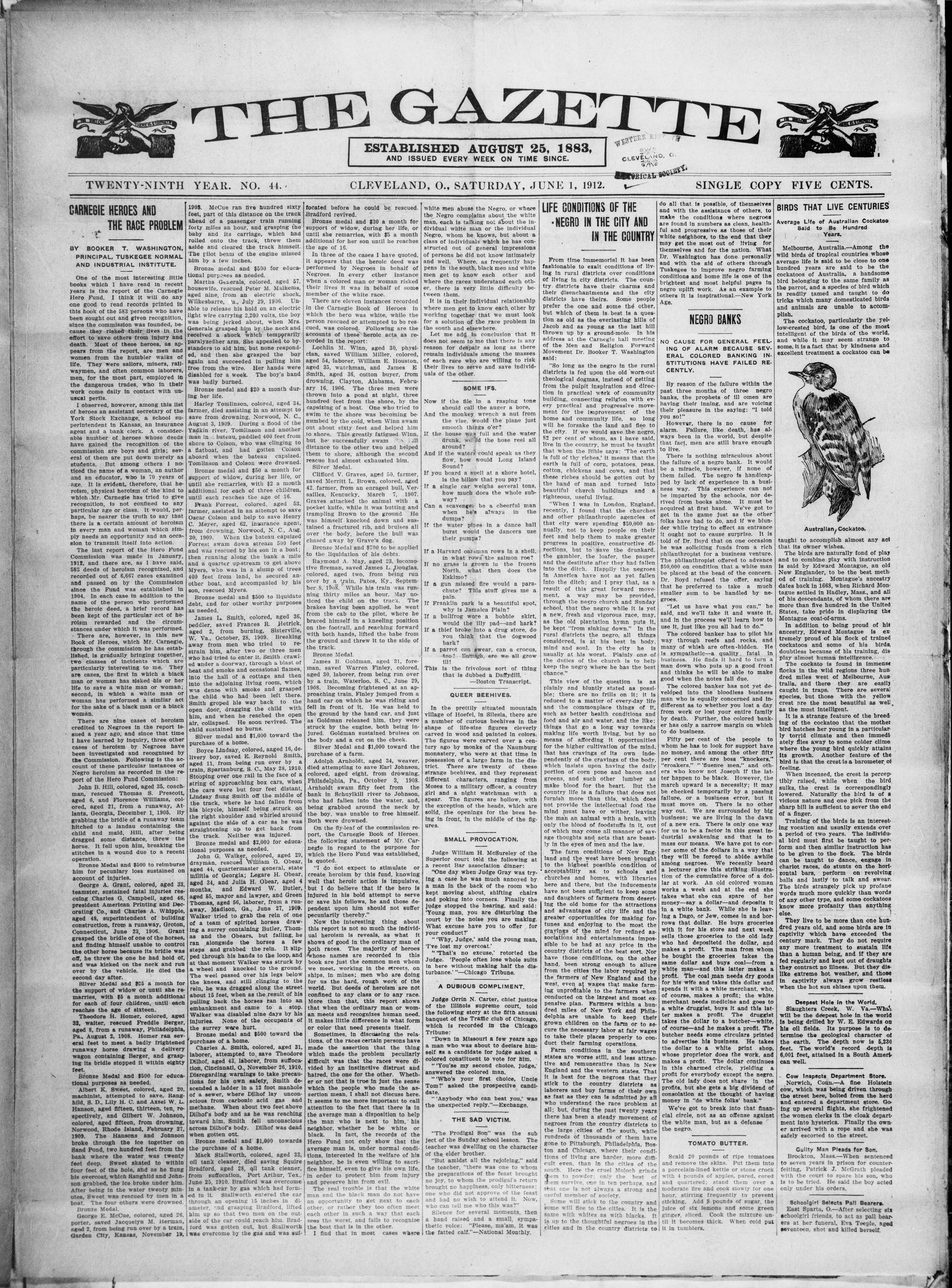
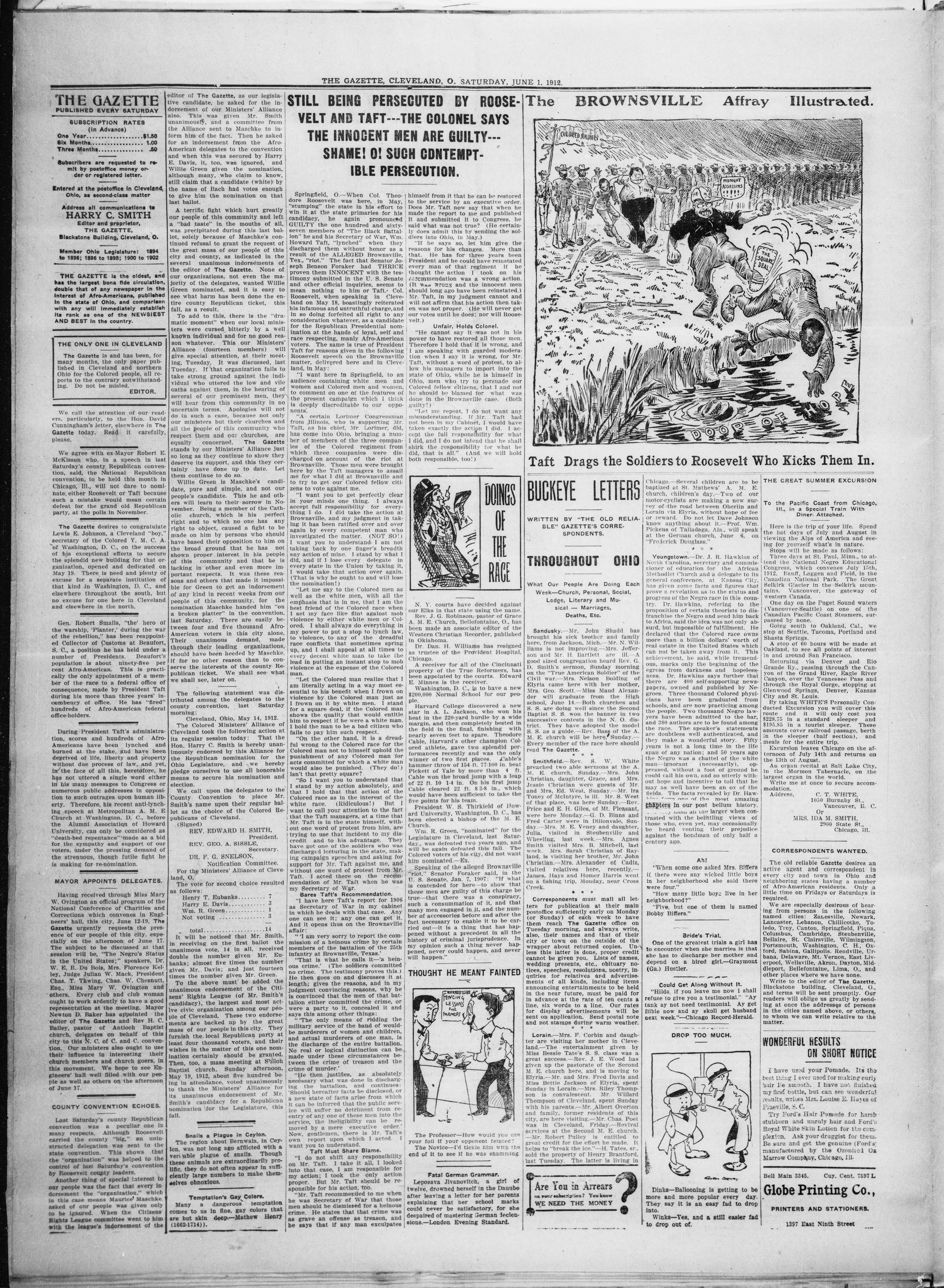
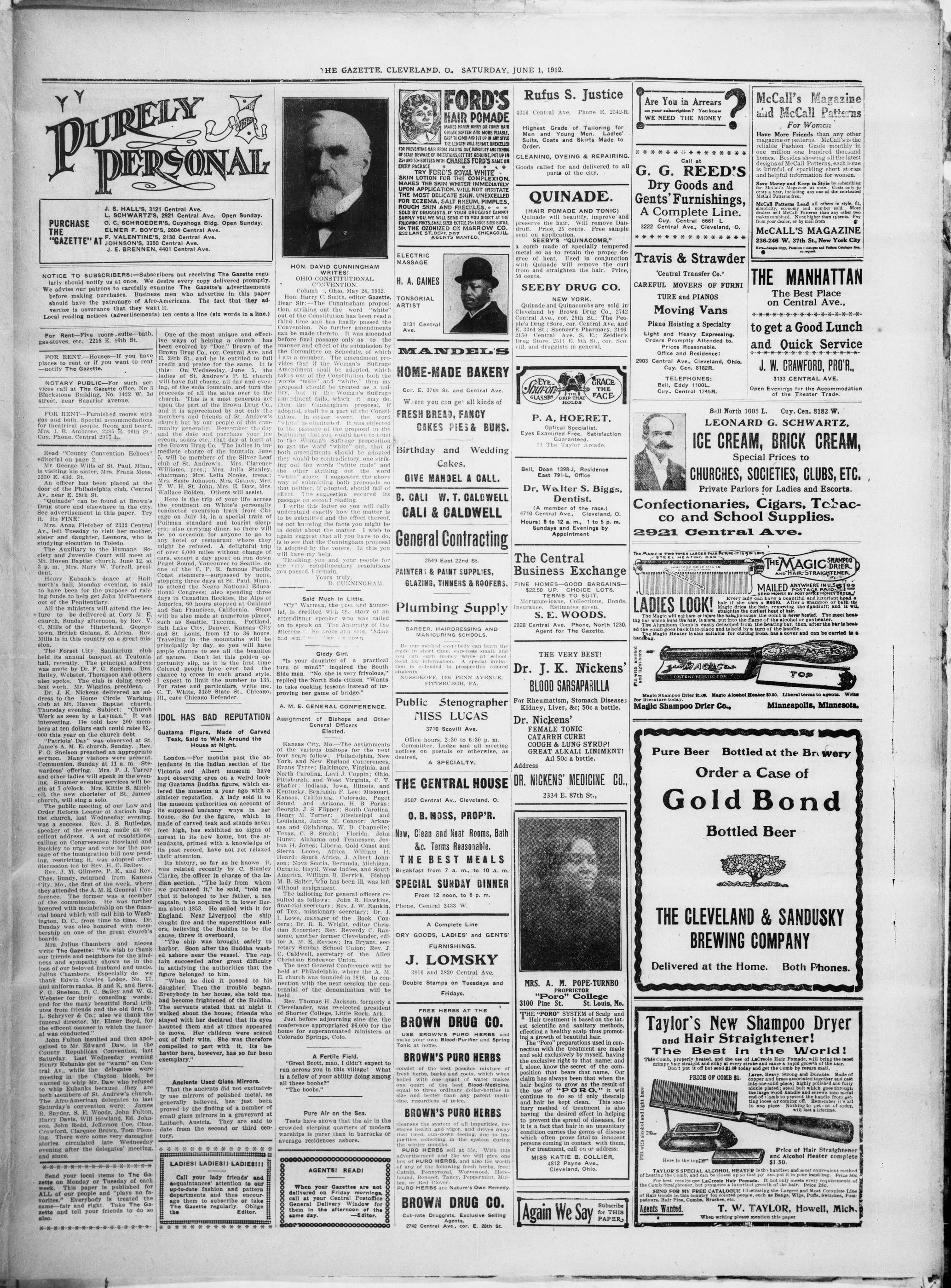
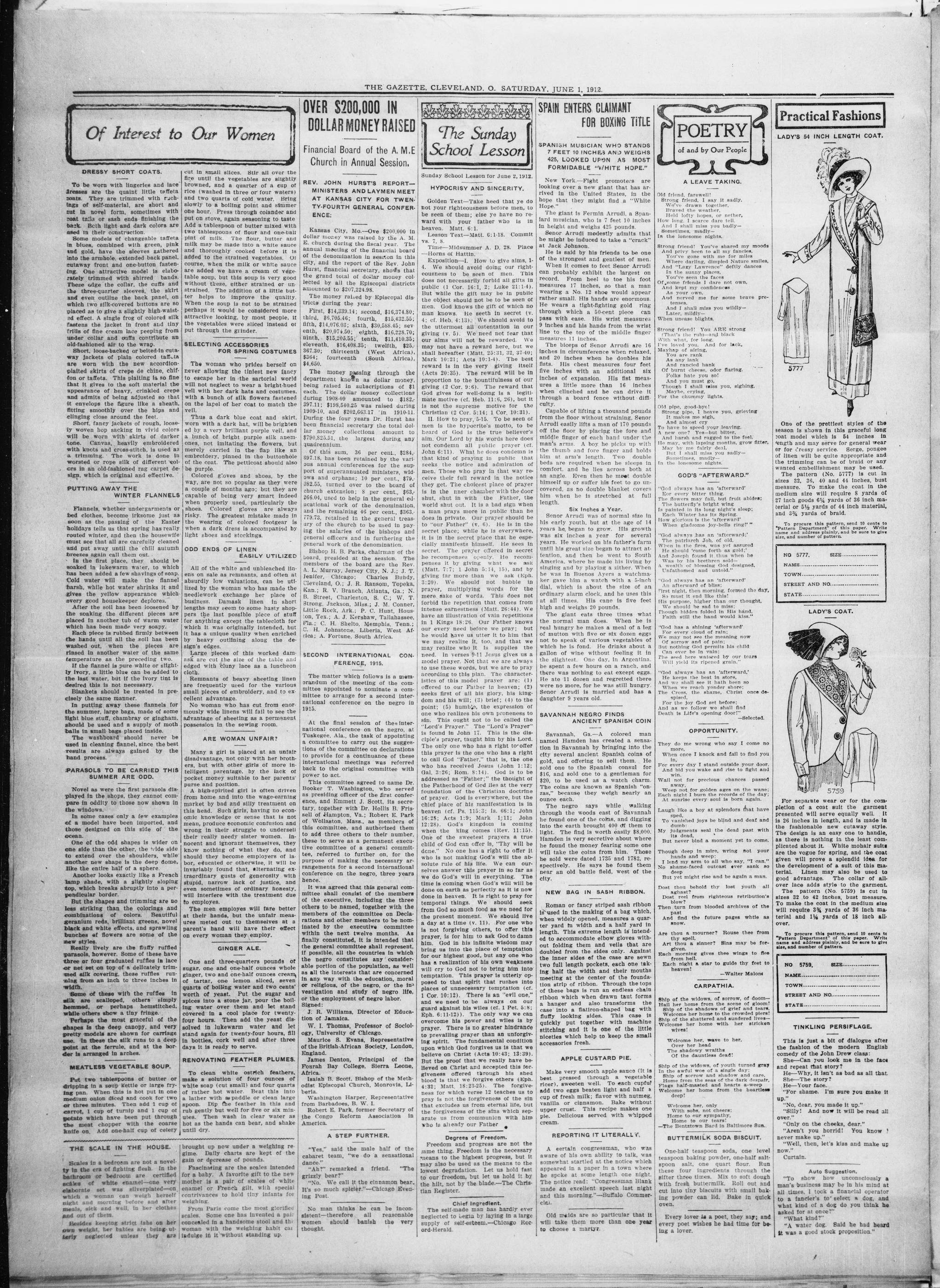
Page text (machine-generated)
TWENTY-NINTH YEAR. NO. 44.
IN HILLCON
THERE IS IMPERIA
CARNEGIE HEROES AND
BY BOOKER T. WASHINGTON, PRINCIPAL, TUSKEGEE NORMAL AND INDUSTRIAL INSTITUTE.
One of the most interesting little books which I have read in recent years is the report of the Carnegie Hero Fund. I think it will do any one good to read records printed in this book of the 583 persons who have been sought out and given recognition, since the commission was founded, because they risked their lives in the effort to save others from injury and death. Most of these heroes, as appears from the report, are men and women from the humbler walks of life. They were sailors, miners, railwaymen, and often common laborers, men, for the most part, employed in the dangerous trades, who in their work come daily in contact with unusual perils.
I observed, however, among this list of heroes an assistant secretary of the York Stock Exchange, a school superintendent in Kansas, an insurance agent and a bank clerk. A considerable number of heroes whose deeds have gained the recognition of the commission are boys and girls; several of them are put down merely as students. But among others I noticed the name of a woman, an author and an educator, who is 70 years of age. It is evident, therefore, that heroism, physical heroism of the kind to which Mr. Carnegie has tried to give recognition, is not confined to any particular age or class. It would, perhaps, be nearer the truth to say that there is a certain amount of heroism in every man and woman which simply needs an opportunity and an occasion to transmit itself into action.
The last report of the Hero Fund Commission was made in January, 1912, and there are, as I have said, 583 deeds of heroism recognized, and recorded out of 6,667 cases examined and passed on by the Commission since the Fund was established in 1904. In each case in addition to the name of the person who performed the heroic deed, a brief record has been kept of the particular act of heroism rewarded and the circumstances under which it was performed. There are, however, in this new Book of Heroes, which Mr. Carnegie, through the commission he has established, is gradually bringing together, two classes of incidents which are particularly interesting to me. They are cases, the first in which a black man or woman has nisked his or her life to save a white man or woman; second, in which a white man or woman has performed a similar act for the sake of a black man or a black woman. There are nine cases of heroism credited to Negroes in the report issued a year ago, and since that time I have learned by inquiry, three other cases of heroism by Negroes have been investigated and recognized by the Commission. Following is the account of these particular instances of Negro heroism as recorded in the report of the Hero Fund Commission:
John B. Hill, colored, aged 35, coachman, rescued Thomas S. Prescott, aged 6, and Florence Williams, colored, aged 21, from a runaway, Atlanta, Georgia, December 1, 1905. By grabbing the bridle of a runaway team hitched to a landau containing the child and maid, Hill, after being dragged some distance, threw the horse. It fell upon him, breaking the stitches in a wound due to a recent operation.
Bronze Medal and $500 to reimburse him for pecuniary loss sustained on account of injuries.
George A. Grant, colored, aged 33, teamster, sustained fatal injuries rescuing Charles G. Campbell, aged 45, president American Printing and Decorating Co., and Charles A. Whipple, aged 48, superintendent of building construction, from a runaway, Groton, Connecticut, June 23, 1906. Grant grasped the bridle of all the horses, and finding himself unable to control the other horse because its bridle was off, he threw the one he had hold of, and was kicked on the neck and run over by the vehicle. He died the second day after.
Silver Medal and $25 a month for the support of widow or until she remarries, with $5 a month additional for each of four children, until each reaches the age of sixteen.
Theodore H. Homer, colored, aged 32, waiter, rescued Freddie Berger, aged 8, from a runaway, Philadelphia, Pa. August 2, 1908. Homer ran several feet to meet a badly frightened runaway horse drawing a delivery wagon containing Berger, and grasping its bridle stopped it within eight feet.
Bronze Medal and $500 for educational purposes as needed.
Albert K. Sweet, colored, aged 20, machinist, attempted to save, Ranghild, S. D. Lily H. C. and Axel W. L. Hanson, aged fifteen, thirteen, ten, respectively, and Gilbert W. Johnson, colored, aged fifteen, from drowning, Norwood, Rhode Island, February 27, 1909. The Hansons and Johnson broke through the ice together on Sand Pond, two hundred feet from the bank where the water was twenty feet deep. Sweet skated to within four feet of the hole, and as he flung his overcoat, which Ranghild and Johnson grabbed, the ice broke under him. After being in the water twenty minutes, Sweet was rescued by men in a boat. The four others were drowned.
Bronze Medal.
George E. McCue, colored, aged 26, porter, saved Jacqueline M. Herman, aged 2, from being run over by a train, Garden City, Kansas, November 18,
THE GAZETTE
1908. McCue ran five hundred sixty feet, part of this distance on the track ahead of a passenger train running forty miles an hour, and grasping the baby and its carriage, which had rolled onto the track, threw them aside and cleared the track himself. The pilot beam of the engine missed him by a few inches.
Bronze medal and $500 for educational purposes as needed.
Martha Generals, colored, aged 57, housewife, rescued Peter M. Malkens, aged nine, from an electric shock, Wilkesbarre, 'a', July 29, 1906. Unable to release his hold on an electric light wire carrying 2,200 volts, the boy was being jerked about, when Mrs. Generals grasped him by the neck and received a shock which temporarily paralyzed her arm. She appealed to bystanders to aid him, but none responded, and then she grasped the boy again and succeeded in pulling him free from the wire. Her hands were disabled for a week. The boy's hand was badly burned.
Bronze medal and $20 a month during her life.
Harley Tomlinson, colored, aged 34, farmer, died assisting in an attempt to save from drowning, Norwood, N. C., August 3, 1909. During a flood of the Yadkin river, Tomlinson and another man in, bateau, paddled 400 feet from shore to Colson, who was clinging to a flatboat, and had gotten Colson aboard when the bateau capsized. Tomlinson and Colson were drowned. Bronze medal and $50 a month for support of widow, during her life, or until she remarries, with $2 a month additional for each of three children, until each reaches the age of 16.
Frank Forrest, colored, aged 53, farmer, assisted in an attempt to save Oscar Colson and help to save Henry C. Meyer, aged 62, insurance agent, from drowning, Norwood, N. C., Aug. 30, 1909. When the bateau capsized Forrest swam down stream 500 feet and was rescued by his son in a boat; then running along the bank a mile and a quarter upstream to get above Myers, who was in a slump of trees 400 feet from land, he secured another boat, and accompanied by his son, rescued Myers.
Bronze medal and $500 to liquidate debt, end for other worthy purposes as needed.
James L. Smith, colored, aged 36, peddler, saved Frances R. Hetrick, aged 2, from burning, Sisterville, W. Va., October, 28, 1909. Breaking away from men who tried to restrain him, after two or three men who had tried to enter it. Smith crawled under a doorway, through a blast of heat and smoke and occasional flames, into the hall of a cottage and then into the adjoining living room, which was dense with smoke and grasped the child who had been left there. Smith groped his way back to the open door, dragging the child with him, and when he reached the open air, collapsed. He soon revived. The child sustained no burns.
Silver medal and $1,000 toward the purchase of a home.
Boyce Lindsay, colored, aaged 16, delivery boy, saved E. Reynold Smith, aged 11, from being run over by a train, Spartanburg, S. C., May 28, 1910. Stooping over one rail in the face of a string of approaching box cars when the cars were but four feet distant, Lindsay flung Smith off the middle of the track, where he had fallen from his bicycle, himself being struck on the right shoulder and whirled around against the side of a car as he was straightening up to get back from the track. Neither was injured.
Bronze medal and $2,000 for educational purposes as needed.
John G. Walker, colored, aged 29, drayman, rescued William G. Oear, aged 44, quartermaster general, state militia of Georgia; Legere H. Oear, aged 34, and Julia H. Oear, aged 4 months, and Edward W. Butler, aged 55, mayor and lawyer, and Green Thomas, aged 56, laborer, from a runaway, Madison, Ga., June 27, 1909. Walker tried to grab the rein of one of a team of spirited horses drawing a survey containing Butler, Thomas and the Oebars, but falling, he ran alongside the horses a few steps and grabbed the rein. It slipped through his hands to the loop, and at that moment Walker was struck by a wheel and knocked to the ground. The weel passed over his legs below the knees, and still clinging to the rein, he was dragged along the street about 15 feet, when as the result of his pulling back the horses ran into an embankment and came to a stop. Walker was disabled nine days by his injuries. None of the occupants of the surrey were hurt.
Bronze medal and $500 toward the purchase of a home.
Charles A. Smith, colored, aged 31, laborer, attempted to save the Theodore Dilhof, aged 43, laborer, from suffocation, Cincinnati, O, November 26, 1910. Disregarding warnings to take precautions for his own safety, Smith descended a ladder in a 12 foot manhole of a sewer, where Dilhof lay unconscious from carbonic acid gas and methane. When about two feet above Dilhof's body and as he was reaching toward him, Smith fell unconscious across Dilhof's body. Dilhof was dead when gotten out.
Bronze medal and $1,000 towards the purchase of a home.
Mack Stallworth, colored, aged 33, tank cleaner, died saving Squire Bradford, aged 28, qtl tank cleaner, from suffocation, Port Arthur, Tex.
June 25, 1910. Bradford was overcome in a tank-car by gas which had formed in it. Stallworth entered the car through an opening 15 inches in diameter, and grasping Bradford, lifted him up so that two men on the outside of the car could reach him. Bradford was gotten out, but Stallworth was overcome by the gas and was suf-
ESTABLISHED AUGUST 25, 1883 AND ISSUED EVERY WEEK ON TIME SINCE.
located before he could be rescued. Bradford revived.
Bronze medal and $30 a month for support of widow, during her life, or until she remarries, with $5 a month additional for her son until he reaches the age of 16.
In three of the cases I have quoted, it appears that the heroic deed was performed by Negroes in behalf of Negroes. In every other instance when a colored man or woman risked their lives it was in behalf of some member of the white race.
There are eleven instances recorded in the Carnegie Book of Heroes in which the hero was white, while the person rescued or attempted to be rescued, was colored. Following are the accounts of these heroic acts as recorded in the report:
white men abuse the Negro, or where the Negro complains about the white man, each is talking not about the individual white man or the individual Negro, whom he knows, but about a class of individuals which he has constructed out of general impressions of persons he did not know intimately and well. Where, as frequently happens in the south, black men and white men get to know each other and where the races understand each other, there is very little difficulty between them.
It is in their individual relationship where men get to know each other by working together that we must look for a solution of the race problem in the south and elsewhere.
Let me add in conclusion that it does not seem to me that there is any
LIFE CONDITIONS
·NEGRO IN THE
IN
From time immemorial fashionable to exalt ing in rural districts of living in city distr ies districts have their disenchantment districts have their prefer the one and but which of them it ions as old as the eva Jacob and as young thrown up by a grow address at the Carne
Lochlin M. Winn, aged 30, physician, saved William Miller, colored, aged 54, laborer, William E. Houston, aged 35, watchman, and James E Smith, aged 36, cotton buyer, from drowning, Clayton, Alabama, February 16, 1906. The three men were thrown into a pond at night, three hundred feet from the shore, by the capsizeing of a boat. One who tried to swim to the shore was becoming numbed by the cold, when Winn swam out about sixty feet and helped him to shore. This greatly fatigued Winn, but he successfully swam all distance to the other two and helped them to shore, although the second rescue had almost exhausted him. Silver Medal. Clifford V. Graves, aged 50, farmer, saved Merritt L. Brown, colored, aged 42, farmer, from an enraged bull, Versallies, Kentucky, March 7, 1907. Graves attacked the animal with a pocket knife, while it was butting and trampelling Brown to the ground. He was himself knocked down and sustained a fractured rib, and bruises all over the body, before the bull was chased away by Grave's dog. Bronze Medal and $700 to be applied to the liquidation of his debts.
Raymond A. May, aged 23, locomotive fireman, saved James L. Douglas, colored, aged two, from being run over by a train, Pates, Ky., September 8, 1908. While his train was running thirty miles an hour, May noticed the child on the track. The brakes having been applied, he went from the cab to the pilot, where he braced himself in a kneeling position on the footrail, and reaching forward with both hands, lifted the babe from the ground and threw it to the side of the track.
Bronze Medal.
James B. Goldman, aged 31, foreman, saved Warren Finley, colored, aged 30, laborer, from being run over by a train, Waterloo, S. C. June 29, 1908. Becoming frightened at an approaching train. Finley jumped from a hand car on which he was riding and fell in front of it. He was held to the ground by the hand car, and just as Goldman released him, they were struck by the engine, both being injured. Goldman sustained bruises on the body and a cut on the cheek.
Silver Medal and $1,000 toward the purchase of a farm.
Adolph Arnoldh, aged 34, weaver, died attempting to save Earl Johnson, colored, aged eight, from drowning. Philadelphia, Pa., October 3, 1908. Arnoldh swift fifty feet from the bank in Schuylkill river to Johnson, who had fallen into the water, and, being grabbed around the neck by the boy, was unable to free himself. Both were drowned.
On the fly-leaf of the commission report, the Carnegie Book of Heroes, the following statement of Mr. Carnegie in regard to the purpose for which the Hero Fund was established, is quoted.
"I do not expect to stimulate or create heroism by this fund, knowing that well heroic action is impulsive, but I do believe that if the hero is injured in his bold attempt to serve or save his fellows, he and those dependent upon him should not suffer peculiarly thereby."
Now the interesting thing about this report is not so much the individual heroism is reveals, as what it shows of good in the ordinary man of both races. The majority of heroes whose names are recorded in this book are just the common men whom we meet, working in the streets, on ships, in mines; men who are doing for us the hard, rough work of the world. But deeds of heroism are not confined to any class or to any race. More than that, this report shows that when the ordinary man or woman meets and recognizes human need, it makes little difference in what form or color that need presents itself. Sometimes, in discussing the relations, of the races certain persons have made the assertion that the thing which made the problem peculiarly difficult was that the races were divided by an instinctive distrust and hatred, the one for the other. Whether or not that is true in just the sense which the people who made the assertion mean, I shall not discuss here. It seems to me more important to call attention to the fact that there is in the average man a disposition to help the man who is next to him, his neighbor, whether he be white or black. In fact, the records of the Hero Fund not only show that the average man is, under normal conditions, interested in the welfare of his neighbor, he is even willing to sacrifice himself, even to give his own life, in order to protect him from injury and preserve him from evil.
The real trouble is that the white man and the black man do not have an opportunity to get next to each other, or rather they too often meet each other in such a way that each sees the worst, and falls to recognize the best that is in the other.
I find that in most cases where
white men abuse the Negro, or where the Negro complains about the white man, each is talking not about the individual white man or the individual Negro, whom he knows, but about a class of individuals which he has constructed out of general impressions of persons he did not know intimately and well. Where, as frequently happens in the south, black men and white men get to know each other and where the races understand each other, there is very little difficulty between them. It is in their individual relationship where men get to know each other by working together that we must look for a solution of the race problem in the south and elsewhere. Let me add in conclusion that it does not seem to me that there is any reason for despair as long as there remain individuals among the masses of each race who are willing to risk their lives to serve and save individuals of the other.
SOME IFS.
Now if the file in a rasping tone should call the auger a bore.
And the monkey wrench a nut from the vise, would the plane just smooth things o'er?
If the house was full and the water drunk, would the hose reel all around?
And if the waters could speak as they flow, how would Long Island Sound?
If you board a snell at a shore hotel, is the billow that you pay?
If a single car weighs several tons, how much does the whole subway?
Can a scavenger be a cheerful man when he's always in the dumps?
If the water pines in a dance hall burst would the dancers use their pumps?
If a Harvard carman rows in a shell, in what rows the salmon roe?
If no grass is grown in the frozen North, what then does the Eskimo?
If a gun missed fire would a parachute? This stuff gives me a pain.
If Franklin park is a beautiful spot, why is Jamaica Plain?
If a bullfrog wore a hobble skirt, would the illy pad—and hark?
If a thief broke into a drug store, do you think that the dogwood bark?
If a parrot can swear, can a crocus, too? Erraugh, ere we all grow fuit.
This is the frivolous sort of thing that is dubbed a Darwinian script.
QUEER BEEHIVES.
In the prettily situated mountain village of Hoeefel, in Silesia, there are a number of curious beehives in the shape of life-size figures cleverly carved in wood and painted in colors. The figures were carved over a century ago by monks of the Naumburg monastery, who were at that time in possession of a large farm in the district. There are twenty of these strange beehives, and they represent different characters, ranging from Moses to a military officer, a country girl and a night watchman with a spear. The figures are hollow, with the exception of the heads, which are solid, the openings for the bees being in front, in the middle of the figures.
SMALL PROVOCATION
Judge William H. McSureley of the Superior court told the following at a recent Bar association dinner: "One day when Judge Gray was trying a case he was much annoyed by a man in the back of the room who kept moving about, shifting chairs and poking into corners. Finally the judge stopped the hearing, and said: 'Young man, you are disturbing the court by the noise you are making. What excuse have you to offer for your conduct?' "Why, Judge," said the young man, I've lost my overcoat." "That's no excuse," retorted the Judge. 'People often lose whole suits in here without making half the disturbance.'"—Chicago Tribune.
A DUBIOUS COMPLIMENT
Judge Orrin N. Carter, chief justice of the Illinois supreme court, told the following story at the fifth annual banquet of the Traffic club of Chicago, which is recorded in the Chicago Tribune:
"Down in Missouri a few years ago a man who was about to declare himself as a candidate for judge asked a colored constituent to vote for him.
"You're my second choice, judge, answered the colored man.
"Who's your first choice, Uncle Tom? asked the prospective candidate.
"Anybody who can beat you,' was the unexpected reply."—Exchange.
THE SAD VICTIM.
"The Prodigial Son" was the sub subject of the Sunday school lesson. The teacher was dwelling on the character of the elder brother.
"But amidst all the rejoicing," said the teacher, "there was one to whom the preparations of the feast brought no joy, to whom the prodigal's return brought no happiness, only bittersweet; one who did not approve of the feast and had no wish to attend it. Now, who can tell me who this was?"
Silence for several moments, then a hand raised and a small, sympathetic voice: "Please, ma'am, it was the fatted calf."—National Monthly.
LIFE CONDITIONS OF THE NEGRO IN THE CITY AND IN THE COUNTRY
From time immemorial it has been fashionable to exalt conditions of living in rural districts over conditions of living in city districts. The country districts have their charms and their disenchants and the city districts have theirs. Some people prefer the one and some the other, but which of them is best is a question as old as the everlasting hills of Jacob and as young as the last hill thrown up by a ground-mole. In his address at the Carnegie hall meeting of the Men and Religion Forward Movement Dr. Booker T. Washington said: "So long as the negro in the rural districts is fed upon the old worn-out theological dogmas, instead of getting from the pulpit inspiration and direction in practical work of community building, connecting religion with every practical and progressive movement for the improvement of the home and community life, so long will he forsake the land and flee to the city. If we would save the negro, 82 per cent of whom, as I have said, live in the country, he must be taught that when the Bible says: 'The earth is full of thy riches,' it means that the earth is full of corn, potatoes, peas, cotton, chickens and cows, and that these riches should be gotten out by the hand of man and turned into beautiful church buildings and a righteous, useful living.
"When I was in London, England, recently, I found that the churches and other philanthropic agencies of that city were spending $50,000 annually, not to keep people on their feet and help them to make greater progress in positive, constructive directions, but to save the drunkard, the gambler, the loafer, the pauper and the destitute after they had fallen into the ditch. Happily the negroes in America have not as yet fallen into the ditch; and I pray that, as a result of this great forward movement, a way may be provided, through the negro church and Sunday school, that the negro while it is yet a new, fresh and vigorous race, may, as the old plantation hymn puts it, be kept "from slinking down." In the rural districts the negro, all things considered, is at his best in body, mind and soul. In the city he is usually at his worst. Plainly one of the duties of the church is to help keep the negro where he has the best chance."
This view of the question is as plainly and bluntly stated as possible; there are no frills on it; it is reduced to a matter of every-day life and the commonplace things of it, such as better health conditions and food and air water, and the like; things that go a long way towards making life worth living, but by no means of affording it opportunities for the higher cultivation of the mind, that has cravings of its own independently of the cravings of the body, which insists upon having the daily portion of corn pone and bacon and greens, and such other lumber as make blood for the heart. But the country life is a failure that does not furnish more than this, which does not provide the intellectual food the mind must have or wither, leaving the man an animal with a brain, with only the blood of foodstuffs in it, of which may come all manner of savage thoughts and acts that are beastly in the eyes of men and the law.
The farm conditions of New England and the west have been brought to the highest possible condition of acceptability as to schools and churches and homes, with libraries here and there, but the inducements have not been sufficient to keep some and daughters of farmers from deserting the old home for the attractions and advantages of city life and the greater opportunities for making fortunes and enjoying to the most the cravings of the mind for refined associations and entertainments impossible to be had at any price in the country districts of the best sort. Nor have those conditions, on the other hand, been strong enough to allure from the cities the labor required by the farmers of New England and the west, even at wages that make farming unprofitable to the farmers when conducted on the largest and most expensive plan. Farmers within a hundred miles of New York and Philadelphia are unable to keep their grown children on the farm or to secure the necessary labor at fair wages to take their places properly to conduct their farming operations.
Farm conditions in the southern states are worse still, and less attractive and remunerative than in New England and the western states. That it is best for the negroes that they stick to the country districts as laborers and buy farms of their own as fast as they can is admitted by all who understand the race problem at all; but, during the past twenty years there has been a steady movement of negroes from the country districts to the large cities of the south, while rundreds of thousands of them have gone to Pittsburgh, Philadelphia, Boston and Chicago, where their conditions of living are harder, more difficult even, than in the cities of the south. Here the cruel Moloch grinds them to powder; only the best of them survive, one in ten perhaps, and that one is not always a strong and useful member of society. Some will stick to the country and some will flee to the cities. It is the same with whites as with blacks. It is up to the thoughtful negroes in the cities and in the country districts to
do all that is possible, of themselves and with the assistance of others, to make the conditions where negroes are found in numbers as clean, healthful and progressive as those of their white neighbors, to the end that they may get the most out of living for themselves and for the nation. What Dr. Washington has done personally and with the aid of others through Tuskegee to improve negro farming conditions and home life is one of the brightest and most helpful pages in negru uplift work. As an example to others it is inspirational.—New York Age.
NEGRO BANKS
NO CAUSE FOR GENERAL FEELING OF ALARM BECAUSE SEVERAL COLORED BANKING INSTITUTIONS HAVE FAILED RECENTLY.
By reason of the failure within the past three months of three negro banks, the prophets of ill omen are having their inning, and are voicing their pleasure in the saying: "I told you so!" However, there is no cause for alarm. Failure, like death, has always been in the world, but despite that fact, men are still brave enough to live.
There is nothing miraculous about the failure of a negro bank. It would be a miracle, however, if none of them failed. The negro is handicapped by lack of experience in a business way. This experience can not be imparted by the schools, nor derived from books alone. It must be acquired at first hand. We've got to get in the game just as the other folks have had to do, and if we blunder while trying to effect an entrance it ought not to cause surprise. It is told of Dr. Boyd that on one occasion he was soliciting funds from a rich philanthropist for a business venture. The philanthropist offered to advance $50,000 on condition that a white man be placed at the head of the concern. Dr. Boyd refused the offer, saying that he preferred to take a much smaller sum to be handled by negroes.
"Let us have what you can," he said, and we'll take it and waste it, and in the process we'll learn how to use it, just like you all had to do."
The colored banker has to pilot his way through reefs and rocks, and many of which are often-hidden. He is sympathetic—a quality, fatal in business. He finds it hard to turn a man down who puts up a good front and thinks he will be able to make good when the notes fall due.
The colored banker has not yet developed into the bloodless business man who is equally concerned and indifferent as to whether you lost a day from work or lost your entire family by death. Further, the colored banker has only a narrow margin on which to do business.
Fifty per cent of the people to whom he has to look for support have no money, and among the other fifty per cent there are boss "knockers," "erookers," "fluence men," and others who know not Joseph if the latter happen to be black. However, the march upward is a necessity; it may be checked temporarily by a passing failure, or a business error, but it must move on. There is no other way out. We are surrounded by big business; we are living in the dawn of a new era. There is only one way for us to be a factor in this great industrial awakening and that is to mass our means. We have got to corner some of the dollars in a way that they will be forced to abide awhile among negroes. We recently heard a lecturer give this striking illustration of the cumulative force of a dollar at work. An old colored woman works a week and at the end she takes what she can spare of her money—say a dollar—and deposits it in a white bank. While she is leaving a Dago, or Jew, comes in and borrows that dollar. He buys groceries with it for his store and next week sells those groceries to the old lady who had deposited the dollar, and makes a profit. The man from whom he bought the groceries takes the same dollar and buys coal—from a white man—and this latter makes a profit. The coal man needs dry goods for his wife and takes this dollar and spends it with a white merchant, who, of course, makes a profit; the white merchant needs medicine and goes to a white druggist, buys it and this latter makes a profit. The druggist takes the dollar to a butcher—white, of course—and he makes a profit. The butcher needs some circulars printed to advertise his business. He takes the dollar to a white print shop, whose proprietor does the work, and makes a profit. The dollar continues in this charmed circle, yielding a profit for everybody except the negro. The old lady does not share in the profits, but she gets a big dividend of consolation at the thought of having money in "de white folks' bank."
We've got to break into that financial circle, not as an offense against the white man, but as a defense the negro.
TOMATO BUTTER
Scald 20 pounds of ripe tomatoes and remove the skins. Put them into a porcelain-lined kettle or stone crock with 4 pounds of apples, pared, cored and quartered; stand them over a moderate fire and cook slowly for one hour, stirring frequently to prevent sticking. Add 8 pounds of sugar, the juice of six lemons and some green ginger, sliced. Cook the mixture until it becomes thick. When cold put it in tumblers.
IN THE NAME OF GOD
451
BIRDS THAT LIVE CENTURIES
Average Life of Australian Cockatoo
Said to Be Hundred
Years.
Melbourne, Australia—Among the
wild birds of tropical countries whose
average life is said to be close to one
hundred years are said to be the
cockatoos of Australia, a handsome
bird belonging to the same family as
the parrot, and a species of bird which
is readily tamed and taught to do
tricks which many domesticated birds
and animals are unable to accomplish.
The cockatoo, particularly the
yellow-crested bird, is one of the most
intelligent of the birds of the world,
and while it may seem strange to
some, it is a fact that by kindness and
excellent treatment a cockatoo can be
Australian, Cockatoo.
taught to accomplish almost any act that its owner wishes.
The birds are naturally fond of play and to combine play with instruction is said by Edward Montague, an old New Englander, to be the best method of training. Montague's ancestry dates back in 1668, when Richard Montague settled in Hadley, Mass., and all of his descendants, of whom there are more than five hundred in the United States, take pride in displaying the Montague coat-of-arms.
In addition to being proud of his ancestry, Edward Montague is extremely proud of his flock of trained cockatoos and some of his birds, doubtless because of his training, play almost human intelligence.
The cockatoo is found in immense flocks in the wild regions three hundred miles west of Melbourne, Australia, and there they are easily caught in traps. There are several species, but those with the yellow crest are the most beautiful as well as the most intelligent.
It is a strange feature of the breeding of the cockatoo that the mother bird hatches her young in a particularly torrid climate and then immediately flies away to some colder clime where the young bird quickly attains its growth. Another feature of the bird is that the crest is a barometer of feeling.
When incensed, the crest is perceptibly raised, while when the bird sulks, the crest is correspondingly lowered. Naturally the bird is of a vicious nature and one pick from the sharp bill is sufficient to sever the end of a finger.
Training of the birds is an interesting vocation and usually extends over a period of two years. The individual bird must first be taught to perform and then similar instruction has to be given to the flock. The birds can be taught to dance, engage in charlot races, do stunts on the horizontal bars, perform on revolving balls and lastly to talk and swear. The birds strangely pick up profane words much more quickly than words of any other type, and some cockatoos know more profanity than anything else.
They live to be more than one hundred years old, and some birds are in captivity which have exceeded the century mark. They do not require any more treatment to sustain life than a human being, and if they are fed regularly and kept out of draughts they contract no illness. But they dislike extreme hot weather, and those in captivity always grow restless when the hot sun shines upon them.
Deepest Hole In the World
Slaughter Creek, W. Va.—Wha will be the deepest hole in the world is being drilled by W. E. Edwards on his oil fields. Its purpose is to determine the geological character of the earth. The depth now is 5,230 feet. The world's record depth is 6,001 feet, attained in a South American well.
Cow Inspects Department Store.
Norwich, Conn.—A fine Holstein cow, which was being driven through the street here, bolted from the herd and entered a department store. Going up several flights, she frightened the women clerks in the cloak department into hysterics. Finally the owner arrived with a rope and she was safely escorted to the street.
Gulity Man Pleads for Sen
Brockton, Mass.—When sentenced to seven years in prison for counterfeiting, Patrick J. McGrath pleaded with the court to spare his son, who is to be tried. He said the boy acted only under his orders.
Schoolgirl Selects Pall Bearers.
East Sparta, O.—After selecting six schoolgirl friends, to act as pall bearers at her funeral, Eva Teeple, aged seventeen, shot and killed herself.
One Year.....$1.50
Six Months.....1.00
Three Months.....50
Subscribers are requested to remit by postoffice money order or registered letter.
Entered at the postoffice in Cleveland Ohio, as second-class matter
Address all communications to HARRY C. SMITH
Editor and proprietor,
THE GAZETTE,
Blackstone Building, Cleveland, O.
Member Ohio Legislature: 1894 to 1896; 1896 to 1898; 1900 to 1902
THE GAZETTE is the oldest, and has the largest bona fide circulation double that of any newspaper in the interest of Afro-Americans, publishes in the state of Ohio, and comparison with any will immediately establish its rank as one of the NEWSIEST AND BEST in the country.
THE ONLY ONE IN CLEVELAND
The Gazette is and has been, for many months, the only paper published in Cleveland and northern Ohio for the Colored people, all reports to the contrary notwithstanding. Do not be misled. EDITOR
EDITOR
We call the attention of our readers, particularly, to the Hon. David Cunningham's letter, elsewhere in The Gazette today. Read it carefully please.
We agree with ex-Mayor Robert E McKisson who, in a speech in last Saturday's county Republican convention, said, the National Republican convention, to be held this month in Chicago, Ill., will not dare to nominate either Roosevelt or Taft because such a mistake would mean certain defeat for the grand old Republican party, at the polls in November.
The Gazette desires to congratulate Lewis E. Johnson, a Cleveland "boy," secretary of the Colored Y. M. C. A. of Washington, D. C., on the success of his exceptional efforts to secure the splendid new building for that or organization, opened and dedicated on May 19. There is need and plenty of excuse for a separate institution of that kind in Washington, D. C., and elsewhere throughout the south, but no excuse for one here in Cleveland and elsewhere in the north.
Gen. Robert Smalls, 'the' hero of the warship, 'Planter,' during the war of the rebellion, has been reappointed Collector of Customs at Beaufort S. C., a position he has held under a number of Presidents. Beaufort's population is about ninety-five per cent Afro-American. This is practically the only appointment of a member of the race to a federal office of consequence, made by President Taft during his more than three years' incumbency of office. He has "fired" hundreds of Afro-American federal office-holders.
---
During President Taft's administration, scores and hundreds of Afro-Americans have been lynched and burned at the stake, and have been deprived of life, liberty and property without due process of law, and yet in the face of all this, heretofore, he has not uttered a single word either in his many messages to Congress on numerous public addresses in opposition to such outrages upon human liberty. Therefore, his recent anti-lynching speech at Metropolitan A. M. E Church at Washington, D. C., before the Alumni Association of Howard University, can only be considered as "death-bed repentance" made as a bld for the sympathy and support of our voters, under the pressing demand of the strenuous, though futile fight he is making for re-nomination.
MAYOR APPOINTS DELEGATES.
Having received through Miss Mary W. Ovington an official program of the National Conference of Charities and Corrections which convenes in Engineers' hall, this city, June 12-19. The Gazette urgently requests the presence of our people of this city, especially on the afternoon of June 17. The subject to be discussed at that session will be, "The Negro's Status in the United States;" speakers, Dr. W. E. B. Du Bois, Mrs. Florence Kelley, Judge Julian W. Mack, President Chas. T. Thwing, Chas. W. Chesnutt, Esq., Miss Mary W. Ovington and others. Every club and club woman ought to work ardently to have a good representation at the meeting, Mayor Newton D. Baker has appointed the editor of The Gazette and Rev H. C. Bailey, pastor of Antioch Baptist church, delegates on behalf of this city to this N. C. of C. and C. convention. Our ministers also ought to use their influence in interesting their church members and church goers, in this movement. We hope to see Engineers' hall well filled with our people as well as others on the afternoon of June 17.
COUNTY CONVENTION ECHOES.
Last Saturday's county Republican convention was a peculiar one in many respects. Although Roosevelt carried the county "big," an uninstructed delegation was sent to the state convention. This shows that the "organization" was helped to the control of last Saturday's convention by Roosevelt county leaders.
Another thing of special interest to our people was the fact that every indorsement the "organization" which in this case means Maurice Masche, asked of our people was given only to be ignored. When the Citizens Rights League committee went to him with the league's indorsement of the
editor of The Gazette, as our legislative candidate, he asked for the endorsement of our Ministers' Alliance also. This was given Mr. Smith unanimously, and a committee from the Alliance sent to Maschke to inform him of the fact. Then he asked for an endorsement from the Afro-American delegates to the convention and when this was secured by Harry E. Davis, it, too, was ignored, and Willie Green given the nomination, although many, who claim to know, still claim that a candidate (white) by the name of Bach had votes enough to give him the nomination on that last ballot.
A terrific fight which hurt greatly our people of this community and left a "bad taste" in the mouths of all, was precipitated during this last ballot, solely because of Maschke's continued refusal to grant the request of the great mass of our people of this city and county, as indicated in the several unanimous indorsements of the editor of The Gazette. None of our organizations, not even the majority of the delegates, wanted Willie Green nominated, and it is easy to see what harm has been done the entire county Republican ticket, this fall, as a result.
To add to this, there is the "dramatic moment" when our local ministers were cursed bitterly by a well known individual and for no good reason whatever. This our Ministers' Alliance (fourteen members) will give special attention, at their meeting, Tuesday. It was discussed, last Tuesday. If that organization fails to take strong ground against the individual who uttered the low and vile caths against them, in the hearing of several of our prominent men, they will hear from this community in no uncertain terms. Apologies will not do in such a case, because not only our ministers but their churches and all the people of this community who respect them and our churches, are equally concerned. The Gazette stands by our Ministers' Alliance just so long as they continue to show they deserve its support, and this they certainly have done up to date. Let them continue to do so.
Willie Green is Maschke's candidate, pure and simple, and not our people's candidate. This he and others will learn to their sorrow in November. Being a member of the Catholic church, which is his perfect right and to which no one has any right to object, caused a fight to be made on him by persons who should have based their opposition to him on the broad ground that he has not shown proper interest in his people of this community and that he is lacking in other and even more important respects. It was these reasons and others that made it impossible for Green to get an indorsement of any kind in recent weeks from our people of this community, for the nomination Maschke handed him "on a broken platter" in the convention, last Saturday. There are easily between four and five thousand Afro-American voters in this city alone. Their unanimous demand, made through their leading organizations, should have been heeded by Maschke, if for no other reason than to conserve the interests of the county Republican ticket. We shall see what we shall see, later on.
The following statement was distributed among the delegates to the county convention, last Saturday morning:
Cleveland, Ohio, May 14, 1912.
The Colored Ministers' Alliance of Cleveland took the following action at its regular session today: That the Hon. Harry C. Smith is hereby unanimously endorsed by this Alliance for the Republican nomination for the Ohio Legislature, and we hereby pledge ourselves to use all honorable means to secure his nomination and election.
We call upon the delegates to the County Convention to place Mr. Smith's name upon their regular ballot as the choice of the Colored Republicans of Cleveland.
REV. GEO. A. SISSLE,
Secretary.
DR. F. G. SNELSON,
Notification Committee.
For the Ministers' Alliance of Cleve
land, O.
The vote for second choice resulted
as follows:
Henry T. Eubanks. 7
Harry E. Davis. 3
Wm. R. Green. 1
Not voting. 3
total. 14
It will be noticed that Mr. Smith,
in receiving on the first ballot the
unanimous vote, 14 in all, received
double the number given Mr. Eubanks;
almost five times the number
given Mr. Davis; and just fourteen
times the number given Mr. Green.
To the above must be added the unanimous endorsement of the Citizens' Rights League (of Mr. Smith's candidacy), the largest and most active civic organization among our people of Cleveland. These two endorsements are backed up by the great mass of our people in this city. They furnish the local Republican party at least four thousand voters, and their wishes in the matter of this one nomination certainly should be granted. Then, too, a mass meeting at Shiloh Baptist church, Sunday afternoon, May 19, 1912, about five hundred being in attendance, voted unanimously to thank the Ministers' Alliance for its unanimous endorsement of Mr. Smith's candidacy for a Republican nomination for the Legislature, this fell.
---
Snails a Plague in Ceylon.
Snails a Plaque in Ceylon:
The region about Bernwala, in Ceylon, was not long ago afflicted with a variable plague of snails. Though these animals are extraordinarily prolific, they do not often appear in sufficiently large numbers to make themselves obnoxious.
Temptation's Gay Colors.
Many a dangerous temptation comes to us in fine, gay colors that are but skin deep—Mathew Henry (1662-1714).
THE GAZETTE, CLEVELAND, O. SATURDAY, JUNE 1, 1912.
STILL BEING PERSECUTED BY ROOSEVELT AND TAFT----THE COLONEL SAYS THE INNOCENT MEN ARE GUILTY---- SHAME! O! SUCH CDNTEMPTIBLE PERSECUTION.
Springfield, O.—When Col. Theodore Roosevelt was here, in May, "stumping" the state in his effort to win it at the state primaries for his candidacy, he again pronounced GUILTY the one hundred and sixty-seven members of "The Black Battalion" he and his Secretary of War, Wm. Howard Taft, "lynched" when they discharged them without honor as a result of the ALLEED Brownsville, N.C. fact that they were seph Benson Foraker had THRICE proven them INNOCENT with the testimony submitted in the U. S. Senate and other official inquiries, seems to mean nothing to him or Taft. Col. Roosevelt, when speaking in Cleveland on May 18, boastingly reiterated his infamous and untruthful charge, and in so doing forfeited all right to any consideration whatever, as a candidate for the Republican Presidential nomination at the hands of loyal, self and race respecting, manly Afro-American name is of the Brownsville Taft for reason in the following Roosevelt speech on the Brownsville matter, delivered here and in Cleveland, in May:
"I want here in Springfield, to an audience containing white men and women and Colored men and women, to comment on one of the features of the present campaign which I think is deeply discreditable to our opponents: certain Lorimer Congresman from Illinois, who is supporting Mr. Taft, as his chief, Mr. Lorimer, did, has come into Ohio, bringing a number of members of the three companies of the Colored regiment from which three companies were discharged on account of the riot at Brownsville. Those men were brought here by the Taft managers to assail Brownsville and to try to get our Colored fellow citizens to vote against me.
"I want you to get perfectly clear in your minds one thing. I always accept full responsibility for everything I do. I did take the action at Brownville, and my judgment in taking it back again by every competent man who investigated the matter. (NOT SO!) I want you to understand I am not taking back by one finger's breadth any action of mine. I stand by what I did, and if I lose every delegate in every state in the Union by taking it, would take that action over again. (I would ought to and will lose the nomination!)
"Let me say to the Colored men as well as the white men, with all the emphasis that is in me, that I am the best friend of the Colored race when I set my face like flint against mob violence by either white men or Colored. I shall always do everything in my power to put a stop to lynch law, to violence, to any of the dreadful race conflicts that sometimes spring up all the time at the expense of every decent white man to take the lead in putting an instant stop to mob violence at the expense of the Colored man.
"Let the Colored man realize that I am literally acting in a way most essential to his benefit when I frown on violence by the Colored man just as I frown on it by white men. I stand for a square deal, if the Colored man shows the quality that would entitle him to respect if he were a white man. I hold the man to be a bad citizen who fails to pay him such respect.
"On the other hand, it is a dreadful wrong to the Colored race for the Colored man not to himself hold the proclaimed man for acts committed for which a white man would also be punished. (They do!) isn't that pretty square?"
"So I want you to understand that I stand by my action absolutely, and that I hold that that action of the Colored race as in the interest of the white race. (Ridiculous!) But I want to call your attention to the fact that the Taft managers, at a time that Mr. Taft is in the state himself, without one word of protest from him, are trying to use that incident to my discredit and to his advantage. The officers who discharged lecturers in the state, making campaign speeches and asking for support for Mr. Taft against me, and without one word of protest from Mr. Taft. I acted there on the recommendation of Mr. Taft when he was my Secretary of War.
*Bares Taft's Recommendation.* "I have here Taft's report for 1906 as Secretary of War in my cabinet in which he deals with that case. Any one can see it; any one can get it. And it opens thus on the Brownsville affair."
"I am very sorry to report the commission of a heinous crime by certain members of the battalion of the 25th infantry at Brownsville, Texas."
"That is what he calls it—a heinous crime." (The soldiers committed no crime. The testimony proves this.) He then goes on and discusses it at length; gives the reasons, and in my judgment convincing reasons, why he is convinced that the men of that battalion either committed the crime, or were a party to it, concealed it and says this among other things.
"The only means of riding the military service of the band of world women and children, and actual murderers of one man, is the discharge of the entire battalion. No real or logical distinction can be made under these circumstances between the crime of treason and the crime of murder."
"He then justifies, as absolutely necessary what was done in discharging the battalion, and continues: 'Should hereafter facts be disclosed, or a new state of facts arise from which it can be inferred that the public service will suffer no detriment from reentry of any one of these men into the service, the ineligibility can be moved by a mere order; now there is Mr. Taft's own report upon which I acted. I want you to understand.
Taft Must Share Blame.
Taft must share responsibility
"I do not shift any responsibility
on Mr. Taft. I will all, I looked
into that case. I am responsible for
my action. I took the only action
paper. But Mr. Taft should be
responsible for his action, too.
"Mr. Taft recommended to me when
he was Secretary of War that those
men should be dismissed for a helmous
crime. He states that that crime was
as grave an offense as treason, and
he says that if any man exculpates
himself from it that he can be restored to the service by an executive order. Does Mr. Taft now say that when he made the report to me and published it and submitted it to Congress, he said what was not true? (He certainly does admit this by sending the soldiers into Ohio, in May.) He says so. He him give the reasons for his changes. More than that. He has for three years been President and he could have reinstated every man of that regiment if he thought the action I took on his recommendation was a wrong action. (It was wrong and the innocent man should long ago have been reinstated.) Mr. Taft, in my judgment cannot and should not have been not proper. (He will never get our votes until he does; nor will Roosevelt.)
Unfair. Holds Colonel.
"He cannot say it was not in his power to have restored all those men. Therefore I hold that it is wrong, and I am speaking with guarded moderation when I say it is wrong, for Mr. Taft, without a word of protest, to allow his managers to import into the state of Ohio, while he is himself in Colored fellow citizen that I should not he should be blamed for what I was done in the Brownsville case. (Both guilty!)
"Let me repeat, I do not want any misunderstanding. If Mr. Taft had not been in my Cabinet, I would have taken exactly the act Ignid, I. accuse him of being a villain. I did, and I do not intend that he shall shirk the responsibility for what he did, that is all." (And we will hold both responsible, too!)
DOINGS OF THE RAGE
N. Y. courts have decided against our Elks in that state using the name. R. E. Robinson, pastor of Grace A. M. E. Church, Bicontaina, o has been made an associate editor of the Western Christian Recorder, published in Oklahoma.
Dr. Dan. H. Williams has resigned as trustee of the Provident Hospital, Chicago. A receiver for all of the Cincinnati property of the True Reformers, has been appointed by the courts. Edward E. Minnes is the receiver. Washington, D. C. is to have a new $200,000 Normal School for our people. Harvard College discovered a new star in A. L. Jackson, who won his heat in the 220-yard hurdle by a wide margin, and then completely bested in the field in the final, finishing with nearly seven feet to spare. Theodore Cable, Harvard's other champion Coloredlete, gave two aplaudid percussion recently and was the only winner of two first places. Cable's hammer throw of 154 ft. 77-100 in. beat Pickett of Yale by more than 4 ft. Cable won the broad jump with a leap of 22 ft. 10-14 in. On his first jump Cable cleared 22 ft. 8-3-8 in., which would have been sufficient to take the five points for his team. President W. S. Thirkield of Howard University, Washington, D. C. has been elected a bishop of the M. E.
Wm. R. Green, "nominated" for the Legislature in Cleveland, last Saturday, was defeated two years ago, and will be again defeated this fall. The Colored voters of his city, did not want him nominated—Ex.
Speaking of the alleged Brownsville Sniper, Foster said, in the U.S. Senate Jan. 7, 1907: "If what is contended for here—to show that these men are guilty of this charge be true—that there was a conspiracy, such a consummation of it, and that many men engaged in it, and the number of accessories before and after the fact necessary to enable it to be carried out, it is a thing he has happened in all the cases of criminal jurisprudence. In my opinion such a thing never happened, never could happen, and never will happen."
THOUGHT HE MEANT FAINTED
WHEREVER WITH FENCING LESSONS FOUL FARMERS
The Professor—How would you use your foil if your opponent feinted?
The Novice—I'd tickle him with the end of it to see if he was shamming
Fatal German Grammar.
Leposava Jivanovitch, a girl of twelve, drowned herself in the Danube after leaving a letter for her parents explaining that her school marks could never be satisfactory, for she despaired of mastering German selections.-London Evening Standard.
COLLORED SHOOTERS
MIDNIGHT ASSASSINES
THE SQUARE DEAL
DOOR OF HOPE
Taft Drags the Soldiers to Rocsevelt Who Kicks Them In.
BUCKEYE LETTERS
WRITTEN BY "THE OLD RELIABLE" GAZETTE'S CORRESPONDENTS.
THROUGHOUT OHIO
What Our People Are Doing Each Week—Church, Personal, Social, Lodge, Literary and Musical — Marriages, Deaths, Etc.
Sandusky.—Mr. John Shadd has brought his sick brother and family here, from Jackson, Mich.—Mr. N. Williams is not improving.—Mrs. Jefferson and Mr. H. Bartlett are ill.—A good sized congregation heard Rev. G. D. Smith's sermon, Sunday morning on the "True American Soldier" of the Civil War.—Mrs. Elyria came here with her mother, Mrs. Geo. Scott.—Miss Maud Alexander will graduate from the High school, June 14.—Both churches and S. S. are doing well since the Second Baptist S. S. won the banner in two successive contests in the N. O. district.—Mr. S. S. is a guide.—Rev. Bass of the A. M. E. church will be here'sunday.—Every member of the race here should read The Gazette.
Smithfield—Rev. S. W. White preached two able sermons at the A. M. E. church, Sunday—Mrs. John Christian, daughter, Grace, and Mrs. Jessie Christian were guests of Mr. and Mrs. Ed. West, Sunday—Mrs. Ira Toney of Mcntyre is ill. Mrs. S. Wetten plea was hereby addressed Price and E. H. Giles, of Mt. Pleasant, were here Monday—D. G. Binns and Fred Carter were in Dillonville, Sunday—Mrs. M. E. Veney and daughter, Julia, visited in Steubenville and Wheeling, last week—Mrs. Agnes Smith visited Mrs. B. Mitchell, last week. Mrs. Sarah Christian of Ray Christian, visited Mrs. Alexander of Cadz, visited relatives here, recently. James, Hays and Homer Harris went on a fishing trip, Monday near Cross Creek.
---
Correspondents must mail all letters for publication at their main postoffice sufficiently early on Monday (or Sunday) of each week to have them reach The Gazette office on Tuesday morning, and always write, also, their names and addresses outside of the wrapper about returned copies. Unless this latter is done, proper credit cannot be given you. Lists of names, wedding presents, etc., obituary notices, speeches, resolutions, poetry, inquiries for relatives and advertisements must be sent to the financing entertainments to be held in the near future, must be paid for in advance at the rate of ten cents a line, six words to a line. Our rates for display advertisements will be sent on application. Send postal note and not stamps during warm weather.
Lorain—Mrs. F. Corbin and daughter are visiting her mother in Cleveland—The entertainment given by Miss Bessie Tate's S. S. class was a great success. Rev. J. E. Wood has given up the pastorate of the Second E. church here, and is moving to Elvy. He is now spending Miss Bettie Jackson of Elvy, spent Sunday in Lorain—Mrs. Riley Thompson is convalescent. Mr. Willard Thompson of Cleveland, spent Sunday with his parents.—Mr. Albert Overton and family, former residents of this city, are here visiting.—Mr. Chas. Poet was in Cleveland, Friday.—Revival services at the Second M. E. church. He is giving great credit for the effort he made. It helps to "breathe the ice."-H Tates, sr., sold the property of Henry Brantford, last Tuesday. The latter is living in
Are You in Arrears on your subscription? You know WE NEED THE MONEY
Chicago.—Several children are to be baptized at St. Matews' A. M. E. church, children's day.—Two of our motor-cyclists are making a new survey of the road between Oberlin and Lorain via Elyria, without hope of fee or reward. Do not let Dave Johnson ride on the road. Pickens of Talladaga, Ala., will speak at the German church, June 6, on "Frederick Douglass."
```markdown
```
Youngstown—Dr. J. R. Hawkins of North Carolina, secretary and commissioner of education for the African Methodist Church, and a delegate to its general conference, at Kansas City has given some facts and figures that prove a revelation as to the status and progress of the Negro race in this country. Dr. Hawkins, referring to the proposition of certain theorists to displace the Negro and send him back to Africa, has said that he had surd, but impossible of fulfillment. He declared that the Colored race owns more than a billion dollars' worth of real estate in the United States which can not be taken away from it. This achievement, he said, while tremendous, marks only the beginning of the egress from darkness and hopelessness. Dr. Hawkins says further that there are 400 self-supporting newspapers, owned and published by Negroes. Three thousand Colored physicians have been graduated from schools, and are now practicing among Negro lawyers have been admitted to the Negro lawyers and 380 authors are to be found among the race. The speaker's statements are doubtless well authenticated, and they make a wonderful story. Fifty years is not a long time in the life span of any nation; and 50 years ago the Negro was a chatter of the white man—ignorant (necessarily), oppressed, without a foot of ground he could call his own, and so utterly without hope and incentive to toll that he may as well have been told by the man who was led by Dr. Hawkins from one of the most amazing chapters in our post bellum history, room all over larger when contrasted with the belitting views of those who, even yet, may occasionally be heard venting their prejudice against the bondman of only half a century ago.
Ah!
"When some one asked Mrs. Biffers if there were any wicked little boys in her neighborhood she said there were four."
"How many little boys live in her neighborhood?"
"Five, but one of them is named Bobby Biffers."
Bride's Trial
One of the greatest trials a girl has to encounter when she marries is that she has to discharge her mother and depend on a hired girl.—Graymont (Ga.) Hustler.
Could Go. Along Without It.
"Hilda, if you leave me now I shall refuse to give you a testimonial." "Ay tank anay not need testimonial. Ay get Bible now and ay skoll get husband next week."—Chicago Record-Herald.
Dinks—Ballooning is getting to be more and more popular every day. They say it is an easy fad to drop into. Winks—Yes, and a still easier fad to drop out of.
THE GREAT SUMMER EXCURSION
To the Pacific Coast from Chicago, Ill., in a Special Train With Dinner Attached.
Here is the trip of your life.
Spend the days of May and August in viewing the coast of America and seeing for yourself what's in nature.
Stops will be made as follows:
Three days at St. Paul, Minn., to attend the National Negro Educational Congress, which convenes July 15th, 1912. Banff, Laggen and Field, in the Canadian National Park. The Great Selkirk Glacier in the Selkirk mountain, the gateway of western Canada.
One day on the Puget Sound waters (Vancouver-Seattle) on one of the Canadian Pacific Coast Steamers, surpassed by none.
Going south to Oakland, Cal., we stop at Seattle, Tacoma, Portland and Shasta Springs.
A stop in hours will be made at Oakland, to see all points of interest in and around San Francisco.
Returning via Denver and Rio Grande Ry., passing through the Canyon of the Grand River, Eagle River Canyon, over the Tennessee Pass and through the Royal Gorge, stopping at Glenwood Springs, Denver, Kansas City and St. Louis.
By taking WHITE'S Personally Conducted Excursion you will cover this route and it will only cost you $75.55 in a cover sleeper and $155.55 in a cover sleeper. These amounts cover railroad passage, berth in the sleeper (half section), and meals for the entire trip.
Excursion leaves Chicago on the afternoon of July 14th and returns on the 13th of August.
An organ recital at Salt Lake City, in the Mormon Tabernacle, on the largest organ in the world.
Write me at once to secure accommodation.
Address, C. T. WHITE,
1050 Burnaby St.
Vancouver, E. C.
Or
MRS. IDA M. SMITH,
2900 State St.
Chicago, ill.
CORRESPONDENTS WANTED.
The old reliable Gazette desires an active agent and correspondent in every city and town in Ohio and neighboring states having a number of Afro-American residents. Only a little time on Fridays or Saturdays is required.
We are especially desirous of hearing from persons in the following named cities: Zan.esville, Newark, Boston, New Hampshire, Springfield, Leoedo, Troy, Canton, Springfield, Piqua Columbus, Cambridge, Steubenville, Bellaire, St. Clairsville, Wilmington, Portsmouth, Washington, C. H., Oxford, Sabina, Gallipolis, Rendville, Urbana, Delaware, M. Ternon, East Liverpool, Wellsville, Akron, Dayton, Middleport, Belfonteain, Lima, O., and other places where we have none.
Write to the editor of The Gazette, Blackstone building, Cleveland, O., and terms will be sent promptly. Our purpose is to be greatly by sending at once the address, period in the cities named above, or others, to whom we can write relative to the matter.
WONDERFUL RESULTS
ON SHORT NOTICE
WONDERFUL RESULTS
ON SHORT NOTICE
I have used your Pomade. Its the best thing I ever used for making curly hair be smooth. I have not finished my first bottle, but can see wonderful results, writes Mrs. Louise E. Hayes of Pineville, S.C.
Try Ford's Pomade for harsh stubborn and unruly hair and Ford's Royal White Skin Lotion for the complexion. Ask your druggist for them. Be sure and get the genuine (Ford's manufactured by the Ozonized Ox Marrow Compamy, Chicago, IL.
1397 East Ninth Street
PURELY PERSONAL
J. S. HALL'S, 3121 Central Ave.
L. SCHWARTZ'S, 2921 Central Ave. Open Sunday.
O. C. SCHROEDER'S, Cuyahoga Bldg. Open Sunday.
ELMER F. BOYD'S, 2604 Central Ave.
F. VALENTINE'S, 2130 Central Ave.
JOHNSON'S, 3350 Central Ave.
J. E. BRENNEN, 4401 Central Ave.
NOTICE TO SUBSCRIBERS:--Subscribers not receiving The Gazette regularly should notify us at once. We desire every copy delivered promptly. We advise our patrons to carefully examine The Gazette's advertisements before making purchases. Business men who advertise in this paper should have the patronage of Afro-Americans. The fact that they advertise is assurance that they want it. Local reading notices (advertisements) ten cents a line (six words in a line.)
PURCHASE
THE
"GAZETTE" AT
For Rent—Five room suite—bath,
gas-stover, etc. 2218 E. 46th St.
FOR RENT—Houses—If you have
places to rent or if you want to rent
—notify The Gazette.
NOTARY PUBLIC—For such service
sices call at The Gazette office. No. 3
Blackstone Building, No. 1422 W. 36
street, near Superior avenue.
FOR RENT—Furnished rooms with
gas and bath. Special accommodations
for theatrical room. Room and board.
Mrs. I. B. Ambrose, 2285 E. 46th St.,
Cuy. Phone, Central 2917 L.
Read "County Convention Echoes"
editorial on page 2.
Mr. George Wills of St. Paul, Minn.,
is visiting his sister, Mrs. Frank Moss.
2230 E. 43rd St.
An officer has been placed at the
door of the Philadelphia club, Central
A. near E. 28th St.
"Quinade" can be found at Brown's Drug store and elsewhere in the city. See advertisement in this paper. Try it. Its FINE!
Mrs. Anna Fletcher of 2332 Central Av. left Tuesday to visit her mother, sister and daughter, Leonora, who is studying elocution in Toledo.
The Auxiliary to the Humane Society and Juvenile Court will meet at M. Hoven Baptist church, June 12, at 3 p. m. Mrs. Mary W. Terrell, president.
Henry Eubank's dance at Haltnorth's hall. Monday evening, is said to have been for the purpose of raising children to help get John McPheeters out of the Penitentiary.
All the ministers will attend the lecture to be delivered at Cory M. E. church, Sunday afternoon, by Rev E. C. Mills of the Hinterland, Georgetown, British Guiana, S. Africa. Rev Mills is in this country on a great mission.
The Forset City Sanitarium club held its annual banquet at Teutonia hall, recently. The principal address was made by Dr. F. G. Snelson. Drs. Bailey, Webster, Thompson and others also spoke. The club is doing excellent work. Mr. Wiggins, president. Dr. J. K. Nickens delivered an address to the club at Mt. Haven Baptist church, Thursday evening. Subject: "Church Work as seen by a Layman." It was interesting. He told how 200 members at ten dollars each could raise $2,000 this year on the church debt. "Patriots Day" was observed at St. James's A. M. E. church, Sunday. Rev. F. G. Snelson preached an appropriate sermon. Many visitors were present. Communion, Sunday at 11 a. m. Stewardess' offering. Mrs. P. J. m. Tierwarden also will speak in the evening. Summer evening services will begin the of October. Kittie S. Mitchert will chair of the christian of St. James' church will sing a solo.
The public meeting of our Law and Order Reform League at Antioch Baptist church, last Wednesday evening, was a success. Rev J. S. Rutledge, speaker of the evening, made an excellent address. A set of resolutions, calling on Congressmen Howland and Buckley to urge and vote for the passage of the immigration bill now pending, restricting it, was adopted after discussion led by Rev H. C. Bailey. Rev J. M. Gillmere, P. E., and Rev Chas. Bundy, returned from Kansas City, Mo., the first of the week, where they attended the A. M. E. General Conference. The former was a member of the commission, He was further honored with membership on the financial board, who called him to Washington, D. C., from time to time. Dr. Bundy was also honored with memorial on one of the great church's boards.
Mrs. Julius Chambers and nieces write The Gazette: "We wish to thank our friends and neighbors for the kindness and sympathy shown us in the loss of our beloved husband and uncle, Julius Chambers. Especially, we are grateful to Lodge. No. 17 and uniform ranks. B and K, and Revs F. G. Snelson. H. C. Balley and W. G. Webster for their consoling words; and for the many beautiful floral tributes from friends and the old firm, G. L. Schryver & Co.; also we thank the funeral director, Mr. Elmer Boyd, for the funeral in which the funerals were conducted."
John Fulton insulted and then apologized to Mr. Edward Daw, in the County Republican Convention, last Saturday. Last Wednesday evening Henry Eubanks got so "warm" on Central Av., while the delegates were meeting in the Clayton block, be wanted to whip Mr. Daw who refused to whip Eubanks because the aid are numbers St. Andrew's church. The Aro-American delegates to last Saturday's convention were: James R. Snyder, S. E. Woods, John Fulton, Harry Davis, Will Howland, Ed Johnson, John Redd, Jefferson Co. Chas, Crawford, Clargene Brown, Tom Fleming. There were some very damaging stories circulated late Wednesday evening after the delegates' meeting, and since.
Send your local items to The Gazette on Monday or Tuesday of each week. This paper is published for ALL of our people and "plays no favorites." Everybody is treated the same—fair and right. Take The Gazette and tell your friends to do so also.
One of the most unique and effective ways of helping a church has been evolved by "Doc." Brown of the Brown Drug Co., cor. Central Ave, and E. 28th St., and he is entitled to full credit and praise for the same. It is this: On Wednesday, June 5, the ladies of St. Andrew's P. E. church will have full charge, all day and evening, of the soda fountain, and turn the church. This is a most generous act upon the part of the Brown Drug Co. and it is appreciated by not only the members and friends of St. Andrew's church but by our people of this community generally. Remember the day and the date and purchase your ice cream, sodas etc., that day at least at the Brown Drug Co. The ladies in immediate charge of the fountain, June 5, will be members of the Silver Leaf club of St. Andrew's: Mrs. Clarence Pres, Mrs. Linda Stanley, chairman, Mrs. Linda Nooks, Mrs. Susie Johnson, Mrs. Gaines, Mrs. T. W. H. St. John, Mrs. E. Daw, Mrs. Wallace Bolden. Others will assist.
Here is the trip of your life across the continent on White's personally conducted excursion train from Chicago on July 14, in a special train of Pullman standard and tourist sleeper; also carrying dinner, so there will be no occasion for anyone to go to any hotel or restaurant where they might be refused. A delightful trip to New York, where you can see cars, except a day spent on run down Puget Sound, Vancouver to Seattle, on one of the C. P. R. r famous Pacific Coast steamers—surpassed by none, stopping three days at St. Paul, Minn., to attend the Negro National Educational Congress; also spending three days in Canadian Rockies, the Alps of Canada, the Rockies and San Francisco, California. Ships will be also made at numerous places, such as Seattle, Tacoma, Portland, Salt Lake City, Denver, Kansas City and St. Louis, from 12 to 36 hours. Traveling in the mountains will be principally by day, so you will have ample chance to see all the beauties of nature. Don't let this golden opportunity slip, as it is the first time people have ever had the chance to see the mountains. I expect to limit the number to 135. For rates and particulars, write me, C. T. White, 3159 State St., Chicago, Ill., care Chicago Defender.
IDOL HAS BAD REPUTATION
Guatama Figure, Made of Carved Teak, Said to Walk Around the House at Night.
London.—For months past the attendants in the Indian section of the Victoria and Albert museum have kept observing eyes on a weird looking Guatama Buddha figure, which entered the museum a year ago with a sinister reputation. A lady sold it to the museum authorities on account of its supposed uncanny ways in her house. So far the figure, which is made of carved teak and stands seven feet high, has exhibited no signs of unrest in its new home, but the attendants, primed with a knowledge of its past record, have not yet relaxed their attention.
Its history, so far as he knows it, was related recently by C. Stanley Clarke, the officer in charge of the Indian section. "The lady from whom we purchased it," he said, "told me that it belonged to her father, a sea captain, who acquired it in lower Burma about 1853. He sailed with it for England. Near Liverpool the ship caught fire and the superstitious sailors, believing the Budda to be the cause, threw it overboard.
"The ship was brought safely to harbor. Soon after the Budda washed ashore near the vessel. The captain succeeded after great difficulty in satisfying the authorities that the figure belonged to him.
"When he died it passed to his daughter. Then the trouble began. Everybody in her house, she told me, had become frightened of the Buddha. The servants stated that at night it walked about the house; friends who stayed with her declared that its eyes haunted them and at times appeared to move. Her children were scared out of their wits. She was therefore compelled to part with it. Its behavior here, however, has so far been exemplary."
Ancients Used Glass Mirrors
That the ancients did not exclusively use mirrors of polished metal, as generally believed, has just been proved by the finding of a number of small glass mirrors in a graveyard at Laibach, Austria. They are said to date from the second or third century.
Call your lady friends' and acquaintances' attention to our up-to-date fashion and pattern departments and thus encourage them to subscribe to the Gazette regularly. Oblige the Editor.
?HE GAZETTE, CLEVELAND, O. SATURDAY, JUNE 1, 1912.
J. B. H.
Columbus, Ohio, May 24, 1912.
Hon. Harry C. Smith, editor Gazette,
Dear Sir:—The Cunningham proposition,
striking out the word "white"
out of the Constitution has been read a
third time and has finally passed the
Convention. No further amendments
can be made thereto. It was amended
before final passage only as to the
manner and effect of its submission by
the Committee on Schedule, of which
I am a member. The amendment provides
that if the Woman's Suffrage
Amendment shall be adopted, which
take a position on the words "male" and "white" with any
proposal should be treated as a nullity, but if the Woman's Suffrage
amendment fails, which it may do,
then the Cunningham proposal, if adopted, shall be a part of the Constitution. In either event, the word "white" is eliminated. It was objected to the passage of the proposal in the
beginning that you would have to trust
to the Woman's Suffrage proposition to get the word "white" out; that if both amendments should be adopted
they would be contradictory, one striking out the words "white male" and
then striking out the word "white woman" suggested a way of submitting both proposals so that neither, if adopted, should tail of effect. The suggestion secured its
passage on second reading.
I write this letter so you will fully understand exactly how the matter is to be submitted and the effect thereof, as not knowing the facts you might be in doubt about the matter. I wish to again suggest that all you have to do, is to see that the Cunningham proposal is adopted by the voters. In this you will have my help.
Thanking you and your people for the very complimentary resolutions you passed, I remain.
Yours truly,
D. CUNNINGHAM.
Said Much in Little
"Cy" Warman, the poet and humorist, is credited with the story of an after-dinner speaker who was called on to speak on "The Antiquity of the Microcele." He wrote and said, "Adam and em" and "thee" at down.
Giddy Girl.
"Is your daughter of a practical turn of mind?" inquired the South Side man "No she is very frivolous." replied the North Side citizen "Wants to take cooking lessons instead of improving her game of bridge."
A. M. E. GENERAL CONFERENCE.
Assignment of Bishops and Other General Officers
Elected
Kansas City, Mo.—The assignments of the various bishops for the next four years follow: Philadelphia, New York, and New England Conferences, Evans Tyree; Baltimore, Virginia, and North Carolina. Levi J. Coppin; Ohio, Pittsburgh, and West Virginia, C. T. Shafer; Indiana, Iowa, Illinois, and Kentucky, Benjamin F. Lee; Missouri, Kansas, California, Colorado, Puget Sound, and Arizona, H. B. Parks, Georgia, J. S. Flipper; South Carolina, Henry M. Turner; Mississippi and Louisiana, James M. Connor; Arkansas and Oklahoma, W. D. Chappelle; Texas, Smith; Florida, John H. Jones; Alabama, Goldstein, Joshua H. Jones; Liberia, Tasselos and Sierra Leone, Africa, William H. Heard; South Africa, J. Albert Johnson; Nova Scotia, Bermuda, Michigan, Ontario, Hayt, West Indies, and South America, William B. Derrick, Bishop M. B. Salter, who has been ill, was left without assignment.
The balloting for general officers resulted as follows: John R. Hawkins, financial secretary; Rev. J. W. Rankin, of Tex., missionary secretary; Dr. J. Lowe, manager of the Book Concern; Dr. R. R. Wright, editor Christian Recorder; Rev. Reverdy C. Ransome, another former Clevelander, editor A. M. E. Review; Ira Bryant, secretary Sunday School Union; Rev. J. C. Caldwell, secretary of the Allen Christian Endeavor Union. The next General Conference will be held at Philadelphia, where the A. M. E. church was founded in 1816. In connection with the next session the centennial of the denomination will be held. Rev. Thomas H. Jackson, formerly a Clevelander, was re-elected president of Shorter College, Little Rock, Ark. Just before adjourning sine die, the conference appropriated $6,000 for the home for superannuated ministers at Colorado Springs, Colo.
A Fertile Field.
"Great Scott, man, I didn't expect to run across you in this village! What is a fellow of your ability doing among all these boobs?" "The boobs."
Pure Air on the Sea.
Tests have shown that the air in the crowded sleeping quarters of modern warships is purer than in barracks or average residences ashore.
When your Gazettes are not delivered on Friday mornings, call at your Central Postoffice General Delivery Window for them in the afternoon of the same day. —Editor.
MARY
FORD'S
HAIR POMADE
MASSES MAKE MAINLY OR CURRY
GLOSSY COATING AND MORE MPLAIN.
EASY TO GROUND AND FUTURE UP MY STYLE
THE LENGTH WILL MISS UNCLEEDED
FOR PREVENTING HAIR FROM FALLING OUT, DANIELROSS OF
SCALE BEWARE OF IMITATIONS, GET THE GENIUS, UP IN
28 AND 50 BOTTLES WITH CHARLES FORD'S NAME ON
EVERY PACKAGE
TRY FORD'S ROYAL WHITE
SKIN LOTION FOR THE COMPLEXION
MAKES THE SKIN WHITER IMEDIATELY
UPON APPLICATION. WILL NOT IRRITATE
THE MAXIMAL SALT TREATMENT, HIMPLES,
ROUGH SKIN AND FRECILIES.
SOLD BY DRUGGISTS. IF YOUR DRUGGIST CANNOT
SUPPLY YOU, WE WILL SEND IT TO YOU DIRECT AT THE
FOLLOWING PRICES. SMALL SIZED BOTTLE, 25% LARGE SIZED BOTTLE,
50% THE OZONIZED OX MARROW CO.
232 LAKE ST. DEPT. 207
CHICAGO,ILL
AGENTS WANTED.
ELECTRIC
MASSAGE
H. A. GAINES
TONSORIAL
ARTIST
3131 Central
Ave.
ELECTRIC MASSAGE
TONSORIAL
ARTIST
3131 Central
Ave.
MANDELS
HOME-MADE BAKERY
Con. E. 37th St. and Central Ave.
Where you can get all kinds of
FRESH BREAD, FANCY
CAKES PIES & BUNS.
Birthday and Wedding
Cakes.
GIVE MANDEL A CALL.
B. CALI W. T. CALDWELL
CALI & CALDWELL
General Contracting
PAINTERS & PAINT SUPPLIES,
GLAZING, TINNERS & ROOFERS.
Plumbing Supply
BARBER, HAIRDRESSING AND
MANICURING SCHOOLS.
By our method everybody can learn the
trade in short time; expenses small, and
you can earn money while at school.
Need for information. A special invite
is extended to prospective closed
students.
NOSSOKOFF, 1405 FENN AVENUE,
PITTSBURGH, PA.
Public Stenographer
MISS LUCAS
3710 Scovill Ave.
Office hours, 2:30 to 6:30 p. m.
Committee, Lodge and all meeting notices on postals or otherwise, as desired.
THE CENTRAL HOUSE
2507 Central Av., Cleveland, O.
O. B. MOSS, PROP'R.
New, Clean and Neat Rooms, Bath
&c. Terms Reasonable.
THE BEST MEALS
Breakfast from 7 a. m., to 10 a. m.
SPECIAL SUNDAY DINNER
From 12 noon, to 8 p. m.
Phone, Central 2433 W.
A Complete Line
DRY GOODS, LADIES' and GENTS'
FURNISHINGS.
J. LOMSKY
3816 and 3820 Central Ave.
Double Stamps on Tuesdays and
Fridays.
USE BROWN'S PURO HERBS and
their own Blood-Purifier and Spring
Taste & Balm.
BROWN'S PURO HERBS
consist of the best possible mixture of fresh herbs, barks and roots, which when boiled with one quart of water makes one quart of the best Blood-Medicine, equal to three ordinary dollar-bottles in volume, and which patent medicine, regardless of price.
BROWN'S PURO HERBS
cleanses the system of all impurities, restores health and vigor, and drives away that tread, run-down feeling, due to imbalance in the system during the winter months. **PURO HERBS** sell at $36. With this advertisement and $3c we will give one of the following fresh horticulture items, $36 worth any of the following fresh horticulture Catilp, Fenneryroal, Wormwood, Horehound, Boneset, Tancy, Peppermint, Mullen, or Red Clover.
BROWN DRUG CO.
Cut-rate Druggists, Exclusive Selling Agents,
2742 Central Ave., cor. E. 28th St.
Rufus S. Justice
Rufus S. Justice
4316 Central Ave. Phone E. 2342-R.
Highest Grade of Tailoring for Men and Young Men. Ladies' Suits, Coats and Skirts Made to Order.
CLEANING, DYEING & REPAIRING.
Goods called for and delivered to all parts of the city.
QUINADE.
(HAIR POMADE AND TONIC)
Quinade will beautify, improve and preserve the hair. Will remove Dandruff. Price, 25 cents. Free sample sent on application.
SEEBY'S "QUINACOMB," a comb made of specially tempered metal so as to retain the proper degree of heat. Used in conjunction with Quinade will remove the curl from and straighten the hair. Price, 50 cents.
SEEBY DRUG CO.
Quinade and Quinacobs are sold in Cleveland by Brown Drug Co., 2742 Central Ave., cor. 28th St.; The People's Drug tStore, cor. Central Ave. and E. 33rd St.; Spenzer's Pharmacy, 2146 2150 Central Ave. S. E.; Zeidler's Drug Store, 2511 E. 9th St., cor. Scovill, and druggists in general.
EYE-SNUFFON GLASSES GRACE THE FACE GRIP THAT HOLDS
P. A. HOERET.
Optical Specialist.
Eyes Examined Free. Satisfaction Guaranteed.
11 The Taylor Arcade.
Bell, Doan 1388-J, Residence
East 791-L, Office
Dr. Walter S. Biggs,
Dentist.
(A member of the race.)
4710 Central Ave., Cleveland, O.
Hours: 8 to 12 a.m., 1 to 5 p.m.
Sundays and Evenings by
Appointment
The Central Business Exchange
FINE HOMES—GOOD BARGAINS—
$22.50 UP. CHOICE LOTS.
TERMS TO SUIT.
Mortgage-loans, Collections, Bonds,
Insurance, Estimates given.
S. E. WOODS.
2828 Central Ave. Phone, North 1230.
Agent for The Gazette.
THE VERY BEST!
Dr. J. K. Nickens'
BLOOD SARSAPARILLA
For Rheumatism, Stomach Diseases
Kidney, Liver, &c; 50c a bottle.
Dr. Nickens'
FEMALE TONIC
CATARRH CURE!
COUGH & LUNG SYRUP!
GREAT ALKALI LINIMENT!
All 50c a bottle.
Address
DR. NICKENS' MEDICINE CO.
2334 E. 87th St.,
MRS. A. M. P. OMER-TURNBO
PROPRIETOR
"PORO" College
3100 Pine St. St. Louis, Mo.
THE "PORO" SYSTEM of Scalp and Hair treatment is based on the latest scientific and sanitary methods, effecting a healthy scalp thus promoting a growth of beautiful hair.
The "Poro" preparations used in connection with the treatment are made and treated properly periated, I having the exclusive right to that name; and I alone, know the secret of the composition that bears that name. Our claim has always been that when the hair begins to grow as the result of the use of "PORO," it will continue to do so if only the scalp and hair be kept clean. This sanitary method of treatment is also having the desired effect in helping to prevent the spread of diseases, for it is a fact that hair in an unsanitary condition carries the germs of disease which may be transmitted to persons coming in contact with them.
For treatment, call on or address:
MISS KATIE B. COLLIER,
4812 Payne Ave.,
Cleveland, Ohio.
Again We Say Subscribe for THIS PAPER
Call at
G. G. REED'S
Dry Goods and
Gents' Furnishings,
A Complete Line.
Cuy. Central 6661 L
3222 Central Ave. Cleveland, O.
Travis & Strawder
'Central Transfer Co.' CAREFUL MOVERS OF FURNI TURE and PIANOS
Piano Hoisting a Specialty
Light and Heavy Expressing.
Orders Promptly Attended to.
Prices Reasonable.
Office and Residence:
2903 Central Ave., Cleveland, Ohio.
Cuy. Cen. 8182R.
TELEPHONES:
Bell, Eddy 1100L.
Cuy., Central 1745R.
WELL North 1005 L. Cust.
CONARD G. S.
CREAM, BRID
Special Price
MACHES, SOCIETIE
state Parlors for Lady
Caries, Cigar
School Suit
Central Ave.
THE M
MAILED
SEND MONEY
Every lady can have a MAGIC hair. If she can use a MAGIC magic dress the first, remove the cap and the halsa, because the comb head of hair put into the flame of the cloth detached from the heating brass is held by a turbine of the machine for curling irons, has a oak MAGIC Alcohol Heater $0.50. L. Co. Minneapolis
Bottled at the Under a Case
Old Boil
Bottled Beer
Private Parlors for Ladies and Escorts.
Confectionaries co and Scho 2921 Centra
Confectionaries, Cigars, Tobacco and School Supplies. 2921 Central Ave.
The Magic will not burn or injure the hair, because the comb is never heated. The steel heating bar which leans the hair, is alone, put into the flame of the alcohol for gas heater. The New Alcohol Drier, is attached from the heating bar, then after the bar is heated the comb goes back into place and is held by a turn of the handle.
The Magic Heater is also suitable for curling irons, has a cover and can be carried in a handle bag.
Fill with alcohol and lighten.
Magic Shampoo Drier $1.00. Magic Alcohol Heater $0.50. Liberal terms to agents. Write for literature today.
Magic Shampoo Drier Co., Minneapolis, Minnesota.
```markdown
```
CHELAND & S
BOWING COMPANY
the Home. B
New Shampoo
Straighter
list in the
and the new of LaCrooke Hail
sky at every stroke and cause a
and $1.08 today and get the Com
Delivered at the Home. Both Phones.
PRICE
and A
$1.50.
OHOL HEATER is the handiest
choice upon that you ran, put it
hair Pongeade. It not only
notes a luxurious growth of she
TALOGUE illustrates the Lax
colored people, such as Benga
hee, etc.
T. W. TAYLOR
writing please mention this pa
TAYLOR'S SPECIAL ALCOHOL HEATER is its handset and most convenient method of heating the Comb, and can be closed up so that you *can* put it in your band-bag. Price 50c. For best results use LaCrete Hair Pomade. It not only meets every requirements of the Comb Straightener, but promotes a luxurious growth of the hair. Price 25c.
SEND FOR MY FREE CATALOGUE Illustrating the Largest and Most Complete Line of Hair Gowns in this country for colored people, such as Bengs, Wigs, Puffs, Switches, Pom
Are You in Arrears
on your subscription? You know
WE NEED THE MONEY
M. A. M.
McCall's Magazine
and McCall Patterns
For Women
Have Move Friends than any other magazine or patterns. McCall's is the reliable Fashion Guide monthly in one million one hundred thousand homes. Besides showing all the latest designs of McCall Patterns, each issue is brimful of sparkling short stories and helpful information for women.
Save Money and Keep in Style by subcribing for McCall's Magazine at once. Costs only so cute, including any one of the celebrated McCall Patterns.
McCall Patterns Lead all others in style, fit, simplicity, economy and number sold. More dealers sell McCall Patterns than any other two makes combined. None higher than 15 cents. Pay from your dealer, or by mail from
McCALL'S MAGAZINE
236-246 W. 37th St., New York City
Norton-Sample Copy, Premium catalogue and Pattern Catalogue free, on request.
The Best Place on Central Ave.,
to get a Good Lunch
and Quick Service
J. W. CRAWFORD, PRO'R.,
3133 CENTRAL AVE.
Open Evenings for the Accommodation
of the Theater Trade.
ARD G. SCHWARTZ.
RAM, BRICK CREAM,
Special Prices to
SOCIETIES, CLUBS, ETC.
ors for Ladies and Escorts.
Cigars, Tobac-
ool Supplies.
Al Ave.
THE MAGIC SHAMPOO DRIER
AND HAIR-STRAIGHTENER.
MAILED ANYWHERE IN U.S.
POSTAGE PAID.
A BEND MONEY BY POST OFFICE OR ORDER
you can have a beautiful and luxurious head
uses a MAGIC. After a shampoo or bath th
the hair, removing the dandruff, and it will
curlest head of hair.
use the comb is never heated. The steel heat
flame of the alcohol or gas heater.
On the heating bar, then, after the bar is hea-
ting irons, has a cover and can be carried in a
Heater $0.50. Liberal terms to agents. Write
Minneapolis, Minnesota.
died at the Brewery
a Case of
Bond
ed Beer
D & SANDUSKY
COMPANY
ome. Both Phones.
Shampoo Dryer
brightener!
in the World!
A Lafrode Hair Pomade will be the most
stroke and cause a rapid growth of the hair.
ay and get the Comb by return mail.
Large, Heavy, Strong and Durable. Made of copper and steel and densely brass, it handles and cast iron tools. It is nickel plated; steel bolt which goes through the large wood handle and screws into metal clamps. It can be used in lacing loops or coming off. Remember it is in one piece. Nothing to set out of order.
Price of Hair Straightener and Alcohol Heater complete $1.50.
IS the handiest and most convenient method that you can put it in your hand-bag. Price 50c made. It not only meets every requirements of its growth of the hair. Price 25c. illustrating the Largest and Most Complete Line sale, such as Bengs, Wigs, Puffs, Switches, Pom.
TAYLOR, Howell, Mich.
mention this paper
MANHATTAN
Of Interest to Our Women
DRESSY SHORT COATS.
To be worn with lingeries and lace dresses are the quaint little taffeta coats. They are trimmed with richings of self-material, are short and cut in novel form, sometimes with coat tails or sash ends finishing the back. Both light and dark colors are used in their construction.
Some models of changeable taffeta in blues, combined with green, pink and gold, have the sleeves gathered into the armhole, extended back panel, cutaway front and one-button fastening. One attractive model is elaborately trimmed with shirred bands. These edge the collar, the cuffs and the three-quarter sleeves, the skirt and even outline the back panel, on which two silk-covered buttons are so placed as to give a slightly high-waist effect. A single frog of colored silk fastens the jacket in front and tiny frills of fine cream lace peeping from under collar and to the wrap.
cut in small slices. Stir all over the fire until the vegetables are slightly browned, and a quarter of a cup of rice (washed in three or four waters) and two quartes of cold water. Bring slowly to a boiling point and simmer one hour. Press through colander and put on stove, again seasoning to taste. Add a tablespoon of butter mixed with two tablespoons of flour and one-half pint of milk. The flour, butter and milk may be made into a white sauce and thoroughly cooked before it is added to the strained vegetables. On course, when the milk or white sauce are added we have a cream of vegetable soup, but this soup is very good without these, either strained or unstrained. The addition of a little butter helps to improve the quality. When the soup is not to be strained perhaps it would be considered more attractive looking, by most people, it the vegetables were sliced instead of put through the grinder.
SELECTING ACCESSORIES
Short, loose-backed or beited-in-cut wayacks of plain colored taffa, are worn with the new accordion-plaited skirts of crepe de chiffon, chiffon or tafeta. This plaiting is so fine that it gives to the soft material the appearance of heavy, crinkled crepe and admits of being adjusted so that it envelops the figure like a sheath fitting smoothly over the hips and clinging close around the feet.
Short, fancy jackets of rough, loosely woven hock sacking in vivid colors will be worn with skirts of darker tone. Canvas, heavily embroidered with knots and cross-sitch, is used as a trimming. The work is done in worsted or rope silk of different colors in an old-fashioned rug carpet de sign, which is original and effective.
PUTTING AWAY THE WINTER FLANNELS
Flannels, whether undergarments or bed clothes, become irksome just as soon as the passing of the Easter holidays tells us that spring has really routed winter, and then the housewife must see that all are carefully cleaned and put away until the chill autumn breezes again call them out.
In the first place, they should be soaked in lukewarm water, to which has been added a few shavings of soap. Cold water will make the flannel harsh, while hot water shrinks it and gives the yellow appearance which every good housekeeper deplores.
After the soil has been loosened by the soaking the different pieces are placed in another tub of warm water which has been made very soapy. Each piece is rubbed firmly between the hands until all the soil has been washed out, when the pieces are rinsed in another water of the same temperature as the preceding two.
If the flannel is pure white or slightly ivory, a little blue can be added to the last water, but if the ivory tint is desired this is not necessary.
Blankets should be treated in precisely the same manner.
In putting away these flannels for the summer, large bags, made of some light blue stuff, chambray or gingham, should be used and a supply of moth balls in small bags placed inside.
The washboard should never be used in cleaning flannel, since the best results are always gained by the hand process.
PARASOLS TO BE CARRIED THIS
SUMMER ARE ODD.
Novel as were the first parasols displayed in the shops, they cannot compare in oddity to those now shown in the windows.
In some cases only a few examples of a model have been imported, and those designed on this side of the ocean.
One of the odd shapes is wider on one side than the other, the wide side to extend over the shoulders, while another new shape is the deep dome, like the entire half of a sphere.
Another looks exactly like a French lamp shade, with a slightly sloping top, which breaks abruptly into a perpendicular border.
But the shapes and trimming are no less striking than the colorings and combinations of colors. Beautiful geranium reds, bright greens, novel black and white effects, and sprawling bunches of flowers are some of the new styles.
Really lively are the fluffy ruffled parasols, however. Some of these have three or four graduated ruffles in lace or net set on top of a delicately trimmed silk covering, these ruffles running from an inch to three inches in width.
Some of these with the ruffles in silk are scalloped, others simply hemmed, or perhaps hemstitched, while others show a tiny fringe.
Perhaps the most graceful of the shapes is the deep canopy, and very pretty models are shown for carriage use. In these the silk runs to a deep point at the fernule, and at the border is arranged in arches.
MEATLESS VEGETABLE SOUP.
Put two tablespoons of butter or dripping in a soup kettle or large trying pan. When this is hot put in one medium onion diced and cook for two or three minutes. Then add 1 cup of carrot, 1 cup of turnip and 1 cup of potato which have been put through the meat chopper with the coarse knife on. Add one-half cup of celery
THE SCALE IN THE HOUSE.
Scales in a bedroom are not a novelty in the era of fighting flesh. In the bathroom or bedroom are certified scaels of white enamel—one very elaborate set was sillyplated—on which a woman can weigh herself night and morning before and after meals, stick and well, in her clothes and out of them.
Besides keeping strict tabs on her own weight, her babies are being utterly neglected unless they are
cut in small slices. Stir all over the fire until the vegetables are slightly browned, and a quarter of a cup of rice (washed in three or four waters) and two quartes of cold water. Bring slowly to a boiling point and simmer one hour. Press through coilander and put on stove, again seasoning to taste. Add a tablespoon of butter mixed with two tablespoons of flour and one-half pint of milk. The flour, butter and milk may be made into a white sauce and thoroughly cooked before it is added to the strained vegetables. Or course, when the milk or white sauce are added we have a cream of vegetable soup, but this soup is very good without these, either strained or unstrained. The addition of a little butter helps to improve the quality. When the soup is not to be strained perhaps it would be considered more attractive looking, by most people, in the vegetables were sliced instead or put through the grinder.
SELECTING ACCESSORIES
FOR SPRING COSTUMES
The woman who prides herself on never allowing the tiniest new fancy to escape her in the sartorial world will not neglect to wear a bright-bued vell with her dark hats and costumes, with a bunch of silk flowers fastened on the lapel of her coat to match the vell.
Thus a dark blue coat and skirt, worn with a dark hat, will be brightened by a very brilliant purple vell, and a bunch of bright purple silk anemones, not imitating the flowers, but merely carried in the flap like an embroidery, pinned in the buttonhole of the coat. The petticoat should also be purple.
Colored gloves and shoes, by the way, are not so popular as they were a couple of months ago; but they are capable of being very smart indeed when properly used, particularly the shoes. Colored gloves are always risky. The greatest mistake made in the wearing of colored footwear is when a dark dress is accompanied by light shoes and stockings.
ODD ENDS OF LINEN
EASILY UTILIZED
All of the white and unbleached linens on sale as remnants, and often at absurdly low valuations, can be utilized by the woman who has made the needlework exchange her place of business. Damask linen in short lengths may seem to some hasty shoppers the last possible piece of stuff for anything except the tablecloth for which it was originally intended, but it has a unique quality when enriched by heavy outlining along the design's edges.
Large pieces of this worked damask are cut the size of the table and edged with clunky lace as a luncheon cloth.
Remnants of heavy sheeting linen are frequently used for the various small pieces of embroidery, and to excellent advantage.
No woman who has cut from enormously wide linens will fall to see the advantage of sheeting as a permanent possession in the sewing room.
ARE WOMAN UNFAIR?
Many a girl is placed at an unfair disadvantage, not only with her brothers, but with other girls of more intelligent parentage, by the lack of pocket money suitable to her parents' purse and position.
A high-spirited girl is often driven from home and into the wage-earning market by bad and silly treatment on this head. Such girls, having no economic knowledge or sense that is not mean, produce economic confusion and wrong in their struggle to undersell their really needy sister women. Innocent and ignorant themselves, they know nothing of what they do, and should they become employers of labor, educated or otherwise, it will be invariably found that, alternating extraordinary gusts of generosity with stupid, narrow lack of justice, and even sometimes of ordinary honesty, will interfere with the treatment due to employees.
The men employees will fare better at their hands, but the unfair measures meted out to themselves at a parent's hand will have their effect on every woman they employ.
GINGER ALE.
One and three-quarters pounds of sugar, one and one-half ounces whole ginger, two and one-half ounces cream of tartar, one lemon sliced, seven quarts of boiling water and two cents' worth of yeast. Put the sugar and spices into a stone jar, pour the boiling water over them and let stand covered in a cool place for twenty-four hours. Then add the yeast dissolved in lukewarm water and let stand again for twenty-four hours, fill in bottles, cork well and after three days it is ready to serve.
RENOVATING FEATHER PLUMES
To clean white ostrich feathers, make a solution of four ounces of white soap (cut small) and four quarts of rather hot water. Beat this into a lather with a paddle or clean large spoon. Dip the feather in this and rub gently but well for five or six minutes. Then wash in clear water as hot as the hands can bear, and shake until dry.
brought up now under a weighing regime. Daily charts are kept of the gain or decrease of pounds.
Fascinating are the scales intended for a baby. A favorite gift to the new mother is a pair of scales of white enamel or French gilt, with special contrivances to hold tiny infants for weighing.
From Paris come the most glorified scales. Some one has invented a pair concealed in a handsome stool and the woman with the weighing habit can tadlele in it without standing up.
THE GAZETTE, CLEVELAND, O. SATURDAY, JUNE 1, 1912
OVER $200,000 IN
DOLLAR MONEY RAISED
OVER $200,000 IN
DOLLAR MONEY RAISED
Financial Board of the A.M.E Church in Annual Session.
REV. JOHN HURST'S REPORT—MINISTERS AND LAYMEN MEET AT KAN$AS CITY FOR TWENTY-FOURTH GENERAL CONFERENCE:
Kansas City, Mo.—Ove $200,000 in dollar money was raised by the A. M. E. church during the fiscal year. The annual meeting of the financial board of the denomination in session in this city, and the report of the Rev. John Hurst, financial secretary, shows that the grand total of dollar money collected by all the Episcopal districts amounted to $207,224.98.
The money raised by Episcopal districts during the year:
First, $14,339.14; second, $16,374.80; third, $6,705.46; fourth, $16,374.55; fifth, $14,076.09; sixth, $30,588.45; seventh, $20,074.50; eighth, $16,228.70; ninth, $15,205.55; tenth, $11,410.35; eleventh, $16,408.35; twelfth, $25,367.30; thirteenth (West Africa), $364; fourteenth (South Africa), $4,650.
The money passing through the department known as dollar money, being raised in subscriptions of $1 each. The dollar money collections during 1908-09 amounted to $182,397.11; $198,540.25 was raised during 1909-10, and $202,663.17 in 1910-11. During the four years Dr. Hurst has been financial secretary the total dollar money collections amount to $790,823.51, the largest during any quadrennium.
Of this sum, 36 per cent., $284, 897.18, has been retained by the various annual conferences for the support of superannuated ministers, widows and orphans; 10 per cent., $79, 882.55, turned over to the board of church extension; 8 per cent., $63, 266.04, used to help in the general educational work of the denomination, and the remaining 46 per cent., $363, 779.73, retained in the general treasury of the church to be used in paying the salaries of the bishops and general officers and in furthering the general work of the denomination.
Bishop H. B. Parks, chairman of the board, presided at the session. The members of the board are the Rev. A. L. Murray, Jersey City, N. J.; J. T. Jenifer, Chicago; Charles Bundy, Cleveland, O.; J. R. Ransom, Topeka, Kan.; R. V. Branch, Atlanta, Ga.; N. B. Street, Charleston, S. C.; W. T. Strong, Jackson, Miss.; J. M. Conner, Little Rock, Ark.; P. C. Hunt, Houston, Tex.; A. J. Kershaw, Tallahassee, Fla.; C. H. Shelto, Memphis, Tenn.; C. H. Johnstone, Liberia, West Africa; A. Fortune, South Africa.
SECOND INTERNATIONAL CONFERENCE, 1915.
The matter which follows is a memorandum of the meeting of the committee appointed to nominate a committee to arrange for a second international conference on the negro in 1915.
At the final session of the international conference on the negro, at Tuskegee, Ala., the task of appointing a committee to carry out the suggestions of the committee on declarations to provide for a continuance of these international meetings was referred back to the original committee with power to act.
This committee agreed to name Dr. Booker T. Washington, who served as presiding officer of the first conference, and Emmett J. Scott, its secretary, together with Dr. Hollis B. Frissell of Hampton, Va.; Robert E. Park of Wollaston, Mass., as members of this committee, and authorized them to add three others to their number, these to serve as a permanent executive committee of a general committee, referred to further on, for the purpose of making the necessary arrangements for a second international conference on the negro, three years hence.
It was agreed that this general committee shall consist of the members of the executive, including the three others to be named, together with the members of the committee on Declarations and other members to be nominated by the executive committee within the next twelve months. As finally constituted, it is intended that the general committee shall represent, if possible, all the countries in which the negro constitutes any considerable portion of the population, as well as all the interests that are concerned in any way with the education, moral or religious, of the negro, or the investigation and study of negro life, or the employment of negro labor. Signed:
J. R. Williams, Director of Education of Jamaica.
W. I. Thomas, Professor of Sociology, University of Chicago.
Maurice S. Evans, Representative of the British-African Society, London, England.
James Denton, Principal of the Fourhay Bay College, Sierra Leone, Africa.
Isaiah B. Scott, Bishop of the Methodist Episcopal Church, Monrovia, Liberia.
Washington Harper, Representative from Barbadines, B. W. I.
Robert E. Park, former Secretary of the Congo Reform Association in America.
A STEP FURTHER
"Yes," said the male half of the cabaret team, "we do a sensational dance."
"Ah?" remarked a friend. "The grizzly bear?"
"No. We call it the cinnamon bear. It's so much spleer."—Chicago Evening Post.
No man thinks he can be inconsistent—therefore all reasonable women should banish the very thought.
The Sunday
School Lesson
Sunday School Lesson for June 2, 1912
HYPOCRISY AND SINGERITY
Golden Text—Take heed that ye do not your righteousness before men, to be seen of them; else ye have no reward with your father who is in heaven. Matt. 6:1.
Lesson Text—Matt. 6:1-18. Commit vs. 7, 8.
Time—Midsummer A. D. 28. Place—Horns of Hattin.
Exposition—I. How to give alms, 1-4.
We should avoid doing our righteousness to be seen of men. This does not necessarily forbid all gifts in public (1 Cor. 16:1, 2; Luke 21:14)
But while the gift may be in public the object should not be to be seen of men. God knows the gift of which no man knows. He seeth in secret (v. 4; cf. Heb. 4:13). We should avoid to the uttermost all ostentation in our giving (v. 5). We need not fear that our alms will not be rewarded. We may not have a reward here, but we shall hereafter (Matt. 25:31, 22, 37:40; Mark 10:21; Acts 10:14). The best reward is in the very giving itself (Acts 20:35). The reward will be in proportion to the bountifulness of our giving (2 Cor. 9:6). The reward that God gives for well-doing is a legitimate motive (cf. Heb. 11:6, 26), but it is not the supreme motive for the Christian (2 Cor. 5:14; 1 Cor. 10:31).
Degrees of Freedom.
Freedom and progress are not the same thing. Freedom is the necessary means to the highest progress, but it may also be used as the means to the lowest degradation. Let us hold fast to our freedom, but let us hold it by the hilt, not by the blade.—The Christian Register.
Chief Ingredient:
The self-made man has hardly ever neglected to begin by laying in a large supply of self-esteem.—Chicago Record-Herald.
SPAIN ENTERS CLAIMANT
FOR BOXING TITLE
SPANISH MUSICIAN WHO STANDS 7 FEET 10 INCHES AND WEIGHS 425, LOOKED UPON AS MOST FORMIDABLE "WHITE HOPE."
New York.—Fight promoters are looking over a new giant that has arrived in the United States, in the hope that they might find a "White Hope."
The giant is Fermin Arrudi, a Spanish musician, who is 7 feet 10 inches in height and weighs 425 pounds.
Senor Arrudi modestly admits that he might be induced to take a "crack" at Jack Johnson.
He is said by his friends to be one of the strongest and gentlest of men.
When it comes to feet Senor Arrudi can probably exhibit the largest on record. From heel to toe his foot measures 17 inches, so that a man wearing a No. 12 shoe would appear rather small. His hands are enormous. He wears a tight-fighting gold ring through which a 50-cent piece can pass with ease. His wrist measures 9 inches and his hands from the wrist line to the top of the middle finger measures 11 inches.
The biceps of Senor Arrudi are 16 inches in circumference when relaxed, and 20 inches when he doubles his fists. His chest measures four feet five inches with an additional six inches of expansion. His fist measures a little more than 16 inches when clinched and he can drive it through a board fence without difficulty.
Capable of lifting a thousand pounds from the floor without straining. Senior Arrurd easily lifts a man of 170 pounds off the floor by placing the fore and middle finger of each hand under the man's arms. A boy he picks up with the thumb and fore finger and holds him at arm's length. Two double beds are required when he sleeps in comfort, and he lies across both at an angle. Even then he must double himself up or suffer his feet to go uncovered, as no double blanket covers him when he is stretched at full length.
Six Inches a Year
Senor Arruild was of normal size in his early youth, but at the age of 14 years he began to grow. His growth was six inches a year for several years. He worked on his father's farm until his great size begin to attract attention, and then he went to South America, where he made his living by singing and by playing a zither. When he was in Buenos Ayers a watchmaker gave him a watch with a 5-inch dial, which is about the size of an ordinary alarm clock, and he uses this at all times. His cane is five feet high and weighs 20 pounds.
The giant eats three times what the normal man does. When he is real hungry he makes a meal of a leg of mutton with five or six dozen eggs not to speak of various vegetables of which he is fond. He drinks about a gallon of wine without feeling it in the slightest. One day, in Argentina, he spent a few hours on a ranch, and there was nothing to eat except eggs. He ate 11 dozen and regretted there were no more, for he was still hungry. Senor Arruild is married and has a daughter 9 years old.
SAVANNAH NEGRO FINDS
ANCIENT SPANISH COIN
Savannah. Ga.—A colored man named Hamden has created a sensation in Savannah by bringing into the city several ancient Spanish coins of gold, and offering to sell them. He sold one to the Spanish consul for $16, and sold one to a gentleman for $20, to be used as a watch charm. The coins are known as Spanish "onzas," because they weigh nearly an ounce each.
The negro says while walking through the woods east of Savannah he found one of the coins, and digging into the earth brought 400 0f them to light. The find is worth easily $8,000. Hamden is very secretive about where he found the money fearing some one will take the coins from him. Those he sold were dated 1735 and 1782, respectively. He says he found them near an old battle field, west of the city.
NEW BAG IN SASH RIBBON.
Roman or fancy striped sash ribbon is used in the making of a bag which, when widely opened, measures a quarter yard in width and a half yard in length. This extreme length is intended to accommodate elbow gloves without folding them and veils that are doubled from the sides only. Against the inner sides of the case are sewn two full length pockets, each one taking half the width and their mouths meeting at the center of the foundation strip of ribbon. Through the tops of these bags is run an endless chain ribbon which when drawn taut forms a hanger and also transforms the case into a flatiron-shaped bag with fluffy looking sides. This case is quickly put together with machine stitching and it is one of the little niceties which help to keep the small accessories fresh.
APPLE CUSTARD PIE.
Make very smooth apple sauce (it is best pressed through a vegetable ricer), sweeten well. To each cupful add two eggs beaten light and half a cup of fresh milk; flavor with cream or clove. Bake without under cover. This recipe makes one pie. Delicious served with whipped cream.
REPORTING IT LITERALLY
A certain congressman, who was aware of his own ability to talk, was somewhat startled at the notice which appeared in a paper in a town where he spoke at some length one night. The notice read: "Congressman Blank made an excellent speech last night and this morning."—Buffalo Commercial.
Old molds are so particular that it will take them more than one year to choose a mortar.
POETRY of and by Our People
Old friend, farewell!
Strong friend, I say it sadly,
We've drowned together,
Braved the weather,
In it for you, for neither,
How long, I scarce dare tell,
And I shall miss you badly-
Sometimes, madly-
In the lonesome nights.
Strong friend! You've shared my moods
and privily been to all my families,
You've gone with me for miles
Wet, wet, wet, wet, wet, wet,
"Lazy Lawrence" deftly dances
In the sunny places,
You've seen the faces
Of some friends I dare not own,
And keep my confidence,
As your own,
And nerved me for some brave pretense,
And I shall miss you wildly-
Later, mildly-
When unsease blights.
Strong friend! You ARE strong
to the ruin and black
With what, for long.
I've loved you. And for lack,
Mayhap of aliring,
You are rank
As any hank
And ranched hank
Of burnt cheese, odor flaring,
Polks hate you so!
And you must go.
There shall be miss you, sighing,
Maybe, crying.
For the chummy lights.
Old pipe, good-bye!
Strong pipe, I heave you, grieving
It makes me sigh,
And almost cry
To have to speed your leaving,
A haw creech, a haw bitter,
And harsh and ragged to the feel,
He may, with lapsing months, grow fitter,
May by me fairly deal,
But I shall miss you sadly-
Somewhat, madly-
In the lonesome nights.
GOD'S "AFTERWARD."
"God always has an 'afterward'
For every bitter thing.
The flowers may fall, but fruit abides;
The butterfly's bright wing
Is painted in its long night's sleep;
When the Spring,
How glorious is the 'afterward'
When gladstone joy-bells ring!"
"God always has an 'afterward':
The patriarch Job, of old.
When in the fires, was yet assured
He should 'come forth as gold';
And Joseph found it thus when he
would be sold.
A wealth of blessing god designed,
Unfathomed and untold.
"God always has an 'afterward':
An afterward of bliss;
First night, then morning, formed the day,
So must it end like this!
His purpose, higher than our thought,
We should be sad to miss;
Though hidden folded in His hand,
Patieth still the hand would kiss."
"God has a shining 'afterward'
For every cloud of rain;
We must be in hibernation now
Of sorrow and of pain.
But nothing God permits his child
Can ever be in vain;
The seed here watered by our tears
Will yield its ripened grain."
"God always has an 'afterward',
He keeps the best in store,
And both he and so
When we reach yonder shore;
The Cross, the shame, Christ once de-
spised.
For the joy God set before;
And as we follow we shall find
Death is Life's opening door!"
—Selected.
OPPORTUNITY.
They do me wrong who say I come no more.
When once I knock and fall to find you
For every day I stand outside your door,
And bid you wake and rise to fight and win.
Wall not for precious chances passed away.
Weep not for golden ages on the wane.
Each night I burn the records of the day;
At sunrise every soul is born again.
Laugh like a boy at splendors that have sped.
To vanish joys be blind and deaf and dumb.
My imagination seal the dead past with its dead,
But never bind a moment yet to come.
Though deep in mire, wring not your hands and weep:
I lend my arm to all who say, "I can."
No shame-faced outcast ever sank so deep
But yet might rise and be again a man.
Dost thou behold thy lost youth all agasth?
Do not feel from righteous retribution's blow.
Then turn from blooded archives of the past
And find the future pages white as snow.
Are thou a mourner? Rouse the from thy spell.
Art thou a sinner? Sins may be forged.
Each morning gives thee wings to flee from hell.
Each night a star to guide thy feet to heaven!
-Walter Malone
CARPATHIA
Ship of the widows, of sorrow, of doom—
Hall her home from the scene of gloom!
Ship of the shadows of grief and tears.
Welcome her home to the crowded pliers!
Ship of the shattered and sundered lives—
Welcome her home with her stricken
wives!
Welcome her, wave to her.
Ship of the widows, of youth turned gray
In the awful woe of a single day;
Ship of sorrow and shadow and care.
Home from the seas of the dark despair.
Flags half-masted and hearts a weep.
Welcome her home from the heartless
-The Bentztown Bard in Baltimore Sun.
BUTTERMILK SODA BISCUIT.
One-half teaspoon soda, one level teaspoon baking powder, one-half salt-spoon salt, one quart flour. Run these four ingredients through the sifter three times. Mix to soft dough with fresh buttermilk. Roll out and cut into tiny biscuits with small baking powder can lid. Bake in quick oven.
Every lover is a poet, they say; and every poet wishes he had time for being a lover.
Practical Fashions
5777
One of the prettiest styles of the season is shown in this graceful long boat model which is 54 inches in length and may serve for general wear or for dressy service. Serge, pongee of linen will be quite appropriate and the trimming can be of braid or any wanted embellishment may be used. The pattern (No. 5777) is cut in sizes 32, 38, 40 and 44 inches, bust measure. To make the coat in the medium size will require 8 yards of 27 inch goods 6½ yards of 36 inch material or 5½ yards of 44 inch material, and 3¾ yards of braid.
To procure this pattern, send 10 cents to "Pattern Department" of this paper. Write name and address plainly, and to give size, and number of pattern.
NO 5777. SIZE.....
NAME.....
TOWN.....
STREET AND NO.....
STATE....
LADY'S COAT.
5759
For separate wear or for the completion of a coat suit the garment presented will serve equally well. It is 26 inches in length, and is made in the fashionable new cutaway style. The design is an easy one to handle, as there is nothing in the least complicated about it. White mohair suits are the vogue for spring, and the coat given will prove a splendid idea for the development of a suit of this material. Linen may also be used to good advantage. The collar of all-over lace adds style to the garment. The pattern (No. 5759) is cut in sizes 32 to 42 inches, bust measure. The coat in the medium size will require 3¾ yards of 36 inch material and 1½ yards of 18 inch all-over.
To procure this pattern, send 10 cents to "Pattern Department" of this paper. Write name and address plainly, and be sure to give size, and number of pattern.
NO 5759. SIZE.
NAME.
TOWN.
STREET AND NO.
STATE.
TINKLING PERSIFLAGE.
This is just a bit of dialogue after the fashion of the modern English comedy of the John Drew class:
She—Can you look me in the face and repeat that story?
He—Why, it isn't as bad as all that.
She—The story?
He—Your face.
"For shame. I'm sure you make it up."
"No, dear, you made it up."
"Silly! And now it will be read all over."
"Only on the cheeks, dear."
"Aren't you horrid! You know I never make up."
"Well, then, let's kiss and make up now."
Auto Suggestion.
"To show how unconsciously a man's business may be in his mind at all times, I took a financial operator to a fancier's to select a dog, and what kind of a dog do you think he asked for at once?"
"What kind?"
"A water dog. Said he had heard it was a good stock proposition."