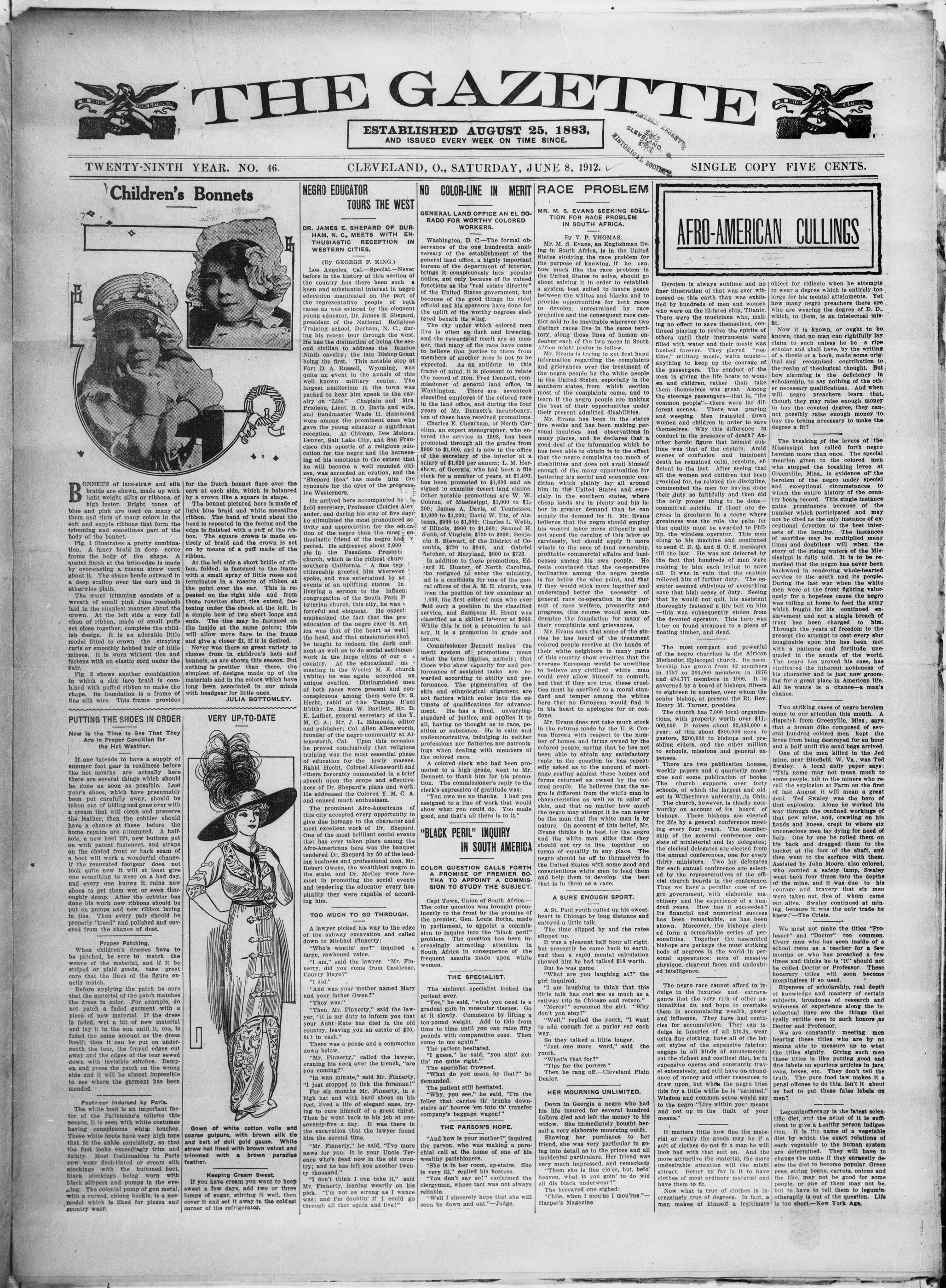
The Gazette
Saturday, June 8, 1912
Cleveland, Ohio
Page text (machine-generated)
Children's Bonnets
DE UNION
DEMOCRATICNATION
TWENTY-NINTH
Children's
ONNETS of lace-straw and silk
braids are shown, made up with
light weight silks or ribbons, of high luster. Bright tones of blue and pink are used on many of them and tints of many colors in the soft and supple ribbons that form the trimming and sometimes part of the body of the bonnet.
Fig. 1 illustrates a pretty combination. A fancy braid in deep ecrue forms the body of the shape. A quaint finish at the brim-edge is made by over-casting a tuscan straw cord about it. The shape bends outward in a deep scallop over the ears and is otherwise plain.
The scant trimming consists of a wreath of small pink June rosebuds laid in the simplest manner about the crown. At the left side a very full chou of ribbon, made of small puffs set close together, complete the childish design. It is an adorable little model fitted to crown the straying curls or smoothly bobbed hair of little misses. It is worn without ties and fastens with an elastic cord under the hair.
Fig. 2 shows another combination in which a silk lace braid is combined with puffed ribbon to make the shape. Its foundation is a frame of fine silk wire. This frame provides
PUTTING THE SHOES IN ORDER
Now Is the Time to See That They Are in Proper Concition for the Hot Weather.
If one intends to have a supply of summer foot gear in readiness before the hot months are actually here there are several things which should be done as soon as possible. Last year's shoes, which have presumably been put carefully away, should be taken out of hiding and gone over with a cream that will clean and preserve the leather, then the cobbler should have a chance at these before the home repairs are attempted. A half-sole, a new heel lift, new buttons on with patent fasteners, and straps on the chafed front or back seam of a boot will work a wonderful change. If the renovated footwear does not look quite new it will at least give one something to wear on a bad day, and every one knows it ruins new shoes to get them wet or even thoroughly damp. After the cobbler has done his work new ribbons should be put on pumps and new ribbon lacing in ties. Then every pair should be properly "tread" and polished and covered from the chance of dust.
Proper Patching
When children's dresses have to be patched, be sure to match the weave of the material, and if it be striped or plaid goods, take great care that the lines of the figure exactly match.
Before applying the patch be sure that the material of the patch matches the dress in color. For example, do not patch a faded garment with a piece of new material. If the dress is faded, wet a bit of new material and lay it in the sun until it, too, is faded the same amount as the dress itself; then it can be put on underneath the tear, the frayed edges cut away and the edges of the tear sewed down with invisible stitches. Dampen and press the patch on the wrong side and it will be almost impossible to see where the garment has been mended.
Footwear Indorsed by Paris.
The white boot is an important factor of the Parisienne's toilette this season. It is seen with white costumes having conspicuous white touches. These white boots have very high tops that fit the ankle exquisitely, so that the foot looks exceedingly trim and dainty. Most fashionables in Paris now wear flesh-tinted or cream silk stockings with the buttoned boot, black stockings being worn with black slippers and pumps in the evening. The colonial pump of gun metal, with a curved, oblong buckle, is a new model which is liked for plaza and country wear.
---
THE GAZETTE
for the Dutch bonnet flare over the ears at each side, which is balanced by a crown like a square in shape.
The bonnet pictured here is made of light blue braid and white messaline ribbon. The band of braid about the head is repeated in the facing and the edge is finished with a puff of the ribbon. The square crown is made entirely of braid and the crown is set on by means of a puff made of the ribbon.
At the left side a short bridle of ribbon, folded, is fastened to the frame with a small spray of little roses and terminates in a rosette of ribbon at the point over the ear. This is repeated on the right side and from these rosettes short ties extend, fastening under the cheek at the left, in a simple bow of two short loops and ends. The ties may be fastened on the inside at the same points; this will allow more flare to the frame and give a closer fit, if it is desired.
Never was there so great variety to choose from in children's hats and bonnets, as are shown this season. But nothing is prettier than these, the simplest of designs made up of the materials and in the colors which have long been associated in our minds with headgear for little ones.
JULIA BOTTOMLEY.
VERY UP-TO-DATE
Gown of white cotton veil and coarse gulure, with brown alik tie and belt of dull gold gauze. White straw hat lined with brown velvet and trimmed with a brown paradise feather.
Keeping Cream Sweet.
If you have cream you want to keep sweet a few days, add two or three lumps of sugar, stirring it well, then cover it and set it away in the coldest corner of the refrigerator.
ESTABLISHED AUGUST 25, 1883 AND ISSUED EVERY WEEK ON TIME SINCE.
CLEVELAND, O., SATURDAY, JUNE 8, 1912.
TOURS THE WEST
DR. JAMES E. SHEPARD OF DUR-
HAM, N. C. MEETS WITH EN-
THUSIASTIC RECEPTION IN
WESTERN CITIES.
(By GEORGE F. KING.)
Los Angeles, Cal.—Special—Never before in the history of this section of the country has there been such a keen and substantial interest in negro education manifested on the part of the representative people of both races as was evinced by the eloquent young educator, Dr. James E. Shepard, president of the National Religious Training school, Durham, N. C., during his recent tour through the west. He has the distinction of being the second civilian to address the famous Ninth cavalry; the late Bishop Grant being the first. This notable stop at Fort D. A. Russell, Wyoming, was quite an event in the annals of this well known military center. The largest auditorium in the town was packed to hear him speak to the cavalry on "Life." Chaplain and Mrs. Prioleau, Lieut. B. O. Davis and wife, and Bandmaster Wade H. Hammond were among the prominent ones who gave the young educator a significant reception. At Chicago, Des Moines, Denver, Salt Lake City, and San Francisco this apostle of a religious education for the negro and the harnessing of his emotions to the extent that he will become a well rounded citizen, was accorded an ovation, and the "Shepard idea" has made him the cynosure for the eyes of the progressive Westerners.
He arrived here accompanied by the field secretary, Professor Charles Alexander, and during his stay of five days he stimulated the most pronounced activity and appreciation for the education of the negro than the most enthusiastic friend of the negro had expected. He addressed about 2,000 people in the Pasadena Presbyterian church, which is the richest church southern California. A fine type citizenship greeted him wherever spoke, and was entertained by so events of an uplifting status. In livering a sermon to the influencer congregation of the South Park Presbyterian church, this city, he was forceful and eloquent. He especially emphasized the fact that the production of the negro race in America was that of the heart as well, the head, and that missionaries should be taught to redeem the dark continent as well as to do social settlement work in the large cities of our country. At the educational meeting in the Wesley M. E. church (white) he was again accorded an unique ovation. Distinguished men of both races were present and conspicuous among them were Dr. S. Hecht, rabbi of the Temple B'nai Brith; Dr. Dana W. Bartlett, Mr. D. E. Luther, general secretary of the Y. M. C. A.; Mr. J. L. Edmonds, editor and publisher; Col. Allen Allensworth, founder of the negro community at Allensworth, Cal. Upon this occasion he proved conclusively that religious training was the most essential phase of education for the lowly masses. Rabbi Hecht, Colonel Allensworth and others favorably commented in a brief speech upon the scope and effectiveness of Dr. Shepard's plans and work. He addressed the Colored Y. M. C. A. and caused much enthusiasm.
The prominent Afro-Americans of this city accepted every opportunity to give due homage to the character and most excellent work of Dr. Shepard. One of the most brilliant social events that has ever taken place among the Afro-Americans here was the banquet tendered Dr. Shepard by 50 of the leading business and professional men. Mr. Robert Owens, the wealthiest negro in the state, and Dr. McCoy were foremost in promoting the social events and tendering the educator every hospitality they were capable of according him.
TOO MUCH TO GO THROUGH.
A lawyer picked his way to the edge of the subway excavation and called down to Michael Finnerty:
"Who's wantin' me?" Inquired a large, raw-boned voice.
"I am," said the lawyer. "Mr. Finnerty, did you come from Castlebar, County Mayo?"
"I did."
"And was your mother named Mary and your father Owen?"
"They was."
"Then, Mr. Finnerty," said the lawyer, "it is my duty to inform you that your Aunt Kate has died in the old country, leaving you an estate of $20,000) in cash."
There was a pause and a commotion down below.
"Mr. Finnerty," called the lawyer, craning his neck over the trench, "are you coming?"
"In wan minute," said Mr. Finnerty, "I just stopped to lick the foreman!"
For six months Mr. Finnerty, in a high hat and with hard shoes on his feet, lived a life of elegant ease, trying to cure himself of a great thirst. Then he went back to his job at one-seventy-five a day. It was there in the excavation that the lawyer found him the second time.
"Mr. Finnerty," he said, "I've more news for you. It is your Uncle Terror who's dead now in the old country; and he has left you another twenty thousand."
"I don't think I can take it," said Mr. Finnery, leaning wearily on his plick. "I'm not as strong as I wance was; and I'm doubtn' if I could go through all that again and live!"
COLOR-LINE IN MERIT
GENERAL LAND OFFICE AN EL DO-RADO FOR WORTHY COLORED WORKERS.
Washington, D. C.—The formal observance of the one hundredth anniversary of the establishment of the general land office, a highly important bureau of the department of interior, brings it conspicuously into popular notice, not only because of its valued functions as the "real estate director" of the United States government, but because of the good things its chief official and his sponsors have done for the uplift of the worthy negroes sheltered beneath its wing.
The sky under which colored men live is often so dark and lowering, and the rewards of merit are so meager, that many of the race have come to believe that justice to them from members of another race is not to be expected. As an antidote to this frame of mind, it is pleasant to relate the record of Hon. Fred Dennett, commissioner of general land office, in Washington. There are seventeen classified employees of the colored race in the land office, and during the four years of Mr. Dennett's incumbency, ten of these have received promotions.
Charles E. Cheatham, of North Carolina, an expert stenographer, who entered the service in 1908, has been promoted through all the grades from $900 to $1,000, and is now in the office of the secretary of the interior at a salary of $1,620 per annum; L. M. Hershaw, of Georgia, who had a file clerk for a number of years, at $1,400, has been promoted to $1,600 and assigned to examine desert land claims. Other notable promotions are W. W. Gohran, of Mississippi, $1,000 to $1,200; James A. Davis, of Tennessee, $1,000 to $1,200; David W. Ut, of Alabama, $900 to $1,000; Charles L. Webb, of Illinois, $900 to $1,000; Samuel H. Webb, of Virginia, $720 to $900; Benjamin S. Stewart, of the District of Columbia, $720 to $840, and Gabriel Fletcher, of Maryland, $600 to $720.
In addition to these promotions, Edward H. Hunter, of North Carolina, who resigned to enter the ministry, and is a candidate for one of the general offices of the A. M. E. church, was given the position of law examiner at 1,600, the first colored man who ever held such a position in the classified service, and Sampson H. Brent was classified as a skilled laborer at $600. While this is not a promotion in salary, it is a promotion in grade and tenure.
Commissioner Dennett makes the merit system of promotions mean what the term implies, namely; that those who show capacity for and performance of assigned tasks are rewarded according to ability and performance. The pigmentation of the skin and ethnological alignment are not factors which enter into the estimate of qualifications for advancement. He has a fixed, unvarying-standard of justice, and applies it to all, having no thought as to race, position or substance. He is calm and undemonstrative, indulging in neither professions nor flatteries nor patronizing when dealing with members of the colored race.
A colored clerk who had been promoted to a high grade, went to Mr. Dennett to thank him for his promotion. The commissioner's reply to the clerk's expression of gratitude was: "You owe me no thanks. I had you assigned to a line of work that would show what you could. You made good, and that's all there is to it."
"BLACK PERIL" INQUIRY IN SOUTH AMERICA
COLOR QUESTION CALLS FORTH
A PROMISE OF PREMIER BOTHA TO APPOINT A COMMISSION TO STUDY THE SUBJECT.
Capt Town, Union of South Africa.—The color question was brought prominently to the front by the promise of the premier, Gen. Louis Botha, made in parliament, to appoint a commission to inquire into the "black peril" problem. The question has been increasingly attracting attention in South Africa in consequence of the frequent assaults made upon white women.
THE SPECIALIST.
The eminent specialist looked the patient over.
"Yes," he said, "what you need is a gradual gain in muscular tissues. Go at it slowly. Commence by lifting a ten-pound weight. Add to this from time to time until you can raise fifty pounds with comparative ease. Then come to me again."
The patient hesitated.
"I guess," he said, "you aint' gettin' me quite right."
The specialist frowned.
"What do you mean by that?" he demanded.
The patient still hesitated.
"Why, you see," he said, "I'm the feller that carries trunks down-stairs an' heaves 'em into th' transfer company's baggage wagon!"
THE PARSON'S HOPE
"And how is your mother?" Inquired the parson, who was making a parochial call at the home of one of his wealthy parishioners. "She is in her room, up-stairs. She is very ill," replied his hostess. "You don't say so!" exclaimed the clergyman, whose tact was not always reliable. "Well I sincerely hope that she will soon be down and out."—Judge.
RACE PROBLEM
MR. M. S. EVANS SEEKING SOLL
TION FOR RACE PROBLEM
IN SOUTH AFRICA.
By V. P. THOMAS.
Mr. M. S. Evans, an Englishman living in South Africa, is in the United States studying the race problem for the purpose of knowing, if he can, how much like the race problem in the United States to solve, should go about solving it in order to establish a system best suited to insure peace between the whites and blacks and to provide opportunities for both races to develop, unrestrained by race prejudice and the consequent race conflict said to be inevitable wherever two distinct races live in the same territory, along those lines of human endeavor each of the two races in South Africa might prefer to follow.
Mr. Evans is trying to get first hand information regarding the complaints and grievances over the treatment of the negro people by the white people in the United States, especially in the southern states, from which section most of the complaints come, and to learn if the negro people are making the best of their opportunities under their present admitted disabilities.
Mr. Evans has been in the states five weeks and has been making personal inquiries and observations in many places, and he declares that a good deal of the information which he has been able to obtain is to the effect that the negro complains too much of disabilities and does not avail himself enough of the many opportunities for bettering his social and economic condition which plainly lay all around him in the United States and especially in the southern states, where cheap lands are in plenty and his labor in greater demand than he can supply the demand for it. Mr. Evans believes that the negro should employ his wanted labor more diligently and not spend the earning of this labor so carelessly, but should apply it more wisely to the uses of land ownership, profitable commercial affairs and businesses among his own people. He feels convinced that the co-operative inclination among the negro people is far below the wise point, and that if they would stick more together and understand better the necessity of general race co-operation in the pursuit of race welfare, prosperity and progress, this course would soon undermine the foundation for many of their complaints and grievances.
Mr. Evans says that some of the stories he has heard of the treatment colored people receive at the hands of their white neighbors in many parts of this country show cruelties that the average European would be unwilling to believe any civilized white man could ever allow himself to commit, and that if they are true, these cruelties must be ascribed to a moral standard and temper among the whites here that no European would find it in his heart to apologize for or condone.
Mr. Evans does not take much stock in the returns made by the U. S. Census Bureau with respect to the number of homes and farms owned by the colored people, saying that he has not been able to obtain any satisfactory reply to the question he has repeatedly asked as to the amount of mortgage resting against these homes and farms returned as owned by the colored people. He believes that the negro is different from the white man in characteristics as well as in color of skin, and that no matter how much the negro may attempt it he can never be the man that the white man is by nature. On account of this belief, Mr. Evans thinks it is best for the negro and the white man alike that they should not try to live together on terms of equality in any place. The negro should be off to themselves in the United States with some good and conscientious white men to lead them and help them to develop the best that is in them as a race.
A SURE ENOUGH SPORT.
A St. Paul youth called up his sweet-heart in Chicago by long distance and enjoyed a little talk.
The time slipped by and the rates slipped up.
It was a pleasant half hour all right, but presently he came back to earth, and then a rapid mental calculation showed him he had talked $18 worth.
But he was game.
"What are you laughing at?" the girl inquired.
"I am laughing to think that this little talk has cost me as much as a railway trip to Chicago and return."
"Mercy!" screamed the girl. "Why don't you stop?"
"Well," replied the youth, "I want to add enough for a parlor car each way.
So they talked a little longer.
"Just one more word," said the youth.
"What's that for?"
"Tips for the porters."
Then he rang off—Cleveland Plain Dealer.
HER MOURNING UNLIMITED.
Down in Georgia a negro who had his life insured for several hundred dollars died and left the money to his widow. She immediately bought herself a very elaborate mourning outfit. Showing her purchases to her friend, she was very particular in going into detail as to the prices and all incidental particulars. Her friend was very much impressed, and remarked "Them sho is fine cloes, but, befo' heaven, what is you goin' to do wid all dis black underwear?" The bereaved one signed: "Chile, when I mou'n's I mou'rns."—Harper's Magazine
AFRO-AMERICAN CULLINGS
The most compact and powerful of the negro churches is the African Methodist Episcopal church. Its membership has grown from 42 members in 1787 to 200,000 members in 1876 and 494,777 members in 1906. It is governed by a board of bishops, fifteen to eighteen in number, over whom the senior bishop, at present the Rt. Rev. Henry M. Turner, presides.
The church has 7,000 local organizations, with property worth over $11,000,000. It raises about $2,000,000 a year; of this about $800,000 goes to pastors, $200,000 to bishops and presiding elders, and the other million to schools, missions and general expenses.
There are two publication houses weekly papers and a quarterly magazine and some publication of books. The church supports over forty schools, of which the largest and oldest is Wilberforce university, in Ohio.
The church, however, is chiefly noteworthy on account of its board of bishops. These bishops are elected for life by a general conference meeting every four years. The membership of the general conference consists of ministerial and lay delegates; the clerical delegates are elected from the annual conferences, one for every thirty ministers. Two lay delegates for each annual conference are selected by the representatives of the official church boards in the conference. Thus we have a peculiar case of no gro government, with elaborate machinery and the experience of a hundred years. How has it succeeded? Its financial and numerical success has been remarkable, as has been shown. Moreover, the bishops elected form a remarkable series of personalities. Together the assembled bishops are perhaps the most striking body of negroes in the world in personal appearance: men of massive physique, clear-cut faces and undoubted intelligence.
The negro race cannot afford to indulge in the luxuries and extravagance that the very rich of other nationalities do, and hope to overtake them in accumulating wealth, power and influence. They have had centuries for accumulation. They can indulge in luxuries of all kinds, wear extra fine clothing, have of the largest styles of the expensive fabrics; engage in all kinds of amusements; eat the richest and costliest diet, be in expensive operas and constantly travel extensively, and still have an abundance of money and other resources to draw upon, but when the negro tries this for a little while he is "satiated." Wisdom and common sense would say to the negro "Live within your means and not up to the limit of your means."
It matters little how fine the material or costly the goods may be if a suit of clothes do not fit a man he will look bad with that suit on. And the more attractive the material, the more undesirable attention will the misfit attract. Better by far is it to have clothes of most ordinary material and have them to fit.
Now what is true of clothes is increasingly true of degrees. In fact, a man makes of himself a legitimate
object for ridicule when he attempts to wear a degree which is entirely too large for his mental attainments. Yet how many preachers there are who are wearing the degree of D. D. which, to them, is an intellectual misfit. Now it is known, or ought to be known, that no man can rightfully lay claim to such unless he be a ripe scholar and shall have, by the writing of a thesis or a book, made some original and recognized contribution to the realm of theological thought. But how alarming is the deficiency in scholarship, to say nothing of the other necessary qualifications. And when will negro preachers learn that, though they may raise enough money to buy the coveted degree, they cannot possibly raise enough money to buy the brains necessary to make the degree a fit?
The breaking of the levees of the Mississippi has called forth negro heremism more than once. The special mention given to the colored men who stopped the breaking levee at Greenville, Miss., is evidence of the heremism of the negro under special and exceptional circumstances to which the entire history of the country bears record. This single instance gains prominence because of the number which participated and may not be cited as the only instance of exceptional devotion to the best interests of the locality. The instances of sacrifice may be multiplied many times and doubtless will when the story of the rising waters of the Mississippi is fully told. It is to be remarked that the negro has never been backward in rendering whole-hearted service to the south and its people. During the last war when the white men were at the front fighting valorously for a hopeless cause the negro was toiling at home to feed the army which fought for his continued enslavement and not a single breach of trust has been charged to him. Through the years of freedom to the present the attempt to cast every slur imaginable upon him has been met with a patience and fortitude unequaled in the annals of the world. The negro has proved his case, has vindicated the inherent nobileness of his character and is just now grooming for a great place in American life. All he wants is a chance—a man's chance.
Two striking cases of negro heroism came to our attention this month. A dispatch from Greenyville, Miss., says that a human dike composed of several hundred colored men kept the levee from being destroyed for an hour and a half until the sand bags arrived. One of the men killed in the Jed mine, near Bluefield, W. Va., was Ted Swaley. A local daily paper says: "This name may not mean much to some people, but to the miners who recall the explosion at Farm on the first of last August it will mean a great deal. Ted Swaley was the hero of that explosion. Alone he worked his way through the confined workings of that new mine, and, crawling on his hands and knees, crept to where six unconscious men lay dying for need of help. One by one he rolled them on his back and dragged them to the bucket at the foot of the shaft, and then went to the surface with them. Assisted by John Moore, also colored, who carried a safety lamp, Swaley went back four times into the depths of the mine, and it was due to his courage and bravery that six men were taken out, five of whom came out alive. Swaley continued at mining, because it was the only trade he knew."—The Crisis.
We must not make the titles "Professor" and "Doctor" too common. Every man who has seen inside of a school room as a teacher for a few months or who has preached a few times and thinks he is "if" should not be called Doctor or Professor. These honorary titles will soon become meaningless if so used.
Ripeness of scholarship, real depth of knowledge and mastery of certain subjects, broadness of research and wideness of experience along the intellectual lines are the things that really entitle men to such honors as Doctor and Professor.
We are constantly meeting men bearing these titles who are by no means able to measure up to what the titles signify. Giving such men these titles is like putting good and fine labels on spurious articles in jars, cans, boxes, etc. They don't tell the truth. The pure food law makes it a penal offense to do this. Isn't it about as bad to put these false labels on men?
Leguminotherapy is the latest scientific diet, and the name of it is sufficient to give a healthy person indigestion. It is the name of a vegetable diet by which the exact relations of each vegetable to the human system are determined. They will have to change the name if they earnestly desire the diet to become popular. Green peas, string beans, carrots, onions and the like, may not be good for some people, or one of them may not be, but to have to tell them to leguminotherapy is out of the question. Life is too short—New York Age.
(In Advance)
One Year.....$1.50
Six Months.....1.00
Three Months.....50
Subscrivers are requested to remit by postoffice money order or registered letter.
Entered at the postoffice in Cleveland Ohio, an second-class matter
Address all communications to HARRY C. SMITH
Editor and proprietor,
THE GAZETTE,
Blackstone Building, Cleveland, O.
Member Ohio Legislature: 1894 to 1896; 1896 to 1898; 1900 to 1902
THE GAZETTE is the oldest, and has the largest bona fide circulation, double that of any newspaper in the interest of Afro-Americans, published in the state of Ohio, and comparison with any will immediately establish its rank as one of the NEWSIEST AND BEST In the country.
The Gazette is and has been, for many months, the only paper published in Cleveland and northern Ohio for the Colored people, all reports to the contrary notwithstanding. Do not be misled. EDITOR
A good deal of unnecessary comment, for and against the Ohio Afro-American because of the recent state primary vote, is being indulged in by a number of our newspapers, various individuals and publications throughout the country. As a matter of fact, the great majority of our Ohio voters refused to participate in the recent state primary because they could not "stomach" either of the "Brownsville lynchers," Roosevelt and Taft.
Finding it too big a job to win a ball-game from the "Smart Set," an Afro-American team, at Paterson, N.J., one day last week, the N. Y "Giants," with a Texan by the name of Drueke, one of their pitchers, in the box, quit "cold" in the tenth inning, with the score a tie, 3 to 1. It took the police of the city, to keep a mob of fans, white and Colored, from doing the "yellow-streaked Giants" great bodily injury as they left the ball-grounds and the city. The Texar started the trouble, of course.
Some years ago, the New York state assembly enacted a law which was begotten in the racial prejudice of white lodges, under which a N. Y court has recently decided that Afro Americans in that state could not or organize under the name, "Elks." This decision will undoubtedly be reversed in the higher courts if carried up as anticipated by our Elks of the country. Because it strikes at our rights and in such an indirect and "under hand" way, it is vitally necessary that the case be appealed to the highest court in the land, if necessary. Mean time, let the N. Y. City Amsterdam News and the N. Y. Age lead our peo ple of their state in an effort to secure the repeal of that unfair, vicious, in sulting and un-American state "law" under which such ridiculous decisions are possible.
THE REAL CAUSE OF THE CUBAN REVOLT.
The dispatches to the daily papers of the country, Monday, from Washington, D. C., announced that the up rising of Afro-Cubans was fast gaining the upper hand of the Cuban government; this, according to dispatches received at the state department from Arthur Beaupre, the U. S. minister at Havana. The situation is so bad, the dispatches say, that Secretary of War Stimson, by direction of the president has shipped to President Gomez 5,000 high powered Krag-Jorgenson rifle and 1,000,000 rounds of ammunition for the guns. So President Taft taking a hand in the Cuban revolt, after all. And why?
Several months ago Afro-Cubans assembled in convention and made ear nest and respectful protest to him an President Gomez of Cuba against the despotic denial by the Cuban government of their right to hold public meetings. They gave the Presidents a full and detailed account of their just grievances against their government, how the Morua law—which their late celebrated and, ill-fated leader, Morua Delgado, president of the Senate, and later, under Gomez Secretary of Agriculture, had had passed forbidding the establishment of racial political parties—had beer distorted into an intolerable suppression of discussion, and how the police had broken up their meetings, and how, in short, free speech was being cruelly and tyrannically denied them
Afro-Cubans played an important part in the Cuban revolution. Major General Antonio Maceo, the most picturesque and popular of the patriot leaders, was an Afro-Cuban, and the majority of the Republican troops were of the same class. Since the establishment of the republic they have held many important offices, but feel that their services have not been adequately rewarded (and they are right too) as well as being mistreated in the matter of their citizen-right to gather in meetings where their interests can be properly discussed and where proper arrangements can be perfected to gain what they desire and are entitled to, in a peaceful way. THIS LATTER IS THE REAL CAUSE OF THE PRESENT CUBAN REVOLT.
In some parts of Cuba, notably in the large province of Oriente, of which Santiago is the capital, Afro-Cuban largely outnumber the whites. Many of them are men of wealth and influence. An uprising which would hold the sympathy and support of all of them would soon assume the importance of a revolution, and judging from the Washington and Cuban dispatches referred to, that is just what
the present one bids fair to become and soon, too.
It is a dangerous thing, even in Cuba, to attempt to throttle free speech, especially when attempt is being made to assemble and voice protest against the denial of a citizen-right. May victory grace the banners of the battling Afro@ubans who, unlike their American brethren, refuse to quietly submit to color-lines of any kind. O, that there was more of their spirit abroad among our people of this country!
COUNTY CONVENTION ECHOES.
(From The Gazette of June 1, 1912.)
Last Saturday's county Republican convention was a peculiar one in many respects. Although Roosevelt carried the county "big," an uninstructed delegation was sent to the state convention. This shows that the "organization" was helped to the control of last Saturday's convention by Roosevelt county leaders.
Another thing of special interest to our people was the fact that every endorsement the "organization," which in this case means Maurice Maschke, asked of our people was given only to be ignored. When the Citizens' Rights League committee went to him with the league's endorsement of the editor of The Gazette, as our legislative candidate, he asked for the endorsement of our Ministers' Alliance also. This was given Mr. Smith unanimously, and a committee from the Alliance sent to Maschke to inform him of the fact. Then he asked for an endorsement from the Afro-American delegates to the convention and when this was secured by Harry E. Davis, it, too, was ignored, and Willie Green given the nomination, although many, who claim to know, still claim that a candidate (white) by the name of Bach had votes enough to give him the nomination on that last ballot.
A terrific fight which hurt greatly our people of this community and left a "bad taste" in the mouths of all, was precipitated during this last ballot, solely because of Maschke's continued refusal to grant the request of the great mass of our people of this city and county, as indicated in the several unanimous endorsements of the editor of The Gazette. None of our organizations, not even the majority of the delegates, wanted Willie Green nominated, and it is easy to see what harm has been done the entire county Republican ticket, this fall, as a result.
To add to this, there is the "dramatic moment" when our local ministers were cursed bitterly by a well known individual and for no good reason whatever. This our Ministers' Alliance (fourteen members) will give special attention, at their meeting, Tuesday. It was discussed, last Tuesday. If that organization falls to take strong ground against the individual who uttered the low and vile oaths against them, in the hearing of several of our prominent men, they will hear from this community in no uncertain terms. Apologies will not do in such a case, because not only our ministers but their churches and all the people of this community who respect them and our churches, are equally concerned. The Gazette stands by our Ministers' Alliance just so long as they continue to show they deserve its support, and this they certainly have done up to date. Let them continue to do so.
Willie Green is Maschke's candidate, pure and simple, and not our people's candidate. This he and others will learn to their sorrow in November. Being a member of the Catholic church, which is his perfect right and to which no one has any right to object, caused a fight to be made on him by persons who should have based their opposition to him on the broad ground that he has not shown proper interest in his people of this community and that he is lacking in other and even more important respects. It was these reasons and others that made it impossible for Green to get an indorsement of any kind in recent weeks from our people of this community, for the nomination Maschke handed him "on a broken platter" in the convention, last Saturday. There are easily between two and five thousand Afro-American voters in this city alone. Their unanimous demand, made through their leading organizations, should have been beeded by Maschke, if for no other reason than to conserve the interests of the county Republican ticket. We shall see what we shall see, later on.
The following statement was distributed among the delegates to the county convention, last Saturday morning:
Cleveland, Ohio, May 14, 1912.
The Colored Ministers' Alliance of Cleveland took the following action at its regular session today: That the Hon. Harry C. Smith is hereby unanimously endorsed by this Alliance for the Republican nomination for the Ohio Legislature, and we hereby pledge ourselves to use all honorable means to secure his nomination and election.
We call upon the delegates to the County Convention to place Mr. Smith's name upon their regular ballot as the choice of the Colored Republicans of Cleveland.
Notification Committee.
For the Ministers' Alliance of Cleveland, O.
The vote for second choice resulted as follows:
Henry T. Eubanks.....7
Harry E. Davis.....3
Wm. R. Green.....1
Not voting.....3
total.....14
It will be noticed that Mr. Smith, in receiving on the first ballot the unanimous vote, 14 in all, received double the number given Mr. Eubanks; almost five times the number given Mr. Davis; and just fourteen times the number given Mr. Green.
To the above must be added the unanimous endorsement of the "Citizens' Rights League (of Mr. Smith's candidacy), the largest and most active civic organization among our peo-
ple of Cleveland. These two endorsements are backed up by the great mass of our people in this city. They furnish the local Republican party at least four thousand voters, and their wishes in the matter of this one nomination certainly should be granted. Then, too, a mass meeting at Shiloh Baptist church, Sunday afternoon, May 19, 1928, about five hundred being in attendance, voted unanimously to thank the Ministers' Alliance for its unanimous endorsement of Mr. Smith's candidacy for a Republican nomination for the Legislature, this fall.
doing business in the city.—Mrs. Martha Tyler entertained Mr. Blackburn and Mr. George Rudolph at dinner. Sunday week.—Mrs. Fanny Simpson and daughter, Elizabeth of Flushing, were guests of Mr. and Mrs. Noah Blanchard recently.—(This letter arrived two days too late, last week. Correspondent will please mail his letter earlier on MONDAY of each week.—Editor.)
Smithfield.—The rally at the A. M. E. church, Sunday, was a decided success. Mrs. S. W. White is preparing an excellent program for children's day. Sunday. Decoration day was fit-
WRITTEN BY "THE OLD RELIA-
BLE" GAZETTE'S CORRE-
SPONDENTS.
THROUGHOUT OHIO
What Our People Are Doing Each Week—Church, Personal, Social, Lodge, Literary and Musical — Marriages, Deaths, Etc.
Columbus.—Veal chops eaten Sunday caused the death today of John Powell, an aged employee of the State house. Three members of the Powell family who also ate the meat were taken ill and are in a dangerous condition
***
Hamilton.—Rev. John Dickerson, one of the oldest and best known ministers in the A. M. E. Church of this section of the country, and a long-time resident of this city, was buried last week. Monday from the family residence. He leaves a wife and two sons to mourn his demise. They have the sympathy of a host of friends here, in Ohio and Indiana. Dr. Dickerson was largely attended. Dr. Dickerson was book-steward of the North Ohio A. M. E. conference.
---
Sandusky.—Miss M. Conway, state organizer, B. Y. P. U., lectured for the B. Y. P. U. of the Second Baptist church.—A silver offering for the sick at Mr. Jas. Davis' Thursday evening. N. F. Williams is quite ill—Mr. Shadd and family are located at 701 Anderson St. New Bass preaching at the Second Baptist church. The attendance there and at the Second Baptist church, Sunday, was excellent.—Have your money for The Gazette, ready, when the paper is delivered.
Correspondents must mail all letters for publication at their main postoffice sufficiently early on Monday (or Sunday) of each week to have them reach The Gazette office on Tuesday morning, and always write, also, their names and that of their city or town on the outside of the house. The Gazette does less this latter is done, proper credit cannot be given you. Lists of names, wedding presents, etc., obituary notices, speeches, resolutions, poetry, inquiries for relatives and advertisements of all kinds, including Items for sale in the near future, must be paid for in advance at the rate of ten cents a line, six words to a line. Our rates for display advertisements will be sent on application. Send postal note and not stamps during warm weather.
Lorain.—The pastor, Rev. S. D. McDuffie, is conducting revival services at the Second M. E. church—Mrs. Chas. Bolden and Miss Clara B. Stevens visited in Cleveland. Master Emmett Haines has returned from a two weeks' visit there.—Mr. Edward Copes has purchased another piece of prophetical clothing.—Mr. Daisy class Owen, Sammie Stewart and Daisy Wintry are ill.—Mrs. Lettie Hogan of Fremont, a former resident of this city, is visiting Mrs. F. S. Smith and Mrs. Irene Robinson.—Mr. Clifford Youngs is visiting in Toledo.—Miss Mary Bond is a resident of Elyria. Mrs. Chas. Brown has moved his family to New York.—Miss Mary Brown and Bettie Jackson, Mr. and Mrs. Fred. Davis of that city, were here.—Rev. G. L. Hicks will baptize several children at St. Mathews' A. M. E. church. Sunday.—Miss W. Jackson is pianist at a moving picture show in Elyria.—Mr. Fred. Owen is visiting his father who is ill.
Youngtown—Miss Nannie Heath visited in Akron, recently. Mrs. Palm er entertained in honor of Miss Conna w/o Dayton, May 24. Mrs. Catherine Fairfax is very ill—Mrs. Harry Williams visited relatives in Steubenville, last week—Buckeye lodge, Elks, met Thursday evening. Mrs. Josie Whitney and E. S. Moore were married that evening, at Onk Hill Av., A. M. E. church. Large attendance—Logan lodge, K. P., nominated officers, May 29. Mrs. Henry Johnson underwent a successful operation, last Monday. Mr. and Mrs. J. H. Howard's little daughter, Henrietta, died May 24, and Mr. Scott Bryant, May 22. The latter was 71 years of age and came here ten years ago from Virginia. He leaves a city, Funeral from the residence, Rev. Cheatham officiating. Interment in Belmont Park cemetery May 24—Mr. and Mrs. Wm. Green's little daughter, Painter have been very ill. —Order The Gazette and get the truth of all interesting matters concerning the race.' It is the only paper that dares to give you the facts.
Cadiz.—The B. B.'s met at R. F. Baldard's, recently.—Mr. and Mrs. B. S. Lee, Mrs. Martha West and son and Miss Reba, Mrs. Nannie Duling and daughters, Bertha, Mamie and Helen, and others attended Mrs. Burke's funeral at Flushing, the 25th, ult. The body of Eugene Thompson who was drowned at Coshocton was found on the 23rd, ult. and buried there. That of Harry Wallace was found on 26th, and brought here for burial, on Monday week. Messrs. George and Will Wadkins accompanied the remains here—Mrs. Mary Dungey Taylor's son, Mrs. Eliza Simpson. Church May 22. Rev. Blackburn of officiated assisted by Rev. Fox—Miss Laura White entertained at dinner, May 26. Miss B. M. Fox and Miss Florence Smith—Miss Verle Redmur spent last week in Wheeling and Mt. Pleasant—Mrs. P. T. Brown and family were called to E. Liverpool recently as Mr. Brown sustained a broken ankle by falling from a scaffold while cleaning the interior of a church there—Mr. and Mrs. Livermore were guests of Mrs. Anna Redman while
doing business in the city—Mrs. Mara Tyler entertained Rev. Blackburn and Mr. George Rudolph at dinner, Sunday week—Mrs. Fanny Simpson and daughter, Elizabeth of Flushing, were guests of Mr. and Mrs. Noah Blanchard recently—(This letter arrived two days too late, last week. Correspondent will please mail his letter earlier on MONDAY of each week.
Smithfield.—The rally at the A. M. E. church, Sunday, was a decided success. Mrs. S. W. White is preparing an excellent program for children's day, Sunday. Decoration day was fittingly observed. Mrs. Mary C. Harris gave an enjoyable social at her home, the 30th, alt. Mrs. Myrtle Peterson is visiting relatives in Steubenville—Mr. H. C. Harris, the 30th, alt. WH. L. A. Clarke and M. Kenney of Harriville, E. H. Giles and M. Jackson of Mt. Pleasant, Mrs. Ed. Smith, S. West and others from McIntyre, Mrs. Clara West and daughter, Mrs. Lola Ramsey and children of Hopedale, spent Decoration day here.—Mrs. Emma Powell and Mrs. Thomas are convalescents.—H. Harris, E. Jackson and John were in the ball game with the 30th, alt. WH. Veney entertained at dinner. Thursday, Mrs. Lola Ramsey and children, and Mary C. Harris. The latter entertained. Friday, at dinner, Mrs. C. West and daughter, Mrs. Lola Ramsey and children.—Miss Alice and Fred. Faithful of Harriville, were guests of Mr. and Mrs. Nelson Mitchell. Sunday, at dinner, Mrs. Lola Ramsey have a fine new boy.—Mr. Archie Hargrave of Homestead, Pa. is visiting his parents.
Youngstown. Rev. McAllen of Toledo, was Rev. Taylor's guest, last week. The May fair at Mabonion Baptist church, was a great success. W. H. Taylor had charge of it. The Elks (Buckeye lodge) will be at Avon park, July 4—Mrs. J. H. Stewart has been with the lodge to walk with a table. Surprise ankle.
—James Harris has been appointed a policeman.—The Eureka club will give a benefit dance for Will Jones who had a leg broken in an auto wreck, last week.—Miss Bell of "Starkville," miss. Is Rev. and Mrs. Taylor's guest. Mr. Wm. Brown and C. E. Williams spent Wednesday and Thursday at Erie, Pa., with their presents.—Logan lodged, and he has been invited.—D. Pettiford has returned from Indiana.—Mrs. Painter and Mrs. Adkinson's little son are ill.—Miss Martha Brown and Mr. Harvey Hayes were married at the parsonage by Rev. Jesse Smith, Wednesday evening. Miss Mary Lincoln attended the bride. They are "at home" at Mr. and Mrs. Harris', W. Federal St. The Eureka club's dance, Thursday evening, was an enjoyable success. Likewise the musicale at St. John's church, the same evening, managed by Mrs. Thos. Robinson for the junior auxiliary of St. Augustine E. Mission.
Cadiz.—Mrs. Susie Mason Hogan, is visiting her parents, Mrs. and Mrs. Thos. Mason.—The baseball team went to Bellaire and played on the 30th. Others included in the party trip were Messrs. Ira Wallace, Chas. Davis, Earl Linder, A. Redman, and the Misses Grace Wallace and Verde Wallace.—Mrs. Frances Christian, Charles and Leola Mason have returned from visiting their sister in Bellaire.—The "Vesper Virgil" drills, given under the auspices of the stewardess' board, the 29th, was a success. Much praise is given those who labored to make it such.—Mrs. Gus Terry of Bellaire, and Miss Lizzie Washington, of Steuart Davis, gave thanks of Mrs. Leola Davis and family, last week. Dean Mason of Springfield, is visiting Mrs. W. A. Mason.—Mrs. Rosig Morgan of Wheeling, is visiting at Mrs. Lydia Timber's.
URGES SOCIALISM
And Says that the Two Old Parties Have Outlived Their Usefulness.
Holly, Colo., June 3, 1912.
Editor Gazette, My Dear Sir: It certainly seems strange to me that more is not said in our papers of the modern political party of America, the only party that offers a single plausible solution of the many entanglements to which the two old parties have surely submerged this whole government. I cannot understand leaders and fall in line with the organization that is bound to sweep the country in the very near future—the socialist party.
Note the two leading candidates for the Republican nomination for the Presidency—Roosevelt and Taft; No self-respecting Afro-American can support either of them. I do firmly believe that the two old parties have outlived their usefulness and are no longer worthy of even mention. Indeed they belong, body and soul, to the people. I should possibly be to the people? Let us wake-up, lay aside the "dead things", and get into the forward political movement.
The Republican and Democrat parties are equally responsible for disfranchisement, lynching and burnings at-the-stake, "jincrow" cars and discrimination of the worst kind. They are also responsible for tracing to do, and that is, to support the socialists, first, last and all the time, and by so doing gain a chance to recover ground lost through the duplicity of both old parties, particularly the Republican party that owes so very much to us for long years of faithful service.
Yours respectfully.
James Smedley.
ANOTHER SEGREGATION ORDINANCE
Forbidding the Owning of Property by Afro-Americans in "White" Residential Sections—Unconstitutional.
Greenville, S. C—Closely following the purchase by Goldsmith brothers, our leading grocers of this city, of the Hoke property at $65,000, located in the fashionable section of north Main street, the city council passed a segregation ordinance fashioned along similar lines to that tried in Philadelphia. The ordinance forbids the owning of property by our people in "white" residential sections. The Hoke property, which runs from north Main down to College to Townes St., is one of the most valuable residential properties in the city as may be gathered from the price paid. As soon as the deal was consummated it was rumored that a syndicate of Washington and Greenville Afro-American organizations forbided of erecting a large hotel for our people. This rumor started agitation which resulted in council's action.
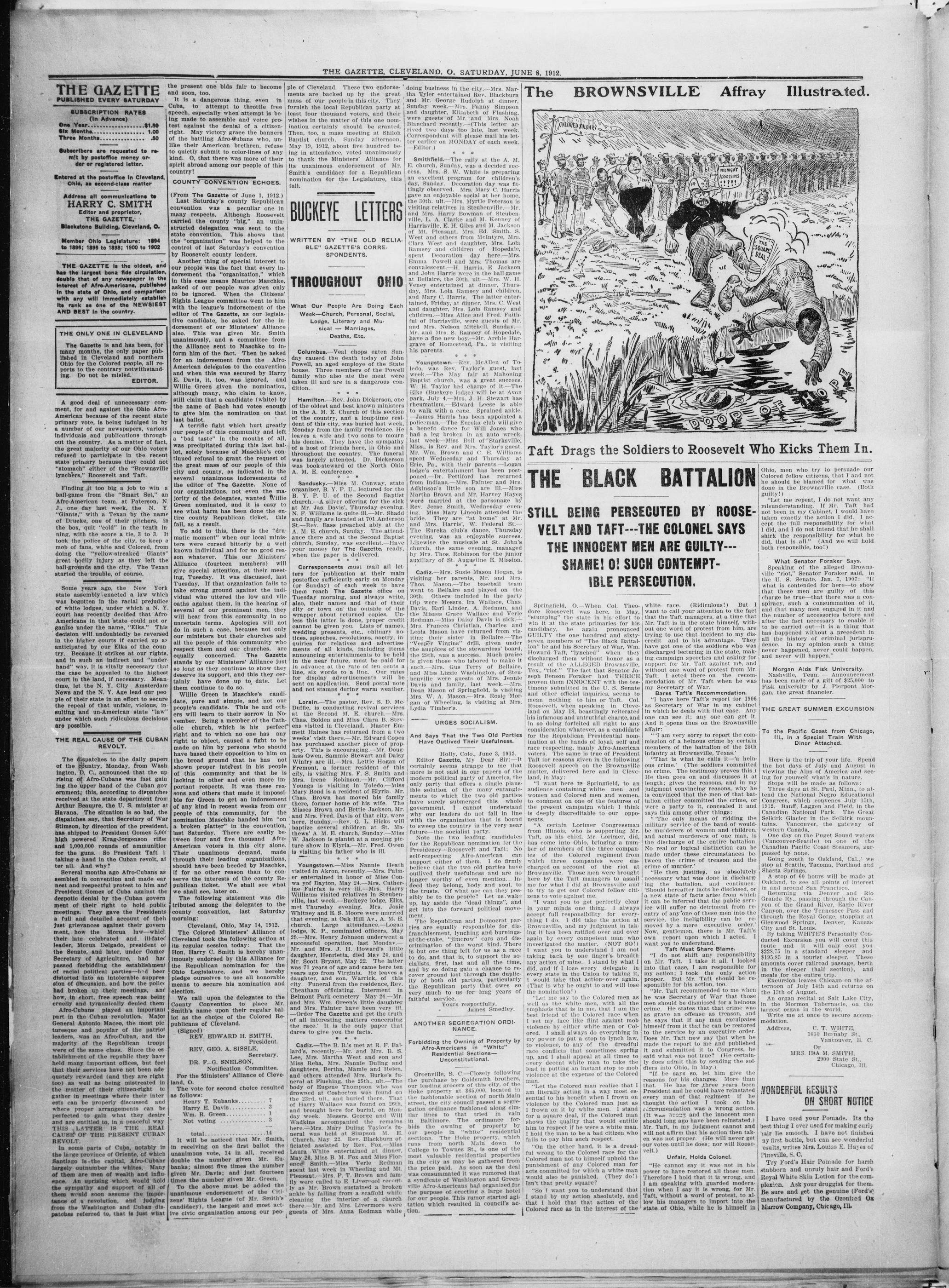
COLLOPED SOLDIERS
MIDNIGHT ASSASSINES
THE SQUARE DEAL
DOOR OF HOPE
Taft Drags the Soldiers to Roosevelt Who Kicks Them In.
THE BLACK BATTALION
STILL BEING PERSECUTED BY ROOSEVELT AND TAFT----THE COLONEL SAYS THE INNOCENT MEN ARE GUILTY---- SHAME! O! SUCH CDNTEMPTIBLE PERSECUTION.
Springfield, O.—When Col. Theodore Roosevelt was here, in May, "stumping" the state in his effort to win it at the state primaries for his candidacy, he again pronounced GUILTY the one hundred and sixty-seven members of "The Black Battalion" he and his Secretary of War, Wm. Howard Taft, "lynched" when they discharged them without honor as a captain of the ALKEID Envillain Tex. "riot." The fact that Senator Joseph Benson Foraker had THRICE proven them INNOCENT with the testimony submitted in the U. S. Senate and other official inquiries, seems to mean nothing to him or Taft. Col. Roosevelt, when speaking in Cleveland on May 18, boastingly reiterated his infamous and untruthful charge, and in so doing forfeited all right to any consideration whatever, as a candidate for the Republican Presidential nomination at the hands of loyal, self and race fighting Afro-Americaners. The same is true for Taft for reasons given in the following Roosevelt speech on the Brownsville matter, delivered here and in Cleveland, in May:
"I want here in Springfield, to an audience containing white men and women and Colored men and women, to comment on one of the features of the present campaign which I think is deeply disrecertable to our opponents. I certain Lorimer Congressman from Illinois, who is supporting Mr. Taft, as his chief, Mr. Lorimer, did, has come into Ohio, bringing a number of members of the three companies of the Colored regiment from which three companies were discharged on account of the riot at Brownsville. Those men were brought here by the Taft managers to assail me for what I did at Brownsville and have told the fellow citizens to vote against me.
"I want you to get perfectly clear in your minds one thing. I always accept full responsibility for everything I do. I did take the action at Brownsville, and my judgment in taking it has been ratified over and over again. I have not investigated the matter. (NOT SO!) I want you to understand I am not taking back by one finger's breadth any action of mine. I stand by what I did, and if I lose every delegate in every state in the Union by taking it, I would take that action over again. I would fight to and will lose the nomination!"
"Let me say to the Colored men as well as the white men, with all the emphasis that is in me, that I am the best friend of the Colored race when I set my face to the slit man and mob the other, always with my ordeal. I shall do everything in my power to put a stop to lynch law, to violence, to any of the dreadful race conflicts that sometimes spring up, and I shall appeal at all times to every decent white man to take the lead in putting an instant stop to mob violence at the expense of the Colored man. Let the Colored man realize that I am literally acting in a way most essential to his benefit when I frown on violence by the Colored man just as I frown on it by white men. I stand for a square deal, if the Colored man shows the respect heaped upon me, if he were a white man, I hold the man to be a bad citizen who fails to pay him such respect.
"On the other hand, it is a dreadful wrong to the Colored race for the Colored man not to himself uphold the punishment of any Colored man for acts committed for which a white man would also be punished. (They do!) Isn't that pretty square?
"So I want you to understand that I stand by my action absolutely, and that I hold that that action of the Colored race as in the interest of the
white race. (Ridiculous!) But I want to call your attention to the fact that the Taft managers, at a time that Mr. Taft is in the state himself, without one word of protest from him, are trying to use that incident to my discredit and to his advantage. They have got one of the soldiers who was discharged lecturing in the state, making support for Mr. Taft against me, and without one word of protest from Mr. Taft. I acted there on the recommendation of Mr. Taft when he was my Secretary of War.
*Bares Taft's Recommendation.* "I have here Taft's report for 1906 as Secretary of War in my cabinet in which he deals with that case. Any one can see it: any one can get it. And it opens thus on the Brownsville affair."
"I am very sorry to report the commission of a heinous crime by certain members of the battalion of the 25th infantry at Brownsville, Texas."
"That is what he calls it—a heinous crime." (The soldiers committed no crime. The testimony proves this. He then goes on and discusses it at length; gives the reasons, and in my judgment convincing reasons, why he is convinced that the men of that battalion either committed the crime, or were a party to it, concealed it and says this among other things:
"The only means of ridding the military service of the band of would-be murderers of women and children of one man, is the discharge of the entire battalion. No real or logical distinction can be made under these circumstances between the crime of treason and the crime of murder."
"He then justifies, as absolutely necessary what was done in discharge the battalion, and continues: 'Should hereafter facts be disclosed, or a new state of facts arise from which it can be inferred that the public service will be relieved from entry of any one of these men into the service, the ineligibility can be removed by a mere executive order.' Now, gentlemen, there is Mr. Taft's own report upon which I acted. I want you to understand.
Taft Must Share Blame. "I do not shift any responsibility on Mr. Taft. I take it all. I looked into that case. I am responsible for my action. I am also responsible for action. But Mr Taft should be responsible for his action, too."
"Mr. Taft recommended to me when he was Secretary of War that those men should be dismissed for a heinous crime. He states that that crime was as grave an offense as treason, and he says that if any man excultates himself from it that he can be restored to the service by an executive order. Does Mr. Taft now say that when he made the report of the attack it to Congress, he said what was not true? (He certainly does admit this by sending the soldiers into Ohio, in May.) "If he says so, let him give the reasons for his changes. More than that. He has for three years been President and he could have reinstated every man of that regiment if he thought the action I took on his recommendation was a wrong action. (It was wrong and the innocent men should long ago have been reinstated.) Mr. Taft, in my judgment cannot and will not affirm that his action then taken was not proper. (He will never get our votes until he does; nor will Roose-
Unfair. Holds Colonel.
"He cannot say it was not in his power to have restored all those men. Therefore I hold that it is wrong, and I am speaking with guarded moderation when I say it is wrong, for Mr. Taft, without a word of protest, to allow his managers to import into the state of Ohio, while he is himself in
Ohio, men who try to persuade our Colored fellow citizens, that I and not he should be blamed for what was done in the Brownville case. (Both guilty!)
"Let me repeat, I do not want any misunderstanding. If Mr. Taft had not been in my Cabinet, I would have taken exactly the action I did. I accept the full responsibility for what I did, and I do not intend that he shall shirk the responsibility for what he did, that is all." (And we will hold both responsible, too!)
What Senator Foraker Says.
Speaking of the alleged Brownville "riot," Senator Foraker said, in the U. S. Senate, Jan. 7, 1907: "If what is contended for here—to show that these men are guilty of this charge be true—that there was a conspiracy, such a consummation of it, and that many men engaged in it and the number of accessories before and after the fact necessary to enable it to be carried out—it is a thing that has happened without a precedent in all cases, and that there is no incidence. In my opinion such a thing never happened, never could happen, and never will happen."
Morgan Aids Fisk University.
Nashville, Tenn. — Announcement has been made of a gift of $25,000 to Fisk university by J. Pierpont Morgan, the great financier.
THE GREAT SUMMER EXCURSION
To the Pacific Coast from Chicago,
Ill., in the South with
Diner Attached.
Here is the trip of your life. Spend the hot days of July and August in viewing the Alps of America and seeing for yourself what's in nature. Stops will be made as follows: Three days at St. Paul, Minn., to attend the National Negro Educational Congress, which convenes July 15th, 1512. Banff, Laggen and Field, in the Canadian National Park. The Great Selkirk Glacier in the Selkirk mountains. Vancouver, the gateway of western Canada. The gateway of one day on the Puget Sound waters (Vancouver-Seattle) on one of the Canadian Pacific Coast Steamers, surpassed by none. Going south to Oakland, Cal., we stop at Seattle, Taunton, Portland and Shasta Springs. A stop of 60 hours will be made at Oakland, to see all points of interest in and around San Francisco. Returning via Denver and Rio Grande Ry., passing through the Canyon of the Grand River, Eagle River Canyon, over the Tennessee Pass and the Gorge, stopping at Glenwood Springs, Denver, Kansas City and St. Louis.
By taking WHITE'S Personally Conducted Excursion you will cover this route and it will only cost you $22.75 in a standard sleeper and $25 in a double. These amounts cover railroad passage, berth in the sleeper (half section), and meals for the entire trip.
Excursion leaves Chicago on the afternoon of July 14th and returns on the 13th of August.
A hotel at Salt Lake City, on the Mormon Tabernacle, on the largest organ in the world.
Write me at once to secure accommodation.
Address, C. T. WHITE,
1050 Burnaby St.
Vancouver, B. C
Or
MRS. I9A M. SMITH,
2900 State St.
Chicago, Ill.
WONDERFUL RESULTS
ON SHORT NOTICE
I have used your Pomade. Its the best thing I ever used for making curly hair lie smooth. I have not finished my first bottle, but can see wonderful results, writes Mrs. Louise E. Hayes of Pineville, S. C.
Try Ford's Hair Pomade for harsh stubborn and unruly hair and Ford's Royal White Skin Lotion for the complexion. Ask your druggist for them. Be sure and get the genuine (Ford's) manufactured by the Ozonized Ox Marrow Company, Chicago, Ill.
PURELY PERSONAL
J. S. HALL'S, 3121 Central Ave.
L. SCHWARTZ'S, 2921 Central Ave. Open Sunday.
O. C. SCHROEDER'S, Cuyahoga Bldg. Open Sunday.
ELMER F. BOYD'S, 2604 Central Ave.
F. VALENTINE'S, 2130 Central Ave.
JOHNSON'S, 3350 Central Ave.
J. E. BRENNEN, 4401 Central Ave.
NOTICE TO SUBSCRIBERS:—Subscribers not receiving The Gazette regularly notify us at once. We desire every copy delivered promptly. We advise our patrons to carefully examine The Gazette's advertisements before making purchases. Business men who advertise in this paper should have the patronage of Afro-Americans. The fact that they advertise is assurance that they want it. Local reading notices (advertisements) ten cents a line (six words in a line.)
PURCHASE
THE
"GAZETTE" AT
FOR RENT -Houses. If you have places to rent or if you want to rent --notify The Gazette.
For Sale -S. E. Woods of 2828 Central Av., has several good homes. Prices ranging from $1,700 to $3,500, on easy terms.
Wanted--Partner-with $200; in the best restaurant on Central Ave. Gentleman or lady. S. G. Adkins, 2613 Central Ave.
NOTARY PUBLIC -For such services call at The Gazette office, No. 3 Blackstone Building, No. 1422 W. 3d street, near Superior avenue.
For Rent -A nicely furnished front room with bath and all conventions for two men, or man and wife at 2346 E. 33d St. 'Phone, Central 7955 K.
For Rent--Furnished rooms with gas and bath. Special accommodations for theatrical people. Room and board. Mrs. I. B. Ambrose, 2285 E. 46th St., Cuy. B. Phone, Central 2917 L.
Mr. and Mrs. E. Gajes are living on E. 77th. St.
Mr. Somers of Oberlin, was in the city, May 26.
Mrs. A. Palmer of Detroit, is visiting her son, Mr. Arthur Palmer.
Mrs. Sadie Skeene and Mr. Leon Fortax were married on the 29th ulc.
Mr. Davis, formerly a resident of this city, has returned to Los Angeles, Cdl.
L. G. Schwartz presented the Phillegan's band a large banner which was raised, May 30.
Mr. and Mrs. Wm. Griffin of E. 37th St., are about to move into their new home on E. 49th St.
Mrs. ha Perkins had as guests, Decorator, Mr. and Mrs. Dan Williams of Asthulman.
Rev. R. W. Bagnall of Detroit, former rector of St. Andrews' P. e Church, was in the city, last week.
Mrs. Chas. Quarles of E. 30th St., was called to Pittsburgh, by her aunt, Mrs. W. S. Lowery's illness.
Miss Vener Robbins, formerly of this city, has closed a successful term on the Livingstone College, Salisbury, N. C., and is at her home in Calumbus.
At Mt. Haven Baptist church, Sunday, Rev. J. L. E. Burr, pastor, will preach in the morning on "The End of Ahah"; at 3 p.m. the U. B. F. sermon, and in the evening on "Spiritual Wrestlers."
The Gazette wishes to call the attention of its readers, particularly, to Mr. Al. Gaines' advertisement in this paper. There is no better barber in this city, "Al." and all know it. Patronize him.
Ethrel Crawford, age 33 years, died at his residence, 2199 E. 75th St. June 1. Funeral services, June 4. Rev. Chas. Bundy officiating. Interment in E. Cleveland cemetery. E. F. Boyd, funeral director.
Miss Myrtle E. Fosnaught and Robert E. Morrison of Davenport, Ia., were guests of Mrs. G. D. Fosnaught, E. 31st St., recently. Miss Fosnaught and her brother, Earl, graduated from the Alliance High School, June 5.
Mr. Chas. Hart who has been royally entertained by his parents, Mr. and Mrs. John Kline, and friends, has returned to college. Mr. and Mrs. Williams desire to thank the friends for their kindness.
The Gazette desires to ask its readers to remember, especially, its advertisers. Patronize them; they want your trade and will treat you far better in every way than those who do not ask for your patronage in these offices.
Former Councilman Thomas W. Fleming was summoned to appear before Juvenile Judge George S. Addams last week on complaint of his divorced wife, Mary Ingles - Fleming, who charged failure to pay $1,000 alimony. Judge Addams instructed Atticus Robinson, counsel for Fleming, to take up the matter with the judge who granted the divorce.
Rev. J. R. Green D. D., pastor of the Congregational church, E. $44th. St., and Cedar Av., preached at the East Zion Baptist church, Sunday afternoon. Collection for the day, $169.84. The pastor, Rev. R. J. C. Preacher, greatly improve the church. He is doing splendid work and is a credit to the congregation and the community.
Prof. Foster of Anderson, Ind., who is here working in the interest of his school, preached, May 26, at Cory M. E. church, and Rev. V. C. Mills of Africa, Sunday. Mr. B. Allen's recital was fine. Mr. Bryant of St. John's church and Rev. Wills addressed the Epworth league's vesper service, Sunday evening week. The W. H. M. S. has been reorganized and will meet in the lecture room of the church, every Thursday afternoon. The E. L. literary society, every Monday evening. Refreshments served by the H. H. club. Mrs. Emma Williams and others of St. John's church furnished an excellent program, Monday evening, Mrs. J. B. and Mrs. Fannie Belschorm were unanimously elected delegates to the W. H. M. S., which meets at Covington, Ky., soon.
Send your local items to The Gazette on Monday or Tuesday of each week. This paper is published for ALL of our people and "plays no favorites." Everybody is treated the same-fair and right. Take The Gazette and tell your friends to do so also.
Roomers and Summer Boarders.
Solenid location. All car lines
available. Address. Mrs. Wm. Black-
well, 888 E. 146th St. Cleveland, O.
It is only fair to say that the "boodle" stories circulated after the recent meeting in Clayton block of Colored delegates to the county convention of May 25, did not reflect on all of them.
Miss Lovesta Strange left Monday evening for Tuskegee, Ala., where she was sent as a delegate from Mt. Haven Baptist church, to attend the National Baptist convention which convenes there, June 5. Miss Strange is organist, financial secretary, S. S. teacher and president of the Silver League Club of the church.
Rev. V. C. Mills, A. M. E. missionary from British Guiana, delivered an interesting address at St. James A. M. E. church, Sunday, and was presented a good purse for his mission work. Mrs. Tarrer, president of the Juvenile court, spelled up the phrase "Lifting us we Climb." The W. M. S. sociology gave a fine entertainment. Tuesday evening, Mrs. Jas. Owens, manager, was assisted by 23 young people in a "Japanese wedding."
The editor of The Gazette acknowledges the receipt of an invitation from Rev. and Mrs. A. H. Leatad of St. Paul, Minn., to attend the commencement exercises of the class of 1912 of the Mechanic Arts High School of that city, June 11. Miss Catherine Deaver Leatad is valedictorian of the class. She and her mother are native Clevelanders.
Mr. Noble Sissie, Cleveland's famous boy tenor and reader, made his second appearance in this city Monday evening at the First Christian Church. The church was crowded and many were compelled to stand. Mr. Sissie sang with marked ease and wonderful expression. He received a storm of applause after each number. He simply captivated his audience, and soul singing. In the elimaxes of his songs ("The Queen of the Earth," by Pinsuln, "When the Heart is Young," by Buck, in particular) he all but raised the audience from their seats, so powerful and ponderous were his tones. In his readings from Dunbar, "When Melindy Sings," and "The Rivals," Mr. Sissie showed himself a master of the Negro dialect. Mrs. Hazel Hart Hendricks, the accompanist, was at her best. She was at all times a performer. Others who sang were Mrs. Maudie Wilson and Miss R. Williams, and Mr. Russell Smith played a piano solo.—Indianapolis Freeman.
A solicitor for the daily Leader appened at the home of a lady of the race, in E. 76th. St., one day last week, and mistaking her for a white woman told her he had "made a mistake in going in next door where Colored people" lived and saying that "the Leader catered to white people, that it did not give its silver premiums to Colored people, or send them the paper; that they had to go to the office for it or purchase it from the boys or agent. By the copy that he sent, that the lady was run by southerners" the lady to whom he was talking, told him plainly what she had to say and called Mrs. F. J. Kitzmiller of the Co-Workers, over the 'phone who sent her to the president of the Citizens' Rights league, the editor of, The Gazette who took up the matter at once taking the lady with him to Mr. N. C. Wright, managing editor of the Leader, who called in Mr. Welmer, in charge of that paper's solicitors, to hear the lady's complaint. That solicitor is now looking for a job Mr. Wright assured The Gazette of color that the policeman the Leader was just acquainted with that stated by the precluded solicitor and that he would not tolerate any such foolishness as the "it" insulted the lady of the race with that day last week. Good!
Here is the trip of your life across the continent on White's personally conducted excursion train from Chicago on July 14, in a special train of Pullman standard and tourist sleepers; also carrying dinner, so there will be no occasion for anyone to go to any hotel or restaurant where they may stay. You will be able to spend of over 6,000 miles without change of cars; except a day spent on run down Puget Sound, Vancouver to Seattle, on one of the C. P. R. famous Pacific Coast steamers—surpassed by none, stopping three days at St. Paul, Minn., to attend the Negro National Educational Congress; also spending three days in Canadian Rockies, the Canadian Oakland and San Francisco, California. Stops will be also made at numerous places, such as Seattle, Tacoma, Portland, Salt Lake City, Denver, Kansas City and St. Louis, from 12 to 36 hours. Traveling in the mountains will be principally by day, so you will have ample chance to see all the beauties of nature. Don't let this golden opportunity pass you by, people have ever had the chance to cross in such grand style. I expect to limit the number to 135. For rates and particulars, write me, C. T. White, 3159 St. St., Chicago, Ill., care Chicago Defender.
Call your lady friends' and acquaintances' attention to our up-to-date fashion and pattern departments and thus encourage them to subscribe or make The Gazette regularly Oblique the Editor.
THE GAZETTE. CLEVELAND. O. SATURDAY, JUNE 8, 1912.
Geo. Williams and Ella Smith were married by Rv. Chas. Bundy, Sunday, in his study at St. John's A. M. E. Church.
Mr. and Mrs. Jos. E. Seelig will celebrate their twenty-fifth wedding anniversary, June 17, with a reception from 8 to 11:30 p. m.
Rev. Chas. Bundy was elected a member of the A. M. E. General Conference Commission at the recent meeting in Kensington, M. O.
Jerome D. Harris of New York City and a Mr. Hagley, of Grenada, British West Indies, were among the guests at the Central Hotel, this week.
Albert Etheredh Crawford, son of Mrs. Josie Crawford, age 33 years, died Saturday, leaving a mother, wife, two children, three sisters, two brothers, and a host of Friends to mourn his demise.
Rev Chas. Bundy officiated at the funeral.
FORD'S HAIR POMADE
MAKES HARSH, JUNKY OR CURLY HAIR COLORS
EASY TO COMB AND PUT UP IN ANY STYLE
THE LENGTH WILL PERMIT UNEXCELED
FOR PREVENTING HAIR FROM FAILING OUT DANROFF AND IGNING OF SCAIR BEWARE OF INITIATIONS GET THE GENIINE. PUP IN 20+ AND 50+ BOTTLES WITH CHARLES FORD'S NAME ON EVERY PACKAGE.
FORD'S ROYAL WHITE
SKIN LOTION FOR THE COMPLEXION, MAKES THE SKIN WHITER IMMEDIATELY UPON APPLICATION. WILL NOT IRRITATE THE MOST DELICATE SKIN. UNEKELLED FOR ECZEMA, SALT RHEUM, PIMPLES, ROUGH SKIN AND SKIN, SOLD BY ORUGGISTS. IF YOUR ORUGGISTS CANNOT SUPPLY YOU, WE WILL SEND IT TO YOU DIRECT AT THE FOLLOWING PRICES. SMILED SOCKS 25.4 LARGE SOCKS BOTTLE.
Children's day exercises will be held at Mt. Zion Congregational church, Sunday. At 10:30 a. m., baptism and talks by the pastor and Prof. Geo C. Sutton, superintendent of the S. S. At 7:30 p. m., a program and the school chorus. At Mrs. Yost's studio, in the Arcade, Monday afternoon, Ruth Naim Fisher of Lorain, gave a song recital (above the average) that was greatly enjoyed by those fortunate enough to have received invitations. Miss Fisher has a soprano voice of power and excellent quality, and is fast learning how to use it to the very best advantage. Mrs. Naim praised her, also, for the splendid results and thus far in the training of Miss Fisher's voice. The accompanist who also gave a solo, was very satisfactory indeed. Her work was good—careful, conscientious and sympathetic. D. C. Fisher and son, Arthur, father and brother of Miss Rush, came to the city, Monday, to attend the recital, and of course, were greatly pleased.
Taft Has 14. T. B. 34
Columbus, O.—As the result of the winning of Ohio's Bix Six President Taft will have 14 of his home state's 48 delegates at Chicago. He won but eight of the 42 district delegates, Col. Roosevelt capturing the remaining 34, which will be his strength in the national gathering from the Buckeye state.
LODGE NOTES
The friends of Sir Julious Chambers, deceased, wish to thank the members of Edwin Cowles Lodge, No. 17, Forest City Co. B, and Dunbar Co. K, U. R. K. P., the U. B. F. and S. M. T. for tokens of esteem and attendance at his funeral. Resolutions were read by the U. B. F. and S. M. T., and remarks made by Dr. H.' C. Bailey and Rev. W. G. Webster. The sermon by Rev. F. G. Snelson, a member of the same lodge as the deceased, was very impressive. The attendance of the two companies, led by Peterson's band, was large. The firm of H. R. Hatch & Co., was represented at the funeral by four of its staff. Sir Cowles was employee of the firm for 22 years. The writer has to call the attention of better sanitary conditions for the race. The large sick and death rate can be lessened by improved sanitary conditions. This can be encouraged more successfully through fraternal and social organizations. Brothers and sisters take up the matter and act on it at once, for the protection of your orders and the race.
Attention is called to the annual election of officers in the various organizations this month, and the necessity of being financial. The infamous New York case of white Elks against our Elks, was decided against us. It has been appealed and will be carried to the U. S. Supreme Court, which will leave for it at least two years, unless some other decision shall be reached at the Grand Lodge meeting in Dayton, O., the last of August. Urge all to take "the old reliable" Gazette, and get the news.
DOINGS OF THE RACE
The National Afro-American Medical Association will convene, August 27, 28 and 29 at Tuskegee, Ala.
Prof. I. Garland Penn is Rev. M. C. B. Mason's successor as a secretary of the Freedman's Aid Society, M. E. Church; headquarters, Cincinnati, O.
The educational foundation by John D. Rockefeller, endowed with $30,000,000, recently appropriated $35,000 for Hampton, Tuskegee and Spellman at Atlanta, Ga., and $9,000 to be used for supervisors of Negro rural schools in Kentucky, North Carolina and Virginia. Nearly $1,000,000 was given away. The South benefited largely. The North donated $50,000 to the public libraries system of New Orleans has just been announced as having been made by Andrew Carnegie. Of this amount $25,000 is to be used for an addition to the main building, and $25,000 is to be utilized for the election of a Colored branch.
There was no truth in the report that the police had to be called in the recent A. M. E. General Conference at Kansas City, Mo. It was a daily newspaper lie.
When your Gazettes are not delivered on Friday mornings, center postoffice General Delivery Window for them in the afternoon of the same day. —Editor.
THE MASTER
FORD'S
HAIR POMADE
MAKES MARSH, KINNY ON CURLY HAIR
GLOSSY, SOFTER AND MORE PLIABLE,
EASY TO GMB AND PUT IN AMY STYLE
THE LENGTH WILL PERMIT UNKREELED
FOR PREVENTING HAIR FROM FROSTING AND MORE
TYPES OF SCAR BARED OF IMITATIONS. GET THE GZRINE, PUP UP IN
25+ AND 50+ BOTTLES WITH CHARLES FORD'S NAME ON
EVERY PACKAGE
TRY FORD'S ROYAL WHITE
SKIN LOTION FOR THE COMPLEXION.
MAKES THE SKIN WHITER IMMEDIATELY
UPON APPLICATION, WILL NOT IRRITATE
THE MOST DELICATE SKIN. UNEXKELLED
FOR ECEEMA, SALT RHEUM, PIMPLES,
OUGH SKIN AND FREECLES.
SOLD BY DRUGGISTS. IF YOUR DRUGGIST CANNOT
SUPPLY YOU, WE WILL SEND IT TO YOU DIRECT AT THE
FOLLOWING PRICES, SMILED SIZED BOTTLE, 25% LARGE SIZED BOTTLE,
50% THE OZONIZED OX MARROW CO.
232 LAKE ST. DEPT. 297
CHICAGO,ILL
AGENTS WANTED.
ELECTRIC
MASSAGE
H. A. GAINES
TONSORIAL
ARTIST
3131 Central
Ave.
ELECTRIC
MASSAGE
H. A. GAINES
TONSORIAL
ARTIST
3131 Central
Ave.
MANDEL'S
HOME-MADE BAKERY
Cor. E. 37th St. and Central Ave.
Where you can get all kinds of
FRESH BREAD, FANCY
CAKES FIES & BUNS.
Birthday and Wedding
Cakes.
GIVE MANDEL A CALL.
B. CALI W. T. CALDWELL
CALI & CALDWELL
General Contracting
PAINTERS & PAINT SUPPLIES,
GLAZING, TINNERS & ROOFERS.
Plumbing Supply
BARBER, HAIRDRESSING AND
MANICURING SCHOOLS.
By our method everybody can learn the
trade in short time; expenses small, and
you can earn money while at school.
Send for information. A special invi-
tation is extended to prospective colored
students.
NOSSOKOFF, 1405 PENN AVENUE,
PITTSBURGH, PA.
Public Stenographer
MISS LUCAS
3710 Scovill Ave.
Office hours, 2:30 to 6:30 p. m.
Committee, Lodge and all meeting notices on postals or otherwise, as desired.
THE CENTRAL HOUSE
2507 Central Av., Cleveland, O.
New, Clean and Neat Rooms, Bath
&c. Terms Reasonable.
THE BEST MEALS
Breakfast from 7 a. m., to 10 a. m.
SPECIAL SUNDAY DINNER
From 12 noon, to 8 p. m.
Phone, Central 2433 W.
A Complete Line
DRY GOODS, LADIES' and GENTS'
FURNISHINGS.
J. LOMSKY
3816 and 3820 Central Ave.
Double Stamps on Tuesdays and
Fridays.
USE BROWN'S PURO HERBS and
make your Blood-Purifier and Spring
BROWN'S PURO HERBS
consist of the best possible mixture of fresh herbs, barks and roots, which when boiled with one quart of water makes one quart of the best Blood-Medicine, equal to three ordinary dollar-bottles in volume, the patent medicine regardless of price.
BROWN'S PURO HERBS
cleanses the system of all impurities, restores health and vigor, and drives away that tired, run-down feeling, due to imbalance in the system during the winter months. **PURO HERBS sell at $3c.** With this advertisement and the $3c we will give one of our Herbs. **PURO HERBS sell at $3c.** With this advertisement and the $3c we will give one of our Herbs. **PURO HERBS sell at $3c.** With this advertisement and the $3c we will give one of our the following fresh herbs, free: Catnip, Pennyroyal, Wormwood, Horehound, Bonsest, Tuncy, Peppermint, Mullen, or Red Clover. **Nature's Natural Remedies**
BROWN DRUG CO.
Cut-rate Druggists, Exclusive Selling Agents.
2742 Central Ave., cor. E. 28th St.
Rufus S. Justice
4316 Central Ave. Phone E. 2342-R.
Highest Grade of Tailoring for Men and Young Men. Ladies' Suits, Coats and Skirts Made to Order.
CLEANING, DYEING & REPAIRING.
QUINADE.
(HAIR POMADE AND TONIC)
Quinade will beautify, improve and preserve the hair. Will remove Dandruff. Price, 25 cents. Free sample sent on application.
SEEBY'S "QUINACOMB," a comb made of specially tempered metal so as to retain the proper degree of heat. Used in conjunction with Quinade will remove the curl from and straighten the hair. Price, 50 cents.
SEEBY DRUG CO.
Quinade and Quinacombs are sold in Cleveland by Brown Drug Co, 2742 Central Ave., cor. 28th St.; The People's Drug Store, cor. Central Ave. and E. 33rd St.; Spenzer's Pharmacy, 2146 2150 Central Ave. S. E.; Zeidler's Drug Store, 2111 E. 9th St.; cor. Scovill, and druggists in general.
EYE SHUROF GLASSES GRACE THE FACE GRIP THAT HOLDS
P. A. HOERET.
Optical Specialist.
Eyes Examined Free. Satisfaction Guaranteed.
11 The Taylor Arcade.
Bell, Doan 1398-J, Residence East 791-L, Office
(A member of the race.)
4710 Central Ave., Cleveland, O.
Hours: 8 to 12 a.m., 1 to 5 p.m.
Sundays and Evenings by
Appointment
The Central Business Exchange
FINE HOMES—GOOD BARGAINS—
$22.50 UP. CHOICE LOTS.
TERMS TO SUIT.
Mortgage-loans, Collections, Bonds,
Insurance. Estimates given.
S. E. WOODS.
2928 Central Ave. Phone, North N230.
Agent for The Gazette.
Dr. J. K. Nickens' BLOOD SARSAPARILLA
For Rheumatism, Stomach Diseases
Kidney, Liver, &c; 50c a bottle.
Dr. Nickens'
FEMALE TONIC
CATARRH CURE!
COUGH & LUNG SYRUP!
GREAT ALKALI LINIMENT!
All 50c a bottle.
DR. NICKENS' MEDICINE CO.
2334 E. 87th St.,
MRS. A. M. R. PORE-TURNBO
PROFRIETOR
"PORO" College
3100 Pine St. St. Louis, Mo.
THE "PORO" SYSTEM of Scalp and Hair treatment is based on the latest scientific and sanitary methods, effecting a healthy scalp thus promoting a growth of beautiful hair.
The "PORO" preparations used in connection with the treatment are made and sold exclusively by myself, having the exclusive right to the name and I alone, know the secret of the composition that bears that name. Our claim has always been that when the hair begins to grow as the result of the use of "PORO," it will continue to do so if only the scalp and hair be kept clean. This sanitary method of treatment is also having the most effect, helping to prevent the spread of diseases, for it is a fact that hair in an unsanitary condition carries the germs of disease which often prove fatal to innocent persons coming in contact with them.
For treatment, call on or address:
MISS KATIE B. COLLIER,
4812 Payne Ave.,
Cleveland, Ohio.
Again We Say Subscribe for THIS PAPER
CHURCHES, SOCIETIES, CLUBS, ETC. Private Parlors for Ladies and Escorts. Confectionaries, Cigars, Tobacco and School Supplies. 2921 Central Ave.
HADIES LOOK! hair if she uses a MAGIC. After a shampoo or bath the Magic dries the hair, removing the dandruff; and is will help the Magic will add nud or laurel the hair, because the comb is never heated. The steel heaters in the cabinet are easily detached from the heating bar, then, after the comb is heated the comb goes back into place and is held by a turn of the handle. The Magic Hester is also suitable for curling irons, has a cover and can be carried in a hand.
Full man alcohol and lighters
Magic Shampoo Drier $1.00. Magic Alcohol Heater $2.00. Liberal terms to agents. Write for literature today.
Magic Shampoo Drier Co., Minneapolis, Minnesota.
Pure Beer Bottled at the Brewery
Order a Case of
Gold Bond
Bottled Beer
THE CLEVELAND & SANDUSKY
BREWING COMPANY
Delivered at the Home. Both Phones.
Taylor's New Shampoo Dryer
and Hair Straightener!
The Best in the World!
This Comb, properly heated, and the use of LaCrete Hair Pomade, will bring the most
crimpy hair straight and silky at every stroke and cause a rapid growth of the hair.
The best in the world by twenty years.
TAYLOR'S SPECIAL ALCOHOL HEATER is the handiest and most convenient method of heating the Comb, and can be closed up so that you can put in your hand-bag. Price 50c. For best results use LaCrete Hair Pomade. It not only meets every requirements of the Comb Strengthener, but promotes an airy growth of the hair. Price 25c.
SEND FOR MY FREE CATALOGUE Illustrating the Largest and Most Complete Line of Haircuts, country colors, colored people, such as Bangs, Wigs, Puffs, Switches, Pomades, Sake Pieces.
Bell Main 3345. Cuy. Cent. 7597 L Globe Printing Co., PRINTERS AND STATIONERS.
Call at
G. G. REED'S
Dry Goods and
Gents' Furnishings,
A Complete Line.
Cuy, Central 6661 L
3222 Central Ave., Cleveland, O.
Travis & Strawder
'Central Transfer Co.'
CAREFUL MOVERS OF FURNI
TURE and PIANOS
Moving Vans
Piano Hoisting a Specialty
Light and Heavy Expressing.
Orders Promptly Attended to.
Prices Reasonable.
Office and Residence:
2903 Central Ave., Cleveland, Ohio.
Cuy. Cen. 8182R.
Bell North 1
LEONA
Hom
ICE CREAM
Spe
CHURCHES,
Private Park
Confectionaries
co and Scho
2921 Centra
Have More Friends than any other magazine or patterns. McCall's is the reliable Fashion Guide monthly in one million one hundred thousand homes. Besides showing all the latest designs of McCall Patterns, each issue is brimful of sparkling short stories and helpful information for women.
Save Money and Keep in Style by subscribing for McCall's Magazine at once. Costs only come a year, including any one of the celebrated McCall Patterns free.
McCall Patterns Lead all others in style, simplicity, economy and number sold. More than 100 McCall Patterns make combined. More higher than 15 cents. Buy from your dealer, or by mail from
McCALL'S MAGAZINE
236-246 W. 37th St., New York City
News-Sample Copy, Premium catalogue and Pattern Catalogue free, on request.
THE MANHATTAN
The Best Place on Central Ave.,
to get a Good Lunch
and Quick Service
J. W. CRAWFORD, PRO'R.,
3133 CENTRAL AVE.
Open Evenings for the Accommodation
of the Theater Trade.
THE MAGIC SHAMPOO DRIER AND HAIR-STRAIGHTENER
MAILED ANYWHERE IN THE U.S. OR CLEAR CASE. SEND MONEY BY POST OFFICE MONTHLY.
You can have a beautiful and luxurious head of hair use a shampoo on bath the hair, removing the dandruff, and it will be the curliest head of hair.
Use the comb in your heated. The steel heat frame of the alcohol or gas heater from the heating bar, then, after the bar is heated, a turn of the handle.
Iron has a cover and can be carried in a heater $0.50. Liberal terms to agents. Write Minneapolis, Minnesota.
Filled at the Brewery
A Case of Bond
Red Beer
D & SANDUSKY COMPANY
Home. Both Phones.
Shampoo Dryer
Lightener!
In the World!
Of LaCreole Hair Pomade, will bring the most moisture and cause a rapid growth of the hair. May and get the comb by return mail.
Large, Heavy, Strong and Durable. Made of
metal, it is very tough. It can hold one
fine one-piece piece; highly polished and fully
nickel plated; steel bolt which goes through
the surface of the piece; and a small
dong of cibu to prevent the handle from get-
ting loose or coming off. Remember it all
in one place. It is very durable, it order,
will last a lifetime.
Price of Hair Straightener and Alcohol Heater complete $1.50.
TR is the handiest and most convenient method that you can put it in your hand-bag. Price 50c made. It not only meets every requirements of fast growth of the hair. Price 25c.
Illustrating the Largest and Most Complete Line, such as Bange, Wigs, Puffs, Switches, Pom-
TAYLOR, Howell, Mich.
me ment this paper
“OLD HICKORY” COMMENTS ON
BOOK OF GEORGE W. MURRAY
OF SOUTH CAROLINA.
ace ideais” is the name of @
book (and also of a lecture) written
by exCongressman Geo. W. Murphy
ot South Carolina. It bears the sub-
title: “Effects, Cause and Remedy for
Afro-American Troubles.” The book
forms a profound psychological study
of tho traits, peculiarities, "habits and
customs of the negro in America. In
order that this investigation into the
@enesis of our troubles. may be
studied by a very large number of
Deople, we purpose to givo a detailed
review of same, and later on a crit-
{eal analysis of some of the author's
faferences and conclusions. Our au-|
‘thor starts out with the proposition
that tn passing through two and
half centuries of training for the ben- |
‘ait of others the Afro-Amertean de-
‘eloped traits and tendencies at va
fiance with Nature’s laws, these
traits, characteristics and tendencies:
Delng classed as a disease. In order
to establish the truth of this propo-
sition, that the negro has traits and
dispositions at variance with Nature's
laws, the writer compares the negro
<-now in & secondary state of free
YGom—with man in the original state
of freedom; be compares the feelings
and dispositions of the negro of to-
@ay with thoze of man not cursed by
slavery or Its effects. After defining
the term “Ideal” as being a man's
highest conceptions of persons, places,
things or qualities, often unatiainable
but always desirable, the author lays
down the proposition that in a state of
natural freedom all races have
their human ideals, thelr highest con-
ception of man, in themselves. And
this finding of the ideal within the
race forms the basis of race-pride,
self-appreciation and — self-preserva-
ton, and is seen not only In man, but
in animals. To a lion no animal
fs as beautiful as a lon, nor ts there
any effort to make himself any-
thing other than a lion. A China-
man's deal tsa Chinaman, ‘The In-
dian’s highest conception of man !s
an Indian, and so on with all races
except the negro—he alone looks for
fand finds his ideal outside of his own
Tace. As each race finds tts highest
{deals of man within Itself tt paints.
pletures and models man in the phys:
feal likeness of Iteelf, Its dolls, tts de-
scriptions of man are all made to et
Body the elements that make up this
Meal. And, further, when men reach
the polnt—and ali races inevitably
reach {tof avenging themselves on
God for having mado them In his tm
age, they reverse the process, and tn-
variably pleture their gods ns having
the same identical qualities, linea-
ments, features, etc. as they them-
selves have. And by a subtle proc-
ess of idealistic exaggeration these.
gods are made to become nothing’
fhore than an expanded replica or
thadow of the races that imeged
them. That fs, the Chinese god or
angel 1s like the Chivaman, the Jap:
anese is like the Japanese, the Afri-
ean’s Ike the African, the white man’s
fm ike the white man, ‘The Afro-
‘American alone of all races presents
4 radical variation from this natural
Jaw. He alone has and yearns to have
© God, angels, Ideals, dolls, etc., en-
tirely unlike himself. And one of the
surest ways of jolting his religious
faith is to show him the picture of a
Diack angel or a black god! A bust.
hess genius some years ago hit upon
the idea of selling pictures of « col
red Christ to Negroes. A lady ac-
quaintance of ours—a devout Chris-
tian, too—saw one’ of these pictures
of a black Christ and exclaimed: “If
‘that Is Christ, I'll pray no more!”
Seeing, then that some mighty
force has operated to differentiate the
‘Afro-American from other races Ip
the matter of ideals, feelings, dispo-
sition—differentiated him not only
from other men, but has made him
ashamed of himself and bis kind, thus
reversing if not abrogating a law of
‘Nature and of Nature's God—the au-
thor next seeks to determine the ex-,
tent of this variation from man in a
Ratural state, and thus measure the
depth of the disease. Like some great
‘gurgeon examining with skilled fngers
the body of a suffering patient, and
‘saying to him, “Thou altest bere, and
here,” our author diagnoses with rare
penetration the manifold weaknesses.
fratities and ailments of the Afro
American, and what is more, gives
thelr cause and remedy.
In giving the symptoms of the Afro-
American disease, the writer states.
that when a white man buys a doll
or a picture embodying the lineaments
‘of his race, he does so with a two-
fold object in view: to amuse his off-
spring and to keep before its eyes
auch an {deal that will foster and
develop pride of race, The Atro-
American, unmindful of any similar
purpose as the latter, buys a doll or
ploture an nearly like that of the
white man as-he can find, and in
time the offspring begins to think
there is something wrong or degraded
about itself, and begina to form ideals
foreign to its own race. Photograph-
fers find that in taking the picture
of an Afro-American they are likely
to have to keep the picture unless It
is mado pretty white. On the other
hand, {f a photograhper were to
miake te pleture of a white man re-
semble that of a negro, there would
Iikely be a funeral on the following
@ay. Sometimes a white person is
‘mistaken for a negro and when that
happens the offending party generally
has ‘to go into bankruptcy in bis ef-
forts to pay the damsges assessed
against bim by the courts. The Afro-
TIRADE AGAINST WHITE TEACH.
ERS
‘While it 4s #0 uncalled for and un.
necessary, yet there are some negro
Headers who learned all they knew
from und under the instruction of
white teachers, yet who nevertheless
are most bittor sgsinst any and all
white teachers who are engaged tn
teaching the negro youth of today. As
We see it such things ougitt not so
to be
‘Toere was o time when we. were
eccupled by Afro-Americans the in-
dustrial captain ts white, unless a
white man refuses to be a competitor
for the place. The {dea merchant
for the Afro-American is white, and
he will pass by business places of
another Afro-American, to give bis
Patronage and influence to his ideal
merchant, right in the face of the
fact that the members of every other
Face, Including that of his {deal mer-
chant, are universally discriminating
in favor of members of thelr own
tribe and going out of their way to
Feach them. This causes all the
Profits from the patronage of the
Diack man to be left with members
of other races and results in glving to
others the power to own the business
community and to make those mem-
bers the masters of the political and
social world. The Afro-American’s
ideal lawyer, doctor and other pro:
fessional men are white, and his {deal
man or women ts the one who is
either white or near white. In our
‘organizations, schools, dance halls,
churches and other social gatherings
Preference is given to those who in
complexion most nearly resemble that
fdeal. Such preference 1s most. dis:
‘tinctly een In schools controlled en-
tirely by Negroes, and where a wom-
fan applicant with a black skin Is
accorded about the same treatment
as a pheasant hen finds among a gang
of coyotes. When the man with a
black skin reaches the heights, he
does 80 by sheer force of brain power
and unquestioned effictency, and with
no fortultous ald from | color—he
riees not because of but in spite of
his black face. The Afro-American’s
{deal in the way of hair ts straight,
and he (or shall we precipitate a riot
dy saying “she”) 1s ransacking the
earth and prizing up hell in order
to find something with which to trans:
form the hair given him or (shall we
say “her”) by nature. With their
{deals within thelr own race, all other
people are involuntarily drawn to-
wards members of their own race;
but having his ideal outside of his
race, the Afro-American involuntarily
draws away from bis race and volun-
tarlly to other races. ‘The white man,
obeerving this unnatural tendency on
the,part of the Afro-American to got
away from himself, has very wisely
drawn up sundry restrictions around
his own race—certain “dead lines”
and has eal to the Negro: “Thus far
and no further.” ‘The Afro-American
finding all races fenced of from him,
can not scale those bars, but he
spends a great deal of time in peer-
ing longingly through them. “‘Ac-
tlons, impelled by the diseased spirit,
which is responsible for all these
symptoms, have resulted tn making
the Afro-American a pauper, criminal,
outcast and laughing stock, In de-
stroying his influence, ballot and cit!
zenship, in depriving him of all em.
ployment in the economic world
above that of menfals and scavengers
and in cheapening bis personality and
iife." Such and so many are the ef-
fects and symptoms of the discase
from which, according to our author,
the’ Afro-American is suffering. In
reading over them, we could not but
recall the searching question asked
‘by Macbeth of the physician attend-
ing upon bis alling wife: “Canst thou
minister to a mind diseased? Pluck
from the memory a rooted sorrow.
Raze out the written troubles of the
brain, and with some sweet oblivious
antidote cleanse the stuffed bosom of
‘that perilous stuft which welghs upon
the heart?” The answer given by
the physician is significant, and we
think applicable to our case: “There-
in the patient must minister to him-
self.”
We have seen that the Negro ‘has
developed tendencies, dispositions,
habits, customs, not traceable in men
in a natural state of freedom, and
differentiating him today from the
members of all other races.
‘This shows that some powerful and
destructive external influence has
wrought havoc with nature's Inw, and
thas inflicted incalculable injury on the
Negro, inner or spiritual being.
Instead of the spirit implanted by
nature, there has been substituted and
developed a spirit which despises the
body In which it 1s placed, and the
race with which it fs Identified. And
this distorted unnatural spirit is nur-
tured In the cradle, continued in the
home, encouraged in the church and
finished in the schools and colleges.
‘The result is, a being ashamed of, at
war. with, and tncessantly trying to
“steal away” from itself.
When the Negro was first brought
to this country and thrown in contact
with the white man, his {deal man,
his highest conception of man. was in
himself. He was not only too proud
and self-respecting to be a slave, but
considered himself better than the
white man.
It cost too much in care, cash and
effort to try to retain him’ with that
spirit in a state of slavery, therefore
the first work of the slaveholder was
to break this spirit, and to reduce his
pride and self-respect to the low level
in which it is seen today. How was
this done?
‘The victim's ancestral and tradi-
tional plan of life was so changed as
to break down and wipe away every
trace of rank or class which produces
the deals, standards and models of
every race. All were reduced to the
same level of life; there was no one
of his race above him—hence no hope,
Re a a
wholly dependent upon white teach-
ers for whatever knowledge we re-
ceived, and even today we cannot af-
ford to attempt to try to be wholly In-
dependent of them. For whether we
desire to admit it or not, the fact
remains that, other things being equal,
they are, #8 they ought to'be, the very
best teachers on earth.
‘As arace, they were given, when
cbildren, bome training superior to
that given the children of any other
race. Their primary schools were,
‘and for generations bave been supe
(HE GAZETTE, CLEVELAND, 0. SATURDAY, JUNE 8, 191.
seen in the Afro-american’s disposi-
tion not to serve a member of his own
race; it is seen in thelr tendency to
oppose the elevation of a member of
their own race; it is seen in the lack
of class or rank in so-called Negro
society where the alley rat and the
“solled dove” from the gutter expect
and are given equal recognition and
honors with those who have never
gone astray or been caught in the
cess-pools of vice and corruption!
This breaking down of rank, and
erasing of all marks of class was
begun by the slave-holders for a pur-
pose, and is continued today—for a
purpose by both secret order and
church—the latter being the most
shameless and brazen sinner in this
respect. Her secred doors are equally
open to maiden in her innocence and
purity, and to the woman who has
spent half a lifetime, and who contin-
tues her habitation, in the sewers. The
latter is given a more cordial welcome
If she has (and she generally has) the
“goods” and is willing (and she is ust-
ally willing) to part with a goodly
amount of same for the glory and
honor of God—through and by the
minister!
‘This systematic breaking down of
rank, the destructioin of ideals and the
wreckage of standards, had a fourfold
result: The white man had a higher
opinion of himself and a lower opin-
fon of the negro; the negro had a
lower opinion of himself and 2 much
higher opinion of the white man.
“There {s scarcely a white man in
this country,” says our author, “even
including Tillman, Vardaman, and
Dixon, who appreciates and honors
the color of the white man on the one
hand, and despises the color of the
black man on the other, more than
the Afro-American himself. Ho 1s as
wild over trying to be white as Till
man {s over boing white.”
‘The institution of slavery bunched
all the dark-hued victims in the same
condition and trained them to fee!
that they were all equal; it placed the
master class far above this condition,
graded them round by round trom
peasant or “white trash,” to president,
that each grade above remained a
perpetual door of hope, emulation and
inspiration to every white man in the
‘one below It.
In the course of time and by a well-
known law of psychology, known as
the law of association of Ideas, every-
thing in the way of power, honor, vir
tue, intelligence and magnificence be-
came associated in the minds of both
races with the white or master class,
and everything in the way of poverty,
ignorance, helplessness, viclousness
and degradation became associated
with a badge of the black man. These
feelings transmitted from generation
to generation are existing in all their
force in a large per cent. of negroes
today, and where they do not manifest
themselves so plainly in the remain:
der they are, nevertheless, slumbering
deep down in the heart and mind. It
4g seen then that as a result of this
baneful training, both races support
and oppose whatever tends to perpet-
uate, of to eradicate the effect of this
training.
Under such conditions the black
man gradually lost pride in himself,
developed contempt for his race and
color, felt that ft was honorable to
serve a white man, and dishonorable
to serve a negro.
Hence the idea now prevalent that
no one can do things, no one can
know, no one can be, except he 1s
white. During slavery days the ne-
gro was trained to carry everything
made on the plantation “to the big
house” or master’s quarters, and re-
ceive In return sufficient rations to
Keep soul and body together to enable
him to produce more, and when we
tecall his conduct today towards his
‘own race n business we see that he
ig still guided by the same instinct—
still carrying everything he can to
“the big house,” or some of its in-
mates—Jow, Dago, Syrian, white man,
anyone except to one of his kind,
‘What is the effect of this unnatural
poliey? This policy of carrying every-
thing to “de big house.”
It Is to make the people of “de big
house” richer, more honorable, more
powerful, and the people of the quar-
ters more dependent, more despised,
poorer and more degraded. It gives
to the former all that this world holds
dear; it gives to the latter pauperism,
eriminalism, degradation.
‘The white man and the negro are
each bent on keeping up this con-
dition—the former as a business pol-
fey, and the latter because by centu-
ries of training he is bullt that way.
Ephraim is joined to his idols and de-
voted to his white ideals,
‘The work of correcting this training,
restoring these transferred ideals, im-
planting a sense of self pride, is a
work which in immensity measures
itself against that of moving a whole
world from its old moorings.
Notes—1. It is a matter of surprise
to many well-djsposed whites that
there is no class distinction among
negroes; that there {s no aristocracy
elther of talent or of morals. They
have only to recall the most artful
system of training ever tried on earth
and through three hundred years.
“Our bad deeds (training) follow us
from afar,
“And what we have been makes us
what we are.”
2.The negroes of Haiti, though
accursed of voodoolsm, and general
cussedness, nevertheless think they
Ta
rior, incomparable. Their high schools
in most instances, are quite equal, if
not superior to, our best negro col-
leges. And with their ordinary col-
leges, our best colieges do not even
reach the dignity of comparison. For
when a negro has graduated from
the best of our negro colleges, he is
but poorly prepared to enter the or
dinary colleges among the white peo-
pie.
For the present, if our people desire
than the young of the race shall have
the best, the very best teachers ob-
a man in bastness made independent
by that patronage, has gone into other
Guarters, and put up the sign either
visible or Javisible, but always effect-
ive: “Negro patronage not wanted.”
Query: What race, or what people
are the prige asses of the world?
FINANCIAL AUTHORITY STRONG.
LY OF THAT OPINION.
(From the Wall Street Journal.)
Cheap cotton in the old sense of the
word seems a thing of the past. In
1895 and 1898 middling uplands sold
in New York at 6.62 and 5.37 cents,
Tespectively; but it may be that in
October, 1908, at 9 cents and in De-
cember last year at 9.37 cents cotton
was actually cheaper, In view of the
changed conditions of production and
consumption, than in elther of these
earlier years,
All elements in the cost of produc-
tion, including labor, interest on the
land, depreciation of machinery and
facilities, and expense for fertilizers,
have risen rapidly; and at the same
time the demand for cotton has grown
80 fast as to establish the price on a
higher level, even if cost of produc:
tion has remained unchanged.
Some of the factors tending toward
higher prices may be here tabulated.
In the first column Is given the esti
mated consumption per capita; in the
second the upproximate interest cost
of land devoted to cotton production,
figuring the interest at five per cent.;
and in the third column is given an
index number showing the rise in
wages. Farm labor has risen in price
to just about the same extent as other
tahoe
= BEY git 28
* gee Ese 32
BSS go< Es
1910 ......22.84 Ibs, $2.97 207.9
1909 ......25.17 2.81 197.5
1908 ....,.29.23 2.43 1950
A907 12.11.2573 = 21S (2090
1906 Jing ast 1926
1905 112ige00 aad 1852
yook LLignaz og 3824
19038 ......24.64 1.99 182.5
1902 ......25.65 1.90 V4
1901 .....:25.94 1.64 W721
1909 LiLiliagst st 3692
nao LIiatat 84
1898 .....,25.76 1,32 162.3
1897 ....,.18.77 123 161.3
1896 ......18.67 1.18 161,7
1894 2.....16.45 131 158.9
ORE, ee an
based on census values,
Any accurate estimate of the cost
of the labor used in producing a bale
of cotton is impossible for many ren-
sons; but assuming it to have been
about $15.00 In the late nineties, the
rise in wages indicates that it 1s now
no less than 19.25. ‘The interest on
land, buildings and machinery mean-
while has more than doubled. Judg-
ing from census returns, the average
value of improved land in 1910 was
about $60.00 per acre, as compared
with less than $80.00 in 1898. At five
per cent. this means an interest cost
of $3.00 per acre or $8.00 per bale at
present, against about $1.32 per acre
or $3.50 per bale in 1898, Nor docs
this include added interest on build-
ings and machinery.
‘With the cost of production about
47 per cent. greater than in 1898, and
with the demand per capita of popula-
tion about 42 per cent. greater, it Is
not at all improbable that cotton was
really cheaper last December than at
any time in the nineties,
SOWING COWPEAS.
The ground should be prepared for
the planting of cowpeas much as it ts
for corn. If one intends to uso land
that was In corn the year before, it
should be disked as soon as It ts
plowed, followed by more disking and
harrowing every ten days or two
weeks, according to the dampness of
the soil, oscasioned by rains This
not only keeps a good mulch on the
ground, but also prevents the weeds
from getting a start. Seed the peas
in late May or June, the method of
seeding depending much upon the pur-
.pose for which the cow peas are to be
used.
‘When the peas are intended for hay,
the drilling should be thick, using
about 2 bushel of peas to the acre,
With small-seed varieties the ordinary
grain drill can be used to advantage.
When the peas are grown for seed
they should be planted in rows about
2% to 3 feet apart and cultivated fre-
quently. Barly varieties can be plant-
ed in the southern part of the corn
belt to follow small grain or early
potatoes.
THE EGG BASKET.
‘The old, old story of comfortable
housing, proper feeding, and the well-
filled egg basket, has been told ‘and
retold. Poultry on the farm Is one
of the easiest cared for products.
Only a little time needs to be taken
to give them a comfortable place to
live; a ttle more time to give them
something to eat besides the ordinary
corn ration—say table scraps, beef
scraps or skim milk, together with
small grain; just a few minutes each
week to clean the house.
Relieve that they are a part of your
assets, Make yourself think that the
hens are interested in your farm
business, and they will be the busiest
helpers on the place. They will buy
the groceries, help to shoe the chil-
dren, and buy the Christmas presents
for the whole family.
But they won't do ft unless you
help them.—Agricultural Epitomist.
jtainable, they will awaken to the fact
that white teachers can not now yet
Jawhlle be wholly left out. Even
Jesus Christ, who Is to teach us the
way back to God, is or the last seen
of him, was a white man.
THE INDEPENDANT AUTHOR.
“Think he's a great one, do you?”
“Shore! He writ one novel an’
raised six bales 0° cotton whilst he
re a-writin’ it!"—Auanta Constitu-
Of Interest to Our Women
DAINTY LINGERIE STYLES
FOR SUMMER AND SPRING
Renee Seana ae Re eee eee eae Oe ee Se er am
‘bunching, gathering and tying in of
‘superfluous. material, as in the old
days of amplitude, thick fabries and
starch. Women know from experience
the comfort of soft fabrics In under-
wear, and will never again accept the
‘Tugged, stiff materials once used, #0
now there are new, soft, durable, fascl-
‘nating materials manufactured for the
‘making of the new underwear, ranging
‘all the way from dainty nainsook and
batistes through the cotton crepe fam-
‘ily into fancy bored and embroidered
lingerie fabries, and the sturdier long-
cloths and cambries
| French style garments, with the
plain embroidered Snisi, are espectal
iy favorable to present styles. Real
French underwear Is costly, but many
inexpensive garments are’ made to
give the effect of French underwear.
In these French-American models the
hand embroidery ts done abroad, while
‘the garments are of domestic ‘manu
facture and machine made, This touch
‘ef handwork adds materially to the
‘effectiveness, and produces a good-
looking garment at a small price.
The chemise nightgown, which slips
over the head and has simple trim-
ming, Is a practical style. ‘The emplre
styles are as popular as ever, espe
cially when the yokes and sleeves
have the effective lace and embrold-
ery trimmings. Nightgowns eut with
panel effect oxtending to the neck,
with a yoke outline on either side
front, are among the favorite models.
The fullness is gathered at the. sides
and Joined to the yoke, and hand em-
broldery in slinple patterns is utilized
for elaboration. Among the novelties
are those in pink and blue batiste,
trimmed with white Ince.
For several seasons fashionable
lines have called for the elimination
of as much underwear as possible.
thus effecting a prominent place for
the combination garment, which fn-
chides. the drawer and corset cover.
Arawer and petticoat, corset cover and
Knickerbocker and the princess slips.
They are usually made of lawn, batiste
or marquisette and trimmed with Ince
and embroidery. The newest ones
show the waist section trimmed with
embroidery and lace in the form of
insertion and motifs, while the skirt
sections show panels of these trim-
mings Inserted at Intervals of about
four inches all the way around the bot-
tom edge. Other styles show the
flounces in slightly scanter width than
formerly, trimmed in the regulation
manner with rows of insertlon and bot-
tom edge of Ince, The new princess
slips of color in messalino and satin
are made in a straight line from the
Rock to the hem, with no suggestion
of trimming around the bottom.
‘The combination of nighteap and
nightgown Is particularly effective.
‘The caps are dainty litle affairs, car-
rying out whatever trimming effect 1s
employed on the nightgowns, and
have especially good features, in that
they can be made to do service for
boudoir caps as well.
The crepe do chine nightzowns,
combinations and princess slips are
very pretty. Pink Is the preferred
color, and Irish, cliny and valen-
clennes laces are the favored trim-
mings. A combination garment of
this material is made with yoke-
drawer effect. It has the seams dell
cately yelned, and is trimmed with
Irish lace edging and ribbon. Novelty
flower effects In rosettes, wreaths and
festoons, made of both chiffon and
ribbon, are seen on these new crepe
de chine garments. Nightdresses of
this material are built on empire lines,
the upper portion of which is a ming-
Ung of lace and ribbon, the high-
waisted effect being necentuated by a
handsome ribbon girdle, which some-
times falls in sash ends to the hem of
the skirt, while at others It is tied at
the back’ In a flat obi bow.
‘The sleeves are vory wide, but are
not more than four or six inches In
width, falling back and revealing the
upper arm, Sometimes these night-
robes are made of a strong quality of
chiffon, the under layer being of the
palest. shell pink. The finest pocket
handkerchief lawn is another material
that is favored, in all instances elab-
orately trimmed with lace.
Some of the newest princess slips
have the upper portion made of spun
silk with @ ribbon across the shoulder
fnstead of the customary strap. The
hems are supplemented with a deep
flounce put on almost flat, composed
of alternate rows of ribbon and lace,
or the flounce may be entirely of lace,
trimmed with trails of small flowers.
Other novelties in underwear are
the printed cambrics, lawns and
cherming figured muslins. Touches of
color by means of embroidery are also
used. ‘The dots in swisses are deli-
cately embroidered in pale blue, pink
or lavender, and crosbar musline, and
allover laces, and allover embrold-
erles are often lightly outlined with
wash silk of a pale shade. This touch
of color is seen on ruffles to drawers
and petticoats, on yokes and sleeve
ruffles of nighigowns, and somethnes
fan entire corset is touched up, at oth-
er times neck and sleeves are edged
with this trimming.
Open-work medallion embroidery, #0
often repeated that very little of the
background can be seen, 1s a favorite
embellishment of a set’ of lingerie,
THE EVER HANDY SHELF.
What fs handier, either inside or
What {s handier, either inside or
outside of the house, than a shelf? A
small bracket shelf, even, is conve
nient, but for general purposes, a shelf
about 12 inches wide and three feet
Tong comes nearer satisfying all de
mands than most any other size. The
corners can either be squared or
round-cornered. If it is to be used
for dishes and is in a place where
utensils are apt to be Jarred or bruah-
ed off, a thin strip of wood can be
while two other sets of rose pink
ninon are embroidered with little
birds and butterflies supporting a rope
of tiny roses and forget-menots, all
rendered in the finest silk embroidery.
Still another set 1s of very soft cream
silk inset with large squares of maline
Jace, which fs edged with hemstitehed
folds of the silk, and two dainty little
camisoles are of fine white cambric
trimmed with medallions of baby Irish
Jace and fine silk embroidery.
LITTLE JOURNEYS INTO FASHION
LAND,
‘The new sunshades have all been de-
signed extraordinarily high, They will
allow for any extravagances in the
way of trimming, Some of them are
shaped like a tullp upside down; oth-
fers remind one of Chineso pagodas
with the corners turned up In true Orl-
ental fashion, No doubt a set of bells
will follow in due course.
Some extraordinary designs have
been seen which are intended to give
‘a touch of gayety to a scheme in black
satin, On the panels of the sunshade
there were sketches by artists, and
for onco there will be something new
for the sun to shine on—when shine
it does.
The new vell goes tn for sober, re-
straint and a novel sanity, It {8 be-
comingly fine, unspotted and wnpat-
terned, and will not disgulse-the fea-
‘tures in the grotesque fashion of its
predecessor. On the other hand, it, too,
has Its disadvantages. It is the fash-
fon to fix it tightly to one’s bit with
jeweled pins, and rather than embark
fon the unpinning process many: fash-
fonable young women prefer to go
iunehless,
eater Then Ghai wee etetiatea
‘moro disquieting than either the tall
‘hat or the tight veil, is the sudden re-
appearance ot the ‘collar. For two
years we have rovelled in a free and
easy collariess condition. Today there
has come out a new turndown, affair
very high at the back and slightly
Byronic in outline at the throat. This
fairly comfortable arrangement 1s the
thin end of the collar wedge.
It paves the way for the Valois col-
Nar, the starched Henrt Il, and Medl-
cis atrocities, Already many small
wired editions of the latter have been
Seon, which attained quite @ respect-
able height at the back. ‘This means
a long farewell to the carefully care-
Jess knot of hair at the nape ot the
neck. It also foreshadows hats with
brims turned up abruptly. The vista
is not alluring, but no doubt we shall
think very differently, as usual, when-
wacwett hers
HINTS FOR THE HOME.
Make a rule to scald sponges in
soda an dwater at least once a week
if you would have them sweet and
clean.
In making a meat sauce of any kind
ft is wiser to blend the flour with
the melted butter. By doing this
the starch in the flour is more quick-
ly cooked and the butter is absorbed.
When the flour is mixed with water
and then stirred into the liquid, at
least ten minutes of boiling is. re-
quired to cook the flour, and even then
it may have a raw taste. Another dif-
ficulty with a sauce made this way ts
that the butter often does not blend,
but rises to the surface of the liquid.
In making fish balls of any kind,
mix them while the potato 1s hot if
you would have them creamy.
Drain apple fritters the moment
they are taken from the deep fat, and
then sprinkle with powdered sugar,
It you cannot strip the skin from
salt fish before soaking over night,
soak it with the skin side up,
If a roast of meat browns rapidly,
cover {t with a buttered paper so that
it will not burn,
In making stuffing for a loin of
veal have it very moist, for the meat
Itself hag little moisture,
If dish towels are washed in cold
water with plenty of soap and then
ringed well after each using, there will
be no necessity of boiling them and
drying in the sun in order to keep
them sweet and clean,
Creamed fish, baked and served in
green pepper shells, 18 not only at-
tractive to the eye, but the pepper
adds a piquancy to the dish.
COPPER CASSEROLES,
Among the novelties for the table
aro tiny individual casseroles. These
are highly bronzed and have small,
flat handles, Fish, eggs, etc., are some
of the things that are served In them.
‘They look very well on a dinner table
and commend themselves because of
novelty.
‘The housekeeper of today is always
looking for something new. It 1s her
pride and her delight to set an origi:
nal table and have something that in-
terests her guests as well as the food
does.
IN THE KITCHEN AND PANTRY
‘The home cook whose family appre-
clates the delicacy of sweetbreads sel-
dom allows a week to pass by with-
out serving them at least one. They
are especially savory with tomatoes,
as the following recipe will show:
Rice Broth
Sweetbreads With Tomatoes
Baked Potatoes Fried Eggplant
Fruit Salad
Cocoanut Cake Tea
tacked on the edge to prevent them
from falling off and being broken. A
shelf should be made of three-quarter
material, If from three to four feet
long. Brackets to hold the shelf can
be sawed from a board of the same
dimensions as the shelt is made, or an
{nvestment of five or ten cents will
buy tnetal brackets, if desired. The
use of screws instead of nails, if the
shelf s on an interior wall, 1s pre-
ferred on account of its being easier
to remove temporarily and replaced,
if the wall is to be painted or papered.
Practical Fashions
: a {
7D )
ms
: A . ih
” (5
oh ii
4 | i|
yh |
! | i
Hi
ae
. =
The front closing is simulated tn
this stylish model, but the fastening
fs at tho back. The dress is made
with the fashionable Empire walst
line, has separate guimpe and a four-
gored skirt To make the garment
‘silk, mohair, pongee or linen can be
used.
The pattern (No. 5772) {s cut in
sizes 82 to 42 inches bust measure.
Medium size requires 5% yards of 36
inch material for dress and 2%
yards of 18 inch fabric for guimpe,
‘To. procure this pattern, send 10 ceate to
patient Department’ of thie paper. "Waite
ieacereepeie eee ote:
eeand number of patterae
No 572, Resets
DROWN sete oes ieee sea
STREET AND NO.seeceeeersnecnsee
pee aS cand
LADY'S TAILORED SHIRT WAIST.
Ee
57 ‘ i |
ads
Every woman requires a number of
tailored shirt waists in her ward-
robe, and the model here given is an
excellent one for the fashioning of, a
plain walst, The garment can have
Plair or gathered sleeves end low,
rolling “ollar or removable turn-down
collar, Linen, madras, percale, cham-
bray or pique can be used.
‘The pattern (No. 5763) ts cut in
sizes 32 to 42 inches bust measure.
To ma . the waist in the medium size
will require 3% yards of 27 inch ma-
terlal or 2% yards of goods 26 inches
wide.
To procure this pattern, send 10 cents to
patter Department’ of thin paper, Weite
ame nod nddress piainiy, and be sure 00 give
Gievand namber of pattern,
NO 5764, Meee
STREET AND NO..cvssecesneseneteses
reiaie see sc tet CE
‘eh lacie Sena
Few mignonette lovers appear to
realize that a plant of this so fragrant
flower may be preserved trom year to
year until it becomes a little tree.
You take a strong plant trom seeds
sown tn the month of April, put In a
pot all alone, and whenever and wher.
ever it attempts to show a blossom
nip it off without remorse. At the
end of September or the beginning of
October cut off all the bottom shoots
fo make it look like a tree; move it
into a larger pot snd put ft in the
greenhouse. Water {t regularly and
Rep it moderately warm, ‘Treat tt in
try same way the following year, cut-
ung of all the lower shoots and bios
soms,'2nd you will have a mignonette
Wee that will last and bloom for years,
Radian. of Paes ten tteaaece
Id a) a a er
The wile 1 the missionary | visited
ir Osaka told me one or two amusing
{ncidents—amusing in one respect and
pathetic 10 atotLer—that are of in-
terest. A, Jaranese miember of her
chureb declared: “No, no, Mra. Hall,
you cant ever make me believe that
my wile tsa8 eco? as 1 am!” On an-
other occasion she was teaching a
Sunday schoo! ciass conceruing the
Koran of Samaria, and icked: “Why
id Jenus ask the woman to call ber
husband?” And the Japanase answer
was: “Because he was olng to talk
on intellectual things and she needed
some man to belr ber understand "—
Clarence Poe iu “Where Hail the
World ts Waking Up”