The Gazette
Saturday, November 2, 1912
Cleveland, Ohio
Page text (machine-generated)
IN DILICON
IN DILICON
BLOCKED ALL WORK
BLOCKED ALL WORK
INCOMPETENCY OF DEMOCRATIC HOUSE WAS THE CAUSE OF GREAT LOSS.
Congressional Session Extended Until September First Because the Majority Delayed Passing Appropriation Bills Necessary for Conducting Public Business.
The incompetency—and worse—of the Democratic house of representatives was abundantly demonstrated in the session of congress which recently ended.
Take, for instance, the appropriation bills. All the estimates, carefully revised and pruned by President Taft, were submitted when congress met on the first Monday in last December. Congress did not adjourn until nearly the first of September and it was still passing appropriation bills in its last hours.
This failure to pass the appropriation bills before the beginning of the fiscal year on the first of July seriously crippled the government in all its branches. The cost of this incompetency is incalculable. While it cannot be estimated in dollars and cents, it is known to have occasioned serious, and in some instances, irreparable loss. President Taft denerved to save the situation, calling the attention of the house to the embarrassment and loss resulting from the negligence of the house in providing money to run the government. The house, however, dawdled along and contented itself with passing resolutions which extended last year's appropriations.
Owing to this makeshift manner of conducting governmental affairs, it was impossible for many divisions of the executive departments to make definite plans for their work or organize their forces for the coming year. Other divisions were driven to the necessity of ordering a cessation or suspension of most important investigations or litigations until the Democratic house finally decided what it would do in the matter of appropriations. Much of the government work had to be abandoned entirely. To be more specific, Attorney General Wickersham was compelled to order a suspension in the prosecution of the cases against the sugar trust, the steamship trust and the periodical clearing house in New York, until it suited the Democratic house to finally and definitely pass the necessary appropriation bills.
The pay of United States district attorneys, their assistants and clerks was not forthcoming in June because of the inaction of the Democratic house and United States District Attorney Wise, at New York, had to arrange for the payment of salaries on his own responsibility with a local bank. Salaries and fees of United States marshals and their deputies likewise could not be paid in June for the same reason. This hardship on the government officials mentioned was brought to the attention of the Democratic chairman of the house appropriations committee by the attorney general, and, of course, the discouragement of prompt, faithful and efficient service was apparent to all conversant with the situation.
The prosecution of the steel trust was halted both by reason of the failure of the Democratic house to pass the necessary appropriation bill and its attempt to legislate out of service special counsel retained to assist the attorney general.
On June 14 the attorney general was compelled to notify the minority house leader, Mr. Mann, that action of the Democratic house made it necessary to materially reduce the number of prosecutions intended to be conducted under the anti-trust laws.
An attempt was also made by the Democratic house to cripple the work of the bureau for the investigation of the white slave traffic.
The Democratic house originally cut the appropriation for the protection of the United States in its suits affecting the Pacific railroads from $25,000 to $10,000, but after the department of justice protested and made it clear that the Democrats would be playing into the hands of large mineral and oil land grabbers in Southern California, who had conspired to defraud the government, the Democrats in the house restored the appropriation to $25,000.
The foregoing shows the attitude of the Democratic house towards only one of the executive departments of the federal government, the department of justice, and does not disclose all the facts in relation to that department and its treatment by the Democratic house. The effect of Democratic mai-administration upon government efficiency in other departments was equally destructive.
The zeal with which the third term candidate espouses woman suffrage in the states where it is already accomplished is only equalled by the care with which he avoids the question in the states where it is still in controversy.
The President Is Right.
The simplifying of the tariff problem is not a hopeless matter by any means; but the president's remedy, rather than that of the politicians', is the right one.—St. Louis Times.
THE GAZETTE
COUNTRY'S INDUSTRIES EASILY INJURED BY LEGISLATION OF DEMOCRATS.
FARMERS ALSO CONCERNED
Plain Explanation of Reason Why Menace of New Tariff Laws Will Cause Condition of Uncertainty and Business Paralysis.
Because you are healthy today are you certain that you will be well a year from now?
No.
And because a country is prosperous today is it certain that all will be well a year hence?
No.
The reason for this uncertainty is the danger of the election of a Democratic candidate for the presidency and a Democratic congress.
Many people are saying in this campaign that this country is too big and too prosperous to be affected by a change of administration. Nothing could be further from the truth. A Democratic victory can easily result in destruction of the present prosperity.
This fact can be easily demonstrated. If it should be known on the morning of November 6 that Woodrow Wilson has been elected president of the United States, every American manufacturer would know that in the course of time there would be a radical change in every schedule of the tariff. The Democratic party declares in its platform that protection is unconstitutional. Woodrow Wilson is a free trader, and of the 229 Democratic members of the house of representatives, 125 are from the south, a section which has always been in favor of free trade. These free trade southern Democrats would dominate the house caucus and outvote the northern and western Democrats who honestly believe in some measure of protection to American industry.
But the trouble is that the change would not come immediately. First of all, there would be tedious and anxious waiting through the months of December, January and February, for the new congress would not assemble until after the 4th of March. Even then, three or four months would still be consumed in debating and enacting the new schedule, so that nearly a year would pass before the American manufacturers would be made acquainted with the conditions under which they would have to conduct their business. During all these months the factories would live from hand to mouth, purchasing no supplies and employing no more workmen than absolutely necessary to fill existing orders.
And then, when the law had been passed, American manufacturers would find that the doors of the United States had been opened to foreign importations. Manufacturing which should have been done in the United States will be done by laborers in England, Germany, France, Austria and even China and Japan. Before long, American gold would go across the sea to pay for these foreign-made products. As in Cleveland's time, this would deplete the bank reserves, compelling loans to be called in and securities to be sacrificed at a low price in order to obtain ready money. The treasury, as in Cleveland's time, would have to sell bonds to maintain its gold reserves, and these bonds would be bought by foreign capitalists with American gold which had gone into
Strong Tide Toward Taft.
There is a strong tide of public sentiment setting in toward President Taft. It comes from all sections of the country and is not confined to Republicans.
The situation at the present time very much resembles the conditions in 1896. At that time the country was menaced by the authority of free coinage of silver but was saved by the action of many Democrats who voted the Republican ticket. This
their countries to pay for foreign made goods.
It is thus easy to understand how Democratic tariff legislation will upset prosperity. The matter is one of vital interest to the farmer because in the Democratic tariff bills passed by the house and vetoed by the president, cereals were placed on the free list. This means that all the grain-producing countries in the world, and especially our neighbor upon the northern border, would send in wheat and corn and deprive the American farmer of his market.
In 1892, when there was prosperity under a Republican administration, a majority of the people voted in favor of a change and elected Grover Cleveland president. What happened then will happen again. There will come anxiety and distress, with many thousands of factories closed, millions of working men out of employment and the farmer suffering under low prices and decreased value of his farm lands.
The way to avoid this result is to vote for Taft and Sberman and the entire Republican ticket.
IN THE MISSISSIPPI VALLEY
Prosperity Reported at High Water Mark by Merchants and Bankers.
Prosperity is at high water mark in the Mississippi valley. The St. Louis Star has been interviewing merchants and bankers and they all tell the same story of abnormal business.
An army of 8,000 salesmen radiating from St. Louis have reported to the Sales Managers' Association, according to Secretary Robert E. Lee, that already there is enough business in sight to test the capacity of all the manufactories.
"All business men are jubilant. The head of a large hardware company has reports from 500 sales agents in every section of the country, showing largely increased orders. It is simply great the way business is advancing," he says."
Walker Hill, president of the Mechanics-American National bank, says that trade is phenomenally large and that he hopes nothing will happen to destroy prosperity.
William F. Saunders, secretary of the Business Men's League, is also enthusiastic over business conditions.
Boom in Shipbuilding.
The shipyards of the United States during the current fiscal year will be busy, according to returns filed with the bureau of navigation.
On July 1, 120 steel vessels, aggregating 254,000 gross tons, were under construction or under contract to be built, against barely 100,000 gross tons at the same time a year ago. The influence of the approaching opening of the Panama canal is manifest, as upwards of 80,000 tons are building for us through the canal. Since congress in the Panama canal act insured free tolls to American coastwise and duty free materials and equipment for ships in the coastwise trade a further stimulus to shipbuilding has been given, the effect which is expected to develop as the provisions of the law become more generally known. Preparations for the use of oil instead of coal are found in most shipbuilding returns. Fifteen tank steamers ranging from 2,200 tons to 6,500 tons will use oil for fuel. Tonnage building on the great lakes shows a falling off of about 10,000 tons compared with a year ago. And part of the current year's lake construction is designed for salt water.
The demand for workers still exceeds the supply in Chicago, as well as all over the country, and is additional evidence of universal Republican prosperity.
year President Taft will receive the votes of thousands of Democrats who are perfectly satisfied with the present conditions and believe that the incoming of a Democratic administration forebodes almost universal disaster. The people have awakened to the fact that a change of administration means a change of business conditions. Prosperity cannot continue if the foundation upon which prosperity rests is removed.
AFRO-AMERICAN CULLINGS
The negro commercial opportunity is by far better than the Jew was at the beginning. In the first place, the negro has a mighty constituency. There are 10,000,000 persons of his own race to be fed, clothed, doctored, drugged, sheltered and buried. At the lowest estimate, it will take ten dollars per month to feed, shelter and clothe each person, or $120,000,000 annually for the race. Let us suppose there is a profit of five per cent, net on this volume of business; if so, that would yield $6,000,000 annually in the hands of the business men who controlled negro trade. This would give 3,000 negro merchants a living income of $2,000 per year. The Jew had to go outside of his race for business. He had to override racial barriers to succeed commercially. The negro can turn his racial disadvantages to advantages. The negro can succeed commercially among his own people—he has the numbers. But, more, the Jews never were an industrial factor in society. They were, and are, too few in number to figure in the labor market, the agricultural field and in the industries. The negro has a monopoly, to a large extent, on labor. He has physical strength and endurance. He has numbers to man large jobs. He can furnish labor for a Panama canal or a transcontinental railroad. He is a reliable, tractable laborer. This country needs the negro. He is the best common laborer that the world knows free from strikes and lockout. This country is dependent upon negro labor. This makes the negro independent.
With these points of advantages the negran can enter into the commercial world and succeed, provided, of course, there is racial co-operation. And this there should be. Not every negran will stand by negran enterprises, for this would be impracticable and inexpedient. Let the negran take advantage of race prejudice and complain not. When white clerks insult negran women and will not accord them courteous treatment, let the negran simply go ahead and build a store of his own. If a store owned by a white person, will not treat negrans as other patrons are treated, then let a negran open a shoe store; and if all the negrans buy shoes of the negran merchant. Someone will miss the trade. We might carry the illustration into further detail, but the point sticks out: The negran has a most inviting commercial opportunity. Will he see it? If he does, will he seize it?—From the Southwestern Christian Advocate.
Misery is so fond of company he'll walk two miles ter spend de day wylou, but when you can see him comin des tell him it ain't yo' soclable day an' slam de door in his wrinkled old face'—Atlanta Constitution.
Crime antedates civilization and almost began with creation, and has grown in proportion to humanity. It seems like the Good Master in creating man created in him a weakness that he has never been able to overcome. It seems that our greatest men suffer from the same malady that has so long infested man—namely, crime. We don't believe that crime is always committed because of a malicious or malignant desire for same, but oftentimes because of inability to resist. Man's mind or conscience is very often inveigled into the idea of might is right and under such pressure he is often led into temptation. —Memphis Bluff City News.
Woman doesn't care to shy her hat into the ring. What she most wants is to get her finger into one.
It has taken the women of Greece many centuries to win for themselves a place in affairs comparing in importance to that their ancient sisters held, but Catherine Panagiotiation shows they are succeeding. There never was a woman physician in modern Greece until Miss Panagiotiation gained permission to practice. Her road was not easy, for recognition of her ability came only after a long stay in Egyptian hospitals, where her success at last attracted the attention of the profession. The young woman's goal was a professorship in the University of Athens, where no woman before her time had been admitted to the faculty. The Grecian gray-beards shook their heads, but bowed in the end to her undeniable ability, and a petticoat now has a place on an Athens lecture platform.
Ridicule is the weapon of a small mind, but, nevertheless, it is sufficient to hinder many men in a righteous career.
A Chicago woman leaped into the water to save a man who she discovered was her husband. But she was game, even then, and brought him ashore.
When a man's wife goes away for a week, he doesn't really call it a vacation for him. He calls it a parole, or a reprieve.
Woman addicted to "high society" habits are undesirable life insurance risks in the eyes of leaders in the American Life convention.
The negro in business has been making unusual progress. In 1911 the American negro, engaged in farming, merchandising, real estate, manufacturing, lumbering, insurance, printing and publishing, engineering and banking, contributed over 700,000,000 to the wealth of the nation. Through persistence, initiative and co-operation, thousands of negro men and women in all parts of the United States have developed small business ventures into substantial business enterprises. They have saved and invested money carefully; they have put into their everyday business life the suggestions given them by Dr. Washington and other men who are vitally interested in the race's welfare. Today the outlook for the negro in business is not only bright but actually inspiring, says the Survey. Negro men and women are quietly getting a firm hold on the essentials of success in business—the buying of homes, the extension of business, the opening of factories, the establishment of banks and the better appreciation of commercial pursuits. Dr. Washington has emphasized the negroes in America becoming the owners and users of their share of the 270,000,000 acres of unused and unoccupied land in the south and west. He declares that if white men can establish and operate sawmills, coal mines, brick yards, lime kilns and other enterprises as to secure wealth and happiness, he can see no reason why the negro should not engage in similar work and reap some of the benefits which come to those who own, develop, manufacture and trade in the natural resources of the country. He declares that in at least 25 places in the south and west negroes may build towns and cities similar to Mound Bayou in Mississippi and Bloye in Oklahoma. To carry on this constructive work negro men and women from the colleges and universities are needed. Negroes must organize. There are places in the south today, according to Dr. Washington, for 5,000 additional negro dry goods stores, 8,000 grocery stores, 3,500 drug stores, 2,000 shoe stores, 1,500 millinery stores and 2,000 negro banks.
Whoseover is sensible of his own faults carps not at others' fallings.
Tuskegee institute has no more enthusiastic admirers than Dr. P. A. Johnson and Dr. E. P. Roberts of New York, who attended the recent session of the National Medical association, which was held at the institute. While at Tuskegee they had an opportunity to see what a great work the school is doing for the race, and they have returned home declaring that Tuskegee institute is one of the most interesting places in the United States. "No one could properly estimate the value of Tuskegee institute with its many and varied activities without first having seen it," Dr. Roberts stated to an Age Representative. "The institute comprises an area of 3,000 acres of fertile soil, a vast number of costly building and a natural scenery that is strikingly picturesque and fascinating. The science of agriculture, chemistry, mathematics, geology, geometry,
any, zoology, hygiene and sanitation is taught and the results from such teachings are startling and exceedingly gratifying. Practical Christianity is taught, and the entire community is enveloped in a spirit of mutual helpfulness and friendly rivalry in their scientific and industrial pursuits."
In a flirtation between a woman and a man she always thinks he is in earnest because she isn't.
In his promotion to the rank of major, just announced at the war department, Charles Young of the Ninth cavalry, a negro, becomes the first man of his race to attain grade in the regular army of the United States. Major Young is also the only negro officer of the army who was graduated from the military academy at West Point. He has served with the Ninth cavalry, Tenth cavalry and Twenty-fifth infantry, all negro regiments, during his entire service, with the exception of a year's service in the Seventh cavalry, a white regiment. He is now attached to the American legation at Monrovia, Liberla, and at the request of the Liberian government has been permitted to assist in the organization and instruction of the Liberian army. His record, it is said at the war department, is without blemish.
Other women are nearly always suspicious of a beautiful blonde who has long, dark lashes.
Sometimes a girl gets a fine reputation for propriety, when, in fact, it's because she has a complexion that will kiss off.
The person who doesn't worry much about what folks think of him is usually pretty well thought of.
The words of wisdom are not hard for the simple to understand, if received in simplicity.
The man who's back from vacation has that much worry off his mind.
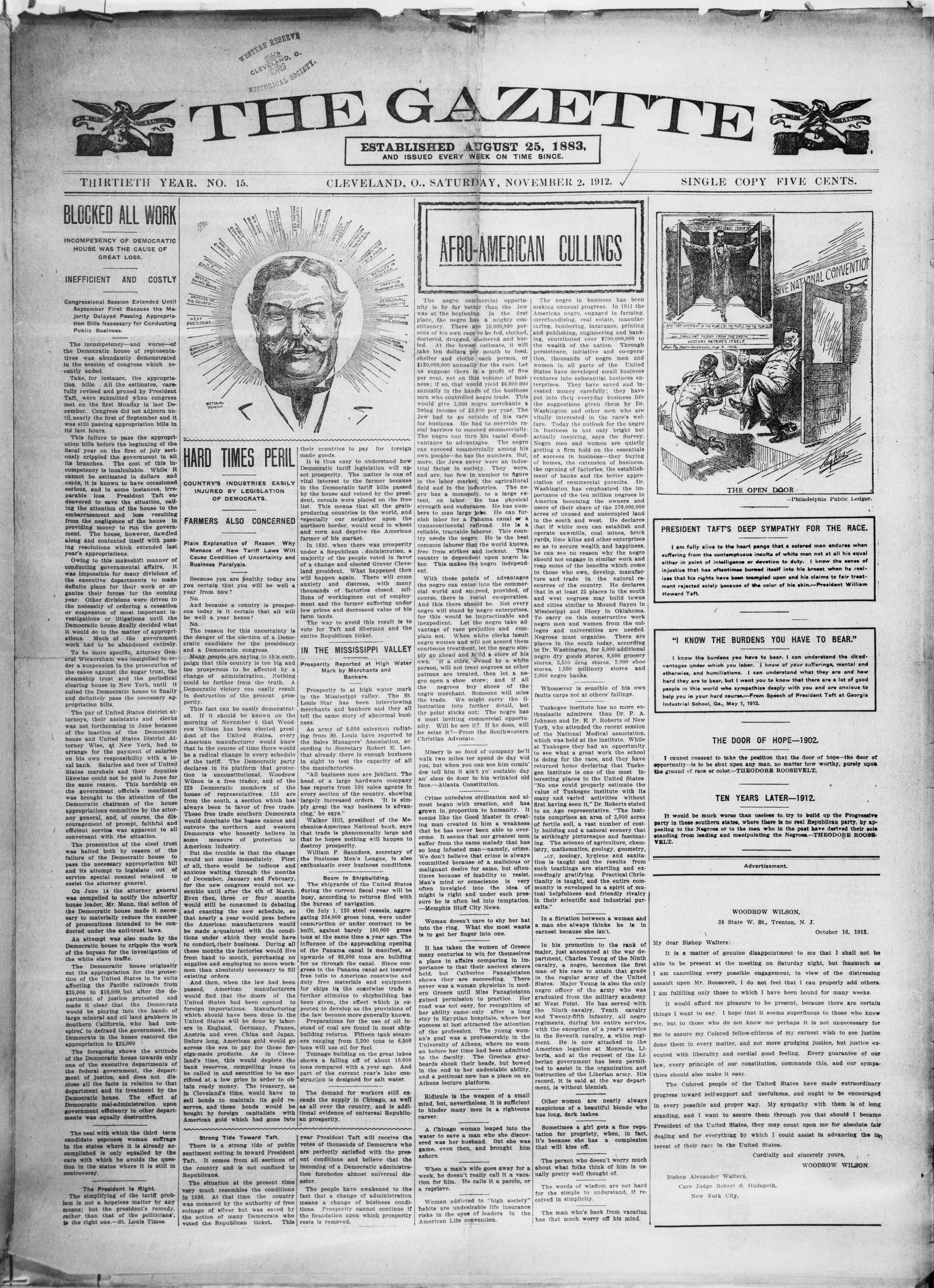
THE OPEN DOOR
—Philadelp
AFT'S DEEP SYMPATHY FOR
he to the heart pangs that a colored man contemptuous insults of white men for intelligence or devotion to duty. I know oftentimes burned itself into his breasts have been trampled upon and his clawed because of the color of his skin.
THE BURDENS YOU HAVE TO
burdens you have to bear. I can understand what the wear, but I want you to know that there is hard course.—From Speech of President Ga., May 1, 1912.
PROGRESSIVE NATIONAL CONVENTION
AND THAT GOVERNMENT OF THE PEOPLE BY THE PEOPLE FOR THE PEOPLE
SMALL NOT PERSON FROM THE EARTH
HISTORY REPEATS ITSELF
From The North American, Aug. 6, 1870
THE OPEN DOOR
PRESIDENT TAFT'S DEEP SYMPATHY FOR THE RACE.
I am fully alive to the heart pangs that a colored man endures when suffering from the contemptuous insults of white men not at all his equal either in point of intelligence or devotion to duty. I know the sense of injustice that has oftentimes burned itself into his breast when he realizes that his rights have been trampled upon and his claims to fair treatment rejected solely because of the color of his akin.—President William Howard Taft.
"I KNOW THE BURDENS YOU HAVE TO BEAR."
I know the burdens you have to bear. I can understand the disadvantages under which you labor. I know of your sufferings, mental and otherwise, and humiliations. I can understand what they are and how hard they are to bear, but I want you to know that there are a lot of good people in this world who sympathize deeply with you and are anxious to help you in your hard course.—From Speech of President Taft at Georgia Industrial School, Ga., May 1, 1912.
THE DOOR OF HOPE—1902.
I cannot consent to take the position to opportunity—is to be shunt upon any man, n the ground of race or color.—THEODORE I
t to take the position that the door
shut upon any man, no matter how
or color.—THEODORE ROOSEVELT.
I cannot consent to take the position that the door of hope—the door of opportunity—is to be shut upon any man, no matter how worthy, purely upon the ground of race or color—THEODORE ROOSEVELT.
TEN YEARS LATER—1912.
It would be much worse than useless party in these southern states, where there plealing to the Negroes or to the men who standing from leading and manipulating the VELT.
Advertisement
such worse than useless to try to build
new states, where there is no real Repo-
ses or to the men who in the past ha-
ing and manipulating the Negroes.—T
It would be much worse than useless to try to build up the Progressive party in these southern states, where there is no real Republican party, by appealing to the Negroes or to the men who in the past have derived their sole standing from leading and manipulating the Negroes.—THEODORE ROOSEVELT.
Advertisement.
---
WOODROW WILSON,
38 State W. St., Trenton, N. J.
Walters:
of genuine disappointment to me
at the meeting on Saturday night
every possible engagement, in view
goosevelt, I do not feel that I can
those to which I have been bound,
me pleasure to be present, because
I hope that it seems superfluous
who do not know me perhaps it is
colored fellow-citizens of my earnest
matter, and not mere grudging justi-
city and cordial good feeling. Ever
one of our constitution, commands to
take it easy.
people of the United States have
self-support and usefulness, and oughe
and proper way. My sympathy we
want to assure them through you the
United States, they may count upon
everything by which I could assist
me in the United States.
Cordially and sincere
WOOD
It is a matter of genuine disappointable to be present at the meeting on me. I am cancelling every possible engagement assault upon Mr. Roosevelt, I do not feel I am fulfilling only those to which I have.
It would afford me pleasure to be present things I want to say. I hope that it seem me, but to those who do not know me I me to assure my Colored fellow-citizens of done them in every matter, and not mercenated with liberality and cordial good law, every principle of our constitution, thies should also make it easy.
The Colored people of the United progress toward self-support and usefulness in every possible and proper way. My standing, and I want to assure them the President of the United States, they may dealing and for everything by which I interest of their race in the United States.
Cordially
It is a matter of genuine disappointment to me that I shall not be able to be present at the meeting on Saturday night, but ihasmuch as I am cancelling every possible engagement, in view of the distressing assault upon Mr. Roosevelt, I do not feel that I can properly add others. I am fulfilling only those to which I have been bound for many weeks.
It would afford me pleasure to be present, because there are certain things I want to say. I hope that it seems superfluous to those who know me, but to those who do not know me perhaps it is not unnecessary for me to assure my Colored fellow-citizens of my earnest wish to see justice done them in every matter, and not mere grudging justice, but justice executed with liberality and cordial good feeling. Every guarantee of our law, every principle of our constitution, commands this, and our sympathies should also make it easy.
The Colored people of the United States have made extraordinary progress toward self-support and usefulness, and ought to be encouraged in every possible and proper way. My sympathy with them is of long standing, and I want to assure them through you that should I became President of the United States, they may count upon me for absolute fair dealing and for everything by which I could assist in advancing the interest of their race in the United States.
Bishop Alexander Walters,
Care Judge Robert S. Hudspeth,
New York City.
---
My dear Bishop Walters:
IN HONOR OF THE
FEDERAL GOVT.
FIVE CENTS.
PRESIVE NATIONAL CONVENTION
DOOR
Philadelphia Public Ledger.
EMPATHY FOR THE RACE.
I that a colored man endures when
a of white men not at all his equal
tion to duty. I know the sense of
self into his breast when he real-
upon and his claims to fair treat-
lor of his skin.—President William
YOU HAVE TO BEAR."
I bear. I can understand the dicad-
now of your sufferings, mental and
understand what they are and how
to know that there are a lot of good
deeply with you and are anxious to
speech of President Taft at Georgia
in that the door of hope—the door of
n, no matter how worthy, purely upon
THE ROOSEVELT.
LATER—1912.
less to try to build up the Progressive
there is no real Republican party, by a
who in the past have derived their so-
the Negroes.—THEODORE ROOSEVELT
ement.
ointment to me that I shall not be on Saturday night, but inasmuch engagement, in view of the distress I feel that I can properly add other have been bound for many weeks. I be present, because there are certain seems superfluous to those who know perhaps it is not unnecessary thus of my earnest wish to see justice here grudging justice, but justice good feeling. Every guarantee of c
October 16. 1912
One Year.....$1.50
Six Months.....1.00
Three Months......50
Subscribers are requested to remit by postoffice money order or registered letter.
Entered at the postoffice in Cleveland, Ohio, as second-class matter
Address all communications to HARRY C. SMITH
Editor and proprietor, THE GAZETTE,
Blackstone Building, Cleveland, O.
Member Ohio Legislature: 1894 to 1896; 1896 to 1898; 1900 to 1902
Vote the straight Republican ticket
We wish to warn our readers, who are voters, to be very careful when it comes to casting their ballot for the various judicial candidates, because, this year, there is a separate judicial ticket. Here will be found the names of such sterling friends of the race as: Judges William T. Spear, Louis H. Winch and Charles A. Thatcher (for the State Supreme Court); George L. Phillips, H. B. Chapman, S. S. Ford, H. R. Keeler, Walter D. Meals, William J. Hart, and several others, whom it is our duty to vote for, because they are all excellent men, thoroughly capable, and true and tried friends of the race. We cannot urge too strong upon our voters their duty in this matter. If we are to retain the friendship of such true and tried friends of the race as the gentlemen named have proven themselves to be for many years, we must do our duty to them by voting for them election day, Tuesday, November 5.
RALLY ON THE CENTER
The campaign is over. The long roll has sounded; the bugles have called boots and saddles; the boys have fallen into line, touched elbows, and wait with eager impatience to charge the enemy.
The outposts have all been called in, and from Malne to California they are rallying on the center with a courage that is invincible and a determination that presages victory.
There is not a coward in our ranks; not a living soul who does not feel that next Tuesday night the Wilson party and the Roosevelt party will both be routed, horse, foot and dragon, and will be scurrying hither and yon, utterly demoralized.
Roosevelt and his cohorts will pass out of public notice and will be remembered only as we recall some horrible dream that was filled with dire forebodings and impending disasters.
God Almighty still reigns supreme, and He will continue to guide and direct this country until its mission has been accomplished.
VOTE YOUR TICKET STRAIGHT
We are on the eve of the most important election which has been held in this country since 1860. That election was followed by a bloody war in which the lives of thousands were sacrificed on the country's altar. In the event of the election of the Democratic ticket this year we believe that the injury to the country would equal that which followed the election of 1860, when war spread over our beautiful land and drenched the soil with the blood of the flower of the country. War would not be the result of the election, but hunger and want would visit homes where now peace and comfort dwell.
We wish to continue to enjoy the good times we now have, and the only way to be assured that prosperity will continue is to stand by the Republican party. We should not try any experiments or indulge any petty spite, as every vote is needed, and where any one fails to vote for the Republican candidate that is equivalent to a half vote for the opposition. This is an important matter, especially in some of the close Congressional districts, for it is necessary to have a Republican Congress to uphold a Republican President.
It is possible that some objectionable men may be on the ticket in certain localities, but there is so much at stake this time that they should be overlooked. Do not take any chances by voting a split ballot.
VOTE THE REPUBLICAN TICKET STRAIGHT.
THEODORE "BROWNSVILLE"
ROOSEVELT.
We must not forget that Col. Theoree "Brownsville" Roosevelt, in a New York magazine article, soon after the close of the Spanish-American war accused of cowardice the black soliders who saved his life and those of the Rough Riders in Cuba, discharged one hundred and sixty-seven innocent members of "The Black Battalion" at Brownville, Texas, and has persecuted them ever since and insists that they are guilty of a crime that was never committed—this even after they had been seven times proven innocent; barred from the national convention of the so-called "Progressive" or "Curse-all" party the Afro-Americans of the south, and finally, even in the present campaign, had the temerity to attack the outraged "Black Battalion," some of whom were among those who saved his and his Rough Riders' lives in Cuba during the Spanish-American war. Isn't this enough? If not, please remember that it was this same Theoree "Brownsville" Roosevelt who hounded our great and good friend, Senator Joseph Benson Forsaker from the U. S. Senate and public life because of his great battle for "The Black Battalion" which resulted in proving their entire innocence of the outrageous (Roosevelt) Brownsville charge. How any member of the race, in the face of all this and more, can find it in his heart or mind to cast a vote for Roosevelt on Tuesday next, is more than we are able to fathom.
The real cause of the great civil war was the desire for the extension and perpetuation of that great blot upon the escutcheon of our country, human slavery. Prior to the advent of Abraham Lincoln and the Republican party, about 400,000 Afro-Americans were held in bondage in the Southern States then as now contrived by the Democrats and when the Republican party elected Abraham Lincoln. President of the team of disapproval upon the Democratic desires, these Democratic Southern States seceded from the Union and attempted to set up a confederacy with human slavery as the chief corner stone. The Republican party determined that the confederacy should be destroyed, that the Union should be preserved; and true to its principles and in keeping with his own declarations the Great Emancipator struck the shackles from the limbs of the bondmen.
The Republican party determined that the confederacy should be destroyed, that the Union should be preserved; and true to its principles and in keeping with his own declarations the Great Emancipator struck the shackles from the limbs of the bondmen.
The leaders of the Republican party, feeling that their work was far from completion, framed and passed the thirteenth, fourteenth and fifteenth amendments to the Federal Constitution, and the states ratified their action, thus making slavery impossible and confirming the civil and political rights of the Afro-American people.
The leaders of the Republican party with the right to vote, is it surprising that these newly made citizens voted with the party which had taken them from their former position as mere chattels and made them citizens of the great Republic?
Through the Republican party, Douglass, Bruce, Langston, Dunn, Pinchback, Rainey, Revels, Lewis, Delaney, Smalls and scores of other national characters, many of them former slaves, rose to eminence impossible without its aid in the period following the slaveholders' rebellion, and in the present day the Republican party has given many Afro-Americans political prominence and recognition which they can obtain from no other party. The Democratic party has never produced any really great Afro-Americans.
The Republican party stands firmly against disfranchisement. No State controlled by Republicans has distranchised the Afro-American. The Republican party has taken a firm stand against jim-crow legislation. No State controlled by Republicans has ever passed a jim-crow or segregation
In the matter of public education the difference between the two parties is marked. In the North, where the Republicans generally control, education among the Colored people is widely diffused, while in the Democratic South the percentage of illiteracy is great. The Democratic legislators fail to provide equal school facilities for the two races, and in several states the facilities, already meagre, have been recently materially reduced. In Louisiana no Afro-American child receives public instruction above the fifth grade, and there is a general movement throughout the Southern Democratic States to confine the education of the Afro-American children to the lower grades. The movement to divide the school money between whites and blacks will proportion to their contributions in cases to the school fund arises in one Democratic Southern State after another, the purpose of which is to perpetuate Afro-American illiteracy.
The Republican party believes that the door of hope and opportunity should not be closed against any man, and this is especially evidenced by the fact that more than 22,000 Afro-Americans are in the service of the Government, drawing salaries aggregating nearly $12,500,000 per annum. There can be no question in the mind of any honorable, right thinking, sane Afro-American as to which party he should support in this campaign. No truer sentiment has ever been uttered than that of the great Douglass, when he said:
THE REPUBLICAN PARTY IS THE SHIP; ALL ELSE IS THE SEA
JUDGE S. S. FORD
A True and Tried Friend of the Race
—Let All Voters
Stand By Him.
There is no more important office, insofar as the great body of the people is concerned, than that of Common Pleas Judge. It is a position which affects not only the property rights of the citizen, but it deals directly with the lives and liberties of the people. It is, therefore, of the utmost importance that great care should be exercised on the part of electors in filling the office of judge. It should not only possess learning, but, above all, should be a man with an established character for honesty and unrightness.
There are twenty-one candidates upon the non-partisan judicial ballot to be voted at the election on November 5th. Among these candidates we desire to call special attention to Judge Simpson S. Ford. Judge Ford is in the prime of life having been born to a life of bounty-six years ago. In his early years at the bar he was associated with Judge Charles J. Estep. His public career began about twenty years ago, at which time he was elected to the Board of Education of this city. His service in this important place was of such high character as to attract gentlemen and from there went to the City Solicitor's office, where he remained for several years. As an assistant solicitor he rendered valuable service to the city, and conducted many important cases to a successful conclusion. While a member of the city law department Judge Ford had established a reputation for legal ability which made it an easy step from this position to the Commodity Court, and from there he was re-elected by over 30,000 majority, leading the ticket in that election.
After thirteen years of faithful service as a judge, he is now a candidate for re-election. We feel that it is but faint praise of Judge Ford to say that he has made an honorable, upright and conscientious judge. He has the respect and confidence of the almost unanimous vote he received in the vote taken by the Bar Association. Judge Ford is a man of extensive learning in the law, and has the patience and temperament which go to make an ideal judge. In these years of public service he has given the people the best part of himself, and at this time he is serving of their confidence and support. In this day when new and untried men are bidding for the support of the people for this high position by making silly and insincere pledges, it is well to keep in mind the man who does not need to make promises of performance, but who has been tried and has been trusted in his trust, he neatly recommend our readers to vote for Judge Simpson S. Ford for Common Pleas Judge at the coming election. He is a sterling friend of the race—Adv.
FOR SALE.
Houses and lots in Oberlin, Ohio, and in a most desirable location; surroundings excellent; cheap and on easy terms. Address or see D. C. Fisher, 554 Broadway, Lorain, Ohio. Phone, residence, 555; office, 385.
TUBERCULOSIS CONRUERED
By Dr. W. H. BAKER'S
Tubercular Remedy,
The greatest Tonic, Alterative, Expectorant and Tissue Builder in the world.
The result of 21 years' earnest study and research of a prominent ethical physician.
If you have friends suffering or even threatened with tuberculosis be sure to tell them to send for free booklet on "Interesting Facts Concerning Tuberculosis" and "How to Live." It may be the means of saving their lives. We will send you Case Report to fill out for our regular Consulting Physician to examine and he will forward you his suggestions free.
Examination free.
Write for testimonials of prominent people.
Agents wanted in every locality. Special inducements to traveling men.
THE DR. W. H. BAKER CO
CLEVELAND, . . . . OHIO.
THE GAZETTE, CLEVELAND, O. SATURDAY, NOVEMBER 2, 1912
A. B.
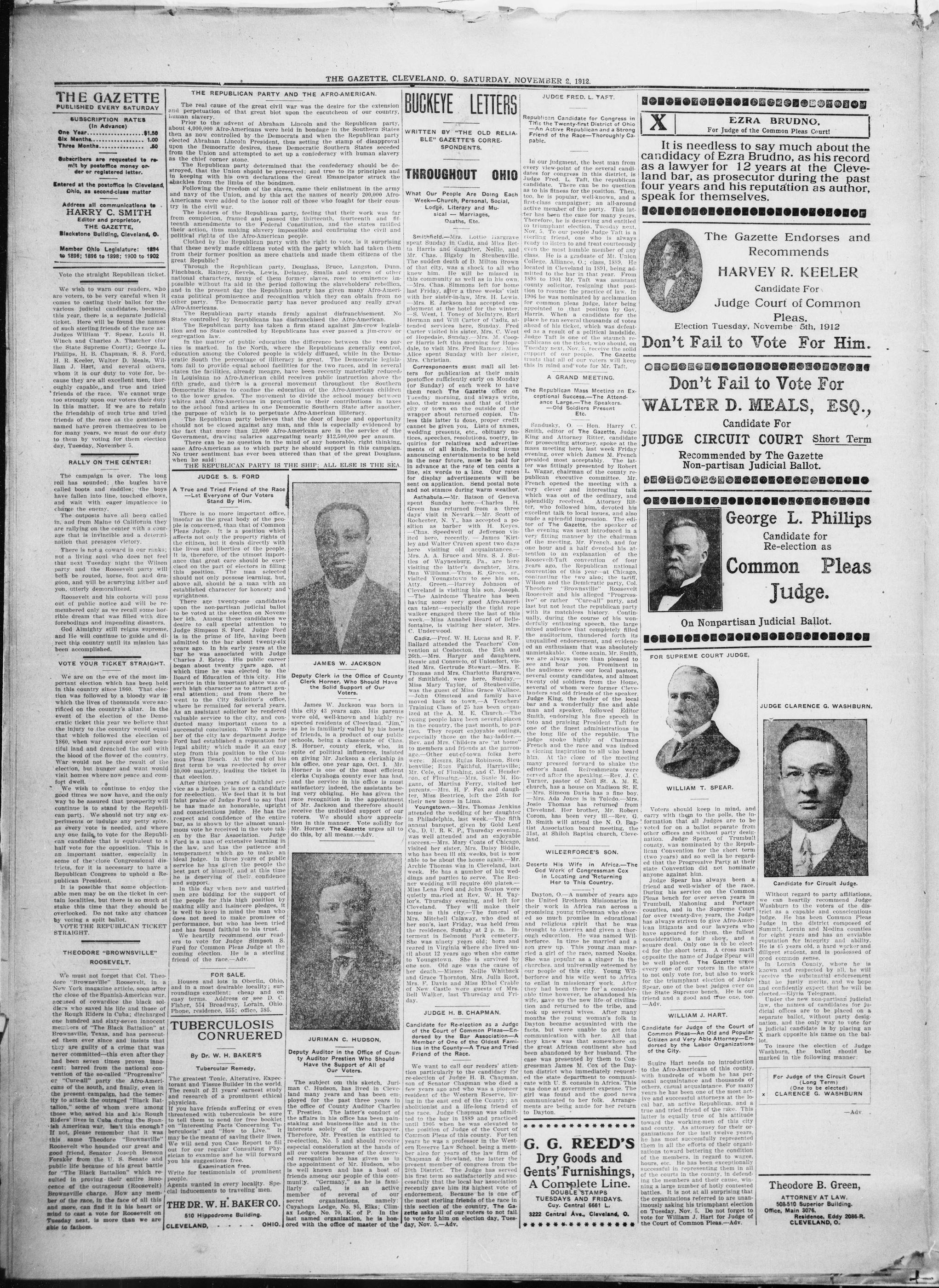
JAMES W. JACKSON
Deputy Clerk in the Office of County Clerk Horner, Who Should Have the Solid Support of Our Voters.
James W. Jackson was born in this city 43 years ago. His parents were old, well-behaved, and respected residents of Cleverland. "Thin as he is familiarly called by his hosts of friends, is a product of our public schools, being a class-mate of Chas S. Horner, county clerk, who, in spite of political influences, insisted on giving Mr. Jackson a clerkship in his office, one year ago, Oct. 1. Mr. Horner is one of the most efficient clerks Cuyahoga county ever has had, and the service in his office is most satisfactory indeed, the assistants being the recognition he has given the recognition of Mr. Jackson and therefore should receive the undivided support of our voters. We should show appreciation in this manner. We vote solidly for Mr. Horner. The Gazette urges all to do this, by all means.—Adv.
[Name]
JURIMAN C. HUDSON.
Deputy Auditor in the Office of County Auditor Prestien Who Should Have the Support of All of Our Voters.
The subject on this sketch, Jurian C. Hudson, has lived in Cleveland many years and has been employed for the past three years in the office of County Auditor Charles T. Prestien. The latter's conduct of the affair in his office has been painstaking and business like the interests solely of the taxpayer. Therefore, Mr. Prestien is entitled to re-election. No. 5 and should receive especial consideration at the hands of all our voters because of the deserved recognition he has given us in the appointment of Mr. Hudson, who is well known and has a host of friends among our people of this community. "Germany," as he is familiar called, is an active member of several of our secret organization, namely, the Moga Lodge, No. 85 Elks, Climax Lodge, No. 70, K. of P. In the last named organization, he is honored with the office of master of the
WRITTEN BY "THE OLD RELIA
BLE" GAZETTE'S CORRE-
SPONDENTS.
THROUGHOUT OHIO
What Our People Are Doing Each Week — Church, Personal, Social, Lodge, Literary and Musical — Marriages, Deaths, Etc.
Smithfield.—Mrs. Lottie, Hargrave spent Sunday in Cadiz, and Miss Retta Harris and daughter, Nellie, and Mr. Charles Higgins, Benville. The sudden death of D. Milton Brown of that city, was a shock to all who knew him. He will be missed in this community as well as in his own.
—Mrs. Chas. Simmons left for home last Friday, after a three weeks' visit with her sister-in-law, Mrs. H. Lewis.
—Mrs. E. Jackson has accepted employment at the hotel for the whiter, white, black, and brown Herman and Will Carter of Cadiz, attended services here, Sunday. Fred Carter visited his sister, Mrs. C. West of Hopeadle, Sunday.—Mrs. M. Cooper Harris left this morning for Hopeadle to visit Mrs. Fred Ramsey, Miss Alice to Sunday with her sister, Mrs. Christian
Correspondents must mail all letters for publication at their main postoffice sufficiently early on Monday (or Sunday) of each week to have them reach The Gazette office on Tuesday morning, and always write, also, their names and that of their city or town on the outside of the wrapper after returned copies. The letter after the credit cannot be given you. Lists of names, wedding presents, etc., obituary notices, speeches, resolutions, poetry, inquiries for relatives and advertisements of all kinds, including items announcing entertainments to be held in the near future, must be paid for in advance at the rate of ten cents a week for display advertisements will be sent on application. Send postal note and not stamps during warm weather.
Asthabula—Mr. Batson of Geneva spent Sunday here—Charles H. Green has returned from a three days' visit in Newark—Mr. Scott of Rochester, N. Y., has accepted a position as barber with H. Keyes.—Chas. Speedwell of Jefferson visited Wynn, Pa. and Walter Craven spent two days here visiting old acquaintances—Mrs. A. B. Bruce and Mrs. S. J. Suttles of Waynesburg, Pa., are here visiting the latter's daughter, Mrs Dan Williams—Thos. E. Green, er. visited youngstown to see his son, Atty. Green—Harvey Johnson of Cleveland is visiting his son, Joseph.—The Aiirdome Theatre has been having some very good Afro-American talent—especially the tight rope walker engaged in the Ambel Heart of Bolles fontaine, is visiting her sister, Mrs C. Underwood.
Cadiz.—Prof. W. H. Lucas and R. F. Ballard attended the Teachers' Convention at Coshcton, the 25th and 26th.—Mrs. Harper and daughters, Bessie and Consuloe, of Unionfort, visited Mrs. Gertrude Stewart.—E. Thomas and Mrs. Charlotte Hargrave visited Mrs. Gertrude Stewart.—Miss Mary Taylor, of Steubenville, was the guest of Miss Grace Wallace—John Olmstead and family have moved back to town.—A Teachers Training Class of 25 has been organized at the A. M. E. Church.—The young people have been several places in the country, the past month, to parishioners, especially those on the hay-ladder.—Rev. and Mrs. Childers are "at home" to members and friends at the parson age.—Other out-of-town folks here were: Messrs. Rufus Robinson, Steubenville; Ross Faitfulh, Harrisville; Mr. Cole, of Flushing, and C. Henderson, of Flushing.—Mrs. Susie M. Hogans, of Martins Ferry, visited her parents.—Mrs. Susan B. Miller, Miss Beatrice, left the 25th for their new home in Lima.
Youngstown—Mrs. Thomas Jenkins attended the wedding of her daughter in Philadelphia, last week. The fifth annual banquet, given by Gold Leaf Co. D, U. R. K. P., Thursday evening was well attended and an enjoyable success—Mrs. Mary Coats of Chicago visited her sister, Mrs. Daisy Biddle, who has been ill six weeks, but is now able to be about the house again—Mr. Archie Thomas was in Cleveland, last week. He has a number of big wedding and wedding will require 400 plates. Miss Lena Ford and John Seaton were quietly married at Rev. W. H. Taylor's. Thursday evening, and left for Cleveland. They will make their home in this city—The funeral of Mrs. Mitchell Calaway, who died at her son's, last Friday, was held from the residence, Sunday at 2 p. m. Interment in Belmont Park cemetery. She was ninety years old; born and reared in Virginia where she lived until about 12 years ago when she came to Youngstown. She was survived by her old age, was the cause of her death—Misses Nellie Whitack and Grace Thornton, Mrs. Julia Root, Mrs. F. Davis and Miss Ethel Crable of New Castle were guests of Mrs. Bell Walker, last Thursday and Friday.
JUDGE H. B. CHAPMAN
Candidate for Re-election as a Judge of the Court of Common Pleas—Ensured by the Bar Association—A Member of One of the Oldest Families in the County—A True and Tried Friend of the Race.
We want to call our readers' attention particularly to the candidacy for re-election of Judge H. B. Chapman, son of Senator Chapman who died a few years ago and who was a pioneer resident of the Western Reserve, living in the east end of the County; an abolitionist and a life-long friend of the race. Judge Chapman was admitted to the bar in 1889 and elevated to the position of Judge of the Court of Common Pleas of this county. For ten years he was a professor in the Western Reserve Law School, being a member also for years of the law firm of Chapman & Howland, the latter the present member of congress from the 20th District. The Judge has served his first term so satisfactorily and successfully, the two bar association gave him the highest vote of endorsement. Because he is one of the most sterling friends of the race in this section of the country, The Gazette asks all of our voters to not fail to vote for him on election day, Tuesday, Nov. 5—Ady.
JUDGE FRED. L. TAFT.
Republican Candidate for Congress in
The Twenty-first District of Ohio
is the Active Republican and a Strong
Friend of the Race—Thoroughly Capable.
In our judgment, the best man from every view-point of the several candidates for congress in this district, is Judge Fred. L. Taft, the republican candidate. There can be no question as to his fitness for the position. Then, he is popular, well-known, and a first-time campaigner, an all-around active member of the state has been the case for many years. Therefore, he is deserving and entitled to triumphant election. Tuesday next, Nov. 5. To our people Judge Taft is a sterling friend, one who is always ready to listen to and treat courteously, most humble member of any class. He is a member of the College, Alliance O; college, 1889, located in Cleveland in 1891, being admitted to the bar in that year. From 1898 to 1901 Mr. Taft was assistant county solicitor, resigning that position to resume the practice of law. In 1906 he was nominated by acclamation for common pleas judge, later being that position by Gov. Harris. When he came to place he ran several thousands of votes ahead of his ticket, which was defeated as a result of a political landslide. Judge Taft is one of the staunch republicans on the ticket, who should, on his behalf, receive the solid support of our people. He trusts that all of our voters will keep this in mind and vote for Mr. Taft.
A GRAND MEETING.
The Republican Mass Meeting an Exceptional Success. The Attendance Large. The Speakers. Old Soldiers Present
WILEERFORCE'S SON.
Deserts His Wife in Africa—The God Work of Congressman Cox in Locating and Returning Her to This Country.
Dayton, O.—A number of years ago the United Brethren Missionsionaries in their work in Africa ran across a promising young tribesman who showed so much promise in educational and religious spirit that he was brought to America and given a thorough education. He was named Wilberforce. In time he married and a son grew up. This young man married a girl of the race, named Nooks. She was popular as a singer in the churches, and universally esteemed by our people of this city. Young Wilberforce and his wife went to Africa to visit the missionsionaries. They had been there for a considerable time however, he abandoned his wife, gave up the new life of civilization and returned to the tribe, and took up several wives. After many months the young woman's folk in Dayton became acquainted with the facts, but were unable to get into communication with her. All that they knew was that somewhere on the great African continent she had been abandoned by her husband. The case was presented by them to Congressman James M. Cox of the Dayton district who immediately requested the state department to communicate to Congressman Sonali in Africa. This was done at government expense. The girl was found and the good news communicated to her folk. Arrangements are being amed for her return to Dayton.
---
It is needless to say much about the candidacy of Ezra Brudno, as his record as a lawyer for 12 years at the Cleveland bar, as prosecutor during the past four years and his reputation as author, speak for themselves.
```markdown
```
The Gazette Endorses and Recommends HARVEY R. KEELER Candidate For Judge Court of Common
Pleas.
Tuesday, Novembe 5th, 1912
Fail to Vote For Him.
Fail to Vote For
R D. MEALS, ESQ.,
Candidate For
RCUIT COURT Short Term
Amended by The Gazette
Artisan Judicial Ballot.
Election Tuesday, M
Don't Fail to W
Don't Fail to
WALTER D. M
Candidate
JUDGE CIRCUIT
Recommended by
Non-partisan Ju
Don't Fail to Vote For Him.
Don't Fail to Vote For
WALTER D. MEALS, ESQ.,
Candidate For
JUDGE CIRCUIT COURT Short Term
Recommended by The Gazette
Non-partisan Judicial Ballot.
George L. Phillips
Candidate for
Re-election as
Common Pleas
Judge.
partisan Judicial Ballot.
URT JUDGE.
On Nonpartisan
FOR SUPREME COURT JUDGE.
Voters should keep in mind, and carry with them to the polls, the information that all Judges are to be voted for on a ball ballot separate from other offices and without party designation. Judge Spear, of Trumbull county, was nominated by the Republican Convention for the short term (two years) and so well is he regarded that the Progressive Party at their state Convention did not nominate anyone against him.
Judge Spear has always been a friend and well-wisher of the race. During his service on the Common Pleas bench for over seven years in Trumbull, Mahoning and Portage counties, and in the Supreme Court for over twenty-five years, the judge has been a great gift to give African-American litigants and our lawyers who have appeared for them, the fullest consideration, a fair show, and a square deal. Only one is to be elected for the short term. A cross mark opposite the name of Judge Spear will be well placed. The Gazette urges every one of our voters in the state to not only vote for, but also to work for the triumphant election of Judge Spear, one of the ever one of our Supreme bench. He is our friend and a good and true one, too.—Adv.
Candidate for Judge of the Court of Common Pleas—An Old and Popular Citizen and Very Able Attorney—Endorses the Labor Organizations of the City.
Suire Hart needs no introduction to the Afro-Americans of this county, with hundreds of whom he has personal acquaintance and thousands of others, casual acquaintance. For many years he has been one of the most active and successful attorneys at the local bar, an active Republican, and a true and tried friend of the race. This latter is equally true of his toward the working class of this city and the attorney for their organizations for the last twelve years, he has most successfully represented them in all the efforts of their organizations toward bettering the condition of the members, in regard to wages, hours, etc. He has been exceptionally successful in representing them in all of the courts in the county, in defending the members and their cause, winning battles, and winning battles. It is not at all surprising that the organizations referred to are unanimously asking his triumphant election on Tuesday, Nov. 5. Do not forget to vote for William J. Hart for Judge of the Court of Common Pleas—Adv.
publican, and a
the race. This
of his attitude
of this city
by their or-
twelve years,
represented
of their organi-
the condition
hard to wages,
exceptionally
g them in all
unity, in defend-
---
---
PETER H. BURGESS
PETER H. BURGESS
WILLIAM J. HART
JUDGE CLARENCE G. WASHBURN.
Candidate for Circuit Judge.
Without regard to party affiliations, we can heartily recommend Judge Washburn to the voters of the district as a capable and conscientious judge. He has been Common Pleas Judge in the district composed of Stuart, Lorin and Medina counties for eight years and has an enviable reputation for integrity and ability. He is 45 years old, a hard worker and diligent student, and is possessed of good common sense. In Lorain County, where he is known and respected by all, he will receive the substantial endorsement that he justly merits, and we hope that he will be appointed. The will he be cheated—Elyria Telegram. Under the new non-partisan judicial law, the names of candidates for judicial offices are to be placed on a separate ballot, without party designation, and the only way to vote for a judicial candidate is by placing an X mark opposite his name on the ballot.
To insure the election of Judge Washburn, the ballot should be marked in the following manner:
For Judge of the Circuit Court
(Long Term)
(One to be elected)
x CLARENCE G. WASHBURN
Theodore B. Green,
ATTORNEY AT LAW.
508-510 Superior Building.
Office, Main 3078.
Residence, Eddy 2086-R.
CLEVELAND, O.
The Best Place on Central Ave.,
to get a Good Lunch
and Quick Service
J. W. CRAWFORD, PRO'R.,
2133 CENTRAL AVE.
Open Evenings for the Accommodation
of the Theater Trade.
B. & M. HAIR DRESS-
A delightfully Perfumed Hair-Pomade for making hair, stubborn, curly hair soft, pliant and glossy. It works on the hair but also the hair but a wonderful hair-grower. It works directly on the scalp and roots of the hair, relieving dandruff and other diseases of the scalp-skin, making it to grow rich, long and luxurious.
B.&M . Eair Dressing
is becoming more popular every day and is sold strictly on a guarantee.
2742 Central Ave. Selling Agents.
Travis & Strawder
'Central Transfer Co.'
CAREFUL MOVERS OF FURNI
TURE and PIANOS
Moving Vans
Piano Hoisting a Specialty
Light and Heavy Expressing.
Orders Promptly Attended to.
Prices Reasonable.
Office and Residence:
2003 Central Ave., Cleveland, Ohio.
Guy, Gen. 8182R.
TELEPHONES:
Bell, Eddy 1100L
Cuy., Central 1745R.
PALACE HOTEL
Dining and Lunch
Rooms, Cigars,
Tobacco &c.
The Best Sleeping and
Eating Accommodations.
R. R. BROOKS, Prop'r.
2733 Central Ave. Cleveland, Ohio.
DANCING SCHOOL
MONDAYS AND THURSDAYS
At G. W. TURPIN'S
DANCING ACADEMY, ORKINS HALL,
3623 Central Ave.
SPECIAL ATTENTION GIVEN BEGINNERS. Join the beginners' class, open the first of each month. PRIVATE LESSONS by appointment. Private classes taught. All out-of-town people are invited. Hall rented for private parties, etc.
MAY MOORE'S ORCHESTRA.
G. W. TURPIN. 'Phone, East 586 J.
1
"Poro" College
3100 Pine St. St. Louis, Mo.
THE "PORO" SYSTEM of Scalp and Hair treatment is based on the latest scientific and sanitary methods, effecting a healthy scalp thus promoting a growth of beautiful hair.
The "Poro" preparations used in connection with the treatment are made and sold exclusively by myself, having the exclusive right to that name; and I, alone, know the secret of the composition that bears that name. Our hair begins to grow as the result of the use of "PORO," it will continue to do so if only the scalp and hair be kept clean. This sanitary method of treatment is also having the desired effect in helping to prevent the spread of diseases, for it is a fact that hair in an unsanitary condition carries the disease of disease in the fatal to innocent persons coming in contact with them. For treatment, call on or address:
MISS KATIE B. COLLISER
4812 Payne Ave.
Cleveland, Ohio
---
PURELY PERSONAL
PURCHASE
THE
"GAZETTE" AT
J. S. HALL'S, 3121 Central Ave.
L. SCHWARTZ'S, 2921 Central Ave. Open Sunday.
O. C. SCHROEDER'S, Cuyahoga Bldg. Open Sunday.
ELMER F. BOYD'S, 2604 Central Ave.
F. VALENTINE'S, 2130 Central Ave.
SAM, FERTMAN'S, 3608 Central Ave.
J. E. BRANHAM'S, 4401 Central Ave.
MILLER'S, 2249 E. 105th St.
SPURLOCK'S, 2737 Central Ave.
PUSHAW, Superior Arcade.
SAM COHEN, 2928 Central Ave.
NOTICE TO SUBSCRIBERS:--Subscribers for receiving The Gazette regularly should notify us at once. We desire every copy delivered promptly. We advise our patrons to carefully examine The Gazette's advertisements before making purchases. Business men who advertise in this paper should have the patronage of Afro-Americans. The fact that they advertise is assurance that they want it. Local reading notices (advertisements) ten cents a line (six words in a line.)
For Rent.—House at $905 Blaine Av. Enquire of Mr. Walker at that address.
FOR RENT.—Houses—If you have places to rent or if you want to rent—notify The Gazette.
For Rent.—Pleasant furnished front room with bath for couple or two gentlemen. 2237 E. 49th St. 21
NOTARY PUBLIC.—For such services call at The Gazette office. No. 3 blackstone Building, No. 1422 W. 34 street, near Superior avenue.
For Rent.—To two gentlemen, nicely furnished room with light, heat and bath. 3857 Carnegie Ave. Fourth house west of E. 40th St, next to the grocery.
Mrs. Hattie Sampson Dale is critically ill.
Mrs. Geo. Fields entertained a Sunday dinner, the Misses Ethel Blue and Ruth Wright, in honor of Miss Mable Polley's thirteenth birthday.
Will J. Rogers of Seaman, near West Union, O. is at Dayton study, under under Dr. Wright. He will become an aviator. For years, he has been making balloon ascensions.
Cyrus Field Adams of Chicago, has resigned his position, assistant registrar of the treasury, and Dr. J. F Strickland of Arkansas, a member of the race, has been appointed to suc
Robert Corom has been very ill.
The Fisk Jubilee Singers will give a concert at Mt. Zion Congregational church, Nov. 4 at 7:30 p. m.
* * *
The records show that Mrs. Lucy Fry of Washington, D. C., born in Virginia, is 112 years old.
* * *
The Gilt Edge Needle Club met at Mrs. Carrie Scott's, Oct. 18, and a very pleasant afternoon was spent. It will meet again this Friday at Mrs. E. Simons', 7215 Port St. Mrs. J. Naylor, sec.
* * *
Mr. Geo. Sutton is teacher in one of the nightschool classes in Harmon school, corner E. 20th St. and Woodland Ave. Everyone desiring a good knowledge of reading, writing and arithmetic is asked to attend his classes. Absolutely free. Mr. Sutton is a member of the race.
At a meeting of the Union Club of St. Andrew, Oct. 29th, George W. Johnson was again elected chairman of the membership committee of the club and Hon. H. T. Eubanks was dropped from the executive committee. The latter then resigned from the club.
Junius Carter was a veteran of the Spanish-American war, a former member of the 9th Cavalry. It is now said that the "auto" that killed him Sunday was not only running at the rate of 50 or 55 miles an hour, but was on the wrong side of the street.
Henry Dickerson, age 58 years, died at Lakeside hospital, Oct. 26th. Funeral services, Oct. 29th 2 p. m. at the residence, conducted by Rev. Chas. T. Bundy, with a society of his fellow-workmen in attendance. Interment at E. Cleveland cemetery. E. F. Boyd, funeral director.
There will be a lecture and musical at Cory church. Thursday evening, for W. H. Smith's educational fund: A fine program has been prepared and Rev. R. M. Bagnall of Detroit, will deliver an address, subject: "Front Porches and Back Yards."
Miss Frances Slimm's Sunday school class gave a concert, Oct. 25 in Union Congregation. A church among those who participated were Mr. Ford, who gave a very good initiation of connect music. Miss Mable Polley, and Master Geo. Howard Fields. Miss Slimm's violin solo was excellent.
Miss Lillian Derrick of Flushing, N.Y., arrived in Cleveland Oct. 15th expecting to spend some time at Mr. and Mrs. E. Daw's. E 8th St. She was called to Oberlin Oct. 18th by the Mrs. Isabel Henderson. Last week her mother, Mrs. Clara E. Derrick, on her return from Oberlin to Flushing, also spent a day at the home of Mr. Daw.
At Mt. Haven Baptist church, Sunday, Rev. J. L. Burr, pastor, will presach in the morning and evening and Rev. Geo. A. Sissle at $ p. m. when his quartette will sing, "Which exercises the greater influence on the civilization and happiness of the human race, the male or the female mind?" is the subject to be discussed by the Payne-Randolph Lyceum, at Mt. Haven Baptist church, Thursday evening. The public is invited.
We want to urge our people to vote particularly for Judges Harvey R. Keeler, S. S. Ford and H. B. Chapman. We have never had any truer or better friends on the contrary than the Please bench. In the minority than the three band. In the editor of The Gazette unequalifiedly endorses and recommends them to all, and urges every one of our voters to do his clear duty and vote for them, particularly on Tuesday next. Urge your friends and acquaintances, voters, to do so, also.
S. E. Woods writes The Gazette under the date, Oct. 29, 12, as follows: "I would like to suggest through our paper, The Gazette, that this is the proper time for our voters of this county, to record their disapproval of the shameful treatment of our race at the hands of A. J. (Gus) Hirstine, now a candidate for county commissioner. A strong rebuke at this time particularly to such public officials will go a long way, gaining authority to be respect which rightly belongs to us. I expect to face against him and call on every self-respecting Afro-American in this county to do likewise."
THE GAZETTE, CLEVELAND, O. SATURDAY, NOVEMBER 2, 1912.
Mrs. Hattie Sampson Dale is critically ill.
Mrs. Geo. Fields entertained at Sunday dinner, the Misses Ethel Blue and Ruth Wright, in honor of Miss Mable Polley's thirteenth birthday.
Will J. Rogers of Seaman, near West Union, O. is at Dayton studying under Orville Wright. He will become an aviator. For years, he has been making balloon ascensions.
Cyrus Flield Adams of Chicago, has resigned his position, assistant registrar of the treasury, and Dr. J. P. Stratton of Arkansas, a member of the race, has been appointed to succeed him.
The great "Zigomar" moving picture play will be at the Alpha Theater, Sunday. Wherever these pictures are exhibited, the theaters are packed because "Zigomar, or The Phantom Bandit," is one of the most wonderfully thrilling series of moving pictures ever exhibited.
* * * *
The joint presidency of Gammon Theological Seminary and Clark University, Atlanta, Ga., has been separated, and Dr. S. E. Ideman, who headed both schools, has been president of Gammon Theological Seminary, D.W. Foster, former president of Rust University, Holly Springs, Miss, has been elected president of Clark University. The joint presidency was invoked several years ago to get rid of two Afro-American presidents. The plan has worked out successfully, to our loss.
Last week Tuesday, Oct. 22, Mr. Edward Chafin was awarded a judgment of $50 and costs against The Federal Amusement Company, a New York corporation, for discriminating him in the case of the Judge Lawrence of the Common Pleas Court rendered the decision. It was a jury trial. Although he had purchased a 20c ticket, which entitled him to a seat on the main floor, this was refused him, and the judge will teach The Grand and several other local theaters, that discriminate in one way or another, a much needed lesson.
The Du Bois Literary Club wishes to thank the public for making its first entertainment, in the interest of the student fund for John Ballard, such a brilliant success, as $42.50 was taken in. Expenses, $9.65; balance, $22.85. The club is preparing to present the drama, "The Miller's Daughter, or Bound in Honor," at an early date. Also, a lecture will be given at Mt. Zion Congregational church under the auspices of the club. Sunday, November 13, 2013, at 10 a.m. a prominent woman, active in club and educational work, will be announced later. Everybody is invited.
The mass meeting in ideal hall, last week Friday evening, was a grand success. All the speakers pleased greatly, especially the orator of the evening, the Hon. Henry Lincoln Johnson of Washington, D. C., recorder of deeds of the District of Columbia. He is a fine man and speaker, and not only interested but benefited all who heard him. There was a large attendance, too. The editor of the magazine in San Diego, the Republican State Committee; at Amee hall, this city this Wednesday evening, for our Republican county executive committee, and at Washington C. H., this state, Thursday evening for the Republican state executive committee.
Junian Carter, 2704 Central Ave. S. E., who had planned to go to Pittsburgh and Washington, D. C., to visit relatives and possibly locate, died Sunday night at Charity hospital. He was htI by an automobile driven by William Collins, 2510 Foe Ave. S. W. driver of the auto patrol of the Cleveland and Electric illuminating company, who diving his car at a rate of 55 miles an hour and had a girl in the auto with him—it is said by those who saw him—when his car struck Carter. The accident occurred at E. 28th St. and Central Ave. S. E. John I. Nunn's ambulance took the dying man to Charity hospital, where he was diving his car at and jaw were broken. Collins was to nolice headquarters and gave himself up. He has been released on bail. He said he was driving at a rate of 15 miles an hour when he struck the man, but that is not so, reliable witneses say. Persons who witnessed the killing of Carter and saw Collins were diving his car at names and addresses to editor of The Gazette. Blackstone Eldg, as soon as possible, Call in, see him, if you can.
FRANK R. LANDER.
Republican Candidate for Re-Election for County Surveyor,
asks for your support on Nov. 5.
His name will be the third from the bottom on the Republican ticket. Mr. Lander has a member of the race in his employ in the person of Mr. Leroy Fowler, appointed nearly four years ago. The Gazette urges our men to vote compatent for him. He compels his compatent and deserves from every viewpoint. Vote for Frank R. Lander, Republican candidate for county surveyor.
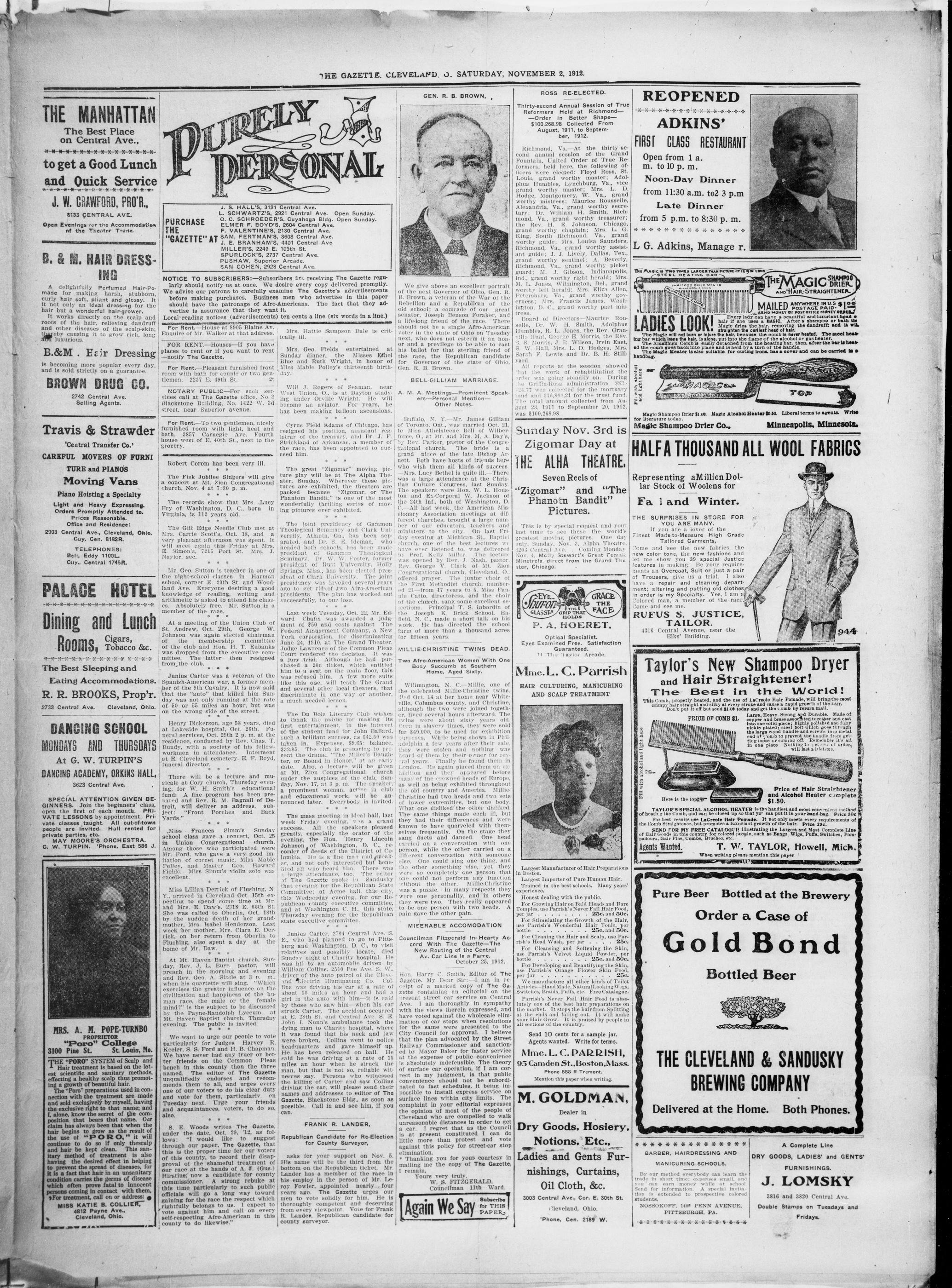
GEN. R. B. BROWN.
JOHN H. BURKE
We give above an excellent portrait of the next Governor of Ohio, Gen. R. B. Brown, a veteran of the War of the Rebellion and a Republican of the old school; a comrade of our great senator, Joseph Benson Foraker, and a life-long friend of the race. There should not be a single Afro-American voter in the state of Ohio on Tuesday next, who does not esteem it an honor and a privilege to be able to cast his ballot for that startling friend of the race. The Republican candidate for Governor of the state of Ohio, Gen. R. B. Brown.
BELL-GILLIAM MARRIAGE.
A. M. A. Meetings—Prominent Speakers—Personal Mention—Other Notes.
Buffalo, N. Y.—Mr. James Gilliam of Toronto, Ont., was married Oct. 21, to Miss Athlestone Bell of Wilberforce, O. at Mr. and Mrs. M. A. Day's, pastor, pastor congregational national church. The bride grand niece of the late Bishop Arnett. Both have hosts of friends here, who wish them all kinds of success
—Mrs. Lucy Bethel is quite ill.—There was a large attendance at the Christian Culture Congress, last Sunday. The speakers were Hon. W. L. Houston and Ex-Corporal W. Jackson of W. Jackson College. —C all last week, the American Missionary Association meetings at different churches, brought a large number of our educators, teachers and ministers to the city. On last Friday evening at Michigan St. Baptist church, one of the best lectures we have ever listened to, was delivered by Prof. Kelly Miller. The lecture was quarried by Rev. M. pastor Rev George V. Clark of Mt. Zion Congregational church, Cleveland, O, offered prayer. The junior choir of the First Methodist church, numbered 21—from 17 years to 5. Miss Fannie Catto, directress, and the choir of the church, sang some excellent selections. Principal T. S. Inbordin of the Joseph K. Brick School, Enid N. M. male school work. He has directed the school farm of more than a thousand acres for fifteen years.
MILLIE-CHRISTINE TWINS DEAD
Two Afro-American Women With One Body Juvenile Southern Woman Juvenile
Willimington, N. C.-Mille, one of the celebrated Millie-Christine twins, died Oct. 14 at her home near Whiteville, Columbus county, and Christine, although the two were joined together, lived several hours afterward. The twins were about sixty years old, Millie was born in New York for $49,000, to be used for exhibition purposes. While being shown in Philadelphia a few years after their sale, they were stolen and nothing was heard of them by their owner for several years. Finally he found them in London. He again placed them on exhibition and they appeared before the public. He then fled and died as well as being exhibited throughout the old country and America. Millie-Christine had two heads and two sets of lower extremities, but one body. What one disliked the other disliked. The same things made each ill, but they had their differences and were known to have quarreled with themselves frequently. On the stage, they were dressed in dark clothes and one head carried on a conversation with one person, while the other carried on a different conversation with someone else. One could sing one thing, and the other something else, yet they were so completely one person that one could not perform any function without them. One head was a puzzle. In many respects they wore one personality, and in others they were two. They really appeared to be one person with two heads. A pain gave the other pain.
MISERABLE ACCOMODATION
Councilman Fitzgerald in Hearty Ac-
cord With the Gazette—The
New Routing of the Central
Av. Car Limo in a Farm
October 25, 1912
Hen, Harry C. Smith, Editor of The Gazette. My Dear Sire: I am in receipt of a marked copy of The Gazette containing an editorial on the present street car service on Central Ave. I am thoroughly in sympathy with the views therein expressed, and have voted against the wholesale elimination of car stops when resolutions for the same were presented to the City Council for approval. I believe that the plan advocated by the Street Railway Commissioner and sanctioned by Mayor Baker for faster service at the expense of public convenience is absolutely indefensible. The theory of surface car operation, if I am correct in my judgment, is that public convenience should not be stored, because accidents, it being impossible to install express service on surface lines within city limits. The complaint in your editorial expresses the opinion of most of the people of Cleveland who are compelled to walk unreasonable distances in order to get a car. I regret that as the Council is at present constituted I can do little more than protest and vote against this policy for street-car stop elimination.
Thanking you for your courtesy in mailing me the copy of The Gazette, I remain.
Yours very truly,
W. S. FITZGERALD,
Councilman 11th Ward.
Again We Say
Subscribe for THIS PAPER
ROSS RE-ELECTED.
Thirty-second Annual Session of True Reformers Held at Richmond—Order in Better Shape—$100,268.98 Collected From August, 1911, to September, 1912.
Richmond, Va.—At the thirty second annual session of the Grand Fountain, United Order of True Reformers, held here, the following officers were elected: Floyd Ross, St. Louis, grand worthy master; Adolphus Hunbels, Lynchburg, Va. vice worthy, master; Mrs. L. Dodge, Southbury, W. Va., grand worthy mistress; Maurice Rousseille, Alexandria, Va., grand worthy secretary; Dr. William H. Smith, Richmond, Va., grand worthy treasurer; the Rev. H. E. Johnson, Chicago, grand worthy chaplain; Mrs. G. Seward, Southbury, W. Va., grand worthy guide; Mrs. Louisa Saunders, Richmond, Va., grand worthy assistant guide; J. J. Lively, Dallas, Tex, grand worthy sentinel; A. Beverly, Richmond, Va., grand worthy picket guard; M. J. Gibson, Indianapolis, ind, grand worthy right herald; Mrs. M. L. Jones, Wilmington, Del, grand worthy left herald; Mrs. Elliza Allen, Petersburg, Va., grand worthy governor; Mrs. Principle Uses Washington, D. C., grand worthy past mistress.
Board of Directors—Maurice Rousseille, Dr. W. H. Smith, Adolphus Humbles, R. L. Jones, the Rev. Granville Hunt, George E. Morris, the Rev. S. S. Morris, J. R. Wilson, Irwin East, S. W. Hall, Mrs. L. D. Lodges, Mrs. Sarch F. Lewis and Dr. B. H. Stillyard.
All reports at the session showed that the work of rehabilitating the workings steadily on. During the Griffin-Ross administration 883. 2447 was collected for the mortuary fund and $16,844.21 for the trust fund. The total amount collected from August 23, 1911 to September 20, 1912, was $100,268.98.
Sunday Nov. 3rd is Zigomar Day at THE ALHA THEATRE. Seven Reels of "Zigomar" and "The Phanotn Bandit" Pictures.
This is by special request and your last time to see these the world's greatest moving pictures. One day only. Sunday, Nov. 2. Alpha Theatre 2205 Central Ave. Coming Monday Nov. 4. Melly Stewart's Great Female Minstrels, direct from the Grand Theater, Chicago.
EYE
SOURPON
GLASSES
GRACE
THE
FACE
THE
GREAT
THAT
HOLDS
Optical Specialist.
Eyes Examined Free. Satisfaction
Guaranteed.
11. The Taylor Arcade.
Mme. L. C. Parrish
HAIR CULTURING, MANICURING
AND SCALP TREATMENT
Largest Manufacturer of Hair Preparations in Boston.
Largest Importer of Pure Human Hair.
Trained in the best schools. Many years' experience.
Honest dealing with the public.
Honest using with the Hair for Growing Hair on Pail Heads and Bare Tapies, use Parrish's Never Hair Food, per jar. 25c and 50c.
For Stimulating the Growth of the Hair, use Parrish's Wonderful Hair Tonic, per bottle. 25c.
For Cleaning the Hair and Scalp, use Parrish's Head Wash, per jar. 25c.
For Cleansing and Softening the Skin, use Parrish's Velvet Liquid Powder, per bottle. 25c and 50c.
For Developing and Beautifying the Skin, use Parrish's Orange Flower Skin Food, per bottle. 25c and 50c.
We manufacture all other kinds of Toilet Articles—Hand-Made, Natural-Looking Wigs, Switches, Braids, Puffs, etc. Free Catalogue.
Parrish's Never Fail Hair Food is absolutely one of the best hair preparations on the market. It is available at the ends and falling out. It will make your Hair Grow. It is praised by people in all sections of the country.
**Send 10 cents for a sample jar.**
**Agents want. Write for terms.**
Open from 1 a.
m. to 10 p. m.
Noon-Day Dinner
from 11:30 a.m. to2 3 p.m
Late Dinner
from 5 p.m. to 8:30 p. m.
L G. Adkins, Manage r.
THE MAGIC IS TWO TIMES LARGER THAN PICTURE-IT IS STEEL HEATING BAR
ALUMINUM COMBS
LADIES LOOK!
Every lair hair if she Magic dress straighten the hair which leave the hair alone, put into the The Magic will not burn or injure the hair, because the Aluminum Combis easily descaled from the comb goes back into place and is held by the Magic Heater is also suitable for curl handbag.
Fill with alcohol and lighters
Magic Shampoo Drier $1.99. Magic Alcohol for literature today.
Magic Shampoo Drier Co.
HALFA THOUSAND A
THE M
AND
MAILED
SEND MONEY
Every lady can buy her
hair if she uses a MAGIC.
Magic dries the hair, removes
the hair, applies the heat and
the hair, because the comb is
put into the frame of the sloo
detached by the hotting b
and is held by a turn of the hain
able for curling hair. has a o
Magic Alcohol Heater $0.50. LU
Co., Minne
AND ALL WO
THE MAGIC SHAMPOO DRIER AND HAIR-STRAIGHTENER
MAILED ANYWHERE IN U.S.$10
SEND MONEY BY POST OFFICE MONEY ORDER
LADIES LOOK!
Every lady can have a beautiful and luxurious head of hair. If desired, use MAGIC. If a shampoo or hair drier Magic dries the hair, removing the dandruff and is with straighten the curliest head of hair.
The Magic will take care of hair once and never heated. The steel heating bar which heats the hair, is alone, put into the frame of the alcohol or gas heater.
The Aluminum Comb is easily detached from the heating bar, then, after the bar is heated the combs goes back into place and is held by a turn of the handle.
The Magic Heater is also suitable for curling irons, has a cover and can be carried in a handbag.
Fill with alcohol and light here
HALFA THOUSAND ALL WOOL FABRICS
Representing a Million Dollar Stock of Woolens for
THE SURPRISES IN STORE FOR YOU ARE MANY.
If you are a lover of the Finest Made to-Measure High Grade Tailored Garments,
Come and see the new fabrics, the new color tone, the new fashions and let me show you 39 special Justice features in making. Be your requirements an Overcoat, Suit or just a pair of Trousers, give us a trial. I also have a repair and cleaning department; altering and putting old clothes in order is my Specialty. Yes, I am a Colored man, a member of the race. Come and see me.
4316 Central Avenue, near the Elks' Building.
Taylor's New S
and Hair Stra
The Best in
This Comb, properly heated, and the use of
crimpy hair straight and silky at every str
Don't put it off but send $1.00 today.
PRICE OF OOMB $1.
Here is the top.
TAYLOR'S SPECIAL ALCOHOL HEAT
of heating the Comb, and can be closed up so t
For neat results use LaCrooke Hair Pins
the Comb Straightener, but promotes a luxurious
SEND FOR MY FREE CATALOGUE ll
of Hair Goods in this country for colored peg
padoura, Hair Pins, Combe, Brushey, etc.
Agents Wanted.
T. W.
When writing please
Pure Beer Bottle
Order a
Gold
Bottle
THE CLEVELAN
BREWING
Delivered at the Ho
New Shampoo
Straighten
just in the
and the use of Lacreole Hair P
ky at every stroke and cause a r
and $1.08 today and get the com-
BOMB $1.
Lacreole, Hair Stri-
铜 and brass, into one solid piece,
the large wood head
end of 1 lb to p
ting holes or com-
in one piece N
Price
and Al
$1.50.
OHOL HEATER is the handiest
closed up so that you can put it
on the peeling of only one
notes a luxuriat of growth of the
TALOGUE illustrating the Larg
colored people, such as Benga
nes, etc.
T. W. TAYLOR
writing please mention this pa
Bottled at the
under a Case
old Bo
Bottled Bee
Taylor's New Shampoo Dryer and Hair Straightener!
The Best in the World!
This Comb, properly heated, and the use of LaCreche Hair Pomade, will bring the most
hair hair straight and shine every stroke and cause a rapid growth of the hair.
The Comb by comb by return mail.
PRICE OF OOMB $1.
Large, Heavy, Strong and Durable. Made of copper and brass associated toper and cast into one solid piece; highly polished and fairly nickel plated; steel bolt which goes through the large wood handle and screws into metal end of comb to prevent the handle from getting noise or coming off. Remember it’s all in one piece; bolting it set or rest of order will last a lifetime.
Price of Hair Straightener and Alcohol Heater complete $1.50.
TAYLOR'S SPECIAL ALCOHOL HEATER is the handiest and most convenient method of heater the Comb, and can be closed up so that you can put it in your hand-bag. Price 50c. For best results use LaCrete Heat or it not only meets every requirements of the Comb Straightener, but promotes a luxuria at growth of the hair. Price 25c.
SEND FOR MY FREE CATALOGUE Illustrating the Largest and Most Complete Line of Hair Glues in this country for colored people, such as Bengs, Wigs, Puffs, Switches, Pompadour, Hair Film, Combe, Brushes, etc.
Agents Wanted.
T. W. TAYLOR, Howell, Mich.
When writing please mention this paper
ELAND & S
WING COMP
the Home.
Delivered at the Home. Both Phones.
BARBER, HAIRDRESSING AND
By our method everybody can learn the
tricks of the game. You can learn
you can earn money while at school
Send for information. A special invitation
is extended to prospective colorors
---
---
PETER H. HARRIS
THE MAGIC SHAMPOO DRIER AND HAIR-STRAIGHTENER
MAILED ANYWHERE IN U.S. POSTAGE PAID.
SEND MONEY BY POST OFFICE MONEY ORDER.
can heat a beautiful and insurient heat of uses a MAGIC. After a shampoo or bath the hair, removing the dandruff, and it will use the comb is never heated. The steel heat-fame of the alcohol or gas heater, on the heating bar, then, after the bar is heating irons, has a cover and can be carried in a Heater $0.50. Liberal terms to agents. Write Minneapolis, Minnesota.
ALL WOOL FABRICS
944
Shampoo Dryer
lightener!
the World!
LaCreole Hair Pomade, will bring the most
oak and cause a rapid growth of the hair,
and get the comb by return mail.
Mopper and brass associated topper and cast
into one solid piece; highly polished and fully
nickel plated; steel bolt which goes through
the large wood handle and screws into metal
end of comb to prevent the handle from get-
ing nose or coming off. Remember it all
in one piece. Bowl and order will last a lifetime.
Price of Hair Straightener
and Alcohol Heater complete
$1.50.
ER is the handiest and most convenient method
that you can put it in your hand-bag. Price 80c.
ada. not only meets every requirements of
growth of the hair. Price 25c.
estrating the Largest and Most Complete Line
le, such as Bengs, Wigs, Puffs, Switches, Pom
TAYLOR, Howell, Mich.
mention this paper
Led at the Brewery
A Case of
Bond
And Beer
D & SANDUSKY
COMPANY
ome. Both Phones.
A Complete Line
DRY GOODS, LADIES' and GENTS'
FURNISHINGS.
J. LOMSKY
3816 and 3820 Central Ave.
Double Stamps on Tuesdays and
Fridays.
SENATOR JOSEPH B. FORAKER.
OUR GREATEST AND BEST WHITE FRIEND, SAYS THE "BULL MOOSE" IS FLIRTING WITH THE "LILY-WHITES" OF THE SOUTH, AND THAT OUR HOPES FOR THE FUTURE ARE CONCENTRATED IN THE REPUBLICAN PARTY--THE TRUTH--HOW WE SHOULD VOTE!
October 7, 1912.
October 1, 1912
Hon. Harry C. Smith, editor Gazette
—Dear Mr. Smith: In accordance
with your request I herewith send you
a copy of my letter to the Colored
Baptist Ministers of this City, as publ
ished in the Commercial Tribune and
the Cincinnati Union.
I am glad to know that you think
of reproducing it in the columns of
The Gazette.
I do not like to take upon myself
the responsibility of being "my bro-
ther's keeper," but under all the cir-
cumstances I hope it was pardonable
for me to make the suggestions in
the newspaper, me.
With kindest regards, I remain.
Oct. 1, 1912.
The Baptist Ministers' Office of Gincinnati, O.:
Gentlemen—I have before me a copy of the resolutions adopted by you yesterday in which you recite that the Hon. Theodore Roosevelt has injected into this campaign "an issue of vital importance to the Negro race, and the Negroes generally are in a confused state of mind as to the meaning and effect of said issue on their race and their duty in the coming election," and asking me "to advise you as to what in my opinion is the meaning and effect as applied to the Negro race of the issue thus raised and the duty of the Negroes in the coming election."
If you had asked me to state without qualification the meaning of the issue you mention I should have declined to undertake to give an answer to your inquiry, for no matter what I might have thus said as to its meaning I would probably have been charged with misrepresentation. But imasmuch as you ask for only my personal opinion of what it means, presume I am safe, at least, in the charge of misrepresentation. In saying that the definition it means to make of the Progressive party in the South a white man's party for the purpose of popularizing the party with the white people, especially the white Democrats of the South, and thus make it possible to break up the solid support of the Democratic party by the Southern states.
So understanding this new issue, as you term it, it has no novelty. From time to time of late years efforts have been made in a number of Southern states to organize among Republicans a so-called "Lily-White" party, which is one of the advocates of this movement have been to overcome the prejudice on account of the Negro, of the white Democrats of the South against becoming Republicans and thus make it possible for the Republicans to capture from the Democrats some of the Southern states.
I have never had any sympathy when I was a whitey-white movement among the Republicans, because it involved a denial to the Negro of his political rights, and for the same reason I have no sympathy with Mr. Roosevelt's proposition.
Ohnoxious Proposition.
It does not help the matter to confine the proposed rule to the Southern states. The "Lily" of the Republican did the same. On the contrary, it makes the proposition more obnoxious, since it devalues the countryside纲ies that equality of political right under the constitution and the laws of the country that it is justly the proud boast of the Republican party to have conferred. Besides it would, in my opinion, be but an entering wedge to further denials of right to the Colored people, not only in the South but also in the North. You have only to recall the election in Ohio at the recent overwhelming motion registered against striking out the word "white" from the Ohio constitution—a word that has been a dead letter ever since the war amends to the constitution of the United States were adopted—to see the extent of the prejudice that can be aroused against the Negro here in our own state, where we are supposed to
have outlived everything of such unworthy character. The degree of prejudice thus manifested here indicates how easy it would be to extend the denial of equality of right to the Negro of the Southern states, that is now proposed, to a denial of that same equality. In Northern states. The whole proposition conflict with Republican sentiment, and Republican principles, and Republican achievements, and Republican beliefs, and should not, in my judgment, be given any countenance at all by any one who calls himself a Republican. A good deal has been said recently about the battle of Armageddon. In view of the fact, if I were a Colored man I would not do to hear less about Armageddon and more about Appomattox.
Deeds That Count.
The greatest of all the achievements of the Republican party was the abolition of slavery and the enfranchisement of your whole race, and the planting of them on the same plane of political equality with the white people of this country in the presence of the constitution and the laws. To go back now to undo that in whole or in part is not progress, but retrogression, and retrogression of a character that is wholly inconsistent with the spirit by which all are actuated who are part of the nation. Nobody knows more than I go or feels more keenly than I do the fact that the Republican party has not at all times done its full duty by the Negroes, who have almost without exception been so steadfastly loyal to our government and institutions and everything the Republican party has represented; but notwithstanding all such shortcomings, the fact remains that the Republican party is the only hope the Negro has of fair political treatment, and that the party that has usually and practically done anything to better his political status and to improve his opportunities.
I need not cite any testimony to support this statement as to the Democratic party. The leaders of that party not only admit, but they justify all that is said and suggested. So far as the Progressive party is concerned, whatever they may say or propose is neutralized by the proposition you mention, which cannot be otherwise than the beginning that you have far more disastrous and exasperating than any one has yet suggested.
Ship and Sea.
Much, therefore, as the Republican party may have fallen short of what it should have done in this or that or the other instance, it remains that it is the only political organization to which the Negro can look with hope for the future. In other words, it is as true now as the Republican Douglas) that for the Negro—the Republican party is the shtg, all else is the sea."
I regard the approaching election as one of the most important ever held in this country in time of peace. It involves for all of us the very life of the protective tariff policy under which we have had such great prosperity. It involves also the very form itself of our democracy, told that the constitution made by Washington and Hamilton and Madison and their associates is a "stage-coach constitution," not suitable to modern conditions; and our distinguished mayor is reported in the newspapers to have told the law class he was addressing a few issues, that our constitution was amended as to prohibit the courts from setting aside as unconstitutional any legislative enactments. Others tell us of the superiority of the English constitution because acts of parliament are beyond question in the courts. Such talk is dangerous. For more than 100 years our personal liberties and rights, have been protected and guaranteed by the bill of rights that is a partmount part of every constitutent ever made in this country. All these bills of rights would be in vain if the courts were as suggested, stripped of their consti
tutional power and duty to protect in their enjoyment.
Bill of Rights.
In addition to these great serious questions for the Colored man there is involved in this approaching election the additional question to which you have called my attention. The tariff and stable government and bills of rights are as important to the Colored man as they are to the white man, for what affects the one affects the other. But over and above all else the Colored man has the further question to consider, about which you have asked me to express an opinion, and that question is sufficient of itself, as I have tried to indicate, to make it the duty of every loyal, self-respecting Colored man in the nation to rally to the support of the Republican party and vote its ticket, from President Taft at the head of it down to the last man on the county ticket.
"WHERE WE STAND."
After careful thought and review of the triangular political situation in the present presidential campaign, we have decided to remain in the ranks of the republican party and support its candidates, or as many of them as we can, in this fall's campaign. Our reasons for this, are:
First: There is absolutely nothing for the Afro-American in the ranks of democracy. This is as it always has been, excepting that this fall, for the first time since the war of the rebellion, southern democracy is "in the saddle," not only controlling the party's candidate for the presidency, a native southerner, but also dominating the organization to such an extent as to make perfectly clear what the condition will be, as far as our people are concerned, after election in November, in event of the elevation of Gov. Woodrow Wilson, of New Jersey, to the presidency. It is hardly necessary to explain to our readers, or our people generally, what "domination of the solid south" means. They know entirely too well that about all the ills of our people, in this country, are directly traceable to this very same domination. Wholesale barbary lynching, mob violence, disfranchisement, "jim-crow" railroad and street cars, a general assault upon our citizen's rights and privileges, and hundreds of other ills that time will not permit us to enumerate, are not all by a great deal, but are quite enough to make it simply impossible for The Gazette to support the candidacy for the presidency of Gov. Woodrow Wilson.
Second: As to Col. Theodore "Brownville" Roosevelt and his Third or "Cure-All" party which, in one breath, bleats so loudly of "its cause being the welfare of humanity, of being the foe of every form of injustice and oppression, of advocating social, industrial and human liberty, of being imbued with the ideals of human rights and wishing to serve their fellow beings", etc., etc, and in the very next breath bars from representation in its first national convention in Chicago, the 6,000,000 Afro-Americans of the southland who have suffered, and are suffering in every way, more than all other elements (combined) of the cosmopolitan population of this country, in addition to Roosevelt's lynch-murder and subsequent persecution of "The Black Battalion", more need not be said to the average, thoughtful member of the race who has a spark of loyalty, manhood, self and race respect. If southern Afro-Americans votes for delegates to "Bull Moose" national conventions are refused, as they are by that party, no member of the race, north or south, should so far forget himself as to cast a vote for its candidates, especially its candidate for the presidency, on election day in November. The many "human lilies" which our people throughout this country, particularly in the south, suffer, do not materially concern Col. "Brownville" Roosevelt and his party. Therefore, race loyalty, manhood, self and race respect make it absolutely for The Gazette to leave the ranks of the republican party, to espouse only the white men's cause, being so eloquently pleaded by the Progressive (?) or "Third Party."
Third: While the major portion of the first term of President William Howard Taft has been a bitter disappointment to our people in several respects, nevertheless, he has said and done some good things for us which are of such recent occurrence as to make it unnecessary for us to particularize at this time. We are free to confess that he has made some serious mistakes. He frankly admits them and gives assurance that he will rectify them as far as it lies in his power, should he be re-elected. While this condition may not suit all, the question recurs, where are we to turn in the present presidential campaign, to find as good assurances or better? Surely not to the democratic party nor to the socalled progressive party. Neither the socialist nor the prohibition parties' candidates for the presidency are positive factors in the contest, this fall. Therefore, are not to be considered. Here, in Ohio, at the head of the state republican ticket, we have in the person of Gen. R. B. Brown of Zanesville, a veteran of the war of the rebellion, a life-long friend of the race, and a republican of the "old school," such as 'is his comrade and long-time friend, our great senator, Joseph Benson Foraker. The rest of the state ticket and nearly all the various county republican candidates in Ohio, this fall, are so infinitely preferable to those of either the democratic or so-called progressive party, that it makes it much easier for others, as it has for The Gazette, to reach a conclusion such as it has, after a little careful thought and review of the political situation in nation, state and county.
Don't Overlook
that subscription. If you
are in arrears remember
that we can always find
good use for
the MONEY
JAMES S. SHERMAN
---
VICE PRESIDENT
SHERMAN IS DEAD
MAN WHO HELD SECOND HIGH
EST OFFICE IN LAND PASS-
ES AWAY IN HOME.
TAFT IS DEEPLY AFFECTED
Chief Executive of United States Al
most Bursts Into Tears When
He Hears News of Death
of His Friend.
Utica, N. Y.—James Schoolcraft Sherman, vice president of the United States, died at his home here after an illness of several weeks. The end came at 9:42 p. m., Mrs. Sherman and the other members of the family being at the bedside. The immediate cause of death was uracic poisoning. Mr. Sherman was unconscious most of his last day on earth. Only twice did he awaken from the state of coma into which he sank early in the morning. Once he was delirious and the other time he was aroused sufficiently to recognize Mrs. Sherman and Dr. Fayette H. Peck, the family physician. Although the vice president has been sick practically all of this year he did not take to his bed until a few weeks ago. His illness was due to a diseased condition of the kidneys, hardening of the arteries and softening of the muscles of the heart. He had a serious attack at Big Moose camp in the Adriackons in June, but he improved somewhat and was soon out of danger. In the latter part of August he had another serious recurrence of his ailments and since that time his course had been steadily downward. For the past three weeks he has remained in bed most of the time.
No Effect on Election.
New York City—The death of Vice President Sherman will have no effect on the election. The Taft electors, in case of a Taft victory at the polls next Tuesday, will choose a vice president. The selection will probably be made by the Republican national committee, in case the republican ticket wins.
Disregarding the outcome of the election the country will have no vice president up to March 4, 1913, owing to the death of Mr. Sherman, as the constitution makes no provision for a successor to the vice president's duties as president of the senate in the event of the death of the vice president.
At present there is no president pro-tem of the senate, the position formerly held by Senator William P. Frye of Maine, the Republicans in the senate having failed to agree up on a successor.
Taft Is Deeply Affected.
New York City—William Howard Taft, president of the United States, almost burst into tears when he received the telegram conveying the sad news of the death of Vice President Sherman. The president at the time was seated at the banquet table in the Thirteenth Regiment armory, Brooklyn, as the guest of honor at the dinner given by the navy yard employees in honor of the launching of the dreadnaught New York. The banquet was immediately adjourned.
Six Nuns Die in Flames.
San Antonio, Tex. — Sacrificing their lives to rescue the 87 orphan children in their charge, six Sisters of Charity perished in a fire that destroyed St. John's orphanage. One baby fell to his death with Mary of the Cross, mother superior of the institution, who left her place of safety in a vain effort to save the child. Flames broke out in the building early in the morning. Roused from their sleep the nuns marshaled their charges to fire escapes, remaining at their posts until the flames barred.
Sets Mark for U. S. Navy
New York City.-A navy of 21 active battleships and 20 in reserve was the mark set for the United States navy by Secretary of Navy Von L. Meyer in a speech at a dinner given given to the employees of the Brooklyn navy yard in the Thirteenth Regiment armory.
"We want -you and I—a fleet of 41 battleships-21 in the active fleet and 20 in reserve, and of these, we want 21 'New Yorks,' or better, as soon as possible, for in the larger caliber ships 'rests defense of country.'
SHERMAN'S LIFE WORK
NEW YORKER'S PERSONAL POPULARITY CONCEDED.
City of Utica Where Vice President Passed Away Was His Home All Through His Life.
Utica, N. Y.—James Schoolcraft Sherman, who died in this city, was born in this city Oct. 24, 1855. Sherman's parents were Richard U. and Mary Frances Sherman, both of English descent. Richard U. Sherman was a journalist by profession. He established the Utica Morning Herald and later, when politics and public office became his principal concern, he wrote Washington letters for New York papers, in which he praised Roscoe Conkling, who lived in Utica.
James S. Sherman attended the public schools of Utica and in 1878 was graduated from Hamilton college. Two years later he was admitted to the bar and he continued to practice law until the beginning of 1897.
Although his father had been a strong Democrat, Mr. Sherman allied himself at the age of 22 with the Republican party. His rise in its ranks was steady. In 1883 he became Oneida county chairman and one year later he was elected mayor at the age of 29. He was the youngest mayor Utica ever had.
His congressional career began in 1887 and lasted, with one year's exception, until he ran for vice president with Taft in 1908. Throughout his continuous officeholding life he grew steadily in importance as a cog in the problem party machine. Three times he served as a chairman of state conventions, and he was "spoken of" in connection with almost every important political post since 1900.
In the house Sherman served as chairman of the committee on railways and canals, of the committee on Indian affairs and of the committee on rules, all-powerful in its influence. The part Sherman played in the national councils of the Republican party was more felt than observed.
Mr. Sherman's marriage to Miss Carrie Babcock of East Orange, N. J., granddaughter of Col. Elakim Sherrill, a noted Whig leader in New York in the days of Henry Clay, took place in 1881. His children are Sherrill, a banker; Richard Hugh, a Hamilton college' mathematics professor, and Thomas M. an official in a company controlled by his father—all married and residents of Utica.
Mr. Sherman was not long in congress before he was recognized as one of the really influential men in the national legislature. From the beginning he was one of the most popular men in Washington, with a host of personal friends even among the Democrats.
With other business men, Mr. Sherman in 1899 organized the Utica Trust & Deposit Co. now one of the leading banks of central New York, and he became its president. Until his death he also was president of the New Hartford Canning Co. organized by his father in 1881, and was interested in many local enterprises. The personal popularity of Mr.
The personal popularity of Mr. Sherman was universally conceded. In health he tipped the scales at 225 pounds.
Becker Now In Sing Sing.
New York City—Charles Becker, former police lieutenant, who was sentenced to die in the electric chair for the week beginning Dec. 9, by Justice Goff for instigating the murder of Herman Rosenthal, gamber, is now in the death house at Sing Sing, where he must stay until the court of appeals gives him a new trial or decides the sentence imposed must be executed. Becker has six months time for his appeal, and the answer and hearing will take six months more.
Rebaters Are Given Fines
New York City—After the government had presented a strong case against Jules E. Bernard, a business man of Chicago, for receiving rebates from the Baltimore & Ohio railroad, Bernard pleaded guilty. He was sentenced to one day's imprisonment and fined $2,000. August Bontheau, Maurice Ascher, Oscar F. Kosche and Albert E. Graser followed suit by entering pleas of guilty. All these except Graser, who was let off on a suspended sentence, were given a day's imprisonment and fined.
FASHION'S LAST SAY
Decrees of Paquin, the Leading Parisian Modiste.
Seeks to Introduce the Long Coat, Though American Women Have Pronounced Against Them—Pannier Gown Is a Favorite.
PARIS—Paquin said this season that she laid stress upon no special fashion. She believed in many gowns for many tastes, and that, although she started the novelty of the long coat, gathered at the waist line, she also showed gowns that had the panier, others that were draped tight to the figure, and shaded to give free movement; she advocated the Watteau and the Pompadour in a modified form, and repeated her successes in fashions suggested by the Russian dancers.
The public was intensely interested over these dancers, and the women were copying many of the lines and the setting of the jewels and the shoulder drapery in the gowns they wore for dinner at the Normandy and for summer at the Casino. Therefore Mme. Paquin, who was a part of this atmosphere, allowed it to influence many of her new gowns for this season.
It was probably through this that we owe the long coat fully gathered to a wide ornamental girdle and hanging to a point at the back. These are distinctly Russian. We saw them in America for a season or two, but did not see of copying them; we thought they were rather crude and cumbreme, and possibly the majority have not revised their opinion on this subject, even though so strong a master as Paquin has considered them good-looking enough to introduce as a leading factor in clothes.
If the gowns of the day are difficult for stout women to wear or those with high, thick waists and curved hips, what will be the effect if they put such coats? They make the hips look twice the natural size, enlarge the waist beyond all normal lines and cut the figure in length because of their curving lines at the knees.
The very slim woman who has been able to wear every fashion without thought will be able to put on these full garments and exploit them as a new and becoming style, but what of the rest of the world? There are certain dignified figures, matronly more than robust, which can stand the added fullness over the waist and hips without deterioration, but the young woman who is neither thin nor fat will surely dislike a coat that gives her no chance to have any figure whatsoever.
Paquin has always been partial to gathers at the waist line. She has never been able to break away from that tradition of the house, just as Worth always uses black velvet and rhinestones. She has always been devoted to plains and will use them whenever the fashion allows. This season she makes use of a woven square in self colors in chiffon or net, and she touches off dark gowns with bits of plaid velvet.
Raguin's Pannier Gown.
Although Cheruit invented, or rather, revived the use of the pannier in the spring, and it fell into disuse among the first families of fashion in the summer. Paquin did not hesitate to use it in a very exquisite gown which could only be worn by a certain type of woman.
When the mannequin came in wearing it, a man of fashion who was looking at the gowns with his wife, broke into such enthusiasm about it that the mannequin was so delighted that she swirled and swayed before him as though she were posing for living pictures. He said emphaticly, "I looked good, he had seen in Paris, and I have learned to listen with great respect to a man's opinion about a costume. He may not know the why's and wherefore's, the cost or the name on the label, but he has an amazing way of knowing what is becoming to a woman and what has good lines and not false ones.
This frock was of rose pink taffeta. The lower skirt was narrow and plain, and the panniers were formed by side plats arranged into the belt, facing each other in two groups, and then narrowed into a curved hem well beaten. The fabric was then faced how this manipulation gives them great width between the knee and hip and the fabric had body enough to keep from falling in.
In Old. Graceful Style.
The bodice was a casual affair of pink tulle and pink taffeta, with floating sleeves that were caught about the arm in much the same careless, graceful way that Romney draped the arms of Lady Hamilton. The gown, even though it represented a modern fashion, had a charming old-world air and distinctly suited the demureness of the girl who wore it. It would be an enchanting frock for a debutante. The spread of the pannier is far enough down on the figure to give grace, and it allows a long line from shoulder to knee to be preserved. It could be repeated in white, and some one has imitated it after a measure in pink and blue taffeta; but I think it is at its best in this rather delicate shade of rose pink.
Paquin shows other skirts, some for walking, others for afternoon wear, that have a drapery which has been instigated by the fashion for the pannier. It is made up of folds of cloth passed around the figure in straight lines or on the bias and then looped up into a drapery at the back that is
For Whitened Locks
In most cities a week is as long as white hair can be kept clean looking. Washing it often means danger of taking cold. Get a package of absorbent cotton at the druggist's strip a layer from it and lav it over the bristles of a wire hairbrush, pushing it down until the bristles penetrate the cotton and it lies close to the brush. A few strokes of this over the hair will reveal how large a quantity of dust can be taken up by the cotton, leaving the hair bright, soft and clean. It
strongly reminiscent of the days of the Grecian bend.
New Idea Criticized.
Many of the gowns have this drapery at the back, which in soft material is just a series of bunched up effects, and in the harsher materials is effected by flat folds caught up one under the other. At the opening of Paquin's Claire, the chief designer, wore a gown of dark blue charmeuse satin with blue chiffon cloth over it, which was draped up across the figure in three flat folds in front above the knees. It shortened the skirt in the exact center and was not altogether pretty.
This manipulation of drapery was tried on many gowns this autumn, and there will be a strong effort to bring it to popular fashion, but any attempt to gather it plait the front of the skirt across the figure, instead of up and down, has never met with any genuine success because it is thoroughly ugly and meets the fate it deserves.
Paquin's Russian Gown.
While one may consider the gathered coat as the most distinct of the Russian styles which Paquin introduced, there were several others that were more acceptable, especially to the American who has become irritated over the long V-shaped wedge which the French put into all their coats and gowns in front from neck to waist, leaving the chest exposed. That may be all very well in Paris, although it wouldn't unless the women were completely covered with furs, but in America, where the women do not believe in wrapping furs close under the chin, these open coats are a mezac. Some women have invented
mufflers in corduroy and velvet and in woolen embroidery mounted on silk which tone in with the gown and lend it color; but with the new Russian method of carrying the coat material in a straight line from waist to neck there is no necessity of either muffler or fur.
The double-breasted coat that fastens from neck to waist is not always attractive, so Paquin has invented a rather attractive way of closing it which is managed by two large buttons at the waist line and two others at the neck.
The material is lapped just enough in front to thoroughly protect the chest. The high collar that is now worn on everything is, of course, on these coats, and often it is held up by a folded satin stock which ties in a loose, careless bow in front. Again the collar will be boned to stand out from under the ears and then fastened in front, as is the case with a brick dust ratine frock, with a bunch of black and white rabbit tails. Odd touch isn't it?
Paquin also shows the old-fashioned dolman which many of the other houses also exhibit. This is sometimes made of velvet edged with heavy fur; again it is of broadtail or seaklinn. In the former it is very handsome, as its suppleness allows it to fall in soft folds from shoulders nearly to knees.
The dolman of other days was warm and comfortable, but it did not cling closely enough to the figure at the hem, and was discarded because it let in a draft of air that chilled the waist and back. Paquin has invented a rather attractive method of overcoming this. She has attached the back of the dolman below the waist to a broad hip sash of black satin which fastens at the left side and holds the cape smugly to the figure.
Evening Coat.
Cloth of fine quality in a delicate shade of green is used for the coat shown in the illustration.
The entire coat is edged with a shaped band of the cloth, set on with a half-inch piping of black satin; the lower edge is fulled to the band; the deep lower part of sleeve is cut up in a point and set on with a piping of black; two large cloth buttons edged with the satin trim each sleeve, also the fronts.
Materials required: 5 yards cloth 48 inches wide, 1 yard satin 20 inches wide on the cross.
should be done every night before retiring.
Hard water makes bathing unpleasant. Hard water is a mistake of nature, but nature has provided a remedy in borax. Borax when added generously to the water in the bath gives it a delightful softness which is soothing to the skin.
Not Often, in Fact.
Fame is a bubble; but it is not always the hardest blower that attains it.