The Gazette
Saturday, November 23, 1912
Cleveland, Ohio
Page text (machine-generated)
THIRTIETH YEAR. NO. 18.
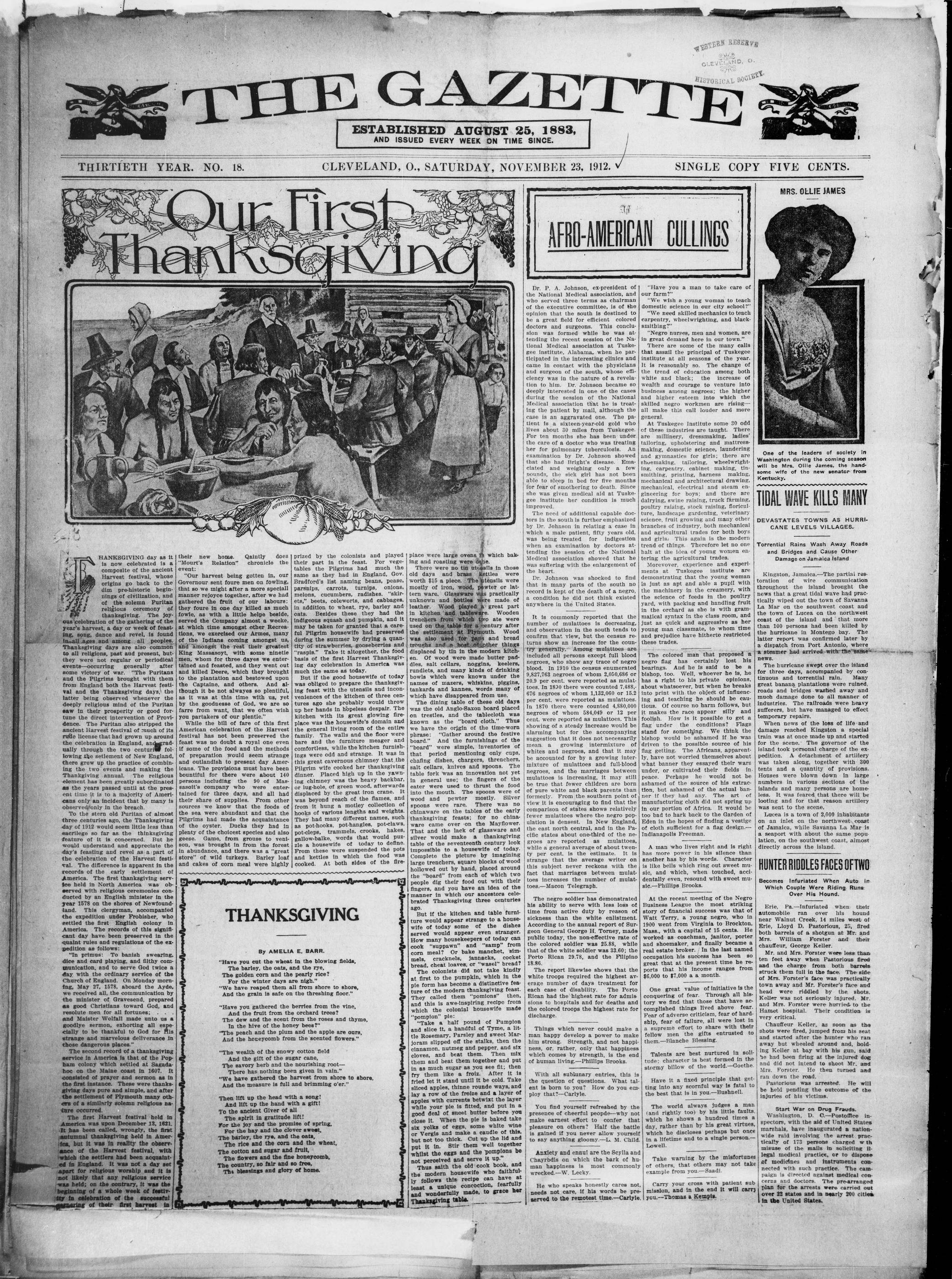
Our First Thanksgiving
VOLUNTARIUM
THIRTIETH YEAR
HANKSGIVING day as it is now celebrated is a composite of the ancient Harvest festival, whose origins go back to the dim pre-historic beginnings of civilization, and of the solemn Puritan religious ceremony of thanksgiving. The toy-
HANKSGIVING day as it is now celebrated is a composite of the ancient Harvest festival, whose origins go back to the dim prehistoric beginnings of civilization, and of the solemn Puritan religious ceremony of thanksgiving. The joyous celebration of the gathering of the year's harvest, a day or week of feasting, song, dance and revel, is found in all ages and among all peoples. Thanksgiving days are also common to all religions, past and present, but they were not regular or periodical events—occurring generally after some victory of war. "The Puritans and the Pilgrims brought with them from England both the Harvest festival and the Thanksgiving days, the latter being observed whenever the deeply religious mind of the Puritan saw in their prosperity or good fortune the direct intervention of Providence. The Puritan also stripped the ancient Harvest festival of much of its rude license that had grown up around the celebration in England, and gradually through the two centuries following the settlement of New England, there grew up the practice of combining the two events and making the Thanksgiving annual. The religious element has been greatly subordinated as the years passed until at the present time it is to a majority of Americans only an incident that by many is observed only in the breach.
To the stern old Puritan of almost three centuries ago, the Thanksgiving day of 1912 would seem little less than sacrilege so far as the thinkgiving feature of it is concerned. But he would understand and appreciate the day's feasting and revel as a part of the celebration of the Harvest festival. The difference is apparent in the records of the early settlement of America. The first thanksgiving service held in North America was observed with religious ceremonies conducted by an English minister in the year 1578 on the shores of Newfoundland. This clergyman, accompanied the expedition under Frobisher, settled the first English colony in America. The records of this significant day have been preserved in the quint rules and regulations of the expedition as follows:
"In primus: To banish swearing, dice and card playing, and filthy communication, and to serve God twice a day with the ordinary service of the Church of England. On Monday morning, May 27, 1578, aboard the Ayde, we received all, the communication by the minister of Gravesend, prepared as good Christians toward God, and resolute men for all fortunes; and Maister Wolfall made unto us a goodly sermon, exhorting all especially to be thankful to God for His strange and marvelous deliverance in those dangerous places."
The second record of a thanksgiving service in America is that of the Popham colony which settled at Sagadahoc on the Maine coast in 1607. It consisted of prayer and sermon as in the first instance. These were thanksgiving days pure and simple, and after the settlement of Plymouth many others of a similarly solemn religious nature occurred.
The first Harvest festival held in America was upon December 13, 1621. It has been called, wrongly, the first autumnal thanksgiving held in America, but it was in reality the observance of the Harvest festival, with which the settlers had been acquainted in England. It was not a day set apart for religious worship and it is not likely that any religious service was held; on the contrary, it was the beginning of a whole week of festivity in celebration of the successful garnering of their first harvest in
THE GAZETTE
their new home. Gaintly does "Mourn's Relation" chronicle the event:
"Our harvest being gotten in, our Governour sent foure men on fowling, so that we might achieve a more speciall manner rejoice together, after we had gathered the fruit of our labours; they foure in one day killed as much fowle, as with a little help beside, served the Company almost a wecke, at which time amongst other Recreations, we exercised our Armes, many of the Indians coming amongst us, and amongst the rest their greatest King Massasoyt, with some ninetie men, whom for three days we entertained and feasted, and they went out and killed Deere, which they brought to the plantation and bestowed upon the Captaine, and others. And although it be not always so plentiful, as it was at this time with us, yet by the goodness of God, we are so farre from want, that we often wish you partakers of our plentile."
While the bill of fare of this first American celebration of the Harvest festival has not been preserved the feast was no doubt a royal one even if some of the food and the methods of preparation would seem strange and outlandish to present day Americans. The provisions must have been bountiful for there were about 140 persons including the 90 of Massachusetts company who were entertained for three days, and all had their share of supplies. From other sources we know that the foods of the sea were abundant and that the Pilgrims had made the acquaintance of the oyster. Ducks they had in plenty of the choicest species and also geese. Game, from grouse to venison, was brought in from the forest in abundance, and there was a "great store" of wild turkeys. Barley loaf and cakes of corn meal were highly
THANKSGIVING
"Have you cut the wheat in the blowing fields,
The barley, the oats, and the rye,
The golden corn and the pearly rice?
For the winter days are nigh."
"We have reaped them all from shore to shore,
And the grain is safe on the threshing floor."
"Have you gathered the berries from the vine,
And the fruit from the orchard trees?
The dew and the scent from the roses and thyn
In the hive of the honey bees?"
"The peach and the plum and the apple are ours
And the honeycomb from the scented flowers."
"The wealth of the snowy cotton field
And the gift of the sugar cane,
The savory herb and the nourishing root—
There has nothing been given in vain."
"We have gathered the harvest from shore to s
And the measure is full and brimming o'er."
"Have you gathered the berries from the vine,
And the fruit from the orchard trees?
The dew and the scent from the roses and thyme,
In the hive of the honey bees?"
"The peach and the plum and the apple are ours,
And the honeycomb from the scented flowers."
"The wealth of the snowy cotton field
And the gift of the sugar cane,
The savory herb and the nourishing root—
There has nothing been given in vain."
"We have gathered the harvest from shore to shore,
And the measure is full and brimming o'er."
Then lift up the head with a song!
And lift up the hand with a gift!
To the ancient Giver of all
The spirit in gratitude lift!
For the joy and the promise of spring,
For the hay and the clover sweet,
The barley, the rye, and the oats,
The rice and the corn and the wheat,
The cotton and sugar and fruit,
The flowers and the fine honeycomb,
The country, so fair and so free,
The blessings and glory of home.
CLEVELAND, O., SATURDAY, NOVEMBER 23, 1912.
prized by the colonists and played their part in the feast. For vegetables the Pilgrims had much the same as they had in England, Gov. Bradford's list naming beans, peas, parsnips, carrots, turnips, onions, melons, cucumbers, radishes, "skirts," beets, coleworts, and cabbages, in addition to wheat, rye, barley and oats. Besides these they had the indigenous squash and pumpkin, and it may be taken for granted that a careful Pilgrim housewife had possessed during the summer a quantity of gooseberries and "poke" Take it altogether, the food basis of the first Harvest Thanksgiving day celebration in America was much the same as today.
But if the good housewife of today was obliged to prepare the thanksgiving feast with the utensils and inconveniences of the kitchen of three centuries ago she probably would throw up her hands in hopeless despair. The kitchen with its great glowing fire place was the housewife's domain and the general living room of the entire family. The walls and the floor were bare and the furniture meager and comfortless, while the kitchen furnishings were odd and strange. It was in this great cavernous chimney that the Pilgrim wife cooked her thanksgiving dinner. Placed high up in the yawning chimney was the heavy backbar or lug-hole, of green wood, afterwards displaced by the great iron crane. It was beyond reach of the flames, and from it hung a motley collection of hooks of various lengths and weights. They had many different names, such as pot-hooks, pot-hangles, pot-claws, pot-claws, trammels, crooks, hakes gallow-balke, words that would puzzle a housewife of today to define. From these were suspended the pots and kettles in which the food was cooked. At both sides of the fire
berries from the vine,
e orchard trees?
from the roses and thyme,
key bees?"
and the apple are ours,
am the scented flowers."
my cotton field
sugar cane,
me nourishing root—
en given in vain."
harvest from shore to shore,
and brimming o'er."
---
ESTABLISHED AUGUST 25, 1883 AND ISSUED EVERY WEEK ON TIME SINCE.
place were large ovens which baking and roasting were done
There were no tin utensils in those old days and brass kettles were worth $15 a piece. The utensils were mostly of iron, wood, pewter or latern ware. Glassware was practically unknown and bottles were made of leather. Wood played a great part in kitchen and tableware. Wooden trenchers from which two ate were used on the tables for a century after the settlement at Plymouth. Wood was also used for pans and bread troughs and a host of other things displaced by tin in the modern kitchen. Of wood were made butter paddles, salt cellars, noggins, keelers, rundlets, and many kinds of drinking bowls which were known under the names of mazers, whiskles, pliggins, tankards and kannes, words many of which have disappeared from use.
The dining table of these old days was the old Anglo-Saxon board placed on trestles, and the tablecloth was known as the "board cloth." Thus we have the origin of the time-worn phrase: "Gather around the festive board." And the furnishings of the "board" were simple, inventories of that period mentioning only cups, chafing dishes, chargers, threnchers, salt cellars, knives and spoons. The table fork was an innovation not yet in general use; the fingers of the eater were used to thrust the food into the mouth. The spoons were of wood and pewter mostly. Silver spoons were rare. There was no chinaware on the tables of the early thanksgiving feasts; for no chinaware came over the Mayflower. That and the lack of glassware and silver would make a thanksgiving table of the seventeenth century house impossible to a household day. Complete the table by imagining large trenches, square blocks of wood hollowed out by hand, placed around the "board" from each of which two people giggled their food out with their fingers and you have an idea of the museum in which our ancestors celebrated Thanksgiving three centuries ago.
But if the kitchen and table furniture would appear strange to a housewife of today some of the dishes served would appear even stranger. How many housekeepers of today can cook "suppawn" and "samp" from corn meal? Or bake manchet, simmels, cracknels, jannacks, cocket bread, cheat loaves, or "wasel" bread? "The colonists did not take kindly at first to the pumpkin, which in the pie form has become a distinctive feature of the modern thanksgiving feast. They called them "pomlons" then, and this is a aw-inspiring recipe from which the colonial housewife made "pomplon" pie: "Take a half pound of Pumpion and slice it, a handful of Tyme, a little Rosemary, Parley and sweet Marjoram slipped off the stalks, then the cinnamon, nutmeg and pepper, and six cabern, and beat them. Then mix them and them together and put in as much sugar as you see fit; then fry them like a froiz. After it is fried let it stand until it be cold. Take sliced apples, rounde wounds, and lay a row of the froize and a layer of apples with currents betwix the layer while your pie is fitted, and put in a good deal of sweet butter before you close it. When the pie is baked take six yolks of eggs, some white wine or Vergis and make a candle of this, but not too thick. Cut up the lid and put it in. Stir them well together whilst the eggs and the pomplons be not perceived and serve it up."
Thus saith the old cook book, and the modern housewife who faithfully follows this recipe can have at least a unique concoction, fearfully and wonderfully made, to grace her Thanksgiving table.
AFRO-AMERICAN CULLINGS
Dr. P. A. Johnson, ex-president of the National Medical association, and who served three terms as chairman of the executive committee, is of the opinion that the south is destined to be a great field for efficient colored doctors and surgeons. This conclusion was formed while he was attending the recent session of the National Medical association at Tuskegee institute, Alabama, when he participated in the interesting clinics and came in contact with the physicians and surgeon of the south, whose efficiency was in the nature of a revelation to him. Dr. Johnson became so deeply interested in one of the cases during the session of the National Medical association that he is treating the patient by mail, although the case is an aggravated one. The patient is a sixteen-year-old gold who lives about 30 miles from Tuskegee. For ten months she has been under the care of a doctor who was treating her for pulmonary tuberculosis. An examination by Dr. Johnson showed that she had Bright's disease. Emaciated and weighing only a few pounds, the sick girl has not been able to sleep in bed for five months for fear of smothering to death. Since she was given medical aid at Tuskegee institute her condition is much improved.
The need of additional capable doctors in the south is further emphasized by Dr. Johnson in relating a case in which a male patient, fifty years old, was being treated for indigestion when an examination by doctors attending the session of the National Medical association showed that he was suffering with the enlargement of the heart.
Dr. Johnson was shocked to find that in many parts of the south no record is kept of the death of a negro, a condition he did not think existed anywhere in the United States.
It is commonly reported that the number of mulattoes is decreasing, and observation in the south tends to confirm that view, but the census returns show an increase for the country generally. Among mulattoes are included all persons except full blood negroes, who show any trace of negro blood. In 1910 the census enumerated 9,827,763 negroes of whom 2,050,696 or 20.9 per cent. were reported as mulattoes. In 1830 there were counted 7,488,676 negroes of whom 1,132,060 or 15.2 per cent. were reported as mulattoes. In 1870 there were counted 4,880,000 negroes of whom 584,049 or 12 per cent. were reported as mulattoes. This showing of a steady increase would be alarming but for the accompanying suggestion that it does not necessarily mean a growing intermixture of whites and negroes, and that it may be accounted for by a growing intermixture of mulattoes and full blood negroes, and the marriages between mulattoes is increasing, it may still be true that fewer children are born of pure white and black parents than formerly. From the southern point of view it is encouraging to find that the comparison of states shows relatively fewer mulattoes where the negro population is densest. In New England, the east north central, and in the Pacific states about one-third of the negroes are reported as mulattoes, while a general average of about twenty per cent. is the estimate. It is strange that the average writer on this subject never reckons with the fact that marriages between mulattoes increases the number of mulattoes—Macon Telegraph.
The negro soldier has demonstrated his ability to serve with less loss of time from active duty by reason of sickness than the white enlistment. According to the annual report of Surgeon General George H. Torney, made public today, the non-effective rate of the colored soldier was 25.88, while that of the white soldier was 33.60; the Porto Rican 29.78, and the Filipino 18.86.
The report likewise shows that the white troops required the highest average number of days treatment for each case of disability. The Porto Rican had the highest rate for admissions to hospitals and for deaths and the colored troops the highest rate for discharge.
Things which never could make a man happy develop a power to make him strong. Strength, and not happiness, or, rather, only that happiness which comes by strength, is the end of human living.—Phillips Brooks.
With all subunary entries, this is the question of questions. What talent is born to you? How do you employ that?—Carlyle.
You find yourself refreshed by the presence of cheerful peopde—why not make earnest effort to confer that pleasure on others? Half the battle is gained if you never allow yourself to say anything gloomy.—L. M. Child.
Anxiety and ennul are the Scylla and Chayrbdis on which the bark of human happiness is most commonly wrecked.—W. Lecky.
He who speaks honestly cares not, needs not care, if his words be preserved to the remotest time.—Caryle.
SINGLE COPY FIVE CENTS.
WESTERN RESERVE
CLEVILAND, O.
HISTORICAL SOCIETY
SINGLE COPY
MAN CULLINGS
"Have you a man to take care of
our farm?"
"We wish a young woman to teach domestic science in our city school?" "We need skilled mechanics to teach carpentry, wheelwrighting, and blacksmithing?" "Negro nurses, men and women, are in great demand here in our town." There are some of the many calls that assail the principal of Tuskegee institute at all seasons of the year. It is reasonably so. The change of the trend of education among both white and black; the increase of wealth and courage to venture into business among negroes; the higher and higher esteem into which the skilled negro workmen are rising—all make this call louder and more general.
At Tuskegee Institute some 30 odd of these industries are taught. There are millinery, dressmaking, ladies' tailoring, upholstering and mattress-making, domestic science, laundering and gymnastics for girls; there are shoemaking, tailoring, wheelwrighting, carpentry, cabinet making, tinsmithing, printing, harness making, mechanical and architectural drawing, mechanical, electrical and steam engineering for boys; and there are dairying, swine raising, truck farming, poultry raising, stock raising, floriculture, landscape gardening, veterinary science, fruit growing and many other branches of industry, both mechanical and agricultural trades for both boys and girls. This again is the modern trend of things. Therefore let no one halt at the idea of young women entering the agricultural trades.
Moreover, experience and experiments at Tuskegee institute are demonstrating that the young woman is just as apt and able a pupil with the machinery in the creamery, with the science of feeds in the poultry yard, with packing and handling fruit in the orchard as she is with grammatical syntax in the class room, and just as quick and aggressive as her young man classmate, to whom time and prejudice have hitherto restricted these trades.
The colored man that proposed a negro flag has certainly lost his bearings. And he is said to be a bishop, too. Well, whoever he is, he has a right to his private opinions, about what printout, but when he breaks into print with the object of influencing and teaching he should be cautious. Of course no harm follows, but it makes the race appear silly and foolish. How is it possible to get a flag under the conditions? Flags stand for something. We think the bishop would be ashamed if he was driven to the possible source of his flag getting. The Africans, apparently, have not worried themselves about what banner they essayed their wars under, or cultivated their fields in peace. Perhaps he would not be ashamed of the source of his extraction, but ashamed of the actual banner if they had any. The art of manufacturing cloth did not spring up in our portion of Africa. It would be too bad to hark back to the Garden of Eden in the hopes of finding a vestige of cloth sufficient for a flag design—Indianapolis Freeman.
A man who lives right and is right has more power in his silence than another has by his words. Character is like bells which ring out sweet music, and which, when touched, accidentally even, resound with sweet music.—Phillips Brooks.
At the recent meeting of the Negro Business League the most striking story of financial success was that of Watt Terry, a young negro, who in 1900 went from Virginia to Brockton, Mass., with a capital of 15 cents. He worked as coachman, Janitor, porter and shoemaker, and finally became a real estate broker. In the last named occupation his success has been so great that at the present time he reports that his income ranges from $6,000 to $7,000 a month.
One great value of initiative is the conquering of fear. Through all history we find that those that have accomplished things lived above fear. Fear of adverse criticism, fear of hardship, fear of failure, all were lost in a supreme effort to share with their fellow men the gifts entrusted to them.—Blanche Blessing.
Talents are best nurtured in solitude; character is best formed in the stormy billow of the world.—Goethe.
Have it a fixed principle that getting into any scornful way is fatal to the best that is in you.—Bushnell.
The world always judges a man (and rightly too) by his little faults, which he shows a hundred times a day, rather than by his great virtues, which he discloses perhaps but once in a lifetime and to a single person.—Lowell.
Take warning by the misfortunes of others, that others may not take example from you.—Saadi.
Carry your cross with patient sub mission, and in the end it will carry you.—Thomas a Kempis.
Y FIVE CENTS.
MRS. OLLIE JAMES
10
One of the leaders of society in Washington during the coming season will be Mrs. Ollie James, the handsome wife of the new senator from Kentucky.
TIDAL WAVE KILLS MANY
DEVASTATES TOWNS AS HURRICANE LEVELS VILLAGES.
Torrential Rains Wash Away Roads and Bridges and Cause Other Damage on Jamaica Island
Kingston, Jamaica.—The partial restoration of wire communication throughout the island brought the news that a great tidal wave had practically wiped out the town of Savanna La Mar on the southwest coast and the town of Lucea on the northwest coast of the island and that more than 100 persons had been killed by the hurricane in Montego Bay. The latter report was confirmed later by a dispatch from Port Antonio, where a steamer had arrived with the same news.
The hurricane swept over the island for three days, accompanied by continuous and torrential rain. Many great banana plantations were ruined, roads and bridges washed away and much damage done to all manner of industries. The railroads were heavy sufferers, but have managed to effect temporary repairs.
When news of the loss of life and damage reached Kingston a special train was at once made up and started for the scene. The governor of the island took personal charge of the expedition. A detachment of artillery was taken along, together with 300 tents and a quantity of provisions. Houses were blown down in large numbers in various sections of the islands and many persons are homeless. It was feared that there will be looting and for that reason artillery was sent to the scene. Lucea is a town of 2,000 inhabitants on an inlet on the northwest coast of Jamaica, while Savanna La Mar is a seaport with about the same population, on the southwest coast, almost directly across the island.
HUNTER RIDDLES FAGES OFTWO
Becomes Infuriated When Auto in Which Couple Were Riding Runs Over His Hound.
Erie, Pa.—Infuriated when their automobile ran over his hound near Walnut Creek, 14 miles west of Erie, Lloyd D. Pastorious, 25, fired both barrels of a shotgun at Mr. and Mrs. William Forster and their chauffeur, George Keller.
Mr. and Mrs. Forster were less than ten feet away when Pastorious fired and the charge from both barrels struck them full in the face. The side of Mrs. Forster's face was practically town away and Mr. Forster's face and head were riddled by the shots. Keller was not seriously injured. Mr. and Mrs. Forster were hurried to the Hamet hospital. Their condition is very critical.
Chauffeur Keller, as soon as the shots were fired, jumped from his seat and started after the hunter who ran away but wheeled around and, holding Keller at bay with his gun, said he had been firing at the injured dog and did not intend to shoot Mr. and Mrs. Forster. He then turned and ran down the road.
Pastorious was arrested. He will be held pending the outcome of the injuries of his victims.
Start War on Drug Frauds.
Washington, D. C.—Postoffice inspectors, with the aid of United States marshals, have inaugurated a nationwide raid involving the arrest practically of 173 persons charged with misuse of the mails in soliciting illegal medical practice, or to dispose of medicines and instruments connected with such practice. The campaign is directed against medical concerns and doctors. The pre-arranged plan for the arrests were carried out over 22 states and in nearly 200 cities in the United States.
PUBLISHED EVERY SATURDAY
Reaper SN UROAY
SUBSCRIFTION RATES
(In Advance)
One Year... eee ecceee se 81.80
Six Menthe. 220000 00
‘Three Months............... 50
Gubscribers are requested to re
mit by postoffice money or
der or registered letter.
Entered at the postoffice in Cleveland,
Ohio, as second-class matter
Address all communtoations te
HARRY C. SMITH
Editor and proprietor,
THE GAZETTE,
Blackstone Building, Cleveland, 0.
Member Oho Legislature: 1996
‘te 1806; 1896 to 1898; 1900 to 1902
See ee,
“THE GAZETTE Is the oldest, and
has the largest bona fide circulation,
double that of any newspaper In the
‘interest of Afro-Americans, published
in the state of Ohio, and comparieon
with any will Immediately establich
ite rank as one of the NEWSIEST
AND BEST In the country.
THANKSGIVING NOTICE.
‘Correspondents cannot mail news
Tor next week's Gazette, later than
Montlay at 4 p.m, at their central
post office—not in a mail-box or else-
where—because next week Thursday
is a holiday, necessitating our sending
‘The Gazette to press on Wednesday,
the day previous, and a day earlier
‘than ‘usual. Faltor.
We are pleased to note that the
“white slave” law has reached out to
save’e woman of the race who came
or was brought to Cleveland from
Camada ‘via Detroit, in recent weeks,
‘Our contemporaries will please note
this fact,
In @ most unfortunate interview in
atocal daily paper, last week, Hon,
Henry ‘T. Eubanks, who it seems has
weased selling stock for the Douglass
Insurance Co. (defunct), said, among
other things:
“The need of a hotel for Negroes
ts becoming more urgent in Cleve-
land, every year. There is almost
no public place left that will receive
Negroes.”
‘This last sentence is not true, and
‘even if it was, a member of the race
ought to be the last person in the
‘world to be heralding It through the
columns of the local daily papers.
Even Eubanke. ought to know this.
‘The statement going the rounds of
the race press to the effect that local
Afro-American property-holders were
‘anxlous to help furnish bail for Jack
Johnson has absolutely no foundation
im truth and is wholly the output of
‘apnensafional-craving local daily paper,
aided by the southern-sympathizing
and controlled Associated Press.
‘What a pity that such men as C. J.
Crawford who is responsible for the
“rot” referred to in the foregoing,
and H. T. Eubanks, cannot realize
how very harmful to our people in
this community, are such misstate-
‘ments as they fhthered in the local
dally press, last woek.
Senater James K. Vardaman of
Mississippi, who lectured in the city,
last week, could not resist the ever
present ficlination to strike the Ne
ron vitally injurious body-blow. Al-
though ae was announced to speak
on “The Power of Public Control,”
he digressed long enough to discuss
the “black Peril,” as he termed it;
advocated the repeal of the fifteenth:
amendment to the U, 8. constitution,
and the formation of a U. 8. commle-
sion to handle “the Negro probiem in
the south,” What is really needed is
A commission of some Kind, that will
Place a-bridie on the mouths of such
southern blatherskites as Vardaman,
Tillman, Dixon, Heflin and thelr stripe.
We often wonder if our people have
real good idea as to how very
drial there men are, when lectus
ing.in this:section of the country.
‘There is absolutely no truth in the
dispatch of Noy. 18, to the daily pa-
ers, alteged to have been received
by cable from Melbourne, Australia,
which stated that the police had been
called out—in that far off country—
to protect an American Negro min-
sstrel tronpe in the city of Melbourne,
Decause some of the members of the
‘company had heen econ walking with
‘2 white woman; that the government
“might” take steps to have the min-
sstreis deported because of an alleged
“intense feeling” against Negroes as
@ result of “Jack Johnson's episodes
in Chicago.” “This is but one of the
many lies thet have been so. freely
Gircutstad in. xeceat weeks by. the
American press with the help of the
Aswociated Press, for the purpose of
imereading prejudice against the race
Une tack
that we have no way of striking beck
fm the American press (white) or of
‘stopping these maliciows attacks.
THOMPSON'S LITTLE “JOKELET.” |
‘The Glevwiand Journal may be re-
vived by N. 2. Brascher, W. T. Blue,
Jobn P. Green and others. Cleveland
Bagi ts te sae to wane tre rece
re sochee See
See ec eee os oe
tinel.
No danger! They have hed quite
ante tonedy Beasbes ie
Beited de tows = yout or 0 020
Sea pnasese nowe where, There
tro muy hove fu Cloveland who wish
Se aeiy meee Indeed, to see Bim
we tuk wchovetena could “repoort™
ONE race paper. In the thirty years,
Seok mare publisning Toe tatte,
Members of the race here started a
ee ese ont
ear Cee seats: and havo snined
experience thet has “held all of them
for awhile.” They have never re-
peated the experiment, either, brother.
Is a wirb, father to the thought you
expressed in the Sentinel? It would
20. 3
Tene ‘Subscribe
¥7 We for THe
i PAPERS
“JACK” REARRESTED!
After Being Released on Bail—Sucd
for $10,000—His Former Bonds-
man Jailed—Persecution!
CHICAGO, 11.—Jack Johnson, cham-
pion heavyweight pugilist, accused of
violation of the Mann white slave acl,
was released trom custody Nov. 15 be:
fore Judge Cerpenter in the U.S. dis
trict court in bonds of $30,000. The
sureties accepted were the pngilist’s
mother, Mrs. Tina Johnson, and. Mat-
thew S. Baldwin (white), real estate
dealer. “Jack” was taken to the coun-
ty jail’ Nov. § and had made many ef
forts to regain bis freedom. As he
was leaving the federal building he
was arrested on a charge of having
attacked a newspaper photographer
when he was entering the county jail.
‘The pugilist was taken to a police sta
‘tion and a cash bond of $400 was ac-
cepted. Later the photographer filed
a suit asking for $10,000 damages from
Johnson, Baldwin clalms-—so the
daily papers say—that he received a
fee of $750 for going on “Jack's”
bond, and that “Jack” agreed to pay
a private detective, employed by him,
to be with “Jack” day and night un-
{il “his appearance in court. This
“sounds fishy.” On Nov. 16 “Jack”
Yisited-U. S. District Attorney Jas. H.
Wilkinsoi in an effort to stop the pros.
ecution which now about amounts to
Dersecution. ‘The case will amount tc
hothing, in the end, anyhow. On Nov
14, Albert C. Jones (white), @ real es
tate dealer, who signed $30,000 bonds
for “Jack,” in-an attempt to obtain
the pugilist’s release from jail, wa:
sentenced to one year in Jail for con
tempt of court by Federal Judge Lan
Big
‘Heason and: duatice ve; Prejudice.
Editor Chicago Daily News—Dear
Sir: Let us consider the matter fully
Yefore reaching” a conaltsion; why
‘should intelligent men and women per-
mit the demon prejudice to paralyze,
their reasoning power? Is it not a
fact that Lucile Cameron visited Jack
Johngon's saloon and cafe without his
Solicitation? It the place and {ts in
habitants had not. been up. to her
standard, or according #0 her liking,
Would she have remained? And if she
Temained rather than offend, why did
she inake repeated visits later?” It any
one is guilty of foreing the girl to do
anything illegal, then they should be
punished according to the law govern
Ing the offense. Her association with
Jack Johnson does not add to her of-
tense one bit, and, It they are satisfied
‘with thelr reiations, providing they do
hot breaic the law as it now stands,
then we, the people that make the
we, should be satisfied, since our
laws’ have been Kept. But. if they
[nave been Silat ten prosection
should take piace, aud penalty accord:
ing to the law should be meted out to
any and all, persons gullty of breaking
jthem. ‘Thus Justice will have been
| done and every one will be satisfied.
‘The black race is no more willing that
[Jack sohnson should be polnted out as
Hits ideal type of moral or mental man
‘than the white race is. that Lucile
[Cameron (or the ‘Schreiber woman)
should be pointed out as its ideal type
[of moral or mental woman, ‘The pa
[bers seem to be featuring Miss Cam
Heron's beauty and Mr. Johnson's
blackness. Personally, think they
[are devoting quite abit of valuable
Space to people who have nothing
more than immorality, beauty and
blackness. In conclusion, I ‘wish to
[say if the good people of any and
| every race wish to get away from vice,
fet us get fonether put our trust
God and get to work. One of the ur-
Rent things necessary for better de-
elopment of morals is the forbidding
‘of the housing of saloons, dance halls,
jeafes and hotels under one roof and
/management, PAUL B. JOHNSON.
| Jack Freed on Abduction Charge.
| CHICAGO, HL, Nov. 19—-A charge
‘of abduction against Jack Johnson was
dismissed before Municipal Judge
Hopkins today, because of the pros-
ecution’s inability to prove that Lucile
Cameron (white), whose association
with Johnson led to his arrest, had
been abducted by him. That the U.
5, Supreme Court will dismiss the case
taken to it last week, is now daily ex-
pected.
Where He Was.
‘The mayor of a small town was try
ing an Afro-American for abusing his
wife. She claimed he got drunk and
tried to beat her and she bit him.
The mayor turned to their little girl |
and asked:
“Girl, was your father under the |
influence of whisky when your mother
hit him?”
"No, sah, He was under the kiteh- |
en table,” she quickly replied.—Na-
tional Monthly.
The Chicago Live Stock Show.
Mr. W. R. Goodwin, managing edi-
tor of the Breeders’ Gazette, Chicazo,
in speaking of the International Live
Stock Exposition, which wil this year
be held from Nov, 20th to Dec. 7th,
said:
“I haye seon more of the great
stock shows and fairs in America in
the past thirty years than any other
man, and T ought to be somewhat
case-hardened; but the “International”
annually fills me with ave. 1 ap-
proach each exhibition of the cousum-
mate triumph of the breeder's art
with a fairly reverent mind. A man
may become {ndifferent to the roar of
Niagara, but Ido not see how any man
can fail to find new instruction and
inspiration in each of these showe.”
CORRESPONDENTS WANTED.
| The old reliable Gazette desires an
Jactive agent and correspondent in
[seer ley and town in Ohio and
helghboriug states having a number
jot Afro-American residents. Oniy
|little time on Fridays or Saturday’ Js
| required.
[We are especially deslrous of hear
[ing from persons. in the following
hamed cities: Zanesville, Newark,
Lancaster, Lebanos, Chillicothe, ‘To
edo, Troy, Canton, Springield, Piqua,
Columbus,” Cambridge, Steubenville,
‘Bellaire, St. Clairsville, Wilmington,
|Portsmouth, Washington, C, Hy Ox
ford, Sabina, Gallipolis. endyilé, Us
bana, Delaware, Mt. Vernon, Bast Lic-
erpool, Wellsville, Akron, Dayton, Mid
|Gigport, Wellefoniaine, Lim. Oy and
other places where we have none.
‘Write to the editor of The Gazette,
Blackstone building, Cleveland, 0..
‘and terms will be sent promptly. Our
readers will oblige us greatly by send-
ing at once the addresses of persons
in the cities named above, or others,
to whom we can write relative to the
matter.
FOR SALE. |
Houses and Jots in Oberlin; Ohio,
and in a most desirable locality; sur-
roundings excellent; cheap and on
easy terms, Address or see D. C.
Fisher, 854 Broadway, Lorain, Ohio.
Phone, residence. 635; office, 585.
THE GAZETTE, CLEVELAND. O. SATURDAY, NOVEMBER 23, 1912.
ae |
ieee ae
' ra eee
ee oa
ho ea”
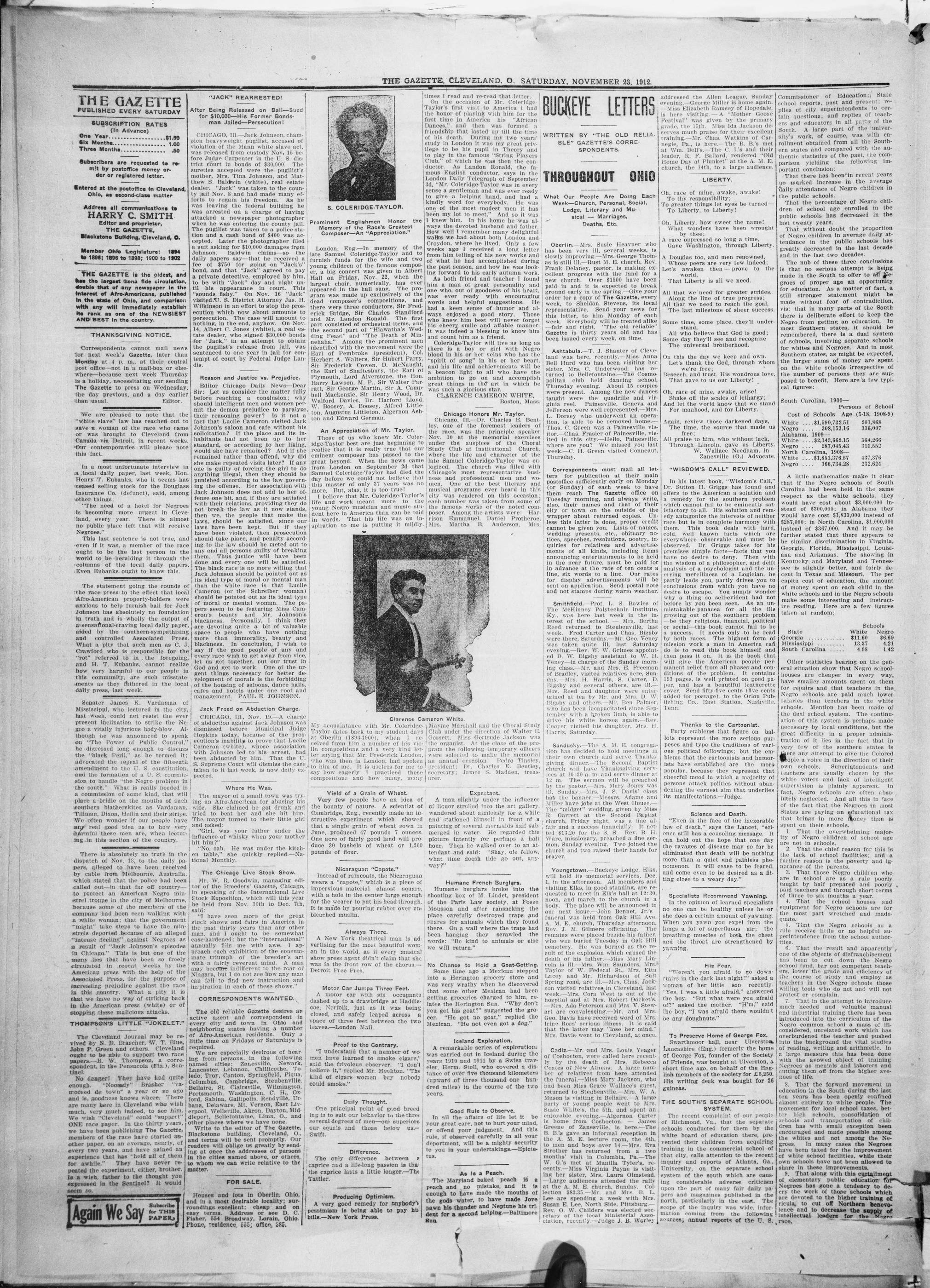
8, COLERIDGE-TAYLOR.
Prominent Englishmen Honor the
‘Memory of the Race’s Greatest
Composer—An “Appreciation.”
London, Eng.—In memory of the
late Samuel Coleridge-Taylor and to
furnish funds for the wife and two
young children of the famous compos-
er, a big concert was given in Albert
Hall on Friday, Nov. 22, when the
largest choir, numerically, has ever
appeared in the hall sang, The pro-
gram was made up exclusively of the
dead composer's compositions, and
there were three conductors, Sir Fred-
crick Bridge, Sir Charles Standford
and Mr. Landon Ronald. The first
part consisted of orchestral items, and
the second part. of “Hiawatha’s Wed-
ding Feast” and “The Death of Min-
nehaha.” Among the prominent men
identified with the movement were the
Earl of Pembroke (president), Col.
Herbert A. Walters, Sir Hubert Parry,
Sir Frederick Cowen, D. McNaught,
the Earl of Shaftesbury, the Earl of
Plymouth, Lord Alverstone, the Hon.
Harry Lawson, M, P., Sir Walter, Par-
rat, Sir George Martin, Sir A. Camp:
‘bell’ Mackenzie, Sir Henry Wood, Dr.
Walford Davies, Dr. Harford Lloyd,
W. Boosey, A. Boosey, Alfred Little:
‘ton, Augustus Littleton, Algernon Ash-
{on and Edward German,
eae a ta
‘Those of us who knew Mr. Coler| Nov. 10 at the me
fage"Taylor best are just beginning to under the. auspices
fealize that it ls really true that our /Study Club at tnsti
Eminent composer has passed to the |where the life and
great beyond. When tie news came late Samuel Colerld
from London on September 20. that |logized. ‘The churcl
Samuel Coloridge-Taylor had died the | Chicago's most rer
Gay before we could not believe that (ness and professior
this muster of only’ 37 years was no|imen, One of the
more. But, alas, it is too true! musical programs.
T potieve'that Mr. Coleridge-Taslor's| city was. rendered
Tent here in America than ean be told | poser. Among the a
in'words, ‘That his life was an in-|rison” Emmmanuel, 1
Shwation to me is putting it mildly.| Mrs. Martha B.
ee. eae
a et eg
Se Pee ae
: Wey sone Mae
; Bem Be
we rsa ee tis a
\ i! ae Raeok: he
pine
ee 5
3 ; ea
Poot Rae er
oe ee
i Cae
bs i ee
Pen Sa. CMs Ca ’
é i Pet
Clarence Cameron White.
My acquaintance with Mr. Coleridge-
Taylor dates back to my student days
at Oberlin (1895-1900), when 1. re.
ceived from bin a number of his vio-
lin compositions and a very kind let-
ter sying thet Mr. Frederick Loudon,
who was then in London, had spoken
to him of me. It is useless for me to
say how eagerly | practiced those
compositions and how many, many
Yield of a Grain of Wheat.
Very few people have an idea of
the bounty of nature. A scientist of
Cambridge, Eng., recently made an in-
structive experiment which showed
that a single grain of wheat sown in
June, produced 47 pounds 7 ounces.
One acre of fairly good land will pro-
duce 30 bushels of wheat or 1,260
pounds of flour.
ge ae
for the wearer to put his head through.
It is made by pouring rubber over nn-
Lene
an in the world, as if every musica!
oe, Norfolk, just as it was being
closed, and safely leaped across a
oe
Soler
Proof to the Contrary,
ee Te Gs
oe
En ee eee
oe OS eee
kind of cigars women buy nobody
could smoke."
One principal point of gcod breed
ee en
ee
‘Swift.
{ Difference.
‘The only difference between ¢
caprice aud a lifelong passion is tha
the eaprice lasts a little longer. —The
Tattler.
| Producing Optimism.
| A very good remedy for snybody’t
‘pexstmiom is being able to pay bit
bilis—New York Press.
times I read and re-read that letter. |
On the occasion of Mr, Coleridge
Taylor's first visit to America T had
the honor of playing with him for the
first time jn Amerfea his “African
Dances,” and then was formed 1
friendship that lasted up till the time
of his death, During my two years
study in London it was my great priv-
ilege to be his pupil in ‘Theory ‘and
to play in the famous “String Players
Club,” of which he was then the con:
ductor. As Landon Ronald, the fi
mous English conductor, says in the
London Daily Telegraph of September
34, “Mr. Coleridge-Taylor was in every
sense a gentleman and was ever ready
to give @ helping hand, and had a
Kindly word for everybody. He was
one of the most modest men it has
been my lot to meet.” And so it was
Lknew him. In his home he ‘was al
ways the devoted husband and father.
How well Tremember many delightful
walks we had about both London and
Croydon, where he lived. Only « few
weeks ago I received a long letter
Trom him telling of his new works and
fof what he had accomplished during
the past season, and how he was look:
ing forward to his early autumn work.
As both friend and teacher 1 found
him a man of great personality and
‘one who, out of goodness of his heart,
was ever ready with encouraging
words and helpful suggestions. He
had a keen sense of humor and ab
ways enjoyed a good story. ‘Those
who knew him best will never forset
His" eheery smite and table’ manner.
Tt was indeed a biessing to know hin
and count him as a friend,
Coleridge-Taylor will live as long as
|there is a boy or girl with Negro
| blood in his or her yeius who has the
|spirit of song” in his or her heart
and his life and achievements. will be
\a beacon light to all who have the
ambition {0 go on and. accomplish
great things in thé art in which he
Was such a glorious star.
CLARENCE CAMERON WHITE,
See aot
Chicago Honors Mr. Taylor.
Chicago. TIL—Dr. Charles E. Bent-
ley, one of the foremost leaders of
the race, was the principle speaker
Nov. 10’ at the memorial exercises
under the auspices of the Choral
Study Club at Institutional Church,
where the life and character of the
late Samuel Coleridge-Taylor was eu
logized.. The church was filled with
Chicago's most representative busi:
ness and professional men and wo-
men, One of the best literary and
musical programs ever heard in this
city was rendered on this occasion;
each number was taken from some of
the famous works of the noted com:
poser, Among the artists were: Har
vison Einmanuel, Daniel Protheroe,
Mra: Martha & Andersot, Mro.
Mayme Marshall and the Cheral Study
Club under the direetion of Walter 15,
Gossett. Miss Gertrude Jackson was
ie organist. At the close of the pro-
gram the ollowing temporary officers
were selected to make the memorial
an annual cecssion: Pedro ‘Tinsley,
president; Dr. Charles E. Bentley,
fecretary; James S. Maddea, treas:
urer
Expectant,
A man slighily under the influence
of licuor etrolied into the art gallery,
wandered about aimlessly for 2 while
and’ stationed himself in frout of a
painting of several mermaids half sub-
merged in water, He regarded this
picture intently for perhaps 2 half
hour. Then he walked over to an at
tendant and said: "Shay, ole fellow,
what time doesh tide go out, any:
way?”
Humane French Burglars.
Humane burglars broke into the
chooting box of M. Lindet, president
of the Paris Law society, at Fosse
Mousson and after ransacking the
place carefully destroyed traps and
snares for animals which they found
there. On a wall where the traps had
been hanging they scrawled the
words: “Be kind to animals or else
we will return.”
No Chance to Hoid a Goat-Getting.
Some thine ago a Mexican stepped
into a Herington grocery store and
was very wrathy when he discovered
that soime other Mexican had been
_getting groceries charged to him, re
ates the Herington Sun. “Why don’t
You get his goat?" suggested the gro:
‘cer. “He got uo goat,” replied the
“Mexican. “He not even got a dog.”
. ee
Iceland Exploration.
A remarkable series of exploration:
was carried out in Iceland during the
years 1910 and 1911 by a Swiss trav-
eler, Herm. Stoll, who covered a dis-
tance of over five thousand kilometers
(upward of three thousand one hun-
dred miles) in the course of the two
years.
Good Rule to Observe,
In all the affaira of life let it be
your great care, not to hurt your mind,
or offend your judgment. And this
rule, if observed carefully in all your
deportment, will be a mighty security
to you in your undertakings —Eplete-
tus.
‘As Is a Peach.
‘The Maryland baked peach {6 a
peach and no mistake, and it is
enough to have made the mouths of
the gods water, to have made Jove
pawn his thunder and Neptune his tri.
Gent for a second helping. —Baltimore
—_
Expectant.
WRITTEN BY “THE OLD RELIA-
BLE” GAZETTE’S CORRE
SPONDENTS.
What Our People Are Doing Each
Week—Chureh, Personal, Social,
Lodge, Literary and Mu-
= sical — Marriages,
Deaths, Ete.
Oberiin.— Airs, Susie Heavner who
has been’ very ill, several weeks, is
slowly improving.—Mrs. George Thom-
as is still ill. —Rust M. E. chureh, Rev.
Frank Delaney, pastor, is making ex
cellent progress with the fund for a
new chureh. Over $1500 have been
paid in and it is expected to break
ground early in the spring.—Give your
order for a copy of The Gazette, every
week, to Sheldon Stevens, its local
representative, Send your news for
this letter, to him Monday of each
week, Everybody will be treated alike
|—fair and right. “The old reliable”
Gazette is thirty years old and has
been issued every week, on time.
Ashtabula.—. J. Shauter of Cleve-
land was here, recently.—Miss Anna
Bell Hurd who has been visiting her
sister, Mrs. C. Underwood, has re-
turned to Bellefontaine —The Cosmo-
politan club held dancing school,
‘Thursday evening. About 15 couples
were present. Among the new dances
taught were the quadrille and vir-
ginia reel. Painesville, Geneva and
Jeffergon were well represented.—Mrs.
L. Dorsey who underwent an opera-
tion, is able to be removed home—
Thos. C, Green was a Painesville vis-
itor.—Chas, Frasier of Painesville, vis:
ited in this city.—Hello, Painesville,
where are you? We missed you last
week.—C. H. Green visited Conneaut,
‘Thursday
Corresponaents must mall all let-
ters for publication at their main
postoffice sufficiently early on Monday
(or Sunday) of each week to have
them reach The Gazette office on
‘Tuesday morning, and always write,
also, their names and that of their
city or town on the outside of the
wrapper about returned copies. Un-
less this latter Is done, proper credit
cannot be given you. Lists of names,
Wedding presents, etc.. obituary no:
tices, speeches, resolutions, poetry, in-
quiries for relatives and adyertise-
ments of all kinds, including items
ennouncing entertainments to be held
in the near future, must be paid for
In advance at the rate of ten cents a
line, six words to a line. Our rates
for display advertisements willbe
sent on application, Send postal note
and not stamns durify warm weather.
Smithfield.—Prof, L.. S. Bowles of
TheMeKinney Poiytechinic Institute,
ky, was hero last’ week In’ the ine
{ereat of the school, =~ Ms, Wertha
Hteod returned to. Steubenville, last
‘seek, "Fred. Carter and Chas. Tilgsby
were there, Saturday.-Mr. Geo. Veney
was taken quite ill, last Saturday
evening.—Rev. W. W. Grimes appoint-
Jed De WW, Bigsby assistant. to W.
Vonej—in charge of the Sunday morn:
ing close“Me-"and Mrs. i Freeman
‘of Bradley, visited relatives nere, Sun:
day. Mra’ He Harris, S. Carter, D,
Bigsby and several others, are il! —
Mes, Reed and daughter: were enter
inined at ten by: Mt and dra, D. W.
Hiigsby and others-—-Mr. Bon Patiwer,
‘tho has been ineapaeltated since Sop:
ember with a fyoken iimb, is able to
Jtrlvo lg white horses, again Rev
[Cooper visited his daughter, Sirs. 1
Harrie, Saturday,
Sanduoky—The A. M. B, congress
tiom tas decided to fiold atectings In
thelr own ehureh aad. serve: Thanks:
fiving dinner-—The Second Baptist
Shurch Sill have Thankegiving serv
fees at 10:40 am. and eerve dinner at
tema The ecemon will be. preched
ty the pastors airs, Mary ‘Jones was
Mi, Sinday.catie, 3, S. Davis! class
hab the banner “alcesre: ‘Adams. and
Milter have Jobs at the West House. —
The “midget wedding, given by Mias
Te Garett at ihe Becond Baptist
hurehy Friday might, wast tne at
{air and a success financially, It net.
ted 1320 for the & 8 Rev. B. HL,
Ware, talsolouary, preached a fine ner.
mon, Sunday evening, Two joined the
tihureh and two raised thelr hands for
eka
Youngstown.— Buckeye Lodge, Elks,
will hold its memorial services, Dec.
1, in the afternoon, All members and
visiting Elks, in good standing, are re-
‘quested to moet In EUk’s hall at 12:20,
‘noon, and mareh to the church in a
‘Dody: ‘The place will be announced in
our next issue.—Jolin Bennet, Jrs
funeral was held from Oak Hill Ave.
4 Mi, chureh, ‘Thuraday afternoon,
Rev. J. M. Giimere officiating. ‘The
‘remains were placed beside his father,
who was buried Tuesday in Oak Hill
cemetery. He was burned as the re-
sult of the explosion which caused the
death of his father—Miss Mary Lin-
coln is il—Mrs, Wm, Saunders, Mrs!
‘Taylor of W. Federal St, Mrs, Etta
Lacey and Mr. Richardson of Salt
Spring road, are ill.—Mrs, Chas. Jack-
con visited relatives in Cleveland, last
week.—Mrs. Cora West is out of the
hoepital and at Mrs, Robert Docket's.
—Mrs. Ada Peterson and Mrs. V. Stew-
art are convaleseing—-Mr. and Mrs.
Geo, Davis have received word of Mrs.
Irine Rozs’ serious illness. It is said
that the latter may "lose her mind.”
Mrs. Davis: went to Cleveland, at once.
Cadiz—Mr. and Mrs. Louis Yeager
of Coshocton, were called here recent-
ly by the death of Mrs. Rebecca
Costes of New Athens. A large num-
ber of relatives from here attended
the faneral—Miss Mery Jackson, who
had been Miss Grace Wallace's guest,
returned to Steubenville—Mrs, W. A.
Mason js visiting in Bellaire.—A large
party of young people went to Mirs.
Susie White's, the 5th, and spent an
enjoyable evening —Aigernon Carter
is home from Coshocton. — Jaines
Greene of Zanesville, is here—The
B. Bis gave an informal reception in
the A. M. E, lecture room, the 4th,
to men and boys over 14—Mrs, Eva.
Strother has returned from a two
months’ visit in Columbia, Pa—The
W. G's met at Manilla ‘Tyler's, re-
cently.—Miss Virginia Payne is visit-
ing her sister, Mrs. Laura Olmstead.
—Large audiences attended the rally
at the A. M. E. church, Sunday. Col-
lection $83.85.—Mr. and Mrs. B. L.
Lee are spending a week with Mrs.
Susan E. Lee, North Side, Pittsburg. —
Rev. O. W. Childers was elected sec-
retary of the local Ministerial Asso-
ciation, recently.-<Judse J... Worley
A,
addressed the Allen League, Sunday
avening,—George Miller is home again.
Miss Elizabeth Ramsey of Hopedale,
is here visiting. —A “Mother Goose
Festival” was given by the primary
grade, the 15h, Miss Ida Jackson dé
serves much praise for their excellent
training.—Mr. Chas. Watkins of Car-
negie, Pa., is here—The B, B.'s met
at Wm. Bell’s—The C. 1’s and their
leader, R. F. Ballard, rendered “Old
Home Day at Plunket” at the A. M, E,
chureh, the 14th, to a large audience,
LIBERTY.
Oh, race of mine, awake, awake!
‘To thy responsibility; :
To greater things let eyes be turned—
‘To Liberty, to Liberty!
Oh, Liberty, how sweet the name!
What wonders have been wrought
by thee:
A race oppressed so long a time,
Gave Washington, through Liberty.
A Douglas too, and men renowned,
Whose peers are very few indeed;
Let's awaken then—prove to the
world,
‘That Liberty is all we need.
All that we need for greater strides,
Along the line of true progress:
All that we need to reach the goal,
‘The last milestone of sheer success.
Some time, some place, they'll under-
stand,
All who believe that God is good;
Some day they'll see and recognize
‘The universal brotherhood,
On this the day we keep and own.
Let's thank the God, through whom
we're free; i
Beseech, and trust, His wondrous love,
‘That gave to us our Liberty! |
‘Oh, race of mine, awake, arise!
Shake off the scales of lethargy;
And let the world know that we stand
For manhood, and for Liberty.
Again, review those darkened days,
‘The time, the source that made us
frees
Ail praise to him, who without lack,
‘Through Lincoin, gave us Liberty.
W, Wallace Needham, in
Zanesville (0.) Advocate.
“WISDOM’S CALL” REVIEWED.
In his latest book, “Wisdom's Call,”
Dr. Sutton H. Griggs has found and
offers to the American a solution and
4 remedy for the southern problem
which cannot fail to be eminently sat-
Istactory to all. His solution and rem-
edy antagonize the interests of neither
race but is in complete harmony with
them, ‘This book deals with hard,
cold, well known facts which are
everywhere observable and must be
observed. Dr. Griggs takes for his
premises simple facts—facts that you
have no desire to deny, Then with
the wisdom of a philosopher, and deift
analysis of a psychologist and the un-
erring mereiliness of a Logician, he
partly leads you, partly drives you to
conclusions irom which you have no
desire to escape. You simply wonder
why a thing so self-evident had not
before by you been seen. As an un-
mistakable panacea for all the ills
erowing out of the southern problem
—be they religious. financial, political
or gocial—this book cannot fail to be
4 Success. It needs only to be read
by both races. ‘The highest form of
mission work a man in Ameriea caf
do is to read this book himself and
then pass it on. It is the book that
will give the American people per-
manent relief from all phases and cop-
ditions of the problem, It contains
193 pages, is well printed on good pa-
per, and has a beautiful leatherette
cover, Send fifty-five cents (five cents
added for postage), to the Orion Pub-
lishing Co,, Bast ‘Station, Nashville,
Tenn:
"Wtmwnkacs quel 'Mua ete caecaiake
Party emblems that figure on bak
lots represent the more serious pur.
poses and type the traditions of vari.
cus political followings; but the em-
blems that the cartoonists and humor-
ists haye established are the moro
popular, because they represent that
cheerfal mood in which a majority of
persons attack politics without aban-
dening the earnest aim that underlies
its manifestations. —Judge.
Science and Death.
“yen in the face of tie inexorable
law of death,” says the Lancet, “sci-
once still has a consoling message. It
can hold out the hope that one day
the ravages of disease may so far be
eliminated that death will be nothing
more than a quiet and painless phe-
nomenon. It will cease to be feared,
and come even to be desired as a fit-
ting close to a weary day.”
Bin cictlnte “rexatanien at bane:
In the opinion of learned specialists
no one can be healthy unloss he or
she does a certain amount of yawning.
When you yawn you expel from the
lunge a lot of superfluous air; the
breathing muscles of both the chest
and the throat are strengthened by
yawning,
Hie Fear.
“Weren't you afraid to go down:
fairs in the dark last night?” asked a
‘woman of her little son revently.
Yes, I was a little afraid,” answered
the boy. “But what were you afraid
of?” asked the mother. “H'm,” said
the boy, “I was afraid there wouldn't
be any doughnuts.”
‘To Preserve Home of George Fox.
Swarthmoor haji, near Ulverstom
Lancashire (Eng.) formerly the home
of George For, founder of the Society
of Friends, was bought at Ulverston, a
short time ago. on behalf of the Eng-
lish members of the society for £5,290.
His writing desk was bought for 26
guiness,
THE SOUTH'S SEPARATE SCHOOL
SYSTEM.
The recent complaint cf our people
of Richmond, Va., that the separate
schools conducted for them by the
white board of education there, pre-
vented their children from acquiring
training in the commercial school of
that city, calls attention to the recent
inquiry and reports of Atlanta, Ga.,
University, on the separate school
system of the south which are caus-
ing considerable adverse criticism
upon the part of many fair dally pa:
pers and magazines published in the
north, particularly in the eas. The
scope of the inquiry was wide, infor-
mation coming from the following
sources; annua! reports of the U. S.
Commissioner of Edueation;| State
school reports, past and present; re-
plies of city superintendents to cer-
tain questions; and replies of teach-
ers and educators in all party of the
South. A large part of the univer-
sity's work, of course, was with en-
rollment obtained from all the South-
ern states and compared with te au-
thentic statistics of the past, the com-
parison yielding the following im-
portant conclusion:
That there has been*in recent years
uo marked increase In the average
daily attendance of Negro children in
the public schools.
‘That the percentage of Negro chil-
aren of school age enrotied in the
‘public schools has decreased in the
last. twenty years.
‘That without doubt the proportion
of Negro children in average daily at-
tendance in the public schools has
greatly decreased in the last decade
and in the last two decades.
‘The nub of these three conclusions
is that no serious attempt is being
made in the South to offer to are
groes of proper age an opportunity
for education. As a matter of fact, @
still stronger statement might ‘be
made without fear of contradiction,
vis: that in many parts of the South
there is deliberate effort to keep the
Negro from getting an education. In
most Southern states, it should be
remembered, there is a dual system
of schools, involving separate schools
for whites and Negroes. And in most
Southern states, as might be expected,
the larger sums of money are spent
‘on the white schools irrespective of
the number of persons they are sup:
posed to benefit, Here area few typi
cal figures:
South Carolina, 1900—
Persons of School
Cost of Schools Age (5-18, 1908-9)
White ....$1,590,732.51 201,868
Negro .... 308,153.16 316,007
Alabama, 1909—
White ...32,143,662.15 364,266
Negro .... "287,045.43 311,552
North Carolina, 1908—
White ....$1,851,376.57 487,876
Negro .... "366,734.28 232,624
A little mathematics make it clear
that if the Negro schools of South
Carolina had been held in the same
respect as the white schools, they
would have cost about $3,000,000 in-
stead of $200,000; in Alabama they
would have cost $1,833,000 instead of
$287,000; in North Carolina, $1,000,000
instead of $367,000. And it may be
further stated that there appears to
be similar discrimination in Virginia,
Georgia, Florida, Mississippi, Louisi-
ana and Arkansas. The showing in
Kentucky and Maryland and Tennes-
see is slightly better, and fairly de-
cent In Texas and Missouri, The per
capita cost of education, the amount
of money spent on each child in the
white schools and in the Negro schools
make some interesting and instruct-
ive reading. Here are a few figures
taken at random:
Schools
State White Negro
Georgia .........5. $1160 36.60
Mississippi ...0000.. 13.87 4.21
South Carolina ..... 498 148
Other statistics bearing on the gen-
eral situation show that Negro school
houses are cheaper in every way,
have smaller amounts spent on them
for repairs and that teachers in the
Negro schools: are paid much lower
salaries than teachers in the white
jschools. Mention has been made of
the dual school system. The contina-
ation of this system is perhaps made
necessary by local conditions, but the
great difficulty in a proper xdminis-
tration of it lies in the fact that in
very few of the southern states is
e's 27 sttem fo give the Colored
ple a voice in the direction of their
own schools. Superintendents and
‘eachers are usually chosen by the
white voters and lack of intelligent
[Supervision is plainly apparent. In
fact, Negro schools are often ebso-
Heiy neglected. And all this in face
‘of the fact that the Negroes tn inost
‘States are paying an gducational tax
[nat brings’ in more ‘Money. than ts
‘sent on their schools,
1, ‘That the overwhelming major
‘ty of Negro children of school age
are not In schools
2, ‘That the chief reason for this ts
the lack of school facilities; and a
further reason is the poverty’ and ig
norance of the parents,
3. ‘That those Negro children who
are in school are as a rule poorly
taught by haif prepared and_ poorly
paid teachers and through short terms
of three to six months @ year.
4. That’ the school houses and
equipment for Negro schools are for
the most part wretched and jnade-
quate,
5. ‘That the Negro schools as a
vule receive little or no helpful. su-
erintendence from the schoo! author:
ties,
6." That the result and apparently”
one of the objects of disfranchisement
has heen to. cut down the Negro
school fund, bar out competent texch-
ers, lower the grade and efficiency of
the course of siudy and employ as
teachers in the Negro schools those
willing tools who do not and will not
protest or complain.
7, ‘That in the attempt to introduce
much needed and valuable manual
and industrial training there has been
introduced into the curriculum of the
Negro common school a mass of ill-
considered, unrelated work which has
overburdened the teacher and pushed
into the background the vital studies
of reading, writing and arithmetic. In
a large measure this has been done
with the avowed object of training
Negroes as mentals and laborers and
cating them off {rom the higher ave-
nuet of life,
8, ‘That the forward movement ta
education ia the South during the last
ten years has been openly confined
almost entirely to white people. ‘The
movement for local school taxes, bet-
tr high schools, coneolidatjon of
schools aud transportation of chil-
dren has with small exception been
encouraged and made possible among
the whites and not among the Ne-
groes. In many cases the Negroes
have been taxed for the improvement
of white school facilities, while thelr
own schools have not been allowed to
share in these improvements,
3. That alone with tie oat,
of, elementary abiie
Negroes has gone a tendency to de-
cry the work of those schools which
are devoted to the higher ot
ricula, to cut off -
lence and to
intellectual. leadere for
Theodore B. Green,
ATTORNEY AT LAW.
508-510 Superior Building.
Office, Main 3076.
Residence, Eddy 2086-R.
CLEVELAND, O.
G. G. REED'S
Dry Goods and
Gents' Furnishings,
A Complete Line.
DOUBLE STAMPS
TUESDAYS AND FRIDAYS.
Cuy. Central 6661 L.
3222 Central Ave., Cleveland, O.
THE MANHATTAN
The Best Place on Central Ave..
to get a Good Lunch and Quick Service
J. W. CRAWFORD, PRO'R.,
2133 CENTRAL AVE.
Open Evenings for the Accommodation of the Theater Trade.
B. & M. HAIR DRESSING AND TONIC HAS PROVEN SUCH A BIG SUCCESS THAT THE BROWN DRUG CO. Has purchased the full control, and will start PLACING AGENTS all over the State. OUT-OF-TOWN AGENTS WANTED.
Write for full particulars to the
2742 Central Ave. CLEVELAND, OHIO
Travis & Strawder
'Central Transfer Co.'
CAREFUL MOVERS OF FURNI
TURE AND PIANOS
Light and Heavy Expressing.
Orders Promptly Attended to.
Prices Reasonable.
Office and Residence:
2903 Central Ave., Cleveland, Ohio.
Cuy. Cen. 8182R.
TELEPHONES:
Bell, Eddy 1100L.
Cuy., Central 1745R.
PALAGE HOTEL
Dining and Lunch
Rooms, Cigars,
Tobacco &c.
The Best Sleeping and
Eating Accommodations.
R. R. BROOKS, Prop'r.
2733 Central Ave. Cleveland, Ohio.
W. E.
3100 Pine St. St. Louis, Mo.
THE "PORO" SYSTEM of Scalp and Hair treatment is based on the latent keratosis methods, effecting a healthy scalp thus promoting a growth of beautiful hair.
The "Poro" preparations used in connection with the treatment are made and sold exclusively by myself, having the exclusive right to that name; and I, alone, know the secret of the comforter; I am the owner of the claim has always been that when the hair begins to grow as the result of the use of "PORO," it will continue to do so if only the scalp and hair be kept clean. This sanitary method of treatment is also having the desired effect in helping to prevent the spread of disease. It is an unsanitary condition carries the germ of disease which often prove fatal to innocent persons coming in contact with them. For treatment, call on or address: MISS KATIE B. COLLIER 4812 Payne Ave. Cleveland, Ohio
---
PURELY PERSONAL
PURCHASE
THE
"GAZETTE" AT
J. S. HALL'S, 3121 Central Ave.
L. SCHWARTZ'S, 2921 Central Ave. Open Sunday.
O. C. SCHROEDER'S, Cuyahoga Bldg. Open Sunday.
ELMER F. BOYD'S, 2604 Central Ave.
F. VALENTINE'S, 2130 Central Ave.
SAM, FERTMAN'S, 3608 Central Ave.
J. E. BRANHAM'S, 4401 Central Ave.
MILLER'S, 2249 E. 105th St.
SPURLOCK'S, 2737 Central Ave.
PUSHAW, Superior Arcade.
SAM COHEN, 2928 Central Ave.
NOTICE TO SUBSCRIBERS:--Subscribers not receiving The Gazette regularly should notify us at once. We desire every copy delivered promptly. We advise our patrons to carefully examine The Gazette's advertisements before making purchases. Business men who advertise in this paper should have the patronage of Afro-Americans. The fact that they advertise is assurance that they want it. Local reading notices (advertisements) ten cents a line (six words in a line.)
PURCHASE
THE
"GAZETTE" AT
For Rent. — Six room house with bath. Inquire of Geo. Brooks, 2327 E. 90th St.
FOR RENT.—Houses—If you have places to rent or if you want to rent—notify The Gazette.
For Rent.—Six room cottage, 2380 E. 33d St. and a five room suite, 2218 E. 46th St. Enquire at 2214 E. 46th St.
NOTARY PUBLIC—For such services call at The Gazette office, No. 3 Blackstone Building, No. 1422 W. 3d street, near Superior avenue.
For Rent—Five rooms, upstairs, bath, gas, etc. $15 per month, at 2506 Central Ave. 'Phone East 3600 M or North 1172 R.
Wanted—Situation, to do stenographic work a few hours a day; position out of the city will be considered. 'Phone Cuy. Cent. 6236 R.
Dr. A. J. M. Howard enjoyed a three-day hunt, near Ashtabula, last week. Where is ours, Doctor?
A successful musicale under the auspices of Club 4 was given at St. John's A. M. E. church the 15th. An excellent program was rendered.
Do you want employment? Mr. Lezgus, of the May Co., in the basement, wishes two good boys, between 16 and 20 years of age. Steady employment.
Miss Eugenia Ballard and mother, of 2250 E. 46th St, entertained the editor of The Gazette Sunday at a delicious dinner. Mrs. and Miss Ballard certainly are fine hostesses and understand thoroughly the culinary art.
Mt. Haven Baptist church is celebrating its anniversary and that of its pastor, Rev. J. L. E. Burr (the seventh of the church and the first of the pastor). Excellent programs were and will be rendered, Nov. 20, 21, 22 and 24.
Ladies! Ladies!! Ladies!!! Don't you know that Mrs. Edith Woods, a member of the race, has the neatest and nicest dry goods and notion store in Central Av., at No. 4217? See advertisements in this book and patronize her.—Adv.
Chas. Reed, plumber, was buried from Rogers' undertaking rooms, 3322 Central Ave., last Friday afternoon. He leaves a wife and several children, why have the sympathy of the community in their bereavement.
High grade, man-tallored suits, Skirts, jackets and coats, up-to-date, for ladies. If you are a lover of high-rise garments, come and see me. Rufus S. Justice, tailor, 4316 Central Ave. One of the race.—Adv.
Do not fail to read The Gazette's advertisements. All who advertise in this paper, want your trade and will treat you better in every way than those who do not advertise in The Gazette.
Joe Jeannette will appear in a Cleveland ring for the first time on Tuesday. He will act as one of the seconds and advisers to "Knockout" Brown when the latter tackles Phil Brock at the Victor Athletic Club. Jeannette will finish his training at Tom Hewitt gymnastium for his bounce with George Christian, at Columbus, Wednesday.
Why not go to Adkins' home restaurant to eat? It is the best place in Cleveland for our people. You will find everybody there and you can get everything you need well paid waiters. Souvenirs for the ladies on Thursday. Special chicken dinners. Sundays. L. G. Adkins. 2613 Central Ave.—Adv.
Mrs. Arnold Green's lecture, "Two Municipal Problems," at Mt. Zion Congregational church, Sunday afternoon, under the auspices of the Du Bois Literary Club, was practical and very interesting indeed. A good-sized audience greeted her. Mrs. Blanche Gilmere presided. John H. Kellogg opened and Rev. G. V. Clark closed the lecture with prayer. Miss Ruby Yates sang two excellent solos. She has a very good soprano voice.
Mrs. Amy Williams, of E. 33d St., one of our pioneer residents of this city, left Monday for Washington, D.C., to locate. Her son Harry A. Llams, is a member of the Academy of amphibian conservatory of music there. Current rumor has it that his daughter, young Miss Amy, is soon to wed a Dr. Child's son of that city His son, "Bud" (Clarence), Miss Amy's brother, is with his mother in New York City, and has been on one of the government's school ships for a year or two.
Lieutenant Detective Walker was informed Saturday that Lottie Bohn, seventeen, white, who is said to have disappeared from her home in Detroit two weeks ago with Albert Grant, a mulatto, has been living in an East 17th St. rooming house. Walker assigned two detectives to arrest the pair, for whom Cleveland and Detroit police have been searching. Complaint against Grant was made by Lottie's mother, Mrs. W. H. Hicks, when she came to Cleveland, some days ago. Lottie sold tickets in a moving picture theater in Detroit where Grant worked. Her mother received two letters from Lottie—one from Chicago and the other from this city.
THE GAZETTE, CLEVELAND, O. SATURDAY, NOVEMBER 23, 1912.
Miss Lillian Fields is visiting relatives in Wooster.
Mrs. Curry, of Urbana, is visiting Mrs. E. F. Boyd, 2316 E. 38th St.
Madam Irene Dean Thompson has returned from a visit to her former home, Springfield.
Mrs. Aria Sellers expects to leave this week to locate in her old home, Macon, Ga.
Mrs. Catherine Clayton of Pittsburg, who was called here by the illness and death of her father, Mr. Barney, is at her sister, Mrs. Creighton's of E. 30th St.
L. G. Adkins has never served bigger, better, cleaner or more wholesome meals than he is providing in his newly restored restaurant at 2613 Central Ave. Popular prices and the very best service. Go in and see for yourself—Adv.
"Doc" Brown, of the Brown Drug Co., is to be complimented for inducing the street car management to add the additional stops on the Central Ave. line at E. 27th, going west, and at E. 28th, going east, thus materially lessening the long distance between the original stops.
Thanksgiving Nov. 28! All orders for men's new suits or overcoats received by Nov. 16th, will be delivered for Thanksgiving. Highest grade of workmanship and fit guarantee. Order now! Rufus S. Justice, tailor, 4316 Central Ave. One of the race.
—Adv.
Walter Lyons, 49 years old, died at 1248 Webster Ave., Nov. 8. Funeral services were conducted by Rev. Guthrie Nov. 11. Fletcher Jackson died at the City Hospital Nov. 9. Funeral services at E. F. Boyd's chapel Nov. 14. Interments in E. Cleveland cemetery. E. F. Boyd, funeral direc
---
The trustees of our Home for Aged People desire to thank the many friends who helped in making their annual ingathering a success. From donations in money, $185; from dinners, $45; on the special building fund $65 was turned in, making a total of $295 at the November 15th meeting. President: Mrs. Ida B. Cash, treasurer. The Gazette wishes to congratulate the ladies on this splendid showing. . . .
Miss Eugenia Ballard had the pleasure of witnessing a performance of "Everywoman" at the Colonial one evening last week, as the guest of a local publication. She was the winner of two of the best seats offered as a prize for the title to a place in one of its recent issues. Her suggestion was "The Jolly Skylarkers," which the editor considered the best of all those submitted.
The men selected by the Mayor to select the new city charter commission of 15 members are: Judge Alexander Hadden, of probate court; Rev Worth M. Tippy, pastor Epworth Medical Center; Pritzke Pizza single taxer and member of the constitutional convention; Thomas Farrell, labor man and member of the constitutional convention; George B. Siddall, attorney-at-law; Fred H. Goff, president Cleveland Trust Company; Rev Gilbert P. Jennings, pastor St. Joseph's Episcopal Church; Euclid Ave. temple, and F. W. Steffen, secretary Cleveland Federation of Labor. We should have one member of that commission.
Our leading people in this community should beware—a "jim crow" Y. M. C. A. stranger has drifted into the city from "New York" or elsewhere and is quietly at work. Our people should remember the recent experience of the city's other cities where "jim crow" Y. M. C. A. as quickly resulted in "jim crow" or separate schools and many other color lines that were not in existence in those communities before the establishment of the "jim crow" Y. M. C. A. This latter is invariably urged, that it may furnish jobs to "jim crow" Negroes, who would forst any iniquity upon the race in order that they could "live" in the a tin can to the coat-tail of the "jim crow" Y. M. C. A. Negro and send him to join "Noonday" Brasher in innocuous desuctue, which may mean Columbus, or any other old place in central or southern Ohio.
The first round a victory! The preliminary hearing of Wm. J. Collins (white), of 2510 Poe Ave. S. W. driver of the auto patrol of the Cleveland Electric Illuminating Co., which struck and killed Junius Carter, of 2704 Central Ave. Oct. 27, while mumming at 60 or 70 miles an hour, postponed from last week Thursday, finally took place Tuesday afternoon in the criminal branch of the municipal court (in one of the old police court rooms on Champlain Ave.), resulting in Collins' being bound over to the grand jury on the charge of manslaughter. Assistant Prosecutor Frank S. Daw and the judge made short work of Collins is on a 5000 ball. Messrs. Nerries, Matthews, John Payne and personnel Weeden made excellent witnesses. Mrs. Samuel A. Dobbins, of Pittsburg, sister of the deceased, was in attendance upon the hearing. The editor of The Gazette has charge of the case.
Formerly of Boston, Mass., solicits your attention and patronage to his
SELECT DANCING SCHOOL an extreme' dignified institution of graceful dancing. In regular session every
Thos. J. Shauter visited in Ashtabula, recently.
Rev. J. M. Gilmere was home from Youngstown, the first of the week.
Bishop J. Albert Johnson, of the A. M. E. church, has sailed for South Africa, after a brief stay here.
The editor of The Gazette is indebted to Fred. D. Sampson for a delicious grape-fruit which he brought him from Florida, last week. Do so, some more, Fred!
Rev. James Robinson and Miss Mary Lyons were married at Corinthian Baptist church, 1007 Central Ave., Sunday, by Rev. G. W. Jackson. The marriage sermon was preached by Rev. C. H. Holly.
Dr. J. K. Nickens' remedies continue in demand in many parts of the country. Tuesday, he sent large shipments to southern Ohio and as far west as Kansas City, Mo.
The Shiloh Baptist church revival attracted attendance every night this week that packed the auditorium to its utmost capacity. The evangelists are fine.
Wednesday, Probate Judge Alexander Hadden appointed the editor of The Gazette administrator of the Junius Carter estate.
Miss Hazel Johnson of Gimbrys, Ga., who visited relatives here, has gone to Youngstown to visit Mrs. Mary Lee and others.
The first confetti dance of the Ivy Leaf Dancing School was given at Orkin's Hall Thursday evening. It was a grand success.
Mr. H. Skaton of Youngstown, who was recently the guest of Mr. Roger Diland of B. E. H. K. left for Ravenna. The latter's mother, Mrs. Mary Lee, of Youngstown, who had been visiting him, returned home, Thursday.
A local representative of The Gazette visited the Alpha and Oriole theaters, Tuesday evening, and found fine "shows," crowded houses and a large number of very happy people.
Mrs. Martha Huff, aged 69 years, mother of Rev. J. H. Huff, died, Tuesday morning, at his residence, 3018 Scowill Ave. Funeral services, this Friday afternoon, at Shiloh Baptist church, Rev. E. H. Smith officiating. Mrs. Huff came here two years ago from Columbus, Ga. She was ill but a few weeks.
Mr. and Mrs. F. B. Jordan of 2203 E. 39th St., celebrated their fifteenth marriage anniversary, Nov. 14, and the Governor who have recently arrived from Georgia, were guests of honor. A number of beautiful presents were received, and a delicious luncheon of three courses, was served to about 35 people by Mrs. L. Johnson and Miss Estelle Smith.
We wish to call our readers' attention, particularly, to the display advertisement of the Select Dancing School in ideal Hall, 2404 Central Ave. Prof. Fred D. Jackson, formerly of Boston, Mass., is in charge and has the assistance of Mr. John Pairment, an excellent orchestra. This school is designed to be above the average in every way. Call your friends' attention to it.—Adv.
* * *
The opening of the Social Settlement House, 2506 Central Ave., last week, Thursday evening, by our local Women's Federation of Clubs, proved a most successful effort. The Federation held an important meeting there, later in the week.
The Francis Harper, W. C. T. U., held a very enthusiastic meeting, Sunday afternoon, at Antioch Baptist church. Mrs. Rosa Johnson, who had charge of the program, spoke on the effect of "Alcohol on Character;" Mrs. Janie Walker, on "Why we should wear the white ribbon;" Mrs. Elliot, county superintendent of mothers meetings, spoke on her work; Mrs. Wells told of the work she was doing for the mothers' club; Mrs. Francis Hampton, who had clarified statements; Mrs. Bertin Austin, Mrs. Gordon and Mrs. Hampfavored the audience with solos; Mrs. Rosa Johnson addressed the children had began an L. T. L.; an offering was takep for the temperance work; eight new members joined the union, and Rev. H. C. Bailey, Mr Lilley and Mrs. Pollard made closing remarks.
The first individual to feel the effects of the U. S. department of justice, here, under the "white slave" law, is Prudie Howard, alias Prudence Clark, mulatto, deported from Detroit about a year ago, taken from a Hamilton avenue house last summer, immigrated to France, who made an affidavit before U. S. Commissioner Frederick P. Walther, charging violation of the "white slave" statute covering deportation. Before Commissioner Walther, the woman said her home was in Windsor, Canada, and she had employed him in the international line each day to and from her work. She came to Cleveland about a week ago, she said. The commissioner fixed bond at $1,000 and held the woman for the grand jury, which convenes in February.
Remember That every added subscriber helps to make this paper better for everybody
Dry Goods
Ladies' Dresses, Ladies'
Underwear, Aprons and
Children's Clothes made
to order. Fancy Waists.
Give us your Christmas
Orders now.
'Phone (House No.), Doan 1082J.
THANKSGIVING DAY
DANCE AT ORKIN'S HALL
3623 Central Ave.
Dancing Afternoon and Evening.
We will assure all that this
DANCE WILL BE THE BEST
in the city.
Cards in the afternoon 25
cents: Evening 35c.
All out-of-town people invited.
MAY MOORE'S ORCHESTRA.
G. W. TURPIN, Floor Mgr.
SIGNS AND SHOW CARDS
OF ALL KINDS.
2352 E. 34th St., Cleveland, Ohio
EYE-
SHUFOR
GLASSES
AT THE
GRIP THAT
HOLDS
GRACE
THE
FACE
P. A, HOERET.
Optical Specialist.
Eyes Examined Free. Satisfaction
Guaranteed.
11 The Taylor Arcade.
Mme.L. C. Parrish
HAIR CULTURING, MANICURING
AND SCALP TREATMENT
Send 10 cents for a sample jar.
Agents wanted. Write for terms.
Mine. L. C. PARRISH,
95 Camden St., Boston, Mass.
Phone 883 R Tremont.
Mention this paper when writing.
M. GOLDMAN,
Dealer in
Dry Goods. Hosiery.
Notions. Etc..
Ladies and Gents Furnishings, Curtains,
Oil Cloth, &c.
3003 Central Ave., Cor. E. 30th St.
Riverland, Ohio
THE MAGIC IS TWO THIRD LARGER THAN PICTURE. IT IS
STEEL HEATING BAR
PUBLISHED BY
LADIES LOOK!
Every inch hair if she Magic drier Magic drier beaten in the ling bar which irons the hair, is alone, put into the Aluminum bomb is easily detached from the comb goes back into place and is held by the Magic Heater is also suitable for curly handbag.
Fill with alcohol and light here
Magic Shampoo Drier $1.00. Magic Alcohol for literature today.
Magic Shampoo Drier Co..
HALF THOUSAND A
MAGGER THAN PICTURE. IT IS SO LONG
LONG BAR
OFFER ME TO
THE MAGIC
AND HAIR-SHINE
MAILED ANYWHERE
POSTAL
SEND MONEY BY POST
EVERLY lady can have a beautiful
hair if she uses a MAGIC. After a s
Magic dries the hair, removing the d
diagnoses the curled hair of hair.
or injure the hair, because the comb is safer heat
is alone, put into the flame of the alcohol or g
is easily detached from the heating bar, then,
to place and is held by a turn of the handle.
also suitable for curling irons, has a cover and
TOP
$1.00 Magic Alcohol Heater $9.50. Liberal term
Drier Co.
Minneapolis
US AND ALL WOOL
The Magic will not burn or injure the hair, because the comb is never heated. The steel heating bar which irons the hair, is alone, put into the flame of the alcohol or gas heater. The Aluminum Comb is easily detached from the heating bar, then, after the bar is heated the comb is placed into place and is held by a turn of the handle. The Magic Heater is also suitable for curling irons, has a cover and can be carried in a handbag.
Fill with alcohol and lighten.
Magic Shampoo Drier $1.00. Magic Alcohol Heater $0.50. Liberal terms to agents. Write for literature today.
Magic Shampoo Drier Co. Minneapolis, Minnesota.
HALF THOUSAND ALL WOOL FABRICS
Representing a Million Dollar Stock of Woolens for
THE SURPRISES IN STORE FOR YOU ARE MANY.
If you are a lover of the Finest Made-to-Measure High Grade Tailored Garments,
Come and see the new fabrics, the new color tone, the new fashions and let me show you 39 special Justice features in making. Be your requirements an Overcoat, Suit or just a pair of Trousers, give us a trial. I also have a repair and cleaning department; altering and putting old clothes in order is my specialty. Yes, I am a Colored man, a member of the race. Come and see me.
RUFUS S. JUSTICE,
TAILOR.
4316 Central Avenue, near the Elks' Building.
Taylor's New and Hair Straight The Best in This Comb, properly heated, and the use of crimpy hair straight and silky at every stall. Don't put it off but send $1.0d today.
PRICE OF OUMB $1.
Here is the top:
TAYLOR'S SPECIAL ALCOHOL HEAT of heating the Comb, and can be closed up so. For best results use LaCrete Hair Poo the Comb Straightener, that provides a luxurious SEND FOR MY FREE CATALOGUE! of Heir Goods in this country for colored peop padours, Hair Pin, Combe, Brushes, etc.
Agents Wanted.
T. W.
When writing please
Pure Beer Bottle
Is New Shampoo
Hair Straightener
Best in the W
heated, and the use of LaCreole Hair Pomade w
and alkyl at the end of the comb grow
off but send $1.00 today and get the comb by reu
Taylor's New Shampoo Dryer and Hair Straightener!
The Best in the World!
This Comb, properly heated, and the use of LaCroche Hair Pomade, will bring the most crunchy hair by the use of the comb and cause a rapid growth of the hair.
Don't pack it off! It will send $1.00 today and get the comb by return mail.
CAL ALCOHOL HEATER is the handiest and most
d can be closed up so that you can put it in your
la LaCrete Hair Pointe. It not only meets ev
b promotes a texture at growth of the hair. Pre
PRE CATALOGUE illustrating the Largest and
country for colored people, such as Bengs, Wigs, P
beer Bottled at the B
T. W. TAYLOR, How
When writing please mention this paper
TAYLOR'S SPECIAL ALCOHOL HEATER is the handiest and most convenient method of heating the Comb, and can be closed up so that you can put it in your hand-bag. Price 50c for best results use LaGrande Hale furnace. It only meets the requirements of the Standard furnace. It grows by the growth of Price 25c. SEND FOR MY FREE CATALOGUE! illustrating the Largest and Most Complete Line of Hair Goods in this country for colored people, such as Bengs, Wigs, Puffs, Switches, Pom-pads, Hair Flax, Combe, Brushes, etc.
Agents Wanted.
T. W. TAYLOR, Howell, Mich.
When writing please mention this paper
Pure Beer Bottled at the Brewery Order a Case of
Gold
Bottle
THE CLEVELAN
BREWING
Delivered at the H
LADIES! LADIES! LADIES!
Old Bor
Bottled Beer
LEVELAND & SAND
BREWING COMPANY
ed at the Home. Both
ESII LADIES!!!
A Comp
DRY GOODS, LAD
FURNIS
Delivered at the Home. Both Phones.
Call your lady friends' and acquaintances' attention to our up-to-date fashion and pattern departments and thus encourage them to subscribe or take The Gazette regularly. Oblige the Editor.
Fri
[Picture of a man in a suit and tie].
IN LEON
THE MAGIC SHAMPOO DRIER
AND HAIR-STRAIGHTENER
MAILED ANYWHERE IN U.S.
POSTAGE PAID.
SEND MONEY BY POST OFFICE MONTHLY.
SEND MONEY can have a Beautiful and luxurious head
uses a MAGIC, after a shampoo or bath tha
is the hair, removing the dandruff, and it will
causes the comb is never beaten. The steel hea-
flame of the alcohol or gas heater,
once the heating bar, then, after the bar is hea-
ling frons, has a cover and can be carried in
Heater $0.60. Liberal terms to agents. Write
Minneapolis, Minnesota.
ALL WOOL FABRICS
944
Shampoo Dryer
nightener!
in the World!
Of LaCroole Hair Pomade, will bring the most
heat and cause a rapid growth of the hair.
Make it shine.
Large, Heavy, Strong and Durable. Made of
copper and brass associated together and case
with a nickel plate. Bigger plate and puffy
nickle plate, steel bolt which goes through
the large wood handle and screws into metal
end of Comp to prevent the handle from
loosening or coming off. Remember it all
in one piece. Not belong to any order.
www.shampoo-dryer.com
Price of Hair Straightener and Alcohol Heater complete $1.50.
TER is the handiest and most convenient method that you can put it in your hand-bag. Price 50c grade. It not only meets every requirements of last growth of the hair. Price 25c.
Illustrating the Largest and Most Complete Line tape, such as Bengs, Wips, Puffs, Switches, Pom.
TAYLOR, Howell, Mich.
mention this paper
tled at the Brewery
Bond ed Beer
ND & SANDUSKY
G COMPANY
Home. Both Phones.
A Complete Line
DRY GOODS, LADIES' and GENT
FURNISHINGS.
BRIEF NEWS NOTES FOR THE BUSY MAN
MOST IMPORTANT EVENTS OF
THE PAST WEEK, TOLD IN
CONDENSED FORM.
Complete Review of Happenings of Greatest Interest From All Parts of the Globe—Latest Home and Foreign Items.
Washington
The immense volume of business of the department of agriculture in educating the farmer will be demonstrated by Secretary Wilson in his annual statistics, which will show that in the last year the department mailed 34,000,000 pieces of documents and other printed matter.
---
The official "bellwether" of the national house, Representative John A. M. Adair of Indiana, will be supplanted in the next house. His office will be gone when Representative J. W. Abercrombie of Alabama takes his seat, for Mr. Abercrombie, alphabetically, will take precedence of the Indiana Democrat.
In an epoch-making decision in the so-called "bathut trust" case, the Supreme court of the United States laid down the broad principle that there can be no monopoly in the unpatented product of a patented machine without violating the Sherman anti-trust law.
At the request of the German government, Secretary MacVeggh of the treasury department postponed until December 20 the date of enforcing the proposed countervailing duty on split peas and flour from Germany.
Colonel Goethals, chairman of the Isthmian canal commission, submitted his annual report, which indicated that the canal will be completed within the next twelve months.
One of the most important moves in recent years to prepare a national militia for use in time of war is proposed in letters addressed by Acting Secretary Oliver to the governors of all the states and territories, inviting their co-operation in the war college plans for the organization of the militia into twelve divisions.
Arthus L. Edington, Earl A. McGowan and John J. Boles, constituting the government board of appraisers of the surface value of the 450,000 acres of valuable coal and asphalt land belonging to the Chocatw and Chickasaw Indians in Oklahoma, have telegraphed their resignation to the president. Their action, which will be followed by the creation of a new board, follows an investigation of detailed charges filed with the interior department at Washington.
Domestic
Edward Smythe and James E. Ray of Peoria, Ill., two of the forty-five defendants in the "dynamite conspiracy" trial, were placed in jail in Indianapolis because their bondsmen withdrew the security on which the men had been at liberty.
A masked maniac, armed with an internal machine containing a large quantity of dynamite, a bottle of nitroglycerin and a 45-caliber revolver, held the occupants of the Los Angeles (Cal.) Central police station at bay for an hour and created a panic among hundreds in adjacent buildings and streets.
A commission of five alienists who examined John Schrank, who shot Theodore Roosevelt, reported to Judge Backus in Milwaukee finding Schrank insane. Decision of the doctors was unanimous and means that Schrank cannot be tried for the attempted murder of Roosevelt, but will be committed to an insane asylum.
Oliver Akin, former member of the Oklahoma legislature, who was being returned to Cleveland, Okla. from Los Angeles, where he was arrested several days ago on a charge of forgery, jumped from a train in the suburbs of Amarillo, Tex. and escaped.
The first annual road congress of the American Association for Highway Improvement opened in Washington with delegates present from all parts of the country.
Trial of John H. Patterson and twenty-nine other officials or former officials of the National Cash Register company of Dayton, Ohio, charged with violation of the criminal section of the Sherman anti-trust act, began at Cincinnati, Ohio.
James B. McNamara's purpose to explode a bomb under Miss Mary C. Dye, a woman stenographer employed by the Iron Workers' union, "because she knew too much," was related at the "dynamite conspiracy" trial by Frank Eckhoff.
Ray McManaway, Harry Kobel and Elmer Dillavou were indicted by the grand jury for participating in the riotous attack on the Walker opera house in Champaign, Ill. October 19. The grand jury returned 25 true bills in all.
The Louisiana state railway commission in a report holds Mark Cunningham, a flagman, responsible for the wreck on the Yazoo & Mississippi Valley railroad by which 15 persons were killed.
Two girls and five men were rescued from the North silver mine, near Frisco, Utah, after 14 hours' entombment 300 feet below the surface of the ground by an explosion and during their imprisonment the rescue runners worked in 15-minute shifts.
"Gyp the Blood," "Lefty Louie," "Dago Frank" and "Whitey" Lewis killed Herman Rosenthal, the gambler at the instigation of Police Lieutenant Charles Becker, and like him must pay the penalty of death in the electric chair. The jury in New York city so decided when it returned against them a verdict of murder in the first degree after but twenty minutes of deliberation.
Two members of a wedding party at Greenwood, Del., were shot by serenaders. Martin Willey, forty-two years old, a prominent resident of the place, probably will die. The other victim, John Collins, a young farmer, is in a critical condition.
Six train men were killed and six others were badly injured in a head-on collision between the northbound and southbound Florida-Cuba specials on the Seaboard Air Line railway, Narilina, N. C.
---
The circuit court of Cuyahoga county, Ohio, by a unanimous decision, has rendered a verdict of guilty in the cases of State Senators Isaac E. Huffman of Oxford and La Forrest R. Andrews of Fronton, charged with accept ing bribes at the last session of the Ohio legislature.
---
The jury in the case of E. G. Lewis, charged with using the mails to defraud, reported to Judge Willard in the United States district court at St Louis that it had found that Lewis was not guilty on three of the eleven counts in the indictment and that it was unable to agree as to the other counts. The jury was discharged.
An international swindling combination, reaching in a chain of sumptuously furnished offices in nine cities including Chicago, New York and London, selecting as its victims only men of supposed keen business intelligence, and mulcting them to the extent of $3,000,000—such are the amazing allegations on the strength of which federal agents made arrests.
The wage schedule which the Brotherhood of Railway Trainmen will submit to the committee of general managers of the 52 railroads in the territory east of Chicago was made public at Cleveland by General Secretary Albert E. King of the trainmen. The new schedule asks for guaranties of fixed amounts—for conductors, $135 a month; for baggagemasters, $87 a month; for rear brakeman, $84 a month, and for other brakeman $81 a month.
Three persons were killed and twenty injured in a fire which started in the St. George hotel, Third and May streets, Los Angeles, Cal.
I. E. Trent and W. D. Frad, found guilty in the federal court at Kansas City of using the mails to defraud in connection with the sale of lots through the Oakland Townsite company, have received sentences of 18 months in the federal prison at Leavenworth.
Five workmen were killed by an explosion of dynamite near Winchester, Pa. in one of the quarries of the General Crushed Stone company. A laborer was carrying a box of the explosive when he stumbled and the box dropped from his hands. The dynamite exploded.
Fire destroyed a large part of the business portion of the village of Tower City, N. D., twenty miles west of Fargo.
Balkan War
Turkey's request for an armistice, made direct to the Balkan allies, is assented to. The allies probably will demand the unconditional surrender of Adrianople and other important points, but will permit the Turks to retain control over Constantinople if they consent to the other terms of the armistice.
Any idea that the Turkish government may have had of benefiting by continued resistance must be shattered by news of the fall of Monastir. In the capture of that important town the Servians took three pashas, including the commander-in-chief, Zekki Pasha, 50,000 men and 47 guns, thus achieving the greatest individual success of the war.
Personal
Mrs. Ella Flagg Young of Chicago made the principal address at the dedication of the new East high school building at Des Moines, Ia. She is to be entertained by University of Chicago alumni.
Former Gov. William Larabee is dead at his home near Clermont, Ia. at the age of eighty.
Vincent Astor celebrated his twenty-first birthday in New York and took legal and official title to the fortune left by his father, Col. John Jacob Astor. The total amount of the estate is estimated at $80,000,000, of which Vincent Astor receives approximately $67,000,000.
Wreaths of flowers were laid at the foot of the statues of Ulysses S. Grant and Robert E. Lee in the capitol by direction of the United Daughters of the Confederacy, who have just concluded their convention in Washington.
Former Governor and former United States Senator Joseph M. Terrell is dead at his home in Atlanta, Ga., after a long illness. He succeeded A. S. Clay in the senate and held the office until the present incumbent, Hoke Smith, was chosen.
Mrs. Frederick A. Dow, president of the Arena club of Chicago, was elected president of the Illinois Federation of Women's Clubs, it was announced at the convention at Aurora, Ill.
Foreign
The Madrid police announce that their investigations show that the assassination of Premier Canalejas was the result of a plot arranged in Havana during a recent meeting of international anarchists
THE GAZETTE, CLEVELAND, O. SATURDAY, NOVEMBER 23, 1912.
MRS. DAVID HUME GUEST
OF SULTAN OF ZANZIBAR
MRS. DAVID HUME GUEST
OF SULTAN OF ZANZIBAR
Mrs. David T. Hume, wife of Commissioner Hume of the Killanjaro district of British Africa, recently visited the harem of the sultan of Zanzibar. The young sultan, Ali bin Hamoud, has a splendid English education, being a graduate of Eton.
M.
Mrs. Hume, in an article in the Chicago Sunday Tribune, after describing her reception at the palace, and the splendors of the sultan's home, has this to say regarding the harem proper:
"The harem is in a building connected with the palace by a bridge. As we entered the long court he (the sultan) pointed to some rooms with the doors closed, or half open, and said these were unimportant, as they belonged to the lowest class of women, who are practically slaves.
"In one of these rooms I noticed two Arab girls wearing masks in semi-moselm fashion. They were squatted on the floor, just as do the higher types of monkeys. Their faces were protected by bright yellow masks that reached the mouth and were slit so the eyes showed through. Their dresses were even more ridiculous. The one had a large black and white shawl wound to protect the lower part of her body. Her chief upper covering was a long strand of sillel beads. "We walked on some paces and entered a more spacious apartment. The first room was a large reception room. The floors were covered with splendid rugs from Persia and India, and about the room were scattered great quantities of ebony, ivory, and lacquer work.
"The adjoining room was a bedroom crowded with furniture, including a handsome Turkish couch, costly silk draperies, and a handsome ebony dresser, piled high with toilet articles of solid gold.
"On the couch was a slight, graceful Zanibar maiden. She was fairer than most of the women in the harem, and when she smiled she showed a double row of handsome pearls.
"Close by were the sultana's room, the favorite wife of the sultan. As we passed the sultan pointed out the suite and said that he was sorry he was not able to show me his favorite wife and her handsome rooms, but it was the rule of the harem that he was the only one, other than her slaves, who had the right to enter her apartments.
"As we retraced our steps we passed a room with the doors wide open, and I saw a beautiful girl with rosy cheeks, reddish hair, and large blue eyes seated on a couch doing some beautiful English embroidery.
"She had been brought to the place when she was not much more than a child, and was the daughter of a San Francisco carpenter, but he could not find out from her or from anybody in the harem how she had been brought there."
"As we left the laemh I remarked to the young sultan: "You are fortunate to have so many wives." "It is all the way you regard these things," he replied. "If I had my way, I should choose an American or English girl for my wife, and love her and her alone."
WEDS THE MAN HER
DAUGHTER REJECTED
Mrs. George A. McLean of Riverside, Ill. is the bride of George Isham
Randolph, son of
Isham Randolph,
the well-known
engineer of
Chicago.
W. H.
The couple were united in marriage at the Cathedral of SS. Peter and Paul in Chicago by Dean Walter T. Summer and Rev. Oscar De Wolf Randolph of Lee Memorial
Church, Lexington, Va.
The wedding is the sequel of a romance begin when the groom was rejected by a daughter of his bride.
Announcement of the engagement of Miss Dorothy McLean, daughter of the bride, to Mr. Randolph, the bridegroom, was made in August, 1909, and was later canceled.
Harold Heller, next door neighbor and childhood sweetheart, had become a constant caller on Miss McLean and within a year she married Heller.
The jilted man continued calling at the McLean home, and the fact that he is in the early thirties while Mrs. McLean is nearly forty-five, served to allay notice. The wedding came as a surprise.
Another General Rule
Gen. Sir John French of the British army told to a reporter on the Lustania about aviation.
"Its mortality is dreadful," he said.
"Such sacrifices, however, attend every human advance."
With a grim smile he added:
"On an aviation field an aeroplane inventor said one day to me complacently:
"See the aeroplanes looking down on the plodding motor cars! That is the general rule now. Aeroplanes everywhere are looking down on motor cars."
"Yes, and falling down on them, too," said L."
"Yes, madame."
"Take Panky out for an airing in the car."
"Yes, madame."
"And be sure you put on the little darling's rain coat. I thought his bark sounded rather hoarse this morning."
One Must Eat.
"I presume there is the deuce to pay when Scriblet writes a poem?" "No. It is usually the butcher."
HIS ONE REDEEMING FEATURE
Ball Player's Averages Were Poor, but He Selected Good Man to Write Stories of Game.
"Yes, we're mighty proud of Bill."
"I spose you are. Still his fieldin' average wasn't quite up to the mark this year, was it?"
"No. Bill sort of had an off year in his fieldin', but we're mighty proud of him, just the same."
"I ain't saw the official battin' averages yet. How did Bill do with the stick this season?"
"Well, he kind of fell down in his battin'. Didn't seem to have no luck; but we're proud of him, just the same."
"Mebby he done some great work stealin' bases. That's a mighty important part of the game."
"To tell the truth Bill didn't do much in the way of stealin' bases this year. He got spiked early in the season and it seemed to kind of slow 'im up."
"Well, what is it you're so blamed proud of him about, then?"
"Didn't you notice them reports he wrote about the world's championship games? Bill's was the best of the whole lot."
"I don't see anything much about that to be proud of. I s'pose he got somebody else to write 'em for him."
"Sure. But look at the judgment he showed in plickin' out the chap that done it."
Unthinkable.
Quite unexpectedly one of Brooks' distant relatives had remembered him in his will, but Brooks hadn't told anybody about it.
"Rivers," he asked, in a casual, off-hand manner, "what do you reckon you could do with—we'll say with—$1,200, if somebody should die and leave you a sum like that? How would you—"
"Twelve hundred dollars!" gasped Rivers.
"All at once? Great Scott, I couldn't believe it! I'd think I had gone crazy!"
Music.
"Just listen to the baby!" said young Mrs. Torkins.
"Yes," replied her husband. "He's trying to yell his head off!" "And isn't it pleasant! The preocious pet sounds as if he were at a ball game and our side had made a home run."
Hyphenated Episode
"What has become of your hyphen
ated friend?"
"My hyphenated friend?"
"Yes; your friend, Mr. Wombat
Wombat."
OUR CITY EDITOR THINKS HE IS THE HARD WORKING MUTT
Managing Editor—See here! We didn't have a line about that fire early this morning—
City Editor—No; I didn't have any body to send out but the society editor.
M. E.—Well?
C. E.—Well, he simply brought in a list of the names of those present.
Taking Life Easy.
"Rasserby used to have a hard time making both ends meet."
"That's true. He seems more cheerful now. I wonder why?"
"He's quit trying to make both ends meet."
A Great Capacity.
"Mr. Guzzalt, have you any rivets in your sides?"
"No, Bobby. Why do you ask me such a question?" "My father said you were a human tank."
Inanimate Salesmen.
Are these good glyphophones?
"The goods speak for themselves."
"That's so. Well, wind one up and let's see if it can effect a sale."
Rough Work.
"I had to quit rooming with that football player."
"Did he talk too much football?"
"It wasn't that so much. He was always dreaming he was in a terrible scrimmage."
Blowing in the Colin.
"My grandfather's hard to handle. He wants to play the races, give wine suppers, and go a rapid pace."
"My grandfather is comparatively easy to manage. All he wants to do is to buy a chicken farm."
BEST SUIT FOR WINTER
BEST SUIT FOR WINTER
NEW MATERIALS AND FASHIONABLE COLORS FOR IT.
Wool Velour and Ratine in Two-Tone Stripes Popular Fabrics Abroad—Zibeline and Diagonals Preferred on This Side.
PARIS.—"It is the Americans who always want something new," exclaim the French manufacturers. "No matter how much we beautify and improve the old fabrics, the first question the American buyer asks is, 'is it new?'
"But what is the reason," you yourself are perhaps inquiring, "why we can't have more new materials every year?" Well, for one thing, there doesn't seem to be anything left to invent, and for another, even a variation in an old material is a risk that a manufacturer is wary of embarking in unless it has been favorably passed upon by one of the famous makers of fashion.
Take the much-run-to-the-ground ratine for example. In the early fall of 1910 a well known American costumer visited the ateliers of Mime. Champot on the Rue Royale. She showed him a revival of an old fabric. "It is called ratine," she said, and the manufacturers are prophesying a wonderful season for it next year. What do you think of it?
"It is new. Nobody else has it, and it is good looking." replied the costumer, "but I should be afraid of it for suits and gowns because it will not press well."
Became the Favorite.
For this very reason the fate of the old-new material hung in the balance, but there was no other decided novelty for the next season and ratine (or enopge if you will) became the fabric of the moment in Paris and New York. Perhaps you think it has faded out of existence this fall. Not at all, it has simply changed its name. More correctly speaking, it is masquerading, with but slight differences, under three new names, besides its old one. "Drap de mouton" so-called because its deliciously soft woolly texture is like the skin of a short sheep, is one. It can be had in beautiful shades of delft blue, brown, taupe and navy, and sells for $3 a yard.
"Drap d'agneau" is practically the same as "drap de mouton," only a slightly finer weave. "Three and four dollars a yard is its price. "Frisse" is the third variation. In some respects it has more character and brilliance to it than either of the others, but for this very reason the majority of American women will be chary of adopting it for anything but afternoon wear. The background is an exquisite shade of blue, garnet, green or gray, rather sparsely dotted with tiny black curls, which give a curious but rather fascinating effect.
Besides these one can also find the original all-wool ratine, which, however, has taken to itself a stripe or lighter color; black striped with white, brown with lighter brown and blue with lighter blue. These are pretty designs and should have an exclusive patronage considering that the cost runs as high as $4 a yard. They are much better looking than the so-called two-toned ratine, which is a weaving of two shades of the same color and results in a more or less mottled apearance.
The New Suitings.
These suitings are by all odds the smartest of the season so far, for the tailored morning suits, and they are the ones upon which Paris has set her seal of approval. Many American women, however, will not care to pay these prices and they will choose, as they have done for a number of years back, a native woven chevot, zebeline or diagonal suiting. Any of these are good, particularly the latter, but the finish should be as rough as possible and the cord as wide.
There is a merry war of woods over the place that broadcloth will occupy this season. Some say it will be revived; others say it will not. Here is the belief of a man who has made a life study of fashion tendencies and who is close to the Reading fabric buyers:
"Yes," he said when the question was put to him, "there were a few broadcloth models shown at the openings, and undoubtedly some women will do as they always have done and wear broadcloth. But despite all this it is not a good choice for this sea son, and the woman who has a suit of it will wish before spring that she had chosen one of the newer and more picturesque fabrics." It is a fact that not for a number of years have there been so many really attractive novelties. They all, how ever, have certain characteristics in common. For instance, they are delicously soft and silky in texture, and so supple that they naturally fall into the most graceful lines. All of them have an inclination to roughness, either by raised cords or a raised conventional allover design.
For example, take one strikingly lovely novelty—"Luyan d'orgue"—in other words, pipes of an organ. There is a wide, raised gray velvet cord on a contrasting colored ground, emerald green, Marle Marie, blue or delicate orchid color. Can you imagine the shimmering, almost iridescent appearance it presents? Five dollars a yard is the price, and one wouldn't feel like begrudging it.
Almost, if not quite as lovely, is the new corded "velour de laine," a raised, wide woolen cord with an undertone of contrasting shade. A black cord, for example, on a ground of turquoise blue, or chocolate navy or reddish
Evening Coats
White satin and broadcloth are popular materials for evening coats; velvet and brocaded silk are newer and are preferred where service and expense need not be considered.
These new embossed velvets on the sheerest and most clinging of crepe or satin or chiffon grounds have been seized eagerly by the evening coat designer, and exceedingly beautiful models have been built from them. The velvet may be in one tone or two tones may combine gold or silver with
brown may be the prevailing color. This, too, is an imported novelty and costs $5 a yard.
Another velour whipcord, also imported, has very fine black diagonal ribs separated by narrow lines of gray, blue, green or brown silk. This gives the effect of different colors in different lights and is very lovely. It is much finer in texture than the others, and it is particularly suitable for the handsome two and three-piece costumes or wraps for afternoons.
Still another novelty, and quite different from any of the preceding, is a brocaded "velour de laine." The raised velour design is the same color as the wool background, otherwise the effect would be too garish. Even so, one could scarcely imagine this material, attractive as it is, being employed for an entire costume. It is clearly intended to be used in conjunction with a plain tissue, say, for example, a silk and wool poplin of the same shade.
Pretty for Afternoon.
The illustration shows an effective style for cloud-gray cashmere. The skirt is filled in on the hips, and trimmed with a "V" shaped piece of blue and white foulard at front and back of waist, also each side of foot; buttons are sewn down the center stripe of each of these pieces. The bodice has sleeves and sides cut Mag-
1
yar, and has the front and back of the stripe. The upper part of front turns back with little revers faced with material, and showing a little vest of lace to match collar. The sleeves are drawn up and set to bands of the stripe.
Materials required: Three and one-half yards cashmere 44 inches wide, one yard foulard 40 inches wide, one fourth yard lace for vest and a lace collar, about four dozen buttons.
DESIGN FOR LAMP SHADES
May Easily Be Made at Home at Little Financial Cost and Small Trouble.
Have you seen the new lamp shades in the shops, those made of pale silk and decorated with pictures of Watteau shepherdesses and Gainsborough beauties. Didn't you long to possess one of them? Though expensive to buy, they may be made at slight cost and the method is very simple for the girl who is deft with her fingers.
First buy a wire frame to fit your lamp. Cover it with a straight length of silk shirred on full and fastened tightly top and bottom to the frame.
Finish with a plaiting of silk at the upper and lower edges.
The pictures to be fastened on should be such as "Madame Le Brun and Her Daughter" and other small prints of famous paintings of that period. These may be bought for a few cents each at a picture dealer's. Four or five different pictures are needed.
Trim them all to the same size and shape, all oval or all round. If they are printed on thin paper, mount each on a backing of plain paper, gumming it smoothly and trimming to the shape of the picture. Then, arranging all the pictures at regular distances apart, sew them firmly and neatly to the silk. A tiny gilt braid should be sewed around each picture as a frame, covering any stitches that might otherwise show.
Now cut away the silk from under the pictures, hemming down the cut edges carefully on the wrong side. In many of the shades for sale in the shops this is not done, and the folds of silk show through and make dark streaks across the pictures, when the light shines through. By cutting away the silk, you insure a clear image of the picture when the lamp is lighted.
If your work has been done neatly the result will be a shade which will elicit admiration from every beholder.
New Ideas in Furs.
Fur is sometimes considered superfluous where these muffs are concerned, and some of the prettiest have a long curling ostrich plume on either side, entirely taking the place of the fur and making a very soft and attractive finish. The flapping saddle-bag shaped type of muff is entirely out of favor, many of the new designs being round, with the fur draped softly instead of being stretched tightly over the surface, while they are big enough to have satisfied the demands of our great-grandmothers, whose muffs were invariably larger than their hats.
its color scheme on a shot ground of chiffon or crepe.
Rhinestones Effective
Silver and crystal represent the keynote of the new trimmings. There is a crystal lace which follows the design of fabric lace. Rhinestones will flash from gowns in many ways this winter. They form the outline of bodice garment, of girdle and of sleeves. Effective as the rhinestone trimming is, it should be used discreetly, as it is very easily overdone.
MISSES' AND SMALL WOMEN'S COAT.
5943
The woman or young girl planning a new tailored suit will no doubt welcome with delight an elegant model as the one presented, both because of its good style and its simplicity of construction. The coat can be made with straight or cutaway fronts, and with the new Robespierre or the usual turn-over collar. Collar, revers and cuffs are pretty made of satin or moire, the latter being a fashionable fabric this fall.
The pattern (5943) is cut in sizes 14, 16 and 18 years. Medium size will require 3 yards of 44 inch material and $1\frac{1}{2}$ yards of 24-inch satin or moire.
To procure this pattern send 10 cents to Pattern Department, of this paper. Write "Robespierre" plain, and give to give size and number of pattern.
5839
The dainty little frock illustrated is quite pretty and serviceable, made of white serge with blue or black stripe and blue or black satin for revers, cuffs and belt. The design is quite easy to carry out and is very smart. The dress has the closing at the back, and the pattern provides for long or short sleeves.
The pattern (5939) is cut in sizes 3, 5 and 7 years. Medium size will require 2½ yards of 36 inch material and ¼ of a yard of 27 inch contrasting goods.
To procure this pattern send 10 cents to "Pattern Department, of this paper. Write name and address plainly, and be sure to give size and number of pattern.
NO. 5939. SIZE
NAME
TOWN
STREET AND NO.
STATE
Varies English Speech.
There's many an England between Land's End and Berwick-on-Tweed, and for each their speech betrayeth them. The sounds which a correspondence between them most often very common in Somerset and Devon. And from the other end of England comes Tennyson's "Northern Farmer," of which the first words are "Where asa bean saw long." The variety of English speech in England completely negatives the possibility of establishing a sharp line of demarcation whereby Americanism may be set off to one side as something singular and to be reprobated. It was that matter which particularly interested the former correspondent.
Working the Change.
"Do you make a different, speech every time you are called upon for an address?" asked the beautiful malden. "Yes," replied the political candidate, "I always shape my remarks to suit the audience I am addressing." "How in the world can you think of new things to say every day?" "Oh, I don't say anything new. If I did the people wouldn't understand what I was trying to get at. I merely blame my stories on Lincoln sometimes, while at other times I let my hearers understand that Mark Twain was the author of them."
Fixing the Blame.
The car had nearly slid over the embankment.
"Heavens!" cried Slithers. "I thought you said this car wouldn't skid?"
"So I did," said the demonstrator.
"Well, what did you call that," demanded Slithers.
"Oh, that!" said the demonstrator.
"Why, that wasn't the car; it was the road—the road is very slippery this morning."—Judge
Quite Probable.
If the Lord hadn't made the little apples there might not have been the delicious apple sauce.—Manchester Union.