The Gazette
Saturday, November 30, 1912
Cleveland, Ohio
Page text (machine-generated)
THIRTIETH YEAR
GHO
of th
SE
FIRTIETH YEAR. NO
HOST
of the
SEA
THIRTIETH YEAR. NO. 19.
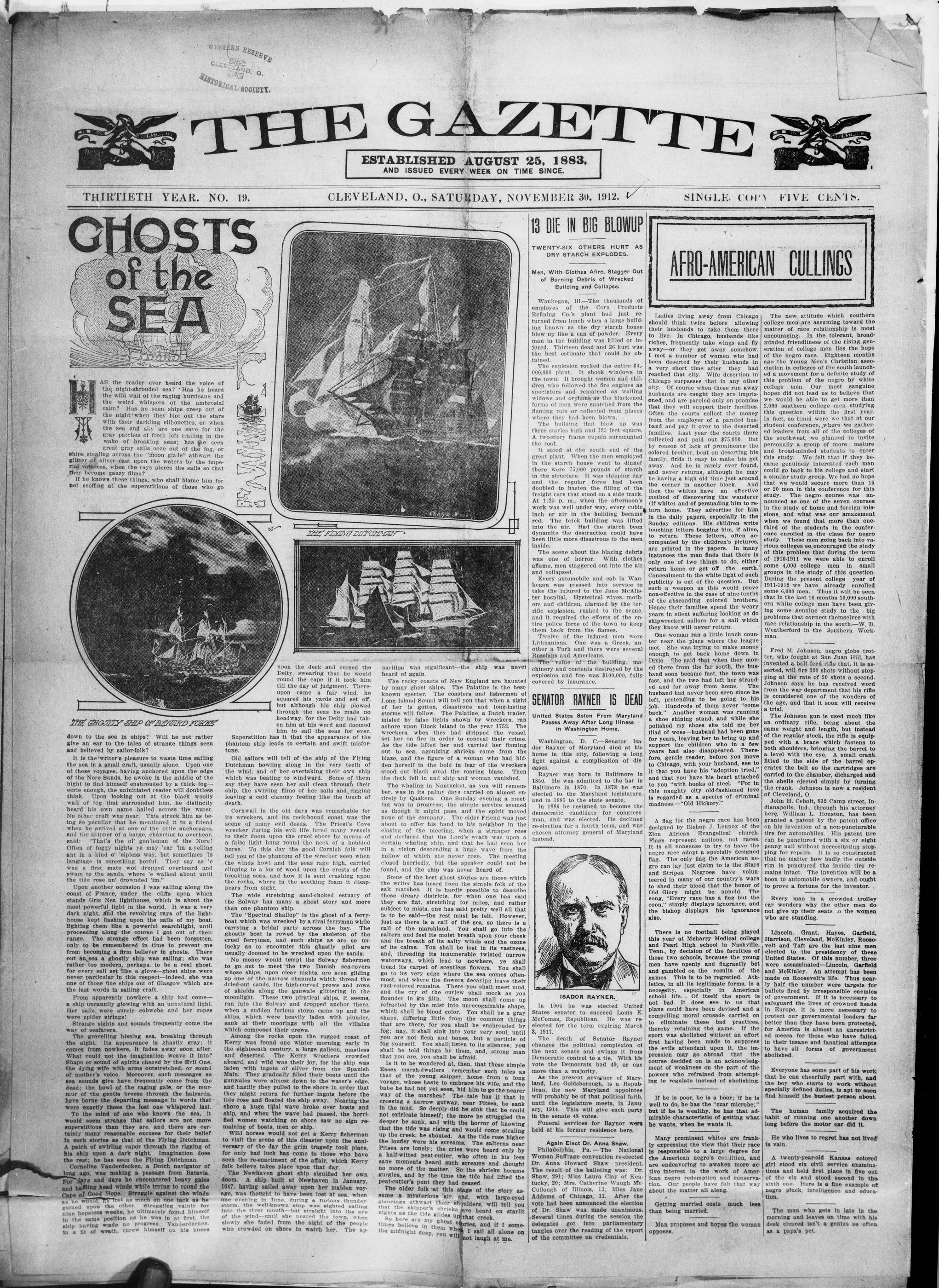
GHOSTS
of the
SEA
AS the reader ever heard the voice of
the night-shrouded sea? Has he heard
the wild wall of the raging hurricane and
the weird whispers of the ambrosial
calm? Has he seen ships creep out of
the night when they blot out the stars
with their darkling silhouettes, or when
the sea and sky are one save for the
gray patches of froth left trailing in the
wake of breaking seas; has he seen
great gray sails ooze out of the fog, or
ships stealing across the "moon glitter of silver cast upon the wateral votewater, when the rays pierce it they become gauzy films? If he knows these things, who shall not scoffing at the superstitions of
ling across the "moon glade" athwart the silver cast upon the waters by the impress, when the rays pierce the sails so that the gauzy films? owes these things, who shall blame him for g at the superstitions of those who go
ships stealing across the "moon glade" athwart the glitter of silver cast upon the waters by the imperial votress, when the rays pierce the sails so that they become gauzy films?
If he knows these things, who shall blame him for not scoffling at the superstitions of those who go
THE GHOSTLY SHIP OF BEVARD FORME
down to the sea in ships? Will he not rather give an ear to the tales of strange things seen and believed by sailor-folk?
It is the 'writer's pleasure to waste time sailing the sea in a small craft, usually alone. Upon one of these voyages, having anchored upon the edge of the Nore Sands, he awoke in the middle of the night to find himself enshrouded by a thick fog—eerie enough, the uninitiated reader will doubtless think. Upon looking out at the black woolly wall of fog that surrounded him, he distinctly heard his own name halled across the water. No other craft was near. This struck him as being so peculiar that he mentioned it to a friend when he arrived at the little anchorage, and the skipper of a barge, chancing to overhear, said: "That's the ol' genleman of the Nore! Often of fogy nights ye may 'ear 'im a-yelling aht in a kind o' elphless, but sometimes' language is something horful. They say as 'e was a first mate wot dropped overboard and swam to the sands, where 'e walked about until the tide rose an' drowned 'im."
On another occasion I was sailing along the coast of France, under the cliffs upon which stands Gris Nez lighthouse, which is about the most powerful light in the world. It was a very dark night, and the revolving rays of the lighthouse kept flashing upon the sails of my boat, lighting them like a powerful searchlight, until proceeding along the course I got out of their range. The strange effect had been forgotten, only to be remembered in time to prevent me from becoming a firm believer in ghosts. There out an sea a ghostly ship was sailing; she was rather too modern, perhaps, to be a real ghost. for every sail set like a glove—ghost ships were never particular in this respect—indeed, she was one of those fine ships out of Glasgow which are the last words in sailing craft.
From apparently nowhere a ship had come—a ship unicornly glowing with an unnatural light. Her sails, were surely cobwebs and her ropes were spider strings!
Strange sights and sounds frequently come the way of seafarers.
The grovelling hissing sea, breaking through the night. Its appearance is ghastly gray; it comes from nowhere, it fades away soon after. What could not the imagination weave it into? Shape or sound of spirits chased by the Evil One, the dying wife with arms outstretched, or sound of mother's voice. Moreover, such messages as sea sounds give have frequently come from the dead; the howl of the raging gale, or the murmur of the gentle breeze through the halyards, have borne the departing message in words that were exactly those the lost one whispered last.
To the mind of one who knows the sea, it would seem strange that sailors are not more superstitious than they are, and there are certainly many reasonable excuses for their belief in such stories as that of the Flying Dutchman. A patch of swirling vapor through the rigging of his ship upon a dark night. Imagination does the rest; he has seen the Flying Dutchman.
Cornellus Vanderdecken, a Dutch navigator of long ago, was making a passage from Batavia. For days and days he encountered heavy gales and hailing head winds while trying to round the Cape of Good Hope. Struggle against the winds as he would, he lost as much on one tack as he gained upon the other. Struggle vainly for nine hopeless weeks, he ultimately found himself in the same position as he was in at first, the ship having wade no progress. Vanderdecken, in a fit of wrath, threw himself on his knees
H
WESTERN RESERVE
CLEVILAND, O.
HISTORICAL SOCIETY.
NO. 19.
THE GAZETTE
the impe
so that
him for
who go
Superstition has it that the appearance of the phantom ship leads to certain and swift misfortune.
Old sailors will tell of the ship of the Flying Dutchman bowling along in the very teeth of the wind, and of her overtaking their own ship which was beating to windward. Some of them say they have seen her sail clean through their ship, the swirling films of her sails and rigging leaving a cold clammy feeling like the touch of death.
Cornwall in the old days was remarkable for its wreckers, and its rock-bound coast was the scene of many evil deeds. The Priest's Cove wrecker durug his evil life lured many vessels to their doom upon the cruel shore by means of a false light hung round the neck of a hobbied horse. To this day the good Cornish folk will tell you of the phantom of the wrecker seen when the winds howl and the seas rage high, carried clinging to a log of wood upon the crests of the breaking seas, and how it is sent crashing upon the rocks, where in the seething foam it disappears from sight.
The wide stretching sand-choked estuary of the Solway has many a ghost story and more than one phantom ship.
The "Spectral Shallop" is the ghost of a ferryboat which was wrecked by a rival ferryman while carrying a bridal party across the bay. The ghostly boat is rowed by the skeleton of the cruelly ferryman, and such ships as are so unlucky as to encounter this ghastly pilot are usually doomed to be wrecked upon the sands.
No money would tempt the Solway fishermen to go out to meet the two Danish sea-rovers whose ships, upon clear nights, are seen gilding up one of the narrow channels which thread the dried-out sands, the high-curved prows and rows of shields along the gunwale glittering in the moonlight. These two plastrical ships, it seems, ran into the Solway and dropped anchor there, when a sudden furious storm came up and the ships, which were heavily laden with plunder, sank at their moorings with all the villains which composed their crews.
Among the rocks upon the rugged coast of Kerry was found one winter morning, early in the eighteenth century, a large galleon, mastless and deserted. The Kerry wreckers crowded aboard, and wild was their joy, for the ship was laden with ingots of silver from the Spanish Main. They gradually filled their boats until the gunwales were almost down to the water's edge, and when they pulled to the shore in order that they might be further ingots before the tide rose and floated the ship away. Nearing the shore a huge tidal wave broke over boats and ship, and when the wave had passed, the horrified women watching on shore saw no sign remaining of boats, men or ship.
Wild horses would not get a Kerry fisherman to visit the scene of this disaster upon the anniversary of the day the grim tragedy took place, for only bad luck has come to those who have seen the re-enactment of the affair, which Kerry folk believe takes place upon that day.
The Newhaven ghost ship signified her own doom. A ship built at Newhaven in January, 1647, having sailed away upon her malen voyage, was thought to have been lost at sea, when one evening in June, during a furious thunderstorm, she sank into the river mouth—but straight into the wind—until she neared the town, when slowly she faded from the sight of the people who crowded on shore to watch her. The an-
CLEVELAND, O., SATURDAY, NOVEMBER 30, 1912.
Charge D'Art
upon the deck and cursed the Deity, swearing that he would round the cape if it took him till the day of judgment. There-upon came a fair wind, he squared his yards and set off, but although his ship plowed through the seas he made no headway, for the Deity had taken him at his word and doomed him to sail the seas for ever.
parition was significant—the ship was new heard of again.
The rocky coasts of New England are haunted by many ghost ships. The Palatine is the best known specter. The coasters and fishermen, Long Island Sound will tell you that when a ship of her is gotten, disastrous and long-lasting storms will follow. The Palatine, a Dutch trad misled by false lights shown by wreckers, was ashore upon Block Island in the year 1752.
ESTABLISHED AUGUST 25, 1883 AND ISSUED EVERY WEEK ON TIME SINCE.
partition was significant—the ship was never heard of again.
The rocky coasts of New England are haunted by many ghost ships. The Palatine is the best-known specter. The coasters and fishermen of Long Island Sound will tell you that when a sight of her is gotten, disastrous and long-lasting storms will follow. The Palatine, a Dutch trader, misled by false lights shown by wreckers, ran ashore upon Block Island in the year 1752. The wreckers, when they had stripped the vessel, set her on fire in order to conceal their crime. As the tide lifted her and carried her flaming out to sea, agonizing shrieks came from the blaze, and the figure of a woman who had hidden herself in the hold in fear of the wreckers stood out black amid the roaring blaze. Then the deck fell in and ship and woman vanished.
The whaling in Nantucket, as you will remember, was in its palmy days carried on almost entirely by Quakers. One Sunday evening a meeting was in progress; the simple service seemed as though it might pass, and the spirit moved none of the company. The elder Friend was just about to offer his hand to his neighbor in the closing of the meeting, when a stranger rose and declared that the Lord's wrath was upon a certain whaling ship, and that he had seen her in a vision descending a huge wave from the hollow of which she never rose. The meeting closed hurriedly, but the speaker could not be found, and the ship was never heard of.
Some of the best ghost stories are those which the writer has heard from the simple folk of the salt marshes. It is hardly possible to describe these dreary districts, for when one has said they are flat, stretching for miles, and rather subject to mists, one has said pretty well all that is to be sad—the rest must be felt. However, just as there is a call of the sea, so there is a call of the marshland. You shall go into the saltern and feel its moist breath upon your cheek and the breath of its salty winds and the ozone of its calms. You shall be lost in its vastness, and, threading its innumerable twisted narrow waterways, which lead to nowhere, ye shall tread its carpet of scentless flowers. You shall go to its very edge where the sea comes often-most, and where the flowers decaying leave their roots remain. There you shall meet mud, and the cry to the sea shall mock as you flounder in its filth. The marshland come up refracted by the mist into unrecognizable shape, which shall be blood color. You shall be a gray shape, differing little from the common things that are there, for you shall be enshrouded by fog; nay, it shall sink into your very soul, until you are not flesh and bones, but a particle of fogy yourself. You shall listen to its silences; you shall be told things by them, and, strong man that you are, you shall be afraid.
Is it to be wondered at, then, that these simple Essex marsh-dwellers remember such tales as that of the young skipper, home from a long voyage, whose hastie to embrace his wife, and the babe he had not yet seen, bid him to go the nearer way of the marshes? The tale has it that in crossing a narrow gutway, near Pitsa, he sank in the mud. So deeply did he sink that he could not extricate himself; the more he struggled the deeper he sank, and with the horror of knowing that the tide was rising and would come stealing up the creek, he shouted. As the tide rose higher the louder were his screams. The salterns near Pitsa are lonely; the cries were heard only by a half-witted peat-cutter, who often in his less sane moments heard such screams and thought no more of the matter. So the shrieks became gurgles, and by the time the tide had lifted the peat-cutter's punt they had ceased.
The older folk at this stage of the story assume a mysterious air, and, with large-eyed glaucomas atwart their shoulders, will tell you that the skipper's shrieks are heard on starlit nights as the tide glides up that creek.
in that creek.
So here are my ghost stories, and if I sometimes believe in them when I sail all alone on the midnight deep, you will not laugh at me.
13 DIE IN BIG BLOWUP
TWENTY-SIX OTHERS HURT AS DRY STARCH EXPLODES.
Men, With Clothes Afire, Stagger Out of Burning Debris of Wrecked Building and Collapse.
Waukegan, Ill.—The thousands of employees of the Corn Products Refining Co.'s plant had just returned from lunch when a large building known as the dry starch house blew up like a can of powder. Every man in the building was killed or injured. Thirteen dead and 26 hurt was the best estimate that could be obtained.
The explosion rocked the entire $4,000,000 plant. It shook windows in the town. It brought women and children who followed the fire engines as spectators and remained as wailing widows and orphans as the blackened forms of men were snatched from the flaming ruin or collected from places where they had been blown.
The building that blow up was three stories high and 125 feet square. A two-story frame cupola surmounted the roof.
It stood at the south end of the great plant. When the men employed in the starch house went to dinner there were 75,000 pounds of starch in the structure. It was shipping day and the regular force had been doubled to hasten the filling of the freight cars that stood on a side track. At 1:25 p. m., when the afternoon's work was well under way, every cubic inch or air in the building became red. The brick building was lifted into the air. Had the starch been dynamite the destruction could have been little more disastrous to the men inside.
The scene about the blazing debris was one of horror. With clothes affame, men staggered into the air and collapsed.
Every automobile and cab in Waukegan was pressed into service to take the injured to the Jane McAllister hospital. Hysterical wives, mothers and children, alarmed by the terrific explosion, rushed to the scene, and it required the efforts of the entire police force of the town to keep them back from the flames.
Twelve of the injured men were Lithuanians. One was a Greek, another a Turk and there were several Russians and Americans.
The value of the building, machinery and contents destroyed by the explosion and fire was $100,000, fully covered by insurance.
SENATOR RAYNER IS DEAD
United States Solon From Maryland Passes Away After Long Illness in Washington Home.
Washington, D. C.—Senator Isador Rayner of Maryland died at his home in this city, following a long fight against a complication of diseases.
Rayner was born in Baltimore in 1850. He was admitted to the bar in Baltimore in 1870. In 1878 he was elected to the Maryland legislature and in 1885 to the state senate.
In 1886 he resigned to become the democratic candidate for congress man, and was elected. He declined re-election for a fourth term, and was chosen attorney general of Maryland instead.
ISADOR RAYNER.
In 1904 he was elected United States senator to succeed Louis E McComas, Republican. He was reelected for the term expiring March 3, 1917.
The death of Senator Rayner changes the political complexion of the next senate and swings it from Democratic control to a tie. With his vote the Democrats had 49, or one more than a majority.
As the present governor of Maryland, Lee Goldsborough, is a Republican, the new Maryland appointee will probably be of that political faith, until the legislature meets, in January, 1914. This will give each party in the senate 48 votes.
Funeral services for Rayner were held at his former residence here.
Again Elect Dr. Anna Shaw
Again Elect Dr. Anna Shaw.
Philadelphia, Pa. — The National Woman Suffrage convention re-elected Dr. Anna Howard Shaw president. The result of the balloting was: Dr. Shaw, 291; Miss Laura Clay of Kentucky, 20; Mrs. Catherine Waugh McCulough of Illinois, 13; Miss Jane Addams of Chicago, 11. After the vote had been announced the election of Dr. Shaw was made unanimous. Several times during the session the delegates got into parliamentary tangles over the reading of the report of the committee on credentials.
AFRO-AMERICAN CULLINGS
Ladies living away from Chicago should think twice before allowing their husbands to take them there to live. In Chicago, husbands like riches, frequently take wings and fly away—or they get away somehow. I met a number of women who had been deserted by their husbands in a very short time after they had reached that city. Wife desertion in Chicago surpasses that in any other city. Of course when they run away husbands are caught they are imprisoned, and are paroled only on promise that they will support their families. Last year the courts collected the money from the employer of a paroled husband and pay it over to the deserted families. Last year the courts there collected and paid out $75,000. But by reason of lack of prominence the colored brother, bent on deserting his family, fits it easy to make his get away. And he is rarely ever found, and never returns, although he may be having a high old time just around the corner in another block. And then the whites have an effective method of discovering the wanderer (if white) and of persuading him to return home. They advertise for him in the daily papers, especially in the Sunday editions. His children write touching letters begging him, if alive, to return. These letters, often accompanied by the children's pictures, are printed in the papers. In many instances the man finds that there is only one of two things to do, either return home or get off the earth. Concealment in the white light of such publicity is out of the question. But such a weapon as this would prove non-effective in the case of nine-tenths of the absconding colored brothers. Hence their families spend the weary years in silent suffering looking as do shipwrecked sailors for a sail which they know will never return.
One woman ran a little lunch counter near the place where the league met. She was trying to make money enough to get back home down in Dixie. She said that when they moved there from the far south, the husband soon became fast, the town was fast, and the two had left her stranded and far away from home. The husband had never been seen since he left, pretending to be going to his job. Hundreds of them never "come back." Another woman was running a shoe shining stand, and while she polished my shoes she told me her illad of woes—husband had been gone for years, leaving her to bring up and support the children who in a few years had also disappeared. Therefore, gentle reader, before you move to Chicago, with your husband, see to it that you have his "adoption tried," and that you have his heart attached to you "with hooks of steel." "For in this naughty city old-fashioned love is regarded as a species of criminal madness."—"Old Hickory."
A flag for the negro race has been designed by Bishop J. Lennox of the Zion African Evangelical church. Flags represent nations, not races. It is all nonsense to try to have the negro race adopt a specially designed flag. The only flag the American negro can lay just claim to is the Stars and Stripes. Negroes have volunteered in many of our country's wars to abed their blood that the honor of Old Glory might be upheld. The song, "Every race has a flag but the coon," simply displays ignorance, and the bishop displays his ignorance also.
There is no football being played this year at Meharyan Medical college and Pearl High school in Nashville, Tenn., by decision of the faculties of these two schools, because the young men have openly and flagrantly bet and gambled on the results of the games. This is to be regretted. Athletics, in all its legitimate forms, is a necessity, especially in American school life. Of itself the sport is not bad. It does see to us that plans could have been devised and a compelling moral crusade carried on to eliminate these bad practices, thereby retaining the game. If the sport was abolished without an effort first having been made to suppress the evils attendant upon it, the impression may go abroad that the course decided on is an acknowledgment of weakness on the part of the powers who refrained from attempting to regulate instead of abolishing.
if he is poor, he is a boor; if he is
well to do, he has the "czar microbe;
but if he is wealthy, he has that admirable characteristic of getting what
he wants, when he wants it.
Many prominent whites are frankly expressing the view that their race is responsible to a large degree for the American negro's condition, and are endeavoring to awaken more active interest in the work of American negro redemption and conservation. Our people have felt that way about the matter all along.
Getting married costs much less than being married.
Man proposes and hopes the woman opposes.
FIVE CENTS.
AN CULLINGS
The new attitude which southern college men are assuming toward the matter of race relationship is most encouraging. In the tolerant, broad-minded friendliness of the rising generation of college men lies the hope of the negro race. Eighteen months ago the Young Men's Christian association in colleges of the south launched a movement for a definite study of this problem of the negro by white college men. Our most sanguine hopes did not lead us to believe that we would be able to get more than 2,000 southern college men studying this question within the first year. In fact, so timid were we that at our student conference, where we gathered leaders from all of the colleges of the southwest, we planned to invite personally a group of more mature and broad-minded students to enter this study. We felt that if they became genuinely interested each man could go back to his college and start a similar study group. We had no hope that we would secure more than 15 or 20 men in this conference for this study. The negro course was an audition of the secrecy in the study of home and foreign missions, and what was our amazement when we found that more than one-third of the students in the conference enrolled in the class for negro study. These men going back into various colleges so encouraged the study of this problem that during the term of 1910-1911 we were able to enroll some 4,000 college men in small groups in the study of this question. During the present college year of 1911-1912 we have already enrolled some 6,000 men. Thus it will be seen that in the last 18 months 10,000 southern white college men have been giving some genuine study to the big problems that connect themselves with race relationship in the south—W. D. Weatherford in the Southern Workman.
Fred M. Johnson, negro globe trotter, who fought at San Juan Hill, has invented a belt feed rifle that, it is asserted, will fire 200 shots without stopping at the rate of 20 shots a second. Johnson says he has received word from the war department that his rifle is considered one of the wonders of the age, and that it soon will receive a trial.
The Johnson gun is used much like an ordinary rifle, being about the same weight and length, but instead of the regular stock, the rifle is equipped with a brace which fastens to both shoulders, bringing the barrel to a level with the eye. A small crank fitted to the side of the barrel operates the belt so the cartridges are carried to the chamber, dicharged and the shells ejected simply by turning the crank. Johnson is now a resident of Cleveland, O.
John H. Cebolt, $32 Camp street, Indianapolis, Ind., through his attorney, William L. Houston, has been granted a patent by the patent office on his invention of a non-puncturable tire for automobiles. His patent tire can be punctured with a six or eight penny nail without necessitating stopping for repairs. It is so constructed that no matter how badly the outside rim is punctured the inside tire remains intact. The invention will be a boon to automobile owners, and ought to prove a fortune for the inventor.
Every man in a crowded trolley car wonders why the other men do not give up their seats o the women who are standing.
Lincoln, Grant, Hayes, Garfield, Harrison, Cleveland, McKinley, Roosevelt and Taft are the last nine men elected to the presidency of these United States. Of this number, three were assassinated—Lincoln, Garfield and McKinley. An attempt has been made on Roosevelt's life. Thus nearly half the number were targets for bullets fired by irresponsible enemies of government. If it is necessary to safeguard the lives of crowned heads in Europe, it is more necessary to protect our governmental leaders far better than they have been protected, for America is almost an unrestricted mecca for those who have failed in their insane and fanatic attempts to have all forms of government abolished.
Everyone has some part of his work that he can cheerfully part with, and the boy who starts to work without specially defined duties, is apt to soon find himself the busiest person about.
The human family acquired the habit of running one another down long before the motor car did it.
He who lives to regret has not lived in vain.
A twenty-year-old Kansas colored girl stood six civil service examinations and held first place in five out of the six and stood second in the sixth one. Here is a fine example of negro pluck, intelligence and education.
The man who gets in late in the morning and leaves on time with his desk cleared isn't a gentus so often as a papa's pet.
fi 4 '
s _. es i ce sen roman
‘THE GAZETTE
PUBLISHED EVERY SATURDAY
OMe Year... ceceseveneeees G180
GIX Montha........eeeceneees 1.00
‘Three Monthe.......ccceeee. 60
Gubscribers are requested te re
mit by postoffice money on
sae
Entered at the postoffice In Cleveland,
‘Ohio, as second-class matter
Address al! rer SMTke te
HARRY C. SMITH ’
THE GAZETTE,
Blackstone Buliding, Cleveland, ©.
Member Ohie Legislature: 1804
‘te 1896; 1896 to 1896; 1900 to 1902
eee
THE GAZETTE Is the oldest, and
Ser eater es
mS aa swear
ite rank as one of the NEWSIEST
‘The recent complaint of our people
of Richmond, Va., that the separate
schools ‘conducted for them by the
‘White board of education there, pre
Yented thelr children from acquiring
training In the commercial school of
tint city, calls attention to the recent
inquiry and reports of Atlanta, Ga.,
University, on the separate school
system of the south which are caus
fag considerable wdverse criticism
upon the part of many fair daily pa
pers and magazines published in the
orth, particularly inthe east. "The
Sone of the inquiry was wide, infor
mation coming from. the. following
sourcen: Annus! tenorts of the 1. 9.
Commissioner of Education; State
school reports, past and present; re-
plies of city superintendents to cer-
tain questions; and replies of teach
ert and educators in all parte of the
South. A large part of the univer.
aity's ‘work, of course, was with on
ollment obtained {rom all the South
fern states and compared with the i
thentle statistics of the paet, the con
parison yielding the following im
Dortant conclusion:
‘That there has been in recent years
no marked increase In the averaze
daily attendance of Negro children In
tie public schools.
That the percentage of Negro chil
aren of school age enrolled. in. the
public schools has decreased in the
last. twenty years.
That without doubt the proportion
of Negro children in average daily at-
tendance in the public schools has
greatly decreased in the last decade
and in the last two decades.
The nud of these three conclusions
fs that no serious attempt Is being
made in the South to offer to all Ne-
Broes of proper age an opportunity
for education, As a matter of fact, 4
still stronger statement might be
made without fear of contradiction,
vis: that4in many parts of the South
there is deliberate effort to keep the
Negro from getting an education. Tn
miost Southern states, it should be
Temembered, there is a dual system
of schools, involving separate schools
for whites and Negroes. And in most
Southern states, as might be expected,
-the larger sums of money are spent.
fon the white sclools Irrespective of
the number of persons they are sup:
posed to benefit. Here are a few typi
cal figutes:
Botith Carolina, 1900—
Persons of School
Cost of Schools Age (5-18, 1908-9)
White ....$1,590,792.51 201,868
Negro |..." “308,153.16 316,007
‘Alabama, 1909—
White ....$2,143,062.15 364,266
Negro |... "287,045.43 311,552
North Carolina, 1908—
White ....$1,851,976.57 497,376
Negro <1." “386,734.28 232/624
A little mathematics make it clear
that if the Negro schools of South
Carolina had been held in the' same
respect as the white schools, they
would have cost about $3,000,000. In-
stend of $800,000; in Alabama they
Would ‘have cost $1,833,000 instead of
$287,000; in North Carolina, $1,000,000
Instead of $367,000. And it may be
further stated that there appears to
be similar discrimination in Virginia,
Georgia, Florida, Mississippi, Louis
ana and Arkansas. The showing in
Kentucky and Maryland and Tennes-
see is slightly better, and fairly de-
cent in Texas and Missouri, The per
capita cost of education, the amount
of money spent on each child in the’
White schools and in the Negro sghools
‘make some interesting and instruct
Ie reading. Here are & few tixures|
taken at random:
Schools
State White Negro
Georgia .....-...... $1160 $6.60
Mississippi ..000.0. 1837421
Gow Carolina ..... 498 142
Other statistics bearing on the gen-
eral situation show that Negro school.
houses are cheaper in every way,
have smaller amounts spent on them
for repairs and that teachers in the
Negro schools are paid much lower
gularies than teachers in the white
schools. Mention has been made of
the dual school system, The continu-
‘ation of this system Is perhaps made
‘necessary by local conditions, but the
great difficulty in a proper adminis-
tration of it lies in the fact that in
eerie ce tee siuenee since te
there any attempt to give the Colored
people a voice in the direction of their
‘wh schools, Superintendents and
Be cats Seat ty
Bee tects Sad heck of inctlignnt
ee ae vate covers in
fact, Negro schools are often sbso-
Jutgly neglected. And all this in face
‘of the fact that the Negroes in most
States are paying an educational tax
that brings in more movey than is
ppevt. on thelr schools
‘LL That the overwhelming major-
‘of, Negro children of school age
eS oa
cz the cbief reason for this is
lack of school facilities; and a
‘reason is the poverty and ig-
norance of the parents.
%. That those Negro children who
Se ee antic: oa ae
Se
of three to six months a year.
4, That the school houses and
equipment for Negro schools are for
Reet see ates ie
ae
perintendence from the school author-
ities. =
one of the objects of disfranchisement
etcetera nan
ers, lower the grade and efficiency of
the course of study and employ as
ea ee te ae
protest or complain.
4... That in the attempt to introduce
earn nica
een ene ee
peecetrcsecnse cumenrreaian
considered, unrelated work which has
Cees
ead artes
education in the South during the las
ten years has been openly confinec
almost entirely to white people. Th
schools and transportation of chil
lintellectual leaders for the Nest
TOO MUCH.
A person may be intemperate te
the most innocent things. He may
Grink too much water; he may eat
too much bread; he may sleep too
much; he may exercise too much; he
may play ball too much; he may go
to the moving pictures too much; be
may eat too much ple; he may drink
too much buttermilk; he may talk too
much; he may love too much; he may
sit around too much; he may read too
much; he may ride too much; he may
Uke company too much; he may write
too much; he may love too much; he
may’ point of stating what we started
‘out to say, that there is such a thing
ax the excess of a good thing; and
that there fa no offense that is as sure
to bring its penalty as the excess of
anything, either good or bud. The
only success in this world {s a sim-
ple earnest, devoted lite that looks at
the stars with more delight than at
a clrcus, and regards’ child at play
‘as grander than a seat In the senate,
says the Ohio State Jouranl. We
started to write this article in elabora-
tion of a remark concerning Burbank.
to wit, that le had two eharacteris-
ties that put/him ahead of all his con-
temporaries—his wonderful patience
and hls loyalty to a purpose—but we
delayed the thought too long to make
the proper connection.
‘The fact that several Nebraska
young women graduating from the de.
partment of agriculture at Washing.
ton into places of responsibility as
seed experts, some in state universi-
ties, while naturally gratifying to
their neighbors, is most significant in
this, that i¢ shows what a potent in-
fluence the government is exerting to-
ward implanting the principle of in-
tensive agriculture, rays the Omaha
Bee, The first steps In the process of
making two blades of grass grow
where but one grew before is the
proper selection of seed and proper
preparation of the voll. The federal
government fs doing a great work
therefore, in thus fostering this move-
ment and ‘co-operating in it with state
educational institutions, Together
they are making the selection of seed
for agriculture and horticulture a scl-
ence and 4 business. Of course, thie
opens up to young men and women lu-
erative flelds of service, but that is
only incidental to the main purpose
‘of improving methods of farming.
[the dangers of submarine: navize-
tion, in the present stage of Its devel
| opment, are greater than those of the
aeroplane. In an aeroplane accident
the deaths are limited to one or two
but when a submarine boat goes down
] and falls to come up, the calamity
Usually carries off a dozen or more
human beings at a time. There were
15 men on the’ British submarine B-2.
which was struck by the Hamburg:
American ner Amerika in a fog of
Dover, and only one of them came
up. This is the eixth disaster to Brit
{sh submarines, and In each of the
previous disasters the death roll
ranged from 11 to 16.
‘The Boy Scout movement Is tour-
ishing in other countries than the
United States and Great Britain. It is
on a strong footing tn Denmark.
where both the Crown Prince Frederik
and his brother, Prince Knud, are tak-
Ing part in the training. The young
princes associate with their fellow
acouts on terms of perfect equality.
This ts a good preparation for future
usefulness on the throne of a demo-
cratic country like Denmark—for dem
ooratic Denmark 18, although ruled by
ain
An English anonymous earl, who
describes himself as of strong person.
ality,’ manly, clean-cut appearance,
social favorite and possessing talents,
has been advertising for a job in
New York journal. Something has
evidently gone wrong with the heiress
market when « nobleman of such self-
assurance is actually driven to work.
fees
pe
Nee oo eae
Wart a . Li
Ce
Ss A RD
tl Ne
AU ante)
% SS F |
UC
UY °°
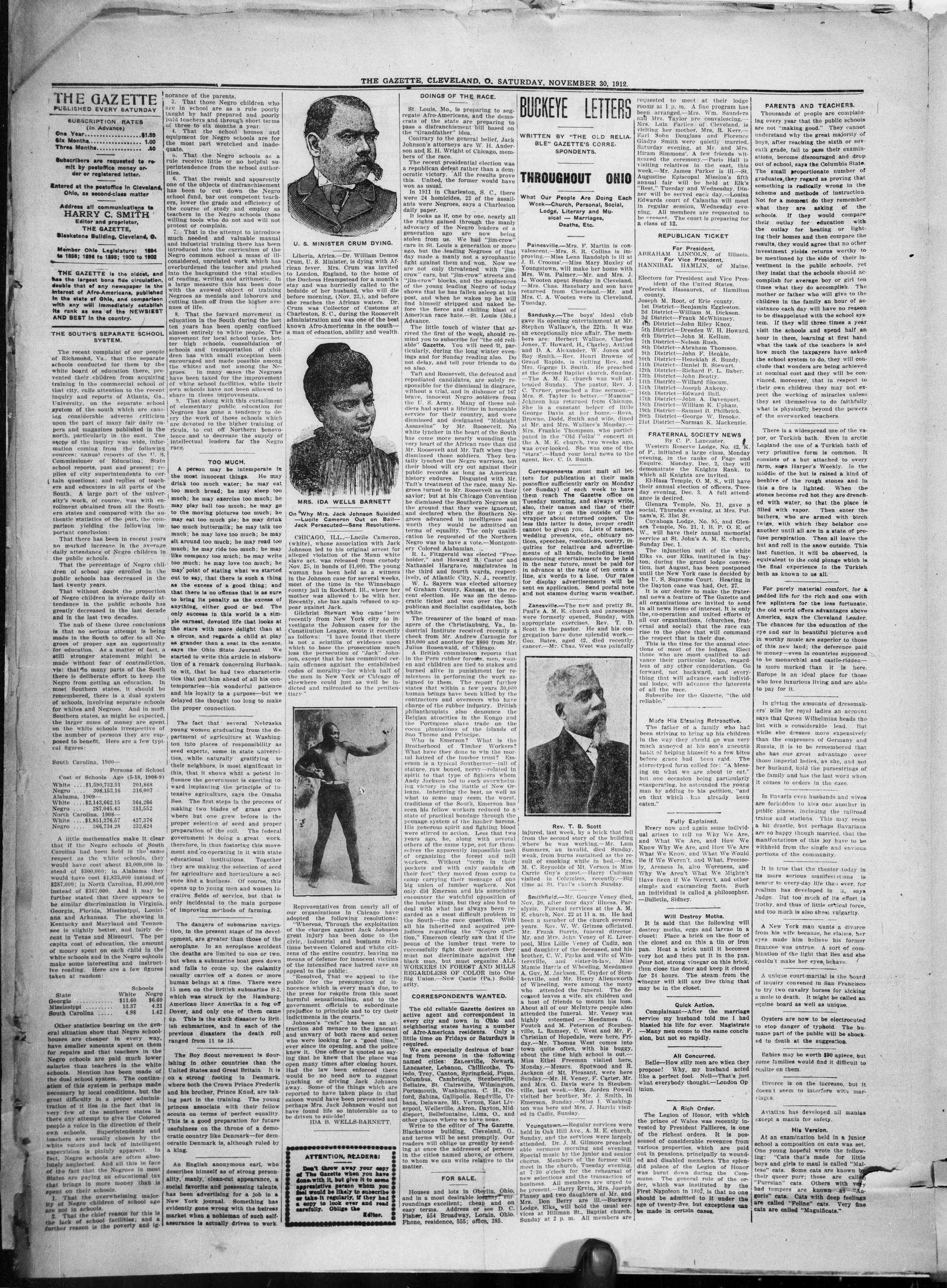
U. S. MINISTER CRUM DYING.
Liberia, Afriea,—Dr, William Demos
Crum, U. 8. Minister, is dying with Af-
rlean’ fever. Mrs, Crum was invited
to London, Engiand, to the home of
he Duchess Heampstead for a month's
stay and was hurriedly called to the
bedside of her husband, who will die
before morning, (Nov. 2%,), and before
‘she reaches the African’ waters, Dr.
Cram was Collector of Customs at
Charleston, 8. C,, during the Roosevelt
administration and was one of the best
known Afro-Americans in the south—
S acs Of ctunation GDOICy anil Wealth
Be oN
as a cing
Be Ne
a AER
eI RES
i A) Pier ah te
eer eae
es Tat ay Mei
Ree | | Mt Hy
ee NE
MRS. IDA WELLS BARNETT
On ‘Why Mrs. Jack Johnson Suicided
*{uelie. Cameron” Out. on Bail
eck Parecite Bane Recolutians:
CHICAGO, ILL.—Lucile Cameron,
(white), whose association with Jack
Johnson led to his original arrest for
alleged violation of the Mann white
slave act, was released from custody
Noy. 25, in bonds of $1,000. The young
woman’ has been held as a witness
in the Johnson case for several weeks,
most of the time in the Winnebago
county jail in Rockford, Ill, where her
mother was allowed to be with her.
Recently, she has again refused to ap-
pear against Jack.
Gilebrist Stewart who came ‘here
recently from New York city to in-
vestigate the Johnson cases for the
Constitution League, wrote it recently
as follows: “I have found that there
Is not a seintilla of evidence upon
which to base the prosecution much
less the persecution of “Jack” John:
son, except that he has committed cer-
tain offenses against the established
codes of morality—for whieh half of
the men in New York or Chicago of
elsewhere could just as well be in:
dicted and rallroaded to the peniten-
‘Gare
we +
a itt ,* ti. oe
-
F
is :
‘ a — .
ey ye kk
x he
| ee
Representatives from nearly all of
our organizations in Chicago have
adopted the following resolutions:
“Whereas, Through the exploitation
of the charges against Jack Johnson
‘great Injury has been done to. the
‘civic, industrial and business reia
‘tions between Colored and white citi
zens of the entire country, leaving no
means of defense for innocent vietims
‘of the intensified race hatred save an
‘appeal to the public:
“““Resolved, That we appeal to the
public for ‘the presumption of in:
hnocence which ig every man’s due, to
the press for respite from this most
harmful sensationalism, and to the
government officials to subordinate
prejudice to principle and to try their
indictments in the courts.”
Johnson's “cafe” has been an at
traction and menace to the ignorant
and unwary of both races and sexes
who were looking for a “good time,”
ever since its opening, and the police
knew it, One officer is quoted as say-
ing that he knew that the place was
open many times after closing hours.
Had the law been enforced there
would be no need now to sussest
lynching or driving Jack Johnson
away. Some: of the things which are
reported to have taken place in that
saloon would have been prevented and
perhaps Mrs, Jack Johnson would not
have found life so intolerable as to
be driven to suicide!
IDA B. WELLS-BARNETT,
ATTENTION, READERS!
Dea throw away your eopy
of The Gazette when you have
done. with it, but give It to some
appreciative jn whom you
$a road be likely to subscribe
qr take-It regularly, if they had
@ copy te look over and read
‘earefully. Oblige the
éter.
AZETTE, CLEVELAND, O. SATURDAY, NOVEMBER 30, 1!
eee
| _- DOINGS OF THE RACE. Wee cota ror ene
St, Louls, Mo, is preparing to se-
regate Afro-Americans, and the demo-
crats of the state are preparing to
pass a disfranchisment Bill based on
the “Grandfather” idea,
Contrary to the general bellet, Jack
Johnson's attorneys are W. H. Ander-
son and B. H, Wright of Chicago, mem:
bers of the race.
‘The recent presidential election was
a republican defeat rather than a dem-
ocratic victory. “All the results prove
this. United, the former would have
won as usual,
In 1911 in Charleston, 8. C, there
were 24 homicides, 22 of the assail-
ants were Negroes, says a Charleston
‘daily paper.
It looks as if, one by one, nearly all
‘the rights gained through the manly
advocacy of the Negro leaders of a
generation ago are now being
‘stolen from us, We had “Jim-erow”
“cars in St. Louis a generation or more
‘ago, but the leading Negroes of that
‘day made a manly not a sycophantic
‘fight against them and won. Now we
are not only threatened with “Jim.
“crow” cars, but “jim-crow” streets and
““uim-crow”” blocks, and the supineness
‘of the young leading Negro of today
shows that he has fallen asleep at his
post, and when he wakes up he will
find’ himself stripped and naked be-
fore the fierce and chilling blast. of
American race hate.—St. Louis (Mo,)
Advance,
| ‘The little touch of winter that ar-
rived the first of the week, should re-
mind you to subscribe for “the old reli-
jable” Gazette. You will need 1t, par-
ticularly, during the long winter even-
ings and for Sunday reading also. Do
“not delay, and tell your friends to do
£0 alto.
| ‘Taft and Roosevelt, the defeated and
repudiated candidates, are solely re-
“sponsible for the dismissal in disgrace,
without # trial, and in dishonor of 167
brave, innocent Negro soldiers trom
the U.S. Army, Many of these sol-
diers had spent a lifetime in honorable
service for their country, and were
dismissed and designated “Midnight
Assassins” by Mr. Roosevelt. No
white lyncher in the heart of the South
has come more nearly wounding the
very heart of the African race than did
Mr. Roosevelt and Mr. Taft when they
| aesace hose. soldiers. ‘They br
tally lynched the Negro warriors, but
| their blood will ery out against their
public records as long as American
| history endures, Disgusted with Mr.
| Tait’s treatment of the race, many Ne-
| sroes turned to Mr. Roosevelt as their
| savior; but at his Chieago Convention
he dismissed the Southern Negroes on
the ground that they were ignorant,
and declared when the Southern Ne
Broek advanced in intelligence and
[worth ‘they would be admitted on
terms of equality. The only qualifi
cation he requested of the Northern
Negro was to have a vote.—Montgom-
[ery Colored Alabamian.
R. L, Fitzgerald was elected “Free
| holder,” and) Howard B. Castor and
| Nathaniel Hargrave, magistrates in
| the third and fourth wards, respect:
ively, of Atlantic City, N. J. recently.
W. L. Sayers was elected attorney
of Graham County, Kansas, at the re
cent election. He was on’ the demo-
cratic ticket and won over the Re
publican and Socialist candidates, both
white,
‘The treasurer of the board of man-
agers of the Christianburg, Va.,_In-
dustrial Institute received recently. a
check from Mr. Andrew Carnegle for
$10,000 and another for $800 from Mr.
Julius Rosenwald, of Chleago,
A British commission reports that
In the Peru rubber foress, men, wom:
en and children are tied to stakes and
burned alive in punishment for’ re-
missness in performing the work as:
signed to them. ‘The report further
| states that within a few years 30,000
| human beings have been killed by ‘the
contractors and overseers who have
charge of the rubber industry. British
philanthropists also denounce the
Belgian atrocities in the Kongo and
the Portugese slave trade on the
cocoa plantations “of the Islands of
Sao ‘Theme and Principe.
Who is Emerson? What ts the
| Brotherhood. of Timber Workers?
| What have they done to win the mor:
tal hatred of the lumber trust? Ero-
|erson is a typical Southerner—tall of
|stature, raw boned, nervy—related in
spirit to that type of fighters whom
Andy Jackson ted to such overwhelm:
ing victory in the Battle of New. Or
jeans. Inheriting the best, as well as
[what to some may seem’ the worst,
“traditions of the South, Emerson has
‘seen his fellow workers reduced to 8
"state of practical bondage through the
_peonage system of the lumber barons.
‘His zenerous spirit and fighting blood
“were stirred to action. Less that wo
years ayo, he, along with several
others of the same type, set for them-
“selves the apparently impossible task
‘of organizing the forest and mill
“workers, Without “serip in thoir
“pockets and with only sandals on
their fect” they moved from camp to
[camp carrying thelr message of one
‘big union of lumber workers. Not
only. did Emerson ard his associates
‘encounter the watchful opposition of
“the lumber kings, but they also had to
‘deal with what has always been re-
‘warded as a most diffeult problem in
‘the South—the race question. With
‘all his inherited and acquired pre-
Judices regarding the “Negro auc
“tion,” Emerson clearly saw that if the
‘eons of the lumber trust were to
successfully fight their masters they
‘must not discriminate against the
black man, but must organize ALL
WORKERS IN FOREST AND MILLS
REGARDLESS OF COLOR into One
‘Big Union—New Castle (Pa,) Solid
arity.
ee pe
‘The old reliable Gazette desires an
active agent and correspondent in
every city and town in Ohio and
helghboring states having a number
of Afro-American residents. Only a
little time on Fridays or Saturdays is
required.
‘We are especially desirous of bear
ing from persons in the following
named cities: Zanesville, Newark,
Laneaster, Lebanon, Chillicothe, To
Jedo, Troy, Canton, Springfield, Piqua,
Columbus, Cambridge, Steubenville,
Bellaire, St. Clairsville, Wilmington,
Portsmouth, Washington, C. HH, Ox
ford, Sabina, Gallipolis. Rendville, Ur-
bang, Delaware, Mt. Vernon, East Liv.
erpool, Wellsville, Akron, Dayton, Mid.
dleport, Bellefontaine, Lima, O., and
other piaces where we have Hone.
Write to the editor of The Gazette,
Blackstone building, Cleveland, 0..
and terms will be sent promptly. Our
readers will oblige us greatly by send
ing at once the addresses of persons
In the cities named above, or others
to whom We can write relative to the
matter. {
FOR SALE.
Houses and lots in Oberlin, Ohio,
ana oe ee ewer hear
roundings excellent; cheap and on
easy terms. Address or see D. C.
Fisher, 654 Broadway, Lorain, Ohio.
Phone, residence, 555; office, 385.
ae
WRITTEN BY “THE OLD RELIA-
| BLE" GAZETTE'S CORRE.
SPONDENTS.
What Our People Are Doing Each
| Week—Church, Personal, Social,
| Lodge, Literary and Mu-
sical — Marriages,
Deaths, Ete.
| _ Painesville—Mrs. F. Martin is con
valescent—Mrs. S. I Collins is im:
| proving.—Miss Lena Randolph ts ill at
J. B, Crooms’.—Miss Mary Moxley of
Youngstown, will make her home with
Mrs. Wm, Palmer—Mr. and Mrs. J.
L, Wooten spent Sunday in Cleveland.
—Mrs. Chas. Hansbary and son have
returned from Cleveland.—Mr. and
Mrs. C. A, Wooten were in Cleveland,
\@naaaae
Sandusky.—The boys’ Ideal club
gave its opening entertainment at Mr.
Stephen Wallace's, the 22th. It was
an exceptionally nice affair. The mem-
bers are: Herbert Wallace, Charles
Jones. T. Howard, H., Charley, Arthiud
and D. A. Alexander, W. Jones and
Roy Smith.—Rev. Henri Browne. of
Grand Rapids, is_vislting Rev. and
Mrs. Geprge D. Smith. He preached
at the Second Baptist chureh, Sunday.
“te A.M. B, church was’ well at
tended Sunday, ‘The pastor, Rev. J.
€. Turner, preached a fine sermon.
Mies. S. ‘Taser. Is better. —"Mamyaa”
Jchneon has returned trom Chiexco.
She Is a canstant helper of. litle
George Davis at her home,—Itevs,
Browne. Dodd, Smith and wife, dined
at Mr. and Mis, Wallace's Monday.—
Mrs, Frankie ‘Thompson, who partic!
pated Inthe “Old Polke’ concert at
the A.M. E. eburch, bo weeks ago,
was overlooked. She was one of the
“stars""—Hand your local news to the
agent, Rev. C.D. Smith,
| Corresponaents must maf ail let:
ters for publleation at their main
‘postoflice sufficiently early on Monday
for ‘Bunday) of each week to. have
ie reach The Gazette office on
‘Tuesday morning, and always write,
jalso, thelr names and that of their
city’ or tor 3 on. the outside of the
[wrapper abont returned copies. Un.
ess this latter {s done, proper credit
cannot be given you. Lists of names,
‘wedding presents, ete,, obituary no
tices, speeches, resolutions, poetry, in
quiries for relatives and advertise
ments of all kinds, including items
ansiouncing entertainments to be held
in the near future, must be paid tor
‘in advance at the rate of ten cents @
line, six words to a line, Our rates
ior display advertisements willbe
sent on application. Send postal note
and not stamns during Warm weather
Zaneaville—The new and pretty St
Paul's A. M. B. church and parsonage
were formerly opened, Sunday, with
appropriate exercises. Rey. T. D.
Scott is the pastor. He and bis con:
grogation have done splendid work.—
Geo,’ Bates axed 12 dled “recently
Generel Oban: WOat seas pEInRUlly
wa
ae
ee is
Oa Be
ey i
caenaari
injured, last week, by a brick that fell
from the second story of the building
wwhere he was working.—Mr. Lum
Summers, an invalid, died Sunday,
weak, from burns sustained as the re
sult of smoking while in bed.—Mrs.
M. C. Reynolds of Mt. Vernon is Miss
Carrie Guy's giest.—Harry Catiman
visited in Columbus, recently.—Big
time at St, Paul's church Sunday.
Smithfield.—Mr. George Veney died,
Nov. 20, after four days’ illness. Par:
alysis. Funeral services at the A. M,
E, chureh, Nov. 22 at 11 a.m, He had
been a member of the church several
years, Rey. W. W, Grimes officiated.
Mr. Frank Burris, funeral director
Mr, and Mre, John Veney of B. Liver:
pool, Miss Lillie Veney of Cadiz, son
and daughter of the deceased, and his
brother, C, W. Parks and wife of Win-
tersvillé, "and sisterindaw, Miss
Mamie Harris of Wheeling, Mésdames
A. Guy, M. Jackson, B. Guyder of Steu-
denville, and Mr. Henry” Allensworth
of Wheeling, were among the many
who attended the funeral. ‘The de-
ceased leaves a wite, six children and
a host of friends to mourn his loss.
‘About all of our MeIntyre people also
attended the funeral. Mr. Veney was
highly esteemed .— Mesdames _G.
Fouteh and M. Peterson of Steuben-
ville, L. Ramsey, C. West and Mr. F.
Christian of Hopedale, were here, Fri-
day—Mr. Thomas West comes’ into
town quite often, with his buggy,
about the time high school fs out.—
Miss Ethel Freeman visited here,
Monday.—Messrs. Spotwood and R.
Jackson of Mt. Pleasant, were here
Sunday.—Mr. H. Veney, F. Carter, Mr.
and Mrs, G. Davis were In Steuben-
Ville, last week.—Mrs. Jorden Powell
visited her brother, Mr, J. Smith, In
Emerson, Sunday.—Miss ‘I. Washing-
ton Was here and Mrs, J. Harris visit-
ed in Cadiz, Sunday.
Youngstown.—Regular services were
held in Oak Hill Ave., A. M.E, church,
Sunday, ani the services were largely
attended. Dr. J. M. Gilmore preached
able sermons morning and evening.
Special music by the funfor and senior
chorus. Members of the former will
meet in the church, Tuesday evening,
at 7:80 o'clock for the rehearsal of
new selections and the transaction of
business. All members are urged to
be present,—Harry Ervin, Mrs. Joseph
Finney and two daughters of Mr. and
Mrs, Don Berry are ill—Buckeye
Lodge, Elks, will hold the usual ser-
vices at Hillman St, Baptist church,
Sanday at 2 p.m. All members are
requested to mect at their lodge
Yoome at 1p, m, A fine program has
been arranged.—Mrs. Wm. Saunders
antl Mrs. Taylor are convalescing, —
Airs, Lula Farlice of Cleveland, is
Visiting her mother, Mrs. R. Kerr—
Earl Yohn Douglass and Florence
Giadys Smith were quietly married,
Saturday evening, at Mr. and Mrs.
Hiram Simmons’. A few friends wit.
neseed the ceremony.—Paris Hall is
Visiting ‘relatives in the east, this
Wweek.—Mr. James Parker is ill—St.
Augustine Episcopal Mission's fifth
annual fair will be held at Elk's
“Rest,” Tuesday and Wednesday. Din-
ner will be served each day.—Louisa
Hawards court of Calantha will meet
in regular session, Wednesday eve-
ning. All members are requested to
be vresent. ‘The court is preparing for
a class of 12,
REPUBLICAN TICKET
For President,
ABRAHAM LINCOLN, ‘of Ilinois.
i For Vice President,
‘HANNIBAL HAMLIN, of Maine.
Electors for President and Vice Pres:
ident of the United States,
Frederick Hassaurek, of Hamilton
county.
Joseph M. Root, of Erie county.
1st District—Benjamin Eggleston,
2d District—William M. Dickson.
8d District—Frank McWhinney.
4th District—John Riley Knox,
5th District—Dresden W. H, Howard
6th District—John M. Kellum,
ith District—Nelson Rush,
Sth Distriet—Abraham Thomson.
Sth District—John F, Henkle,
10th Distriet—Hezekiah 8. Bundy.
11th District—Daniel B. Stewart.
12th District—Richard P. L. Baber.
13th Distriet—John Beatty.
Lith Distri¢t—Willard Slocum,
15th District—Joseph Ankeny.
16th District Edward Ball,
Tith Distriet—John A. Davenport.
18th Distriet—William K, Upham,
19th District—Saminel B, Phitbrick.
20th District—George W. Brooke.
‘Uist Distriet—Norman K. Mackenzie,
Nh vege eae
fi Rauaiva Laie Oda nS
Western Reserve Lodge, No. 42,
of P., initiated a large class, Monday
evening, in the ranks of Page and
Esquire. Monday, Dec. 2, they wil
demonstrate the ‘Knights Rank, t¢
which all Knights are invited,
El-Hasa Temple, 0. M. S., will have
their annual election of officers, Tues
day evening, Dec. 3. A full attend
ance is desired,
Glenara Temple, No. 21, gave 1
social, Thursday evening, at Mrs, Put
nam’s, E, 31st St.
Cuyahoga Lodge, No. 95, and Glen
ara Temple, No. 21, 1. B. P. 0. B. 0}
W., will have their anntial memorial
service at St. John's A. M. E. church
Sunday Dee, 1
‘The injunction suit of the whit
Elks vs. our Elks, instituted in Day
ton, during the grand lodge conven
tion, last August, has been postponed
until the New York case is decided by
the U. S. Supreme Court. Hearing in
the Dayton case was had, Oct. 27.
It is our desire to make the frater
nal news a feature of The Gazette and
all organizations are invited to send
in all news items of interest. It is only
the, co-operation and united efforts 0}
all our organizations, (churches, frat
ernal and social) that the race can
rise to the place that will command
the respect that is their due.
‘This ts the time for the annual elec
tons of most of the lodges. Elect
those Who are most qualified to ad
vance their particular lodge, regard
less of any other consideration. Gc
forward, not backward, and every
thing that will advance each individ
ual lodge, will advance the Interests
of all the race,
‘Subscribe for the Gazette, “the olt
reliable.”
| Made His Blessing Retroactive.
|The father of « family who had
heen striving to bring up his children
in the way they should go was very
much annoyed at tls son's uncouth
abit of helping himaselt *0 a few bites
before grace had been sald. ‘The
sterectyped form called for: "A blest.
ing on what we are about to eat.”
bitt one occasion being particularly
exasperating, he astounded the young
man by adding to his petition, “and
On that whlen tas already” been
eaten.”
Fully Explained.
Rvery now and again some Individ-
ual arises to tell us Why We Are,
and ‘What We Are, and How We
Know Why We Are, and How We Are
What We Know, and What We Would
Be if We Weren't. and What, Precise:
ly, Areness Is, also Woreness, and
Why We Aren't What We Mightn't
Have Been if We Weren't, and other
simple and entrancing facts, Such
an individual is called a philosopher.
Bulletin, Sidney.
Will Destroy Moths.
It is said that the following will
destroy moths, exgs and larvae in a
Closet: Place'a briek on the floor of
the closet and on this a tin or fron
pan. Heat a brick until it becomes
ery hot and then put {t in the pan.
Pour hot, strong vinegar on this brick,
then close the door and keep it closed
for 24 hours. The steam from the
winegar will kill any live thing that
Siae We cinwhe Wibuae.
Quick Action,
Complainant—After the marriage
service my husband told me I had
blasted his life for ever. Magistrate
Many men come to the same conclu
sion, but not so rapidly.
All Concurred.
| Belle—How silly men are when they
propose! Why, my husband acted
Wke @ perfect fool. Nell—That’s just
what everybody thought—London Op
{nion,
A Rich Order.
‘The Legion of Honor, with which
the prince of Wales was recently In-
vested by President Fallieres, is one
of the richest orders. It is pos:
sessed of considerable revenues from
varlous properties, which are paid
ut in pensions, principally to wound-
ed and disabled members. ‘The splen-
Gia palace of the Legion of Honor
was burnt down during the Com
mune. ‘The general rule of the or
der, which was instituted by. the
First Napoleon in 1802, is that no one
should be admitted to it under the
age of twenty-Ave, but exceptions ean
be made in certain casos,
PARENTS AND TEACHERS.
Thousands of people are complain’
ing every year that the public schoois
are not “making good.” ‘They cannot
understand why the great majority of
boys, after reaching the sixth or sev-
enth grade, fail to pess their examin-
ations, become discouraged and drop
out of school, says the Columbia State.
‘The small proportionate number of
sraduates,they regard as proving that
something is radically wrong in the
scheme and methods of instruction
Not for a moment do they remember
what they are asking of the
schools. It they would compare
their outlay for education with
the outlay for heating or light:
ing their homes and then compare the
results, they would agree that no other
investment ylelds returns worthy to
be mentioned by the side of their In-
yestment in the public schools, yet
they Insist that the schools should ac:
‘complish for average boy or girl ten
times what they do accomplish. The
mother or father who will give to the
children in the family an hour ot as-
sistance each day will have no reason
to be disappolated with the school sy
tem. If they will three times a year
visit the schools and spend half an
hour in them, learning at first hand
what the task of the teachera is and
iow much the taxpayers have asked
the school system to do, they will con:
clude that wonders are being achieved
‘at nominal cost and they will be con:
vinced, moreover, that in respect to
their own children they may not ex-
pect the working of miracles unless
they set themselves to do faithfully
what is physically, beyond the powers
of the overworked teachers.
‘There is a widespread use of the va-
por, or Turkish bath, Hyen in arctic
Lapland the use of a Turkish bath of
very primitive form is common. It
consists of a hut attached to every
farm, says Harper's Weekly. In the
middle of the hut is raised a kind of
beehive of the rough stones and in
this a fire is lighted. When the
stones become red hot they are drench-
ed with water, so that the place is
filled with vapor. ‘Then enter the
bathers, who are armed with birch
twigs, with which they belabor one
another until all are In a state of pro-
fuse perspiration. Then all leave the
hut and roll in the snow outside. Thie
last function, it will be observed, is
equivalent to the cold plunge which is
the final experience in the Turkish
bath as known to us all.
For purely material comfort, for &
padded life for the rich and one with
few splinters for the less fortunate,
the old world offers advantages above
Amerlea, says the Cleveland Leader.
‘The chances for the education of the
eye and ear In beautiful /pletures and
in worthy music are superior to those
of this new land; the deference paid
to money—even in countries supposed
to be monarchial and castleriddea—
is more marked than it is here.
Europe is an ideal place for those
who love luxurious living and are able
{0 Day. for it
In giving the amounts of dressmak-
ers’ bills for royal ladies an account
says that Queen Wilhelmina heads the
st with a considerable lead, fut
while she dresses more expensively
than the empresses of Germany and
Ruvsia, It is to be remembered that
she has one great advantuge over
those Imperial ladies, a8 she, and not
her husband, hold the pursestrings of
the family and has the last word when
it comes to orders In the case.
Tn Bavaria even husbands and wives
are forbidden to kiss one anocher In
public places, including the railroad
trains and stations. ‘This may seem
@ bit drastic, but perhaps Bavarians
are £0 huppy though married, that the
manifestations of this Joy have to be
withheld from the single and envious
portions of the commenity,
It ts true that the theater today in
its more serious manifesistions Is
nearer te everyatay life thas ever, for
realism has developed in i, says
Judge. But too much of its effort 1s
frothy, and thus of little ertical force,
and too mach is also sheq: vulgarity.
A New York man wante a divorce
trom his wife because, he claims, her
eyes made him believe his former
fingueee was untrue. A sort of com-
bination of the light that les aud she
couldn't make her eyes behave. /
A unique court-martial is the board
of inquiry convened im San Francisco
to try two cavalry horses for kicking
amule to death. It might be called an
equine board as well as unique.
Oysters are now to be electrocuted
to stop danger of typhoid. The hu-
mane part of the publle will be shock-
ed to death at the eugges:ion.
Bables may be worth $90 aplece, but
some families would find it difficult to
realize on them.
Divorce is on the Increaso, but it
doesn't seem to interfere with mar
rages.
Aviation has developed all manias
except a mania for safety.
His Version.
At an examination held in 9 junior
school a composition on cats was set.
‘One young hopeful wrote the follow-
ing: “Cats that’s made for little
boys and girls to maul is called “Mal-
teso” cats. Some cats are known
thelr queer purr; these ure call
“Purrsian” eats. Others with vy
bad tempers are knowneca= “An.
Goris" cats. Cats with deep feelings
‘are called “Feline” cats. Very fine
‘cats are called “Magnificats.”
Theodore B. Green,
ATTORNEY AT LAW.
608-510 Superior Building.
Office, Main 3076.
Residence, Eddy 2086-R.
CLEVELAND, O.
G. G. REED'S Dry Goods and Gents' Furnishings, A Complete Line. DOUBLE STAMPS TUESDAYS AND FRIDAYS. Cuy. Central 6661 L. 3222 Central Ave., Cleveland, O.
THE MANHATTAN
The Best Place on Central Ave..
to get a Good Lunch and Quick Service
J. W. GRAWFORD, PRO'R.,
8133 CENTRAL AVE.
Open Evenings for the Accommodation of the Theater Trade.
B. & M. HAIR DRESSING AND TONIC
HAS PROVEN SUCH A BIG SUCCESS THAT THE
Has purchased the full control, and will start PLACING AGENTS all over the State. OUT-OF-TOWN AGENTS WANTED.
Write for full particulars to the
BROWN DRUG CO.
2742 Central Ave. CLEVELAND, OHIO
Travis & Strawder
'Central Transfer Co.'
CAREFUL MOVERS OF FURNI
TURE and PLANOS
Piano Hoisting a Specialty
Light and Heavy Expressing.
Orders Promptly Attended to.
Prices Reasonable.
Office and Residence:
2903 Central Ave., Cleveland, Ohio.
Cuy. Cen. 8182R.
TELEPHONES:
Bell, Eddy 1100L.
Cuy., Central 1745R.
PALACE HOTEL
Dining and Lunch
Rooms, Cigars,
Tobacco &c.
The Best Sleeping and Eating Accommodations.
R. R. BROOKS, Prop'r.
2733 Central Ave. Cleveland, Ohio.
W. E. H.
THE "PORO" SYSTEM of Scalp and
Hair treatment is based on the la-
test scientific and sanitary methods,
and is promoted by a prominent
a growth of beautiful hair.
The "Fo:o" preparations used in connection with the treatment are made and sold exclusively by myself, having the exclusive right to that name; and we have the exclusive position that bears that name. Our claim has always been that when the hair begins to grow as the result of the use of "PORO," it will continue to do so if only the scalp and hair be treated with the method of treatment is also having the desired effect in helping to prevent the spread of diseases, for
MISS KATIE B. COLLIER,
4812 Payne Ave.,
Cleveland, Ohio.
PURELY PERSONAL
PURCHASE THE "GAZETTE" AT
J. S. HALL'S, 3121 Central Ave.
L. SCHWARTZ'S, 2921 Central Ave. Open Sunday.
O. C. SCHROEDER'S, Cuyahoga Bldg. Open Sunday.
ELMER F. BOVY'S, 2604 Central Ave.
F. VALENTINE'S, 2130 Central Ave.
SAM, FERTMAN'S, 3608 Central Ave.
J. E. BRANHAM'S, 4401 Central Ave.
MILLER'S, 2249 E. 105th St.
SPURLOCK'S, 2737 Central Ave.
PUSHAW, Superior Arcade.
SAM COHEN, 2928 Central Ave.
NOTICE TO SUBSCRIBERS:- Subscribers be receiving The Gazette regularly should notify us at once. We desire every copy delivered promptly. We advise our patrons to carefully examine The Gazette's advertisements before making purchases. Business men who advertise in this paper should have the patronage of Afro-Americans. The fact that they advertise is assurance that they want it. Local reading notices (advertisements) ten cents a line (six words in a line.)
PURCHASE
THE
"GAZETTE" AT
O. C. SCHROEDER
ELMER M. BOYD'
VALENTINES
SAM. FERTMAN'
J. E. BRANHAM'
MILLER'S, 2249 E
SPURLOCK'S, 273
PUSHHA, Superi
SAM COHEN, 2928
NOTICE TO SUBSCRIBERS--Subso
larly should notify us at once. We
We advise our patrons to carefully ex
before making purchases. Business
should have the patronage of Afro
vertise is assurance that they wan
Local reading notices (advertisements
For Rent.-- Six room house with
bath. Inquire of Geo. Brooks, 2327
E. 90th St.
FOR RENT.--Houses--If you have
places to rent or if you want to rent
--notify The Gazette.
For Rent.-- Six room cottage, 2380
E. 33d St. and a five room suite, 2218
E. 46th St. Enquire at 2214 E. 46th St.
NOTARY PUBLIC—For such services call at The Gazette office, No. 3 Blackstone Building, No. 1422 W. 3d street, near Superior avenue.
For Rent—Five rooms, upstairs, bath, gas, etc., $15 per month, at 2506 Central Ave. 'Phone East 3600 M or North 1172 R.
For Rent—Large room for light housekeeping; also a single room. Inquire at 2223 E. 43d St. 2t
For Rent—Furnished front room, every convenience, for married couple. 2165 E. 22nd St.
Be sure to read and call your friends' attention to our "For Rent" and "Wanted" advertisements.
Go to P. A. Hoeret, 11 The Taylor Arcade, for eye glasses, etc. This is one of the leading places in the city for the very best in that line, at honest and reasonable prices.—Adv.
Do not forget "The Manhattan," J. W. Crawford, proprietor, 3133 Central avenue, when you desire a good lunch or meal, and quick service. Open all night.—Adv.
Mrs. S. A. Dobbins of Pittsburg, sister of Junius Carter, (deceased), returned home, Tuesday. She visited her mother-in-law, Mrs. J. Yewell, 2704 Central Av.
"Shark bait" is what an exchange calls our people who patronize money-lenders like those that infest Central Av., almost from one end to the other. "Shark bait" is good.
Do not fail to read The Gazette's advertisements. All who advertise in this paper, want your trade and will treat you better in every way than those who do not advertise in The Gazette.
M. Goldman, 3003 Central Av., cor. M. 30th, dealer in dry goods, hosiery, notions, ladies' and gents' furnishings, curtains, oil cloth, etc., is too well known to need further introduction. Be sure to remember him, particularly, from now until the first of the year—during the holiday season—Adv.
* * * *
The newly renovated Palace Hotel, R. R. Brooks, proprietor, has the very best sleeping and eating accommodations. Do not forget to tell your friends, at home and abroad, of the Palace Hotel, 2733 Central Ave.—Adv.
About twenty-five members of St. James A. M. E. church surprised its pastor, Rev. C. H. Young, and wife at the parsonage, 10705 Arthur avenue, last Tuesday evening, with a large and appreciated donation of very useful articles.
High grade, man-tailored suits, Skirts, jackets and coats, up-to-date, for ladies. If you are a lover of well-fitting, well-made, high-grade garments, come and see me. Rufus S. Justice, tailor, 4316 Central Ave. One of the race.—Adv.
Rev. J. L. E. Burr, pastor of Mt. Haven Baptist church, will preach Sunday, at 10:45 a. m., on "The Corner Stone of a Noble Louse," at 7:30 p. m. on "Between the Gates, Looking Forward." S. S. at 12:30 noon and B. Y. P. U. at 6:30 p. m.
Ladies! Ladies! Ladies!! Don't you know that Mrs. Edith Woods, a man of the race, has the nearest and nicest dry goods and notice店 in Central Av., at No. 4217? See advertisements in this paper and patronize her.—Adv.
Mrs. James Owens of Arthur avenue was hostess to the DuBois Literary club, Nov. 20. After its regular business was trespassed, a deed was tendered to the church, which was thoroughly enjoyed. The club will meet Dec. 4 at Mrs. Smith's Blaine avenue.
Why not go to Adkins' home restaurant to eat? It is the best place in Cleveland for our people. You will find everybody there and you can get everything you want, well cooked, Good waiters. Souvenirs for the ladies on Thursday. Special chicken dinners. Sundays. L. G. Adkins, 2013 Central Ave.—Adv.
The case of Wm. J. Collins (white), charged with manslaughter, was considered by the Grand Jury last Thursday morning and this week. Monday morning. He is the chauffeur who operated the Cleveland Electric Illuminating Company's automobile that killed Junius Carter, in Central Av., Oct. 27.
Lieut. Col. Chas, S. Royal inspected Co. D, Second Reg, Ohio U. R. K. P. .ov. 24, at Youngstown, giving the company some plain talk about military discipline and had the ladies promise to help. The regiment will attend the encampment at Baltimore, next August. Co. B., Capt. S. Rickman, and Co. C., Capt. W. J. Howland, are also making arrangements to go. Col. Royal will inspect Co. E, at Steubenville, Dec. 8.
THE GAZETTE, CLEVELAND, O. SATURDAY, NOVEMBER 30, 1912.
Rumor has it that the Cleveland Association of Colored Men has abandoned its series of lectures called "the lyceum." There was to have been one Sunday afternoon.
The Dorcas Sunday School club gave a "shower" at Mrs. Lula Cox's, E. 95th St., Nov. 21, for two of its members who have recently married. Quite a number of useful articles were received.
One of the best cooks in the city is Mrs. L. Armstrong, who recently opened a restaurant and lunch room at 2432 Central Av. Everything clean and neat; the very best home cooking and quick service—Adv.
L. G. Adkins has never served bigger, better, cleaner or more wholesome meals than he is providing in his newly renovated restaurant at 2613 Central Ave. Popular prices and the very best service. Go in and see for yourself.—Adv.
Genevieve Dorsey, age 31 years, died in Chicago, Nov. 18. The remains were shippered here for interment. Funeral services, Friday at 2 p.m., at 2500 E. 28th St., were conducted by Rev. Chas. Bundy. Interment in E. Cleveland cemetery, E. F. Boyd, funeral director.
A. M. Mills, who formerly owned the grocery store at the corner of Central A. and E. 300 St., has re-purchased it from A. J. Harper, and scores of old residents of that section of the city are greatly pleased. He has hosts of real good friends among all classes of residents of that section, particularly among our people.
"Hold-up advertising" is the way program and other similar advertising was characterized by the R. R. Shuman of Chicago at the Cleveland A. Club last week Friday noon. Members of the national vigilance committee of the Advertising Clubs of America attended. "This sort of advertising simply is 'big stick' coercion. Its value is on a par with the junk shop."
We wish to call our readers' attention, particularly, to the display advertisement of the Select Dancing School in Ideal Hall, 2404 Central Ave. Prof. Fred D. Jackson, formerly of Boston, Mass., is in charge and has the assistance of Mr. John Fairfax and his excellent orchestra. This school is designed to be above the average in every way. Call your friends' attention to it—Adv.
"What is it the Chinese laundry-men, up Central avenue, put in the water that ruins my white shirts, is something I would like to know," said a well-known member of the race who resides in the 12th ward. "In the last year nearly one dozen have been ruined. The cloth gets so brittle after the shirts have been laundered three times, they break into bolt about the cuff-bands and under the shirt bosom if they are 'drawn' the slightest." Some person, a member of the race, ought to open a good laundry in the Central avenue, and soon.
Our leading people in this community should beware—a "jim crow" Y. M. C. A. stranger has drifted into the city from "New York" or elsewhere and is quietly at work. Our people should remember the recent experiences of our people in Chicago, Dayton and New York. Y. M. C. As quickly resulted in "jim crow" or separate schools and many other color lines that were not in existence in those communities before the establishment of the "jim crow" Y. M. C. A. This latter is invariably urged, that it may furnish jobs to "jim crow" Negroes, who would forst any iniquity upon the race in order that they might secure an easy living "the a tin can of the city," the result of all of them. Y. M. C. A. Negro and send him to join "Noonday" Brasher in innocuous desuetude, which may mean Columbus, or any other old place in central or southern Ohio.
Our City Federation of Women's Clubs held a successful meeting and a "kitchen shower" at its "Social Settlement" rooms, 2008 Central Av. Monday evening. Many useful things were donated by members and friends. The "Federation" will give a musicale, this Friday evening, at the same place to raise funds for its work. For more information at 8 o'clock. The organization will hold its second open meeting at Mt. Zion Congregational church. Thursday evening, at 8 p.m. Dr. Bustard of the Enclav A.D. Baptist church, will deliver the address and several musical numbers will be rendered by some of our best local talent. Mrs. Kitty S. Mitchell has the programme in charge. All are invited. No admission charge. Let every one take advantage of the opportunity to hear Dr. Bustard as he is one of the best speakers in the city. A speech extended to the officers and members of the "Federation" wish to thank Hon. Harry C. Smith, J. Walter Wills, Mr. W. Johnstone, Mr. Wm. Nmaughton, J. E. Reed and others for donations and services rendered them at the opening of the "Social Settlement" rooms. They also thank Mr. Slocum of the Slocum Piano Co., for allowing them the use of a piano, free of charge, for the occasion; also Mr. Slocum delivering the same to Mr. Crable, manager of the Colonial Coal Co., for the donation of a ton of coal.
Formerly of Boston, Mass., solicits your attention and patronage to his
SELECT DANCING SCHOOL
an ex reme y dignified institution of graceful dancin
In regular session every
In regular session every
Wednesday Night, 8 to 2 o'clock
Thursday Afternoon, 2:30 to 6:30
Special teachers for beginners from 8 to 10 p. m.
None too young or too old to learn correct dancing.
FAIRFAX'S ORCHESTRA. ADMISSION 25C, CH PERONS FREE
Ideal Hall, 2404 Central Ave., Cleveland, Ohio.
A. M. MILLS.
Dealer in
Groceries,
Meats,
Fruits and
Vegetables.
2927 Central Ave.
Cor, E, 30th St.
RESTAURANT & LUNCH ROOM
Quick Service. Home Cooking. The Best Meals. MRS. L. ARMSTRONG, 2432 CENTRAL AVE.
Balfe's Famous Opera
THE BOHEMIAN GIRL
Mammoth Magnificent Masterpiece
Star Cast Special Music Stupendous Settings
This Featu e Will Be Shown at
THE ALPHA THEATRE
Corner Central & E. 33rd St.
SUNDAY, DECEMBER 1 ST.
Doors Open at 1;30 p. m.
Week of December 2nd, the Booker W shin g tn Stock Co.
The thirty-six Afro-American employees of the local postoffice, receive $35,500 annually.
The management of the Old Folk's Home should beware of real estate agents—so one of the intelligent members of the association writes. The Gazette. She points to the recent sad experience of Treisedone Baptist church.
Balafe's famous opera, "The Bohemian Girl," will be beautifully illustrated and exploited in moving pictures at the Alpha Theatre, Sunday from 1:30 to 10:30 p. m. This will be a grand sight. Therefore, do not fail to see it.—Adv.
Poetry at the Bottom of the Mug.
"He will work," said a Tottenham (Eng.) constable of a defendant, "if he knows there is a pint of beer at the end of the job." This must have been very much the sort of thing Tennyson had in mind when he wrote "Follow the Gleam."
To Sterilize Cistern Water
Cistern water can be thoroughly sterilized by the addition of one-tenth of a grain of hypochloride of lime to the gallon. This does not injure the water for laundry and bathing purposes.
Precious Attributes.
"Why are diamonds so highly valued?" "I suppose," replied Mr. Groucher, "it's because they are made of carbon, which is the equivalent of coal, and at the same time look like ice."
The little fox terrier of L. N. Hanley won for his master a license tag for the killing of 100 rats. The prize was offered, when the canine had killed 50 in two weeks, by a member of the council.-Carlisle Advocate.
Butter to the Rescue.
Many people who live at the expense of others seek to mitigate the bitterness of the bread of charity by spreading it very thick with other people's butter—The Tattler.
Spoiling Boy's Fun.
The scientist who eradicates the measles germ will not be regarded as a friend by the boy who would rather be an interesting invalid than go to school.
Fortunate Discovery
Fortune Discovery
Proprietor—"Well, sir, how did you
find the beef?" Diner—"Oh, I hap-
pened to shift a potato, and—well
there it was."
Remember
That every added sub-
scriber helps to make this
paper better for everybody
Ladies' Dresses, Ladies'
Underwear, Aprons and
Children's Clothes made
to order. Fancy Waists.
Give us your Christmas
Orders now.
Mrs. Edith Woods.
4217 Central Ave.
'Phone (House No.), Doan 1082J.
THANKSGIVING LAY
Dancing Afternoon and Evening.
We will assure all that this
DANCE WILL BE THE BEST
in the city.
Cards in the afternoon 25
cents: Evening 35c.
All out-of-town people invited.
MAY MOORE'S ORCHESTRA.
G. W. TURPIN, Floor Mgr.
BEN BAIRD
THE SIGNIST
SIGNS AND SHOW CARDS
OF ALL KINDS.
2352 E. 34th St., Cleveland, Ohio.
EYE
SHOFOT
GLASSES
THE GRIP THAT HOLD'S
P. A. HOERET.
Optical Specialist.
Eyes Examined Free. Satisfaction
Guranteed.
11. The Taylor Arcade.
Mme.L. C. Parrish
HAIR CULTURING, MANICURING
AND SCALP TREATMENT
Parrish's Never Fail Hair Food is absolutely one of the best hair preparations on the market. It stops the hair from Splitting at the cute and falling out. It will make your Hair Grow. It is praised by people in all sections of the country.
Send 10 cents for a sample jar.
Agents wanted. Write for terms.
Mme. L. C. PARRISH,
95 Camden St., Boston, Mass.
Phone 883 R Tremont.
Mention this paper when writing.
M. GOLDMAN,
Dealer in
Dry Goods. Hosiery.
Notions. Etc..
Ladies and Gents Furnishings, Curtains,
Oil Cloth, &c.
3003 Central Ave., Cor. E. 30th St.
(Cleveland, Ohio.
'Phone, Cen. 2189 W.
REOPENED
FIRST CLASS RESTAURANT
Open from 1 a.
m. to 10 p. m.
Noon-Day Dinner
from 11:30 a.m. to 2:30 p.m.
Late Dinner
from 5 p.m. to 8:30 p.m.
* * * * * * * * * * * * *
L. G. Adkins, Manager.
THE MAGICIE TWO THREE LARGER THAN PICTURE. IT IS
STEEL MEATING BAR
WARNING ORDER MUST BE
PUNISHMENT CENTER
LADIES LOOK!
Every lair hair if she Magio dries. Braighten the Magio will not burn or injure the hair being bar which iron the hair, is alone, put into the. The Aluminum Comb is easily detached from the comb goes back into place and is held by The Magio Heater is also suitable for curly handbag.
Fill with alcohol and light alcohol.
Magic Shampoo Drier $1.00. Magic Alcohol for Literature today.
Magic Shampoo Drier Co.
HALF THOUSAND A
MARGER THAN PICTURE IT IS 9TH LONG
THE MAGIC
AND HAIR-SHINE
MAILED ANYWHERE
POSTAL
OK!
Every lady can have a Magic. Auntin a
hair if she uses a Magic. After a
Magic dries the hair, removing the dye.
She gives the curled hair a shine or
or injure the hair, because the comb is never hea-
ter, is isle, put into the flame of the alcohol or g
is easily detached from the heating bar, then
to place and is held by a turn of the handle.
also suitable for curling irons, has a cover and
$1.00. Magic Alcohol Heater $0.50. Liberal term
Drier Co. Minneapolis
USAND ALL WOOL
The Magic will not burn or injure the hair, because the comb is never heated. The steel heat-insulator with iron is the hair, is stained, put into the flame of the alcohol to heat it, and the heat, detected from the heating bar, then after the bar is heated the comb goes back into place and is held by a turn of the handle.
The Magic Heater is also suitable for curling irons, has a cover and can be carried in a handbag.
Fill with alcohol and with ignition.
Magic Shampoo Drier $1.00. Magic Alcohol Heater $2.00. Liberal terms to agents. Write for literature today.
Magic Shampoo Drier Co., Minneapolis, Minnesota.
HALF THOUSAND ALL WOOL FABRICS
Representing a Million Dollar Stock of Woolens for
Fall and Winter.
THE SURPRISES IN STORE FOR
YOU ARE MANY.
If you are a lover of the
Finest Made-to-Measure High Grade
Tailored Garments,
Come and see the new fabrics, the new color tone, the new fashions and let me show you 39 special Justice features in making. Be your requirements an Overcoat, Suit or just a pair of Trousers, give us a trial. I also have a repair and cleaning department; altering and putting old clothes in order is my Specialty. Yes, I am a Colored man, a member of the race. Come and see me.
RUFUS S. JUSTICE,
TAILOR.
4316 Central Avenue, near the Elks' Building.
Taylor's New S
and Hair Stra
The Best in
This Comb, properly heated, and the use of
crumpy hair straight and silky at every str
Don't put it off but send $1.00 today.
PRICE OF COMB $1.
Fill with alcohol and light here
Here is the top.
TAYLOR'S SPECIAL ALCOHOL HEATHE
of heating the Comb, and can be closed up so that
For best, results use LaCreole Hair Peon
the Comb Miraglene, but promotes a bruise.
SEND FOR MY FREE CATALOGUE list
of Hair Goods in this country for colored people
padours, Hair Pins, Combs, Brushes, etc.
Agents Wanted.
T. W.
When writing please
Pure Beer Bottle
is New Shampoo
Hair Straightener's
Best in the Wor
heated, and the use of LaCreole Hair Pomade, w
and itels, as every stroke and cause a rapid growth
of hair. It is also used in conditioners and
blowouts.
Taylor's New Shampoo Dryer and Hair Straightener!
The Best in the World!
This Comb, properly heated, and the use of LaCreole Hair Pomade, bring the most crimpy hair straight and silky, every stroke and cause the hair.
The Comb, properly heated, and the use of LaCreole Hair Pomade, bring the most crimpy hair straight and silky, every stroke and cause the hair.
AL ALCOHOL HEATER is the handiest and most
can be closed up so that you can put it in your
la Creote Hair Pomade. It not only meets eva-
bly but promotes a luxuria at growth of the hair. PRIZE CATALOGUE! Illustrating the Largest and
nature for colored people, such as Bangs, Wigs, Pins,
Brushes, etc.
T. W. TAYLOR, How
When writing please mention this paper
Bottled at the B
TAYLOR'S SPECIAL ALCOHOL HEATER is the handiest and most convenient method of heatit the Comb, and can be closed up so that you can put it in your hand-bag. Price 26c for the Comb, and $1c for the Creeks. For the Comb Storage, but, you can also purchase requirements of the Comb Storage, but a luxurious growth of the hair. Price 26c. SEND FOR MY FREE CATALOGUE Illustrating the Largest and Most Complete Line of Hair Goods in this country for colored people, such as Bangs, Wigs, Puffs, Switches, Pompadours, Hair Pins, Combs, Brushes, etc.
Agents Wanted.
T. W. TAYLOR, Howell, Mich.
When writing please mention this paper
Order a Case of
Gold
Bottle
THE CLEVELAN
BREWING
Delivered at the H
LADIES! LADIES! LADIES!
old Bor
Bottled Beer
LEVELAND & SAND
BREWING COMPANY
d at the Home. Both
ESII LADIESII
A Compl
DRY GOODS, LAD
FURNIS
Delivered at the Home. Both Phones.
Call your lady friends' and acquaintances' attention to our up-to-date fashion and pattern departments and thus encourage them to subscribe or take The Gazette regularly. Oblige the Editor.
Fri
[Picture of a man in a suit].
THE MAGIC SHAMPOO DRIER AND HAIR-STRAIGHTENER
MAILED ANYWHERE IN U.S. POSTAGE PAID.
SEND MONEY by POSTAL MONEY OR
CARD have a equivial and luxurious胶
uses a MAGIC. After a shampoo or bath th
the hair, removing the dandruff, and is
suffused head of life.
The comb is never heated. The steel heat-
flame of the alcohol or gas heater.
from the heating bar, then, after the bar is hea-
ted or a turn of the handle.
Irons, has a cover and can be carried in
Heater $0.50. Liberal terms to agents. Write
Minneapolis, Minnesota.
ALL WOOL FABRICS
944
Shampoo Dryer
nightener!
in the World!
Lacrine Hair Pomade, will bring the most
power and grace to the air.
and get the comb by return mail.
Large, Heavy Strong and Durable. Made of
copper and brass assort. Made and cut
to fit comb to protect the handle from goggles
nickel plated; steel bolt which goes through
the large wood handle and screws into metal
end of comb to protect the handle from goggles
glores or coming off. Remember it's all
in one piece. Nothing is a patent of order,
but it's a great gift.
Price of Hair Straightener and Alcohol Heater complete $1.50.
ER is the handiest and most convenient method that you can put it in your hand bag. Price 80c made. It not only meets every requirements of at growth of the hair. Price 25c.
Illustrating the Largest and Most Complete Line, such as Bangs, Wigs, Puffs, Switches, Pom
TAYLOR, Howell, Mich.
mention this paper
led at the Brewery
Bond
D. & SANDUSKY
COMPANY
ome. Both Phones.
A Complete Line
DRY GOODS, LADIES' and GENT
FURNISHINGS.
HAPPENINGS OF A WEEK
Latest News Told in Briefest and Best Form.
Washington
Secretary MacVeagh asked for the resignation of Gideon C. Bantz as assistant treasurer of the United States because he is said not to be in sympathy with the administrative policy of the secretary of the treasury. Mr Bantz will be succeeded by Christian S. Pearce, at present chief of the division of banks, loans and postal savings.
---
Oscar W. Underwood. Democratic leader in the house, has purchased the Washington residence owned by Maj. Archie Butt, who lost his life in the Titanic disaster.
Domestic
Two plants of the Corn Products Refining company, owned and controlled by Standard Oil interests, were destroyed by explosion and fire. One was in Brooklyn, one in Waukegan, Ill., but the blasts that wrecked them came within a single hour. The Brooklyn plant was the Union Sulphur mill. That in Waukegan was the company's dry starch house. In the Waukegan explosion twelve men were killed and twenty-three injured. In the Brooklyn explosion fifteen men were crushed and burned, but luckily none lost their lives. Both accidents are attributed to spontaneous combustion.
Orte McManigal, the confessed dynamiter, while being crossed-examined by Senator Kern in the "conspiracy" trial at Indianapolis, told of a plot suggested by the McNamaras to destroy the whole city of Los Angeles by explosion and fire, to make history on the coast date from the destruction of that city, instead of from the date of the San Francisco earthquake.
---
Dr. Arthur D. Smith of Springfield, O., charged with murder of his first wife, Florence Cavileer Smith, prominent society leader and wealthy, by use of cyanide, was arraigned in court and pleaded not guilty. Trial will probably be fixed for next May. Defense won't be ready for case in January term.
Jerome Quigler, hotel clerk, former flame of Miss Cecilia Farley, stenographer, acquitted by a jury at Columbus, O., of the murder of Alvin E. Zollinger, will not make Miss Farley his wife, according to an announcement by him. It had been announced that Quigler intended to marry the girl providing she was acquitted of the murder charge.
Howard James, director of purchases of the Great Northern railroad, and Samuel P. Plechner, purchasing agent of the same road, were instantly killed in St. Paul, Minn., when the automobile in which they were driving turned turtle and crushed them to death.
The American Federation of Labor in convention at Rochester, N. Y., decided to ask the unions affiliated with it to raise money for the defense of the alleged dynamiters who are on trial in Indianapolis.
The board of arbitration intrusted with the settlement of the dispute between 52 eastern railroads and their engineers has reported awarding substantial increases over the wages on some of the roads, the settlement being virtually a compromise.
With the arrest at Omaha, Neb. of three men and two women, the police believe they have broken up a band of violators of the Mann "white slave" law, which has been operating in Chicago and Omaha for the last six months.
Members of the state educational building commission will meet in the governor's office at Springfield, Ill., to consider plans for the state's proposed new $500,000 building which is to shelter the educational department.
Hundreds of insane and feeble-minded persons in a group of institutions at Amityville, L. I., were thrown into panic by fire. One mail was burned to death and two buildings were destroyed. Several hundred inmates were led out in confusion.
Six hundred trainees employed by the Homestead, Edgar Thompson and Carrie furnaces of the Carnegie Steel company at Pittsburgh have quit work and say they will not return until the company gives them an increase tr
Fire in the Santa Monica mountains, California, bursting out afresh, swept through Dry Creek and Cold Creek canyons toward Mallibu ranch, Ranchers and their wives, totaling more than 400, are fighting the blaze. Four ranches have been destroyed since the fire began.
. . .
Reports from many points in southern South Dakota and northern Nebraska tell of the most disastrous prairie fires ever known. One fire starting in the Pine Ridge Indian reservation swept through the Rose Bud agency and south into Nebraska. The town of Crookston was in danger for a time. This fire ran over 100 miles.
Joseph Schwartz, Chicago, was arrested at Indianapolis on a federal warrant charging him with attempting to obstruct justice by intimidating Cornelius L. Crowley, a government witness in the dynamite case. Crowley said that Schwartz in the presence of a detective told him not to testify to the truth.
---
Indictments against the Lake Shore & Michigan Southern, Big Pour and Chicago, Indiana & Southern railroads were returned by the federal grand jury in Chicago, charging violation of the Elkins act in the payment of rebates. A separate bill charging the receiving of rebates was returned against the O'Gara Coal company.
Harry Dishman, Louis Johnson and Lloyd Bristow, all members of well-to-do families at Springfield, O., and each sixteen years old, were arrested there, charged with killing Calvin Higgs, a well-to-do negro, who refused to submit to their efforts to rob him.
Balkan War
The first meeting of the peace envoy represents Turkey and Bulgaria looking to the terms in an effort to end the Balkan war took place at the Beghichte, near Blyuk Chekmendy, a small town in the center of a neutral zone, declared such for the purpose of carrying on the negotiations.
. . .
The sultan of Turkey has made an appeal for the good offices of the king of Italy to bring about a more conciliatory attitude on the part of the king of Montenegro and the king of Servia.
Greek troops have occupied the Turkish town of Florina, to the south of Monastir, and cut off the rear guard of the Turkish army retreating from Monastir after its captive by the Servians.
The first classes of the reserves of six Austro-Hungarian army corps have been called to the colors, according to a dispatch from Vienna. Three of these army corps are stationed in the north and three in the southeast of the empire.
Politics
Several hundred workers of the Progressive party held a love feast at Indiapolis, Ind., at which former Senator Albert J. Beveridge, defeated candidate for governor, was hailed as the party's next candidate for the presidency.
A decision of the appellate court handed down at Los Angeles apparently insures a plurality of about 150 votes for Woodrow Wilson in California.
. . .
Official figures given out on the Kansas vote on suffrag show that the amendment carried by a majority of 16.077. Seventy-four counties voted for it, 30 against it and there was a tie In Brown county.
. . .
Alleged miscounting of votes on a constitutional amendment permitting women to hold office in Louisiana has resulted in the indictment of 17 election officers at New Orleans. Ballot boxes, it is charged, show padding of the returns against the amendment.
Sporting
Kodji Yamada won third money in the play-off of the tie with Oro Morningstar in the 18.2 balk line billiard championship at New York. The score was 500 points to 299, and the Oriental gets a trifle more than one thousand dollars as his share for participating in his first premier tournament.
Charlie White went up against the cleverest lightweight in the east, "Pal" Moore of Philadelphia, and beat him in a ten-round battle before a crowd of two thousand at Kenosha, Wla. White did not have much of a margin at the end, however, but it was enough to entitle him to the popular verdict.
---
Willie Hoppe retained his world's championship title at 18.2 balk line billiards by defeating Ora Morningstar by a score of 500 to 276 in the final game of the big tournament in New York.
Personal
Isidor Rayner, United States senator from Maryland, is dead of neuritis in Washington, from which he had been suffering for five years, following an acute illness of six weeks. Mr. Rayner lay in a comatose condition for nearly a week before passing away.
The National Woman Suffrage convention at Philadelphia re-elected Dr. Anna Howard Shaw president.
President-elect Wilson was obliged to cancel all his engagements in Hamilton, Bermuda, because of a slight attack of indigestion.
Eloquent tribute to James Schoolcraft Sherman were paid by President Taft in a letter and by United States Senator Elihu Root, former Senator Chancey M. Depew and others in speeches at memorial exercises held at the Republican club in New York city in honor of the late vice-president.
THE GAZETTE, CLEVELAND, O. SATURDAY, NOVEMBER 30, 1912
THE LAND OF MILK AND HONEY
HERE IT IS—
IT'S NOT ONLY
TO YOUR
ME WILSON
— GRANT
See That the Fields Are Well Fertilized and the Factories Teeming With Orders. My Friends Will Not Antagonize You.
HARD TO TELL JUST WHAT THE COUNTRY MAY LOOK FOR.
Dealing With Office-Hunting Army Will Be the First of President Wilson's Trials—and Then More Serious Difficulties.
While the next congress will be Democratic in both branches, the senate majority margin will be very small. If the Republicans stand together on important issues they will constitute a very powerful minority. If divergencies develop in the senatorial majority in respect to tariff schedules or any other important party measure there may be a series of deadlocks that will prevent action. And then there is Dr. Woodrow Wilson. Will there be complete harmony of view in respect to a tariff redraft between the new congress and the new president? Nobody knows at this time.
The thing that looms largest in many Democratic minds in connection with the accession to power in national affairs of the Democratic party is the distribution of the patronage. If the civil-service law is not eluded—and there is no reason to expect that the next president will permit it to be sideltracked—the place changes will not be so sweeping as they were under the first Cleveland administration. But the appointments which the new president will make will run far up in the thousands and will affect every state and congressional district. In the view of many Democrats the most important of all Democratic maxims is that Jackson screen "To the victors belong the spoils." It is fatefully certain that there will be a great army of place hunters from all over the map to invade Washington as soon as the new president takes up quarters at the White House.
Speaking of the prospective and inevitable office-hunting army that will besiege the new president, Col. Henry Watterson of the Louisville Courier-Journal, declares that upon the very threshold of his administration the new president will have rough work to do. Colonel Watterson predicts that "the onus of office hunters will surpass anything ever known before." Concerning the appeals for appointment that will be made upon the next president the Courier-Journal editor, Peter H. White, will color the picture. White House, and assail the new occupant "during all his waking hours and pursue him in his sleep and dreams, morning, noon and night. He will never escape from the mean, sordid and brazen in the rank ignominy of self-seeking.
Colonel Watterson's picture of what awaits Dr. Wilson as a patronage distributor is not too fancifully touched up. Far more serious difficulties, however, than standing off and sending back the office-hunting brigades will soon be encountered if the new president happens to have some ideas as to legislative policy that differ from those which the congressional majority may attempt to put through. In the Democratic platform adopted at the Baltimore convention not one word is said about maintaining the protective principle in the advocated redraft of the tariff. In the platform emphasis is placed upon the declaration favoring the speedy and extensive reduction of the schedules. It was in reference to this plank that Governor Wilson time and again in his campaign speeches remarked that "a platform is not a program." Frequently he told his audiences in manufacturing sections: "I do not believe in free trade or anything like it." By "anything like it" he must have meant, un-
Prosperity of Republican Rule.
The 1907 panic was a Wall street affair—that is to say, it was a spectaculair panic. It touched the country only in spots, and the farm industries which were prostrated during 1893, 1894, 1895, 1896 and until late in 1897, were not deleteriously affected in 1907. We have had no such period of prostration since the restoration of the Republican party to power in 1897—15 years ago—as the four-year period during which the country was run under a Democratic tariff.
Keeping No Standards Alive
Keeping Up Standard of Living.
If we had not enjoyed the benefit of a protective tariff for many years there would now be no American standard of living; it would be the European standard of living, or the still lower English standard, where the working people subsist on a plain, monotonous diet. The English trade report states that there is a greater variety of meat diet in France than in England, and that considered as a whole the diet of the French is more varied and of greater quantity than
less his utterance was a mere vagary, that he did not believe in the doctrine of tariff for revenue only, which is but a variation of the free-trade doctrinal. No president during the past half-century was selected by such a sweeping majority of the electoral college vote as will mark the formal choosing of the next president. This sweeping victory including as it does many rock-ribbed Republican states, must naturally broaden the horizon of the incoming president, though there is nothing in Governor Wilson's record to indicate that his party allegiance is of the small, feather-in-hat kind. He will have something more than the usual reasons for regarding himself as president of the whole country. The complicated industrialism of the country has been fostered and developed through governmental policies that have been thoughtfully worked out and proved by experience. The new president may find himself obliged to stand like a stone wall against hasty and unwise legislation proposed by his party. The country at large has more faith in Woodrow Wilson than in the Democratic party.—Baltimore American.
NOT A MAJORITY PRESIDENT
Woodrow Wilson's Elevation to High Office Largely Matter of Lucky Circumstances.
Imposing as Governor Wilson's majority in the electoral college looms up before the country, the entire structure of Democratic power in the nation will be founded from the first on quicksand. Woodrow Wilson is to be a minority president to a degree unprecedented in American history. His triumph at the polls is obviously due to his success in numerous states where he fell far short of obtaining half the ballots cast.
In 1860 Abraham Lincoln was a minority victor in the presidential race, but in a totally different sense. Breckinridge, who carried many states in the south, made no show in the northern states where Lincoln beat Douglas. The states which Lincoln carried his swept, as a rule, by a clear margin were votes cast.
With Woodrow Wilson the situation is radically different. He has carried state after state in which the Roosevelt vote combined with the Taft vote would have buried the Democratic ticket out of sight
These facts make it clear that from the beginning of President-elect Wilson's term he and his party will stand on a most treacherous foisting. At any time that the Progressives and the Republicans, long members of the same great organization, get together, even in a degree failing considerably short of the old unity, down will come the Democratic house of cards and the term of the minority president will be doomed to end in his complete overthrow as an aspirant for further political honors.
Republican Party's Future
As for those to whom the unity and power of the Republican party is dear there must be a new course set. At present it is in exactly the same position as the Democratic party after 1896, except that the rupture is more violent and the fracture more even. Unless it is to undergo a long period of minority it must eschew the vices that have brought it to this pass. It must cease to be swayed by devotion to personal ambitions or by service to pecuniary interests. The discarding of personal interests and the sincere advocacy only of popular welfare may restore the Republican party to its old place. Nothing short of this is likely to—unless the Democrats make good their former record of throwing away by monumental blunders what they have gained—Pittsburg Dispatch.
Forced to Face Facts.
There is no attempt on the part of the Democratic organs and orators to deny that there was business prostration during the four years of Democratic control of national affairs. The facts are too recent to be denied. There are too many people yet living who remember that era of shut-down mills, depressed business and general hard times.
Joyrides, like possips, are always running people down.
the English. And this despite the increased cost of living in France, where in the years between 1905 and 1907 food prices increased considerably. For there was a rise of from 7 to 23 per cent. on pork, beef from 7 to 5 per cent., mutton from 2 to 10 per cent., 5 per cent. on coffee, sugar from 9 to 20 per cent., veal from 6 to 10 per cent., bread from 4 to 16 per cent. Yet wages have not gone up.
All the capital jokes do not originate in Washing on
STREET APPAREL
Much Importance Attached to Outdoor Costume.
Draped Effects Are Accorded the Most Popularity by the Leading Designers—Walist Line a Matter of Individual Choice.
NEW YORK.-Just now and for another month to come the principal interest in clothes centers around street apparel, and certainly it is an important feature in dress to appear well gowned in public, but the smart dresser never neglects the frocks to be worn in the house, for she realizes how telling it is to be becoming and distinctively gowned in one's own home, writes Laura R. Sellep in the Chicago Record-Herald. Therefore the first considerations in dress are the street costumes and the evening gowns, and after these difficult problems are accomplished, then attention can be turned to fascinating house gowns. This does not mean the matinee or negligue, but the tea gown, which today finds quite as elaborate and every whit an expensive, if not more so, than the fashionable dinner gown, and often in many respects it is very similar.
Many of the world's renowned designers have gone over to draped effects for street wear; indeed few of the European houses have turned out anything but draped styles of one kind or another. And in many of the great establishments the normal waist line and even the elongated waist line receives much attention, but the raised waist line is by no means discarded, and many sumptuous models are shown with decidedly short waist. On street costumes the ceinture is indicated by a false girdle or belt, which in many instances furnished the decorative feature of the coat. All sorts of original ideas are thus expressed, and with excellent results. Sometimes the lengthened waist line is suggested in the same way.
White Velvet for the Street.
White Velvet for the Street.
One of the handsomest street costumes brought out by one of New York's importers who has copied and idealized a large number of exclusive models, is a gown very simple in line, yet superlatively gorgeous, being made as it is of white velvet. The silhouette of the model is similar to a dress which have been familiar during the past year, out straight back, the left side closes over the right in a rounded corner, leaving the slightly plated underskirt in view at the bottom. Ornate white buttons set with a single brilliant hold the corner in place. In the front a cleverly arranged white satin sash starting from under the front of the Mediell collar and falling down the left front of coat and skirt to the knee. The scarf is held flat by straps of velvet and small buttons.
Indications point to an unproceded year of velvet. Velvets of all kinds are popular, but the broaches and embossed patterns are the novelties most prized, and lovely effects are being developed with them. The embossed velvet designs on chiffon or messaline or on metallic gauze are particularly beautiful and lend themselves charmingly to drapery effects. A great deal is being done with black velvet embossed on cloth of gold and blue on cloth of silver. Some wonderfully gorgeous gowns in these superb broaches, combined with plain velvet are being exhibited at the smart houses, and so well are the embossed fabrics taking that it is almost impossible to obtain even short lengths of the choice patterns in the shops.
One-Tone Effects Popular
Taupe one-tone effects are extremely popular in these delectable materials, and some of the smartest after noon gowns are developed in taupe velvet embossed messaeline madeup with plain taupe velvet or satin and relieved by cascades of lovely soft lace. The various taupe shades are surprisingly effective and generally becoming, but often relieving colors are employed with taupe, certain shades of red or old rose being the most successful. One also sees deep orange with taupe, but this combination is only for the brunette to whom burnt orange is becoming. The new reds that are being favored just now are excellent with all the fashionable mole and brown tones, as well as with the heavier shades of taupe.
Some exceedingly pretty models in corduroy and heavy velvet, not unlike those in wool, are modish and charming-for street wear. A lovely little suit in deep rose corded velvet was highly complimented with its underskirt of black satin bordered with skunk fur, and its caunningly arranged skirt plaits. The fancy coat was cut quite long at the back with cutaway fronts and satin waistcoat embroidered with red and gold. The high collar and long tight sleeves were finished with a band of fur corresponding with that on the bottom of the skirt. The high, close collar trimmed with a line of fur is becoming more and more popular, as are also the long close-fitting sleeves finished in the same manner.
Coat tails, long or short, square or spiked, and belts or odd ornaments marking the waist line offer variety to the modish street costume. Even when the coats are short in front they are likely to show more length in the back than did the coats of a few weeks back. In many instances the collars appear only in the back show.
Picturesque Frills.
The Victorian influence is daily becoming stronger. Frills and ruches are seen on many of the new gowns, and a curious old-fashioned cut gives an added touch of picturesque to the new styles. A very new tailor-made for afternoon wear shows this new idea to a very marked extent. The outaway coat of dull green satin fits into the waist at the back, and is edged all around with a deep gathered frill of green mousseau. Another frill of
log not at all from the front view or merely as lines on the shoulders, and occasionally one notices a bodice finished round at the base of the neck across the front, but running down a trifle lower in a point at the back. Many of the expensive gowns and bouses are made with the round deep cut, but as cold weather advances we shall see fewer and fewer of the bare throats.
The newest street gowns of less pretentious skirt do not employ whipcord or serge but a handsome new material called velour de laine, striped or plain both as to finish and color. The smartest outfits we have seen in these are in maroon with the tiniest stripe of red, green, blue, brown, black or white, the stripe being so faint that it is but used to give color to the ensemble. The material is thick, heavy and warm. A lovely shade called tilleul—a tone between dead green and yellow—composes some of the smartest street costumes. This particular shade is considered by many arbiter of fashion, as being one of the best colors of the season. Another becoming tone is known as "dead leaves" and is novel in its combination of a sort of dull gray with a dash of brown and red.
Popular Shades of Brown.
All the shades of brown are sought, except those in intensely dark dyes. Navy blue is always smart, but unless it is in some soft material the effect is apt to be hard and old, and this is the case with whipcord and serge. A lovely new tone called motebrown is attractive in all the modish woolen stuffs, and there are some very charming models in such color and materials. A stunning tailored twopiece model was of thick soft wool of the peat de chamois sort and the trimming was a flat braid matching the material in color. The clever way in which the braid was applied and the great fur collar dyed to match the
THE LADY OF THE BALLROOM
The gown here illustrated consists of a swathing of mother-of-pearl Ninon veiled with blue net. it has a beaded lace band passing under the drapery and a back pleat of sapphire-blue velvet. The hat is of white Ninon lined with blue velvet. tones of the costume furnished the exquisite detail of the finished costume.
In the same exhibit with this excellent model was another gown worthy of mention. This was in a beautiful shade of brown and was fashioned of heavy chiffon and moire. There was a full underskirt of the chiffon having a drapery of the supple lustrous moire forming the lower part of the skirt and running up at the left front to the high waist line. This treatment allowed the underskirt of full chiffon showing in a sort of panier at the left side, while on the right side the chiffon was draped. The sides of the bodice and sleeves were of chiffon and the moire was employed in the plain bodice front. A line of dark fur trimmed the sleeves, neck and bottom of the skirt.
Three-Piece Suits
As the season advances more interest is shown in three-piece suits, says the Dry Goods Economist, especially styles which show a coat made of velvet or novelty cloth and the dress developed in broadcloth, peau de souris, zibeline or similar materials. The coats of these suits are usually made in modified cutaway outline, the measurements in the back extending half the skirt length. A favorite design for the dresses of these costumes shows the long draped skirt. This drapery is usually arranged well toward the back, although some styles show the drapery effects toward the front, this being formed by looping up the side front in folds, which are caught in with the side seam. For this draping extra length is allowed in the skirt measurement.
Belt Garniture.
The smart belt for lingerie dresses is of narrow black velvet ribbon and has one loop that stands up and two long ends that are finished in a horizontal line. A huge, loose petaled artificial rose of some color unknown to botanists is fastened into the belt at one side of the waist line. The blue rose is immensely popular, while mauve and orange roses are considered very smart.
mousseline takes the shape of a roll collar, and three frills of the same material finish the orange sleeves. The skirt of this costume is most original. There is a wide panel front, on which from the waist to the knees come wide overlapping frills of the mousseline. The rest of the skirt is quite plain.
"Did you ever try auto suggestion?" "Often, but I can't induce my husband to do it."
CAP
and
BELLS
SON-IN-LAW WAS RESENTFUL
Mighty Sore Whenever He Remembered How Old Man Asked Him if He Could Support Girl.
"I see that your wife's father and mother are living with you now."
"Yes."
"The old gentleman has permanently retired from business, has he?"
"Retired? That's hardly the name for it. He has been kicked out."
"I'm sorry to hear that. Didn't he have anything saved up to keep him and his wife in their old age?"
"Not a cent. I'll have to support them the rest of their lives."
"Well, it's lucky that you are able to do so."
"It may be lucky enough, but there's one thing that makes me mighty sore whenever I think of it."
"What's that?"
"The lofty way in which the old man asked me, when I told him I wanted to marry his daughter, if I thought I would be able to support her in the style to which she had been accustomed."
Couldn't Be Done
"So you will agree that women have greater powers of persuasion than men."
"Yes, Henriletta," replied Mr. Meekton. "No man could go out and buy five or six hundred dollars" worth of silk hats and suits of clothes and satisfy his wife with the explanation that he wanted to make himself more attractive in her eyes."
Not Competent
District Attorney—Is the lady on your left, just selected as a juror, related to you, Mr. Jones?
"Yes, sir," she's my wife.
"Would she be apt to influence your opinion in deciding on the merits of this case?"
Judge—That is a foolish question. Mr. Jones, you are excused.—Life.
In the Alps.
At the Alpine Resort: "We're back again, count; we've had a splendid day; we've been up the mountain, you know."
"Ah, you English mothers, you are a-ways as young as your daughters."
"You fatter me, count, it was only my girls who climbed. I went up in the vernacular."—Punch.
Safe Reading
"My husband got so excited reading about the world's series that it affected his heart. The doctor says he mustn't read anything exciting for a long time." Mr. Sandam. Well, he is a nice book entitled 'Elise's School Days'. I don't think that will excite your husband too much."
HE KNEW BETTER.
Mrs. Henpeck—All the world's a stage.
Mr. Henpeck (sadly)—And some men are foolish enough to think they're stage managers.
In a hospital
First Doctor—Had a couple of odd patients this morning.
Second Doctor—Indeed! Who were they?
First Doctor—One was a beekeeper with the hives and the other a grass widow with the hay fever.
Proof Positive.
"Am I the first girl you ever kissed?"
"Supposing I said 'yes'?"
"Never mind supposing. Am I?"
"Supposing I said 'no'?"
"There! I knew I wasn't."—Lippincott's Magazine.
Big Percentage.
Blobbs—Here's a chap who has written an article claiming that four men out of every five regret that they ever married.
Blobbs—And how about the fifth?
Blobbs—I suppose he stayed single.
Not Her Fault.
Mr. Newlywed—Doesn't this omelet seem—er—nather tough, my dear?
Mrs. Newlywed—I don't see why it should, darling. I'm sure I order the very best egg cook to cook it with—Jason the dealer had urge.
The Me
"What does the hero mean when he tells the heroine: 'Through darkness and cold and storm and despair my love shall always remain the same'."
"Means he'll love her even after they are married."