The Gazette
Saturday, December 27, 1913
Cleveland, Ohio
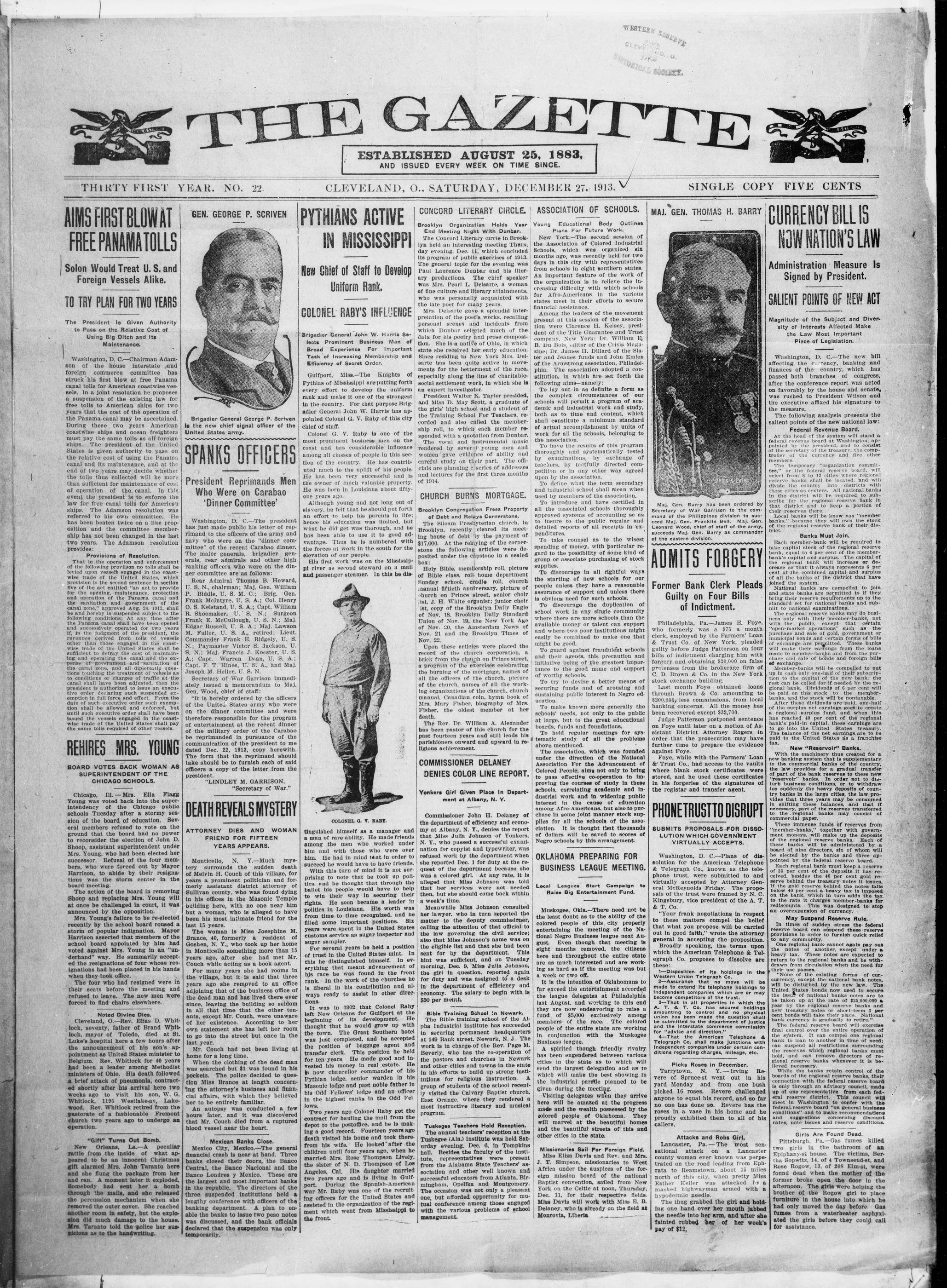
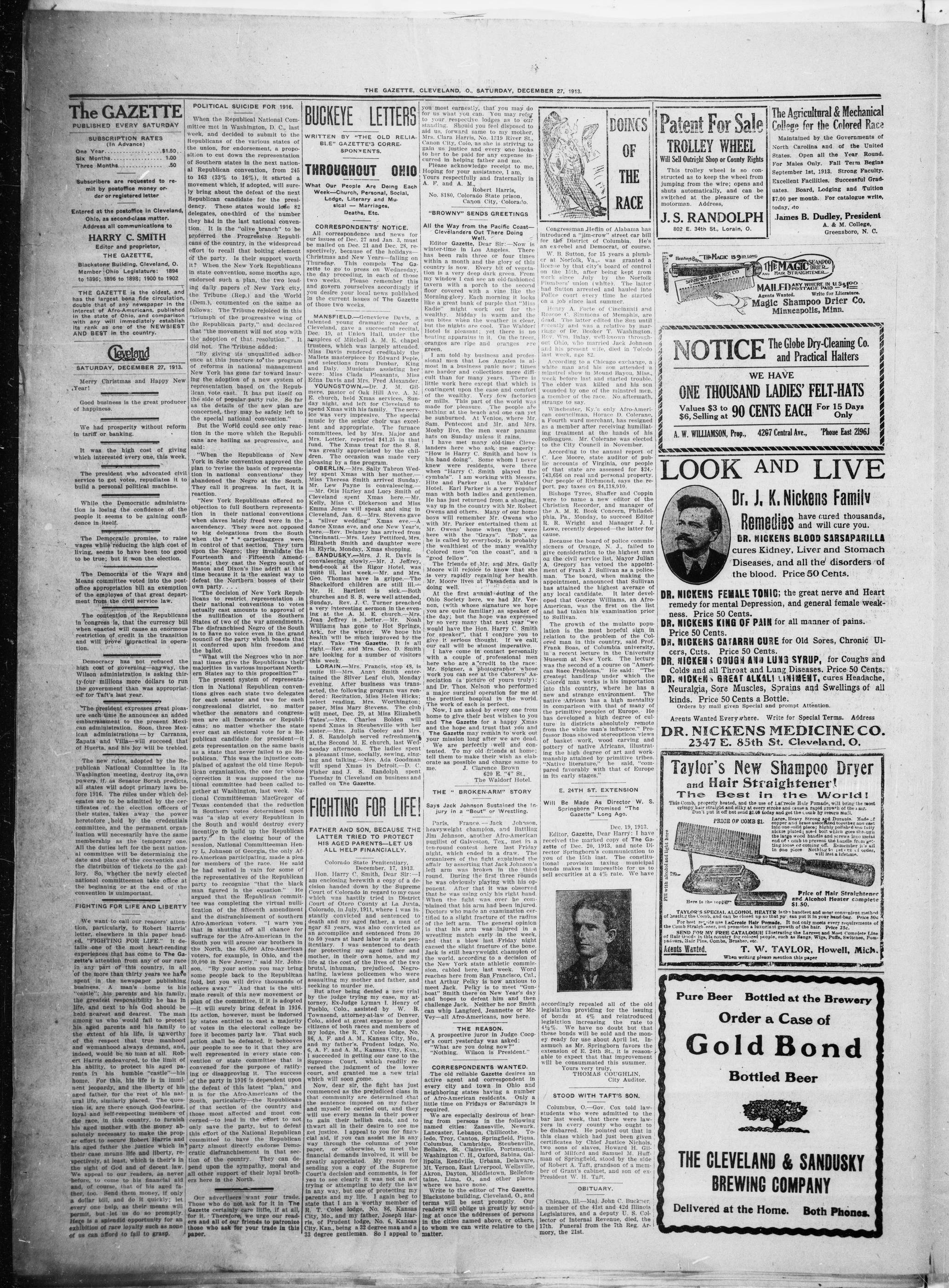
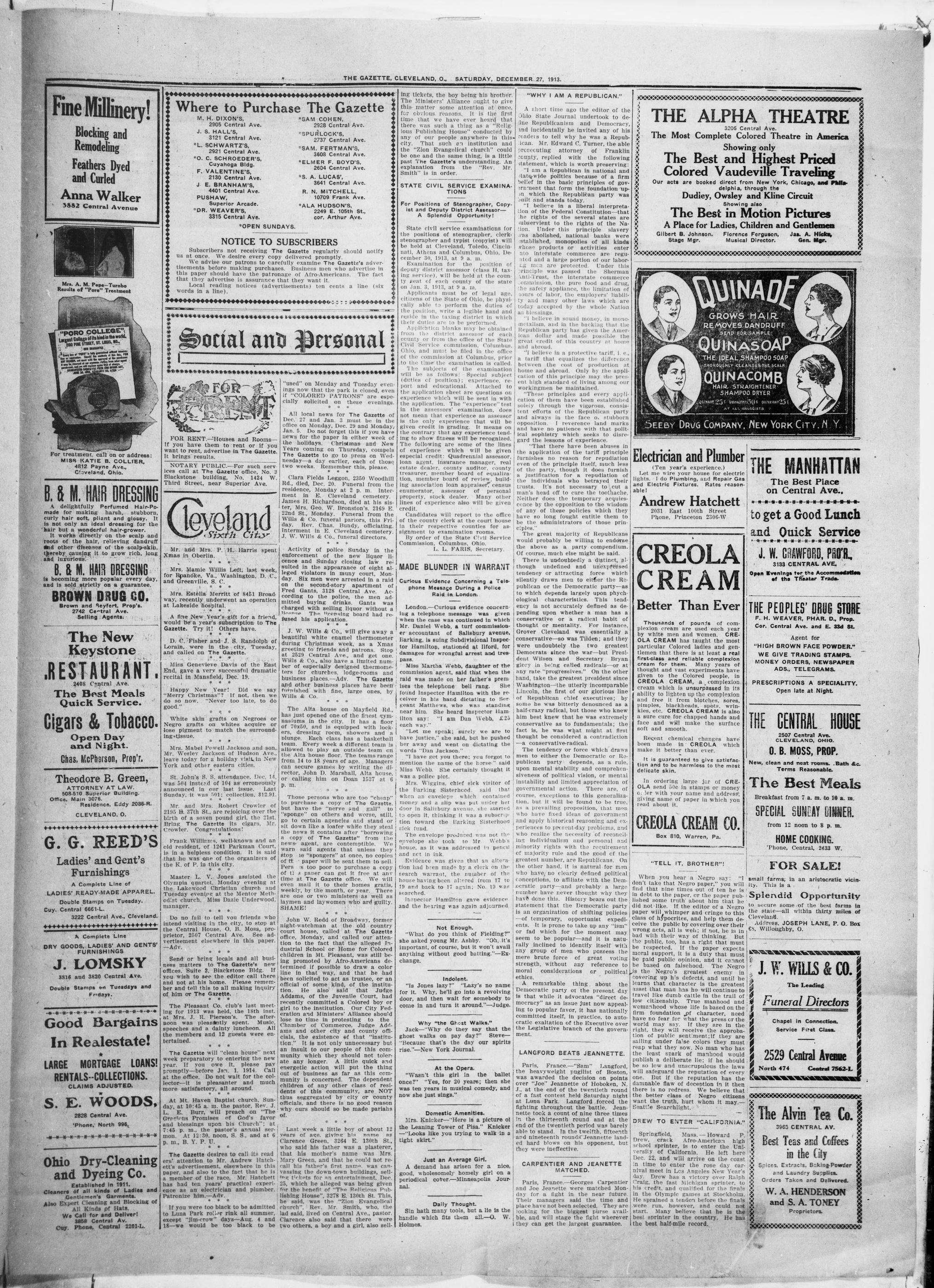
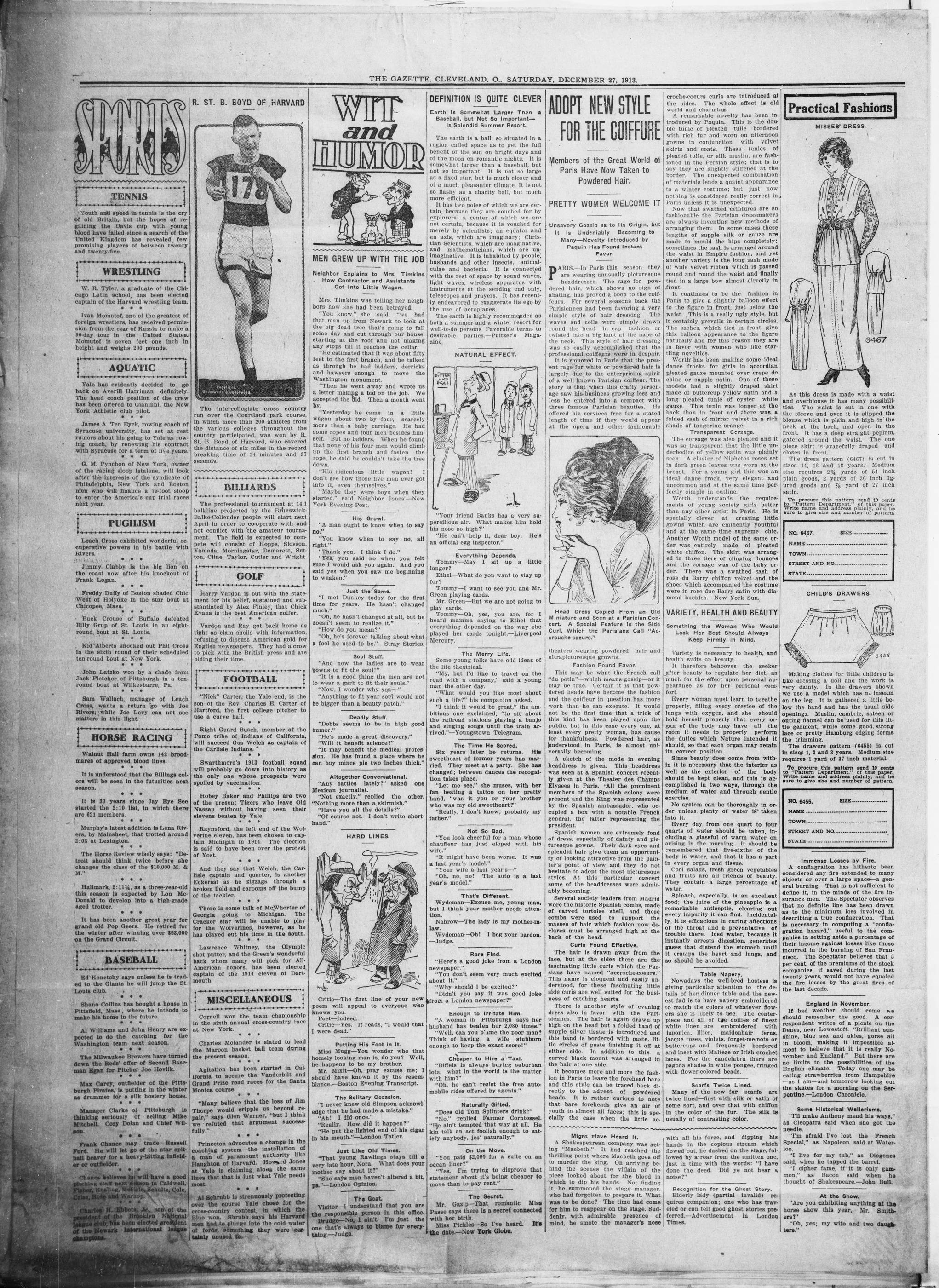
Page text (machine-generated)
THIRTY FIRST YEAR. NO. 22.
SERVICE
AIMS FIRST BLOWAT FREE PANAMATOLLS
Solon Would Treat U. S. and Foreign Vessels Alike.
TO TRY PLAN FOR TWO YEARS
The President Is Given Authority to Pass on the Relative Cost of Using Big Ditch and Its Maintenance.
Washington, D. G.—Chairman Adamson of the house interstate and foreign commerce committee has struck his first blow at free Panama canal tols for American coastwise vessels. In a joint resolution he proposes a suspension of the existing law for free tols to American ships for two years that the cost of the operation of the Panama canal may be ascertained. During these two years American coastwise ships and ocean freighters must pay the same tols as all foreign ships. The president of the United States is given authority to pass on the relative cost of using the Panama canal and its maintenance, and at the end of two years may decide whether the tols thus collected will be more than sufficient for maintenance of cost of operation of the canal. In this event the president is to enforce the law for free canal tols for American ships. The Adamson resolution was referred to his own committee. He has been beaten twice on a like proposition and the committee member ship has not been changed in the last two years. The Adamson resolution provides:
Provisions of Resolution:
Provisions of Resolution.
That in the operation and enforcement of the following provision no tolls shall be imposed on the canal and the wise trade of the United States, which provision is the second sentence in section five of the act entitled "an act to provide for the opening, maintenance, protection and authorization of the Panama canal and the sanitation of the canal zone," approved Aug. 24, 1912, shall be and hereby is suspended subject to the following conditions: At any time after the opening, maintenance, protection and successively operated for two years if, in the judgment of the president, the revenues derived from tolls of vessels other than those engaged in the coastward navigation sufficient to defray the cost of maintaining and operating the canal and the expense of government and sanitation of the canal zone, and all diplomatic questions arising from the canal to conditions or charges of traffic at the canal shall have been adjusted, then the president is authorized to issue an execution of the provisions in the emption in full force and effect. From the date of such executive order such exemption shall be allowed and enforced, but until such executive order shall have been issued by the president or wise trade of the United States shall pay the same tolls required of other vessels.
REHIBES MRS. YOUNG
BOARD VOTES BACK WOMAN AS SUPERINTENDENT OF THE CHICAGO SCHOOLS.
Chicago, Ill. — Mrs. Ella Flagg Young was voted back into the superintendency of the Chicago public schools Tuesday after a stormy session of the board of education. Several members refused to vote on the ground that the board had no power to reconsider the election of John D. Shoop, assistant superintendent under Mrs. Young, who had been elected her successor. Refusal of the four members, who were forced out by Mayor Harrison, to abide by their resignations was the storm center in the board meeting.
The action of the board in removing Shoop and replacing Mrs. Young will at once be challenged in court, it was announced by the opposition.
Mrs. Young's failure to be re-elected recently by the school board roused a storm of popular indignation. Mayor Harrison asserted that members of the school board appointed by him had voted against Mrs. Young in an "underhand" way. He summarily accepted the resignations of four whose resignations had been placed in his hands when they took office.
The four who had resigned were in their seats before the meeting and refused to leave. The new men were forced to find chairs elsewhere.
Noted Divine Dies
Cleveland, O.—Rev. Elias D. Whitlock, seventy, father of Brand Whitlock, mayor of Toledo, died at St. Luke's hospital here a few hours after the announcement of his son's appointment as United States minister to Belgium. Rev. Whitlock for 40 years had been a leader among Methodist ministers of Ohio. His death followed a brief attack of pneumonia, contracted shortly after his arrival here two weeks ago to visit his son, W. G. Whitlock, 1195 Westlake-av, Lakewood. Rev. Whitlock retired from the pastorate of a fashionable Fremont church two years ago to undergo an operation.
"Gift" Turns Out Bomb.
New Orleans, La.—A peculiar rattle from the inside of what appeared to be an innocent Christmas gift alarmed Mrs. John Taranto here and she flung the package from her and ran. A moment later it exploded. Somebody had sent her a bomb through the mails, and she released the percussion mechanism when she removed the outer cover. She reached another room in safety, but the explosion did much damage to the house. Mrs. Taranto told the police her suspicions as to the handwriting.
THE GAZETTE
GEN. GEORGE P. SCRIVEN
Brigadier General George P. Scriven is the new chief signal officer of the United States army.
Washington, D. C.—The president has just made public his letter of reprimand to the officers of the army and navy who were on the "dinner committee" of the recent Carabao dinner. The major generals, brigadier generals, rear admirals and other high ranking officers who were on the dinner committee are as follows:
Rear Admiral Thomas B. Howard, U. S. N, chairman; Maj. Gen. William P. Biddle, U. S. M. C.; Brig. Gen. Frank McIntyre, U. S. A.; Col. Henry O. S. Kelstand, U. S. A.; Captain William R. Shemaker, U. S. N.; Surgeon Frank E. McCullough, U. S. N.; Mal. Edgar Russell, U. S. A.; Maj. Lawson M. Fuller, U. S. A. retired; Lieut. Commander Frank E. Ridgely, U. S. N.; Paymaster Victor S. Jackson, U. S. N.; Maj. Francis J. Koester, U. S. A.; Capt. Warren Dean, U. S. A.; Capt. F. T. Hines, U. S. A., and Maj. Joseph M. Heller, U. S. N.
Secretary of War Garrison immediately issued a memorandum to Maj. Gen. Wood, chief of staff:
"It is hereby ordered by the officers of the United States army who were on the dinner committee and were therefore responsible for the program of entertainment at the recent dinner of the military order of the Carabao be reprimanded in pursuance of the communication of the president to dated Dec. 22, 1913, copy herewith. The form that the reprimand should take should be to furnish each of said officers a copy of the letter from the president.
"LINDLEY M. GARRISON,
"Secretary of War."
DEATH REVEALS MYSTERY
ATTORNEY DIES AND WOMAN
FRIEND FOR FIFTEEN
YEARS APPEARS.
Monticello, N. Y.—Much mystery surrounds the sudden death of Melvin H. Couch of this village, for years a prominent politician and formerly assistant district attorney of Sullivan county, who was found dying in his offices in the Masonic Temple building here, with no one near him but a woman, who is alleged to have been his most intimate friend for the last 15 years.
The woman is Miss Josephine M. Brance, 40, formerly a resident of Goshen, N. Y., who took up her home in Monticello something more than 15 years ago, after she had met Mr. Couch while acting as a book agent.
For many years she had rooms in the village, but it is said that three years ago she removed to an office adjoining that of the business office of the dead man and has lived there ever since, leaving the building so seldom in all that time that the other tenants, except Mr. Couch, were unaware of her existence. According to her own statement she has left her room to go into the street but once in the last year.
Mr. Couch had not been living at home for a long time.
When the clothing of the dead man was searched but $1 was found in his pockets. The police decided to question Miss Brance at length concerning the attorney's business and financial affairs, with which they believed her to be entirely familiar.
An autopsy was conducted a few hours later, and it was discovered that Mr. Couch died from a ruptured blood vessel near the heart.
Mexican Banks Close
Mexico City, Mexico.-The general financial crash is near at hand. Three banks closed their doors, the Banco Central, the Banco Nacional and the Banco Londres y Mexico. These are the largest and most important banks in the republic. The directors of the three suspended institutions held a lengthy conference with officers of the banking department. A plan to enable the banks to issue two peso notes was discussed, and the bank officials declared that the suspension was only temporarily.
ESTABLISHED AUGUST 25, 1883 AND ISSUED EVERY WEEK ON TIME SINCE.
New Chief of Staff to Develop Uniform Rank.
GOLONEL RABY'S INFLUENCE
Brigadier General John W. Harris Selects Prominent Business Man of Broad Experience For Important Task of Increasing Membership and Efficiency of Secret Order.
Gulfport, Miss.-The Knights of Pythias of Mississippi are putting forth every effort to develop the uniform rank and make it one of the strongest in the country. For that purpose Brigadier General John W. Harris has appointed Colonel G. V. Raby of this city chief of staff.
Colonel G. V. Raby is one of the most prominent business men on the coast and has considerable influence among all classes of people in this section of the country. He has contributed much to the uplift of his people. He has been very successful and is the owner of much valuable property. He was born in Louisiana about fifty-one years ago.
Although young and not long out of slavery, he felt that he should put forth an effort to help his parents in life hence his education was limited, but what he did get was thorough, and he has been able to use it to good advantage. Thus he is numbered with the forces at work in the south for the elevation of our people.
His first work was on the Mississippi river as second steward on a mail and passenger steamer. In this he dis-
COLONEL G. V. RABY.
tinguished himself as a manager and a man of rare ability. He made friends among the men who worked under him and with those who were over him. He had in mind that in order to succeed he would have to have friends. With this turn of mind it is not surprising to note that he took up politics, and he thought that through the ballot his people would have to help to win their way in securing their rights. He soon became a leader in politics in Louisiana. His worth was from time to time recognized, and he filled some important positions. Six years were spent in the United States customs service as sugar inspector and sugar sampler. For several years he held a position of trust in the United States mint. In this he distinguished himself. In everything that meant advancement of his race he was found in the front rank. In the work of the churches he is liberal in his contribution and always ready to assist in other directions.
It was in 1902 that Colonel Raby left New Orleans for Gulfport at the beginning of its development. He thought that he would grow up with the town. The Great Southern hotel was just completed, and he accepted the position of baggage agent and transfer clerk. This position he held for ten years. He made good and invested his money in real estate. He is now chancellor commander of his Pythian lodge, senior warden in his Masonic lodge and past noble father in his Odd Fellows' lodge and an officer in the highest ranks in the Odd Fellows.
Two years ago Colonel Raby got the contract for hauling the mail from the depot to the postoffice, and he is making a good record. Fourteen years ago death visited his home and took therefrom his wife. He looked after the children until four years ago, when he married Mrs. Rose Thompson Lively, the sister of N. D. Thompson of Los Angeles. Cal. His daughter married two years ago and is living in Gulfport. During the Spanish-American war Mr. Raby was one of the recruiting officers for the United States and assisted in the organization of the regiment which went from Mississippi to the front.
CONCORD LITERARY CIRCLE.
Brooklyn Organization Holds Year
End Month Night With Rushers
End Meeting Night With Dunbar.
The Concord Literary circle in Brooklyn held an interesting meeting Thursday evening, Dec. 11, which concluded its program of public exercises of 1913. The general topic for the evening was Paul Laurence Dunbar and his literary productions. The chief speaker was Mrs. Pearl L. Delsarte, a woman of fine culture and literary attainments, who was personally acquainted with the late poet for many years.
Mrs. Delsarte gave a splendid interpretation of the poet's works, recalling personal scenes and incidents from which Dunbar selected much of the data for his poetry and prose composition. She is a native of Ohio, in which state she received her early education. Since residing in New York Mrs. Delsarte has been quite active in movements for the betterment of the race, especially along the line of charitable-social settlement work, in which she is an expert investigator.
President Walter K. Tierley presided, and Miss D. May Scott, a graduate of the girls' high school and a student of the Training School For Teachers, recorded and also called the membership roll, to which each member responded with a quotation from Dunbar. The vocal and instrumental music rendered by several young men and women gave evidence of ability and careful study on their part. The officials are planning a series of addresses and lectures for the first three months of 1914.
CHURCH BURNS MORTGAGE.
Brooklyn Congregation Fresn Property of Debt and Relaks Cornerstone. The Siloam Presbyterian church. In Brooklyn, recently cleared its meeting house of debt by the payment of $17,000. At the relaying of the cornerstone the following articles were deposited under the cushion in a sealed box: Holy Bible, membership roll, picture of Bible class, roll home department Sunday school, candle roll, church manual fifth anniversary, picture of church on Prince street, senior chair l. J. H. White organist; junior chair l. copy of the Brooklyn Daily Eagle of Nov. 18, Brooklyn Daily Standard Union of Nov. 19, the New York Age of Nov. 20, the Amsterdam News of Nov. 21 and the Brooklyn Times of Nov. 22. Upon these articles were placed the record of the church corporation, a brick from the church on Prince street, a program of the exercises celebrating the burning of the mortgage, names of all the officers of the church, picture of the church, names of all the working organizations of the church, church manual, Canadian coin, hymn book of Mrs. Mary Fisher, biography of Mrs. Fisher, the oldest member at her death. The Rev. Dr. William A. Alexander has been pastor of this church for the past fourteen years and still leads his parishioners onward and upward in religious achievement.
COMMISSIONER DELANEY
DENIES COLOR LINE REPORT.
Yonkers Girl Given Place In Department at Albany, N. Y.
Commissioner John H. Delaney of the department of efficiency and economy at Albany, N. Y., denies the report that Miss Julia Johnson of Yonkers, N. Y., who passed a successful examination for copyist and typewriter, was refused work by the department when she reported Dec. 1 for duty at the request of the department because she was a colored girl. At any rate, it is alleged that Miss Johnson was told that her services were not needed then, but she should come back within a week's time.
Meanwhile Miss Johnson consulted her lawyer, who in turn reported the matter to the deputy commissioner, calling the attention of that official to the law governing the civil service; also that Miss Johnson's name was on the eligible list and that she had been sent for by the department. This hint was sufficient, and on Tuesday morning, Dec. 9, Miss Julia Johnson, the girl in question, reported again for duty and was assigned to a desk in the department of efficiency and economy. The salary to begin with is $50 per month.
Bible Training School in Newark.
The Bible training school of the Alpha Industrial institute has succeeded in securing permanent headquarters at 149 Bank street, Newark, N. J. The work is in charge of the Rev. Page M. Beverly, who has the co-operation of the pastors and churches in Newark and other cities and towns in the state in his efforts to build up strong institutions for religious instruction. A group of students of the school recently visited the Calvary Baptist church, East Orange, where they rendered a most instructive literary and musical program.
Tuskegee Teachers Hold Reception.
The annual teachers' reception at the Tuskegee (Ala.) institute was held Saturday evening, Dec. 6, in Tompkins hall. Besides the faculty of the institute, representatives were present from the Alabama State Teachers' association and other well known and successful educators from Atlanta, Birmingham, Opelika and Montgomery.
The occasion was not only a pleasant one, but afforded opportunity for mutual conference among those engaged with the various problems of school management.
WESTEEN RESERVE
OVER
CLYDE, N.D. O.
HISTORICAL SOCIETY
ASSOCIATION OF SCHOOLS.
Young Educational Body Outlines Plans For Future Work.
New York—The second session of the Association of Colored Industrial Schools, which was organized six months ago, was recently held for two days in this city with representatives from schools in eight southern states. An important feature of the work of the organization is to relieve the increasing difficulty with which schools for Afro-Americans in the various states meet in their efforts to secure financial assistance.
Among the leaders of the movement present at this session of the association were Clarence H. Kelsey, president of the Title Guarantee and Trust company. New York: Dr. William E. B. Du Bois, editor of the Crisis Magazine; Dr. James H. Dillard of the Sister and Jeanes funds and John Emlen of the Armstrong association, Philadelphia. The association adopted a constitution, in which are set forth the following aims—namely:
To lay out in as definite a form as the complex circumstances of our schools will permit a program of academic and industrial work and study, both as to time and content, which shall constitute a minimum standard of actual accomplishment by units of work for all the schools, belonging to the association.
The results of this program thoroughly and systematically tested by examinations, by exchange of teachers, by tactfully directed competition or in any other way agreed upon by the association.
To define what the term secondary and industrial school shall mean when used by members of the association.
To introduce and have certified in all the associated schools thoroughly approved systems of accounting so as to insure to the public regular and detailed reports of all receipts in expenditures.
To take counsel as to the wisest spending of money, with particular regard to the possibility of some kind of group or associate purchasing of stock supplies.
To discourage in all rightful ways the starting of new schools for our people unless they have a reasonable assurance of support and unless there is obvious need for such schools.
To discourage the duplication of school work in any single community where there are more schools than the available money or talent can support and where two poor institutions might easily be combined to make one that might be good.
To guard against fraudulent schools and their agents, this precaution and initiative being of the greatest importance to the good name and support of worthy schools.
To try to devise a better means of securing funds and of arousing and sustaining public interest in Negro education.
To make known more generally the schools' needs, not only to the public at large, but to the great educational boards, funds and foundations.
To hold regular meetings for systematic study of all the problems above mentioned.
The association, which was founded under the direction of the National Association For The Advancement of Colored People, aims not only to bring to pass effective co-operation in improving the courses of study in these schools, correlating academic and industrial work and in widening public interest in the cause of education among Afro-Americans, but also to purchase in some joint manner stock supplies for all the schools of the association. It is thought that thousands of dollars will be saved to scores of Negro schools by this arrangement.
OKLAHOMA PREPARING FOR BUSINESS LEAGUE MEETING.
Local Leagues Start Campaign to Raise Big Entertainment Fund.
Muskogee, Okla.—There need not be the least doubt as to the ability of the colored people of this city properly entertaining the meeting of the National Negro Business league next August. Even though that meeting is eight months removed, the citizens here and throughout the entire state are as much interested and are working as hard as if the meeting was but a week or two off.
It is the intention of Oklahomaans to far exceed the entertainment accorded the league delegate at Philadelphia last August, and working to this end they are now endeavoring to raise a fund of $5,000 exclusively among members of the race. The colored people of the entire state are working in conjunction with the Muskogee Business league.
A spiritied though friendly rivalry has been engendered between various cities in the state as to which will send the largest delegation and as to which will make the best showing in the industrial parade planned to be given during the meeting.
Visiting delegates when they arrive here will be amazed at the progress made and the wealth possessed by the colored people of Oklahoma. They will marvel at the beautiful homes and the beautiful streets of this and other cities in the state.
Missionaries Sail For Foreign Field. Miss Eliza Davis and Rev. and Mrs. J. T. Simpson, missionaries to West Africa under the auspices of the foreign mission board of the national Baptist convention at New York on a moon. On Dec. 11, for their respective fields Miss Davis will work with Miss E. B. Delaney, who is already on the field at Monrovia, Liberta.
TE SINGLE COP MAJ. GEN. THOMAS H. BARRY
HANDER & EMPIR
Maj. Gen. Barry has been ordered by Secretary of War Garrison to the command of the Philippines division to succeed Maj. Gen. Franklin Bell. Maj. Gen. Bernard Wood chief of staff of the army succeeds Maj. Gen. Barry as commander of the eastern division.
ADMITS FORGERY
Former Bank Clerk Pleads Guilty on Four Bills of Indictment.
Philadelphia, Pa.—James E. Foye, who formerly was a $75 a month clerk, employed by the Farmers' Loan & Trust Co. of New York, pleaded guilty before Judge Patterson on four bills of indictment charging him with for forgery and obtaining $20,000 on false pretenses from the brokerage firm of C. D. Brown & Co. in the New York stock exchange building.
Last month Foye obtained loans through Brown & Co. amounting to $200,000 less commissions, from local banking concerns. All the money has been recovered except $22,700.
Judge Patterson postponed sentence on Foye until later on a motion of Assistant District Attorney Rogers in order that the prosecution may have further time to prepare the evidence against Foye.
Foye, with while with the Farmers' Loan & Trust Co., had access to the vaults where blank stock certificates were stored, and he used these certificates in his forgeries of the signatures of the registar and transfer agent.
PHONETRUSTTODISRUPT
PHONETRUSTTODISRUPT
SUBMITS PROPOSALS-FOR DISSOLUTION WHICH GOVERNMENT VIRTUALLY ACCEPTS.
Washington, D. C.—Plans of dissolution for the American Telephone & Telegraph Co., known as the telephone trust, were submitted to and virtually accepted by Attorney General McReynolds Friday. The proposals of the trust were framed by N. C. Kingsbury, vice president of the A. T. & T. Co.
"Your frank negotiations in respect to these matters compel the belief that what you propose will be carried out in good faith," wrote the attorney general in accepting the proposition. Broadly speaking, the terms upon which the American Telephone & Telegraph Co. proposes to dissolve are these:
1—Disposition of its holdings in the Western Union Telegraph Co.
2—Assurance that no move will be made to extend its telephone holdings to independent companies which are or may become companies.
3—Thinking all properties in which the A. T. & T. Co. has secured holdings amounting to control and no physical property in which the American Telephone & Telegraph Co. may be submitted to the department of justice and the interstate commerce commission for "advice and direction."
3—That the American Telephone & Telegraph Co. will accept independent companies under certain conditions regarding charges, mileage, etc.
Picks Roses in December
Tarrytown, N. Y.—Irving Revere of Spruce-st went out in his yard Monday and from one bush picked 16 roses. Revere challenged anyone to equal his record, and so far no one has done so. Revere has the roses in a vase in his home and he proudly exhibited them to all of his callers.
Attacks and Robs Girl,
Lancaster, Pa.—The most sensational attack on a Lancaster county woman ever known was perpetrated on the road leading from Ephrata to Reamstown, about 15 miles north of this city, when pretty Miss Esther Keller was attacked by a masked highwayman armed with a hypodermic needle.
The thug grabbed the girl and holding one hand over her mouth jabbed the needle into her arm, and after she fainted robbed her of her week's pay of $12.
SINGLE COPY FIVE CENTS
Attacks and Robs Girl.
A
CURRENCY BILL IS NOW NATION'S LAW
Magnitude of the Subject and Diversity of Interests Affected Make the Law Most Important Piece of Legislation.
Washington, D. C.—The new bill affecting the currency, banking and finances of the country, which has passed both branches of congress, after the conference report was acted on favorably by the house and senate, was rushed to President Wilson and the executive affixed his signature to the measure.
The following analysis presents the salient points of the new national law: Federal Revenue Board.
At the head of the system will stand a federal revenue board at Washington, appointed by the president, and to consist of the secretary of the treasury, the comptroller of the currency and five other members.
The temporary "organization committee," or the federal reserve board, will from 8 to 12 cities where regional banks are located, and will divide the country into districts with these cities as centers. All national banks in the district will be required to subscribe for the regional reserve bank in that city to keep a portion of their reserves there.
Local banks will be known as "member banks," because they will own the stock of the regional reserve bank of their dis-
Banks Must Join.
Each member-bank will be required to take capital stock of the regional reserve bank, equal to 6 per cent of the member-bank's capital and surplus of all the banks of the district that have registered the regional bank will increase or decrease so that it always represents 6 per cent of the combined capital and surplus of all the banks of the district that have registered the regional bank may do business only with their member-banks, not with the public, except that certain banks may be compelled to purchase and sale of gold, government or municipal bonds and certain forms of bills of exchange are permitted. These banks will make their earnings from the banks of the member-banks and from the purchase and sale of bonds and foreign bills of exchange. Member-banks will be compelled to put money into the bank to the capital of the new bank; the rest can be called for if needed by the regional bank. Dividends of 6 per cent will be paid on this stock to the member-bank, and the rest will be paid to the member-bank's paid-in capital, these earnings are to go into the United States treasury. The balance of the net earnings are to be paid to the United States as a franchise
New "Reservoir" Banks.
With the machinery thus created for a new banking system that is supplementary to the commercial banks of the country, it is important to understand that part of the bank reserves to these new "reservoir" banks. In order not to disturb business conditions, or to withdraw too suddenly the heavy deposits of countryside banks, the reserves transferred to the regional banks may consist of commercial paper. In shifting these balances, and that if they are the reserves transferred to the regional banks may consist of commercial paper.
These immense funds of reserves from "member-banks," together with government money, will make up the deposits of the regional banks. These banks will be administered by a board of nine directors, six of whom will be elected by the banks and three appointed by the federal reserve board. These banks will have a total of 35 per cent of the deposits it has received, besides the 40 per cent gold reserve behind the treasury notes it issues. If the gold reserve behind the notes falls below the bank's allowance, the tax to the rate it charges member-banks for rediscounts. This was designed to stop an overexpansion of currency.
May Suspend Reserve Rule.
In many cases sudden stress the federal reserve provisions in order to furnish quick relief to any community.
One regional bank cannot again pay out the heavy tax. These notes are expected to return to the regional banks and be withdrawn from circulation when the need for their use passes.
The existing forms of currency, except the national bank notes, will be disturbed by the new law. The United States bonds now used to secure the national banks notes are to be taken by the regional reserves banks and new treasury notes or short-term 3 per cent bonds will take their place. National banks may also take their place.
The federal reserve board will exercise final control over the entire operation of the system. It can compel one regional bank to loan to another in time of need; it can compel the banks to hold the reserves which regional banks must hold, and can remove directors of regional reserve banks whenever it is beneficial. While the banks retain control of the boards of the regional reserve banks, their connection with the federal reserve board is only through an advisory council, made up of the board's members, the federal reserve district. This council will meet in Washington to confer with the federal reserve board "on general business conditions" and to make recommendations to the banks' rates, note issues and reserve conditions.
Girls Are Found Dead.
Pittsburgh. Pa.-Gas fumes killed two girls in the bathroom of an Epiphany-st house. The victims, Bertha Sopwitz, 14, of 4 Townseud-st, and Rose Rogow, 13, of 208 Elm-st, were found dead when the mother of the former broke open the door in the afternoon. The girls were helping the brother of the Rogow girl to place furniture in the house into which he had only moved the day before. Gas fumes from a waterheater asphyxated the girls before they could call for assistance.
PUBLISHED EVERY SATURDAY
SUBSCRIPTION RATES
(In Advance)
One Year.....$1.50.
Six Months.....1.00
Three Months......50
Subscribers are requested to remit by postoffice money order or registered letter
Entered at the postoffice in Cleveland, Ohio, as second-class matter.
Address all communications to
Blackstone Building, Cleveland, O.
Member Ohio Legislature: 1894
to 1896; 1896 to 1898; 1900 to 1902
THE GAZETTE is the oldest, and has the largest bona fide circulation, double that of any newspaper in the state of American, published in the state of Ohio, and comparison with any will immediately establish its rank as one of the NEWSIEST AND BEST in the country.
SATURDAY, DECEMBER 27, 1913.
Good business is the great producer of happiness.
We had prosperity without reform in tariff or banking.
It was the high cost of giving which interested every one, this week.
The president who advocated civil service to get votes, repudiates it to build a personal political machine.
While the Democratic administration is losing the confidence of the people it seems to be gaining confidence in itself.
The Democratic promise, to raise wages while reducing the high cost of living, seems to have been too good to be true; but it won the election.
The Democrats of the Ways and Means committee voted into the post-office appropriation bill an exemption of the employees of that great department from the civil service law.
The contention of the Republicans in congress is, that the currency bill when enacted will cause an enormous restriction of credit in the transition and will prove impractical in operation.
Democracy has not reduced the high cost of governing—anyway, the Wilson administration is asking thirty-four millions more dollars to run the government than was appropriated for Taft's last year.
"The president expresses great pleasure each time he announces an added embarrassment to the present Mexican administration. Soon, three Mexican administrations—by Carranza, Zapata and Villa—will succeed that of Huerta, and his joy will be trebled.
The new rules, adopted by the Republican National Committee in its Washington meeting, destroy its own powers, if, as Senator Borah predicts all states will adopt primary laws be fore 1916. The rules under which delegates are to be admitted by the certificates of the election officers of their states, takes away the power heretofore, held by the credentials committee, and the permanent organization will necessarily have the same membership as the temporary one. All the duties left for the next national committee will be determining the date and place of the convention and the distribution of tickets to the gallery. So, whether the newly elected national committeemen take office at the beginning or at the end of the convention is unimportant.
FIGHTING FOR LIFE AND LIBERTY
We want to call our readers' attention, particularly, to Robert Harris letter, elsewhere in this paper headed "FIGHTING FOR LIFE." It detains one of the most heart-rending experiences that has come to The Gazette's attention from any of our race in any part of this country, in all of the more than thirty years we have spent in the newspaper publishing business. A man's home is his "castle"; his parents and his family the greatest responsibility he has in life, and next to his God should be held nearest and dearest. The man among us who would fail to protect his aged parents and his family to the extent of his life, is unworthy of the respect that true manhood and womanhood always demand, and, indeed, would be no man at all. Robert Harris endeavored, to the limit of his ability, to protect his aged parents in his humble "castle"—his home. For this, his life is in imminent jeopardy, and the liberty of his aged father, for the rest of his natural life, similarly placed. The question is, are there enough God-fearing, loyal and self-respecting members of the race, in this country, to furnish his aged mother with the money absolutely necessary to make the proper effort to secure Robert Harris and his aged father the justice which in their case means life and liberty, respectively, at least, which is theirs in the sight of God and of decent law. We appeal to our readers, as never before, to come to his financial aid and, of course, that of his aged father, too. Send them money, if only a dollar bill, and do it quickly; let every one help, as their wills will permit, but let us do so promptly. Here is a splendid opportunity for an exhibition of race loyalty such as none of us can afford to fall to grasp.
POLITICAL SUICIDE FOR 1916.
When the Republican National Committee met in Washington, D. C., last week, and decided to submit to the Republicans of the various states of the union, for endorsement, a proposition to cut down the representation of Southern states in the next national Republican convention, from 245 to 163 (33% to 16%), it started a movement which, if adopted, will surely bring about the defeat of the next Republican candidate for the presidency. These states would lose 82 delegates, one-third of the number they had in the last national convention. It is the "olive branch" to be preferred the Progressive Republicans of the country, in the widespread effort to recall that bolting element of the party. Is their support worth it? When the New York Republicans in state convention, some months ago, endorsed such a plan, the two leading daily papers of New York city, the Tribune (Rep.) and the World (Dem.), commented on the same as follows: The Tribune rejoiced in this "triumph of the progressive wing of the Republican party," and declared that "the movement will not stop with the adoption of that resolution." It did not. The Tribune added:
"By giving its unqualified adherence at this juncture to the program of reforms in national management New York has gone far toward insuring the adoption of a new system of representation based on the Republican vote cast. It has put itself on the side of popular party rule. So far as the details of the new plan are concerned, they may be safely left to the special national convention."
But the World could see only reaction in the move which the Republicans are hailing as progressive, and said:
"When the Republicans of New York in Sate convention approved the plan to 'revise the basis of representation in national conventions' they abandoned the Negro at the South. They call it progress. In fact, it is reaction.
"New York Republicans offered no objection to full Southern representation in their national conventions when slaves lately freed were in the ascendancy. They were not opposed to big delegations from the South when the * * * carpetbaggers were in control of that section. They turn upon the Negro; they invalidate the Fourteenth and Fifteenth Amendments; they cast the Negro south of the South as a slave time because it is the easiest way to defeat the Northern bosses of their own party. . . .
"The decision of New York Republicans to restrict representation in their national conventions to votes actually cast amounts to approval of the nullification of the Southern States of two of the war amendments. The disfranchised Negro of the South is to have no voice even in the grand council of the party which boasts that it conferred upon him freedom and the right. "What will the Negroes who in normal times give the Republicans their majorities in various important Northern States say to this proposition?"
ern States say to this proposition?"
The present system of representation in National Republican conventions gives each state two delegates for each senator and two for each congressional district, no matter whether the senators and congressmen are all Democrats or Republicans; no matter whether the state ever cast an electoral vote for a Republican candidate for president—it gets representation on the same basis as a state that never failed to go Republican. This was the injustice complained of against the old time Republican organization, the one for whose correction it was supposed the national committee had been called to gather at Washington, last week. National Committeeman MacGregor of Texas contended that the reduction in Southern votes determined upon was "a slap at every Republican in the South and would destroy every incentive to build up the Republican party." In the closing hour of the session, National Committeeman Henry L. Johnson of Georgia, the only Afro-American participating, made a plea for members of the race. He said he had waited in vain for some of the representatives of the Republican party to recognize "that the black man figured in the equation." He argued that the Republican committee was completing the virtual nullification of the fifteenth amendment and the disfranchisement of southern Afro-American voters. "I warn you that in shutting off all chance for the afro-American in the South you will arouse our brothers in the North, the 65,000 Afro-American voters, for example, in Ohio, and the 30,000 in New Jersey," said Mr. Johnson. "By your action you may bring some people back to the Republican fold, but you will drive thousands of others away." And that is the ultimate result of this new movement or plan of the committee, if it is adopted—it will surely bring defeat in 1916. Its action, however, must be indorsed by states entitled to cast a majority of votes in the electoral college before it becomes party law. That such action shall be defeated, it behooves our people to see to it that they are well represented in every state convention or state committee that is convened for the purpose of ratifying or disapproving it. The success of the party in 1916 is dependent upon the defeat of this latest "plan," and it is for the Afro-Americans of the South, particularly—the Republicans of that section of the country and those most affected and most concerned—to lead in the effort to not only save the party, but to defeat this effort of the National Republican committee to have the Republican party almost directly endorse Democratic disfranchisement in that section of the country. They can depend upon the sympathy, moral and all other support of their loyal brothers here in the North.
Our advertisers want your trade. Those who do not ask for it in The Gazette certainly care little, if at all, for it. Therefore, we urge our readers and all of our friends to patronize who ask for your trade in this paper.
THE GAZETTE, CLEVELAND, O., SATURDAY, DECEMBER 27, 1913.
WRITTEN BY "THE OLD RELIA
BLE" GAZETTE'3 CORRE-
SPON'ENTS.
What Our People Are Doing Each Week—Church, Personal, Social, Lodge, Literary and Musical — Marriages, Deaths, Etc.
CORRESPONDENTS' NOTICE.
All correspondence and news for our issues of Dec. 27 and Jan. 3, must be mailed on Dec. 21 and Dec. 28, respectively, because of the holidays—Christmas and New Years—falling on Thursday and compels The Gazette to go to press on Wednesday, the day preceding, in each of these two weeks. Please remember this and govern yourselves accordingly if you desire your local news published in the current issues of The Gazette of those two weeks.
MANSFIELD—Genevieve Davis, a talented young dramatic reader of Cleveland, gave a successful recital, Dec. 19, at Union Hall, under the masters of Mitchell A. M. E. chapel trustees, which was largely attended. Miss Davis rendered creditably the Mallets masterpiece by Edward Peple, sections from Dunbar, King and Duncan musicians; were Miss Clada pleasing. Miss Edna Davis and Mrs. Fred Alexander. YOUNGSTOWN—Dr. J. M. Gillmere, pastor of Oak Hill Ave. A. M. E. church, held Xmas services, Sunday night, and left for Cleveland to spend Xmas with his family. The service was very impressive. The special music by the senior choir was excellent and appropriate. The furnace committees, led by Mrs. Major and Mrs. Lottler, reported $41.25 in that fund. The choir was greatly appreciated by the children. The occasion was made very pleasing by a fine program.
OBERLIN.—Mrs. Sally Tabron Wedley spent Xmas with her mother.—Miss Theresa Smith arrived Sunday. Mr. Lew Payne is convalescing.—Mr. Otis Harley and Lucy Smith of Cleveland spent Xmas here.—Mr. Kelly, Miss C. Dickerson and Miss Emma Jones will speak and sing in Cleveland, Jan. 6.—Mrs. Stevens gave a "silver wedding" Xmas eve.—A Emma Jones will speak here.—Rev. Delaney has arrived from Cincinnati.—Mrs. Lucy Lepittford, Mrs. Elizabeth Smith and daughter were in Elvira. Monday, Xmas shopping.
SANDUSKY—Mrs. J. R. Davis is convalescing slowly.—Mrs. J. Jeffrey, head cook at the Rigor Hotel, was quite ill, last week—Mr. and Mrs. Geo. Thomas have la gripe—the Shackelford children are still ill.—Mr. H. Bartlett is sick.—Both churches and S. S. were well attended, Sunday. Rev. J. C. Turner preached a very interesting sermon in the evening at the A. M. E. church—Mrs. Jean Jeffrey is better. Mr. Noah Williams has gone to Hot Springs. We have a visitor. We health will be much improved by the stay. Take The Gazette. It is all right. Rev. and Mrs. Geo. D. Smith are looking for a number of visitors this week.
LORAIN—Mrs. Francis, stop 48, is quite ill—Mrs. Anna Smith entertained the Silver Leaf club, Monday evening. After business was transacted, the following program was rendered: Recitation, Miss Helen Hicks; select reading, Mrs. Worthington; paper, Miss Mary Stevens. The club will meet, Dec. 29, at Miss Elizabeth Tates’—Mrs. Charles Bolden will spend Xmas in Steubenville with her sister—Mrs. Julia Cooley and Mrs. Sandra Randolph, with a reception at the Schoen M. E church, last Wednesday afternoon. The ladies spent a pleasant time, socially, sewing, singing and talking. Mrs. Ada Goodman will spend Xmas in Detroit.—D. C. Fisher and J. S. Randolph spent Tuesday in Cleveland on business and called on the Gazette.
FIGHTING FOR LIFE
FIGHTING FOR LIFE
FATHER AND SON, BECAUSE THE
LATTER TRIED TO PROTECT
HIS AGED PARENTS—LET US
ALL-HELP FINANCIALLY.
Colorado State Penitentiary,
December 17, 1913
Hon. Harry C. Smith, Dear Sir: I am enclosing here a copy of a decision handed down by the Supreme Court of Colorado in regard to my case which was hastily tried in District Court of Otero County at La Junta, Colorado, in July, 1911, where I was instantly convicted and sentenced to death and my aged father, a man of great courage, who was an accomplice and sentenced from 30 to 50 years at hard labor in state penitentiary. I was sentenced to death for protecting my aged father and mother, in their own home, and my life at the cost of the lives of the two brutal, inhuman, prejudiced, Negro population men who were assaulting my mother and father, and seeking to murder me.
But after being dented a new trial by the judge trying my case, my attorney, Ex-Judge Lyman I. Henry of Pueblo, Colo., assisted by W. B. Townsend, attorney-at-law of Denver, aloed at great expense, good citizen, and good friend my lodge, the R. T. Coles lodge, No. 86, A. F. and A. M. Kansas City, Mo., and my father's. Prudent lodge, No. 6, A. F. and A. M. Kansas City, Kan., I succeeded in getting our case to the Supreme Court, which readily re-covered the amount of the lower court, and granted me a new trial which will soon come.
Now, dear sir, the fight has just commenced as the prejudiced class in that community are determined that the sentence imposed on my father and myself be carried out, and they will use every means in their power to gain their hellish ends, and to allude to the fact that they will get justice. I appeal to you for financial aid, if you can assist me in any way through the columns of your paper, or otherwise, to meet the financial demands involved, it will be greatly appreciated. My reason for sending you a copy of the Supreme Court's decision and comments, is for you to see clearly it was not an act trying or attempting to defy the law in any way, but one of my parents paraded me. I again beg to see that I am a worthy member of R. T. Coles lodge, No. 86, Kansas City, Mo, and my father, Joseph Harris, of Prudent lodge, No. 6, Kansas City, Kan, being a 32 degree man and a 33 degree gentleman. So I appeal to
you most earnestly, that you may do for us what you can. You may refugiate to your respective lodges as to our standing. Should you feel disposed to aid us, forward same to my mother. Mrs. Clara Harris, No. 1319 River St., Canon City, Colo, as she is striving to gain us justice and every one looks to her to be paid for any expense incurred in helping father and me. Please acknowledge receipt to me. Hoping for your assistance, I am. Yours respectfully and fraternally in A. F. and A. M., Robert Harris, No. 8180, Colorado State prison, Canon City, Colorado.
All the Way from the Pacific Coast—Clevelandands Out There Doing Well.
Editor Gazette, Dear Sir;—Now is winter-time in Los Angeles. There has been rain three or four times within a month and the glory of this country is now. Every bit of vegetation is a very dark green. From my window I can see a old ashland tavern with a porch to the second floor covered with a vine like the Morningglory. Each morning it looks like a great bank of purple that "Miss Eadie" might work out for the wealthy. Midday is warm and the sun bites when the weather is clear, but the nights are cool. The Waldorf Academy is yet there. No heating apparatus in it. On the tree oranges are ripe and oranges are green.
I am told by business and professional men that Los Angeles is almost in a business panic now; times are harder and collections more difficult than for many years. There is little work here except that which is contingent upon the ease and comfort of the wealthy. Very few factories are made for pleasure. The people are bathing at the beach and one can yet be sunburned. At Venice, who Sam, Pentecost and Mr., and Mrs. Mosby live, the men wear panama hats on Sunday unless it rains.
I have met many old-time Clevelanders here who ask me eagerly: "How is Harry C. Smith and how is his band doing?" Some whom I never knew were residents, were there when "Harry C. Smith played the cymbals and I am working with Messrs. I am working with Messrs. Hotel, Earl Parker is a very popular man with both ladies and gentlemen. He has just returned from a shooting, way up in the country with Mr. Robert Owens and others. Many of our home boys will remember Mr. Owens who with Mr. Parker entertained them at Mr. Owens' home when they were here with the "Grays". "Bob", as he is called by everybody, is probably the wealthiest of the many wealthy Colored men "on the coast", and "good friends of Mr. and Mrs. Gally Moore will rejoice to know that she is very rapidly regaining her health. Mr. Moore lives at Passadena and is doing well.
At the first annual outing of the Ohio Society here, we had Mr. Vernon, (with whose signature we hope you are quite familiar) as speaker of the day; but the hope was expressed by so very man that next year we "wrote a book" to H. H. H. C. (S. C. for speaker," that I conjure you to give it serious thought. If we call, our call will be almost imperative. I have come in contact personally with a couple of professional men here who are a "credit to the race: Mr. Spigner, a photographer whose work you can see at the Catered Association picture gallery." And Dr. Thos. Nelson who performed a major surgical operation for me at the prettiest hospital in the world. The work of each is perfect.
Now, I am asked by every one from home to give their best wishes to you and The Gazette for a happy Xmas and the hope and trust that you and The Gazette may remain to work out your mission long after we are dead and to be treated. To my old friends at home, tell them to make their wish as elaborate as possible and charge same to me. J. Clarence Brown
THE "BROKEN-ARM" STORY
Says Jack Johnson Sustained the Injury in a "Bout" or Wrestling.
Paris, France — Jack Johnson, heavyweight champion, and Battling Jim Johnson, another Afro-American pugilist of Galveston, Tex., met in a ten-round contest here last Friday night, which ended in a draw. The organizers of the fight explained the affair by asserting that Jack Johnson's left arm was broken in the third round. During the first three rounds he was obviously playing with his opponent. After that it was observed that the fight was over. When the fight was over he complained that his arm had been injured. Doctors who made an examination certified to a slight fracture of the radius of the left arm. The general opinion is that his arm was injured in a wrestling match early in the week, and that a blow last Friday night caused the slight fracture of the bone. Jack is still heavyweight champion of the world, according to a decision of the New York state court. He was last week. Word reaches here from San Francisco, Cal., that Arthur Pelky is now anxious to meet Jack. Pelky is to meet "Gunbah" Smith there on New Year's day and hopes to defeat him and then challenge Jack. Neither he nor Smith can wipe Langford, Jeannette or McVey—all Afro-Americans, now here.
THE REASON.
A prospective juror in Judge Cooper's court yesterday was asked: "What are you doing now?" "Nothing. Wilson is President."
CORRESPONDENTS WANTED.
The old reliable Gazette desires an active agent and correspondent in every city and town in Ohio and neighboring states having a number of Afro-American residents. Only a little time on Fridays or Saturdays is required.
We are especially desirous of hearing from persons in following municipalities in Newark, Lancaster, Lebanon, Chillicothe, Toledo, Troy, Canton, Springfield, Piqua, Columbus, Cambridge, Steubenville, Bellaire, St. Clairsville, Portsmouth, Washington C. H., Oxford, Sabina, Galipolis, Rendville, Urbana, Delaware, Mt. Vernon, East Liverpool, Wellsville, Akron, Dayton, Middletown, Bellefontaine, Minneapolis, O and other places here we have none.
Write to the editor of The Gazette. Blackstone building, Cleveland, O. and terms will be sent promptly. Our readers will oblige us greatly by sending at once the addresses of persons in the cities named above, or others, to whom we can write relative to the matter.
DOINCS
OF
THE
RACE
Congressman Heflin of Alabama has introduced a "jim-crow" street car bill for the District of Columbia. He's an ex-rebel and Democrat, of course.
W. B. Sutton, for 15 years a plumber at Norfolk, Va., was granted a license by that city's board of control on the 15th, after being kept from work since July by the Norfolk Plumbers' union (white). The latter had Sutton arrested and hauled into Police court every time he started on a job since last summer.
Henry A. Forte of Cincinnati and Ralph Simmons of Memphis, are dead. The former edited the Sunnell recently and was a relative by marriage of Dr. Booker T. Washington. Rev. Wm. Balay, well known throughout Ohio, who married Jack Johnson and his present wife, died in Toledo last week, age 82.
According to a Chicago exchange, a white man and his son attended a minstrel show in Mound Bayon, Miss, week before last and started trouble, which was wounded by one of the minstrel men, a member of the race. No aftermath, strange to say.
Winchester, Ky.'s only Afro-American councilman, Horace D. Colerane, a Fourth ward merchant, has resigned as a member after receiving humiliating treatment at the hands of his colleagues. Mr. Colerane was elected to the City Council in November. According to the annual report of C.O.R.E., 74,356 on public accounts of Virginia, our people of that state are assessed for $24; 74,356 on real and personal property. Our people of Richmond, says the report, pay taxes on $4,118,910. Bishops Tyree, Shaffer and Coppin were to name a new editor of the Christian Recorder, and manager of the M. A. E. Book Concern, Philadelphia, Pa. Monday, to succeed Editor John Smith and Manager J. Lowe, recently deposed—the latter for cause.
Because the board of police commissioners of Orange, N. J., failed to give consideration to the highest man on the civil service list, Mayor Julian Greepman, the board appointed Frank J. Sullivan as a policeman. The board, when making the appointment, announced that Sullivan has attained the highest average of any local candidate. It later developed that George Williams, an Afro-American, was the first on the list when his examination prior to Sullivan.
The growth of the mulatto population is the most hopeful sign in relation to the problem of the Colored man in this country, said Prof. Frank Boas, of Columbia university, in a recent lecture in the University of Chicago. The culture was the second of a course on "American Race Problems." He said: "The greatest handicap under which the Colored man works is his importation into this country, where he has a new and strange environment. The native African has a high mentality in comparison with the people of Europe. He has developed a high degree of culture in districts absolutely remote from the white man's influence." Professor Boas showed stereotypic views of basket work, wood carving and pottery of native Africans, illustrating the high degree of cultural assimilation tribes. "Native literature," he said, "compared favorably with that of Europe in its early stages."
E. 24TH ST. EXTENSION
Will Be Made As Director W. S.
Springborn Promised "The
Gazette" Long Ago.
Dec. 19, 1913.
Editor, Gazette, Dear Harry: I have
received the marked copy of The
Gazette of Dec. 20, 1913, and note Director Springborn's communication to
you of the 15th inst. The constitu-
tional provision训 tung munificent
bonds makes it impossible for us to
sell securities at a 4% rate. We have
accordingly repealed all of the old legislation providing for the issuing of bonds at 4% and reintroduced legislation increasing the rate to 4%%. We have no doubt but that these bonds will be sold and the money ready for use about April 1st. Inasmuch as Mr. Springborn favors the extension of E. 24th St., it is reasonable to expect that that improvement will be consummated this summer.
Yours very truly,
THOMAS COUGHLIN.
City Auditor.
STOOD WITH TAFT'S SON.
Columbus, O.—Gov. Cox told law-
students who were admitted to the
bar last week, that there were law-
yers in every county who ought to
be disbarred. He pointed out that in
this class which had just been given
certificates by Chief Justice Nichols,
two sons of leaves, Howard H. Gli-
son, of Springfield, and Martin M.
man of Springfield, stood by the side
of Robert A. Taft, grandson of a mem-
ber of Grant's cabinet, and son of ex-
president W. H. Taft.
OBITUARY.
Chicago, Ill.—Maj. John C. Buckner, a member of the 41st and 42d Illinois Legislatures, and a deputy U. S. Collector of Internal Revenue, died, the 17th. Funeral from the 7th Reg. Armory, the 21st.
Heating Bars
THE MAGIC IS 9 IN LONG
THE MAGIC SEAMPOO
AND HAIR STRAIGHTENER
SEAMPOO DRIER MEE CO
MAILED ANYWHERE IN U.S.$100
POSTAGE PAID
Agents Wanted.
Write for Literature.
Magic Shampoo Drier Co.
Minneapolis, Minn.
LOOK AND LIVE
Remedies have cured thousands, and will cure you.
DR. NICKENS BLOOD SARSAPARILLA cures Kidney, Liver and Stomach Diseases, and all the disorders of the blood. Price 50 Cents.
DR. NICKENS FEMALE TONIC; the great nerve and Heart remedy for mental Depression, and general female weakness. Price 50 Cents.
DR. NICKENS KING OF PAIN for all manner of pains. Price 50 Cents.
DR. NICKENS CATARRH CURE for Old Sores, Chronic Ulcers. Cuts. Price 50 Cents.
DR. NICKEN'S COUGH AND LUNG SYRUP, for Coughes and
Colds and all Throat and Lung Diseases. Price 50 Cents.
DR. NICKEN'S GREAT ALKALI LINIMENT, cures Headache,
Neuralgia, Sore Muscles, Sprains and Swellings of all
kinds. Price 50 Cents a Bottle.
Orders by mail given Special and prompt Attention.
The Best in the World!
This Comb, properly heated, and the use of Lactoire Hair Pomade, will bring the most crimpy hair straight and silky at every stroke and cause a rapid growth of the air. Don't put it off but send $1.00 today and get the comb by return mail.
PRICE OF COMB $1.
Large, Heavy Strong and Durable. Made of copper and brass associated together and cast into one solid piece. Hinty polished and neat nickle plated; gas bolt which goes through the large wood handles and screws into metal end of comb to prevent the handle from getting loose or coming off. Remember it is all in one piece. Nothing to get out of order, will set a lifetime.
Fill with alcohol and light here
Here is the top 77
Pure Beer Bottled at the Brewery
Order a Case of
Gold Bond
Bottled Beer
THE CLEVELAND & SANDUSKY
BREWING COMPANY
Delivered at the Home. Both Phones.
Will Sell Outright Shop or County Rights This trolley wheel is so constructed as to keep the wheel from jumping from the wire; opens and shuts automatically, and can be switched at the pleasure of the motorman. Address,
802 E. 34th St., Lorain, O.
Heating Barre TIP-MAGIC IS 9 IN LONG
SHRIMP 90 DINER MUG CO.
M
As
Ma
NOTICE
WE
ONE THOUSAND
Values $3 to
$6, Selling at 90 CENT
A. W. WILLIAMSON, Prop., 42
LOOK A
Dr. J.
Remi
DR. MI
cures K
Disease
the blo
DR. NICKENS FEMALE TO
remedy for mental Depre
ness. Price 50 Cents.
DR. NICKENS KING OF PA
Price 50 Cents.
DR. NICKENS CATARRH C
The Agricultural & Mechanical College for the Colored Race
Maintained by the Governments of North Carolina and of the United States. Open all the Year Round. For Males Only. Fall Term Begins September 1st, 1913. Strong Faculty. Excellent Facilities. Successful Graduates. Board, Lodging and Tuition $7.00 per month. For catalogue write, today, to James B. Dudley, President A. & M. College, Greensboro, N. C.
Mrs. A. M. Pene—Turnbo
Results of "Pore" Treatment
"PORO COLLEGE"
Largest College of its kind in the world.
2000 PINE STREET, ST. LOUIS, IL.
(no address required)
Every box of "PORO" is hereby permitted without reserve
free or occupation. Secure a box of the box. For
additional information, call the nearest of the purchaser
it may be pursued at or resumes the purchase price.
Purchaser will be notified of the price by day.
SANDFIELD BOROUGH ST. LOUIS, ILL.
JUNE 10, 1918. GARANTY NO. 47248
For treatment, call on or address:
MISS KATIE B. COLLIER,
4812 Payne Ave.
Cleveland, Ohio.
B. & M. HAIR DRESSING
A delightfully Perfumed Hair-Pomade for making harsh, stubborn, curly hair soft, pliant and glossy. It is not only an ideal dressing for the hair but a wonderful hair-grower. It works directly on the scalp and roots of the hair, relieving dandruff and other diseases of the scalp-skim, thereby causing it to grow rich, long and luxurious.
B. & M. HAIR DRESSING is becoming more popular every day, and is sold strictly on a guarantee.
BROWN DRUG CO.
Brown and Seyfert, Prop's.
2742 Central Ave.
Selling Agents.
The New Keystone .RESTAURANT. 2408 Central Ave. The Best Meals Quick Service. Cigars & Tobacco.
Open Day and Night.
Theodore B. Green,
ATTORNEY AT LAW.
508-518 Superior Building.
Office, Main 3076.
Residence, Eddy 2086-R.
CLEVELAND, O.
G. G. REED'S
Ladies' and Gent's
Furnishings
A Complete Line of
LADIES' READY-MADE APPAREL.
Double Stamps on Tuesday.
Cuy. Central 6661-L.
3222 Central Ave., Cleveland.
A Complete Line
DRY GOODS, LADIES' AND GENTS'
FURNISHINGS.
Double Stamps on Tuesdays and Fridays.
Good Bargains
In Realestate!
LARGE MORTGAGE LOANS!
RENTALS--COLLECTIONS.
CLAIMS ADJUSTED.
S. E. WOODS,
2828 Central Ave.
'Phone: North 996.
Ohio Dry-Cleaning
and Dyeing Co.
Established in 1911.
Cleaners of all kinds of Ladies and
Gentlemen's Garments.
Also Expert Cleaning and Blocking of
All Kinds of Hats.
We Call for and Deliver!
3858 Central Av.
Cuy. Phone, Central 2201-L.
---
NOTICE TO SUBSCRIBERS
Subscribers not receiving T
us at once. We desire every cop
We advise our patrons to can
tisements before making purchas
this paper should have the patric
that they advertise is assurance
Local reading notices (adve
words in a line).
Subscribers not receiving The Gazette regularly should notify us at once. We desire every copy delivered promptly.
We advise our patrons to carefully examine The Gazette's advertisements before making purchases. Business men who advertise in this paper should have the patronage of Afro-Americans. The fact that they advertise is assurance that they want it.
Local reading notices (advertisements) ten cents a line (six words in a line).
FOR RENT.—Houses and Rooms—
If you have them to rent or if you
want to rent, advertise in The Gazette.
It brings results.
NOTARY PUBLIC.—For such services call at The Gazette office, No. 3
Blackstone building, No. 1424 W.
Third Street, near Superior Ave.
Cleveland
Sixth City
Mr. and Mrs. P. H. Harris spent
Xmas in Oberlin.
Mrs. Mamie Willis Left, last week,
for Rpanoke, Va., Washington, D. C.,
and Greenville, S. C.
Mrs. Estella Merritt of 8451 Broad
way, recently underwent an operation
at Lakeside hospital.
A fine New Year's gift for a friend,
would be a year's subscription to The
Gazette. Try it! Others have.
D. C. Fisher and J. S. Randolph of Lorain, were in the city, Tuesday, and called on The Gazette.
Miss Genevieve Davis of the East End, gave a very successful dramatic recital in Mansfield, Dec. 19.
Happy New Year! Did we say "Merry Christmas?" If not, then we do so now. "Never too late, to do good."
White skin grafts on Negroes or Negro grafts on whites acquire or lose pigment to match the surrounding-tissue.
Mrs. Mabel Powell Jackson and son, Mr. Wesley Jackson of Hudson Ave., leave today for a holiday visit in New York and other eastern cities.
St. John's S. S. attendance, Dec. 14, was 504 instead of 104 as erroneously announced in our last issue. Last Sunday, it was 501; collection, $12.91.
Mr. and Mrs. Robert Crowler of 2195 B. 37th St. are relocering over the birth of a seven pound girl, the 21st Bride. The Gazette its cigar, Mr. Crowler. Congratulations!
Frank Williams, well-known and an old resident, of 1241 Parkman Court, is in a helpless condition. It is said that he was one of the organizers of the K. of P. in this city.
Master L. V. Jones assisted the Olympia quartet. Monday evening at the Lakewood Christian church and Tuesday evening at the Mentor Methodist church. Miss Dazie Underwood, manager.
Do no fail to tell you friends who intend visiting in the city, to stop at the Central House, O. B. Moss, proprietor, 2507 Central Ave. See ad vertissement elsewhere in this paper.—Adv.
Send or bring locals and all business matters to The Gazette's new offices, Suite 2, Blackstone Bldg. If you wish to see the editor call there and not at his home. Please remember and tell this to all making inquiry of him or The Gazette.
The Pleasant Co. club's last meeting for 1913 was held, the 18th inst. at Mrs. J. H. Pleerson's. The after-school event spent Music speeches and a dainty luncheon. All the members and 12 guests were entertained.
The Gazette will "clean house" next week preparatory to entering the new year. If you owe it, please pay promptly—before Jan. 1. 1914. Call at the office. Do not wait for the collector—it is pleasanter and much more satisfactory, all around.
At Mt. Haven Baptist church, Sunday, at 10:45 a.m. the pastor, Rev. J. L. E. Burr will preach on "The Greatest Promises of God's favor and blessings upon his Church"; at 7:45 p. m., the pastor's annual sermon. At 12:30, noon, S. S., and at 6 p. m., B. Y. P. U.
The Gazette desires to call its readers' attention to Mr. Andrew Hatchett's advertisement, elsewhere in this paper, and also to the fact that he is a member of the race. Mr. Hatchett has had ten years' practical experience as an electrician and plumber. Patronize him.—Adv.
If you were too black to be admitted to Luna Park roller rink all summer, except "jim-crow" days—Aug. 4 and 18—we would be too black to be
The Gazette regularly should notify
they delivered promptly.
finitely examine The Gazette's adver-
ses. Business men who advertise in
image of Afro-Americans. The fact
that they want it.
artisements) ten cents a line (six
"used" on Monday and Tuesday even-
nings now that the park is closed, even if "COLORED PATRONS" are espe-
cially solicited on these evenings.
All local news for The Gazette of
Dec. 27 and Jan. 3 must be in the
office on Monday, Dec. 29 and Monday,
Jan. 5. Do not forget this if you have
news for the paper in either week of
the holidays. Christmas and New
Years coming on Thursday, compels
The Gazette to go to press on Wednes-
day—a day earlier, of those two
weeks. Remember this, please.
Clara Fields Leggon, 2350 Woodhill Rd., died, Dec. 20. Funeral from the residence, Monday at 2 p. m. Interment in E. Cleveland cemetery. James H. Richardson, died at his sister, Mrs. Gee, G. W. Bronstein, 2169 E. 22nd St. Monday. Funeral from the Wills & Co. funeral pariors, this Friday. Rev. Chas, Bundy, officiating. Interment in E. Cleveland cemetery. J. W. Wills & Co., funeral directors.
Activity of police Sunday in the enforcement of the new liquor licence and Sunday closing law resulted in the insurance of eight alleged violators in court Monday. Six men were arrested in a raid on the second-story apartment of Fred Gants, 3128 Central Ave. According to the police, the men admitted buying drinks. Gants was charged with selling liquor without a license. The licensing board had refused his application.
J. W. Wills & Co., will give away a beautiful white enamel thermometer during Christmas week, as a Xmas greeting to friends and patrons. Stop the car and ave., and get one. Wills & Co., also have a limited number of especially designed thermometers for churches, lodge-rooms and business places.—Adv. The Gazette and other business places have been furnished with fine, large ones, by Wills & Co.
The Alta house on Mayfield Rd., has just opened one of the finest gymnasiums in the city. It has a floor of 70x50, and is equipped with lockers, dressing room, showers and a plunge. Each class has a basketball team. Every week a different team is allowed to play a outside team on the Alta house floor. The team's range from 14 to 18 years of age. Managers can secure games by writing the director, John D. Marshall, Alta house, or calling him on Doan 1537 at 6 p.m.
Those persons who are too "cheap" to purchase a copy of The Gazette, but have the "nerve and gall" to "sponge on others and worse, still, go to certain agencies and stand or show up the news like a loafter while they steal the down it contains after "borrowing a copy of The Gazette" from the news agent, are contemptible. We warn said agents that unless they stop 1e "spongers" at once, no copies of ft. paper will be sent them to sell. Pers is too poor to purchase a copy of t; s paper can get it free at any time at The Gazette office. We will even mail it to their homes gratis, weekly, by the money year. There are one or two ministers as well as laymen and lay men who are guilty. SHAME!
John W. Redd of Broadway, former night-watchman at the old country court house, called at The Gazette office, Monday, and called our attention to the fact that the alleged Industrial School or Home for Colored children in Mt. Pleasant, was still being promoted by Afro-Americans determined if possible to draw a color line in that way, and that he had been solicited to act as trustee, or an official of some kind, of the institution. He also said that Judge Adams of the Juvenile Court had recently committed a Colored boy or girl to the institution. Our City Federation and Ministers' Alliance should lose no time in protesting to the Chamber of Commerce, Judge Adams and other city and county officials, the existence of that "institution." It is not only unnecessary but an insult to our people of this community which they should not tolerate any longer. A little quick and energetic action will put the thing out of business as far as this community is concerned. The dependent community of older residents of this community, are NOT thus segregated by city or county officials, and there is no good reason why ours should so be made pariads of.
Last week a little boy of about 12 years of age, giving his name as Clarence Green, 3264 E. 130th St., who said his father was a plasterer, that his mother's name was Mrs. Mary Green, and that he could not recall his father's first name, was canvassing the down-town buildings, selling tickets for an entertainment, Dec. 25, which he alleged was being given for the benefit of "The Religious Publishing House", 3278 E. 130th St. This, he said, was the "Zion Evangelical church". Rev. Mr. Smith, who the lad said, lived on Central Ave., pastor. Clarence also said that there were two others, a boy and a girl, also sell-
THE GAZETTE, CLEVELAND, O., SATURDAY, DECEMBER 27, 1913
Gazette
Central Ave.
Central Ave.
AN'S.
Central Ave.
BOYD'S.
Central Ave.
ing tickets, the boy himself his brother. The Ministers' Alliance ought to give this matter some attention at once, for obvious reasons. It is the first time that we have ever heard that there was such a thing as a "Religious publishing House" conducted by any of our people anywhere in this city. That such an institution and the "Zion Evangelical church" could be one and the same thing, is a little past The Gazette's understanding. An explanation from the "Rev. Mr. Smith" is in order.
"WHY I AM
A short time
Ohio State Joe
Republican
and incidental
readers to tell
ican. Mr. Ed'
replied
county, replied
statement, whi
"I am a our
Smith" is in order.
STATE CIVIL SERVICE EXAMINATIONS
For Positions of Stenographer, Copyist and Deputy District Assessor—A Splendid Opportunity!
State civil service examinations for the positions of stenographer, clerk-stenographer and typist (copyist) will be held at Cleveland, Toledo, Cincinnati, Athens and Columbus, Ohio, December 30, 1913, at 9 a. m.
Examination for the position of deputy district assessor (class H, taxing service), will be held at the county seat of each county of the state of Ohio, at 9 a. m. Applicants to the position of legal agent citizens of the State of Ohio, be physically able to perform the duties of the position, write a legible hand and reside in the taxing district in which their duties are to be performed
Application blanks may be obtained from the district assessor of each county or from the office of the State Civil Service commission, Columbus, Ohio, and must be filed in the office of the commission at Columbus, prior to the time the examination is called. The subjects of the examination will as follows: Special subject (duties of office); experience report and report education, attached to the application sheet are questions on experience which will be sent in with the application. The "experience" test in the assessors' examination, does not mean that experience as assessor is the only experience that will be given credit in grading. It means on the contrary that any experience tending to show fitness will be recognized. The following are some of the lines of experience which will be given especial credit: Quadrennial assessor, finance manager, real estate dealer, county auditor, county treasurer, member board of equalization, member board of review, building association loan appraiser, census enumerator, assessor of personal property, stock dealer. Many other lines of experience also will be given credit. Candidates will report to the office of the county clerk at the court house in their respective counties for assignment to examination rooms. By order of the State Civil Service Commission, County auditor. L. L. FARIS, Secretary.
MADE BLUNDER IN WARRANT
Curious Evidence Concerning a Tele phone Message During a Police Raid in London.
London. Curious evidence concerning a telephone message was given when the case was continued in which Mr. Daniel Webb, a turf commissioner accountant of Salisbury avenue, Barking, is suing Subdivisional Inspector Hamilton, stationed at Ilford, for damages for wrongful arrest and trespass.
Miss Martha Webb, daughter of the commission agent, said that when the raid was made on her father's premises the telephone bell rang. She found Inspector Hamilton with the receiver in his hand dictating to Sergeant Matthews, who was standing near him. She heard Inspector Hamilton say: "I am Dan Webb, £25 each way."
"Let me speak; surely we are to have justice," she said, but he pushed her away and went on dictating the words "Dan Jackson."
"I have get you there; you forgot to mention the name of the horse," said Miss Webb. She certainly thought it was a police plot.
Mrs. Wiggins, chief sick visitor of the Barking Sisterhood, said that when an envelope which contained money and a slip was put under her door in Salisbury avenue, she started to open it, thinking it was a subscription toward the Barking Sisterhood sick fund.
The envelope produced was not the envelope she took to Mr. Webb's house, as it was addressed in pencil and not in ink.
Evidence was given that an alteration had been made by a clerk on the search warrast, the number of the house having been altered from 17 to 19 and back to 17 again; No. 19 was searched.
Inspector Hamilton gave evidence and the hearing was again adjourned
Not Enough.
"What do you think of Fielding?" she asked young Mr. Ashby. "Oh, it's important, of course, but it won't avail anything without good batting."—Exchange.
Indolent.
"is Jones lazy?" "Lazy's no name for it. Why, he'll go into a revolving door, and then wait for somebody to come in and turn it around." —Judge
Jack—"Why do they say that the ghost walks on pay day?" Steve—"Because that's the day our spirits rise."—New York Journal.
At the Opera.
"Wasn't this girl in the ballet once?" "Yes, for 20 years; then she was ten years in musical comedy, and now she just sings."
Mrs. Knicker—"Here is a picture of the Leaning Tower of Pisa." Knicker—"Looks like you trying to walk in a tight skirt."
A demand has arisen for a nice, good, wholesomely homely girl on a periodical cover—Minneapolis Journal.
Daily Thought.
Sin hath many tools, but a lie is the handle which fits them all.—O. W. Holmes.
"WHY I AM A REPUBLICAN."
A short time ago the editor of the Ohio State Journal undertook to define Republicanism and Democracy, and incidentally he invited any of his readers to tell why he was a Republican. Mr. Edward C. Turner, the able prosecuting attorney of Franklin county, replied with the following statement, which is worth preserving: "I am a Republican in national and statewide politics because of a firm belief in the basic principles of government that form the foundation upward in the Republic party was built and stands to the rights of the Nation. Under this principle slavery was abolished, national banks were established, monopolies of all kinds whose products or activities enter into interstate commerce are regulated and a large portion of our laboring men are protected. Under this policy was passed the Sherman Anti-Trust law, the interstate commission, the pure food and drug, the safety appliance, the limitation of labor, the employers' liability and many other laws which are today accepted by the whole Nation as blessings.
"I believe in sound money, in monetarism, and in the backing that the Republican party has given the American and made possible the great credit of this country at home and abroad."
"I believe in a protective tariff, i.e. a tariff that gives the difference between the cost of production at home and abroad. Only by the application of this principle may the present high standard of living among our workingmen be maintained. Every application of them have been established solely through the vigorous, consistent efforts of the Republican party and always in the face o. stubborn opposition. I reverence land marks and have no patience with that political sophistry which seeks to disregard the lessons of experience. That there have been diseases in the army of the principle furnishes no reason for repudiation even of the principle itself, much less of the party, though it does furnish a justification for a repudiation of the individuals who betrayed their trusts. It's not necessary to cut a man's head off to cure the toothache. Neither does the temporary acquiescence by the opposition to the wisdom of any of these policies which they so long fought entitle them to be the administrators of those principles." The great majority of Republicans would probably be willing to endorse the above as a party compendium. Of course, much else might be said.
There is undoubtedly a distinct, although undefined and unexpressed tendency or attracting force which silently draws men to either the Republican or the Democratic party—as to which depends largely upon physiological characteristics. This tendency is not accurately defined as depending upon whether a man has a conservative or a radical habit of thought or mentality. For instance, Grover Cleveland was essentially a conservative—so was Tilden; and they were undoubtedly the two greatest Democrats since the war—but President Wilson and Secretary Bryan glory in being called radicals—or at any rate "progressives." On the other hand, take the greatest president since Washington—the utterly incomparable Lincoln, the first of our glorious line of Republican chief executives; by some he was bitterly denounced as a half-crazy radical, but those who knew him best knew that he was extremely conservative as to fundamentals; the fact is, he was what might at first thought be considered a contradiction—a conservative radical.
The tendency or force which draws men to either the Democratic or Republican party depends, as a rule, upon mental stability and comprehensiveness of political vision, or mental instability and limited appreciation of governmental action. There are, of course, exceptions to this generalization, but it will be found to be true, as a prevailing proposition, that men who have fixed ideas of government and apply historical reasoning and experiences to present-day problems, and who realize the necessity of reconciling individualism and personal and minority rights with the requirement of majority rule and the good of the greatest number, are Republicans. On the other hand, it is natural for men who have, no clearly defined political conceptions, to affiliate with the Democratic party—and probably a large number have never thought why they have done this. History bears out the statement that the Democratic party is an organization of shifting policies—of temporary, opportunist expedients. It is prone to take up any "ism" orad which for the moment may seem to be popular—and it is naturally inclined to identify itself with any group of men who possess the mere brute force of great voting strength, without any reference to moral considerations or political ethics.
A remarkable thing about the Democratic party or the present day is that while it advocates "direct democracy" as an issue just now appealing to popular favor, it has nationally committed itself, in practice, to auto-evaluation of the Executive over the Legislative branch of the government.
LANGFORD BEATS JEANNETTE.
Paris, France.—"Sam" Langford, the heavyweight pugilist of Boston, was awarded the decision on points over "Joe" Jeannette of Hoboken, N. J., at the end of the twentieth round of a fast contest held Saturday night at Luna Park. Langford forced the fighting throughout the battle. Jeannette took a count of nine three times in the thirteenth round and at the end of the fourth round, barely able to stand. In the twelfth flurry and nineteenth rounds Jeannette landed hard blows on his opponent, but they were ineffective.
CARPENTIER AND JEANETTE
MATCHED.
Paris, France—Georges Carpentier and Joe Jeanneette were matched Monday for a fight in the near future. Their managers said the time and place have not been selected. They are looking for the biggest purse available, and will stage the fight wherever they can get the largest guarantee.
QUINADE
GROWS HAIR
REMOVES DANDRUFF
SEAP FOR SAMPLE
QUINASOAP
THE IDEAL SHAMPOO 50AP
THOROUGHLY CLEANSER THE SCALR
QUINACOMB
HAIR. STRAIGHTENER
SHAMPOO DRYER
QUINADE 25¢ QUINACOMB 25¢ QUINADE 25¢
AT ALL DRUGGISTS
SEEBY DRUG COMPANY, NEW YORK CITY, N. Y.
Electrician and Plumber
(Ten year's experience.)
Let me wire your house for electric lights. I do Plumbing, and Repair Gas and Electric Fixtures. Rates reasonable!
Andrew Hatchett
2031 East 100th Street
Phone, Princeton 2306-W
CREOLA CREAM Better Than Ever
Thousands of pounds of complexion cream are used each year by white men and women. CREOLA CREAM has taught the most particular Colored ladies and gentlemen that there is at least a real first-class and reliable complexion cream for them. Many years of thought and experience have given to the Colored people, in CREOLA CREAM, a complexion cream which is unsurpassed in its ability to lighten up the complexion and free it from blotches, sores, pimples, blackheads, spots, wrinkles, etc. CREOLA CREAM is also a sure cure for chapped hands and face and will make the surface soft and smooth.
Recent chemical changes have been made in CREOLA which make it better than ever.
It is guaranteed to give satisfaction and to be harmless to the most delicate skin.
In ordering large jar of CREOLA send 500 in stamps or money o.ler with your name and address, giving name of paper in which you read about it.
CREOLA CREAM CO.
Box 810, Warren, Pa.
"TELL IT, BROTHER!"
When you hear a Negro say: "I don't take that Negro paper," you will find that nine times out of ten he is in debt to the paper, or the paper published some truth about him that he did not like. If the editor of a Negro paper will whisper and cringe to this class of hippocrites, and help them deceive the public by covering their wrong acts, all is well; if not, he is in bad with their way of thinking. But the public, too, has a right that must be respected. If the paper expects support, it is a duty that must be paid to the public, and it cannot be based on falschance. The Negro is the Negro's greatest enemy, covering up his defects, and until he learns that character is the greatest asset that man has will continue to travel like dumb cattle in the trail of low citizenship. True manhood and womanhood whose life is based on the firm foundation of character, need have no fear for what the press or the world may say. If they are in the right, they will receive the approbation of public sentiment; if they are under false colors they must reap what the No man who has the least spark of manhood would publish a deliberate lie if he should be so low and unscrupulous, the laws will safeguard the reputation of everyone. But if the reputation has the damnable flaw of deception in it then there is no redress. We believe that the better class of Negro citizens want the truth, hurt whom it may.—Seattle Searchlight.
DREW TO ENTER "CALIFORNIA."
Springfield, Mass.—Howard P. Drew, crack Afro-American high school spinner, is to enter the University of California. He left here Dec. 22, and will arrive on the coast in time to enter the rose day carnival meet in Los Angeles New Year's day. Drew has a victory over Ralph Craig, the fast Michigan spinner, to his credit, and qualified for the finals in the Olympic games at Stockholm. He sprained a tendon before the finals were run, however, and could not start. Many believe that he is the best spinner in the country. He has the best half-mile record.
THE MANHATTAN
The Best Place on Central Ave..
to get a Good Lunch and Quick Service
J. W. GRAWFORD, PRO'R..
3133 CENTRAL AVE.
Open Evenings for the Accommodation of the Theater Trade.
THE PEOPLES' DRUG STORE
F. H. WEAVER, PHAR. D., Prop.
Cor. Central Ave. and E. 33d St.
Agent for
"HIGH BROWN FACE POWDER."
WE GIVE TRADING STAMPS.
MONEY ORDERS, NEWSPAPER ADS, TELEGRAMS.
PRESCRIPTIONS A SPECIALITY.
Open late at Night.
THE CENTRAL HOUSE
2507 Central Ave.
CLEVELAND, OHIO.
O. B. MOSS, PROP.
New, clean and neat rooms. Bath &c.
Terms Reasonable.
The Best Meals
Breakfast from 7 a. m. to 10 a. m.
SPECIAL SUNDAY DINNER.
from 12 noon to 8 p. m.
HOME COOKING.
Phone, Central, 2433 W.
FOR SALE!
small farms; in an aristocratic vicinity. This is a
Splendid Opportunity to secure some of the best farms in
the state—all within thirty miles of
Cleveland.
Address, JOSEPH LANE, P. O. Box
68, Willoughby, O.
J. W. WILLS & CO.
The Leading
Funeral Directors
Chapel in Connection.
Service First Class.
2529 Central Avenue
North 474 Central 7562-L
The Alvin Tea Co.
3965 CENTRAL AV.
Best Teas and Coffees
in the City
Spices, Extracts, Baking-Powder
and Laundry Supplies.
Orders Taken and Delivered.
W. A. HENDERSON
and S. A. TONEY
Proprietors.
---
SPORTS
Youth and speed in tennis is the cry of old Britain, but the hopes of regaining the Davis cup with young blood have fallen since a search of the United Kingdom has revealed few promising players of between twenty and twenty-five.
WRESTLING
W. R. Tyler, a graduate of the Chicago Latin school, has been elected captain of the Harvard wrestling team.
Ivan Momutof, one of the greatest of foreign wrestlers, has received permission from the coar of Russia to make a 90-day tour in the United States. Momutof is seven feet one inch in height and weighs 290 pounds.
AQUATIC
Yale has evidently decided to go back on Averill Harriman definitely. The head coach position of the crew has been offered to Gianlain, the New York Athletic club pilot.
James A. Ten Eyck, rowing coach of Syracuse university, has set at rest rumors about his going to Yale as rowing coach, by renewing his contract with Syracuse for a term of five years.
G. M. Pynchon of New York, owner of the racing slop Istalene, will look after the interests of the syndicate of Philadelphia, New York and Boston men who will finance a 75-foot slop to enter the America's cup trial races next year.
Leach Cross exhibited wonderful recuperative powers in his battle with Rivers.
Jimmy Clabby is the big lion on the coast now after his knockout of Frank Logan.
Freddy Duffy of Boston shaded Chic West of Holyooke in the star bout at Chicopee, Mass.
Buck Crouse of Buffalo defeated Billy Grup of St. Louis in an eight-round bout at St. Louis.
Kid Alberts knocked out Phil Cross in the sixth round of their scheduled ten-round bout at New York.
John Latzko won by a shade from Jack Fletcher of Pittsburgh in a ten-round bout at Wilkesbarre, Pa.
Sam Wallach, manager of Leach Cross, wants a return go with Joe Rivers, while Joe Levy can not see matters in this light.
Walnut Hall farm owns 142 brood-
mares of approved blood lines.
It is understood that the Billings col-
ors will be seen in the futurities next
season.
It is 30 years since Jay Eye See
started the 2:10 list, in which there
are 621 members.
Murphy's latest addition is Lena Rivers,
by Mainsheet, that trotted around
2:08 at Lexington.
The Horse Review wisely says: "De-
troit should think twice before she
changes the class of the $10,000 M & M."
Hallmark, 2:11½, as a three-year-old
this season is expected by Lou Mc-
Donald to develop into a high-grade
agged trotter.
It has been another great year for grand old Pop Geers. He retired for the winter after winning over $53,000 on the Grand Circuit.
BASEBALL
Ed Konetchy says unless he is traded to the Giants he will jump the St. Louis club.
Shano Collins has bought a house in Pittsfield, Mass., where he intends to make his home in the future.
Al Williams and John Henry are expected to do the catching for the Washington team next season.
The Milwaukee Brewers have turned down the Reds' offer of Second Baseman Egan for Pitcher Joe Hovlik.
Max Carey, outfielder of the Pittsburgh Pirates, is putting in the winter as drummer for a silk hosiery house.
Manager Clarke of Pittsburgh is thinking seriously of selling Mike Mitchell. Cozy Dolan and Chief Wilson.
Frank Chance may trade Russell Ford. He will let go of the star spitball heaver for a heavy-lifting infielder or outfielder.
Chance believes he will have a good pitching star next season in Caldwell, Fisher, Kealing, Mellick, Schultz, Cole, Crisz, Rose and Warbop.
Charles H. Ebbets, Jr., son of the president of the Brooklyn National league club, has been elected president of the Newark International league champions.
178
Copyright
Underwood & Underwood.
The intercollegiate cross country run over the Courtland park course, in which more than 200 athletes from the various colleges throughout the country participated, was won by R. St. B. Boyd of Harvard, who covered the distance of six miles in the record breaking time of 34 minutes and 37 seconds.
BILLIARDS
The professional tournament at 14.1 balkline projected by the Brunswick-Balkelc-RLender people will start April in order to co-operate with and not conflict with the amateur tournament. The field is expected to compete will consist of Hoppe, Slosson, Yamada, Morningstar, Demarest, Sutton, Cline, Taylor, Cutler and Wright.
Harry Vardon is out with the statement for his belief, sustained and substantiated by Alex Finley, that Chick Evans is the best American golfer.
Vardon and Ray got back home as tight as clam shells with information, refusing to discuss American gold for English newspapers. They had a crow to pick with the British press and are biding their time.
"Nick" Carter, the Yale end, is the son of the Rev. Charles E. Carter of Hartford, the first college pitcher to use a curve ball.
Right Guard Busch, member of the Pomo tribe of Indians of California, will succeed Gus Welch as captain of the Carlisle Indians.
Swarthmore's 1913 football squad will probably go down into history as the only one whose prospects were spoiled by vaccination.
Hobey Baker and Phillips are two of the present Tigers who leave Old Nassau without having seen their eleven beaten by Yale.
Raynsford, the left end of the Wolverine eleven, has been chosen to captain Michigan in 1914. The election is said to have been over the protest of Yost.
And they say that Weich, the Carlisle captain and quarter, is another Eckersal as he zigzags through a broken field and carooms off the bump of the tackler.
There is some talk of McWhorter of Georgia going to Michigan. The Cracker star will be unable to play for the Wolverines, however, as he has played out his time in the south.
Lawrence Whitney, the Olympic shot putter, and the Green's wonderful back whom many will pick for All-American honors, has been elected captain of the 1914 eleven of Dartmouth.
MISCELLANEOUS
Cornell won the team championship in the sixth annual cross-country race at New York.
Charles Molander is slated to lead the Maroon basket ball team during the present season.
Agitation has been started in California to secure the Vanderbilt and Grand Prize road races for the Santa Monica course.
"Many believe that the loss of Jim Thorpe would cripple us beyond repair," says Glen Warner, "but I think we refuted that argument successfully."
Princeton advocates a change in the coaching system—the installation of a man of paramount authority like Haughton of Harvard. Howard Jones at Yale is claiming along the same lines that that is just what Yale needs most.
Al Schrubb is strenuously protesting over the course Yale chose for the cross-country contest, in which the Blue won. Shrubb says his Harvard men had to plunge into the cold water of fords, something they were certainly unused to.
THE GAZETTE, CLEVELAND, O., SATURDAY, DECEMBER 27, 1913
WIT
and
HUMOR
MEN GREW UP WITH THE JOB
Neighbor Explains to Mrs. Timkins
How Contractor and Assistants
Got Into Little Wagon.
Mrs. Timkins was telling her neighbors how she had been betrayed.
"You know," she said, "we had that man up from Newark to look at the big dead tree that's going to fail some day and cut through our house, starting at the roof and not making any stops till it reaches the cellar.
"He estimated that it was about fifty feet to the first branch, and he talked as through he had ladders, derricks and hawers enough to move the Washington monument.
"Then he went away and wrote us a letter making a bid on the job. We accepted the bid. Then a month went by.
"Yesterday he came in a little wagon about two by four, scarcely more than a baby carriage. He had some ropes and four men besides himself. But no ladders. When he found that none of his four men would climb up the first branch and fasten the rope, he said he couldn't take the tree down.
"His ridiculous little wagon! I don't see how those five men ever got into it, even themselves."
"Maybe they were boys when they started," said Neighbor Jones.—New York Evening Post.
"A man ought to know when to say no."
"You know when to say no, all right."
"Thank you. I think I do."
"Yes, you said no when you felt sure I would ask you again. And you said yes when you saw me beginning to weaken."
Just the Same.
"I met Dunkey today for the first time for years. He hasn't changed much."
"Oh, he hasn't changed at all, but he doesn't seem to realize it."
"How do you mean?"
"Oh, he's forever talking about what a fool he used to be."—Stray Stories.
Soul Stuff.
"And now the ladies are to wear
gowns to fit the soul!"
"It is a good thing the men are not
to wear a garb to fit their souls."
"Now, I wonder why you—"
"Anything to fit your soul would not
be bigger than a beauty patch."
Deadly Stuff
"Dobbs seems to be in high good humor."
"He's made a great discovery."
"Will it benefit science?"
"It may benefit the medical profession. He has found a place where he can buy mince pie two inches thick."
**Altogether Conversational.**
"Any battles lately?" asked one Mexican journalist.
"Not exactly," replied the other.
"Nothing more than a skirmish."
"Have you all the details?"
"Of course not. I don't write short hand."
HARD LINES.
Critic—The first line of your new poem will appeal to everyone who knows you.
Critic—Yes. It reads, "I would that I were dead."
Putting His Foot In It
Miss Mugg—You wonder who that homely looking man is, do you? Well, he happens to be my brother.
Mr. Mixt it, pray excuse me; I should have known it by the resemblance—Boston Evening Transcript.
The Solitary Occasion.
"I never knew old Simpson acknowledge that he had made a mistake."
"Ah! I did once."
"Really, How did it happen?"
"He put the lighted end of his cigar in his mouth."—London Tatler.
Just Like Old Times.
"That young Rawlings stays till a very late hour, Nora. What does your mother say about it?"
"She says men haven't altered a bit, pa."—London Opinion.
The Goat.
Visitor—I understand that you are the responsible person in this office.
Drudge—No, I ain't. I'm just the one that's always to blame for everything—Judge.
Earth Is Somewhat Larger Than a Baseball, but Not So Important—Is Splendid Summer Resort.
The earth is a ball, so situated in a region called space as to get the full benefit of the sun on bright days and of the moon on romantic nights. It is somewhat larger than a baseball, but not so important. It is not so large as a fixed star, but is much closer and of a much pleasanter climate. It is not so flashy as a charity ball, but much more efficient.
It has two poles of which we are certain, because they are vouched for by explorers; a center of which we are not certain, because it is vouched for merely by scientists; an equator and an axis, which are imaginary; Christian Scientists, which are imaginative, and mathematicians, which are unimaginative. It is inhabited by people, husbands and other insects, animalcule and bacteria. It is connected with the rest of space by sound waves, light waves, wireless apparatus with instruments at the sending end only, telescopes and prayers. It has recently endeavored to exaggerate its ego by the use of aeroplanes.
The earth is highly recommended as both a summer and a winter resort for well-to-do persons. Favorable terms to desirable parties.—Pultzer's Magazine
NATURAL EFFECT.
"Your friend Banks has a very supercilious air. What makes him hold his nose so high?"
"He can't help it, dear boy. He's an official egg inspector."
Everything Depends
Everything Depends.
Tommy—May I sit up a little longer?
Ethel—What do you want to stay up for?
Tommy—I want to see you and Mr. Green playing cards.
Mr. Green—But we are not going to play cards.
Tommy—Oh, yes, you are, for I heard mamma saying to Ethel that everything depended on the way she played her cards tonight—Liverpool Mercury.
The Merry Life
Some young folks have odd ideas of the life theatrical.
"My, but I'd like to travel on the road with a company," said a young man the other day.
"What would you like most about such a life?" his companion asked.
"I think it would be great," the ambitious one exclaimed, "to sit about the railroad stations playing a banjo and singing songs until the train arrived."-Youngstown Telegram.
The Time He Scored
Six years later he returns. His sweetheart of former years has married. They meet at a party. She has changed; between dances the recognition takes place.
"Let me see," she muses, with her fan beating a tattoo on her pretty hand, "was it you or your brother who was my old sweetheart?"
"Really, I don't know; probably my father."
Not So Bad.
"You look cheerful for a man whose chauffeur has just eloped with his wife."
"It might have been worse. It was a last year's model."
"Your wife a last year's—"
"Oh, no, no! The auto is a last year's model."
That's Different.
Wydeman—Excuse me, young man,
but I think your mother needs attention.
Nahrow—The lady is my mother-in-law.
Wydeman—Oh! I beg your pardon.
-Judge.
Rare Find.
"Here's a good joke from a London newspaper."
"You don't seem very much excited about it."
"Why should I be excited?"
"Didn't you say it was good joke from a London newspaper?"
Enough to Inmitate Him
"A woman in Pittsburgh says her husband has beaten her 2,080 times." "Well, can you blame the poor man?" Think of having a wife stubborn enough to keep the exact score!" Cheaper to Hire a Taxi. "Biffels is always buying suburban lots. what in the world is the matter with him?" "Oh, he can't resist the free automobile rides offered by agents."
Naturally Gifted.
"Does old lom Spinners drink?"
"No," replied Farmer Carrorton. He mustelwol
him, "I will ask all he kin talk an act foolish enough to satisfy anybody, jes' naturally."
On the Move.
"You paid $2,000 for a suite on an ocean liner?"
"Yes. I'm trying to disprove that statement about it's being cheaper to move than to pay rent."
The Secret.
Mr. Gaziz—That romantic Miss Passe says there is a secret connected with her birth.
Miss Pickles—So I've heard. It's the date—New York Globe.
ADOPT NEW STYLE FOR THE COIFFURE
Members of the Great World of Paris Have Now Taken to Powdered Hair.
PRETTY WOMEN WELCOME IT
Unsavory Gossip as to Its Origin, but
It Is Undeniably Becoming to
Many—Novelty Introduced by
Paquin Has Found Instant
Favor.
PARIS.—In Paris this season they
are wearing unusually pictureurses
headdresses. The rage for pow-
dered hair, which shows no sign of
abating, has proved a boon to the coifeurs. For several seasons back the Parisiennes had been favoring a very
simple style of hair dressing. The waves and colls were simply drawn
round the head in cap fashion, cr
twisted into a big knot at the nape
of the neck. This style of hair dressing
was so easily accomplished that the
professional coifeurs were in despair.
It is mourned in Paris that the present rage for white or powdered hair is largely due to the enterprising spirit of a well known Parisian coiffeur. The story is that when this crafty perseverance saw his business growing less and less he entered into a compact with a new hairstyle. He offered his services free for a stated length of time if they would appear at the opera and other fashionable
Head Dress Copied From an Old Miniature and Seen at a Parisian Concert. A Special Feature Is the Side Curl, Which the Parisians Call "Accrouche-coeurs."
theaters wearing powdered hair and ultrapicturesque growns.
Fashion Found Favor.
This may be what the French call "du potin"—which means gossip—or it may be true. Certain it is that powdered heads have become the fashion and the coiffeur in question has more work than he can execute. It would not be the first time that a trick of this kind has been played upon the public, but in this case every one, at least every pretty woman, has cause for thankfulness. Powdered hair, as understood in Paris, is almost universally becoming.
A sketch of the mode in evening headdress is given. This headdress was seen at a Spanish concert recently given at the Theater des Champs Elysees in Paris. 'All the prominent members of the Spanish colony were present and the King was represented by the Spanish ambassador, who occupied a box with a notable French general, the latter representing the president.
Spanish women are extremely fond of dress, especially of dainty and picturesque gowns. Their dark eyes and splendid hair give them an opportunity of looking attractive from the painter's point of view and they do not hesitate to adopt the most picturesque styles. At this particular concert some of the headresses were admirably becoming.
Several society leaders from Madrid wore the historic Spanish combs, made of carved tortoise shell, and these combs were used to support the masses of hair which fashion now declares must be arranged high at the back of the head.
Curls Found Effective
The hair is drawn away from the face, but at the sides there are the fascinating little curls which the Parsians have named "acroche-coeurs". This name is eloquent and easily understood, for these fascinating little side curls are well suited for the business of catching hearts.
There is another style of evening dress also in favor with the Parisiennes. The hair is again drawn up high on the head but a folded band of supple silver tissue is introduced and this band is bordered with paste, little circles of paste finishing it off at either side. In addition to this a curved black mount was arranged in the hair at one side.
It becomes more and more the fashion in Paris to leave the forehead bare and this style can be traced back directly to the advent of powdered heads. It is rather curious to note that bare foreheads give an air of youth to almost all faces; this is specially the case when the little ac-
Might Have Heard It
A Shakespearean company was acting "Macbeth." It had reached the thrilling point where Macbeth goes off to murder the king. On arriving behind the scenes the villain of the piece looked about for the blood in which to dip his hands. Not finding it, he summoned the stage manager, who had forgotten to prepare it. What was to be done? The time had come for him to reappear on the stage. Suddenly, with admirable presence of mind, he smote the manager's nose
croche-ceours curis are introduced at the sides. The whole effect is old world and charming.
A remarkable novelty has been introduced by Paquin. This is the double tunic of pleated tulle bordered with rich fur and worn on afternoon gowns in conjunction with velvet skirts and coats. These tunics of pleated tulle, or silk muslin, are fashioned in the Persian style; that is to say they are slightly stiffened at the border. The unexpected combination of materials lends a quaint appearance to a winter costume; but just now nothing is considered really correct in Paris unless it is unexpected.
Now that swathed ceintures are so fashionable the Parisian dressmakers are always inventing new methods of arranging them. In some cases these lengths of supple silk or gauze are made to mould the hips completely; sometimes the sash is arranged around the waist in Empire fashion, and yet another variety is the long sash made of wide velvet ribbon which is passed round and round the waist and finally tied in a large bow almost directly in front.
It continues to be the fashion in Paris to give a slightly balloon effect to the figure in front, just below the waist. This is a really ugly style, but it certainly prevails in certain circles. The sashes, which tied in front, give this balloon appearance to the figure naturally and for this reason they are in favor with women who like startling novelties.
Worth has been making some ideal dance frocks for girls in accordion pleated gauze mounted over crepe de chine or supple satin. One of these models had a slightly draped skirt made of buttercup yellow satin and a long pleated tunic of oyster white gauze. This tunic was longer at the back than in front and there was a folded sash of mirror velvet in a rich shade of tangerine orange.
Transparent Corsage:
Transparent Cottage.
The corsage was also pleated and it was so transparent that the little underbodice of yellow satin was plainly seen. A cluster of Niphetos roses set in dark green leaves was worn at the breast. For a young girl this was an ideal dance frock, very elegant and uncommon and at the same time perfectly simple in outline.
Worth understands the requirements of young society girls better than any other artist in Paris. He is specially clever at creating little gowns which are eminently youthful and at the same time supreme chic. Another Worth model of the same order was entirely made of pleated white chiffon. The skirt was arranged in three tiers of clinging flouces and the corsage was of the baby order. There was a sawed sash of rose du Barry chiffon velvet and the shoes which accompanied the costume were in rose due Barry satin with diamond buckles.—New York Sun.
VARIETY, HEALTH AND BEAUTY
Something the Woman Who Would Look Her Best Should Always Keep Firmly in Mind.
Variety is necessary to health, and health waits on beauty.
It therefore behooves the seeker after beauty to regulate her diet, as much for the effect upon personal appearance as for her personal comfort.
Every woman must learn to treathe properly, filling every crevice of the lungs with oxygen, and she should hold herself properly that every organ of the body may have all the room it needs to properly perform the duties which Nature intended it should, so that each organ may retain its correct position.
Since beauty does come from within it is necessary that the interior as well as the exterior of the body should be kept clean, and this is accomplished in two ways, through the medium of water and through gentle exercise.
No system can be thoroughly in order unless plenty of water is taken into it.
Every day from one quart to four quarts of water should be taken, including a glassful of warm water on arising in the morning. It should be remembered that five-sixths of the body is water, and that it has a part in every organ and tissue.
Cool salads, fresh green vegetables and fruits are all friends of beauty. They contain a large percentage of water.
Spinach, especially, is an excellent food; the juice of the pineapple is a remarkable antiseptic, clearing out every impurity it can find. Incidentally, it is efficacious in curing affections of the throat and a preventative of trouble there. Iced water, because it instantly arrests digestion, generates gases that distend the stomach until it cramps the heart and lungs, and so should be avoided.
Table Napery.
Nowadays the well-bred hostess is giving particular attention to the details of her dinner table and the newest fad is to have napery embroidered to match the colors of whatever flowers she is likely to use. The centerpiece and all of the doilies of finest white linen are embroidered with japonica, Illies, maldenhair ferns, jacque roses, violets, forget-me-nots or buttercups and frequently bordered and inset with Maltease or Irish crochet laces. For the candelabra there are pagoda shades in white pongee, fringed with flower-colored beads.
Scarfs Twice Lined
Many of the new fur scarfs are twice lined—first with silk or satin of some sort, and over that with chiffon in the color of the fur. The silk is usually of contrasting color.
with all his force, and dipping his hands in the copious stream which flowed out, he dashed on the stage, followed by a roar from the smitten one, just in time with the words: "I have done the deed. Did ye not hear a noise?"
Recognition for the Ghost Story.
Elderly lady (partial invalid) requires companion; one who has traveled or can tell good ghost stories preferred—Advertisement in London Times.
MISSES DRESS.
6467
As this dress is made with a waist and overblowe it has many possibilities. The waist is cut in one with the sleeve and over it is slipped the blouse which is plain and high in the neck at the back, and open in the front. It has a deep straight peplum, gatered around the waist. The one piece skirt is gracefully draped and closes in front.
The dress pattern (6467) is cut in sizes 14, 16 and 18 years. Medium size requires $2\frac{1}{4}$ yards of 54 inch plain goods, 2 yards of 36 inch figured goods and $\frac{7}{8}$ yard of 27 inch satin.
To procure this pattern send 10 cents of the pattern Department, of this paper. Write to the following address to give size and number of pattern.
NO. 6467. SIZE.....
NAME.....
TOWN.....
STREET AND NO.....
STATE.....
CHILD'S DRAWERS.
6455
Making clothes for little children is like dressing a doll and the work is very dainty. In the drawers shown we use a model which has no, inseam on the leg. It is gathered a little below the band and has the usual side openings. Muslin, cambric, sateen or outing flannel can be used for this little garment, while some good, strong lace or pretty Hamburg edging forms the trimming.
The drawers pattern (6455) is cut in sizes 1, 2 and 3 years. Medium size requires 1 yard of 27 inch material.
To procure this pattern send 10 cents to "Pattern Department," of this paper. Write name and address plainly, and be sure to give size and number of pattern.
NO. 6455. SIZE.
NAME
TOWN
STREET AND NO.
STATE
Immense Losses by Fire.
A confagration has hitherto been considered any fire extended to many objects or over a large space—a general burning. That is not sufficient to define it, in the minds of the fire insurance men. The Spectator observes that no definite line has been drawn as to the minimum loss involved in describing a true confagration. That is necessary in computing a "confagration hazard," useful to the companies in setting aside a percentage of their income against losses like those incurred in the burning of San Francisco. The Spectator believes that 5 per cent. of the premiums of the stock companies, if saved during the last twenty years, would not have equaled the fire losses by the great fires of the last decade.
England in November
If bad weather should come we should remember the good. A correspondent writes of a picnic on the Denes, near Lowestoff. "Brilliant sunshine, blue sea and skies, gorse all in bloom, making it impossible almost to believe that it is really November and England." But there are no limits to the possibilities of the English climate. Today one may be eating strawberries from Hamphire—as I am—and tomorrow look out the skates for a morning on the Serpentine.—London Chronicle.
"I'll make Anthony mend his ways," as Cleopatra said when she got the needle.
"I'm afraid I've lost the French Special," as Napoleon said at Waterloo.
"I live for my tub," as Diogenes said, when he tapped the barrel.
"I cipher fame, if it is only gammon," as Bacon said when he thought of Shakespeare—John Bull.
At the Show,
"Are you exhibiting anything at the horse show this year, Mr. Smithers?"
"Oh, yes; my wife and two daughters."