The Gazette
Saturday, December 19, 1914
Cleveland, Ohio
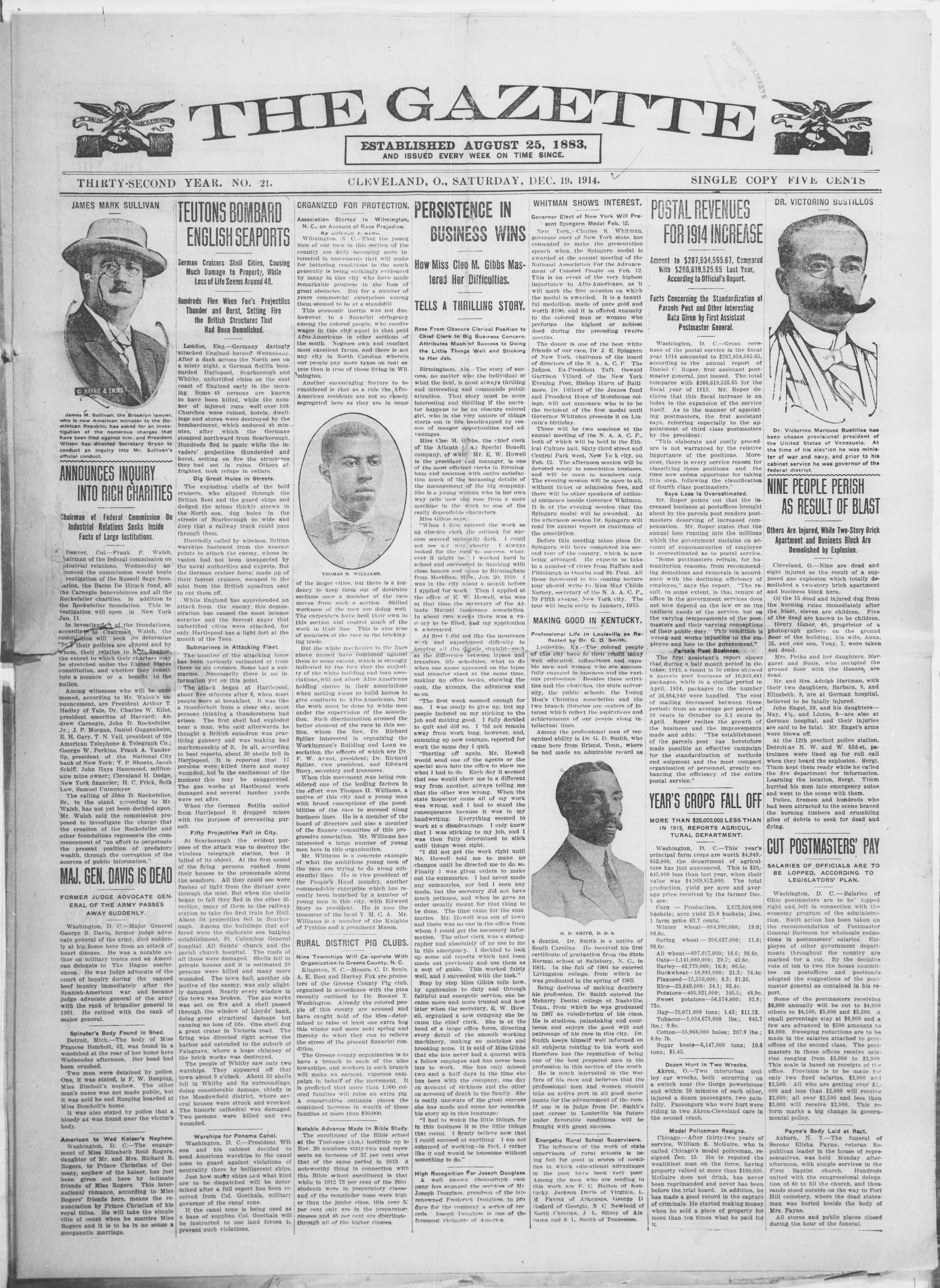
Page text (machine-generated)
IN UNION
THERE IS STRENGTH
C HARRIS & EWING
James M. Sullivan, the Brooklyn lawyer, who is now American minister to the Dominican Republic, has asked for an investigation of the numerous charges that have been filed against him, and President Wilson has directed Secretary Bryan to conduct an inquiry into Mr. Sullivan's official conduct.
ANNOUNCES INQUIRY INTO RICH CHARITIES
Chairman of Federal Commission On Industrial Relations Seeks Inside Facts of Large Institutions.
Denver, Col.—Frank P. Walsh, chairman of the federal commission on industrial relations, Wednesday announced the commission would begin investigation of the Russell Sage foundation, the Baron De Hirsch fund, all the Carnegie benevolences and all the Rockefeller charities, in addition to the Rockefeller foundation. This investigation will open in New York Jan. 11.
In investigation of the foundations, according to Chairman Walsh, the commission will seek to determine their policies are shaped and by whom, their relation to h. e. finance, the extent to which their charters may be stretched under the United States constitution, and whether they constitute a menace or a benefit to the nation.
Among witnesses who will be summoned, according to Mr. Walsh's announcement, are President Arthur T. Hadley of Yale, Dr. Charles W. Eilot, president emeritus of Harvard; Andrew Carnegie, John D. Rockefeller, Jr.; J. P. Morgan, Daniel Guggenheim, E. H. Gary, T. N. Vail, president of the American Telephone & Telegraph Co.; George W. Perkins, Frank A. Vanderlip, president of the National City bank of New York: T. P. Shonts, Jacob Schiff, John Hays Hammond, millionaire mine owner; Cleveland H. Dodge, New York financier; H. C. Frick, Seth Low, Samuel Untermeyer.
The calling of John D. Rockefeller, Sr., to the stand, according to Mr. Walsh, has not yet been decided upon. Mr. Walsh said the commission proposed to investigate the charge that the creation of the Rockefeller and other foundations represents the commencement of "an effort to perpetuate the present position of predatory wealth, through the corruption of the sources of public information."
FORMER JUDGE ADVOCATE GENERAL OF THE ARMY PASSES AWAY SUDDENLY.
Washington, D. C.—Major General George B. Davis, former judge advocate general of the army, died suddenly at his home here from an attack of heart disease. He was a notable author on military topics and an American delegate to The Hague conferences. He was judge advocate of the court of inquiry during the canned beef inquiry immediately after the Spanish-American war and became judge advocate general of the army with the rank of brigadier general in 1901. He retired with the rank of major general.
Spinster's Body Found in Shed. Detroit, Mich.—The body of Miss Frances Bomholt, 62, was found in a woodshed at the rear of her home here Wednesday afternoon. Her head had been crushed.
Two men were detained by police. One, it was stated, is F. W. Rueping, Miss Bimholt's nephew. The other man's name was not made public, but it was asid he and Rueping boarded at Miss Bomholt's home.
It was also stated by police that a bloody ax was found near the victim's body.
American to Wed Kaiser's Nephew,
Washington, D. C. The engagement of Miss Elizabeth Reid Rogers,
daughter of Mr. and Mrs. Richard R. Rogers, to Prince Christian of Germany, nephew of the kaiser, has just been given out here by intimate friends of Miss Rogers. This international romance, according to Miss Rogers' friends here, means the renunciation by Prince Christian of his royal titles. He will take the simple title of count when he marries Miss Rogers and it is to be in no sense a morganic marriage.
THE GAZETTE
TEUTONS BOMBARD ENGLISH SEAPORTS
TEUTONS BOMBARD ENGLISH SEAPORTS
Berman Cruisers Shell Cities, Causing Much Damage to Property, While Loss of Life Seems Around 48.
Hundreds Flee When Foe's Projectiles Thunder and Burst, Setting Fire the British Structures That Had Been Demolished.
London, Eng.—Germany daringly attacked England herself Wednesday. After a dash across the North sea on a misty night, a German flotilla bombarded Harlepool, Scarborough and Whitby, unfortified cities on the east coast of England early in the morning. Some 48 persons are known to have been killed, while the number of injured runs well over 100. Churches were ruined, hotels, dwellings and stores were destroyed by the bombardment, which endured 40 minutes, after which the Germans steamed northward from Scarborough. Hundreds fled in panic while the invaders' projectiles thundered and burst, setting on fire the structures they had set in ruins. Others aftrighted, took refuge in cellars.
Dig Great Holes in Streets.
The exploding shells of the bold cruisers, who slipped through the British fleet and the guard ships and dodged the mines thickly strewn in the North sea, dug holes in the streets of Scarborough so wide and deep that a railway truck could pass through them.
Hurriedly called by wireless, British warships hastened from the nearest points to attack the enemy, whose invasion had not been unexpected by the naval authorities and experts. But the German cruiser force, made up of their fastest cruisers, escaped in the mist from the British squadron sent to cut them off.
While England has apprehended an attack from the enemy, this demonstration has caused the most intense surprise and the fiercest anger that unfortified cities were attacked, for only Hartlepool has a light fort at the mouth of the Tees.
Submarines in Attacking Fleet.
The number of the attacking force has been variously estimated at from three to six cruisers. Some had a submarine. Necessarily there is no information yet on this point.
The attack began at Hartlepool, about five minutes after 8, when most people were at breakfast. It was like a thunderbolt from a clear sky, most persons thinking a thunderstorm had arisen. The first shell had exploded near a man, who said afterwards he thought a British squadron was practicing gunnery and was making bad marksmanship of it. In all, according to best reports, about 30 shells fell in Hartlepool. It is reported that 17 persons were killed there and many wounded, but in the excitement of the moment this may be exaggerated.
The gas works at Hartlepool were damaged and several lumber yards were set afire.
When the German flotilla sailed from Hartlepool it dropped mines with the purpose of preventing pursuit.
Fifty Projectiles Fall in City
At Scarborough the evident purpose of the attack was to destroy the wireless telegraph station, but it failed of its object. At the first sound of the firing persons rushed from their houses to the promenade along the seashore. All they could see were flashes of light from the distant guns through the mist. But when the shells began to fall they fled in the other direction, many of them to the railway station to take the first train for Hull. About 50 projects fell in Scarborough. Among the buildings that suffered were the elaborate sea bathing establishment, St. Columbus General hospital. All Saints' church and the parish church hospital. The roofs of all these were damaged. Shells fell in private houses and it is estimated 25 persons were killed and many more wounded. The town hall, another objective of the enemy, was only slightly damaged. Nearly every window in the town was broken. The gas works was set on fire and a shell passed through the window of Lloyd's bank doing great structural damage but causing no loss of life. One shell dug a great crater in Victoria road. The firing was directed right across the harbor and extended to the suburb of Falsgrave, where a huge chimney of the brick works was destroyed.
The people of Whitby saw only two warships. They appeared off that town about 9 o'clock. About 30 shells fell in Whitby and its surroundings, doing considerable damage, chiefly in the Meadowfield district, where several houses were struck and wrecked. The historic cathedral was damaged. Two persons were killed and two wounded.
Warships for Panama Canal.
Washington, D. C.—President Wilson and his cabin decided to send American warships to the canal zone to guard against violations of neutrality by belligerent ships. Just how many ships and what kind are to be dispatched will be determined after a full report has been received from Col. Goethals, military governor of the canal zone.
If the canal zone is being used as a base of supplies Col. Goethals will be instructed to use land forces to prevent such violations.
ESTABLISHED AUGUST 25, 1883 AND ISSUED EVERY WEEK ON TIME SINCE.
ORGANIZED FOR PROTECTION.
Association Started In Wilmington,
N. C., on Account of Race Prejudice.
Wilmington, N.C.—That the young men of our race in this section of the country are daily becoming more interested in movements that will make for bettering conditions in the south generally is being strikingly evidenced by many in this city who have made remarkable progress in the face of great obstacles. But for a number of years commercial enterprises among them seemed to be at a standstill. This economic inertia was not due, however, to a financial stringency among the colored people, who receive wages in this city equal to that paid Afro-American in other sections of the south. Negroes own and conduct most excellent farms, and there is not any city in North Carolina wherein our people pay more taxes on real estate than is true of those living in Wilmington.
Another encouraging feature to be considered is that as a rule the Afro-American residents are not so closely segregated here as they are in some
[Picture of a young man in a suit and bow tie].
THOMAS H. WILLIAMS.
of the larger cities, but there is a tendency to keep them out of desirable sections once a member of the race moves from such a section. Skilled workmen of the race are doing well. The carpenters have held their own in this section and control much of the work in their line. This is also true of members of the race in the bricklaying trade.
But the white mechanics in the lines above named have combined against them to some extent, which is strongly indicated by the fact that the majority of the white building and loan associations, will not allow Afro-Americans holding shares in their associations when making loans to build homes to give contracts to Afro-Americans, but the work must be done by white men under the supervision of the association. Such discrimination aroused the better element of the race in this section, whom the Rev. Dr. Richard Spiller interested in organizing the Workingmen's Building and Loan association, the officers of which are Dr. F. W. Avant, president; Dr. Richard Spiller, vice president, and Edward Story, secretary and treasurer.
When this movement was being considered one of the leading factors in the effort was Thomas H. Williams, a native of this city and a young man with broad conceptions of the possibilities of the race to succeed along business lines. He is a member of the board of directors and also a member of the finance committee of this progressive association. Mr. Williams has interested a large number of young men here in this organization.
Mr. Williams is a concrete example of what the ambitious young men of the race are trying to do along substantial lines. He is vice president of the People's Hand laundry, another commendable enterprise which has recently been launched by a number of young men in this city, with Edward Story as president. He is also the treasurer of the local Y. M. C. A. Mr. Williams is a member of the Knights of Pythias and a prominent Mason.
RURAL DISTRICT PIG CLUBS
Nine Townships Will Co-operate With Organization In Greene County, N. C.
Kingston, N. C.-Messrs. C. D. Saus,
A. E. Best and Harvey Fox are promoters of the Greene County Pig club,
organized in accordance with the plan recently outlined by Dr. Booker T. Washington. Already the colored people of this county are aroused and have caught hold of the idea—determined to raise at least one extra hog this winter and more next spring and thereby do what they can to relieve the stress of the present financial condition.
The Greene county organization is to have a branch in each of the nine townships, and workers in each branch will make an earnest, vigorous campaign in behalf of the movement. It is predicted that more than 1,000 colored families will raise an extra pig. A conservative estimate places the combined increase in wealth of these families at more than $10,000.
Notable Advance Made In Bible Study
The enrollment of the Bible school at the Tuskegee (Ala.) institute up to Nov. 30 numbers sixty-two and represents an increase of 37 per cent over that of the same period in 1913. A noteworthy thing in connection with this Bible school enrollment is that while in 1912 73 per cent of the Bible students were in preparatory classes, and of the remainder none were higher than the junior class, this year 6 per cent only are in the preparatory classes and 45 per cent are distribute- through all of the higher classes.
TELLS A THRILLING STORY.
Rose From Obscure Clerical Position to Chief Clerk In Big Business Concern. Attributes Much of Success to Doing the Little Things Well and Sticking to Her Job.
Birmingham, Ala—The story of success, no matter who the individual or what the field, is most always thrilling and interesting and commands public attention. That story must be more interesting and thrilling if the narrator happens to be an obscure colored girl, who in the very nature of things starts out in life handicapped by reason of meager opportunities and advantages.
Miss Cleo M. Gibbs, the chief clerk of the Athena (a.) Special Benefit company, of which Mr. E. W. Howell is the president and manager, is one of the most efficient clerks in Birmingham and assumes with entire satisfaction much of the barring details of the management of the big company. She is a young woman who in her own way tells how she rose from a mere machine in the work to one of the really dependable characters.
"When I first entered the work as an obscure clerk the outlook for success seemed unusually dark. I could not see my way clearly. I always looked for the road to success, whatever it might be. I worked hard in school and succeeded in finishing with class honors and cline to Birmingham from Meridian, Mills, Jan. 20, 1910. I was in the city about a month before I applied for work. Then I applied at the office of E. W. Howell, who was at that time the secretary of the Atlanta Mutual insurance association. In about two weeks there was a vacancy to be filled, and my application w accepted.
At first I did not like the insurance work and experienced difficulty in keeping all the details straight—such as the difference between lapses and transfers, life schedules, what to do when one name appeared on the lapse and transfer sheet at the same time, making up office books, showing the cash, the arrears, the advances and so on.
"The first week seemed enough for me. I was ready to give up, but my people insisted on my sticking to the job and making good. I fully decided to quit and did so. I did not remain away from work long, however, and, summing up new courage, reported for work the same day I quit.
"Starting off again. Mr. Howell would send one of the agents or the special men into the office to show me what I had to do. Each day it seemed that one would show me in a different way from another, always telling me that the other was wrong. When the state inspector came all of my work was wrong, and I had to stand the consequences because it was in my handwriting. Everything seemed to work at a disadvantage. I only knew that I was sticking to my job, and I was then fully determined to stick until things went right.
"I did not get the work right until Mr. Howell told me to make no changes until he directed me to do so. Finally I was given orders to make out the summaries. I had never made any summaries, nor had I seen any made, but the secretary did not have much patience, and when he gave an order usually meant for that thing to be done. The time came for the summaries. Mr. Howell was out of town and there was no one in the office from whom I could get the necessary information. The other clerk was a stenographer and absolutely of no use to me in this emergency. I decided to look up some old reports which had been made out previously and use them as a sort of guide. This worked fairly well, and I succeeded with the task."
Step by step Miss Gibbs tells how, by instruction to duty and through faithful and energetic service, she became more and more trusted and how later when the secretary, E. W. Howell, organized a new company she became the chief clerk. She is at the head of a large office force, directing every detail of the smooth working machinery, making no mistakes and brooking none. It is said of Miss Gibbs that she has never had a quarrel with a fellow employee and has never been late to work. She has only missed two and a half days in the time she has been with the company, one day on account of sickness and the other on account of death in the family. She is really unaware of the great success she has made and sums her remarkable story up in this language:
"I had to watch the little things, for in this business it is the little things that count. I firmly believe now that I could succeed at anything. I am not ashamed of working—in fact, I rather like it and would be lonesome without something to do."
High Recognition For Joseph Douglass
A well known phonograph company has engaged the services of Mr. Joseph Douglass, grandson of the late renowned Frederick Douglass, to produce for the company a series of records. Joseph Douglass is one of the foremost violinists of America.
Governor Elect of New York Will Pre-
sident Steven Medal Feb. 12
sent Spingarn Medal Feb. 12.
New York.-Charles S. Whitman,
governor elect of New York state, has
consented to make the presentation
speech when the Spingarn medal is
awarded at the annual meeting of
the National Association For the Advance-
ment of Colored People on Feb. 12.
This is an event of the very highest
importance to Afro-Americans, as it
will mark the first occasion on which
the medal is awarded. It is a beauti
ful medalion, made of pure gold and
worth $100, and it is offered annually
to the colored man or woman who
performs the highest or noblest
deed during the preceding twelve
months.
The donor is one of the best white
friends of our race, Dr. J. E. Spingarn
of New York, chairman of the board
of directors of the N. A. A. C. P. The
judges. Ex-President Taft. Oswald
Garrison Villard of the New York
Evening Post, Bishop Hurst of Balti-
more. Dr. Dillard of the Jeanes fund
and President Hope of Morehouse
college, will not announce who is to
be the recipient of the first medal until
Governor Whitman presents it on Lincoln's birthday.
There will be two sessions at the annual meeting of the N. A. A. C. P., both of which will be held in the Ethical Culture hall, Sixty-third street and Central Park west, New York city, on Feb. 12. The afternoon session will be devoted solely to association business, and will be open to members only. The evening session will be open to all, without ticket or admission fees, and there will be other speakers of national eminence beside Governor Whitman. It is at the evening session that the Spingarn medal will be awarded. At the afternoon session Dr. Spingarn will read his annual report as chairman of the association.
Before this meeting takes place Dr. Spingarn will have completed his second tour of the country, which is now being arranged. He expects to take in a number of cities from Buffalo and Pittsburgh to Omaha and St. Paul. All those interested in his coming lecture tour should write to Miss May Childs Nersey, secretary of the N. A. A. C. P., 70 Fifth avenue, New York city. The tour will begin early in January, 1915.
MAKING GOOD IN KENTUCKY.
Professional Life In Louisville as Reflected by Dr. G. D. Smith. Louisville, Ky.-The colored people of this city have to their credit many well educated, industrious and capable men and women who are successfully engaged in business and the various professions. Besides these activities and the churches, the state university, the public schools, the Young Men's Christian association and the two branch libraries are centers of interest which reflect the aspirations and achievements of our people along intellectual lines. Among the professional men of recognized ability is Dr. G. D. Smith, who came here from Bristol, Tenn., where he had made an admirable record as
G. D. SMITH, D. D. S.
a dentist. Dr. Smith is a native of
South Carolina. He received his first
certificate of graduation from the State
Normal school at Salisbury, N. C., in
1901. In the fall of 1901 he entered
Livingston college, from which he
was graduated in the spring of 1903.
Being destroys of making dentistry his profession. Dr. Smith entered the Meharry Dental college at Nashville, Tennessee, from which he was graduated in 1907 as valedictorian of his class. He is studious, painstaking and courteous and enjoys the good will and patronage of his race in this city. Dr. Smith keeps himself well informed on all subjects relating to his work and therefore has the reputation of being one of the best prepared men in his profession in this section of the south. He is much interested in the welfare of his race and believes that the professional men and women should take an active part in all good movements for the advancement of the race. If one is to judge from Dr. Smith's past career in Louisville his future under favorable conditions will be fraught with great success.
Energetic Rural School Supervisors.
The influence of the work of state supervisors of rural schools is being felt for good in scores of localities in which educational advantages in the past have been very poor. Among the men who are leading in this work are F. C. Button of Kentucky, Jackson Davis of Virginia, L. M Favrot of Arkansas, George D Goddard of Georgia, N C Newbold of North Carolina, J L Sibley of Alabama and S L Smith of Tennessee.
POSTAL REVENUES FOR 1914 INCREASE
Amount to $287,934,565.67, Compared
With $266,619,525.65 Last Year,
According to Official's Report.
Facts Concerning the Standardization of Parcels Post and Other Interesting Data Given by First Assistant Postmaster General.
Washington, D. C.—Gross revenues of the postal service in the fiscal year 1914 amounted to $287,934,565.65, according to the annual report of Daniel C. Roper, first assistant postmaster general, just issued. The total compares with $266,619,525.65 for the fiscal year of 1913. Mr. Roper declares that this fiscal increase is an index to the expansion of the service itself. As to the manner of appointing postmasters, the first assistant says, referring especially to the appointment of third class postmasters by the president:
"This elaborate and costly procedure is not warranted by the relative importance of the positions. Moreover, there is every service reason for classifying these positions and the time now seems opportune for taking this step, following the classification of fourth class postmasters."
Says Loss Is Overestimated.
Mr. Roper points out that the increased business at postoffice brought about by the parcels post renders postmasters deserving of increased compensation. Mr. Roper states that the annual loss running into the millions which the government sustains on account of superannuation of employees is overestimated as to postal service.
"Some postmasters refrain, for humanitarian reasons, from recommending demotions and removals in accordance with the declining efficiency of employees," says the report. "The result, to some extent, is that tenure of office in the government services does not now depend on the law or on the uniform needs of the service, but on the varying temperaments of the postmasters and their varying conceptions of their public duty. This condition is wrong and works injustice to the employees and loss to the government."
*Parcels Post Business.* The first assistant's report shows that during a half month period in October, 1912, a number of 50 offices showed a parcels post business of 10,835,641 packages, while in a similar period in April, 1914, packages to the number of 26,884,940 were handled. The cost of mailing decreased between these periods from an average per parcel of 10 cents in October to 5.1 cents in April. Roper recites the growth of the business and the improvements made and adds: "The establishment of the parcels post has heretofore made possible an effective campaign for the standardization of methods and equipment and the most compact organization of personnel, greatly enhancing the efficiency of the entire postal service."
YEAR'S CROPS FALL OFF
YEAR'S CROPS FALL OFF
MORE THAN $20,000,000 LESS THAN
IN 1913, REPORTS AGRICUL-
TURAL DEPARTMENT.
Washington, D. C.—This year's
principal farm crops are worth $4,949,
852,000, the department of agricu-
ture has just announced. This is $20,
645,000 less than last year, when their
value was $4,969,852,000. The total
production, yield per acre and avera-
ge price received by the farmer Dec.
1 are:
Corn — Production, 2,672,804,000
bushels; acre yield 25.8 bushels; Dec.
1 farm price 63.7 cents.
Winter wheat—684,990,000; 19.0;
98.6c.
Spring wheat—206,027,000; 11.8;
98.6c.
All wheat—897,107,000; 16.6; 98.6c.
Oats—1,141,060,000; 29.7; 43.6c.
Barley—42,779,000; 16.8; 86.5c.
Buckwheat—16,881,000; 21.3; 76.4c.
Flaxseed—15,550,000; 8.3; $1.26.
Rice—23,648,000; 34.1; 92.4c.
Potatoes—405,921,000; 105.5; 48.9c.
Sweet potatoes—56,574,000; 93.8;
73c.
Hay—70,071,000 tons; 1.43; $11.12.
Tobacco—1,034,679,000 lbs.; 845.7
lbs.; 9.8c.
Cotton—15,966,000 bales; 207.9 lbs.;
6.8c lb.
Sugar beets—5,147,000 tons; 10.6
tons; $5.43.
Akron, O—Two interurban troley car wrecks, both occurring on a switch near the Gorge powerhouse and within 30 minutes of each other, injured a dozen passengers, two painfully. Passengers who were hurt were riding in two Akron-Cleveland cars in the second crash.
Model Policeman Resigns
Chicago. After thirty-two years of service, William S. McGuire, who is called Chicago's model policeman, resigned Dec. 15. He is reputed the wealthiest man on the force, having property valued at more than $100,000. McGuire does not drink, has never been reprimanded and never has been before the trial board. In addition, he has made a good record in the capture of criminals. He started making money when he sold a piece of property for more than ten times what he paid for it.
IN HONOR OF THE
UNION
DR. VICTORINO BUSTILLOS
Dr. Victorino Marquez Bustillos has been chosen provisional president of the United States of Venezuela. At the time of his election he was minister of war and navy, and prior to his cabinet service he was governor of the federal district.
NINE PEOPLE PERISH AS RESULT OF BLAST
Others Are Injured, While Two-Story Brick Apartment and Business Block Are Demolished by Explosion.
Cleveland, Q—Nine are dead and eight injured as the result of a supposed gas explosion which totally demolished a two-story brich apartment and business block here.
Of the 15 dead and injured dug from the burning ruins immediately after the blast, eleven are children. Five of the dead are known to be children. Henry Haner, 40, proprietor of a photograph gallery on the ground floor of the building; his wife, Anna 35, and one son, Tony, 7 were taken out dead.
Mrs. Petka and her daughters, Margaret and Suslie, who occupied the ground floor with the Haners, are dead.
Mr. and Mrs. Adolph Hartman, with their two daughters, Barbara, 8, and Elizabeth, 9, are at German hospital, believed to be fatally injured.
John Engst, 38, and his daughters—May, 4½, and Lizzie, 8—are also at German hospital, and their injuries are said to be fatal. Mr. Engst's arms were blown off.
At the 12th precinct police station, Detroit-av N. W. and W. 83d-at, patrolmen were lined up for roll call when they heard the explosion. Sergt. Timm kept them ready while he called the fire department for information. Learning the location, Sergt. Timm hurried his men into emergency autos and went to the scene with them.
Police, firemen and hundreds who had been attracted to the scene braved the burning timbers and crumbling piles of debris to seek for dead and dying.
CUT POSTMASTERS' PAY
SALARIES OF OFFICIALS ARE TO BE LOPPED, ACCORDING TO LEGISLATORS' PLAN.
Washington, D. C. — Salaries of Ohio postmasters are to be 'lopped right and left in connection with the economy program of the administration. Swift action has been taken on the recommendation of Postmaster General Burleson for wholesale reductions in postmasters' salaries. Employes of other government departments throughout the country are marked for a cut. By the decisive vote of ten to two the house committee on postoffices and postroads adopted the suggestions of the postmaster general as contained in his report.
Some of the postmasters receiving $6,000 annually will be cut to $4,000 others to $4,500, $5,000 and $5,500. A small percentage stay at $6,000 and a few are advanced in $500 amounts to $8,000. Sweeping reductions are to be made in the salaries attached to postoffices of the second class. The postmasters in these offices receive salaries ranging from $2,000 to $2,900. This scale is based on receipts of the office. Provision is to be made for only two fixed salaries, $2,000 and $2,500. All who are getting over $2,000 and less than $2,000 will receive $2,000; all over $2,500 and less than $3,000 will receive $2,500. This reform marks a big change in governmental policy.
Auburn, N. Y. The funeral of Sereno Ellisha Payne, veteran Republican leader in the house of representatives, was held Monday afternoon, with simple services in the First Baptist church. Hundreds united with the congressional delegation of 60 to fill the church, and thousands stood outside on the way to Fort Hill cemetery, where the dead statesman was buried beside the body of Mrs. Payne. All stores and public places closed during the hour of the funeral.
One Year.....$1.50.
Six Months.....1.00
Three Months......50
Subscribers are requested to re-
mit by postoffice money or-
der or registered letter
Entered at the postoffice in Cleveland
Ohio, as second-class matter.
Address all communications to
Blackstone Building, Cleveland, O.
Member Ohio Legislature: 1894
to 1896; 1896 to 1898; 1900 to 1902
THE GAZETTE is the oldest, and has the largest bona fide circulation, double that of any newspaper in the interest of Afro-Americans, published in the state of Ohio, and comparison with any full immediately establish its rank as one of the NEWSIEST AND BEST in the country.
10,000,000 Afro-Americans..
160,000 in Ohio.
20,000 in Cleveland.
SATURDAY, DECEMBER 19, 1914.
Merry Christmas to all of our many readers.
Afro-Americans, applicants for positions under the incoming republican state administration, should not forget the civil service laws the democrats enacted. It is one of the many problems that have been left for Governor-elect Willis and the republican State Assembly to solve, this winter.
We are in receipt of a letter from Editor Harry C. Smith of The Cleveland Gazette, referring to our article concerning Governor-elect Moses Alexander, of Idaho, reminding us that we were perhaps wrong in our assertion that Alexander is the only Jew ever elected governor of a state. He mentions Franklin Moses, who was governor of South Carolina during the reconstruction period. However, Moses was born in Idaho. He was the son of a Jewish father and a Christian mother and was brought up in his mother's religion—Jewish Independent.
The editor of the Independent's position, in the matter of Gov. Moses' race connection, may be all right from a race (Jewish) religious viewpoint, but it would hardly answer in the courts or for the general public—providing he is correct in the statement that Mrs. Moses was a gentle. Her son was generally known and recognized as a Jew in spite of the fact that he did not affiliate with that class and did not accept the religion of his father.
THE PRESIDENT AND TRUTH.
President Wilson did not appear a his best in his recent conference with the delegation which appealed to him in behalf of the Negroes in the Government service. If, as alleged, Mr William Monroe Trotter of Boston, the spokesman of the committee, was guilty of an impropriety in making a reply to the President, then the President might well have used his discretion as to whether a rebuke was in order. But it does not seem obviously appropriate for the President of the United States, complete of the "tolerable burden" of his own office to Negroes who daily suffer burdens more intolerable, who come to the President with real grievances due to the President's own inaction in a moral crisis. The President waives aside all references to considerations of political support by Negroes as "blackmail", but the President before his election sought that support, and it sought with explicit promises which Negroes and others believe have not been kept. "Should I become President of the United States", he said during the campaign of 1912, "they [the Colored people] may count upon me absolutely the power to assist which I could assist in advancing the interest of their race in the United States." What the President has as yet done in advancing this interest he does not state; what he intends to do in the future he does not state. But he does express his unwillingness to interfere with Southern members of his Cabinet, who are segregating Colored employees, setting apart Federal civil servants with Negro blood in them as though they were lepers, a humiliation which is bitterly resented by Colored people throughout the country and deplored by thousands of high-minded white people, yet one which the President used fair words in 1912 in his appeal to the Negroes for votes. We know now that those words meant nothing.—The New Republic, N. Y. City.
The President thinks that this is not a political question, but he is wrong. Anything that is unjust, discriminating and un-American in government is certain to be a political question. Servants of the United States Government are servants of the United States Government, regardless of race or color. Whether the President thinks so nor does he, the president was implicated as a deliberate discrimination against Negro employees. Worse still, it is a small, mean, petty discrimination, and Mr. Wilson ought to have set his heel upon this presumptuous "jim-crow" government the moment it was established. He ought to set his heel upon it now. It is a reproach to his Administration and to the great political principles which he represents.—N. Y. World.
The Louisville (Ky.) Courier-Journal, a leading Democratic Southern newspaper, had the following to say, editorially:
A Foolish Proceeding.
"The Courrier-Journal agrees with the New York World that the 'segregation' business over in Washington spells rather small. During fifty years, including two Democratic Presidential terms, there was no thought of separating the white and black official sheep. The police were the event of anybody now? The segregation order should be revoked. It has no real cause or interest to back it. The issue should not have been raised. Having rebuked Trotter, Mr. Wilson take matters further
into his own hands, and restore the status quo.
"The Courier-Journal has received a brief note from Tennessee which reads: 'If those fellows who are dissatisfied with their fat jobs at Washington on account of Colored propinium will resign and come home there is a standing army of willing and idle patriots ready to take their places who don't care how close they get to the Negroes so the pay is good. Doubtless.'
"The whole thing simmered down" shows that President Wilson has not only failed to keep his promise to our people, but that he has purposely injured us, and greatly too, by his endorsement of segregation in the government departments at Washington, D. C.; that there is not even the shadow of a good excuse for so doing, and also that leading Democratic and Republican newspapers, daily and weekly, north and south, are as frank to say so as are the N. Y. World and the Louisville Courier-Journal. President Wilson cannot have failed to note this fact. The question therefore is—is he a big enough man to be the Chief Executive of this great country? If he really is, he will revoke that segregation order. If he does not do so, it will be proof positive that we have "a southern schoolmaster playing president"—many many able writers have from time to time stated for more than a year.
ARE WE A RACE OF COWARDS?
Under the above caption, the Atlanta (Ga.) Independent, a few weeks ago, carried the following editorial which we are moved to republish for several good seasons. It reminds us of the fact that the Cleveland Association of Colored Men for several seasons has persisted in holding yearly what it terms "emancipation celebrations" in Luna park, this city, where on nearly every other day of the year our people are discriminated against in several of its attractions. This is done, too, in the face of The Gazette's protests backed at times by leading Aro-American ministers and persons of this city. To the members of that association and all others of the race who believe in Dr. Booker T. Washington's "doctrine of surrender" we especially commend the Independent's well-written editorial which follows:
"No race of people in the history of civilization ever endured a leadership of more consummate cowards than the Negroes. The average Negro is a coward in his own esteem. Void of self-respect, appreciation or manly resentment, he submits to every indignity, with apology, the white man inflicts upon him. When we speak of cowards, we do not mean physical cowards, but moral, and intellectual cowards; the coward who hasn't the moral courage to resent a wrong; the coward who submits to every indignity imposed upon him by cowardly newspapers; the coward who accepts every 'jim-crow' accommodation offered. If the Negro preacher, leader, pupil and platform orator would teach their people to decently and respectfully decline to patronize those white business and other enterprises that insult their womanhood and manhood, it wouldn't be long before insults and indignities heaped upon the race because of its color would grow beautifully less. If the Negro preacher would tell his congregation, that a manly and self-respecting race-pride would not permit us to accept accommodation in the 'buzzard-roost,' in the attics and lofts of white men's theatres, it would not be long before the 'buzzard-roost' attics and 'jim-crow' places in white theatres would be cut out, because they would have no business; and for the reason a white man has the intelligence and keenness of foresight not to operate a business that does not pay.
"If the Negro preacher would teach his congregation from his pulpit each Sunday, and the orator from the platform, not to read a white paper that endorses outrages against the race that perpetrated and circulated indignities and wrongs upon our man and womanhood, it wouldn't be long before the white papers would cut out that part of their policy, for the reason every white paper in the south is largely read by Negro constituents, and their advertising rates are based upon circulation.
"The Jew will not read a paper that is hostile to Jews. The German cuts out every paper that antagonizes and fights his nationality. The Irishman resents with all of his hot blood insults heaped upon his race by newspapers and other nationalities. The Jap resents with all of his soul, with all of his might, every wrong done him because of his race, his color or his condition.
"There is nobody a coward but the Negro; there is no race so divided against itself and is such a consumate band of bootlicks, cowards and sycophants as black educated leaders. What we need most is a manly leader ship—one full of moral courage and intellectual bravery. No bully, no insulter, but a man who has the intelligence and the Christian manhood to resent decently and manly, wrongs heaped upon the race; a man who defends the race of indignities that they ought not to endure, and shows how they may rid themselves of the agencies that seek to crush and undo it. Let us have a manly race; and we can only have a manly race by many leadership. Let the pulpit and the platform do their duty, and all will be well."
CHRISTMAS GIFT!
Send The Gazette, one year, to a friend, as a Christmas gift. It will be appreciated.
EDITOR
THE GAZETTE, CLEVELAND, O.
FRESH OHIO NEWS
BY "THE OLD RELIA
GAZETTE'S CORRE-
SPONDENTS
THROUGHOUT THE STATE
What Our People Are Doing Each Week—Church, Personal, Social, Lodge, Literary and Musical—Marriages, Deaths, Etc.
CADIZ.—Rev. G. W. Jackson, Quincy, Mich., who conducted evangelical meetings at Simpson M. E. church, left for Cleveland. B. S. Lee and daughter, Susie, spent days, last week, in Pittsburgh.—Paul Tempinson was agreeably surprised, the 12th, by 18 young people who came to help him enjoy his 18th birthday. Games and music.—Mrs. Ella Wallace and daughter, Grace, have returned from a visit in Pittsburgh.—Earl West is home again. Mrs. Ida Bowles has gone to Oberlin, for the winter. Mrs. Eva Strother has returned from a visit in Canton.—Mr. Clyde Williams, Lissie Davis were married recently. Miss Lizzie West, Pittsburg, is the guest of Mrs. Alberta Madison.
CORRESPONDENTS must mail all letters for publication at their main postoffice sufficiently early on Monday (or Sunday) of each week to have them reach The Gazette office on Tuesday morning, and always write also, their names and that of their city or town on the outside of the building returned copies. Unless this latter done, proper credit cannot be given you like a wedding presents, etc., obtruity notices, speeches, resolutions, poetry, inquiries for relatives and advertisements of all kinds, including items announcing entertainments to be held in the near future, must be paid for in advance at the rate of ten cents a week for display advertisements will be sent on application. Send postal note and not stamps during warm weather.
LEBANON.—Miss Jessie Morton lost her mother, Sunday. Apploxy and acute indigestion. She wishes to thank relatives and friends for many kind ministrations.—Mrs. Ware Tilton of Xenia, is visiting Mrs. Wyatt Morton.—Rev. Gray of Cincinnati.—Gray of Winston Churchill evening.—Mrs. Wallace and apollo Tibbles attended a missionary convention at Hamilton, Saturday and Sunday.—Mr. and Mrs. Bodine visited in Dayton, last week.—Little Odessa Petio is threatened with pneumonia.—Miss Blanche Singleton is convalescing. Tonsilitis.—Robert Morton, jr. is very ill.—Wm. Caldwell is ill.—Mr. Sterling Evans will undergo an operation for cataract, soon. Last week he was treated. Do not miss a single copy but take it every week from the local agent. Tell your friends and acquaintances to do so, also.
OBERLIN—Mrs. Martha Copes has been quite ill. H. C. Tuck is suffering from a stroke of paralysis, sustained Sunday night—Sheldon Stevens is studying plumbing, in New York city. The quartet of young boys will go to Ridgeville, Wednesday evening. Mt. Zion church is pleased the good results from the "Efficiency Coaching" summer afternoon. Rev. Williams of Elrya, will speak at Rust M. E. church, the 20th. The campaign will be renewed at the opening of the New Year. Work on the church will begin this spring. Race day will be celebrated, Jan. 1. "The Future of the Negro, Read the Signs of the Time" will be given by Don McLean songs will be rendered by the choir. In the afternoon a program will be rendered by the Women's Missionary society and students, and will be managed by Mr. Collins and Miss Warren.
SANDUSKY—Miss Mildred Drake has gone to Nashville, Tenn., to spend Xmas—Miss Emma Gilkerson is very ill as a result of vaccination. —Messrs. Wm. Jones and Stephen Wallace have butchered three pigs for winter use.—The Second Baptist church was well attended, Sunday and there was one conversion for baptism. God is surely blessing the pastorate of Rev. G. D. Smith. Mr. S. Scott is a success as a teacher of the bible-class. J. R. Davis is preparing a fine play for Xmas night. He is the leader of the young people.—The A. M. E. church members will give a social, Tuesday evening. The pastor, Rev. J. C. Singleton, and Rev. G. D. Smith are wondering what "Santa" is going to be. The church was here. Sunday at the A. M. E. church. Quarterly meeting and conference. The church made an excellent showing.—Take The Gazette and get the news. It is our best paper.
AKRON—The Ladies' Aid society of the A. M. E. Zion church will give a "Silence Luncheon", Dec. 18, and are putting forth every effort to make it a success.—Mrs. E. D. W. Bell is preparing to go home to spend the Holidays.—Mr. Wimbish, who has been ill for three months, is rapidly recovering, and who has been seriously ill for three weeks is convalescing.—The ladies of the A. M. E. Zion church gave Mrs. Loretta Woodson a very pleasant shower, Wednesday afternoon.—Miss Virginia Porter slipped away and was quietly married to Mr. Archie Anderson, last week.—Mrs. Pearl Christian was called to Columbus, last week, to attend the board meeting of the Baptist State Convention, proving very fast.—Mr. John McEwain has gone to Birmingham, Ala., to spend the holidays with his parents.—We are, very glad to hear that Miss Dotson is doing so well with her restaurant, and wish her God-speed.
YOUNGSTOWN—Miss Edith Payton of Franklin, Pa., was the guest of Mrs. Tyles, last week—Mrs. Wm. Saunders and niece, Miss Sadie Boggess, are guests of Mr. and Mrs. David Boggess of Cleveland—The infant daughter of Mrs. Akers of Eastwood St. is very ill—Buckeve lodge's meadow, Oak Lake, Oak Lake, late爱教堂, Sunday, the late爱教堂, Elks from New Castle, Sharon, Farrell, Cleveland and other cities and towns, were in attendance. The vocal selections by Mrs. Fowler of Sharon and Mrs. R. D. Lynch, and the addresses, were good. After the program, the lodge returned to its hall where an elaborate lunch was enjoyed it is preparing for its annual affair in March—Mrs. Emma White of Greensboro, Mrs. H. P. Parker of Chicago—The All-Star Whist club's annual affair, the 28th, and the Mutchel club's, in
O., SATURDAY, DECEMBER 19, 1914.
Excelsior Parlors, New Years!—Mr.
and Mrs. Geo. Rideout entertained at
Sunday breakfast, Mr. and Mrs. Wmn.
Honesty, Mr. and Mrs. Thos. E. Green.
Jr., and others.
WILMINGTON. — Miss Taylor of Springfield, is visiting her aunt, Mrs. Jack Burris, for the winter — Messrs. Clarence Jackson and Gratton Woodward of Columbus, were guests of Miss Cleo M. Emmons and Miss Kathleen Peyton, Sunday — Mrs. Harry T. Hart learned, last week, of the serious illness of her brother, Henry Taylor, of Columbus. — The Ladies' Ald society was entertained, Friday, by Mrs. Anna Hart — The Woman's Praying association, Mrs. Johnson, by Mrs. Anna Jenkins' — Little Ellen, daughter of Mr. and Mrs. William B. Gibbons, was ill, last week — Mr. and Mrs. Chas. Johnson are the proud parents of a son, born, the 5th. — The A. M. E. s. program for the 24th is in charge of Teachers Ivy Edwards and Glenna Emmons, who will preside over the little folks. Music by the B. M. E. trio, and the Glee club. A splendid program is anticipated. Rev. James Johnson, doing excellently in Hillsborough — Pay for your Gazette promptly, please, and save the agent a few steps. 'Tis worth it. The Gazette is a good paper and tells about our race at first hand.
MANSFIELD—Mr. Kinney has accepted a position in Ashland—Mr. Kline has left for Reading, Pa., to join his mother—Rev C. W. Ford and Mrs. E. Dunmore were guests of Mr. and Mrs. J. Davis, at dinner, Friday—Mr. Fox is located with a shoe firm here that was formerly in business at Cincinnati. We wish him success. Mr. Erwin Dunnmore of Child Care, Eden, and Eden the father of the Els' banquet, Saturday night—Mr. Beaumont has returned to spend Xmas with his mother and sister—Mr. and Mrs. G. C. Weaver, recently married, are happily located at 233 Diamond St—Mr. Ross of Shelby, was here on business, last week. There will be a "municipal Xmas tree," Dec. 25. Five thousand and children are to receive gifts. Messrs. Blaine and Love of Mr. Dunnmore were members of Mr. B. Dunnmore, Friday—Dec. 20, is rally day for the pastor. A good program will be rendered. Committee: Miss L. Beaumont, Mrs. M. Thompson and the pastor. Rev C. W. Ford preached an able sermon, Sunday. Topic, "The Church Militant." The Ladies' Missionary society met at Mrs. W. F. H. Poindexter's, Friday night. The business was well transmitted. The lady was re-organized. Mrs. Hamilton and Mrs. C. Dunmore were elected presidents. Madam A. Spencer, presiding, Chocolate and crackers were served. Mrs. R. Davis was elected prescriber. Mrs. D. Barker has the children well trained for the Xmas exercises. The pastor's phone number is 1679, Mansfield.
KNOWS "THE OLD RELIABLE".
Praises Is Editorials — Optimistic View of the Race's Future Political Action—Likes Trotter's
New Albany, Ind., Dec. 6, 14.
Mear Dear Smith.—I knew that the "Old Reliable" Gazette could be depended upon in this mellee. Your editorials ring out shrill and clear and in no uncertain tone. I must say that I like the tone of your voice and the background of your expression. You now have the power to say to the point. Fight the good fight, for we are bound to win. We can now see that the race is swinging to that leadership that spells success. The awakening is at hand.
Yes, Sir; the next national campaign will find the Afro-American united as never before; but not for the Democratic, the Progressive or the Republican party. They are going to vote with the Republican party; but they are going to vote for Afro-American candidates this time. And I believe me, by the long horn-moon, they are going to get them.
That was a nice little letter of Mr. Trotter's to the Gazette. It has in the sound of uniting forces for one common good.
Justice for all men. It's coming; it is bound to come. The thing that we are complaining of today, we will shortly see no more.
I am for "a new freedom."
G. L. Cheatham.
THE PROBLEM OF THE SOUTH.
Editor Chicago Examiner:
Noting from your paper that the sentiment is growing toward a provision for Americans who are being affected by the conditions in Europe, I give you below an extract from a letter received from one of the largest supply merchants in the South, from Albany, Georgia, which will give some insight as to the conditions of the Negro at the present time, and what is likely to occur during the Winter months when there will be but little work for him to do:
There are more Negroes begging for something to eat, and begging for something to do than we have ever known before in our country, and in two weeks from now, after all of the cotton is picked, it is going to be fearful to contemplate.
Being myself a Southerner, and knowing the conditions there, I am sure that some of the funds could be well distributed for the purpose of taking care of this dependent class for the next few months.
This is the real problem that the South is now facing. MORRIS WESLOSKY. New York City.
Christmas in the South.
Editor Plain Dealer—Sir: I know something of how severely the generosity of people throughout the country has been taxed on account of the suffering in Europe, but nevertheless I have a feeling that there are many who would count it a privilege to provide some Christmas remembrance for Negro children in the rural districts of the south, especially in the cotton regions where there is likely to be, not only nothing in the way of ordinary Christmas gifts, but poverty and suffering on account of the depressed financial conditions growing out of the European var.
I shall be glad to be used, as in other years, as a medium for the distribution of such presents, through such societies, as may be sent, and shall see that they much deserving children in wide sections of the south.
BOOKER T. WASHINGTON.
Tuskegee Institute, Ala.
If you knew
Nelson's Hair Dressing as we do
you would never use anything
else on your hair.
We want you to know it—
know it personally by actual use,
don't take our word for it, or any-
one elses,—test it yourself.
You can do this,
send us your name and address
and we will send you,
Free of cost,
a sample box of Nelson's Hair
Dressing, also a sample of Nel-
son's Scalp and Hair Cleaner and
a sample cake of Nelson's Skin
and Complexion Soap.
Test them
in your own home, if they are
not what we claim, you are not
out anything.
We have confidence
in them and are ready and anx-
ious to prove every claim we
make.
Write to day,
enclosing two cent stamp to pay
postage on samples.
NELSON MANUFACTURING CO.,
Richmond, Virginia
NELSON'S
HAIR DRESSING
Has no superior as
a hair beautifier.
Thousands of men and
women have improved the
appearance of their hair by
using NELSON'S HAIR
DRESSING.
For those who know—it
is a toilet necessity.
Why not try it yourself?
Ask your druggist. If he
cannot supply you, send us
his name and address and we
will send you a free sample.
NELSON MFG. CO.
RICHMOND, VA.
The Answer
Is:
NELSON'S
HAIR DRESSING
25¢
50¢
DOINGS
OF
THE
RACE
An estate valued at $139,000 was left
by John W. Holland, retired caterer,
of Philadelphia, who died two weeks
ago.
Sam McVey defeated "Battling Jim"
Johnson of Philadelphia in a 10-round
bout in N. Y. City, Dec. 11. McVey
outpointed and outboxed his opponent.
The validity of Maryland's "jim-crow" car law was upheld there by the Court of Appeals in an opinion handed down, recently. The opinion was in the case of James Jenkins, who was arrested for refusing to take a seat assigned him by a conductor of the Washington, Baltimore and Annapolis Railway.
Send "the old reliable" Gazette to a friend for one year, as a Christmas gift, and thus help it to increase its circulation. The friend will appreciate the gift, too.
It does not add to our strength now to abuse Booker T. Washington or take up prestige, or to have our people oppose him, but it will pay for unitedly join in with Editors Smith and Mitchell to open the eyes of the world to see him as he is. Keep it going. John E. Milhooland started it. Martinsburg (W. Va.) Pioneer Press.
John Mitchell, Jr., editor of the Richmond Planet, may not live "in a free country" but William Munroe Trotter, who made the assertion quoted above, nor anybody else, living or dead, has ever made a wiser or braver fight along every imaginable line, for the interest of the Negro than has this same John Mitchell.—Pioneer Press. Bishop M. Cufford of the Martinsburg (W. Va.) Pioneer Press, is in the "Mitchell" class, too. Floyd Ross of Richmond, Va., grand worthy master of the True Reformers, has disappeared and moved his family out of that state. During the past few weeks fifteen men have been killed by Jacksonville, Fla., officers of the law, most of the cases being where arrests were attempted for trivial offenses. Not one of the men killed was charged with a capital crime. Because of this epidemic of legal (?) murder our people have been going to meetings to formal protest against these police outrages and to secure a peaceful adjustment of conditions.
President Scarborough has received the first subscription book used in the interest of Wilberforce University nearly sixty years ago. Its preface read, "Subscriptions to Purchase Tawawa Springs for an Ohio African University". It was sent him by Mrs. M. McCormick, of Jackson, range, N. J., the daughter of Rev. Mansfield French, president of the Xenia Female College in the early 50's of the last century. W. H. Jackson, for eight years assistant doorkeeper at the State House of Representatives, was recently elected without opposition to the City Council from the second ward of Newport, R. I., for two years, by Republican voters. He had been on the City Republican Committee for twenty-seven years, and was the same. His son, W. H. Jackson, Jr., is stock clerk for one of the leading business houses in that city.
A writer in the Portland (Ore.) Advocate says: "Every time you have attempted to do something you believed was for our good, and we did not realize it or support you and you failed, it has made you fight the harder the next time. If you had become disgruntled and said 'what's the use,' The Lord has told me the thing of the past, long years ago, instead of being the only Colored paper for its race in this seemingly God forsaken, prejudiced state. The fault is that those so-called leaders have fallen into the rut that our old friend Harry C. Smith of The Cleveland Gazette, speaks of when he says: "It is high time that our manly, among our edible men and women were speaking to the open and ceasing their cowardly walking for fear of personal harm."
Why not become a Hair Dresser? This is your chance. We will set you up in the business. We will send you the Milpark Course in Hair Dressing, give you a Diploma from our school and furnish you with our Complete Hair Dressing Outfit. All this for the small sum of $3.50. Hundreds of saltified graduates all over the country are earning Big Money with our Outfits. Why not you? Write today, do not delay.
MILPARK SCHOOL OF HAIR DRESSING
EDENTON, N. C.
QUINADE
GROWS HAIR
REMOVES DANDRUFF
SEED FOR SAMPLE
QUINASOAP
THE IDEAL SHAMPOO 50AP
THOROUGHLY CLEANSSES THE SCALP
QUINACOMB
HAIR STRAIGHTENER
SHAMPOO DRYER
QUINADE 25¢ QUINACOMP 50¢ QUINASOAP 25¢
AT ALL DRUGSTores
SEEBY DRUG COMPANY. NEW YORK CITY. N. Y.
TAYLOR'S SPECIAL ALCOHOL HEATER is the handiest and most convenient method of heating the Comb, and can be closed up so that you can put it in your hand-bag. Price 50c For best regular use La Cretée Hair Pomade. It not only meets every requirements of the Comb Straightener, but promotes a luxurious growth of the hair. Price 25c.
SEND FOR MY FREE CATALOGUE illustrating the Largest and Most Complete Line of Hair Gifts in this country for colored people, such as Bange, Wigs, Furry Switches, Pom-
All things considered, the appointment of Cheeks, Moon and Hodges as vice-presidents of the "Herrick" reception meeting, was decidedly better. This seems to be the consensus of opinion among our people locally.
.
CHRISTMAS GIFT!
Send The Gazette, one year, to a friend, as a Christmas gift. It will be appreciated.
EDITOR.
Month FOR YOU.
Presser? This is your chance. We
ness. We will send you the Mil-
sizing give you a Diploma from our
city our Composite Hair Dressing
all sun of $3.50. Hundreds of sat-
this country are earning Big Money
you? Write today, do not delay.
OIL OF HAIR DRESSING,
TON, N. C.
NADE
G HAIR
DANDRUFF
FOR SAMPLE
ASOAP
SHAMPOO 50AP
EANSSES THE SCALP
ACOMB
RAIGHTENER
POO DRYER
50¢ QUINNSOAP 25¢
DRUGGISTS
Y. NEW YORK CITY, N. Y.
e use MUST be pure
ND BEER
anteed and is bottled
supervision by
Sandusky Brewing Co.
Central 3933
Shampoo Dryer
rightener!
in the World!
of LaCrobe Hair Pomade, will bring the most
stroke and cause a liquid growth of the hair.
and get the comb by return mail.
Larce, Heavy Strong and Durable. Made of
metal, it is very hard. If you fold one solid piece highly polished and polished nickel plate; steel bolt which goes through the large wood pieces and screws it from the inside. It is used for moving lones or coming off. Remember, it is all in one piece. Will last of order, not just for lones.
Price of Hair Straightener and Alcohol Heater complete $1.50.
ER is the handiest and most convenient method that you can put it in your hand-bag. Price 50c made. It not only meets every requirements of small growth of the hair. Price 25c. Illustrating the Largest and Most Complete Line tie, such as Benge, Wige, Puffa, Switches, Pom-
TAYLOR, Howell, Mich.
mention this paper
Brown Drug Co.
SPECIAL
rem. Nov.'20 te Doo. 2 1014, to
Peay eins
HIGH BROWN FACE “CowoER,
50c, and
PURO PEROXIDE CREAM, 25¢
we are going to sell BOTH FOR 39¢
Te unetmanthe "The EXCELLENT
COMBINATION wet cel eae
fornes
bo NoT FORGET THAT THE
Brown Drug Co.
has only ONE STORE and that is
Mteies’ CENTRAL avers caat ff
Ben's
; :
WALKERS’
Eek sy ilies anecoaiie
Pate
; Remodeling and Blocking.
Fe Festi Gk Cte ae
| ene
3965 Central Ave.
Cleveland, 0.
STERLING
5 and 10 Cent Store
3003 Central Ave.
Watch Our Windows
For Bargains
Colored Salesladies
WE yossrdgard,ols THIS AD-
VERTISEMENT FOR FIVE
“GENTS IN TRADE, TOAPPLY_
ON ANY PURCHASE OF
TWENTY-FIVE CENTS OF
more. -
E. Rubenstein, Ph. C., Prop.
8. W. Cor, Central Ave. & E.
si S5th st.
The Fifteenth Annual Session of thr
Gir colerea
‘TEACHERS OF BOTH SEXES
athe
Agricultural and
‘
Mechanical College
GREENSBORO, N.C.
‘will begin June 29th, 1914, and con
tinue five weeks.
ie dice tes Fiislos otk, mo
Iesears tabie soaree tea bons or
Bree ts aecan gat somes
thaw ulstinguished white and Col
rapa
Dect eas intging. forthe. enti
ee ase eitonaes sone
ject unless other arrangements have
been made.
Limited accommodations. Send $1
ial ath cite Nsscren ta cara
Bo eie eects we
oo
dames B, Dudiey, President, or
D..J.. Jordan, Director,
A. & M. College, Greenaboro, N.C _
;
THE PEOPLES’ DRUG STORI
F. H. WEAVER, PHAR. D., Prop.
Gon: catral Avs. and €. 384. 8b
Kee be a
sijoH BROWN FACE POWDER.”
See oN ADING STAMPS.
Money ORDERS, NEWSPAPER
ADS., TELEGRAMS.
PRESCRIPTIONS A SPECIALTY
Soartarak Slab.
P. H. Lewis & Son
2549 E. 30th St.
Practical House
Painters and
Paper Hangers
The Best is the Cheapest;
hence we are the
Cheapest.
Cuy. Central 6661-L
G. G. REED
Dry Goods
Ladies’ and Gents’ Furnishings
Sole agents for the
AMERICAN LADY NEMO
R. @ G. CORSETS
5222 Central Ave. mf
| Where to Purchase The Gazette
oer *oR. WEAVERS,
SH Gentrl Ave 3818 Central Ave,
*A. GORDON,
+L H, MATTER, ;
tM at Central Ave. 2928 Central Ave.
*SAM_ FERTMAN',
*0. 0, SOHROEDER'S, 3608 Central Ave
estes = *ELMER F. BOYD'S,
FO MAERNTINE'S 2604 Central Ave.
2130 Central Ave. .
J. E, BRANHAM’S *8. A. LUCAS,
4401 Central Ave. 3943 Central Ave.
pusHaw sNews STORE,
the Arcade. SNe 6 toner 8
suaser enka Be ave:
*OPEN SUNDAYS.
NOTICE TO SUBSCRIBERS
poiecsree wet veecrnd as case ARAL) saad oot
cee as Ramee nan anton a
See re One eos oe argtles tear:
tisements before making purchases, Business men who advertise in
this paper should have the patronage of Afro-Americans, The fact
Te aaa eee onc gee
Ce ee te es ia dino, ate
svete sah
Soctal and Personal
See
For Rent—Five rooms, up stairs, at
2417 B. 82d St., water, gas, etc. Ap-
ply, Room 2, Biackstone Bldg.
FOR RENT.—Houses and Rooms—
{ you have them to rent or if you
want to rent, advertise in The Gazette.
{t brings results.
—————
NOTARY PUBLIC—For such serv
‘ices call at The Gazette office, No. 2
Blackstone building, No. 1424 W.
‘Third Street, near Superior Ave.
FOR, SALE—tiouses or lots. If
you have either or anything else to
ell, or if you wish to purchase, ad:
vertise in ‘The Gazette. If anything
can bring you Tesults, it can and
will
FOR RENT.—Lower haif of house,
five nice rooms, bath, gas, large cel-
ar, yard, ete., at 2417 E. 82d St. Near
Qunicy Ave. "Front and three side en:
tances. Take Scovill car. Apply.
Room 2, Blackstone Bidg., W. 3d St,
near Superior Ave.
| For Sale—2i74 East 38th St. 7
lrooms and bath, Price, | $2,650.00.
Bank appraisal, $2,837.50. First mort:
gage $1,875.00 at 6%. payable $100.00
her year and interest. Will accept
$600 down. John M. Anderson, 510
Superior Bidg, Central 5930-1. at
Cleveland
|W. H. Webster of Central Ave., has
|quinsy. :
| Mr. Sam Boyd of H, 82d St, has
| neuralgia and is unable to be at work,
Mr. Frank Smith of Chicago, is vis-
|iting Miss Maggie Bishop of 2250
[46m St.
| Mrs. Lethia Fleming of F. 20th St,
spent the first of the week in Youngs:
town, ces
Mr, Walter Craighead of Chicago,
was the week-end guest of Mr. and
[Mrs L, Craighead of 2389 E. 26th
| Place.
| Detinquent subscriptions will be dis-
|continued on the 15th of this month.
lit you owe, pay before that date,
| please. ©
| anonymous communications for
| publication, are never accepted. We
[have recelved many in the last tow
| weeks.
| ‘The Optimistic club of Zion church,
held @ most encouraging meeting at
Mrs. S$. Lacy’s, E, 46th St, Wednes-
day evening.
| Mr. Thomas H, Samuels of Chicago,
| grand lecturer of our Mlinols F. and A.
M., expects to visit friends and lodges
in this city, soon. »
| Kline & Grossman make some of the
swellest men’s garments in the city’
‘Try them And be convinced. See thelr
jadvertisement, elsewhere in The Ga
zette—Adv.
Among those on the convalescent
|list are: Mra, Ivy Robinson-King. and
Mrs. Rosa Brooks of the East End
[Both have been quite, il
Mrs, David Quinn of B. 36th St. re
| turned from Oberlin, the middle of th
| week, having been’ summoned ther
|by the stdden Mines of her father.
|. G, Woods of the Winona Apts.
| who was taken to one of the local hos
|pitals, last week, suffering with asth
[ma and dropsy, ‘ix slowly improving
| Mr. and Mrs. Harry Menon hav:
opened a first-class lunch room (quicl
| service) at 2900 Central Ave. Every
thing new, clean and the best. Giv
them a trinl.—Adv,
|| Mr. and Mrs. George Wiggins of F
|toad St, lost’ their daughter, Mis
‘Della, the first of last week. Th
/death was a shock to the family’
many East End friends,
| Mise Basie McCloud of Springfel
‘I, and Mr. Wr. Callis of this cits
| Were married at Mrs. Muke's, E. 318
St. Inst week Wednesday evening.
|. The lower halt of the house at 241
B. S24 St, Is for rent. Gas, bath
jlarge cellar, yard; five nice ‘room:
\fake Scovill car. Apply. Room
| Blackstone Bldg. near Superior Ave
‘A splendid opportunity to get a com
fortable home.
‘THE GAZETTE, CLEVELAND, 0, SATURDAY, DECEMBER 19,1914... ...
Se ee
Mr. Join Nooks is again confined
to his home,
Mrs, Mabel Jackson of Hudson Ave.
is also sick with the grip.
Mrs. Clarence Williams is able to be
out of bed after a bad case of the eID.
Mrs. Patio Baker, sister of Moses
Alston, Is. much improved after an
operation in Eddy Road hospital
Mrs. Harmon, mother of Mrs. Della
‘Eubanks, and Mrs. Wesley Harmon:
Still keeps quite poorly.
Mrs. Rachel Anderson, who visited
her daughter, Mrs. Walter Brown, of
-E, 29th St, was compelled to shorten
[her visit and return to Columbus, Sun-
|day, by her son's sudden Illness.
wee
| Be sure to read Madam Matilda
Walker's advertisement elsewhere in
this paper. She is one of the very
dest in the tollet supply business and
is a member of the race——Adv
FI Hasa Temple, No. 28, A. E. A. 0..
Nobles of the Mystic Shrine, held its
annual council session. in Masonic
‘Temple, Monday evening, and elected
officers for the ensuing year.
Mrs. Florence C. Taylor's guest, Mrs.
J. H, Lewis, has returned to Youngs-
town. ‘Several very pleasant socials
were given by Mrs. Taylor, her cousin,
‘and others during her visit here,
James A. Smith and Miss Lillie L.
Sutton were married, Tuesday even:
ing, at St. Andrews’ P. 18. church par-
sonage, and are “at home” at 2422
Scovill’ Ave. Congratulations! Mr.
Snilth is a Post office employe.
Rev. GR. Jackson, the evangelist,
fs a five artist with the brush. Beau
tiful pictures for sale now. Go and
see them at Dr. H. A. Dale’s residence,
2209 Central AVv., until Dec, 24, 1914,
‘adv.
Our advertisers want your trade
Those who do not ask for it In The
Gazette certainly care little, if at all,
for it, Therefore, we urge our read:
ers and il of our friends to patronize
those who ask for your trade in this
paver.
‘The editor of The Gazette acknowl
edges the receipt of a very acceptable
Christmas greeting from) Rev. and
Mrs. E. Thos. Demby of Memphis,
Tenn. Mrs. Demby was former Miss
Nettie Ricks of this city.
When you do your Christmas buy:
Ing, please do not forget to patronize,
a8 far as possible, those who adver:
tise in “the old’ reliable” Gazette.
‘They want your trade, are reliable~
we vouch for that—and will give you
the best at the lowest prices.
See the fine display of Christinas
goods at the Sterling 5 and 10 cent
store. Have Just received a fresh, new
line of Christmas candies and. tree
trimmings. Special prices to churches
and societies, on Christmas candies.
‘Adv.
Sunday was communion day at St
John's A. M, E. church. Rev Maxwell
P. B,, preached a soul-stirring sermon
and a large number accepted com
munion. Next Sunday, will be “dona
tion day" for the Sunday school. Spe
celal exercises will be held, Christma:
night.
Frank W. and George R. Tucker anc
Grace Tucker Burke desire to than
the friends and ministers for kindnes
‘and attention shown them at the tim
of their recent bereavement — th
death of their father, James W. Tuck
eA.
Mr. and Mrs, James H. Beckwith o
12018 Woodland Av., desire to sir
cerely thank their Kind friends ani
|nelghbors for. their sympathy; an
Rev. H. C. Bailey and Rey. E. E
Smith, for their consoling words; als
for the beautiful floral offerings sex
fo shom uring epar rocent eran
-| ment—the loss of their dear baby, Ev
Adv. x
|. ast Sunday: was = most prostabl
iday at St. James A.M. E. churel
; East End. The attendance was larg
morning and evening, 8. S. atten
ance, 106, Much interest has bee
| manifested in the revival meeting
| and great good is being done. Ina
. probability, the meetings will, clos
; Sundity, which is to be the occasio
» of exceptional activity. At § a. m
. prayer service: 10:20 a. m., preaching
{SS at 12:30 noon; at 3 p. m.,
| special sermon by Rey. J. C. Turne
. subject, “Four Entrances to Heaven:
| at 6:30 p.m, song services, and
| 7:40 p.m, preaching. Pastor, Re
©. H. Young.
CHRISTMAS GIFT!
Send The Gazette, one year, to 2
friend, as a Christmas gift. It will
be appreciated.
EDITOR,
Dr. J. 8. Presnell of Knoxville,
‘Tenn, was in the city, recently, on a
professional call to take Miss “Edith
Hannuni, who is Yery Ml, back to thee
city. He is a graduate of Meharry
Medical College and a successful prac:
titioner.
eee
| aie, oan "rv of 2225 Contra
Ave,, desires greatly to learn the name
‘and ‘address of the boy who stood in
the lobby of the Grand Theater, in the
| afternoon of Oct. 24, when she was
refused a seat for which she had pur-
chased a ticket,
Send or bring locals and all busi-
hess matters to The Gazette's offices,
suite 2, Blackstone Bldg. If you wist
to see the editor call there, please.
All matters for publication im current
issues of The Gazette, must be in the
office by 4p. m., WEDNESDAY at the
latest.
eee
‘The lower half of the house at 2417
E. $34 St, near Quincy Ave., is for
Tent. Gas, bath, large cellar, yard:
five nice rooms. ‘Front and three side
entrances, Take Scovill car. Apply,
Room 2, Blackstone Bldg., near Supe-
rior Ave. A splendid opportunity to
get a coniforiable home. |
There is a great umber of our peo: |
ple who are being “stung”, every
Week, by local loan agencies and
sharks who ought to make known
thoir miserable treatment to the prop
‘er authorities, secure release from
their predicament and have the
agencies and “sharks” punished
‘Wake ub!
Every reader of The Gazette should
have a copy of “Battles and Victories
of Allen Allensworth.” This excellent
‘ook, just published by Sherman,
French & Company of Boston, Mass.
was written by Prof. Charles Alex:
[ander of Los Angeles, Cal. It contains
‘a narrative of the life of Rev. Allen
‘Allensworth, who rose from slavery
to the rank of Lieutenant-Cotonel in
the regular army of this country, the
highest rank in it yet attained by an
‘Afro-American; and it also contains
the history of the race from the bein
ning of the slave trade in the Unitec
[States up to the present time. Thi
book is written In a most fascinatins
|style, with bits of moral philosophy
and sound wisdom, altogether admir
able. It fs intensely Interesting t
readers of every class. It is one o
the really great books on the “Nesr
| question””—a most valuable contribu
ition to our historical literature. Or
| ders sent to Prof. Charles Alexander
| 502 Thorpe Building, Los Angeles
'Cal.. will be given prompt attention
| The book contains over 400 pages an
[sells for $1.70 postage prepaid. Rook
jor this Kind usually sell for $3.00
Agents wanted.
fe ees oo
| The new master on his first day at
the school had all the pupils gathered
fn the hall, where he delivered an ad
| dress to them, in the course of which
he remarked that he did not believe
“fn eanes, At this polnt he was inter
| rupted by ringing cheers from ls
/ youthtul audience, ““A far better thing.”
| he continued, beaming at them through
| his epectacies, “Is a good stout strap
"of the best leather.”
“IT ISN'T IN THE BOOK
On Sporting Life, What Big Sam Mo
Vey Would Do to Any One
Calling Him “Sambo”.
The Cleveland Press
Editorial Rooms.
. Dee. 14, 1914.
Hon, H.C. Smith, The Gazette, City
Dear Mr. Smith:—I thoroughly sym-
pathize and agree with you in your
view-point on such phrases as. “Sant
ho", “darkey”, ece,, when applied to
the Colored race, indeed, it 18 a vers
strict rule in The Press office that
these appellations. shall not_be used
in the description of the very worthy
Colored race.
[made inquiry of the sporting cd:
itor of The Press in regard to. the
item concerning McVey, particularly
in reference to the headline “It’s No.
Use to Hit Sambo On His Head’.
The sporting editor explains to me
that MeVey" bimselt ie often called
“Sambo” among his associates ani
that the reference in the headline was
to this nlekname and not to the Co!
ored race.
‘Yours very truly,
B. MacLean,
Editor,
Dec. 14, "14.
Mr. B. MacLean, The Press, City,
Dear Sir:—Your letter just received
and Iam glad to have it.
Your “sporting editor” has been mis:
informed. ‘Tell him not to try it when
MeVey comex here—if he ever does—
because he (your sporting editor)
would surely get a “fearful jolt” in the
Jaw. MeVey's associates would uot
dare call him “Sambo”.
With best wishes, Tam
Yours very truly,
Harry C, Smith.
SUTTON ANSWERS PATTERSON,
Dee, 12, 1914.
Editor Gazette, Dear Sir:—J. An-
drew Patterson claims, in the last ts:
sue of The Gazette, that he has been
misquoted by me and that I have erred
in my construction upon what he Is
claimed to have sald about a Colored
(jim-crow") Y, M. C. A, in Cleveland,
The occasion of my meeting with Mr,
Patterson was purely accidental, At
that time, after talking over one or
two other matters of general Interest,
Mr, Patterson launched into a discus:
sion of the possibilities of a Negro Y.
M,C. A. in Cleveland. He said, in
part, that he had visited the Central Y,
M,C. A. here, and talked with the
assistant secretary who in answer to
his query as to why the Colored peo:
ple did not have a building, said that
there are $100,000 waiting to build a
building for the Colored people, but
for some nonsensical reason there are
some men among them who don’t want
it. Tand Mr. Chas. Hackley, who was
with me, told him two futile attempts
had been made to establish a “jim:
crow” Y. M. C. A. in Cleveland, and he
said he had been well informed of the
circumstances surrounding them both
to the extent that he knew the names
of the parties who were for and
against the proposition. He also said
that he had talked to 80 ladies who
would work for the proposition.
Yours truly,
Chas. S. Sutton.
President Witesee Ma,
In its whole tone and purport Mr.
Wilson's message ig amazing, Never
before has he shown so, plainly. hie
tinsafe detachment from. the realities
of our national life, "Never before has
he exhibited so frankly his bllud. self
confidence in the force of a few sham
humanitarian phrases. The elections
of 1014 have taught him nothing, | He
Ys not in. touch with the. country, and
the country knows it—if he doesn't
Yesterday's message will furnish. s
wealth of material for the eraftsman
who Is eventually ealled on to write
the present administration's epitaph.—
N. Y. Daily Tribune.
Thank You!
Louisville, Ky., Dec. 6, 14.
| My Dear Mz. Smith:—T want you to
know your work. is appreciated and
‘that 1, for one, thank you for your
race fights, Tam
Yours very truly,
‘Willlam Warley.
THE Onis SUATIOR:
To the Editor of The N. Y. Age:
In your Columbus letter last week
your correspondent stated that “sey-
eral prominent Colored men had al-
ready been picked for office” under
the new Republican governor. That
the readers of ‘The Age may not be
misled, T wish to say Governor Wills
has not even picked a “prominent”
white man for office yet, and it is
not customary for officials-elect, no
matter how pure of heart, to pick
Colored men for office first.
Your correspondent also states that
“A Negro attorney will be in the of-
fice of the attorney general.” The
governor has nothing to do with the
attorney general's office, that office
being chosen, as is the governor, by
the people. The new Republican at-
‘toney general has announced. prac-
tically all his appointees, save his jan-
‘itor, yet the name of no Colored at-
‘torney has been announced. . Possibly
he Is reserving the janitorship for the
Colored attorney whom your corre-
‘spondent says will be in the attorney
“general's office.
Further, your correspondent stated
that Negro clerks would be appointed
in the State treasurer's and secretary
of State offices. I hope so, but I am
|reminded that the clerical forces in
“these offices, as in all State offices,
‘are under State civil service rules;
[that it will require legisiative enact-
| ment to repeal the civil service so as
to prepare for Colored clerks, and the
Republican majority, even if ihe party
| was committed to the repeal of civil
| service, which it is not, in the legisla.
ture is not sufficient to repeal civil
service.
‘Your correspondent also referred to
‘Thomas W. Fleming as being the only
Colored. member of the Republican
| State Committee. No other Colored
man wanted it, It's but an empty
honor.
| Also your correspondent spoke of 2
wonderful State political organization
jexisting among Colored Republicans
It is wonderful in that it never held
& meeting—not even to. organize:
never has done anything, and the fact
of its existence was not known unti
mentioned in The Age last week, 1
is a sort of moribund organization ro
suseitated on paper only, to. club of
ficials into the bellef that some of it
members deserve office.
Like all Colored men, 1 hope fo
recognition of the race at the hand:
of the new administration, when i
takes hold in January, but must adm
as yet there is “nothing doing.”
| ‘H. E. Ferguson.
Columbus, Ohio.
A Big Cut In The Price Of The Masterpieces Of Negro Eloquence
NEVER BEFORE SOLD FOR LESS THAN $2.50 A COPY—Edited by Mrs.
Alice Moore Dunbar—A LIMITED NUMBER HAS BEEN PLACED AT THE DI8-
POSAL OF THIS PAPER AS AN ADVERTISING PROPOSITION AND THE
READERS CAN HAVE A COPY FOR $1.50, Postpaid.
The Masterpieces of Negra Eloquence hat neither a predecessor nor a com-
detitor. ‘The ost brillant men and women of Ue race; the leading: newspapers
At both races endorse and nnqualifedly recommend jt. ‘To read it is a liberal ed-
cation, 1 trvaxuee trove ‘of valuable Information actessthle inno other form, a
Peference book, # history, brary in. tselt. No intelligent Negro home ean af-
ford to he without a copy 48 {Clk ay inspiration to the okt and a help to the
young. ‘it Contains Sl of the greatert speeches ever delivered by the ableat men
And Women of America, Attics, England nnd Brance from 3818 to the present hme.
Fach adress ia a separate gem and feom the standpoint of inspiration alone. 18
‘Pho regular price 14 $2.0-—thousands of coples have been sold at that price
but to Intinduce It in as many new neighborhoods as posible we will gend any.
Funier of this paper a copy at almust HALF PRICE—$1.50. A COPY 18 HERE
For You, AcT NOW.
The Douglass Publishing Co.
DRAWER |, HARRISEURG, PA. U. 8! A.
Klein & Grossman
ne nee
if ae! Wa >
ae "Na
(on. 10 Grea!
LO SOO™ GR
f De Ree ° Ss
es |
Re Sear
| alee)
Aes Wig action, filled wit
Na YW fire eg Seetieeion eck ed
i by 250 short stories of adventure,
— will make
The YOUTHS COMPANION
Better Than Ever in 1915
Then the Family Page, a rare Editorial Page, Boys’ Page,
Girls’ Page, Doctor's Advice and a ton of fun,” Articlesok
Travel, Science, Education. From the best minds to the best
| minds, the best the world can produce for you and everyone
in thehome. There is no age
CUT THIS OUT | limit to enthusiasm for The
wine 0 £5 TRS COP ANION Youth’s ee
of 1215 and we will send 52 Times a Year
FREE #nioi"#s tha temsicne —not 12.
CAO ise
FREE THE, eer Boe Send Se The ee Com.
ay panion, Boston, Mass., for
THEN Ti Gol@aniohiis | rmmex cumnenr 1ssves—raex
> SUBSCRIPTIONS RECEIVED AT THIS OFFICE
Really Time Il! Spent.
Fach man’s mind is an unknown
land to himself, so that we need not
be at such pains to frame a mechan-
ism of adventure fer getting to un-
discovered countries—Samuel Butler.
Helpfulness.
In every relation of life the Idea of
helpfulness comes into play, not only
with regard to our fellow men, but
also with regard to the vast animal
kingdom which surrounds us.
Only One Way to Tell.
Lillian, aged six, stole into the pan-
try and eagerly approached a sponge
cake, which the cook had Just taken
from the oven, Cook asked: “How do
you think it looks, Lillian?” "0."
said Lillian disgustedly, “it looks all
right, but you never can tell about
that kind of a cake until you taste It.”
as |
of |
I
Mes. A. M. Pope-Tarnbo
Results of "Pore Treatment
Crm
pene ce
fait m
¢ :
e © COLLE i
wren, cottrce Va
ations fae
[aera %
Vimar ner recat Beg
Heres :
Sephari 3
See
ee
4 ae ae Es
a: Sep.
a os mr a. 7
se eae ae
meni:
aa Een
For treatment, call on or address:
MISS KATIE @, COLLIER,
4812 Payne Ave,
Giavaland. Ohio:
LX.L. LUNCH ROOM
2900 Central Ave. CLEVELAND, CHIO
Dinners, 15c
Short Orders 15c, 20¢ and 25¢
Quick Service
Harry Menon, Prop.
ee fe,
| ¥ de % MN
eat
| ea”
1 Ze aaa
eet ee re Te eee
* How to be
: Beautiful
z By Using
= Walker's Toilet and Hair
i Preparations
| kvasne tue mene
a Ok ae
: Walker’s
= Black-No-More
tomes one on
t oe A
£ 50c Brwn-Face Powter 250
t pesatin tian Pmening |
E scones wanrap; aie teres Sep
x. Gointrerecenatves: Salty nae Commie
[pee eee
t eamtyeninree
|. Mrs, Matilda Walker
& Box 44 So. Orange, N. J. 3
[ ?
MEN’S HAIR
The M organ Hair Refimer
le a new dlacovery that, postivaly
teralghtens the hale within Mftecn ‘mite
epitgcemaies ee ee
Wabeaily"Rmene ved accor
Manufactured by
The G. A. Morgan
Hair Refining Co.
5202 Harlem Avenue, Cleveland, Ohio
ROSEDALE
FACE
Greasy-(REAM-Greasless
j
| -25 cents
At all Druggists.
Oa unico ne
4 J. W. WHS & CO.
4 The Leading
4 Funeral Directors
A chwoel tn connec
J Service First Clase,
i sas
4 2529 Central Avenue
4 North 474 Central 7562-L
NS
10 Great
e
Serials
re
ppc cotangent
‘will make i
SECRETARY WILSON
Thinks Strikos in Calumet Cognsr Region
and Colorada Coal Fists Ocal
Have Been Preveatad.
Reviews Labor Disputes His Sercrtment
Was Successfully Mediated and De-
fines the Principles Upaa
‘Which Officials Aci.
Washington, D, C—Serretary Wil
Son of the department of lebor, in
his annual report, just submited, ex
presses the conviction that had the
owners of the mine properties in the
Calumet copper region and the Cole-
rado coal fields dealt with te strike
situatigns in their inception, “had
they been on the ground and person:
ally in charge, there Is reason to be
Heve that no strike would have oc
curred.”
“Whatever may have beon the re
sponsibility of the workmen for the
strike and its incidents,” said Secre-
tary Wilson, “the local management
cannot de wholly acquitted: and upon
the elementary principle of agency, as
sound in morals as in law, ultimate
responsibility must rest upon the
owners.”
Reviews Labor Disputes.
Principally, Secretary Wilson's re-
port is devoted to a review of the
labor disputes the department has sue-
cessfully mediated during the last
year, and it defines at some length the
principles upon which the depart
ment acts in such cases, Of the
mediation and conciliation work the
report says:
“Of all the functions of the depart
ment of labor which it ts yet possible
to administer, this one may be reason
ably regarded as the most important
Suggesting with reference to labor
disputes a development of diplomatic
duties in the department of labor
analogous to those in the department
of state with reference to international
disputes, it points to a federal admin:
fstrative system for promoting and
fostering industrial peace; not a peace
of the Warsaw order, but one of mu
tual benefit and good will,
“Primarily the department of Isbor
must conserve in industrial disputes
the interests of the wage earners of
the United States. Not only do wage
earners constitute in number more
than third of our total population,
but in financial respects also their
aggregate interests are vast,
Policy of the Department.
“Accordingly, the policy of the de-
partment of labor, though ft executes
its mediation and’ conciliation func-
tions as the governmental representa-
tive of wage-earning interests, is to
do so without partisanship or prefu-
dice, but with fairness to: every Inter-
‘est concerned,
“It should be understood, therefore,
that mediation does not mean arbitra.
tion, compulsory or otherwise. Nor is
it Jn any other sense a Judicial tunc-
tlon, The function is one of negotia-
‘tion, Neither the secretary nor com-
‘of conciliation whom he
a ‘are arbitrators. Though they
Muay propose arbitration when circum-
‘stances seem to call for it, they do not
themselves act as arbitrators, and it
is contrary to the policy of the depart-
‘ment of labor for them to do so.
“it fs, then, the policy of the depart-
ment of labor, and has been its cus-
tom, to appoint in important cases
two or more commissioners of concilt-
ation of the kind Just described, so
that the secretary may be intelligent:
ly advised of the merits of the dispute
from all angles on both sides.”
POSTAL DEPARTMENT SHOWS
SECOND SURPLUS, SAYS BUR.
LESON'S REPORT.
‘Washington, D. C—In his acnual
‘report, just made public, ‘Postmaster
General Albert 8. Burleson announces
‘the second consecutive postal surplus
of his administration and points out
‘that now, for the first time in its his:
tory, the postal establishment has
Been securely placed upon a self-sus-
taining basis.
‘The report contains many other in-
teresting and important features. It
records an astounding growth of the
parcel post, points to tie service per-
formed hy the postal savings banks
in steadying financial conditions dur-
ing the crisis precipitated in this coun-
try by the war in Europe, tells of re-
‘organizations and improvements in-
troduced in the railway mail service
and in the larger city post offices
which have assured prompt handling
of the additional bulk of mail created
by the parcel post, and reveals the
aggressive and effective work of the
department's law officers and inspec:
tion service in renewing the enforce-
‘ment of the fraud-order statutes.
nae itil tn thine Accidente.
‘Washington, D. C.—-Three thousand
men were killed and 10,00) in:
Jored in the mining and metallureical
industries of this country during the
fiscal yaar ended June 20, 1914, aq.ord-
ing to the annual report of the director
of the hureau of mines. The report,
which bas just been issued, makes this
significant comment.
Onehalf of these fatalities ‘and
threefourths of the injuries may be
regarded as easily preventable. The
money loss from the accidents may be
estimated at about $12,000,000 a year.
Store le Robbed Six Times.
Yonkers, N, ¥—The sixth annual
holiday opening of August Klein's
store in this city took place
when burglars robbed tt for the sixth
time in six winters. ‘They took many
eigars but only $1 in money. Mr.
Klein now leaves his cash register
‘oven because the thieves have
Sinashed two. He still ts a lap debinc
two other Yonkers merchants. The
eioree of George W. Morton, clothler
and. Frank Knepfer, sporting goods.
pave been entered weven Umes tt
covets Faaee,
AFRO-AMERICAN CULLINGS
| Richard Holmes Allen, ninety-nine
years old, who was born in Baltimore
Oetober 17, 1815, the son of Richard
Alten and Jane Wilson, is thought to
be the oldest colored man in Boston.
He lives at 1 Hope place of North
Russell sereet, West end
“It was only the other day 1 made
up my mind to tell my life story, for
I wanted to wait untii I was 100 years
old, but everybody that comes to ser
me said 1 ought to tell it now,” said
Mr, Allen, who, in spite of nis age,
looks well, sleeps well and is without
a pain or ache, except once in a great
while when he has a stight attack of
rheumatism.
Mr, Allen (old the Globe reporter all
about his war record, as well as his
early life when he was very cruelly
treated on a farm five miles out from
the city of Baltimore. His story is as
follows:
“My grandfather, grandmother and
mother’s two sisters were stolen from
Africa and brought to Baltimore and
sold in the Woodfork jail.
“A sea captain by the name of
George Thompson bought them and
set my grandfather and grandmother
free. My mother’s two sisters were
in the service of the captain's wife for
28 years.
“After my mother was set free |
was born. My mother bound me to
her mistress until 1 was twenty-one
years old. Her saistress’ name was
Elizabeth Southcomb. and her hus
bund’s name was John Plummer
Southeomb.
“In 1824 Captain Southcomb was
lost at sea, 1 was jut out with an
other man named Johnson—a white
man, of course—in 1827.
“E endured great hardship while
with him, for he treated me very
creully, I'stayed with him until 1885.
He often came home drunk and abused
"Once he came home from the city,
and being enraged at something that
happened to him, he took revenge out
of mo, This time he locked me up ina
smokehouse for an hour. It was in the
‘month of August, and It was the hot-
test day that summer.
“He made a fire in the smokehouse,
He called an old lame man named
Stepney and told him I was baking to
death in the smokehouse. ‘Then he
opened the door and called for me to
come out, but I didn’t come out fast
enough to please him.
“He had an {dea that Mr. Stepney
would highly approve of his cruel ac
tion of me, but he didn't. Instead,
Mr. Stepney and Johnson got ito an
argument, Stepney telling him be had
no right to treat me In such a crud
manner, Mr. Stepney, as a resul. of
the argument, struck old man John-
son several blows, knocking him
down.
“I was a small boy when I became
free, and started out to make my own
living, I have been with all kinds of
people in my years, bad and good,
with sailors, gamblers, thieves, and
have been with the very best people
In the world.
“In 1863 I came to Boston and en-
Usted to fill up the quota of Ward six
under John §, Damreil. At that time
I served in the Fifth cavalry. 1 am
‘a member of Grand Army Post Robert
‘Bell, whose headquarters are on Joy
street. é
“During the Civil war I served in
the Bucktall regiment of Pennsylvania
under Captain Taylor. 1 was with my
regiment at the battle of Bull Run, |
Dyring the National Negro Business
league convention at Muskogee, Okla.
it was stated that 2,000,000 Negroes
living in Oklahoma, Kansas, Missouri,
Arkansas, Louisiana and Texas uow
have under thelr control, as owners
and renters, about $300,000.00) worth
of farm property and own 60,000 farms,
containing 6,000,000 acres of land,
with farm property, land, live stock
and farming implements worth $200;
000,000,
Eight million of the colored people
‘of the South still live In the country
Gistricts, sometimes in the ratio of
six gr seven to one white man,
Steel water mains which have been
In constant use at New Bedford, Mass.,
during the last 17 years, have recently
een inspected and show evidence of a
life of more than forty-five years be
fore’corrosion destroys them.
‘An apple tree owned by S. W. Alex-
ander of Los Angeles, Cal., is exciting
interest through the fact that, In the
last year, it has had two crops, giving
each time a different variety of apple.
J.B, Reed of Ithaca asserts he has
trained rabbits to dig up and eat all
the weeds in his garden without dam-
etee-Satunbie plants.
‘Two girls in Budapest who had de-
cided to fight a duel over a young man
with whom both were in love, have
settled the matter by becoming en-
‘gaged to the two mon who volunteered
to act as thelr seconds.
‘The Jordan is the world's most
crooked river, wandering 213 miles to
cover 60.
Henry Ill of France disliked cats 60
intensely that he was known to faint
at the sight of one. Two other great
generals, Marshal Saxe, the French
soldier, and the duke of Schomberg,
also held them in horror.
‘A student board of health has been
‘organized in Columbia university to
improve eating houses and restau-
rants near the untversity.
Champagne was discovered or tn-
“vented 250 years ago in France, in a
monastery.
THE GAZETTE. CLEVELAND. 0.. SATURDAY, DECEMBER 19, 1914.
also at another time served with the
Fifth Wisconsin regiment.”
Mr, Allen pointed with pride to his
uniform, musket and other war uten-
sis, and said that when he died he
will be buried in his full Grand Army
uniform
Mr. Allen does no work, living on
the pension he receives, and he says
it is quite enough, even in these hard
times. He has a son and daughter
living, Miss Rachel Allen and Jacob
Allen,
Almost 8,00 young men and women,
including 1,200 Indians, have already
gone from Hampton institute into the
| South and West, ‘equipped in body,
mind, and heart to help their race
‘get land. build better homes, echools.
“and churches; and {mprove social and
‘economic conditions. Many of the
Hampton students have literally recon-
structed, in many places, the existing
community life and have brought pros-
perity to men and women by helping
them increase thelr earning power,
and showing them how to use to the
best advangage the resources at their
doors.
Hampton institute aims to train
Nogroes and Indians to earn an honest
living and serve unfailingly and un:
selfishly their respective races. The
best white people throughout the
South and West testify that Hampton
Lees realized its aims and that they
are firm believers in the value of the
| so-called Hampton idea of education.
Hampton institute has eet the pace
for that form of vocational education
which fits young people to work with
‘skill and persistence, and also gives
them a broad and sympathetic outlook
on life. For 45 years under the eff:
cient leadership of Gen, Samuel C.
Armstrong and Dr. Hollis B. Frissell
| Hampton institute has been training
boys and girls for safe and sane lead
|erehip in business, fn home-building,
‘in improving chureh, home and social
| tife throughout the South and West.
J. B, Thompson of Clearview, Okla,
which Is one of several prosperous Ne
gro settlements, represents the idea of
big business among Negroes. Thomp:
gon controls 5,000 acres of farm land;
furnishes employment throughout the
year for many members of his race:
grows crops that are worth selling,
and brings the market to his products;
employs the methods of scientific
farming, and preaches the doctrine of
keep a-pushing,
‘The gon of a slave woman, be be
gan at the age of thirteen to farm
Today, at the age cf fifty-five, Thomp:
son actually owns 1,800 acres, He
raises mules, horses, hogs and cattle
‘This is In contrast to his condition tn
1871, when he stood on the porch of
a renter's hovel and, looking longingly
with his sister into a garden full of
mustard, sighed: “If we only had some
meat, we could cook it in plenty of
mustard.”
Logan Morgan, who lives within four
miles of Muskogee, Okla., finds that
no color line is drawn in the market
against bis 12 and 14-ounce Alberta
peaches, which bring $2 a bushel in
the orchard, His 21 years of exper:
fence in the Southwest have taught
him the value of remaining quietly at
work and of producing among other
crops “peaches that can't be beat.”
Morgan was married 20 years ago
when he had only six bits and an
$18 pony. Now they own 1,400 acres
of land.
‘A large, rich deposit of phosphate
has been discovered in the valley of
the Hausco river, about three hundred
miles north of Valparaiso. Government
engineers are preparing report
thereon, and it is believed to be of
much importance, since the use ol
phosphate on the farm of Chile is tn:
creasing rapidly with good results.
A New York homeopath, speaking at
the recent convention in Atlantic City,
‘said that conserving the eyesight was
a phase of health conservation often
overlooked. He said that 50 per cent
of the blindness in this country was
due to conditions that might have
been avoided.
According to figures published by
the Monetary Times of Toronto, the
sum total of American investments in
Canada was $636,904,000 in 1913, as
compared with $417,143,000 in 1911,
and $279,075,000 in 1909.
Bleven surveying parties will be
sent out this year by the United States
Geological Survey to investigate the
mineral resources of Alaska,
‘The “safety first” idea which has re
cently come into general practice on
most American roads is an old one in
Germany and other Buropean coun
tries where the practice’ extends to
every form of industry as well as the
ae thiaiie
‘There are 692 pawnbrokers’ shops
within a radfus of ten miles from the
Royal Exchange, London.
Egypt 1s adopting modern agricul-
tural machinery after using the most
‘primitive kinds for thousands of years
‘The Canadian Northern railway re-
cently petitioned the Provincial gov-
ernment to guarantee an additional
Joan of $10,000 a mile on its lines in
British Columbia, making an aggre
gate obligation of $25,000,000.
Bartenders in San Francisco are con-
ducting a campaiga for one day's rest
fn seven, and in many Instances thelr
request has been granted.
‘There are many indications that the
ancient American Indians were good
farmers.
DECOLLETAGE 1S LESS
MORF COVERING GIVEN THE UP.
PER PART OF THE FIGURE.
That Change, andthe Style of the
Skirt, Are’ the Principal ier
ences in the Prevailing Fash
eae ike Biles,
The skirt and the decolletage are
the principal points of divergence from
| the styles of the fast 15 years, and it
will be interesting to watch the tur-
ther development of this fashion. Ev-
erywhere one sees strong evidence
that bodices are growing less trans-
parent and the fashion for covering
the upper part of the figure with
| opaque material is progressing. Prob-
|ably by the springtime the use of tulle
|and chiffon will be greatly reduced.
| The Paris designers forestalled this
| when they showed in their wartime
| openings the bodices of cloth or velvet
for day wear that extended from a line
below the waist to the neck, leaving
only a splash of white below the
ears.
‘This movement may be in keeping
| with the glorified Moyen-age which we
adopted in a wholesaly way in July;
it may be the period of the long body
/Yine, the girdle at the hips, the wrst-
length, tight sleeves end the univer
sal use of colored velvets in deep,
rich tones, brightened by lavish han
dling of colored Jets to imitate Jewels
Whatever the reason, it 1s the strict
ly new note to watch develop. That
employment of the fabric straight up
to the collarbone without the inter
vention of a thin material 1s sure to
win out. Already the separate blouse
of colored chiffon to go with a skirt
of cloth looks out of tune with the
newest fashions. If one wears a sult
instead of a one-piece frock the blouse
chosen for it must give the superficial
appearance of a continuation of the
skirt.
It is this fashion that has suggested
to women to give the preference in
thelr winter clothes to the street frock
of cloth worn under a tur coat or dol:
man or long cloth eape. It has be
come more and more difficult to man:
age a separate blouse with a cloth
skirt that is cut off at the waist line
proper.
When the suit fs for every-day usage
and to serve the most informal pur
Ss then the wash blouse of white
muslin with a collar that stands up,
no matter how, is the appropriate ad
@ition; much more so than the orna
mental waist of chiffon or silk oF sat.
{n, although one may be compelled to
also have a fanciful affair on hand in
eet F ,
we | Weg
at \
ay 4A
gcomneg | 7Me 2
af |
- } | \
Nt
Ber DS)
‘Turquoise blue sili frock with a sliver
lace petticoat, and with steaps and frills
of blue tulle over the shoulders,
ease of a luncheon or a tea to which
one wears this coat and skirt.
If one wants to simulate a frock by
adding a self-toned blouse to a skirt
when the coat is off, one might do well
to consider the claims of that new
style of cloth jumper that is slipped
over a soft silk lining with long
sleeves.
‘This blouse 1s easily accomplished
by utilizing a piece of the skirt ma-
terial and binding it with braid or
silk or velvet ribbon, Its juncture
with the separate skirt 1s hidden un-
der a broad belt of braided cloth.
‘Another type of blouse that deceives
‘one into thinking In terms of one-piece
frocks instead of coats and skirts is a
wrinkled garment, purposely wrinkled,
of soft grosgrain silk the color of the
skirt. It fastens down the front with
PURIIIIU Orr one
DICTATES OF FASHION
Some of the new jackets are made
with belts showing in front, but hid-
den at the back.
Buttons generally sew on from be-
hind. They are large and flat, convex
or ball-shaped.
‘Trimmings are sparingly used.
Braiding is reserved for the ornamen-
tation of the belt and straps.
Wine-colored velvet sults are
trimmed with cords of the velvet and
buttons embroidered with steel beads.
Most evening coiffures show the
hair dressed so closely to the head
fas to give a certain severity of out-
Mine.
Long-haired, cream-colored plush ts
used for evening wraps and is lined
with brocaded crepe in vivid colors,
Selvages in Fashion.
Selvages are more _fasblonable
than ever. {t seems. The French
couturiers and their American {mita-
tors delight in using breadths of rich
silk and handsome cloth with. un-
hemmed edges, and the selvages
LATEST LONG COAT
f _
*\
i
\
Long coat suits have already mace
thelr appearance In Paris. Model of
broadcloth with short cape, wide re
vers and standing collar. Skirt of
plaited broadcloth.
covered buttons and either turns up at
the hem in imitation of a middy
blouse, or loses {tself in a sash which
{s finished at the back with a flat bow
to carry out the tailored idea.
SUGGEST THE TAILOR-MADE
Present-Day Blouses Are Along More
Severe Lines Than Has Been the
Case for Some Time.
Has the one-piece frock laid success-
ful siege to the shirtwaist? Although
not answered completely tn the affirm-
ative, there can be no doubt that the
allinall garment so popular this sea-
son ts going to affect the position of
the blouse.
However, new waists are here, and
plenty of them, What surprises us in
thelr design is the tallored look of
most of them. Following In the wake
of that pied piper, the high collar of
these military times, many of chem
have a buttoned-up-to-theneck appear,
fice fussing im these garments sluce
many a year. Feo pe
Of course we are not yet in posses:
sion of boned “chokers.” Nevertheless,
the blouse of today is distinetly
“tailored.” Witness to this 1s sup
plied by a new model of crepe meteor
buttoned sternly down the front. Per-
haps one should say up to the front,
for those buttons never end till they
see safely in its place a high collar
turning down smartly over a stock of
black moire.
This {s, in fact, the favored collar of
the favored every-day _blouse—a
turnedover one which reveals in front
a stock of velvet or moire. Sometimes,
of course, the collar is not severely
turndown; sometimes it yields to the
fanciful little points and variations
which have added so much charm to
the tailored suit. In spite of this the
trend toward the tailor-made is clear.
Yokes are much favored and with
them a perfectly normal cut of sleeves,
these, by the way, are rather tight
and conform to the rest of the garment
in plain turn-back cuffs. One of the
‘most charming versions of the tailored
waist to make its appearance 5 that
with a plajted bosom. Perhaps this
plaited effect is at its best in white,
but there are in navy and brown crepe
de chine examples evident of the fact
that you are not limited to the regu
lation shirt material.
Snap Shots of Styles.
‘The short cape of black velvet Is
worn with lingerie gowns,
Gloves of contrasting color are
worn by many well dressed women.
To be fashionable the new basque
must wrinkle on the figure,
A goodly number of skirts with
tight fitting yokes are seen.
‘The little girl must wear white it
she would be fashionable.
‘The fact that skirts are growing
wider is well established.
Varietions of the tunic are becom:
ing to all figures, be they tall or
short,
make a very graceful finish as a rule,
blending more softly with the Ines
of the costume. A Parisian dinner
frock has a width of superb lace
which covers ‘the bodice and forms
the tunic, applied to the black tulle
yoke merely by its selvages, the flat
Une of white outlining the curved
shape of the yoke in very effective
fashion.
Broadcloth and Satin.
Broadcloth and satin are much com
bined. For instance, there will be
skirt of broadcloth with a bodice of
satin. Plaid broadcloth 1s also used.
‘But {t is plaited tn dull deep colors.
‘These colors, which are employed in
the season's plaids and stripes, are in-
finitely more pleasing than the vivid,
garish colors used last year.
ebpigca allec acas aia
Sometimes the tunic ts cut short tn
front and so long in back that it com
pletely hides the foundation skirt, tt
self extremely short, in the back.” Tp
the front the foundation skirt, of chit
fon, shows for three or four inches,
MAKING CORNED BFEF
RECIPE THAT 18 RECOM 1ENDED
BY AN EXPERT.
Neat From Fat Animals etter Than
Than From Poor—Proportion of
Salt lea Highly Impor.
CE MLeaes
‘Tho plecen commonly used for corn-
Ing are the plate, rump, eros ribs and
brisket, or in other words the cheaper
cuts of meat. ‘The loia, ribs and other
faney cuts are more often used fresh,
‘and singo there is more or less waste
of nutrients in corning, this is well.
The pieces for corning should be cut
into convenient-sized joints, say, five
or six inches square. It should be the
aim to cut them all about the same
thickness: so that they will make an
even layer in the barrel.
Meat from fat animals makes
choicer vorned beet than that trom
poor animals. When the meat is thor-
oughly cooied {. should be comed as
soon as po sible, as any decay in the
meat {s likely to spoil the brine during.
the corning process. Under no cir-
cumstances shuuld the meat be brined
while it is frozen.
Weigh cut the meat and allow eight
pounds of salt to each 100 pounds:
sprinkle a layer of aalt one-quarter of
en inch in depth over the bottom of
the barrel; pack In as closely as poe
sible the cuts of meat, making a layer
five or six inches in thickness; then
put on a layer of salt, following that
with another layer of meat; repeat
until the meat and salt uave all beer
Facked in the barrel, care being used
to reserve salt enough for a good layer
over the top. After the package har
stood overnight, add for every 10¢
pounds of meat, four pounds of sugar
two ounces of baking soda and four
ounces of saltpeter dissolved in a gal
on of tepid water Three gallone
more water should be sufficient te
cover this quantity, In :ase more o1
Jest than 190 pounds of meat 1s to be
worned, make the brine in the propor
tion give». A loose board cover
weighted down with a heavy atone ot
piece of iron, should be put on the
meat to keep all of it under the brine
Im case any should project, rust woulk
start and the brine would poll in ¢
short time
It Js not necessary to boll the brine
except in warm weather. If the meal
has boon corned during the winter ané
must be Kept into the summer season
{t would be well to watch the brine
closely during the spring, as it is more
likely to spoil at that time than at any
other season. If the brine appears te
bo ropy or does not drip freely from
the finger when {immersed and lifted
t should be turned off and new brine
added, after carefully washing the
meat. The sugar or molasses in the
brine has @ tendeney to ferment, and,
unless the brine is kept in a cool
place, there is sometimes trouble rom
this source. ‘The ment should be kept
in the brine twenty-elght to forty days
to secure thorough corning.—Andrew
Boss, Actleulturist, University Farm,
St. Paul, iin usta ieee
ss German Pot Roast,
Boll slowly in salted water enough
to cover it, a piece of lean beet weigh-
tng about three pounds. In the water
with the beef boll a small carrot, one
onion, two slices of turnip and a leat
or two of cabbage until they are ten-
der, Remove the vegetables and let
the meat simmer until all the water
has cooked away, allowing the meat to
brown well, turning ft frequently. Then
chop halt a cupful of fat salt pork
finely and add to it a cupful of flour
‘and milk to make a batter as for pan-
cakes. Roll the roast around in the
batter and return {t to the kettle. Pour
a Iittle water in the bottom of the ket-
tle and place in a hot oven to brown
the crust well. Serve with a gravy
made from the liquid remaining in the
kettle when the roast 1s done.—Moth-
er’s Magazine.
Erled Rabbit.
Clean rabbit and cut into pieces.
Put in salted water overnight, In the
morning cover with fresh cold water
and place over fire. Just before it
reaches the boiling point add a piece
of baking soda the size of a pea and
after a few minutes drain this water
off. Wash the pieces of rabbit again
and put on with fresh water a medium
sized onion. Cut fine two or three
sage leaves and add a teaspoonful of
salt. Simmer until quite tender, re
move thé meat, roll in egg and cracker
crumbs and fry in hot butter or drip-
pings, Brown a large tablespoonful of
flour in the drippings and strained
stock for gravy which the rabbit was
boiled in. Very delicious and also
cheap.
Sugar Cookies.”
‘Two pounds sugar, one cupful but-
ter, one egg, one cupful clabbered
eream, one teaspoonful soda, one tea-
spoonful vanilla extract, one teaspoon:
fal lemon extract, one teaspoonful
baking powder; flour to roll soft. Mix
as for cake, beating soda into the
cream and sprinkle sugar over the top
and bake In very slow oven. If the
dough is allowed to stand 15 to 20 min-
utes before being rolled and the board
and rolling pin ere well floured they
can be handled much softer than would
be imagined and a better cooky will
result.
as iii iain tice
One-quarter of a cupful of corn
meal, 1% cupfuls of flour, one-quar
ter of a cupful of sugar, five tea
spoonfuls of baking powder, onehalt
teaspoonful salt, one cupful of milk,
one egg, one tablespoonful of meted
butter; bake in a shallow buttered
pan, in hot oven, 20 minutes. Mix
and sift dry ingredients, add milk, egg,
well beaten, and butter, melted.
To Clean Roaster.
To clean the double roaster fill the
under pan half full of water as soon
as the meat and gravy are removed
and place on the front of the stove.
When dinner is over and all the other
dishes done, clean the roasting pan in
the usual way and you will have no
trouble with it.
COTS AND BOSTON CULTURE
Los Angeles Matron Had Trouble In
Making Her Wante Known—Fin-
ally Secured a Small Bed.
“Apropos of Boston and her R's,”
said a Los Angeles matron, “I had &
very funny experience with them both
last year. We were living in a cramped
flat in Boston, and I needed a small
cot-bed for Harry, who was four years
old. So 1 went to a furniture dealer's,
where 1 was told that they didn’t keep
cots. The obliging clerk. however, dl-
rected me to a store on another street,
where, he assured me, 1 would-find
plenty of cots,
“It turned out to be an ordinary toy
shop, and though slightly taken aback,
1 walked right in.
“Do you keep cots?” sald I.
“-Yes'm.’
“Well, 1 want one for a small boy
of four!
“The clerk came back in a moment,
trundiing a little red wagon after him!
“When T want a cart,’ I explained,
as soon as I could catch my breath,
‘TN say so. What I really would like
to get today, if the purchase {s possl-
ble in this town of excessive culture,
is a ct, cot!
“I was politely told that they kept
cots, but not cots--and when I was
Girected to the store I had just lett,
where they kept cots, but not cots!
“I was confused, but determined,
and I finally got a cot that bad casters
inatenh of wheela”
His Objection.
“What's your objertion to women
voting?”
“They haven't got industry enough,”
said the man with short hair and a
large diamond pin, “I used to seo
men who would willingly vote six or
seven times in a day. I've never
heard a woman talk who would think
of voting more than once at the same
election.”
PARADISE
hay LM
=a
: e"
os Na
\e %
cs
‘ p—That man cot
es os a
connected with a brewery. *
First Tramp—Wish I was on his stl
Dian’? Mean It That Wav - +
“I'm sorry I can't go to the theater
with you tonight," said Miss Peach.
“I'm already engaged for the evening.
But as long as you have the tickets
I'll introduce you to a pretty girl and
you can take her.”
“But I don't want to°go with a pretty
girl,” sorowfiliy protested: Mr. Lamb.
“I want to go with you."—Cincinnatl
Enquirer.
Suppressed indignation.
“What do you think of that tender:
foot's having the nerve to spring @
deck of marked, cards on me?" ex-
claimed Broncho Bob.
“Did you shoot him?”
“What's the use of killing the goose
that lays the golden egg? I held a
gun in front of him and made him
show me how he marked ‘em.”
Getting a Start.
“How do you Want your egeat”
“Soft dolled.”
“Yessuh. I'l boil ‘em about five
minutes.”
“Five minutes!”
“Yessuh. Dese is cold storage eggs
au’ it's Hable to take ‘em a couple of
infmutes to thaw.”
Extreme Popularity.
“You seem to stand well with your
wife's relatives.”
“Il tell you something that will sur
prise you.”
“AM right.”
| “There's hardly one of them 1
‘couldn't strike for a loan with reason-
ght expectebionn at eetties 46”
Girle Can't Keeo Silent.
“What do you do with an unpopular
teacher?”
“Give him the silence treatment,”
sald the boy.
“T'm afrald that would hardly be
practicable in a girls’ school,” sald the
damsel—Louisville Courier-Journal.
Confusing Offices.
Caller—Is vour daughter an eques-
trian?
Proud Mother—Either that or vale
Gictorlan. These class offices are so
confusing, don't you know.
Case of Thrift.
“A reception today, my dear, when
you gave a party only last night?"
“Yes; I had a bow! of fruit punch
left over, and I didn't see any use of
wasting it!"—Kansas City Journal.
Household Economy.
“You shouldn't permit the butcher
to throw away all the trimmings after
he has welghed your meat.”
“I don't. 1 take them home and let
the cook throw them sway.”
The Accompaniment.
“Who told Billy that the champagne
supply would not give out after all?”
“I don't know, but 1 guess it was a
Httle bot bird.”