The Gazette
Saturday, February 20, 1915
Cleveland, Ohio
Page text (machine-generated)
THIRTY-SECOND YEAR. NO. 30
IN UNAION
THERE IS INDIGIT
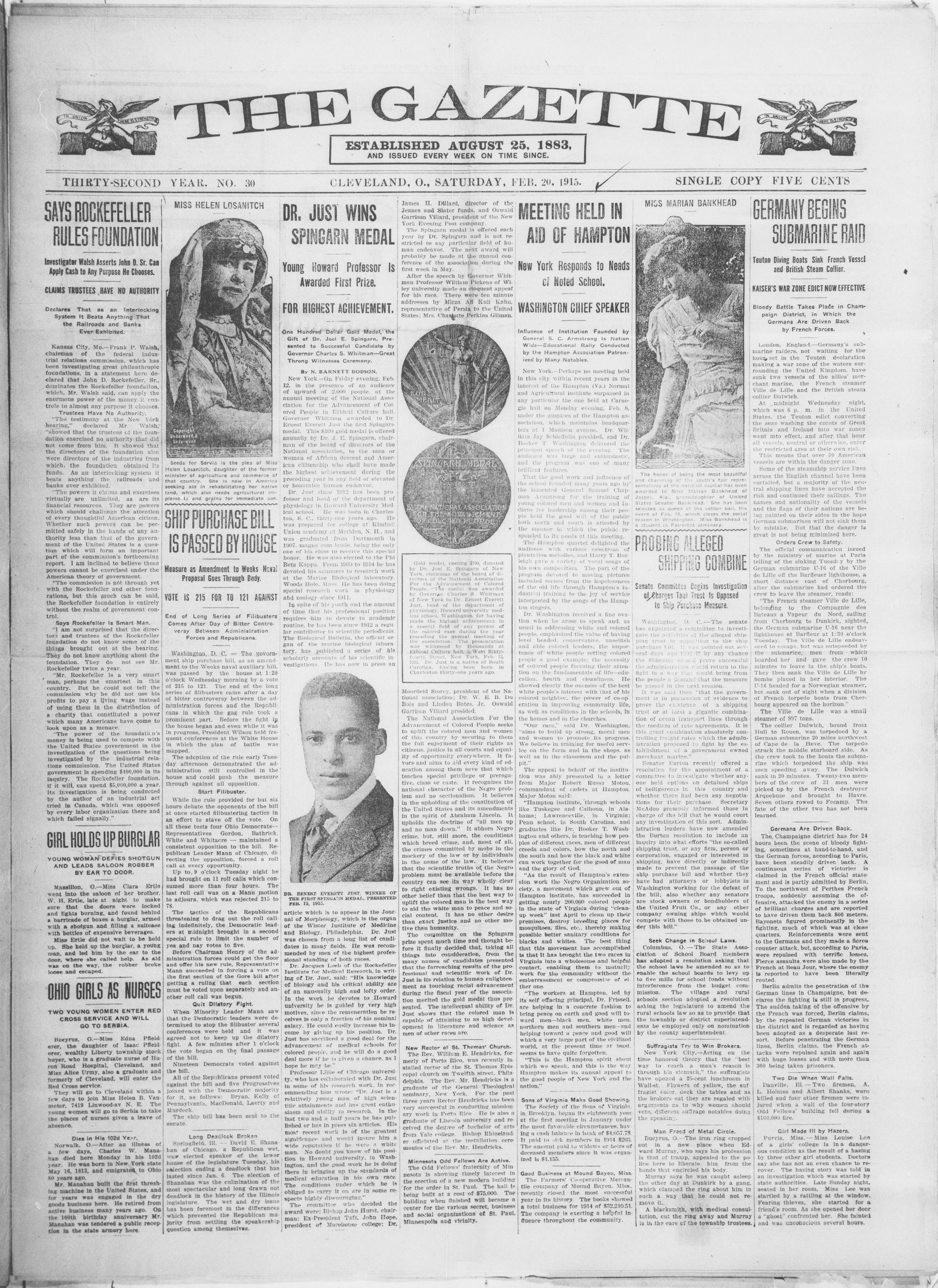
SAYS ROCKEFELLER RULES FOUNDATION
Investigator Walsh Asserts John D. Sr. Can Apply Cash to Any Purpose He Chooses.
CLAIMS TRUSTEES, HAVE NO AUTHORITY
Declares That as an Interlocking System It Beats Anything That the Railroads and Banks Ever Exhibited.
Kansas City, Mo.—Frank P. Walsh, chairman of the federal industrial relations commission, which has been investigating great philanthropic foundations, in a statement here declared that John D. Rockefeller, Sr., dominates the Rockefeller foundation, which, Mr. Walsh said, can apply the enormous power of the money it controls to almost any purpose it chooses.
Trustees Have No Authority.
"The testimony at the New York hearing," declared Mr. Walsh, "showed that the trustees of the foundation exercised no authority that did not come from him. It showed that the directors of the foundation also were directors of the industries from which, the foundation obtained its funds. As an interlocking system it beats anything the railroads and banks ever exhibited.
"The powers it claims and exercises virtually are unlimited, as are its financial resources. They are powers which should challenge the attention of every thoughtful American citizen. Whether such powers can be permitted safely in the hands of any authority less than that of the government of the United States is a question which will form an important part of the commission's forthcoming report. I am inclined to believe these powers cannot be exercised under the American theory of government.
"The commission is not through yet with the Rockefeller and other foundations, but this much can be said, the Rockefeller foundation is entirely without the realm of government control.
"Says Rockefeller Is Smart Man.
"I am not surprised that the directors and trustees of the Rockefeller foundation do not know some of the things brought out at the hearing. They do not know anything about the foundation. They do not see Mr. Rockefeller twice a year.
"Mr. Rockefeller is a very smart man, perhaps the smartest in this country. But he could not tell the commission why he did not use his profits to pay a living wage instead of using them in the distribution of a charity that constituted a power which many Americans have come to look upon as a menace.
"The power of the foundation's money is being used to compete with the United States government in the investigation of the questions being investigated by the industrial relations commission. The United States government is spending $400,000 in its inquiry. The Rockefeller foundation, if it will, can spend $5,000,000 a year. Its investigation is being conducted by the author of an industrial act tried in Canada, which was opposed by every labor organization there and which failed signally."
GIRL HOLDS UP BURGLAR
YOUNG WOMAN DEFIES SHOTGUN
AND LEADS SALOON ROBBER
BY EAR TO DOOR.
Massillon, O.-Miss Clara Ertlie
went into the saloon of her brother,
W. H. Ertlie late at night to make
sure that the doors were locked
and lights burning, and found behind
a barricade of boxes a burglar, armed
with a shotgun and filling a suitcase
with bottles of expensive beverages.
Miss Ertlie did not wait to be held
up. She held up the burglar, a young
man, and led him by the ear to the
door, where she called help. As aid
was on the way, the robber broke
loose and escaped.
OHIO GIRLS AS NURSES
TWO YOUNG WOMEN ENTER RED CROSS SERVICE AND WILL GO TO SERBIA.
Bucyrus, O.-Miss Edna Pfielderer, the daughter of Isaac Pfielderer, wealthy Liberty township stock buyer, who is a graduate nurse of Huron Road Hospital, Cleveland, and Miss Alice Urmy, also a graduate and formerly of Cleveland, will enter the Red Cross service.
They will go to Cleveland within a few days to join Miss Helen B. Vameter, 7419 Linwood-av N. E. The young women will go to Serbia to take the places of nurses given a leave of absence.
Dies in His 102d Ye:r.
Norwalk, O.-After an illness of a few days, Charles W. Manahan died here Monday in his 102nd year. He was born in New York state May 16, 1813, and emigrated to Ohio 80 years ago.
Mr. Manahan built the first threshing machine in the United States, and for years was engaged in the dry goods business here. He retired from active business many years ago. On the 100th birthday anniversary Mr. Manahan was tendered a public reception in the state armory here.
THE GAZETTE
MISS HELEN LOSANITCH
Copyright
Underwood &
Underwood
Seeds for Servia is the plea of Miss Helen Losanitch, daughter of the former minister of agriculture and commerce of that country. She is now in America seeking aid in rehabilitating her native land, which also needs agricultural impiences and grains for immediate use.
SHIP PURCHASE BILL IS PASSED BY HOUSE
Measure as Amendment to Weeks Naval Proposal Goes Through Body.
VOTE IS 215 FOR TO 121 AGAINST
End of Long Series of Filibusters Comes After Day of Bitter Controversy Between Administration Forces and Republicans.
Washington, D. C. — The government ship purchase bill, as an amendment to the Weeks naval auxiliary bill, was passed by the house at 1:20 o'clock Wednesday morning by a vote of 215 to 121. The end of the long series of filibusters came after a day of bitter controversy between the administration forces and the Republicans in which the gag rule took a prominent part. Before the fight in the house began and even while it was in progress, President Wilson held frequent conferences at the White House in which the plan of battle was mapped.
The adoption of the rule early Tuesday afternoon demonstrated the administration still controlled in the house and could push the measure through against all opposition.
Start Filibuster.
While the rule provided for but six hours debate the opponents of the bill at once started diblustering tactics in an effort to stave off the vote. On all these tests four Ohio Democrats—Representatives Gordon, Bathrick, White and Whitacre — maintained a consistent opposition to the bill. Republican Leader Mann of Chicago, directing the opposition, forced a roll call at every opportunity.
Up to, 9 o'clock Tuesday night he had brought on 11 roll calls which consumed more than four hours. The last roll call was on a Mann motion to adjourn, which was rejected 215 to 78.
The tactics of the Republicans threatening to drag out the rolling indefinitely, the Democratic leaders at midnight brought in a second special rule to limit the number of yea and nay votes to five.
Before Chairman Henry of the administration forces could get the floor and offer his new rule, Representative Mann succeeded in forcing a vote on the first section of the Gore bill after getting a ruling that each section must be voted upon separately and another roll call was begun.
Quit Dilatory Fight.
When Minority Leader Mann saw that the Democratic leaders were determined to stop the filibuster several conferences were held and it was agreed not to keep up the dilatory fight. A few minutes after 1 o'clock the vote began on the final passage of the bill. Nineteen Democrats voted against the bill. All of the Republicans present voted against the bill and five Progressives joined with the Democratic majority for it, as follows: Bryan, Kelly of Pennsylvania, MacDonald, Laerty and Murdeck. The ship bill has been sent to the senate.
Long Deadlock Broken
Springfield, Ill. -- David E. Shanahan of Chicago, a Republican wet, was elected speaker of the lower house of the legislature Tuesday, his selection ending a deadlock that has lasted since Jan. 6. The election of Shanahan was the culmination of the most spectacular and long drawn out deadlock in the history of the Illinois legislature. The wet and dry issue has been ferestom in the differences which prevented the Republican majority from settling the speakership question among themselves.
ESTABLISHED AUGUST 25, 1883, AND ISSUED EVERY WEEK ON TIME SINCE.
CLEVELAND, O., SATURDAY, FEB. 20, 1915.
DR. JUST WINS SPINGARN MEDAL
DR. JUST WINS SPINGARN MEDAL
Young Howard Professor Is Awarded First Prize.
FOR HIGHEST ACHIEVEMENT.
One Hundred Dollar Gold Medal, the Gift of Dr. Joel E. Spingarn, Presented to Successful Candidate by Governor Charles S. Whitman-Great Throng Witnesses Ceremony.
By N. BARNETT DODSON.
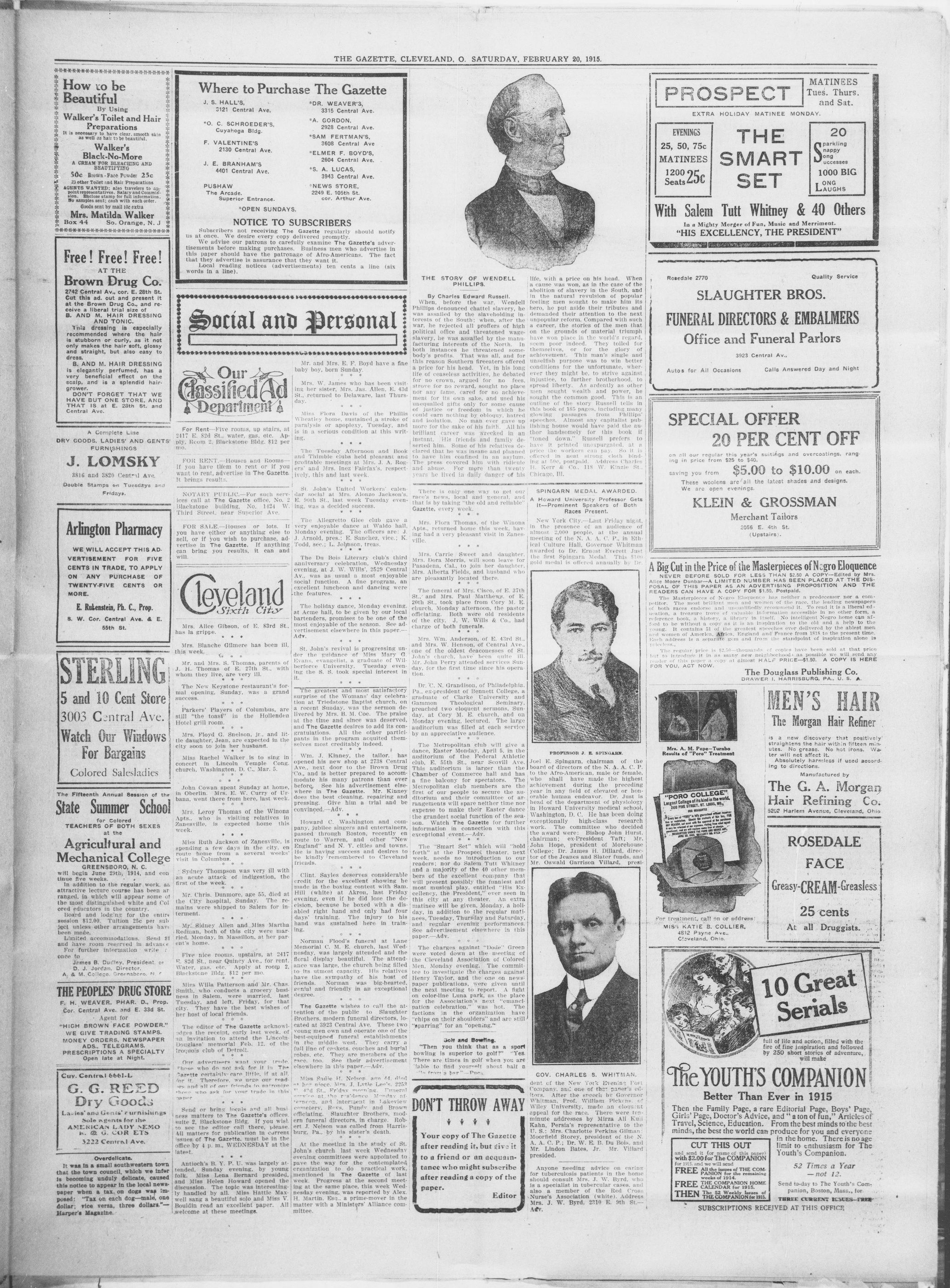
New York.—On Friday evening, Feb. 12, in the presence of an audience of upward of 2,000 people at the annual meeting of the National Association for the Advancement of Colored People in Ethical Culture hall, Governor Whitman awarded to Dr. Ernest Everett Just the first Spingarn medal. This $110 gold medal is offered annually by Dr. J. E. Spingarn, chairman of the board of directors of the National association, to the man or woman of African descent and American citizenship who shall have made the highest achievement during the preceding year in any field of elevated or honorable human endeavor.
Dr. Just since 1912 has been professor and head of the department of physiology in Howard University Medical school. He was born in Charleston, S. C., thirty-one years ago. He was prepared for college at Kimball Union academy at Meriden, N. H., and was graduated from Durmont in 1907. magna cum hude, being the only one of his class to receive this special honor. He was also elected to the Phi Beta Kappa. From 1909 to 1914 he has devoted his summers to research work at the Marine Biological laboratory. Woods Hole, Mass. He has been doing special research work in physiology and zoology since 1911.
In spite of his youth and the amount of time that his professional position requires him to devote to academic routine, he has been since 1812 a regular contributor to scientific periodicals. The Biological Bulletin, the official organ of the marine biological laboratory, has published a series of his scholarly accounts of his scientific investigations. He has now in press an
DR. BENESE EVERETT JUST, WINNER OF THE FIRST SPINGAIN MEDAL, PRESENTED FEB. 12, 1915.
article which is to appear in the Journal of Morphology, which is the organ of the Wister Institute of Medicine and Biology, Philadelphia. Dr. Just was chosen from a long list of candidates in many fields. He was recommended by men of the highest professional standing of both races. Dr. Jacques Loeb of the Rockefeller Institute for Medical Research, in writing of Dr. Just, said: "His knowledge of biology and his critical ability are of an unusually high and lofty order. In the work he devotes to Howard university he is guided by very high motives, since the remuneration he receives is only a fraction of his nominal salary. He could easily increase his income by giving up his position. Dr. Just has sacrificed a good deal for the advancement of medical schools for colored people, and he will do a good deal more if he is given a chance, as I hope he may be."
Professor Lillie of Chicago university, who has collaborated with Dr. Just in some of his research work. In recommending him wrote: "Dr. Just is a relatively young man of high scientific attainments and has great enthusiasm and ability in research. In the last two and a half years he has published or has in press six articles. His most recent work is of the greatest significance and would insure him a wide reputation if he were a white man. No doubt you know of his position in Howard university, in Washington, and the good work he is doing there in bringing up the standards of medical education in his own race. The conditions under which he is obliged to carry it on are in some respects highly discouraging." The committee who decided the award were: Bishop John Hurst, chairman: Ex-President Taft, John Hope, president of Movehouse college; Dr.
James H. Dillard, director of the Jeanes and Slater funds, and Oswald Garrison Villard, president of the New York Evening Post company.
The Spingarn medal is offered each year by Dr. Spingarn and is not restricted to any particular field of human endeavor. The next award will probably be made at the annual conference of the association during the first week in May.
After the speech by Governor Whitman Professor William Pickens of Wiley university made an appeal for his race. There were ten minute addresses by Mirza All Kull Kahn, representative of Persia to the United States; Mrs. Charlotte Perkins Gilman.
FOR MERIT
SUNGARN MEDAL
AVAILABLE TO
BY THE NATIONAL ASSOCIATION
FOR THE ADVANCEMENT
OF COLORED PEOPLE
Gold medal, costing $100, donated by New York, chairman of the board of directors of the National Association for the Preservation of People. The medal was awarded by Governor Charles S. Whitman of New York to Dr. Ernest Everett Just, head of the department of physiology. Howard university medical school made the highest achievement in a special field of any person of the colored race during the year preceding the annual meeting of the association. The presentation was witnessed by thousands at Ethical Culture hall. West Sixixty-fourth Street, New York, Feb. 12, 1912. Just as in the past of South Carolina, having been born in Charleston thirty-one years ago.
Moorefield Storey, president of the National association; Dr. W. E. B. Du Bois and Lindon Bates, Jr. Oswald Garrison Vilrion presided.
The National Association For the Advancement of Colored People seeks to uplift the colored men and women of this country by securing to them the full enjoyment of their rights as citizens, justice in all courts and equality of opportunity everywhere. It favors and aims to aid every kind of education among them save that which teaches special privilege or prerogative, class or caste. It recognizes the national character of the Negro problem and no sectionalism. It believes in the upholding of the constitution of the United States and its amendments in the spirit of Abraham Lincoln. It upholds the doctrine of "all men up and no man down." It abhors Negro crime, but, still more, the conditions which breed crime, and, most of all, the crimes committed by mobs in the mockery of the law or by individuals in the name of the law. It believes that the scientific truths of the Negro problem must be available before the country can see its way wholly clear to right existing wrongs. It has no other belief than that the best way to uplift the colored man is the best way to aid the white man to peace and social content. It has no other desire than exact justice and no other motive than humanity.
The committee on the Spingarn prize spent much time and thought before it finally decided that, taking all things into consideration, from the many names of candidates presented that the farreaching results of the professional and scientific work of Dr. Just in its relation to human enlightenment as touching racial advancement during the fiscal year of the association merited the gold medal thus presented. The intellectual ability of Dr. Just shows that the colored man is capable of attaining to as high development in literature and science as men of other races are.
New Rector of St. Thomas' Church.
The Rev. William E. Hendricks, formerly of Porto Rico, was recently installed rector of the St. Thomas Episcopal church on Twelfth street, Philadelphia. The Rev. Mr. Hendricks is a graduate of the General Theological seminary, New York. For the past three years Rector Hendricks has been very successful in conducting missionary work in Porto Rico. He is also a graduate of Lincoln university and received the degree of bachelor of arts from Yale college. Bishop Rhineland er officiated at the installation ceremonies of the Rev. Mr. Hendricks.
Minnesota Odd Fellows Are Active. The Odd Fellows' fraternity of Minnesota is showing timely interest in the erection of a new modern building for the order in St. Paul. The hall is being built at a cost of $75,000. The building when finished will become a center for the various secret, business and social organizations of St. Paul Minneapolis and vicinity.
MEETING HELD IN AID OF HAMPTON
WASHINGTON CHIEF SPEAKER
Influence of Institution Founded by General S. C. Armstrong Is Nation Wide—Educational Rally Conducted by the Hampton Association Patronized by Many Notables.
New York.—Perhaps no meeting held in this city within recent years in the interest of the Hampton (Va.) Normal and Agricultural institute surpassed in any particular the one held at Carnegie hall on Monday evening, Feb. 8, under the auspices of the Hampton association, which maintains headquarters at 1 Madison avenue, Dr. William Jay Sheffellin presided, and Dr. Booker T. Washington delivered the principal speech of the evening. The audience was large and enthusiastic, and the program was one of many brilliant features.
That the good work and influence of the school founded many years ago by the lamented General Samuel Chapman Armstrong for the training of young colored men and women and Indians for leadership among their people hold the good will of the public both north and south is attested by the manner in which the public responded to its needs at this meeting.
The Hampton quartet delighted the audience with various selections of plantation melodies, and Harry T. Burleigh gave a variety of vocal songs of his own composition. The part of the program devoted to moving pictures included scenes from the hopelessness of the old life through Hampton's industrial training to the joy of service interpreted by the songs of the Hampton singers.
Dr. Washington received a fine ovation when he arose to speak and, as usual in addressing white and colored people, emphasized the value of having level headed, conservative, unsettled and able colored leaders; the importance of white people setting colored people a good example; the necessity of colored people focusing their attention on the fundamentals of life—education, health and cleanliness. He showed clearly the oneness of the best white people's interest with that of his colored neighbor, the power of co-operation in improving community life, as well as conditions in the schools, in the homes and in the churches.
"Our race," said Dr. Washington, "aims to build up strong, moral men and women to promote its progress. We believe in training for useful service on the farm and in the shops, as well as in the classroom and the pulpit."
The appeal in behalf of the institution was ably presented in a letter from Major Robert Russa Moton, commandant of cadets at Hampton. Major Moton said:
"Hampton institute, through schools like Tuskegee and Calhoun, in Alabama; Lawrenceville, in Virginia; Penn school, in South Carolina, and graduates like Dr. Booker T. Washington and others, is teaching how peoples of different races, men of different creeds and colors, how the north and the south and how the black and white can work together for the good of man and the glory of God.
"As the result of Hampton's extension work the Negro Organization society, a movement which grew out of Hampton institute, has succeeded in getting nearly 200,000 colored people in the state of Virginia during "cleanup week" last April to clean up their premises, destroy breeding places for mosquitoes, flies, etc., thereby making possible better sanitary conditions for blacks and whites. The best thing that this movement has accomplished is that it has brought the two races in Virginia into a wholesome and helpful contact, enabling them to mutually work for the community without the embarrassment or compromise of either one.
"The workers at Hampton led by its self effacing principal, Dr. Frissell, are helping in a concrete fashion to bring peace on earth and good will to toward men—black men, white men, northern men and southern men—and helping toward a peace and good will which a very large part of the civilized world, at the present time at least, seems to have quite forgotten.
"This is the Hampton spirit about which we speak, and this is the way Hampton makes its annual appeal to the good people of New York and the nation."
Sons of Virginia Make Good Showing.
The Society of the Sons of Virginia, in Brooklyn, began its eighteenth year at the first meeting in January under the most favorable circumstances, having a cash balance in bank of $4,057.78 it paid to seek members in 1914 $203. The amount paid to widows or heirs of deceased members since it was organized is $1,153.
Good Business at Mound Bayou, Miss.
The Farmers' Co-operative Mercantile company of Mound Bayou, Miss, recently closed the most successful year in its history. The books showed a total business for 1914 of $32,210.51. The company is exerting a helpful influence throughout the community.
MISS MARIAN BANKHEAD
The honor of being the most beautiful and charming of the south's fair representatives at the national capital has been awarded to Senator Jasper, Aia, granddaughter of United States Senator Bankhead. She has been selected as queen of the cotton ball, the event of Feb. 16, which closes the social season. Senator Bankhead is a student in Fairmont seminary.
Senate Committee Begins Investigation of Charges That Trust Is Opposed to Ship Purchase Measure.
Washington, D. C.—The senate has appointed a committee to investigate the activities of the alleged shipping trust in opposition to the ship purchase bill. It was pointed out several days ago that if by any chance the filibuster sound prove successful the administration would return to the fight in a way that would bring from the people a demand that the measure be passed in the next session.
It was said then that the government is in possession of evidence to prove the existence of a shipping trust or at least a gigantic combination of ocean transport lines through the medium of rate agreements. It is this great combination absolutely controlling freight rates which the administration proposed to fight by the establishment of a government owned merchant marine."
Senator Burton recently offered a resolution for the appointment of a committee to investigate whether anyone held options on detained ships of belligerents in this country and whether there had been any negotiations for their purchase. Secretary McAdoo promptly informed those in charge of the bill that he would court any investigation of this sort. Administration leaders have now amended the Burton resolution to include an inquiry into what efforts "the so-called shipping trust, or any firm, person or corporation, engaged or interested in shipping, have directly or indirectly made to prevent the passage of the ship purchase bill and whether they have had attorneys or lobbyists in Washington working for the defeat of the bill; also whether any senators are stock owners or bondholders of the United Fruit Co., or any other company owning ships which would compete with those to be obtained under this bill."
Seek Change in School Laws
Columbus, O. — The State Association of School Board members has adopted a resolution asking that the school laws be amended so as to enable the school boards to levy up to five mills for school funds without interference from the budget commission. The village and rural schools section adopted a resolution asking the legislature to amend the rural schools law so as to provide that the township or district superintendents be employed only on nomination by the county superintendent.
Suffragists Try to Win Brokers
Suffragists Try to Win Brokers.
New York City—Acting on the time honored theory that the "best way to reach a man's reason is through his stomach," the suffragists have opened a 25-cent lunchroom in Wall-st. Flowers of yellow, the suffragist coat, deck the tables and as the brokers eat they are regaled with arguments as to why women should vete, different suffrage notables doing the speaking.
Man Freed of Metal Circle
Bucyrus, O.-The iron ring cropped out in a new place when Edward Murray, who says his profession is that of trump, appealed to the police here to liberate him from the bonds that encircled his body. Murray says he was caught asleep the other day at Dunkirk by a gang, which clamped the ring about him in such a way that he could not remove it. A blacksmith, with medical consultation, cut the ring away and Murray is in the care of the township trustees.
IN UNION
IN ETERNITY
GERMANY BEGINS SUBMARINE RAID
Teuton Diving Boats Sink French Vessel and British Steam Collier.
KAISER'S WAR ZONE EDICT NOW EFFECTIVE
Bloody Battle Takes Plade in Champaign District, in Which the Germans Are Driven Back by French Forces.
London, England—Germany's submarine raiders, not waiting for the hour, set in the Teuton declaration making a war zone of the waters surrounding the United Kingdom, have sunk two vessels of the allies' merchant marine, the French steamer Ville de Lille and the British steam collier Dulwich.
At midnight Wednesday night, which was 6 p. m. in the United States, the Teuton edict converting the seas washing the coasts of Great Britain and Ireland into war zones went into effect, and after that hour all vessels, neutral or otherwise, enter the restricted area at their own risk.
This means that over 30 American vessels are within the danger zone. Some of the steamship service lines across the English channel have been curtailed, but a majority of the neutral shipping lines have accepted the risk and continued their sailings. The names and nationality of the vessels and the flags of their nations are being painted on their sides in the hope German submarines will not sink them by mistake. But that the danger is great is not being minimized here.
Orders Crew to Safety.
The official communication issued by the ministry of marine at Paris telling of the sinking Tuesday by the German submarine U-16 of the Ville de Lille off the Barfleur lighthouse, a short distance east of Cherbourg, after the submarine had ordered the crew to leave the steamer, reads:
"The French steamer Ville de Lille, belonging to the Compagnie des Bateaux a Vapeur du Nord, sailing from Cherbourg to Dunkirk, sighted, the German submarine U-16 near the lighthouse at Barfleur at 1:30 o'clock Tuesday. The Ville de Lille endeavored to escape, but was outspeeded by the submarine, men from which boarded her and gave the crew 10 minutes to leave in the ship's boats. They then sank the Ville de Lille by bombs placed in her interior. The U-16 headed for a Norwegian steamer, but sank out of sight when a division of French torpedo boats from Cherbourg appeared on the horizon."
The Ville de Lille was a small steamer of 997 tons.
The collier Dulwich, bound from Hull to Rouen, was torpedoed by a German submarine 20 miles northwest of Cape de la Heve. The torpedo struck the middle starboard side. As the crew took to the boats the submarine which torpedoed the ship was seen speeding away. The Dulwich sank in 20 minutes. Twenty-two members of the crew of 31 men were picked up by the French destroyer Arquebuse and brought to Havre. Seven others rowed to Fecamp. The fate of the other two has not been learned.
Germans Are Driven Back.
The Champagne district has for 24 hours been the scene of bloody fighting, sometimes at hand-to-hand, and the German forces, according to Paris, have been steadily driver back. A continuous series of victories is claimed in the French official statement and is partly admitted by Berlin. To the northwest of Perthes French troops, suddenly assuming the offensive, attacked the enemy in a series of brilliant charges and are reported to have driven them back 800 meters. Bayonets figured prominently in the fighting, much of which was at close quarters. Reinforcements were sent to the Germans and they made a fierce counter attack, but, according to Paris, were repulsed with terrific losses. Fierce assaults were also made by the French at Beau Jour, where the enemy is reported to have been literally routed. Berlin admits the penetration of the German lines in Champagne, but declares the fighting is still in progress. The sudden taking of the offensive by the French was forced, Berlin claims, by the repeated German victories in the district and is regarded as having been adopted as a desperate last resort. Before penetrating the German lines, Berlin claims, the French attacks were repulsed again and again with huge losses and with more than 300 being taken prisoners.
Two Die When Wall Falls.
Danville, Ill.—Two firemen, A. L. Holmes and Albert Shanks, were killed and four other firemen were injured when a wall of the four-story Odd Fellows' building fell during a $100,000 fire.
Girl Made Ill by Hazers.
Purvis, Miss. — Miss Louise Lee of a girls' college is in a dangerous condition as the result of a hazing by three other girl students. Doctors say she has not an even chance to recover. The hazing story was told in an investigation which was started by state authorities. Late Sunday night, seated in her room, Miss Lee was started by a rattling at the window. Fearing thieves, she started for a friend's room. As she opened her door a "ghost" confronted her. She fainted and was unconscious several hours.
How vo be
Beautiful
j By Using ‘i
| Walker's Toilet and Hair
s Preparations 3
Tels necosaary to have cle. smooth skin
MSR atta
Walker's
© Black-No-More |
nomenon aeeatnone a> |
Sareea :
; $06 Brwwn-Pace Powder 25c
Pvigeeetueutmereces |
| AGENTS WANTED: algo tryeers tay
ime emacs aerate
Geoeeca eae:
eeoatbyautmecce 7
: Mrs, Matilda Walker
: Box44 So. Orange, N. J
AT THE
Brown Drug Co.
2742 Central Av., cor. E. 28th St.
Cut this ad. out and present it
Meteavoe tine Gos oe rs.
me star eal as ee
BAND M HAIR DRESSING
Ako’ rome,
Vila dressing is especially
recommended where the hair
Be aumernver tay, sek net
pay wares tale ore, floes
Se craigne bet site sony
dress.
B. AND M. HAIR DRESSING
Renee etree toss
Ser MONT Gate: onthe
Soha ea atenaa ste
eee
DON'T FORGET THAT We
HAVE BUT-ONE GrOne ANE
Wikre ae sneak No
sts ve
Rcargiess Lie
DRY GOODS. LADIES’ AND GENTS
FURNISHINGS
1616 and $820 Central ave
BARGE eiblipe'be ‘Tusssiyi ane
Plies
WE WILL ACCEPT THIS AD-
VERTISEMENT FOR FIVE
CENTS IN TRADE, TO APPLY
ON ANY PURCHASE OF
TWENTY-FIVE CENTS OR
MORE.
E. Rubenstein, Ph. C., Prop.
8. W. Cor. Central Ave. & E.
58th st.
STERLING
5 and 10 Cent Store
3003 Central Ave.
Watch Our Windows
For Bargains
Colored Salesladies
‘The Fifteenth Annual Session of the
nesSicclanad
TEACHERS OF BOTH SEXES
ne
Agricultural and
Mechanical College
GREENSBORO, N. C.
wwitt bocin Sune 2th, A914, and con
feu ec mece oe
aceite aieia capuler ork an
Susie eawrc meats nse boon or
Bee ue uitigll avec some of
the most distinguished white and Col
pool ce bya tar la
ees sae adele othe. enti
seunioa $1200. Fallon’ 260 per" sub
I cipapsiagtarrenareienss vars
tees mabe
edits aeontiaodassons: Sena
ee tk
Partiehier miorention wets
hele
Bornes @: Guctey, President, o»
Re oesn creer
Hears Raters piscnssetn. ©
?
THE PEOPLES’ DRUG STORE
FH. WEAVER, PHAR. D., Prop.
Tor. Contral Ave. and E. 384 t
Agent for
sHIGH BROWN FACE POWDER.”
WE GIVE TRADING STAMPS.
MONEY ORDERS. NEWSPAPER
Koes TELEGRAMS.
PRESCRIPTIONS A SPECIALTY
ZUM cpl telna as
Cuy. Central 6661-L
G.G. REED
Dry Goods
Lavies’ ane Gents’ furnishings
pe pee
AMERICAN LADY SEMO
&. @ G. COR ETS
3222 Central Ave.
uae
oe eT oe
Tt was in a small southwestern town
that the town council, which we infor
4s becoming unduly delicate, caused
‘this notice to appear in the local news-
veber when 8 taxon dogs wap im
posed; “Tax on each dog—male, one
dollar; vice versa, three dollars.”"—
‘Harper's Magazine.
Where to Purchase The Gazette
J. 8. HALLS, SOR, WEAVER'S,
121 Central Ave, 3816, Central “Ave.
2 ‘ *A. GORDON.
‘0. C. SCHROEDER'S, 2928 Central Ave.
Cuyahoga alae,
‘SAM FERTMANS,
F. VALENTINE’S 3008 Central Ave
2180 Central Ave, Seceeseste:
2808. Central Ave.
J. E, BRANHAM'S Sore
‘4401 Central Ave, A. LUCAS,
aes 3943 Central Ave,
PusHAW NEWs STORE,
fine Arvada 2240 E. 108en Se
Superior Entrance. cor, Arthur Ave.
*OPEN SUNDAYS.
NOTICE TO SUBSCRIBERS
eabaininers aidt rasaiVing tha (Gseatie URUIATS. anoola Wot
us at once, We desire every copy ‘aeivered artis
Weletioe oun paras’ ie carats soamine Tie Oicatere adver
finseapas ators tasking purchaase, Business tase oe uttering
this paper should have the patronage of Afro-Americans. The fact
that tay advertise i saeuraice siasthor sunt ae
Local reading. totiees “(adverticments) ton’ conta a tino (atx
va
. :
octal and aWersonal :
|
sx Our 2 om
rime ‘4b te
PRATT ETA, ce tal a ine yal
For Rent-Five rooms, up wars, at PTA or amonlen, Tuesday, ana
2417 B, $20 St, water, kas, ete. AD-| ing.
ply. Room 2, Blackstone Bldg. $12 per |" eeiee
eng ‘The Tuesday Afternoon and Book
It brings result ae mes
wil. The Du Bois Literary club's third
Cleveland
Mrs, Alice Gibson, of E. 83rd St.
has la. grippe.
Mrs. Blanche Gilmere has been ill,
this week.
Mr. and Mrs, 8. ‘Thomas, parents of
JH. Thomas of B. 27th St. with
Whom they live, are very ilL
‘The New Keystone restaurant's for-
mal opening, Sunday, was a grand
Parkers’ Players of Columbus, are
still “the toast in the Hollenden
Hote! grill room,
Mrs, Floyd G. Snelson, jr. and lit
tle daughter, Jean, are expected in the
city soon to join her husbana,
Miss Rachel Walker is to sing in
concert in Lincoln ‘Temple Cons.
church, Washington, D. C., Mar. 5.
John Cowan spent Sunday at home,
in’ Oberlin. Mrs. E. W. Curry of Ur:
bana, went there from here, last week.
Mrs. Leroy ‘Thomas of the Winona
Apts... who is visiting relatives in
Zanesville, is expected home this
week.
Miss Ruth Jackson of Zanesville, Is
spending a few days in the city, en
route home trom a several weeks’
visit in Columbus
Sydney Thompson was very ill with
an acute attack of indigestion, the
first of the week.
Mr. Chris. Dunmore, age 55, died at
the City hospital, Sunday. “The re-
mains were shipped to Salem for in:
terment. i
Mri Siduey Allen and. Miss Martha
Redman, both of this city were mar.
ried. Monday, in Massillon, at her par
ent’s home.
Five nice rooms, upstairs, at 2417
f, 82d St., near Quiney Ave., for rent.
Water, gas. ete. Apply at roop 2
Blackstone Bldg. $12 per mo,
Mies Willa Patterson and’ Mr. Chas.
“Smith, who conducts a grocery bust
ness in Salem, were married, last
‘Tuesday, and left, Friday, for that
city. They have the best wishes of
‘her host of local friends.
‘The editor of The Gazette acknowl:
-dgee the receipt, early Inst week, of
an invitation to ‘attend the Lincoln-
Douglass’ memorial Feb. 12, of the
Iroquois club of Detroit.
One advertmers want vour trode
“chose who do not ask for it in The
Sarette certainly» care ttle, if at all
for it. Therefore, we urze our read
wre and all nf ony friends ta natranize
chee who aek far Vor trade in thts
Send or bring locals and all. busi
ness matters to The Gazette's offices.
suite 2, Blackstone Bldg. If you wis!
to see’ the editor call there, piease.
Mi matters for publication 1 current
ssneg of The Gazette. must be in the
office by 4 p. m., WEDNESDAY at the
latest,
Antioch’s B. Y. P. U. was largely at-
tended, Sunday’ evening, by young
folk. "Miss_Lena Bernard presided,
and Miss Helen Howard opened the
discussion. The topic was interesting-
ly handled by all. Miss Hattie Max-
well sang @ beautiful solo and Miss V.
Bouldin read an excellent paper. All
welcome at these meetings.
THE GAZETTE, CLEVELAND, 0. SATURDAY, FEBRUARY 20, 1915.
Mr. and Mrs, B, F. Boyd have a fine
baby boy, born Sunday.
Mrs, W. Jamies who has been visit
ing her sister, Mrs, Jas, Allen, B. 40
St, returned io Delaware, last Thurs
day
Miss Flora Davis of the Phillis
Wheatley home, sustained a stroke of
paralysis or apoplexy, Tuesday, and
is in a serious condition at this’ writ
The Tuesday Afternoon and Book
and ‘Thimble elubs held pleasant and
profitable meetings at Mrs. J. A, Ros:
ers’ and Mrs. Inez’ Fairfax’s, respect
ively, this and last week
St. John's United Workers’ eaten.
dar social at Mrs. Alonzo Jackson's.
E, 90th St, last week Tuesday even:
ing, was a decided success,
The Allegretto Glee club gave a
very enjoyable dance at Waldo hall
Monday evening. ‘The officers are: J
J. Arnold, pres.: B. Sanchez, viee.; K
Todd, see.; 1., Jolson, treas,
‘The Du Bois Literary: club's. third
anniversary celebration, Wednesday
evening, at J. W. Wills’, 2529 Central
AY. Was as usual a most enjoyable
social function. A fine program, au
excellent luncheon and dancing were
the features,
‘The holiday dance, Monday evening
at Acme hall, to be given by our local
bartenders, promises to be one of the
most enjoyable of the season. See ad
Vertisement elsewhere in this paper.—
Ady.
St. John’s revival is progressing un-
der ‘the gnidanee of Miss Mary @
Evans, evangelist, a graduate of Wil
verforce University. Tuesday even
ing the S. 8. took special interest in
it.
The greatest and most satisfactory
surprise of the Womans’ day celebra-
tion at ‘Triedstone Baptist chureh, on
a recent Sunday, was the sermon’ de-
livered by Mrs. B. M. Coe. The praise
at the time and since was deserved,
and The Gazette desires to add its con-
gratulations, All the other partici
pants In the program acquited them:
Selves most ereditably, indeed.
Wm. J, Kinney, the tailor, has
opened his new shop at 2738 Central
Ave, next door to the Brown Drug
Co., and is better prepared to accom:
modate his many patrons than ever
heforg, See his advertisement. else-
where’ in The Gazette. Mr. Kinney
does the best cleaning, repairing and
pressing. Give him a trial and be
convinged.—-Adv.
Howard C. Washington and com:
pany, jubilee singers and entertainers,
passed through Boston, recently en
route to Warren, and’ other “New
England” and N. Y. cities and towns.
He is having success and desires to
be kindly ‘remembered to Cleveland
friends.
Clint, Sayles deserves considerable
credit for the excellent showing he
made in the boxing contest with Sam.
Hill (white) at Akron, last Friday
evening, even if he did lose the de
cision, because he boxed with a dis
abled right hand and only had four
days’ training. The injury to his
hand was sustained here in train
ing.
Norman Flood’s funeral at Lane
Memorial C. M. E. church, last Wed:
nesday, was largely attended and the
ftoral display beautiful, ‘The attend
ance was large, the church being filled
to its utmost capacity. Ilis relatives
have the sympathy of his host of
friends. Norman was big-hearted,
venial and friendly in an exceptional
dexree.
The Gazette wishes to call the at
tention of the public to Slaughter
Brothers. modern funeral directors, 1o-
cated at 3923 Central Ave. These two
voung men own and operate one of the
hest-equipned funeral establishments
in the middle west. They carry. a
{Ant Tine of caskets. couches and burfal
robes, ete. ‘They are members of the
race. foo. See thelr advertisement
elsewhere in this paper—Adv.
Mise Sadie H. Neleon ava 44. avon
ne her niece. Mrs, J. Lvtle Leo's. 2258
Tia St. Friday morning. Myneral
sowie at the Tostdence Monday at
‘ernenn. and interment in Lakeview
cometery, Revs, Bundy and Brown
officiating. Slaughter Brothers, mod:
ern funeral directors, in charge. Rob-
ert J. Nelson was called from Harris.
burg, Pa, by his sister's death,
At the meeting in the study of St.
John’s church last week Wednesilay
evening committees were appointed to
pave the way for the contemplated
organization to do practical work,
mentioned In The Gazette of last
week. Progress at the second meet:
ing at the same place, this week Wed:
nesday evening, was reported by Alex.
H. Martin. Esq. a primemover in the
matter with a Minist¢rs’ Altlance com:
mittee.
Go >
Bd ‘
4
See .
Re ay
a eae
Be Aes
eee
ay zr i ty
EE eee:
ey
THE STORY OF WENDELL life, ei a price on his hee
oy ne ceen) Serer et. Seems.
When, “before the war, Wendell
Phillips denounced chattel slavery, he
was assailed by the slaveholding’ in.
terests of the South; when, after the
war, he rejected all proffers of high
political office and threatened wage-
slavery, he was assailed by the manu.
facturing interests of the North, In
both instances he threatened some-
body's profits. That was all, and for
this reason Southern fireeaters offered
a price for his head. Yet, in his long
life of ceaseless activities, he debated
for no crown, argued for no fees,
strove for no reward, sought no place
nor any fame, cared for no achieve:
ment for its own sake, and used his
unequalled gifts only for some cause
of justice or freedom in which he
conid earn nething by obloauy, hatred
and isolation. No man ever gave up
more for the sake of his faith. All his
brilliant career was wrecked in an
instant, “His friends and family de
serted him. Some of his relatives ce
clared that he was insane and planned
to have him confined in an asylum
The press covered him with ridicule
and. abuse, For more than twenty
years he Hved in daily danger of his
‘There is only one way to get om
race's mews, Toeal and keneral, asd
that is by taking “the old and reliable”
Gazette, every week
Mrs, Plora ‘Thomas, of the Winon
Apis, returned home this week, iv
ing had a very pleasant visit in Zanes:
ville
Mrs. Carrie Sweet and daughter
Mrs. Dora Morris, will soon leave for
Pasadena, Cal, to Join her daughter
Mrs. Alberta Pields, and husband who
are pleasantly located there
‘The funeral of Mrs. Cisco, of B. 37th
Stand Mrs, Paul Matthews, of E.
20th St, took place from Cory M. E.
Church, ‘Monday afternoon, the pastor
officiating. Both were old. residents
of the city. J, W. Wills & Co, had
charge of both’ funerals,
Mrs. Wm, Anderson, of E. 43rd St.
and Mrs, W. Henson, of Central Ave.
one of the oldest deaconesses of St
John's church, have heen quite ill
Mr. John Perry attended services Sun
day, for the first Ume since his opera
tion
Dr. ©. N. Grandison, of Philadelphia
Pa,, es-preaident of Hennett College, a
graduate of Clarke University. and
Gammon “ ‘Theological Seminary,
preached two eloquent sermons, Sun:
day, at Cory M. E. church, and on
Monday evening, lectured. The large
auditorium was filled at each service
by an appreciative audience.
‘The Metropolitan club will give a
Gance, Easter Monday, April 5, in the
fauditerium of the Federal Athletic
club, BE. 55th St, near Seovill Ave.
This auditorium is larger than the
‘Chamber of Commerce hall and has
a fine balcony for spectators. The
Metropolitan club members are the
firat of our people to secure the au
ditorium and their committee of ar
rungemients will spare neither time nor
expense to make their Easter dance
the grandest social function of the sea:
son, Watch The Gazette for further
information in connection with tis
exceptional event-—Adv.
‘The “Smart Set" which will “hold
forth” at the Prospect theater. next
Week, needs no introduction to our
‘readers: nor do Salem Tutt. Whitnes
‘and a majority of the 40 other mem:
“bers of the excellent company that
will present possibly the funniest and
most’ musical play. entitled “His. Bx
cellency, the President,” ever seen in
this city at any theater. An extra
“matinee will be given, Monday, a hol
day, in addition to the regular matt
nees, Tuesday, Thursilay and Saturday,
and” regular | evening performances
See advertisement elsewhere in this
paper.—Ady.
‘The charges against “Doe” Green
were voted down at the meeting of
the Cleveland Association of Colored
Men, Monday evening. ‘The commit:
tee to investigate the charges against
Henry Taylor, and the one on news:
‘paper publications, were given until
the next meeting to report. A fight
fon colordine Luna park, ax the place
for “the Association's next “emanct
pation celebration,” was hot. The
factions in the ‘organization have
“chips on their shoulders” and arc still
‘quaetue” tor an “opening.”
Gol and Bowing.
“Then you think that as a sport
bowling is superior to golf?” “Yes
‘There are times in golf when you are
fuble to find youreelf about halt a
Na! fehan hep ieee
a
DONT THROW AWA’
vo ew
Your copy of The Gazette
after reading it, but dive it
toa friend or an acquain-
tance who might subscribe
after reading a copy of the
paper.
Editor
.
life, with a price on his head, When
a cause was won, as in the ease of the
abolition of slavery in the South, and
in the natural revulsion of popular
feeling men sought to make him its
hero, he put aside their tributes and
demanded thelr attention to the next
unpopular reform, Compared with such
a career, the stories of the men that
on the grounds of material triumph
have won place in the world's regard,
scem poor indeed. ‘They. toiled for
themselves, or for the glory of
achievement. ‘This man's single and
unselfish purpose was to win better
conditions for the unfortunate, wher:
ever they might be, to strive against
injustice, to further brotherhood, to
spread liberty. As ardently as other
men sought’ wealth and power, he
Sought the common good, This fs an
outline of the story Russell tells in
this book of 185 pages, including many
glowing passages from Phillips"
Speeches, “Almost any capitalist. pnb:
lishing house would have paid the u-
thor handsomely for this book it
“toned down.” Russell prefers to
haye it printed uncxpurgated, at a
price the workers can pay. So Mt |
Sffered In neat strong cloth. bind.
Ing at 50, postpaid. Address Chavles
H. Kerr & Co, 18 W. Kinzie St
Chicago, Ml,
SPINGARN MEDAL AWARDED.
A Howard University Professor Gets
It—Prominent Speakers of Both
Races Present.
New York City —Last Friday nigat
meeting of the NA” An (Py in Eth
<a
Le *%
ae ge
aie
5 ere
Vive
& . eras
SS ag
Meee SNe ae:
Sih UREN :
aoa. a dete
Joel K. Spingarn, chairman of the
board of directors of the N. A. A. C. P.
to the Afro-American, male of female,
who shall have made the highest
achievement during the preceding
year in any field of elevated, or hon-
orable human endeavor. Dr. Just Is
head of the department of physiology
in Howard University medical school,
Washington, D, C. He has been doing
exceptionally high-class research
work. The committee who decided
the award were: Bishop John Hurst,
chairman; ex-President ‘Taft; Mr.
John Hope, president of Morehouse
College: Dr. James . Dillard, direc-
tor of the Jeanes and Slater funds, and
Mic. Oswald Gartaon Vilar ‘orest
7
3 a
(a
» :
GOV. CHARLES S. WHITMAN.
dent of the New Yors Evening Por
Company. auc one of the: paner’s cit-
itars, After the sneech be Governor
Whitman, Prof. Willlam Plekens. 0?
Wiley University, made an eloquent
appeal for the race. There were ten.
minute addresses by Mirza All Kui
Kahn, Persia’s representative to the
U.S. Mrs. Charlotte Perkins Gilman
Moorfield Storey, president of the N
A. A.C. P.; Dr, W. E. B. Du Bois, and
Mr. Lindon Bates, Jr. Mr. Villard
presided.
Anyone needing advice on cari
for tuberculosis patients in the homie
should consult Mrs, J. W. Byrd, who
is a specialist in tubercular cases, auc
also a member of the Red Cross
Nurse's Association (white). Address
Mrs. J. W. Byrd, 2210 E. oth st—
—
[ PROSPECT [n= tus.
(eee ee nocieate
EVENINGS ' 20
25, 50, 75c T H E parelina
warnees| SMART |Sei.
1200 1000 BIG
saul0e]| SET | i3e
With Salem Tutt Whitney & 40 Others
In a Mighty Merger of Fun, Music and Merriment.
“HIS EXCELLENCY, THE PRESIDENT”
SLAUGHTER BROS.
FUNERAL DIRECTORS & EMBALMERS
Office and Funeral Parlors
SPECIAL OFFER
20 PER CENT OFF
on oll our regular this rae suitihgs and overcoatings, rang:
ning os ten $5.002t0 $10.00! sac
KLEIN & GROSSMAN
Merchent Tailors
A Big Cut in the Price of the Masterpieces of Negro Eloquence
NEVER BEFORE SOLD FOR LESS THAN $2.0 A COBY_—Ealtad by Mre
neNaMEe GEEORE, $0L0 SO NUMBER Has SEEN PLACED AT. THE DIS:
Ao oe nee MU ERTIGING PROFGGITION AND” FHE
ROGET chu waUE A Cope FOR Sie Boecin
Mee aanreae tek soparMle gon and from ihe standpoint of inapiration alone: to
rhe wgular price is $2.50—thousand: spies have been sold at that price
220 tne Ta nn ee nee ene a (Sony ie He
i
The Douglass Publishing Co.
cane Dougiass Kublishing ©.
———
{ep VE
LG it RES i :
On: ey 10 Gree
‘ ao ae ° is
2 gates as
‘Ce Eu") Seria
I eg ao
oe
eee Yfgy 7 \i\ of life and action, filled with the
ea it sists, eg wim as
Sa by 250 short stories of adventure, #
— will make a
i
‘The YOUTHS COMPANION
i Better Than Ever in 1915
Then the Family Page, a rare Editorial Page, Boys’ Page,
Girls’ Page, Doctor’s Advice, and “a ton of fun,” Articles of
Travel, Science, Education. From the best minds to the best
| minds, the best the world can produce for you and everyone
in thehome. There is no age
CUT THIS OUT] limit to cathusiasm for The
Sin’ Bloat HReCOMBARION | YOU'S ae
or 7s, and we wil send 52 Times a Year
FREE pAsigh ist ho teases —not 12.
FRE Comparion nome | Send tonday ts The Youth's Com:
Ce ea | reas bees a fe
pig ComPANoNteisis. | rumer cumuext 1csvEs—reee
> SUBSCRIPTIONS RECEJVED AT THIS OFFICE
|
PR AG
wiiceilct
cae ae
So
ere, 4
colle 2”.
“poo COLLECT, Wi
args Sanat ae Hy mn
ees | |
ria |
y rch
f »)
73 So
Lo coe Sos -«
eo eee DS i
A 9
MEN’S HAIR
The Morgan Hair Refiner
The G. A. Morgan
Hair Refining Co.
ROSEDALE |
FACE :
Greasy-CREAM-Greasless
25 cents —
At all’ Druggists. |
Sir Edward Grey Argues U. S. Complaint is 'Founded On a Misconception.'
CITES UNCLE SAM'S CIVIL WAR ACTION
Says England Has Not Interfered With Any Ships Sailing from the U. S. to Any Countries Except Holland, Denmark, Norway Sweden and Italy.
Washington, D. C.—The text of the British government's reply to the American protest against British interference with American commerce was made public Wednesday night simultaneously in Washington and London. The British reply is written by Sir Edward Grey and is dated Feb. 10. In acknowledging Secretary Bryan's letter of protest the British foreign secretary says that Secretary Bryan "describes the situation produced by the action of Great Britain as a pitiful one to the commercial interests of the United States." Sir Edward Grey then says in reply that the British government has not interfered in any way whatsoever with any ships that have sailed from the United States to any countries except Holland, Denmark, Norway, Sweden and Italy.
Eight Placed in Prize Court
It is only "through those countries adjacent to the theater of war that the enemy introduces the supplies which he requires for the carrying on of the war,"[1] and it is only "through those countries from the United States for those countries since the beginning of the war only 7 out of 772 have been placed in the prize compartment of the war,"[2] and 45 temporarily detained to enable particular conglamations of cargo to be discharged for the purpose of prize court proceedings.[3] Sir Edward Grey then calls attention to the fact that "if cotton be excluded from the calculation the effect of the war on exports, but quite the contrary. At cotton, while it is affected by war, is not affected by British interference with commerce, as it is not contraband of war and commerce, but in other words, the naval operations of Great Britain are not the cause of any invasion in the volume of American export."
"The general complaint in your excellency's note," Sir Edward Grey writes to Secretary Bryan, "was that the action of Great Britain was affecting adversely the economic conditions in several national countries. The naval operations of England certainly do not interfere with the commerce of the United States on its way to England and allied countries. Yet during the exports to England and her allies during the war, the American commerce was diminished by $280,000,000, whereas the American commerce, with neutral countries and Austria increased by over $280,000,000. It is fair to infer, that the British foreign secretary states, that a substantial part of this increase of trade with neutral countries was, in fact, "intended for the enemy countries, going through neutral countries," and that commerce was previously unaccounted.
Serious Shortage of Ships.
One of the many inconvenience caused by the war is the serious shortage in shipping available for transportation and the consequent result of excessive freight charges. It cannot fairly be said" contends the British foreign secretary, "that this shortage is caused by Great Britain's interference and the consequent result of only seven neutral vessels awaiting adjudication in the prize courts in this country and three in the British dominions. Every effort is being made to expedite the release of those ships on the water, and the result is that detained in this country in addition to those awaiting adjudication in the prize court. Great Britain is suffering from the shortage in shipping and the rise in freight rates as acutely as any other nation. The enemy's ships which have been contended in the prize courts are being said as rapidly as possible in order that they
"Founded on a Misconception."
From all of which the British foreign secretary argues that the complaint of the American government is "founded on a misconception." He proceeds to argue that the American government has failed to educate contraband goods on their way to an enemy is ancient but that the means of exercising it has necessarily changed with the advent of steam power, which condemns the contraband to himself through the ports of a occult contiguous country as through his own. He continues: "No better instance of the necessity of countering new doyears for dispatching contraband is the need of applying the fundamental principle of the right to capture contraband can be given than the steps which the government of the United States found it necessary to take during the
Wild Auto Hurts Four
Toiledo, O. — Abandoned by its owner, a moving automobile ran down four people in the center of the city, severely injuring two women. They are Mrs. L. Strobel and Mrs. George Bowen. Mrs. Bowen's seventy-old daughter also was hurt, as was a young man who timed away. The automobile was driven by a young man, who said that while running fast in Adams-et he suddenly became frightened and leaped to the street, allowing the machine to run wild.
Six Most Death in First
Marshfield, Ore.-Six persons are dead and 10 severely injured on badly burned as the result of a fire which destroyed the boarding house of the C. A. Smith Lumber Co. here. Forty-five persons lodged in the boarding house. The fire had such a start before it was discovered that the large boarding house was doomed when the firemen arrived. A. A. Craig, father of George Craig, proprietor of the boarding house, was suffocated in his room. He wag an invalid and was unable to help himself.
EIGHT ARE KILLED WHEN GAS EXPLODES IN MINE
Six Other Coal Workers Seriously Hurt as Pocket of Feeder Fumes Leaps to Naked Lights of Laborers.
Wilkesbarre, Pa.—Eight mine workers were killed and six others seriously injured by an explosion of gas at the Prospect colliery of the Lehigh Valley Coal Co. here.
The accident occurred in the Red Ash vein at a point nearly two miles from the shaft. A heavy pocket of feeder gas that had accumulated behind a wall of coal forced the coal out and, leaping to the naked lights of the miners, ignited, causing a terrific explosion.
A fire was caused by the explosion, but was extinguished before it gained headway.
GERMANY PROPOSES IN NOTE THAT
H. S. SUPERVISE FOOD DISTRIBUTION
Washington, D. C. — The official text of Germany's note, presented by Count Von Bernstorf to the United States, proposing that food cargoes be distributed under the American consular jurisdiction and originating from the embassy to contend for the right to ship foodstuffs for non-combatants, was made public here Wednesday by the state department. It reads: "The council's decision concerning the seizure of food products, which England shipped to the cause of food products shipped to Germany being treated as contraband, is exclusively on 'wheat, rye, both unmixed and mixed' and also 'wheat, rye, cats and barley flour'. 2. The federal council makes an express exception in section 15 of the order. Section 45 provides as follows: 'The stipulations of this regulation do not apply to flour imported from abroad after Jan. 21.'
3. Conjunctively with that saving clause, the federal council's order contains a provision under which imported goods are to be delivered to the municipalities of certain specially designated organizations by the importers. Although that provision had for its object simply to throw imported grain and flour from the farm to the municipalities for consumption of civilians, and, in consequence of that provision the intent and purpose of the federal council's order, which is to protect the civilian population from the farm to the municipalities was nevertheless rescinded so as to leave no room for doubt. My government is amenable to any proposition to control by a special American organization under the supervision of the American consular officers, and, if necessary, will itself make a proposition to control. 5. The German government further calls attention to the fact that municipalities do not form part of or belong to the government, but are "self-administrative" entities, and that the citizens of the commune in accordance with fixed rules, and, therefore, exclusively represent the private part of the population. 6. The German government's principles are generally known and obtain in the United States as well as in England itself, the German government desired to point out the fact so as to
5. Hence it is absolutely assured that imported food products will be consumed by the civilian population in German ex-communist areas, and there will be no upon which England can prevent the exportation of food products from America to Germany for the use of civilians. The German government will hope that the American government will stand on its right in this matter.
Civil war. It was at that time that the applied to the capture of contraband; that is to say, it was then for the first time that a belligerent found himself obliged to capture contraband goods on their way to Germany. The German government captured they were en route for a neutral port from which they were intended subsequently to continue their journey. The United States was not inconsistent with general principles already sanctioned by international law and met with no prosecution, though it was upon British cargoes and upon British ships that the losses and the inconvenience due to this new development rule of international law principally fell."
"It will still be our endeavor to avoid injury and loss to theirs, but the announcement by the German government asks the German government to sink more vessels and their cargoes without verification of their nationality or character and without making any provision for the safety of non-combatant vessels when the chance of saving their lives, has made it necessary for his majesty's government to consider what measures they should adopt to protect their interests. It is important that we treat our bottles from rules and precedents and for the other to remain bound by them."
Pest House Denied Beer.
Sandusky, O.-Do germs lurk in the necks of beer bottles? Dr. Charles Graefe, president of the board of health, believes they do. Some time ago Sandusky had a mild epidemic of smallpox. Patients sent to the pest house were permitted to have beer. Recently several mild cases of the disease have been discovered and the health board has come to the conclusion that beer bottles reflilled carried the germs.
No more beer can be delivered at the pest house.
Saves Wife Ousted Him
Warren, O.—I did not kick much when my wife fed the boarder the best stuff in the house, while all I got to eat was potatoes," said Louie Venzel, "and I did not argue the question when my wife announced that I was no longer the boss of the place. But when they both pitched on me and, after smashing me in the face, threw me right out of the place, I thought it time to complain."
Venzel had his wife and the boarder arrested on an assault and battery charge.
THE GAZETTE, CLEVELAND, O., SATURDAY, FEBRUARY 20, 1915
AFRO-AMERICAN CULLINGS
The collar and cross of a knight commander of the Humane Order of African Redemption, conferred by the Liberian government, was presented at Washington to Dr. H. L. E. Johnson, president of the American Colonization society, founder at the Negro republic on the west coast of Africa. Dr. Ernest Lyon, consul general of Liberia in the United States, made the presentation. Liberia has conferred this decoration on several crowned heads and some distinguished statesmen. It consists of a heavy gold six-pointed star, attached to a neckband of blue and white silk. On one side of the star is a medallion showing a ship in enamel, surrounded by the legend, "The love of liberty brought us here." On the reverse, on a medallion, are shown two Africans kneeling at the foot of a cross.
Doctor Johnson was re-elected president of the American Colonization society at the annual meeting, Henry L. West was re-elected vice-president and Paul Sleman secretary-treasurer. The directors chosen were also by re-election, consisting of Milton E. Alles, J. Henry Small, James B. Reynolds and Charles E. Howe.
The president read his annual report, recommending assertion of sovereignty and property rights in Liberia, with prospects to recover possession of territory alienated by the republic to Great Britain and France. A commission was authorized to investigate.
The report of the secretary-treasurer was accompanied by the report of a public actuary. Walker H. Waker, resident agent of the corporation of Liberia, who is also secretary to President Howard, in a report advocated increase of the pay of the teacher of the Graham school from $100 to $150 a year; the purchase of uniform school books, and presented a small expense account. Favorable action was taken.
Announcement was made that, subject to friendly litigation, the organization has prospect of enjoying a $1,000 endowment left by the will of John R. Peters, who died in 1858, and whose estate is now being settled.
President Johnson, in his report, called attention to the attitude of Liberia in declaring neutrality in the present European war. It was stated that a foreign wireless station set up on Liberian soil had been definitely sealed for the period of the conflict.
Rachel Howard, an aged colored woman, living near Gaithersburg, Md., is the plaintiff in an interesting suit filed in the circuit court against Herman C. Briggs, a young farmer of Gaithersburg district. The suit seeks to have carried out the wishes of Mrs. Mary J. Briggs, mother of the defendant, expressed in her will, which provides that "it is my desire and wish that my son, Herman C. Briggs, take good care of Rachel Howard during her life for her faithful services rendered during the time she lived with me."
The defendant inherited his mother's estate, the total value of which was about $60,000. Until a year ago the colored woman was provided for, but since then the defendant has, it is charged, refused to care for her.
The bill represents that the defendant has disposed of all the property inherited by him, excepting a portion of a 400-acre farm near Gaithersburg, and that he is fast divesting himself of what remains.
Desiring to contribute their share to the fund Washington is raising for the relief of the Belgian sufferers, thousands of colored people of the district assembled in Convention hall, where a benefit entertainment, consisting of a big ball and feast, was given by a committee of colored citizens who are co-operating with the Washington Belgian relief committee. Several weeks ago a delegation of prominent colored men of the city, headed by Leon S. Wormley, informed Mrs. John A. Logan, chairman of the relief committee, of the desire of the colored people to assist in the relief work, and asked if the committee would lend its support to a movement among the colored people for a joint benefit entertainment. Mrs. Logan assured them that any sum they might raise would be most welcome, and offered to co-operate with them in every way possible. Committees were immediately appointed, and from the first the success of the movement was assured.
A gigantic gas chandelier in Atlanta sheds a glow of more than 10,000 candle power from 15 powerful lamps.
A two-year-old plantation of Douglas fir on the Oregon national forest shows 94 per cent of the trees living.
China's new mines are exporting above five tons of tungsten each month to Japan, at about $400 a ton².
Cuba is to seek additional American markets for sugar, tobacco leaf and cigars, bee products and hides.
A paper drinking cup that is unfolded by the weight of water flowing into it has been invented.
Los Angeles is canning lima beans with much success. The enterprise was initiated last year.
Chicago has more houses wired for electricity than any other city in the United States.
Idaho established new high records last year for its production of silver, lead and zinc. _____
Attachments have been invented for converting an ordinary bicycle into a motorcycle.
The Rev. Harry G. Hill, pastor of the People's church of Indianapolis, was the speaker for the men's "monster meeting" at the colored Y. M. C. A. building. Mr. Hill has previously addressed the men's meetings. A feature of the meeting was the special music by Theodore Cable, violinist. Mr. Cable was violinist in the Harvard orchestra while a student in the university.
All the departments of the association are doing efficient work. The special rate for the night course, which was made recently, has added several new names to the association roll. Classes are offered in the fundamentals and special courses in barbering and mechanics. Requests are being considered for a class in mechanical drafting. Special emphasis is placed on the automobile school, which has been one of the most popular departments of the association nearly two years. The Bible study classes continue to attract a large number of men. A three-year course is offered free. The Sunday school lesson work is a feature.
Negro folk songs were presented about ten years ago by one of the influential colored churches at Indianapolis and were well received by a large audience of white and colored persons. Following tills effort a number of churches featured the Negro music with varying degrees of success. Within the last ten years, however, few attempts have been made to revive folklore songs.
The management of the Y. M. C. A. feels that some organization of the colored people should make an effort to preserve this form of Negro music, and believes that it is peculiarly fitting for the Y. M. C. A. to do so, because it is made up of the representatives of all organizations and churches
---
Bob Holmes, aged one hundred and sixteen years, a Negro pensioner of Harris county, and formerly a slave on a Texas plantation, will be the first inmate of a home for aged former slaves that was inaugurated on the outskirts of Houston Heights by John H. Grant, a Negro residing at 1522 Columbia street.
After conferring with Mayor Marion of Houston Heights relative to moving Holmes to Houston Heights, Grant announced that the new institution will use temporarily a rent house belonging to him at 1518 Columbia street. Two women, also former slaves, will be moved at once into the home. One of these is Martha Anton and the mother of Anna Briton, both said to be more than eighty years of age.
The home for aged exslaves is an outgrowth of a New Year's dinner given about forty aged Negroes January 1 this year by John Grant. Following the dinner a meeting was held at one of the local Negro churches and an organization was formed for the purpose of raising funds and maintaining a home of this kind. Only aged exslaves who are without means of support will be cared for. Among the means that will be used for providing funds will be the sale of enlarged portraits of the beneficiaries, framed for hanging in the Negro churches of Harris county—Haltimore American.
In the province of Shantung, China, is a population of 30,000,000 on an area of one-third the size of California.
In the matter of their treatment in Sunday schools Negroes have no civil rights. This was the ruling of Judge W. S. McCleenahan in the district court at Brainerd, Minn. Mary C. Marshall.
sixteen years old, had brought assault against the officers of a Sunday school at Atkin, Minn., alleging she had been discriminated against while attending religious services, being forced to sit apart from the white members. "No legislative body," Judge McCleenahan said. "ever has specifically included churches or religious societies in the so-called civil rights act. For courts to undertake to dictate how they shall conduct their affairs would meet with just resentment and would be of doubtful legality on constitutional grounds."
The town of Simla, India, is built on the side of a steep hill, and the roof of one house is often on a level with the foundation of one on the next terrace.
"Queen Anne's fan" was the polite name for the action which consists of putting one's thumb to the nose and wiggling the four fingers in derision.
Jamaica annually furnishes from eight million to nine million bunches of bananas to the United States.
The athletes of ancient Greece trained on new cheese, dried figs, grain, milk and warm water.
A machine has been invented for beating carpet thoroughly as it is stretched upon the ground.
A telegraph cable for use between New York and Colon is being made that will cost $1,500,000.
Coffins are being made of paper in France, cheapness and lightness being their advantages.
Paint made from the oil of a species of Manchurian bean is both water and fire proof.
A gas heater to warm both a bath tub and the water it contains has been patented.
The Baltic has the greatest wreck record of all the seas, averaging one a day.
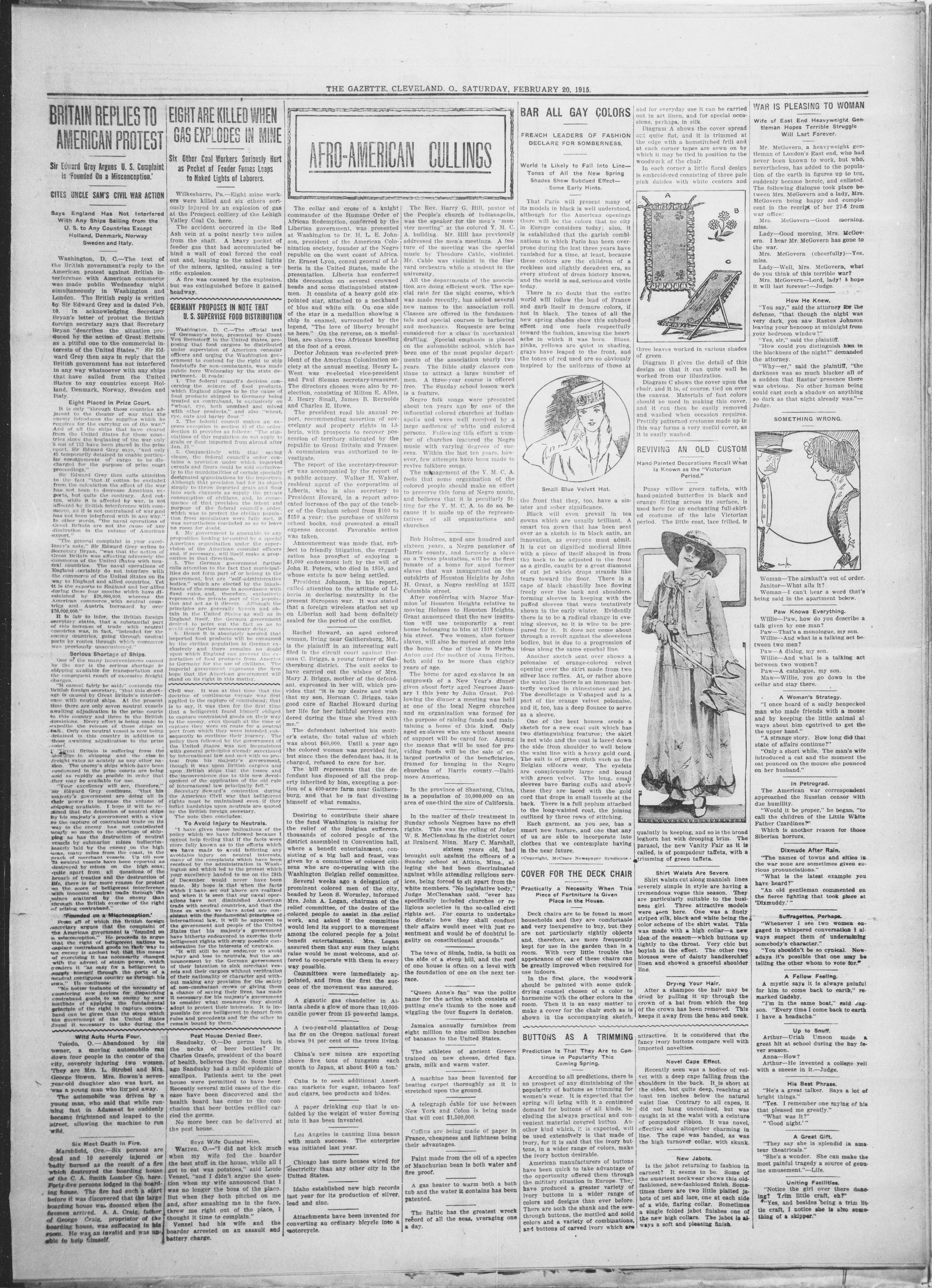
BAR ALL GAY COLORS
FRENCH LEADERS OF FASHION
DECLARE FOR SOMBERNESS.
World Is Likely to Fall Into Line—
Tones of All the New Spring
Shades Show Subdued Effect—
Some Early Hints.
That Paris will present many of
its models in black is well understood,
although for the American openings
there will be the colors that no city
in Europe considers today; also, it
is established that the garish combinations
to which Paris has been overprone during the last three years have vanished for a time, at least, because these colors are the children of a reckless and slightly decadent era, as every student of dress history knows,
and the world is sad, serious and virile today.
There is no doubt that the entire world will follow the lead of France and garb itself in demure colors, if not in black. The tenes of all the new spring shades show this subdued effect and one feels respectfully toward the fashion, knowing the heartache in which it was born. Blues, pinks, yellows are quiet in shading, grays have leaped to the front, and the tones of red used are so obviously inspired by the uniforms of those at
Small Blue Velvet Hat.
the front that they, too, have a sinister and sober significance.
Black will even prevail in tea gowns which are usually brilliant. A smart tea gown that has been sent over as a sketch is in black satin, an innovation, as everyone must admit. It is on cutigned medieval lines with a piece of itself shaped in from the back to be adjusted in the front as a girdle, caught by a great diamond of cut jet which drops strands like tears toward the floor. There is a cape of black chantilly lace flowing freely over the back and shoulders, forming sleeves in keeping with the puffed sleeves that were tentatively shown in the early winter. Evidently there is to be a radical change in evening sleeves, so it is wise to be prepared for it. It does not come about through a revolt against the sleeveless bodice, but is due to a progression of ideas along the same epochal line.
Another sketch sent over shows a polonaise of orange-colored velvet opening over the skirt made from two silver lace ruffles. At, or rather above the waist line there is an immense butterfly worked in rhinestones and jet. The decolletage is V-shaped and is a part of the orange velvet polonaise, and it, too, has a deep flounce to serve as a sleeve.
One of the best houses sends a sketch for a new coat suit which has two distinguishing features; the skirt is not wide and the coat is laced down the side from shoulder to well below the waist line with a heavy gold cord. The suit is of green cloth such as the Belgian officers wear. The eyelets are conspicuously large and bound with green velvet. The long, small sleeves have flaring cuffs and above these they are laced with the gold cord that drops in small tassels at the back. There is a full peplum attached to the long-waisted coat, the joining outlined by three rows of stitching.
Each garment, as you see, has a smart new feature, and one that any of us are able to incorporate into clothes that we contemplate having in the near future. (Copyright, McChure Newspaper Syndicate.)
COVER FOR THE DECK CHAIR
Practically a Necessity When This
Piece of the House Is Given
In the House
Deck chairs are to be found in most households and they are comfortable and very inexpensive to buy, but they are not particularly sightly objects and, therefore, are more frequently kept for use in the garden than in a room. With very little trouble the appearance of one of these chairs can be greatly improved when required for use indoors.
In the first place, the woodwork should be painted with some quick-drying enamel chosen of a color to harmonize with the other colors in the room. Then it is an easy matter to make a cover for the chair such as is shown in the accompanying sketch.
BUTTONS AS A TRIMMING
Prediction Is That They Are To Continue in Popularity This Coming Spring.
According to all predictions, there is no prospect of any diminishing of the popularity of buttons as trimming for women's wear. It is expected that the spring will bring with it a continued demand for buttons of all kinds, including the always practical and convenient material covered button. Another kind which, it is expected, will be used extensively that is made of ivory, for it is said that the ivory buttons, in a wider range of colors, make the ivory button desirable.
American manufacturers of buttons have been quick to take advantage of the opportunity offered them through the military situation in Europe. They have produced a greater variety of ivory buttons in a wider range of colors and designs than ever before. There are both the shank and the sew-through buttons, the mottled and solid colors and a variety of combinations, and buttons of carved ivory which are
and for everyday use it can be carried out in art linen, and for special occasions, perhaps, in silk.
Diagram A shows the cover spread out quite flat, and it is trimmed at the edge with a hemistructured frill and at each corner tapes are sewn on by which it may be tied in position to the woodwork of the chair.
In each corner a little floral design is embroidered consisting of three pale pink daisies with white centers and
A B C
three leaves worked in various shades of green
Diagram B gives the detail of this design so that it can quite well be worked from our illustration.
Diagram C shows the cover upon the chair, and it is, of course, tied on over the canvas. Materials of fast colors should be used in making this cover, and it can then be easily removed and washed when occasion requires. Prettily patterned cretonne made up in this way forms a very useful cover, as it is easily washed.
REVIVING AN OLD CUSTOM
Hand-Painted Decorations Recall What Is Known as the "Victorian Period."
Pussy willow green taffeta, with hand-painted butterflies in black and orange flitting across its surface, is used here for an enchanting full-skirted costume of the late Victorian period. The little coat, lace frilled, is
THE WORLD'S FINEST FASHION
qualitiy in keeping, and so is the broad leghorn hat with drooping brim. The parasol, the new Vanity Fair as it is called, is of pompadour taffeta, with a trimming of green taffeta.
Shirt Waists Are Severe
Shirt waists cut along mannish lines severely simple in style are having a tremendous vogue this season. They are particularly suitable to the business girl. Three attractive models were seen here. One was a finely striped silk, black and white being the color scheme of the shirt waist. This was made with a high collar—a new idea of the season—which buttons up tightly to the throat. Very chic but not too fluffy. The neck, blouses were of dainty handkerchief linen and showed a graceful shoulder line.
Drying Your Hair.
After a shampoo the hair may be dried by pulling it up through the crown of a hat from which the top of the crown has been removed. This keeps it away from the head and neck.
attractive. It is considered that the fancy ivory buttons compare well with imported novelties.
Novel Cape Effect.
Recently seen was a bodice of velvet with a deep cape falling from the shoulders in the back. It is short at the sides, but quite deep, reaching at least ten inches below the natural waist line. Contrary to all capes, it did not hang unconfined, but was caught in at the waist with a censure of pompadour ribbon. It was novel, effective and altogether charming in line. The cape was banded, as was the high turnover collar, with skunk.
New Jabots.
Is the jabot returning to fashion in earnest? It seems to be. Some of the smartest neckwear shows this old-fashioned, new-fashioned finish. Sometimes there are two little plaited jabots of net and lace, one at each side of a wide, flaring collar. Sometimes a single folded jabot finishes one of the new high collars. The jabot is always a soft and pleasing finish.
WAR IS PLEASING TO WOMAN
Wife of East End Heavyweight Gentleman Hopes Terrible Struggle Will Last Forever.
Mr. McGovern, a heavyweight gentleman of London's East end, who had never been known to work, but who, nevertheless, has added to the population of the earth in figures up to ten, suddenly became heroic, and enlisted. The following dialogue took place between Mrs. McGovern and a lady, Mrs. McGovern being happy and complacent in the receipt of her 27-5 from war office:
Mrs. McGovern—Good morning, miss.
Lady—Good morning, Mrs. McGovern. I hear Mr. McGovern has gone to the war.
Mrs. McGovern (cheerfully)—Yes, miss.
Lady—Well, Mrs. McGovern, what do you think of this terrible war?
Mrs. McGovern—Lord, lady! I hope it will last forever!—Judge.
How He Knew
"You say," said the attorney for the defense, "that though the night was very dark, you saw Rastus Johnson leaving your hencoop at midnight from your bedroom window?"
"Yes, sir." said the plaintiff.
"How could you distinguish hbo in the blackness of the night?" demanded the attorney.
"Why—er," said the plaintiff, "the darkness was so much blacker all of a sudden that Rastus' presence there was obvious. No other human being could cast such a shadow on anything so dark as that night already was."— Judge.
Woman—The airshaft's out of order.
Janitor—What ails it?
Woman—I can't hear a word that's being said in the apartment below.
Raw Knows Everything.
Willie—Paw, how do you describe a talk given by one man?
Paw—That's a monologue, my son.
Willie—And what is a talking act between two men?
Paw—A dialog, my son.
Willie—And what is a talking act between two women?
Paw—A catalogue, my son.
Maw—Willie, you go down in the cellar and stay there.
A Woman's Strategy
"I once heard of a sadly heppecked man who made friends with a mouse and by keeping the little animal always about him cntrived to get the upper hand."
"A strange story. How long did that state of affairs continue?
"Only a short while. The man's wife introduced a cat and the moment the cat pounced on the mouse she pounced on her husband."
In Petrograd.
The American war correspondent approached the Russian censor with due humility. "Would it be proper," he began, "to call the children of the Little White Father Czardines?" Which is another reason for those Siberian horrors.
Dixmude After Rain
"The names of towns and cities in the war zone are sometimes given curious pronunciations."
"What is the latest example you have heard?"
"An old gentleman commented on the fierce fighting that took place at 'Dtxmuddy.'"
"Whenever I see two women engaged in whispered conversation I always suspect them of undermining somebody's character."
"You shouldn't be so cynical. Nowadays it's possible that one may be telling the other whom to vote for."
Fellow Feeling
A mystic says it is always painful for him to come back to earth," remarked Gadbys. "I'm in the same boat," said sagson. "Every time I come back to earth I have a headache."
Arthur—Uriah Umson made a great hit at school during the hay fever season.
Anna—How?
Arthur—He invented a college yell with a sneeze in it—Judge.
His Best Phrase.
"He's a great talker. Says a lot of bright things."
"Yes. I remember one saying of his that pleased me greatly."
"They say she is splendid in amateur theatricals." She's a woman. She can make the most of tragedy a source of genuine enjoyment."—Life.
Uniting Facilities
ing? Trim little craft, eh? "
"Yes, and besides being a trim little craft, I notice she is also some- thing of a skipper."