The Gazette
Saturday, May 1, 1915
Cleveland, Ohio
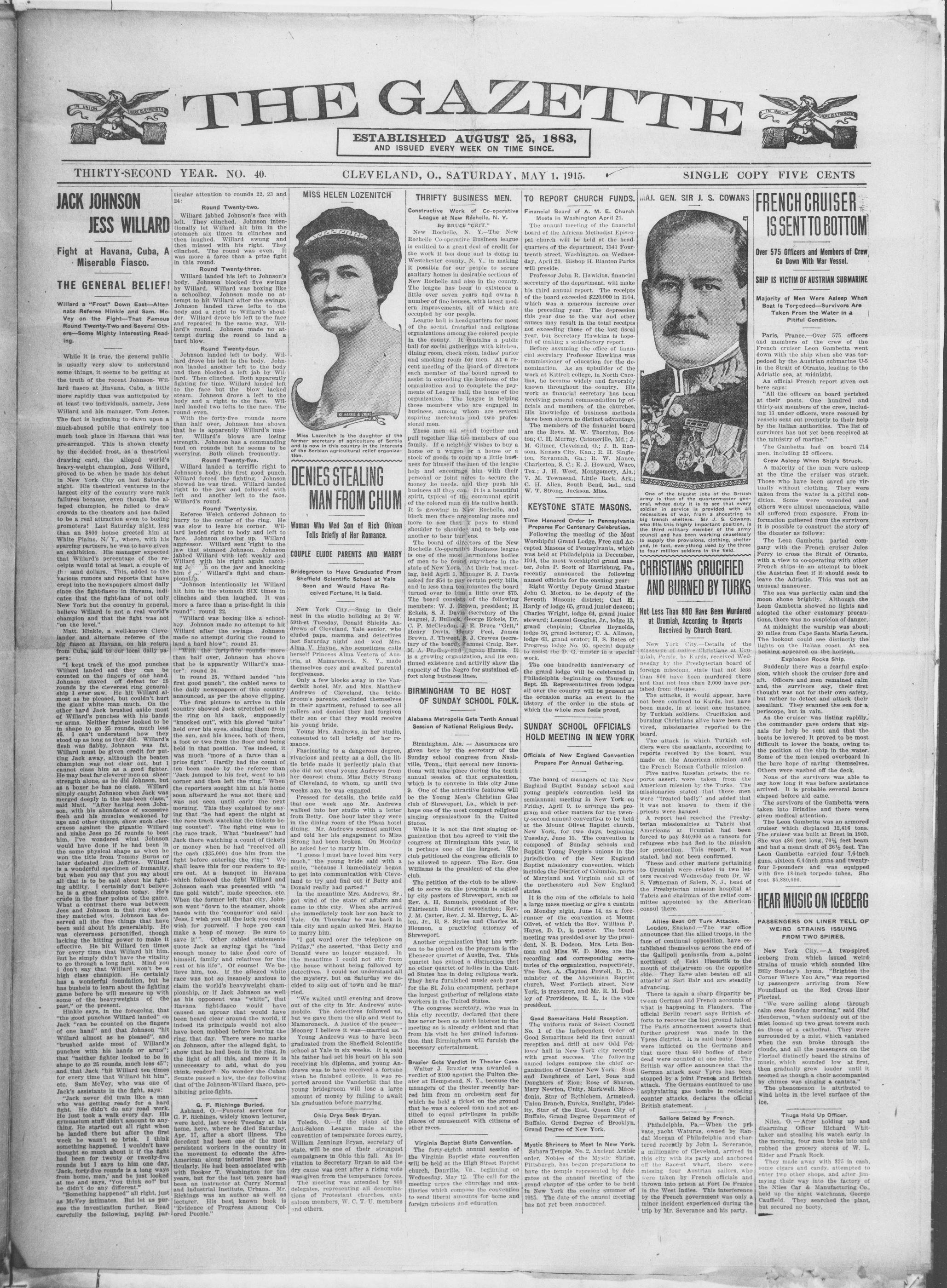
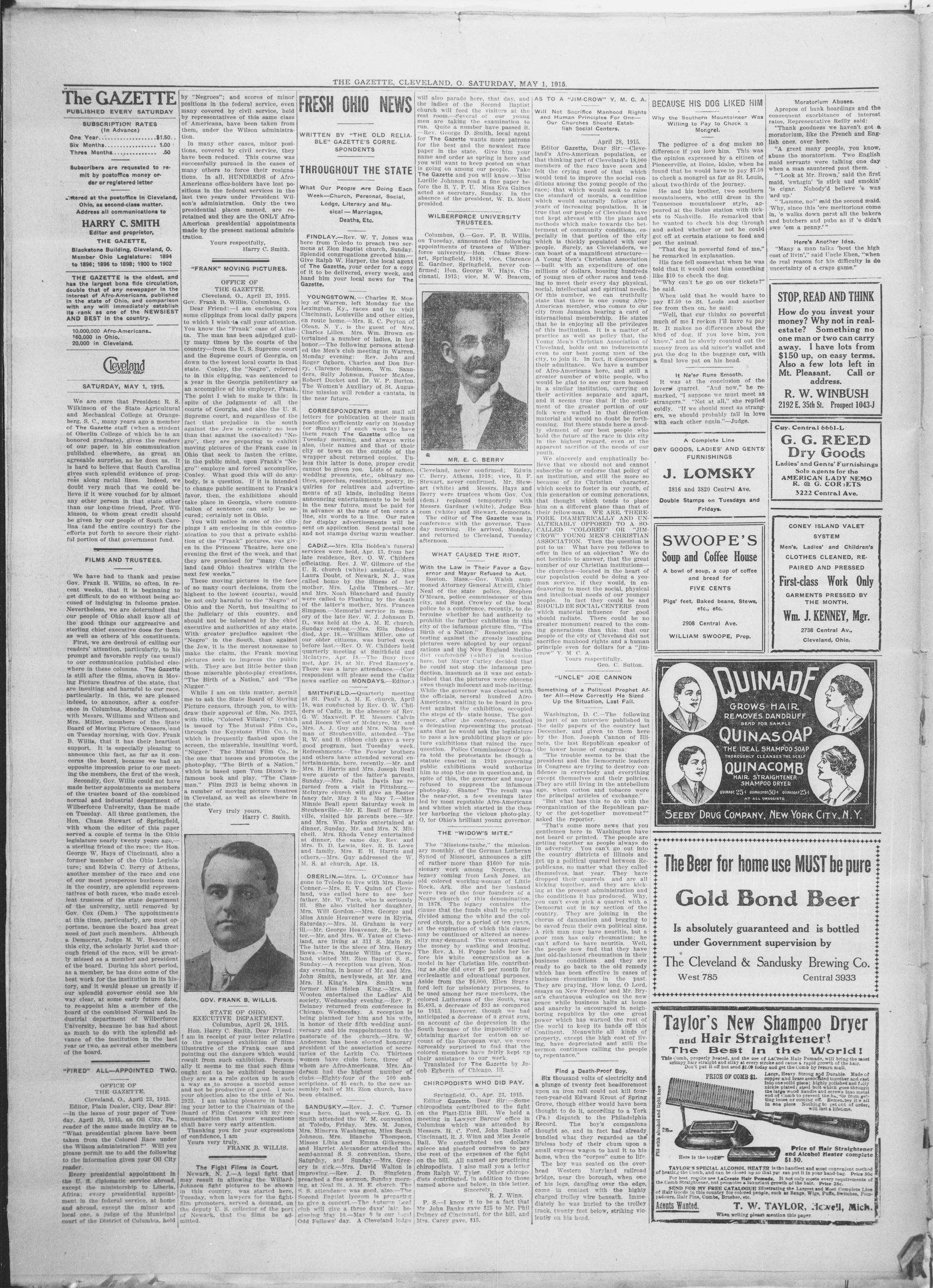
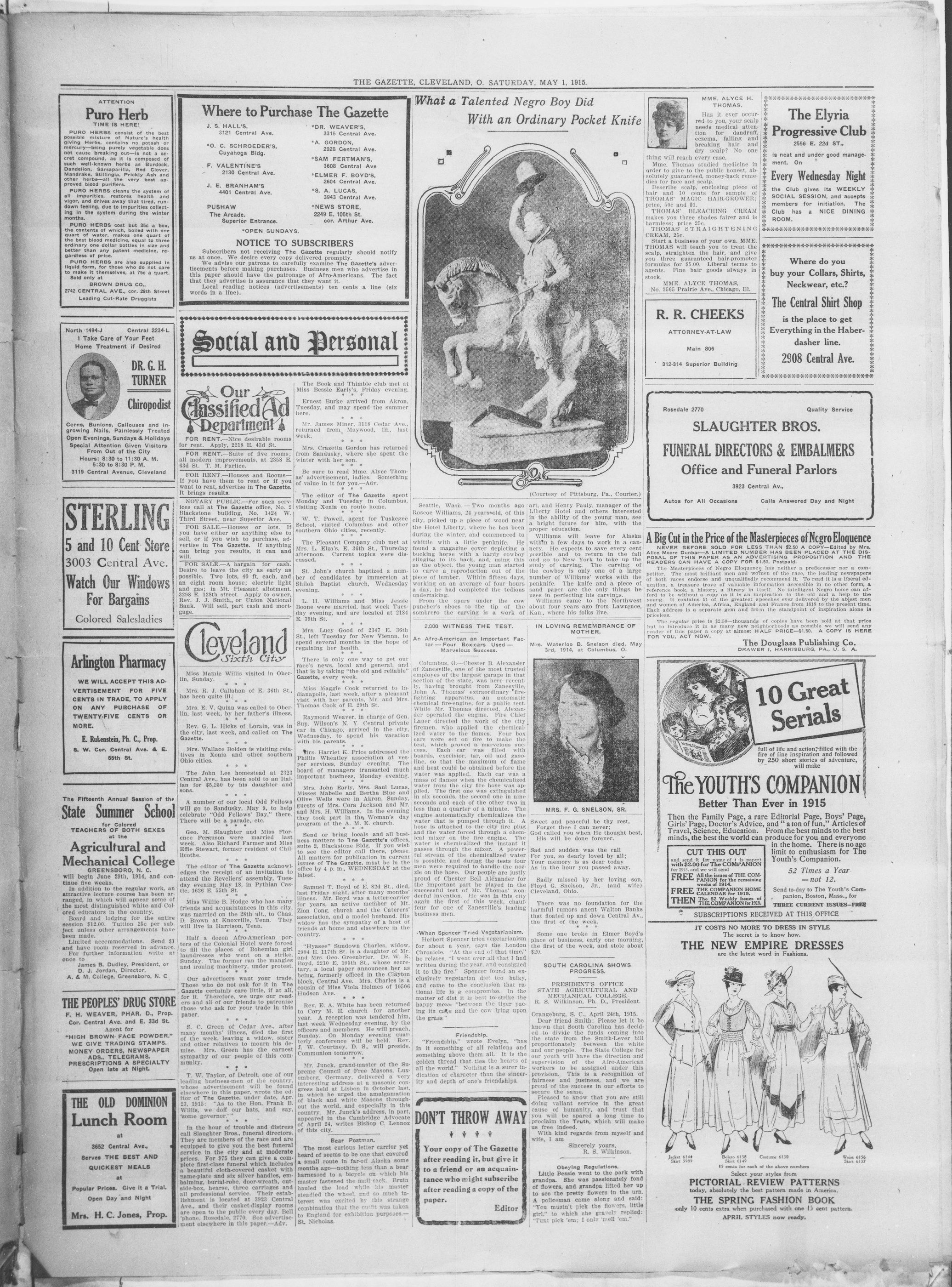
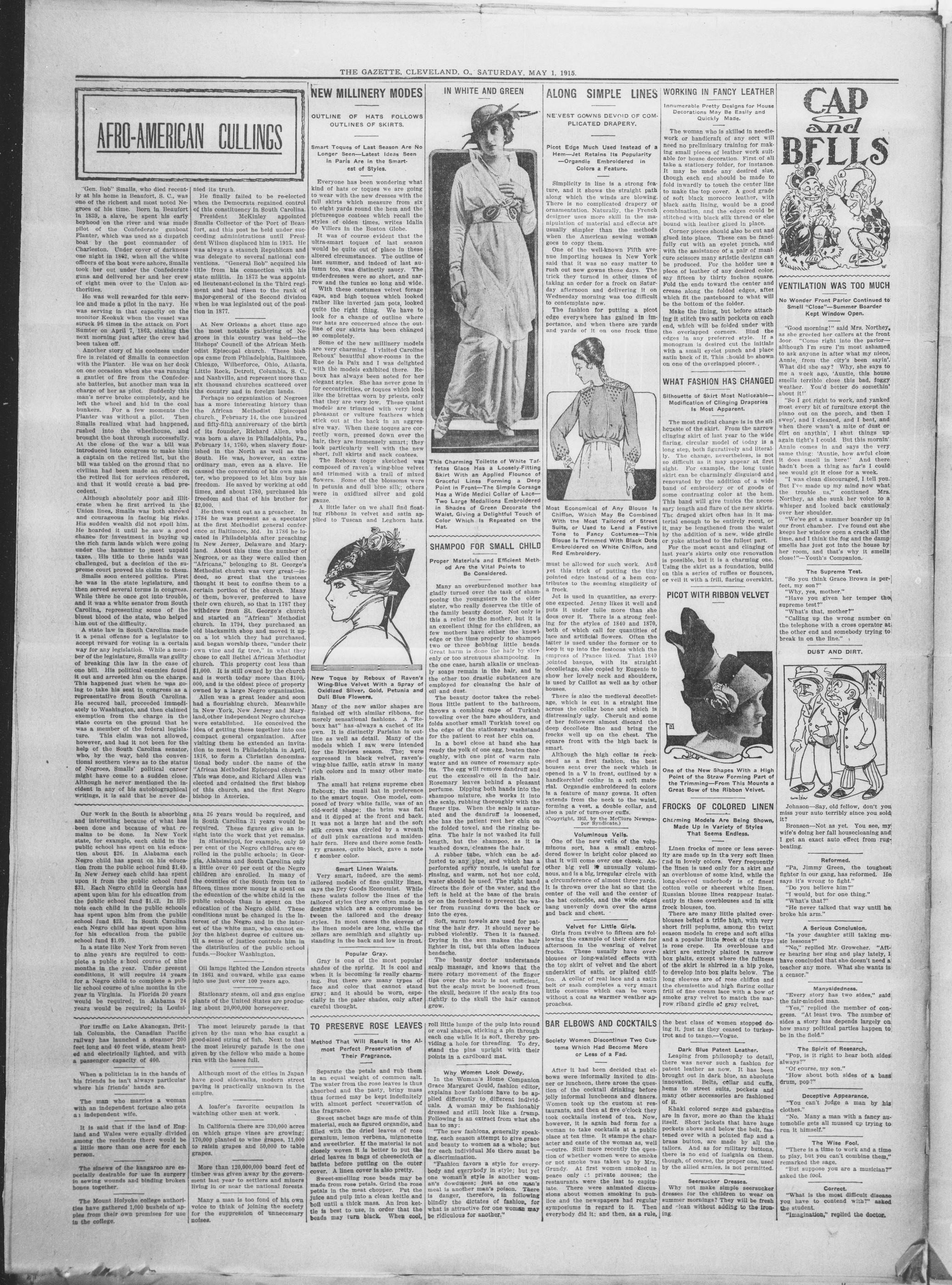
Page text (machine-generated)
THE WATCH
THE SUNSHINE
JACK JOHNSON JESS WILLARD
Fight at Havana, Cuba, A Miserable Fiasco.
THE GENERAL BELIEF
Willard a "Frost" Down East—Alterate referee Hinkle and Sam. Vey on the Flight—That Famous Round Twenty-Two and Several Others—Some Might Interesting Reading.
While it is true, the general public is usually very slow to understand some things, it seems to be getting at the truth of the recent Johnson, Willard flasco at Havana, Cuba, a little more rapidly than was anticipated by at least two individuals, namely, Jesse Willard and his manager, Tom Jones. The fact is beginning to dawn upon a much-abused public that entitlely too much took place in Havana that was pre-arranged. This is shown clearly by the decided frost, as a theatrical drawing card, the alleged world champion, Jesse Willard, proved to be when he made his debut in New York City on last Saturday night. His theatrical ventures in the largest city of the country were rank failures because, even though the alleged champion, he failed to draw crowds to the theaters and has failed to be a real attraction even to boxing promoters! Last Saturday night, less than half of the world's Plains, N.Y., where, with his sparing partners, he was to have given an exhibition. His manager expected that Willard's percentage of the receipts would total at least, a couple of tand dollars. This, added to the various rumors and reports that have crept into the newspapers almost daily since the fight-flasco in Havana, India, in New York but the country in general, believe Willard is not a real world champion and that the fight was not "on the level."
Matt. Hinkle, a well-known Cleve
lander, and alternate referee of the
big flasco, at Havana, on his return
to Cuba; said to our local daily par-
mish.
Hinkle says, in the foregoing, that "the good punches Willard landed" on Jack "can be counted, on the fingers of one-hand" and that Johnson "hit Willard almost as he pleased", and "brushed aside, most of Willard's punches with his hands or arms"; that "neither fighter looked to be in shape to go 25 rounds, much less 45"; and that Jack "hit Willard ten times for every time that Willard hit him". etc. Sam McVey, who was one of Jack's assistants in the fight, says: "when you were getting ready for a hard fight, He didn't do any road work. He just took a walk every day. His gymnasium stuff didn't amount to anything. He started out all right when he landed there, but brisk. I think something happened. I wouldn't have thought so much about it if the fight had been for twenty or twenty-five rounds—but I says to him one day, Jack, forty-five rounds is a long way from home, man. You think so, but he didn't do any different."
"Something happened" all right, just as McVey intimates. But let us pursue the investigation further. Read carefully the following, paying par-
THE GAZETTE
ticular attention to rounds 22) 23 and MISS HELEN LOZENITCH
Round Twenty-two.
Willard jabbed Johnson's face with left. They clinched. Johnson intentionally let Willard hit him in the stomach six times in clinches and then laughed. Willard swung and then missed with his right. They were more than a prize fight was more a farce than a prize fight in this round.
Round Twenty-three.
Willard landed his left to Johnson's body. Johnson blocked five swings by Willard. Willard was boxing like a schoolboy. Johnson made no attempt to block. Johnson landed three lefts to the body and a right to Willard's shoulder. Willard drove his left to the face and reposted in the same way. Willards round. Johnson made no attempt to round the round to land a hard blow.
Round: Twenty-four.
Johnson landed left to body. Willard drove his left to the body. Johnson landed another left to the body and then blocked a left jab by Willard. Then clinched. Both apparently landed on the left to the face but the blow lacked steam. Johnson drove a left to the body and a right to the face. Willard landed two left to the face. The round even. He forty-five rounds more than half over, Johnson has shown that he is apparently Willard's master. Willard's blows are losing strength. Johnson has a commanding lead on rounds but he seems to be worrying frequently. Round twenty-five. Willard landed a terrific right to Johnson's body, his first good punch. Willard forced the fighting. Johnson showed he was tired. Willard landed right to the jaw and followed with another left to the face. Willard's round.
Round Twenty-six:
Referee Welch ordered Johnson to hurry to the center of the ring. He was slow to leave his corner. Wilson landed tight to body and to face Johnson's slap up. Willard aggressor. Willard sent right to the jaw that stunned Johnson. Johnson jabbed Willard with left weakly and will land on the jaw. Willard jumped on the jaw and knocking him. Willard's fight and championship. "Johnson intentionally let Willard hit him in the stomach SIX times in clinches and then laughed. It was made a prize-fight in this round": round 22. "Willard was boxing like a schoolboy. Johnson made no attempt to hit Willard after the swings. Johnson made no attempt during the round to land a hard blow": round 22. "With the 'orty' rounds more than half over, Johnson has shown that currently Willard's master": round 24.
C. F. Blahnsen Burled
Abbland, O.-Funeral services for G. F. Richings, widely known lecturer, were held, last week Tuesday at his home near Washington, D.C. After a short illness, the decedent had been one of the most persistent workers in the country in the movement to build industrial lines, particularly. He had been associated with Booker T. Washington for ten years, but for the last ten years had worked with the Industrial Institute, Urbana. Mr. Richings was an author as well as lecturer. His best known book is "Evidence of Progress Among Colonial Americans."
ESTABLISHED AUGUST 25, 1883,
AND ISSUED EVERY WEEK ON TIME SINCE.
Miss Lozenitch is the daughter of the former secretary of agriculture of 'Serbia and is now in this country in the interests of the Serbian agricultural relief organization.
DENIES STEALING MAN FROM CHUM
Bridgroom to Have Graduated From Sheffield Scientific School at Yale Soon and Would Have Received Fortune, it Is Said.
New York City—Sung in their nest in the studio building at 24 W. 59th at Tuesday, Donald Shields Andrews of Cleveland, Yale senior, who eluded pama, mamma and detectives last Saturday night, and wed Mrs. Alma V. Hayne, who sometimes calls herself Princess Alysina of Austria, at Mammonarock, N. Y., made cozy and awaived parent forgiveness.
Only a few blocks away in the Vanderbilt hotel, Mr. and Mrs. Matthew Andrews of Cleveland, the bridegroom's parents, secluded themselves in their apartment, refused to see all callers and dented they had forgiven their son or that they would receive his young bride.
Young Mrs. Andrews, in her studio, consented to tell briefly of her romance.
Pacing to a dangerous degree, vivacious and pretty as a doll, the little bride made it perfectly plain that she did not stalem young Andrews from her dearest凑, Miss Betty Strong of Cleveland, to whom, up until two weeks ago, he was engaged.
Pressed for details, the bride said that one week, ago Mr. Andrews walked into her studio with a letter from Betty. One hour-later they were in the dining room of the Plaza hotel dining. Mr. Andrews seemed smitten with her.
Strong had been broken. On Monday he asked her to marry him.
"I guess I must have loved him very much," the young bride said with a smile, "because I immediately began to get into communication with Cleveland to try and find out if Betty and Donald really had parted."
In the meantime Mrs. Andrews, Sr. got wind of the state of affairs and she immediately took her son back to Yale. On Thursday he was back in this city and again asked Mrs. Hayne to marry him.
"I got word over the telephone on Friday," she asserted, "that Betty and Donald were no longer engaged. In the meantime I could not stir from the house without being followed by detectives. I could not understand all the mystery, on on Saturday we decided to slip out of town and be married.
"We waited until evening and drove out of the city in Mr. Andrews' automobile. The detectives followed us, but we gave them the slip and went to Mamoreckone. A justice of the peace—Mooney I believe it was—married us."
Young Andrews was to have been graduated from the Sheffield Scientific school at Yale in six weeks. It is said his father had set his heart on his son receiving his diploma, and young Andrews was to have received a fortune and was ported around the Vanderbilt that the young bridegroom will lose a large amount of money by failing to await his graduation before marrying.
Ohio Drys Seek Bryan.
Toledo, O.-I. the plans of the Anti-Saloon League made, at the convention of temperance forces carry, William Jennings Bryan, secretary of state, will be one of their strongest advocates for the invitation to Secretary. Bryan to aid the dry cause was sent after a rising vote was given from the temperance forces. The meeting was attended by 500 delegates, representing all denominations of Protestant churches, anti-Saloon groups, W. C. T. I. members and others.
THRIFTY BUSINESS MEN.
Constructive Work of Co-operative League at New Rocheille, N. Y.
By BRUCE "GRIT"
New Rocheille, N. Y.-The New Rocheille Cooperative Business league is entitled to a great deal of credit for the work it has done and is doing in Westchester county, N. Y. in making it possible for our people to secure military homes in desirable sections of New Rocheille and also in the county. The league has been in existence a little over seven years and owns a number of fine houses, with latest modern improvements, all of which are occupied by our people.
League hall is headquarters for most of the social, fraternal and religious organizations among the colored people in the county. It contains a public hall for social gatherings with kitchen, living room, check room, index card, and bulletin board. It also contains a cent meeting of the board of directors each member of the board agreed to assist in extinguishing the business of the organization and to complete the payments of League hall, the home of the organization. The league is helping those members who are engaged in business, among whom are several merchants and two professional men. These men all stand together and pull together like the members of one family. If a neighborhood wishes to buy a horse or a wagon or a house or a stock of goods to open a little business for himself the man of the league must personally or joint notes to secure the money he needs, and they push his business all they can. It is a beautiful spirit, typified of the communal spirit of the colored man of his native heath. It is growing in New Rochelle, and black men there are coming more and more. They have days to stand shoulder to shoulder and to help one another to bear burens.
BIRMINGHAM TO BE HOST OF SUNDAY SCHOOL FOLK.
Alabama Metropolis Gta Tenth Annual Session of National Religious Body
Birmingham, Ala. — Assurances are given here by the secretary of the Sunday school congress from Nashville, Tenn., that several new innovations will take place during the tenth annual session of that organization, which is to convene in this city June 14, of the tenure features will be the Young Men's Christian Glee club of Shreveport, La., which is perhaps one of the most compact religious singing organizations in the United States. While it is not the first singing organization that has agreed to visit the congress at Birmingham this year, it is perhaps one of the largest, it is also the most accessible to be allowed to appear. The Rev. Gus Williams is the president of the glee club. The petition of the club to be allowed to serve on the program is signed by city pastors of Shreveport, such as Rev. A. H. Samuel, president of the Thirteenth District association; Rev. J. M. Carter, Rev. J. M. Harvey, L. A. Johnson, E. S. Styles and Charles M. Blount, a practicing attorney of Shreveport. Another organization that has written to be placed on the program is the Elenbee quartet of Austin, Tex. This quartet has gained a distinction that no other quartet of ladies in the United States has in doing religious work. The quartet will be for the St. John encampment, perhaps the largest gathering of religious state workers in the United States.
The congress secretary, who was in this city recently, declared that there has never been as much interest in the meeting as is already evident and that from his visit he has gained information that Birmingham will furnish the necessary entertainment.
Brauer College Vedict in Theater Case.
Walter J. Braizer was awarded a vederic of $100 against the Fulton theater at Hempstead, N. X., because the managers of the theater recently barred him from an orchestra seat for which he held a ticket on the ground that he was a colored man and not entitled to equal privileges in public places of amusement with citizens of other races.
Virginia Baptist State Convention.
The forty-eighth annual session of the Virginia Baptist state convention will be held at the High Street Baptist church, Danville, Va., beginning on Wednesday, May 12. The call for the meeting arises the churches and auxiliaries which compose the convention to send liberal amounts for home and foreign missions and education.
TO REPORT CHURCH FUNDS
Financial Board of A. M. E. Church
Made in Washington, August 21.
Meets in Washington April 21.
The annual meeting of the financial board of the African Methodist Episcopal church will be held at the headquarters of the department, 141 Fourteenth street, Washington, on Wednesday, April 21. Bishop H. Bhantan Parks will preside.
Professor John R. Hawkins, financial secretary of the department, will make his third annual report. The receipts which is a generous increase over the preceding year. The depression this year due to the war and other causes may result in the total receipts not exceeding those of the last fiscal year, but Secretary Hawkins is hopeful of making a satisfactory report.
Before assuming the office of financial commissioner of education for the demission, As an upholder of the work at Kittrell college, in North Carolina, he became widely and favorably known throughout the country. His work as financial secretary has been resolving general commendation by officials and members of the churches, and the commissioner of education have been shown to distinct advantage.
The members of the financial board are the Revs. M. W. Thornton, Boston; C. H. Murray, Catonsville, Md.; J. M. Gilmer, Cleveland, O. J. R. Ranson, Kansas City, Kan.; R. H. Singleton, Savannah, Ga.; R. W. H唐, Montgomery, Tex.; J. H. West, Montgomery, Ala.; V. M. Townsend, Little Rock, Ark.; C. H. Allen, South Bend, Ind., and W. T. Strong, Jackson, Miss.
KEYSTONE STATE MASONS.
Time Honored Order in Pennsylvania
Prepares For Centenary Celebration.
Following the meeting of the Most
Worshipful Grand Lodge, Free and
Accepted Masons of Pennsylvania, which
was held at Philadelphia in December,
1914, the most worshipful grand master,
John P. Scott of Hartsville, Pa.
recently announced the following
named officials for the ensuing year:
John C. Morton, to be deputy of the
Seventh Masonic district; Carl H.
Hardy of lodge 65, grand junior descent;
Charles Wright, lodge 64, grand junior
steward; Lemuel Googins, jr. 13, grand
chapman; Charles Reynolds,
lodge 36, grand lecturer; C. A. Allman,
lodge 63, grand master; S. B. Sates of
Progress lodge No. 15, special deputy to
assist the D. G. master in a special
work.
One hundredth anniversary of the
grand lodge will be celebrated in
Philadelphia beginning on Thursday,
Sept. 23. Representatives from lodges
all over the country will be present as
the occasion marks an event in the
history, of the order in the state of
which the whole race feels proud.
SUNDAY SCHOOL OFFICIALS
HOLD MEETING IN NEW YORK
Officials of New England Convention Prepare For Annual Gathering
The board of managers of the New England Baptist Sunday school and young people's convention held its simultaneous meeting in New York on Friday, April 9, to arrange the program and other matters for the twenty-second annual convention to be held at the Mount Olivet Baptist church, New York, for two days, beginning Tuesday, June 15. The convention is composed of Sunday schools and Baptist Young People's unions in the jurisdiction of the New England Baptist missionary convention, which includes the District of Columbia, parts of Maryland and rural areas of the northeastern and New England states.
It is the aim of the officials to hold a large mass, meeting or give a cantata on Monday night, June 14, as a foreruner of the convention at Mount Olivet, of which the Rev. William P. Hayes, D. D., is pastor. The board meeting was presided over by the president, N. B. Dodson, Mrs. Leta Beaman and Miss W. D. Moss are the recording and corresponding secretaries of the organization, respectively. Chayton Powell, D. D., minister of the Abyssinian Baptist church, West Portland street, New York is treasurer, and Mr. R. M. Dudley of Providence, R. L., is the vice president.
Good Samaritans Hold Reception.
The uniform rank of Select Council
No. 1 of the Independent, Order of
Good Samaritans held its first annual
reception and drill at new Old Fell
and New York City with great success. The following
named lodges compose the chief
organization of Greater New York: Sons
and Daughters of Levl, Sons and
Daughters of Zion; Rose of Sharon,
Mary Newton, Unity, Markwell, Macedon,
Star of Bethlehem, Armstead,
Star of the East, Queen Chip
Buffalo, Grand Degree Department of
Buffalo, Grand Degree of Brooklyn,
Grand Degree of New York.
Mystic Shriners to Meet in New York
Sahara Temple, No. 2, Ancient Arab
order, Nobles of the Mystic Shrine,
Pittsburgh, has begun preparations
at the annual meeting of the
grand chapter of the order to be held
in New York the coming summer of
1915. The date of the annual meeting
has not yet been announced.
C
One of the biggest jobs of the British army is that of the quartermaster general, whose duty it is to see that every member of the army has the necessities of war. from a sheeing to biltrench shelters. Sir J. S. Cowans who filts this highly important position, is the most senior officer in the council and has been working ceaselessly to supply the provisions, clothing, shelter and, in fact, everything used by the three to four million soldiers in the field.
CHRISTIANS CRUCIFIED AND BURNED BY TURKS
Not Less Than 800 Have Been Murdered at Urumiah, According to Reports Received by Church Board
New York City. Details of the preserver of Christians at Urumiah, Peshish, by Kumis, received Wednesday by the Presbyterian board of foreign missions, state that not less than 800 have been murdered there and that not less than 2,000 have perished. The attacks, it would appear, have not been confined to Kurds, but have been made, in at least one instance, by Turkish soldiers. Crucifixion and burning Christians alive have been revived, missionaries reported to the board, the attack in which Turkish soldiers were the assailants, according to reports received by the board, was made on the American mission and the French Roman Catholic mission. Five native Russian priests, the reports assert, were taken from the American mission by the Turks. The missionaries stated that, these men were "treated badly" and added that it was not known to them if the priests were involved. A report had reached the Presbyterian missionaries at Tatribes that Americans at Urumiah had been forced to pay $40,000 as a ransom for refugees who had fled to the mission for protection. This report, it was stated, had not been confirmed. These and other matters pertaining to Urumiah were related in two letters received Wednesday from Dr. W. Kumis, the Presbyterian mission hospital at Tatribes and chairman of the relief committee appointed by the American consul there.
Allied Boat Off Tusk Attacks
Allies Beat Off Turk Attacks.
London, England.—The war office announces that the allied troops, in the face of continual opposition, have established themselves across the end of the Gallipoli peninsula of Saki its surriskik to the mouth of this stream on the opposite side. They have also beaten off all attacks at Sari Bair and are steadily advancing.
There is again a sharp disparity between German and French accounts of what is happening in Flanders. The official Berlin report says British of the Germans had lost ground. The Paris announcement asserts that further progress was made in the Ypres district. It is said heavy losses were inflicted on the Germans and that, more than 600 bodies of their dead were counted at one point. The British war office announces that the German attack near Ypres has been stopped. The French attack. The Germans continued to use asphyxilating gas bombs in resisting counter attacks, declares the official British statement.
---
Sailors seized by French Philadelphia, Pa. - When the private, yacht Waturus, owned by Randal Mergan of Philadelphia and chartered recently by John L. Severance, was seized this week, this city with its party and anchored off the coast wharf, there were sixteen four Australian sailors, who were taken by French officials and thrown into prison at Fort De France in the West Indies. This interference by the French government was only a minor incident experienced during the trip by Mr. Severance and his party.
IN PICOR
NOSTRA SEMNITA
FRENCH CRUISER
IS SENT TO BOTTOM
Over 575 Officers and Members of Crew Go Down With War Vessel.
Majority of Men Were Asleep When Boat Is Torpeded—Survivors Are Taken From the Water in a Pitiful Failure.
Paris, France—Over 575 officers and members of the crew of the French cruiser, Leon Gambetta went down with the ship when she was torpeded by the Austrian submarine U-5 in the Strait of Otranto, leading to the Adriatic sea, at midnight.
French report given out here says:
"All the officers on board perished at their posts. One hundred and thirty-six members of the crew, including 11 under officers, were rescued by vessels sent out promptly to their help by the Italian authorities. The list of survivors has not yet been received at the Gambetta had on board 714 men, including 22 officers.
'Grew Asleep When Ship's Struck.
A majority of the men were asleep at the time the cruiser was struck. Those who have been saved are virtually without clothing. They were taken from the water in a pitiful condition. Some were wounded and others were almost unconscious, while all suffered from the formation gathered from the survivors it is possible to construct the story of the disaster as follows:
The Leon Gambetta parted company with the French cruiser Jules Ferry to cross the Strait of Otranto, with a view to co-operating with other French ships in an attempt to block the Austrian fleet if it should seek to the Austrian sea. This was not an unusual maneuver.
The sea was perfectly calm and the moon shone brightly. Although the Leon Gambetta showed no lights and adopted the other custom precautions, there was no suspicion of danger. At midnight the warship was about 20 miles from Cape Santa Maria Leucen. The lookout could see distinctly the lights on the Italian coast. At sea nothing appeared on the horizon.
Explosion Rocks Ship.
Suddenly there was a fearful explosion, which shook the cruiser for and aff. Officers and men remained calm and, the survivors say, their first thought was not for their own safety, but rather to detect and attack their assailant. They scanned the sea for a periscope, but in vain.
As the cruiser was listing rapidly, the commander gave orders that signals for help be sent and that the crew be sent to assist. It was difficult to lower the boats, owing to the position of the ship in the water. Some of the men leaped overboard in the bare hoe of saving themselves. Others were washed off the deck.
None of the survivors was able to say how long it was before assistance arrived. It is probable several hours elapsed before aid came.
The survivors of the Gambetta were taken into Brindisse and there were given medical attention. She was an armored cruiser which displaced 12,416 tons. The cruiser was built at Brest in 1903. She was 486 feet long, 70.9 feet beam and had a mean draft of 26.2% feet. The Leon Gambetta carried four 7.6-inch guns, sixteen 6.4-inch guns and twenty-3 four-pounders. and was equipped with five 18-inch torpedo tubes. She cost $5,880,000.
HEAR MUSIC ON ICEBERG
PASSEGERS ON LINER TELL OF WEIRD STRAINS-ISSUING FROM TWO SPIRES.
New York City.—A two-spired iceberg from which issued weird strains of music which sounded like Billy Sunday's hymn, "Brighten the Corner Where You Are," was reported by passengers arriving from New Foundland on the Red Cross linser.
"We were sailing along through calm seas Sunday morning," said Olaf Henderson, "when suddenly out of the mist loured up two great towers, such as of a cathedral. They were surrounded by a mist, which vanished when the sun broke through the clouds, and all the passengers on the Florized distinctly heard the strains of music which sounded low, at first then gradually grew louder, until it seemed as though a choir accompanied by chimes was singing a cantata."
The phenomenon is attributed to ice holes in the level surface of the ice.
Tunga-Hope Up Officer.
Niles, O.O. After holding up and disarming, Officer Richard Whitaker and stoaling his watch early in the morning, four men broke into and robbed the grocery stores of W. L. Rider and Frank Rock.
They made away with $25 in cash, some chars and candies, attempted to buy their way into the factory of the Niles Car & Manufacturing Co. held up the night watch, George Caulfield. They searched the plant, but secured no boot.
PUBLISHED EVERY SATURDAY
SUBSCRIPTION RATES
(in Advance)
One. Vear......ecsseeeeess 81.50.
Six Months.........seeee04 1000
Three Months....s.cceceee+ 50
Subscribers are requested to re-
mit by postotfice money or
dor or registered letter
ntered at the postoffice In Cleveland,
‘Ohio, as second-class matter.
Address all communications to
HARRY C. SMITH
Editor and proprietor,
THE GAZETTE,
Blackstone Building, Cleveland, 0.
Member Ohio Legislature: 1894
to 1896; 1896 to 1898; 1900 to 1902
THE GAZETTE Is the oldest, and
has the largest bona fide circulation,
double that of any newspaper In the
Interest of Afro-Americans, published
In the state of Ohio, and comparisor
with any will immediately establist
Ite rank as one of the NEWSIEST
AND BEST In the country.
10,000,000 Afro-Americans.
160,000 in Ohio.
20,000 in Cleveland.
We are sure that President R. 8.
Wilkinson of the State Agricultural
and Mechanical College at Orange-
berg, S. C., many years ago a member
of The Gazette staff (when a student
of Oberlin College of which he is an
honored graduate), gives the readers
of our paper, in bis communication
published elsewhere, as great an
agreeable surprise, as he does us. It
is hard to believe that South Carolina
gives such splendid evidence of prog.
Teas along racial lines. Indeed, we
doubt very much that we could be-
Meve if it were vouched for by almost
any other person in that state other
than our long-time friend, Prof. Wil
kinson, to whom great credit should
be given by our people of South Caro-
lina (and the entire country) for the
‘efforts put forth to secure their right-
ful portion of that government fund.
SS ee
FILMS AND TRUSTEES.
We have had to thank and praise
Gov. Frank B. Willis, so often, in re-
cent weeks, that it is beginning to
get difficult to do so without being ae:
cused of indulging in fulsome praise.
Nevertheless, we are determined that
our people of Ohio shall know all of
the good things our aggressive and
sterling chief executive does for them
as well as others of his constituents.
First, we are desirous of calling our
readers’ attention, particularly, to his
prompt and fayorable reply (as usual)
to our communication published else
where in these columns. The Gazette
4s still after the films, shown in Mov-
ing Picture theatres of the state, that
are insulting and harmful to our race,
particularly. In this, we are pleased
indeed, to announce, after a confer-
ence in Columbus, Monday afternoon,
with Messrs, Williams and Wilson and
Mrs. Miller, members of the State
Board of Moving Picture Censors, and
on Tuesday morning, with Gov. Frank
B, Willis, that it has their heartiest
support. It is especially pleasing tc
announce this fact, as far as it con
cerns the board, because we had an
‘opposite impression prior to our meet:
ing the members, the first of the week.
Secondly, Gov. Willis could not have
made better appointments as members
of the trustee board of the combined
normal and industrial department of
Wilberforce University, than he made
on Tuesday. All three gentlemen, the
Hon, Chase Stewart of Springfield,
with whom the editor of this paper
served a couple of terms in the Ohio
legisiature nearly twenty years ago,—
& sterling friend of the race; the Hon.
George W. Hays of Cincinnati, also a
former member of the Ohio Legisla-
ture; and Edwin C. Berry of Athens,
another member of the race and one
of our most prosperous business men
in the country, are splendid represen-
tatives of both races, who made excel-
ent trustees of the state department
of the university, until removed by
Gov, Cox (Dem.) The appointments
‘at this time, particularly, are most op-
portune, because the board has great
need of just such members. Although
& Democrat, Judge M. W. Beacon of
this city, the scholarly furist and thor-
ough friend of the race, will be great-
ly missed as a member and president
of the board. During his short period,
as a member, he has done some of the
best work for the institution in its his-|
tory, and it would please us greatly if
our splendid governor could see his
‘way clear, at some early future date,
to reappoint him a member of the
board of the combined Normal and In-
dustrial department of Wilberforce
University, because he has had about
as much to do with the splendid ad-
vance of the institution in the last
year or two, as several other members
of the board,
“FIRED” ALL—APPOINTED TWO.
OFFICE OF
THE GAZETTE.
Cleveland, O., April 23, 1915.
Editor, Plain Dealer, City, Dear Sir:
—In the issue of your paper of Tues:
day, April 20, 1915, an Ol City, Pa.,
reader of the same made inquiry as to
“What presidential places have been
taken from the Colored Race under
the Wilson administration?” Will you
please permit me to add the following
to the tnformation given your Oil City
reader.
Bvery presidential appointment in
the U. 8. diplomatic service abroad,
except the ministership to Liberia,
Africa; every presidential appoint-
ment in the federal service, at home
and abroad, except the minor apd
focal one, & judge of the Municipal
court of tbe District of Columbia, held
by “Negroes”; and scores of minor
positions in the federal service, even
many covered by civil service, held
by representatives of this same ciass
of Americans, have been taken from
them, under the Wilson administra-
tion.
In many other cases, minor posi-
tions, covered by civil service, they
have been reduced. This course was
successfully pursued in the cases of
many others to force their resigna-
tions. In all, HUNDREDS of Afro-
Americans officeholders have lost. po:
sitions in the federal services in the
last two years under President Wil-
son's administration. Only the two
presidential places named, are re-
retained and they are the ONLY Afro-
American presidential appointments
made by the present national adminis.
tration.
: Yours respectfully,
Harry C. Smith,
“RANK” MOVING PICTURES.
OFFICE OF
‘THE GAZETTE.
Cleveland, ©., April 23, 1915.
Gov. Frank B. Willis, Columbus, 0.
Dear Friend:—! am enclosing you
some clippings from local daily papers
to which T wish-ta call your attention.
You know the “Frank” case of Atlan:
ta. The man has been adjudged guil-
ty many times by the courts of the
country—from the U. 8. Supreme court
and the Supreme court of Georgia, on
down to the lowest local courts in that
state. Conley, the “Negro”, referred
to in this clipping, was sentenced to
a year in the Georgia penitentiary as
jan accomplice of his employer, Frank.
‘The point I wish to make fs this: in
spite of the judgments of all the
courts of Georgia, and also the U. 8.
Supreme court, and regardless of the
fact that prejudice in the south
against the Jew Is certainly no ess
than that against the (so-called) “Ne
ro", they are preparing to exhibit
moving pictures of the Frank case in
Ohio that seek to fasten the crime,
in the public mind, upon Frank's “Ne-
gro" employe and forced accomplice,
Conley. What good this will do any-
body, is a question. If it is intended
to change public sentiment to Frank’s
favor, then, the exhibitions should
take place In Georgia, where commu.
tation of sentence can only be se
cured; certainly not in Onio.
You will notice in one of the clip
pings 1 am enclosing in this comm
‘nication to you that a private exhib
tion of the “Frank” pictures, was giv:
en in the Princess Theatre, here one
evening the first of the week, and that
they are promised for “many Cleve-
land (and Ohio) theatres within the
next few weeks.”
These moving pictures in the face
of so many court decisions, from the
highest to the lowest (courts), would
be not only harmful to the “Negro” of
Ohio and the North, but insulting to
the judiciary of this country, and
should not be tolerated by the chief
executive and authorities of any state.
With greater prejudice against “the
“Negro” in the South, than against
the Jew, It is the merest nonsense to
make the claim, the Frank moving
pictures seek to impress the public
With. ‘They are but litte better than
those miserable photo-play creations,
“Phe Birth of a Nation,” and “The
Nigger.”
While Tam on this matter, permit
me to ask the State Board of Moving
Picture censors, through you, to with-
draw thelr approval of film, No. 2928,
with title, “Colored Vitiaing.” (which
Is fasued’ by The Mutual Pum Co,
through the Keystone Film Co.), in
which is frequently flashed upon ‘the
sereen, the miserable, insulting word,
*Nigger" The Mutual Film Co. is
the one that isaues and promotes the
photo-play, “The Birth of a Nation,”
which is based upon Tom Dixon's in-
famous book and play, “The Clans:
man.” Film 2922 is being shown in
a number of moving picture theatres
in Cleveland, ax well as elsewhere in
the state.
Very truly yours,
Harry C. Smith.
Po
os
Ce
GOV. FRANK 8, WILLIS.
STATE OF OHIO,
EXECUTIVE DEPARTMENT,
Se a re
Hon. Harry C. Smith, Dear Friend:
Tam in receipt of your letter relative
to the proposed exhibition of films
illustrative of the Frank case and
pointing out the dangers which would
Feeult from such exhibition. Person-
ally it seems to me that such films
ought not to be exhibited because
they are as a rule gotten up in such
& Way as to arouse a morbid sense
and not be productive of good. I note
your objection also to the title of No.
2928. I am taking pleasure in hand-
ing your letter to the Chairman of the
Board of Film Censors with my ree-
ommendation that your suggestions
shall have very early attention.
‘Thanking you for your expressions
of confidence, 1 am
‘Yours very truly,
FRANK B. WILLIS.
he Rink ‘Plime ta Cont.
Newark, N. J.—A legal fight that
may result in allowing the Willard.
Johnson fight pictures to be shown
in this country, was started here,
‘Tueaday, when lawyers for the fight:
film promoters, served a demand, on
the deputy U. 8, collector of the port
of Newark, thet the films be ad-
ee
THE GAZETTE, CLEVELAND, O. SATURDAY, MAY 1, 1918
—$ $$ ni & SATURDAY, MAY 1, 1918
will also parade here, that day, and|AS TO A
the ladies of the Second Baptist |
church will feed the visitors at the | Will Not
rest room—Severul of our young | Vand Hur
men are taking the examination to| "Our ¢
Rev. George D. Smith, local agent
MAIDEN GY OTHE (OLD -RELIA:| tor The Guactes vents Tasty Tacos
BLE” GAZETTE'S CORRE. for the best and the newsiest race| aitor
SPONDENTS: Paper in the state. Give him your| tend’ At
oar Mame and order a8 spring is here’and ti fish
you will want to keep posted on what | members
THROUGHOUT THE STATE) ,£°12% 22 among our people. Take |fule the
The Gazette and you will know.—Miss | would. tem
— Lucille Johnson read a fine paper be-| ditions an
fore the B. ¥.P. U. Miss Eva Gaines | pace: that
ee ae Pine Ba as cic eter ee
Week—Chureh, Personal, Social, absence of the president, W. D. Mott] witch a
Lodge, Literary and Mu- presided. | years of
sical — Marriages, WILBERFORCE UNIVERSITY [not kept
Deaths, Etc. TRUSTEES. methods
— terment
c i, O—Goy. F. B. Willis, | pecially |
Here eee aclede fo Breach two ser-| SOoointments of trustees of Wilber |people.
Brandy sion, Baptist church, Sunday. | force universlty—Hon. Chase Stew: (ean boast
gplendid congregations greeted him.— | art, “springfield, 1018;, vice, Clarence |A Young
Give, Raiph W. Harper, the local agent |i "Gardner, Springfield, never con: |—-bullt
oF eo erates Zour order for @ copy |qrmed; Hon. George W. Hajs, Cin-|millions «
Sitg “oibe Gelivered, every week, and |cinnati, 1915; vice, M. W. Heacom, |of young |
hand him your local news for The soa ee vice een
‘eeetee. See I
YOUNGSTOWN. — Charles E. Mos-
ley of Warren, left Monday for the
Lexington, Ky. races and. to visit
Cincinnati, Louisville and other cities,
en route homeMrs. R. C. Peyton of
Olean, N. ¥., is the guest. of Mrs.
Charles Lines. “Mrs. Wim. Brown en:
tertained a number of ladies, in her
honor—The following persons attend-
ed the Men’s club meeting in Warren,
Monday evening: Rev. John and
Roger Ogborn, Charles and Don Rer-
[ry Clarence "Robinson, "Wan, 'Saun
ders, Sully Johnson, Foster MeAfee,
Robert Docket and Dr. W. P. Burton,
‘The Women’s Auxiliary of St. Augus:
tine mission will render a cantata, in
the near future.
| CORRESPONDENTS must mail all
letters for publication at thelr main
postoffice sufficiently early on Monday
(or Sunday) of each week to have
them reach The Gazette office on
Tuesday morning, and always. write
also, their names and that of thelr
city’ or town on the outside of the
wrapper about returned copies. Un-
less this latter is done, proper credit
cannot be given you. Lists of names,
Wedding presents, etc., obituary no.
tices, speeches, resolutions, poetry, in-
‘guiries for relatives and advertise
ments of all kinds, including items
announcing entertainments to be held
[in the near future, must be. paid. for
in advance at the rate of ten cents a
Hine, six words to a line. “Our rates
for display advertisements will be
sent on application. Send postal note
and not stamps during warm weather.
CADIZ.—Mrs. Ella Bolden’s funeral
services were held, Apr. 13, from her
late residence, Rev. 0. W. Childers
officiating. Rev. J. W. Gilmore of the
U. R. church (white) assisted.—Miss
Laura Doubt, of Newark, N. J., was
called home’ by the illness of her
mother, Mrs. Lydia ‘Timbers.—Mr.
and Mrs. Noah Blanchard and family
were calied to Flushing by the death
of the latter's mother, Mrs. Frances
Simpson.—Memorial service in mem:
ory of the late Rev. W. J. Johnson D.
D., was held at the A. M. B. church,
Sunday evening—Mrs, Ella Bolden
died, Apr. 18.—William Miller, one of
our ‘older citizens, was buried week
Defore last.—Rev. 0, W. Childers held
quarterly meeting at Smithfield and
McIntyre, Apr. 18—The Busy. Bees
met, Apr, 18, at Mr. Pred Ramsey's,
‘There was @ large attendance.—(Cor-
respondent will please send the Cadiz
news earlier on MONDAYS.—Editor.)
Me Teepe eee only TROON
at St, Paul's A.M. E. church, April
18, was conducted by Rev. 0. W. Chil
ders of Cadiz, in the absence of Rev.
G. W. Maxwell, P. E. Messrs. Calvin
and Recen West of Mcintyre, Mr. and
Mrs, A. J. Guy and Mrs. Nina Bow:
man of Steubenville, attended.—The
R. W. and B. ribbon club gave a very
good program, last Tuesday week.
Refreshments.-The Fowler brothers
‘and others have attended several en-
tertainments, here, recently.—Mr. and
Mrs. H. Harris and Mrs. Joseph Beall
Were guests of the latter's parents,
Sunday.—Mrs. Julia Davis has re-
turned from a ‘visit in Pittsburg—
Melntyre church will give an Easter
fancy fair, May 3 to May 7—Miss
Minnie Beall spent Saturday week in
Steubenville.—Mr. E. Beall of Barnes-
ville, visited his parents here—Mr.
and Mrs. Wm. Parks entertained at
dinner, Sunday, Mr. and Mrs. N. Mit-
chell. ' Mrs. Rhoda Veney entertained
at dinner, the same day, Rev, and
Mrs. D. D, Lewis, Rev. R. B. Lowe
and family, Mrs, FE. H. Harris and
others.—Mrs. Guy addressed the W.
iis ak chaveh. Ate. 18:
_ OBERLIN.—Mrs. L, O'Connor has
gone to Toledo to live with Mrs, Rosie
Conner—Mrs. B. V. Quinn of Cleve:
land, was called here to see her
father, Mr. W. Tuck, who is seriously
Ml. She also visited her’ daughter
Mrs. Will Gordon—Mrs. George and
Miss Annie Heavener were in Elyria,
Saturday—Mrs. M. Graham is. very
ill—Mr. George Heavener, Sr., 1s bet-
ter—Mr. and Mrs. W. Yates of Cleve-
land, are living at 311 S. Main St.
The latter is the niece of Mrs, Henry
Bows.—Mrs. Mamie Willis of Cleve-
land, visited Mt. Zion Baptist 8. S.
Sunday.—A reception was given. Mon:
day evening, in honor of Mr. and Mrs.
John Smith, newlyweds, at Mr. and
Mrs. H. King’s, Mrs.’ Smith was
former “Miss Helen King.—Mrs. B.
Wooten entertained the Ladies’ Aid
society, Wednesday evening. —Rev. F.
Delaney returned from conference in
Chicago, Wednesday. A reception Is
being planned for him and his wite,
in honor of their fifth wedding anni-
versary and his reappointment to the
pastorate of the church—Mrs. W.
Anderson has been elected honorary
president of the association of secre-
taries of the Larkin. Co. Thirteen
women have clubs here, three of
whom are Afro-Americans, Mrs, An-
detson had the highest number of
clubs—Righty-four of the 100 sub-
scriptions, of $5 each, to the new as-
sembly ball of Mt. Zion church, have
Gece charac.
SANDUSKY.—Rey. J. C. Turner
was here, last week—Rev. G. D.
Smith attended the W. M. convention
at Toledo, Friday. Mrs, M. Jones,
Mrs, Minerva Washington, Miss Sarah
Johnson. Mrs. Blanche | Thompson,
Misses Lidia and Emma Gilkerson,
and Harriet Alexander attended the
semiannual 8. S. convention, there,
Saturday, and Sunday.—Mrs. Greg-
ory is sick—Mrs, David Walton is
improving.—Rev. J. D. Singleten
preached a fine sermon, Sunday morn-
ing, at Neal St, A.M. E church. The
S_§, attendance was good, also—The
Second Faptist lyceum is preparing
to give a concert.—The Autumn Teaf
elnh will give a three days’ fair be-
cinning May 10.—May 9 fg our tact
Odd Fellows’ day. A Cleveland lodge
will also parade here, that day, and
the ladies of the Second Luptist
church will feed the visito-s at the
Fest room—Eeveral of our young
men are taking the examination to
run. Quite a number have passed it
Rey. George D. Smith, local agent
for The Gazette wants more patrons
for the best and the newsiest race
Paper in the state. Give him your
name and order as spring is here and
you will want to keep posted on what
is going on among our people. Take
The Gazette and you will know.—Miss
Lucille Johnson read a fine paper be-
fore the B. ¥. P.U. Miss Eva Gaines
acted as secretary, Sunday. In. the
absence of the president, W. D. Mott
presided.
WILBERFORCE UNIVERSITY
TRUSTEES.
Columbus, O.—Goy. F. B. Willis,
on Tuesday, announced the following
appointments of trustees of Wilber:
force university—Hon. Chase Stew-
art, Springfield, 1918; vice, Clarence
E. Gardner, Springfield, never con-
firmed; Hon. George W. Hays, Cin-
cinnati, 1915; vice, M. W. Beacom,
I eh?
I E ee
i et ae ks
a
i é ar
' ee Sane J
«
MR. E. ¢. BERRY
Giovelang, uate, contrmed, Bavis
Gerry! Athens, “1816: vee, BP
Steware uever contraed, Mr. Siow
ae (ehite) sal Messe, Hara. and
(ace) seoaeel tenporsriy wie
Messin. Gardner (rine), dude. Sex
ibe licr af The Gazonas’ wea a
Gay ‘moming. “He ‘arrived, Boaday
and returned. {0 Cleveland, Tuesday
War ChUREG ain non
With the Law in Their Favor a Gov-
‘ernor and Mayor Refused to Act.
Boston, Mass.—Goy. Walsh sum.
moned Attorney General Attwill, Chief
Neal of the state police, Stephen
O'Meara, police commissioner of this
city, and Supt. Crowley of the local
police to a conference, recently, to de-
termine whether he had authority to
prohibit the further exhibition in. this
city of the infamous picture film, “The
Birth of a Nation.” Resolutions pro-
testing against the grossly insulting
pictures were adopted by our organi-
zations and th New England Metho-
dist conferenée (white) in session
here, but Mayor Curley decided that
he could not’ stop the infamous pro-
duction, inasmuch as it was not estab-
lished that the pictures were obscene
even though indecent and mob-inciting.
While the governor was closeted with
the officials, several hundred Afro:
Americans, waiting to be heard in pro:
test against the exhibition, occupied
the steps of th» state house. The gov.
emor, after ihe conference, notified
a delegation representing the protest
ants that he would ask the legislature
to pass a law prohibiting plays or pic-
ture exhibitions that raised the race
question. Police Commissioner O'Mea-
ra told the protestants he though a
statute enacted in 1910 governing
public exhibitions would authorize
him to stop the one in question.and, in
spite of this, the governor and mayor
refused to suppress the infamous
photo-play. Shame! The result was
the nearriot, a few evenings later
led by most reputable Afro-Americans
and whites which started in the thea-
ter harboring the vicious photo-play.
©, for Ohio's brilliant young governor.
THE “WIDOW'S MITE.”
The “Missions-taube,” the mission-
ary monthly, of the German Lutheran
Synod of Missouri, announces a gift
of rather moré than $1600 for mis.
sionary work among Negroes, the
legacy coming from Leah Jones, an
old colored working-woman of Little
Rock, Ark, She and her husband
Were two of the four founders of a
Negro church of this denomination,
in 1878. ‘The legacy contains the
clause that the funds shall be enuatly
divided among the white and the col-
ored church, for a period of ten yess,
at the expiration of which this Clause
may be continued or altered as neces
sity may demand. ‘The woman earned
the money by washing and ironing.
The Rey. A. H. Poppe holds her Le.
fore his white congregation as a
model in her Christian life, contribut-
ing as she did over $5 per month for
ecclesiastic and educational purposes.
Aside from the $6,000, Ellen Brars
ford left for missionary purposes, to
be used among her race members, the
colored Lutherans of the South, was
$5.493, a decrease of $02 af. compared
to. 1913. However, though we had
anticipated a decrease of a great suum,
on account of the depression in the
South because of the impossibility of
obtaining market for cotton on ac-
count of the European war. we were
agreeably surprised to find that the
colored members have feirly kept xp
thelr assistance to our work
‘Translated for The Gazette by Je-
eob Egberth of Chicago, Il.
CHIROPODISTS WHO DID PAY.
Springfleld, O., Apr. 23, 1915.
Editor Gazette, Dear Sir:—Some
chiropodists contributed to the fight
on the Platt-Ellis Bill. We held a
meeting in Lawyer Barcus’ office in
Columbus which was attended by
Messers. H. C. Ford, John Banks of
Cincinnati, 2. J. Winn and Miss Jessie
Ball. We contributed ten dollars
apiece and pledged ourselves to pay
the rest of the expenses of the fight
on the bill. All named are practicing
chiropodists. 1 also mail you a letter
from Ralph W. Tyler. Other chiropo-
dists éontributed, !n addition to those
named above and below, in this letter.
Sincerely.
R. J. Winn.
P, S—I know it to be « fact that
Mr John Ranks eave $25 to Mr. Phil
Dabney of Cincinnati, for the bill, and
Mrs. Carey gave, $15.
AS TO A “JIM-CROW” Y, M,C. A.
Will Not Sacrifice Manhood Rights
and Human Principles For One—
‘Our Churches Should Estab:
lish Social Centers.
Ra Saat at Uae ana
Raitor Gazette, Dear Sir:—Cleve-
land's Afro-American population, or
that thinking part of Cleveland's 18,000
members of the race have seen and
felt the crying need of that which
would tend to improve the social con-
ditions among the young people of the
race;.that which would seek to raise
the standard of morals, a condition
which would ‘naturally follow after
years of increasing population. It is
true that our people of Cleveland have
not kept abreast with the plans and
methods which make towards the bet
terment of community conditions, es-
Decially in that portion of the ‘eity
whieh Is thickly populated with our
people. Surely, as Clevelanders, we
can boast of a magnificent structure—
A Young Men's Christian Association
—bufit, with an expenditure of one
millions of dollars, housing hundreds
of young men of other races and tend-
ing to meet their every day physical,
social, intellectual and spiritual needs.
Of this number, we can truthfully
Mate that’ there 1s one. young Afro-
‘American member, who comes to our
city from Jamalea bearing @ card’ of
international membership. He states
that he is enjoying all the privileses
of this institution, It is a matter of
practice as Well as policy that, the
Young Men's Christian Association of
Cleveland, holds out no inducements
even to onr best young men of the
city, to join it. In fact, it discourages
thelr admittance. We have a number
of Afro-Americans here, and still. a
Ereater number of white people, who
Would be glad to see our men housed
in a similar institution, carrying on
their activities separate and apart,
and it seems true that if the sent
ment of the greater portion of our
folk were watted In that direction
material aid would no doubt be forth-
coming, Tut there stands here a good-
Iyslement of our best people who
hold the future of the race in this ity
in the highest regard, even at the
Apparent sacrifice of the needs Of OUF
youth.
“We sincerely and emphatically be
lieve that we should not and cannot
‘subseribe to or endorse that policy of
fan institution, and still the more. s0
because of its Christian character,
“which seeks to foster in our youth, of
‘this generation or coming generations,
that thought which tends to place
‘kim on a diferent plane than that of
their fellowman, WE ARE, THERE
PORE, DIAMETRICALLY AND UN
ALTERABLY OPPOSED TO A, SO.
CALLED. COLORED" OR “JIM:
CROW" YOUNG MEN'S CHRISTIAN
ASSOCIATION, ‘Then the auestion is
‘put to us: What have you fellows to
offer in lien of an objection? We do
not hesitate to answer, that the great
noe healer a ee
‘the churches—located in the heart of
‘our population could be doing a yeo
man’ service, if they would, in en
“deavoring to meet the social, phystea
_and intellectual needs of our younger
people. In fact they could ‘be. and
SHOULD BE SOCIAL CENTERS. trom
“which material influence for _ good
should radiate, ‘There could be nc
greater monument reared to the com
ing generations than this: that, ou
‘people of the city of Cleveland did not
Sacrifice manhood rights and a humay
‘principle even for dollars for a “Jim:
crow" YMC. A.
Yours respectitully,
| ‘Ged, C. ‘Sutton:
“UNCLE” JOE CANNON
Something of a Political Prophet Af.
ter All—How Correctly He Sized
Up the Situation, Last Fall.
Washington, D. C.—The following
js part of an interview published tn
‘the dally papers of the country Tast
December, and given to them” here
by the Hon. Joseph Cannon of TH
nois, the last Republican speaker of
the ‘lower house of congress
“The trouble seems to be that the
president and the Democratle leaders
in Congress are trying to destroy eon:
fidence in everybody and everything
except themselves and. thelr policies.
‘They are still living in the antebellum
age, when cotton and tobacco were
the’ prineipal articles of exchange.”
“put what has this to do with the
reorganization of the Republican. par-
ty or the get-together movement?”
asked the reporter.
“That's some more news that you
gentlemen here in Washington have
not heard or printed. ‘The people are
getting together as people always do
in adversity. You can't go out into
the country districts of Ilinois and
get up a political quarrel between Re-
publicans, no matter what they called
themselves, last year. ‘They have
dropped thelt quarrels and are all
kicking together, and they are kick-
ing at the present administration and
the conditions it has produced. Why,
you can't even pick @ quarrel with a
Democrat out in my: section of the
country. They are joining in’ the
chorus of damnation and begging to
be saved from their own political sins,
A rich man may have neuritis, but «
poor man has only rheumatism: he
ran't afford to have neuritis. Well,
tie people now find that they have
just old-fashioned rheumatism in their
business conditions and they are
ready to go back to the old remedy
which has been effective in cases of
business rheumatism in the past.
They are praying, ‘How long, O Lord,
essays on New Freedom’ and Mr. Bry:
an's chalitauqua eulogies on the new
peace while business halts at home
and anarchy is encouraged in neigh-
boring republics by the one great
power which has warned the rest of
the world to keep its hands off this
Continent, Meanwhile all kinds of
property, except the high cost of liv-
ing, have depreciated ‘and still the
sermon continues calling the people
i seuentaisaa™
Find a Death-Proof Boy.
Six thousand volts of electricity and
a plunge of twenty fect headforemost
upon an iron rafl could not kill four-
ten-year-old Edward Krout of Spring
Grove, though either would have been
thought to do it, according to a York
(Pa.) dispatch to the Philadelphia
Record. The boy's companions
thought so, and in fact had already
bundled what they regarded as thé
lifeless body of their chum upon a
small express wagon to haul it to his
home, when the “corpse” came to life
‘The boy was seated on the over-
head Western Maryland railroad
bridge, near the borough, when one
of his legs, dangling over the edge,
came in contact with the highly
charged trolley wire beneath. Imme-
diately he was hurled to the trolley
track, twenty fest below, striking vio-
lently on his head.
& WT
A (easton NI te "
&\ Ray REMOVES DANDRUFF 4 Y
> parents Ay Y.
PO crore
“THE IDEAL SHAMPOO SOAP 6
¢ 3 QUINACOMB SS
Be DE eee Pca a) e
ih OT Errunitra re
LAT foe ene) 2 (ik
Seesy Dave Company, New York Ciry..N.Y,
The Beer for home use MUST be pure
Gold Bond Beer |
Is absolutely guaranteed and is bottled :
under Government supervision by
The Cleveland & Sandusky Brewing Co. |
West 785 Central 3933
Taylor's New Shampeo Dryer
and Hair Straightener!
The Best in the World!
a Sond, poeny Brig edie eo acer Hie Foal Write he met
Sear pit ad eel tee Lat pe ac ee
PRIOB OF COMB $1. Sépser und Grans anseekted topsiter ans eace
| ei recortnet arenas
AH nickle plated: suanl bolt which pose through
i AL ibe lnege wood Randle and screws into tertal
LNA Besta eve ee
UM eicics ease eeceeesas
ne siti ct!
S — .
EE (aD) Nite
2 «ete %
io a ae ~ ou Price of Mair Straightener
Ben nye 28 Aisha! Heater compet
SAYLON'S SPECIAL ALCONOT, HERAT loth handiat sd sot coneaion method
tact TORS SPECIE ANCOUO, EATIR ft handle wd set conraion method
erat copa taceese ae Cosma ies irnee iar tooe ocala
sin 22k Birla ent nceete ae Coen, nt sae mee ac me
oe maRODAEG AN ERRE ATaNnOp Utrtetog Lament aed Newt Comets Lien
Settn Sas tan: Coates heckan eas MOUNTS ane Wie Pe Dey oe
Agents Wanted, T. W. TAYLOR, Hewell, Mich,
cone ee ‘When writing pleau> mention this paper
BECAUSE HIS DOG LIKED am
Why the Southern Mountaineer Was
Willing 0 Pay te Chock a |
Mongrel.
‘The pedigree of a dog makes no
Aifference if you love him, ‘This was.
tho opinion expressed by a eltizen of
Pioneerville, nt Boise, Idaho, when he
found that he would have to pay $7.50
to check a mongrel as far as St. Louis,
about two-thirds of the Journey.
He and his brother, two southern
mountaineers, who still dress in the
‘Tennessee mountaineer style, ap-
peared at the Boise station with tick
ets to Nashville, He remarked that
ho wanted to check his dog through
and asked whether or not he could
got off at certain stations to feed and
pet the animal.
“That dog is powerful fond of me,”
he remarked in explanation.
is face fell somewhat when he was
told that {t would cost him something
like $10 to check the dog.
“Why can't fe go on our tickets?”
ho said,
When told that he would have. to
‘pay $7.50 to St, Louis and another
fee from then on, he said:
“Well, that cur thinks #0 powertal
much of me I reckon I'll have 19 pay
it. It makes no difference about the
Kind of dog, it you love him, you
Know,” and he slowly counted out the
money from an old miner's wallet and
‘put the dog in the baggage car, with
= heal iovecbak o0 Mia Sea
It Ne'er Runs Smooth.
It was at the conclusion of the
lovers quarrel. “And now,” he re-
marked, “I suppose we must meet as
strangers.” “Not at all,” she replied
coldly. “It we should meet as strang-
ers, we should probably fall in love
with each other again."—Judge.
A Complete Line
DRY GOODS, LADIES’ AND GENTS’
FURNISHINGS
3816 and 3820 Central Ave.
Double Stamps on Tuesdays and
Fridays.
SWOOPE’S
Soup and Coffee House
IA vot soupy @:cupior cation
Meera cer
FIVE CENTS
Pige fost; Baka basi Stave
ttey ote.
2808 Central Ave.
WILLIAM SWOOPE, Prop.
Moratorium Abuses.
Apropos of bank hoardings and the
consequent exorbitance of interest
rates, Representative Reflly said:
“Thank goodness we haven't got &
moratorium, like the French and Eng-
lish ones, over here.
“A greet many people, you know,
abuse the moratorium. Two English
maid servants were talking one day
when a man sauntered past them.
“‘Look at Mr. Brown,’ said the first
maid, ‘swingin’ ‘is stick and smokin’
‘is cigar. Nobody’d believe 'e was
‘ard up?
““Lumme, no!" sald the second maid.
"Why, since this ‘ere meritorious come
In, 'e walks down parst all the bakers
and butchers and pubs as if ’e didn’t
bwe ‘em a penny.”
Here's Another Idea.
“Many a man talks ‘bout the high
cost of livin’,” said Cnele Eben, “when
de real reason for his difficulty is de
uncertainty of a craps game.”
STOP, READ AND THINK
How do you invest your
money? Why not in real-
estate? Something no
one man or two can carry
away. Ihave lots from
$150 up, on easy terms.
Also a few lots left in
Mt. Pleasant. Call or
address.
R. W. WINBUSH
2192 E. 35th St. Prospect 1043-5
Cuy. Central 6661-L
G. G. REED
_ Dry Goods
| Ladies’ and Gents’ Furnishings
Sole agents for the
AMERICAN LADY NEMO
R. @ G. COR>ETS
| 3222 Central Ave.
| CONEY ISLAND VALET
| avereM
wees, Lasse ana. chusdeat
| CLOTHES CLEANED, RE-
PAIRED AND PRESSED
First-class Work Only
| GARMENTS PRESSED BY
| Pie sow
Wm. J. KENNEY, Mgr.
, 2788 Central Avy
Bo rereeaclons
PURO HERBS consist of the best possible mixture of Nature's health giving Herbs, contains no potash or salt and does not cause break out—is not a secret compound, as it is composed of such well-known herbs as Burdock, Dandelion, Sarsaparilla, Red Clover, Marjoram, Stingray, Prickly Ash and other herbs—all the very best approved blood purifiers.
PURO HERBS cleans the system of all impurities, restores health and vigna leaves, and reduces down feeling, due to impurities collecting in the system during the winter months.
PURO HERBS cost but 35c a box, the contents of which, boiled with one quart of water, makes one quart of purified water, the equal to three ordinary one dollar bottles in size and better than any patent medicine, regardless of price.
PURO HERBS are also supplied in linen bags in those who do not care to make it themselves, at 75c a quart. Sold only at
BROWN DRUG CO.
2742 CENTRAL AVE., cor. 28th Street
Leading Cut-Rate Druggists
North 1494-J Central 2234-L
I Take Care of Your Feet
Home Treatment if Desired
DR. G. H.
TURNER
Chiropodist
DR. G. H.
TURNER
Corns, Bunions, Callouses and
in-growing Nails, Painlessly Treated
Open Evenings, Sundays & Holidays
Special Attention Given Visitors
3119 Central Avenue, Cleveland
STERLING
5 and 10 Cent Store
3003 Central Ave.
Watch Our Windows
For Bargains
Colored Salesladies
Arlington Pharmacy
WE WILL ACCEPT THIS ADVERTISEMENT FOR FIVE CENTS IN TRADE, TO APPLY ON ANY PURCHASE OF TWENTY-FIVE CENTS OR MORE.
E. Rukenstein, Ph. C., Prop.
S. W. Cor. Central Ave. & E.
55th St.
The Fifteenth Annual Session of the State Summer School
The Fifteenth Annual Session of the State Summer School
for Colored TEACHERS BOTH SEXES at th
GREENSBORO, N. C.
will begin June 29th, 1914, and continue five weeks.
In addition to the regular work, an attractive lecture course has been arranged, in which will appear some of the most distinguished white and Colored educators in the country.
Board and lodging for the entire session $12.00. Tuition 25c per subject unless other arrangements have been made.
Limited accommodations. Send $1 and have room reserved in advance.
For further information write as once to
James B. Dudley, President, or
D. J. Jordan, Director,
A. & M. College, Greenboro, N. C
THE PEOPLES' DRUG STORE
F. H. WEAVER, PHAR. D., Prop.
Cor. Central Ave. and E. 33d St.
Agent for
"HIGH BROWN FACE POWDER."
WE GIVE TRADING STAMPS.
MONEY ORDERS, NEWSPAPER
ADS., TELEGRAMS.
PRESCRIPTIONS A SPECIALTY
Open late at Night.
THE OLD DOMINION
Lunch Room
at
3652 Central Ave.,
Serves THE BEST AND
QUICKEST MEALS
Popular Prices. Give it a Trial.
Open Day and Night
Mrs. H. C. Jones, Prop.
Where to Purchase The Gazette
J. S. HALL'S,
3121 Central Ave.
*O. C. SCHROEDER'S,
Cuyahoga Bldg.
F. VALENTINE'S
2130 Central Ave.
J. E. BRANHAM'S
4401 Central Ave.
PUSHAW
The Arcade.
Superior Entrance.
*OPEN SUNDAYS.
NOTICE TO SUBSCRIBERS
Subscribers not receiving The us at once. We desire every copy d We advise our patrons to careful tisements before making purchases. this paper should have the patrona that they advertise is assurance that Local reading notices (advertis words in a line).
Subscribers not receiving The Gazette regularly should notify us at once. We desire every copy delivered promptly.
We advise our patrons to carefully examine The Gazette's advertisements before making purchases. Business men who advertise in this paper should have the patronage of Afro-Americans. The fact that they advertise is assurance that they want it.
Local reading notices (advertisements) ten cents a line (six words in a line).
Social and Personal
Our
Classified Ad
Department
FOR RENT.-Nice desirable rooms
for rent. Apply, 2218 E. 43d St.
FOR RENT.-Suite of five rooms;
all modern improvements, at 2358 E.
63d St. T. M. Farlice.
FOR RENT.-Houses and Rooms--
If you have them to rent or if you
want to rent, advertise in The Gazette.
It brings results.
NOTARY PUBLIC.-For such services
call at The Gazette office, No. 2
Blackstone building, No. 1424 W.
Third Street, near Superior Ave.
FOR SALE.-Houses or lots. If
you have either or anything else to
sell, or if you wish to purchase, ad-
vertise in The Gazette. If anything
can bring you results, it can and
will.
FOR SALE.—A bargain for cash.
Desire to leave the city as early as possible. Two lots, 40 ft. each, and
an eight room house; electric light and gas; in Mt. Pleasant allotment.
3298 E. 128th street. Apply to owner, Rev. J. J. Smith., or Union National Bank. Will sell, part cash and mortgage.
Cleveland
Sixth City
Miss Mamie Willis visited in Oberlin, Sunday.
Mrs. R. J. Callahan of E. 36th St. has been quite ill.
Mrs. E. V. Quinn was called to Oberlin, last week, by her father's illness.
Rev. G. L. Hicks of Lorain, was in the city, last week, and called on The Gazette.
Mrs. Wallace Bolden is visiting relatives in Xenia and other southern Ohio cities.
* * *
The John Lee homeestead at 2323 Central Ave. has been sold to an Italian for $5,250 by his daughter and sons.
* * *
A number of our local Odd Fellows will go to Sandusky, May 9, to help celebrate "Odd Fellows' Day," there. There will be a parade, etc.
Geo. M. Slaaughter and Miss Florence Ferguson were married last week. Also Richard Farmer and Miss Effle Stewart, former resident of Chilicothe.
* * *
The editor of *The Gazette* acknowledges the receipt of an invitation to attend the Revelers' assembly, Tuesday evening May 18, in Pythian Castle, 1626 E. 55th St.
Miss Willie B. Hodge who has many friends and acquaintances in this city, was married on the 28th ult., to Chas. D. Brown at Knoville, Tenn. They will live in Harrison, Tenn.
* * * *
Half a dozen Afro-American porters of the Colonial Hotel were forced to fill the places of Bohemian girl laudresses who went on a strike. Sunday. The former ran the mangles and ironing machinery, under protest.
Our advertisers want your trade. Those who do not ask for it in The Gazette certainly care little, if at all for it. Therefore, we urge our readers and all of our friends to patronize those who ask for your trade in this paper.
* * * *
S. C. Green of Cedar Ave. after many months' illness, died the first of the week, leaving a widow, sister and other relatives to mourn his demise. Mrs. Green has the earnest sympathy of our people of this community.
T. W. Taylor, of Detroit, one of our leading business-men of the country, whose advertisement will be found elsewhere in this paper, wrote the editor of The Gazette, under date, Apr. 23, 1915: "As to the Hon. Frank B Willis, we doff our hats, and say 'some governor.'" In the hour of trouble and distress call Slaughter Bros., funeral directors. They are members of the race and are equipped to give you the best funeral service in the city and at moderate prices. For $75 they can give a complete first-class funeral which includes a beautiful cloth-covered casket with name-plate and six silver handles, embalming, burial-robe, door-wreath, outside-box, hearse, three carriages and all professional services. Their establishment Ave. and their casket-display rooms are open to the public every day. Bell phone, Rosdale, 2770. See advertisement elsewhere in this paper.—Adv.
---
*DR. WEAVER'S,
3315 Central Ave.
*A. GORDON,
2928 Central Ave.
*SAM FERTMAN'S,
3608 Central Ave
*ELMER F. BOYD'S,
2604 Central Ave.
*S. A. LUCAS,
3943 Central Ave.
*NEWS STORE,
2249 E. 105th St.
cor. Arthur Ave.
The Gazette regularly should notify
the delivered promptly.
fully examine The Gazette's adver-
s. Business men who advertise in
image of Afro-Americans. The fact
at they want it.
tirements) ten cents a line (six
Personal
The Book and Thimble club met at
Miss Bessie Early's Friday evening.
Ernest Burke arrived from Akron,
Tuesday, and may spend the summer
here.
Mr. James Miner, 3118 Cedar Ave.,
returned from Maywood, Ill., last
week.
Mrs. Crazetta Gordon has returned
from Sandusky, where she spent the
winter with her son.
Be sure to read Mme. Alyce Thomas'
advertisement, ladies. Something
of value in it for you.—Adv.
The editor of The Gazette spent
Monday and Tuesday in Columbus,
visiting Xenia en route home.
W. T. Powell, agent for Tuskegee
School, visited Columbus and other
southern Ohio cities, recently.
The Pleasant Company club met at
Mrs. L. Elza's, E. 36th St., Thursday
afternoon. Current topics were discussed.
St. John's church baptized a number
of candidates by immersion at
Shiloh Baptist church, Wednesday
evening.
L. H. Williams and Miss Jessie Boone were married, last week Tuesday evening, and are located at 2184 E. 39th St.
* * *
Mrs. Lucy Good of 2347 E. 36th St. left Tuesday for New Vienna, to spend several months in the hope of regaining her health.
* * *
There is only one way to get our race's news, local and general, and that is by taking the "old and reliable" Gazette, every week.
* * *
Miss Maggie Cook returned to Indianapolis, last week, after a pleasant visit with her parents, Mr. and Mrs. Thomas Cook of E. 29th St.
* * *
Raymond Weaver in charge of Gen. Sun, Wilson's N. Y. Central private car in Chicago, arrived in the city Wednesday, to spend his vacation with his parents.
Mrs. Harriet K. Price addressed the Philiss Wheatley association at vesp. per services, Sunday evening. The board of managers transacted much important business. Monday evening.
Mrs. John Early, Mrs. Saul Lucas, Misses Mabelle and Bertha Bhoe and Olive Walters with Aaron, Sunday guests of Mrs. Cora Jackson and Mr. and Mrs. H. Williams. In the evening they took part in the Woman's day program at the A. M. E. church.
Send or bring locals and all business matters to *The Gazette* offices suite 2, Blackstone Bldg. If you wish to see the editor call there, please visit the *Farmers for Gazette* issues of *The Gazette*, must be in the office by 4 p. m., WEDNESDAY at the latest.
Samuel T. Boyd of E. 82d St., died, last Friday night, after many months' illness. Mr. Boyd was a letter-carrier for years, an active member of Mt. Zion Cong. church and the Caterers' association, and a model husband. His widow has the sympathy of a host of friends at home and elsewhere in the country.
"Hyasee" Sundown Charles, widow, 2904 E. 117th St. is a daughter of Mr. and Mrs. Geo. Greenier, Dr. W. R. Boyd, 2016 E. 104th St., whose secretary, a local paper announces her as being, formerly officeed in the Clayton block, Central Ave. Mrs. Charles is a cousin of Miss Viola Holmes of 10506 Hudson Ave.
Rev. E. A. White has been returned to Cory M. E. church for another year. A reception was tendered him, last week Wednesday evening, by the officers and members. He will preach, Sunday. On Monday evening quarterly conference will be held. Rev. J. W. Courtney, D. S., will preside. Communion tomorrow.
Mr. Junck, grand-master of the Supreme Council of Free Masons, Luxemburg, Germany, delivered a very interesting address at a masonic congress held at Lisbon in October last, in which he urged the amalgamation of black and white Masons throughout the world, and especially in this country. Mr. Junck's address, in part, appeared in the Cambridge Advocate of April 24, writes Bishop C. Lennox of this city.
Bear Postman.
The most curious letter carrier yet heard of seems to be one that covered a small route in far-off Alaska some months ago—nothing less than a bear harnessed to a bicycle on which his master fastened the mall sack. Bruin hauled the load while his master steadied the wheel, and so much interest was excited by this strange combination that the cuttit was taken to England for exhibition purposes.—St. Nicholas.
THE GAZETTE, CLEVELAND, O. SATURDAY, MAY 1, 1915.
---
Courtesy of Pittsburgh, Pa. Courie
Seattle, Wash. — Two months ago Roscoe Williams, 24 years old, of this city, picked up a piece of wood near the Hotel Liberty, where he has been during the winter, and commenced to whittle with a little penknife. He found a magazine cover depicting a buckling horse with a hardy cowboy clinging to its back, and, using this as the object, the young man started to carve a reproduction out of the piece of lumber. Within fifteen days, he manned an average of four hours a day, he and completed the tedious undertaking. From the spurs under the cow puncher's shoes to the tip of the sombrero the carving is a work of
2.000 WITNESS THE TEST.
An Afro-American an Important Factor
An Important Used —
Mangrove, Success
Columbus, O.,—Chestier B. Alexander of Zanesville, one of the most trusted employees of the largest garage in that section of the state, was here recently, having brought from Zanesville, John A. Thomas' extraordinary "firefighting apparatus," an automatic chemical fireengine, for a public test. Mr. Thomas, a firefighter operated the engine. Fire Chief Lauer directed the work of the city firemen, who applied the chemicalized water to the flames. Four box cars were set on fire to make the test, which proved a marvelous success. Each car was filled with boards, excelsior, tar, oil and gasoline, so that the maximum of flame and eat could be obtained before the fire engine could reach the mass of flames when the chemicalized water from the city fire hose was applied. The first one was extinguished in six seconds, the second one in nine seconds and each of the other two in less than a quarter of a minute. The engine automatically chemicalizes the water that is pumped through it. A hose is attached to the city fire plug and water is pumped into a chemically modified fire engine. The water is chemicalized the instant it passes through the mixer. A powerful stream of the chemicalized water is possible, and during the tests four men were required to handle the nozzle on the hose. Our people are justly proud of Chester Bell Alexander for the important part he played in the succession of Mr. Erwin C. inventions; he was a captain again the first of this week, chauffeur for one of Zanesville's leading business men.
*When Spencer Tried Vegetarianism.*
Herbert Spencer tried vegetarianism for about a year, says the London Chronicle. "At the end of that time," he relates, "I went over all that I had written during the year, and consigned it to the fire." Spencer found an exclusively vegetarian diet too bulky, and came to the conclusion that rational life is a compromise. In the matter of diet it is best to strike the happy mean "between the tiger pacing its cafe, and the cow lying upon the grass."
Friendship.
"Friendship," wrote Evelyn, "has in it something of all relations and something above them all. It is the golden thread that ties the hearts of all the world." Nothing is a surer indication of character than the sincerity and depth of one's friendships.
DON'T THROW AWAY
Your copy of The Gazette after reading it, but give it to a friend or an acquaintance who might subscribe after reading a copy of the paper.
Editor
(Courtesy of Pittsburg, Pa., Courrier.)
art, and Henry Pauly, manager of the Liberty Hotel and others interested in the ability of the young man, see a bright future for him, with the proper education.
Williams will leave for Alaska within a few days to work in a canery. He expects to save every cent possible and to return in the fall and go to New York to take up the study of carving. The carving of the cowboy is only one of a large number of Williams' works with the pennakek. 'The knife and a piece of sand paper are the only things he uses to carve.' Williams came to the Northwest about four years ago from Lawrence, Kan, where his folks live.
IN LOVING REMEMBRANCE OF MOTHER.
Mrs. Waterloo B. Snelson died, May
3rd, 1914, at Columbus, O.
MRS, F. G. SNELSON, SR.
Sweet and peaceful be thy rest,
Forget thee I can never;
God called you when He thought best,
His will be done forever.
Sad and sudden was the call
For you, so dearly loved by all;
Your memory is as dear today
As in the hour you passed away.
Sadly missed by her loving son,
Floyd G. Snelson, Jr., (and wife)
Cleveland, Ohio.
There was no foundation for the
harmful rumors anent Walton Banks
that floated up and down Central Av.,
the first of the week.
* * *
Some one broke in Elmer Boyd's
place of business, early one morning,
the first of the week, and stole about
$20.
SOUTH CAROLINA SHOWS PROGRESS.
PRESIDENT'S OFFICE
STATE AGRICULTURAL AND
MECHANICAL COLLEGE
R. S. Wilkinson, Ph. D. President.
Orangeburg, S. C., April 24th, 1915.
Dear friend Smith: Please let it be known that South Carolina has decided to divide the funds coming into the state from the Smith-Lever bill proportionately between the white and our people. The State College for our youth will have the direction and supervision of the Afro-American workers to be assigned under this provision. This is a recognition of fairness and justness, and we are proud of the success in our efforts to secure the team.
Please to know that you are still doing valiant service in the great cause of humanity, and trust that you will be spared a long time to proclaim the Truth, which will make us free indeed.
With kind regards from myself and wife, I am
Obeying Regulations.
Little Bessie went to the park with grandpa. She was passionately fond of flowers, and grandpa lifted her up to see the pretty flowers in the urn. A policeman came along and said: "You mustn't pick the flowers, little girl" to which she gravely replied: "Tuntick 'em; I only 'mell 'em."
Rosedale 2770
SLAUGHTER
FUNERAL DIRECTORS &
Office and Funera
RIGHTER BROS.
LECTORS & EMBALMERS
and Funeral Parlors
3923 Central Av.,
A Big Cut in the Price of the Masterpiece
NEVER BEFORE SOLD FOR LESS THAN
Alice Moore Dunbun WITHDRAWED. IN LISBON
POSAL OF THIS PAPER AS AN ADVERTISING
READERS CAN HAVE A COPY FOR $1.50. Post
The Masterpieces of Negro Eloquence has new
petition. The most brilliant men and women of
the two races endorse and unqualifiedly
recruitation, a treasure trove of valuable information
about the history of the Negro race.
Ford to be without a copy as it is an inspiration
young. It contains 51 of the greatest speeches
and women of America, Africa, England and Fran
Each address is a separate gem and from the
stricheless.
The regular price is $2.50—thousands of copies
but to introduce it in as many new neighborhood
reader of this paper a copy at almost HALF PRICE
NEVER BEFORE SOLD FOR LESS THAN $2.50 A COPY—Edited by Mrs. Alice Moore Dunbar—A LIMITED NUMBER HAS BEEN PLACED AT THE DISPOSAL OF THIS PAPER AS AN ADVERTISING PROPOSITION AND THE READERS CAN HAVE A COPY FOR $1.50. Postpaid.
The Masterpieces of Negro Eloquence has neither a predecessor nor a competitor. The most brilliant men and women of the race, the leading newspapers of both races endorse and unqualifiedly recommend it. To read it is a liberal education, a treasured treasure of various cultures, and a book, a library in itself. No intelligent Negro home can afford to be without a copy as it is an inspiration to the old and a help to the young. It contains 51 of the greatest speeches ever delivered by the ablest men and women of America, Africa, England and France from 1818 to the present time. Each address is a separate gem and from the standpoint of inspiration alone is priceless. The regular price is $2.50—thousands of copies have been sold at that price but to introduce it in as many new neighborhoods as possible we will send any reader of this paper a copy at almost HALF PRICE—$1.50. A COPY IS HERE FOR YOU, ACT NOW.
The Douglass Publishing Co.
DRAWER I, HARRISBURG, PA., U. S. A.
10
S
full of life
fire of fire
by 250 s
The YOUTH'S CO
Better Than Ever
Then the Family Page, a rare Edit
Girls' Page, Doctor's Advice, and
Travel, Science, Education. From
minds, the best the world can produc
10 Great Serials
10 Great Serials
full of life and action, filled with the fire of fine inspiration and followed by 250 short stories of adventure, will make
The YOUTH'S COMPANION Better Than Ever in 1915
Then the Family Page, a rare Editorial Page, Boys' Page, Girls' Page, Doctor's Advice, and "a ton of fun." Articles of Travel, Science, Education. From the best minds to the best minds, the best the world can produce for you and everyone
FREE THE COMPANION HOME
CALENDAR for 1915.
The 92 Weekly issues of
THE COMPANION for 1915.
SUBSCRIPTIONS RECEIVED
IT COSTS NO MORE TO DRIVE
The secret is to know
THE NEW EMPIRI
are the latest word in
IT COSTS NO MORE TO DRESS IN STYLE The secret is to know how. THE NEW EMPIRE DRESSES are the latest word in Fashions.
Jacket 6144
Skirt 5989
Bolero 6158
Skirt 6149
Costume 6130
Waist 6156
Skirt 6137
PICTORIAL REVIEW PATTERNS today, absolutely the best pattern made in America.
THE SPRING FASHION BOOK only 10 cents extra when purchased with one 13 cent pattern.
APRIL STYLES now ready.
MME. ALYCE H.
THOMAS.
1
Has it ever occurred
red to you, your scalp
needs medical attention
for dandruff,
itching, itching,
breaking hair and
dry scalp? No one
thing will reach every case.
Mme. Thomas studied medicine in order to give to the public honest, abolutely guaranteed, money-back remedies for face and scalp.
Describe scalp, enclosing piece of hair and 10 cents for sample of THOMAS' MAGIC HAIRGROWER; price, 50c and $1.
THOMAS' BLEACHING CREAM makes you three shades fairer and is harmless; price 25c.
THOMAS STRAIGHTENING
CREAM, 25c.
Start a business of your own. MME.
THOMAS will teach you to treat the
scalp, straighten the hair, and give
care to the hair. Please enter
formulas for $5.00. Liberal terms
to agents. Fine hair goods always
in stock.
MME. ALYCE THOMAS,
No. 355 Prairie Ave., Chicago, Ill.
ATTORNEY-AT-LAW
Main 806
312-314 Superior Building
Rosedale 2770
Autos for All Occasions
CUT THIS OUT
and send R (or name of 't' is paper)
with $2.00 for THE COMPANION
for 19.5, and we will send
FREE All the issues of THE COMPANION for the remaining
is neat and under good management. On
the Club gives its WEEKLY SOCIAL SESSION, and accepts members for initiation. The Club has a NICE DINING ROOM.
Where do you buy your Collars, Shirts, Neckwear, etc.?
The Central Shirt Shop is the place to get Everything in the Haber-dasher line.
2908 Central Ave.
Quality Service
Calls Answered Day and Night
AFRO-AMERICAN CULLINGS
"Gen. Bob" Smalls, who died recently at his home in Beaufort, S. C., was one of the richest and most noted Negroes of his time. Born in Beaufort in 1839, a slave, he spent his early boyhood on the river and was made pilot of the Confederate gunboat Planter, which was used as a dispatch boat by the post commander of Charleston. Under cover of darkness one night in 1862, when all the white officers of the boat were ashore, Smalls took her out under the Confederate guns and delivered her and her crew of eight men over to the Union authorities.
He was well rewarded for this service and made a pilot in the navy. He was serving in that capacity on the monitor Keokuk when the vessel was struck 96 times in the attack on Fort Sumter on April 7, 1863, sinking the next morning just after the crew had been taken off.
Another story of his coolness under fire is related to Smalls in connection with the Planter. He was on her deck on one occasion when she was running a gaitlet of fire from the Confederate batteries, but another man was in charge of her as pilot. Suddenly this man's nerve broke completely, and he left the wheel and hid in the coal bunkers. For a few moments the Planter was without a pilot. Then Smalls realized what had happened, rushed into the wheelhouse, and brought the boat through successfully. At the close of the war a bill was introduced into congress to make him a captain on the retired list, but the bill was tabled on the ground that no civilian had been made an officer on the retired list for services rendered, and that it would create a bad precedent.
Although absolutely poor and illiterate when he first arrived in the Union lines, Smalls was both shrewd and courageous in facing big risks. His sudden wealth did not spoil him. He hoarded it until he saw a good chance for investment in buying up the rich farm lands which were going under the hammer to meet unpaid taxes. His title to these lands was challenged, but a decision of the supreme court proved his claim to them.
Smalls soon entered politics. First he was in the state legislature, and then served several terms in congress. While there he once got into trouble, and it was a white senator from South Carolina, representing some of the bluest blood of the state, who helped him out of the difficulty. A state law in South Carolina made it a penal offense for a legislator to accept reward for voting in a certain way for any legislation. While a member of the legislature, Smalls was gully of breaking this law in the case of one bill. His political enemies found it out and arrested him on the charge. This happened just when he was going to take his seat in congress as a representative from South Carolina. He secured hall, proceeded immediately to Washington, and then claimed exemption from the charge in the state courts on the ground that he was a member of the federal legislature. This claim was not allowed, however, and had it not been for the help of the South Carolina senator, who, by the way, held the conventional southern views as to the status of Negroes, Smalls' political career might have come to a sudden close. Although he never mentioned the incident in any of his autobiographical writings, it is said that he never de-
When a politician is in the hands of his friends he isn't always particular where his friends' hands are.
The man who marries a woman with an independent fortune also gets a independent wife.
It is said that if the land of England and Wales were equally divided among the residents there would be a little more than one acre for each person.
The sinnes of the kangaroo are especially desirable for use in surgery in sewing wounds and binding broken bones together.
The Mount Holyoke college authorities have gathered 1,000 bushels of apples from their own premises for use in the college.
nited its truth.
He finally failed to be re-elected when the Democrats regained control of this constituency in South Carolina.
President McKinley appointed Smalls Collector of the Port of Beaufort, and this post he held under succeeding administrations until President Wilson displaced him in 1913. He was always a staunch Republican and was delegate to several national conventions. "General Bob" acquired his title from his connection with his state militia. In 1873 he was appointed lieutenant-colonel in the Third regiment and had risen to the rank of major-general of the Second division when he was legislated out of the position in 1877.
At New Orleans a short time ago the most notable gathering of Negroes in this country was held—the Bishop's Council of the African Methodist Episcopal church. These bishops came from Philadelphia, Baltimore, Chicago, Wilberforce, Ohio, Atlanta, Little Rock, Detroit, Columbia, S. C., and Nashville, and represent more than six thousand churches scattered over the country and in foreign lands.
Perhaps no organization of Negroes has a more interesting history than the African Methodist Episcopal church, February 14, the one hundred and fifty-fifth anniversary of the birth of its founder, Richard Allen, who was born a slave in Philadelphia, Pa., February 14, 1760, when slavery flourished in the North as well as the South. He was, however, an extraordinary man, even as a slave. He caused the conversion of his own master, who proposed to let him buy his freedom. He saved by working at odd times, and about 1780, purchased his freedom and that of his brother for $2,000.
He then went out as a preacher. In 1784 he was present as a spectator at the first Methodist general conference at Baltimore, Md. In 1786 he located in Philadelphia after preaching in New Jersey, Delaware and Maryland. About this time the number of Negroes, or as they were called then "Africans," belonging to St. George's Methodist church was very great—indeed, so great that the trustees thought it best to confine them to a certain portion of the church. Many of them, however, preferred to have their own church, so that in 1787 they withdrew from St. George's church and started an "African" Methodist church. In 1794, they purchased an old blacksmith shop and moved it upon a lot which they had purchased, and began worship there, "under their own vine and fig tree," in what they chose to call Bethel African Methodist church. This Bethel African Methodist church. It is still owned by the church and is worth today more than $100,000, and is the oldest piece of property owned by a large Negro organization.
Allen was a great leader and soon had a flourishing church. Meanwhile in New York, New Jersey and Maryland, other independent Negro churches were established. He conceived the idea of getting these together into one compact general organization. After visiting them he extended an invitation to meet in Philadelphia in April 1816, to form a Christian denominational body under the name of the "African Methodist Episcopal church." This was done, and Richard Allen was elected and ordained the first bishop of this church, and the first Negro bishop in America.
ana 26 years would be required, and in South Carolina 31 years would be required. These figures give an insight into the work that yet remains. In Mississippi, for example, only 50 per cent of the Negro children are enrolled in the public schools; in Georgia, Alabama and South Carolina only a little over 40 per cent of the Negro children are enrolled. In many of the counties of the South from ten to fifteen times more money is spent on the education of the white child in the public schools than is spent on the education of the Negro child. These conditions must be changed in the interest of the Negro and in the interest of the white man, who cannot enjoy the highest degree of culture until a sense of justice controls him in the distribution of the public school funds.—Booker Washington.
O lamps lighted the London streets in 1861 and onward, while gas came into use just over 100 years ago.
Stationary steam, oil and gas engine plants of the United States are producing about 20,000,000 horsepower.
The most leisurely parade is that given by the man who has caught a good-sized string of fish. Next to that the most leisurely parade is the one given by the fellow who made a home run with the bases full.
Although most of the cities in Japan have good sidewalks, modern street paving is practically unknown in the empire.
A loafer's favorite occupation is watching other men at work.
In California there are 330,000 acres on which grape vines are growing; 170,000 planted to wine grapes, 11,000 to raisin grapes and 50,000 to table grapes.
More than 120,000,000 board feet of timber was given away by the government last year to settlers and miners living in or near the national forests.
Many a man is too fond of his own voice to think of joining the society for the suppression of unnecessary noises.
THE GAZETTE, CLEVELAND, O., SATURDAY, MAY 1, 1915
---
NEW MILLINERY MODES
NEW MILLINERY MODES
OUTLINE OF HATS FOLLOWS
OUTLINES OF SKIRTS.
Smart Touques of Last Season Are No Longer Seen—Latest Ideas Seen In Paris Are in the Smartest of Styles.
Everyone has been wondering what kind of hats or toques we are going to wear with the new dresses with the full skirts which measure from six to eight yards round the hem and the picturesque coattees which recall the styles of olden times, writes Idalia de Villers in the Boston Globe.
It was of course evident that the ultra-smart toques of last season would be quite out of place in these altered circumstances. The outline of last summer, and indeed of last autumn too, was distinctly saucy. The underdresses were so short, and narrow and the tunics so long and wide. With these costumes velvet forage caps, and high toques which looked rather like inverted jam pots, looked quite the right thing. We have to look for a change of outline where our hats are concerned since the outline of our skirts has been changed so completely.
Some of the new millinery models are very charming. I visited Caroline Reboux' beautiful showrooms in the Rue de la Paix and I was delighted with the models exhibited there. Reboux has always been noted for her elegant styles. She has never gone in for eccentricities, or toques which look like the birettas worn by priests, only that they are very low. These quaint model-are trimmed with very long phasenant or vulture feathers which stick out at the back in an aggressive way. When these toques are correctly worn, pressed down over the hair, they are immensely smart; they look particularly well with the new short, full skirts and sack coatees. The Reboux toque sketched was composed of raven's wing-blue velvet and trimmed with a trail of mixed flowers. Some of the blossoms were in petunia and dull blue silk; others were in oxidized silver and gold gauze. A little later on we shall find floating ribbons in velvet and satin applied to Tuscan and Lechorn hats.
New Toque by Reboux of Raven's Wing-Blue Velvet With a Spray of Oxidized Sliver, Gold, Petunia and Duli Blue Flowers.
Many of the new sailor shapes are finished off with similar ribbons, for merely sensational fashions. A "Reboux hat" has always a cachet of its own. It is distinctly Parisian in outline as well as detail. Many of the models which I saw were intended for the Riviera season. The; were expressed in black velvet, raven's wing-blue faille, satin straw in many rich colors and in many other materials.
The small hat reigns supreme chee Reboux; the small hat in preference to the smart toque. One model, composed of ivory white faille, was of an old-world shape; the brim was flat and it dipped at the front and back. It was not a large hat and the soft silk crown was circled by a wreath of dull pink carnations and maidenhair fern. Here and there some feathery grasses, quite black, gave a note f somber color.
Smart Linen Waists.
Very smart, indeed, are the semi-tailored models of fine quality linen, says the Dry Goods Economist. While these waists follow the lines of the tailored styles they are often made in designs which are a compromise between the tailored and the dressy styles. In most cases the sleeves of the linen models are long, while the collars are semihigh and slightly upstanding in the back and low in front.
Popular Gray.
Gray is one of the most popular shades of the spring. It is cool and when it is becoming is really charming. But there are many types of face and color that cannot stand gray; and it should be worn, especially in the paler shades, only after careful thought.
TO PRESERVE ROSE LEAVES
Method That Will Result in the Almost Perfect Preservation of Their Fragrance.
Separate the petals and rub them in an equal weight of common salt. The water from the rose leaves is thus absorbed and the pasty, briny mass thus formed may be kept indefinitely with almost perfect preservation of the fragrance.
Sweet sachet bags are made of thin material, such as figured organole, and filled with the dried leaves of rose geranium, lemon verbena, mignonette and sweetbrier. If the material is not closely woven it is better to put the dried leaves in bags of cheesecloth or batiste before putting on the outer cover. A linen cover is also pretty.
Sweet-smelling rose beads may be made from rose petals. Grind the rose petals in the meat chopper. Put the juice and pulp into a clean kettle and boil until a thick mass. An iron kettle is best to use, in order that the beads may turn black. When cool,
This Charming Toilette of White Tafetas Glace Has a Loosely-Fitting Skirt With an Applied Flounce of Graceful Lines Forming a Deep Point in Front—The Simple Corsage Has a Wide Medici Collar of Lace—Two Large Medallions Embroidered in Shades of Green Decorate the Waist, Giving a Delightful Touch of Color Which is Repeated on the Hat.
SHAMPOO FOR SMALL CHILD
Proper Materials and Efficient Method Are the Vital Points to Be Considered.
Many an overburdened mother has gladly turned over the task of shampooing the youngsters to the elder sister, who really deserves the title of the family beauty doctor. Not only is this a relief to the mother, but it is an excellent thing for the children, as few mothers have either the knowledge or the time properly to shampoo two or the three bobbing little heads. Great harm is done the hair by slovenly or too strenuous shampooing. In the one case, harsh alkalis or unclearly soaps remain in the hair, and in the other too drastic substances are employed for cleansing the hair of oil and dust.
The beauty doctor takes the rebellious little patient to the bathroom, throws a combing cape of Turkish towelling over the bare shoulders, and folds another small Turkish towel on the edge of the stationary washstand for the patient to rest her chin.
In a bowl close at hand she has ready the yolk of one egg, beaten thoroughly, with one pint of warm rain water and an ounce of rosemary spirits. The egg will remove dandruff and cut the excessive oil in the hair. Rosemary leaves behind a pleasant perfume. Dipping both hands into the shampoo mixture, she works it into the scalp, rubbing thoroughly with the finger tips. When the scalp is saturated and the dandruff is loosened, she has the patient rest her chin on the folded towel, and the rinsing begins. The hair is not washed its full length, but the shampoo, as it is washed down, cleanses the hair.
A rubber tube, which can be adjusted to any pipe, and which has a perforated spray nozzle, is useful for rinsing, and warm, not hot nor cold, water should be used. The right hand directs the flow of the water, and the left is held at the base of the brain or on the forehead to prevent the water from running down the back or into the eyes.
Soft, warm towels are used for patting the hair dry. It should never be rubbed violently. Then it is fanned. Drying in the sun makes the hair lighter in tint, but this often induces headache.
The beauty doctor understands scalp massage, and knows that the mere rotary movement of the finger tips over the scalp is not sufficient, but the scalp must be loosened from the skull, because if the scalp fits too tightly to the skull the hair cannot grow.
roll little lumps of the pulp into round or oval shapes, sticking a pin through each one while it is soft, thereby providing a hole for threading. To dry, stand the pins upright with their points in a cardboard mat.
Why Women Look Dowdy.
In the Woman's Home Companion Grace Margaret Gould, fashion editor, explains how fashions have to be applied differently to different individuals. A woman may be fashionably dressed and still look like a trump. Following is an extract from what she has to say:
"The new fashions, generally speaking, each season attempt to give grace and beauty to women as a whole; but for each individual Me there must be a discrimination.
"Fashion favors a style for everybody and everybody in style; but yet one woman's style is another woman's dowdiness; just as one man's meal is another man's dictate. There is danger, therefore, in following blindly the dictates of fashion, for what is attractive for one woman may be ridiculous for another."
---
NE'VEST GOWMS DEVOID OF COM
PLICATED DRAPERY,
Picot Edge Much Used Instead of a Hem—Jet Retains Its Popularity
—Organdie Embroidered in Colors a Feature.
Simplicity in line is a strong feature, and it shows the straight path along which the winds are blowing. There is no complicated drapery or ornamentation. Naturally, the French designer uses more skill in the manipulation of material and affects are usually simpler than the methods when the American sewing woman goes to copy them.
One of the well-known Fifth avenue importing houses in New York said that it was no easy matter to rush out new gowns these days. The trick they turned in other times of taking an order for a frock on Saturday afternoon and delivering it on Wednesday morning was too difficult to contemplate now.
The fashion for putting a picot edge everywhere has gained in importance, and when there are yards and yards of it on one frock time
Most Economical of Any Blouse Is Chiffon, Which May Be Combined With the Most Tailored of Street Suits, or Used to Lend a Festive Tone to Fancy Costumes—This Blouse is Trimmed With Black Dots Embroidered on White Chiffon, and Red Embroidery.
must be allowed for such work. And yet this trick of putting the tiny pointed edge instead of a hem contributes to the seeming simplicity of a frock.
Jet is used in quantities, as everyone expected. Jenny likes it well and puts it under tulle more than she does over it. There is a strong feeling for the styles of 1840 and 1870, both of which call for quantities of lace and artificial flowers. Often the latter is used under the former or to loop it up into the festoons which the empress of France liked. That 1840 pointed basque, with its straight docilelletage, also copied by Eugenie to show her lovely neck and shoulders, is used by Callilot as well as by other houses.
There is also the medieval docilelletage, which is cut in a straight line across the collar bone and which is distressingly ugly. Cheruit and some of her followers almost discard the deep docilelletage and bring the frocks well up on the chest. The square front with the high back is smart.
Although the high collar is reckoned as a first fashion, the best houses sent over the neck which is opened in a V in front, outlined by a handkerchief collar in a soft material. Organdie embroidered in colors is a feature of many gowns. It often extends from the neck to the waist, forming a vest, a double collar, and also a pair of turn-over cuffs.
(Copyright, 1915, by the McClure Newspaper Syndicate.)
Voluminous Vells.
One of the new veils of the voluminous sort, has a small embroidered flower in bright color placed so that it will come over one cheek. Another big veil anusually voluminous, and is a big, irregular circle with a circumference of almost three yards. It is thrown over the hat so that the center of the veil and the center of the hat coincide, and the wide edges hang unevenly down over the arms and back and chest.
Valvet for Little Girls
Girls from twelve to fifteen are following the example of their elders for afternoon in the wearing of velvet frocks. These usually have overblouses or long-waisted effects with the top skirt of velvet and the short underskirt of sath or plaited chiffon. A collar of real lace and a satin belt or sash completes a very smart little costume which can be worn without a coat as warmer weather approaches.
Society Women Discontinue Two Customs Which Had Become More or Less of a Fad.
After it had been decided that elbows were informally invited to dinner or luncheon, there arose the question of the cocktail drinking before jolly informal luncheons and dinners. Women took up the custom at restaurants, and then at five o'clock they took cocktails instead of tea. Now, however, it is again had form for a woman to take cocktails at a public place at tea time. It stamps the character and caste of the woman as, well —outre. Still more recently the question of whether women were to smoke or not smoke was taken up by Mrs. Grundy. At first women smoked in peace only at private nouses; the restaurants were the last to capitulate. There were animated discussions about women smoking in public and the newspapers had regular symposiums in regard to it. Then everybody did it; and then, as a rule,
Innumerable Pretty Designs for House Decorations May Be Easily and Quickly Made.
The woman who is skilled in needlework or handicraft of any sort will need no preliminary training for making small pieces of leather work suitable for house decoration. First of all take a stationery folder, for instance. It may be made any desired size, though each end should be made to fold inwardly to touch the center line to make the top cover. A good grade of soft black morocco leather, with black satin lining, would be a good combination, and the edges could be stitched with black silk thread or else bound with leather glued in place. Corner pieces should also be cut and glued into place. These can be fanefully cut with an eyelet punch, and with the assistance of a pair of manicure scissors many artistic designs can be produced. For the holder use a piece of leather of any desired color, say fifteen by thirty inches square. Fold the ends toward the center and crease along the folded edges, after which fit the pasteboard to what will be the bottom of the folder.
Make the lining, but before attaching it stitch two satin pockets on each end, which will be folded under with the overlapped corners. Bind the edges in any preferred style. If a monogram is desired cut the initials with a small eyelet punch and place satin back of it. This should be shown on one of the overlapped pieces.
WHAT FASHION HAS CHANGED
Silhouette of Skirt Most Noticeable—Modification of Clinging Draperies Is Most Apparent.
The most radical change is in the silhouette of the skirt. From the narrow clinging skirt of last year to the wide flaring, circular model of today is a long step, both figuratively and literally. The change, nevertheless, is not so difficult as it may appear at first sight. For example, the long tunic skirt can be charmingly disguised and renovated by the addition of a wide band of embroidery or of goods of some contrasting color at the hem. This band will give tunics the necessary length and flare of the new skirts. The draped skirt often has in it material enough to be entirely recut, or it may be lengthened from the waist by the addition of a new, wide girdle or yoke attached to the fullest part. For the most scant and clinging of last year's skirts only one renovation is possible, but it is a charming one. Using the skirt as a foundation, build on this a series of ruffles or flounces, or veil it with a drill, flaring overkirt.
PICOT WITH RIBBON VELVET
One of the New Shapes With a High Point of the Straw Forming Part of the Trimming—From This Mounts a Great Bow of the Ribbon Velvet.
FROCKS OF COLORED LINEN
Charming Models Are Being Shown,
Made Up in Variety of Styles
That Seems Endless.
Linen frocks of more or less severity are made up in the very soft linen and in lovely colors. Very frequently the linen is used only for a skirt and an overblouse of some kind, while the long-sleeved underbody is of finest cotton volle or sheerest white linen. Russian blouse lines reappear insistently in these overblouses and in silk frock blouses, too.
There are many little plaited overblouses befitted a trifle high, with very short frill peplums, among the twtwt season models in crepe and soft silks and a popular little frock of this type is rose crepe. Its overblouse and skirt are entirely plaited in narrow box plaits, except where the fullness of the skirt is shirred in a hip yoke, to develop into box plaits below. The long sleeves are of rose chiffon and the chemisette and high flaring collar frill of fine cream lace with a bow of smoke gray velvet to match the narrow riband girdle of gray velvet.
the best class of women stopped doing it, just as they ceased to turkey-trot and to tango--Vogue.
Dark Blue Patent Leather
Leaping from philosophy to detail,
there was never such a fashion for
patent leather as now. It has been
brought out in dark blue, an absolute
innovation. Belts, collar and cuffs,
hems to street suits, pockets and
many other accessories are fashioned
of it.
Khaki colored serge and gabardine
are in favor, more so than the khaki
itself. Short jackets that have huge
pockets above and below the belt, fastened over with a pointed flap and a brass button, are made by all the tailors. And as for military buttons,
there is no end of insignia on them,
though, of course, the proper one, used
by the allied armies, is not permitted.
Seersucker Dresses.
Why not make simple seersucker dresses for the children to wear on summer mornings? They will be fresh and clean without adding to the ironing.
CAP
and
BELLS
VENTILATION WAS TOO MUCH
No Wonder Front Parlor Continued to
Smell "Close"—Summer Boarder
Kept Window Open.
"Good morning!" said Mrs. Northey, as she greeted her callers at the front door. "Come right into the parlor—although I'm sure I'm most ashamed to ask anyone in after what my niece, Annie, from the city's been sayin' What did she say? Why, she says to me a week ago, Auntie, this house smells terrible close this bad, foggy weather. You'd better do somethin' about it."
"So I got right to work, and yanked most every bit of furniture except the piano out on the porch, and then I swept, and I cleaned, and I beat, and when there wasn't a mite of dust or dirt on anyhin', I shut things up again tight's I could. But this mornin' Annie comes in and says the very same thing: 'Auntie, how awful close it does smell in here'. And there hadn't been a thing as far's I could see would git it close for a week.
"It was clean discouraged, I tell you. But I've made up my mind now what the trouble us," confirmed Mrs. Northey, as she sunk her voice to a whisper and looked back cautiously over her shoulder.
"We've got a summer boarder up in our front chamber. I've found out she keeps her window open a crack all the time, and I think the fog and the damp smells has just got into the house by her room, and that's why it smells close!"—Youth's Companion.
The Supreme Test:
"So you think Grace Brown is perfect, my son?"
"Why, yes, mother."
"Have you given her temper the supreme test?"
"What's that, mother?"
"Calling up the wrong number on the telephone with a cross operator at the other end and somebody trying to break in on the line."
Johnson—Say, old fellow, don't you miss your auto terribly since you sold it?
Bronson—Not as yet. You see, my wife's doing her fall housecleaning and I get an exact auto effect from rug-beating.
Reformed.
"Fa, Jimmy Green, the toughest fighter in our gang, has reformed. He says it's wrong to fight."
"Do you believe him?"
"I would, but for one thing."
"What's that?"
"He never talked that way until he broke his arm."
"Is your daughter still taking music lessons?"
"No," replied Mr. Growcher. "After hearing her sing and play lately, I have concluded that she doesn't need a teacher any more. What she wants is a censor."
Manysidedness
"Every story has two sides," said the fair-minded man.
"Yes," replied the member of congress. "At least two. The number of sides a story has depends largely on how many political parties happen to be in the field."
The Spirit of Research.
"Pop. is it right to hear both sides always?"
"Of course, my son."
"How about both sides of a bass drum, pop?"
Deceptive Appearance.
"You can't judge a man by his clothes."
"No. Many a man with a fancy automobile gets all mussed up trying to run it himself."
The Wise Fool
"There is a time to work and a time to play, but you can't combine them," remarked the sage. "You are a musician you are a musician?" asked the cook.
"What is the most difficult disease you have to contend with?" asked the student.
"imagination." replied the doctor.