The Gazette
Saturday, August 7, 1915
Cleveland, Ohio
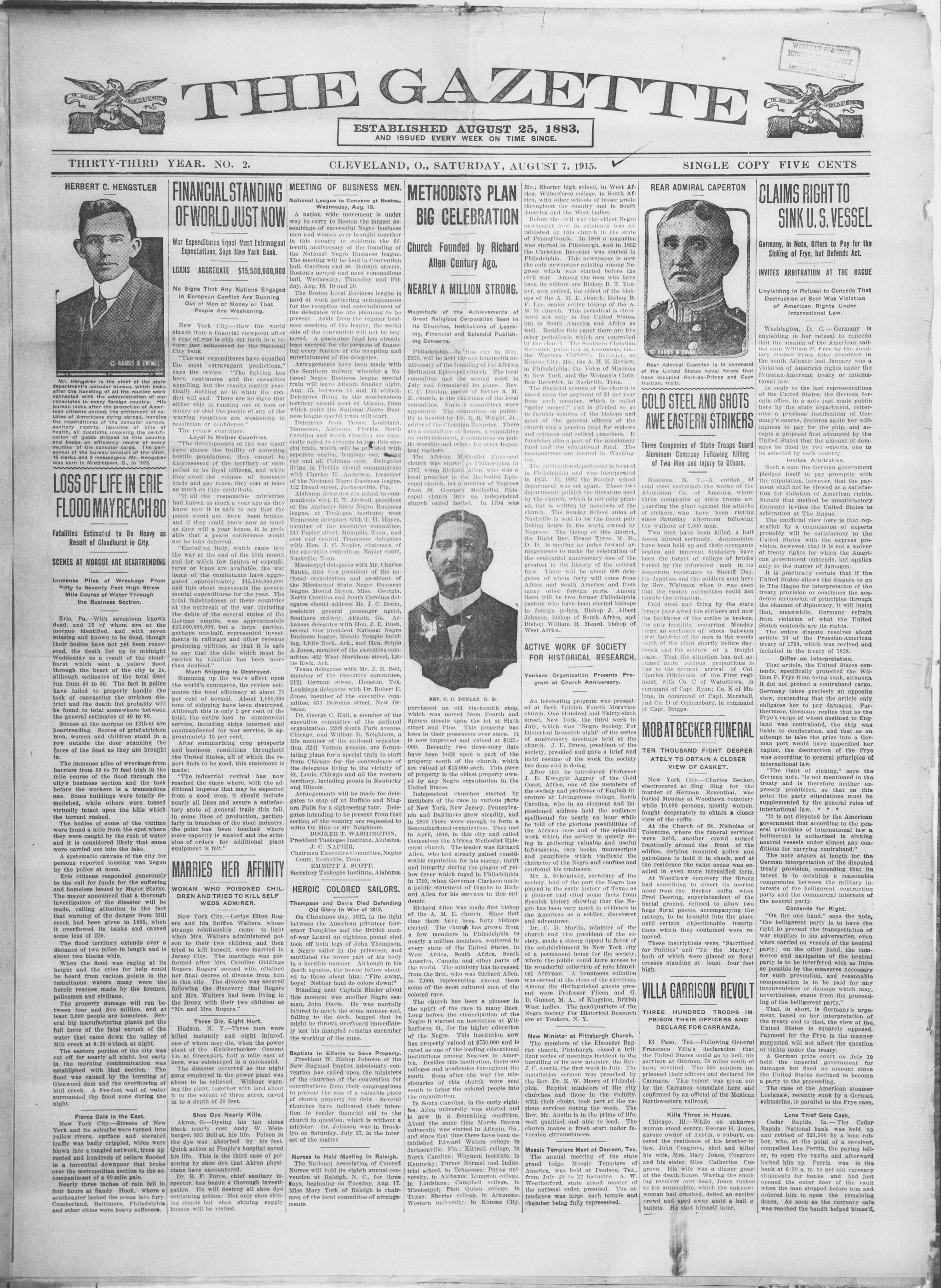
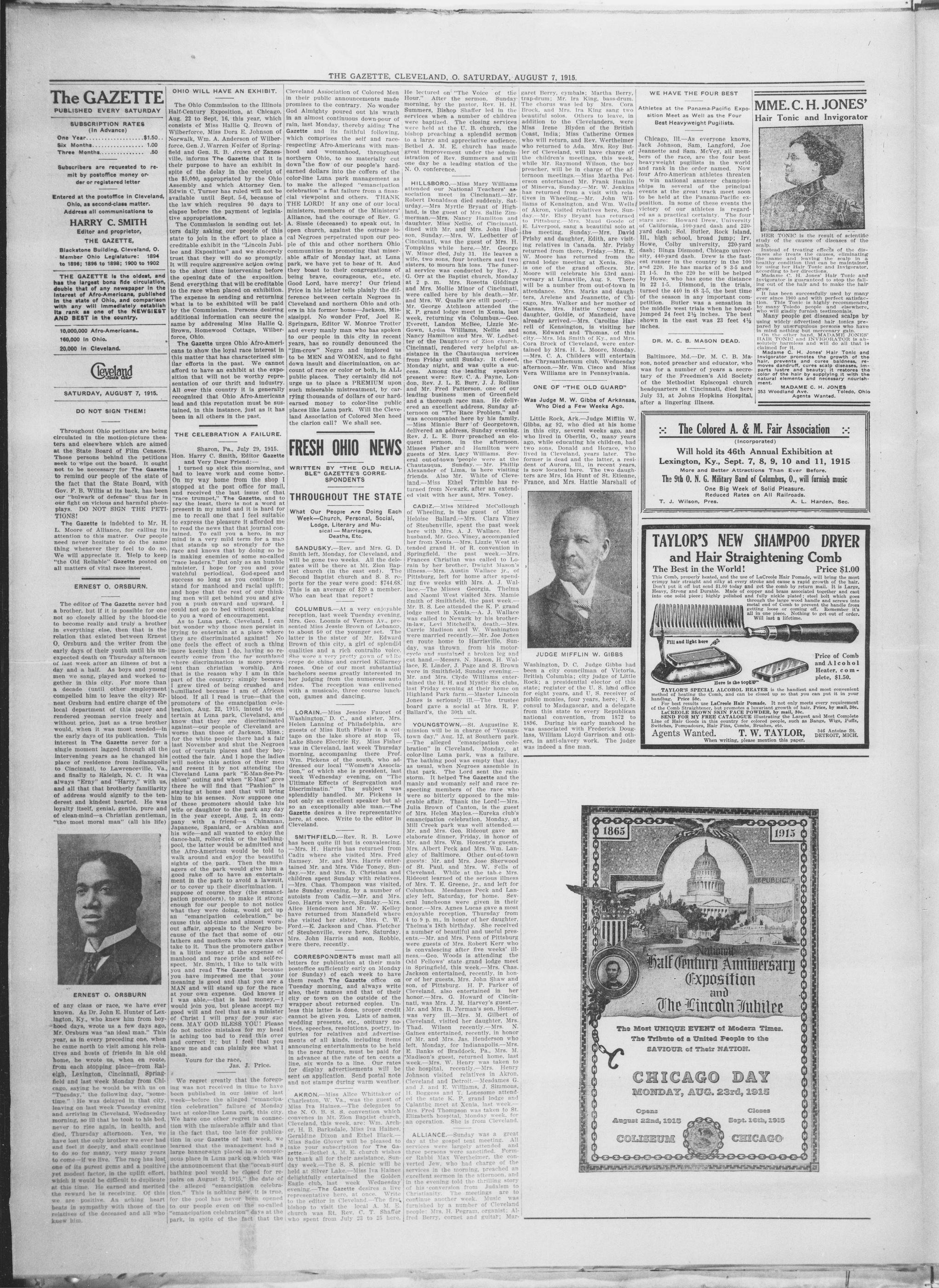
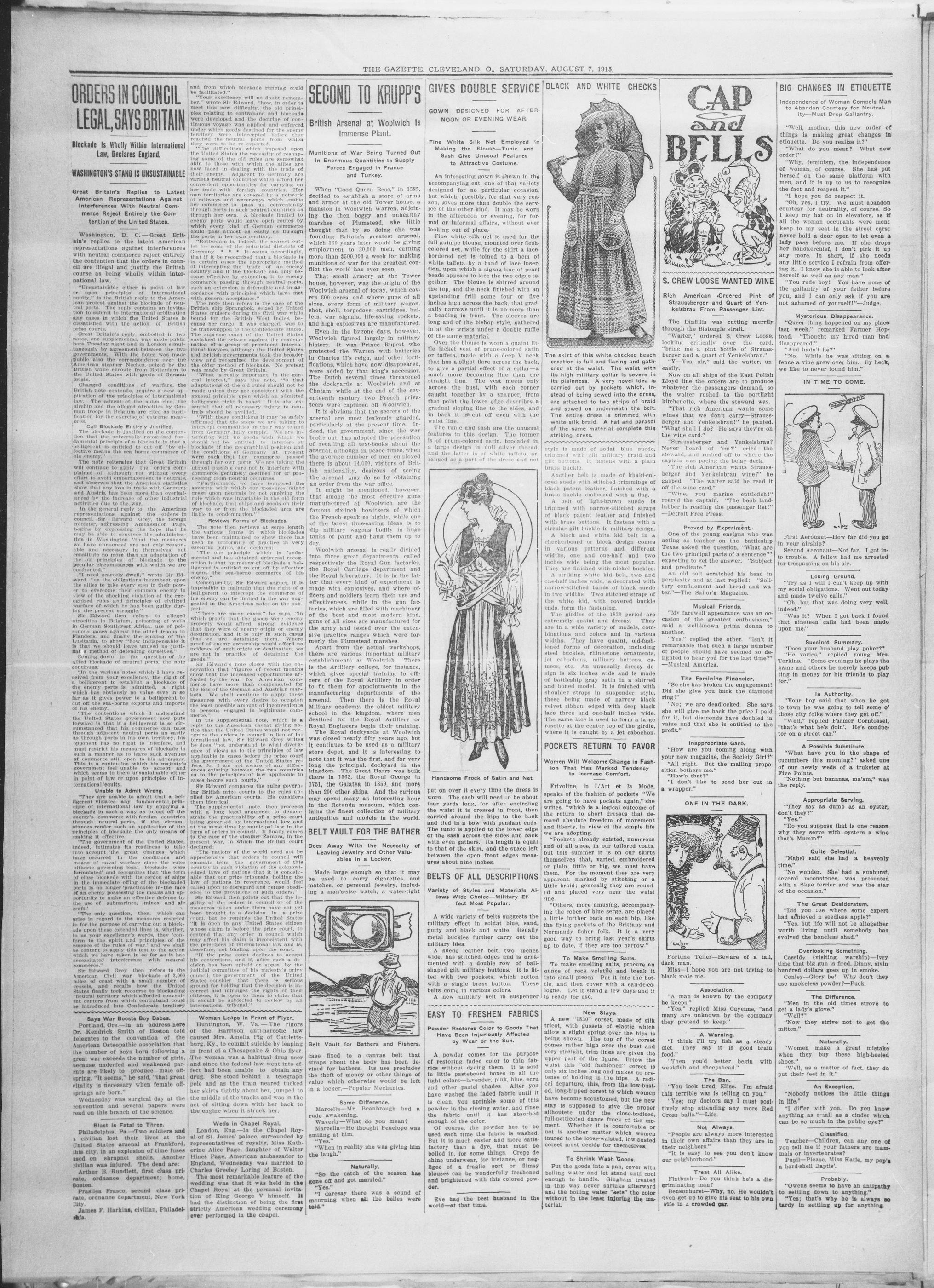
Page text (machine-generated)
IN VIRGIN
BRACES AND BREASTS
HERBERT C. HENGSTLER
Mr. Hengster is the chief of, the state department's consular bureau, which looks after the handling of all the routine work connected with the administration of our consulates in every foreign country. His bureau looks after the protection of American citizens abroad, the settlement of estates of Americans dying abroad, handles the expenditures of the consular service, sanitary reports, insurance of health, all questions involving the certification of goods shipped to this country and keeps an efficiency record of every member of the consular corps. The personnel of the consular consists of the chief, 16 clerks and 2 messengers. Mr. Hengster was born in Middle Town, O. in 1876.
LOSS OF LIFE IN ERIE FLOOD MAY REACH 80
Fatalities Estimated to Be Heavy as Result of Cloudburst in City.
SCENES AT MORGUE ARE HEARTRENDING
Immense Piles of Wreckage From "Fifty to Seventy Feet High Streak Mile Course of Water Through the Business Section.
Erie, Pa.—With seventeen known dead, and 16 of whom are at the morgue identified, and with seven missing and known to be dead, though their bodies have not yet been recovered, the death list up to midnight Wednesday as a result of the cloudburst which sent a yellow flood through the heart of the city is 24, although estimates of the total dead run from 40 to 80. The fact is police have failed to properly handle the task of canvassing the stricken district and the death list probably will be found to total somewhere between the general estimates of 40 to 80.
Scenes at the morgue on 13th-st are heartrending. Scores of grief-striken men, women and children stand in a row outside the door scanning the faces of the dead as they are brought in.
The immense piles of wreckage from barriers from 50 to 70 feet high in the mile course of the flood through the city's business section and the task before the workers is a tremendous one. Some buildings were totally demolished, while others were tossed virtually intact upon the hills which the torrent rushed.
The bodies of some of the victims were found a mile from the spot where they were caught by the rush of water and it is considered likely that some were carried out into the lake.
A systematic canvass of the city for persons reported missing was begun by the police at noon. Erie citizens responded generously to the call for funds for the suffering and homeless issued by Mayor Sterns. The mayor announced that a thorough investigation of the disaster will be made, calling attention to the fact that warning of the danger from Mill creek had been given in 1895, when it overflowed its banks and caused some loss of life.
The flood territory extends over a distance of two miles in length and is about two blocks wide.
When the flood was raging at its height and the cries for help could be heard from various points in the tumultuous waters many were the heroic rescues made by the firemen, policemen and civilians.
The property damage will run between four and five million, and at least 3,000 people are homeless. Several big manufacturing plants got the full force of the fatal onrush of the water that came down the valley of Mill creek at 8:30 o'clock at night.
The eastern portion of the city was cut off for nearly all night, but early in the morning communication was established with that section. The flood was caused by the bursting of Glenwood dam and the overflowing of Mill creek. A five-foot-wall of water surrounded the flood zone during the night.
Fierce Gale In the East.
New York City - Streets - of New York and its suburbs were turned into yellow rivers, surface and elevated traffic was badly crippled, wires were blown into a tangled network, trees uprooted and hundreds of cellars flooded in a torrential downpour that broke over the metropolitan section to the accompaniment of a 60-mile gale.
Nearly three inches of rain fell in four hours at Sandy Hook, where a southeaster lashed the ocean into fury. Cumberland, Baltimore, Philadelphia and other cities were heavy sufferers.
THE GAZETTE
FINANCIAL STANDING OF WORLD JUST NOW
War Expenditures Equal Most Extravagant Expectations, Says New York Bank.
No Signs That Any Nations Engaged in European Conflict Are Running Out of Men or Money or That People Are Weakening.
New York, City—How the world stands from a financial viewpoint after a year of war is ably set forth in a review just announced by the National City bank.
"The war expenditures have equalled the most extravagant predictions," says the review. "The fighting has been continuous and the casualties appalling, but the results signify practically nothing; as to when the conflict will end. There are no ships that either side is running out of men or money or that the people of any of the warring countries are weakening in resolution or confidence."
The review continues:
Loyal to Mother Countries.
"The developments of the war itself have shown the futility of annoying hostile populations; they cannot be dispossessed of the territory or compelled to be loyal citizens, and while they swell the volume of domestic trade and pay taxes, they cost at least as much as they contribute.
"If all the responsible ministries had known as much a year ago as they know now it is safe to say that the peace would not have been broken, and if they could know now as much as they will a year hence, it is probable that a peace conference would not be deferred.
"Excluding Italy, which came into the war at the end of the 10th month and for which few figures of expenditures or loans are available, the war loans of the combatants have aggregated approximately" $15,500,000,000 and this about represents the governmental expenditures for the year. The total indebtedness of these countries at the outbreak of the war, including the debts of the several states of the German empire, was approximately $23,000,000,000, but a large portion, perhaps one-half, represented investments in railways and other revenue producing utilities, so that it is safe to say that the debt which must be carried by taxation has been more than doubled.
Much Shipping is Destroyed.
Summing up the war's effect upon the world's commerce, the review estimates the total efficiency at about 75 per cent of normal. About 1,000,000 tons of shipping have been destroyed. Although this is only 2 per cent of the total, the entire loss to commercial service, including ships interried and commanded for war service, is approximately 15 per cent.
After summarizing crop prospects and business conditions throughout the United States, all of which the report finds to be good, this statement is made:
"The industrial revival has now reached the stage where, with the additional impetus that may be expected from a good crop, it should include nearly all lines, and assure a satisfactory state of general trade this fall. In some lines of production, particularly in branches of the steel industry, the point has been touched where more capacity is wanted and the stimulus of orders for additional plant equipment is felt."
MARRIES HER AFFINITY
WOMAN WHO POISONED CHILDREN AND TRIED TO KILL SELF WEDS ADMIRER:
New York City.—Lorlys Elton Rogers and Ida Sniften Walters, whose strange relationship came to light when Mrs. Walters administered poison to their two children and then tried, to kill herself, were married in Jersey City. The marriage was performed after Mrs. Caroline Giddings Rogers, Rogers' second wife, obtained her final decree of divorce from him in this city. The divorce was secured following the discovery that Rogers and Mrs. Walters had been living in the Bronx with their two children as "Mr. and Mrs. Rogers."
Three Die. Eight Hurt.
Hudson, N. Y.-Three men were killed instantly and eight injured, one of whom may die, when the power plant of the Knucklerbocker Cement Co. at Greenport, half a mile east of here, was submerged in a quicksand. The disaster occurred as the night gang employed in the power plant was about to be relieved. Without warning the plant, together with land about it to the extent of three acres; caved in to a depth of 30 feet.
**Shoe Dye Nearly Kills.**
Akron, O.-D. Oreying his tan shoes black nearly cost Andy W. Welsburger, 853 Bell-st, his life. Poison in the dye was absorbed by his feet. Quick action at People's hospital saved his life. This is the third case of poisoning by shoe dye that Akron physicians have encountered.
Dr. B. F. Force, chief sanitary inspector, has begun a thorough investigation. He will destroy all shoe dye containing poison: Not only shoe shining stands but shoe shining supply houses will be visited.
ESTABLISHED AUGUST 25, 1883 AND ISSUED EVERY WEEK ON TIME. SINCE.
MEETING OF BUSINESS MEN.
National League to Convene at Boston
Wednesday, Aug. 18.
A nation wide movement is under
way to carry to Boston the largest as-
semblea of successful Negro business
men, and women ever brought together
in this country to celebrate the fifte-
th anniversary of the founding of the
National Negro Business league.
The meeting will be held in Convention
hall, Garrison and St. Johnstown streets,
Boston's newest and most commonsible
hall. Wednesday: Thursday and Friday,
Aug. 18, 19 and 20.
The Boston Local Business league is
hard at work perfecting arrangements
for the reception and entertainment of
the delegates who are planning to be
present. Aside from the regular busi-
ness sessions of the league, the social
side of the convention will not be neg-
ected. A guarantee fund has already
been secured for the purpose of finan-
cing every feature, of the reception and
entertainment of the delegates.
Arrangements have been made with
the Southern railway whereby a National Negro Business league special
train will leave Atlanta Sunday night,
Aug. 15, between 11 and 12 o'clock.
Delegates living in the southeastern
torture should meet at Atlanta, from
which point the National Negro Busi-
ness league special train will start.
Delegates from Texas, Louisiana, Tennessee, Alabama, Florida, North Carolina and South Carolina are especially urged to arrange to join this special train, which will be provided with separate弯道, bargeage car, rolling car and all Pullman cars. Delegates living in Florida should communicate with Charles H. Anderson, treasurer of the National Negro Business league, 152 Broad Street, Jacksonville, Fla.
Alabama delegates are asked to communicate with E. T. Arwell, president of the Alabama State Negro Business league, at Tuskegee institute, west Tennessee delegates with T. H. Hayes, member of the executive committee, 247 Poplar street, Memphis, Teum, and east and central Tennessee delegates with Hon. J. C. Napler, chairman of the executive committee, Napler court, Nashville, Teum.
Mississippi delegates with Mr. Charles Banks, first vice president of the national organization and president of the Mississippi State Negro Business league, Mound Bayou, Miss. Georgia, North Carolina and South Carolina delegates should address Mr. J. C. Beam, assistant general passenger agent, Southern railway, Atlanta, Ga. Arkansas delegates with Hon. J. E. Bush, second vice president National Negro Business league, Mosaite Temple building, Little Rock, Ark., and Hen. Selpia A Jones, member of the executive committee, 402 West Markham street, Little Rock, Ark.
Texas delegates with Mr. J. B. Bell, member of the executive committee, 2321 German street, Houston, Tex. Louisiana delegates with Dr. Robert E. Jones, member of the executive committee, 631 Baronue street, New Orleans.
Dr. George C. Hall, a member of the executive committee of the national organization, 2328 South Park avenue, Chengo, and William D. Neighbors, a life member of the national organization, 2324 Vernon avenue, are formulating plans for a special train to start from Chicago for the governance of the delegates living in the vicinity of St. Louis, Chicago and all the western territory, including points in Kentucky and Illinois.
Arrangements will be made for delegates to stop off at Buffalo and Niagara Falls for a sightseeing tour. Delegates intending to be present from that section of the country are requested to write Dr. Hall or Mr. Neighbors.
BOOKER T. W. HWATSON, President Tuskegee Institute, Alabama.
J. C. NAPIER, Chairman Executive Committee, Napier Court, Nashville, Tennessee.
EMMETT J. SCOTT, Secretary Tuskegee Institute, Alabama.
HEROIC COLORED SAILORS.
Thompson and Davis Died Defending Old Glory in Wpr of 1812.
On Christmas day, 1812, in the fight between the American privateer Governor Tompkins and the British man-of-war Laurel an eighteen pound shot took off both legs of John Thompson, a Negro sailor in the privateer, and mutilated the lower part of his body in a horrible manner. Although in his death agonies, the herde fellow shouted to those about him: "Fire away, boys! 'Nebber haw de colors down!"
Standing near Captain Shaler about this moment was another Negro seaman, John Davis. He was mortally injured in much the same manner and, falling to the deck, begged that he might be thrown overboard immediately lest his mungled remains encumber the working of the gun.
Baptists in Efforts to Save Property. President W. Bishop Johnson of the New England Baptist missionary convention has called upon the ministers of the churches of the convention for contributions from their congregations to prevent the loss of a valuable piece of church property for debt. Several churches have fiddled their intention to render financial aid to the church in question, which is without a minister. Dr. Johnson was in Brooklyn on Saturday, July 17, in the interest of the matter.
Nurses to Hold Meeting in Raleigh
The National Association of Colored
Nurses will hold its eighth annual con-
vention at Raleigh, N. C. for three
days, beginning on Tuesday, Aug. 17.
Miss Mary York of Raleigh is chairman of the local committee of arrangements.
METHODISTS PLAN BIG CELEBRATION
Magnitude of the Achievements of Great Religious Corporation Seen In Its Churches, Institutions of Learning, Financial and Splendid Publishing Concerns.
Philadelphia—In this city in May, 1816, will be held the one hundredth anniversary of the founding of the African Methodist Episcopal church. The local committee met the second week in July and formulated its plans. Rev. C. C. Dunlap, pastor of Bethel A. M. E. church, is the chairman of the local committee. Various committees were appointed. The committee on publicity is led by Dr. R. K. Wright, JE. editor of the Christian Episcopal. There are a committee on issues a committee on entertainment, a committee on public worship and other for other important matters.
The African Methodist Episcopal church was started in Philadelphia in 1787, when Richard A. Abe was a local placer in the African Episcopal church, led a number of Negroes from St. George's Methodist Episcopal church into an independent church called Bethel. In 1814 was
REV. C. C. DUNLAP, D. D.
purchased an old blacksmith shop, which was moved from Fourth and Spruce streets upon the lot at Sixth street and Pine. This property has been in their possession ever since. It is now improved and valued at $125,000. Recently two three-story hats have been built upon a part of the property south of the church, which are valued at $15,000 each. This piece of property is the oldest property owned by any Negro organization in the United States.
Independent churches started by members of the race in various parts of New York, New Jersey, Pennsylvania and Baltimore grew steadily, and in 1816 there were enough to form a denominational organization. They met in April, 1816, in this city and called themselves the African Methodist Episcopal church. The leader was Richard Allen, who had already gained considerable reputation for his energy, shift and integrity during the plague of yellow fever which raged in Philadelphia in 1763, when Governor Clarkson made a public statement of thanks to Richard Allen for his services in this epidemic.
Richard Allen was made first bishop of the A. M. E. church. Since that time there have been forty bishops elected. The church has grown from a few members in Philadelphia to nearly a million members, scattered in every state of the United States, in West Africa, South Africa, South America, Canada and other parts of the world. The ministry has increased from the first, who was Richard Allen, to 7,000, representing among them some of the most cultured men of the colored race.
The church has been a pioneer in the uplift of the race in many lines. Long before the emancipation of the Negro it started an institution at Wilberforce, O. for the higher education of the Negro. This institution now has properly valued, at $750,000 and is rated as one of the leading educational institutions among Negroes in America. Besides this institution, there are colleges and academies throughout the south. Soon after the war the missionaries<sup>6</sup> of this church were sent south to bring the colored people into the organization.
In South Carolina, in the early eighties. Allen university was started and is now in a flourishing condition. About the same time Morris Brown university was started in Atlanta, Ga., and since that time there have been established Edward Waters college in Jacksonville, Fla.; Kittrell college, in North Carolina; Wayman institute, in Kentucky; Turner Normal and Industrial school, in Tennessee; Payne university, in Alabama; Lampton college, in Louisiana; Campbell college, in Mississippi; Paul Quinn college, in Texas; Shorter college, in Arkansas; Western university, in Kansas, City.
Mo.; Shorter high school, in West Africa; Willier for college, in South Africa, with other schools of lesser grade throughout the country and in South America and the West Indies.
Before the civil war the oldest Negro newspaper town in existence was established by this church in the state of Pennsylvania. In ISIS a magazine was started in Pittsburgh, and in 1852 the Christian Recorder was started in Philadelphia. This newspaper is now the only newspaper existing among Negroes which was started before the civil war. Among the men who have been its cellars are Bishop B. T. Tanner, now retired, the oldest of the bishops of the A. M. E. church; Bishop B. F. Lee, senior active bishop of the A. M. E. church. This periodical is circulated not only in the United States, but in South America and Africa as well. Besides this paper there are five other periodicals which are controlled by the church. The Southern Christian Research party is controlled by the Western Christian Research party. At Kansas City, Mo. the A. M. E. Review in Philadelphia; the Voice of Missions in New York; and the Women's Charlson Beamer in Nashville, Tenn.
The financial system of the church is based upon the payment of $4 per year from each member, which is called "dollar money" and is divided so as to furnish salaries of the bishops and most of the general officers of the church and a pension fund for widows and epiphans and retired priests. It furnishes a part of the missionary fund and the educational fund. The department is located in Washington.
The department is located in Philadelphia and was incorporated in 1855. In 1852 the Sunday school department was set apart. These two department publish the literature used by the church, which is not only printed, but is written by members of the church. The Sunday School union at Nashville is said to be the finest publishing house in the world owned by Negroes. The bishop of this district, the Right Rev. Evans Tyreo, M. D., D. J. is sparing no polls toward arrangements to impale the celebration of the centennial anniversary one of the greatest in the history of the colored race. There will be about 290 delegates, of whom forty will come from Africa and South-America and from many other foreign parts. Among them will be two former Philadelphia pastors who have elected bishops to foreign points, Bishop J. Albert Johnson, bishop of South Africa, and Bishop William H. Heard, bishop of West Akron.
ACTIVE WORK OF SOCIETY FOR HISTORICAL RESEARCH.
Yonkers Organization Presents Program at Church Anniversary.
An interesting program was presented at Beth Tiphilh Fourth Moravian church, One Hundred and Thirty-sexth street, New York, the third week in July, which was "Negro Society For Historical Research night" of the series of anniversary meetings, held at the church, J. E. Bruce, president of the society, presided and gave a brief and held resume of the work the society has done and is doing.
After this he introduced Professor J. E. Kwegly Aggroy of the Gold Coast, Africa, one of the members of the society and professor of English literature at Livingstone college, North Carolina, who in an eloquent and impassioned address held the audience spellbound, for nearly an hour while he told of the glorious possibilities of the African race and of the splendid work which the society is quietly doing in gathering valuable and useful information, rare books, manuscripts and pamphlets which vindicate the character of the Negro and confuse and confound the race. Schubembe, secretary of the society, told of the part the Negro has played in the early history of Texas as a pioneer and cited some facts from Spanish history showing that the Negro has been very much in evidence in the Americas as a soldier, discoverer and adventurer.
Dr. C. D. Marth, minister of the church and vice president of the society, made a strong appeal in favor of the establishment in New York city of a permanent home for the society, where the public could have access to its wonderful collection of rare historical Africana. A bountiful collation was served at the close of the exercises. Among the distinguished guests present were Professor Fileen and G. D. Gunter, M. A., of Kingston, British West Indies. The headquarters of the Negro Society For Historical Research are at Yankers, N. Y.
Now Minister at Pittsburgh Church.
The members of the Ebenezer Baptist church, Pittsburgh, closed a brilliant series of meetings incident to the installing of its new minister, the Rev. J. C. Austin, the first week in July. The installation sermon was preached by the Rev. Dr. E. W. Moore of Philadelphia. Baptist ministers of the city churches and those in the vicinity, with their choirs, took part at the various services during the week. The Rev. Mr. Austin is in the prime of life, well qualified and able to lead. The church makes a fresh start under favorable circumstances.
Mosaic Templars Meet at Denison, Tex.
The annual meeting of the state grand lodge. Mosaic Templars of Amerlen, was held at Denison, Tex. from July 20 to 22 inclusive. A. W. Weatherford, state grand master of the national order, presided. The attendance was large, each temple and chamber being fully represented.
SINGLE COPY FIVE CENTS
Rear Admiral Caperton is in command of the United States naval forces that have occupied Port-au-Prince and Cape Haitian, Haiti.
COLD STEEL AND SHOTS
AWE EASTERN STRIKERS
Three Companies of State Troops Guard Aluminum Company Fellowing Killing of Two Men and Injury to Others.
Messana, N. Y. A. cordon of cold steel surrounds the works of the Aluminum Co. of America, where three companies of state troops are arranging the plant against the attacks of strikers, who have been, flotting since Saturday afternoon following the walkout of 1,000 men.
Two men have been killed, a half dozen injured seriously. Automobiles have been held up and their occupants beaten and innocent bystanders have been the target of volleys of bricks hurled by the infiltrated mob in its designee resistance to Sheriff Day; his deputies and the soldiers sent here by Gov. Whitman, when it was seen that the county authorities could not handle the situation.
Cold steel and dring by the state troops have aided the strikers and now the backbone of the strike is broken, so only heatlity occurring Monday gives an exchange of shots between rival factions of the men in the woods each of the plant shortly before daybreak and the seizure of a freight ship. That the situation has not assumed more serious proportions is due to the rumour arrival of Col. Charles Hiteckeck of the first regiment, with Co. C of Watertown, in command of Capt. Ryan; Co. K of Malone, in command of Capt. Marshall, and Co. D of Oglutsburg, in command of Capt. Briggs.
MOBATBECKERFUNERAL
MOBATBECKERFUNERAL
TEN THOUSAND FIGHT DESPER
ATELY TO OBTAIN A CLOSER
VIEW OF CASKET.
New York City.—Charles Becker,
electrocuted at Sing Sing for the
murder of Herman Rosenthal, was
buried Monday at Woodawn cemetery
white 10,000 persons, mostly women,
fought desperately to obtain a closer
view of the coffin.
At the Church of St. Nicholas of
Tolentine, where the funeral services
were held, another crowd surged
frantically around the front of the
office, defying mounted police and
patrolmen to hold it in check, and
at the residencia the same scene was
acted in even more intensified form.
At Woodawn cemetery the throng
had something to divert its morbid
mind from the becker coffin when
Fred Deering, superintendent of the
burial ground, refused to allow two
huge floral pieces, accompanying the
cortege, to be brought into the place
until certain objectionable inscriptions
which they contained were removed.
These inscriptions were, "Sacrificed
for Politics" and "To, the Martyr,
both of which were placed on floral
crosses standing at least four feet
high.
VILLA GARRISON REVOLT
THREE HUNDRED TROOPS IMPRISON THEIR OFFICERS AND DECLARE FOR CARRANZA.
El Paso, Tex.-Following General Francisco Villa's declaration, that the United States could go to hell, his garrison at Guzman, 78 miles south of here, revolted. The 300 soldiers imprisoned their officers and declared for Carranza. This report was given out by the Carranza consulate here and confirmed by an official of the Mexican Northwestern railroad.
Kills Thred in House
Chicagos, Ill.—While an unknown woman stood sentry, George H. Jones, garage owner of Austin, a suburb, entered the residence of his brother-in-law, John Cosgrove, shot and killed his wife, Mrs. Mary Jones, Cosgrove and his sister, Miss Catherine Cosgrove. His wife was a dinner guest at the death house. Waving the smoking revolver over head, Jones rushed to his automobile, which the unknown woman had cranked, defied an exciter crowd and sped away amid a hall of bullets. He shot himself later.
CLAIMS RIGHT TO SINK U.S. VESSEL
INVITES ARBITRATION AT THE HAGUE
Unyielding in Refusal to Concede That Destruction of Boat Was Violation of American Rights Under
Washington, D. C. — Germany is unyielding; in her refusal to concede that the sinking of the American sailing ship William P. Frye by the auxiliary cruiser Prizz Eitel Friedrich in the south Atlantic last January was a violation of American rights under the Prussian-American treaty or international law.
In reply to the last representations of the United States, the German foreign office, in a note just made public here by the state department, reiterates, a previous justification of Germany's course, declares again her willingness to pay for the ship, and accepts a proposal first advanced by the United States that the amount of damages be fixed by two experts, one to be solicited by each country.
Invites Arbitration.
Such a sum the German government pledges itself to pay promptly with the stipulation, however, that the payment shall not be viewed as a satisfaction for violation of American rights.
Should that method be unsatisfactory Germany invites the United States to arbitration at The Hague.
The unofficial view here is that reparation by a commission of experts probably will be satisfactory, to the United States with the express provision, however, that it is not a waiver of treaty rights for which the American government contents, but applies only to the matter of damages.
It is practically certain that if the United States allows the dispute to go to The Hague for interpretation of the treaty provision or continues the academic discussion of principles through the channel of diplomacy, it will insist that, meanwhile, Germany refrain from violation of what the United States contends are its rights.
The entire dispute resolves about article 13 of the Prussian-American treaty of 1799, which was revived and included in the treaty of 1828.
Differ on Interpretation.
"That article, the United States contends, specifically protected the William P. Frye from being sunk, although it did not protect a contraband cargo. Germany takes precisely an opposite view, contending that the article only obligates her to pay damages. Furthermore, Germany replies that as the Frye's cargo of wheat destined to England was contraband, the ship was liable to confiscation, and that as an attempt to take the prize into a German port would have imperilled her captor, the destruction of the Frye was according to general principles of international law.
"The right of sinking," says the German note, "is not mentioned in the treaty and is therefore neither expressly prohibited, so that on this point the party stipulations must be supplemented by the general rules of international law."
"It is not disputed by the American government that according to the general principles of international law a belligerent is authorized in sinking neutral vessels under almost any conditions for carrying contraband."
The note argues at length for the German interpretation of the disputed treaty provision, contending that its intent is to establish a reasonable compromise between the military interests of the belligerent contracting party and the commercial interests of the neutral party.
Contends for Right.
"On the oile hand," says the note, "the belligerent party is to have the right to prevent the transportation of war supplies to his adversaries, even when carried on vessels of the neutral party; on the other hand, the commerce and navigation of the neutral party is to be interfered with as little as possible by the measures necessary for such prevention, and reasonable compensation is to be paid for any inconvenience or damage which may, nevertheless, ensue from the proceeding of the belligerent party."
That, in short, is Germany's argument, based on her interpretation of the treaty and to that, the view of the United States is squarely opposed. Payment for the Frye in the manner suggested will not affect the question of rights under the treaty.
A German prize court on July 10 held the imperial government for damages but fixed no amount since the United States declined to become a party to the proceeding.
The case of the American steamer Leelanaw, recently sunk by a German submarine, is parallel to the Frye case.
Lone Thief Gets Cash
Cedar Rapids, Ia. — The Cedar Rapids National bank was held up and robbed of $21,300 by a lone robber, who, at the point of a revolver, compelled Leo Perrin, the paying teller, to open the vaults and afterward locked him up. Perrin was in the bank at 6:30 a.m. to get out currency shipments for banks; and had just opened the outer door of the vault when the man stepped before him and ordered him to open the remaining doors. As soon as the currency safe was reached the band helped himself,
SUBSCRIPTION RATES
(In Advance)
One Year.....$1.50.
Six Months.....1.00
Three Months......50
Subscribers are requested to re-
mit by postoffice money or-
der or registered letter
Entered at the postoffice in Cleveland
Ohio, as second-class matter.
Address all communications to
Blackstone Building, Cleveland, O.
Member Ohio Legislature: 1894
to 1896; 1896 to 1898; 1900 to 1902
THE GAZETTE is the oldest, and
has the largest bona fide circulation,
double that of any newspaper in the
Interest of Afro-Americans, published
in the state of Ohio, and comparison
with any will immediately establish
its rank as one of the NEWSIEST
AND BEST in the country.
10,000,000 Afro-Americans..
160,000 In Ohio.
20,000 In Cleveland.
SATURDAY, AUGUST 7, 1915.
DO NOT SIGN THEM!
Throughout Ohio petitions are being circulated in the motion-picture theaters and elsewhere which are aimed at the State Board of Film Censors. Those persons behind the petitions seek to wipe out the board. It ought not to be necessary for The Gazette to remind our people of the state of the fact that the State Board, with Gov. F. B. Willis at its back, has been our "bulwark of defense" thus far in our fight on vicious and harmful photo plays. DO NOT SIGN THE PETTIONS!
The Gazette is indebted to Mr. H. L. Moore of Alliance, for calling its attention to this matter. Our people need never hesitate to do the same thing whenever they feel to do so. We will appreciate it. Help to keep "the Old Reliable" Gazette posted on all matters of vital race interest.
ERNEST O. ORSBURN
The editor of The Gazette never had a brother, but if it is possible for one not so closely allied by the blood-tie to become really and truly a brother in everything else, then that is the relation that existed between Ernest O. Orsburn and the writer from the early days of their youth until his unexpected death on Thursday afternoon of last week after an illness of but a day and a half. As boys and young men we sang, played and worked together in this city. For more than a decade (until other employment compelled him to leave the city) Ernest Orsburn had entire charge of the local department of this paper and rendered yeoman service freely and without price, just as a true brother would, when it was most needed—in the early days of its publication. This interest in The Gazette never for a single moment lagged through all the intervening years as he changed his place of residence from Indianapolis to Cincinnati, to Lawrenceville, Va., and finally to Raleigh, N. C. It was always "Erny" and "Harry," with us and all that that brotherly familiarity of address would signify to the tenderest and kindest hearted. He was loyalty itself, genial, gentle, pure and of clean-mind—a Christian gentleman, "the most moral man" (all his life)
ERNEST O. ORSBURN
of any class or race, we have ever known. As Dr. John E. Hunter of Lexington, Ky., who knew him from boyhood days, wrote us a few days ago Mr. Orsburn was "an ideal man." This year, as in every preceding one, when he came north to visit among his relatives and hosts of friends in his old home, he wrote us, when en route, from each stopping place—from Raleigh, Lexington, Cincinnati, Springfield and last week Monday from Chicago, saying he would be with us on "Tuesday," the following day, "sometime." He was delayed in that city leaving on last week Tuesday evening and arriving in Cleveland, Wednesday morning, so ill that he took to his bed, never to rise again, in health, and died. Thursday afternoon. Yes, we have lost the only brother we ever had and feel it deeply, and shall continue to do so for many, very many years to come—if we live. The race has lost one of its purest gems and a positive yet modest factor, in the uplift effort, which it would be difficult to duplicate at this time. He earned and merited the reward he is receiving. Of this we are positive. An aching heart beats in sympathy with those of the relatives of the deceased and all who knew him.
OHIO WILL HAVE AN EXHIBIT.
The Ohio Commission to the Illinois Half-Century Exposition, at Chicago, Aug. 22 to Sept. 16, this year, which consists of Miss Hallie L. Brown of Wilberforce, Miss Dora E. Johnson of Norwalk, Wm. A. Anderson of Wilberforce, Gen. J. Warren Keifer of Spring field and Gen. R. B. drown of Zanesville, informs The Gazette that it is their purpose to have an exhibit in spite of the delay in the receipt of the $5,000, appropriated by the Ohio Assembly and which Attorney Gen. Edwin C. Turner has ruled will not be available until Sept. 5-6, because of the law which requires 90 days to elapse before the payment of legislative appropriations.
The Commission is sending out letters daily asking our people of this state to join in the effort to place a creditable exhibit in the "Lincoln Jubilee and Exposition" and we sincerely trust that they will do so promptly. It will require aggressive action owing to the short time intervening before the opening date of the exposition. Send everything that will be creditable to the race when placed on exhibition. The expense in sending and returning what is to be exhibited will be paid by the Commission. Persons desiring additional information can secure the same by addressing Miss Hallie Q Brown, Homewood Cottage, Wilber force, Ohio.
The Gazette urges Ohio Afro-Americans to show the loyal race interest in this matter that has characterized similar efforts in the past. We cannot afford to have an exhibit at the exposition that will not be worthy representation of our thrift and industry. All over this country it is generally recognized that Ohio Afro-Americans lead and this reputation must be sustained, in this instance, just as it has been in all others in the past.
THE CELEBRATION A FAILURE.
Sharon, Pa., July 29, 1915.
Hon, Harry C. Smith, Editor Gazette
I turned up sick this morning, and had to leave work and come home. On my way home from the shop I stopped at the post office for mail, and received the last issue of that "race trumpet." The Gazette, and to say the least, there is not a word at present in my mind and it is hard for me to recall one that I feel suitable to express the pleasure it afforded me to read the news that that journal contained. To call you a hero, in my view, is to express that that stands up so strongly for the race and knows that by doing so he is making enemies of some so-called "race leaders." But only as an humble minister, I hope for you and your watchful periodical, God-speed and success so long as you continue to stand for manhood and racial uplift; and hope that the rest of our thinking men will get behind you and give me the courage to believe that could not go to bed without speaking to you a word of encouragement.
As to Luna Park, Cleveland, I can but wonder why those men persist in trying to entertain at a place where they are discriminated against! No one feels the effect of such a thing more keenly than I do, having so recently come from the far southland where I am the most prominent than Christian worship. And that is the reason why I am in this part of the country; simply because I grew tired of being crushed and humiliated because I am of African blood. If all I read is true—that the promoters of the emancipation celebration, Aug. 22, 1915, intend to entertain at Luna Park, Cleveland, and know that they are discriminated against the people of the world worse than those of Jackson, Miss., for the white people there had a fail last November and shut the Negroes out of certain places and they boy cotted the fair. And I hope the ladies will notice this action of their men and resent it by not attending the Cleveland Luna park "E-Man-See-Pashion" outing and when "E-Man" goes there will find that "Fashion" is the best way to bring him to his senses. Now suppose one of the promoters to take his company or daughter to the park any day in the year except, Aug. 2, in company with a friend—a Chianman, Japanese, Spaniard, or Arabian and his wife—and all wanted to enjoy the dance-hall, roller-rink or the bathing-pool and be admitted to the Afro-American would be admitted and the Afro-American would be admitted to the park to avoid a lawsuit, or to cover up their discrimination. I suppose of course they (the emancipation promoters), to make it strong enough for our people to not notice what they were doing, would get up an "emancipation celebration," because this old-time and almost workout affair, appeals to the Negro because of the fact that some of their slaves take to it. Thus the promoters gather in a little money at the expense of manhood and race pride and self-respect. Mr. Smith, I like to talk with you and read The Gazette because you have impressed me that your meaning is good and that you are a MAN and will stand up for the race at your own expense. God knows if I was able—that is had money—I would join you, but please accept my good opinion and my hard work. I must ask the artist will pray for your success. MAY GOD BLESS YOU! Please do not notice mistakes for my head is aching too bad to read this over and correct it; but I feel that you know me and can plainly see what I mean.
We regret greatly that the foregoing was not received in time to have been published in our issue of last week—before the alleged "emancipation celebration" failure of Monday last at color-line Luna park, this city. We have one other regret in connection with the miserable affair and that is the fact that, too late for publication in our Gazette of last week, we learned that the management had a large banner-sign placed in a conspicuous place in Luna park on which was the announcement that the "ocean-surf bathing pool would be closed for repairs on August 2, 1915," the date of the alleged "emancipation celebration." This is nothing new. It is true, for the pool has never been opened to our people even on the so-called "emancipation celebration" days at the park, in spite of the fact that the
THE GAZETTE, CLEVELAND, O. SATURDAY. AUGUST 7, 1915
Cleveland Association of Colored Men in their public announcements made promises to the contrary. No wonder God Almighty poured out his wrath in an almost continuous down-pour of rain, last Monday, thereby aiding The Gazette and its faithful following, which comprises the self and race-respecting Afro-Americans with manhood and womanhood, throughout northern Ohio, to so materially cut down "the flow of our people's hard-earned dollars into the coffers of the color-line Luna park management as to make the alleged "emancipation celebration that failure from a financial viewpoint and others." HANK THE LORD! If any one of our local ministers, members of the Ministers' Alliance, had the courage of Rev. G. A. Sissle (deceased) to speak out, in open church, against the outrage local Negroes perpetrated upon our people of this and other northern Ohio communities in promoting that miserable affair of Monday last, at Luna park, we have yet to hear of it. And they boast to their congregations of being brave, courageous, etc., etc. Good Lord, have mercy! Our friend Price in his letter tells plainly the difference between certain Negroes in Cleveland and northern Ohio and others in his former home—Jackson, Mississippi. No wonder Prof. Joel E. Springing, Editor W. Monroe Trotter and every man who has spoken to our people in this city in recent years, has so roundly denounced the "jim-crow" Negro and implored us to be MEN and WOMEN, and to fight down insult and discrimination, on account of race or color or both, in ALL public places. They certainly did not urge us to place a PREMIUM upon such miserable mistreatment, by caring thousands of dollars of our hard earned money to color-line public places like Luna park. Will the Cleveland Association of Colored Men heed the clarion call? We shall see.
FRESH OHIO NEWS
FRESH OHIO NEWS
WRITTEN BY "THE OLD RELIA
BLE" GAZETTE'S CORRE-
SPONDENTS
THROUGHOUT THE STATE
What Our People Are Doing Each Week — Church, Personal, Social, Lodge, Literary and Musical — Marriages, Deaths, Etc.
SANDUSKY.—Rev, and Mrs. G. D. Smith left, for Cleveland, and will be gone two weeks. All the delegates will be on vacation on Baptist church (in the east end). The Second Baptist church and S. S. reports for the year were good: $744.68. This is an average of $20 a member. Who can beat that report?
COLUMBUS—At a very enjoyable reception, last week Tuesday evening, Mrs. Geo. Loomis of Vernon Av., presented Miss Jessie Brown of Lebanon to about 60 of the younger set. The Mrs. Loomis, a former Brown of this city, a girl of splendid qualities and a rich contralto voice, she wore a very pretty gown of white crepe de chine and carried Killarney roses. One of our most substantial bachelors seems greatly interested in her judging from the numerous auto awards she received, and with a musicale, three courses, lunch con, games and dancing.
LORAIN.—Miss Jessie Faucet of Washington, D. C., and sister, Mrs. Helen Lanning of Philadelphia, are guests of Miss Ruth Fisher in a cottage on the lake shore at stop 75, Lake Shore Electric Ry. Miss Fisher was in Cleveland, last week Thursday morning, accompanying there Prof. Robert H. Dressler, who dressed our local "Women's Association," of which she is president, last week Wednesday evening, on "The Ultimate Effects of Segregation and Discriminatin." The subject was splendidly handled. Mr. Pickens is not only an excellent speaker but also an exceptional companion. Gazette desires a live representative here, at once. Write to the editor in Cleveland.
SMITHFIELD—Rev. R. B. Lowe has been quite ill but is convalescing.—Mrs. H. Harris has returned from Cadiz where she visited Mrs. Fred Ramsey. Mr. and Mrs. Harris entered trained Mr. and Mrs. Vide Toney, Sunday.—Mr. and Mrs. D. Christian and children spent Sunday with relatives.—Mrs. Chas. Thompson was visited, late Sunday evening, by a number of autists from Cadiz.—Mr. and Mrs. Geo Hahn, he helped Mrs. Hahn, his tenement W. Kelley have returned from Mansfield where she visited her sister, Mrs. C. W. Ford.—E. Jackson and Chas. Fletchen of Steubenville, were here, Saturday. Mrs. John Harris and son, Robbie were there, recently.
CORRESPONDENTS must mail all letters for publication at their main postoffice sufficiently early on Monday (or Sunday) of each week to have them reach The Gazette office on Tuesday morning, and always write also, their names and that of their employer. If you send a wrapper about returned copies. Unless this latter is done, proper credit cannot be given you. Lists of names, wedding presents, etc., obituary notices, speeches, resolutions, poetry, inquiries for relatives and advertisements of all kinds, including items announcing entertainments to be held for advance in the rate of ten cents a line, six words to a line. Our rates for display advertisements will be sent on application. Send postal note and not stamps during warm weather.
AKRON.—Miss Alice Whittaker of Charleston, W. Va., was the guest of Miss Iva Haines. The delegates to the N. O. B. S. s. convention which convenes in Mt. Zion Baptist Church, Cleveland, this week are, Wn. Archer, H. B. Barksdale, and Ethel Black. Miss Sadie Glover will be pleased to take your subscription for The Gazette.—Bethel A. M. E. church wishes to thank all for their assistance. Sunday week.—The S. S. picnic will be held at Silver Lake.—Miss Iva Haines delightfully entertained the Golden Eagle club, last week. Wednesday evening.—The Gazette desires a live representative here, at once to the editor, at home. The first visit to the local A. M. E. church was Rt. Rev. C. T. Shaffar who spent from July $3 to $25 here.
He lectured on "The Voice of the Hour." After the sermon, Sunday morning, by the pastor, Rev. H. H. Summers, Bishop Shaffer led in the services when a number of children were baptized. The closing services were held at the U. B. church, the bishop preaching a splendid sermon to a large and appreciative audience Bethel A. M. E. church has made great improvement under the administration of Rev. Summers and will one day be a leading station of the N. O. conference.
HILLSBORO.—Miss Mary Williams attended our National Teachers' association meet in Cincinnati.—Mr. Robert Donaldson died suddenly. Saturday.—Mrs Myrtle Bryant of Highland, is the guest of Mrs. Sallie Zimmerman.—Mrs. Nancy Hamilton and Mrs. Robert Bryant, are dined with Mr. and Mrs. John Hudson. Sunday.—Mrs. W. Ledbetter of Cincinnati, was the guest of Mrs. H. Tompkins here, while Mr. George W. Minor died, July 31. He leaves a wife, two sons, four brothers and two sisters, to mourn his loss. The funeral service was conducted by Rev. J. G. Orr at the Baptist church, Monday at 2 p. m. Mrs. Rosetta Giddings and Mrs. Mollie Minor of Cincinnati, were called here by the death.—Mr. George W. Minor died, Mrs. George Atchison attended the K. P. grand lodge meet in Xenia, last week, returning via Columbus. Geo. Everett, Landon McBee, Lizzie McGown, Lydia Williams, Nellie and Nancy Hamilton and Mrs. W. Ledbetter of the Daughters of Zion church, Cincinnati, rendered very helpful assistance in the Chauquaqua services from Friday until Sunday. It closed, Monday night, and was quite a success. Among the 'leading speakers present were: Reree Lon Lon, E. R. Eurr, J. R. Roen and Mr. Fred Patterson, one of our leading business men of Greenfield and a thorough race man. He delivered an excellent address, Sunday afternoon on "The Race Problem," and was accompanied here by his family.—Miss Minnie Burr 'of Getorgetown, delivered an address, Sunday evening, Rev. J. L. E. Burr preached an eloquent sermon, in the afternoon. Misses Fisher and Hamilton were guests of Mrs. Lucy Williams. Sev. Robert Owens, of Chauquaqua, Sunday.—Mr. Philip Alexander of Lima, is here visiting friends. Also Mr. White of Cleve land.—Miss Ethel Trimble has returned from Newark, an extended visit with her aunt, Mrs. Toney.
CADIZ—Miss Mildred McColough of Wheeling, is the guest of Miss Heloise Ballard—Mrs. Clara Viney of Steubenville, spent the past week here with Mrs. A. J. Wallace. Her husband, Mr. Geo Viney, accompanied her from Xenia—Mrs. Lizzie West attended grand H. of R. convention in Springfield, the past week—Mrs. Frances Christian was called to Lorain by her brother, Dwight Mason's Hiness—Mrs. Austin Wallace Jr., of Steubenville, spent five weeks with Mrs. A. J. Wallace—The Misses Georgia, Thelmia and Naomi West visited Mrs. Manie Smith of Smithfield, the past week—Mr. B. S. Lee attended the P. K. pardge meet in Xenia—A. J. Wallace was called to Newark by his brother-in-law, Levi Mitchell's, death—Mrs. Carrie Madison and W. Washington were married recently—Mr. Joe Jones en route home to Harrisville, Sunday, was thrown from his motorcycle and sustained a broken leg and cut hand—Messrs. N. Mason, H. Wallace, E. Linder, J. Lage and S. Brown, Mr. and Mrs. Clyde Holden, evening, Mr. and Mrs. Clyde Williams entertained the H. H. and Mystic Six clubs, last Friday evening at their home on Highland Park farm—Master Lincoln Jones is seriously ill—The trustee board gave a social at Mrs. R. F. Ballard's, the 30th ult.
YOUNGSTOWN.—St. Augustine E. mission will be in charge of "Youngstown day," Aug. 12, at Southern park. —The alleged "emancipation celebration" in Cleveland, Monday, at color-line Luna park, was a failure. The bathing pool was empty that day, as usual, when Negroes assemble in that park. The Lord sent the rainstorm. It helped The Gazette and the manly and womanly self and race respecting members of the race who were so bitterly oppose the mission of the Lord. Julla Brown of Canton, is the guest of Mrs. Helen Mayles. —Eureka club's emancipation celebration, Monday, at Mill Creek park was well attended. —Mr. and Mrs. Geo. Rideout gave an elaborate dinner, Friday, in honor of Mr. and Mrs. Wm. Honesty's guests, Mrs. Albert Peck and Mrs. Wm. Langley of Baltimore. Other out-of-town guests: Mr. and Mrs. Jose Sherwood of St. Paul, and Mrs. W. Sells of Cleveland. While at the table Mrs. Wm. outward part of the serious Mrs. T. E. Grawell took Columbus. Mesdames Peck and Langley left, Saturday, for home. Several luncheons were given in their enjoyment. Mrs. Agnes Lucas gave a most enjoyable reception, Thursday from 4 to 9 p.m. in honor of her daughter, Thelma's 18th birthday. She received a number of beautiful and useful presents. —Mr. and Mrs. Penn of Pittsburgh were guests of Mrs. Robert Kerr who is convalescing after five weeks' illness. —Gooo. Woods is attending the Odd Fellows' state grand lodge meet in Springfield, this week. Mrs. Chas. and Mrs. T. E. Grawell are or of her guests, Mrs. John Shaw and son of, Pittsburg. H. P. Parker of Cleveland, also entertained in her honor. —Mrs. G. Howard of Cincinnati, was Mrs. J. M. Harvey's guest. —Mr. and Mrs. B. Ferman's son. Homer, was very ill. —Mrs. M. Gilbert of Cleveland, visited her daughter, Mrs. Thad. Wilson recently. —Mrs. N. Gaines entertained, recently, in honor of Mr. and Mrs. Jas. Henderson who left, Monday, for Indianapolis. —Mrs. E. Banks of Braddock, Pa., Mrs. M. Madison's guest, returned home. week. —Mrs. W. Hennessy, was recently. —Mrs. Henry Johnson visited relatives in Akron. Cleveland and Detroit. —Mesdames G. and J. and E. Williams, J. Simmons, H. Boggess and T. Lonesome attended the state K. P. grand lodge and Calanthe meet at Xenia, last week. Mrs. Fred Thompson was taken to St. Elizabeth hospital, Monday week, for an operation. She is from Cleveland.
ALLIANCE - Sunday was a great day at the gospel tent meeting. All services were largely attended and three persons were sanctified. Former Rabbi Max Wertheimer, the converted Jew, who had charge of the services in the morning, preached an excellent sermon in the afternoon, and in the evening told the thrilling of his conversionism to church meetings are to continue another week. Music was furnished by a number of Cleveland people; Mrs. H. Pegram, organist; Alfred Berry, cornet and guitar; Mar
1865 1915
National
Half Century Anniversary
Exposition
and
The Lincoln Jubilee
The Most UNIQUE EVENT of Modern Times.
The Tribute of a United People to the
SAVIOUR of Their NATION.
CHICAGO DAY
MONDAY, AUG. 23rd, 1915
Opens
August 22nd, 1915
Closes
Sept. 16th, 1915
COLISEUM CHICAGO
garet Berry, cymbals; Martha Berry, trap-drum; Mr. Ira King, bass-drum. The chorus was led by Mrs. Cora Brock, and Mrs. Ira King sang two beautiful solos. Others to leave, in addition to the Clevelanders, were Miss Irene Blyden of the British Coast, India; Miss Catherine Ormes who returned to Ada, Mrs. Roy Butler of Cleveland, will have charge of the children's meetings, this week, while Mr. Raymond Wilson, the boy preacher, will be in charge of the afternoon meetings—Miss Martha Peterson entertained Mr. Frank Hamlin of Minerva, Sunday—Mr. W. Jenkins returned from a visit with relatives of Kensington, and Wm. Wells of Akron, visited relatives here, Sunday—Mr. Elsy Bryant has returned to Pittsburgh—Mrs. Maud Goode of E. Liverpool, sang a beautiful solo at the meeting, Sunday—Mrs. David Prisby and daughter, Edith, are visiting lives in Canada, Mr. Prisby returned to Kensington, and Wm. Wells has returned from the grand lodge meeting at Xenia. She is one of the grand officers, Mr. Moore will celebrate his 53rd anniversary at Limaaug, Aug. 9. There will be a number from out-of-town in attendance. Mrs. Marks and daughters, Arelen and Jeannette, of Chicago, Walter Walker, of Kansas, Mrs. Hattie Cromer and daughter, Goldie, of Mansfield, have already arrived—Mrs. Caroline Harlell of Kensington, is visiting his sons, Edward and Thomas, of this city—Mrs. Ida Smith of Ky, and Mrs Cora Brock of Cleveland, were entered by Mrs. H. L. Moore, Monday to Mrs. Cora Brock of Cleveland, the Chrysanthemum club, Wednesday afternoon—Mr. Wm. Cisco and Miss Vera Williams are in Pennsylvania.
ONE OF "THE OLD GUARD"
Was Judge M. W. Gibbs of Arkansas, Who Died a Few Weeks Ago.
Little Rock, Ark.—Judge Mifflin W. Gibbs, ag 92, who died at his home in this city, several weeks ago, and who lived in Oberlin, O., many years ago, while educating his children, had two sons, Donald and Horace, who lived in Cleveland, years later. The former is dead and the latter, a resident of Ann Arbor, is now located here. The two daughters are Mrs, Ida Hunt of St. Etienne, France, and Mrs, Hattie Marshall of
JUDGE MIFFLIN W. GIBBS
Washington, D. C. Judge Gibbs had been a city councilman of Victoria, British Columbia; city judge of Little Rock; a presidential elector of this state; register of the U. S. land office for eight years, and U. S. receiver of public monies, four years, here; U. S. consul to Madagascar, and a delegate from this state to every Republican from 1872 to 1896. During his early manhood he was associated with Frederick Douglass, William Lloyd Garrison and others, in anti-slavery work. The judge was indeed a fine man.
Will hold its 46th Annual Exhibition at Lexington, Ky., Sept. 7, 8, 9, 10 and 11, 1915
More and Better Attractions Than Ever Before.
The 9th O. N. G. Military Band of Columbus, O., will furnish music
One Big Week of Solid Pleasure.
Reduced Rates on All Railroads.
T. J. Wilson, Pres.
A. L. Harden, Sec.
TAYLOR'S NEW SHAMPOO DRYER and Hair Straightening Comb
TAYLOR'S SPECIAL ALCOHOL HEATER is the easiest and most convenient method of heating the Comb, and can be closed up so that you can put it in your hand. For best results use LaCreole Hair Pomade. It not only meets every requirement of the Comb Straightener, but promotes a luxurious growth of hair. Price by mail, 32c, LaCreole BROOKS BROWN BERMUDA BERMUDA, by mail, 32c, FREE CATALOGUE illustrated. The Largest and Most Complete Line of Hair Goods in this country for colored people, such as Bangs, Wigs, Fuffs, Switches, Pompadours, Hair Pins, Combs, Brushes, etc.
Agents Wanted. T. W. TAYLOR. 346 Avnst. St. DETROIT, MICH
WE HAVE THE FOUR BEST
Athletes at the Panama-Pacific Expo sition Meet as Well as the Four Best Heavyweight Pugilists.
Chicago, Ill.-As everyone knows, Jack Johnson, Sam, Langford, Joe Jeannette and Sam, McVey, all members of the race, are the four best heavyweight pugilists in the world and rank in the order named. Now four Afro-American athletes threaten to win national amateur champions in several of the principal events, the ten men to be held at the Panama-Pacific exposition. In some of these events the victory of our athletes is regarded as a practical certainty. The four stars are: Howard Drew, University of California, 100-yard dash and 220-yard dash; Sol Butler, Rock Island, 100-yard dash; Bingo Dismond, John Howe, Colby university, 220-yard dash; Binga Dismond, Chicago university, 440-yard dash. Drew is the fastest runner in the country in the 100 and 220. He has marks of 9 3-5 and 21 1-5. In the 220 he will be helped by Howe, who has gone the distance in 22 1-5. Dismond, in the trials, turned the 440 in 48 3-5, the best time of the season in any important competition, and turned the middle west trials when he branched jumped 24 feet $2\frac{1}{2}$ inches. The best shown in the east was 23 feet $4\frac{1}{2}$ inches.
DR. M. C. B. MASON DEAD.
Baltimore, Md.—Dr. M, C. B. Mason, noted preacher and educator, who was for a number of years a secretary of the Freedmen's Aid Society of the Methodist Episcopal church headquarters at Cincinnati, died here July 31, at John Hopkins Hospital, after a lingering illness.
HER TONIC is the result of scientific study of the causes of diseases of the scalp.
Instead of treating effects of the diseases she treats the causes, eliminating the same and leaving the scalp in a healthy condition that can be maintained by using her Hair Tonic and Invigorator, according to her directions.
Madame C. H. Jones' Hair Tonic and Invigorator is guaranteed to stop the falling out of the hair and to make the hair
It has been successfully used by many ever since 1800 and with perfect satisfaction by many Toledo people and elsewhere, by many Toledo people and elsewhere. Many people get diseased scals by using widely advertised hair tonics prepared by unscrupulous persons who have been trained in INVIGORATOR is abused claimed for it. On the other hand, MADAME JONES' HAIR TONIC and INVIGORATOR is abused claimed for it. MADAME JONES' Hair Tonic and Invigorator promotes the growth of the hair, prevents and cures baldness, restores hair color and part's lustre and beauty; it restores the color of the hair by supplying it with the natural elements and necessary nourishment. MADAME C. H. JONES 353 Woodland Toledo, Ohio Agents Wanted.
M. Fair Association ::
(corporated)
Annual Exhibition at
8, 8, 9, 10 and 11, 1915
ions Than Ever Before.
of Columbus, O., will furnish music
of Solid Pleasure.
on All Railroads.
A. L. Harden, Sec.
SHAMPOO DRYER
lightening Comb
Price $1.00
LaCreole Hair Pomade, will bring the most
role and cause a rapid growth of the hair.
get the comb by return mail. It is Large,
oper and brass associated together and cast
fully nickel plated; steel bolt which goes
through the large wood handle and screws into
terminal of Comb to prevent the handle from
tating loose or coming off. Remember it's
in one piece. Nothing to get out of order.
Will last a lifetime.
Price of Comb and Alcohol Heater, complete, $1.50.
ATER is the handiest and most convenient closed up so that you can put it in your made. It not only meets every requirement auxurient growth of hair, Price, by mail, 30e. WORK, by mail, 30e. illustrating the Largest and Most Complete clobed people, such as Bangs, Wigs, Puffs, Brushes, etc.
V. TAYLOR, 346 Antoine St. DETROIT, MICH. mention this paper.
PURO HERBS consist of the best possible mixture of Nature's health giving Herbs, contains no potash or vinegar and vegetable potatoes, not cause breaking gut—is not a secret compound, as it is composed of such well-known herbs as Burdock, Dandelion, Sarsaparilla, Red Clover, Ocimum basilicum, Plicity Alder and other herbs—all the very best approved blood purifiers.
PURO HERBS cleans the system of all impurities, restores health and drives away that tired, run-down blood. EIBRIGA, Plicity Alder and other herbs—all the very best approved blood purifiers.
PURO HERBS cost but 35c a box, the contents of which, boiled with one cup of water, yield the best blood medicine, equal to three ordinary one dollar bottles in size and better than any patent medicine, regardless of price.
PURO HERBS are also supplied in liquid form, for those who do not care to make it themselves, at 75c a quart. Sold only at
BROWN DRUG CO,
2742 CENTRAL AVE., cor. 28th Street
Leading Cate-Rate Drugs
North 1494-J Central 2234-L
I Take Care of Your Feet
Home Treatment if Desired
DR. G. H.
TURNER
Chiropodist
DR. G. H.
TURNER
Corns, Bunlone, Callouses and ingrowing Nails, Painfully Treated Open Evenings, Sundays & Holidays Special Attention Given Visitors From Out of the City Hours: 8:30 to 11:30 A. M 5:30 to 8:30 P. M.
STERLING 5 and 10 Cent Store
3003 Central Ave.
Watch Our Windows
For Bargains
Colored Salesladies
During July and August
we close at 6 P.M. every
evening except Saturday
Arlington Pharmacy
WE WILL ACCEPT THIS ADVERTISEMENT FOR FIVE CENTS IN TRADE, TO APPLY ON ANY PURCHASE OF TWENTY-FIVE CENTS OR MORE.
E. Rubenstein, Ph. C., Prop.
S. W. Cor. Central Ave. & E.
55th St.
The Sixteenth Annual Session
State Summer School
for
TEACHERS OF BOTH SEXES
at the
Agricultural and
Technical College
GREENSBORO, N. C.
began in June and will continue five weeks.
In addition to the regular work, an attractive lecture course has been arranged, in which will appear some of the most distinguished white and colored educators in the country.
For the entire session $12.00. Tuition 25c per subject unless other arrangements have been made.
Limited accommodations. Send $1 and have room reserved in advance.
For further information write at once.
James B. Dudley, President, or
S. B. Jones, Director,
A. & T. College, Greensboro, N. C.
G. G. REED
Dry Goods
Ladies' and Gents' Furnishings
Sole agents for the
AMERICAN LADY NEMO
R. @ G. COR-ETS
3222 Central Ave.
DON'T THROW AWAY
Your copy of The Gazette after reading it, but give it to a friend or an acquaintance who might subscribe after reading a copy of the paper.
Editor
Where to Purchase The Gazette
*SAM FERTMAN'S,
3608 Central Ave
*S. A. LUCAS,
3943 Central Ave.
NOTICE TO SUBSCRIBERS
Gazette regularly should notify
delivered promptly.
Fully examine The Gazette's adver-
s. Business men who advertise in
image of Afro-Americans. The fact
that they want it.
eisements) ten cents a line (slx
Personal
Subscribers not receiving The Gazette regularly should notify us at once. We desire every copy delivered promptly.
We advise our patrons to carefully examine The Gazette's advertisements before making purchases. Business men who advertise in this paper should have the patronage of Afro-Americans. The fact that they advertise is assurance that they want it. Local reading notices (advertisements) ten cents a line (six words in a line).
Social and Personal
Miss Virginia Robinson has returned from a very pleasant visit in Baltimore and other eastern cities.
Mrs. Hattie Fairfax of E. 35th St., is slowly improving. She has been critically ill.
J. S. Thomas of E. 34th St., left, Monday, for an extended visit in Richmond and other Virginia cities.
Mr. Grubbs, a traveling representative of the Indianapolis Freeman, called on The Gazette, Tuesday, Also Mrs. B. T. Richardson of Cincinnati.
Mrs. Nathan Waters (and her two little boys), of Pittsburg, former Miss Bebe Brown of this city, sister of Clarence Brown, jr., are visiting Miss Ida Scott of 9116 Aetna road.
Mrs. N. B. Ward and Mrs. L. B. Averitte of Indianapolis, his mother and aunt, respectively, are visiting Mr. and Mrs. A. L. Ward of 2321 E. 29th St.
Mrs. Brent Stewart and Mrs. W. Wingfield of Blaine Ave., and Mrs. Henry Mason, of E. 161st St., entertained royally, the past week, in honor of Mesdames Hamilton and Huston of Columbus.
Mrs. Joseph Seelig, sr., presented a Canadian quartette, supported by some of the best local talent, at Mt. Zion Congregational church, Wednesday evening. The proceeds are for the benefit of the new church fund.
Madam C. H. Jones, whose advertisement will be seen elsewhere in this paper, can be addressed, this week, at 1545 Winton Apt. Lakewood, O., and next week at 2298 E. 90th St. She is an artist in her line—Adv.
Send or bring locals and all business matters to The Gazette's offices, suite 2, Blackstone Bldg. If you wish, to see the editor call there, please. All matters for publication in current issue of The Gazette. must be in the office by 4 p. m., WEDNESDAY at the latest.
Miss Bessie Blakemore Cook left, Tuesday, for Indianapolis, to spend her vacation with her sister, Miss Maggie. She was accompanied by her mother, Mrs. Thomas Cook. Miss Sorrell of Baltimore, guest of Mrs. Marie Taylor Perkins and Miss Howard, will preside at St. John's organ in Cook's absence.
Jas. A. Smith, an employee of the central P. O., for many years, who was injured while at work last December and incapacitated for about three months, received from the P. O. department at Washington, D. C., last week Tuesday, a check for $274.99 for the time lost while recovering from his injuries. This is encouraging.
Miss Ruth Fisher of Lorain, and Prof. Wm. Pickens of the south, called on The Gazette, last week Thursday, to attend a news spoke in Lorain, the evening previous. Miss Fisher is entertaining, in a cottage on the lake at stop 75, Lake Shore Electric Ry. Mrs. Helen Lanning of Philadelphia, and sister, Miss Jessie Faucer, of Washington, D. C.
Mr. and Mrs. Arthur T. Abbott are attending the annual meet of Ohio district grand lodge, Odd Fellows, at Springfield, this week. Mrs. Abbott is a grand officer of the Household of Ruth. Mr. Abbott writes the Gazette that he saw a number of Clevelanders as he passed through Yellow Springs, last week, where the state encampment of the O. N. G. was being held.
Mrs. A. S. Steele who has been conducting a school in Chattanooga, Tenn., for our children for years, made some very pleasing remarks at St. John's church, Sunday evening. Mrs. Steele, a Boston "yankee," is proud of the work she became greatly interested in 35 years ago, and says she intends to continue educating the Afro-American youth of the south until she dies. Her son is one of Cleveland's business men.
Mrs. Anna Hlam was hosted to the Du Bois Literary club, July 21, when it had as its guests. Miss "Mickie" Cook and Miss Anna Williamson of Baltimore, who are visiting Mrs. Delia Eubanks of Lakewood. The club's program was interesting. Tennyson being the subject. Remarks made by the visitors were very much enjoyed and they were elected honoree them a club. It tended them a delightful musicale, this Friday evening at J. Walter Wills'.
* * * *
Mr. and Mrs. Geo C Jones of Central Av., Mrs. Wm. Allen of E. 423 St., and Mr. and Mrs. W. T. Blue of Cedar Av., entertained Mrs Blanche T. Richardson of Cincinnati, with auto rides. Mrs. Mayme Robinson of 2175 E. 105th St., entertained her at whist, last Wednesday afternoon, Mrs. Richardson winning the guest prize. Mrs. E. Turner of E. 36th St., entertained Mrs. Richardson, and2175 E. 36th St. entertained Mr. and Mrs. Richardson, at interior, and Mrs. E. A. White entertained Mrs. Richardson at dinner Sunday.
---
PUSHAW
The Arcade.
Superior Entrance.
*OPEN SUNDAYS.
Our
Classified Ad
Department
FOR RENT—Houses and Rooms—
If you have them to rent or if you want to rent, advertise in The Gazette. It brings results.
NOTARY PUBLIC—For such services call at The Gazette office, No. 2 Blackstone building, No. 1424 W. Third Street, near Superior Ave.
FOR RENT—House of eight rooms, bath, gas, nice yard, cellar etc., 2347 E. 86th Str, near Quincy Av. Apply, Room 2, Blackstone Bldg., or 2246 E. 90th St.
For Sale—Six room new house, bath, etc. Lot 40 by 150, $2.700. Will take a vacant lot as part pay. Easy terms, S. E. Woods, 2828 Central Av. Bell 'phone, Prospect 996.
FOR SALE—Houses or lots. If you have either or anything else to sell, or if you wish to purchase, advertise in The Gazette. If anything can bring you results, it can and will.
Cleveland
Sixth City
Mrs. A. M. Pogue, of Ironton, is the guest of Mrs. Warfield of Blaine Ave.
Miss Helen Wright of E. 24th St., is visiting Miss Ruth Freeman of Painesville.
Miss Ethel Harnett, a school teacher of Columbus, Ind., is visiting her brother, George.
Misses Henrietta Jones and Miss Adelle Curry, daughter of E. W. Curry of Urbana, are visiting in the city.
* * * *
Geo. T. ("Whispering") Smith lost his cases against Mr. and Mrs. Richardson, Wednesday morning, in municipal court. He sued for $134 "commissions."
* * * *
Mr. and Mrs. Walter Stowers' son and daughter, of Detroit, spent Sunday in the city, guests of Mrs. Belle Bolden of the East End.
* * * *
Mrs. Willa Patterson Smith of Canton, visited her folk in this city, last week. She and her father were entertained at dinner by Mrs. Alice Doctor Gilliam of E. 35d St.
* * * *
Mrs. Blanche T. Richardson, guest of Mrs. Grant Russell of E. 90th St., returned home to Cincinnati, today, after having a delightful visit in the city. She was highly entertained.
The carnival given at Mrs. A. T. Henderson's, Carnegie Av., last Tuesday day evening, was a very pleasant affair. The lawn presented a beautiful appearance with its booths, electric lights and interesting games.
Harry C. Smith of E. 93rd St., spent his vacation in Washington, and Baltimore. Writing The Gazette, the first of the week, from Baltimore, he said that in spite of the hot weather, he was "having a delightful time."
Our advertisers want your trade. Those who do not ask for it in The Gazette certainly care little, if at all for it. Therefore, we urge our readers and all of our friends to patronize those who ask for your trade in this paper.
N. K. Dhalwani of Bombay, India, will lecture at Mt. Zion Congregational church, Tuesday evening, August 10, 1915. Admission, fifteen cents. Do not fail to hear him. It will be a treat rarely experienced. Good music.—Adv.
H. C. Gilbert sent the editor of The Gazette a very pretty souvenir Postcard from Baltimore, July 31, on which he wrote: "Just a line to inform you that I do not like this neck of the woods. I start north. Tuesday, Aug. 3d. Lots of inquiry about you." * * *
Miss Dora E. Johnson of Norwalk, a member of the Ohio Commission to the Illinois Half-Century Exposition and Lincoln Jubilee, was in the city, Wednesday, booming Ohio day, Sept. 14, 1916, and looking up exhibits. Miss Johnson is energetic, aggressive and thoroughly interested in the work.
Mrs. Mary Francis Nickens of 2212 E. 33d St., formerly Miss Mary B. Baldwin, a well-known resident of this city, will host partors for hairrestor, scalp-treatment, singing en, her home. she extends an invitation to her many friends and others to call and give her a trial. Mrs. Nickens guarantees entire satisfaction. Engagements may be made by Bell phone. The Gazette wishes Mrs. Nickens much success.—Adv.
Mrs. S. A. Lucas has returned from Toledo and Lima, her native home.
Mrs. John Mann attended the state grand lodge and Court of Calanthe meet at Xenia, last week.
St. John's S. S. Perpetua class will meet at Miss Viola Dixon's, 2217 E. 33rd St., next Wednesday evening.
Mr. and Mrs. Delaney Johnson and daughters, Misses Inez and Myrtle, lett. Thursday, for Washington, D. C., where they will spend their vacation.
Sunday will be celebrated as "Educational Day" at St. John's A. M. E. church. A special program will be rendered at each service.
Madam C. Honley Jones of Toledo, is in the city visiting relatives and will remain during August. She is the guest, this week, of Mrs. Emma Corom of Lakewood.
bus. The following appointed: Mrs. C. Urbana, Mrs. Lulu Liverpool, and Mrs. Cincinnati.
Thus closed the mission in the history of Ben.
EX-REGISTER VER
Jackson, Miss.—F nation meeting, helps zens to protest agaon of Hon. W. T. Vernon of the U. S. treasur Campbell College, I Connor was burnt Thursday night. The dent of the board college. A warrant here for his arrest violating the Mann Childs, the woman was secretary to t
Among the visitors in the city, this week were: Misses Martha Washington of Pittsburgh, Juanita Thompson of Erie, Messrs. Harold Clark of Akron and Prof. T. J. Reynolds of Kansas City, Kans.
Other race papers come and go while "the old reliable" Gazette remains with you. There is no race paper available as part of the country that compares at all favorably with it. in circulation or otherwise. You can easily satisfy yourself as to this, if you are interested. Subscribe for and advertise in The Gazette if you want the BEST.
E. H. Krueger, Esq., of the Rockefeller bldg., attorney for Amos Wesley Carter in his cases against Garrett A. Morgan, the Morgan Hair Refining Co., and Moses Dixon, barber, announces the settlement of at least $125 in a lawsuit against a named, for $125 it will be remembered that Carter's goal was so severely burned as a result of an application of the Morgan hair-refiner, in Dixon's shop, that he was compelled to spend a week or ten days in a hostelry offered for many days of forward as well as back at the hospital. In addition to the $125 court-costs, attorneys' fees, etc., were paid by Morgan or the company.
The following from the Philadelphia Weekly Tribune is of prime interest to our people of this community because Mrs. J. F. Gregory was formerly Miss Ednah Anderson, one of our local public school teachers and a native of this city. "Of the 116 pupils in Ednah, 80 were underwent a mental test, conducted by the Educational Department of the Universities of Pennsylvania, little La Verne, the 8 year old daughter of Rev. and Mrs. J. Francis Gregory, won first place by a wide margin." Rev. and Mrs. Gregory and mother, Mrs. J. Francis Gregory, spending their summer vacation at their oatage at Linwood Park, Vermilion.
STATE K. P., GRAND LODGE.
The Twentieth Annual Session. The Most Successful—Interesting Reports—Officers Elected—Grand Court of Calanthe.
Xenia, O—Our Ohio K. P. grand lodge session was opened here promptly at 9 a.m., July 27, by Wm. L. Anderson, G. C., of Cincinnati. The credentials committee reported 18 eligible grand officers, 4 supreme representatives, 20 past grand chancellors and 99 grand departmental members, the grand lodge 141 members. The twentieth annual session of the grand court of calanthe opened, on the same date at Zion Baptist church, with Miss Olive D. Pettiford of Pliqua, G. W. C., presiding. Grand Chancellor Anderson's report showed progress throughout the state and his address was the most scholarly and complete in the history of the order, Robert B. Barcus, Esq. of departmental; also as chairman of the committee on the entertainment of the supreme lodge, to meet in Columbus, Aug. 15-21 inclusive. He spoke in glowing terms of the arrangements and stated that they were preparing to entertain 30,000 visitors. The grand lodge voted $1,000 to assist in making the session a reality. Grand Chancellor the next meeting place of the state grand lodge. The treasurer of the bureau of insurance, Mr. Goodrich Gilles of Pliqua, reported the total amount in hand for the payees, $44,040.41; paid in claims of beneficiaries, $15,592.51, leaving a balance in hand of $24,847.90; the total number of deaths for the year 63; present number of deaths for the year 63; Grand Chancellor was presented with a gold watch valued at $50 by Hon. Chas. Cottrell of Toledo. After the parade and competitive drill, the following officers were elected: Wm. L. Gee of Gallipolis, G. C.; Dr. W. T. Nelson of Columbus, G. V.; Rev. B. F. McWilliams of Toledo, G. P.; L. M. H. of Columbus, G. P.; Grand Chancellor of Columbus, G. M.; A. E. C. Sesson of Xenia, G. M.; A. R. E. Pettiford of Springfield, G. M.; A. L. B. Bernard of Cleveland, G. L; R. B. Barcus of Columbus, G. A.; T. M. Moore of Ironton, G. I. G.; Geo. W. Miney of Steubenville, G. O. G.; M. Viney of Deleware, G. M.; members of the endowment board, Capt. P. Sneed of Cincinnati, G. O. G.; W. L. Anderson and Chass, Cottrell, supreme representatives. The citizens of Xenia, were given a vote of thanks for their splendid entertainment. The competitive drill took place at the fair grounds, Company D. First regiment, Springfield, former champions, were defeated by Company A. Second regiment of Columbus. Company C. First regiment, Springfield, was each with a silk flag, $425, second prize, $25; a prize, $25. The judges were Wm. L. Gee, L. Reynolds of Urbana, and S. T. Sneed. The grand court of calanthe elected the following named officers for the ensuing year: G. W. C. Miss Ollie Pettiford; Pliqua, elected by acclamation, G. W. Ins.; Mrs. Lillian Brandon, Columbus, G. W. Sr. Dr. W. M. Minnell, Maries Field, Dr. W. M. Minnell, Mrs. Lillian Brandon, G. W. O. M. J. C. Taylor, Toledo; G. W. Reg. D. Miss Ella Hillard, Xenia, acclamation, G. W. Rec. Dep., Mrs. Louise White, Portsmouth, G. W. E. Mrs. Lulu Wilcoxon, E. Liverpool; G. W. Cond. Carrie Carrière, Urbana, G. W. Asst. Cond., Mrs. Ella LeMay Cincinnati, G. W. L. Elizabeth Culpher, Troy; G. W. H., Mrs. LaSante, Cleveland; G. M., Mrs. Minnie Moore, Alliance, G. Med.; Mrs. Minnie Moore, Springfield; G. W. Juveniles, Mrs. Belle Kenney Springfield; Pres. of Endowment board, Mrs. Harriett Justice, Cleveland, Miss Ollie Pettiford, G. W. C and Mrs. Edna Pate, Columbus, were elected supreme representatives to the supreme lodge session in Columb
bus. The following trustees were appointed: Mrs. Carrie Roberts of Urbana, Mrs. Luiju Wilcoxson of E. Liverpool, and Mrs. Ella LaMay, of Cincinnati. Thus closed the most profitable session in the history of the order. Benjamin S. Lee
EX-REGISTER VERNON REMOVED.
Jackson, Miss.—Following an indignation meeting, held by leading citizens to protest against the dismissal of Hon. W. T. Vernon, former register of the U. S. treasury, as president of Campbell College, Bishop James A. McDonnell, was appointed Thursday night. The bishop is president of the board of trustees of the college. A warrant has been issued here for his arrest on a charge of violating the Mann act. Beatrice Childs, the woman in the case, who was secretary to the governor, has been arrested. She and the bishop are charged with traveling and living together in the states of Louisiana and Tennessee.
NATIONAL CONVENTION OF OUR TEACHERS.
Cincinnati, O.—The twelfth annual meeting of our National Association of Teachers closed, Sunday afternoon, with an educational mass meeting in Emery Auditorium. The annual election of officers resulted as follows: President, John Hope, Atlanta; corp.sec. j. R. Lee, Tuskegee, Ala.; rec.sec. G. W. Carry, Guthrie, Okla.; assist. Miss Ida C. Plummer, Washington, D. C.; registrar, J. S. Clarke, B. W. Carry, Cambria, Va.; executive committee: Nathan B. Young, Florida; chairman; W. T. B. Williams, Virginia; vice-chairman; S. G. Atkins, North Carolina, and 17 others.
Second Lieutenant in British Army.
New York City...John G. Russell, a well known clarionet player, formerly residing here, has been commissioned as a second lieutenant in the British Army and will soon see active service in the great European war now being waged. This will not be his first experience on the firing line, as he was a member of the Indian company that fought in the Boer War and also in West Africa. When a youth he lived in London and studied music at the Royal Academy of Music, making an excellent record.
CASH-ORSBURN OBITUARY
In all the years we have lived in this community we have never known our people here to be so thoroughly shocked by anything as they were, last week Thursday, by the announcement of the deaths of Henry W. Cash and Ernest O. Orsburn, husband and uncle, respectively, of Mrs. Ida Brown Cash of E. 36th St. Both men "passed out" in the same house—the former of the same family, and only a few days' illness (pneumonia), and the latter who arrived the morning before from Chicago, in the afternoon of the same day (Thursday), after but a day and a half's illness (apoplexy). It was heart-rending—enough to have broken the heart of a much stronger person than the sorrow of a mournful niece, respectively, who has stood the exceptional ordeal like a Spartan.
Mr. Cash, age 50, was a skilled mechanic and in the employ (for years) of The Ferry Cap and Set Screw Co., which prized his expert services highly. He was also active in local church and musical circles, being an officer of St. John's A. M. E. church and leader of its S. S. and Antoch Baptist S. S. orchestras. He was born in Murfreesboro, Tenn., came to this city from Cuyahoga Falls where he spent his boy and early manhood days. Mr. and Mrs. Cash were united in marriage, in this city, about five years ago. He met another brother, other relatives and other friends and acquaintances to mourn his loss. Mr. Cash was a fine man—a Christian gentleman. His immediate relatives have the earnest sympathy of the community.
Mr. Orsburn, "Erny" as he was familiarly known by a host of friends and acquaintances in a host and many other cities of the country, was born in London, Canada, in 1859, coming to Cleveland with his parents in 1865. Here he was schooled, graduating from the University of Chicago. For years he was in charge of the local department of The Gazette, at the same time being employed as stationary clerk of the C. C. C. I. & St. L. Ry. Co., afterward the "Big Four," and now the "N. Y. Central Ry." When the offices of the company were moved to Indianapolis about twenty years later, he was appointed the "Big Four" changed his place of residence, too, but invariably came "home" to spend his vacation, until sickness made it necessary for him to resign the clerkship and return to recuperate. Many months were required for this. It was then he was compelled, out of consideration for his health, to take up education at work at St. Lawrence University, Lawrenceville, Va., where he remained some years, finally going to a better position at "St. Augustine," another Episcopal church school, at Raleigh, N. C., where he remained until death called him. He arrived in the city, last week Wednesday morning, from Chicago where he had been working. Mrs. Sadie Cisco Bolden, leaving for Cleveland apparently in the best of health and spirits. "Erny" was confirmed in the Episcopal church in the early "eighties," a member of the choir of Grace P. E. church, and librarian of its S. S., for years when a young man, and a member of that church until his death. He is survived by a brother, Robert; two nieces, Mrs. C. Bolden and Mrs. Messrs J. Brown and Wm. H. Cisco, and a host of friends and acquaintances who sincerely mourn his demise.
The double funeral, last Saturday afternoon, at St. John's church was one of the saddest occasions this city has ever had. The auditorium and gallery were filled; the floral tributes were most profuse and beautiful, covering the front of the rostrum as well as the caskets, some coming from out of the city. The rector of St. Andrews P. E. church, in the unavoidable absence of the rector of Grace P. E. church, read the Episcopal service over the remains of Mr. Orsman, and the pastor of St. John's church conducted the service for those of the congregation from the Anti-organizations of St. John's and Antioch churches were read, after which those who desired to, had an opportunity to view the remains. At the double grave in Mrs. Cash's lot at Woodland cemetery, the masons' service was read and interment followed.
SLAUGHT
FUNERAL DIRECTOR
Office and F
3923 Cen
3923 Central Av.,
THE HAITIAN
By Chaplain T. C.
Second Edition
ARMY AND NAVY REC
book has been written.
PROFESSOR ALBERT I.
not fail to be serviceable
of the Negro race and t
the West Indies."
Address, T.
Cuyahoga, C.
Edward Do
(T H.
3035 Cent
Wm. Brack, Prop. -
James M.
THE HAITIAN REVOLUTION
:: :: By Chaplain T. G. Steward, U. S. A. :: ::
ARMY AND NAVY REGISTER: "No more interesting book has been written."
PROFESSOR ALBERT BUSHNELL HART: "It cannot fail to be serviceable both for the understanding of the Negro race and the relations of France with the West Indies."
Address, T. G. Steward, Wilberforce, O
3035 Central Avenue Wm. Brack, Prop. Frank Doctor, Manager James Mabel, Chef
KINKY HAIR
AGENTS WANTED EVERYWHERE.
Write for particulars today
OLD
THE CR
ABLE
W. 785
e Cleveland
Brewi
Central 3371
STARLIGHT'S CAFE
A. D. Boyd, Prop.
J. C. Hudson, Mgr.
Choice Wines, Liquors and Cigars
J. H. Starkey, Walter Parker
Mixologists
3221 Central Ave., Cleveland, O.
J. LOMSKY
3816-3820 Central Ave.
Eve
the
SOO
men
Clu
ROU
Try Our
Lomsky Special $1.00 Corsets,
Also our Ladies' $1.00 Waists
They are good
Your Eyes
are Your Breadwinners
ners
Why Not Protect Them?
In order to introduce our work, bring this advertisement with you and we will give you a pair of glasses and a leather case for $3.75. Thorough examination.
No. 7 Haltnorth Building, E.
55th St., near Woodland Av.
Central 3647 R.
Where do you buy your Collars, Shirts, Neckwear, etc.?
The Central Shirt Shop is the place to get Everything in the Haberdasher line.
2908 Central Ave.
Shop
et
laber-
ve.
F
219
Rosedale 2770
Autos for All Occasions
P
GOLPÉ
DRY GOODS
LADIES' AND GENT'S
FURNISHINGS
Calls Answered Day and Night
REVOLUTION
J. Steward, U. S. A.
Agents Wanted
MISTER: "No more interesting
UISHNELL HART: "It can
both for the understanding
the relations of France with
G. Steward, Wilberforce, O.
Central 5727
Doctor's Cafe
(E Z)
Central Avenue
Frank Doctor, Manager
bel, Chef
KY HAIR
Don't be fooled by using some fake preparation. Your claims to straighten your hair you are just fooling yourself by using it. You have to look hair before you can straighten it. Exelente Quinine Pomade is a Hair Grower which feeds the scalp a hair grow very fast and makes the hair grow very fast and results by using several times. It is a wonderful Hair Grower. It cleans dandruff and stops itching. It stubborn, nappy looking hair soft and silky, and you can fix up your hair the way you want it. We give you a hair grower claim. Try a box. Price $25 by mail, on receipt of stamped or coin.
D BOND
CREAM OF
LE BEERS
785 C. 3933
eland and Sandusky
Brewing Co.
The Elyria
Progressive Club
2556 E. 22d ST.,
is neat and under good manage-
ment. On
Every Wednesday Night
the Club gives its WEEKLY SOCIAL SESSION, and accepts members for initiation. The Club has a NICE DINING ROOM.
Next session begins September
29th and ends May 25th,
1916.
No Tuition, no Room Rent, no
Charges for Water, Lights or
Fees for Emergency Fee $1000.
Board $6.00 per Month in
advance. Books, Laundry And
Personal Expenses Extra.
STOP, READ AND THINK
How do you invest your money? Why not in real-estate? Something no one man or two can carry away. I have lots from $150 up, on easy terms. Also a few lots left in Mt. Pleasant. Call or address.
R. W. WINBUSH
2192 E. 35th St. Prospect 1043-J
The Pride of Carolina
R. S. Wilkinson, Pres.
Orangeburg, S. C.
ORDERS IN COUNCIL LEGAL,SAYS BRITAIN
Blockade Is Wholly Within International Law, Declares England.
WASHINGTON'S STAND IS UNSUSTAINABLE
Great Britain's Replies to Latest American Representations Against Interferences With Neutral Commerce Reject Entirely the Contention of the United States.
Washington, D. C. — Great Britain's replies to the latest American representations against interferences with neutral commerce reject entirely the contention that the orders in council are illegal and justify the British course as being wholly within international law.
"Unsustainable either in point of law or upon principles of international justice," the American protest against the blocked neutral ports. The reply contains an invitation to submit to international arbitration any cases in which the United States is satisfied with the action of British prince.
Great Britain's reply, embodied in two notes, one supplemental, was made public here Tuesday night and in London simultaneously by the British government. While the note was made public also the correspondence over the American steamer Naches, seized by the British who enroute from Rotterdam to the United States with goods of German origin.
Changed conditions of warfare, the British note contends, require a new application of the principles of international law. The advent of the submarine, the airship and the alleged atrocities by German troops in Belgium are cited as justification for the exercise of extreme measures.
Call Blockade Entirely Justified.
The blockade is justified on the content that the universally recognized fundamental principle of the belligerent is entitled to cut off "by effective means the sea borne commerce of his enemy."
The note reiterates that Great Britain will apply the complement of, although not without every effort to avoid embarrassment to neutralis, and observes that the American statistics show that any loss in trade with Germany and Austria has been more than overbearable and the increase of other industrial activities in the
In the general reply to the American representations against the orders in council, Sir Edward Grey, the foreign minister, addressing Ambassador Page, said that the measures that may be able to convince the administration in Washington "that the measures we have announced are not only reasonable and necessary in themselves, but also necessary in the old principles of blockade to the peculiar circumstances with which we are confronted." I need scarcely dwell" wrote Sir Edward, who obligations incumbent upon the allies to take every step in their power to overcome their common enemy in view of the shocking violation of the recognized rules and principles of civilized warfare of which he has been guilty during the war. Sir Edward then refers to alleged atrocities in Belgium, poisoning of wells in German Southwest Africa, use of poisonous gases against the allied troops in the Austrian and Russian armies, to show "how indispassible it is that we should leave unused no justifiable a method of defending ourselves." Coming down to the question of the allied blockade of neutral ports, the note
"In the various notes which I have received from your excellency, the right of a belligerent to establish a blockade of a city, which has obviously no value save in so far as it gives power to a belligerent to cut off the sea-borne exports and imports of his enemy, the institutions which I understand the United States government now puts forward is that if a belligerent is so constrained that his commerce can pass through ports as through ports in his own territory, his opponent has no right to interfere, and must restrict his measures of blockade in such a manner as to leave such avenues open to commerce." This is a contention which his majesty's government feel unable to accept and which seems to them unsustainable either in the upon principles of international equity.
Unable to Admit Wrong
"They are unable to admit that a belligerent violates any fundamental principle of blockade in such a way as to offend the enemy's commerce with foreign countries through neutral ports, if the circumstances render such an application of the principle to the only means of making it effective.
"The government of the United States, indeed, intimates its readiness to take action against governmental blockade were have occurred in the conditions and means of naval warfare since the rules litherto governing local blockade were no longer applicable to the ports of close blockade with its cordon of ships in the immediate offing of the blockaded ports is no longer 'practicable in the face of such port conditions,' a port of great portility to make an effective defense by the use of submarines, mines and air craft."
"You only question, then, which carriage in regard to the measures resorted to for the purpose of carrying out a blockade upon these extended lines is, whether to your excellent's words, they 'conform to the spirit and principles of the treaty,' to your content to apply this test to the action which we have taken in so far as it has necessitated interference with neutral countries."
Sir Edward Grey then refers to the American Civil war blockade of 3,000 miles of coast with a small number of warships. The United States finally took recourse to blockading "neutral territory which afforded convenient centers from which contraband could be introduced into Confederate territory"
Says War Boots Boy Babes.
Portland, Ore.—In an address here Dr. Kendrick Smith of Boston told delegates to the convention of the American Osteopathic association that the number of boys born following a great war exceeds the number of girls, because underfed and weakened parents are likely to produce male offspring. "It seems," he said, "that great vitality is necessary when female offspring are born."
Wednesday was surgical day at the convention and several papers were read on this branch of the science.
Blast Is Fatal to Three
Philadelphia, Pa.—Two soldiers and a civilian lost their lives at the United States arsenal at Frankford, this city, in an explosion of time fuses used on shrapnel shells. Another civilian was injured. The dead are: Arthur B. Rundlett, first class private, ordnance department; home, Boston. Prasilea Frasco, second class private, ordnance department, New York City. James F. Harkins, civilian, Philadelphia.
and from which blockade running could be facilitated.
"Your excellency will no doubt remember to warn you, 'how, in order to meet this new difficulty, plies relating to contraband and blockade were developed and the doctrine of continuous voyage was applied and enforced under which goods destined for the enemy territory were intercepted before they were to be re-exported. The difficulties which imposed on them, some of the old rules are somewhat akin to those with which the allies are now faced in dealing with the trade of their enemy. Adjacent to Germany are convenient opportunities for carrying on her trade with foreign countries. Her own territories are covered by a network of railways and waterways which enable them to move through ports in such neutral countries as through her own. A blockade limited to enemy ports would leave open routes by which every kind of German commerce was passed through the ports in her own territory.
"Rotterdam is, indeed, the nearest outlet for some of the industrial districts of Germany. * * * * It seems, accordingly, that if it were that a blockade is made in certain cases the trade of intercepting the trade of an enemy country and if the blockade can only become effective by extending it to enemy commerce passing through neutral ports, such an extension is defensible and in action it would cause the states which have met with general acceptance."
The note then refers to the case of the British ship Springbok, seized by United States cruisers during the Civil war while the blockade was being made, because her cargo, it was charged, was to be transshipped to the Confederate states. The supreme court of the United States sustained the seizure against the condemnation of a group of prominent international and British governments took the broader view and recognized the development of the older method of blockade. No protest was made by Great Britain, in the general interest," says the note. "Is that adaptations of the old rules should not be made unless they are consistent with the general principle upon which an admitted belligerent right is based. It is also essential that all necessary injury to neutral countries be avoided."
"With these conditions it may be safely affirmed that the stops we are taking to intercept commodities on their way to and from Germany fully comply. We are in compliance with the conditions which should not be certified to interfere by blockade if the geographical position and the conditions of Germany at present are not the same as through our own ports. We are taking the utmost possible care not to interfere with commerce genuinely destined for or proceeding from neutral countries, and we are prepared to impress the severity with which our measures might press upon neutrals not by applying the rule which was invariable in the old form of blockade, that slips and goods on their way to and from blocked area are liable to condemnation.
Reviews Forma of Blockades.
The note then reviews at some length the various forms in which blockades have been maintained to show there has been no uniformity of practice in very essential points, and declares: "The nature of the blockade is its fundamental and has obtained universal recognition is that by means of blockade a belligerent is entitled to cut off by effective means the sea-borne commerce of his enemy." Consequently, Sir Edward argues, it is impossible to maintain that the right of a belligerent to intercept the commerce of his enemy can be limited in the way suggested in the American notes on the subject: "There are many cases," he says, "in which proofs that the goods were enemy property would afford strong evidence that they were of enemy origin or enemy origin of the goods that we are detaining them. Where proof of enemy ownership would afford no evidence of such origin or destination, we are not in practice of detaining the
Sir Edward's note closes with the observation that "figures of recent months show that the increased opportunities for commerce have more than compensated for the loss of the German and Austrian markets. We shall continue to apply these measures with every desire to accession to least personals to persons engaged in legitimate commerce."
In the supplemental note, which is a reply to the American caveat giving notice that the United States would not recognize the orders in council in lieu of international law, Sir Edward Grey writes that "the existence of views as to the principles of law applicable in cases before the prize court the government of the United States resumes existing between the two countries as to the principles of law applicable in cases before such courts." Sir Edward compares the rules governings British prize courts to the rules applied by American courts. He considers
The supplemental note then proceeds with a long legal argument to demonstrate practicality of a prize court stating governmental jurisdiction at the same time by municipal law in the form of orders in council. It finally comes to cases of the steamer Zamora, in the present order, in which the British court declared: "The nations of the world need not be apprehensive that orders in council will this country in such violation of the acknowledged laws of nations that it is conceivable that our prize tribunals, holding the court of the United States, are called upon to disregard and refuse obedience to the provisions of such orders." Sir Edward then points out that the beginning measures taken under them have not yet been brought to a decision. In a prize court, but he reminds the United States that the claim is before the prize court, to contend that any order in council which may affect his claim is inconsistent with the principles of international law and is,
"If the prize court declines to accept his contentions, and if, after such a decision has been upheld on appeal by the judicial committee of his majesty's privy council, the government of the United States consider that there is serious ground for holding that the decision is incorrect and infringes the rights of their citizens, it is open to them to claim that the court should review by an international tribunal."
Woman Leaps in Front of Flyer.
Huntington, W. Wa. — The rigors of the Harrison anti-narcotic law caused Mrs. Amelia Pigle of Cattlesburg, Ky., to commit suicide by leaping in front of a Chesapeake & Ohio flyer. The woman was a habitual drug user and since the federal law went into effect had been unable to obtain any drug. She stood behind a telegraph pole and as the train neared tucked her skirts tightly about her, jumped to the middle of the tracks and was in the act of sitting down with her back to the engine when it struck her.
Weds in Chapel Royal.
London, Eng.—In the Chapel Royal of St. James' palace, surounded by representatives of royalty, Miss Katherine Alice Page, daughter of Walter Hines Page, American ambassador to England, Wednesday was married to Charles Greeley Loring of Boston. The most remarkable feature of the wedding was that it was held in the Chapel Royal at the personal invitation of King George V himself. It had the distinction of being the first strictly American wedding ceremony ever performed in the chapel.
THE GAZETTE, CLEVELAND, O. SATURDAY, AUGUST 7, 1915
SECOND TO KRUPP'S
British Arsenal at Woolwich Is Immense Plant.
Munitions of War Being Turned Out In Enormous Quantities to Supply Forces Engaged in France and Turkey.
When "Good Queen Bess," in 1585, decided to establish a store of arms and armor at the old Tower house, a mansion in Woolwich Warren, adjoining the then boggy and unhealthy marshes of Plumstead, she little thought that by so doing she was founding Britain's greatest arsenal, which 330 years later would be giving employment to 30,000 men, earning more than $500,000 a week for making munitions of war for the greatest conflict the world has ever seen.
That small armory at the Tower house, however, was the origin of the Woolwich arsenal of today, which covers 600 acres, and where guns of all sizes, every form of military wagon, shot, shell, torpedoes, cartridges, bullets, war signals, life-saving rockets, and high explosives are manufactured.
Even in the bygone days, however, Woollow figured largely in military history. It was Prince Rupert who protected the Warren with batteries in Charles II's reign, and other fortifications, which have now disappeared, were added by that king's successor. The Dutch several times threatened the dockyards at Woolwich and at Chatam, while at the end of the seventeenth century two French privateers were captured off Woolwich. It is obvious that the secrets of the arsenal are most jealously guarded, particularly at the present time. Indeed, the government, since the war broke out, has adopted the precaution of recalling all text-books about the arsenal, although in peace times, when the average number of men employed there is about 14,000, visitors of British nationality, desirous of seeing the arsenal, may do so by obtaining an order from the war office.
It might be mentioned, however, that among 'he most effective guns manufactured at Woolwich are the famous six-inch howitzers of which the French speak so highly, while one of the latest time-saving ideas is to dip military wagons bodily in huge tanks of paint and hang them up to dry.
Woolwich arsenal is really divided into three great departments, called respectively the Royal Gun factories, the Royal Carriage department and the Royal laboratory. It is in the latter that every kind of experiment is made with explosives, and where officers and soldiers learn their use and effectiveness, while in the gun factories, which are filled with machinery of the best and most modern kind, guns of all sizes are manufactured for the army and tested over the extensive practice ranges which were formerly the Plumstead marshes.
Apart from the actual workshops, there are various important military establishments at Woolwich. There is the Artillery college, for instance, which gives special training to officers of the Royal Artillery in order to fit them for appointments in the manufacturing departments of the arsenal. Then there is the Royal Military academy, the oldest military school in the kingdom, where men destined for the Royal Artillery or Royal Engineers begin their training. The Royal dockyards at Woolwich was closed nearly fifty years ago, but it continues to be used as a military store depot, and it is interesting to note that it was the first, and for very long the principal, dockyard in the kingdom. The Great Harry was built there in 1562, the Royal George in 1751, the Galatea in 1859, and more than 200 other ships. And the curious may spend many an interesting hour in the Rotunda museum, which contains the finest collection of military antiquities and models in the world.
BELT VAULT FOR THE BATHER
Does Away With the Necessity of Leaving Jewelry and Other Valuables in a Locker.
Made large enough so that it may be used to carry cigarettes and matches, or personal jewelry, including a man's-size watch, a water-tight
Belt Vault for Bathers and Fishers
case fixed to a canvas belt that straps about the body has been devised for bathers. Its use precludes the theft of money or other things of value which otherwise would be left in a locker.—Popular Mechanics.
Some Difference.
Marcella—Mr. Beanbrough had a
rude awakening.
Waverly—What do you mean?
Hustah—What? Beanbrough
Waverly—What do you mean?
Marcella—He thought Penelope was smiling at him.
"Yes."
"When in reality she was giving him the laugh."
Naturally.
"So the catch of the season has gone off and got married."
"Yes."
"I darsay there was a sound of mourning when all the belles were told."
GIVES DOUBLE SERVICE
GOWN DESIGNED FOR AFTER NOON OR EVENING WEAR.
Fine White Silk Net Employed 'In Making the Blouse—Tunic and Sash Give Unusual Features to Attractive Costume.
An interesting gown is shown in the accompanying cut, one of that variety designed for no particular occasion, but which, possibly, for that very reason, gives more than double the service of the other kind. It may be worn in the afternoon or evening, for formal or informal affairs, without ever looking out of place.
Fine white silk net is used for the full guipme blouse, mounted over flesh-colored net, while for the skirt a lace-bordered net is joined to a hem of white taffeta by a band of lace insertion, upon which a zigzag line of pearl beads appears to lace the two edges together. The blouse is shirred around the top, and the neck finished with an upstanding frill some four or five inches high across the back, that gradually narrows until it is no more than a beading in front. The sleeves are long and of the bishop style, gathered in at the wrists under a double ruffle of the same material.
Over the blouse is worn a quaint kit jacket the vest of prune-colored satin or taffeta, made with a deep V neck that has a slight flare across the back, to give a partial effect of a collar—a much becoming line than the straight line. The vest meets only across the bust, with each corner caught together by a snapper, from that point the lower edge describes a gradual sloping line to the sides, and in back it is cut off even with the waist line. The tunic and sash are the unusual features in this design. The former is of prune-colored satin, brocaded in a large design in dull silver thread, and the latter is of white taffeta, arranged as a part of the dress and not
MARIE BERGER
Handsome Frock of Satin and Net.
put on over it every time the dress is
put on over it every time the dress is
four yards long, for after encircling
the waist it is crossed in front, then
carried around the hips to the back
and tied in a bow with pendant ends.
The tunic is applied to the lower edge
of the sash across the sides and back
with even gathers. Its length is equal
to that of the skirt, and the space left
between the open front edges meas
ures about nine inches.
BELTS OF ALL DESCRIPTIONS
Variety of Styles and Materials Allows Wide Choice—Military Effect Most Popular.
A wide variety of belts suggests the military effect in soldat blue, sand, putty and black and white. Usually metal buckles further carry out the military idea.
A suede leather belt, two inches wide, has hitched edges and is ornamented with a double row of ball-shaped gilt military buttons. It is fitted with two pockets, which button with a single brass button. These belts come in various colors.
A new military belt in suspender
EASY TO FRESHEN FABRICS
Powder Restores Color to Goods That Have Been Injuriously Affected by Wear or the Sun.
A powder comes for the purpose of restoring faded color to thin fabrics without dyeing them. It is sold in little pasteboard boxes in all the light colors—lavender, pink, blue, ecru and other pastel shades. After you have washed the faded fabric until it is clean, you sprinkle some of this powder in the rinsing water, and rinse the fabric until it has absorbed enough of the color.
Of course, the powder has to be used each time the fabric is washed. But it is much easier and more satisfactory than a dye, that must be boiled in, for some things. Crepe de chine underwear, for instance, or negligee of a fragile sort or flimsy blouses can be wonderfully freshened and brightened with this colored powder.
Eve had the best husband in the world—at that time.
UNDER WOOD
The skirt of this white checked beach creation is full and flaring and gathered at the waist. The waist with its high military collar is severe in its plainness. A very novel idea is carried out by pockets which, instead of being sewed into the dress, are attached to two strips of braid and sawed on underneath the belt. The entire dress is trimmed with white silk braid. A hat and parasol of the same material complete this striking dress.
style is made of sodat blue suede, trimmed with gilt military braid and gilt buttons. It fastens with a plain brass buckle.
Another belt is made of khaki-colored suede with stitched trimmings of black patent leather, finished with a brass buckle embossed with a flag.
A belt of light-brown suede is trimmed with narrow-stitched straps of black patent leather and finished with brass buttons. It fastens with a circular gilt buckle in military design.
A black and white kid belt in a checkerboard or block design comes in various patterns and different widths, one and one-half and two inches wide being the most popular. They are finished with nickel buckles. A striking white kid belt, two and one-half inches wide, is decorated with narrow-stitched bands of black suede in two widths. Two stitched straps of the white kid, with covered buckle ends, form the fastening.
The girdles of the 1830 period are extremely quaint and dressy. They are in a wide variety of models, combinations and colors and in various widths. They have quaint, old-fashioned forms of decoration, including steel buckles, rhinestone ornaments, jet cabochons, military buttons, cames, etc. An unusually dressy design is six inches wide and is made of battleship gray satin in a shredred and boned model. It is finished with shoulder straps in suspender style, these being made of narrow black velvet ribbon, edged with deep black lace three and one-half inches wide. The same lace is used to form a large rosette at the center top of the girdle, where it is caught by a let cabochon.
POCKETS RETURN TO FAVOR
Women Will Welcome Change in Fashion That Has Marked Tendency to Increase Comfort.
Frivolline, in L'Art et la Mode, speaks of the fashion of pockets "We are going to have pockets again," she writes, "which is a logical outcome of the return to short dresses that demand absolute freedom of movement and liberty, in view of the simple life we are adopting.
"Pockets already existed, numerous and of all sizes, in our tailored coats, but this summer it is on our skirts themselves that, varied, embroidered or plain, little or big, we must have them. For the moment they are very apparent, marked by stitching or a little braid; generally they are rounded and placed very near the waist line.
"Others, more amusing, accompanying the robes of blue serge, are placed a little further back on each hip, like the flying pockets of the Brittany and Normandy fisher folk. It is a very good way to bring last year's skirts up to date, if they are too narrow."
To Make Smelling Sweat
To make smelling salts, procure an ounce of rock volatile and break it into small pieces. Put it into the bottle, and then cover with a aeau-de-cologne. Let it stand a few days and it is ready for use.
A new "1830" corset, made of silk tricolor, with gussets of elastic which allow a slight spring over the hips is being shown. The top of the corset comes rather high over the bust and very straight, trim lines are given the upper part of the figure. Below the waist this "old fashioned" corset is only six inches long and makes no pretense of holding in the hips. A radial departure, this, from the low-busted, long-hipped corset to which women have become accustomed, but the new stay is supposed to give the proper full-petticoat under the close-bodied, full-petticoat dance frock of the moment. Whether it is comfortable or not is another matter which women inured to the loose-waisted, low-busted corset must decide for themselves.
To Shrink Wash Goods
Put the goods into a pan, cover with boiling water and let stand until cook enough to handle. Gingham treated in this way never shrinks afterward and in a boiling water "eats" the color without in the least injuring the material.
CAP
and
BELLS
S. CREW LOOSE WANTED WINE
Rich American -Ordered Pint of Straussberger and Quart of Yenkelsbrau From Passenger List.
The Dinnills was cutting merrily through the Bistongle strait.
"Waiter," ordered S. Crew Loose, looking critically over the card, "bring me a pint bottle of Straussberger and a quart of Yenkelsbrau."
"Y—Yes, sir," said the waiter, uneasily.
Now on all ships of the East Polish Lloyd line the orders are to produce whatever the passengers demand, so the waiter rushed to the portlight kitchenette, where the steward was.
"That rich American wants some wines that we don't carry—Straussberger and Yenkelsbrau!" he panted.
"What shall I do? He says they're on the wine card."
"Straussberger and Yenkelsbrau? Never heard of of 'em?' cried the steward, and rushed off to where the captain was pacing the belay deck.
"The rich American wants Straussberger and Yenkelsbrau wine?" he gasped. "The waiter said he read it off the wine card."
"Wine, you marine cuttlefish! roared the captain. "The boob land-lubber is reading the passenger list!"—Detroit Free Press.
Proved by Experiment
One of the young ensigns who was acting as teacher on the battleship Texas asked the question, "What are the two principal parts of a sentence?" expecting to get the answer, "Subject and predicate."
An old salt scratched his head in perplexity and at last replied: "Solitary confinement and bread and water."—The Sailor's Magazine.
Musical Friends
"My farewell appearance was an occasion of the greatest enthusiasm," said a well-known prima donna to another.
"Yes," replied the other. "Isn't it remarkable that such a large number of people should have seemed so delighted to wait for the last time?" —Musical America
The Feminine Financier
"So she has broken the engagement! Did she give you back the diamond ring?" "No; we are deadlocked. She says she will give me back the price I paid for it, but diamonds have doubled in value and that she is entitled to the profit."
Inappropriate Garb.
"How are you coming along with your new magazine, the Society Girl?"
"All right. But the mailing proposition bothers me."
"How's that?"
"I don't like to send her out in a wrapper."
ONE IN THE DARK.
Fortune Teller—Beware of a tall, dark man.
Miss—I hope you are not trying to black male me.
Association.
"A man is known by the company he keeps."
"Yes," replied Miss Cayenne, "and many are unknown by the company they pretend to keep."
A Warning.
"I think I'll try fish as a steady diet. They say it is good brain food."
"Then you'd better begin with weakfish and sheepshead."
The Ban.
"You look tired, Ellse. I'm afraid this terrible war is telling on you."
"Yes; my doctors say I must positively stop attending any more Red Cross balls."—Life.
Not Always
"People are always more interested in their own affairs than they are in their neighbors."
"It is easy to see you don't know our neighborhood."
Treat All Alike
Flatbush--Do you think he's a discriminating man?
Bensonhurst--no, he. He wouldn't give his seat to his own wife in a crowded car.
BIG CHANGES IN ETIQUETTE
Independence of Woman Compels Man to Abandon Courtesy for Neutrality—Must Drop Gallantry.
"Well, mother, this new order of things is making great changes in etiquette. Do you realize it?"
"What do you mean? What new order?"
"Why, feminism, the independence of woman, of course. She has put herself on the same platform with men, and it is up to us to recognize the fact and respect it."
"I hope you do respect it."
"Oh, yes, I try. We must abandon courtesy for neutrality, of course. So I keep my hat on in elevators, as if all the woman occupants were men; keep to my seat in the street cars; never hold a door open to let even a lady pass before me. If she drops her handkerchief, I don't pick it up any more. In short, if she needs any little service, I refrain from offering it. I know she is able to look after herself as well as any man."
"You rude boy! You have none of the gallantry of your father before you, and I can only ask if you are not ashamed of yourself!" —Judge.
Mysterious Disappearance
"Queer week happened on my place last week," remarked Farmer Hoptoad. "Thought my hired man had disappeared." "And hadn't he?" "No. While he was sitting on a fence a vine grew over him. By heck, we like to never found him."
IN TIME TO COME
First Aeronaut—How far did you go in your airship?
Second Aeronaut—Not far. I got into trouble. A fellow had me arrested for trespassing on his air.
Losing Ground
"Try as I will I can't keep up with my social obligations. Went out today and made twelve calls."
"Oh, but that was doing very well, indeed."
"Was it? When I got back I found that nineteen calls had been made upon me."
"Does your husband play poker?"
"He varies," replied young Mrs. Torkins.
"Some evenings he plays the game and others he merely keeps putting in money for his friends to play for."
In Authority
"Your boy said that when he got to town he was going to tell some of those city folks where they get off." "Well," replied Farmer Corntosell, "that's what he doin'. He's conductor on a street car."
A Possible Substitute
"What have you in the shape of cucumbers this morning?" asked one of our newly weds of a trukster at Five Points.
"Nothing but bananas, ma'am," was the reply.
Approprlate Serving
"They say as dumb as an oyster, don't they?" "Yes." "Do you suppose that is one reason why they serve with oysters a wine that's Mumm?"
Quite Celestial
"Mabel said she had a heavenly time."
"No wonder. She had a sunburst, several moonstones, was presented with a Skye terrier and was the star of the occasion."
The Great Desideratum.
"Did you use where some expert had achieved a seedless apple?"
"Yes, but life will not be altogether worth living until somebody has evolved the boneless shad."
Overlooking Something
Conley—Glory be! Why don't they use smokeless powder?—Puck.
The Difference.
"Men in the old times strove to get a lady's glove."
"Well."
"Now they strive not to get the mitten."
Naturally.
"Women make a great mistake when they buy these high-heeled shoes."
"Women as a matter of fact, they do not put feet in it."
An Exception
"Nobody notices the little things in life."
"I differ with you. Do you know anything as s-all as a cinder which can be so much in the public eye"
Classified.
Teacher—Children, can any one of you tell me if your fathers are mammals or invertebrates?
Pupil—Please, Miss Katie, my pop's a hard-shell Japtis.
Probably.
"Owens seems to have an antipathy to settling down to anything."
"Yes; that's why he is always so tardy in settling up for anything.