The Gazette
Saturday, October 2, 1915
Cleveland, Ohio
Page text (machine-generated)
THIRTY-THIRD YEAR. NO. 10.
IN UNION
THERE IS STRENGTH
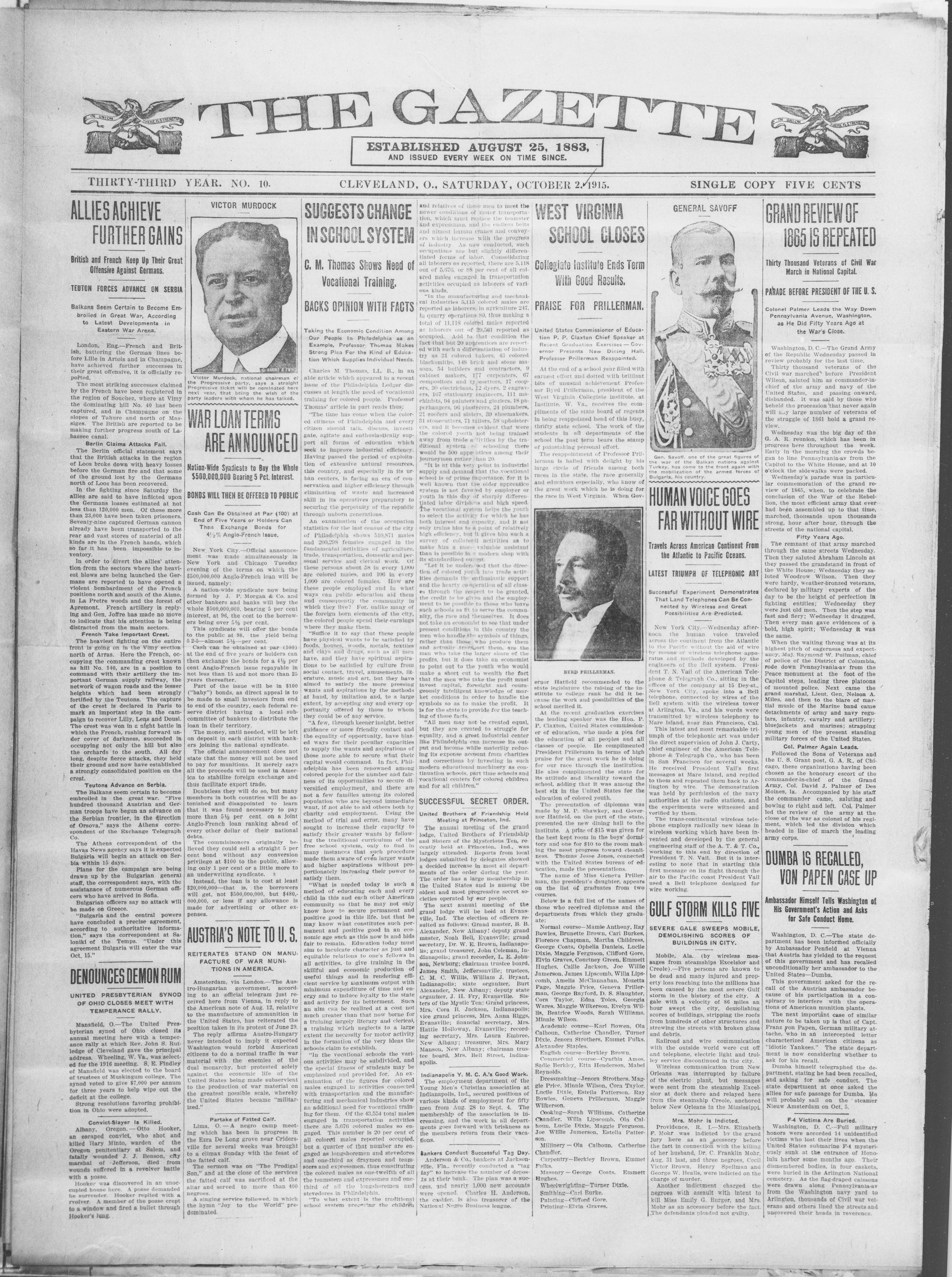
ALLIES ACHIEVE FURTHER GAINS
British and French Keep Up Their Great Offensive Against Germans.
TEUTON FORCES ADVANCE ON SERBIA
Balkans Seem Certain to Become Embroiled in Great War, According to Latest Developments in
London, Eng.—French and British, battering the German lines before Lille in Artiois and in Champagne, have achieved further successes in their great offensive, it is officially reported.
The most striking successes claimed by the French have been registered in the region of Souchez, where at Vimy the dominating hill No. 40 has been captured, and in Champagne on the slopes of Tahure and north of Massiges. The British are reported to be making further progress south of Labassee canal.
Berlin Claims Attacks Fail.
The Berlin official statement says that the British attacks in the region of Loos broke down with heavy losses before the German fire and that some of the ground lost by the Germans north of Loos has been recovered.
In the fighting since Saturday the allies are said to have inflicted upon the Germans losses estimated at not less than 120,000 men. Of these more than 23,000 have been taken prisoners. Seventy-nine captured German cannon already have been transported to the rear and vast stores of material of all kinds are in the French hands, which so far it has been impossible to inventory.
In order to divert the allies' attention from the sectors where the heaviest blows are being launched the Germans are reported to have opened a violent bombardment of the French positions north and south of the Alise, in La Pretre woods and the forest of Montmorency. French artillery is replying and Gen. Joffre has made no move to indicate that his attention is being distracted from the main sectors.
French Take Important Crest.
The heaviest fighting on the entire front is going on in the Vimy section north of Aras. Here the French, occupying the command crest known as hill No. 140, are in a position to command with their artillery the important German supply railway, the network of wagon roads and the lesser heights which had been strongly fortified by the Teutons. The capture of the crest is declared in Paris to mark an important step in the campaign to recover Lilly, Lens and Dousl. The crest was won in a night battle in which the French, rushing forward under cover of darkness, succeeded in occupying not only the hill but also the orchards to the south. All day long, despite fierce attacks, they held their ground and now have established a strongly consolidated position on the crest.
Teutons Advance on Serbia.
The Balkans seem certain to become embroiled in the great war. "Five hundred thousand Austrian and German troops have begun an advance on the Serbian frontier, in the direction of Orsova," says the Athens correspondent of the Exchange Telegraph Co.
The Athens correspondent of the Havas News agency says it is expected Bulgaria will begin an attack on Serbia within 15 days.
Plans for the campaign are being drawn up by the Bulgarian general staff, the correspondent says, with the assistance of numerous German officers who have arrived in Sofia.
Bulgarian officers say no attack will be made on Greece.
"Bulgaria and the central powers have concluded a precise agreement, according to authoritative information," says the correspondent at Saloniki of the Temps. "Under this agreement Bulgaria will enter the war Oct. 15."
UNITED PRESBYTERIAN SYNOD OF OHIO CLOSES MEET WITH TEMPERANCE RALLY.
Mansfield, O.-The United Presbyterian synod of Ohio closed its annual meeting here with a temperance rally at which Rev. John S. Rutledge of Cleveland gave the principal address. Wheeling, W. Va., was selected for the 1916 meeting. S. E. Findley of Mansfield was elected to the board of trustees of Muskingum college. The synod voted to give $7,000 per annum for three years to help wipe out the deficit at the college.
Strong resolutions favoring prohibition in Ohio were adopted.
Convict Slayer Is Killed
Albany, Oregon.—Otto Hooker, an escaped convict, who shot and killed Hary Minto, warden of the Oregon penitentiary at Salem, and fatally wounded J. J. Benson, city marshal of Jefferson, died from wounds suffered in a revolver battle with a posse.
Hooker was discovered in an unoccupied house here. A posse demanded he surrender. Hooker replied with a revolver. A member of the posse crept to a window and fired a bullet through Hooker's lung.
THE GAZETTE
VICTOR MURDOCK
Victor Murdock, national chairman of the Progressive party, says a straight Progressive ticket will be nominated here next year, that being the wish of the party leaders with whom he has talked.
WAR LOAN TERMS ARE ANNOUNCED
BONDS WILL THEN BE OFFERED TO PUBLIC
Cash Can Be Obtained at Par (100) at End of Five Years or Holders Can Then Exchange Bonds for $4½% Anglo-French Issue.
New York City.—Official announcement was made simultaneously in New York and Chicago Tuesday evening of the terms on which the $500,000,000 Anglo-French loan will be issued, namely:
A nation-wide syndicate now being formed by J. P. Morgan & Co. and other bankers and banks will buy the whole $500,000,000 bearing 5 per cent interest, at 96, the cost to the borrowers being over 5½ per cent.
This syndicate will offer the bonds to the public at 98, the yield being 5.2-5 almost 5½-per cent.
Cash can be obtained at par (100) at the end of five years or holders can then exchange the bonds for a 4½ per cent Anglo-French issue repayable in not less than 15 and not more than 25 years thereafter.
Part of the issue will be in $100 ("baby") bonds, as direct appeal is to be made to small investors from end to end of the country, each federal reserve district having a local subcommittee of bankers to distribute the loan in their territory.
The money, until needed, will be left on deposit in each district with bankers joining the national syndicate.
The official announcement does not state that the money will not be used to pay for munitions. It merely says all the proceeds will be used in America to stabilize foreign exchange and thus facilitate export trade. Doubless they will do so, but many members in both countries will be astonished and disappointed to learn that it was found necessary to pay more than $1½ per cent on a joint Anglo-French loan ranking ahead of every other dollar of their national debts. The commissioners originally believed they could sell a straight 5 per cent bond without any conversion privilege at $100 to the public, allowing only 1 per cent or a little more to an underwriting syndicate. Instead, the loan is to cost at least $20,000,000—that is, the borrowers will get, not $500,000,000, but $480,000,000, or less if any allowance is made for advertising or other expenses.
AUSTRIA'S NOTE TO U. S.
REITERATES STAND ON MANUFACTURE OF WAR MUNI-TIONS IN AMERICA.
Amsterdam, via London.—The Austro-Hungarian government, according to an official telegram just received here from Vienna, in reply to the American note of Aug. 12, relative to the manufacture of ammunition in the United States, has reiterated the position taken in its protest of June 29.
The reply affirms Austro-Hungary never intended to imply it expected Washington would forbid American citizens to do a normal traffic in war material with the enemies of the dual monarchy, but protested solely against the economic life of the United States being made subservient to the production of war material on the greatest possible scale, whereby the United States became "militarized."
Partake of Fatted Calf
Lima, O. — A negro camp meeting which has been in progress in the Ezra De Long grove near Cridersville for several weeks was brought to a climax Sunday with the feast of the fatted calf.
The sermon was on "The Prodigial Son," and at the close of the services the fatted calf was sacrificed at the altar and served to more than 400 negroes.
A singing service followed, in which the hymn "Joy to the World" predominated.
ESTABLISHED AUGUST 25, 1883 AND ISSUED EVERY WEEK ON TIME SINCE.
CLEVELAND, O., SATURDAY, OCTOBER 2, 1915.
C. M. Thomas Shows Need of Vocational Training.
BACKS OPINION WITH FACTS
Taking the Economic Condition Among Our People In Philadelphia as an Example, Professor Thomas Makes Strong Plea For the Kind of Education Which Supplies Individual Needs.
Charles M. Thomas, LL. B., in an able article which appeared in a recent issue of the Philadelphia Ledger discusses at length the need of vocational training for colored people. Professor Thomas' article in part reads thus:
"The time has come when the colored citizens of Philadelphia and every citizen should talk, discuss, investigate, agitate and enthusiastically support all forms of education which seek to improve industrial efficiency. Having passed the period of exploitation of extensive natural resources, this country, and especially in its urban centers, is facing an era of conservation and higher efficiency through elimination of waste and increased skill in its operatives preparatory to securing the perpetuity of the republic through unborn generations.
An examination of the occupation statistics for the last census of the city of Philadelphia shows 519,871 males and 200,298 females engaged in the fundamental activities of agriculture, trade, transportation, domestic and personal service and clerical work. Of these persons about 58 in every 1,000 are colored males, and 106 in every 1,000 are colored females. How are these people employed and in what ways can public education aid them and consequently the community in which they live? For, unlike many of the foreign born elements of the city, the colored people spend their earnings where they make them.
"Suffice it to say that these people have physical wants to be satisfied by foods, houses, woods, metals, textiles and clays and drugs, such as all men have, and they have spiritual aspirations to be satisfied by culture from social contact, travel, amusements, literature, music and art, but they have aimed to satisfy the more pressing wants and aspirations by the methods at hand, by imitation and, to a large extent, by accepting any and every opportunity offered by those to whom they could be of any service.
"A few, through keener insight, better guidance or more friendly contact and the equality of opportunity, have bizarred ways for their peculiar capacities to supply the wants and aspirations of those more able to secure what their capital would command. In fact, Philadelphia has been renowned among colored people for the number and fairness of its opportunities to secure diversified employment, and there are not a few families among its colored population who are beyond immediate want, if not able to aid others both by charity and employment. Using the method of trial and error, many have sought to increase their capacity to satisfy their greater wants by following the traditional curriculum of the free school system, only to find in many instances that such procedure made them aware of even larger wants and higher aspirations without proportionately increasing their power to satisfy them.
"What is needed today is such a method of educating each and every child in this and each other American community so that he may not only know how to secure permanent and positive good in this life, but that he may know what constitutes such permanent and positive good in an economic age such as this now is and bids fair to remain. Education today must aim to inculcate character as just and equitable relations to one's fellows in all activities, to give training in the skillful and economic production of useful things and in rendering efficient service by maximum output with minimum expenditure of time and energy and to induce loyalty to the state and activity for its betterment. Such an aim can be realized at a cost not much greater than that now borne for a training largely literary and clerical, a training which neglects to a large extent the necessity for motor activity in the formation of the very ideas the schools claim to establish.
"In the vocational schools the various activities may be subdivided, and the special fitness of students may be emphasized and provided for. An examination of the figures for colored males engaged in activities connected with transportation and the manufacturing and mechanical industries show an additional need for vocational training for them. Of the 43,574 total males engaged in transportation activities there are 5,676 colored males so engaged. This number is 20 per cent of all colored males reported occupied, but a quarter of that number are engaged as longshoremen and stevedores and one-third as draymen and teamsters and expressmen, thus constituting the colored males as one-twelfth of all the teamsters and expressmen and one-third of all the longshoremen and stevedores in Philadelphia.
"To what extent is the traditional school system preparing the children
and relatives of these men to meet the newer conditions of motor transportation, which must replace the teamster and expressman, and the endless belts and almost human cranes and conveyers which increase with the progress of industry. As now conducted, such occupations are but slightly differentiated forms of labor. Consolidating all laborers as reported, there are 5,118 out of 5,675, or 88 per cent of all colored males engaged in transportation activities occupied as laborers of various kinds.
"In the manufacturing and mechanical industries 5,115 colored males are reported as laborers, in agriculture 247. In quarry operations 80, thus making a total of 11,118 colored males reported as laborers out of 29,561 reported as occupied. Add to that condition the fact that but 20 apprentices are reported with such a differentiation of industry as 31 colored bakers, 43 colored blacksmiths, 148 brick and stone masons, 54 builders and contractors, 9 cabinet makers, 177 carpenters, 67 compositors and typesetters, 17 cooperers, 30 electricians, 12 dyers, 2 engravers, 167 stationary engineers, 111 machinists, 94 painters and glazers, 18 paperhangers, 96 plasterers, 24 plumbers, 27 roofers and slaters, 39 shoemakers, 31 stonecutters, 71 tailors, 58 upholsters, and it becomes evident that were the colored youth not being trained away from trade activities by the traditional system of schooling there would be 500 apprentices among their journeymen rather than 20.
"It is at this very point in industrial supply and demand that the vocational school is of prime importance, for it is well known that the older apprentice system is not favored by employer or youth in this day of sharply differentiated labor divisions and high speed. The vocational system helps the youth to select the activity for which he has both interest and capacity, and it not only trains him to a point of relatively high efficiency, but it gives him such a survey of collateral activities as to make him a more valuable assistant than is possible in a modern shop with its standardized output.
"Let it be understood that the direction of colored youth into trade activities demands the enthusiastic support and the hearty co-operation of all classes through the respect to be granted, the credit to be given and the employment to be possible to those who leave such schools as fit to serve the community, the race and themselves. It does not take an economist to see that under present conditions in this country the men who handle the symbols of things, rather than those who produce them and actually transport them, are the most profitable, but it does take an economist to point out to the youth who would make a short cut to wealth the fact that the men who take the profit must invest capital, foresight and courageously intelligent knowledge of market conditions in order to handle the profits so as to make the profit. It is for the state to provide for the teaching of those facts.
"All men may not be created equal, but they are created to struggle for equality, and a great industrial center like Philadelphia can increase its output and income while materially reducing its expense account from charities and corrections by investing in such modern educational institutions as condition schools, art museums, schools and vocational centers for colored children and for all children."
SUCCESSFUL SECRET ORDER.
United Brothers of Friendship Hold Meeting at Princeton, Ind.
The annual meeting of the grand lodge, United Brothers of Friendship and Sisters of the Mysterious Ten, recently held at Princeton, Ind., was largely attended. Reports from local lodges submitted by delegates showed a decided increase in most all departments of the order during the year. The order has a large membership in the United States and is among the oldest and most progressive secret societies operated by our people.
The next annual meeting of the grand lodge will be held at Evansville, Ind. The election of officers resulted as follows: Grand master, B. B. Alexander, New Albany! deputy grand master, Noah Bell, Evansville! grand secretary, Dr. W. E. Brown, Indianapolis! grand treasurer, John Coleman, Indianapolis! grand recorder, L. E. Johnson, Newburg; chairman trustee board, James Smith, Jeffersonville; trustees, C. M. C. Willis, William J. Bryant, Indianapolis! state organizer, Burt Alexander, New Albany; deputy state organizer, J. H. Fry, Evansville. Sisters of the Mysterite Ten: Grand princess, Mrs. Cora B. Jackson, Indianapolis! vice grand princess, Mrs. Anna Riggs, Evansville! financial secretary, Mrs. Hattie Holloway, Evansville! recording secretary, Mrs. Laura Embrey, New Albany! treasurer, Mrs. Mary Manson, New Albany! chairman trustee board, Mrs. Bell Street, Indianapolis.
Indianapolis Y. M. C. A's Good Work.
The employment department of the Young Men's Christian association at Indianapolis, Ind., secured positions of various kinds of employment for fifty men from Aug. 28 to Sept. 4. The membership of the association is increasing, and the work in all departments goes forward with briskness as the members return from their vacations.
Bankers Conduct Successful Tag Day.
Anderson & Co. bankers at Jacksonville, Fla., recently conducted a "tag day" to increase the number of deposits at their bank. The plan was a success, and nearly 1,000 new accounts were opened. Charles H. Anderson, the cashier, is also treasurer of the National Negro Business league.
WEST VIRGINIA SCHOOL CLOSES
PRAISE FOR PRILLERMAN.
United States Commissioner of Education P. P. Claxton Chief Speaker at Recent Graduation Exercises — Governor Presents New Dining Hall. Professor Prillerman Reappointed.
At the end of a school year filled with earnest effort and dotted with brilliant bits of unusual achievement Professor Byrd Prillerman, president of the West Virginia Collegiate institute, at Institute, W. Va., receives the compliments of the state board of regents in being reappointed head of this busy, thrifty state school. The work of the students in all departments of the school the past term bears the stamp of painstaking personal effort.
The reappointment of Professor Prillerman is halted with delight by his large circle of friends among both races in the state, the race generally and educators especially, who know of the great work which he is doing for the race in West Virginia. When Gov-
BYRD PRILLERMAN.
ernor Hatfield recommended to the state legislature the raising of the institute to college rank he did it because the work and possibilities of the school merited it.
At the recent graduation exercises the leading speaker was the Hon. P. P. Claxton, United States commissioner of education, who made a plea for the education of all peoples and all classes of people. He complimented President Prillerman in terms of high praise for the great work he is doing for the race through the institution. He also complimented the state for its attitude and liberality toward the school, adding that it was among the best six in the United States for the education of colored youth.
The presentation of diplomas was made by M. P. Shawkey, and Governor Hatfield, on the part of the state, presented the new dining hall to the institute. A prize of $15 was given for the best kept room in the boys' dormitory and one for $10 to the room making the most progress toward cleanliness. Thomas Jesse Jones, connected with the United States bureau of education, made the presentations.
The name of Miss Geneva Prillerman, the president's daughter, appears on the list of graduates from two courses.
Below is a full list of the names of those who received diplomas and the departments from which they graduate:
Normal course—Mamie Anthony, Ray Bowles, Brunette Brown, Carl Burkes, Florence Chapman, Martha Childress, George Coats, Ophelia Daniels, Lucie Dixie, Maggie Ferguson, Clifford Gore, Elvin Graves, Courtney Green, Emmett Hughes, Calle Jackson, Joe Wille Jamerson, James Lipscomb, Willa Lipscomb, Amelia McClannahan, Mozetta Page, Maggie Price, Geneva Prillerman, George Rayford, D. S. Slaughter, Cora Taylor, Edna Toles, Evelyn Wills, Beatrice Woods, Sarah Williams, Minnie Wilson.
Academic course—Karl Bowen, Ola Calhoun, Catherine Chandler, Turner Dixie, Jenora Strothers, Emmet Fulks, Alexander Staples.
English course—Berkley Brown.
Commercial course—Cynthia Amos, Sadie Berkley, Etta Henderson, Mabel Reynolds.
Dressmaking—Jenora Strothers, Maggie Price, Mimnie Wilson, Cora Taylor, Lucie Dixie, Estella Patterson, Ray Bowles, Geneva Prillerman, Maggie Wilkerson.
Cooking—Sarah Williams, Catherine Chandler, Willa Lipscomb, Ola Calhoun, Lucie Dixie, Maggie Ferguson, Joe Wille Jamerson, Estella Patterson.
Millinery—Ola Calhoun, Catherine Chandler.
Carpentry—Berkley Brown, Emmet Fulks.
Masonry—George Coats, Emmett Hughes.
Wheelwrighting--Turner Dixie.
Smithing--Carl Burke.
Painting--Clifford Gore.
Printing--Elvin Graves.
SINGLE COPY FIVE CENTS
GENERAL SAVOFF GRAND DEVIEW OE
Gen. Savoff, one of the great figures of the war of the Balkan nations against Turkey, has come to the front again with the mobilization of the armed forces of Bulgaria, his country.
HUMAN VOICE GOES FAR WITHOUT WIRE
LATEST TRIUMPH OF TELEPHONIC ART
Successful Experiment Demonstrates That Land Telephones Can Be Connected by Wireless and Great Possibilities Are Predicted.
New York City.—Wednesday afternoon the human voice traveled across the continent from the Atlantic to the Pacific without the aid of wire by means of wireless telephone apparatus and methods developed by the engineers of the Bell system. President T. N. Vail of the American Telephone & Telegraph Co., sitting in the offices of the company at 15 Dey-st., New York City, spoke into a bell telephone, connected by wires of the Bell system with the wireless tower at Arlington, Va., and his words were transmitted by wireless telephony to Mare Island, near San Francisco, Cal. This latest and most remarkable triumph of the telephonic art was under the direct supervision of John J. Carty, chief engineer of the American Telephone & Telegraph Co., who has been in San Francisco since he received President Vail's first messages at Mare Island, and repiled to them and repeated them back to Arlington by wire. The demonstration was held by permission of the navy authorities at the radio stations, and the experiments were witnessed and verified by them.
The trans-continental wireless telephone employs radically new ideas in wireless working which have been invented and developed by the general engineering staff of the A. T. & T. Co., working to this end by direction of President T. N. Vail. But it is interesting to note that in starting this first message on its flight through the air to the Pacific coast President Vail used a Bell telephone designed for wire working.
GULF STORM KILLS FIVE
GULF STORM KILLS FIVE
SEVERE GALE SWEEPS MOBILE, DEMOLISHING SCORES OF BUILDINGS IN CITY.
Mobile, Ala. (by wireless messages from steamships Excelior and Creole).—Five persons are known to be dead and many injured and property loss reaching into the millions has been caused by the most severe Gulf storm in the history of the city. A gale with a velocity of 86 miles an hour swept the city, demolishing scores of buildings, stripping the roofs from hundreds of other structures and strewing the streets with broken glass and debris.
Railroad and wire communication with the outside world were cut off and telephone, electric light and trolley service discontinued in the city.
Wireless communication from New Orleans was interrupted by failure of the electric plant, but messages were sent from the steamship Excelior at dock there and relayed here from the steamship Creole, anchored below New Orleans in the Mississippi.
Mrs. Mohr Is Indicted
Providence, R. I—Mrs. Elizabeth F. Mohr was indicted by the grand jury here as an accessory before the fact in connection with the killing of her husband, Dr. C. Franklin Mohr, Aug. 31, last three and no needles, Cecil Victor Brown, Henry Spellman and George W. Heals, were indicted on the charge of murder.
Another indictment charged the negroes with assault with intent to kill Miss Emily G. Burger, and Mrs Mohr as an accessory before the fact the defendants pleaded not guilty.
IN ONION
DIESEST HERDEN
GRAND REVIEW OF 1865 IS REPEATED
Thirty Thousand Veterans of Civil War March in National Capital.
PARADE BEFORE PRESIDENT OF THE U. S.
Colonel Palmer Leads the Way Down Pennsylvania Avenue, Washington, as He Did Fifty Years Ago at
Washington, D. C.—The Grand Army of the Republic Wednesday passed in review probably for the last time. Thirty thousand veterans of the Civil war marched before President Wilson, saluted him as commander-in-chief of the army and navy of the United States, and passing onward, disbanded. It was said by those who beheld the procession that never again will any large number of veterans of the struggle of 1861 hold a grand review.
Wednesday was the big day of the G. A. R. reunion, which has been in progress here throughout the week. Early in the morning the crowds began to line Pennsylvania-av from the Capitol to the White House, and at 10 o'clock the sidewalks were packed.
Wednesday's parade was in particular commemoration of the grand review of 1865, when, to celebrate the conclusion of the War of the Rebellion, the most efficient army that ever had been assembled up to that time, marched, thousands upon thousands strong, hour after hour, through the streets of the national capital.
Fifty Years Ago.
The remnant of that army marched through the same streets Wednesday. Then they saluted Abraham Lincoln as they passed the grandstand in front of the White House; Wednesday they saluted Woodrow Wilson. Then they were hardy, weather-bronzed veterans, declared by military experts of the day to be the height of perfection in fighting entities; Wednesday they were just old men. Then the step was fast and fiery; Wednesday it dragged. Then every man gave evidences of a bold, high spirit; Wednesday it was the same.
When the waiting throng was at its highest pitch of eagerness and expectancy, Maj. Raymond W. Pullman, chief of police of the District of Columbia, rode down Pennsylvania-av from the Peace monument at the foot of the Capitol steps, leading three platoons of mounted police. Next came the grand marshal, Lieut. Gen. Nelson A. Miles, and then to the blare of martial music of the Marine band came detachments of army and navy regulars, infantry, cavalry and artillery; bluejackets and marines; strapping young men of the present standing military forces of the United States.
Col. Palmer Again Leads.
Followed the Sons of Veterans and the U. S. Grant post, G. A. R. of Chicago, these organizations having been chosen as the honorary escort of the commander-in-chief of the Grand Army, Col. David J. Palmer of Des Moines, la. Accompanied by his staff the commander came, saluting and bowing to right and left. Col. Palmer led the review of the army at the close of the war as colonel of his regiment, which led the division which headed in line of march the leading army corps.
DUMBA IS RECALLED,
VON PAPEN CASE UP
Washington, D. C. The state department has been informed officially by Ambassador Penfield at Vienna that Austria has yielded to the request of this government and has recalled unconditionally her ambassador to the United States—Dumba.
This government asked for the recall of the Austrian ambassador because of his participation in a conspiracy to interfere with the operations of American munition plants.
The next important case of similar nature to be taken up is that of Capt. Franz von Papen, German military attache, who in an intercepted letter characterized American citizens as "idiotic Yankees." The state department is now considering whether to ask for his recall.
Dumba himself telegraphed the department, stating he had been recalled, and asking for safe conduct. The state department at once asked the allies for safe passage for Dumba. He will probably sail on the steamer Nieuw Amsterdam on Oct. 5.
E-4 Victims Are Buried
Washington, D. C.--Full military honors were accorded 14 unidentified victims who lost their lives when the United States submarine F-4 mysteriously sunk at the entrance of Honolulu harbor some months ago. Their dismembered bodies, in four caskets, were buried in the Arlington National cemetery. As the flag-draped caissons were drawn along Pennsylvania-av from the Washington navy yard to Arlington, thousands of Civil war veterans and others lined the streets and uncovered their heads in reverence.
PUBLISHED EVERY SATURDAY
SUBSCRIPTION RATES
(In Advance)
DMEVONE kore vicki voss sc BIRO.%
Bix Months.........s0000004 100
Three Months..........2000. 60
Subscribers are requested to re-
mit by postoffice money or
der or registered letter
Entered at the postoffice In Cleveland,
= Ohio, as second-class matter,
Address all communications to
HARRY C. SMITH
© Editor and proprietor,
THE GAZETTE,
Blackstone Building, Cleveland, 0.
Member Ohio Legislature: 1894
‘to 1896; 1896 to 1898; 1900 to 1902
THE GAZETTE Is the oldest, and
has the largest bona fide circulation,
double that of any newspaper In the
Interest of Afro-Americans, published
In the state of Ohio, and comparison
with any. will immediately establish
Ite rank 28 one of the NEWSIEST
AND BEST in the country.
10,000,000 Afro-Americans.
40008 in One
20,000 In Cleveland.
SATURDAY, OCTOBER 2, 1915
DARE TO DO YOUR DUTY.
“Let us have faith that right
makes might, and in that faith
let us to the end dare to do our
duty as we understand it”"—
Abraham Lincoln.
ANOTHER GREAT VICTORY.
Notwithstanding the fact that Gov.
Willis assured the editor of The Ga-
zette, many months ago, when we
went to him with our plea against
that miserable photoplay, “The Nig-
ger,” the opening wedge for “The
Birth (Filth) of a Nation,” that “no
films which reflect upon any class of
our citizens will be exhibited in this
state,” we had our fears. With the
assistance of the loyal and active
members/ of the race throughout the
state, The Gazette was able to lead a
suecesstul fight against the first-
named photoplay and have revoked
the permit that had been given it to
exhibit, Then came the repeated an-
nouncements, of “movie” theater man-
agers throughout the state, to the ef-
fect that “The Birth of a Nation” was
soon to be exhibited. Our people,
headed by The Gazette, kept up the
fight. Last week, the promoters. of
the maliciously harmful photoplay_ap-
plied to the State Board of Film Cen-
sors, at Columbus, for a permit to
show it in Ohio. The Columbus branch
of the N. A. A.C. P., Mayor Geo. J.
Karb of that city, Dr. Washington
Gladden, Ex-Secretary of State Daniel
J. Ryan, Rabbi Kornfield, Editor James
Carroll of The Catholic Columbian and
many others of both races in that
city signed a strong protest against
the miserable photoplay, that was im-
mediately filed with the State Board
of Film Censors, which has been re-
ceiving similar protests for many
months from Cleveland and other
parts of the state. The promoters of
‘Tom Dixon's infamous play, “The
‘Clansman,” from which “The Birth of
a Nation” was made, evidently waited
until Gov. Willis was out of the state
to apply for a permit, He is in the
west en route to the Panama-Pacific
exposition and is to be gone a month
from the first of last week—two weeks
more. ‘The following letter, written
several weeks ago, gave us confidence.
however, last and this week:
State of Ohio
Executive Department
* Columbus
‘Aug. 31, 1915.
Hon. Harry C. Smith,
Editor, The Gazette,
Cleveland, Ohio.
Dear Mr, Smith:—I am in receipt
of marked copies of newspaper call-
ing attention to the objectionable
film (“The Birth of a Nation”) re-
faring which wo have had consider
‘able correspondence. 1 shall place
this communication before the State
Board of Film Censors, The law
‘must be enforced and so far as I have
power to prevent it no films which
reflect upon apy class of our citizens
will be exhibited in this state.
Very truly yours,
“Frank B. Willis.
On Tuesday came the welcome news
that the State Board of Film Censors
had denied the request of the promot-
ers of the miserable play, and on
Wednesday morning came the splen-
did communication from the chairman
‘of the board to be found elsewhere in
this paper, It is an exceptional and
unanswerable reply to the promoters’
request for approval of “The Birth
(Filth) of a Nation” and we congratu-
late Chairman Williams and the rest
ot the members of the board on the
ame. The position they take is a
credit alike to the great state of Ohio,
Gov, Willis and the board itself. That
our people of the state fully appreci-
ate it there can be no doubt. We
have escaped the riots and other dis-
graceful results the miserable photo-
play bas “thrust upon Philadelphia.
Boston, New York, Chicago and other
cities in those states. THANK THE
LORD! Meantime, do not forget HIS
instruments—our friends—Gov, Frank
B. Willis, the State Board of Film
Censors and “the old reliable” Gazette,
whieh is always “on the firing, line”
when the race's rights, privileges and
interests are being assailed or are in
danger, and which ACCOMPLISHES
RESULTS, with the help of the loyal
and active of the race. Additional
satisfaction can be gained from the
knowledge that the Btate ee)
Board, which bas jurisdiction over the
State Board of Film Censors, bas al-
resdy refused to rescind bans placed
on films by the State Censors,
WHO IS A REPUBLICAN?
Former President Taft is quoted as
saying that the Progressives of 1912
may come back into the Republican
party in 1916, but that they cannot
bring their principles along with them.
Mr. Taft's admirable personal quali-
ties have served to give him an effec:
tionate place in the minds of many of
his fellow-citizens, but we are not
aware that these qualities or the fact
that he was orice our President permit
Mr. Taft to pose as the sole judge of
individual qualification for classifica-
tion as a Republican. Further, we do
not believe that any body of men now
possess such power. The Republican
party is not a social club. It has
no committee on membership to whom
intending Republicans must submit
themselves. There are no black-balls
in our party paraphernalia, Men join
the Republican party, or act with it
‘from time to time, from conviction; be-
‘cause Republican doctrine as con
tained in the Republican platform ap-
peals to their reason; or because of
‘qualifications or the attractive per-
sonality of Republican candidates
These are the only limitations upon
membership in the Republican party—
and they permit the widest latitude
for individual opinion because there
are many matters which may be of
commanding importance to a State or
to a group of States and which never
find expression in a national platform.
Moreover, platforms change with the
‘times, ‘There are certain cardinal
Republican doctrines which are un-
alterable—such as a Government by
law rather than by men, a tariff for
protection, a vigorous foreign policy,
fan efficient currency. But a party of
growth and of advance Mke ours
adapts itself to the needs of the occa-
sion. For example, the plank in the
platform of 1908 relating to labor and
injunctions—a plank, by the way, for
which Mr, Taft contended earnestly
—could have found no place in the
Platform of 1860 because no occasion
existed for it at the earlier date.
‘Therefore, who can tell what will be
in the platform of 1916? A Govern.
ment by law rather than by men?
Most assuredly. A protective tariff?
Yes. Efficient currency law? Cer-
tainly. A sterling expression on for-
eign relations? Without doubt. A
just indictment of the present admin.
‘istration? Emphatically, yes. These
‘will form the bases of Republican doc-
trine. Whoever subscribes to them
will be @ Republican. He may hold
whatever other views he may choose.
He may try to write these views into
the platform. If they are sound views,
he will succeed. But if he fails and
if he still acts with the Republican
party, he may hold to whatever opin-
fons he pleases as to social justice,
the initiative, the referendum, the re:
call, or any other fundamentals of
local government. So long as he votes
the Republican ticket he will be a good
enough Republican for us—and it will
not le with Mr. Taft, or with any
other ex-President, or with any individ-
ual anywhere to say differently. ‘The
Republican party is the party of liber-
ty—and that is why Mr. Taft can say
what he pleases and why any other
Republican may say what he pleases
so long as he acts in harmony with the
major doctrines of the Republican
Soe
“THE BIRTH OF
A NATION”
Decision of Mr. Chas. G. Will-
iams, Chairman of the
Ohio Board of
Censors
It devolves upon meas a member
of the Ohio Board of Censors’ to Ten:
der my individual decision as to
whether or not the film, “The Birth
of a Nation,” should be approved or
rejected.
Many protests have been brought to
our attention from sources that indi.
cate that the entire Colored race and
those especially interested in. thelr
advancment seriously object to said
film. Governor Frank B, Willis ‘has
Tepentedly called the attention of the
Board to the fact that many protests
against this film haye been entered
in his department. He has also re-
peatedly requested that this Board
zive said film very careful attention,
and if it should be found to be of
such a character as to reflect pon the
Gaiored eace and tend to arouse racial
: we oe |
hatred and prejudice, as claimed, he
has urgently recommended that we re-
ject the same.
‘On the other hand, the owners of
said film have filed quite a number of
recommendations praising this. photo:
play. It is claimed by many reputa-
ble individuals citizens that said film
ought to be exhibited because of its
dramatic and hisigrical value. It is
urged that it is the most gigantic pro-
duction from the standpoint of cast
and spectacular achievement the film
industry has yet produced.
After having very carefully consid-
ered the arguments pro and con, and
having closely inspected said film as
well as discussed the merits of the
same with the other members of this
Board (who have equally considered
all matters pertaining to the same),
now render my decision. looking to
the things portrayed in the film itself.
THE GAZETTE, CLEVELAND, 0. SATURDAY, OCTOBER 2, 1915.
it will not be disputed but that it
has a great dramatic value and is stu-
pendous from the standpoint of cam-
era achievements, On the other hand,
by no stretch of the imagination can
we get away from the fact that it re-
fleots unfavorably upon the Colored
race, The entire latter half of sald
film is devoted to scenes and sub-
titles portraying Colored men en-
gaged in all sorts of vicious conduct
towards the whites of the South dur
ing the Civil War and the Reconstrue
tion Period following. There are
many mob scenes where Negroes are
in the most repelling way attacking
white citizens, and scenes where Ne-
gro men are forcing thelr attentions
upon white women and are engaged in
all sorts of ridiculous and knavish
conduct, not_only as individuals, but
as a race, True, they were in many
instances led by what the film terms
“eealawag carpet baggers”; but. this
only further reflects upon the govern-
ment of that period. While the ple-
ture is based upon some historical
facts, many phases are exaggerated
im such a way that the child unfamiliar
with the real facts of history, would
upon viewing the film immediately
conclude that the result of the Civil
War was the greatest crime in the an-
nals of history, rather than the pre-
vention of human beings being driven
by the lash and sold upon the auction
block. The entire film would seem to
proclaim the very doctrine which it
cost half a million lives and billions
of dollars to eradicate.
It is claimed that the film should
not be objectionable because of the
time that has elapsed since the period
when these episodes were supposed to
have taken plave. With this I cannot
agree. Many soldiers of the Civil
War are still living, both in the North
‘and in the South, This film cannot
‘but open the wound of illfeeling be-
tween them and their offspring. Not
only does it rekindle. the. feeling of
‘Sectional hatred, but it strongly tends
to arouse hatred and prejudice among
‘the coming generation against a race
‘that is ving in our midst, 160,000 of
whom are in the State of Ohio. Too,
there are eight millions of this race
in the United States; and since the
‘constitution of the United States guar-
‘anteed them equal rights, and having
taken an oath to support this consti-
tution, T consider it wholly unwise,
unjust, dangerous and harmful to off
‘ally approve a film that reflects upon
them and incites hatred toward them,
retarding them in their progress, as
this film does.
‘The play also represents the Ku
‘kiux Klan In such a manner that their
‘conduct would be applauded. I tends
to justify that organization in cap-
‘turing the Negroes and, as masked vis-
ilance committees, trying them at
‘night, convicting ‘them of supposed
outraxes, executing them and placing
their bodies at the doors of state off
clais who sympathized with their
eanse. Without discussing the justifi
cation of their methods of that day,
the same spirit that urged their ac:
tivities at that time is the same that
prompts such appalling conduct in re-
cent times as" to cause Negroes
to be lynched, making the Iynching-
day a day of celebration, “The same
spirit prompted masked men to take
‘Leo M. Frank from the custody of
the law and execute him. Films which
present scenes of this character in a
Tanner whieh to the on-looker seems
to be justified cannot fail to be harm-
ful.
Tt is also true that there are a few
seenes on the end of the last reel of
Said film that show the Colored race
in a favorable light. But to my mind,
after considering all that has gone
before, it is similar to forcing a very
nauseating concoction down the throat
of a man and then giving him a grain
of sugar to take the taste out of his
mouth.
‘Again, the objectionable features
above described, including the plot,
scenes and sub-titles, are so inter-
woven throughout the entire film that
I consider it impossible to eliminate
said objectionable matter,
My individual decision, therefore,
fs that said film should be rejected in
its entirety.
DOINGS OF THE RACE.
Rey. W. H. Credit, for many years
pastor of Cherry St! Baptist church,
Philadelphia, has resigned.
Sergeant Clayton L. Brown of the
‘Tenth U. S. Cavalry, stationed at Na-
co, Arizona, has passed an examina-
tion as ordnance sergeant, making an
average of 96.08 per cent, standing
sixth in a class of thirty-six. He is
‘the only Afro-American who passed
the severe tert.
Only 45 years of age, William A.
‘Vroonian, regimental "quartermaster
‘sergenat of the 9th cavalry, retifed on
Sept. 12, after thirty years continuous
service, with pay amounting to $67.50
per month. His entire” service was
with the Ninth.
‘There is a tendency on the part of
some Colored people to gush over
whatever the white papers say of a
complimentary nature editorially, at
the same time disregarding the awful
foul stories in the news columns
which do. untold harm.—Loufsville
(Ky.) News.
‘That the intermarriage of white and
Negroes would not violate biological
laws and that the offspring of such
unions would be admirable stock, is
the opinion of T. ‘T. Waterman, pro-
fessor of anthropology at the Univers-
ity of California,
‘One of the greatest evils, sapping
the very life-blood of our race and im-
peding its speedier progress, is the in-
Gifference or scant attention that is
paid to matters which should greatly
concern us.—Newark (N. J.) Informer.
Roy Morse of the Salem-Cresent
club, N. Y. City, has equalled the rec-
ord for 235 yards (at Toronto, Can-
ada, recently) and bids fair to suc-
ceed Howard P. Drew us our, world’s
champion runner.
Maurice Menos, son of Solon Menos,
the Haitien minister to the U.S. was
married in Baltimore to Miss Lillian
Burgess, (white), of Culpepper, Va.,
but recently attending @ business col-
lege in Washington, D. C., where she
met young Menos, who Is 36 years old,
and secretary of the Haitien legation,
going to Washington a year ago from
Paris, where he held a minor post.
The marriage was performed Sept. 17,
by Rev. I. M. Wallace, pastor of Ais
quith St, Presbyterian church, an in-
fluential white minister. Mrs.’ Apted,
an aunt, and Mrs, Joseph Janis, a sis-
ter, accompanied Miss Burgess from
Washington to Baltimore and wit-
nessed the ceremony. Luncheon was
had at the Belvedere, the leading ho-
tel in the exclusive residential district
after which young Menos and his
bride left for New York. His father
did not hear of the marriage until it
was over. Some more southern “so:
ial equality.”
WRITTEN BY “THE OLD RELIA.
BLE” GAZETTE’S CORRE.
SPONDENTS
What Our Peopre mre Doing Each
Week—Church, Personal, Social,
Lodge, Literary and Mu-
sical — Marriages,
Deaths, Etc.
SANDUSKY.—Rev. Chas. Carter,
who is visiting Rey. G. D. Smith, an
acquaintance of 30. years, preached,
Thursday evening, at the Second Bap-
list chureh—Rey. L. H. Dodd, evan-
gelist, returned, Friday.—Miss ‘Corde-
lia Solee_and ‘Mr. Moses. Thompson
are fll, She was unable to sing her
solo al the B. Y. P. U. Miss Maudia
Alexander, pres., returned from De-
troit and presided, Sunday. Mr. Chas.
Alexander returned from Chicago,
‘Thursday—The entertainment at the
Second Baptist chureh, Friday even
ing, was unique and fine—Get. your
money ready for The Gazette; it is
now pay-day for the local agent.
SMITHFIELD.—The Misses L. B,
Hargrave, Mattie West and Mamie
Smith left, Monday week, for Wilber-
force University.—Mrs. Rhoda Veney
Was in Steubenville, recently—The
Jefferson Co. fair, Sept. 22-24, was
largely attended.—The Silver’ Leaf
club was entertained by Miss Eva
Smith, Tuesday week—Miss Minnie
Beall returned, recently, from Minne-
apolis, visited her parents a few days,
and left for Bryn Mawr, Pa., to spend
the winter—Revs. R. B. Lowe and
Chas. Greene attended conference in
Cleveland. The former's farewell ser-
mon, Sunday week, was preached to
a large audience—Mrs. E. H. Harris
fell down stairs but was not seriously
injured.—Mrs. H. Harris entertained
Miss G. Redmon of Cadiz, fair week.
CORRESPONDENTS must mail all
letters for publication at their main
Postoffice sufficiently early on Monday
(or Sunday) of each week to have
them reach The Gazette office on
‘Tuesday morning, and always write
also, their names and that of their
city or town on the outside of the
wrapper about returned copies. Un-
less this latter is done, proper credit
cannot be given you. Lists of names,
wedding presents, ete, obituary no-
tices, speeches, resolutions, poetry, in-
quiries for relatives and advertise-
ments 6f all kinds, including . items
announcing entertainments to be held
in the near future, must be paid for
in advance at the rate of ten cents a
line, six words to a line. Our rates
for display advertisements will be
sent on application. Send postal note
‘and not stamps during warm weather.
YOUNGSTOWN.—Mrs. Wm, Saun-
ders and niece, Sadie Boggess, re-
turned, Saturday, from a two weeks’
visit ‘in Bellevue.—Mrs. Amanda
‘Thomas spent Sunday in Columbus
and left, Thursday, to visit in Pitts-
burg—Mirs, Will “Thomas spent a
week in Wheeling—Mr. Stephen
Clark, a well known citizen, died sud-
denly, Saturday. Funeral, Wednes:
day, from the Third Baptist church;
Logan lodge in charge—Frank Leece,
who sustained a stroke, is better.—
‘Mrs. Mary Castle of Toledo, is. visit-
ing her sister, Mrs. Hattie Harper.—
‘Mrs. B. Cameron and Chas. A. Jack-
gon spent Sunday in Cleveland— Mrs.
‘A. H. Berry of Leetonia, was here,
‘last week.
| AKRON—The Daughters of Jeru-
‘salem’s annual session, at the Second
‘Baptist church, was a success. Mrs.
Elizabeth Moore of Springfield, has
been grand royal princess for 45 years.
Mrs. Janie Pickett of this city, is
also one of the founders of the order.
Other officers at the session were:
Grand deputy R. P., Emma Jackson,
Dayton; first vice-pres., Mrs. M. Boone,
Dayton; second, Mrs. M. Blackburn,
Springfield; first steward, Mrs, W.
Wheeler, Dayton; second, Mrs. M.
Scott, Toledo; third, Mrs. M. Pickett,
Akron; G.P., Mrs. W. Sherman, Chi-
cage: G. M,, Mrs. N. F. Archer, Ak-
‘ron; 0. S., Mrs. M. Johnson, ‘Day-
ton: G.'S,, Mrs. C. Henderson, Spring.
field, Next meeting in Springfield
where they own an old woman’s home.
‘They wish to thank the friends of Ak-
ron for 80 royally entertaining them.
‘The reception all enjoyed.—Mrs. Jacob
Haines is home from People’s hospital
and convalescing. ‘Typhoid fever.—
Mrs. M. Dodson is also improving.
ZANESVILLE.—Do you know that
if 100 additional Negroes would pat-
ronize any one of our Negro enter-
prises, and spend only 25 cents apiece
a week with him, in a year he would
make $1,200? Suppose 500 Negroes
would patronize him, in a short time
his or her business would increase
so rapidly that they would have to
take on more help. Maybe then your
son or daughter might be taken out of
the field or kitchen to fill the posi-
tion.—Patterson-Greenfield is the
name of the new automobile made by
the famous race firm of buggy makers,
. R, Patterson & Sons, of Greenfield,
this state. The car is said to embody
many distinctive features and to in
every way measure up to the Patter-
son standard of excellence —This is-
sue of The Gazette illustrates nicely
the absolute necessity of reading it if
you want the Ohio news of'our people.
See the report of the conferences and
the Ohio Board of Film Censors chair-
man’s report on that vicious and in-
famous photo-play, “The Birth of a
Nation”, and then give the local agent
your order for a copy of The Gazette
‘avery week.
ALLIANCE.—Sunday services were
well attended. The S. 5. at 9 a. m.
and morning church service were very
interesting. In the evening, Mr. Ran-
dall of Nazarine church, "preached.
One responded to the’ altar call.
Messrs. Randall and Patric sang a
duett. Mr. Frank Smith and Chas,
Swaney of Salem, were here, Satur-
day, ‘The latter’ and Chas, Garner
went to Columbus, Sunday —Mrs. Sa-
rah Cisco attended conference in
Cleveland, last week—The W. W. so-
ciety was entertained by Miss Rosa
Hargrave. Tuesday eyening, at Mr.
and Mrs, W. H. Palmer's, The follow-
ing program was rendered: Read:
ings, Mrs. Cisco, Mr. Dunwood and
Mrs. Harrell; solo, Miss J. Stokes:
instrumental solos, Miss N. Oliver and
Mrs. Palmer. Refreshments. In two
weeks, Mr. and Mrs, EL Harrell will
entertain—Mr. Dewey Young visited
his parents in Ravenna, Sunday.—
The I. C. A. society will meet, Tues-
day evening, and the sewing circle,
Wednesday afternoon, at Mr. and Mrs.
H. L. Moore’s—The Chrysanthemum
is visiting relatives in Fernwood.—
Miss Lillian Royston of Sebring, vis-
ited Mrs. J. C. Turner, Sunday.
STEUBENVILLE—The services at
Simpson M. E. chureh, Sunday, were
well attended. The S. 8. is growing,
The pastor, Rey. G. W. ‘Tindull,
preached a strong sermon in the even-
ing and held a pledge meeting, having
ail the members promise to seek a
deeper spiritual growth—Mr. James
Faris of Knoxville, Tenn., is here vis-
iting his brother, Thomas, whom he
has not seen for 82 years, ' The latter
‘is a leading contractor.—Mr. and Mrs.
Edwin Coffman of Wheeling, have
been the guests of Mr. and Mrs. I. N.
McCullough, the past week.—The Four
Leat Clover club, 15 young married
ladies and husbands’ outing the 13th,
‘at Stanton Park.—The Gazette's locai
‘correspondent was sick with tofsilitis
anid failed to send the news last week.
“Phe old reliable” Gazette will be at
your doors every Friday. It is one
of the best race journals published.—
Mrs. Henry Davis was taken to the
City hospital, Monday, for an opera.
tion, for appendicitis. Mrs. Frank
Clark visited her daughter in Cleve:
land, last week, and attended the con-
{erence—Do you want the Ohio news?
If so, take The Gazette.—H. C. Davis
‘has been elected assistant janitor of
Washington school—Mr. and Mrs,
Harry Carter visited in Columbus,
last Saturday, Mr. Carter is custo
Gian of the county court house—Mr.
and Mrs. Edwin Coffman returned
‘home last Tuesday, for the emancipa-
‘tion. Mrs. Charles Hanna, Mrs. 1. N
McCullough and Miss Eva Mercer also
‘attended the emancipation celebra
tion.—Be prepared to pay for your
‘sure to notice The Gazette's great vic-
‘tory after many months’ fighting “The
Birth of a Nation”. Sec articles else
where in this paper. “The old rell
“able” leads!—Rev, E. Grandison of the
Second Baptist church, preached two
‘able sermons, Sunday.—We are glad
‘to note the return of Rev. J. T. Farley
for another year. He is one of the
progressive men of the conference.—
Simpson M. E. ehureh is contemplat
ing repairs in the near future. The
‘pastor is pushing things, and was at
‘his best at both services, Sunday.
HILLSBORO.—Miss Ruth Smothers
has returned to Dayton. She visited
her aunt, Mrs, Aline Burton.—Mrs.
Lang Young is visiting her sister, Mrs.
Carlisle, in Zanesville—Mr. ' Wm.
Johnson has returned from a visit
with relatives in Cleveland.—Mr.
Robt. Kemp left, Sunday, for Spring-
field.—Messrs. Howard Kilgore, Fred
Riggs, Geo. Tompkins, Mose Trimble
and Vivian Hudson spent Sunday in
Columbus. Mrs. Gance, her son, Rob-
ert, and Mrs. Lewis Colter spent, Sun-
day, here.—Prof. 8. G. Hough visited
his ‘parents in Jamestown, last week.
—Mr. Odus Bolden and Miss Margene
Kilgour, both former residents of this
place, were married in Columbus, last
week ‘They have the best wishes of
many friends.—Rev. J. G. Orr left,
last Thursday, for a two week's vaca:
tion in Kentucky.—Geo. M. Atchison
and Mr. Clarence Riggs spent Sunday
in Columbus.—Mrs. Rebecca Alsop is
improving—Mr. Wm. Bushon of Wil-
mington, spent Sunday and Monday
with his daughters, Mrs. Brace and
Mrs. Carrie Hudson —Miss Romaine
Donaldson is attending Wilberforce
university.—Mr. Ed Jones motored to
Moscow, Sunday.—Mrs. Waters is im-
proving.—Mrs. J. J. Burr and daugh-
ter, Miss Anita, visited her brother,
Mr. Joseph Jenkins, in Columbus, Sun-
day.—The emancipation program was
enjoyed by all. Rey. J. J. Jackson of
Bellefontaine, one of the leaders of
the Baptist denomination, delivered
an eloquent address. Hon. J. J. Rol-
lins and son and Prof Mason of Car-
thagenia, were in attendance —Mrs.
Alice Day visited her sister, Mrs.
Green, in Bainbridge.—Miss Ulah “Al-
sop of Oakley, is visiting her rgand-
bor. Otel ctat Apert Sipe
PXEMPTING PUBLIC BONDS FROM
TAXATION.
Be it resolved by the General Assembly of
the State of Ohlo:
Section 1. A proposition shall be suh-
mitted to the electors of the State of Ohto,
Gnvthe first ‘uesday: after the first Mon:
day'in November, 1915, to amend, Article
Kir of the ‘Consittution ‘of the "State. of
Sho ye dalton of Section 12, t0 read
‘JOINT RESOLUTION.
Proposing A supplement to article XIE
‘of the constitution of the state of
Ohio, by the aWddition of a section 10
de designated section 12 of article
Xi fuuative to the exemption of
Donds from taxation.
Be It resolved be the General Assembly
of the: State of Ohio, ThreesAMttie of Use
members elected to both houses coneur-
ring therein:
sitbat thers, shalt be. submnicted, to. the
electors of thie state in ie manner proe
Vided' "by" law, on the rat “Tuesday atter
the first Monday ‘in November. 1915,. a
Ppa so euppiement ariicie X11 by an
Additional section to be designated cection
12, article XII of the constitution of Ohio
to rend as follows:
Section 12." Honda of the state of Ohio
or of any: subdivision or ifstrict thereat,
Authorised ‘yaw 0 taza. Donda. famed
Gn or after Januaey 1, 1316, shall Be ex
empt from. taxation.
Be it further, resolved, That at such
election above referred to this supplement
Shall be placed on the official ballot, 1m
the manner provided ‘by law and. desig
hated as fallows: “TO EXEMPT BONDS
ISSUED ON” OR AFTER JANUARY 1
1318, OF THE STATE OF O10, Ol ANY
SUB-DIVISION OR DISTRICT: THERE!
OF AUTHORIZED BY LAW TO ISSUR
BONDS, FROM TAXATION," or in other
lameunye suftlelentis clestr to designate Tt
I adopted this. supplement shall. take
effect on the frst day of January, 1918
CHARLES Dp. CONOVER,
Speaker of the House of Represnsatlvos,
©. J. HOWARD,
President pro tem of the Senate.
Adopted April £7, 1915.
United States of Ainerica,
‘State of Oblo.
Office of the Secretary of State.
1, CQ. HILDEBRANT, Secretary of
Suite of the State of Olio, do hereby cers
{ify “tae the foregoing an, exempted
Cony, caretuliy compared by me with the
Sriginal rolls now on ile in Gis offies and
im my official custody” ae Secretary’ of
State and found to be trae ang correct. of
Piaint resolution, adopted. by. te General
Assembly of the State ef Obie, on the 18th
dav ot April, A.D. 191%, and filed in. ¢his
office on, the'28th day of April, A. D. 1815,
entitied “Joint Resolution to Amend’ Arti:
cle Xi1 of the Constitution of Oblo by the
Mtoption of Section 12"
Ia Testimony Whereof, I have hereunto
subscribed my name, and alfived ‘me offte
fai seal ut the Clty of Columbus, Ohlo,
this 250i day of June, A.D. 15,
€. Q.HILDEBRANT,
ean ‘Secretary of State.
AUTHORIZATION OF PUBLICATION.
Department of Public Printing of Ohio,
Publication of the "above propased
amendment to ‘the ‘Constitation. bf Obito,
ander Section a of an act entitled, "At
act felting oy certain propane
ments to the Constitution of Obio and
the publication thereof,” passed. by ‘the
General Aysembly. of Olio, April 28. 1913
and ax amended April 25, 1418, 4 author:
ined by the Department ot Publte Printing
Of thei State of Obie
JOE E. CROSS,
‘Supervisor of Public Printing.
‘Cannibal God.
Ajian cannibals worship a god
sumed Mata Waloo, who has eight
stomachs, and {s always eating.
QUICK RESPONSE TO APPEAL
British Women Swamped Military Au-
thorities With Respirators for
Which They Had Asked.
One would have to go far to find
greater hustlers than the women of
Britain are when it comes to making
things for their men at the front.
Their indefatigability in this direction
tas been demonstrated frequently
since the war began, but never more
strikingly than in response to the re-
cent war office appeal for respirators
for the army in Flanders. Respirators
were needed, of course, owing to the
sudden use by the Germans of poison-
ous gases as a means of warfare, They
wore wanted by the hundreds of thou-
sands. The war office appeal for them
appeared in the papers on a Wednes-
day morning, And within forty-eight
hours another official announcement
was forthcoming stating that sufficient
respirators had been received and ask
ing the public please not to send any
more, It all happened so quickly that
some of the evening papers on Friday
‘which carried the later announcement
on their news pages also carried on
their inside ones the original appeal
‘and elaborate instructions for making
‘respirators, there having been no time
to take the latter out.
Meanwhile the rush for the mate
rials of which respirators are made
had been something unprecedented
By three o'clock of the day on which
the appeal was made most of the prin-
cipal shops and stores had entirely
exhausted their stock of narrow elas-
tic. One big house had by that time
sold 12,000 pounds of wool and 18,000
packets of gauze. By the end of the
same day another establishment had
accepted orders to make 25,000 respir-
Bey psaneah care bei cerees ag
SPOKE ONLY SIMPLE TRUTH
Dog's Cwner Not to Blame if Man
With Whom He Traded Had
Misunderstood Him.
Senator William H. Thompson of
Kansas smiled when reference at a
recent banquet was made to sharp
practice in trading. He said he was
reminded of Jim Jones’ dog.
Jim Jones had a hound dog, and
having an opportunity to trade him
for a shotgun wtih a party from the
next county, he lost no time in mak-
ing the swap. It was a month later
before the traders met again.
“Look here, you bloomin' ‘possum!”
cordially greeted the man from the
next county. “You didn’t do a thing
but sting me on that pup!”
“Sting you!" returned Jim, with an
innocent look. “In what way?”
“You know!" wrathfully exclaimed
the man from the next county. “You
told me that he would lick anything
in sight.”
“So he will,” declared Jim, with a
pleasant emile, “He is a very affec-
tionate animal.”
ara tiao pa eee
An interesting enterprise is the
American cyanamid works at Niagara
Falls, Ont,, which began operations in
1910 with a capacity of 12,000 tons,
and which has recently increased its
output to 64,000 tons a year in order
to meet the growing demand for its
product. Cyanamid fs a fertilizing
material obtained by combining at-
mosphere nitrogen with calcium car-
bide, according to Consul Julius, D.
Dreher, at Toronto, By simply heat-
ing cyanamid with steam, ammonia
can be produced, which, being passed
through heated platinum sponges, is
oxidized into nitric acid, of which the
explosive industry uses 55,000 tons a
year. By fusing cyanamid with salts,
eyanides may be produced which are
used in extracting gold and silver
from low-grade ores, As these and
other useful products may easily be
made from cyanamid, this article is
likely to be in demand in various oth-
er industries besides agriculture.
‘Quast Theusht: Me: Hea ‘Gm:
James F. McGee, former cashier of
the Crestwood bank of Louisville, Ky.,
got the scare of his life and suffered
fa shock whfch necessitated calling a
physician when he found a six-foot
“Georgia bull” snake crawling about
his room in a local hotel,
Thinking a friend was playing @
Joke on him, McGee grabbed the
snake, when the reptile began to
show fight and put up a hard battle.
Clerks and attaches of the hotel came
to his rescue,
A clerk at the hotel said the snake
belonged to a vaudeville performer
whose room was directly above that
of McGee's.
Food Oil from Weed.
The discovery that ofl from the
“Devil's Claws," a hitherto worthless
weed, can be utitized for food may re-
sult In making It a valuable industrial
product for the semiarid regions of
Kansas, according to Prof. E. H. 8.
Bailey, the University of Kansas focd
chemist.
Laboratory investigations showed
that this weed, now growing abundant-
ly on the waste lands of western Kan-
sas, Colorado, Texas and New Mexico,
produces a seed from which an edible
oil is extracted that may take the
place of olive or cottonseed oil.
The press cake from the oil is also
valuable for stock food, as it has a
high protein value,
cist iaeclaeci
Rankin—What do you think of the
plan of giving cabaret patrons little
hammers with which to pound on the
tables for applause?
Phyte—It is an extremely ingenious
method of turning a knock into
boost —Judge,
CARD OF THANKS.
We desire to thank kindly the many
friends for kindness and’ courtesies
shown during the critical illness and
at the time of the death of our beloved
son, Kenneth W. Rogers. ‘The floral
offerings were most profuse and beau:
titul.
f ‘Mr. and Mrs. James A.
Rogers and family,
. Year Began in March.
| March 25 once was the first day of
dee aie
THE WIZARD OF CONCORD.
Professor Frank Sanborn Values Free-
dom More Highly Than Wealth.
Boston. —Profesfor Frank Sanborn
of Concord. Mass,, noted abolitionist
and possibly the Inst of the men who
bocame famous on account of the part
they took against the slave trade in
America, made a most timely speech
to the delegates present at the recent
session of the National Negro Business
Teague held in this elty, Mr, Sanborn
received a most wonderful ovation
When be arose to speak. for he ts hon”
ored and revered hy the colored citizens
of Boston In very marked deste.
Mr, Sauboru said: “It bas given me
the greatest pleasure to hear these re-
ports of the progress sour people bave
made in the past fifteen years. But
the feeling came over me as T sat
ou this platform as your guest that
tls is the time when perchance you
niny have use for adview from a very
old man like te.
“It has pveurred to me that. as t
heard to low great ani exteat some
of you have progressed fy getting mu
terial possessions, you should te
warued that an aceyinvtation of cay
at fs as likely to ben seliele tor ane
righteousness as it fs for rlzhtoarsness
U have fi mind the comin to our ety
of Boston some mouths ago a moving
Ofensive and ludecent im the eyes ot
all good people. 1 suppose more than
$1,000.00 was bebind lis being made
aud exploited before the public. It
was just such an accumulation of cap!
tal for unrighteousness ax 1 before
warned you of. So much money was
represented, and of course that much
“power, that of tho free press of Bos-
ton, which should have stood on the
‘side of correcting such an offense
“against eltizenship. ‘There were but two
“papers outspokenly to protest against
{ts continued exhibition.
“L have been interested to hear what
some of your men suid who had profit-
ably and shrewdly made money in real
“estate and chiefly in the rise of reat es-
“tate values. Real estate does many
times inerease in value, but invariably
“it fs because the elty in which it 4s
located has grown. And, as you come
to think of it, you must realize that it
“is you yourselves, in your own town,
"who produce the very thing that in-
“creases your real estate values, for the
‘nicer your town and the more upright
it is the more people will want to come
_to that town and make it their home.
| “I desire to bring to your attention a
report of a conversation which took
Place between Abraham Lincoln and a
friend of his named Gillespie, from
Kentucky, which I believe has never
appeared in print. ‘The two friends met
some sixty years ago, and the talk nat-
urally fell upon the subject of slavery.
Mr. Lincoln said to his friend. ‘I am
terribly afraid this slavery will spread
to my state of Illinois and from there
“all through the north. 1 will tell you
what I think causes the spread of siav-
ery more than anything else. If a man
of means hias his property in the form
of securities and bank deposits perhaps
nothing much of his fortune will be
known. If, on the other hand, a man
has two or three slaves to follow him
about the young men are apt to be im-
| pressed by the evidence of his wealth
_and by the fact that what he wants he
gets. It may be only his slaves who are
doing the work, and it is from thelr
“ownership and thelr labors that he has
come to have means’
| “Your race, you. remember, was treat-
ed merely as representing only prop-
“erty. Your race was indebted to the
immortal Lincoln and in some part to
those persons with whom T was asso
elated all my life. Tt was due to these
things that the time eame when you
_were no longer considered to be prop-
erty, but as a tace whose men were
Just as much men and should be Just as
Dien go cua nthe Gets Ge mien
ELKS’ GRAND LODGE MEETS.
Annual Session Held In Chicago—Nut-
ter Re-elected Grand Exalted Ruler.
Chicago.—The Improved Benevolent
and Protective Order of Elks of the
World closed its sixteenth annual ses-
sion receutly in this city at Odd Fel-
lows’ hall after being royally received
‘and highly entertamed by Chicagoans,
who understood how to treat “the best
people on earth.”
‘Phe reports of the grand lodge show-
ed a remarkable increase in the Jodzes
and temples and a decided advance-
nient In fiunnces. ‘The order is to be
credited for standing as a unit for all
Elks. There is no division in. the
ranks, and its era of prosperity under
the administration of 'T. Gillis Nutter.
G. E.R. and George E. Bates. G. 8.
4s a revelotion.
"The parade, ball and reception brought
the convention to a brilliant close.
much to the credit of Great Lakes
lodge and its local committee.
Ofiicers elected for the ensuing year
are: T. Gillis Nutter, G. E.R. Charles-
ton, W. Va.; George E. Bates, G: 8.
Jersey City, N. Ju; James T. Carter,
GT, Richmond, Va. C. W. F. Me-
Mechan. G. E. L. K., Baltimore: George
W. Hoibert. G. E. L. K., Minneapolis,
Minn.; H, Adolph Howell. G. E. L. K.
New York; W. Hopkins Johnson, 6.
I. G., St. Paul, Minn.; Dr. Stevens, G.
0. G.. Norfolk, Va; Henry Chisman,
G. Esq, Hampton, Va; J. J. Jones,
G._T., Chicago.
Cleveland and Philadelphia entered
the race for the next convention. * Phil-
Adelphia won, and the slogan ts now.
“On to Philadelphia,”
Carney Post Wins Prize at Getroit.
‘The William H. Carney Post, No. 45.
“Hittsborgh Veteraus of Foreign Wars,
ton the silver loving cup at the recent
“tcampment of the omer held at De
folt. The Carney post made the Ouest
appearance in the annual parade of the
veterans at Detroit.
THEY po!
Cleveland, Sept. 28, 1916.
Friend Smith:—The Colored people
ought to give you great credit for the
hot fight you put up for their good,
each week.
Yours truly,
B. 8. Driggs,
Great City Less Foggy.
Weather records compiled (or more
than a quarter of a century indicate
thst the atmosphere of London is bo.
‘coming less fogsy.
A BARGAIN
Seven Room house, all improvements, on 101st St. near Cedar Av.
WILL MAKE LOW PRICE to early Buyer.
C. D. KERSHAW
906 Williamson Bldg.
Main 5450. Evenings, Garfield, 5463-W
MME. C. H. JONES'
Hair Tonic and Invigorator
HER TONIC is the result of scientific study of the causes of diseases of the scalp. Instead of treating effects of the diseases she treats the causes, eliminating the same and leaving the scalp in a healthy condition that can be maintained by using her Hair Tonic and Invigorator, according to her directions.
It has been successfully used by many over 1900 and with perfect satisfaction. This Toilet is highly recommended by many Toiledo people and elsewhere who will gladly furnish testimonials. My business is by using widely advertised hair tonics prepared by unscrupulous persons who have in mind nothing but mercury gain. MADARA TOILET HAIR TONIC and INVIGORATOR is absolutely harmless and will do all that that is Madame C. H. Jones' Hair Tonic and invigorator promotes the growth of the hair prevents and cures balances, damages dandruff, cures scalp diseases, imparts lust and beauty; it restores the color of the hair by supplying it with the natural element and necessary nourishment.
MADAME C. H. JONES
353 Woodland Ave.
Toiledo, Ohio
Agents Wanted.
STERLING
5 and 10 Cent Store
3003 Central Ave.
Watch Our Windows
For Bargains
Colored Salesladies
We close at 6 P.M. every
evening except Saturday
Arlington Pharmacy
WE WILL ACCEPT THIS ADVERTISEMENT FOR FIVE CENTS IN TRADE, TO APPLY ON ANY PURCHASE OF TWENTY-FIVE CENTS OR MORE.
E. Rukenstein, Ph. C., Prop.
S. W. Cor. Central Ave. & E.
55th St.
Your Eyes
are Your Breadwinners!
Why Not Protect Them?
In order to introduce our work, bring this advertisement with you and we will give you a regular $6.00 pair of eyeglasses and a leather case for $3.75. Thorough examination.
Louis B. Rappaport
Eye Specialist
No. 7 Haltnorth Building, E.
55th St., near Woodland Av.
Central 3647 R.
J. LOMSKY
3816-3820 Central Ave.
DRY GOODS
LADIES' AND GENT'S
FURNISHINGS
Try Our
Lomsky Special $1.00 Corsets,
Also our Ladies' $1.00 Waists
They are good
Central 3371
STARLIGHT'S CAFE
A. D. Boyd, Prop.
J. C. Hudson, Mgr.
J. H. Starkey, Mixologist
Choice Wines, Liquors and Cigars
3221 Central Ave., Cleveland, O.
DON'T THROW AWAY
Your copy of The Gazette after reading it, but give it to a friend or an acquaintance who might subscribe after reading a copy of the paper.
Editor
Where to Purchase The Gazette
Where to Purchase The Gazette
NOTICE TO SUBSCRIBERS
Subscribers not receiving The us at once. We desire every copy We advise our patrons to care tisements before making purchase this paper should have the patro that they advertise is assurance the Local reading notices (adver words in a line).
Subscribers not receiving The Gazette regularly should notify us at once. We desire every copy delivered promptly.
We advise our patrons to carefully examine The Gazette's advertisements before making purchases. Business men who advertise in this paper should have the patronage of Afro-Americans. The fact that they advertise is assurance that they want it.
Local reading notices (advertisements) ten cents a line (six words in a line).
Social and Personal
Our
Classified Ad
Department
FOR SALE.—Good houses; two and
three hundred dollars down. S. E.
Woods, 2828 Central Av. Bell 'phone,
Prospect, 996.
FOR RENT. Houses and Rooms—
If you have them to rent or if you
want to rent, advertise in The Gazette.
It brings results.
NOTARY PUBLIC—For such services call at The Gazette office. No. 2
Blackstone building, No. 1424 W.
Third Street, near Superior Ave.
FOR SALE.—Houses or lots. If
you have either or anything else to
or if you wish to purchase a
vertise in The Gazette. If anything
can bring you results, it can and
will.
Cleveland
Sixth City
Mr. and Mrs. Jas. A. Smith of Scot
vill Ave., spent Sunday in Youngstown.
Miss Alta Moss left Sunday for a
short visit in Columbus.
Rachel L. Walker will sing in Pitts-
burg, Oct. 20.
Mrs. Mattie Allen McAdoo has loca-
ted in Cleveland in a nice flat on
the heights.
Wesley Jackson returned, recently
from a fine trip to the coast and left
almost immediately for the east.
Mrs. Lottie Harvey of Zanesville,
is visiting her sister, Mrs. Chas, Bundy
E. 95th St.
Mrs. Margaret Hargrave of Zanes
ville, is visiting Mrs. Clarence Hunni-
cutt, E. 101st St.
Mrs. Henry Taylor of Cedar Ave
has returned from a two weeks' visit
in Columbus and Urbana.
Misses Lettie King and Lelia Thomas of Lima, are guests of Mrs. S. A. Lucas.
*If you want a good home cheap, and on good terms, do not fail to read the advertisement, elsewhere in this paper, headed "A Bargain"*—Adv.
Mrs. Ina Perkins of E. 86th St. has returned from a delightful two weeks' visit with her sister, Mrs. Ada Felipe, in Chicago.
Mr. and Mrs. Herbert L. Taylor of E. 43d St. spent several days in Youngstown, last week, and report a delightful visit.
*Wanted—1,000 men to trade regularly at the Central Shirt Shop, 2922 Central Ave. Hats, caps, neckwear, underwear, arrow collars and shirts, earrings.*
Marriage licenses were issued last week to Isaac Lawton, 3332 E. 128th St. and Ella Tucker, 2319 E. 36th St.; Clarence Perry and Lucy Starkey, 3829 Pine Ave; Rob Overton and Catherine Kinney, E. 29th St.; Ralph Spencer and Bessie Simmons.
Do not fail to read carefully each week, The Gazette's editorials (in cols. 1 and 2 page. 2.) They mean much to you, reader. If you want to keep up to date in matters of race interest, you must read "the old reliable" Gazette. This is admitted generally.
Among The Gazette's callers, Tuesday, were Dr. E. E. Underwood and son, of Frankfort, Ky.; Revs. J. S. Jackson, J. M. J. Price and Thas. O. Dr. Underwood was in the city to enter his son in the Pharmaceutical department of Western Reserve university. The former is a "Gazette alumnus."
Messrs. A. T. Abbott and Edward Daw of this city, and J. Frank Gardner of Delaware, a committee appointed by Mr. Sidney Cheeks, M. W., were in conference, the first of the week, with a Marion committee and city officials relative to the local arrangements for taking care of the Odd Fellows' 1916 D. T. C. lodge meet. They report the outlook as excellent.
Those of our voters in the 11th ward who wish to vote for an Afro-American candidate for the City Council, should support Dallas S. Cooper. He is decidedly the best in the two and has not written in the court, but has absolutely nothing, in the way of legislation, of direct benefit to our people. He has not been a failure as a councilman from a race viewpoint. Think it over and see if we are not right in reasoning thus. Neither men nor women who have been notoriously dishonest with their fellowmen, especially members of the same church, should be retained in the church as members, to say nothing of their being officials of the church. They should not be allowed to toil themselves on the church in order to get their votes, several of our leading churches, in recent years and it ought to be stopped. Let the good members be more active and insist upon a "house-cleaning"—for the good of the churches.
---
THE GAZETTE, CLEVELAND, O. SATURDAY, OCTOBER 2, 1915.
The Gazette regularly should notify
delivered promptly.
fully examine The Gazette's adver-
s. Business men who advertise in
image of Afro-Americans. The fact
that they want it.
tisements) ten cents a line (six
Personal
Art Morris and John Wood spent
Sunday in Detroit.
Mr. Edward Jones, father of Mr.
Harry Jones, died recently.
Mrs. Geo. Jackson of Martinsburg, W. Va., is in the city visiting relatives.
Mrs. Roger Dillard of 2162 E. 30th St., is visiting in Youngstown and Pittsburg, this week.
Mrs. Alice Day of Ridgeway, and Mrs. C. C. Perry of Mansfield, are guests of Mrs. W. T. Blue.
Mrs. Eugenia Ballard had as guests, last week, Miss Fannie Webb and Mrs. Service of Pittsburg.
Rev. Wm. Dawkins, a student of Payne Theological seminary, was the guest of Mr. and Mrs. P. W. Lemon, E 87th St., last week.
Mrs. J. D. Jackson of E. 33d St., and Miss Carrie Beeler were guests of Mrs. Henry Allenworth in Wheeler last week, and attended the emancipation celebration there.
Mrs. Charles Coleman of Cincinnati, who was summoned here by the serious illness of her sister, Mrs. Walter Brown, E. 29th St., has returned home.
Marriage licenses were issued, the past week to Thomas Butler, 2709 Woodland Ave., and Sarah West, 2320 E. 29th St.; Benjamin Harris and Beatrice Jones, 2339 E. 34th St.
The Optimistic club held an interesting meeting at Mrs. M. Sherman's E. 27th place, Wednesday. The Excelior club met at Mrs. J. H. Beckwith's Woodland Ave. Tuesday.
Mrs. Clark, guest of Mrs. Cooper, E. 39th St, for a week, has returned to New York. Mr. Cooper is on a trip to the coast and the Panama-Pacific exposition.
Rev. J. J. Price of Wren, is greatly interested in the organization of a race insurance company with head offices in this city. It is a big enterprise and would be a paying one too.
Rev. J. F. Gregory has accepted a call to the Peoples' Congregational church of Washington, D. C. He is a son of Prof. James Monroe Gregory well-known among our oldest residents.
Mrs. W. T. Maxwell, wife of a former pastor of St. James church, is seriously ill at Middletown, so Rev. Maxwell, who was in attendance on the conference, informed a representative of The Gazette, last Saturday.
That "fair" at Randall, last week, is still considerable of a conundrum. The daily papers' announcement that our churches and societies were promoting a "cake-walk" to be held during the "fair" surely cannot be true. It is reported that the Rosa Boyd property in E. $2d St., has been sold. Also that Mr. Abner Smith is no longer in the employ of the Postal Telegraph's repair-box department. He served them for nearly 20 years. The advertisers want your trade. Those who do not ask for it in The Gazette certainly care little, if at all for it. Therefore, we urge our readers and all of our friends to patronize those who ask for your trade in this paper.
Our long-time friend, Mr. J. W. Butler, is now secretary of the South End Chamber of Enterprise. That organization could not have found a better man for the place. We congratulate both.
Send or bring locals and all business matters to The Gazette's offices, suite 2, Blackstone Bldg. If you wish, to see the editor call there, please. All matters for publication in current issues of The Gazette, must be in the office by 4 p. m., WEDNESDAY at the latest.
The Daw-Moser case was disposed of in Police court, last week Thursday, the latter being punished. The案情 succeeded leaving Moser the costs to pay. The charge was assault and battery. The suit for $500 damages, under our Ohio Civil Rights' law, has been started against Moser for Mr. Daw by Senator W. T. Clark.
Mr. G. W. Carroll of E. 74th St., tended Dr. and Mrs. Chas. Bundy and her sister, Mrs. Lottie Harvey, Mr. and Mrs. Clarence Hunnicutt, Mrs. Margaret Hargrave, Mrs. Lulu Cox and daughter, and Mrs. Cliff, Bundy, a dinner, Thursday evening, which was up to his unusually high standard. Mr. Carroll, as a host, has a reputation not confined to this city's limits by any means.
Dr. Chas. Bundy was tendered a fine reception, Tuesday evening, at St John's church. He has done excellent work for it and has been a positive help to our people of this community. Mrs. Chas. Bundy will leave the city with the best wishes of our good people of this community. He has gone to Mt. Pleasant to visit his aged mother and will stop here en route to his new charge at Toledo. The Gazette wishes him continued success, good health and prosperity.
D. B. Johnson of Hague Ave., (west side), age 56, for 18 years an engineer with the H. P. Nail Co., who had been ill of and on ever since his wife's death, a year or two ago, sustained a paralytic stroke, Aug. 18, and was taken to the Glenville hospital, where he died, Sept. 5. The remains were
The North Ohio (annual) conference of the A. M. E. Connection, Rtt Rev. C. T. Shaffer, bishop of the third Episcopal district presiding, opened its sessions in St. John's church, last week Wednesday and closed them. Monday. The annual sermon was preached by Rev. H. F. Fox, who was elected secretary of the conference; Rev. C. M. Hogans, statistical sec.; Rev. J. D. Singleton, rec. sec.; Dr. Carl W. Shaffer, bishop's private sec.; Rev. S. A. Atkins, M. M. Lewis, and G. W. Lacy, marshals; Revs. J. T. Farley, J. S. Jackson, Rev. C. H. Young, reporters; and Rev. Chas Bundy, postmaster. The evening was devoted to a reception and an entertainment. A fine program was rendered. St. John's college and freshmen refreshments. Blues. J. H. Jones of the 9th Episcopal district of the Connection, who visited the conference, was also in attendance.
Thursday morning's session was devoted to reports of missions, circuits and stations. The afternoon, and most of the evening's sessions were given to the election of four delegates to the General Conference, Major W. T. Anderson and Rev. J. H. Collins—and an equal number of alternates—Revs. G. W. Maxwell, J. E. Hagins, J. D. White and H. E. Talbert—to the General Conference to be held in Philadelphia in May 1916. A splendid lecture on education by Rev. J. H. Talbert was presented at the district, and another excellent program closed the evening session.
Friday morning's session was devoted to an morning session, after the conference, on motion of Major W. T. Anderson, exchauling U. S. army, had extended the Hon. Harry C. Smith an invitation to address it. Bishop Shaffer introduced the editor of The Gazette. Major Anderson prefaced his motion with a short talk in which he warmly praised The Gazette and ordered the Hon. Harry C. Smith for years. Editor Smith's address was an exhortation to the members of the conference to encourage the organization of Citizen's Rights' leagues or clubs in their various communities for the purpose of defending the race from the many vicious photoplay and other attacks being made upon it these days; to help protect the rights of our people in the public places of their communities; and to assist in all such matters of state and even national magnitude. He was splendidly received and esteemed by one of his too brief address—made so by lack of time. After a short session, in the afternoon, the Woman's Mite Missionary society held forth, reporting the collection of more than $1,000 and handing to the bishop a check for $450 to be used for home-mission purposes. A receipt for the balance, from the foreign missionary department, was shown. In the evening, a fine concert was received by St. John's choir, led by Major Anderson and Rev C. S. Williams of Allen Temple, Cincinnati. The latter "lifted an offering" of $40
Saturday morning's session was devoted to hearing statistical, judiciary, unfinished and other reports; new business and the report of the memorial committee. The afternoon and evening sessions, to the business of the Preachers' Aid association and to the aid of a program it had prepared.
Sunday, early morning "Love-feast" service, conducted by Rev. G. W. Maxwell, P. E. The service of the day was in charge of Bishop Shaffer who announced that the ordination sermon would be preached by Bishop Jones. About six men were on duty, two several of the church. Three speakers followed the report on memorials, Bishop Shaffer closing with an address on the life of the late Bishop H. M. Turner. The reading of resolutions closed the sessions of the conference. Rev. Maxwell presented Bishop Shaffer with a purse, made up by the ministers as an appreciation of kindness, necessity, and then returned tables, and then began the reading of appointments which follow:
Cleveland district—Presiding elder, George W. Maxwell. Stations—St. John's, Cleveland, J. S. Jackson; St. James, Cleveland, C. H. Young; Steubenville, J. T. Farley; Toledo, Chas. Bundy; Youngstown, J. M. Glmere; Bellaire, T. A. Green; Smithfield, R. B. Lowe; Cadiz, Stillwater and Selo, O. W. Childers, E. Liverpool, J. M.
moved to the home and on Sept. 8 the funeral held, Rev. Wm. Kraft officiating, assisted by Rev. W. J. Rotherburger of Franklin City. The body was taken to Hushylvania. For burial beside his wife's remains, Mr. Johnson was a fine man; though modest he was intensely loyal. A niece, Mrs. S. C. Early of Hague Ave., and brothers and sisters and other relatives in southwestern Ohio survive him.
Tate; Wellsville, J. H. Mason; Salem, M. I. Pemberton; Alliance, J. C. Turner; Canton, Jesse Bass; Akron, H. E. Lewis; Newark, W. P. Myers; Mt. Vernon, T. W. Woodson; Mansfield, W. S. Grimes; N. Lewisburg, A. T. Green; Marysville, W. H. Coleman; Delaware, M. S. Hunter; Marion, G. H. Cotton; Mechanicsburg, S. W. White; Lorain, G. L. Hicks; Sanduky and Norwalk, J. D. Singleton; Fremont E. Artis; J. Pleasant and Marriott; William Shilver; Chilville and Flushing, George Smith; Sharon and Warren, F. H. Gray; McIntyre, C. W. Green; Ravenna, G. C. Clemens.
Springfield district—Presiding Elder, J. H. Collins. Stations—North St, Springfield, W. B. Lee; Trinity, Springfield, D. W. Butler; Hamilton, W. S. Watson; Lockland, Primus Alston; Lebanon, W. T. Maxwell; Oxford, M. M. Lewis; Pliqua, C. M. Hogans; Urbana, H. F. Fox; Middletown, A. A. Challanger; London, W. M. Dawkins; Kenton, Jesse Smith; Lima, J. E. Haas; Lebanon, W. T. Maxwell; Enelid Ax Dayton, E. Fort; Bellefontaine and Pickrellton, H. H. Uphergrove; Findlay, J. D. White; Troy, N. M. Culpher; Yellow Springs, E. A. Adams; Long and Eaton, R. Thomas; Harviesburg, H. Maxwell; Glendale and Mainville, R. B. Wright; Van Wert and Pauling, S. S. Atkins; Wren and Carthagenia, J. J. Price; Dayton mission, J. H. Upshaw; Rumey, G. W. Suel. General Evangelists, W. W. Anderson and Horace E. Tobert. E. Wavell. Virginia Day, Rosa Johnson, Mrs. B. A. Powell, E. Glover and J. Okey. Transfers; H. H.ummers to the Pittsburgh conference; F. D. Taylor to Ohio conference. Rev. V. H. Jackson, appointed a professor at Payne Theological seminary, Wilberforce; Rev. G. W. Priolean, chapplain, 9th cavalry, U. S. A. member of conference.
Monday's session was brief and of a business nature.
The Ohio Conference's Appointments.
Cincinnati District—Presiding Elder, P. E. Mills, Stations—Allen Temple, Cincinnati, C. S. Williams; Brown Chapel, Walnut Hills, T. D. Scott; Wilmington, Charles H. Sheen; Washington C. H., J. O. Haitcox; Wilberforce, A. W. Thomas; Xenia (old site), John Coleman; Xenia (new site), John Coleman; mostown, C. E. Williams; Jiamo, J. M. Cardville, I. N. Patterson Jr.; South Charleston, A. N. Clark, Missiones—Gee Chapel, O'Bryansville, B. F. Adams; Bainbridge, C. C. Method, Circuits—Sabina and Richland, J. N. Blackwell; Selma and Jeffersonville, G. A. Grant; College Hill and Delhi, J. L. Griffith; Georgetown and Decatur, James Bridges; New Richmond and Batavia, F. H. Mason; Frankfort and Bryau, F. H. Johnson; Greenfield and Junction, J. N. Woodrow City Missionary—D. C. Williams, Supernumerary, G. R. Wingfield.
Columbus District—Presiding Elder, S. P. West, Stations—St. Paul, Columbus, J. W. Gazaway, Mt. Vernon Av., Columbus, C. D. White, St. Paul, Zanesville, Ira A. Collins, Chillicothe, A. Farrell, Ironton, J. S. Ferguson, Portsmouth, John Irwin; Cambridge, New Hampshire, L. W. White; Clypeville, I. A. Charleston; Gallipolis, F. D. Taylor. Mission—Wayman Chapel, Columbus, J. H. Pursley. Circuits—Barnesville, Cumberland and Captina, L. W. Becks. Middleport, Rutland and Pomeroy, J. W. Carroll; Lancaster and Nelsonville, Williams; Worthington, Westville, Williams; D. M. Carson; Carr's Run, Straight Creek and Piketon, to be supplied. Transfers—T. W. Woodson and W. H. Edwards, to North Ohio conference. Evangelists—Mrs. Maud Smith, Ironspot, Ohio.
Supernumerary—E. C. Cotton. Regret for the illness of our great and good friend, Senator J. B. Foraker, is tempered by the knowledge that he has borne most nobly a very serious surgical operation. Indications prevailed to a continuation of the illness has rendered this country invaluable service. The resolutions in his behalf, offered at this conference which met in Cincinnati, week before last, were unanimously adopted. They were offered by Rev. C. S. Williams. After Bishop Shaffer had announced their adoption, the ministers and delegates for all over the state and the congregation, with bowed heads, engaged for several minutes in silent prayer for the recovery of the great statesman. Speaking on the resolutions, Rev. Williams told of the great anxiety our people all over the country felt after the report of the illness of the Senator had been received and in side view of him in the "The Senator." he said, "is the Afro-American's greatest friend in America. He is a second Abraham Lincoln. Lincoln freed the Negro from slavery and Senator Foraker contributed a large share to the elimination of all the handicaps incurred during and since those dark days."
(Rev.) J. J. Price.
A.
Cuyahoga,
Edward De
(T R
3035 Cen
Wm. Brack, Prop. -
James M
Cuyahoga, Central 5727
ward Doctor's Cafe
(THE Z)
3035 Central Avenue
Back, Prop. - - Frank Doctor, Manager
James Mabel, Chef
Cuyahoga, Central 5727
Edward Doctor's Cafe
(THE Z)
3035 Central Avenue
Wm. Brack, Prop. - - Frank Doctor, Manager
James Mabel, Chef
SLAUGHTER BROS.
FUNERAL DIRECTORS & EMBAN
Office and Funeral Parl
3923 Central Av.,
Autos for All Occasions Calls Answered Day
RAL DIRECTORS & EMBALMERS
office and Funeral Parlors
3923 Central Av.,
r All Occasions Calls Answered Day and Night
GOLD BOND
THE CREAM OF
TABLE BEERS
GOLD BOND THE CREAM OF TABLE BEERS
W.785 C.3933
The Cleveland and Sandusky Brewing Co.
ARTISE IN THE GAZETTE
DROR'S NEW SHAMPOO DRYER
and Hair Straightening Comb
at in the World!
Price $1.00
operably heated, and the use of LaCreole Hair Pomade, will bring the most
straight and silky at every stroke and cause a rapid growth of the hair.
It off but send $1.00 today and get the comb by return mail. It is Large,
and Durable. Made of copper and brass associated together and made
piece; highly polished and fully nickel plated; steel belt which goes
through the large wood handle and screws into
metal end of Comb to prevent the handle from
getting loose or coming off. Remember it all in one piece. Nothing to get out of order.
Will last a lifetime.
Price of Comb
and Alcohol
Heater, complete, $1.50.
Here is the topic:
S SPECIAL ALCOHOL HEATER is the handiest and most convenient
tightening the Comb, and can be closed up so that you can put it in your
results use LaCreole Hair Pomade. It not only meets every requirement
straightener, but promotes a luxurious growth of hair. Price, by mail, 29c.
R MY FREE CATALOGUE illustrating the Largest and Most Complete
Goods in this country for colored people, such as Bangs, Wigs, Puffs,
paduours, Hair Pins, Combs, Brushes, etc.
Wanted:
T. W. TAYLOR,
When writing, please mention this paper.
346 Antoine St.
DETROIT, MICH.
1 6661-L
ADVERTISE IN
TAYLOR'S NEW
and Hair Straight
The Best in the World!
This Comb, properly heated, and the use
crimy hair straight and silky at every
Don't put it off but but $1.00 today at
Heavy, SUPER and DURABLE. Made of
into one solid piece; highly polished a
Fill and light here
Here is the top
TAYLOR'S SPECIAL ALCOHOL L
method of heating the Comb, and can
handbag. Price 50c.
For best results use LaCreole Hair
of the Comb Straightener, but promotes
LaCREOLE BROWN SKIN FACE
SENATOR BY DURABLE. Made of
Line of Hair Goods in this country for
Switches, Pompadours, Hair Pins, Comb
Agents Wanted.
T.
When writing, plo
Cuy. Central 6661-L
G. G. REED
Dry Goods
Ladies' and Gents' Furnishings
Sole agents for the
AMERICAN LADY NEMO
R. @ G. CORSETS
3222 Central Ave.
TAYLOR'S SPECIAL ALCOHOL HEATER is the easiest and most convenient method of heating the Comb, and can be closed up so that you can put it in your handbag. Price $26.
For best results use LaCreole Hair Pomade. It not only meets every requirement of the Comfortable Hair, but promotes a luxurious growth of hair. Price, by mail, $36.
LACREOLE BROWN SKIN FACE POWDER, by mail, $36.
SEND FOR MY FREE CATALOGUE illustrating the Largest and Most Complete Line of Hair Goods in this country for colored people, such as Bangs, Wigs, Puffs, Switches, Pompadours, Hair Pins, Combs, Brushes, etc.
ADVERTISE IN THE GAZETTE.
The Pride of Carolina
The State Agricultural and Mechanical College of South Carolina
Orangeburg, S. C.
Next session begins September 29th and ends May 25th, 1916.
No Tuition, no Room Rent, no Charges for Water, Lights or Fuel.
Entrance Fee $10.00.
Board $6.00 per month in Advance.
Books, Laundry and Personal Expense Extra.
Every Modern Facility. Standard Equipment. A Faculty of 57 Officers and Instructors.
For Information and Catalogue, Write
R. S. Wilkinson, Pres.
Orangeburg, S. C.
---
---
Rosedale 2770
Cava
Cava
WOMAN'S CHARM
Pretty hair lends a charm to a woman's face and makes her attractive.
HER-TRU-LINE makes pretty hair. It cleans and heals the scalp, removes dandruff, stops the hair from falling out, breaking off and splitting.
HER-TRU-LINE removes the ugly kinks and curls, and makes the hair grow so long and soft that it can be done up in any style.
This pretty picture was sent us by a customer made happy by using HER-TRU-LINE. Large jars 50c at drug stores and by our agents.
Send us ten cents for a sample box and you will thank us for telling you about it. Agents wanted.
Price of Comb
and Alcohol
Heater, complete,
$1.50.
Where do you buy your Collars, Shirts, Neckwear, etc.?
is the place to get Everything in the Haberdasher line. 2922 Central Ave.
STOP, READ AND THINK
How do you invest your money? Why not in real estate? Something no one man or two can carry away. I have lots from $150 up, on easy terms. Also a few lots left in Mt. Pleasant. Call or address.
R. W. WINBUSH
2192 E. 35th St. Prospect 1043-J
CAP
and
BELLS
WHERE REAL TROUBLE BEGAN
Argument Between Hogan, Casey and O'Brien Progressed Smoothly Until Stranger Butted In.
When a man just naturally wants trouble it is mighty easy to find an excuse for macking it. According to Mike Hogan, Casey and O'Brien were having an argument of their own. It had progressed to the extent that each had forgotten what it was about originally, and they were wholly oblivious of the gathering crowd until an urbane and genteel person in a frock coat put in.
"Come, come, my man," he said, gently plucking Casey by the sleeve. "You don't want to fight. I can tell it by your looks. Your face is too benign—"
"Two be nine! Two be nine, is ut, ye scut!" bellow Casey. "Me face is two be nine, is ut?"
And there was where the real trouble began—Louisville Times.
Important Inquiry
"Father," said the small boy, "couldn't George Washington tell a lie?" That statement has been seriously made by his son. "Well what did he do when his folks had unexpected company and he was told to say he didn't want any pie for dessert?"
Hopeful Future.
"To tell you the truth," said the man who is ostentatiously cheerful, "the hotter the climate is the better I like it."
"I envy you and your calmness of mind," replied the sardonic person, "and trust, for your own comfort, that your ideas of future punishment are stricly orthodox."
The Eternal Feminine.
Pretty Daughter—Papa, I'd like to give a party next week.
Papa—Why, my dear, you gave one only last week. Do you think it necessary to entertain your friends so often?
Pretty Daughter—But this is not to entertain my friends; it's to snub my enemies.
Only Difference.
"One of my daughters has tonsillitis," exclaimed Mr. Growcher, "and the other has sprained her wrist."
"Yes. Nothing seems to work out the way it ought to. The girl who sprained her wrist stings, and the one with a sore throat plays the piano."
Business Manager—Well, how many orders did you get yesterday?
Traveler—I got two orders in one place.
B. M.—That's the stuff! What were they?
T—One was to get out and the other was to stay out.
A Correction.
Friend (intending to compliment)—I heard somebody say the other day. Mr. Naggs, that your wife was a fine conversationalist. Naggs—She's nothing of the sort. Friend—No? Naggs—She hates conversation. She's a monologist.
Ella—He says that he shall never forget me. Stella—No; you have one of those indelible faces.
As Paw Had It Doped.
Little Lemuel—Say, paw, what is an impressionist?
Paw—An impressionist, son, is an artist who tries to give one the impression that he sells more pictures than he can paint.
Wherein They Differ
Bethy—They say that a camel can work seven or eight days without drinking.
Omar—That's nothing. Many a time I have drank for seven or eight days without working.
No Cause for Alarm.
Omar—Death loves a shining mark, they say.
Hazel—Oh, well, don't be uneasy. You're not so brilliant.
NEAT BONBON BASKETS
NEW IDEA IN TABLE DECORATION
IS REAL NOVELTY.
Intended to Hold Salted Almonds or
Confections—Expensive to Buy
But Not Difficult to Make
One of the novelties in table decoration this season is the tiny gift and lace individual basket designed to hold bombs, salted almonds, or other dainty confections. They are the prettiest things imaginable, and though expensive to buy, should not be difficult to make at home.
One should make a trial basket first. Get a ten-cent knot of gilt wire and fashion into a basket, weaving the wire in and out in a very large mesh, in any preferred shape. There is the dainty little French basket, also the square shape fashioned on the order of the ordinary waste paper basket. Both are popular and also quite easy to follow. The lining is of valenciennes lace. The first step is to cut a tiny round of cardboard to fit the bottom of the basket, square, or oval as the case may be, and cover first with silk in a delicate color and then with a scrap of the valenciennes lace. Next cut a strip of lace edging a little wider than the depth of the basket and long enough to go around it and half as much again. Gather the straight edge of the lace and sew to the piece of covered cardboard. Put in a gathering of the lace, thus creating a little trill to stand up all around the basket, trim the handles with baby ribbon tied into bows to match the color of the bottom, and the basket is complete.
For a Christmas table the baskets could be trimmed with red or holly ribbons. For ordinary use one could get a very pretty effect by using a different color for each basket in harlequin fashion. In this way any scraps of silk or ribbon that night be on hand could be used up. Val lace at ten cents a yard or less will answer for lining. It should be from three to three and one-half inches
Pretty Eonbon Basket.
wide and the scallop not too deep for obvious reasons.
As one becomes more skilled in bask
ket making larger pieces could be
attempted, as a catch-all basket for the
bunches. A basket for the pieces for a
bunchoon to hold the favors.
TOO TALL OR TOO STOUT
Dressmakers' Art is to Cover the Defects in Stature of Their Patrons.
Most women, measured by an ideal standard of beauty, are too tall or too thin, too short or too stout; they do not stand well; they walk badly; or they have spoiled their complexions by hook or by crook—something is wrong. The dressmaker's art is to cover these defects so far as possible, to draw attention away from defects toward the good points of the figure.
The ideally beautiful woman can wear anything from a Greek gown to a peasant costume, and look divine. But with very few exceptions allowed for the perfect woman, designs in dress must be adapted before they can be adopted to advantage. Fashion plates are drawn upon beautifully tall and fair women to show the proper proportions to be observed in the designs themselves, according to the mind of the designing artist.
Some designs are hopelessly bad at the beginning. Designs, however good in themselves, are not meant to be slavishly copied. A woman six feet tall may wear a dress skirt eight or ten yards wide at the bottom, but the dumpy little woman who is as broad as she is long will be a ridiculous figure in the same enormous sweep of skirt.—Belle Armstrong Whitney, in Good Health.
Smocking for Skirt*
Smocks have taken the popular fancy this summer, and smocking is employed on many of the thinner material. The skirt that is shirred, sometimes smocked, into a slim silhouette at the waist line and hips is very becoming to the slender woman.
Turbans of Various Design and Sailors of Medium Brim Are Favorites.
A round, bow-shaped turban of black velvet, with thick frill of black malines from front to back over the crown, is broken by a bunch of pink velvet roses near the front. A round turban with one high point on the left has a crown of Ottoman and a brim of velvet. A small round plush turban fitting low on the face is trimmed with a rosette near the left front. Small turbans of silk or velvet finish with a twist like a large wing worn upright and in front. Taffeta sailors have a round crown and medium brim with a slight roll all around. The large sailor is covered with heavy Georgette crepe and a scarf of the times, and sometimes the crown is covered with silk fringe.
Two Figures for Fall
It is said that this autumn will show the two extremes of the straight and the rounded figure.
THE GAZETTE, CLEVELAND, O. SATURDAY, OCTOBER 2, 1915
VANCOUVER & PETERSON
The model of this semitailored suit is of black broadcloth. The skirt reaches to the shoe tops and the coat is double-breasted. The collar, cuffs and coat edging are of black fox.
TO USE ODD BITS OF LACE
Great Variety of Pretty and Useful Things in Which Odd Pieces Can Be Used.
There seems to be an endless variety of uses to which fillet crochet can be applied. A large square of this crochet could be made into a very charming boudor cap. A square with a rose pattern would be very pretty, although the extremely conventional designs are equally good.
The square should be made with fifty or sixty codon net, as it will be more attractive if the mesh is not too fine. A picot edging may be added to the edge of the square, or it can merely be finished with two rows of the plain mesh.
When making this cap a casing is stitched around the inside of the square, forming a circle by eliminating the corners. An elastic is run through the casing; then the corners are wired with fine millinery wire, so as to make them stand out. The front and back corners are slightly rolled over the crown. The points of the corners at each side are turned back. The effect is very much the same as a Normandy cap; but, being made of fillet crochet, it is very quaint and unusual.
LACING FROM BOOTS TO HATS
New Bolero Jacket is Laced to Fit the Figure Snugly—Gloves Also Are Laced.
As eagerly as the buttoned boot was discarded to replace the laced one is the idea of lacing any two pieces of material that seem in any way to belong to each other being introduced and adopted. A costume that has attracted much attention is one of navy blue gambardine, the bolero jacket of which was laced to fit the figure snugly. The rather large sleeves were laced to fit the lower arm; the collar, too, was laced to the chin.
With the new inside lacing of the boot comes the hat, whose several portions are joined with lacing. Gloves, too, are laced on either the inside or the outside of the arm; in fact, to be quite up-to-the-minute one must have two parts of the costume laced together.
What Color For Waists.
The most radical change in the waist styles this season is in the color. The dressy waistls are either dark, so as to match the suit, or are in some high color, thus contrasting with the suit. On the other hand, the semi-tailored models continue to be mostly in white and in flesh-color, says the Dry Goods Economist.
The new season waistls of conservative type are in navy, brown, dark green, purple, gray or mulberry.
Waists of more striking type are in garnet, light green, rose, royal purple, French blue and other tones which will blend harmoniously with the dark suit colorings.
**Cleaning Wheat Felt Hats.**
The white felt hat is much in evidence that the wheat felt hat is gone when it becomes soiled. To it brush it thoroughly with a soft clean brush; then take some flour which has been dried in a slow oven, mix it with bread crumbs and rub it into the felt with your hands. When all marks have disappeared brush the hat briskly.
A New Silk.
There is a new silk out in deep dark blue on which is a printed border in deep red and a bright tone of blue. This aids the dressmaker in a most graftifying way to solve the problem of trimming. If we are to wear simple lines, and to depend on our original material for our effects, then we may often be in despair as to how to get in our color.
Tulle on Straw.
A charming hat shows an accordion plaited tulle ruffle around the brim of a straw hat—the straw in coral; pink hair; the straw in blue. The result is truly delightful.
MORE FUR IS SLOGAN
WHAT FASHION MAKERS DICTATE
FOR FALL WEAR.
Cuffs on Every Jacket Are Now Muffs
—Hems of Skirts and Jackets
Smothered in Bands
of Fur.
It is probable that women will
never be persuaded to give up pieces
of petry that cover the shoulders; it
is the remaining savage instinct in
them to fling around their bodies the
skins of wild beasts; this truth was
proved during the summer, when
every woman who could afford the
price of a fox, white or otherwise, ar-
rayed herself in it, even on days when
a mosquito netting would have been
too warm a covering. She temporarily
reverted to the cave-woman.
The furriers, however, need not
spend sleepless nights wondering
where their rent is to be obtained,
for paradise is opening to them. Fur,
and again fur, and still more fur, is
the slogan of the fashion-makers.
As to Neckpieces.
There may not be a great quantity of neckpieces worn, as fashion does not indicate any loose covering for the shoulders that will hide their lines, but so much fur is demanded elsewhere that it is more probable the furriers will spend sleepless nights wondering where to get it.
The cuffs, for instance, on every jacket are now muffs. They extend to the elbows and flare to a width of eight and ten inches at the hands. This is a part of the Russian influence, and there is every reason to believe that these immense bell-shaped accessories will be sought by every woman who likes to take up the extreme thing.
In addition to such lavish use of petry on the sleeves, the hems of skirts, as well as jackets, are smothered in bands of fur. Evening wraps are in the nature of Russian coats, and one of the newest, by Callot, has entire sleeves of fur that are shaped out from the shoulders into a great
1
White Broadcloth Trimmed With Beaver Fur.
width at the wrist. There are other evening coats that have round Victorian tops of sealskin, with all the edges outlined with ten inches of sealskin. As for flaring fur redingotes—that's another chapter.
(Copyright by the McClure Newspaper Syndicate.)
CHANGES IN WOMAN'S HAIR
Simplicity in Style Gives Way to Pompadour, Pulls and Curls This Fall.
In the Woman's Home Companion the fashion editor comments in part as follows about the changes in coifure this fall:
"There is to be a decided change in the coifure this autumn. Simplicity has been the model these past two or three seasons. Now there is a return to the pompadour and puffs and curls. This should be welcome news to many women, as this new style is far more becoming and softening to the features than the severely plain coifure recently favored. The new pompadour is interesting as it is so different from the pompadour so popular in the past. It is called the slanting pompadour, because it is very low in front and rises gradually until it reaches the crown, where it is finished with a group of small puffs or curls encircled with a soft col."
JEWELRY FOR TAFFETA FROCK
Stones of Color in Contrast to Dress
Are One of the Novelties
of the Season.
With the newest taffeta frocks contrasting colors are worn in the jewelery. Turquoise with dark green, sapphires on French pink, amethysts with cherry or gray, and rubles on pale blue are the very last word in gem and silk combinations.
Lapis-lazuli mounted in repousse silver is used in a handsome necklace worn with a sago green taffeta afternoon gown and an unusual hat completes the costume. The hat is of soft, two-toned straw, green above, faced with dark blue; the brim is broad and the crown low and rounded, while its only trimming is a jeweled ornament matching exactly the lapis and silver necklace.
Riaited Underskirts.
With the underskirts accordion plait
ings have come back again—an admi-
rable treatment for underskirts which
give freedom of movement.
F. FERMORE & CO.
The model of this fall coat is of tan English broadcloth with satin belt and trimmings and stole of mole.
FALL STYLES FOR CHILDREN
School Dresses Are Made in Ginghams, Percales, Linens, Ratines and Piques.
Children's wash dresses suitable for school wear are in ginghams, percales, linens, ratines, piques, cordalines and other heavy wash fabrics. Many are in plain colors trimmed with checked, plaid or striped material, while others are of a fancy material trimmed with a plain fabric. Combinations of middy or blouse of plain color with a skirt of plaid, or vice versa, are very pretty. Colored worsted dresses are also in a great variety of styles in serges, poplins and checked and plaid worsted. Some are made in sailor effect, while others have the middy blouse or the new college blouse with smocking.
In dressy little frocks combinations of worsted and silk, such as serge, with plaid or check silk, are seen. Corded and plain velvets are combined with satin charmeuse, or fancy plaid, checked or striped silk. Party dresses of net, crepe, chiffon or lace are often combined with silk.
For older girls three-piece suits are popular. They consist of simple little serge or gabardine dresses with a short, snappy coat in norfolk, Russian or box effect, of the same material. Flat collars are almost universally worn and sleeves are usually set in at the regular armhole, finished off with a flare cuff, or made in flare effect starting from the elbow. Belts and sashes are usually of self material, or of the same fabric as the collars and cuffs.
Children's coats are made with a slight flare in the lower section. Sometimes a coat is cut in two sections and joined together at the normal or slightly lower waist line, this joining covered by a belt or sash. A yoke sometimes appears in the back, sometimes in front. Sometimes as many as four pockets appear on a coat, and they are also used on belts. Smocking and hand embroidery trimse wee coats, and braids and buttons trim all coats. Krimmer, beaver, otter, seal, mole, chinchilla, squirrel, ermine and honey, as well as velvet in plain colors and novelty stripes and checks, are used for collars, cuffs and other trimmings.
Natural Silk Hose.
The pale tan stockings so fashionable this summer with skirts of dark material, are most often of natural silk, this shade having a particular delicate, lustrous appearance over the flesh of instep and ankle. With slippers of patent leather, natural silk stockings are very smart, worn with frocks or black or navy blue pussy willow silk.
About the Fancy Boot
A light and fanciful boot or shoe demands elegance and daintiness in the whole toilet associated with it. Moreover, it must be fresh, shapely, immaculate. The wear and soil that are tolerable and can be easily hidden in the serviceable black or russet leather or in white canvas or buckskin are not permissible in the dress shoe or boot.
The New French Ribbons
Paris finds, for one thing, that ribbons made this year are of a very inferior quality. The French ribbon industry, it seems, was largely carried on by men. The men went to war and women went into the ribbon factories. They are doing their best, but as yet the best ribbons they can turn out are inferior to the ribbons the Paris dressmakers desire.
In some cases the dressmakers can make silk take the place of ribbons. But this poor quality of ribbons has helped to decide the nature of the trimming of autumn millinery.
Stripes Acceptable
Stripes are the most acceptable of all the black and white combinations, if one may judge by the number of black and white striped frocks that one sees. There are some charming afternoon frocks of this sort in chiffon or silk volle, with stripes an inch and a half or two inches wide. These frocks are made with black or white—for trimming bands, vests, collars, cuffs and girdle—to accentuate their character.
AFRO-AMERICAN CULLINGS
A correspondent of the New York
Evening Mail, writes as follows:
Evening with writes as follows:
I read with interest in the Evening
Mail the proposal of the "compulsory
enlistment of Negroes in a huge standing
army," primarily to wield the
shovel and incidentally to defend the
country, and this, too, offered as a
solution of the Negro problem. Of
all flights of the imagination this is
the worst.
The Negro has always been foremost in the defense of his country, and always among the first to answer his country's call. I will mention Crispus Attacks, the Negro whose blood was the first shed in the War of the Revolution in calling the citizens of Boston to resent the attacks of the British; the conduct of the black troops in the Civil war, especially the men of the Massachusetts and Illinois regiments, who fought throughout the war without murmuring, although their families were without support because a secretary of war refused to pay them because their faces were black! Though these men didn't receive their pay until seven years after the war, there was no thought of mutiny or of quitting. When Gen. Benjamin Butler sent his famous message to headquarters, "If you don't send me re-enforcements by tomorrow I will carry the war into Africa," time has shown he made no mistake in so doing.
Of the conduct of the Negroes in the Spanish-American war, those who were at El Caney and San Juan Hill can bear witness. The president of the United States has seen fit to congratulate the black men of the border patrols for their splendid discipline and efficiency between a rain of lead in front of them and a storm of prejudice behind them. Then why this compulsory enlistment of a race that never in the history of this country has been weighed in the balance and found wanting?
The Negro does not have to be driven to serve his country, but he does ask that he be allowed to serve his country as a man. The only place the Negro race, or any other race, has is that to which by merit it is entitled. The time has long since passed since the Negro was only a hewer of wood and a drawer of water. In this government of the people, by the people and for the people, the Negro asks only an equal opportunity for his lawyers, his doctors, his business men, etc. A race that can produce such concededly efficient fighters surely can and has produced men capable of acting as officers. Then why "white" officers?
I regret not having been able, as the writer, "to have done my full duty to my country," but that wasn't my fault. Perhaps my experiences in that direction might be interesting. When a student at the Boys' High school of Brooklyn representatives from several Brooklyn regiments called at the school to interest students in high school companies of those regiments. Every man in my class was approached but myself. Having learned of the part Negroes had played in the wars of the United States and being ambitious to do my share, I presented myself at a certain armory near the school. I was informed that they had no companies for colored men.
Later on in life as a student in a university up state which has compulsory freshmen military training under the control of an officer of the United States army, I was told by
There is a lesson given in every thing they do at Tuskegee, and a demand that they do it well, writes Mrs J. B. Reid in the Birmingham (Ala) work harder. They are taught that good service is important, and that poor service ice is not wanted.
Every pupil, boy or girl, is given the opportunity of learning a trade, fitting themselves to do one thing best, though they learn many lessons in all kinds and classes of work. They are disciplined, are taught order, politeness, stimulated to study; when they fail to do their best they are put in the drone class, subjected to the charge of failure, and this plan has worked well. Think of the lessons learned from the cultivation of diversified crops, all done by students—110 in Doolly yam potatoes, and other crops of similar acreage; the preparation of a silo for winter forage, a butcher pen, cold storage plant, furniture factory, wagons, buggies and carriage, shoe shops, laundry, bakery, printing press, creamery, a model dairy and kitchen, where every girl is forced to take cooking lessons, sewing room, plain and fancy stitches; can-
Of the minor race divisions, the Albanians, the inhabitants of the remaining immediate possession of European Turkey, are supposed to be direct descendants of the ancient Illyrians. They are still in the patriarchal stage of social development, living in clans, as did the Highlanders of Scotland two centuries ago.
It requires 582.333 of the smallest screws in the world to make a pound. A magnifying glass is needed by one who would see them clearly.
The Albanians are half-civilized mountaineers, and live in perpetual anarchy, every village being at war with its neighbor, even the several quarters of the same town carrying on mutual hostilities. Many of them serve as mercenaries in other countries, and they form the best soldiers of the Turkist army.
Fish are being shipped to England via Montreal from British Columbia waters, the reason being the fish are caught in the waters of the fishery interference with the North sea fisheries.
this commandant that I would be excused from the regiments because the presence of a colored man in the company would cause friction. Quite a change since the Wilderness. Over my protest to serve my country I was refused. A classmate of mine who joined the bugle corps was asked to resign because there was one too many buglers, yet he was among the first to come out for the position and had experience.
In connection with the meeting of the National Negro Business league, at Boston, the New York Post publishes some figures relative to the commercial progress of the Negro during the last 15 years. In 1900 there were in this country 20,000 Negro business enterprises; in 1915 over 45,000. In 1900 Negroes operated two banks; 1915, over fifty. In 1900 there were 10,000 Negro retail merchants; 1915, over 25,000. During the same period the value of farm property held by Negroes has increased proportionately. The value of domestic animals advanced from $85,000,000 to $177,000,000; poultry, $2,800,000 to $5,000,000; implements and machinery, $18,500,000 to $36,800,000; land and buildings, $69,500,000 to $273,500,000. The percentage of increase ranges from 36 per cent to 29.3.
Much of this progress is credited to the influence of Booker T. Washington, Tuskegee institute, and to like institutions, which have stood for vocational training. At Tuskegee and the other schools which have been modeled after its plan, emphasis is laid on such courses as blacksmithing, dairying, poultry raising, etc., which fit the student for immediately recursive employment. In his address before the Negro business men at Boston, Doctor Washington urged his audience to take up truck farming, baking, storekeeping, etc., saying "there is in the United States no hope for us, except we teach our young people to apply their education to develop the natural resources and promote human happiness in the communities in which they live." On farms, both North and South, there is ample opportunity to put this advice into effect.
Despite lynching in the South, which is an expression of community lawlessness rather than Negro antagonism, there is reason to believe that prejudice against the Negro is dying out. When the Negro exposition was held at Richmond, Va., a short time ago, the newspapers of city warmly supported the undertaking, urging white people to attend, and there were thousands of white visitors. At the exposition in Chicago, where the work of 2,000,000 Negro school children was on exhibition, the opening day was declared a holiday by the city council and all municipal and county offices were closed.
"Few colored men have had such a large number of friends among prominent white citizens as Walter Perry, for many years employed in a responsible position at the Country club, and whose death occurred recently," said Robert B. McDowell, secretary of the Southern club of Birmingham, Ala.
"Some years ago while I was secretary of the Country club I hired Walter and he was there until he died. Always dependable, always faithful, no one could have given better service. Everybody who knew him liked him, and I among hundreds learned of his death with sincere regret."
ning and preserving; all of these were in operation at the summer school as well as through the regular term. Already 90,000 cans of preserved fruits, vegetables, jellies and fruit juices have been shelved there, and the work still goes on. Milk and butter from 90 Jersey cows; pupils are taught the care of stock, milking and dairying; nurses are trained in the hospital, both men and women. This is a human factory, turning from its workshop, out of rough material, laborers ready to meet the world's emergencies in the field of progress, in the demand for skilled labor. There is no foolishness about the system—it is worth while. They are teaching them practical lessons and teaching them books, studies adapted to their vocations. There was no mention of lessons on Cicero; no effort to show off. It was a matter of fact business.
The small diagonal streaks or wrinkles across the grain of a piece of timber not only betrays weakness, but sometimes indicates periods of stress through which the wood passed when it was growing.
The nominal strength of Turkey's navy is about 40,000 sailors and marines, exclusive of officers, commanders and admirals. Three dreadnaughts, built in 1912 and 1913, two cruisers, three old battleships, and a variety of old gunboats comprise the total number of vessels.
The telegraph announces that a plot has been found in Siam. And we assume that, following the usual custom, it will be used as the basis of a musical comedy.
The port of New York in 1914 handled 46 per cent of the entire export trade of the United States, and the total of $1,807,000,000 of foreign trade, export and import, which passed through the port was larger than that of all the other American ports combined.
An eight-day watch, which tells the day of the week and the month, is the product of a Belgian firm. The manufacturers claim that the time kept by the watch cannot vary more than one minute in its eight-day run.