The Gazette
Saturday, October 16, 1915
Cleveland, Ohio
Page text (machine-generated)
THIRTY-THIRD YEAR. NO. 12.
IN UNION
AMERICA'S STRONGEST
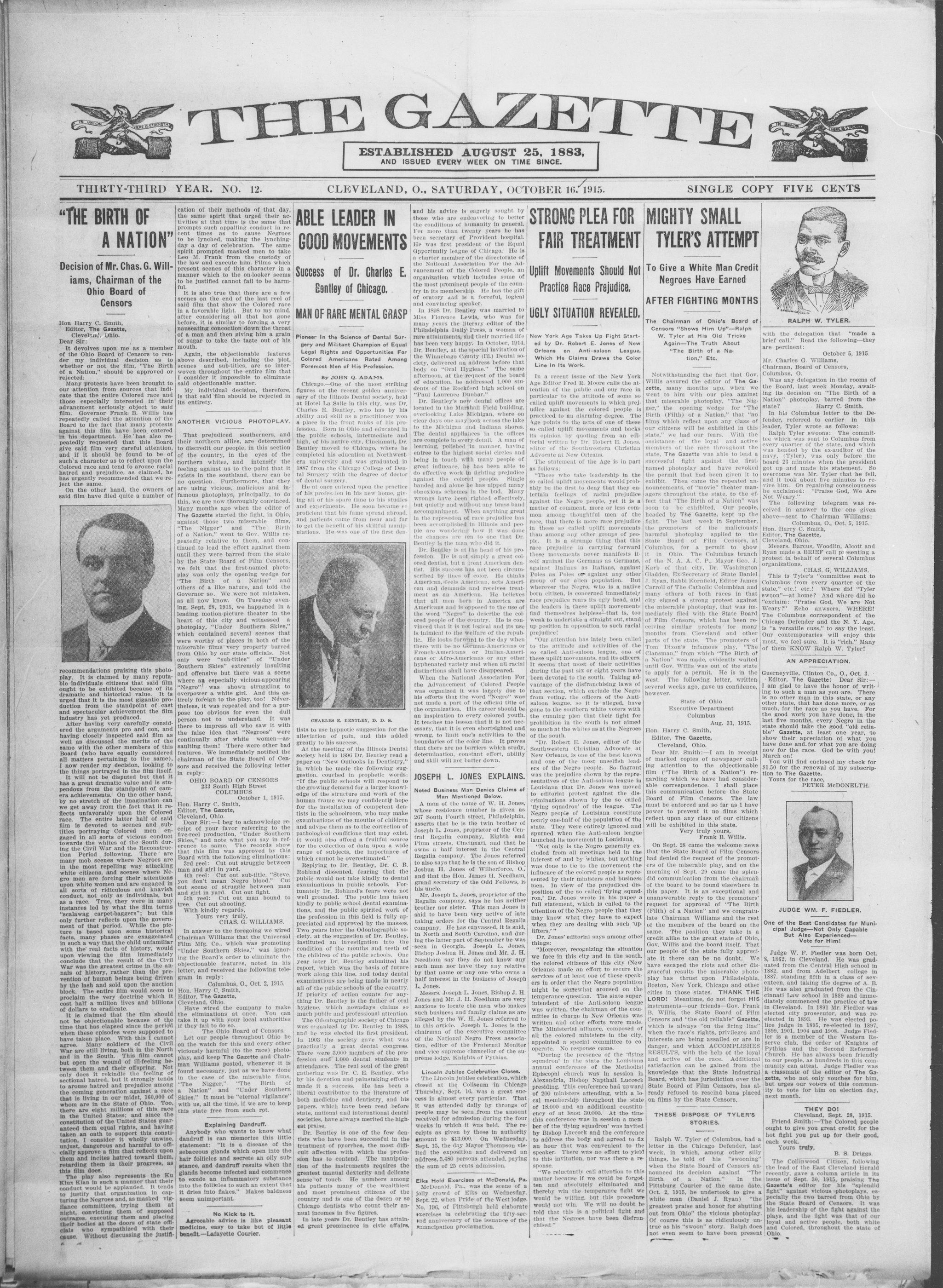
"THE BIRTH OF A NATION"
Hon Harry C. Smith Editor The Gazette
It devolves upon me as a member of the Ohio Board of Censors to render my individual decision as to whether or not the film, "The Birth of a Nation," should be approved or rejected.
Many protests have been brought to our attention from sources that indulge in the serious race and those especially interested in their advancement seriously object to said film. Governor Frank B. Willis has repeatedly called the attention of the Board to the fact that many protests against this film have been entered in his department. He has also repeatedly requested that this Board give said film very careful attention, and if it should be found to be of such a character as to reflect upon the Colored race and tend to arouse racial hatred and prejudice, as claimed, he has been recommended that we refere the same.
On the other hand, the owners of said film have filed quite a number of
recommendations praising this photoplay. It is claimed by many reputable individuals citizens that said film ought to be exhibited because of its dramatic and historical value. It is urged that it is the most gigantic production from the standpoint of cast and spectacular achievement the film industry has yet produced.
After having very carefully considered the arguments pro and con, and having closely inspected said film as well as discussed the morits of the same with the other members of this Board (who have equally considered all matters pertaining to the same), I now render my decision, looking to the things portrayed in the film itself.
It will not be disputed but that it has a great dramatic value and is stupendous from the standpoint of camera achievements. On the other hand, by no stretch of the imagination can we get away from the fact historical race has been imposed upon the Colored race. The entire latter half of said film is devoted to scenes and subtitles portraying Colored men engaged in all sorts of vicious conduct towards the whites of the South during the Civil War and the Reconstruction Period following. There are many mob scenes where Negroes are in the most repelling way attacking white men and some historical groan men are forcing their attentions upon white women and are engaged in all sorts of ridiculous and knavish conduct, not only as individuals, but as a race. True, they were in many instances led by what the film terms "scalawag carpet-baggers"; but this only further reflects upon the government of that period. While the picture of white men, some historical facts, many phases are exaggerated in such a way that the child unfamiliar with the real facts of history, would upon viewing the film immediately conclude that the result of the Civil War was the greatest crime in the animals of history, rather than the prevention of human beings being driven by the lash and sold upon the block. The entire film could seem to cost half a million lives and billions of dollars to eradicate.
It is claimed that the film should not be objectionable because of the time that has elapsed since the period when these episodes were supposed to have taken place. With this I cannot agree. Many soldiers of the Civil War are still living, both in the North and in the South. This film cannot but open the door of ill-feeling between them and their offspring. Not does it reckle the feeling of sectional hatred, but it strongly tends to arouse hatred and prejudice among the coming generation against a race that is living in our midst, 160,000 of whom are in the State of Ohio. Too, there are eight millions of this race in the United States; and since the constitution of the United States guaranteed them equal rights, and having taken an oath to support this constitution, I consider it dangerous and harmful to officially appointe a film that reflects upon them, appointe hatred toward them, rewarding them in their progress, as this film does.
The play also represents the KluKlan in such a manner that their conduct would be applauded. It tends to justify that organization in capturing the Negroes and, as masked vigilance committees, trying them at night, convicting them of outrages, executing them and placing their bodies at the door of criminals who sympathized with their cause. Without discussing the justifi-
THE GAZETTE
cation of their methods of that day, the same spirit that urged their activities at that time is the same that prompts such appalling conduct in recent times as to cause Negroes to be lynched, making the lynchling-day a day of celebration. The same spirit prompted masked men to take Leo M. Frank from the custody of the law and execute him. Films which present scenes of this character in a manner which to the on-looker seems to be justified cannot fail to be harmful.
It is also true that there are a few scenes on the end of the last reel of said film that show the Colored race in a favorable light. But to my mind, after considering all that has gone before, it is similar to forcing a very nauseating concoction down the throat of a man and then giving him a grain of sugar to take the taste out of his mouth.
Again, the objectionable features above described, including the plot questions and subtitles, are so interwoven throughout the entire film that I consider it impossible to eliminate said objectionable matter.
My individual decision, therefore, is that said film should be rejected in its entirety.
ANOTHER VICIOUS PHOTOPLAY.
That prejudiced southerners, and their northern allies, are determined to discredit our people, in this section of the country, in the eyes of the northern whites, and intensify the feeling against us to the point that it exists in the southland, there can be no question. Furthermore, that they are using vicious, malicious and infamous photoplays, principally, to do this, we are now thoroughly convinced. Many months ago when the editor of The Gazette started the fight, in Ohio, against those two miserable films, "The Nigger" and "The Birth of a Nation," went to Gov. Willis repeatedly relative to them, and continued to lead the effort against them until they were barred from the state by the State Board of Film Censors, we felt that the first-named photoplay was only the opening wedge for "The Birth of a Nation" and others of a like nature, and told the Governor so, as all now know. On Tuesday evening, Sept. 28, 1915, we happened in a leading motion-picture theater in the heart of this city and witnessed a photoplay, "Under Southern Skies," which were worthy of places in both of the miserable films very properly barred from Ohio by our state officials. Not only were "sub-titles" of "Under Southern Skies" extremely insulting and offensive but there was a scene where an especially vicious-appearing "Negro" was shown struggling to overpower a white girl. And this entirely foreign to the play, too! Nevertheless, it was repeated and for a purpose too obvious for even the dull person not to understand. It was there to impress all who saw it with the false idea that "Negroes" were continually after white women—assaulting them! There were other bad features. We immediately notified the chairman of the State Board of Censors and received the following letter in reply:
OHIO BOARD OF CENSORS
233 South High Street
COLUMBUS
October 1, 1915.
Hon. Harry C. Smith,
Editor, The Gazette,
Cleveland, Ohio.
Dear Sir:—I beg to acknowledge receipt of your favor referring to the five-reel production, "Under Southern Skies," and note what you say in reference to same. The records show that this film was approved by this board with the following eliminations: 3rd and 4th struggle between man and girl in yard.
4th reel: Cut out sub-title, "Steve
you don't mean Negro blood." Cut
out scene of struggle between man
and girl in yard. Cut out fight.
5th reel: Cut out man bound to
tree. Cut out shooting.
In answer to the foregoing we wired Chairman Williams that the Universal Film Mfg. Co., which was promoting "Under Southern Skies," was ignoring the Board's order to eliminate the objectionable features, noted in his letter, and received the following telegram in reply: Columbus, O., Oct. 2, 1915. Hon. Harry C. Smith, Editor, The Gazette, Cleveland, Ohio.
Have wired the company to make the eliminations at once. You can take it up with your local authorities if they fail to do so.
The Ohio Board of Censors.
Let our people throughout Ohio be on the watch for this and every other viciously harmful (to the race) photoplay, and keep The Gazette and Chairman Williams posted, whenever it is found necessary, just as we have done in the case of the miserable films, "The Nigger," "The Birth of a Nation" and "Under Southern Skies." It must be "eternal vigilance" with us, all the time, if we are to keep this state free from such rot.
Explaining Dandruff
Anybody who wants to know what dandruff is can memorize this little statement: "It is a disease of the sebaceous glands which open into the hair follicles and secrete an oily substance, and dandruff results when the glands become infected and commence to exude an inflammatory substance into the follicles to such an extent that it dries into flakes." Makes baldness seem unimportant.
No Kick to it.
Agreeable advice is like pleasant medicine, easy to take but of little benefit. -Lafayette Courier.
ESTABLISHED AUGUST 25, 1883 AND ISSUED EVERY WEEK ON TIME SINCE.
CLEVELAND, O., SATURDAY, OCTOBER 16, 1915.
MAN OF RABE MENTAL GRASP
Pioneer In the Science of Dental Surgery and Militant Champion of Equal Legal Rights and Opportunities For Colored Americans Rated Among Foremost Men of His Profession.
By JOHN Q. ADAM5.
BY JOHN Q. ADAMS.
Chicago—One of the most striking figures at the recent golden anniversary of the Illinois Dental society, held at Hotel La Salle in this city, was Dr. Charles E. Bentley, who has by his ability and skill as a practitioner won a place in the front ranks of his profession. Born in Ohio and educated in intermediate school, he graduated high of his native city of Chicago. Dr Bentley moved to Chicago, where he completed his education at Northwestern university and was graduated in 1887 from the Chicago College of Dental Surgery with the degree of doctor of dental surgery.
He at once entered upon the practice of his profession in his new home, giving all of his spare time to his studies and experiments. He soon became so proficient that his fame spread abroad, and patients came from near and far to get the benefit of his skillful manipulations. He was one of the first den-
CHARLES E. DENTLEY, D. D. 8.
fists to use hypnotic suggestion for the alleviation of pain, and this added greatly to his success.
At the meeting of the Illinois Dental society held in 1896 Dr. Bentley read a paper on "New Outbooks in Dentistry," in which he made the following suggestion, couched in prophetic words: "If the public schools will respond to the growing demand for a larger knowledge of the structure and work of the human frame we may confidently hope for the installation of competent dentists in the schoolroom, who may make examinations of the mouths of children and advise them as to the correction of pathological conditions that may exist. It would also afford a fruitful source for the collection of data upon a wide range of subjects, the importance of which cannot be overestimated." Replying to Dr. Bentley, Dr. C. B. Rohland dissented, fearing that the public would not take kindly to dental examinations in public schools. Fortunately Dr. Rohland's fears were not well grounded. The public has taken kindly to public school dental examinations, and the public spirited work of the profession in this field is fully appreciated and approved by the masses. Two years later the Odontographic society, at the suggestion of Dr. Bentley, instituted an investigation into the condition of the mouths and teeth of the children of the public schools. One year later Dr. Bentley submitted his report, which was the basis of future work along this line, and today dental examinations are being made in nearly all the public schools of the country. If priority of action counts for anything Dr. Bentley is the father of oral hygiene, which nowadays claims so much public and professional attention.
The Odontographic society of Chicago was organized by Dr. Bentley in 1888, and he was elected its first president. In 1903 the society gave what was practically a great dental congress. There were 3,000 members of the profession and 1,000 dental students in attendance. The real soul of the great gathering was Dr. C. E. Bentley, who by his devotion and painstaking efforts made it a success. He has been a liberal contributor to the literature of both medicine and dentistry, and his papers, which have been read before state, national and international dental societies, have always merited the highest praise.
Dr. Bentley is one of the few dentists who have been successful in the treatment of pyrrhena, the most difficult affection with which the profession has to contend. The manipulation of the instruments requires the greatest manual dexterity and delicate sense of touch. He numbers among his patients many of the wealthiest and most prominent citizens of the country and is one of the dozen or so Chicago dentists who count their annual incomes in five figures.
In late years Dr. Bentley has attained great prominence in civic affairs,
and his advice is eagerly sought by those who are endeavoring to better the conditions of humanity in general. For more than twenty years he has been secretary of Provident hospital. He was first president of the Equal Opportunity league of Chicago. He is a charter member of the directorate of the National Association For the Advancement of the Colored People, an organization which includes some of the most prominent people of the country in its membership. He has the gift of oratory and is a forceful, logical and convincing speaker. In 1898 Dr. Bentley was married to Miss Florence Lewis, who was for many years the literary editor of the Philadelphia Daily Press, a woman of rare attainments, and their married life has been very happy. In October, 1914, Dr. Bentley, at the special invitation of the Winnebago County (Ill.) Dental society, delivered an address before that body on "Oral Hygiene." The same afternoon, at the request of the board of education, he addressed 1,000 students of the Rockford high school on "Paul Laurence Dunbar."
Dr. Bentley's new dental offices are located in the Marshall Field building, overlooking Lake Michigan, where on clear days one may look across the lake to the Michigan and Indiana shores. The dental appliances in the offices are complete in every detail. A man of learning, polished in manner, having entree to the highest social circles and being in touch with many people of great influence, he has been able to do effective work in fighting prejudice against the colored people. Single handed and alone he has nipped many obnoxious schemes in the bud. Many wrongs have been righted effectively, but quietly and without any brass band accompaniment. When anything great in the repression of race prejudice has been accomplished in Illinois and people are wondering how it was done the chances are ten to one that Dr. Bentley is the man who did it.
Dr. Bentley is at the head of his profession. He is not simply a great colored dentist, but a great American dentist. His success has not been circumscribed by lines of color. He thinks American, feels American, acts American and demands and receives treatment as an American. He believes that all men born in America are Americans and is opposed to the use of the word "Negro" to describe the colored people of the country. He is convinced that it is not logical and its use is imitical to the welfare of the republic. He looks forward to the day when there will be no German Americans or French Americans or Italian Americans or Afro-American or any other hyphenated variety and when all racial distinctions shall have disappeared.
When the National Association For the Advancement of Colored People was organized it was largely due to his efforts that the word "Negro" was not made a part of the official title of the organization. His career should be an inspiration to every colored youth. It teaches the lesson that it is not necessary, that it is even shortsighted and, wrong, to limit one's activities to the boundaries of the color line. It proves that there are no barriers which study, determination, constant effort, ability and skill will not batter down.
JOSEPH L. JONES EXPLAINS
Noted Business Man Denies Claims of Man, Mentioned Below.
A man of the name of W. H. Jones, whose residence number is given as 267 South Fourth street, Philadelphia, asserts that he is the twin brother of Joseph L. Jones, proprietor of the Central Regalia company, Eighth and Plum streets, Cincinnati, and that he owns a half interest in the Central Regalia company. The Jones referred to also says that he is the son of Bishop Joshua H. Jones of Wilberforce, O., and that the Hon. James H. Needham, grand secretary of the Odd Fellows, is his uncle.
Mr. Joseph L. Jones, proprietor of the Regalia company, says he has neither brother nor sister. This man Jones said to have been very active of late taking orders for the Central Regalia company. He has canvassed, it is said, in North and South Carolina, and during the latter part of September he was seen in Georgia. Joseph L. Jones, Bishop Joshua H. Jones and Mr. J. H. Needham say they do not know any such man nor have they any relative by name or any one who owns a half interest in the business of Joseph L. Jones.
Messrs. Joseph L. Jones, Bishop J. H. Jones and Mr. J. H. Needham are very anxious to locate the man who makes such business and family claims as are alleged by the W. H. Jones referred to in this article. Joseph L. Jones is the chairman of the executive committee of the National Negro Press association, editor of the Fraternal Monitor and vice supreme chancellor of the supreme lodge, Knights of Pythias.
Lincoln Jubilee Celebration Closes.
The Lincoln jubilee celebration, which closed at the Coliseum in Chicago Thursday, Sept. 16, was a great success in almost every particular. That it was attended daily by throngs of people may be seen from the amount received for admission during the four weeks in which it was held. The receipts as given by those in authority amount to $13,000. On Wednesday, Sept. 15, the day Mayor Thompson visited the exposition and delivered an address, 5,480 persons attended, paying the sum of 25 cents admission.
Elks Hold Exercises at McDonald, Pa.
STRONG PLEA FOR FAIR TREATMENT
Uplift Movements Should Not Practice Race Prejudice.
UGLY SITUATION REVEALED.
New York Age Takes Up Fight Started by Dr. Robert E. Jones of New Orleans on anti-saloon League Which He Claims Draws the Color Line In Its Work.
In a recent issue of the New York Age Editor Fred R. Moore calls the attention of the public and our race in particular to the attitude of some so called uplift movements in which prejudice against the colored people is practiced to an alarming degree. The Age points to the acts of one of these 50 called uplift movements and backs its opinion by quoting from an editorial written by Dr. Robert E. Jones editor of the Southwestern Christian Advocate at New Orleans.
The statement of the Age is in part as follows:
"Those who take leadership in the so called uplift movements would probably be the first to deny that they entertain feelings of racial prejudice against the Negro people, yet it is a matter of comment, more or less common among thoughtful men of the race, that there is more race prejudice in these so called uplift movements than among any other groups of people. It is a strange thing that this race prejudice in carrying forward these movements never manifests itself against the Germans as Germans, against Italianas as Italianas, against Poles as Poles against any other group of our alien population. But wherever the Negro, who is a native born citizen, is concerned immediately race prejudice rears its ugly head, and the leaders in these uplift movements find themselves helpless—that is, too weak to undertake a straight out, stand up position in opposition to such racial prejudice!
"Our attention has lately been called to the attitude and activities of the so called Anti-saloon league, one of these uplift movements, and its officers. It seems that most of their activities during the past six or eight years have been devoted to the south. Taking advantage of the disfranchising laws of that section, which exclude the Negro from voting, the officers of the Anti-saloon league, so it is alleged, have gone to the southern white voters with the cunning plea that their right for prohibition in the south is not almed so much at the whites as at the Negroes of the south.
"Dr. Robert E. Jones, editor of the Southwestern Christian Advocate at New Orleans, is one of the best known and one of the most unselfish leaders of the Negro people. So fragrant was the prejudice shown by the representatives of the Anti-saloon league in Louisiana that Dr. Jones was moved to editorial protest against the discriminations shown by the so called 'flying squadron' of the league. The Negro people of Louisiana constitute nearly one-half of the population of the state. They were entirely ignored and spurned when the Anti-saloon league launched its movement in Louisiana. "Not only is the Negro generally excluded from all meetings held in the interest of and by whites, but nothing was done to tie to the movement the influence of the colored people as represented by their ministers and business men. In view of the prejudiced disposition of the so called 'flying squadron', Dr. Jones wrote in his paper a full statement, which is called to the attention of the Negro people that they may know what they have to expect when they are dealing with such 'uplifters.'" Dr. Jones' editorial says among other things:
"Moreover, recognizing the situation we face in this city and in the south, the colored citizens of this city (New Orleans) made an effort to secure the services of at least one of these speakers in order that the Negro population might be somewhat aroused on the temperance question. The state superintendent of the Anti-saloon league was written, the chairman of the committee in charge in New Orleans was written and other efforts were made. The Ministerial alliance, composed of all the colored ministers in the city, appointed a special committee to cooperate. No response came.
"During the presence of the 'flying squadron' in the state the Louisiana annual conference of the Methodist Episcopal church was in session in Alexandria, Bishop Napthali Lucecock presiding. This conference had upward of 200 ministers attending, with a local membership throughout the local of 18,000 and an additional constituency of at least 20,000. At the time this conference was in session a member of the 'flying squadron' was invited by Bishop Lucecock and the conference to address the body and agree to fix an hour that was convenient to the speaker. There was no effort to yield to this invitation, nor was there a response.
"We reluctantly call attention to this matter because if we could be forgotten and absolutely eliminated and thereby win the temperance fight we would be willing, but this procedure would not win. We will no doubt be told that this is a political fight and that the Negroes have been disfranchised."
SINGLE COPY FIVE CENTS
MIGHTY SMALL TYLER'S ATTEMPT
To Give a White Man Credit Negroes Have Earned
AFTER FIGHTING MONTHS
The Chairman of Ohio's Board of Censors "Shows Him Up"—Ralph W. Tyler at His Old Tricks Again—The Truth About "The Birth of a Nation" Etc.
Notwithstanding the fact that Gov. Willis assured the editor of The Gazette, many months ago, when we went to him with our plea against that miserable photoplay, "The Niger," the opening wedge for "The Birth (Fifth) of a Nation," that "no films which reflect upon any class of our citizens will be exhibited in this state," we had our fears. With the assistance of the loyal and active member of the race throughout the state, The Gazette was able to lead a successful fight against the first named photoplay and have revoked the permit that had been given it to exhibit. Then came the repeated announcements, of "movie" theater managers throughout the state, to the effect that "The Birth of a Nation" was soon to be exhibited. Our people, headed by The Gazette, kept up the fight. The last week in September, the promoters of the maliciously harmful photoplay applied to the State Board of Film Censors, at Columbus, for a permit to show it in Ohio. The Columbus branch of the N. A. A. C. P., Mayor Geo. J. Karb of that city, Dr. Washington Gladden, Ex-Secretary of State Daniel J. Ryan, Rabbi Kornfield, Editor James Carroll of the Catholic Columbian and many others of both races in that city signed a strong protest against the miserable photoplay, that was immediately filed with the State Board of Film Censors, which has been receiving similar protests for many months from Cleveland and other parts of the state. The promoters of Tom Dixon's infamous play, "The Clansman," from which "The Birth of a Nation" was made, evidently waited until Gov. Willis was out of the state to apply for a permit. He is in the west. The following letter, written several weeks ago, gave us confidence, however.
Dear Mr. Smith:—I am in receipt of marked copies of newspaper calling attention to the objectionable film ("The Birth of a Nation") regarding which we have had considerable correspondence. I shall place this communication before the State Board of Film Censors. The law must be enforced and so far as I have power to prevent it no films which reflect upon any class of our citizens will be exhibited in this state.
Frank B. Willis
On Sept. 28 came the welcome news that the State Board of Film Censors had denied the request of the promoters of the miserable play, and on the morning of Sept. 29 came the splendid communication from the chairman of the board to be found elsewhere in this paper. It is an exceptional and unanswerable reply to the promoters' request for approval of "The Birth (Filth) of a Nation" and we congratulate Chairman Williams and the rest of the members of the board on the same. The position they take is a credit alike to the great state of Ohio, Gov. Willis and the board itself. That our people of the state fully appreciate it there can be no doubt. We have escaped the riots and other disgraceful results the miserable photoplay has thrust upon Philadelphia, Boston, New York, Chicago and other cities in those states. THANK THE LORD! Meantime, do not forget HIS instruments—our friends—Gov. Frank B. Willis, the State Board of Film Censors and the old reliable" Gazette, which is always "on the firing line" when the race's rights, privileges and interests are being assailed or are in danger, and which ACCOMPLISHES RESULTS, with the help of the loyal and active of the race. Additional satisfaction can be gained from the knowledge that the State Industrial Board, which has jurisdiction over the State Board of Film Censors, has already refused to rescind bans placed on films by the State Censors.
THESE DISPOSE OF TYLER'S STORIES.
Ralph W. Tyler of Columbus, had a letter in the Chicago Defender, last week, in which, among other silly things, he told of his "swoning" when the State Board of Censors announced its decision against "The Birth of a Nation." In the Pittsburg Courier of the same date, Oct. 2, 1915, he undertook to give a white man (Daniel J. Ryan) "the greatest praise and honor for shutting out from Ohio" the vicious photoplay. Of course this is as ridiculously untrue as his "swoon" story. Ralph does not even seem to have been present
IN UNION
UNITED
1776
RALPH W. TYLER.
with the delegation that "made a brief call." Read the following—they are pertinent:
October 5, 1915
Mr. Charles G. Williams,
Chairman, Board of Censors,
Columbus, O.
Was any delegation in the rooms of the Board, last week Monday, awaiting its decision on "The Birth of a Nation" photoplay, barred from the state?
Harry C. Smith.
In his Columbus letter to the Defender, referred to earlier in this leader Tyler wrote as follows:
Ralph Tytler swoons: The committee which was sent to Columbus from every quarter of the state, and which was headed by the ex-auditor of the navy, (Tytler), was only before the board 23 minutes when the president got up and made his statement. So he asked the Tytler that he will and it took about five minutes to revive him. On regaining consciousness he exclaimed: "Praise God, We Are Not Weary." The following telegram was received in answer to the one given above—sent to Chairman Williams:
Messrs. Barcus, Woodlin, Alcott and Ryan made a BRIFE call p searing a protest in behalf of several Columbus organizations.
CHAS. G. WILLIAMS.
This is Tyler's "committee sent to Columbus from every quarter of the state," etc.! etc.! Where did "Tyler swoon"—at home? And where did he "exclaim: "Praise God, We are Not Weary?" Echo answers, WHERE! The Columbus correspondent of the Chicago Defender and the N. Y. Age, is "a versatile cuss," to say the least. Our contemporaries will enjoy this most, we feel sure. It is "rich." Many of them KNOW Ralph W. Tyler!
AN APPRECIATION.
Guerneyville, Clinton Co., O., Oct. 3.
Editor, The Gazette: Dear Sir:—
I am glad to have the honor of writing to such a man as you are. There is no other man in this state, or any other state, that has done more, or as much, for the race as you have. For the good work you have done, in the last five months, every Negro in the state should take the good "old reliable" Gazette, at least one year, to show their appreciation of what you have done and for what you are doing now for the race. God be with you! March on!
You will find enclosed my check for $1.50 for the renewal of my subscription to The Gazette.
Yours for the race.
PETER McDONELTH.
JUDGE WM. F. FIEDLER.
One of the Best Candidates for Municipal Judge—Not Only Capable
But Also Experienced—
Vote for Him!
Judge W. F. Fiedler was born Oct. 8, 1862, in Cleveland. He was graduated from the Central High school in 1882, and from Adelbert college in 1887, standing fifth in a class of seventeen, and taking the degree of A. B. He was also graduated from the Cincinnati Law school in 1889 and immediately commenced the practice of law in Cleveland. In 1891 Mr. Fiedler was elected city prosecutor, and was re-elected in 1893. He was elected police judge in 1895, re-elected in 1897, 1899, 1901, 1904 and 1908. Judge Fiedler is a member of the Western Reserve club, the order of Knights of Church, and the Second Reformed Church, has always been friendly to our people, as hundreds in this community can attest. Judge Fiedler was a classmate of the editor of The Gazette, who not only vouchs for him, but urges our voters of this community to vote for him on election day, next month.
THEY DO!
Cleveland, Sept. 28, 1915.
Friend Smith:—The Colored people ought to give you great credit for the hot fight you put up for their good, each week.
Yours truly.
B. S. Driggs.
The Collinwood Citizen, following the lead of the East Cleveland Herald recently, gave a column article in its issue of Sept. 30, 1915, praising The Gazette's editor for his "spendid fight" against vicious photoplays, especially the two barred from Ohio by the State Board of Censors. It was his leadership of the fight against the plays, and the fight was that of our loyal and active people, both white and Colored, throughout the state of Ohio.
SUBSCRIPTION RATES
(In Advance)
One Year.....$1.50.
Six Months.....1.00
Three Months......50
Subscribers are requested to re-
mit by postoffice money or
order or registered letter
Entered at the postoffice in Cleveland
Ohio, as second-class matter.
Address all communications to
Blackstone Building, Cleveland, O.
Member Ohio Legislature: 1894
to 1898; 1896 to 1898; 1900 to 1902
THE GAZETTE is the oldest, and
has the largest bona fide circulation
double that of any newspaper in the
interest of African-Americans, publisher
in State of Ohio, and companion
with any will immediately establish
its rank as one of the NEWSIEST
AND BEST in the country.
10,000,000 Afré-Americans.
160,000 in Ohio.
20,000 in Cleveland.
SATURDAY, OCTOBER 16, 1915.
DARE TO DO YOUR DUTY.
“Let us have faith that right makes right, and in that let us to the end dare to do our duty as we understand it”—Abraham Lincoln.
The hope of Democracy is in what Wilson has not done.
"Protective Tariff and Prosperity! How would that listen for a slogan?
Charging another increase in taxes to the European war will not help the taxpayers any, or Democracy much.
All of this Democratic prosperity from making munitions comes through the hated house of J. P. Morgan & Co.
The Democratic state organization in its meeting in Columbus on Monday adopted as its slogan, "Stand by President Wilson." We have to. He doesn't move.
"A prosperity fed upon dead men cannot be permanent, and is not worth having. This country must have back of its industries something more than war."—Gov. Willis at Spokane.
The Washington correspondent of the Chicago "Tribune" speaks of "the Eremite of the White House." This is calculated to turn that "million of citizenry" from their guns to their dictionaries.
The financial expert who writes special articles from New York to the St Louis "Globe-Democrat" compacts the whole truth into four words: "Not sat isfactory, but improving." This, he says, "accurately summarizes domestic business conditions."
Commenting on the fact that the President went to a Washington theater and saw "the Ringmaster," the "Knickerbocker Press" says "he is pretty much of a ringmaster himself." True. And the Democratic party is a circus, well supplied with clowns.
The Marion (Iowa) "Sentinel" declares that Cummins would carry Iowa against Wilson by 75,000 to 100,000 majority, "iowa," it declares, "is a Republican State." Wilson is a Democrat. By the same token, we should look for a handsome Republican majority in Iowa for whoever may be the nominee.
The deficit in Government business from July 1 to September 30 was $38,654,983. Apparently expenditures will continue to exceed revenues at a similar rate until the present balance of about $41,000,000 has been exhausted. More taxes or bond issues will be necessary.
Some northern Democrats in Congress will ask the President to help them get some of the chairmanships now held by the South. We can imagine the stern negative they will receive. The President is himself a Southern man.
At President Wilson's direction the Department of Commerce and the Federal Trade Commission have begun an investigation to find means to prevent a flood of cheap products from Europe on the American market at the end of the war, says a Washington dispatch. They needn't bother. The incoming Republican Administration will know the means and will apply them.
The Chicago "Evening Post" takes Wilson to task for having received Bryan at the White House. "Now that we are rid of Mr. Bryan," it petulantly exclaims, "let's stay rid of him." Is this the attitude of Wilson men generally? If it is, and if they succeed in getting rid of Bryan on election day, they will surely find themselves much worse off than they are now.
Foreign trade development requires assurance of government protection of legitimate business rights. This administration is making great vocal efforts to build up trade with South America but it is hampered by its
record in urging American citizens to abandon their property and get out of Mexico. The business men of the United States judge this administration by what it does, more than by what it says. There is one thing more cautious than a dollar—two dollars.
It is evident that the Democrats do not expect to retain control of the Senate. Otherwise they would not be so fussy about an extra session and a gag-rule. It is well known that a measure which has popular approval can easily pass the Senate under the present rules. The ship-purchase bill is no exception. If the country wanted the measure, the Senate would pass it. But the country doesn't want it, and the Democrats want to cram it down our throats during the next Congress.
"FREEDOM OF SPEECH" ABUSED
Following is a copy of a postal card sent to Julian M. Solomon, Jr., "Bosworth," 220 W. 42d St., New York City:
Cleveland, O., Oct. 8, 1915.
Sir:—Your circular letter with enclosures received. This card is my answer:
When the "movie" promoters send such "inflammable" ROT as is MUCH of the photoplayts, "The Birth of a Nation" and "The Nigger," to Ohio, they make censorship absolutely necessary.
"Freedom of Speech—An American Institution" sounds nice, but there is certain kind of "speech-freedom" the "American" government, and none other, tolerate, and THAT is the sort of ROT some photoplayts contain that make censorship absolutely necessary.
Yours truly,
HARRY C. SMITH.
THE PRESIDENT AND THE TARIFF
The President's letter to ex-Governor Cox of Ohio is no evidence that he looks with favor upon any change in the schedules of the Underwood tariff, no matter how much the Treasury may be in need of revenue. Mr. Wilson is a free-trader. For years he nursed this theory in the academic shades of the colleges where he taught. It runs through all his books and speeches; and finally, by the fortune of politics, he was enabled to put it into practice. To surrender that principle now, to admit that the traffit bill has been a failure, would be to pull out the corner-stone of the whole structure of Woodrow Wilson's political beliefs—and his letter to Mr. Cox conveys no intimation of any such purpose. The main thought in this letter is a familiar one. It is a repetition of the startling assertion, made for the first time in the President's Indianapolis speech, that he "put one over" when the Federal Trade Commission was established and that that commission is, in effect, a tariff board. This may indeed, be so; but the men who voted for the Trade Commission law did not think so. And if Mr. Wilson attempts to make tariff changes on the basis of recommendations coming from the Trade Commission, we can foresee lively times in Congress.
A Photo Play That Won't Play.
An adroit political conspiracy has been betrayed by one of the machine hands.
The conspirators are Robt, F. Wolfe of Columbus, O., and the Photo-Play Trust.
The Trust wants to show in Ohio, "The Birth of a Nation," a reel film from Dixon's play, "The Clansman," of scenes in which Afro-Americans are debased and the KuKlux Klan glorified. Mr. Wolfe saw an opportunity to make a damaging attack upon Governor Willis in his papers, the Columbus Journal and Dispatch. If the state moving picture censor board passed it, stories could be told of uprisings and riots in many places induced by the pictures and Afro-Americans provoked thereby to punish Governor Willis at the next election. And, too, the G. A. R. would be shown how the governor disregarded their condemnation of it in a resolution.
If the censors rejected it, Willis was to be charged "with playing politics with the board by suppressing an educational play of great historical interest and value." Either way, Willis would be damaged in the public esteem.
The censors rejected the film.
The censors rejected the nim.
Thereupon Wolfe's Columbus Dispatch told that it was the finest photo play ever produced; that its suppression would entail heavy loss to the producers who would appeal to the supreme court; that 'the governor's fear of losing the Colored vote had caused the Ohio censors to reject the governor's two appointees voted to reject.' The Dispatch then adds, "Mrs. Maude Murray Miller, the third member, is said to have voted to accept it with some eliminations."
Some facts: the governor named but one member of this board. Mrs. Maude Murray Miller has long been employed on the Ditipatch. After the paper goes to press at 2 P. M., she views pictures and the state pays her wages, $125 a month—but she is not the only person working on the Dispatch who is paid by Ohio for this one of the ways in which the late governor (Cox) secured the support of newspapers. Wolfe's Columbus Ohio State Journal editorially sobbed that 5,000,000 people of Ohio had been denied a view of this "greatest of productions."
Some of the reasons for barring it as given by Mr. C. G. Williams, chairman of the board, follow:
"The entire latter half is devoted to scenes and subtitles portraying Colored men engaged in all sorts of vicious conduct toward the whites of the South during the civil war and the reconstruction period following. There are many mob scenes where Negroes are in the most repelling attacking white citizens, and scenes where Negro men are forcing their attentions upon white women and are engaged in all sorts of ridiculous and
knavish conduct, not only as individuals, but as a race
Mr. Williams says, too, that one "viewing the film would immediately conclude that the result of the civil war was the greatest crime in the annals of history, rather than the prevention of human beings being driven by the lash and sold upon the auction block. The entire film would seem to proclaim the very doctrine which it cost a half million lives and billions of dollars to eradicate.
"The play also represents the Ku Klux Klan in such a manner that their conduct is applauded. It tends to justify that organization in capturing Negroes, and, as masked vigilance committees, trying them at night, convicting them of supposed outrages, executing them and placing their bodies at the doors of state officials who sympathized with their cause."
Services, Sunday, were well attended.—Mrs. Homer Harris and Mrs. R. B. Lowe visited in McIntyre last Friday.—Mr. and Mrs. Haze Harris' little daughter, Anna, is slowly convalescing. Pneumonia.—Mr. Robert Bell recently took his little nephew, Ellsworth, home to Milwaukee, Minn.—Mrs. Anna Howard visited in Pittsburg, last week.—Mr. Dave West of Hopedale, spent Sunday here.—Mrs. Mary Ford of Mansfield, widow of the late Rev. Chas. W. Ford, returned to her former home in McIntyre, recently.
ALLIANCE.—The A. M. E. church services, Sunday, were largely attended. A number from Salem were in attendance. The sermons were preached by Rev. C. G. Garner, of the Pittsburgh conference, who is visiting his son, Mr. and Mrs. C. G. Garner entertained at dinner, Sunday, in his honor. Mr. and Mrs. George Hall and son, Ray.
WRITTEN BY "THE OLD RELIABLE" GAZETTE'S CORRESPONDENTS
THROUGHOUT THE STATE
What Our People Are Doing Each Week—Church, Personal, Social, Lodge, Literary and Musical—Marriages, Deaths, Etc.
GEORGETOWN.—Clifford Fleming of Dayton, visited relatives here, last week. Elmer Baker and family of Dayton, are here, among old friends and relatives. Fred Payne has purchaed the Marshal restaurant in Ripley and will open for business soon. Rev Johnson will hold regular services here, Sunday. Mrs. Moody of St Louis, is visiting her mother, "Aunt" Emily Tatmoy.—Mrs. Hannah Wills of Elkhard, Ind., is here visiting relatives this week. Miss Frankie Yates of Cincinnati, is visiting her mother, Mrs Ellen Yates.
---
SANDUSKY.—Mr. Moses Thompson is quite sick and the Mr. Wm. Alexander is under the doctor's care—Mrs. Eccles has left town.—The churches and S. s. were well attended. Sunday.—Mrs. S. Scott and Mrs. B. Thompson are doing a great work among the children. They gave a birthday party to about 15, Saturday.—Mrs. L. H. Dodd, Mrs. Mary Jones, Miss Emma Gilkerson, Rev. G. D. Smith and Mrs. G. Gilkerson, left to Columbus, Tuesday, to attend the State Baptist convention.—Mrs. Lydia Williams was in town, two days last week.—Take The Gazette, Rev. George D. Smith agent.—Miss Evia Walton and Mr. John Robinson were married in Cleveland, Sept. 9.
CADIZ—Mrs. Susie Hogans of Plaqu, is here, visiting relatives—Several young folk from here attended the "Home Coming" in Bellaire, the 8th—Mr. John Ballard and sister, Miss Jill Ballard, and brother R. F. Ballard, the past week—Messrs. Dallas Wallace and Fleming Williams Jr., spent Sunday in Mt. Pleasant—A. J. Guy and sons, James and Elsworth. Messrs. Matthews and Howard, Mr. and Mrs. Morton and son, Parker, and others of Steubenville, Mr. and Mrs. Johnson, Johnson Robins and Miss Me Johnson were in Columbus last week.
YOUNGSTOWN.—A men club was organized, Monday evening, at St. Augustine Episcopal mission. Next meeting, Nov. 1.—Mrs. Lemuel Stewart is visiting her brother, Mr. Loven Richards, in Franklin, Kentucky. Mr. Parker is visiting the church's delegation to the O. B. S., convention in Columbus, this week.—Thomas E. Green, Jr., of Columbus, was here, last week.—the "Harvest Home" service and dinner at Oak Hill Ave. A. M. E. church, Sunday and Monday, was a great success.—Mrs. W. P. Burton is ill.—Miss Amara zella Mishna in Huntington, A. will meet with Mrs. B. Winter, winter—Buckeye Lodge, Elks, will meet, Thursday evening.—Mr. and Mrs. Geo. Holmes of Sandusky, are here visiting relatives.
CORRESPONDENTS must mail all letters for publication at their main postoffice sufficiently early on Monday (or Sunday) of each week to have them reach The Gazette office on Tuesday morning, and always write also, their names and that of their relatives, and that of their wrapper about returned copies. Unless this latter is done, proper credit cannot be given you. Lists of names, wedding presents, etc., obituary notices, speeches, resolutions, poetry, inquiries for relatives and advertisements of all kinds, including items announcing entertainments to be held in the near future, must be paid for by the postmaster. On a line, six words to a line. Our rates for display advertisements will be sent on application. Send postal note and not stamps during warm weather.
ZANESVILLE.—Rev. A. M. Thomas and delegates from the several auxiliaryaries of the Union Baptist church left Tuesday to attend the Baptist state convention at Columbus.—Mr. and Mrs. Russell Williams and Mr. and Mrs. Sidney Blackwell motored to Newark, Sunday, and had a most enjoyable visit with relatives.—Mrs. Emily Henderson continues quite ill.—Freddie Blackwell is selling The Gazette. Patronize him and hand him local news for this letter.—Mr. Clarence Robinson, a resident of this city, was seriously injured in an auto accident at Columbus, and those are doors are open. The church hurry have been slow.—Rev. Ira Collins, St. Paul's new pastor is "at home" to members and friends, at the parsonage.—Help make The Gazette's Zanesville's newsletter more interesting by 'phoning the local correspondent, Chas. F. Henderson, what real live news you have. Bell phone 3828. Order the paper, too.
SMITHFIELD.—Mrs. Chauncy West and friend, of Ellwood City, visited relatives here, last week.—Messrs. M. Cooper and D. Freeman of McIntyre, spent Monday here.—Mr. E. Powder of Bradley, visited in Wheeling, Steubenville and Wellsburg, Saturday and Sunday.—Mrs. J. Beall visited a week, with her husband, in Ellwood City. Mrs. M. E. Veney daughter of J. spent Saturday and Brilliant. St. Paul's school selected, last Wednesday evening for the ensuing year. The stewards, stewardesses and other trustees were appointed by the pastor.—
Services, Sunday, were well attended. —Mrs. Homer Harris and Mrs. R. B. Blowe visited in McIntyre, last Friday. —Mr. and Mrs. Haze Harper's little daughter, Anna, is slowly convalescing. Pneumonia. —Mr. Robert Beall recently took his little nephew, Ellsworth, home to Milwaukee, Minn. —Mrs. Anna Howard visited in Pittsburgh, last week. —Mr. Dave West of Hopefield, spent Sunday here. Mrs. R. B. Blowe visited with her late Rev. Chas. W. Ford, returned to her former home in McIntyre, recently.
---
ALLIANCE. The A. M. E. church services, Sunday, were largely attended. A number from Salem were in attendance. The sermons were preached by Rev. C. G. Garner, of the Pittsburg conference, who is visiting his son, Mr. and Mrs. C. G. Garner entertained at dinner, Sunday, in his honor: Mr. and Mrs. George Hall and son, Raymond; Miss Ethel Veney, Mr. and Mrs. R. Smith and Rev. J. C. Turner. Mrs. Anna Russell was given an enjoyable surprise by her S. S. members, Monday evening. She was also given a little basket containing a neat sum of money—Mrs. Lucy Smith is still offering a finger to a finger on a finger.—Mr Chas Swaney of Salem, visited Miss J. Stokes, Sunday. The Chrysanthemum club will meet at Meo. Gell, Hall's this week. Miss Rosa Hargrave has concluded a visit with Mrs. W. H. Palmer. The Willing Workers' society met at Mr. and Mrs. Edward Harrell's, Tuesday evening, and had a large attendance. After business, a fine program was rendered. Refreshments. Next meeting, Oct. 19, at Mr. Walter Oliver's. Mr. Harry Palmer and Ernest Nell were in Cleveland, Saturday. The W. H. Moore was meeting the church, Wednesday evening. Mr Curtis Smith mashed his right foot, Monday. He is using crutches. Mrs. H. L. Moore is convalescent. Mrs. Carrie Waters and son, Chester, of Chicago, are here visiting.
---
STEUBENVILLE—It pains me to say this, but it is the general verdict, that this "small place" is one of the worst in the country for trying to tear down character; and what is most appalling, it is done by a class that should forever bridle their tongues. Men who have been so low and base and who have no moral qualifications, seeking to climb up by pulling somebody down, so as to hide their own dirty characters, along with some of the women who have never been anything so far as uplifting the race is concerned, are the vultures who are trying to prey upon innocent men and women. The services at the Simpson E. Church are not as pressive. Rev. G. W. Tindull, and Rev. Leo. Geer, a young man just entering the ministry, preached ably morning and evening, respectively. The latter has a bright future. The pastor will begin a series of interesting sermons, Sunday, rally day. The Epworth League will render a fine program, Friday evening.—Mrs. Annie Davis has been removed home from the hospital where she was successively opened. She is now an improver. The Second Baptist church had a turkey supper, Tuesday evening. The services, Sunday, were largely attended. Rev. Grandison preached two able sermons.—Mrs. Carrie Bowman Smith of Pittsburg, who exhibited off paintings and china work at her mother's, here returned home, Sunday. She made several very profitable sales.—Rev. J. T. Farley was greeted, Sunday, at Quinn A. M. E. church, by large congregations, and preached ably.
HILLSBORO—Mrs. Mary Ellis of Cincinnati, spent Sunday with her mother, Mrs. Northana Christy—Mrs. Lang Young has returned from Zanesville.—Rev. L. C. Kiner of Lockland, preached at Wesleyan church, Sunday.—Mr. Starlie Ellis of Dayton, visited his aunt, Mrs Anne Ellis, this week.—Mr. Vivian Hudson entertained young friends at a party, last Wednesday evening, in honor of the Misses Bessie and Zelma Zelma of Wesleyan church.—Mrs. Charles Day returned from Bainbridge Saturday.—Rev. J. G. Orr represented the church and S. G. Hough, our B. Y. P. U., in the O. B. S. convention in Columbus, this week. Rev. J. L. E. Burr also attended it.—Misses Pauline Captain and Mere Cole, Messrs. Charles Greene, Lecary and Mose Trimble motored to New Vienna, last Thursday night, and attended the reception at Mrs. Greene, Friday evening, of their daughter, Miss Eva, and her college chum, Miss Wilburn, who are home on a vacation from Grand Rapids, Mich.—Mr. Andrew Johnson of Dayton, is visiting his mother, Mrs. Sophia Johnson. — Mrs. Amanda Tompkins entertained at supper, Friday, Misses Bessie Craig and Hazel Burkhead and Mr. Vivian Hudson.—Mrs. Fannie Trimble has returned from Columbus—Young friends met at Mrs. Fannie, Friday evening, and enjoyed a delicate repast.—Mrs. Carrie Hudson of Superior, Wis, visited friends near Martinsville, this week. — Mrs. Cary Williams and daughter, Mrs. Ed. Dixon, have returned from Columbus—Mrs. Hannah Pleasant accompanied her uncle, James, to New Richmond, en route home to Dayton.—Mrs. Blair and daughter, of Greenfield, visited Mr. and Mrs. Race, this week.—Mr. nash Ash Pleasant of Elkirk, will visit this week, will visit relatives. She is a sister of Rev. J. L. E. Burr.—Miss Raymond Day has returned from Wilmington—Miss Eva Rollins and Wilburn, and Mr. Homer Burton of New Vienna, were guests of Mr. Leo. Carv. Sunday—Miss Ethel Trimble is visiting in Piqua.
SURELY A MEAN REJOINDER
Seems to Prove Truth of Assertion
That "We Keep for Our Own the
Sharpest Tone."
The talk topic in the lobby of a hotel the other evening turned to the mean things occasionally remarked by hubby, when this incident was recalled by Winston Churchill, the author.
Sometimes ago a party named Brown sat in the living room of his bungalow pulling away on a Kentucky meerschaum and reading the evening paper. Near by little wifey was juggling an embroidery needle.
"Here is another evidence of it, Mary," remarked the old man, glancing up from his paper. "If a man steals, no matter what it is, he will regret it."
"During our courtship, John," reflectively rejoined little wifey, "you used to steal kisses from me quite often."
"Well," was the brutal rejoinder of the mean husband, "you heard what I said."—Philadelphia Telegraph.
```markdown
```
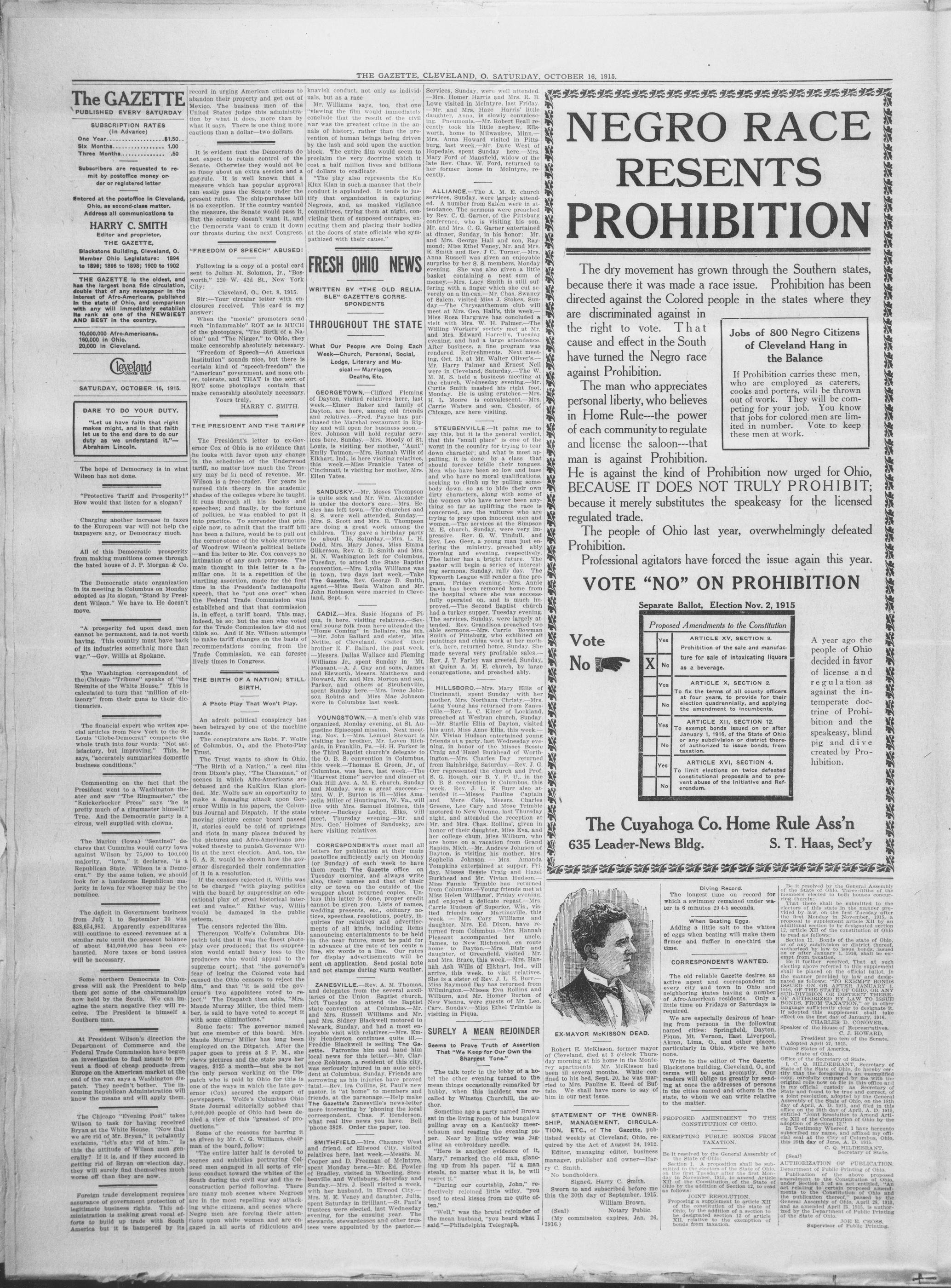
NEGRO RACE RESENTS PROHIBITION
The dry movement has grown through the Southern states, because there it was made a race issue. Prohibition has been directed against the Colored people in the states where they are discriminated against in the right to vote. That cause and effect in the South have turned the Negro race against Prohibition. Jobs of 800 Negro Citizens of Cleveland Hang in the Balance If Prohibition carries these men.
The man who appreciates personal liberty, who believes in Home Rule---the power of each community to regulate and license the saloon---that man is against Prohibition.
He is against the
BECAUSE IT
because it merely s
regulated trade.
The people of
Prohibition.
Professional agit
VOTE "N
Vote
No
The Cuya
635 Leader-New
He is against the kind of BECAUSE IT DOES NO because it merely substitutes regulated trade.
The people of Ohio last Prohibition.
Professional agitators have VOTE "NO" O
Separate Ballot,
Proposed Amendment
Vote No
Yes
X No
ARTICLE Prohibition ture for s as a beverage
Yes
No
ARTICLE To fix the t at four y election q the amene
Yes
No
ARTICLE To exempt t January 1 or any su of authori taxation.
Yes
No
ARTICLE To limit ele constitution vent abuse erendum.
The Cuyahoga C 635 Leader-News Bldg.
He is against the kind of Prohibition now urged for Ohio, BECAUSE IT DOES NOT TRULY PROHIBIT; because it merely substitutes the speakeasy for the licensed regulated trade. The people of Ohio last year, overwhelmingly defeated Prohibition. Professional agitators have forced the issue again this year.
VOTE "NO" ON PROHIBITION
The Cuyahoga Co. Home Rule Ass'n 635 Leader-News Bldg. S. T. Haas, Sect'y
Diving Record.
The longest time on record for which a swimmer remained under water is 6 minutes 29 4-5 seconds.
When Beating Eggs.
Adding a little salt to the whites of eggs when beating will make them firmer and fluffier in one-third the time.
CORRESPONDENTS WANTED.
The old reliable Gazette desires an active agent and correspondent in every city and town in Ohio and neighboring states having a number of Afro-American residents. Only a little time on Fridays or Saturdays is required.
We are especially desirous of hearing from persons in the following named cities: Springfield, Dayton, Charleston, Lawrence, Urbana.
Be it resolved by the General Assembly of the State of Ohio, Three-fifths of the members elected to both houses concurring therein. That there shall be submitted to the electors of this state in the manner provided by law, on the first Tuesday after the first Monday in November, a proposal to supplement article XIX by an additional section to be designated section 12, article XII of the constitution of Ohio to read as follows.
Section 12. Bonds of the state of Ohio, or of any subdivision or district thereof, authorized by less bonds, issued on after January 1, 1916, shall be exempt from taxation.
Best that this be resolved. That at each election above referred to this supplement shall be placed on the official ballot, in the manner provided by law and designated as follows: "TO EXEMPT BONDS AFTER OR ENTER JANUARY 1, 1916, OF THE STATE OF OHIO, OR ANY SUB-DIVISION OR DISTRICT THERE- OF AUTHORIZED BY LAW TO EXEMPT BONDS, FROM TAXATION," or in other language sufficiently clear to designate it. If adopted this supplement shall take effect on the date stated below.
CHARLES D. CONOVER.
Speaker of the House of Representatives.
C. J. HOWARD.
Robert E. McKisson, former mayor of Cleveland, died at 3 o'clock Thursday day morning at his home in the Monterey apartments. Mr. McKisson had been ill several months. While confined to his bed, Sept. 20, he was married to Mrs. Pauline E. Reed of Buffalo. We shall have more to say of him in our next issue.
STATEMENT OF THE OWNERSHIP, MANAGEMENT, CIRCULATION, ETC., of The Gazette, published weekly at Cleveland, Ohio, required by the Act of August 24, 1912. Editor, managing editor, business manager, publisher and owner—Harry C. Smith.
No bondholders.
Signed, Harry C. Smith.
Sworn to and subscribed before me
this the 30th day of September, 1915.
William Brown.
(Seal) Notary Public.
(My commission expires, Jan. 26,
1916.)
June 30th day of September, 1915.
William Brown.
(1) Notary Public.
commission expires, Jan. 26,
kind of Prohibition no
DOES NOT TRULY
substitutes the speakeasy
Ohio last year, overw
ators have forced the iss
NO" ON PROP
rate Ballot, Election Nov. 2,
proposed Amendments to the Constit
Yes
ARTICLE XV, SECTION 9.
Prohibition of the sale and manu
ture for sale of intoxicating liqu
as a beverage.
No
ARTICLE X, SECTION 2.
To fix the terms of all county offi
at four years, to provide for the
election quadrennially, and apply
the amendment to incumbents.
Yes
ARTICLE XII, SECTION 12.
To exempt bonds issued on or a
January 1, 1916, of the State of C
or any subdivision or district th
of authorized to issue bonds, fife
taxation.
Yes
ARTICLE XVI, SECTION 4.
To limit elections on twice defea
constitutional proposals and to p
vent abuse of the Initiative and i
erendum.
hoga Co. Home
vs Bldg.
Proposed Amendments to the Constitution
X Yes
No
Yes
No
Yes
No
Yes
No
ARTICLE XV, SECTION 9.
Prohibition of the sale and manufacture for sale of intoxicating liquors as a beverage.
ARTICLE X, SECTION 2.
To fix the terms of all county officers at four years, to provide for their election quadrennially, and applying the amendment to incumbents.
ARTICLE XII, SECTION 12.
To exempt bonds issued on or after January 1, 1916, of the State of Ohio or any subdivision or district thereof authorized to issue bonds, from taxation.
ARTICLE XVI, SECTION 4.
To limit elections on twice defeated constitutional proposals and to prevent abuse of the Initiative and Referendum.
Diving Record.
The longest time on record for which a swimmer remained under water is 6 minutes 29 4-5 seconds.
When Beating Eggs.
Adding a little salt to the whites of eggs when beating will make them firmer and fluffier in one-third the time.
CORRESPONDENTS WANTED.
The old reliable Gazette desires an active agent and correspondent in every city and town in Ohio and neighboring states having a number of Afro-American residents. Only a little time on Fridays or Saturdays is required.
We are especially desirous of hearing from persons in the following named cities: Springfield, Dayton, Plqua, Mt. Vernon, East Liverpool, Akron, Lima, O., and other places, particularly in Ohio, where we have none.
Write to the editor of The Gazette, Blackstone building, Cleveland, O, and terms will be sent promptly. Our readers will oblige us greatly by sending at once the addresses of persons in the cities named and others in the state, to whom we can write relative to the matter.
PROPOSED AMENDMENT TO THE CONSTITUTION OF OHIO.
EXEMPTING PUBLIC BONDS FROM TAXATION.
Be it resolved by the General Assembly of the State of Ohio:
Section 1. A proposition shall be submitted to the seators of the State of Ohio on the first Tuesday after the first Monday in November, 1915, to amend Article XII of the Constitution of the State of Ohio by the addition of Section 12, to read as follows:
JOINT RESOLUTION.
Proposing a supplement to article XII of the constitution of the state of Ohio, by the addition of a section to be designated section 12 of article XII relative to the exemption of bonds from taxation.
Jobs of 800 Negro Citizens of Cleveland Hang in the Balance
If Prohibition carries these men, who are employed as caterers, cooks and porters, will be thrown out of work. They will be competing for your job. You know that jobs for colored men are limited in number. Vote to keep these men at work.
hibition now urged for Ohio,
TRULY PROHIBIT;
speakeasy for the licensed
ear, overwhelmingly defeated
ced the issue again this year.
PROHIBITION
tion Nov. 2, 1915
to the Constitution
Home Rule Ass'n
S. T. Haas, Sect'y
---
```markdown
```
A year ago the people of Ohio decided in favor of license and regulation as against the intemperate doctrine of Prohibition and the speakeasy, blind pig and dive created by Prohibition.
It be resolved by the General Assembly of the state of Ohio, Three-fifths of the members constituted to both houses concerning therein:
That there shall be submitted to the legislature both houses constituted by law, on the first Tuesday after the first Monday in November, a proposal to supplement article thirteen of the constitution and assigned section 12, article XII of the constitution of Ohio to read as follows:
By the legislature of the state of Ohio, or of any subdivision or district thereof, authorized by law to issue bonds, issued on or after the 1, 1916, shall be ex-communicated by it.
It be further resolved. That at such election above referred to this supplement shall be submitted to the legislature of the manner provided by law and designated as follows: "TO EXEMPT BONDS OF THE STATE OF OHIO, 1919 OF THE STATE OF OHIO, 1919 SUB-DIVISION OR DISTRICT THREE-AUTHORIZED BY LAW TO ISSUE BONDS OF THE STATE OF OHIO, 1919 LANGUAGE sufficiently clear to designate it, if adopted this supplement shall take effect on the first day of January, 1916, on the House of the Senate, Speaker of the House of Representatives.
C. J. HOWARD,
President pro tem of the Senate.
Adopted April 27, 1915.
United States of America.
Office of the Secretary of State.
I. C. Q. HILDEBRANT, Secretary of
State of the State of Ohio, do hereby certify
that the original copy, carefully compared by me with
the original roll now on file in this office arrl
my official custody as Secretary of
State of Ohio, and that a joint resolution, adopted by the General
Assembly of the State of Ohio, on the 18th
day of April, 1915, and filed in the
State of Ohio, on the 18th day of April, 1915,
entitled "Joint Resolution to Amend Arti-
llement of the 28th day of April, 1915,
constitution of Ohio by the
adoption of Secretary of State.
In Testimony Whereof, I have hereunto
submitted my name, and affixed my official seal at the City of Columbus, Ohio,
this 28th day of April, 1915,
C. Q. HILDEBRANT,
Secretary of State.
[Seal]
AUTHORIZATION OF PUBLICATION.
Department of Public Printing of Ohio.
Publication of the above proposed
amendment to the Constitution of Ohio,
and that a joint resolution, entitled "An
act relating to certain provisions,
amends to the Constitution of Ohio and
the publication thereof," passed by the
State of Ohio, on the 18th day of April, 1915, is authorized
and as amended April 25, 1915, by the
Department of Public Printing of
the State of Ohio.
JOE E. CROSS
Supervisor of Public Printing.
MME.C.H.JONES' Hair Tonic and Invigorator
HER TONIC is the result of scientific study of the causes of diseases of the scalp.
Instead of treating effects of the diseases she treats the causes, eliminating the same and treating the scalp in the healthy condition that can be maintained by using her Hair Tonic and Invigorator, according to her directions.
Madame C. H. Jones Hair Tonic and invigorator is guaranteed to stop the falling out of the hair and to make the hair grow.
It has been successfully used by many even 100 and with perfect satisfaction. This Tutorial by many Toledo people and elsewhere, by many People people get diseased scabs by using widely advertised hair tonics pre-treatment and have in mind nothing but mercury gain.
On the other hand, MADAME JONES
H. JONES is a brand of hair
solutely harmless and will do all that
is claimed for it.
M. H. JONES Hair Tonic and
Invigorator promotes the growth of
the hair, prevents and cures baldness,
reduces dandruff and it restores
dance and beauty; it restores
the color of the hair by supplying it with the
natural elements and necessary nourlash-
ing.
MADAME C. H. JONES
883 Woodland Hills
Toledo, Ohio
Agents Wanted.
STERLING
5 and 10 Cent Store
3003 Central Ave.
Watch Our Windows
For Bargains
Colored Salesladies
We close at 6 P.M.every evening except Saturday
Arlington Pharmacy
WE WILL ACCEPT THIS ADVERTISEMENT FOR FIVE CENTS IN TRADE, TO APPLY ON ANY PURCHASE OF TWENTY-FIVE CENTS OR MORE.
E. Rukenstein, Ph. C., Prop.
B. W. Cor. Central Ave. & E.
55th St.
Your Eyes are Your Breadwinners!
Why Not Protect Them?
In order to introduce our work, bring this advertisement with you and we will give you a regular $6.00 pair of eyeglasses and a leather case for $3.75. Thorough examination.
Louis B. Rappaport
Eye Specialist
No. 7 Haltnorth Building, E.
55th St., near Woodland Av.
Central 3647 R.
J. LOMSKY
3816-3820 Central Ave.
DRY GOODS
LADIES' AND GENT'S
FURNISHINGS
Try Our
Lomsky Special $1.00 Coreets,
Also our Ladies' $1.00 Waists
They are good
Where do you
buy your Collars, Shirts, Neckwear, etc.?
is the place to get Everything in the Haberdasher line.
2922 Central Ave.
DON'T THROW AWAY
Your copy of The Gazette after reading it, but give it to a friend or an acquain tance who might subscribe after reading a copy of the paper.
Editor
Where to Purchase The Gazette
Where to Purchase The Gazette
PUSHAW
The Arcade.
Superior Entrance.
NOTICE TO SUBSCRIBERS
Subscribers not receiving The us at once. We desire every copy We advise our patrons to care tisements before making purchases this paper should have the patron that they advertise is assurance the Local reading notices (adver words in a line).
We advise our patrons to carefully examine The Gazette's advertisements before making purchases. Business men who advertise in this paper should have the patronage of Afro-Americans. The fact that they advertise is assurance that they want it. Local reading notices (advertisements) ten cents a line (six words in a line).
Social and Personal
Our Classified Ad Department
FOR RENT — Two unfurnished rooms, upstairs, 2180 E. 76th St.
FOR RENT — Nice furnished room for man and wife or two gentlemen, 3857 Carnegie Ave.
FOR RENT — Four large rooms, down stairs, at 6012 Blaine Ave. Inquire of Wm. Thomas, 9014 Blaine
FOR SALE — Good houses; two and three hundred dollars down. S. E. Woods, 2828 Central Av. Bell phone, Prospect, 996.
FOR RENT — Houses and Rooms — If you have them to rent or if you want to rent, advertise in The Gazette. It sells. Costs.
FOR SALE — Restaurant doing a good business. Selling on account of poor health. S. E. Woods, 2828 Central Ave. Prospect 996.
FOR SALE — Seven room house, all improvements, on E. 101st St. near Cedar Ave. Low price to early buyer. Apply at The Gazette office.
FOR SALE—Barber-shop in a downtown business block. A splendid opportunity. Address George J. Brooks, 2227 E. 90th St. Cleveland, O.
NOTARY PUBLIC—For such services call at The Gazette office, No. 2 Blackstone building, No. 1424 W. Third Street, near Superior Ave.
FOR RENT—Five nice rooms (down stairs) in the "East End;" bath, gas, large cellar, yard, etc. Apply, Suite 2, Blackstone Building, 1426 W. Third St, near Superior Av.
FOR SALE—Houses or lots. If you have either or anything else to sell, or if you wish to purchase, advertise in The Gazette. If anything can bring you results, it can and will.
Cleveland
Sixth City
Harry Palmer and Ernest Neil were here from Alliance, Saturday.
Mr. Frank Harper, 2366 E. 43rd St., died at Huron Rd. Hospital, the first of the week.
Miss Alice Taylor, E. 27th St., and Mr. Charles West, the electrician, were married, Monday evening.
Mr. David James, of Pittsburg, is visiting his sister-in-law, Mrs. Lee Thomas, Winona Apts.
Mrs. Mamie Alkerns is expected home from New York, this week. Her mother, Mrs. L. Cunningham, E. 43rd St., is still ill.
Robert Mitchell, 3005 Central Ave., and Miss Gladys Henderson, 6112 Quincy Ave., were licensed to wed, the past week.
Miss Myrtle Johnson addressed the P. W. association ladies last Sunday, on the formation of good habits. Mr. Clarence Cheeks will make the address, Sunday.
Our advertisers want your trade. Those who do not ask for it in The Gazette certainly care little, if at all, to prove, we urge our readers and all 46 our friends to patronize those who ask for your trade in this paper.
Mrs. Grant Russell of E. 90th St., entertained a breakfast, Tuesday, in honor of Mrs. W. M. McFall and aunt, Mrs. White, of Montreal, Can. Those present: Mesdames Taylor, Turner, Isom, McFall, White. H. S. Slaughter, and Miss Moore. Covers were laid for eight.
St. John's S. R. rally attendance, Sunday, was unprecedented, 1027 being present. The goal was 900. The collection was $40.97. The superintendent and his excellent corps of workers were unlimited praise for their success. He delightfully entertained the board. Tuesday evening.
Mrs. Sarah Bailey was recently appointed teacher of night schools in the Sterling building. She retains her day position as teacher. Mr. George Sutton who was night school teacher, last year, left last week for Washington, D. C., to matriculate in the medical department of Howard University.
Neither men nor women who have been notoriously dishonest with their fellowmen, especially members of the same church, should be retained in the church as members, to say nothing of their being officials of the church. They should not be allowed to foist themselves on the church in any way. This has been the case in recent years and it ought to be stopped.
Let the good members be more active and insist upon a "house-cleaning" for the good of the churches.
---
---
THE GAZETTE, CLEVELAND. O. SATURDAY, OCTOBER 16, 1915.
The Gazette regularly should notify
delivered promptly.
fully examine The Gazette's adver-
s. Business men who advertise in
image of Afro-Americans. The fact
that they want it.
tisements) ten cents a line (six
Personal
Be sure to read the advertisements
in our "classified ad" department
in column 2, page 3.
The local Howard University club
hold an interesting meeting in S. E.
Wood's office. Tuesday evening.
Tell your friends and acquaintances in the 19th ward to attend the Stolte meeting at St. James' A. M. E. church, Tuesday evening. Good speakers and music.—Adv.
Five nice rooms for rent, in the "East End"; bath, gas, large cellar, yard, etc. Apply, Suite 2. Blackstone Building, 1426 W. Third St., near Superior Ave.
Wanted—1,000 men to trade regularly at the Central Shirt Shop, 2922 Central Ave. Hats, caps, neckwear, underwear, arrow collars and shirts, etc.—Adv.
Rev. J. S. Jackson preached two splendid sermons at St. John's A. M. E. church, Sunday. Rev. E. A. White of Cory M. E. church, extended the S. S. members at their rally, Sunday, an invitation to attend Cory's S. S. rally. The Topap Cluster club met at Mrs. Minerva Taylor's, Cedar Ave, last Friday. The next meeting, at Mrs. Bessie Kittmiller's, Superior Ave. The club has issued invitations for its Autumn dance, next Friday evening, at Waldo Hall, Hought Ave.
The sacred cantata "Jeptha and his daughter," directed by Jay W. Noble will be given at the Central Y. M. C. A., for the benefit of Antioch Baptist church, Oct. 28. Mrs. Mamie Willis Hawkins is in charge of the arrangements for the cantata.
We regret exceedingly to announce that Mr. Wallace Bolden of 2214 E 33th St. is at home very ill. Pneumonia. He has been confined to the hospital with prospects of remaining at least two weeks longer so his physician says.
Do not fail to read carefully each week. The Gazette's editorsial (in cols. 1 and 2, page 2). They mean much to you, reader. If you want to keep up to date in matters of race interest, you must read "the old reliable" Gazette. This is admitted generally.
Send or bring locals and all business matters to The Gazette's offices, suite 2, Blackstone Bldg. If you wish to see the editor call there, please. At matters for publication in current issue of The Gazette, must be in the office by 4 p. m., WEDNESDAY at the latest.
Our voters in the 19th ward should not fail to attend the great mass meeting at St. James' A. M. E. church, Hudson Ave. Tuesday evening. Councilman Stolte, who is a candidate for reelection, will be the principal speaker. Good music. Ladies welcome, also. See advertisement elsewhere in this paper.—Adv.
Mervin Kyle Green, aged 41, 2387 E. 34th St., died Oct. 8. Funeral services, Oct. 12, from Cory M. E. church. Rev. Mr. Brown of Mt. Pleasant, officiating, October 12, in the latter's interest in E. Cleveland cemetery. The deceased leaves a wife, four children, mother, six sisters and three brothers to mourn his demise. He was a member of Edwin Cowles lodge, K. P., and the Philligan band. Slaughter Bros. funeral directors, in charge.
The Men's club of the Second Pressbyterian church, cor. Prospect Ave. and E. 30th St., Tuesday, announced the organization has acquired land in the vicinity of Central Ave. S. E. and E. 30th St., and secured social and social settlement house. The club officers and Rev. Paul F. Sutphen, pastor of the church, were authorized to acquire the land at a recent meeting of the club. As directors of the church, he was appointed Mrs. Russell Jelliffe. Both, graduates of Oberlin college and of the Dr. Graham Taylor School of Civics and Philanthropy of Chicago.
The DuBois Literary club held a very interesting session at Mrs. Geo. Bundy's, E. 35th St. Wednesday afternoon. Only one absent member. The club had as guests, Rev. Sterling N. Brown of Washington, D. C. Mrs. Harmon, mother of Mrs. Bee Subanks, mother of Mrs. Miss Walker. The club is contemplating presenting soon Mr. Roland Hayes of Boston, an artist of rare ability. Mrs. Florence Robinson of Scovill Ave., will be hostess to the club at its next meeting, when Harrett Beecher Stove will be the guest. The books are soon to be taken up by the club. Mrs. Mayne Copes was elected a member of the club.
Rev. Thomas Dixon, the author of "The Leopard's Spots" and "The Clansman" has committed grave literary offenses, so grave that has name has become anathema among a large class of American readers. A man who has used race prejudice and the most disgusting sensationalism as the basis on which to build a literary reputation has gone far on the road toward unforgivability. These earlier books were worse than worthless. They were an influence for evil in American life. Their undoubted financial success raised up a host of feeble and paltry imitators, while the Dixon clientele cried for more and more Dixonism. For a time the author met this demand.—Cleveland Plain Dealer.
Mrs. C. F. Williams Jef, Oct. 7, for San Francisco, to spend the winter
Miss Minnie Schuman, a reformed Jewess, gave a very interesting talk at Antioch Baptist church, Sunday afternoon.
A social and supper, for the benefit of Arnett Lodge, U. B. F., will be given at Mr. and Mrs. John Mann's, 2188 E. 39th St., Oct. 19.
Mrs. Will Robinson, Enoch St., left Sunday morning to attend a convention in Columbus. Little Anna and Bob C. Finkley accompanied her.
Some weeks ago, Geo. A. Myers and others notified The Gazette that there was to be an investigation of the management of the Old Folk's Home, following the various "Mrs. Essie Brown" complaints. What has become of the movement looking toward the promised investigation?
Mr. Richard Scott of Aetna road, for many years in the government's railway mail service, sent The Gazette a souvenir postcard from Elizabeth, Pa. Oct. 7, 15, on which he wrote: "Dear Jewess, I am on my vacation and having a good time." Many thanks, "Dick," for the very pretty card. Sorry we were not with you.
Last fall when the fight was on between the "wets" and the "drys" just as it is now—who was it that announced ("with a flourish of trumpets" and with a "sour grapes" taste were "for prohibition"—because The Gazette stood for "home rule" (then as it does now? Where are they, this time—for prohibition or for home rule? We hear that they have capitulated and now oppose prohibition and stand for "home rule"? Good! Better late than never! Of course The Gazette had to lead in this as in all other good movements of material interest to the race locally and other areas. In the coming and go, you know—that is 15 of them have, right here in Cleveland, since the birth of The Gazette nearly 33 years ago—but, "the old reliable" Gazette stays with you and is always "on the job" and in the lead.
MESDAMES BUNDY AND MAXWELL.
St. John's Y. W. M. M. Gleaners held a "call" meeting in honor of their superintendent, Mrs. Chas. Bundy, who leaves, this week, for Toledo, and presented her a beautiful ivory toilet-set and the following resolutions:
Morecases, Sister Bundy has been our superintendent since our organization and, has by her words of sympathy and loving counsel, encouraged and strengthened us until we have been able to reach a point in our progress of which we may justly be proud.
Be it resolved, that we extend to Sister Bundy a hearty vote of thanks for her service. She has won for herself a place in our hearts and work that can not easily be filled.
Be it resolved, that we cherish the ideals she has instilled in us both by word of mouth and the life she has lived before us.
Be it resolved, that we wish her God's blessing in her new home. May she find there as loving and loyal friends as ever we have, and may she be to them the inspiration and help she has been to us.
Be it further resolved, that a copy of these resolutions be sent to Sister Bundy, a copy spread on the pages of our minutes, and a copy sent to The Gazette. Respectfully submitted.
Respectfully, submit,
Nettie Miller and Lillian Scott, commit.
Resolutions were also drawn for our secretary, Mrs. Maxwell, who has moved to Lebanon. She was presented with a beautiful picture.
15
JUDGE SAMUEL E. KRAMER.
Samuel E. Kramer was born in Newark, O. in, 187, and came to Cleveland in 1883. He attended Cleveland's public schools, graduating from Central High school in 1896; Adelbert college in 1900; Western Reserve Law school in 1903, and was admitted to the bar in that year. He practiced law as a member of the firm of Kramer & Chapman, and later of Ewing, Kramer & Counts, until 1912. In 1907 he was elected to the City Council from the 22d ward and was re-elected in 1909. In his second term, Mr. Kramer was chairman of two most important council committees — street railways, and appropriation and finance. In 1911, he was elected judge of the Municipal Court for the term beginning Jan. 1, 1912 and ending Jan. 1, 1914. Kramer has earned re-election. It is the common and general verdict that he has proven himself to be one of the very best judges on the bench — fair and just to all without relation to race, or class. The Gazette urges its readers, voters, to remember him on election day, next month. Adv.
O Lord, help us to tear the soldiers at the foe to bloody shrieks with our shells, help us to cover their smiling fields with the pale forms of their patriot dead; help us to lay waste their humble homes with a hurricane of fire; help us to wring the hearts of their offending widows with unavailing grief. Blast their hopes, blight their lives, water their way with their tears.—Mark Twain.
Mixtures In Type Metal.
Type metal, from which the types used in printing are made, consists of 65 parts lead, 25 parts antimony and 10 parts tin.
INDUSTRY OF GREAT VALUE
Most Essential Service for Humanity
Performed by Those Who Manu-
fature Fertilizers.
In the American Magazine Ida M.
Tarbell, writing another article in
her business series entitled "The
Golden Rule in Business," emphasizes
the usefulness of the fertilizer bus-
ness as an industry. Following is an
extract from what she has to say:
"Few businesses perform a more essential service. Making two blades of grass grow where there was one, or none, is the useful task of a fertilizer plant. It serves men, not only by what it produces, but by what it saves. Into its mixture go substances derived from otherwise useless waste, the dregs and refuse of great industries. Millions of pounds of trimmings from factories using leather and rubber and felt are turned into ammonials in its great incinerators. From the pomace left from the making of cottonseed and castor oil, from the horns and hoofs of the slaughter house, from the remains of fish and meat canneries, are made meals which the soil greedily swallows, to give back to us later more abundant crops of grain and vegetables and flowers.
"This waste and its transformation, the making and using of acid, all produce smells which cause an active and painful nausea to the unaccustomed. When men first go to work in the plants they are often unable to eat, or at least to retain food, for a week or more. I have never found a doctor who thought this nausea had any more than temporary effects, like the ordinary seasickness. It is, however, a painful experience and should be relieved, if possible."
WHALE MEAT A GOOD FOOD
Is Being Used for Frankfurters in Denmark, and Is Said to Be Highly Nutritious.
Frankfurters made of whale meat are getting to be quite the thing in Denmark, according to Elnar Tenniksen, a mechanical engineer of Tonsberg, Norway.
Mr. Henrikksen came to America to study drop forging. He was graduated from a school of mechanical engineering in Christiania a year ago, and planned to go to Germany and then to come to the United States to study this particular line of engineering, but the war kept him out of Germany.
"There has been developed in Norway in the last few years a new field of industry in which mechanical engineers are much interested," said Mr. Hendricksen. "This is the designing and manufacture of machinery for cutting up whales. It requires special machinery, of course, and the investigation of the whale in relation to the kind of machinery required for dissecting it developed the comparatively new industry of using whale meat for frankfurters. A big business has grown out of this. Most of the whale meat is sent to Denmark and there made into frankfurters. Whale meat tastes not unlike beef and is very nutritious. I have frequently eaten whale steaks."
Uncle Eben.
"When a man has a general grouch," said Uncle Eben, "he tries to kind o' apologize for it by kickin' bout de weather."
World's tallest trees.
The tallest trees are the Australian
sucalyptus, which attain a height of
180 feet.
Center for Pens and Pins.
Birmingham (England) is a large
producer of pens and pins.
Red and white currants, like melons,
apples, oranges, limes, lemons and
gooseberries, are cooling and therefore
most acceptable hot weather foods.
STOP, READ AND THINK
How do you invest your money? Why not in real estate? Something no one man or two can carry away. I have lots from $150 up, on easy terms. Also a few lots left in Mt. Pleasant. Call or address.
R. W. WINBUSH
2192 E. 35th St. Prospect 1043-J
G. G. REED
Dry Goods
Ladies' and Gents' Furnishings
Sole agents for the
AMERICAN LADY NEMO
R. @ G. COR>ETS
3222 Central Ave.
The Pride of Carolina
The State Agricultural and Mechanical College of South Carolina
Orangeburg, S. C.
Next session begins September 29th and ends May 25th, 1916.
No Tuition, no Room Rent, no Charges for Water, Lights or Fuel. Entrance Fee $10.00.
Board $6.00 per Month in Advance. Books, Laundry and Personal Expenses Extra.
Every Modern Facility, Standard Equipment, Faculty of 57 Officers and Instructors.
For Information and Catalogue, Write
R. S. Wilkinson, Pres.
Orangeburg, S. C.
Grand Mass Meeting
AT
St. James A. M. E. Church
HUDSON AV.
Tuesday Evening
8 P. M. SHARP
IN THE INTEREST OF COUNCILMAN WM. STOLTE, CANDI-
DATE FOR RE-ELECTION IN THE 19th WARD.
REV. C. H. YOUNG WILL PRESIDE
and there will be other speakers and also music.
THE LADIES WELCOME ALSO
Cuyahoga, Central 5727
Doctor's Cafe
(THE Z)
1035 Central Avenue
rop. Frank Doctor, Manager
James Mabel, Chef
Quality Service
LAUGHTER BROS.
DIRECTORS & EMBALMERS
and Funeral Parlors
3923 Central Av.,
occasions Calls Answered Day and Night
GOLD BOND
THE CREAM OF
TABLE BEERS
Cuyahoga, C
Edward Do
(T H
3035 Centr
Wm. Brack, Prop. -
James Ma
Rosedale 2770
SLAUGHT
FUNERAL DIRECTOR
Office and Fu
3923 Cent
Autos for All Occasions
Cuyahoga, Central 5727
Edward Doctor's Cafe
(THE Z)
3035 Central Avenue
Wm. Brack, Prop. - - Frank Doctor, Manager
James Mabel, Chef
Autos for All Occasions Calls Answered Day and Night
GOLD BOND THE CREAM OF TABLE BEERS
W.785 C.3933
The Cleveland and Sandusky Brewing Co.
NEW SHAMPOO DRYER
Hair Straightening Comb
One World!
Price $1.00
instated, and the use of LaCreole Hair Pomade, will bring the most
and silky at every stroke and cause a rapid growth of the hair.
and $1.00 today and get the comb by return mail. It is Large,
stable. Made of copper and brass associated together and cast
highly polished and fully nickel theiliary steel hoot which goes
through the large wood handle and screws into
metal end of Comb to prevent the handle from
getting loose or coming off. Remember it's
all in one piece. Nothing to get out of order.
Will last a lifetime.
Price of Comb
and Alcohol
Heater, complete,
$1.50.
Here is the top!
AL ALCOHOL HEATER is the handiest and most convenient
Comb, and can be closed up so that you can put it in your
LaCreole Hair Pomade. It not only meets every requirement
but promotes a luxuriant growth of hair. Price, by mail, 38c.
W. W. L. L. POWER, mail, 30c.
REE CATALOGUE illustrating the lazy set and Most Complete
this country for colored people, such as Bangs, Wigs, Puffs,
Hair Pins, Combs, Brushes, etc.
ed.
T. W. TAYLOR,
348 Antoine St.
DETROIT, MICH.
When writing, please mention this paper.
ADVERTISE IN
TAYLOR'S NEW
and Hair Strain
The Best in the World!
This Comb, severely heated, and the use of
crumpy hair, straight and silky at every st
Don't put it off but send $1.00 today and
Heavy, Strong and Durable. Made of corn
into one solid piece; highly polished and
the met
get all
Fill and light here
Here is the top 2
TAYLOR'S SPECIAL ALCOHOL HE
method of heating the Comb, and can be
handling. Please see.
For best results use LaCreole Hair Po
of the Comb Straightener; but promotes a
LACREOLLE BROWN SKIN FACE PRO
SEND FOR MY FREE CATALOGUE
Line of Hair Goods in this country for c
Switches, Pompadours, Hair Pins, Combs.
Agents Wanted. T. V.
When writing, please
ADVERTISE IN THE GAZETTE
TAYLOR'S NEW SHAMPOO DRYER and Hair Straightening Comb
The Best in the World!
Price $1.00
This Comb, properly heated, and the use of LaCreole Hair Pomade, will bring the most crimpy hair straight and silky at every stroke and cause a rapid growth of the hair.
Don't put it off but send $1.00 today and get the comb by return mail. It is Large, Heavy, Strong and Durable. Made of copper and brazeassociated together and made into one solid piece; highly polished and fully nickel plated. Steel bolt which goes through the large wood handle and screws into metal end of Comb to prevent the handle from getting loose, on coming off. Remember it's all in one piece. Nothing to get out of order. Will last a lifetime.
Fill and light here
Price of Comb and Alcohol Heater, complete, $1.50.
Here is the top!
TAYLOR'S SPECIAL ALCOHOL HEATER is the easiest and most convenient method of heating the Comb, and can be closed up so that you can put it in your handbag. Price $50.
For best results use LaCreole Hair Pomade. It not only meets every requirement of the Comb Straightener; but promotes a luxurious growth of hair. Price, by mail, $30.
LACREOLE BROWN SKIN FACE POWDER, by mail, $30.
SINED FOR MY FREE CATALOGUE! Illustrates the Largest and Most Complete Line of Hair Goods in this country for colored people, such as Bangs, Wigs, Puffs, Switches, Pompadours, Hair Pins, Combs, Braushes, etc.
Agents Wanted.
T. W. TAYLOR
When writing, please this paper.
In some parts of Siberia milk is sold frozen around a piece of wood, which serves as a handle to carry it.
Does Away With Misdeals.
A Frenchman has invented a machine for dealing cards that is said to make misdeals impossible.
---
---
Southern Medicine Co.
COUPE
COUPE
COUPE
WOMAN'S CHARM
Pretty hair lends a charm to a woman's face and makes her attractive.
face and makes her attractive.
HER-TRU-LINE makes pretty hair. It cleans, and heals the scalp, removes dandruff, stops the hair from falling out, breaks in, and HER-TRU-LINE removes the ugly kinks and curls, and makes the hair grow so long and soft that it can be done up in any style.
This pretty picture was sent us by a customer made happy by using HER-TRU-LINE. Large jars 50c at drug stores and by our website.
Send us ten cents for a sample box and you will thank us for telling you about it. Agents wanted.
Central 3371
STARLIGHT'S CAFE
A. D. Boyd, Prop.
J. C. Hudson, Mgr.
J. H. Starkey, Mixologist
Choice Wines, Liquors and Cigars
3221 Central Ave., Cleveland, O.
QUESTIONS WILL SOON BE SETTLED
Officials Believe Troublesome Diplomatic Controversies Nearing an End.
ONLY FOUR STILL TO BE PRESSED
The Demand Upon Great Britain to Cense Illegal Seizures of American Ships and Cargoes the First in Importance.
Washington, D. C.—The progress made by the state department in the last 10 days in clearing up the most acute of its diplomatic controversies has led high officials to believe all troublesome international questions will be settled soon, perhaps before the end of the year. Reviewing the situation, one of the state department officials said that of all the questions which confronted this government the two most threatening and difficult were the situation in Mexico and the controversy with Germany. These are now practically removed from the sphere of serious diplomatic questions. There remains to be pressed to a conclusion, he said, the following:
Questions Yet to Be Settled.
First, the demand upon Great Britain that she should conduct her warfare, so far as it affects neutral rights, according to the rules of international law. Second, the ratification of the long held up treaty with Colombia, the object of which is to restore friendly relations with that important republic. Third, the establishment of a firm basis of the republic of Haiti, now practically a protectorate of the United States. Fourth, the efforts of the United States to obtain protection for Armenian Christians in Turkish territory.
The demand which the United States has made upon Great Britain, that she cease the illegal seizure and detention of American ships and cargoes bound for neutral ports is the first in importance of the unsettled questions. While it is true that Great Britain for the past year has stood on her own construction of international law, state department officials say that Great Britain's recent release of hundreds of millions of dollars' worth of American owned goods of enemy origin, contracted for before March I, is an intimation at least that Great Britain may receive the demands of the note, which is about to be revised by the president, in a somewhat more accommodating spirit than she has manifested heretofore.
All officials agree that the practical settlement of the controversy with Germany makes imperative the strongest possible statement of American rights to Great Britain. It is not impossible that the note to Great Britain will be reviewed by the president today and sent on its way at once.
The treaty with Colombia is regard ed as extremely important. The treaty proposes to pay Colombia $25, 000,000 for all its supposed losses and thus to restore friendly relations.
FACING CERTAIN DEATH
LONG ISLAND LAWYER VICTIM OF DREADED CATTLE DISEASE OF SOUTH AMERICA.
New York City.-Facing certain death from one of the most rare and subtle diseases known to medicine, George F. Stackpole, a leading lawyer of Riverhead, L. L. lay propped up in his cot at Bellevue hospital. Mr. Stackpole, until a few days ago a hale and hearty man of 71, is the victim of anthrax, the dreaded sheep and cattle disease of South America. The virus is imparted to human beings by an insect, and there is cure known to science for its ravages.
This is the third case of this subtle disease to come to the attention of physicians within two weeks, and it is felt that a fatal epidemic may invade New York and its environs.
MAYBE MARRIED SOON
BELIEVED WEDDING OF PRESIDENT AND MRS. GALT WILL OCUR WITHIN TEN DAYS
Washington, D. C.—The belief is growing in official and social circles because of the wedding of President Wilson and Mrs. Galt will take place within the next 10 days. Washington would not be the least bit surprised if it occurred before Tuesday evening. It is generally understood that the ceremony will be as private as possible. Secretary McAdoo and Mrs. McAdoo, who were to have left here for the west last Friday, have postponed their departure until Tuesday. Miss Margaret Wilson, who was due at the White House on Friday of this week, will return three or four days earlier.
Slide Closen Canal
Panama.—A careful survey of the slide in the Galliard cut reveals the fact that there probably are 10, 900,000 cubic yards of earth in motion, which must be taken out by dredging operations before a permanent channel through the cut is possible. This is the conclusion reached by the canal engineers, who concede that there is little hope of opening the waterway, even for the temporary use of shipping, much before the first of the year. It is the greatest slide in the history of the canal.
Vescar Semi-Centennial Exercises.
Vassar Semi-centennial Exercise
Poughkeepsie, New York—Alumnus commemorative exercises to celebrate the semi-centennial of the founding of Vassar college by the wealthy brewer, Marianne Laushey were held here today. This morning addresses were delivered by three prominent Vassar graduates—Mary A. Jordan of Enlish at Smith College; Ellen C. Semple and Julia C. Lathrop, chief of the children's bureau of the United States department of labor. In the afternoon the students presented the "Pascant of Minerva."
MRS. NORMAN GALI
© by
ARNOLD
GENTHE
HIV
Mrs. Norman Gait is the wealthy widow who is to become the wife of President Wilson. She is a southerner and has lived in Washington nearly all her life. A TIME OF SPECIAL STRESS AND TEST
CONSERVE PRINCIPLES OF PATRIOTISM
Calls Upon the Women of the D. A. R. to Assist in Persuading Americans of Foreign Birth to Stand for 'America First.'
Washington, D. C.—President Wilson, in an address before the Daughters of the American Revolution at their 25th anniversary Monday attacked the "vocal" byphonetic American who so "lily represents the greater number of our foreign citizens" and called upon the women of the organization to assist him and the officers of the government in persuading Americans of foreign birth to stand for "America first." The president said in part:
'America First.'
"Now we have come to a time of special stress and test. There never was a time when we needed more clearly to conserve the principles of our own patriotism than this present.
"There have been some among us who have not thought first of America, who have thought to use the might of America in some matter not of America's originate and they have forgotten that the first duty of a nation is to express its principles in the action of the family of nations and not to seek to aid and abet any rival or contrary ideal.
"America has a great cause which is not confined to the American continent. It is the cause of humanity itself. I do not mean in anything that I say even to imply a judgment upon any nation or upon any policy, for my object here is not to sit in judgment upon anybody but ourselves and to challenge you to assist all of us who are trying to make America conscious of nothing so much as her own principles and her own duty."
ciples and her own duty."
RIVALS JUKES FAMILY
INVESTIGATORS FIND 58 BLOOD RELATIVES OF OHIO FAMILY ARE IN INSTITUTIONS.
Columbus, O. — Fifty-eight blood relatives confined 'in penitentiaries, jails, infirmaries, institutions for reeble minded or industrial schools. This is the record of an extensive family of degenerates traced the past year by the Ohio juvenile research bureau.
In announcing the results Dr. T. H. Haines, director of the bureau, declared the family history already discovered was the basis for a record comparable to that of the notorious Jukes family, which has been familiar to sociologists for the last 40 years.
The "Mengold" family—this is the fictitious name which has been chosen for the newly traced clan of degenerate men, women and children—lives mainly in southeastern Ohio and lower Ohio river counties of West Virginia.
Five generations of the family have been charted, including 474 individuals. Definite data on 261 of these show the following condition of degeneracy: Sixty members of the family have court records. Fifteen have been in jail, 14 in the penitentiary, 9 in the infirmary, 9 in children's homes, 6 in the workhouse, 2 in the girls' industrial home, 2 in the institution for fee minded and 1 in the boys' home.
Probe Patient's Death.
Athens, O.-Coroner J. J. Lane and Prosecutor J. P. Wood spent several hours investigating the death of Gabriel E. Graham, 57, an Athens county patient at the Athens State hospital, who died in a struggle with two attendants and two patients, who say they were attempting to undress him and put him to bed. A post-mortem examination revealed six of Graham's ribs were broken. All patients and hospital physicians who saw the struggle said Graham was violent and tried to beat off his keepers with a chair.
To Train Schoolboys
New York City.-The plan to train 1,000,000 schoolboys throughout the country to be soldiers is embodied in an application made to Supreme Court Justice Ford for the incorporation of the National School Camp association. It was signed by Ernest K. Coulter, ex-clerk of the children's court and head of the "big brother" movement and now superintendent of the Society for the Prevention of Cruelty to Children, and other prominent men. It is proposed to have the schoolboys drilled regularly.
THE GAZETTE, CLEVELAND, O. SATURDAY, OCTOBER 16, 1915
CAP
and
BELLS
SMITH HAD THE WRONG IDEA
Easy to Imagine Large Volume of Music Was Made by Hands and Feet, but Not by Ear Alone.
One evening Smith jitneyed to the suburbs to call on his friend Jones, and while they were sitting on the veranda enjoying their after-dinner ragweed large volumes of music broke loose in the adjacent bungalow.
"Some music," commented Smith, glancing through the fireplaces to the scenery beyond. "Who might the performer be?"
"It is my neighbor Green," answered Jones. "And would you believe that he plays by ear alone."
"I would not," was the prompt rejoinder of Smith. "I can easily imagine that he might make that much noise by using both hands and feet and an ax, but you can't make me believe that he does it by banging the side of his head on the keys."-Philadelphia Telegraph.
His Trollex Twisted
He was raving to his family about the fair maid that he had selected to lead him up before the parson.
"Her golden hair, her velvet complexion, her liquid eyes—" he was saying, when his ten-year-old sister interrupted him:
"You are getting things mixed, George," she said. "It is her complexion that is liquid. I was with her when she bought it."
Wrong Impressions
"You will observe," said the professor, "the higher the altitude attained the colder the temperature becomes." "But isn't it warmer up in the mountains?" asked the youth at the pedal extremity of the class. "Certainly not," replied the professor. "Why do you think it would be warmer there?" "I thought the atmosphere was heated by the mountain ranges," answered the youth.
Mrs. Snooper—Man makes me tired.
Mrs. Swayback—What's the matter now?
Mrs. Snooper—My husband saw Mrs. Keedick yesterday, and I asked him what she had on, and he replied, "Oh, clothes."—Stray Stories.
The Element of Enjoyment.
"What satisfaction did you derive from paying a fortune for that quiet old picture?" asked the woman who is not very appreciative of art.
"The satisfaction," replied Mrs. Cumrox, "of showing our old friends that we could afford to spend all that money."
GEORGE WAS OUT ONE.
A
George--I've fixed that kid brother so he won't watch us any more. I have paid him a dollar and he has agreed not to bother us for a year. She--That's too bad. I got engaged to Freddy last night.
His Patience.
"If you had to work—just nahcherly had to," queried Seldom Fedd, who was a great hand to cogitate, "what kind of a job would you choose?" "Bein' janitor in an air castle," replied Sailed Spooner, a prominent volunteer in the great army of the unemployed.—Judge.
Something Wrong.
"I paint things as I see them," said Dobbster, complacently, as the critic inspected big "Moonlight on the Hudson."
"Interesting!" said the critic. "Have you ever thought of consulting an oculist. Dobater?"—Life.
Early Indications.
"What profession do you think your youngest boy will follow?" "Well," replied Farmer Corntosset, "judging from the way he likes to play in the dirt, I think maybe he'll be one o' these land-grabbers you read so much about."
Worse Than Ghost Stories. Her Husband—Young Wederly is continually relating creepy stories. His Wife—About ghosts? Her Husband—No; about that precoctious infant of his.
DRESSES FOR EVENING
DRESSES FOR EVENING
DECOLLETE GOWNS MUCH WORN
IN FRANCE.
Best Parisian Designers Have Beer
Giving Their Attention to This Class
All the great dressmakers of Paris say that for France and England they are making, just now, very few regular evening dresses. On this side of the water demi-evening toilets are the only demanded. But these demi-evening dresses are real works of art, writes Idalia de Villiers, Paris correspondent of the Boston Globe. They are, in fact, very much the same style of dress that the lovely women of past centuries wore at great dinner parties and even balls. It is only of late years, comparatively, that decollete gowns, with no sleeves, have been worn at dinner parties.
Our grandmothers would have said that such gowns were only suitable for court balls. We have had a great many sartorial changes in the last fifty years. Nowadays decollete gowns are worn even at ordinary theaters. The picturesque gowns shown in Nattier's pictures are being copied by leading dressmakers.
These gowns nearly always show a tunic or pannier, and many of them have sets of narrow, gathered flouces at the hem of the full skirt. These flouces are headed by set rosettes made of silver ribbon, or by little garlands of chiffon or satin roses.
On some of Doucet's new models I have seen borders of fine feather trimming. This is a revival of an old and very popular fashion. The feathers are only slightly curled and the trimming is about three inches wide. One model which specially pleased me was made of pale shell-pink crepe de chine and the overdress, in fourreau form, was bordered with pearl gray feather trimming.
There were pearl gray silk embroideries on the border of the overdress and also on the corsage and at the hem of the skirt there was a deep fringe of gray crystal heads. Another model of the same order was made of flame-red crape, with a border of fine black feathers and delicate embroideries in jet and dull gold on the front of the skirt.
I have also seen feather trimming introduced on the border of evening mantles, and with the best effects. Worth showed me a model in saphire blue velvet which was bordered with feathers in a slightly darker shade in the interior, with heliocephalon chiffon, dobby shining. Feather boss are again fashionable.
A
Simple Hair Ornament of Black Velvet
Ribbon to Wear With a Tea Gown.
Simple Hair Ornament of Black Velvet
Ribbon to Wear With a Tea Gown.
the ordinary round models which have
always been dear to the hearts of the
English queens and princesses.
These boas are extremely flattering
to the skin. Smart women have been
accustomed to making fun of them,
calling them "quite too English for
anything," but I assure you that a
black feather boa is a genuine beast.
Neckwear Newness
Neckwear fashions are about as stable as the thermometer or the stock market, for one minute collars are up and the next they are down very flat. Neckwear styles for winter, however, are to be mostly high; that is, there will be some all-high collars, some flat collars and some that are high in the back and roll away in the front. The stole is a new neckwear note, as is also the cross fuchu of organdie with organdie ruchings. There will be much soft neckwear of georgette crepe, net, marquiseette and silk organdie. Colored embroidery on georgette crepe is a new feature, while burnt-orange collarettes of the same material are a popular fashion note.
ATTRACTIVE NEW TEA GOWN
Garment Has Much to Recommend It
From Many Different Points
of View.
The fact that the tea gown is always with us does not in the least diminish its attractions. Never a season dawns but we are introduced to fresh inspirations, while there is probably no garment that lends itself to greater elasticity of taste and expression. During the last year, in its quiet, rest-gown phase, it has never enjoyed greater popularity.
Akin with everything else, the tea gown has been drawn into the vortex of trainless dresses, and is frequently charming and unquestionably younger in appearance. A most admirable case in point was a model entitled by its designer a "study in black and white."
The basis of the gown was white ninon, the gathered skirt set on at a slightly raised waist line that drooped a trifle at the back. At the bem there was worked a key, or Greek, pattern in small cut jet beads, the very tiniest
PAQUIN MODEL
[Image of a woman in a long dress with a belt, standing confidently with her hands on her waist.]
The model of this afternoon dress is of gray satin trimmed with black velvet and net frill. Waist shirring is held in place by corsage bouquet. The skirt of the dress is full, with shirring forming a yoke.
Girl Who Would Remain Slim Must Arrange Her Daily Meals With the Utmost Care.
The girl who is inclined by nature toward stoutness must diet vigorously in order to keep her weight down and must beware and take care if she does not wish to be overtaken by the dreaded flesh.
If a girl belongs to a family of heavyweights, but is herself sufficiently slim for her size, she need not congratulate herself too soon on her syllabic shape, but should keep on the sharp lookout for any increase in size. Once she begins to grow stouter she will be amazed to see how rapidly her weight increases.
At the first signs of hateful fat the girl should begin a vigorous campaign against the enemy, before she is absolutely conquered by it.
The first and most powerful-weapon to usa in this warfare against flesh are diet and exercise. The diet should eliminate all sweets (cakes, candies, desserts, sodas, sugar in tea or coffee, etc.), all starchy foods (rice, white bread, potatoes, beans, peas, etc.), and all fatty foods (cream, milk, chocolate, etc). However, it is a great mistake to cut down too much on the amount of food, for it only produces weakness.
Another point about the diet is this: it is better to take three slim meals, consisting of non-fattening foods, than to eat only one meal a day, in which enough is eaten to make up for four other meals. A great many women follow this form of dieting, giving up all but one meal, but they eat enough at this one repast to make up for all their dieting
FASHION HINTS
The schoolgirl's dress should have pockets because they are both practical and fashionable.
Little girl's dresses show plain-colored belted blouses worn over plaid kilted skirts.
Day gowns are relieved from dullness by chiffon sleeves and pretty neckties.
One of the few military-influences in feminine attire that seems likely to be accorded any sound recognition is the tartan skirt.
Chiffon sleeves seem to be as much as ever in favor for fall dresses.
Odd velvet coats will be worn with cloth or rep serge skirts.
Slashed cloth skirts over velvet or silk are a charming fashion.
White organdle has been and still is in great favor.
is great.
Short puffed and long full sleeves are a feature of afternoon and evening toilets.
Among the new tweeds, subdued plaids and checks are most in favor.
procurable, because they had been closely packed. If this white ninon were mounted over a foundation of palest flesh-plink the effect obtained would be considerably softer. The quaint little paysanne bodice had the fullness of the decoletage gathered into a fold, while an entrance was effected down center front, beneath boules of jet.
Over all came a coatet of black chiffon velvet.
Frill of Tulle.
A bit of coquetry that the summer called forth is a band of tuile to drop from the edge of a toque and veil the eyes. This fancy is not confined only to the toque, but is used most attractively on the small-brimmed satiar; part of the tuile stands above the edge of the brim, and the other half falls below it, and drops to just below the eyelashes. Not only is this droopy tuile rim seen on women's hats, but it is quite as charming on little girls' bonnets of velvet or straw.
Bell sleeves are among the most charming of the new styles
AFRO-AMERICAN CULLINGS
The Hampton institute press service offers some interesting information concerning Titustown, a prosperous Negro community, which lies on the southern side of Hampton Roads, midway between Ocean View and Norfolk.
At Titustown it is possible for a colored man to build an attractive and comfortable detached house, on a lot 35 by 110 feet, for $500. For $1,500 he can build and own a house of seven rooms. He is favored also in having a vacant lot left between his house and that of his neighbor. Every family has its full quota of air space. The children are not compelled to play in the streets and roadways.
Titustown streets are straight, well graded, and bordered with trees, shrubs, and plants. To the people the rural free delivery brings the news of the outside world. It is said, on good authority, too, that every Negro in Titustown gets and reads a daily paper. Some Negroes buy and read two daily papers. "To millions of black folks, even now," says the institute's report, "this would seem ultra modern. To some it may seem strange and even dangerous that Negroes should be so up and coming, but the truth is that in proportion as Negroes get knowledge based on experience and have their wants increased, they settle down to habits of thrift and industry. This is what has happened to the Negroes of Titustown. They have enjoyed rare opportunities. They have had plenty of work to do—work on the rich trucking lands, in the United States navy yard at Portsmouth, on the great coal piers at Sewell's and Lamber's point, and on the estates of wealthy Norfolk business and professional men. They have also received good wages.
"The church at Titustown—the Mt. Pleasant Baptist church—is a fine structure. It was recently built at a cost of $12,000 and has a membership of 1,500 persons. For long, long distances colored people come to attend this church and discuss problems of lively civic interest.
"In Titustown the church is strong and very attractive, but the school is also strong and fully as substantial, it less outwardly attractive. The county school board spent $8,000 on the Titustown town school, which is a brick, four room building so constructed that and other story may easily be added. Some 250 children are enrolled and the average attendance is very satisfactory. The children in Titustown school have good teachers and a term of seven months. They are clean, happy and alert. They are physically well set up and show the good results of careful home training. The Titustown moths find it possible to remain at home and cace for their children instead of eking out a meager living over the washtub. The school equipment is good and is being steadily improved. The county manual training teacher has been able to make, with the assistance of the boys; some useful articles of school furniture. The school playground of three-quarters of an acre is kept clear of weeds and trash. A plot of two acres has been reserved for a public park. It is important that in any scheme for community building some provision should be made for recreational activities. One of the crying needs of Negro country life is healthful recreation."
A caterpillar's eyes can see nothing at a distance beyond two-fifths of an inch.
The students at Tuskegee are quoting with enthusiasm the following statement from a recent census bulletin:
"Farming in the South is passing into the hands of the black man. In the last ten-year census period the number of acres occupied by whites actually decreased; the negro acreage increased.
"The proportion of whites engaged in farming decreased; the proportion of Negroes increased. Ownership of farms by whites increased 12 per cent; by Negroes, 17 per cent. Among the whites the increase in farm tenants—men who do not own the land they work—was 27 per cent; among the Negroes it was but 21 per cent.
"The total number of white farmers working not their own but another man's land increased 188,000; the total number of Negro farmers working another man's land increased 118,000."
With wireless stations powerful enough to reach vessels in all Chinese water, the government of that nation will establish a typhoon warning service.
The ways of the law are sometimes like those of a heathen Chinese. A New York policeman, on whom three bulldogs were "sicked," had the "sicker" arrested for violating the sanitary code. It provides that canines must be muzzled.
The sound of the military rifle bullet, traveling at 1,500 feet a second, is like that of a long black snake whip, violently cracked. However, the bullet beats the sound, and if a man struck by one hears a cracking it is from some other missile.
New York city has received the first of ten rapid fire guns to be mounted on her police boats. Their attention will be devoted not to the navies of the world, but to river pirates.
When you hear a woman criticizing "society" in her town, it is a sign her application for membership has been tabled.
If you do one thin pretty well, that is enough. Very few of the really efficient performers are able to double in brass.
The fifty-third anniversary of the issuance of the emancipation proclamation by Abraham Lincoln was celebrated by the National Emancipation Commemorative society at Mount Carmel Baptist church, Washington. Lincoln issued the emancipation proclamation September 22, 1862. Louis F. Post, assistant secretary of labor, was the principal speaker at the celebration, and congratulated the colored-people of the country upon the progress made by them since their emancipation. He commended the society for having adopted September 22 as the day for the general observance and celebration throughout the country of the issuance of the proclamation by Lincoln.
"England and France," said he, "were on the eve of recognizing the southern confederacy as they were in need of cotton, and would have done so had not President Lincoln issued this preliminary proclamation, just when he did, threatening to forever abolish slavery in the cotton producing states should those states refuse to lay down their arms and come back into the Union. Not only should this day be celebrated by the colored people, but the people of all races throughout the country ought to unite in celebrating the anniversary of an event that was the first step calculated to making the Declaration of Independence a living verity." Prof. Jesse Lawson in opening the celebration commended the colored people for their loyalty to country and flag, and urged the establishment of a chair in patriotism in American universities and institutions of learning in every section of the country.
H. Martin Williams, reading clerk of the house, said that the abolition of Negro slavery in the United States gave freedom, in part, to all of the people in the country. Rev. W. A. Taylor of the Florida Avenue Baptist church, and N. W. Magowan, chairman of the ways and means committee of the commemorative society, also delivered addresses.
The society adopted resolutions recommending to the colored people of the country that they set apart September 22 of each year for a celebration of the issuance of the emancipation proclamation. The resolutions declared that no class of citizens in America will long suffer injustice because of the spirit of fair play of the American people and called attention to the recent decision of the Supreme court of the United States holding unconstitutional the "grandfather clause" of the constitutions of some of the states by which colored voters were discriminated against.
The resolutions provided for the appointment of a committee of 100 by the president of the society to make all necessary arrangements for the con- as of colored Americans to be held in Washington next year, and recommended to the colored people of the country that they take steps to participate in the national exposition of colored Americans to be held in Washington in 1920.
The weather affects man in more ways, it appears, than many suspect. For example, it is believed that pressure variation due to fluctuating winds has peculiar pathological effects, that certain electrical conditions of the air induced by low atmospheric pressure have a pathological effect on nervous subjects and that solar radiation has peculiar effects which vary according to the season.
A New Yorker left in his will a provision that loaves of bread stamped with his name should be given to the poor and that the will should be published in five papers. Heirs have tried to break the last provision on grounds of eccentricity, but the court has said it must be done.
Two thousand persons appeared in silk at Paterson, N. J., recently at a parade to boom Paterson looms, hosers, gowns, suits and in some cases, among the men, even hats were of that material. Thus is progress made toward fixing the high cost of living.
The tuna, which until within a few years was known only as one of the greatest of game fish, is now the basis of an extensive canning industry. It is predicted that 1,000,000 cans of it will be garnered this year on the Pacific coast.
The Philippine islands produce approximately 10,000,000 gallons of alcohol yearly. About all of this is made from the sap of the nipa palm that grows in great abundance in various swamps of the country.
A long and high English railroad bridge is equipped with automatic wind gauges, which set danger signals against trains should the wind blow at a dangerous velocity.
A Bath (Me.) man recently received notice from the United States patent office that a patent for which he filed an application seven years ago had been granted.
By reconstructing some parts an English railroad is using for light work a locomotive built in 1847.
Superheated oxygen is being used successfully in the treatment of gangrene wounds in Paris hospitals.
A Texas inventor has patented an attachment for sewing machines to wave a fan as a person is sewing.
Holland annually produces about 20,000,000 pounds of flax fiber and 500,000 bushels of seed.
Illinois has more coal producing counties than any other state, fifty-one containing mines.