The Gazette
Saturday, November 11, 1916
Cleveland, Ohio
Page text (machine-generated)
IN DAIGH
NO EXPLAINING
KINGERHAM R.
L. 1864-1937
CHARLES E. HUGHES.
"I stand for equality before the law. I stand ever against unjust discrimination against any man on account of his color, on account of his race or on account of anything. We are all together in this country working out our salvation under the greatest plan of self-government that the world has ever seen. It was founded for the purpose of making opportunity. Its foundation principle is that all men stand before the law as citizens with equal rights and equal opportunities, and with an equal chance to get the rewards of industry and integrity, with equal chance to win the reputation that is due to manhood and honor and decency to life and honor in all the activities of the world. Charles Evans Hughes, delivered at Bethel A. M. E. church, New York city, Nov. 4, 1906, when candidate for governor of the state of New York.
"I am and always have been friendly in my feelings to the Colored people. I have expressed it in this city at a meeting held with reference to Dr. Washington. I know the burdens and problems of your people. In what I say as to brotherhood and opportunity dented to none because of race, in that word race I include in my mindful of your problems. There are parts of my career I can not bring into politics, but in the position that I have taken is to be seen my principles as to equal rights. Americanism is a spirit. It means equality of opportunity, character, intelligence. In intellect, in character, in equality of opportunity there is no, there can be no color line. That is not true. I am aware and "Hon. Charles E. Hughes, to a delegation of Afro-Americans, at Astor Hotel, N. Y. City, on August 2, 1916.
"I say to you that I. stand. If I stand for anything, for equal and exact justice, for all I can stand for the maintenance of the rights of all citizens, regardless of race or color. The one word that I love above all others is the word 'justice.' We want in this country what is right. I am sure you do not wish particular things 'done because of color. You want what is right and fair. I desire to see such fair things, just because man will make you proud of manhood and womanhood."—Charles E. Hughes in an address at Fisk University, Nashville, Tenn., Sept. 4, 1916.
We don't want any lynch law in this country. We don't want any lynch law in criticism. We don't want any lynch law in newspapers. We don't want any lynch law in spirit that manifests itself in lynch law anywhere. Hon. Chas. E. Hughes.
J.
CHARLES W. FAIRBANKS.
THE GAZETTE
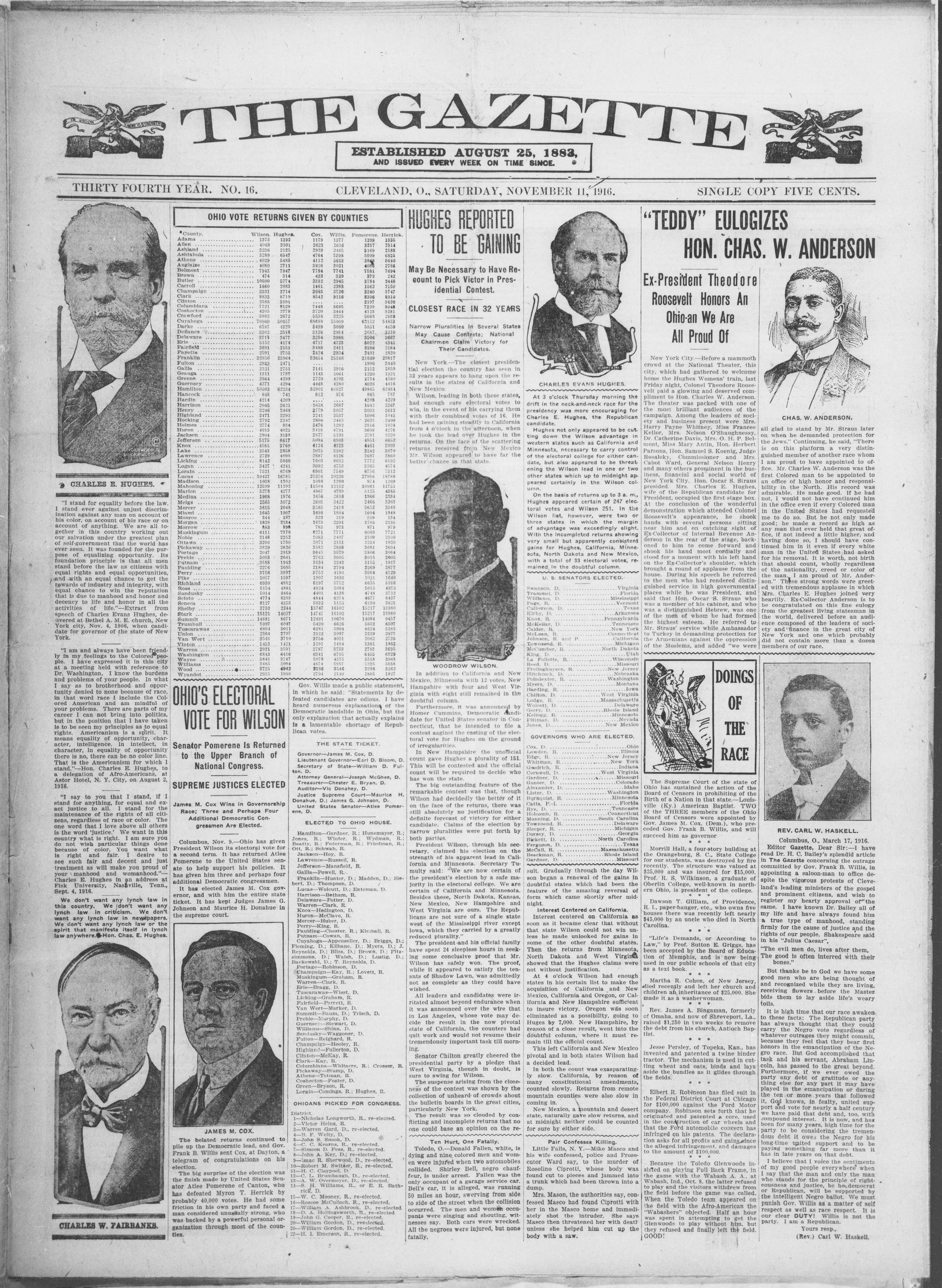
OHIO VOTE RETURNS GIVEN BY COUNTIES
OHIO'S ELECTORAL VOTE FOR WILSON
Senator Pomerene Is Returned to the Upper Branch of National Congress.
SUPREME JUSTICES ELECTED
James M. Cox Wins in Governorship Race; Three and Perhapa Four Additional Democratic Congressmen Are Elected.
Columbus, Nov. 9.—Ohio has given President Wilson Its electoral vote for a second term. It has returned Atlee Pomerene to the United States senate to help support his policies. It has given him three and perhaps four additional Democratic congressmen.
It has elected James M. Cox governor, and with him the entire state ticket! It has kept Judges James G. Johnson and Maurice H. Donahue in the supreme court.
JAMES M. COX.
The belated returns continued to pile up the Democratic lead, and Gov. Frank B. Willis sent Cox, at Dayton, a telegram of congratulations on his election.
The big surprise of the election was the finish made by United States Senator Atlee Pomerene of Canton, who has defeated Myron T. Herrick by probably 40,000 votes. He had some friction in his own party and faced a man considered unusually strong, who was backed by a powerful personal organization through most of the counties.
ESTABLISHED AUGUST 25, 1883 AND ISSUED EVERY WEEK ON TIME SINCE.
Gov. Willis made a public statement, in which he said: "Statements by defeated candidates are odious. I have no confidence in them. Democratic landlords in Ohio, but the only explanation that actually explains is a lamentable shortage of Republican votes.
Lieutenant Governor—Earl D. Bloom, D.
Secretary of State—William D. Fulton, D.
Attorney General—Joseph McGhee, D.
Treasurer—Chester E. Bryan, D.
Auditor—Vic Donahue, D.
Justice Supreme Court—Maurice H.
Donahue, D.; James G. Johnson, D.
United States Senator—Atlee Pomerene, D.
Hamilton - Gardner, R; Humeumper, R;
Jones, R; Winter, R; Wydman, R;
Bentty, R; Federman, R; Friedman, R;
Ott, R; Schwab, R.
Degdon, Jay.
Lawrence - Russell, R.
Jefferson - Minnafield, R.
Gallia - Powell, R.
Franklin - Hunter, D; Madden, D; Ste-
bert, D; Thompson, D.
Lucas - Wolcott, D; Entenman, D.
Hartmon - Schumar, R.
Draperwine - Schumar, R.
Warren - Clark, R.
Knox - Hedington, R.
Huron - McClave, R.
Mercer - Hulver, R.
Perry - King, R.
Paulding - Chester, R; Kifaball, R.
Putnam - Cowan, R.
Capybara - Chandler, D; Briggs, D;
Fleming, D; Kilnane, D; Myers, D; J.
Reynolds, D; Bjss, D; Brown, D; Fliz-
smons, D; Walsh, D; Lustig, D;
Backswain, D; Reynolds, D.
Powell - Cohnbauer, R.
Champion - Kay, R; Lovett, D.
Musklingum - Graham, R.
Warren - Clark, R.
Ester-Brown, R.
Tasmanuwa - Wisst, D.
Licking - Graham, D.
Fairfield - Harrett, D.
Van West - Marker, D.
Stainland - Trisch, D.
Proble - Murphy, D.
Guerney - Stewart, D.
Williams - Shinn, D.
Sandisk - Waggoner, D.
Paton - Reigard, R.
Champion - Hooley, R.
Highland - Fullerton, D.
Clinton - McKay, R.
Crawford - K.
Columbiana - Whitney, R; Crosser, R.
Pickaway - Stump, D.
Athea - Totman, R.
Coshocton - Foster, R.
Grass - Browne, R.
Lorain - Comings, R; Hughes, R.
OHIOANS PICKED FOR CONGRESS.
District.
1- Johnsola Longworth, R., re-elected.
2- Victor Helm, R.
3- Warren Gard, D., re-elected.
4- B. F. Welty, D.
5- John S. Snook, D.
6- C. C. Sherman, R., re-elected.
7- Simoon D. Fess, R., re-elected.
8- John A. Key, D., re-elected.
9- Isaac R. Sherwood, D., re-elected.
10- R. C. Sherwood, R., re-elected.
11- R. C. Claypool, D.
12- C. L. Brumbaugh, D., re-elected.
12-C. I. Brumhaugh, D., re-elected.
13-A. I. W. Overmeyer, D., re-elected.
14-W. Williams, R., or E. R. Bath-
rick, D.
15-C. M. Mooney, R., re-elected.
16-Roscoe McCullough, R., re-elected.
17-William A. Ashbrook, D., re-elected.
18-William A. Ashbrook, D., re-elected.
19-John G. Cooper, R., re-elected.
20-William Gordon, D., re-elected.
20-William Gordon, D., re-elected.
20-H. I. Emerson, R., re-elected.
HUGHES REPORTED TO BE GAINING
HUGHES REPORTED TO BE GAINING
May Be Necessary to Have Reeount to Pick Victor In Presidential Contest.
CLOSEST RACE IN 32 YEARS
Narrow Pluralities In Several States May Cause Contests; National Chairmen Claim Victory for Their Candidates.
New York--The closest presidential election the country has seen in 32 years appears to hang upon the results in the states of California and New Mexico.
Wilson, leading in both these states, had enough sure electoral votes to win, in the event of his carrying them with their combined votes of 16. He had been gaining steadily in California from 4 of clock in the afternoon, when he took the lead over Highes in the returns. On the face of the scattering returns received from New Mexico Nr. Wilson appeared to have far the better chance in that state.
WOODROW WILSON.
In addition to California and New Mexico, Minnesota with 12 votes, New Hampshire with four and West Virginia with eight still remained in the doubtful column.
Furthermore, it was announced by Hon. Comminers, Democratic Candidate for United States Senator in North Carolina, that he intended to file a contest against the casting of the electoral vote for Hughes on the ground of irregularities.
In New Hampshire the unofficial count gave Hughes a plurality of 151. This will be contested and the official count will be required to decide who has won the state.
The big outstanding feature of the remarkable contest was that, though Wilson had decidedly the better of it on the face of the returns, there was still absolutely no justification for a definite forecast of victory for either candidate. Claims of the election by narrow pluralities were put forth by both parties.
President Wilson, through his secretary, claimed his election on the strength of his apparent lead in California and Minnesota. Secretary Tumulty said: "We are now certain of the president's election by a safe majority in the electoral college. We are certain of California and Minnesota. Besides those, North Dakota, Kansas, New Mexico, New Hampshire and West Virginia are ours. The Republicans are not sure of a single state west of the Mississippi river except town, which they carried by a greatly reduced plurality."
The president and his official family have spent 24 sleepless hours in seeking some conclusive, proof that Mr. Wilson has safely won. The proof, while it appeared to satisfy the tenth of Shadow Lawn, was admittedly not as complete as they could have wished.
All leaders and candidates were irritated almost beyond endurance when it was announced over the wire that in Los Angeles, whose vote may decide the result in the now pivotal state of California, the counters had quit work and would not resume their tremendously important task till morning.
Senator Chilton greatly cheered the presidential party by a pledge that West Virginia, though in doubt, is sure to swing for Wilson.
The suspense arising from the closeness of the contest was shown by the collection of unheard of crowds about the bulletin boards in the great cities, particularly New York.
The result was so clouded by conflicting and incomplete returns that no one could base an opinion on the re
Toledo, O.—Donald Fallen, white, is dying and nine colored men and women were injured when two automobiles collided. Shirley Bell, negro chauffeur, is under arrest. Fallen was the only occupant of a garage service car. Bell's car, it is alleged, was running 50 miles an hour, swerving from side to side of the street when the collision occurred. The men and women occupants were singing and shouting, says. Both cars were wrecked. All the negroes were injured, but none fatally.
CHARLES EVANS HUGHES.
At 3 o'clock Thursday morning the drift in the neck-and-neck race for the presidency was more encouraging for Charles E. Hughes, the Republican candidate.
Hughes not only appeared to be cutting down the Wilson advantage in western states such as California and Minnesota, necessary to carry control of the electoral college for either candidate, but also appeared to be threatening the Wilson lead in one or two other states which up to midnight appeared certainly in the Wilson column.
On the basis of returns up to 3 a.m., Hughes appeared certain of 247 electoral votes and Wilson 251. In the Wilson list, however, were two or three states in which the margin of advantage was exceedingly slight. With the incomplete returns showing very small but apparently consistent gains for Hughes, California, Minnesota, North Dakota and New Mexico, with a total of 33 electoral votes, remained in the doubtful column.
U.S. SENATORS ELECTED.
Sawyers, D ..... Virginia
Trumpet, D ..... Florida
Williams, D ..... Mississippi
Fake, D ..... Vermont
Little, D ..... Texas
Little, D ..... Arkansas
Kivy, D ..... Pennsylvania
Kivy, D ..... Pennsylvania
Cabler, R ..... New York
McLean, R ..... Connecticut
Johnson, R ..... California
Towneward, R ..... Michigan
Towneward, R ..... North Dakota
King, D ..... Utah
La Fellatt, D ..... Wisconsin
Preshawker, R ..... Missouri
Preshawker, R ..... Jersey
Hitchcock, R ..... Newaska
Pohlhauer, R ..... Washington
Meyer, D ..... Montana
Chilton, D ..... Iowa
Chilton, D ..... West Virginia
Lackey, D ..... Massachusetts
Wollett, D ..... Delaware
Cagle, R ..... Rhode Island
Kellogg, D ..... Minnesota
Littman, D ..... Newada
Jones, D ..... New Mexico
Cox, D.
Lowden, R.
Edge, R.
Whitman, R.
Gosdahl, R.
Gosdahl, R.
Gardner, D.
Gunter, D.
Alexander, D.
Litter, D.
Hartnell, R.
Cattis, D.
Rye, D.
Holemb, R.
Manning, D.
Townsend, R.
Hepler, R.
Dorsey, D.
Bickett, D.
Ferguson, D.
McCall, R.
Mastenbuster
Gardner, D.
Missouri
Ohio
Illinois
New Jersey
New York
Indiana
West Virginia
Missouri
Colorado
Idaho
Washington
Minnesota
Florida
Tennessee
Connecticut
North Carolina
Bokway
Michigan
Georgia
North Carolina
Texas
Mastenbuster
Rhode Island
Missouri
suit. Gradually through the day Wilson began a renewal of the gains in doubtful states which had been the feature of the amazing reversal of form which came shortly after midnight.
Interest Centered on California
Interest Centered on California.
Interest centered on California as soon as it became clear that without that state Wilson could not win unless he made unlooked for gains in some of the other doubtful states. Then he returns from Minnesota, North Dakota and West Virginia, showed that the Hughes claims were not without Justification. ...
At 4 o'clock Wilson had enough states in his certain list to make the acquisition of California and New Mexico, California and Oregon, or California and New Hampshire sufficient to insure victory. Oregon was soon eliminated as a possibility, going to Hughes by 7,000. New Hampshire, by reason of a close result, went into the doubtful column, where it must remain till the official count.
This left California and New Mexico pivotal and in both states Wilson had a decided lead.
In both the count was exasparatingly slow. California, by reason of many constitutional amendments, counted slowly. Returns from remote mountain counties were also slow in coming in.
New Mexico, a mountain and desert state, naturally gave slow returns, and at midnight, neither could be counted for sure by either side.
Little Falls, N. Y.-Mike Masco and his wife confessed, police and Prosecutor Ward say, to the murder of Rosolino Ciprotti, whose body was found cut to pieces and jammed into a trunk which had been thrown into a dump.
Mrs. Mason, the authorities say, confessed Masco had found Ciprotti with her in the Masco home and immediately shot the intruder. She says Masco then threatened her with death unless she helped him cut up the body with a saw.
SINGLE COPY FIVE CENTS.
"TEDDY" EULOGIZES HON. CHAS. W. ANDERSON
New York City - Before a mammoth crowd at the National Theater, this city, which had gathered to welcome home the Hughes Womens' train, last Friday night, Colonel Theodore Roosevelt paid a glowing and decorated welcome to the theater was packed with one of the most brilliant audiences of the campaign. Among the leaders of society and business present were Mrs. Harry Payne Whitney, Miss Frances Kelor, Mrs. Nelson O'Shaughnessy, Dr. Catherine Davis, Mrs. O. H. P. Belmont, Miss Mary Antin, Hon. Herbert Parsons, Hon. Samuel K. Koenig, Judge Rosabsky, Commissioner and Mrs. Cairo Ward, General Nelson Henry and many others prominent in the business, financial and social world of New York City, Hon. Oscar S. Straus presided, Mrs. Charles E. Hughes, wife of the Republican candidate for President, occupied the first stage box. At the conclusion of the wonderful performance of Rosabsky's appearance, he shook hands with several persons sitting near him and on catching sight of Ex-collector of Internal Revenue Anderson in the rear of the stage, backed to him to come forward and shook his hand most cordially and stood for a moment with his left hand on the Ex-collector's shoulder, which brought a round of applause from the house. During his speech he referred to the men who had rendered distinguished service in high governmental places while he was President, and said that Hon. Oscar S. Straus who was a distinguished member of the distinguished Hebrew, was one of the men of whom he had formed the highest esteem. He referred to Mr. Straus' service while Ambassador to Turkey in demanding protection for the Armenians against the oppression of the Moslems, and added "we were
DOINGS
OF
THE
RACE
The Supreme Court of the state of Ohio has sustained the action of the Board of Censors in prohibiting of the Birth of a Newborn in that state. Louisville (Ky.) American Baptist. TWO of the THREE members of the Ohio Board of Censors were appointed by Gov. James M. Cox. (Dem.), who preceded Gov. Frank B. Willis, and will succeed him as governor.
Morrill Hall, a four-story building at the Orangeburg, S. C., State College for our students, was destroyed by fire recently. The structure was valued at $25,000 and was insured for $15,000. Prof. R. S. Wilkinson, a graduate of Oberlin College, well-known in northern Ohio, is president of the college.
Dawson T. Gilliam, of Providence, R. I., paper-hanger, etc., who owns five houses there was recently left nearly $45,000 by an uncle who died in North Carolina.
"Life's Demands, or According to Law," by Prof. Sutton E. Griggs, has been accepted by the Board of Education of Memphis, and is now being used in our public schools of that city as a text book.
Martha R. Cohen, of New Jersey, died recently and left her church and children in inheritance of $25,000. She made it as a washerwoman.
Rev. James A. Bingaman, formerly of Omaha, and now of Shreveport, La., raised $1,250 in two weeks to remove the debt from his church, Antioch Baptist.
Jesse Persley, of Topeka, Kan., has invented and patented a two binder traction machine based in cutting wheat and oats, binds and lays aside the bundles as it glides through the fields.
---
Elbert R. Robinson has filed suit in the Federal District Court at Chicago for $100,000 against Ahe Ford Motor company. Robinson sets forth that he originated and patented a core, used in the construction of car wheels and that the Ford automobile concern has infringed on his patents. The declaration asks for all profits and gains since the alleged infringement, and damages to the amount of $100,000.
Because the Toledo Glenwoods insisted on playing Full Back Frame, in the game with the Wabash A. A., at bash with the 8.8 lathered to play and the visitors Andrew from the field before the game was called. When the Toledo team appeared on the field with the Afro-American the "Wabashers" objected. Half an hour was spent in attempting to get the Glenwoods to play without him, but they refused and finally left the field. GOOD!
THE LEGAL JUDGE
CHAS. W. ANDERSON.
all glad to stand by Mr. Straus later on when he demanded protection for the Jews." Continuing, he said, "There is on this platform a very distinguished member of another race whom I am proud to have appointed to office. Mr. Charles W. Anderson was the first Colored man to be appointed to an office of high honor and responsibility. He is a board was admirable. He made good. If he had not, I would not have continued him in the office even if every Colored man in the United States had requested me to do so. But he not only made good; he made a record as high as any man that ever held that great office, if not indeed a little higher, and having done so, I should have continued him in it even if every white man in the United States delivered honor for his removal. It is worth, not birth that should count, wholly regardless of the nationality, creed or color of the man. I am proud of Mr. Anderson." These strong words were greeted with tremendous applause in which Mrs. Charles E. Hughes joined very heartily. Ex-Collector Anderson is to be congratulated on this fine eulogy from the greatest living statesman in the world, delivered here, and one of the leaders of society and finance in the great city-of New York and one which probably did not contain more than a dozen members of our race.
REV. CARL W. HASKELL.
Columbus, O, March 17, 1916.
Editor Gazette, Dear Sir:—I have read Dr. H. C. Bailey's splendid article in The Gazette concerning the outrage committed by Gov. Frank B. Willis, in appointing a saloon-man to office despite the vigorous protests of Cleveland's leading ministers of the gospel and prominent citizens, and wish to register my hearty approval of the same. I have known Dr. Bailey all of my life and have always found him a true type of manhood, standing firmly for the cause of justice and the rights of our people. Shakespeare said in his "Julius Caesar".
"The evil men do, lives after them. The good is often interred with their bones."
But thanks be to God we have some good men who are being thought of and recognized while they are living, receiving flowers before the Master bids them to lay aside life's weary tolls.
It is high time that our race awakened to these facts: The Republican party has always, thought that, they could carry the Negro vote regardless of whatever outrages they might commit, because they feel that they bear first honors in the emancipation of the Negro race. But God, accomplished that task and his servant, Abraham Lincoln, has passed to life great beyond. We owe the party any debt of gratitude and that party else for any part it may have played in the emancipation or during the ten or more years that followed it, God knows, in fealty, united support and vote for nearly a half century we have paid that debt and, too, with compound interest. It is now, and has been for many years, high time for the party to be considering the tremendous debt it owes the Negro for his long-time united support and to be paying something far more than it has in late years on that debt.
I believe that I voice the sentiments of my good people everywhere when I say that the man and only the man are the ones who are unconscious and justice, be the democrat or Republican, will be supported by the intelligent Negro ballot. We must punish Gov. Willis as a matter of self respect as well as race respect. It is our clear DUTY! Willis is not the party. I am a Republican.
The GAZETTE
One Year.....$1.50.
Six Months.....1.00
Three Months......50
Subscribers are requested to re-
mit by postoffice money or
der or registered letter
Entered at the postoffice in Cleveland
Ohio, as second-class matter.
Address all communications to
HARRY C. SMITH
Editor and propietor,
THE GAZETTE,
Blackstone Building, Cleveland, O.
Member Ohio Legislature: 1894
to 1898; 1898 to 1898; 1900 to 1902
THE GAZETTE is the oldest, and
has the largest bona fide circulation,
double that of any newspaper in the
interest of Afro-Americans, published
in Ohio and comparison
with any will immediately establish
its rank as one of the NEWSIEST
AND BEST in the country.
10,000,000 Afro-Americans.
160,000 In Ohio.
20,000 In Cleveland.
SATURDAY, NOVEMBER 11, 1916
"Let us have faith that right makes might, and in that faith let us to the end dare to do our work to understand it"—Abraham Lincoln.
OUR SACRIFICE.
The letters of Oct. 13, 1916, and Oct. 20, 1916, from the Mumm-Romer Co., magazine and newspaper advertising agents, 568 E. Broad St., Columbus, O., each enclosing an order from the manager of the Publicity Department of the Ohio Republican State Committee for thirty inches (electrotype) advertising in The Gazette, at the rate of fifty cents an inch, for the Ohio Republican State Executive Committee, and the one of Oct. 26, 1916, enclosing an order for forty inches more, making a total of ONE HUNDRED inches, (FIFTY DOLLARS), are mute evidences of the fact that The Gazette has again been called upon to make a SACRIFICE in the interest of the race and a principle we hold equally dear and important. Acceptance of the orders meant the support of Frank B. Willis for re-election as governor of face of his broken promises, gratuitous insults and other mistreatment of our people of Ohio, loyal supporters of his two years ago. This and more, we wrote the manager of the publicity department of the state committee on Oct. 21, 1916, as all of our readers know. We are fully aware of the fact that we are fully of commercialism, disregard of racial interests and principle for personal gain, etc, the course in matters of this kind The Gazette follows, and has ever followed since its inception, is not the usual or even the popular one, but it's our way, has always been and always will be, and we are now too old to change if we would and we would not do so if we could. Rarely, if ever, have we called attention to this sort of action on our part in the past, and we would not have done so in this instance but for the fact that the instance but for the fact that the election of Tuesday was one of the most important in the history of this race of ours and a FULL explanation was due our readers as to why The Gazette, so strong in its support of all the other Republican candidates, withheld its assistance from Messrs. Willis and Hildebrant, candidates for governor and secretary of state, respectively. We felt and feel that the truth as to our sacrifice in the interest of the race and principle, was and is an important part of the explanation.
WILLIS DEFEATED!
The defeat of Gov. Frank B. Willis, on Tuesday last, is retribution, pure and simple. From the very beginning of his term of office, nearly two years ago, the man gave evidence of a disposition to trifle with important issues and measures, and with large bodies of his constituents, as well as many leading individuals of the state, that could only end as it has—in an overwhelming defeat that cannot in any considerable measure be ascribed to other causes than those created by Frank B. Willis and by him only.
He "played fast and loose" with the "wets" and the "drys" until both sides lost confidence in him. A case in point is his acquiescence in the appointment by State Oil Inspector Carr of a local Afro-American saloon-keeper as a deputy oil inspector for this county, in the face of the long and bitter protests of our clerkymen and leading citizens. Then secured the assistance of Rev. John Rutledge, (white), of this city, local superintendent of the State Anti-Saloon league, in an effort to stop The Gazette's caustic criticisms of him (Willis) as a result of Carr's very objectionable appointment. Queer representation this to give the good people of color of Cleveland and Cuyahoga county, wasn't it? Queerer association for Willis, though—a saloon-keeper one one side of him, placed there by his appointee, State Oil Inspector Carr; and a minister of the gospel on the other side, in the person of the Rev. John Rutledge. Cleveland superintendent of the Anti-Saloon league! Good Lord, have mercy!
This same course was followed by Willis in the case of our people. He failed to keep a voluntary promise to give us recognition in HIS appointments, occasionally expressing a willingness to do so but never acting Meantime, he was appointing members of other races, some democrats to the desirable positions. In addition to this, he permitted his adju-
tant-general to grossly insult all our people of the state through that worthy's outrageous mistreatment on the members of the Ninth Battalion when he ordered them to Columbus "to prepare the camp for the white-soldiers" who were to be sent to the Mexican border. Adjutant-General Hough was particular to have it heralded throughout the state and country at the time, that "the Colored soldiers of the Ninth were to be returned to their homes as soon as the work of preparing the camp for the white soldiers was completed" and that "they (the Colored soldiers) were not to be sent to the border." And they were sent home when the work was completed; and they were not permitted to go to the border like the Eighth Regiment of Illinois, Afro American soldiers of the District of Columbia and other parts of the country. No white soldiers were so treated and compelled to work in that camp with convicts from the Ohio penitentiary.
Then Willis' effort to make us believe that he had barred "The Birth of a Nation" and other infamous photoplays from the state when as a matter of fact this was done by the State Board of Censors, two of the three members of which were and are democrats, appointed by his predecessor in office, James M. Cox, governor-elect. It was to this board that the writer was compelled to appeal on each of his several trips to Columbus, last year, when he led the successful fight against the vicious and infamous film and others.
All the way, from his taking office last year in January to and including the campaign just closed, Frank B. Willis apparently depended on his ability to fool the people, black and white, to secure his re-election. He did fool them for a time. But as the immortal, martyred President, Abraham Lincoln, so well said, many years ago: "You can fool part of the people all the time and all of the people part of the time, but you CANNOT FOOL ALL OF THE PEOPLE ALL OF THE TIME." And that is just the point in Willis' case. He fooled the people for a while; that is all. They woke up—some before we did and some after, but apparently ALL got their eyes open before Tuesday last. The large plurality his opponent was given proves this beyond all question or doubt. While there were undoubtedly other and good causes contributing to Willis' stinging defeat, the fact remains that the people of this state lost confidence in him because of his broken promises and transparent efforts to fool them.
The defeat of Secretary of State C. Q. Hildebrant was little less pleasing than that of Willis. It was Hildebrant, who also steadfastly refused throughout his near two-year tenure of office, to appoint a member of our race to a clerkship in his office—the first Ohio Republican secretary of state to do so in more than 30 years. The loss of the electoral vote of the state, the U. S. senatorship and several candidates for Congress, as well as the state ticket, can be attributed to the weakness, as candidates, of these two men almost as much as to any other one thing. This loss is greatly regretted and the failure to deliver Ohio's electoral vote to Mr. Hughes is a burning shame and disgrace the Republicans of this state will feel keenly for many years to come.
When The Gazette went to press, Thursday, the result of the Presidency that contest was still in doubt with the indications slightly favoring our candidate, Judge Hughes." We are hoping and praying that he is elected for reasons so well known by all of our people that it is unnecessary to state them again at this time. It was a remarkable contest, its only parallel in the history of this country being the Hayes-Tilden affair of 1876.
The defeat of Harry E. Davis, the local Afro-American candidate for the Legislature, is to be regretted. He went down to defeat with the rest of the Republican county ticket. Some day our party in this city and county will awaken to the fact that there must come a radical change in the party leadership and management here before "success will perch upon its banners." This has been apparent for years. Then, too, Davis must learn that a candidate should seek every vote it seems possible for him to get and not take so much "for granted."
A "POLITICAL" CLASSIC
Mr. Wilson now dwells at Shadow Lawn; there should be shadows enough—the shadows of men, women and children who have risen from the ooze of the ocean bottom and from the graves in foreign lands; the shadow of the helpless whom Mr. Wilson did not dare protect lest he mutilated have to face danger; the shadows of babies gasping pitifully as they sank under the waves; the shadows of women outraged and slain by bandits; the shadows of Boyd and Adair and their troopers who lay in the Mexican desert; the shadows of deeds that were never done; the shadows of lofty words that were followed by no action; the shadows of the tourned dead—Ex-President Roosevelt.
REPUBLICAN PARTY "JIM-CROWS" NEGRO.
Throughout the Campaign Just Ended Colored Men Worked Without Protest in Segregated Quarters.
Special to The Gazette.
Special to the newspaper
St. Louis, Mo.—Now that the election is over and everyone is satisfied that the candidates have their favorite, it is interesting to notice the inconsistency of local politicians. All during the past campaign we have heard a great deal of criticism about the segregation of Colored employees in various departments at Washington, D.C., by the Wilson administration, and there have been speakers going over the country making much of that situation. Naturally our men as a rule resent such conditions when they are brought to their attention. However right here in St. Louis this very same proscription is being used by C. C. Hughes' candidacy; yet not a word of protest was uttered against it by those who had to endure it daily, nor did our local papers take it up and seek to have it corrected.
THE GAZETTE, CLEVELAND, O., SATURDAY, NOVEMBER 11, 1916
MAY MAKE "KAPOK" OF VALUE
Fiber That Is Abundant in Haiti Has Been Mentioned as a Substitute for Wool.
There are two varieties of kapok fibers to be found in Haiti, both products of trees of the *Biodendron family* and both of good quality. The local names for the fiber vary according to locality; "marodem," "cotton mapou" and "cotton noir" are those most commonly used.
Kapok is fairly abundant all over Haiti, but no commercial use has been made of it. The natives sometimes stuff pillows with it, and occasionally mattresses, but this is about the extent of its utilization. Indeed, all over the West Indies it is little used and has no fixed market value, except in Cuba, where it is a well-defined article of local trade, and where considerable quantities are brought from the Dominican Republic.
There has been noted of late some interest in the substance in the United States, and it is being advertised under fancy trade names as a new discovery for life preservers, cushions on steamers, pillows and the like. As filling for mattresses it is an ideal substance, exceedingly light, absolutely sanitary and possessing such resilience that even after long use it does not lump or pack. As a quilting material for comforters and other bed coverings it equals wool in warmth and exels cotton in softness and lightness. For dressing gowns, smoking jackets and other padded garments it has much to recommend it. For upholstery it is superior to most materials now in use.
Kapok is used in England to some extent in the manufacture of hats, and certain of the longer varieties are mixed with cotton to impart a silky luster to fabrics. The regular kapok, however, has too short a fiber to spin. It is extremely inflammable, and this is its chief drawback. If the fiber could be so treated with chemicals as to eliminate this dangerous quality it would be very much more valuable.
ARE NOT REALLY VOCALISTS
Tree Frog and Locust Have Been
Called. Other Preserva-
tion Show. Otherwise.
The folk in the little brown house call the two musicians—one who makes music in the maple tree at the edge of the sidewalk and the other in the apple tree behind the house—"singers." But this, like much of our current information, is incorrect, says the Indianapolis News. They are not vocalists at all, neither of them. They are instrumentalists. The one at the front of the house turns up about midafternoon and as the sun goes down his notes rise higher and higher until about eight o'clock, when he ceases. It is then that the backyard performer begins. The performer in the maple tree is the cicada, which is usually and improperly called the locust; the one in the apple tree is the hyla versicolor, that is, the tree frog. Both are credited with prophetic power; the tallness batrachian is held to be a predicator of rain and the cicada in his shrill insistence announces that a frost is coming, coming in six weeks from the evening when he first began his nocturne. But, it must be said, that little reliance can be placed on either of these minor prophets. The tree frog is a drummer. The instrument he thumps upon is his own abdomen, and as drummers he uses his own toes and fingers. The musical apparatus of the cicada is at the base of the abdomen. He is a fiddler—not a violinist—and he produces his music by drawing his wings and legs across his handy little fiddle.
Dishonest Servants.
The London Evening News, in an article on the dishonesty of servants who have long served in old houses, cites the case of an aged woman who died in a suburb of London 20 years ago. She had been continuously in service in a great family for half a century and had appropriated all kinds of property, among which was a picture which was recovered by the heir of the house and sold to America for $150,000. The News asks: "How it to be accounted for that a fine Rubens should be found decorating the trim "parlor" of a farmhouse in Lincolnshire; curtains embroidered by Mary Queen of Scots, a tiny cottage in Norfolk, and a marquetry bureau from the collection at Windsor castle, an obscure vicarage in Shropshire? That a bundle of linen, each piece of which is marked with the monogram of Charles I, was disposed of some years ago at a local sale in the west of England is less difficult to explain —Cromwell, together with members of his family, frequently visited the house from which the sheets came, and possibly brought them from one of the royal palaces."
Good Duck Story.
The Chinese are often compelled to make their dwellings in large boats on the rivers. An officer in the navy says he observed one of these men, who kept ducks for a living, practice an odd piece of ingenuity. In the daytime the ducks were permitted to float about, but in the night time they were carefully collected. The keeper when the night set in gave a whistle, when the ducks always flew toward him with violent speed, so that they were invariably gathered in a minute. How do you suppose he had educated his flock so effectually? He always beat the last duck.
Binocular Vision.
A very few of the lower animals like some of the monkeys, seem to possess the true binocular vision; that is, they center both eyes on the same object at the same time and blend the two images into one. The dog is not one of these, in spite of the forward position of its eyes; it is but a single eye that the dog centers upon the object of interest. Man, on the other hand, possessing a well-developed faculty of using both eyes upon the same object with successful results, probably leads the entire procession in the matter of binocular vision.
Modern Science Has Taken a Hand in Interpreting the "Visions of the Night."
Scientific dream interpretation helps us to see ourselves as we really are; gives us intimate glimpses of the subconscious as well as conscious desires, fears and modes of thinking that enter into the making of our character and the shaping of our conduct, according to H. Addington Bruce in Mothers' Magazine. The compilers of the gaudy little paper-covered dream books once so much in vogue, went, right enough, on the theory that dreams are symbolic. But they erred by assuming that they are always symbolic of future events, and that any particular dream element can always be interpreted as symbolic of the same kind of future event.
Those who expect modern science to provide them with a dream manual akin to the old dream books, so that everyone may become his own interpreter at a glance, are consequently doomed to disappointment. Accurate dream interpretation almost always means time and effort. But it is well worth the trouble it costs. All who would discover unsuspected weaknesses and defects in themselves, who would gain a maximum of health, happiness and efficiency through right living, will do well to seek to have their dreams analyzed.
And it is not only for the light it throws on one's nature and character that scientific dream interpretation is worth while. There are dreams which, rightly interpreted, throw light on the state of the dreamer's physical health, sometimes enabling action disease. There also are dreams which give valuable information regarding people of the dreamer's acquaintance. There are other "exceptional" dreams, needlessly looked upon with superstitious awe by many persons.
AS TO DIGNITY OF HISTORY
Times Have Changed Since Macaulay
Criticized a Phrase Which Was
Then Much in Vogue.
Macauley wrote: "There is a vile phrase of which bad historians are exceedingly fond, the dignity of history"; and he proceeded, with his usual point and force, to show that, though historians should not record trifles, it is not always easy to distinguish trifles from events of great importance.
There are trifles which are by no means trifling.
Macauley was comparing Sir W. Temple's dispatches with the love letters which, during a seven-years' courtship, passed between him and the lady who became his wife, and he was plending on their behalf for attention and respect.
They were, it is true, love letters, and not state papers; but love letters which betrayed the social feeling of a period.
There is no need for any such plea today.
The tendency now is to overlook what is official and grave and to hunt out the love letters, fables, toys and trimmings of history.
Success.
Success that is worth anything must be earned, must be waited patiently for before it is won. Our foremost men in every department of civil, of professional, of commercial, of literary life are gray-hatred men. True, there are many promising men and women in every walk in life who are young; but they are not yet ripe, and cannot be till years have passed over them. Through the years they must work on steadily, persistently, constantly, under scorching suns, during long and weary days, along dusty and crowded thoroughfares, till the knowledge they have gathered and the experiences they have gone through have time to pass into wisdom.
As there is a class of soil-tillers who realize handsomely from the sale of early vegetables and fruits, so there are those who in different ways succeed in making a "hit" and reaping quick pecuniary returns. But, early flowers, early vegetables, early fruits are hothouse growths, and spring from rich and highly stimulated soils. The great crops of grain which feed the world are months in growing and maturing. The great writers and thinkers held in honor by their contemporaries shed their May blossoms years and years ago, lived through their Junes and Julys and Augusts, and now in the golden autumn of their lives are reaping their well-earned harvests.—Selected
Hls Motive.
Fresh from his vacation, the minister faced a large congregation, who were very kind in their praise of his sermon. The next Sunday a larger congregation came and listened with growing concern to the same address as before. The next Sunday he preached the sermon again. The officers of the church, after much consulting together, asked him why. The minister replied, "Why, yes, it was the same sermon. The first Sunday you told me how fine it was, and how it was just what you needed. I watched you all week, and you lived just as before, so I preached it again. All the following week I watched, and you lived just the same; so, remembering that you all had said it was just what you needed, I preached it once more. Unless there is some sign of improvement, don't you think I'd better plan to repeat it again?"
"Kidding" the Anglers
Two recently converted neophytes of the gentle art of angling, on the way to the st-airm where they proposed to try their luck, paused in astonishment at the sight of a small urchin staggering under the burden of a huge fish almost as large as himself. Approaching him, the stout member said: "Good gracious, boy! That's a good catch! The youngster slowly sized him up from his conspicuously new shoes to the latest style of "alpine" hat while adorned his head, spat disgustedly, and said: "Aw, this ain't the catch, it's the bait!"
FRESH OHIO NEWS
Written by 'The Old Reliable Gazette's Correspondents
What Our People Are Doing Each Week—Church, Personal, Social, Lodge, Literary and Musical—Marriages, Deaths, Etc.
CADIZ.—Miss Annie Richardson, age 65, died, Friday, and was buried, Sunday afternoon, Rev. O. W. Childs officiating, assisted by Rev. W. H. Lucas—Mr. and Mrs. A. J. Guy and Mr. and Mrs. George Viney, of Steuerville, died on Sunday—The "Buy Bees" were entertained by Mr. and Mrs. B. S. Lee. There was a large attendance—The contest with the Newark A. M. E. church is increasing in interest—Mr. and Mrs. R. F. Ballard were called to Cleveland by the death of Mrs. Nettie Ballard Anderson. She was well known and highly esteemed here, and the family have the entire community—Dwight Brooks, of Denison, and Virgie Blanchard, of Cleveland, are here visiting.
CORRESPONDENTS must mail all letters for publication at their main postoffice sufficiently early on Monday (or Sunday) of each week to have them reach The Gazette office on Tuesday morning, and always write also, their names and that of their city or town on the outside of the wrapper about returned copies. Unless this latter is done, proper credit cannot be given you. Lists of names, wedding presents, etc., obituary tices, speeches, resolutions, poetry, inquiries for relatives and assistance, including items announcing entertainments to be held in the near future, must be paid for in advance at the rate of ten cents a line, six words to a line. Our rates for display advertisements will be sent on application.
AKRON. Our people are very "sore" as a result of Postmaster Read's apparent refusal to appoint Julius R. Johnson, an alumnus of the University of Wooster and a postgraduate student at Municipal University here, to a position in the post service here after successful passions, civil service examinations and standing among the highest in the last examination. Read is a democrat, an appointee of the Wilson administration.
HILLSBORO—Mr. and Mrs. Walter Wilson, of Virginia, are visiting the latter's parents, Mr. and Mrs. J. R. Cole—Mr. Ida Day spent a week in Cincinnati, the guest of Mrs. Oliver Smith—Mr. John Hudson and daughter, Lynne Bernice, spent Saturday and Sunday at Blehn, guests of Mr. and Mrs. Chase Hudson, guests of Mrs. and Mrs. Chase Hudson, guests of Mrs. and Mrs. here—Prof. S. G. Hough, Revs. G. W. Burr, H. Johnson, J. B. Jurr and family, Prof. and Mrs. C. Anderson and Wm. Pope of Columbus, attended the anniversary celebration at Blehn, Sunday. An excellent program was rendered and the services were enjoyed by all, Mrs. Amanda Owens, Mrs. Kendall Keen, Mrs. Mr. Jesse Gois is better—Mrs. Alline Burton, who spent a week in Dayton, returned, Monday—Mrs. James Captain has opened a restaurant on S. High St., and will have a public reception, Thursday, from 8 to 9:30 p. m.—Rev. J. Burr and Mr. Frank Powers will speak in behalf of "The Old Habit Gazette and the Profs. S. Woods and the Anderson will represent the schools and Mr. Henry Woods. The Home, Ice cream and cake will be served. Come and bring your neighbor. Everybody is invited.
BIEHN.—Mrs. Lissie Curtis, of Cincinnati, Misses Edna and Minnie Burr and Mrs. Adam Burr, of Georgetown, were guests of Mrs. Francis Curtis, last week.—The 75th anniversary of the church, Sunday, was a success. Representatives from Seanan, Hillsboro, Georgetown and Columbus were present. Welcome address, Prof. Morton, Rev. G. W. Burr preached a soul-stirring sermon on Monday and S. G. Hough held the audience spell-bound by their able addresses. An excellent paper was read by Miss Minnie Burr, and splendid music was rendered by members of the Hillsboro choir. Recitations by Anita E. Burr and Bernice Hudson, Hillsboro, Bertha Toler, Blihn, and Mrs. Florence Burr, Georgetown, Anniversary sermon by the pastor, Rev. J. J. Burr. Encouraging remarks from Johnson, Mr. Toler, Columbus; Mrs. J. Burr and Mrs. Chester Annette. Our white brethren remembered us with a large attendance and gave liberally. Total expenses, $19.75, Balance, $23.50. Prof. Morton, chairman finance committee. Don't forget to come to Georgetown Thanksgiving. Each one bring your dinner, and don't fail to subscribe for the *Gazette*
SMITHFIELD.—Mrs. Rhoda Veney was hostess at a Halloween en masque, Tuesday evening. Messrs. Jackson, Clark Giles, Mercer and Rhen, of Mt. Pleasant and Mt. Ferry, were the out-of-town guests. St. Paul's A. M. E. parsonage is about ready for occupancy after undergoing necessary repairs. Mrs. Williams, little daughter and her mother arrived from Indiana, Monday evening. Mr. Ed. Fowler and F. Smith are convalescent. L. Brooks, A. Rhen, F. Fields and H. Giles attended church here, Sunday evening.—Miss Rhetta Smith of McKenna, Mr. Samuel Thompson of near Steubenville, were quietly married, last Thursday week, near beside on Cole's hill near Steub. The hunting season for raccoons last week, and the men are making good use of it.—Rev. I. M. Williams dined with Mr. and Mrs. Jas. Beall, Saturday, and Mr. and Mrs. G. Davis, Sunday.—W. H. Veney lost his horse, Sunday. Mr. John Fields, of Mt. Pleasant, recently sold a fine one to F. Carter. Mr. Frank Smith has purchased the S. Vernon property on N. W. St.
YOUNGSTOWN.—A number of out-of town people attended the Republican rally. Saturday, among the number being Atty. Thos. Green of Columbus.—Rev. W. O. Harper will address St. Augustine Mission men's club, Monday.—Mr. and Mrs. W. Saunders, of Farrell, Pa., spent Sunday with Mr. and Mrs. Mack Parm.—Mrs. M. Conrad has opened a hair-dressing school.—Harper Hagman is convalescing after three weeks' illness.—Mrs. Emma Moore, of Akron, was called here by her sister, Mrs. Louisa
On social older persons who we see the bed or the car unable to control their water during the night or day. All it is not a house or a car that we have. We are not our family members, we are today for a Free Package of our tarnish Remedy. When parental rollover toll their friends, contact us. No phone number required.
ZEMETO CO. PO. 305, Milwaukee, WI
H. J. OWEN
Signs of all kinds. Show Cards and Specialty.
5709 Longfellow Ave.
Rosedale 1800
SLAUGHTER
Funeral Directive
Embalmer
Office and Funeral
3923 CENTRAL AVENUE
Autos for All Occasions. Calls Answer
FORD'S
HAIR POMADE
MAKES HARSH
KINNY HAIR SOFTER.
MORE PLUSABLE HAMB
TO COM AND PUT UP
IN ANY STYLE THE
LENGTH WILL PERMIT
PRICE 25¢ AND 50¢ A BOTTLE
FORD'S HAIR STRAIGHTENER
NO. 022 STRAIGHTENS THE HAIR
BY ROLLING IT BETWEEN FOUR BRASS
ROLLS. BEST AND QUICKEST THING
WE KNOW OF TO STRAIGHTEN HAIR
PRICE $1.50
PATENT SECTIONAL TOOTH COMB
PATENTED LOCKING
DEVICE FOR MOLDING TEETH TIGHT
FORD'S SPIRAL HANDLE
HAIR STRAIGHTENER AND COMB NO. 024. HAIR BRASS, HICKEL
PLATES, LARGE AND VERY STRONG
LOOKS BURN THE INNER OF SPECIAL
LOOKING HANDLE THE MAIN OF WITHOUT SOLDERING. PRICE $1.00
FORD'S SMALL BRASS
FORD'S MEDIUM SIZED
BRASS SHAMPOO AND
HAIR STRAIGHTENER COMB NO. 026
A 500 GOLD SOLDER AND FOR
THE MONEY. PRICE $50
ALL OUR GOODS WARENED AS DESCRIBED OR MONEY REFUNDED.
FOR SALE BY YOUR DEaler OR DIRECT FROM US UPON RECEIPT OF
PRICE, IN WRITING DIRECT SEND MONEY BY POST OFFICE OR EXPRESS MONEY.
OZONIZED OX MARROW CO. 46 WILMINGTON
FORD'S
HAIR POMADE MAKES HARSH KIMNED SHIN MORE PLABLE EASHEM TO COMS AND PUT UP IN ANY STYLE THE LENGTH WILL PERMIT
PRICE 25¢ AND 50¢ A BOTTLE
FORD'S
HAIR POMADE ROYAL WHITE SKIN LOTON
MORE PLABLE EASHEM AS SOON AS IT IS PUT ON. EXCELLENT FOR PIMPLES, ROUGH SKIN AND LOCAL RAIN DISEASES
PRICE 25¢ AND BOTTLE
FORD'S PATENT TWO PIECES SHAMPOO
FORD'S HAIR STRAIGHTENER NO. 022 STRAIGHTENS THE HAIR BY ROLLING IT BETWEEN FOUR BASS ROLLS. BEST AND QUICKEST THING WE KNOW UP TO STRAIGHTEN HAIR PRICE $1.50
PATENT SECTIONAL TOOTH COMB
NO. 023.5 TEETH IN THIS COMB ARE MADE OF STEELBOO AND HELD BY A PATIENT PERCRULE. SHOULD THE TEETH DECOME LOOSE, TURN THE FERRILLE BY TWISTING THE HANDLE AND THIS WILL PRESS THE SLEEVE UP TIGHTLY AGAINST THE TEETH AND HOLD THEM FIRMLY. PRICE $1.25
FORD'S SPIRAL HANDLE
HAIR STRAIGHTENING COMB SHAMPOO COME KELZ-24-SOLID BRAZIS PREL PLATED, LARGE AND VERY STRONG CANNOT BURN THE HINDLLE OF SCFICAL LEGEND PRICE HOUSE THE HANDLE WITHOUT SOLDERING PRICE $1.00
FORD'S SMALL BRAZIS
SHAMPOO AND HAIR STRAIGHTENING COMB NO. 022. A SMALL STRONG COMBS USED BEST ON REAL SHOP
HAIR, NICKEL PLATED, PRICE $25
FORD'S HAIR PRESSER NO. 023 NICKEL PLATED, STEEL FRAME, SOLID BRAZIS NO. 022. VERY SERVICEABLE PRICE $50
FORD'S GROODS WARRANCE AS DESCRIVED OR MONEY REFUNDED
FOR SALE BY YOUR DEALER OR DIRECT FROM US UPON RECEIPT OF PRICE IN WRITING DIRECT, SEND MONEY BY POST OFFICE OR EXPRESS MONEY REFRIGER
ABusyLife
By HON. JOSEPH BENSON FORAKER
The Most Important Autobiography
Mr Foraker has given us his experience on the Bench, as Governor of Ohio and in United States.
Political and public events of great importance many national characters are dealt with lightening manner.
The work will prove of special interest political history whether they are public or spirited Americans, interested in the presentations.
2 VOLS. NET $5.00
All orders sent direct to the
"THE GAZETTE"
Political and public events of great importance and incidentally many national characters are dealt with in the most enlightening manner. The work will prove of special interest to all students of political history whether they are public officials or only public spirited Americans, interested in the preservation of our institutions.
Cousins' death. The funeral of Mrs. Alta Cousins, age 26, who died at her mother, Mrs. Susan Holmes', after six months' illness, was held, Monday, from Oak Hill Av. A. M. E. church of which she was a member, Mrs. Cousins was a native of this city and lived here until her marriage, Dec. 12, 1915, when she located in Cleveland where her husband is in business. She is survived by her husband, mother, four sisters, three brothers and a number of other relatives who have the earnest sympathy of the community.—Wm. Wright is ill.—Miss Margaret Clarke, who was struck by an auto, is doing nicely.—Dr. and Mrs. Floyd Lancaster spent Sunday with relatives in Ravenna.
CORRESPONDENTS WANTED.
The old reliable Gazette desires an active agent and correspondent in every city and town in Ohio and neighboring states having a number of Afro-American residents. Only a little time on Fridays or Saturdays is required.
We are especially desirous of hearing from persons in the following named cities: Springfield, Dayton, Plaquit, Mt. Vernon, East Liverpool, Akron, Lima, O., and other places, particularly in Ohio, where we have none.
Write to the editor of The Gazette, Blackstone building, Cleveland, O, and terms will be sent promptly. Our readers will oblige us greatly by sending at once the addresses of persons named and others in the state, to whom we can write relative to the matter.
Don't Whip Children
New York City.—Eighteen months ago the Pulliman Porters' Benefit association was organized. Since that time the beneficiaries of members of that organization have received more than $40,000 at an average expense to the members of about $8. Of this amount the porters themselves have paid about 95 per cent.
Germs on Stamps.
Eternal vigilance is not only the price of liberty as our fathers knew it, liberty plain and unadorned, but recent scientific discoveries have added thereto the admonition that eternal vigilance is the price of freedom from many varieties of germs undreamt of by the fathers of the republic. We are now told to beware of the normal bacterial flora of postage stamps! The cry of alarm is raised by the New York Medical Record. Don't lick the stamps, no matter what their denomination. They may be bacteria laden, and under certain conditions may easily convey pathogenic types, especially colon diphtheria and tuberculosis. The writer of the article on these stamps that are afflicted or are under suspicion of harboring bacterial flora advocates a movement to have installed "in all places dispensing postage stamps a moistening device of some kind," and says that this movement "could be started with beneficent results in the postoffice of the United States."
GALL STONES HOME REMEDY
No. 100 Gall Stones, 100 West 42nd Street, New York, NY 10017
Telephone: (212) 254-2222
Fax: (212) 254-2222
Website: www.gallstoneshomeremedy.com
Email: gallstoneshomeremedy@gmail.com
Toll-Free: (212) 254-2222
Call: (212) 254-2222
Gallstones Remedy Co., F.
HER TONIC is the result of scientific study of the causes of diseases of the scalp.
Instead of treating effects of the diseases she treats the causes, eliminating the same and leaving the scalp in a healthy condition that can be maintained by taking her Hair Tonic and Invigorator, according to her direction.
Madame C. H. Jones' Hair Tonic and fragrator is guaranteed to stop the falling out of the hair and to make the hair grow.
It has been successfully used by many even experienced men. This Toniene is highly recommended by many Toledo people and elsewhere, who tend to furnish harmonious, many people's scaps by using widely advertised hair tonics pre-matured and appurposed persons who have in mind nothing. On the other hand, MADAME JONES' Invigorator promotes the growth of the hair, prevents and cures baldness, removes dandruff, cure hair loss, it restores the color of the hair by supplying it with the natural elements and necessary nourishers.
MADAME C. H. JONES
883 Woodland, Toledo, Ohio
Agents Wanted.
STERLING 5 and 10 Cent Store
3003 Central Ave.
Under New Management!
Watch Our Windows
For Bargains
Colored Saleslady
We close at 8 P.M. every
evening except Saturday
FOR
Pure Drugs, Prescriptions
AND
Cut Rate Patent Medicines
GO TO
The Arlington Pharmacy
S. W. Cor. E. 55th Street
and Central Avenue
3816-3820 Central Ave.
DRY GOODS
LADIES' AND GENT'S
FURNISHINGS
Try Our
Lomsky Special $1.00 Corsets,
Also our Ladies' $1.00 Waists
They are good
The Pride of Carolina
The State Agricultural and Mechanical College of South Carolina
Orangeburg, S. C.
Next session begins September 27th and ends May 25th, 1917.
No Tuition, no Room Rent, no Charges for Water, Lights or Fuel. Entrance Fee $10.00.
Board $6.00 per Month in Advance. Books, Laundry and Personal Expenses Extra.
Every Modern Facility. Standard Equipment. A Faculty of 57 Officers and Instructors.
For Information and Catalogue, Write
R. S. Wilkinson, Pres.
Orangeburg, S. C.
G. G. REED
Ladies' and Gents' Furnishing Goods
Special $1 Waist
Worth more
Sole Agent for the
American Lady, Nemo & R. & G. Corsets
3222 CENTRAL AVENUE
Cuy. Central 6661.L
DON'T THROW AWAY
Your copy of The Gazette after reading it, but give it to a friend or an acquaintance who might subscribe after reading a copy of the paper.
Don't wait for the collector, but send or bring what you owe The Gazette to the office. It is pleasanter to all concerned.
Where to Purchase The Gazette
J. S. HALL'S,
3121 Central Ave.
*O. C. SCHROEDER'S,
Guyahoga Bldg.
J. E. BRANHAM'S
4219 Central Ave.
*MRS. BESSIE
3943 C
*OPEN 9
*OPEN SUNDAYS.
NOTICE TO SUBSCRIBERS
Subscribers not receiving The us at once. We desire every copy.
Send or bring locals and all bu fice, suite 2, Blackstone Bidg. If you please.
We advise our readers to care tisements before making purchases; this paper should have the patron they advertise is assurance that the Local reading notices (adver words in a line); display advertis publication.
All matters for publication in be in the office by 4 p. m., WEDNES
Social and
Subscribers not receiving The Gazette regularly should notify us at once. We desire every copy delivered promptly.
Send or bring locals and all business matters to The Gazette's office, suite 2, Blackstone Bldg. If you wish to see the editor call there, please.
We advise our readers to carefully examine The Gazette's advertisements before making purchases. Business men who advertise in this paper should have the patronage of our people. The fact that they advertise is assurance that they want it.
Local reading notices (advertisements) ten cents a line (six words in a line); display advertising space, fifty cents an inch, single publication.
All matters for publication in current issues of The Gazette, must be in the office by 4 p. m., WEDNESDAY of that week, at the latest.
Social and Personal
Classified Ad Department
FOR SALE—Four room cottage, water, gas, toilet, No. 2287 E. 27th St., near Central Av. Apply, room 2, Blackstone Bldg., W. Third St., near Superior Av.
WANTED—50 women for house cleaning. Any day, $1.75 and lunch. Acme Employment Co., 308 W. Superior Ave.
FOR RENT—Houses and Rooms—If you have them to rent or if you want to rent, advertise in The Gazette. It brings results.
NOTARY PUBLIC—For such services call at The Gazette office, No. 2 Blackstone building, No. 1424 W. Third Street, near Superior Ave.
FOR SALE—Houses or lots. If you have either or anything else to sell or if you wish to purchase, advertise in The Gazette. If anything can bring you results, it can and will
Cleveland
Sixth City
Mrs. Olla Wheatley, of E. 29th St. is quite ill.
Mrs. P. W. Lemon has returned from Pittsburgh where she visited a piece
Mr. Howard Slaughter, undertaker, visited his mother in Springfield, last week.
Rev. R. C. Ransom was the guest of Mr. and Mrs. Wm. McIntire while in the city, last week.
Mrs. Priscilla Day, of Hulda Ave., was hostess to the Lydians association, Tuesday evening.
Mr. and Mrs. Fred. Clark have purchased a fine six room house on E 58th, next to Mrs. Cornelia F. Nickens'.
"Tates' Stars" cleaned up, Sunday, alright. The boys won their foot-ball game with a team (white), beating them 19 to 0.
Tuesday's election results (local) reduced a large swelling in several local individuals' heads, didn't they? O, next fall's election!
Will Clifford, a clerk in the Treasury department came from Washington, D. C., the first of the week to vote for Hughes and Fairhawk, and Robert Martin won the double championship of St John's tennis court, Monday, by defeating Arthur Davis and Ernest Jackson.
The splendid "Hughes and Fairbanks" edition of "The Gazette, issued last week, was the cause of much very favorable comment. Nothing that equaled it came to this city.
The "Present Day" club, Mrs. Mabel Biggs, president, gave an enjoyable Halloween party at Mrs. Charles Bailey's, and met at Mrs. Leslie Slaughter's. E. 696 St. Tuesday.
Attorney Henry L. Thomas secured a $110 settlement with doctor's fees, in addition, in settlement for injuries his wife sustained recently in a street-car accident. Mrs. Thomas is convalescing.
Mrs. John Pattiford, of Oberlin, a former and popular resident of this city, for years a Gazette reader, spent half a year in the city on business and called on the editor incidently renewing her subscription.
One evening, last week, Dr. E. A. Bailey with his chauffeur and auto came to "The Gazette office and took the editor for a long and very enjoyable ride through much of the east end of the city. Come again and often, doctor.
St. John's S. S. attendance, Sunday, was 541; collection, $15.31. The "treat" service, under the auspices of the school, was very instructive. Rev. Berger, secretary of the Evangelical S. S. board, and Miss Edith Wright were the speakers.
Mr. Steve. Freeman, daughter, of Palinville, and Mrs. Fred. Alexander of Erie, Pa., were in the city, Tuesday, shopping. Miss Freeman will go to Freedman's hospital, Washington, D.C., at an early date to study to become a trained nurse.
The story floating about the city to the effect that a man by the name of "Smith" was interested in the disposal of the Central Hotel property, has no bearing on the editor of The Gazette who has nothing to do with the deal and no knowledge of it.
Josh Billings (34), the professional ball-player, defeated Dr. Charles L. Reason (34), in Helm's interroom ball-hall tourney last Friday night by the score of 34 to 24 in 73 innings. Billings had the only high run, getting four in his 22d inning.
lng.
*A. GORDON'S,
2928 Central Ave.
JACKSON'S,
3641 Central Ave.
KITZMILLER'S
Central Ave.
UNDAYS.
The Gazette regularly should notify
delivered promptly.
business matters to The Gazette's of-
fice you wish to see the editor call there,
fully examine The Gazette's adver-
t. Business men who advertise in
age of our people. The fact that
they want it.
stements) ten cents a line (six
ing space, fifty cents an inch, single
current issues of The Gazette, must
SDAY of that week, at the latest.
Personal
"Any prejudice whatever will be insurmountable if those who do not share in it themselves truckle to it and flatter it and truckle to it and law of nature"—John Stuart Mill.
There is only one way to get the real race news and that is to take "the old reliable" Gazette.
Mrs. Alta Cousins, of this city, died last week at her mother's, in Youngstown. Funeral there, last Monday. A husband, mother, several sisters and brothers and other relatives mourn her demise. Mr. Cousins has the sympathy of a host of friends in this city. The statement that 25,000 African-American children in Ohio from the South in recent months and that 10,000 of them are in northern Ohio, is ridiculous. Not ten thousand in all have come to this state during that period, and less than 1200 to Cleveland and less than 2,000 to northern Ohio.
One-third of the fools in the country think they can beat a lawyer expounding the laws. One-half think they can beat the doctor healing the sick. Two-thirds of them think they can put the minister in the hole expounding the gospel, and all of them think they can beat the (experienced) editor running a paper—Salina (Kan.) Union. One-third of the following officers for the ensuing year, at Sterling Library, last Saturday evening; Miss Wilberetta Hansbry, pres.; Miss Lucretia Grant, vice-pres.; Miss Amy Rogers, sec.; Miss Blanche Johnson, cor.sec.; Miss Susie Grant, treas.
FINE property on E. 86th St., for sale; $3,000. Eight room house in excellent condition and with all modern improvements: furnace, etc. Call at 867-222-2222. Gazette刊. Interested. The owner has left the city to reside. This is an OPPORUNITY you will not get again soon; maybe for years, if ever—Adv.
Albert Walker, better known locally as "New Yorker", who won nearly ten thousand dollars on the races at Cincinnati, some weeks ago, bet $1,000 on Hughes, Monday evening, and won five races and later in the day lost almost the last amount in the same way. He purchased several race horses, several weeks ago, paying between four and five thousand dollars for them. Rev. R. C. Ransom, of N. City, in city, won last Friday evening, "went right out" Gov. Willis who had just finished speaking and left the hall, Roosevelt, Taft and President Wilson. Atty. Douglass Wetmore, of the same city, who followed Ransom endorsed much that the latter had said. Theirs were "the" speeches of the evening and made "Starlight" leave the meeting and Tom Fleming
L. J. Price, on last Thursday evening when Roosevelt's carriage turned into E. 68th. St. en route to the Central Armory mass meeting, was in a large crowd on the side-walk and cried out several times to "Teddy" to stand up in his carriage and let the people see him. The cry was taken up by the immense throng of people in the vicinity and the Colonel rose to his feet and saluted the crowd greatly to their, and of course Mr. Price's satisfaction.
Mr. Raymond Cassidy and Miss Elizabeth Marshall were married at Shiloh Baptist church, last week Thursday evening, by Rev. G. Cassidy back, and Rev. G. Missie Crawford and Esther Edwards, husbands; Mr. Earl Calloway, best man, and Mr. G. B. Cooper, usher. Mr. John Myers gave the bride away. The couple will reside at 3030 Central Ave. the groom was founder, and is corresponding secretary of the Young Men's Sedulous club.
Mrs. Anderson, of E. 46th. St., a sister of Miss Eugenia Ballard, died Saturday morning and was buried, Monday. Miss Ballard, her mother and other relatives here and in Cadiz, have the sympathy of the community. Too much credit cannot be given the young and older voters of the 11th ward who are already quietly and peacefully represented in the City Council, next fall "Tom Fleming must go" they say and they are right.
The following took the recent civil service examinations for patrolmen: W. L. Jones, Oliver Smith, Benjamin Brown, Herman Eames, William Thomas, Fred D. Brown, Harry N. Stokely, BenJ. H. Brown, Jas P. Oglebsy, Herold S. Robinson, Carl King, Edward H. Stokes, Lewis H. King, Edward F. Foster, Tyler E. Brown, John Emmes, Lee V. Thomas, and Henry Lindsey. This is the result of the *Gazette*'s recent continued urging of our men to do so. GOOD! Now watch and see how many are permitted to pass the examinations and are appointed policemen by Director Sprosty and Mayor Davis, who refuses to give us even ONE clerkship at the City hall and assistant police prosecutor.
Mr. Chas. H. Crable, the affable pastor of M. Haven Baptist church, visited *The Gazette* sanctum sanctum, Monday afternoon. He is doing splendid work, preaching interesting sermons and building up "Mt Haven"
---
THE GAZETTE, CLEVELAND, O., SATURDAY, NOVEMBER 11, 1916.
ette
ave.
ave.
ave.
ave.
materially. About 75 members have been added to the church roll since his advent in the city and the work goes on nicely. Teachers have been appointed for the B. Y. P. U. mission study and bible readers' course. Next week (the 14th, 15th, and 16th) during the Institute, Rev. B. A. Mitchell, of Columbus, pres., of the O. B. Y. P. convention; Rev. Geo. Washington, pres., State B. S. convention, and other noted speakers will be heard at Mt. Haven. The Sunshine class' recent social at the R. B. Paterson' was a decided success. Rev. Crable's sermons, Sunday, were exceptionally strong and convincing.
LEGAL N.
The Wyoming Lafia a corporation, whose business is Laramie hereby notified that has filed his petit 152,106 in the Comm Cuyahoga County, above named defend there-in that he is simple and in the following described success. Rev. Crable's sermons, Sunday, were exceptionally strong and convincing.
J. G. Owens, secretary of the Cleveland Federation of Labor, has planned to urge the organization of southern "Negroes" upon the American Federation of Labor. The executive committee of the Cleveland Federation reported, last Wednesday night, that such organization would solve many of the problems arising through "Negroes" movement to northern cities. The Caterers' association was the outgrowth of our local waiters' refusal to be organized into a separate or "jim-crow" union, and no such segregation should be permitted in Cleveland when the Federation of Labor starts to gain the support of our Southern and Negroes in this city. When the Federation opens its doors of ALL its organizations to our people, as well as all other races or classes, and admits them as men and brothers without segregating and "jim-crowing" them, will be the proper time to join "organized labor."
The Afro-Americans connected with the two recent ideal hall meetings and the County Republican Executive committee, held the SMALLEST meetings, for our people, with speakers of national reputation, ever held in this city during a national campaign in the last thirty years. Why? Germania, or Army & Navy hall, if not the Gray's armory, should have been secured and good reusing meetings of the party. What was a shame to ask men like Lewis and Ransom to speak to such small audiences. It would have been better from a political viewpoint to have held the meetings in St. John's A. M. E. church where more people could have assembled. The present pastor seems to love such affairs within that church's consecrated walls. In announcing the coming of Rev. R. C. Ransom to preach there. Sunday night week, he would not object if Mr. Ransom wanted to say something about the party during his sermon. Of course even this would not have been a "Willis boost" meeting with the candidate making a speech.
MRS. "BOOKERTEE" GETS $5,000.
St. Paul, Minn.—Lawyer W. T. Francis has recovered the $5,000 from the Russell estate for Mrs. B. T. W.ington, Mrs. Elizabeth Russell (white) proprietress of a famous coffee house in Minneapolis, left her that amount at her death four years ago. After many delays, Mr. Francis succeeded week before last in collecting the amount from the executors of the estate.
KINCHEN TESTIMONIAL
'Los Angeles, Cal.-Wesley M. E. chapel gave its retired pastor, Rev. E. W. Kinchen former resident of Ohio, a splendid testimonial reception, on a recent Sunday afternoon, in which most of our local ministers and many of our people of various religious denominations participated. Rev. H. D. Proud, former resident of Cincinnati, delivered the principal address and a fine program was rendered. Rev. Kinchen has accepted a smaller charge at Pasadena, inorder to pursue some special studies in the University of Southern California.
HIS BANK ROLL VANISHED
And a Knife Was Stuck in His Back—"Smore "Social Equality" in Evidence.
Toledo, O. A woman and a bankroll got Thomas Phillips into trouble last week Monday night. Phillips was found in the Clover Leaf railroad yards by Railroad Detective Burton, a 3-inch blade sticking in his back. He pulled the Central police station and caused the arrest of S. A. Western, 48, Charles Jones, 23, Ida Williams and Mary Drake, all of 632. 11th St. Phillips lives at 634 the same street. The two women are white. He told the police that he had been talking to the Drake woman. As they walked out of his house, the two men and Ida Williams attacked him, he says. His roll, which he showed to the women, disappeared. Phillips was taken for treatment to the Toledo hospital and then to the Lagrange站, where he charged with suspicion. The women charged up in the Lagrange station, and the men in Central station.
TOUGH ON TAFT!
New Haven, Conn—Wnen former President William "Brownsville" Taft attempted to make a political speech to a crowd of workingmen (white) at a local munitions factory Monday he was jeered and booted in an axe that he was obliged to abandon his speech, after talking a few minutes.
SHE SUES A HOSPITAL.
Syracuse, N. Y.—Race prejudice is the accusation lodged by Dr. Isabelle Vandervall of Orange, N. J., against the Women's and Children's hospital here because she was refused admission when she came here last May as an interne. Dr. Vandervall, an honorary professor of the college, where she ranked 97.8 per cent., demands $5,000 damages in a Supreme Court suit and is very likely to get it, too. She has an excellent case. On the night Dr. Vandervall presented herself at the hospital she was not only denied admittance, but was forced to stand outdoors in a rain storm, she charges, because of her
JURY CONVICTS LEADER OF MOB
Lima, O.-Milton Spyker (white), charged with attacking Sheriff Sherman E. Eley with intent to lynch him when the sheriff refused to divulge the hiding place of Charles Daniels, sought by the mob, was found guilty Saturday by a jury. The penalty is from one to 10 years. Spyker is the first of thirty-four men indicted. He was accused of being leader of the mob which on Aug. 30 last broke down the door of the jail and which resulted in death from the shock of the sheriff's 3-year-old daughter.
LEGAL NOTICE.
The Wyoming Land and Credit Co., a corporation, whose principal place of business is Laramie, Wyoming, is hereby notified that E. O. S. Brown has filed his petition in Case No. 152,106 in the Common Pleas Court of Cuyahoga County, Ohio, against the above named defendant and sets forth there-in that he is the owner if fee simple and in the possession of the following described premises:
Situated in the village of West Park, County of Cuyahoga and State of Ohio, and known as being sublot No. 20 in The Scott-Hall-Clark Co.'s subdivision of original Rockport township, Section No. 1. Sald sublot No. 16 in frontage of 40 ft. on the north side of Wheelof St. and extends back of equal width.
That the aforesaid defendant claims an ownership or some interest in the above described property adverse to the said plaintiff but that he has none in reality. The prayer of the said petition is that the claims of said defendant may be adjudged null and void; that plaintiff's title to said premises may be quieted and for such other and further relief as may be just and equitable, said defendant is required to answer said petition on or about Dec. 9, 1916, or judgment will be taken against him.
E. O. S. Brown, by Carver & Thompson, Attorneys.
Our advertisers want your trade. Those who do not ask for it in The Gazette certainly care little, if at all, for it. Therefore, we urge our readers and all of our friends to patronize those who ask for your trade in this paper.
Do not leave notes, letters, items for the paper, etc. at the editor's home. Send or bring them to The Gazette office, and call THERE when you wish to see him, please.
"Heart of City" Lunch Room
Between West 6th and West 9th Sts.
BEST HOME COOKING
QUICK SERVICE
T. E. BLAIR, Prop.
THE
Limited Restaurant
3854 Central Ave.
WALKER & BURROWS, Proprietors
Regular Meals and Short
Orders
Try Our Special Sunday Dinners
STEAKS A SPECIALTY
Central 2477 K.
Phone, Prospect 441-J.
A RACE ENTERPRISE
Central Shirt Shop
G. J. TATE, Prop.
GENT'S FURNISHINGS
Hosiery, Underwear and
Neckwear
Arrow Collars and Shirts
Hats, Caps, Etc.
2922 CENTRAL AVENUE
CLEVELAND, O.
The Palace
Hotel and Restaurant
MRS, R. R. BROOKS, Prop.
2733 Central Ave.
Cleveland, O.
OPEN DAY AND NIGHT
Best Home Cooking--Quick Service
Regular Meals and Short Orders
LUNCH COUNTER
CIGARS AND TOBACCO
YOU
should take PURO HERBS,
the great Spring remedy.
Cleanses the organs and purifies
the blood.
A blood medicine with a reputation
that cannot be beaten.
Made from Nature's health giving
herbs.
( 35c PER PACKAGE -- Day Form
PRICES ( 75c PER BOTTLE -- Liquid Form
$1 PER BOTTLE -- Extra Strong
FOR SALE ONLY AT
BROWN DRUG CO.
CARL R. SEYFERT, Cor. E. 28th
2742 Central Ave. Cor. E. 28th
Lunches Put Up
HOME RESTAURANT
711 BOLIVAR RD., Near E.9th St.
Meals 10c, 15c, 25c
Quick Service
MRS. M. H. WHITE, Prop.
Open Day and Night
Tables for Ladies
Christmas Photos!
Christmas Photos!
Our work has class and distinction that sets it apart from the every-day sort.
Make the appointment NOW for this particular HOLIDAY time.
PHOTOS TAKEN DAY OR NIGHT
THE SMITH STUDIO
4207 CENTRAL AVENUE
Cuy., Cent. 7408-L
Bell, Rosedale 5028
Cuyahoga, Central 5727
Edward Doctor's Cafe
(THE Z)
3035 Central Avenue
Wm. Brack, Prop. - - Frank Doctor, Manager
James Mabel, Chef
HEALTH FOR THE HAIR
Nice, beautiful hair is sure to grow on a clean, healthy scalp. A clean, healthy scalp may be had only by using the best hair dressing. Many dressings are spoiled in the making, and have a bad effect on the hair.
P
made in our own laboratory under the super-
vision of men who know how. We take pleas-
ure in offering to you this high-class dressing.
Dandruff Splitting Ends
Itching Scalp Coarse
Falling Out Stubborn
Breaking Off Kinky Hair
Are all quickly relieved by this wonderful
remedy. All girls and women who like to be
up-to-date are now using it. Its delightful per-
measure pleases everybody. Large jars 50c
stamps or money order) or, to get acquainted,
will send you a "SAMPLE BOX" for 10c.
SOUTHERN MEDICINE CO.
D BOND
GOLD
GOLD BON The Cream of Table Beers
Gold Bond is a brew fit for
most modern equipment, the
"made from sun-rise
and hops, pure and
properly aged before
It comes to your table pure,
cheer. No other beer com-
Gold Bond.
The National T
"I cordially commend the
all who believe in the Negro
help promote its intellectual,
Rev. Dr. Charles H.
It is more than a mea
It is a community of
Its influence is destined to be
in improved Negro community I
locate.
Settlement workers, mission
sion fields, Y. M. C. A. and Y.
nurses receive a comprehensi-
Wellesley graduate and experi-
day practice through the school.
We aim also to create a bet
Industrial training, advance
Thirty-two acres, ten modern
We can accommodate a few
Communities requiring social
Next School Term
Gold Bond is a brew fit for Kings --- the pre-
nost modern equipment, the highest skill in lhe
"made from sun-ripened barley tea
and hops, pure distilled water,
properly aged before bottling."
comes to your table pure, wholesome, bubbly
beer. No other beer compares with the ffi
Gold Bond.
The National Training
"I cordially commend the school's interest
all who believe in the Negro race and in our
help promote its intellectual, moral and religious
Rev. Dr. Charles H. Parkhurst, New Y
It is more than a mere school
It is a community of service and up
Its influence is destined to be felt in all sections
improved Negro community life wherever our训
Settlement workers, missionaries for home and
n fields, Y. M. C. A. and Y. W. C. A. secretaries
ses receive a comprehensive grasp of their
lesley graduate and experienced co-workers and
practice through the school's social service dept
We aim also to create a better qualified minist-
Industrial training, advanced literary branches,
Thirty-two acres, ten modern buildings, health
We can accommodate a few more earnest, ambi-
Communities requiring social workers should w
Next School Term Opens Oct. 4,
new fit for Kings --- the product of the
ment, the highest skill in beer-brewing.
"sun-ripened barley malts
pure distilled water, and
ed before bottling."
e pure, wholesome, bubbling with good
er compares with the fine flavor of
Nual Training School
mend the school's interest and needs to
e Negro race and in our obligation to
electual, moral and religious uplift."
Charles H. Parkhurst, New York City.
a mere school
unity of service and uplift.
ned to be felt in all sections of the country
unity life wherever our trained workers
missionaries for home and foreign mis-
and Y. W. C. A. secretaries and district
prehensive grasp of their studies under a
experienced co-workers and actual every-
school's social service department.
te a better qualified ministry.
advanced literary branches, business school.
in modern buildings, healthful location.
te a few more earnest, ambitious students.
ing social workers should write us.
Term Opens Oct. 4, 1916.
Gold Bond is a brew fit for Kings --- the product of the most modern equipment, the highest skill in beer-brewing.
"made from sun-ripened barley malts and hops, pure distilled water, and properly aged before bottling."
It comes to your table pure, wholesome, bubbling with good cheer. No other beer compares with the fine flavor of Gold Bond.
The National Training School
The National Training School
"I cordially commend the school's interest and needs to all who believe in the Negro race and in our obligation to help promote its intellectual, moral and religious uplift." Rev. Dr. Charles H. Parkhurst, New York City.
Its influence is destined to be felt in all sections of the country in Improved Negro community life wherever our trained workers locate.
Settlement workers, missionaries for home and foreign mission fields, Y. M. C. A. and Y. W. C. A. secretaries and district nurses receive a comprehensive grasp of their studies under a Wellesley graduate and experienced co-workers and actual everyday practice through the school's social service department. We will also create a better unified ministry.
Industrial training, advanced literary branches, business school. Thirty-two acres, ten modern buildings, healthful location.
We can accommodate a few more earnest, ambitious students.
Communities requiring social workers should write us.
For catalogue and detailed information address
Pres. JAS. E. SHEPA
National Training School DURHAM,
Pres. JAS. E. SHEPA
National Training School DURHAM, N
12 GREAT SERIALS OR GROUP STORIES
12 GREAT SERIALS
OR GROUP STORIES
IN 1917
Stories upon Stories—and plenty of them. Action,
Life, Adventure, Fun, Pathos, Inspiration.
The Youth's
Companion
will make 1917 a Great Story Year. Besides
the Great Serials and 250 Short Stories,
there are rare Special Pages for each one.
Family Page, exceptional Editorial Page,
Boys' Page, Girls' Page, Children's Page,
Doctor's Corner, Current Events, Nature
and Science, Travel, Information, etc.
Everything from everywhere for every-
one in the family.
THE YOUTH'S COMPANION, St. Paul St., BOSTON, MASS.
52 ISSUES
A YEAR
CUT THIS OUT
and send it (for the name of this paper) with
$2.00 for The Companion for 1917,
and we will send you
FREE All the remaining issues of THE
COMPANION for 1916.
FREE THE GROUP STORIES CALENDAR for 1917.
THEN The Fifty-Two Weekly Issues of
THE COMPANION for 1917.
SUBSCRIPTIONS RECEIVED AT THIS OFFICE
BOX 754 ATLANTA, GA.
DURHAM, NORTH CAROLINA
1930
DEMOGRATS KEEP SENATE CONTROL
Republicans in Lead So Far in Election of Members of Lower House.
INDEPENDENTS, SOCIALISTS
Will Hold Balance of Power Unless Republicans Get Enough From Doubtful Districts to Control; 30 to Hear From.
Washington, Nov. 9.—The 65th congress, according to indications at midnight, will be Democratic in the senate and Republican in the house. The latest returns indicate that the Democrats will hold 52 seats in the senate and the Republicans 42. In the house there will be 218 Republicans, 212 Democrats, three Progressives, one Independent, one Socialist, one Socialist-Democrat.
Practically the balance of power will rest in the hands of the small group of Independents, Progressives and Socialists, unless the Republicans pick up enough additional seats in districts that are still doubtful to give them a majority over all others. In any case, the Republican control will be so slight that the six miscellaneous members and a few independently inclined Republicans, by kicking over the traces of the party whips, can upset the Republican domination any time they please.
The Republicans still hope to carry the senatorial contests in New Mexico and Arizona, which remain in doubt. Victories for them would cut the present Democratic majority of 16 to eight.
The Democrats lost four senators, one each in Maine, New Jersey, New York and Maryland, while they gained one each in Rhode Island, Delaware and Utah.
Late congressional returns showed a Republican net gain of 14 seats, overturning the present Democratic lead of 23. Among the most surprising results were the election of Peter Goelet Gerry, democrat, over Senator Henry L. Lippett, in Rhode Island; the election of the Republican candidate for senator, Dr. J. L. France, in Maryland, and the defeat of Senator DuPont in Delaware by J. O. Wolcott, Democrat. Republican leaders are still hopeful of controlling the house. If they succeed, Minority Leader Mann will be their candidate for speaker of the house to oppose Speaker Clark, and Representative Fordney of Michigan will become the majority leader and chairman of the ways and means committee, succeeding Representative Claude Kitchin of North Carolina.
Republicans have made important gains in Illinois and Wisconsin. Among the Democrats defeated in Illinois is Buchanan, who is under indictment for alleged conspiracy in connection with labor's peace council involved in charges of attempts to restrain trade in munitions.
Other Illinois Democrats defeated are Tavner and Stone. In Indiana Cullop, Cline and Gray lost their seats. Konop and Burkem of Wisconsin, Taggart of Kansas, Riordan and Driscoll of New York, and Casey of Pennsylvania were other Democrats who lost their seats.
Among well known Republicans defeated are Bennet, New York; Hopwood and Matthews, Ohio, and Roberts of Massachusetts.
In the senate four present Democratic members, according to the latest indications, have been defeated. They are Senators Kern and Taggart of Indiana, Martine of New Jersey and Chilton of West Virginia.
Three Republican senators—Lippitt of Rhode Island, Clark of Wyoming and Sutherland of Utah—also have lost their seats on the basis of returns.
The defeat of Senator Kern of Indiana by Harry S. New, former chairman of the Republican national committee, takes from the Democratic organization its floor leader.
Among Democratic senators mentioned for the succession are Saulsbury of Delaware, Martin of Virginia, Walsh of Montana, and Underwood of Alabama.
Baker Will Not Quit.
Washington, Nov. 9:—"There is not a word of truth in that report," said Secretary of War Baker, when asked about the rumor that he does not propose to serve as a member of President Wilson's cabinet after March 4. "I noticed that story in the newspapers," continued the secretary, "but the matter has not had the slightest consideration from me for some time."
Auto Accident Kills Ohioan.
Auto Accident Kills Onlaugh
Mansfield, O., Nov. 9.—Pierce J.
Wigton, 55, former Richland county
treasurer, is dead at his home near
here. He was injured in an automobile
accident about six months ago and
never recovered from the shock.
Woman Killed by Runaway Team.
Washington C. H., Nov. 9.—Mrs.
John Hunt of near Luttrell, Fayette
county was killed while attempting to
stop a runaway队 hitched to a load
of corn. The horses trampled her and
the wheels crushed her body.
Cruiser Reported Sunk
Socha, Nov. 9. — Rumors have reached here that the new Russian dreadnought Imperatiza Maria has been sunk with practically her entire crew, by an internal explosion.
Crime Reduced.
Winnipeg.—During four months of Winnipeg's operation without saloons, drunkenness has been reduced 80 per cent and all crimes have been reduced 60 per cent, according to a report by Chief License Inspector McLean.
Lanao Was U. S. Vessel.
London.—Lorin A. Lathrop, American consul at Cardiff, has telegraphed to the consulate here that the Lanao when sunk was still under Philippine registry and flying the American flag.
AFRO-AMERICAN CULLINGS
"With a demand for the Negro in the industries there will be a lessening of Negro congestion in the big centers like New York, Chicago, Baltimore, Philadelphia, Washington and St. Louis," writes Wilson Jefferson, from the Negro point of view, in the New York Evening Post. "With all of the ostracism of the trade unions, and the indifference of employers, there have still been more opportunities for earning a living in the big cities than in the towns and smaller cities. There were always openings in the big cities for Negroes as house servants, porters, hotel men and the like. And more important still there was always a large circle of friends to fall back on if temporarily out of a job. With a greater demand for his services in the smaller industrial towns and in the manufacturing districts around the big cities, there will spring up that community and neighborhood life which he so dearly loves. Besides, the employer will have him present in large enough numbers to fight any competition which might arise over any question of race or nationality. There will not be much incentive to complain about ten or fifteen Negroes in an establishment if there are other capable Negroes to take the places of those complaining.
"To get a glimpse of the possibilities wrapped up in Negro labor one has only to investigate the more progressive of the manufacturing cities of the South. Birmingham, Ala., depends almost wholly upon the Negro for its unskilled and semi-skilled labor. Nashville, Atlanta, Memphis and Jacksonville do likewise. But in all of these towns, save in some instances in Birmingham, wages are too low, housing conditions are poor, and the advantages for recreation and pleasure exceedingly limited. It will be from these localities that Negroes will emigrate to the middle West and East, and to localities where wages are good and where there are opportunities for pleasure and self-improvement. No class of labor remains satisfied indefinitely under oppressive conditions. The Negro laborer is no exception to the rule. He has tried the South. He is willing to try the East and middle West. All he has awaited is a genuine call, based upon a real and lasting need.
"This movement eastward and westward of unskilled Negro labor will both directly and indirectly help the Negro. The younger element, those of ambition, and of some training in the schools, will be constantly emerging from the unskilled to the semi-skilled classes, with a consequent increase in their pay rolls and a betterment in their methods of living.
"A decidedly better treatment of the Negro, both in the North and in the South, will grow out of this scattering of the race. The old condition grew out of the fact that the demand for his labor has been limited and the supply unlimited. Other influences, some sinister and some not so sinister, have worked against him."
Pure music for the children of today is an important factor in a nation's scheme of preparedness, in that it will make for a strong and brave race of men and women tomorrow. Such is the conclusion of David Mannes, the violinist, who owes his start in his profession to an old colored musician in the Tenderloin of an earlier New York, and who has devoted his life in large part to guilding and developing the musical genius of the
Heads of colleges and secondary schools for education and training of Negroes in the United States have been invited to a conference, lasting from November 21 to 24, at the National Training school, Durham, N. C. They will be entertained at the National Training school, where it is planned to hold three conferences a day during the session, and speakers of prominence in educational circles and men who have devoted themselves to the advancement of colored people, have been invited to make addresses.
Among the subjects and the speakers announced for the conference are: "Race Preparedness," an address by Bishop George W. Clinton, D. D., of Charlotte, N. C.; "A General Clearing House for Aid for Negro Schools," by Harry Andrews, King, president of Clark university; "A Study of the Rural Schools of North Carolina," by Dr. A. M. Moore, secretary of the Association for Improvement of Rural Conditions Among Schools; "Preparedness of Negro Teachers," by H. J. Joyner, state superintendent of public instruction in Raleigh, N. C., and "What the State of Texas Is Doing for the Educa-
The present demand for ships has accelerated the shipbuilding industry at Parrsboro, N. S. Ship carpenters and wood workers are in demand.
Norway's cod fishery has closed with a total of 51,307,000 fish. The official value is $20,100,000. England has bought the entire catch.
During the kaiser's visit to Mitau two Russian airmen flew over the town and dropped a number of bombs.
For warming the feet there has been invented a heating pad on which are a pair of slippers, the whole being filled with wires that can be supplied with electric current by a light socket.
An anonymous Frenchman has offered a $10,000 prize for the mechanical apparatus that will best supply the place of a missing human hand.
A concave motion picture screen has been invented by a Chicago man to prevent distortion no matter from what angle the pictures are viewed.
THE GAZETTE, CLEVELAND, O.. SATURDAY, NOVEMBER 11, 1916
Negro. Mr. Mannes advanced this thesis as to the importance of music to the human race, respective of color, while talking on a favorite theme; the possibilities of the American Negro and the rare opportunity of reaching and developing him through his fondness for music.
Basing his statement on a long and intimate experience with colored students, Mr. Mannes said that the Negro invariably turned for his musical expression either to instruments upon which he could pick or to instruments of percussion, bowed instruments never having figured in the Negro's repertoire either here or in Africa. Essentially a violinist himself, Mr. Mannes is particularly interested in speculations as to what will happen when the Negro race awakes to the possibilities of the violin and the 'cello, and he likes to think that when the Negroes master the use of the bow their management of it will approach "the fine and natural legato of their own voices."
When, it comes to comparing human potentialities, this musician, who was first taught by a Negro and has since made the teaching of many members of that "ace a labor of color line. As he warms to the championship of their possibilities of development through music, he pictures what the future has in store. That future may be a distant one, he readily admits, but, he adds, to dream is to prophesy. "Ragtime is not essentially vulgar, though its text and harmonic sequence may be" he said. "The Negro himself is most sorrowful that he is thought the producer of vulgar ragtime. To my knowledge no Negro ever written to his music words to which anyone could take exception. Where vulgarity occurs in songs attributed to colored men, it is invariably some white man who has superimposed it. Furthermore, you must acknowledge the Negro's sense of poetry.
"To be sure, he is not now developed, but I would set no limit to his future growth. Recognizing his human qualities, who would deny him divine right? If you deny these human qualities, then, of course, you deny the divine attributes. I combat most earnestly the theory that the Negro's capacity for development is limited.
"Not having had the opportunity to develop a musical art tradition of their own, our colored citizens must become acquainted with ours. There the difficulty lies because they must retain their natural genius and make their own music. Having no framework of their own upon which to build, their faith must rest on Bach and Beethoven and Brahms."—New York Evening Post.
In the seven months from February 1 to September 1, 1916, American yards entered into contracts to build 220 steel vessels of 57,857 gross tons, and completed 55 such vessels of 206,545 gross tons.
To carry smaller boats within large craft a Dutch inventor has patented a vessel with hinged doors at one end of the hull, through which boats can be floated.
Automobile service for both passengers and freight over the Andes mountains between Chile and Argentina is contemplated in opposition to the present railroad.
tion of Colored Youth," by Prof. J. E. Clayton, principal of the Clayton Industrial high school.
The subjects for discussion have been announced at follows: "Religious Instruction in Schools," "Standards of Universities," "Colleges and Secondary Schools," "Duplication of Work in Schools," "Teacher-Training," "Rural Schools."
A commission will be appointed by the conference to offer a concrete plan and present it to the public.
Japanese scientists are searchin. for an explanation of an apparent relationship between the frequency of earthquakes at Tokyo and the amount of rainfall and snowfall in other parts of the empire.
In an encounter near Lewiston, Me., between a bald-headed eagle and a porcupine, the latter succumbed, but the eagle bore off several trophies in the shape of quills.
The ordinary year ends on the same day of the week as that on which it begins.
Bohemian brewers have perfected a process that matures beer and makes it ready for use in from 8 to 12 days instead of the usual three months.
A New York Inventor's motor-cycle streetsweeper does the work of five men with brooms and does it more quickly and thoroughly.
According to a Vienna physician insomnia can be cured if a person will grasp the head of his bed and pull backward until fatigue develops.
A golf ball to which is attached a small parachute to retard its flight has been invented to enable players to practice strokes where room is limited.
Paper dust exploded with fatal results when workmen carried lightenings into a room filled with it in a paper-tube factory in France.
Over a series of mountain peaks in France there will be stretched antenna 15 miles long to test wireless waves of extreme length.
ALL CALL FOR FUR
ALL CALL FOR FUR
PRACTICALLY EVERY OUTER GARMENT HAS THAT TRIMMING.
Narrow Bands Finishing the Edges of Veils Are Considered Smart—Many Colors That May Be Considered Strictly Correct.
Furs are scarce and high in price, but the demand is as great as ever. Truthfully one may say "They are trimming everything in fur," meaning by "they" those who decide each season's fashions.
The sketch illustrates two new veils, each modishly trimmed in a band of new square veils. From 27 to 36 inches is regarded as the proper size for this, and it is simply picked up and dropped on top of the hat, secured perhaps at the center of the crown for safety's sake, but otherwise unconfined. These veils are usually of fillet or other hand-run lace, although dotted, plain or fish-net may be used. A narrow band of fur finishing the edge is considered very smart. Large circular and square veils, similar to this, covering the entire hat and forming frequently its only trimming, find a fur edging not only smart but useful, as it serves as a weight for the veil and helps to keep it in place.
The lower sketch shows a lace or net veil developed for wear over one of the small hats. This type is commended for motor use. It is equipped with a wide collar of some flat fur—beaver on black net is shown in the sketch—and with the collar fastened smugly at the side or back by means of
THE HAT
Fur-Trimmed Veils the Latest.
the fur-covered button and loop provided for the purpose the wearer may defy any wind that blows to "ruffle he fur for warmth."
Popular colors in veils are brown, tan, blond, mhogny, several shades of gray, black and navy.
Now for Winter Wardrobe.
At the first touch of coolness in the air, summer clothes begin to look puse and the woman who prides herself upon her appearance immediately dashes into the shops, in search of a winter outfit. Straw hats and serge dresses are now out of place. We must cover our heads with velvet, felt or satin, and clothe our bodies in heavy broadcloth trimmed with fur.
The majority of women look better in their winter wardrobes than in summer clothes. The reason for this is that velvet hats make an infinitely softer and more becoming frame for the face than straw headgear, and that furs add immensely to a woman's attractions. The richness of winter apparel is, as a rule, immensely flattering to feminine beauty.
This year there are some particularly lovely styles. Hats are very becoming in outline, big, broad shapes predominating. The picture type of hat is a boon to the woman past her first youth, as its broad lines shade her face so that any wrinkles that may be there are lost in the shadow. The young girl also makes a striking picture in a big hat, and for this reason the Galnsborough type of headgear is always sure of a welcome whenever it appears on fashion's horizon. However, not all the newest and smartest hats are big. There are plenty of chic shapes that are small or of medium size. These assume all sorts of queer contours and are trimmed in a number of odd ways.
Old Silk Stockings
If the front of your fine silk stockings are threadbare cut out this part and fill it in with a wide band of imitation lace.
For Made-Over Dresses.
Those who make over their dresses will find a very good idea in the little slip-on sleeveless boleros. Say that your dress is serge, the slip-on blouse will be of the same color, velvet or satin. It is cut with a low, round neck and it does not meet at all under the arms. It is held on and is shaped by an encrelting belt of ribbon. This may be of the gown color or of silver or gold ribbon tied into a rosette at one side of the front. If the skirt needs lengthening, a drop skirt several inches longer than the original skirt can be faced up with the bolero material.
Soft Handbag.
Nothing stiff can be carried in the hand by my lady of fashion. A charming affair is made of strips of many color ribbon; these are sewed on a soft satin lining. The handbag is drawn together by a blue cord or narrow ribbon, and the bag is trimmed with a long, silk tassel.
MIDNIGHT DOWN
And now we have the "midnight gown." It is made of blue velvet embroidered in silver and trimmed with grey lapin fur. This design is the very latest word in fashion, but as a design itself it is old, dating back to the middle ages. It is this ancestry that gives the creation all its gorgeousness.
For the Prized Lingerie.
The girl who counts her nicest "dudies" by the half dozen or more insists on keeping each variety of garments carefully separated in neat piles in her hope chest or bureau drawer. If she is saving for a trousseau she will very carefully tie these piles with pale ribbons, so they will make a dainty appearance when she shows them off to her dearest girl friends. Instead of tying the ribbons she will perhaps shir a ribbon over a band of elastic and slip it over the pile of snowy garments. Or she may make use of the new contrivance called a trousseau "buckle". These little claps or snaps come in pairs, six pairs to a card, and the ends of a sufficient length of ribbon may be slipped through the pair, fastened with a few neat stitches, and then the buckle may be chased like a snap fastener after the ribbon has been passed around the lingerie. Make a set of six for the little bride-to-be, and embroider on each ribbon a name like "chemises", "petticonts", "night gowns", "drawers", "camisoles", etc. Outline the name with chain stitches in a contrasting color, as pink on blue, or reversing this arrangement.
For Use When Traveling.
A cushion is always a most useful and acceptable article, both to make for oneself or to give to a friend; they are things one cannot have too many of.
One to take when travelling is indeed most useful, in fact they make all the difference in the world between comfort and discomfort.
First of all make a case to hold the stuffing for the cushion; this may be feathers or vegetable down, according to what is at hand. Soap the inside of
A Useful Cushion.
the case well over; then fill and sew securely up.
Now make an outer case, which should be of brown or green holland, with a pocket on one side as shown in the sketch.
The pocket will be found most useful when traveling, for the papers, magazines, writing materials, etc., can all be put inside it, which is handy when one has to change trunks, as often small things get left behind.
At the top edge of this pocket work a simple design in old gold wool or thread; this gives a delightful and good look to the cushion and is worked with crewel stitch.
Then make a handle of the material and sew on the pillow as in the sketch, and it can be carried about without the slightest trouble.
When the cushion is made as a gift for a friend, a monogram can be worked on the pocket; this should be done in solid satin stitch.
Eiderdown for Sports
An oddity is the elderdown sports wear. And on the whole it is very effective, too. There are sports coats of this shaggy and warm material and smart little sports hats to go with it, made like the coats of elderdown.
The light yellow shades in cloth have evidently appealed to the best of our domestic designers, for numerous suits and frocks for autumn wear are offered in these shades. Mustard and sulphur tones of yellow are still with us, and the gold and green gold shades are modish and lovely, but the soft maize of corn color is always delightful and less trying than the greener yellows. A new homespun in this corn yellow has been made up into exceedingly good-looking tailored sports suits, and sweaters of this yellow have been in great demand all season and are still extremely popular.
Different Tunics for Single Dress.
A simply made gown of plated black satin may be converted into a dressy afternoon frock by the addition of a fancy-colored or embroidered sleeveless tunic. In fact it would be an easy matter to have variously colored tunices more or less suitable for various occasions.
A
The figure on the left shows a French gown with a plaited satin skirt and a long cuirass blouse of velvet covered with ecclesiastical embroidery, and girdled with a narrow belt of black velvet ending in jet balls. The figure on the right shows the newest and most amazing scarf of moleskin, which is wrapped around the figure to form a cape and an overskirt in effect. All the edges are heavily banded with ermine flecked with black. The two hats show the extremes in new shapes.
FEATURES OF NEW FASHIONS
Paris Insists on Detached Trains of Velvet for the Frocks for Evening Wear.
AGAIN THE PLAITED SKIRT
Is a Favorite Worn With Long-Waisted Straight Bodice of Metal Embroidered Net—Draped Collaris Will Be Largely Worn This Winter—Footwear.
New York.—All the French clothes of importance have arrived. From now on, the decision for failure or success will be left to the public.
The new gowns have detached trains of embroidered velvet lined with a contrasting color of satin, and sometimes partly lined with fur, in mediated fashion. Douillet has an immense attractive evening frock of oxidized gray net, heavily embroidered with tarnished silver roses dropped over flesh pink satin, with a part of the bodice and the sides and back of the skirt which extends into a long train made of dahlia red velvet.
The balance of dignity in the new fashions is thrown on the side of the long evening skirt with the train, but a remnant of the present fashion is in a short line across the exact front of the skirt. No French designer seems to have considered whether the skirt was long or moderately short, however, in placing a train on it. When there is so much uniformity of ophion among the French houses as is shown in this, it is only fair to believe that America will accept skirts with trains.
Skirts Laid in Fine Plains.
No only Culott, but several others of the day.
The figure on the left shows a Fr
and a long cuirass blouse of velvet co
and girdled with a narrow belt of bla
ure on the right shows the newest an
which is wrapped around the figure
fect. All the edges are heavily band
The two hats show the extremes in n
thusiasm the gown with the finely skirted skirt; above it is a long-waisted, straight bodice made of metal-embroidered net.
One of the best models built in this manner is of pearl gray satin cloth, the entire skirt of which is laid in eight-inch plaits and a glittering culrass bodice made of gray net, heavily embroidered in silver threads and gray silk floss.
Mme. Paquin has herself created an exceedingly good-looking street suit of velour, in that rich, warm tone once known as dregs of wine. The skirt is laid in two-inch plaits with a flatty ornamented hem, and the jacket is nipped in sharply in two places at the back to allow the material to sag over it; the wide right front is carried well across the figure at neck and waist. This cont does not extend more than three or four inches below the normal waistline, and the top of it is finished
Most Fashionable Shade Just Now but
Is Extremely Trying to the
Average Woman.
To say that gray is in high fashion
does not carry out the statement that
the colors which we will wear this season
are full of depth and warmth, such
as plum, deep burgundy, bottle green,
copper and bronze. The first two pe
taken from the whole period of the
French revolution, and the gray is
taken up by France because of the sec-
ond mourning which many of the European women wore this summer. This is also the reason for the introduction of purple.
Brown will be worn in several
shades, many of which are easy to
carry off by the average woman, but
one of which—mustard yellow, which
is the height of fashion—is exceeding
difficult. It will be unfortunate, indeed, if a large number of women take
up this trying shade through the absurd idea that fashion overcomes ugli-
ness.
---
with one of those new collars that wrap around the neck like a muffler; it is made of a bright, warm tone of red velvet edged with gray rabbit.
The New Draped Collars.
This story of clothes is too far advanced to go deeply into the subject of the draped collars of the hour, but just a word to put you on the sharp lookout for them. The American designers call them Guardsmen's capes; the French designers name them after the Revolution, but on neither continent have they ever been worn as they will be worn this winter. They will no longer remain over the shoulders, but will be pulled up to the brim of the hat in the back, and up and across the chin in front.
To see just such a collar at a smart fashion opening is like regarding a lightning-change artist. It hangs to the waist, it mounts to the crown of the head, it is thrown around the neck twice like a muffler, and it is sharply pointed at each ear and sedately drawn across the breast to form a ker-chief.
Winter Footwear.
The shops are well supplied with footwear and, on the whole, it is a most satisfactory sort of stock that is shown. It is not very much different from that of last year. The better sort of shoe dealers is not showing freakish models and there are few of the eccentricities, such as back laceings and openwork over the instep, that marked some of last winter's footwear. On the whole, though, those oddities did not find favor with the better-dressed woman. For her, there is not much change in the footwear outlook. High boots, between seven and eight buches high, and about the same in height as those of last year, will be used for street wear, although pumps and spats will be worn to some extent.
The Flat Heel.
There is a new heel, and, although high heels for dress will be usual, the new heel, which is only a little over an inch high, is used on many street shoes. It is an admirable heel for walking and doubtless we have the
rench gown with a plaited satin skirt covered with ecclesiastical embroidery, black velvet ending in jet balls. The figure most amazing scarf of moleskin, to form a cape and an overskirt in e-faced with ermine flecked with black. new shapes.
rage for sports clothes to thank for its appearance. It is used on shoes daintily cut, so that now it is no longer necessary to wear a rough, huge boot if we would get a low, straight heel. Just as sweaters are now made of silk and sports frocks of chiffon, so straight, low heels are put on boots with dainty toes and ankles.
As for the high heels, the incurved Louise heel to which we have become so accustomed, is used on all evening shoes and slippers, and on many for 'afternoon. But there is also a high Cuban heel on dress boots and shoes.
So those who roamed the shoe shops disconsolately last winter looking for a sensible heel will not be disappointed this year. The straight, high Cuban and the low, straight sports heel will both satisfy them.
(Copyright, 1916, by the McClure Newspaper Syndicate.)
Autumn gowns and suits are made of it in satin and wool jersey, also cloth, but the woman who refuses to have her appearance likened to a mustard plaster shows sufficient sense to have a host of followers.
Coats for Traveling
Traveling coats are being made of very thick rough-surfaced materials, heavy rough serge, thick velours, delinear or jersey cloth. The jersey cloth for winter wraps and suits appear under various names, such as winter jersey, "tricho double," and the like.
Almost all of the new coat models have a wide belt, catching in the fullness at the front, but leaving the back loose. They also have enormous pockets. In one of the shops was exhibited a smart garment of this description in velours delinear with pockets placed quite high and coming from under the arms from these pockets started plaits, giving fullness to the coat, which had no belt.