The Gazette
Saturday, January 13, 1917
Cleveland, Ohio
Page text (machine-generated)
THIRTY FOURTH YEAR. NO.24.
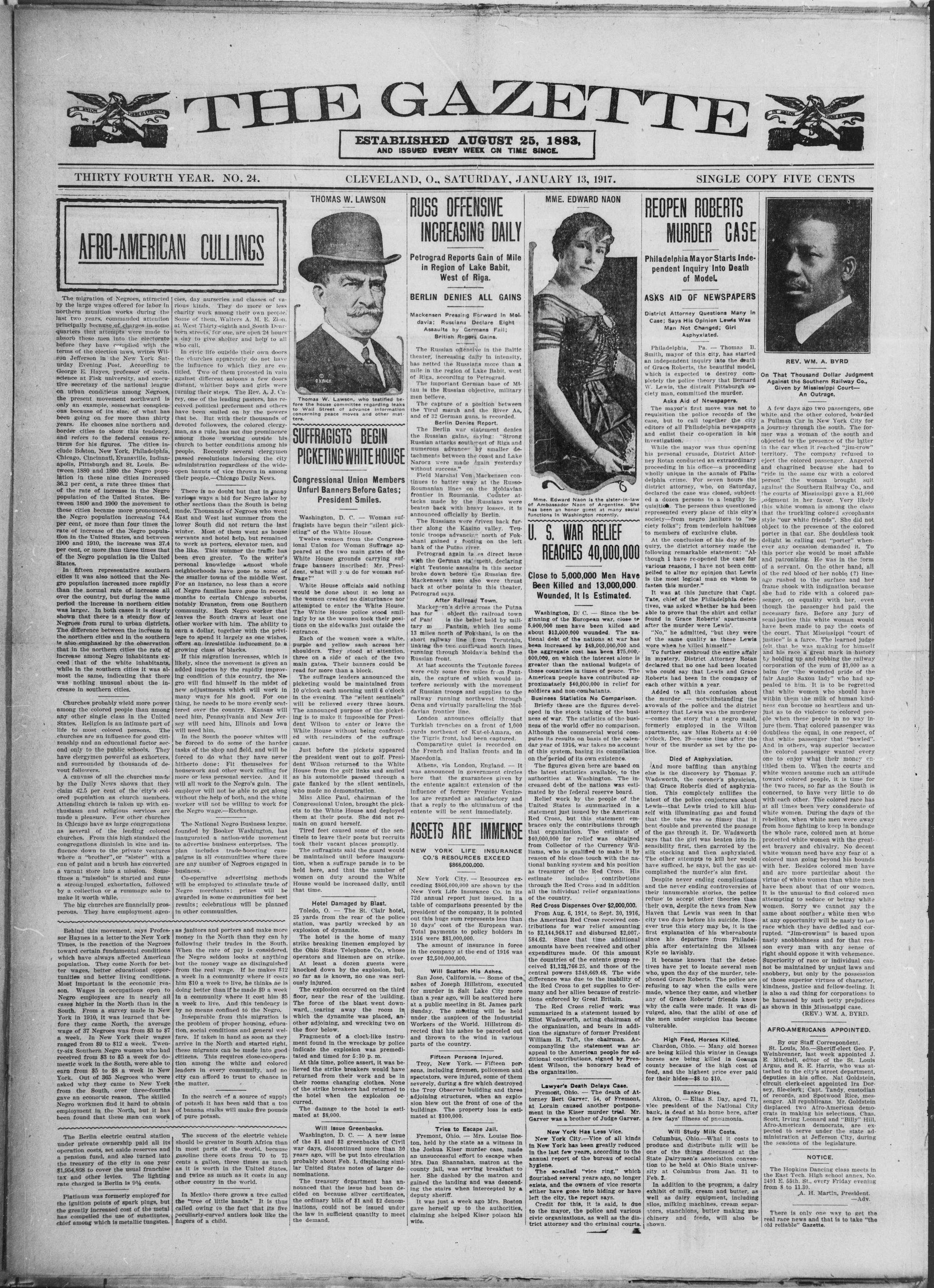
AFRO-AMERICAN CULLINGS
---
---
IN UNION THERE IS LIBERTY
THIRTY FOURTH
AFRO-AMERICA
In fifteen representative southern cities it was also noticed that the Negro population increased more rapidly than the normal rate of increase all over the country, but during the same period the increase in northern cities was larger. In both cases it is clearly shown that there is a steady flow of Negroes from rural to urban districts. The difference between the increase in the northern cities and in the southern is also emphasized by the observation that in the northern cities the rate of increase among Negro inhabitants exceed that of the white inhabitants, while in the southern cities it was almost the same, indicating that there was nothing unusual about the increase in southern cities.
Churches probably wield more power among the colored people than among any other single class in the United States. Religion is an intimate part of life to most colored persons. The churches are an influence for good citizenship and an educational factor second only to the public schools. They have clergymen powerful as exhorters, and surrounded by thousands of devout followers.
A canvass of all the churches made by the Daily News shows that they claim 42.5 per cent of the city's colored population as church members. Attending church is taken up with enthusiasm and religious services are made a pleasure. Few other churches in Chicago have as large congregations as several of the leading colored churches. From this high standard the congregations dumbish in size and influence down to the private ventures where a "brother", or "sister" with a can of paint and a brush has converted a vacant store into a mission. Sometimes a "mission" is started and runs a strong-lunged exhortation, followed by a collection or a rummage sale to make it worth while. The big churches are financially prosperous. They have employment agen-
Behind this movement, says Professor Haynes in a letter to the New York Times, is the reaction of the Negroes toward certain fundamental conditions which have always affected American population. They come North for better wages, better educational opportunities and better living conditions. Most important is the economic reason. Wages in occupations open to Negro employees are in nearly all cases higher in the North than in the South. From a survey made in New York in 1910, it was learned that before they came North, the average wage of 37 Negroes was from $3 to $7 a week. In New York their wages ranged from $9 to $12 a week. Twenty-six Southern Negro women who had received from $3 to $5 a week for domestic work in the South, were able to earn from $5 to $8 a week in New York. Out of 36 Negroes who were asked why they came to New York from the South, over three-fourths gave an economic reason. The skilled Negro workmen find it hard to obtain employment in the North, but it has been found that these man can work
The Berlin electric central station under private ownership paid all its operation costs, set aside reserves and a pension fund, and also turned into the treasury of the city in one year $1,94,888 to cover the usual franchise tax and other levies. The lighting rate charged is Berlin $9½ cents.
Platinum was formerly employed for the ignition points of spark plugs, but the greatly increased cost of the metal has compelled the use of substitutes, chief among which is metallic tungsten.
THE GAZETTE
cies, day nurseries and classes of various kinds. They do more or less charity work among their own people. Some of them, Walters A. M. E. Zion, at West Thirty-eight and South Dearborn streets, for one, are open 24 hours a day to give shelter and help to all who call.
In civic life outside their own doors the churches apparently do not have the influence to which they are entitled. Two of them protested in vain against different saloons a few doors distant, whither boys and girls were turning their steps. The Rev. A. J. Carey, one of the leading pastors, has received political preferment and others have been smiled on by the powers that be. But with their thousands of devoted followers, the colored clergyman, as a rule, has not due prominence among those working outside his church to better conditions among his people. Recently several clergymans passed resolutions indorsing the city administration regardless of the wide-open halls of vice thrown in among their people.—Chicago Daily News.
There is no doubt but that in many various ways a bid for Negro labor by other sections than the South is being made. Thousands of Negroes who want East and West last summer from the lower South did not return the last winter. Most of them went as house servants and hotel help, but remained to work as porters, elevator men, and the like. This summer the traffic has been even greater. To the writer's personal knowledge almost whole neighborhoods have gone to some of the smaller towns of the middle West. For an instance, no less than a score of Negro families have gone in recent months to certain Chicago suburbs, notably Evanston, from one Southern community. Each Negro worker that leaves the South draws at least one other worker with him. The ability to earn a dollar, together with the privilege to spend it largely as one wishes, offers an irresistible inducement to a growing class of blacks.
If this migration increases, which is likely, since the movement is given an added impetus by the rapidly improving condition of this country, the Negro will find himself in the midst of new adjustments which will work in many ways for his good. For one thing, he needs to be more even scattered over the country. Kansas will need him, Pennsylvania and New Jersey will need him, Illinois and Iowa will need him.
In the South the poorer whites will be forced to do some of the harder tasks of the shop and field, and will be forced to do what they have never hitherto done; Fit themselves for housework and other work calling for more or less personal service. And it will all work to the Negro's gain. The employer will not be able to get along without the help of both, and the white worker will not be willing to work for the Negro wage—Exchange.
The National Negro Business league, founded by Booker Washington, has inaugurated a nation-wide movement to advertise business enterprises. The plan includes trade-boosting campaigns in all communities where there are any number of Negroes engaged in business.
Co-operative advertising methods will be employed to stimulate trade of Negro merchants; prizes will be awarded in some communities for best results; celebrations will be planned in other communities.
as fanferts and porters and make more money in the North than they can by following their trades in the South. When the rate of pay is considered, the Negro seldom looks at anything but the money wage as distinguished from the real wage. If he makes $12 a week in a community where it costs him $10 a week to live, he thinks he is doing better than if he made $0 a week in a community where it cost him $5 a week to live. And this tendency is by no means confined to the Negro. Inseparable from this migration is the problem of proper housing, education, social conditions and general welfare. If taken in hand as soon as they arrive in the North and started right, these migrants can be made into good citizens. This requires close-co-operation among the white and colored leaders in every community, and no city can afford to trust to chance in the matter.
In the search of a source of supply of potash it has been said that a ton of banana stalks will make five pounds of pure potash.
The success of the electric vehicle should be greater in South Africa than in most parts of the world, because gasoline there costs from 70 to 75 cents a gallon, three times as much as it is worth in the United States, and twice as much as it costs in any other country in the world.
In Mexico there grows a tree called the "tree of little hands." It is thus called owing to the fact that its five peculiarly-curved antlers look like the fingers of a child.
ESTABLISHED AUGUST 25, 1883 AND ISSUED EVERY WEEK ON TIME SINCE.
THOMAS W. LAWSON
Thomas W. Lawson, who testified before the house committee regarding leake to Wall Street of advance information concerning peace moves and other matters.
Congressional Union Members Unfurl Banners Before Gates; President Smiles.
Washington, D. C. — Woman suffragists have begun their "silent picketing" of the White House.
Twelve women from the Congressional Union for Woman Suffrage appeared at the two main gates of the White House grounds carrying suffrage banners inscribed: Mr. President, what will you do for woman suffrage?
White House officials said nothing would be done about it so long as the women created no disturbance nor attempted to enter the White House. The White House police stood smilingly by as the women took their positions on the sidewalks just outside the entrance.
Each of the women wore a white, purple and yellow sash across her shoulders. They stood at attention, three on a side of each of the two main gates. Their banners could be read for more than a block.
The suffrage leaders announced the picketing would be maintained from 10 o'clock each morning until 6 o'clock in the evening. The "silent sentinels" will be relieved every three hours. The announced purpose of the picketing is to make it impossible for President Wilson to enter or leave the White House without being confronted with reminders of the suffrage cause.
Just before the pickets appeared the president went out to golf. President Wilson returned to the White House from the golf links and smiled as his automobile passed through a gate flanked by the silent sentinels, who made no demonstration.
Miss Alice Paul, chairman of the Congressional Union, brought the pickets to the White House and deployed them at their posts. She did not remain on guard herself.
Tired feet caused some of the sentinels to leave their posts but recruits took their vacant promptly.
The suffragists said the guard would be maintained until before inauguration, when a suffrage parade is to be held here, and that the number of women on duty around the White House would be increased daily, until that time.
Hotel Damaged by Blast
Toledo, O. — The St. Clair hotel, 25 yards from the rear of the police station, was partly wrecked by an explosion of dynamite.
The hotel is the home of many strike breaking linemen employed by the Ohio State Telephone Co., whose operators and linemen are on strike. At least a dozen guests were knocked down by the explosion, but, so far as is known, no one was seriously injured.
The explosion occurred on the third floor, near the rear of the building. The force of the blast went downward, tearing away the room in which the dynamite was placed, another adjoining, and wrecking two on the floor below.
Fragments of a clock-like instrument found in the wreckage by police indicate the explosion was premeditated and timed for 5:30 p. m.
At this time, police assert, it was believed the strike breakers would have returned from their work and be in their rooms changing clothes. None of the strike breakers had returned to the hotel when the explosion occurred.
The damage to the hotel is estimated at $8,000.
Will Issue Greenbacks
Washington, D. C. — A new issue of the $1 and $2 greenbacks of Civil war days, discontinued more than 30 years ago, will be put into circulation probably about Feb. 1, displacing similar United States notes of larger denominations.
The treasury department has announced that the issue had been decided on because silver certificates, the ordinary bills of $1 and $2 denominations, could not be issued under the law in sufficient quantity to meet the demand.
RUSS OFFENSIVE INCREASING DAILY
Petrograd Reports Gain of Mile in Region of Lake Babit, West of Riga.
BERLIN DENIES ALL GAINS
Mackensen Pressing Forward in Moldavia; Russians Declare Eight Assaults by Germans Fail; British Report Gains.
The Russian offensive in the Baltic theater, increasing daily in intensity, has netted the Russians more than a mile in the region of Lake Babit, west of Riga, according to Petrograd.
The important German base of Mitau is the Russian objective, military men believe.
The capture of a position between the Tirul marsh and the River An, and of 32 German guns, is recorded.
Berlin Denies Report.
The Berlin war statement denies the Russian gains, saying: "Strong Russian attacks southwest of Riga and numerous advances by smaller detachments between the coast and Lake Narocz were made again yesterday without success."
Field Marshal Von Mackensen continues to batter away at the Russo-Romanian lines on the Moldavian frontier in Romania. Counter attacks made by the Russians were beaten back with heavy losses, it is announced officially by Berlin.
The Russians were driven back further along the Kasino valley. Teutonic troops advancing north of Fokshani gained a footing on the left bank of the Putna river.
Petrograd again to as direct issue with the German statement, declaring eight Teutonic assaults in this sector broke down before the Russian fire. Mackensen's men also were thrust back at other points in this theater, Petrograd says.
After Railroad Town.
Mackenzie's drive across the Putna has for object the railroad town of Pantan is the belief held by military m Pantzin, which lies some 13 miles north of Fokushani, is on the short railway line from Terutchin, linking the two north and south lines running through Moldavia behind the Russian front.
At last accounts the Teutonic forces were only some five miles from Pantzin, the capture of which would interfere seriously with the movement of Russian troops and supplies to the railway running northwest through Ocna and virtually paralleling the Moldavian frontier line.
London announces officially that Turkish trenches on a front of 1,000 yards northside of Kutel-eAmara, on the Tigris front, had been captured.
Comparative quiet is recorded on the French and Italian fronts and in Macedonia.
Athens, via London, England. — It was announced in government circles here that the guarantees given by the entente against extension of the influence of former Premier Venizelos are regarded as satisfactory and that a reply to the ultimatum of the entente will be sent immediately.
ASSETS ARE IMMENSE
NEW YORK LIFE, INSURANCE
CO.'S RESOURCES EXCEEED
$866,000,000.
New York City. — Resources exceeding $866,000,000 are shown by the New York Life Insurance Co. in its 72d annual report just issued. In a table of comparisons presented by the president of the company, it is pointed out this huge sum represents less than 10 days' cost of the European war. Total payments to policy holders in 1916 were $81,000,000.
The amount of insurance in force in the company at the end of 1916 was over $2,500,000,000.
Will Scatten His Ashes
San Jose, California. — Some of the ashes of Joseph Hillstrom, executed for murder in Salt Lake City more than a year ago, will be scattered here at a public meeting in St. James park Sunday. The meeting will be held under the auspices of the Industrial Workers of the World. Hillstrom directed that his ashes be parceled out and thrown to the wind in various parts of the country.
Fifteen Persons Injured.
Troy, New York. — Fifteen persons, including firemen, policemen and spectators, were injured, some of them severely, during a fire which destroyed the Troy Observer building and three adjoining structures, when an explosion blew out the front of one of the buildings. The property loss is estimated at $100,000.
Tries to Escape Jail.
Fremont, Ohio. — Mrs. Louise Boston, held by the state as a witness in the Joshua Kiser murder case, made an unsuccessful effort to escape when Mrs. Dan Shannahan, matron at the county jail, was serving breakfast to her. She dashed by the matron and gained the landing and was descending the stairs when intercepted by a deputy sheriff. It was just a week ago Mrs. Boston gave herself up to the authorities, claiming she helped Kiser poison his wife.
MME. EDWARD NAON
6
Mme. Edward Naon is the sister-in-law of Ambassador Naon of Argentine. She has been an honor guest at many social functions in Washington recently.
U. S. WAR RELIEF REACHES 40,000,000
Close to 5,000,000 Men Have Been Killed and 13,000,000 Wounded. It Is Estimated.
Washington, D. C. — Since the beginning of the European war, close to 5,000,000 men have been killed and about $13,000,000 wounded. The national debt of the nations at war has been increased by $49,000,000 and the aggregate cost has been $75,000,000, on which the interest alone is greater than the national budgets of those countries in times of peace. The American people have contributed approximately $40,000,000 in relief for soldiers and non-combatants.
Business Statistics No Comparison. Briefly these are the figures developed in the stock taking of the business of war. The statistics of the business of the world offer no comparison. Although the commercial world computes its results on basis of the calendar year of 1916, war takes no account of this system, basing its compilation on the period of its own existence.
The figures given here are based on the latest statistics available, to the authorities at Washington. The increased debt of the nations was estimated by the federal reserve board.
Relief work by the people of the United States is summarized in a statement just issued by the American Red Cross, but this statement embraces only the contributions through that organization. The estimate of $40,000,000 for relief was obtained from Collector of the Currency Williams, who is qualified to make it by reason of his close touch with the national banking system and his position as treasurer of the Red Cross. His estimate includes contributions through the Red Cross and in addition all the individual relief organizations of the country.
**Red Cross Dispenses Over $2,000,000.**
From Aug. 6, 1914, to Sept. 30, 1916, the American Red Cross received contributions for war relief amounting to $2,144,968.17 and disbursed $2,007,584.62. Since that time additional amounts have been received and other expenditures made. Of this amount the countries of the entente group received $1,121,766.25, and those of the central powers $48,649.69. The wide difference was due to the inability of the Red Cross to get supplies to Germany and her allies because of restrictions enforced by Great Britain.
The Red Cross relief work was summarized in a statement issued by Eliot Wadsworth, acting chairman of the organization, and bears in addition the signature of former President William H. Taft, the chairman. Accompanying the statement was an appeal to the American people for additional contributions, signed by President Wilson, the honorary head of the organization.
Lawyer's Death Delays Case
Fremont, Ohio. — The death of Attorney Bert Garver, 54, of Fremont, at Lorain caused another postponement in the Kiser murder trial. Mr. Garver was a brother of Judge Garver.
New York Has Less Vice.
New York City.-Vice of all kinds in New York has been greatly reduced in the last few years, according to the annual report of the bureau of social hygiene. The so-called "vice ring," which flourished several years ago, no longer exists, and the owners of vice resorts either have gone into hiding or have left the city, the report says. Credit for this, it is said, is due to the mayor, the police and various civic organizations, as well as the district attorney and the criminal courts.
REOPEN ROBERTS MURDER CASE
Philadelphia Mayor Starts Independent Inquiry Into Death of Model.
ASKS AID OF NEWSPAPERS
District Attorney Questions Many In Case; Says His Opinion Lewis Was Man Not Changed; Girl Asphyxiated.
Philadelphia, Pa. — Thomas B. Smith, mayor of this city, has started an independent inquiry into the death of Grace Roberts, the beautiful model, which is expected to destroy completely the police theory that Bernard W. Lewis, the district Pittsburgh society man, committed the murder.
Asks Aid of Newspapers.
The mayor's first move was not to requisition the police records of the case, but to call together the city editors of all Philadelphia newspapers and enlist their co-operation in his investigation.
While the mayor was thus opening his personal crusade, District Attorney Rotan conducted an extraordinary proceeding in his office—a proceeding wholly unique in the annals of Philadelphia crime. For seven hours the district attorney, who, on Saturday, declared the case was closed, subjected a dozen persons to a lengthy inquisition. The persons thus questioned represented every plane of this city's society—from negro janitors to "society folks"; from tenderloin habitus to members of exclusive clubs.
At the conclusion of his day of inquiry, the district attorney made the following remarkable statement: "Although I have re-opened the case for various reasons, I have not been compelled to alter my opinion that Lewis is the most logical man on whom to fasten this murder."
It was at this juncture that Capt. Tate, chief of the Philadelphia detectives, was asked whether he had been able to prove that the shirt and collar found in Grace Roberts' apartments after the murder were Lewis.
"No," he admitted, "but they were of the same quality as those Lewis wore when he killed himself."
To further enshroud the entire affair in mystery, District Attorney Rotan declared that no one had been located who could say that Lewis and Grace Roberts had been in the company of each other within a year.
Added to all this confusion about the murder — notwithstanding the avowals of the police and the district attorney that Lewis was the murderer — comes the story that a negro maid, formerly employed in the Wilton apartments, saw Miss Roberts at 4:00 o'clock. Dec. 29—some time after the hour of the murder as set by the police.
Died of Asphyxiation.
And more baffling than anything else is the discovery by Thomas F. Wadsworth, the coroner's physician, that Grace Roberts died of asphyxiation. This completely nullifies the latest of the police conjectures about Lewis—that Lewis tried to kill himself with illuminating gas and found that the tube was so filmy that it bent double and prevented the passage of the gas through it. Dr. Wadsworth says that the girl was beaten into insensibility first, then garranted by the silk stocking and then asphyxated. The other attempts to kill her would have sufficed, he says, but the gas accomplished the murder's aim first. Despite never ending complications and the never ending controversies of their innumerable stories, the police refuse to accept other theories than their own, despite the news from New Haven that Lewis was seen in that city two days before his suicide. How ever true this story may be, it is the first explanation of his whereabouts since his departure from Philadelphia after entertaining the Misses Kyle so lavishly. It became known that the detectives have yet to locate several men who, upon the day of the murder, telephoned Grace Roberts. The police are refusing to say when the calls were made, whence they came, and whether any of Grace Roberts' friends know why the calls were made. It was divulged, also, that the alibi of one of the men under suspicion has become vulnerable.
High Feed, Horses Killed
Chardon, Ohio. — Many old horses are being killed this winter in Geauga horses are being killed in Geauga county because of the high cost of feed, and the highest price ever paid for their hides—$8 to $10.
Banker Dies.
Akron, O. — Elias S. Day, aged 71, vice president of the National City bank, is dead at his home here, after a few days' illness of pneumonia.
Will Study Milk Costs
Columbus, Ohio.—What it costs to produce and distribute milk will be one of the things discussed at the State Dairyman's association convention to be held at Ohio State university at Columbus from Jan. 31 to Feb. 2.
In addition to the program, a dairy exhibit of milk, cream and butter, as well as dairy equipment, including silos, milking machines, cream separators, stanchions, butter making machinery and feeds, will also be shown.
IN UNION WITH
THE UNION
REV. WM. A. BYRD
On That Thousand Dollar Judgment Against the Southern Railway Co. Given by Mississippi Court— An Outrage.
A few days ago two passengers, one white and the other colored, boarded a Pullman Car in New York City for a journey through the south. The former was a woman of the south and objected to the presence of the latter in the car when it reached "jim-crow" territory. The company refused to eject the colored passenger. Angered and chagrined because she had to "ride in the same car with a colored person" the woman brought suit against the Southern Railway Co., and the courts of Mississippi gave a $1,000 judgment in her favor. Very likely this white woman is among the class that the truckling colored swappians style "our white friends". She did not object to the presence of the colored porter in that car. She doubtless took delight in calling out "porter" whenever any occasion demanded it. To this porter she would be most affectionate and patronizing. He was in the form of a servant. On the other hand, all of the red blood of her noble (7) lineage rushed to the surface and her frame shook with indignation because she had to ride with a colored passenger, on equality with her, even though the passenger had paid the necessary fare. Before any jury of semi-justice this white woman would have been made to pay the costs of the court. That Mississippi "court of justice" is a farce. The learned judge felt that he was making for himself and his race a great mark in history by holding up and robbing the railway corporation of the sum of $1,000 as a balm for the "wounded pride of the fair Anglo Saxon lady" who had appealed to him. It is to be regretted that white women who should have within them the milk of human kindness can become so heartless and unjust as to do violence to colored people when these people in no way injure them. That colored passenger was doubtless the equal, in one respect, of that white passenger that "bawled". And in others, was superior because the colored passenger wanted every one to enjoy their money when the two races, so far as the South is concerned, to have very little to do with each other. The colored race has at all times been very considerate of white women. During the days of the rebellion, when white men were away from home fighting to keep in bondage the whole race, colored men at home protected white women with the greatest bravery and chivalry. No decent white woman need have any fear of a colored man going beyond his bounds with her. Besides colored men have and are more particular about the virtue of white women than white men have about that of our women. It is the unusual to find colored men attempting to seduce or betray white women. Sorry we cannot say the same about southern white men who at any opportunity will be nasty to the race which they have defiled and corrupted. "Jim-crowism" is based upon nasty snobbishness and for that reason every man with any sense of right should oppose it with vehemence. Superiority of race or individual cannot be maintained by unjust laws and snobbery, but only by the possession of those superior virtues of character, kindness, justice and fellow-feeling. It is also a sad thing for corporations to be harassed by such petty prejudices as shown in this Mississippi case. (REV) WM A. RYND
AFRO-AMERICANS APPOINTED.
By our Staff Correspondent.
St. Louis, Mo.—Sheriff-elect Geo. P. Weinbrinner, last week appointed J. E. Mitchell, editor of the St. Louis Press, and Mr. Harris, who was attached to the army, was deputy in his office. Nat Goldstein, circuit clerk-elect appointed Ira Dorey, file-clerk; Capt. Tandy, custodian of records, and Spotwood Rice, messenger. All republicans. Mr. Goldstein displaced two Afro-American democrats in making his selections. Chas. Scott, Irving Leonard and "Billy" Hill. After the election, he expected to serve under the state administration at Jefferson City, during the sessions of the legislature.
NOTICE.
The Hopkins Dancing class meets in
the East Tech. High school annex, No.
2491 E. 55th. St., every Friday evening
from 8 to 11.30.
A. H. Martin, President.
—Adv.
There is only one way to get the
real race news and that is to take "the
old reliable" Gazette.
PUBLISHED EVERY SATURDAY
One Year.....$1.50.
Six Months.....1.00
Three Months.....50
Subscribers are requested to re-
mit by postoffice money or-
der or registered letter
Entered at the postoffice in Cleveland
Ohio, as second-class matter.
Address all communications to
HARRY C. SMITH
Editor and proprietor,
THE GAZETTE,
Blackstone Building, Cleveland, O.
Member Ohio Legislature: 1894
to 1898; 1896 to 1898; 1900 to 1902
THE GAZETTE is the oldest, and has the largest bona fide circulation, double that of any newspaper in the Interest of Afro-Americans, published state of Ohio, and comparison with an all-time likely establish its rank as one of the NEWSIEST AND BEST in the country.
10,000,000 Afro-Americans.
240,000 in Ohio.
20,000 in Cleveland.
SATURDAY, JANUARY 13, 1917.
"Let us have faith that right makes might, and in that faith let us to the end dare to do our duty as we understand it."—Abraham Lincoln.
Gov. Goodrich of Indiana announces that there are at least a hundred offices in his State which can be abolished without injury to the public service. We are surprised that there are so few, considering that the Democrats have been in control for eight years.
"ENTANGLING ALLIANCES."
We are hearing less of late about President Thomas Woodrow Wilson's after-the-war plan to commit this country to an alliance with European nations for the purpose of maintaining peace. The scheme is loaded. If we are to take an active part in the affairs of Europe, we must expect Europe to take an active part in our afairs. This means the abandonment of the "Monroe Doctrine," the abrogation of our rights of domination on this side of the ocean, and an exposure to trouble-on both coasts as a result of ambitious schemes in Europe and in Asia to take advantage of commercial and other opportunities in South America. It is too high a price to pay even for the honor of being considered a real world power.
CHARACTERISTIC DEMOCRATIC
OPPOSITION.
The determination of Democratic U. S. senators to prevent the passage of the bill providing retirement for volunteer officers of the civil war was never more manifest than on the day before the holiday, recess. No sooner did Senator Charles E. Townsend, Republican, of Michigan, the sponsor of the measure, make the motion to proceed to its consideration than dilatory motions of all kinds were resorted to by his opponents. Calls for a quorum were made only to be repeated a few moments later. Seeing many Democrats leaving the chamber for the deliberate purpose of breaking a quorum Mr. Townsend exclaimed: "It seems to me there is a determination to prevent the attendance of a quorum, and to prevent the consideration of this bill." Under the circumstances one was reminded of the caustic criticisms leveled at the Republicans last year when they indulged in a filibuster to prevent the passage of the vicious government ship purchase bill.
DEMOCRATIC CONTRIBUTOR'S
"CLEAN UP."
Bernard Baruch, whom Wall Street knows as "Barney," is among those who are reported to have made a "clean-up" of seven figures in the recent furry in the stock market which followed the President's remarkable note to the European belligerents, Mr. Lansing's even more remarkable "explanation" of that note, and his still more notable explanation of the explanation. Mr. Baruch was an active personage in the recent campaign for the presidency. He is supposed to have raised a good deal of money for the Democratic campaign fund, his contributors hailing from the lower end of Manhattan island. He has, of course, now recouped himself for his own contribution and it is not unlikely that some of his associates find themselves similarly to the good. If so, they are the lucky people of that unlucky week for so many others. We wonder how it happened.
Thomas W. Lawson, with the posttiveness which marks all his utterances, declared without qualification that there was a "leak" from Washington which enabled the knowing ones to anticipate the movements of the stock market and to make big money when the President's peace note was dispatched. Lawson himself is reputed to have made a "killing" on Wall Street; and in view of his statements we expect to see him among the first of the witnesses to confront the committee which will conduct the Congressional inquiry into the matter.
AS TO HAMPTON AND TUSKEGEE
Some of our contemporaries have flown to the defence of Tuskegee and Hampton, attempting to strengthen their position by raising the issue of the kind of education "Colored Youth" should have. Clearly the defenders had no legs to stand upon in trying to combat our warning as to the educational policies of Hampton and Tuskegee. It is not a fight between industrial and literary education, but a
fight against policies that teach Colored youth to accept discrimination and segregation as their portion, and that they should not loudly protest. Much stress is laid upon the "humility" side of the Colored man's life. Institutions that believe the policy of the south is right, respecting its treatment of the Colored race, need not expect the approval of manly Colored men. We are not concerned about the kind of education Colored youths get when the higher and lower education is considered but we are aroused over any form of education that teaches a Colored boy to take without resentment an insult from any other boy he white or black. We are bitterly opposed to any kind of education that teaches a Colored girl to believe that she is not the peer of any other girl when she observes the rules of virtue, decorum and womanliness. Our criticism of Hampton and Tuskegee is that they are attempting to meet the approval of southern "traditions." This means that a Colored person is infinitely inferior to a white and that there are no rights belonging to a Colored person that a white person is legally and duty bound to respect. Such traditions deserve to be smashed to smithereens. Atlanta University, Fisk University, Oberlin College and a few more colleges where whites teach blacks, have spurned this "tradition policy" and for that reason they have not been able to reach the pocket-book of the givers as have Hampton and Tuskegee. A race with our moral courage and backbone is no race at all. The youth of any race taught to believe in and accept its inferiority to other races cannot make a virile and contending race in the upward trend of civilization. Let our contemporaries state whether they believe in this Hampton and Tuskegee policy or not and then we may debate it before the public.
VILLARD RESIGNS.
That Mr. Villard did the right thing when he resigned from the board of The Crisis goes without saying. Mr. Villard has not gone far enough, he should resign from the N. A. A. C. P. As we said in our former article in The Gazette, when Mr. Villard accepted Woordow Wilson and his policies he had to disown the Association of which he has been the leading figure. He cannot accept the policies of Mr. Wilson and continue to fight the South in its treatment of the Colored people there. Against the brutal treatment of the Colored people in the south, Mr. Wilson has not uttered a word but he has shed tears over the suffering of the Belgians and other unfortunate European nations. He has expressed great indignation at the treatment accorded the peons of Mexico, but the lynching of Colored people in Georgia, Florida and the south in general, has not called forth a word from him. It was clear to us that Mr. Villard was "swapping horses" when he voted for and advocated the election of Mr. Wilson. If the South were treating the Colored people justly, the Association which Mr. Villard and Du Bois have held together so long would be useless. We have a far higher respect for Mr. Villard since he has resigned than we had view. The suggestion that Mr. Villard favors the Booker Washington view of the "Race Problem" rather than the Du Bois, does not help matters. The Colored race is not duty bound to accept the views of any man or set of men, in contending for its rights. We have nothing harsh to say of any of the dead but we do say that the Booker Washington policy of accepting the treatment the southern whites give Colored people and not strike back is not the position of the late head of Tuskegee. At the close of his activities no man struck harder against oppression than he. No man plead for the liberty of his race with more zeal than he. Mr. Washington had completely changed his attack. He did not advocate, at the close of his career, what he advocated at the beginning. The Du Bois point of view for his race is the same that any white MAN would have for his. In Mr. Villard's breaking with Dr. DuBois, he acknowledges that he does not believe in Colored men demanding the same for their race he would for his. Since the issue is clear cut and each has shown where he stands. Colored people with manhood will unhesitatingly support Du Bois. Those of our contemporaries, who mollycoddled with Mr. Villard's flop to Wilson, may proceed to state what they will do in this crucial race conflict between a Colored champion and white flapper.
(REW) WM A BYRD
1917 LYNCHING RECORD.
Mr. Monroe N. Work's annual Tuskegee Ala., lynching record for 1918 shows that there were 50 Negroes and 4 whites lynch-murdered, last year. Included in this total number were 3 women. Fourteen or more than fourth of the total lynchings, occurred in the state of Georgia. Of those put to death 42, or 77 per cent of the total, were charged with offenses other than rape. The charges for which whites were lynchmed were murder; 3; suspected of cutting a woman, 1 (this a Mexican). The charges for which Negroes were put to death were, attempted rape, 9; killing officers of the law, 10; murder, 7; hog stealing, and assisting another person to escape, 6; wounding officers of the law, 10; each of the following offenses one person was put to death: slapping boy; robbing store; brushing against girl on street; assisting his son, accused of rape, to escape; entering a house for robbery or some other purpose; defending her son, who in defense of mother, killed man; fatally wounding a man with whom had quarreled; speaking against mob in act of putting a man to death; attacking a man and causing him to be murdered in the following states: Alabama, 1, Arkansas, 4, Florida, 8, Georgia, 14, Kansas, 1, Kentucky, 2, Louisiana, 2, Mississippi, 1, Missouri, 1, North Carolina, 2, Oklahoma, 4, South Carolina, 2, Tennessee, 3, Texas, 9.
Pneumonia as a Health Test
Science now believes that a man who has just passed through an attack of pneumonia is the best imaginable life insurance risk, for the fact that he survived the disease is absolute proof of his powers of resistance and endurance.
THE GAZETTE, CLEVELAND, O., SATURDAY, JANUARY 13, 1917
FRESH OHIO NEWS
Written by 'The Old Reliable' Gazette's Correspondents
THROUGHOUT THE STATE
What Our People Are Doing Each Week—Church, Personal, Social, Lodge, Literary and Musical—Mariages, Deaths, Etc.
TOLEDO. — Mrs. Alida Williams, daughter, Catherine, and son, Edward, of Berlin Heights, spent the holidays with her sister, Mme. C. H. Jones, who surprised her husband, last Tues-
EX-LIEUT. H. O. FLIPPER
On the Carrizal and Parral, Mexico, Butcheries—A Correction—An Intensely Interesting Letter.
El Paso, Tex., Jan. 3, 1917.
Hon. Harry C. Smith,
Editor The Gazette,
Cleveland, Ohio.
My Dear Mr. Smith:—With a mania for accuracy in all things, I want to call your attention to an error in The Gazette for Dec. 30, 1916. In that issue, there is an article entitled "PARRAL BUTCHERY, WHAT WAS SAID". Have we so soon forgotten the incidents to which this article refers? Is it possible that a man writing "on the ground" should fall into such error? The incidents referred to occurred in CARRIZAL not Parral. The troops involved belonged to the Tenth Cavalry.
There was a butchery at PARRAL some two or three weeks prior to the CARRIZAL incident; the troops involved were white; of the 8th Cavalry, I think, and some nineteen soldiers were killed. CARRIZAL is near El Paso. The first news of the attack came to El Paso and was sent to Gen. Pershing from here, for which reason it was impossible to hush it. On the contrary, the news of the PARRAL incident went to Gen. Pershing first and little was known of it here. The details were never published or made public. It is said that on the very day the Tenth Cavalry covered itself with glory at CARRIZAL, fourteen army trucks reached headquarters "some where in Mexico" with the bodies of the nineteen men killed at PARRAL. Whether honors equal those given the bodies of the CARRIZAL heroes were given the bodies from PARRAL, whether they were buried at Arlington or not, the public does not know. A cell was drawn over the incident and has been kept there. If it had been been siderably more than nineteen men were killed at PARRAL. Carrizal is about eight miles south of the boundary line at El Paso and PARRAL is three hundred and forty miles.
Another correction for the fun of it. The Governor of South Carolina said to the Governor of North Carolina: "Isn't a long time between drinks?" See border Reminiscences by Ralph B. Marcy, Harper Bros., 1855. Please find enclosed postal money-order for my subscription to THE GAZETTE. With best wishes of the season, I am.
CARRIZAL NOT PARRAL.
Las Cruces, N. M. Jan. 3, 1917.
Editor Gazette, Dear Friend:—Have just noticed the mistake in my letter in your last issue—referring to the Carrizal butchery as the "Parral butchery." Really I cannot understand how I came to do it, unless it was a result of my being in a several of my friends and myself had indulged in just prior to my writing the letter.
Sincerely,
WILL EDWIN SMITH.
High Honor Deserved.
The father of the lifeboot in America was James Francis, who was born in Boston in 1801. He died in Washington in 1833. Three years before his death congress voted him a medal of pure gold said to be the largest and finest ever given by this government to any individual. It was presented to him with appropriate ceremonies at the White House by President Harrison and is now on exhibition at the National museum in Washington.
Bolivian Tin.
Bolivia is the only locality of the new world whence tin in large commercial quantities is exported. The deposits are large, and the use of tin as an alloy appeared to be very old. Before the coming of the Spanish conquistadores the natives of Peru and Bolivia, in the vicinity of Lake Titicaca, made use of tin as an alloy with copper to make bronze.
Always in Working Order
Mary talked, so fast one had much of a chance to say anything in her presence. Her little neighbor had no one else to play with after school hours, but would not remain in her company long at a time. After noticing that her boy returned so soon each time he went to play with her, his mother inquired into it, and Walter replied, "Oh, she is always wounded up so."
Pity the Poor Editor
Mingus (speaking of one who has just passed)—"He certainly has a squeaked appearance." Sillibent—"No wonder. His wife won't let him express his mind at home, and his boss won't let him express it at the office." Mingus—"What's his business?" Sillibent—"He's a newspaper editor."—Life.
Good Advice Wasted.
The Life Extension institute issues a statement advising girls and young women to go to bed early every night, to shun cake and in no circumstances to eat ice cream. They will be glad to follow this advice, beginning on the same day they stop talking about clothes.—New York Herald.
Strange that some of our people insist on advertising their ignorance and weaknesses by loud talk in street cars, restaurants and other public places.
What Our People Are Doing Each Week—Church, Personal, Social, Lodge, Literary and Musical — Marriages, Deaths, Etc.
TOLEDO. — Mrs. Alida Williams, daughter, Catherine, and son, Edward, of Berlin Heights, spent the holidays with her sister, Mme. C. H. Jones, who surprised her husband, last Tuesday evening, with a "smoker," which was also thoroughly enjoyed by nineteen of his old friends. Madam Jones as usual, proved an exceptionally en entertaining hostess.
CADIZ—Rev. Geo. Johnson was in Sico recently—Mrs. Cora Olmstead, of M. Pleasant, was here last week—The W. C. T. U. held its monthly meeting at Mrs. Henrietta Smith's—Mr. and Mrs. Jas. Petress have moved into their new home—An effort is being made by the S. S. officers and teachers to improve the attendance. The last two Sundays showed an increase—The Y. M. L. club met at Mrs. Lulu Ballard's—Mrs. Clara Ramsey, who has been quite ill, is improving. FINDLAY, Rev. W. W. Grimes preached at Zion Baptist church, Sunset Ridge, Collins, of Springfield will preach at E. church, Jan. 13 and 14—Mr. and Mrs. Carl Thomas have returned to Chicago after a two months' visit with their grandmother. Emily Gillferord has returned there also—Mr. Claude Mitchell, of Ft. Wayne, Ind., spent a week with his brother, Melvin—The Woman for Women, Jan. 19, 20 and 21. Miss Made Harper was elected a delegate by Zion church.
CORRESPONDENTS must mail all letters for publication at their main postoffice sufficiently early on Monday (on Sunday) of each week to have them reach The Gazette office on Tuesday morning, and always write also, their names and that of their city or town on the outside of the wrapper about returned copies. Unless this latter is done, proper credit cannot be given you. Lists of names wedding presents, e.g., obituary no. 10, memorial notices, quilts for relatives and advertisements of all kinds, including items announcing entertainments to be held in the near future, must be paid for in advance at the rate of ten cents a line, six words to a line. Our rates for display advertisements will be sent on application.
ELYRIA. — The Y. M. W. I. club was entertained by Mrs. Vaughn. — Mr. Milton Lewis has returned from an extended visit with relatives. — Miss Nancy Smith has returned from a visit in Cleveland. — Mr. Michael Davis is visiting in Akron. — N. A. Holmes, of Oberlin Theological seminary, preached a very interesting sermon to the Brotherhood of the Second M. E. church, Sunday. An interesting program was rendered, last Wednesday evening, at the church. Wm. Ann Quayy and daughter were visiting Mrs. Reynolds. Mrs. Otto Robinson returned to Springfield after a long visit with her mother. — (Correspondent must write on one side of the paper only and mail news-letter on MONDAY, and not later in the week. — Editor.)
SMITHFIELD. — H. Jeffries, who is attending high school in St. Clairsville, spent the holidays at home here — Chas. Thompson, John and Norris Smith and Norman Bigsby started to work in the Bradley coal mines recently. — Mr. Ed. Fowler left, last week, for Penn. — Little Elizabeth Veney, badly burned recently, and Wm Parks (pneumonia) are convalescing slowly. — S. and Allen West and Ira Toney were here recently. — Mr. and Mrs. F. Smith, Mrs. Jeffries and Miss Ethel Freeman attended St. Paul's church, Sunday. Revival services were started, Sunday. Mrs. Steward the teacher, the M. E. bursary preach, Tuesday evening—Mrs. Chas. Thompson was out, Sunday, after a long illness. — Mr. Jas. Harris, Jr. Mrs. Mattie West and M. Harris, Mrs. M. E. Veney and Master Wm. Davis are recovering from la gripe. Mrs. Harris has returned from Steubenville to reside.
YOUNGSTOWN. — J. H. Moore is convalescing at home. — Archie Fleming has returned from Richmond, Va., where he spent five months improving his health. — Paul Adkins and Frank Stewart are ill. — Buckeye lodge will meet, hurry around, and come badly injured, some time ago, is not doing so well at this writing. — Simon Page, who died last Monday, was buried from Emerson's morgue, Saturday morning. He leaves a number of relatives and friends to mourn his demise. An uncle, Essex K. Page, of Richmond, Va., was here and took charge of the funeral, burying the deceased beside his parish. A committee from 31 churches started a go-to-church campaign, Sunday afternoon. If you have not been doing so, go to church now. — Mrs. Lena Brady, of Fairmount, W. Va., is the guest of Mrs. J. H. Harvey. — John Peterson, who died Monday evening in St. Elizabeth hospital, was a member of Covenant lodge, F. & M. M., services, the middle of this week. Tell your friends and acquaintances that the only way to get the real race news is to take the old reliable Gazette. Will Saunders, agent.
SANDUSKY — the churches and S. S. were well attended, Sunday. The Second Baptist church is doing fine. Sunday was communion day and four joined the church. It was election day for the S. S. and B. Y. P. U. J. R. Davis, sup't; assist, M. E. Smith; sec. Miss Libbia Gilkerson. Mr. Harry Alexander, pres, B. Y. P. U.; sec. Mrs Blanche Thompson. Rev. Geo. D. Smith, pastor for eight years, is greatly pleased with the growth of the church and S. S. — The New Year's reception at Mr. and Mrs. S. Scott's new home, one of the best in Sandusky, was a most auspicious event. H. H. Christian Journey, the its appearance, is full of news. M. G. Manks and Miss Magnolia Howard were married, Sunday, by Rev. G. D. Smith. — The K. P. elected Mr. John Shadd, C. C.; O. B. Shacklewood. M. F.; Alvin Smith. Ex.; Rev.
DOINGS
OF
THE
RACE
Start the new year right—subscribe
for the old reliable Gazette.
Prof. J. E. Spingarn is helping the
race with his lectures in southern
white universities.
Mrs. L. C. Clark has been elected
president of our Oklahoma State
Teachers' association.
Ladies, our fashion page is the latest and best—up to date! Tell your friends and acquaintances about it, please.
Ivan Williams, of Port Gibson, Miss., has recently sold his farm to a northern capitalist for $25,000. He paid $4 an acre for it "not so many buildings." The State A. & M. College, Orangeburg, S. C., Prof. Robert Shaw Wilkinson, president, is to have three new buildings in the early spring costing $150,000.
Brown's Savings and Banking Company of Norfolk, Va., led all of our banks in the amount of Christmas club savings accumulated during 1916. The bank paid off $70,000.
The National Association for the Assessment of Colored People will hold a mass meeting at Antioch Baptist church, Sunday afternoon, Jan. 14 at 3:30 o'clock. All welcome—Adv.
First Mrs. E. Azala Hackley, then Bishop Alexandra Walters and now Dr. W. E. B. DuBois is very ill in a N. H. hospital and has submitted to a serious operation. The last named is said to be suffering from a kidney affection.
Ancient tombs recently opened at Princeton (Greece) show colored figurines of men and animals, and many vases with human figures painted black. They belong to the Fifth and Sixth centuries B. C.—American Journal of Archaeology.
A. T. Donald and Miss Jenna McGee, of Chicago, won a civil rights suit against the Franklin theater, that city, last month. They were refused seats on the floor and urged to go to the museum. They were admitted to the They left the theater quietly and entered suit. GOOD! More of our people so insulted throughout the North, should do this.
Mr. Stock's tenth Friday-Saturday program featured a suite called "The American Negro," arranged by Thorwald Otterstrom, a well known Chicago composer. The feature was unique in that it was made up entirely of Negro compositions, with the exception of Weber's familiar overture to "Oberon" and Stephen's composition known as "Music for Orchestra." —Chicago Tribune.
G. D. S. K. R. S., With 36 members the lodge "is marching on." —We hope to greatly increase the local circulation of The Gazette soon. It is certainly the race paper to read, for two reasons: It is clean and truthful, and just what is needed in our homes for the children as well as the adults. It is the result of it, either. Rev. G. D. Smith, agent. To those desiring to subscribe; it is only $1.50 a year.
HILLSBORO—Mrs. Charity Pearl, of New Vienna, visited her son, Mr. Oliver Mitchell, last week. Mrs. Rhoda Kittrell and daughter, Mrs. Metcalf and Mrs. Pearl were entertained at dinner, last Tuesday, at Mr. Mitchell's. Master Booker T. Atchison returned, last week, to East High school, Columbus. Mrs. Wm. Newman, of Greenfield, spent New Year's here with her daughter, Mrs. Mary Jones, and family-Miss. Cassie Essen, and family-Miss. Jennifer Essen, Mrs. Henry Ford is quite Mr. and Mrs. Frank Williams' son, Edward, is recovering from pneumonia. Mrs. Alline Burton returned from Columbus Wednesday night accompanied by her son, Otho, who will join his wife here for a visit with relatives. G. M. Atchison entertained, Monday evening. L. D. Taylor, of Columbus, spent a few days here, last week, with relatives—Miss Romaine Donaldson returned to Wilberforce University, with her parents, with her parents, Mr. and Mrs. A. F. Donaldson, Mrs. Louis Young is better. Lagripe—Miss Mabel Williams entertained at a birthday party, Tuesday evening. Mrs. Bertha Clark entertained Mrs. Hannah Pleasant at dinner, Sunday. Mr. Charles Colter entertained, Sunday evening. Mrs. Bertha Clark and Mrs. Sarah Zimmerman were entertained at dinner, Thursday, at Mrs. Bertha Clark, Mrs. Linda Tompkins, of Blanchest, spent New Year's here with his wife. Mrs. Amen Kittrell, of Cincinnati, visited relatives here, this week. Mrs. Andrew Ellis, Mrs. Lillie Scott, Helen and Kate Christy and Mr. Butler, of Cincinnati, spent New Year's with Mrs. N. A. Christy.
AS TO "BAGTIME" MUSIC
Victor Herbert, 'cello soloist, band and orchestral director, of national repute, and called "king of American light opera writers," said while in this city last week: "Ragtime is synocopied rhythm. There is good ragtime as well as bad. There are far too many writers trying untrained at rafters. I have written rafters. For ragtime has a place in the musical world." Mr. Herbert was in Cleveland to direct the orchestra and company on the opening nights of his new musical "Hearts of Erin."
Ladies and Gents Furnishings
"FEMALE HELP WANTED"
A rare opportunity; comfortable living; home sewing; machine; sleedy. No canvassing. No trifers wanted. Samples 10c. Return if not satisfactory. Home Sewing. Robbers sewing. Lince. 2, Rebehoc, Del.
USE GORDON'S HAIR GROWER Then Watch the Results
This GREAT VALUE is sold with the understanding that if it does not grow the hair your money is refunded at any time. Save the empty boxes; they are worth five cents each.
plitting out, use GORDON'S GLORY SHAM-
splitting at the ends, rub GORDON'S GLORY
t to the scalp and be relieved of such hor-
RY HAIR-GROWER, 50c per box.
RY SHAMPOO CREAM, 25c per jar.
RIGHTENING COMBS, and LAMP attach-
m 10 to 15 dollars per day. Agents wanted
Laboratory
No. 209 Roanoke St
WINSTON-SALEM, N. C.
usy Life
If your hair is falling out, use GORDON'S GLORY SHAM-
POO CREAM, and if splitting at the ends, rub GORDON'S GLORY
HAIR-GROWER direct to the scalp and be relieved of such horri-
ble pain.
If your hair is falling out, use GORDON'S POO CREAM, and if splitting at the ends, HAIR-GROWER direct to the scalp and be rible trouble.
GORDON'S GLORY HAIR-GROWER, 5.
GORDON'S GLORY SHAMPOO CREAM.
GORDON'S STRAIGHTENING COME-ment, $1.25.
Agents make from 10 to 15 dollars per everywhere. WRITE.
O. C. Gordon's Laboratory WINS
A Busy
GORDON'S GLORY HAIR-GROWER, 50c per box.
GORDON'S GLORY SHAMPOO CREAM, 25c per jar.
GORDON'S STRAIGHTENING COMBS, and LAMP attachment, $125.
Agents make from 10 to 15 dollars per day. Agents wanted everywhere. WRITE.
O. C. Gordon's Laboratory
No. 209 Roanoke St
WINSTON-SALEM, N. C.
ABusyLife
By HON. JOSEPH BENSON FORAKER
The Most Important Autobiography In Years
Mr Foraker has given us his experience in the Union Army' on the Bench, as Governor of Ohio and in the Senate of the United States.
Political and public events of great importance and incidentally many national characters are dealt with in the most enlightening manner.
The work will prove of special interest to all students of political history whether they are public officials or only public spirited Americans, interested in the preservation of our institutions.
2 VOLS. NET $5.00
All orders sent direct to the
"THE GAZETTE"
Blackstone Bldg., Cleveland, O.
will have the personal direction
of its Editor
TEAR OFF HERE
The GAZETTE
Blackstone Bldg.
CLEVELAND, O.
Please send me eop
"Notes of a Busy Life"
BY J. B. FORAKER
Net $5.00 for which I enclose
Name
Address
FORD'S
HAIR POMADE
MAKES HARSH
MORE PLABLE, FISHER
TO COMB AND PUT UP
IN ANY STYLE
THE LENGTH WILL PERMIT
PRICE 25¢ AND 50 A BOTTLE
FORD'S
ROYAL WHITE
HAIR LOTION
MAKES HARSH
MORE PLABLE, FISHER
TO COMB AND PUT UP
IN ANY STYLE
THE LENGTH WILL PERMIT
PRICE 25¢ AND 50 A BOTTLE
FORD'S PATENT
TWO PIECE SWAMPOW
FORD'S HAIR STRAIGHTENER
NO. 022 STRAIGHTENING THE HAIR
BY ROLLING IT BETWEEN FOUR BRASS
ROLLS, BEST AND QUICKEST THING
WE WISH TO STRAIGHTEN HAIR
PATENTED LOCKING
DEVICE FOR ROLLING TEETH TIGHT
FORD'S SPIRAL HANDLE
HAIR STRAIGHTENING AND SWAMPOW
COMB NO. 022 SOLID BRASS, NICKEL
COMB AND KEVY STRONG
CANNOT BURN THE HANDLE OFF-SPECIAL
LOCKING DEVICE HOLDS THE HANDLE
WITHOUT SALVERING. PRICE $1.00
FORD'S LARGE BRASS
SHAMPOO AND HAIR STRAIGHTENING
COMB NO. 025 WOODEN HANDLE
LARGE AND VERY STRONG, MAKING A GODD AND
SERVICIED HANDLE
FORD'S SMALL BRASS
SHAMPOO AND HAIR STRAIGHTENING COMB NO. 022
A SMALL, STRONG COMB USED DEST ON REAL SHORT
HAIR, NICKEL PLATE, PRICE $2.50
ALL OUR COURDS WARRANTED AS DESCRIBED OR MONEY REQUIRED
FOR SALE IN YOUR SALEM, OR DIRECT FROM US UPON RECEIPT OF
PRICE. IN WRITING DIRECT MONEY BY POST OFFICE OR EXPRESS MONEY ORDER:
OZONIZED DIX MARROW CO. 46 W.KINZIE ST. CHICAGO, ILL.
12 GREAT SERIALS OR GROUP STORIES IN 1917
Stories upon Stories—and plenty of them. Action, Life, Adventure, Fun, Pathos, Inspiration.
The Youth's Companion
will make 1917 a Great Story Year. Besides the Great Serials and 250 Short Stories, there are rare Special Pages for each one. Family Page, exceptional Editorial Page, Boys' Page, Girls' Page, Children's Page, Doctor's Corner, Current Events, Nature and Science, Travel, Information, etc.
Everything from everywhere for every-one in the family.
THE YOUTH'S COMPANION, St. Paul St., BOSTON, MASS.
52 ISSUES A YEAR
CUT THIS OUT
and send it (for the name of this paper) with $2.00 for The Companion for 1917, and we will send it.
FREE
THE COMPANION for 1916.
FREE
THE COMPANION HOME CALENDAR for 1917.
THEN
The Fifty Two Weekly Issues of THE COMPANION for 1917.
Subscribe for The Gazette
```markdown
```
GENT'S FURNISHINGS
Hoslery, Underwear and
Neckwear
Arrow Collars and Shirts
Hats, Caps, Etc.
2922 CENTRAL AVENUE
CLEVELAND, O.
STERLING
5 and 10 Cent Store
3003 Central Ave.
Under New Management!
Watch Our Windows For Bargains
Colored Saleslady
We close at 8 P.M. every evening except Saturday
HER TONIC is the result of scientific study of the causes of diseases of the scalp.
Instead of treating effects of the diseases she treats the causes, evaluating the same and leaving the scalp in a healthy condition that can be maintained by using her plaster and Invigorator, according to her directions.
Madame C. H. Jones' Hair Tonic and Invigorator is guaranteed to stop the falling out of the hair and to make the hair
It has been successfully used by many dancers in this event. This Tonic is highly recommended by many Toledo people and elsewhere, and is used by many people get diseased scalps by using widely advertised hair tonics pre-treatment. You can have in mind nothing but necessary gain. On the other hand, MADAME JONES BLAKE and INVIGORATOR is absolutely harmless and invigorator is claimed for it. H. Jones' Hair Tonic and Invigorator promotes the growth of the hair, prevents and cures baldness, removes dandruff, cures scalp disease, imitates the appearance of the color of the hair by supplying it with the natural elements and necessary nourish-
MADAME C. H. JONES
353 Woodland Hills, Toledo, Ohio
Wanted.
SPLENDID ENDORSEMENT.
Toledo, March 15, 1910.
To Whom I Correct.
This is to certify and stimulate an acquaintance that has passed over many years, and has furnished an abundance of knowledge, and has been acquainted with the veracity of any claim made by Madame Clara Jones. The acquaintance has acquired with the formula and have an adequate knowledge of the veracity of any claim firm that no combination of drugs have been offered to the public for Alopecia and other conditions, and given such relief, and further has cured nine-tenths of the cases for which he has been a pleasure to practice medicine, if I were as certain of the medical effects of drugs as am confident that he will be a Invigorator will produce. its effect is specific and I clearly recognize it to special use—one who may be in need of such a remedy. It is the best that the human mind has produced so far. Truly I am. MASL H. FERGUSON, M. D.
FOR
Pure Drugs, Prescriptions
AND
Cut Rate Patent Medicines
GO TO
The Arlington Pharmacy
S. W. Cor. E. 55th Street
and Central Avenue
The State Agricultural and Mechanical College of South Carolina
Orangeburg, S. C.
Next session begins September 27th and ends May 25th, 1917.
No Tuition, no Room Rent, no Charges for Water, Lights or Fuel. Entrance Fee $10.00.
Board $6.00 per Month in Advance. Books, Laundry and Personal Expenses Extra.
Every Modern Facility, Standard Equipment. A Faculty of 57 Officers and Instructors.
For Information and Catalogue, Write
R. S. Wilkinson, Pres.
Orangeburg, S. C.
G. G. REED
Ladies' and Gents' Furnishing Goods
Special $1 Waist
Worth more
Sole Agent for the
American Lady, Nemo & R. & G. Corsets
3222 CENTRAL AVENUE
Bell 'Phone: Prospect 1200 R.
J. S. HALL'S,
3121 Central Ave.
*O. C. SCHROEDER'S,
Cuyahoga Blg.
J. E. BRANHAM'S
4219 Central Ave.
*ERNEST P. JACKSON'S
3969 Central Ave.
*OPEN SUNDAYS.
NOTICE TO SUBSCRIBERS
Subscribers not receiving the us at once. We desire every copy. Send or bring locals and all bu fice, suite 2, Blackstone Bldg. If y picase.
We advise our readers to care tisements before making purchases this paper should have the patron they advertise is assurance that
Local reading notices (adver words in a line); display advertis publication.
All matters for publication in be in the office by 4 p. m., WEDN
Subscribers not receiving The Gazette regularly should notify us at once. We desire every copy delivered promptly.
Send or bring locals and all business matters to The Gazette's office, suite 2, Blackstone Bldg. If you wish to see the editor call there, please.
We advise our readers to carefully examine The Gazette's advertisements before making purchases. Business men who advertise in this paper should have the patronage of our people. The fact that they advertise is assurance that they want it.
Local reading notices (advertisements) ten cents a line (six words in a line); display advertising space, fifty cents an inch, single publication.
All matters for publication in current issues of The Gazette, must be in the office by 4 p. m., WEDNESDAY of that week, at the latest.
Social and Personal
Our
Classified Ad
Department
WANTED AGENTS.—New invention. Royal Slide Comb, actually straightens kinky hair. Taylor Pharmacal Co., Box-100, Atlanta, Ga.
WANTED—Men roomers—All conveniences. Charge reasonable. Apply at 2347 E. 86th St., between 6 a.m. 7 p. m.
FOR RENT—Houses and Rooms—If you have them to rent or if you want to rent, advertise in The Gazette. It brings results.
NOTARY PUBLIC—For such services calls at The Gazette office, No. 2 Blackstone building, No. 1424 W Third Street, near Superior Ave.
FOR SALE—Houses or lots. If you have either or anything else to sell, or if you wish to purchase, advertise in The Gazette. If anything can bring you results, it can and will.
FOR SALE—Property at 2176 E. 43d. St., near Cedar Ave; eleven rooms, bath, furnace, etc., $3,000. Four hundred dollars down and the balance, $25 per month. Apply at The Gazette office.
FOR SALE—Eight room house; gas for lighting and heating; lot 55 by 96, $2500 cash. A splendid opportunity to get a good home with nice light, light rooms. Between Cedar and Quincy Ave's., west of E. 75th St. Apply at The Gazette office.
ANY WOMAN CAN MAKE BIG MONEY IN HER OWN HOME. THIS IS A GREAT OPPORTUNITY! GRASP IT AT ONCE! FOR MARIARLS, ULLARS, EVEN MORTON, CO. LOISE, MO., BELLE PLACE, ST. LOUIS, MO., AND MENTION "THE GAZETTE." PLEASE.
Cleveland
Sixth City
Mr. Carl Bell is visiting in Chicago
Mrs. Crazetta Gordon, E. 39th. St.
spent Sunday in Canton.
Mrs. Ola Wheatley, E. 29th. St. visited in Columbus, the past week.
Mrs. S. Little, E. 43rd. St., was host to the Priscilla club, this Friday.
Miss Stean Thomas, E. 40th. St. visited relatives in Pittsburgh recently.
Mr. P. O'Connell, the new pastor of Cory M. E. church, will lecture Sunday afternoon.
The Gazette published bank annual statements, twenty years ago and in recent years.
Mr. Wm. Smith, of Oil City, Pa. will call the city by Mr. Chas Loney's death.
Mr. Thos. Good, of Columbus, was a week-end visitor with his cousins, Mrs. Good and family.
Four car-loads of Afro-Americans, about 400, arrived, last week, from the South to work in local plants.
Mrs. Wm. Owena with St. lost hain 12, world of father, Saturday, and has the earnest sympathy of the community.
The National Equal Rights League urges the race to observe the Hon. Frederick Douglass' centenary, Feb. 14, and it should be done.
Mrs. Jennie Cross was hostess to the Pleasant Company club, last Thursday. Next meeting, in the evening, at Mrs. Freeman's, 2258 E. 43d. 5.
At the N. A. A. C. P. local branch at Antioch church, Sunday afternoon, the officers elected, some weeks ago, will be installed.
Charles McAfee, who was taken home, the first of the week, suffering from a bursted blood-vessel, which caused hemorrhages, is improving.
Ladies, how do you feel, is the best—thoroughly up to date! Tell your friends and acquaintances about it, please.
Mrs. Mabelle Clark Biggs, organist of St. John's church, has been sick, the past week; also Mrs. Mary Taylor, E. 29th. St. Mrs. Carrie Thornhill is convalescing.
Goo, Y. Fields, an old Cleveland "boy," for years in business at Washington, Pa., was in the city, the first of the week, circulating among his many old friends.
Shiloh Baptist church added about 80 new members, last Sunday. Mt. Haven and others of our local churches did well also. Nearly all of the new members are from the South.
Arthur Johnson, age 21, and Edith Richardson, age 21, both of 2221 E. 37th St. and John Lewis, 44, and Hattie Hollingsworth, 26, both of 3202 Scovill Ave., were married last week by Justice Zoul.
The following named young local
*A. GORDON'S,
2928 Central Ave.
JACKSON'S,
3641 Central Ave.
*MRS. BESSIE KITZMILLER'S
3943 Central Ave.
SUNDAYS.
The Gazette regularly should notify
delivered promptly.
business matters to The Gazette's of-
you wish to see the editor call there,
fully examine The Gazette's adver-
t. Business men who advertise in
image of our people. The fact that
they want it.
attements) ten cents a line (six
space, fifty cents an inch, single
current issues of The Gazette, must
USDAY of that week, at the latest.
Personal
"Any prejudice whatever will be insurmountable if those who do not share in it themselves treason will be accepted it and accept it as a law of nature."— John Stuart Mill.
athletes are organizing a basket-ball team: Richard Blue, Rob, Brooks Ernie Jackson, R. Burke, Herbert Myers, Ramsey, Rose, Harris, Singer Miss. Hobert, E. 34th. St. entertained at dinner recently the Misses Edith and Dorothy McAllister of Yonkers, N. Y., who visited their parents, Mr. and Mrs. N. W. McAllister, E. 34th. St., during the holidays.
The Christian Missionary Alliance S. S. presented the retiring superinventant, Mr. L. Callender, on Weekend at the Toucanau pen. Miss Emma Tolbert has been elected his successor. The annual convention tomorrow.
All news for The Gazette should be in our office on WEDNESDAY at the latest. Please remember this. Do not mail it on that day and expect it to be delivered in time. Notify us promptly when your copy is not delivered on time.
B. P. Phillips has opened one of the neatest and nicest dining parlors and has made sure that section of the city on the corner of Scovill Ave. and E 21st. St. and is serving the very best meals quickly. HOME-COOKING, too! Step in for yourself—Adv.
James F. Beason, 2652 Central Ave. for years a well-known resident of this city, died Jan. 6. Funeral, Wednesday afternoon, from Antioch Baptist church, the pastor, Rev. H. C. Bailey, officiating. A wife survives him and has the sympathy of the community. Mrs. Mary Solomon, of Marion Ave., entertained on last Thursday evening, Mrs. Susan Chas, H. Dobbins, Mr. and Mrs. Jas Offer, Mrs. Susie Taylor, Mrs. Lulu and Mary Taylor, Mr. Chas. Hunt of Cincinnati and R. B. Weaver.
Our organizations should get in touch with Stanley McMichael, sec. of the real estate board, and get him interested in a new tenement or two for the 11th ward. He is arranging for the erection of a number throughout the city ward, and he needs Mrs. J. H. Fox of McMichael have located in this city. He has purchased the tailoring business at 2728 Central Av., from W. J. Kenney, whose health requires more out-of-home life, and is doing splendidly. Mr. Cox is a first-class workman. Try him and be convinced—Adv.
Mrs. Maud Turner Jones, of E. 434 St., sister of Mrs. Wawne Bolden, died in the afternoon. Two brothers, Edward and William Turner, also survive her and all have the sympathy of a host of friends. Funeral, Monday afternoon, from the residence of Mr. and Mrs. Bolden, E. 39th St.
Complaints have reached The Gazette of the mistreatment of patrons by the management of the Grand Central theater, cor. Central Ave. and E. 36th St. They claim that frequently after personal grievances, the latter, the admission is "boosted" from ten to fifteen cents.
The first lecture under the McBride lecture fund of Western Reserve university was delivered, last Friday evening, in Amasa Stone Memorial chapel by John Avery Lomax, secretary of the University of Texas and former president of the American Folk Lore Society. He talked on "Negro Spirituals."
A very pretty souvenir post-card, from Tampa, Fla., under date, Jan. 7, 1917, received by the editor of The Gazette, Wednesday, announced that Messrs. Wallace Bolden and Fred. Sampson, of this city, were "enjoying a trip in the far south" and that both "send regards." They stopped in Jacksonville, too.
A Negro said he was Wilbur Green, 208. E 31st St., drew a limit of $200, costs and six months, Tuesday from Muny Judge Cull on an assault and battery charge. Patrolman Block testified he captured Green at the point of a gun Tuesday, after the man had attacked Rosie Jakubich, 700 Berg St., on her way to work.
Mrs. Dovie Miller, of Rendville; Miss Remitha Ford, of Jackson; Misses Cecil Miller and Frances Starks, school-teachers, of Charleston, W. Va., were guests of Mr. and Mrs. E. P. Miller, E. 43d. St. Among those who entertained in their honor were: Mrs. E. K. Eelley, Central Ave.; Mina. Irene Dean Cuny, J. A. Branham, Cuny, M. Va. Yates died in ambulance after a street-car accident, Friday. Funeral, Tuesday, from Mt. Haven Haven church, the pastor, Rev. Chas. H. Crable, officiating, assisted by Rev. G. V. Clark. Mrs. Yates was the mother of 25 children, Mesdames Slaughter, Copes and Tucker being among the number. The family have the sympathy of the community.
THE PEOPLES' DRUG STORE, F. H. WEAVER, PHAR. D. PROPRIETOR OF COCONUT EAST 33RD ST. PRESCRIPTIONS OUR SPECIALTY. MONEY ORDERS TELEGRAMS, GAS BILLS, CAMERA SUPPLIES, ADAMS EXPRESS AGENCY, WANT ADS, POSTAGE
---
AND TRADING STAMPS. HOT DRINKS OF ALL KINDS. ALL FOR YOUR CONVENIENCE—Advt.
The Optimistic club was royally entertained, Wednesday evening, at Mrs. Willa Randall's, Central Ave. The following officers were elected for the ensuing year: Mrs. Cynthia Bates, pres.; Martha Nelson, vice-pres.; Mrs. Willa Randall, sec.; Mrs. J. E. Burris, assist.; Mrs. Jas. Offer, treas.; Mrs. sausie Jefferson, chaplain. Next meeting, Jan. 17, at Mrs. Rector's, 3923 Central Ave. The club is making preparations for an Easter bazaar.
The editor of The Gazette acknowledges the receipt of an invitation from the City Club to attend a luncheon, today, in the ball room of the Holldenden hotel to hear learning educators at the Survey's New Contribution to Education." Dr. Ernst M. Hopkins, president of Dartmouth College, is to be the guest of honor, with Profs. A. Flexner, W. A. Jessup, E. C. Elliott, and E. L. Thorndike of Columbia University.
elite of Richmond whom was a all-people town. A list of that city of the Opera house a high-class concance a chorus of put the Richmond H directed by a Prof largest one of the took a prominent Howard and other organizations (chant that city. Wesley the Richmond hip老 ago, and a mem chestra, gave eva tion that the violin. T money with which come a student in atory. The Comm choirs of practical churches had char concert. Master k
Mr. Charles Lacey, one of our oldest residents and for about 35 years in the employ of the Sigler Bros. Co., jewelers, died early Sunday morning after a brief illness. A wife and several grown children by his first wife survive him and have the sympathy of the community. Funeral, Thursday afternoon, from Cory M. E. Clemente, the new Mrs. M. Clemente, official. Mr. Lacey has been an active member of this church for many years.
Rev. C. G. Fishback preached two able sermons, Sunday, to large congregations. Many were turned away, unable to gain admission. Over $140 was collected and 82 new members added. The following S. S. officers have been elected: Mosby Johnson, supt.; Wm. Nen, contact; Mrs. Ada Perkinson, contact; Mrs. Ada Perkinson, contact; Rev. William of Chicago, is assisting Rev. Fishback in his revival meetings, started Monday evening.
Felix Worth, president of the Y. M. C. U., must not forget that it is the support of our older and more substantial citizens which must be gained before he can expect that organization to succeed. His too frequent violent attacks have not amounted to indulgence in, has already had the effect of retarding the progress of the Union, will very naturally drive from it the support it might get and must eventually have if success is ever to perch upon its banners. According to the foreman of the ashcrew, ashes in the 11th ward were removed, Monday, for "the first time in the history of the United States" three months. The Gazette's expose, of last week, brought quick results again, didn't it? When one of the crew was asked to place the ashbark back in the yard where he took them from, his reply was: "I'll be damned if I will." Fine service from the city this, hen, he said. He must be damned if he is sackedly the diminutive's democratic employees."
It is rumored that there is an effort being made to change the name of the Caterers' Association because prospective applicants do not wish to join it while it bears its present name which they claim, it is said, suggests SERVICE (servants.) There are some members who think it expedient to change the name in order to get these alleged "prospective applicants." Many of the pioneer members of the organization are bitterly opposed to such a change and cannot be blamed for their stance.
The first of a series of weekly neighborhood gatherings is to be held at Brownell community center school, Summer Ave. and E. 14th St., this Friday evening. The clubrooms will be thrown open to the citizens and the gymnasium will be opened for dancing, states J. W. Barkley, supervisor of school extension. Barkley also announced that Kennard school, E. 46th St., south of Scovill Ave. is to be opened and classes, beginning this week. The school was formerly open exclusively to girls. Our people should remember this.
The editor of The Gazette acknowledges the receipt, last week, of an invitation from Allen T. Burns, secretary of the Cleveland Foundation, to attend the joint civic rally held, last Saturday noon, in the ball room of the Holldenden hotel, under the auspices of the Chamber of Commerce, Chamber of Industry, City Club and the Steague Club of the Cleveland Foundation. Dr. Leonard P. Ayres, director of the Cleveland public school survey, spoke on "Conclusions and Legislation Recommended by the School Survey". The Cuyahoga county legislators were the special guests.
Jas. Thompson, age 15; Theo. Taylor, 13, whores E. 32d St.; and Larry Joyce, 19, according to the police, were the guilty ones who stole nearly $200 worth of goods and $16 from him recently. About $200 worth of merchandise and $13 have been recovered, most of the former being returned from Detroit by Larry's mother, who lives there. Bass and Larry Joyce are cousins. Their mothers did all they could to assist in the recovery of the goods and money. The Bass boy was sent to the bad boy's school on the west side, the Thompson boy, to the bad boys' school at Lancaster, and the Taylor boy, to relatives in Pittsburgh. Larry got away from them during the summer months with his grandmother at 3203 Scovill Ave. Bass and Joyce are cousins.
In a statement to the voters of the 11th. ward, issued Monday, Tom Fleming says he has a "desire to make them a good councilman." The voters would like better evidence of this "desire" than his mere sayso. Dirty streets, miserably poor service when it comes to the removal of ashes, rubbish and garbage. Bad street-car service and about every other vehicle, including unquoted street-cars, apparently the worst in the city (on the Central Ave. line); bad street and sidewalk pavements, and practically no improvements; all this, too, in spite of the fact that he has served two terms in the City Council. Tom says he "solicits suggestions" and invites his constituents to call on him at his office which is located over a saloon in Central Ave. Judging from Tom's conversation in that ward for many conversations that they will "see" Tom on election day next fall. Its "GOOD-NIGHT" for him—as a councilman.
Accompanied by Mr. L. S. Jones, of E. 101st. St., whose guest he is, Master Wesley J. Howard, a fellow-student of Master Louise Vaughn Jones at the New England conservatory of Music, Boston, Mass., paid the Gazette sanctum a pleasant call, Wednesday afternoon. Wesley was en route east from his home in Richmond, Ind., where he had been visiting his widowed mother and where, on Jan. 5, the leading citizens of that city had tendered him a testimonial concert (for his benefit) such as is seldom given any person of any class in any city of this country. About 600 of the
elite of Richmond's population among whom was a slight sprinkling of our people, for the Afro-American population of that city is small, gathered in the Opera house there and listened to a high-class concert program in which a chorus of public school children, the Richmond High school orchestra, directed by a Prof. Sloane, possibly the largest one of the kind in the country, took a prominent part, with Master Howard and other leading soloists and organizations (church choirs, etc.) of that city. Wesley, who was a pupil in the school of high school four years ago, and a member of the school orchestra, gave evidence of such rare talent that the Richmond Commercial Club fathered a movement to "place" him so he could continue his studies of the violin. The club raised the money with which he was able to become a student in the Boston conservatory. The Commercial Club and the choirs of practically all of Richmond's churches had charge of the testimonial concert. Master Howard, accompanied by Mrs. L. S. Jones, were guests of the concert at the Thompson-Caldwell recital at the Grays' Armory, Thursday evening. He may remain in the city until Monday, 'he he had planned to leave for Boston, today.
GOV. WILLIS AND SHERIFF ELEY
Presented Loving-Cups in the Same Church by Our People—The Difference in the Attendance Upon the Two Meetings
Special to The Gazette.
Columbus, O. — The Gazette was right—there were very few of our people in attendance upon the meeting held here, a few weeks ago, in which Gov. Fritz Reeves, the special press agent, who wrote up the affair for the newspapers, made a few slight (?) misstatements. First he said the Second Baptist church, in which it was held, "seats 1200" and that "every available seat was taken". The church will only hold 800 when people are packed in "like sardines". As a matter of fact, only "a handful" of people turned out to help present the cup to Willis. Soummas was the host, and the gubernator, who presided, apologized to the governor and expressed his regrets that so few were present, and each speaker did likewise. Mr. Chas. Cottrell, of Toledo, who was brought here, at the expense of those who contributed to buy the cup, to speak, criticised Mr. Wilbur King, in his speech for not being present, although holding the best job given a member of the race by the Willis administration; not a gubernator appointment; not a governor from Willis. The special press agent also said that the governor's wife was present and was presented with a bouquet. The fact is she was not present. The "handful" of people, not over 75, in a church that holds about 700 shows that our voters of Columbus, like those of Cleveland and elsewhere in Ohio, "aint very sweet" on Willis. They found him out, and in time, too. It is said that Wilbur King, who was the governor, to present Willis with a loving-cup, did not like the selection of Cottrell as speaker in preference to himself and also "got cold feet" when he found only a few would attend the meeting. The result was, he "sidestepped" the affair which was unquestionably a dismal failure. Only 75 turned out when a loving-cup was presented to Gov. Willis, but the following week when a cup was intended to Sheriff Eley, of Ima, the same church was packed to the doors.
R. W. T.
FOR QUALITY Prescription Work THE OWL DRUG CO. 3743 CENTRAL AVE. Excels All Others
PHONES:
Studio, Rosedale 383-J.
Home, Prospect 333-J.
TEACHER OF PIANO
Hours 10 A.M. to 6 P.M.
Evenings by Appointment
4910 CENTRAL AVE.
"Heart of City" LunchRoom
720 W. Frankfort Ave.
Between West 6th and West 9th Sts.
BEST HOME COOKING
QUICK SERVICE
T. E. BLAIR, Prop.
DON'T THROW AWAY
Your copy of The Gazette after reading it, but give it to a friend or an acquaintance who might subscribe after reading a copy of the paper.
Editor
REAL HAND MADE HUMAN HAIR BOOK
EXTRA SPECIAL OFFER Electric S
ELECTRIC ENGINEER
together with Impressive Branch
Jewel Comb b o o with two Hair N
to-day enclosing order for EoS comb or EoS com
and get Hair Nets Free also BOOK fully illustrated
b o oing latest styles in Heli Goods and Toilet
articles. Remember, Hair Nets FREE with order for
EoS or EoS comb. Illustrated Book FREE on request.
GEORGE F. F. BUNGAY 28 S. William St. New York
FREE--REAL HAND MADE HUMAN HAIR BOOK HAIR NETS FREE
EXTRA SPECIAL OFFER Electric Straightening COMB Ec.c.
ELECTRIC STREET BROADWAY
together with Imported French Hair Nets Free, Jewel Comb Ske with two Hair Nets Free, Write to any enclosing order for Eoo comb or Eoo comb showing latest styles in Hair Goods and Toilet Bathroom. Ec.c. order for Eoo or Eoo comb. Illustrated book FREE on request.
GEORGE F. P. BUNGAY 28 S., William St., New York
A. B.
Cuyahoga, C
Edward Do
(T H
3035 Cent
Wm. Brack, Prop. . . .
James Ma
Rosedale 1800
SLAUGHT
Funeral Di
Emba
Office and F
3923 CEN
Autos for All Occasions.
Cuyahoga, Central 5727
Ward Doctor's Call
(THE Z)
3035 Central Avenue
Rack, Prop. . . Frank Doctor, Ma
James Mabel, Chef
edale 1800 Quality Se
SLAUGHTER BROS.
Funeral Directors and
Embalmers
Office and Funeral Parlors
3923 CENTRAL AV.
Calls for All Occasions. Calls Answered Day and
(THE Z)
3035 Central Avenue
Wm. Brack, Prop. Frank Doctor, Manager
James Mabel, Chef
Rosedale 1800 Quality Service
SLAUGHTER BROS.
Funeral Directors and
Embalmers
Office and Funeral Parlors
3923 CENTRAL AV.
Autos for All Occasions. Calls Answered Day and Night
GOLD BOND
The Cream of Table Beers
Gold Bond is a brew fit for most modern equipment, the
"made from sun-ripp and hops, pure and properly aged before
It comes to your table pure,
Bond is a brew fit for Kings --- the product modern equipment, the highest skill in beer-brew "made from sun-ripened barley malts and hops, pure distilled water, and properly aged before bottling." es to your table pure, wholesome, bubbling wit No other beer compares with the fine fla Bond.
Gold Bond is a brew fit for Kings --- the product of the most modern equipment, the highest skill in beer-brewing.
"made from sun-ripened barley malts and hops, pure distilled water, and properly aged before bottling."
It comes to your table pure, wholesome, bubbling with good cheer. No other beer compares with the fine flavor of Gold Bond.
The National Training School
"I cordially commend the school's interest and needs to all who believe in the Negro race and in our obligation to help promote its intellectual, moral and religious uplift." Rev. Dr. Charles H. Parkhurst, New York City.
It is a community of service and uplift.
Its influence is destined to be felt in all sections of the country in improved Negro community life wherever our trained workers locate.
Settlement workers, missionaries for home and foreign mission fields, Y. M. C. A. and Y. W. C. A. secretaries and district nurses receive a comprehensive grasp of their studies under a Wellesley graduate and experienced co-workers and actual everyday practice through the school's social service department.
Industrial training, advanced literary branches, business school.
Thirty-two acres, ten modern buildings, healthful location.
We can accommodate a few more earnest, ambitious students.
Communities requiring social workers should write us.
YOU
should take PURO HERBS,
the great Spring remedy.
Cleanses the organs and purifies
the blood.
A blood medicine with a reputation
that cannot be beaten.
Made from Nature's health giv-
ing herbs.
( 25c PER PACKAGE — Dry Form
PRICES ( 7.5c PER BOTTLE — Liquid Form
$1 PER BOTTLE — Extra Strong
FOR SALE ONLY AT
BROWN DRUG CO.
CAR R. SEYFERT, Prop.
2742 Central Ave. Cor. E. 28th
MAN HAIR BOOK HAIR NETS FREE
NAL OFFER Electric Straightening COMB 20c.
together with Imported French Hair Jewel Jewel Comb $50 with two Hair Nets Free, Write or $20 comb or $50 comb
also BOOK Kelly illustrated Jewel Goods and Tollet Nets FREE with order for printed Book FREE on request.
28 s., William St., New York
Prospect 1095-J J. H. COX
COX DRY CLEANING CO.
Repairing, Pressing, Cleaning, etc., on short order. Suits Pressed, 30 Cents
2738 Central Avenue CLEVELAND, O.
Central 5727
Doctor's Cafe
(SE Z)
Central Avenue
Frank Doctor, Manager
bel, Chef
Quality Service
TER BROS.
Directors and
almers
Central Parlors
CENTRAL AV.
Calls Answered Day and Night
Kings --- the product of the highest skill in beer-brewing,
opened barley malts distilled water, and are bottling."
wholesome, bubbling with good pares with the fine flavor of
Season's Skirts Must Be Narrow GO TO EXTREMES
Paris Has So Ordered, and of Course American Women Will Obey.
PETTICOAT A DEAD LETTER
Unless of the Thinness Material, It Will Not Be Worn—Outside Blouse Grows in Popularity—Ribbon to Be Used as a Substitute for Embroidery.
New York—Every cable brings from Paris the news that the skirts of 1917 will be narrow. All those in the watch towers have proclaimed the coming of this enemy to full skirts since last September, but only in limited segments of society was the news acted upon. The manufacturers had the material for full skirts, the wholesale houses turned them out by the thousands, and it was only left to the exclusive women and their dressmakers to cut down the width and length them.
Even now there are skirts that are slightly gathered to the v aistline, and these are coming from some of the best houses in Paris, but they are dropped over a lower skirt that is quite narrow. No matter what the fulness, every skirt clings to the figure, as it did in the end of the eighteenth century. Petticoats are dead, unless they are of chiffon, crepe de chine or jersey silk.
The question which will soon confront every woman is whether she wishes to change the silhouette of her skirt or go on wearing it until it is ready to be discarded. One cheerful feature of the return to the slim silhouette is that a full skirt can be cut into a narrow one with ease.
The Outside Blouse.
That garment known as the outside blouse, which is merely a short, twelfth century chemise, has grown quite important and popular since the large shops copied the exclusive French models and placed them within the reach of the average purse. The new ones started at $85; you can now buy them for $5 or $10 in those shops where vast quantities of garments are sold. They still remain at $30 in the shops that are neither departmental nor exclusive.
Women like them. They are more becoming than the white shirtwist and they do not make demands on one's purse for laundry. They have a thin lining of their own, which is a boon to the woman who has neither the time nor the money to arrange a vast variety of expensive underwear which shows through a thin white blouse.
Skirts of Other Materials
These outside blouses are worn with skirts that are not of their material or color, so this makes for economy and comfort at once. So far, they are in chiffon embroidered in silk floss or bullion thread, but there are some very smart ones coming in colored satins. The sleeve is half length or long, but the latter should be chosen for every occasion except one's own dinner table. The neck is in the Renaissance fashion; in fact, the extraordinary high collar, standing or turned over, has given way to the flat, twelfth century neckline. This is cut in many ways. The dressmakers do not hold one down to the vertable Renissance. Jenny has taken up the Italian decolletage for the daytime, which is cut in the form of a delta. A new gown which she sends over, which was copied from a
I
It lt a Fine, Black Weave, With a Brim
That Rises Skyward on the Side—
There is a Lovers' Knot of Black
Fur at Side.
As an Aid to Beauty It is Superior to Any Other Fruit That Is Known.
Few women realize the health and beauty-giving qualities of a single lemon. It is a greater beauty aid than any other fruit that grows.
It is an excellent idea to keep a half of a lemon, cut side down to prevent it from drying, upon the shelf near the kitchen sink. Following the handling of vegetables, with the stains they leave upon the fingers, the hands can be rubbed with the lemon and the skin left white and clean. Following dishwashing with hot water and soap, the hands can be rubbed over with one lemon, rinsed in cold water, and all the unpleasant odor of the dishwater is gone.
A half of a lemon is equally useful in the bathroom, though many women prefer to squeeze out the juice into a small bottle and keep it in this form. If you do this, strain the juice to free it from seeds, and add about a quarter
STREET CAPE COAT.
It is of Gray Cloth, Finished With a Wide Band of Ermine at the Hem "The Deep Shoulder Cape Is Cut In One With the Coat and Drops to the Hem at the Back.
Rembrandt portrait and which is of black panne velvet with girdle and arm pieces of black satin, has no ornamentation at the neckline. The velvet is cut to the base of the neck at the back, then out on each side to the armpits and goes in a straight line across the chest below the collarbone. It may be safely said that the thousands who are continuing to wear the neck arrangement of the last three years because it is becoming and comfortable, are not in fashion. The vast industries in this country connected with the manufacturing of neckwear will surely set up a howl of protest if this new style of the collarless neck makes strong headway.
Ribbon Instead of Embroidery
There is a rumor that France and America in combination will present ribbons as a substitute for embroidery. It is possible that America is the father to this thought. The manufacturers in this country have ardently wished for definite fashions from Paris that would feature miles of ribbon used in any way possible to cover the surface of clothes. The demand for ribbon has been worked up in Paris to some extent through American exporters who represented factories that could turn out ribbon in this country, but so far all attempts have failed to produce a real call for this kind of ornamentation.
A minor fashion which has come into being and which calls, for embroidery is the ornamented glove. A few women have been foolish enough to wear hand-painted ones recently at afternoon affairs, but there will always be women foolish enough to do anything. The glove which is embroidered in a simple way will be at the height of style, because America has learned how to do it with the machine, instead of by hand. (Copyright, 1918, by the McClure Newspaper syndicate.)
FASHION'S FADS
Eggplant-colored satin is richer than black, and has all the quiet distinction of black.
The girdle of a charming gown is crushed and rather wide and tied in a large bow at the side.
Gray velvet trimmed with seal and buttons to match the velvet describes a charming suit.
Underwear need no longer be in simple white, but colors are used freely; nile green is the newest. Rose-colored chiffon draped over a foundation of silver cloth makes an evening gown of rare beauty. A transparent hat has an edge of skunk, the black net of the brim being embroidered with golden flowers. The finer skirts for large women are usually smooth over the hips, though apt to be full below them.
Linings for Furs.
Linings for fug coverings are decidedly bold in color. Al sorts of old-world brocade is used; the heavier and more dignified the design the better. They remind one of grandmother gowns—stiff, severe and uncompromising, for they are quite decided as to flower, or scroll, or dye. As for color, the lining is royal purple, pea green, king's blue, yellow brass. Of course they render a wrap stately and gay, and it is a gayety that is not young. However, they accord perfectly with the garment they finish and, as the harmony is observed throughout, there is no fault to find.
the amount of pure alcohol. This keeps the lemon juice indefinitely.
When the nails are stained, rub lemon juice under them, and rub in a little powdered chalk. This cakes beneath the nails, but washes out, taking the stain with it. Lemon juice will help to fade freckles and, diluted with water, makes a wonderful face and neck bleach. It also cures sunburn. Diluted with water, half and half, it forms a harmless and effective hair bleach. It can be rubbed into the hair before washing and allowed to dry in the sun, or it can be poured into the last rinse water.
Evening Dress of Gray
One of the most beautiful gowns at a recent ball was of gray tulle. Wide blue ribbons looped up at the sides provided the contrasting color note and the wearer wore her hair powdered and bound with silver-faced blue velvet ribbons.
A burglar on being frightened from a building in Exeter, N. H., fled, leaving an automobile behind him.
THE GAZETTE, CLEVELAND, O.. SATURDAY, JANUARY 13, 1917
---
BUTTONHOLE FINISH
There is such a craze for fur trimings this winter that some of our dressmakers are losing the sense of porportion which is so necessary for all artists, sartorial and otherwise. For example, I have seen wide bands of fur passed round the hips of 1880 dresses, with deplorable results, writes Idalia de Villiers, Paris correspondent of the Boston Globe. No form, however tall and slender, could carry off such a trimming as
Striking Coiffure.
this, and the idea is wrong; even highly inartistic. The Jersey dress which is always associated with the 1880-1881 period was a sort of glorified fish-wife costume. The corsage which reached well down on the hips, was skin-tight and it was attached to a wide hem of kilted material.
Where the plain bodice was joined to the kilted hem there was a loose sash which circled the hips and which was tied in a flat bow at the back All this was quite reasonable. But when the same style of dress is finished off with a hip belt of opossum or fox a spirit of mere eccentricity is introduced.
Some of the new toques are so distinctly directoire that they fill us with amazement; for example, the chimney-pot models, which are high as the highest tail hat ever worn by a man, and which have practically no brim. Needlessly to say these models are not for every one, but when they prove becoming they are exceedingly smart and attractive.
These toques are covered with mirror velvet, panne or hatter's plush and in some cases they are trimmed with high, straight aigrettes made of coarse horsehair. It seems at the present moment that all our dress artists, dressmakers and milliners alike are trying hard to create a race of tall women. Certainly it is true that the new high-crowned toques add several inches to a woman's height, and the same may be said of long straight dresses.
Some of the newest three-cornered models are very high at the sides, with a distinct dip in front. When these hats are worn with the new vells, which are handsomely embroidered on the upper hem, no trimming whatever is introduced, but little by little high, straight, mounts are creeping back into favor.
The colfure sketched is an example of the craze for addition to the height.
BELTS OF MANY MATERIALS
Wide Choice Available, But the Smartest of Them Are Narrow and Neatly Tailored.
Belts continue in fashion. Perhaps this recurrence of a bygone fashion is due to our recurrent waistlines. For so long we have had no waistlines that we must now do something to celebrate their reappearance, even if that something is the wearing of a belt. So belts we wear, and now when we pack our week-end suitcases we shall be forced to look for one more accessory to go with our coats, frocks and suits. There are many interesting leather belts of various styles and colors. Some are lined with silk or satin, some are covered or partly covered with bead embroidery. Some are made of other materials. But whatever the color, whatever the material, the smart belt is narrow, and neatly tailored. It is altogether a neat addition to our wardrobe.
FACE REQUIRES STEAM BATH
Thorough Cleansing, and Massaging of the Tissues, Will Be Found to Work Wonders.
Our present day highbred life, with its comforts figured out to a science, has its pitfalls. Fancy one of our old New England women needing to steam her face, even if she dared to attempt it. Overwork, overeating, insufficient sleep and exercise, especially outdoor
A picot edge on chiffon crepe and organdie collars, while not out of style, is set aside a little for the new button-hole charm. finish in these days when so much embroidery is used on dresses.
Chiffon blouses, dress tops and blouses now have their edges overbound with a narrow one-eighth or one-fourth-inch band of the chiffon to give just the right degree of solidity to this material. Edges of surplice fronts, collars, cuffs, etc., all show this finish. If the material is taffetta or satin the overbound edge matches. Of course, this edge is put on by hand, and is often pressed into a fold in the center first to keep it from getting askew.
Mole and Mink Combined
Mole and mink are the furs that travel; together just now in fashion's estimation. Who would have thought two years ago of putting mole and mink
exercise, overheated houses and a lot more things that we love to indulge in bring about a tight skin and tensed muscles. Most nervously rundown patients are hide-bound all over, especially over the abdomen. Getting free from this is the first stage in the cure. When the skin takes up this stiffened condition, take a lesson from the stable man. He exercises his animal till he gets every pore vigorously throwing off secretions. Then he blankets the horse and lets him steam and cool off gradually. The principle is the same. Steam the face, massage the tissues, then close the pores gradually.
MOST USEFUL HAND BLOTTER
Something Different, and Easy to Make If the Directions Given Are Properly Followed.
A most delightful and useful hand blotter, shown in the sketch, is made from a darner with a round head, and the directions are as follows:
The diameter of the head of the darner is 3 inches, so cut out a round piece of stiff cardboard to measure 3 inches by 4 inches. Take four pieces of thick white blotting paper to measure $4\%$ by $5\%$ inches. Place the cardboard on the head of the darner and over the cardboard the blotting paper; this is arranged exactly like the small diagram.
Turn the ends of the blotting paper under the cardboard and secure to the under part of the darner head by
Hand Blotter.
means of four drawing-pins, two pins on each side. This device is perfectly firm, and as steady as a rock.
In these days when almost every girl is busily employed with office work, a hand blotter will be found an ideal present, for they are so much more convenient than just blotting paper, especially for figures.
The blotting paper is renewed by simply undoing the drawing-pins and pinning fresh on.
Modish Chemisettes
White chiffon inset with narrow ochre-hued lace is a French chemisette iden, and yellow Valenciennes is much used upon batiste, lawn and other fine stuffs tinted in the same yellowish tone.
The collars of the modish chemisettes are of many kinds—the wide notched or shawl design of the tailored type; the plaited frills of net or chiffon, high in the back, but rolling away in front; the wide cape collar; the large or small sailor collar. Some of the newest models have collars only across the back, and in front are cut down in a narrow U or V shape with pictor erge or narrow frill finish.
Narrow black silk ribbons or still narrower velvet ribbons in dark, dark blue, purple, etc., are introduced in cavat bands or bows upon many of the thin chemisettes and collar.
VEILING OVER HAIR
TOMIE
WILSON
BENNETT
This new idea in veiling is called the E-Z or Van Raalte. It serves the combined purpose of a veil and a hair net and it looks much neater than the veiling over the hat. To offset that it cannot be removed as easily. It is just the thing for the close-fitting hat that is in vogue this season. The photograph shows how it appears with the hat while doing the duty of a veil.
together? But the combination today is particularly smart. Twilight-and-dark wraps for wear over dinner and evening frocks are of matched molekins, with broad border bands and collars of mink—the more mink the better. One does not see, however, mink wraps trimmed with mole, though that may come with midwinter. The favored lining color seems to be a very pale corn color, and the popular—or perhaps one should say the select—lining material is satin, or the shimmering, satin-textured soiree silk, which comes in such delicate colorings.
Convertible Sports Dress
A white cotton jersey sports dress is cut in a front and back panel effect, the two being joined at the sides with belts. The top of the front plastron can be let down to the waistline, disclosing an elaborately embroidered gimp; embroidery in black.
---
IN ROSE AND BLUE
DAINTY GARMENT FOR WEAR IN
THE BOUDOIR.
Material Is Georgette Crepe, Made Up in the Latest Fashion—Empire Models Being Shown Among the New Negligees.
The dainty little negigee or boudier garment shown in the sketch is made of rose and French blue geogette crepe, one layer over the other, which is now an approved method of combining two shades of this popular fabric. The under section of the garment may be of blue geogette, with the upper half of the sleeves of the same, and the overslip of rose-colored geogette or vice versa. The making of a garment of this type is really a simple matter, as the fabric drapes itself so gracefully and easily that it might almost be draped on the figure and held in place with pins. In fact, it was only a short time ago that a well-known artist dressmaker entertained a large body of clubwomen by showing them how a dainty negigee might be so constructed. The negigee shown is trimmed about the bottom and on the little simulated jacket with silver embroidery done in a conventional design.
The sleeves are interesting. The arm covering proper is of the sheer fabric, while a heavy "drop" of black velvet weights the lower part and contributes to the whole graceful silhouette. The question of color is one that may, of course, be decided according
THE FASHION OF THE TWENTIETH CENTURY
Two-Tone Negligee of Georgette Crepe, to the individual taste and complexion. Yellow and black or yellow and white might be combined, lavender and rose, gray and rose, etc. The touch of black velvet on the sleeves and the neck finished in black marabou give real character to the garment. A black velvet cord may be used to girdle the waist or a metal girdle may be used matching the embroidery, according to choice.
Among the new negligees now shown many empire models are seen, and the coatee type of negligee is a favorite the lower part of the garment being usually of plain or accordion plaited crepe de chine, with long overcoatee of chiffon or georgette in matching or contrasting shade.—Washington Star.
Hints for Home Decoration.
Nothing is more important in the matter of making one's surroundings individual than color, and color is something that can easily be regulated. Just because every one, almost, has buff or yellow walls and white enameled woodwork, with mahogany furniture and old rose Oriental rugs, does not mean that you should also, unless this combination happens especially to suit your taste. If dark brown or dark green woodwork is more expressive of your taste have it. It is only a matter of the color of the paint, and with a little insistence the decorator or painter will follow out this idea as well as the more usual tones. If you can't just get the tone in wallpaper that you want, perhaps you can find just the right shade for your walls in paint, for every wall decorator can produce different tones by the mixture of the pigment in the paint.
And once having fixed on your color
Canteen Purse.
The military influence has penetrated even to the realm of handbags. Possibly the latest novelty shown is the canteen purse, a fascinating affair made of patent leather and moire silk. It opens by way of a slit in the top and this is possible because the sections fold back over one another. The inside is cleverly lined with taffeta in a pale rose shade and fitted with the necessary items of the vanity case. A leather handle suspends from one side of the opening. When the bag is closed it is difficult to note where it fastens, this proving one of its chief values.
Clinging to One Color.
There are many women who have always adhered to tite one color scheme in selecting their clothes, but not until this season has the idea become so general among women. It is to be hoped that it will continue to grow popular,for by clinging to the one color idea, one is sure to appear more
scheme stick to it. There is no reason why you should have the conventional sorts of upholstery if you do not find them to your taste. If bed tickling or apron gingham happens to express your taste better than the kind of upholstery material the upholster has to show you, have it.
And then wonders can be done by making use of the services of even an inexpert cabinet-maker. Book shelves, window seats, shelves and settees can be constructed along original lines under your direction at a price that is really not so great as the price of ready-constructed pieces of furniture. But you must be insistent, and you must not waver.
How to Renovate Silk Bag.
The silk bags which have been so much used lately often become shabby before the frame is worn out; our illustration shows a plan of renovating one in an effective way.
The frame where fastening is must be covered quite smoothly with silk that is carried down in a deep point in
Dainty Bag.
center each side, and over the point a piece of silk embroidery or gold tinsel lace is sewn. A length of silk is then folded and sewn together at ends and is put on with the top edge turned in and slip-stitched down each side of point; a little plait is made at point which will cause the cover to hang full as shown.
If a new handle is needed, it can be of ribbon sewn under two little ornaments at each end of the frame. Should the fastener be broken off, as was the case with our model, sew a stud fastener at each end inside just below frame; these will keep the top effectively fastened and can easily be undone.
Novel Cuff.
A dress of midnight blue satin and chiffon shows novel cuffs. The sleeves are of chiffon with deep mousquetaire cuffs of satin. A little distance above the wrist the cuffs are drawn together forming puffs and ending in tight sleeves over the hand.
To Freshen Velvet Bows.
Heat a curling iron and around each prong wrap a damp cloth. Slip the iron inside each loop and then open it as far as possible, stretching the velvet into shape. The moisture will raise the nap, and when the loops have all been freshened the bow will be as crisp and pretty as when new.
Smart Sports Suit.
Copyright
Milton Bradley
1910
Dainty sports suit of green and white striped tusore silk combined with green jersey, is one of the most appropriate costumes for Palm Beach wear. The hat is of white panama embroidered with green worest. It is worn with a slight tilt which gives it a sporty air.
smartly dressed than if a combination of colors were introduced. For instance, the woman who decides to dress in purple this season should make an effort to have suit, gown, hat, coat and petticoat all of the same color. It is not necessary that one should use only one tone of color. This would become monotonous. The wide variety of shades of one color makes such a step quite unnecessary. Anyone deciding to use but one color should strive to introduce the color on every accessory. In the long run the fad is very economical.
Home-Made Negligee.
A very pretty negligee can be made of alternate strips of four-inch satin ribbon and footing dyed to exactly match the ribbon. Cut in the shape of a dolman or a large circular cape, this overmantle is fastened across the shoulders to a slip of the same color, and two slits are made at the elbows for the arm to come through. A heavy beaded ornament fastens the mantle in front.
TO CLEAN SILVER
GOVERNMENT EXPERTS TELL OF BEST METHODS.
Directions for Preparing a Cleansing Material That Has Much Virtue—Must Be Applied With Care and Thoroughness.
For the benefit of those who have the care of silver, the office of home economics at Washington has made a thorough study of the electrolytic method of cleaning and has published the results of their work in United States Department of Agriculture Bulletin No. 449.
After discussing several types of commercial cleaners and giving the results of various analyses, they suggest the following method as being cheap and satisfactory:
"An enamel or agateware dish should be partly filled with a cleaning solution of one teaspoonful of either washing or baking soda and one teaspoonful of common table salt to each quart of water and placed directly on the stove to boil. A sheet of aluminum or clean zinc should then be dropped into the dish and tarnished silver placed in contact with the metal. It is best that the silver be entirely covered with the cleaning solution and that the solution remain at the boiling temperature. As soon as the tarnish has been removed the silver should be removed, rinsed in clean water, and wiped with a soft cloth. Zinc may be used in place of aluminum, but it becomes corroded and inactive in a much shorter time."
The electrolytic method cleans plated or sterling silverware without loss of metal, giving, however, a satin finish rather than a burnished appearance, and has the additional advantages of being both clean and labor-saving. - Clara Glidden, Colorado Agricultural College, Fort Collins, Colo.
Silver Cake.
Beat whites of four eggs stiff, one and one-half cupfels sugar, one-half cupfel butter, one cupfelt cream or rich milk, two and one-third cupfels flour, two teaspoonfels cake tart, one teaspoonful soda or two and one-half teaspoonful baking powder, one teaspoonful scant of salt, flavor with lemon. Cream butter and sugar together. Add egg whites, then milk, alternately, with flour in which baking powder and salt have been sifted four times. Last add one cupfel coconut if liked. Frost with cream frosting made as follows: One and one-half cupfels powdered sugar, two teaspoonfels butter and sufficient cream to make of right consistency to spread. No flavoring, as butter and cream flavor it. Beat hard five minutes and spread on cake.
Delmonico Cream Roll Potatoes
Here are two Delmonico potato recipes: Pare potatoes and cut them into bits the size of a pea. Keep them in cold water until all are ready. For each scant pint of potatoes make a pint of white sauce, seasoning with onion juice or celery salt. Stir the potatoes into the hot sauce, turn into a well-buttered agate sauce pan and cook in the oven until the potatoes are tender and the sauce is absorbed, with the exception of just enough to hold the bits of potatoes together. Fold one part over the other as an amolet and turn onto a hot dish. The potatoes should not brown above or below. If necessary, set them on the grate and cover the pan.
Old-Style Mincemeat
One and a half pounds stoned raisins, three-quarters pound currants one-half pound sultanas, half pound mixed peel, one pound apples, two pounds of brown sugar, two pounds suet, one heaping teaspoonful of mixed ground spices, one half teaspoonful of mixed ground ginger and nutmeg, one gill brandy. Mix the chopped or grated suet and the well-cleaned and dried fruit together with the sugar, spices and the candied peel shredded and chopped fine. Mix for several minutes, then add the brandy and pack tightly into clean, dry jars. Seal thoroughly, so as to keep out the air, and store in a dry place for at least a week before using.
Hot Biscuit.
Three cupfuls of flour, two tablespoonfuls of baking powder, three-quarters of a teaspoonful of salt, three tablespoonfuls of butter, three-quarters to one cupful of milk. Mix and sift the flour, baking powder and salt together twice; then cut in the butter with a fork until it is in fine bits. Add the milk gradually, just enough to make a soft dough. Do not handle any more than is necessary. Turn out on a floured board and roll to about three-quarters of an inch thickness. Cut, then place on a baking sheet and bake in a hot oven from 12 to 15 minutes.
Fried Parsley.
We always use a little fried parsley to ornament our meat dishes with. This is how it is done: Wait until a blush smoke is rising from the fat, then remove it to the side of the fire. When it has cooled slightly throw in the parsley, and leave it until the fat has almost stopped spluttering. Then lift it out at once and drain it well, when it should be a lovely green color. Be careful not to overfry it, or it will turn an ugly brownish color.—Boston Globe.
Chicken Pie
Boll chicken until tender. With the water in which it was boiled make a gravy, allowing one-half cupful of flour and two tablespoonfuls butter to every quart of water. Season with salt and pepper, put in baking dish, add chicken from which bones have been removed. Cover with one-half pint cream and pieces of butter, cover with a rich pie crust. Bake in hot oven.
Simplifies Curtain Hanging
When hanging lace or muslin curtains, fit an old glove finger or a thimble over the end of the curtain rod, and you will find that the rod will slip much more quickly through the *sin* material.