The Gazette
Saturday, February 9, 1918
Cleveland, Ohio
Page text (machine-generated)
Dancing Every Thursday Evening at Barksdale's Academy,
THIRTY-FIFTH YEAR. No.27
IN UNION IS STRENGTH.
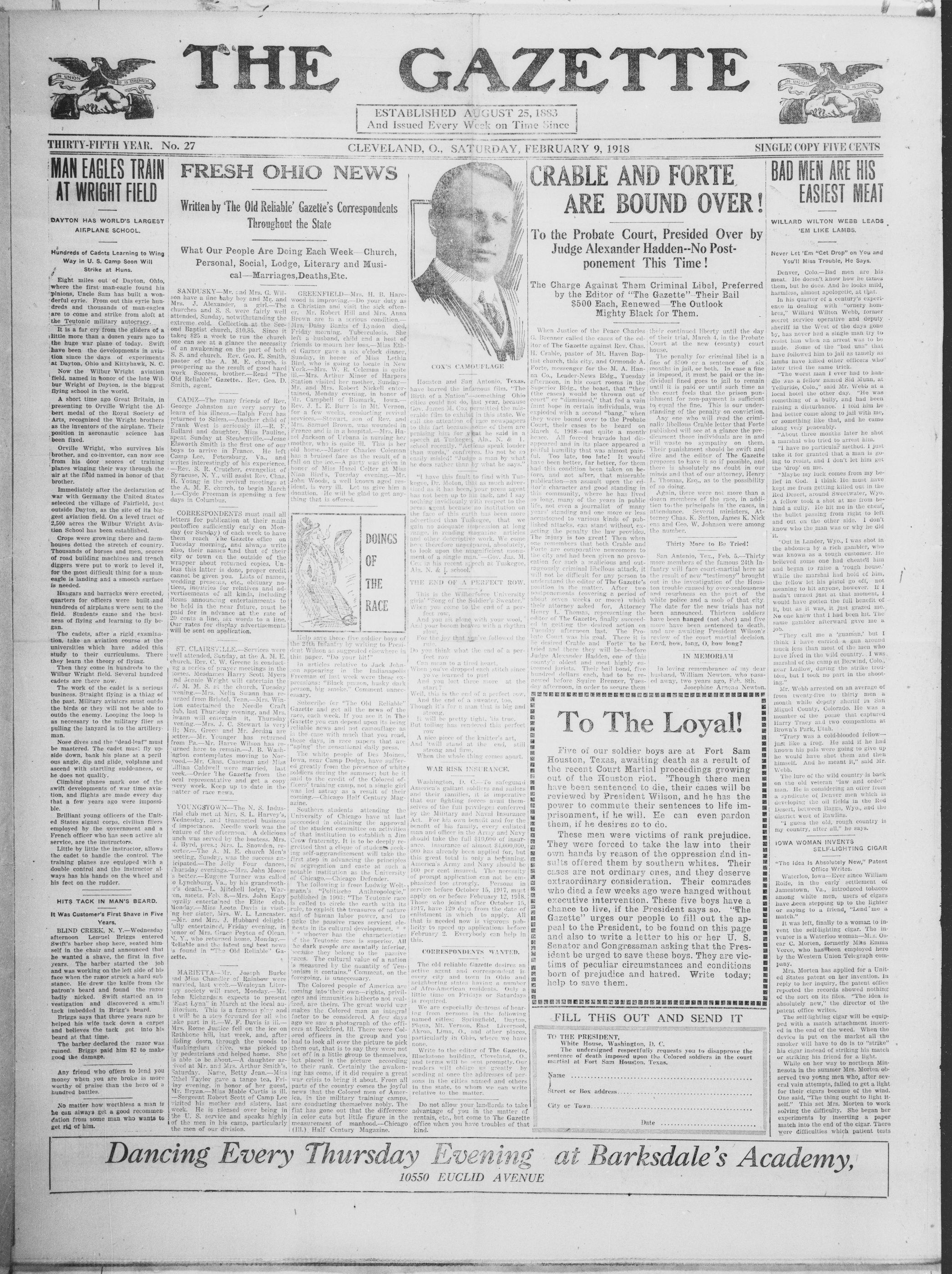
MAN EAGLES TRAIN AT WRIGHT FIELD
DAYTON HAS WORLD'S LARGEST
AIRPLANE SCHOOL
Hundreds of Cadets Learning to Wing Way in U. S. Camp Soon Will Strike at Huns.
Eight miles out of Dayton, Ohio, where the first man-eagle found his pinnions, Uncle Sam has built a wonderful eyrie. From out this eyrie hundreds and thousands of man-eagles are to come and strike from aloft at the Teutonic military autocracy.
It is a far cry from the gliders of a little more than a dozen years ago to the huge war plane of today. Swift have been the developments in aviation since the days of experiments at Dayton, Ohio and Kittyhawk, N. C.
Now the Wilbur Wright aviation field, named in honor of the late Wilbur Wright of Dayton, is the biggest flying school in the world.
A short time ago Great Britain, in presenting to Orville Wright the Albert medal of the Royal Society of Arts, recognized the Wright brothers as the inventors of the airplane. Their position in aeronautic science has been fixed.
Orville Wright, who survives his brother, and co-inventor, can now see from his door scores of training planes winging their way through the air at the field named in honor of that brother.
Immediately after the declaration of war with Germany the United States selected the village of Fairfield, just outside Dayton, as the site of its biggest aviation field. On a level tract of 2,500 acres the Wilbur Wright Aviation School has been established.
Crops were growing there and farmhouses dotted the stretch of country. Thousands of horses and men, scores of road building machines and trench diggers were put to work to level it, for the most difficult thing for a maneagle is landing and a smooth surface is needed.
Hangars and barracks were erected, quarters for officers were built and hundreds of airplanes were sent to the field. Students came and the business of flying and learning to fly began.
The cadets, after a rigid examination, take an aviation course at the universities which have added this study to their curriculums. There they learn the theory of flying.
Then they come in hundreds to the Wilbur Wright field. Several hundred cadets are there now.
The work of the cadet is a serious business. Straight flying is a thag of the past. Military aviators must outdo the birds or they will not be able to outdo the enemy. Looping the loop is as necessary to the military flier as pulling the lanyard is to the artillery man.
Nose dives and the "dead-leaf" must be mastered. The cadet must fly upside down, bank his plane at a perilous angle, dip and glide, volplane and ascend with startling sadness, or he does not qualify.
Climbing planes mark one of the swift developments of war time aviation, and flights are made every day that a few years ago were impossible.
Brilliant young officers of the United States signal corps, civilian fliers employed by the government and a French officer who has seen active air service, are the instructors.
Little by little the instructor, allows the cadet to handle the control. The training planes are equipped with a double control and the instructor always has his hands on the wheel and his feet on the rudder.
HITS TACK IN MAN'S BEARD.
It Was Customer's First Shave in Five Years
BLIND CREEK, N. Y.—Wednesday afternoon Lemuel Briggs entered Swift's barber shop here, seated himself in the chair and announced that he wanted a shave, the first in five years. The barber started the job and was working on the left side of his face when the razor struck a hard substance. He drew the knife from the patron's beard and found the razor badly nicked. Swift started an investigation and discovered a small tack imbedded in Briggs's beard. Briggs says that three years ago he helped his wife tack down a carpet and believes the tack got into his beard at that time.
The barber declared the razor was ruined. Briggs paid him $2 to make good the damage.
Any friend who offers to lend you money when you are broke is more worthy of praise than the hero of a hundred battles.
No matter how worthless a man is he can always get a good recommendation from some man who wants to get rid of him.
THE GAZETTE
FRESH OHIO NEWS
What Our People Are Doing Each Week—Church, Personal, Social, Lodge, Literary and Musical—Marriages, Deaths, Etc.
SANDUSKY—Mr. and Mrs. G. Wilson have a fine baby boy and Mr. and Mrs. J. Alexander, a girl. The churches and S. S. were fairly well attended, Sunday, notwithstanding the extreme cold. Collection at the Second Baptist church, $10.85. Since it takes $25 a week to run the church one can see at a glance the necessity of an awakening on the part of both S. S. and church. Rev. Geo. E. Smith, pastor of the A. M. E. church, is prospering as the result of good work Success, brother—Read "The Old Reliable" Gazette. Rev. Geo. D. Smith, agent.
CADIZ—The many friends of Rev. George Johnston are very sorry to lean of his illness. Ralph Ford has returned to Salem. Another child of Frank West is意愿. ILL. D. Ballard and daughter, Miss Pauline, spent Sunday at Steubenville. Jesse Elsworth Smith is the first one of our boys to arrive in France. He left Camp Lee, Petersburg, Va., and writes interestingly of his experience.—Rev. S. R. Crutcher, evangelist of Syracuse, N. Y., will assist Rev. Chas. H. Young in the revival meetings at the A. M. E. church, to begin March 1.—Clyde Freeman is spending a few days in Columbus.
GREENFIELD—Mrs. H. H. Beowood is improving.—Do your duty a Christian and visit the sick off er. Mr. Robert Hill and Mrs. A. Brown are in a serious condition. Mrs. Daisy Banks of Lyndon day Friday morning. Tuberculosis. She left a husband, child and a host friends to mourn her loss. Miss E. Garner gave a six o'clock dinner. Sunday, in honor of Miss Let Bird, who is going to locate in N York. Mrs. W. R. Coleman is quill—Mrs. Arthur Minor of Harp Station visited her mother, Sunday, and Mrs. Robert Nickell entrained, Monday evening, in honor Mr. Cumberl of Bismark, Iowa Rev. L. E. Burr is in Merrimack for a few weeks, conducting revival services.—Stewart of Rev. Mrs. Samuel Brown, was wounded France and is in a hospital.—Mrs. Zel Jackson of Urbania is nursing mother, who is quite ill. This is a old home. Master Charles Coleman has a bruised face as the result of the ice. A party was given honor of Miss Hazel Colter at M Nina Birds, Tuesday evening.—John Woods, a well known agent is ill, very likely. Give us him donation. He will be glad to get a thing that is offered.
CORRESPONDENTS must mail all letters for publication at their main postoffice sufficiently early on Monday (or Sunday) of each week to have them reach the office on Tuesday morning, and always write also, their names and that of their city or town on the outside of the wrapper about returned copies. Unless this letter is done, proper credit cannot be given you. Lists of names, wedding presents, etc., may not notice, inquiries for relatives and advertisements of all kinds, including items announcing entertainments to be held in the near future, must be paid for in advance at the rate of 20 cents a line, six words to a line. Our rates for display advertisements will be sent on application.
ST. CLARISVILLE—Services were well attended, Sunday, at the A. M. E. Church. Rev. C. W. Greene is conducting a series of prayer meetings in the Jones. Mesdames Harry Scott, Myers and Jennie Wright will entertain the M. M. M. S. at the church, Tuesday evening.—Mrs. Nelia Swann has returned from Bristol, Teen—Mrs. Winn entertained the Needle Craft club, last Thursday evening, and Mrs Swann will entertain it, Thursday evening.—Mrs. J. C. Stewart is very ill; Mrs. Green and Mr. Jordan are better.—Mr. Younger has returned here to remain.—J. B. Washington contemplates moving to Norwood.—Mr. Chas, Caseman and Miss Lillian Caldwell were married, last week.—Order The Gazette from the local representative and get a copy every week. Keep up to date in the matter of race news.
---
YOUNGSTOWN — The N. S. Industrial club met at Mrs. S. L. Hurvey's Wednesday, and transmitted business of importance. Needle work was the culture of the afternoon. A deliciousunch was served by the hostess, Mrs. D. Byrd, pres.; Mrs. L. Snowden, reporter.-The A. M. E. church men's meeting. Sunday, was the success anticipated.-The Jolly Four dances,thursday evenings.-Mrs. John Moore's better.-Eugene Turner was called by Lynchburg, Va., by his grandmother's death.-L. Mitchell lodge, Warren, meets. Feb. 8.-Mrs. John Espy entertained the Elite club, Monday.-Miss Leota Davis is visiting her sister, Mrs. S. L. Lancaster and Mrs. J. Hibbard delightfully entertained. Friday, in honor of Mrs. Grace Poynton of Oleen N. Y., who returned home, Monday.-Reliable and the latest and best news is found in "The Old Reliable" Gazette.
MARIETTA—Mr. Joseph Burke and Miss Chandler of Rainbow were married, last week—Wesleyan Literary society will meet, Monday—Mr. John Richardson expects to present "East Llyn" in March at the local auditorium. This is a famous play and it will be a step forward for all who take part in it.—W. F. Davis is ill—Mrs. Rome Justice fell on the ice on Rathbone hill, last week, and after hiding down, through the woods to Muskingum drive, was picked up by pedestrians and helped home. She is able to be about. A daughter arrived at Mr. and Mrs. Arthur Smith's, Saturday. Name, Betty Jean—Miss Tetl Taylor gave a tango tea, Friday evening, in honor of her guest, Mr. Bryan—Miss Mable Curtis is ill—Sergeant Robert Scott of Camp Lee visited his mother and sisters, last week. He is pleased over being in the U. S. service and speaks highly of the men in his camp, particularly the men of our division.
ESTABLISHED AUGUST 25,1883 And Issued Every Week on Time Since CLEVELAND, O., SATURDAY, FEBRUARY 9, 1918
GREENFIELD—Mrs. H. B. Harewood is improving. Do your duty as a Christian and visit the sick officer. Mr. Robert Hill and Mrs. Anna Brown are in a serious condition. Mrs. Daisy Banks of Lyon died, Friday morning. Tuberculosis. She left a husband, child and a host of friends to mourn her loss. Miss Ethel Garner gave a six-eight dinner, Sunday, in honor of Miss Loria Bird, who is going to locate in New York. Mrs. W. R. Coleman is quite ill. Mrs. Arthur Minor of Harpers Station visited her mother, Sunday. Mr. and Mrs. Robert Nickell entertained, Monday evening, in honor of Mr. Campbell of Bismark, Iowa. Rev. J. L. E. Burr is in Mt. Vernon, for a few weeks, conducting revival services. Stewart, son of Rev. and Mrs. Samuel Brown, was wounded in France and is in a hospital. Mrs. Hazel Jackson of Urbana is nursing her mother, who is quite ill. This is her old home. Master Charles Coleman has a bruised face as the result of a fall on the ice. A party was given in honor of Miss Hazel Colter at Miss Nina Bird's, Tuesday evening. Mr. John Woods, a well known aged resident, is very ill. Let us give him a donation. He will be glad to get anything that is offered.
DOINGS OF THE RACE
Help save those five soldier boys of the 21st Infantry by writing to President Wilson as suggested elsewhere in this paper. "Do your bit!"
In articles relative to Jack Johnson appearing in the Indianapolis Freeman of last week were these expressions; "Black pusson, husky dark person, big smoke." Comment unnecessary.
Subscribe for "The Old Reliable" Gazette and get all the news of the race, each week. If you see it in The Gazette you can depend upon its being reliable news and not camouflage as is the case with much that you read, these days, in race papers that are "aping" the sensational daily press. The white people of Des Moines, Iowa, near Camp Dodge, have suffered greatly from the presence of white soldiers during the summer; but be it said to the credit of the Colored officers' training camp, not a single girl was led astray as a result of their coming.—Chicago Half Century Magazine. Southern students attending the University of Chicago have at last succeeded in obtaining the approval of that institute to establish a Jim Crow fraternity. It is perhaps greeted that a clique of students working self-aggrandizement will take the first step in advancing the principles of segregation and caste at such a notable institution as the University of Chicago.—Chicago Defender.
The following is from Ludwig Woltmann's "Politische Anthropologie," published in 1903: "The Teutonic race is called to circle the earth with its rule, to exploit the treasures of nature and of human labor power, and to make the passive races servient elements in its cultural development. *" whoever has the characteristics of the Teutonic race is superior. All the dark people are mentally inferior, because they belong to the passive races. The cultural value of a nation is measured by the quantity of Teutonism it contains." Comment, on the foregoing, is unnecessary.
The Colored people of America are coming into their own—rights, privileges and immunities hitherto not realized, are theirs. The great world war makes the Colored man an integral factor to be considered. A few days ago we saw a photograph of the officers at Rockford, Ill. There were Colored officers in the group and you had to look all over the picture to pick them out, that is to say they were not set off in a little group to themselves, but placed in the picture according to their rank. Certainly the awakening has come, if it did require a great war crisis to bring it about. From all parts of the country comes the joyful news that the Colored men of America, in the military training camps, are conducting themselves nobly. The flat has gone out that the difference in color cuts but little figure in the measurement of manhood—Chicago (Ill.). Half Century Magazine.
COX'S CAMOUFLAGE
Houston and San Antonio, Texas, have barred the infamous film, "The Birth of a Nation"—something Ohio cities could not do, last year, because Gov. James M. Cox permitted the miserable film to exhibit in this state. We call the attention of rage newspapers to this fact because some of them are praising him for what he said in a speech at Tuskegee Ala., N. & I. school recently, "Actions speak louder than words," confesses. Do not be so easily misled: "Judge a man by what he does rather than by what he says." "I have this fault to find with Tuskegee, Dr. Moton, that as much advertised as it has been, your press agent has not been up to his work, and I say nothing inviolently with respect to the press agent because no institution on the face of the world has been more identified than Tuskegee. That we gain no adequate impression at long range, in reading magazine articles and other descriptive work. We come here therefore unprepared, absolutely, to look upon the magnificent monument of a single man."—Gov. Jas. M. Cox, in his recent speech at Tuskegee, Ala. N. & I. school.
THE END OF A PERFECT ROW
This is the Wilberforce University girls' "Song of the Soldier's Sweater." When you come to the end of a perfect row,
And you sit alone with your wool,
And your bosom heaves with a rhythm slow,
For the joy that you've followed the run,
Do you think what the end of a perfect row
Can mean to a tired heart,
When you've dropped each stitch since you've learned to purl
And you lost three more at the start?
Well, this is the end of a perfect row.
And the end of a sweater, too.
And the end of a sweater, too.
Though it's for a man that is big and
strong.
It will be pretty tight, his true.
But toiling has rendered this perfect
row.
A nice piece of the knitter's art.
And twill stand at the end, still
strong and firm.
When the whole thing comes apart.
WAR RISK INSURANCE.
Washington, D. C.—To safeguard America's gallant soldiers and sailors and their families, it is imperative that our fighting forces avail themselves of the full privileged conferred by the Military and Naval Insurance Act. For his own benefit and for the benefit of his family, every enlisted man and officer in the Army and Navy should take the fall $10,000 of insurance. Insurance of almost $4,000,000 has already been applied for, but this great total is only a beginning. America's Army and Navy should be 100 per cent insured. The necessity of prompt application can not be emphasized too strongly. Persons in service before October 15, 1917, must apply on or before February 12, 1918. Those who joined after October 15, 1917, have 120 days from the date of enlistment in which to apply. All that is needed now is vigorous publicity to speed up applications before February 2. Everybody can help in this.
CORRESPONDENTS WANTED.
The old reliable Gazette desires an active agent and correspondent in every city and town in Ohio and neighboring states having a number of Afro-American residents. Only a little time on Fridays or Saturdays is required.
We are especially destroys of hearing from persons in the following named cities: Springfield, Dayton, Pluqa, M. Vernon, East Liverpool, Akron, Limn, O., and other places, particularly in Ohio, where we have none.
Write to the editor of The Gazette, Blackstone building, Cleveland, O., and terms will oblige us greatly by sending at once the addresses of persons in the cities named and others in the state, to whom we can write relative to the matter.
Do not allow your landlords to take advantage of you in the matter of rentals, etc., but come to The Gazette office when you have troubles of that kind.
10550 EUCLID AVENUE
CRABLE AND FORTE ARE BOUND OVER!
To the Probate Court, Presided Over by Judge Alexander Hadden--No Postponement This Time!
The Charge Against Them Criminal Libel, Preferred by the Editor of "The Gazette". Their Bail $500 Each, Renewed -The Outlook Mighty Black for Them.
```markdown
```
To The Loyal!
Five of our soldier boys are at Fort Sam Houston, Texas, awaiting death as a result of the recent Court Martial proceedings growing out of the Houston riot. 'Though these men have been sentenced to die, their cases will be reviewed by President Wilson, and he has the power to commute their sentences to life imprisonment, if he will. He can even pardon them, if he desires so to do.
These men were victims of rank prejudice. They were forced to take the law into their own hands by reason of the oppression and insults offered them by southern whites. Their cases are not ordinary ones, and they deserve extraordinary consideration. Their comrades who died a few weeks ago were hanged without executive intervention. These five boys have a chance to live, if the President says so. "The Gazette" urges our people to fill out the appeal to the President, to be found on this page and also to write a letter to his or her U. S. Senator and Congressman asking that the President be urged to save these boys. They are victims of peculiar circumstances and conditions born of prejudice and hatred. Write today; help to save them.
```markdown
```
When Justice of the Peace Charles G. Brenner called the cases of the editor of The Gazette against Rev. Chas. H. Crable, pastor of Mt. Haven Baptist church, this city, and Ormonea A. Forte, messenger for the M. A. Hanna Co., Leader News Bldg., Tuesday afternoon, in his court cases in the Superior Bldg, the boast, that "they (the cases) would be thrown out on court" or "dismissed," that fed a vain hope in certain individuals, was exploded with a second "bang," when they were bound over to the Probate Court, their cases to be heard on March 4, 1918—not quite a month. Hence, our bravedow had disappeared and in its place appeared a painful humility that was almost painful. Too late, too late! It would have been better, far better, for them had this condition been taken on before, and not after, that miserable publication—an assault upon the editor's character and good standing in this community, where he has lived so long, many of the years in public life, not even a journalist of many years' standing and one more or less accustomed to various kinds of published attacks, can stand without, exacting the penalty that the law provides. The injury is too great! Then when one remembers that both Crable and Forte are comparative newcomers to the city and had been given no prosecution for such a malicious and outrageously criminal libellous attack, it will not be difficult for any person to understand the editor of The Gazette's position in the matter. After two postponements (covering a period of about seven weeks or more) which their attorney asked for, Attorney Henry L. Thomas, representing the editor of The Gazette, finally succeeded in getting the desired action on Tuesday afternoon last. The Probate Court was his goal. There it is desired Crable and Forte to be tried and there they will be—before Judge Alexander Hadden, one of this county's oldest and most highly esteemed jurists. Their bail bond, five hundred dollars each, had to be renewed before Squire Brenner, Tuesday afternoon, in order to secure them
their continued liberty until the day of their trial, March 4, in the Probate Court at the new (county) court house.
The penalty for criminal libel is a fine of $500 or a sentence of six months in jail, or both. In case a fine is imposed, it must be paid or the individual fined goes to jail to remain until it is paid or until such time as the court feels that the prison punishment for non-payment is sufficient to equal the fine. This is our understanding of the penalty on conviction.
Any one who will read the criminally libellous Crable letter that Forte published will see at a glance the predicament those individuals are in and will waste no sympathy on them. Their punishment should be swift and dire and the editor of The Gazette purposes to have it so if possible, and their punishment absolutely no minds and that of our attorney, Henry L. Thomas, Esq., as to the possibility of so doing.
Again, there were not more than a dozen members of the race, in addition to the principals in the cases, in attendance. Several ministers, Attorney Chas. K. Sutton, James K. Nickens and Geo. W. Johnson were among the number.
Thirty More to Be Tried!
San Antonio, Tex., Feb. 5—Thirty more members of the famous 24th Infantry will face court-martial here as the result of new "testimony" brought out in the investigation of the Houston trouble caused by over-ceilousness and roughness on the part of the white police and a mob of that city. The date for the new trials has not been announced. Thirteen soldiers have been hanged (not shot) and five more have been sentenced to death. The Army's review of the court martial decision, Lord, how, long, O. how long?
IN MEMORIAM
In loving remembrance of my dear husband, William Newton, who passed away, two years ago, Feb. 8th.
IN UNION
IT IS SIBENGING
BAD MEN ARE HIS EASIEST MEAT
WILLARD WILTON WEBB LEADS
'EM LIKE LAMBS.
Never Let 'Em "Get Drop" on You and You'll Miss Trouble, He Says.
Denver, Colo.-Bad men are his meat. He doesn't know how he tames them, but he does. And he looks mild, harmless, almost apologetic, at that.
In his quarter of a century's experience in dealing with "ornery homies," Wilhard Wilton Webb, former secret service operative and deputy sheriff in the West of the days gone by, has never had a single man try to resist him when an arrest was to be made. Some of the "bad uns" that have followed him to jail as tamerly as lambs have killed other officers who later tried the same trick.
"The worst man I ever had to handle was a fellow named Sid Munn, at Telluride, Colo.," said Mr. Webb at a local hotel the other day. "He was something of a bully, and had been raising a disturbance. I told him he had better come along to jail with me, or something like that, and he came along very peaceably.
"About three months later he shot a marshal who tried to arrest him.
"I have no particular method. I just take it for granted that a man is going to resist, and I don't let him get the 'drop' on me.
"Maybe my luck comes from my belief in God. I think he must have kept me from getting killed out in the Red Desert, around Sweetwater, Wyo. A fellow took a shot at me from behind a sully. He hit me in the cheek, the bullet passing from right to left and out on the other side. I don't know who the man was or why he did it.
"Out in Lander, Wyo, I was shot in the abdomen by a rich gambler, who was known as a tough customer. He believed some one had cheated him and began to raise a 'rough house.' While the marshal had hold of him, the fellow let his pistol go off, not meaning to hit anyone, however. If I hadn't turned just at that moment, I would have gotten the full benefit of it, but as it was, it just grazed me. No one knew that I had been hit. The same gambler afterward gave me a job.
"They call me a 'gunman,' but I think I have carried a gun around much less than most of the men who have lived in the wild country. I was marshal of the camp at Benwind, Colo., near Ludlow, during the strike troubles, but I took no part in the shooting."
Mr. Webb arrested on an average of from twenty-five to thirty men a month while deputy sheriff in San Miguel County, Colorado. He was a member of the posse that captured Harry Tracy and two companions at Iberya Park, Utah.
"Tracy was a cold-blooded fellow—just like a trog. He said he had known his pals were going to give up he would have shot them and then himself. And he meant it," said Mr. Webb.
"The fire of the wild country is back on the old veteran "law and order" man. He is considering an offer from a syndicate of Denver men which is developing the oil fields in the Red Desert, between Baggs, Wyo., and the district west of Rawlins.
"I guess the old, rough country is my country, after all," he says.
IOWA WOMAN INVENTS SELF-LIGHTING CIGAR
"The Idea Is Absolutely New," Patent Office Writes.
Waterloo, Iowa—Ever since William Roife, in the early settlement of Jamestown, Va., introduced tobacco among white men, users of cigars have been stepping up to the lighter or saying to a friend, "Lend 'me a match."
It was left, finally to a woman to invent the self-lighting cigar. The inventor is a Waterloo woman—M. S. Oscar C. Morten, formerly Miss Emma Vorce, who has been employed here by the Western Union Telegraph company.
Mrs. Morten has applied for a United States patent on her invention. In reply to her inquiry, the patent office reported the records showed nothing of the sort on its files. "The idea is absolutely now," the director of the patent office writes.
The self-fighting cigar will be equipped with a match attachment inserted in the end of the weed. When the device is put on the market all the smoker will have to do is to "strike" his cigar instead of striking his match or striking his friend for a light.
While on her way to northern Minnesota in the summer Mrs. Morten observed two young men who, after several vain attempts, failed to get a light for their cigars because of the wind. One said, "The thing ought to light itself." This set Mrs. Morten to work solving the difficulty. She began her experiments by inserting a paper match into the end of the cigar. There were difficulties which patient tests
One year . $1.50
Six Months . 1.00
Three months . 2.00
Subscribers are requested to remit
postoffice money order or reg-
istered letter
Entered at the postoffice in Cleveland, Ohio, as second-class mail matter.
Address all communications to HARRY C. SMITH
Editor and proprietor,
THE GAZETTE,
Blackstone Building, Cleveland, O.
Member Ohio Legislature: 1894
to 1896; 1896 to 1898; 1900 to 1902
THE GAZETTE is the oldest, and has the largest bona fide circulation, double that of any newspaper in the interest of Afro-Americans, published in the state of Ohio, and comparison with any will immediately establish its rank as one of the NEWS-TEST AND BEST in the country.
10,000,000 Afro-Americans.
300,000 In Ohio.
25,000 in Cleveland.
SATURDAY, FEBRUARY 9, 1918
"Any prejudice whatever will be insurmountable if those who do not share in it themselves truckle to it and flatter it and accept it is a law of nature."—John Stuart Mill.
"Let us have faith that right
makes might, and in that
faith let us to the end dare
to do our duty as we under-
stand it."—Abraham Lincoln.
What is needed in Washington, D.C., is not a fireless day but a firing day. And everybody has a good idea who should be fired.
It is real encouraging to notice the number of mayors in other than Ohio cities that find it possible to stop the miserable film, "The Birth of a Nation," from showing in their towns.
Special Assistant Secretary of War Emmett J. Scott will greatly please millions of Afro-Americans if he will make it possible to have Col. Charles Young recalled to active service. And no one will be more pleased than the Colonel himself. Do your level best, Friend Scott!
The white American, who assumes to be the criterion of modern civilization, is having forced on him, almost daily, as a direct result of the World War, a recognition of hitherto ignored facts as to manhood and citizen rights and privileges for all that is bound to create, generally, a truer and better Americanism.
State Auditor Donahey (Dem.) says the position of state inspector of automatic couplers should be abolished because the work is covered by federal government inspectors. There are two reasons why this will not be done. The first one is that the job is held by a good and deserving Democrat. It is therefore unnecessary to mention the other one.
Many Inventions: Stephenson invented the locomotive, Watt the steam engine, Fulton the steamship, Morse the telegraph, Bell the telephone, McCormick the reaper. Howe the sewing-machine, Marconi the wireless, Wright the aeroplane, Oliver the plow, Ericson the ironclad, but it remained for Garfield to invent the psychology of "You ain't as you are." Ohio, for example, was not without coal at all. It just thought it was. Do the people realize, do they have any idea of how much similar psychology is being sent upon them in endless waves of publicity?
The Republican National Committee will meet, Feb. 12, at St. Louis. We are a little curious to know what it will do in the case of its lone Afro-American member whose seat the "illy-white" Republicans (?) of Mississippi are contesting. That "illy-white" political nonsense, recognized entirely too much by Presidents McKinley, Roosevelt and Taft ought to be stamped out of existence by the committee, this time and for all time. They have never been of any material good to the party but have been a source of aggravation and trouble only for many years. It's time their camouflage was exposed and they "put out of the political business."
Four Republicans have withdrawn from Congress, Captain Victor Heinzt of Ohio, now in the army. La Guardia, of New York City, now in the army. Johnson, of North Dakota, now in the army. And the gallant Major Augustus P. Gardner, who recently met a soldier's death, and is now in the Great Army above.
Four Democrats have withdrawn from Congress. John J. Fitzgerald to practice law. Henry Bruckner to take a better job under Tammany. Murray
Hulbert to take a better job under Tammany. Daniel J. Griffin to take a better job under Tammany. So far as the House of Representatives is on record, the war seems to be rather partisan, at least as far as the Republicans are concerned. They, alone, insist on carrying partisanship clear into the uniform of the army.
BUSY FOR THE WAR.
The Cincinnati Enquirer carried a dispatch from Columbus setting forth that while the joint session of the Republican State Central and Advisory Committees was being held recently in Columbus, two of its members, Col. William Cooper Proctor and Hon. James R. Garfield, were absent from its deliberations, indifferent to its plans, and, as a matter of fact, were attending a Red Cross meeting in the capitol building. The facts were that Col. Proctor and Mr. Garfield were both present at the Republican gathering and spoke enthusiastically in approval of its plans and purposes. Later they went to the Red Cross meeting and did their full duty there as well. The Enquirer's mistake was natural, however, as Republicans are so active in all the good works for the war that it is hard for them to find time or anything else.
MARSHALL'S POST-MORTEM.
Vice President. Marshall recently said: "We did not prepare. We thought there was no danger. And in one year there comes upon us an outlay of extraordinary expense which might have been prevented had we exercised foresight and courage, little by little, to get ready."
Vice President Marshall misses the true crux of our national regret. It is not that we have to stand a burden of extraordinary expense which might have been prevented had those whom the people had delegated with power exercised foresight and courage. It hurts the national pride that because there was not foresight and courage we are not doing our bit for and with our allies, and we have long to be the beneficiaries of their sacrifices until we can make ready. It hurts that the war which, with preparedness, could have been soon victoriously ended, must drag on.
Then there is always the thought that had we been prepared, armed and ready, no nation in the world would have dared to have our decisive power go into the scales against it. War might have passed us by. The outlay of extraordinary expense which might have been prevented, is almost the least regret in the category of regrets.
WHAT GORGAS FOUND.
Some weeks ago Secretaries Daniels and Baker asserted that there was no need of American women knitting sweaters or other articles, as the government had abundantly provided clothing for the health and comfort of the sailors and soldiers. As a result thousands of patriotic women naturally enough stopped knitting.
Now comes Gorgas, Surgeon General of the United States, and in a report made public December 18, finds that the lack of warm garments during the cold weather of the late fall contributed largely to the spread of pneumonia. At Camp Bowie, in one month there were 41 deaths from pneumonia out of 409 cases. At Camp Funston there were 43 deaths from pneumonia with 189 cases. At Camp Sevier 60 men died of pneumonia. At Camp Doniphan there were 11 deaths out of 74 cases of pneumonia. As the trenches are more trying to health than the cantonments, there will be the more need of sweaters, mufflers and socks. The intuition of the women has been found by experience to be better than the judgment of our secretaries.
REPUBLICAN WISCONSIN.
Wisconsin is a Republican state. It never went Democratic in a National election except in 1912 when the Republican party was split and the Wilson electors just managed to slip through, as they did almost everywhere, for that matter. The Democrats now say, "Let there be no politics during the war," and "Let us Democrats have the Senator from Wisconsin." If "there is to be no politics during the war," why not let the Republicans have the Senator from a great Republican state? There is no one but who admits that the Republicans have been manifestly loyal. But, if there is to be no politics during the war, still there may be after the war. Possibly it will pay the people to look forward to that portentious period.
And as to the cry that "There is no politics during the war," we have just the same amount of faith in that as we had in another interesting cry, to-wit: We were to be kept out of war. Upon the whole we do not think it expedient to be kept out of a Senator in Wisconsin. Any Republican elected there will be loyal—loyal to the core. Then when the war ends he will be a Republican.
You should take PURO HERBS, the great blood purifier and system cleanser. On sale only at the Brown Drug Co., 2742 Central Ave., cor. E. 28th St.-Adv.
Subscribe Now
THE GAZETTE, CLEVELAND, OHIO, FEBRUARY 9, 1918
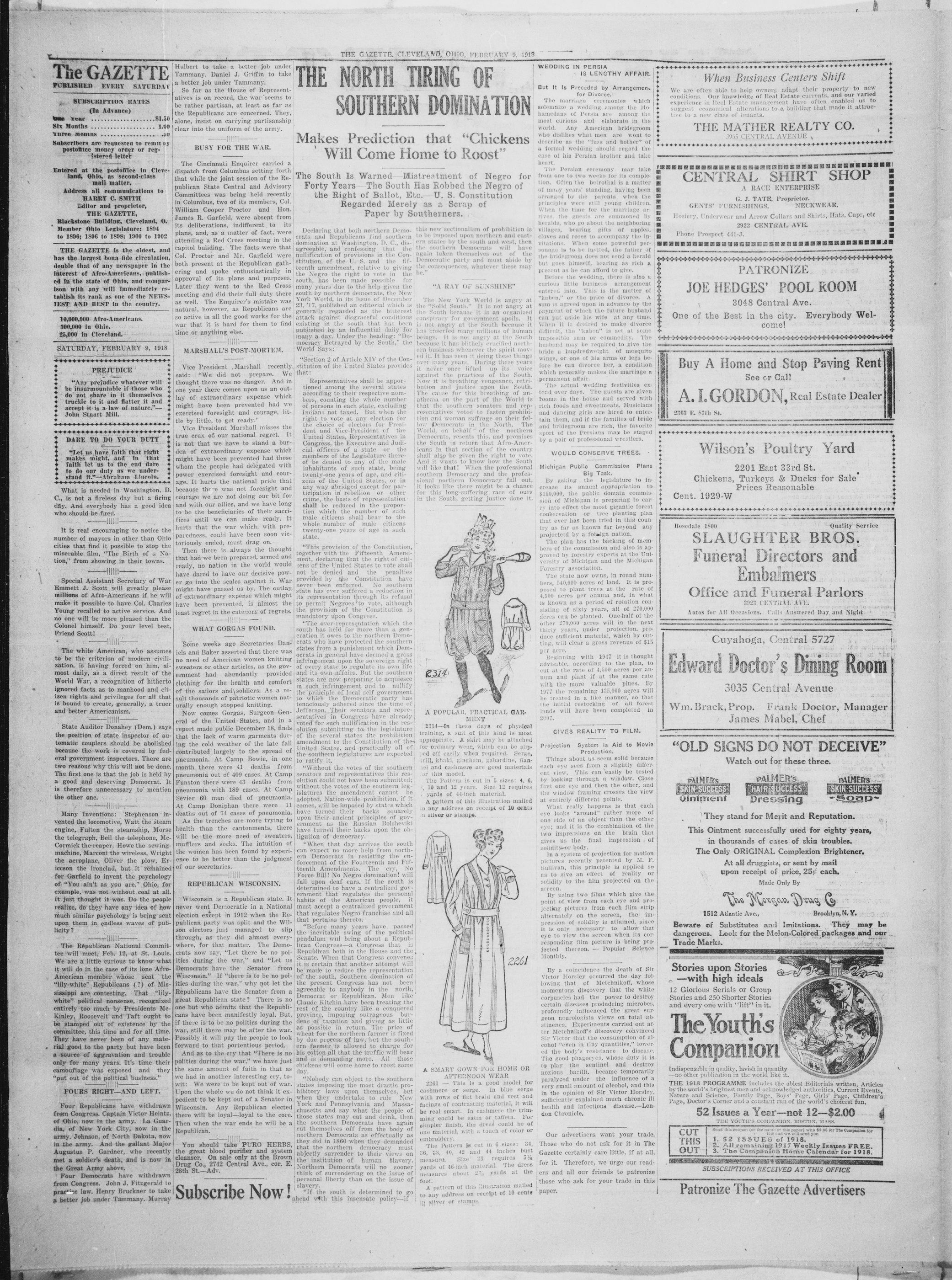
THE NORTH TIRING OF SOUTHERN DOMINATION
Makes Prediction that "Chickens Will Come Home to Roost"
The South Is Warned—Mistreatment of Negro for Forty Years—The South Has Robbed the Negro of the Right of Ballot, Etc.—U. S. Constitution Regarded Merely as a Scrap of Paper by Southerners.
Declaring that both northern Democrats and Republicans find southern domination at Washington, D. C., disagreeable, and confessing that the nullification of provisions in the Constitution, of the U. S. and the fifteenth amendment, relative to giving the Negro the right to vote in the south, has been made possible for many years due to the help given the south by northern democrats, the New York World, in its issue of December 23, 17, published an editorial which is generally regarded as the bitterest attack against disgraceful conditions existing in the south that has been published by an influential daily for many a day. Under the heading: "Democracy Betrayed by the South," the World Says:
this new sectionalism of prohibition is to be imposed upon northern and eastern states by the south and west, then the southern Democrats will have again taken themselves out of the Democratic party and must abide by the consequences, whatever these may be."
"A RAY OF SUNSHINE"
The New York World is angry at the "Solid South." It is not angry at the South because it is an organized conspiracy for government spoils. It is not angry at the South because it has inscribed many millions of human beings. It is not angry at the South because it has blithed crucified north business whenever the spirit moves
"Section 2 of Article XIV of the Constitution of the United States provides that:
Representatives shall be apportioned among the several states according to their respective numbers, counting the whole number of persons in each state, excluding Indians not taxed. But when the right to vote at any election for the choice of electors for President and Vice-President of the United States, Representatives in Congress, the Executive and Judicial officers of a state or the members of the Legislature thereof be denied to any of the male inhabitants of such state, being twenty-one years of age, and citizens of the United States, or in any way abridged except for participation in rebellion or other crime, the basis of representation shall be reduced in the proportion which the number of such male citizens shall bear to the whole number of male citizens twenty-one years of age in such state.
"This provision of the Constitution, together with the Fifteenth Amendment, declaring that the right of citizens of the United States to vote shall not be denied and the penalties provided by the Constitution have never been enforced. No southern state has ever suffered a reduction in its representation through its refusal to permit Negroes to vote, although the provision of the Constitution is mandatory upon Congress.
"The over-representation which the south has held for more than a generation it owes to the northern Democrats who have protected the southern states from a punishment which Democrats in general have deemed a gross infringement upon the sovereign right of every state to regulate its own life and its own affairs. But the southern states are now preparing to acquiesce in such infringement and to nullify the principle of local self government to which the Democratic party has teniously adhered since the time of Jefferson, and to maintain that power in Congress have already voted for such nullification in the resolution submitting to the legislature of the several states the prohibition amendment to the Constitution of the United States, and practically all of the southern legislatures are expected to ratify it.
"Without the votes of the southern senators and representatives this resolution could not have been submitted; without the votes of the southern legislatures the amendment cannot be adopted. Nation-wide prohibition, if it comes, will be imposed by states which have turned their backs squarely upon their ancient principles of government as the Russian Bolsheviks have turned their backs upon the obligation of democracy.
"When that day arrives the south can expect no more help from northern Democrats in resisting the enforcement of the Fourteenth and Fifteenth Amendments. The cry, "Boss Bill! No negro disarmament will fail!" is true. If the south is determined to have a centralized government that regulates the personal habits of the American people, it must accept a centralized government that regulates Negro franchise and all that pertains thereto.
"Before many years have passed the inevitable swing of the political pendulum will bring about a Republican Congress—a Congress that is Republican both in the House and the Senate. When that Congress convenes it is certain that another attempt will be made to reduce the representation of the south. Southern domination of the present Congress has not been agreeable to anybody in the north; Democrat or Republican. Men like Claude Kitchin have been treating the rest of the country like a conquered province, imposing outrageous burdens of taxation and giving as little as possible in return. The price of wheat for the northern farmer is fixed by due process of law, but the southern farmer is allowed to charge for his cotton all that the traffic will bear and is demanding more. All those chickens will come home to roost some day.
"Nobody can object to the southern states imposing the most drastic prohibitory laws upon themselves, but when they undertake to rule New York and Pennsylvania and Massachusetts and say what the people of those states may eat and drink, then the southern Democrats have again cut themselves off from the body of northern Democrats as effectually as they did in 1860 when they demanded that the northern democracy must abjectly surrender to their views on the institution of human slavery. Northern Democrats will no sooner think of surrendering on the issue of personal liberty than on the issue of slavery.
"If the south is determined to go ahead with this insensitive policy—if
this new sectionalism of prohibition is to be imposed upon northern and eastern states by the south and west, then the southern Democrata will have again taken themselves out of the Democratic party and must abide by the consequences, whatever these may be."
"A RAY OF SUNSHINE"
The New York World is angry at the "Solid South." It is not angry at the South because it is an organized conspiracy for government spoils. It is not angry at the South because it has asserted many millions of human beings. It is not angry at the South because it has brittle crucified northern business whenever the spirit moved it. It has seen it doing these things over many years. During these years it never once lifted up its voice against the practices of the South. Now it is breathing vengeance, retribution and justice upon the South. The cause for this breathing of an anthem on the part of the World is that the southern senators and representatives voted to fasten prohibition and woman suffrage on their fellow Democrats in the North. The World Democrats, recess this, and promises the South in return that Afro-Americans in that section of the country shall also be given the right to vote. And it wants to know how the South will like that! When the professional southern democracy and the professional northern Democracy fall out, it looks like there might be a chance for this long-suffering race of ours in the South, getting justice done it.
R314
A POPULAR, PRACTICAL GARMENT
2314-In these days of physical training, a suit of this kind is most appropriate. A skirt may be attached for ordinary wear, which can be slipped off easily when required. Serge, drill, khaki, ginameth, gabardine, flange and cashemere are good materials for this model.
The Pattern is cut in 5 sizes: 4, 6, 10 and 12 years. Size 12 requires yards of 44-inch material.
A pattern of this illustration mailed to any address on receipt of 10 cents in silver or stamps.
2261
A SMART GOWN FOR HOME OR AFTERNOON WEAR
2261 — This is a good model for cashmere or serge. In blue serge with rows of flat braid and vest and facings of contrasting material, it will be real smart. In cashmere the trimming could be satin or taffeta. For simpler finish, the dress could be of one material, with a touch of color or embroidery.
The Pattern is cut in 6 sizes: 34, 36, 38, 40, 42 and 44 inches bust measure. Size 33 requires 5% yards of 46-inch material. The dress measures about 2% yards at the foot.
A pattern of this Illustration mailed to any address on receipt of 10 cents in silver or stamps.
WEDDING IN PERSIA
But It Is Preceded by Arrangement for Divorce
The marriage ceremonies which solemnize a wedding among the Mohamedians of Persia are among the most curious and elaborate in the world. Any American bridegroom who dislikes what men are wont to describe as the "fuss and bother" of a formal wedding should regard the case of his Persian brother and take heart.
The Persian ceremony may take from one to two weeks for its completion. Often the betrothal is a matter of many years' standing, having been arranged by the parents when the principles were still young children. When the time for the marriage arrives, the guests are summoned by heralds, who go about the neighboring villages, bearing gifts of apples, cloves and roses to accompany the invitations. When some powerful personage is to be invited, the father of the bridegroom does not send a herald but goes himself, bearing as rich a present as he can afford to give.
Before the wedding, there is also a curious little business arrangement entered into. This is the matter of "kaben" or the price of divorce. A sum is agreed upon in advance by the payment of which the future husband can put aside his wife at any time. When it is desired to make divorce difficult, the "kaben" is set at some impossible sum or commodity. The husband may be required to give the bride a hundredweight of mosquito wings, or one of his arms or legs before he can divorce her, a condition which generally makes the marriage a permanent affair.
The actual wedding festivities extend over days. The guests are given booms in the house and served with rich foods and sweetmeats. Musicians and dancing girls are hired to entertain them, and if the families of bride and bridegroom are rich, the favorite sport of the Persians may be staged by a pair of professional wrestlers.
WOULD CONSERVE TREES.
Michigan Public Commission Plans Big Task.
By asking the legislature to increase its annual appropriation to $150,000, the public domain commission of Michigan is preparing to carry into effect the most gigantic forest conservation or tree planting plan that ever has been tried in this country as far as known far beyond any projected by a foreign nation.
The plan has the backing of members of the commission and also is approved by forestry experts at the University of Michigan and the Michigan Forestry association.
The state now owns, in round numbers, 540,000 acres of land. It is proposed to plant trees at the rate of 4,500 acres per annum, and in what is known as a period of rotation consisting of sixty years, all of 270,000 acres can be planted. One-half of the other 270,000 acres will in the next thirty years, under protection, produce sufficient material, which by cutting, will clear a gross revenue of $15 per acre.
Beginning with 1947 it is thought advisable, according to the plan, to cut at the rate of 4,500 acres per annum and plant if at the same rate with the more valuable pines. By 1977 the remaining 135,000 acres will be treated in a like manner, so that the initial restocking of all forest lands will have been completed in 2007.
GIVES REALITY TO FILM.
Projection System is Aid to Movie Production.
Things about us seem solid because each eye sees from a slightly different view. This can easily be tested by looking through a window. Close first one eye and then the other, and the window framing crosses the view at entirely different points.
What really happens is that each eye looks "around" rather more of one side of an object than the other eye; and it is the combination of the two impressions on the brain that gives us the final impression of solidity or body.
In a system of projection for motion pictures recently patented by M. F. Sullivan, this principle is applied so as to give an effect of reality or solidity to the film projected on the screen.
By using two films which give the point of view from each eye and projecting pictures from each film strip alternately on the screen, the impression of solidity is attained, since it is only necessary to allow that eye to view the screen when its corresponding film picture is being projected thereon. — Popular Science Monthly.
By a coincidence the death of Sir Victor Horsley occurred the day following that of Metchnikoff, whose momentous discovery that the white corpuscles had the power to destroy certain diseases producing microbes, profoundly influenced the great surgeon neurologists views on total abstinence. Experiments carried out after Metchnikoff's discovery convinced Sir Victor that the consumption of alcohol "even in tiny quantities," lowered the body's resistance to disease. The good phagocytes, whose duty it is to play the sentinel and destroy noxious bacilli, became temporarily paralyzed under the influence of a very small amount of alcohol, and this in the opinion of Sir Victor Horsley, sufficiently explained much chronic ill health and infectious disease.—London Chronicle.
Our advertisers want your trade. Those who do not ask for it in the Gazette certainly care little, if at all, for it. Therefore, we urge our readers and all our friends to patronize those who ask for your trade in this paper.
We are often able to help owners adapt their property to new conditions. Our knowledge of Real Estate currents, and our varied experience in Real Estate management have often enabled us to suggest economical alterations to a building that made it attractive to a new class of tenants.
G. J. TATE, Proprietor.
GENTS' FURNISHINGS,
NECKWEAR.
Hosiery, Underwear and Arrow Collars and Shirts, Hats, Caps, etc
2922 CENTRAL AVE.
JOE HEDGES' POOL ROOM
3048 Central Ave.
One of the Best in the city. Everybody Welcome!
Buy A Home and Stop Paving Rent See or Call A.I.GORDON, Real Estate Dealer 2363 E. 87th St.
Wilson's Poultry Yard
2201 East 33rd St.
Chickens, Turkeys & Ducks for Sale
Prices Reasonable
Cent. 1929-W
Office and Funeral Parlors
3923 CENTRAL AVE.
Autos for All Occasions. Calls Answered Day and Night
Wm.Brack,Prop. Frank Doctor, Manager James Mabel, Chef
"OLD SIGNS DO NOT DECEIVE"
Watch out for these three.
PALMER'S
SKIN-SUCCESS
Ointment
PALMER'S
HAIR-SUCCESS
Dressing
PALMER'S
SKIN-SUCCESS
Soap
They stand for M
This Ointment successfully
in thousands of c
The Only ORIGINAL
At all druggis
upon receipt of
Made
The Move
1512 Atlantic Ave.,
Beware of Substitutes and
dangerous. Look for the M
Trade Marks.
and for Merit and
successfully used
bands of cases of she
ORIGINAL Complex
druggists, or sent
receipt of price, 2d
Made Only By
Morgon Dr.
Ave.,
Instutes and Imitation
for the Melon-Colo
They stand for Merit and Reputation.
This Ointment successfully used for eighty years,
in thousands of cases of skin troubles.
The Only ORIGINAL Complexion Brightener.
At all druggists, or sent by mail
upon receipt of price, 25¢ each.
Made Only By
Beware of Substitutes and Imitations. They may be dangerous. Look for the Melon-Colored packages and our Trade Marks.
Stories upon Stories with high ideals 12 Glorious Serials or Group Stories and 250 Shorter Stories and every one with "lift" in it.
5 includes the ablest Born and acknowledged asaily Page, Boys' Page, a constant run of the a Year—not 1 YEARS COMPANION, BOOTS
THE 1918 PROGRAMME includes the oldest Editorials written, Articles by the world's brightest men and acknowledged authorities, Current Events, Nature and Science, Family Page, Boys' Page, Girls' Page, Children's Page, Doctor's Corner and a constant run of the world's choicest fun.
Patronize The Gazette Advertisers
PAIMER'S SKIN SUCCESS Oiniment
irit and Reputation.
rally used for eighty years,
ses of skin troubles.
Complexion Brightener.
or sent by mail
price, 25¢ each.
Only By
gm Drug C
Brooklyn, N. Y.
Imitations. They may be
non-Colored packages and our
the ablest Editorials written, Articles
knowledged authorities, Current Events,
Boys' Page, Girls' Page, Children's
run of the world's choicest fun.
—not 12—$2.00
NATION, BOSTON, MASS.
PALMER'S SKIN-SUCCESS
~Soap~
tism, eczema, scrofula or any blood, liver or kidney disease, or your dollar returned and no questions asked, or if you take two bottles between today and March 1, 1918, and you receive no benefit, upon affidavit of same, I will refund your $2.00 and receive a free. Why experiment? Take a remedy with wonderful merit. A trial is all I ask you to give G. S. Sold by all drugstores paid. Price $1.00, or six for $5.00. Call on your drugstress for G. S. before you order from me. Write for testimonials.
L. M. GROSS
721 Spring St. Little Rock, Ark.
The Pride of Carolina
The State Agricultural and Mechanical College of South Carolina
Orangeburg, S. C.
Next session begins September 26th and ends May 31st, 1918.
No Tuition, no Room Rent, no Charges for Water, Lights or Fuel. Entrance Fee $10.00. Board $8.00 per Month in Advance. Books, Laundry and Personal Expenses Extra.
Every Modern Facility. Standard Equipment. A Faculty of 57 Officers and instructors.
For information and Catalogue, Write.
R. S. WILKINSON, Pres.
Orangeburg, S. C.
KINKY
HAIR
Eralento Medicina Co.
Alabama, to
Glenwood Park, Illinois
to Eralento Guinne
Peruana, Brazil
short, curly and nappy,
but very brave and hairy.
laches long, and is so neat,
and so fluffy, we can tell
up any way. I want to
not sending you my
pictures so I can
protect Eralento's hair made
to fit you.
Examiner includes 60,
Albany, Ga. The Good
Exelento Guinne
crumpled in the was
and the was
but pice it has proved to
include fire, and to so,
and to so,
up say way I mean to
ask you how to know you
have prince Exelento had made
Don't let some fake Kink Remover feel
you. You really can, but because your hair
would it in rice and long. That's what
EXELENTO QUININE
POWERED
does, removes Dandruff, soothes the Roots of
hair, and removes rashes. So much, so much
the difference, and after a little while it
will be so pretty and long that you can fix
it with a spray. We will give your powder
we will give your powder
Prices 25c by mail on receipt of stamp
or coin.
AGENTS WANTED EVERYWHERE.
Wells for particular.
EXELENTO MEDICINE CO., Albany, Ga.
Mme. C. H. Jones' HAIR Invigorator and Grower
THE WEEKEND
Stop, Look, Read!
When I started using Mme. C. H. Jones' Hair Invigorator and Grower, my hair was but one inch long. After using it only one year, my hair is to my shoulders. Charlotte Smith
353 WOOLAND AVENUE
Home Phone, B7218 TOLEDO, OHIO
AGENTS WANTED—Stamp for reply
Where to Purchase The Gazette
NOTICE TO SUBSCRIBERS
Subscribers not receiving The Gazette regularly should notify us at once. We desire every copy delivered promptly.
Send or bring locals and all business matters to The Gazette's office, 214-215 Blackstone Bldg. If you wish to see the editor call there, please.
We advise our readers to carefully examine The Gazette's advertisements before making purchases. Business men who advertise in this paper should have the patronage of our people. The fact that they advertise is assurance that they want it.
All matters for publication in current issues of The Gazette must be in the office by 4 p. m., WEDNESDAY of that week, at the latest.
Classified Advertising
... Department ...
FOR RENT —Furnished rooms with gas range to cook on; extra kitchen, at 2385 West 41st St. This is a splendid opportunity.
CLUB NOTICE —The Working Men's Social and Literary club meets, every Friday evening, for business and gives a dance, every Monday night at a halls hall, 3108 Social Ave. H. P. Williams, pres., 8040 Central Ave. L. V. Orton, see, 2687 E. 40th St. Milton Watkins, chairman, 2524 E. 30th St.
CLEVELAND Social and Personal
Mrs. Leslie Slaughter visited relatives in Xenia recently.
Miss Jennie Cox, of E. 106th St., entertained, last Friday evening, a number of young folk. Dancing and lunch.
Fred D. Sampson has returned from Jacksonville, Fla., where he visited his brother, Prof. George Sampson, several weeks.
Frank J. Perkins returned recently from Romulus, Mich., where he was called by the death of an uncle. He lost his sister a short time ago.
The young man shot in E. 37th St., Saturday, as wounded in the hip. This occurred in the same house where another was killed, a few months ago, it is said.
Mr. Charles Terry's broken shoulder mends slowly but surely. "Bull" (Harry) Smith, chef and caterer, is still his faithful companion and assistist.
Mr. Roberta Queen, who has been ill at her daughter, Mrs. Edna Joyce, from a nervous breakdown occasioned by the death of a daughter, Mamie, in Washington, D. C. is convalescent.
For information as to Crable and Forte see article on page one, columns six and seven. Slowly but surely retribution is being forced on them. They have been bound over to the Probate Court. Bail $500 each. Mrs. Edward Chaffin, Sr., and daughter, Miss Nina, a popular school teacher, paid a pleasant visit recently to their son and brother, Sergt Ed. Chaffin, Jr., at Camp Sherman, Chillicothe, "Eddie" is making good as a clerk in one of the camp hospitals. The aid of police in running down a Nineveh enemy arcade at 618 W. Superior Ave. of 618 was sought by Frederick William, proprietor. Wednesday. He said that while he was making change for the Negro the latter ran out of the arcade with a box containing $12.
The many Cleveland friends of Attorney Lewis E. Johnson, brother of Mrs. Walter B. Wright, Sr., W. 85th St., will be pleased to learn that he was on the honor roll of the 370th National Guard infantry, formerly the 8th Illinois regiment, being promoted from first lieutenant to captain recently.
Miss Minna Bell Wallace is receiving congratulations from her many New York friends for standing highest in a class of accident nursery and minor surgery, and has secured a position with Dr. A. W. Binkeleck, accident surgeon for the Industrial Commission of Ohio: Miss Wallace won over thirty white competitors.
S. John's Deborah S. S. class met at Mrs. Turpin's, Jan. 23. Ten members and one visitor were present. The evening was spent in rehearsing a play to be given in the near future. The sick committee reported two members, Madis Kimb-McLeod and Pearl Myers, Ill. The next meeting at Mrs. Easy Widleder, Feb. 18.
Mr. Roman Smith, of the Pittsburg Steamship Co., left this week, on his annual inspection of the ranges of the company's ships. The trip will take him from Buffalo to Duluth with stops at Chicago, Detroit and intermediate points. He has been a trusted and efficient employee of the company for many years.
Be sure to attend the East End social class conference on St. Valentine college Feb. 14, at Barksdale's Academy, 10550 Ecidle Acad. It is to be a grand masquerade! The club has arranged with Mr. Barksdale to teach a new dance—"The Bugle Trot." So be sure to attend, learn the most popular dance, and have a real good time. You are welcome.—Ady.
A well known member of the race who lives in this city writes The Gazette that several of our soldiers were refused service at the Red Cross headquarters, Camp Sherman, after having been invited there for dinner, one day last week. Here is a matter for the local branch of the N. A. A. C. P. to interest itself in, especially since one of the main characters in the incident is a Cleveland boy. The midwinter convention of the Christian Missionary Alliance, Branch No. 2, at Mt. Zion Cong. church, closed with many converts, Rev. E. M. Burgess of Pittsburgh was the principal speaker during the session. Miss Carrie Merriwweather, a missionary from Africa, gave several interesting talks. Miss Belle Smooth superintendent of
*OPEN SUNDAYS.
this branch, is an indefatigable Christian worker.
Mrs. Grace Tucker Burke, wife of Ernest H. Burke, former Clevelandians, now of Toledo, is greatly interested in the welfare of All Saints' Episcopal church of that city. Recently as chairman of Club No. 4 of the women's auxiliary she raised its largest amount at an entertainment. Mrs. Burke was a member of St. Andrew's Episcopal church of this city. "Ernie" is still making good as usher at the union depot, Toledo.
The Owls, a basketball team, are in the spotlight now because they played the Favorite Knit A's (white) at Glenville high, Wednesday night. The Owls believe they have the best race team in the country and are willing to meet all comers. Eddie Collins, an Oberlin star, has been added to their lineup and has greatly strengthened the team. Teams wanting games with the Owls are requested to phone Floyd Ramsey, Garfield 9334 J.
Our young ladies attending Normal school were grossly insulted and the race practically labelled, one day last week, by a woman teacher when lecturing to a class on various characteristics, etc., of our people, if she said what she is quoted as having said. This is another matter that ought to be looked into at once by our local Federation of Woman's clubs. Her remarks were an outrage, if they have been correctly repeated to The Gazette.
Those persons, some of whom are still "grumbling" about it, who were induced, some months ago, to subscribe for, and take part in a contest at, and take part in a contest was admissing two automobiles (a touring car and a roadster), a victoria and a building lot, should demand the return of their subscription money and get it, or place the matter in the hands of the proper (U. S.) authorities.
A charge of stealing the life savings of an aged "mammy" was denied by Ernest Jackson in judge Kennedy's criminal court. Wednesday. Jackson was arrested, Jan. 13, on a charge of robbery after Mrs. Gillie Couchman, ninety, 2905 Central Ave., complained to the police that he and another man accumulated after $100 which she had accumulated after stealing the saving, Jackson will be tried on the robbery charge, Monday. Of course this Ernest Jackson is a newcomer:
War Savings Stamps were introduced at the Peace Pagent at Gray Armory by five attractive young ladies from the Phillis Wheatley Association. Jennie E Hunter, General Secretary of the Association, provided the following five members who sold Thrift Stamps: Mabel Harris, Hattie Davis, Doris Harton, Celeste Strode and Willette Strode. The general office in charge of the stamps in Cleveland announces that they are on sale in 1000 places in Cleveland. They pay for a cent interest, compounded quarterly, and will be redeemed at the post office any time upon ten days' written notice. This is the best paying Government security so far offered and is one which should fit the purse of every man, woman and child.
Under the head, "Starlight Boyd gets sugar; then loses it," the Cleveland Daily News, of last week Friday, carried the following local item of interest: "A hundred pound sack of sugar that A. D. (Starlight) Boyd, saloonist, had delivered to his home at 7410 Carnegie Ave., was purchased for the Old Ladies' Home, Cedar Ave., according to an explanation he offered Chief City Food Inspector Rouche late Friday. Following a complaint that Boyd had had the sugar delivered to his home, Rouche sent a patrolman to home to investigate and it was leamed the report was correct. The sugar was taken to the Central police station and Boyd was called before Rouche for an explanation. He said he intended to give it to the Old Ladies' Home. He will be questioned further, Saturday morning, Rouche said."
The East End Social club will give a grand masquerade at Barksdale Dancing Academy, Thursday evening, Feb. 14. Be sure to attend and have a good time. The dance hall is the prettiest and best in the city, available to our people, and Mr. Barksdale a real dancing-master and director. The E. E. Social club committee of arrangements, in charge of the Feb. 14 masquerade consists of Misses Helen Yates, Louise Cleage, Mrs. Sarah Holloway; Messrs. Richard Cleage, Eugene Wilkins and Fred Berry.—Adv. Charles Harris is in receipt of an interesting censored letter from his brother, William Henry. Company H. 302nd Stevedore Regiment, dated "American Expeditionary" Forces, somewhere in France. Dec. 25 1918. Deborah Class, St. John's S. S., Mrs. Frances Hampton, teacher, elected the following named officers recently: Mme. Kibbey-MeLead pres.; Mrs. R. W. Hawkins, vice pres.; Mrs. Essie Ridgely, fgn. see.; Mrs. Pearl Myers, rec. see.; Mrs. Margaret Gales, treas.
A court martial can not take away that part of a soldier's pay which has been allotted to his dependents. This has just been announced at department headquarters, San Antonio, Tex.
THE GAZETTE, CLEVELAND, OHIO, FEBRUARY 9, 1918
"Sam," or "Somewhere in France"
As recited by J. Honer Tutt of "The Smarter Set"—The Feature of the New Show, "My People." (Mr. Tutt has just been handed a telegram informing him of his pal, "Sam's" death "Somewhere in France.")
death "Somewhere in France.")
Dead! Dead! Heel like saying: "I told you so!" Of course he was one of the first ones to go. He was one of those chaps that must be in front in every scrap, and there stand the brunt Of the bitterest fighting! you bet he was game, If the battle was lost he was never to blame. begged him to stay, but he would take the chance, And now—he is dead—"somewhere in France." Dead! Somewhere in France, O the pity, the shame; Just one of the millions that's over there slain. But there'll come a reckoning and some one must pay, For a just God has said to us: "Thou shalt not slay." Sam was not one of the commonplace place, He was one in a million so seldom we find. His face shone bright with the glory of youth; Upright his actions, his lips spoke the truth. Either study or play he engaged with a vim; He discounted failure and won. That was never the "exam" that Sam did not pass. Seemed to have a term's lease on the head of the class. We were all proud to follow when Sam set the pace; Who contested with him had to take second place. There was none envied Sam for his rapid advance; And now—he is dead—"somewhere in France—
I was his pal and the first one to know
He would answer the summons, to me 'twas a blow,
Uried to dissuade him, but I knew 'twas no use;
He just smiled at my pleading, ignored my abuse.
Usaid he was crazy and had not the right
To forsake his people and enter this fight.
Yes, I was disloyal, but my heart was with Sam
When I said that this country cared not a damn
For him or his service, "Why, the black in your face
Is a sign of dishonor, a badge of disgrace.
Then the look in his eyes was determined and fine;
The same courage he showed when bucking the line
And bowlin' 'em over, yes, making them roll
Aside from his path until he placed the goal.
"My Country has called, I am not asking why."
And then he continued, "Tis little care I
What some people may say, or how others define
My Race or my color, this country is mine.
My people earned title, by the sweat of their brow,
In factory and field, tis my heritage now.
For Liberty, Crispus Attuck's was the first blood to spill;
Peter Salem fought bravely at old Bunker Hill;
Many black men died fighting down at New Orleans,
With brave Andrew Jackson, back of his cotton bale screens,
The brave Tenth at San Juan and gory Carrazal,
Is a record of glory, a tale known to all.
Thru no crisis in history that this country has fared,
No struggle, nor conflict, that my race has not shared."
I can still hear him speaking, see the fire in his glance;
And now—he is dead—somewhere in France.
He died while in action, this tells of the fight,
Of the brilliant charge made in the gray morning light;
How they rushed from their trenches, nor rifle, nor shell,
Could stay their mad rush. Good God! It was hell.
Sam carried the flag, in the front was his place;
"Come on boys!" he shouted, "For your country and race!"
Rifle, shrapnel nor shell could those gallant boys stay;
Demoralized, the enemy fled in disma.
Sam carried the flag to their works highest crest
Then fell when a rifle ball pierced thru his breast.
He fell, he kept the old flag waving high.
Till 'twas grasped by a comrade who was fighting near by.
And these words were the last his lins ever gave sound:
"Boys, I never once let the old flag touch the ground!"
And I, called him a fool, but never again.
Such heroes as Sam was cannot die in vain.
He died for his country, not forgetting his Race
And when history is writ, Sam's name will have place
With other black men, who will as gallantly die
For their country as he, and never ask why.
And America must remember such heroes as Sam
Nor reckon their color, but remember the man;
For our heroes have died, be it thus understood.
For one country, one people and one brotherhood.
610 N. 39th St., Philadelphia.
—SALEM TUT
A
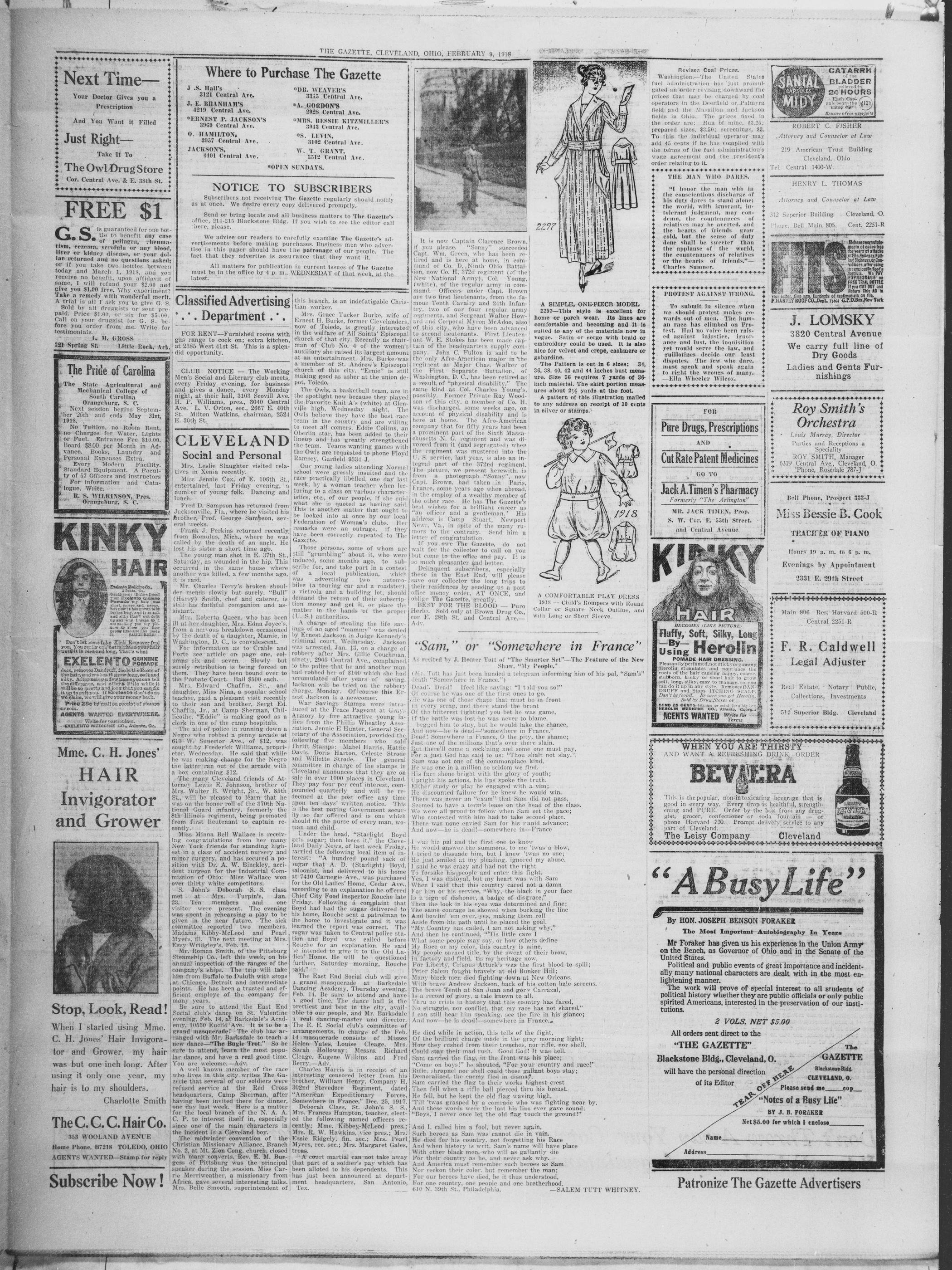
It is now Captain Clarence Brown, if you please. "Sonny" succeeded Capt. Wm. Green, who has been retired and is here at home, in command of Co. D. Ninth Ohio Battalion, now Co. H. 372d regiment (of the New National Army), Col. Young, (white), of the regular army in command. Officers under Capt. Brown are two first lieutenants, from the famous Tenth Cavalry and 21th Infantry, two of our four regular army regiments, and Sergeant Walter Howard and Corporal McRonan Adoo, also of this city, who have been advanced to second lieutenants. First Lieutenant W. E. Stokes has been made captain of the headquarters supply company. John C. Fulton is said to be the only Afro-American major in the regiment as Major Chas. Walker of the First Separate Battalion, of Washington, D. C., has been retired as a result of "physical disability." The same kind as Col. Charles Young's, possibly. Private Frontal Ray Woodson of this city, a member of Co. H., was discharged, some weeks ago, on account of physical disability and is an Afro-American company that for fifty years had been a prominent part of the Sixth Massachusetts N. G. regiment. Afro-American company that for fifty years had been a prominent part of the Sixth Massachusetts N. G. regiment. Afro-American company that for fifty years had been a prominent part of the 372d regiment. The picture, we present herewis, from a photograph "Sonny", now Capt. Brown, had taken in Paris, France, some years ago when abroad, in the employ of a wealthy member of the other race. He has The Gazette's best wishes for a brilliant career as "an officer and a gentleman." His address is Camp Stuart, Newport News, Va., in spite of the many rumors to the contrary. Send him a letter of congratulation.
If you owe The Gazette, do not wait for the collector to call on you but come to the office and pay. It is so much pleasant and better. Delinquent subscribers, especially those in the East End, will please save our collector the long trips to their residences by sending us a post office money order, AT ONCE, and oblige The Gazette, greatly. BEST FOR THE BLOOD — Pure Herbe. Sold only at Brown Drug Co, cor E. 28th St. and Central Ave.— Adv.
2297
A SIMPLE, ONE-PIECE MODEL
2297—This style is excellent for
home or porch wear. Its lines are
comfortable and becoming and it is
suited to any of the materials now in
vogue. Satin or serge with braid or
embroidery could be used. It is also
nice for velvet and crepe, cashmere or
gabardine.
The Pattern is cut in 6 sizes: 34,
36, 38, 40, 42 and 44 inches bust
measure. Size 36 requires 7 yards of 36
inch material. The skirt portion measures about 2½ yards at the foot.
A pattern of this illustration malled
to any address on receipt of 10 cents
in silver or stamps.
1918
A COMFORTABLE PLAY DRESS
1918 — Child's Rompers with Round
Collar or Square Neck Outline, and
with Long or Short Sleeve.
SANTAL CAPITULUS MIDY
GATARRH of the
BLADDER
reliaved in
24 HOURS
to serve the
suit balee under the
name of
Beare of our fortifications
Tel. Central 1400-W
Attorney and Counselor at Law
312 Superior Building Cleveland, O.
Phone: Bell Main 806. Cent. 2251-R
HITS
We havewarehouse state
insurance for years of absence
of its Salesperson. Falling
Signsensor Con-
trol will be required in a com-
munity for Roots' formulas. We PAY
A TRAINING OR FREE TRAN 900TL
if you OUT OUT and
Return This AD in
FOR
Pure Drugs, Prescriptions
AND
Cut Rate Patent Medicines
GO TO
Jack A.Timen's Pharmacy
Formerly "The Arlington"
MR. JACK TIMEN, Prop.
S. W. Cor. E. 55th Street.
and Central Avenue
Roy Smith's
Orchestra
Louis Murray, Director
Parties and Receptions a
Speciality
ROY SMITH, Manager
6319 Central Ave, Cleveland, O.
Phone, Rosedale 787-J
512 Superior Bldg. Cleveland
WHEN YOU ARE THIRSTY
AND WANT A REFRESHING DRINK-O
BEVAERA
This is the popular, non-intoxicating beverage good in every way. Every drop is healthful, sizing and PURE. Order by the box from an gist, ginger, confectioner or soda fountain phone Harvard 730. Prompt delivery service part of Cleveland.
The Leisy Company Clove
"A Busy L
This is the popular, non-infotoxicating beverage that is good in every way. Every drop is healthful, strengthening and PURE. Order by the box from any drugist, grocer, confectioner or soda fountain — or phone Harvard 730. Prompt delivery service to any part of Cleveland.
yLife" DRAKER biography In Years Experience in the Union Army in and in the Senate of the
"A Busy Life" By HON. JOSEPH BENSON FORAKER
The Most Important Autobiography
Mr Foraker has given us his experience in on the Bench, as Governor of Ohio and in United States.
Political and public events of great importance many national characters are dealt with lightening manner.
The work will prove of special interest political history whether they are public off spirited Americans, interested in the present tutions.
2 VOLS. NET $5.00
All orders sent direct to the
"THE GAZETTE"
Mr Foraker has given us his experience in the Union Army on the Bench, as Governor of Ohio and in the Senate of the United States. Political and public events of great importance and incidentally many national characters are dealt with in the most enlightening manner. The work will prove of special interest to all students of political history whether they are public officials or only public spirited Americans, interested in the preservation of our institutions.
2 VOLS. NET $5.00
All orders sent direct to the
"THE GAZETTE"
Blackstone Bldg., Cleveland, O.
will have the personal direction of its Editor
TEAR OFF HERE
The GAZETTE
Blackstone Bldg.
CLEVELAND, O.
Please send me ___ cop_
"Notes of a Busy Life"
BY J. B. FORAKER
Net $5.00 for which I enclose
Name___
Address___
Patronize The Gazette Advertisers
Washington,—The United States fuel administration has just promulgated an order revising downward the prices that may be charged by coal operators in the Deerfield or Palmyra field and the Massillon and Jackson fields in Ohio. The prices fixed in the order are: Run of mine, $3.25; prepared sizes, $3.50; screenings, $3. To this the individual operator may add 45 cents if he has compiled with the terms of the fuel administration's wage agreement and the president's order relating to it.
THE MAN WHO DARES.
"I honor the man who in the conscientious discharge of his duty dares to stand alone; the world, with ignorant, tolerant judgment, may condemn, the countenances of relatives may be averted, and the hearts of friends grow cold, but the sense of duty done shall be sweeter than the applause of the world, the countenances of relatives or the hearts of friends,"—Charles Sumner.
PROTEST AGAINST WRONG.
To submit in silence when we should protest makes cowards out of men. The human race has climbed on Protest. Had no voice been raised against injustice, ignorance and lust, the inquisition yet would serve the law, and guillotines decide our least disputes. The few who dare, must speak and speak again to right the wrongs of many. —Ella Wheeler Wilcox.
KIKYA
HAIR
BECOMES (LIKE PICTURE)
Fluffy, Soft, Silky, Long
By Using Herolin
POMADE HAIR DRESSING.
Please perform net, net, net, dampy Herolin stimulates and nourishes the roots of the hair causing nappy, coarse, soft hair, knaky coily hair, to grow soft, long, silky, easy to manage, as you can do it up in any style. Removes DAN-DRUFF and Stains. HICHING SCALP.
Don't be fool. Receive gud Herolin.
Sold by Drug Store or
SEND 25 CENTS (stamp or coin) for a big b
HEROIN MEDICINE CO., RICHMOND, CALIF.
AGENTS WANTED
Write for Terms
219 American Trust Building Cleveland, Ohio
HENRY L. THOMAS
Attorney and Counselor at Law
J. LOMSKY
3820 Central Avenue
We carry full line of
Dry Goods
Ladies and Gents Furnishings
Bell Phone, Prospect 333-J
Miss Bessie B. Cook
Hours 19 a. m. to 6 p. m.
Evenings by Appointment
2331 E. 29th Street
Main 806 Res: Harvard 500-R
Central 2251-R
F. R. Caldwell
Legal Adjuster
Real Estate, Notary Public, Collections, Investments
BREWER
BEVIERA
BREWER CO. BREWING
BREWER CO. BREWING
1910
Don't Throw Away Your Copy of THE GAZETTE After Reading it, but Give It to a Friend or an Acquaintance who Might Subscribe after Reading a Copy of It
LA JUNTA LIKE SUEZ
AS A CARAVANSERAI.
Colorado Junction Point Has Atmosphere of Oriental City.
There are certain widely scattered places on the surface of this widely traveled earth that are interesting not for what they are but for the things they lead to. They are way stations on the roads to far things; they are the night halts of travelers journeying to remote goals. Such places have an atmosphere all their own—an atmosphere of restlessness and the comradeship of the ways halt. Such a place is Suez, where travelers for the orient shop; such a place is Liverpool for Europe, and Cherbourg for Latin Europe; and such a place, in a very modest little way, for a modest little section of the United States, is La Junta, Colo.
La Junta in Spanish means "the junction." It is a railroad junction today, and before the railroad cane it was the point where the northern stage road to Denver met the main line of the Santa Fe train running east and west. Now it is the point where the railroad branches northward to Denver, westward to San Francisco and Los Angeles, eastward to Kansas City and Chicago, and all the cities of the east. If you will sit in one of the cane bottomed chairs on the platform at La Junta, you will see a respectable portion of the American travel pass before your eyes. If you are looking for someone who travels in the southwest, you have only to sit in La Junta long enough and he will come to you.
The little station has that indefinite atmosphere of the caravanserai that attaches to places utterly different from its commonplace western aspect. It has in common with Suez and Cherbourg the free mason spirit of a travelers' way station, where men speak to each other without introduction, tell sections of their life histories without excuse, propound domestic embarrassments without sham, open their hearts a little to strangers they will never see again, under the spell of night and gleaming lines of track studded with red and green glowing lanterns, leading away into the emptiness, east and west and north and south, ready to carry speaker and listener their separate ways.
The World's Greatest Inventor.
Edison is acclaimed as the world's greatest inventor. After he had achieved success as an inventor and manufacturer, he dropped everything else and adopted invention for his life work, in 1876. After that he simply HAD to make good or become a laughing-stock. Edison made good. He is also the world's greatest experimenter. He tries thousands and thousands of ways to do a thing, and never quits until he has either found a way or proved to his satisfaction that it cannot be done.
Edison has worked harder and slept less than any other great man in history — he once worked continuously, without a moment's sleep, for five days and nights, while perfecting the phonograph. He has conducted more experiments than any other human being. He has taken out upwards of 100 patents in one year and has secured a grand total of over 1,000 patents, a record unapproached by any other individual in this country or abroad.
He has tasted the bitterest defeats and lost all his money time and again. He spent five solid years and over $2,000,000 creating a plan and a plant to extract ores by magnets from powdered rock, only to find that the discovery of unlimited quantities of rich Mesaga ore rendered his whole process profitless and it had to be abandoned, leaving him grievously in debt but undaunted in spirit.
Difficulties which would drive normal mortals to despair only light up Edison's enthusiasm and stimulate his determination to triumph. If a thing won't work one way, he tries it another way—5,000 other ways, 10,000 other ways, 20,000 other ways, if necessary. He has sent botanists, mineralogists, chemists, geologists, and others into the most remote uncivilized nooks of the earth in search of some fiber or other elusive material which the indefatigable experimenter calculated might, prove the missing link in a chain of experiments—one expert circumscribed the globe in search of a species of bamboo which Edison figured might supply just the right filament for his in-the-making incandescent lamp, while other explorers combed the fastnesses of South America for a fiber which might still better serve the purpose.
With Edison inventing is the result of successful experimenting on definite lines. His greatest achievements have set been in originating ideas for new achievements, but in carrying to fruition what others have dreamed of accomplishing but failed to attain. Edison is a doer rather than a dreamer. He too, of course, has dreamed, but his fame rests less upon his dreams than upon what he has done. He did not originate the telegraph or the telephone; he was not the inventor of electric lighting; the electric railway was not first thought of by him; others had made moving pictures—of a kind; the recording of the human voice for reproduction was not an idea born it. his brain; nor was he the first to think of storing electric energy in a battery.
But without Edison the world would not be enjoying these adjectives of progress as it is today. He has been the mester mind, his the master hand in bringing them to flower and fruition. Where others had failed, he has succeeded. Where others brought forth only ideas, he has created actualities. —Leslie's.
The origin of the Stars and Stripes as our national emblem is shrouded in doubt. While the early colonies displayed many and various colored emblems, it is understood that at Cambridge, Mass., on January 2nd, 1776, Washington displayed a flag consisting of thirteen strips of red and white, with the union jack in place of the stars, the strips being emblematic of the union of the thirteen colonies against British oppression. Where and when the blue field and white stars originated is a matter of conjecture. Perhaps the majority of authorities consider the design to have been suggested by the coat of arms of the Washington family which contains both the stars and stripes.
It may be surprising to know that the American flag is among the oldest flags of the nations, being older than the present British jack, the French tricolor, the flag of Spain and many years older than the national emblems of Germany nad Italy. Naturally, in an unformed country, previous to the days of national unity, there were many forms of flags used by the individual colonies and various military bodies. It was not until 1777 that a national emblem was adopted by the Continental Congress, on July 14th, now celebrated throughout the country as Flag Day. Most of us know that the resolution then adopted stated: "That the flag of the thirteen United States be thirteen stripes, alternate red and white; that the union be thirteen stars, white in a blue field, representing a new constellation," but did not define how many points the stars should have, how they should be grouped, nor did is make any provision for additional stars.
It has been generally; accepted that the American emblem has always retained the general formation of the original flag adopted by the Continental Congress, but a series of flags in the National Museum shows very well the periodic changes which have taken place. From the time of the Revolution the stars and stripes have varied in number. After the admission of Vermont and Kentucky into the Union in 1792 and 1794, Congress enacted "That from and after the first day of May, one thousand seven hundred ninety-five, the flag of the United States be fifteen stripes alternated red and white; that the union be fifteen stars, white in a blue field;" the intention apparently being to add a stripe as well as a star for each State admitted.
The inadvisability of this plan was apparent in a few years, for in 1818, when the number of States had increased to twenty, Congress passed a new resolution to the effect that the number of stripes be reduced to thirteen, to typify the original thirteen states and that the number of stars be increased to twenty and that "on the admission of every new state into the Union, one star be added to the union of the flag, and that such addition shall take effect on the Fourth of July next succeeding such admission." -Leslies.
Splash and Sail in Kizuki Bay!
Hear Music.
The Bay of Kizuki is a Japanese watering place, and like any watering place in America, it has a fine sandy beach stretching half a mile between two long green hills, and a great hotel and a casino, and good fishing. In addition to these things, it has a sacred temple and a wonderful rock. The hotel is sufficiently different from any outside the orient, for its every room is open to the street and you may see at a glance dozens of families playing, eating, sleeping. The Japanese do not know privacy as the occident knows it They go about all things openly. All day at Kizuki bay the people will disport themselves as man has disported by the sea since before his memories began. The water will be filled with splashing figures and the air with the shrill voices of children and women, the deep guffaws of men. There is music, too, of the Japanese sort, and men put cut in boats to fish and sail.
But the event of the day comes in the evening, when the sun drops into the bay, turning it into gold, and the protecting arms of the hills are plunged in night. Then does the lone rock spire of Kizuki bay stand out in a silhouette of majestic curves against a fiery sky. And all the people come to look and admire.
CLOTH MADE OF CORK.
Is Waterproof and Protects From Sun's Rays.
The war has cut, down the supply of standard fabrics, but European chemists have met the situation in part by inventing new ones. Stories of grass clothes in the European markets are numerous, but underwear manufactured from a new water proof material made of cork is even more remarkable. The latter is of particularly value since the price of rubber has become so high.
It is made by treating thin slices of cork with chemical baths to remove the little substances and then gluing them to cloth. The result is a fabric so flexible that it may be folded up, and so close in texture that it affords efficient protection against the rain and also against the heat of the sun—at least, such are the claims for it.
THE GAZETTE, CLEVELAND, OHIO, FEBRUARY 9, 1918
RIDERLESS HORSE WINS
RACE AND DROPS DEAD.
Keeps Lead Throughout, Though Jock
ex is Lost in Stumble
Bristol, Tenn. "The story of how Eva M. the fleet racing mare of Garnet Booher, of Abington, Va., won the triumph of a day's track events at the Wise county, Virginia, fair recently, as one as pathetic as it is true. The slender, trim matched victory trorn defeat, and a moment later, while being embraced as the idol of her owner, fell limp in death at his feet. Eva M was entered with two other horses for a mile dash. Her rider, confident of winning, was off at the drop of the hat, with the two other riders neck and neck beside his spirited mount. The race started beautifully, with Eva M. gaining steadily on her opponents until she had distanced them at the half way point, and seemed destined to win easily.
That moment, when going at her best, she stumbled and fell, pitching her rider a distance of many feet. Stunned, the rider lay in a lump at the side of the track, while the mare righted herself, and with a sprint of renewed vim plunged straight ahead riderless, determined to win the race at any cost.
Although in the time lost by her fall her opponent gained dangerously upon her, she held her lead as down the track they came on the last lap, three spirited racers under full steam, and all closely bunched, but with the riderless horse pointing her nose ahead of the next closest.
Steadily she gained, with nobody to urge her on save the shouting spectators.
She kept the lead to the last and amid the strains of band music and the yells and shouts of the throng Eva M. dashed across the line a full head and shoulders in advance and was declared the winner before she could come to a stop.
Her proud owner advanced to embrace his idol. Here came the climax of a tragedy in triumphant achievement. That moment the racer, the pride of all hearts, uttered a groan of pain and her limp body fell crumpled to the ground. Death had claimed the heroine of the day's events.
YOUNG BULL SWALLOWS
$139, U. S. BANK NOTES.
Ruined Bills Are Recovered and Re ( deemed by Treasury
Syracuse, N. Y. - A few days ago Albert S. Kenyon of this city with a friend went to the Fisher & Snyder farm at Marcellus near it to spend the day.
Mr. Kenyon left his coat with $150 in one of the pockets in the barnyard while he went with his companion for a walk about the farm. Upon his return the money was gone. Kenyon and others made a search which resulted in the recovery of $11, but the balance of the bank-roll could not be found.
According to Kenyon, a yearling bull, the sole tenant of the barnyard, looked guilty and acted as if it had indigestion. He summoned Doctor Stack of this city and Doctor Sullivan of Macellus, veterinary surgeons, who came to the farm and performed an operation upon the bull. They found a partly masticated mass, which bore little semblance to legal currency. The mass was forwarded to Washington and Mr. Kenyon has now received Uncle Sam's personal check for $124.
The bull shows no ill effects from the operation.
MASKED GIRL BANDIT
ROBS DENVER CLERK
"There Are Worse Things Girls Can Do," She Tells Him.
Denver, Colo.—A masked girl here held up Harry Williams, drug clerk, at the point of a revolver, and relieved him of $20 in cash, a watch and a diamond stick pin.
Williams, who was going home from work, was accosted by the young woman about three blocks from his home. She poked a gun in his face with the stern command; "Throw up your hands!"
Williams did so, and as the girl bandit was going through his pockets, she said:
"I hate to do this, but there are lots worse things a girl can do to get money."
FINDS TOOTH IN HER PALATE.
*Woman Suffered Eight Years Before Ascertaining Cause.*
Clearfield, Pa.—Mrs. Rose Sallack of Johnsonburg for eight years past has taken all kinds of medicines to relieve the "neuralgia" which caused her so much pain during that time. Then she went to a dentist, who discovered and impact tooth lying horizontally in the hard palate and which was responsible for her pains. The tooth was removed.
SPRING GUSHES PURPLE WATER
Liquid Is Being Analyzed to Determine Its Origin.
Wilmington, Del.—A spring of bright purple water has been discovered issuing forth on Soldiers Cap hill near New Castle, Del. The water is odorless and tasteless. It is being analyzed to determine its origin.
Wants $10,000 For Ruined Hair.
Cleveland, Ohio.—A bushy crop of thick brown hair for years was the pride of Andrew P. Wood, of this city, but now what little is left is prematurely gray, and he has filed a suit for $10,000 against a store, alleging that a bottle of shampoo which he purchased there had ruined his hair.
MONSTER FROG IS JUMBO OF TRIBE
MONSTER FROG IS JUMBO OF TRIBE
BIGGEST GREENBACK IN CIRCULATION, WITHOUT DOUBT.
Weighs Three Pounds and Can Jump
Twenty Feet to Nail a Drowsy
Fly.
Waynesboro, Tenn.—The Jumbo of the trog tribe, as far as the records show, was lately a resident of the Buffalo River in Tennessee. Now he graces a pond in the yard of Lovie Meredith of this city, except when he is reclining in an arm chair for the edification of Meredith's friends. He does other things, too, which go to prove that a trog properly trained is almost as expert in performing tricks as sea lions, elephants and other circus animals.
This monster greenback weighs exactly three pounces, which means that he is some trog, since the average weight of his tribe is less than one-third of that. When his hind legs are stretched out to their fullest extent he measures 28 inches from the tip of his nose to his toes. Yet notwithstanding his tremendous bulk and reach, and the fact that he can jump twenty feet and nail a fly with unerring accuracy every time, he is a very gentle creature in Mr. Meredith's hands, Mr. Meredith put him in the pond with another trog almost his equal in size for a week or two things went well enough, for there was a plentiful supply of fish in the pond, but when these gave out the largest trog attempted to swallow the smaller one whoie, and was only prevented from doing so by the time arrival of Meredith, who seized the suffering creature by the legs, only one-third of which were sticking out, and yanked him to safety.
After this occurrence Meredith carried the larger frog to the basement of his house and soon he got so tame that he would take meat from his master's hand. He was next tied in a small chair which was built especially for him, and fed there, and finally he learned to go to the chair alone when ever dinner time came along.
Occasionally the frog is taken down to the pond for a swim, but after an hour or so he may be seen taking his way back to the house in tremendous leaps, for evidently he thinks it is a much easier life to be fed by the hand of his master than to have to rustle for his own living.
RATS IN CHURCH ORGAN
TERRIFY CONGREGATION
Woman Player Faints and Men Battle
With Army of Rodents.
Mitten, N. Y. - Services were resumed at the church here Sunday morning, the church having been closed for several months.
Miss Amalia Gluck, the organist, seated herself at the organ and started the prelude. Miss Gluck had played sev. 10 measures when she suddenly stop. . . . a large rat had emerged from the c. 10. . . . ran over the keyboard and disappeared.
Miss Gluck jumped and screamed. The congregation was startled. Several ladies rushed to Miss Gluck's assistance, she having fainted. After the minister had dismissed the congregation, Miss Gluck was carried to the vestibule, where she soon recovered.
The janitor and two members of the congregation went to the organ, took it apart, and when the back was removed numerous rats jumped from it to the floor and disappeared. Ten rats were killed before they could escape. Four nests full of mice were found in the organ.
The organ was not used at the evening service, but it has since been cleaned and tuned, and is ready for use next Sunday.
SQU'RREL LOVERS'
KISS PROVES FATAL
"Redakins" Tried to Make Bower of Live Electric Wires.
New York, N. Y.—This is the story of a short circuit on a 13,800 volt electric line. Recently tromble showed on the Fayville line between Hopkinton and the Sudbury dam in England, says the Electrical Experimenter.
On patrolling the line through the woods Charlie Marshall, Hopkinton trouble man, found one of the lines on the ground with a squirrel lying dead beside the wire. Another squirrel was wedgeged in the crossarm brace on the pole and was also dead. On examination it was found that the bodies and noses of both animals were burned.
The nature of the burns disclosed the fact that one squirrel was on the line and the other was on the brace, which is grounded. When the little animals touched noses a flash over from the line to arm was caused, which burned off the wire and resulted fatally for the unfortunate lovers.
Which goes to show that the top of a pole carrying 13,800 volts is a bad place for spooning.
Wills Man Her Old Shoes
San Francisco, Cal.-The will of
Mrs. Carrie E. Fabian Smith, opened
nere, left her $8,000 estate to her son
and then added:
"If Daniel Carnegie Smith should
appear and claim any portion of my
estate on the ground that he is my
second husband, I will be as generous
to him as he was to me. I will leave
him two pairs of my old shoes."
192-500
DINING OUT IN WASHINGTON.
Washin ton is our great national school of "dining out." With all the development of American civilization, "dining out" has still—let us be honest—for the greater part of the native-born character at once semi-sacred and terrifying. The magazine advertisements give glimpses of our easier, more genuinely characteristic circles, where the arrival of guests is signaled by the decanning of some beans and the opening of a bottle of Ohio champagne. And ladies may arrive in Washington with the conception so prevalent in the most popular books, and plays that a butterfly of fashion is mainly occupied with bridge parties and afternoon teas. But at the capital they soon wake to the fact that even a "ladies" lunch, however prettily the table and salad may be decorated, gets them nowhere; and that only formal, concerted, night feeding is socially valuable.
In Washington, however, as everywhere in America, man lags behind in all social activities. The burden of eating and overcooking always falls heavily on a comparatively small band of dining males. You take the same lady pretty often. Appropos of this, there is a story of a weary young Washintonian who proposed marriage in this impassioned phrase, "You see, dear, if we are married they'll have to stop putting us next to each other at dinner."
It is needless to insist upon the value, in such a society, of aliens, who eat out easily. Indeed, it can scarcely be wondered at if second, third, and fourth secretaries of the embassies come to believe that the services expected of them are wholly gastronomic. There was a preposterous story at the time when Washington's cheek club burned that, in its very smoking ruins, young diplomats were seen by the firemen hurriedly counting their boiled shirts to make sure that they could still dine out every night that week!—Harper's Magazine.
USE GLASSES AT MOVIES.
Colored Spectacles Often Protect Eyes from Glare.
Many persons cannot attend motion pictures because of the annoying after-effects on the eyes. Some suffer from eye-strain and others are subject to severe headaches. The relief, in most cases, consists in perfectly fitted glasses, according to the Popular Science Monthly. The picture may not be quite so sharp, but this is more than compensated for by the increased comfort. For persons with very sensitive eyes, a colored glass, either amber, yellowish green or amethyst, may afford immediate relief. Several varieties of colored glass have been put on the market recently, and there are so many shades available that some suitable color can be secured.
A subdued light in the theater has a much less irritating effect than a dark theater which the only light is reflected from the screen. It is also advisable for those who are liable to suffer after viewing pictures to avoid sitting in a dark place where it is necessary to look upward, as the additional strain becomes very tiresome, and frequently leaves a severe headache. In the major causes of cases, however, if glasses are correctly fitted to a person, he or she stands a good chance of enjoying motion pictures without any attendant ill results.
RISKS LIFE FOR LINE
U. S. Engineer Works in Swamps and Peaks
From the mosquito - infested swamps of our lowlands to the highest peaks of our mountains and from the ice-colored northland of Alaska to the blistering sands of the tropics, the engineer in the service of the United States coast and geodetic survey is facing privation and hardship for the sake of precision. He is laying a network of imaginary lines upon the maps of the states that we may know just how high a given place within the national boundaries is and just what latitude and longitude it lies.
Thus, the surveyer is establishing a line along a coast where it is necessary for him to stand in water up to his waist. He is obliged to work from this particular spot because it enables him to see his observation point far away on the horizon. Otherwise he could not make his measurements and establish his line.
However, he is taking fewer chances while he is working in the water than when he is establishing a line in a heavily wooded country. Where the land is flat and the trees of excessive height he sometimes has to work on giddy platforms more than a hun red feet above ground. —Popular science Monthly.
BEES ARE NOT SO SMART
Have No Adaptability to Changed Condition
The intelligence of the honey bee has been greatly overrated, according to Everett F. Phillips, who is the government expert on bee culture. He says this insect really has no adaptability at all, but a wonderfully perfected instinct.
Success in bee keeping therefore depends upon studying the bee and giving it exactly what its imperious instincts require. For example, the space between the wall of a hive, and the comb in which the honey is to be placed must be exactly a quarter of an inch. If it is more, the bees will store honey in the space, and if it is less, they will seal it closed. In either case the hive must be broken open to get the honey.
CATCH TROUT WITHIN
METROPOLIS OF WILDS
Spokane Residents Have Fishing
Live Outdoors.
A city of 150,000 people that has good trout fishing within its city limits and Indians living in their peepees a mile and a half away is something that you cannot grasp unless you know the vest. And even if you do Spokane would strike you as something of a surprise. It looks as though it had been built yesterday in what was a virgin wilderness the day before and yet made complete with street cars and electric lights and everything that you could find in a New England town, except, perhaps the cultured atmosphere.
The Spokaneites do not miss the cultured atmosphere. If you asken about it, they would probably tell you that they prefer the smell of the pines, for they are an outdoors living crew. A citizen of Spokane may attend a board of directors meeting in the heart of the city at 10 a. m. and at 4 p. m. he may be hunting bear. The mountains crowd right down upon the city, and there are fifty lakes within a radius of a hundred miles. Spokane, like Rome, was not built in a day, but it was set up at a rate that makes all of those old saws about how long it takes to do things look hollow and meaningless. It was only in 1858 that the Indians got their first decisive defeat in this region, and the first locomotive arrived in 1881. By 1890 they had something of a town started, but it was wiped out by fire that year.
The real growth began when the river was turned into electric power. From the giant dynamo, electricity reached out through the canyons to hundreds of mines, driving the power trans into the bowels of the mountains, bringing walth to the city which sits like a spider at the center of its mighty web of current.
EXPLAIN TRAITS OF FISH.
Experts Say Fresh Water is Known by Chemical Conditions.
How salt-water fishes determine where they are, and why fresh-water fishes can always find their way into rivers is made clear by Dr. V. S. Shelford and E. B. Powers. Their studies on the resistance of salt-water fishes to the decayed and decomposed things, lead to an explanation of their habits.
It appears that herring can sense difference in heat and cold as small as a quarter of a degree or less. They appreciate the fact that only a trace of an acid or alkali is present in water. So sensitive are herring to acids and alkali that the scientists propose that these and other fish be used to detect the chemicals instead of the litmus paper, which chemists use, and in the same manner that canary birds are used to discover traces of poison cool gas in mines and elsewhere.
In connection with the entrance of salmon into rivers and other bodies of water, Drs. Shelford and Powers say it is evident that they find their way by virtue of the presence or absence of acids and alkali.
Fish determine the direction they must go to fresh water even when hundreds of miles out at sea and find their way to bays, harbors and inlets when their mating season demands it, by the chemical conditions of the water.
It is not necessary to appeal to "instinct" to explain the return of certain salmon to certain rivers or the running of herrings in certain localities. These new chemical discoveries make it all clear that smell and touch are the sense most concerned, and these are highly developed in certain species.—Popular Science Monthly.
DESCRIBES CITY OF EAST.
Yezd Is Thiving City, Peculiarly Situated
Yead is the most progressive city of Persia. It is not much of a goal for the traveler who seeks the exotic, the flavor of the orient, or the atmosphere of Harun al Rashid's days, but it is interesting as an example of the possibilities and limitations of the modern Persian.
In point of location, Ybed can boast few natural advantages. The city lies in a somewhat barren plain. The water problem is in fact the worst that Yead has to deal with for there are no streams with a dependable flow, and water even for drinking must be drawn from melting snows of the mountains by artificial canals called kanats.
A citizen of Yezd is a man of enterprise and energy, to a degree that shames most of his countrymen. He is of no narrow and provincial type; he is a far wanderer and voyager, a trader whose caravans tap the markets of Afghanistan and India, even of China, in spite of the hazards of robbery and the lack of any but the most primitive trade routes. Laden with opium and tobacco, with rare woods, rugs and copper pots, their caravans fare eastward, to return if Allah be kind, with no mean wealth, with tin and tin, with arms and jewels and the wars of the Celestial kingdom. Men who speak two or three European languages are not uncommonly found in Yezd, and the school systems are among the best in the orient. The children are said to be unusually quick to grasp new thoughts and new languages.
A newly contrived kitchen cabinet contains a rare combination, that of an electric range and a refrigerator, both of which are hidden from view by convenient doors when not in use.
SCIENCE "STUMPED"
BY MONSTER BABY
Stands 3 Feet 6 Inches in His Stockings—"Billy's" Growth Baffles Physicians.
Philadelphia, Pa.—A 100 pound baby just 2 years and 9 months old, who moves furniture as a pastime with the ease of a piano mover and who eats as much as two adults at each meal, is baffling science.
'Doctors from near and far have studied him. He has been X-rayed and examined. They cannot find anything abnormal about him except his weight. They cannot explain his growth. His enormous weight is not due primarily to fat, because his bones are as large as an adults 5 feet 8 inches tall and weighing 154 pounds.
The baby is "Billy" McCarthy, son of Mr. and Mrs. W. E. McCarthy of Narberth suburb. When he was born in New York city, he weighed nine pounds and twelve ounces.
He immediately began to gain at such a phenomenal rate that when he left the hospital with his mother twenty-one days later he weighed thirty-six pounds. A three-week old baby weighed thirty-six pounds was an unheard of thing even in New York city. He kept right on gaining until at 9 months he weighed eighty-nine pounds and today, although he will not be 3 years old until August, he stands 3 feet 6 inches in his stocking feet and weighs 100 pounds.
Billy has a brother, Frank, who is nearly five years old, with whom he plays like a doll, and Frank wears "8-year-old suits" himself. Billy holds Frank on his lap like a plaything and pushes him around the McCarthy lawn in the "Irish Mall" cart with the facility of a baby elephant playing with a kitten.
And the interesting thing about "little" Billy is that his mind is away above normal. It has not been hurt by his growth. He talks about things, reasons and asks questions which a child of 6 or 8 would not think of. His mother says all the doctors who have examined him say that he is away above normal mentally and to just let him grow as long as he is healthy.
Getting the ordinary comforts of baby life for young Billy is a problem in high and frenzied finance, according to his mother.
His shoes cost $12 a pair. They have to be made to order, and he grows out of them in three months. His entire wardrobe has to be renewed every three months because he grows so fast. His last three shirts cost $4.00 apiece.
And his baby earriage—well, it has to have regular automobile springs—and it had to be made to order, too. The parents paid $42 for that baby carriage.
Billy is even outgrowing that carriage now. But as luck would have it he is beginning to walk. His parents feared he never would be able to walk because he is so heavy. But two months ago he surprised everybody by beginning to walk, and now he toddles around with as much ease as a child of 5 or 6. He has a wonderful disposition—never gets cross and as as happy as any normal healthy baby should be.
INDIAN ACTIVE AT
127, WOULD MARRY.
Three Other Wives Fitted From His Memory Long Ago, So He Seeks Younger, Better One.
Cass Lake, Minn.—Just what a North American Indian will endure despite of age, infirmities and divers hard knocks, is well illustrated in the case of Ge-be-nah-gew-wonce, who is 127 years old and whose tepee for many years was pitched in this vicinity.
Old Ge-be-nah-gew-wonce (those who can't pronounce his name call him plain John Smith) reports that he is still bale and hearty and that he is looking for a new squaw—younger the better—to brighten up his lonely lodge and cheer him in his declining years, although he will not admit he is declining. He has had three wives at different periods of his life, but so long ago that they have flitted from his memory. However, he occasionally recalls that they were "handy to have around" and he is anxious to again travel n "double harness."
No startling events have transpired in his life during the last two years, except that he was run down by a switch engine in the Great Northern railroad yards here. He was badly shaken up and taken to a hospital for medical treatment. He refused to occupy a bed while in the hospital, preferring to roll himself up in a blanket and lie on the floor, which he was permitted to do during all the two weeks he was confined in the hospital.
At present he is living with his Indian son-in-law here, and he is really quite active. He frequently goes by train to Bena to visit his Indian friends in that vicinity, and is there now. When he was seen at the depot he was still hoping to meet some comely Indian maiden who is willing to become Mrs. John Smith Ga-be-nahgewn-wonce.
GIANT WORMS KILL ROOSTER.
Two Prize Birds Digs Up More Than They Can Chew.
Seaford, Del.-Two prize roosters belonging to Seth Lewis met their death suddenly while scratching for angleworms. Their diligent scratching unearthed two enormous worms resembling miniature boa constrictors. The worms wrapped themselves around the necks of the chickens and strangled them to death.
Don't undertake to lay out a bigger man than yourself unless you are an undertaker.