Colorado Statesman
Saturday, June 1, 1912
Denver, Colorado
Page text (machine-generated)
PATRONIZE MERCHANTS WHO ADVERTISE IN THIS PAPER
THE COLORADO STATESMAN
THE JOURNAL OF THE WEST.
LABOR SHALL BE FREE
RACE COUNTRY PARTY
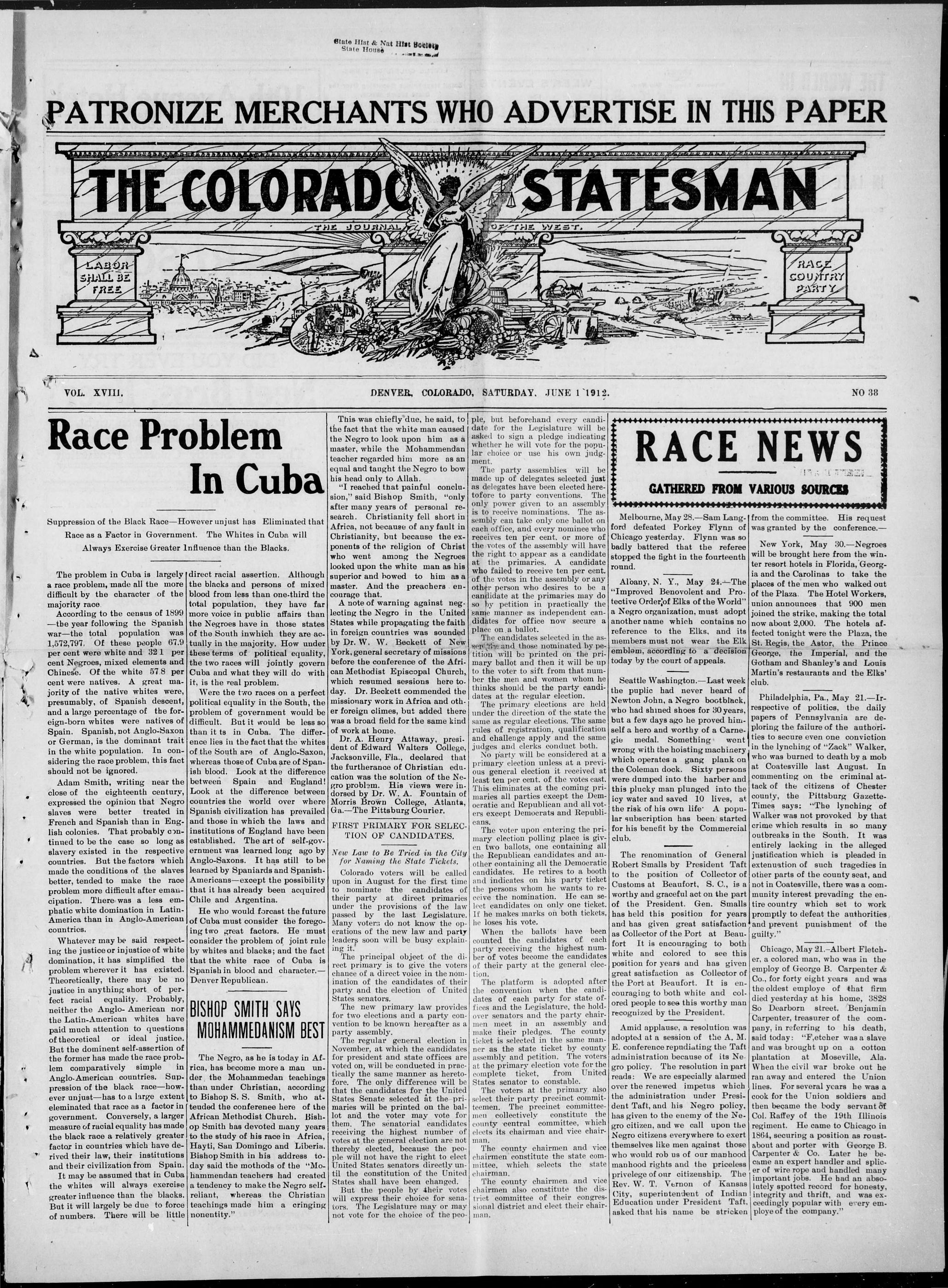
Race Problem In Cuba
Suppression of the Black Race-However unjust has Eliminated that Race as a Factor in Government. The Whites in Cuba will Always Exercise Greater Influence than the Blacks.
VOL. XVIII.
Race Pro
Suppression of the Black Race—H
Race as a Factor in Governme
Always Exercise Greater I
The problem in Cuba is largely
a race problem, made all the more
difficult by the character of the
majority race.
According to the census of 1899—the year following the Spanish war—the total population was 1,572,797. Of these people 67.9 per cent were white and 32.1 per cent Negroes, mixed elements and Chinese. Of the white 57.8 per cent were natives. A great majority of the native whites were, presumably, of Spanish descent, and a large percentage of the foreign-born whites were natives of Spain. Spanish, not Anglo-Saxon or German, is the dominant trait in the white population. In considering the race problem, this fact should not be ignored.
Adam Smith, writing near the close of the eighteenth century, expressed the opinion that Negro slaves were better treated in French and Spanish than in English colonies. That probably continued to be the case so long as slavery existed in the respective countries. But the factors which made the conditions of the slaves better, tended to make the race problem more difficult after emancipation. There was a less emphatic white domination in Latin America than in Anglo-American countries.
Whatever may be said respecting the justice or injustice of white domination, it has simplified the problem wherever it has existed. Theoretically, there may be no justice in anything short of perfect racial equality. Probably, neither the Anglo-American nor the Latin-American whites have paid much attention to questions of theoretical or ideal justice. But the dominant self-assertion of the former has made the race problem comparatively simple in Anglo-American countries. Suppression of the black race—however unjust—has to a large extent eliminated that race as a factor in government. Conversely, a larger measure of racial equality has made the black race a relatively greater factor in countries which have derived their law, their institutions and their civilization from Spain.
It may be assumed that in Cuba the whites will always exercise greater influence than the blacks. But it will largely be due to force of numbers. There will be little
direct racial assertion. Although the blacks and persons of mixed blood from less than one-third the total population, they have far more voice in public affairs than the Negroes have in those states of the South in which they are actually in the majority. How under these terms of political equality, the two races will jointly govern Cuba and what they will do with it, is the real problem.
Were the two races on a perfect political equality in the South, the problem of government would be difficult. But it would be less so than it is in Cuba. The difference lies in the fact that the whites of the South are of Anglo-Saxon, whereas those of Cuba are of Spanish blood. Look at the difference between Spain and England! Look at the difference between countries the world over where Spanish civilization has prevailed and those in which the laws and institutions of England have been established. The art of self-government was learned long ago by Anglo-Saxons. It has still to be learned by Spaniards and Spanish-Americans—except the possibility that it has already been acquired Chile and Argentina.
He who would forecast the future of Cuba must consider the foregoing two great factors. He must consider the problem of joint rule by whites and blacks; and the fact that the white race of Cuba is Spanish in blood and character. Denver Republican.
BISHOP SMITH SAYS
MOHAMMEDANISM BEST
BISHOP SMITH SAYS
MOHAMMEDANISM BEST
The Negro, as he is today in Africa, has become more a man under the Mohammedan teachings than under Christian, according to Bishop S. S. Smith, who attended the conference here of the African Methodist Church. Bishop Smith has devoted many years to the study of his race in Africa, Hayti, San Domingo and Liberia. Bishop Smith in his address today said the methods of the "Mohammendan teachers had created a tendency to make the Negro self-reliant, whereas the Christian teachings made him a cringing nonentity."
DENVER, COLORADO, SATURDAY, JUNE 1 1912.
State Hist & Nat Hist Society
State House
HANTS WH
ADC
THE JOURNAL
DENVER, COLORADO
This was chiefly due, he said, to the fact that the white man caused the Negro to look upon him as a master, while the Mohammendan teacher regarded him more as an equal and taught the Negro to bow his head only to Allah.
"I reached that painful conclusion," said Bishop Smith, "only after many years of personal research. Christianity fell short in Africa, not because of any fault in Christianity, but because the exponents of the religion of Christ who went among the Negroes looked upon the white man as his superior and bowed to him as a master. And the preachers encourage that.
A note of warning against neglecting the Negro in the United States while propagating the faith in foreign countries was sounded by Dr. W. W. Beckett of New York, general secretary of missions before the conference of the African Methodist Episcopal Church, which resumed sessions here today. Dr. Beckett commended the missionary work in Africa and other foreign climes, but added there was a broad field for the same kind of work at home. Dr. A. Henry Attaway, president of Edward Walters College, Jacksonville, Fla., declared that the furtherance of Christian education was the solution of the Negro problem. His views were indorsed by Dr. W. A. Fountain of Morris Brown College, Atlanta, Ga.-The Pittsburg Courier.
FIRST PRIMARY FOR SELECTION OF CANDIDATES.
New Law to Be Tried in the City for Naming the State Tickets. Colorado voters will be called upon in August for the first time to nominate the candidates of their party at direct primaries under the provisions of the law passed by the last Legislature. Many voters do not know the operations of the new law and party leaders soon will be busy explaining it. The principal object of the direct primary is to give the voters chance of a direct voice in the nomination of the candidates of their party and the election of United States senators. The new primary law provides for two elections and a party convention to be known hereafter as a party assembly.
The regular general election in November, at which the candidates for president and state offices are voted on, will be conducted in practically the same manner as heretofore. The only difference will be that the candidates for the United States Senate selected at the primaries will be printed on the ballot and the voter may vote for them. The senatorial candidates receiving the highest number of votes at the general election are not thereby elected, because the people will not have the right to elect United States senators directly until the constitution of the United States shall have been changed.
But the people by their votes will express their choice for senators. The Legislature may or may not vote for the choice of the peo-
ple, but beforehand every candidate for the Legislature will be asked to sign a pledge indicating whether he will vote for the popular choice or use his own judgment. The party assemblies will be made up of delegates selected just as delegates have been elected herefore to party conventions. The only power given to an assembly is to receive nominations. The assembly can take only one ballot on each office, and every nominee who receives ten per cent, or more of the votes of the assembly will have the right to appear as a candidate at the primaries. A candidate who failed to receive ten per cent, of the votes in the assembly or any other person who desires to be a candidate at the primaries may do so by petition in practically the same manner as independent candidates for office now secure a place on a ballot.
The candidates selected in the assembly and those nominated by petition will be printed on the primary ballot and then it will be up to the voter to sift from that number the men and women whom he thinks should be the party candidates at the regular election.
The primary elections are held under the direction of the state the same as regular elections. The same rules of registration, qualification and challenge apply and the same judges and clerks conduct both. No party will be considered at a primary election unless at a previous general election it received at least ten per cent. of the votes east. This eliminates at the coming primaries all parties except the Democratic and Republican and all voters except Democrats and Republicans.
The voter upon entering the primary election polling place is given two ballots, one containing all the Republican candidates and another containing all the Democratic candidates. He retires to a booth and indicates on his party ticket the persons whom he wants to receive the nomination. He can select candidates on only one ticket. If he makes marks on both tickets, he loses his vote.
When the ballots have been counted the candidates of each party receiving the highest number of votes become the candidates of their party at the general election.
The platform is adopted after the convention when the candidates of each party for state offices and the Legislature, the holdover senators and the party chairmen meet in an assembly and make their pledges. The county ticket is selected in the same manner as the state ticket by county assembly and petition. The voters at the primary election vote for the complete ticket, from United States senator to constable.
The voters at the primary also select their party precinct committeemen. The precinct committeemen collectively constitute the county central committee, which elects its chairman and vice chairman.
The county chairmen and vice chairmen constitute the state committee, which selects the state chairman.
The county chairmen and vice chairmen also constitute the district committee of their congressional district and elect their chairman.
RACE NEWS
Melbourne, May 28.—Sam Langford defeated Porkey Flynn of Chicago yesterday. Flynn was so badly battered that the referee stopped the fight in the fourteenth round.
Albany, N. Y., May 24.—The "Improved Benovolent and Protective Order of Elks of the World" a Negro organization, must adopt another name which contains no reference to the Elks, and its members must not wear the Elk emblem, according to a decision today by the court of appeals.
Seattle Washington.—Last week the public had never heard of Newton John, a Negro bootblack, who had shined shoes for 30 years, but a few days ago he proved himself a hero and worthy of a Carnegie medal. Something went wrong with the hoisting machinery which operates a gang plank on the Coleman dock. Sixty persons were dumped into the harber and this plucky man plunged into the icy water and saved 10 lives, at the risk of his own life. A popular subscription has been started for his benefit by the Commercial club.
The renomination of General Robert Smalls by President Taft to the position of Collector of Customs at Beaufort, S. C., is a worthy and graceful act on the part of the President. Gen. Smalls has held this position for years and has given great satisfaction as Collector of the Port at Beaufort. It is encouraging to both white and colored to see this position for years and has given great satisfaction as Collector of the Port at Beaufort. It is encouraging to both white and colored people to see this worthy man recognized by the President.
Amid applause, a resolution was adopted at a session of the A. M. E. conference repudiating the Taft administration because of its Negro policy. The resolution in part reads: We are especially alarmed over the renewed impetus which the administration under President Taft, and his Negro policy, has given to the enemy of the Negro citizen, and we call upon the Negro citizens everywhere to exert themselves like men against those who would rob us of our manhood manhood rights and the priceless privilege of our citizenship. The Rev. W. T. Vernon of Kansas City, superintendent of Indian Education under President Taft asked that his name be stricken
NO 38
from the committee. His request was granted by the conference. New York, May 30.—Negroes will be brought here from the winter resort hotels in Florida, Georgia and the Carolinas to take the places of the men who walked out of the Plaza. The Hotel Workers, union announces that 900 men joined the strike, making the total now about 2,000. The hotels affected tonight were the Plaza, the St. Regis, the Astor, the Prince George, the Imperial, and the Gotham and Shanley's and Louis Martin's restaurants and the Elks' club.
Philadelphia, Pa., May 21.—Irrespective of politics, the daily papers of Pennsylvania are deploring the failure of the authorities to secure even one conviction in the lynching of "Zack" Walker, who was burned to death by a mob at Coatesville last August. In commenting on the criminal attack of the citizens of Chester county, the Pittsburg Gazette-Times says: "The lynching of Walker was not provoked by that crime which results in so many outbreaks in the South. It was entirely lacking in the alleged justification which is pleaded in extenuation of such tragedies in other parts of the county seat, and not in Coatesville, there was a community interest prevading the entire country which set to work promptly to defeat the authorities and prevent punishment of the guilty."
Chicago, May 21. Albert Fletcher, a colored man, who was in the employ of George B. Carpenter & Co., for forty eight years and was the oldest employee of that firm died yesterday at his home, 3828 So Dearborn street. Benjamin Carpenter, treasurer of the company, in referring to his death, said today: "F,etcher was a slave and was brought up on a cotton plantation at Moseville, Ala. When the civil war broke out he ran away and entered the Union lines. For several years he was a cook for the Union soldiers and then became the body servant of Col. Raffey of the 19th Illinois regiment. He came to Chicago in 1864, securing a position as roustabout and porter with George B. Carpenter & Co. Later he became an expert handler and splicer of wire rope and handled many important jobs. He had an absolutely spotted record for honesty, integrity and thrift, and was exceedingly popular with every employ of the company."
THE WORLD IN PARAGRAPHS
BRIEF RECORD OF PASSING EVENTS IN THIS AND FOR- EIGN COUNTRIES.
DOINGS AND HAPPENINGS THAT
MARK THE PROGRESS
OF THE AGE.
Western Newspaper Union News Service.
WESTERN.
Abe Ruef's long expected exposé of
graft in San Francisco has been be-
gun in a San Francisco daily newspaper.
Dan Davis, a negro, was burned at a
stake in the streets in Tyler, Texas,
after he had confessed to assaulting a
young girl.
As they were digging in a trench at
Price, Utah, Ray Jeweks and Andrew
Thomas were buried by a cave-in and
suffocated.
All the troops at Fort. D. A. Russell, near Cheyenne, Wyo., have been ordered by wire to be ready to move to Cuba on a day's notice.
To be the first woman probate judge in America, to have served two successful terms and to be a candidate for re-election without opposition is the distinction of Mrs. Mary H. Cooper of Beloit, Kansas.
Miss Dora Keen of Philadelphia and her party of six men attained the summit of Mount Blackburn, Alaska, 16, 140 feet. They arrived at Kennecott, on the Copper River railroad, all well. This is the first ascent of the great Copper river peak.
Attorney General Webb, who was sent to San Diego by the governor to review the situation in relation to the Industrial Workers of the World disturbances, has given it out that martial law will be established if the local authorities cannot handle matters.
The Indians of the Wind River reservation in Wyoming not having taken to the cultivation of the large acreage brought under irrigation facilities by the system completed a year or two ago, the government is preparing to sell or lease 61,000 acres to whites. Some of this land is very desirable.
The first State Legislature of Arizona has adjourned, having passed about a hundred bills Among those signed two relate to mining; elections four, court procedure five, land laws four, labor sixteen, reformatory three, municipal improvements three, agriculture one, corporations six, appropriations for state departments six, revenue and taxation eight, county affairs four, education seven, miscellaneous twelve.
More than a million dollars in cash and a still larger amount in clothing and supplies have been devoted to the refugees of the Mississippi flood district and there is almost a half million dollars in sight for their urgent needs. Of approximately 170,000 persons who have been driven from their homes by the floods, the United States army relief corps is dispensing rations daily to nearly 140,000, and such of the others as need assistance are being cared for by local relief committees.
POLITICAL.
Out of the 1,026 Republican delegates thus far named, President Taft has a total of 454 and Colonel Roosevelt has 413, getting 38 as the result of Ohio's primary.
WASHINGTON
Notice has been given in the Senate that the minority would insist upon an early consideration of the Lorlmer case.
Senator Crawford of South Dakota advocates a constitutional amendment to fix the terms of judges of inferior federal courts at ten years.
Ultimate adoption of the Borah-Taylor three-year homestead bill was clinched by the approval in the Senate of the report of the conference committee. It is expected the House will take similar action without delay and the measure will go promptly to the President for his signature.
A charge that members of the House were guilty of petty grafting was made on the floor by Representative Fitzgerald, chairman of the appropriations committee. A wordy war was precipitated, in the course of which Fitzgerald himself was accused of having submitted for payment bills for material for which there was no provision by law. The clash marked the consideration of the emergency appropriation bill, carrying $201,000 for the expenses of the House.
A historic old tree, estimated to be more than 500 years old, famous also because it was used during the Civil War as a signal station and by Confederate sharpshooters when General Early in 1864 made his attack upon the national capital, has been cut down.
Senator Lorimer has telegraphed to Senator Kern, one of his leading opponents, requesting that his case be not called up for the present and saying that he wanted to speak and did not feel able to do so now.
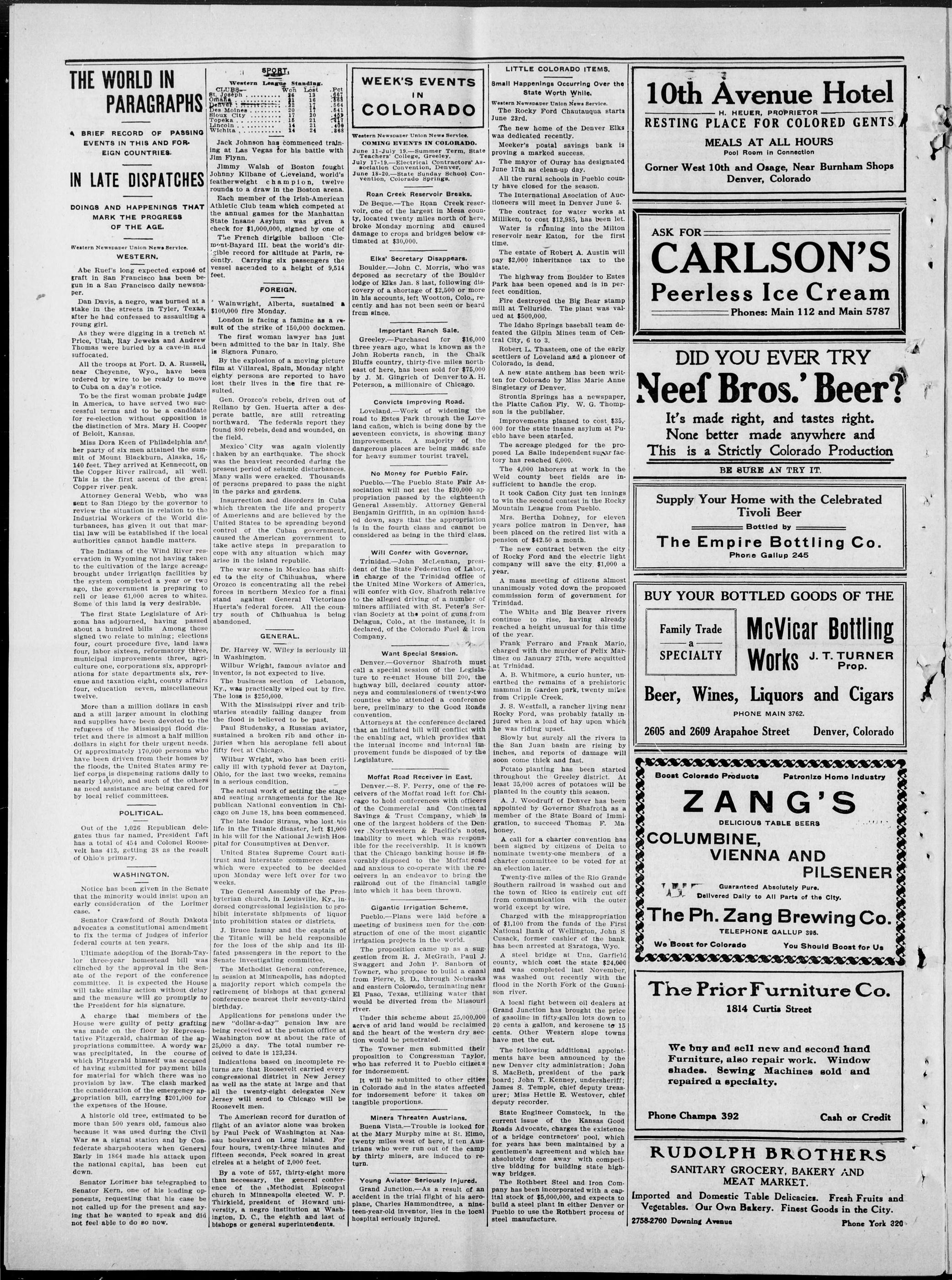
Western League Standing.
CLUBS Won Lost Pet
St. Joseph 26 13 667
Omaha 21 16 588
Denver 22 17 564
Des Moines 30 14 544
Sluice City 17 20 459
Topeka 16 21 417
Lincoln 14 21 409
Wichita 14 24 368
Jack Johnson has commenced training at Las Vegas for his battle with Jim Flynn.
Jimmy Walsh of Boston fought Johnny Kilbane of Cleveland, world's featherweight champion, twelve rounds to a draw in the Boston arena.
The French dirigible balloon Clement-Bayard III. beat the world's dirigible record for altitude at Paris, recently. Carrying six passengers the vessel ascended to a height of 9,514 feet.
FOREIGN.
Wainwright, Alberta, sustained a $100,000 fire Monday.
London is facing a famine as a result of the strike of 150,000 dockmen.
The first woman lawyer has just been admitted to the bar in Italy. She is Signora Funaro.
By the explosion of a moving picture film at Villareal, Spain, Monday night. eighty persons are reported to have lost their lives in the fire that resulted.
Gen. Orozco's rebels, driven out of Rellano by Gen. Huerta after a desperate battle, are still retreating northward. The federals report they found 800 rebels, dead and wounded, on the field.
Mexico City was again violently shaken by an earthquake. The shock was the heaviest recorded during the present period of seismic disturbances. Many walls were cracked. Thousands of persons prepared to pass the night in the parks and gardens.
Insurrection and disorders in Cuba which threaten the life and property of Americans and are believed by the United States to be spreading beyond control of the Cuban government, caused the American government to take active steps in preparation to cope with any situation which may arise in the island republic.
The war scene in Mexico has shifted to the city of Chihuahua, where Orozco is concentrating all the rebel forces in northern Mexico for a final stand against General Victoriano Huerta's federal forces. All the country south of Chihuahua is being abandoned.
GENERAL
Dr. Harvey W. Wiley is seriously ill in Washington. Wilbur Wright, famous aviator and inventor, is not expected to live. The business section of Lebanon, Ky., was practically wiped out by fire. The loss is $250,000. With the Mississippi river and tributaries steadily falling danger from the flood is believed to be past. Paul Studensky, a Russian aviator, sustained a broken rib and other injuries when his aeroplane fell about fifty feet at Chicago. Wilbur Wright, who has been critically ill with typhoid fever at Dayton, Ohio, for the last two weeks, remains in a serious condition. The actual work of setting the stage and seating arrangements for the Republican National convention in Chicago on June 18, has been commenced.
The late Isador Straus, who lost his life in the Titanic disaster, left $1,000 in his will for the National Jewish Hospital for Consumptives at Denver.
United States Supreme Court antitrust and interstate commerce cases which were expected to be decided upon Monday were left over for two weeks.
The General Assembly of the Presbyterian church, in Louisville, Ky., indorsed congressional legislation to prohibit interstate shipments of liquor into prohibition states or districts.
J. Bruce Ismay and the captain of the Titanic will be held responsible for the loss of the ship and its ill-fated passengers in the report to the Senate investigating committee.
The Methodist General conference, in session at Minneapolis, has adopted a majority report which compels the retirement of bishops at that general conference nearest their seventy-third birthday.
Applications for pensions under the new "dollar-a-day" pension law are being received at the pension office at Washington now at about the rate of 25,000 a day. The total number received to date is 123,234.
Indications based on incomplete returns are that Roosevelt carried every congressional district in New Jersey as well as the state at large and that all the twenty-eight delegates New Jersey will send to Chicago will be Roosevelt men.
The American record for duration of flight of an aviator alone was broken by Paul Peck of Washington at Nassau boulevard on Long Island. For four hours, twenty-three minutes and fifteen seconds, Peck soared in great circles at a height of 2,000 feet. By a vote of 557, thirty-eight more than necessary, the general conference of the Methodist Episcopal church in Minneapolis elected W. P. Thirkield, president of Howard university, a negro institution at Washington, D. C., the eighth and last of bishops or general superintendents.
Western Newspaper Union News Service.
COMING EVENTS IN COLORADO.
June 11-July 19—Summer Term, State Teachers' College, Greeley.
July 17-19—Electrical Contractors' Association Convention, Denver.
June 18-20—State Sunday School Convention, Colorado Springs.
Roan Creek Reservoir Breaks.
De Beque.-The Roan Creek reservoir, one of the largest in Mesa county, located twenty miles north of here, broke Monday morning and caused damage to crops and bridges below estimated at $30,000.
Elks' Secretary Disappears.
Boulder.—John C. Morris, who was deposed as secretary of the Boulder lodge of Elks Jan. 8 last, following discovery of a shortage of $2,500 or more in his accounts, left Wootton, Colo., recently and has not been seen or heard from since.
Important Ranch Sale.
Greeley.—Purchased for $16,000 three years ago, what is known as the John Roberts ranch, in the Chalk Bluces country, thirty-five miles northeast of here, has been sold for $75,000 by J. M. Gingrich of Denver to A. H. Peterson, a millionaire of Chicago.
Convicts Improving Road.
Loveland.—Work of widening the road to Estes Park through the Loveland canon, which is being done by the seventeen convicts, is showing many improvements. A majority of the dangerous places are being made safe for heavy summer tourist travel.
No Money for Pueblo Fair.
Pueblo.—The Pueblo State Fair Association will not get the $20,000 appropriation passed by the eighteenth General Assembly. Attorney General Benjamin Griffith, in an opinion handed down, says that the appropriation is in the fourth class and cannot be considered as being in the third class.
Will Confer with Governor.
Trinidad.—John McLennan, president of the State Federation of Labor, in charge of the Trinidad office of the United Mine Workers of America, will confer with Gov. Shafroth relative to the alleged driving of a number of miners affiliated with St. Peter's Servian Society at the point of guns from Delagua, Colo., at the instance, it is declared, of the Colorado Fuel & Iron Company.
Want Special Session.
Denver.—Governor Shafroth must call a special session of the Legislature to re-enact House bill 200, the highway bill, declared county attorneys and commissioners of twenty-two counties who attended a conference here, preliminary to the Good Roads convention.
Attorneys at the conference declared that an initiated bill will conflict with the enabling act, which provides that the internal income and internal improvement funds be disposed of by the Legislature.
Moffat Road Receiver in East.
Denver.-S. F. Perry, one of the receivers of the Moffat road left for Chicago to hold conferences with officers of the Commercial and Continental Savings & Trust Company, which is one of the largest holders of the Denver Northwestern & Pacific's notes, inability to meet which was responsible for the receivership. It is known that the Chicago banking house is favorably disposed to the Moffat road and anxious to co-operate with the receivers in an endeavor to bring the railroad out of the financial tangle into which it has been thrown.
Gigantic Irrigation Scheme.
Pueblo.—Plans were laid before a meeting of business men for the construction of one of the most gigantic irrigation projects in the world.
The proposition came up as a suggestion from R. J. McGrath, Paul J. Swaggert and John P. Sanborn of Towner, who propose to build a canal from Pierre, S. D., through Nebraska and eastern Colorado, terminating near El Paso, Texas, utilizing water that would be diverted from the Missouri river.
Under this scheme about 25,000,000 acres of arid land would be reclaimed and the heart of the western dry section would be penetrated.
The Towner men submitted their proposition to Congressman Taylor, who has referred it to Pueblo citizens for endorsement.
It will be submitted to other cities in Colorado and in the states affected for indorsement before it takes on tangible proportions.
Miners Threaten Austrians.
Buena Vista.—Trouble is looked for at the Mary Murphy mine at St. Elmo, twenty miles west of here, if ten Austrians who were run out of the camp by thirty miners, are induced to return.
Young Aviator Seriously Injured.
Grand Junction.—As a result of an accident in the trial flight of his aeroplane, Charles Hammondtree, a nineteen-year-old inventor, lies in the local hospital seriously injured.
Small Happenings Occurring Over the State Worth While.
Western Newspaper Union News Service.
The Rocky Ford Chautauqua starts June 23rd.
The new home of the Denver Elks was dedicated recently.
Meeker's postal savings bank is proving a marked success.
The mayor of Ouray has designated June 17th as clean-up day.
All the rural schools in Pueblo county have closed for the season.
The International Association of Auctioneers will meet in Denver June 5.
The contract for water works at Milliken, to cost $12,985, has been let.
Water is running into the Milton reservoir near Eaton, for the first time.
The estate of Robert A. Austin will pay $2,000 inheritance tax to the state.
The highway from Boulder to Estes Park has been opened and is in perfect condition.
Fire destroyed the Big Bear stamp mill at Telluride. The plant was valued at $500,000.
The Idaho Springs baseball team defeated the Gilpin Mines team of Central City, 6 to 3.
A new state anthem has been written for Colorado by Miss Marie Anne Singletary of Denver.
Strontia Springs has a newspaper, the Platte Cañon Fly. W. G. Thompson is the publisher.
Improvements planned to cost $35,000 for the state insane asylum at Pueblo have been starred.
The acreage pledged for the proposed La Salle independent sugar factory has reached 6,000.
The 4,000 laborers at work in the Weld county beet fields are insufficient to handle the crop.
It took Cañon City just ten innings to win the second contest in the Rocky Mountain League from Pueblo.
Mrs. Bertha Dohney, for eleven years police matron in Denver, has been placed on the retired list with a pension of $42.50 a month.
The new contract between the city of Rocky Ford and the electric light company will save the city. $1,000 a year.
A mass meeting of citizens almost unanimously voted down the proposed commission form of government for Trinidad.
The White and Big Beaver rivers continue to rise, having already reached a height unusual for this time of the year.
Frank Ferraro and Frank Mario, charged with the murder of Felix Martinez on January 27th, were acquitted at Trinidad.
A. B. Whitmore, a curio hunter, unearthed the remains of a prehistoric mammal in Garden park, twenty miles from Cripple Creek.
J. S. Westfall, a rancher living near Rocky Ford, was probably fatally injured when a load of hay upon which he was riding upset. Slowly but surely all the rivers in the San Juan basin are rising by inches, and reports of damage will soon come thick and fast. Potato planting has been started throughout the Greeley district. At least 35,000 acres of potatoes will be planted in the county this season. A. J. Woodruff of Denver has been appointed by Governor Shafroth as a member of the State Board of Immigration, to succeed Thomas F. Mahoney. A call for a charter convention has been signed by citizens of Delta to nominate twenty-one members of a charter committee to be voted for at an election later.
Twenty-five miles of the Rio Grande Southern railroad is washed out and the town of Rico is entirely cut off from communication with the outer world except by wire.
Charged with the misappropriation of $1,100 from the funds of the First National Bank of Wellington, John S Cusack, former cashier of the bank has been arrested at Saratoga, Wyo.
A steel bridge at Una, Garfield county, which cost the state $24,000 and was completed last November, was washed out recently with the flood in the North Fork of the Guinnison river.
A local fight between oil dealers at Grand Junction has brought the price of gasoline in fifty-gallon lots down to 20 cents a gallon, and kerosene to 15 cents. Other Western slope towns have met the cut.
The following additional appointments have been announced by the new Denver city administration: John S. MacBeth, president of the park board; John T. Kenney, undersheriff; James S. Temple, chief deputy treasurer; Miss Hettie E. Westover, chief deputy recorder.
State Engineer Comstock, in the current issue of the Kansas Good Roads Advocate, charges the existence of a bridge contractors' pool, which for years has been maintained by a gentlemen's agreement and which has absolutely done away with competitive bidding for building state highway bridges.
The Rothbert Steel and Iron Company has been incorporated with a capital stock of $5,000,000, and expects to build a steel plant in either Denver or Pueblo to use the Rothbert process of steel manufacture.
Corner West 10th and Osage, Near Burnham Shops Denver, Colorado
ASK FOR CARLSON'S Peerless Ice Cream Phones: Main 112 and Main 5787
It's made right, and tastes right. None better made anywhere and This is a Strictly Colorado Production
Supply Your Home with the Celebrated Tivoli Beer Bottled by The Empire Bottling Co. Phone Gallup 245
BUY YOUR BOTTLED GOODS OF THE
Guaranteed Absolutely Pure. Delivered Daily to All Parts of the City.
The Prior Furniture Co. 1814 Curtis Street
We buy and sell new and second hand Furniture, also repair work. Window shades. Sewing Machines sold and repaired a specialty.
RUDOLPH BROTHERS
SANITARY GROCERY, BAKERY AND MEAT MARKET. Imported and Domestic Table Delicacies. Fresh Fruits and Vegetables. Our Own Bakery. Finest Goods in the City. 2758-2760 Downing Avenue Phone York 320
Family Trade a SPECIALTY
Beer, Wines,
2605 and 2609 Arapa
Boost Colorado Prod.
Z A
DELIVERY
COLUMBIN
VIEW
Guara
Delivered D
The Ph. Z
TELEPHONE
We Boost for Colorado
The Prior
182
We buy and sell
Furniture, alce
shades. Sewi
repaired a spe
Phone Champa 392
RUDOLP
SANITARY G
ME
Cash or Credit
AFRO-AMERICAN CULLINGS
This is among some of the great mistakes our girls are making (some of them) as they seemingly try to have all the sweetheart in the town, from a "flunkie" down. We will say its a shame to see them, intelligent in some instances, strolling and palarving in leisure with these "beauts," when they could have demanded higher social privileges had they kept themselves from this class of gentlemen. (?)
Some of these, of which we speak, their parents, whose history is without a blemish, to them they are a disgrace and a shame to the entire race.
The most of them think they are pretty and the smartest of all human beings, when they are nothing but fools in human form.
Of course some are bribed in this kind of society by their escorts, as many among them think that the beauty of a man is his high-heel shoes and 30 or 40-inch coat and those "beautiful peg-top pants."
Clothes, dear girls, do not make a man; it is principle, ability and such other things that are honorable and manly that constitutes men of real service and benefit to his people and the country.
Call yourself to a standstill and consider that you are making the mistake of your life and will never be of any service to those dear parents who sacrificed all but their lives for you and would have sacrificed their lives had it been necessary.
How can you allow yourself to disgrace those who are so dear to you? This is a very important thing that all parents should try to observe—the company in which your daughters are associated, for associations, whatever they may be, will be inherited by them. Draw in your reins, girls, and be a better exponent of the race. By doing this you will add many stars to the crowns that await us in the future. This rowdy and unpromising class among us should have no charms for any respectable person who is trying to hold their heads above the waves of this sin-trying world.—Palestine (Tex.) Plaindealer.
Is it not a disheartening thing to go through life under the harrow of debt, struggling to get release under circumstances that give no hope of relief? Is it not unfortunate to feel that we can never lift the mortgage from the home, that in spite of all our efforts it must finally be sold over the heads of those dearer to us than life itself? But all this is nothing compared with the mortgage of vice upon the character which blights the life. Many a man has died without being able to lift a mortgage from his home, yet has been a real success, for he has kept his manhood clean, his integrity unstained, and, although he left no material wealth, he has enriched the lives of all who knew him.
The nicotine mortgage upon your vitality, the alcohol mortgage which hardens your nerve fiber, benumbs the brain cells, paralyzes the power to achieve and makes you a slave instead of a king, are encumbrances compared with which the mere mortgage upon your home is a blessing. If you are mortgaged to the cigarette habit, which demoralizes your ambition, poisons your blood, benumbs your nerves and vitiates your aim; if you have a whisky mortgage, an immortality mortgage on your character which you have been trying for years to lift, this is infinitely worse than your chattel mortgage or real estate mortgage.
The mortgage on your home may not touch your real self. In spite of it, you may be a man, respected, looked up to, admired. If your life has been clean you may have made every acre of land in your vicinity worth more. But if your character is mortgaged to a demoralizing habit; if you are the victim of a degrading vice that holds you down, cripples your advance, this is a thousand times worse. It loses you not only your respect, but also the respect of those who know you.—Success Magazine.
Another prophet has arisen who confidently claims that the immigration of foreigners into the south will solve the Negro problem. Just how this is to come is not made as clear as one could desire. It is certain that the Negro problem is not going to be solved by increasing the competition which the Negro now has unless Negro efficiency is going to be increased out of proportion to his competitors. Of course this is impossible because every foreign element admitted to our citizenship is going to get better school advantages than those accorded the Negro. In this respect the introduction of foreigners to the south means the curtailment of employment for Negroes and the corresponding neglect of those facilities which are designed to better fit and prepare a people for the fuller life of our civilization. All of the benefits which the negro may hope to derive from foreign emmigration are indirect rather than otherwise. The increase of the population of the south will diminish the social and political importance of the Negro and in this way the race may drop from public discussion. This will be an indirect benefit and one too that may
mean public neglect. Of course the Negro is not in position just now to be left to himself. He needs help now and will need it for the next four or five generations. We are of the opinion that emigration will not solve the Negro problem but may create new problems that will take the place of the old and may be more intolerable.
Three hundred hotel waiters were discharged in New York last year and their places given to foreigners. Among other objections urged against the retention of Negro waiters was that they presented too great a variety in color. That is to say, if twenty-five men were employed at a place they ranged in color all the way from that of the darkest to the lightest races of mankind and this is supposed to have had a queer effect on something or somebody. It is not at all improbable that in the course of time the colored man will find difficulty in getting a job in town unless it is furnished him by another Negro. And this can be possible only on the theory that the Negro becomes to be a factor in the industrial and commercial affairs of this country. At present we are practically a jobless race, dependent in large measure on other folks for jobs ranging all the way from blacking boots to represent this government abroad. Therefore the man who is doing anything looking to the creation of a job first for himself and then for others is at tacking the "problem" at its most important point. This position must be conquered or the field is practically lost. Instead of being a jobless race, we've got to become more largely a race with innumerable jobs that are ours inaliablely.
Few people who amuse themselves by singing or whistling the popular song "Casey Jones" are aware of the fact that the song was first originated by a negro.
A writer in a recent issue of the Railroad Man's Magazine, signing himself "Red Mac," gives the following history of the origin of the song: "As to the origin of the song, it was started by an old negro named Geo. Crockett, who was employed around the shop and roundhouse at Water Valley, Miss. Like many other old-time darkies, if they admire anything, particularly some person, you will often hear them hum something about that person. Casey was admired by all the colored firemen and brakemen, who were always singing about his ability to get over the road. Of course, old Uncle George could not help sing Casey's praise, so he collected a few scattering words in real negro fashion. With the help of the colored firemen, switchmen, etc., he got together two short verses and composed an air for the words. From time to time more words were added and the song's popularity grew. After Casey's death, Mrs. Jones endeavored to stop the publishing of the song, but was unsuccessful, as there was no copyright."—Dallas Express.
Colonel G. M. Quarles, a tobacco planter in Christian County, Ky., had a dark man servant named Mose. Mose was driving his boss into town one day, when he suddenly remarked: "Marse Garrett, dey had me up befoah my church las' night fur dancin'." "I don't suppose you were guilty—were you, Mose?" asked the colonel. "Yas, suh; yas, suh," said Mose. "I was guilty of dancin' and dey proved hit on me too; but I come clear. My friends stuck to me close, and after dem other niggers had done testified ag'inst me, my friends all got up and testified dat, though it was true I danced, I was so drunk at de time I didn't know wuht I was doin'. So I come clear—and the preacher scused me!"—Ex.
Rev. John Peterson of Annapolis, Illinois, knowing that it is not good for man to live alone, decided to take unto himself a better half. The date was fixed and a fellow minister was engaged to tie the nuptial knot, but when the hour arrived, the invited minister was nowhere to be seen. Bro. Peterson rose to the emergency by calming performing the marriage ceremony himself—for himself. We think that in the matter of nerve the good brother not only takes the cake, but walks away with the bakery.
It is always easier to be a ritualist than a sincere Christian, a pretender rather than a thorough-going confessor of the faith, but if religion is worth anything, it is worth everything, and God will reject all pretenses, while He will crown all true endeavors and sacrifices in His name. It is impossible to deceive God, who reads the hearts allike of Pharisees, Sadducees and Publicans.—N. Y. Observer.
Don't find so many reasons for refusing to patronize institutions operated by your own people. Take a lesson from your white neighbor. He is trying to build up his white brother. Consider your children and build something for them.—The Dallas Express.
LIFE CONDITIONS OF THE NEGRO IN THE CITY AND IN THE COUNTRY
From time immemorial it has been fashionable to exalt conditions of living in rural districts over conditions of living in city districts. The country districts have their charms and their disenchantments and the city districts have theirs. Some people prefer the one and some the other, but which of them is best is a question as old as the everlasting hills of Jacob and as young as the last hill thrown up by a ground-mole. In his address at the Carnegie hall meeting of the Men and Religion Forward Movement Dr. Booker T. Washington said:
"So long as the negro in the rural districts is fed upon the old worn-out theological dogmas, instead of getting from the pulpit inspiration and direction in practical work of community building, connecting religion with every practical and progressive movement for the improvement of the home and community life, so long will he forsake the land and flee to the city. If we would save the negro, $2 per cent of whom, as I have said, live in the country, he must be taught that when the Bible says: 'The earth is full of thy riches,' it means that the earth is full of corn, potatoes, peas, cotton, chickens and cows, and that these riches should be gotten out by the hand of man and turned into beautiful church buildings and a righteous, useful living.
"When I was in London, England, recently, I found that the churches and other philanthropic agencies of that city were spending $50,000 annually, not to keep people on their feet and help them to make greater progress in positive, constructive directions, but to save the drunkard, the gambler, the loafer, the pauper and the destitute after they had fallen into the ditch. Happily the negroes in America have not as yet fallen into the ditch; and I pray that, as a result of this great forward movement, a way may be provided, through the negro church and Sunday school, that the negro while it is yet a new, fresh and vigorous race, may, as the old plantation hymn puts it, be kept "from sinking down." In the rural districts the negro, all things considered, is at his best in body, mind and soul. In the city he is usually at his worst. Plainly one of the duties of the church is to help keep the negro where he has the best chance."
This view of the question is as plainly and bluntly stated as possible; there are no frills on it; it is reduced to a matter of every-day life and the commonplace things of it, such as better health conditions and food and air and water, and the like; things that go a long way towards making life worth living, but by no means of affording it opportunities for the higher cultivation of the mind, that has cravings of its own independently of the cravings of the body, which insists upon having the daily portion of corn pone and bacon and greens, and such other lumber as make blood for the heart. But the country life is a failure that does not furnish more than this, which does not provide the intellectual food the mind must have or wither, leaving the man an animal with a brain, with only the blood of foodstuffs in it, out of which may come all manner of savage thoughts and acts that are beastly in the eyes of men and the law.
The farm conditions of New England and the west have been brought to the highest possible condition of acceptability as to schools and churches and homes, with libraries here and there, but the inducements have not been sufficient to keep some and daughters of farmers from deserting the old home for the attractions and advantages of city life and the greater opportunities for making fortunes and enjoying to the most the cravings of the mind for refined associations and entertainments impossible to be had at any price in the country districts of the best sort. Nor have those conditions, on the other hand, been strong enough to allure from the cities the labor required by the farmers of New England and the west, even at wages that make farming unprofitable to the farmers when conducted on the largest and most expensive plan. Farmers within a hundred miles of New York and Philadelphia are unable to keep their grown children on the farm or to secure the necessary labor at fair wages to take their places properly to conduct their farming operations.
Farm conditions in the southern states are worse still, and less attractive and remunerative than in New England and the western states. That it is best for the negroes that they stick to the country districts as laborers and buy farms of their own as fast as they can is admitted by all who understand the race problem at all; but, during the past twenty years there has been a steady movement of negroes from the country districts to the large cities of the south, while rundreds of thousands of them have gone to Pittsburgh, Philadelphia, Boston and Chicago, where their conditions of living are harder, more difficult even, than in the cities of the south. Here the cruel Moloch grinds them to powder; only the best of them survive, one in ten perhaps, and that one is not always a strong and useful member of society.
Some will stick to the country and some will flee to the cities. It is the same with whites as with blacks. It is up to the thoughtful negroes in the cities and in the country districts to
do all that is possible, of themselves and with the assistance of others, to make the conditions where negroes are found in numbers as clean, healthful and progressive as those of their white neighbors, to the end that they may get the most out of living for themselves and for the nation. What Dr. Washington has done personally and with the aid of others through Tuskegee to improve negro farming conditions and home life is one of the brightest and most helpful pages in negro uplift work. As an example to others it is inspirational.—New York Age.
NEGRO BANKS
NO CAUSE FOR GENERAL FEELING OF ALARM BECAUSE SEVERAL COLORED BANKING INSTITUTIONS HAVE FAILED RECENTLY.
By reason of the failure within the past three months of three negro banks, the prophets of ill omen are having their innning, and are voicing their pleasure in the saying: "I told you so!" However, there is no cause for alarm. Failure, like death, has always been in the world, but despite that fact, men are still brave enough to live.
There is nothing miraculous about the failure of a negro bank. It would be a miracle, however, if none of them failed. The negro is handicapped by lack of experience in a business way. This experience can not be imparted by the schools, nor derived from books alone. It must be acquired at first hand. We've got to get in the game just as the other folks have had to do, and if we blunder while trying to effect an entrance it ought not to cause surprise. It is told of Dr. Boyd that on one occasion he was soliciting funds from a rich philanthropist for a business venture. The philanthropist offered to advance $50,000 on condition that a white man be placed at the head of the concern. Dr. Boyd refused the offer, saying that he preferred to take, a much smaller sum to be handled by negroes.
"Let us have what you can," he said, and we'll take it and waste it, and in the process we'll learn how to use it, just like you all had to do." The colored banker has to pilot his way through reefs and rocks, and many of which are often hidden. He is sympathetic—a quality fatal in business. He finds it hard to turn a man down who puts up a good front and thinks he will be able to make good when the notes fall due. The colored banker has not yet developed into the bloodless business man who is equally concerned and indifferent as to whether you lost a day from work or lost your entire family by death. Further, the colored banker has only a narrow margin on which to do business.
Fifty per cent of the people to whom he has to look for support have no money, and among the other fifty per cent there are boss "knockers," "croakers," "fluence men," and others who know not Joseph if the latter happen to be black. However, the march upward is a necessity; it may be checked temporarily by a passing failure, or a business error, but it must move on. There is no other way out. We are surrounded by big business; we are living in the dawn of a new era. There is only one way for us to be a factor in this great industrial awakening and that is to mass our means. We have got to corner some of the dollars in a way that they will be forced to abide awhile among negroes. We recently heard a lecturer give this striking illustration of the cumulative force of a dollar at work. An old colored woman works a week and at the end she takes what she can spare of her money—say a dollar—and deposits it in a white bank. While she is leaving a Dago, or Jew, comes in and borrows that dollar. He buys groceries with it for his store and next week sells those groceries to the old lady who had deposited the dollar, and makes a profit. The man from whom he bought the groceries takes the same dollar and buys coal—from a white man—and this latter makes a profit. The coal man needs dry goods for his wife and takes this dollar and spends it with a white merchant, who, of course, makes a profit; the white merchant needs medicine and goes to a white druggist, buys it and this latter makes a profit. The druggist takes the dollar to a butcher—white, of course—and he makes a profit. The butcher needs some circulars printed to advertise his business. He takes the dollar to a white print shop, whose proprietor does the work, and makes a profit. The dollar continues in this charmed circle, yielding a profit for everybody except the negro. The old lady does not share in the profits, but she gets a big dividend of consolation at the thought of having money in "de white folks" bank.
We've got to break into that financial circle, not as an offense against the white man, but as a defense for the negro.
TOMATO BUTTER.
Scald 20 pounds of ripe tomatoes and remove the skins. Put them into a porcelain-lined kettle or stone crock with 4 pounds of apples, pared, cored and quartered; stand them over a moderate fire and cook slowly for one hour, stirring frequently to prevent sticking. Add 8 pounds of sugar, the juice of six lemons and some green ginger, sliced. Cook the mixture until it becomes thick. When cold put it in tumblers.
Furnished
Rooms
And the Old
Reliable
Newport Thirst
Parlors
341-45 Arapahoe Street.
MONAR
SHORT ORDERS AT ALL
ahoe Street.
DE
THE
MONARCH LIQUOR
COMPANY
MONARCH LIQUOR COMPANY
TELEPHONE
CHAMPA 1231
IMPORTED & D.
D. W. REEVES, Manager
FULL LINE
Five Point
272
PHONE CHAMPA 471.
COCHRAN
PORTED & DOMESTIC WINES & LIQUOR
EEVES, Manager. W. P. JONES,
FULL LINE OF CIGARS AND TOBACCO.
The Points Barber S
2727 WELTON STREET.
CHAMPA 471. DENVER
CHRAN, HOKLAS &
D. W. REEVES, Manager. W. P. JONES, Proprietor. FULL LINE OF CIGARS AND TOBACCO.
COCHRAN, HOKLAS & CO.
Contractors and Builders
All kinds
jobbing. S
specialty . .
All kinds of carpenter work and jobbing. Store and office work a specialty .. Phone Main 1925
All kinds of carpenter work and jobbing. Store and office work a specialty .. Phone Main 1925
1846 Arapahoe St.
Railroad
We lead, others for
Men. A welcome
and papers will be
Railroad Men and Waiters Club
lead, others follow. Home for Railroad and W
n. A welcome to visitors. All the latest maga
papers will be found in the Library room.
Railroad Men and Waiters'
We lead, others follow. Home for Railroad and Club Men. A welcome to visitors. All the latest magazines and papers will be found in the Library room.
FRANK BURNLEY, Manager
2149 Curtis Street Denver, C
THE ZOBE
SAMP
1004 Nineteent
THE ZOBEL BROTHER
AMPLE ROO
Nineteenth Street, Corner of C
1004 Nineteenth Street, Corner of Curtis
FINE WINES, LIQUORS AND CIGARS COORS' CELEBRATED BEER ON TAP
R COLO
---
In Connection There Are Also Nicely
DENVER
Richard Frazier and Tom Lewis, Props.
SHORT ORDERS AT ALL HOURS.
DENVER, COL
THE
CH LIQUOR
MPANY
THE MONARCH
LIQUOR CO
1516
COURT PLACE
DOMESTIC WINES & LIQUORS
W. P. JONES, Proprietor.
OF CIGARS AND TOBACCO.
s Barber Shop
VELTON STREET.
DENVER, COLO.
HOKLAS & CO.
carpenter work and
vice and office work a
Phone Main 1925
DENVER, COLO.
en and Waiters' Club
v. Home for Railroad and Club
visitors. All the latest magazines
und in the Library room.
ABEL BROTHERS'
PLE ROOM
North Street, Corner of Curtis
---
Denver, Colo.
COLORADO
JOS. D. D. RIVERS.....Proprietor
1524 Curtis Street, Room 25.
SUBSCRIPTION RATES:
One Year .....$2.00
Six Months .....1.00
Three Months ......60
PAYABLE IN ADVANCE.
Entered as second-class matter at the postoffice in the city of Denver, Colorado.
All communications of a personating nature that are not complimentary will be withheld from the columns of this paper.
It occasionally happens that papers sent to subscribers are lost or stolen. In case you do not receive any number when due, inform us by postal card and we will cheerfully forward a duplicate of the missing number.
Communications to receive attention must be newsy, upon important subjects, plainly written only upon one side of the paper; must reach us Tuesdays, if possible, anyway, not later than Wednesdays, and bear the signature of the author. No manuscript returned, unless stamps are sent for postage.
Remittances should be made by Express Money Order, Postoffice Money Order, Registered Letter or Bank Draft. Postage stamps will be received the same as cash for the fractional part of a dollar. Only 1-cent and 2-cent stamps taken.
Display advertising 25 cents per square. A square contains ten agate lines.
Reading notices, ten lines or less, 10 cents per line. Each additional line over ten lines, 5 cents per line.
No discounts allowed on less than three months' contract. Cash must accompany all orders from parties unknown to us. Further particulars on application.
THE WRONG YEAR.
This is the wrong year for colored people to be careless of or disinterested in the drift of political events; the wrong year to heedlessly vote into office a man who has been a Republican only for office; the wrong year to blindly follow the clamor raised to perpetuate the political fortunes of any one who has felt or will feel under no obligations to the colored voter. This is a year when political sincerity and private integrity are to be placed on trial for the sake of a people's future assurance and welfare. If our strength and support are needed, don't give us any bad medicine to take. This is the wrong year!
THOUGHT THINKING.
If white men who think had ever thought it wise to think over the thoughts of black men who think, and had thought themselves black while thinking, there would have been a whole lot less trouble for white men who don't think and who act as they imagine other white men think. Think that over. Then think of the laws aimed at Negroes that are hitting white men; and of the practices originated to condemn the Negro which now condemns and executes the white man. Long ago Negro newspapers published wide the prophesies that these things would come to pass. But white men thought that nobody's thought but their own thought was worth thinking.
It is becoming more apparent each day that the man who owns the soil will rule the world. If this be true, it is equally true that the man who owns the soil must in a measure own the man who has no title to the soil. Industrial slavery and lockouts must even confront those who depend upon others entirely for livelihood. Notwithstanding the American farmer is the happiest man in our land, too few people like to stick to the farm. After we sustain ourselves out of our scant earnings we have so little left and it is almost impossible for us to lay aside for a rainy day, and as a result old age catches us unprepared. This condition could be easily avoided if our young men and women would, while they are in health and vigor, quit the overcrowded cities and take up their abode upon the farm. There are good farming lands in all parts of the country to be had for a mere trifle upon which any energetic and shrewd person can make for himself a happy maintenance. Such a course is recommended to our young men and women who desire prosperity.
WHEN HONEST MEN FALL OUT THIEVES REAP A HARVEST.
An old adage that will not work both ways has something dishonest about it. We have an illustration in "When thieves fall out honest men get their just deserts." Most of the rogueries in high and low places are found out because some one of the rascals, for greater gain or to get even for a real or fancied injury with his confederates or to save himself, gives them away to the police. Such creatures are despised by those whom they betray as well as by those who benefit by their treachery, and by the community at large. Indeed, public opinion, when in a healthy condition, despises no creature more than one who is disloyal, dishonest to it, or as between individual and individual. Mankind are held together by the word of truth, in so far that the check of a private individual who is known is accepted as readily at its face value as a Treasury or National Bank note.
But, look at the adage reversed: "When honest men fall out thieves reap a harvest." We find this to be true as between individual and individual, in little and big business enterprises, and in politics. As long as the honest men stand together all goes well; the moment they fall out, disagree among themselves, the dishonest men among them seize the advantage and reap a harvest. Dishonest men in any situation, like the professional gambler in any game, never go to sleep; they always keep an eye open to the main chance, and they invariably work together, up to a certain point. The hazards of their profession, if it may so be dignified, compel them to hang together, in order to save them from possibly hanging separately; it also arms them with great courage, of a kind, the desperate, reckless kind, such as honest men shrink from with horror. The sneak thief and the Wall Street gambler are of like sort; the Democratic political thieves who stole state governments and tried to steal the presidency of the United States in 1876, are in the same class with the sneak thief and the Wall street gambler of today.
The division among honest Republicans, the bitter strife that rivalry for the nomination for President has aroused among Republican leaders and the rank and file of the party is all the more to be deplored, as the Democratic thieves hang on the flanks of the warring Republican hosts as carrion crows hover about moving animals, ready to make the most of any disaster, as they did in 1876-7. We have no faith in the national Democratic party and the nation has none; it has done nothing to warrant it since James Buchanan sneaked out of the White House as Abraham Lincoln walked into it. It is all the more deplorable, therefore, that it is only when honest Republicans fall out that the thievish, incompetent national Democratic party possibly has an opportunity to come into the power of the government. Let us hope then, as we go along towards the Chicago convention, that the Republican masses will bear this fact in mind.
The personal rivalry that degenerates into personal hatred is as dangerous to partisans as to groups of freinds or members of a family, and is always more advantageous, more profitable to their enemies than to the friends warring among themselves.—New York Age.
THE common-sense point of view, it seems to me, is that as far as the working people, under present conditions, are able to benefit from gymnastic exercises, just so far they are valuable to them. That, of course, applies to any other class of people as well. All of which simply means that to a vast number of working people it is a matter of minor importance or of utter indifference because their principal need is for industrial conditions which are safe, and for higher wages and shorter hours, which would give them opportunity for mental and moral education as well as physical.
To educate oneself in any way means the expenditure of energy, and one must not only have the energy to expend, but must also have enough good sleep and happy leisure, which is not active, in order to replace the energy used in work and active play.
If the question is whether the large part of working class women have these things, the answer must be that they do not.
The object of expending energy is in the hope of getting something one wants; one's living, one's health, some one or other form of happiness; if the struggle of life is too hard, then the lessened energy is used to secure the greatest instinctive desire, one's bare existence, and often there is not enough energy for that.
To use a part of that small and precious fund in active play appeals, I think, very little to the working class, that is, to that part of it which expends most of its energy in making a living. They crave something to relax the nervous tension, something which is "done to them" without much effort on their part. Hence it is that there is so much drinking, loafing in cheap theaters and so many vices of various kinds.
However, I would not in any way undervalue the usefulness of physical exercises for the many persons who are enabled by them to throw off morbid conditions and to pull themselves out of anemic conditions and get fresh starts in life.
The only objection, I should think, is the tendency to make them into a fad, and to give the impression that, given gymnastics, we have cured the sorrows of the world. In other words, we must not put the cart before the horse, but remember that poverty and ignorance are the real evils to be coped with and we can have no real health while we have these. Anything, however, that will strengthen us for the time being to play
Method for Making Business More Rushing
By F. N. BLANCHARD
in the minority and the workers compose the vast majority, the workers' proportion of obtainable money must necessarily diminish as fast as the wealth of the capitalist increases. When a panic comes the position of the capitalist is somewhat like that of the monkey who put his hand into a jar of nuts and got his hand so full that he was unable to withdraw it. The more selfish and grasping the money kings (and humanity at large) will become the oftener we will have times of depression and panics.
Should Not Seek to Acquit Guilty
By CHARLES C. HUNTER
By obtaining an acquittal for a guilty man he has defeated justice.
Suppose a lawyer knows his client is guilty, and if convicted the sentence must be imprisonment; but he obtains a verdict of acquittal. The client is turned loose on society, and commits other crimes while he ought to have been serving time for the first crime, is not the lawyer partly responsible for his crimes?
The knowledge that they can hire great lawyers to defend them has given encouragement to criminals all over our land. It is true, a lawyer owes a duty to his client, but if he knows the client is guilty he has fully discharged his duty when he has made clear all extenuating circumstances, if any there be, connected with the crime, and has made a plea for as light a sentence as the court can pass for the crime committed.
While the lawyer owes a duty to his client, he also owes a duty to himself, to his profession and to society; he can best discharge these duties by laboring to obtain absolute justice for all.
Mirth is Truly God's Own Medicine
By R. W. REICH
right in saying that mirth is God's medicine; but how about those to whom this is denied, those that live within the limits of privation and even at that do not really live but only exist? For those I do not believe there is any fun. When people battle with misfortune every day in the year, every day in their lives, how can they laugh in the face of fate and say, "We won't concede that we are beaten?" When everything looks dark in the future that is an impossibility. For some unfortunates the sun never shines. They are human machines and they drudge from morning till night and wear out their lives before their time.
And there are others less fortunate even than the human machines, those poor souls that lost their jobs because work is slacking and there is no bank roll to back them up. They do not feel like being cheerful about it. They have desperation written on their faces.
And I am sorry to say that many of these have not the education or ability and perseverance to better their condition.
By SARAH S. PERKINS
The manufacturers and other business men of this country would like to have business more rushing and not so quiet as it is at present. They can easily bring about such a condition of affairs, as it is a simple matter. All they need to do is to increase the wages of the producers so they will have the money to buy back more of the things they have produced. That would relieve the present stringency and times would become easier. Those who own the machines that the workers use for producing certain articles are all the time storing up more and more profits, and as they are
A lawyer should only seek justice for his clients. By obtaining an acquittal for a guilty man he has defeated justice.
Suppose a lawyer knows his client is guilty, and if convicted the sentence must be imprisonment; but he obtains a verdict of acquittal. The client is turned loose on society, and commits other crimes while he ought to have been serving time for the first crime, is not the lawyer partly responsible for his crimes?
The knowledge that they can hire great lawyers to defend them has given encouragement to criminals all over our land. It
Dr. Orison Swett Marden is perfectly right in saying that mirth is God's medicine; but how about those to whom this is denied, those that live within the limits of privation and even at that do not really live but only exist? For those I do not believe there is any fun. When people battle with misfortune every day in the year, every day in their lives, how can they laugh in the face of fate and say, "We won't concede that we are beaten?" When everything looks dark in the future that is an impossibility. For some unfortunates the sun never shines. They are hu-
THEY'RE PICTURES
THE SEASONS
MASTERPIECES.
38.
Our furnishing goods department is more complete this season than ever before.
STRAW AND PANAMA HATS
All the Latest Shapes and Styles.
MASTERPIECES!
We had it all "framed up" with the makers to send out the real "new" things for men, first of all this season. They're "masterpieces" of the tailor's art. Suits $12.50 to $30.
HATS
Johnson-Noel C
SHIRTS
1005 SIXTEENTH STREET
The CAPITOL BREWING COMPANY
The purity of Capitol Beer is demonstrated by its superior flavor and strength-giving qualities. It's capital.
HAVE A CASE SENT HOME.
The Capitol Brewing Co.
Phone Champa 356. Delivered Anywhere.
IN OUR Millinery Shop You Can Buy Your Hat for LESS MONEY
IT'S THE TALK OF THE TOWN The Wonderful Values we offer in Trimmed and Untrimmed Hats.
WHILE THEY LAST-OVER 1,000 PIECES Beautiful all new Straw Braid at $4\frac{1}{2}$ c per Yard. Worth up to 25c per yard-Yes, it's no mistake. $4\frac{1}{2}$ c Will Be the Price
SIXTEENTH STREET Opposite Daniels & Fisher
LYMAN'S
PHONE MAIN 1658. DENVER, COLO.
Western agents for Minneapolis Grain Belt Beer and Carnegie Porter,
Pipls Imported Beer and Bock Ol.
THE TIVOLI UNION BREWING CO.
Fivoli
DENVER, COLO.
BATES' TWENTIETH CENTURY WONDER TEA AND POW-DERS.
For Sale at Scholtz Drug Stores, Totman's and Elite Drug Stores.
TESTIMONIALS:
Denver, Colo.
Gentlemen: I want to give you a short history of my condition so that others who have the same trouble I had may know there is a cure for rhaumatism. In July, 1909, I noticed that I had inflammatory rheumatism. In health I had weighed 152 pounds, I dropped to 120 pounds. After being confined to the bed for two and a half months a friend recommended Bates' Twentieth Century Wonder Powder. In the summer of 1910 I began to take it. At this time, April, 1911, I have been well and robust for five months. My appetite is good and my weight is 140 pounds and not a trace of the old trouble remains. I have taken six bottles of the Twentieth Century Wonder Powder. If you want to refer anyone to me I will gladly express the merits of this medicine. Yours truly.
THE WOMEN'S LIBRARY
A. J. LYLE
Continental Building.
Colorado Springs, Colo.
To Whom It May Concern. I have suffered with my lungs for a long time, after trying different remedies, from which I had lost flesh, and my appetite was more than bad. I tried Bates' Twentieth Century Wonder Tea, being recommended by another sufferer, and to my great happiness I am gaining in weight and my appetite has enlightened. I feel like a new man; no more drowsy feeling and lack of ambition. How gladly can I sing the praises of Bates' Twentieth Century Tea.
GUS TRAVERS
PREVENTING HAIR FROM IMITATIONS, OUT DANDRUFF AND TICHING OF SCALE BEWARE OF IMITATIONS, GET THE GENUINE, UP IN UP 25* AND 50* BOTTLES WITH CHARLES FORD'S NAME ON EVERY PACKAGE
TRY FORD'S ROYAL WHITE
SKIN LOTION FOR THE COMPLEXION.
MAKES THE SKIN WHITER IMmediately UPON APPLICATION. WILL NOT IRRITATE THE MOST DELICATE SKIN, UNEXCELLED FOR ECZEMA, SALT RHEUM, PIMPLES, ROUGH SKIN AND FRECKLES.
SOLD BY DRUGGISTS. IF YOUR DRUGGIST CANNOT SUPPLY YOU, WE WILL SEND IT TO YOU DIRECT AT THE FOLLOWING Prices, SMALL SIZED BOTTLE 25* LARGE SIZED BOTTLE 50*. THE OZONIZED OX MARROW CO.
324 LAKE ST. DEPT. 280
CHICAGO, ILL.
GUS TRAVERS,
526 E. Cimarron St.
THE COLORADO STATESMAN
Mr. G. Arthur Smith, a clerk in the postoffice, is taking his vacation.
Mrs. M. N. Bray left Tuesday evening for her home in Pueblo.
The Self Improvement and Soc Club wish to thank the public for the generous patronage at their paper or tume party.
Monday afternoon the follow
---
G. Buford of Colorado Springs was in the city this week on business.
H. J. M. Brown and Thomas Campbell spent last Sunday in Pueblo.
Mrs. Martha Hall of Boulder was called to the city Wednesday to be with her daughter, Mrs. Virgil Graves, who was ill.
Mrs. Henry Settles and mother, Mrs. M. M. Bray, returned Tuesday from Kansas City, where they attended the General Conference.
Mrs. Inez Martin arrived home last Wednesday from a six months' visit points in Texas and Arkansas. She reports her sojourn one of much pleasure.
J. B. Waddell, who had the misfortune of spraining his ankle a few days ago, is getting along nicely and his many friends hope to see him out again.
Frank Burnley, proprietor of the Railroad Men and Waiters' Club, who has been ill several weeks, is able to be at his place of business, looking the picture of health.
The colored Spanish-American veterans had a conspicuous place in the Decoration day parade and won much applause from the great throng that witnessed the parade.
Last Monday Mrs. Ida De Priest payed off all the workers who worked on election day employed through the Colored Woman's Republican Club. The headquarters of the club are closed temporarily.
Dean Peck occupied the pulpit at Shorters Church Sunday morning and delivered a heart-stirring sermon. The Dean is full of the holy spirit and they who heard him were greatly benefitted and are anxiously awaiting his return.
The People's Sunday Alliance held an open meeting last Sunday at which eight new members were admitted. Tomorrow they will render a splendid program, to which the public is invited.
Do you need a suit of clothes at reasonable prices? Only $20 and $25? Then call on N. Ferry, No. 1905 Curtis street. Best goods, best workmanship, best goods for the money.
The ball given at Eureka hall last Thursday night by Corporal White Camp Bugle Corps proved to be a very successful affair. The hall was well filled with a jolly crowd. Dancing prevailed until a late hour and those who missed it have only themselves to blame for missing a great treat.
Decoration Day was observed by the citizens of Denver in a very appropriate manner, by people of all nationalities. The parade, which took place in the forenoon, was quite an interesting feature of the day. The cemeteries were thronged with people who did honor to the sleeping dead by floral decorations of the graves.
Mrs. Andrew Armstrong of San Antonio, Texas, arrived in the city last Wednesday to join her husband, who is permanently located here. Mrs. Armstrong is one of the prominent church and society leaders of the Alamo City and her location in Denver as well as that of her husband will be greeted with a most hearty welcome. They are located at 1214 Thirty-third street.
'The May fete given by the Church of the Redeemer, Tuesday, at the Chapter house, Thirteenth avenue and Clarkson street, by the kind permission of Rev. Dean Hart, was quite a success from every point of view, both afternoon and evening. The different articles that were on sale found many ready purchasers. Four very handsome prizes were given to the most popular babies. The winners in this most spirited contest and their standings were: Frise prize, Baby Halloway; second, Baby Burns; 3rd, Baby Patrick; 4th Baby Gaines.
For first.class tailor work, cleaning, repairing, pressing and dyeing, call on N. Ferry, No. 1905 Curtis street.
---
ORIGINAL IN POOR CONDITION
The Self Improvement and Social Club wish to thank the public for their generous patronage at their paper costume party.
Monday afternoon the following program was carried out at the residence of Mrs. James Abernathy: Instrumental Solo....Mrs. Thompkins "What Is a Novel? How Does It Differ From a Play?"....Mrs. Gash What to My Judgment Are Five of
The Best Novels and Why?
..... Mrs. Jones
"Ten Foremost English and American Novelists and One of Their Novels"..... Mrs. Webb
"What I Consider the Most Interesting Novel I Have Ever Read and Why?"..... Mrs. Grey
Vocal Solo..... Mrs. Cox
The club was favored with a paper by Dr. T. E. McClain and Mrs. Beatty. Mrs. Hudson and Mrs. Hamilton were guests of the afternoon.
One of the best little tailor shops in the city is conducted by that affable gentleman and competent workman, N. Ferry, 1905 Curtis street. Prices reasonable. Ladies' and gents' clothing cleaned, pressed, repaired and dyed.
CARD OF THANKS.
We desire to thank our friends for their kindness to our sister and aunt in her recent illness and for their loving sympathy to us in our loss at her demise. MR. HENRY HOWARD AND FAMILY.
BAR ALL NEGROES
Because five Negro families have moved into the district bounded by Mississippi and Kentucky avenues and by Pearl and Downing streets, the property owners of that district have banded together to stop future residence in that section by Negroes and to take steps to induce the present residents to seek other localities. Several meetings have been held during the past two months by over 300 property owners looking to the accomplishment of this end. A special committee of twenty men was appointed to confer with an attorney and ascertain what legal procedure could be taken.
F. A. Chase was elected chairman of this committee and took the matter to Edward T. Murphy, an attorney in the Foster building, who advised that a petition could be circulated through the district for the signatures of the property owners, pledging themselves not to sell or rent their property to Negroes. If 80 per cent of the property owners sign this petition it will bind the rest.
This district is one of the coming residence sections of Denver and many people are spending large sums on beautiful homes. It is close to Washington park and property values are steadily increasing.
U. B. F. AND S. M. T.
The annual sermon of the U. B. F. and S. M. T. was preached Sunday at the People's Presbyterian Church by Rev. Hazell at 3 p. m. The orders turned out in large numbers. The church was packed and the sermon was an excellent one.
FOR SALE.
A nice home; 4-room house with one, two or three lots, in Colorado City, on boulevard; fine location; on easy terms. Inquire at 1004 Nineteenth street or 4604 Elm Court, Denver, Colo.
Modern eight-room house for rent. Apply at 1610 Stout street.
Five-room house for rent, 320 24th street. Apply at 1824 Curtis street, Room 25.
Fort Rent—Three nice unfurnished rooms. Apply 2929 Glenarm Place.
Brickler's New Barber Shop is located at 2208 Larimer street. Shave, 10c. Hair Cut, 25c; Children, 15c.
For Rent—Nicely, modern-furnished rooms. Apply Mrs. T. Edwards, 2929 High street.
FOR RENT—A nice modern front room; gentleman preferred. Apply Mrs. N. Dean, 2218 Clarkson street, phone York 6121.
J. H. BIGGINS
Furniture Repairing and Upholstering. All work Cash. PHONE YORK 5566
2231 Washington St. Denver.
Recipe That Comes Direct From Louisiana, the Home of This Delicious Confection.
Louisiana is rightly the home of molasses candy, for it was right here (where sugar was first raised in the United States, and molasses, sweet and health giving, was first given to the world) that molasses candy, or "candle tire," as the Creoles call it, had its birth. "Candle tire" parties, or molasses candy pullings, were among the pleasurable incidents of life among the early belles and beaux. Take one quart of molasses, one tablespoonful butter, one pound granulated sugar, two tablespoonfuls vinegar, one half teaspoonful soda and the juice of one lemon. Boil the molasses and sugar until it becomes thick when dropped into water. Add the vinegar, lemon and butter. Boil until it hardens when dropped into water, stir in a small half teaspoonful bicarbonate of soda, and pour into buttered tins, and as soon as it begins to cool, sufficiently, pull until white. Molisten the hands, while pulling, with ice water or butter. The sticks may be single, twisted, braided or flattened, according to taste.
MAKING FRUIT FILLED CAKE
New Recipe With Full Instructions That Make Success Within Reach of Amateur.
For the layers, cream one-half pound of butter and one pound of sugar, add six well-beaten eggs, one pound and one ounce of flour, one-half pint of milk and two even teaspoonfuls of baking powder. Beat vigorously and bake in round jelly cake pans. For the filling boll one pound of sugar with water enough to dissolve it until it threads. Pour slowly into the whites of four eggs, which have been beaten to a stiff froth, beating steadily all the time. When all the syrup has been consumed add one-quarter pound of shredded citron, one-quarter pound chopped figs, one-half pound of raisins, seeded and cut fine, and one pound of blanched and chopped almonds, stirring the fruit into the icing gradually. When all has been thoroughly blended, spread between the layers and on the top and sides of the cake. As this is rich cake it should be cut into small slices and served with fruit punch.
FOLDING TABLE MOST HANDY
Is Great Convenience in Small Apartment When Space Must Be Economized.
For the small apartment where every inch of space must be eoconized, there is no piece of furniture to equal the folding table which when closed may be placed almost flatly against a wall. When opened this table shows a flat surface covered with balze or morocco, on which a tea tray may be set or a four-handed game of cards be played. Through its center this top is invisibly hinged and has two flat lids, one of which, when raised, discloses a shallow box containing an entire sewing equipment. The other side is fitted with a complete writing desk set in addition to a blotter pad next to which are sunken grooves for pens and pencils and at the two upper corners wells for ink and paste.
Poke Weed Salad.
Just as soon as the common poke weed begins to project its stout stem above the ground and open its leaves, it is in condition for an ideal spring salad. Only the tenderest tips of the weed should be used and these should be cleansed and cooked like any other green. Drain and pack the cooked vegetable into individual cups, and when it is cold, turn out the molded forms and serve with French dressing or mayonnaise on lettuce leaves. Poke weed is also delicious used like spinach. Its flavor reminds some persons of asparagus.
Tomatoes and Cheese.
Delicious are rounds of croutons—bread fried to a golden brown in butter, spread thickly with anchovy paste sprinkled with finely chopped pimentos. Another spread is a very thick stew of tomatoes, almost the consistency of a paste, sprinkle with grated cheese of the ordinary American variety. The tomatoes should be highly seasoned and quite rich with butter. If hot chocolate is liked at tea time the flavor is improved by adding a
Mexican Spaghetti.
Melt two tablespoonfuls of butter in a granite saucepan. When hot add four ounces of spaghetti, broken small, half an onion chopped fine, a teacupful of canned tomatoes, half a teaspoonful of salt and a little cayenne pepper. Stir till slightly browned and then add a large cupful of hot water and simmer till the water is absorbed and the spaghetti tender.
Bolled Salad Dressing.
Cream three level tablespoons of butter with a level teaspoon of mustard, a saltspoon each of salt and paprika, add the yolks of two eggs beaten and pour on one-half cup of vinegar. Set in a double boiler and cook until thickened. Cool and add one cup of beaten whipped cream.
Faded Shades
When green shades have become faded, they can be renewed by rubbing them with a rag squeezed out of linseed oil.
NEED NOT ALWAYS BE SERVED
IN SAME OLD WAY.
Should Be Thoroughly Chilled Before Frying to Get Best Results—Various Nice Ways of Serving as Breakfast Dish.
There is a proper and an improper way to cook bacon. One unfortunately sees too much of the latter. Baked on a rack or a broiler, it is considered more wholesome than when it is fried, but most of the trouble with fried bacon lies not in the fact that it is fried, but rather in the way it is fried. It is too often sent to the table either half cooked and floating in grease, or else it is dried up and half burned.
To fry bacon ideally, it should, after it has been cut into thin slices, be placed on ice to become thoroughly chilled. The pan must be very hot, so that the bacon curls into little rolls as soon as the pan is shaken. Fry it thoroughly, but not long enough to harden it.
Bacon baked as follows is free from grease: Cut it into thin slices and place them on a rack such as is used for roasting meat or upon a gridiron placed over a dripping pan. Have the oven very hot and let the slices remain in it until they are crisp and brown.
The following is a unique way of broiling bacon: Cut it into thin slices as usual, place cracked ice over them, and let them stand in this way until they are chilled. After broiling the slices on one side place them again on the ice. In a moment or two put back on the fire, and broil them on the other side until done. The sudden change of temperature is believed to improve bacon.
There are many nice ways of serving bacon as a breakfast dish. Tomatoes fried with bacon are a favorite dish in many English households. Cut the tomatoes in slices, season with salt and pepper, and, if preferred, dip in egg and bread crumbs before frying.
A catsup gravy is very nice when fried in bacon. Pour off the superfluous grease after frying, add a little catsup mixed with water and thicken with flour, if necessary. About a quarter of a cupful of water is added to half a cupful of catsup.
Fried bacon with cream gravy makes a nice breakfast dish in spring, with corn bread. After cooking the bacon free it from superfluous grease. Add a little flour and milk to the drippings that remain, cook the sauce on top of the stove and pour it over the bacon. Another way to prepare this dish is to soak the bacon in cold milk for 20 minutes before cooking, afterward dipping the slices in flour and frying in a very hot greased frying pan. The soaking in milk gives a fine flavor to the bacon and the flour, and the flour insures a crisp crust. Shake the pan well while cooking, and after browning thoroughly on both sides remove the bacon. Pour off superfluous grease and place the slices on rough brown paper to absorb any fat that may adhere to the outside. Stir into the frying pan one or two tablespoonfuls of flour, gradually adding the milk the bacon was soaked in, and season with salt and pepper. When the sauce is thick pour it over the bacon and serve at once.
Simple Cleaning Process
When embroidering a gift for a friend, linen shirtwaists or centerpieces become soiled, even if the greatest of care is taken to prevent this.
If you do not want to wash it, sprinkle the soiled piece thickly with French chalk. Roll it up, allowing the chalk to remain for several days.
The chalk then may be easily shaken out and an immaculate gift presented without destroying the "new" appearance of the fabric.
This is successful. Do not hesitate to try it.
Mocha Pie.
Two eggs, beaten till very light, one cup sugar, beaten gradually into the eggs, one cup unsifted flour, into which put one teaspoon of cream tartar and one-half teaspoon soda, and sift, one-half cup boiling milk, with one teaspoon of melted butter, pinch of salt and one-half teaspoon vanilla. Mix in order given.
Filling—One-quarter cup of butter, creamed, one cup powdered sugar, beaten in gradually, two tablespoons strong hot coffee, two teaspoons dry cocoa, one teaspoon vanilla. Do not cook.
To Mend Lace Curtains.
Lace curtains may be neatly mended by taking strips of net or good parts of old curtains and dipping them into hot starch. Apply these pieces at once to the worn places in the curtains. The pieces will adhere and will not show as much as a darn will.
Shrewsbury Cakes.
Beat together one-fourth pound of butter and one-fourth pound or sugar. Add one egg, one teaspoon each of cinnamon and mace, water and six ounces of flour. Roll out very thin and bake in a quick oven.
HInt for Lemonade.
When making this refreshing drink dissolve the sugar in a little hot water before adding it to the lemon juice. It will not sink and will sweeten it more quickly
GASAWAY WALTON
Palace Car
CALL MAIN 5038, STAND
Special Rates for
Midway
1
ANNEX 211
Showing Three Reels of the
Complete Change of Prog
to Please All. Laboring
ADMISSION A
Palace Car Auto Serv
IN 5038, STAND 19th & MARK
Special Rates for Parties and Balls.
Palace Car Auto Service CALL MAIN 5038, STAND 19th & MARKET STREETS Special Rates for Parties and Balls.
Midway Theatre
NNEX 2118-20 Lars
Three Reels of the Very Best H
te Change of Program Every Day
Please All. Laboring Men Bring Your
ADMISSION ALWAYS 5 CENTS
ED FOR AND REPAIR
ERED
TELEPHONE MAIN 7377
THE CAPITAL CITY S
REPAIRING CO.
ED HALF SOLES 60 cts. and
HENRY WARNECKE, President
IMPA STREET DE
ANNEX 2118-20 Larimer Showing Three Reels of the Very Best Pictures Made Complete Change of Program Every Day. We Strive to Please All. Laboring Men Bring Your Families. ADMISSION ALWAYS 5 CENTS.
WORK CALLED FOR AND
DELIVERED
TELEPHONE
THE CAPITA
REPAIR
SEWED HALF SOLES
HENRY WARN
1511 CHAMPA STREET
SEWED HALF SOLES 60 cts. and 75 cts.
HENRY WARNECKE. President
FIRST TREATMENT $1.50
OTHER TREATMENTS EACH $1.00
RATES BY THE MONTH
ADD 3 CENTS
MADAM M
Manufa
Madam Holly's Won
PHONE CHAMPA 2561
LET US W
Shirts, Collars and
Curtains and Re
The Denver S
PHONE M
ADD 3 CENTS FOR POSTAGE
ADAM M. A. HOLY
Manufacturer Of
Adam Holly's Wonderful Hair Growth
HAMPA 2561 2118 ARAPA
LET US WASH YOUR
Collars and Cuffs, H
tains and Rough Dry
Denver Sanitary L
PHONE MAIN 5670
DE REPAIR
1023 EIGHTEENTH ST.
The Best Equipped Outfit in the West to Pro
Manufacturer Of Madam Holly's Wonderful Hair Grower PHONE CHAMPA 2561 2118 ARAPAHOE STREET.
LET US WASH YOUR Shirts, Collars and Cuffs, Blankets, Curtains and Rough Dry Work. The Denver Sanitary Laundry. PHONE MAIN 5670
SHOE RE
1023 EIGHT
We Have the Best Equipped Outfit
THE SEWING MACHINE
SHOE REPAIRING 1023 EIGHTEENTH ST.
Sewed Soles .....60c 75c, $1.00
Nailed Soles .....50c 65c, 75c
Heels .....25c, 35c, 50c
Rubber Heels .....50c
Turn Rips .....15c to 25c
Patches .....15c to 25c
We Use the Best Oak Lether.
REPAIRING W
WALTER CAI
REPAIRING WHILE YOU WAIT
TER CAMBERS
1082 Broadway.
Auto Service
BUND 19th & MARKET STREETS.
for Parties and Balls.
Theatre
1946 Larimer St.
18-20 Larimer the Very Best Pictures Made Program Every Day. We Strive Men Bring Your Families. ALWAYS 5 CENTS.
NE MAIN 7377
RAL CITY SHOE
BRING CO.
ES 60 cts. and 75 cts.
RNECKE, President
M. A. HOLLY
Manufacturer Of
Wonderful Hair Grower
2118 ARAPAHOE STREET.
WASH YOUR
Hand Cuffs, Blankets,
Rough Dry Work.
Sanitary Laundry.
MAIN 5670
THE NEW YORK TIMES
REPAIRING DONE WHILE
YOU WAIT
DENVER, COLO.
OIL 60 CENTS
DISCOUNT TO CUSTOMERS
TREATED 10 CENTS
Denver. Colo.
CARNEGIE HEROES AND
THE RACE PROBLEM
BY BOOKER T. WASHINGTON, PRINCIPAL, TUSKEGEE NORMAL AND INDUSTRIAL INSTITUTE.
One of the most interesting little books which I have read in recent years is the report of the Carnegie Hero Fund. I think it will do any one good to read records printed in this book of the 583 persons who have been sought out and given recognition, since the commission was founded, because they risked their lives in the effort to save others from injury and death. Most of these heroes, as appears from the report, are men and women from the humber walks of life. They were sailors, miners, railwaymen, and often common laborers, men, for the most part, employed in the dangerous trades, who in their work come daily in contact with unusual perils.
I observed, however, among this list of heroes an assistant secretary of the York Stock Exehange, a school superintendent in Kansas, an insurance agent and a bank clerk. A considerable number of heroes whose deeds have gained the recognition of the commission are boys and girls; several of them are put down merely as students. But among others I noticed the name of a woman, an author and an educator, who is 70 years of age. It is evident, therefore, that heroism, physical heroism of the kind to which Mr. Carnegie has tried to give recognition, is not confined to any particular age or class. It would, perhaps, be nearer the truth to say that there is a certain amount of heroism in every man and woman which simply needs an opportunity and an occasion to transmit itself into action.
The last report of the Hero Fund Commission was made in January, 1912, and there are, as I have said, 583 deeds of heroism recognized and recorded out of 6,667 cases examined and passed on by the Commission since the Fund was established in 1904. In each case in addition to the name of the person who performed the heroic deed, a brief record has been kept of the particular act of her heroism rewarded and the circumstances under which it was performed
There are, however, in this new Book of Heroes, which Mr. Carnegie, through the commission he has established, is gradually bringing together, two classes of incidents which are particularly interesting to me. They are cases, the first in which a black man or woman has risked his or her life to save a white man or woman; second, in which a white man or woman has performed a similar act for the sake of a black man or a black woman.
There are nine cases of heroism credited to Negroes in the report issued a year ago, and since that time I have learned by inquiry, three other cases of heroism by Negroes have been investigated and recognized by the Commission. Following is the account of these particular instances of Negro heroism as recorded in the report of the Hero Fund Commission:
John B. Hill, colored, aged 35, coachman, rescued Thomas S. Prescott, aged 6, and Florence Williams, colored, aged 21, from a runaway, Atlanta, Georgia, December 1, 1905. By grabbing the bridle of a runaway team hitched to a landau containing the child and maid, Hill, after being dragged some distance, threw the horse. It fell upon him, breaking the stitches in a wound due to a recent operation. Bronze Medal and $500 to reimburse him for pecuniary loss sustained on account of injuries.
George A. Grant, colored, aged 33,
teamster, sustained fatal injuries rescuing Charles G. Campbell, aged 46,
president American Printing and Decorating Co., and Charles A. Whipple,
aged 48, superintendent of building construction, from a runaway, Groton,
Connecticut, June 23, 1906. Grant
grasped the bridle of one of the horses,
and finding himself unable to control
the other horse because its bridle was
off, he threw the one he had hold of,
and was kicked on the neck and run
over by the vehicle. He died the
second day after.
Silver Medal and $25 a month for
the support of widow or until she
remarries, with $5 a month additional
for each of four children, until each
reaches the age of sixteen.
Theodore H. Homer, colored, aged 32, waiter, rescued Freddie Berger, aged 8, from a runaway, Philadelphia, Pa., August 2, 1908. Homer ran several feet to meet a badly frightened runaway horse drawing a delivery wagon containing Berger, and grasping its bridle stopped it within eighty feet. Bronze Medal and $500 for educational purposes as needed.
Albert K. Sweet, colored, aged 20,
machinist, attempted to save, Rangbild, S. D., Lily H. C. and Axsel W. L.
Hanson, aged fifteen, thirteen, ten, ten,
respectively, and Gilbert W. Johnson,
colored, aged fifteen, from drowning,
Norwood, Rhode Island, February 27,
1909. The Hansons and Johnson
broke through the ice together on
Sand Pond, two hundred feet from the
bank where the water was twenty
feet deep. Sweet skated to within
four feet of the hole, and as he flung
his overcoat, which Ranghild and Johnson
grabbed, the ice broke under him.
After being in the water twenty minutes,
Sweet was rescued by men in a
boat. The four others were drowned.
Bronze Medal.
George E. McCue, colored, aged 26,
porter, saved Jacquelyn M. Herman,
aged 2, from being run over by a train,
Garden City, Kansas, November 19,
1908. McCue ran five hundred sixty feet, part of this distance on the track ahead of a passenger train running forty miles an hour, and grasping the baby and its carriage, which had rolled onto the track, threw them aside and cleared the track himself. The pilot beam of the engine missed him by a few inches. Bronze medal and $500 for educational purposes as needed.
Martha Generals, colored, aged 57, housewife, rescued Peter M. Malkems, aged nine, from an electric shock, Wilkesbarre, Pa., July 29, 1906. Unable to release his hold on an electric light wire carrying 2,200 volts, the boy was being jerked about, when Mrs. Generals grasped him by the neck and received a shock which temporarily paralyzed her arm. She appealed to bystanders to aid him, but none responded, and then she grasped the boy again and succeeded in pulling him free from the wire. Her hands were disabled for a week. The boy's hand was badly burned. Bronze medal and $20 a month during her life.
Harley Tomlinson, colored, aged 34, farmer, died assisting in an attempt to save from drowning, Norwood, N. C., August 3, 1909. During a flood of the Yadkin river, Tomlinson and another man in : bateau, paddled 400 feet from shore to Colson, who was clinging to a flatboat, and had gotten Colson aboard when the bateau capsized. Tomlinson and Colson were drowned. Bronze medal and $50 a month for support of widow, during her life, or until she remarries, with $2 a month additional for each of three children, until each reaches the age of 16.
Frank Forrest, colored, aged 53, farmer, assisted in an attempt to save Oscar Colson and help to save Henry C. Meyer, aged 62, insurance agent, from drowning, Norwood, N. C., Aug. 30, 1909. When the bateau capsized Forrest swam down stream 500 feet and was rescued by his son in a boat; then running along the bank a mile and a quarter up-stream to get above Myers, who was in a slump of trees 400 feet from land, he secured another boat, and accompanied by his son, rescued Myers. Bronze medal and $500 to liquidate debt, and for other worthy purposes as needed.
James L. Smith, colored, aged 36, peddler, saved Frances R. Hetrick, aged 2, from burning, Slisterville, W. Va., October, 28, 1909. Breaking away from men who tried to restrain him, after two or three men who had tried to enter it, Smith crawled under a doorway, through a blast of heat and smoke and occasional flames, into the hall of a cottage and then into the adjoining living room, which was dense with smoke and grasped the child who had been left there. Smith groped his way back to the open door, dragging the child with him, and when he reached the open air, collapsed. He soon revived. The child sustained no burns. Silver medal and $1,000 toward the purchase of a home.
Boyce Lindsay, colored, aged 16, delivery boy, saved E. Reynold Smith, aged 11, from being run over by a train, Spartanburg, S. C., May 28, 1910. Stooping over one rail in the face of a string of approaching box cars, when the cars were but four feet distant, Lindsay flung Smith off the middle of the track, where he had fallen from his bicycle, himself being struck on the right shoulder and whirled around against the side of a car as he was straightening up to get back from the track. Neither was injured. Bronze medal and $2,000 for educational purposes as needed
John G. Walker, colored, aged 29, drayman, rescued William G. Obear, aged 44, quartermaster general, state militia of Georgia; Legare H. Obear, aged 34, and Julia H. Obear, aged 4 months, and Edward W. Butler, aged 55, mayor and lawyer, and Green Thomas, aged 56, laborer, from a runaway, Madison, Ga., June 27, 1909. Walker tried to grab the rein of one of a team of spirited horses drawing a surrey containing Butler, Thomas and the Obears, but falling, he ran alongside the horses a few steps and grabbed the rein. It slipped through his hands to the loop, and at that moment Walker was struck by a wheel and knocked to the ground. The weel passed over his legs below the knees, and still clinging to the rein, he was dragged along the street about 15 feet, when as the result of his pulling back the horses ran into an embankment and came to a stop. Walker was disabled nine days by his injuries. None of the occupants of the surrey were hurt.
Bronze medal and $500 toward the purchase of a home.
Charles A. Smith, colored, aged 31, laborer, attempted to save theodore Dilhof, aged 43, laborer, from suffocation, Cincinnati, O., November 26, 1910.
Disregarding warnings to take precautions for his own safety, Smith descended a ladder in a 12 foot manhole of a sewer, where Dilhof lay unconscious from carbonic acid gas and methane. When about two feet above Dilhof's body and as he was reaching toward him, Smith fell unconscious across Dilhof's body. Dilhof was dead when gotten out.
Bronze medal and $1,000 towards the purchase of a home.
Mack Stallworth, colored, aged 33, oil tank cleaner, died saving Squire Bradford, aged 28, oil tank cleaner, from suffocation, Port Arthur, Tex. June 25, 1910. Bradford was overcome in a tank-car by gas which had formed in it. Stallworth entered the car through an opening 15 inches in diameter, and grasping Bradford, lifted him up so that two men on the outside of the car could reach him. Bradford was gotten out, but Stallworth was overcome by the gas and was sui-
focated before he could be rescued. Bradford revived.
Bronze medal and $30 a month for support of widow, during her life, or until she remarries, with $5 a month additional for her son until he reaches the age of 16.
In three of the cases I have quoted, it appears that the heroic deed was performed by Negroes in behalf of Negroes. In every other instance when a colored man or woman risked their lives it was in behalf of some member of the white race.
There are eleven instances recorded in the Carnegie Book of Heroes in which the hero was white, while the person rescued or attempted to be rescued, was colored. Following are the accounts of these heroic acts as recorded in the report:
Lochlin M. Winn, aged 30, physician, saved William Miller, colored, aged 54, laborer, William E. Houston, aged 35, watchman, and James E Smith, aged 36, cotton buyer, from drowning, Clayton, Alabama, February 16, 1906. The three men were thrown into a pond at night, three hundred feet from the shore, by the capsizing of a boat. One who tried to swim to the shore was becoming numbed by the cold, when Winn swam out about sixty feet and helped him to shore. This greatly fatigued Winn, but he successfully swam the full distance to the other two and helped them to shore, although the second rescue had almost exhausted him.
Silver Medal.
Clifford V. Graves, aged 50, farmer, saved Merritt L. Brown, colored, aged 42, farmer, from an enraged bull, Versallles, Kentucky, March 7, 1907. Graves attacked the animal with a pocket knife, while it was butting and trampling Brown to the ground. He was himself knocked down and sustained a fractured rib, and bruises all over the body, before the bull was chased away by Grave's dog. Bronze Medal and $700 to be applied to the liquidation of his debts.
Raymond A. May, aged 23, locomotive fireman, saved James L. Douglas, colored, aged two, from being run over by a train, Pates, Ky., September 8, 1908. While his train was running thirty miles an hour, May noticed the child on the track. The brakes having been applied, he went from the cab to the pilot, where he braced himself in a kneeling position on the footrail, and reaching forward with both hands, lifted the babe from the ground and threw it to the side of the track.
Bronze Medal.
James B. Goldman, aged 31, foreman, saved Warren Finley, colored, aged 30, laborer, from being run over by a train, Waterloo, S. C., June 29, 1908. Becoming frightened at an approaching train, Finley jumped from a hand car on which he was riding and fell in front of it. He was held to the ground by the hand car, and just as Goldman released him, they were struck by the engine, both being injured. Goldman sustained bruises on the body and a cut on the cheek. Silver Medal and $1,000 toward the purchase of a farm.
Adolph Arnoldt, aged 34, weaver, died attempting to save Earl Johnson, colored, aged eight, from drowning. Philadelphia, Pa., October 3, 1908. Arnoldt swam fifty feet from the bank in Schuylkill river to Johnson, who had fallen into the water, and, being grabbed around the neck by the boy, was unable to free himself. Both were drowned.
On the fly-leaf of the commission report, the Carnegie Book of Heroes, the following statement of Mr. Carnegie in regard to the purpose for which the Hero Fund was established, is quoted.
"I do not expect to stimulate or create heroism by this fund, knowing well that heroic action is impulsive, but I do believe that if the hero is injured in his bold attempt to serve or save his fellows, he and those dependent upon him should not suffer pecuniarily thereby."
Now the interesting thing about this report is not so much the individual heroism is reveals, as what it shows of good in the ordinary man of both races. The majority of heroes whose names are recorded in this book are just the common men whom we meet, working in the streets, on ships, in mines; men who are doing for us the hard, rough work of the world. But deeds of heroism are not confined to any class or to any race. More than that, this report shows that when the ordinary man or woman meets and recognizes human need, it makes little difference in what form or color that need presents itself.
Sometimes, in discussing the relations, of the races certain persons have made the assertion that the thing which made the problem peculiarly difficult was that the races were divided by an instinctive distrust and hatred, the one for the other. Whether or not that is true in just the sense which the people who made the assertion mean, I shall not discuss here. It seems to me more important to call attention to the fact that there is in the average man a disposition to help the man who is next to him, his neighbor, whether he be white or black. In fact, the records of the Hero Fund not only show that the average man is, under normal conditions, interested in the welfare of his neighbor, he is even willing to sacrifice himself, even to give his own life, in order to protect him from injury and preserve him from evil.
The real trouble is that the white man and the black man do not have an opportunity to get next to each other, or rather they too often meet each other in such a way that each sees the worst, and fails to recognize the best that is in the other.
I find that in most cases where
white men abuse the Negro, or where the Negro complains about the white man, each is talking not about the individual white man or the individual Negro, whom he knows, but about a class of individuals which he has constructed out of general impressions of persons he did not know intimately and well. Where, as frequently happens in the south, black men and white men get to know each other and where the races understand each other, there is very little difficulty between them.
It is in their individual relationship where men get to know each other by working together that we must look for a solution of the race problem in the south and elsewhere.
Let me add in conclusion that if does not seem to me that there is any reason for despair as long as there remain individuals among the masses of each race who are willing to risk their lives to serve and save individuals of the other.
SOME IFS.
Now if the file in a rasping tone should call the auger a bore,
And the monkey wrench a nut from the vise, would the plane just smooth things o'er?
If the house was full and the water drunk, would the hose reel all around?
And if the waters could speak as they flow, how would Long Island Sound?
If you board a spell at a shore hotel is the billow that you pay?
If a single car weighs several tons how much does the whole subway?
Can a scavenger be a cheerful man when he's always in the dumps?
If the water pipes in a dance hall burst would the dancers use their pumps?
If a Harvard oarsman rows in a shell in what rows the salmon roe?
If no grass is grown in the frozen North, what then does the Eskimo?
If a gun missed fire would a parachute? This stuff gives me a pain.
If Franklin park is a beautiful spot, why is Jamaica Plain?
If a bullfrog wore a hobble skirt would the lily pad—and hark!
If a thief broke into a drug store, do you think that the dogwood bark?
If a parrot can swear, can a crocus too? Enough, ere we all grow ill!
This is the frivolous sort of thing that is dubbed a Daffydill.
—Boston Transcript.
QUEER BEEHIVES.
In the prettly situated mountain village of Hoefel, in Siliesia, there are a number of curious beehives in the shape of life-size figures cleverly carved in wood and painted in colors. The figures were carved over a century ago by monks of the Naumburg monastery, who were at that time in possession of a large farm in the district. There are twenty of these strange beehives, and they represent different characters, ranging from Moses to a military officer, a country girl and a night watchman with a spear. The figures are hollow, with the exception of the heads, which are solid, the openings for the bees being in front, in the middle of the figures.
SMALL PROVOCATION.
Judge William H. McSureley of the Superior court told the following at a recent Bar association dinner: "One day when Judge Gray was trying a case he was much annoyed by a man in the back of the room who kept moving about, shifting chairs and poking into corners. Finally the judge stopped the hearing, and said: 'Young man, you are disturbing the court by the noise you are making. What excuse have you to offer for your conduct?' " 'Why, Judge,' said the young man, I've lost my overcoat.' " 'That's no excuse,' retorted the Judge. 'People often lose whole suits in here without making half the disturbance.'"—Chicago Tribune.
A DUBIOUS COMPLIMENT.
Judge Orrin N. Carter, chief justice of the Illinois supreme court, told the following story at the fifth annual banquet of the Traffic club of Chicago, which is recorded in the Chicago Tribune:
"Down in Missouri a few years ago a man who was about to declare himself as a candidate for judge asked a colored constituent to vote for him.
'You're my second choice, judge; answered the colored man.
'Who's your first choice, Uncle Tom?' asked the prospective candidate.
'Anybody who can beat you,' was the unexpected reply."—Exchange
THE SAD VICTIM
"The Prodigal Son" was the sub ject of the Sunday school lesson. The teacher was dwelling on the character of the elder brother.
"But amidst all the rejoicing," said the teacher, "there was one to whom the preparations of the feast brought joy, to whom the prodigal's return brought no happiness, only bitterness; one who did not approve of the feast and had no wish to attend it. Now, who can tell me who this was?"
Silence for several moments, then a hand raised and a small, sympathetic voice: "Please, ma'am, it was the fatted calf."—National Monthly.
SPAIN ENTERS CLAIMANT
FOR BOXING TITLE
SPAIN ENTERS CLAIMANT
FOR BOXING TITLE
SPANISH MUSICIAN WHO STANDS 7 FEET 10 INCHES AND WEIGHS 425, LOOKED UPON AS MOST FORMIDABLE "WHITE HOPE."
New York.—Flight promoters are looking over a new giant that has arrived in the United States, in the hope that they might find a "White Hope."
The giant is Fermin Arrudi, a Spanish musician, who is 7 feet 10 inches in height and weighs 425 pounds.
Senor Arrudi modestly admits that he might be induced to take a "crack" at Jack Johnson.
He is said by his friends to be one of the strongest and gentlest of men
of the strongest and gentlest of men. When it comes to feet Senor Arrudi can probably exhibit the largest on record. From heel to toe his foot measures 17 inches, so that a man wearing a No. 12 shoe would appear rather small. His hands are enormous. He wears a tight-fighting gold ring through which a 50-cent piece can pass with ease. His wrist measures 9 inches and his hands from the wrist line to the top of the middle finger measures 11 inches. The biceps of Senor Arrudi are 16 inches in circumference when relaxed, and 20 inches when he doubles his fists. His chest measures four feet five inches with an additional six inches of expansion. His fist measures a little more than 16 inches when clinched and he can drive it through a board fence without difficulty.
Capable of lifting a thousand pounds from the floor without straining, Senor Arrudi easily lifts a man of 170 pounds off the floor by placing the fore and middle finger of each hand under the man's arms. A boy he pleks up with the thumb and fore finger and holds him at arm's length. Two double beds are required when he sleeps in comfort, and he lies across both at an angle. Even then he must double himself up or suffer his feet to go uncovered, as no double blanket covers him when he is stretched at full length.
Six Inches a Year.
Senor Arrudi was of normal size in his early youth, but at the age of 14 years he began to grow. His growth was six inches a year for several years. He worked on his father's farm until his great size began to attract attention, and then he went to South America, where he made his living by singing and by playing a zither. When he was in Buenos Ayers a watchmaker gave him a watch with a 5-inch dial, which is about the size of an ordinary alarm clock, and he uses this at all times. His cane is five feet high and weighs 20 pounds.
The giant eats three times what the normal man does. When he is real hungry he makes a meal of a leg of mutton with five or six dozen eggs not to speak of various vegetables of which he is fond. He drinks about a gallon of wine without feeling it in the slightest. One day, in Argentina, he spent a few hours on a ranch, and there was nothing to eat except eggs. He ate 11 dozen and regretted there were no more, for he was still hungry. Senor Arrudi is married and has a daughter 9 years old.
SAVANNAH NEGRO FINDS
ANCIENT SPANISH COIN
Savannah, Ga.—A colored man named Hamden has created a sensation in Savannah by bringing into the city several ancient Spanish coins of gold, and offering to sell them. He sold one to the Spanish consul for $13, and sold one to a gentleman for $20, to be used as a watch charm. The coins are known as Spanish "onzas," because they weigh nearly an ounce each.
The negro says while walking through the woods east of Savannah he found one of the coins, and digging into the earth brought 400 of them to light. The find is worth easily $8,000. Hamden is very secretive about where he found the money fearing some one will take the coins from him. Those he sold were dated 1735 and 1782, respectively. He says he found them near an old battle field, west of the city.
NEW BAG IN SASH RIBBON.
Roman or fancy striped sash ribbon is used in the making of a bag which, when widely opened, measures a quarter yard in width and a half yard in length. This extreme length is intended to accommodate elbow gloves without folding them and veils that are doubled from the sides only. Against the inner sides of the case are sewn two full length pockets, each one taking half the width and their mouths meeting at the center of the foundation strip of ribbon. Through the tops of these bags is run an endless chain ribbon which when drawn taut forms a hanger and also transforms the case into a flatiron-shaped bag with fluffy looking sides. This case is quickly put together with machine stitching and it is one of the little niceties which help to keep the small accessories fresh.
APPLE CUSTARD PIE.
Make very smooth apple sauce (it is best pressed through a vegetable ricer), sweeten well. To each cupful add two eggs beaten light and half a cup of fresh milk; flavor with nutmeg, vanilla or cinnamon. Bake without upper crust. This recipe makes one pie. Delicious served with whipped cream.
A Big Gift to the Public THE DENVER REPUBLICAN
DELIVERED TO SUBSCRIBERS AT SIXTY CENTS A MONTH.
A reduction of more than 20 per cent on former rates.
At this price THE REPUBLI-CAN is the cheapest and best paper published in Denver.
Neither money nor labor will be spared to make THE REPUBLI-CAN, as it has always been in the past, the best and most reliable paper in the West.
THE REPUBLICAN'S news service has no equal. The Associated Press, supplemented by the splendid New York Herald news service, gives our readers every morning all the news gathered from every part of the world.
THE ILLUSTRATED SUNDAY MAGAZINE section of THE REPUBLICAN contains stories by the leading authors and humorists of the day and many pages of photographs of great interest.
SEND IN YOUR SUBSCRIPTION TODAY
Please fill out and forward this blank.
THE REPUBLICAN PUBLISHING Co.
DENVER, COLO.,
Send to my address until I order
it discontinued, THE DENVER RE-
PUBLICAN, Daily and Sunday.
Name.....
Address.....
SIXTY CENTS A MONTH
The
WARD AUCTION
COMPANY
Sales Daily at 2 p.m. Office Fur-
niture a Specialty.
PRIVATE SALES AT ALL TIMES
HAVE MOVED TO—
1723-39 GLENARM ST.
PHONE MAIN 1675.
Miss M. Cowden Hair Dressing Parlor
Shampoo, cutting and curling. Scalp treatment, hair tonics, hair straightening, manicuring. Stage wigs for rent; theatrical use and masquerades. Goods delivered out of the city. All shades of hair matched by sending sample of hair; also combings made up.
Cheapest Switches 50 Cents
1219 21st St. Denver, Colo.
THE BEST ICE CREAM AND CANDIES AT
O.P. BAUR & CO.
CATERERS AND
CONFECTIONERS
Phone: 168.
1512 Curtis Street, Denver, Cole.
Hours: 10 to 11 a. m., 2 to 5 and 7 to 9
p. m. and by Appointment.
Dr. J. H. P. Westbrook
COR. 21ST AND ARAPAHOE 8TS
Day Phone Main 1144.
Night Phone Champa 570.
DO IT NOW Subscribe for THIS PAPER
VISITING THE CAPITAL
ONE MAY SEE CHIEF OBJECTS OF INTEREST IN TWO DAYS.
Cursory Glances at the Capitol, White House and Surroundings, as Well as the Historic and Ever Interesting Home at Mount Vernon.
In every city of note there are many things of more or less interest to all kinds of people, and a few special things that appeal to every one. That is especially true of Washington, where every true American should be virtually interested in the things that pertain to the national govern-
and a few special things that appeal to every one. That is especially true of Washington, where every true American should be virtually interested in the things that pertain to the national government—that is, to us, or to the United States, it really means the same thing, says the Washington Herald. A visitor here for a very short time can easily see the few most important things in two days by going at it in the right way. One day may be profitably spent beginning with the capitol. Go early and examine the building, basement, main floor and terraces, bronze doors, pictures in the rotunda of historic interest and statues in the old hall of representatives.
Don't fail to see the bronze balustrades below the house and senate and senate corridors and note the American game birds in the senate wing. Visitors are allowed in the legislative chambers until nearly noon, when the respective bodies usually assemble just at twelve. It is very interesting to stand in the corridor and watch the justices of the Supreme court cross from the robing room into the court. Then by going quickly to the senate and then to the house one may see both bodies in session before lunch time. It is of vital importance in sight-seeing not to forget to eat!
By lunching at the library of congress the interested visitor is in a position to spend several hours inspecting that building to good advantage—it is well to remember also that the library is open in the evening, and on Sunday afternoon, a time when all the other government buildings are closed, except the new museum.
The next day offers opportunity for a short visit to the White House at 10 o'clock, a glance around the Corcoran gallery, not far away. Indeed, some of the more famous paintings and pieces of statuary are worth more than a hasty glance. If it is necessary for one's peace of mind to "do" the war department and treasury buildings, it is possible to walk through them also, as they are very near both the White House and the picture gallery.
Then, after a hasty luncheon, take the electric car near the post office for Mount Vernon, at one or two o'clock, as no conscientious visitor should ever omit the pilgrimage to Washington's home on the Potomac. The way lies through Alexandria, where leisurely tourists may stop off and see the historic church where Washington had a pew, with his autograph on the nameplate. Thus, in two days, the industrious and indefatigable visitor may see the most important sights of the city, and what is thus seen will remain in the mind and be a source of satisfaction. But such hurried tourists will miss lots of the charm of a more leisurely visit.
New Plants From Abroad.
After having discovered during two and a half years abroad a number of fruits, plants and grasses which will stand cold equal to that of the northwest in this country, Frank N. Meyer, explorer for the department of agriculture, is back in Washington. Most of his time was spent in Russia, Siberia and Central Asia.
Mr. Meyer found a Siberian bush cherry which will live in a temperature nearly 40 degrees below zero, and among other fruits he came across an apricot which a temperature of 30 below zero will not kill.
Both these fruits, seeds and cuttings of which were sent to this country, will prove of value, experts believe, to farmers in Minnesota, the Dakotas, Montana and other cold northern states. Alfalfa which will endure much cold and different kinds of grain also were found by the explorer.
A number of times during his wanderings in Siberia, Afghanistan and other Central Asian countries, Mr. Meyer was arrested as a spy, although he never was held long.
Lucky Dog1
M. Jusserand, the French ambassador, will not allow anybody to "kick that dawg aroun'." Faultlessly attired in evening clothes, the ambassador was entering his carriage in front of the rife club when a small black and tan mongrel slipped through the crowd and gazed at him beseechingly. The diplomat attempted unsuccessfully to catch the animal and then sent a footman after it. Taking it under his arm, he carried the animal to the French embassy.
The Same.
"A cattle thief does no more than the ordinary careful business man." "What do you mean?" "He simply devotes himself to taking stock."
"Hamlet really had a dog's life."
"Why shouldn't he? Wasn't he a Great Dane?"
Former Washingtonian, for Many Years Resident of Colon, Says Waterway Will Be Profitable.
"When the Panama Canal is thrown open for the passage of vessels, which will be, I am confident, the latter part of next year, as Colonel Goethals has estimated, it will be completeir fortified," said Jesse Hyatt, of Colon, a former Washingtonian, who has spent many years in the Canal Zone. MrHyatt has been in Washington for several weeks, and left the other day for Panama. He knows as much about the work on the big ditch as any man, because he has seen the work progress from the time the Americans took the canal over from the French, and he saw the French themselves at work.
"When this government took hold of the digging of the canal, I knew it would be finished," continued Mr. Hyatt, "because Americans do not start anything they cannot complete. But I was hardly prepared to see my own countrymen go ahead so rapidly. There never has been anything like it in the history of the world, and it is no wonder that the undertaking is amazing to foreigners. Colonel Goethals is not given to extravagance in making statements. If anything, I should be inclined to think that the date of the opening will be earlier than Colonel Goethals estimates. Of course, this does not mean that the canal will be thrown open as a highway for all vessels, but merely that it will be possible to send a ship through. The water will be turned in.
"There is not the slightest doubt in my mind that the Panama Canal will be a paying institution. This may not be at once, but it will yield profits before it has been in operation long. You know it was predicted that the Suez Canal would not pay, but it is one of the best investments England ever made."
HOPITALS FOR THE SICK
Uncle Sam Provides for the Thousands of Men and Women In His Employ.
In the provision of emergency hospital facilities, Uncle Sam sets an example that might well be followed by other big business and manufacturing establishments, where a great number
Scene In Hospital Annex.
of men and women are employed. The accompanying cut shows how the government provides for the sick and injured during official hours in many of the great government buildings at Washington. Some of these buildings have many thousand employees, some of whom are well advanced in years. A corps of doctors and trained nurses are employed, and are constantly on hand, to look after the welfare of the sick and injured.
Hall Site Indorsed.
Approval of the bill granting Armory Square—the site of the old Pennsylvania station on B street between Sixth and Seventh streets northwest—as the site for the erection of the George Washington Memorial hall was expressed by the senate committee on public buildings and grounds the other day.
Mrs. Henry F. Dimmock promised the committee that if congress passed the bill granting that site for the memorial the work of erecting the building would be started at once. The favorable report by the committee will go far toward getting the bill passed by the senate.
This action means that the senate committee on public buildings and grounds disapproves of the use of Armory Square for a magnificent armory for the District National Guard. Tn armory on that square has been the hope of National Guard officers in the national capital for years, and was recommended by a commission appointed a few years ago by congress. The committee's action today is a blow to the project.
Atlantic the Saltiest Ocean.
The origin of the salt in the sea is usually attributed to the constant washing of salts from the land by rain and rivers, and the gradual depositing of them in the sea, through evaporation. In every 100 parts of sea water there are about $2\frac{1}{2}$ parts of salt. It has been computed that there are four and one-half million cubic miles of rock salt in the ocean, fourteen and one-half times the bulk of the continent of Europe above highwater mark. The Atlantic is much saltier than the other oceans. Prof. Alexander Woolkow of St. Petersburg believes that this is due to the large amount of water vapor that is carried onto the continents bordering this ocean, which are comparatively low where they front the sea.—Youth's Companion.
U. S. TROOPS ON CUBAN SOIL
PADUCAH SENDS TROOPS ASHORE
TO PROTECT LIVES AND
PROPERTY
WOMEN AID REBELS
REPORTS SAY THEY ARE ARMING THEMSELVES ON BEHALF OF REVOLUTIONISTS.
Western Newspaper Union News Service.
Havana.—United States marines have landed on Cuban soil to protect American property at Daiquiri. The insurgents threatened to destroy the property of the Spanish-American Mining Company. The small guard of rural guards was unable to protect the property and the gunboat Paducan was dispatched to Daiquiri from the United States naval station at Guantanamo. The Paducah arrived at Daiquiri, from which it is reported the insurgents retired into the interior.
The opinion is becoming general that the government forces are insufficient to guard the property and cope with the insurgents, who are recruiting rapidly by the voluntary or enforced enlistments of plantation laborers.
A serious engagement is reported at Mayala, near Palma Soriano. The Cuban troops used Gatling guns, the report says, inflicting heavy losses on the insurgents. There were few casualties among the regulars.
The insurgents under Vicento Anaya, attacked the Confluente plantation near Guantanamo, firing the sugar cane. They threatened to hang the manager if he attempted to stop the spread of the fire. After setting fire to several houses, they departed, carrying off many horses and compelling the laborers to accompany them.
Apparently there is small prospect of greatly augmenting the government forces, the only possible reinforcements being 700 volunteers now being organized for active service at Cabana fortress under Colonel Piedra. The home guard is being rapidly recruited, but the terms of enlistment forbid the use of these troops except in defense of the capital.
Cuban revenue cutters are vigilantly patrolling the coast of Oriente to prevent the landing of arms. Quiet is reported throughout the other provinces. President Gomez has received a letter from General Ivonet in which the insurgent leader says he has 4,000 men, and that even women are girding on machettes in defense of their rights of the negro race.
Key West, Fla.—Eight battleships of the Atlantic squadron have arrived here and anchored in the harbor. They form part of the fleet dispatched here to await eventualities in Cuba. The vessels are the Washington, Georgia, Rhode Island, New Jersey, Minnesota, Mississippi, Missouri and Ohio. The latter is the flagship of Rear Admiral N. R. Usher, commander of the provisional fleet.
Wilbur Wright Is Dead.
Dayton, O.—Dayton is mourning the death of Wilbur Wright, the famous aeroplane inventor, who died from typhoid fever, from which he had been desperately ill for some time. Definite arrangements for the funeral have not been made, but it is probable he will be buried in Woodland cemetery south of Dayton. The death of the inventor came suddenly, members of the family being hastily summoned from their rooms, to which they had retired in the belief that the patient was making substantial improvement.
Americans Are in Peril.
Chihuahua, Mex.—An open note directed to the Madero government and to the United States in which it was pointed out that the rebel authorities might be unable to protect foreigners, has been published in both Spanish and English.
Dr. Wiley III.
New York.—Dr. Harvey W. Wiley is seriously ill with la gripe at his home in Washington. He was unable to address the New York Pharmaceutical Society meeting Monday night as scheduled.
Senate Passes Pension Bill.
Washington. — The Senate passed the pension appropriation bill, already passed by the House. It carries $164,500,000, an increase of $12,500,000 over the amount appropriated by the house.
Oil Prospects Are Good.
Cortez, Colo.—Mammoth oil well west of Cortez is now down 1,400 feet, and there are splendid indications of oil.
Engineers to Get Pensions.
Harrisburg, Pa.—The Brotherhood of Locomotive Engineers have adopted a pension plan for members of the order. Pensions will be allowed only for total disability or on retirement at the age of sixty, the amounts being graded from $40 to $60 a month.
Would Prohibit Fight Pictures
Washington. — Representative Roddenberry introduced a bill to prohibit the interstate transportation of moving picture films of prize fights.
LESSONS FROM THE NEGRO CONFERENCE AT TUSKEGEE
By WM. HICKS, B. D., UNIONTOWN, ALA.
The call of this, the first and only denominational conference on the negro ever held, was suggested to "Tuskegee Wizard" and the greatest educator of our race by letters coming to him from nearly every part of the globe, where the negro lives in large numbers. These letters have been coming to Dr. Washington for years, asking him for information that would put the writers in touch with the methods of education employed at Tuskegee. Hence the idea of calling representatives of the dark races of earth together to receive this information was born in the fertile mind of the great educator.
The writer, as an eyewitness, is pleased to testify that these messengers from over the seas, not only received information, but they gave us the religious, educational and industrial status of our brothers in distant climes that we could not have gotten from books. The first lesson was that the black man's condition from a world viewpoint is encouraging, but possibly the reports were discouraging where they showed that Africa, our fatherland, was sliced up and owned by European powers, with few exceptions, and that missionaries are up against seemingly impossible propositions because of this fact. The reports were encouraging and optimistic when they told of the large amount of work that has been and is today being accomplished under these adverse circumstances. More churches and schools are being organized and established among the natives, and much good and abiding work is being done. This is evidenced by the fact that two Africans from the schools of West Africa were roommates of the writer at Tuskegee during the conference. These young men conversed as intelligently and deported themselves as well as any American negro.
It was easily learned also from the reports that the salvation of the American negro means the salvation of the negro in Africa, and that the failure of the American negro means the failure of the negro in Africa. We in America have devolved upon us a wonderful responsibility. We must act well our part, as keys to the unlocking of the jungles, letting our brethren out into the enjoyment of civil and religious liberties, and to the walks of industrial life. To this end Dr. Washington issued the call for the conference, and to this end every one of us should co-operate with him, and labor.
When Dr. Washington asked Mr. W. H. Plant, head master of the Titchfield school, Kingston, Jamaica; R. C. Thompson, master of the Old Harbour Elementary school, Kingston, Jamaica; and Washington Harper, shipwright; A. R. Parkinson, teacher; Elliott Durant, journalist (all of Bar-Barbados) "What was the best and most practical way we here in America could help you all in the islands of the sea," they promptly replied, "Give us a Tuskegee Institute."
Mr. Thompson said further in concluding his address, "We consider ourselves, while in Tuskegee, students and learners endeavoring to take in all we can, and to return to our native country. We mean to take away with us, in mind, some part, if not the whole of this wonderful industrial institution, to erect in a substantial manner on other spots beyond the sea." Our line of duty is closely seen.
Finally, the next lesson taught by this conference is that applied Christianity and applied industrialism are the negro's high tower and fortress which alone will shield and protect him from the beating winds of adversity and besetment in the onward march of progress. Life is a game. The individual, race, or nation that plays best will win. We have opportunities more than two to one when compared with negroes in other parts of the world. It was easy to see at this great meeting that the American negro is in the world's garden spot right here in the south, where he has a field of opportunities.
The first session of the International Negro conference has passed into history the greatest meeting ever held for the tangible and constructive development of negroes throughout the world.
A NEEDED SUGGESTION.
The restaurant manager stood behind the cashier's desk, wearing his stock-in-trade smile for each customer."
An old gentleman came up. "I notice," said he, fumbling with his wallet, "that you advertise to make your own pies."
"Yes, sir," answered the manager proudly, "we do."
"Will you permit me to offer a suggestion?"
'TIS FALSE.
Miss Goodley—Miss Passay says she admires auburn hair most.
Miss Knox—She doesn't admire it at all. That's just a,bluff she uses to throw people off the track.
Miss Goodley—How do you mean? She has black hair—"
Miss Knox—Yes, and she wants to give the impression that she couldn't have bought auburn just as easily.—Catholic Standard and Times.
$25.00 COLONIST FARES
All Main Line Points
AND ALL POINTS ON
Marshall Pass Line, Salida to Grand Junction
ON THE
Denver & Rio Grande in Colorado
TO
California and the Pacific Northwest
VIA
THE DENVER & RIO GRANDE RAILROAD
AND
THE WESTERN PACIFIC RAILWAY
By depositing tickets with agent, stop,overs of five days will be allowed at and west of Cafion City on the Denver & Ri Grande Railroad in Colorado and Utah, and at Elko, Hazen, Reno, Las Vegas, Lovelock, Shafter, Winnemucca, Nev., and all points in California; at all points on the Great Northern at and west of Billings, Mont.; at all points on O. S. L. and O.-W. R. & N. Co., and all points on Southern Pacific between Portland, Ore, and Weal. Cal.
Colonist tickets will be honored over the Rio Grande via Glenwood Springs or via Gunnison and Montrose. For detailed information, inquire of nearest agent. Frank A. Wadleigh, General Passenger Agent, Denver, Colorado.
2735 Welton S
The Central Bottling
Agents for the
CAPITOL BEER---
Try a case, 2 doz. pints for $1.10, deliver
Family Liquors, Wine
Genuine Goods at
A glass of good wine will improve your
Welton St. M
Rural Bottling & Distri
Agents for the famous
COL BEER---IT'S CA
pints for $1.10, delivered promptly;
by Liquors, Wines, and Co
quine Goods at Popular P
ne will improve your Sunday dinner
LMER HOT
2735 Welton St. Main 6363
The Central Bottling & Distributing Co.
Agents for the famous
CAPITOL BEER---IT'S CAPITAL
Try a case, 2 doz. pints for $1.10, delivered promptly; empties called for
A glass of good wine will improve your Sunday dinner, and aid digestion.
T. H. JOHNSON, Proprietor.
Newly Built and Newly Fur
Hot and Cold Baths
Built and Newly Furnished
Hot and Cold Baths
ST.
Champa Pho
Twentieth and Champa
Is the place to get your
CHEMICALS AND PATENTS
WE SERVE HOT DRINKS
Exceptions Our Special
We will deliver the goods to all p
S E. THRALL,
PHONE MAIN 2425.
When You W
SEET, TAILS, SNOUTS, EARS, B
INGS OR ANY OTHER PART OF
Newly Built and Newly Furnished Hot and Cold Baths
The Champa
Twentieth and
Is the place to
DRUGS, CHEMICALS AND
WE SERVE HOC
Prescriptions O
Phone us and we will deliver the go
JAMES E. THR
PHONE MAIN
When You
THE HEADS, FEET, TAILS, SNOU
CHITTERLINGS OR ANY OTHER
The Champa Pharmacy
Twentieth and Champa,
Is the place to get your
DRUGS, CHEMICALS AND PATENT MEDICINES
WE SERVE HOT DRINKS.
Prescriptions Our Specialty.
Phone us and we will deliver the goods to all parts of the city.
JAMES E. THRALL, PROPR.
PHONE MAIN 2426.
THE HEADS, FEET, TAILS, SNOUTS, EARS, NECKBONES OR
CHITTERLINGS OR ANY OTHER PART OF THE HOG
EXCEPT THE SQUEAL, GO TO
East's Market
st's Mar
STREET
The Purpose of an Advertisement
is to serve your needs. It will help sell your goods—talk to the people you want to reach. An advertisement in this paper is a reference guide to those whose wants are worth supplying.
A Dollar Kept with the home merchants it benefit. Business men should awa this dollar at home and make a bid
Dollar spent at home with unceasing Sent out of town home merchants it is a mess mess men should awake to the im home and make a bid for it by ju
Kept with the home merchants it is a messenger of continuous benefit. Business men should awake to the importance of keeping this dollar at home and make a bid for it by judicious advertising.
FIREPROOF
2130 ARAPAHOE ST.
RODNE GORGE
BROOK AND
BROVER AND
BROVER AND
BROVER
RODNE GORGE
St. Main 6363
& Distributing Co.
famous
IT'S CAPITAL
reed promptly; empties called for
es, and Cordials
Popular Prices
Sunday dinner, and aid digestion.
Newly Furnished Baths
Pharmacy
Champa,
get your
PATENT MEDICINES
BET DRINKS.
Our Specialty.
foods to all parts of the city.
RALL, PROPR.
2426.
PHONE 1461 MAIN
has not affected our job printing prices. We're still doing commercial work of all kinds at prices satisfactory to you.
ent at home reacts in its benefits th unceasing general profit. out of town it's life is ended. is a messenger of continuous like to the importance of keeping for it by judicious advertising.
STEAM HEAT
DENVER, COLO.
PHONE 1461 MAIN
THE HIGH COST OF LIVING
Sewed Soles 60 cts. and 75 cts. WORK CALLED FOR AND DELIVERED FREE
Yellow Front 1527 Champa St. P ONE 8453 MAIN
WHEN YOU WANT THE BEST LIVE CHICKENS Spring Lamb and Fresh Vegetables
WE RENDER OUR OWN LARD
2601 Lafayette Street Phone York 19
For Drugs and Medicines
GO TO
MEYER'S
The Leading East Side Druggist
2601 Humboldt Street Phones: York 462, Yo
Order by Phones. We deliver anything, any time, any place.
For Drugs and Medicine
GO TO
MEYER'S
Le Leading East Side Drug
It Street
by Phones. We deliver anything, any time, any
The Leading East Side Druggist
2601 Humboldt Street
Order by Phones. We deliver anything, any time, any place.
PHONE MAIN 3028 RES. PHONE GALLUP 942
JOHN K. RETTIG
Meats, Fancy and Staple Groceries
1864 CURTIS STREET
Fancy and Staple Gro
1864 CURTIS STREET
seventh.
THE
PITOL CL
A SOCIAL CLUB.
CAPITO A SOCI
CAPITOL CLUB
A SOCIAL CLUB.
MACK SMART
MA
2018 CHAMPA STREET
DENV
---
The
Curtis
Park
Floral
Company
FLORAL DESIGNS PUT UP WHILE
YOU WALT
FLORAL DESIGNS PUT UP WHILE YOU WAIT
CHOICE PLANTS AND CUT FLOWERS CONSTANTLY ON HAND
GREENHOUSES: Thirty-Fourth and Curtis Streets
TELEPHONE, MAIN 1511 DENVER, COLO
CARSONS
SUMMER ANNOUNCEMENT
At no time has our Open Stock Dinner Ware line been as large or varied as at the present time. Out of these patterns you can select one piece or 100 pieces.
During the summer months these goods will be specially priced. Come in and let us show you these good things.
Regular 75c Hand Painted Bread and Butter Plates; Assorted Decorations—Special $4.50 Each. Regular $1.50 Cut Glass Handled and Unhandled Nappies and Bon Dishes—Special, $1 Each.
THE CARSON CROCKERY COMPANY
Denver's Largest Exclusive China Store.
732-36 FIFTEENTH STREET.
Corner Nineteenth.
THE
PETER H.
Phone York 1979
Medicines
ER'S
Side Druggist
Phones: York 462, York 481
thing, any time, any place.
RES. PHONE GALLUP 942
Staple Groceries
STREET
Denver, Colo.
L CLUB
CLUB.
PHONE MAIN 5496.
---
Denver, Colo.
MANAGER.
DENVER, COLO
Trimmings That Are Popular on Hats in Mannish Modes
THE HAT
THE mannish shapes in women's only and are worn far down on the street hats are making a great head in a manner we would consider success and the problem of ridiculous if men should adopt it. But decorating them calls for much there is no gainsaying the success of ingenuous designing on the part these hats in this noise for women
ingenious designing on the part of the milliner. With a charming and truly feminine inconsistency, the Derbys and plain walking shapes are trimmed with ribbons, wings, feathers and even lace. We may expect to see stiff standing bouquets of flowers with the advance of summer. The Derby has never been credited with gracefulness and is, in fact, an ugly hat, yet possessing a certain style and distinction of its own. Those shapes, now so much in vogue, modeled on the lines of the Derby, or of the same character, prove very becoming, as worn by women. They are to be seen with tailored gowns
FADS THAT HAVE "CAUGHT ON"
Approbation of Fashion Secured by a Number of Striking Innovations.
Waists of real lace, notably those in Venise and Irish, are much seen, and Irish lace coats are being revived. Long handbags of these materials are much in evidence, being swung from long cords and carried with lingerie dresses.
Nearly all of the latest lingerie dresses are of pure white. That is, they show practically no colored embroidery. The color is usually added in the garniture of girdle, sash, tunic, coat or princess slip.
Cotton ratine is having a great popularity for misses' suits, with crystal or ball ivory buttons for trimming. It is one of the new tube materials in demand for shirtwaists.
Lace trimmed and lace covered parsols are among the spring and summer novelties. Lace covered fans are also having a reign of popularity. There is a new red shade, known as "primrose red." It originated in Paris, and seems to be a combination of wine, fraise, grosseille and cerise shades. It is claimed that the combined tints are more artistic than a distinct color.
Use of Bright Colors.
Though gray is again to be in great favor, yet there are to be some lovely bright colors seen in dress this season, and our modistes are unlikely to forget that the success of all such bright colors lies in the moderation with which they are used.
At a sensational dress show last week the draped skirt and the bunched pannier were features of many of the models, and the modified color touch proved once more how telling it is. For instance, a fawn colored, embroidered tussore coat and skirt had a Chinese red collar, which gave it a cachet. From this exhibition we learned that black patent leather is again in favor for belts, and that oriental embroidery is in greater demand than ever.
Use of Black Ribbon
Black ribbon jewelry is the striking contribution to smartness made now by the designers of fashionable gewaws. The ribbon chosen is of the watered or motre kind, and in all cases is allied to precious stones.
A watch for the wrist is a fascinating trifle. The band is composed of ribbon, and the watch is mounted in platinum with diamonds, the combination of black and white making a very striking ornament for the wrist. Such a wrist watch is not heavy to wear nor overwhelming in appearance: indeed, quite the reverse.
All the severely plain shapes are shown in great range of colors with black and white combinations in the lead. Plain sailors, Derbys and walking hats appear in cerise, pink, blue, lavender, purple, cherry, gold, and linen color. Also an occasional light green. Combinations of black with cerise, or linen, or white, have proved much more popular than other combinations, but black and white is far and away the best choice. This sparkling combination has a dash to match the shape and it is always elegant and usually most becoming. JULIA BOTTOMLEY.
FLEUR
There are any number of new and fascinating possibilities in your favorite blue serge. How do you like the idea, for example, of a wide black silk braid and ball fringe trimming for that smartest of coats of navy twill serge, which takes quite new and graceful curves on both collar and basque, its absolute up-to-dateness being further proclaimed by the position of the trimly fitting waist belt of patent leather, the sleeves, too, being of the most correct new length, and also finished off with that effectively combined trimming.
White for Mourning
So much white is being introduced into mourning these days that even first mourning hats are allowed to show a relieving line of white, and many models are elaborately trimmed with white crepe, which is very effective against the black crepe or dull mourning silk.
One of the quaintest models of this sort seen recently is a large bonnet shape that would look especially well on a young face. The bonnet proper is of heavy mourning silk, but it has a narrow turned back brim all around of white crepe, and there are broad bonnet strings of the white crepe to the tie under the chin
DAY OR NIGHT.
A. M. LAWHORN Undertakers
A first-class Mortuary establishment
time of death of loved ones. Prices be-
lieve
LAWRENCE JONES, B
LOUIS HUBBARD, FU
PARLORS 1925 Arapa
W H
Are you a member of THE ROCKY M
TION? If not, why not? You can only give
liquors. I will give thirteen reasons why you s
1 THE ROCKY MOUNTAIN is the o
ATHLETIC ASSOCIATION
CLASS Mortuary establishment. First aid to the berea
th of loved ones. Prices below competitors. Polite s
AWRENCE JONES, Licenced Embalme
LUIS HUBBARD, Funeral Director
DRS 1925 Arapahoe Street
A first-class Mortuary establishment. First aid to the bereaved in the time of death of loved ones. Prices below competitors. Polite service LAWRENCE JONES, Licenced Embalmer LOUIS HUBBARD, Funeral Director PARLORS 1925 Arapahoe Street
WHY?
Are you a member of THE ROCKY MOUNTAIN ATHLETIC ASSOCIATION? If not, why not? You can only give one reason, why not, to-wit: The sale of liquors. I will give thirteen reasons why you should be.
1 THE ROCKY MOUNTAIN ATHELITIC ASSOCIATION is the only club (not religious) in the United States where gambling is absolutely prohibited.
2 THE ROCKY MOUNTAIN ATHELITIC ASSOCIATION gives physical training to its members.
3 THE ROCKY MOUNTAIN teaches its members to be gentlemen in deportment.
4 THE ROCKY MOUNTAIN prohibits loud, profane or obscene language.
5 THE ROCKY MOUNTAIN not sell liquors to one of its members who at the time is under the influence of drink.
6 THE ROCKY MOUNTAIN pays $355.00 per month in salaries to men who support families.
7 THE ROCKY MOUNTAIN gives one Annual Outing and one Grand Dance each year.
8 THE ROCKY MOUNTIN has nice, clean, steam-heated rooms for Men only.
9 THE ROCKY MOUNTAIN provides the professional and business Men of the Race.
10 THE ROCKY MOUNTAIN employs Negro mechanics and arti sans.
11 THE ROCKY MOUNTIN acts as a clearing house for the unemployed of the city, its endorsement being sufficient to kill the trailways out of Denver, and all the commercial houses employing Negroes.
12 THE ROCKY MOUNTAIN contributes more to charity than any orchard.
13 THE ROCKY MOUNTAIN carries nothing but the highest grade of the purest wines and liquors, and finest
A. BRAD
BRADSHA
A. BRADSHAW
BROADWAY
AROUND THE CORNER FROM THE OLD STAND 1443 THE CHAMPA
THE CORNER
THE OLD STAND
1443-1447 Stout
CHAMPA PHARMA
AROUND THE CORNER 1443-1447 Stout St.
FROM THE OLD STAND
THE CHAMPA PHARMACY
TWENTIETH AND CHAMPA.
Is the place to get your Drugs, Chemicals and Pats
serve Hot Drinks. Perfumes, box candies
or specialties. Get our prices before buying elsew
JAMES E. THRALL, P
PHONE MAIN 2425.
to get your Drugs, Chemicals and Patent Medicines
Drinks. Perfumes, box candies and box
es. Get our prices before buying elsewhere.
JAMES E. THRALL, Prop.
PHONE MAIN 2425.
Is the place to get your Drugs, Chemicals and Patent Medicines. We serve Hot Drinks. Perfumes, box candies and box paper or specialties. Get our prices before buying elsewhere.
SOR WALLACE CLOW A.
The
ado Wall Paper &
Company
Colorado Wall Comp
Colorado Wall Paper & Paint Company
WALL PAPER, PAINTS, OILS AND GLASS
Interior and Exterior Decorators. We Do House Painting. Coach Colors, Paints and Varnishes. Agents for John W. Masury & Sons. TELEPHONE MAIN 871.
728 W. Colfax, foot of Welton St. Denver, Colo
PHONE MAIN 6123—Day or Night
RESIDENCE PHONE YORK 1669.
PARLORS 1023 NINETEENTH STREET.
THE DOUGLASS
UNDERTAKING
COMPANY
J. R. CONTEE
Pres. and Mgr.
R. E. Handy
Licensed
Embalmer
Frank Rogers
Assistant
Funeral
Director.
CURTIS M.
HARRIS
Asst. Manager
and Funeral
Director.
Lady Assistant
POLITE SERVICE TO ALL.
Ambulance and Carriages Furnished for All Occasions
J. R. DRESSOR
Publishment. First aid to the bereaved in the
prices below competitors. Polite service
NES, Licenced Embalmer
RD, Funeral Director
Arapahoe Street
is the only club (not religious) in the
lately prohibited, religion to its more
will not sell liquors to one of its members who at the time is under the influence of drink.
pays $355.00 per month in salaries to men who support families.
gives out Outing and one Grand Dance each year.
has nice, clean, steam-heated rooms for Men only.
patronizes the professional and business Men of the Race.
employs Negro mechanics and arti sans.
acts as a clearing house for the unemployed of the race, its endorsement being sufficient with all the railways in and around the city, all the commercial houses employing Negroes.
contributes more to charity than any organization in Denver except the churches, carries nothing but the highest grade of the purest wines and liquors, and finest grade of domestic and clear Havana clique.
ADSHAW
Millinery
FOR JUST ONE HALF
WHAT YOU PAY ON
SIXTEENTH STREET.
WE OWN OUR BUILDING
AND HAVE NO RENT TO
PAY THIS ENABLES
US TO SELL 10 PER
CENT. CHEAPER
443-1447 Stout St.
PA PHARMACY
S. Chemicals and Patent Medicines. We
lines, box candles and box paper
is before buying elsewhere.
A. THRALL, Prop.
NE MAIN 2425.
ILLACE CLOW A. B. CLO
The
All Paper & Pain
mpany
salaries to
and one Grand
and rooms for
and business
and arti
AW
ut St.
ACY
dicines. We
box paper
A. B. CLOW
Paint