Colorado Statesman
Saturday, May 31, 1913
Denver, Colorado
Page text (machine-generated)
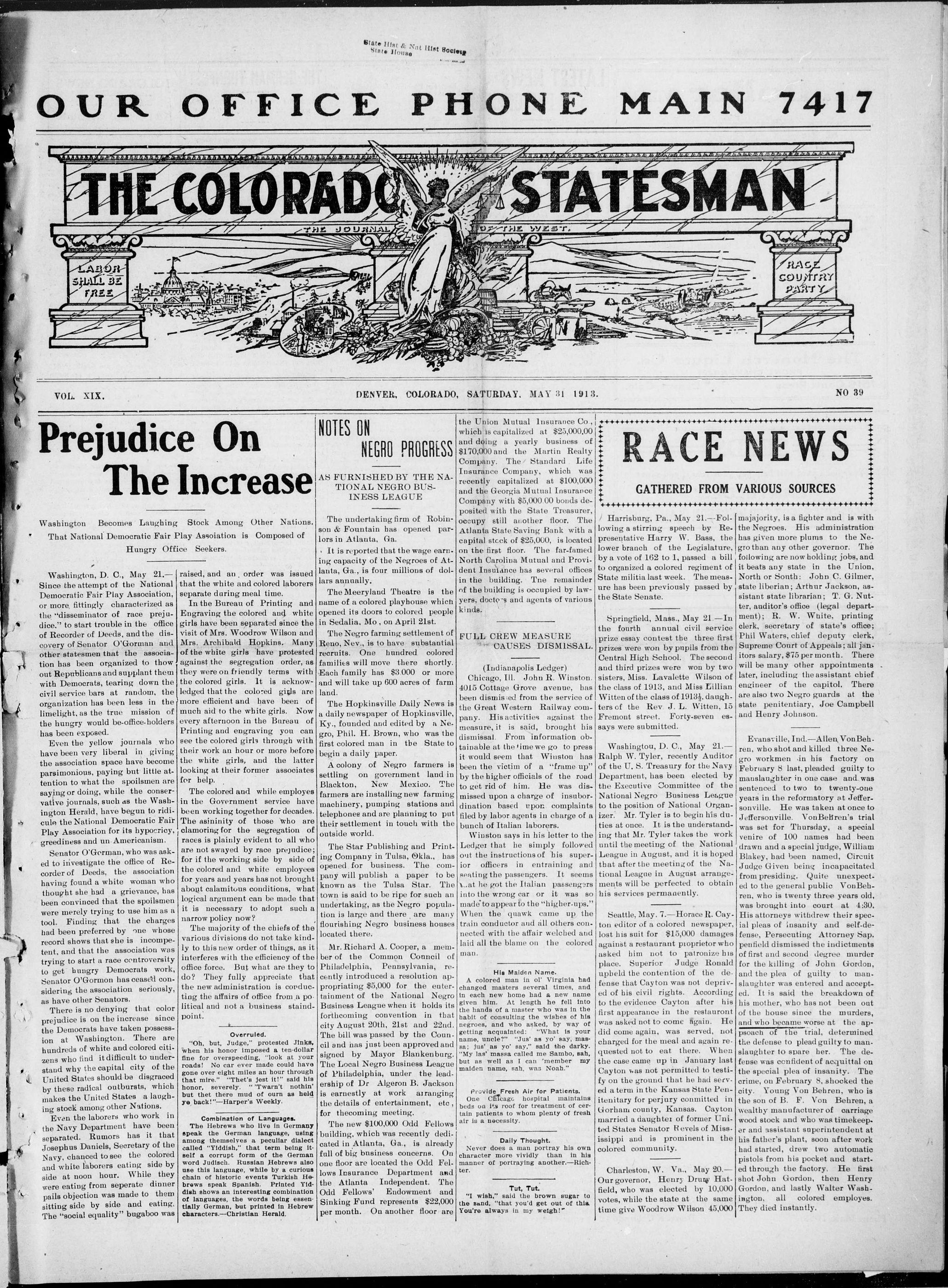
OUR OFFICE PHONE MAIN 7417
THE COLORADO STATESMAN
THE JOURNAL OF THE WEST.
LABOR SHALL BE FREE
RAGE
COUNTRY
PARTY
Prejudice On The Increase
Washington Becomes Laughing Stock Among Other Nations. That National Democratic Fair Play Association is Composed of Hungry Office Seekers.
VOL. XIX.
Prejudice The
Washington Becomes Laughing
That National Democratic Fair
Hungry Off
Washington, D. C., May 21. Since the attempt of the National Democratic Fair Play Association, or more fittingly characterized as the "disseminator of race prejudice," to start trouble in the office of Recorder of Deeds, and the discovery of Senator O'Gorman and other statesmen that the association has been organized to throw out Republicans and supplant them with Democrats, tearing down the civil service bars at random, the organization has been less in the limelight, as the true mission of the hungry would be-office-holders has been exposed.
Even the yellow journals who have been very liberal in giving the association space have become parsimonious, paying but little attention to what the spoilsmen are saying or doing, while the conservative journals, such as the Washington Herald, have begun to ridicule the National Democratic Fair Play Association for its hypocricy, greediness and un Americanism.
Senator O'German, who was asked to investigate the office of Recorder of Deeds, the association having found a white woman who thought she had a grievance, has been convinced that the spoilsmen were merely trying to use him as a tool. Finding that the charges had been preferred by one whose record shows that she is incompetent, and that the association was trying to start a race controversy to get hungry Democrats work, Senator O'Gormon has ceased considering the association seriously, as have other Senators. There is no denying that color prejudice is on the increase since the Democrats have taken possession at Washington. There are hundreds of white and colored citizens who find it difficult to understand why the capital city of the United States should be disgraced by these radical outbursts, which makes the United States a laughing stock among other Nations.
Even the laborers who work in the Navy Department have been separated. Rumors has it that Josephus Daniels, Secretary of the Navy, chanced to see the colored and white laborers eating side by side at noon hour. While they were eating from seperate dinner pails objection was made to them sitting side by side and eating. The "social equality" bugaboo was
raised, and an order was issued that the white and colored laborers separate during meal time. In the Bureau of Printing and Engraving the colored and white girls have been separated since the visit of Mrs. Woodrow Wilson and Mrs. Archibald Hopkins. Many of the white girls have protested against the segregation order, as they were on friendly terms with the colored girls. It is acknowledged that the colored girls are more efficient and have been of much aid to the white girls. Now every afternoon in the Bureau of Printing and engraving you can see the colored girls through with their work an hour or more before the white girls, and the latter looking at their former associates for help.
The colored and while employees in the Government service have been working together for decades. The asininity of those who are clamoring for the segregation of races is plainly evident to all who are not swayed by race prejudice; for if the working side by side of the colored and white employees for years and years has not brought about calamitous conditions, what logical argument can be made that it is necessary to adopt such a narrow policy now?
The majority of the chiefs of the various divisions do not take kindly to this new order of things, as it interferes with the efficiency of the office force. But what are they to do? They fully appreciate that the new administration is conducting the affairs of office from a political and not a business stainpoint.
Overruled.
"Oh, but, Judge," protested Jinka, when his honor imposed a ten-dollar fine for overspeeding, "look at your roads! No car ever made could have gone over eight miles an hour through that mire." "Thet's jest it!" said his honor, severely. "T'warn't nothin' but that there mud of ourn as held ye back!"-Harper's Weekly.
Combination of Languages
The Hebrews who live in Germany speak the German language, using among themselves a peculiar dialect called "Yiddish," that term being itself a corrupt form of the German word Judisch. Russian Hebrews also use this language, while by a curious chain of historic events Turkish Hebrews speak Spanish. Printed Yiddish shows an interesting combination of languages, the words being essentially German, but printed in Hebrew characters.—Christian Herald.
DENVER, COLORADO, SATURDAY, MAY 31 1913.
State Hist & Nat Hist Society
State House
CE PH
ADO
THE JOURNAL
DENVER, COLORADO,
OTES ON
NEGRO PROGRESS
AS FURNISHED BY THE NATIONAL NEGRO BUSINESS LEAGUE
The undertaking firm of Robinson & Fountain has opened parlors in Atlanta, Ga.
It is reported that the wage earning capacity of the Negroes of Atlanta, Ga., is four millions of dollars annually.
The Meeryland Theatre is the name of a colored playhouse which opened its doors to colored people in Sedalia, Mo., on April 21st.
The Negro farming settlement of Reno, Nev., is to have substantial recruits. One hundred colored families will move there shortly. Each family has $3,000 or more and will take up 600 acres of farm land.
The Hopkinsville Daily News is a daily newspaper of Hopkinsville, Ky., founded and edited by a Negro, Phil. H. Brown, who was the first colored man in the State to begin a daily paper.
A colony of Negro farmers is settling on government land in Blackton, New Mexico. The farmers are installing new farming machinery, pumping stations and telephones and are planning to put their settlement in touch with the outside world.
The Star Publishing and Printing Company in Tulsa, Okla., has opened for business. The company will publish a paper to be known as the Tulsa Star. The town is said to be ripe for such an undertaking, as the Negro population is large and there are many flourishing Negro business houses located there.
Mr. Richard A. Cooper, a member of the Common Council of Philadelphia, Pennsylvania, recently introduced a resolution appropriating $5,000 for the entertainment of the National Negro Business League when it holds its forthcoming convention in that city August 20th, 21st and 22nd. The bill was passed by the Council and has just been approved and signed by Mayor Blankenburg. The Local Negro Business League of Philadelphia, under the leadership of Dr Algeron B. Jackson is earnestly at work arranging the details of entertainment, etc. for thecoming meeting.
The new $100,000 Odd Fellows building, which was recently dedicated in Atlanta, Ga., is already full of big business concerns. On one floor are located the Odd Fellows Insurance Department and the Atlanta Independent. The Odd Fellows' Endowment and Sinking Fund represents $22,000 per month. On another floor are
the Union Mutual Insurance Co. which is capitalized at $25,000,00 and doing a yearly business of $170,000 and the Martin Realty Company. The Standard Life Insurance Company, which was recently capitalized at $100,000 and the Georgia Mutual Insurance Company with $5,000.00 bonds deposited with the State Treasurer, occupy still another floor. The Atlanta State Saving Bank with a capital stock of $25,000, is located on the first floor. The far-famed North Carolina Mutual and Provident Insurance has several offices in the building. The remainder of the building is occupied by lawyers, doctors and agents of various kinds.
FULL CREW MEASURE CAUSES DISMISSAL
(Indianapolis Ledger)
(Indianapolis Ledger)
Chicago, Ill. John R. Winston.
4015 Cottage Grove avenue, has been dismissed from the service of the Great Western Railway company. His activities against the measure, it is said, brought his dismissal. From information obtainable at the time we go to press it would seem that Winston has been the victim of a "frame up" by the higher officials of the road to get rid of him. He was dismissed upon a charge of insubordination based upon complaints filed by labor agents in charge of a bunch of Italian laborers.
Winston says in his letter to the Ledger that he simply followed out the instructions of his superior officers in entraining and seating the passengers. It seems that he got the Italian passengers into the wrong car or it was so made to appear to the "higher-ups." When the quawk came up the train conductor and all others connected with the affair welched and laid all the blame on the colored man.
His Maiden Name.
A colored man in ol' Virginia had changed masters several times, and in each new home had a new name given him. At length he fell into the hands of a master who was in the habit of consulting the wishes of his negroes, and who asked, by way of getting acquainted: "What is your name, uncle?" "Jus' as yo' say, massa; jus' as yo' say," said the darky. "My las' massa called me Sambo, sah, but as well as I can' member my maiden name, sah, was Noah."
Provide Fresh Air for Patients. One Chicago hospital maintains beds on its roof for treatment of certain patients to whom plenty of fresh air is a necessity.
Daily Thought.
Never does a man portray his own character more vividly than in his manner of portraying another.—Richer.
Tut, Tut.
"I wish," said the brown sugar to the sand, "that you'd get out of this. You're always in my weigh!"
RACE NEWS
GATHERED FROM VARIOUS SOURCES
Harrisburg, Pa., May 21.—Following a stirring speech by Representative Harry W. Bass, the lower branch of the Legislature, by a vote of 162 to 1, passed a bill to organized a colored regiment of State militia last week. The measure has been previously passed by the State Senate.
Springfield, Mass., May 21.—In the fourth annual civil service prize essay contest the three first prizes were won by pupils from the Central High School. The second and third prizes were won by two sisters, Miss. Lavalette Wilson of the class of 1913, and Miss Lillian Witten of the class of 1913½. daughters of the Rev J. L. Witten, 15 Fremont street. Forty-seven essays were submitted.
Washington, D. C., May 21.—Ralph W. Tyler, recently Auditor of the U. S. Treasury for the Navy Department, has been elected by the Executive Committee of the National Negro Business League to the position of National Organizer. Mr. Tyler is to begin his duties at once. It is the understanding that Mr. Tyler takes the work until the meeting of the National League in August, and it is hoped that after the meeting of the National League in August arrangements will be perfected to obtain his services permanently.
Seattle, May. 7.—Horace R. Cayton editor of a colored newspaper, lost his suit for $15,000 damages against a restaurant proprietor who asked him not to patronize his place. Superior Judge Ronald upheld the contention of the defense that Cayton was not deprived of his civil rights. According to the evidence Cayton after his first appearance in the restaurant was asked not to come again. He did come again, was served, not charged for the meal and again requested not to eat there. When the case came up in January last Cayton was not permitted to testify on the ground that he had served a term in the Kansas State Penitentiary for perjury committed in Gorham county, Kansas. Cayton married a daughter of former United States Senator Revels of Mississippi and is prominent in the colored community.
Charleston, W. Va., May 20. Our governor, Henry Drury Hatfield, who was elected by 10,000 votes, while the state at the same time give Woodrow Wilson 45,000
NO 39
majiority, is a fighter and is with the Negroes. His administration has given more plums to the Negro than any other governor. The following are now holding jobs, and it beats any state in the Union, North or South: John C. Gilmer, state liberian; Arthur Jackson, assistant state librarian; T. G. Nutter, auditor's office (legal department); R. W. White, printing clerk, secretary of state's office; Phil Waters, chief deputy clerk, Supreme Court of Appeals; all janitors salary, $75 per month. There will be many other appointments later, including the assistant chief engineer of the capitol. There are also two Negro guards at the state penitentiary, Joe Campbell and Henry Johnson.
Evansville, Ind.—Allen VonBehren, who shot and killed three Negro workmen in his factory on February 8 last, pleaded guilty to manslaughter in one case and was sentenced to two to twenty-one years in the reformatory at Jeffersonville. He was taken at once to Jeffersonville. VonBehren's trial was set for Thursday, a special venire of 100 names had been drawn and a special judge, William Blakey, had been named, Circuit Judge Given being incapacitated from presiding. Quite unexpected to the general public VonBehren, who is twenty three years old, was brought into court at 4:30. His attorneys withdrew their special pleas of insanity and self-defense, Persecuting Attorney Sap penfield dismissed the indictments of first and second degree murder for the killing of John Gordon, and the plea of guilty to manslaughter was entered and accepted. It is said the breakdown of his mother, who has not been out of the house since the murders, and who became worse at the approach of the trial, determined the defense to plead guilty to manslaughter to spare her. The defense was confident of acquittal on the special plea of insanity. The crime, on February 8, shocked the city. Young Von Behren, who is the son of B. F. Von Behren, a wealthy manufacturer of carriage wood stock and who was timekeeper and assistant superintendent at his father's plant, soon after work had started, drew two automatic pistols from his pocket and started through the factory. He first shot John Gordon, then Henry Gordon, and lastly Walter Washington, all colored employees. They died instantly.
What a Dollar Will Do
at the
THE MONARCH
INE & LIQUOR CO.
You Can Get
One Case of Good, Ste
ized Beer, 24 Pints
Or One Gallon of Pure
California Port, Sherry
Muscatel Wine.
Or One Full Quart o
Bond Rye or Bourb
The Monarch L
PHONE CHAMPA
1516 Court Place
SEEDS
Your back yard will help pay you
BARTELD
"WESTERN SEEDS FOR WES
THE BARTELDES S
1521-1525 Fifteenth St.
The Largest Poultry Supply H
HENRY MILL
Good, Steamed, Steril-
4 Pints to the Case.
Man of Pure 8 Year Old
Art, Sherry, Angelica or
Clove.
Quart of Bottled in
Bourbon Whiskey.
March Liquor Co.
E CHAMPA 1231
Denver, C
SEEDS
help pay your rent if you pla
RTELDES'
FOR WESTERN PLANTER
RTELDES SEED CO.
Denver, Co
Entry Supply House in the West
MILLER & C
9 BROADWAY
AVEL ROOFING
AND CEMENT WORK
One Case of Good, Steamed, Sterilized Beer, 24 Pints to the Case. Or One Gallon of Pure 8 Year Old California Port, Sherry, Angelica or Muscatel Wine. Or One Full Quart of Bottled in Bond Rye or Bourbon Whiskey.
The Monarch Liquor Co.
PHONE CHAMPA 1231
1516 Court Place Denver, Colo.
Your back yard will help pay your rent if you plant
BARTELDES'
"WESTERN SEEDS FOR WESTERN PLANTERS"
THE BARTELDES SEED CO.
1521-1525 Fifteenth St. Denver, Colorado
The Largest Poultry Supply House in the West
HENRY MILLER & CO.
GRAVEL ROOFING AND CEMENT WORK Cement Ash Pits, $5 Up Repairing Promptly Done Tin Roofs Painted
Guaranteed Give Us
Phone Main 1062
F. Davis
Inspector for City and County of
Plating and Ventilation
Tests for Sewer Gases On Alu-
tive buildings
Invites Given
NNE SOUTH 855 DENVER
R & SCHUCK
ATE FARM LANDS
All Work Guaranteed Give Us a Trial
Phone Main 1062
W. F. D.
(12 Years Chief Plumbing Inspector for
Plumbing, Heating and
Examination and Tests for Sew
defective build
Estimates C
842 BROADWAY PHONE SOUTH
BROWER &
W.F.Davis
(12 Years Chief Plumbing Inspector for City and County of Denver)
Plumbing, Heating and Ventilation
Examination and Tests for Sewer Gases On All Old defective buildings
Estimates Given
842 BROADWAY PHONE SOUTH 855 DENVER, COLO
Q Engstron SALE DEALERS IN Liquors and Cigars
Beck & En
WHOLESALE DEAL
Wines, Liquor
Cigar
Beck & Engstrom
WHOLESALE DEALERS IN Wines, Liquors and Cigars Western Agents for Minneapolis Grain Belt Beer and Carnegie Porter, Pripps Imported Beer and Bock Ol.
1644-46-48-50 Larimer Street
Phone Main 1053 Denver, Colorado
A STEAM ENGINE
REAL ESTATE
311 Cooper Building
DENVER, COLORADO
HENRY BECK
Give Us a Trial
tain 1062
avis
(ly and County of Denver)
Ventilation
Gases On All Old
vs
ven
DENVER, COLO
CHUCK
RM LANDS
Telephone Champa 1962
Residence Phone Main 7345
JOHN ENGSTROM
strom
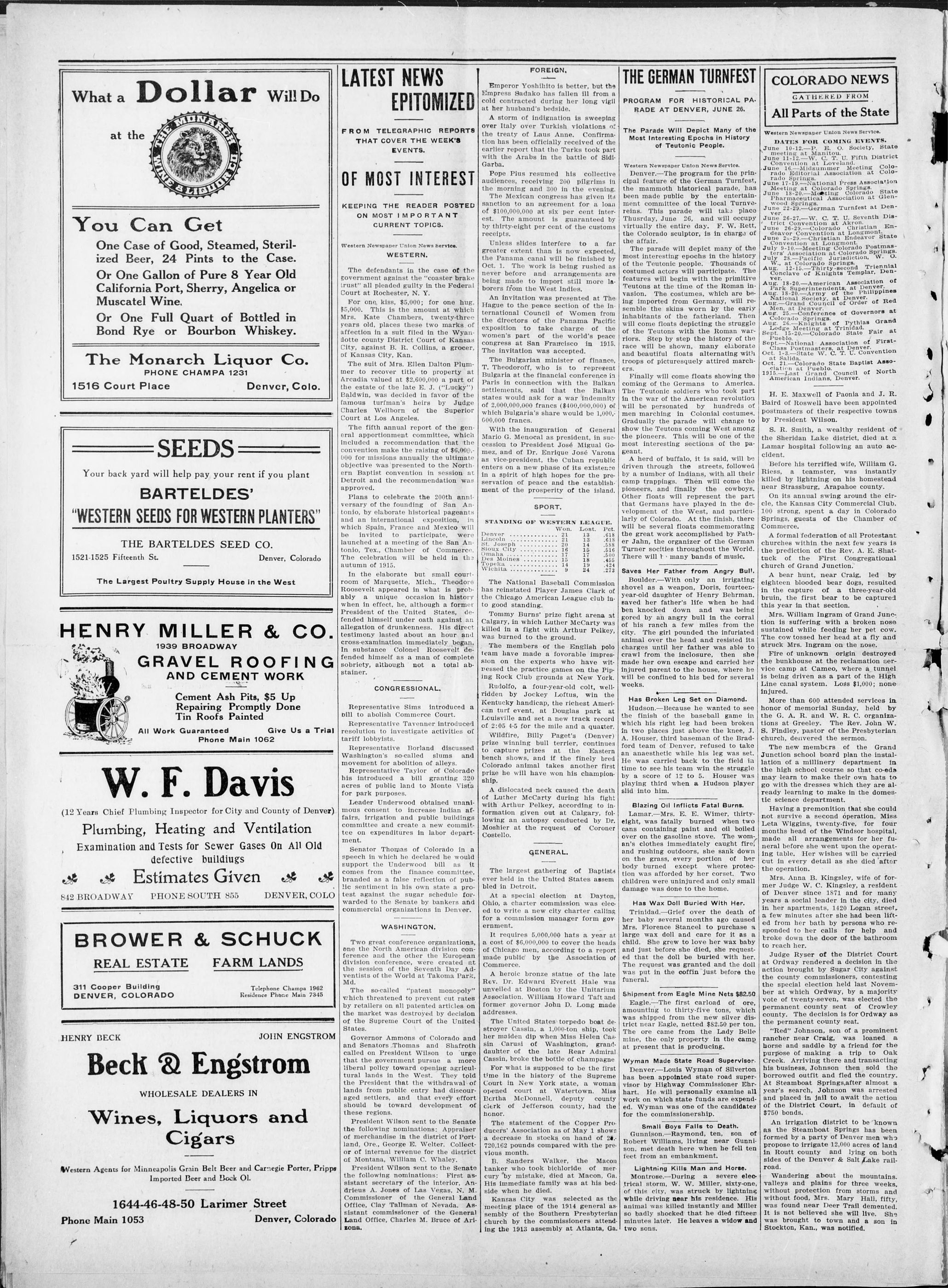
LATEST NEWS EPITOMIZED
FROM TELEGRAPHIC REPORTS THAT COVER THE WEEK'S EVENTS.
OF MOST INTEREST
KEEPING THE READER POSTED
ON MOST IMPORTANT
CURRENT TOPICS.
Western Newspaper Union News Service.
WESTERN.
The defendants in the case of the
government against the "coaster brake
brust" all pleaded guilty in the Federal
Court at Rochester, N. Y.
For one kiss, $5,000; for one hug,
$5,000. This is the amount at which
Mrs. Kate Chambers, twenty-three
years old, places these two marks of
affection in a suit filed in the Wyandotte county District Court of Kansas
City, against B. R. Collins, a grocer,
of Kansas City, Kan.
The suit of Mrs. Ellen Dalton Plummer to recover title to property at Arcadia valued at $2,600,000 a part of the estate of the late E. J. ("Lucky") Baldwin, was decided in favor of the famous turfman's heirs by Judge Charles Wellborn of the Superior Court at Los Angeles.
The fifth annual report of the general apportionment committee, which included a recommendation that the convention make the raising of $6,000,000 for missions annually the ultimate objective was presented to the Northern Baptist convention in session at Detroit and the recommendation was approved.
Plans to celebrate the 200th anniversary of the founding of San Antonio, by elaborate historical pageants and an international exposition, in which Spain, France and Mexico will be invited to participate, were launched at a meeting of the San Antonio, Tex., Chamber of Commerce. The celebration will be held in the autumn of 1915.
In the elaborate but small courtroom of Marquette, Mich., Theodore Roosevelt appeared in what is probably a unique occasion in history when in effect, he, although a former President of the United States, defended himself under oath against an allegation of drunkenness. His direct testimony lasted about an hour and cross-examination immediately began. In substance Colonel Roosevelt defended himself as a man of complete sobriety, although not a total abstainer.
CONGRESSIONAL.
Representative Sims introduced a bill to abolish Commerce Court.
Representative Tavnerner introduced resolution to investigate activities of tariff lobbyists.
Representative Borland discussed Washington's so-called slums and movement for abolition of alleys.
Representative Taylor of Colorado his introduced a bill granting 320 acres of public land to Monte Vista for park purposes.
Leader Underwood obtained unanimous consent to increase Indian affairs, irrigation and public buildings committee and create a new committee on expenditures in labor department.
Senator Thomas of Colorado in a speech in which he declared he would support the Underwood bill as it comes from the finance committee, branded as a false reflection of public sentiment in his own state a protest against the sugar schedule forwarded to the Senate by bankers and commercial organizations in Denver.
WASHINGTON.
Two great conference organizations, one the North American division conference and the other the European division conference, were created at the session of the Seventh Day Adventists of the World at Takoma Park, Md.
The so-called "patent monopoly" which threatened to prevent cut rates by retailers on all patented articles on the market was destroyed by decision of the Supreme Court of the United States.
Governor Ammons of Colorado and Senators Thomas and Shafroth called on President Wilson to urge that the government pursue a more liberal policy toward opening agricultural lands in the West. They told the President that the withdrawal of lands from public entry had discouraged settlers, and that every effort should be toward development of these regions.
President Wilson sent to the Senate the following nominations: Appraiser of merchandise in the district of Portland, Ore., George E. Welter, Collector of internal revenue for the district of Montana, William C. Whaley.
President Wilson sent to the Senate the following nominations: First assistant secretary of the interior, Andrieus A. Jones of Las Vegas, N. M. Commissioner of the General Land Office, Clay Tallman of Nevada. Assistant commissioner of the General Land Office, Charles M. Bruce of Arizona.
FOREIGN.
Emperor Yoshihito is better, but the Empress Sadako has fallen ill from a cold contracted during her long vigil at her husband's bedside.
A storm of indignation is sweeping over Italy over Turkish violations of the treaty of Laus Anne. Confirmation has been officially received of the earlier report that the Turks took part with the Arabs in the battle of Sidi-Garba.
Pope Pius resumed his collective audiences, receiving 200 pilgrims in the morning and 300 in the evening.
The Mexican congress has given its sanction to an agreement for a loan of $100,000,000 at six per cent interest. The amount is guaranteed by thirty-eight per cent of the customs receipts.
Unless slides interfere to a far greater extent than is now expected, the Panama canal will be finished by Oct. 1. The work is being rushed as never before and arrangements are being made to import still more laborers from the West Indies.
An invitation was presented at The Hague to the peace section of the International Council of Women from the directors of the Panama Pacific exposition to take charge of the women's part of the world's peace congress at San Francisco in 1915. The invitation was accepted.
The Bulgarian minister of finance, T. Theodoroff, who is to represent Bulgaria at the financial conference in Paris in connection with the Balkan settlements, said that the Balkan states would ask for a war indemnity of 2,000,000,000 francs ($400,000,000) of which Bulgaria's share would be 1,000,000,000 francs.
With the inauguration of General Mario G. Menocal as president, in succession to President José Miguel Gomez, and of Dr. Enrique José Varona as vice-president, the Cuban republic enters on a new phase of its existence in a spirit of high hopes for the preservation of peace and the establishment of the prosperity of the island.
SPORT.
STANDING OF WESTERN LEAGUE.
Won. Lost. Pct.
Denver 21 13 .618
Lincoln 21 13 .618
St. Joseph 20 14 .588
Southern City 16 15 .516
Omaha 17 15 .500
Des Moines 15 18 .455
Topeka 14 19 .424
Wichita 9 24 .273
The National Baseball Commission has reinstated Player James Clark of the Chicago American League club into good standing.
Tommy Burns' prize fight arena at Calgary, in which Luther McCarty was killed in a fight with Arthur Pelkey, was burned to the ground.
The members of the English polite team have made a favourable impression on the experts who have witnessed the practice games on the Piping Rock Club grounds at New York.
Rudolfo, a four-year-old colt, well-ridden by Jockey Loftus, win the Kentucky handicap, the richest American turf event, at Douglas park at Lcuisville and set a new track record of 2:05 4:5 for the mile and a quarter. Wildfire, Billy Paget's (Denver) prize winning bull terrier, continues to capture prizes at the Eastern bench shows, and if the finely bred Colorado animal takes another first prize he will have won his championship.
A dislocated neck caused the death of Luther McCarty during his fight with Arthur Pelkey, according to information given out at Calgary, following an autopsy conducted by Dr. Moshier at the request of Coroner Costello.
GENERAL.
The largest gathering of Baptists ever held in the United States assembled in Detroit.
At a special election at Dayton, Ohio, a charter commission was elected to write a new city charter calling for a commission manager form government.
It requires 5,000,000 hats a year at a cost of $6,000,000 to cover the heads of Chicago men, according to a report made public by the Association of Commerce.
A heroic bronze statue of the late Rev. Dr. Edward Everett Hale was unveiled at Boston by the Unitarium Association. William Howard Taft and former governor John D. Long made addresses.
The United States torpedo boat destroyer Cassin, a 1,000-ton ship, took her maiden dip when Miss Helen Cassin Carusi of Washington, grand-daughter of the late Rear Admiral Cassin, broke the bottle of champagne.
For what is supposed to be the first time in the history of the Supreme Court in New York state, a woman opened court at Watertown. Miss Bertha McDonnell, deputy county clerk of Jefferson county, had the honor.
The statement of the Copper Producers' Association as of May 1 shows a decrease in stocks on hand of 28,720,162 pounds compared with the previous month.
B. Sanders Walker, the Macon banker who took bichloride of mercury by mistake, died at Macon, Ga. His immediate family was at his bedside when he died.
Kansas City was selected as the meeting place of the 1914 general assembly of the Southern Presbyterian church by the commissioners attending the 1913 assembly at Atlanta, Ga.
THE GERMAN TURNFEST
PROGRAM FOR HISTORICAL PARADE AT DENVER, JUNE 26.
The Parade Will Depict Many of the Most Interesting Epochs in History of Teutonic People.
Western Newspaper Union News Service.
Denver.—The program for the principal feature of the German Turnfest, the mammoth historical parade, has been made public by the entertainment committee of the local Turnvereins. This parade will take place Thursday, June 26, and will occupy virtually the entire day. F. W. Rett, the Colorado sculptor, is in charge of the affair.
The parade will depict many of the most interesting epochs in the history of the Teutonic people. Thousands of costumed actors will participate. The features will begin with the primitive Teutons at the time of the Roman invasion. The costumes, which are being imported from Germany, will resemble the skins worn by the early inhabitants of the fatherland. Then will come floats depicting the struggle of the Teutons with the Roman warriors. Step by step the history of the race will be shown, many elaborate and beautiful floats alternating with troops of picturesquely attired marchers.
Finally will come floats showing the coming of the Germans to America. The Teutonic soldiers who took part in the war of the American revolution will be personated by hundreds of men marching in Colonial costumes. Gradually the parade will change to show the Teutons coming West among the pioneers. This will be one of the most interesting sections of the pageant.
A herd of buffalo, it is said, will be driven through the streets, followed by a number of Indians, with all their camp trappings. Then will come the pioneers, and finally the cowboys. Other floats will represent the part that Germans have played in the development of the West, and particularly of Colorado. At the finish, there will be several floats commemorating the great work accomplished by Father Jahn, the organizer of the German Turner societies throughout the World. There will be many bands of music.
Saves Her Father from Angry Bull.
Boulder.—With only an irrigating shovel as a weapon, Doris, fourteen-year-old daughter of Henry Brhrman, saved her father's life when he had ben knocked down and was being gored by an angry bull in the corral of his ranch a few miles from the city. The girl pounded the infuriated animal over the head and resisted its charges until her father was able to crawl from the enclosure, then she made her own escape and carried her injured parent to the house, where he will be confined to his bed for several weeks.
Has Broken Leg Set on Diamond.
Hudson.—Because he wanted to see the finish of the baseball game in which his right leg had been broken in two places just above the knee, J. A. Houser, third baseman of the Bradford team of Denver, refused to take an anaesthetic while his leg was set. He was carried back to the field in time to see his team win the struggle by a score of 12 to 5. Houser was playing third when a Hudson player slid into him.
Blazing Oil Inflicts Fatal Burns.
Lamar,—Mrs. E. E. Wimer, thirty-eight, was fatally burned when two cans containing paint and oil boiled over on the gasoline stove. The woman's clothes immediately caught fire and rushing outdoors, she sank down on the grass, every portion of her body burned except where protection was afforded by her corset. Two children were uninjured and only small damage was done to the home.
Has Wax Doll Buried With Her.
Trinidad.—Grief over the death of her baby several months ago caused Mrs. Florence Stancel to purchase a large wax doll and care for it as a child. She grew to love her wax baby and just before she died, she requested that the doll be buried with her. The request was granted and the doll was put in the coffin just before the funeral.
Shipment from Eagle Mine Nets $82.50
Eagle.—The first carload of ore, amounting to thirty-five tons, which was shipped from the new silver district near Eagle, netted $82.50 per ton. The ore came from the Lady Belle mine, the only property in the camp at present that is producing.
Wyman Made State Road Supervisor.
Denver.—Louis Wyman of Silverton has been appointed state road supervisor by Highway Commissioner Ehrhart. He will personally examine all work on which state funds are expended. Wyman was one of the candidates for the commissionership.
Small Boys Falls to Death.
Gunnison.—Raymond, ten, son of Robert Williams, living near Gunnison, met death here when he fell ten feet from an embankment.
Lightning Kills Man and Horse.
Montrose.—During a severe electrical storm, W. W. Miller, sixty-one, of this city, was struck by lightning while driving near his residence. His animal was killed instantly and Miller so badly shocked that he died fifteen minutes later. He leaves a widow and two sons.
Western Newspaper Union News Service.
DATES FOR COMING EVENTS.
June 10-12—P. E. O. Society, State meeting at Manitou.
June 11-12—W. C. T. U. Fifth District Convention at Loveland.
June 16—Midsummer Meeting Colorado Sigma Association at Colorado Sigma.
June 17-19—National Press Association Meeting at Colorado Springs.
June 26-27.—W. C. T. U. Seventh Dist. district Convention at Akron.
July 9-10—Meeting Colorado Postmasters' Association at Colorado Springs.
July 28—Pacific Jurisdiction. W. O. W., at Colorado Springs.
Aug. 12-15—Thirty-second Triennial Conclave of Knights Templar, Denver.
National Society, at Denver.
Abraham Grant Council of Order of Red
Men.
Aug. 25—Conference of Governors at Colorado Springs.
Buffalo, Grand
Pueblo.
Sept.—National Association of First-
time Carriers
H. E. Maxwell of Paonia and J. R. Baird of Roswell have been appointed postmasters of their respective towns by President Wilson.
S. R. Smith, a wealthy resident of the Sheridan Lake district, died at a Lamar hospital following an auto accident.
Before his terrified wife, William G. Riess, a teamster, was instantly killed by lightning on his homestead near Strassburg, Arapahoe county.
On its annual swing around the circle, the Kansas City Commercial Club, 100 strong, spent a day in Colorado Springs, guests of the Chamber of Commerce.
A formal federation of all Protestant churches within the next few years is the prediction of the Rev. A. E. Shattuck of the First Congregational church of Grand Junction.
A bear hunt, near Craig, led by eighteen blooded bear dogs, resulted in the capture of a three-year-old bruin, the first bear to be captured this year in that section.
Mrs. William Ingram of Grand Junction is suffering with a broken nose sustained while feeding her pet cow. The cow tossed her head at a fly and struck Mrs. Ingram on the nose.
Fire of unknown origin destroyed the bunkhouse at the reclamation service camp at Cameo, where a tunnel is being driven as a part of the High Line canal system. Loss $1,000; none injured.
More than 600 attended services in honor of memorial Sunday, held by the G. A. R. and W. R. C. organizations at Greeley. The Rev. John W. S. Findley, pastor of the Presbyterian church, delivered the sermon.
The new members of the Grand Junction school board plan the installation of a millinery department in the high school course so that co-eds may learn to make their own hats to go with the dresses which they are already learning to make in the domestic science department.
Having a premonition that she could not survive a second operation, Miss Leta Wiggins, twenty-five, for four months head of the Windsor hospital, made all arrangements for her funeral before she went upon the operating table. Her wishes will be carried out in every detail as she died after the operation.
Mrs. Anna B. Kingsley, wife of former Judge W. C. Kingsley, a resident of Denver since 1871 and for many years a social leader in the city, died in her apartments, 1420 Logan street, a few minutes after she had been lifted from her bath by persons who responded to her calls for help and broke down the door of the bathroom to reach her.
Judge Ryser of the District Court at Ordway rendered a decision in the action brought by Sugar City against the county commissioners, contesting the special election held last November at which Ordway, by a majority vote of twenty-seven, was elected the permanent county seat of Crowley county. The decision is for Ordway as the permanent county seat.
"Red" Johnson, son of a prominent rancher near Craig, was loaned a horse and saddle by a friend for the purpose of making a trip to Oak Creek. Arriving there and transacting his business, Johnson then sold the borrowed outfit and fled the country. At Steamboat Springs,after almost a year's search, Johnson was arrested and placed in jail to await the action of the District Court, in default of $750 bonds.
An irrigation district to be known as the Steamboat Springs has been formed by a party of Denver men who propose to irrigate 12,000 acres of land in Routt county and lying on both sides of the Denver & Salt Lake railroad.
Wandering about the mountains, valleys and plains for three weeks, without protection from storms and without food, Mrs. Mary Hall, fifty, was found near Deer Trail demented. It is not believed she will live. She was brought to town and a son in Stockton, Kan., was notified.
FLORAL DESIGNS PUT UP WHILE YOU WAIT
CHOICE PLANTS AND CUT FLOWERS CONSTANTLY ON HAND
GREENHOUSES: Thirty-Fourth and Curtis Streets
TELEPHONE, MAIN 1511 DENVER, COLO
2735 Welton St. Main 6363
The Central Bottling & Distributing Co.
Agents for the famous
CAPITOL BEER---IT'S CAPITAL
Try a case, 2 doz. pints for $1.10, delivered promptly; empties called for.
Family Liquors, Wines, and Cordials Genuine Goods at Popular Prices A glass of good wine will improve your Sunday dinner, and aid digestion.
The Champa Pharmacy
Twentieth and Champa,
Is the place to get your
DRUGS, CHEMICALS AND PATENT MEDICINES
WE SERVE HOT DRINKS.
Prescriptions Our Specialty.
Phone us and we will deliver the goods to all parts of the city.
JAMES E. THRALL, PROPR.
PHONE MAIN 2425.
WORK CALLED FOR AND DELIVERED
THE CA
RE
SEWED HALF
HE
1511 CHAMPA STR
Boost Colorado P
ZA
DE
COLUMB
VI
Guaranteed Absolutely Pure. Delivered Daily to All Parts of the City.
The Ph. 2
We Boost for Colo
DAY OR NIGHT.
A. M
U n
A first-class Mortua
time of death of loved o
LAWRENCI
LOUIS HU
PARLORS 19
LET
Shirts, Colla
Curtains a
The Denver
A first-class Mortuary establishment. First aid to the bereaved in the time of death of loved ones. Prices below competitors. Polite service LAWRENCE JONES, Licenced Embalmer LOUIS HUBBARD, Funeral Director PARLORS 1925 Arapahoe Street
The Denver Sanitary Laundry. PHONE MAIN 5670
```markdown
```
1082 Broadway
REPAIBING DONE WHILE
YOU WAIT
TY SHOE
CO.
and 75 cts.
ident
DENVER, COLO.
ze Home Industry
'S
D
PILSENER
wing Co.
185.
should Boost for Us
PHONE MAIN 6243
HORN
ers
aid to the bereaved in the
citizens. Polite service
Ed Embalmer
Director
Street
YOUR
Fits, Blankets,
Dry Work.
y Laundry.
---
Denver, Colo.
AFRO-AMERICAN CULLINGS
Consolidation works wonders in development, if all parties concerned are sufficiently in earnest to appreciate its importance. All things, however small the beginning, attain a stage of magnitude when the forces, backing them, have in view a definite purpose; and, although obstacles apparently insurmountable may confront advancement, they disappear in the face of a solid stand. Determination relieves the pressure of obstruction and lightens the weight of burdens. The obligations, resting upon the shoulders of each individual, become easier to perform when we labor in a spirit of union. It is only when our divided ranks are assailed, that we feel the damage most. Defeat does not discourage efforts in the pursuit of honorable ends. We often invite the inconveniences by which our walks, are hindered, because we are too prone to surrender to despair. Nothing reaches great proportions without the trouble of cultivation; and whatever attracts the attention or wins the consideration of mankind has won it through pains and perils. There is no royal road to the attainment of success, either by races or by nations; and the monuments of greatness which commemorate the deeds of a people were planted by the toils and privations of those whose names are revered by posterity. The grandeur of the past serves to kindle aspiration in things of the present age; and the remarkable achievements of earlier days have ever set a worthy example for succeeding generations to imitate. But, the mighty deeds which have merited the aplause of ages, were not the accomplishments of single actions, but, the results of a bond of union upon which all progress leans. The stability of governments, the prosperity of nations, the maintenance of authority are all due to a concert of actions by which conduct is regulated and personal rights secured. The world, as it grows in age, increases in fame; but, its conquest is the outcome of what men accomplished in numbers. Sincere devotion to the needs of the hour, renders activity in human ranks and the awakening of dormant energy is the kindling of ambition. Protection against encroachment follows in the wake of union, and baffles the fulfillment of base designs. The aims of avarice are checkmated when pitted against its strength; and is sufficiently able to guarantee its safety in times of tribulations. In our worldly combat, the strong dominate the weak. Greed is ever insistent, when conscious of its might; and if arrayed against that which is powerless to withstand its demands, is arrogant to the extreme. All classes of men, irrespective of racial connection, seek to prey upon helpless conditions, and are more active in the game of spoliation than the process of elevation; hence the necessity, duty and wisdom of action in a common cause for the promotion of a common end. Experience is the sternest of teachers; and whatever is gained thereby remains stamped indelibly upon the memory, nor is time able to erase its effects. There is ever an advantage to be gained by those who walk together in brotherhood, to rise above the common level. They prove true warriors in our daily strifes.
By intelligence, industry and integrity you may become worthy of the best that the world has to give, and then you will be as great in a hut as in a palace.—The Torch Light.
There have been a great many negroes in the past 50 years who neglected to protect their rights in their inventions, and have died poor and unknown. The story is often told of one such New Yorker who invented many of the earlier railroad car appliances while employed by a certain railroad, but, failing to protect any of them, was defrauded of his rights and died in poverty. Such negro inventions should be careful to patent their work. It is not possible to estimate their value until the demand for them has been measured. Some of the simplest inventions like the bread-saving knife and the hook and eyes for dresses, have been the most useful and profitable.—New York Age.
The Ninth Cavalry did the work in demonstrating to the world, and especially the United States, that the negro will do the same thing over again for the dear old U. S. A., if the eagle screams and the bugle calls.—The Weekly Reporter.
The German standard of light measurement is nine-tenths that of the international candlepower.
A colored minister of Richmond, Va., has invented a whistling piano, the keyboard of which is arranged on a scale somewhat different from that of an ordinary piano. It is reported to be capable of whistling the most difficult notes, and the inventor is confident that his device will become very popular with his own race throughout the world.
An artificial leather for electricians' gloves that resist dangerous currents almost as well as rubber has been invented.
HOT-BED MANAGEMENT.
The hot-bed is a valuable assistant to the gardener and a thorough knowledge of the same leads to success.
My method after the first year is to clean out each spring and mix thoroughly the soil and old manure from the beds and return it upon new, fresh manure, adding new soil as needed.
After the beds become heated up and the temperature drops to 90 degrees, the seed is sown in drills four inches apart and covered according to the kind of seed used.
Insert a thermometer into the soil at the beginning and hold the heat around 60 to 70 degrees by opening or closing the sash as necessary.
In early spring, old strips of carpeting laid over the sash at night keep the frost away, and help to hold the temperature even. When the plants begin to show the third leaf, remove to boxes three inches deep, holding the same kind of soil as that in the bed.
This soil is tamped down smooth and solid. Then use a small stick like a lead pencil to make the holes for the plants, making them at least two inches apart.
Drop the plants in, firm the soil and then water well and return to hot-bed box and all and proceed in the care of them as though you had not disturbed them at all.
When they get to be four inches high, proceed to harden them off by removing the sash during the day, but return it at night until the nights become warm.
This hardening process is very essential before setting into open ground. In transplanting always use care not to injure the roots, and a very important thing to do it to firm the soil about the plant. When setting into open ground, do so on a showery day or at evening, and success is almost sure.—U. G. Patten.
PASTURING STOCK.
The trampling of very wet ground by stock causes the soil to "poach" and puddle, and if it dries out in this condition the soil becomes backed and very hard, and in such a condition that it is almost impossible to pulverize it by any method of tillage. If ground in such a condition is plowed, either wet or dry, it is apt to remain in a bad physical condition for a long time, even for several years. If the surface is left exposed to freezing and thawing, the poached or puddled condition of the soil will be largely corrected.
If this land is in grass, about the best you can do with it is to run over the field with a harrow or disk during the winter when there is an open period, or cultivate it early in the spring. If the land is unplowed, I would advise not to plow it until after the freezing and thawing; then it would be a good plan to disk it previous to plowing. If this ground which has been tramped with stock while very wet is handled properly, as suggested above, the tramping may not result in seriously reducing the yield of crop another season. There will be some injury to the soil, however, and there is danger of neglect or improper handling, which may result in very materially injuring the land for future cropping. The safer plan is to keep the stock off the fields or pasture whenever the soil is so wet it will poach or puddle when the animals step on it.—Prof. A. M. Ten Eyck in Kansas Farmer.
MOLE AN INSECT DESTROYER.
The Illinois authorities recently made an examination of the stomachs of moles. It was found that half or more of the food of the mole consists of insects and their larvae, most of them noxious. So far as its food is concerned, the mole is thus beneficial on the whole. There is no direct evidence that it will eat potatoes or other tubers, but circumstantial evidence admitting that mice of herbiferous habit may occupy mole runs in fall. It was shown that corn may form an important item of the food of moles; that recently planted corn is sometimes destroyed by them, and that if numerous in corn fields in spring, they are capable of doing considerable damage there.
The colored men must learn to make money faster and spend it for education, religious purposes and a good home.—The Messenger.
Alcohol in conjunction with the Welshbach mantle is now used for the purposes of automobile headlights in Germany.
Colored ribbon finishes the seams of a bag shaped precisely like an old fashioned carpet satchel having double handles, which, when joined, hold the two sagging sides together. This bag is usually developed in art denim or printed cretonne, but is attractively quaint in plain or figured tapestry, edged with tarnished gold braid.
St. Louis street railway has been ordered by the State Public Utilities commission to place 300 more cars in service.
ASK FOR CARLSON'S Peerless Ice Cream Phones: Main 112 and Main 5787
It's made right, and tastes right. None better made anywhere and This is a Strictly Colorado Production BE SURE AN TRY IT.
IN 3028 RES. PHONE C
JOHN K. RETTIGER
Fancy and Staple Gr
1864 CURTIS STREET
seventh.
THE ZOBEL BROTHER
AMPLE ROO
Nineteenth Street, Corner of
Meats, Fancy a 1864 CU
Meats, Fancy and Staple Groceries 1864 CURTIS STREET
THE ZOBE
SAMPL
1004 Nineteenth
1004 Nineteenth Street, Corner of Curtis
FINE WINES, LIQUORS AND CIGARS
COORS' CELEBRATED BEER ON TAP
DENVER CO
FIRST TREATMENT $1.50
OTHER TREATMENTS EACH $1.00
RATES BY THE MONTH
DISCOUNT
TREATED
ADD 3 CENTS FOR POSTAGE
MADAM M. A. HOLL
Manufacturer Of
ADD 3 CENTS FOR POSTAGE ADAM M. A. HOLL Manufacturer Of
MADAM M. A. HOLLY
Manufacturer Of Madam Holly's Wonderful Hair Grower PHONE YORK 2229 2618 DOWNING STREET
Supply Your Home with the Celebrated Tivoli Beer BOTTLED BY THE EMPIRE BOTTLING CO. Phone Gallup 245
J. A. GARFIELD, Pres. C. A. BRYANT, Mgr.
If you have a warm spot in your heart for the Maceo Ice Cream and Confectionery
Parlors, stop in and get cool.
Fountain Drinks, Confectionery and Cigars
ICE CREAM, DAIRY LUNCHES
Our Specialty, Hot Drinks, Chili and Spaghetti.
2712½ WELTON STREET. DENVER, COLORADO.
Tesch's Market and Grocery
Five-Points Pool and Billiard Parlor CIGARS, TOBACCO and SOFT DRINKS
PHONE MAIN 3028
Corner Nineteenth.
DENVER
THERS'
OOM
ner of Curtis
oil 60 CENTS
DISCOUNT TO CUSTOMER
TREATED 10 CENTS
AGE
HOLLY
Denver, Colo.
COLORADO
THE COLORADO STATESMAN
JOS. D. D. RIVERS.....Proprietor
1824 Curtis Street, Room 25.
Phone Main 7417.
JOS. D. D. RIVERS.....Proprietor
1824 Curtis Street, Room 25.
Phone Main 7417.
SUBSCRIPTION RATES:
One Year .....$2.00
Six Months .....1.00
Three Months ......80
PAYABLE IN ADVANCE.
Entered as second-class matter at the postoffice in the city of Denver,
Colorado.
All communications of a personating nature that are not complimentary
will be withheld from the columns of this paper.
Reading notices, ten lines or less, 10 cents per line. Each additional line over ten lines, 5 cents per line.
No discounts allowed on less than three months' contract. Cash must accompany all orders from parties unknown to us. Further particulars on application
Remittances should be made by Express Money Order, Postoffice Money Order, Registered Letter or Bank Draft. Postage stamps will be received the same as cash for the fractional part of a dollar. Only 1-cent and 2-cent stamps taken.
Communications to receive attention must be newsy, upon important subjects, plainly written only upon one side of the paper; must reach us Tuesdays, if possible, anyway, not later than Wednesdays, and bear the signature of the author. No manuscript returned, unless stamps are sent for postage.
It occasionally happens that papers sent to subscribers are lost or stolen. In case you do not receive any number when due, inform us by postal card and we will cheerfully forward a duplicate of the missing number.
Decoration Day the whole nation suspends the stern activities of life's daily struggle to do homage to the sacred ashes of our honored dead.
The nation's tribute to those noble heroes is sufficient testimonial to general belief that death in the cause of one's conviction is NOT a calamity. In all ages, among the greatest men, differences of opinion have arisen. That many of those heroes conscientiously believed liberty, freedom and human justice should not perish from the earth, was natural.
Others believed with equal conviction that to surrender institutions which they had determined to maintain under what they considered inalienable rights of state sovereignty, would be not only a confessoin of cowardice, but wanton dishonor. This contention was as natural as it is for the minds of men to differ. That they fought bravely and died nobly upon the great battlefields, where devotion led them, entitles them to the greatest respect and homage their countrymen can bestow.
With the termination of that memorable conflict sectionalism vanished to the four proverbial winds, and with one people pressing toward a common goal, one country and one flag as our heritage from that struggle, a Union has been established, the solidarity of which is the marvel of nations. All reverence and honor to those noble patriots who bled and died, embellishing the soil of many battlefields that their country might be dedicated to the proposition that all men are created free and equal. May ages prove that they died not in vain.
As they lie in death side by side may their sacred ashes rest in peace—those of the Blue and the Gray.
FRIENDLY CRITICISM HELPS.
(Wide-Awake, Birmingham, Ala.)
Criticism or the calling to one's attention of their faults is seldom kindly received, therefore we do not expect to add to our list of subscribers those who we criticise, but as they happen to be members of our race and our object is to help as much as we can to bring it out of the background to the front ranks among races of mankind we sometimes offer friendly criticism. To accomplish our desire we know that it will take brave men, noble women and good children, but these cannot be obtained from dissipated men or immoral women. Thus it is in the spirit of friendship that we offer friendly criticism to those members of the race who persist in living the lives of hypocrisy and deceit. Pushing themselves by one device or another into places where they are utterly unfit to occupy.
Race pride, if nothing else, should keep those persons who are morally unfit for any kind of decent companions, from entering homes where parents are honestly endeavoring to raise good families.
Shame should make them hide their faces from places where decent people assemble and their moral unfitness should be brought to their knowledge with the hope that they may change their way of living and honestly endeavor to live better lives.
We feel that any true friend will tell us of our faults and that it is every man's duty to try to correct those faults and become a strong, beneficial man in every respect. In that way we believe that friendly criticism will help each of us to become stronger.
Criticism or the calling to one's attention of their faults is seldom kindly received, therefore we do not expect to add to our list of subscribers those who we criticise, but as they happen to be members of our race and our object is to help as much as we can to bring it out of the background to the front ranks among races of mankind we sometimes offer friendly criticism. To accomplish our desire we know that it will take brave men, noble women and good children, but these cannot be obtained from dissipated men or immoral women. Thus it is in the spirit of friendship that we offer friendly criticism to those members of the race who persist in living the lives of hypocrisy and deceit. Pushing themselves by one device or another into places where they are utterly unfit to occupy.
Race pride, if nothing else, should keep those persons who are morally unfit for any kind of decent companions, from entering homes where parents are honestly endeavoring to raise good families.
Shame should make them hide their faces from places where decent people assemble and their moral unfitness should be brought to their knowledge with the hope that they may change their way of living and honestly endeavor to live better lives.
We feel that any true friend will tell us of our faults and that it is every man's duty to try to correct those faults and become a strong, beneficial man in every respect. In that way we believe that friendly criticism will help each of us to become stronger.
The Right Kind of Reading Matter
The home news; the doings of the people in this town; the gossip of our own community, that's the first kind of reading matter you want. It is more important, more interesting to you than that given by the paper or magazine from the outside world. It is the first reading matter you should buy. Each issue of this paper gives to you just what you will consider
The home news; the doings of the people in this town; the gossip of our own community, that's the first kind of reading matter you want. It is more important, more interesting to you than that given by the paper or magazine from the outside world. It is the first reading matter you should buy. Each issue of this paper gives to you just what you will consider
The Right Kind of Reading Matter
---
twenty years. I well recollect that a schoolboy who took off his hat to a girl was called a Sissy and a Molly. That has all gone. It is not longer the feeling that a man is effeminate who is deferential to women.
The feroigner will doff his hat upon meeting even his male friend. The employes in stores abroad always shake each other by the hand and say a pleasant word upon meeting for the first time in the morning. So far as bowing profoundly and standing with bared head, the Latin peoples are incomparable, and Helen is pretty apt, before she is twenty-five, to think that the man who will do these things the most gracefully is the loveliest man who ever happened. But a glance beneath the surface tells a different story. Did you ever see a Frenchman carry the bundles on his wife's shopping tour? A man who did such a thing in Paris would be laughed off the boulevard.
We are all right in these things except where women are out of the spheres which they formerly occupied exclusively. The disgraceful rush at the New York end of Brooklyn bridge about six in the evening is due to the rivalry of men and women who are engaged in the same work in the world. They are rivals for the same jobs in the city. Probably no woman in that crush would hesitate to seek, at $1 a week lower, the job that feeds the family of the sickly man who is elbowing her so that when the car comes in he will be just ahead of her at the step, and he will get a seat while she has to stand for an hour. She probably calls him impolite. What he would call her for stealing his job is not yet in the dictionaries.
If he had stood for that hour in the crush that pushed and fought in the aisle of the car, he could not have had the strength to work the next day. As she had to stand, she did not have the reserve, and she lost her job when she returned to it two days later. Was he impolite? Well, if he was, he was blameless.
It comes back to the doctrine of self-preservation. If women will persist in entering as candidates for the prizes sought by men they must stand the gaff. They must abide by the rules of the game, for the game will not be changed so long as obtaining a living is a desperate struggle involving the use of every faculty we possess.
cases the cause is in the doomed person's inability to swim.
Among the heartrending reports of the awful calamity which has visited our neighboring states the following significant sentence appears more than once: "Those who were able swam to places of safety; others could not swim and were lost to the world." A sad lesson is borne home with terrible force in that sentence.
Taking for granted the facts that the torrents of the flooded districts would baffle even the most expert swimmers, it is only reasonable to assume that, had they been able to swim to a place of safety, many unfortunate victims might not have perished.
It seems not unjust to assume that a smaller percentage of the population of our country is able to take care of itself in the water than is the case in Europe.
The reason is that in most of the European countries the schools make swimming compulsory, while our public schools are conspicuous by their lack of real swimming facilities.
To be sure, we have bathing beaches and swimming pools in some parks in most of our large cities, but the instruction one can receive in the healthful art of swimming at such places is limited.
a "rich family." This relation to the family is in every way a most intimate one. The person holding it must be tactful as well as conscientious.
But it is to be regretted that many families who consider a governess an asset to their social position and appearance should in return for her service offer the governess a salary of $6 a week!
In order to feel that she "fits in" and at the same time meet with the critical approval of her young charges, it is demanded that she dress quite well. I have the feeling that young women are then inclined to acquire a liking for material things—the luxury of beautiful surroundings which are to their detriment rather than to their good. This is more true if she is placed with a family of recent wealth.
The woman seeking a refined young woman as governess to her children should carefully consider admitting the stranger within her home. On the other hand, she should forecast its influence on the applicant, and be more generous than—six dollars a week!
posed to use the term "mister," it brought to light in a rather laughable manner one of the inadequacies of the English language.
That there is need of a title applicable to all grown females of the human species regardless of whether they be married or single is quite evident. But to confiscate the term "Mr." or "Mrs." would not be an easy feat, as these titles are held by their present owners by virtue of long possession, and being hard to dispense with they would not be surrendered without a serious struggle.
If it is necessary to annex a title or a prefix already in use, would it not be feasible to adopt the piquant French "madame," which is now being used to some extent by milliners and hairdressers irrespective of their marital state?
It is not likely that the few practitioners who are now availing themselves of it would have any serious objection to its adoption for general use.
When the elevator breaks down the optimist laughs merrily because his office is on the eleventh floor instead of the sixteenth. But everybody knows what the pessimist does in the circumstances.
Great Importance of Knowing How to Swim By Frederick Ringer, Cincinnati, Ohio
cases the cause is in the doomed person's inna
Among the heartrending reports of the
visited our neighboring states the following
more than once: "Those who were able swa
could not swim and were lost to the world."
with terrible force in that sentence.
Taking for granted the facts that the to
would baffle even the most expert swimmers,
that, had they been able to swim to a place
victims might not have perished.
It seems not unjust to assume that a sr
lation of our country is able to take care of
the case in Europe.
The reason is that in most of the Eu
make swimming compulsory, while our pu
by their lack of real swimming facilities.
To be sure, we have bathing beaches
parks in most of our large cities, but the inst
healthful art of swimming at such places is
Salary Allowed for
Governess is Small
By GRACE IVERSEN
a "rich family." This relation to the family mate one. The person holding it must be to. But it is to be regretted that many fam an asset to their social position and appear service offer the governess a salary of $6 a w In order to feel that she "fits in" and a critical approval of her young charges, it is well. I have the feeling that young wom a liking for material things—the luxury of are to their detriment rather than to their she is placed with a family of recent wealth. The woman seeking a refined young w dren should carefully consider admitting t On the other hand, she should forecast its in be more generous than—six dollars a week!
Inadequacy of English Language Is Shown
By John Bulow, San Francisco
posed to use the term "mister," it brought
manner one of the inadequacies of the Engli
That there is need of a title applicable
human species regardless of whether they
evident. But to confiscate the term "Mr.
easy feat, as these titles are held by their pr
possession, and being hard to dispense with
without a serious struggle.
In all but manners we are the politest to women of all nations in the world. In the graces of politeness we do not shine, but we are acquiring them. Great has been the change in the past
boy who took off his hat to has all gone. It is not longer deferential to women. Meeting even his male friend, each other by the hand and first time in the morning. So bared head, the Latin peoples before she is twenty-five, to the most gracefully is the nance beneath the surface tells man carry the bundles on his a thing in Paris would be where women are out of theively. The disgraceful rush out six in the evening is due engaged in the same work in jobs in the city. Probably no at $1 a week lower, the job is elbowing her so that when at the step, and he will get she probably calls him impo-job is not yet in the dicion- rush that pushed and fought had the strength to work the lot have the reserve, and she says later. Was he impolite? preservation. If women will sees sought by men they must sees of the game, for the game living is a desperate struggle
From time to time dispatches from many reliable sources of information bring from various parts of the country news of accidental losses of life by drowning, and in most
The awful calamity which has
significant sentence appears
in to places of safety; others
A sad lesson is borne home
currents of the flooded districts
it is only reasonable to assume
of safety, many unfortunate
smaller percentage of the popu-
f itself in the water than is
European countries the schools
public schools are conspicuous
and swimming pools in some
production one can receive in the
limited.
A great deal is being said about the wage of the working girl. Many young women by virtue of a good education and in some instances training are seeking positions as governess with
is in every way a most inti tiful as well as conscientious. dies who consider a governess once should in return for her ek! at the same time meet with the remanded that she dress quite are then inclined to acquire beautiful surroundings which good. This is more true if man as governess to her chil e stranger within her home. influence on the applicant, and
When the discussion arose among the Illinois suffragettes about the proper title for women, some being in favor of using "mistress" for both married and single women, while others pro-
to light in a rather laughable language.
to all grown females of the be married or single is quite or "Mrs." would not be an sent owners by virtue of long they would not be surrendered
refix already in use, would it madame," which is now being users irrespective of their mar-
s who are now availing themo its adoption for general use.
BERRIES IN ALASKA
Strawberry Growing Is Possible in the Far North.
Department of Agriculture Finds Cold-Resisting Plant Susceptible to Cultivation—The "Tin Cow" No Longer a Luxury.
Washington. — Native-grown strawberries and cream in Alaska would have sounded like a comic supplement joke a few years ago. But they are now actualities, according to the experiment station report of the department of agriculture. Of course, the resident millionaires of the Klondike could afford to import strawberries from Indo-China if they wanted to do so, but they prefer to grow them locally, and if the present prospects hold out they are likely to become a regular market commodity and within reach of the common mine laborer who makes only $15 or $20 a day.
The department of agriculture was interested in Alaska fruit culture for a long time, and explorers brought cold-resistant plants from all quarters. Many of them did well, and the department is now experimenting there with a black currant that will live out of doors at a temperature of —58. But the residents could not find a strawberry that would stand the climate and bear fruit inside the narrow time limit allowed by an Alaskan summer.
Finally the plant breeders took hold of the problem. The plant breeder is one of the latest developments of science. He is the wizard of the new horticulture. They found a little native member of the strawberry family down on the coast near Sitka. The fruit was about as eatable as a mockorange, but it was a native and injured to the climate. This was crossed with a good fruit-bearing plant from the states, and the result has developed as a cold-resisting plant that bears a better fruit than either of its parents. The experiment station has been growing them and next year they will be generally put out in the local gardens.
As for cream, that is easy. The day has passed when Alaska had to depend on the "tin cow" and get its milk from the condensing factories. The department started several years ago with a small herd of the little shaggy, black Galloway cattle and found they took kindly to the soil and climate of Kodiak Island. To be sure, the big brown Kodiak bears that are big as elephants ate a few, and last year there was a volcano on the mainland sixty-two miles away that sifted ashes down on the pastures and starved a few more to death. But the cattle did well in spite of handicaps, and the department now is selecting some of the best milkers and building up a regular dairy herd.
Butter from the native cows has sold at times in Alaska cheaper than it was doing on the same date in Washington. So the cream for the native strawberries is assured. It is true that the department has not yet found a sugar cane that will grow inside the arctic circle, and the Alaskans still have to import their sugar, but if the sugar beet man is to be trusted, he thinks in time he can develop a sugar beet that will grow on the Yukon. If that is the case, Alaska will feel so independent of the rest of the country that the chances are she will raise a kick in congress for an autonomous form of government.
In a bulletin made public the other day by Director Durand, bureau of the census, department of commerce, regarding the causes of
White Plague
Victims Fewer
death for the registration area of the United States for 1911 the total number of deaths from all forms of tuberculosis during the year is given at 94,205, a death rate of 158.9 per 100,000. This shows a slight decrease from the death rates of previous years. The statistics show a marked increase in the number of suicides and deaths by violence. On the subject of suicides and other violent deaths the report reads: "The total number of deaths from suicide in the registration area for 1911 was 9,622, an increase of 1,032 over the preceding year. There is a tendency to apparent increase in the death rate from suicide.
"The death rate of the white population was higher than that of the negro population. Among the registration states, the highest death rates from this cause were in California, 30.1; Montana, 27.8; Colorado, 21.7; Washington, 20.7; and Vermont, 20.1; and among the cities of 100,000 population and over San Francisco, 39.4; St. Louis, 37.7; Los Angeles, 37.2; Denver, 35.6; and Oakland, 35.1." Of the total number of deaths in the registration area in 1911 classified as violent deaths (excluding suicide), 54.028, more than nine-tenths, 50.121, were of an accidental or undefined character, the remainder being due to homicide.
Reports on various other causes of death are given, including scarlet fever, 5,243 deaths or 8.8 per 100,000 population; typhoid fever, 12,451 deaths or a rate of 21; measles, 5,922 deaths giving a rate of ten, whooping cough, 6,682 deaths or a rate of 11.3; diphtheria, with a rate of 18.9 per 100,000 population; cancer, 44,024 deaths, a rate of 74.3; infantile paralysis, a death rate of 1.8; pneumonia, with 79,233 deaths, a rate of 133.7, and heart disease with 83,525 deaths and a rate of 140.9.
One employee of the senate, at least has not yet been a victim of the
His Job Is as Safe as Ever
is Charles N. Richards, 72 years old, superintendent of the senate stationery room, who has just started on his fifteenth year of service.
Mr. Richards entered the service of the senate in the days when Charles Sumner and Henry Wilson were the senators from Massachusetts, his native state.
He was appointed to office fifteen years before Senator Luke Lea of Tennessee, at present the youngest member of the senate, was born, and was serving the highest legislative body in the country long before many of the present day senators had seen the light of day.
"This is the third time that the Democrats have had a chance to lop off my official head," said Mr. Richards the other day, "and they haven't done it yet. What's the reason? Here are three: First, I am a stationery clerk; secondly, they want a sample of the old rascals, to show just what a bad lot we were, and thirdly, they seem to want me to stay, and I want to stay more than they want to have me. There is not a senator, member of the house or member of the Supreme court who was in office when I began my work here."
The net earnings of corporations of the United States for the calendar year of 1912 were $3,000,000,000, an increase of $250,000,000, over 1911.
This amount will yield an income to the federal government under the corporation tax law of $30,000,000, which is $2,500,000, or 8 per cent., greater than a year ago. Royal E. Cabell, commissioner of internal revenue, has just received returns from practically all corporations, and today completed assessments to the full extent of the $30,000,000, which must be paid to the government by June 30. In addition $2,000,000 will come from delinquents of previous years. Net corporation earnings for 1911 decreased 2 per cent. as compared with 1910. The figures for 1912, however, showing an increase of about 8 per cent. over 1911, were 6 per cent. greater than 1910.
After a six weeks' "hike" from his home in Mississippi William Gregory, a former negro employee of Senator Vardaman, limped, footsore and travel-stained, into the capital in search of a job. He got it. He went to work the other day as a porter in the senate office building, for Senator Vardaman believed the display of grit made by Gregory in search of office deserved to be rewarded. "I'm glad William is here," said the senator, "for he will prove an example to the members of his race." He added that this old employee "never would take a seat in a street car while a woman was standing."
Representative Henry D. Flood has a constituent down in Spottsylvania county, Virginia, who has long aspired to the position of postmaster at the neighboring crossroads store. His name is Stephen Noah, and when at last his application was presented to Mr. Flood for approval he indorsed it as follows:
"I take pleasure in supporting Mr. Noah. We Flood supported him several thousand years ago.
" (Signed) H. C. FLOOD."
Astronomer's Theory
While the most of us are attributing the floods to the neglect of men and their governments to take the necessary precautions in dealing with the rivers, Camille Flammarion, the eminent French astronomer, suggests a theory that puts the disaster over and above the power of man to prevent. We say that men have erred in narrowing the river channels and building bridges over them that in flood time serve as dams. He says that the disaster is due to the movement of the earth's crust. "The whole of the western section of the great lakes region," he says, "is slowly but surely slinking in a south-westerly direction," and then he tells us that somebody has computed that if the subsidence continues five centuries hence, Lake Michigan will end by running away into the Mississippi. That may be. But in the meantime it will be well for men to deal [with the rivers intelligently and with foresight.-Columbus Dispatch.
Beards on Wheat as Lightning Rods. Wheat growers in general do not favor long-bearded grain, as the straw made therefrom is not liked by farmyard animals. Still, in windy regions the beard of wheat is found to act as a protection, its elasticity keeping the plants from injury. It also checks the inroads of birds. But quite a new function of the pointed bristles has been discovered by Professor Lemstron of the University of Helsingfors, who points out that the points of the bristles dissipate electricity, acting somewhat like miniature lightning conductors.
Business Head.
Old Bullion (on his deadbed)—All my property is willed to you, but I'm afraid my children by my first wife will make a contest, and then the lawyers will get it.
Young Wife—Don't worry, my love; I can easily fix that. I'll marry one of the lawyers."
Mrs. H. R. Crawford continues feeble, her recovery from a recent operation seems to be slow.
Mr. and Mrs. I. H. Harper moved to their home at 3918 Winona Court last Monday.
Miss Vivian Rivers was the guest of Mr. and Mrs. L. J. Parks at Wattenberg, Colorado this week.
Rev. Mrs. J. C. Carter of Cripple Creek and Miss Edith Millen a teacher in the public schools of Phoenix Arizona were introduced and made some helpful remarks. Miss Millen among the brightest young women in this country. She will be the guest of the pastor and wife for the great part of the summer.
The "Carnival of the Nations," under the management of the Sewick Circle will be given at the church Thursday and Friday evening, July 5th and 6th. Six of the great nation
Mrs. J. W. Levelt of 2546 South Broadway has been on the sick list, but is able to be out again.
Mrs. L. J. Parks of Wattenburg, Colo., is a visitor in the city.
Mrs. A. J. Fallings left Thursday for Kansas City to visit with her mother for two months.
Miss Bonzetta Stafford o. Emporia Kansas will arrive in the city Monday, to visit friends and relatives during the summer.
Mrs. Cassie Flemings of Colorado Springs, who has been attending the Kansas State Normal, at Emporia, Kansas, will arrive home next Monday.
It is rumored that Mr. Sim Payne is about to take unto himself another wife—he says that the master has decreed that it is not good for man to be alone.
William Buchanan, twenty-seven years old, of 2618 Welton, jumped in front of a Union Pacific passenger train last Saturday night and was instantly killed.
Mrs. Daniel Martin left Monday for Los Angeles, California, to join her husband who has been in California many months. Mrs Martin has many friends in Denver, who wish her prosperity in her new home.
Miss Edith M. Millen teacher in the public schools of Phoenix, Arizona and one of Denver's favorite daughter, arrived in the city Saturday. She will spend the summer here at the home of Rev. and Mrs. H. Franklin Bray, at 2320 Lawrence st. Miss Millen is a very accomplished linquist, pianist and, volinist. Denver will be favored at various times during the summer with a display of her talent.
AT REST.
Mrs. Mary Owens, mother of Mrs. Aunity Hall, Jordon White and Mrs Anna Woods died Sunday, and was buried Tuesday from Central Baptist church, of which she was a faithful member. Her remains were laid at rest in Riverside Cemetary. There will be four colored youths in this years graduating class from Manual Training High School. Messrs Dean, Brickler, Holmes, and Theodore Von Dickersohn They stuck to their tasks.
DEATHS.
The funeral of Mrs. Annie Davis was held Sunday afternoon from her daughter's home, Mrs. Tena Waltom, 3214 Champa street. Rev. Chartu officiated, assisted by Rev. Brooks. The remains were buried at Fairmount cemetery.
The funeral of Mr. and Mrs. D. Sanchez's Baby Edna of 2033 Arapahoe street, was held Monday at 2 p. m. from the Douglass Undertaking Company parlors, Rev. S. A. Thompson officiating.
The funeral of Mrs. Mary Owens was held Tuesday at 2 p. m. from Central Baptist church. Rev. Price officiated, assisted by Rev. Pope. Interment at Riverside.
The funeral of Mr. Wm. T. Buchanan was held Wednesday morning at 10 a. m. from the Douglass Undertaking Company's parlors. Rev. Price officiated. Interment at Riverside.
Mrs. Catherine Walls, 84 years of age, grandmother of Mrs. Naomi Love and Harvey and William Page, died Wednesday morning at the residence of her granddaughter, 2218 Glenarm Place, Funeral from Shorter's Chapel, at 2 p. m., Saturday. The Douglass Undertaking Company was in charge of above funerals.
CAMPBELL NOTES
Campbell Chaple A. M. E. church, corner 23rd and Lawrence street Revs H. Franklin, Bray, D. D., Pastor. Tomorrow our regular monthly communion and general class meeting will be held at 11 a. m. these services are always attended by the outpouring of the Holy Ghost and the public is invited to be benefited thereby. Sabbath School at 9:45 Miss Ethel Fitchue, Supt, Allen Christian Endeavor League at 6:45 D. D. Howard president
Rev. J. W. Braxton, D. D. of Colorado Springs preached a powerful sermon last Sunday evening, after which
Rev, Mrs. J. C. Carter of Cripple Creek and Miss Edith Millen a teacher in the public schools of Phoenix Arizona were introduced and made some helpful remarks. Miss Millen is among the brightest young women in this country. She will be the guest of the pastor and wife for the greater part of the summer.
The "Carnival of the Nations," under the management of the Sewing Circle will be given at the church Thursday and Friday evening, June 5th and 6th. Six of the great nations of the world will be represented. A treat for everybody.
A high class wedding, such as was possibly never seen in this city before will take place at Campbell Thursday evening, June 19th. Watch for detailed announcements later.
Added to our sick list last week were, Mrs. Hattle Berry, Mrs. Laura Johnson and Moses Jenkins. They are all better at this time.
Everybody is getting ready to go to Tolland over the famous Moffat road on Monday, July 14th. Grand Union excursion.
All Campbell is talking about the big rally to be held on the fifth Sunday in June. The first returns for the rally will be received tomorrow. Have you heard that wonderful choir at Campbell?
SHORTER CHAPEL NOTES.
The order of service at Shorter Campon tomorrow will be as follows: 10 a. m., Sunday school; lesson, "Joseph Tests His Brethren," Gen. 44:13 14. 11, sermon by the pastor, subject, "The Bitter Waters." The monthly communion will be observed at this service also. 6:45 p. m., Allen Christian Endeavor League; topic, "The Ideal Christian—VI, His Bible Study," Deut. 6:14 9. Consecration meeting. 7:45, an echo meeting under the auspices of the Sunday School and League. The several delegates will give a brief description of their visit to the Boulder conference and convention.
Program.
Introductory service conducted by Rev. R. L. Pope. 2. Summary of reports at district conference, Mr. J. C. Porter. 3. Anthem by the choir. 4. Character of papers read, Mrs. Mary E. Wade. 5. "What I saw at the Convention," by Miss Verona Mason. 6. Remarks by Mrs. O. W. Glenn. 7. Anthem by the choir. 8. "Primary Hand Work," by Miss Philimina Von Dickersohn. 9. The Growth of the Convention," by Mrs. Fannie Brown. Song by the choir. 10. "My First and Last Convention," by Mr. Roy C. Brown. "From a Hospitable Viewpoint," by Mrs. Mae Stell. 11. "General Impressions," by Messrs. Guy Nelson and Theodore Von Dickersohn. Anthem by the choir. Offertory. Benediction. Little Winnie Fred Steelo, 4 years, was the junior member of the Boulder convention and the convention was delighted with her recitation.
The pastor and officers desire to thank most heartily the membership for its liberal contribution for Western University last Sabbath.
Our spring campaign closes on the fourth Sunday of June and every member should assist his club in raising $30.
The Relief Corps of Ladies will hold a campfire of the Grand Army of Republic at Shorter Chapel, Monday evening, June 2, at 8 o'clock. Admission will be free.
Mother Kathrine Wall, 2248 Glennarm place, and Mother Martha West, 3132 Downing, are on the sick list this week.
The Order of U. B. F. and S. M. T. made quite an impressive display at their anniversary service last Sabbath afternoon. A splendid financial showing was made, a large increase in membership was reported and the lodge is said to be in the midst of halcyon days. Dr. P. E. Spratlin was the presiding officer and Rev. R. L. Pope delivered the thanksgiving sermon.
And What Could He Do?
Elaine—"Did the waiter ask if we were engaged?" Courtney—"Yes. And he seemed quite crestfallen when I had to say 'No.'" Elaine—"It would be horrid to disappoint him when he looked after us so charmingly—tell him that we are."
Regions Still Unexplored
The mighty mass of the Himalayas, the loftiest of all mountains, "the roof of the world," has not been penetrated to its center. No man has yet approached nearer than a hundred miles from the foot of Mount Everest, which lifts its snowy head five miles and a half above sea level. There are lofty valleys among the Himalayas of whose existence and whose inhabitants only traditions are known.
Considerate Wife.
"I shall use the money you gave me to spend on my birthday, John," said the wife, tenderly, "in the purchase of something that will constantly remind me of your generosity. I shall have the portraits of my first three husbands beautifully framed and hung in our sitting-room."
Saving Time.
It will always be a problem how much time in a year is saved by the man who is the first to get off the train as it runs into the terminal.—Philadelphia Ledger.
NOTICES TO BE PAID FOR.
Owing to the increased cost of publication, it becomes necessary to make a nominal charge of 50 cents, payable in advance, for all cards of thanks, notices of condolence and resolutions. The price of room rent ads and other liners that run on a monthly rate of 50 cents must be paid in advance, as small a rate and pay a collector's commission. No items of this nature accepted without a cash payment.
SEVENTH-DAY ADVENTIST
CHURCH.
"I was glad when they said unto me, let us go into the house of the Lord." Psa. 122:1.
Dear friend: A personal and cordial invitation is extended to you to attend the services conducted by the Seventh-Day Adventist, in the chapel of the People's Presbyterian church, corner E. 23rd avenue and Washington street.
Sabbath school (Saturday) 10:30 a.m.
Preaching, 11:15 a.m.
Young People's Miss'y Volunteer society (Saturday), 1:30 p.m.
Prayer meeting (Tuesday), 8 p.m.
Bible lecture (Sunday), 7:30 p.m.
A special program will be rendered once each month, to be composed of sacred music, recitations, etc., bearing on some special phase of the Gospel.
Bibles and other religious literature may be obtained from any of our agents, or direct from the conference office, 1112 Kalamath St.
Elder, J. W. Owens, Pastor, 2941
Glenarm Place. Phone Main 6646.
$1.00 reward to the first party giving us the correct address of Mrs. Andrew C. Ballard who recently moved from 2349 Tremont place. Columbine Music Co., 924 Fifteenth street.
When you want Lawyer Townsend, call Champa 618. Office, 313 Kittredge building.
Mrs. L. H. Harper has opened an ice cream parlor at 2445 Larimer street. She will also serve dinner every Sunday at the above address. She solicits the patronage of the public.
Modern furnished rooms for rent. Mrs. A. Arnold, 2318 Arapahoe.
13 CENTS A DAY BUYS A PIANO.
WITH MUSIC LESSONS FREE, PIANOS FROM $88 UP. COLUMBINE
MUSIC CO., 920-924 15th STREET, CHARLES BUILDING.
The Central Bottling and Distributing Co. have moved to 2727 Welton street, to a more desirable location.
Nicely furnished alcove front room for rent with all modern conveniences. Telephone Olive 1608, Mrs. Howard Steele, 2222 Curtis street.
Brickler's New Barber Shop is located at 2208 Larimer street. Shave 10c. Hair Cut, 25c; Children, 15c.
THE DE LUXE.
Furnished apartments. 2 and 3 rooms, with hot and cold water in each kitchen. Also front room, single electric lights and gas. Modern throughout. Rates very reasonable. 2352 Ogden St., Cor. 24th Ave. Phone York 6707. Mrs. R. M.-Blakey.
CREOLE HAIR GOODS.
- Mrs. W. G. Campbell of 2835 Stout street, the popular hair-culturist, has just received a full line of Natural Creole hair from Boston. All who desire to purchase braids, transformation pieces or who desire scalp treatment, are requested to call before going elsewhere. Phone Olive 1304.
NOTICE OF PROCEEDING FOR
DETERMINATION OF HEIRSHIP
AND FINAL SETTLEMENT.
In the Matter of the Estate of Mary Fern, Deceased Mary Fern, died day of June, A. D. 1913, being one of the regular days of the May term of the County Court of the City and County of Denver, in which time the approval of the same, and administrator of said estate, will appear before said Court, present my final settlement as such administrator, pray the approval of the same, and permit the administrator to be such administrator. At which time and place any person in interest may appear and present objections to the said estate. Notice is also hereby given that Nicolino Fern has filed his duly verified petition alleging that he is an heir at law of said deceased and the only heir at law of said deceased and known to said petitioner as follows:
Nicolino Fern, 1905 Curtis; husband. Accordingly on said date hereinbeenferred, he said he heard which such hearing may then be continued, the said Court will proceed to ascertain and determine who are heirs of said deceased and as such entitled to such hearing, to hold titutions, or other property, real or personal, constituting all or a part of the estate of said deceased, and enter a decree accordingly, at which hearing the said Court will appear and present their proofs.
Dated at Denver, Colorado, May 15
1913.
NICOLINO FERN.
Administrator of the Estate of Mary
Fern, Deceased.
W. H. Hunt, Attorney.
Date of first publication May 24
1913.
Date of last publication June 28
1913.
THE TIVOLI UNION BREWING CO.
Tivoli
DENVER, COLO.
PHONE MAIN 6123—Day or Night
RESIDENCE PHONE YORK 1669.
PARLORS. 1830 ARAPAHOE ST.
THE DOUGLASS UNDERTAKING COMPANY
POLITE SERVICE TO ALL.
Ambulance and Carriages Furnished for A
DRINK CAPITOL BE
DENVER'S PRIDE
The purity of Capitol Beer is demonstrated by its and strength-giving qualities. It's capital.
HAVE A CASE SENT HOME.
The Capitol Brewing Co
Phone Champa 356.
Deliv
SHOE REPAIR
1023 EIGHTEENTH ST.
We Have the Best Equipped Outfit in the West to
Sewed Soles .....60c 75c, $1.00
Nailed Soles .....50c 65c, 75c
Heels .....25c, 35c, 50c
Rubber Heels .....50c
Turn Rips .....15c to 25c
Patches .....15c to 25c
We Use the Best Oak Lether.
RESOLVING WHILE YOU WAI
REPAIRING CAMBERS
BREWING COMPANY
TOL BEER,
PRIDE
demonstrated by its superior flavor
capital.
SENT HOME.
Brewing Co.
Delivered Anywhere.
PAIRING
SEVENTH ST.
In the West to Produce the Goods
Resoling from heel to heel, entire
new bottom
and heel ... $1.50
SHOES MADE TO ORDER.
Tailor Made ... $10
WE CAN FIT ANY KIND OF
DEFORMED FOOT.
ILE YOU WAIT
MBERS
1023
Eighteenth St.
Ambulance and Carriages Furnished for All Occasions
The CAPITOL BREWING COMPANY
The purity of Capitol Beer is demonstrated by its superior flavor and strength-giving qualities. It's capital.
HAVE A CASE SENT HOME.
The Capitol Brewing Co.
Phone Champa 356. Delivered Anywhere.
A man sewing a garment on a large machine.
SHOE REPAIRING
The Best Place in the City to Get a Home-Cooked Meal Is at the Holmes
nes Cafe
MRS. L. P. HOLMES, Proprietress
PHONE
OLIVE 1117
J. H. BIGGINS
Furniture Repairing and Upholstering. All work Cash.
1417 East 24th Ave Denver
---
J. R. CONTEE
Pres. and Mgr.
Licensed
Embalmer
Frank Rogers
Assistant
Funeral
Director.
2121 Arapahoe Street
Before You Buy Property, Let Lawyer
W. B. TOWNSEND
EXAMINE THE TITLE AND MAKE
YOUR CONTRACT. LAWYER TOWN-
SEND MAKES A SPECIALTY OF
COLLECTING FROM INSURANCE
COMPANIES, ALSO ENDOWMENT
MONIES.
OFFICE 313 KITTREDGE BUILDING
A. E.
Asst. Manager and Funeral Director.
PHONE YORK 7602
MARION ELEANOR DODD
MARION ELEANOR DODD
By RICHARD STRONG.
Many indeed are the sins of the telephone girl—and rightly so. And general indeed is the recognition of these sins by the public. But perhaps telephone girls are aggravated beyond the lot of other mortals, and their good acts are not always recognized as are those which destroy the peace of mind of the telephone public.
For instance, if Marion Eleanor Dodd, an operator at ten per week, had not been full of charity and love for human kind, at least one case of true love would have miscarried and at least two hearts would have gone over the falls.
It became the duty of Marion Eleanor one day to connect Charles Dudley Smythe and Fannie Mayme Kirton on her wires. From the first intonation of Fannie Mayme's voice as she answered Charles Dudley's inquiry as to her health the operator realized that something was wrong. The brief conversation which it was her sad privilege to hear confirmed her first realization. Charles Dudley was all apology and reconciliation; Fannie Mayme was all coldness and reserve. "How mean!" thought Marion Eleanor to herself.
Now the relations of Charles Dudley Smythe and Fannie Mayme Kirton were town gossip—more than town gossip, for they were of the very essence of the town life. The twain had mutually fallen in love, literally at first sight their courtship thus far had been a dream. He ardent and compelling, she tender and receptive. Both proud of the other.
This was their first quarrel, so judged the telephone girl, and judged correctly. It gave her a distinct shock when in answer to Charles Dudley's greeting Fannie Mayme replied in icy tones:
"Well, Mr. Smythe."
There was evident apprehension in the voice of Charles Dudley as he rejoined:
"I—I beg your pardon for disturbing you, Fannie—"
"Miss Kirton, if you please," came an interruption.
"Yes, exactly, I mean Miss Kirton. Er—I called you up because I wanted to make amends for anything I may have done or said last night which may have seemed offensive. I—I was a trifle piqued at your attitude toward that matter and—and—well, really, I did not mean to be rude or anything, you know."
Her answer came in the same chill tones.
"There is nothing whatever to explain or apologize for, I assure you, Mr. Smythe. I think the less said about our little difference of opinion the better for all concerned. I beg you to excuse me, as I am very busy."
Then both receivers dropped with two very decided chugs.
This episode haunted the telephone girl for the days and weeks which followed, but she spoke no word of it to any human being.
The days went by and the town began to take notice of the estrangement. It began to be whispered that Charles Dudley and Fannie Mayme were seen together no more. Nobody but Marion Eleanor understood the matter at all and she was mum as the traditional church mouse.
Then came her great opportunity.
Charles Dudley and a friend were on the wire one day and in answer to some question as to his down-heartedness, Charles Dudley told of his estrangement from Fannie Mayme and broke into the most impassioned protestations of love and despair and self-accusation.
Now it so happened at the very moment when this flood of Charles Dudley's heart's blood broke loose, Marion Eleanor had Fannie Mayme on the wire waiting for a number. Now the telephone girl, being a woman herself, had a very clear idea of a woman's point of view and she already had figured it out. Fannie Mayme would have been glad of a reconciliation if it could come about in a manner so she would do the pardoning and the man would be properly humbled.
Instantly she recognized her opportunity and with Napoleonic rapidity she grasped it. She cut Fannie Mayme into the conversation between Charles Dudley and his friend.
When it was over she cut out the friend and said sharply to Fannie Mayme:
"There's your number."
There was a preliminary skirmish of questions and answers before Fannie Mayme finally discovered that she was connected with Charles Dudley and the friend was out. Then Fannie Mayme said:
"You're a great goose to talk that sort of thing into a telephone for half the town to hear. If you have anything to say to me would it not be wise to come over and tell it to me. You know how dreadfully inquisitive and gossip these horrid telephone operators are anyway, and they say that snippy little Dodds girl never misses an opportunity to make trouble if she can get people by the ears."
Both receivers dropped again with two thuds and while Charles Dudley hastened to the side of Fannie Mayme, that the billing and cooling might again begin. Marion Eleanor sighed and muttered into the ear of a waiting telephone:
"Now wouldn't that jar you!"
First Cinder—"Why so angry?" Second Cinder—"I've been wasting time in a glass eye."
SUMMARY OF LAWS PASSED
BY THE NINETEENTH GENERAL ASSEMBLY AND APPROVED BY THE GOVERNOR.
IMPORTANT MEASURES
IMPORTANT MEASURES
A COMPLETE AND CONCISE COM
PILATION FOR FUTURE
REFERENCE.
(Copyright, 1913, by Western Newspaper Union.)
Denver.—The Nineteenth General Assembly sent 187 bills to Governor Ammons for his approval or rejection. Of this number he signed 157, vetoed 18, signed 11 in part, and allowed one to become a law without his signature. The total appropriation made by the Assembly is approximately $2,850,000. It is impossible to get the exact figure. Of this amount $1,777,133.12 is salary appropriations. The Assembly enacted a number of very important laws, among them a law creating a state highway commissioner with an advisory board and giving this commissioner and board the right to expend the internal improvement fund with the consent of the governor. Also the law providing for the direct election of United States senators; also a public utility law, a law creating a coal mine commission and a law creating a horse racing commission with power to establish rules controlling all horse races.
The following is a general summary of the bills enacted:
Some of the Most Important Appropriation Bills.
Salary appropriation.—$1,777,133.12.
S. B. No. 30 (Buris).—Appropriating $11,000 to pay back premiums at Fueblo State Fair.
S. B. No. 104 (Carver).—Appropriating $162,000 Industrial School for Boys.
S. B. No. 123 (Carver).—Appropriating $60,000 State Home for Mental Defectives.
S. B. No. 157 (Lines).—Appropriating $214,000 for State Penitentiary.
S. B. No. 160 (Burris).—Appropriating $167,500 for State Insane Asylum.
S. B. No. 163 (Reynolds).—Appropriating $26,700 for Normal School at Creey.
S. B. No. 173 (Cross).—Appropriating $81,809.80 for Agricultural College at Fort Collins.
S. B. No. 231 (MacArthur).—Appropriating $57,900 for Soldiers and Sailors' Home.
S. B. No. 235 (Affolter).—Appropriating $150,000 for State University.
S. B. No. 269 (Sharpley).—Appropriating $17,000 for Industrial Workshop for the Blind.
H. B. No. 4 (Philbin).—Appropriating $115,500 for Colorado Reformatory.
H. B. No. 51 (Cavanaugh).—Appropriating $15,730 for Deaf and Blind School.
H. B.s Nos. 213 and 214 (Gates).—Appropriating $312,000 for Capitol building.
Senate Bills.
S. B. No. 1 (Burris).—Creating a public utility commission and giving it power over all public utilities in the state, except those wholly within incorporated towrs and cities, and abolishing the present railroad commission.
S. B. No. 24 (Van Tilborg).—Recodifying the banking laws of the state and amending them to correspond with the other laws relating to finances.
S. B. No. 28 (Napier).—Requiring railroads to equip their locomotives with headlights of not less than 1,200 candle power.
S. B. No. 47 (Bellesfield).—Re-enacting the eight-hour law, which was referred by the Eighteenth General Assembly, and which was adopted by the people, but which was probably killed through the adoption of the initiated eight-hour law. This law creates an eight-hour work day in mines, smelters and kindred employments.
S. B. No. 49 (Tobin).—Fixing a license for the operation of motorcycles and automobiles, and also a license for chauffeurs; money to be divided equally between state and county in which machines are owned; money to be expended on the roads of the state.
S. B. No. 58 (Iles).—Transferring the Brand Department of the state from the office of the Secretary of State to the Stock Inspection Commission.
S. B. No. 63 (West).—Providing for the refunding of irrigation district bonds.
S. B. No. 69 (Joyce).—Placing the assumption of risk entirely on the employer and abolishing all assumption of risk, even under contract, by the employe.
S. B. No. 73 (Wm. C. Robinson).—Repealing the Moffat tunnel bill, which was passed by the Eighteenth General Assembly, the proposed bond issue of which was defeated by the people at the election last fall.
S. B. No. 75 (Williams).—Providing for incorporation of the town of Central City.
S. B. No. 85 (Sharpley).—Providing better protection for employés engaged in the construction of buildings.
S. B. No. 86 (Reynolds).—Known as the Tuberculosis bill and defining the powers and duties of local health officers and boards of health in the matter of tuberculosis. Providing for the reporting of all cases of tuberculosis by physicians to local boards of health.
S. B. No. 127 (Iles).—To declare who is the proper public trustee, to make public trustee sales, releases of deeds to certain lands in Moffat county, and legalizing the acts of the public trustee.
S. B. No. 147 (Helen Ring Robinson).—Creating a commission whose duty it will be to determine a minimum wage for women in case of dispute between women employés and their employer.
S. B. No. 170 (Tobin).—Establishing a uniform system of practice and procedure in the courts of record.
S. B. No. 174 (Garman).—Establishing a uniform system for the licensing of architects throughout the entire state.
S. B. No. 177 (Stephan).—To make Mills' Annotated Statutes of the State of Colorado, "revised edition compiled in 1912, prima facie evidence of the original in all courts and proceedings in this state."
S. B. No. 202 (Tobin).—Providing for the organization of domestic waterworks companies immediately outside an incorporated town and providing for the purchase of water for the same from the parties controlling the sale of water in the town or city.
S. B. No. 210 (Bellesfield).—Creating a state sanitary inspector and preventing the preparation or distribution of food intended for sale, or the sale of food under sanitary conditions.
S. B. No. 212 (Iles).—Providing for the delivery to Moffat county of the taxes due that county prior to the year A. D. 1911.
S. B. No. 227 (Reynolds).—Giving each county the right to establish a county agriculturist, whose duty it shall be to assist the farmers of the county in their agricultural pursuits.
S. B. No. 232 (MacArthur).—Amending the irrigation district law so that the assessment against the land for the construction of irrigation systems shall be according to the benefits derived.
S. B. No. 242 (Williams).—Establishing the eastern boundary line of Gilpin county and the western boundary line of Jefferson county.
S. B. No. 243 (Cornforth).—Conforming the title of the Union Printers' home to certain lands in El Paso county.
S. B. No. 302 (Sharpley).—Giving cities and towns the right to acquire parks outside their corporate limits. This is known as the Mountain Park bill and is really Denver's authority for establishing her system of mountain parks.
S. B. No. 329 (Weiland).—Appropriating $50,000 to defend Colorado's water rights from suits started by outside states.
S. B. No. 339 (Tobin).—Preventing the importation of diseased potatoes and other diseased seed and fixing a penalty for the violation thereof.
S. B. No. 390 (Helen Ring Robinson).—For the protection of abused, neglected and dependent children.
S. B. No. 417 (Van Tilborg).—Providing for the supervision and regulation of trust companies. Giving this power to the state bank examiner and other state officials. The bill is known as the anti-trust bill.
S. B. No. 504 (Finance Committee).—Providing that all moneys collected in the state capitol shall be turned over to the state treasurer daily, and all moneys collected by state institutions shall be turned over to the state treasurer monthly.
S. B. No. 507 (Finance Committee). Providing that all departments, boards, bureaus and commissions shall, upon demand, make financial report to the governor.
S. B. No. 510 (Affolter).—Authorizing and empowering the county clerk and recorder of any county to issue certificates concerning notaries public.
S. B. No. 526 (Finance Committee).—Providing that all state institutions shall make financial report to governor upon demand of the governor.
S. B. No. 541 (Finance Committee).—Prohibiting state officers and employees from circulating or soliciting signatures to any initiative or referendum petitions.
S. B. No. 545 (Adams).—Establishing the county of Alamosa.
S. B. No. 214 (Joyce)—Providing that all deputy sheriffs, constables and other peace officers shall be residents of the counties in which they are appointed. This law prevents the importation of deputy sheriffs during a strike.
S. B. No. 537 (Finance Committee).—Creating the office of state horticulturist and establishing the same at State Agricultural College.
S. B. No. 410 (Joyce).—Amending the act establishing the State Museum so that the judiciary department may be transferred to that building if it is deemed necessary.
S. B. No. 364 (Affolter).—Amending the laws of the state in relation to wills to conform to the other laws relating to the deceased.
S. B. No. 175 (Van Tilborg).—Requiring ditch companies to erect and maintain screens and other appliances
at or near the intake of ditches, canals, flumes, pipes, etc., to prevent the destruction of fish.
S. B. No. 92 (Tobin).—Providing for the testing of all horses, mules and asses before being shipped into the state of Colorado with Mallein.
S. B. No. 186 (Stephan).—Amending the present law in relation to the payment of fees and salaries of certain county officers in counties below the first class.
S. B. No. 187 (Stephan).—Providing for the turning over to the county treasurer of certain fees collected by county offices in counties below the first class.
S. B. No. 467 (Hayden).—Providing a manner for the disconnection of outlying territory from cities and towns.
S. B. No. 224 (Napler).—To provide for the payment of the traveling expenses of district judges by both the state and county which the district judge is visiting.
S. B. No. 409 (Joyce).—Giving the governor the power to temporarily dispense with the services of state boards, commissions and bureau, when finances are such that they cannot be continued.
S. B. No. 108 (Van Tilborg).—Giving a town or city the right to annex outlying territory if the owner of the territory plots it in lots for sale.
S. B. No. 359 (Stephan).—Providing for the appointment of a commission to promote uniformity of laws among the states in the United States.
S. B. No. 487 (Metz).—Giving trainmen police powers while on duty.
S. B. No. 534 (Finance Committee). Giving State Auditing Board power to transfer state employés from one department to another in order to accomplish the greatest amount of work.
S. B. No. 247 (Lines, Stephan and Affolter).—Providing for the election of United States senators by direct vote of the people.
S. B. No. 78 (Affolter).—Limiting the power of a district attorney to dismiss or nolle a criminal case without the consent of the judge.
S. B. No. 197 (Hayden).—Providing that a county clerk may make a reasonable charge for giving photographic copies or transcript of records in his office.
S. B. No. 323 (Cornforth).—Making certain amendments to incorporation laws in relation to the holding of elections by corporations.
S. B. No. 381 (Joyce)—Providing for the numbering of proposed constitutional amendments and initiated and referred bills in the advertisement submitting them to the people and the placing of the same number opposite the amendment on the ballot.
S. B. No. 416 (Parrish)—Providing for the collection of a fee of five cents per head by the State Board of Stock Inspection Commissioners for the inspection of all stock. The money to be used in the maintenance of the office.
S. B. No. 537 (Finance Committee).—Establishing the position of state horticulturist at the State Agricultural College.
S. B. No. 279 (Stephan)—Repealing parts of the act in relation to roads, highways and bridges which provided for the organization and maintenance of road districts.
S. B. No. 282 (Stephan).—Repealing certain sections of the road and highway law to conform to the new highway commission law.
S. B. No. 283 (Stephan).—Providing for the appointment of county road supervisors and the defining of the duties thereof.
S. B. No. 280 (Stephan).—Giving boards of county commissioners the right to order the construction of new roads after having been petitioned to dc so by ten freeholders residing within two miles of the road to be constructed.
S. B. No. 247 (Lines, Stephan and Affolter).—Providing for an hourly ballot count on election day in those precincts where there are over three hundred voters the last preceding election.
S. B. No. 186 (Stephan).—Reclassifying the counties of the state for and regulating the compensation of county and other officers.
S. B. No. 187 (Stephan).—Classifying the counties of the state for fee purposes.
House Bills.
H.B.No.1 (Skinner).—Providing for the publication of initiated and referred bills in pamphlet by the newspapers.
H.B.No.48 (Dailey).—Providing for permanent registration lists.
H.B.No.59 (Old).—Increasing the width of mining claims to three hundred feet.
H.B.No.67 (Norvell).—Amending the game and fish law and establishing a five-year closed season on deer.
H.B.No.100 (Ashton).—Concerning employés in County Courts in cities of the second class.
H.B.No.113 (Andrew).—Regulating the sale of cocaine, alphaeucaine, betaeucaine and their salts.
H.B.No.124 (Gilbert).—Establishing a coal mine commission and providing for the better protection of miners in coal mines.
H. B. No. 135 (Hawkins and Gates).—Providing for the licensing of commission merchants and providing a triplicate set of bills which commission merchants must issue.
H. B. No. 138 (Geo. W. Gates).—In relation to the protection of range stock.
H. B. No. 147 (Mitchell).—Regarding the sale of oleomargaine and creating a state dairy commissioner.
H. B. No. 218 (Talt).—In relation to the final settlement of estates in court.
H. B. No. 219 (Talt)—To create public administrators in each county.
H. B. No. 234 Ashton).—Providing for the appointment of a jury commissioner in counties of the second class.
H. B. No. 254 (Skinner, Simpson and Hicks).—Creating the office state highway commissioner, and providing for an advisory board of five to superintend, with the consent of the governor, the expenditure of the internal improvement fund.
H. B. No. 255 (Skinner, Simpson and Hicks).—Transferring the moneys in the internal improvement fund and the internal income fund over to the state highway commissioner.
H. B. No. 262 (Phillip, Skinner and Senator Helen Ring Robinson).—Establishing a minimum wage of $50 per month for school teachers.
H. B. No. 299 (Lee).—Providing that towns and cities can establish a pension fund for policemen.
H. B. No. 301 (Wright).—Providing for the compilation, publication and distribution of the constitution of the United States and the constitution of the state of Colorado.
H. B. No. 337 (Andrew).—Concerning judges and clerks of the County Court.
H. B. No. 347 (Skinner, Packer and Dalley).—Limiting the levy that can be assessed by counties for county purposes on all property, the levy ranging from one to six mills on the dollar, with the proviso that an extra five mills can be levied if the boards of county commissioners secure permission to do so from the state tax commission.
H. B. No. 23 (Skinner).—Proposed constitutional amendment making it possible to adopt the pamphlet system of advertising initiated and referred bills.
H. B. No. 205 (Newton).—To provide for the issuance of bonds by irrigation districts. This is a relief bill for the especial benefit of certain irrigation districts in Mesa county.
H. B. No. 263 (Geo. W. Gates).—Regulating the importation of hogs.
H. B. No. 289 (Old).—Providing that counties may change the locatoin of their county seats through an election.
H. B. No. 348 (Skinner, Backer and Dalley).—Giving the state tax commission and State Board of Equalization to equalize assessments as made by county assessors.
H. B. No. 368 (Hasty).—In relation to the powers of the state tax commission and State Board of Equalization to equalize assessments as made by county assessors.
H. B. No. 381 (Philp and Hicks).—Providing that farmers can employ a chemist to test their beets at the sugar factories.
H. B. No. 389 (Schaefer and Andrew).—Establishing a work shop for the employment of blind men and women.
H. B. No. 453 (Wright).—Proposing a constitutional amendment allowing cities to issue long time bonds for local improvements.
H. B. No. 475 (Smedley).—In relation to the advertising and the settlement of probate matters.
H. B. No. 606 (Appropriation Committee).—Providing for daily turn over of state funds to the state treasurer.
H. B. No. 550 (Gates and Ardourel).—Authorizing the land board to improve state land and test the right of eminent domain over federal lands. This is the bill which authorizes the State Land Board to force a suit to determine whether or not the state has the right of eminent domain over federal lands.
H. B. No. 356 (McDonald).—Regulating loan sharks and providing the rate of interest that can be charged.
H. B. No. 388 (Andrew).—Defining and prohibiting trusts.
H. B. No. 393 (Schaefer and Andrew).—Regarding the payment of appropriations when the revenue is insufficient and classifying all charitable institutions in the second class.
H. B. No. 457 (Wright).—Providing for the weeding out by the secretary of state of all defunct corporations.
H. B. No. 72 (Smedley).—In relation to unacknowledged and defectively acknowledged instruments.
H. B. No. 143 (Andrew).—To prevent wrongs to children and dumb animals and to amend the law establishing a bureau of child and animal protection.
H. B. No. 166 (Rowan).—Defining the powers of incorporated towns and cities.
H. B. No. 238 (McDonald).—Defining blackmail and establishing a penalty therefore.
H. B. No. 272 Kennedy).—Prohibiting the scattering of sharp edged substances on highways.
H. B. No. 300 (Wright).—Providing that the secretary of state may sell old copies of session laws and the revised statutes at greatly reduced prices.
H. B. No. 309 (Cunningham and Thomas).—Preventing the organization of frats and sororities in schools.
H. B. No. 287 (Philip).—Establishing a complete insurance code recodifying the insurance laws of the state.
H. B. No. 97 (Gallup).—Regulating the business or practice of embalming and providing against the spread of disease.
H. B. No. 102 (Howells).—Creating a state board of optometry.
H. B. No.105 (Perl B. Gates) —Providing for the refunding of irrigation district bonds.
H. B. No.149 (Lee) —Providing for the protection of children.
H. B. No. 181 (Flinch).—Congressional repositionment bill
H. B. No. 231 (Wright).—Providing for the publication of the Colorado Session Laws.
H. B. No. 232 (Wright).—Amending the present inheritance tax law and establishing an inheritance tax ranging from $2 to $10 per hundred with certain exemptions. the exemptions guarded by the relation of the living to the deceased.
H. B. No. 250 (Dailey).—Providing for an annual grand jury in certain counties.
H. B. No. 310 (Young).—To provide for the levy of a tax to pay judgment in municipalities.
H. B. No. 326 (Hicks).—Providing for the establishment and incorporation of co-operative associations.
H. B. No. 351 (Vogt).—Legislative reapportionment bill.
H. B. No. 413 (Hasty and Simpson).—To fix the classification of Prowers and Bent county.
H. B. No. 509 (Mitchell).—To establish a state racing commission giving it the power to make rules for all horse races held in the state.
H. B. No. 598 Vogt).—To provide for the terms of the Judicial Court in the Fourth judicial district.
H. B. No. 611 (Gates and Ardourel).—To compel the attendance of witnesses at legislative investigations.
H. B. No. 198 (Ardourel).—Providing that a pupil of one school district can attend a high school in another school district or county through the payment of certain tuition fees.
H. B. No. 269 (Dalley).—In relation to the payment of delinquent taxes on mines.
H. B. No. 547 (Gallup and Skinner).Giving the assessor greater powers in the valuation of property and providing for full cash valuation.
H. B. No. 548 (Gallup and Skinner).—Defining the term "Public Utility."
—Defining the term Public Utility.
H. B. No. 549 (Tait and Skinner).
—Providing that mines shall be assessed upon the full valuation of their real estate and improvements and upon fifty per cent of their gross output together with the value of their total net output.
H. B. No. 368 (Hasty).—In relation to the issuance of tax deeds and in relation to lost certificates issued by county treasurers.
H. B. No. 413 (Hasty and Simpson).
—Classifying Prowers and Bent counties, as regards salaries to be paid the county commissioners and other officers.
H. B. No. 546 (Gallup and Skinner).
—Submitting a constitutional amendment giving the State Board of Equalization power to equalize taxes either as between the counties or in counties. Under this they can change any valuation made by any assessor.
BILLS VETOED BY GOVERNOR:
S. B. No. 16 (Cross). - Regulation and supervision of investment companies, commonly called blue-sky bill.
S. B. No. 117 (Helen Ring Robinson).—Short appropriation for Home for Dependent Children.
S. B. No. 209 (Garman).—Giving the officers and employees of the State Board of Health greater police powers.
S. B. No. 305 (Sharpley).—In relation to lying-in hospitals
S. B. No. 408 (Joyce).—Providing the manner for the distribution of the four million dollar bond issue among the institutions, had the amendment authorizing the issue carried. The amendment was defeated; hence the veto by the governor of this bill.
S. B. No. 418 (Helen Ring Robinson).—Short appropriation for the traveling library.
S. B. No. 503 (Finance Committee).—Abolishing the State Board of Immigration. The governor was assured that private funds would be raised to maintain this board. Hence he vetoed the bill.
H. B. No. 77 (Skinner).—Establishing an income tax on all incomes above $5,000.
H. B. No. 103 (Cavanaugh).—Repealing the present boycott law.
H. B. No. 116 (Richards).—In relation to the incorporation of the town of Central City.
H. B. No. 121 (Andrew and Kennedy).—To establish a state athletic commission, known as the boxing bill.
H. B. No. 134 (Smedley).—In relation to probate matters.
H. B. No. 156 (Williams).—Concerning probation of persons proceeded against for crime.
H. B. No. 227 (Philp and Hicks).
—Making an appropriation for the State Normal School.
H. B. No. 260 (Wright).—Providing for the investment of the permanent school fund.
H. B. Nos. 284 and 285 (Rowan).—Creating the county of Uncompahgre, and providing for the attachment to Ouray county of a strip of No-Man's Land bordering Ouray county.
H. B. No. 323 (Gates).—Making an appropriation for the hospital and insane wards of the Soldiers and Sailors' Home.
H. B. No. 510 (Slattery).—In relation to appeals and writs of error.
RESOLUTIONS AND JOINT MEMORIALS.
Senate Conference Resolution No. 1 (Garman). — Ratifying the federal amendment to the constitution providing for the direct election of United States senators.
Senate Joint Memorial (Joyce).—Memoralizing national government to establish an experiment mining station at Sliverton.
Senate Joint Memorial No. 5 (Cross).—Memoralizing Congress to establish national park in Colorado.
House Joint Memorial No. 5.—Protesting against federal control of public domain.
A Big Gift to the Public THE DENVER REPUBLICAN
DELIVERED TO SUBSCRIBERS AT SIXTY CENTS A MONTH.
A reduction of more than 20 per cent on former rates.
At this price THE REPUBLI-CAN is the cheapest and best paper published in Denver.
Neither money nor labor will be spared to make THE REPUBLI-CAN, as it has always been in the past, the best and most reliable paper in the West.
THE REPUBLICAN'S news service has no equal. The Associated Press, supplemented by the splendid New York Herald news service, gives our readers every morning all the news gathered from every part of the world.
THE ILLUSTRATED SUNDAY MAGAZINE section of THE REPUBLICAN contains stories by the leading authors and humorists of the day and many pages of photographs of great interest.
SEND IN YOUR SUBSCRIPTION TODAY
Please fill out and forward this blank.
THE REPUBLICAN PUBLISHING CO.
DENVER, COLO.
Send to my address until I order
it discontinued, THE DENVER RE-
PUBLICAN, Daily and Sunday.
Name.....
Address.....
SIXTY CENTS A MONTH.
The
WARD AUCTION
COMPANY
Sales Daily at 2 p.m. Office Furniture a Specialty.
PRIVATE SALES AT ALL TIMES
HAVE MOVED TO—
1723-39 GLENARM ST.
PHONE MAIN 1675.
Miss M. Cowden Hair Dressing Parlor
Shampoo, cutting and curling. Scalp treatment, hair tonics, hair straightening, manicuring. Stage wigs for rent; theatrical use and masquerades. Goods delivered out of the city. All shades of hair matched by sending sample of hair; also combings made up.
Cheapest Switches 50 Cents
1219 21st St. Denver, Colo
THE BEST ICE CREAM AND
CANDIES AT
O. P. BAUR & CO.
CATERERS AND
CONFECTIONERS
Phone: 168.
1512 Curtis Street, Denver, Colo.
A Word to the Borrower
IF you are a borrower of this paper, don't you think it is an injustice to the man who is paying for it? He may be looking for it at this very moment. Make it a regular visitor to your home. The subscription price is an investment that will repay you well.
---
Flowers
for the
Brave
Flowers for the soldier dead today,
The illac's purple plumes
Flowers for the heroes laid to rest,
From Dixie's heart aglow
With golden summer's burning suns,
Magnolia buds of snow.
To whisper to the dust below
In uniform of gray.
A message from the mocking-bird
That sings so far away.
SACKED TO THE
MEMORY
OF
ALLEED
IVESANT
OUR COUNTRY AND OUR FLAG
THE flag itself is only a bit of bunting or a bit of silk. In what it stands for, what it covers and
what it means to our country it is more precious than mines of gold and silver, and rivals the steadfast stars of heaven in its brilliant galaxy. Originally our flag floated over a few struggling colonies newly federated into states of a union. The daring courage of the men who lived under the flag when first the United States were separated by a stubborn and successfully fought war, from the motherland across the sea, awakens our enthusiasm when we look back on the historic page. This country was destined to grow as rapidly as Jack's famous beanstalk, with an immense territory stretching north, south, east and west. With inexhaustible resources of the soil, and ores of price in the caverns underground, its wealth was assured from the beginning. Small wonder it is that the nations of the globe have turned to it with eager longing, and that vast tides of immigration have continually swept upon our shores.
NE stands at the entrance of a seaport and gazes at peasant folk
carrying their small household gear in bundles and bags, and watches them as they take a train that shall carry them to a distant point where their life on the continent shall commence. In three generations the children of the immigrant shall be in the forefront of American civilization. Thus it has been in the past, and thus it shall be in the future. This great country means home under a free flag with thousands and tens of thousands who are crowded out by poverty and want from the older lands. The flag as the children in the public schools daily salute it is the pledge and symbol of room to grow, of health and hope, education and plenty.
VEARS hurried on through varying scenes, and in a comparatively
i scenes, and in a comparatively short space of the nation's existence it was all too frequently engaged in conflict. The children in school studying American history learn that we had a war in 1812, another in 1848, and yet another, this time between
Flowers for the nation's true and brave
The gallant souls that bore
The stars and stripes to victory
ourselves, in 1861. Our Civil war continuing during four stirring and memorable years resulted practically in the firmer welding of the nation. The men who wore the blue of the federal army and those who wore the gray of the Confederate service were led on either side by officers who had been trained at West Point. When the war was over, the men who had faced each other in battle dropped their enmity and became friends.
MRS. ROGER A. PRYOR, a beautiful and gifted southern woman who made New York her home after the Civil war, said in one of her books, "We came into the arms of the enemy, and the enemy received us with love." Her husband had fought throughout the war on the side of the south.
Memorial day, at first observed in only a few of our states, is today almost universally celebrated. There are few veterans on either side remaining to march in the ranks, for death has been busy and the old soldiers are passing away. There are already veterans of our later war, that Spanish-American flurry that came up like a gale from the south, raged like a hurricane, was soon over and left the nation richer in territory and stronger in position in the councils of the world. WE deprecate war and grieve for the losses it makes, the mourn-
wing it causes and the blood that flows on fields of carnage. Yet, when all is said, war is sometimes a blessing in the end, clearing the atmosphere and making broad and stable the way of peace. Mars is always more heroic than Mammon. The women of our country should be in favor of peace, and throw the weight of their influence into the scale in its behalf, yet peace at any price is not what we should crave. Peace at the sacrifice of principle and the desecration of conscience may be bought too dearly.
We scatter flowers on the graves of our heroes on Memorial day, decorating impartially the mounds of friend and foe. In the field of the grounded arms all sleep peacefully and, therefore, all are friends. Whoever has visited a national cemetery and, north or south, has seen the inscription "Unknown" on many a stone, must have felt a heartache at the thought of the men who never returned to their dear ones. How the wives and mothers and children watched and waited, hoping against hope as time went slowly by, that some day there would be a remembered voice at the door, a remembered step, a bronzed and weary soldier, coming home at last. They never came home, these unknown men, and when they were laid away in the grave all that any could tell concerning their careers was that they had died for their country. This was true, whether they fought under one flag or another, if they were honest and patriotic and willing to die for what they held most dear.
Nature sympathizes with our effort to decorate the soldiers' graves. Her grass is green above them and her wild flowers are countless in the latter days of May; the gardens are a-bloom with the rose and everywhere we see color and brightness and beauty broad-spread as if the angels of light and love were invisibly busy to help the children of men.
This is a beautiful country in which we live. Our relations with the motherland across the sea are reciprocal and intimate, and children are no longer by way of exhibiting resentment against England when they read the story of 1776. George Washington is forever a name to conjure, because in the Hall of Fame no name is whiter than his. We claim all that England holds most precious as our own. Her literature, her laurels and her glory are part of our inheritance. The great authors belong to us as to her and her traditions have entered into our national life.
NOMINATING CONVENTIONS
SHOULD BE ABOLISHED, SAYS REPRESENTATIVE BRITTEN OF STATE OF ILLINOIS.
WILSON FAVORS PLAN
HARRISON ASKS PRESIDENT TO GRANT INDEPENDENCE TO PHILIPPINE ISLANDS.
Western Newspaper Union News Service
Washington. — Representative Britten of Illinois sought President Wilson's views on his measures to provide a six-year single term for the President and Vice President, the abolition of nominating conventions and the choice of President and Vice President by presidential preference primaries and direct elections. Mr. Britten said on leaving the White House that the President favored the abolition of national conventions for nominating purposes, but thought them necessary to draft party platforms, and declared that Mr. Wilson approved presidential primaries and direct elections which would shorten the ballot. On the six-year proposition Mr. Britten said the President refrained from comment.
Representative Francis Burton Harrison of New York appealed to President Wilson to grant immediate independence to the Philippine Islands. He declared that not only were the Philippines an easy point of attack for an enemy, but that the people were capable of self-government and deserved the promised independence. Mr. Harrison said he did most of the talking and that the President had not committed himself.
NEW PARTY AGAINST CABINET.
Japanese Negotiations With United States Government Progressing. Tokio.—The executive committee of Premier Count Katsura's new party has issued a statement declaring that the present Cabinet could not be relied upon to settle the California allen island ownership question and adding that after a conference with Count Katsura, who is convalescent from a recent illness, the party had decided to adopt its own propaganda with regard to the dispute. There are indications that the opposition parties in Japan are utilizing the California problem to discredit the Yamamoto ministry and to further their own interests. The Cabinet is generally conceded to be in a strong position with the public, chiefly because of the extensive economies and administrative forms which it has brought about.
The Japanese foreign office has given out a statement that the efforts of the foreign office in the California question have not been as successful as might be wished but that the negotiations with the United States government are proceeding.
Farmer Killed by Lightning Bolt.
Keota, Colo.—William Horst, 25, a farmer living ten miles southeast of here, was instantly killed by a bolt of lightning, while his cousin, Jacob who was but ten feet away, felt no effect whatever.
Senator Must Serve Four-Year Term.
New York.—Former State Senator Stephen K. Stillwell, convicted of bribery by a jury after he had been exonerated by the New York State Senate, was sentenced to serve not less than four nor more than eight years.
Mrs. Flagler Gets Bulk of Estate
St. Augustine, Fla.—The will of Henry M. Flagler recites that J. R. Parrott, president of the Florida East Coast railroad, is to retain that post as long as he desires. To the widow is left the bulk of the $100,000,000 estate, it being provided that the estate shall be handled for five years by J. R. Parrott, W. H. Beardley and William R. Keenen as trustees, during which time Mrs. Flagler is to receive $100,000 annually.
Marquette, Mich.—Introduction of further testimony to show the abstemious habits of the plaintiff was resumed in the libel suit of theodore Roosevelt against George A. Newett, publisher of the Iron Ore of Ishpeming, Mich., who charged him with drunkenness.
Hanover, Germany.—A Horn, a German aviator, was instantly killed by fall from a height of 500 feet while making an overland flight.
Forced Peace Urged.
London.—It is believed the Servian and Greek delegates will sign the draft of the peace treaty under compulsion. The only hopeful development in the quarrel is an arrangement whereby the Servian and Bulgarian premiers will meet on the frontier to confer.
Italian Peer Wants Rich Wife.
New York.—A real, live, Italian nobleman, Prince G. Gatenl, is to enter the United States shortly in quest of a rich American bride.
When You Want
WALL PAPER, PAINTS, OILS AND GLASS Interior and Exterior Decoration. Wedo House Painting, Coach Colors, Paints and Varnishes. Agents for John W. Masury & Sons. TELEPHONE MAIN 871.
STATE OF COLORADO,
Insurance Department
Invoice of Statement for 1912 and
Copy of Certificate of Authority
STATE FARMERS' MUTUAL HAIL
INSURANCE COMPANY
of Wascon, Minnesota.
Assets ..... $ 519,500.33
Liabilities ..... 1,745.14
Capital ..... Mutual
Surplus ..... 517,755.19
STATE OF COLORADO,}
Insurance Department,
Certification for the Year
Ending February 28th, 1914.
Symns
Cop SWISS
Symns
Cop SWISS
Ending February 24th, 1914.
Office of the County of Minnesota, Insurance.
It is hereby certified that the STATE FARMERS' MUTUAL HAIL
INSURANCE COMPANY, a corporation
organized under the laws
Minnapolis, whose principal
located at Waseca, Minnesota,
has complied with the requirements of
the laws of this State applicable
to said company, and the company is
honored as an insurance company in
accordance with its Charter or Articles
of Incorporation, within the State of
Colorado subject to the provisions
of the law of February
last day of February, in the year of
our Lord one thousand nine hundred
and fourteen.
The attorney whereof, I. W. L.
Clayton, Commissioner of Insurance,
of the State of Colorado, have here-
unto set my hand and affixed my
seal of office, at the City of Denver,
this 1st day of March, 1914.
W. L. CLAYTON,
(Seal) Commissioner of Insurance.
JOHN H. UPTON,
(Seal)
Published in the Colorado Statesman
by authority of Commissioner of
Insurance.
STATE OF COLORADO,
Insurance Department,
Synopsis of Statement for 1912 and
Copy of Certificate of Authority
UNION HEALTH AND ACCIDENT
COMPANY
of Denver, Colorado.
Assets
Liabilities
Capital
Surplus
151,063.48
10,630.03
100,000.00
40,433.45
STATE
Insurance
Synops
Cop
SWIS
151,063.48
10,630.03
100,000.00
40,433.45
STATE OF COLORADO,}
Insurance Department.}
Certificate of Authority for the Year
Ending February 28th, 1914.
Office of Commissioner of Insurance.
It is hereby certified that the UNION HEALTH AND ACCIDENT COMPANY, a corporation organized under the laws of Colorado, the principal office is located at Denver, Colorado, has complied with the requirements of the laws of this State applicable to said company, and the c company is hereinafter authorized to issue insurance as an insurance company in accordance with its Charter or Articles of Incorporation, within the State of Colorado, subject to the provisions and requirements of the law, until the last day of February, in the year of Lord One thousand nine hundred and fourteen.
in testimony whereof, I. W. L. Clayton, Commissioner of Insurance, of the State of Colorado, have here-united by hand held affirmed my seal of office, at the City of Denver, this 1st day of March, A. D. 1913.
W. L. CLAYTON,
(Seal) Commissioner of Insurance.
JOHN H. UPTON
Actuary.
Published in the Colorado Statesman by authority of Commissioner of Insurance.
STATE OF COLORADO.}
Insurance Department.}
Symposium for 1912 and
Copy of Certificate of Authority
WESTERN LIFE AND ACCIDENT
COMPANY
of Denver, Colorado.
Assets ... $ 20,969.79
Liabilities ... $ 8,079.75
Capital ... Mutual
Surplus ... 12,890.14
STATE OF COLORADO.}
Insurance Department.}
Assets ... $ 20,969.79
Liabilities ... $ 8,079.75
Capital ... Mutual
Surplus ... 12,890.14
STATE OF COLORADO.}
Insurance Department.}
Assets ... $ 20,969.79
Liabilities ... $ 8,079.75
Capital ... Mutual
Surplus ... 12,890.14
Insurance Deposit Certification Authority for the Year
Ending February 28th, 1914.
Ending February 29th, 1914.
Office of Commissioners of Insurance.
It is hereby certified that the WESTERN LIFE AND ACCIDENT COMPANY, a corporation organized under the laws of Colorado, whose principal office is located at a Deming office in Colorado, and the requirements of the laws of this State applicable to said company, and the company is hereby authorized to transact business as an insurance company, including with its Charter or Articles of Incorporation, within the State of Colorado, subject to the provisions and requirements of the law, until the last day of February, in the year of four and a thousand nine hundred and fourteen.
In testimony whereof, I. W. L. Clayton, Commissioner of Insurance, of the State of Colorado, set up my hand and affixed my seal of office, at the City of Denver, this 1st day of March, A.D. 1913. (Seal) Commissioner of Insurance. JOHN H. UPTON. Actuary. Published in the Colorado Statesman by authority of Commissioner of Insurance.
When You
The Heads, Feet, Tails Sn
or Chiterlings or any other
except the squeal
East's Ma
2300-6 Larimer Street.
J. R. DRESSOR
THE
COLORADO WALL PAPER
COMPANY
WALL PAPER, PAPER
AND GLASS
Interior and Exterior Decorative
Painting, Coach Colors, Paint
Agents for John W. Masury
PHONE MAIN 871.
728 W. Colfax, foot of Welton St.
STATE OF COLORADO.{
Insurance Department}
Synopsis of Statement for 1912 and
Copy of Certificate of Authority
SWISS NATIONAL INSURANCE COM-
PANY, LTD.,
of Switzerland.
Assets $ 1,212,656.68
Liabilities 852,921.09
Deposit 200,000.00
Surplus 193,755.59
Assets ..... $ 1,212,656.68
Liabilities ..... 1,212,656.68
Deposit ..... 200,000.00
Surplus ..... 159,733.59
STATE OF COLORADO,}
Insurance Department
Certification Authority for the Year
Ending February 29th, 1914.
Office of Commissioner of Insurance,
is hereby certified that the
SWISS NATIONAL INSURANCE CO
PANY, LTD., a corporation organized
under the laws of Switzerland,
whose principal office is located
in the city of Chicago, and which
complied with the requirements of
the laws of this State applicable
to said company, and the company is
responsible for transacting
ness as an insurance company in accord
ance with its Charter or Articles of
Incorporation, within the State of
Colorado, subject to the provisions
of the law of the State, the last
day of February, in the year of
our Lord one thousand nine hundred
and fourteen.
An attorney whereof, I. W. L.
Clayton, Commissioner of Insurance,
of the State of Colorado, have here-
unto set my hand and affixed my
name to the name of the Commissioner,
this 1st day of March, A. D. 1913.
(Seal) Commissioner of Insurance.
JOHN H. UPTON.
Actuary.
Published in the Colorado Statesman
by authority of Commissioner of Insurance.
STATE OF COLORADO.}
Insurance Department.}
Symnopsis of Statement for 1912 and
Copy of Certificate of Authority
SWIS SYSTEMS, INVESTMENT COMPANY
of Zurich, Switzerland
Assets
$ 870,460.25
Liabilities
569,531.19
Deposit
200,000.00
Surplus
100,929.06
STATE OF COLORADO,}
Insurance Department,}
Certification for the Year
Ending February 25th, 1914.
Office of Commissioner of Insurance.
It is hereby certified that the SWISS RE-INSURANCE COMPANY, a corporation organized under the awning of whose principal copal office is located at Zurich, Switzerland, has complied with the requirements of the laws of this State *applicable to said company, and the company is hereby authorized to transact business of its insurance company or accordance with its Charter or Articles of Incorporation, within the State of Colorado, subject to the provisions and requirements of the law, until the last day of February, in the year of January, thousand nine hundred and fourteen.
In testimony whereof, I. W. L. Clayton, Commissioner of Insurance, of the State of Colorado, have here set up a private fund, affixed my seal of office, at the City of Denver, this 1st day of March, A. D. 1913.
W. L. CLAYTON,
(Seal) Commissioner of Insurance.
JOHN H. UPTON,
Actuary.
Published in the Colorado Statesman by authority of Commissioner of Insurance.
STATE OF COLORADO.}
Insurance Department.}
Symposium of Statement for 1912 and
Copy of Certificate of Authority
INTERNATIONAL RE-ASSURANCE
COMPANY, LTD.,
of Vienna, Austrin.
Assets . . . $ 411,827.02
Liabilities . . . 14,848.66
Deposit . . . 250,000.00
Surplus . . . 152,388.36
STATE OF COLORADO.}
Insurance Department.}
Certificate of Authority for the Year
Ending February 25th, 1914.
Office of Commissioner of Insurance.
It is hereby certified that the INTERNATIONAL REASSURANCE COMPANY, LTD., a corporation organized under the laws of Auschwitz, the German office is located at Vienna, Austria, has complied with the requirements of the laws of this State applicable to said company, and the company is hereby authorized to transact business with the State in accordance with its Charter or Articles of Incorporation, within the State of Colorado, subject to the provisions and requirements of the law, until the last day of February, in the year of fourteen and thousand nine hundred and fourteen.
In testimony whereof, I. W. L. Clayton, Commissioner of Insurance, of the State of Denver, to set my hand and affixed my seal of office, at the City of Denver, this 1st day of March, D. 1913. (Seal) Commissioner of Insurance. JOHN H. UPTON. Published in the Colorado Statesman by authority of Commissioner of Insurance.
ou Want
ils Snouts, Neckbones
other part of the hog
ueal go to
Market
Phone Main 1461.
A. B. CLOW
E
PAPER & PAINT
PANY
PAINTS, OILS
GLASS
decoration. We do House
Paints and Varnishes.
Masury & Sons. TELE-
on St. Denver. Colo
STATE OF COLORADO,}
Insurance Department.}
Synopsis of Statement for 1912 and
Copy of Certificate of Authority
ST. PAUL MUTUAL HAIL, AND CY-
CLONE INSURANCE COMPANY
of St. Paul, Minnesota.
Assets $ 343,207.72
Liabilities 2,500.00
Capital Mutual
Surplus 340,707.72
STATE OF COLORADO,}
Insurance Department.}
Certification for the Year
Ending February 28th, 1914.
Office of Commissioner of Insurance.
It is hereby certified that the
ST. PAUL MUTUAL HAIL, AND CYCLONAL INSURANCE CORPORATION, organized under the laws of
Minnesota, whose principal office is
located at St. Paul, Minnesota, has
complied with the requirements of
the laws of this State applicable
as such company or organization,
hereby authorized to transact
business as an insurance company in
accordance with its Charter or Articles
of Incorporation, within the State of
Minnesota, and with the laws and
requirements of the law, until the
last day of February, in the year of
our Lord one thousand nine hundred
and fourteen.
The attorney whereof, I. W. L.
Clayton, Commissioner of Insurance,
of the State of Colorado, have here-
unto set my hand and affixed my
seal of office, at the City of Denver,
this 1st day of April, 1912.
W. L. CLAYTON,
(Seal) Commissioner of Insurance.
JOHN H. UPTON,
Seal.
Published in the Colorado Statesman
by authority of Commissioner of Insurance.
STATE OF COLORADO,}
Insurance Department. {
Synopsis of Statement for 1912 and
Copy of Certificate of Authority
SOUTH GERMAN RE-INSURANCE
qf. (luxcap-
921,506,38
473,616,34
200,000,00
257,890,84
Assets
Liabilities
Capital
Surplus
$ 921,506.38
473,616.38
200,000.00
257,900.04
STATE OF COLORADO,)
Insurance Department.
Certified for the Year
Ending February 25th, 1914.
Office of Commissioner of Insurance.
It is hereby certified that the
SCHULZ GERMANY THE MANAGER
COMPANY, a corporation organized
under the laws of Bavaria, whose
principal office is located at Munich,
Bavaria, has complied with the
warranty of the law with
this State applicable to said company,
and the company is hereby
authorized to transact business
as an insurance company in acco-
dence with the State of Colorado, subject to the provisions
and requirements of the law, until the
last day of February, in the year
of our thousand nine hundred
fourteen.
In testimony whereof, I. W. L. W.
Clayton, Commissioner of Insurance,
the City of Colorado, has affixed my
seal of my hand and affixed my
seal of office at the City of Denver,
this 1st day of March, A. D. 1913.
W. J. H. STAUNTON.
(Seal) Commissioner of Insurance.
JOHN H. UPTON.
Actuary.
Published in the Colorado Statesman
by authority of Commissioner of Insurance.
STATE OF COLORADO,}
Insurance Department.}
Symmetry Statement for 1912 and
Copy of Certificate of Authority
INDIANA AND OHIO LIVE STOCK
INSURANCE COMPANY
of Crawfordsville, Indiana.
Assets $433,865.48
Liabilities 200,524.96
Capital 200,000.00
Surplus 33,340.52
STATE OF COLORADO,}
Insurance Department.}
Certificate of Authority for the Year
Ending February 28th, 1914.
Ending February 29th, 1914.
Office of Commissioner of Insurance,
I. H. Clayton, of the Indiana AND Ohio LIVE STOCK INSURANCE COMPANY, a corporation organized under the laws of Indiana,
whose principal office is located
the Crawfordville, Indiana,
complied with the requirements
of the laws of this State applicable
to said company, and the company is
hereby authorized to act as Commissioner
in accordance with its Charter or Articles
of Incorporation, within the State of
Colorado, subject to the provisions
of the State of Colorado, have hereunto set my hand and affixed my seal of office, at the City of Denver,
this 1st day of March A. D. 1913.
(Seal) Commissioner of Insurance,
JOHN H. UPTON.
Published in the Colorado Statesman
by authority of Commissioner of Insurance.
NAST THE GREAT BABY
ONLY CATERS TO FIRST-
CLASS TRADE. OUR PIC-
TURES SPEAK FOR THEM-
SELVES.
COR. 16th @ CURTIS ST. POST BLDG.
ORIENTAL CAFE
1848
Arapahoe St.
Phone Main
4896
Do You Know That
The Colorado Statesman
Is Prepared to Do All Kinds of
Job
Printing?
Commercial, Fraternal, Church, Book and Stationery Jobs a Specialty
Ball and Concert Programs, Bill and Letter Heads, Calling Cards, Wedding Cards, Envelopes and Everything in the Printing Line Turned Out in Neatest and Best Style Promptly on Short Notice.
We have supplied our office with job press and type of up-to-date style and our work will be on a par with the
Very Best
Give Us a Trial
and We Will Give
You Satisfaction
PRICES AS REASONABLE
AS THOSE OF ANY JOB
OFFICE IN DENVER.
THE
Colorado
Statesman
1824 Curtis Street
Room 25
---
Underwood & Underwood
A gown of black charmeuse trimmed with lace. The skirt reveals a rich panel of the same material, accordeon pleated.
Complete Transformation May Be Made in the Fashioning of the One-Piece Frock.
It is rather astounding what a fashionable air can be given to a one-piece frock that has served during the winter as a house gown, by adding to it a belted jacket of figured silk matelasse or crepe. Also, it turns the gown into a serviceable thing for outdoor wear through the spring and summer and saves one the necessity of getting a suit.
A dark blue crepe de chine trimmed with satin cloth which had served its purpose since December as a smart house frock was converted by one woman into a spring suit for the street and for afternoon wear by the addition of a dark blue watered poplin jacket which had a pronounced wave in it. This was lined with a figured silk in blue and yellow and belted in with a loose girdle of crepe
BEAUTIFUL NEW MODEL
BEAUTIFUL NEW MODEL
Underwear & Underwear
A new model of blue crepon trim med with white maline and lace collar.
de chine run through a jet buckle in front. The revers were of crepe de chine and the long sleeves had a two-inch turnover cuff of the same. The economy of getting this garment was furthered by having a separate skirt made of plain material, which could be worn at odd hours with a white shirtwaist. Whatever else you forget in planning your spring and summer ward robe remember that the short dressy coat is probably the conspicuous garment of the moment.
OLD POKE BONNETS REVIVED
Made Into Things of Beauty by the Clever Hands of the Up-to-Date Milliner.
Here and there one sees an alluring poke bonnet brought to life by the milliner who is clever enough to know that the old fashions are being revived, and if women wish to look like old prints they must have hats and mantles to go with the gowns.
The revival of the poke bonnet has met with approval because in its modern shape it is exceedingly becoming and does not clash with the ideas of present millinery. It is not a scoop; it merely has a rounded brim in front to shade the eyes, and is turned up with a flap in the back. There is a chin band of black velvet or colored satin ribbon and a bunch of flowers over one ear.
The milliners make these old-time flowered mantles to go with the hat and the same color scheme is sup posed to be carried out in the two. If a woman is going to attempt trim mind such a hat and making such a wrap at home, it is wise for her to remember this.
Picturesque Note:
Even in the matter of tailor-made gowns a certain picturesque note asserts itself this season, the severity of the coats, for example, being very frequently softened by the introduction of frilled jabots of net and lace emphasizing the Directoire style in which the collars and revers are cut. The coats themselves, too, show a very becoming fullness, both back and front, above the curved lines of stitched strappings with which so many of the basques are finished. The fabrics which are employed for some of these tailor-made gowns are in themselves exceedingly picturesque and far more decorative than the smooth cloths and fine serges which have been used hitherto for gowns of this description.
Change Purse Bracelets.
Change purse bracelets are among the new pieces of jewelry. The purse shaped like a tiny circular powder puff box, has a closely fitted spring operated lid which files back at touch and reveals a space for nickels and dimes. It is attached to a self closing extension bracelet so narrow that it scarcely shows upon the wrist and the purse itself is so flat that readily slips out of sight under the glove's wrist.
WATER MAKES A DIFFERENCE
Use of Hard or Soft Is Something for Serious Consideration When Cooking Is in Order.
All cooks do not understand the different effects produced by hard and soft water in cooking meat and vegetables. Peas and beans cooked in hard water, containing lime or gypsum, will not boil tender, because these substances harden vegetable casein. Many vegetables, as onions, boil nearly tasteless in soft water, because all the flavor is boiled out. The addition of salt often checks this, as in the case of onions, causing the vegetables to retain their peculiar flavoring principles, besides such nutritious matter as might be lost in soft water. For extracting the juice of meat to make a broth or soup, soft water, unsalted, and cold at first, is the best, for it much more readily penetrates the tissue, but for boiling, where the juices should be retained, hard water, or soft water salted, is preferable. The meat should be put in while the water is boiling, so as to seal up the pores at once.
If you are in doubt about the water the common test is soap. Hard water will not make a suds freely, while soft water will. Once acquainted with the nature of the cooking water, you can govern yourself accordingly in cooking.
GOOD FOR AFTERNOON TEA
Dainty Chocolate Cake That Has the Indorsement of the Best French Cooks.
A little French chocolate cake which comes from a New Orleans cook makes a delightful afternoon tea cake. It is called "petits choux au chocolat." Put a quarter of a pint of hot water in a small saucepan with two ounces of butter and one of sugar. When this boils add gradually two ounces and a half of finely sifted flour and stir quickly until the mixture is quite stiff.
Take the saucepan from the fire and stir the contents for about ten minutes, then add two eggs, one at a time. Beat the mixture up with a wooden spoon and put it aside to cool. Butter a baking sheet, lay the paste on it with a teaspoon in small round balls, plum size. Bake about twenty minutes in a moderate oven. When cold make an incision in the side of each and fill with whipped cream flavored with vanilla. Before serving glaze each separately with chocolate icing.
Revival of the Quilt.
From unbleached muslin cut squares to be used for a foundation on which to build the design. For instance, if you choose to piece a fan quilt, cut a piece of material of a plain color in the shape of a quarter circle and stitch it across one corner of the square. Four patches radiate from this to form a half fan, which, when joined to a similar block, completes the semi-circle and the fan.
When the required number of blocks are finished, join them together, forming the large top of the quilt, and line with a layer of cotton. Over this stitch the lining, and the quilt is ready for quilting.
California Irish Stew.
Cut neat pieces from ribs or neck of mutton and put in a round bottomed Scotch kettle with about half a cupful of hot water. Watch carefully, and as the water boils away, brown the meat in its own fat. Then pour in boiling water to cover. Have ready tender carrots, celery, turnip and onion cut in uniform pieces, add to the meat together with a cupful or more of tomato and a little parsley. These go in about twenty minutes before serving. When done and tender add a little green pepper, thicken slightly with flour, season and serve.
Cracker Puffs.
Split six crackers and soak them for half an hour in cold water. They will be twice their usual size. Take them out with a skimmer, being careful not to break or crack them, and place them in a buttered pan, the inner side up. Butter tops of crackers and place in a hot oven. The oven must be very hot or the crackers will not puff. In half an hour they should be well puffed and brown. Serve them with any kind of stewed or pressed fruit with whipped cream, if desired, but they are nice without the cream.
Quaker Muffins.
One cup scalded milk poured on two-thirds cup rolled oats. Let stand five minutes, add three tablespoons sugar, one-half teaspoon salt, two tablespoons lard or melted butter. Sift in 1½ cups flour, four teaspoons baking powder. Mix thoroughly, add one well-beaten egg. Bake in hot greased gem pans twenty to twenty-five minutes.
Some Cookery Hints
The best way to warm up a joint is to wrap it in thickly greased paper and keep it covered while in the oven. By having it covered the steam will prevent the meat from becoming hard and dry. To hurry the cooking process of any thing cooked in a double boiler add salt to the water in the outer boiler.
Ham a La Venlson.
This is a dainty for Sunday night suppers: Put one tablespoon butter and one tablespoon currant jelly in a frying pan over a rather slow fire. When melted, lay in some slices of cooked ham, and fry each side until almost ready to burn. Remove to a hot platter and garnish with parsley.
CARSONS
Spring Dinnerware and Glassware Announcement
The housewife at this time of year always has more or less China and Glassware to replace, and we do not know of any better place to do your buying than right here. Our new patterns in both lines are now on display and we would be very pleased to have you call and let us show you around before buying elsewhere.
42 Piece Cottage Set Special
Regular $6, 42-piece White and Gold Initial Cottage Dinner Sets; wonders at the price. Special,
$3.69.
Regular $4, 42-piece White and Gold Medallion and Floral Design Cottage Sets. Special, $2.75.
Our Glassware lines are complete
these goods, whether you buy or not.
Our new auto delivery will insu-
at all times.
THE CARSON
DENVER'S ONLY EXCLUS
732-36 Fifteenth
Come and be Measu
Best Material, Latest
Best of Work.
THE PROF
Customer Tailor
Order at
Ware lines are complete, and it will pay you well whether you buy or not.
Auto delivery will insure you prompt and satis-
tion.
ARSON CROCKER
DEVER'S ONLY EXCLUSIVE CHINAWARE STUDIO
732-36 Fifteenth Street (near Stout.)
And be Measured. Do it with Material, Latest Styles, Lowest Cost of Work. My Rent is low.
THE PROFIT IS YOURS
Other Tailor--Clothes My Order at Half Price
Our Glassware lines are complete, and it will pay you well to look over these goods, whether you buy or not.
Our new auto delivery will insure you prompt and satisfactory service at all times.
THE CARSON CROCKERY CO.
DENVER'S ONLY EXCLUSIVE CHINAWARE STORE.
732-36 Fifteenth Street (near Stout.)
Come and be Measured. Do it To-Day. Best Material, Latest Styles, Lowest Prices, Best of Work. My Rent is low. THE PROFIT IS YOURS
$25 00 SUIT FOR.....$12.50
$28 00 SUIT FOR.....$13.25
$30 00 SUIT FOR.....$15.00
$35.90 SUIT FOR.....$17.50
$38 00 SUIT FOR.....$18.50
N. FERRY
IF I PLEASE YOU, TELL YOU
THE PRIOR F
1814 CUR'
NEW AND SECOND HAND
SOLD AND EXCHANGE
AND SEWING MACH
PAIRED A
RY Phone
1905 0
E YOU, TELL YOUR FRIENDS, IF NO
PRIOR FURNITURE
114 CURTIS STREET
O SECOND HAND FURNITURE
AND EXCHANGED. WINDOW SE
SEWING MACHINES SOLD AND
PAIRED A SPECIALTY
Empa 392 Ca
All Hail!
IG PICNIC
IF I PLEASE YOU, TELL YOUR FRIENDS, IF NOT, TELL US
NEW AND SECOND HAND FURNITURE BOUGHT, SOLD AND EXCHANGED. WINDOW SHADES AND SEWING MACHINES SOLD AND REPAIRED A SPECIALTY Phone. Champa 392 Cash or Cred
All BIG P
All Hail! BIG PICNIC!
First of the Season GIVEN BY
Progress Lodge
BLOOMFIELD
BROWN'S MI
A Famous Band of the City,
sicians, will furnish music,
note, having played with our
band under his leadership is
out in the cool; don't be hou
Decora
Dancing from 3
Lodge No. 12, K
BLOOMFIELD PARC
WN'S MILITARY B
a Band of the City, composed of 10 high
will furnish music. Mr. Brown is a cornet
ing played with our leading colored orchestra
or his leadership is assurance of good music
cool; don't be housed up on a hot day.
coration I
ng from 3 p. m. to 12
Progress Lodge No.12, K.of P. BLOOMFIELD PARK
BROWN'S MILITARY BAND
A Famous Band of the City, composed of 10 high class musicians, will furnish music. Mr. Brown is a cornet player of note, having played with our leading colored orchestras. Any band under his leadership is assurance of good music. Come out in the cool; don't be housed up on a hot day.
Decoration Day
Dancing from 3 p. m. to 12 p. m.
Admission 25 Cents.
---
Regular $17.50, 100-piece Imported English Porcelain Dinner Set, choice of several designs. Special, $10.
Regular $15 Austrian China Dinner Set, 100 pieces; neat rose spray design; a wonder at the price.
Special, $10.50.
and it will pay you well to look over
you prompt and satisfactory service
ROCKERY CO.
VE CHINAWARE STORE.
reet (near Stout.)
ed. Do it To-Day.
Styles, Lowest Prices,
My Rent is low.
IT IS YOURS
-Clothes Made to
Half Price
Phone Main 7411
1905 Curtis Street
R FRIENDS, IF NOT, TELL US
FURNITURE CO
IS STREET
FURNITURE BOUGHT,
D. WINDOW SHADES
LINES SOLD AND RE-
SPECIALTY
Hail! CNIC!
No. 12, K. of P.
OLD PARK
MILITARY BAND
composed of 10 high class mu-
r. Brown is a cornet player of
sing colored orchestras. Any
insurance of good music. Come
up on a hot day.
ion Day
m. to 12 p. m.
---
Cash or Credit