Colorado Statesman
Saturday, January 17, 1914
Denver, Colorado
Page text (machine-generated)
PATRONIZE MERCHANTS WHO ADV. IN THE PEOPLE'S PAPER
THE COLORADO STATESMAN
THE JOURNAL OF THE WEST.
LABOR SHALL BE FREE
RAGE COUNTRY PARTY
ADDRESS TO THE COUNTRY
Address Prepared by the National Negro Press Association. Setting Forth Plans for the Moral Uplift of Their People.
VOL. XX.
ADDRESS
THE CO
Address Prepared by the National
Forth Plans for the Mo
Special to COLORADO STATESMAN. Nashville, Tenn., Jan. 12th Declaring their loyalty to the Flag and the Constitution of the U. S., and setting forth plans for the moral uplift of their people, the National Negro Press Association has taken definite action in outlining work for the betterment of the Negroes throughout the United States, which will be furthered at the mid-winter session which has been called to meet at Nashville, Friday and Saturday, February 13th and 14th. Through this movement they have been able to inaugurate many reforms and to help thousands of their race. It is their plan to get at true conditions of the Negroes of the United States, and to report and expose all crime. To assist in this, they have asked all city, county and state officials to cooperate with
them by recognizing their official card and their metal membership badge when embarrassing conditions are already made. In making this call for a mid-winter session they have issued an address to the country. The address, brief but explicit, was authorized by their national body, which convened in Philadelphia, last August. It says:
"1. We believe with the founders of this government that there are INALIENABLE RIGHTS which are the natural dower of every human being born into the world,—that the permanent welfare of the nation and of civilization is best advanced by these rights remaining the property of the legitimate owners.
"Civilization makes every man his brother's keeper (protector), but no man his brother's owner. Whenever the accident of race, nationality, position, power, color, or other physical condition enables one individual, race or nation to ignore or usurp the inalienable rights of another individual, race or nation, the equilibrium of civilization is disturbed and the progress of humanity interrupted. Justice can only come to man when man is JUST. LIBERTY IS FOR ALL OR FOR NONE. U. The fate of America and the Negro are inextricably bound together. The Negro has nowhere else to go.
"We call upon our people to use all their powers to meet the ideals of civilization and the obligations of American citizenship.
"III. Race cannot be substituted for fitness as a qualification for citizenship if the land is to remain 'Bright with freedom's holy light.'
"We believe not only in the separation of Church and State but that a man's inalienable right to earn his bread should not be confused with the privilege of his neighbor's table. Men may be patriotic fellow-citizens without personal fellowship.
"Finally, we ask for our people only a square deal; a man's chance to meet civilization's demands of MANHOOD. We think the American people should be willing to grant as a minimum of justice what Abraham Lincoln asked for the Negro:—
"All I ask for the Negro is that if you do not like him, let him alone. If God gave him but little, that little let him enjoy."
SOUTHERNERS ANGRY WITH MRS. LA FOLLETTE
Washington, D. C. Jan. 6 — The radical Southern Democrats, who are playing a prominent part in running the Government under the Wilson Administration, are highly incensed because at least one person in "official" Washington, and a woman at that, has had the teremity to criticize them for their "Jim-Crow" and other un-American policies which are making the United States the laughing stock of other nations.
Many Southerners have even canceled their subscriptions for Senator La Follette's magazine because of the attitude of his wife, but.Mrs. La Follette continues to upbraid the Southerners for their viciousness just the same.
Mrs. La Follette's argument has been that segregation of colored people in street cars. other conveyances, and in the departments, is entirely wrong, and that it is to the credit of the colored people that they had arisen en masse in protest. She advises Negroes to keep up their fight, and says there will be no constitution of peace until the question is settled and settled in the right way.
Mrs. La Follette, at a recent antisegregation meeting held in Washington, said that she had written several articles for her husband's magazine about the colored people of Washington, and that
State Houses & Nat Hist Society
State Houses
GIANTS WHO
ADO
THE JOURNAL
DENVER COLORADO
many Southerners had them canceled their subscriptions. "I see no reason why we will eat food prepared by colored cooks, have them nurse our babies, and live in intimate relation with them in this way and then object to them sitting beside us in the street cars and workrooms," she said. "If you own your own conveyance you can invite whom you choose to ride with you, but on a public car and in other public places all lines of distinction and caste must be disregarded, and rich and poor, employer and employee, and white snd black, must ride together.
"The civil service is a department of the Government, and it is a shame that a Government should put its stamp of approval upon such unjust measures against a struggling people. There are 11,000 colored civil service employees in the Government, and they won their places on their merits. Why should they be subjected to indignities? This race, numbering 10,000,000, is without a representative in Congress."
THE TRUTH ON JIM-CROW CARS
THE TRUTH ON JIM-CROW CARS
(Boston Guardian)
Mr. R. H. Fitzhugh of Danville, Kentucky, in a far from radical article on Jim-Crow cars, published in The Torchlight, gives a statement under segregation and Jim-Crowism which we here publish to show what color segregation in practices actually means. Let our readers read and take careful note. Here is the statement:
All patrons of our railroads except the Negroes have the privileges of every coach in the train, selecting that which may seem to be most agreeable to them, or in case of annoyance or discomfort, or changing from one coach to another. Each of these coaches is furnished with separate toilets for men and women as well as other ordinary comforts and conveniences. Besides that a separate car or compartment is provided for men who smoke and their social companions.
Two men—one a Negro, approached the ticket office together, they are bound for the same destination and each pays five dollars for his ticket; the first goes to the train and takes his seat anywhere he pleases except in the colored compartment of the coaches, the other portion of which is generally the smoker, from which Negroes are excluded.
The Negro, having paid a like fare, is ordered into single compartment of the coach, usually nearest to the engine where danger is greatest, equipment the poorest, and discomfort the rule. In this single compartment men and wo
men the clean and unclean, the pure and the vile, the drunken and the sober, the obscene and the refined are huddled together amid fumes of rotten tobacco, spit, body exhalations and other stenches.
Here the sick the delicate are forced to submit to a stifling atmosphere, reeking with filth and disease, there is no escape, not even in the horrors of a single bisexual toilet.
This cursory grouping of intolerable conditions conveys to the minds of such good, unoffending Negroes as have had to endure them but a meager idea of that which they have to suffer; but surely it is enough to direct attention to a condition which on all grounds of commercial fairness, moral influence and sanitary safety should be looked into and at least abated."—Torchlight.
The moral is to refuse and spurn segregation at home, no matter what allurements or alleged benefits are claimed for a separate place.
"WHITE MAN TO DARKEN
"Americans are destined to be, come much darker of complexions, because there are 10,000,000 Negroes who must be absorbed by the white people," said Dr. George A. Dorsey of the Field museum in speaking before the Adventures Club in Chicago. This absorption by the white race makes it possible that the time will come when there will be no full blooded Negroes.
"But there is no terror in the prophecy, he continued. The ultimate destiny of the human race, or of the race which now peoples America, will not be affected by matters of color. It makes no difference to the future of the race whether we are red, yellow, black or white.
The white man has accomplished nothing that the opposite race cannot do. The white race is dominate because the laws of chance have operated in its favor.
"Pleased to Meet You."
The Americans have a polite habit on being presented to a new acquaintance of uttering the words, "Pleased to meet you," although upon what the pleasure can rest, or now they know that it is a pleasure, or why an ordinary incident which is not the fulfillment of any anticipation and which may turn out to be very disagreeable, should be pronounced at sight to be pleasant, I have never been able to understand. — London Saturday Review.
Not Many of Them Do
Of the men who take life hard for a statesman is the constituent who imagines that a congressman spends most of his time waiting impatiently for six o'clock so that he can get into his evening clothes.
Getting the Best of the Grouch.
Herbert Casson says "The way to get the better of a grouch is to let him talk himself out." Try it, I have and it works.—Exchange.
RACE NEWS
The segregation of the Negro may be a popular policy at Washington under Democratic domination, but it does not go at Harvard where the seniors have chosen Alexander Jackson, a black man, as their class orator.
Wilmington, Del., Jan. 9.—Levi A. Taylor, a colored farmer of Newark, Del., has come into a fortune of $200,000, including a large strip of land in Atlantic City, N. J., by the will of Mrs. Susie Brighter, a white woman, who died recently. Taylor worked for Mrs. Brighter, entering her employ in 1900. He reclaimed lowlands at Atlantic and supervised the erection of sixty houses on these lands for Mrs. Brighter. He will establish a home for colored boys near Wilmington, Del., with the money.
believe," he said to-day, "that the uplift of the Negro, like that of any one else, must come through education." Jackson was born in Englewood on March 1, 1891. His father died a few years ago; his mother still lives in Englewood. As a youngster he sold newspapers worked as a chauffeur and as a store clerk, tended furnaces, waited on table, tutored and tried his hands at many kinds of labor. He has worked his way through school and college.
Raleigh, N. C., Jan. 6.—Because he got married one of the students of Shaw University was dismissed from school by President Chas. F. Meserve. Incensed at this action a large number of the male students "cut" class last Friday and demanded the restoration of their
According to the report of Adjit was as follows:—Out of a total of 25,086 enlistments during the last fiscal year, 18,802 were native whites; 3,365 foreign whites; 2,049 Colored; twenty-seven Indians; 216 Porto Ricans, and 627 Filipinos. Desertions during the past aggregated 4,451, which was 5.48 per cent of the enlisted force of the army, as against 4.43 per cent during the preceding fiscal year. Two colored regiments, the 9th and 10th cavalry, and the 5th Infantry (white), had the fewest desertions during the year.
Paris, Jan. 3.—The scientific controversy over the theory that the color of the Negro's skin is a protection has brought out the information that the pigment in the black man's epidermis protects him from the ruinous effect of ultraviolet rays. This provokes another theory from Dr. Miramond Roquette, an army physician, who states that Negroes are lazy when living in temperate zones and cold climates because they draw the greater part of their vital energy directly from the sun through their skins, which are especially adapted to absorbing solar energy, whereas white skin is not. The Negro, therefore, thrives best in tropical, sunny lands, while the white man deteriorates and loses his energy.
Cambridge, Mass, Jan. 3.—Alexander L. Jackson, of Englewood, N.J., colored, will be graduated from Harvard University next June with the honor of class orator, a distinction for which there were six candidates. At his home he is known as the "Boy Demosthenes," and his ambition is to devote his life to the uplift of his race. "I
NO 20
believe," he said to-day, "that the uplift of the Negro, like that of any one else, must come through education." Jackson was born in Englewood on March 1, 1891. His father died a few years ago; his mother still lives in Englewood. As a youngster he sold newspapers worked as a chauffeur and as a store clerk, tended furnaces, waited on table, tutored and tried his hands at many kinds of labor. He has worked his way through school and college.
Raleigh, N. C., Jan. 6. Because he got married one of the students of Shaw University was dismissed from school by President Chas. F. Meserve. Incensed at this action a large number of the male students "cut" class last Friday and demanded the restoration of their classmate. The students held indignation meetings which were opened with prayer, and demanded the resignation of President Meserve Members of the faculty were ignored. The students were given an ultimatum by the president in which he demanded their return to the class rooms by 3 o'clock today. The American Baptist Home Mission Society, controls Shaw University, gave official notice today that it upheld the administration of President Meserve and endorsed his action. As the students failed to return to class rooms within the time limit set by the president, they are automatically expelled. Between two hundred and three hundred students are affected.
Valdosta, Ga., Jan. 8 — When J. C. Flythe, an electrical wireman, tore the ceiling from the house of Hattie Baldwin, on South Lee St., yesterday, to do some electric light wiring, two bags full of silver money fell on him, almost knocking him from the stepladder. The bags contained apparently $300 each. He presumed the bags belonged to the woman, who is a hard working, miserly old colored woman, so he gave them to her. Later on, when he went to complete the job, he found two complete the job, he found two more sacks full of money, making four in all. There were a lot of greenbacks mixed up in the bags, making something like $1,500 in all. The old woman did not undertake to explain how the money came to be in the attic, though it is supposed it represents the earnings of herself and husband for many years, as they operate a restaurant and live industriously.
CONDENSATION OF FRESH NEWS
THE LATEST IMPORTANT DISP
PATCHES PUT INTO SHORT,
CRISP PARAGRAPHS.
wa
fab
it
abo
wif
frc
do
we
six
co
lat
fo
wl
STORY OF THE WEEK
SHOWING THE PROGRESS OF EVENTS IN OUR OWN AND FOREIGN LANDS.
Western Newspaper Union News Service.
WESTERN.
Thomas J. Peeples, attorney general of South Carolina, was acquitted of murder at Columbia.
Government co-operation has been obtained by San Francisco in dealing with her unemployed.
Finished lumber, dry kilns and sheds valued at $250,000 were destroyed by fire at Los Angeles.
The fourth trial of Dr. B. Clarke Hyde, charged with the murder of Col. Thomas Swope, was postponed again and set for Jan. 19.
A Salt Lake paper says that the Denver & Rio Grande railroad is preparing to move its general offices from Denver to Salt Lake City.
The Riverside plant of the U. S. Steel corporation resumed operations in full at Wheeling, W. Va., after an idleness of four months. Approximately 5,000 men are affected.
There are no bad boys by nature, they are made bad by circumstances, it was argued by Jacob Riis, in an address before the national conference on race betterment at Battle Creek, Mich.
While driving his locomotive fifty-five miles an hour, George S. Perry of Seattle, engineer of the Chicago, Milwaukee & St. Paul's fast overland train, the Olympian, dropped dead of heart disease at his throttle.
A movement to build a million-dollar monument in Nashville to the memory of Gen. Andrew Jackson, hero of the battle of New Orleans and seventh president of the United States was launched at a banquet at Nashville, Tenn.
Roger O'Mara, trustee for the estate of Harry K. Thaw, and his confidential adviser, said in Pittsburg that while no definite plans had been formed for Thaw if he is released on bail, he would probably come to Pittsburg and go into business.
Burr L. Harris, a young negro sentenced to be hanged Feb. 13 for the murder of Mrs. Rebecca Gay, Christian Science practitioner in Los Angeles, confessed at Sacramento that he also killed and robbed C. E. Pendell, a Los Angeles diamond broker.
Fourteen fresh eviction suits, coupled with a blizzard and the first break in the union ranks at Ahmeek village in the northern part of the strike district, coused Western Federation of Miners leaders to shake their heads dubiously at Houghton, Mich.
Stephen Godo of St. Louis, who a few days ago advertised in the newspapers offering his children for sale, his daughter Margaret, six, for $2,000, and his son Stephen, Jr., eight, for $1,000, declared he would not take a million for either one. In fact, he would not sell them and all because he has a job.
WASHINGTON
Thorough investigation of strike districts in the copper district in the Calumet, Hancock and South Range districts of Michigan was proposed in a resolution by Senator Ashurst of Arizona. The Supreme Court refused to set aside a death sentence of Texas courts on Leon Cardenas Martinez, a sixteen-year-old Mexican, convicted of murdering Miss Emma Brown near Saragosa, Tex. Plans for the government to buy the Bull Run battlefield and make of it a national park are indorsed in a report by a board of army officers to Secretary Garrison. Better care for the monuments now there is recommended.
In order to bring woman's suffrage again to the attention of President Wilson, the President is to be asked to receive at the White House Jan. 31 a delegation of 1,000 working women, representing the various trades in which women are employed.
William E. Chandler, former secretary of the navy, has prepared a joint resolution of Congress for intervention in Mexico. He declares that if the United States could not honorably avoid going to war with Spain in order to put an end to atrocities in Cuba, it cannot now avoid going to war with the brutal contending forces in Mexico in order to put an end to worse atrocities there.
Belief was professed by friends of J. B. Foley of Denver that he will be selected by Secretary McAdoo for the office of collector of customs at Denver.
Compensation for the stupendous loss of life and of property with the sinking of the steamship Titanic was up for consideration by the Supreme Court. Delegates to national conventions and national committeemen will be elected under state primary laws by a bill introduced by Senator Sherman, Republican of Illinois.
FOREIGN.
The Manitoba Legislature unanimously declared for free wheat on the motion of J. A. Simpson, of the government party.
A terrible snowstorm has swept over northwestern Russia, blocking the roads and the railways and interfering with telegraphic communication.
The pope has appointed Cardinal Merry Del Val archpriest of St. Peter's to succeed the late Cardinal Rampolla, according to official announcement made at Rome.
The entire village of Castel Guglielmi, Italy, was destroyed by fire ignited by the overturning of a cook stove. The 3,000 inhabitants escaped without personal injury.
Joseph Chamberlain, the venerable British statesman, has decided to retire from parliament at the next general election. He has served continuously as a member of the House of Commons since 1876, all this time representing West Birmingham. Turning their backs on Mexico, the ragged soldiers and generals of the Mexican federal army, routed by the rebels from Ojinaga, Mexico, opposite Presidio, Tex., began their strange march toward Fort Bliss at El Paso, Tex., where they are to be kept indefinitely as wards of the United States government.
The Norwegian authorities received from the French tribunal the decree of arrest and a demand for the extradition of Ferdinand Pinney Earle, the American artist, and Miss Charlotte Herman, who are charged with kidnapping Earle's eight-year-old son from a school in France. It is understood the demand will be granted.
* Japan is heroically meeting a double affliction—famine in the north and earthquakes and volcanic eruptions in the south. Ten million people are in need of food in northern Hondo and Hokkaido and there have been many deaths from starvation. In the south the islands of Kluushiu and Shlkoku are in the grip of seismic disturbances.
SPORT.
Mike Gibbons of St. Paul knocked out Bob McAllister of San Francisco in the seventh round of their ten-round match at New York. Richard McCreery, a millionaire, was sentenced to five days in the county jail by a police judge for violation of the automobile speed laws of San Francisco. President Woodrow Wilson, who recently celebrated his fifty-seventh birthday, is and has always been a "fan" in regard to all manly outdoor sports and pastimes. George Chip, the Pittsburg middle-weight, who twice recently knocked out Frank Klaus, defeated Gus Christie of Milwaukee in a ten-round contest at Milwaukee. Chip landed at will throughout.
Jess Willard, the heavyweight pugilist, on trial charged with prize fighting, was acquitted by a jury at Los Angeles after an all-night deliberation. The charge was the result of the death of John Young, after a bout at the Vernon arena with Willard, Aug. 22.
Jack Geyer, the Denver heavyweight, knocked out One Round Davis of Buffalo in the first round at Buffalo, N. Y. A right cross sent Davis down for the count of eight and in the next mixup the same kind of a punch dropped him cold a half minute later.
GENERAL.
Twenty persons were injured and fifteen buildings badly damaged at Cleveland, Ohio, by an explosion of sewer gas in a telephone conduit.
Harry Jordan and Edward Haight, known in police circles as the "pink shirt twins," sawed and fought their way out of the Cumberland county jail at Bridgeton, N. J.
In the opinion of speakers at the annual convention of the National Shoe Retailers' Association at New York, which closed with a banquet, the retail price of shoes soon may reach $10 a pair.
Clayton M. Saxty, accused of robbing the Wells-Fargo express office at Fort Smith Ark., of a package containing more than $9,000 in gold and currency, was arrested in St. Louis with $5,714 in his possession.
Charles F. Ryan, appearing in the New York financial district lin a snowstorm for the first time in several months, announced that the National Bank of Commerce, of which he is a stockholder, will join the federal reserve organization. Anti-trust and rural credit legislation are considered of paramount and immediate importance by President Wilson. Altough the influence of the executive will be exerted in behalf of other measures as well during the present session of Congress, he indicated in a conversation with newspaper correspondents aboard his train from Pass Christian, Miss., for Washington, that in the immediate future these subjects would occupy the forum of public attention.
Mrs. Ida von Clausson, who once tried to sue Theodore Roosevelt for $1,000,000 because she said he thwarted her presentation to the king of Sweden, was committed to Matteawan asylum for the criminal insane by Judge Malone in the court of special sessions of New York.
Paul G. Menzel of New York and Miss Evaline Smith of Denver, stood on the platform at Aeolian hall in New York and made marriage vows according to the form of the New Thought church. This was the first marriage under New Thought tenets.
Western Newspaper Union News Service.
DATES FOR COMING EVENTS.
Jan. 20—Annual banquet Colorado Pioneer Printers' Society at Denver.
Jan. 19-24—National Western Stock Show at Denver.
July 13-14—Grand Lodge Session, B. P. O. Elks at Denver.
Sept. 7—Colorado State Fair at Pueblo.
1915—Last Grand Council of North American Indians at Denver.
Montrose voted to establish a commission form of government by a majority of 172.
Warrants were sworn out at Fort Collins charging Denver brewers with selling in "dry" territory.
The Colorado State Bookkeepers' Association will hold its annual convention in Denver, Jan. 20 to 21.
David I. Cramer, seventy, a prominent farmer of Sedalia, died of pneumonia at the Colorado sanitarium in Boulder.
Manitou lost its title to part of the scenic rocks comprising the Garden of the Gods by a decision of the Colorado Supreme Court.
Two of Boulder's most prominent citizens, Capt. Samuel West and Mrs. Jennie Cattermole, died there each being seventy-six years old.
M. P. Capp, former sheriff of Boulder county, has been named warden of the state reformatory at Buena Vista, to succeed A. T. Stewart.
Captain Dorn, in charge of the militia in the Oak Creek district, took possession of two of the saloons—that of William Doyle and Ray M. Spears.
Claiming that he had been robbed of a trunk containing antiques valued at $4,000, Nils Grandald, a minister, appealed to the police of Colorado Springs for assistance.
Julian Wilensky, forty-four, opera singer in Europe and New York for more than twenty-two years, died at St. Anthony's hospital in Denver, the result of an operation.
Making a ladder out of blankets and bedding, three women inmates of the Pueblo city jail, one of them being held for disposing of cocaine, opium and other drugs, escaped.
The case of the United States against D. C. Beaman for the recovery of coal lands worth $1,000 per acre near Walsenburg was dismissed by United States District Judge Lewis in Denver.
The most unusual Christmas tree ever seen in Pueblo, appreciated, although a trifle tardy, was prepared by the kindergarten pupils of the Minnequa school, and the birds were the beneficiaries.
E. E. Shumway, fifty-one years old, died at his home in Denver after an illness of two weeks. Shumway became ill shortly after taking charge of rescue work following the Vulcan mine disaster.
While assisting Mrs. Eulid Jobe, eighteen years old, and her baby, to escape from Hope Cottage, a rescue home for women in Pueblo, Harry Harmon of Fort Collins was arrested and held by the Pueblo police.
Clements Knaus, seventy, a wealthy Boulder county pioneer, died at his home six miles southwest of Longmont from cancer. Knaus came to this section in 1861. He made a fortune in farming and business enterprises.
Without a sign of emotion Harry E. Hillen, convicted of killing Thomas Chase in an attempted holdup, received sentence at the hands of Judge Butler in the West Side Court in Denver. The court confirmed the sentence of death imposed by the jury and decreed that the young self-confessed bandit shall hang during the week of April 20.
Miss Wilma Meyer, the girl in the case of J. R. Dew, whose letters were discovered in Dew's pocket when he was arrested by the Denver police for attempting to impersonate Adolphus Busch, III., millionaire heir of the St. Louis brewer, broke the silence she has maintained at her home in Portland, Ore., since Dew's arrest and admitted their engagement.
Claim to the $1,000,000 estate in the process of probate in London, England, in which the living heirs of Mary Ann Jones Tonkin are named as beneficiaries will be filed by Mrs. A. G. Spears of Central City. Mrs. Spears is the divorced wife of the husband of Mary Ann Jones, both of whom are dead and it is upon this relationship that she seeks to recover a part or all of the estate.
Since the announcement of the plan proposed by A. C. Carson, for rounding up a herd of the 40,000 starving elk in Jackson's Hole, Wyo.. and placing them in Colorado foothills, the governor, state game and fish commissioner, the Colorado Publicity League, several hundred influential citizens of Colorado and three of the largest motion picture concerns in the world have become interested.
With the third strike in its Jackson mine, twelve miles north of Walsenburg, since it signed a contract with the union Sept. 28, the Monument Coal Company refused to treat further with the union, and declared that in future it would operate the mine with nonunion labor.
In the District Court at Boulder, Judge Robert G. Strong sentenced John Gardner, a young engineering student at the State University, who had entered upon a career of forgery, to an indeterminate period in the state reformatory.
STATE GAINS BIG SUM
WHEN SUPREME COURT SUSTAINS ASSESSMENT RAISE.
Colorado Justices Declare Commission and Board of Equalization Acts Are Legal.
All assessments must be made on full cash value basis.
tall cash value basis.
The burden of Equalization to equalize between counties by increasing aggregate values as well as reducing them, is upheld.
New state revenue laws and law held constitutional.
Power of state authorities to prevent under-assessment of property by assessors for political or other purposes is recognized. Assessors beided by each individual will be the same as they would have been under the old system. State government will receive revenue of which it has hitherto been deducted under-assessments of county, officers.
Denver pays $19,508 less in taxes to state government this year than last year.
Denver.—The State Supreme Court, in a majority opinion written by Justice White, upheld the right claimed by the State Tax Commission to arbitrarily increase property valuations returned by county assessors.
The decision was delivered in the mandamus proceedings instituted by Clair J. Pitcher, county assessor of Denver, and overthrows every contention made by him.
Justices Garrigues, Gabbert and Hill dissented in separate opinions. There is no recall of the decision, as it upholds the constitution of the state, and the recall may be exercised only when opinions of the court overrule the constitution.
The main point made by Justice White in the majority opinion, which was concurred in oy Chief Justice Musser and Justices Bailey and Scott, was that— "Values placed by assessors are not conclusive and binding on the State Tax Commission. Values of property on which taxes are to be levied are to be determined not by county assessors alone, but only in conjunction with other officers and boards provided for the purpose of correcting errors and inequalities in valuation as fixed by the assessor, and to bring all property values to the legislative standard.
"Whatever confusion has arisen or may arise in the extension and collection of taxes growing out of the questions here involved," the opinion concludes, "must be attributable to the fact that local public officers have failed and refused to obey the mandate of the entire people of the state, expressed through and directed by their legislative will."
The opinion means that the $101,000,000,000 added to Denver's assessed valuation over the returns made by Assessor Pitcher must stand.
It also means that the total of $85,000,000,000 added to fifty-seven other counties in the state must stand.
Mine Death Was Unavoidable.
Victor.—A coroner's jury held an inquest into the death of Benjamin R. Crump, twenty-four years old, the miner killed at the Dead Pine mine by the falling of a loaded bucket. The inquest was held in the city council chambers. Six witnesses were examined by Assistant District Attorney Guy Nevitt. The verdict was that the accident was unavailble. Funeral services for Crump were held and the body sent to Clark, Mo.
Soldier Shoots Strikebreaker
Walsenburg.—The first fatal gunshot fired by a militiaman in the strike zone, occured near the Cameron mine when John German, 27, a strikebreaker, was shot in the stomach and killed by Charles Obley, a private with Company F First Infantry from Fort Collins, according to information received by the military authorities and mine operators.
Ranchman Killed in Water Dispute.
Yampa.—John F. McWilliams, 55, a wealthy bachelor living near Yampa, was fatally shot through the head by George Williams, a neighbor. The shooting took place at the home of McWilliams, near Yampa, and was the result of a quarrel over water rights, which originated last summer.
Stork Seems Partial to Girls.
Boulder.—There were 176 births to 107 deaths in the rural districts outside of Boulder, according to the report made public by A. E. Howe, registrar. Twenty-two more girl babies were born than boys.
Coal Strike Cases All Continued.
Trinidad.—All criminal cases growing out of the present coal strike were continued until the March term in the District Court on motion of F. W. Clark, attorney of the United Mine Workers of America.
Reward Offered for Cattle Thieves.
Grand Junction.—In a determined effort to stop cattle stealing in Mesa county the Cattle Owners' Protective Association has offered rewards aggregating $3,500 for the arrest and conviction of those who have stolen approximately $5,000 worth of cattle during the last few months.
Lafayette Man Shot and Killed. Lafayette.—An unidentified assassin shot and killed Marcelino Gaguez, a Mexican beet worker, on the main street of Lafayette.
The Monarch Liquor Co.
Phone: Champa 1231 and 1516 Court Pl. Champa 508 PROMPT ATTENTION TO OUT OF TOWN ORDERS
The
Curtis
Park
Floral
Company
FLORAL DESIGNS PUT UP WHILE
YOU WAIT
CHOICE PLANTS AND CUT FLOWERS CONSTANTLY
ON HAND
GREENHOUSES: Thirty-Fourth and Curtis Streets
TELEPHONE, MAIN 1511
DENVER, COLO
DID YOU EVER TRY Neef Bros.' Beer?
It's made right, and tastes right. None better made anywhere and This is a Strictly Colorado Production
RES. PHONE GALLUP 94
JOHN K. RETTIG
Fancy and Staple G
1864 CURTIS STREET
enth.
DELIVER THE C
uality, Accuracy, Go
service and Low Price
WHITE SWAN DRU
RETTIG Staple Groceries STREET
THE GOODS
racy, Good
Low Prices
AN DRUG CO.
WE DELIVER THE GOODS
Quality, Accuracy, Good Service and Low Prices
THE WHITE SWAN DRUG CO.
THREE GOOD STORES
—17th Ave. and Downing—31st Ave.
ning—31st Ave. and Columbine L.C. HAMPSON Wine Press
27th and Welton—17th Ave. and Downing—31st Ave. and Columbine
C. H. SHIRLEY, Pres. J. C. HAMPSON, Vice Pres.
PAUL J. SHIRLEY, Sec. and Treas.
THE ATLAS DRUG CO.
Courteous Treatment Right Prices
LEADER IN PRESCRIPTIONS
Store No. 1. Store No. 2.
2701 WELTON ST 26TH AND WELTON
Main 895-875 Main 4955-4956
Denver, Colo
Very Reasonable Prices—Our Specialty, the Finest of Work.
The Sanitary Clothes Cleaners and Pressers
WE PLEASE THE BEST DRESSERS
Ladies' and Gents' Suits Steam or French Cleaned ..... $1.00
Ladies' and Gents' Suits Cleaned and Pressed ..... 1.00
Dresses Cleaned and Pressed ..... 1.00
Skirts Cleaned and Pressed ..... .50
Suits Sponged and Pressed ..... .35
PHONE MAIN 1800
Calls and Deliveries Made
GUS DOWNING
Downing
Pool Hall
With Reading Room
Pleasant
ING CHAS.
Downing & Downing
Pool Hall & Billiard Parlor
Ading Room in Connection. Spend
Pleasant Moments With Us.
With Reading Room in Connection. Spend a Few Pleasant Moments With Us.
SODA WATER, CIGARS
2540 Washington Ave. STAPLE and ERIES and M
STAPLE and FANCY G
ERIES and MEAT MARK
M. SNYDER, Proprietor
PHONE 2058 CHAMPA 2551 WELTON
PHONE CHAMPA 1285 PHONE CI
PHONE CHAMPA 1285
J. B. OGLESBY
PICTURES IN ENLARGE
HIGH IN QUALITY
SERVING TRAYS M
PICTURES FRAMED PHOTO ENLARGED OR REDUCED
HIGH IN QUALITY LOW
SERVING TRAYS MADE TO ORDER.
DELIVERIES MA
2602 WELTON ST. DENVER
The Five Points Wonder
ive Points Wonder
The Five Points Wonder Store
EDWARD McNAMARA, Mgr.
See Our Sp
Counters. I
IT WILL F
Free Our Special 5c, 10c and 15c counters. Many Other Bargains T WILL PAY YOU TO CALL
See Our Special 5c, 10c and 15c Counters. Many Other Bargains IT WILL PAY YOU TO CALL
Phone Main 6685
SOLE AGENTS
Cannuck Hams and Bacon
The East
WHOL
Beef, Mutt
Phones: {3977
3978
KEYST
OPEN FOR
BUSINESS
Strictly home cooking
food. Eastern corn-fed
WHOLESALE DEALERS IN Beef, Mutton, Pork and Veal
YSTONE CA
N FOR
BINESS New Dining Room in Co
to Keystone Social Club.
like it ever attempted in
home cooking. Lowest prices for best q
eastern corn-fed meats. Your patronage
KEYSTONE CAFE
OPEN FOR BUSINESS New Dining Room in Connection to Keystone Social Club. Nothing like it ever attempted in Denver. Strictly home cooking. Lowest prices for best quality of food. Eastern corn-fed meats. Your patronage solicited.
FULL DINNER
11:30 a. m.
to
8:30 p. m.
Soup, Fish or Meat, Two Vegetables
Coffee, Tea or Cocoa Desert
25 CENTS
SHORT OR
Syl
1857 Champa St.
SHORT ORDERS AT ALL HOURS
Syl. Stewart Manag
ampa St. Phone Champa 3543 Den
1857 Champa St. Phone Champa 3543 Denver, Colo.
2622 WELTON STREET
Denver, Colorado
CHAS. DOWNING
& Downing
Billiard Parlor
Connection. Spend a Few
ments With Us.
FANCY GROCAT MARKET
2551 WELTON STREET.
PHONE CHAMPA 395
AMED PHOTO'S OR REDUCED
LOW IN PRICE
E TO ORDER.
DELIVERIES MADE
DENVER, COLO.
al 5c, 10c and 15c
ny Other Bargains
YOU TO CALL
2625 Welton St.
We Make Hotels, Restaurants
and Boarding Houses
Our Specialty
NE CAFE
New Dining Room in Connection
Keystone Social Club. Nothing
it ever attempted in Denver.
Lowest prices for best quality of
eats. Your patronage solicited.
Fruit Bowl
Soup, Fish or
Meat, Two
Vegetables
Coffee, Tea or Cocoa
Desert
25 CENTS
ATS AT ALL HOURS
Stewart Manager.
Champa 3543 Denver, Colo.
Denver, Colo
AFRO-AMERICAN CULLINGS
THE CHINESE CATHOLIC CHURCH
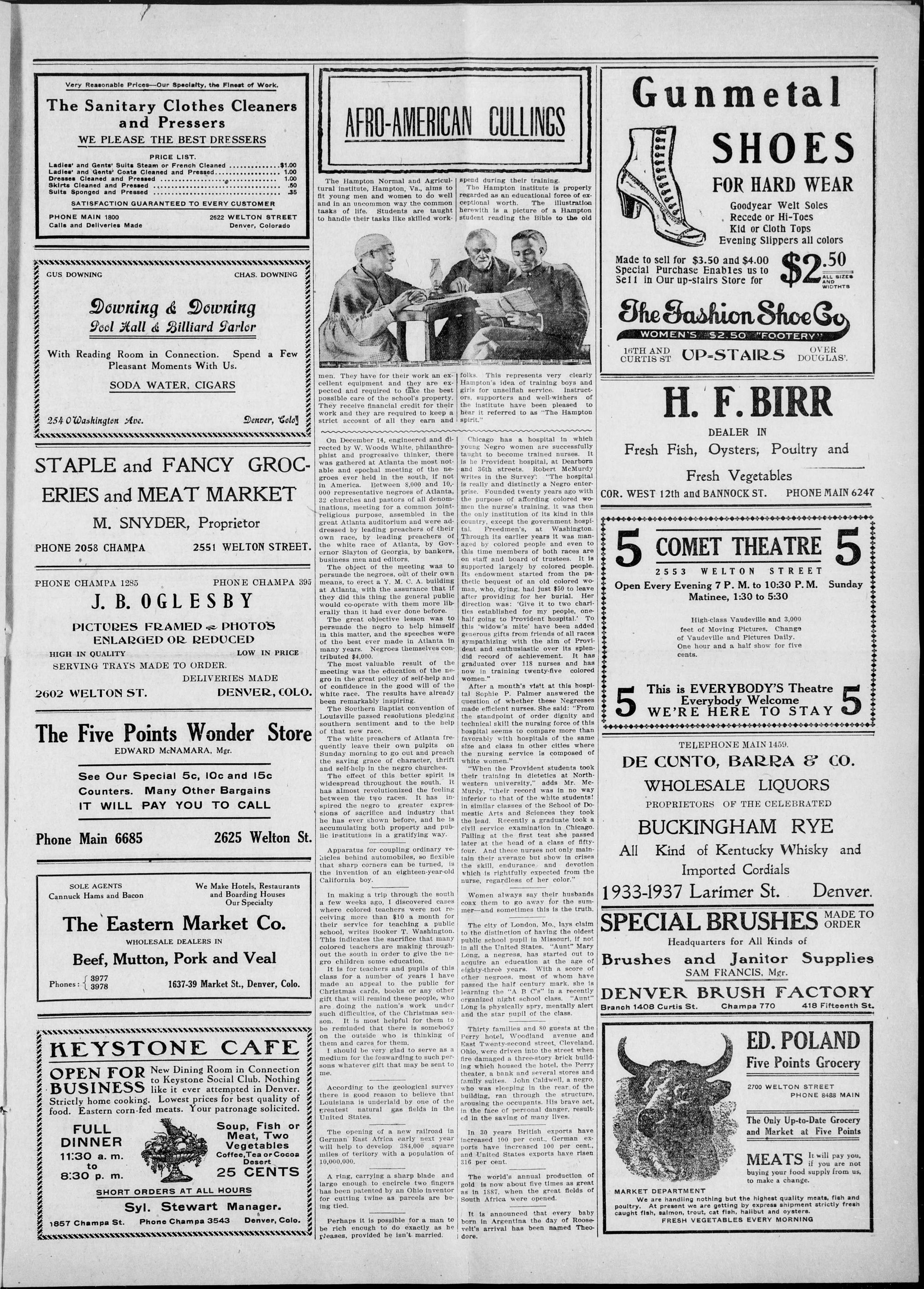
The Hampton Normal and Agricultural institute, Hampton, Va., aims to fit young men and women to do well and in an uncommon way the common tasks of life. Students are taught to handle their tasks like skilled work-
P
men. They have for their work an excellent equipment and they are expected and required to take the best possible care of the school's property. They receive financial credit for their work and they are required to keep a strict account of all they earn and
On December 14, engineered and directed by W. Woods White, philanthropist and progressive thinker, there was gathered at Atlanta the most notable and epochal meeting of the negroes ever held in the south, if not in America. Between 8,000 and 10,000 representative negroes of Atlanta, 32 churches and pastors of all denominations, meeting for a common joint-religious purpose, assembled in the great Atlanta auditorium and were addressed by leading preachers of their own race, by leading preachers of the white race of Atlanta, by Governor Slayton of Georgia, by bankers, business men and editors.
The object of the meeting was to persuade the negroes, out of their own means, to erect a Y. M. C. A. building at Atlanta, with the assurance that if they did this thing the general public would co-operate with them more liberally than it had ever done before.
The great objective lesson was to persuade the negro to help himself in this matter, and the speeches were of the best ever made in Atlanta in many years. Negroes themselves contributed $4,000. The most valuable result of the meeting was the education of the negro in the great policy of self-help and of confidence in the good will of the white race. The results have already been remarkably inspiring. The Southern Baptist convention of Louisville passed resolutions pledging southern sentiment and to the help of that new race. The white preachers of Atlanta frequently leave their own pulpits on Sunday morning to go out and preach the saving grace of character, thrift and self-help in the negro churches.
The effect of this better spirit is widespread throughout the south. It has almost revolutionized the feeling between the two races. It has inspired the negro to greater expressions of sacrifice and industry that he has ever shown before, and he is accumulating both property and public institutions in a gratifying way.
Apparatus for coupling ordinary vehicles behind automobiles, so flexible that sharp corners can be turned, is the invention of an eighteen-year-old California boy.
In making a trip through the south a few weeks ago, I discovered cases where colored teachers were not receiving more than $10 a month for their service for teaching a public school, writes Booker T. Washington. This indicates the sacrifice that many colored teachers are making throughout the south in order to give the negro children some education. It is for teachers and pupils of this class for a number of years I have made an appeal to the public for Christmas cards, books or any other gift that will remind these people, who are doing the nation's work under such difficulties, of the Christmas season. It is most helpful for them to be reminded that there is somebody on the outside who is thinking of them and cares for them.
I should be very glad to serve as a medium for the forwarding to such persons whatever gift that may be sent to me.
According to the geological survey there is good reason to believe that Louisiana is underlaid by one of the greatest natural gas fields in the United States.
The opening of a new railroad in German East Africa early next year will help to develop 384,000 square miles of territory with a population of 10,000,000.
A ring, carrying a sharp blade and large enough to encircle two fingers has been patented by an Ohio inventor for cutting twine as parcels are being tied.
Perhaps it is possible for a man to be rich enough to do exactly as he pleases, provided he isn't married.
spend during their training.
The Hampton institute is properly regarded as an educational force of exceptional worth. The illustration herewith is a picture of a Hampton student reading the Bible to the old
THE CHANGING OF THE WORLD
folks. This represents very clearly Hampton's idea of training boys and girls for unselfish service. Instructors, supporters and well-wishers of the institute have been pleased to hear it referred to as "The Hampton spirit."
Chicago has a hospital in which young Negro women are successfully taught to become trained nurses. It is he Provident hospital, at Dearborn and 36th streets. Robert McMurdy writes in the Survey: "The hospital is really and distinctly a Negro enterprise. Founded twenty years ago with the purpose of affording colored women the nurse's training, it was then the only institution of its kind in this country, except the government hospital. Freedmen's, at Washington. Through its earlier years it was managed by colored people and even to this time members of both races are on staff and board of trustees. It is supported largely by colored people. Its endowment started from the pathetic bequest of an old colored woman, who, dying, had just $50 to leave after providing for her burial. Her direction was: 'Give it to two charities established for my people, one half going to Provident hospital.' To this 'widow's mite' have been added generous gifts from friends of all races sympathizing with the aim of Provident and enthusiastic over its splendid record of achievement. It has graduated over 118 nurses and has now in training twenty-five colored women."
After a month's visit at this hospital Sophie P. Palmer answered the question of whether these Negresses made efficient nurses. She said: "From the standpoint of order dignity and technical skill the nursing force of this hospital seems to compare more than favorably with hospitals of the same size and class in other cities where the nursing service is composed of white women."
"When the Provident students took their training in dietetics at Northwestern university," adds Mr. McMurdy, "their record was in no way inferior to that of the white students! in similar classes of the School of Domestic Arts and Sciences they took the lead. Recently a graduate took a civil service examination in Chicago. Falling at the first test she passed later at the head of a class of fifty-four. And these nurses not only maintain their average but show in crises the skill, endurance, and devotion which is rightfully expected from the nurse, regardless of her color."
Women always say their husbands coax them to go away for the summer—and sometimes this is the truth.
The city of London, Mo., lays claim to the distinction of having the oldest public school pupil in Missouri, if not in all the United States. "Aunt" Mary Long, a negress, has started out to acquire an education at the age of eighty-three years. With a score of other negress, most of whom have passed the half century mark, she is learning the "A B C's" in a recently organized night school class. "Aunt" Long is physically spry, mentally alert and the star pupil of the class.
Thirty families and 80 guests at the Perry hotel, Woodland avenue and East Twenty-second street, Cleveland, Ohio, were driven into the street when fire damaged a three-story brick building which housed the hotel, the Perry theater, a bank and several stores and family suites. John Caldwell, a negro, who was sleeping in the rear of the building, ran through the structure, arousing the occupants. His brave act, in the face of personal danger, resulted in the saving of many lives.
In 30 years British exports have increased 100 per cent. German exports have increased 100 per cent. and United States exports have risen 316 per cent.
The world's annual production of gold is now about five times as great as in 1887, when the great fields of South Africa were opened.
It is announced that every baby born in Argentina the day of Roosevelt's arrival has been named Theodore.
```markdown
```
Goodyear Welt Soles
Recede or Hi-Toes
Kid or Cloth Tops
Evening Slippers all colors
Made to sell for $3.50 and $4.00
Special Purchase Enables us to
Sell in Our up-stairs Store for
The Fashion S
WOMEN'S $2.50 "F
16TH AND
CURTIS ST UP=STAIR
Fashion Shoe Co
MEN'S $2.50 "FOOTERY"
UP-STAIRS OVER DOUGLAS'.
16TH AND CURTIS ST UP=STAIRS OVER DOUGLAS'.
H. F. BIRR
DEALER IN
Fresh Fish, Oysters;
Fresh Vegeta
OR. WEST 12th and BANNOCK ST.
5 COMET THE
2553 WELTON
Open Every Evening 7 P. M. to 1
Matinee, 1:30 to 5
DEALER IN
Fish, Oysters, Poultry and
Fresh Vegetables
12th and BANNOCK ST. PHONE MAIN 62
COMET THEATRE 5
1553 WELTON STREET
Every Evening 7 P. M. to 10:30 P.M. Sunday
Matinee, 1:30 to 5:30
DEALER IN Fresh Fish, Oysters; Poultry and
COR. WEST 12th and BANNOCK ST. PHONE MAIN 6247
High-class Vaudeville and 3,000 feet of Moving Pictures. Change of Vaudeville and Pictures Daily. One hour and a half show for five cents.
5 This is EVERYBODY
Everybody Well
WE'RE HERE TO
TELEPHONE MAIN
DE CUNTO, BAR
WHOLESALE L
PROPRIETORS OF THE O
BUCKINGHAM
All Kind of Kentucky
Imported Cord
1933-1937 Larimer St
SPECIAL BRUSH
Headquarters for All Brushes and Janitie
SAM FRANCIS, B
DENVER BRUSH
Branch 1408 Curtis St. Champa 77
this is EVERYBODY'S Theatre
Everybody Welcome
WE'RE HERE TO STAY 5
TELEPHONE MAIN 1459.
CUNTO, BARRA & CO.
HOLESALE LIQUORS
OPRIETORS OF THE CELEBRATED
BUCKINGHAM RYE
Kind of Kentucky Whisky and
Imported Cordials
1937 Larimer St. Denver
SPECIAL BRUSHES MADE TO ORDER
Headquarters for All Kinds of
es and Janitor Supplies
SAM FRANCIS, Mgr.
ER BRUSH FACTORY
Curtis St. Champa 770 418 Fifteenth
This is EVERYBODY'S Theatre Everybody Welcome WE'RE HERE TO STAY 5
WHOLESALE LIQUORS
PROPRIETORS OF THE CELEBRATED
BUCKINGHAM RYE
All Kind of Kentucky Whisky and
Imported Cordials
1933-1937 Larimer St. Denver.
Headquarters for All Kinds of Brushes and Janitor Supplies SAM FRANCIS, Mgr. DENVER BRUSH FACTORY Branch 1408 Curtis St. Champa 770 418 Fifteenth St.
```markdown
```
MARKET DEPARTMENT
We are handling nothing but the highest poultry. At present we are getting by express caught fish, salmon, trout, cat fish, hallibut and
FRESH VEGETABLES EVERY
DEPARTMENT
we handling nothing but the highest quality meats, fish and
present we are getting by express shipment strictly fresh
salmon, trout, cat fish, halibut and oysters.
FRESH VEGETABLES EVERY MORNING
We are handling nothing but the highest quality meats, fish and poultry. At present we are getting by express shipment strictly fresh caught fish, salmon, trout, cat fish, halibut and oysters.
FRESH VEGETABLES EVERY MORNING
5
$2.50
ALL SIZES
AND
WIDTHTB
5
2700 WELTON STREET
PHONE 8488 MAIN
The Only Up-to-Date Grocery and Market at Five Points MEATS It will pay you, if you are not buying your food supply from us, to make a change.
THE COLORADO STATESMAN
KING'S SHELL BE FREE
MAY THE COURTIS PARTY
JOS. L. D. RIVERS.....Proprietor
1824 Curtis Street, Room 25.
Phone Main 7417.
SUBSCRIPTION RATES:
One Year ..... $2.00
Six Months ..... 1.00
Three Months ..... .60
PAYABLE IN ADVANCE.
Entered as second-class matter at the postoffice in the city of Denver, Colorado.
All communications of a personating nature that are not complimentary will be withheld from the columns of this paper.
Display advertising, 50 cents per inch. An inch contains twelve agate lines.
Reading notices, ten lines or less, 10 cents per line. Each additional line over ten lines, 5 cents per line.
No discounts allowed on less than three months' contract. Cash must accompany all orders from parties unknown to us. Further particulars on application.
Remittances should be made by Express Money Order, Postoffice Money Order, Registered Letter or Bank Draft. Postage stamps will be received the same as cash for the fractional part of a dollar. Only 1-cent and 2-cent stamps taken.
Communications to receive attention must be newsy, upon important subjects, plainly written only upon one side of the paper; must reach us Tuesdays, if possible, anyway, not later than Wednesdays, and bear the signature of the author. No manuscript returned, unless stamps are sent for postage.
It occasionally happens that papers sent to subscribers are lost or stolen. In case you do not receive any number when due, inform us by postal card and we will cheerfully forward a duplicate of the missing number.
GET A HOME
The increasing frequency with which we can note the purchase of comfortable homes by Denver's colored citizens is a source of great gratification and encouragement to all who realize the wisdom of such a course. If we would more generally take the heart, the advice arising out of the experiences of the older citizens we would improve our opportunities far more than we do at present. While the chance to make a fortune quickly in real estate is not, and probably never will be again what it once was, it is almost a certainty that every careful investment in residential property, no matter how far out it may be located, will bring the investor reward in the way of comfort and independence such as no other form of investment is apt to bring.
Denver is growing and will continue to grow for many years, and even if the value of suburban real estate increases but slowly, increase it must to some extent, while fortunate purchasers may see their properties increase in value by leaps. But the importance of owning a home is not confined to the possibility of its increasing in value. Home owners are recognized as representing a more solid citizenship than the tenant class, while the comfort and interest which one finds in his own property increases with his years. And it is possible for every steady wage earner to buy a home. A little frugality, a little sacrifice of idle pleasures, a little saving and a determination to be boss of a little plot of your own, and in a few years the work is achieved. Some of our leading property owners made every dollar of their first investments working as janitors or laborers. They have insured comfort, self-reliance and respect to themselves and their families, and they realize with no little satisfaction the wisdom of their earlier efforts.
A FINANCIAL CRISIS.
A recent issue of the Philadelphia Tribune, one of the oldest and most influential Negro journals of the country, sums up the financial situation in a nutshell and points out the real cause of such a crisis. It reads as follows:
"All indications point that in the very near future this country is to pass through a financial crisis that will threaten the strongest business houses in this country. Many of the strongest and best equipped financial institutions are preparing for the strain they will be called upon to meet.
"They are already commencing to curtail their sphere of financial operation, husbanding their resources in order to be able to stand the strain of the impending storm. There is no doubt those less able to do so will have to go to the wall. This strain will not be felt by one class alone, but will bear most heavily on those who can stand it the least. The institutions of limited resources, those in whom the poorer class of the community have invested their savings to provide for themselves later in life will be the greatest sufferers. These are the ones who will feel it most when the crash comes.
"It is a peculiar fact that as soon as the Democratic party secures the control of the government it is always followed by a crisis of this character. It should not be, yet it is true, for some reason or other, they create a feeling of uncertainty. At the present moment this has been brought about through the action of the Democratic party in the legislation that it has already passed and that which is impending. The restriction of the industrial interests of the nation through the tariff bill, and later the distrust that has been aroused in the passage of the currency measure.
"At no time in the history of the country has it been in a more prosperous condition than at the time the Democratic party came into power. The yield of agricultural products during the past two years has been greater by many millions of dollars than any preceding year. The price for these crops in the home and European markets has also been greater. The products of the mines of the country have been most phenomenal, yet in the face of all this wealth of resources this crisis is pending which will for a time cripple the nation."
"The cause of all this, the country can point to the Democratic party as the one that has brought this about. They claimed that as soon as they secured the full control of the government, high prices for articles of food and other necessities of life would be a thing of the past, while the facts of the case are the cost of living is higher today since this party has been in power than before, and as events are shaping themselves will mount higher and higher. At this present time there are in this city between 20,000 and 30,000 people out of employment, which also means without or the other necessities of life or the money to get the same. These people have to be fed. The city will have to feed them. In order to do so, soup houses will have to be opened in various parts of the city."
---
Mme. Walker has opened hair dressing, manicuring and massage parlors. Body massage a specialty, and will also teach classes in all branches of her work. Residence, 2515 Clarkson St. Phone York 5532.
13 CENTS A DAY BUYS A PIANO.
WITH MUSIC LESSONS FREE.
PIANOS FROM $88 UP. COLUMBINE
MUSIC CO. 920-924 15th STREET.
CHARLES BUILDING
Women Allowed to Perform Hard Work By DR. GRACE E. CROSS
Women Allowed to Perform Hard Work
By DR. GRACE E. CROSS
"Should women be allowed to do hard work?"
Now in opening a discussion of a certain subject it is often necessary to define the subject, so as to have a common ground of understanding. What then do we mean by "hard" work for women? As we think of the difficult tasks which already, by common consent, fall to woman's lot, we come to see that we mean by "hard" work for women only hard work which it is not customary for women to perform—work which in the past has been done by men.
From a physician's standpoint the question of a suitable task for women would largely be determined by its physical effect upon her. To help us in deciding what a woman is physically able to bear it may be well to consider what she has borne and is bearing.
For instance, a woman in the lower social scale may bear and rear a large family, a sufficient task in itself. In the interval she does all the household work. She lauders, cooks, cleans and sews. She lifts heavy tubs and baskets of clothes and stands for hours at cook stove or ironing board. She often carries a freftful child on one arm while she does the housework with the other. She rises with the sun and with the darkness her work endeth not. Does any arise in chivalrous wrath and exclaim, "Woman should not be allowed to do such hard work?" Indeed not! Rather, if perchance she complain, she is comforted with the assurance that she is doing her duty in "woman's true sphere."
On the other hand, the lady of fashion labors indeed, but at different tasks. She is handicapped at the outset by ridiculous clothing. Her encasing steel-ribbed undergarments restrict respiration, impede circulation, retard digestion and displace every internal organ from its normal position. Her shoes cramp the walking muscles and throw the whole body out of proper poise, and her scanty-skirted gown necessitates an unnatural and weary gait. Her amazing coiffure, constructed from masses of unwholesome jute or dead human hair, heats the brain and strains the delicate structures of the neck and upper spine, and the fashionable hat, a crowning monstrosity, with its weight of velvet, plumes and abnormal flora, adds its burden.
Thus equipped, my lady enters upon her strenuous round. The daily demands of her engagement book would phase the average business man who sometimes thinks he is overworked. She must visit the modiste and the milliner to supervise the new gowns and hats which are ever on the way. She may have appointments with dentist, manicurist or hairdresser, or she must see florist, decorator and caterer, if perchance she entertains at some near date. She lunches hurriedly to rush off to calls, teas, receptions or bridge and returns to dress for dinner at home or abroad. In the evening she goes to the opera or theater, or if a ball is on she dances if young and chaperones if older until the small hours of morning.
These are the extremes, but each rung of the social ladder in between has heavy burdens of its own for women's baring.
There can be no absolutely healthful occupation for the woman who attempts to follow the present silly caprices in dress. Whatever her task, she works at a disadvantage. We remember the physical prowess of the primitive woman and see, as in a thrilling vision, woman as she might have been today if, in addition to the mental and spiritual charm which she has received from education and culture, she had developed her wondrous native strength and grace as nature pland.
The whole question, therefore, becomes a comparative and individual one, of which the conclusion is this: Whatever work a certain woman can do and wishes to do, provided it is
do and wishes to do, provided it is not morally degrading, is suitable work for her, and this she should be free to perform.
Steam laundries are growing more in favor in the Philippines each year. The fear of contracting skin diseases from clothing washed by natives in the Philippines has greatly helped to
Steam Laundries Growing More in Favor
By JOHN B. MARRISON, Manila, P. I.
Steam laundries are growing more in favor in the Philippines each year. The fear of contracting skin diseases from clothing washed by natives in the Philippines has greatly helped to build up the business of the steam laundries.
The natives in the Philippines do excellent laundry work, but there is always danger of contracting some disease from the clothing washed by them. In reports recently issued by the United States government it is learned that cheap labor, especially that of women and children, has retarded the introduction of modern laundries all over Asia and the far east.
Even now in Japan, the most advanced of the eastern nations, the bulk of laundry work for the public is done by hand. In Asiatic countries clothing is usually washed by beating on stones, trampling in vats and other primitive processes.
Not even are modern washboards, not to mention washing machines, in use. In tropical places like Hongkong, where an abundance of fresh linen and clean wash clothing is a necessity of prime importance, most of the work is still done by hand, the majority of families supporting a Chinese "amah," or woman, and sometimes a man, for laundry work only. The heavily starched goods, however, can seldom be laundered satisfactorily by these employes.
There are native laundries of some importance in nearly all cities, but they do all their work by hand, though establishments will occasionally be found containing one or two of the less expensive laundry appliances. Many of the hotels of the far east have laundries of this description.
Swat Pestiferous Little Sparrow Well as Fly
By FRANCIS WAGNER, St. Louis, Mo.
To the slogan swat the fly should be added kill the sparrow. The sparrows belong to the same class of nuisances and menaces to the health as the fly. The sparrow's habit of living al-
Swat Pestiferous Little Sparrow Well as Fly By FRANCIS WAGNER, St. Louis, Mo.
To the slogan swat the fly should be added kill the sparrow. The sparrows belong to the same class of nuisances and menaces to the health as the fly. The sparrow's habit of living always near settlements and in sheltered places makes it a most prolific bird. It is almost independent of the seasons in breeding. Several broods of as many as seven or eight birds may be reared in a year.
The sparrow helps to spread diseases by building nests on or near houses. Building on houses is especially a menace to health in the country, where people catch water from the roofs to fill their cisterns. The nests are of such construction that they are likely harbors for various sorts of vermin and germs.
Most birds deserve to be protected for some service they perform, but when all the evidence has been submitted in the sparrow's case it will stand condemned. Perhaps it occasionally eats a harmful worm, but the greater part of its food is of grain. Then it is the constant enemy of native birds, which, unlike itself, live mostly on worms and insects that are injurious to trees and crops.
For many years the sparrow was unknown except in towns, and it gained the name of "town bird." But in later years it has spread all over the country, until now it is probably a greater nuisance on the farm than in the city.
PETER H. HARRIS
THE NEWPORT SALOON
ANNEX CAFE AND LUNCH ROOM
SHORT ORDERS AT ALL HOURS
CHINESE DISHES OF ALL KINDS
FURNISHED ROOMS
TOM LEWIS, Proprietor.
DENVER, COLORADO
1841-45 ARAPAHOE STREET
REPAIRING DONE WHILE
YOU WAIT
WORK CALLED FOR AND DELIVERED
TELEPHONE MAIN 7377
THE CAPITAL CITY SHOE
REPAIRING CO.
SEWED HALF SOLES 60 cts. and 75 cts.
HENRY WARNECKE, President
1511 CHAMPA STREET DENVER, COLO.
Will Not Be Complete Without OYSTERS CLAMS OR LOBSTERS
Received Daily By Express
LYNN HAVENS, COTUETS, BLUE POINTS, BALTIMORE
STANDARDS, BALTIMORE SELECTS, NEW YORK COUNTS
THE ONLY EXCLUSIVE FISH AND OYSTER HOUSE IN DENVER
WASHBURN'S
1506 Arapahoe St. Phone Champa 2211
PROMPT DELIVERY
REO CLUB
2710=12 Welton St
Phone Main 2759 Denver, Colo.
Stop!
Stop!
Consider
Did you ever stop to think that you are helping to pay the big up town rents when you buy without considering this. Patronize Home Industry
N. FERRY
Phone Main 7411
1905 Curtis Street
I PAY SMALL RENT, DELIVER THE BEST
$20.00 AND $25.00 SUIT IN THE CITY
Best Goods, Best Workmanship, Best for the money in the City of Denver. Give me a trial and you will be convinced I give all my customers perfect Satisfaction, Fit, Style, Workmanship and the BEST FOR THE MONEY.
How do I Turn Out Such Fine suits for the Money? Why? On account of THE LOW RENT.
Bolden Bros.' Barber Shop
AGENTS WANTED
To Sell
MAGIC SHAVING POWDER.
A new discovery for shaving the face and head without using razor or shears.
Will send half pound can by mail, postage paid, for all cents in stamps.
Write
THE SHAVING POWDER CO.
Savannah, Georgia.
Rufus Bolden, Mgr. W. D.
Smith, G. C. Craig Artists
BATHS AND ELECTRICAL MASSAGE
QUICK SERVICE
PHONE MAIN 4052
926 19th Street Denver.
Near Curtis
Miss M. Cowden Hair Dressing Parlor
Coal from Sack to Carload Delivered Anywhere in the City.
Office: 2807 Welton Street DENVER - COLORADO
Shampoo, cutting and curling. Scalp treatment, hair tonics, hair straightening, manicuring. Stage wigs for rent; theatrical use and masquerades.
The
WARD AUCTION
COMPANY
Sales Daily at 2 p.m. Office Furniture a Specialty.
PRIVATE SALES AT ALL TIMES
HAVE MOVED TO—
1723-39 GLENARM ST.
PHONE MAIN 1675.
Goods delivered out of the city. All shades of hair matched by sending sample of hair; also combings made up.
Cheapest Switches 50 Cents
1219 21st St. Denver, Colo.
THE COLORADO STATESMAN
Mrs. M. Keelan is quite ill at her home, 2610 Welton street.
Fire destroyed the house and contents of Dr. and Mrs. J. H. P. Westbrook last Monday night.
R. L. Boyd of Exline, Kansas, is in the city to remain indefinitely.
fight, hard from start to finish the decision a draw, was welcomed all. The smokers are becoming v popular and the club deserves m credit for putting such efforts please it friends.
WANTED—MANAGER AND SC DISPENSER.
L. E. Baker, a Pullman employé of Kansas City, spent a few days in the city this week.
Miss L. E. Hammond, who has been visiting in the East, returned home last Sunday.
Miss Zenobia Fisher left last Sunday for Indianapolis, Ind., to visit indefinitely with relatives.
Mr. E. V. Cammel is associated with the A. M. Lawhorn undertaking establishment as manager and funeral director.
Miss Della Black of 2329 Lafayette street left this week for Los Vegas, N. M., where she expects to spend the winter.
Mrs. L. Carter, who has been ill several weeks, is much improved, and will be pleased to see her friends at her new address, 2624 California street.
Robert Moss of Oakland, Cal., who was called here to attend the funeral of his mother, Mrs. Marcellina Beatty, returned to his home last Tuesday.
Samuel E. Cook, one of the best known and popular railroad men in the West, arrived in the city last Sunday on a visit with his wife and host of friends.
"Two Million Farm Hands" or "The Right and Wrong Way to Handle Negro Labor," by Booker T. Washington, is the subject of an article in "The Country Gentleman," 'an agricultural journal. It is indeed interesting, revealing important facts about Negro labor.
Lorie's family liquor store at 2958-62 Welton street will have a grand opening today. The increased patronage, caused by the courteous treatment of patrons, is largely due for the forced enlargement of the store with the addition of a bar in connection. It is indeed gratifying to the many patrons of the place to know that Mr. H. Lorie, the proprietor, is adding better accommodations for the large and increasing patronage.
At a special meeting held Jan. 11, 1914, the following officers were elected for the year 1914: Corporal William White, Camp No. 4, Department of Columbia; William Robison, commander; John Norton, senior vice commander; Morgan Wells, junior vice commander; Amos Ellison, chaplain; John E. Oglesby, quarter master; Walter H. Vernell, adjutant; Augustus Morris, officer of the day; Thomas E. Campbell, officer of the guard; Amos Ellison, William Barnes, Clarence E. Langston, trustees.
John Rollins, one of our popular young society men, gave an enjoyable smoker Wednesday evening at 3741 Franklin street. Those who enjoyed his hospitality were Messrs. F. G. Turner, W. A. Slade, Fred Macey, Ira Turner, O. W. Washington, George Halsey, W. Irby, W. M. Davis and R. C. Williams. There was a-flow of reason and feast of soul. Mr. Rollins is an ideal host and knows how to add to the pleasure of his friends.
George W. Horne, a former well known resident of this city, arrived in the city this week from Creede, Colo., which place he has made his home for a number of years, where he has been engaged in mining on a quasi successful scale. Mr. Horne has many friends among the old-timers, who have given him a hearty welcome. Mr. Horne came to the city to attend the funeral of his father, William Horne, who died at 2843 Glenarm Pl., Jan. 12th.
KEYSTONE SOCIAL CLUB SMOKER.
The second monthly smoker of the Keystone Social Club was held at Eureka hall Thursday evening and proved a very successful entertainment. The main boxing bout was between "Kid" Bell and K. O. Brown, both Denver boys. It was a clean
fight, hard from start to finish and the decision a draw, was welcomed by all. The smokers are becoming very popular and the club deserves much credit for putting such efforts to please it friends.
WANTED—MANAGER AND SODA DISPENSER.
Wanted—A first-class soda water dispenser. Colored man to take charge of fountain and manage store. Salary $50 per month and board. Give experience.
Address:
St. Louis Delicatessen Co.,
2315 Market Street.
St. Louis, Mo.
DEATH OF MRS. ZENON BRICKLER
It is with regret that the Colorado Statesman mentions the death of Mrs. Z. Brickler, the beloved wife of the well known barber, which occurred Wednesday night at their residence in Park Hill. Mrs. Brickler has been an invalid for a number of years, although her devoted husband had sent her to the hospital twice to be operated on the operations seemed not to be successful. Mrs. Brickler leaves to mourn her untimely death, a husband, several children, a mother and other relatives, besides a number of close friends.
DEATHS.
the funeral of Wm. Horne was held Wednesday 11 a. m., from the home of his daughter, Mrs. E. W. Houston, 2843 Glenarm Place, Rev. D. E. Over, officiated.
Edward Turner, died Jan. 14, at county hospital, funeral notice later.
The funeral of Mrs. May Brickler will be held from her residence, 2946 Dahla, Sunday at 2 p. m.
The funeral of Mrs. Lousie Richardson will be held Sunday, one p. m., from Campbell church.
Douglas Undertaking Co. in charge of above funerals.
CARD OF THANKS.
We desire to thank our many friends who so kindly lent their assistance during the illness and death of our beloved mother and wife, Mrs Marcellina Beatty, who departed this life January 6th, 1914; also for the beautiful floral offerings.
ROBERT BEATTY,
ROBERT MOSS,
H. O. W. MOSS,
F. W. MOSS.
CAMPBELL A. M. E. CHURCH.
Corner 23rd and Lawrence Streets.
REV. JAS. WASHINGTON, Pastor.
Sunday school—9:45 a. m.
Preaching—10:45 a. m. Subject:
"What True Prayer Is."
Class—12:15 p. m.
Allen's C. E. League—6:30 p. m.
Wednesday, Jan. 21st, will be the day for city-wide special prayer, and we are asked to unite on the following petitions.
1. A conviction of my sin and inefficiency to be revealed to me by a clearer vision of God.
2. A consciousness of my cleansing through Christ.
3. A consciousness of God's efficiency in me.
4. A deepening sense of my responsibility for the salvation of others.
5. That Christ will teach me how to pray.
The W M. M. Society will meet Thursday, Jan. 22, at 8 p. m. Mesdames C. A. J. Spires and B. E. Cole will entertain.
To these services all have a cordial invitation.
BETHLEHEM BAPTIST CHURCH
NOTES.
9:45 Sunday school. Lesson, "The Good Samatarian," Scripture, Luke 10:25-37.
We are glad to note the interest and sturdy growth of the school. We have a full corps of teachers now.
11 a. m. the pastor will preach on the subject of prayer, Text Psalms, 42: 4.
6:30. B. Y. P. U. Topic, "Our Standard," Phil. 3: 12-16.
7:30. Preaching by the pastor.
7. 30. Treaching
A call is issued to every member of the church to meet Wednesday evening at 7:45 to unite in the city-wide prayer services, praying that God will bless our city with his favor we will pray for:
1. A conviction of my sinand inefficiency to be revealed to me by a clearer vision of God.
2. A consciousness of my cleansing through Christ.
3. A consciousness of God's efficiency in me.
4. A deepening sense of my responsibility for the salvation of others.
5. That Christ will teach me how to pray.
Mr. Dealich Robinson was struck by a street car last Saturday, but is resting well, and we pray for his speedy recovery, he leaves at 2326 Welton st. Visitors and strangers are always welcome to all of our services. Rev. A. E. Reynolds, Pastor.
Brickler's New Barber Shop is located at 2208 Larimer street. Shave, 10. Hair cut, 25c; children, 15c.
VOTERS WHO HAVE MOVED MUST CHANGE REGISTRATION BY FEB. 10.
Every person in Denver who voted at the commission-form election last May and has since moved into another precinct, must go to the office of the election commission, in the basement of the courthouse, before Feb. 10, and have his registration changed. Otherwise he will not be permitted to vote at the water election Feb. 17.
Votes of non-taxpayers will be as important as those of taxpayers in the water election, and to avoid the congestion that has heretofore existed at the election offices, all whose registration should be changed are urged to attend to it at once.
The books will be open every day from 9 o'clock in the morning until 5 o'clock in the afternoon, in the basement room at the Fifteenth and Tremont street corner of the courthouse. New registration will not be made there, but all changes must be made at that place before Feb. 10. Only those who voted in Denver last May and have since moved INTO ANOTHER PRECINCT will be permitted to change their registration at the courthouse. A husband may not have his wife's registration changed, or viceversa. Every voter must appear in person at the courthouse to change registration.
SHORTER'S CHAPEL NOTES.
Shorter will join in with the city-wide movement to make Wednesday, January 21st, a day of prayer. The pastor will deliver a sermon Sunday at the morning hour on The Prayer-Life—Its Powers and Its Blessedness, and on Wednesday evening it is earnestly hoped that our entire congregation will co-operate heartily in the prayer service. The subject of the pastor's sermon Sunday evening will be The Almost Christian.
Our mid-winter revival will begin Sunday, February 1st. Rev. J. P. Howard of Kansas City, Mo., will assist our pastor in this campaign. The fight is on and every soldier is expected to show his colors.
The Deaconess Board held a very profitable meeting last Friday afternoon and a good showing was made for the month of December.
The newly elected officers of the Ushers Club were installed by the pastor Monday evening, last, when a four-course luncheon was served to delight of the members and their guest. The officers for the ensuing years are: President, Wm. Hawkins; vice president, Walter Lindsay; secretary, J. A. Waldon; assistant secretary, Wm. Robinson; treasurer, Chas. A. Burton. The annual report rendered showed that J. P. Perkins, the retiring president, made a splendid showing for the year 1913. The receipts for the year being $129.97 and the membership being 41.
Nicely furnished rooms for rent at 2441-43 Lawrence street. Phone Champa 2783.
For rent a five room frame house at 322 24th street. Apply at 1824 Curtis street, room 25.
Three nicely furnished rooms for light housekeeping at 2929 Glenarm Place. Call at 2815 Arapahoe St.
For Rent—Nicely modern furnished rooms at 2210 Clarkson street, also plain and fancy sewing done at the above address.
An industrious man wanted to learn the undertaking business, one who has some business ideas. Call at Lawhorn's, 1925 Arapahoe street, for further particulars.
H. C. Radcliff has opened a nice, neat barber shop at his old stand, 1226 18th street. The shop has been remodeled in the latest style, and the only colored shop in the city giving artesian baths. Mr. Radcliff is well known and liked by the citizens of Denver. He solicits the trade of all his friends.
THE DE LUXE.
Furnished apartments. Two and three rooms, with hot and cold water in each kitchen. Also front room, single, electric lights and gas. Modern throughout. Rates very reasonable. 2352-2358 Odgen street, corner Twenty-fourth avenue. Phone York 6707. Mrs. R. M. Blakey.
Before You Buy Property, Let Lawyer W. B. TOWNSEND
EXAMINE THE TITLE AND MAKE YOUR CONTRACT. LAWYER TOWN-SEND MAKES A SPECIALTY OF COLLECTING FROM INSURANCE COMPANIES, ALSO ENDOWMENT MONIES.
OFFICE 313 KITTREDGE BUILDING
J. H. BIGGINS
Furniture Repairing and Up-
PHONE YORK 7602
1417 East 24th Ave Denver
TO CROWN HER LOVE
By EMILY BEE.
They had celebrated together the advent of each New Year since the first year of their acquaintance. That meant five celebrations. And each had ended with a declaration from him which she parried, and a question from him to which she would not give definite answer.
That night they sat in the glittering restaurant, part of the noisy hilarious crowd, and yet by their sincerity and simplicity differentiated from that crowd.
With the rest of the crowd they ate, drank and laughed.
A bell struck, and at the sound the great noisy throng hushed suddenly, voluntarily, expectantly. A distant door opened and a silken silvery page led in a rosy child, typifying the New Year. A thousand chimes rang out. The diners sprang to their feet, and the scene in the restaurant became pandemonium. She alone was silent, with a fixed smile. As her escort joined those about them in the cry of Happy New Year! she only smiled and smiled. Had she emitted a single sound, it would have been a cry. The first confusion over, they settled in their chairs again. Her eyes were fixed upon her plate. Before raising them she must be sure that they were velled. Last year he had seized this moment to speak to her. This year—could she live through this year?
He was relating a story, doubtless amusing. With an effort she gave him attention. Something was wrong. He no longer cared. Could she keep him from knowing that she did, that after all, she did? He would not speak.
Rather abruptly he leaned back, as if he, too, wearied of the face they played. "Aren't you bored with this, Alice? It only lasts—so long. Let's go."
She nodded and rose. He held her wrap, and as she slipped into its loose warm folds, his fingers touched her shoulder. She could feel the warm blood rise to that touch, and miserably conscious, she fastened her wrap without a glance in his direction. He picked up her white gloves and handed them to her. She observed, with dull surprise, that his hand was a bit unsteady. In a flash she recollected—she was almost positive of it—that the fingers touching her shoulder had trembled. She looked up at him swiftly, caught him off guard, and read the bitterness in his eyes.
Threading her way before him, through lines of colorful sparkling tables, the distance to the door seemed interminably long. She must verify that glimpse into his soul. If she had seen aright, then he still cared. It was only indifference that proved the death of love.
As the cold air of the street smote them, they breathed deeply of its freshness. "Let's walk," he said.
Again she only nodded. "Now," she thought, "Now, perhaps he will speak." But they walked on in silence, a silence almost unbearable to both of them. It was after they had traveled many blocks, passed out of the district of garish merry-making, were approaching the threshold at which they must part, that she took her fate in her hands.
"Tonight," she said, endeavoring to speak casually, lightly, "we have omitted a part of our ancient and honorable formula."
"Since it is only a formula," he said, "it is better omitted. The times are against formalism."
"But the occasion is not complete without it," she persisted, with a soft laugh, the while her eyes were blank with pain.
"It is not only complete, but finished," he said.
They walked on. She was praying for strength to carry her through the little distance remaining, until—until the end. So he thought she had trifled with him! He would not understand. A wild determination came to her. He should understand! As though they had both been speaking frankly, she said, "I will answer your words of last year, and the year before, and years before. I could not give myself to you while I was a failure. I should have been less worth winning. I have succeeded now. The commission has come to me, to make the mural paintings for the New Center. It will be in the papers tomorrow. You are the only one who knows."
"Then you are worth winning now?" he asked calmly.
"Now," she said to herself, "my heart will surely break."
"It is only when you love that you are worth winning. When you love, and when I love you."
"Now," she said to herself, "my heart is surely broken. It does not matter what I say now." To him she said, in a voice like death, "I understand. It is too late."
"I am bitter against you," he said.
"I am sorry. It is hard for a man to forgive the woman who does not want him, the woman who prefers success to love."
"But I am not that woman," she said, throwing what was left of her pride to the four winds.
He asked, scarcely above his breath:
"Do you mean—that you care—for love—my love?"
And now she would not answer. They had reached the threshold of their parting. They passed over it and into the dimly lighted, deserted hall.
He gathered her into his arms, "I wanted success," she whispered, "only—to crown my love."
CHAS. HARRIS, Pres. J. M. JOHNS, Treas. SEIB MILLER, Sec.
1728 $ \frac{1}{2} $ Wazee St. Only one block from Union Depot Phone Main 8416. Denver, Colorado
PHONE CHAMPA 2570
THE MACEO
F. S. DENTON, PROPRIETOR
FOUNTAIN DRINKS OF ALL KINDS. SHORT ORDERS
CHILE, AND SANDWICHES, AT ALL HOURS.
ORDERS SENT OUT ON SHORT NOTICE
BEST OF SERVICE GUARANTEED
F. S. DENTON, PROPRIETOR
FOUNTAIN DRINKS OF ALL KINDS. SHORT ORDERS
CHILE, AND SANDWICHES, AT ALL HOURS.
ORDERS SENT OUT ON SHORT NOTICE
BEST OF SERVICE GUARANTEED
2721 Welton Street Denver.
Denver.
Rocky Mountain Athletic Ass'n.
It is a tribute to the officers and members of the Rocky Mountain Athletic Association, of Denver, Colorado, that in a city noted the world over for its hospitality, it has been accorded first honors as a place of social amusement and relaxation. Colorado is the Switzerland of America. Its snow-clad hills and verdant valleys, its charming resorts, its rugged beauty are famous the world over. Denver, its capital, is one of the most beautiful cities in America. Matchless in climate, situated where first the eternal snowy hills rear their snowy tops to the heavens, it has long been the mocha of visitors. Its people have been well trained in hospitality, and of that training the Rocky Mountain Athletic Association is the highest expression.
In offering to the public this set of interior views of its home, the Board of Directors of the Association have only one regret, that they cannot reproduce in black and white the cordial good fellowship that exists among the members, and the hearty welcome which is accorded visitors. The limitations of the camera are understood, so that they will convey an idea of the building and accommodations, but words cannot take the place of the handshake, the smile and friendly greeting. Therefore the Association extends to all men of good character a cordial invitation to visit the Association quarters while in Denver, and assures them that their inspection is no intrusion, but, on the other hand, will give it an opportunity for doing for them the duty which Denver lays upon its citizens.
It is the spirit of good fellowship that has made the Rocky Mountain Athletic Association a factor in Denver life, though it is only a year and a half old, and it has occupied its present quarters, 2014 Champa street, since April, 1910. In that time it has grown to 900 members, a part of whom are non-residents, being accorded the privileges of the Association under the provisions of the by-laws relative to non-resident members.
It is not the desire to burden you with facts and figures, but to entertain you—on paper now, and in the hope that some day we may entertain you in person. Therefore let's make an inspection of the Association quarters. The Rocky Mountain Athletic Association is housed in a twenty-room two-story brick building situated at 2014 Champa street, Denver, Colorado, on a plot of ground 50x125 feet, one block from the new postoffice now building. In preparation for its occupancy this building was remodeled a year ago.
BARBELL'S BARBELL'S BARBELL'S
The pool and billiard room is high class. To those who have never played upon the famous Wellington tables with Monarch cushions, a game upon these tables would be a revelation. The equipment is entirely new, with special attendants and instructors at your service.
THE SEWING MACHINE
SHOE REPAIRING
CATTLE IN TRANSIT
Information on Shrinkage of Beef Cattle.
After Special Study Uncle Sam's Department of Agriculture Gives Cause of Loss in Weight in Railroad Shipment to Market.
Washington.—The shrinkage or loss in weight of beef cattle in the course of shipment from western farms and ranches to the markets has been made a subject of special study by the department of agriculture, and what is believed to be the first authentic information on this subject has been compiled. The investigation covered three years in various cattle raising sections of the west. The cattle were weighed at the point of loading, on arrival at their destination, and again after having rest, feed and water. The weight was also taken when the animals were sold. The records include the weighing of Texas and northwestern range cattle and calves, and of corn-fed, silage-fed, and beet-pulp-fed cattle. In all 265 shipments were weighed, comprising over 19,000 cattle. Many of these shipments were several days on the road and in such cases were weighed at the unloading points as well as at the first shipping point and at the market.
The transfer of cattle from the farm or ranch to the market usually necessitates a drive to the railroad and a further journey on the cars. These drives may vary in distance from a few hundred yards to more than a hundred miles, depending upon the location of the ranch, while the railroad journey may consume any time from a few hours to several days. All cattlemen know that when their stock arrives at market they are usually lighter in weight than when they started. This loss in weight is called shrinkage.
The loss in weight during the journey is due to excretions from the alimentary canal, from the urinary organs, and from moisture given off by the lungs in breathing. A portion of this loss may be regained at the market by the food and water taken into the system. The consumption of this food and water at the market is termed the "fill."
The shrinkage in weight of cattle in transit to market is the difference between the weight of the animals at the point of origin and the weight of the animals on arrival at destination. The net shrinkage is the difference in the weight at the point of origin and the weight of the animals when sold at the market after taking the fill.
The shrinkage of cattle in transit is such a variable factor that no one can say definitely how much it will be during a journey, but by the use of very large numbers of cattle an average shrinkage will be obtained which may be used as a basis for estimating the amount of shrinkage on cattle shipped under similar conditions.
The net shrinkage was found in the department's investigations to range all the way from 15 to 75 pounds per head, or from 2.14 to 7 per cent, depending upon the length of time and other conditions. The time that the cattle were in transit varied from less than 24 hours to more than 72 hours. The normal shrinkage may be regarded as from 3 to 6 per cent. of live weight.
The extent of the shrinkage depends upon various factors, among which are the conditions at the time of shipping and the treatment during the drive to the leading pens; the length of time the cattle were held without feed and water before being loaded; the nature of the fill before loading—the greater losses occurring when this consisted of succulent grass, beet pulp or silage, the weather and climatic conditions at the time of loading, while in transit, and at the market; the character of the run to market, greater shrinkage naturally being caused by slow, rough runs; the time of arrival at market. If the cattle arrived just before being sold the fill was small. Cattle that were shipped a long distance and arrived at market during the night usually did not fill well. If they arrived the afternoon before or about daylight of the same day they generally took a good fill.
An exceedingly large fill at market is not desired, as it will detract from the selling price.
The shrinkage of cattle was found to vary in direct proportion to their live weight when conditions were the same and all other factors were equal.
The shrinkage during the first 24 hours is greater proportionately than for any succeeding period of the same duration. The shrinkage on cattle is proportionately smaller for each 12 hours they are in transit after the first 24-hour period is passed.
The difference between the shrinkage of cows and steers is not as great as is ordinarily supposed. Steers will usually shrink somewhat less than cows of the same weight.
The shrinkage on calves seems small, but under normal conditions it holds about the same proportion to their weight as is found with grown cattle.
The shrinkage of range cattle in transit over 70 hours during a normal year is from 5 to 6 per cent of their live weight. If they are in transit 36 hours or less the shrinkage will range from 3 to 4 per cent of their live weight. For a long journey the common method of unloading for feed, water,
and rest is to be preferred to the use of "feed and water" cars. Cattle should be weighed before being loaded wherever practicable, since a comparison of this weight with the sale weight will show the net shrinkage. Moreover, this weight at point of origin may be of material benefit to the shipper in case of a wreck or a very poor run to market. There is no way of entirely preventing shrinkage in the shipping of cattle, but by judicious care in handling and feeding the cattle just previous to shipping the shrinkage may be lessened. If cattle are to be in transit for 24 hours or longer it is a good plan to feed about two bales of nice bright hay for each carload a few hours before loading.
When care is used in trailing the cattle to the loading pen, not driving them too fast nor too far in a day and giving them five or six hours a day to graze on the way, long distances may be covered with no apparent injury to the cattle. On arrival at the pens it is well to give the animals a light feed of hay with a little water, or allow them to graze a short time before loading them, unless the grass is very luxurant. An excessive fill of water or green fodder or grass just before loading is not good for the cattle, as it may cause them to scour in transit; then, too, they will not stand up as well in the cars.
BLIGHTS OF NURSERY STOCK
A number of different blights, concerning which little has been known, do considerable damage to conifers in nurseries in the United States, according to bulletin No. 44, bureau of plant industry, United States department of agriculture. The increasing amount of forest planting and the danger that imported stock will bring in serious tree diseases make it especially important that methods of controlling these blights be found in order to encourage the growing or planting stock in this country.
Sun scorch is the commonest summer trouble among nursery stock. The roots of the plants affected die before or at the same time as the tops. Death is caused by excessive water loss. It usually occurs when the air is hot and dry and the soil around the roots is dry. The disease is worse on sandy soils in crowded beds and on raised parts of beds. On sandy soils it may kill suddenly and in definite patches. Successful preventive measures that have been tested by the department are watering, shading and avoidance of crowding. In nurseries located on mineral soils the humus content should be increased. Winter killing, another disease, causes the tops of the plants to dry when the soil is frozen so that the plants cannot take up water. The preventive measures most used consist of a light straw mulch on the beds and windbreaks.
The tops of plants affected by the mulch-blight die in winter. This happens while the mulch is still on or occasionally just after it is removed. The roots do not die till sometime after the tops. The immediate cause of death is unknown. The disease may be prevented by avoidance of heavy close mulches. Spraying with Bordeaux mixture just before the beds are mulched in the fall may also be of value.
There are a number of needle-destroying fungi, some of which are certain sooner or later to cause damage in the nurseries in the more moist parts of the United States. They have so far done little damage in our nurseries, and have been little studied Spraying with Bordeaux mixture at the proper time will presumably prevent damage from any of them. The proper times for spraying have not yet been determined. The importation of European stock should be discouraged in order to avoid bringing parasites which have not yet reached this country.
A great deal of blight occurs in red cedar seedlings and transplants. The cause and methods of prevention are unknown. Shading, watering and frequent spraying should be tested.
RELINQUISHED THE LEASE.
Vice-President and Mrs. Marshall have been pursued by an unkind fate in their search for a dwelling place since Mr. Marshall stepped into the vice-presidency on March 4 last. They made the Shoreham hotel their residence as a base to begin a search for a house. Mrs. Marshall, between thousands of official calls, was escorted by scores of real estate men to inspect what they positively knew was just the kind of house for the vice-president and his wife. One by one they were turned down until after months of search one was found that suited. The lease was signed and Mrs. Marshall began to get things ready for "moving day." Incidentally to these preliminary arrangements she called upon the woman who owns the place. She was informed that a purchaser had been found for the house. Would the vice-president and Mrs. Marshall mind relinquishing the lease?
Of course, they "minded," but didn't tell the owner so. With their usual good grace, although knowing they could enforce the lease, they released the woman from her contract.
"I have inspected every available residence in this town, and now I am through house hunting," said Mrs Marshall.
"I am going to have a cot moved into my office and stay there," murmured the vice-president, who had been taken on many of the house hunting trips.
However, their hotel will remain their residence.
BELIEVER IN "BACK TO THE LAND MOVEMENT"
SETS PACE FOR DEALING OUT CALLING CARDS
SETS PACE FOR DEALING OUT CALLING CARDS
OUEEN ENA OF SPAIN IS GROWING OLD RAPIDLY
OUEEN ENA OF SPAIN IS GROWING OLD RAPIDLY
VOICE GIVES JOY TO BLIND UNFORTUNATES
Helen Campbell of New York, who stays a part of her year in Boston
and while there affiliates herself with the Bum Row on Boston common, was one of the first women in the United States definitely to act in bettering the conditions of the wage-earning women in the country. She is, at the present time, called the mother of the movement. It was her enthusiasm which helped to awaken people to the fact that their
affiliates herself with the Bum Row on Boston common, was one of the first women in the United States definitely to act in bettering the conditions of the wage-earning women in the country. She is, at the present time, called the mother of the movement. It was her enthusiasm which helped to awaken people to the fact that their attitude toward the poor should be other than that of mere givers of money or dispensers of food.
It was Whitelaw Reid who, after reading "Mrs. Herndon's Income," by Mrs. Campbell, suggested that she begin investigations of the laboring conditions among poor women and children in New York city. Mrs. Campbell began the investigation, and for a year there appeared each week in the New York Tribune articles by Mrs. Campbell on the woman wage earner's problem.
Not satisfied while studying the conditions among the working women of her own country, Mrs. Campbell went to Paris, where for a year she studied the problems of the wage earning women of that city. Later for three years she covered the conditions in England, Italy and Germany. During her entire period abroad there came from her pen a series of brilliant, comprehensive articles dealing with the industrial place of the woman wage earner. While in New York, when she was carrying on investigations in the business districts, Helen Campbell spent much of her time in Jerry Macaulay's mission. Helen Campbell is probably best known as an author. She is also known as a former professor of the Kansas Agricultural college, as a special lecturer of the University of Wisconsin and as being connected with Charlotte Perkins Gilman in Chicago
Mrs. Thomas R. Marshall, wife of Vice-President Marshall, has set the
pace for dealing out calling cards. She started out in the summer to round up all those who had called upon her, and her card with that of the vice-president now rests on the top layer of 1,600 trays, distributed all the way from the capitol to Alexandria, extending through Maryland to Baltimore and intersecting all fashionable and unf a s h o n i a ble highways in the
out calling cards. She started out in the summer to round up all those who had called upon her, and her card with that of the vice-president now rests on the top layer of 1,600 trays, distributed all the way from the capitol to Alexandria, extending through Maryland to Baltimore and intersecting all fashionable and unfashionable highways in the District of Columbia. The number represents the calls returned and
Queen Ena of Spain, who is only twenty-six, is aging rapidly under the cares of royalty. Her latest photograph shows that she has grown handsomer than ever but looks at least fifteen years older than her actual age.
THE QUEEN OF GERMANY
Not alone has Queen Ena been burdened with grievous family troubles owing to the delicate health of the king and the sad deficiencies of two of her children but she is naturally of an autocratic and fretful temperament, like her mother, Princess Henry of Battenberg. Like Princess Arthur of Connaught,
Miss Margaret Wilson, daughter of the president, sang to more than fifty blind residents of Washington the other evening at the National library for the blind, and at the end of her recital sent home in the White House car, in which she had come, a number of her auditors who dwell in the remote part of the northeast.
M.
Not by design, but because of tremendous demand for encores, Miss Wilson sang just 13 songs. When she came to give the titles to officials of the library for entry in a permanent record, it was discovered that the total number was the sup-
settlement work. She is a familiar person on Boston common, where she is called the "mother of the bum row." It is on one of the seats reserved for the occupancy of the "bums" of Boston and other cities that Mrs. Campbell, when the weather permits, reads her morning paper—always with an observant eye to her fellows of the row. When she thinks one of them is genuinely down and out she speaks to him, and the heart of many a poor chap has been cheered by the little white-haired woman, whose kindly eyes gave him sympathy and who comprehensively listens to a tale of fortunes lost and ships wrecked.
"My love for the poor and hungry," says Helen Campbell, "began at the age of nine years, when in the cold of a November day in New England a band of gypsies camped below my grandfather's farm. I met one of the little children wrapped in a tattered red shawl and she told me how hungry she was. She said her band had been ordered out of the town. I ran back to my grandparents and announced my intention of having the gypsies come up to the big house on the hill. My grandparents were aghast at the proposition. Their refusal to entertain the wanderers infuriated me, and I shall never forget the episode nor how, after the storms and tears, a basket of provisions was finally sent down to the gypsies in the hollow. That night the band was hurried out of the town."
Mrs. Campbell is a firm believer in the "back to the land movement." "Through this great country," says Helen Campbell, "I have traveled. In the west I have seen the wheat being garnered; in the south I have seen the cotton fields white, ready for the harvest; in the north I have seen the great timber lands, and in the east broad, fertile acres, and I tell pou there is plenty for the masses, plenty for the poor women and their little children, losing childhood in toil. And even while industrial unrest possesses the hearts of the women and children—there is yet a great peace—when out of the turmoil they will come into their own.
"My human creed is to do good and love much. I have tried to live it all my life," says Helen Campbell, mother of the bum row.
which have been made upon her at the Shoreham hotel since March 4. The record is one never before made by a vice-president's wife, cabinet members" wives or any one else in the official circle except Mrs. Henry Kirk Porter of Pennsylvania, whose husband was in the house from that state a few years ago. Mrs. Marshall can now rest on her laurels. She has closed her visiting list and covered up everything until this winter. The long session of congress made it possible for her to accomplish this. The not too sumptuous machine given to the vice-president for use while he is in office, and accompanied by a chaufeur who knows the city, has been seen in a dozen sections of the town in the same afternoon—first before the door of some high official or a fashionable woman of society, with a caretaker to receive the card, and then before the humble home of a government clerk from Indiana.
she affords a striking example of the beautifying results of fashionable clothes. Always extremely pretty, with wonderful blond coloring, lovely hair and handsome eyes, Queen Ena's figure had the serious defect of being high-shouldered and short-necked. This appearance has now been got rid of, and the grace and beauty of her neck and shoulders are undeniable.
The prospect of facing a regency in Spain for some years, at any rate while her eldest son is under age, must have a wearing effect on Queen Ena, and especially as it is so freely predicted that she could never sustain the position successfully in the face of the letting loose of not merely Republican but revolutionary forces expected to follow the death of the present king.
However, Queen Ena will not fail for want of brains, for it is said she is well endowed with them, and if she does fail it will be owing to bad advisers or her own defective temperament.
possibly lucky numeral of her distinguished father.
Besides the distinction imparted to the occasion by the presence of the daughter of the president, Miss Wilson's singing as such pleased the audience. With a wealth of feeling and a well-trained technique, Miss Wilson gave first some Norse, German and French selections, and then some familiar Scotch and Irish ballads.
Among these numbers were three from Grieg, Strauss' "Margen," Schubert's "Ave Maria," Faure's "Des Berceaux" and "Claire de Lune," "Where the Bee Sucks" and "Lovey Alice," old English songs; "My Laddle, Will Ye Gang to the Hielands," "Loch Lomond," and "The Low-backed Car."
Miss Wilson was accompanied home to the White House by Mrs. William Hitz.
A number of blind persons were taken to and from the concert in the car of Mrs. Emile Berliner. These were residents of the recently opened Aid Association Blind Home.
FREE FREE
K JOHN
ck & Eng'str
WHOLESALE DEALERS IN
nines, Liquors and
Cigars
for Minneapolis Grain Belt Beer and Carnegie
Imported Beer and Bock Ol.
644-46-48-50 Larimer Street
1053 Denw
L KINDS OF REPAIR WORK NEATLY DO
REFINISHING A SPECIALTY.
elton Street Furniture
F. R. LINDENMIER, Prop.
Beck & B
WHOLESALE
Wines, Lic
Cig
Western Agents for Minneapolis Grain
Imported Beer
1644-46-48-50
Beck & Engstrom
WHOLESALE DEALERS IN Wines, Liquors and Cigars Western Agents for Minneapolis Grain Belt Beer and Carnegie Porter, Pripps Imported Beer and Bock Ol.
ALL KINDS OF REPAIR
REFINISHING A
The Welton Street
F. R. LINDEN
ALL KINDS OF REPAIR WORK NEATLY DONE. REFINISHING A SPECIALTY.
2619 WELTON STREET
New and Second Hand Furniture Bo and Exchanged
We Pay the Highest Cash Price for Furnit
Second Hand Furniture Box and Exchanged
We Pay the Highest Cash Price for Furniture
8247.
New and Second Hand Furniture Bought, Sold and Exchanged We Pay the Highest Cash Price for Furniture
FOR SALE—FURNITURE
$$$ - Save
Tandy's Old
2005 Ara
Complete line of high and cl
carpets; brass beds, $5; stove
cook stoves, heating st
$2.50, and a lot of other
$-Save Your-S
AT
Andy's Old Warehouse
2005 Arapahoe St.
line of high and cheap grades of fun-
s; brass beds, $5; steel range, $6; buffe
stoves, heating stoves, iron beds,
and a lot of other bargains.
Tandy's Old Warehouse 2005 Arapahoe St.
Complete line of high and cheap grades of furniture and carpets; brass beds, $5; steel range, $6; buffet dressers, cook stoves, heating stoves, iron beds, complete, $2.50, and a lot of other bargains.
BUY YOUR
Coal Coal
Hay and
FR
TOM T
FULL WEIGHT
Telephone Main 3762
Pete's F
Ho
New and Second Hand Furniture
Etc. Bought, Sol
CASH OR
ALL KINDS OF FUR
al Coke W ay and Gra FROM TOM TURNER
Coal Coke Wood Hay and Grain
te's Funitu
House
second Hand Furniture, Carpets, Sto
Etc. Bought, Sold and Exchange
CASH OR CREDIT
ALL KINDS OF FURNITURE REPAIRING
Pete's Funiture House
New and Second Hand Furniture, Carpets, Stoves, [Ranges, Etc. Bought, Sold and Exchanged
2559 WELTON STREET
Everybody who reads magazines buys newspapers, but everybody who reads newspapers doesn't buy magazines. Catch the Drift? Here's the medium to reach the people of this community.
---
HENRY BECK
Phone Main 1053
PHONE MAIN 8247.
We are the largest Importers and Manufacturers of Colored People's Hair, being the oldest and most reliable firm in this line. We guarantee perfect satisfaction on our products. We actively guarantee our hair to be superior to any on the market, and our prices are lower than those quoted anywhere else.
This hair will stand combing and washing, the same as your own. We provide the proper tools all styles of the hair also an exceptionally fine line of toilet articles and straightening combs at wholesale prices.
Send 2-cent stamp for Free Book.
Agents Wanted.
HUMANIA HAIR COMPANY
Dept. 101, No. 23 Duncan Street
NEW YORK CITY.
Engstrom
DEALERS IN
alcoors and
ars
Belt Beer and Carnegie Porter, Pripps
and Bock Ol.
Larimer Street
WORK NEATLY DONE.
SPECIALTY.
et Furniture Co.
MIDIER, Prop.
IN STREET
Furniture Bought, Sold
changed
High Price for Furniture
Your-$$$
Warehouse
pahoe St.
eap grades of furniture and
del range, $6; buffet dressers,
oves, iron beds, complete,
pargains.
Ke Wood
dGrain
OM
URNER
GUARANTEED
2601 ARAPAHOE STREET
uniture
use
re, Carpets, Stoves, [Ranges,
and Exchanged
CREDIT
FURNITURE REPAIRING
DENVER, COLORADO
THE BEST ICE CREAM AND
CANDIES AT
O. P. BAUR & CO.
CATERERS AND
CONFECTIONERS
Phone: 163.
1512 Curtis Street, Denver, Cole.
JOHN ENGSTROM
Denver, Colorado
DENVER, COLO.
When You Want
The Heads, Feet, Tails Snouts, Neckbones or Chiterlings or any other part of the hog except the squeal go to
2300-6 Larimer Street.
THE ZO
SAMI
1004 Ninetee
1004 Nineteenth Street, Corner of Curtis
FINE WINES, LIQUORS AND CIGARS COORS' CELEBRATED BEER ON TAP
The Cha
Twee
IN
DRUGS, CHEMICAL
WE S
Prescript
Phone us and we will
JAMES
Twentieth and Champa,
Is the place to get your
DRUGS, CHEMICALS AND PATENT MEDICINES
WE SERVE DRINKS.
Prescriptions Our Specialty.
Phone us and we will deliver the goods to all parts of the city.
JAMES E. THRALL, PROPR.
PHONE MAIN 2425.
Boost Colorado Products Patronize Home Industry
ZANG'
NOW O
GUARANTEE
Delivered Da
The Ph. 7
Tele
GUARANTEED ABSOLUTELY PURE Delivered Daily to All Parts of the City
We Boost for Colorado PATRONIZ
PATRONIZE HOME INDUSTRY!
SATISFACTION GU
We have been making
established. Every Trunk
Best Made.
WE CARRY A COMPLETE
TELESCOPES, ETC. EVE
Second-hand True
We Repair Trunks, Suit C
If you have any Rep
call and give you
The Welt
SATISFACTION GUARANTEED or MONEY REFUNDED We have been making Trunks for fifteen years, and our quality is well established. Every Trunk we sell is strictly Hand-Made, Denver-Made, the Best Made.
The Central Bottling & Distributing Co. Agents for the famous CAPITOL BEER---IT'S CAPITAL Try a case, 2 doz. pints for $1.10, delivered promptly; empties called for.
Family Liquors, Wines, and Corcials Genuine Goods at Popular Prices A glass of good wine will improve your Sunday dinner, and aid digestion. 2727 Welton Street. Phone Main 6363.
Supply Your Home with the Celebrated Tivoli Beer BOTTLED BY THE EMPIRE BOTTLING CO. Phone Gallup 245
DENVER
```markdown
```
THERS'
OOM
ner of Curtis
Pharmacy
mpa,
our
ENT MEDICINES
RINKS.
Specialty.
all parts of the city.
L, PROPR.
Patronize Home Industry
BEERS
MARKET
UTELY PURE
ts of the City
Brewing Co.
1395
You Should Boost for Us
INDUSTRY! COLORADO! Made Trunk from
Buy a Denver Made Trunk from the Factory and You Will Be Money Ahead.
Phone Main 1461
COLORADO
WILSON TO BAR IMMUNITY BATH
WANTS UNCERTAINTY AS TO "REASONABLE" ELIMINATED IN THE TRUST LAWS.
MESSAGE TO SENATORS
POINTS OUT GENERAL LINES
ALONG WHICH HE WANTS
ANTI-COMBINE ACTION.
Washington, Jan. 15.—President Wilson took into his confidence on the subject of anti-trust reform the Democratic members of the Senate committee on interstate commerce and a sub-committee of the House judiciary committee. With these committees, which will be in charge of anti-trust legislation the President spent several hours reading his fortcoming message and pointing out the general lines along which he believes trust legislation should be framed. From the conference the following program was assured: Prohibition of interlocking directorates in banks, trust companies and allied industrial corporations.
Elimination of uncertainty as to what constitutes a restraint of trade under the Sherman law through specific definition of monopolies and trustms so that there can be no "reasonable" restraint of trade.
The removal of all possibility of "immunity baths" for offending corporations or individuals.
Establishment of an interstate trade commission which would take over the bureau of corporations, serve as an auxiliary to the courts and Department of justice and act as a bureau of information to which the business world could direct inquiries, but which would have no power of granting immunity or of regulation.
Provision in every case for penalties based on individual responsibility and personal guilt.
HUNDRED RESCUED FROM OCEAN
Sailors Answer Appeal From Wireless and Make Rescue in Raging Storm.
Yarmouth, N. S.; Jan. 15.—Snatched from what seemed almost certain death, the 108 passengers and crew of the Royal Mail packet Cobequid are snug in Yarmouth harbor.
The wireless appeals for assistance which she had first made thirty-six hours before were answered as the doomed steamer was being dashed to pieces on Trinity Rock, six miles off Port Maitland. The rescue will go down in shipping annals as one of the most notable ever accomplished on the Atlantic coast.
The Cobequid had begun to break up under the battering of the terrific seas that had been merciless from the time the vessel struck early Tuesday. Quantities of cargo covered the waters as the lifeboats ranged alongside. The coastal steamers Westport and John L. Cann were first to get boats into the water, and they were followed soon by the boats of the government steamer Lansdowne and the Rappahannock. As the work of rescue progressed the sea subsided considerably and no mishap marred the triumph over the waves.
All of the rescued had suffered from the intense cold. Most of them were frost bitten, and every one showed the effects of exposure to zero weather.
Legion of Honor Decorates Bernhardt. Paris.—Sarah Bernhardt was decorated with the Legion of Honor.
ZERO WAVE KILLS SIXTEEN.
Thirteen Succumb in New York and Three at Rochester.
New York, Jan. 15.—Relief from the most severe cold spell that this city has experienced in fifteen years was in sight last night. Rising temperature abated the suffering in the streets, but during the day the weather was so cold that six persons succumbed to exposure, bringing the death list for the city up to thirteen since the frigid wave arrived Wednesday.
The mercury rose from 5 degrees below zero at 2 o'clock Wednesday morning to 19 above at 5 yesterday afternoon, then it turned colder and four hours later stood at 13 above.
Rochester, N. Y.—Three deaths, many injuries and a number of fires are the result of the cold wave here, which continued Wednesday.
Albany, N. Y.—Cold weather records for the winter were broken here when the mercury sank to 10 below zero. At Watertown the temperature touched 22 below, and at Middletown 23 below. Northville, N. Y., reported 40 below.
Bradley Named State Railroad Chief. Denver.—George T. Bradley of Ouray was appointed state railroad commissioner for a term of six years by Governor Ammons to fill the vacancy caused by the resignation of Daniel H. Staley.
Capp Appointed Reformatory Head. Denver.—M. P. Capp, formerly sheriff of Boulder county, was officially appointed warden of the state reformatory at Buena Vista by Governor Ammons. The appointment will take effect Feb. 1.
DECLARED VALID IN ALL ESSEN-
TIAL POINTS, BUT ONE.
Attorney General Farrar Declares
That Investments Must Be Made on
Direction of State Land Board.
Western Newspaper Union News Service.
Denver.-Tax levies by counties to reimburse the state school funds for losses which might occur on loans of funds made to farmers would not be valid, according to the opinion of Attorney General Farrar, but he believes that the state might impose a general and uniform tax levy for such a purpose which would be legal.
Attorney General Farrar has finished a draft of the opinion which contains his essential holdings.
He believes the loan law valid and consistent with the exception of the one provision making the counties responsible for any losses which might occur to the school funds from loans and says that a plan of operation can be worked out.
IS PREPARED TO DO ALL KINDS OF
"It seems to me obvious that one person cannot, under the constitution, be taxed to pay the indebtedness of another person," he says. Such action would not be a uniform taxation when made by a county.
He believes the investment of school funds by the treasurer in state bonds and warrants to be all right and thinks no criticism of the present or past treasurers for such investments can be made justly.
Treasurer Leddy is reminded by the attorney general that he is only the custodian of the funds and that the laws of the state as to disposal and investment of funds must be the treasurer's justification, although it is the treasurer's privilege and duty to be certain that the laws are safe and valid.
Commercial, Fraternal, Church, Book and Stationery Jobs A SPECIALTY
The attorney general declares that investments in state irrigation district bonds and loans of funds to farmers must be made on the direction of the State Land Board.
Denver.—Governor Ammons issued the following statement in regard to the tax decision in which he characterizes the Supreme Court's decision as a great victory for the state in tax matters and defends the position of the state in the long controversy:
Ball and Concert Programs, Bill and Letter Heads, Calling Cards, Wedding Cards, Envelopes and Everything in the Printing Line Turned Out in the Neatest and Best Style Promptly on Short Notice.
"I consider this the greatest victory in the direction of equal taxation ever achieved in the history of the state. Even with the valuation now sustained, there will be collected for state purposes throughout the state approximately $70,000 to $80,000 less than a year ago, and in Denver, with the increased valuation, there will be collected about $20,000 less than a year ago.
"With the large amount of new property included in this increased valuation, the rate of taxation is, therefore, much less than it was in preceding years, and if anyone suffers from overtaxation for state purposes it will be because of unequal valuations in the individual counties.
We Have Supplied Our Office with New Job Press & Type of Up-to-Date Style and Our Work Will Be on a Par with the Very Best.
"It will be found upon investigation that the rate of taxation this year for state purposes is lower, valuations considered, than for any other year in the last quarter of a century, if not the entire history of the state."
Denver.—Rumor is current at the state house that George T. Bradley, state pure food and drug commissioner and chairman of the State Democratic Central committee, will be appointed state railroad commissioner to succeed D. H. Staley. It is also reported that George E. Hosmer will be named surveyor of customs by President Wilson.
Denver.—H. W. Risley, state commissioner of public printing, has saved the state more than $8,000 in printing expenses during the last year, according to his annual report presented to Governor Ammons. His report states that the saving for the biennial period will be $18,000 over the expense of $55,912.63 for the biennial period of 1911-1912.
Prices as Reasonable as Those of Any Job Office in Denver
Denver.—Colorado was urged to exort every effort to have a state exhibit at the Panama-Pacific exposition in San Francisco, in a message received by the Chamber of Commerce from Frank Burt of Denver, now commissioner of concessions at the exposition.
Denver.—E. E. Drach of Rifle took oath of office as state bank commissioner and entered upon his duties. He was appointed commissioner by Governor Ammons, to fill the vacancy caused by the resignation of Emil Pfeiffer, who is entering private business.
Radium Bank Backs Henahen Protest.
Denver.—T. R. Henahen, state mining commissioner, received a letter indorsing his attitude against the proposed withdrawal of radium bearing mineral lands from public entry written by the Montmesa Mining and Milling Company of Grand Junction, which conducts the Radium bank, the only bank of its kind in the West. The company informed Henahen that it expects soon to be refining and extracting radium in a mill which it is erecting.
THE Oriental influence is distinct enough in this elaborate evening gown, in which one thin fabric after another is draped over the silk foundation. There is first a skirt of silk velled with chiffon. Six narrow ruffles are also veiled with chiffon with a border or tuck of this fabric extending below each ruffle.
Over this skirt a tunic of lace is worn, extending almost to the knees. One would think this quite enough in the way of draping, but over this a drapery of gorgeously embroidered chiffon is gathered like a second tunic. By way of further elaboration a wreath of scattered chiffon roses on a fuzzy stem extends from the bust to the hem of the embroidered chiffon, and a small bouquet at its upper end finishes the corsage.
The draped shoulder and opening at the neck are finished with a fine lace edging. There is a narrow crushed girdle of chiffon.
The natural lines of the figure are followed in this wonderful gown, and
NETS AND SHADOW LACES USED FOR THE LATEST BLOUSE
NETS AND SHADOW LACES USED FOR THE LATEST BLOUSE
THE last step in the direction of thin materials for blouses is said. There isn't anything thinner than nets and shadow laces.
An underblouse with sleeve caps (finished with lace) is made of the same net as that used over it, in the waist model shown here. A broad band of ribbon is tacked to it below the bust and finished with a bow at the left side. The blouse with long sleeves is placed over this. The shoulder seams and under arm seams are in one.
A double frill of net encircles the neck and extends down the front with round pearl buttons for fastening.
```markdown
```
The sleeves are finished at the wrist with two single frills.
Sometimes two kinds of net are used, but often shadow lace makes the outside waist, over plain net. Heavier all-over laces are used as well.
In any of these the waist is so sheer that a fancy corset cover must be worn under the blouse. These are of lace, chiffon, net or thin silk. They are trimmed with ribbon and small
we must concede to the French designer a masterful handling of the drapery. It is modest, but is meaut to be conspicuous. It is original and sticks to beautiful lines, so that there is no straining after novel effect at the expense of taste.
The headdress is in keeping with the character of the gown. It is made of rhinestones and a magnificent spray of costly feathers. The hair is peculiarly dressed but suits the type of face of the model in the illustration, which is pure French.
Altogether the gown, coiffure, and hair ornament suit this type incomparably well, so that the ensemble is full of fascination. One could hardly be other than charming with a toilette so complete and so beautiful. And it is the knowledge that she is making a charming appearance which lends charm to those wonderful French women, to whom the world owes a debt of gratitude. They are preserving charm; they take care to be charming. JULIA BOTTOMLEY.
chiffon or ribbon flowers, and are very pretty.
Using a plain net waist as $ \varepsilon $ foundation, more beautiful effects are made by draping lace or chiffon veils over them and supplying a wide crushed girdle of silk or velvet. Lace veils in colors are used for the same purpose, and tinted nets and laces make possible an unending variety in these thin, soft garments.
Three such blouses take up so little room that they may be carried in a small box or a bag. They are very convenient for the southern tourist and they are indispensable with the season's suits.
JULIA BOTTOMLEY.
SEASON'S COLOR IS YELLOW
Skillfully Handled, as It Must Be, It Is Becoming to the Average Wearer.
Yellow is much seen in these days. Last spring yellow was first extensively used in lingerie. Ribbons of yellow were run into all sorts of underwear and negligees. Then yellow and crepe de chine were used for the making of rest robes and petticoats and chemises and night gowns. Yellow waists of chiffon and crepe de chine were next worn. And then evening frocks and afternoon frocks of yellow appeared. There are even some yellow tweed street suits. Yellow is usually a becoming color, if it is skillfully handled. But there are not many skins that are improved by coming into direct contact with yellow. This fact is now understood by most dressmakers. In almost all the gowns and blouses of yellow there is a generous use of cream of white tulle at the throat. There is usually a touch of black somewhere on these yellow garments. A little black velvet at the wrist or elbow or belt, or a knot of black in the drapery of the skirt, gives character to the color that might otherwise seem monotonous.
Hooped Coats.
The hooped coats are very smart They are made of velvet, broche satin, velours de laine, fine faced cloth and many other materials, says the New York Press. The genuine leg of mut ton sleeve is seen, and, as a rule, these coats are generously trimmed with fur
GREATEST PUBLIC LIBRARY
Washington Ahead of Other Cities in Results Obtained, but Behind in Salaries.
The annual report of the District public library, which was given out the other day, is of interest for two reasons—the economy shown in the local system, as compared with other cities of similar size, and the way in which this is accomplished, by the payment of low wages to many employees. The growth of the institution and the spread of its work are also noticeable features.
The available cost of home circulation of books in 26 cities of more than 200,000 population is placed at 13 cents, according to the report, while the similar item in this city is placed at ten cents a volume. The librarian of congress, Mr. Putnam, has declared the local institution to be "the most intelligently active for its size and constituency in the whole country." In relation to wages, the report says, in part:
"The original library appropriations were slowly and inadequately made. The salaries were fixed by congress on a starvation basis, and no effort hitherto has been successful in raising them except in spots. Charwomen are still paid $180 a year, as against a minimum of $240 a year elsewhere; many regular assistants, professional librarians, are paid $480 and $540 a year, when the minimum pay for merely clerical work elsewhere in the government service is $720."
The treasurer's report shows that the total expenditures during the year amounted to $68,307.08, with receipts, mainly from congressional appropriations, of $66,999.95.
KINDS OF MEN IN CONGRESS
Some Are Lawyers, and Others Newspaper Men, Farmers, and Just Plain Business Men.
Out of ninety-six senators and 438 representatives, 300 are listed as lawyers. Newspaper men come along next with a total of 40. School teachers number 21. Farmers have the same score. Merchants and business men number 20. There are one dozen real estate operators and land agents. Manufacturers of various products take up another dozen. Bankers answer the roll to the number of ten. Those answering to the name of politicians number nine. Lumber dealers and physicians each have eight. There are half a dozen stock raisers and cattle men. There are three each of cotton planters and tobacco growers, insurance agents and contractors. Telegraph operators, builders, hat makers and wool dealers run in pairs. Among the callings which command only one member of congress to respond are:
Bridge builder, civil engineer, inventor, dentist, contractor, grocer, architect, plumber, machinist, iron molder, hotel proprietor, electrician, nursery man, chemist and preacher.
TO DANCE IN THE OPEN AIR
Washington Society Leader Is Taking "Health Dances" in Roof Garden of Her Home.
The latest fad of Mrs. Christian Hemmick, a Washington society leader, is the taking of "health dances" in the open-air roof garden of her Washington home. Mrs. Hemmick says she intends to take these dances all the winter. While going through them she is clad principally in a smile, which shows some very fine white teeth, and a Greek robe of white tulle, or something of that character, and sandals or bare feet. She says she depends entirely upon the circulation of her blood to keep her warm. Mrs. Hemmick scorns the tango and dances of that character, and takes her poses from the ancient Greeks. So far as this writer is able to judge, the American interpretation of the ancient Greek dances is the hop, skip and jump of the kids of the streets, who make chalkmarks, hold up one foot and see how many of the marks can be missed while going through the act.
IN AN UNACCUSTOMED ROLE
Senator Stone of Missouri, Mistaken for Footman, but Was Not Daunted.
Senator William J. Stone of Missouri appeared the other day in a new role—that of a footman.
Two Missourians asked Senator Stone to take them to the White House to see the president. The senator promptly telephoned Sergeant-at-Arms Higgins of the senate to hurry around a vehicle. Nothing could be found save one of Washington's famous old "seagoing hacks," capable of seating two persons.
Nothing daunted. Senator Stone climbed to the footman's seat beside the driver. The hack drove up to the offices of the White House with a flourish and the senator descended from his high perch and opened the door of the equipage for his friends in true footman style.
Most Meritorious Senate Page.
"Col." Edwin A. Halsey, chief of pages, United States senate, has awarded to Clyde S. Balley of the page force first place for having the highest number of merit marks for the session just closed. Merit marks are given the pages for good behavior and efficiency in work, and first place is a much coveted honor. Everett W. Held and William Jorgenson were close seconds.
WHITE HOUSE KITCHEN
RULED BY ONE COOK AND AN ASSISTANT.
On Special Occasions, and at State Dinners, Outside Help Is Called In
—President's Tastes Are Very Simple.
The president's kitchen, or, in other words, the kitchen at the White House, is presided over by Mrs. Martha Mullivan, who came to the White House during Taft's administration, and was retained by the Wilons.
LAW CENTER
The kitchen is ruled over by one cook and an assistant, except at s t a t e dinners, when outside help
is called in. President Wilson's simple tastes do not call for elaborate meals. The president breakfasts about cight o'clock. Eggs (soft-bolled, poached or fried) with bacon fried crisp in thin slices is the heaviest item of the morning meal. Buttered toast, fried or baked potatoes are at times added to the fare. At lunch at 1:30 o'clock lamb chops, broiled fish, mashed or baked potatoes, with peas or beans, are as elaborate viands as are to be found at the White House. Occasionally a green salad or steamed rice may be added. A large cup of coffee without cream completes the meal. Plain white bread is always on the table. Desserts are the simplest, usually jellies or preserves.
Dinner starts at seven o'clock. It begins with cream soup or consomme, with ordinary relishes. A thick sirloin, roast beef, lamb or mutton are the favorite meats. A green salad, with a vegetable or two, is always present. Desserts at dinner are always simple. Although cigars follow the dinner, the president never indulges. The wines and brandies which once were stored in the White House have been cleared out, and whenever such stimulants are desired they are purchased.
UNCLE SAM'S SOLDIERS' HOME
Cannot Be Equaled for Beauty in the United States, or Probably in World.
A group of buildings comprising the United States Soldiers' home in Washington cannot be equaled for beauty in the United States, and it is doubtful if they can be matched anywhere in the world.
Eighteen veterans of the Mexican war are among the former soldiers of the United States army living at Soldiers' home. Five of the veterans fought also in the Civil war, according to the report of the board of managers of the home, announced recently. There are 1,390 soldiers at the home. The oldest is ninety-three years old, and the youngest is twenty-four. There are ten inmates more than eighty years of age. The soldiers are contented at the home, apparently. They were given opportunity during the past year privately to make complaint. But one "kick" was registered. This was outside the jurisdiction of the home. Farming at the home resulted in a profit of about $3,500. There was expended $7,712.01. More than $11,000 worth of produce was grown. The dairy plant produced more than 10,000 gallons of milk and cream.
TO HONOR FATHER OF NAVY
Fifty Thousand Dollar Statue Being Erected to the Memory of John Barry.
The father of the United States uavy, John Barry, is to be honored with a statue. Congress several years ago appropriated $50,000 for this memorial. It will be in Franklin park where the foundation is now being laid. There was a good deal of trouble over selecting a design for the statue. One made by O'Connor and accepted by the congressional commission was very seriously objected to by prominent members of the Irish-American society. So the O'Connor plans were rejected, and a design which is the work of John J. Boyle, a New York sculptor, was modified and approved by the national commission of fine arts.
Salutations!
Soon after Oliver P. Newman was appointed by the president last summer as one of the commissioners of the District of Columbia, he and his fellow commissioner, Mr. Siddons, went to the Gettysburg reunion.
As the two men came into sight of the soldiers, cannon began to go off. The noise was ear-splitting. Every time a gun popped, Newman jumped at least a foot in the air. He was gun-shy. Finally, the fuss was too much for him. He glared at the artillery, frowned at the officers, and scowled at the privates. Then he returned to Siddons and asked angrily "What in thunder is all that dad blamed noise about?"
Later somebody explained to him that, as a commissioner of the District of Columbia held the rank of a governor of a state, he was being given the governor's salute of seventeen guns.
"Then," he said, with evident relief "I was being honored instead of an noyed."—Popular Magazine.
PHONE MAIN 6123—Day or Night
RESIDENCE PHONE YORK 7992.
PARLORS, 1830 ARAPAHOE ST.
THE DOUGLASS
UNDERTAKING
COMPANY
J. R. CONTEE
Pres. and Mgr.
Licensed
Embalmer
Frank Rogers
Assistant
Funeral
Director.
CURTIS M.
HARRIS
Asst. Manager
and Funeral
Director.
Lady Assistant
POLITE SERVICE TO ALL.
Ambulance and Carriages Furnished for All Occasions
```markdown
```
Drink Ca
DENVE
The CAPITO
The purity of Ca
strated by its s
strength-giving q
nk Capitol B
DENVER'S PRIDE
CAPITOL BREW
COMPANY
urity of Capitol Beer is d
d by its superior flav
th-giving qualities. It's
Drink Capitol Beer DENVER'S PRIDE
The CAPITOL BREWING COMPANY The purity of Capitol Beer is demon- strated by its superior flavor and strength-giving qualities. It's capital.
HAVE A CASE SENT HOME
The Capito
Phone Champa 356
C. H. SHIRLEY, Pres.
PAUL J. SHIR
THE ATLAS
Courteous Treat
Leaders in
Capitol Brewing Champa 356 Delivered A
The Capitol Brewing Co.
Phone Champa 356 Delivered Anywhere
C. H. SHIRLEY, Pres. J. C. HAMPSON, Vice Pres PAUL J. SHIRLEY, Sec. and Treas.
THE ATLAS DRUG CO.
Courteous Treatmet. Right Prices Leaders in Prescription
DAY OR NIGHT.
A. M. L
Under
A first-class Mortuary establis
time of death of loved ones. Price
A first-class Mortuary establishment. First aid to the bereaved in the time of death of loved ones. Prices below competitors. Polite service
PARLORS 1925 Arapahoe Street
Store No. 1.
2701 WELTON ST.
Main 895 875
EE! Catalogue of the Latest Styles of
FINE CREOLE HAIR
We are the largest dealers in Creole Hair Goods, Raw Hair by the pound, Electric Combs, etc., in this country. We show, a larger variety of styles and sell more Fine Creole Wigs than any other manufacturer in the United States.
Write for Catalogue. IT IS FREE
SAM WILLER
HUMAN HAIR GOODS CO.,
SHREVEPORT, LA.
pitol Beer
R'S PRIDE
BREWING
COMPANY
pitol Beer is demon-
superior flavor and
qualities. It's capital.
Brewing Co.
Delivered Anywhere
J. C. HAMPSON, Vice Pres
LEY, Sec. and Treas.
AS DRUG CO.
tmet. Right Prices
Prescription
Store No. 2.
26TH AND WELTON
Main 4955-4956
PHONE MAIN 6243
LAWHORN
rtakers
Comment. First aid to the bereaved in the
cases below competitors. Polite service